SUBJECT MATTER EXPERT
Session 04
Characterizing Running Times
Henry Lucky, S.Kom. M.Kom.
OUTLINE MATERIALS
SESSION 04
• O-notation, Omega-notation, Theta-notation
• Asymptotic notation
• Standard notations and common functions
LEARNING OUTCOMES
04
• LO 1: Explain fundamental concept of analysis algorithms
• LO 2: Apply algorithm techniques and methods
• LO 3: Solve a problem using specific algorithm.
• LO 4: Compare several algorithm design methods
O-NOTATION, OMEGA-NOTATION, THETA-NOTATION
INFORMAL DEFINITION
• In previous session, we have learned about -notation.
• In short, to characterize running times of algorithms: discard the
lower-order terms and the coefficient of the leading term, and use a
notation that focuses on the rate of growth of the running time.
• -notation is not the only such “asymptotic notation”. We’ll learn
about two other asymptotic notations.
O-NOTATION, OMEGA-NOTATION, THETA-NOTATION
INFORMAL DEFINITION
• Before we get into specifics, bear in mind that the asymptotic
notations we’ll see are designed so that they characterize functions
in general.
• Beside running times, it can also characterize some other aspect of
algorithms (e.g. the amount of space they use), or even to functions
that have nothing to do with algorithms.
O-NOTATION, OMEGA-NOTATION, THETA-NOTATION
O-NOTATION
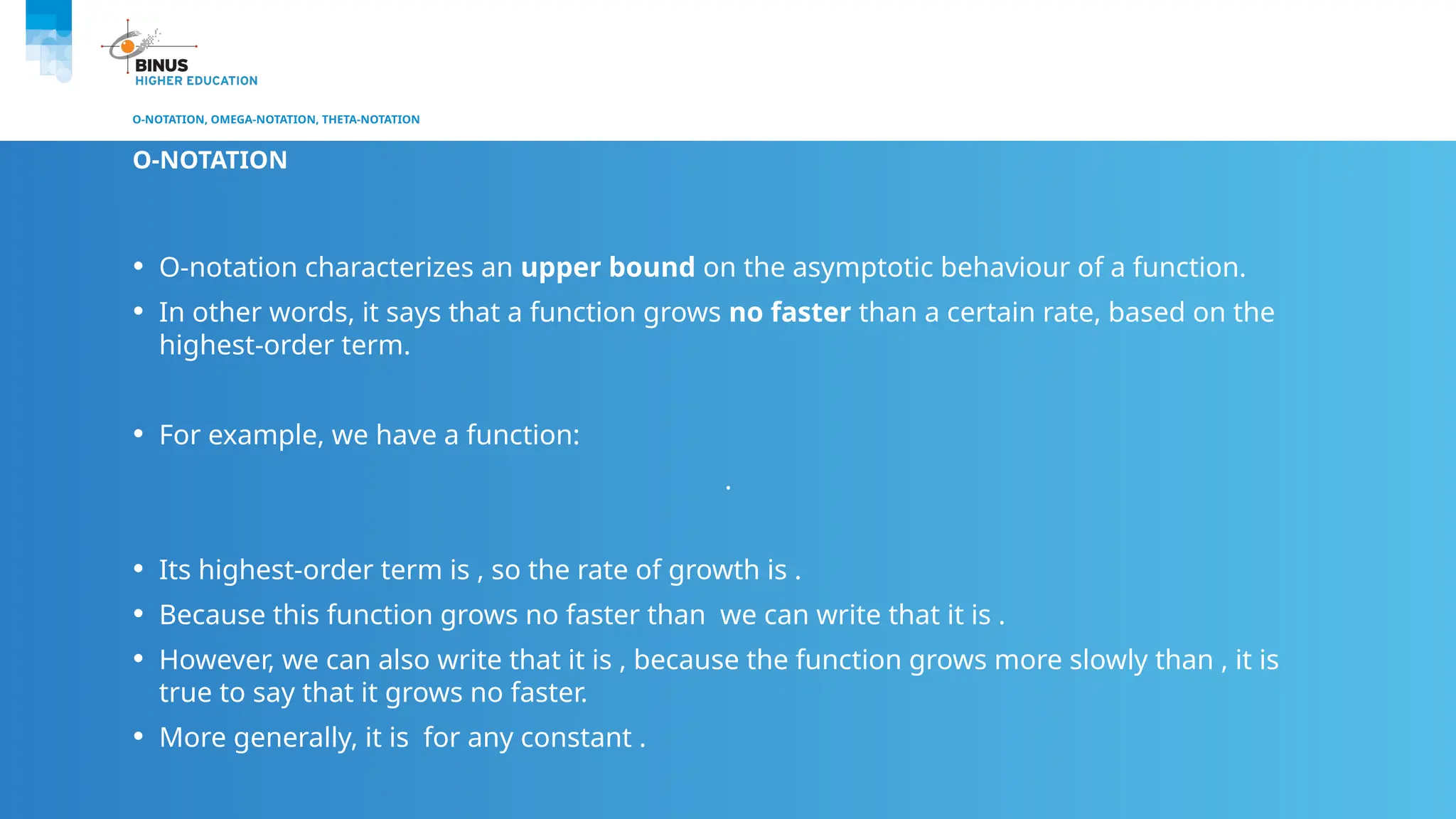
• O-notation characterizes an upper bound on the asymptotic behaviour of a function.
• In other words, it says that a function grows no faster than a certain rate, based on the
highest-order term.
• For example, we have a function:
.
• Its highest-order term is , so the rate of growth is .
• Because this function grows no faster than we can write that it is .
• However, we can also write that it is , because the function grows more slowly than , it is
true to say that it grows no faster.
• More generally, it is for any constant .
O-NOTATION, OMEGA-NOTATION, THETA-NOTATION
OMEGA-NOTATION
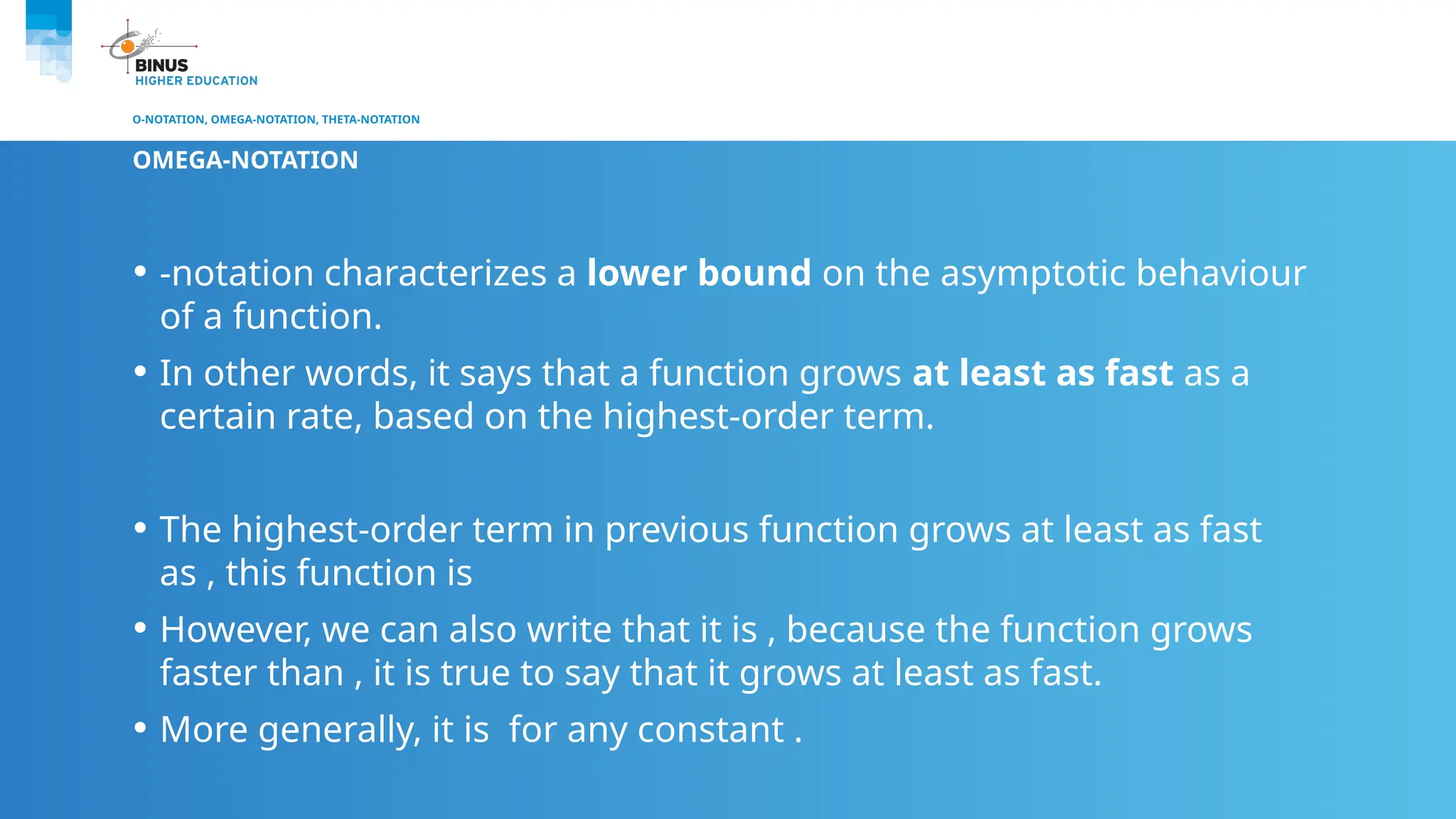
• -notation characterizes a lower bound on the asymptotic behaviour
of a function.
• In other words, it says that a function grows at least as fast as a
certain rate, based on the highest-order term.
• The highest-order term in previous function grows at least as fast
as , this function is
• However, we can also write that it is , because the function grows
faster than , it is true to say that it grows at least as fast.
• More generally, it is for any constant .
O-NOTATION, OMEGA-NOTATION, THETA-NOTATION
THETA-NOTATION
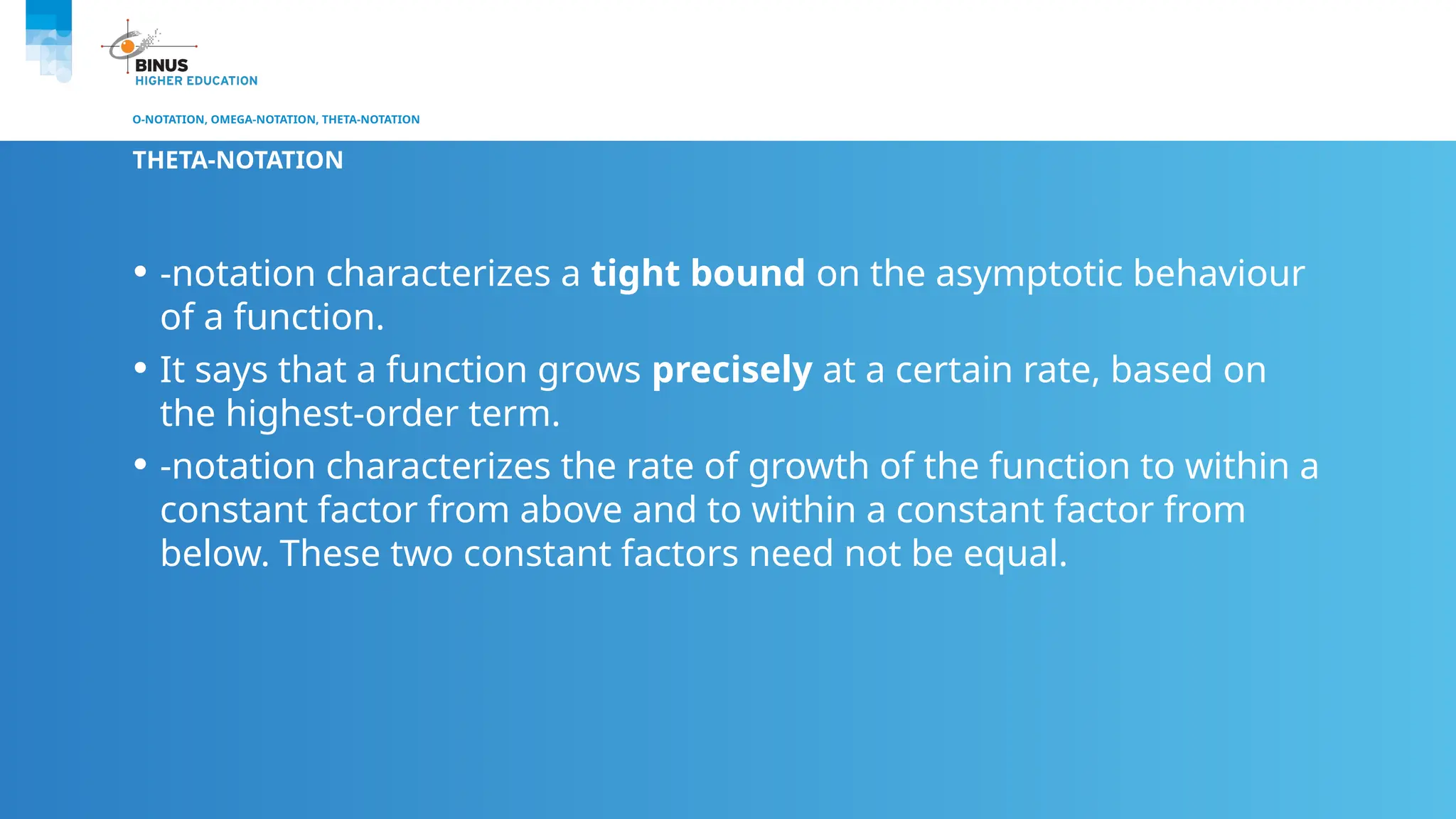
• -notation characterizes a tight bound on the asymptotic behaviour
of a function.
• It says that a function grows precisely at a certain rate, based on
the highest-order term.
• -notation characterizes the rate of growth of the function to within a
constant factor from above and to within a constant factor from
below. These two constant factors need not be equal.
O-NOTATION, OMEGA-NOTATION, THETA-NOTATION
THETA-NOTATION
• So, if you can show that a function is both and for some function ,
then you have shown that the function is also .
• For example, since the previous function is both and , the function
is also .
O-NOTATION, OMEGA-NOTATION, THETA-NOTATION
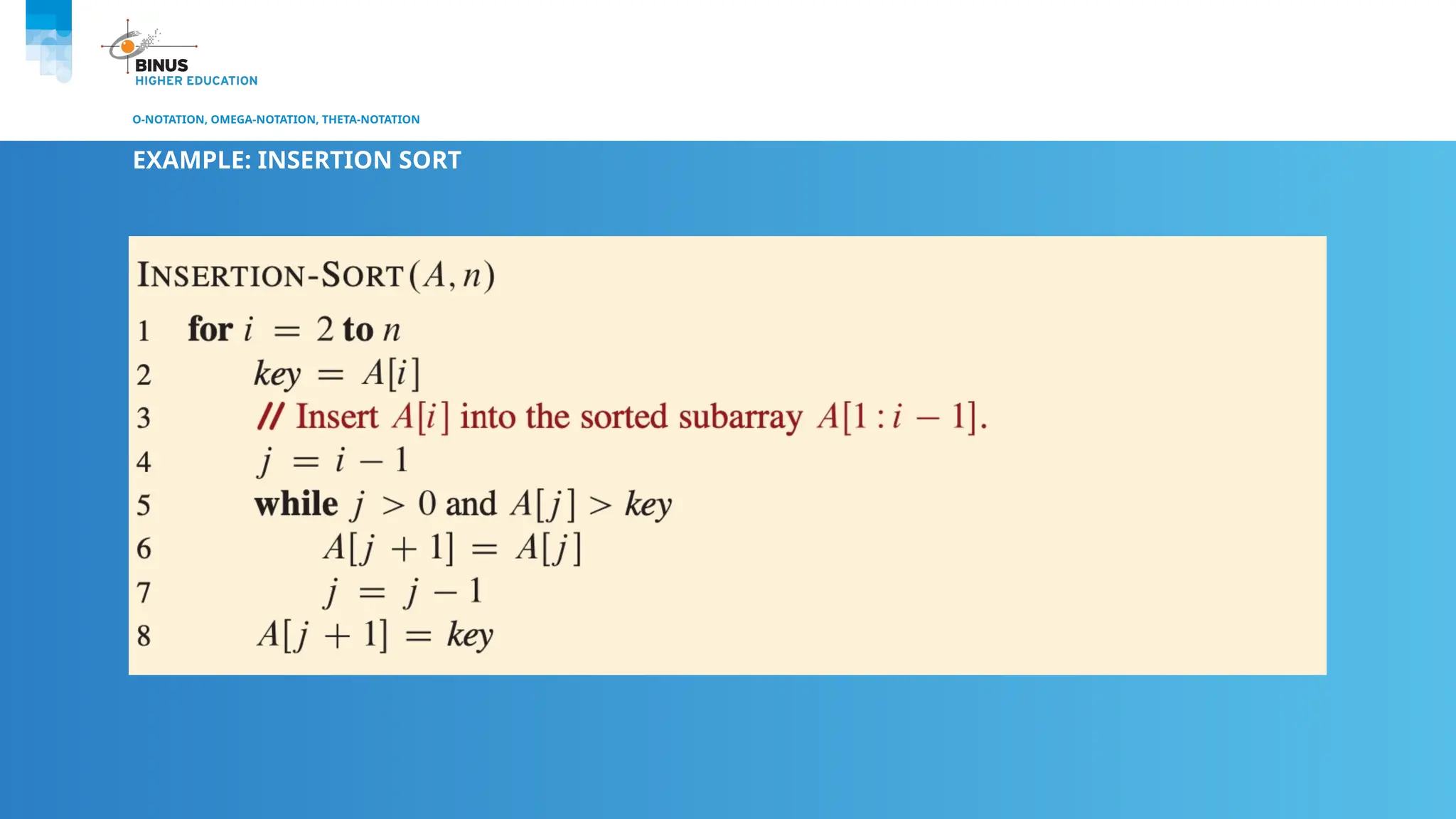
EXAMPLE: INSERTION SORT
O-NOTATION, OMEGA-NOTATION, THETA-NOTATION
EXAMPLE: INSERTION SORT
• From the procedure, we can observe that it has nested loops. The
outer (for) that runs n-1 times and the inner (while) loop which
might runs 0 times, i-1 times, or anywhere in between.
• These observation suffice to deduce an running time for any case
of Insertion-Sort, giving us a blanket statement that covers all
inputs.
• We can also see that the worst-case running time is . It means
that for every input size above a certain threshold, there is at least
one input of size for which the algorithm takes at least time, for
some positive constant .
O-NOTATION, OMEGA-NOTATION, THETA-NOTATION
EXAMPLE: INSERTION SORT
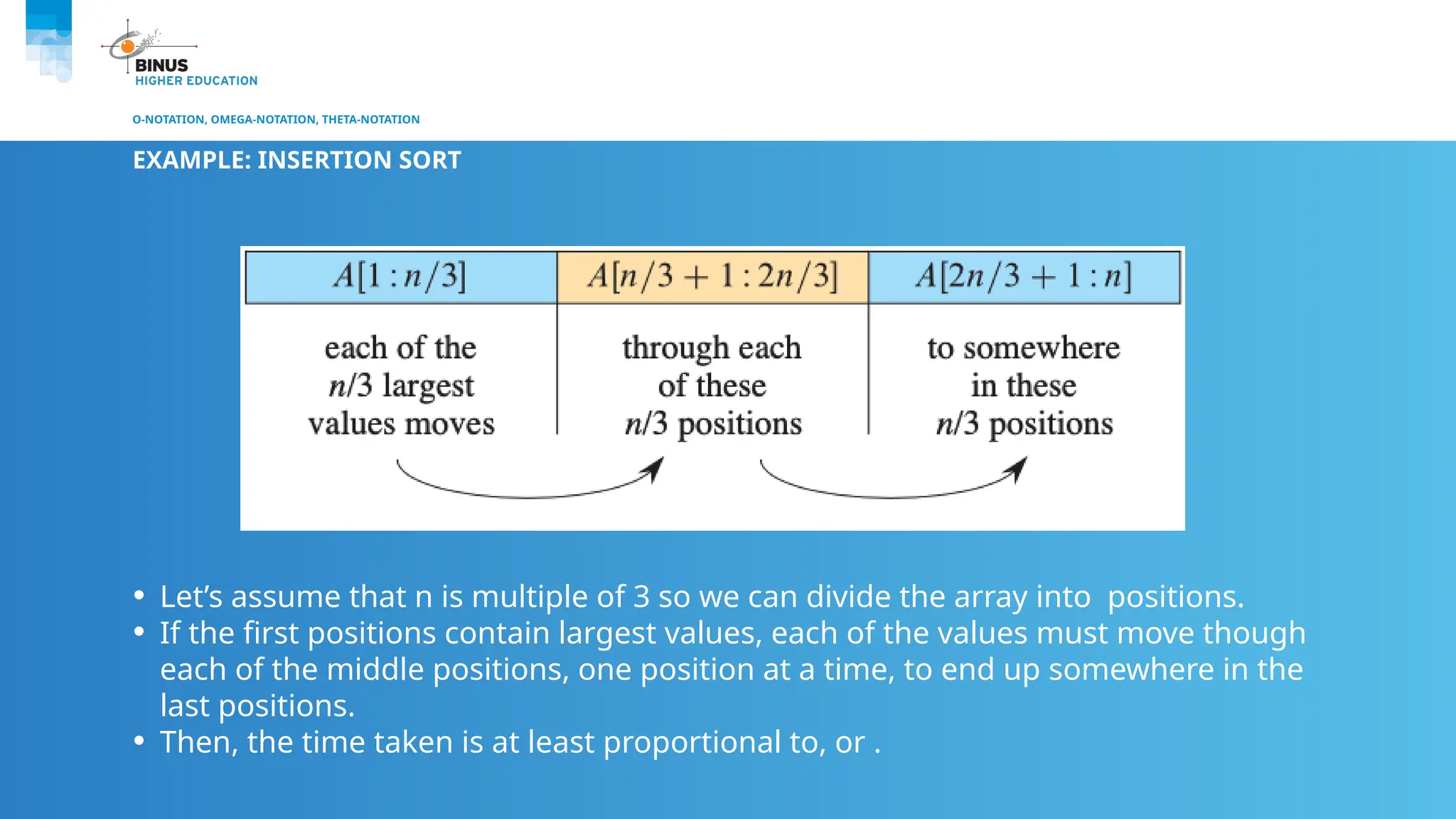
• Let’s assume that n is multiple of 3 so we can divide the array into positions.
• If the first positions contain largest values, each of the values must move though
each of the middle positions, one position at a time, to end up somewhere in the
last positions.
• Then, the time taken is at least proportional to, or .
O-NOTATION, OMEGA-NOTATION, THETA-NOTATION
EXAMPLE: INSERTION SORT
• Because we have shown that Insertion-Sort runs in time in all cases
and that there is an input that makes it take time, we conclude that
the worst-case running time of Insertion sort is
• This argument doesn’t show that it runs in time in all cases.
Indeed, because the best-case running time is .
ASYMPTOTIC NOTATION
FORMAL DEFINITIONS
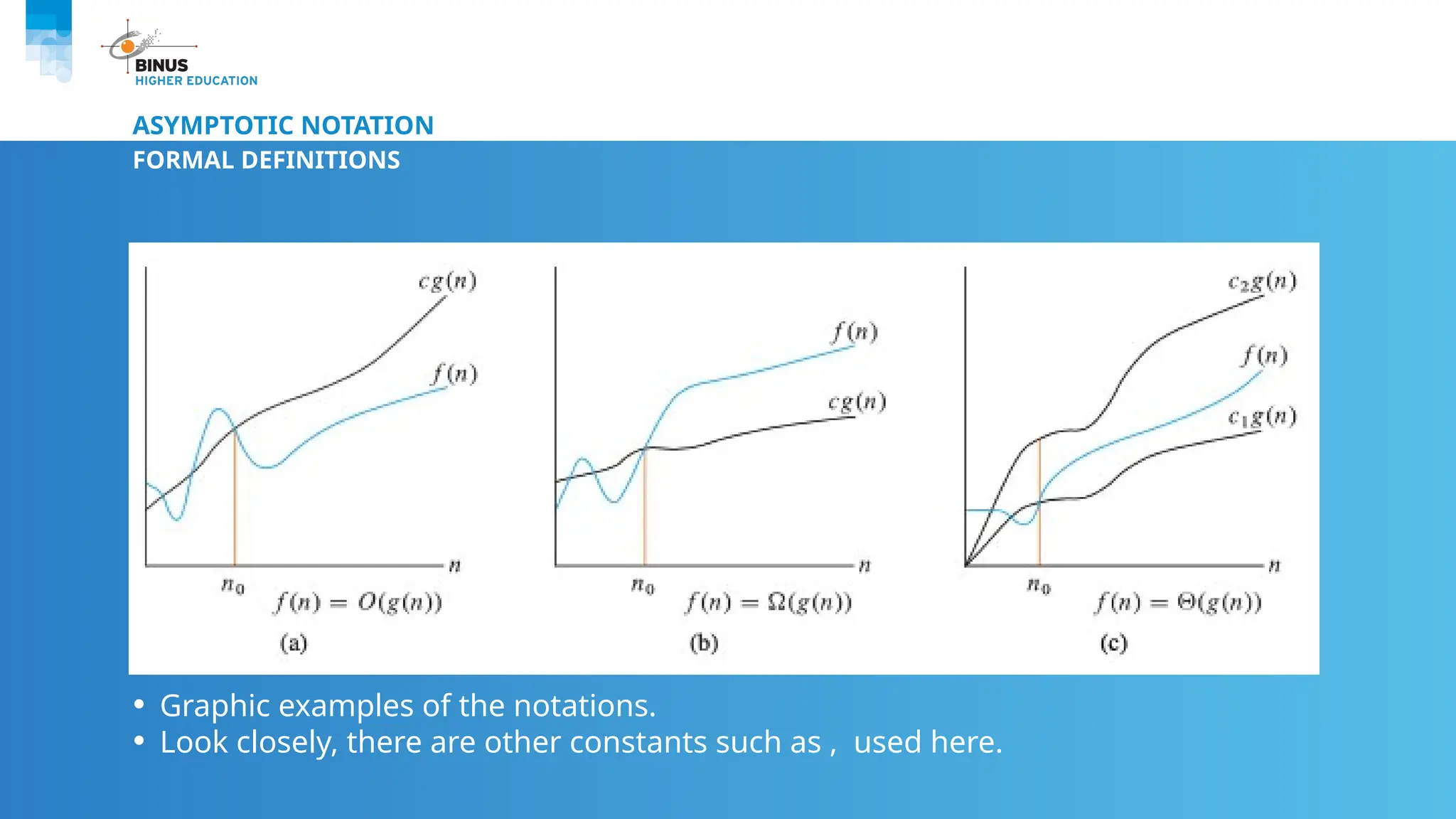
• Graphic examples of the notations.
• Look closely, there are other constants such as , used here.
ASYMPTOTIC NOTATION
FORMAL DEFINITIONS
• -notation (Big-Oh or Oh)
• -notation (Big-Omega or Omega)
• -notation (Big-Theta or Theta)
ASYMPTOTIC NOTATION
FORMAL DEFINITIONS
• These definitions lead to following theorem:
For any two functions and , we have if and only if and .
ASYMPTOTIC NOTATION
FORMAL DEFINITIONS EXAMPLE
• We already shown that , We will show that , even though the lower-
order terms have much larger coefficients than the leading term.
• We need to find positive constants c and such that for all .
• Inequality above is satisfied for many choices of c and .
ASYMPTOTIC NOTATION
FORMAL DEFINITIONS EXAMPLE
• For example, if we choose , then the inequality holds for . if we
choose , then works.
• We already shown that , now let’s show that !
ASYMPTOTIC NOTATION
OTHER FORMAL DEFINITIONS
• -notation (little-oh)
• -notation (little-omega)
ASYMPTOTIC NOTATION
PROPER USE OF ASYMPTOTIC NOTATIONS TO CHARACTERIZE RUNNING TIMES
• Insertion sort:
• We can correctly say that insertion sort’s worst-case running
time is , , and
• Although all three ways are correct, the bound is the most
precise and hence the most preferred.
• We can correctly say that insertion sort’s best-case running time
is , , and
ASYMPTOTIC NOTATION
PROPER USE OF ASYMPTOTIC NOTATIONS TO CHARACTERIZE RUNNING TIMES
• Merge sort:
• Since merge sort runs in time in all cases, we don’t have to
specify worst-case, best-case or any other cases.
• If an algorithm has a running time of in all cases, it’s best to use .
or is also correct, however neither is as useful as writing in this
case.
ASYMPTOTIC NOTATION
WRONG USE OF ASYMPTOTIC NOTATIONS TO CHARACTERIZE RUNNING TIMES
• Insertion sort:
• Insertion sort’s running time is or . <- Overstatement, because
by omitting “worst-case”, we’re left with a blanket statement
covering all cases.
• Insertion sort’s running time is . <- Correct, in all cases, its
running time grows no faster than .
• Insertion sort’s running time is <- Correct, its running time
grows at least as fast as .
ASYMPTOTIC NOTATION
WRONG USE OF ASYMPTOTIC NOTATIONS TO CHARACTERIZE RUNNING TIMES
• People occasionally conflate -notation with -notation by mistakenly
using -notation to indicate an asymptotically tight bound.
• “An -time algorithm runs faster than an -time algorithm”. <-
Incorrect, O-notation denotes only an asymptotic upper bound,
that so-called -time algorithm might run in -time.
STANDARD NOTATIONS AND COMMON FUNCTIONS
MATHEMATICAL FUNCTIONS AND NOTATIONS
• There are several functions and notations that you need to know to
be able to compare asymptotic notations:
• Monotonicity
• Polynomials
• Exponentials
• Logarithms
• Factorials
• Functional iteration
• The iterated logarithm function
• Fibonacci numbers
STANDARD NOTATIONS AND COMMON FUNCTIONS
MATHEMATICAL FUNCTIONS AND NOTATIONS
• Monotonicity
• A function f(n) is monotonically increasing if implies .
• Similarly, it is monotonically decreasing if implies .
• A function f(n) is strictly increasing if implies .
• Similarly, it is strictly decreasing if implies .
STANDARD NOTATIONS AND COMMON FUNCTIONS
MATHEMATICAL FUNCTIONS AND NOTATIONS
• Polynomials
• Given a nonnegative integer d, a polynomial in n of degree d is a
function p(n) of the form
• where the constants a0, a1, …, ad are the coefficients of the
polynomial and ad0.
• Example polynomial in n of degree 4:
STANDARD NOTATIONS AND COMMON FUNCTIONS
MATHEMATICAL FUNCTIONS AND NOTATIONS
• Exponentials
• For all n and a1, the function is monotonically increasing in n.
• where “n” is a variable and “a” is a constant which is called the base of
the function.
• Any exponential function with a base strictly greater than 1 grows faster
than any polynomial function.
• Using e to denote 2.71828…, the base of the natural-logarithm function,
we have for all real x,
STANDARD NOTATIONS AND COMMON FUNCTIONS
MATHEMATICAL FUNCTIONS AND NOTATIONS
• Logarithms
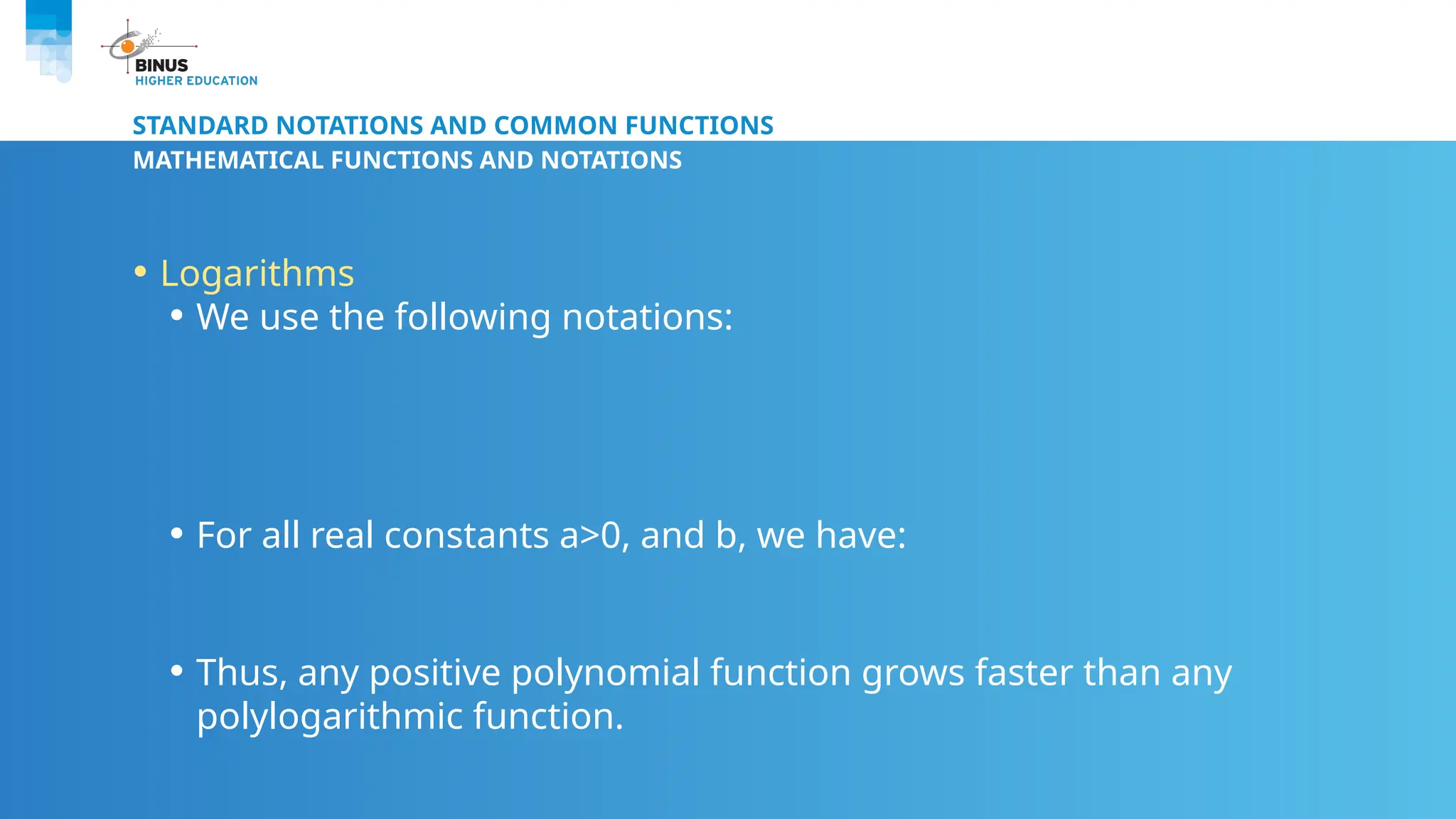
• We use the following notations:
• For all real constants a>0, and b, we have:
• Thus, any positive polynomial function grows faster than any
polylogarithmic function.
STANDARD NOTATIONS AND COMMON FUNCTIONS
MATHEMATICAL FUNCTIONS AND NOTATIONS
• Factorials
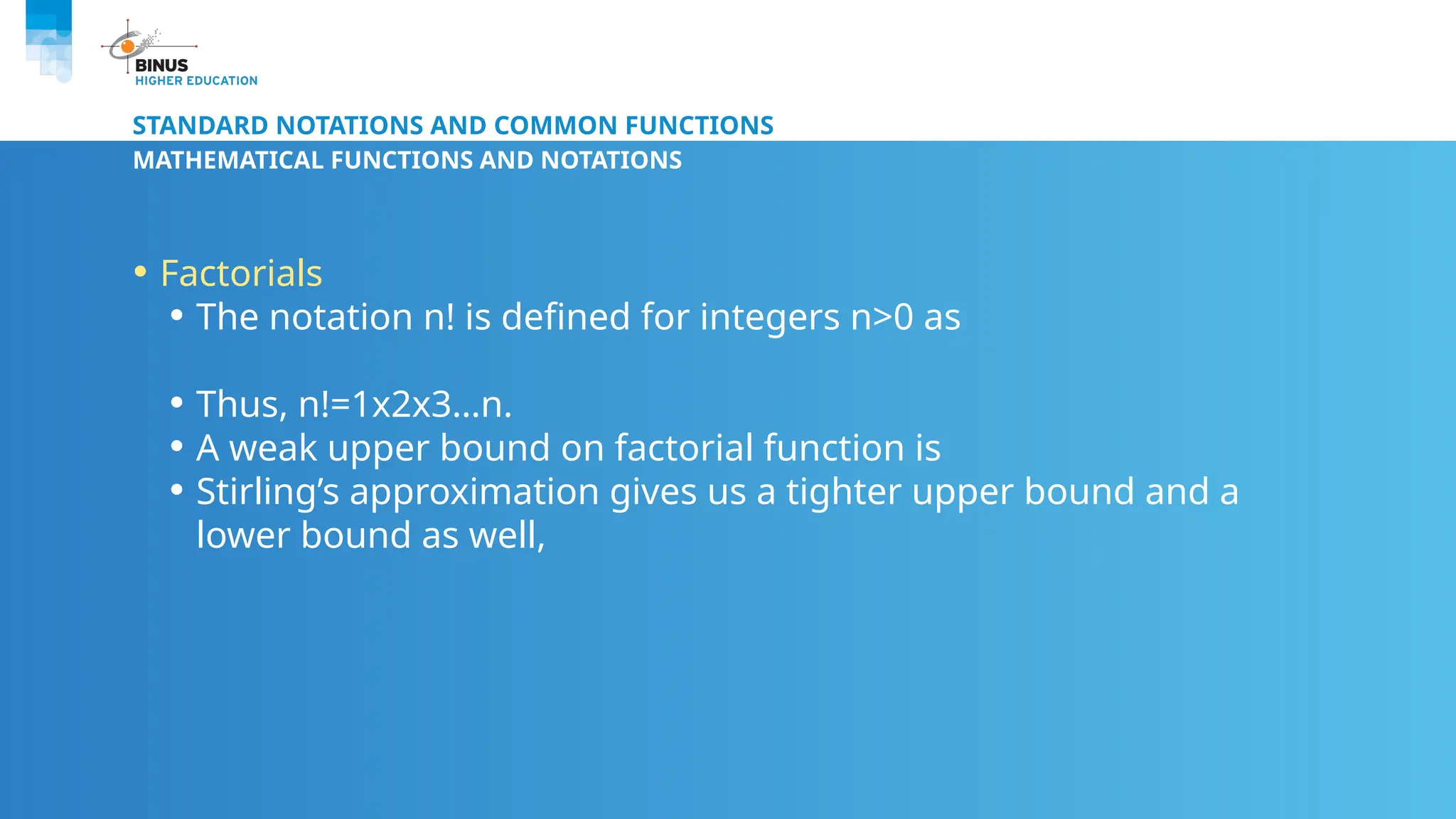
• The notation n! is defined for integers n>0 as
• Thus, n!=1x2x3…n.
• A weak upper bound on factorial function is
• Stirling’s approximation gives us a tighter upper bound and a
lower bound as well,
STANDARD NOTATIONS AND COMMON FUNCTIONS
MATHEMATICAL FUNCTIONS AND NOTATIONS
• Functional iteration
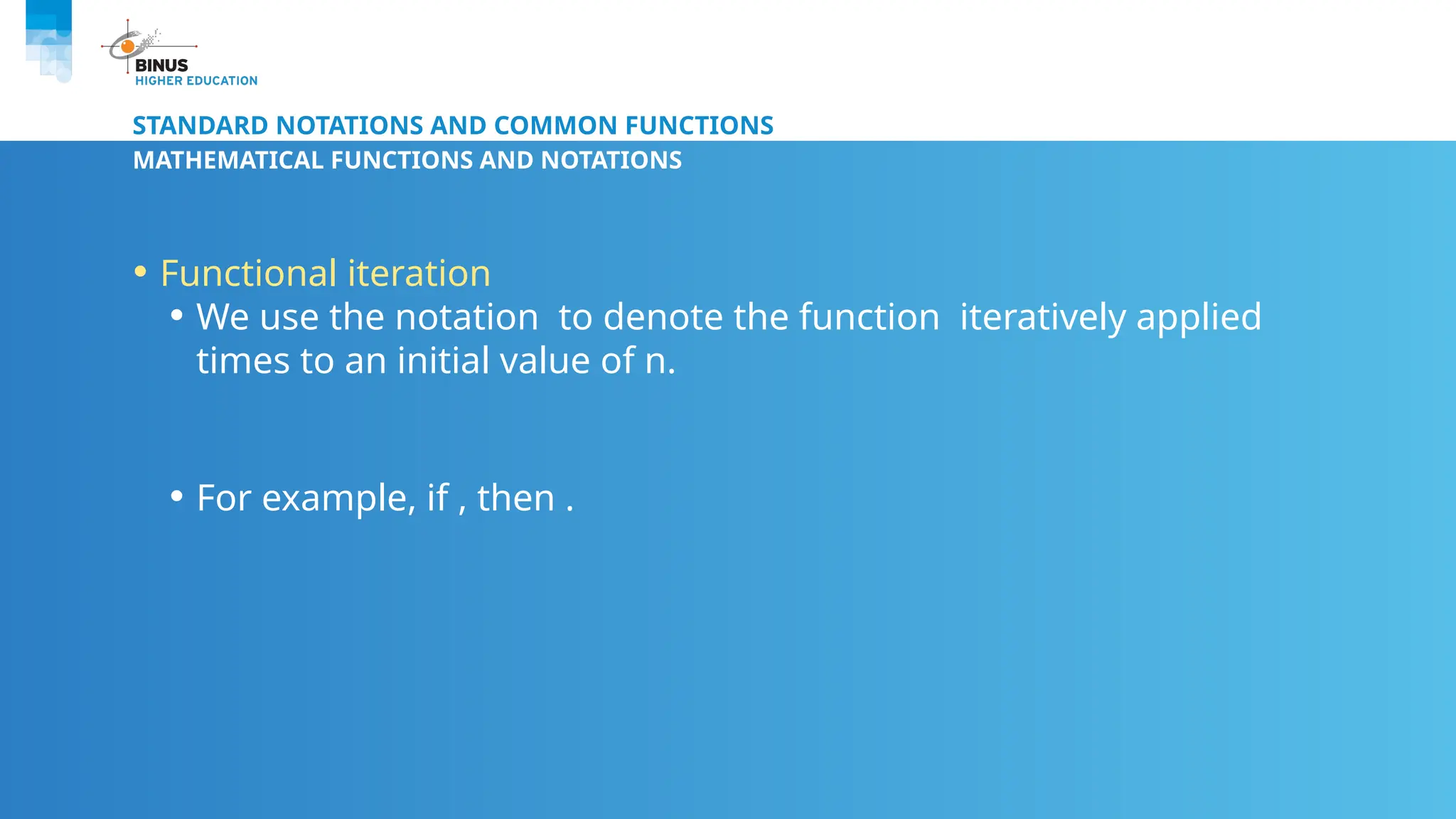
• We use the notation to denote the function iteratively applied
times to an initial value of n.
• For example, if , then .
STANDARD NOTATIONS AND COMMON FUNCTIONS
MATHEMATICAL FUNCTIONS AND NOTATIONS
• Iterated logarithm function
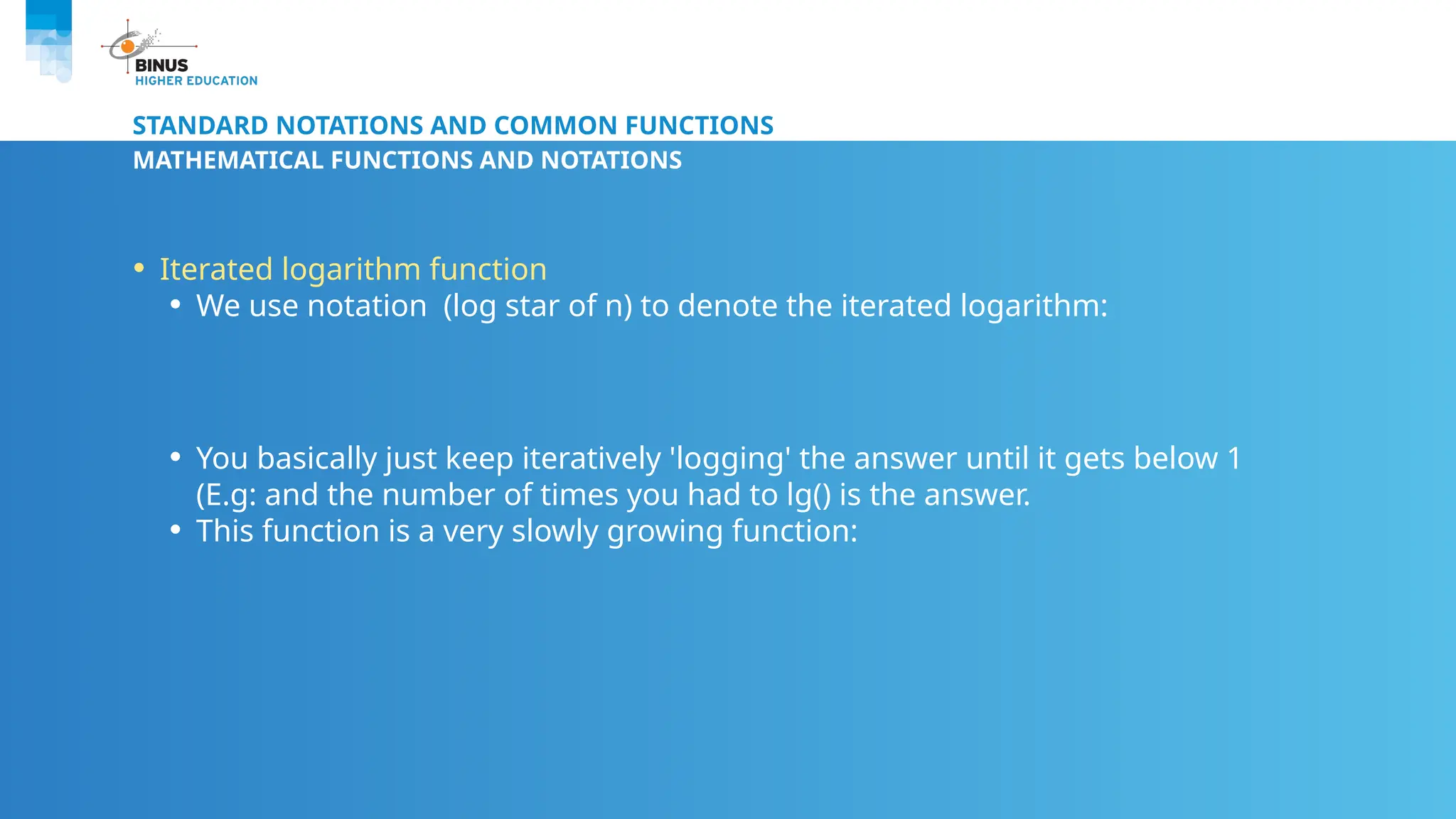
• We use notation (log star of n) to denote the iterated logarithm:
• You basically just keep iteratively 'logging' the answer until it gets below 1
(E.g: and the number of times you had to lg() is the answer.
• This function is a very slowly growing function:
STANDARD NOTATIONS AND COMMON FUNCTIONS
MATHEMATICAL FUNCTIONS AND NOTATIONS
• Fibonacci numbers
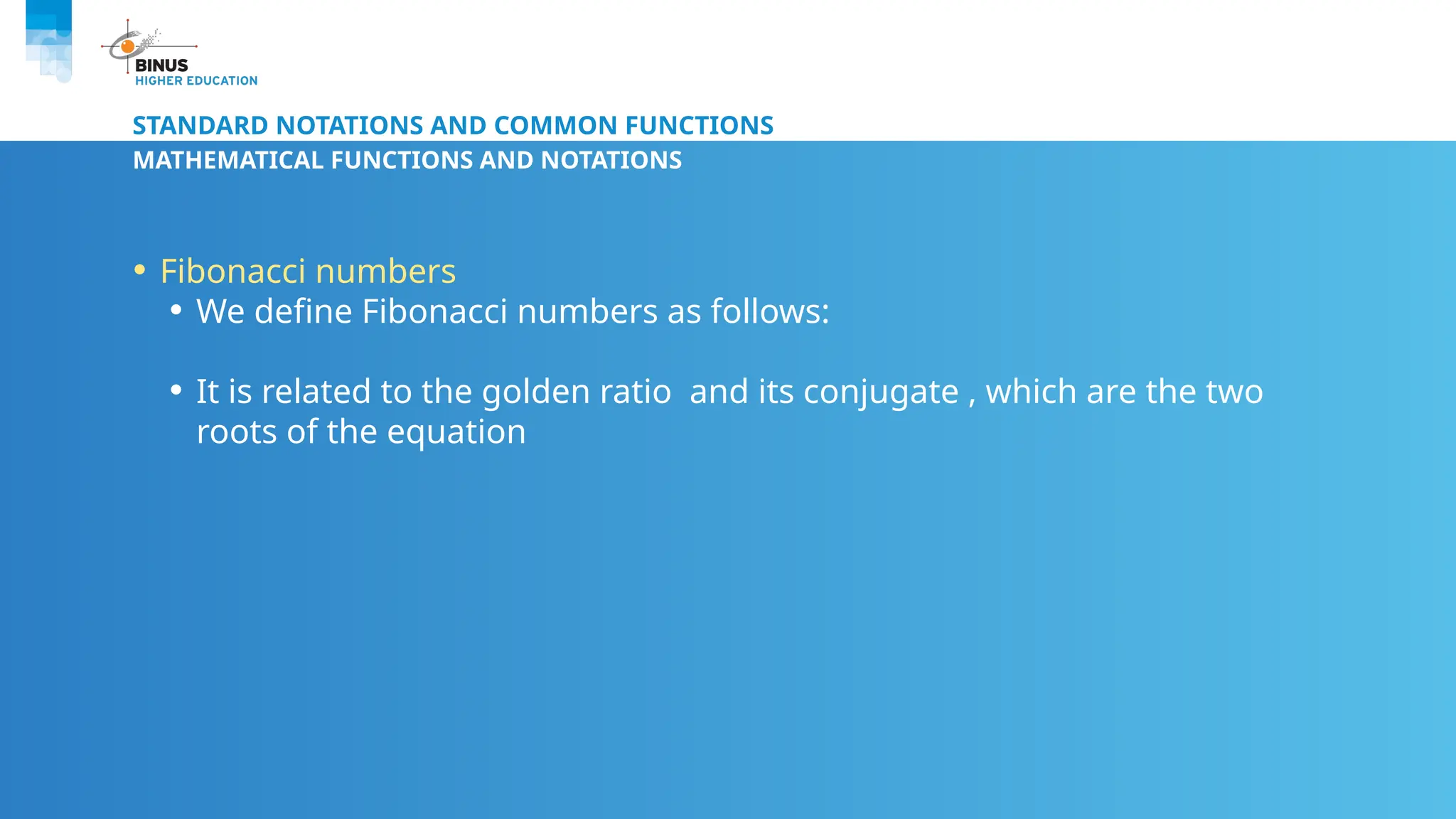
• We define Fibonacci numbers as follows:
• It is related to the golden ratio and its conjugate , which are the two
roots of the equation
SUMMARY
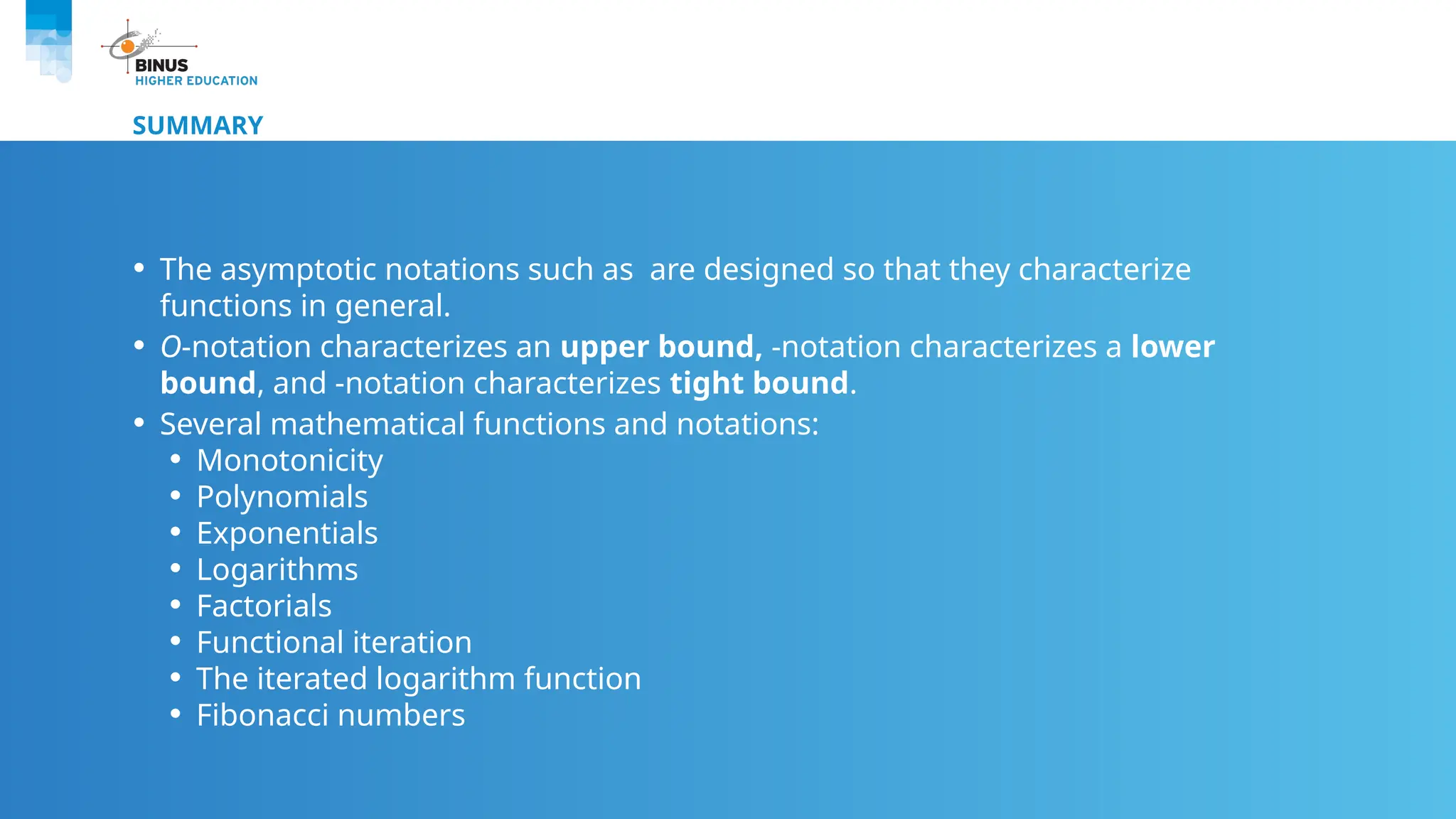
• The asymptotic notations such as are designed so that they characterize
functions in general.
• O-notation characterizes an upper bound, -notation characterizes a lower
bound, and -notation characterizes tight bound.
• Several mathematical functions and notations:
• Monotonicity
• Polynomials
• Exponentials
• Logarithms
• Factorials
• Functional iteration
• The iterated logarithm function
• Fibonacci numbers
EXERCISES
04
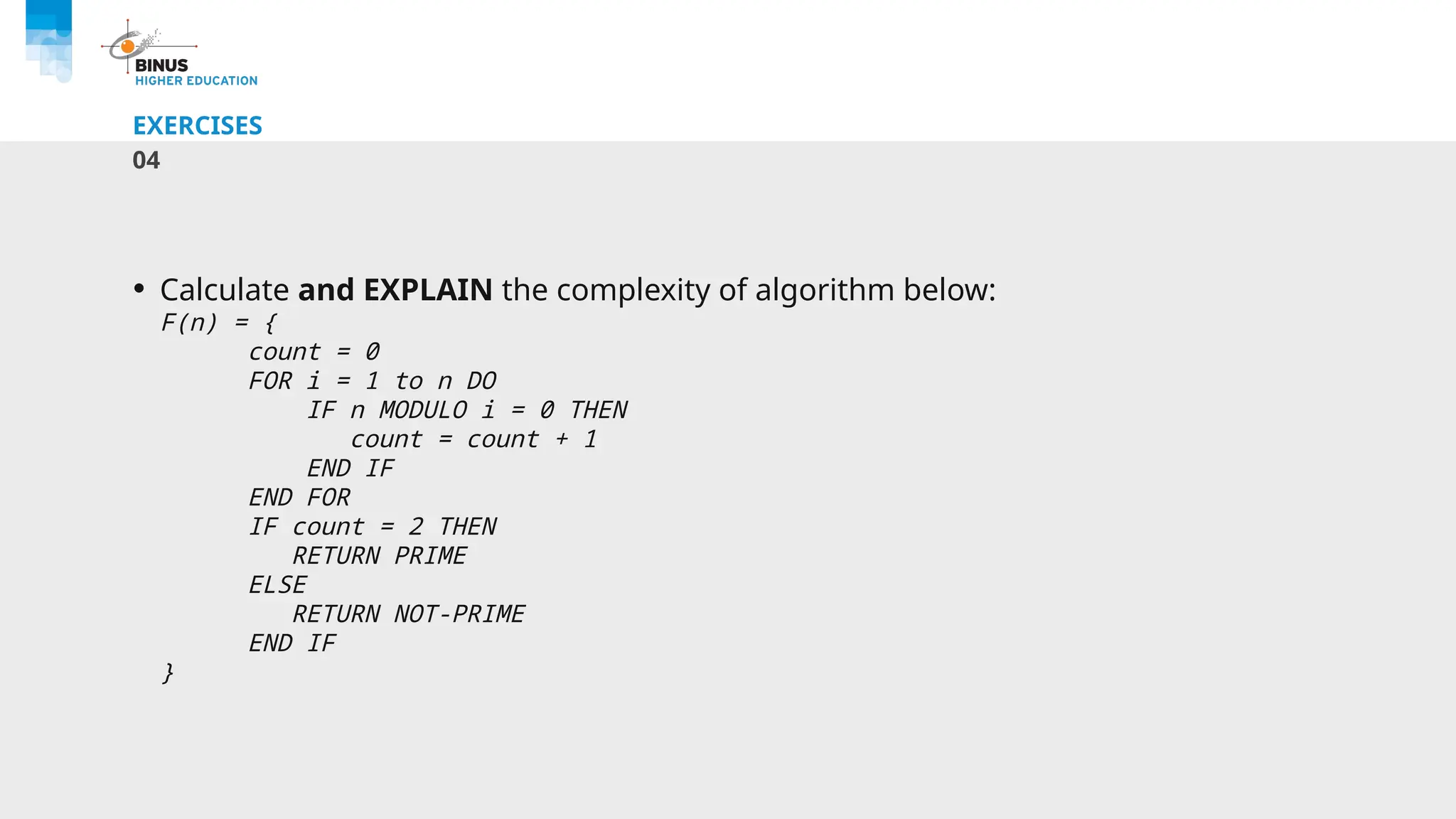
• Calculate and EXPLAIN the complexity of algorithm below:
F(n) = {
count = 0
FOR i = 1 to n DO
IF n MODULO i = 0 THEN
count = count + 1
END IF
END FOR
IF count = 2 THEN
RETURN PRIME
ELSE
RETURN NOT-PRIME
END IF
}
EXERCISES
04
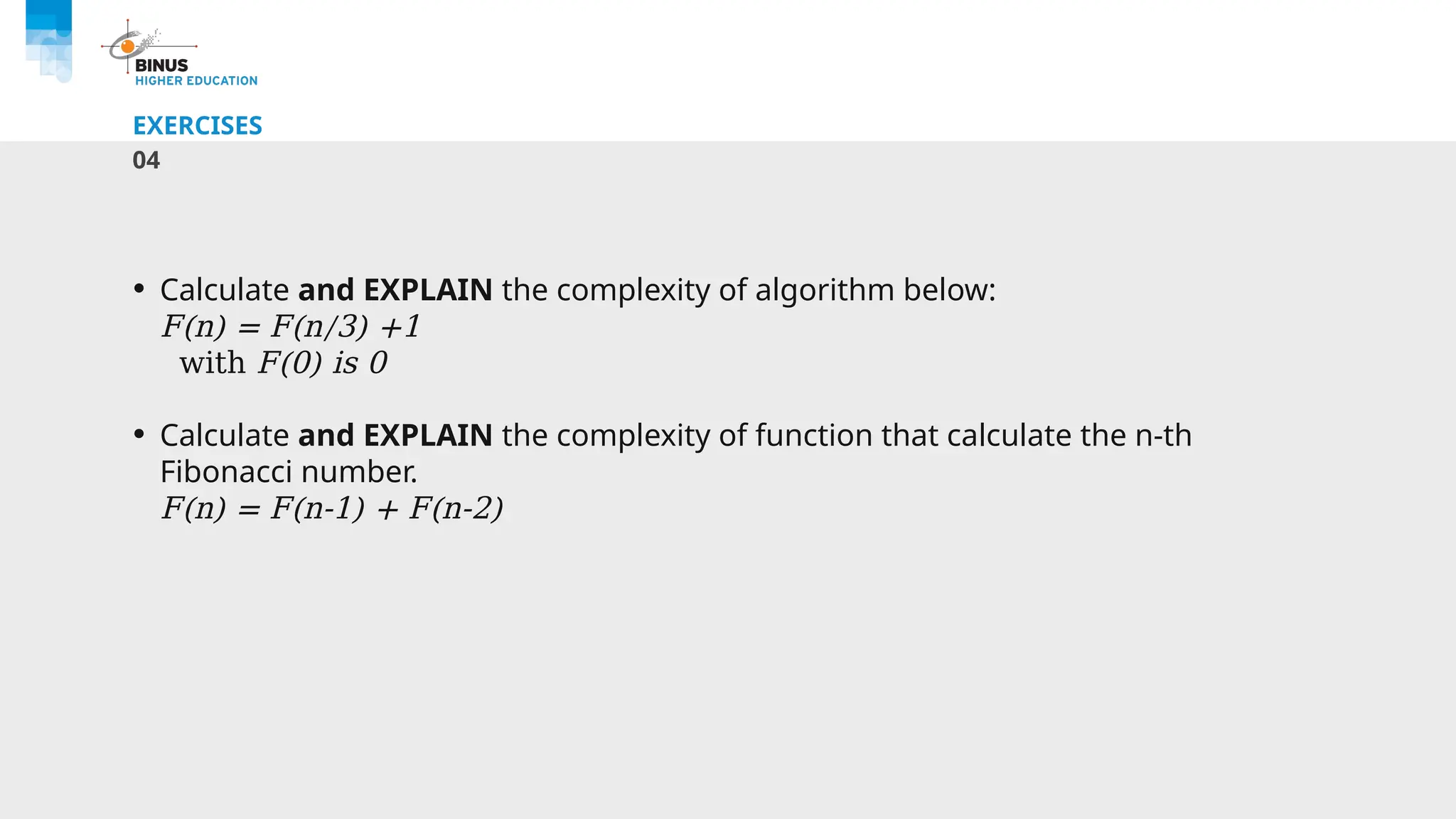
• Calculate and EXPLAIN the complexity of algorithm below:
F(n) = F(n/3) +1
with F(0) is 0
• Calculate and EXPLAIN the complexity of function that calculate the n-th
Fibonacci number.
F(n) = F(n-1) + F(n-2)
EXERCISES
04
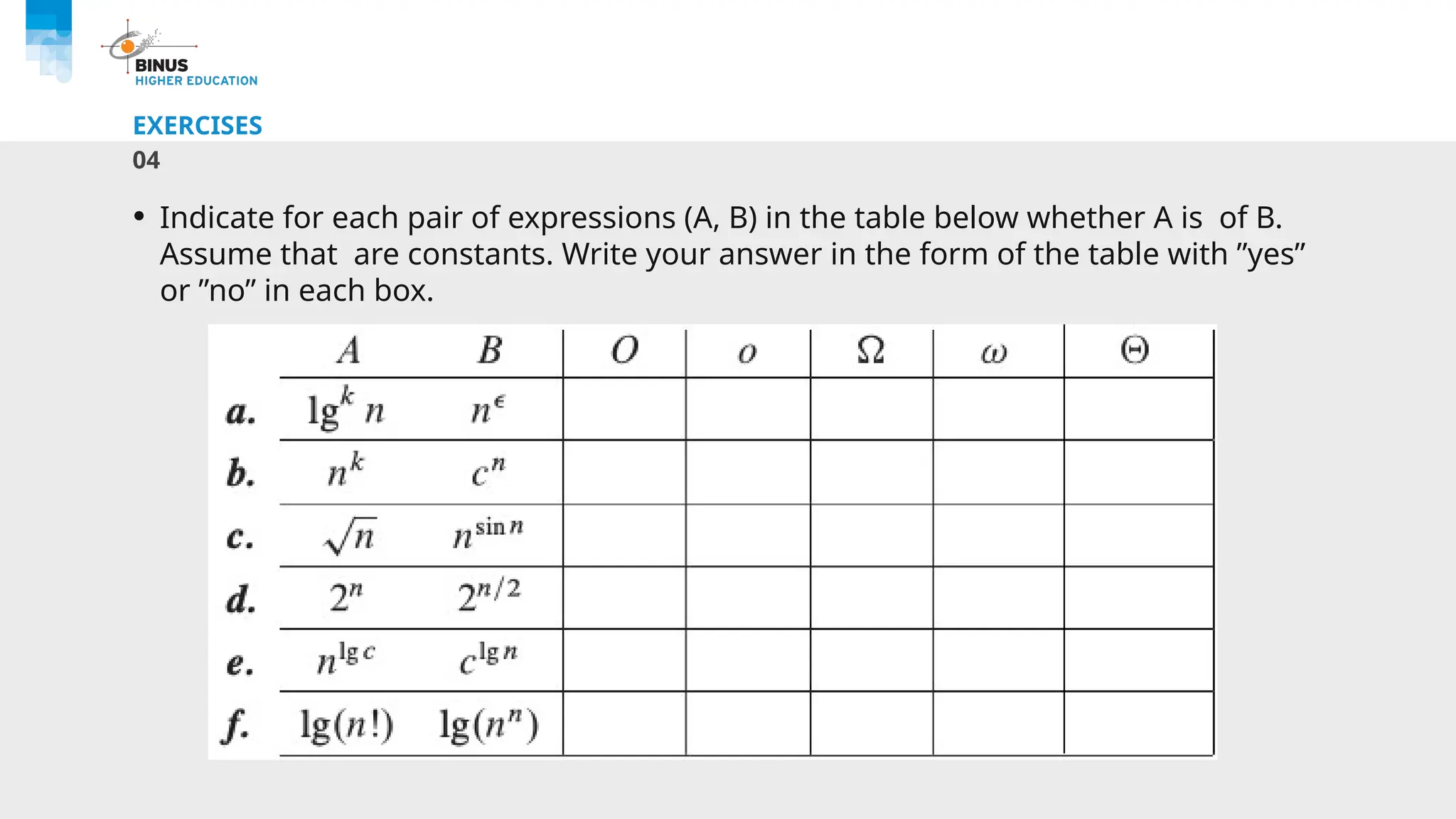
• Indicate for each pair of expressions (A, B) in the table below whether A is of B.
Assume that are constants. Write your answer in the form of the table with ”yes”
or ”no” in each box.
EXERCISES
04
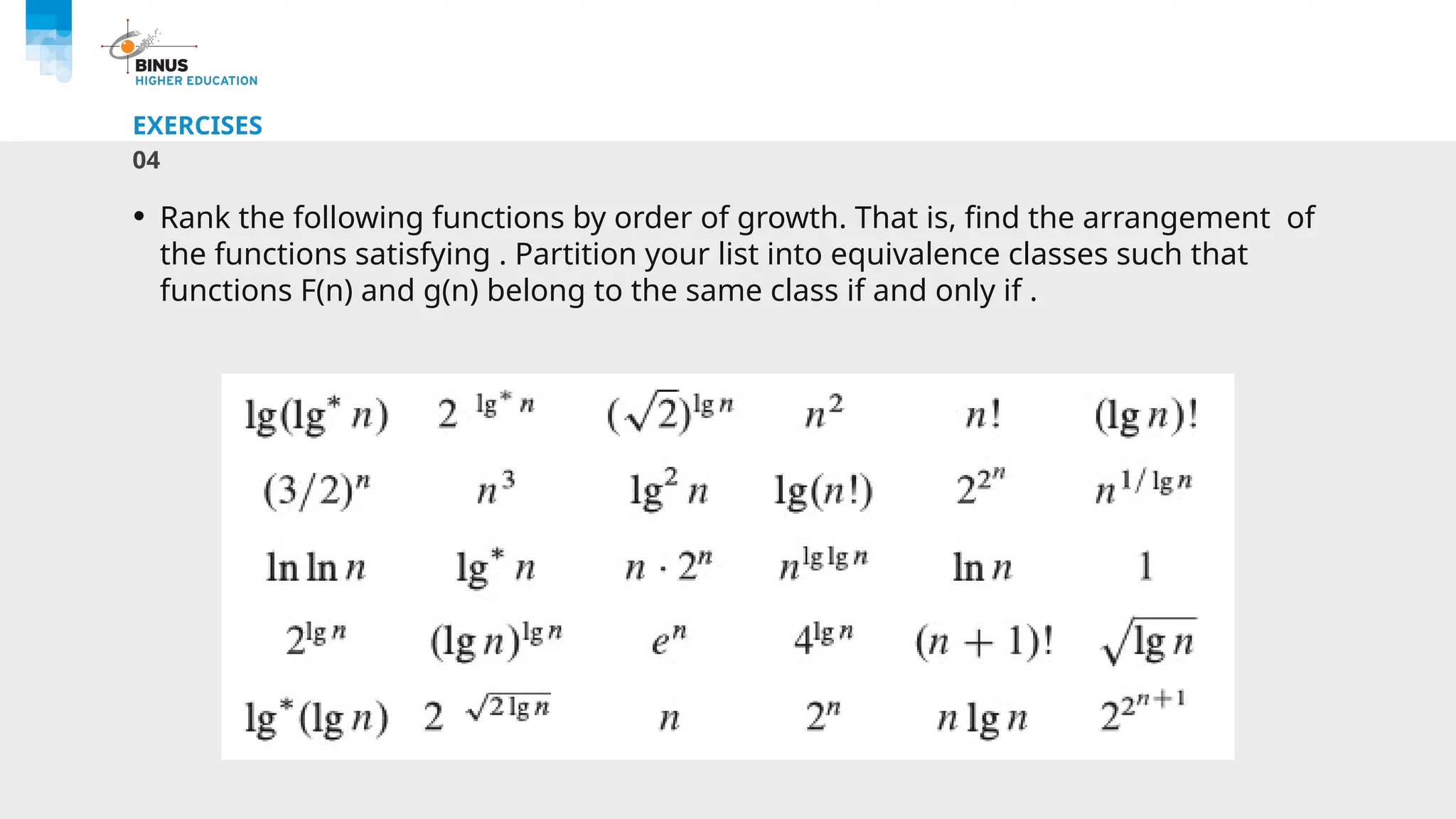
• Rank the following functions by order of growth. That is, find the arrangement of
the functions satisfying . Partition your list into equivalence classes such that
functions F(n) and g(n) belong to the same class if and only if .
REFERENCES
• Thomas H. Cormen. (2022). Introduction to algorithms: Fourth edition. The MIT
Press. Chapter 3.
• S. Sridhar. 2015. Design and Analysis of Algorithms, 1/e. Oxford University Press.
India. Chapter 18
UNIVERSITAS BINA NUSANTARA
Characterizing Running Times
THANK YOU
September, 2023

20230731155326_Pert 4, its about a materi for Algorithm Design Analysis

  • 1.
    SUBJECT MATTER EXPERT Session04 Characterizing Running Times Henry Lucky, S.Kom. M.Kom.
  • 2.
    OUTLINE MATERIALS SESSION 04 •O-notation, Omega-notation, Theta-notation • Asymptotic notation • Standard notations and common functions
  • 3.
    LEARNING OUTCOMES 04 • LO1: Explain fundamental concept of analysis algorithms • LO 2: Apply algorithm techniques and methods • LO 3: Solve a problem using specific algorithm. • LO 4: Compare several algorithm design methods
  • 4.
    O-NOTATION, OMEGA-NOTATION, THETA-NOTATION INFORMALDEFINITION • In previous session, we have learned about -notation. • In short, to characterize running times of algorithms: discard the lower-order terms and the coefficient of the leading term, and use a notation that focuses on the rate of growth of the running time. • -notation is not the only such “asymptotic notation”. We’ll learn about two other asymptotic notations.
  • 5.
    O-NOTATION, OMEGA-NOTATION, THETA-NOTATION INFORMALDEFINITION • Before we get into specifics, bear in mind that the asymptotic notations we’ll see are designed so that they characterize functions in general. • Beside running times, it can also characterize some other aspect of algorithms (e.g. the amount of space they use), or even to functions that have nothing to do with algorithms.
  • 6.
    O-NOTATION, OMEGA-NOTATION, THETA-NOTATION O-NOTATION •O-notation characterizes an upper bound on the asymptotic behaviour of a function. • In other words, it says that a function grows no faster than a certain rate, based on the highest-order term. • For example, we have a function: . • Its highest-order term is , so the rate of growth is . • Because this function grows no faster than we can write that it is . • However, we can also write that it is , because the function grows more slowly than , it is true to say that it grows no faster. • More generally, it is for any constant .
  • 7.
    O-NOTATION, OMEGA-NOTATION, THETA-NOTATION OMEGA-NOTATION •-notation characterizes a lower bound on the asymptotic behaviour of a function. • In other words, it says that a function grows at least as fast as a certain rate, based on the highest-order term. • The highest-order term in previous function grows at least as fast as , this function is • However, we can also write that it is , because the function grows faster than , it is true to say that it grows at least as fast. • More generally, it is for any constant .
  • 8.
    O-NOTATION, OMEGA-NOTATION, THETA-NOTATION THETA-NOTATION •-notation characterizes a tight bound on the asymptotic behaviour of a function. • It says that a function grows precisely at a certain rate, based on the highest-order term. • -notation characterizes the rate of growth of the function to within a constant factor from above and to within a constant factor from below. These two constant factors need not be equal.
  • 9.
    O-NOTATION, OMEGA-NOTATION, THETA-NOTATION THETA-NOTATION •So, if you can show that a function is both and for some function , then you have shown that the function is also . • For example, since the previous function is both and , the function is also .
  • 10.
  • 11.
    O-NOTATION, OMEGA-NOTATION, THETA-NOTATION EXAMPLE:INSERTION SORT • From the procedure, we can observe that it has nested loops. The outer (for) that runs n-1 times and the inner (while) loop which might runs 0 times, i-1 times, or anywhere in between. • These observation suffice to deduce an running time for any case of Insertion-Sort, giving us a blanket statement that covers all inputs. • We can also see that the worst-case running time is . It means that for every input size above a certain threshold, there is at least one input of size for which the algorithm takes at least time, for some positive constant .
  • 12.
    O-NOTATION, OMEGA-NOTATION, THETA-NOTATION EXAMPLE:INSERTION SORT • Let’s assume that n is multiple of 3 so we can divide the array into positions. • If the first positions contain largest values, each of the values must move though each of the middle positions, one position at a time, to end up somewhere in the last positions. • Then, the time taken is at least proportional to, or .
  • 13.
    O-NOTATION, OMEGA-NOTATION, THETA-NOTATION EXAMPLE:INSERTION SORT • Because we have shown that Insertion-Sort runs in time in all cases and that there is an input that makes it take time, we conclude that the worst-case running time of Insertion sort is • This argument doesn’t show that it runs in time in all cases. Indeed, because the best-case running time is .
  • 14.
    ASYMPTOTIC NOTATION FORMAL DEFINITIONS •Graphic examples of the notations. • Look closely, there are other constants such as , used here.
  • 15.
    ASYMPTOTIC NOTATION FORMAL DEFINITIONS •-notation (Big-Oh or Oh) • -notation (Big-Omega or Omega) • -notation (Big-Theta or Theta)
  • 16.
    ASYMPTOTIC NOTATION FORMAL DEFINITIONS •These definitions lead to following theorem: For any two functions and , we have if and only if and .
  • 17.
    ASYMPTOTIC NOTATION FORMAL DEFINITIONSEXAMPLE • We already shown that , We will show that , even though the lower- order terms have much larger coefficients than the leading term. • We need to find positive constants c and such that for all . • Inequality above is satisfied for many choices of c and .
  • 18.
    ASYMPTOTIC NOTATION FORMAL DEFINITIONSEXAMPLE • For example, if we choose , then the inequality holds for . if we choose , then works. • We already shown that , now let’s show that !
  • 19.
    ASYMPTOTIC NOTATION OTHER FORMALDEFINITIONS • -notation (little-oh) • -notation (little-omega)
  • 20.
    ASYMPTOTIC NOTATION PROPER USEOF ASYMPTOTIC NOTATIONS TO CHARACTERIZE RUNNING TIMES • Insertion sort: • We can correctly say that insertion sort’s worst-case running time is , , and • Although all three ways are correct, the bound is the most precise and hence the most preferred. • We can correctly say that insertion sort’s best-case running time is , , and
  • 21.
    ASYMPTOTIC NOTATION PROPER USEOF ASYMPTOTIC NOTATIONS TO CHARACTERIZE RUNNING TIMES • Merge sort: • Since merge sort runs in time in all cases, we don’t have to specify worst-case, best-case or any other cases. • If an algorithm has a running time of in all cases, it’s best to use . or is also correct, however neither is as useful as writing in this case.
  • 22.
    ASYMPTOTIC NOTATION WRONG USEOF ASYMPTOTIC NOTATIONS TO CHARACTERIZE RUNNING TIMES • Insertion sort: • Insertion sort’s running time is or . <- Overstatement, because by omitting “worst-case”, we’re left with a blanket statement covering all cases. • Insertion sort’s running time is . <- Correct, in all cases, its running time grows no faster than . • Insertion sort’s running time is <- Correct, its running time grows at least as fast as .
  • 23.
    ASYMPTOTIC NOTATION WRONG USEOF ASYMPTOTIC NOTATIONS TO CHARACTERIZE RUNNING TIMES • People occasionally conflate -notation with -notation by mistakenly using -notation to indicate an asymptotically tight bound. • “An -time algorithm runs faster than an -time algorithm”. <- Incorrect, O-notation denotes only an asymptotic upper bound, that so-called -time algorithm might run in -time.
  • 24.
    STANDARD NOTATIONS ANDCOMMON FUNCTIONS MATHEMATICAL FUNCTIONS AND NOTATIONS • There are several functions and notations that you need to know to be able to compare asymptotic notations: • Monotonicity • Polynomials • Exponentials • Logarithms • Factorials • Functional iteration • The iterated logarithm function • Fibonacci numbers
  • 25.
    STANDARD NOTATIONS ANDCOMMON FUNCTIONS MATHEMATICAL FUNCTIONS AND NOTATIONS • Monotonicity • A function f(n) is monotonically increasing if implies . • Similarly, it is monotonically decreasing if implies . • A function f(n) is strictly increasing if implies . • Similarly, it is strictly decreasing if implies .
  • 26.
    STANDARD NOTATIONS ANDCOMMON FUNCTIONS MATHEMATICAL FUNCTIONS AND NOTATIONS • Polynomials • Given a nonnegative integer d, a polynomial in n of degree d is a function p(n) of the form • where the constants a0, a1, …, ad are the coefficients of the polynomial and ad0. • Example polynomial in n of degree 4:
  • 27.
    STANDARD NOTATIONS ANDCOMMON FUNCTIONS MATHEMATICAL FUNCTIONS AND NOTATIONS • Exponentials • For all n and a1, the function is monotonically increasing in n. • where “n” is a variable and “a” is a constant which is called the base of the function. • Any exponential function with a base strictly greater than 1 grows faster than any polynomial function. • Using e to denote 2.71828…, the base of the natural-logarithm function, we have for all real x,
  • 28.
    STANDARD NOTATIONS ANDCOMMON FUNCTIONS MATHEMATICAL FUNCTIONS AND NOTATIONS • Logarithms • We use the following notations: • For all real constants a>0, and b, we have: • Thus, any positive polynomial function grows faster than any polylogarithmic function.
  • 29.
    STANDARD NOTATIONS ANDCOMMON FUNCTIONS MATHEMATICAL FUNCTIONS AND NOTATIONS • Factorials • The notation n! is defined for integers n>0 as • Thus, n!=1x2x3…n. • A weak upper bound on factorial function is • Stirling’s approximation gives us a tighter upper bound and a lower bound as well,
  • 30.
    STANDARD NOTATIONS ANDCOMMON FUNCTIONS MATHEMATICAL FUNCTIONS AND NOTATIONS • Functional iteration • We use the notation to denote the function iteratively applied times to an initial value of n. • For example, if , then .
  • 31.
    STANDARD NOTATIONS ANDCOMMON FUNCTIONS MATHEMATICAL FUNCTIONS AND NOTATIONS • Iterated logarithm function • We use notation (log star of n) to denote the iterated logarithm: • You basically just keep iteratively 'logging' the answer until it gets below 1 (E.g: and the number of times you had to lg() is the answer. • This function is a very slowly growing function:
  • 32.
    STANDARD NOTATIONS ANDCOMMON FUNCTIONS MATHEMATICAL FUNCTIONS AND NOTATIONS • Fibonacci numbers • We define Fibonacci numbers as follows: • It is related to the golden ratio and its conjugate , which are the two roots of the equation
  • 33.
    SUMMARY • The asymptoticnotations such as are designed so that they characterize functions in general. • O-notation characterizes an upper bound, -notation characterizes a lower bound, and -notation characterizes tight bound. • Several mathematical functions and notations: • Monotonicity • Polynomials • Exponentials • Logarithms • Factorials • Functional iteration • The iterated logarithm function • Fibonacci numbers
  • 34.
    EXERCISES 04 • Calculate andEXPLAIN the complexity of algorithm below: F(n) = { count = 0 FOR i = 1 to n DO IF n MODULO i = 0 THEN count = count + 1 END IF END FOR IF count = 2 THEN RETURN PRIME ELSE RETURN NOT-PRIME END IF }
  • 35.
    EXERCISES 04 • Calculate andEXPLAIN the complexity of algorithm below: F(n) = F(n/3) +1 with F(0) is 0 • Calculate and EXPLAIN the complexity of function that calculate the n-th Fibonacci number. F(n) = F(n-1) + F(n-2)
  • 36.
    EXERCISES 04 • Indicate foreach pair of expressions (A, B) in the table below whether A is of B. Assume that are constants. Write your answer in the form of the table with ”yes” or ”no” in each box.
  • 37.
    EXERCISES 04 • Rank thefollowing functions by order of growth. That is, find the arrangement of the functions satisfying . Partition your list into equivalence classes such that functions F(n) and g(n) belong to the same class if and only if .
  • 38.
    REFERENCES • Thomas H.Cormen. (2022). Introduction to algorithms: Fourth edition. The MIT Press. Chapter 3. • S. Sridhar. 2015. Design and Analysis of Algorithms, 1/e. Oxford University Press. India. Chapter 18
  • 39.
    UNIVERSITAS BINA NUSANTARA CharacterizingRunning Times THANK YOU September, 2023

Editor's Notes

  • #8 Theta-notation characterizes the rate of growth of a function by providing both an upper bound (big-O) and a lower bound (Omega) on the function's growth rate. When we say "the factors need not be equal," it means that the constant factors multiplying the upper bound and lower bound terms in the notation may differ. For example, if a function has an upper bound of O(n^2) and a lower bound of Omega(n), the factors in front of n^2 and n can be different. The upper bound might be represented by a constant factor of, say, 5n^2, while the lower bound could be represented by a constant factor of 0.5n.

  • #9 Theta-notation characterizes the rate of growth of a function by providing both an upper bound (big-O) and a lower bound (Omega) on the function's growth rate. When we say "the factors need not be equal," it means that the constant factors multiplying the upper bound and lower bound terms in the notation may differ. For example, if a function has an upper bound of O(n^2) and a lower bound of Omega(n), the factors in front of n^2 and n can be different. The upper bound might be represented by a constant factor of, say, 5n^2, while the lower bound could be represented by a constant factor of 0.5n.