MT 3D
Your Partner in Metal 3D Printing
28/10/2015 Metal Technics 3D 1
Company Info
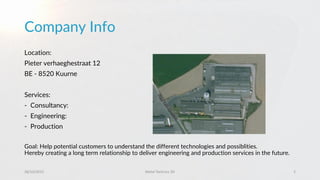
Location:
Pieter verhaeghestraat 12
BE - 8520 Kuurne
Services:
- Consultancy:
- Engineering:
- Production
Goal: Help potential customers to understand the different technologies and possiblities.
Hereby creating a long term relationship to deliver engineering and production services in the future.
28/10/2015 Metal Technics 3D 2
Technology
28/10/2015 Metal Technics 3D 3
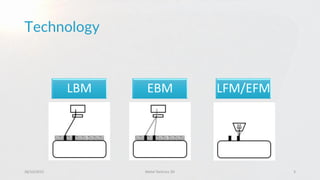
LBM EBM LFM/EFM
Technology
28/10/2015 Metal Technics 3D 4
Technology
28/10/2015 Metal Technics 3D 5
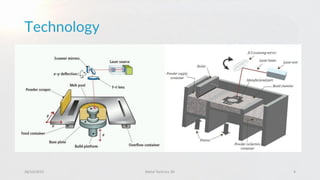
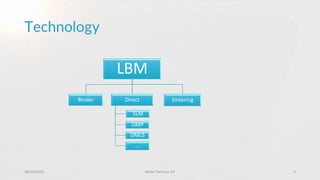
LBM
Binder Direct
SLM
DMLS
DMP
….
Sintering
Technology
28/10/2015 Metal Technics 3D 6
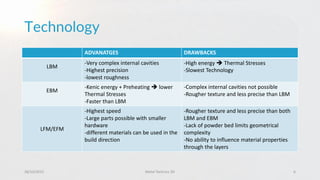
ADVANATGES DRAWBACKS
LBM
-Very complex internal cavities
-Highest precision
-lowest roughness
-High energy  Thermal Stresses
-Slowest Technology
EBM
-Kenic energy + Preheating  lower
Thermal Stresses
-Faster than LBM
-Complex internal cavities not possible
-Rougher texture and less precise than LBM
LFM/EFM
-Highest speed
-Large parts possible with smaller
hardware
-different materials can be used in the
build direction
-Rougher texture and less precise than both
LBM and EBM
-Lack of powder bed limits geometrical
complexity
-No ability to influence material properties
through the layers
Terminology
28/10/2015 Metal Technics 3D 7
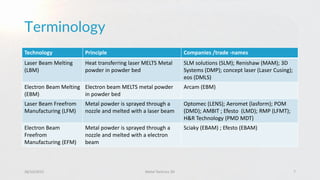
Technology Principle Companies /trade -names
Laser Beam Melting
(LBM)
Heat transferring laser MELTS Metal
powder in powder bed
SLM solutions (SLM); Renishaw (MAM); 3D
Systems (DMP); concept laser (Laser Cusing);
eos (DMLS)
Electron Beam Melting
(EBM)
Electron beam MELTS metal powder
in powder bed
Arcam (EBM)
Laser Beam Freefrom
Manufacturing (LFM)
Metal powder is sprayed through a
nozzle and melted with a laser beam
Optomec (LENS); Aeromet (lasform); POM
(DMD); AMBIT ; Efesto (LMD); RMP (LFMT);
H&R Technology (PMD MDT)
Electron Beam
Freefrom
Manufacturing (EFM)
Metal powder is sprayed through a
nozzle and melted with a electron
beam
Sciaky (EBAM) ; Efesto (EBAM)
Terminology
28/10/2015 Metal Technics 3D 8
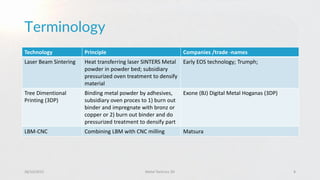
Technology Principle Companies /trade -names
Laser Beam Sintering Heat transferring laser SINTERS Metal
powder in powder bed; subsidiary
pressurized oven treatment to densify
material
Early EOS technology; Trumph;
Tree Dimentional
Printing (3DP)
Binding metal powder by adhesives,
subsidiary oven proces to 1) burn out
binder and impregnate with bronz or
copper or 2) burn out binder and do
pressurized treatment to densify part
Exone (BJ) Digital Metal Hoganas (3DP)
LBM-CNC Combining LBM with CNC milling Matsura
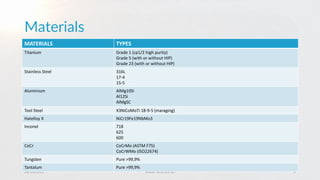
Materials
28/10/2015 Metal Technics 3D 9
MATERIALS TYPES
Titanium Grade 1 (cp1/2 high purity)
Grade 5 (with or without HIP)
Grade 23 (with or without HIP)
Stainless Steel 316L
17-4
15-5
Aluminium AlMg10Si
Al12Si
AlMgSC
Tool Steel X3NiCoMoTi 18-9-5 (maraging)
Hatelloy X NiCr19Fe19NbMo3
Inconel 718
625
600
CoCr CoCrMo (ASTM F75)
CoCrWMo (ISO22674)
Tungsten Pure >99,9%
Tantalum Pure >99,9%
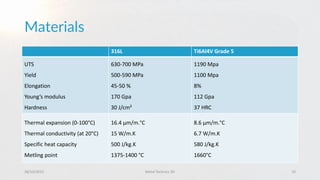
Materials
28/10/2015 Metal Technics 3D 10
316L Ti6Al4V Grade 5
UTS
Yield
Elongation
Young’s modulus
Hardness
630-700 MPa
500-590 MPa
45-50 %
170 Gpa
30 J/cm²
1190 Mpa
1100 Mpa
8%
112 Gpa
37 HRC
Thermal expansion (0-100°C)
Thermal conductivity (at 20°C)
Specific heat capacity
Metling point
16.4 µm/m.°C
15 W/m.K
500 J/kg.K
1375-1400 °C
8.6 µm/m.°C
6.7 W/m.K
580 J/kg.K
1660°C
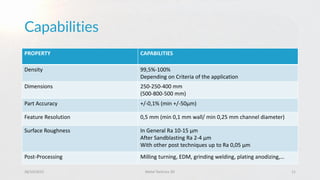
Capabilities
28/10/2015 Metal Technics 3D 11
PROPERTY CAPABILITIES
Density 99,5%-100%
Depending on Criteria of the application
Dimensions 250-250-400 mm
(500-800-500 mm)
Part Accuracy +/-0,1% (min +/-50µm)
Feature Resolution 0,5 mm (min 0,1 mm wall/ min 0,25 mm channel diameter)
Surface Roughness In General Ra 10-15 µm
After Sandblasting Ra 2-4 µm
With other post techniques up to Ra 0,05 µm
Post-Processing Milling turning, EDM, grinding welding, plating anodizing,…
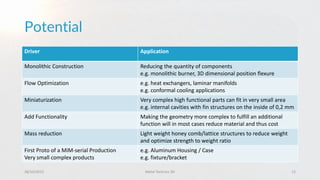
Potential
28/10/2015 Metal Technics 3D 12
Driver Application
Monolithic Construction Reducing the quantity of components
e.g. monolithic burner, 3D dimensional position flexure
Flow Optimization e.g. heat exchangers, laminar manifolds
e.g. conformal cooling applications
Miniaturization Very complex high functional parts can fit in very small area
e.g. internal cavities with fin structures on the inside of 0,2 mm
Add Functionality Making the geometry more complex to fulfill an additional
function will in most cases reduce material and thus cost
Mass reduction Light weight honey comb/lattice structures to reduce weight
and optimize strength to weight ratio
First Proto of a MiM-serial Production
Very small complex products
e.g. Aluminum Housing / Case
e.g. fixture/bracket
Design Rules
28/10/2015 Metal Technics 3D 13
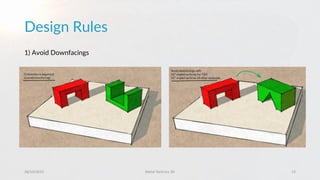
1) Avoid Downfacings
Design Rules
28/10/2015 Metal Technics 3D 14
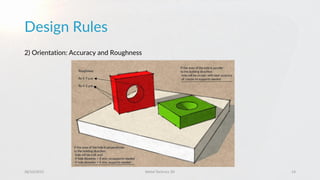
2) Orientation: Accuracy and Roughness
Design Rules
28/10/2015 Metal Technics 3D 15
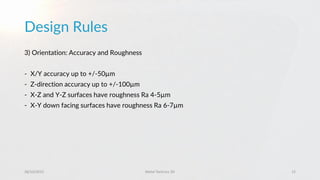
3) Orientation: Accuracy and Roughness
- X/Y accuracy up to +/-50µm
- Z-direction accuracy up to +/-100µm
- X-Z and Y-Z surfaces have roughness Ra 4-5µm
- X-Y down facing surfaces have roughness Ra 6-7µm
Design Rules
28/10/2015 Metal Technics 3D 16
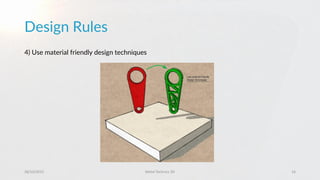
4) Use material friendly design techniques
Design Rules
28/10/2015 Metal Technics 3D 17
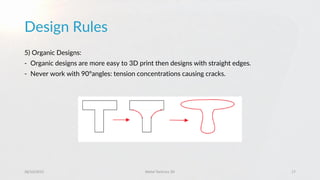
5) Organic Designs:
- Organic designs are more easy to 3D print then designs with straight edges.
- Never work with 90°angles: tension concentrations causing cracks.
Design Rules
28/10/2015 Metal Technics 3D 18
6) Design Checks:
- Down facing surfaces in internal cavities > 45°?
- Channel diameter < Ø 8 mm?
- Sealed cavities?
- Are supports accessible for removal
MT 3D
Pieter Verhaeghestraat 12
8520, Kuurne
Ir. Thomas Bossuyt
T +32 (0)56 37 02 60
M +32 (0)479 55 19 13
www.metaltechnics3D.com
Thomas.Bossuyt@metaltechnics3D.com
28/10/2015 Metal Technics 3D 19

2015-10-28 Metal 3DP Possibilities

  • 1.
    MT 3D Your Partnerin Metal 3D Printing 28/10/2015 Metal Technics 3D 1
  • 2.
    Company Info Location: Pieter verhaeghestraat12 BE - 8520 Kuurne Services: - Consultancy: - Engineering: - Production Goal: Help potential customers to understand the different technologies and possiblities. Hereby creating a long term relationship to deliver engineering and production services in the future. 28/10/2015 Metal Technics 3D 2
  • 3.
  • 4.
  • 5.
    Technology 28/10/2015 Metal Technics3D 5 LBM Binder Direct SLM DMLS DMP …. Sintering
  • 6.
    Technology 28/10/2015 Metal Technics3D 6 ADVANATGES DRAWBACKS LBM -Very complex internal cavities -Highest precision -lowest roughness -High energy  Thermal Stresses -Slowest Technology EBM -Kenic energy + Preheating  lower Thermal Stresses -Faster than LBM -Complex internal cavities not possible -Rougher texture and less precise than LBM LFM/EFM -Highest speed -Large parts possible with smaller hardware -different materials can be used in the build direction -Rougher texture and less precise than both LBM and EBM -Lack of powder bed limits geometrical complexity -No ability to influence material properties through the layers
  • 7.
    Terminology 28/10/2015 Metal Technics3D 7 Technology Principle Companies /trade -names Laser Beam Melting (LBM) Heat transferring laser MELTS Metal powder in powder bed SLM solutions (SLM); Renishaw (MAM); 3D Systems (DMP); concept laser (Laser Cusing); eos (DMLS) Electron Beam Melting (EBM) Electron beam MELTS metal powder in powder bed Arcam (EBM) Laser Beam Freefrom Manufacturing (LFM) Metal powder is sprayed through a nozzle and melted with a laser beam Optomec (LENS); Aeromet (lasform); POM (DMD); AMBIT ; Efesto (LMD); RMP (LFMT); H&R Technology (PMD MDT) Electron Beam Freefrom Manufacturing (EFM) Metal powder is sprayed through a nozzle and melted with a electron beam Sciaky (EBAM) ; Efesto (EBAM)
  • 8.
    Terminology 28/10/2015 Metal Technics3D 8 Technology Principle Companies /trade -names Laser Beam Sintering Heat transferring laser SINTERS Metal powder in powder bed; subsidiary pressurized oven treatment to densify material Early EOS technology; Trumph; Tree Dimentional Printing (3DP) Binding metal powder by adhesives, subsidiary oven proces to 1) burn out binder and impregnate with bronz or copper or 2) burn out binder and do pressurized treatment to densify part Exone (BJ) Digital Metal Hoganas (3DP) LBM-CNC Combining LBM with CNC milling Matsura
  • 9.
    Materials 28/10/2015 Metal Technics3D 9 MATERIALS TYPES Titanium Grade 1 (cp1/2 high purity) Grade 5 (with or without HIP) Grade 23 (with or without HIP) Stainless Steel 316L 17-4 15-5 Aluminium AlMg10Si Al12Si AlMgSC Tool Steel X3NiCoMoTi 18-9-5 (maraging) Hatelloy X NiCr19Fe19NbMo3 Inconel 718 625 600 CoCr CoCrMo (ASTM F75) CoCrWMo (ISO22674) Tungsten Pure >99,9% Tantalum Pure >99,9%
  • 10.
    Materials 28/10/2015 Metal Technics3D 10 316L Ti6Al4V Grade 5 UTS Yield Elongation Young’s modulus Hardness 630-700 MPa 500-590 MPa 45-50 % 170 Gpa 30 J/cm² 1190 Mpa 1100 Mpa 8% 112 Gpa 37 HRC Thermal expansion (0-100°C) Thermal conductivity (at 20°C) Specific heat capacity Metling point 16.4 µm/m.°C 15 W/m.K 500 J/kg.K 1375-1400 °C 8.6 µm/m.°C 6.7 W/m.K 580 J/kg.K 1660°C
  • 11.
    Capabilities 28/10/2015 Metal Technics3D 11 PROPERTY CAPABILITIES Density 99,5%-100% Depending on Criteria of the application Dimensions 250-250-400 mm (500-800-500 mm) Part Accuracy +/-0,1% (min +/-50µm) Feature Resolution 0,5 mm (min 0,1 mm wall/ min 0,25 mm channel diameter) Surface Roughness In General Ra 10-15 µm After Sandblasting Ra 2-4 µm With other post techniques up to Ra 0,05 µm Post-Processing Milling turning, EDM, grinding welding, plating anodizing,…
  • 12.
    Potential 28/10/2015 Metal Technics3D 12 Driver Application Monolithic Construction Reducing the quantity of components e.g. monolithic burner, 3D dimensional position flexure Flow Optimization e.g. heat exchangers, laminar manifolds e.g. conformal cooling applications Miniaturization Very complex high functional parts can fit in very small area e.g. internal cavities with fin structures on the inside of 0,2 mm Add Functionality Making the geometry more complex to fulfill an additional function will in most cases reduce material and thus cost Mass reduction Light weight honey comb/lattice structures to reduce weight and optimize strength to weight ratio First Proto of a MiM-serial Production Very small complex products e.g. Aluminum Housing / Case e.g. fixture/bracket
  • 13.
    Design Rules 28/10/2015 MetalTechnics 3D 13 1) Avoid Downfacings
  • 14.
    Design Rules 28/10/2015 MetalTechnics 3D 14 2) Orientation: Accuracy and Roughness
  • 15.
    Design Rules 28/10/2015 MetalTechnics 3D 15 3) Orientation: Accuracy and Roughness - X/Y accuracy up to +/-50µm - Z-direction accuracy up to +/-100µm - X-Z and Y-Z surfaces have roughness Ra 4-5µm - X-Y down facing surfaces have roughness Ra 6-7µm
  • 16.
    Design Rules 28/10/2015 MetalTechnics 3D 16 4) Use material friendly design techniques
  • 17.
    Design Rules 28/10/2015 MetalTechnics 3D 17 5) Organic Designs: - Organic designs are more easy to 3D print then designs with straight edges. - Never work with 90°angles: tension concentrations causing cracks.
  • 18.
    Design Rules 28/10/2015 MetalTechnics 3D 18 6) Design Checks: - Down facing surfaces in internal cavities > 45°? - Channel diameter < Ø 8 mm? - Sealed cavities? - Are supports accessible for removal
  • 19.
    MT 3D Pieter Verhaeghestraat12 8520, Kuurne Ir. Thomas Bossuyt T +32 (0)56 37 02 60 M +32 (0)479 55 19 13 www.metaltechnics3D.com Thomas.Bossuyt@metaltechnics3D.com 28/10/2015 Metal Technics 3D 19