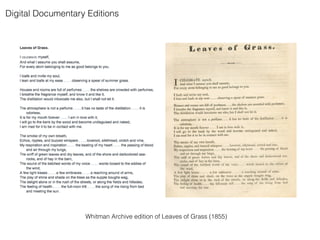
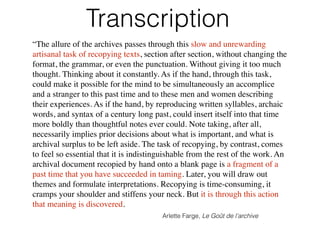
This document discusses machine reading and optical character recognition (OCR) in historical archives. It summarizes the views of Arlette Farge on how the manual transcription of archival documents allows one to discover meaning through labor, textual taming, and interpretation. The document then discusses how OCR automation locates this labor in machines instead of individuals. It provides examples of how OCR systems can "tame" historical texts by standardizing orthography and identifying languages. The document argues OCR can function as a digital documentary edition but also notes the "false transparency" of computing.



![Schematic of optophone from Vetenskapen och livet (1922)
[Mara Mills, “Optophones and Musical Print”]
Labor](https://image.slidesharecdn.com/2015-adests-talk-150706221633-lva1-app6891/85/2015-adests-talk-7-320.jpg)