CAREERS
GUIDE
2013
DEAN OF BUSINESS
Professor Roy GREEN
EDITOR & UTS BSOC
CAREERS DIRECTOR
Lloyd WOOD
CAREERS TEAM
Annelise JEROMELA
Elise KENNEDY
Suzy LIVAJA
Demara ROCHE
Davor TOCAKOVIC
CONTRIBUTORS
Katheryne BARETAS
Rojda DAG
Isabelle DUGGAN
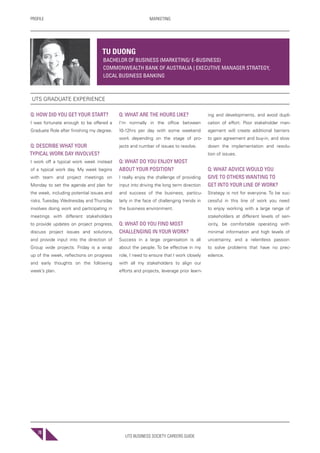
Tu DUONG
Tyson GUNDERSEN
Rosie KAVANAGH
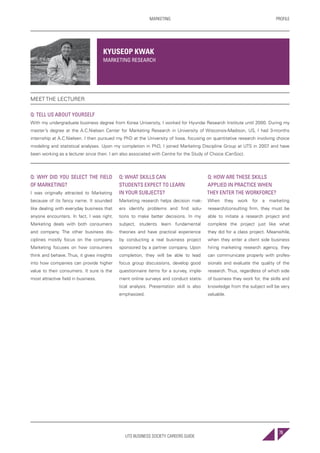
Kyuseop KWAK
Shanil LAL
Samantha LOW
Hamish MISHRA
Nicholas ROKKAS
Laura RULLO
Luke SHIELDS
Susan SMITH
Nicole SNOWDEN
Charlotte TAYLOR
Mark TOMA
Johnny VANCE
Da Gong ZHAO
DESIGNER
Linda HOANG
PHOTOGRAPHY
Ron LAL
TALENT
Demara ROCHE
PRINT
KwikKopy Neutral Bay
THANKS TO THE UTS UNION
MAILING ADDRESS
UTS Business Society
C/O UTS Union Info Desk
Level 3, 15 Broadway (Building 1)
PO Box 3210 | Broadway NSW 2007
UTS BUSINESS SOCIETY OFFICE
UTS Haymarkets Campus CB05A.01.10
COPYRIGHT
© UTS BUSINESS SOCIETY
This publication is copyright. Except where permitted
under the Copyright Act 1968 (Cth), no part of this
publication may be reproduced or stored by any
process, electronic or otherwise, without the specific
written permission of the UTS Business Society.
DISCLAIMER
The articles and opinions expressed in this publication are not
necessarily those of the UTS Business Society, the Editor, or the
UTS Business School. Although the editor and authors have taken
every care in preparing and writing the guide, they expressly
disclaim and accept no liability for any errors, omissions, misuse
or misunderstandings on the part of any person who uses or
relies upon it. The editor, authors and Business Society accept
no responsibility for any damage, injury or loss occasioned to
any person or entity as a result of a person relying, wholly or
in part, on any material included, omitted or implied in this
publication. The user of this guide acknowledges that they
will take responsibility for their actions and will under no
circumstances hold the editor, authors or UTS Business
Society responsible for any damage resulting to the user
or anyone else from use of this publication.
01 02 03
CONTENTS
04 05 06
07 WHERE TO START
08 TIPS FOR RESUMES
09 ONLINE APPLICATIONS
10 TIPS FOR COVER LETTERS
12 THE SUCCESSFUL INTERVIEW
14 UTS BUSINESS INTERNSHIP
15 TIPS FOR INTERNATIONAL
STUDENTS
16 UTS ACCOMPLISH AWARD
18 NETWORKING TIPS
19 BACK DOOR CEOS
20 ENTREPRENEURSHIP
21 ACCOUNTING
22 WHAT IS ACCOUNTING?
23 INSTITUTE OF CHARTERED
ACCOUNTANTS AUSTRALIA
26 CPA
29 HOW TO GET A
VACATIONER POSITION
31 SUCCESSFUL
VACATIONER RECOUNT
32 PRICEWATERHOUSECOOPERS
36 KPMG
38 DELOITTE
40 ERNST & YOUNG
42 SUCCESSFUL
VACATIONER RECOUNT
43 INSOLVENCY INDUSTRY
44 BDO
46 THE CADETSHIP
48 ECONOMICS
49 WHAT IS ECONOMICS?
50 CHOOSING ECONOMICS
51 FINSIA
52 ANZ
53 NSW TREASURY
54 AUSTRALIAN BUREAU
OF STATISTICS
56 APRA
58 FINANCE
59 WHAT IS FINANCE?
60 GRADUATE TIPS TO SUCCESS
61 FINSIA
62 CFA
64 CBA
66 MACQUARIE GROUP
69 MANAGEMENT
70 WHAT IS MANAGEMENT?
71 INDUSTRY EXPERIENCE
72 WHAT IS HR MANAGEMENT?
73 STUDYING HR
74 LIFE IN THE INDUSTRY
75 AUSTRALIAN RED CROSS
76 MARKETING
77 WHAT IS MARKETING?
78 UTS GRADUATE EXPERIENCE
79 MEET THE LECTURER
80 PERCEPTICS
81 MARKETING WEBSITES
UTS BUSINESS SOCIETY CAREERS GUIDE
WELCOME TO THE GUIDE INTRODUCTION
4
It is with great pleasure that I welcome
you to the inaugural UTS Business Soci-
ety Careers Guide.
This Guide strives to provide you with
career information based on your cho-
sen head of discipline, presenting you
with profiles and graduate opportunities
of some of the key firms in the industry,
student experiences in the workforce,
as well as tools and tips to succeed in
the recruitment process.
It is truly never too early to start and I
advise you to begin applying for intern
positions and contemplating your gradu-
ate goals as soon as possible. For those
submission dates that have passed,
use these as forewarning to assist your
preparation for future years.
The production of this Guide would not
have been possible without the tireless
dedication of my careers team, thus
an enormous thanks goes to Annelise,
Demara, Suzanna, Elise and Davor. I
also wish to thank all contributors for
their submissions, our amazing designer
Linda Hoang for the entire look and feel,
and Susan Smith from UTS Careers for
her guidance.
On behalf of the team, I invite you to
explore the career opportunities that lie
awaiting and hope this Guide will be a
useful resource in your future career
endeavours.
Kind regards,
Lloyd Wood
UTS Business Society Careers Director
MESSAGE FROM THE EDITOR
LLOYD WOOD
CAREERS DIRECTOR
UTS BUSINESS SOCIETY
UTS BUSINESS SOCIETY CAREERS GUIDE
WELCOME TO BSOCINTRODUCTION
5
I express gratitude and a vote of con-
gratulations to you for picking up a copy
of UTS Business Society’s inaugural
Careers Guide.
As a Society taking a new direction in
2013, we have taken some big steps
to ensure UTS produces Business
students who are well-rounded, com-
mercially minded and are of high cali-
bre, suitable in any high performance
culture. The Society holds the view that
students ought to be given exposure to
relevant information and various career
opportunities, and this publication is the
medium through which we have aimed
to achieve that objective.
As Business students, you have an array
of options to choose from for post-uni-
versity life, be it a professional services
firm, commercial environment, or ven-
turing into your own entrepreneurial pur-
suits. We have laid down the foundation
in this publication and it is up to you to
leap in the right direction. The first step
is being proactive – you are already on
the right path by reading this.
The Business and related courses
offered by UTS are rigorous in nature
and you will graduate with a diverse
range of technical and fundamental
skills essential to stand out in the crowd.
You will have been challenged to think
outside the box, get creative, and solve
tricky business situations. From deriv-
ing the maximum return on securities
investments to developing compre-
hensive marketing proposals, you have
been trained to apply your respective
skills in the workforce to excel above
and beyond expectation.
You will find in this publication a wide
range of perspectives from several
industry leaders as well as those of UTS
Alumni who are fresh into their careers.
You will find the contributors in this
guide discussing the secrets to being
successful in your hunting for a career
as well as what worked for them in their
experience.
Use this guide as a comprehensive
overview of the options available to
you, as well as a range of tips to keep
in mind when writing you curriculum
vitae and covering letter, preparing for
an interview and building your range of
experience to maximise your chances of
securing employment.
I wish you all the very best of luck for
the remainder of this university year
and for your future endeavours. As
always, if you would like to get in touch
please do not hesitate to contact me at
president@utsbsoc.com.
Shanil Lal
UTS Business Society President
MESSAGE FROM THE PRESIDENT
LLOYD WOOD
UTS BUSINESS SOCIETY
CAREERS DIRECTOR
SHANIL LAL
PRESIDENT
UTS BUSINESS SOCIETY
UTS BUSINESS SOCIETY CAREERS GUIDE
FROM THE DEAN INTRODUCTION
6
Congratulations to the UTS Business
Society for preparing this excellent
Careers Guide which will help you – our
students and graduates – to make key
decisions about your future. It is never
too early to begin getting prepared for
these decisions.
The UTS Business School is proud that
its programs are held in high regard by
business and the professions, and that
they provide a springboard for a wide
range of opportunities in many types of
organisations, including new ventures
you might even start yourself!
The distinctive attributes of a UTS Busi-
ness graduate are the ability to combine
specialised knowledge with broader
‘boundary-crossing’ skills such as team-
work, leadership, critical thinking and
problem-solving. These are the attrib-
utes that count in today’s constantly
changing environment. As we say in our
mission, our aim is to advance knowl-
edge with impact through integrative
thinking for the next generation leaders
of a globalising world.
I would encourage you to consider your
choices carefully, whether they are pro-
gram choices, internships, international
studies or opportunities for employment
and career paths. Please keep in mind
that you have valuable sources of advice
and information right here in the Busi-
ness School.
May I wish you the best of luck in pur-
suing your chosen paths whatever they
might be and wherever they take you,
and I hope you will keep in touch with
us and your fellow graduates as part of
the UTS Business School alumni com-
munity.
Regards
Professor Roy Green
Dean
UTS Business School
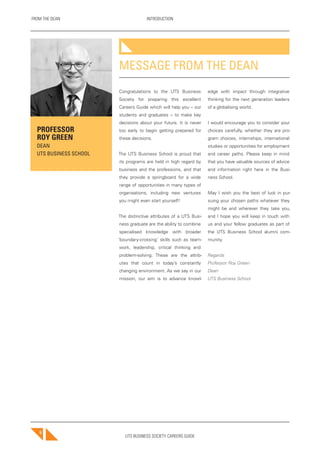
MESSAGE FROM THE DEAN
PROFESSOR
ROY GREEN
DEAN
UTS BUSINESS SCHOOL
01
WHERE TO
START
UTS BUSINESS SOCIETY CAREERS GUIDE
RESUMES WHERE TO START
8
SO HOW CAN YOU
FOCUS YOUR RESUME?
Don’t use the same resume for every
job - highlight information most relevant
to the selection criteria.
Under each job heading when you
record your duties, record the most rel-
evant duties (to the job you are applying
for) first. Use active verbs to start the
sentences that highlight your duties.
Make your resume achievement-ori-
ented – highlight academic achieve-
ments and work-based achievements.
These could include positions of leader-
ship, prizes, awards, promotions, addi-
tional responsibilities, targets met or
exceeded, etc. The achievements could
be included under each job you have
held or recorded as an Achievement
Summary.
Include a skills section that directly
addresses the selection criteria. Don’t
rely on a simple dot point list – state the
skill and then provide evidence to dem-
onstrate where you have developed or
enhanced the skills.
For example;
“Special Events Coordination
- Initiated several local and
regional promotions. This involved
extensive research, planning,
negotiation of sponsorship,
liaison with police, councils,
community service groups,
volunteers, sponsors and
media. Organised production
of leaflets and promotional
material and distributed and
directed operations on the day.
Responsible for budget and the
financial success of events.”
Employers will spend a very short
period of time scanning your resume
looking for relevant information. An
often quoted figure is that they will
spend no more than 30 seconds –
although one recent report says only 6
seconds! Therefore you need to make it
reader friendly; clearly defined headings,
dot points instead of long blocks of text,
and some valuable white space.
Many large companies and government
departments use online applications
and some will not require a resume so
you may not need to send one for every
job you apply to. Read the instructions
carefully before you attach anything.
For more information please visit:
www.careers.uts.edu.au
TIPS FOR RESUMES
BY SUSAN SMITH, UTS CAREERS
Your resume is your marketing tool to an employer. They will use it to determine if you have the potential to do the job and want
to further explore this potential at an interview. Your task is to ensure that your resume presents you in the best possible light
and provides information that convinces the employer that you can do the job. Therefore it should focus on the skills set needed
for the advertised role – this skills set is often described as the selection criteria.
UTS BUSINESS SOCIETY CAREERS GUIDE
ONLINE APPLICATIONSWHERE TO START
9
1. PREPARE!
ALL THE CLUES ARE RIGHT IN FRONT OF YOU.
Research and analyse the company, its goals and values, and
the graduate stream that you are applying for. All the clues
you need to complete your online application form are there
on the company literature, annual reports and website. Attend
employer sessions on campus and use every opportunity to
network through careers fairs and campus events.
2. WHY THEM?
WHAT IS IT ABOUT THAT
ORGANISATION THAT STANDS OUT?
Don’t proceed to tell the employer why you want to work for
them by stating the obvious. Banks already know if they are
the top 4 in the country. You need to differentiate more on
why they are your employer of choice, by the values they hold,
the graduate program they offer, and the opportunity for expo-
sure to key influencers and mentors in your profession.
3. WHY YOU?
BE CLEAR ABOUT YOUR SKILLS AND VALUE.
Approach the application with a clear idea of your strengths,
skills and career aspirations. Draw out how this organisation
will play to your strengths and enhance your career prospects.
You need to be aware that every question they are asking on
the application is a chance for you to market yourself. Have
you really understood the role that you are applying for and
what you will be asked to do as a new graduate? Within a
couple of weeks, you’ll be working with your own clients and
solving problems that you might not know anything about!
Resilience, the ability to ask the right questions, the confi-
dence to take the lead, the professionalism to deal with the
situation - all this and more is what you have.
4. WHY NOT?
GIVE THEM A REASON TO SAY YES!
Try to steer away from bland, vanilla statements that don’t
really get to the heart of the question. Really think about what
behaviour or skill they are trying to elicit from the question.
Be specific, be focused and drill down to a deeper level to
describe your behaviours and prove why you should get the
job.
For more information please visit:
www.careers.uts.edu.au
ONLINE APPLICATIONS
BY SUSAN SMITH, UTS CAREERS
Think about this simple equation:Your strengths and skills + the skills and behaviours the job requires = A MATCH!
Online application forms are designed to see if you have the motivation, the necessary insight and the personal effectiveness to
make the right impact as a graduate in that organisation. Follow these top 4 tips and ensure your application form makes it
through to the next round.
UTS BUSINESS SOCIETY CAREERS GUIDE
COVER LETTERS WHERE TO START
10
If there is an advertised position make sure you target the skill
sought by the employer for that role. This means you can’t just
use the same old letter for every job, you need to modify it for
each application.
Where there is no advertisement, you might be asking for an
internship, or if a company would consider recruiting a recent
graduate into an entry-level role. You can use a standard let-
ter but make sure you highlight your skills and relevant experi-
ence, and ensure that the skills you highlight are those that
would generally be sought by employers in that profession/
industry.
Generally speaking cover letters should be no longer than one
page in length. The first paragraph should highlight why you
are writing and your interest in the company and role. The fol-
lowing 2 or 3 paragraphs highlight your skills, experience and
attitudes relevant to the role – these will be fairly broad state-
ments, you can include more detail in the resume. Nonethe-
less you should provide evidence to support your claims. The
final paragraph thanks the reader for their time and suggests
arranging an interview.
Use good quality white paper and a font like Arial, Times New
Roman or Calibri, no smaller than 11 point. Layout is important
– the cover letter is a business communication and your com-
munication skills are being assessed by the employer.
If you are emailing your cover letter to an employer, mention
in the text of the email that you are applying for the position
and that your cover letter is attached. Attach the document as
either a word doc or PDF.
Following is a sample letter, use it as a model but do not copy
it, you want to stand out from the crowd. Your cover letter
should be individual and differentiate you from other people
applying for the role.
The UTS Careers Service runs cover letter review workshops
and general workshops on cover letters and resumes. Check
out the Careers Service website for precise dates and times
www.careers.uts.edu.au.
TIPS FOR COVER LETTERS
BY SUSAN SMITH, UTS CAREERS
Your cover letter is the first thing an employer will read about you. It is one of your key marketing tools, so make sure it creates
a positive first impression. It should reflect your strengths and experiences in relation to the job you are applying for and be free
of any spelling or grammatical errors.
Ms Alice I. Wunderland
16 Softley Close
Randwick NSW 2031
Phone: 1234 567 890
Email: Alice.Wunderlund@student.uts.edu.au
8 March 2013
Ms Molly Meba
Meba Media
100 Sussex Street,
Sydney NSW 2000
Dear Ms Meba,
Re: Marketing Assistant (Position ref: G452/A)
As a recent Bachelor of Business graduate from the University of Technology, Sydney with a major in marketing, I am very inter-
ested in the advertised position. Achieving a distinction average over the course of my studies, along with my work experience
at two high profile media organisations, demonstrates I am hardworking and self–motivated, with a passion for marketing within
the entertainment industry.
During my degree I completed several marketing internships, including positions at Channel 7 and ACP magazines. These intern-
ships proved to be invaluable as I was able to demonstrate my skills as a confident communicator to both internal and external
clients and confirm my enthusiasm for employment in this industry. In addition to my internships, I have been involved with
extracurricular pursuits including working with the NSW Volunteer Fire Brigade for six years and also at my local Smith Fam-
ily shop. Here I strengthened my teamwork skills, the ability to adapt to changing circumstances, and how to work effectively
under pressure.
The internet is of particular interest to me due its ever-changing nature and I also enjoy working with social media as it is a grow-
ing market segment area. Notably, at Channel 7 I was responsible for increasing the Channel’s Facebook and Twitter traffic in
2011. As a result of my efforts Twitter traffic increased by 40% and the number of Facebook ‘likes’ by 30% over six months.
As a market leader in providing creative strategies for social media and communications branding I note that Meba Media works
has contributed to the success of organisations such as XYD company and ZXY. An opportunity to learn from the expert talent
at Meba Media would be a welcome challenge, enabling me to develop my own capacity to work as a marketeer and learn from
experts in the field.
Thank you for your consideration, please do not hesitate to contact me should you require further information supporting my
application. I am available for interview at your discretion and can be contacted on 1234 5667 890 or at the email address: Alice.
Wunderlund@student.uts.edu.au. I look forward to hearing from you.
Yours sincerely,
[Signature]
Ms Alice Wunderland
UTS BUSINESS SOCIETY CAREERS GUIDE
INTERVIEWS WHERE TO START
12
1. THE WORK
The most fundamental goal of the interview is to determine
whether you have the skills to do the job. Still, your inter-
viewer may not even know how to figure out if you have what
it takes. You must be ready to do it for them. Be prepared
with a list of your top selling points with examples of when
you have shown these skills, so the interviewer is completely
aware of your advantages over others.
2. THE COMPANY
Research, research, research! All the clues for the candidates
they are looking for will be on their website. The companies’
values, their mission statement, their annual reports - do your
homework ahead of time so you are ready to say why you
want to work at that job and for that company. Be clear about
how your values match theirs (and again with examples of you
showing these values in action).
3. THE CULTURE
The work environment can determine whether you love your
job or hate it. Address the work culture with your interviewer
to make sure your values align. There’s nothing worse than
landing a job only to realize the organization is not a place
where you would feel comfortable working.
4. INDUSTRY KNOWLEDGE
Want to “wow” the interviewer? Show off your knowledge of
the industry. Make sure you’re reading the Financial Review
and are aware of recent deals or what is happening in that
industry space.Thoroughly understanding your industry proves
your passion for the field. In addition, having this knowledge
suggests you have a deeper level of expertise than the average
candidate.
THE SUCCESSFUL INTERVIEW
BY SUSAN SMITH, UTS CAREERS
The job interview might be the only thing left between you and the position of your dreams.
Even if you’re the most qualified candidate, a poor interview performance can leave a poor impression on a potential employer.
Yet, you can avoid nearly all interview mishaps if you prepare the right way for your interview.
As the saying goes: fail to prepare, prepare to fail.
HERE ARE SOME THINGS TO PREPARE AND ADDRESS IN AN INTERVIEW:
UTS BUSINESS SOCIETY CAREERS GUIDE
INTERVIEWSWHERE TO START
13
5. EVIDENCE OF YOUR SKILLS – SHINE LIKE A STAR.
Your past experiences demonstrate how you would perform if
you landed the job. So, you want to be prepared to describe
past experiences where you had a big impact or shown
leadership, decision making and initiative. If you have numbers
to back up your claims, that’s even more persuasive. Aim to be
a STAR – address the Situation, the Task you were required to
undertake, the Action you took and the Results you achieved.
This technique for preparing answers will ensure you set the
scene and cover your input well.
6. THOUGHT-OUT QUESTIONS
Always make sure you have questions at the end of the
interview. From queries about the interviewer’s role to thoughts
on the history of the position, questions show your desire for
the job.They can also give you more insight into the role, which
may not have been addressed during the more formal portion
of the interview. However, don’t pull out a list of 20 questions
before lunch. Read the situation and ask one or two pertinent
questions.
7. NEXT STEPS
Understanding the next steps in the interview process is
essential. Always ensure you’re aware of what these are. It
may be a second interview. It may be giving the company a list
of references. It may mean you won’t know the outcome for
a few weeks. By asking about these next steps, you’ll know
what to expect and gain some peace of mind. You’ll also show
your enthusiasm for this position.
As you can see, job interviews can be a much smoother
process if you use this checklist. Do your research, emphasize
why you are the best candidate for the job, and always leave
on a good note.You’ll find the outcome of the interview will be
much more positive if you do.
For more information and help on how to prepare for interviews
and how to tackle tough interview questions please attend
UTS:Careers workshop series and visit our website http://
www.ssu.careers.uts.edu.au
UTS BUSINESS SOCIETY CAREERS GUIDE
INTERVIEWS WHERE TO START
14
‘Work experience’, ‘work ready’, ‘interns’, ‘graduate attributes’,
‘employability’ - tired of the terminology and not quite sure
what it all means?
YOU’RE NOT ALONE.
So let me spell it out for you with some facts:*
• In 2012, on average, 23.6% of graduates who were
recruited to Accounting and Finance firms with over 500
employees came from an internship program and 9.8%
from an employee referral program.
• This figure jumps to 40.7% for internships with Legal and
Professional Services firms with over 500 employees and
17% from employee referral programs.
• Smaller organisations (1-500 employees) who used these
programs recruited, on average, a larger proportion of
their total graduate intake through undergraduate and
employee referral programs than their larger counterparts
(36.3% versus 29.9% for internships and 15.7% versus
9.8% for employee referral programs).
SO, WHAT AM I TRYING TO SAY?
In two short words - Experience works!
• Look at the stats - internships and work experience in a
career area you are interested in are an important part of
your success in getting a graduate entry job.
• It gives you valuable experience on your CV.
• It helps you answer those thorny questions on graduate
application forms about a time you’ve shown leadership
abilities, overcome a conflict and resolved a problem.
• It helps set your subject knowledge in context and
teaches business acumen in the real world.
• It offers you the opportunity to develop a network of
people working in a professional field you would like to
break into.
• It develops your confidence and the ability to market
yourself effectively.
• The internship has increasingly become the ‘1st interview’
to graduate programs. If you complete a successful
internship, depending on the organisation, you can
often be referred on and skip past some of the graduate
recruitment phases for final year students.
• Doing an internship gives you the opportunity to discover
what your strengths and skills are
• Undertaking work experience can help you to make
decisions about potential career paths to follow.
• UTS Business School offers you the opportunity to
undertake an internship as part of your degree and
receive credit for it!
UTS BUSINESS INTERNSHIP
BY SUSAN SMITH, UTS CAREERS
For more information and help on the Business Internship, please contact Angela Powell at angela.powell@uts.edu.au
For further information on careers and ‘Where UTS Graduates Go’ please visit UTS:Careers at
http://www.ssu.careers.uts.edu.au
To view current internships and job vacancies visit our jobs board at
http://www.ssu.careers.uts.edu.au/careers/opportunities/index.html
*GRADUATE OUTLOOK 2012 REPORT, by Graduate Careers Australia
UTS BUSINESS SOCIETY CAREERS GUIDE
INTERVIEWSWHERE TO START
15
International students face more challenges in gaining work
than their local colleagues due to two main factors :–
1. Lack of English speaking skills; and
2. Lack of experience in the Australian workplace.
These facts were gleaned from research recently conducted
by a Monash University academic who was commissioned by
the CPA to find out what issues International students are fac-
ing when marketing themselves to the Australian workforce.
Based on these findings, it would be recommended that Inter-
national students who struggle with their written and verbal
communication skills, must improve them where ever pos-
sible. This can take the form of joining conversational English
groups or attending student society groups for an opportunity
to use English language skills more often. Many international
students have an understandable tendency to gather in their
own language groups and fall into a regular habit of speaking
in their own tongue. It would be recommended that you join
or create a group within your community to improve English
speaking skills, where you speak it as often as possible and
get honest feedback to make any improvements.
The other way to improve your communication skills is to get
any sort of work experience - be it paid casual or part-time
work, an internship or voluntary work. This is a great way to
get you speaking with different members of society. One
way to gain this sort of work experience is through the UTS
Careers Service who can assist International students to gain
work experience through the “Working Solutions” Program.
This program has been put in place to increase your employ-
ability skills through regular workshops that will assist you to
establish your resume and cover letters, adopt interview tech-
niques, learn the expectations of the Australian workplace,
network and search for jobs effectively. International students
need to enrol at the beginning of semester to participate in
the workshops.
The other great resource that UTS has to offer is the HELPS
office where you can get assistance preparing for your course
of study, find out what tutors expect, group learning, assess-
ments and where to seek help.There are workshops at HELPS
that will give you an overview of all the things you will be
required to do as a student and another set of workshops that
specifically cover areas such as reading and note-taking, exam
preparation, preparation for IELTS exam, writing skills, assign-
ment analysis, academic writing, critical writing, report writing,
presentation and speaking skills, grammar reviews and more.
A common misconception amongst International students is
that the more you study and the better your grades, the more
employable you will be. This can be true in part; however, with-
out the basic communication essentials, a Masters and sev-
eral degrees under your belt will not be sufficient. As with any
workplace in the world, communication skills, be it written or
spoken, are always going to be at the top of the list. To assist
you with this process, identify your strengths, both skills and
personality, and articulate these by using demonstrated exam-
ples for use in your interviews, cover letters and resumes. It
really comes down to your transferrable skills (not just your
technical ones), and your experience.
Another tip is don’t devalue the non-discipline related work
experience or opportunities that come your way – all of this
can enhance your employability and are often the skills sought
by employees. For example, you may be studying Engineer-
ing, and work in sales at a whiteware retail outlet. Your cus-
tomer service skills, your technical knowledge and knowledge
of how a business runs will score you points when applying for
other work.
Most importantly, practice your English speaking skills as
much as possible and don’t be afraid to make mistakes! Peo-
ple will respect and admire that you are making an effort to
communicate your thoughts and feelings and will often assist
you to make your point clear.
TIPS FOR INTERNATIONAL STUDENTS
BY CHARLOTTE TAYLOR, UTS CAREERS
UTS BUSINESS SOCIETY CAREERS GUIDE
INTERVIEWS WHERE TO START
16
According to studies completed by AAGE (Australian
Associate of Graduate Employers) the top ten skills
assessed in the recruitment process by graduate
employers are:
1. Oral Communication
2.Teamwork
3. Interpersonal skills
4. Problem solving skills
5. Analytical thinking
6.Written communication
7. University grades
8. Planning and organising
9.Time management
10. Leadership
This means that, no matter what your degree is, stu-
dents need to be more proactive in developing their
skills outside of their degree.
This might mean getting a part time job, volunteering
in your community or landing an internship in your
preferred industry. All of these avenues allow you to
build valuable transferable skills that you will use in
your graduate role.
It’s never too early to start developing these trans-
ferable skills - even if you are a first year student. If
you start now these skills will be useful during the
recruitment process, as you’ll have a bank of experi-
ences to draw on during those all-important behav-
ioural-based questions during an interview. Make a
mental note of difficult customers you’ve dealt with
and situations when you’ve lead a team, because
they will come in handy!
UTS ACCOMPLISH AWARD
BY NICOLE SNOWDEN, UTS ACCOMPLISH PROGRAM COORDINATOR
While many students believe that university grades are the most important aspect
in securing a graduate role, studies show that employers look for much more in a
well-rounded graduate. Recent studies show that generic skills are ranked as more
important in the recruitment process than university grades.
UTS BUSINESS SOCIETY CAREERS GUIDE
INTERVIEWSWHERE TO START
17
You may be reading this thinking,
‘I don’t know where to start!’
If you are, don’t worry! The UTS Careers Service is
here to help you become more employable in time
for final year when you starting applying for graduate
roles.
The UTS Accomplish Award is a program run by the
Careers Service and is aimed at penultimate year
students and postgraduate students. The program is
designed to improve your employability skills while
encouraging you to build your transferable skills now
in the workplace.
Students complete workshops targeting important
areas like interviews (including how to dress appro-
priately for the workplace), networking, business
etiquette, professional presentations, resume writ-
ing and mock group assessments. They also com-
plete 100 hours of employment practice across the
year, enabling them to build their generic skills, their
resumes and also their networks.
We have a number of fantastic employers involved
in the Award including Citigroup, Louis Vuitton, CBA,
KPMG, Liquid Ideas, ASIC, State Street and Ernst &
Young, just to name a few. Students are able to hear
employer insights into the recruitment process, and
their hints and tips for standing out in the crowd. All
in all, the employer input into this program is very
valuable for students!
So, not only will you have the skills to ace the recruit-
ment process, you’ll have a resume full of employ-
ment experiences and some useful employer con-
tacts as well! And to top it all off, you’ll have a fancy
Accomplish Award certificate, signed by the Deputy
Vice Chancellor to prove you’ve been dedicated and
committed to the program!
With 9.3% fewer graduate roles available in 2013
compared to 2012 (according to AAGE Employer
survey 2012), and with potential for this trend to
continue in following years, it’s just not enough to
succeed in your studies. You need to become an
all-rounded, involved student. Get involved in extra-
curricular activities, secure a part time job and take
part in initiatives offered by the university to improve
your skills.
If you’re in your penultimate (second last) year in
2014, you can register your interest for the Accom-
plish Award for 2014 here: http://www.ssu.uts.edu.
au/careers/jobsearch/accomplish/sign-up.html
UTS BUSINESS SOCIETY CAREERS GUIDE
NETWORKING WHERE TO START
18
1. THE ABILITY TO SELL YOURSELF
In order to create an everlasting impression to those who are
in positions of power, one must be able to differentiate them-
selves from the crowd surrounding them and the status quo.
You must be engaging, charismatic, interesting and have an all-
rounded approach. A sense of humour in conjunction with a
broad understanding of worldly matters increases the value of
your stock. You should be able to resonate with those around
you yet provide a unique or different perspective on similar
experiences. The key to selling yourself is finding that striking
balance of individuality and modesty to ultimately leave those
around you impressed by your overall image.
2. THE ABILITY TO LEAVE POSITIVE
EVERLASTING IMPRESSIONS
It is imperative that you leave a really good impression on
whomever you are talking to. As a young university student,
your polite gestures, respectable sense of humour and pas-
sion towards business, will evoke thought on whom you are
communicating with and makes them reflect on their univer-
sity days. They compare themselves to you, and your drive,
ambition and desire for success reflects on you positively. In
leaving a good impression, make sure you also develop the
skill of listening. Ask them questions about their role and what
they enjoy about it and naturally a connection will appear. This
is where you start drawing upon your own personal experi-
ences and comments in order to relate it back to the person
you are communicating with. Leaving a good impression has
multiple effects as it improves your personal brand image
amongst others and enables your name to get exposed; it’s
not ‘’who you know’’ but ‘’who knows you.’’
3. THE ABILITY TO REINFORCE CONNECTIONS
Reinforcing your connections flows from selling yourself effec-
tively, as you maintain your positive impression in a more
permanent sense. But how does one reinforce a connection?
According to The Harvard Business Review, the top business
executives and over 2/3 of employees of transnational com-
panies have LinkedIn profiles. LinkedIn is a form of social
media that allows members to connect with those they have
had professional experiences with and enables one to publicly
advertise the influence that they have in a particular company
and industry. Reinforcing these relationships is crucial in main-
taining contact and the impression you’ve created. In my opin-
ion, getting a LinkedIn profile is imperative in this process and
helps you build a strong network for future opportunities.
Networking demands that you test your ideas, hone your abil-
ity to communicate and improve your executive presence.
Networking is a time commitment and the more time you
dedicate to it – the more you will learn what works for you and
against you. The more you procrastinate, the more you will
find yourself disconnected from the opportunities that may
potentially advance your career or allow you to meet the right
people. Ultimately, I reiterate; networking isn’t about ‘’who
you know’’ but rather ‘’who knows you”, so I encourage you to
build your connections and get your name known.
NETWORKING TIPS
BY MARK TOMA, UTS BSOC SOCIALS DIRECTOR
The most common perception running around in the university world - ‘’it’s not what you know, but whom you know’’ - is a
phrase that humours me every time I hear it.
Contrary to popular belief, networking isn’t just about having connections but rather, using these connections as a catalyst to
reach your goals. Therefore, having a strong network is not a characteristic but rather a skill. Networking entails three significant
steps:
UTS BUSINESS SOCIETY CAREERS GUIDE
ARTICLEWHERE TO START
19
A
pplying for internships and graduate roles can be a dif-
ficult time and unfortunately sometimes people miss
out. Rejection can have a very debilitating effect on a
person – resilience is often hard to come by in these circum-
stances. However, it’s not the end of the world. Many success-
ful business professionals did not get where they are today
following the more ‘traditional pathways.’These are people that
for some reason could not, or chose not, to conform to the
status quo. Though their curiosity and passion to succeed did
not see them throw in the towel, instead they entered through
the ‘back door.’
I was experiencing some difficulties in finding part time work
via the traditional means, though after speaking to Anthony
Matis (General Manager, Business Development, Education
- International, CPA Australia) about my dilemma, he encour-
aged me to find a ‘back door.’ Anthony explained that this
meant channelling your curiosity, setting goals, building your
networks and most importantly, not limiting yourself to one
path.
Gail Kelly, the first woman to gain a Chief Executive position at
a major bank, did not start her career battling through a gruel-
ling application process to land a graduate role trading deriva-
tives on George St; her youth did not emulate that of Gordon
Gekko and she was not a cashed-up intern with her AMEX
behind the bar every Friday night. On the contrary, Gail stud-
ied History and Latin at the University of Cape Town and fol-
lowed this with a Diploma in Education. While her future col-
leagues were in the basement crunching numbers, Gail was
teaching the likes of Julius Caesar to schoolboys in Zimbabwe.
In South Africa, her Arts degree was enough to get a banking
job - from there, Gail moved to Australia and fast-tracked her
career through training programs. She attained various man-
agement positions and finally reached the corporate summit
in 2008.
Chairwoman of Qantas Super, Anne Ward puts it well when
asked about traditional paths:
“CAREER PATHS ARE SO RARELY LINEAR THAT IT IS
REALLY IMPORTANT NOT TO BE TOO DOGMATIC...
YOU HAVE TO BE PREPARED TO CHANGE YOUR PATH
WHEN AN OPPORTUNITY PRESENTS ITSELF, EVEN
IF THAT MEANS TAKING A SIDEWAYS STEP.”
Lindsay Fox is a shining example of corporate success from
a non-traditional means. Lindsay started his company with
one truck in exchange for four quarterly promissory notes. By
1967 he had won a contract with BP to distribute heating oil
and had acquired 60 trucks. Whilst running his own business
Lindsay found time to show off his athletic prowess, playing
20 senior games for the Saints. To this day Linfox has over 14,
000 employees as well as the title of the largest logistics com-
pany in Australia. Lindsay’s unorthodox ride to the top is evi-
dence that hard work, passion and determination can get you
further than any university degree or internship position - after
all, life is so much more than that!
Business is all about relationships, who you know is cru-
cial - that is why building your networks now is so vital. Get
involved with societies, extra-curricular activities and travel the
world! Plan ahead and be realistic, what are your back-ups if
you miss out? Use the UTS Careers Service, I am bewildered
as to why more students don’t take advantage of this free,
professionally-run service. Come to BSoc career events - this
is where you can get your one-on-one time with business pro-
fessionals and hear advice pertaining to your interests straight
from the horse’s mouth. Stop throwing away those brochures
you get in lectures and start reading them, do your research
and compare opportunities. Keep your options open - you
never know when you may need to use the back door!
ENTERING YOUR DREAM CAREER
THROUGH THE ‘BACK DOOR’
BY ROSIE KAVANAGH, UTS BSOC VICE-PRESIDENT
UTS BUSINESS SOCIETY CAREERS GUIDE
ARTICLE WHERE TO START
20
If you ask a hundred people to define entrepreneurship, you’re
likely to get a hundred different answers, each as vague as the
last. Yet few realise just how much this often-misunderstood
concept has shaped the way in which we currently live.
At its core, entrepreneurship is simply a way of thinking. A
desire to innovate, invoke change, and challenge the status
quo, championed by a select few. From Facebook to Youtube,
Google to Microsoft, the biggest companies to emerge over
the past few decades have almost unilaterally begun with little
more than a few computers in a parent’s garage and an entre-
preneurial vision to challenge the way that businesses think,
see and do.
By its very nature however, entrepreneurship is not confined
to these multi-million dollar companies based out of Silicon
Valley, the veritable mecca for “start-ups” - rather, it is a way
of thinking that has taken the world by storm in lieu of the late
90’s tech boom, with bustling communities emerging across
the globe on almost every continent.
This has certainly proved true for Sydney over the past dec-
ade. One only has to dig slightly below the bustling surface
of the CBD to uncover a booming “start-up” industry. For UTS
students this process becomes even easier, with a vast array
of fledgling companies and co-working spaces tucked away in
Ultimo’s Harris Street, less than two minutes walk from the
Haymarket Campus.
Driven by passionate individuals who thrive on long hours and
little pay, the established consensus emerges amongst these
CEO’s that few jobs offer the unparalleled freedom of being
your own boss, accompanied by the immense satisfaction of
watching your own creation come to life.
Entrepreneurship however, is not simply confined to launch-
ing your own company. One look at the recruitment section of
Macquarie Bank or McKinsey & Co.’s websites echo the trend
of employers increasingly looking for individuals who possess
the ability to think outside the box, approach issues laterally
and innovate.
Here at UTS, the Australian Collective Entrepreneurial Society
(ACES) seeks to build this skill set within students, providing
a platform for aspiring leaders, entrepreneurs and business
people to connect, learn and develop. Personally, I can say
quite honestly that few things have impacted my professional
and personal life as much as getting involved in societies as
UTS and more specifically, engaging with entrepreneurship
through ACES. For those who want to find out more about our
upcoming events, you can find ACES on Facebook.
Ultimately the reality is that more and more people from
across the world answer the call of the entrepreneur each day.
From school leavers to University graduates, to those with
professional experience seeking a career change later in life;
embracing innovation and inspiring change often proves to be
an unparalleled source of inspiration for many.
ENTREPRENEURSHIP
BY LUKE SHIELDS, UTS ACES PRESIDENT
02
ACCOUNTING
UTS BUSINESS SOCIETY CAREERS GUIDE
MAJOR STRUCTURE ACCOUNTING
22
THE MAJOR STRUCTURE
An Accounting major at UTS comprises of 48 credit points
(8 subjects), which build on the core subjects studied in first
year Business. As part of the Accounting major, students must
complete all of the following subjects:
• 22320 Accounting for Business Combinations 6cp
• 22321 Cost Management Systems 6cp
• 22420 Accounting Standards and Regulations 6cp
• 79014 Applied Company Law 6cp
• 22522 Assurance Services and Audit 6cp
• 79017 Taxation Law 6cp
• 22421 Management Decisions and Control 6cp
• 22319 Financial Statement Analysis (Capstone) 6cp
CAREER PROSPECTS
Graduating with an Accounting major opens up a wealth
of opportunity with regard to career prospects.
GRADUATE POSITIONS:
• Payroll Officer
• Commercial Analyst
• Services Accountant
• Tax Accountant
• Accounts Officer
• Analyst
CAREER PROGRESSION:
• Financial Controller
• Senior Accountant
• Business Manager
• Chief Financial Officer (CFO)
• Finance Manager
• Senior Tax Specialist
NOTE:
For those students studying a Bachelor of Business Bachelor of Laws, an alternative subject must be substituted in place
of 79014 Applied Company Law. Also, students who complete 76212 Revenue Law as an elective within Law, may apply
to substitute an alternative subject in place of 79017 Taxation Law.
ACCOUNTING
Accounting deals with the evaluation and analysis of the financial operations of businesses and organisations, and translating
this knowledge into understandable and demonstrable results. It provides the rules and foundations for the monetary measure-
ment and representation of all business activities, meaning that skilled, qualified accountants are in demand in all sectors.
At UTS Business School, you will be provided with strong intellectual training in the foundation techniques of the accounting dis-
cipline, enabling you to understand accounting, to think critically and creatively about accounting problems and to adapt to the
rapidly changing business environment.
UTS BUSINESS SOCIETY CAREERS GUIDE
PROFILEACCOUNTING
23
PROFILE OF UTS ACCOUNTING GRADUATE
AMY GIANNAKAKOS
SENIOR ASSOCIATE, FINANCIAL MANAGEMENT GROUP -
MACQUARIE FUNDS GROUP
BACHELOR OF ACCOUNTING
(MAJOR IN ACCOUNTING AND FINANCE), 2010
1. WHAT ATTRACTED YOU TO
AN ACCOUNTING CAREER?
A career in accounting opens up a whole
world of opportunities in the corporate
world. It’s these strong foundations which
allow you to springboard into a variety
of roles across a variety of industries,
whether it would be in banking and finan-
cial services or not-for-profit organisations.
There are no boundaries or limitations on
where you can apply your knowledge; the
sky is your limit.
2. WHAT ATTRACTED YOU TO THE
CHARTERED ACCOUNTANTS PROGRAM?
The Chartered Accountants Program
upholds a strong reputation in the cor-
porate world. Working alongside quali-
fied Chartered Accountants during my
internships and as a first-year graduate,
it became clear that there is a noticeable
advantage in the technical and problem-
solving skills of its members. There is
a real investment in your professional
development to make sure the theoreti-
cal concepts translate into real skills in real
business environments. It is these skills
that l wanted to get out of the Program
to strengthen my accounting foundations.
The Chartered Accountants Program is
also a member of the Global Accounting
Alliance and this international recognition
gives me the confidence to pursue inter-
national career opportunities in the longer
term.
3. DESCRIBE A TYPICAL WORK DAY?
A typical day for me over month-end would
begin by running the monthly P&L results
for the global infrastructure and real assets
division. I will need to have a strong under-
standing on what is driving movements to
trends in revenues and expenses, whether
it’ll be changes in inputs in the manage-
ment fee model or simply movements in
the exchange rate. These results are then
reported to the Finance regional head,
along with any anticipated movements
before the ledger closes. In the mean-
time, I’ll respond to queries from offshore
accountants relating to tax transfers pric-
ing agreements, attend meetings with the
business team and work closely with our
team in Delhi. Amongst the fast-paced and
busy schedule, there’s always time for a
coffee break with the team (or two!).
4. WHAT DO YOU LIKE
MOST ABOUT YOUR JOB?
The best part of my job is being able to
make a real difference. As a team member,
my contributions are truly valued and there
is constant encouragement for fresh ideas
from a young perspective. There is a real
push to drive positive change, whether it
would be process efficiencies or re-mod-
elling procedures. There is ongoing com-
munication with senior management and
strong trust is built on achieving project
results and deadlines independently.
5. WHAT ADVICE WOULD YOU GIVE
OTHER ACCOUNTING STUDENTS ABOUT
TO GRADUATE?
Now that you are about to graduate, con-
sider accounting work experience or sum-
mer vocational programs, where you will
gain invaluable experience in dealing with
and reporting to senior managers, and an
opportunity to taste different corporate
cultures. This will also provide powerful
ammunition on your CV for graduate roles.
As you enter into the corporate world as
graduates, don’t be afraid to ask questions.
As you are thrown into the deep end, you’ll
be required to work independently and be
responsible for managing your workload
and so understand, underpromise and
overdeliver. But most importantly network,
meet new people and leverage off their
experiences.
6. WHAT DO YOU THINK EMPLOYERS
LOOK FOR MOST WHEN RECRUITING
GRADUATES?
Along with sound academic results, it is
important to demonstrate strong leader-
ship, communication and team working
skills expected of future business leaders.
Being able to prove your successes as a
leader in a team environment will differen-
tiate yourself instantly.
7. ANY OTHER COMMENTS
OR TIPS FOR UNI STUDENTS?
Commit yourself 100 per cent to your
studies and develop a foundation of strong
technical skills in accounting. Start thinking
from now about the broad range of busi-
ness-disciplines which shadow account-
ing and immerse yourself into a major
or sub-majors which interests you. But
also remember, get involved in as much
as you can and try new things. There are
hundreds of clubs and societies, so get
involved in ones that interest you and start
to make a difference from now.
0313-21
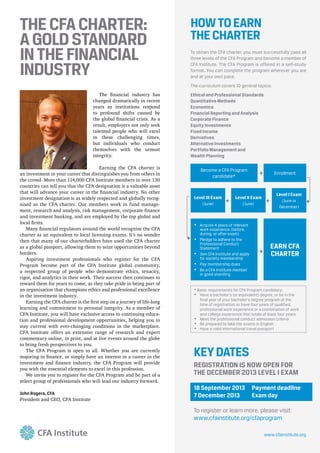
Sign up for OneNetwork today
charteredaccountants.com.au/onenetwork
RRRRRRRiiiiiiiisssssseeeeeee ttttttttoooooooo ttttttthhhhhhheeeeeee tttttttooooooooppppppppp wwwwwwwwiiiiiiiiittttttttthhhhh
ooooooooouuuuuurrr fffffffrrrrreeeeee ssssstttuuuuuddeennnntttt cclluubbbb
As an aspiring Chahartrteredededd AAccccccououououountntntntnn ananananannantt,t,t,t,t,,
OneNetwork puts youu firsrsrsttttt inininninn lllllininininnni eeeee totototo aaaccccccccesesesessessssss
a range of career enhancing opopportrttr unununnititii ieieieies.s.s.s.s.
You can expect to:
• Attend high profile events
Have fun, network with top employers andand
meet new people at a rich line up of events
• Enhance your CV
Showcase an enhanced CV by highlighting your
involvement in a leading professional business
association – OneNetwork
• Secure your dream job
Get ahead of the rest by applying first as jobs open up
• Enter competitions
With heaps of fun competitions and great prizes
up for grabs, you’ll be able to add your winning
moment as an accolade on your CV
• Access information at your finger tips
Access free editions of Charter magazine online,
vodcasts on business and technical topics, and
subscribe to our quarterly enewsletters.
• Build your online networworksks
JoJoinin conco versations, proofile your proprofessional
practical experience and connect witwith
popotent tial empployers through our excluslusive
LiLinkenkedIndIn GroGroupup forfor univerve sity stus dents.s. AlsA o
jooin us ono Facaceboebookok toto conconnecnectt witwith othherer
students and share your thoughug ts.ts.
facebook/charteredaccountants
Chartered Accountants – OneNetwork
Work and live overseas
Chartered Accountants can work all around the world
and are recognised by the accounting bodies in the
leading financial centres. The Institute is a founding
member of the Global Accounting Alliance (GAA),
and currently the only Australian member within the
Alliance. The GAA represents a network of 800,000
accounting professionals and leaders in countries
such as, the United States, New Zealand, Canada,
South Africa, Ireland, Scotland, Hong Kong,
Germany, Japan, England and Wales.
Find job security
Chartered Accountants are in demand both in
Australia and overseas. They are some of the most
highly regarded professionals in the business world
today, not only in accounting firms but in all sectors of
business, government and not-for-profit organisations.
Chartered Accountants are valued for their commercial
know-how, analytical thinking and leadership abilities.
Have choices
Chartered Accountants have diverse roles such
as CEO, CFO, forensic accountant, management
consultant, stockbroker and business analyst,
which span across commerce and industry,
government, public practice and not-for-profit.
To find out more, see some of our technical
vodcasts, play some games and get connected
check out our website.
charteredaccountants.com.au/students
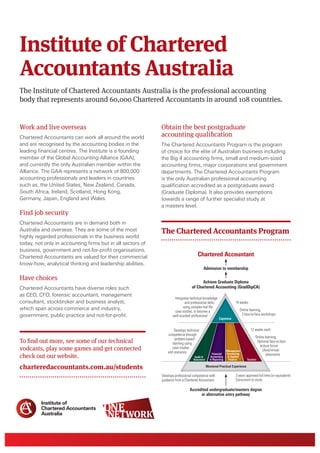
Achieve Graduate Diploma
of Chartered Accounting (GradDipCA)
Admission to membership
Chartered Accountant
Accredited undergraduate/masters degree
or alternative entry pathway
Integrates technical knowledge and
professional skills, using complex
real life case studies, to become
a well-rounded professional
Mentored Practical Experience
14 weeks
Online learning,
3 face-to-face workshops
Workshops (40%),
Final exam (60%)
12 weeks each
Online learning,
Optional face-to-face lect
forum (Aus)/virtual clas
3 online assessments
Final exam (80%)
3 yea
tim
C
ops technical competence
through problem-based
ing using case studies
and scenarios
onal
th
Capstone
Audit &
Assurance Taxation
Management
Accounting
& Applied
Finance
Financial
Accounting
& Reporting
Integrates technical knowledge
and professional skills,
using complex real life
case studies, to become a
well-rounded professional
Develops technical
competence through
problem-based
learning using
case studies
and scenarios
14 weeks
Online learning,
3 face-to-face workshops
12 weeks each
Online learning,
Optional face-to-face
lecture forum
(Aus)/virtual
classrooms
Develops professional competence with
guidance from a Chartered Accountant
3 years approved full time (or equivalent)
Concurrent to study
The Chartered Accountants Program
Obtain the best postgraduate
accounting qualification
The Chartered Accountants Program is the program
of choice for the elite of Australian business including
the Big 4 accounting firms, small and medium-sized
accounting firms, major corporations and government
departments. The Chartered Accountants Program
is the only Australian professional accounting
qualification accredited as a postgraduate award
(Graduate Diploma). It also provides exemptions
towards a range of further specialist study at
a masters level.
Institute of Chartered
Accountants Australia
The Institute of Chartered Accountants Australia is the professional accounting
body that represents around 60,000 Chartered Accountants in around 108 countries.
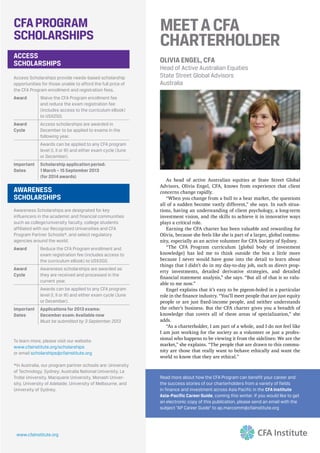
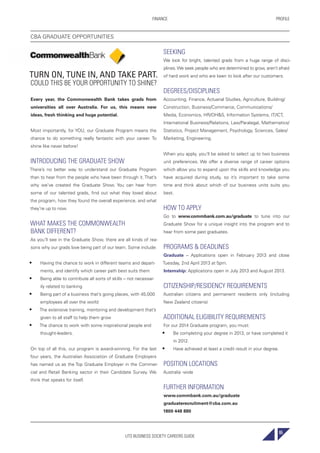
Wanting to see the world didn’t stop
Josh from advancing his career. He
began the CPA Program working at
Macquarie Bank in London. When
he returned to Sydney, Josh had the
skills he needed to gain a coveted
position in Strategic Investments at
Commonwealth Bank. Start your
success story with the CPA Program.
Get connected
CPA Australia’s global student network
connects you to
+ employers
+ internships
+ networking events
+ career advice and resources
+ study support
Get connected
Get noticed
Get ahead
Join now at
cpaaustralia.com.au/cpapassport
Joshua Morris CPA
Manager – Strategic Investments
Commonwealth Bank
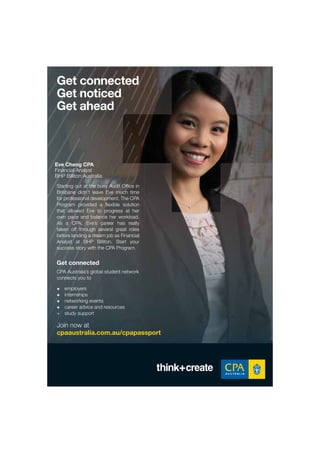
Starting out at the busy Audit Office in
Brisbane didn’t leave Eve much time
for professional development. The CPA
Program provided a flexible solution
that allowed Eve to progress at her
own pace and balance her workload.
As a CPA, Eve’s career has really
taken off through several great roles
before landing a dream job as Financial
Analyst at BHP Billiton. Start your
success story with the CPA Program.
Get connected
CPA Australia’s global student network
connects you to
+ employers
+ internships
+ networking events
+ career advice and resources
+ study support
Get connected
Get noticed
Get ahead
Join now at
cpaaustralia.com.au/cpapassport
Eve Cheng CPA
Financial Analyst
BHP Billiton Australia
UTS BUSINESS SOCIETY CAREERS GUIDE
FIRM PROFILE ACCOUNTING
28
The letters CPA are a professional accounting designation,
held by members of CPA Australia. They are displayed after
a member’s name (a post nominal) to indicate both technical
accounting expertise and strategic business leadership.
Being a CPA will put you ahead of the curve, giving you the
recognition and knowledge sought by employers. As a CPA,
you’ll do more than merely think through the numbers – you’ll
create business solutions.
The first step to becoming a CPA is to complete an accredited
accounting, commerce or business degree and, if required,
demonstrate the equivalent core knowledge through CPA
Australia’s foundation level exams.
While studying the CPA Program you are an Associate (ASA)
member of CPA Australia and hold the ASA designation. To
become a CPA you must complete the CPA Program, includ-
ing three years of relevant work experience.
If you’re planning a successful career grounded in accounting,
plan to begin working towards your professional designation
after you graduate.
The CPA Program is rigorous and internationally recognised.
By combining accounting knowledge with strategic thinking
and practical experience, it offers the perfect start to a reward-
ing career.
More than 400 leading academics and business professionals
from around the world contribute to the design, development
and delivery of the CPA Program ensuring it remains current,
relevant and of the highest quality. With the advantage of
the CPA Program, you have every chance to succeed in your
career in accounting.
WHY COMPLETE THE CPA PROGRAM:
• gain the globally-recognised CPA designation
• be prepared for numerous roles – not just in accounting or finance
• specialise in your area of interest
• receive ongoing support and training – at every stage in your career
• enjoy the advantages of a CPA career
• access a network of professionals
• have the potential to earn an extremely competitive salary
TO SUCCEED IN BUSINESS, YOU REALLY NEED TO STAND OUT FROM THE CROWD.
UTS BUSINESS SOCIETY CAREERS GUIDE
ARTICLEACCOUNTING
29
STEP 1: BE ORGANIZED
Work out what industry you would like to do a Vacation Pro-
gram in or if you have heaps of time on your hands and will
be applying everywhere. Next, compile a list of firms in that
industry by grabbing your closest careers guide (hint: this one)
or head to websites such as those listing graduate positions
or the BRW list series. Then obtain all the application closing
dates for these firms via their individual websites. This plan-
ning stage is really important as firms in the commercial world
all have different closing dates for applications that often open
in March/April and a few firms will operate rolling recruitment
days and just close as soon as all positions are filled. These
initial steps are really important as there is no central industry
body that runs the application process for Vacation Programs,
therefore all the planning falls on you to create your own
game plan.
Attend as many Careers Days and Networking Events as possi-
ble. UTS Careers and UTS Business Society run different events
with the big firms and there are also events run by industry
bodies such as the Institute of Chartered Accountants. Firms
that offer Vacationer Positions will be there and it is a great
opportunity to introduce yourself to their HR representatives,
find out more about what they look for and more importantly, to
have a chat and express your interest in their Vacation Program.
STEP 2: THE APPLICATION
Most firms will require an online application through their
website. Although each firm is different, generally speaking an
online application requires an academic transcript, work his-
tory including key roles and responsibilities held and details of
extracurricular involvement. Not all firms require your typical
cover letter and CV combination so make sure all the relevant
parts of your CV make it into your application somewhere.
You will also be required to answer such questions like “Why
do you want to work in Restructuring / in Asset Management
/ in Audit / in Finance?” or “Why do you want to work at X
firm?” A tip to answering these last questions effectively is
to research what the firms values are / what is important to
them and link this in with your prior extracurricular involve-
ment / work experience / careers goals to answer the ques-
tion. This is the tricky part – but practice makes perfect! Make
sure to keep a complete record of each application submitted.
You will see how your applications improve as each one is sub-
mitted and firms in similar industries may ask slightly similar
questions or have similar values they look for in a Vacationer.
HOW TO GET A VACATIONER POSITION
BY ISABELLE DUGGAN
During the course of my degree I’ve been fortunate enough to have done three Vacation Programs; at RSM Bird Cameron, BDO
and more recently at Ernst & Young. Vacation Programs are run at a variety of firms in industries such as Banking, Investment
Banking, Accounting, Management Consulting, Insolvency and Restructuring, Insurance and various Financial Services firms.
Although targeted mainly at students in their penultimate year, many firms have been known to offer positions to those who
have up to two years left at university.
I would highly recommend applying for a Vacation Program to get a feel for the work in different areas of the
commercial world, to build a network and for the opportunity to obtain a graduate position. Not to mention it is
an absolutely invaluable experience for your CV and is a lot of fun.
ALREADY CONVINCED? HERE ARETHE STEPSYOU NEEDTOTAKE:
UTS BUSINESS SOCIETY CAREERS GUIDE
ARTICLE ACCOUNTING
30
If your application is successful you will get an email or a
phone call from HR. They will sometimes call you on the spot
and ask a few interview type questions (this has been known
to happen so be prepared!). Or you may receive an email
asking you to complete a literacy / IQ / numeracy test online,
often to be completed within a 48hr period, so check your
email frequently after submitting your applications.
If you are successful at making it past this stage you will be
invited to attend a recruitment day. Generally they will be a
half day or an all day process at the office of the firm with
other applicants consisting of any or all of the following; an
interview or two, more literacy and numeracy tests, an infor-
mal networking session (often over lunch with anyone from
graduates to partners), team based problem solving activities
and maybe an office tour.
YOU MUST PREPARE WELL FORTHIS DAY:
• Research the firm (again).
• Know the application you submitted.
• Think about how your skills and experience so far demonstrate your leadership skills / ability to work effectively in a team /
problem solving skills / other skills or values that the firm looks for in a Vacationer.
• Read the business section of major newspapers and research the industry in which the firm operates. Have they been
involved in a landmark deal recently?
• Think about what questions to ask your interviewers / HR representatives / graduates you will meet on the day. This shows
your intelligence and enthusiasm for the firm’s Vacation Program.
• Take along a copy of your application, CV and your passport (most firms require this).
• Be well dressed (business attire) and on time!
This is the end of the recruitment process for most firms, however some firms do conduct another interview after this day.
If that is the case repeat the preparation above. Following this you will get an email or phone call from a HR representative
or even a manager or partner of the firm advising you of the outcome of the recruitment process you have completed and
if you have a Vacationer Position for the following summer holidays. Sign the contract and you’re on your way!
STEP 3: TESTING AND RECRUITMENT DAYS
UTS BUSINESS SOCIETY CAREERS GUIDE
PROFILEACCOUNTING
31
UTS BUSINESS SOCIETY CAREERS GUIDE
M
onday, November 26, 2012
– first day of work. Having
arrived almost three-quarters
of an hour early (public transport – shows
just how much I trust it), I sat in a café
near PwC wondering just what the next
six weeks will be like – what I will learn,
what I will do, who I will meet? However,
the most important thought that crossed
my mind while finishing my coffee was,
“how on earth do I get to the PwC recep-
tion again?”
It was a terrifyingly exciting day when
I started at PwC as part of their 2012/13
Summer Vacation Program. After a
well-planned stroll through the Darling
Park Towers, I made it to the lobby and
quickly realised I knew no one.This soon
became an insignificant detail as, by the
end of my six weeks, I had made lasting
friendships across various service lines
and positions.
For six weeks, I had the pleasure of
being part of the Corporate Tax Team. I
had the opportunity to work on a range of
clients from the mining, property, finan-
cial services and high-end consumer
products industries and providing a vari-
ety of services. Exposure to this assort-
ment of clients and roles illustrated just
how diverse and dynamic the Tax space
is, but more broadly, the business envi-
ronment as a whole.
Broadly, Tax is broken into two ser-
vices – consulting and compliance.
Consulting usually relates to a specific
business issue where you’re required
to investigate what the relevant legisla-
tion, rulings etc. say about the matter
and then advise the client accordingly.
Compliance on the other hand has to do
with the ‘numbers’ side of life – checking
and calculating tax returns and ensuring
everything has been accounted for cor-
rectly. Along with this, we were given
non-client projects to work on for the
duration of our program that focused on
a technical aspect of Tax.
You’re probably thinking that you
need a substantial knowledge of Tax in
order to apply for a position in this area
– you don’t. I applied and was accepted
while I was completing my one and
only tax subject (at the time) as part of
my Accounting major. I certainly expe-
rienced a steep learning curve in wrap-
ping my head around some of the more
complex technical issues and jargon, but
the support network around you is sim-
ply amazing. I’m not just talking about
the electronic databases and printed
resources available, but the people – the
genuine generosity of time, knowledge,
care and empathy is what really cap-
tured my attention and appreciation.
Aside from the actual work, we had
the opportunity to ‘shadow’ (follow
around) partners and senior manage-
ment. This was one of the more interest-
ing and eye-opening experiences I had
and gave me the best insight into how a
professional services firm actually oper-
ates, the responsibilities entrusted to
and decisions being made by the part-
ners and how they got to where they
are. By sheer serendipity, PwC Australia
was rolling out new company values at
the time. We were able to participate in
a student team “Innovation Challenge”
to design a way in which the values can
receive mass and enduring exposure,
both within the company and externally.
Also, the Program is certainly at the
right time of year in regards to the social
aspects of work – I found this to be a
fantastic way to get to know people on
a more personal level and without the
‘constraints’ of a work environment.
Work is very different from university
– you’ll learn what happens in the ‘real
world’ is not always what you’re taught.
However, in saying this, work requires
you to think on your feet, even forcing
you to recall things you did in Autumn of
first year. It requires some discipline to
get up every day in order to get to work
on time (and taking into account public
transport issues), but you’ll soon realise
that if your job is truly what you want
to do, getting up in the morning is a lot
more bearable.
As cliché as it is, you honestly have
nothing to lose by applying for a Vaca-
tioner Program, and everything to gain
if you do. I truly believe that the Vaca-
tioner Program at PwC works both ways
– it’s as much about you learning all you
can and taking hold of all opportunities
that come your way (there are plenty of
them) as it is for them to see if it’s a suit-
able place of employment for you in the
future. And some final pieces of advice:
keep your ears and eyes open and don’t
ever be afraid to ask questions – I hope
you’ll believe me when I say that you’ll
be surprised by what you learn if you do.
KATHERYNE BARETAS
BACHELOR OF ACCOUNTING (ACCOUNTING, INTERNATIONAL MANAGEMENT AND TAXATION LAW)
PRICEWATERHOUSECOOPERS (PWC) SUMMER VACATIONER | TAX AND LEGAL – CORPORATE TAX
SUCCESSFUL VACATIONER RECOUNT
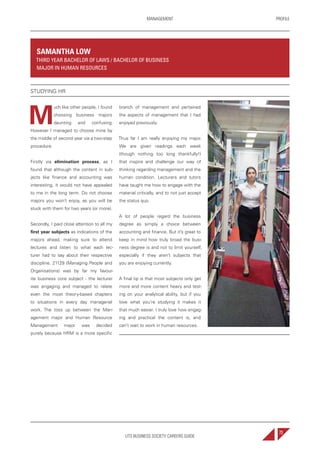
• Debt &
Ca
pitalAdvisory•Actuarial•Succes
sionPlanning•CloudAssurance
•
StampDuty•DueDiligence•Ope
rations Improvement
Peo
ple
&
ChangeManagement•Proje
ctAssurance•InternationalAssig
nm
entSolutions•Corporate&
Pro
ject Finance • Indirect Taxes
Forensics • Perso
nalEstatePlanning&W
ea
lth
Management•Internal
Audit•Research&Develo
pm
ent • T
echnologyRisk&Security•F
inancialReportingAdvice•T
ransferPricing•Valuations
&
Value Advisory Services
Strategy•M
e
rgers&Acquisitions•Co
rporateTaxConsulting&
Compliance • Financial A
ssurance•
•
•
Key
Open to international students
currently studying in Australia
Open to Australian or
New Zealand Citizens
and Australian Permanent
Residents
Year 12
First year
Two or more years remaining
Second last year
Final year
© 2013 KPMG, an Australian partnership. All rights reserved. The KPMG name, logo and “cutting through complexity”
are registered trademarks or trademarks of KPMG International. January 2013. NSWN10606PPC.
LIVE. LEARN.
DISCOVER. ACHIEVE.
At KPMG, we provide an open and friendly
environment that offers long-term growth, constant
challenge and generous rewards. It’s a philosophy
that will continue throughout your career with us
and touch every stage of your development.
We call it ‘Live. Learn.
Discover. Achieve.’
To discover more about career opportunities at
KPMG, visit the‘Careers’ section of our website.
kpmg.com.au
Scan with your smart
phone to find out more.
UTS BUSINESS SOCIETY CAREERS GUIDE
FIRM PROFILEACCOUNTING
37
LIVE. LEARN. DISCOVER. ACHIEVE.
It can be daunting. But KPMG can give you a good idea of
where you’re going and how you’re going to get there.
We’re seeking bright minds from all degree disciplines who
are interested in a challenging and rewarding career with one
of the world’s leading professional services’ firms.
Application for our 2014 Graduate and 2013/2014 Summer
Vacation Program are now open, apply now at kpmg.com.au
OUR CULTURE AND VALUES
As one of the world’s leading professional services firms, we
cut through complexity to help organisations in over 150 coun-
tries to work smarter, grow and prosper. Here in Australia, we
employ around 5,200 people across 13 offices and work with
some of the most high profile public and private names.
Our open and friendly culture encourages you to explore and
share new ideas, and build a successful and individual career
at your own pace.
LEARNING AND DEVELOPMENT
Our people never stop learning.
Forward thinking development and growth programs to sup-
port your personal interests and ambitions are the foundations
on which all graduate careers are built at KPMG.
WHAT WE OFFER UNDERGRADUATES
KPMG offers graduate, vacation, cadetship and co-operative
recruitment programs to students and university graduates.
Nationally, KPMG is one of the largest employers of graduates,
vacationers and cadets and co-ops.
SEEKING
We’re open-minded about people.
Our standards are high but we’re interested in more than just
academic records. We’re looking for talented people, team
players and progressive thinkers who can communicate their
ideas with passion.
DEGREES/DISCIPLINES
All disciplines accepted.
HOW TO APPLY
For closing dates and vacancies in your preferred office and to
submit your online application, please visit the ‘Careers’ sec-
tion of our website.
PROGRAMS & DEADLINES
Cadetship • Cooperative • Vacation Work • Graduate
For closing dates and vacancies in your preferred office please
see our website.
CITIZENSHIP/RESIDENCY REQUIREMENTS
KPMG accepts applications from international students major-
ing in Accounting for our Graduate Program.
All other programs are open to Australian Citizens and Perma-
nent Residents ONLY (including New Zealand Citizens).
POSITION LOCATIONS
Australia-wide
FURTHER INFORMATION
kpmg.com.au
KPMG GRADUATE OPPORTUNITIES
Find us:
www.facebook.com
/DeloitteAustralia
Follow us:
@Green_Dot
@AuDeloittian
Download us:
iPhone app,
Join Deloitte
Download us:
Android app,
Join Deloitte
watch us:
Deloittetv.deloitte.
com.au
Watch us:
www.youtube.com
/DeloitteAustralia
It’s your future
How far will you take it?
We encourage our employees to help architect
the future direction of our business. Choose
from our range of graduate opportunities within
Audit, Consulting, Tax, Financial Advisory Services
and Technology that will stimulate, reward and
motivate you like no other. Step into your future.
graduates.deloitte.com.au
For the past seven months
Deloitte has delivered... I didn’t
expect that some of the most
rewarding experiences would
come from the clients that I’ve
worked with
Amanda Bott
Consulting
One of the most exciting prospects for me was to be a part
of Deloitte’s culture. It’s one of the reasons that I’ve heard
many prospective graduates cite when speaking about what
is important to them. For the past seven months Deloitte has
delivered. However, I didn’t expect that some of the most
rewarding experiences have come from the clients that I’ve
worked with.
For most of my graduate career, I have worked on a large
scale finance transformation at a diverse construction,
development and investment company. While playing a part
in program management has been challenging at times, the
support of great clients and the Deloitte team has enabled me
to ‘embrace the deep end’ and continue to shape my role.
I’ve seen the ‘empower and trust’ signal in action throughout
this major project. I’ve been given the chance to take
on challenging work and directly support senior client
management, which is not a typical graduate role. However,
it is the flexibility and support of the Deloitte leaders who
manage delivery while also giving the team personal
opportunities to grow.
I have found that the most unexpected professional
opportunity has come from working with a predominantly
female, senior leadership team. Not only are these women
talented and extremely accomplished, they have also made
the time to develop meaningful relationships with the team
members, including myself, which has been very inspirational.
The culture and initiatives like Inspiring Women and The
Deloitte Foundation make Deloitte an exceptional place to
work, but I have discovered that working with our clients
from day to day can be the source of some of the most
rewarding experiences.
This publication contains general information only, and none of Deloitte Touche Tohmatsu Limited, its member firms, or their related entities (collectively the “Deloitte Network”) is,
by means of this publication, rendering professional advice or services.
Before making any decision or taking any action that may affect your finances or your business, you should consult a qualified professional adviser. No entity in the Deloitte Network
shall be responsible for any loss whatsoever sustained by any person who relies on this publication.
About Deloitte
Deloitte refers to one or more of Deloitte Touche Tohmatsu Limited, a UK private company limited by guarantee, and its network of member firms, each of which is a legally separate
and independent entity. Please see www.deloitte.com/au/about for a detailed description of the legal structure of Deloitte Touche Tohmatsu Limited and its member firms.
Deloitte provides audit, tax, consulting, and financial advisory services to public and private clients spanning multiple industries. With a globally connected network of member
firms in more than 150 countries, Deloitte brings world-class capabilities and high-quality service to clients, delivering the insights they need to address their most complex business
challenges. Deloitte has in the region of 200,000 professionals, all committed to becoming the standard of excellence.
About Deloitte Australia
In Australia, the member firm is the Australian partnership of Deloitte Touche Tohmatsu. As one of Australia’s leading professional services firms, Deloitte Touche Tohmatsu and its
affiliates provide audit, tax, consulting, and financial advisory services through approximately 6,000 people across the country. Focused on the creation of value and growth, and
known as an employer of choice for innovative human resources programs, we are dedicated to helping our clients and our people excel. For more information, please visit Deloitte’s
web site at www.deloitte.com.au.
Liability limited by a scheme approved under Professional Standards Legislation.
Member of Deloitte Touche Tohmatsu Limited
© 2012 Deloitte Touche Tohmatsu
UTS BUSINESS SOCIETY CAREERS GUIDE
FIRM PROFILEACCOUNTING
41
At Ernst & Young we want you to be yourself. We want
you to bring your intelligence, energy and integrity into
our business. Think how much further you’ll go sur-
rounded by people who encourage you to express your
ideas and who’ll respect your opinions.
Ernst & Young is a global leader in assurance, tax, transactions
and advisory services. Our 167,000 people are united by our
shared values, which inspire our people worldwide and guide
them to do the right thing, and our commitment to quality,
which is embedded in who we are and everything we do.
Ernst & Young is committed to doing its part in building a bet-
ter working world for our people, for our clients and for our
communities.
JOIN ERNST & YOUNG AND SHAPE YOUR CAREER.
CREATE YOUR FUTURE
Turn your hard work and studies into the future you want. We’ll
provide you with the support, the experiences and the oppor-
tunities to create a career that inspires you. Because that’s
when you’ll do your best work for us and for our clients.
At Ernst & Young, you’ll help define us and we’ll help define
you.
You’ll have all the coaching, formal training and leadership
development you need to progress quickly. You’ll have experi-
ences that will set you up for success, both now and in the
future.
Using the knowledge you’ve gained from your studies, you’ll
help all types of companies, from entrepreneurial start-ups to
multinationals. And, in the process, you’ll build your reputation
as a trusted business advisor and develop relationships that
you’ll draw on for the rest of your professional career.
WE’RE LOOKING FOR...
Individuals who are committed, talented, curious, energetic,
inquisitive and ready to become successful business profes-
sionals.
We’re interested in talented students and graduates from
many disciplines, including: accounting, actuarial, busi-
ness, commerce, economics, engineering, finance, human
resources, information systems, law and science.
JOIN ERNST & YOUNG AND CREATE
YOUR FUTURE. APPLY NOW!
Apply online at www.ey.com/au/careers/apply. Click on your
preferred program and complete the application form and
attach a copy of your academic transcript.
EXPERIENCES THAT LAST A LIFETIME
Whatever your degree or discipline, with Ernst & Young you
can create the future you want. Connect with us and keep in
touch.
Become a fan on Facebook: www.facebook.com/eycareers
Follow us onTwitter: www.twitter.com/EY_Australia
Connect with us on LinkedIn: www.linkedin.com/company/
ernstandyoung/careers
Discover more at: www.ey.com/au/careers
©2013 Ernst & Young, Australia. All Rights Reserved.
Liability limited by a scheme approved under Professional Standards Legislation.
ERNST & YOUNG GRADUATE OPPORTUNITIES
UTS BUSINESS SOCIETY CAREERS GUIDE
PROFILE ACCOUNTING
42
WHAT DID YOU LEARN WHILST
UNDERTAKING THE SUMMER
VACATIONER POSITION?
The entire experience was a learning
curve.The program ran for 8 weeks from
December 2012 to February 2013 and as
I was working in the Assurance service
line, I spent the majority of the program
working outside of the office on client
sites around Sydney, performing half-
year reviews and year-end audits.
The program began with one and a half
weeks worth of training at the Sydney
office. It was during this time that I was
able to familiarise myself with the opera-
tions of the business and the audit pro-
cess. I was also able to network with
other vacationers and colleagues during
social events organised by the firm.
The rest of the program was spent
working on client engagements. This is
ultimately where the greatest learning
opportunities presented themselves. As
an Assurance vacationer, I was able to
work within different industry teams,
including Consumer Products (CP), Tech-
nology, Entertainment and Communi-
cations (TCE) and Real Estate. Thus, on
a week-by-week basis, I worked on a
different client with a new engagement
team. I quickly learnt the importance of
being organised by keeping a detailed
schedule and taking notes. I also learnt
how to communicate effectively with
a variety of clients and team members,
as maintaining a good working relation-
ship with both parties is essential when
undertaking an audit. Furthermore, I
learnt practical audit skills, as I per-
formed substantive procedures on sig-
nificant balance sheet accounts.
HOW IS THIS DIFFERENT
TO STUDIES AT UNIVERSITY?
Studying a subject, such as audit, at uni-
versity will provide you with a good theo-
retical and practical basis. However, it is
through working in the industry that real
meaning is given to what you have learnt.
You are able to apply your university stud-
ies to real life situations and build upon
your prior knowledge and skills through
both formal and informal training and
professional development programs.
WHAT CHALLENGES DID YOU FACE
DURING THE VACATIONER PROGRAM?
During the first week of the Vacationer
Program, I found it difficult to adjust to
working full-time in a corporate environ-
ment. However, Ernst & Young ensured
that Vacationers were given the proper
guidance from the beginning. I was
assigned a ‘Buddy’ (an Accountant) that
taught me how to complete essential
tasks such as filling in my timesheet. I
was also assigned a ‘Counsellor’ (a Sen-
ior Accountant) that guided me through
the program. My counsellor helped me
set my own professional goals and also
alleviated any concerns I had.
Furthermore, as it was my first time
working in Assurance, I found it difficult
to understand some of the tasks that I
was required to complete. Despite this, I
found that through asking my colleagues
questions and seeking feedback, I was
able to understand and carry out the
work that I had been allocated effectively.
WHAT DID YOU ENJOY MOST ABOUT
YOUR TIME AS A VACATIONER?
I enjoyed being able to work with and
learn from a wide range of experienced
and talented people across the Assur-
ance service line. I also enjoyed the
unique opportunities that the firm pro-
vided vacationers, including Partner
shadowing.
DO YOU HAVE ANY ADVICE FOR
STUDENTS CONSIDERING APPLYING FOR
A VACATIONER POSITION?
I would strongly recommend penulti-
mate year accounting students to apply
for a vacationer position - it is a great way
to get work experience, network with
others and possibly secure a graduate
position before completing your studies.
When looking for a Vacationer Pro-
gram, ensure that you research the firm
and the area that you are interested in.
Attend careers events and talk to repre-
sentatives from the firm to gather more
information and cast a good impression.
When completing online applications,
ensure that you invest time in research-
ing and drafting your responses. If you
make it to the next recruitment round,
which may be a phone interview or
assessment day, prepare and practice
your interview responses (including
being able to discuss your reasons for
applying to the firm and service line).
LAURA-MARIE RULLO
BACHELOR OF BUSINESS (ACCOUNTING AND IT)
ERNST & YOUNG SUMMER VACATIONER – ASSURANCE
SUCCESSFUL VACATIONER RECOUNT
UTS BUSINESS SOCIETY CAREERS GUIDE
ARTICLEACCOUNTING
43
WHAT AREA OF ACCOUNTING
ARE YOU PRIMARILY INVOLVED IN?
KordaMentha is a corporate recovery
and advisory firm and doesn’t fall into a
particular accounting area such as audit,
management accounting or tax. How-
ever we do have a strong understanding
of accounting and how businesses work.
This knowledge is used in analysing and
hopefully turning around distressed
companies.
WHAT DO YOU WISH YOU WERE TOLD
WHEN APPLYING FOR GRADUATE ROLES?
Avoid the marketing spin, the promise of
fancy trips away or high salaries.The key
to enjoying your work is the people you
work with, and if you’re not happy you
won’t succeed.
Remember, your interviews are also
about you finding out about the firm not
just them finding out about you. Don’t
go to a firm that is disengaged with the
recruiting process – they won’t value
your work, if you don’t feel comfortable
and (relatively) relaxed, then you may not
fit with the organisation and if you aren’t
enjoying the conversation, the culture
may not be for you.
HOW IS YOUR WORK DIFFERENT
TO STUDIES AT UNIVERSITY?
The real world doesn’t fall into the neat
little boxes that you are taught at univer-
sity. Most issues are full of intricacies
and interrelationships that have to be
considered when making decisions. The
commercial reality of a decision is often
very different to a theoretical outcome.
WHAT CHALLENGES DO YOU FACE?
KordaMentha is the market leader in find-
ing innovative solutions to problems. We
particularly focus on finding a commer-
cial solution that may require a bit of ‘out
of the box’ thinking. The ability to look at
a complex problem and come up with a
simple and logical solution is a skill that
only comes with experience. The more
of these issues you face, the better you
get at coming up with solutions.
WHAT DO YOU ENJOY
MOST ABOUT YOUR ROLE?
This is an easy one! The people. I have
been at KordaMentha for five years. In
this time the Sydney office alone has
grown from a team of about 25 to over
100. Throughout the growth the firm has
managed to keep a fantastic firm cul-
ture; we are all very good friends. I have
worked in a number of organisations and
none have been like this.
DO YOU HAVE ANY ADVICE FOR
STUDENTS CONSIDERING APPLYING
FOR A POSITION IN THIS FIELD?
The industry isn’t for everyone, there is
not a stereotypical day, you won’t have
a ‘routine’ or a month-end and will be
faced with new challenges every day.
If you are someone who is diligent and
enthusiastic and likes the idea of con-
stantly being challenged then it may just
be for you.
If you think it is for you then research
– know as much as you can about the
industry, the main players, the drivers
and key news items. Speak with some-
one in the industry if not the company
you are applying for, it will make a dif-
ference in the interview and show you
are keen.
TYSON GUNDERSEN
BACHELOR OF ACCOUNTING (ECONOMICS AND FINANCE)
KORDAMENTHA | SENIOR EXECUTIVE ANALYST
INSOLVENCY INDUSTRY
www.bdo.com.au/grads
You can choose the type of relationship you wish to have with BDO. At BDO we
will provide you with a career roadmap for your entire learning and development
journey.
If you’re looking for support with your career development with a culture that offers
adventure through travel with secondment programs, you should consider BDO.
Every journey requires a roadmap just to get from point A to point B. If you are unsure
of your destination, we have provided a guide on how you may wish to travel with BDO
throughout your career journey to succeed both professionally and personally.
Your career.
Your journey.
Your BDO.
Distinctively different – It’s how we see you.
“Since starting as a graduate at BDO I have
been provided with the opportunity to work
on a variety of projects including completing
individual and company tax returns, research
and liaising with the ATO. Having recently
started my CA, I have been provided with
extensive learning and training resources and
support throughout the firm. I would recommend
BDO to anyone looking for a positive start to
their career.”
MELISSA BISHOP, GRADUATE
UTS BUSINESS SOCIETY CAREERS GUIDE
FIRM PROFILEACCOUNTING
45
BDO employs over 300 people in New South Wales, including
over 40 partners. There are 3 offices including Sydney, Tugge-
rah and Caringbah.
GRADUATE OPPORTUNITIES FOR 2014
We are excited to be offering graduate positions for com-
mencement in 2014. Our graduates are extremely important
to us as they represent the future leaders of the firm and are
the secret to our success. We look for people who display
energy, ambition, potential and a quest for learning.
BUSINESS SPECIALITIES
At BDO we provide a full range of audit, tax and advisory ser-
vices such as Audit, Business Recovery & Insolvency, Corpo-
rate Finance, Private Clients and Tax.
CLIENTS
At BDO our focus on developing strong client relationships
has helped deliver proven results for our clients. Just like
our people, we know that each of our clients is distinctively
different. Their needs drive our approach and we tailor our
thinking to their specific situation. We apply this thinking to
clients ranging from large corporate organisations to private
businesses, entrepreneurs and individuals across a range of
industry sectors.
INDUCTION AND MENTORING PROGRAM
As a new employee it is important that we help you find your
feet and adjust to a new environment and culture.
All our graduates are assigned a ‘buddy’ upon commence-
ment. We pride ourselves on the personal attention we give
to each new employee ensuring they understand their respon-
sibilities, the reasoning behind the work they are doing and
where to go for help if required. This commitment to contin-
ued support is provided throughout your career at BDO.
STUDY SUPPORT
BDO, as a Chartered Accounting firm, offers support and
incentives for all employees to successfully complete the CA
program and become a member of the Institute of Chartered
Accountants Australia.
BDO GRADUATE OPPORTUNITIES
BDO PROVIDES:
• Upfront payment of enrolment fees
• A range of external support options including notes, lecture series, practice exams
• Paid study leave.
• Internally run focus sessions to compliment those provided by the Institute of Chartered Accountants
HOW TO APPLY
Applications for BDO Sydney close on 25 March 2013. Applications will only be accepted via www.bdo.com.au/grads
UTS BUSINESS SOCIETY CAREERS GUIDE
ARTICLE ACCOUNTING
46
My area of expertise is in account-
ing cadetships – and I am currently
undertaking one with ESV Chartered
Accountants, a mid-tier accounting firm
in the CBD. I have been working at
ESV full-time since January 2011 when
I first commenced at UTS studying a
combined Business (Accounting) / Law
degree, so I can certainly share some
insights into the sorts of work you
would normally be given and the chal-
lenges I face in the role.
I seized the opportunity to pursue full-
time work in the accounting industry
fresh out of high school and had spent
a good few months during mid-year 12
researching into and applying at various
firms. Accounting cadetships are nor-
mally offered to high school graduates,
but many firms are increasingly mov-
ing towards hiring first and second year
Business degree students as cadets,
simply because in most cases they have
had some sort of exposure to account-
ing theory through completion of first-
year accounting subjects, which cer-
tainly puts you in a better position when
tackling client work in your role.
The good news is that there is a way to
alleviate the stress of finding a job post-
university - the best way to do this is to
find a job before you finish university.
Perhaps even before you start! Which
is what the focus of this piece is – it’s
about the opportunity to pursue what is
known as a ‘cadetship’, something that
gives you a head start, a competitive
edge and a way forward! The bad news
is that it’s not easy to get a cadetship –
but let me tell you; it is well worth the
time and effort, and will put you miles
ahead of the rest!
A cadetship is typically defined as full-
time work and part-time study, though
there are various other combinations
(addressed below). The beauty of a
cadetship is that not only are you earn-
ing an income while you are studying,
but you are also gaining hands-on expe-
rience in the industry. Cadetships are
typically offered in Accounting and Engi-
neering, but there are clerkships avail-
able to students studying law as well as
internship opportunities in various indus-
tries – all of which are useful to obtain
relevant work experience.
THE CADETSHIP
BY NICHOLAS ROKKAS, ESV CHARTERED ACCOUNTANTS
What doors will my degree open for me? Are my marks good enough? Who is going to hire me after I graduate? These are all
typical questions pondered by university students as they progress through their degree, across a range of disciplines – busi-
ness, law, engineering, arts, and anything else! And probably the biggest thing on the minds of university students as they inch
closer to and complete their final semesters, is what opportunities are available for them to grab beyond the world of university.
A cadetship is typically
defined as full-time work
and part-time study,
though there are various
other combinations
(addressed below). The
beauty of a cadetship
is that not only are you
earning an income while
you are studying, but
you are also gaining
hands-on experience in
the industry.
UTS BUSINESS SOCIETY CAREERS GUIDE
ARTICLEACCOUNTING
47
The application process involved to get
your hands on one of these cadetship
opportunities is pretty rigorous – but
they have to be, because they want
all-rounders; sociable, enthusiastic and
intelligent people to add some real
value to their firms. The process varies
depending on the particular firm, but it
will typically include a mix of telephone
and face-to-face interviews plus written
exercises, all of which are designed to
gauge the type of person you are, how
you think, what experiences and skills
you can bring to the firm and the likeli-
hood of you being a good cultural fit. It
sounds daunting (and I won’t lie, it is!)
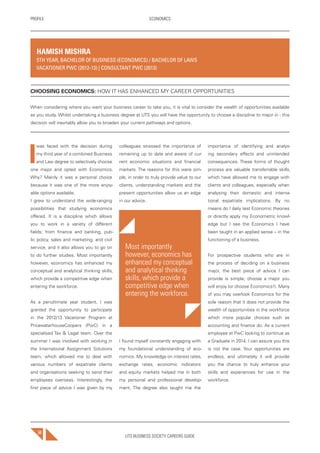
but the best thing to do when it comes
to going for these positions is to just be
yourself and don’t be afraid to tell the
employer what is that you can offer, and
what makes you stand out from the rest.
I have personally enjoyed the challenge
of working full-time and simultaneously
combining this with full-time univer-
sity study. Some say I’m crazy and ask
me how I do it - and why I put myself
through such a rigorous program - but
one of the things I can confidently say
is that if you enjoy what you do, and
put your mind to it, you can achieve the
things you set out to achieve.
After starting as a cadet at ESV in Janu-
ary 2011, I was promoted to Intermedi-
ate Accountant earlier this year and now
have two cadets working under me, for
which I have responsibility to train them
and to delegate work to them. This has
definitely been one of the most reward-
ing parts of my role on a personal level.
On a professional level, I have gained
exposure to a broad range of client ser-
vices, including taxation, superannua-
tion, bookkeeping and audit, and have
had opportunities to market the firm
at Institute of Chartered Accountants
(ICAA) events and local high schools. I
have been mentored by leaders in the
industry, constantly learning new things
on a daily basis and have formed close
friendships with many of my colleagues.
On a final note, if you are someone
studying Business and are interested
in accounting, consider a cadetship –
not only will you be supported as you
complete your degree, but your skill set
and knowledge will transform in incred-
ible ways and you will be ahead of the
pack when you graduate. I guarantee
many doors will open for you, because
in today’s competitive job market, there
is nothing more valuable than practical
industry experience and that’s what you
can be sure you’re going to get from a
cadetship.
The application process
involved to get your
hands on one of these
cadetship opportunities
is pretty rigorous – but
they have to be, because
they want all-rounders;
sociable, enthusiastic
and intelligent people to
add some real value to
their firms.
03
ECONOMICS
UTS BUSINESS SOCIETY CAREERS GUIDE
MAJOR STRUCTUREECCONOMICS
49
THE MAJOR STRUCTURE
An Economics major at UTS comprises
of 48 credit points (8 subjects).
As part of the Economics major, students must
complete all of the following subjects:
• 23566 Economics for Business 2 6cp
• 23567 Intermediate Microeconomics 6cp
• 23568 Intermediate Macroeconomics 6cp
• 23571 Introductory Econometrics 6cp
• 23580 The Global Economy (Capstone) 6cp
Additionally, you will have a choice of completing
18 credit points from the following:
• 23021 Labour Economics 6cp
• 23022 Public Economics 6cp
• 23418 Economics of Money and Finance 6cp
• 23569 Economic Growth and Development 6cp
• 23570 Economics of the Environment 6cp
• 23623 Alternative Perspectives in
Contemporary Economics 6cp
• 23565 Mathematics for Economics and Business 6cp
• 23572 Applied Microeconometrics 6cp
• 23592 Game Theory 6cp
• 23593 Industrial Organisation 6cp
• 23591 Economics of Law 6cp
• 23999 Business Internship 6cp
CAREER PROSPECTS
Careers exist across industry, government organisations and
financial institutions in roles which focus on undertaking analy-
sis for and providing advice to policymakers, funds managers
and other corporate strategic decision makers.
GRADUATE POSITIONS:
• Member of Economic Consulting Team
• Data Analyst
• Statistician
• Economic Markets Report Writer
• Policy Analyst
• Market Analyst
• Researcher
CAREER PROGRESSION:
• Policymaker
• Senior Policy Analyst
• Economic Strategist
• Econometrician
• Economic Natural Resources Manager
• Finance Manager
• International Trade Analyst
• Natural Resource Manager
• Economist in a range of sectors
ECONOMICS
The study of economics provides students with a greater understanding of how people, businesses and governments make
decisions based on their economic environment. Economics seeks to understand these issues by developing a systematic
approach to analysing resource allocation, price determination, income distribution, economic growth and the welfare conse-
quences of economic policies.
A major in economics at UTS is centred on equipping students with powerful tools to systematically evaluate economic behaviour
and policy for a wide range of economic problems: firm and consumer behaviour, labour markets, government tax and expendi-
ture policy, environmental and resource management, regulating financial systems and managing the aggregate economy.
Key analytical tools include microeconomic and macroeconomic theory, empirical analysis using econometric modelling, and game theory.
UTS BUSINESS SOCIETY CAREERS GUIDE
PROFILE ECONOMICS
50
I
was faced with the decision during
my third year of a combined Business
and Law degree to selectively choose
one major and opted with Economics.
Why? Mainly it was a personal choice
because it was one of the more enjoy-
able options available.
I grew to understand the wide-ranging
possibilities that studying economics
offered. It is a discipline which allows
you to work in a variety of different
fields; from finance and banking, pub-
lic policy, sales and marketing, and civil
service, and it also allows you to go on
to do further studies. Most importantly
however, economics has enhanced my
conceptual and analytical thinking skills,
which provide a competitive edge when
entering the workforce.
As a penultimate year student, I was
granted the opportunity to participate
in the 2012/13 Vacationer Program at
PricewaterhouseCoopers (PwC) in a
specialised Tax & Legal team. Over the
summer I was involved with working in
the International Assignment Solutions
team, which allowed me to deal with
various numbers of expatriate clients
and organisations seeking to send their
employees overseas. Interestingly, the
first piece of advice I was given by my
colleagues stressed the importance of
remaining up to date and aware of cur-
rent economic situations and financial
markets. The reasons for this were sim-
ple; in order to truly provide value to our
clients, understanding markets and the
present opportunities allow us an edge
in our advice.
Most importantly
however, economics has
enhanced my conceptual
and analytical thinking
skills, which provide a
competitive edge when
entering the workforce.
I found myself constantly engaging with
my foundational understanding of eco-
nomics. My knowledge on interest rates,
exchange rates, economic indicators
and equity markets helped me in both
my personal and professional develop-
ment. The degree also taught me the
importance of identifying and analys-
ing secondary effects and unintended
consequences. These forms of thought
process are valuable transferrable skills,
which have allowed me to engage with
clients and colleagues, especially when
analysing their domestic and interna-
tional expatriate implications. By no
means do I daily test Economic theories
or directly apply my Econometric knowl-
edge but I see the Economics I have
been taught in an applied sense – in the
functioning of a business.
For prospective students who are in
the process of deciding on a business
major, the best piece of advice I can
provide is simple; choose a major you
will enjoy (or choose Economics!). Many
of you may overlook Economics for the
sole reason that it does not provide the
wealth of opportunities in the workforce
which more popular choices such as
accounting and finance do. As a current
employee at PwC looking to continue as
a Graduate in 2014, I can assure you this
is not the case. Your opportunities are
endless, and ultimately it will provide
you the chance to truly enhance your
skills and experiences for use in the
workforce.
HAMISH MISHRA
5TH YEAR, BACHELOR OF BUSINESS (ECONOMICS) / BACHELOR OF LAWS
VACATIONER PWC (2012-13) | CONSULTANT PWC (2013)
CHOOSING ECONOMICS: HOW IT HAS ENHANCED MY CAREER OPPORTUNITIES
When considering where you want your business career to take you, it is vital to consider the wealth of opportunities available
as you study. Whilst undertaking a business degree at UTS you will have the opportunity to choose a discipline to major in - this
decision will inevitably allow you to broaden your current pathways and options.
Finsia’s highly customised mentoring program pairs mentees
with hand-picked senior industry executives.
Gain access and insight to this executive expertise in tandem
with structured workshops and networking sessions. For final
year, post-grad students or graduates only.
Go to www.finsia.com/mentoring to find out more and to
register for the next program. Or phone 02 4476 8107 to
speak to someone.
WE POWER THE PEOPLE WHO DRIVE THE FUTURE
An inspired program
A TOP FINANCE
EXECUTIVE
AS YOUR
MENTOR
“Through Finsia’s mentoring program, I have learnt valuable insights
and gained experiences assisting me across many aspects of my career
and personal life.
I would recommend the mentoring program with my highest
endorsement to colleagues and fellow graduates as an essential
networking tool in progressing forward."
Daniel Lennox, first year graduate, B Comm Gain access
We understand that you’re about to start a journey, and might
not be sure where you see yourself in 3, 5 or 10 years. That’s
why we help you get clarity by giving you a range of experi-
ences to get you started – from working with different teams
to presenting projects to senior management.
WHY ANZ?
As a graduate at ANZ, you’ll get the chance to make a differ-
ence in ways you never thought possible.
We’re an organisation that’s focused on our people. Our envi-
ronment is built on fostering the skills, talents and interests of
all our staff and ensuring that great work is rewarded. We hire
graduates who we believe will have lasting careers with ANZ.
THE ANZ VISION
We’re in an exciting period of growth as we work towards
becoming a super regional bank. We’re broadening our global
presence by leveraging off our strong foundations in Australia,
New Zealand and across Asia. This means that we are able to
offer our employees access to a greater knowledge base and
more opportunities than ever before.You’ll be able to have real
involvement guiding ANZ through this growth period.
WHAT WE OFFER
• Training and development
• Challenging roles
• Attractive remuneration and rewards
• Extensive support
• Outstanding career opportunities.
OUR GRADUATE PROGRAM
The ANZ Graduate Program is professionally designed to give
you the best possible start to your career.
• 18 or 24 month program (length depends on program
stream)
• Rotations that expand and enhance your experience
• Comprehensive training and business-specific inductions
• Hands-on project work
• Opportunities to meet with senior leaders
• Coaching and peer support through the program
SEEKING
Graduates who are driven to perform with excellence. We look
for people who actively come up with solutions, work collabo-
ratively and are able to deliver great results for our customers.
DEGREES/DISCIPLINES
Use our online ‘Explore the program streams’ tool to view
your career options at ANZ. Regardless of your academic
background, the tool will help you work out what part of our
business best suits your skills and interests.
CITIZENSHIP REQUIREMENTS
Australian citizens and permanent residents (including New
Zealand citizens).
HOW TO APPLY
Online at: www.anz.com/graduates
APPLICATION DEADLINES
Graduate program: 28 March 2013
Summer Intern program: applications open from mid July
2013. Check website for further infomation.
CONNECT WITH US
Facebook.com/ANZ.Australia.Graduates
FURTHER INFORMATION
www.anz.com/graduates
ANZ GRADUATE OPPORTUNITIES
UTS BUSINESS SOCIETY CAREERS GUIDE
PROFILEECCONOMICS
53
WANT TO MAKE A DIFFERENCE
TO THE STATE OF NSW?
JOIN TREASURY
When you work at Treasury, everything you do has an impact
on the lives of the people of NSW. We make a difference.
The Treasury is the NSW Government’s main financial and eco-
nomic adviser. We work to ensure the public sector retains
a strong balance sheet leading to the sustainable delivery of
services. We apply rigour and innovation in our advice and are
influential in its delivery. The Treasury works with more than
200 public agencies and businesses across the State such as
health, education, environment, transport, police, housing and
the arts.
OUR WORK INCLUDES:
• Preparing the NSW State Budget
• Analysing the financial position of Government agencies
and businesses
• Developing and implementing the Government’s eco-
nomic and fiscal policies
• Advising the Government on the effective use of the
State’s resources
• Leading microeconomic reform to support a strong, com-
petitive economy
• Driving public sector financial accountability
• Assessing financial and economic risk.
GRADUATE PROGRAM AT TREASURY
Over the 12-month program, graduates will receive three
placements within different branches of Treasury. You will be
involved in choosing your placement.
We value our Graduates and effort is rewarded. We offer sala-
ries that are competitive with the private sector, generous
superannuation, assistance for further study and flex-time. We
also encourage our staff to become involved in Treasury activi-
ties like the social club and sporting groups.
ELIGIBILITY AND HOW TO APPLY?
We are seeking people from a broad range of disciplines
including Accounting, Business, Commerce, Economics and
Finance. Combined Qualifications incorporating Public Policy,
Politics or Law will also be considered.
To be eligible for our graduate program you should have com-
pleted your studies within the last three years: 2011, 2012,
2013. You should be an Australian Citizen or a Permanent Resi-
dent.
Our applications open on Monday, 5 August 2013. To apply
please go to www.jobs.nsw.gov.au when the applications
open.
If you have any questions about our graduate program, visit
us at www.treasury.nsw.gov.au or email People & Develop-
ment on people&development@treasury.nsw.gov.au.
NSW TREASURY
Statistics
tell the
story
Be the author of tomorrows tales
The ABS is at the centre of informed decision making
for all Australians.To become part of an internationally
recognised organisation that is the foundation of research,
planning and discussion within governments and the
community, apply to the ABS Graduate Development or
Cadetship Program.The ABS offers you diverse, challenging
wand rewarding careers in many fields.
Contribute. Be part of a team which makes a difference
Develop. Find unique opportunities to grow
Community. Enjoy a diverse working community
Career. Start writing your own story with the ABS
Applications are available online at
www.abs.gov.au/careers
Give us a call on our
Graduate Hotline: 1800 675 125
UTS BUSINESS SOCIETY CAREERS GUIDE
FIRM PROFILEECCONOMICS
55
Applications open from 7 March 2013 until 26 April 2013
COMPANY INFORMATION
The Australian Bureau of Statistics (ABS) is Australia’s official
statistical agency. The ABS has an important coordination
function with respect to the statistical activities of other offi-
cial bodies, both in Australia and overseas. The ABS produces
and disseminates statistics in a number of key areas includ-
ing; social statistics, economic statistics, population statistics,
labour statistics and environment statistics.
The ABS’ statistical programs are supported by service areas
which deliver assistance and advice on statistical methods,
data and metadata management, information technology, cli-
ent management, dissemination, human resources and other
corporate services. In addition to producing statistical publica-
tions, the ABS also undertakes a range of statistical leadership
activities focused on increasing the understanding of statis-
tics used by government, organisations, schools and the wider
community.
RELEVANT DEGREES
The ABS Graduate Development Program offers opportunities
to graduates across a variety of different disciplines including:
Accounting, Arts & Design, Business & Commerce, Communi-
cations & Media, Finance & Economics, HR, Humanities, IT &
Computing, Marketing, Mathematics, Science, Social Science.
OPPORTUNITIES
With eight offices around Australia, there are opportunities for
graduates in the following streams: Statistical; Methodology
& Data Management; Service and Information & Communica-
tion Technology.
The ABS Graduate Development Program (GDP) provides you
with practical on-the-job training through team based work or
projects. Our nine month program will involve structured for-
mal training and development activities that are designed to:
• assist you to transition into the ABS
and the Australian Public Service
• provide you with training specific to your subject matter area
• provide work rotations and formal projects
(subject to areas placed)
• give opportunities to access buddies
• offer networking opportunities
ABS generalist graduates commence at the APS 3 level and
will be eligible to advance to the APS 4 level upon successful
completion of the Graduate Development program. Informa-
tion and Communications Technology (ICT) graduates com-
mence at the APS 4 level and will be eligible to advance to
the top of the classification upon successful completion of the
Graduate Development Program.
In addition to these career and development opportunities the
ABS offers attractive employment conditions including annual
leave, personal leave and paid Christmas shutdown (for more
information about our employment conditions, refer to our
website).
WHO ARE WE LOOKING FOR?
To be eligible for our program:
• You must an Australian Citizen, before the program com-
mences in January each year.
• You have completed at least an undergraduate qualifica-
tion before the program commences.
• Your most recent qualification (at the Bachelor degree
level, or higher) must have been completed in 2011 or
later.
Also to be successful you will need to possess strong com-
munication skills, the ability to think laterally, display resilience
and adapt change, enjoy challenging analytical work and be
able to work in a diverse environment.
HOW TO APPLY
To apply for our graduate program, you must submit an appli-
cation online via our eRecruitment system. Applications will
be open from 7 March 2013 through to 26 April 2013.
2014 ABS GRADUATE DEVELOPMENT PROGRAM
LEARN MORE
For more information about the application process,
refer to our website www.abs.gov.au/careers
Also find us on Facebook at
https://www.facebook.com/absstats
UTS BUSINESS SOCIETY CAREERS GUIDE
FIRM PROFILE ECONOMICS
56
Many organisations give you a start in the finance industry.
But few give you a fast track experience across the entire
finance industry from day one. Even fewer actually shape the
industry’s future. In Australia, there’s only one. The Australian
Prudential Regulation Authority is Australia’s financial services
regulator, regulating around $4.2 trillion in assets for almost
23 million Australians.
We are looking for graduates with high academic standards
and integrity to help us carry out this very important work. In
return, APRA offers graduates:
• Unmatched exposure to the Australian financial services
industry
• Ongoing training and development – arguably the most
rigorous in the finance industry
• Work life balance
• Work diversity
• Accountability
• An enviable career with an organisation at the forefront
internationally of financial regulators
• The opportunity to make a difference!
Successful applicants will commence with APRA in February
2014.
SEEKING
We are looking for graduates with a minimum credit average
from:
• accounting
• actuarial
• banking
• econometrics
• finance
• financial modelling
• law
• mathematics
• public policy
• statistics
We will also consider high achieving graduates with strong
research and analytical skills from all disciplines.
HOW TO APPLY
Applications for APRA’s Graduate Program can only be made
through the graduate section of the ‘Careers’ page of the
APRA www.aviewfromthetop.com.au.
The recruitment process involves completing a detailed appli-
cation form and submitting academic results. Applicants will
then be invited to undertake online assessments. Shortlisted
applicants will move through two further stages being a com-
bination of an assessment centre held in Sydney and a struc-
tured interview.
AUSTRALIAN PRUDENTIAL REGULATION AUTHORITY (APRA)
APPLICATION DATES
Applications open: March 2013
Applications close: April 2013
FURTHER INFORMATION
More information about the Graduate Program and scholar-
ship opportunities available please visit our website or contact
APRA’s recruitment team on (02) 9210 3000 or by emailing
recruitment@apra.gov.au.
UTS BUSINESS SOCIETY CAREERS GUIDE
FIRM PROFILEECCONOMICS
57
2013 BRIAN GRAY SCHOLARSHIP PROGRAM
The Australian Prudential Regulation Authority (APRA) and the
Reserve Bank of Australia have established the Brian Gray
Scholarship program in memory of Brian Gray, who died on 24
August 2001 while serving as Executive General Manager of
APRA’s Policy, Research and Consulting Division.
The Brian Gray Scholarship program will fund up to four schol-
arships annually, to the value of $12,500 each.
The scholarship purpose is to support students who intend to
focus full time on their studies and research.
As part of the scholarship, students will devote a substan-
tial amount of time to an agreed research topic benefiting,
where possible, from access to APRA expertise and data.
The research paper may be that which you are preparing for
your Honours or Post-graduate Thesis or project. Scholarship
holders are also given the option of working with APRA for
a period during their final year of study to gain valuable work
experience.
THE APPLICATION PROCESS
Applications are to be submitted via the on-line application
process. This will require you to complete an application form
including academic details, work experience, extra-curricular
activities, an outline of your proposed research and its rele-
vance to APRA, and two written references. The written refer-
ences will need to be attached to the application form and so
you may need to scan hard copies for this process.
WHO CAN APPLY?
The Brian Gray Scholarship is open to any Australian/New
Zealand citizen or permanent resident, studying a topic of rel-
evance to APRA. The focus will be on honours year students,
although postgraduate students can apply.
APPLICATION CLOSING DATE:
Should you be interested in applying for our 2013 program,
applications close 26 April 2013.
BRIAN GRAY SCHOLARSHIP PROGRAM
04
FINANCE
UTS BUSINESS SOCIETY CAREERS GUIDE
MAJOR STRUCTUREFINANCE
59
FINANCE
Finance investigates topics such as investment strategies and analysis, and deals with the way funds are gathered and dis-
tributed to best benefit corporations and individuals. It has evolved as a major field of business, practised by analysts and
executives in the management of company funds, and in financial markets, financial institutions, information technology and
consultancy firms that provide financial advice and services to businesses and individuals. At UTS Business School, you will
be provided with strong intellectual training in the foundation techniques of the finance discipline, enabling you to understand
finance, to think critically and creatively about financial problems and to adapt to the rapidly changing financial environment.
THE MAJOR STRUCTURE
A Finance major at UTS comprises of 48 credit points (8 sub-
jects), which build on the core subjects studied in first year
Business. As part of the Finance major, students must com-
plete all of the following subjects:
• 25556 The Financial System 6cp
• 25622 Quantitative Business Analysis 6cp
• 25503 Investment Analysis 6cp
• 25410 Corporate Financial Analysis (Capstone) 6cp
• 25557 Corporate Finance: Theory and Practice 6cp
Select 18 credit points from the following options:
• 25421 International Financial Management 6cp
• 25558 Issues in Corporate Finance 6cp
• 25602 Ethics in Finance 6cp
• 25005 Economics and Finance of the Life Cycle 6cp
• 25620 Derivative Securities 6cp
• 25574 Commercial Bank Management 6cp
• 25576 Wealth Management 6cp
• 25577 Behavioural Finance 6cp
• 25579 Applied Portfolio Management 6cp
• 25573 Time Series Econometrics 6cp
• 25575 Investment Banking 6cp
• 23566 Economics for Business 2 6cp
• 25999 Business Internship 6cp
CAREER PROSPECTS
Graduating with a Finance major gives you Certified Financial
Analyst Program Partner status. Graduates of this major may
seek membership of the Financial Services Institute of Aus-
tralasia.
GRADUATE POSITIONS
• Financial Advisor
• Investment Analyst
• Corporate Financial Consultant
• Banker
• Financial Planner
• Fund Administrator
• Banking Consultant
• Pricing Analyst
GRADUATE PROGRESSION
• Treasury Manager
• Risk Manager
• Hedge Fund Manager
• Superannuation Fund Manager
• Stockbroker
• Equity Research Analysis
UTS BUSINESS SOCIETY CAREERS GUIDE
PROFILE FINANCE
60
I
am currently working as a commercial
analyst in Optus Group Management
Accounting team and have previously
finished my undergraduate studies from
the University of Sydney with a major
in Finance and Marketing. I then did
post-graduate studies and majored in
Accounting. In the same year, I applied
for the Optus Graduate Program. Optus
said “Yes” to me, and I said “Yes Optus”.
Through different rotations across the
Accounting/Finance space provided
by the Graduate Program, I obtained a
good understanding of how the Finance
functions operate in different parts
of the business, and how they work
together with other functions within
the business such as Marketing, Sales,
and Networks. The rotations I worked
in were Management Accounting,
Commercial Evaluation, Tax, Customer
Insights, and Activity-Based Costing.
Three tips from my experience as a grad-
uate over the two year program:
1. UNDERSTAND THE DIFFERENT STYLES
OF LEARNING IN CORPORATE LIFE.
In corporate life, similar to the unit out-
line at university, you will have your job
description. However, it won’t mention
anything on what text books or readings
will help you to do your job or when will
be the final exam. So how do we learn?
Where are the resources? I used the
“70/20/10 percentage” rule:
i. 70% of learning from your day-to-
day work is on the job.
You learn from your colleagues and
your manager. All the resources are
available to you, but you are the one who
ensures you learn from the right person
in time, and your daily work will serve
as the test or exam to see if you have
mastered those skills.
ii. The next 20% of learning is
from informal training. One of the
best resources made available to me
throughout my graduate program (and
even today) is my mentor. A mentor is a
senior manager in the organisation, who
holds a wealth of industry knowledge
and has an extended network in the
company. During my graduate program,
I sent her fortnightly emails to keep her
updated on my learning, challenges and
pain points. When we caught up once a
month, she would give me feedback and
would share her career experiences as
well as provide contacts in the business
that can help me resolve issues. As men-
tors are such busy people, you need to
ensure the meetings happen and make
the most out of each session as they will
be very valuable.
iii. The last 10% comes from formal
training. They serve as a continuous
development exercise, to keep your
industry knowledge and technical skills
up to date. They bring in new ideas to
your workplace so you need to ensure
you apply the new knowledge ASAP
before you forget!
2. GET AS MUCH EXPOSURE AS YOU
CAN FROM EACH ROTATION, BUT BE
PATIENT.
As a fresh graduate, I found I started
with most basic tasks within the team.
Once I did the basics and understood
the fundamentals, my rotation manager
was able to delegate more complicated
tasks. I found it was important to treat
every single task given to you seriously,
perform consistently, above people’s
expectation, and show that you have the
extra capacity to do more. This would
give your rotation manager the confi-
dence to delegate more duties to you
and give you more exposure. Remind
yourself why you want to join the gradu-
ate program in the first place. Is to gain
as much exposure as you can, in differ-
ent parts of the business, within a short
two-year period.
3. LEARN FROM YOUR FELLOW
GRADUATES TO UNDERSTAND THE
BUSINESS BETTER.
As the best of the best, why not form a
support group and learn from each other.
It can’t be stressed more on how impor-
tant teamwork is in today’s corporate
life. So gain marketing insights from the
Marketing graduate, learn a few network
technical jargons from the networks
graduates, and share your learning expe-
rience in Finance functions, understand
how the other part of the business oper-
ates.
I hope you find my tips are useful and I
wish you all the best. Hopefully one day
a few of you will also say “Yes Optus”!
DA GONG ZHAO, CPA
COMMERCIAL ANALYST | OPTUS GROUP
GRADUATE TIPS TO SUCCESS
OPTUS GRADUATE DEVELOPMENT PROGRAM:
http://www.optus.com.au/aboutoptus/About+Optus/
Careers/Optus+Graduate+Development+Program
POWER YOUR
CAREER
with Finsia’s FSA
program
Get ready to go further.
Right now, financial services employers across Australia are looking for people
with an edge – with new insights, an appetite for challenge and who want to
make a difference from the start.
Take your career further with Finsia’s Financial Services Associate (FSA)
program. The FSA combines online postgraduate study, real world insights
into how financial services works today, and membership of Australia’s premier
financial services association – all in one simple, great value package
Finsia’s FSA program will take you further. Enrol now.
Visit www.finsia.com/fsa to find out more
or phone 1300 346 742.
THECFACHARTER:
AGOLDSTANDARD
INTHEFINANCIAL
INDUSTRY
John Rogers, CFA
HOWTOEARN
THECHARTER
* Basic requirements for CFA Program candidacy:
Have a bachelor’s (or equivalent) degree, or be in the
final year of your bachelor’s degree program at the
time of registration, or have four years of qualified,
professional work experience or a combination of work
and college experience that totals at least four years
Meet the professional conduct admission criteria
Be prepared to take the exams in English
Have a valid international travel passport
Level III Exam
(June)
Enrollment
Become a CFA Program
candidate*
Level I Exam
(June or
December)
Level II Exam
(June)
EARN CFA
CHARTER
Acquire 4 years of relevant
work experience (before,
during, or after exam)
Pledge to adhere to the
Professional Conduct
Statement
Join CFA Institute and apply
for society membership
Pay membership dues
Be a CFA Institute member
in good standing
To obtain the CFA charter, you must successfully pass all
three levels of the CFA Program and become a member of
CFA Institute. The CFA Program is offered in a self-study
format. You can complete the program wherever you are
and at your own pace.
The curriculum covers 10 general topics:
Ethical and Professional Standards
Quantitative Methods
Economics
Financial Reporting and Analysis
Corporate Finance
Equity Investments
Fixed Income
Derivatives
Alternative Investments
Portfolio Management and
Wealth Planning
KEYDATES
REGISTRATION IS NOW OPEN FOR
THE DECEMBER 2013 LEVEL I EXAM
18 September 2013 Payment deadline
7 December 2013 Exam day
To register or learn more, please visit:
www.cfainstitute.org/cfaprogram
www.cfainstitute.org
MEETACFA
CHARTERHOLDER
OLIVIA ENGEL, CFA
Head of Active Australian Equities
State Street Global Advisors
Australia
CFAPROGRAM
SCHOLARSHIPS
AWARENESS
SCHOLARSHIPS
Awareness Scholarships are designated for key
influencers in the academic and financial communities
such as college/university faculty, college students
affiliated with our Recognized Universities and CFA
Program Partner Schools*, and select regulatory
agencies around the world.
Award Reduce the CFA Program enrollment and
exam registration fee (includes access to
the curriculum eBook) to US$350.
Award
Cycle
Awareness scholarships are awarded as
they are received and processed in the
current year.
Awards can be applied to any CFA program
level (I, II or III) and either exam cycle (June
or December).
Important
Dates
Applications for 2013 exams:
December exam: Available now
Must be submitted by 3 September 2013
ACCESS
SCHOLARSHIPS
Access Scholarships provide needs-based scholarship
opportunities for those unable to afford the full price of
the CFA Program enrollment and registration fees.
Award Waive the CFA Program enrollment fee
and reduce the exam registration fee
(includes access to the curriculum eBook)
to US$250.
Award
Cycle
Access scholarships are awarded in
December to be applied to exams in the
following year.
Awards can be applied to any CFA program
level (I, II or III) and either exam cycle (June
or December).
Important
Dates
Scholarship application period:
1 March – 15 September 2013
(for 2014 awards)
To learn more, please visit our website:
www.cfainstitute.org/scholarships
or email scholarships@cfainstitute.org
*In Australia, our program partner schools are: University
of Technology, Sydney; Australia National University, La
Trobe University, Macquarie University, Monash Univer-
sity, University of Adelaide, University of Melbourne, and
University of Sydney.
www.cfainstitute.org
Read more about how the CFA Program can benefit your career and
the success stories of our charterholders from a variety of fields
in finance and investment across Asia Pacific in the CFA Institute
Asia-Pacific Career Guide, coming this winter. If you would like to get
an electronic copy of this publication, please send an email with the
subject “AP Career Guide” to ap.marcomm@cfainstitute.org
UTS BUSINESS SOCIETY CAREERS GUIDE
PROFILEFINANCE
65
TURN ON, TUNE IN, AND TAKE PART.
COULD THIS BE YOUR OPPORTUNITY TO SHINE?
Every year, the Commonwealth Bank takes grads from
universities all over Australia. For us, this means new
ideas, fresh thinking and huge potential.
Most importantly, for YOU, our Graduate Program means the
chance to do something really fantastic with your career. To
shine like never before!
INTRODUCING THE GRADUATE SHOW
There’s no better way to understand our Graduate Program
than to hear from the people who have been through it. That’s
why we’ve created the Graduate Show. You can hear from
some of our talented grads, find out what they loved about
the program, how they found the overall experience, and what
they’re up to now.
WHAT MAKES THE COMMONWEALTH
BANK DIFFERENT?
As you’ll see in the Graduate Show, there are all kinds of rea-
sons why our grads love being part of our team. Some include:
• Having the chance to work in different teams and depart-
ments, and identify which career path best suits them
• Being able to contribute all sorts of skills – not necessar-
ily related to banking
• Being part of a business that’s going places, with 45,000
employees all over the world
• The extensive training, mentoring and development that’s
given to all staff to help them grow
• The chance to work with some inspirational people and
thought-leaders.
On top of all this, our program is award-winning. For the last
four years, the Australian Association of Graduate Employers
has named us as the Top Graduate Employer in the Commer-
cial and Retail Banking sector in their Candidate Survey. We
think that speaks for itself.
SEEKING
We look for bright, talented grads from a huge range of disci-
plines.We seek people who are determined to grow, aren’t afraid
of hard work and who are keen to look after our customers.
DEGREES/DISCIPLINES
Accounting, Finance, Actuarial Studies, Agriculture, Building/
Construction, Business/Commerce, Communications/
Media, Economics, HR/OH&S, Information Systems, IT/ICT,
International Business/Relations, Law/Paralegal, Mathematics/
Statistics, Project Management, Psychology, Sciences, Sales/
Marketing, Engineering.
When you apply, you’ll be asked to select up to two business
unit preferences. We offer a diverse range of career options
which allow you to expand upon the skills and knowledge you
have acquired during study, so it’s important to take some
time and think about which of our business units suits you
best.
HOW TO APPLY
Go to www.commbank.com.au/graduate to tune into our
Graduate Show for a unique insight into the program and to
hear from some past graduates.
PROGRAMS & DEADLINES
Graduate – Applications open in February 2013 and close
Tuesday, 2nd April 2013 at 5pm.
Internship: Applications open in July 2013 and August 2013.
CITIZENSHIP/RESIDENCY REQUIREMENTS
Australian citizens and permanent residents only (including
New Zealand citizens)
ADDITIONAL ELIGIBILITY REQUIREMENTS
For our 2014 Graduate program, you must:
• Be completing your degree in 2013, or have completed it
in 2012.
• Have achieved at least a credit result in your degree.
POSITION LOCATIONS
Australia -wide
FURTHER INFORMATION
www.commbank.com.au/graduate
graduaterecruitment@cba.com.au
1800 448 880
CBA GRADUATE OPPORTUNITIES
For further information or to apply, visit macquarie.com.au/graduates
Successfully different
Macquarie Group
2014 Australian Graduate program
2013/2014 Australian Summer Internship program
Find us on Facebook
Macquarie Group Careers
(Australia and New Zealand)
Follow us on LinkedIn
Macquarie Group
OPPORTUNITIES WITH MACQUARIE
THE MACQUARIE
GRADUATE EXPERIENCE
05
MANAGEMENT
UTS BUSINESS SOCIETY CAREERS GUIDE
PROFILE MANAGEMENT
70
THE MAJOR STRUCTURE
As part of the major, students must
complete the following subjects:
• 21510 The Global Context of Management 6cp
• 21512 Understanding Organisations:
Theory and Practice 6cp
• 21511 Global Operations and
Supply Chain Management 6cp
• 21440 Management Skills 6cp
• 21513 Business Ethics and Sustainability 6cp
• 21504 Management Capstone 6cp
The major enables you to select two (2)
electives from the following options:
• 21591 Transnational Management 6cp
• 21227 Innovation and Entrepreneurship 6cp
• 21228 Management Consulting 6cp
• 21595 International Management Field Study 6cp
• 21555 Human Resource Management 6cp
• 21602 Strategy: Theory and Practice 6cp
• 21999 Business Internship 6cp
CAREER PROSPECTS
A degree in management allows for a variety of career oppor-
tunities including professional roles in general management,
entrepreneurship, logistics management or other manage-
ment related roles.
• General management
• Business Analysis
• Client Services Officer
• Corporate Planning Officer
• Management Consultancy
• Strategic Planning
• Operations Co-ordinator
• Supply Chain Management.
MANAGEMENT
The management major consists of a reflective and critical analysis of how to most effectively and efficiently use available
resources in order to achieve organizational objectives and aspirations. The subjects not only ask you to critically reflect on
foundational theories of management but challenge you to be proactive in questioning its applicability in responding to modern
contexts, demands and concerns through a contemporary and international lens.
The Management stream has been designed with a multi-disciplinary focus, to help develop a plethora of essential graduate
attributes and competencies essential for a career in a management role. The major empowers individuals by giving them the
ability to solve constantly changing problems in dynamic environments, an imperative attribute for a management position in
contemporary industries.
UTS BUSINESS SOCIETY CAREERS GUIDE
PROFILEMANAGEMENT
71
When a friend told me about the big-
name businesses they were working
with and the global Meltwater events
they had been attending, in locations
such as Lillehammer and Monte Carlo, I
had just one single thought: I wanted in.
MY BACKGROUND
In 2007, I’d just completed a Bachelor of
Law and landed a job in a legal firm that
was a stuffy, top down organisation with
no room for employee input or any sort
of creativity – a very different culture
to the type that I had hoped to work in.
My friend at Meltwater was telling me
about all the exciting work challenges
with top clients she was experiencing;
and team building exercises such as
bob-sledding in Lillehammer, Norway,
and the annual motivational get-together
held in Monte Carlo; and just like that I
knew I would never have those kind of
opportunities where I was working. It
became for me, quite simply, the bench-
mark of where I wanted to be.
MY CAREER
I made the switch from the legal sec-
tor to Meltwater, Sydney in 2008 and it
was absolutely the right move; though
I had only a vague idea of the type of
services Meltwater offered and I knew
it was a sales based position to begin
with. After I started it was clear my per-
ception of sales and the services Melt-
water offered its clients were a little off
the mark! Meltwater offers an extensive
suite of tools that allow businesses —
everything from charities right through
to the largest corporations, keep on top
of all of their traditional and social media
efforts.
As a company, Meltwater
simply believes in giving
young determined people
opportunities to advance.
I was promoted from Sales Consultant
to Sales Manager early in 2009, and
then again in April 2010 to become the
Managing Director of the New York
office. It was a dream come true, but
was challenging on both a personal and
a professional level. I was looking after
new people, which thoroughly tested
my management skills; and I had an
entirely new market to learn and devise
strategies for, and different competi-
tors to analyse – all while I was getting
used to living in new surroundings, over
10,000 miles away from home.
THE CHALLENGES
It’s always challenging but I think being
challenged is intrinsic to your growth
within any company. Sometimes you
are faced with a challenging client that
requires you to be solutions-orientated.
And sometimes the challenges are
much more personal. But it’s made
easier by having genuine support from
your peers and management - I believe
that kind of guidance and care is a core
strength of the Meltwater culture.
As a company, Meltwater simply
believes in giving young determined
people opportunities to advance. Real
opportunities. I have friends who excit-
edly accepted roles into graduate pro-
grams and, to be honest, they are still
yet to progress or take on responsibil-
ity. Place their career paths side-by-side
with mine and now it is they who are
having the envious feelings.
JOHNNY VANCE
MANAGING DIRECTOR OF MELTWATER,
WASHINGTON DC
INDUSTRY EXPERIENCE
APPLY ONLINE AT
http://www.meltwater.com/careers/jobs
FOLLOW US ON
LinkedIn | Facebook @Meltwatergroup |Twitter @Meltwater
UTS BUSINESS SOCIETY CAREERS GUIDE
PROFILE MANAGEMENT
72
THE MAJOR STRUCTURE
As part of the major, students must
complete the follow subjects:
• 21555 Human Resource Management 6cp
• 21036 Managing Strategic Performance 6cp
• 21407 Strategic Human Resource Management 6cp
• 21037 Managing Employee Relations 6cp
• 21440 Management Skills 6cp
• 21510 The Global Context of Management 6cp
• 21512 Understanding Organisations:
Theory and Practice 6cp
• 21505 Human Resource Management (Capstone) 6cp
CAREER PROSPECTS
A degree in human resource management provides for a
plethora of career opportunities concerning the management
of human capital, including working as either a HR practitioner
or as part of a broader general management role.
• Employment Relations Consultant
• Human Capital Co-ordinator
• Human Resources Officer
• Learning and Development Officer
• Recruitment Officer
• Remuneration Officer
• Staff Development Officer
• Training Coordinator
• People and Culture Specialist
HUMAN RESOURCE MANAGEMENT
Human resource management is an integral component of firms large and small, focusing on the effective organisation and
integration of its workforce. Human resources’ primary efforts are dual layered and concern the recruitment and retainment of
employees, as well supervising and regulating organizational culture.
The major develops competencies by engaging students with the responsibilities of attracting and selecting desirable applicants,
effectively training, developing and incorporating employees, and finally, ensuring effective performance assessment and reward
structures are in place.
The Human Resource Management major also provides understanding and proficiency of both local and international founda-
tional frameworks, and effectively integrates organisational theory with the competencies of management.
UTS BUSINESS SOCIETY CAREERS GUIDE
PROFILEMANAGEMENT
73
M
uch like other people, I found
choosing business majors
daunting and confusing.
However I managed to choose mine by
the middle of second year via a two-step
procedure.
Firstly via elimination process, as I
found that although the content in sub-
jects like finance and accounting was
interesting, it would not have appealed
to me in the long term. Do not choose
majors you won’t enjoy, as you will be
stuck with them for two years (or more).
Secondly, I paid close attention to all my
first year subjects as indications of the
majors ahead, making sure to attend
lectures and listen to what each lec-
turer had to say about their respective
discipline. 21129 (Managing People and
Organisations) was by far my favour-
ite business core subject - the lecturer
was engaging and managed to relate
even the most theory-based chapters
to situations in every day managerial
work. The toss up between the Man-
agement major and Human Resource
Management major was decided
purely because HRM is a more specific
branch of management and pertained
the aspects of management that I had
enjoyed previously.
Thus far I am really enjoying my major.
We are given readings each week
(though nothing too long thankfully!)
that inspire and challenge our way of
thinking regarding management and the
human condition. Lecturers and tutors
have taught me how to engage with the
material critically, and to not just accept
the status quo.
A lot of people regard the business
degree as simply a choice between
accounting and finance. But it’s great to
keep in mind how truly broad the busi-
ness degree is and not to limit yourself,
especially if they aren’t subjects that
you are enjoying currently.
A final tip is that most subjects only get
more and more content heavy and test-
ing on your analytical ability, but if you
love what you’re studying it makes it
that much easier. I truly love how engag-
ing and practical the content is, and
can’t wait to work in human resources.
SAMANTHA LOW
THIRD YEAR BACHELOR OF LAWS / BACHELOR OF BUSINESS
MAJOR IN HUMAN RESOURCES
STUDYING HR
UTS BUSINESS SOCIETY CAREERS GUIDE
PROFILE MANAGEMENT
74
HR MANAGER - LIFE IN THE INDUSTRY
BY ROJDA DAG
“Good management is the art of making problems so interesting, and their solutions so constructive,
that everyone wants to get to work and deal with them” - Paul Hawken
Management involves the efficient and effective coordination
of a company’s resources to achieve set objectives. Human
resources (HR) is the management of a company’s employees,
namely their training, assessment, up-skilling, hiring, firing
and rewarding. Rowan Sayan, who works in the public service
sector, provided her thoughts on the industry, but wishes for
her firm not to be identified.
“HR is a great industry to be a part of,” begins Rowan, who
works as a Student Relations Manager, “I have the responsi-
bility of managing participants on entry level programs such as
Trainees, Apprentices, Cadets, Scholars, Paraprofessionals and
primarily Graduates from disciplines ranging from Engineering
to Policy. I look after the day to day management of the par-
ticipants as well as identifying needs for career progression,
work placements, technical and non-technical training and per-
formance management.”
Rowan landed her dream role soon after leaving high school.
Once she had completed her HSC, she was not entirely cer-
tain of what path she wanted to pursue – something that
many of us experience, be it after high school or upon ter-
tiary graduation. Having completed a certificate IV in Human
Resources Management and applying for a traineeship, she
decided HR was where she wanted to be. Why? “You defi-
nitely need to be a “people person” as you’re dealing one-on-
one with so many people from a range of backgrounds and
different personalities so you need to know how to effectively
manage each individual,” she says, and Rowan, from her
warm disposition and sunny smile, is most definitely a people
person. She adds that she really enjoys watching people enter
the corporate world straight out of school or university, much
like herself, and grown into the professionals they aspire to
be, whether that includes working as an Engineer or as an
Accountant.
Asking for her recommendations, she reveals that having a
desire to be innovative is incredibly useful, as she believes
there is always room for growth in every organisation. She
also states that students must take every opportunity and
experience presented to them – “not just in the HR world,
but in any corporate environment.” She urges students not
to discount their non-managerial part-time jobs. Getting an
internship or relevant work experience would be great; how-
ever there are many HR applicable skills that can be learned
through the retail and hospitality industries. “Any job that lets
you develop your communication skills and empathy is essen-
tial... understanding of individual needs and having an open
mind is crucial because in HR it is so easy to fall into a ‘one
way of thinking’ trap.” Thus, the ability to connect with oth-
ers is key, and this talent can be developed through your non-
managerial employment. She adds in one last quick comment,
advocating that “every experience counts towards building
you in to a greater professional and HR expert.”
Despite all the glory, there are some trying elements of the
HR industry. “The thing I’d say that I dislike would be see-
ing people throw away the opportunity in front of them and
the potential they have by doing silly things in the workplace
which result in performance management (and not always
happy endings).”
UTS BUSINESS SOCIETY CAREERS GUIDE
PROFILEMANAGEMENT
75
Each year, Australian Red Cross sends more than 100 aid
workers and 140 volunteers with specialist skills to help com-
munities prepare for, respond to and recover from the impacts
of disasters. They provide urgent humanitarian assistance to
people affected by war and other armed conflicts, working
with communities to help them achieve safer, healthier and
more sustainable lives.
Becoming an international volunteer or aid worker gives peo-
ple the opportunity to share their skills and ideas where they
are needed, experience another culture and lifestyle and to
gain experience in international development. Volunteers
work within local humanitarian or development organisations,
including Red Cross and Red Crescent societies to enhance
the capacity and skills that already exist within host organisa-
tions.
Rob Neilson is a certified public accountant who was inspired
to move into international aid work after working briefly in
Papua New Guinea. He had worked in various roles within
accounting and insurance firms before deciding he needed
a change. Currently on assignment in Tonga as a finance aid
worker, Rob has had the opportunity to live and work in many
parts of Asia and the Pacific.
“Development work is very different to working in Australia.
It can be really challenging and I’ve had to adjust my expec-
tations to consider local capacity. But I’ve really enjoyed the
challenges and have learnt so much through my experiences.”
“I’ve been amazed at the resilience of the people in places that
I have worked and the welcoming that they have provided.
My experience in Cambodia and Myanmar in particular has
changed the way in which I think about things. The living con-
ditions and the poverty are quite overwhelming but the atti-
tude and the resourcefulness of the people is astonishing.”
“I have made many friends in various countries and we still
keep in touch. I enjoy seeing how they have progressed in
their careers and hope that I have contributed to that is some
way.”
Currently there are opportunities for people with business and
finance qualifications to volunteer for Red Cross in Uganda,
Kenya and Cambodia. Selected candidates participate in an
intensive training program to prepare them for humanitarian
work in disasters and armed conflicts, as well as working with
a broad range of cultures.
If you would like further information on volunteer opportuni-
ties contact Red Cross on (03) 9345 1834 or visit www.red-
cross.org.au/volunteeroverseas. You can also search for an
assignment on the website www.ausaid.gov.au/volunteer.
Red Cross aid workers and volunteers deliver their vital
humanitarian assistance with the financial support of the Aus-
tralian Government through AusAID and donations from the
Australian community.
AUSTRALIAN RED CROSS
06
MARKETING
UTS BUSINESS SOCIETY CAREERS GUIDE
PROFILEMARKETING
77
THE MAJOR STRUCTURE
The Marketing major comprises of 48 credit points (8 sub-
jects). As part of the Marketing major, students must com-
plete the following required 5 subjects, and chose 3 subjects
from the options list.
Required 24 credit points (5 subjects)
• 24202 Consumer Behaviour 6cp
• 24309 Marketing Research 6cp
• 24210 Integrated Marketing Communications 6cp
• 24415 Marketing Planning and Strategy 6cp
• 24100 Applied Project in Marketing (Capstone) 6cp
Choose 18 credit points (3 subjects)
• 24222 Marketing Channels 6cp
• 24223 New Product Marketing 6cp
• 24224 Pricing Strategies and Tactics 6cp
• 24205 Business-to-Business Marketing 6cp
• 24331 Marketing Analytics and Decisions 6cp
• 24220 International Marketing 6cp
• 24306 Services Marketing 6cp
• 24104 Emerging Marketing Issues and Social Media 6cp
• 24999 Business Internship
CAREER PROSPECTS
Graduating with a Marketing major opens up a wealth of
opportunity with regard to career prospects. Graduates who
complete the Marketing major are eligible to apply for Asso-
ciate Membership of the Australian Marketing Institute – the
professional body for marketers.
GRADUATE POSITIONS:
• Marketing Analyst
• Marketing Coordinator
• Sales & Marketing Assistant
• Insight Analyst
• Social Media Advisor
• Events Coordinator
CAREER PROGRESSION:
• Marketing Manager
• Brand Manager
• Service Experience and Quality Manager
• Marketing Director
• Marketing Executive
• Product Manager
MARKETING
Marketing focuses on understanding the wants and needs of individual and business consumers/markets and developing strate-
gies, products, solutions and ways to communicate and deliver those offers to those markets. It is vital to organisations because
the better they understand their consumers’ wants and needs, the better they can satisfy them, which is the key to being more
successful than competitors in any market. This means a marketing skill-set is one of the key attributes that employers look for
in university graduates, because the knowledge and skills are completely transferable to any industry sector or market, for any
product or service.
UTS BUSINESS SOCIETY CAREERS GUIDE
PROFILE MARKETING
78
Q: HOW DID YOU GET YOUR START?
I was fortunate enough to be offered a
Graduate Role after finishing my degree.
Q: DESCRIBE WHAT YOUR
TYPICAL WORK DAY INVOLVES?
I work off a typical work week instead
of a typical work day. My week begins
with team and project meetings on
Monday to set the agenda and plan for
the week, including potential issues and
risks. Tuesday, Wednesday and Thursday
involves doing work and participating in
meetings with different stakeholders
to provide updates on project progress,
discuss project issues and solutions,
and provide input into the direction of
Group wide projects. Friday is a wrap
up of the week, reflections on progress
and early thoughts on the following
week’s plan.
Q: WHAT ARE THE HOURS LIKE?
I’m normally in the office between
10-12hrs per day with some weekend
work depending on the stage of pro-
jects and number of issues to resolve.
Q: WHAT DO YOU ENJOY MOST
ABOUT YOUR POSITION?
I really enjoy the challenge of providing
input into driving the long term direction
and success of the business, particu-
larly in the face of challenging trends in
the business environment.
Q: WHAT DO YOU FIND MOST
CHALLENGING IN YOUR WORK?
Success in a large organisation is all
about the people. To be effective in my
role, I need to ensure that I work closely
with all my stakeholders to align our
efforts and projects, leverage prior learn-
ing and developments, and avoid dupli-
cation of effort. Poor stakeholder man-
agement will create additional barriers
to gain agreement and buy-in, and slow
down the implementation and resolu-
tion of issues.
Q: WHAT ADVICE WOULD YOU
GIVE TO OTHERS WANTING TO
GET INTO YOUR LINE OF WORK?
Strategy is not for everyone. To be suc-
cessful in this line of work you need
to enjoy working with a large range of
stakeholders at different levels of sen-
iority, be comfortable operating with
minimal information and high levels of
uncertainty, and a relentless passion
to solve problems that have no prec-
edence.
TU DUONG
BACHELOR OF BUSINESS (MARKETING/ E-BUSINESS)
COMMONWEALTH BANK OF AUSTRALIA | EXECUTIVE MANAGER STRATEGY,
LOCAL BUSINESS BANKING
UTS GRADUATE EXPERIENCE
UTS BUSINESS SOCIETY CAREERS GUIDE
PROFILEMARKETING
79
Q: WHY DID YOU SELECT THE FIELD
OF MARKETING?
I was originally attracted to Marketing
because of its fancy name. It sounded
like dealing with everyday business that
anyone encounters. In fact, I was right.
Marketing deals with both consumers
and company. The other business dis-
ciplines mostly focus on the company.
Marketing focuses on how consumers
think and behave. Thus, it gives insights
into how companies can provide higher
value to their consumers. It sure is the
most attractive field in business.
Q: WHAT SKILLS CAN
STUDENTS EXPECT TO LEARN
IN YOUR SUBJECTS?
Marketing research helps decision mak-
ers identify problems and find solu-
tions to make better decisions. In my
subject, students learn fundamental
theories and have practical experience
by conducting a real business project
sponsored by a partner company. Upon
completion, they will be able to lead
focus group discussions, develop good
questionnaire items for a survey, imple-
ment online surveys and conduct statis-
tical analysis. Presentation skill is also
emphasized.
Q: HOW ARE THESE SKILLS
APPLIED IN PRACTICE WHEN
THEY ENTER THE WORKFORCE?
When they work for a marketing
research/consulting firm, they must be
able to initiate a research project and
complete the project just like what
they did for a class project. Meanwhile,
when they enter a client side business
hiring marketing research agency, they
can communicate properly with profes-
sionals and evaluate the quality of the
research. Thus, regardless of which side
of business they work for, the skills and
knowledge from the subject will be very
valuable.
KYUSEOP KWAK
MARKETING RESEARCH
MEET THE LECTURER
Q: TELL US ABOUT YOURSELF
With my undergraduate business degree from Korea University, I worked for Hyundai Research Institute until 2000. During my
master’s degree at the A.C.Nielsen Center for Marketing Research in University of Wisconsis-Madison, US, I had 3-months
internship at A.C.Nielsen. I then pursued my PhD at the University of Iowa, focusing on quantitative research involving choice
modeling and statistical analyses. Upon my completion in PhD, I joined Marketing Discipline Group at UTS in 2007 and have
been working as a lecturer since then. I am also associated with Centre for the Study of Choice (CenSoc).
YOURGREENLIGHT
TOSTANDOUTFROMTHECROWD
1. Find new potential,
2. Realise business value,
3. Create new outcomes,
4. Clarify best actions.
Perceptics equips companies worldwide with advantages that competitors simply can’t copy.
AUSTRALIA
perceptics.com.au
+61 (0)2 8060 4300
UNITED KINGDOM
perceptics.co.uk
+44 (0)20 8144 8143
UNITED STATES
percepticsinternational.com
+1 323 606 9210
Copyright © 2013 Perceptics International Pty Ltd. All rights reserved.
PERCEPTICS IS LOOKING IN
PLACES OTHERS CAN’T SEE.
Businesses need every advantage they can get
to match market demands and compete for
customer dollars. Company leaders worldwide
know only the best performers will stand out in
an increasingly complex economic landscape.
86%
BUSINESS NOW IS
MORE COMPLEX
THAN PAST 3 YEARS.
Source: Economist Intelligence Unit
By looking in places the others don’t, won’t or can’t,
Perceptics is making collective sense from separate,
existing information in business. Detecting the connections
between strategy, disparate data and business activities,
Perceptics provides the context needed for addressing
complex challenges and strengthening strategic
capabilities.
The best working relationships require
trust, integrity and mutual respect
formed through shared values, glued
together with humour.
CLEAR STEPS TO SATISFACTION
Cyclical measurement of satisfaction created a
self-fuelling source of dissatisfaction among customers
and employees of a global technology company.
Perceptics investigative analysis of separate, existing
information overcame the challenges of unknown customer
opportunities and unclear actions.
Equipped with contextual answers, Perceptics developed
coordinated programs that delivered in-year results and
strengthened engagement with customers and employees.
CHANNEL PERFORMANCE
The competitors of a global technology company were
gaining momentum. Significant loss in revenue and market
share were the focus of weekly executive forums and by
mid-year the situation was critical.
Complex questions were raised. Existing operational
reports couldn’t provide the answers. Multiple, isolated IT
systems meant the cross-functional pattern of customer
interactions was undetectable.
With Perceptics, the invisible boundaries surrounding
conventional information sources are removed. Contextual
analysis underpinned development of new strategic
priorities and identified inter-dependencies for success.
These essential answers unified the efforts of marketing,
sales and service to deliver the seamless interaction
customers demand.
CASE STUDY
CASE STUDY
We seek the real cause, facts and to
challenge the status quo. The
Perceptics team are active participants
with the determination to see things
through to completion.
Our efforts are vested in the best
interests of whose with whom we work.
Register your interest at
join.us@perceptics.com.au or visit
our website.
WORKING WITH PERCEPTICS
SPOTLIGHT ON INFORMATION-BASED STRATEGY
UTS BUSINESS SOCIETY CAREERS GUIDE
PROFILEMARKETING
81
MARKETING
INDUSTRY
mumbrella.com.au
Everything about Australia’s media,
marketing and entertainment.
digitalbuzzblog.com
Features the latest digital ad
campaigns, new websites,
interactive marketing ideas, digital
campaign case studies, and other
digital trends all over the world.
brandchannel.com
International website about brand mar-
keting and branding.
bandt.com.au
Covers information about Australia’s
advertising, marketing media and PR
industries. Find events, campaigns,
jobs, and which advertising
agencies won B&T Awards.
MARKETING
PROFESSIONAL
ORGANISATIONS
AUSTRALIAN MARKETING
INSTITUTE (AMI)
www.ami.org.au
The Australian Marketing Institute is the
professional association for marketers.
MEDIA FEDERATION OF
AUSTRALIA (MFA)
www.mediafederation.org.au
The MFA offers internships for three
months in a media agency.
Australian Marketing & Social
Research (AMSRS)
www.amsrs.com.au
Non-for-profit professional membership
dedicated to marketing research.
PRODUCT DEVELOPMENT
AND MANAGEMENT
ASSOCIATION (PDMA)
www.pdma.org
International website dedicated to new
product development and innovation.
AUSTRALIAN DIRECT MARKETING
ASSOCIATION (ADMA)
www.adma.com.au
Australian Association for data-driven
marketing & advertising.
MARKETING
COMPANIES
• Millward Brown
• Perceptics
• AC Nielson
• Ikon Communications
• M&C Satchii
• Leo Burnett
• Wunderman
• Clemenger BBDO
• MARS Australia
• Proctor & Gamble
• Coca-Cola Amatil
• Unilever
• Schweppes Australia
• Reckitt Beckinser
• Telstra
• Commonwealth Bank
MARKETING WEBSITES
Keeping on top of marketing trends can impress potential employees by your depth of understanding. The following websites
can kick-start your understanding of the industry, and are a great place to start to see how your marketing major can be applied
in practice.
UTS BUSINESS SOCIETY CAREERS GUIDE
SPONSORS
82
THANK YOU TO OUR SPONSORS
GOLD SPONSORS
SILVER SPONSOR
BRONZE SPONSORS
GUIDE SPONSORS
UTS BUSINESS SOCIETY CAREERS GUIDE
INTRODUCTION
83
THANK YOU UTS BSOC COMMITTEE
The UTS Business Society
(UTS BSoc) is a dynamic
student-run organisation that
strives to enhance the university
experience for our members
through educational, vocational
and social programs and events.
Without our hard working team
UTS BSoc wouldn’t be what it is
today – so a big thank you to our
entire committee!
OFFICERS
PRESIDENT
Shanil LAL
VICE PRESIDENT
Rosie KAVANAGH
SECRETARY
Katheryne BARETAS
TREASURER
Yuxi PAN
DIRECTORS
MARKETING DIRECTOR
Sharon LIU
SOCIALS DIRECTOR
Mark TOMA
CAREERS DIRECTOR
Lloyd WOOD
EDUCATION DIRECTOR
Ameet NAND
IT DIRECTOR
Laura-Marie RULLO
SOCIAL JUSTICE DIRECTOR
Pranamie MANDALAWATTA
WEBSITE
http://www.utsbsoc.com
FACEBOOK
http://www.facebook.com/utsbsoc
TWITTER
https://twitter.com/utsbsoc
EMAIL
officers@utsbsoc.com
MARKETING
Brendan CHEUNG
Daniella SUKKAR
Danielle SZCZESNY
Celine TRUONG
Joanna TSAPROUNIS
SOCIALS
Rojda DAG
Scott FERRIS
Chryssanthe HRONOPOULOS
Sebastian HUYNH
Luke SHIELDS
Kevin THAY
CAREERS
Annelise JEROMELA
Elise KENNEDY
Suzy LIVAJA
Demara ROCHE
Davor TOCAKOVIC
EDUCATION
Nafiz CHOWDHURY
Bryan DO
Saad KHAN
Harshaa RAHA
IT TEAM
Alexander PATRULESCU
Priyanka SRIRAMULA
SOCIAL JUSTICE TEAM
Ashleigh CARR
Josel ESPINOSA
Tiffany FAZON
Dominic RANERI
FIRST YEAR
REPRESENTATIVE
Karen ZHANG
COMMITTEE
2013 UTS BSoc Careers Guide

2013 UTS BSoc Careers Guide

  • 1.
  • 2.
    DEAN OF BUSINESS ProfessorRoy GREEN EDITOR & UTS BSOC CAREERS DIRECTOR Lloyd WOOD CAREERS TEAM Annelise JEROMELA Elise KENNEDY Suzy LIVAJA Demara ROCHE Davor TOCAKOVIC CONTRIBUTORS Katheryne BARETAS Rojda DAG Isabelle DUGGAN Tu DUONG Tyson GUNDERSEN Rosie KAVANAGH Kyuseop KWAK Shanil LAL Samantha LOW Hamish MISHRA Nicholas ROKKAS Laura RULLO Luke SHIELDS Susan SMITH Nicole SNOWDEN Charlotte TAYLOR Mark TOMA Johnny VANCE Da Gong ZHAO DESIGNER Linda HOANG PHOTOGRAPHY Ron LAL TALENT Demara ROCHE PRINT KwikKopy Neutral Bay THANKS TO THE UTS UNION MAILING ADDRESS UTS Business Society C/O UTS Union Info Desk Level 3, 15 Broadway (Building 1) PO Box 3210 | Broadway NSW 2007 UTS BUSINESS SOCIETY OFFICE UTS Haymarkets Campus CB05A.01.10 COPYRIGHT © UTS BUSINESS SOCIETY This publication is copyright. Except where permitted under the Copyright Act 1968 (Cth), no part of this publication may be reproduced or stored by any process, electronic or otherwise, without the specific written permission of the UTS Business Society. DISCLAIMER The articles and opinions expressed in this publication are not necessarily those of the UTS Business Society, the Editor, or the UTS Business School. Although the editor and authors have taken every care in preparing and writing the guide, they expressly disclaim and accept no liability for any errors, omissions, misuse or misunderstandings on the part of any person who uses or relies upon it. The editor, authors and Business Society accept no responsibility for any damage, injury or loss occasioned to any person or entity as a result of a person relying, wholly or in part, on any material included, omitted or implied in this publication. The user of this guide acknowledges that they will take responsibility for their actions and will under no circumstances hold the editor, authors or UTS Business Society responsible for any damage resulting to the user or anyone else from use of this publication.
  • 3.
    01 02 03 CONTENTS 0405 06 07 WHERE TO START 08 TIPS FOR RESUMES 09 ONLINE APPLICATIONS 10 TIPS FOR COVER LETTERS 12 THE SUCCESSFUL INTERVIEW 14 UTS BUSINESS INTERNSHIP 15 TIPS FOR INTERNATIONAL STUDENTS 16 UTS ACCOMPLISH AWARD 18 NETWORKING TIPS 19 BACK DOOR CEOS 20 ENTREPRENEURSHIP 21 ACCOUNTING 22 WHAT IS ACCOUNTING? 23 INSTITUTE OF CHARTERED ACCOUNTANTS AUSTRALIA 26 CPA 29 HOW TO GET A VACATIONER POSITION 31 SUCCESSFUL VACATIONER RECOUNT 32 PRICEWATERHOUSECOOPERS 36 KPMG 38 DELOITTE 40 ERNST & YOUNG 42 SUCCESSFUL VACATIONER RECOUNT 43 INSOLVENCY INDUSTRY 44 BDO 46 THE CADETSHIP 48 ECONOMICS 49 WHAT IS ECONOMICS? 50 CHOOSING ECONOMICS 51 FINSIA 52 ANZ 53 NSW TREASURY 54 AUSTRALIAN BUREAU OF STATISTICS 56 APRA 58 FINANCE 59 WHAT IS FINANCE? 60 GRADUATE TIPS TO SUCCESS 61 FINSIA 62 CFA 64 CBA 66 MACQUARIE GROUP 69 MANAGEMENT 70 WHAT IS MANAGEMENT? 71 INDUSTRY EXPERIENCE 72 WHAT IS HR MANAGEMENT? 73 STUDYING HR 74 LIFE IN THE INDUSTRY 75 AUSTRALIAN RED CROSS 76 MARKETING 77 WHAT IS MARKETING? 78 UTS GRADUATE EXPERIENCE 79 MEET THE LECTURER 80 PERCEPTICS 81 MARKETING WEBSITES
  • 4.
    UTS BUSINESS SOCIETYCAREERS GUIDE WELCOME TO THE GUIDE INTRODUCTION 4 It is with great pleasure that I welcome you to the inaugural UTS Business Soci- ety Careers Guide. This Guide strives to provide you with career information based on your cho- sen head of discipline, presenting you with profiles and graduate opportunities of some of the key firms in the industry, student experiences in the workforce, as well as tools and tips to succeed in the recruitment process. It is truly never too early to start and I advise you to begin applying for intern positions and contemplating your gradu- ate goals as soon as possible. For those submission dates that have passed, use these as forewarning to assist your preparation for future years. The production of this Guide would not have been possible without the tireless dedication of my careers team, thus an enormous thanks goes to Annelise, Demara, Suzanna, Elise and Davor. I also wish to thank all contributors for their submissions, our amazing designer Linda Hoang for the entire look and feel, and Susan Smith from UTS Careers for her guidance. On behalf of the team, I invite you to explore the career opportunities that lie awaiting and hope this Guide will be a useful resource in your future career endeavours. Kind regards, Lloyd Wood UTS Business Society Careers Director MESSAGE FROM THE EDITOR LLOYD WOOD CAREERS DIRECTOR UTS BUSINESS SOCIETY
  • 5.
    UTS BUSINESS SOCIETYCAREERS GUIDE WELCOME TO BSOCINTRODUCTION 5 I express gratitude and a vote of con- gratulations to you for picking up a copy of UTS Business Society’s inaugural Careers Guide. As a Society taking a new direction in 2013, we have taken some big steps to ensure UTS produces Business students who are well-rounded, com- mercially minded and are of high cali- bre, suitable in any high performance culture. The Society holds the view that students ought to be given exposure to relevant information and various career opportunities, and this publication is the medium through which we have aimed to achieve that objective. As Business students, you have an array of options to choose from for post-uni- versity life, be it a professional services firm, commercial environment, or ven- turing into your own entrepreneurial pur- suits. We have laid down the foundation in this publication and it is up to you to leap in the right direction. The first step is being proactive – you are already on the right path by reading this. The Business and related courses offered by UTS are rigorous in nature and you will graduate with a diverse range of technical and fundamental skills essential to stand out in the crowd. You will have been challenged to think outside the box, get creative, and solve tricky business situations. From deriv- ing the maximum return on securities investments to developing compre- hensive marketing proposals, you have been trained to apply your respective skills in the workforce to excel above and beyond expectation. You will find in this publication a wide range of perspectives from several industry leaders as well as those of UTS Alumni who are fresh into their careers. You will find the contributors in this guide discussing the secrets to being successful in your hunting for a career as well as what worked for them in their experience. Use this guide as a comprehensive overview of the options available to you, as well as a range of tips to keep in mind when writing you curriculum vitae and covering letter, preparing for an interview and building your range of experience to maximise your chances of securing employment. I wish you all the very best of luck for the remainder of this university year and for your future endeavours. As always, if you would like to get in touch please do not hesitate to contact me at president@utsbsoc.com. Shanil Lal UTS Business Society President MESSAGE FROM THE PRESIDENT LLOYD WOOD UTS BUSINESS SOCIETY CAREERS DIRECTOR SHANIL LAL PRESIDENT UTS BUSINESS SOCIETY
  • 6.
    UTS BUSINESS SOCIETYCAREERS GUIDE FROM THE DEAN INTRODUCTION 6 Congratulations to the UTS Business Society for preparing this excellent Careers Guide which will help you – our students and graduates – to make key decisions about your future. It is never too early to begin getting prepared for these decisions. The UTS Business School is proud that its programs are held in high regard by business and the professions, and that they provide a springboard for a wide range of opportunities in many types of organisations, including new ventures you might even start yourself! The distinctive attributes of a UTS Busi- ness graduate are the ability to combine specialised knowledge with broader ‘boundary-crossing’ skills such as team- work, leadership, critical thinking and problem-solving. These are the attrib- utes that count in today’s constantly changing environment. As we say in our mission, our aim is to advance knowl- edge with impact through integrative thinking for the next generation leaders of a globalising world. I would encourage you to consider your choices carefully, whether they are pro- gram choices, internships, international studies or opportunities for employment and career paths. Please keep in mind that you have valuable sources of advice and information right here in the Busi- ness School. May I wish you the best of luck in pur- suing your chosen paths whatever they might be and wherever they take you, and I hope you will keep in touch with us and your fellow graduates as part of the UTS Business School alumni com- munity. Regards Professor Roy Green Dean UTS Business School MESSAGE FROM THE DEAN PROFESSOR ROY GREEN DEAN UTS BUSINESS SCHOOL
  • 7.
  • 8.
    UTS BUSINESS SOCIETYCAREERS GUIDE RESUMES WHERE TO START 8 SO HOW CAN YOU FOCUS YOUR RESUME? Don’t use the same resume for every job - highlight information most relevant to the selection criteria. Under each job heading when you record your duties, record the most rel- evant duties (to the job you are applying for) first. Use active verbs to start the sentences that highlight your duties. Make your resume achievement-ori- ented – highlight academic achieve- ments and work-based achievements. These could include positions of leader- ship, prizes, awards, promotions, addi- tional responsibilities, targets met or exceeded, etc. The achievements could be included under each job you have held or recorded as an Achievement Summary. Include a skills section that directly addresses the selection criteria. Don’t rely on a simple dot point list – state the skill and then provide evidence to dem- onstrate where you have developed or enhanced the skills. For example; “Special Events Coordination - Initiated several local and regional promotions. This involved extensive research, planning, negotiation of sponsorship, liaison with police, councils, community service groups, volunteers, sponsors and media. Organised production of leaflets and promotional material and distributed and directed operations on the day. Responsible for budget and the financial success of events.” Employers will spend a very short period of time scanning your resume looking for relevant information. An often quoted figure is that they will spend no more than 30 seconds – although one recent report says only 6 seconds! Therefore you need to make it reader friendly; clearly defined headings, dot points instead of long blocks of text, and some valuable white space. Many large companies and government departments use online applications and some will not require a resume so you may not need to send one for every job you apply to. Read the instructions carefully before you attach anything. For more information please visit: www.careers.uts.edu.au TIPS FOR RESUMES BY SUSAN SMITH, UTS CAREERS Your resume is your marketing tool to an employer. They will use it to determine if you have the potential to do the job and want to further explore this potential at an interview. Your task is to ensure that your resume presents you in the best possible light and provides information that convinces the employer that you can do the job. Therefore it should focus on the skills set needed for the advertised role – this skills set is often described as the selection criteria.
  • 9.
    UTS BUSINESS SOCIETYCAREERS GUIDE ONLINE APPLICATIONSWHERE TO START 9 1. PREPARE! ALL THE CLUES ARE RIGHT IN FRONT OF YOU. Research and analyse the company, its goals and values, and the graduate stream that you are applying for. All the clues you need to complete your online application form are there on the company literature, annual reports and website. Attend employer sessions on campus and use every opportunity to network through careers fairs and campus events. 2. WHY THEM? WHAT IS IT ABOUT THAT ORGANISATION THAT STANDS OUT? Don’t proceed to tell the employer why you want to work for them by stating the obvious. Banks already know if they are the top 4 in the country. You need to differentiate more on why they are your employer of choice, by the values they hold, the graduate program they offer, and the opportunity for expo- sure to key influencers and mentors in your profession. 3. WHY YOU? BE CLEAR ABOUT YOUR SKILLS AND VALUE. Approach the application with a clear idea of your strengths, skills and career aspirations. Draw out how this organisation will play to your strengths and enhance your career prospects. You need to be aware that every question they are asking on the application is a chance for you to market yourself. Have you really understood the role that you are applying for and what you will be asked to do as a new graduate? Within a couple of weeks, you’ll be working with your own clients and solving problems that you might not know anything about! Resilience, the ability to ask the right questions, the confi- dence to take the lead, the professionalism to deal with the situation - all this and more is what you have. 4. WHY NOT? GIVE THEM A REASON TO SAY YES! Try to steer away from bland, vanilla statements that don’t really get to the heart of the question. Really think about what behaviour or skill they are trying to elicit from the question. Be specific, be focused and drill down to a deeper level to describe your behaviours and prove why you should get the job. For more information please visit: www.careers.uts.edu.au ONLINE APPLICATIONS BY SUSAN SMITH, UTS CAREERS Think about this simple equation:Your strengths and skills + the skills and behaviours the job requires = A MATCH! Online application forms are designed to see if you have the motivation, the necessary insight and the personal effectiveness to make the right impact as a graduate in that organisation. Follow these top 4 tips and ensure your application form makes it through to the next round.
  • 10.
    UTS BUSINESS SOCIETYCAREERS GUIDE COVER LETTERS WHERE TO START 10 If there is an advertised position make sure you target the skill sought by the employer for that role. This means you can’t just use the same old letter for every job, you need to modify it for each application. Where there is no advertisement, you might be asking for an internship, or if a company would consider recruiting a recent graduate into an entry-level role. You can use a standard let- ter but make sure you highlight your skills and relevant experi- ence, and ensure that the skills you highlight are those that would generally be sought by employers in that profession/ industry. Generally speaking cover letters should be no longer than one page in length. The first paragraph should highlight why you are writing and your interest in the company and role. The fol- lowing 2 or 3 paragraphs highlight your skills, experience and attitudes relevant to the role – these will be fairly broad state- ments, you can include more detail in the resume. Nonethe- less you should provide evidence to support your claims. The final paragraph thanks the reader for their time and suggests arranging an interview. Use good quality white paper and a font like Arial, Times New Roman or Calibri, no smaller than 11 point. Layout is important – the cover letter is a business communication and your com- munication skills are being assessed by the employer. If you are emailing your cover letter to an employer, mention in the text of the email that you are applying for the position and that your cover letter is attached. Attach the document as either a word doc or PDF. Following is a sample letter, use it as a model but do not copy it, you want to stand out from the crowd. Your cover letter should be individual and differentiate you from other people applying for the role. The UTS Careers Service runs cover letter review workshops and general workshops on cover letters and resumes. Check out the Careers Service website for precise dates and times www.careers.uts.edu.au. TIPS FOR COVER LETTERS BY SUSAN SMITH, UTS CAREERS Your cover letter is the first thing an employer will read about you. It is one of your key marketing tools, so make sure it creates a positive first impression. It should reflect your strengths and experiences in relation to the job you are applying for and be free of any spelling or grammatical errors.
  • 11.
    Ms Alice I.Wunderland 16 Softley Close Randwick NSW 2031 Phone: 1234 567 890 Email: Alice.Wunderlund@student.uts.edu.au 8 March 2013 Ms Molly Meba Meba Media 100 Sussex Street, Sydney NSW 2000 Dear Ms Meba, Re: Marketing Assistant (Position ref: G452/A) As a recent Bachelor of Business graduate from the University of Technology, Sydney with a major in marketing, I am very inter- ested in the advertised position. Achieving a distinction average over the course of my studies, along with my work experience at two high profile media organisations, demonstrates I am hardworking and self–motivated, with a passion for marketing within the entertainment industry. During my degree I completed several marketing internships, including positions at Channel 7 and ACP magazines. These intern- ships proved to be invaluable as I was able to demonstrate my skills as a confident communicator to both internal and external clients and confirm my enthusiasm for employment in this industry. In addition to my internships, I have been involved with extracurricular pursuits including working with the NSW Volunteer Fire Brigade for six years and also at my local Smith Fam- ily shop. Here I strengthened my teamwork skills, the ability to adapt to changing circumstances, and how to work effectively under pressure. The internet is of particular interest to me due its ever-changing nature and I also enjoy working with social media as it is a grow- ing market segment area. Notably, at Channel 7 I was responsible for increasing the Channel’s Facebook and Twitter traffic in 2011. As a result of my efforts Twitter traffic increased by 40% and the number of Facebook ‘likes’ by 30% over six months. As a market leader in providing creative strategies for social media and communications branding I note that Meba Media works has contributed to the success of organisations such as XYD company and ZXY. An opportunity to learn from the expert talent at Meba Media would be a welcome challenge, enabling me to develop my own capacity to work as a marketeer and learn from experts in the field. Thank you for your consideration, please do not hesitate to contact me should you require further information supporting my application. I am available for interview at your discretion and can be contacted on 1234 5667 890 or at the email address: Alice. Wunderlund@student.uts.edu.au. I look forward to hearing from you. Yours sincerely, [Signature] Ms Alice Wunderland
  • 12.
    UTS BUSINESS SOCIETYCAREERS GUIDE INTERVIEWS WHERE TO START 12 1. THE WORK The most fundamental goal of the interview is to determine whether you have the skills to do the job. Still, your inter- viewer may not even know how to figure out if you have what it takes. You must be ready to do it for them. Be prepared with a list of your top selling points with examples of when you have shown these skills, so the interviewer is completely aware of your advantages over others. 2. THE COMPANY Research, research, research! All the clues for the candidates they are looking for will be on their website. The companies’ values, their mission statement, their annual reports - do your homework ahead of time so you are ready to say why you want to work at that job and for that company. Be clear about how your values match theirs (and again with examples of you showing these values in action). 3. THE CULTURE The work environment can determine whether you love your job or hate it. Address the work culture with your interviewer to make sure your values align. There’s nothing worse than landing a job only to realize the organization is not a place where you would feel comfortable working. 4. INDUSTRY KNOWLEDGE Want to “wow” the interviewer? Show off your knowledge of the industry. Make sure you’re reading the Financial Review and are aware of recent deals or what is happening in that industry space.Thoroughly understanding your industry proves your passion for the field. In addition, having this knowledge suggests you have a deeper level of expertise than the average candidate. THE SUCCESSFUL INTERVIEW BY SUSAN SMITH, UTS CAREERS The job interview might be the only thing left between you and the position of your dreams. Even if you’re the most qualified candidate, a poor interview performance can leave a poor impression on a potential employer. Yet, you can avoid nearly all interview mishaps if you prepare the right way for your interview. As the saying goes: fail to prepare, prepare to fail. HERE ARE SOME THINGS TO PREPARE AND ADDRESS IN AN INTERVIEW:
  • 13.
    UTS BUSINESS SOCIETYCAREERS GUIDE INTERVIEWSWHERE TO START 13 5. EVIDENCE OF YOUR SKILLS – SHINE LIKE A STAR. Your past experiences demonstrate how you would perform if you landed the job. So, you want to be prepared to describe past experiences where you had a big impact or shown leadership, decision making and initiative. If you have numbers to back up your claims, that’s even more persuasive. Aim to be a STAR – address the Situation, the Task you were required to undertake, the Action you took and the Results you achieved. This technique for preparing answers will ensure you set the scene and cover your input well. 6. THOUGHT-OUT QUESTIONS Always make sure you have questions at the end of the interview. From queries about the interviewer’s role to thoughts on the history of the position, questions show your desire for the job.They can also give you more insight into the role, which may not have been addressed during the more formal portion of the interview. However, don’t pull out a list of 20 questions before lunch. Read the situation and ask one or two pertinent questions. 7. NEXT STEPS Understanding the next steps in the interview process is essential. Always ensure you’re aware of what these are. It may be a second interview. It may be giving the company a list of references. It may mean you won’t know the outcome for a few weeks. By asking about these next steps, you’ll know what to expect and gain some peace of mind. You’ll also show your enthusiasm for this position. As you can see, job interviews can be a much smoother process if you use this checklist. Do your research, emphasize why you are the best candidate for the job, and always leave on a good note.You’ll find the outcome of the interview will be much more positive if you do. For more information and help on how to prepare for interviews and how to tackle tough interview questions please attend UTS:Careers workshop series and visit our website http:// www.ssu.careers.uts.edu.au
  • 14.
    UTS BUSINESS SOCIETYCAREERS GUIDE INTERVIEWS WHERE TO START 14 ‘Work experience’, ‘work ready’, ‘interns’, ‘graduate attributes’, ‘employability’ - tired of the terminology and not quite sure what it all means? YOU’RE NOT ALONE. So let me spell it out for you with some facts:* • In 2012, on average, 23.6% of graduates who were recruited to Accounting and Finance firms with over 500 employees came from an internship program and 9.8% from an employee referral program. • This figure jumps to 40.7% for internships with Legal and Professional Services firms with over 500 employees and 17% from employee referral programs. • Smaller organisations (1-500 employees) who used these programs recruited, on average, a larger proportion of their total graduate intake through undergraduate and employee referral programs than their larger counterparts (36.3% versus 29.9% for internships and 15.7% versus 9.8% for employee referral programs). SO, WHAT AM I TRYING TO SAY? In two short words - Experience works! • Look at the stats - internships and work experience in a career area you are interested in are an important part of your success in getting a graduate entry job. • It gives you valuable experience on your CV. • It helps you answer those thorny questions on graduate application forms about a time you’ve shown leadership abilities, overcome a conflict and resolved a problem. • It helps set your subject knowledge in context and teaches business acumen in the real world. • It offers you the opportunity to develop a network of people working in a professional field you would like to break into. • It develops your confidence and the ability to market yourself effectively. • The internship has increasingly become the ‘1st interview’ to graduate programs. If you complete a successful internship, depending on the organisation, you can often be referred on and skip past some of the graduate recruitment phases for final year students. • Doing an internship gives you the opportunity to discover what your strengths and skills are • Undertaking work experience can help you to make decisions about potential career paths to follow. • UTS Business School offers you the opportunity to undertake an internship as part of your degree and receive credit for it! UTS BUSINESS INTERNSHIP BY SUSAN SMITH, UTS CAREERS For more information and help on the Business Internship, please contact Angela Powell at angela.powell@uts.edu.au For further information on careers and ‘Where UTS Graduates Go’ please visit UTS:Careers at http://www.ssu.careers.uts.edu.au To view current internships and job vacancies visit our jobs board at http://www.ssu.careers.uts.edu.au/careers/opportunities/index.html *GRADUATE OUTLOOK 2012 REPORT, by Graduate Careers Australia
  • 15.
    UTS BUSINESS SOCIETYCAREERS GUIDE INTERVIEWSWHERE TO START 15 International students face more challenges in gaining work than their local colleagues due to two main factors :– 1. Lack of English speaking skills; and 2. Lack of experience in the Australian workplace. These facts were gleaned from research recently conducted by a Monash University academic who was commissioned by the CPA to find out what issues International students are fac- ing when marketing themselves to the Australian workforce. Based on these findings, it would be recommended that Inter- national students who struggle with their written and verbal communication skills, must improve them where ever pos- sible. This can take the form of joining conversational English groups or attending student society groups for an opportunity to use English language skills more often. Many international students have an understandable tendency to gather in their own language groups and fall into a regular habit of speaking in their own tongue. It would be recommended that you join or create a group within your community to improve English speaking skills, where you speak it as often as possible and get honest feedback to make any improvements. The other way to improve your communication skills is to get any sort of work experience - be it paid casual or part-time work, an internship or voluntary work. This is a great way to get you speaking with different members of society. One way to gain this sort of work experience is through the UTS Careers Service who can assist International students to gain work experience through the “Working Solutions” Program. This program has been put in place to increase your employ- ability skills through regular workshops that will assist you to establish your resume and cover letters, adopt interview tech- niques, learn the expectations of the Australian workplace, network and search for jobs effectively. International students need to enrol at the beginning of semester to participate in the workshops. The other great resource that UTS has to offer is the HELPS office where you can get assistance preparing for your course of study, find out what tutors expect, group learning, assess- ments and where to seek help.There are workshops at HELPS that will give you an overview of all the things you will be required to do as a student and another set of workshops that specifically cover areas such as reading and note-taking, exam preparation, preparation for IELTS exam, writing skills, assign- ment analysis, academic writing, critical writing, report writing, presentation and speaking skills, grammar reviews and more. A common misconception amongst International students is that the more you study and the better your grades, the more employable you will be. This can be true in part; however, with- out the basic communication essentials, a Masters and sev- eral degrees under your belt will not be sufficient. As with any workplace in the world, communication skills, be it written or spoken, are always going to be at the top of the list. To assist you with this process, identify your strengths, both skills and personality, and articulate these by using demonstrated exam- ples for use in your interviews, cover letters and resumes. It really comes down to your transferrable skills (not just your technical ones), and your experience. Another tip is don’t devalue the non-discipline related work experience or opportunities that come your way – all of this can enhance your employability and are often the skills sought by employees. For example, you may be studying Engineer- ing, and work in sales at a whiteware retail outlet. Your cus- tomer service skills, your technical knowledge and knowledge of how a business runs will score you points when applying for other work. Most importantly, practice your English speaking skills as much as possible and don’t be afraid to make mistakes! Peo- ple will respect and admire that you are making an effort to communicate your thoughts and feelings and will often assist you to make your point clear. TIPS FOR INTERNATIONAL STUDENTS BY CHARLOTTE TAYLOR, UTS CAREERS
  • 16.
    UTS BUSINESS SOCIETYCAREERS GUIDE INTERVIEWS WHERE TO START 16 According to studies completed by AAGE (Australian Associate of Graduate Employers) the top ten skills assessed in the recruitment process by graduate employers are: 1. Oral Communication 2.Teamwork 3. Interpersonal skills 4. Problem solving skills 5. Analytical thinking 6.Written communication 7. University grades 8. Planning and organising 9.Time management 10. Leadership This means that, no matter what your degree is, stu- dents need to be more proactive in developing their skills outside of their degree. This might mean getting a part time job, volunteering in your community or landing an internship in your preferred industry. All of these avenues allow you to build valuable transferable skills that you will use in your graduate role. It’s never too early to start developing these trans- ferable skills - even if you are a first year student. If you start now these skills will be useful during the recruitment process, as you’ll have a bank of experi- ences to draw on during those all-important behav- ioural-based questions during an interview. Make a mental note of difficult customers you’ve dealt with and situations when you’ve lead a team, because they will come in handy! UTS ACCOMPLISH AWARD BY NICOLE SNOWDEN, UTS ACCOMPLISH PROGRAM COORDINATOR While many students believe that university grades are the most important aspect in securing a graduate role, studies show that employers look for much more in a well-rounded graduate. Recent studies show that generic skills are ranked as more important in the recruitment process than university grades.
  • 17.
    UTS BUSINESS SOCIETYCAREERS GUIDE INTERVIEWSWHERE TO START 17 You may be reading this thinking, ‘I don’t know where to start!’ If you are, don’t worry! The UTS Careers Service is here to help you become more employable in time for final year when you starting applying for graduate roles. The UTS Accomplish Award is a program run by the Careers Service and is aimed at penultimate year students and postgraduate students. The program is designed to improve your employability skills while encouraging you to build your transferable skills now in the workplace. Students complete workshops targeting important areas like interviews (including how to dress appro- priately for the workplace), networking, business etiquette, professional presentations, resume writ- ing and mock group assessments. They also com- plete 100 hours of employment practice across the year, enabling them to build their generic skills, their resumes and also their networks. We have a number of fantastic employers involved in the Award including Citigroup, Louis Vuitton, CBA, KPMG, Liquid Ideas, ASIC, State Street and Ernst & Young, just to name a few. Students are able to hear employer insights into the recruitment process, and their hints and tips for standing out in the crowd. All in all, the employer input into this program is very valuable for students! So, not only will you have the skills to ace the recruit- ment process, you’ll have a resume full of employ- ment experiences and some useful employer con- tacts as well! And to top it all off, you’ll have a fancy Accomplish Award certificate, signed by the Deputy Vice Chancellor to prove you’ve been dedicated and committed to the program! With 9.3% fewer graduate roles available in 2013 compared to 2012 (according to AAGE Employer survey 2012), and with potential for this trend to continue in following years, it’s just not enough to succeed in your studies. You need to become an all-rounded, involved student. Get involved in extra- curricular activities, secure a part time job and take part in initiatives offered by the university to improve your skills. If you’re in your penultimate (second last) year in 2014, you can register your interest for the Accom- plish Award for 2014 here: http://www.ssu.uts.edu. au/careers/jobsearch/accomplish/sign-up.html
  • 18.
    UTS BUSINESS SOCIETYCAREERS GUIDE NETWORKING WHERE TO START 18 1. THE ABILITY TO SELL YOURSELF In order to create an everlasting impression to those who are in positions of power, one must be able to differentiate them- selves from the crowd surrounding them and the status quo. You must be engaging, charismatic, interesting and have an all- rounded approach. A sense of humour in conjunction with a broad understanding of worldly matters increases the value of your stock. You should be able to resonate with those around you yet provide a unique or different perspective on similar experiences. The key to selling yourself is finding that striking balance of individuality and modesty to ultimately leave those around you impressed by your overall image. 2. THE ABILITY TO LEAVE POSITIVE EVERLASTING IMPRESSIONS It is imperative that you leave a really good impression on whomever you are talking to. As a young university student, your polite gestures, respectable sense of humour and pas- sion towards business, will evoke thought on whom you are communicating with and makes them reflect on their univer- sity days. They compare themselves to you, and your drive, ambition and desire for success reflects on you positively. In leaving a good impression, make sure you also develop the skill of listening. Ask them questions about their role and what they enjoy about it and naturally a connection will appear. This is where you start drawing upon your own personal experi- ences and comments in order to relate it back to the person you are communicating with. Leaving a good impression has multiple effects as it improves your personal brand image amongst others and enables your name to get exposed; it’s not ‘’who you know’’ but ‘’who knows you.’’ 3. THE ABILITY TO REINFORCE CONNECTIONS Reinforcing your connections flows from selling yourself effec- tively, as you maintain your positive impression in a more permanent sense. But how does one reinforce a connection? According to The Harvard Business Review, the top business executives and over 2/3 of employees of transnational com- panies have LinkedIn profiles. LinkedIn is a form of social media that allows members to connect with those they have had professional experiences with and enables one to publicly advertise the influence that they have in a particular company and industry. Reinforcing these relationships is crucial in main- taining contact and the impression you’ve created. In my opin- ion, getting a LinkedIn profile is imperative in this process and helps you build a strong network for future opportunities. Networking demands that you test your ideas, hone your abil- ity to communicate and improve your executive presence. Networking is a time commitment and the more time you dedicate to it – the more you will learn what works for you and against you. The more you procrastinate, the more you will find yourself disconnected from the opportunities that may potentially advance your career or allow you to meet the right people. Ultimately, I reiterate; networking isn’t about ‘’who you know’’ but rather ‘’who knows you”, so I encourage you to build your connections and get your name known. NETWORKING TIPS BY MARK TOMA, UTS BSOC SOCIALS DIRECTOR The most common perception running around in the university world - ‘’it’s not what you know, but whom you know’’ - is a phrase that humours me every time I hear it. Contrary to popular belief, networking isn’t just about having connections but rather, using these connections as a catalyst to reach your goals. Therefore, having a strong network is not a characteristic but rather a skill. Networking entails three significant steps:
  • 19.
    UTS BUSINESS SOCIETYCAREERS GUIDE ARTICLEWHERE TO START 19 A pplying for internships and graduate roles can be a dif- ficult time and unfortunately sometimes people miss out. Rejection can have a very debilitating effect on a person – resilience is often hard to come by in these circum- stances. However, it’s not the end of the world. Many success- ful business professionals did not get where they are today following the more ‘traditional pathways.’These are people that for some reason could not, or chose not, to conform to the status quo. Though their curiosity and passion to succeed did not see them throw in the towel, instead they entered through the ‘back door.’ I was experiencing some difficulties in finding part time work via the traditional means, though after speaking to Anthony Matis (General Manager, Business Development, Education - International, CPA Australia) about my dilemma, he encour- aged me to find a ‘back door.’ Anthony explained that this meant channelling your curiosity, setting goals, building your networks and most importantly, not limiting yourself to one path. Gail Kelly, the first woman to gain a Chief Executive position at a major bank, did not start her career battling through a gruel- ling application process to land a graduate role trading deriva- tives on George St; her youth did not emulate that of Gordon Gekko and she was not a cashed-up intern with her AMEX behind the bar every Friday night. On the contrary, Gail stud- ied History and Latin at the University of Cape Town and fol- lowed this with a Diploma in Education. While her future col- leagues were in the basement crunching numbers, Gail was teaching the likes of Julius Caesar to schoolboys in Zimbabwe. In South Africa, her Arts degree was enough to get a banking job - from there, Gail moved to Australia and fast-tracked her career through training programs. She attained various man- agement positions and finally reached the corporate summit in 2008. Chairwoman of Qantas Super, Anne Ward puts it well when asked about traditional paths: “CAREER PATHS ARE SO RARELY LINEAR THAT IT IS REALLY IMPORTANT NOT TO BE TOO DOGMATIC... YOU HAVE TO BE PREPARED TO CHANGE YOUR PATH WHEN AN OPPORTUNITY PRESENTS ITSELF, EVEN IF THAT MEANS TAKING A SIDEWAYS STEP.” Lindsay Fox is a shining example of corporate success from a non-traditional means. Lindsay started his company with one truck in exchange for four quarterly promissory notes. By 1967 he had won a contract with BP to distribute heating oil and had acquired 60 trucks. Whilst running his own business Lindsay found time to show off his athletic prowess, playing 20 senior games for the Saints. To this day Linfox has over 14, 000 employees as well as the title of the largest logistics com- pany in Australia. Lindsay’s unorthodox ride to the top is evi- dence that hard work, passion and determination can get you further than any university degree or internship position - after all, life is so much more than that! Business is all about relationships, who you know is cru- cial - that is why building your networks now is so vital. Get involved with societies, extra-curricular activities and travel the world! Plan ahead and be realistic, what are your back-ups if you miss out? Use the UTS Careers Service, I am bewildered as to why more students don’t take advantage of this free, professionally-run service. Come to BSoc career events - this is where you can get your one-on-one time with business pro- fessionals and hear advice pertaining to your interests straight from the horse’s mouth. Stop throwing away those brochures you get in lectures and start reading them, do your research and compare opportunities. Keep your options open - you never know when you may need to use the back door! ENTERING YOUR DREAM CAREER THROUGH THE ‘BACK DOOR’ BY ROSIE KAVANAGH, UTS BSOC VICE-PRESIDENT
  • 20.
    UTS BUSINESS SOCIETYCAREERS GUIDE ARTICLE WHERE TO START 20 If you ask a hundred people to define entrepreneurship, you’re likely to get a hundred different answers, each as vague as the last. Yet few realise just how much this often-misunderstood concept has shaped the way in which we currently live. At its core, entrepreneurship is simply a way of thinking. A desire to innovate, invoke change, and challenge the status quo, championed by a select few. From Facebook to Youtube, Google to Microsoft, the biggest companies to emerge over the past few decades have almost unilaterally begun with little more than a few computers in a parent’s garage and an entre- preneurial vision to challenge the way that businesses think, see and do. By its very nature however, entrepreneurship is not confined to these multi-million dollar companies based out of Silicon Valley, the veritable mecca for “start-ups” - rather, it is a way of thinking that has taken the world by storm in lieu of the late 90’s tech boom, with bustling communities emerging across the globe on almost every continent. This has certainly proved true for Sydney over the past dec- ade. One only has to dig slightly below the bustling surface of the CBD to uncover a booming “start-up” industry. For UTS students this process becomes even easier, with a vast array of fledgling companies and co-working spaces tucked away in Ultimo’s Harris Street, less than two minutes walk from the Haymarket Campus. Driven by passionate individuals who thrive on long hours and little pay, the established consensus emerges amongst these CEO’s that few jobs offer the unparalleled freedom of being your own boss, accompanied by the immense satisfaction of watching your own creation come to life. Entrepreneurship however, is not simply confined to launch- ing your own company. One look at the recruitment section of Macquarie Bank or McKinsey & Co.’s websites echo the trend of employers increasingly looking for individuals who possess the ability to think outside the box, approach issues laterally and innovate. Here at UTS, the Australian Collective Entrepreneurial Society (ACES) seeks to build this skill set within students, providing a platform for aspiring leaders, entrepreneurs and business people to connect, learn and develop. Personally, I can say quite honestly that few things have impacted my professional and personal life as much as getting involved in societies as UTS and more specifically, engaging with entrepreneurship through ACES. For those who want to find out more about our upcoming events, you can find ACES on Facebook. Ultimately the reality is that more and more people from across the world answer the call of the entrepreneur each day. From school leavers to University graduates, to those with professional experience seeking a career change later in life; embracing innovation and inspiring change often proves to be an unparalleled source of inspiration for many. ENTREPRENEURSHIP BY LUKE SHIELDS, UTS ACES PRESIDENT
  • 21.
  • 22.
    UTS BUSINESS SOCIETYCAREERS GUIDE MAJOR STRUCTURE ACCOUNTING 22 THE MAJOR STRUCTURE An Accounting major at UTS comprises of 48 credit points (8 subjects), which build on the core subjects studied in first year Business. As part of the Accounting major, students must complete all of the following subjects: • 22320 Accounting for Business Combinations 6cp • 22321 Cost Management Systems 6cp • 22420 Accounting Standards and Regulations 6cp • 79014 Applied Company Law 6cp • 22522 Assurance Services and Audit 6cp • 79017 Taxation Law 6cp • 22421 Management Decisions and Control 6cp • 22319 Financial Statement Analysis (Capstone) 6cp CAREER PROSPECTS Graduating with an Accounting major opens up a wealth of opportunity with regard to career prospects. GRADUATE POSITIONS: • Payroll Officer • Commercial Analyst • Services Accountant • Tax Accountant • Accounts Officer • Analyst CAREER PROGRESSION: • Financial Controller • Senior Accountant • Business Manager • Chief Financial Officer (CFO) • Finance Manager • Senior Tax Specialist NOTE: For those students studying a Bachelor of Business Bachelor of Laws, an alternative subject must be substituted in place of 79014 Applied Company Law. Also, students who complete 76212 Revenue Law as an elective within Law, may apply to substitute an alternative subject in place of 79017 Taxation Law. ACCOUNTING Accounting deals with the evaluation and analysis of the financial operations of businesses and organisations, and translating this knowledge into understandable and demonstrable results. It provides the rules and foundations for the monetary measure- ment and representation of all business activities, meaning that skilled, qualified accountants are in demand in all sectors. At UTS Business School, you will be provided with strong intellectual training in the foundation techniques of the accounting dis- cipline, enabling you to understand accounting, to think critically and creatively about accounting problems and to adapt to the rapidly changing business environment.
  • 23.
    UTS BUSINESS SOCIETYCAREERS GUIDE PROFILEACCOUNTING 23 PROFILE OF UTS ACCOUNTING GRADUATE AMY GIANNAKAKOS SENIOR ASSOCIATE, FINANCIAL MANAGEMENT GROUP - MACQUARIE FUNDS GROUP BACHELOR OF ACCOUNTING (MAJOR IN ACCOUNTING AND FINANCE), 2010 1. WHAT ATTRACTED YOU TO AN ACCOUNTING CAREER? A career in accounting opens up a whole world of opportunities in the corporate world. It’s these strong foundations which allow you to springboard into a variety of roles across a variety of industries, whether it would be in banking and finan- cial services or not-for-profit organisations. There are no boundaries or limitations on where you can apply your knowledge; the sky is your limit. 2. WHAT ATTRACTED YOU TO THE CHARTERED ACCOUNTANTS PROGRAM? The Chartered Accountants Program upholds a strong reputation in the cor- porate world. Working alongside quali- fied Chartered Accountants during my internships and as a first-year graduate, it became clear that there is a noticeable advantage in the technical and problem- solving skills of its members. There is a real investment in your professional development to make sure the theoreti- cal concepts translate into real skills in real business environments. It is these skills that l wanted to get out of the Program to strengthen my accounting foundations. The Chartered Accountants Program is also a member of the Global Accounting Alliance and this international recognition gives me the confidence to pursue inter- national career opportunities in the longer term. 3. DESCRIBE A TYPICAL WORK DAY? A typical day for me over month-end would begin by running the monthly P&L results for the global infrastructure and real assets division. I will need to have a strong under- standing on what is driving movements to trends in revenues and expenses, whether it’ll be changes in inputs in the manage- ment fee model or simply movements in the exchange rate. These results are then reported to the Finance regional head, along with any anticipated movements before the ledger closes. In the mean- time, I’ll respond to queries from offshore accountants relating to tax transfers pric- ing agreements, attend meetings with the business team and work closely with our team in Delhi. Amongst the fast-paced and busy schedule, there’s always time for a coffee break with the team (or two!). 4. WHAT DO YOU LIKE MOST ABOUT YOUR JOB? The best part of my job is being able to make a real difference. As a team member, my contributions are truly valued and there is constant encouragement for fresh ideas from a young perspective. There is a real push to drive positive change, whether it would be process efficiencies or re-mod- elling procedures. There is ongoing com- munication with senior management and strong trust is built on achieving project results and deadlines independently. 5. WHAT ADVICE WOULD YOU GIVE OTHER ACCOUNTING STUDENTS ABOUT TO GRADUATE? Now that you are about to graduate, con- sider accounting work experience or sum- mer vocational programs, where you will gain invaluable experience in dealing with and reporting to senior managers, and an opportunity to taste different corporate cultures. This will also provide powerful ammunition on your CV for graduate roles. As you enter into the corporate world as graduates, don’t be afraid to ask questions. As you are thrown into the deep end, you’ll be required to work independently and be responsible for managing your workload and so understand, underpromise and overdeliver. But most importantly network, meet new people and leverage off their experiences. 6. WHAT DO YOU THINK EMPLOYERS LOOK FOR MOST WHEN RECRUITING GRADUATES? Along with sound academic results, it is important to demonstrate strong leader- ship, communication and team working skills expected of future business leaders. Being able to prove your successes as a leader in a team environment will differen- tiate yourself instantly. 7. ANY OTHER COMMENTS OR TIPS FOR UNI STUDENTS? Commit yourself 100 per cent to your studies and develop a foundation of strong technical skills in accounting. Start thinking from now about the broad range of busi- ness-disciplines which shadow account- ing and immerse yourself into a major or sub-majors which interests you. But also remember, get involved in as much as you can and try new things. There are hundreds of clubs and societies, so get involved in ones that interest you and start to make a difference from now.
  • 24.
    0313-21 Sign up forOneNetwork today charteredaccountants.com.au/onenetwork RRRRRRRiiiiiiiisssssseeeeeee ttttttttoooooooo ttttttthhhhhhheeeeeee tttttttooooooooppppppppp wwwwwwwwiiiiiiiiittttttttthhhhh ooooooooouuuuuurrr fffffffrrrrreeeeee ssssstttuuuuuddeennnntttt cclluubbbb As an aspiring Chahartrteredededd AAccccccououououountntntntnn ananananannantt,t,t,t,t,, OneNetwork puts youu firsrsrsttttt inininninn lllllininininnni eeeee totototo aaaccccccccesesesessessssss a range of career enhancing opopportrttr unununnititii ieieieies.s.s.s.s. You can expect to: • Attend high profile events Have fun, network with top employers andand meet new people at a rich line up of events • Enhance your CV Showcase an enhanced CV by highlighting your involvement in a leading professional business association – OneNetwork • Secure your dream job Get ahead of the rest by applying first as jobs open up • Enter competitions With heaps of fun competitions and great prizes up for grabs, you’ll be able to add your winning moment as an accolade on your CV • Access information at your finger tips Access free editions of Charter magazine online, vodcasts on business and technical topics, and subscribe to our quarterly enewsletters. • Build your online networworksks JoJoinin conco versations, proofile your proprofessional practical experience and connect witwith popotent tial empployers through our excluslusive LiLinkenkedIndIn GroGroupup forfor univerve sity stus dents.s. AlsA o jooin us ono Facaceboebookok toto conconnecnectt witwith othherer students and share your thoughug ts.ts. facebook/charteredaccountants Chartered Accountants – OneNetwork
  • 25.
    Work and liveoverseas Chartered Accountants can work all around the world and are recognised by the accounting bodies in the leading financial centres. The Institute is a founding member of the Global Accounting Alliance (GAA), and currently the only Australian member within the Alliance. The GAA represents a network of 800,000 accounting professionals and leaders in countries such as, the United States, New Zealand, Canada, South Africa, Ireland, Scotland, Hong Kong, Germany, Japan, England and Wales. Find job security Chartered Accountants are in demand both in Australia and overseas. They are some of the most highly regarded professionals in the business world today, not only in accounting firms but in all sectors of business, government and not-for-profit organisations. Chartered Accountants are valued for their commercial know-how, analytical thinking and leadership abilities. Have choices Chartered Accountants have diverse roles such as CEO, CFO, forensic accountant, management consultant, stockbroker and business analyst, which span across commerce and industry, government, public practice and not-for-profit. To find out more, see some of our technical vodcasts, play some games and get connected check out our website. charteredaccountants.com.au/students Achieve Graduate Diploma of Chartered Accounting (GradDipCA) Admission to membership Chartered Accountant Accredited undergraduate/masters degree or alternative entry pathway Integrates technical knowledge and professional skills, using complex real life case studies, to become a well-rounded professional Mentored Practical Experience 14 weeks Online learning, 3 face-to-face workshops Workshops (40%), Final exam (60%) 12 weeks each Online learning, Optional face-to-face lect forum (Aus)/virtual clas 3 online assessments Final exam (80%) 3 yea tim C ops technical competence through problem-based ing using case studies and scenarios onal th Capstone Audit & Assurance Taxation Management Accounting & Applied Finance Financial Accounting & Reporting Integrates technical knowledge and professional skills, using complex real life case studies, to become a well-rounded professional Develops technical competence through problem-based learning using case studies and scenarios 14 weeks Online learning, 3 face-to-face workshops 12 weeks each Online learning, Optional face-to-face lecture forum (Aus)/virtual classrooms Develops professional competence with guidance from a Chartered Accountant 3 years approved full time (or equivalent) Concurrent to study The Chartered Accountants Program Obtain the best postgraduate accounting qualification The Chartered Accountants Program is the program of choice for the elite of Australian business including the Big 4 accounting firms, small and medium-sized accounting firms, major corporations and government departments. The Chartered Accountants Program is the only Australian professional accounting qualification accredited as a postgraduate award (Graduate Diploma). It also provides exemptions towards a range of further specialist study at a masters level. Institute of Chartered Accountants Australia The Institute of Chartered Accountants Australia is the professional accounting body that represents around 60,000 Chartered Accountants in around 108 countries.
  • 26.
    Wanting to seethe world didn’t stop Josh from advancing his career. He began the CPA Program working at Macquarie Bank in London. When he returned to Sydney, Josh had the skills he needed to gain a coveted position in Strategic Investments at Commonwealth Bank. Start your success story with the CPA Program. Get connected CPA Australia’s global student network connects you to + employers + internships + networking events + career advice and resources + study support Get connected Get noticed Get ahead Join now at cpaaustralia.com.au/cpapassport Joshua Morris CPA Manager – Strategic Investments Commonwealth Bank
  • 27.
    Starting out atthe busy Audit Office in Brisbane didn’t leave Eve much time for professional development. The CPA Program provided a flexible solution that allowed Eve to progress at her own pace and balance her workload. As a CPA, Eve’s career has really taken off through several great roles before landing a dream job as Financial Analyst at BHP Billiton. Start your success story with the CPA Program. Get connected CPA Australia’s global student network connects you to + employers + internships + networking events + career advice and resources + study support Get connected Get noticed Get ahead Join now at cpaaustralia.com.au/cpapassport Eve Cheng CPA Financial Analyst BHP Billiton Australia
  • 28.
    UTS BUSINESS SOCIETYCAREERS GUIDE FIRM PROFILE ACCOUNTING 28 The letters CPA are a professional accounting designation, held by members of CPA Australia. They are displayed after a member’s name (a post nominal) to indicate both technical accounting expertise and strategic business leadership. Being a CPA will put you ahead of the curve, giving you the recognition and knowledge sought by employers. As a CPA, you’ll do more than merely think through the numbers – you’ll create business solutions. The first step to becoming a CPA is to complete an accredited accounting, commerce or business degree and, if required, demonstrate the equivalent core knowledge through CPA Australia’s foundation level exams. While studying the CPA Program you are an Associate (ASA) member of CPA Australia and hold the ASA designation. To become a CPA you must complete the CPA Program, includ- ing three years of relevant work experience. If you’re planning a successful career grounded in accounting, plan to begin working towards your professional designation after you graduate. The CPA Program is rigorous and internationally recognised. By combining accounting knowledge with strategic thinking and practical experience, it offers the perfect start to a reward- ing career. More than 400 leading academics and business professionals from around the world contribute to the design, development and delivery of the CPA Program ensuring it remains current, relevant and of the highest quality. With the advantage of the CPA Program, you have every chance to succeed in your career in accounting. WHY COMPLETE THE CPA PROGRAM: • gain the globally-recognised CPA designation • be prepared for numerous roles – not just in accounting or finance • specialise in your area of interest • receive ongoing support and training – at every stage in your career • enjoy the advantages of a CPA career • access a network of professionals • have the potential to earn an extremely competitive salary TO SUCCEED IN BUSINESS, YOU REALLY NEED TO STAND OUT FROM THE CROWD.
  • 29.
    UTS BUSINESS SOCIETYCAREERS GUIDE ARTICLEACCOUNTING 29 STEP 1: BE ORGANIZED Work out what industry you would like to do a Vacation Pro- gram in or if you have heaps of time on your hands and will be applying everywhere. Next, compile a list of firms in that industry by grabbing your closest careers guide (hint: this one) or head to websites such as those listing graduate positions or the BRW list series. Then obtain all the application closing dates for these firms via their individual websites. This plan- ning stage is really important as firms in the commercial world all have different closing dates for applications that often open in March/April and a few firms will operate rolling recruitment days and just close as soon as all positions are filled. These initial steps are really important as there is no central industry body that runs the application process for Vacation Programs, therefore all the planning falls on you to create your own game plan. Attend as many Careers Days and Networking Events as possi- ble. UTS Careers and UTS Business Society run different events with the big firms and there are also events run by industry bodies such as the Institute of Chartered Accountants. Firms that offer Vacationer Positions will be there and it is a great opportunity to introduce yourself to their HR representatives, find out more about what they look for and more importantly, to have a chat and express your interest in their Vacation Program. STEP 2: THE APPLICATION Most firms will require an online application through their website. Although each firm is different, generally speaking an online application requires an academic transcript, work his- tory including key roles and responsibilities held and details of extracurricular involvement. Not all firms require your typical cover letter and CV combination so make sure all the relevant parts of your CV make it into your application somewhere. You will also be required to answer such questions like “Why do you want to work in Restructuring / in Asset Management / in Audit / in Finance?” or “Why do you want to work at X firm?” A tip to answering these last questions effectively is to research what the firms values are / what is important to them and link this in with your prior extracurricular involve- ment / work experience / careers goals to answer the ques- tion. This is the tricky part – but practice makes perfect! Make sure to keep a complete record of each application submitted. You will see how your applications improve as each one is sub- mitted and firms in similar industries may ask slightly similar questions or have similar values they look for in a Vacationer. HOW TO GET A VACATIONER POSITION BY ISABELLE DUGGAN During the course of my degree I’ve been fortunate enough to have done three Vacation Programs; at RSM Bird Cameron, BDO and more recently at Ernst & Young. Vacation Programs are run at a variety of firms in industries such as Banking, Investment Banking, Accounting, Management Consulting, Insolvency and Restructuring, Insurance and various Financial Services firms. Although targeted mainly at students in their penultimate year, many firms have been known to offer positions to those who have up to two years left at university. I would highly recommend applying for a Vacation Program to get a feel for the work in different areas of the commercial world, to build a network and for the opportunity to obtain a graduate position. Not to mention it is an absolutely invaluable experience for your CV and is a lot of fun. ALREADY CONVINCED? HERE ARETHE STEPSYOU NEEDTOTAKE:
  • 30.
    UTS BUSINESS SOCIETYCAREERS GUIDE ARTICLE ACCOUNTING 30 If your application is successful you will get an email or a phone call from HR. They will sometimes call you on the spot and ask a few interview type questions (this has been known to happen so be prepared!). Or you may receive an email asking you to complete a literacy / IQ / numeracy test online, often to be completed within a 48hr period, so check your email frequently after submitting your applications. If you are successful at making it past this stage you will be invited to attend a recruitment day. Generally they will be a half day or an all day process at the office of the firm with other applicants consisting of any or all of the following; an interview or two, more literacy and numeracy tests, an infor- mal networking session (often over lunch with anyone from graduates to partners), team based problem solving activities and maybe an office tour. YOU MUST PREPARE WELL FORTHIS DAY: • Research the firm (again). • Know the application you submitted. • Think about how your skills and experience so far demonstrate your leadership skills / ability to work effectively in a team / problem solving skills / other skills or values that the firm looks for in a Vacationer. • Read the business section of major newspapers and research the industry in which the firm operates. Have they been involved in a landmark deal recently? • Think about what questions to ask your interviewers / HR representatives / graduates you will meet on the day. This shows your intelligence and enthusiasm for the firm’s Vacation Program. • Take along a copy of your application, CV and your passport (most firms require this). • Be well dressed (business attire) and on time! This is the end of the recruitment process for most firms, however some firms do conduct another interview after this day. If that is the case repeat the preparation above. Following this you will get an email or phone call from a HR representative or even a manager or partner of the firm advising you of the outcome of the recruitment process you have completed and if you have a Vacationer Position for the following summer holidays. Sign the contract and you’re on your way! STEP 3: TESTING AND RECRUITMENT DAYS
  • 31.
    UTS BUSINESS SOCIETYCAREERS GUIDE PROFILEACCOUNTING 31 UTS BUSINESS SOCIETY CAREERS GUIDE M onday, November 26, 2012 – first day of work. Having arrived almost three-quarters of an hour early (public transport – shows just how much I trust it), I sat in a café near PwC wondering just what the next six weeks will be like – what I will learn, what I will do, who I will meet? However, the most important thought that crossed my mind while finishing my coffee was, “how on earth do I get to the PwC recep- tion again?” It was a terrifyingly exciting day when I started at PwC as part of their 2012/13 Summer Vacation Program. After a well-planned stroll through the Darling Park Towers, I made it to the lobby and quickly realised I knew no one.This soon became an insignificant detail as, by the end of my six weeks, I had made lasting friendships across various service lines and positions. For six weeks, I had the pleasure of being part of the Corporate Tax Team. I had the opportunity to work on a range of clients from the mining, property, finan- cial services and high-end consumer products industries and providing a vari- ety of services. Exposure to this assort- ment of clients and roles illustrated just how diverse and dynamic the Tax space is, but more broadly, the business envi- ronment as a whole. Broadly, Tax is broken into two ser- vices – consulting and compliance. Consulting usually relates to a specific business issue where you’re required to investigate what the relevant legisla- tion, rulings etc. say about the matter and then advise the client accordingly. Compliance on the other hand has to do with the ‘numbers’ side of life – checking and calculating tax returns and ensuring everything has been accounted for cor- rectly. Along with this, we were given non-client projects to work on for the duration of our program that focused on a technical aspect of Tax. You’re probably thinking that you need a substantial knowledge of Tax in order to apply for a position in this area – you don’t. I applied and was accepted while I was completing my one and only tax subject (at the time) as part of my Accounting major. I certainly expe- rienced a steep learning curve in wrap- ping my head around some of the more complex technical issues and jargon, but the support network around you is sim- ply amazing. I’m not just talking about the electronic databases and printed resources available, but the people – the genuine generosity of time, knowledge, care and empathy is what really cap- tured my attention and appreciation. Aside from the actual work, we had the opportunity to ‘shadow’ (follow around) partners and senior manage- ment. This was one of the more interest- ing and eye-opening experiences I had and gave me the best insight into how a professional services firm actually oper- ates, the responsibilities entrusted to and decisions being made by the part- ners and how they got to where they are. By sheer serendipity, PwC Australia was rolling out new company values at the time. We were able to participate in a student team “Innovation Challenge” to design a way in which the values can receive mass and enduring exposure, both within the company and externally. Also, the Program is certainly at the right time of year in regards to the social aspects of work – I found this to be a fantastic way to get to know people on a more personal level and without the ‘constraints’ of a work environment. Work is very different from university – you’ll learn what happens in the ‘real world’ is not always what you’re taught. However, in saying this, work requires you to think on your feet, even forcing you to recall things you did in Autumn of first year. It requires some discipline to get up every day in order to get to work on time (and taking into account public transport issues), but you’ll soon realise that if your job is truly what you want to do, getting up in the morning is a lot more bearable. As cliché as it is, you honestly have nothing to lose by applying for a Vaca- tioner Program, and everything to gain if you do. I truly believe that the Vaca- tioner Program at PwC works both ways – it’s as much about you learning all you can and taking hold of all opportunities that come your way (there are plenty of them) as it is for them to see if it’s a suit- able place of employment for you in the future. And some final pieces of advice: keep your ears and eyes open and don’t ever be afraid to ask questions – I hope you’ll believe me when I say that you’ll be surprised by what you learn if you do. KATHERYNE BARETAS BACHELOR OF ACCOUNTING (ACCOUNTING, INTERNATIONAL MANAGEMENT AND TAXATION LAW) PRICEWATERHOUSECOOPERS (PWC) SUMMER VACATIONER | TAX AND LEGAL – CORPORATE TAX SUCCESSFUL VACATIONER RECOUNT
  • 32.
    • Debt & Ca pitalAdvisory•Actuarial•Succes sionPlanning•CloudAssurance • StampDuty•DueDiligence•Ope rationsImprovement Peo ple & ChangeManagement•Proje ctAssurance•InternationalAssig nm entSolutions•Corporate& Pro ject Finance • Indirect Taxes Forensics • Perso nalEstatePlanning&W ea lth Management•Internal Audit•Research&Develo pm ent • T echnologyRisk&Security•F inancialReportingAdvice•T ransferPricing•Valuations & Value Advisory Services Strategy•M e rgers&Acquisitions•Co rporateTaxConsulting& Compliance • Financial A ssurance• • •
  • 34.
    Key Open to internationalstudents currently studying in Australia Open to Australian or New Zealand Citizens and Australian Permanent Residents Year 12 First year Two or more years remaining Second last year Final year
  • 36.
    © 2013 KPMG,an Australian partnership. All rights reserved. The KPMG name, logo and “cutting through complexity” are registered trademarks or trademarks of KPMG International. January 2013. NSWN10606PPC. LIVE. LEARN. DISCOVER. ACHIEVE. At KPMG, we provide an open and friendly environment that offers long-term growth, constant challenge and generous rewards. It’s a philosophy that will continue throughout your career with us and touch every stage of your development. We call it ‘Live. Learn. Discover. Achieve.’ To discover more about career opportunities at KPMG, visit the‘Careers’ section of our website. kpmg.com.au Scan with your smart phone to find out more.
  • 37.
    UTS BUSINESS SOCIETYCAREERS GUIDE FIRM PROFILEACCOUNTING 37 LIVE. LEARN. DISCOVER. ACHIEVE. It can be daunting. But KPMG can give you a good idea of where you’re going and how you’re going to get there. We’re seeking bright minds from all degree disciplines who are interested in a challenging and rewarding career with one of the world’s leading professional services’ firms. Application for our 2014 Graduate and 2013/2014 Summer Vacation Program are now open, apply now at kpmg.com.au OUR CULTURE AND VALUES As one of the world’s leading professional services firms, we cut through complexity to help organisations in over 150 coun- tries to work smarter, grow and prosper. Here in Australia, we employ around 5,200 people across 13 offices and work with some of the most high profile public and private names. Our open and friendly culture encourages you to explore and share new ideas, and build a successful and individual career at your own pace. LEARNING AND DEVELOPMENT Our people never stop learning. Forward thinking development and growth programs to sup- port your personal interests and ambitions are the foundations on which all graduate careers are built at KPMG. WHAT WE OFFER UNDERGRADUATES KPMG offers graduate, vacation, cadetship and co-operative recruitment programs to students and university graduates. Nationally, KPMG is one of the largest employers of graduates, vacationers and cadets and co-ops. SEEKING We’re open-minded about people. Our standards are high but we’re interested in more than just academic records. We’re looking for talented people, team players and progressive thinkers who can communicate their ideas with passion. DEGREES/DISCIPLINES All disciplines accepted. HOW TO APPLY For closing dates and vacancies in your preferred office and to submit your online application, please visit the ‘Careers’ sec- tion of our website. PROGRAMS & DEADLINES Cadetship • Cooperative • Vacation Work • Graduate For closing dates and vacancies in your preferred office please see our website. CITIZENSHIP/RESIDENCY REQUIREMENTS KPMG accepts applications from international students major- ing in Accounting for our Graduate Program. All other programs are open to Australian Citizens and Perma- nent Residents ONLY (including New Zealand Citizens). POSITION LOCATIONS Australia-wide FURTHER INFORMATION kpmg.com.au KPMG GRADUATE OPPORTUNITIES
  • 38.
    Find us: www.facebook.com /DeloitteAustralia Follow us: @Green_Dot @AuDeloittian Downloadus: iPhone app, Join Deloitte Download us: Android app, Join Deloitte watch us: Deloittetv.deloitte. com.au Watch us: www.youtube.com /DeloitteAustralia It’s your future How far will you take it? We encourage our employees to help architect the future direction of our business. Choose from our range of graduate opportunities within Audit, Consulting, Tax, Financial Advisory Services and Technology that will stimulate, reward and motivate you like no other. Step into your future. graduates.deloitte.com.au
  • 39.
    For the pastseven months Deloitte has delivered... I didn’t expect that some of the most rewarding experiences would come from the clients that I’ve worked with Amanda Bott Consulting One of the most exciting prospects for me was to be a part of Deloitte’s culture. It’s one of the reasons that I’ve heard many prospective graduates cite when speaking about what is important to them. For the past seven months Deloitte has delivered. However, I didn’t expect that some of the most rewarding experiences have come from the clients that I’ve worked with. For most of my graduate career, I have worked on a large scale finance transformation at a diverse construction, development and investment company. While playing a part in program management has been challenging at times, the support of great clients and the Deloitte team has enabled me to ‘embrace the deep end’ and continue to shape my role. I’ve seen the ‘empower and trust’ signal in action throughout this major project. I’ve been given the chance to take on challenging work and directly support senior client management, which is not a typical graduate role. However, it is the flexibility and support of the Deloitte leaders who manage delivery while also giving the team personal opportunities to grow. I have found that the most unexpected professional opportunity has come from working with a predominantly female, senior leadership team. Not only are these women talented and extremely accomplished, they have also made the time to develop meaningful relationships with the team members, including myself, which has been very inspirational. The culture and initiatives like Inspiring Women and The Deloitte Foundation make Deloitte an exceptional place to work, but I have discovered that working with our clients from day to day can be the source of some of the most rewarding experiences. This publication contains general information only, and none of Deloitte Touche Tohmatsu Limited, its member firms, or their related entities (collectively the “Deloitte Network”) is, by means of this publication, rendering professional advice or services. Before making any decision or taking any action that may affect your finances or your business, you should consult a qualified professional adviser. No entity in the Deloitte Network shall be responsible for any loss whatsoever sustained by any person who relies on this publication. About Deloitte Deloitte refers to one or more of Deloitte Touche Tohmatsu Limited, a UK private company limited by guarantee, and its network of member firms, each of which is a legally separate and independent entity. Please see www.deloitte.com/au/about for a detailed description of the legal structure of Deloitte Touche Tohmatsu Limited and its member firms. Deloitte provides audit, tax, consulting, and financial advisory services to public and private clients spanning multiple industries. With a globally connected network of member firms in more than 150 countries, Deloitte brings world-class capabilities and high-quality service to clients, delivering the insights they need to address their most complex business challenges. Deloitte has in the region of 200,000 professionals, all committed to becoming the standard of excellence. About Deloitte Australia In Australia, the member firm is the Australian partnership of Deloitte Touche Tohmatsu. As one of Australia’s leading professional services firms, Deloitte Touche Tohmatsu and its affiliates provide audit, tax, consulting, and financial advisory services through approximately 6,000 people across the country. Focused on the creation of value and growth, and known as an employer of choice for innovative human resources programs, we are dedicated to helping our clients and our people excel. For more information, please visit Deloitte’s web site at www.deloitte.com.au. Liability limited by a scheme approved under Professional Standards Legislation. Member of Deloitte Touche Tohmatsu Limited © 2012 Deloitte Touche Tohmatsu
  • 41.
    UTS BUSINESS SOCIETYCAREERS GUIDE FIRM PROFILEACCOUNTING 41 At Ernst & Young we want you to be yourself. We want you to bring your intelligence, energy and integrity into our business. Think how much further you’ll go sur- rounded by people who encourage you to express your ideas and who’ll respect your opinions. Ernst & Young is a global leader in assurance, tax, transactions and advisory services. Our 167,000 people are united by our shared values, which inspire our people worldwide and guide them to do the right thing, and our commitment to quality, which is embedded in who we are and everything we do. Ernst & Young is committed to doing its part in building a bet- ter working world for our people, for our clients and for our communities. JOIN ERNST & YOUNG AND SHAPE YOUR CAREER. CREATE YOUR FUTURE Turn your hard work and studies into the future you want. We’ll provide you with the support, the experiences and the oppor- tunities to create a career that inspires you. Because that’s when you’ll do your best work for us and for our clients. At Ernst & Young, you’ll help define us and we’ll help define you. You’ll have all the coaching, formal training and leadership development you need to progress quickly. You’ll have experi- ences that will set you up for success, both now and in the future. Using the knowledge you’ve gained from your studies, you’ll help all types of companies, from entrepreneurial start-ups to multinationals. And, in the process, you’ll build your reputation as a trusted business advisor and develop relationships that you’ll draw on for the rest of your professional career. WE’RE LOOKING FOR... Individuals who are committed, talented, curious, energetic, inquisitive and ready to become successful business profes- sionals. We’re interested in talented students and graduates from many disciplines, including: accounting, actuarial, busi- ness, commerce, economics, engineering, finance, human resources, information systems, law and science. JOIN ERNST & YOUNG AND CREATE YOUR FUTURE. APPLY NOW! Apply online at www.ey.com/au/careers/apply. Click on your preferred program and complete the application form and attach a copy of your academic transcript. EXPERIENCES THAT LAST A LIFETIME Whatever your degree or discipline, with Ernst & Young you can create the future you want. Connect with us and keep in touch. Become a fan on Facebook: www.facebook.com/eycareers Follow us onTwitter: www.twitter.com/EY_Australia Connect with us on LinkedIn: www.linkedin.com/company/ ernstandyoung/careers Discover more at: www.ey.com/au/careers ©2013 Ernst & Young, Australia. All Rights Reserved. Liability limited by a scheme approved under Professional Standards Legislation. ERNST & YOUNG GRADUATE OPPORTUNITIES
  • 42.
    UTS BUSINESS SOCIETYCAREERS GUIDE PROFILE ACCOUNTING 42 WHAT DID YOU LEARN WHILST UNDERTAKING THE SUMMER VACATIONER POSITION? The entire experience was a learning curve.The program ran for 8 weeks from December 2012 to February 2013 and as I was working in the Assurance service line, I spent the majority of the program working outside of the office on client sites around Sydney, performing half- year reviews and year-end audits. The program began with one and a half weeks worth of training at the Sydney office. It was during this time that I was able to familiarise myself with the opera- tions of the business and the audit pro- cess. I was also able to network with other vacationers and colleagues during social events organised by the firm. The rest of the program was spent working on client engagements. This is ultimately where the greatest learning opportunities presented themselves. As an Assurance vacationer, I was able to work within different industry teams, including Consumer Products (CP), Tech- nology, Entertainment and Communi- cations (TCE) and Real Estate. Thus, on a week-by-week basis, I worked on a different client with a new engagement team. I quickly learnt the importance of being organised by keeping a detailed schedule and taking notes. I also learnt how to communicate effectively with a variety of clients and team members, as maintaining a good working relation- ship with both parties is essential when undertaking an audit. Furthermore, I learnt practical audit skills, as I per- formed substantive procedures on sig- nificant balance sheet accounts. HOW IS THIS DIFFERENT TO STUDIES AT UNIVERSITY? Studying a subject, such as audit, at uni- versity will provide you with a good theo- retical and practical basis. However, it is through working in the industry that real meaning is given to what you have learnt. You are able to apply your university stud- ies to real life situations and build upon your prior knowledge and skills through both formal and informal training and professional development programs. WHAT CHALLENGES DID YOU FACE DURING THE VACATIONER PROGRAM? During the first week of the Vacationer Program, I found it difficult to adjust to working full-time in a corporate environ- ment. However, Ernst & Young ensured that Vacationers were given the proper guidance from the beginning. I was assigned a ‘Buddy’ (an Accountant) that taught me how to complete essential tasks such as filling in my timesheet. I was also assigned a ‘Counsellor’ (a Sen- ior Accountant) that guided me through the program. My counsellor helped me set my own professional goals and also alleviated any concerns I had. Furthermore, as it was my first time working in Assurance, I found it difficult to understand some of the tasks that I was required to complete. Despite this, I found that through asking my colleagues questions and seeking feedback, I was able to understand and carry out the work that I had been allocated effectively. WHAT DID YOU ENJOY MOST ABOUT YOUR TIME AS A VACATIONER? I enjoyed being able to work with and learn from a wide range of experienced and talented people across the Assur- ance service line. I also enjoyed the unique opportunities that the firm pro- vided vacationers, including Partner shadowing. DO YOU HAVE ANY ADVICE FOR STUDENTS CONSIDERING APPLYING FOR A VACATIONER POSITION? I would strongly recommend penulti- mate year accounting students to apply for a vacationer position - it is a great way to get work experience, network with others and possibly secure a graduate position before completing your studies. When looking for a Vacationer Pro- gram, ensure that you research the firm and the area that you are interested in. Attend careers events and talk to repre- sentatives from the firm to gather more information and cast a good impression. When completing online applications, ensure that you invest time in research- ing and drafting your responses. If you make it to the next recruitment round, which may be a phone interview or assessment day, prepare and practice your interview responses (including being able to discuss your reasons for applying to the firm and service line). LAURA-MARIE RULLO BACHELOR OF BUSINESS (ACCOUNTING AND IT) ERNST & YOUNG SUMMER VACATIONER – ASSURANCE SUCCESSFUL VACATIONER RECOUNT
  • 43.
    UTS BUSINESS SOCIETYCAREERS GUIDE ARTICLEACCOUNTING 43 WHAT AREA OF ACCOUNTING ARE YOU PRIMARILY INVOLVED IN? KordaMentha is a corporate recovery and advisory firm and doesn’t fall into a particular accounting area such as audit, management accounting or tax. How- ever we do have a strong understanding of accounting and how businesses work. This knowledge is used in analysing and hopefully turning around distressed companies. WHAT DO YOU WISH YOU WERE TOLD WHEN APPLYING FOR GRADUATE ROLES? Avoid the marketing spin, the promise of fancy trips away or high salaries.The key to enjoying your work is the people you work with, and if you’re not happy you won’t succeed. Remember, your interviews are also about you finding out about the firm not just them finding out about you. Don’t go to a firm that is disengaged with the recruiting process – they won’t value your work, if you don’t feel comfortable and (relatively) relaxed, then you may not fit with the organisation and if you aren’t enjoying the conversation, the culture may not be for you. HOW IS YOUR WORK DIFFERENT TO STUDIES AT UNIVERSITY? The real world doesn’t fall into the neat little boxes that you are taught at univer- sity. Most issues are full of intricacies and interrelationships that have to be considered when making decisions. The commercial reality of a decision is often very different to a theoretical outcome. WHAT CHALLENGES DO YOU FACE? KordaMentha is the market leader in find- ing innovative solutions to problems. We particularly focus on finding a commer- cial solution that may require a bit of ‘out of the box’ thinking. The ability to look at a complex problem and come up with a simple and logical solution is a skill that only comes with experience. The more of these issues you face, the better you get at coming up with solutions. WHAT DO YOU ENJOY MOST ABOUT YOUR ROLE? This is an easy one! The people. I have been at KordaMentha for five years. In this time the Sydney office alone has grown from a team of about 25 to over 100. Throughout the growth the firm has managed to keep a fantastic firm cul- ture; we are all very good friends. I have worked in a number of organisations and none have been like this. DO YOU HAVE ANY ADVICE FOR STUDENTS CONSIDERING APPLYING FOR A POSITION IN THIS FIELD? The industry isn’t for everyone, there is not a stereotypical day, you won’t have a ‘routine’ or a month-end and will be faced with new challenges every day. If you are someone who is diligent and enthusiastic and likes the idea of con- stantly being challenged then it may just be for you. If you think it is for you then research – know as much as you can about the industry, the main players, the drivers and key news items. Speak with some- one in the industry if not the company you are applying for, it will make a dif- ference in the interview and show you are keen. TYSON GUNDERSEN BACHELOR OF ACCOUNTING (ECONOMICS AND FINANCE) KORDAMENTHA | SENIOR EXECUTIVE ANALYST INSOLVENCY INDUSTRY
  • 44.
    www.bdo.com.au/grads You can choosethe type of relationship you wish to have with BDO. At BDO we will provide you with a career roadmap for your entire learning and development journey. If you’re looking for support with your career development with a culture that offers adventure through travel with secondment programs, you should consider BDO. Every journey requires a roadmap just to get from point A to point B. If you are unsure of your destination, we have provided a guide on how you may wish to travel with BDO throughout your career journey to succeed both professionally and personally. Your career. Your journey. Your BDO. Distinctively different – It’s how we see you. “Since starting as a graduate at BDO I have been provided with the opportunity to work on a variety of projects including completing individual and company tax returns, research and liaising with the ATO. Having recently started my CA, I have been provided with extensive learning and training resources and support throughout the firm. I would recommend BDO to anyone looking for a positive start to their career.” MELISSA BISHOP, GRADUATE
  • 45.
    UTS BUSINESS SOCIETYCAREERS GUIDE FIRM PROFILEACCOUNTING 45 BDO employs over 300 people in New South Wales, including over 40 partners. There are 3 offices including Sydney, Tugge- rah and Caringbah. GRADUATE OPPORTUNITIES FOR 2014 We are excited to be offering graduate positions for com- mencement in 2014. Our graduates are extremely important to us as they represent the future leaders of the firm and are the secret to our success. We look for people who display energy, ambition, potential and a quest for learning. BUSINESS SPECIALITIES At BDO we provide a full range of audit, tax and advisory ser- vices such as Audit, Business Recovery & Insolvency, Corpo- rate Finance, Private Clients and Tax. CLIENTS At BDO our focus on developing strong client relationships has helped deliver proven results for our clients. Just like our people, we know that each of our clients is distinctively different. Their needs drive our approach and we tailor our thinking to their specific situation. We apply this thinking to clients ranging from large corporate organisations to private businesses, entrepreneurs and individuals across a range of industry sectors. INDUCTION AND MENTORING PROGRAM As a new employee it is important that we help you find your feet and adjust to a new environment and culture. All our graduates are assigned a ‘buddy’ upon commence- ment. We pride ourselves on the personal attention we give to each new employee ensuring they understand their respon- sibilities, the reasoning behind the work they are doing and where to go for help if required. This commitment to contin- ued support is provided throughout your career at BDO. STUDY SUPPORT BDO, as a Chartered Accounting firm, offers support and incentives for all employees to successfully complete the CA program and become a member of the Institute of Chartered Accountants Australia. BDO GRADUATE OPPORTUNITIES BDO PROVIDES: • Upfront payment of enrolment fees • A range of external support options including notes, lecture series, practice exams • Paid study leave. • Internally run focus sessions to compliment those provided by the Institute of Chartered Accountants HOW TO APPLY Applications for BDO Sydney close on 25 March 2013. Applications will only be accepted via www.bdo.com.au/grads
  • 46.
    UTS BUSINESS SOCIETYCAREERS GUIDE ARTICLE ACCOUNTING 46 My area of expertise is in account- ing cadetships – and I am currently undertaking one with ESV Chartered Accountants, a mid-tier accounting firm in the CBD. I have been working at ESV full-time since January 2011 when I first commenced at UTS studying a combined Business (Accounting) / Law degree, so I can certainly share some insights into the sorts of work you would normally be given and the chal- lenges I face in the role. I seized the opportunity to pursue full- time work in the accounting industry fresh out of high school and had spent a good few months during mid-year 12 researching into and applying at various firms. Accounting cadetships are nor- mally offered to high school graduates, but many firms are increasingly mov- ing towards hiring first and second year Business degree students as cadets, simply because in most cases they have had some sort of exposure to account- ing theory through completion of first- year accounting subjects, which cer- tainly puts you in a better position when tackling client work in your role. The good news is that there is a way to alleviate the stress of finding a job post- university - the best way to do this is to find a job before you finish university. Perhaps even before you start! Which is what the focus of this piece is – it’s about the opportunity to pursue what is known as a ‘cadetship’, something that gives you a head start, a competitive edge and a way forward! The bad news is that it’s not easy to get a cadetship – but let me tell you; it is well worth the time and effort, and will put you miles ahead of the rest! A cadetship is typically defined as full- time work and part-time study, though there are various other combinations (addressed below). The beauty of a cadetship is that not only are you earn- ing an income while you are studying, but you are also gaining hands-on expe- rience in the industry. Cadetships are typically offered in Accounting and Engi- neering, but there are clerkships avail- able to students studying law as well as internship opportunities in various indus- tries – all of which are useful to obtain relevant work experience. THE CADETSHIP BY NICHOLAS ROKKAS, ESV CHARTERED ACCOUNTANTS What doors will my degree open for me? Are my marks good enough? Who is going to hire me after I graduate? These are all typical questions pondered by university students as they progress through their degree, across a range of disciplines – busi- ness, law, engineering, arts, and anything else! And probably the biggest thing on the minds of university students as they inch closer to and complete their final semesters, is what opportunities are available for them to grab beyond the world of university. A cadetship is typically defined as full-time work and part-time study, though there are various other combinations (addressed below). The beauty of a cadetship is that not only are you earning an income while you are studying, but you are also gaining hands-on experience in the industry.
  • 47.
    UTS BUSINESS SOCIETYCAREERS GUIDE ARTICLEACCOUNTING 47 The application process involved to get your hands on one of these cadetship opportunities is pretty rigorous – but they have to be, because they want all-rounders; sociable, enthusiastic and intelligent people to add some real value to their firms. The process varies depending on the particular firm, but it will typically include a mix of telephone and face-to-face interviews plus written exercises, all of which are designed to gauge the type of person you are, how you think, what experiences and skills you can bring to the firm and the likeli- hood of you being a good cultural fit. It sounds daunting (and I won’t lie, it is!) but the best thing to do when it comes to going for these positions is to just be yourself and don’t be afraid to tell the employer what is that you can offer, and what makes you stand out from the rest. I have personally enjoyed the challenge of working full-time and simultaneously combining this with full-time univer- sity study. Some say I’m crazy and ask me how I do it - and why I put myself through such a rigorous program - but one of the things I can confidently say is that if you enjoy what you do, and put your mind to it, you can achieve the things you set out to achieve. After starting as a cadet at ESV in Janu- ary 2011, I was promoted to Intermedi- ate Accountant earlier this year and now have two cadets working under me, for which I have responsibility to train them and to delegate work to them. This has definitely been one of the most reward- ing parts of my role on a personal level. On a professional level, I have gained exposure to a broad range of client ser- vices, including taxation, superannua- tion, bookkeeping and audit, and have had opportunities to market the firm at Institute of Chartered Accountants (ICAA) events and local high schools. I have been mentored by leaders in the industry, constantly learning new things on a daily basis and have formed close friendships with many of my colleagues. On a final note, if you are someone studying Business and are interested in accounting, consider a cadetship – not only will you be supported as you complete your degree, but your skill set and knowledge will transform in incred- ible ways and you will be ahead of the pack when you graduate. I guarantee many doors will open for you, because in today’s competitive job market, there is nothing more valuable than practical industry experience and that’s what you can be sure you’re going to get from a cadetship. The application process involved to get your hands on one of these cadetship opportunities is pretty rigorous – but they have to be, because they want all-rounders; sociable, enthusiastic and intelligent people to add some real value to their firms.
  • 48.
  • 49.
    UTS BUSINESS SOCIETYCAREERS GUIDE MAJOR STRUCTUREECCONOMICS 49 THE MAJOR STRUCTURE An Economics major at UTS comprises of 48 credit points (8 subjects). As part of the Economics major, students must complete all of the following subjects: • 23566 Economics for Business 2 6cp • 23567 Intermediate Microeconomics 6cp • 23568 Intermediate Macroeconomics 6cp • 23571 Introductory Econometrics 6cp • 23580 The Global Economy (Capstone) 6cp Additionally, you will have a choice of completing 18 credit points from the following: • 23021 Labour Economics 6cp • 23022 Public Economics 6cp • 23418 Economics of Money and Finance 6cp • 23569 Economic Growth and Development 6cp • 23570 Economics of the Environment 6cp • 23623 Alternative Perspectives in Contemporary Economics 6cp • 23565 Mathematics for Economics and Business 6cp • 23572 Applied Microeconometrics 6cp • 23592 Game Theory 6cp • 23593 Industrial Organisation 6cp • 23591 Economics of Law 6cp • 23999 Business Internship 6cp CAREER PROSPECTS Careers exist across industry, government organisations and financial institutions in roles which focus on undertaking analy- sis for and providing advice to policymakers, funds managers and other corporate strategic decision makers. GRADUATE POSITIONS: • Member of Economic Consulting Team • Data Analyst • Statistician • Economic Markets Report Writer • Policy Analyst • Market Analyst • Researcher CAREER PROGRESSION: • Policymaker • Senior Policy Analyst • Economic Strategist • Econometrician • Economic Natural Resources Manager • Finance Manager • International Trade Analyst • Natural Resource Manager • Economist in a range of sectors ECONOMICS The study of economics provides students with a greater understanding of how people, businesses and governments make decisions based on their economic environment. Economics seeks to understand these issues by developing a systematic approach to analysing resource allocation, price determination, income distribution, economic growth and the welfare conse- quences of economic policies. A major in economics at UTS is centred on equipping students with powerful tools to systematically evaluate economic behaviour and policy for a wide range of economic problems: firm and consumer behaviour, labour markets, government tax and expendi- ture policy, environmental and resource management, regulating financial systems and managing the aggregate economy. Key analytical tools include microeconomic and macroeconomic theory, empirical analysis using econometric modelling, and game theory.
  • 50.
    UTS BUSINESS SOCIETYCAREERS GUIDE PROFILE ECONOMICS 50 I was faced with the decision during my third year of a combined Business and Law degree to selectively choose one major and opted with Economics. Why? Mainly it was a personal choice because it was one of the more enjoy- able options available. I grew to understand the wide-ranging possibilities that studying economics offered. It is a discipline which allows you to work in a variety of different fields; from finance and banking, pub- lic policy, sales and marketing, and civil service, and it also allows you to go on to do further studies. Most importantly however, economics has enhanced my conceptual and analytical thinking skills, which provide a competitive edge when entering the workforce. As a penultimate year student, I was granted the opportunity to participate in the 2012/13 Vacationer Program at PricewaterhouseCoopers (PwC) in a specialised Tax & Legal team. Over the summer I was involved with working in the International Assignment Solutions team, which allowed me to deal with various numbers of expatriate clients and organisations seeking to send their employees overseas. Interestingly, the first piece of advice I was given by my colleagues stressed the importance of remaining up to date and aware of cur- rent economic situations and financial markets. The reasons for this were sim- ple; in order to truly provide value to our clients, understanding markets and the present opportunities allow us an edge in our advice. Most importantly however, economics has enhanced my conceptual and analytical thinking skills, which provide a competitive edge when entering the workforce. I found myself constantly engaging with my foundational understanding of eco- nomics. My knowledge on interest rates, exchange rates, economic indicators and equity markets helped me in both my personal and professional develop- ment. The degree also taught me the importance of identifying and analys- ing secondary effects and unintended consequences. These forms of thought process are valuable transferrable skills, which have allowed me to engage with clients and colleagues, especially when analysing their domestic and interna- tional expatriate implications. By no means do I daily test Economic theories or directly apply my Econometric knowl- edge but I see the Economics I have been taught in an applied sense – in the functioning of a business. For prospective students who are in the process of deciding on a business major, the best piece of advice I can provide is simple; choose a major you will enjoy (or choose Economics!). Many of you may overlook Economics for the sole reason that it does not provide the wealth of opportunities in the workforce which more popular choices such as accounting and finance do. As a current employee at PwC looking to continue as a Graduate in 2014, I can assure you this is not the case. Your opportunities are endless, and ultimately it will provide you the chance to truly enhance your skills and experiences for use in the workforce. HAMISH MISHRA 5TH YEAR, BACHELOR OF BUSINESS (ECONOMICS) / BACHELOR OF LAWS VACATIONER PWC (2012-13) | CONSULTANT PWC (2013) CHOOSING ECONOMICS: HOW IT HAS ENHANCED MY CAREER OPPORTUNITIES When considering where you want your business career to take you, it is vital to consider the wealth of opportunities available as you study. Whilst undertaking a business degree at UTS you will have the opportunity to choose a discipline to major in - this decision will inevitably allow you to broaden your current pathways and options.
  • 51.
    Finsia’s highly customisedmentoring program pairs mentees with hand-picked senior industry executives. Gain access and insight to this executive expertise in tandem with structured workshops and networking sessions. For final year, post-grad students or graduates only. Go to www.finsia.com/mentoring to find out more and to register for the next program. Or phone 02 4476 8107 to speak to someone. WE POWER THE PEOPLE WHO DRIVE THE FUTURE An inspired program A TOP FINANCE EXECUTIVE AS YOUR MENTOR “Through Finsia’s mentoring program, I have learnt valuable insights and gained experiences assisting me across many aspects of my career and personal life. I would recommend the mentoring program with my highest endorsement to colleagues and fellow graduates as an essential networking tool in progressing forward." Daniel Lennox, first year graduate, B Comm Gain access
  • 52.
    We understand thatyou’re about to start a journey, and might not be sure where you see yourself in 3, 5 or 10 years. That’s why we help you get clarity by giving you a range of experi- ences to get you started – from working with different teams to presenting projects to senior management. WHY ANZ? As a graduate at ANZ, you’ll get the chance to make a differ- ence in ways you never thought possible. We’re an organisation that’s focused on our people. Our envi- ronment is built on fostering the skills, talents and interests of all our staff and ensuring that great work is rewarded. We hire graduates who we believe will have lasting careers with ANZ. THE ANZ VISION We’re in an exciting period of growth as we work towards becoming a super regional bank. We’re broadening our global presence by leveraging off our strong foundations in Australia, New Zealand and across Asia. This means that we are able to offer our employees access to a greater knowledge base and more opportunities than ever before.You’ll be able to have real involvement guiding ANZ through this growth period. WHAT WE OFFER • Training and development • Challenging roles • Attractive remuneration and rewards • Extensive support • Outstanding career opportunities. OUR GRADUATE PROGRAM The ANZ Graduate Program is professionally designed to give you the best possible start to your career. • 18 or 24 month program (length depends on program stream) • Rotations that expand and enhance your experience • Comprehensive training and business-specific inductions • Hands-on project work • Opportunities to meet with senior leaders • Coaching and peer support through the program SEEKING Graduates who are driven to perform with excellence. We look for people who actively come up with solutions, work collabo- ratively and are able to deliver great results for our customers. DEGREES/DISCIPLINES Use our online ‘Explore the program streams’ tool to view your career options at ANZ. Regardless of your academic background, the tool will help you work out what part of our business best suits your skills and interests. CITIZENSHIP REQUIREMENTS Australian citizens and permanent residents (including New Zealand citizens). HOW TO APPLY Online at: www.anz.com/graduates APPLICATION DEADLINES Graduate program: 28 March 2013 Summer Intern program: applications open from mid July 2013. Check website for further infomation. CONNECT WITH US Facebook.com/ANZ.Australia.Graduates FURTHER INFORMATION www.anz.com/graduates ANZ GRADUATE OPPORTUNITIES
  • 53.
    UTS BUSINESS SOCIETYCAREERS GUIDE PROFILEECCONOMICS 53 WANT TO MAKE A DIFFERENCE TO THE STATE OF NSW? JOIN TREASURY When you work at Treasury, everything you do has an impact on the lives of the people of NSW. We make a difference. The Treasury is the NSW Government’s main financial and eco- nomic adviser. We work to ensure the public sector retains a strong balance sheet leading to the sustainable delivery of services. We apply rigour and innovation in our advice and are influential in its delivery. The Treasury works with more than 200 public agencies and businesses across the State such as health, education, environment, transport, police, housing and the arts. OUR WORK INCLUDES: • Preparing the NSW State Budget • Analysing the financial position of Government agencies and businesses • Developing and implementing the Government’s eco- nomic and fiscal policies • Advising the Government on the effective use of the State’s resources • Leading microeconomic reform to support a strong, com- petitive economy • Driving public sector financial accountability • Assessing financial and economic risk. GRADUATE PROGRAM AT TREASURY Over the 12-month program, graduates will receive three placements within different branches of Treasury. You will be involved in choosing your placement. We value our Graduates and effort is rewarded. We offer sala- ries that are competitive with the private sector, generous superannuation, assistance for further study and flex-time. We also encourage our staff to become involved in Treasury activi- ties like the social club and sporting groups. ELIGIBILITY AND HOW TO APPLY? We are seeking people from a broad range of disciplines including Accounting, Business, Commerce, Economics and Finance. Combined Qualifications incorporating Public Policy, Politics or Law will also be considered. To be eligible for our graduate program you should have com- pleted your studies within the last three years: 2011, 2012, 2013. You should be an Australian Citizen or a Permanent Resi- dent. Our applications open on Monday, 5 August 2013. To apply please go to www.jobs.nsw.gov.au when the applications open. If you have any questions about our graduate program, visit us at www.treasury.nsw.gov.au or email People & Develop- ment on people&development@treasury.nsw.gov.au. NSW TREASURY
  • 54.
    Statistics tell the story Be theauthor of tomorrows tales The ABS is at the centre of informed decision making for all Australians.To become part of an internationally recognised organisation that is the foundation of research, planning and discussion within governments and the community, apply to the ABS Graduate Development or Cadetship Program.The ABS offers you diverse, challenging wand rewarding careers in many fields. Contribute. Be part of a team which makes a difference Develop. Find unique opportunities to grow Community. Enjoy a diverse working community Career. Start writing your own story with the ABS Applications are available online at www.abs.gov.au/careers Give us a call on our Graduate Hotline: 1800 675 125
  • 55.
    UTS BUSINESS SOCIETYCAREERS GUIDE FIRM PROFILEECCONOMICS 55 Applications open from 7 March 2013 until 26 April 2013 COMPANY INFORMATION The Australian Bureau of Statistics (ABS) is Australia’s official statistical agency. The ABS has an important coordination function with respect to the statistical activities of other offi- cial bodies, both in Australia and overseas. The ABS produces and disseminates statistics in a number of key areas includ- ing; social statistics, economic statistics, population statistics, labour statistics and environment statistics. The ABS’ statistical programs are supported by service areas which deliver assistance and advice on statistical methods, data and metadata management, information technology, cli- ent management, dissemination, human resources and other corporate services. In addition to producing statistical publica- tions, the ABS also undertakes a range of statistical leadership activities focused on increasing the understanding of statis- tics used by government, organisations, schools and the wider community. RELEVANT DEGREES The ABS Graduate Development Program offers opportunities to graduates across a variety of different disciplines including: Accounting, Arts & Design, Business & Commerce, Communi- cations & Media, Finance & Economics, HR, Humanities, IT & Computing, Marketing, Mathematics, Science, Social Science. OPPORTUNITIES With eight offices around Australia, there are opportunities for graduates in the following streams: Statistical; Methodology & Data Management; Service and Information & Communica- tion Technology. The ABS Graduate Development Program (GDP) provides you with practical on-the-job training through team based work or projects. Our nine month program will involve structured for- mal training and development activities that are designed to: • assist you to transition into the ABS and the Australian Public Service • provide you with training specific to your subject matter area • provide work rotations and formal projects (subject to areas placed) • give opportunities to access buddies • offer networking opportunities ABS generalist graduates commence at the APS 3 level and will be eligible to advance to the APS 4 level upon successful completion of the Graduate Development program. Informa- tion and Communications Technology (ICT) graduates com- mence at the APS 4 level and will be eligible to advance to the top of the classification upon successful completion of the Graduate Development Program. In addition to these career and development opportunities the ABS offers attractive employment conditions including annual leave, personal leave and paid Christmas shutdown (for more information about our employment conditions, refer to our website). WHO ARE WE LOOKING FOR? To be eligible for our program: • You must an Australian Citizen, before the program com- mences in January each year. • You have completed at least an undergraduate qualifica- tion before the program commences. • Your most recent qualification (at the Bachelor degree level, or higher) must have been completed in 2011 or later. Also to be successful you will need to possess strong com- munication skills, the ability to think laterally, display resilience and adapt change, enjoy challenging analytical work and be able to work in a diverse environment. HOW TO APPLY To apply for our graduate program, you must submit an appli- cation online via our eRecruitment system. Applications will be open from 7 March 2013 through to 26 April 2013. 2014 ABS GRADUATE DEVELOPMENT PROGRAM LEARN MORE For more information about the application process, refer to our website www.abs.gov.au/careers Also find us on Facebook at https://www.facebook.com/absstats
  • 56.
    UTS BUSINESS SOCIETYCAREERS GUIDE FIRM PROFILE ECONOMICS 56 Many organisations give you a start in the finance industry. But few give you a fast track experience across the entire finance industry from day one. Even fewer actually shape the industry’s future. In Australia, there’s only one. The Australian Prudential Regulation Authority is Australia’s financial services regulator, regulating around $4.2 trillion in assets for almost 23 million Australians. We are looking for graduates with high academic standards and integrity to help us carry out this very important work. In return, APRA offers graduates: • Unmatched exposure to the Australian financial services industry • Ongoing training and development – arguably the most rigorous in the finance industry • Work life balance • Work diversity • Accountability • An enviable career with an organisation at the forefront internationally of financial regulators • The opportunity to make a difference! Successful applicants will commence with APRA in February 2014. SEEKING We are looking for graduates with a minimum credit average from: • accounting • actuarial • banking • econometrics • finance • financial modelling • law • mathematics • public policy • statistics We will also consider high achieving graduates with strong research and analytical skills from all disciplines. HOW TO APPLY Applications for APRA’s Graduate Program can only be made through the graduate section of the ‘Careers’ page of the APRA www.aviewfromthetop.com.au. The recruitment process involves completing a detailed appli- cation form and submitting academic results. Applicants will then be invited to undertake online assessments. Shortlisted applicants will move through two further stages being a com- bination of an assessment centre held in Sydney and a struc- tured interview. AUSTRALIAN PRUDENTIAL REGULATION AUTHORITY (APRA) APPLICATION DATES Applications open: March 2013 Applications close: April 2013 FURTHER INFORMATION More information about the Graduate Program and scholar- ship opportunities available please visit our website or contact APRA’s recruitment team on (02) 9210 3000 or by emailing recruitment@apra.gov.au.
  • 57.
    UTS BUSINESS SOCIETYCAREERS GUIDE FIRM PROFILEECCONOMICS 57 2013 BRIAN GRAY SCHOLARSHIP PROGRAM The Australian Prudential Regulation Authority (APRA) and the Reserve Bank of Australia have established the Brian Gray Scholarship program in memory of Brian Gray, who died on 24 August 2001 while serving as Executive General Manager of APRA’s Policy, Research and Consulting Division. The Brian Gray Scholarship program will fund up to four schol- arships annually, to the value of $12,500 each. The scholarship purpose is to support students who intend to focus full time on their studies and research. As part of the scholarship, students will devote a substan- tial amount of time to an agreed research topic benefiting, where possible, from access to APRA expertise and data. The research paper may be that which you are preparing for your Honours or Post-graduate Thesis or project. Scholarship holders are also given the option of working with APRA for a period during their final year of study to gain valuable work experience. THE APPLICATION PROCESS Applications are to be submitted via the on-line application process. This will require you to complete an application form including academic details, work experience, extra-curricular activities, an outline of your proposed research and its rele- vance to APRA, and two written references. The written refer- ences will need to be attached to the application form and so you may need to scan hard copies for this process. WHO CAN APPLY? The Brian Gray Scholarship is open to any Australian/New Zealand citizen or permanent resident, studying a topic of rel- evance to APRA. The focus will be on honours year students, although postgraduate students can apply. APPLICATION CLOSING DATE: Should you be interested in applying for our 2013 program, applications close 26 April 2013. BRIAN GRAY SCHOLARSHIP PROGRAM
  • 58.
  • 59.
    UTS BUSINESS SOCIETYCAREERS GUIDE MAJOR STRUCTUREFINANCE 59 FINANCE Finance investigates topics such as investment strategies and analysis, and deals with the way funds are gathered and dis- tributed to best benefit corporations and individuals. It has evolved as a major field of business, practised by analysts and executives in the management of company funds, and in financial markets, financial institutions, information technology and consultancy firms that provide financial advice and services to businesses and individuals. At UTS Business School, you will be provided with strong intellectual training in the foundation techniques of the finance discipline, enabling you to understand finance, to think critically and creatively about financial problems and to adapt to the rapidly changing financial environment. THE MAJOR STRUCTURE A Finance major at UTS comprises of 48 credit points (8 sub- jects), which build on the core subjects studied in first year Business. As part of the Finance major, students must com- plete all of the following subjects: • 25556 The Financial System 6cp • 25622 Quantitative Business Analysis 6cp • 25503 Investment Analysis 6cp • 25410 Corporate Financial Analysis (Capstone) 6cp • 25557 Corporate Finance: Theory and Practice 6cp Select 18 credit points from the following options: • 25421 International Financial Management 6cp • 25558 Issues in Corporate Finance 6cp • 25602 Ethics in Finance 6cp • 25005 Economics and Finance of the Life Cycle 6cp • 25620 Derivative Securities 6cp • 25574 Commercial Bank Management 6cp • 25576 Wealth Management 6cp • 25577 Behavioural Finance 6cp • 25579 Applied Portfolio Management 6cp • 25573 Time Series Econometrics 6cp • 25575 Investment Banking 6cp • 23566 Economics for Business 2 6cp • 25999 Business Internship 6cp CAREER PROSPECTS Graduating with a Finance major gives you Certified Financial Analyst Program Partner status. Graduates of this major may seek membership of the Financial Services Institute of Aus- tralasia. GRADUATE POSITIONS • Financial Advisor • Investment Analyst • Corporate Financial Consultant • Banker • Financial Planner • Fund Administrator • Banking Consultant • Pricing Analyst GRADUATE PROGRESSION • Treasury Manager • Risk Manager • Hedge Fund Manager • Superannuation Fund Manager • Stockbroker • Equity Research Analysis
  • 60.
    UTS BUSINESS SOCIETYCAREERS GUIDE PROFILE FINANCE 60 I am currently working as a commercial analyst in Optus Group Management Accounting team and have previously finished my undergraduate studies from the University of Sydney with a major in Finance and Marketing. I then did post-graduate studies and majored in Accounting. In the same year, I applied for the Optus Graduate Program. Optus said “Yes” to me, and I said “Yes Optus”. Through different rotations across the Accounting/Finance space provided by the Graduate Program, I obtained a good understanding of how the Finance functions operate in different parts of the business, and how they work together with other functions within the business such as Marketing, Sales, and Networks. The rotations I worked in were Management Accounting, Commercial Evaluation, Tax, Customer Insights, and Activity-Based Costing. Three tips from my experience as a grad- uate over the two year program: 1. UNDERSTAND THE DIFFERENT STYLES OF LEARNING IN CORPORATE LIFE. In corporate life, similar to the unit out- line at university, you will have your job description. However, it won’t mention anything on what text books or readings will help you to do your job or when will be the final exam. So how do we learn? Where are the resources? I used the “70/20/10 percentage” rule: i. 70% of learning from your day-to- day work is on the job. You learn from your colleagues and your manager. All the resources are available to you, but you are the one who ensures you learn from the right person in time, and your daily work will serve as the test or exam to see if you have mastered those skills. ii. The next 20% of learning is from informal training. One of the best resources made available to me throughout my graduate program (and even today) is my mentor. A mentor is a senior manager in the organisation, who holds a wealth of industry knowledge and has an extended network in the company. During my graduate program, I sent her fortnightly emails to keep her updated on my learning, challenges and pain points. When we caught up once a month, she would give me feedback and would share her career experiences as well as provide contacts in the business that can help me resolve issues. As men- tors are such busy people, you need to ensure the meetings happen and make the most out of each session as they will be very valuable. iii. The last 10% comes from formal training. They serve as a continuous development exercise, to keep your industry knowledge and technical skills up to date. They bring in new ideas to your workplace so you need to ensure you apply the new knowledge ASAP before you forget! 2. GET AS MUCH EXPOSURE AS YOU CAN FROM EACH ROTATION, BUT BE PATIENT. As a fresh graduate, I found I started with most basic tasks within the team. Once I did the basics and understood the fundamentals, my rotation manager was able to delegate more complicated tasks. I found it was important to treat every single task given to you seriously, perform consistently, above people’s expectation, and show that you have the extra capacity to do more. This would give your rotation manager the confi- dence to delegate more duties to you and give you more exposure. Remind yourself why you want to join the gradu- ate program in the first place. Is to gain as much exposure as you can, in differ- ent parts of the business, within a short two-year period. 3. LEARN FROM YOUR FELLOW GRADUATES TO UNDERSTAND THE BUSINESS BETTER. As the best of the best, why not form a support group and learn from each other. It can’t be stressed more on how impor- tant teamwork is in today’s corporate life. So gain marketing insights from the Marketing graduate, learn a few network technical jargons from the networks graduates, and share your learning expe- rience in Finance functions, understand how the other part of the business oper- ates. I hope you find my tips are useful and I wish you all the best. Hopefully one day a few of you will also say “Yes Optus”! DA GONG ZHAO, CPA COMMERCIAL ANALYST | OPTUS GROUP GRADUATE TIPS TO SUCCESS OPTUS GRADUATE DEVELOPMENT PROGRAM: http://www.optus.com.au/aboutoptus/About+Optus/ Careers/Optus+Graduate+Development+Program
  • 61.
    POWER YOUR CAREER with Finsia’sFSA program Get ready to go further. Right now, financial services employers across Australia are looking for people with an edge – with new insights, an appetite for challenge and who want to make a difference from the start. Take your career further with Finsia’s Financial Services Associate (FSA) program. The FSA combines online postgraduate study, real world insights into how financial services works today, and membership of Australia’s premier financial services association – all in one simple, great value package Finsia’s FSA program will take you further. Enrol now. Visit www.finsia.com/fsa to find out more or phone 1300 346 742.
  • 62.
    THECFACHARTER: AGOLDSTANDARD INTHEFINANCIAL INDUSTRY John Rogers, CFA HOWTOEARN THECHARTER *Basic requirements for CFA Program candidacy: Have a bachelor’s (or equivalent) degree, or be in the final year of your bachelor’s degree program at the time of registration, or have four years of qualified, professional work experience or a combination of work and college experience that totals at least four years Meet the professional conduct admission criteria Be prepared to take the exams in English Have a valid international travel passport Level III Exam (June) Enrollment Become a CFA Program candidate* Level I Exam (June or December) Level II Exam (June) EARN CFA CHARTER Acquire 4 years of relevant work experience (before, during, or after exam) Pledge to adhere to the Professional Conduct Statement Join CFA Institute and apply for society membership Pay membership dues Be a CFA Institute member in good standing To obtain the CFA charter, you must successfully pass all three levels of the CFA Program and become a member of CFA Institute. The CFA Program is offered in a self-study format. You can complete the program wherever you are and at your own pace. The curriculum covers 10 general topics: Ethical and Professional Standards Quantitative Methods Economics Financial Reporting and Analysis Corporate Finance Equity Investments Fixed Income Derivatives Alternative Investments Portfolio Management and Wealth Planning KEYDATES REGISTRATION IS NOW OPEN FOR THE DECEMBER 2013 LEVEL I EXAM 18 September 2013 Payment deadline 7 December 2013 Exam day To register or learn more, please visit: www.cfainstitute.org/cfaprogram www.cfainstitute.org
  • 63.
    MEETACFA CHARTERHOLDER OLIVIA ENGEL, CFA Headof Active Australian Equities State Street Global Advisors Australia CFAPROGRAM SCHOLARSHIPS AWARENESS SCHOLARSHIPS Awareness Scholarships are designated for key influencers in the academic and financial communities such as college/university faculty, college students affiliated with our Recognized Universities and CFA Program Partner Schools*, and select regulatory agencies around the world. Award Reduce the CFA Program enrollment and exam registration fee (includes access to the curriculum eBook) to US$350. Award Cycle Awareness scholarships are awarded as they are received and processed in the current year. Awards can be applied to any CFA program level (I, II or III) and either exam cycle (June or December). Important Dates Applications for 2013 exams: December exam: Available now Must be submitted by 3 September 2013 ACCESS SCHOLARSHIPS Access Scholarships provide needs-based scholarship opportunities for those unable to afford the full price of the CFA Program enrollment and registration fees. Award Waive the CFA Program enrollment fee and reduce the exam registration fee (includes access to the curriculum eBook) to US$250. Award Cycle Access scholarships are awarded in December to be applied to exams in the following year. Awards can be applied to any CFA program level (I, II or III) and either exam cycle (June or December). Important Dates Scholarship application period: 1 March – 15 September 2013 (for 2014 awards) To learn more, please visit our website: www.cfainstitute.org/scholarships or email scholarships@cfainstitute.org *In Australia, our program partner schools are: University of Technology, Sydney; Australia National University, La Trobe University, Macquarie University, Monash Univer- sity, University of Adelaide, University of Melbourne, and University of Sydney. www.cfainstitute.org Read more about how the CFA Program can benefit your career and the success stories of our charterholders from a variety of fields in finance and investment across Asia Pacific in the CFA Institute Asia-Pacific Career Guide, coming this winter. If you would like to get an electronic copy of this publication, please send an email with the subject “AP Career Guide” to ap.marcomm@cfainstitute.org
  • 65.
    UTS BUSINESS SOCIETYCAREERS GUIDE PROFILEFINANCE 65 TURN ON, TUNE IN, AND TAKE PART. COULD THIS BE YOUR OPPORTUNITY TO SHINE? Every year, the Commonwealth Bank takes grads from universities all over Australia. For us, this means new ideas, fresh thinking and huge potential. Most importantly, for YOU, our Graduate Program means the chance to do something really fantastic with your career. To shine like never before! INTRODUCING THE GRADUATE SHOW There’s no better way to understand our Graduate Program than to hear from the people who have been through it. That’s why we’ve created the Graduate Show. You can hear from some of our talented grads, find out what they loved about the program, how they found the overall experience, and what they’re up to now. WHAT MAKES THE COMMONWEALTH BANK DIFFERENT? As you’ll see in the Graduate Show, there are all kinds of rea- sons why our grads love being part of our team. Some include: • Having the chance to work in different teams and depart- ments, and identify which career path best suits them • Being able to contribute all sorts of skills – not necessar- ily related to banking • Being part of a business that’s going places, with 45,000 employees all over the world • The extensive training, mentoring and development that’s given to all staff to help them grow • The chance to work with some inspirational people and thought-leaders. On top of all this, our program is award-winning. For the last four years, the Australian Association of Graduate Employers has named us as the Top Graduate Employer in the Commer- cial and Retail Banking sector in their Candidate Survey. We think that speaks for itself. SEEKING We look for bright, talented grads from a huge range of disci- plines.We seek people who are determined to grow, aren’t afraid of hard work and who are keen to look after our customers. DEGREES/DISCIPLINES Accounting, Finance, Actuarial Studies, Agriculture, Building/ Construction, Business/Commerce, Communications/ Media, Economics, HR/OH&S, Information Systems, IT/ICT, International Business/Relations, Law/Paralegal, Mathematics/ Statistics, Project Management, Psychology, Sciences, Sales/ Marketing, Engineering. When you apply, you’ll be asked to select up to two business unit preferences. We offer a diverse range of career options which allow you to expand upon the skills and knowledge you have acquired during study, so it’s important to take some time and think about which of our business units suits you best. HOW TO APPLY Go to www.commbank.com.au/graduate to tune into our Graduate Show for a unique insight into the program and to hear from some past graduates. PROGRAMS & DEADLINES Graduate – Applications open in February 2013 and close Tuesday, 2nd April 2013 at 5pm. Internship: Applications open in July 2013 and August 2013. CITIZENSHIP/RESIDENCY REQUIREMENTS Australian citizens and permanent residents only (including New Zealand citizens) ADDITIONAL ELIGIBILITY REQUIREMENTS For our 2014 Graduate program, you must: • Be completing your degree in 2013, or have completed it in 2012. • Have achieved at least a credit result in your degree. POSITION LOCATIONS Australia -wide FURTHER INFORMATION www.commbank.com.au/graduate graduaterecruitment@cba.com.au 1800 448 880 CBA GRADUATE OPPORTUNITIES
  • 66.
    For further informationor to apply, visit macquarie.com.au/graduates Successfully different Macquarie Group 2014 Australian Graduate program 2013/2014 Australian Summer Internship program Find us on Facebook Macquarie Group Careers (Australia and New Zealand) Follow us on LinkedIn Macquarie Group
  • 67.
  • 68.
  • 69.
  • 70.
    UTS BUSINESS SOCIETYCAREERS GUIDE PROFILE MANAGEMENT 70 THE MAJOR STRUCTURE As part of the major, students must complete the following subjects: • 21510 The Global Context of Management 6cp • 21512 Understanding Organisations: Theory and Practice 6cp • 21511 Global Operations and Supply Chain Management 6cp • 21440 Management Skills 6cp • 21513 Business Ethics and Sustainability 6cp • 21504 Management Capstone 6cp The major enables you to select two (2) electives from the following options: • 21591 Transnational Management 6cp • 21227 Innovation and Entrepreneurship 6cp • 21228 Management Consulting 6cp • 21595 International Management Field Study 6cp • 21555 Human Resource Management 6cp • 21602 Strategy: Theory and Practice 6cp • 21999 Business Internship 6cp CAREER PROSPECTS A degree in management allows for a variety of career oppor- tunities including professional roles in general management, entrepreneurship, logistics management or other manage- ment related roles. • General management • Business Analysis • Client Services Officer • Corporate Planning Officer • Management Consultancy • Strategic Planning • Operations Co-ordinator • Supply Chain Management. MANAGEMENT The management major consists of a reflective and critical analysis of how to most effectively and efficiently use available resources in order to achieve organizational objectives and aspirations. The subjects not only ask you to critically reflect on foundational theories of management but challenge you to be proactive in questioning its applicability in responding to modern contexts, demands and concerns through a contemporary and international lens. The Management stream has been designed with a multi-disciplinary focus, to help develop a plethora of essential graduate attributes and competencies essential for a career in a management role. The major empowers individuals by giving them the ability to solve constantly changing problems in dynamic environments, an imperative attribute for a management position in contemporary industries.
  • 71.
    UTS BUSINESS SOCIETYCAREERS GUIDE PROFILEMANAGEMENT 71 When a friend told me about the big- name businesses they were working with and the global Meltwater events they had been attending, in locations such as Lillehammer and Monte Carlo, I had just one single thought: I wanted in. MY BACKGROUND In 2007, I’d just completed a Bachelor of Law and landed a job in a legal firm that was a stuffy, top down organisation with no room for employee input or any sort of creativity – a very different culture to the type that I had hoped to work in. My friend at Meltwater was telling me about all the exciting work challenges with top clients she was experiencing; and team building exercises such as bob-sledding in Lillehammer, Norway, and the annual motivational get-together held in Monte Carlo; and just like that I knew I would never have those kind of opportunities where I was working. It became for me, quite simply, the bench- mark of where I wanted to be. MY CAREER I made the switch from the legal sec- tor to Meltwater, Sydney in 2008 and it was absolutely the right move; though I had only a vague idea of the type of services Meltwater offered and I knew it was a sales based position to begin with. After I started it was clear my per- ception of sales and the services Melt- water offered its clients were a little off the mark! Meltwater offers an extensive suite of tools that allow businesses — everything from charities right through to the largest corporations, keep on top of all of their traditional and social media efforts. As a company, Meltwater simply believes in giving young determined people opportunities to advance. I was promoted from Sales Consultant to Sales Manager early in 2009, and then again in April 2010 to become the Managing Director of the New York office. It was a dream come true, but was challenging on both a personal and a professional level. I was looking after new people, which thoroughly tested my management skills; and I had an entirely new market to learn and devise strategies for, and different competi- tors to analyse – all while I was getting used to living in new surroundings, over 10,000 miles away from home. THE CHALLENGES It’s always challenging but I think being challenged is intrinsic to your growth within any company. Sometimes you are faced with a challenging client that requires you to be solutions-orientated. And sometimes the challenges are much more personal. But it’s made easier by having genuine support from your peers and management - I believe that kind of guidance and care is a core strength of the Meltwater culture. As a company, Meltwater simply believes in giving young determined people opportunities to advance. Real opportunities. I have friends who excit- edly accepted roles into graduate pro- grams and, to be honest, they are still yet to progress or take on responsibil- ity. Place their career paths side-by-side with mine and now it is they who are having the envious feelings. JOHNNY VANCE MANAGING DIRECTOR OF MELTWATER, WASHINGTON DC INDUSTRY EXPERIENCE APPLY ONLINE AT http://www.meltwater.com/careers/jobs FOLLOW US ON LinkedIn | Facebook @Meltwatergroup |Twitter @Meltwater
  • 72.
    UTS BUSINESS SOCIETYCAREERS GUIDE PROFILE MANAGEMENT 72 THE MAJOR STRUCTURE As part of the major, students must complete the follow subjects: • 21555 Human Resource Management 6cp • 21036 Managing Strategic Performance 6cp • 21407 Strategic Human Resource Management 6cp • 21037 Managing Employee Relations 6cp • 21440 Management Skills 6cp • 21510 The Global Context of Management 6cp • 21512 Understanding Organisations: Theory and Practice 6cp • 21505 Human Resource Management (Capstone) 6cp CAREER PROSPECTS A degree in human resource management provides for a plethora of career opportunities concerning the management of human capital, including working as either a HR practitioner or as part of a broader general management role. • Employment Relations Consultant • Human Capital Co-ordinator • Human Resources Officer • Learning and Development Officer • Recruitment Officer • Remuneration Officer • Staff Development Officer • Training Coordinator • People and Culture Specialist HUMAN RESOURCE MANAGEMENT Human resource management is an integral component of firms large and small, focusing on the effective organisation and integration of its workforce. Human resources’ primary efforts are dual layered and concern the recruitment and retainment of employees, as well supervising and regulating organizational culture. The major develops competencies by engaging students with the responsibilities of attracting and selecting desirable applicants, effectively training, developing and incorporating employees, and finally, ensuring effective performance assessment and reward structures are in place. The Human Resource Management major also provides understanding and proficiency of both local and international founda- tional frameworks, and effectively integrates organisational theory with the competencies of management.
  • 73.
    UTS BUSINESS SOCIETYCAREERS GUIDE PROFILEMANAGEMENT 73 M uch like other people, I found choosing business majors daunting and confusing. However I managed to choose mine by the middle of second year via a two-step procedure. Firstly via elimination process, as I found that although the content in sub- jects like finance and accounting was interesting, it would not have appealed to me in the long term. Do not choose majors you won’t enjoy, as you will be stuck with them for two years (or more). Secondly, I paid close attention to all my first year subjects as indications of the majors ahead, making sure to attend lectures and listen to what each lec- turer had to say about their respective discipline. 21129 (Managing People and Organisations) was by far my favour- ite business core subject - the lecturer was engaging and managed to relate even the most theory-based chapters to situations in every day managerial work. The toss up between the Man- agement major and Human Resource Management major was decided purely because HRM is a more specific branch of management and pertained the aspects of management that I had enjoyed previously. Thus far I am really enjoying my major. We are given readings each week (though nothing too long thankfully!) that inspire and challenge our way of thinking regarding management and the human condition. Lecturers and tutors have taught me how to engage with the material critically, and to not just accept the status quo. A lot of people regard the business degree as simply a choice between accounting and finance. But it’s great to keep in mind how truly broad the busi- ness degree is and not to limit yourself, especially if they aren’t subjects that you are enjoying currently. A final tip is that most subjects only get more and more content heavy and test- ing on your analytical ability, but if you love what you’re studying it makes it that much easier. I truly love how engag- ing and practical the content is, and can’t wait to work in human resources. SAMANTHA LOW THIRD YEAR BACHELOR OF LAWS / BACHELOR OF BUSINESS MAJOR IN HUMAN RESOURCES STUDYING HR
  • 74.
    UTS BUSINESS SOCIETYCAREERS GUIDE PROFILE MANAGEMENT 74 HR MANAGER - LIFE IN THE INDUSTRY BY ROJDA DAG “Good management is the art of making problems so interesting, and their solutions so constructive, that everyone wants to get to work and deal with them” - Paul Hawken Management involves the efficient and effective coordination of a company’s resources to achieve set objectives. Human resources (HR) is the management of a company’s employees, namely their training, assessment, up-skilling, hiring, firing and rewarding. Rowan Sayan, who works in the public service sector, provided her thoughts on the industry, but wishes for her firm not to be identified. “HR is a great industry to be a part of,” begins Rowan, who works as a Student Relations Manager, “I have the responsi- bility of managing participants on entry level programs such as Trainees, Apprentices, Cadets, Scholars, Paraprofessionals and primarily Graduates from disciplines ranging from Engineering to Policy. I look after the day to day management of the par- ticipants as well as identifying needs for career progression, work placements, technical and non-technical training and per- formance management.” Rowan landed her dream role soon after leaving high school. Once she had completed her HSC, she was not entirely cer- tain of what path she wanted to pursue – something that many of us experience, be it after high school or upon ter- tiary graduation. Having completed a certificate IV in Human Resources Management and applying for a traineeship, she decided HR was where she wanted to be. Why? “You defi- nitely need to be a “people person” as you’re dealing one-on- one with so many people from a range of backgrounds and different personalities so you need to know how to effectively manage each individual,” she says, and Rowan, from her warm disposition and sunny smile, is most definitely a people person. She adds that she really enjoys watching people enter the corporate world straight out of school or university, much like herself, and grown into the professionals they aspire to be, whether that includes working as an Engineer or as an Accountant. Asking for her recommendations, she reveals that having a desire to be innovative is incredibly useful, as she believes there is always room for growth in every organisation. She also states that students must take every opportunity and experience presented to them – “not just in the HR world, but in any corporate environment.” She urges students not to discount their non-managerial part-time jobs. Getting an internship or relevant work experience would be great; how- ever there are many HR applicable skills that can be learned through the retail and hospitality industries. “Any job that lets you develop your communication skills and empathy is essen- tial... understanding of individual needs and having an open mind is crucial because in HR it is so easy to fall into a ‘one way of thinking’ trap.” Thus, the ability to connect with oth- ers is key, and this talent can be developed through your non- managerial employment. She adds in one last quick comment, advocating that “every experience counts towards building you in to a greater professional and HR expert.” Despite all the glory, there are some trying elements of the HR industry. “The thing I’d say that I dislike would be see- ing people throw away the opportunity in front of them and the potential they have by doing silly things in the workplace which result in performance management (and not always happy endings).”
  • 75.
    UTS BUSINESS SOCIETYCAREERS GUIDE PROFILEMANAGEMENT 75 Each year, Australian Red Cross sends more than 100 aid workers and 140 volunteers with specialist skills to help com- munities prepare for, respond to and recover from the impacts of disasters. They provide urgent humanitarian assistance to people affected by war and other armed conflicts, working with communities to help them achieve safer, healthier and more sustainable lives. Becoming an international volunteer or aid worker gives peo- ple the opportunity to share their skills and ideas where they are needed, experience another culture and lifestyle and to gain experience in international development. Volunteers work within local humanitarian or development organisations, including Red Cross and Red Crescent societies to enhance the capacity and skills that already exist within host organisa- tions. Rob Neilson is a certified public accountant who was inspired to move into international aid work after working briefly in Papua New Guinea. He had worked in various roles within accounting and insurance firms before deciding he needed a change. Currently on assignment in Tonga as a finance aid worker, Rob has had the opportunity to live and work in many parts of Asia and the Pacific. “Development work is very different to working in Australia. It can be really challenging and I’ve had to adjust my expec- tations to consider local capacity. But I’ve really enjoyed the challenges and have learnt so much through my experiences.” “I’ve been amazed at the resilience of the people in places that I have worked and the welcoming that they have provided. My experience in Cambodia and Myanmar in particular has changed the way in which I think about things. The living con- ditions and the poverty are quite overwhelming but the atti- tude and the resourcefulness of the people is astonishing.” “I have made many friends in various countries and we still keep in touch. I enjoy seeing how they have progressed in their careers and hope that I have contributed to that is some way.” Currently there are opportunities for people with business and finance qualifications to volunteer for Red Cross in Uganda, Kenya and Cambodia. Selected candidates participate in an intensive training program to prepare them for humanitarian work in disasters and armed conflicts, as well as working with a broad range of cultures. If you would like further information on volunteer opportuni- ties contact Red Cross on (03) 9345 1834 or visit www.red- cross.org.au/volunteeroverseas. You can also search for an assignment on the website www.ausaid.gov.au/volunteer. Red Cross aid workers and volunteers deliver their vital humanitarian assistance with the financial support of the Aus- tralian Government through AusAID and donations from the Australian community. AUSTRALIAN RED CROSS
  • 76.
  • 77.
    UTS BUSINESS SOCIETYCAREERS GUIDE PROFILEMARKETING 77 THE MAJOR STRUCTURE The Marketing major comprises of 48 credit points (8 sub- jects). As part of the Marketing major, students must com- plete the following required 5 subjects, and chose 3 subjects from the options list. Required 24 credit points (5 subjects) • 24202 Consumer Behaviour 6cp • 24309 Marketing Research 6cp • 24210 Integrated Marketing Communications 6cp • 24415 Marketing Planning and Strategy 6cp • 24100 Applied Project in Marketing (Capstone) 6cp Choose 18 credit points (3 subjects) • 24222 Marketing Channels 6cp • 24223 New Product Marketing 6cp • 24224 Pricing Strategies and Tactics 6cp • 24205 Business-to-Business Marketing 6cp • 24331 Marketing Analytics and Decisions 6cp • 24220 International Marketing 6cp • 24306 Services Marketing 6cp • 24104 Emerging Marketing Issues and Social Media 6cp • 24999 Business Internship CAREER PROSPECTS Graduating with a Marketing major opens up a wealth of opportunity with regard to career prospects. Graduates who complete the Marketing major are eligible to apply for Asso- ciate Membership of the Australian Marketing Institute – the professional body for marketers. GRADUATE POSITIONS: • Marketing Analyst • Marketing Coordinator • Sales & Marketing Assistant • Insight Analyst • Social Media Advisor • Events Coordinator CAREER PROGRESSION: • Marketing Manager • Brand Manager • Service Experience and Quality Manager • Marketing Director • Marketing Executive • Product Manager MARKETING Marketing focuses on understanding the wants and needs of individual and business consumers/markets and developing strate- gies, products, solutions and ways to communicate and deliver those offers to those markets. It is vital to organisations because the better they understand their consumers’ wants and needs, the better they can satisfy them, which is the key to being more successful than competitors in any market. This means a marketing skill-set is one of the key attributes that employers look for in university graduates, because the knowledge and skills are completely transferable to any industry sector or market, for any product or service.
  • 78.
    UTS BUSINESS SOCIETYCAREERS GUIDE PROFILE MARKETING 78 Q: HOW DID YOU GET YOUR START? I was fortunate enough to be offered a Graduate Role after finishing my degree. Q: DESCRIBE WHAT YOUR TYPICAL WORK DAY INVOLVES? I work off a typical work week instead of a typical work day. My week begins with team and project meetings on Monday to set the agenda and plan for the week, including potential issues and risks. Tuesday, Wednesday and Thursday involves doing work and participating in meetings with different stakeholders to provide updates on project progress, discuss project issues and solutions, and provide input into the direction of Group wide projects. Friday is a wrap up of the week, reflections on progress and early thoughts on the following week’s plan. Q: WHAT ARE THE HOURS LIKE? I’m normally in the office between 10-12hrs per day with some weekend work depending on the stage of pro- jects and number of issues to resolve. Q: WHAT DO YOU ENJOY MOST ABOUT YOUR POSITION? I really enjoy the challenge of providing input into driving the long term direction and success of the business, particu- larly in the face of challenging trends in the business environment. Q: WHAT DO YOU FIND MOST CHALLENGING IN YOUR WORK? Success in a large organisation is all about the people. To be effective in my role, I need to ensure that I work closely with all my stakeholders to align our efforts and projects, leverage prior learn- ing and developments, and avoid dupli- cation of effort. Poor stakeholder man- agement will create additional barriers to gain agreement and buy-in, and slow down the implementation and resolu- tion of issues. Q: WHAT ADVICE WOULD YOU GIVE TO OTHERS WANTING TO GET INTO YOUR LINE OF WORK? Strategy is not for everyone. To be suc- cessful in this line of work you need to enjoy working with a large range of stakeholders at different levels of sen- iority, be comfortable operating with minimal information and high levels of uncertainty, and a relentless passion to solve problems that have no prec- edence. TU DUONG BACHELOR OF BUSINESS (MARKETING/ E-BUSINESS) COMMONWEALTH BANK OF AUSTRALIA | EXECUTIVE MANAGER STRATEGY, LOCAL BUSINESS BANKING UTS GRADUATE EXPERIENCE
  • 79.
    UTS BUSINESS SOCIETYCAREERS GUIDE PROFILEMARKETING 79 Q: WHY DID YOU SELECT THE FIELD OF MARKETING? I was originally attracted to Marketing because of its fancy name. It sounded like dealing with everyday business that anyone encounters. In fact, I was right. Marketing deals with both consumers and company. The other business dis- ciplines mostly focus on the company. Marketing focuses on how consumers think and behave. Thus, it gives insights into how companies can provide higher value to their consumers. It sure is the most attractive field in business. Q: WHAT SKILLS CAN STUDENTS EXPECT TO LEARN IN YOUR SUBJECTS? Marketing research helps decision mak- ers identify problems and find solu- tions to make better decisions. In my subject, students learn fundamental theories and have practical experience by conducting a real business project sponsored by a partner company. Upon completion, they will be able to lead focus group discussions, develop good questionnaire items for a survey, imple- ment online surveys and conduct statis- tical analysis. Presentation skill is also emphasized. Q: HOW ARE THESE SKILLS APPLIED IN PRACTICE WHEN THEY ENTER THE WORKFORCE? When they work for a marketing research/consulting firm, they must be able to initiate a research project and complete the project just like what they did for a class project. Meanwhile, when they enter a client side business hiring marketing research agency, they can communicate properly with profes- sionals and evaluate the quality of the research. Thus, regardless of which side of business they work for, the skills and knowledge from the subject will be very valuable. KYUSEOP KWAK MARKETING RESEARCH MEET THE LECTURER Q: TELL US ABOUT YOURSELF With my undergraduate business degree from Korea University, I worked for Hyundai Research Institute until 2000. During my master’s degree at the A.C.Nielsen Center for Marketing Research in University of Wisconsis-Madison, US, I had 3-months internship at A.C.Nielsen. I then pursued my PhD at the University of Iowa, focusing on quantitative research involving choice modeling and statistical analyses. Upon my completion in PhD, I joined Marketing Discipline Group at UTS in 2007 and have been working as a lecturer since then. I am also associated with Centre for the Study of Choice (CenSoc).
  • 80.
    YOURGREENLIGHT TOSTANDOUTFROMTHECROWD 1. Find newpotential, 2. Realise business value, 3. Create new outcomes, 4. Clarify best actions. Perceptics equips companies worldwide with advantages that competitors simply can’t copy. AUSTRALIA perceptics.com.au +61 (0)2 8060 4300 UNITED KINGDOM perceptics.co.uk +44 (0)20 8144 8143 UNITED STATES percepticsinternational.com +1 323 606 9210 Copyright © 2013 Perceptics International Pty Ltd. All rights reserved. PERCEPTICS IS LOOKING IN PLACES OTHERS CAN’T SEE. Businesses need every advantage they can get to match market demands and compete for customer dollars. Company leaders worldwide know only the best performers will stand out in an increasingly complex economic landscape. 86% BUSINESS NOW IS MORE COMPLEX THAN PAST 3 YEARS. Source: Economist Intelligence Unit By looking in places the others don’t, won’t or can’t, Perceptics is making collective sense from separate, existing information in business. Detecting the connections between strategy, disparate data and business activities, Perceptics provides the context needed for addressing complex challenges and strengthening strategic capabilities. The best working relationships require trust, integrity and mutual respect formed through shared values, glued together with humour. CLEAR STEPS TO SATISFACTION Cyclical measurement of satisfaction created a self-fuelling source of dissatisfaction among customers and employees of a global technology company. Perceptics investigative analysis of separate, existing information overcame the challenges of unknown customer opportunities and unclear actions. Equipped with contextual answers, Perceptics developed coordinated programs that delivered in-year results and strengthened engagement with customers and employees. CHANNEL PERFORMANCE The competitors of a global technology company were gaining momentum. Significant loss in revenue and market share were the focus of weekly executive forums and by mid-year the situation was critical. Complex questions were raised. Existing operational reports couldn’t provide the answers. Multiple, isolated IT systems meant the cross-functional pattern of customer interactions was undetectable. With Perceptics, the invisible boundaries surrounding conventional information sources are removed. Contextual analysis underpinned development of new strategic priorities and identified inter-dependencies for success. These essential answers unified the efforts of marketing, sales and service to deliver the seamless interaction customers demand. CASE STUDY CASE STUDY We seek the real cause, facts and to challenge the status quo. The Perceptics team are active participants with the determination to see things through to completion. Our efforts are vested in the best interests of whose with whom we work. Register your interest at join.us@perceptics.com.au or visit our website. WORKING WITH PERCEPTICS SPOTLIGHT ON INFORMATION-BASED STRATEGY
  • 81.
    UTS BUSINESS SOCIETYCAREERS GUIDE PROFILEMARKETING 81 MARKETING INDUSTRY mumbrella.com.au Everything about Australia’s media, marketing and entertainment. digitalbuzzblog.com Features the latest digital ad campaigns, new websites, interactive marketing ideas, digital campaign case studies, and other digital trends all over the world. brandchannel.com International website about brand mar- keting and branding. bandt.com.au Covers information about Australia’s advertising, marketing media and PR industries. Find events, campaigns, jobs, and which advertising agencies won B&T Awards. MARKETING PROFESSIONAL ORGANISATIONS AUSTRALIAN MARKETING INSTITUTE (AMI) www.ami.org.au The Australian Marketing Institute is the professional association for marketers. MEDIA FEDERATION OF AUSTRALIA (MFA) www.mediafederation.org.au The MFA offers internships for three months in a media agency. Australian Marketing & Social Research (AMSRS) www.amsrs.com.au Non-for-profit professional membership dedicated to marketing research. PRODUCT DEVELOPMENT AND MANAGEMENT ASSOCIATION (PDMA) www.pdma.org International website dedicated to new product development and innovation. AUSTRALIAN DIRECT MARKETING ASSOCIATION (ADMA) www.adma.com.au Australian Association for data-driven marketing & advertising. MARKETING COMPANIES • Millward Brown • Perceptics • AC Nielson • Ikon Communications • M&C Satchii • Leo Burnett • Wunderman • Clemenger BBDO • MARS Australia • Proctor & Gamble • Coca-Cola Amatil • Unilever • Schweppes Australia • Reckitt Beckinser • Telstra • Commonwealth Bank MARKETING WEBSITES Keeping on top of marketing trends can impress potential employees by your depth of understanding. The following websites can kick-start your understanding of the industry, and are a great place to start to see how your marketing major can be applied in practice.
  • 82.
    UTS BUSINESS SOCIETYCAREERS GUIDE SPONSORS 82 THANK YOU TO OUR SPONSORS GOLD SPONSORS SILVER SPONSOR BRONZE SPONSORS GUIDE SPONSORS
  • 83.
    UTS BUSINESS SOCIETYCAREERS GUIDE INTRODUCTION 83 THANK YOU UTS BSOC COMMITTEE The UTS Business Society (UTS BSoc) is a dynamic student-run organisation that strives to enhance the university experience for our members through educational, vocational and social programs and events. Without our hard working team UTS BSoc wouldn’t be what it is today – so a big thank you to our entire committee! OFFICERS PRESIDENT Shanil LAL VICE PRESIDENT Rosie KAVANAGH SECRETARY Katheryne BARETAS TREASURER Yuxi PAN DIRECTORS MARKETING DIRECTOR Sharon LIU SOCIALS DIRECTOR Mark TOMA CAREERS DIRECTOR Lloyd WOOD EDUCATION DIRECTOR Ameet NAND IT DIRECTOR Laura-Marie RULLO SOCIAL JUSTICE DIRECTOR Pranamie MANDALAWATTA WEBSITE http://www.utsbsoc.com FACEBOOK http://www.facebook.com/utsbsoc TWITTER https://twitter.com/utsbsoc EMAIL officers@utsbsoc.com MARKETING Brendan CHEUNG Daniella SUKKAR Danielle SZCZESNY Celine TRUONG Joanna TSAPROUNIS SOCIALS Rojda DAG Scott FERRIS Chryssanthe HRONOPOULOS Sebastian HUYNH Luke SHIELDS Kevin THAY CAREERS Annelise JEROMELA Elise KENNEDY Suzy LIVAJA Demara ROCHE Davor TOCAKOVIC EDUCATION Nafiz CHOWDHURY Bryan DO Saad KHAN Harshaa RAHA IT TEAM Alexander PATRULESCU Priyanka SRIRAMULA SOCIAL JUSTICE TEAM Ashleigh CARR Josel ESPINOSA Tiffany FAZON Dominic RANERI FIRST YEAR REPRESENTATIVE Karen ZHANG COMMITTEE