Tijuana: Security Successes
In North America’s Quicksourcing Capital
June 2013
www.TijuanaEDC.org || contact@TijuanaEDC.org
Call toll free from the US: 1-855-558-5332 (1-855-55-TJEDC) || ph (011-52) 664-681-8344 | fx (011-52) 664-681-8788
Higher Competitive Level and Lower Security Risks: A Location in
Tijuana
Deciding where to establish your company internationally should always include an
objective analysis of risks – using current facts, independent assessments, and the real
experiences of business visitors, investors, and international analysts actively working in
a region – not sensational stories or out-of-date perceptions.
Tijuana – only minutes from Downtown San Diego, and the second-largest city on the
West Coast of North America (with nearly 1.7 million residents) – is the focus of this
briefing. The goal: to provide some fact-based context about this major metropolitan
area to help potential investors understand why – in 2013 – Tijuana is still Mexico’s
leading city for nearshore operations, and the home to over 540 maquiladora
(IMMEX) manufacturing companies1
.
Also an important part of this document: to
give specific examples of the significant
progress that Tijuana and Baja California
have made in addressing public security
challenges – with success that U.S. business
and governmental leaders, research
institutions, as well as many in the U.S.
media are now acknowledging.
Tijuana & Baja California Rebounding
Independent data analyzed by the University
of San Diego’s Trans-Border Institute (TBI) 2
shows that Tijuana and Baja California
achieved major security improvements
throughout 2012. As seen in TBI’s map at
right, through Q3 of 2012, areas in Mexico
with the most significant security concerns
are now more than 500 miles from Tijuana.
In fact, security officials and business
leaders from the U.S. are also noting the
positive security situation that now exists in Tijuana, as noted in the quotes below:
3
“Finally, it is important to reiterate that
violence has diminished in certain areas in
2011 and 2012, particularly as the number of
homicides fell in key states in northern
Mexico, including Baja California…”
2
— Source: “Drug Violence in Mexico:
Data and Analysis Through 2012”
University of San Diego
Trans-Border Institute
“When prospective customers visit our
manufacturing operation, they are surprised
at the quality of organization and products
that are built. They always say, this isn’t
the Tijuana that they heard about or
expected to find on their visit”.
— Rod Gunther
Plant Manager of Suntron de Mexico
part of Benchmark Electronics, Inc.
June, 2013
“It always takes time for public perception
to embrace the current situation on the
ground, and it seems to me that the
[security] situation here in Tijuana has
improved 100 times over what existed in the
past...”
— Alan Bersin
Assistant Secretary of International Affairs
U.S. Department of Homeland Security
June 5, 2013 (Televisa Interview)3
www.TijuanaEDC.org || contact@TijuanaEDC.org
Call toll free from the US: 1-855-558-5332 (1-855-55-TJEDC) || ph (011-52) 664-681-8344 | fx (011-52) 664-681-8788
The Facts: Context & Tijuana’s Recent Security Successes
Like all of Mexico, Tijuana has been a common subject of media reports about security
(although lately, often positive). Many past media reports gave little context, and often
omitted the fact that the vast majority of violence in Mexico has been of criminals
fighting amongst themselves (or with law enforcement) – and that business visitors are
not targets, something even the U.S. State Department has acknowledged: “Millions of
U.S. citizens safely visit Mexico each year for study, tourism, and business,
including more than 150,000 who cross the border every day…there is no evidence
that Transnational Criminal Organizations (TCOs) have targeted U.S. visitors…4
.”
That said, U.S. and international media have started
to cover the positive turnaround in Tijuana (such as
this article from USA Today, this from the BBC, and
even this from National Geographic’s Traveler) – a
result of the city’s sustained and serious effort to
regain security.
In fact, Tijuana’s investment in police screening and
training, new equipment, and nearly daily
coordination with State and Federal law
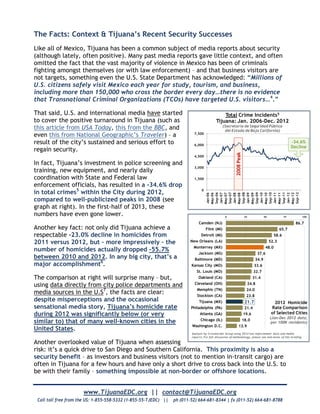
enforcement officials, has resulted in a -34.6% drop
in total crimes5
within the City during 2012,
compared to well-publicized peaks in 2008 (see
graph at right). In the first-half of 2013, these
numbers have even gone lower.
Another key fact: not only did Tijuana achieve a
respectable -23.0% decline in homicides from
2011 versus 2012, but – more impressively – the
number of homicides actually dropped -55.7%
between 2010 and 2012. In any big city, that’s a
major accomplishment6
.
The comparison at right will surprise many – but,
using data directly from city police departments and
media sources in the U.S7
, the facts are clear:
despite misperceptions and the occasional
sensational media story, Tijuana’s homicide rate
during 2012 was significantly below (or very
similar to) that of many well-known cities in the
United States.
Another overlooked value of Tijuana when assessing
risk: it’s a quick drive to San Diego and Southern California. This proximity is also a
security benefit – as investors and business visitors (not to mention in-transit cargo) are
often in Tijuana for a few hours and have only a short drive to cross back into the U.S. to
be with their family – something impossible at non-border or offshore locations.
86.7
65.7
58.6
52.3
48.0
37.6
34.9
33.6
32.7
31.4
24.8
24.0
23.8
21.7
21.4
19.6
18.0
13.9
0 25 50 75 100
Camden (NJ)
Flint (MI)
Detroit (MI)
New Orleans (LA)
Monterrey (MX)
Jackson (MS)
Baltimore (MD)
Kansas City (MO)
St. Louis (MO)
Oakland (CA)
Cleveland (OH)
Memphis (TN)
Stockton (CA)
Tijuana (MX)
Philadelphia (PA)
Atlanta (GA)
Chicago (IL)
Washington D.C.
2012 Homicide
Rate Comparison
of Selected Cities
(Jan-Dec 2012 data;
per 100K residents)
Analysis by Crossborder Group using 2012 law enforcement data and media
reports. For full discussion of methodology, please see end-notes of this briefing.
0
1,500
3,000
4,500
6,000
7,500
Jan-06
May-06
Sep-06
Jan-07
May-07
Sep-07
Jan-08
May-08
Sep-08
Jan-09
May-09
Sep-09
Jan-10
May-10
Sep-10
Jan-11
May-11
Sep-11
Jan-12
May-12
Sep-12
Total Crime Incidents5
Tijuana: Jan. 2006-Dec. 2012
(Secretaría de Seguridad Pública
del Estado de Baja California)
2008Peak
-34.6%
Decline
www.TijuanaEDC.org || contact@TijuanaEDC.org
Call toll free from the US: 1-855-558-5332 (1-855-55-TJEDC) || ph (011-52) 664-681-8344 | fx (011-52) 664-681-8788
Investments in Tijuana’s Security
While Tijuana’s overall security situation in 2013 is by some measures comparable to
other U.S. and international business cities, the City Government, along with State and
Federal agencies, continues to invest in technology, personnel and equipment. In
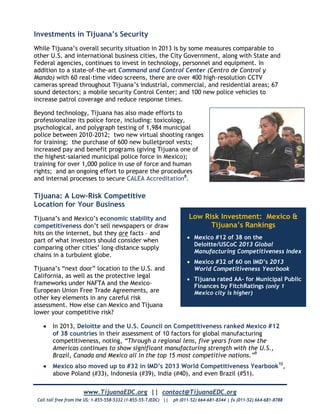
addition to a state-of-the-art Command and Control Center (Centro de Control y
Mando) with 60 real-time video screens, there are over 400 high-resolution CCTV
cameras spread throughout Tijuana’s industrial, commercial, and residential areas; 67
sound detectors; a mobile security Control Center; and 100 new police vehicles to
increase patrol coverage and reduce response times.
Beyond technology, Tijuana has also made efforts to
professionalize its police force, including: toxicology,
psychological, and polygraph testing of 1,984 municipal
police between 2010-2012; two new virtual shooting ranges
for training; the purchase of 600 new bulletproof vests;
increased pay and benefit programs (giving Tijuana one of
the highest-salaried municipal police force in Mexico);
training for over 1,000 police in use of force and human
rights; and an ongoing effort to prepare the procedures
and internal processes to secure CALEA Accreditation8
.
Tijuana: A Low-Risk Competitive
Location for Your Business
Tijuana’s and Mexico’s economic stability and
competitiveness don’t sell newspapers or draw
hits on the internet, but they are facts – and
part of what investors should consider when
comparing other cities’ long-distance supply
chains in a turbulent globe.
Tijuana’s “next door” location to the U.S. and
California, as well as the protective legal
frameworks under NAFTA and the Mexico-
European Union Free Trade Agreements, are
other key elements in any careful risk
assessment. How else can Mexico and Tijuana
lower your competitive risk?
 In 2013, Deloitte and the U.S. Council on Competitiveness ranked Mexico #12
of 38 countries in their assessment of 10 factors for global manufacturing
competitiveness, noting, “Through a regional lens, five years from now the
Americas continues to show significant manufacturing strength with the U.S.,
Brazil, Canada and Mexico all in the top 15 most competitive nations.”9
 Mexico also moved up to #32 in IMD’s 2013 World Competitiveness Yearbook10
,
above Poland (#33), Indonesia (#39), India (#40), and even Brazil (#51).
Low Risk Investment: Mexico &
Tijuana’s Rankings
 Mexico #12 of 38 on the
Deloitte/USCoC 2013 Global
Manufacturing Competitiveness Index
 Mexico #32 of 60 on IMD’s 2013
World Competitiveness Yearbook
 Tijuana rated AA- for Municipal Public
Finances by FitchRatings (only 1
Mexico city is higher)
www.TijuanaEDC.org || contact@TijuanaEDC.org
Call toll free from the US: 1-855-558-5332 (1-855-55-TJEDC) || ph (011-52) 664-681-8344 | fx (011-52) 664-681-8788
 The City of Tijuana is also considered one of the best fiscally managed and
highest-rated municipalities in Mexico: in April 2013, Fitch Ratings continued
giving Tijuana an AA- rating (only one city in Mexico was rated higher)11
; and
Mexico’s National Federation of Municipalities (Federación Nacional de Municipios
de México) presented Tijuana the 2013 Good Government award for
management of local government finances12
.
Regional Synergy, Regional
Collaboration, Regional Vision
While law enforcement collaboration between
Tijuana and San Diego has long been part of
ongoing security activities, so too has been a
broader effort to leverage economic synergies
between the two cities – with the goal of
growing stronger and more globally competitive
binational businesses.
This is reflected not only in the nearly $3
billion worth of international goods trucked
between Tijuana and San Diego each month,
but also in innovative Cali Baja Bi-National
Mega-Region Initiative – a long-term economic
development collaboration between the
Tijuana-EDC (DEITAC), the San Diego Regional
Economic Development Corporation (SDREDC),
the Imperial Valley Economic Development
Corporation, the Industrial Development
Commission of Mexicali, the Tecate Economic
Promotion Commission, and the Ensenada Economic Development Commission.
Regional collaboration and promoting a binational vision is not only part of daily life for
many in the San Diego-Tijuana region today, but extends into the future – with a $731
million upgrade currently underway at the San Ysidro Port of Entry border crossing;
planning underway for a new passenger and cargo border crossing in East Otay Mesa (to
supplement the existing Otay Mesa Port of Entry passenger and cargo facilities); and
even preliminary exploration by San Diego and Tijuana of what could be the world’s first
Binational Olympics13
games in 2024.
“Somos dos ciudades pero una regiόn.
We are two cities, but one region… We
need to make the border the center, not
the end — but the biggest problem we
have is not security, it is openness and
communication.”
— San Diego Mayor Bob Filner
Interview in the New York Times13
Published May 12, 2013
“Cubic considers Tijuana as not only a strategic place to manufacture from, but also a
safe and innovative environment for our executives and our operations. In fact, Cubic is
moving its New Zealand and Orlando manufacturing to Cubic de Mexico in Tijuana and
expanding our present location by 50,000 square feet.”
— Reiny Giesecke
Director of Business Development
Cubic Defense Applications
June, 2013
www.TijuanaEDC.org || contact@TijuanaEDC.org
Call toll free from the US: 1-855-558-5332 (1-855-55-TJEDC) || ph (011-52) 664-681-8344 | fx (011-52) 664-681-8788
Tijuana: A Template for Growth14
Tijuana’s security successes mean a better place to do
business from. Or, as former Wired magazine editor
Chris Anderson called it, the “TJ template” for growth
– when he wrote about his new UAV/droid
manufacturing venture in Tijuana14
, its “quicksourcing”
and competitive benefits, as well as his observation
that being in Tijuana gives them “less risk” in their
production processes, in protecting their intellectual
property, in their supply chains, and against
international political turmoil.
Nearly five years after the 2008 peak of security
challenges, Tijuana is once-again gaining recognition as
a major, low-risk and high-return investment
destination in North America – as seen by the growth of
new companies like 3DRobotics (UAVs), Visual
Communications Company (LED lighting), and
expansions at companies like Bench, Cubic, Integra
Biotechnical, OnCore, SMK Electronica, TPV and others.
Data from agencies and institutions on both sides of the
border demonstrate that the combination of Tijuana’s professionalization in its law
enforcement personnel, investments in better security technologies and equipment, and
increased coordination with authorities in Mexico and the U.S. has resulted in significant
security improvements in the city to levels similar to (or better than) some locations in
the U.S.. Truly, a city that deserves a new reputation as a low risk for investors, and as a
place for continued growth and innovation.
For more information about this briefing, or about investing in the City of Tijuana,
please call the Tijuana Economic Development Corporation at 1-855-55-TJEDC.
1
Website of Mexico’s statistical agency, Instituto Nacional de Estadística y Geografía, accessed June 2013 (http://www.inegi.org.mx/sistemas/bie/)
2
“Drug Violence in Mexico: Data and Analysis Through 2012”, University of San Diego, Trans-Border Institute (February 2013, Page 22,
http://justiceinmexico.org/publications/reports/)
3
Interview of Alan Bersin by Televisa on June 5, 2013, accessed June 2013 (http://youtu.be/XeDTBb8aek0)
4
U.S. State Department website, accessed June 2013 (http://travel.state.gov/travel/cis_pa_tw/tw/tw_5815.html)
5
Website of Baja California’s State Security Secretariat, Tijuana security statistics (Secretaría de Seguridad Pública de Baja California,
http://www.seguridadbc.gob.mx/contenidos/estadisticas2.php, accessed June 2013)
6
Analysis of Tijuana homicide data by Crossborder Group, using data provided by the Secretaría de Seguridad Pública Municipal de Tijuana, and the
Baja California Procuraduria General de Justicia del Estado (PGJE).
7
Calculations made by Crossborder Group, using city-level homicide data from January-December 2012 obtained directly from websites of police
departments (when available), media quotes from police officials of those cities (when available), or (as homicide data is often not available or
delayed from some cities) from multiple regional media sources and/or crime tracking websites. Homicide rates were calculated for 2012 using July
2012 Census data for population in the U.S., and using 2012 population estimates from CONAPO in Mexico.
8
Crossborder Group analysis based on data provided by the Tijuana Secretaría de Seguridad Pública, June 2013.
9
U.S. Council on Competitiveness and Deloitte 2013 Global Manufacturing Competitiveness Index (http://ow.ly/m2hbP), p. 2-3
10
IMD World Competitiveness Center, 2013 World Competitiveness Yearbook (http://ow.ly/m2fJP, accessed June 2013)
11
Fitch México, Finanzas Públicas – Municipios, Listado de Calificaciones (http://ow.ly/m2n6W, April 30, 2013, accessed June 2013)
12
Federación Nacional de Municipios de México website, award for Saneamiento de las Finanzas Locales (http://ow.ly/m2pgs, accessed June 2013)
13
Jennifer Medina, New York Times, “San Diego Mayor Building Economic Bridges to Tijuana” (http://ow.ly/mpSsL, May 12, 2013, accessed June 2013)
14
Opinion piece by Chris Anderson, CEO of 3DRobotics, former editor-in-chief of Wired Magazine, printed in the New York Times (January 26, 2013;
http://ow.ly/m3bWK)
“Today, what Shenzhen is to Hong
Kong, Tijuana is becoming to San
Diego. [It] has become North
America’s electronics assembly
hot spot… What all these pieces
add up to is a model — one that
might hold the long-sought answer
for how American manufacturers
can compete with those in China,
India and the next generation of
economic powerhouses. That’s
because the TJ template isn’t so
much about outsourcing as it is
quicksourcing…”
“The sense of possibility I felt
when I first crossed from Hong
Kong to Shenzhen in 1997 is what I
now feel when I cross from San
Diego to Tijuana...”14
— Chris Anderson
CEO of 3D Robotics
January 26, 2013
Briefing researched & developed by Crossborder Group (Version 130626-2pm)

2013 – Tijuana: Security Successes In North America’s Quicksourcing Capital

  • 1.
    Tijuana: Security Successes InNorth America’s Quicksourcing Capital June 2013
  • 2.
    www.TijuanaEDC.org || contact@TijuanaEDC.org Calltoll free from the US: 1-855-558-5332 (1-855-55-TJEDC) || ph (011-52) 664-681-8344 | fx (011-52) 664-681-8788 Higher Competitive Level and Lower Security Risks: A Location in Tijuana Deciding where to establish your company internationally should always include an objective analysis of risks – using current facts, independent assessments, and the real experiences of business visitors, investors, and international analysts actively working in a region – not sensational stories or out-of-date perceptions. Tijuana – only minutes from Downtown San Diego, and the second-largest city on the West Coast of North America (with nearly 1.7 million residents) – is the focus of this briefing. The goal: to provide some fact-based context about this major metropolitan area to help potential investors understand why – in 2013 – Tijuana is still Mexico’s leading city for nearshore operations, and the home to over 540 maquiladora (IMMEX) manufacturing companies1 . Also an important part of this document: to give specific examples of the significant progress that Tijuana and Baja California have made in addressing public security challenges – with success that U.S. business and governmental leaders, research institutions, as well as many in the U.S. media are now acknowledging. Tijuana & Baja California Rebounding Independent data analyzed by the University of San Diego’s Trans-Border Institute (TBI) 2 shows that Tijuana and Baja California achieved major security improvements throughout 2012. As seen in TBI’s map at right, through Q3 of 2012, areas in Mexico with the most significant security concerns are now more than 500 miles from Tijuana. In fact, security officials and business leaders from the U.S. are also noting the positive security situation that now exists in Tijuana, as noted in the quotes below: 3 “Finally, it is important to reiterate that violence has diminished in certain areas in 2011 and 2012, particularly as the number of homicides fell in key states in northern Mexico, including Baja California…” 2 — Source: “Drug Violence in Mexico: Data and Analysis Through 2012” University of San Diego Trans-Border Institute “When prospective customers visit our manufacturing operation, they are surprised at the quality of organization and products that are built. They always say, this isn’t the Tijuana that they heard about or expected to find on their visit”. — Rod Gunther Plant Manager of Suntron de Mexico part of Benchmark Electronics, Inc. June, 2013 “It always takes time for public perception to embrace the current situation on the ground, and it seems to me that the [security] situation here in Tijuana has improved 100 times over what existed in the past...” — Alan Bersin Assistant Secretary of International Affairs U.S. Department of Homeland Security June 5, 2013 (Televisa Interview)3
  • 3.
    www.TijuanaEDC.org || contact@TijuanaEDC.org Calltoll free from the US: 1-855-558-5332 (1-855-55-TJEDC) || ph (011-52) 664-681-8344 | fx (011-52) 664-681-8788 The Facts: Context & Tijuana’s Recent Security Successes Like all of Mexico, Tijuana has been a common subject of media reports about security (although lately, often positive). Many past media reports gave little context, and often omitted the fact that the vast majority of violence in Mexico has been of criminals fighting amongst themselves (or with law enforcement) – and that business visitors are not targets, something even the U.S. State Department has acknowledged: “Millions of U.S. citizens safely visit Mexico each year for study, tourism, and business, including more than 150,000 who cross the border every day…there is no evidence that Transnational Criminal Organizations (TCOs) have targeted U.S. visitors…4 .” That said, U.S. and international media have started to cover the positive turnaround in Tijuana (such as this article from USA Today, this from the BBC, and even this from National Geographic’s Traveler) – a result of the city’s sustained and serious effort to regain security. In fact, Tijuana’s investment in police screening and training, new equipment, and nearly daily coordination with State and Federal law enforcement officials, has resulted in a -34.6% drop in total crimes5 within the City during 2012, compared to well-publicized peaks in 2008 (see graph at right). In the first-half of 2013, these numbers have even gone lower. Another key fact: not only did Tijuana achieve a respectable -23.0% decline in homicides from 2011 versus 2012, but – more impressively – the number of homicides actually dropped -55.7% between 2010 and 2012. In any big city, that’s a major accomplishment6 . The comparison at right will surprise many – but, using data directly from city police departments and media sources in the U.S7 , the facts are clear: despite misperceptions and the occasional sensational media story, Tijuana’s homicide rate during 2012 was significantly below (or very similar to) that of many well-known cities in the United States. Another overlooked value of Tijuana when assessing risk: it’s a quick drive to San Diego and Southern California. This proximity is also a security benefit – as investors and business visitors (not to mention in-transit cargo) are often in Tijuana for a few hours and have only a short drive to cross back into the U.S. to be with their family – something impossible at non-border or offshore locations. 86.7 65.7 58.6 52.3 48.0 37.6 34.9 33.6 32.7 31.4 24.8 24.0 23.8 21.7 21.4 19.6 18.0 13.9 0 25 50 75 100 Camden (NJ) Flint (MI) Detroit (MI) New Orleans (LA) Monterrey (MX) Jackson (MS) Baltimore (MD) Kansas City (MO) St. Louis (MO) Oakland (CA) Cleveland (OH) Memphis (TN) Stockton (CA) Tijuana (MX) Philadelphia (PA) Atlanta (GA) Chicago (IL) Washington D.C. 2012 Homicide Rate Comparison of Selected Cities (Jan-Dec 2012 data; per 100K residents) Analysis by Crossborder Group using 2012 law enforcement data and media reports. For full discussion of methodology, please see end-notes of this briefing. 0 1,500 3,000 4,500 6,000 7,500 Jan-06 May-06 Sep-06 Jan-07 May-07 Sep-07 Jan-08 May-08 Sep-08 Jan-09 May-09 Sep-09 Jan-10 May-10 Sep-10 Jan-11 May-11 Sep-11 Jan-12 May-12 Sep-12 Total Crime Incidents5 Tijuana: Jan. 2006-Dec. 2012 (Secretaría de Seguridad Pública del Estado de Baja California) 2008Peak -34.6% Decline
  • 4.
    www.TijuanaEDC.org || contact@TijuanaEDC.org Calltoll free from the US: 1-855-558-5332 (1-855-55-TJEDC) || ph (011-52) 664-681-8344 | fx (011-52) 664-681-8788 Investments in Tijuana’s Security While Tijuana’s overall security situation in 2013 is by some measures comparable to other U.S. and international business cities, the City Government, along with State and Federal agencies, continues to invest in technology, personnel and equipment. In addition to a state-of-the-art Command and Control Center (Centro de Control y Mando) with 60 real-time video screens, there are over 400 high-resolution CCTV cameras spread throughout Tijuana’s industrial, commercial, and residential areas; 67 sound detectors; a mobile security Control Center; and 100 new police vehicles to increase patrol coverage and reduce response times. Beyond technology, Tijuana has also made efforts to professionalize its police force, including: toxicology, psychological, and polygraph testing of 1,984 municipal police between 2010-2012; two new virtual shooting ranges for training; the purchase of 600 new bulletproof vests; increased pay and benefit programs (giving Tijuana one of the highest-salaried municipal police force in Mexico); training for over 1,000 police in use of force and human rights; and an ongoing effort to prepare the procedures and internal processes to secure CALEA Accreditation8 . Tijuana: A Low-Risk Competitive Location for Your Business Tijuana’s and Mexico’s economic stability and competitiveness don’t sell newspapers or draw hits on the internet, but they are facts – and part of what investors should consider when comparing other cities’ long-distance supply chains in a turbulent globe. Tijuana’s “next door” location to the U.S. and California, as well as the protective legal frameworks under NAFTA and the Mexico- European Union Free Trade Agreements, are other key elements in any careful risk assessment. How else can Mexico and Tijuana lower your competitive risk?  In 2013, Deloitte and the U.S. Council on Competitiveness ranked Mexico #12 of 38 countries in their assessment of 10 factors for global manufacturing competitiveness, noting, “Through a regional lens, five years from now the Americas continues to show significant manufacturing strength with the U.S., Brazil, Canada and Mexico all in the top 15 most competitive nations.”9  Mexico also moved up to #32 in IMD’s 2013 World Competitiveness Yearbook10 , above Poland (#33), Indonesia (#39), India (#40), and even Brazil (#51). Low Risk Investment: Mexico & Tijuana’s Rankings  Mexico #12 of 38 on the Deloitte/USCoC 2013 Global Manufacturing Competitiveness Index  Mexico #32 of 60 on IMD’s 2013 World Competitiveness Yearbook  Tijuana rated AA- for Municipal Public Finances by FitchRatings (only 1 Mexico city is higher)
  • 5.
    www.TijuanaEDC.org || contact@TijuanaEDC.org Calltoll free from the US: 1-855-558-5332 (1-855-55-TJEDC) || ph (011-52) 664-681-8344 | fx (011-52) 664-681-8788  The City of Tijuana is also considered one of the best fiscally managed and highest-rated municipalities in Mexico: in April 2013, Fitch Ratings continued giving Tijuana an AA- rating (only one city in Mexico was rated higher)11 ; and Mexico’s National Federation of Municipalities (Federación Nacional de Municipios de México) presented Tijuana the 2013 Good Government award for management of local government finances12 . Regional Synergy, Regional Collaboration, Regional Vision While law enforcement collaboration between Tijuana and San Diego has long been part of ongoing security activities, so too has been a broader effort to leverage economic synergies between the two cities – with the goal of growing stronger and more globally competitive binational businesses. This is reflected not only in the nearly $3 billion worth of international goods trucked between Tijuana and San Diego each month, but also in innovative Cali Baja Bi-National Mega-Region Initiative – a long-term economic development collaboration between the Tijuana-EDC (DEITAC), the San Diego Regional Economic Development Corporation (SDREDC), the Imperial Valley Economic Development Corporation, the Industrial Development Commission of Mexicali, the Tecate Economic Promotion Commission, and the Ensenada Economic Development Commission. Regional collaboration and promoting a binational vision is not only part of daily life for many in the San Diego-Tijuana region today, but extends into the future – with a $731 million upgrade currently underway at the San Ysidro Port of Entry border crossing; planning underway for a new passenger and cargo border crossing in East Otay Mesa (to supplement the existing Otay Mesa Port of Entry passenger and cargo facilities); and even preliminary exploration by San Diego and Tijuana of what could be the world’s first Binational Olympics13 games in 2024. “Somos dos ciudades pero una regiόn. We are two cities, but one region… We need to make the border the center, not the end — but the biggest problem we have is not security, it is openness and communication.” — San Diego Mayor Bob Filner Interview in the New York Times13 Published May 12, 2013 “Cubic considers Tijuana as not only a strategic place to manufacture from, but also a safe and innovative environment for our executives and our operations. In fact, Cubic is moving its New Zealand and Orlando manufacturing to Cubic de Mexico in Tijuana and expanding our present location by 50,000 square feet.” — Reiny Giesecke Director of Business Development Cubic Defense Applications June, 2013
  • 6.
    www.TijuanaEDC.org || contact@TijuanaEDC.org Calltoll free from the US: 1-855-558-5332 (1-855-55-TJEDC) || ph (011-52) 664-681-8344 | fx (011-52) 664-681-8788 Tijuana: A Template for Growth14 Tijuana’s security successes mean a better place to do business from. Or, as former Wired magazine editor Chris Anderson called it, the “TJ template” for growth – when he wrote about his new UAV/droid manufacturing venture in Tijuana14 , its “quicksourcing” and competitive benefits, as well as his observation that being in Tijuana gives them “less risk” in their production processes, in protecting their intellectual property, in their supply chains, and against international political turmoil. Nearly five years after the 2008 peak of security challenges, Tijuana is once-again gaining recognition as a major, low-risk and high-return investment destination in North America – as seen by the growth of new companies like 3DRobotics (UAVs), Visual Communications Company (LED lighting), and expansions at companies like Bench, Cubic, Integra Biotechnical, OnCore, SMK Electronica, TPV and others. Data from agencies and institutions on both sides of the border demonstrate that the combination of Tijuana’s professionalization in its law enforcement personnel, investments in better security technologies and equipment, and increased coordination with authorities in Mexico and the U.S. has resulted in significant security improvements in the city to levels similar to (or better than) some locations in the U.S.. Truly, a city that deserves a new reputation as a low risk for investors, and as a place for continued growth and innovation. For more information about this briefing, or about investing in the City of Tijuana, please call the Tijuana Economic Development Corporation at 1-855-55-TJEDC. 1 Website of Mexico’s statistical agency, Instituto Nacional de Estadística y Geografía, accessed June 2013 (http://www.inegi.org.mx/sistemas/bie/) 2 “Drug Violence in Mexico: Data and Analysis Through 2012”, University of San Diego, Trans-Border Institute (February 2013, Page 22, http://justiceinmexico.org/publications/reports/) 3 Interview of Alan Bersin by Televisa on June 5, 2013, accessed June 2013 (http://youtu.be/XeDTBb8aek0) 4 U.S. State Department website, accessed June 2013 (http://travel.state.gov/travel/cis_pa_tw/tw/tw_5815.html) 5 Website of Baja California’s State Security Secretariat, Tijuana security statistics (Secretaría de Seguridad Pública de Baja California, http://www.seguridadbc.gob.mx/contenidos/estadisticas2.php, accessed June 2013) 6 Analysis of Tijuana homicide data by Crossborder Group, using data provided by the Secretaría de Seguridad Pública Municipal de Tijuana, and the Baja California Procuraduria General de Justicia del Estado (PGJE). 7 Calculations made by Crossborder Group, using city-level homicide data from January-December 2012 obtained directly from websites of police departments (when available), media quotes from police officials of those cities (when available), or (as homicide data is often not available or delayed from some cities) from multiple regional media sources and/or crime tracking websites. Homicide rates were calculated for 2012 using July 2012 Census data for population in the U.S., and using 2012 population estimates from CONAPO in Mexico. 8 Crossborder Group analysis based on data provided by the Tijuana Secretaría de Seguridad Pública, June 2013. 9 U.S. Council on Competitiveness and Deloitte 2013 Global Manufacturing Competitiveness Index (http://ow.ly/m2hbP), p. 2-3 10 IMD World Competitiveness Center, 2013 World Competitiveness Yearbook (http://ow.ly/m2fJP, accessed June 2013) 11 Fitch México, Finanzas Públicas – Municipios, Listado de Calificaciones (http://ow.ly/m2n6W, April 30, 2013, accessed June 2013) 12 Federación Nacional de Municipios de México website, award for Saneamiento de las Finanzas Locales (http://ow.ly/m2pgs, accessed June 2013) 13 Jennifer Medina, New York Times, “San Diego Mayor Building Economic Bridges to Tijuana” (http://ow.ly/mpSsL, May 12, 2013, accessed June 2013) 14 Opinion piece by Chris Anderson, CEO of 3DRobotics, former editor-in-chief of Wired Magazine, printed in the New York Times (January 26, 2013; http://ow.ly/m3bWK) “Today, what Shenzhen is to Hong Kong, Tijuana is becoming to San Diego. [It] has become North America’s electronics assembly hot spot… What all these pieces add up to is a model — one that might hold the long-sought answer for how American manufacturers can compete with those in China, India and the next generation of economic powerhouses. That’s because the TJ template isn’t so much about outsourcing as it is quicksourcing…” “The sense of possibility I felt when I first crossed from Hong Kong to Shenzhen in 1997 is what I now feel when I cross from San Diego to Tijuana...”14 — Chris Anderson CEO of 3D Robotics January 26, 2013 Briefing researched & developed by Crossborder Group (Version 130626-2pm)