Part One
     the american patient
        meaningful use
   the affordable care act
accountable care organizations
patient-centered medical home
THE American Patient
More and more in policymaking, the U.S. government is seeking to actively
engage the American patient or their caregiver as a participant in the care
management process. With chronic disease impacting nearly 140 million
Americans today, it remains a critical factor to reining in health care spending.
Experts believe one of the principal causes of chronic disease is that the American
patient is unengaged and not held accountable for lifestyle choices made. The
provider community can expect this point to be pressed in future policymaking
and their ability to successfully deliver patient-centric care linked to
reimbursement in the near future.
THE American patient
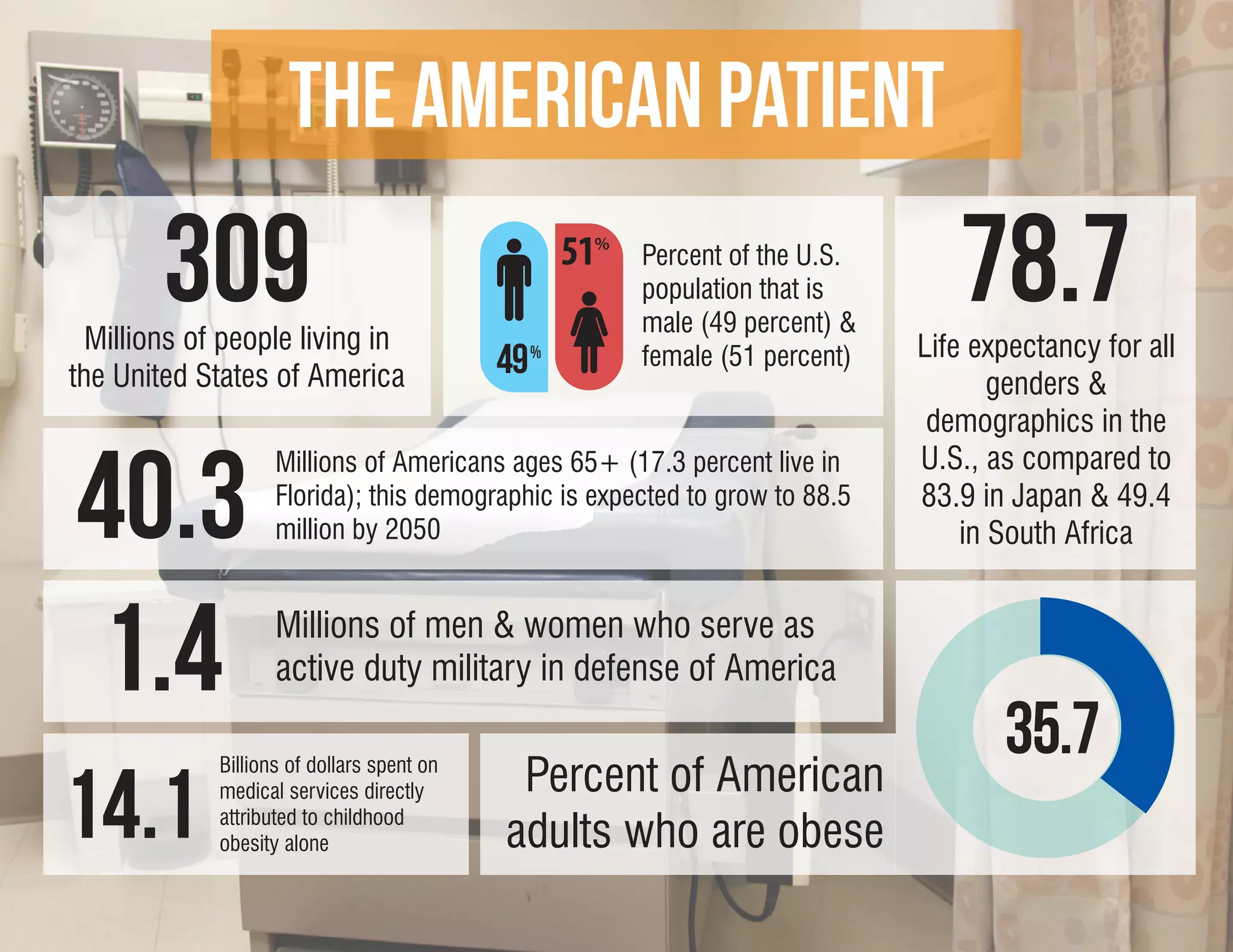
        309
  Millions of people living in
                                                   51%   Percent of the U.S.
                                                         population that is
                                                         male (49 percent) &
                                                                                  78.7
                                                                               Life expectancy for all
the United States of America                49 %         female (51 percent)
                                                                                      genders &
                                                                                demographics in the


40.3
                    Millions of Americans ages 65+ (17.3 percent live in       U.S., as compared to
                    Florida); this demographic is expected to grow to 88.5     83.9 in Japan & 49.4
                    million by 2050                                                in South Africa


1.4                 Millions of men & women who serve as
                    active duty military in defense of America

                                                                                      35.7
                                             Percent of American
14.1
             Billions of dollars spent on
             medical services directly
             attributed to childhood
             obesity alone                  adults who are obese
THE American patient
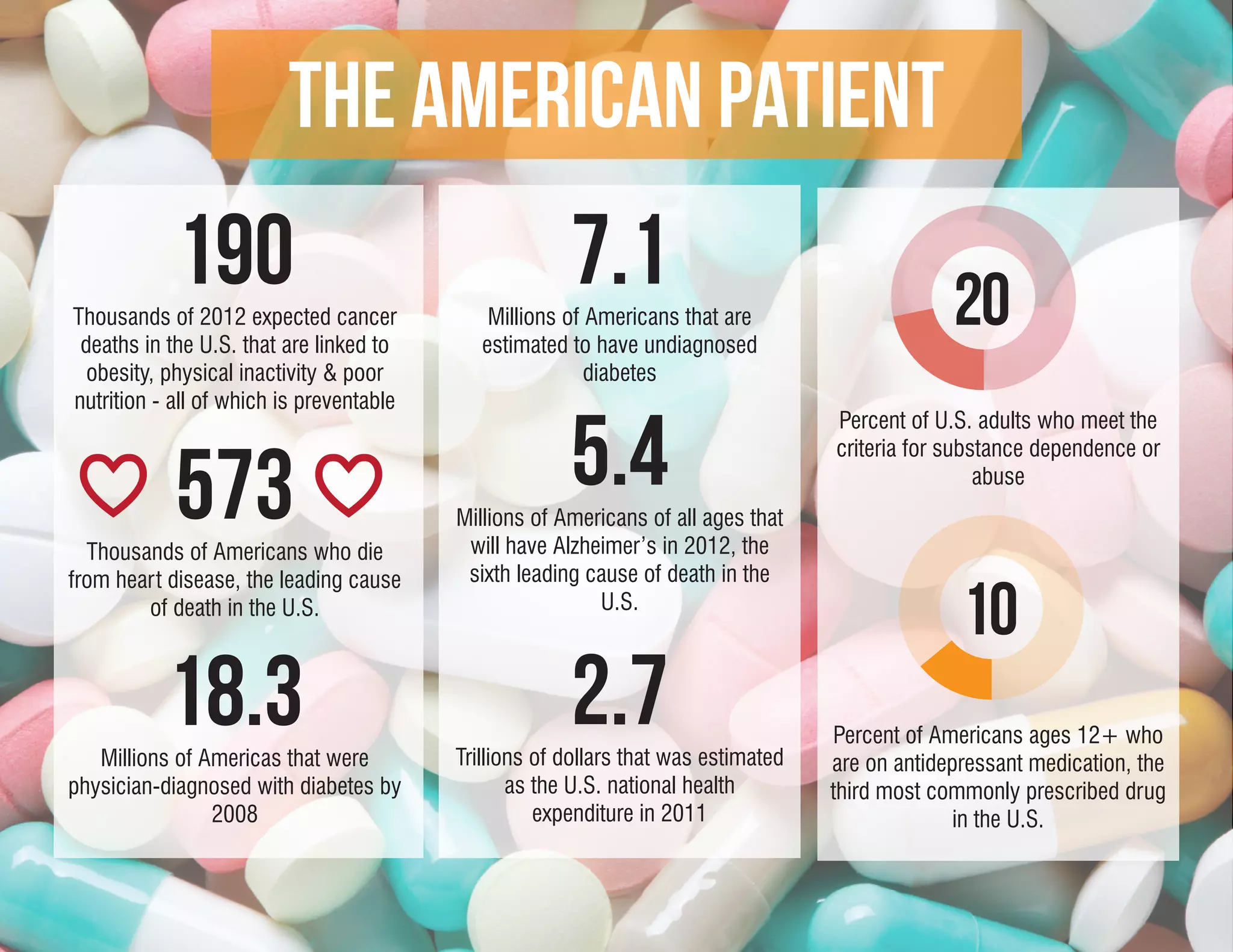
            190
Thousands of 2012 expected cancer
                                                       7.1
                                              Millions of Americans that are                     20
 deaths in the U.S. that are linked to       estimated to have undiagnosed
  obesity, physical inactivity & poor                     diabetes
nutrition - all of which is preventable


                                                       5.4
                                                                                    Percent of U.S. adults who meet the


            573
                                                                                    criteria for substance dependence or
                                                                                                     abuse
                                          Millions of Americans of all ages that
  Thousands of Americans who die           will have Alzheimer’s in 2012, the
from heart disease, the leading cause      sixth leading cause of death in the
        of death in the U.S.                              U.S.
                                                                                                  10
           18.3
   Millions of Americas that were
                                                       2.7
                                          Trillions of dollars that was estimated
                                                                                    Percent of Americans ages 12+ who
                                                                                    are on antidepressant medication, the
physician-diagnosed with diabetes by             as the U.S. national health        third most commonly prescribed drug
                2008                                expenditure in 2011                           in the U.S.
THE American Patient
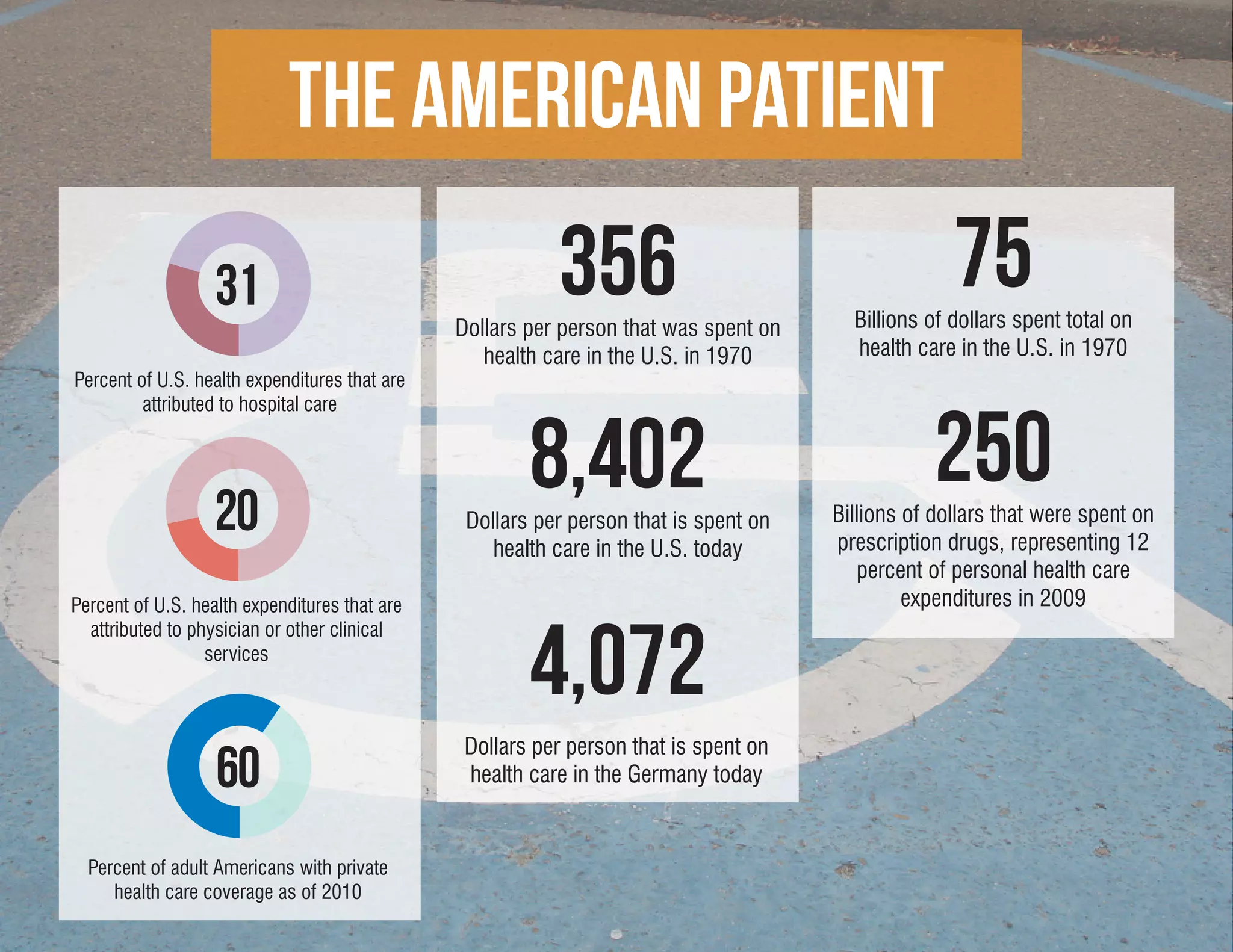
                   31                                     356
                                               Dollars per person that was spent on
                                                                                                    75
                                                                                        Billions of dollars spent total on
                                                  health care in the U.S. in 1970       health care in the U.S. in 1970
Percent of U.S. health expenditures that are
         attributed to hospital care


                   20
                                                       8,402
                                                Dollars per person that is spent on
                                                                                                  250
                                                                                      Billions of dollars that were spent on
                                                   health care in the U.S. today      prescription drugs, representing 12
                                                                                         percent of personal health care
Percent of U.S. health expenditures that are                                                   expenditures in 2009


                                                       4,072
  attributed to physician or other clinical
                  services


                                                Dollars per person that is spent on
                   60                           health care in the Germany today


  Percent of adult Americans with private
     health care coverage as of 2010
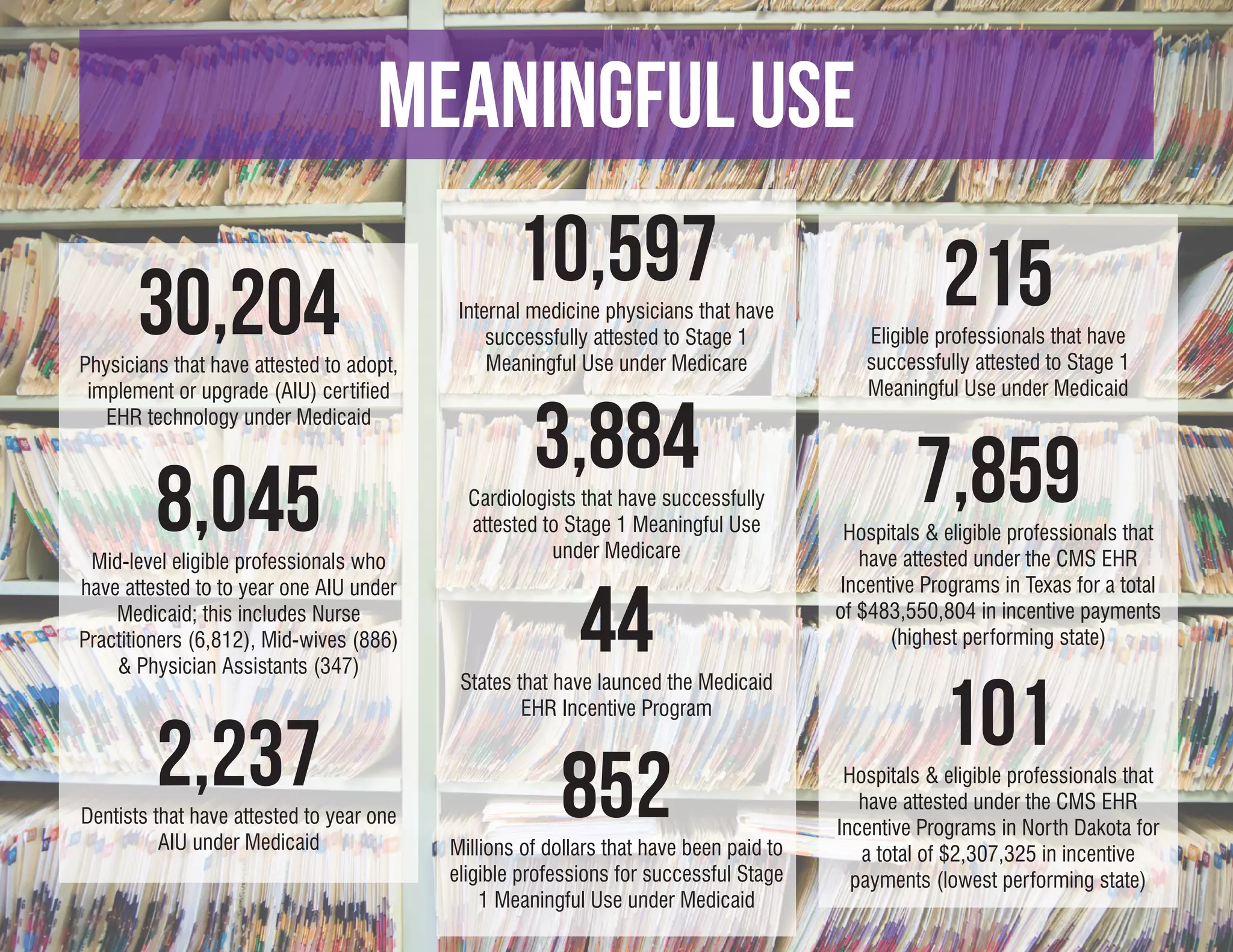
meaningful use
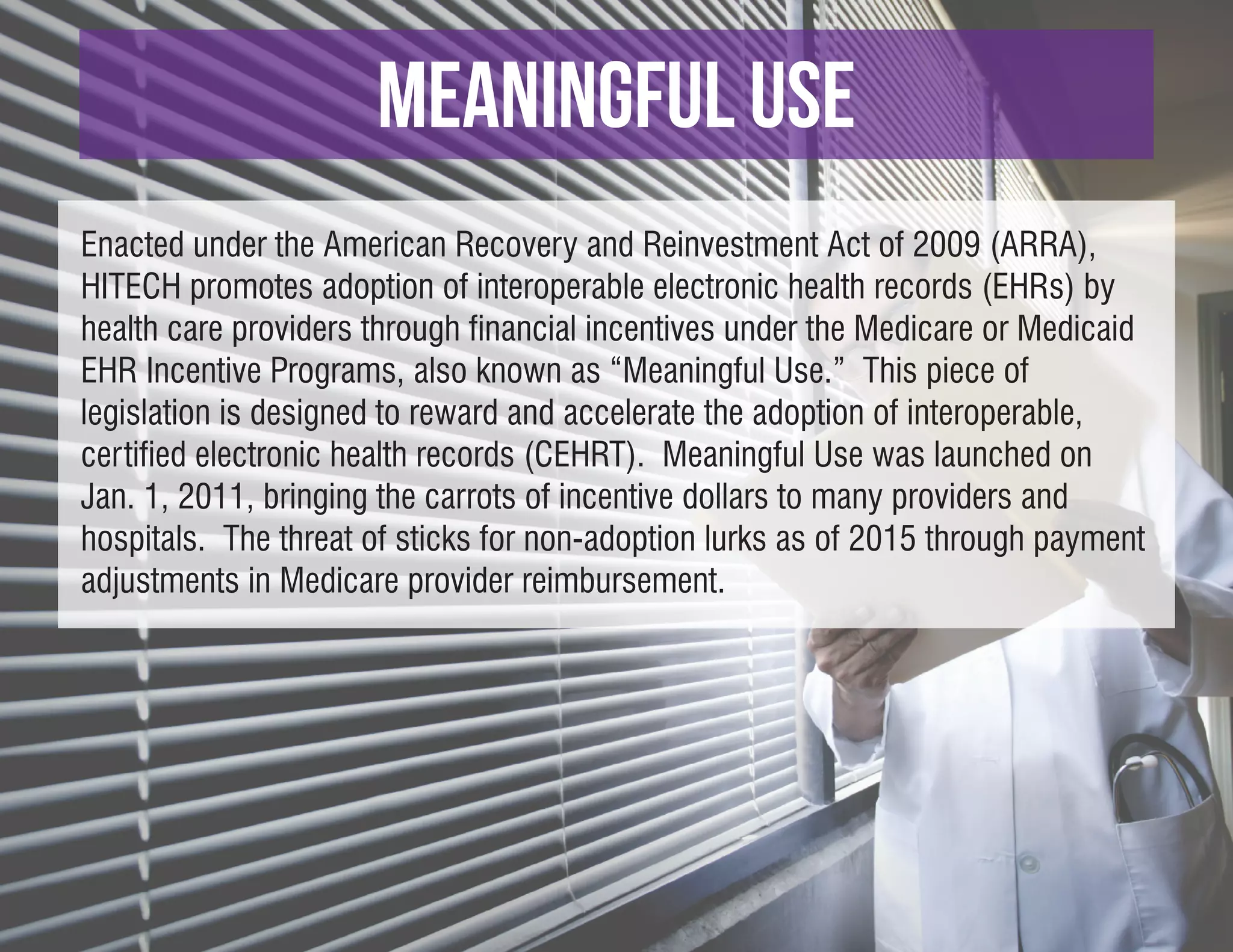
Enacted under the American Recovery and Reinvestment Act of 2009 (ARRA),
HITECH promotes adoption of interoperable electronic health records (EHRs) by
health care providers through financial incentives under the Medicare or Medicaid
EHR Incentive Programs, also known as “Meaningful Use.” This piece of
legislation is designed to reward and accelerate the adoption of interoperable,
certified electronic health records (CEHRT). Meaningful Use was launched on
Jan. 1, 2011, bringing the carrots of incentive dollars to many providers and
hospitals. The threat of sticks for non-adoption lurks as of 2015 through payment
adjustments in Medicare provider reimbursement.
meaningful use
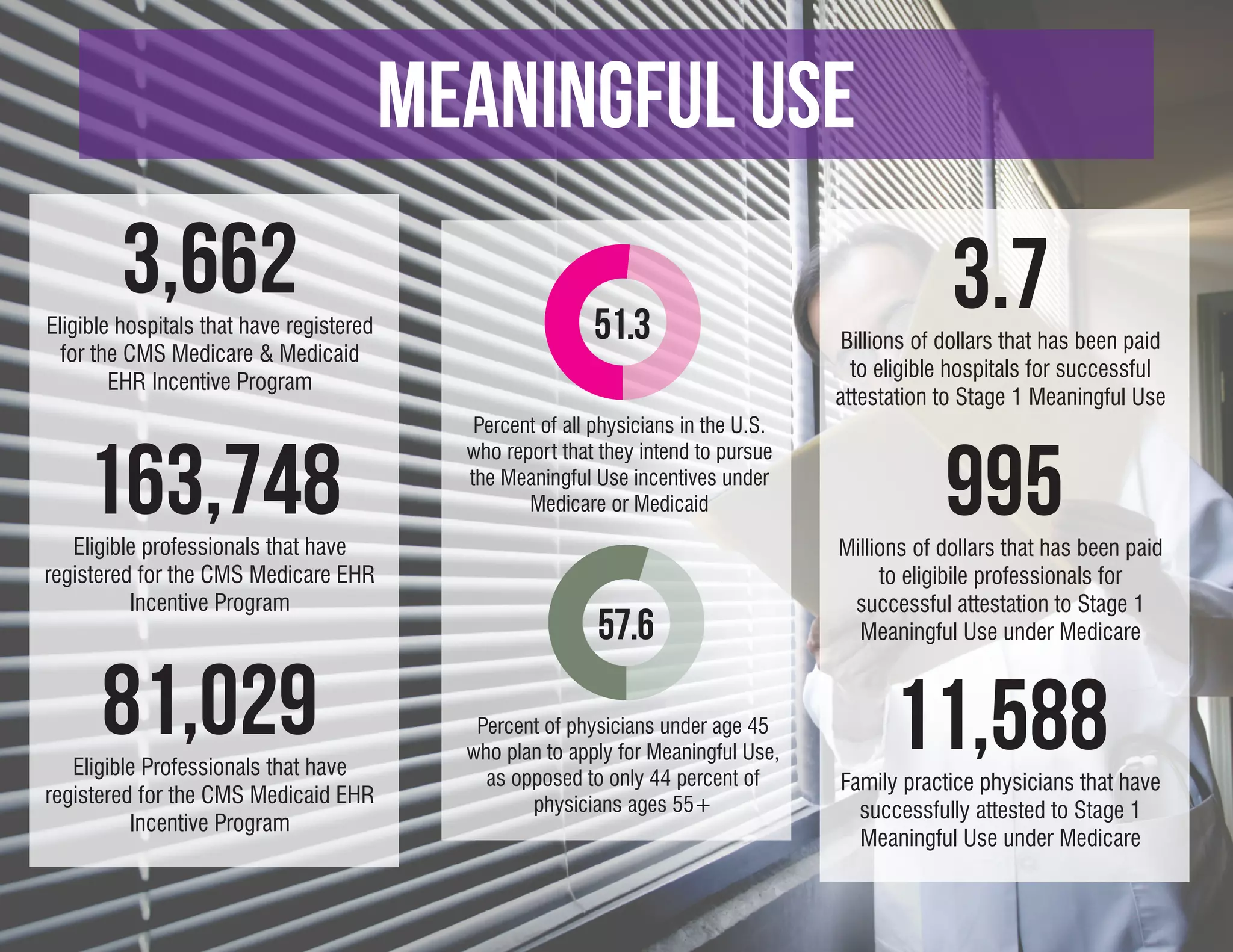
        3,662
Eligible hospitals that have registered                    51.3
                                                                                                  3.7
                                                                                      Billions of dollars that has been paid
  for the CMS Medicare & Medicaid
                                                                                       to eligible hospitals for successful
        EHR Incentive Program
                                                                                     attestation to Stage 1 Meaningful Use
                                             Percent of all physicians in the U.S.


    163,748                                                                                      995
                                            who report that they intend to pursue
                                            the Meaningful Use incentives under
                                                   Medicare or Medicaid
   Eligible professionals that have                                                  Millions of dollars that has been paid
registered for the CMS Medicare EHR                                                       to eligibile professionals for
          Incentive Program                                                           successful attestation to Stage 1
                                                            57.6                       Meaningful Use under Medicare


      81,029
   Eligible Professionals that have
                                             Percent of physicians under age 45
                                            who plan to apply for Meaningful Use,          11,588
                                              as opposed to only 44 percent of       Family practice physicians that have
registered for the CMS Medicaid EHR                physicians ages 55+                 successfully attested to Stage 1
          Incentive Program
                                                                                       Meaningful Use under Medicare
meaningful use
                                                  10,597                                            215
       30,204
Physicians that have attested to adopt,
                                           Internal medicine physicians that have
                                               successfully attested to Stage 1
                                               Meaningful Use under Medicare
                                                                                          Eligible professionals that have
                                                                                          successfully attested to Stage 1
 implement or upgrade (AIU) certified                                                     Meaningful Use under Medicaid
   EHR technology under Medicaid
                                                    3,884                                       7,859
         8,045
 Mid-level eligible professionals who
                                            Cardiologists that have successfully
                                            attested to Stage 1 Meaningful Use
                                                      under Medicare
                                                                                        Hospitals & eligible professionals that
                                                                                          have attested under the CMS EHR


                                                          44
have attested to to year one AIU under                                                  Incentive Programs in Texas for a total
    Medicaid; this includes Nurse                                                      of $483,550,804 in incentive payments
Practitioners (6,812), Mid-wives (886)                                                        (highest performing state)
    & Physician Assistants (347)


                                                                                                    101
                                           States that have launced the Medicaid
                                                   EHR Incentive Program


         2,237
Dentists that have attested to year one                 852                             Hospitals & eligible professionals that
                                                                                          have attested under the CMS EHR
                                                                                       Incentive Programs in North Dakota for
          AIU under Medicaid              Millions of dollars that have been paid to      a total of $2,307,325 in incentive
                                          eligible professions for successful Stage      payments (lowest performing state)
                                              1 Meaningful Use under Medicaid
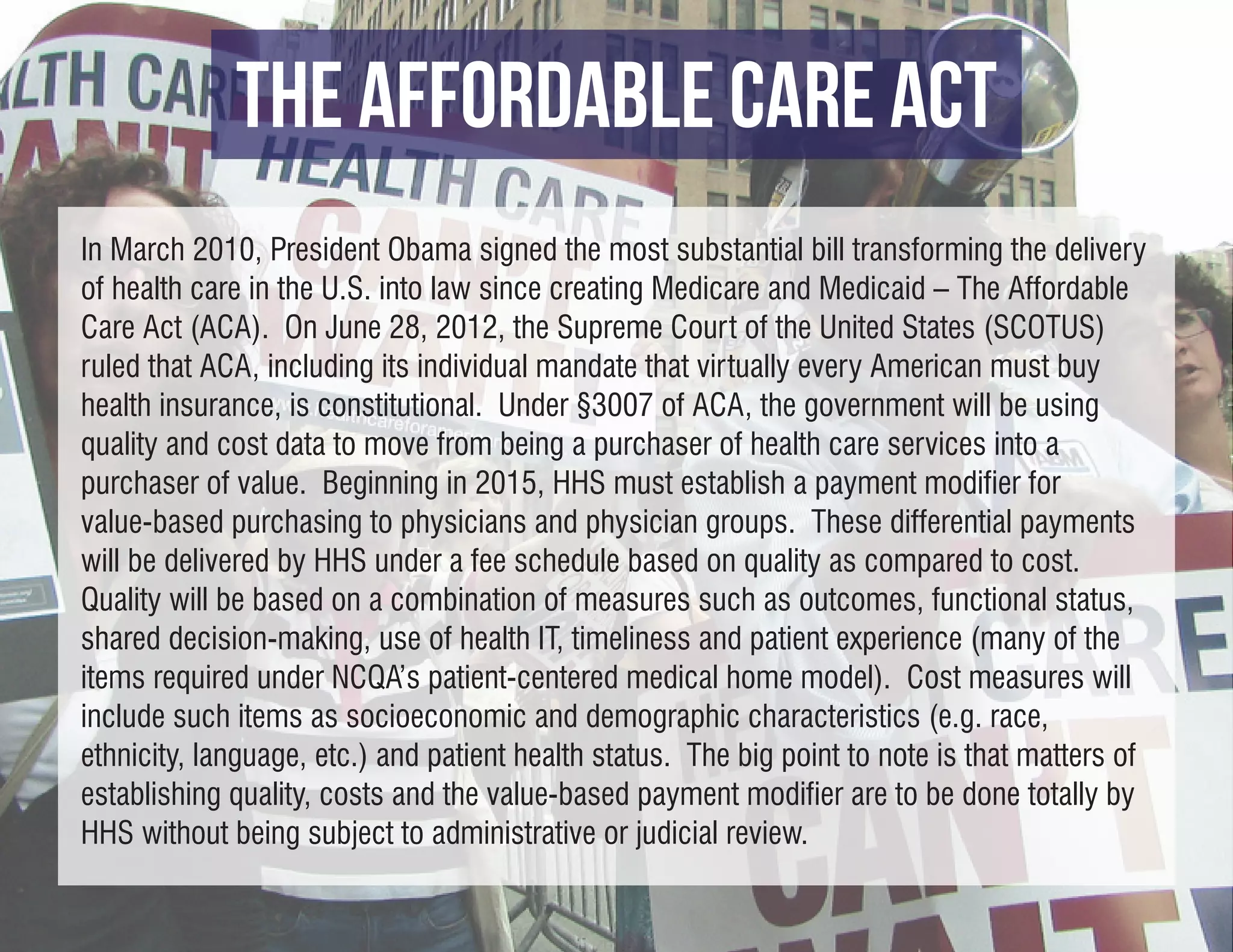
THE AFFORDABLE CARE ACT
In March 2010, President Obama signed the most substantial bill transforming the delivery
of health care in the U.S. into law since creating Medicare and Medicaid – The Affordable
Care Act (ACA). On June 28, 2012, the Supreme Court of the United States (SCOTUS)
ruled that ACA, including its individual mandate that virtually every American must buy
health insurance, is constitutional. Under §3007 of ACA, the government will be using
quality and cost data to move from being a purchaser of health care services into a
purchaser of value. Beginning in 2015, HHS must establish a payment modifier for
value-based purchasing to physicians and physician groups. These differential payments
will be delivered by HHS under a fee schedule based on quality as compared to cost.
Quality will be based on a combination of measures such as outcomes, functional status,
shared decision-making, use of health IT, timeliness and patient experience (many of the
items required under NCQA’s patient-centered medical home model). Cost measures will
include such items as socioeconomic and demographic characteristics (e.g. race,
ethnicity, language, etc.) and patient health status. The big point to note is that matters of
establishing quality, costs and the value-based payment modifier are to be done totally by
HHS without being subject to administrative or judicial review.
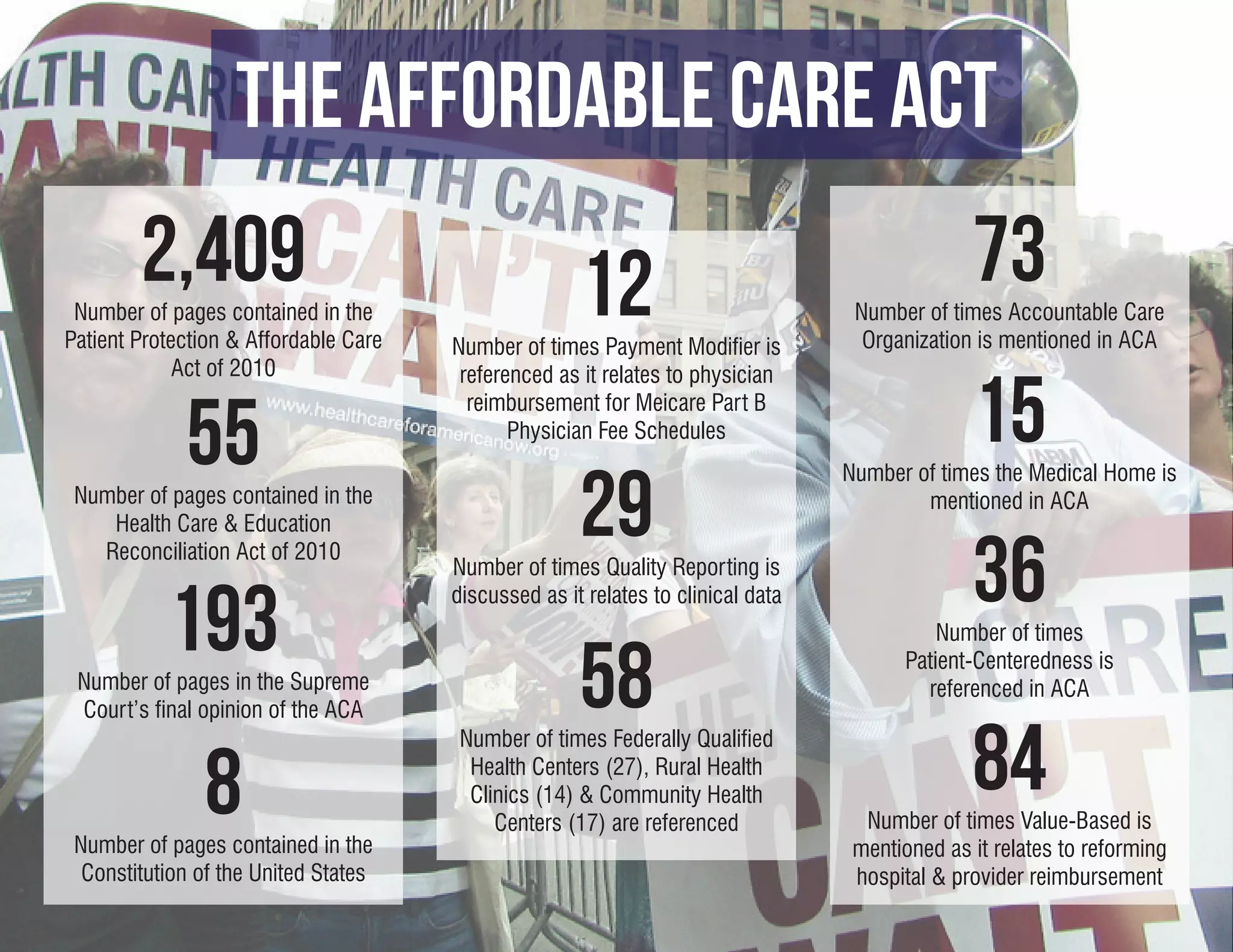
THE AFFORDABLE CARE ACT
        2,409
 Number of pages contained in the                     12                                        73
                                                                                   Number of times Accountable Care
Patient Protection & Affordable Care   Number of times Payment Modifier is          Organization is mentioned in ACA
             Act of 2010

                                                                                                15
                                        referenced as it relates to physician


             55
                                         reimbursement for Meicare Part B
                                              Physician Fee Schedules


                                                      29
                                                                                  Number of times the Medical Home is
 Number of pages contained in the                                                         mentioned in ACA
    Health Care & Education
   Reconciliation Act of 2010
                                       Number of times Quality Reporting is
                                                                                                36
           193
                                       discussed as it relates to clinical data
                                                                                             Number of times

 Number of pages in the Supreme
 Court’s final opinion of the ACA                     58                                 Patient-Centeredness is
                                                                                           referenced in ACA


               8
                                        Number of times Federally Qualified
                                         Health Centers (27), Rural Health
                                         Clinics (14) & Community Health
                                            Centers (17) are referenced
                                                                                                84
                                                                                    Number of times Value-Based is
 Number of pages contained in the                                                  mentioned as it relates to reforming
  Constitution of the United States                                                hospital & provider reimbursement
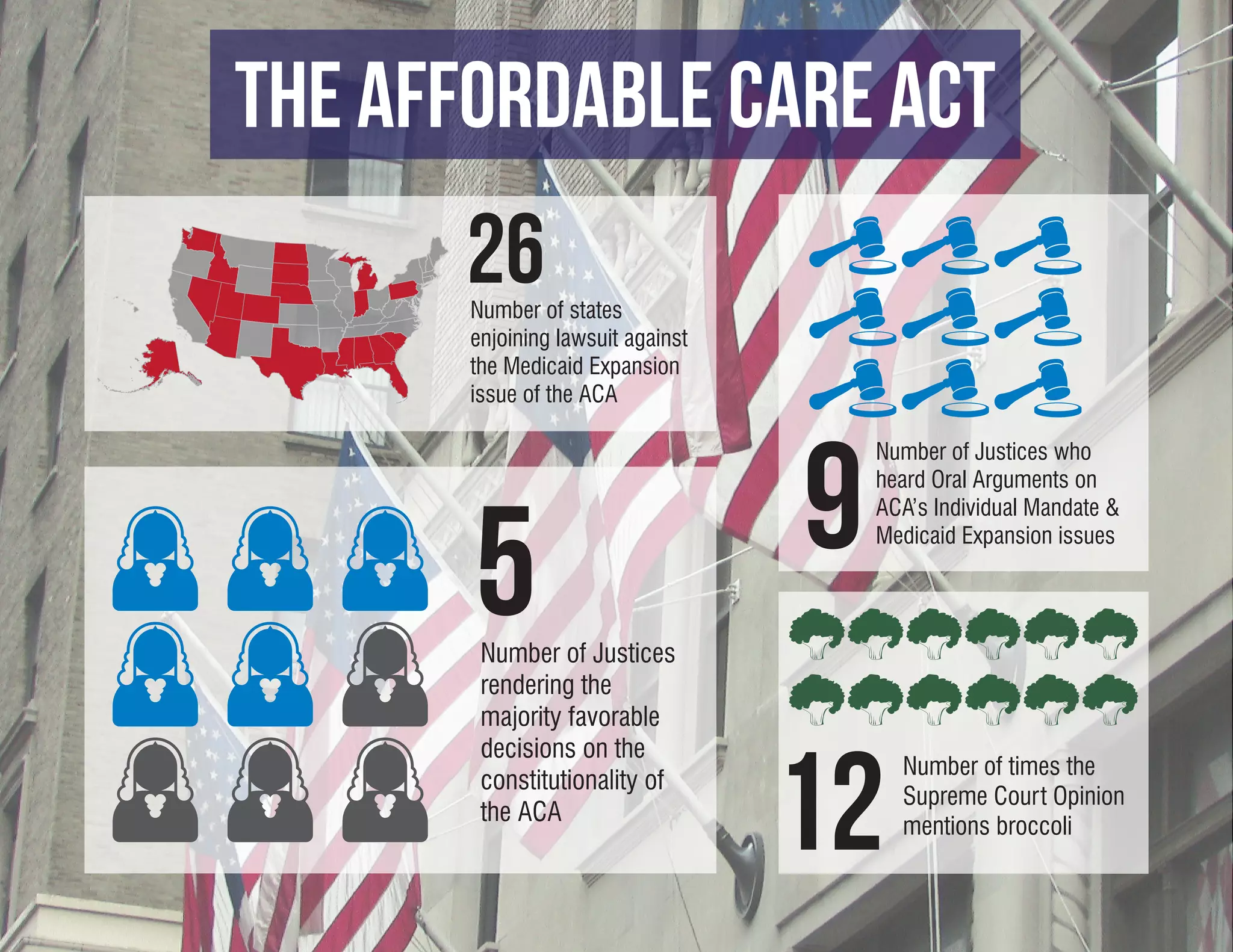
THE AFFORDABLE CARE ACT

       Number of states
       enjoining lawsuit against
       the Medicaid Expansion
       issue of the ACA

                                   Number of Justices who
                                   heard Oral Arguments on
                                   ACA’s Individual Mandate &
                                   Medicaid Expansion issues


        Number of Justices
        rendering the
        majority favorable
        decisions on the
                                     Number of times the
        constitutionality of
                                     Supreme Court Opinion
        the ACA
                                     mentions broccoli
Accountable Care Organizations
Created under ACA, CMS began contracting with Accountable Care Organizations
(ACOs) to provide services for a defined population of Medicare patients with two
launch dates: April 1, 2012 and July 1, 2012. There are three ACO models: one
with no risk, one with risk and one deemed a “Pioneer” model. Each ACO will
need to be armed with technology tools such as EHR, HIE and Patient Portals as a
foundation for achieving cost-effective and patient-centric quality of care. The
rules governing assignment of Medicare beneficiaries, the 33 quality measures,
eligibility considerations for FQHCs and RHCs, NCQA’s ACO recognition program,
and the desired reformation being sought by CMS were released in final on Oct.
20, 2011. Since that date, not only has CMS has been moving forward with this
innovative care delivery model, but the private industry has also joined the mix.
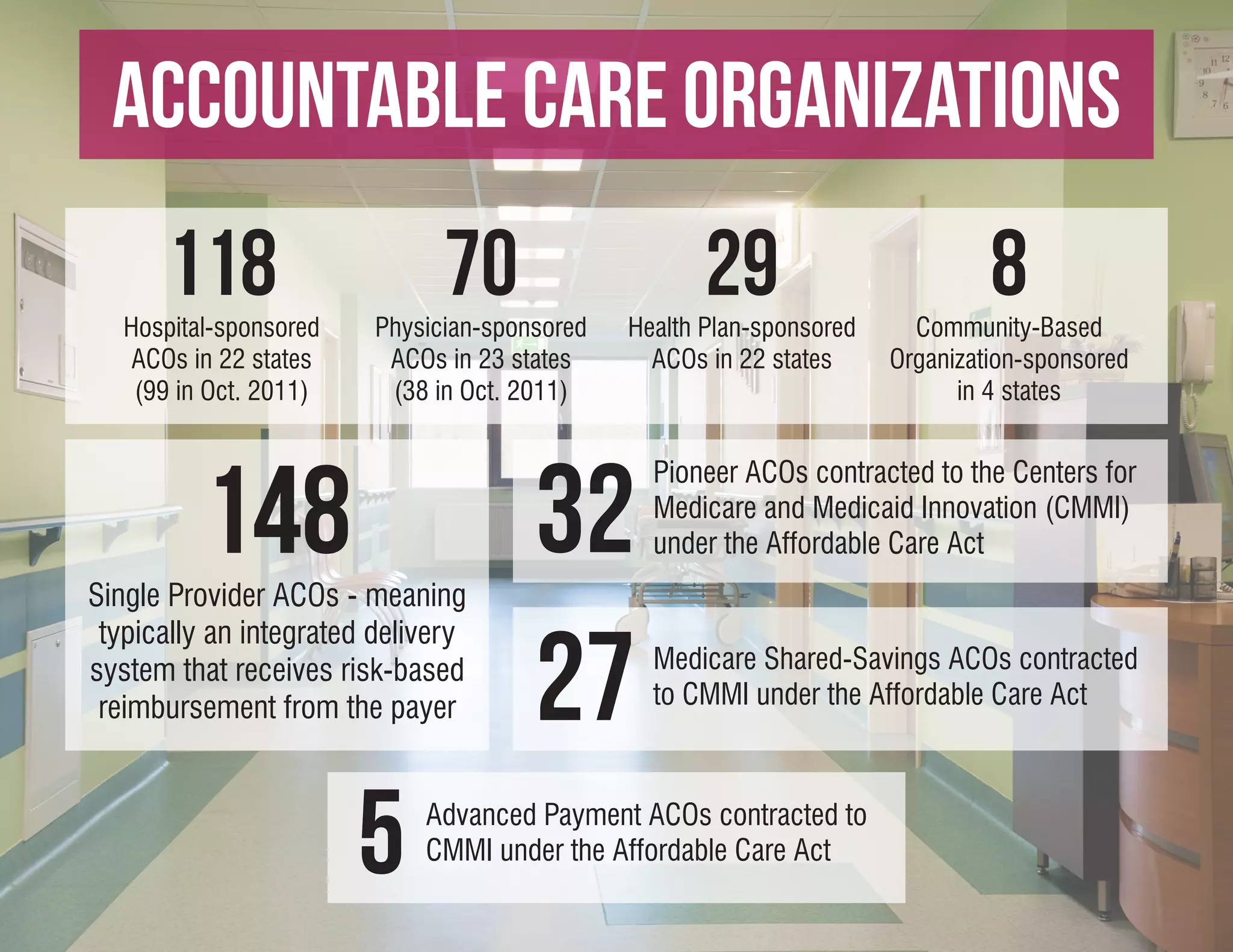
Accountable Care Organizations
      118
   Hospital-sponsored
                               70
                         Physician-sponsored
                                                      29
                                               Health Plan-sponsored
                                                                                8
                                                                         Community-Based
    ACOs in 22 states     ACOs in 23 states      ACOs in 22 states     Organization-sponsored
    (99 in Oct. 2011)     (38 in Oct. 2011)                                  in 4 states


          148                          32
                                                 Pioneer ACOs contracted to the Centers for
                                                 Medicare and Medicaid Innovation (CMMI)
                                                 under the Affordable Care Act
Single Provider ACOs - meaning


                                       27
 typically an integrated delivery
system that receives risk-based                  Medicare Shared-Savings ACOs contracted
 reimbursement from the payer                    to CMMI under the Affordable Care Act


                        5    Advanced Payment ACOs contracted to
                             CMMI under the Affordable Care Act
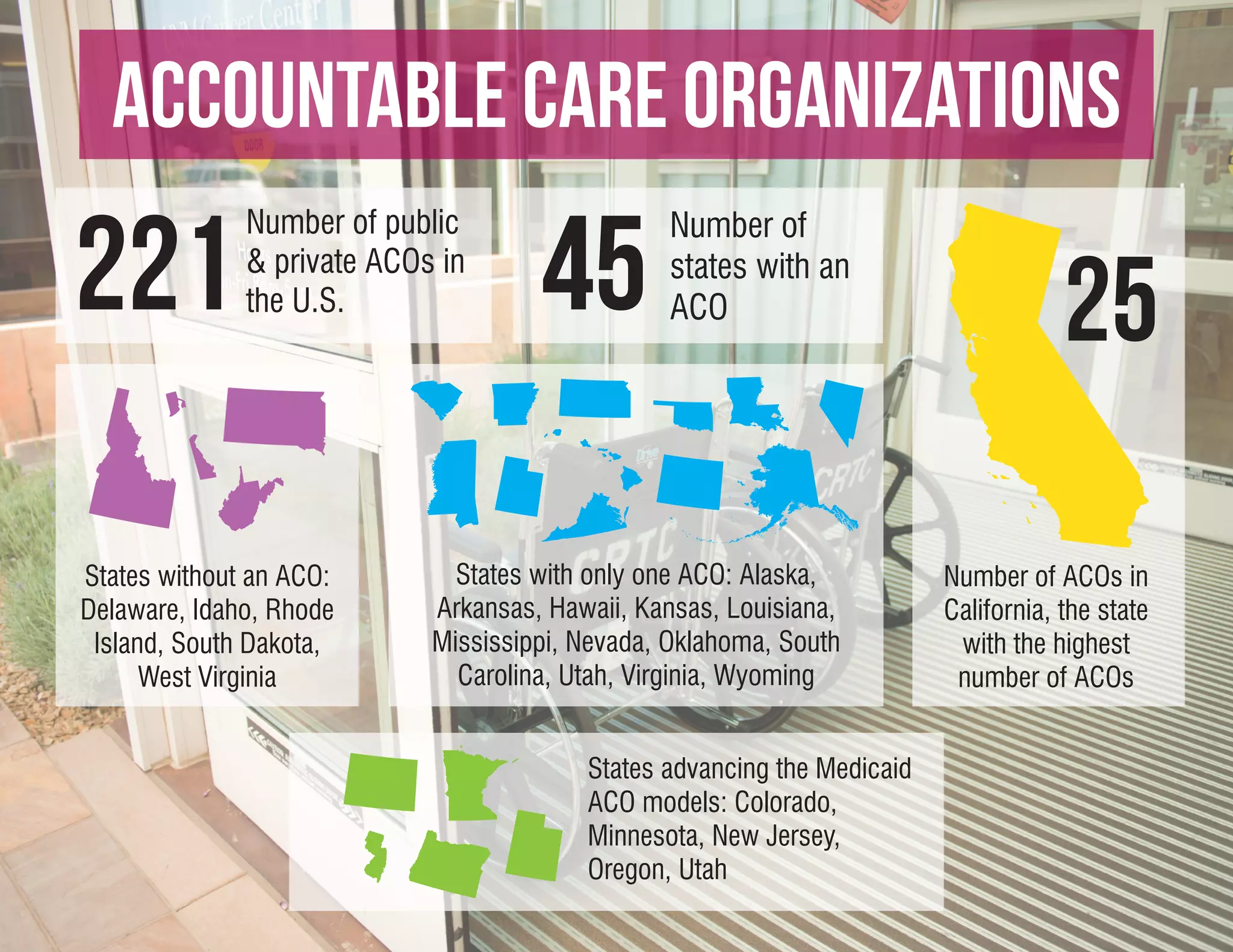
Accountable Care Organizations
221                                  45
              Number of public                  Number of


                                                                                     25
              & private ACOs in                 states with an
              the U.S.                          ACO


States without an ACO:        States with only one ACO: Alaska,          Number of ACOs in
Delaware, Idaho, Rhode      Arkansas, Hawaii, Kansas, Louisiana,         California, the state
 Island, South Dakota,      Mississippi, Nevada, Oklahoma, South          with the highest
      West Virginia           Carolina, Utah, Virginia, Wyoming           number of ACOs


                                         States advancing the Medicaid
                                         ACO models: Colorado,
                                         Minnesota, New Jersey,
                                         Oregon, Utah
Patient-centered medical home
The patient-centered medical home (PCMH) is a care delivery model that partners
a primary care provider to other teammates for a coordinated effort at managing
patients, the goal being to deliver quality of care and value to the patient as a care
team. The returns on improved patient quality, improved patient health and
reduced costs of care are measurable. Because prevention, wellness and
long-term healing not only promotes quality of care but saves money, both public
and private payers are beginning to pay differentially to providers with PCMH
recognition. There are four organizations that offer PCMH accreditation,
certification, achievement or recognition, namely: The National Committee for
Quality Assurance (NCQA), The Joint Commission, URAC and the Accreditation
Association for Ambulatory Health Care.
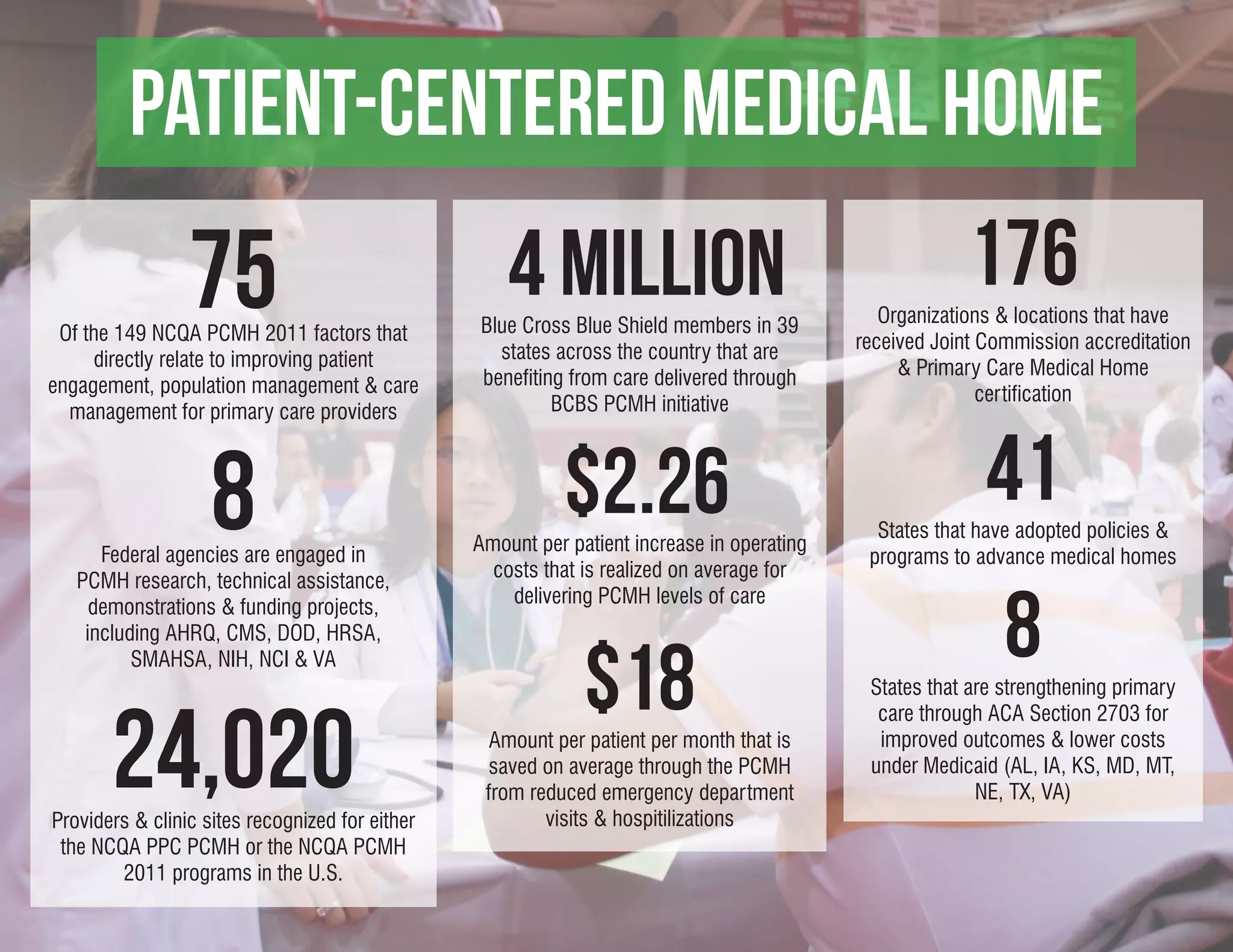
Patient-centered medical home
                 75                                  4 Million                                           176
                                                                                               Organizations & locations that have
 Of the 149 NCQA PCMH 2011 factors that          Blue Cross Blue Shield members in 39
                                                   states across the country that are       received Joint Commission accreditation
     directly relate to improving patient                                                        & Primary Care Medical Home
engagement, population management & care         benefiting from care delivered through
                                                          BCBS PCMH initiative                             certification
  management for primary care providers


                    8                                      $2.26                                           41
                                                                                              States that have adopted policies &
                                                 Amount per patient increase in operating
      Federal agencies are engaged in                                                        programs to advance medical homes
                                                   costs that is realized on average for
   PCMH research, technical assistance,


                                                                                                             8
                                                     delivering PCMH levels of care
     demonstrations & funding projects,
    including AHRQ, CMS, DOD, HRSA,
          SMAHSA, NIH, NCI & VA
                                                              $18                            States that are strengthening primary


       24,020
                                                                                              care through ACA Section 2703 for
                                                   Amount per patient per month that is       improved outcomes & lower costs
                                                   saved on average through the PCMH         under Medicaid (AL, IA, KS, MD, MT,
                                                  from reduced emergency department                       NE, TX, VA)
Providers & clinic sites recognized for either           visits & hospitilizations
 the NCQA PPC PCMH or the NCQA PCMH
        2011 programs in the U.S.
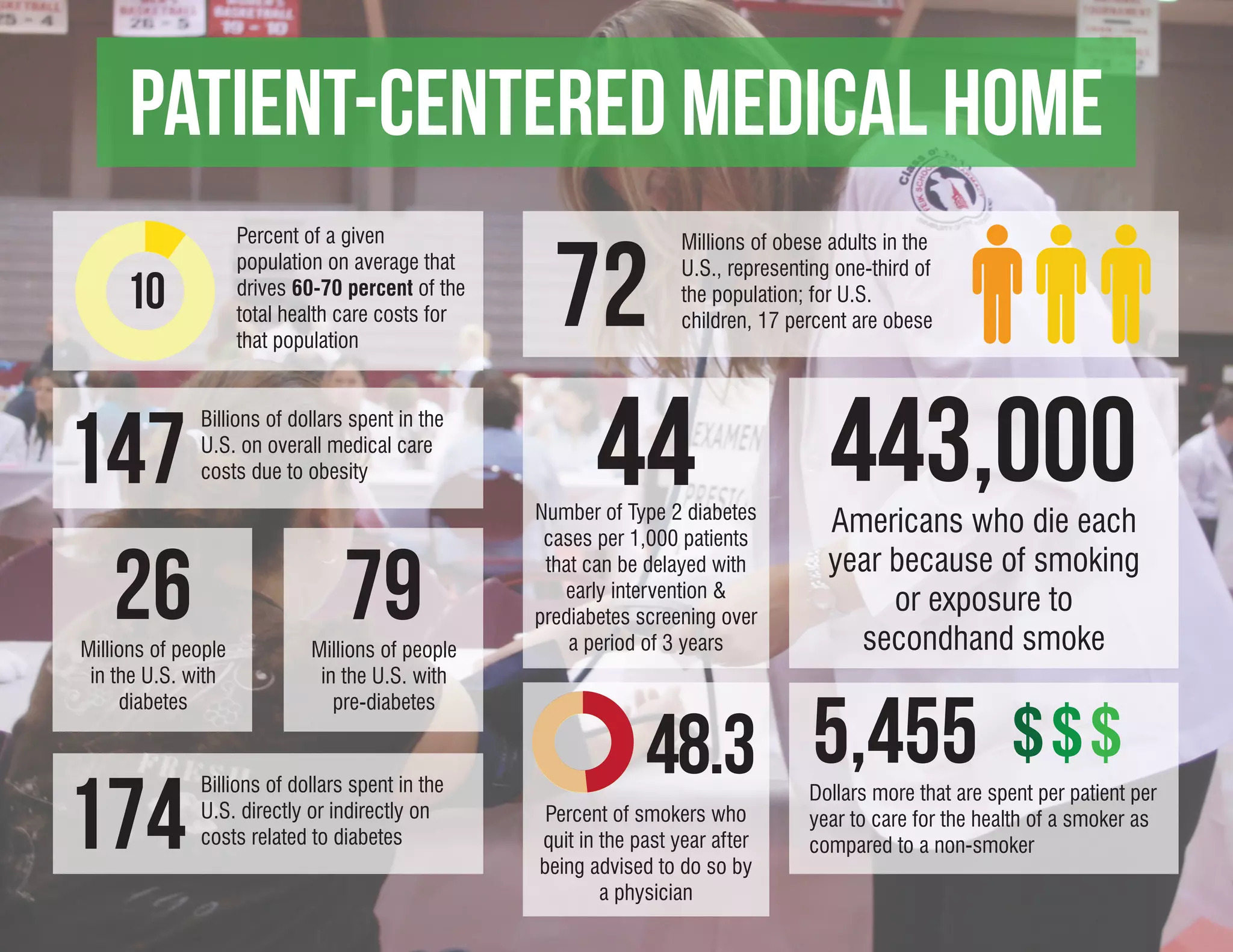
Patient-centered medical home

                                                     72
                     Percent of a given                             Millions of obese adults in the
                     population on average that                     U.S., representing one-third of
     10              drives 60-70 percent of the
                     total health care costs for
                                                                    the population; for U.S.
                                                                    children, 17 percent are obese
                     that population


147
              Billions of dollars spent in the
              U.S. on overall medical care
              costs due to obesity                        44
                                                   Number of Type 2 diabetes
                                                    cases per 1,000 patients
                                                                                      443,000
                                                                                      Americans who die each

 26
Millions of people
                                 79
                             Millions of people
                                                    that can be delayed with
                                                      early intervention &
                                                   prediabetes screening over
                                                       a period of 3 years
                                                                                      year because of smoking
                                                                                           or exposure to
                                                                                        secondhand smoke
 in the U.S. with             in the U.S. with


                                                                48.3 5,455
     diabetes                   pre-diabetes


174
              Billions of dollars spent in the                                     Dollars more that are spent per patient per
              U.S. directly or indirectly on        Percent of smokers who         year to care for the health of a smoker as
              costs related to diabetes            quit in the past year after     compared to a non-smoker
                                                   being advised to do so by
                                                           a physician
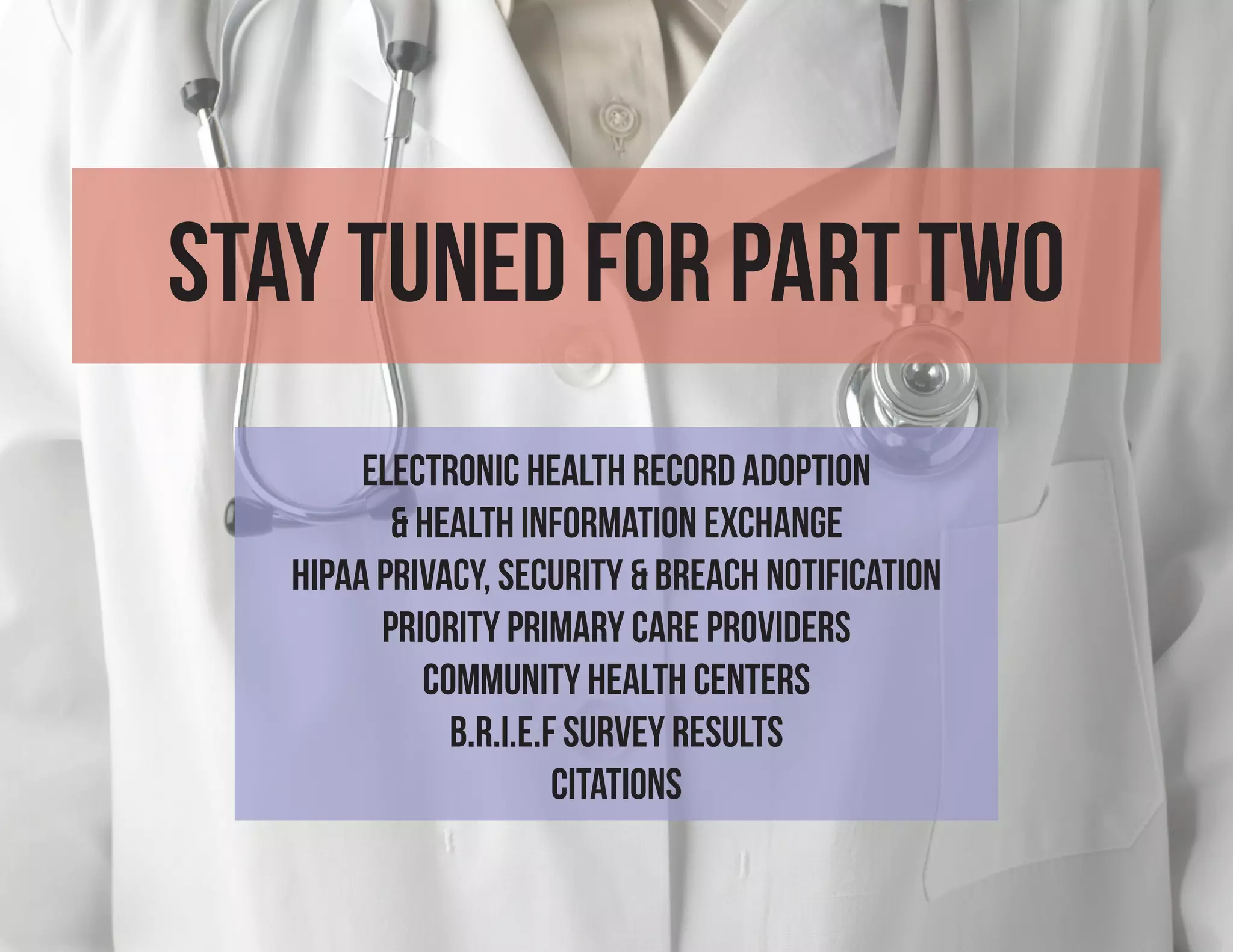
Stay Tuned for Part Two
        electronic Health Record Adoption
          & Health information Exchange
   HIPAA privacy, Security & Breach Notification
         Priority Primary Care Providers
            Community Health Centers
              B.R.I.E.F SURVEY RESULTS
                       CITATIONS

2012 Health Care By the Numbers Part One

  • 2.
    Part One the american patient meaningful use the affordable care act accountable care organizations patient-centered medical home
  • 3.
    THE American Patient Moreand more in policymaking, the U.S. government is seeking to actively engage the American patient or their caregiver as a participant in the care management process. With chronic disease impacting nearly 140 million Americans today, it remains a critical factor to reining in health care spending. Experts believe one of the principal causes of chronic disease is that the American patient is unengaged and not held accountable for lifestyle choices made. The provider community can expect this point to be pressed in future policymaking and their ability to successfully deliver patient-centric care linked to reimbursement in the near future.
  • 4.
    THE American patient 309 Millions of people living in 51% Percent of the U.S. population that is male (49 percent) & 78.7 Life expectancy for all the United States of America 49 % female (51 percent) genders & demographics in the 40.3 Millions of Americans ages 65+ (17.3 percent live in U.S., as compared to Florida); this demographic is expected to grow to 88.5 83.9 in Japan & 49.4 million by 2050 in South Africa 1.4 Millions of men & women who serve as active duty military in defense of America 35.7 Percent of American 14.1 Billions of dollars spent on medical services directly attributed to childhood obesity alone adults who are obese
  • 5.
    THE American patient 190 Thousands of 2012 expected cancer 7.1 Millions of Americans that are 20 deaths in the U.S. that are linked to estimated to have undiagnosed obesity, physical inactivity & poor diabetes nutrition - all of which is preventable 5.4 Percent of U.S. adults who meet the 573 criteria for substance dependence or abuse Millions of Americans of all ages that Thousands of Americans who die will have Alzheimer’s in 2012, the from heart disease, the leading cause sixth leading cause of death in the of death in the U.S. U.S. 10 18.3 Millions of Americas that were 2.7 Trillions of dollars that was estimated Percent of Americans ages 12+ who are on antidepressant medication, the physician-diagnosed with diabetes by as the U.S. national health third most commonly prescribed drug 2008 expenditure in 2011 in the U.S.
  • 6.
    THE American Patient 31 356 Dollars per person that was spent on 75 Billions of dollars spent total on health care in the U.S. in 1970 health care in the U.S. in 1970 Percent of U.S. health expenditures that are attributed to hospital care 20 8,402 Dollars per person that is spent on 250 Billions of dollars that were spent on health care in the U.S. today prescription drugs, representing 12 percent of personal health care Percent of U.S. health expenditures that are expenditures in 2009 4,072 attributed to physician or other clinical services Dollars per person that is spent on 60 health care in the Germany today Percent of adult Americans with private health care coverage as of 2010
  • 7.
    meaningful use Enacted underthe American Recovery and Reinvestment Act of 2009 (ARRA), HITECH promotes adoption of interoperable electronic health records (EHRs) by health care providers through financial incentives under the Medicare or Medicaid EHR Incentive Programs, also known as “Meaningful Use.” This piece of legislation is designed to reward and accelerate the adoption of interoperable, certified electronic health records (CEHRT). Meaningful Use was launched on Jan. 1, 2011, bringing the carrots of incentive dollars to many providers and hospitals. The threat of sticks for non-adoption lurks as of 2015 through payment adjustments in Medicare provider reimbursement.
  • 8.
    meaningful use 3,662 Eligible hospitals that have registered 51.3 3.7 Billions of dollars that has been paid for the CMS Medicare & Medicaid to eligible hospitals for successful EHR Incentive Program attestation to Stage 1 Meaningful Use Percent of all physicians in the U.S. 163,748 995 who report that they intend to pursue the Meaningful Use incentives under Medicare or Medicaid Eligible professionals that have Millions of dollars that has been paid registered for the CMS Medicare EHR to eligibile professionals for Incentive Program successful attestation to Stage 1 57.6 Meaningful Use under Medicare 81,029 Eligible Professionals that have Percent of physicians under age 45 who plan to apply for Meaningful Use, 11,588 as opposed to only 44 percent of Family practice physicians that have registered for the CMS Medicaid EHR physicians ages 55+ successfully attested to Stage 1 Incentive Program Meaningful Use under Medicare
  • 9.
    meaningful use 10,597 215 30,204 Physicians that have attested to adopt, Internal medicine physicians that have successfully attested to Stage 1 Meaningful Use under Medicare Eligible professionals that have successfully attested to Stage 1 implement or upgrade (AIU) certified Meaningful Use under Medicaid EHR technology under Medicaid 3,884 7,859 8,045 Mid-level eligible professionals who Cardiologists that have successfully attested to Stage 1 Meaningful Use under Medicare Hospitals & eligible professionals that have attested under the CMS EHR 44 have attested to to year one AIU under Incentive Programs in Texas for a total Medicaid; this includes Nurse of $483,550,804 in incentive payments Practitioners (6,812), Mid-wives (886) (highest performing state) & Physician Assistants (347) 101 States that have launced the Medicaid EHR Incentive Program 2,237 Dentists that have attested to year one 852 Hospitals & eligible professionals that have attested under the CMS EHR Incentive Programs in North Dakota for AIU under Medicaid Millions of dollars that have been paid to a total of $2,307,325 in incentive eligible professions for successful Stage payments (lowest performing state) 1 Meaningful Use under Medicaid
  • 10.
    THE AFFORDABLE CAREACT In March 2010, President Obama signed the most substantial bill transforming the delivery of health care in the U.S. into law since creating Medicare and Medicaid – The Affordable Care Act (ACA). On June 28, 2012, the Supreme Court of the United States (SCOTUS) ruled that ACA, including its individual mandate that virtually every American must buy health insurance, is constitutional. Under §3007 of ACA, the government will be using quality and cost data to move from being a purchaser of health care services into a purchaser of value. Beginning in 2015, HHS must establish a payment modifier for value-based purchasing to physicians and physician groups. These differential payments will be delivered by HHS under a fee schedule based on quality as compared to cost. Quality will be based on a combination of measures such as outcomes, functional status, shared decision-making, use of health IT, timeliness and patient experience (many of the items required under NCQA’s patient-centered medical home model). Cost measures will include such items as socioeconomic and demographic characteristics (e.g. race, ethnicity, language, etc.) and patient health status. The big point to note is that matters of establishing quality, costs and the value-based payment modifier are to be done totally by HHS without being subject to administrative or judicial review.
  • 11.
    THE AFFORDABLE CAREACT 2,409 Number of pages contained in the 12 73 Number of times Accountable Care Patient Protection & Affordable Care Number of times Payment Modifier is Organization is mentioned in ACA Act of 2010 15 referenced as it relates to physician 55 reimbursement for Meicare Part B Physician Fee Schedules 29 Number of times the Medical Home is Number of pages contained in the mentioned in ACA Health Care & Education Reconciliation Act of 2010 Number of times Quality Reporting is 36 193 discussed as it relates to clinical data Number of times Number of pages in the Supreme Court’s final opinion of the ACA 58 Patient-Centeredness is referenced in ACA 8 Number of times Federally Qualified Health Centers (27), Rural Health Clinics (14) & Community Health Centers (17) are referenced 84 Number of times Value-Based is Number of pages contained in the mentioned as it relates to reforming Constitution of the United States hospital & provider reimbursement
  • 12.
    THE AFFORDABLE CAREACT Number of states enjoining lawsuit against the Medicaid Expansion issue of the ACA Number of Justices who heard Oral Arguments on ACA’s Individual Mandate & Medicaid Expansion issues Number of Justices rendering the majority favorable decisions on the Number of times the constitutionality of Supreme Court Opinion the ACA mentions broccoli
  • 13.
    Accountable Care Organizations Createdunder ACA, CMS began contracting with Accountable Care Organizations (ACOs) to provide services for a defined population of Medicare patients with two launch dates: April 1, 2012 and July 1, 2012. There are three ACO models: one with no risk, one with risk and one deemed a “Pioneer” model. Each ACO will need to be armed with technology tools such as EHR, HIE and Patient Portals as a foundation for achieving cost-effective and patient-centric quality of care. The rules governing assignment of Medicare beneficiaries, the 33 quality measures, eligibility considerations for FQHCs and RHCs, NCQA’s ACO recognition program, and the desired reformation being sought by CMS were released in final on Oct. 20, 2011. Since that date, not only has CMS has been moving forward with this innovative care delivery model, but the private industry has also joined the mix.
  • 14.
    Accountable Care Organizations 118 Hospital-sponsored 70 Physician-sponsored 29 Health Plan-sponsored 8 Community-Based ACOs in 22 states ACOs in 23 states ACOs in 22 states Organization-sponsored (99 in Oct. 2011) (38 in Oct. 2011) in 4 states 148 32 Pioneer ACOs contracted to the Centers for Medicare and Medicaid Innovation (CMMI) under the Affordable Care Act Single Provider ACOs - meaning 27 typically an integrated delivery system that receives risk-based Medicare Shared-Savings ACOs contracted reimbursement from the payer to CMMI under the Affordable Care Act 5 Advanced Payment ACOs contracted to CMMI under the Affordable Care Act
  • 15.
    Accountable Care Organizations 221 45 Number of public Number of 25 & private ACOs in states with an the U.S. ACO States without an ACO: States with only one ACO: Alaska, Number of ACOs in Delaware, Idaho, Rhode Arkansas, Hawaii, Kansas, Louisiana, California, the state Island, South Dakota, Mississippi, Nevada, Oklahoma, South with the highest West Virginia Carolina, Utah, Virginia, Wyoming number of ACOs States advancing the Medicaid ACO models: Colorado, Minnesota, New Jersey, Oregon, Utah
  • 16.
    Patient-centered medical home Thepatient-centered medical home (PCMH) is a care delivery model that partners a primary care provider to other teammates for a coordinated effort at managing patients, the goal being to deliver quality of care and value to the patient as a care team. The returns on improved patient quality, improved patient health and reduced costs of care are measurable. Because prevention, wellness and long-term healing not only promotes quality of care but saves money, both public and private payers are beginning to pay differentially to providers with PCMH recognition. There are four organizations that offer PCMH accreditation, certification, achievement or recognition, namely: The National Committee for Quality Assurance (NCQA), The Joint Commission, URAC and the Accreditation Association for Ambulatory Health Care.
  • 17.
    Patient-centered medical home 75 4 Million 176 Organizations & locations that have Of the 149 NCQA PCMH 2011 factors that Blue Cross Blue Shield members in 39 states across the country that are received Joint Commission accreditation directly relate to improving patient & Primary Care Medical Home engagement, population management & care benefiting from care delivered through BCBS PCMH initiative certification management for primary care providers 8 $2.26 41 States that have adopted policies & Amount per patient increase in operating Federal agencies are engaged in programs to advance medical homes costs that is realized on average for PCMH research, technical assistance, 8 delivering PCMH levels of care demonstrations & funding projects, including AHRQ, CMS, DOD, HRSA, SMAHSA, NIH, NCI & VA $18 States that are strengthening primary 24,020 care through ACA Section 2703 for Amount per patient per month that is improved outcomes & lower costs saved on average through the PCMH under Medicaid (AL, IA, KS, MD, MT, from reduced emergency department NE, TX, VA) Providers & clinic sites recognized for either visits & hospitilizations the NCQA PPC PCMH or the NCQA PCMH 2011 programs in the U.S.
  • 18.
    Patient-centered medical home 72 Percent of a given Millions of obese adults in the population on average that U.S., representing one-third of 10 drives 60-70 percent of the total health care costs for the population; for U.S. children, 17 percent are obese that population 147 Billions of dollars spent in the U.S. on overall medical care costs due to obesity 44 Number of Type 2 diabetes cases per 1,000 patients 443,000 Americans who die each 26 Millions of people 79 Millions of people that can be delayed with early intervention & prediabetes screening over a period of 3 years year because of smoking or exposure to secondhand smoke in the U.S. with in the U.S. with 48.3 5,455 diabetes pre-diabetes 174 Billions of dollars spent in the Dollars more that are spent per patient per U.S. directly or indirectly on Percent of smokers who year to care for the health of a smoker as costs related to diabetes quit in the past year after compared to a non-smoker being advised to do so by a physician
  • 19.
    Stay Tuned forPart Two electronic Health Record Adoption & Health information Exchange HIPAA privacy, Security & Breach Notification Priority Primary Care Providers Community Health Centers B.R.I.E.F SURVEY RESULTS CITATIONS