2011

   Index
   of the
   Massachusetts
   Innovation
   Economy
The Index of the Massachusetts Innovation Economy,

published annually since 1997, is the premier fact-based

benchmark for measuring the performance of the

Massachusetts knowledge economy.
Dear Friends,

     It is my pleasure to welcome you to the 2011 Index of the Massachusetts Innovation Economy. The
     Index, published annually by the Massachusetts Technology Collaborative (MTC), is the Commonwealth’s
     instrument for assessing the performance of the state’s innovation ecosystem and the key industry sectors
     of the innovation economy. The Index highlights key trends and themes affecting the state’s Innovation
     Economy and helps inform fact-based decision-making among Massachusetts’ policymakers, industry
     practitioners, and academic leaders.

     Since 1997, the MTC has produced the Index report analyzing the innovation process, and capital and
     human resources that grow and sustain the Innovation Economy in the Commonwealth. This report, based
     on a set of 25 quantitative indicators, examines not only the strengths of the Massachusetts Innovation
     Economy, but also areas of concern that need to be addressed by the state if it is to remain at the forefront
     of innovation and economic development. The Index is a key tool for state leaders, public and private, to
     align our resources with the innovation process to meet emerging challenges and opportunities.

     The Massachusetts Innovation Economy is one of the state’s key advantages in the global economy and an
     engine of prosperity for our citizens. It is also a source of resilience amidst national and global economic
     uncertainty.

     While the state continues to face challenges in these tough economic times, this edition of the Index
     shows that the Commonwealth, under the Patrick-Murray administration, has been able to maintain its
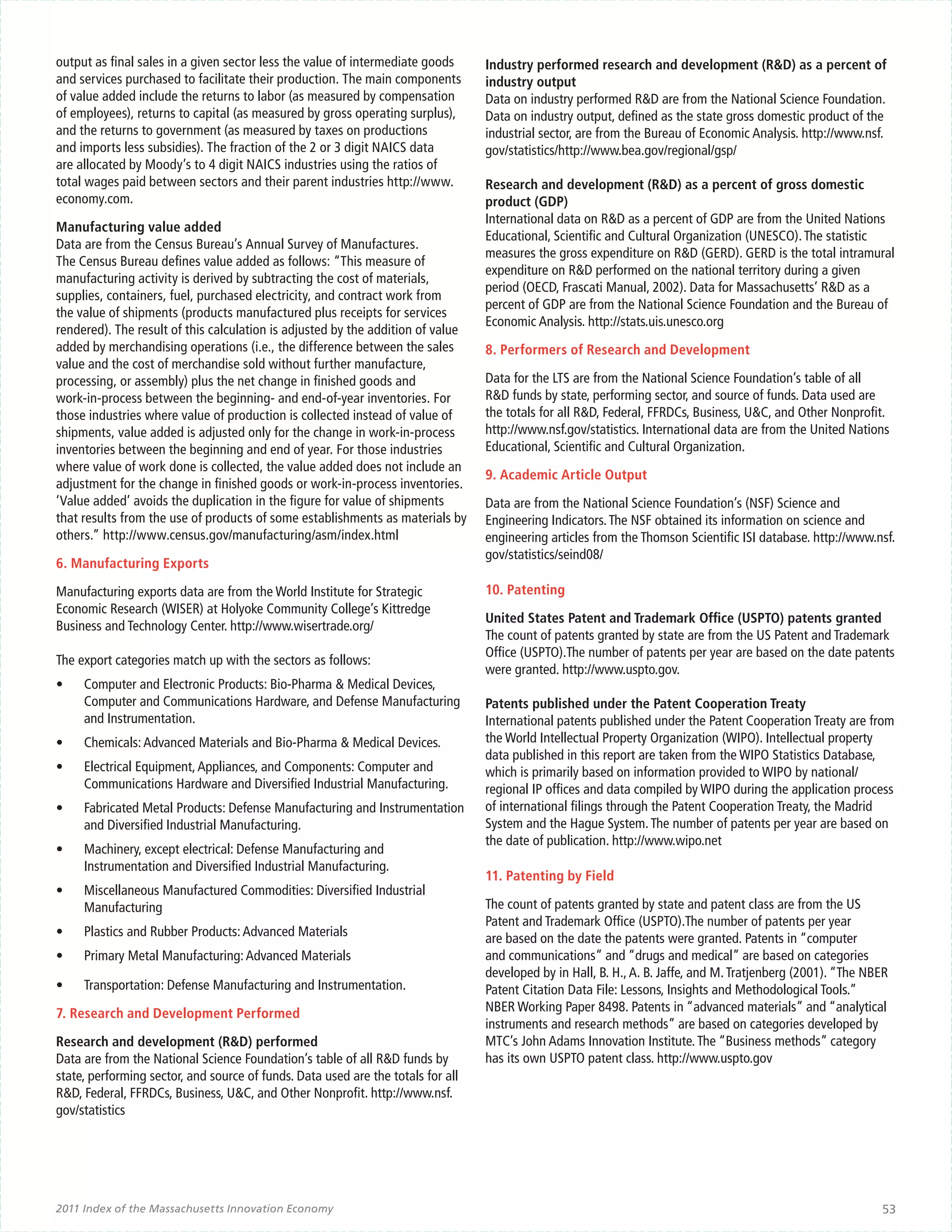
     leadership in the Innovation Economy. The Commonwealth retains its status as one of the most R&D
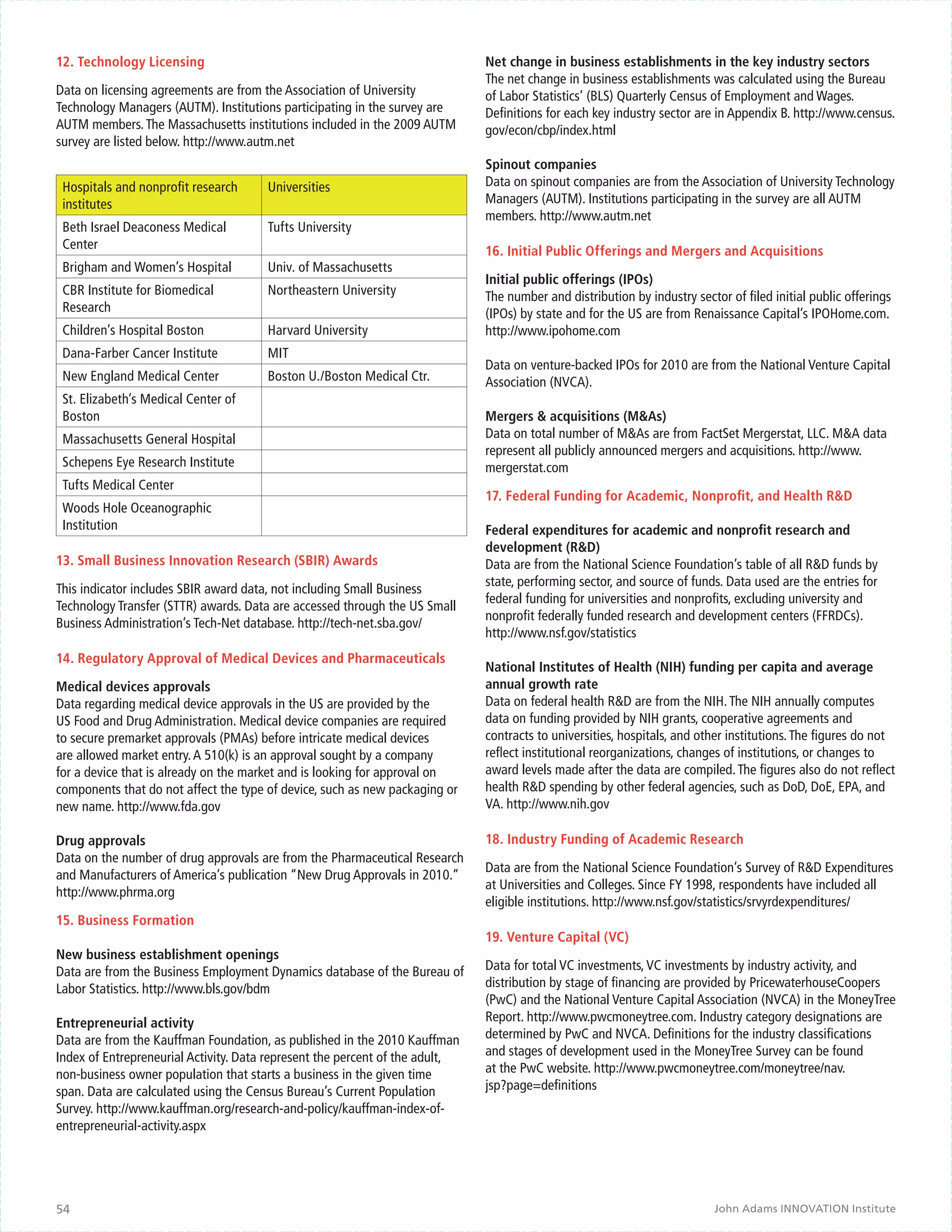
     intensive economies in the world. The Commonwealth is also among the leaders in attracting federal
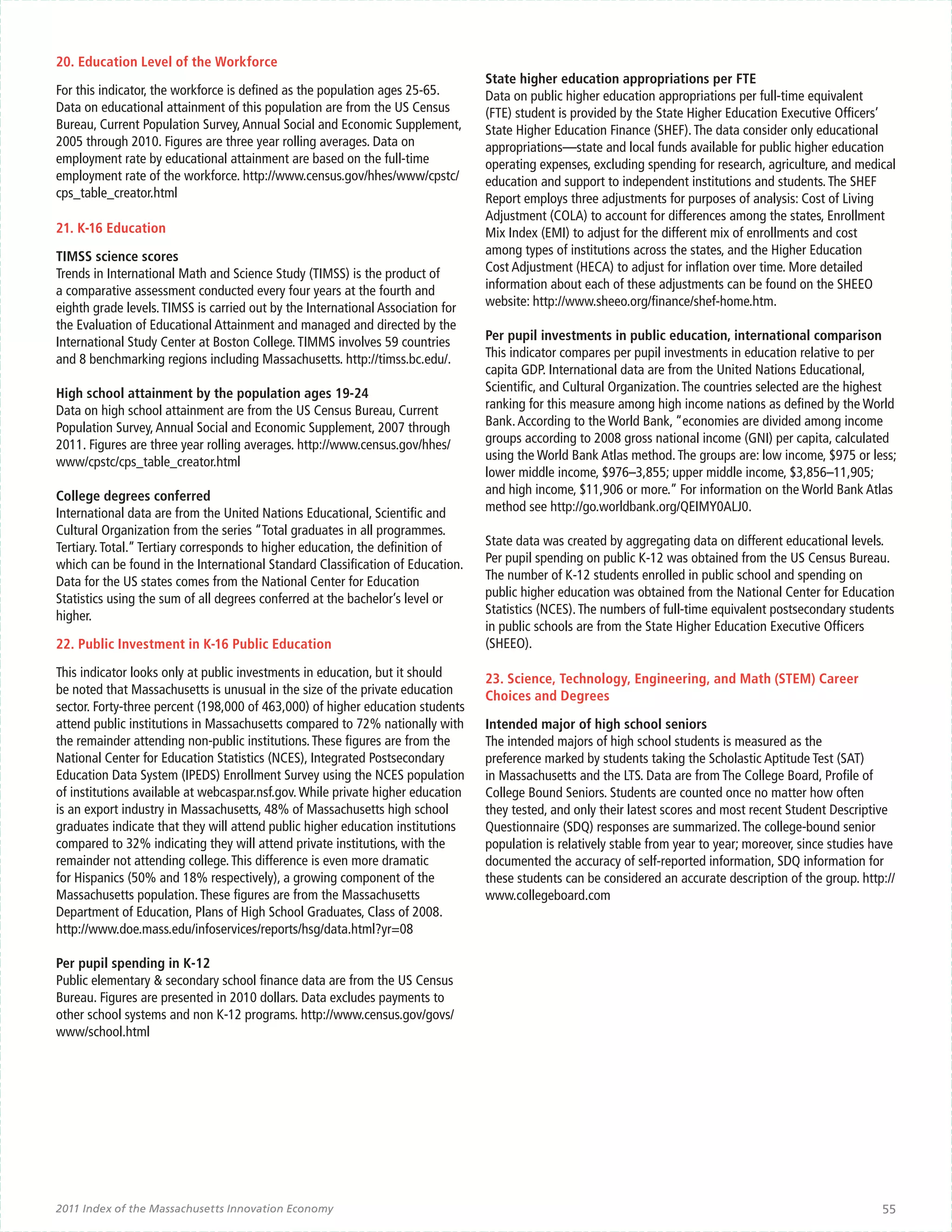
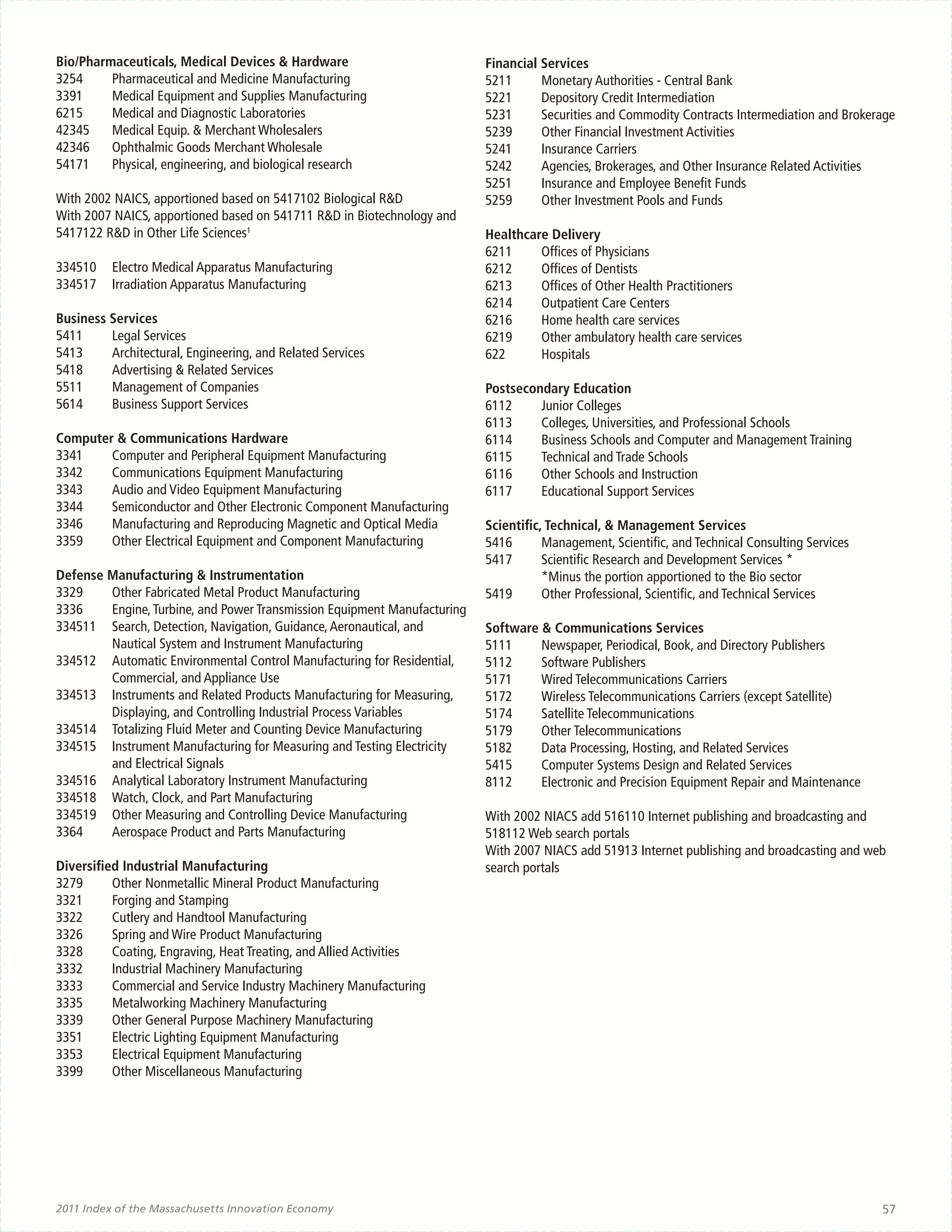
     R&D dollars to its universities and nonprofit research institutes.

     I invite you to read the Index, add your thoughts, and join our collaborative efforts to enhance
     Massachusetts as a leading center of the world’s innovation revolution.


     Gregory P. Bialecki, Secretary
     Executive Office of Housing and Economic Development
     Commonwealth of Massachusetts


2011 Index of the Massachusetts Innovation Economy                                                                   1
2011        Index
                                                     of the
                                                     Massachusetts
                                                     Innovation
                                                     Economy


2011 Index of the Massachusetts Innovation Economy                   3
The Massachusetts Technology Collaborative

    The Mass Tech Collaborative is the Commonwealth’s
    economic development engine for facilitating and
    catalyzing innovation throughout Massachusetts.
    The Mass Tech Collaborative bolsters innovation and job growth in
    the private sector for the good of the Commonwealth, providing a
    standard for government agencies by employing the collaborative
    model to create public benefit. It fosters collaborations among       John Adams Innovation Institute
    industry, government, and academia to sustain a thriving
    innovation economy in Massachusetts and strengthen the state’s
    competitiveness globally.                                             The John Adams Innovation Institute, an operating division of
                                                                          the Mass Technology Collaborative, is dedicated to fostering
    The rich history of The Mass Tech Collaborative reaches back to
                                                                          collaboration among business, government, universities, and
    1982, when the Legislature created the Massachusetts Technology       other economic and civic institutions to improve the conditions for
    Park Corporation to develop a “partnership of government and          economic growth and job creation in the technology sector. Using
    industry and education” for the tech sector. As the state’s economy   industry clusters as an organizing concept, John Adams contributes
    evolved during the past thirty years, the Mass Tech Collaborative     its expertise, investment-making, problem-solving, and access to
    adapted and accommodated a changing marketplace by creating a         thought leaders and decision makers, to support innovation and
    foundation of collaboration, flexibility, and independence.           technological changes in the marketplace. John Adams promotes
                                                                          innovation and economic growth through advancement of the
                                                                          following program objectives:


                                                                          1.	   enhance and improve our collective understanding at the
                                                                                intersection of economic development and innovation
                                                                          2.	   convene industry, government and academia as a primary
                                                                                means to enhance the economic competitiveness of
                                                                                recognized economic sectors
                                                                          3.	   strengthen and support institutions focused on growing the
                                                                                innovation economy
                                                                          4.	   support and sponsor civic entrepreneurs
                                                                          5.	   intervene opportunistically in close collaboration with
                                                                                industry, academia and public sector stakeholders, especially
                                                                                in instances where, but for the intervention, a competitive
                                                                                advantage for the Massachusetts economy could be
                                                                                diminished.


4                                                                                                               John Adams INNOVATION Institute
Table of Contents
 Highlights................................................................................................................................................................................................ 4


 Introduction............................................................................................................................................................................................ 7
      Island of Misfit Toys, Ted Acworth................................................................................................................................................... 10
      Manufacturing Innovation, Richard S. Himmelwright....................................................................................................................12
      Intersections that Matter, Elisabeth Reynolds................................................................................................................................ 14
      Roll-to-Roll Innovation, James J. Watkins....................................................................................................................................... 16
      Integration through Design, Richard Watson................................................................................................................................. 18


 The Massachusetts Innovation Ecosystem.......................................................................................................................................... 20


     Indicators	
 	       Construction of the Indicators...................................................................................................................................................... 23
 ECONOMIC IMPACT
 		            1.	 Industry Cluster Employment and Wages..................................................................................................................... 24
 		            2.	 Occupations and Wages................................................................................................................................................. 25	
 		3	Household Income.......................................................................................................................................................... 26
 		4.	Productivity..................................................................................................................................................................... 27
 		            5.	 Industry Output and Manufacturing Value Added...................................................................................................... 28	
 		6.	Manufacturing Exports................................................................................................................................................... 29
 RESEARCH
 		            7.	 Research and Development Performed ....................................................................................................................... 30
 		            8.	 Performers of R&D.......................................................................................................................................................... 31
 		            9.	 Academic Article Output................................................................................................................................................ 32
      Patenting......................................................................................................................................................................... 33
 		10.	
 		            11.	 Patenting by Field........................................................................................................................................................... 34
 TECHNOLOGY DEVELOPMENT
 		12.	
      Technology Licensing...................................................................................................................................................... 35
 		            13	 Small Business Innovation Research Awards................................................................................................................. 36
 		            14.	 Regulatory Approval of Medical Devices and Pharmaceuticals.................................................................................. 37
 BUSINESS DEVELOPMENT
 		15.	
      Business Formation......................................................................................................................................................... 38
 		            16.	 Initial Public Offerings and Mergers and Acquisitions................................................................................................. 39
 CAPITAL
 		            17.	 Federal Funding for Academic, Nonprofit, and Health R&D....................................................................................... 40	
 		            18.	 Industry Funding of Academic Research........................................................................................................................41
 		19.	
      Venture Capital............................................................................................................................................................... 42
 TALENT
 		            20.	 Education Level of the Workforce................................................................................................................................. 43
 		21.	 Education................................................................................................................................................................. 44
      K-16
 		            22.	 Public Investment in K-16 Education.............................................................................................................................. 45
 		            23.	 Science, Technology, Engineering and Math Career Choices and Degrees................................................................ 46	
 		            24.	 Talent Flow and Attraction............................................................................................................................................. 47	
 		25.	
      Housing Affordability..................................................................................................................................................... 48
 Appendix A: Data Sources for Indicators and Selection of LTS......................................................................................................... 49
 Appendix B: Industry Cluster Definitions........................................................................................................................................... 54


2011 Index of the Massachusetts Innovation Economy                                                                                                                                                              5
Highlights


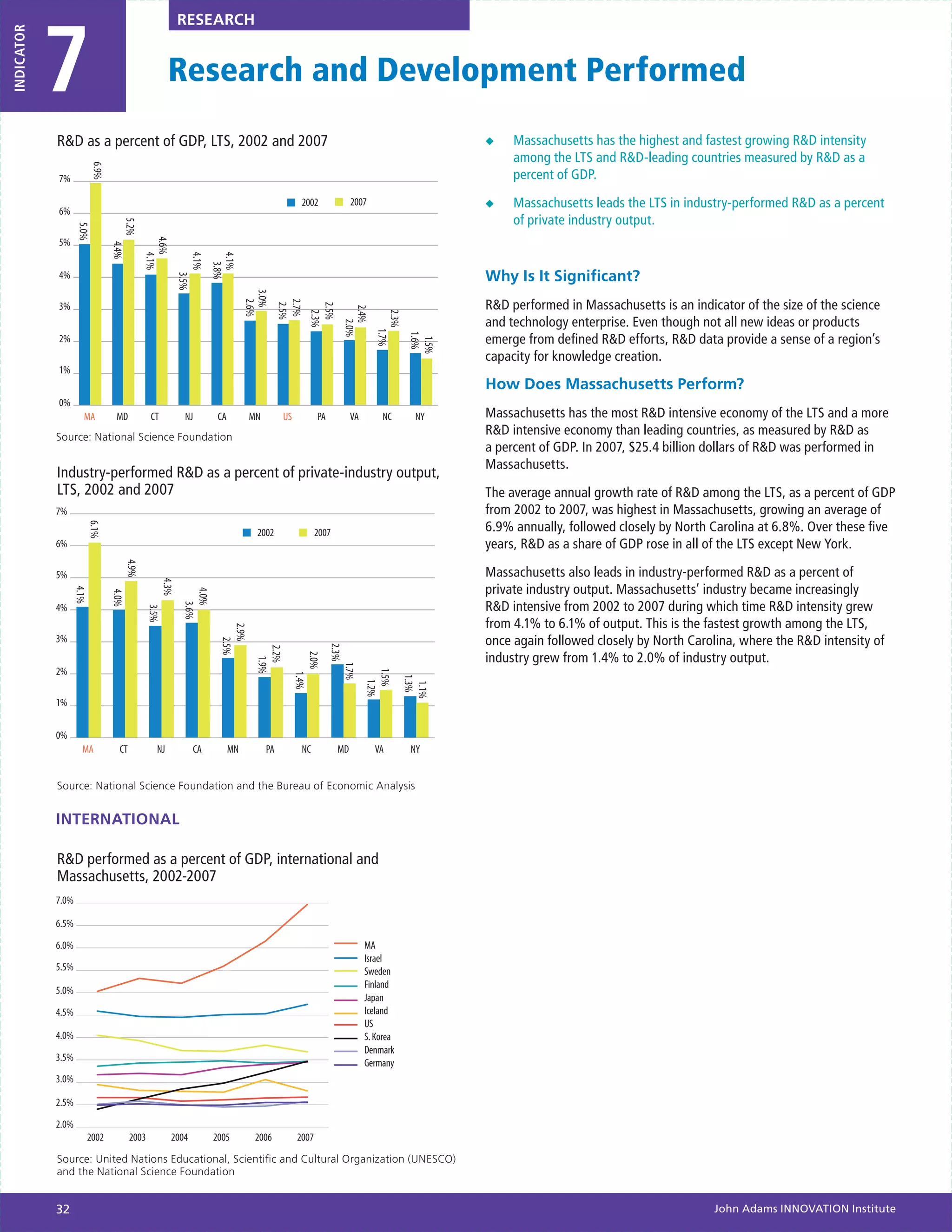
    The Index                                                R&D performed as a percent of GDP, international and
                                                             Massachusetts, 2002-2007
Through 25 indicators, the Index of the Massachusetts        7.0%

Innovation Economy provides a comprehensive view of          6.5%
the performance of the Commonwealth’s innovation             6.0%                                                           MA
                                                                                                                            Israel
ecosystem and its impact on the state’s economic             5.5%                                                           Sweden
prosperity. Using a rich set of data sources, the Index      5.0%
                                                                                                                            Finland
                                                                                                                            Japan
benchmarks Massachusetts against nine Leading                4.5%                                                           Iceland
                                                                                                                            US
Technology States (LTS) to reveal relative strengths         4.0%                                                           S. Korea
and weaknesses and compare the state’s competitive           3.5%
                                                                                                                            Denmark
                                                                                                                            Germany
position. Appendix A describes the LTS selection criteria.   3.0%
The nine LTS chosen for comparison in the 2011 Index         2.5%
are California, Connecticut, Maryland, Minnesota, New        2.0%
Jersey, New York, North Carolina, Pennsylvania, and                 2002   2003     2004     2005    2006     2007

Virginia.                                                    Source: United Nations Educational, Scientific and Cultural Organization (UNESCO)
                                                             and the National Science Foundation

                                                             (Updated data for 2008 will be released by the National Science Foundation during
                                                             the first quarter of 2012.)
    Highlights

The share of Massachusetts’ total employment
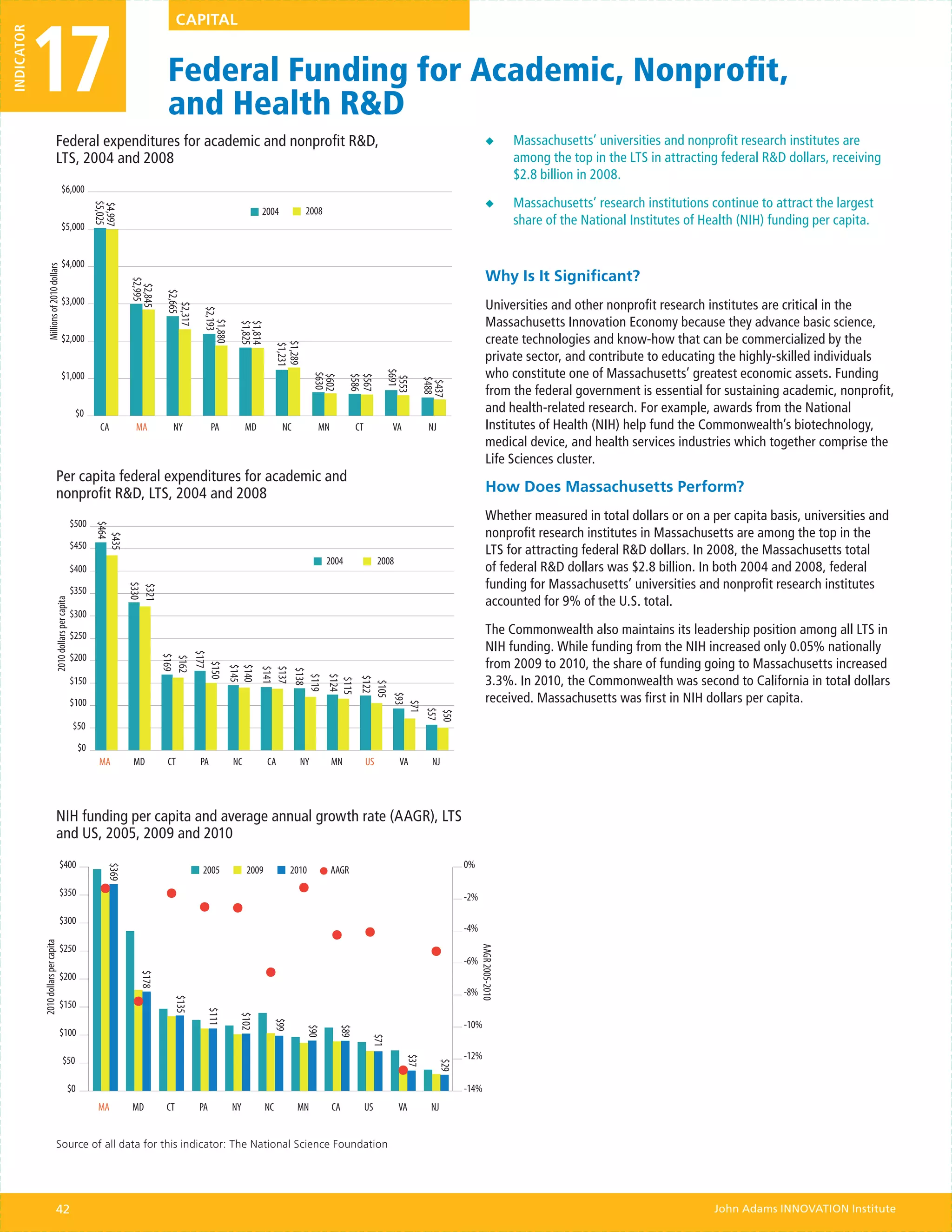
concentrated in the eleven key sectors of the                Federal funding is a key enabler of research and
Innovation Economy increased to 38.4% in 2011.               development in Massachusetts.

Typically, these sectors provide some of the highest         Whether in total dollars or on a per capita basis,
paying jobs in Massachusetts. Total wages paid in these      universities and nonprofit research institutes in
key sectors were 23% higher in 2010 than in 2005,            Massachusetts were among the top in the LTS for
a larger increase than the 15% gain in the economy           attracting federal R&D dollars. Academic and nonprofit
as a whole. The largest employer in these sectors in         research institutes in the Commonwealth received $2.8
2010 was Healthcare Delivery, with more than double          billion federal R&D dollars in 2008, accounting for 8.9%
the employees than the next closest sector, Financial        of the US total. At $435 per capita, federal expenditures
Services. The Bio-pharma & Medical Devices sector saw        for academic and nonprofit R&D were more than
the largest percent change in employment from 2006 to        four times larger in Massachusetts than in the United
2010 with a 27.0% increase.                                  States as a whole (per capita). The Commonwealth
                                                             also maintained its leadership position among all LTS
                                                             in funding from the National Institutes of Health (NIH)
Massachusetts is a national and global leader in             in 2010. Massachusetts’s small businesses attracted
research and development.                                    12.2% of all federal funding invested in 2010 through
                                                             the Small Business Innovation Research (SBIR) Program,
R&D represents a vital segment of the Massachusetts          which funds proof-of-concept research and prototype
economy. As documented in previous editions of the           development.
Index, the Commonwealth has the most R&D intensive
economy of the LTS and one of the most R&D intensive         	
economies in the world. In Israel, for example—the
leader among countries—R&D accounted for 4.7% of
GDP in 2007, while R&D represented 2.7% of GDP in the
United States as a whole. Massachusetts has also led the
LTS in industry-performed R&D as a percent of private
industry output.


6                                                                                                           John Adams INNOVATION Institute
Highlights


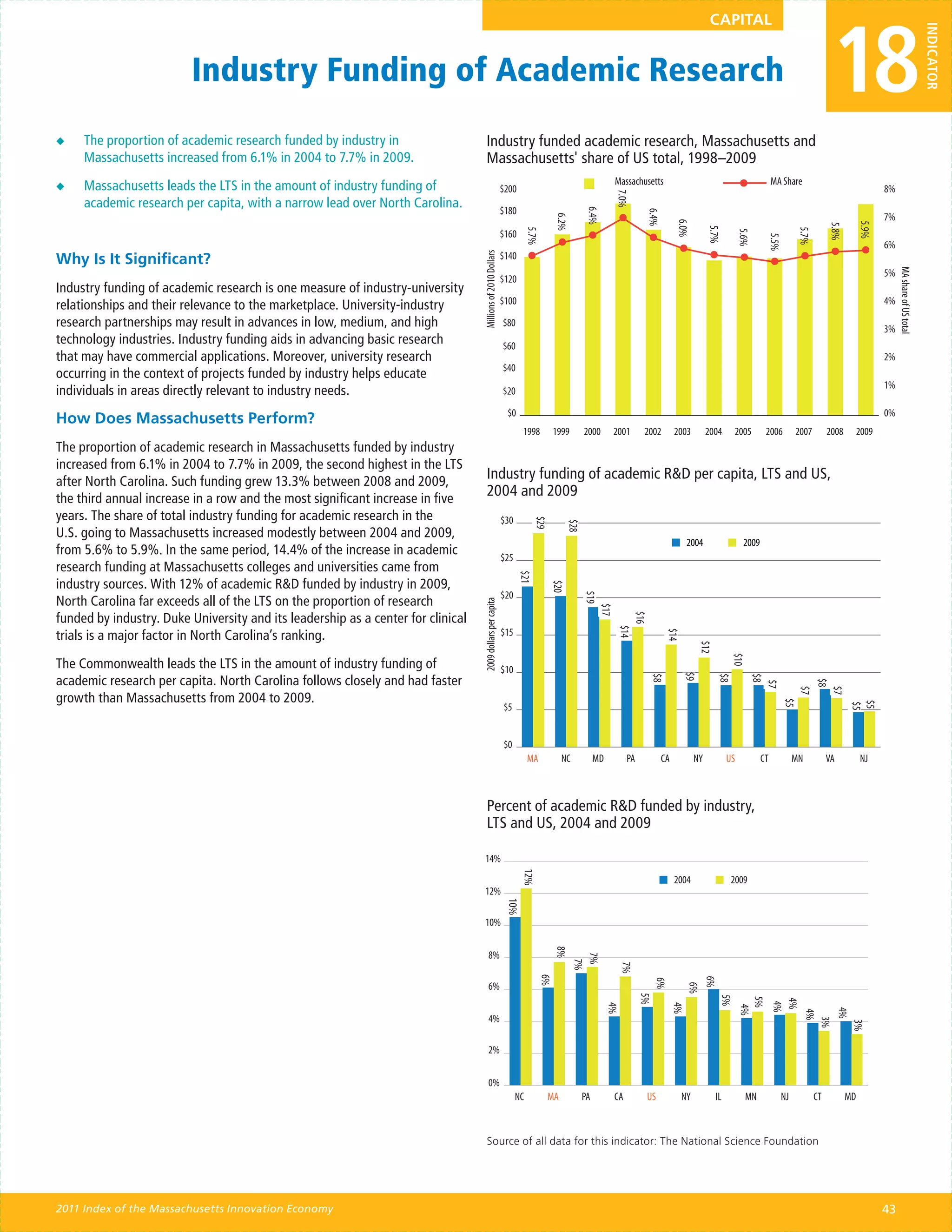
Massachusetts’ universities and colleges are dynamic       and early stage businesses in Massachusetts reached its
contributors to the state’s Innovation Economy.            highest level since the height of the 2000 tech bubble,
                                                           with $1.7 billion invested.
Universities and colleges attract and educate the
highly-skilled and creative talent that gives the          		
state a key competitive advantage in the global
                                                           Jobs created in the Massachusetts economy
economy. Universities and colleges also contribute to
                                                           increasingly require advanced degrees.
employment, knowledge creation and dissemination,
and new business formation. With approximately             Compared to the 2006 average, the Massachusetts
140,200 employees (Q1 2011), the postsecondary             economy as a whole showed a net loss of 88,600
education sector was the third largest employer            jobs in the first quarter of 2011. In the same period
among the 11 key sectors. Universities and colleges in     employment in the key sectors of the Innovation
Massachusetts performed nearly $2.17 billion dollars       Economy had a net increase of 24,100 people.
of R&D in 2007, or 43 % of all non-business R&D in the     Employment gains specific to these sectors suggest
Commonwealth. In 2008 Massachusetts led the LTS in         that jobs are being created in industries that
the amount of industry funding of academic research        normally require associate’s degrees or other higher.
per capita, with a narrow lead over North Carolina.        Not surprisingly, full-time employment rates in
In 2009, universities in Massachusetts reached a 14-       Massachusetts show that more highly educated
year high in licensing and options revenue, bringing       individuals are more likely to be employed. Between
in $162 million. While university spin-outs account for    2005 and 2010, the full-time employment rate of the
only a small fraction of overall new business formation,   working-age population in Massachusetts hovered at
Massachusetts’ universities perform exceptionally well     around 76% for individuals with a bachelor’s degree or
in this measure. Forty-nine businesses spun out from       higher. At the other end of the spectrum, the full-time
universities in Massachusetts in 2009, second only to      employment rate for individuals without high school
California with 84. Per capita, Massachusetts maintains    shows a downward trend over the same period.
a substantial lead.
                                                           Full-time employment rate by education,
	                                                          Massachusetts, 2005, 2009, 2010
Entrepreneurship has remained vibrant and well                                                                          2005         2009   2010


                                                                                                                                                                                                                 77.0%
                                                                                                                                                                                                 75.8%
                                                                                                        80.0%


                                                                                                                                                                                                         73.7%
supported in Massachusetts even amidst economic
                                                                                                                                                                                       69.9%
                                                                                                                                            68.0%


                                                                                                                                                                       65.9%


uncertainty and a slowdown in business establishment                                                    70.0%
                                                                                                                                                                               63.8%
                                                                                                                                                    61.7%

                                                                                                                                                            60.1%


openings.
                                                             Employment rate of population ages 25-65


                                                                                                        60.0%
                                                                                                                47.1%


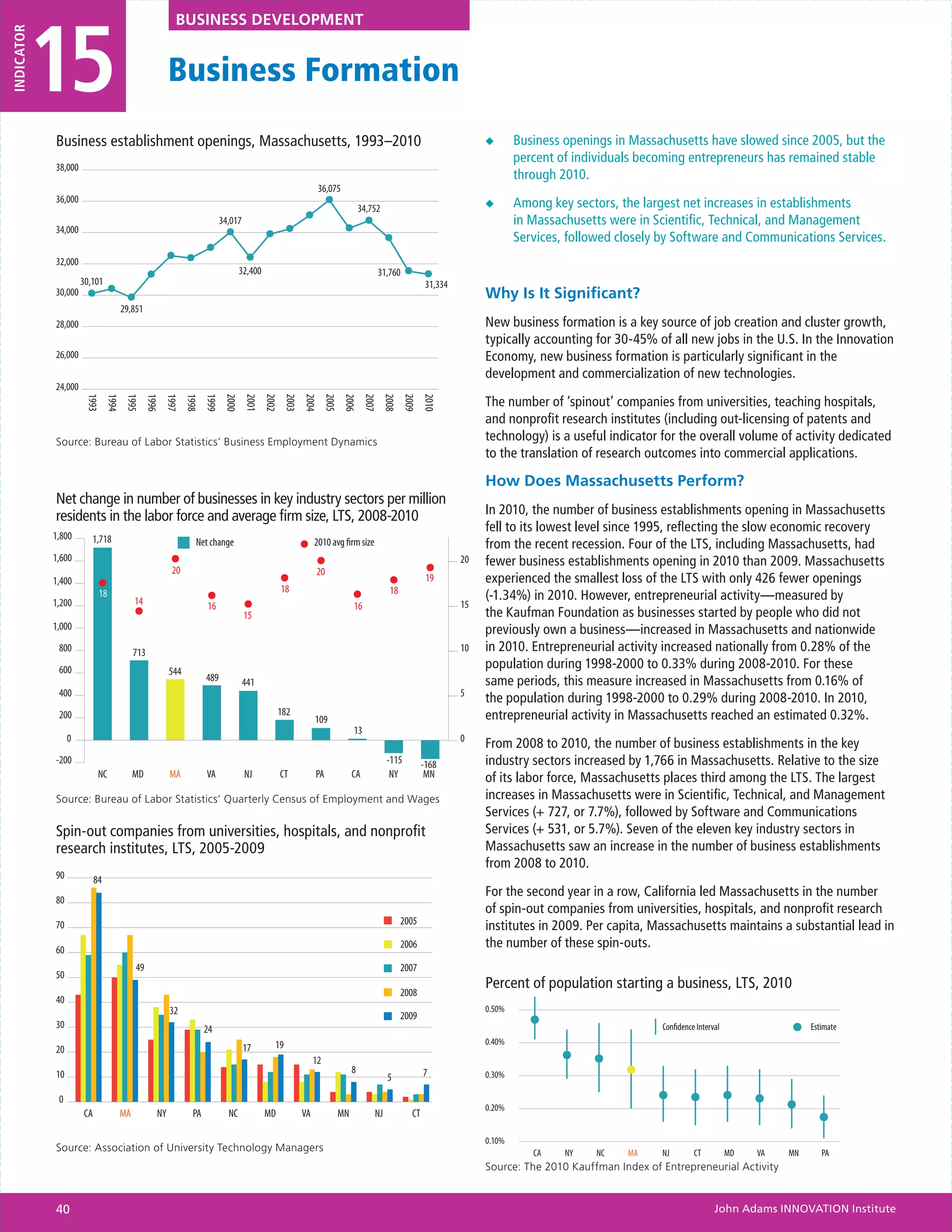
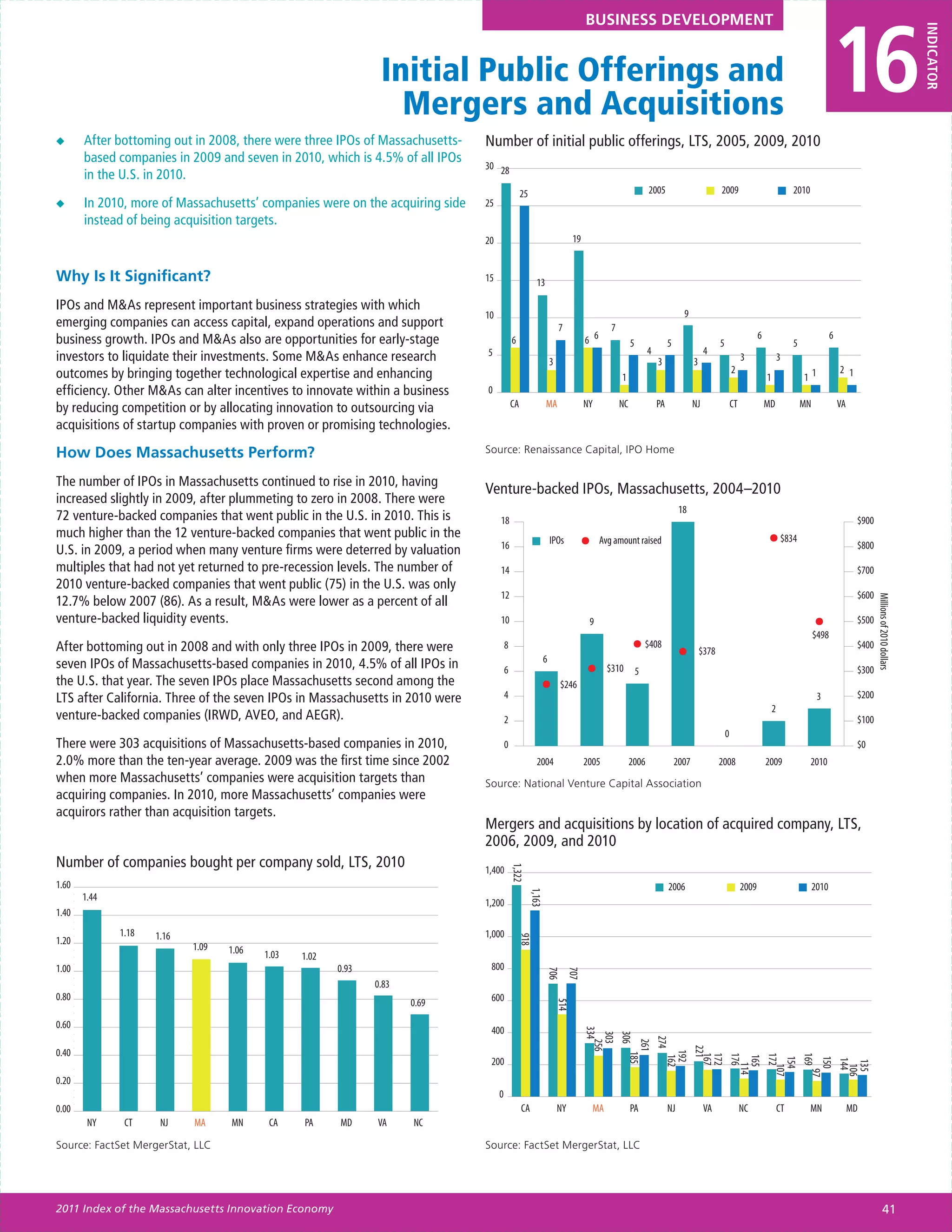
In 2010, the number of business establishments opening
                                                                                                                          44.8%


                                                                                                        50.0%

in Massachusetts fell to its lowest level since 1995,                                                   40.0%
                                                                                                                                  34.2%


reflecting the slow economic recovery from the recent
                                                                                                        30.0%
recession. Four of the LTS, including Massachusetts, had
fewer business establishments opening in 2010 than                                                      20.0%

2009. Yet, entrepreneurial activity, estimated by the                                                   10.0%
Kaufman Foundation as the percentage of businesses                                                      0.0%
started by people who did not previously own a                                                                  No high school              High school or          Some college, less than    Bachelor's degree
                                                                                                                   diploma                    equivalent               4-year degree              or higher
business, increased in Massachusetts and nationwide.
This estimate increased nationally from 0.28% of the       Source of all data for this indicator: US Census Bureau, Current Population Survey
population during 1998-2000 to 0.33% during 2008-
2010, while it increased in Massachusetts from 0.16% to
0.29% during the same time periods. New businesses in
Massachusetts were also being relatively well funded. In
2009 and 2010, venture capital going to startup, seed,
2011 Index of the Massachusetts Innovation Economy                                                                                                                                                                       7
Highlights                       continued


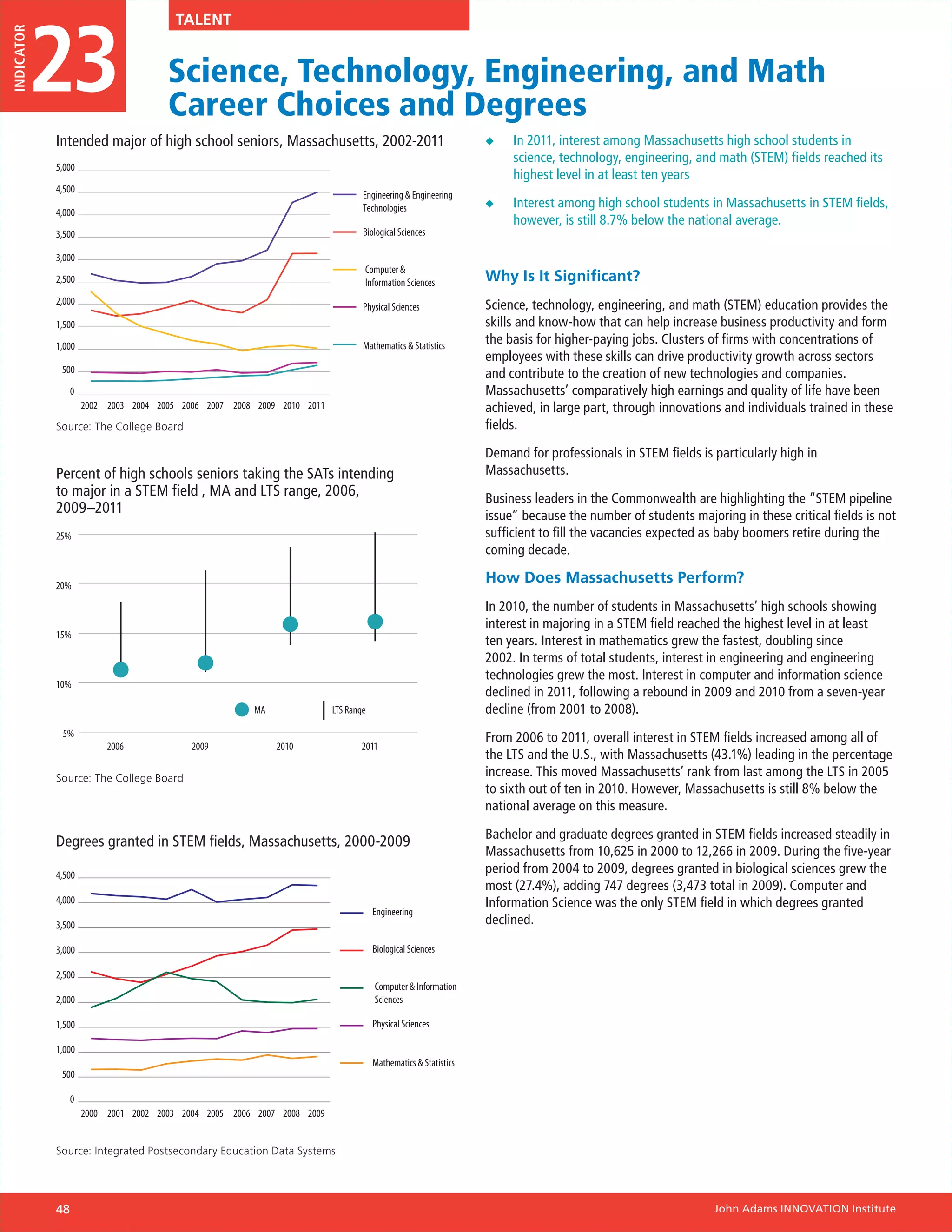
Massachusetts’ appropriations for public higher                                         Interest in Science, Technology, Engineering, and Math
education continue to decline, whether viewed per                                       (STEM) fields is increasing among Massachusetts’ high
student, per capita, or relative to the size of the                                     school students, but the state is still 8.7% below the
economy.                                                                                national average.

Massachusetts’ appropriations per student in public                                     In science and mathematics, Massachusetts’ high
higher education are now 6.9% below the US average,                                     school students outperform their US peers and are
compared to 2003 when they were 23% above. From                                         highly competitive internationally. Their interest in
2009 to 2010 appropriations fell 2.2% while enrollment                                  STEM careers had remained notoriously low when
rose 6.3%, resulting in a 8.0% decline in appropriations                                compared to the LTS, but a comparison between 2006
per student. Among the fifty states, the size of this gain                              and 2011 shows the gap between ability and interest
is in the middle of the pack being 28th overall.                                        has narrowed. While in 2006 the percent of high school
                                                                                        students intending to major in STEM fields was lowest
                                                                                        in Massachusetts among the LTS, by 2011 the state had
                                                                                        moved up the rankings to sixth out of ten. Also in 2011,
Intended major of high school seniors, Massachusetts, 2002-2011                         the percentage of Massachusetts’ high school students
5,000                                                                                   intending to major in STEM fields reached the highest
4,500
                                                            Engineering & Engineering   level since record keeping began eleven years ago. This
                                                            Technologies
4,000                                                                                   increase was driven largely by interest in engineering &
3,500                                                       Biological Sciences         engineering technology majors and biological sciences
3,000                                                                                   majors. Interest in computer and information sciences
                                                            Computer &
2,500                                                       Information Sciences        declined steadily between 2003 and 2008, but has
2,000
                                                            Physical Sciences
                                                                                        started to rebound since 2008.
1,500
1,000                                                       Mathematics & Statistics

 500

    0
        2002 2003 2004 2005 2006 2007 2008 2009 2010 2011


Source: The College Board


8                                                                                                                      John Adams INNOVATION Institute
Introduction
MASSACHUSETTS IS ONE OF THE WORLD’S LEADING                   and add or subtract measures and whole indicators. Our
innovation economies, and one of its most distinctive         Advisory Committee strives to preserve independence
characteristics is its ability to continuously reinvent       and long-term thinking, seeking to inform policy
itself. Throughout its history, the state has excelled—       priorities without inferring conclusions or making
and often has led the nation and the world—in pushing         recommendations that follow what is fashionable in
the frontiers of science and creating new domains of          policy and management circles. The Index highlights
research and technology. The innovation that takes            the multiple dimensions of the ecosystem, but refrains
place here has fueled the rise of new industries such as      from suggesting simplistic causal relationships and
digital technology, biotechnology and medical devices         recommendations for complex problems. We offer
and transformed established industries with new               interpretations but leave the conclusions to an informed
processes, practices, and tools, like the machinery of        audience.
mass production and the analytical instruments serving
today’s research enterprises.                                 This year the Index once again documents the
                                                              commanding position of the Massachusetts Innovation
The self-renewal capacity of our economy rests                Economy nationally and worldwide. Massachusetts
upon individual creativity and is amplified by a rich         continues to be a global leader in research and
innovation ecosystem. Thousands of entrepreneurial            innovation. Eighty measures within the 25 indicators
and creative people choose Massachusetts to learn,            examine and benchmark our innovation economy
innovate, work, and live, and they benefit enormously         along multiple dimensions in five categories: research,
from our vibrant environment of universities,                 technology and business development, capital, and
laboratories, companies, hospitals, private and public        talent. We hold leadership positions—sometimes
investment, and diverse business services.                    globally—in many measures. Relative to the size of
                                                              our economy we attract a disproportionate amount
Since its first release 15 years ago, in 1997, the Index of   of federal research dollars. We publish more academic
the Massachusetts Innovation Economy has examined             publications per capita than anywhere else in the
and benchmarked the state of our innovation                   world. In our most prized natural resource, our people,
ecosystem. With the guidance of the Index Advisory            Massachusetts excels by having the most educated
Committee, the Index has established a national and           workforce in the country and we continue to attract
global standard for quality and objectivity among the         highly educated individuals. By other measures the
universe of publications that seek to measure regional        picture is not as good. While we rank first in our
innovation-based economic trends. In Massachusetts,           amount of Small Business Innovation Research (SBIR)
the Index helps inform evidence-based decision-making         dollars per capita, attracting nearly three times more
in industry, academia and government. As a data-              than our next closest competitor, our share of national
driven communications tool, it signals the importance         SBIR awards has declined since 2000, though this decline
of innovation in our economy and triggers attention,          appears to have stabilized. Similarly, we lead in venture
conversations, and media references.                          capital (VC) investment per capita, but our share of
                                                              national VC investment is declining as other states catch
The Index focuses on data that highlights what merits         up. We also face the ever-present challenge of finding
the attention of policy, academic, business and civic         ways for the un- and underemployed and less-educated
leaders in the state, including both emerging strengths       to acquire the skills necessary to work in our innovation
and opportunities and worrisome trends and current            economy industries.
challenges. We update indicators every year in response
to the evolution of our economy and new or more               While quantitative assessments are at the core of
precise knowledge about the innovation process. We            the Index, we recognize that not all truths can be
bring additional or more accurate data sources to bear,       measured. That is why the Index incorporates a special


2011 Index of the Massachusetts Innovation Economy                                                                     9
analysis section whenever pertinent. Many emerging         In the pages that follow five individuals share with
trends, opportunities and concerns in our innovation       us concrete examples of innovation and business
economy escape easy categorization and require special     opportunities at the intersections of innovation
attention. They are hard to quantify and only become       in Massachusetts. Ted Acworth shares with us an
evident through in-depth exposure to our regions and       inspiring example of what happens when advanced
our research, innovation, and industry communities and     technology intersects with design and the arts to
are captured best through a combination of anecdotes,      reinvent an ancient art and build a successful business.
stories, and empirical evidence.                           Richard Himmelwright discusses the potential of
                                                           digital printing to revolutionize the textile and apparel
In this year’s special analysis section, we examine a      industries and James Watkins discusses roll-to-roll
phenomenon, interdisciplinary innovation, made             technology as an emerging example of technology
possible by a distinctive feature of the Massachusetts     borne out of nanomanufacturing research. Both of
Innovation Economy: its diversity.                         these technologies use cutting-edge research and new
                                                           technology in revolutionary applications to enhance
Unlike other regions and emerging innovation               the competitiveness of old process-based industries.
ecosystems elsewhere, which may have one or two            Building on her experience at MIT, Liz Reynolds
successful industries, Massachusetts’ universities,        describes how universities perform interdisciplinary
companies, and entrepreneurs excel in numerous fields,     research to respond to the world’s most pressing
from design and architecture to biopharmaceuticals,        challenges while reflecting on ways to facilitate this
robotics, and social media. They embody a staggering       type of research. Richard Watson reflects on how
array of research, innovation, and entrepreneurship        design can play a key role in helping businesses better
capabilities that have been developed and leveraged        link technology, markets, and users and reminds us that
since the Industrial Revolution—and at an accelerated      understanding people and culture is often as important
pace since World War II. In recessions, this diverse       as technical expertise in order to innovate successfully.
portfolio of industries and capabilities dampens the
effects of downturns in our economy. In times of           Together, these five voices reflect on the organizational,
major industrial restructuring or decline, capabilities    talent and funding challenges of research and
are redistributed and recombined in surprising ways,       innovation at the intersections and on the possibilities
fueling the rise of novel business segments and            to accelerate and amplify what happens there. They
sometimes of whole new industries that lay new             remind us that connecting the dots in our diversified
foundations for prosperity.                                and ever-changing portfolio of research, innovation,
                                                           and business capabilities in Massachusetts offers
In good and bad times, conversations that cross the        numerous opportunities for innovation. Just look
boundaries of the diverse fields and industries in our     at what already is emerging. Systems biology and
economy lead to the discovery and pursuit of some          bioinformatics thrive where biology and computing
of the most exciting and promising innovation and          blend. Mobile computing is transforming a vast
business opportunities. For decades, these interactions    swath of life and business, from marketing and
at the intersection of disciplines, industries, business   entertainment to medicine. Advanced materials and
segments and technology domains have been a key            digital technologies are driving incremental and
driver of technological, business and industrial change    radical innovation in energy generation, storage, and
in our economy. The medical devices industry, for          transmission. Design is transforming how we think
example, emerged at the intersection of medicine and       and organize for innovation in industries like financial
analytical instrumentation. And yet what happens           services and healthcare. They also remind us of the
at the intersections of innovation is often poorly         enormous potential for innovation by integrating new
understood.


10                                                                                         John Adams INNOVATION Institute
knowledge and technology into established processes                                        communities, and launch projects. They are precursors
and business segments that sustain and create jobs                                         of innovative action.
right now in existing industries. From construction                                        	
and manufacturing to textiles, innovation in what                                          As the Index enters its 15th year, business, policy,
exists already is as important as developing completely                                    and academic leaders in Massachusetts are more
new products and industries. Himmelwright writes                                           aware than ever before about the importance of
succinctly: “Everything we do does not have to be                                          research, innovation, and entrepreneurship capabilities
brand new.”                                                                                as foundations of our economy. Similarly, our
                                                                                           understanding of the innovation process and its impact
Building collaboration and promoting the emergence                                         on the economy continues to increase. In the upcoming
of new relationships and communities that cross the                                        year, the Index Advisory Committee will lead an effort
boundaries of disciplines and industries is a powerful                                     to envision and implement ways to make the Index
catalyst of discovery and innovation. How do we do                                         more useful, more relevant and more inspiring. We
this? One way is through the provision, maintenance,                                       need, for example, to gain a deeper understanding of
creation, and management of opportunities and spaces                                       emergent phenomena that escape easy quantification,
for dialogue and exploration among specialists and                                         such as how our diversified technological and industrial
experts from different fields and industries.                                              capabilities recombine and lead to novelty at the
                                                                                           intersections of innovation.
We find explicit or implicit references to this idea
in the commentaries. Liz Reynolds introduces the                                           Complex sociotechnical phenomena like innovation
concept of “public space” to highlight its significance.1                                  require multiple lenses to be understood
We find these spaces in our universities, in research                                      comprehensively. Inevitably, many aspects cannot
centers such as James Watkins’ Center for Hierarchical                                     be measured easily or at all. That is the case of what
Manufacturing at UMass Amherst and Liz Reynolds’                                           happens at the intersections of innovation, but we
Industrial Performance Center at MIT. There,                                               can still take action to seize the new opportunities
interdisciplinary teams engage in research that                                            we see and sense. To do so, we must use every tool at
combines multiple science and engineering disciplines                                      our disposal and sometimes we need to invent new
with an understanding of business, society, and politics                                   ones. We need to embrace novel ways to promote
to examine big issues like energy innovation, climate                                      innovation and industry clusters—such as through
change, and nanoscale science and engineering. We                                          the preservation, creation, and management of
find these public spaces throughout regions and                                            public space. And in our economic development
industries in the state, in regular meetings such as                                       policy and practice, we need our industry executives,
Mobile Mondays and Mass Innovation Nights. We find                                         academic leaders, and government policymakers
these spaces in the hallways, kitchens, and seminar                                        to balance coordinated activity with decentralized
rooms of the Cambridge Innovation Center, where                                            creativity; a focus on existing markets with new and
entrepreneurs bump into each other and talk. We find                                       unexpected ones; and an emphasis on urgent current
them in conferences, such as MassTLC’s Unconference,                                       needs with longer-term concerns. It is in the crevices
TedX Boston, and IdeaMill in Holyoke. We find them                                         and intersections of our innovation ecosystem, and
in entities like the Robotics Cluster and the Design                                       the countless conversations at the margins, where
Industry Group of Massachusetts that Ted Acworth                                           the future of our economy is emerging. Freedom
mentions. All of these are public spaces where                                             of exploration, ambiguity, variety, serendipity and
meetings, dialogue, and exploration help combine                                           surprise: These are the sources of innovation.
knowledge, generate new ideas, build interdisciplinary


1 The concept of public space was introduced a few years ago at the MIT Industrial Performance Center as a conceptual device to apprehend a “missing dimension” of the
innovation process. See Lester, Richard K. and Michael J. Piore, Innovation: The Missing Dimension. Harvard University Press, (2004). See also Breznitz, Dan “Collaborative public
space in a national innovation system: a case study of the Israeli military’s impact on the software industry,” in Industry and Innovation Vol. 12 No.1 (2005).


2011 Index of the Massachusetts Innovation Economy                                                                                                                             11
Island of Misfit Toys
     Edward “Ted” Acworth, Ph.D., Founder and CEO, ARTAIC – Innovative Mosaic


                   efore becoming a full-time                 on Earth to start and grow our business.
                   entrepreneur I spent most of               We operate at the intersection of some
                   my life in academia in New York            of the world’s most powerful innovation
                   City, Palo Alto and the two                clusters. We manufacture our product in
                   Cambridges (Massachusetts and              Boston for customers locally, in the US, and
                   England). Everywhere, promising            abroad, benefiting from the state’s rich and
     research was happening at the intersections              diverse history in manufacturing and its
     of disciplines. Think about robotics, which              concentration of advanced manufacturing
     can combine mechanical engineering,                      capabilities. It’s little known today that
     electronics, control systems, software, vision           Massachusetts is where the American
     and artificial intelligence. I have always been          industrial revolution began in the 19th
     excited by bridging “stove-piped” disciplines.           century, and that today 8,000 Massachusetts
     Throughout my life this inclination has led              manufacturing companies make it the 4th
     me to look for opportunities where few                   largest sector in the State. Massachusetts
     people have. Interdisciplinary niches are                manufacturing is a $40B growth industry. Our
     novel and exciting, full of opportunities to             process is automated with robotics, and we
     create breakthrough products, often less                 benefit from our $1B robotics cluster—one
     competitive, tap (and create) big markets,               of the strongest in the world—growing
     and make unexpected contributions to                     at 17% per year. And we also benefit
     society.                                                 from Massachusetts’ world-class cluster
                                                              of excellence in design. We have a large
     Artaic was born out of a search for                      concentration of architecture firms and
     opportunities between disciplines. Founded               around 45,000 architects, graphic designers,
     in 2007 as an MIT spinout, we are now                    product designers, and other creative
     an early growth stage company based in                   professionals.
     Boston’s Innovation District. Artaic aims to
     revolutionize the ancient mosaic art form                Like any start-up here, Artaic benefits by
     through “mass customization.” Just as                    being part of Greater Boston’s innovation
     custom print technology transformed the                  ecosystem. We have cutting-edge research,
     carpet industry 30 years ago and spawned                 education, and many entrepreneurial support
     a multibillion-dollar industry, Artaic aims to           resources such as venture capital. And yet,
     transform the $76 billion global tile industry.          it was not easy to fund the launch of Artaic.
     We create beautiful custom tile mosaics using            We defy categorization. Our business does
     our proprietary technologies that combine                not fit into the standard pattern recognition
     robotics, advanced manufacturing, and                    of venture capital. We do not fall into any
     computer aided design systems, and our                   of the usual venture capital focus areas such
     access to artists and design professionals.              as IT, biotech or medical devices. Venture
     Our customers now include Sheraton, Hyatt,               capitalists invest where their funding model
     and Tropicana, and locally our mosaics are               makes sense, and it was hard to make sense
     on display at Salem Five Bank, MIT, Legal Sea            of our market and business model. Moreover,
     Foods, G2O Spa, the Cambridge Innovation                 manufacturing and robotics are perceived
     Center, Boston Children’s Hospital and many              as capital-intensive and not explosive-
     other commercial and residential locations.              growth, venture-grade investments. “Maker”
     Last year we piloted a residential e-commerce            companies have a hard time raising capital.
     sales channel with the first-ever customizable           But Artaic has found funding from a variety
     product at The Home Depot.                               of sources: founder investment, sweat equity,
                                                              friends and family, loans, grants from the
     Given what Artaic is, what disciplines and               National Science Foundation, prize money
     skills we draw upon and what markets we tap              from MassChallenge, barter. And best of all:
     into, Massachusetts is arguably the best place           Revenue.


12                                                                                        John Adams INNOVATION Institute
Our most valuable asset is people. A benefit     the Robotics Cluster organized by the Mass.
             of Artaic’s uniqueness has been that             Technology Leadership Council, and more
             finding qualified employees has not been         recently the Advanced Manufacturing
             a challenge. Massachusetts and Boston            Collaborative. In addition to bringing visibility
             concentrate some of the most talented            to our many innovation communities,
             scientists, engineers, designers, artists, and   they create spaces to build relationships,
             business professionals in the world. We          identify common issues, connect with
             look for people with a mix of technical, art,    other entrepreneurs and with educational
             business and making—polymaths and life-          institutions, discover business opportunities,
             long learners used to change, with multiple      and launch collaborative projects.
             experiences and careers, and respectful of       Importantly, these spaces help connect across
             other disciplines and approaches. STEM is        industries and disciplines, and foster ideas
             not enough for us. One of our employees          and successful high-growth businesses at the
             double-majored in art and math. Another          intersections of innovation, like Artaic.
             started school in engineering and then
             switched to graphic design while continuing      Artaic is somewhat of a misfit, as are most
             to take courses in economics, engineering,       businesses at the intersections of innovation.
             and advertising. Yet one more started            These businesses are crucial to build the
             in architecture, moved to sculpture and          future of our economy, but it takes time
             materials, and after school acquired             for others and for markets to make sense
             management experience as a professional          of them. Our funding community and
             set builder. For our production group we         policymakers would do a great service to
             have partnered with Artisan’s Asylum to hire     entrepreneurs and businesses like mine,
             artists and makers.                              if they remained attentive to emerging
                                                              innovation and business opportunities
             Massachusetts has plenty of resources            outside of traditional focus areas. In Artaic
             available to help young businesses get off       we embrace diversity, embrace the misfits,
             the ground. I have been pleasantly surprised     and encourage multidisciplinarity. Maybe
             at the number of public initiatives and quasi-   Massachusetts is, and should be, like an Island
             public agencies. But there is little public      of Misfit Toys—a sanctuary where winged
             awareness about what is available. When          lions fly, cowboys ride ostriches, and robots
             I was looking to locate the Artaic facility      make art. Imagine the possibilities.
             I searched for months until I stumbled
             across the artist loft space newsletter. From
             there I stumbled onto Create Boston, and
             that led to the City of Boston helping us        Ted Acworth, Ph.D., founded Artaic LLC in
             locate at 21 Drydock Avenue and a Boston         2007—a groundbreaking provider of “mass
             Redevelopment Authority loan. I wish there       customized” artistic mosaics for the $76B
             had been a single place or web resource          global tile market. Artaic’s innovative design
             to point me in the right direction quickly.      software and robotic manufacturing systems
             Making the array of currently available          enable the creation of unique tile solutions
             resources more findable to entrepreneurs         with short lead times and exceptional value.
             would make a real difference, as would
             connecting and mutually reinforcing these
             resources.

             Massachusetts also has myriad opportunities
             to connect through initiatives such as Design
             Museum Boston, the Design Industry Group
             of Massachusetts (DIGMA), MassChallenge,


2011 Index of the Massachusetts Innovation Economy                                                                13
Manufacturing Innovation
     Richard S. Himmelwright, Ph.D., Cold Spring Technology, Inc. & 27 Gaylord LLC


                  ver the last year, I have been                 new technology enabling existing businesses
                  encouraged by how business,                    and improving manufacturing processes.
                  academic, and policy leaders are               However, it seems this often does not receive
                  recognizing that Massachusetts                 the focus needed to allow the significant
                  and the United States cannot                   progress to be realized.
                  maintain our leading position
     in the global economy without a solid                       One example that we have worked on
     manufacturing base. Innovation is essential to              over the past several years is directed at
     maintain our strength in manufacturing and                  bringing innovation to the Massachusetts
     regain what we have lost.                                   textile industry. At the start of this project
                                                                 I was surprised to learn that there was still
     I have been fortunate to grow up in                         a Massachusetts textile printing industry
     Massachusetts. Here, I had the privilege of                 in existence. Well, there is. A driven group
     working in Edwin Land’s Polaroid when it was                of people is working hard to maintain a
     still a major force in our state. At Polaroid               competitive position in a difficult worldwide
     I learned that innovative manufacturing is                  marketplace.
     as important as new product development.
     Polaroid was a vivid example of how                         The textile printing industry is a process-
     innovation in manufacturing was the                         based manufacturing industry with well-
     engine for a large part of the success of                   established processes in place. The need for a
     Massachusetts' industries. But we have missed               competitive advantage to help maintain and
     some key opportunities to bring innovation                  grow business volume is at a critical point.
     to existing industries. To be sure, we                      The Massachusetts Office of Technology
     constantly need to push the limits of science               Assistance, working with MTC’s John Adams
     and technology and develop totally new                      Innovation Institute, has put energy and
     products and processes, but we can have a                   resources into understanding this industry
     tremendous impact on existing industries by                 segment and identifying areas of potential
     infusing innovation to established processes                investment. My company has worked on
     and businesses.                                             this project now for a few years, and we
                                                                 started with a simple question: Can high-
     My personal focus and source of pride                       speed digital ink jet printing impact the
     and accomplishment has come from the                        textile printing industry? We discovered that
     commercialization of technology in very                     the answer is yes. After working through
     large and small companies. I worked in the                  a detailed collaborative process, we found
     chemicals and coatings industry for almost                  that this technology can make a huge
     thirty years, and I have devoted much of                    difference in the textile printing process.
     my career to bring new technology to                        Implementing high-speed digital ink jet
     process-based manufacturing businesses.                     printing in the textile and apparel industry
     While leading research and development                      will allow economic and profitable short
     at a large paper and film coating company                   runs, near-zero inventory, very rapid new
     based in Western Massachusetts, we brought                  product development cycles and an improved
     substantial innovations to the imaging,                     competitive position for the industry.
     medical, electronics and other industry
     segments while dramatically reducing the                    The key step in the project required a team
     impact on the environment. The introduction                 of individuals with broad experience in
     of water-based and 100% solids radiation-                   many technologies. The use of digital ink
     cured processes advanced manufacturing                      jet printing has transformed many printing
     capabilities and also reduced the                           industry segments. However, even though
     environmental impact substantially. Like this               ink jet printing has become one of the
     experience, there are numerous examples of                  most advanced industry processes currently


14                                                                                             John Adams INNOVATION Institute
being utilized in many varied production          process industries. Our project was possible
             environments, bringing digital ink jet printing   thanks to a strong collaboration between
             to high speed textile printing required           government, academia and industry that
             one key innovative step. Recognizing that         we would like to build on in the future. The
             there was a stabilized web carried in the         potential is enormous, and I believe it can
             existing rotary screen press was the single       make a difference for manufacturing in
             major breakthrough in the project. This           Massachusetts. There are many examples of
             understanding allowed the team to realize         very large investments in specific technology
             that a printing unit could be constructed         segments such as biotech and energy
             and retrofitted onto existing, expensive          production; which are indeed necessary for
             hardware, thereby enhancing the capabilities      our country to move forward. However,
             of textile printing companies.                    in many instances these huge investments
                                                               have yielded very little in overall economic
             The project will also bring radiation curing      or job growth. Further, the focus on large
             capability to the high-speed textile printing     “home run” investments, I believe, has driven
             machines. This cure technology is advancing       funding away from more modest investment
             at a very rapid rate. The benefits include        opportunities that could enhance, grow and
             reduced solvent use, dramatically reduced         sustain existing manufacturing sectors.
             energy use and improved product quality. In
             the most advanced state of this technology        Bringing innovation to established
             the use of blue-light cured inks, being           industries is as important as establishing
             developed at UMass Dartmouth, could               new industry segments for Massachusetts’
             potentially reduce energy demands further         continued economic strength. And there is
             and eliminate the dangers of UV radiation         a very satisfying feeling of accomplishment
             from the process.                                 associated with seeing products that
                                                               are already utilized by people and
             The hurdle for acceptance of new technology       businesses in various applications being
             and taking the risk involved with being the       manufactured more efficiently, safely and
             first to adopt new technology is always           in an environmentally friendly manner. This
             high, particularly in an economic downturn.       example shows that the development of all
             Training manufacturing technicians to run         new technology is critical to our success, but
             and maintain somewhat more sophisticated          not the only thing we need to drive forward.
             equipment is also challenging. However, the       Enhancing established processes with new
             basic elements of a manufacturing process         technology and with alternative processing
             require focus on product quality, efficiencies    steps is vital to the prolonged success of
             and high yield. These characteristics are         manufacturing in our state and our economy
             generally part of a company’s manufacturing       as a whole. Everything we do does not have
             culture if the company has existed for any        to be brand new.
             length of time. Providing adequate training
             and hands-on run experience will be a critical
             element in achieving ultimate success from
             this project.                                     Richard Himmelwright, Ph.D., a
                                                               Massachusetts native, is the founder of Cold
             Massachusetts is fortunate to have a stronger     Spring Technology, Inc., a company that
             economy than many other states as we              develops materials and coatings for a variety
             navigate a difficult economic environment.        of applications. He also co-founded a new
             Massachusetts is also fortunate in that           venture, 27 Gaylord LLC, that is focused on
             there are many opportunities to expand            developing manufacturing technology for
             the type of collaborations required to            innovative new products.
             generate true competitive advantage for our


2011 Index of the Massachusetts Innovation Economy                                                              15
Intersections that Matter
     Elisabeth Reynolds, Ph.D., Executive Director, MIT Industrial Performance Center


                    oday we take for granted                      airplanes, the complexity of the challenge
                    the idea that innovation                      has increased as has the knowledge required
                    is enhanced by a diverse                      to tackle it. As the level of specialization
                    range of perspectives and                     needed to understand a particular issue has
                    multidisciplinary teamwork.                   deepened, research in teams rather than
                    This was not always the                       by individuals has become the norm, teams
     case. In the 1940s, MIT built Building 20,                   that often represent diverse backgrounds
     a warehouse of sorts for the growing                         and training. It also turns out that some
     Radiation Laboratories that were acting as                   of the best research (as measured by
     the Defense Department’s research center                     citations) is conducted by teams that work
     during World War II. After the war, Building                 near each other, i.e., collaboration within
     20 became the destination for a hodgepodge                   close proximity produces some of the best
     of departments and campus activities that                    work. This last point seems out of step
     needed space: electronics, nuclear science,                  with a world in which global connectivity is
     linguistics, acoustics. There was no rhyme or                increasingly enhanced and communication
     reason to which researchers or departments                   across distances practically frictionless. Yet,
     were located in the building, and therein lay                the value of face-to-face interactions and
     the beauty of it. The juxtaposition of various               collaborations persist.
     departments and teams of researchers
     crammed together produced an enormously                      If interdisciplinary teams working in close
     creative and innovative environment that led                 proximity are a critical component to
     to many postwar scientific breakthroughs.                    the innovation process, how can we best
                                                                  promote this? One important element is the
     Seventy years later, research teams,                         creation of “public spaces” that allow for the
     departments and buildings, whether in a                      kinds of discussions that lead to innovative
     university or company setting, are expressly                 breakthroughs. Based on work conducted
     created with this interaction of diverse                     at MIT’s Industrial Performance Center (IPC),
     perspectives in mind. The Broad Institute,                   Faculty Co-Chairs Richard Lester and Michael
     created in 2004, focuses on issues related                   Piore describe the innovation process as
     to the biological sciences bringing together                 comprised of two dimensions1—analysis,
     researchers from a wide variety of fields, and               which focuses on specific problem solving,
     in addition, from two separate institutions,                 and interpretation, an open-ended process
     Harvard and MIT. The recently-opened Koch                    that allows for exploration and ambiguity
     Institute for Integrative Cancer Research                    around a common area of interest. While
     also is designed for maximum interaction                     many teams and organizations can excel at
     between diverse teams of researchers                         the analytic process, the interpretive process
     that cross the boundaries of engineering,                    is more challenging to develop and sustain.
     medicine and the life sciences to focus on                   Creating “public spaces” where teams can
     curing one of society’s deadliest diseases.                  engage in the interpretive process, whether
                                                                  within a company, a university or a regional
     As has been suggested elsewhere, the                         “community of practice”, is a critical part
     most interesting questions and challenges                    of building an environment that supports
     that exist today are at the intersections                    interdisciplinary, innovative work.
     of disciplines. Whether it is curing cancer,
     developing renewable energies or building


     1 Innovation: The Missing Dimension, Harvard University Press, 2004.


16                                                                                              John Adams INNOVATION Institute
Two current projects at the IPC highlight the     across industry clusters. Creating the space
             value of this kind of space, both addressing      for these conversations requires incentives to
             complex issues facing the country today.          bring individuals to the table. In universities,
             MIT’s Production in the Innovation Economy        interdisciplinary research often does not
             project is an institute-wide Commission           reward academics as much as individual work,
             begun in 2011 to look at the relationship         while companies can be concerned about
             between innovation and production, and            protecting intellectual property. Financial
             whether there are ways the U.S. can gain          resources can support and encourage these
             more of the downstream benefits from its          conversations, for example, with funding for
             innovative capacity. The research team draws      collaborative research centers and projects
             from several departments in engineering           and shared infrastructure.
             (aerospace, electrical, mechanical, nuclear)
             as well as political science, economics, and      All of this requires a culture conducive
             management. This allows for inquiry not           to the open, interactive, cross-cutting
             only into new technologies and how they           conversations required to spark ideas and
             are changing manufacturing processes              sustain collaboration at the intersections of
             across industries, but also the economics of      innovation. This point might be the most
             manufacturing, the management of supply           challenging to address because culture is not
             chains and global operations, and the role        easily fixed with money—though that helps—
             public policy plays in affecting firm decisions   or public policy. But the building blocks for
             about production. Without this multi-faceted      the culture we’d like to foster are already
             approach to the topic, there would be an          here. They are in the networks of people who
             incomplete picture of the importance of           share common and complementary interests,
             manufacturing to the U.S. economy.                a high level of mutual trust, and that engage
                                                               in collaborative, often risky, activities.
             Likewise, the IPC’s Energy Innovation             Nurturing these “trust networks” takes time
             Project necessarily takes an interdisciplinary    but the rewards can be significant, and the
             approach to the challenge of clean energy         process itself an exciting one.
             and energy independence in the U.S. The
             project assesses the strengths and weaknesses
             of the US energy technology innovation
             system, considering the complexity of             Elisabeth Reynolds, Ph.D. is the Executive
             government incentives, regulations, markets,      Director of the MIT Industrial Performance
             and public and private institutions. Again,       Center (IPC), a multi-disciplinary research
             understanding the energy industry and how         center dedicated to the study of innovation,
             to build a system less dependent on fossil        productivity and competitiveness in the U.S.
             fuels cannot be understood or addressed           and around the world.
             from just one discipline or perspective.

             We have many examples in Massachusetts
             where this kind of interdisciplinary approach
             and “public space” exists—within innovative
             companies, universities, and within and


2011 Index of the Massachusetts Innovation Economy                                                                17
Roll-to-Roll Innovation
     James J. Watkins, Ph.D., Director, NSF Center for Hierarchical Manufacturing, University of Massachusetts – Amherst


                   assachusetts has been the                     for progress in printed electronics, this
                   home of many manufacturing                    intersection of two technologies—volume
                   innovations over the years                    production on continuous rolls of film,
                   in which basic materials are                  and nanofabrication technology—brings
                   transformed into sheets,                      many opportunities to the fore. The diverse
                   rolls, spools, reams and                      product applications of roll-to-roll range
     even featherweight wisps of technically                     high on the value chain and match well with
     sophisticated products. The textile industry                Massachusetts’ advanced manufacturing
     gave Massachusetts its legendary fabric                     companies and our state’s skilled work force.
     mills. Our paper industry, with nearly three                They include not only electronic and energy
     dozen mills in the Bay State today and dozens               devices such as solar cells, sensors, antennas,
     more paper-converting and nonwovens                         memory, displays, capacitors and batteries,
     companies has historically been innovative at               but also many other functional materials such
     transforming ordinary materials into high-                  as barrier layers, security films, transparent
     value sheet products. These papermaking                     conductor layers, magnetic metamaterials,
     origins, often in combination with chemical                 chem/bio shielding, water-repellent surfaces,
     and material technologies, have given rise to               filtration/separation membranes and other
     successful technology-based Massachusetts                   products incorporating nanomaterials-on-
     businesses in diverse fields such as instant                film.
     photographic film, separation membranes,
     filtration media, advance printing and                      Roll-to-roll nanomanufacturing comes with
     holographic coatings, polymer anti-shatter                  many benefits. These include low unit costs,
     films for car windshields, and flexible solar               high-volume rates of production, efficiency
     panels.                                                     through sequential application of successive
                                                                 layers on a web, energy and materials
     We are now at a new intersection of                         efficiency, versatility in the types of devices
     technologies that can potentially spur                      that can be made, form-factor benefits of
     innovation and economic growth. Thanks                      flexibility and low weight, and relatively
     to a global trend toward mass production                    benign and plentiful constituent chemicals
     of flexible electronic displays, solar cells and            and materials.
     many other thin-film materials and devices,
     manufacturers are looking for innovative                    During the past twenty years, many in
     continuous-feed processes for printing                      the nanotechnology research community
     devices on flexible substrates. To meet                     have strived to achieve production-ready
     industry needs and consumer demand, roll-                   solutions from the promise of materials
     to-roll technology is moving in the direction               and device technology at the nanoscale. At
     of extreme miniaturization of critical feature              the University of Massachusetts Amherst’s
     sizes to the nanoscale. Many of the new                     Center for Hierarchical Manufacturing,
     techniques of roll-to-roll nanomanufacturing                supported by the National Science
     involve using chemical and materials                        Foundation, we are creating roll-to-roll
     technology to print devices with features                   nanomanufacturing advances that open the
     smaller than 1/1000 of the width of a human                 door to true high-volume printed nanoscale
     hair on thin, flexible film on a moving web.                device production on a moving web. Our
                                                                 scientists tackle industry-relevant problems
     Seen by industry as a game-changer


18                                                                                                   John Adams INNOVATION Institute
such as continuous nanoscale patterning              right time for this technology. For American
             at the device level, achieving nanometer-            competitiveness in printed electronics and
             scale smoothness in the device layers, and           nanotechnology-enabled products, the
             printing or coating of hybrid polymer-               development of industrial ecosystems at the
             nanoparticle materials for desired device            regional level can be an effective strategy.
             performance. In contrast to the deposit-             Roll-to-roll technology and tools are in many
             and-etch-away approach typical of silicon            ways high-tech extensions of techniques that
             wafer fabs, we focus on the chemical and             are already used in the advanced coatings,
             material interactions between components,            printing and flexible electronics industries. It
             creating active nanohybrid layers in which           is possible for Massachusetts companies that
             the system spontaneously assembles itself            are engaged in these sectors to readily climb
             into predictable and adjustable nanoscale            the product and device value chain, creating
             structures as the coating process proceeds.          jobs and opportunity. R&D partnerships with
             This research effort originating in UMass            institutions such as UMass Amherst, MIT
             Amherst’s Polymer Science and Engineering            and others working in this area can catalyze
             Department is one of the few in the world            further advances.
             where nanoscale fabrication techniques
             meet roll-to-roll platform technology. In            The Patrick Administration has been
             partnership with Massachusetts companies,            strongly supportive of innovation in
             this national center has designed and built          advanced manufacturing. It is my hope
             several roll-to-roll pilot tools to demonstrate      that Massachusetts’ industry innovators
             how the advances produced by the CHM can             will converge around opportunities such as
             be scaled to viable manufacturing platforms.         printed electronics and roll-to-roll processing
                                                                  for the economic betterment of our state.
             Research and development in the US of                Academic research centers like ours are ready
             roll-to-roll nanomanufacturing is modest             to work with industry to translate laboratory
             compared to more vigorous technology                 proof-of-concept to scaled high-rate
             development in Asian and European                    integrated processes, and thus contribute
             research centers and companies. Significantly        to Massachusetts’ innovation ecosystem for
             more emphasis has been placed on                     advanced manufacturing.
             nanomanufacturing of devices using a
             semiconductor production paradigm.
             However, when costs of up to $25,000 per
             square meter for fab-built chips are compared        James J. Watkins, Ph.D. is Professor of
             with target costs of $25 per square meter for        Polymer Science and Engineering at the
             roll-to-roll device processing, it is logical that   University of Massachusetts Amherst and
             over time more products will gravitate to the        Director of the NSF Center for Hierarchical
             low-cost process.                                    Manufacturing.

             Massachusetts is in the right place at the


2011 Index of the Massachusetts Innovation Economy                                                                   19
Integration through Design
     Richard Watson, Partner and Co-Founder, Essential


                  assachusetts has innovation            several others—who are creating exciting
                  in its DNA. Our history is tied        new product and service solutions. With
                  to a culture of innovation             roots in interdisciplinary design, Essential
                  that has transformed over              started 10 years ago, and has evolved from
                  time adapting to changing              a product development focus to a wider
                  economic environments, creating        set of capabilities that help create human-
     some of the most disruptive technologies,           centered solutions and experiences across
     products and systems in the world. As our           many industries and contexts. We bring
     innovation culture evolves, our rich science        together a multidisciplinary community of
     and technology clusters, higher education           researchers, industrial designers, interface
     system, financial sector and creative economy       designers, mechanical engineers, and others.
     continue to inspire entrepreneurs to grow a         An interdisciplinary culture and approach
     myriad of new businesses.                           helps us reveal hidden market opportunities
                                                         and deliver compelling solutions that bring
     Massachusetts consistently targets its              together technology, business and the human
     innovation culture to unexpected areas when         experience.
     others have not even seen the opportunity.
     Today a revolution is unfolding enabled by          One of our past clients MeYou Health, a
     the ability to connect quickly and simply with      local healthcare start-up that was founded
     our social networks through technology. This        to engage, educate and empower people to
     revolution of social interconnectedness is          pursue healthy lifestyles. MeYou Health is
     combining new strengths of Massachusetts’           successfully combining social gaming, which
     innovation (such as cloud computing, digital        builds on Massachusetts’ long history in game
     gaming, social networking, and mobile               development, with new applications that
     communications), with established industries        change how we think about and manage
     in which the state has a longstanding               our health. The same game mechanics, now
     reputation. Unexpected combinations                 evolved beyond an entertainment focus, are
     are expanding the ways we think about               being deployed in social networks to create
     healthcare, mobility, education, energy             products that promote sustained healthy
     management and the way we live in our               change and well-being and engage with
     homes, creating new user experiences and            people across a vast range of interests and
     business models along the way. Cloud-               needs. For example “The Daily Challenge”
     based social interconnectedness is opening a        utilizes email and apps to connect people
     whole new set of user-driven innovation and         with achievable daily tasks. The social value
     business opportunities.                             of the design is a feeling of more control and
                                                         convenience over maintaining a positive sense
     To capture these opportunities requires             of wellbeing. By empowering individuals
     entrepreneurs to "connect the dots" between         to make small-but-positive steps on a daily
     diverse emerging technologies and cultural          basis, it is helping individuals and their social
     trends to create new business models that are       networks achieve better and longer-term
     increasingly defined by an enhanced human           well-being outcomes.
     connection. Our innovation and design
     consultancy, Essential, operates in this space.     MeYou Health is not alone. Several other
     We partner with entrepreneurs and business          local innovators such as Healthrageous and
     leaders to help them connect ideas with             Patients Like Me are all creating compelling
     business needs, understand what is possible         connected health solutions driven by the
     with technology, and how it all relates to          ability to not only analyze data, but to dissect
     users. We are part of a local community of          it, visualize it, and present it in a way that
     design and innovation consultancies that            enables compelling new patient experiences.
     includes IDEO, Continuum, Mad Pow—among             Connected health platforms are now a central


20                                                                                      John Adams INNOVATION Institute
component in the portfolio of most major          here creates a tremendous opportunity for
             healthcare providers. These technologies are      the Massachusetts economy. From the tech
             not only transforming healthcare delivery,        sector, to life sciences to clean energy to
             but are also being applied to workflow            manufacturing, the design community is a
             productivity, disease management and              massive resource.
             patient compliance. They will play a major
             role in reshaping our healthcare system.          I am encouraged by the efforts of
                                                               Massachusetts’ colleges and universities
             The same social interconnectedness that           that are bringing together engineers,
             is driving connected health is fueling            designers, and artists in projects that
             innovation elsewhere. One example is              intersect technology and society. Such
             the contagious explosion in traditional           learning experiences help our future
             sharing, bartering, lending, renting, and         professionals, employees and leaders to
             swapping, now reinvented through online           develop the integrative capacity to connect
             social networks. An early success story was       across disciplines, appreciate different ways
             Zipcar, now global but founded and based          of thinking, and reinforce the collaborative
             in Cambridge. Based on old European car           spirit necessary for human-centered
             sharing models, ZipCar focused on students        innovation. Beyond our schools, we need
             and young professionals who didn't own a          more spaces and more opportunities to build
             car but needed one occasionally for errands       connections between the design community
             and short trips. In 1999 connecting the dots in   and industry. With our strengths in design,
             this way was visionary. Now companies such        science, and technology, Massachusetts has
             as Relay Rides, which focuses on neighbor-to-     a unique opportunity to lead the new wave
             neighbor car sharing, and the Hubway bicycle      of technological, human-centered, and
             sharing initiative, are further reinforcing       connected innovation.
             the momentum behind this movement.
             And this model is rapidly spreading to other
             activities. TaskRabbit allows you to connect
             with people who can help fulfill basic tasks      As a founding partner at Essential, a design
             such as picking up the groceries and house        and innovation in company in Boston, Richard
             cleaning. ThredUP allows you to buy, sell,        Watson is a leading advisor to companies
             trade or share kids clothing, toys and books.     on product innovation and an authority in
             These are just the tip of the iceberg in a new    the field of design strategy. He is also an
             interconnected and more social approach to        accomplished designer of award-winning
             online commerce that is riding what has been      products and services.
             described as major behavioral shifts among
             a new generation who doesn’t necessarily
             value ownership in the same way as past
             generations. Why own a car? It can be such a
             burden.

             Discovering opportunities and making
             connections at the intersections of
             innovation between technologies and
             users requires bringing together science
             and engineering expertise coupled with a
             deep understanding of people and culture.
             With so many science and technology based
             industries in Massachusetts, the cluster of
             excellent design professionals that are also


2011 Index of the Massachusetts Innovation Economy                                                             21
Massachusetts Innovation Ecosystem
Taken together, the 25 indicators in the Index examine       Research
the performance of the Commonwealth’s innovation
ecosystem through several lenses. To help organize and      The massive and diversified research enterprise
navigate these indicators, the Index classifies them in     concentrated in Massachusetts’ universities, teaching
three categories: economic impact, innovation activities,   hospitals, and government and industry laboratories
and innovation capacity. The sequencing and logic of        [Indicators #7 and #8] is a major source of the new
indicators suggest how performance in one arena may         ideas that fuel the innovation process. Research activity
affect performance in others, as well as overall results.   occurs within a spectrum that ranges from curiosity-
		                                                          driven fundamental science, whose application often
  Economic Impact                                           becomes evident once the research has started, to
                                                            application-inspired research which starts with better
A key goal of the Index is to convey how innovation         defined problems or commercial goals in mind.
impacts the state’s economy. One way innovation             Academic publications [Indicator #9] and patenting
contributes to economic prosperity in Massachusetts         activity [Indicators #10 and #11] reflect both the
is through employment and wages in the key industry         intensity of new knowledge creation and the capacity
clusters [Indicator #1]. Jobs created in the innovation     of the Massachusetts economy to make these ideas
economy are often high paying [Indicator #2], which         available for dissemination and commercialization.
directly and indirectly sustains a high standard of
living throughout the Commonwealth [Indicator #3].           Technology Development
This capacity hinges on the ability of individual firms
to utilize innovative technologies and processes that       In close interaction with research activities, but with
improve productivity [Indicator #4] and support the         a clearer application as a goal, product development
creation and commercialization of innovative products       begins with research outcomes and translates them
and services. Industry output is a measure of economic      into models, prototypes, tests, and artifacts that
activity [Indicator #5]. An export-orientation is           help evaluate and refine the plausibility, feasibility,
becoming an increasingly important driver of business       performance, and market potential of a research
and overall economic growth [Indicator #6]. Success         outcome. One way in which universities, hospitals, and
in the national and global marketplaces brings in the       other research institutions make new ideas available for
revenue that enables businesses to survive, prosper, and    product development by businesses and entrepreneurs
create and sustain high-paying jobs.                        is through technology licensing [Indicator #12].
                                                            Small Business Innovation Research (SBIR) grants
 Innovation Activities                                      enable small companies to test, evaluate, and refine
                                                            new technologies and products [Indicator #13]. In
In the Index, innovation is defined as the capacity         the medical device and biopharma industries, both
to continuously translate ideas into novel products,        significant contributors to the Massachusetts Innovation
processes and services that create, improve, or expand      Economy, regulatory approval of new products is an
business opportunities. The Index assesses innovation       important milestone in the product development
by examining three categories of activities that underlie   process [Indicator #14].
this complex and interactive process.                         Business Development


22                                                                                          John Adams INNOVATION Institute
Massachusetts Innovation Ecosystem
Business Development                                           Investors in these areas, capable of assessing both the
                                                               risk and opportunities associated of new technologies
Business development involves commercialization,               and entrepreneurial ventures, are partners in the
new business formation [Indicator #15], and business           innovation process and vital to its success.
expansion. For existing businesses, growing to scale and
sustainability often involves an initial public offering        Talent
(IPOs), a merger or an acquisition (M&A) [Indicator
#16]. Technical, business, and financial expertise all         Innovation may be about technology and business
play a role in the process of analyzing and realizing          outcomes, but it is a social process. As such, innovation
business opportunities, which result after research and        is driven by the individuals who are actively involved
development are translated into processes, products,           in science, technology, design, and business
or services. Business model innovation also creates            development. The concentration of men and women
value but is not measured by the Index due to difficult        with postsecondary and graduate education [Indicator
quantification.                                                #20], complemented by the strength of the education
                                                               system [Indicator #21] provides the Commonwealth
  Innovation Capacity                                          with competitive advantages in the global economy.
                                                               Investment in public education helps sustain quality
The performance of the Massachusetts innovation                and enhance opportunities for individuals of diverse
ecosystem is greatly enhanced by a number of                   backgrounds to pursue a high school or college
factors that increase the capacity for innovation by           degree [Indicator #22]. Students and individuals with
scientists, engineers, entrepreneurs, and firms in the         an interest or background in science, technology,
Commonwealth.                                                  engineering, and math [Indicator #23] are particularly
                                                               important. Massachusetts also benefits from an
  Capital                                                      ongoing movement of people across its boundaries,
                                                               including some of the brightest people from the nation
Massachusetts attracts billions of dollars of funding          and world who chose to live, study, and work in the
every year for research, development, new business             Commonwealth [Indicator #24]. Housing affordability
formation, and business expansion. The ability to              influences Massachusetts’ ability to attract and retain
attract public funds sustains the unparalleled capacity        talented individuals [Indicator #25].
of individuals and organizations in the state to engage
in the most cutting-edge and forward-looking research
and development efforts [Indicator #17]. Universities
in Massachusetts benefit from industry’s desire to
remain at the cutting edge of research and product
development through university-industry interactions
[Indicator #18]. For new business formation and
expansion, Massachusetts’ concentration of venture
capitalists and angel investors is critical [Indicator #19].


2011 Index of the Massachusetts Innovation Economy                                                                       23
Massachusetts Innovation Ecosystem continued
There are a number of aspects of a region’s capacity
for innovation that are important, but are not directly     Innovation Infrastructure
measured in the Index:
                                                           This category includes the physical spaces in which
 Institutional Framework                                   innovators work and interact, such as laboratories,
                                                           incubators, and venues which allow innovators from
The work of innovators in Massachusetts occurs within,     across the economy to come together. Innovation
and is supported by, an outstanding constellation          infrastructure also refers to the technologies and
of organizations that are critical for the innovation      instruments that support R&D activities, including: high-
process. These include research universities, mission-     speed Internet (access and bandwidth) and computing
oriented national laboratories, corporate laboratories,    capacity; as well as the analytical instruments that
and research-based commercial ventures. Civic              support R&D activities in universities, hospitals,
organizations, trade groups, and funding organizations     industries, and mission-oriented laboratories.
operating across industries and regions are also an
important part of the institutional framework for           Demand
innovation. Finally, service providers such as patent
lawyers, management consultants, and scientific            Demand for new capabilities is an important driver
and technical consultants make vital contributions         of innovation. In this context, we distinguish demand
throughout the innovation process.                         for new capabilities from the traditional marketplace
                                                           demand for existing products and services (captured
 Connections, Interactions, and Mobility                   as Impacts). In Massachusetts, demand for innovative
                                                           products, processes, and services comes from two
Ongoing interaction among the people involved              sources. Firstly, and most importantly, from the
in research, development, and entrepreneurship             marketplace. Comprised of businesses and consumers
sustains the flow of new ideas and the discovery           around the state, nation, and world, buyers of products
of opportunities that fuel the innovation process.         and services created and sold by Massachusetts
These interactions include formal and informal             companies are vital sources of demand. The
conversations, joint projects, student internships, and    “demanding customer” both stimulates and motivates
many other relationships that span organizational—and      entrepreneurs and businesses to keep creating new or
often geographic—boundaries. The mobility and              improved products, processes, and services. Secondly,
communication of people across such boundaries,            the Federal government, particularly through its
affected by cultural factors and the density of            mission-oriented agencies such as the Department of
relationships, are crucial for the creation and transfer   Defense and the Department of Energy, is a crucial
of new ideas. In Massachusetts, connections and            source of challenges as well as funding that sustains
interactions between innovators and end users are          viability and pushes the technological frontier of many
extremely important to inspire new R&D and discover        Massachusetts businesses.
opportunities to apply R&D outcomes.


24                                                                                        John Adams INNOVATION Institute
Construction of the Indicators

  About the Indicators                                       Eleven Key Industry Clusters

The indicators in the Index of the Massachusetts            The 2011 Index monitors 11 industry clusters of the
Innovation Economy are quantitative measures that           Commonwealth’s Innovation Economy:
allow performance comparisons with other leading            	
regional innovation economies. The indicators examine       	 Advanced Materials
long-term changes and trends in regional economic             Bio-pharma and Medical Devices
fundamentals, such as the education level of the              Business Services
workforce and manufacturing productivity, in addition         Computer and Communications Hardware
to variables that are subject to short-term fluctuations,     Defense Manufacturing and Instrumentation
such as initial public offerings and venture capital          Diversified Industrial Manufacturing
funding. Indicators are selected to be measurable             Financial Services
on an ongoing basis and derived from objective and            Healthcare Delivery
reliable data sources. Appendix A describes in detail the     Postsecondary Education
construction of each indicator.                               Scientific, Technical, and Management Services
                                                              Software and Communication Services
  Benchmark Comparisons
                                                            Together, these eleven Innovation Economy clusters
Benchmark comparisons provide the context for               account for 38.4% of employment in Massachusetts,
understanding how Massachusetts is performing.              including most of the highest paying jobs in the
The 2011 Index benchmarks Massachusetts against             Commonwealth. Counting direct and indirect jobs,
nine Leading Technology States (LTS) and the national       these industry clusters support more than half of all
average. The nine states chosen for comparison in the       state employment. For purposes of the Index analysis
2011 Index are: California, Connecticut, Maryland,          indirect employment effects are not considered.
Minnesota, New Jersey, New York, North Carolina,
Pennsylvania, and Virginia. Appendix A describes
the methodology for selecting the LTS. To advance
our understanding of Massachusetts’ place in the
global economy, the Index benchmarks Massachusetts
against top performing nations where high quality
international data are available.


2011 Index of the Massachusetts Innovation Economy                                                                  25
1
INDICATOR                                               ECONOMIC IMPACT


                                                       Industry Cluster Employment and Wages
               Employment by industry sector, Massachusetts,                                                                                                             ◆◆    Massachusetts continues to demonstrate a substantial 38.4% share of
               2006, 2009, 2010, and 2011 Q1                                                                                                                                   its total employment concentrated in the key sectors of the Innovation
                							                                                                                                                                                        Economy.
                           Healthcare Delivery                                                                                                                342

                             Financial Services                                                        157                                                               ◆◆    From the first quarter of 2010 to the first quarter of 2011, no Leading
                      Postsecondary Education                                                    140                                                                           Technology State (LTS) lost employment in the combined key industry
                              Business Services                                                  139                                                                           sectors of the Innovation Economy.
             Software & Communications Svcs                                                  133                                   2011 Q1
                                                                                                                                                                         ◆◆    Total wages paid in the key industry sectors of the Massachusetts
                Bio-pharma & Medical Devices                                73                                                                                                 Innovation Economy were 23% higher in 2010 than in 2005, a much
                                                                                                                                   2010
               Scientific, Technical, & Mgt Svcs                       63                                                                                                      larger increase than the 15% gain in the Massachusetts economy as a
                                                                                                                                   2009
                     Diversified Industrial Mfg                39                                                                                                              whole.
               Defense Mfg & Instrumentation                  36                                                                   2006
            Computer & Communications Hdwe                    36

                           Advanced Materials                30                                                                                                          Why Is It Significant?
                                                   0              50             100          150          200                   250         300            350
                                                                                          Employment in thousands                                                        Increased employment concentration in technology and knowledge-
                                                                                                                                                                         intensive industry clusters can indicate competitive advantages for the
               Average annual wage by sector, 2010 dollars, Massachusetts,                                                                                               Massachusetts Innovation Economy and potential for future economic
               2005, 2009, and 2010                                                                                                                                      growth. Typically, these clusters provide some of the highest paying jobs in
                                 Financial Services                                                                                                         $116,119
                                                                                                                                                                         Massachusetts.
                 Software & Communications Svcs                                                                                                        $109,988
            Computer & Communications Hardware                                                                                                       $106,502            How Does Massachusetts Perform?
                    Bio-pharma & Medical Devices                                                                                                   $104,809
                   Scientific, Technical, & Mgt Svcs                                                                                           $102,631                  Year-over-year employment in the overall Massachusetts economy was up
                   Defense Mfg & Instrumentation                                                                                             $99,241                     1.1% in the first quarter of 2011. This was the second smallest percent gain
                                  Business Services                                                                                    $92,109                           among the LTS, yet was only 0.7% behind the LTS leader, Maryland. Idaho
                         Diversified Industrial Mfg                                                                    $68,804                                           (-.01%), New Mexico (-.04%), and New Jersey (-.32%) were the only states
                                                                                                                                                     2010
                               Healthcare Delivery                                                              $62,486                                                  in the nation to lose jobs in this measure over that same period. In the key
                               Advanced Materials                                                              $61,999                               2009                industry sectors of the Innovation Economy, Massachusetts gained 0.7%
                          Postsecondary Education                                                        $56,202                                                         employment, the second smallest gain of any of the LTS. Among the LTS,
                                                                                                                                                     2005
                                      All Industries                                                         $57,770                                                     only Minnesota did not lose of jobs in any of the key sectors for this time
                                                       $0          $20,000             $40,000        $60,000       $80,000               $100,000       $120,000        period.
                                                                                                 Average annual wage
                                                                                                                                                                                                A five-year comparison of employment in key
                Percent change in cluster employment, 2010 Q1 - 2011 Q1                                                                                                                         industry sectors of the Massachusetts Innovation
                                                              CA                 CT          MD                MA            MN              NJ             NY          NC      PA       VA
                                                                                                                                                                                                Economy reveals a 2.1% increase — 24,000 more
                                                                                                                                                                                                people — in the first quarter of 2011 over the 2006
                Advanced Materials                          1.7%*       -0.2%             1.0%*              -1.5%         3.6%           -1.6%         0.5%        0.3%      2.2%     -2.2%
                                                                                                                                                                                                average. Employment gains during this interval were
                Bio-Pharma & Medical                         1.1%           0.1%           -0.1%             1.2%          0.6%           -1.0%        0.3%            2.8%   -3.0%    0.5%     in Healthcare Delivery, Postsecondary Education,
                Devices
                                                                                                                                                                                                Bio-Pharma & Medical Devices, and Software &
                Business Services                           2.3%            0.4%           3.7%              0.3%          2.3%           0.5%          1.3%           3.4%   2.7%    -0.8%     Communications Services. Jobs were lost in the
                Computer & Comm                              3.1%           2.1%          -5.1%*             1.9%          2.0%           -0.1%       -0.3%         -1.6%     3.2%     2.6%     other seven sectors of the Massachusetts Innovation
                Hrdwe                                                                                                                                                                           Economy during the same interval.
                Def Mfg &                                   -1.5%       -0.4%             -5.3%          -0.5%             4.3%        -3.2%            1.7%        3.3%      1.8%    -0.4%*
                Instrumentation**                                                                                                                                                               Although inflation-adjusted wages declined in most
                Diversified Ind Mfg                         2.8%            1.9%           -1.4%             0.5%          5.3%           1.5%          1.9%        4.8%      1.3%     -2.5%
                                                                                                                                                                                                sectors at some point between 2005 and 2010,
                                                                                                                                                                                                when comparing only 2005 and 2010 data, inflation-
                Financial Services                          -1.0%       -0.6%              0.9%              -1.3%          1.1%          -1.4%         2.4%           1.9%   -0.9%    0.4%
                                                                                                                                                                                                adjusted wages were higher in every key sector in
                Healthcare Delivery                         1.8%            1.8%           2.2%              1.6%          0.7%           1.4%         2.0%         0.3%       1.1%    1.3%     2010 except Diversified Industrial Manufacturing
                Postsecondary Education                     -3.3%           3.9%          4.1%*          -0.6%             2.9%           1.9%          1.0%           1.0%   1.0%     4.4%     (-2.8%). Of the eleven key sectors, the two with
                Scientific, Technical, &                    5.5%            6.3%           3.7%              3.0%          1.3%           4.9%         4.9%         4.3%      4.0%     4.9%     the largest increases over the five-year period were
                Mgmt Svcs                                                                                                                                                                       Defense Manufacturing & Instrumentation (15.8%)
                Software & Comm Svcs                        3.5%            1.3%           0.5%               1.4%         1.3%        -2.3%           2.1%*        11.1%     -0.3%    1.1%     and Software & Communications Services (11.8%).
                                                                                                                                                                                                Total aggregate wages paid in the key industry sectors
                Total State Employment                       1.0%           1.5%           1.8%               1.1%         1.5%        -0.3%            1.2%           1.4%    1.7%    1.5%
                                                                                                                                                                                                of the Massachusetts Innovation Economy were 23%
                % of Total in Key                           29.4%       35.9%             29.7%          38.4%            32.2%        31.8%          32.1%         30.6%     32.5%   30.4%
                                                                                                                                                                                                higher in 2010 than in 2005, a much larger increase
                Sectors, 2011 Q1
                                                                                                                                                                                                than the 15% gain in the Massachusetts economy as a
               Source of all data for this indicator: Bureau of Labor Statistics’ Quarterly Census of Employment and Wages                                                                      whole. Total aggregate wages paid in the key industry
               Note: Blue-shaded cells indicate job decline                                                                                                                                    sectors of the Massachusetts Innovation Economy
               * Due to undisclosed values by BLS, these figures are estimated based on historical data.                                                                                       were 4.1% higher in 2010 than in 2009, a much larger
               ** In 2011 the BLS dropped NAICS code 33418 (Watch, clock and parts manufacturing) from the Defense
               Manufacturing & Instrumentation data, that subsector data is deleted from the 2010 data for comparison. This                                                                    increase than the 3.2% gain in the state’s economy as
               subsector accounted for 2,500 jobs in the LTS in Q1 2010, with the majority (1,440) of these employed                                                                           a whole.
               in Massachusetts.


               26                                                                                                                                                                                                    John Adams INNOVATION Institute
ECONOMIC IMPACT


                                                                                                                                                                                                                                2
                                                                                                                                                                  ECONOMIC IMPACT


                                                                                                                                                                                                                                                       INDICATOR
                                                                                                                                                                                                                                                       INDICATOR
                                                                                                   Occupations and Wages
◆◆    In terms of total jobs created in key sectors, Healthcare occupations                                      Average annual employment growth by occupation, Massachusetts,
      come out on top with a positive net change of 33,810 jobs between                                          LTS, and US, 2005–2010
      2005 and 2010.                                                                                                   Community & Social Service

◆◆    Massachusetts has a high concentration of employment in occupations                                                             Arts & Media
      that earn well above the national average.                                                                         Computer & Mathematical
                                                                                                                                          Healthcare
                                                                                                                                     Other Services                                                                                     MA
Why Is It Significant?                                                                                                                    Education
                                                                                                                       Business, Financial, & Legal                                                                                     LTS
The Massachusetts Innovation Economy supports middle- and high-wage                                           Science, Architecture, & Engineering                                                                                      US
jobs, thereby contributing to a higher standard of living throughout
                                                                                                                                    All Occupations
the Commonwealth. In specific occupational categories, employment
                                                                                                                                     Sales & Office
concentrations higher than the national average indicate skill strengths
                                                                                                                       Construction & Maintenance
particular to Massachusetts. Changes in occupational employment and
wages suggest shifts in job content and skill utilization, as well as in the                                                            Production

overall skill mix of the workforce across all industries.                                                                                             -5%      -4%     -3%       -2%      -1%     0%           1%     2%   3%      4%           5%

How Does Massachusetts Perform?
In 2010, Massachusetts ranked relatively high in the concentration of                                            Average annual growth rate of real annual pay by occupation,
occupations in Healthcare; Community and Social Service; Computer and                                            Massachusetts, LTS, and US, 2005–2010
Mathematical; Arts and Media; and Science, Architecture, and Engineering.                                                                  Healthcare
                                                                                                                                       Arts & Media
Between 2005 to 2010, net employment in Community and Social Services
occupations increased the most, followed by Arts and Media, Computer and                                                             All Occupations

Mathematical; Healthcare, Other Services, and Education occupations. In                                                                    Education
terms of total jobs created in key sectors, Healthcare occupations come out                                              Business, Financial, & Legal
on top with a positive net change of 33,810 jobs between 2005 and 2010.                                                               Other Services
                                                                                                                                                                                                                                              MA
                                                                                                               Science, Architecture, & Engineering
Massachusetts has a high concentration of employment in occupations                                                                                                                                                                           LTS
                                                                                                                         Computer & Mathematical
that earn well above the national average. This advantage is greatest for
                                                                                                                                      Sales & Office
employees in Healthcare occupations who make 10.7% more on average                                                                                                                                                                            US
                                                                                                                        Construction & Maintenance
than counterparts in other LTS. Healthcare witnessed the largest increase in
inflation-adjusted wages between 2005 and 2010, growing by 11.8% in net                                                                   Production
terms, but still ranks second among the LTS behind California. The state’s                                              Community & Social Service
occupational mix contributes to above-average median household income.                                                                                 -0.5%         0.0%          0.5%           1.0%              1.5%    2.0%                2.5%
The average annual wage in Massachusetts in 2010 was $53,700, which is
9.6% greater than the LTS average ($49,000) and
21% above the national average ($44,400).
                                                                                 Occupations by employment concentration and annual pay, Massachusetts, 2010
                                                             $120,000
                                                                                                                                                 Business, Financial, & Legal
                                                                                                                                                 380,990

                                                             $100,000                                                                                                                             Computer & Mathematical
                                                                                                                                                                                                  125,010
                                                                                                                                                                       Science, Architecture, &
                                                              $80,000                                                                        Healthcare                Engineering
                                                                                                                                             317,260                   114,430
                                          Average 2010 pay


                                                                                         Construction & Maintenance                                                     Arts & Media
                                                              $60,000                                                                                                   55,990
                                                                                         188,580
                                                                                                                                                        Education                                 Community & Social Service
                                                                                                                                                        219,940                                   71,890
                                                                                                                         Sales & Office
                                                              $40,000
                                                                                         Production                      818,960
                                                                                         157,480

                                                              $20,000
                                                                                                             Other Services
                                                                                                             668,590
                                                                   $0
Source of all data for this indicator:                                  0.5                        0.75                         1                           1.25                                         1.5                       1.75
US Bureau of Labor Statistics,                                                                  Employment concentration relative to US (location quotient)
Occupational Employment
Estimates                                                                                                        Circle size represents total employment
                                                                                                         Solid horizontal line represents average national wage
                                                                        Circle color represents year-over-year trend. Growing occupations appear in blue, stable in yellow, and shrinking in red.


2011 Index of the Massachusetts Innovation Economy                                                                                                                                                                                  27
3
INDICATOR                                                                                    ECONOMIC IMPACT


                                                                                             Household Income
                                     Year over year percent change in median household income,                                                                                                    ◆◆   Real median income in Massachusetts fell 4.7% in 2010, second only
                                     LTS and US, 2010                                                                                                                                                  to Connecticut.


                                                                                                                                                                                       0.6%
                                                             1.0%                                                                                                                                 ◆◆   Wages and salaries paid in the Commonwealth have been recovering
                                                                                                                                                                                                       since the first quarter of 2009, but have not yet resulted in a
                                                             0.0%
                                                                                                                                                                                                       corresponding increase in median household income.
                                                             -1.0%
                                                                                                                                                                                                  ◆◆   Virginia was the only LTS to record an increase in median household
                                                             -2.0%                                                                                                                                     income in 2010.
                                   Year over year % change


                                                                                                                                                                            -1.8%
                                                                                                                                                                 -1.9%
                                                                                                                                                     -2.0%
                                                                                                                                           -2.2%
                                                                                                                                -2.4%
                                                                                                                      -2.5%
                                                                                                          -2.5%


                                                             -3.0%

                                                             -4.0%                                                                                                                                Why Is It Significant?
                                                                                             -3.6%


                                                             -5.0%                                                                                                                                Household incomes that rise in inflation-adjusted dollars enable increases
                                                                                  -4.7%


                                                                                                                                                                                                  in the standard of living. Median household income tracks changes in the
                                                             -6.0%                                                                                                                                general economic condition of middle-income households and are a good
                                                                       -6.0%


                                                                                                                                                                                                  indicator of prosperity. Significant changes in the Bureau of Economic
                                                             -7.0%
                                                                       CT         MA         CA           NJ          NY        NC         MD        PA          US         MN         VA         Analysis’ (BEA) estimates of wages and salaries for Massachusetts-based
                                                                                                                                                                                                  jobs traditionally can be a leading indicator for future changes in the
                                     Source: US Census Bureau
                                                                                                                                                                                                  standard of living because the two metrics generally move together.

                                                                                                                                                                                                  How Does Massachusetts Perform?
                                     Median household income, 2009 and 2010, LTS and US.
                                                                                                                                                                                                  With the exception of Virginia, which recorded the only gain, median
                                                             $80,000                                                                                                                              household income fell in each of the LTS and the US from 2009 to 2010.
                                                                       $70,408

                                                                                  $69,463
                                                                        $68,854


                                                                                                                                            2009                2010
                                                                                   $67,681

                                                                                             $68,134


                                                                                                                                                                                                  In Massachusetts, median household income fell 4.7% to $62,072.
                                                                                                          $65,132
                                                                                                $64,032


                                                             $70,000
                                                                                                            $62,072

                                                                                                                      $60,674
                                                                                                                      $60,303

                                                                                                                                $59,898


                                                                                                                                                                                                  Connecticut recorded the largest decline at 6.0%. Over the past nine years,
                                                                                                                                 $57,708

                                                                                                                                           $56,528
                                                                                                                                           $55,459
                                                                                                                                                     $55,556
                                                                                                                                                      $54,148


                                                             $60,000                                                                                                                              the median income of Massachusetts’ households has remained above the
                                                                                                                                                                 $51,045
                                                                                                                                                                  $50,046
                                                                                                                                                                            $50,332
                                                                                                                                                                             $49,288


                                                                                                                                                                                                  LTS average. In 2010, median household income in Massachusetts was
                                                                                                                                                                                       $44,390
                                                                                                                                                                                        $43,326


                                                             $50,000
                                                                                                                                                                                                  24.0% above the US average, and 6.4% above the LTS average.
                                    2010 Dollars


                                                             $40,000
                                                                                                                                                                                                  After declining for four consecutive quarters beginning in early 2008, total
                                                             $30,000                                                                                                                              wages and salaries paid in the Commonwealth and in the US stabilized
                                                                                                                                                                                                  in 2009, began to increase in 2010 and have continued to increase
                                                             $20,000                                                                                                                              through 2011. Traditionally, the BEA’s estimates of wages and salaries
                                                                                                                                                                                                  for Massachusetts-based jobs have proven to be a leading indicator for
                                                             $10,000
                                                                                                                                                                                                  future change in Household Income. A wider inquiry would be needed to
                                                                 $0                                                                                                                               understand more completely which economic and demographic factors are
                                                                        MD           NJ        CT          MA           VA        CA        MN         NY          US          PA       NC        responsible for a divergence in these two trends.

                                     Source: US Census Bureau


                                     Total wages and salaries paid, Massachusetts,
                                     Q2 2006 through Q2 2011
                                          $200,000
                                                                                                                                                                                    $195,905
                                          $195,000                                                        $192,431
                                                                                                                                                                   $190,974
                                          $190,000
            Millions of Q2 2011 Dollars


                                          $185,000
                                                                               $182,369
                                          $180,000
                                                                                                                                        $181,970
                                          $175,000
                                                 $171,564
                                          $170,000

                                          $165,000

                                          $160,000
                                                  2006Q2 2006Q4 2007Q2 2007Q4 2008Q2 2008Q4 2009Q2 2009Q4 2010Q2 2010Q4 2011Q2

                                     Source: Bureau of Economic Analysis


                                     28                                                                                                                                                                                                      John Adams INNOVATION Institute
4
                                                                                                                                                                                            ECONOMIC IMPACT


                                                                                                                                                                                                                                                                                                                     INDICATOR
                                                                                                                                                                        Productivity
◆◆   Manufacturing productivity in Massachusetts in 2010 increased in four
     of the five sectors measured by this indicator.                                 Manufacturing labor productivity by sector,
                                                                                     Massachusetts, 2004 to 2010
◆◆   Massachusetts has a manufacturing productivity advantage over the                                                      $400
     LTS in two of these five sectors.
                                                                                                                            $350
◆◆   When reviewing productivity across all sectors, Massachusetts does
                                                                                                                            $300
     relatively well, ranking third internationally.


                                                                                   Manufacturing value added per employee
                                                                                         (thousands of 2010 dollars)
                                                                                                                            $250
                                                                                                                                                                                                                                                                       Bio-pharma & Medical Devices
                                                                                                                                                                                                                                                                       Computer & Communications Hardware
                                                                                                                            $200                                                                                                                                       Defense Manufacturing & Instrumentation
Why Is It Significant?                                                                                                                                                                                                                                                 Diversified Industrial Manufacturing
                                                                                                                            $150                                                                                                                                       Advanced Materials

Increasing productivity enables wage growth. It is defined as the value
                                                                                                                            $100
added per employee (labor productivity) or per unit of capital goods (capital
productivity). Firms with high labor productivity create comparatively                                                      $50
higher levels of commercial value, have relatively fewer employees, or a
                                                                                                                             $0
combination of the two. In order to achieve increases in the level of labor                                                              2004            2005          2006                2007        2008             2009          2010
productivity, individuals and organizations must innovate in ways that
                                                                                     Source: US Census Bureau, Annual Survey of Manufactures
increase the value of their products or services, or make the business
processes more efficient.
                                                                                     Manufacturing labor productivity by sector,
Manufacturing value added per manufacturing employee is a measure of                 Massachusetts, LTS, and US, 2010
manufacturing labor productivity. Increases in manufacturing productivity
are essential to avoiding a ‘race to the bottom’ of the level of manufacturing                              Diversified Industrial Manufacturing
                                                                                                                                                                                                                                                                                      Massachusetts
wages among competitors or the loss of jobs to overseas production.
                                                                                                                                                                                                                                                                                      US
                                                                                       Computer & Communications Hardware
How Does Massachusetts Perform?
                                                                                                                                                                                                                                                                                      LTS avg

From 2005 to 2010, the key industry sector in Massachusetts with the
                                                                                 Defense Manufacturing & Instrumentation
fastest manufacturing labor productivity growth was Diversified Industrial
Manufacturing, in which productivity grew by 35.9%. The Diversified
Industrial Manufacturing sector had the highest productivity relative to the                                                                     Advanced Materials
LTS average in 2010. The Advanced Materials sector had the second highest
rate of manufacturing productivity growth (22.1%) from 2005 to 2010. In                                                       Bio-pharma & Medical Devices
contrast, productivity declined in Defense Manufacturing & Instrumentation
during this interval as manufacturing value added declined faster than                                                                                                      $0                $50       $100            $150         $200            $250            $300             $350         $400      $450
                                                                                                                                                                                                                        Manufacturing value added per employee
manufacturing employment. In 2010, the Bio-pharma and Medical Devices                                                                                                                                                         (thousands of 2010 dollars)
sector had the lowest productivity relative to the LTS average.                      Source: US Census Bureau, Annual Survey of Manufactures

Productivity in most manufacturing sectors in Massachusetts lagged the LTS
and U.S. averages during 2010. The state did have a manufacturing labor
productivity advantage over the LTS in two of these five sectors, Diversified        INTERNATIONAL
Industrial Manufacturing and Computer & Communications Hardware.
Relative to the U.S. overall, Massachusetts had a manufacturing labor               GDP per employed resident, international, 2004, 2007, and 2010
productivity advantage in one sector, Diversified Industrial Manufacturing.                                       $300

Massachusetts also ranks well internationally in terms of productivity. For                                                                                                                            2004                                2007                                       2010
                                                                                                                                        $250


example, Massachusetts ranks third in the world as measured by GDP per                                            $250
employed resident. By this measure, productivity grew the fastest in Canada
and Norway from 2004 to 2010. Luxembourg and Norway had the highest                                               $200
                                                                                   Thousands of 2010 dollars


                                                                                                                                                   $166


productivity in 2010.
                                                                                                                  $150
                                                                                                                                                           $120
                                                                                                                                                                      $114
                                                                                                                                                                                   $114
                                                                                                                                                                                               $111
                                                                                                                                                                                                       $105
                                                                                                                                                                                                                 $104
                                                                                                                                                                                                                           $101
                                                                                                                                                                                                                                    $100
                                                                                                                                                                                                                                               $98
                                                                                                                                                                                                                                                           $94
                                                                                                                                                                                                                                                                      $92
                                                                                                                                                                                                                                                                                $92


                                                                                                                  $100
                                                                                                                                                                                                                                                                                           $88
                                                                                                                                                                                                                                                                                                     $85
                                                                                                                                                                                                                                                                                                            $78


                                                                                                                        $50


                                                                                                                            $0
                                                                                                                                                                                                                                           Finland
                                                                                                                                   Luxembourg
                                                                                                                                                Norway
                                                                                                                                                          MA
                                                                                                                                                                  Denmark
                                                                                                                                                                             Switzerland
                                                                                                                                                                                           Ireland
                                                                                                                                                                                                      US


                                                                                                                                                                                                                                                                   Canada


                                                                                                                                                                                                                                                                                                           UK
                                                                                                                                                                                                              Belgium
                                                                                                                                                                                                                        Sweden
                                                                                                                                                                                                                                 France


                                                                                                                                                                                                                                                     Netherlands


                                                                                                                                                                                                                                                                            Austria
                                                                                                                                                                                                                                                                                        Japan
                                                                                                                                                                                                                                                                                                 Germany


                                                                                     Source: Bureau of Labor Statistics, the World Bank, and
                                                                                     the International Labor Organization


2011 Index of the Massachusetts Innovation Economy                                                                                                                                                                                                                                                              29
5                                                                                                                                                                                                            6
INDICATOR                                              ECONOMIC IMPACT


                                                      Industry Output and
                                                      Manufacturing Value Added
                    Industry output by sector, Massachusetts, 2005 and 2010                                                                         ◆◆   Between 2005 and 2010, increases in the output of seven of
                                                                                                                                                         Massachusetts’ key industry sectors outweighed decreases in the
                           Financial Services                                                                                              $38           remaining four, resulting in a net increase of $16.6 billion (12.0%).
                                                                                                                           $31
                        Software & Com Svcs                                                                                                         ◆◆   On a per capita basis, Massachusetts outperformed the LTS average
                           Business Services                                                        $21                                                  in output in 2010 in all of the key industry sectors except Advanced
                         Healthcare Delivery                                          $14                                                                Materials.
             Scientific, Technical, & Mgt Svcs                                  $12                                    2010
                                                                                                                                                    ◆◆   Between 2008 and 2009, manufacturing value added declined more
                      Computer & Com Hdw                                  $10                                          2005                              in Massachusetts (-13.4%) than the LTS (-11.2%) and U.S. (-12.7%)
                          Postsecondary Edu                       $8                                                                                     averages
                         Defense Mfg & Instr                      $7

                     Bio-pharma & Med Dev                    $5

                          Diversified Ind Mfg            $4                                                                                         Why Is It Significant?
                         Advanced Materials             $4                                                                                          Industry output, the market value-added of goods and services produced
                                                 $0     $5             $10        $15         $20         $25        $30          $35       $40     in a sector, provides insight into the performance of industry sectors over
                                                                                     Billions of 2010 dollars                                       time. Due to inherent differences in the way industry output is calculated
                                                                                                                                                    in different sectors, it is important, however, not to interpret this measure
                    Source: Moody’s Economy.com
                                                                                                                                                    as an assessment of the importance of one industry relative to another.
                                                                                                                                                    Manufacturing value-added is a measure of the economic value created by
                    Industry output per capita, Massachusetts and LTS, 2010                                                                         manufacturers across industry sectors. It is calculated by subtracting the
                                                                                                                                                    costs of primary factor inputs for manufacturing from the value of the final
                          Financial Services                                                                                                        product.
                  Software & Com Services
                                                                                                                                                    How Does Massachusetts Perform?
                          Business Services
                        Healthcare Delivery                                                                                      LTS avg            The largest increases in industry output from 2005 to 2010 in
                     Computer & Com Hdw                                                                                                             Massachusetts occurred in Bio-pharma & Medical Devices (40.9%),
                                                                                                                                 MA                 Computer and Communications Hardware (32.1%), and Healthcare Delivery
            Scientific, Technical, & Mgt Svcs
                                                                                                                                                    (27.9%). Declines in industry output were greatest in Diversified Industrial
                         Postsecondary Edu
                                                                                                                                                    Manufacturing (-23.6%), Advanced Materials (-7.1%), and Business Services
                          Defense Mfg Instr                                                                                                         (-3.7%). Overall, the increases in the output of Massachusetts’ key industry
                 Biopharma & Med Devices                                                                                                            sectors outweighed the decreases, resulting in a net gain of $16.6 billion.
                         Diversified Ind Mfg
                                                                                                                                                    On a per capita basis, Massachusetts outperformed the LTS average in
                        Advanced Materials                                                                                                          industry output in 2010 in all of the key industry sectors except Advanced
                                                 $0      $1,000              $2,000           $3,000       $4,000          $5,000          $6,000   Materials. Moreover, the Commonwealth ranked first among the LTS in per
                                                                                            2010 dollars                                            capita industry output in one sector, Postsecondary Education, and was
                   Source: Moody’s Economy.com
                                                                                                                                                    among the top three LTS in all but Advanced Materials, Business Services,
                                                                                                                                                    and Bio-pharma & Medical Devices.

                                                                                                                                                    In 2009, Massachusetts manufacturing value added was 11.5% of GDP;
                   Manufacturing value added as a percent of GDP, Massachusetts,                                                                    this represents a decline from 14.5% five years earlier in 2004. Declines
                   LTS, and US, 2003-2009                                                                                                           between 2007 and 2009 appear particularly steep, partly as a result of
                                                                                                                                                    adjusting for inflation since there was also a decline in the Consumer Price
                   20%
                                                                                                           US                                       Index. However, even without adjusting for inflation, between 2008 and
                   19%                                                                                                                              2009 manufacturing value added declined more in Massachusetts (-13.4%)
                                                                                                           MA
                   18%                                                                                                                              than the LTS (-11.2%) and U.S. (-12.7%) averages.
                                                                                                           LTS avg
                   17%
                   16%

                   15%

                   14%

                   13%

                   12%

                   11%

                   10%
                             2003         2004        2005         2006          2007           2008       2009


                    Source: US Census Bureau, Annual Survey of Manufactures


                   30                                                                                                                                                                           John Adams INNOVATION Institute
6
                                                                                                                                                                                               ECONOMIC IMPACT


                                                                                                                                                                                                                                                                                        INDICATOR
                                                                                                                                       Manufacturing Exports
        ◆◆      Manufacturing exports as a percentage of GDP increased in                                                                        Distribution of Massachusetts manufactured exports, 2009 and 2010
                Massachusetts from 6.1 % in 2009 ($22.1 billion) to 6.5% in 2010                                                                                                                        2.3%
                                                                                                                                            Electrical Equipment, Appliances, & Components                                                                            2009
                ($24.8 billion).                                                                                                                                                                        2.2%
                                                                                                                                                                 Plastics & Rubber Products             2.5%                                                          2010
                                                                                                                                                                                                          3.0%
        ◆◆      Canada replaced Great Britain as Massachusetts’ top export                                                                                                                               2.7%
                                                                                                                                                                  Fabricated Metal Products
                destination.                                                                                                                                                                               3.3%
                                                                                                                                                                 Transportation Equipment                       5.0%
                                                                                                                                                                                                              4.3%
        ◆◆      Massachusetts exports to China grew by nearly 60%, led by a large                                                                                                      Other                       6.3%
                increase in the exports of Machinery.                                                                                                                                                              6.4%
                                                                                                                                                                Machinery, Except Electrical                                   9.1%
                                                                                                                                                                                                                                              14.0%
                                                                                                                                                               Primary Metal Manufacturing                                                12.4%
                                                                                                                                                                                                                                9.7%
        Why Is It Significant?                                                                                                                   Miscellaneous Manufactured Commodities                                                   12.4%
                                                                                                                                                                                                                                          12.3%
                                                                                                                                                                                  Chemicals                                                                17.4%
        Manufacturing exports are an indicator of the Commonwealth’s global                                                                                                                                                                    14.6%
        competitiveness. Selling into global markets can help bolster growth in                                                                             Computer & Electronic Products                                                                                          29.8%
                                                                                                                                                                                                                                                                                     30.2%
        sales and employment, and increase market share for innovation-intensive                                                                                                               0%              5%              10%           15%             20%         25%      30%      35%
        companies. In addition, diversity in target export markets and product
                                                                                                                                                 Distribution of manufacturing exports, in millions,
        categories can create an offset or hedge against economic downturns in
                                                                                                                                                 Massachusetts, 2010
        different regions in the world. Also, because manufacturing represents                                                                                                         Transportation Equipment $1,058.7
        9.5% of all private sector jobs in the Commonwealth, it is noteworthy that                                                                                                           Fabricated Metal Products $809.4
                                                                                                                                                                                                     Plastics & Rubber Products      $747.9
        22.2% (2 of 9) of manufacturing jobs are tied to exports.                                                                                                                                            Electrical Equipment, Appliances, & Component $556.9

        How Does Massachusetts Perform?
        After decreasing by $1.6 billion over seven quarters (from 1Q 2008 to 3Q
        2009), Massachusetts’ exports rebounded by $1.4 billion (27.3%) in the                                                                                                                                              Computer & Electronic
                                                                                                                                                                                                                            Products $7,487.5
        following eight quarters. All LTS experienced this trend. Exports increased                                                                                               Other $1,594.6
        the fastest in New York at 54.4%, followed by New Jersey at 36.2% during
        this time period. Relative to state GDP, in 2010 Massachusetts was the
        second largest exporter ($24.8 billion, 6.5% of GDP) among the LTS after                                                                                              Machinery, Except Electrical $3,461.9
        California ($124.6 billion, 6.6% of GDP).

        The distribution of Massachusetts’ top export categories has held mostly                                                                                                                                                     Chemicals $3,620.3
                                                                                                                                                                                          Primary Metal
        steady from 2004 through 2010. In 2010, 44.8% of manufacturing exports                                                                                                            Manufacturing
        from Massachusetts were chemicals and computer and electronic products.                                                                                                           $2,397.5             Miscellaneous
                                                                                                                                                                                                               Manufactured
        In 2010, Canada was the largest destination for Massachusetts’ exports,                                                                                                                                Commodities
                                                                                                                                                                                                               $3,046.2
        followed by Great Britain. China moved up from 7th to 3rd place in 2010 as
        Massachusetts exports to China grew by nearly 60%.

     INTERNATIONAL                                                                                                                               Manufacturing exports as a percent of GDP, 2008 and 2010
     Export value by top foreign trade destination, Massachusetts, 2010
                                                                                                                                                                    6.9%
                                                                                                                                                        6.7%


                                                                                                                                                  7%
                                                                                                                                                         6.6%


                                                                                                                                                                       6.5%


                                                                                                                                                                                                       6.5%
                                                                                                                                                                              6.4%
                                                                                                                                                                              6.4%


3,500                                                                                                                                  60.0%                                                                                                         2008             2010
                                                                                                                                                                                           5.9%
                                                                                                                                                                                           5.9%


                                                                                                                                                                                                           5.9%


             $3,242    $3,213                              Percent change, 2009 –2010
                                                                                                                                                                                                                      5.6%


                                                                                                                                                                                                                                              5.6%


                                                                                                                                                  6%
                                                                                                                                                                                                                       5.5%

                                                                                                                                                                                                                                 5.5%


                                         59.9%
                                                                                                                                                                                                                                  5.4%


                                                           Millions of 2010 dollars
3,000                                                                                            46.4%                                 50.0%
                                                                                                                                                                                                                                                    4.7%


                                                                                                                                                  5%
2,500                                                                                                      43.1%                       40.0%
                                         $2,194
                                                  $2,045                               41.0%
2,000                                                        $1,872                                                                    30.0%      4%
                                                                                                                                                                                                                                                             3.6%


                                                                                                                                                                                                                                                                      3.6%


                                                                        $1,695
                                                                                                                                                                                                                                                               3.4%


                                                                                                                                                                                                                                                                          3.1%


1,500                                                                                  $1,272                             27.3%        20.0%
                                                                                                                                                  3%
                                                  19.1%                                           $906     $893
1,000        5.1%                                                                                                                      10.0%
                                                                                                                          $668
                                                                                                                                                  2%
  500                                                         7.0%                                                                     0%

    0                                                                                                                                  -10.0%     1%

                       -20.6%                                           -14.5%                                                         -20.0%
 -500                                                                                                                                             0%
                                                              Germany
              Canada


                                                                                                                                                          CA         MA         MN           CT           NJ           PA            NC           NY          VA       MD
                                                                                                  Taiwan


                                                                                                           Korea, South
                                                                         Netherlands


                                                                                                                           Hong Kong
                                                                                        Mexico
                                          China


                                                   Japan
                        United Kingdom


-1,000                                                                                                                                 -30.0%


     Source of all data for this indicator: WiserTrade.org


     2011 Index of the Massachusetts Innovation Economy                                                                                                                                                                                                                          31
7
INDICATOR                                                     RESEARCH


                                                         Research and Development Performed
            R&D as a percent of GDP, LTS, 2002 and 2007                                                                                                     ◆◆   Massachusetts has the highest and fastest growing R&D intensity
                                                                                                                                                                 among the LTS and R&D-leading countries measured by R&D as a
                          6.9%


            7%                                                                                                                                                   percent of GDP.
                                                                                                          2002                 2007                         ◆◆   Massachusetts leads the LTS in industry-performed R&D as a percent
            6%
                                                                                                                                                                 of private industry output.
                                    5.2%
                   5.0%


            5%
                                               4.6%
                                 4.4%

                                                   4.1%


                                                                     4.1%

                                                                            4.1%
                                                                               3.8%


            4%                                                                                                                                              Why Is It Significant?
                                                              3.5%


                                                                                       3.0%


                                                                                                                                                            R&D performed in Massachusetts is an indicator of the size of the science
                                                                                          2.6%


                                                                                                  2.7%
            3%
                                                                                                   2.5%


                                                                                                               2.5%

                                                                                                                             2.4%
                                                                                                                 2.3%


                                                                                                                                            2.3%
                                                                                                                                                            and technology enterprise. Even though not all new ideas or products
                                                                                                                                2.0%

                                                                                                                                       1.7%
                                                                                                                                                            emerge from defined R&D efforts, R&D data provide a sense of a region’s


                                                                                                                                                    1.6%
            2%


                                                                                                                                                     1.5%
                                                                                                                                                            capacity for knowledge creation.
            1%
                                                                                                                                                            How Does Massachusetts Perform?
            0%
                     MA           MD             CT             NJ           CA         MN         US            PA            VA        NC          NY     Massachusetts has the most R&D intensive economy of the LTS and a more
            Source: National Science Foundation
                                                                                                                                                            R&D intensive economy than leading countries, as measured by R&D as
                                                                                                                                                            a percent of GDP. In 2007, $25.4 billion dollars of R&D was performed in
                                                                                                                                                            Massachusetts.
            Industry-performed R&D as a percent of private-industry output,
            LTS, 2002 and 2007                                                                                                                              The average annual growth rate of R&D among the LTS, as a percent of GDP
            7%                                                                                                                                              from 2002 to 2007, was highest in Massachusetts, growing an average of
                                                                                                                                                            6.9% annually, followed closely by North Carolina at 6.8%. Over these five
                          6.1%


                                                                                          2002                   2007
            6%                                                                                                                                              years, R&D as a share of GDP rose in all of the LTS except New York.
                                        4.9%


            5%                                                                                                                                              Massachusetts also leads in industry-performed R&D as a percent of
                                                       4.3%


                                                                                                                                                            private industry output. Massachusetts’ industry became increasingly
                   4.1%


                                                               4.0%
                                 4.0%


            4%                                                                                                                                              R&D intensive from 2002 to 2007 during which time R&D intensity grew
                                                                  3.6%
                                                3.5%


                                                                                                                                                            from 4.1% to 6.1% of output. This is the fastest growth among the LTS,
                                                                              2.9%


            3%                                                                                                                                              once again followed closely by North Carolina, where the R&D intensity of
                                                                                 2.5%


                                                                                                                      2.3%
                                                                                          2.2%


                                                                                                                                                            industry grew from 1.4% to 2.0% of industry output.
                                                                                                               2.0%
                                                                                             1.9%


                                                                                                                             1.7%


            2%
                                                                                                                                    1.5%
                                                                                                        1.4%


                                                                                                                                                   1.3%
                                                                                                                                       1.2%


                                                                                                                                                     1.1%


            1%


            0%
                     MA            CT              NJ                CA           MN         PA           NC            MD             VA           NY


            Source: National Science Foundation and the Bureau of Economic Analysis


            INTERNATIONAL

            R&D performed as a percent of GDP, international and
            Massachusetts, 2002-2007
            7.0%

            6.5%

            6.0%                                                                                                                    MA
                                                                                                                                    Israel
            5.5%                                                                                                                    Sweden
                                                                                                                                    Finland
            5.0%
                                                                                                                                    Japan
            4.5%                                                                                                                    Iceland
                                                                                                                                    US
            4.0%                                                                                                                    S. Korea
                                                                                                                                    Denmark
            3.5%
                                                                                                                                    Germany
            3.0%

            2.5%

            2.0%
                      2002               2003             2004              2005          2006           2007

            Source: United Nations Educational, Scientific and Cultural Organization (UNESCO)
            and the National Science Foundation


            32                                                                                                                                                                                        John Adams INNOVATION Institute
8
                                                                                                                                                                                   RESEARCH


                                                                                                                                                                                                                                                                              INDICATOR
                                                                                                           Performers of R&D

◆◆   R&D expenditures in industry increased by 64% in absolute terms             Distribution of R&D by performer, LTS and US, 2007
     between 2002 and 2007. Among the LTS, this growth is second
                                                                                                              Nonprofit                        U&C                 Industry                  FFRDC                       Federal              Total R&D
     to North Carolina, where there was a 72% increase. Industry is
     responsible for the bulk of R&D expenditures in Massachusetts.            100%                                                                                                                                                     $90,000
                                                                                90%                                                                                                                                                     $80,000
◆◆   Massachusetts leads the LTS in R&D expenditures per capita by              80%                                                                                                                                                     $70,000


                                                                                                                                                                                                                                                   Millions of 2009 dollars
     industry and nonprofit research institutions.                              70%                                                                                                                                                     $60,000
                                                                                60%
                                                                                                                                                                                                                                        $50,000
                                                                                50%
                                                                                                                                                                                                                                        $40,000
                                                                                40%
Why Is It Significant?                                                          30%                                                                                                                                                     $30,000
                                                                                20%                                                                                                                                                     $20,000
The distribution of R&D expenditures by type of performer illustrates the                                                                                                                                                               $10,000
                                                                                10%
relative importance of different kinds of organizations performing R&D in        0%                                                                                                                                                     $0
an innovation ecosystem, as well as providing insight into the mix of basic                                   CA             CT          MA          MD       MN         NC          NJ         NY          PA       VA            US
research, applied research, and development performed. Nationally, 75%          Source: The National Science Foundation
of the research by universities and colleges is classified as basic and only
4% as development. In contrast, 76% of research by industry is classified as
development and only 4% as basic. Federal agencies tend to perform more          R&D performed by universities, colleges, and nonprofit
applied research and less development, while non-profits tend to perform         research institutes, 2002 and 2007
more basic and applied research. A mix of R&D performers and types of                                      $9,000


                                                                                                                             $8,031
research is required to cover the pathway from knowledge creation to
                                                                                                           $8,000
commercialization in an innovation ecosystem.

                                                                                                                    $6,801
                                                                                                                                                                              2002              2007
                                                                                                           $7,000
How Does Massachusetts Perform?
                                                                                                           $6,000
National data show that approximately 7% of all R&D is performed by
                                                                                Millions of 2009 dollars


                                                                                                                                      $4,471
federal agencies, 71% by industry, 13% by universities and colleges, 4%                                    $5,000                          $3,772


                                                                                                                                                    $3,607
by non-profit organizations and 5% by Federally Funded R&D Centers
                                                                                                                                                     $3,469
                                                                                                           $4,000


                                                                                                                                                              $2,919


                                                                                                                                                                          $2,860


                                                                                                                                                                                          $2,860
(FFRDC’s). Massachusetts conforms to the national pattern, as do all the LTS

                                                                                                                                                                $2,647


                                                                                                                                                                           $2,613


                                                                                                                                                                                           $2,613
                                                                                                           $3,000
except two, where the federal government conducts more than 30% of R&D


                                                                                                                                                                                                     $2,053
                                                                                                                                                                                                        $1,617
(Maryland with 52.0% and Virginia with 32.7%).                                                             $2,000


                                                                                                                                                                                                                  $919


                                                                                                                                                                                                                              $866
                                                                                                                                                                                                                   $838


                                                                                                                                                                                                                              $799


                                                                                                                                                                                                                                        $766
                                                                                                                                                                                                                                        $719
Both in absolute terms and as a proportion of the total, industry’s                                        $1,000
expenditures in the state’s R&D enterprise grew steadily between 2002 and                                     $0
2007. It increased 64% in absolute terms, from 72% to 79% as a proportion                                              CA                NY          MA         PA            MD           VA          NC           NJ             MN    CT
of the total. In the same period R&D expenditures by universities, colleges     Source: The National Science Foundation
and non-profit institutions in Massachusetts grew by 10%.

Among the LTS, Massachusetts is unique in the high proportion of R&D
conducted by nonprofit institutions. In 2007, they conducted a total of
                                                                                INTERNATIONAL
$1.4 billion of research in Massachusetts—higher than in any other LTS,         Distribution of R&D by performer, international and
even without adjusting for the size of the economy. This is $209 per capita,    Massachusetts and US, 2007
more than five times higher than Maryland which is second in this measure
among the LTS. Nonprofit research institutions include the Commonwealth’s                                                             Academic and Nonprofit                         Industry                    Government
health centers such as the Dana-Farber Cancer Institute, as well as            100%
organizations such as the Broad Institute, Charles Stark Draper Laboratories    90%
                                                                                80%
and the Woods Hole Oceanographic Institution, but exclude colleges and
                                                                                70%
universities.                                                                   60%
                                                                                50%
                                                                                40%
                                                                                30%
                                                                                20%
                                                                                10%
                                                                                 0%
                                                                                                                                                                                           MA
                                                                                                                               d


                                                                                                                                                                   l
                                                                                                                                                          d


                                                                                                                                                                                                                                        US
                                                                                                                                                                              an
                                                                                                             ark


                                                                                                                                                                                                                                n
                                                                                                                                            y


                                                                                                                                                                                                                    re
                                                                                                                                                                ae


                                                                                                                                                                                                     rea
                                                                                                                        lan


                                                                                                                                                     lan
                                                                                                                                          an


                                                                                                                                                                                                                             de
                                                                                                                                                                                                                 po
                                                                                                                                                                         Jap
                                                                                                                                                              Isr
                                                                                                           nm


                                                                                                                                      rm


                                                                                                                                                                                                    Ko


                                                                                                                                                                                                                             e
                                                                                                                    Fin


                                                                                                                                                    Ice


                                                                                                                                                                                                             ga

                                                                                                                                                                                                                          Sw
                                                                                                   De


                                                                                                                                      Ge


                                                                                                                                                                                                S.

                                                                                                                                                                                                          Sin


                                                                                Source: United Nations Educational, Scientific, and Cultural Organization (UNESCO)


2011 Index of the Massachusetts Innovation Economy                                                                                                                                                                                             33
9
INDICATOR                                                                                          RESEARCH


                                                                                               Academic Article Output
                Science and Engineering (S&E) Academic article output per million                                                                                                                           ◆◆   In 2008 Massachusetts had the highest number of academic articles
                residents, LTS and US, 1998, 2003, and 2008                                                                                                                                                      published per capita among the LTS and internationally.
                                                       1,800                                                                                                                                                ◆◆   Productivity in academic articles (articles published per million
                                                                         1,656


                                                                                                                                                                                                                 academic R&D dollars) is higher in Massachusetts than the other LTS.
                                                       1,600
                                                                1,464
                                                                   1,391


                                                                                                                                   1998                           2003                        2008
                                                       1,400
             Article output per million residents


                                                       1,200                                                                                                                                                Why Is It Significant?
                                                                                 964


                                                       1,000                                                                                                                                                In contrast to R&D expenditures, which are an input to research, academic
                                                                                  900


                                                                                    876
                                                                                     848

                                                                                     830


                                                                                                                                                                                                            article publication is a measure of research output and represents the most
                                                                                      792


                                                                                                         750


                                                        800
                                                                                                                                                                                                            common form of codified dissemination of research results. This is also an
                                                                                                           687
                                                                                                           668


                                                                                                           667
                                                                                                            633
                                                                                                             640

                                                                                                             639


                                                                                                             632
                                                                                                              615


                                                                                                               574

                                                                                                                                                                                                            important productivity measure as well as an indicator of Massachusetts
                                                                                                                551
                                                        600
                                                                                                                532
                                                                                                                 517


                                                                                                                 512


                                                                                                                 504
                                                                                                                  501

                                                                                                                   473
                                                                                                                   453
                                                                                                                                                                                                            researchers’ participation in the global science and engineering


                                                                                                                                                                                     419
                                                                                                                                                                                      384
                                                                                                                                                                                      367
                                                        400

                                                                                                                                                                                        339
                                                                                                                                                                                                            conversation.


                                                                                                                                                                                         280
                                                                                                                                                                                           237
                                                        200
                                                                                                                                                                                                            How Does Massachusetts Perform?
                                                            0
                                                                     MA               MD          CT              PA          NY         NC              CA       US         MN           NJ           VA   Massachusetts had the highest number of academic articles published per
                                                                                                                                                                                                            capita among the LTS in 2008, a reflection of the intensity of knowledge
               Science and Engineering (S&E) Academic article ouput per million                                                                                                                             production in the Commonwealth’s research enterprise. This metric is 72%
               academic R&D dollars, LTS and US, 1998, 2003, and 2008                                                                                                                                       higher in Massachusetts than in Maryland, which is second among the LTS.
                                                                                                                                                                                                            Internationally, Massachusetts also has the highest per capita output of
                                                       6
                                                                                                                                                                                                            academic articles.
                                                                                                                                   1998                           2003                        2008
                                                                           5


                                                                                                                                                                                                            Measures of research productivity are less differentiated among the LTS.
                                                            5


                                                       5
                                                                   5


                                                                                                                                               5
                                                                                                        5


                                                                                                                                                                                                            Nevertheless, Massachusetts researchers are among the most productive of
            Articles per million 2009 dollars in R&D

                                                                4


                                                                                                                       4

                                                                                                                                   4
                                                                                           4
                                                                                      4


                                                                                                                                                                                                            the LTS, based on the number of academic articles published per academic
                                                                                                                                                              4

                                                                                                                                                                         4
                                                                                 4


                                                       4
                                                                                               4

                                                                                                             4


                                                                                                                                                                                   4


                                                                                                                                                                                                            R&D dollar.
                                                                                                             4

                                                                                                                         4
                                                                                             4


                                                                                                                          4


                                                                                                                                    3

                                                                                                                                                    3
                                                                                                                                     3


                                                                                                                                                     3


                                                                                                                                                                            3
                                                                                                                                                              3
                                                                                                                                                              3


                                                                                                                                                                             3

                                                                                                                                                                                         3
                                                                                                                                                                                         3


                                                       3
                                                                                                                                                                                                 3
                                                                                                                                                                                                      2
                                                                                                                                                                                                       2


                                                       2


                                                       1


                                                       0
                                                                MA               CT          NJ              MN          PA         VA              NY         US           NC           CA           MD


                INTERNATIONAL

                S&E articles per million residents, 2007, international

                   Massachusetts*                                                                                                                                                        1,667
                                                       Switzerland                                                                                            1,217
                                                             Sweden                                                                                  1,084
                                                           Denmark                                                                            959
                                                             Finland                                                                      943
                                                                Israel                                                                    922
               The Netherlands                                                                                                       867

                                                             Norway                                                                  866
                                                            Australia                                                               846
                                                             Canada                                                                 843
                                                           Singapore                                                                826
                                                                           0           200             400         600         800       1,000 1,200                1,400        1,600        1,800
                                                                                                                           Articles per million residents
            *Only 2008 data available for Massachusetts, and 2007 data available for
            international comparison.
            Source for all data for this indicator: The National Science Foundation


               34                                                                                                                                                                                                                                     John Adams INNOVATION Institute
5                                                                                                                                                                                                                                                                                         10
                                                                                                                                                                                                                                    RESEARCH


                                                                                                                                                                                                                                                                                                                     INDICATOR
                                                                                                                                                                                                          Patenting
◆◆   Patents granted to Massachusetts inventors increased 33.2% in                  US Patent and Trademark Office patents issued, Massachusetts,
     2010 from 2009, the largest year-to-year percentage increase in                1990-2010
     Massachusetts for at least 45 years.                                                                                                                                                                                                                                                                 4,923
                                                                                                                                5,000

◆◆   Massachusetts was ranked 5th in the US for number of patents                                                               4,500
                                                                                                                                                                                                                                                       3,908                  4,011
     granted in 2010, but led the LTS in the number of patents granted per                                                      4,000
     capita this year.                                                                                                                                                                                         3,413
                                                                                                                                3,500
                                                                                                                                                                                                                                         nd                                                 3,516
                                                                                                                                                                                                                                   ar tre
                                                                                                                                                                                                                              20 ye


                                                                               Patents issued
                                                                                                                                3,000
                                                                                                                                                                                                                                                                     3,114
Why Is It Significant?                                                                                                          2,500
                                                                                                                                2,000
Patents are the leading form of legal codification and ownership of                                                                             1,953                                    2,161
innovative thinking and its application. A patent award is particularly                                                         1,500

important for R&D-intensive industries when the success of a company                                                            1,000
depends on its ability to protect inventive products resulting from                                                                       500
investments in R&D. High levels of patenting activity indicate an active R&D
                                                                                                                                           0
enterprise combined with the capacity to codify and translate research into
                                                                                                                                                1990              1992               1994        1996            1998              2000        2002           2004            2006         2008           2010
unique technology with commercial potential. US Patent and Trademark
Office (USPTO) patents represent one-fifth of global patents. To protect            Source: US Patent and Trademark Office
invention from imitators, a new patent must be filed with each country (or
                                                                                    US Patent and Trademark Office patents issued per million
region) in which a company wishes to market a new product or service.
                                                                                    residents, LTS, 2006 and 2010
How Does Massachusetts Perform?                                                                                                 1,000

The total number of patents granted by the USPTO to Massachusetts’                                                                        900            931
inventors rose an extraordinary 33.2% to 2010 from 2009. Patenting has                                                                    800
                                                                                                                                                                                                                              2006                   2010
                                                                                                                                                                           749

                                                                                                                                                                                        734
remained relatively high in Massachusetts since 1998 when the number of
                                                                                                   Patents issued per million residents


                                                                                                                                          700
patents granted jumped to 3,413 from 2,575. The sharp decline in patents
                                                                                                                                                   622


                                                                                                                                                                                     623


                                                                                                                                                                                                                                   579
granted in 2005 is consistent with national trends and is most likely due                                                                 600


                                                                                                                                                                                                 532
to slowdowns in the processing of patent applications, especially since                                                                   500                                                       475
the number of applications for patents was on pace that year. The pace of

                                                                                                                                                                                                                         421

                                                                                                                                                                                                                                     412
                                                                                                                                          400


                                                                                                                                                                                                                                                                                                        368
patents issued in Massachusetts has since picked up with patents granted
                                                                                                                                                                         291


                                                                                                                                                                                                                                                 277
in 2010 climbing to 4,923 from 3,696, an increase of 1,227 or 33.2%. This


                                                                                                                                                                                                                                                            267
                                                                                                                                          300


                                                                                                                                                                                                                                                             252

                                                                                                                                                                                                                                                                          253
                                                                                                                                                                                                                                                                           238
                                                                                                                                                                                                                 229


                                                                                                                                                                                                                                                                                          228
                                                                                                                                                                                                                                                                                           209

                                                                                                                                                                                                                                                                                                          198
marks the largest year-to-year increase that Massachusetts has had in at                                                                  200


                                                                                                                                                                                                                                               145
least several decades. It’s important to note the very large increases may
                                                                                                                                          100
also be an aberration reflecting the pace of processing at the USPTO. Over
the past ten years, patents issued by California and Virginia inventors                                                                    0
                                                                                                                                                      MA                  NY          CA            CT                  PA         MN           VA             US             MD          NC             NJ
increased the fastest, both at an average annual growth rate of 5.2%,
followed by Minnesota at 4.6%, Massachusetts at 4.5%, and New York                  Source: US Patent and Trademark Office
at 4.3%. Patenting activity did not decline in any of the LTS in 2010, with
                                                                                    INTERNATIONAL
Pennsylvania growing the slowest at 0.5% and Connecticut next at 0.9%.
                                                                                    Patents published under the Patent Cooperation Treaty per billion
Massachusetts leads the LTS in the number of patents granted on a per               dollars of GDP, international and Massachusetts, 2010
capita basis in 2010. Unlike previous years, where Massachusetts had only
                                                                                                                                                8.9        8.9
a narrow lead over several LTS, Massachusetts now has a sizable lead over                                                        9.0                                       8.5        8.4
the closest LTS, New York and California, by 24.3% and 26.9% respectively.                                                                                                                     8.0
                                                                                                                                 8.0
                                                                                                                                                                                                          7.0
Internationally, Massachusetts ranked 7th (after Sweden, Switzerland,                                                            7.0                                                                                         6.6
                                                                                 Patents published per billion dollars of GDP


Finland, Israel, South Korea, and Netherlands) in the number of patents                                                                                                                                                              5.9
relative to GDP under the Patent Cooperation Treaty administered by the                                                          6.0                                                                                                           5.4
                                                                                                                                                                                                                                                         5.1
World Intellectual Property Organization in 2010. The United States, as a                                                        5.0
whole, ranked 14th that year.                                                                                                                                                                                                                                       3.9
                                                                                                                                 4.0                                                                                                                                            3.7        3.5          3.4
                                                                                                                                 3.0

                                                                                                                                 2.0

                                                                                                                                 1.0

                                                                                                                                 0.0
                                                                                                                                                Sweden

                                                                                                                                                           Switzerland

                                                                                                                                                                           Finland

                                                                                                                                                                                      Israel

                                                                                                                                                                                               S. Korea

                                                                                                                                                                                                          Netherlands

                                                                                                                                                                                                                             MA

                                                                                                                                                                                                                                     Germany

                                                                                                                                                                                                                                               Japan

                                                                                                                                                                                                                                                         Denmark

                                                                                                                                                                                                                                                                    Austria

                                                                                                                                                                                                                                                                                Belgium

                                                                                                                                                                                                                                                                                           U. Kingdom

                                                                                                                                                                                                                                                                                                        US


                                                                                    Source: World Intellectual Property Organization


2011 Index of the Massachusetts Innovation Economy                                                                                                                                                                                                                                                              35
11
INDICATOR                                                                            RESEARCH


                                                                               Patenting by Field
              Drugs and medical patents per million residents, LTS, US, 2010                                                  ◆◆                                        Massachusetts excels in patenting per capita across a spectrum of
                                                                                                                                                                        patent classes relevant to key sectors of the Innovation Economy.
                                                             179
                                                       180
                                                                                                                              ◆◆                                        Massachusetts is first among the LTS in analytical instrument patents
                                                       160
                                                                   138
                                                                                                                                                                        and ranks second in research methods, business methods, computers
                                                       140
                                                                                                                                                                        and communications, and drugs and medical patents.
            Patents issued per million residents


                                                       120

                                                       100
                                                                         78    75
                                                       80                             74
                                                                                                                              Why Is It Significant?
                                                       60
                                                                                            46
                                                       40
                                                                                                  44
                                                                                                                              Measuring the amount of patenting per capita by technology class
                                                                                                        28   26   25
                                                                                                                       15
                                                                                                                              indicates those fields in which Massachusetts’ inventors are most active
                                                       20
                                                                                                                              and suggests comparative strengths in knowledge creation, which is a vital
                                                        0
                                                             MN    MA    CA    NJ     CT    MD    PA    NY   NC   US   VA
                                                                                                                              source of innovation. The patent categories in this comparison are selected
                                                                                                                              and grouped on the basis of their connection to key industries of the
               Computer and communications patents per million                                                                Massachusetts Innovation Economy.
               residents, LTS, US, 2010
                                                       350
                                                                                                                              How Does Massachusetts Perform?
                                                             327

                                                       300                                                                    The breadth and depth of Massachusetts’ strength in original knowledge
                                                                                                                              creation are evident from its first, second, or third place rankings among
            Patents issued per million residents


                                                       250         238
                                                                                                                              the LTS for patents per capita across a broad range of fields. On a patents
                                                       200               184                                                  per capita basis, the Commonwealth ranks first among the LTS in analytical
                                                                               150                                            instruments and second among the LTS in business methods, computers and
                                                       150
                                                                                      116   113                               communications, drugs and medical, and research methods. Massachusetts
                                                                                                  104
                                                       100
                                                                                                        76
                                                                                                                              places third in patents per capita for advanced materials. None of the LTS
                                                                                                             64   58
                                                                                                                       42
                                                                                                                              appears in the top three in all five of the patent classes measured in this
                                                       50
                                                                                                                              indicator.
                                                        0
                                                             CA    MA    MN    NJ     NC    US    NY    CT   MD   VA   PA


                   Analytical instruments and research methods patents per
                   million residents, LTS, US, 2010
                                                       90    85

                                                       80

                                                       70
                Patents issued per million residents


                                                                   59
                                                       60

                                                       50
                                                                         43
                                                       40                      37     37
                                                                                            34
                                                       30                                         28
                                                                                                        22   21
                                                       20                                                         15   14
                                                       10

                                                        0
                                                             MA    CA    MD    MN     CT    NJ    NY    US   PA   NC   VA


              Advanced materials patents per million residents, LTS, US, 2010                                                 Business method patents per million residents, LTS, US, 2010
                                                       40                                                                                                          40   38
                                                             36
                                                       35          33                                                                                              35

                                                       30                                                                                                          30
                Patents issued per million residents


                                                                                                                            Patents issued per million residents


                                                                         25    25
                                                       25                                                                                                          25
                                                                                                                                                                             21
                                                                                                                                                                                  20   20
                                                       20                             17                                                                           20                       18
                                                                                            16    15
                                                       15                                               12                                                         15                            14
                                                                                                                                                                                                      13   12
                                                                                                             10   10                                                                                             11
                                                       10                                                                                                                                                             10
                                                                                                                                                                   10
                                                                                                                       5
                                                        5                                                                                                                                                                  5
                                                                                                                                                                   5

                                                        0                                                                                                          0
                                                             MN    CT    MA    PA     NY    NJ    CA    VA   NC   US   MD                                               CT   MA   CA   NJ   NY   VA   MD   MN    US   PA   NC


              Source of all data for this indicator: US Patent and Trademark Office


              36                                                                                                                                                                                                John Adams INNOVATION Institute
12
                                                                                                                               TECHNOLOGY DEVELOPMENT


                                                                                                                                                                                                                                                             INDICATOR
                                                                                Technology Licensing
◆◆   In 2009, Massachusetts reversed a two-year decline, increasing the           Technology licenses and options executed, LTS, 1999 and 2009
     number of technology licenses and options executed by in-state
     institutions by 10.9% (5,771 total).                                         600
                                                                                                                  528
◆◆   Massachusetts’ universities, hospitals, and nonprofit research                500                                    481                               1999                   2009
     institutes led the LTS in the number of licenses and options executed
                                                                                                                                417
     in 2009.
                                                                                   400
                                                                                                                                                     350
◆◆   Universities in Massachusetts reached a 14-year high in technology                                     329
     licensing and options revenue, bringing in $159.5 million in 2009.                                                                     290
                                                                                   300
                                                                                                                                                           242
                                                                                                                                                                  214 221           207
                                                                                                                                      201
                                                                                   200                                                                                                        179 164
Why Is It Significant?                                                                                                                                                                                          131
                                                                                                                                                                                                                              118
                                                                                                                                                                                                         102
                                                                                   100                                                                                         76                                        83
Technology licenses provide a vehicle for the transfer of codified knowledge                                                                                                                                                          44
in the form of intellectual property (IP) from universities, hospitals, and                                                                                                                                                                14
                                                                                                 0
nonprofit research organizations to companies and entrepreneurs seeking
                                                                                                                 MA           CA         NC           NY              PA           NJ           MD          MN            VA            CT
to commercialize the technology. License royalties are evidence of the
perceived value of IP in the marketplace and are typically based on revenue
generated from the sales of products and services using the licensed IP
or from the achievement of milestones on the path of commercialization.
Increases in royalty revenue are important, validating the original research      Technology licenses and options executed by major universities,
and innovation, and can be reinvested in additional R&D. This promotes            hospitals, and other nonprofit research institutions,
and reinforces incentives at universities, teaching hospitals, and nonprofit      Massachusetts, 1996-2009
research institutes to undertake new research.                                    600
                                                                                                                          Universities
How Does Massachusetts Perform?
                                                                                   500                                    Hospitals and Research Institutions
Massachusetts’ universities, hospitals, and other nonprofit research
institutes have long-established track records in executing IP licenses            400                                                                                                                                                     238
                                                                                                                                                                                                            252       282
and options, and both the number and dollar value of these agreements                                                                                                                              249
                                                                                                                                                                                                                                234
have increased. Even without adjusting for the size of the LTS’ respective                                                                                                     267        260
                                                                                   300
economies, Massachusetts’ universities, hospitals, and nonprofit research                                                                                     281      264
                                                                                                                                                  210
institutes led in the number of technology licenses and options executed in                                             160              197
                                                                                   200                                          178
2009 as in prior years.
                                                                                                            145                                                                                                                            290
                                                                                                                                                                                                   250      264       245       242
From 1999 to 2009, IP licensing grew fastest in New Jersey where the               100                                                                                         186        202
number of licenses increased at an average yearly rate of 21% (from 76 to                                               154              126      142                  141
                                                                                                                                114                           121
                                                                                                             77
207), followed by North Carolina and Virginia, both with an average annual                       0
increase of 12% (North Carolina from 201 to 290 and Virginia from 83 to                                     1996 1997 1998 1999 2000 2001 2002 2003 2004 2005 2006 2007 2008 2009
118). In Massachusetts, the number of licenses increased at an average
annual growth rate of 5.4% during that decade, but from 2007 to 2008 the
number of licenses dropped 10% from 527 to 476. Most of the decrease in           Technology licensing revenue received by major
licensing activity occurred at Massachusetts’ universities. The number then       universities, hospitals, and nonprofit research institutes,
again grew in Massachusetts by 11% to 528 in 2009.                                Massachusetts, 1996-2009
                                                                                                       $600
Licensing revenue at Massachusetts’ universities increased 5.4% in 2009
to $162 million, reaching a 13-year high. After spiking in 2006 ($386.7
million) and 2007 ($402.3 million), 2008 licensing revenue ($81.3 million) at                          $500
                                                                                                                                                                                                                            $128


                                                                                                                                                            Universities
                                                                                                                                                                                                                  $103


hospitals and research institutions dropped to 2003 levels but saw a 10%
                                                                                                                                                            Hospitals and Research Institutions
growth (+ $8 million) in 2009. Ninety-nine percent of the spike from 2005                              $400
                                                                                 Millions of 2009 dollars


to 2007 was attributed to Massachusetts General Hospital (MGH), as MGH
sold its rights to royalties on foreign sales of the arthritis drug Enbrel in                          $300
2007, resulting in $284 million of licensing income.
                                                                                                                                                                                                         $113


                                                                                                                                                                                                                            $402
                                                                                                                                                                                                                  $387


                                                                                                       $200
                                                                                                                                                                                                                                                 $162
                                                                                                                                                                                                                                      $154
                                                                                                                                                                                                $97
                                                                                                                                                                    $154


                                                                                                                                                                                        $90
                                                                                                                                                                             $80


                                                                                                       $100
                                                                                                                                                                                                         $145
                                                                                                                                                        $64 $43


                                                                                                                                                                                                $110
                                                                                                                                                                                        $87


                                                                                                                                                                                                                                                 $90
                                                                                                                                                                                                                                      $81
                                                                                                                                                                             $74
                                                                                                                              $53

                                                                                                                                      $45

                                                                                                                                               $47


                                                                                                                                                                    $63
                                                                                                                   $26


                                                                                                            $0
                                                                                                                  1996 1997 1998 1999 2000 2001 2002 2003 2004 2005 2006 2007 2008 2009


                                                                                  Source of all data for this indicator: Association of University Technology Managers


2011 Index of the Massachusetts Innovation Economy                                                                                                                                                                                                      37
13
INDICATOR                                     TECHNOLOGY DEVELOPMENT


                                            Small Business Innovation Research Awards

            Massachusetts' share of number of SBIR awards, 2000–2010                                                            ◆◆   Small companies brought $267 million into the Commonwealth for
                                                                                                                                     technology development in 2010 by competing for SBIR awards—a
            20.0%
                                                                                                                                     decrease of $1.4 million (-0.5%) from 2009.
                      18.1%
            18.0%             17.7%                                                                                             ◆◆   While Massachusetts' small companies continue to excel in competing
                                      16.5%                                                                                          for SBIR funding, the state’s share of SBIR awards has fallen from
            16.0%                             15.6%                                                                                  18.1% to 12.2% over the past decade.

                                                      13.9%
            14.0%                                                                                  13.2%
                                                              12.6%       12.6%       12.6%                 12.6%
                                                                                                                        12.2%
                                                                                                                                Why Is It Significant?
            12.0%
                                                                                                                                The Small Business Innovation Research (SBIR) Program is a highly
                                                                                                                                competitive federal grant program that enables small companies to conduct
            10.0%                                                                                                               proof-of-concept (Phase I) research on technical merit and idea feasibility
                                                                                                                                and prototype development (Phase II) building on Phase I findings.
            8.0%
                       2000   2001    2002    2003    2004    2005        2006         2007        2008         2009    2010    Unlike many other federal research grants and contracts, SBIR grants
                                                                                                                                are reserved for applicant teams led by for-profit companies with fewer
                                                                                                                                than 500 employees. The program is intended to address the technology
                                                                                                                                needs of federal agencies while encouraging companies to profit from the
            SBIR awards to companies by phase, Massachusetts, 2000-2010                                                         commercialization of research. Participants in the SBIR program are often
            1,000
                                                                                                                                able to use the credibility and experimental data developed through their
                                                                                      Phase 2                                   research to develop commercial products and to attract strategic partners
             900
                                                                                                                                and investment capital.
                                                                                      Phase 1
             800                      214     234
                                                                                                                                How Does Massachusetts Perform?
             700       202    222                     266
                                                              229                                                       241     In 2010, Massachusetts’ small businesses were awarded 12.2% of total SBIR
             600                                                          239                      219          232
                                                                                      202                                       funds. Massachusetts continues to rank second to California in absolute
             500
                                                                                                                                terms (dollar value and number of awards), but, in terms of the amount of
             400                                                                                                                funding per capita, Massachusetts continues to be the leader nationwide.
                                      712     692
             300       588    590                     579
                                                                                                                                Massachusetts’ share of SBIR funds awarded, however, has continued to
                                                              516         471         468          489          498     519     decline, falling from 18.1% in 2000 to 12.2% in 2010.
             200

             100                                                                                                                From 2007 to 2010, both Phase I and Phase II awards to Massachusetts’
                                                                                                                                companies increased. The number of Phase II awards grew faster, at
                  0
                      2000    2001    2002    2003    2004    2005        2006        2007         2008     2009        2010    an average annual growth rate of 6.1% compared to 3.5% for Phase I
                                                                                                                                awards. The Department of Defense (DOD) and Health and Human Services
                                                                                                                                (HHS) are the largest sources of SBIR awards for the Commonwealth.
            Dollar value of SBIR awards per capita, LTS, 2010                                                                   Massachusetts companies ranked either first or second in the nation in
                                                                                                                                terms of the number of Phase I and Phase II awards granted by each major
            $45                                                                                                                 (at least 50 Phase I awards) SBIR funding agency.
                      $40
            $40

            $35

            $30

            $25
                              $21
            $20
                                      $15
            $15
                                               $11      $11
            $10                                                      $7
                                                                                 $6
                                                                                              $5           $5          $5
            $5

            $0
                      MA      MD       VA       CT      CA           NJ          PA           NY           MN          NC

            Source for all data for this indicator: US Small Business Administration (SBA)


            38                                                                                                                                                            John Adams INNOVATION Institute
14
                                                                                                TECHNOLOGY DEVELOPMENT


                                                                                                                                                                                       INDICATOR
                                            Regulatory Approval of
                               Medical Devices and Pharmaceuticals
◆◆   Massachusetts companies received two medical device pre-market             Medical device pre-market approvals (PMAs), LTS 2006-2010
     approvals in 2010, second only to California, which received six.
                                                                                CA
◆◆   Massachusetts ranks second in total number of new drug approvals
                                                                                MA
     (4.5), and is in a three-way tie for first in number of biologic
     approvals (1).                                                             MN                                                                     2006
                                                                                PA
                                                                                                                                                       2007
                                                                                NJ
Why Is It Significant?                                                                                                                                 2008
                                                                                CT
The U.S. Food and Drug Administration (FDA) classifies medical devices by       NY                                                                     2009
two categories during the approval process: pre-market approvals (PMAs)         NC                                                                     2010
and pre-market notifications, known as 510(k)s. PMA is the designation
for the more sophisticated, newly-developed devices, while 510(k) is a          VA
classification for less sophisticated instruments or for simple improvements    MD
to existing products or functional equivalents. These approvals track
                                                                                     0            5          10            15               20                25           30
innovation in medical device design and manufacturing, and often indicate
important relationships with teaching and research hospitals where many of      Source: US Food and Drug Administration
these devices undergo clinical investigation and trial.

New Drug Applications (NDAs) measure a commercially important outcome           Medical device pre-market notifications (releasable 510(k)s), LTS
from years of research and development. Biologics, which include drugs,         2006-2010
vaccines, blood products, and therapies created through biological
processes, are of particular importance in today’s market. They hold            CA
the promise of new approaches for treating cancer, infectious diseases,         MA
autoimmune disorders, and other medical conditions.
                                                                                PA                                                                     2006
How Does Massachusetts Perform?                                                 MN
                                                                                                                                                       2007
Massachusetts regularly ranks first or second among the LTS, in both            NJ
absolute and relative terms, in medical device approvals and notifications                                                                             2008
                                                                                NY
and new drug approvals. This reflects the Commonwealth’s strong life
                                                                                MD                                                                     2009
sciences and healthcare technology sectors.
                                                                                CT
                                                                                                                                                       2010
Among the LTS, Massachusetts ranked second behind New Jersey in
                                                                                NC
NDA approvals in 2010, and California ranked third. Massachusetts is
one of three LTS to receive a new BLA approval in 2010; New York, and           VA
Pennsylvania also each received one biological approval.                             0           500        1000          1500             2000               2500         3000

Massachusetts’ companies received two medical device pre-market                 Source: US Food and Drug Administration
approvals in 2010, second among the LTS, behind California which received
six. In the last 13 years, Massachusetts companies have remained relatively
consistent on this measure, averaging between two and three pre-market
approvals (2.77) per year since 1998. Two other top performers, California      NDA approvals, LTS, 2010
and Minnesota, have seen a significant decline in PMAs over that time
period. In 2010, however, California saw its first significant increase since   7

2000, going from one approval in 2009, to six the following year.                                                       New Biological Awards
                                                                                6
Massachusetts companies were second to California in the number of                                                      Other New Drug and Therapeutic Biological Awards
medical device pre-market notifications in 2010. On a per capita basis,         5
Massachusetts ranked first, followed by Minnesota.
                                                                                4           1

                                                                                     6.5
                                                                                3


                                                                                2                      4    1
                                                                                           3.5
                                                                                                                   1
                                                                                1
                                                                                                            1.5
                                                                                                                   1            1      1
                                                                                0
                                                                                     NJ    MA          CA   NY     PA       CT        NC          MD       NC         VA


                                                                                Source: Pharmaceutical Research and Manufacturers of America (PhRMA)


2011 Index of the Massachusetts Innovation Economy                                                                                                                                39
15
INDICATOR                                                  BUSINESS DEVELOPMENT


                                                         Business Formation
            Business establishment openings, Massachusetts, 1993–2010                                                                                                         ◆◆      Business openings in Massachusetts have slowed since 2005, but the
                                                                                                                                                                                      percent of individuals becoming entrepreneurs has remained stable
            38,000
                                                                                                                                                                                      through 2010.
                                                                                                                    36,075
            36,000                                                                                                                                                            ◆◆      Among key sectors, the largest net increases in establishments
                                                                                                                                       34,752
                                                                             34,017                                                                                                   in Massachusetts were in Scientific, Technical, and Management
            34,000
                                                                                                                                                                                      Services, followed closely by Software and Communications Services.
            32,000
                                                                                     32,400                                                    31,760
                     30,101                                                                                                                                     31,334
            30,000                                                                                                                                                            Why Is It Significant?
                                      29,851
            28,000                                                                                                                                                            New business formation is a key source of job creation and cluster growth,
                                                                                                                                                                              typically accounting for 30-45% of all new jobs in the U.S. In the Innovation
            26,000                                                                                                                                                            Economy, new business formation is particularly significant in the
                                                                                                                                                                              development and commercialization of new technologies.
            24,000
                                                                                                                                                                              The number of ‘spinout’ companies from universities, teaching hospitals,
                      1993
                               1994
                                       1995
                                                 1996
                                                        1997
                                                               1998
                                                                      1999
                                                                              2000
                                                                                      2001
                                                                                              2002
                                                                                                      2003
                                                                                                             2004
                                                                                                                       2005
                                                                                                                               2006
                                                                                                                                        2007
                                                                                                                                                2008
                                                                                                                                                        2009
                                                                                                                                                               2010           and nonprofit research institutes (including out-licensing of patents and
            Source: Bureau of Labor Statistics’ Business Employment Dynamics                                                                                                  technology) is a useful indicator for the overall volume of activity dedicated
                                                                                                                                                                              to the translation of research outcomes into commercial applications.

                                                                                                                                                                              How Does Massachusetts Perform?
            Net change in number of businesses in key industry sectors per million
            residents in the labor force and average firm size, LTS, 2008-2010                                                                                                In 2010, the number of business establishments opening in Massachusetts
                                                                                                                                                                              fell to its lowest level since 1995, reflecting the slow economic recovery
            1,800       1,718                                     Net change                                      2010 avg firm size                                          from the recent recession. Four of the LTS, including Massachusetts, had
            1,600                                                                                                                                                        20   fewer business establishments opening in 2010 than 2009. Massachusetts
                                                         20                                                       20
            1,400                                                                                                                                               19            experienced the smallest loss of the LTS with only 426 fewer openings
                                                                                                     18                                           18
            1,200
                           18
                                           14                                                                                                                                 (-1.34%) in 2010. However, entrepreneurial activity—measured by
                                                                      16                                                           16                                    15
                                                                                      15                                                                                      the Kaufman Foundation as businesses started by people who did not
            1,000                                                                                                                                                             previously own a business—increased in Massachusetts and nationwide
             800                           713                                                                                                                           10   in 2010. Entrepreneurial activity increased nationally from 0.28% of the
             600                                         544
                                                                                                                                                                              population during 1998-2000 to 0.33% during 2008-2010. For these
                                                                      489             441                                                                                     same periods, this measure increased in Massachusetts from 0.16% of
             400                                                                                                                                                         5
                                                                                                                                                                              the population during 1998-2000 to 0.29% during 2008-2010. In 2010,
             200                                                                                     182                                                                      entrepreneurial activity in Massachusetts reached an estimated 0.32%.
                                                                                                                  109
                                                                                                                                   13
                 0                                                                                                                                                       0
                                                                                                                                                                              From 2008 to 2010, the number of business establishments in the key
            -200                                                                                                                                 -115          -168           industry sectors increased by 1,766 in Massachusetts. Relative to the size
                           NC              MD            MA           VA              NJ             CT           PA               CA             NY            MN            of its labor force, Massachusetts places third among the LTS. The largest
            Source: Bureau of Labor Statistics’ Quarterly Census of Employment and Wages                                                                                      increases in Massachusetts were in Scientific, Technical, and Management
                                                                                                                                                                              Services (+ 727, or 7.7%), followed by Software and Communications
            Spin-out companies from universities, hospitals, and nonprofit                                                                                                    Services (+ 531, or 5.7%). Seven of the eleven key industry sectors in
            research institutes, LTS, 2005-2009                                                                                                                               Massachusetts saw an increase in the number of business establishments
                                                                                                                                                                              from 2008 to 2010.
            90            84
                                                                                                                                                                              For the second year in a row, California led Massachusetts in the number
            80
                                                                                                                                                                              of spin-out companies from universities, hospitals, and nonprofit research
                                                                                                                                                       2005
            70                                                                                                                                                                institutes in 2009. Per capita, Massachusetts maintains a substantial lead in
            60
                                                                                                                                                       2006                   the number of these spin-outs.
                                           49                                                                                                          2007
            50
                                                                                                                                                                              Percent of population starting a business, LTS, 2010
                                                                                                                                                       2008
            40
                                                         32                                                                                                                   0.50%
                                                                                                                                                       2009                             J
            30                                                        24                                                                                                                                         Confidence Interval             J    Estimate
                                                                                                 19                                                                           0.40%
            20                                                                        17
                                                                                                                  12                                                                          J     J
            10                                                                                                                     8                           7              0.30%                       J
                                                                                                                                                 5

             0                                                                                                                                                                                                  J         J            J    J
                                                                                                                                                                              0.20%                                                              J
                     CA               MA            NY           PA            NC             MD             VA               MN           NJ             CT                                                                                            J
                                                                                                                                                                              0.10%
            Source: Association of University Technology Managers                                                                                                                        CA    NY   NC    MA     NJ        CT          MD   VA   MN      PA
                                                                                                                                                                              Source: The 2010 Kauffman Index of Entrepreneurial Activity


            40                                                                                                                                                                                                                    John Adams INNOVATION Institute
16
                                                                                                                            BUSINESS DEVELOPMENT


                                                                                                                                                                                                                                                                                      INDICATOR
                                                                Initial Public Offerings and
                                                                  Mergers and Acquisitions
◆◆     After bottoming out in 2008, there were three IPOs of Massachusetts-   Number of initial public offerings, LTS, 2005, 2009, 2010
       based companies in 2009 and seven in 2010, which is 4.5% of all IPOs
                                                                              30 28
       in the U.S. in 2010.
                                                                                                25                                                    2005                           2009                                 2010
◆◆     In 2010, more of Massachusetts’ companies were on the acquiring side   25
       instead of being acquisition targets.
                                                                              20                                       19


Why Is It Significant?                                                        15                       13

IPOs and M&As represent important business strategies with which
                                                                              10                                                                                     9
emerging companies can access capital, expand operations and support                                              7                  7
business growth. IPOs and M&As also are opportunities for early-stage                      6                                6 6               5                5                     5
                                                                                                                                                                                                         6
                                                                                                                                                                                                                          5
                                                                                                                                                                                                                                          6
                                                                              5                                                                       4                        4
investors to liquidate their investments. Some M&As enhance research                                         3                                            3               3                       3                  3
outcomes by bringing together technological expertise and enhancing                                                                                                                          2                                                2 1
                                                                                                                                         1                                                                   1                11
efficiency. Other M&As can alter incentives to innovate within a business     0
by reducing competition or by allocating innovation to outsourcing via                     CA                MA             NY           NC               PA              NJ                 CT              MD               MN              VA

acquisitions of startup companies with proven or promising technologies.

How Does Massachusetts Perform?                                               Source: Renaissance Capital, IPO Home


The number of IPOs in Massachusetts continued to rise in 2010, having
                                                                              Venture-backed IPOs, Massachusetts, 2004–2010
increased slightly in 2009, after plummeting to zero in 2008. There were
                                                                                                                                                                    18
72 venture-backed companies that went public in the U.S. in 2010. This is          18                                                                                                                                                               $900
much higher than the 12 venture-backed companies that went public in the                                     IPOs                 Avg amount raised                                                                  $834
                                                                                   16                                                                                                                                                               $800
U.S. in 2009, a period when many venture firms were deterred by valuation
multiples that had not yet returned to pre-recession levels. The number of         14                                                                                                                                                               $700
2010 venture-backed companies that went public (75) in the U.S. was only
                                                                                   12                                                                                                                                                               $600
12.7% below 2007 (86). As a result, M&As were lower as a percent of all


                                                                                                                                                                                                                                                           Millions of 2010 dollars
venture-backed liquidity events.                                                   10                                        9                                                                                                                      $500
                                                                                                                                                                                                                                   $498
After bottoming out in 2008 and with only three IPOs in 2009, there were               8                                                              $408                                                                                          $400
                                                                                                                                                                              $378
                                                                                                         6
seven IPOs of Massachusetts-based companies in 2010, 4.5% of all IPOs in               6                                            $310          5                                                                                                 $300
the U.S. that year. The seven IPOs place Massachusetts second among the                                           $246
LTS after California. Three of the seven IPOs in Massachusetts in 2010 were            4                                                                                                                                            3               $200
                                                                                                                                                                                                                 2
venture-backed companies (IRWD, AVEO, and AEGR).                                       2                                                                                                                                                            $100
                                                                                                                                                                                         0
There were 303 acquisitions of Massachusetts-based companies in 2010,                  0                                                                                                                                                            $0
2.0% more than the ten-year average. 2009 was the first time since 2002                                2004                 2005              2006                 2007              2008                    2009                2010
when more Massachusetts’ companies were acquisition targets than              Source: National Venture Capital Association
acquiring companies. In 2010, more Massachusetts’ companies were
acquirors rather than acquisition targets.
                                                                              Mergers and acquisitions by location of acquired company, LTS,
                                                                              2006, 2009, and 2010
Number of companies bought per company sold, LTS, 2010
                                                                                           1,322


                                                                              1,400
1.60                                                                                                                                                           2006                               2009                             2010
                                                                                                     1,163


       1.44
                                                                              1,200
1.40
              1.18   1.16                                                     1,000
                                                                                               918


1.20
                            1.09   1.06   1.03   1.02
1.00                                                    0.93                   800
                                                                                                             706
                                                                                                                      707


                                                               0.83
0.80                                                                           600
                                                                      0.69
                                                                                                                 514


0.60
                                                                               400
                                                                                                                            334
                                                                                                                             303
                                                                                                                             306


                                                                                                                              274
                                                                                                                               256


                                                                                                                               261


                                                                                                                                 221


0.40
                                                                                                                                  192
                                                                                                                                  185


                                                                                                                                   167
                                                                                                                                   172
                                                                                                                                   176


                                                                                                                                   172


                                                                                                                                   169
                                                                                                                                   162


                                                                                                                                   165


                                                                               200
                                                                                                                                    154


                                                                                                                                    150
                                                                                                                                    144
                                                                                                                                     135
                                                                                                                                      114


                                                                                                                                      107


                                                                                                                                      106
                                                                                                                                       97


0.20
                                                                                   0
0.00                                                                                            CA               NY           MA              PA               NJ              VA                 NC                 CT          MN                MD
        NY     CT     NJ    MA     MN      CA    PA     MD     VA     NC

Source: FactSet MergerStat, LLC                                               Source: FactSet MergerStat, LLC


2011 Index of the Massachusetts Innovation Economy                                                                                                                                                                                                                 41
17
INDICATOR                                                                                CAPITAL


                                                                                    Federal Funding for Academic, Nonprofit,
                                                                                    and Health R&D
                                 Federal expenditures for academic and nonprofit R&D,                                                                                                                ◆◆           Massachusetts’ universities and nonprofit research institutes are
                                 LTS, 2004 and 2008                                                                                                                                                               among the top in the LTS in attracting federal R&D dollars, receiving
                                                                                                                                                                                                                  $2.8 billion in 2008.
                                            $6,000
                                                                                                                                                                                                     ◆◆           Massachusetts’ research institutions continue to attract the largest
                                                                $5,025
                                                                $4,997


                                                                                                                       2004            2008
                                            $5,000
                                                                                                                                                                                                                  share of the National Institutes of Health (NIH) funding per capita.


                                            $4,000
                 Millions of 2010 dollars


                                                                                                                                                                                                     Why Is It Significant?
                                                                          $2,995
                                                                           $2,845

                                                                                    $2,665


                                            $3,000                                                                                                                                                   Universities and other nonprofit research institutes are critical in the
                                                                                       $2,317

                                                                                                 $2,193


                                                                                                                                                                                                     Massachusetts Innovation Economy because they advance basic science,
                                                                                                    $1,880

                                                                                                              $1,825
                                                                                                              $1,814


                                            $2,000                                                                                                                                                   create technologies and know-how that can be commercialized by the
                                                                                                                              $1,289
                                                                                                                              $1,231


                                                                                                                                                                                                     private sector, and contribute to educating the highly-skilled individuals
                                                                                                                                                                                                     who constitute one of Massachusetts’ greatest economic assets. Funding
                                                                                                                                                                   $691
                                            $1,000
                                                                                                                                         $630
                                                                                                                                         $602

                                                                                                                                                     $586
                                                                                                                                                     $567


                                                                                                                                                                    $553

                                                                                                                                                                               $488
                                                                                                                                                                                $437
                                                                                                                                                                                                     from the federal government is essential for sustaining academic, nonprofit,
                                                          $0                                                                                                                                         and health-related research. For example, awards from the National
                                                                 CA        MA         NY             PA           MD           NC        MN            CT           VA          NJ                   Institutes of Health (NIH) help fund the Commonwealth’s biotechnology,
                                                                                                                                                                                                     medical device, and health services industries which together comprise the
                                                                                                                                                                                                     Life Sciences cluster.
                                 Per capita federal expenditures for academic and
                                 nonprofit R&D, LTS, 2004 and 2008                                                                                                                                   How Does Massachusetts Perform?
                                                                                                                                                                                                     Whether measured in total dollars or on a per capita basis, universities and
                                                         $500
                                                                $464


                                                                                                                                                                                                     nonprofit research institutes in Massachusetts are among the top in the
                                                                  $435


                                                         $450                                                                                                                                        LTS for attracting federal R&D dollars. In 2008, the Massachusetts total
                                                                                                                                              2004               2008
                                                         $400                                                                                                                                        of federal R&D dollars was $2.8 billion. In both 2004 and 2008, federal
                                                                                                                                                                                                     funding for Massachusetts’ universities and nonprofit research institutes
                                                                          $330
                                                                          $321


                                                         $350
                                                                                                                                                                                                     accounted for 9% of the U.S. total.
                               2010 dollars per capita


                                                         $300

                                                         $250                                                                                                                                        The Commonwealth also maintains its leadership position among all LTS in
                                                                                                                                                                                                     NIH funding. While funding from the NIH increased only 0.05% nationally
                                                                                    $177


                                                         $200
                                                                                     $169
                                                                                     $162


                                                                                                                                                                                                     from 2009 to 2010, the share of funding going to Massachusetts increased
                                                                                       $150
                                                                                                          $145
                                                                                                          $140
                                                                                                                       $141
                                                                                                                       $137
                                                                                                                       $138


                                                                                                                                                                                                     3.3%. In 2010, the Commonwealth was second to California in total dollars
                                                                                                                         $119
                                                                                                                                              $124


                                                         $150
                                                                                                                                                        $122
                                                                                                                                               $115

                                                                                                                                                         $105


                                                                                                                                                                                                     received. Massachusetts was first in NIH dollars per capita.
                                                                                                                                                            $93


                                                         $100
                                                                                                                                                              $71
                                                                                                                                                                $57
                                                                                                                                                                $50


                                                         $50

                                                          $0
                                                                 MA       MD        CT          PA           NC          CA         NY         MN           US          VA       NJ


                                 NIH funding per capita and average annual growth rate (AAGR), LTS
                                 and US, 2005, 2009 and 2010
                                       $400                                                                                                                                                0%
                                                                   $369


                                                                                                2005              2009           2010         AAGR

                                       $350                                                                                                                                                -2%

                                       $300
                                                                                                                                                                                           -4%
            2010 dollars per capita


                                       $250
                                                                                                                                                                                                 AAGR 2005-2010


                                                                                                                                                                                           -6%
                                       $200
                                                                            $178


                                                                                                                                                                                           -8%
                                                                                      $135


                                       $150
                                                                                                  $111

                                                                                                              $102


                                                                                                                                                                                           -10%
                                                                                                                          $99

                                                                                                                                       $90

                                                                                                                                                 $89


                                       $100
                                                                                                                                                             $71


                                            $50                                                                                                                                            -12%
                                                                                                                                                                         $37

                                                                                                                                                                                     $29


                                                    $0                                                                                                                                     -14%
                                                                 MA       MD        CT          PA           NY          NC         MN         CA           US          VA      NJ


                                 Source of all data for this indicator: The National Science Foundation


                                 42                                                                                                                                                                                                                    John Adams INNOVATION Institute
18
                                                                                                                                                                                            CAPITAL


                                                                                                                                                                                                                                                                                       INDICATOR
                          Industry Funding of Academic Research
◆◆   The proportion of academic research funded by industry in                        Industry funded academic research, Massachusetts and
     Massachusetts increased from 6.1% in 2004 to 7.7% in 2009.                       Massachusetts' share of US total, 1998–2009
                                                                                                                                                       Massachusetts                                                MA Share
◆◆   Massachusetts leads the LTS in the amount of industry funding of                                        $200                                                                                                                                          8%


                                                                                                                                                       7.0%
     academic research per capita, with a narrow lead over North Carolina.                                   $180


                                                                                                                                             6.4%


                                                                                                                                                                  6.4%
                                                                                                                                                                                                                                                           7%


                                                                                                                                  6.2%


                                                                                                                                                                              6.0%


                                                                                                                                                                                                                                                    5.9%
                                                                                                                                                                                                                                        5.8%
                                                                                                                                                                                           5.7%
                                                                                                                        5.7%


                                                                                                                                                                                                                            5.7%
                                                                                                             $160


                                                                                                                                                                                                       5.6%

                                                                                                                                                                                                                5.5%
                                                                                                                                                                                                                                                           6%
Why Is It Significant?                                                                                       $140


                                                                                  Millions of 2010 Dollars
                                                                                                                                                                                                                                                           5%


                                                                                                                                                                                                                                                                MA share of US total
                                                                                                             $120
Industry funding of academic research is one measure of industry-university
relationships and their relevance to the marketplace. University-industry                                    $100                                                                                                                                          4%

research partnerships may result in advances in low, medium, and high                                        $80
                                                                                                                                                                                                                                                           3%
technology industries. Industry funding aids in advancing basic research                                     $60
that may have commercial applications. Moreover, university research                                                                                                                                                                                       2%
                                                                                                             $40
occurring in the context of projects funded by industry helps educate
                                                                                                                                                                                                                                                           1%
individuals in areas directly relevant to industry needs.                                                    $20

                                                                                                              $0                                                                                                                                           0%
How Does Massachusetts Perform?
                                                                                                                     1998         1999      2000       2001       2002        2003         2004    2005         2006       2007         2008        2009
The proportion of academic research in Massachusetts funded by industry
increased from 6.1% in 2004 to 7.7% in 2009, the second highest in the LTS
after North Carolina. Such funding grew 13.3% between 2008 and 2009,
                                                                                      Industry funding of academic R&D per capita, LTS and US,
the third annual increase in a row and the most significant increase in five
                                                                                      2004 and 2009
years. The share of total industry funding for academic research in the                                      $30
                                                                                                                          $29

                                                                                                                                      $28
U.S. going to Massachusetts increased modestly between 2004 and 2009,
                                                                                                                                                                                   2004                 2009
from 5.6% to 5.9%. In the same period, 14.4% of the increase in academic                                     $25
research funding at Massachusetts colleges and universities came from
                                                                                                                    $21


industry sources. With 12% of academic R&D funded by industry in 2009,
                                                                                                                                $20


                                                                                                             $20
                                                                                                                                            $19
North Carolina far exceeds all of the LTS on the proportion of research
                                                                                  2009 dollars per capita


                                                                                                                                               $17
funded by industry. Duke University and its leadership as a center for clinical
                                                                                                                                                                $16
                                                                                                                                                        $14
trials is a major factor in North Carolina’s ranking.                                                        $15


                                                                                                                                                                           $14

                                                                                                                                                                                       $12

                                                                                                                                                                                                   $10
The Commonwealth leads the LTS in the amount of industry funding of                                          $10
academic research per capita. North Carolina follows closely and had faster                                                                                                      $9
                                                                                                                                                                      $8


                                                                                                                                                                                             $8

                                                                                                                                                                                                          $8


                                                                                                                                                                                                                            $8
                                                                                                                                                                                                           $7

                                                                                                                                                                                                                              $7

                                                                                                                                                                                                                              $7
growth than Massachusetts from 2004 to 2009.


                                                                                                                                                                                                                       $5


                                                                                                                                                                                                                                               $5
                                                                                                             $5


                                                                                                                                                                                                                                               $5
                                                                                                             $0
                                                                                                                        MA          NC           MD         PA           CA           NY          US           CT          MN           VA          NJ


                                                                                      Percent of academic R&D funded by industry,
                                                                                      LTS and US, 2004 and 2009

                                                                                   14%
                                                                                                                    12%


                                                                                                                                                                              2004                 2009
                                                                                   12%
                                                                                                              10%


                                                                                   10%
                                                                                                                                  8%


                                                                                         8%
                                                                                                                                         7%
                                                                                                                                          7%


                                                                                                                                                           7%
                                                                                                                             6%


                                                                                                                                                                                   6%
                                                                                                                                                                      6%


                                                                                         6%
                                                                                                                                                                                    6%
                                                                                                                                                                 5%


                                                                                                                                                                                              5%

                                                                                                                                                                                                       5%

                                                                                                                                                                                                                    4%
                                                                                                                                                                                                                     4%
                                                                                                                                                      4%


                                                                                                                                                                              4%


                                                                                                                                                                                                        4%


                                                                                                                                                                                                                      4%
                                                                                                                                                                                                                      4%


                                                                                         4%
                                                                                                                                                                                                                        3%

                                                                                                                                                                                                                         3%


                                                                                         2%


                                                                                         0%
                                                                                                                   NC          MA           PA         CA         US             NY          IL          MN           NJ           CT          MD


                                                                                      Source of all data for this indicator: The National Science Foundation


2011 Index of the Massachusetts Innovation Economy                                                                                                                                                                                                         43
19
INDICATOR                                                                CAPITAL


                                                                       Venture Capital
              Venture capital (VC) investment in Massachusetts and as a share of                                                                                                                        ◆◆   Based on the first three quarters of 2011, venture capital funds going
              total VC investment in the US, 2004 Q1–2011 Q4                                                                                                                                                 to startup, seed, and early stage businesses in Massachusetts were
                                                                                                                                                                                                             tracking closely to the height of the 2000 tech bubble, with $0.94
                              $1,200                                                           MA $ amount               MA Investment Share                                16%
                                                                                                                                                                                                             billion already invested.
                                                                          $1,063


                                                                                                  $1,021
                                                           $996


                                                                                                                                                                            14%
                                                   $985


                                                                                                                                                                                                             Despite a significant decrease in the absolute amount of venture


                                                                                                                                                           $954
                              $1,000                                                      $924                                                                                                          ◆◆
                                                                                          $914

                                                                                                      $901
                                                $872


                                                                       $865


                                                                                                                                                                            12%                              capital dollars invested in the state since 2007 ($2.9 billion in 2011,
                                                                                                         $813

                                                                                                                    $790
                                                                                                                     $776
                                                                                                                                                                                                             down from $3.8 billion in 2007), Massachusetts still leads the LTS in


                                                                                                                                      $738
                                        $800
                                                                                      $723
             Millions of 2010 dollars


                                                                                                                                       $719


                                                                                                                                                                    $717
                                                                               $710


                                                                                                                                                                            10%
                                                              $680
                                                              $681


                                                                                                                                        $687
                                                              $679


                                                                                                                 $677


                                                                                                                                                                                  Percent of US share
                                                                                                                                                       $658
                                                                                                                                                                                                             VC investments per capita in 2011.
                                                       $603


                                                                                   $579


                                                                                                                                                                 $572
                                                                                                                             $550


                                                                                                                                                 $541
                                        $600                                                                                                                                8%
                                                                                                                                                                                                        ◆◆   Through the first three quarters of 2011, the Biotechnology sector
                                                                                                                                 $461


                                                                                                                                                    $459
                                                                                                                                   $414
                                                                                                                                                                            6%                               received more than double the venture funding of any other sector in
                                        $400
                                                                                                                                                                            4%                               Massachusetts.
                                        $200
                                                                                                                                                                            2%

                                         $0                                                                                                                                 0%                          Why Is It Significant?
                                                2004-1
                                                2004-2
                                                2004-3
                                                2004-4
                                                2005-1
                                                2005-2
                                                2005-3
                                                2005-4
                                                2006-1
                                                2006-2
                                                2006-3
                                                2006-4
                                                2007-1
                                                2007-2
                                                2007-3
                                                2007-4
                                                2008-1
                                                2008-2
                                                2008-3
                                                2008-4
                                                2009-1
                                                2009-2
                                                2009-3
                                                2009-4
                                                2010-1
                                                2010-2
                                                2010-3
                                                2010-4
                                                2011-1
                                                2011-2
                                                2011-3
                                                2011-4
                                                                                                                                                                                                        Venture capital (VC) firms are an important source of funds for the creation
                 Source: PricewaterhouseCoopers MoneyTree Report                                                                                                                                        and development of innovative new companies. VC firms also typically
                                                                                                                                                                                                        provide valuable guidance on strategy as well as oversight and governance.
                                                                                                                                                                                                        Trends in venture investment can indicate emerging growth opportunities
             MA Venture capital investment by stage of                                                                                                                                                  in the Innovation Economy. Private investment capital derived from sources
             financing, 2004 Q1–2011 Q3                                                                                                                                                                 such as individual ‘angel’ investors is also important for seed and early
                                                                                                                                                                                                        stage companies, but not included in these data.
                                        $600
                                                                                                                             Later Stage                                                                How Does Massachusetts Perform?
                                                                                                                             Expansion
                                        $500
                                                                                                                             Early Stage                                                                The amount of capital allocated to venture capital firms began to rise in
                                                                                                                             Start-Up/Seed                                                              2011. The amount of venture dollars invested in Massachusetts companies
                                        $400
                                                                                                                                                                                                        in Q2 2011 reached its highest quarterly point since Q3 2007, only 2.4%
            Millions of 2010 dollars


                                                                                                                                                                                                        below the 2007 peak. The amount invested by VC firms in Massachusetts
                                        $300                                                                                                                                                            companies grew by 18.1% from 2010 to 2011 and 26.2% nationally.
                                                                                                                                                                                                        Massachusetts companies received 10.5% of the $27.7 billion invested
                                        $200                                                                                                                                                            across the country in 2011 and also accounted for 10.4% of the number of
                                                                                                                                                                                                        deals nationally. Massachusetts still led the LTS in VC investment per capita,
                                        $100                                                                                                                                                            notwithstanding a decline in total venture dollars invested into companies
                                                                                                                                                                                                        from 2006 to 2011.
                                           $0                                                                                                                                                           From Q1 2009 to Q3 2011, VC funding going to startup, seed, and early
                                                2004-1
                                                2004-2
                                                2004-3
                                                2004-4
                                                2005-1
                                                2005-2
                                                2005-3
                                                2005-4
                                                2006-1
                                                2006-2
                                                2006-3
                                                2006-4
                                                2007-1
                                                2007-2
                                                2007-3
                                                2007-4
                                                2008-1
                                                2008-2
                                                2008-3
                                                2008-4
                                                2009-1
                                                2009-2
                                                2009-3
                                                2009-4
                                                2010-1
                                                2010-2
                                                2010-3
                                                2010-4
                                                2011-1
                                                2011-2
                                                2011-3


                                                                                                                                                                                                        stage businesses in Massachusetts was the highest since the height of the
                                                                                                                                                                                                        2000 tech bubble, with $3.2 billion invested; the majority (55%) of this
              Source: Thomson Reuters and National Venture Capital Association                                                                                                                          amount was invested in biotechnology firms.

                                                                                                                                                                                                        Companies in the Biotechnology, Software, Medical Devices, and Industrial/
             Venture capital investment per capita, LTS, 2006 and 2011                                                                                                                                  Energy sectors in Massachusetts received the most venture dollars in Q1
                                                                                                                                                                                                        2011 across all stages of financing. The Biotechnology sector received more
                                                 $491


                                        $500                                                                                                                                                            than double the funding of any other sector in Massachusetts.
                                                    $455


                                        $450
                                                                                                             2006                         2011
                                                              $398
                                                               $387


                                        $400

                                        $350
            2011 dollars per capita


                                        $300

                                        $250

                                        $200
                                                                                      $127


                                        $150
                                                                              $118


                                                                                                                    $93
                                                                                                    $86


                                        $100
                                                                        $75


                                                                                                                                  $75


                                                                                                                                                           $77


                                                                                                                                                                           $71
                                                                                                                         $62

                                                                                                                                   $63


                                                                                                                                             $54


                                                                                                                                                                             $52
                                                                                           $49


                                                                                                                                                               $41
                                                                                                           $38


                                                                                                                                               $34


                                         $50

                                          $0
                                                  MA              CA      NY              MD           CT               NJ          VA         NC             PA           MN

              Source: PricewaterhouseCoopers MoneyTree Report


             44                                                                                                                                                                                                                                     John Adams INNOVATION Institute
20
                                                                                                                                                                                                                              Talent


                                                                                                                                                                                                                                                                                                            INDICATOR
                                          Education Level of the Workforce
◆◆   Massachusetts continues to rank first among the LTS and the U.S. in      Educational attainment of working age population, LTS and US,
     the percent of the working age population with a bachelor’s degree or    2009-2011 average
     higher.                                                                                                                                                                                                                                   Some College, less than 4-yr degree
                                                                                                                          70%
◆◆   From 2009 to 2010, the employment rate of the working age                                                                                                                                                                                 Bachelor's Degree or higher
     population in Massachusetts increased for residents with a bachelor’s                                                60%
     degree or higher while it remained stable or continued to fall for
     residents with less education.                                                                                       50%


                                                                              Percent of population ages 25-65
                                                                                                                                                  20%       23%           24%            21%           25%            33%           24%        27%              27%           23%             28%

                                                                                                                          40%

Why Is It Significant?                                                                                                    30%
A well-educated workforce constitutes an essential component of a region’s
capacity to generate and support innovation-driven economic growth.                                                       20%
                                                                                                                                                  45%       41%           40%            40%           39%            36%           36%        33%              32%           30%             30%
Challenges to maintaining a suitably trained labor force in Massachusetts
                                                                                                                          10%
include the need to increase skill levels and technical sophistication of
workers, as well as the aging of the baby-boomer generation of employees.
                                                                                                                                    0%
                                                                                                                                                   MA           CT         MD            NJ             VA            MN             NY         CA              US            PA              NC
How Does Massachusetts Perform?
Massachusetts continues to rank first in the U.S. in the percent of its
working age population with a four-year college degree or higher. In 2011,    College attainment of the working age population, Massachusetts,
44.6% of the working age population in Massachusetts had a bachelor’s         2006-2010 three-year rolling average
degree or higher, compared to 31.7% nationally. Massachusetts maintains
                                                                                                                                                                     Some college, less than 4-yr degree                            Bachelor's degree or higher
this leadership position despite a small decline (-0.4%) in 2011 from 2010.


                                                                                                                                                                                                                                    47.0%
                                                                                                                                               50.0%


                                                                                                                                                                                                              46.2%


                                                                                                                                                                                                                                                        45.0%


                                                                                                                                                                                                                                                                              44.6%
                                                                                                                                                                                     44.0%
Employment rates during current economic conditions reinforce the                                                                              45.0%             41.2%
importance of a college education in the Massachusetts’ labor market.
                                                                                                                                               40.0%
From 2009 to 2010, full-time employment continued to fall for individuals
with only a high school education. In contrast, employment held steady for
                                                                                                            Percent of population ages 25-65


                                                                                                                                               35.0%
the working age population with some college education and increased to                                                                        30.0%
above 2005 levels (77.0%) for those with a bachelor’s degree or higher. In
                                                                                                                                               25.0%
                                                                                                                                                         21.2%


                                                                                                                                                                                                                                                                      20.5%
the U.S. as a whole, the employment rate of the working age population
                                                                                                                                                                             20.2%


                                                                                                                                                                                                                                               20.2%
                                                                                                                                                                                                      19.9%


                                                                                                                                                                                                                            19.5%
continued to fall across the educational spectrum, but fell faster at lower                                                                    20.0%
educational attainment levels.                                                                                                                 15.0%

                                                                                                                                               10.0%

                                                                                                                                               5.0%
                                                                                                                                               0.0%
                                                                                                                                                           2006                   2007                 2008                   2009               2010                  2011


                                                                              Full-time employment rate by education,
                                                                              Massachusetts, 2005, 2009, 2010

                                                                                                                                                                2005         2009              2010
                                                                                                                                                                                                                                                                                               77.0%
                                                                                                                                                                                                                                                                         75.8%


                                                                                                                                    80.0%
                                                                                                                                                                                                                                                                                      73.7%
                                                                                                                                                                                                                                                       69.9%
                                                                                                                                                                                              68.0%


                                                                                                                                                                                                                                     65.9%


                                                                                                                                    70.0%
                                                                                                                                                                                                                                             63.8%
                                                                                                                                                                                                       61.7%

                                                                                                                                                                                                                  60.1%
                                                                                         Employment rate of population ages 25-65


                                                                                                                                    60.0%
                                                                                                                                                        47.1%

                                                                                                                                                                  44.8%


                                                                                                                                    50.0%

                                                                                                                                    40.0%
                                                                                                                                                                          34.2%


                                                                                                                                    30.0%

                                                                                                                                    20.0%

                                                                                                                                    10.0%

                                                                                                                                         0.0%
                                                                                                                                                        No high school                         High school or                  Some college, less than                Bachelor's degree
                                                                                                                                                           diploma                               equivalent                       4-year degree                          or higher

                                                                              Source of all data for this indicator: US Census Bureau, Current Population Survey


2011 Index of the Massachusetts Innovation Economy                                                                                                                                                                                                                                                     45
21
INDICATOR                                                                 Talent


                                                                         K–16 Education
              High school attainment of persons ages 19-24, LTS, three                                                                                 ◆◆   Only 8% of young adults in Massachusetts lacked a high school
              year rolling averages, 2007-2011                                                                                                              credential in 2011, down from 11% in 2006.
                                               95%
                                                                                                                                      2007             ◆◆   In science and mathematics, Massachusetts students outperform their
                                                                                                                                                            U.S. peers and are highly competitive internationally.
                                                                                                                                      2008

                                                                                                                                      2009
            Percent of population ages 19-24


                                               90%
                                                                                                                                      2010             Why Is It Significant?
                                                                                                                                      2011             Education plays a very important role in preparing Massachusetts’ residents
                                                                                                                                                       to succeed in their evolving job requirements and career trajectories. A
                                               85%                                                                                                     strong education system also helps attract and retain workers who want
                                                                                                                                                       excellent educational opportunities and skills for themselves and their
                                                                                                                                                       children. Economic growth in Massachusetts is strongly dependent upon
                                                                                                                                                       improving the skill mix of the population, especially because of relatively
                                                                                                                                                       slow population growth. Some of the key metrics for talent development
                                               80%
                              VA   MA    MN     CT   MD     NJ    PA    NY                                              US       NC          CA
                                                                                                                                                       are mathematics ability, high school diploma attainment, and college
                      Source: US Census Bureau, Current Population Survey                                                                              degrees conferred.

                INTERNATIONAL                                                                                                                          How Does Massachusetts Perform?
                Top 15 nations participating in the 8th grade TIMSS science                                                                            Massachusetts has the second highest high school attainment rate among
                evaluation, with Massachusetts, 2007                                                                                                   the LTS as measured by the percent of the population ages 19-24 with at
                              Singapore                                                                                                     567        least a high school diploma or GED. The progress achieved by the K-12
                                  Taiwan                                                                                                   561
                                      MA                                                                                                  556          education system is evident in rising educational attainment among the
                                   Japan                                                                                                  554          youngest adults. The percent of the Massachusetts’ population aged 19-24
                            South Korea                                                                                                   553
                                England                                                                                                 542
                                                                                                                                                       who have not yet completed high school dropped to 7.7% in 2011 from
                               Hungary                                                                                                  539            11.0% in 2006. Over the last five years, Massachusetts’ improvement on
                         Czech Republic                                                                                                 539
                                Slovenia
                                                                                                                                                       this measure is consistent with that of the nation as a whole.
                                                                                                                                        538
                             Hong Kong                                                                                                530
                      Russian Federation                                                                                              530              In science and in mathematics, Massachusetts’ students outperform their
                                      US                                                                                             520               U.S. peers and are highly competitive internationally. Massachusetts’
                               Lithuania                                                                                             519
                               Australia                                                                                            515
                                                                                                                                                       eighth-grade students taking the Trends in International Math and Science
                                Sweden                                                                                              511                Study (TIMSS) science assessment in 20071 ranked third behind Singapore
                               Scotland                                                                                           496
                                                                                                                                                       and Taiwan. The state ranked fourth internationally in mathematics. In
                                                                 0       100       200             300           400            500           600
                                                                                             Average TIMSS score                                       higher education, the Commonwealth ranked eighth globally in 2009 in
              Source: International Association for the Evaluation of Educational Achievement
                                                                                                                                                       degrees conferred per capita after Poland, Romania, Russia, New Zealand,
                                                                                                                                                       Slovakia, Ukraine, and Lithuania. The U.S., in comparison, ranked 19th.
              INTERNATIONAL
              Post-secondary degrees conferred per thousand residents, all levels,
              international, 2009                                                                                                                      1
                                                                                                                                                         The TIMSS is done every 5 years. 2007 was the last time the study was performed;
                                                       Poland                                                                                15.0
                                                                                                                                                       it will be done again in 2012.
                                                   Romania                                                                               14.4
                                                        Russia                                                                           14.4
                                                New Zealand                                                                             14.1
                                                    Slovakia                                                                          13.8
                                                     Ukraine                                                                          13.8
                                                   Lithuania                                                                       13.4
                                               Massachusetts                                                                       13.2
                                                       Ireland                                                                     13.1
                                                         Cuba                                                                   12.7
                                                     S. Korea                                                                  12.4
                                                   Mongolia                                                                  12.2
                                                      Belarus                                                                12.0
                                                        Latvia                                                            11.6
                                                          U.K                                                         10.9
                                                      Iceland                                                         10.9
                                                 Switzerland                                                         10.6
                                                   Moldova                                                          10.4
                                                           US                                                 9.4
                                                     LTS Avg                                            8.3
                                                                 0   2         4         6          8          10         12          14          16

                    Source: United Nations Educational, Scientific and Cultural Organization (UNESCO)
                    and the National Center for Education Statistics


              46                                                                                                                                                                                     John Adams INNOVATION Institute
22
                                                                                                                                                                                                                                                       Talent


                                                                                                                                                                                                                                                                                                                                                                                                       INDICATOR
                                    Public Investment in K–16 Education
                                                                                        State higher education appropriations per
◆◆   During the last five years, Massachusetts increased per pupil support
                                                                                        full-time equivalent student, LTS, 2010
     for K-12 education.
                                                                                                                                $10,000                                                                                                $9,007                                                                                                 20%
                                                                                                                                                                     $8,450
◆◆   Meanwhile, per pupil support for public higher education in                                                                    $8,000                                                              $7,163                                        $7,136
                                                                                                                                                                                                                                                                      $7,783
                                                                                                                                                                                                                                                                                                                                 $6,451       15%
     Massachusetts fell to 7% below the national average in 2010.                                                                   $6,000
                                                                                                                                                  $5,941                            $6,006                            $5,645
                                                                                                                                                                                                                                                                                             $5,159 $5,096
                                                                                                                                                                                                                                                                                                                                              10%
                                                                                                                                    $4,000


                                                                                                                                                                                                                                                                                                                                                      One- year percent change
                                                                                                                                                                                                                                                                                                                                              5%
                                                                                                                                    $2,000
Why Is It Significant?


                                                                                 2010 dollars
                                                                                                                                        $0                                                                                                                                                                                                    0%
                                                                                                                                                                     0.2%                                                              0.5%
Investments in elementary, middle and high schools are important                                                                -$2,000                                                                 -1.4%
                                                                                                                                                                                                                                                                                                                                              -5%
for preparing a broadly educated and innovation-capable workforce.                                                              -$4,000                                                                                                                -5.9%
                                                                                                                                                                                                                                                                       -7.0%                                                     -7.2%
Investments in public, postsecondary education are critical to increase                                                                                                              -8.0%                             -8.6%                                                                 -8.1%                                            -10%
                                                                                                                                -$6,000
the ability of public academic institutions to prepare students for skilled                                                                       -12.5%                                                                                                                                                        -11.8%
                                                                                                                                                                                                                                                                                                                                              -15%
                                                                                                                                -$8,000
and well-paying employment. In addition, well-regarded, public higher                                                                                                                        FY2010                                                          1-yr % change
education programs enhance Massachusetts’ distinctive ability to attract                                            -$10,000                         CA               CT                 MA              MD                 MN           NC                 NJ                NY                  PA               VA                US       -20%

students from around the globe, some of whom choose to work in the                  Source: State Higher Education Executive Office
Commonwealth after graduation.

How Does Massachusetts Perform?                                                     Per pupil spending of public elementary/secondary
                                                                                    school systems, LTS, 2009
From 2002 to 2009, per pupil support for K-12 education in Massachusetts
                                                                                                                                                                                                                                                                                                                                               4.5%
rose at an average annual rate of 2.7%. From 2008 to 2009, it rose 5.3%,                                                            $20,000                          2009                       AAGR                                                                     $18,423
maintaining the state’s fourth place rank among the LTS.                                                                            $18,000
                                                                                                                                                                                                          4.1%                                          $16,538                                                                                4.0%
                                                                                                                                                                                                                                                                              4.0%
                                                                                                                                    $16,000                          $14,769                                                                                                                                                                   3.5%
Massachusetts’ appropriations for higher education have declined


                                                                                                                                                                                                                                                                                                                                                                Average annual growth rate 2002-2009
                                                                                                                                                                                      $14,350
                                                                                                                                                                                                        $13,670
                                                                                                                                    $14,000                                                                                                                                                      $12,717 $11,109
significantly since the late 1980s, whether viewed per student, per                                                                                                                                                    $11,280                                                                                                                 3.0%
capita, or relative to the size of the Massachusetts economy. In 2003,                                                              $12,000                           2.9%                                                  2.8%                                                                                    2.9% $10,671
                                                                                 2010 dollars


                                                                                                                                                    $9,816                                   2.7%                                                                                                                                              2.5%
                                                                                                                                                                                                                                                            2.6%
Massachusetts’ appropriations per student were 23% above the                                                                        $10,000                                                                                             $8,728
                                                                                                                                                                                                                                                                                                  2.5%
                                                                                                                                                                                                                                                                                                                                               2.0%
U.S. average; in contrast, in 2010 they were 7% below the national                                                                   $8,000                                                                                                                                                                                          1.9%
average. From 2009 to 2010, per pupil support for higher education in                                                                $6,000
                                                                                                                                                                                                                                                                                                                                               1.5%
                                                                                                                                                                                                                                          1.5%
Massachusetts declined by 8%. Moreover, in 2010, while appropriations                                                                                                                                                                                                                                                                          1.0%
                                                                                                                                     $4,000          1.1%
fell 2.2%, enrollments rose 6.3%, leading to an 8.0% decline in per pupil
                                                                                                                                     $2,000                                                                                                                                                                                                    0.5%
appropriations.
                                                                                                                                            $0                                                                                                                                                                                                 0.0%
In 2008, Massachusetts ranked 16th compared to high-income nations* in                                                                                    CA            CT                   MA             MD              MN              NC               NJ                   NY               PA                   VA             US
per pupil public investment in education (inclusive of all levels) relative to
per capita GDP. Massachusetts held steady on this measure from 2004 to              Source: US Census Bureau
2008. The U.S. ranks 19th on this measure, just behind Poland.
                                                                                           INTERNATIONAL
                                                                                           Per pupil investment in public education, all
                                                                                           levels, international, 2004-2008
                                                                                                                                                 32.7%
                                                                                                                                                            32.1%


                                                                                                                                    35.0%                                                                                   2004-2008 average                                                                       AAGR                      35.0%
                                                                                                                                                                       28.7%
                                                                                                                                                                                 27.9%


                                                                                                                                    30.0%                                                                                                                                                                                                     30.0%
                                                                                                                                                                                               26.9%
                                                                                                                                                                                                         26.8%
                                                                                 Dollars per pupil as a percent of GDP per capita


                                                                                                                                                                                                                    26.2%
                                                                                                                                                                                                                              26.1%
                                                                                                                                                                                                                                       26.0%
                                                                                                                                                                                                                                                  24.8%
                                                                                                                                                                                                                                                             24.6%
                                                                                                                                                                                                                                                                         24.5%
                                                                                                                                                                                                                                                                                        24.4%
                                                                                                                                                                                                                                                                                                   24.3%
                                                                                                                                                                                                                                                                                                                 24.1%
                                                                                                                                                                                                                                                                                                                             23.5%
                                                                                                                                                                                                                                                                                                                                      22.3%


                                                                                                                                    25.0%                                                                                                                                                                                                     25.0%

                                                                                                                                    20.0%                                                                                                                                                                                                     20.0%

                                                                                                                                    15.0%                                                                                                                                                                                                     15.0%

                                                                                                                                    10.0%                                                                                                                                                                                                     10.0%

                                                                                                                                    5.0%                                                                                                                                                                                                      5.0%
                                                                                                                                                                                                                                                                                                                                     5.8%
                                                                                                                                                 3.6%
                                                                                                                                    0.0%                                                      2.4%                                                                    1.8%                                                                    0.0%
                                                                                                                                                                                                                                                  1.4%                                                          0.7%
                                                                                                                                                               -0.3%                                    -0.1%               -0.6% -1.5%                     -0.7%
                                                                                                                                                                     -1.8%                                                                                                             -1.1% -0.9%
                                                                                                                                    -5.0%                 -2.4%                                                    -3.0%                                                                                                 -3.1%                -5.0%
                                                                                                                                                 Cyprus
                                                                                                                                                           Denmark
                                                                                                                                                                      Sweden
                                                                                                                                                                               Switzerland
                                                                                                                                                                                              Belgium


                                                                                                                                                                                                                             Finland


                                                                                                                                                                                                                                                                                                                Italy


                                                                                                                                                                                                                                                                                                                                     Latvia
                                                                                                                                                                                                         Austria
                                                                                                                                                                                                                   Norway


                                                                                                                                                                                                                                       Slovenia
                                                                                                                                                                                                                                                  Iceland
                                                                                                                                                                                                                                                            Hungary
                                                                                                                                                                                                                                                                      United Kingdom
                                                                                                                                                                                                                                                                                        France
                                                                                                                                                                                                                                                                                                  Netherlands


                                                                                                                                                                                                                                                                                                                         MA


                                                                                           Source: United Nations Educational, Scientific and Cultural Organization (UNESCO),
                                                                                           Bureau of Economic Analysis, the National Center for Education Statistics, State
                                                                                           Higher Education Executive Officers (SHEEO) and the Census Bureau
                                                                                    *In order to make comparisons based on GDP per capita, the nations selected were all
                                                                                    high income as defined by the World Bank. See appendix for more information.


2011 Index of the Massachusetts Innovation Economy                                                                                                                                                                                                                                                                                                 47
23
INDICATOR                               Talent


                                      Science, Technology, Engineering, and Math
                                      Career Choices and Degrees
            Intended major of high school seniors, Massachusetts, 2002-2011                                     ◆◆   In 2011, interest among Massachusetts high school students in
                                                                                                                     science, technology, engineering, and math (STEM) fields reached its
            5,000
                                                                                                                     highest level in at least ten years
            4,500
                                                                                 Engineering & Engineering
                                                                                 Technologies                   ◆◆   Interest among high school students in Massachusetts in STEM fields,
            4,000
                                                                                                                     however, is still 8.7% below the national average.
            3,500                                                                Biological Sciences

            3,000
                                                                                 Computer &
            2,500                                                                Information Sciences           Why Is It Significant?
            2,000                                                                                               Science, technology, engineering, and math (STEM) education provides the
                                                                                 Physical Sciences
            1,500                                                                                               skills and know-how that can help increase business productivity and form
            1,000                                                                Mathematics & Statistics
                                                                                                                the basis for higher-paying jobs. Clusters of firms with concentrations of
                                                                                                                employees with these skills can drive productivity growth across sectors
             500                                                                                                and contribute to the creation of new technologies and companies.
                 0                                                                                              Massachusetts’ comparatively high earnings and quality of life have been
                     2002 2003 2004 2005 2006 2007 2008 2009 2010 2011                                          achieved, in large part, through innovations and individuals trained in these
            Source: The College Board                                                                           fields.

                                                                                                                Demand for professionals in STEM fields is particularly high in
            Percent of high schools seniors taking the SATs intending                                           Massachusetts.
            to major in a STEM field , MA and LTS range, 2006,                                                  Business leaders in the Commonwealth are highlighting the “STEM pipeline
            2009–2011                                                                                           issue” because the number of students majoring in these critical fields is not
            25%                                                                                                 sufficient to fill the vacancies expected as baby boomers retire during the
                                                                                                                coming decade.

            20%
                                                                                                                How Does Massachusetts Perform?
                                                                                                                In 2010, the number of students in Massachusetts’ high schools showing
                                                                                                                interest in majoring in a STEM field reached the highest level in at least
            15%
                                                                                                                ten years. Interest in mathematics grew the fastest, doubling since
                                                                                                                2002. In terms of total students, interest in engineering and engineering
                                                                                                                technologies grew the most. Interest in computer and information science
            10%
                                                                                                                declined in 2011, following a rebound in 2009 and 2010 from a seven-year
                                                       MA                LTS Range                              decline (from 2001 to 2008).
             5%                                                                                                 From 2006 to 2011, overall interest in STEM fields increased among all of
                          2006             2009             2010                2011
                                                                                                                the LTS and the U.S., with Massachusetts (43.1%) leading in the percentage
            Source: The College Board
                                                                                                                increase. This moved Massachusetts’ rank from last among the LTS in 2005
                                                                                                                to sixth out of ten in 2010. However, Massachusetts is still 8% below the
                                                                                                                national average on this measure.

                                                                                                                Bachelor and graduate degrees granted in STEM fields increased steadily in
            Degrees granted in STEM fields, Massachusetts, 2000-2009
                                                                                                                Massachusetts from 10,625 in 2000 to 12,266 in 2009. During the five-year
            4,500
                                                                                                                period from 2004 to 2009, degrees granted in biological sciences grew the
                                                                                                                most (27.4%), adding 747 degrees (3,473 total in 2009). Computer and
            4,000                                                                                               Information Science was the only STEM field in which degrees granted
                                                                                     Engineering
            3,500                                                                                               declined.

            3,000                                                                    Biological Sciences

            2,500
                                                                                     Computer & Information
            2,000                                                                    Sciences

            1,500                                                                    Physical Sciences

            1,000
                                                                                     Mathematics & Statistics
             500

                 0
                     2000 2001 2002 2003 2004 2005 2006 2007 2008 2009


            Source: Integrated Postsecondary Education Data Systems


            48                                                                                                                                             John Adams INNOVATION Institute
24
                                                                                                                                                                                                                                                          Talent


                                                                                                                                                                                                                                                                                                                                                                     INDICATOR
                                                                                             Talent Flow and Attraction
◆◆       After six years of population losses from 2002 through 2007,                                Net international and domestic migration,
         Massachusetts turned the tide and recorded population increases                             Massachusetts, 1990-2009
         (domestic migration gains) in 2008 and 2009.                                                                                                                                                                                                                                                                            28,132


                                                                                                                                                                                                                                                       30,635
                                                                                                                                                                                                                                                                29,139
                                                                                                                                 40,000                                                                                                                                                                                                                    30,000


                                                                                                                                                                                                                                                                                                          27,691
                                                                                                                                                                                                                                                                                                25,786
                                                                                                                                                                                                                                                                         25,569
                                                                                                                                                                                                                                                                                     24,522


                                                                                                                                                                                                                                                                                                                      24,781
                                                                                                                                                                                                                                                                                                                                 24,516
                                                                                                                                                                                                                                                                                                                                          24,518
                                                                                                                                                               17,603


                                                                                                                                                                                        18,103
                                                                                                                                                                                                 16,661
         While overall geographic mobility declined in 2009, Massachusetts still


                                                                                                                                                      16,086


                                                                                                                                                                         16,138


                                                                                                                                                                                                           15,915
                                                                                                                                                                                                                                                                                                                                                           20,000


                                                                                                                                                                                                                                 14,939
◆◆


                                                                                                                                                                                                                        14,466
                                                                                                                                            13,588
                                                                                                                                 20,000


                                                                                                   Change in population
         experienced positive net migration for the second straight year.


                                                                                                                                                                                                                                          7,988
                                                                                                                                                                                                                                                                                                                                                           10,000


                                                                                                                                                                                                                                                                                                                                               3,614
                                                                                                                                                                                                                                                                                                                                                           0
◆◆       Massachusetts ranks first among the LTS in the combined flow of                                                                0


                                                                                                                                                                                                                                              -2,046
         college educated adults migrating to the state from other states and                                                                                                                                                                                                                                                                              -10,000


                                                                                                                                                                                                                                    -8,656
                                                                                                                                                                                                               -9,775
                                                                                                                                                                                                                          -10,077


                                                                                                                                                                                                                                                                                                                                     -9,724
                                                                                                                                                                                          -11,736


                                                                                                                                                                                                                                                         -14,677
         abroad.                                                                                                                 -20,000


                                                                                                                                                                                                    -16,652
                                                                                                                                                                                                                                                                                                                                                           -20,000


                                                                                                                                                                              -22,961


                                                                                                                                                                                                                                                                                                                           -26,575
                                                                                                                                                                   -29,591


                                                                                                                                                                                                                                                                   -30,511
                                                                                                                                 -40,000                                                                                                                                                                                                                   -30,000
Why Is It Significant?


                                                                                                                                                                                                                                                                                                               -42,445
                                                                                                                                                                                                                                                                              -44,632
                                                                                                                                                                                                                                                                                                                                                           -40,000


                                                                                                                                                         -52,925


                                                                                                                                                                                                                                                                                          -54,695
                                                                                                                                                                                                                                                                                                    -55,077
                                                                                                                                 -60,000
Migration patterns are a key indicator of a region’s attractiveness.                                                                                                                                                                                                                                                                                       -50,000
Regions that are hubs of innovation have high concentrations of educated,                                                                             -56,196


                                                                                                                                               -69,784 90-91
                                                                                                                                 -80,000                                                    Net Intl. Migration                                Net Domestic                               Net Migration                                                    -60,000
high-skilled workers and dynamic labor markets refreshed by inflows of


                                                                                                                                                       91-92
                                                                                                                                                               92-93
                                                                                                                                                                             93-94
                                                                                                                                                                                        94-95
                                                                                                                                                                                                 95-96
                                                                                                                                                                                                              96-97
                                                                                                                                                                                                                        97-98
                                                                                                                                                                                                                                 98-99
                                                                                                                                                                                                                                             99-00
                                                                                                                                                                                                                                                       00-01
                                                                                                                                                                                                                                                                01-02
                                                                                                                                                                                                                                                                             02-03
                                                                                                                                                                                                                                                                                        03-04
                                                                                                                                                                                                                                                                                                04-05
                                                                                                                                                                                                                                                                                                              05-06
                                                                                                                                                                                                                                                                                                                         06-07
                                                                                                                                                                                                                                                                                                                                 07-08
                                                                                                                                                                                                                                                                                                                                              08-09
talent. In-migration of well-educated and highly skilled individuals fuels
innovative industries by bringing in diverse and high-demand skill sets.
                                                                                                     Source: US Census Bureau
While a positive net talent flow is important, Massachusetts benefits from
talent flows in both directions, connecting Massachusetts institutions and
businesses to other regions.
                                                                                                     Relocations by college educated adults to the LTS from out of state
How Does Massachusetts Perform?                                                                      or abroad, 2009 and 2010

                                                                                                                                                       1.7%
The economic and housing crises have dampened mobility nationally,                                                               1.8%


                                                                                                                                                                                                 1.6%
                                                                                                                                               1.6%
with state-to-state migration down 5% in the US in 2009. International                                                                                                                                                                                                   2009                             2010
                                                                                                                                                               1.5%

                                                                                                                                                                                     1.5%
                                                                                                                                 1.6%
                                                                                                                                        1.4%


immigration declined 11% that year. The net impact on Massachusetts has


                                                                                                                                                                                                          1.3%
been a 7% decline in new residents moving in. However, far fewer people                                                          1.4%
left Massachusetts, thus net migration in the state was positive. After


                                                                                                                                                                                                                                          1.1%
                                                                                                   Percent of state population


                                                                                                                                                                                                                             1.1%

                                                                                                                                                                                                                                          1.1%
                                                                                                                                 1.2%


                                                                                                                                                                                                                                                                1.0%

                                                                                                                                                                                                                                                                                  1.0%


                                                                                                                                                                                                                                                                                                                             1.0%
six years of population losses from 2002 through 2007, Massachusetts

                                                                                                                                                                                                                      0.9%


                                                                                                                                                                                                                                                                   0.9%

                                                                                                                                                                                                                                                                                     0.9%

                                                                                                                                                                                                                                                                                                      0.9%
turned the tide and recorded domestic migration gains in 2008 and 2009.                                                          1.0%
                                                                                                                                                                             0.8%


                                                                                                                                                                                                                                                                                                         0.8%


                                                                                                                                                                                                                                                                                                                                                0.8%
                                                                                                                                                                                                                                                                                                                                     0.8%

                                                                                                                                                                                                                                                                                                                                                0.8%
As a share of population, net migration had the greatest impact in North                                                         0.8%
Carolina and Massachusetts in 2008 and 2009.
                                                                                                                                 0.0%
Massachusetts leads all other states in the percent of in-migrants with a
                                                                                                                                 0.4%
bachelor’s degree or higher at 57% in 2010, with Connecticut the closest
LTS with 49%. College attainment among international immigrants to                                                               0.2%
Massachusetts rose over the last six years from 42% to 56%.                                                                      0.0%
                                                                                                                                            MA             VA                   PA                  MD                    NY                  CT                   US                    NJ               MN                     NC                   CA
State-to-state and international relocations by college-educated adults
                                                                                                     Source: US Census Bureau, Current Population Survey
declined in six of the ten LTS from 2009 to 2010, with Pennsylvania and,
to a lesser extent, Massachusetts, New York and Minnesota bucking the
downward trend. Massachusetts gained more college-educated workers per
capita through immigration than all other LTS in 2010.
                                                                                                     Percent of population with a bachelor's degree or more,
                                                                                                     Massachusetts, 2005–2010
                                                                                                                                 70%

Percent of migrants to the LTS with a bachelor's                                                                                 65%
degree or higher, LTS and US, 2010                                                                                                                                                60%                                                                       59%
                                                                                                                                 60%                                                                                     58%                                                                        57%                                   58%
                                                                                                                                                56%
          57.6%


                                                                                                                                 55%                                                                                     54%
 60.0%                                                                                                                                                                                                                                                                                                                                    56%
                                                                                                                                                                                  50%                                                                       50%                                     54%
                  49.3%


                                                                                                                                 50%
                          48.9%

                                  48.9%

                                          48.2%

                                                  45.2%

                                                          44.7%


 50.0%
                                                                  43.4%

                                                                          43.4%


                                                                                                                                 45%            42%
                                                                                  39.1%

                                                                                          37.6%


                                                                                                                                 40%                                                                                     38%                                38%                                     38%                                   39%
 40.0%                                                                                                                                          37%                               37%
                                                                                                                                 35%
 30.0%                                                                                                                                                                                                                                                             Population moved from another state
                                                                                                                                 30%
                                                                                                                                                                                                                                                                   Population moved from abroad
 20.0%                                                                                                                           25%
                                                                                                                                                                                                                                                                   Population
                                                                                                                                 20%
 10.0%                                                                                                                                          2005                              2006                                   2007                               2008                                    2009                                  2010

 0.0%                                                                                                Source: US Census Bureau
          MA      CT      NY      MD      VA      NJ      CA      PA      MN      US      NC
Source: US Census Bureau, American Community Survey


2011 Index of the Massachusetts Innovation Economy                                                                                                                                                                                                                                                                                                             49
25
INDICATOR                                                                                                            Talent


                                                                                                                Housing Affordability
               Households spending 30 percent or more of income on housing                                                                                                                                          ◆◆   The number of renters and homeowners with mortgages spending
               costs, LTS and US, 2010                                                                                                                                                                                   more than 30% of income on housing costs in Massachusetts declined
                                                                                                                                                                                                                         slightly in 2010.
                  60%                                                                                                                                                                                   $80,000
                                                                                                                Mortgage                Renters             Median Household Income, 2010
                  55%                                                                            54%                                                                                                    $75,000     ◆◆   California and Massachusetts continue to have the highest median
                                                                                               51%        52%        51%
                                                                                                                                   50%                                                                  $70,000          home prices of the LTS, both of which were above $300,000 in Q2
                                                                                        49%                                                                          49%
                  50%
                                                                                                        47%                                    47%
                                                                                                                                                            48%
                                                                                                                                                                             47%
                                                                                                                                                                                      48%                                2010.
                                                                                                                                                                                               46%      $65,000
                  45%
                                                                                                                                                                                                        $60,000
                                                                                                                  41%            41%
                  40%                                                                                                                                 39%                                               $55,000
                                                                                  38%                                                                             38%
                                                                                                                                                                                                                    Why Is It Significant?
                                                                                                                                           34%                             35%                          $50,000
                  35%                                                                                                                                                              33%       33%
                                                                                                                                                                                                        $45,000     Assessments of ‘quality of life’, of which housing affordability is a major
                  30%                                                                                                                                                                                               component, influence Massachusetts’ ability to attract and retain talented
                                                                                                                                                                                                        $40,000
                  25%                                                                                                                                                                                               people. Also, a lack of affordable housing for essential service providers
                                                                                                                                                                                                        $35,000
                                                                                                                                                                                                                    and entry-level workers can deter individuals from moving to the area, thus
                  20%                                                                                                                                                                                   $30,000     slowing business’ ability to fill open positions and fuel expansion in the
                                                                                       US        CA      NJ          CT           NY           NC          MA       MD       VA      MN        PA
                                                                                                                                                                                                                    region. Spending 30% or more of income on housing costs is a common
               Source: US Census Bureau, American Community Survey                                                                                                                                                  threshold for measuring housing affordability.

                                                                                                                                                                                                                    How does Massachusetts Perform?
                                                                                                                                                                                                                    Massachusetts, like the rest of the nation, has experienced housing price
                                                                                                                                                                                                                    deflation over the last five years, reversing a trend, beginning in 2000,
               Housing price index, Massachusetts and low to high                                                                                                                                                   in which housing cost increases drastically outpaced income growth. In
               range for LTS, 1992 - 2011                                                                                                                                                                           2011, median prices in Massachusetts are hovering around $300,000 after
                                                                                                                                                                                                                    peaking at over $350,000 in 2005. While this represents more than a 15%
                                                                                30%                                                                                                                                 decline, median home prices decreased nationally by more than 23% from
                                                                                                                                                                                                                    over $223,000 in 2006 to around $180,000 in 2010. [The data series used
            Percent change from same quarter of prior year


                                                                                20%                                                                                                                                 for this analysis was produced in connection with an ad hoc publication.
                                                                                10%                                                                                                                                 While the Federal Housing Finance Agency (FHFA) may produce such a
                                                                                                                                                                                                                    series in the future, there are no specific plans at the moment.]
                                                                                0%

                                                                          -10%                                                                                                                                      Coupled with housing price declines, more homeowners with mortgages
                                                                                                                MA                          Low to high range for LTS                                               in Massachusetts have housing costs that are considered affordable than
                                                                          -20%
                                                                                                                                                                                                                    in 2009. The number of homeowners with mortgages requiring more than
                                                                          -30%                                                                                                                                      30% of income declined slightly for a second year in a row 2009 to 2010
                                                                                                                                                                                                       2011
                                                                                      1992


                                                                                                 1994


                                                                                                          1996


                                                                                                                          1998


                                                                                                                                        2000


                                                                                                                                                     2002


                                                                                                                                                                  2004


                                                                                                                                                                           2006


                                                                                                                                                                                     2008


                                                                                                                                                                                                2010


                                                                                                                                                                                                                    from 40% to 39%. This contrasts with the rest of the nation as national
                                                                                                                                                                                                                    mortgage affordability has remained static for four years beginning in
                                                                                                                                                                                                                    2007. For renters, conditions across the nation also failed to improve for the
                        Source: Federal Housing Finance Agency
                                                                                                                                                                                                                    third continuous year as the percent of renters spending more than 30% of
                                                                                                                                                                                                                    their income on housing increased from 48% in 2009 to 49% in 2010. This
                                                                                                                                                                                                                    measure increased in Massachusetts from 46% in 2009 to 48% in 2010.
               Housing affordability trends for renters and home owners with                                                                                                                                        California continues to maintain its status as the least affordable of the
               mortgages, Massachusetts and US, 2006-2010                                                                                                                                                           LTS, with the highest percent of both renters and mortgaged homeowners
                                                                                                                                                                                                                    spending more than 30% of monthly income on housing (54% and 51%
                                                                                 50%                                                                                                                                respectively). California also has the highest median house price as of Q2
            Households spending 30 percent or more of income on housing costs


                                                                                                                                                                                                                    2010 at just over $330,000.
                                                                                 45%                                                                                                     MA Renters

                                                                                 40%
                                                                                                                                                                                         US Renters
                                                                                 35%

                                                                                 30%                                                                                                     MA Mortgaged Home Owners

                                                                                 25%
                                                                                                                                                                                         US Mortgaged Home Owners
                                                                                 20%

                                                                                 15%

                                                                                 10%
                                                                                              2006            2007               2008               2009            2010


                    Source: US Census Bureau, American Community Survey


               50                                                                                                                                                                                                                                              John Adams INNOVATION Institute
APPENDIX A: DATA SOURCES FOR INDICATORS AND SELECTION OF LTS

                                                                                Data Availability
                                                                                Indicators are calculated with data from proprietary and other existing
                                                                                secondary sources. In most cases data from these sources were organized
                                                                                and processed for use in the Index. Since these data are derived from a
                                                                                wide range of sources, content of the data sources and time frames are
                                                                                not identical and cannot be compared without adjustments. This appendix
                                                                                provides information on the data sources for each indicator.

                                                                                Price Adjustment
                                                                                The 2011 Index uses inflation-adjusted figures for most indicators. Dollar
                                                                                figures represented in this report, when indicated, are in ‘chained’ (adjusted
                                                                                for inflation) 2010 dollars. Price adjustments are according to the Consumer
                                                                                Price Index for all Urban Consumers (CPI-U), US City Average, All Items.

                                                                                Bureau of Labor Statistics, US Dept. of Labor. http://data.bls.gov/cgi-bin/
                                                                                surveymost

                                                                                I. Selection of Leading Technology States (LTS) for Benchmarking
                                                                                Massachusetts Performance
                                                                                The Index benchmarks Massachusetts performance against other leading
                                                                                states and nations to provide the basis for comparison. The Leading
                                                                                Technology States (LTS) list, which was updated in 2011, includes: California,
                                                                                Connecticut, Maryland, Minnesota, New Jersey, New York, North Carolina,
                                                                                Pennsylvania, and Virginia. The LTS are chosen by the number of select key
                                                                                industry sectors with a high concentration of employment, the percent of
                                                                                employment in these sectors, and the size of each states’ economy. The
                                                                                sectors used for this purpose are Bio-pharma & Medical Devices, Computer
                                                                                & Communication Hardware, Defense Manufacturing & Instrumentation,
                                                                                Financial Services, Postsecondary Education, Scientific, Technical, &
                                                                                Management Services, and Software & Communications Services. The sector
                                                                                employment concentration for each state measures sector employment as
                                                                                a percent of total employment to the same measure for the US as a whole.
                                                                                This ratio, called the ‘location quotient’ (LQ), is above average if greater than
                                                                                one. The LTS are the ten states with the greatest number of sectors with
                                                                                a location quotient greater than 1.1, ranked by the percent of jobs in the
                                                                                key sectors, excluding states with fewer than a half million jobs in the key
                                                                                sectors. The size threshold excludes states such as New Hampshire, Rhode
                                                                                Island, and Utah. This methodology yields a roster of LTS that is comparable
                                                                                to Massachusetts and has a similar composition of industry sectors.


                         2011 Industry Sector Employment Concentrations
                         2011 Sector Employment (LQ)             MA          CT         CA         PA        MN          NC         NJ        MD          VA         NY
                         Bio-pharma & Medical Devices            2.23       1.50       1.40       1.39       1.58       1.39       2.37       1.06       0.54       0.89
                         Computer & Com Hdw                      1.79       1.12       2.14       0.97       1.41       1.42       0.63       0.54       0.42       0.86
                         Defense Mfg                             1.33       3.08       1.29       0.73       0.65       0.55       0.52       0.54       0.25       0.51
                         Financial Services                      1.38       1.84       0.81       1.17       1.28       0.92       1.23       0.79       0.64       1.38
                         Postsecondary Education                 1.33       1.15       1.04       1.06       0.86       1.10       0.82       1.17       0.97       1.20
                         Scientific, Tech, & Mgt Serv            1.20       0.69       1.23       0.82       0.70       0.87       0.96       1.81       1.87       0.89
                         Software & Com Serv                     1.51       0.99       1.11       0.85       1.01       0.82       1.25       1.44       2.09       0.98
                         Advanced Materials                      0.86       0.83       0.60       1.40       0.91       1.48       1.00       0.39       0.82       0.58
                         Business Services*                      1.03       0.92       0.95       1.14       1.18       0.92       1.12       0.88       1.29       1.17
                         Diversified Industrial Mfg.             1.18       1.74       0.83       1.25       1.49       0.90       0.70       0.34       0.63       0.79
                         Healthcare Delivery                     1.17       0.99       0.85       1.09       1.00       1.05       0.97       0.95       0.81       1.08
                         Count of Sectors with LQ>1.1        9          6          5          5          5          4          4          3          3          3
                         Percent of Jobs in Key Sectors      38.4%      35.9%      29.4%      32.5%      32.2%      30.6%      31.8%      29.7%      30.4%      32.1%
                         Cells are shaded to show industry sector concentrations more than 10% above the US average.
                         Source: BLS QCEW.


2011 Index of the Massachusetts Innovation Economy                                                                                                                    51
II. Notes on selection of comparison nations                                   The occupational categories in the Index are:
For all the indicators that include international comparisons, countries       •	   Arts & Media: Arts, design, entertainment, sports, and media
displayed on the graph are the top performers for that measure. In some             occupations.
cases, the countries are selected high income nations as defined by the
World Bank due to the small denominator effect. Categories of data not         •	   Construction & Maintenance: Construction and extraction occupations;
reported by excluded countries vary from category to category.                      Installation, maintenance, and repair occupations.
                                                                               •	   Education: Education, training, and library occupations.
III. Notes on international data sources
                                                                               •	   Healthcare: Healthcare practitioner and technical occupations;
For countries where the school year or the fiscal year spans two calendar
                                                                                    Healthcare support occupations.
years, the year is cited according to the later year. For example, 2004/05
is presented as 2005. All international population estimates are obtained      •	   Computer and Mathematical: Computer and mathematical occupations.
from the World Bank. Total population is based on the de facto definition      •	   Science, Architecture, and Engineering Occupations: Architectural and
of population, which counts all residents regardless of legal status or             engineering occupations; life, physical, and social science occupations.
citizenship—except for refugees not permanently settled in the country
of asylum, who are generally considered part of the population of their        •	   Business, Financial, and Legal Occupations: Management occupations;
country of origin. The numbers shown are midyear estimates. The World Bank          Business and financial operations occupations; and Legal occupations.
estimates population from various sources including census reports, the        •	   Production: Production occupations.
United Nations Population Division’s World Population Prospects, national
statistical offices, household surveys conducted by national agencies, and     •	   Sales & Office: Sales and related occupations; Office and administrative
Macro International. Statistics on China obtained from the United Nations           support occupations.
Educational, Scientific, and Cultural Organization (UNESCO) do not include     •	   Community and Social Service: Community and social service
the two Special Administrative Regions of Hong Kong and Macao. All                  occupations.
economic data, such as GDP, GNI, and exchange rates, used by UNESCO in
                                                                               •	   Other Services: Protective service occupations; Food preparation
the Index, are provided by the World Bank and are revised on a biannual
                                                                                    and serving related occupations; Building and grounds cleaning and
basis.
                                                                                    maintenance occupations; Personal care and service occupations;
                                                                                    Transportation and material moving occupations; Farming, fishing, and
IV. Notes on overview charts                                                        forestry occupations.
The overview charts are created with the calculations used for the
corresponding indicators. The definitions for each of the measures are
                                                                               3. Median Household Income
also the same as defined in the indicators, except for mortgage and rent
affordability, which are based on the number of renters and mortgage           Median household income
holders who do not have to spend 30% or more of income on housing as           Median household income data are from the US Census Bureau, American
opposed to those who do. The measures are per capita comparisons unless        Community Survey. For the 2011 Index, data are one year estimates. http://
otherwise indicated or unless based on an average or median. The arrows        www.census.gov
represent the direction of change in Massachusetts since the previous year.
The charts are not indexed to the United States average or comparing to        Wages and salaries paid
the LTS.                                                                       Data are from the Bureau of Economic Analysis series “State Personal
                                                                               Income, wage and salary disbursements by place of work for Massachusetts.”
V. Notes on Data Sources for Individual Indicators                             http://www.bea.gov/regional/

1. Industry Sector Employment and Wages                                        4. Productivity

Data on sector wages are from the Bureau of Labor Statistics’ Quarterly        Manufacturing productivity in key industry sectors
Census of Employment and Wages. This survey derives employment and             For this measure, productivity is defined as manufacturing value added per
wage data from workers covered by state unemployment insurance laws and        manufacturing employee. Industry definitions used are the manufacturing
federal workers covered by the Unemployment Compensation for Federal           components of the key industry sectors (only NAICS codes beginning with the
Employees program. Wage data denote total compensation paid during the         number 3). For information on the calculation of value added, see Indicator
four calendar quarters regardless of when the services were performed. Wage    5 below. Data are from the Census Bureau’s Annual Survey of Manufactures.
data include pay for vacation and other paid leave, bonuses, stock options,    http://www.census.gov/manufacturing/asm/index.html
tips, the cash value of meals and lodging, and contributions to deferred
compensation plans. Definitions for each key industry sector are in Appendix   International labor productivity
B. http://www.bls.gov/cew/                                                     Labor productivity for the overall economy is defined by the Index as gross
                                                                               domestic product (GDP) per employee. Data on GDP are from the World
2. Occupations and Wages                                                       Bank. http://data.worldbank.org. Data on total employment are from the
                                                                               International Labour Organization (ILO). http://laborsta.ilo.org/
The US Bureau of Labor Statistics’ Occupational Employment Statistics (OES)
program estimates the number of people employed in certain occupations         5. Industry Output and Manufacturing Value Added
and wages paid to them. The OES data include all full-time and part-time
wage and salary workers in non-farm industries. Self-employed persons          Industry output
are not included in the estimates. The OES uses the Standard Occupational      Industry output data are obtained from the Moody’s Economy.com Data
Classification (SOC) system to classify workers. MTC aggregated the 22         Buffet. Moody’s estimates are based on industry output data for 2 and 3
major occupational categories of the OES into 10 occupational categories for   digit NAICS produced by the Bureau of Economic Analysis (BEA). The BEA’s
analysis. http://www.bls.gov/oes/home.htm                                      calculations are value added estimates. The term “value added” defines


52                                                                                                                        John Adams INNOVATION Institute
output as final sales in a given sector less the value of intermediate goods      Industry performed research and development (R&D) as a percent of
and services purchased to facilitate their production. The main components        industry output
of value added include the returns to labor (as measured by compensation          Data on industry performed R&D are from the National Science Foundation.
of employees), returns to capital (as measured by gross operating surplus),       Data on industry output, defined as the state gross domestic product of the
and the returns to government (as measured by taxes on productions                industrial sector, are from the Bureau of Economic Analysis. http://www.nsf.
and imports less subsidies). The fraction of the 2 or 3 digit NAICS data          gov/statistics/http://www.bea.gov/regional/gsp/
are allocated by Moody’s to 4 digit NAICS industries using the ratios of
total wages paid between sectors and their parent industries http://www.          Research and development (R&D) as a percent of gross domestic
economy.com.                                                                      product (GDP)
                                                                                  International data on R&D as a percent of GDP are from the United Nations
Manufacturing value added
                                                                                  Educational, Scientific and Cultural Organization (UNESCO). The statistic
Data are from the Census Bureau’s Annual Survey of Manufactures.
                                                                                  measures the gross expenditure on R&D (GERD). GERD is the total intramural
The Census Bureau defines value added as follows: “This measure of
                                                                                  expenditure on R&D performed on the national territory during a given
manufacturing activity is derived by subtracting the cost of materials,
                                                                                  period (OECD, Frascati Manual, 2002). Data for Massachusetts’ R&D as a
supplies, containers, fuel, purchased electricity, and contract work from
                                                                                  percent of GDP are from the National Science Foundation and the Bureau of
the value of shipments (products manufactured plus receipts for services
                                                                                  Economic Analysis. http://stats.uis.unesco.org
rendered). The result of this calculation is adjusted by the addition of value
added by merchandising operations (i.e., the difference between the sales         8. Performers of Research and Development
value and the cost of merchandise sold without further manufacture,
processing, or assembly) plus the net change in finished goods and                Data for the LTS are from the National Science Foundation’s table of all
work-in-process between the beginning- and end-of-year inventories. For           R&D funds by state, performing sector, and source of funds. Data used are
those industries where value of production is collected instead of value of       the totals for all R&D, Federal, FFRDCs, Business, U&C, and Other Nonprofit.
shipments, value added is adjusted only for the change in work-in-process         http://www.nsf.gov/statistics. International data are from the United Nations
inventories between the beginning and end of year. For those industries           Educational, Scientific and Cultural Organization.
where value of work done is collected, the value added does not include an
                                                                                  9. Academic Article Output
adjustment for the change in finished goods or work-in-process inventories.
‘Value added’ avoids the duplication in the figure for value of shipments         Data are from the National Science Foundation’s (NSF) Science and
that results from the use of products of some establishments as materials by      Engineering Indicators. The NSF obtained its information on science and
others.” http://www.census.gov/manufacturing/asm/index.html                       engineering articles from the Thomson Scientific ISI database. http://www.nsf.
                                                                                  gov/statistics/seind08/
6. Manufacturing Exports

Manufacturing exports data are from the World Institute for Strategic             10. Patenting
Economic Research (WISER) at Holyoke Community College’s Kittredge
                                                                                  United States Patent and Trademark Office (USPTO) patents granted
Business and Technology Center. http://www.wisertrade.org/
                                                                                  The count of patents granted by state are from the US Patent and Trademark
                                                                                  Office (USPTO).The number of patents per year are based on the date patents
The export categories match up with the sectors as follows:
                                                                                  were granted. http://www.uspto.gov.
•	   Computer and Electronic Products: Bio-Pharma & Medical Devices,
     Computer and Communications Hardware, and Defense Manufacturing              Patents published under the Patent Cooperation Treaty
     and Instrumentation.                                                         International patents published under the Patent Cooperation Treaty are from
•	   Chemicals: Advanced Materials and Bio-Pharma & Medical Devices.              the World Intellectual Property Organization (WIPO). Intellectual property
                                                                                  data published in this report are taken from the WIPO Statistics Database,
•	   Electrical Equipment, Appliances, and Components: Computer and               which is primarily based on information provided to WIPO by national/
     Communications Hardware and Diversified Industrial Manufacturing.            regional IP offices and data compiled by WIPO during the application process
•	   Fabricated Metal Products: Defense Manufacturing and Instrumentation         of international filings through the Patent Cooperation Treaty, the Madrid
     and Diversified Industrial Manufacturing.                                    System and the Hague System. The number of patents per year are based on
                                                                                  the date of publication. http://www.wipo.net
•	   Machinery, except electrical: Defense Manufacturing and
     Instrumentation and Diversified Industrial Manufacturing.
                                                                                  11. Patenting by Field
•	   Miscellaneous Manufactured Commodities: Diversified Industrial
     Manufacturing                                                                The count of patents granted by state and patent class are from the US
                                                                                  Patent and Trademark Office (USPTO).The number of patents per year
•	   Plastics and Rubber Products: Advanced Materials                             are based on the date the patents were granted. Patents in “computer
•	   Primary Metal Manufacturing: Advanced Materials                              and communications” and “drugs and medical” are based on categories
                                                                                  developed by in Hall, B. H., A. B. Jaffe, and M. Tratjenberg (2001). “The NBER
•	   Transportation: Defense Manufacturing and Instrumentation.                   Patent Citation Data File: Lessons, Insights and Methodological Tools.”
7. Research and Development Performed                                             NBER Working Paper 8498. Patents in “advanced materials” and “analytical
                                                                                  instruments and research methods” are based on categories developed by
Research and development (R&D) performed                                          MTC’s John Adams Innovation Institute. The “Business methods” category
Data are from the National Science Foundation’s table of all R&D funds by         has its own USPTO patent class. http://www.uspto.gov
state, performing sector, and source of funds. Data used are the totals for all
R&D, Federal, FFRDCs, Business, U&C, and Other Nonprofit. http://www.nsf.
gov/statistics


2011 Index of the Massachusetts Innovation Economy                                                                                                            53
12. Technology Licensing                                                      Net change in business establishments in the key industry sectors
                                                                              The net change in business establishments was calculated using the Bureau
Data on licensing agreements are from the Association of University           of Labor Statistics’ (BLS) Quarterly Census of Employment and Wages.
Technology Managers (AUTM). Institutions participating in the survey are      Definitions for each key industry sector are in Appendix B. http://www.census.
AUTM members. The Massachusetts institutions included in the 2009 AUTM        gov/econ/cbp/index.html
survey are listed below. http://www.autm.net
                                                                              Spinout companies
 Hospitals and nonprofit research      Universities                           Data on spinout companies are from the Association of University Technology
 institutes                                                                   Managers (AUTM). Institutions participating in the survey are all AUTM
                                                                              members. http://www.autm.net
 Beth Israel Deaconess Medical         Tufts University
 Center                                                                       16. Initial Public Offerings and Mergers and Acquisitions
 Brigham and Women’s Hospital          Univ. of Massachusetts
                                                                              Initial public offerings (IPOs)
 CBR Institute for Biomedical          Northeastern University                The number and distribution by industry sector of filed initial public offerings
 Research                                                                     (IPOs) by state and for the US are from Renaissance Capital’s IPOHome.com.
 Children’s Hospital Boston            Harvard University                     http://www.ipohome.com
 Dana-Farber Cancer Institute          MIT
                                                                              Data on venture-backed IPOs for 2010 are from the National Venture Capital
 New England Medical Center            Boston U./Boston Medical Ctr.          Association (NVCA).
 St. Elizabeth’s Medical Center of
 Boston                                                                       Mergers & acquisitions (M&As)
 Massachusetts General Hospital                                               Data on total number of M&As are from FactSet Mergerstat, LLC. M&A data
                                                                              represent all publicly announced mergers and acquisitions. http://www.
 Schepens Eye Research Institute                                              mergerstat.com
 Tufts Medical Center
                                                                              17. Federal Funding for Academic, Nonprofit, and Health R&D
 Woods Hole Oceanographic
 Institution                                                                  Federal expenditures for academic and nonprofit research and
                                                                              development (R&D)
13. Small Business Innovation Research (SBIR) Awards                          Data are from the National Science Foundation’s table of all R&D funds by
                                                                              state, performing sector, and source of funds. Data used are the entries for
This indicator includes SBIR award data, not including Small Business
                                                                              federal funding for universities and nonprofits, excluding university and
Technology Transfer (STTR) awards. Data are accessed through the US Small
                                                                              nonprofit federally funded research and development centers (FFRDCs).
Business Administration’s Tech-Net database. http://tech-net.sba.gov/
                                                                              http://www.nsf.gov/statistics
14. Regulatory Approval of Medical Devices and Pharmaceuticals
                                                                              National Institutes of Health (NIH) funding per capita and average
Medical devices approvals                                                     annual growth rate
Data regarding medical device approvals in the US are provided by the         Data on federal health R&D are from the NIH. The NIH annually computes
US Food and Drug Administration. Medical device companies are required        data on funding provided by NIH grants, cooperative agreements and
to secure premarket approvals (PMAs) before intricate medical devices         contracts to universities, hospitals, and other institutions. The figures do not
are allowed market entry. A 510(k) is an approval sought by a company         reflect institutional reorganizations, changes of institutions, or changes to
for a device that is already on the market and is looking for approval on     award levels made after the data are compiled. The figures also do not reflect
components that do not affect the type of device, such as new packaging or    health R&D spending by other federal agencies, such as DoD, DoE, EPA, and
new name. http://www.fda.gov                                                  VA. http://www.nih.gov

Drug approvals                                                                18. Industry Funding of Academic Research
Data on the number of drug approvals are from the Pharmaceutical Research
                                                                              Data are from the National Science Foundation’s Survey of R&D Expenditures
and Manufacturers of America’s publication “New Drug Approvals in 2010.”
                                                                              at Universities and Colleges. Since FY 1998, respondents have included all
http://www.phrma.org
                                                                              eligible institutions. http://www.nsf.gov/statistics/srvyrdexpenditures/
15. Business Formation
                                                                              19. Venture Capital (VC)
New business establishment openings
Data are from the Business Employment Dynamics database of the Bureau of      Data for total VC investments, VC investments by industry activity, and
Labor Statistics. http://www.bls.gov/bdm                                      distribution by stage of financing are provided by PricewaterhouseCoopers
                                                                              (PwC) and the National Venture Capital Association (NVCA) in the MoneyTree
Entrepreneurial activity                                                      Report. http://www.pwcmoneytree.com. Industry category designations are
Data are from the Kauffman Foundation, as published in the 2010 Kauffman      determined by PwC and NVCA. Definitions for the industry classifications
Index of Entrepreneurial Activity. Data represent the percent of the adult,   and stages of development used in the MoneyTree Survey can be found
non-business owner population that starts a business in the given time        at the PwC website. http://www.pwcmoneytree.com/moneytree/nav.
span. Data are calculated using the Census Bureau’s Current Population        jsp?page=definitions
Survey. http://www.kauffman.org/research-and-policy/kauffman-index-of-
entrepreneurial-activity.aspx


54                                                                                                                         John Adams INNOVATION Institute
20. Education Level of the Workforce
                                                                                 State higher education appropriations per FTE
For this indicator, the workforce is defined as the population ages 25-65.       Data on public higher education appropriations per full-time equivalent
Data on educational attainment of this population are from the US Census         (FTE) student is provided by the State Higher Education Executive Officers’
Bureau, Current Population Survey, Annual Social and Economic Supplement,        State Higher Education Finance (SHEF). The data consider only educational
2005 through 2010. Figures are three year rolling averages. Data on              appropriations—state and local funds available for public higher education
employment rate by educational attainment are based on the full-time             operating expenses, excluding spending for research, agriculture, and medical
employment rate of the workforce. http://www.census.gov/hhes/www/cpstc/          education and support to independent institutions and students. The SHEF
cps_table_creator.html                                                           Report employs three adjustments for purposes of analysis: Cost of Living
                                                                                 Adjustment (COLA) to account for differences among the states, Enrollment
21. K-16 Education                                                               Mix Index (EMI) to adjust for the different mix of enrollments and cost
TIMSS science scores                                                             among types of institutions across the states, and the Higher Education
Trends in International Math and Science Study (TIMSS) is the product of         Cost Adjustment (HECA) to adjust for inflation over time. More detailed
a comparative assessment conducted every four years at the fourth and            information about each of these adjustments can be found on the SHEEO
eighth grade levels. TIMSS is carried out by the International Association for   website: http://www.sheeo.org/finance/shef-home.htm.
the Evaluation of Educational Attainment and managed and directed by the
International Study Center at Boston College. TIMMS involves 59 countries        Per pupil investments in public education, international comparison
and 8 benchmarking regions including Massachusetts. http://timss.bc.edu/.        This indicator compares per pupil investments in education relative to per
                                                                                 capita GDP. International data are from the United Nations Educational,
High school attainment by the population ages 19-24                              Scientific, and Cultural Organization. The countries selected are the highest
Data on high school attainment are from the US Census Bureau, Current            ranking for this measure among high income nations as defined by the World
Population Survey, Annual Social and Economic Supplement, 2007 through           Bank. According to the World Bank, “economies are divided among income
2011. Figures are three year rolling averages. http://www.census.gov/hhes/       groups according to 2008 gross national income (GNI) per capita, calculated
www/cpstc/cps_table_creator.html                                                 using the World Bank Atlas method. The groups are: low income, $975 or less;
                                                                                 lower middle income, $976–3,855; upper middle income, $3,856–11,905;
College degrees conferred                                                        and high income, $11,906 or more.” For information on the World Bank Atlas
International data are from the United Nations Educational, Scientific and       method see http://go.worldbank.org/QEIMY0ALJ0.
Cultural Organization from the series “Total graduates in all programmes.
Tertiary. Total.” Tertiary corresponds to higher education, the definition of    State data was created by aggregating data on different educational levels.
which can be found in the International Standard Classification of Education.    Per pupil spending on public K-12 was obtained from the US Census Bureau.
Data for the US states comes from the National Center for Education              The number of K-12 students enrolled in public school and spending on
Statistics using the sum of all degrees conferred at the bachelor’s level or     public higher education was obtained from the National Center for Education
higher.                                                                          Statistics (NCES). The numbers of full-time equivalent postsecondary students
                                                                                 in public schools are from the State Higher Education Executive Officers
22. Public Investment in K-16 Public Education                                   (SHEEO).

This indicator looks only at public investments in education, but it should      23. Science, Technology, Engineering, and Math (STEM) Career
be noted that Massachusetts is unusual in the size of the private education      Choices and Degrees
sector. Forty-three percent (198,000 of 463,000) of higher education students
attend public institutions in Massachusetts compared to 72% nationally with      Intended major of high school seniors
the remainder attending non-public institutions. These figures are from the      The intended majors of high school students is measured as the
National Center for Education Statistics (NCES), Integrated Postsecondary        preference marked by students taking the Scholastic Aptitude Test (SAT)
Education Data System (IPEDS) Enrollment Survey using the NCES population        in Massachusetts and the LTS. Data are from The College Board, Profile of
of institutions available at webcaspar.nsf.gov. While private higher education   College Bound Seniors. Students are counted once no matter how often
is an export industry in Massachusetts, 48% of Massachusetts high school         they tested, and only their latest scores and most recent Student Descriptive
graduates indicate that they will attend public higher education institutions    Questionnaire (SDQ) responses are summarized. The college-bound senior
compared to 32% indicating they will attend private institutions, with the       population is relatively stable from year to year; moreover, since studies have
remainder not attending college. This difference is even more dramatic           documented the accuracy of self-reported information, SDQ information for
for Hispanics (50% and 18% respectively), a growing component of the             these students can be considered an accurate description of the group. http://
Massachusetts population. These figures are from the Massachusetts               www.collegeboard.com
Department of Education, Plans of High School Graduates, Class of 2008.
http://www.doe.mass.edu/infoservices/reports/hsg/data.html?yr=08

Per pupil spending in K-12
Public elementary & secondary school finance data are from the US Census
Bureau. Figures are presented in 2010 dollars. Data excludes payments to
other school systems and non K-12 programs. http://www.census.gov/govs/
www/school.html


2011 Index of the Massachusetts Innovation Economy                                                                                                           55
STEM degrees                                                                      ages 25 and older.” This is the number of people moving in and includes no
Data about degrees conferred by field of study are from the National Center       information about the number moving out. It can be used as a measure of
for Education Statistics, Integrated Postsecondary Education Data System          the ability to attract talent. http://factfinder.census.gov
(IPEDS) Completions Survey using the National Science Foundation (NSF)
population of institutions. Data were accessed through the NSF WebCASPAR          25. Housing Affordability
website. http://caspar.nsf.gov. Fields are defined by 2-digit Classification of   Housing Price Index
Instructional Program (CIP), listed below.                                        Housing price data are from the Federal Housing Finance Agency’s Housing
                                                                                  Price Index (HPI). Figures are four-quarter percent changes in the seasonally
•	   Science: 26-Biological & Biomedical Sciences and 40-Physical Sciences        adjusted index. The HPI is a broad measure of the movement of single-family
                                                                                  house prices. The HPI is a weighted, repeat-sales index that is based on
•	   Technology: 11-Computer & Information Science & Support Services
                                                                                  repeat mortgage transactions on single-family properties whose mortgages
•	   Engineering: 14-Engineering                                                  have been purchased or securitized by Fannie Mae or Freddie Mac since
                                                                                  January 1975 [technical description paper available at: http://www.fhfa.gov/
•	   Math: 27-Mathematics & Statistics                                            webfiles/896/hpi_tech.pdf].

24. Talent Flow and Attraction                                                    Housing affordability
Net population change                                                             Housing affordability figures are from the US Census Bureau, American
Data on population growth rate by state and the US, as well as total foreign      Community Survey. The Index includes data from table R2515: “Percent of
and domestic migration data, are from the US Census Bureau’s Population           Renter-Occupied Units Spending 30 Percent or More of Household Income on
Estimates Program. This dataset is an annual release that uses estimates          Rent and Utilities,” and R2513: “Percent of Mortgaged Owners Spending 30
of the total population as of July 1 for the respective calendar year. http://    Percent or More of Household Income on Selected Monthly Owner Costs.”
www.census.gov/popest/datasets.html http://www.census.gov/popest/                 http://factfinder.census.gov
archives/1980s/80s_st_totals.html

Relocations to LTS by college educated adults
Data on population mobility come from the American Community Survey
table BO7009: “Residence one year ago by educational attainment, persons


APPENDIX B                                                                        With the exception of Advanced Materials, sectors are assembled from
                                                                                  those interrelated NAICS code industries that have shown to be individually
INDUSTRY SECTOR DEFINITIONS
                                                                                  significant according to the above measures. In the instance of the Business
The Index makes use of four- , five- and six-digit North American Industry        Services sector, it is included because it represents activity that supplies
Classification System (NAICS) codes to define key industry sectors of             critical support to other key sectors. In the 2009 Index, the definition of
the Massachusetts Innovation Economy. The Index’s key industry sector             Business Services was expanded to include 5511-Management of companies
definitions capture traded-sectors that are known to be individually              and enterprises. According to analysis by the Bureau of Labor Statistics, this
significant in the Massachusetts economy. Consistent with the innovation          category has at least twice the all-industry average intensity of technology-
ecosystem framework, these sector definitions are broader than ‘high-tech’.       oriented workers. All time-series comparisons use the current sector
Strictly speaking, clusters are overlapping networks of firms and institutions    definition for all years, and, as such, may differ from figures printed in prior
which would include portions of many sectors, such as Postsecondary               editions of the Index. The slight name change in 2009 of the Bio-pharma and
Education and Business Services. For data analysis purposes the Index has         Medical Devices sector does not reflect any changes in the components that
developed NAICS-based sector definitions that are mutually exclusive.             define the sector.

                                                                                  Advanced Materials
Modification to Sector Definitions
                                                                                  3133	   Textile and Fabric Finishing and Fabric Coating Mills
The eleven key industry sectors as defined by the Index reflect the changes       3222	   Converted Paper Product Manufacturing
in employment concentration in the Massachusetts Innovation Economy               3251	   Basic Chemical Manufacturing
over time. For the purposes of accuracy, several sector definitions were          3252	   Resin, Synthetic Rubber, and Artificial and Synthetic Fibers and 		
modified for the 2007 edition. The former “Healthcare Technology” sector          	       Filaments Manufacturing
was reorganized into two new sectors: “Bio-pharmaceuticals, Medical               3255	   Paint, Coating, and Adhesive Manufacturing
Devices and Hardware” and “Healthcare Delivery.” The former “Textiles &           3259	   Other Chemical Product and Preparation Manufacturing
Apparel” sector was removed and replaced with the “Advanced Materials”            3261	   Plastics Product Manufacturing
sector. While “Advanced Materials” does not conform to established criteria,      3262	   Rubber Product Manufacturing
it is included to in an attempt to quantify and assess innovative and high-       3312	   Steel Product Manufacturing from Purchased steel
growing business activities from the former “Textiles & Apparel” sector.          3313	   Alumina and Aluminum Production and Processing
                                                                                  3314	   Nonferrous Metal (except Aluminum) Production and Processing


                                                                                  1. Seven-digit NAICS are apportioned to this sector based on more detailed industry data from one of two US
                                                                                  Census Bureau sources: County Business Patterns or the Economic Census.


56                                                                                                                                             John Adams INNOVATION Institute
Bio/Pharmaceuticals, Medical Devices & Hardware                            Financial Services
3254	    Pharmaceutical and Medicine Manufacturing                         5211	     Monetary Authorities - Central Bank
3391	    Medical Equipment and Supplies Manufacturing                      5221	     Depository Credit Intermediation
6215	    Medical and Diagnostic Laboratories                               5231	     Securities and Commodity Contracts Intermediation and Brokerage
42345	 Medical Equip. & Merchant Wholesalers                               5239	     Other Financial Investment Activities
42346	 Ophthalmic Goods Merchant Wholesale                                 5241	     Insurance Carriers
54171	 Physical, engineering, and biological research                      5242	     Agencies, Brokerages, and Other Insurance Related Activities
                                                                           5251	     Insurance and Employee Benefit Funds
With 2002 NAICS, apportioned based on 5417102 Biological R&D               5259	     Other Investment Pools and Funds
With 2007 NAICS, apportioned based on 541711 R&D in Biotechnology and
5417122 R&D in Other Life Sciences1                                        Healthcare Delivery
                                                                           6211	    Offices of Physicians
334510	 Electro Medical Apparatus Manufacturing                            6212	    Offices of Dentists
334517	 Irradiation Apparatus Manufacturing                                6213	    Offices of Other Health Practitioners
                                                                           6214	    Outpatient Care Centers
Business Services                                                          6216	    Home health care services
5411	    Legal Services                                                    6219	    Other ambulatory health care services
5413	    Architectural, Engineering, and Related Services                  622	Hospitals
5418	    Advertising & Related Services
5511	    Management of Companies                                           Postsecondary Education
5614	    Business Support Services                                         6112	    Junior Colleges
                                                                           6113	    Colleges, Universities, and Professional Schools
Computer & Communications Hardware                                         6114	    Business Schools and Computer and Management Training
3341	   Computer and Peripheral Equipment Manufacturing                    6115	    Technical and Trade Schools
3342	   Communications Equipment Manufacturing                             6116	    Other Schools and Instruction
3343	   Audio and Video Equipment Manufacturing                            6117	    Educational Support Services
3344	   Semiconductor and Other Electronic Component Manufacturing
3346	   Manufacturing and Reproducing Magnetic and Optical Media           Scientific, Technical, & Management Services
3359	   Other Electrical Equipment and Component Manufacturing             5416	      Management, Scientific, and Technical Consulting Services
                                                                           5417	      Scientific Research and Development Services *
Defense Manufacturing & Instrumentation                                    	          *Minus the portion apportioned to the Bio sector
3329	   Other Fabricated Metal Product Manufacturing                       5419	      Other Professional, Scientific, and Technical Services
3336	   Engine, Turbine, and Power Transmission Equipment Manufacturing
334511	 Search, Detection, Navigation, Guidance, Aeronautical, and 		      Software & Communications Services
	       Nautical System and Instrument Manufacturing                       5111	    Newspaper, Periodical, Book, and Directory Publishers
334512	 Automatic Environmental Control Manufacturing for Residential, 	   5112	    Software Publishers
	       Commercial, and Appliance Use                                      5171	    Wired Telecommunications Carriers
334513	 Instruments and Related Products Manufacturing for Measuring, 	    5172	    Wireless Telecommunications Carriers (except Satellite)
	       Displaying, and Controlling Industrial Process Variables           5174	    Satellite Telecommunications
334514	 Totalizing Fluid Meter and Counting Device Manufacturing           5179	    Other Telecommunications
334515	 Instrument Manufacturing for Measuring and Testing Electricity 	   5182	    Data Processing, Hosting, and Related Services
	       and Electrical Signals                                             5415	    Computer Systems Design and Related Services
334516	 Analytical Laboratory Instrument Manufacturing                     8112	    Electronic and Precision Equipment Repair and Maintenance
334518	 Watch, Clock, and Part Manufacturing
334519	 Other Measuring and Controlling Device Manufacturing               With 2002 NIACS add 516110 Internet publishing and broadcasting and
3364	   Aerospace Product and Parts Manufacturing                          518112 Web search portals
                                                                           With 2007 NIACS add 51913 Internet publishing and broadcasting and web
Diversified Industrial Manufacturing                                       search portals
3279	     Other Nonmetallic Mineral Product Manufacturing
3321	     Forging and Stamping
3322	     Cutlery and Handtool Manufacturing
3326	     Spring and Wire Product Manufacturing
3328	     Coating, Engraving, Heat Treating, and Allied Activities
3332	     Industrial Machinery Manufacturing
3333	     Commercial and Service Industry Machinery Manufacturing
3335	     Metalworking Machinery Manufacturing
3339	     Other General Purpose Machinery Manufacturing
3351	     Electric Lighting Equipment Manufacturing
3353	     Electrical Equipment Manufacturing
3399	     Other Miscellaneous Manufacturing


2011 Index of the Massachusetts Innovation Economy                                                                                                57
Massachusetts Technology Collaborative Board of Directors
Executive Committee
The Honorable Gregory P. Bialecki, Board Chairperson, MTC; Secretary, Executive Office of Housing and Economic Development, Commonwealth of Massachusetts
Donald R. Dubendorf, Esq., Board Vice-Chairperson, MTC; Attorney, Dubendorf Law
Emily Nagle Green, President and CEO, Smart Lunches
Alain Hanover, Co-founder, CommonAngels, and Active Mentor, MIT Venture Mentoring Service
Dana Mohler-Faria, PhD, President, Bridgewater State College
Mitchell Tyson, Principal, Tyson Associates
Gerald L. Wilson, PhD, Professor Emeritus, Massachusetts Institute of Technology

Board Members
Martin Aikens, M.E.A. Consultant
Mohamad Ali, Senior Vice President of Corporate Strategy & Development, Avaya, Inc.
Robert L. Caret, PhD, President, University of Massachusetts
Leland Cheung, City Councillor, City of Cambridge

Phillip L. Clay, PhD, Professor of Urban Studies and Planning, Massachusetts Institute of Technology
Joseph Dorant, President, Massachusetts Organization of State Engineers and Scientists (MOSES)
Stephen W. Director, PhD, Provost, Northeastern University
Richard M. Freeland, PhD, Commissioner, Massachusetts Department of Higher Education
The Honorable Jay Gonzalez, Secretary, Executive Office for Administration and Finance, Commonwealth of Massachusetts
Robert E. Johnson, President, Becker College
Pamela D.A. Reeve, Chair, The Commonwealth Institute; Former CEO, Lightbridge, Inc. Lawrence J. Reilly, President and CEO, Central Vermont Public Service Corporation
Benjamin I. Schwartz, Novelist; Consultant, Scuderi Group
Frederick Sperounis, PhD, Executive Vice Chancellor, University of Massachusetts Lowell
Krishna Vedula, PhD, Professor of Engineering, University of Massachusetts Lowell
Karl Weiss, PhD, Professor Emeritus, Northeastern University


Officers of the Corporation
Pamela W. Goldberg, Chief Executive Officer
Philip F. Holahan, Deputy Executive Director, General Counsel and Secretary
Christopher B. Andrews, Treasurer, Chief Financial and Administrative Officer

John Adams Innovation Institute Governing Board
Chairman, Governing Board, John Adams Innovation Institute
Donald R. Dubendorf, Esq., Board Vice-Chairperson, MTC; Attorney, Dubendorf Law

Governing Board Members
The Honorable Gregory P. Bialecki, Board Chairperson, MTC; Secretary, Executive Office of Housing and Economic Development, Commonwealth of Massachusetts
Julie Chen, PhD, Vice Provost for Research, University of Massachusetts Lowell
C. Jeffrey Cook, Attorney, Cohen Kinne Valicenti & Cook LLP
Thomas G. Davis, Executive Director, The Greater New Bedford Industrial Foundation
Priscilla H. Douglas, PhD, Principal, PHDouglas & Associates
Patricia M. Flynn, PhD, Trustee Professor of Economics and Management, Bentley University
Amy K. Glasmeier, PhD, Head, Department of Urban Studies and Planning, Massachusetts Institute of Technology
Pamela W. Goldberg, Chief Executive Officer, MTC
Mary K. Grant, PhD, President, Massachusetts College of Liberal Arts
Michael A. Greeley, General Partner, Flybridge Capital Partners
Emily Nagle Green, President and CEO, Smart Lunches
C. Jeffrey Grogan, Partner, Monitor Group, LP
Marty Jones, President and CEO, MassDevelopment
Richard K. Lester, PhD, Head, Department of Nuclear Science and Engineering, and Co-Chair, Industrial Performance Center, Massachusetts Institute of Technology
Teresa Lynch, Senior Vice President and Director of Research, Initiative for a Competitive Inner City
Paul C. Martin, PhD, John H. Van Vleck Professor of Pure and Applied Physics, Harvard University
Daniel O’Connell, President, Massachusetts Competitive Partnership
Joan Y. Reede, MD, MPH, MS, Dean for Diversity and Community Partnership, Harvard Medical School
Lawrence J. Reilly, President and CEO, Central Vermont Public Service Corporation
Timothy Rowe, Founder and CEO, Cambridge Innovation Center
Pieter J. Schiller, Partner Emeritus, Advanced Technology Ventures
Stephen C. Smith, Executive Director, Southeastern Regional Planning and Economic Development District
Mitchell G. Tyson, Principal, Tyson Associates
Karl Weiss, PhD, Professor Emeritus, Northeastern University
Jack M. Wilson, PhD, President Emeritus and University Distinguished Professor of Higher Education,
Emerging Technologies, and Innovation, University of Massachusetts
Phyllis R. Yale, Partner, Bain & Company

Patrick J. Larkin, Deputy Director, Massachusetts Technology Collaborative; Director, John Adams Innovation Institute


58                                                                                                                                    John Adams INNOVATION Institute
John Adams Innovation Institute n Innovation Index Advisory Committee
                                                                       Chairperson: Patricia M. Flynn, Ph.D.,
                                           Trustee Professor of Economics & Management, Bentley University

                                                                                           Joseph D. Alviani,
                                                Vice President for Government Affairs, Partners HealthCare
                                                                                         William B. Asher, Jr.,
                                                                        Partner, Choate, Hall & Stewart, LLP
                                                                                           David D. Fleming,
                                                                                                   Consultant
                                                                                        Pamela W. Goldberg,
                                                                                 Chief Executive Officer, MTC
                                                                                    Michael Goodman, Ph.D.,
 Associate Professor and Chair of the Department of Public Policy, University of Massachusetts at Dartmouth
                                                                                           C. Jeffrey Grogan,
                                                                              Partner, The Monitor Group, LP
                                                                                            Alain J. Hanover,
                                                 Managing Director & CEO, Navigator Technology Ventures
                                                                                 Yolanda K. Kodrzycki, Ph.D.,
              Vice President and Director, New England Public Policy Center, Federal Reserve Bank of Boston
                                                                                               Patrick Larkin,
                         Director, John Adams Innovation Institute, Massachusetts Technology Collaborative
                                                                                          Thomas O’Donnell,
                                                     Vice President, Business Development, Product Genesis
                                                                                              Timothy Rowe,
                                                           Founder and CEO, Cambridge Innovation Center


                                                                                               Index Staff
                                                                                      Content Creation:
                                                                                 Indicators & Highlights
                                                                                            Robert Kispert,
                                     Director of Cluster Development, John Adams Innovation Institute, MTC
                                                                                             James Byrnes,
                                                Operations Supervisor, John Adams Innovation Institute, MTC
                                                                                              James Kowal,
                                         Research and Analysis Intern, John Adams Innovation Institute, MTC

                                                                      Introduction & Special Analysis
                                                                                Carlos Martínez-Vela, Ph.D.,
                                         Director of Innovation Policy, John Adams Innovation Institute, MTC

                                                                                               Consultants:
                                                                                               Sarah Rahman
                                                                                              Elise M. Rapoza
                                                                                              Christine Raisig
75 North Drive
Westborough, MA 01581
tel: 508.870.0312
fax: 508.898.2275
www.masstech.org

Published in USA for Massachusetts
Technology Park Corporation
© Copyright 2012

MassTech's 2011 Annual Index of the Innovation Economy

  • 1.
    2011 Index of the Massachusetts Innovation Economy
  • 2.
    The Index ofthe Massachusetts Innovation Economy, published annually since 1997, is the premier fact-based benchmark for measuring the performance of the Massachusetts knowledge economy.
  • 3.
    Dear Friends, It is my pleasure to welcome you to the 2011 Index of the Massachusetts Innovation Economy. The Index, published annually by the Massachusetts Technology Collaborative (MTC), is the Commonwealth’s instrument for assessing the performance of the state’s innovation ecosystem and the key industry sectors of the innovation economy. The Index highlights key trends and themes affecting the state’s Innovation Economy and helps inform fact-based decision-making among Massachusetts’ policymakers, industry practitioners, and academic leaders. Since 1997, the MTC has produced the Index report analyzing the innovation process, and capital and human resources that grow and sustain the Innovation Economy in the Commonwealth. This report, based on a set of 25 quantitative indicators, examines not only the strengths of the Massachusetts Innovation Economy, but also areas of concern that need to be addressed by the state if it is to remain at the forefront of innovation and economic development. The Index is a key tool for state leaders, public and private, to align our resources with the innovation process to meet emerging challenges and opportunities. The Massachusetts Innovation Economy is one of the state’s key advantages in the global economy and an engine of prosperity for our citizens. It is also a source of resilience amidst national and global economic uncertainty. While the state continues to face challenges in these tough economic times, this edition of the Index shows that the Commonwealth, under the Patrick-Murray administration, has been able to maintain its leadership in the Innovation Economy. The Commonwealth retains its status as one of the most R&D intensive economies in the world. The Commonwealth is also among the leaders in attracting federal R&D dollars to its universities and nonprofit research institutes. I invite you to read the Index, add your thoughts, and join our collaborative efforts to enhance Massachusetts as a leading center of the world’s innovation revolution. Gregory P. Bialecki, Secretary Executive Office of Housing and Economic Development Commonwealth of Massachusetts 2011 Index of the Massachusetts Innovation Economy 1
  • 4.
    2011 Index of the Massachusetts Innovation Economy 2011 Index of the Massachusetts Innovation Economy 3
  • 5.
    The Massachusetts TechnologyCollaborative The Mass Tech Collaborative is the Commonwealth’s economic development engine for facilitating and catalyzing innovation throughout Massachusetts. The Mass Tech Collaborative bolsters innovation and job growth in the private sector for the good of the Commonwealth, providing a standard for government agencies by employing the collaborative model to create public benefit. It fosters collaborations among John Adams Innovation Institute industry, government, and academia to sustain a thriving innovation economy in Massachusetts and strengthen the state’s competitiveness globally. The John Adams Innovation Institute, an operating division of the Mass Technology Collaborative, is dedicated to fostering The rich history of The Mass Tech Collaborative reaches back to collaboration among business, government, universities, and 1982, when the Legislature created the Massachusetts Technology other economic and civic institutions to improve the conditions for Park Corporation to develop a “partnership of government and economic growth and job creation in the technology sector. Using industry and education” for the tech sector. As the state’s economy industry clusters as an organizing concept, John Adams contributes evolved during the past thirty years, the Mass Tech Collaborative its expertise, investment-making, problem-solving, and access to adapted and accommodated a changing marketplace by creating a thought leaders and decision makers, to support innovation and foundation of collaboration, flexibility, and independence. technological changes in the marketplace. John Adams promotes innovation and economic growth through advancement of the following program objectives: 1. enhance and improve our collective understanding at the intersection of economic development and innovation 2. convene industry, government and academia as a primary means to enhance the economic competitiveness of recognized economic sectors 3. strengthen and support institutions focused on growing the innovation economy 4. support and sponsor civic entrepreneurs 5. intervene opportunistically in close collaboration with industry, academia and public sector stakeholders, especially in instances where, but for the intervention, a competitive advantage for the Massachusetts economy could be diminished. 4 John Adams INNOVATION Institute
  • 6.
    Table of Contents Highlights................................................................................................................................................................................................ 4 Introduction............................................................................................................................................................................................ 7 Island of Misfit Toys, Ted Acworth................................................................................................................................................... 10 Manufacturing Innovation, Richard S. Himmelwright....................................................................................................................12 Intersections that Matter, Elisabeth Reynolds................................................................................................................................ 14 Roll-to-Roll Innovation, James J. Watkins....................................................................................................................................... 16 Integration through Design, Richard Watson................................................................................................................................. 18 The Massachusetts Innovation Ecosystem.......................................................................................................................................... 20 Indicators Construction of the Indicators...................................................................................................................................................... 23 ECONOMIC IMPACT 1. Industry Cluster Employment and Wages..................................................................................................................... 24 2. Occupations and Wages................................................................................................................................................. 25 3 Household Income.......................................................................................................................................................... 26 4. Productivity..................................................................................................................................................................... 27 5. Industry Output and Manufacturing Value Added...................................................................................................... 28 6. Manufacturing Exports................................................................................................................................................... 29 RESEARCH 7. Research and Development Performed ....................................................................................................................... 30 8. Performers of R&D.......................................................................................................................................................... 31 9. Academic Article Output................................................................................................................................................ 32 Patenting......................................................................................................................................................................... 33 10. 11. Patenting by Field........................................................................................................................................................... 34 TECHNOLOGY DEVELOPMENT 12. Technology Licensing...................................................................................................................................................... 35 13 Small Business Innovation Research Awards................................................................................................................. 36 14. Regulatory Approval of Medical Devices and Pharmaceuticals.................................................................................. 37 BUSINESS DEVELOPMENT 15. Business Formation......................................................................................................................................................... 38 16. Initial Public Offerings and Mergers and Acquisitions................................................................................................. 39 CAPITAL 17. Federal Funding for Academic, Nonprofit, and Health R&D....................................................................................... 40 18. Industry Funding of Academic Research........................................................................................................................41 19. Venture Capital............................................................................................................................................................... 42 TALENT 20. Education Level of the Workforce................................................................................................................................. 43 21. Education................................................................................................................................................................. 44 K-16 22. Public Investment in K-16 Education.............................................................................................................................. 45 23. Science, Technology, Engineering and Math Career Choices and Degrees................................................................ 46 24. Talent Flow and Attraction............................................................................................................................................. 47 25. Housing Affordability..................................................................................................................................................... 48 Appendix A: Data Sources for Indicators and Selection of LTS......................................................................................................... 49 Appendix B: Industry Cluster Definitions........................................................................................................................................... 54 2011 Index of the Massachusetts Innovation Economy 5
  • 7.
    Highlights The Index R&D performed as a percent of GDP, international and Massachusetts, 2002-2007 Through 25 indicators, the Index of the Massachusetts 7.0% Innovation Economy provides a comprehensive view of 6.5% the performance of the Commonwealth’s innovation 6.0% MA Israel ecosystem and its impact on the state’s economic 5.5% Sweden prosperity. Using a rich set of data sources, the Index 5.0% Finland Japan benchmarks Massachusetts against nine Leading 4.5% Iceland US Technology States (LTS) to reveal relative strengths 4.0% S. Korea and weaknesses and compare the state’s competitive 3.5% Denmark Germany position. Appendix A describes the LTS selection criteria. 3.0% The nine LTS chosen for comparison in the 2011 Index 2.5% are California, Connecticut, Maryland, Minnesota, New 2.0% Jersey, New York, North Carolina, Pennsylvania, and 2002 2003 2004 2005 2006 2007 Virginia. Source: United Nations Educational, Scientific and Cultural Organization (UNESCO) and the National Science Foundation (Updated data for 2008 will be released by the National Science Foundation during the first quarter of 2012.) Highlights The share of Massachusetts’ total employment concentrated in the eleven key sectors of the Federal funding is a key enabler of research and Innovation Economy increased to 38.4% in 2011. development in Massachusetts. Typically, these sectors provide some of the highest Whether in total dollars or on a per capita basis, paying jobs in Massachusetts. Total wages paid in these universities and nonprofit research institutes in key sectors were 23% higher in 2010 than in 2005, Massachusetts were among the top in the LTS for a larger increase than the 15% gain in the economy attracting federal R&D dollars. Academic and nonprofit as a whole. The largest employer in these sectors in research institutes in the Commonwealth received $2.8 2010 was Healthcare Delivery, with more than double billion federal R&D dollars in 2008, accounting for 8.9% the employees than the next closest sector, Financial of the US total. At $435 per capita, federal expenditures Services. The Bio-pharma & Medical Devices sector saw for academic and nonprofit R&D were more than the largest percent change in employment from 2006 to four times larger in Massachusetts than in the United 2010 with a 27.0% increase. States as a whole (per capita). The Commonwealth also maintained its leadership position among all LTS in funding from the National Institutes of Health (NIH) Massachusetts is a national and global leader in in 2010. Massachusetts’s small businesses attracted research and development. 12.2% of all federal funding invested in 2010 through the Small Business Innovation Research (SBIR) Program, R&D represents a vital segment of the Massachusetts which funds proof-of-concept research and prototype economy. As documented in previous editions of the development. Index, the Commonwealth has the most R&D intensive economy of the LTS and one of the most R&D intensive economies in the world. In Israel, for example—the leader among countries—R&D accounted for 4.7% of GDP in 2007, while R&D represented 2.7% of GDP in the United States as a whole. Massachusetts has also led the LTS in industry-performed R&D as a percent of private industry output. 6 John Adams INNOVATION Institute
  • 8.
    Highlights Massachusetts’ universities andcolleges are dynamic and early stage businesses in Massachusetts reached its contributors to the state’s Innovation Economy. highest level since the height of the 2000 tech bubble, with $1.7 billion invested. Universities and colleges attract and educate the highly-skilled and creative talent that gives the state a key competitive advantage in the global Jobs created in the Massachusetts economy economy. Universities and colleges also contribute to increasingly require advanced degrees. employment, knowledge creation and dissemination, and new business formation. With approximately Compared to the 2006 average, the Massachusetts 140,200 employees (Q1 2011), the postsecondary economy as a whole showed a net loss of 88,600 education sector was the third largest employer jobs in the first quarter of 2011. In the same period among the 11 key sectors. Universities and colleges in employment in the key sectors of the Innovation Massachusetts performed nearly $2.17 billion dollars Economy had a net increase of 24,100 people. of R&D in 2007, or 43 % of all non-business R&D in the Employment gains specific to these sectors suggest Commonwealth. In 2008 Massachusetts led the LTS in that jobs are being created in industries that the amount of industry funding of academic research normally require associate’s degrees or other higher. per capita, with a narrow lead over North Carolina. Not surprisingly, full-time employment rates in In 2009, universities in Massachusetts reached a 14- Massachusetts show that more highly educated year high in licensing and options revenue, bringing individuals are more likely to be employed. Between in $162 million. While university spin-outs account for 2005 and 2010, the full-time employment rate of the only a small fraction of overall new business formation, working-age population in Massachusetts hovered at Massachusetts’ universities perform exceptionally well around 76% for individuals with a bachelor’s degree or in this measure. Forty-nine businesses spun out from higher. At the other end of the spectrum, the full-time universities in Massachusetts in 2009, second only to employment rate for individuals without high school California with 84. Per capita, Massachusetts maintains shows a downward trend over the same period. a substantial lead. Full-time employment rate by education, Massachusetts, 2005, 2009, 2010 Entrepreneurship has remained vibrant and well 2005 2009 2010 77.0% 75.8% 80.0% 73.7% supported in Massachusetts even amidst economic 69.9% 68.0% 65.9% uncertainty and a slowdown in business establishment 70.0% 63.8% 61.7% 60.1% openings. Employment rate of population ages 25-65 60.0% 47.1% In 2010, the number of business establishments opening 44.8% 50.0% in Massachusetts fell to its lowest level since 1995, 40.0% 34.2% reflecting the slow economic recovery from the recent 30.0% recession. Four of the LTS, including Massachusetts, had fewer business establishments opening in 2010 than 20.0% 2009. Yet, entrepreneurial activity, estimated by the 10.0% Kaufman Foundation as the percentage of businesses 0.0% started by people who did not previously own a No high school High school or Some college, less than Bachelor's degree diploma equivalent 4-year degree or higher business, increased in Massachusetts and nationwide. This estimate increased nationally from 0.28% of the Source of all data for this indicator: US Census Bureau, Current Population Survey population during 1998-2000 to 0.33% during 2008- 2010, while it increased in Massachusetts from 0.16% to 0.29% during the same time periods. New businesses in Massachusetts were also being relatively well funded. In 2009 and 2010, venture capital going to startup, seed, 2011 Index of the Massachusetts Innovation Economy 7
  • 9.
    Highlights continued Massachusetts’ appropriations for public higher Interest in Science, Technology, Engineering, and Math education continue to decline, whether viewed per (STEM) fields is increasing among Massachusetts’ high student, per capita, or relative to the size of the school students, but the state is still 8.7% below the economy. national average. Massachusetts’ appropriations per student in public In science and mathematics, Massachusetts’ high higher education are now 6.9% below the US average, school students outperform their US peers and are compared to 2003 when they were 23% above. From highly competitive internationally. Their interest in 2009 to 2010 appropriations fell 2.2% while enrollment STEM careers had remained notoriously low when rose 6.3%, resulting in a 8.0% decline in appropriations compared to the LTS, but a comparison between 2006 per student. Among the fifty states, the size of this gain and 2011 shows the gap between ability and interest is in the middle of the pack being 28th overall. has narrowed. While in 2006 the percent of high school students intending to major in STEM fields was lowest in Massachusetts among the LTS, by 2011 the state had moved up the rankings to sixth out of ten. Also in 2011, Intended major of high school seniors, Massachusetts, 2002-2011 the percentage of Massachusetts’ high school students 5,000 intending to major in STEM fields reached the highest 4,500 Engineering & Engineering level since record keeping began eleven years ago. This Technologies 4,000 increase was driven largely by interest in engineering & 3,500 Biological Sciences engineering technology majors and biological sciences 3,000 majors. Interest in computer and information sciences Computer & 2,500 Information Sciences declined steadily between 2003 and 2008, but has 2,000 Physical Sciences started to rebound since 2008. 1,500 1,000 Mathematics & Statistics 500 0 2002 2003 2004 2005 2006 2007 2008 2009 2010 2011 Source: The College Board 8 John Adams INNOVATION Institute
  • 10.
    Introduction MASSACHUSETTS IS ONEOF THE WORLD’S LEADING and add or subtract measures and whole indicators. Our innovation economies, and one of its most distinctive Advisory Committee strives to preserve independence characteristics is its ability to continuously reinvent and long-term thinking, seeking to inform policy itself. Throughout its history, the state has excelled— priorities without inferring conclusions or making and often has led the nation and the world—in pushing recommendations that follow what is fashionable in the frontiers of science and creating new domains of policy and management circles. The Index highlights research and technology. The innovation that takes the multiple dimensions of the ecosystem, but refrains place here has fueled the rise of new industries such as from suggesting simplistic causal relationships and digital technology, biotechnology and medical devices recommendations for complex problems. We offer and transformed established industries with new interpretations but leave the conclusions to an informed processes, practices, and tools, like the machinery of audience. mass production and the analytical instruments serving today’s research enterprises. This year the Index once again documents the commanding position of the Massachusetts Innovation The self-renewal capacity of our economy rests Economy nationally and worldwide. Massachusetts upon individual creativity and is amplified by a rich continues to be a global leader in research and innovation ecosystem. Thousands of entrepreneurial innovation. Eighty measures within the 25 indicators and creative people choose Massachusetts to learn, examine and benchmark our innovation economy innovate, work, and live, and they benefit enormously along multiple dimensions in five categories: research, from our vibrant environment of universities, technology and business development, capital, and laboratories, companies, hospitals, private and public talent. We hold leadership positions—sometimes investment, and diverse business services. globally—in many measures. Relative to the size of our economy we attract a disproportionate amount Since its first release 15 years ago, in 1997, the Index of of federal research dollars. We publish more academic the Massachusetts Innovation Economy has examined publications per capita than anywhere else in the and benchmarked the state of our innovation world. In our most prized natural resource, our people, ecosystem. With the guidance of the Index Advisory Massachusetts excels by having the most educated Committee, the Index has established a national and workforce in the country and we continue to attract global standard for quality and objectivity among the highly educated individuals. By other measures the universe of publications that seek to measure regional picture is not as good. While we rank first in our innovation-based economic trends. In Massachusetts, amount of Small Business Innovation Research (SBIR) the Index helps inform evidence-based decision-making dollars per capita, attracting nearly three times more in industry, academia and government. As a data- than our next closest competitor, our share of national driven communications tool, it signals the importance SBIR awards has declined since 2000, though this decline of innovation in our economy and triggers attention, appears to have stabilized. Similarly, we lead in venture conversations, and media references. capital (VC) investment per capita, but our share of national VC investment is declining as other states catch The Index focuses on data that highlights what merits up. We also face the ever-present challenge of finding the attention of policy, academic, business and civic ways for the un- and underemployed and less-educated leaders in the state, including both emerging strengths to acquire the skills necessary to work in our innovation and opportunities and worrisome trends and current economy industries. challenges. We update indicators every year in response to the evolution of our economy and new or more While quantitative assessments are at the core of precise knowledge about the innovation process. We the Index, we recognize that not all truths can be bring additional or more accurate data sources to bear, measured. That is why the Index incorporates a special 2011 Index of the Massachusetts Innovation Economy 9
  • 11.
    analysis section wheneverpertinent. Many emerging In the pages that follow five individuals share with trends, opportunities and concerns in our innovation us concrete examples of innovation and business economy escape easy categorization and require special opportunities at the intersections of innovation attention. They are hard to quantify and only become in Massachusetts. Ted Acworth shares with us an evident through in-depth exposure to our regions and inspiring example of what happens when advanced our research, innovation, and industry communities and technology intersects with design and the arts to are captured best through a combination of anecdotes, reinvent an ancient art and build a successful business. stories, and empirical evidence. Richard Himmelwright discusses the potential of digital printing to revolutionize the textile and apparel In this year’s special analysis section, we examine a industries and James Watkins discusses roll-to-roll phenomenon, interdisciplinary innovation, made technology as an emerging example of technology possible by a distinctive feature of the Massachusetts borne out of nanomanufacturing research. Both of Innovation Economy: its diversity. these technologies use cutting-edge research and new technology in revolutionary applications to enhance Unlike other regions and emerging innovation the competitiveness of old process-based industries. ecosystems elsewhere, which may have one or two Building on her experience at MIT, Liz Reynolds successful industries, Massachusetts’ universities, describes how universities perform interdisciplinary companies, and entrepreneurs excel in numerous fields, research to respond to the world’s most pressing from design and architecture to biopharmaceuticals, challenges while reflecting on ways to facilitate this robotics, and social media. They embody a staggering type of research. Richard Watson reflects on how array of research, innovation, and entrepreneurship design can play a key role in helping businesses better capabilities that have been developed and leveraged link technology, markets, and users and reminds us that since the Industrial Revolution—and at an accelerated understanding people and culture is often as important pace since World War II. In recessions, this diverse as technical expertise in order to innovate successfully. portfolio of industries and capabilities dampens the effects of downturns in our economy. In times of Together, these five voices reflect on the organizational, major industrial restructuring or decline, capabilities talent and funding challenges of research and are redistributed and recombined in surprising ways, innovation at the intersections and on the possibilities fueling the rise of novel business segments and to accelerate and amplify what happens there. They sometimes of whole new industries that lay new remind us that connecting the dots in our diversified foundations for prosperity. and ever-changing portfolio of research, innovation, and business capabilities in Massachusetts offers In good and bad times, conversations that cross the numerous opportunities for innovation. Just look boundaries of the diverse fields and industries in our at what already is emerging. Systems biology and economy lead to the discovery and pursuit of some bioinformatics thrive where biology and computing of the most exciting and promising innovation and blend. Mobile computing is transforming a vast business opportunities. For decades, these interactions swath of life and business, from marketing and at the intersection of disciplines, industries, business entertainment to medicine. Advanced materials and segments and technology domains have been a key digital technologies are driving incremental and driver of technological, business and industrial change radical innovation in energy generation, storage, and in our economy. The medical devices industry, for transmission. Design is transforming how we think example, emerged at the intersection of medicine and and organize for innovation in industries like financial analytical instrumentation. And yet what happens services and healthcare. They also remind us of the at the intersections of innovation is often poorly enormous potential for innovation by integrating new understood. 10 John Adams INNOVATION Institute
  • 12.
    knowledge and technologyinto established processes communities, and launch projects. They are precursors and business segments that sustain and create jobs of innovative action. right now in existing industries. From construction and manufacturing to textiles, innovation in what As the Index enters its 15th year, business, policy, exists already is as important as developing completely and academic leaders in Massachusetts are more new products and industries. Himmelwright writes aware than ever before about the importance of succinctly: “Everything we do does not have to be research, innovation, and entrepreneurship capabilities brand new.” as foundations of our economy. Similarly, our understanding of the innovation process and its impact Building collaboration and promoting the emergence on the economy continues to increase. In the upcoming of new relationships and communities that cross the year, the Index Advisory Committee will lead an effort boundaries of disciplines and industries is a powerful to envision and implement ways to make the Index catalyst of discovery and innovation. How do we do more useful, more relevant and more inspiring. We this? One way is through the provision, maintenance, need, for example, to gain a deeper understanding of creation, and management of opportunities and spaces emergent phenomena that escape easy quantification, for dialogue and exploration among specialists and such as how our diversified technological and industrial experts from different fields and industries. capabilities recombine and lead to novelty at the intersections of innovation. We find explicit or implicit references to this idea in the commentaries. Liz Reynolds introduces the Complex sociotechnical phenomena like innovation concept of “public space” to highlight its significance.1 require multiple lenses to be understood We find these spaces in our universities, in research comprehensively. Inevitably, many aspects cannot centers such as James Watkins’ Center for Hierarchical be measured easily or at all. That is the case of what Manufacturing at UMass Amherst and Liz Reynolds’ happens at the intersections of innovation, but we Industrial Performance Center at MIT. There, can still take action to seize the new opportunities interdisciplinary teams engage in research that we see and sense. To do so, we must use every tool at combines multiple science and engineering disciplines our disposal and sometimes we need to invent new with an understanding of business, society, and politics ones. We need to embrace novel ways to promote to examine big issues like energy innovation, climate innovation and industry clusters—such as through change, and nanoscale science and engineering. We the preservation, creation, and management of find these public spaces throughout regions and public space. And in our economic development industries in the state, in regular meetings such as policy and practice, we need our industry executives, Mobile Mondays and Mass Innovation Nights. We find academic leaders, and government policymakers these spaces in the hallways, kitchens, and seminar to balance coordinated activity with decentralized rooms of the Cambridge Innovation Center, where creativity; a focus on existing markets with new and entrepreneurs bump into each other and talk. We find unexpected ones; and an emphasis on urgent current them in conferences, such as MassTLC’s Unconference, needs with longer-term concerns. It is in the crevices TedX Boston, and IdeaMill in Holyoke. We find them and intersections of our innovation ecosystem, and in entities like the Robotics Cluster and the Design the countless conversations at the margins, where Industry Group of Massachusetts that Ted Acworth the future of our economy is emerging. Freedom mentions. All of these are public spaces where of exploration, ambiguity, variety, serendipity and meetings, dialogue, and exploration help combine surprise: These are the sources of innovation. knowledge, generate new ideas, build interdisciplinary 1 The concept of public space was introduced a few years ago at the MIT Industrial Performance Center as a conceptual device to apprehend a “missing dimension” of the innovation process. See Lester, Richard K. and Michael J. Piore, Innovation: The Missing Dimension. Harvard University Press, (2004). See also Breznitz, Dan “Collaborative public space in a national innovation system: a case study of the Israeli military’s impact on the software industry,” in Industry and Innovation Vol. 12 No.1 (2005). 2011 Index of the Massachusetts Innovation Economy 11
  • 13.
    Island of MisfitToys Edward “Ted” Acworth, Ph.D., Founder and CEO, ARTAIC – Innovative Mosaic efore becoming a full-time on Earth to start and grow our business. entrepreneur I spent most of We operate at the intersection of some my life in academia in New York of the world’s most powerful innovation City, Palo Alto and the two clusters. We manufacture our product in Cambridges (Massachusetts and Boston for customers locally, in the US, and England). Everywhere, promising abroad, benefiting from the state’s rich and research was happening at the intersections diverse history in manufacturing and its of disciplines. Think about robotics, which concentration of advanced manufacturing can combine mechanical engineering, capabilities. It’s little known today that electronics, control systems, software, vision Massachusetts is where the American and artificial intelligence. I have always been industrial revolution began in the 19th excited by bridging “stove-piped” disciplines. century, and that today 8,000 Massachusetts Throughout my life this inclination has led manufacturing companies make it the 4th me to look for opportunities where few largest sector in the State. Massachusetts people have. Interdisciplinary niches are manufacturing is a $40B growth industry. Our novel and exciting, full of opportunities to process is automated with robotics, and we create breakthrough products, often less benefit from our $1B robotics cluster—one competitive, tap (and create) big markets, of the strongest in the world—growing and make unexpected contributions to at 17% per year. And we also benefit society. from Massachusetts’ world-class cluster of excellence in design. We have a large Artaic was born out of a search for concentration of architecture firms and opportunities between disciplines. Founded around 45,000 architects, graphic designers, in 2007 as an MIT spinout, we are now product designers, and other creative an early growth stage company based in professionals. Boston’s Innovation District. Artaic aims to revolutionize the ancient mosaic art form Like any start-up here, Artaic benefits by through “mass customization.” Just as being part of Greater Boston’s innovation custom print technology transformed the ecosystem. We have cutting-edge research, carpet industry 30 years ago and spawned education, and many entrepreneurial support a multibillion-dollar industry, Artaic aims to resources such as venture capital. And yet, transform the $76 billion global tile industry. it was not easy to fund the launch of Artaic. We create beautiful custom tile mosaics using We defy categorization. Our business does our proprietary technologies that combine not fit into the standard pattern recognition robotics, advanced manufacturing, and of venture capital. We do not fall into any computer aided design systems, and our of the usual venture capital focus areas such access to artists and design professionals. as IT, biotech or medical devices. Venture Our customers now include Sheraton, Hyatt, capitalists invest where their funding model and Tropicana, and locally our mosaics are makes sense, and it was hard to make sense on display at Salem Five Bank, MIT, Legal Sea of our market and business model. Moreover, Foods, G2O Spa, the Cambridge Innovation manufacturing and robotics are perceived Center, Boston Children’s Hospital and many as capital-intensive and not explosive- other commercial and residential locations. growth, venture-grade investments. “Maker” Last year we piloted a residential e-commerce companies have a hard time raising capital. sales channel with the first-ever customizable But Artaic has found funding from a variety product at The Home Depot. of sources: founder investment, sweat equity, friends and family, loans, grants from the Given what Artaic is, what disciplines and National Science Foundation, prize money skills we draw upon and what markets we tap from MassChallenge, barter. And best of all: into, Massachusetts is arguably the best place Revenue. 12 John Adams INNOVATION Institute
  • 14.
    Our most valuableasset is people. A benefit the Robotics Cluster organized by the Mass. of Artaic’s uniqueness has been that Technology Leadership Council, and more finding qualified employees has not been recently the Advanced Manufacturing a challenge. Massachusetts and Boston Collaborative. In addition to bringing visibility concentrate some of the most talented to our many innovation communities, scientists, engineers, designers, artists, and they create spaces to build relationships, business professionals in the world. We identify common issues, connect with look for people with a mix of technical, art, other entrepreneurs and with educational business and making—polymaths and life- institutions, discover business opportunities, long learners used to change, with multiple and launch collaborative projects. experiences and careers, and respectful of Importantly, these spaces help connect across other disciplines and approaches. STEM is industries and disciplines, and foster ideas not enough for us. One of our employees and successful high-growth businesses at the double-majored in art and math. Another intersections of innovation, like Artaic. started school in engineering and then switched to graphic design while continuing Artaic is somewhat of a misfit, as are most to take courses in economics, engineering, businesses at the intersections of innovation. and advertising. Yet one more started These businesses are crucial to build the in architecture, moved to sculpture and future of our economy, but it takes time materials, and after school acquired for others and for markets to make sense management experience as a professional of them. Our funding community and set builder. For our production group we policymakers would do a great service to have partnered with Artisan’s Asylum to hire entrepreneurs and businesses like mine, artists and makers. if they remained attentive to emerging innovation and business opportunities Massachusetts has plenty of resources outside of traditional focus areas. In Artaic available to help young businesses get off we embrace diversity, embrace the misfits, the ground. I have been pleasantly surprised and encourage multidisciplinarity. Maybe at the number of public initiatives and quasi- Massachusetts is, and should be, like an Island public agencies. But there is little public of Misfit Toys—a sanctuary where winged awareness about what is available. When lions fly, cowboys ride ostriches, and robots I was looking to locate the Artaic facility make art. Imagine the possibilities. I searched for months until I stumbled across the artist loft space newsletter. From there I stumbled onto Create Boston, and that led to the City of Boston helping us Ted Acworth, Ph.D., founded Artaic LLC in locate at 21 Drydock Avenue and a Boston 2007—a groundbreaking provider of “mass Redevelopment Authority loan. I wish there customized” artistic mosaics for the $76B had been a single place or web resource global tile market. Artaic’s innovative design to point me in the right direction quickly. software and robotic manufacturing systems Making the array of currently available enable the creation of unique tile solutions resources more findable to entrepreneurs with short lead times and exceptional value. would make a real difference, as would connecting and mutually reinforcing these resources. Massachusetts also has myriad opportunities to connect through initiatives such as Design Museum Boston, the Design Industry Group of Massachusetts (DIGMA), MassChallenge, 2011 Index of the Massachusetts Innovation Economy 13
  • 15.
    Manufacturing Innovation Richard S. Himmelwright, Ph.D., Cold Spring Technology, Inc. & 27 Gaylord LLC ver the last year, I have been new technology enabling existing businesses encouraged by how business, and improving manufacturing processes. academic, and policy leaders are However, it seems this often does not receive recognizing that Massachusetts the focus needed to allow the significant and the United States cannot progress to be realized. maintain our leading position in the global economy without a solid One example that we have worked on manufacturing base. Innovation is essential to over the past several years is directed at maintain our strength in manufacturing and bringing innovation to the Massachusetts regain what we have lost. textile industry. At the start of this project I was surprised to learn that there was still I have been fortunate to grow up in a Massachusetts textile printing industry Massachusetts. Here, I had the privilege of in existence. Well, there is. A driven group working in Edwin Land’s Polaroid when it was of people is working hard to maintain a still a major force in our state. At Polaroid competitive position in a difficult worldwide I learned that innovative manufacturing is marketplace. as important as new product development. Polaroid was a vivid example of how The textile printing industry is a process- innovation in manufacturing was the based manufacturing industry with well- engine for a large part of the success of established processes in place. The need for a Massachusetts' industries. But we have missed competitive advantage to help maintain and some key opportunities to bring innovation grow business volume is at a critical point. to existing industries. To be sure, we The Massachusetts Office of Technology constantly need to push the limits of science Assistance, working with MTC’s John Adams and technology and develop totally new Innovation Institute, has put energy and products and processes, but we can have a resources into understanding this industry tremendous impact on existing industries by segment and identifying areas of potential infusing innovation to established processes investment. My company has worked on and businesses. this project now for a few years, and we started with a simple question: Can high- My personal focus and source of pride speed digital ink jet printing impact the and accomplishment has come from the textile printing industry? We discovered that commercialization of technology in very the answer is yes. After working through large and small companies. I worked in the a detailed collaborative process, we found chemicals and coatings industry for almost that this technology can make a huge thirty years, and I have devoted much of difference in the textile printing process. my career to bring new technology to Implementing high-speed digital ink jet process-based manufacturing businesses. printing in the textile and apparel industry While leading research and development will allow economic and profitable short at a large paper and film coating company runs, near-zero inventory, very rapid new based in Western Massachusetts, we brought product development cycles and an improved substantial innovations to the imaging, competitive position for the industry. medical, electronics and other industry segments while dramatically reducing the The key step in the project required a team impact on the environment. The introduction of individuals with broad experience in of water-based and 100% solids radiation- many technologies. The use of digital ink cured processes advanced manufacturing jet printing has transformed many printing capabilities and also reduced the industry segments. However, even though environmental impact substantially. Like this ink jet printing has become one of the experience, there are numerous examples of most advanced industry processes currently 14 John Adams INNOVATION Institute
  • 16.
    being utilized inmany varied production process industries. Our project was possible environments, bringing digital ink jet printing thanks to a strong collaboration between to high speed textile printing required government, academia and industry that one key innovative step. Recognizing that we would like to build on in the future. The there was a stabilized web carried in the potential is enormous, and I believe it can existing rotary screen press was the single make a difference for manufacturing in major breakthrough in the project. This Massachusetts. There are many examples of understanding allowed the team to realize very large investments in specific technology that a printing unit could be constructed segments such as biotech and energy and retrofitted onto existing, expensive production; which are indeed necessary for hardware, thereby enhancing the capabilities our country to move forward. However, of textile printing companies. in many instances these huge investments have yielded very little in overall economic The project will also bring radiation curing or job growth. Further, the focus on large capability to the high-speed textile printing “home run” investments, I believe, has driven machines. This cure technology is advancing funding away from more modest investment at a very rapid rate. The benefits include opportunities that could enhance, grow and reduced solvent use, dramatically reduced sustain existing manufacturing sectors. energy use and improved product quality. In the most advanced state of this technology Bringing innovation to established the use of blue-light cured inks, being industries is as important as establishing developed at UMass Dartmouth, could new industry segments for Massachusetts’ potentially reduce energy demands further continued economic strength. And there is and eliminate the dangers of UV radiation a very satisfying feeling of accomplishment from the process. associated with seeing products that are already utilized by people and The hurdle for acceptance of new technology businesses in various applications being and taking the risk involved with being the manufactured more efficiently, safely and first to adopt new technology is always in an environmentally friendly manner. This high, particularly in an economic downturn. example shows that the development of all Training manufacturing technicians to run new technology is critical to our success, but and maintain somewhat more sophisticated not the only thing we need to drive forward. equipment is also challenging. However, the Enhancing established processes with new basic elements of a manufacturing process technology and with alternative processing require focus on product quality, efficiencies steps is vital to the prolonged success of and high yield. These characteristics are manufacturing in our state and our economy generally part of a company’s manufacturing as a whole. Everything we do does not have culture if the company has existed for any to be brand new. length of time. Providing adequate training and hands-on run experience will be a critical element in achieving ultimate success from this project. Richard Himmelwright, Ph.D., a Massachusetts native, is the founder of Cold Massachusetts is fortunate to have a stronger Spring Technology, Inc., a company that economy than many other states as we develops materials and coatings for a variety navigate a difficult economic environment. of applications. He also co-founded a new Massachusetts is also fortunate in that venture, 27 Gaylord LLC, that is focused on there are many opportunities to expand developing manufacturing technology for the type of collaborations required to innovative new products. generate true competitive advantage for our 2011 Index of the Massachusetts Innovation Economy 15
  • 17.
    Intersections that Matter Elisabeth Reynolds, Ph.D., Executive Director, MIT Industrial Performance Center oday we take for granted airplanes, the complexity of the challenge the idea that innovation has increased as has the knowledge required is enhanced by a diverse to tackle it. As the level of specialization range of perspectives and needed to understand a particular issue has multidisciplinary teamwork. deepened, research in teams rather than This was not always the by individuals has become the norm, teams case. In the 1940s, MIT built Building 20, that often represent diverse backgrounds a warehouse of sorts for the growing and training. It also turns out that some Radiation Laboratories that were acting as of the best research (as measured by the Defense Department’s research center citations) is conducted by teams that work during World War II. After the war, Building near each other, i.e., collaboration within 20 became the destination for a hodgepodge close proximity produces some of the best of departments and campus activities that work. This last point seems out of step needed space: electronics, nuclear science, with a world in which global connectivity is linguistics, acoustics. There was no rhyme or increasingly enhanced and communication reason to which researchers or departments across distances practically frictionless. Yet, were located in the building, and therein lay the value of face-to-face interactions and the beauty of it. The juxtaposition of various collaborations persist. departments and teams of researchers crammed together produced an enormously If interdisciplinary teams working in close creative and innovative environment that led proximity are a critical component to to many postwar scientific breakthroughs. the innovation process, how can we best promote this? One important element is the Seventy years later, research teams, creation of “public spaces” that allow for the departments and buildings, whether in a kinds of discussions that lead to innovative university or company setting, are expressly breakthroughs. Based on work conducted created with this interaction of diverse at MIT’s Industrial Performance Center (IPC), perspectives in mind. The Broad Institute, Faculty Co-Chairs Richard Lester and Michael created in 2004, focuses on issues related Piore describe the innovation process as to the biological sciences bringing together comprised of two dimensions1—analysis, researchers from a wide variety of fields, and which focuses on specific problem solving, in addition, from two separate institutions, and interpretation, an open-ended process Harvard and MIT. The recently-opened Koch that allows for exploration and ambiguity Institute for Integrative Cancer Research around a common area of interest. While also is designed for maximum interaction many teams and organizations can excel at between diverse teams of researchers the analytic process, the interpretive process that cross the boundaries of engineering, is more challenging to develop and sustain. medicine and the life sciences to focus on Creating “public spaces” where teams can curing one of society’s deadliest diseases. engage in the interpretive process, whether within a company, a university or a regional As has been suggested elsewhere, the “community of practice”, is a critical part most interesting questions and challenges of building an environment that supports that exist today are at the intersections interdisciplinary, innovative work. of disciplines. Whether it is curing cancer, developing renewable energies or building 1 Innovation: The Missing Dimension, Harvard University Press, 2004. 16 John Adams INNOVATION Institute
  • 18.
    Two current projectsat the IPC highlight the across industry clusters. Creating the space value of this kind of space, both addressing for these conversations requires incentives to complex issues facing the country today. bring individuals to the table. In universities, MIT’s Production in the Innovation Economy interdisciplinary research often does not project is an institute-wide Commission reward academics as much as individual work, begun in 2011 to look at the relationship while companies can be concerned about between innovation and production, and protecting intellectual property. Financial whether there are ways the U.S. can gain resources can support and encourage these more of the downstream benefits from its conversations, for example, with funding for innovative capacity. The research team draws collaborative research centers and projects from several departments in engineering and shared infrastructure. (aerospace, electrical, mechanical, nuclear) as well as political science, economics, and All of this requires a culture conducive management. This allows for inquiry not to the open, interactive, cross-cutting only into new technologies and how they conversations required to spark ideas and are changing manufacturing processes sustain collaboration at the intersections of across industries, but also the economics of innovation. This point might be the most manufacturing, the management of supply challenging to address because culture is not chains and global operations, and the role easily fixed with money—though that helps— public policy plays in affecting firm decisions or public policy. But the building blocks for about production. Without this multi-faceted the culture we’d like to foster are already approach to the topic, there would be an here. They are in the networks of people who incomplete picture of the importance of share common and complementary interests, manufacturing to the U.S. economy. a high level of mutual trust, and that engage in collaborative, often risky, activities. Likewise, the IPC’s Energy Innovation Nurturing these “trust networks” takes time Project necessarily takes an interdisciplinary but the rewards can be significant, and the approach to the challenge of clean energy process itself an exciting one. and energy independence in the U.S. The project assesses the strengths and weaknesses of the US energy technology innovation system, considering the complexity of Elisabeth Reynolds, Ph.D. is the Executive government incentives, regulations, markets, Director of the MIT Industrial Performance and public and private institutions. Again, Center (IPC), a multi-disciplinary research understanding the energy industry and how center dedicated to the study of innovation, to build a system less dependent on fossil productivity and competitiveness in the U.S. fuels cannot be understood or addressed and around the world. from just one discipline or perspective. We have many examples in Massachusetts where this kind of interdisciplinary approach and “public space” exists—within innovative companies, universities, and within and 2011 Index of the Massachusetts Innovation Economy 17
  • 19.
    Roll-to-Roll Innovation James J. Watkins, Ph.D., Director, NSF Center for Hierarchical Manufacturing, University of Massachusetts – Amherst assachusetts has been the for progress in printed electronics, this home of many manufacturing intersection of two technologies—volume innovations over the years production on continuous rolls of film, in which basic materials are and nanofabrication technology—brings transformed into sheets, many opportunities to the fore. The diverse rolls, spools, reams and product applications of roll-to-roll range even featherweight wisps of technically high on the value chain and match well with sophisticated products. The textile industry Massachusetts’ advanced manufacturing gave Massachusetts its legendary fabric companies and our state’s skilled work force. mills. Our paper industry, with nearly three They include not only electronic and energy dozen mills in the Bay State today and dozens devices such as solar cells, sensors, antennas, more paper-converting and nonwovens memory, displays, capacitors and batteries, companies has historically been innovative at but also many other functional materials such transforming ordinary materials into high- as barrier layers, security films, transparent value sheet products. These papermaking conductor layers, magnetic metamaterials, origins, often in combination with chemical chem/bio shielding, water-repellent surfaces, and material technologies, have given rise to filtration/separation membranes and other successful technology-based Massachusetts products incorporating nanomaterials-on- businesses in diverse fields such as instant film. photographic film, separation membranes, filtration media, advance printing and Roll-to-roll nanomanufacturing comes with holographic coatings, polymer anti-shatter many benefits. These include low unit costs, films for car windshields, and flexible solar high-volume rates of production, efficiency panels. through sequential application of successive layers on a web, energy and materials We are now at a new intersection of efficiency, versatility in the types of devices technologies that can potentially spur that can be made, form-factor benefits of innovation and economic growth. Thanks flexibility and low weight, and relatively to a global trend toward mass production benign and plentiful constituent chemicals of flexible electronic displays, solar cells and and materials. many other thin-film materials and devices, manufacturers are looking for innovative During the past twenty years, many in continuous-feed processes for printing the nanotechnology research community devices on flexible substrates. To meet have strived to achieve production-ready industry needs and consumer demand, roll- solutions from the promise of materials to-roll technology is moving in the direction and device technology at the nanoscale. At of extreme miniaturization of critical feature the University of Massachusetts Amherst’s sizes to the nanoscale. Many of the new Center for Hierarchical Manufacturing, techniques of roll-to-roll nanomanufacturing supported by the National Science involve using chemical and materials Foundation, we are creating roll-to-roll technology to print devices with features nanomanufacturing advances that open the smaller than 1/1000 of the width of a human door to true high-volume printed nanoscale hair on thin, flexible film on a moving web. device production on a moving web. Our scientists tackle industry-relevant problems Seen by industry as a game-changer 18 John Adams INNOVATION Institute
  • 20.
    such as continuousnanoscale patterning right time for this technology. For American at the device level, achieving nanometer- competitiveness in printed electronics and scale smoothness in the device layers, and nanotechnology-enabled products, the printing or coating of hybrid polymer- development of industrial ecosystems at the nanoparticle materials for desired device regional level can be an effective strategy. performance. In contrast to the deposit- Roll-to-roll technology and tools are in many and-etch-away approach typical of silicon ways high-tech extensions of techniques that wafer fabs, we focus on the chemical and are already used in the advanced coatings, material interactions between components, printing and flexible electronics industries. It creating active nanohybrid layers in which is possible for Massachusetts companies that the system spontaneously assembles itself are engaged in these sectors to readily climb into predictable and adjustable nanoscale the product and device value chain, creating structures as the coating process proceeds. jobs and opportunity. R&D partnerships with This research effort originating in UMass institutions such as UMass Amherst, MIT Amherst’s Polymer Science and Engineering and others working in this area can catalyze Department is one of the few in the world further advances. where nanoscale fabrication techniques meet roll-to-roll platform technology. In The Patrick Administration has been partnership with Massachusetts companies, strongly supportive of innovation in this national center has designed and built advanced manufacturing. It is my hope several roll-to-roll pilot tools to demonstrate that Massachusetts’ industry innovators how the advances produced by the CHM can will converge around opportunities such as be scaled to viable manufacturing platforms. printed electronics and roll-to-roll processing for the economic betterment of our state. Research and development in the US of Academic research centers like ours are ready roll-to-roll nanomanufacturing is modest to work with industry to translate laboratory compared to more vigorous technology proof-of-concept to scaled high-rate development in Asian and European integrated processes, and thus contribute research centers and companies. Significantly to Massachusetts’ innovation ecosystem for more emphasis has been placed on advanced manufacturing. nanomanufacturing of devices using a semiconductor production paradigm. However, when costs of up to $25,000 per square meter for fab-built chips are compared James J. Watkins, Ph.D. is Professor of with target costs of $25 per square meter for Polymer Science and Engineering at the roll-to-roll device processing, it is logical that University of Massachusetts Amherst and over time more products will gravitate to the Director of the NSF Center for Hierarchical low-cost process. Manufacturing. Massachusetts is in the right place at the 2011 Index of the Massachusetts Innovation Economy 19
  • 21.
    Integration through Design Richard Watson, Partner and Co-Founder, Essential assachusetts has innovation several others—who are creating exciting in its DNA. Our history is tied new product and service solutions. With to a culture of innovation roots in interdisciplinary design, Essential that has transformed over started 10 years ago, and has evolved from time adapting to changing a product development focus to a wider economic environments, creating set of capabilities that help create human- some of the most disruptive technologies, centered solutions and experiences across products and systems in the world. As our many industries and contexts. We bring innovation culture evolves, our rich science together a multidisciplinary community of and technology clusters, higher education researchers, industrial designers, interface system, financial sector and creative economy designers, mechanical engineers, and others. continue to inspire entrepreneurs to grow a An interdisciplinary culture and approach myriad of new businesses. helps us reveal hidden market opportunities and deliver compelling solutions that bring Massachusetts consistently targets its together technology, business and the human innovation culture to unexpected areas when experience. others have not even seen the opportunity. Today a revolution is unfolding enabled by One of our past clients MeYou Health, a the ability to connect quickly and simply with local healthcare start-up that was founded our social networks through technology. This to engage, educate and empower people to revolution of social interconnectedness is pursue healthy lifestyles. MeYou Health is combining new strengths of Massachusetts’ successfully combining social gaming, which innovation (such as cloud computing, digital builds on Massachusetts’ long history in game gaming, social networking, and mobile development, with new applications that communications), with established industries change how we think about and manage in which the state has a longstanding our health. The same game mechanics, now reputation. Unexpected combinations evolved beyond an entertainment focus, are are expanding the ways we think about being deployed in social networks to create healthcare, mobility, education, energy products that promote sustained healthy management and the way we live in our change and well-being and engage with homes, creating new user experiences and people across a vast range of interests and business models along the way. Cloud- needs. For example “The Daily Challenge” based social interconnectedness is opening a utilizes email and apps to connect people whole new set of user-driven innovation and with achievable daily tasks. The social value business opportunities. of the design is a feeling of more control and convenience over maintaining a positive sense To capture these opportunities requires of wellbeing. By empowering individuals entrepreneurs to "connect the dots" between to make small-but-positive steps on a daily diverse emerging technologies and cultural basis, it is helping individuals and their social trends to create new business models that are networks achieve better and longer-term increasingly defined by an enhanced human well-being outcomes. connection. Our innovation and design consultancy, Essential, operates in this space. MeYou Health is not alone. Several other We partner with entrepreneurs and business local innovators such as Healthrageous and leaders to help them connect ideas with Patients Like Me are all creating compelling business needs, understand what is possible connected health solutions driven by the with technology, and how it all relates to ability to not only analyze data, but to dissect users. We are part of a local community of it, visualize it, and present it in a way that design and innovation consultancies that enables compelling new patient experiences. includes IDEO, Continuum, Mad Pow—among Connected health platforms are now a central 20 John Adams INNOVATION Institute
  • 22.
    component in theportfolio of most major here creates a tremendous opportunity for healthcare providers. These technologies are the Massachusetts economy. From the tech not only transforming healthcare delivery, sector, to life sciences to clean energy to but are also being applied to workflow manufacturing, the design community is a productivity, disease management and massive resource. patient compliance. They will play a major role in reshaping our healthcare system. I am encouraged by the efforts of Massachusetts’ colleges and universities The same social interconnectedness that that are bringing together engineers, is driving connected health is fueling designers, and artists in projects that innovation elsewhere. One example is intersect technology and society. Such the contagious explosion in traditional learning experiences help our future sharing, bartering, lending, renting, and professionals, employees and leaders to swapping, now reinvented through online develop the integrative capacity to connect social networks. An early success story was across disciplines, appreciate different ways Zipcar, now global but founded and based of thinking, and reinforce the collaborative in Cambridge. Based on old European car spirit necessary for human-centered sharing models, ZipCar focused on students innovation. Beyond our schools, we need and young professionals who didn't own a more spaces and more opportunities to build car but needed one occasionally for errands connections between the design community and short trips. In 1999 connecting the dots in and industry. With our strengths in design, this way was visionary. Now companies such science, and technology, Massachusetts has as Relay Rides, which focuses on neighbor-to- a unique opportunity to lead the new wave neighbor car sharing, and the Hubway bicycle of technological, human-centered, and sharing initiative, are further reinforcing connected innovation. the momentum behind this movement. And this model is rapidly spreading to other activities. TaskRabbit allows you to connect with people who can help fulfill basic tasks As a founding partner at Essential, a design such as picking up the groceries and house and innovation in company in Boston, Richard cleaning. ThredUP allows you to buy, sell, Watson is a leading advisor to companies trade or share kids clothing, toys and books. on product innovation and an authority in These are just the tip of the iceberg in a new the field of design strategy. He is also an interconnected and more social approach to accomplished designer of award-winning online commerce that is riding what has been products and services. described as major behavioral shifts among a new generation who doesn’t necessarily value ownership in the same way as past generations. Why own a car? It can be such a burden. Discovering opportunities and making connections at the intersections of innovation between technologies and users requires bringing together science and engineering expertise coupled with a deep understanding of people and culture. With so many science and technology based industries in Massachusetts, the cluster of excellent design professionals that are also 2011 Index of the Massachusetts Innovation Economy 21
  • 23.
    Massachusetts Innovation Ecosystem Takentogether, the 25 indicators in the Index examine Research the performance of the Commonwealth’s innovation ecosystem through several lenses. To help organize and The massive and diversified research enterprise navigate these indicators, the Index classifies them in concentrated in Massachusetts’ universities, teaching three categories: economic impact, innovation activities, hospitals, and government and industry laboratories and innovation capacity. The sequencing and logic of [Indicators #7 and #8] is a major source of the new indicators suggest how performance in one arena may ideas that fuel the innovation process. Research activity affect performance in others, as well as overall results. occurs within a spectrum that ranges from curiosity- driven fundamental science, whose application often Economic Impact becomes evident once the research has started, to application-inspired research which starts with better A key goal of the Index is to convey how innovation defined problems or commercial goals in mind. impacts the state’s economy. One way innovation Academic publications [Indicator #9] and patenting contributes to economic prosperity in Massachusetts activity [Indicators #10 and #11] reflect both the is through employment and wages in the key industry intensity of new knowledge creation and the capacity clusters [Indicator #1]. Jobs created in the innovation of the Massachusetts economy to make these ideas economy are often high paying [Indicator #2], which available for dissemination and commercialization. directly and indirectly sustains a high standard of living throughout the Commonwealth [Indicator #3]. Technology Development This capacity hinges on the ability of individual firms to utilize innovative technologies and processes that In close interaction with research activities, but with improve productivity [Indicator #4] and support the a clearer application as a goal, product development creation and commercialization of innovative products begins with research outcomes and translates them and services. Industry output is a measure of economic into models, prototypes, tests, and artifacts that activity [Indicator #5]. An export-orientation is help evaluate and refine the plausibility, feasibility, becoming an increasingly important driver of business performance, and market potential of a research and overall economic growth [Indicator #6]. Success outcome. One way in which universities, hospitals, and in the national and global marketplaces brings in the other research institutions make new ideas available for revenue that enables businesses to survive, prosper, and product development by businesses and entrepreneurs create and sustain high-paying jobs. is through technology licensing [Indicator #12]. Small Business Innovation Research (SBIR) grants Innovation Activities enable small companies to test, evaluate, and refine new technologies and products [Indicator #13]. In In the Index, innovation is defined as the capacity the medical device and biopharma industries, both to continuously translate ideas into novel products, significant contributors to the Massachusetts Innovation processes and services that create, improve, or expand Economy, regulatory approval of new products is an business opportunities. The Index assesses innovation important milestone in the product development by examining three categories of activities that underlie process [Indicator #14]. this complex and interactive process. Business Development 22 John Adams INNOVATION Institute
  • 24.
    Massachusetts Innovation Ecosystem BusinessDevelopment Investors in these areas, capable of assessing both the risk and opportunities associated of new technologies Business development involves commercialization, and entrepreneurial ventures, are partners in the new business formation [Indicator #15], and business innovation process and vital to its success. expansion. For existing businesses, growing to scale and sustainability often involves an initial public offering Talent (IPOs), a merger or an acquisition (M&A) [Indicator #16]. Technical, business, and financial expertise all Innovation may be about technology and business play a role in the process of analyzing and realizing outcomes, but it is a social process. As such, innovation business opportunities, which result after research and is driven by the individuals who are actively involved development are translated into processes, products, in science, technology, design, and business or services. Business model innovation also creates development. The concentration of men and women value but is not measured by the Index due to difficult with postsecondary and graduate education [Indicator quantification. #20], complemented by the strength of the education system [Indicator #21] provides the Commonwealth Innovation Capacity with competitive advantages in the global economy. Investment in public education helps sustain quality The performance of the Massachusetts innovation and enhance opportunities for individuals of diverse ecosystem is greatly enhanced by a number of backgrounds to pursue a high school or college factors that increase the capacity for innovation by degree [Indicator #22]. Students and individuals with scientists, engineers, entrepreneurs, and firms in the an interest or background in science, technology, Commonwealth. engineering, and math [Indicator #23] are particularly important. Massachusetts also benefits from an Capital ongoing movement of people across its boundaries, including some of the brightest people from the nation Massachusetts attracts billions of dollars of funding and world who chose to live, study, and work in the every year for research, development, new business Commonwealth [Indicator #24]. Housing affordability formation, and business expansion. The ability to influences Massachusetts’ ability to attract and retain attract public funds sustains the unparalleled capacity talented individuals [Indicator #25]. of individuals and organizations in the state to engage in the most cutting-edge and forward-looking research and development efforts [Indicator #17]. Universities in Massachusetts benefit from industry’s desire to remain at the cutting edge of research and product development through university-industry interactions [Indicator #18]. For new business formation and expansion, Massachusetts’ concentration of venture capitalists and angel investors is critical [Indicator #19]. 2011 Index of the Massachusetts Innovation Economy 23
  • 25.
    Massachusetts Innovation Ecosystemcontinued There are a number of aspects of a region’s capacity for innovation that are important, but are not directly Innovation Infrastructure measured in the Index: This category includes the physical spaces in which Institutional Framework innovators work and interact, such as laboratories, incubators, and venues which allow innovators from The work of innovators in Massachusetts occurs within, across the economy to come together. Innovation and is supported by, an outstanding constellation infrastructure also refers to the technologies and of organizations that are critical for the innovation instruments that support R&D activities, including: high- process. These include research universities, mission- speed Internet (access and bandwidth) and computing oriented national laboratories, corporate laboratories, capacity; as well as the analytical instruments that and research-based commercial ventures. Civic support R&D activities in universities, hospitals, organizations, trade groups, and funding organizations industries, and mission-oriented laboratories. operating across industries and regions are also an important part of the institutional framework for Demand innovation. Finally, service providers such as patent lawyers, management consultants, and scientific Demand for new capabilities is an important driver and technical consultants make vital contributions of innovation. In this context, we distinguish demand throughout the innovation process. for new capabilities from the traditional marketplace demand for existing products and services (captured Connections, Interactions, and Mobility as Impacts). In Massachusetts, demand for innovative products, processes, and services comes from two Ongoing interaction among the people involved sources. Firstly, and most importantly, from the in research, development, and entrepreneurship marketplace. Comprised of businesses and consumers sustains the flow of new ideas and the discovery around the state, nation, and world, buyers of products of opportunities that fuel the innovation process. and services created and sold by Massachusetts These interactions include formal and informal companies are vital sources of demand. The conversations, joint projects, student internships, and “demanding customer” both stimulates and motivates many other relationships that span organizational—and entrepreneurs and businesses to keep creating new or often geographic—boundaries. The mobility and improved products, processes, and services. Secondly, communication of people across such boundaries, the Federal government, particularly through its affected by cultural factors and the density of mission-oriented agencies such as the Department of relationships, are crucial for the creation and transfer Defense and the Department of Energy, is a crucial of new ideas. In Massachusetts, connections and source of challenges as well as funding that sustains interactions between innovators and end users are viability and pushes the technological frontier of many extremely important to inspire new R&D and discover Massachusetts businesses. opportunities to apply R&D outcomes. 24 John Adams INNOVATION Institute
  • 26.
    Construction of theIndicators About the Indicators Eleven Key Industry Clusters The indicators in the Index of the Massachusetts The 2011 Index monitors 11 industry clusters of the Innovation Economy are quantitative measures that Commonwealth’s Innovation Economy: allow performance comparisons with other leading regional innovation economies. The indicators examine Advanced Materials long-term changes and trends in regional economic Bio-pharma and Medical Devices fundamentals, such as the education level of the Business Services workforce and manufacturing productivity, in addition Computer and Communications Hardware to variables that are subject to short-term fluctuations, Defense Manufacturing and Instrumentation such as initial public offerings and venture capital Diversified Industrial Manufacturing funding. Indicators are selected to be measurable Financial Services on an ongoing basis and derived from objective and Healthcare Delivery reliable data sources. Appendix A describes in detail the Postsecondary Education construction of each indicator. Scientific, Technical, and Management Services Software and Communication Services Benchmark Comparisons Together, these eleven Innovation Economy clusters Benchmark comparisons provide the context for account for 38.4% of employment in Massachusetts, understanding how Massachusetts is performing. including most of the highest paying jobs in the The 2011 Index benchmarks Massachusetts against Commonwealth. Counting direct and indirect jobs, nine Leading Technology States (LTS) and the national these industry clusters support more than half of all average. The nine states chosen for comparison in the state employment. For purposes of the Index analysis 2011 Index are: California, Connecticut, Maryland, indirect employment effects are not considered. Minnesota, New Jersey, New York, North Carolina, Pennsylvania, and Virginia. Appendix A describes the methodology for selecting the LTS. To advance our understanding of Massachusetts’ place in the global economy, the Index benchmarks Massachusetts against top performing nations where high quality international data are available. 2011 Index of the Massachusetts Innovation Economy 25
  • 27.
    1 INDICATOR ECONOMIC IMPACT Industry Cluster Employment and Wages Employment by industry sector, Massachusetts, ◆◆ Massachusetts continues to demonstrate a substantial 38.4% share of 2006, 2009, 2010, and 2011 Q1 its total employment concentrated in the key sectors of the Innovation Economy. Healthcare Delivery 342 Financial Services 157 ◆◆ From the first quarter of 2010 to the first quarter of 2011, no Leading Postsecondary Education 140 Technology State (LTS) lost employment in the combined key industry Business Services 139 sectors of the Innovation Economy. Software & Communications Svcs 133 2011 Q1 ◆◆ Total wages paid in the key industry sectors of the Massachusetts Bio-pharma & Medical Devices 73 Innovation Economy were 23% higher in 2010 than in 2005, a much 2010 Scientific, Technical, & Mgt Svcs 63 larger increase than the 15% gain in the Massachusetts economy as a 2009 Diversified Industrial Mfg 39 whole. Defense Mfg & Instrumentation 36 2006 Computer & Communications Hdwe 36 Advanced Materials 30 Why Is It Significant? 0 50 100 150 200 250 300 350 Employment in thousands Increased employment concentration in technology and knowledge- intensive industry clusters can indicate competitive advantages for the Average annual wage by sector, 2010 dollars, Massachusetts, Massachusetts Innovation Economy and potential for future economic 2005, 2009, and 2010 growth. Typically, these clusters provide some of the highest paying jobs in Financial Services $116,119 Massachusetts. Software & Communications Svcs $109,988 Computer & Communications Hardware $106,502 How Does Massachusetts Perform? Bio-pharma & Medical Devices $104,809 Scientific, Technical, & Mgt Svcs $102,631 Year-over-year employment in the overall Massachusetts economy was up Defense Mfg & Instrumentation $99,241 1.1% in the first quarter of 2011. This was the second smallest percent gain Business Services $92,109 among the LTS, yet was only 0.7% behind the LTS leader, Maryland. Idaho Diversified Industrial Mfg $68,804 (-.01%), New Mexico (-.04%), and New Jersey (-.32%) were the only states 2010 Healthcare Delivery $62,486 in the nation to lose jobs in this measure over that same period. In the key Advanced Materials $61,999 2009 industry sectors of the Innovation Economy, Massachusetts gained 0.7% Postsecondary Education $56,202 employment, the second smallest gain of any of the LTS. Among the LTS, 2005 All Industries $57,770 only Minnesota did not lose of jobs in any of the key sectors for this time $0 $20,000 $40,000 $60,000 $80,000 $100,000 $120,000 period. Average annual wage A five-year comparison of employment in key Percent change in cluster employment, 2010 Q1 - 2011 Q1 industry sectors of the Massachusetts Innovation CA CT MD MA MN NJ NY NC PA VA Economy reveals a 2.1% increase — 24,000 more people — in the first quarter of 2011 over the 2006 Advanced Materials 1.7%* -0.2% 1.0%* -1.5% 3.6% -1.6% 0.5% 0.3% 2.2% -2.2% average. Employment gains during this interval were Bio-Pharma & Medical 1.1% 0.1% -0.1% 1.2% 0.6% -1.0% 0.3% 2.8% -3.0% 0.5% in Healthcare Delivery, Postsecondary Education, Devices Bio-Pharma & Medical Devices, and Software & Business Services 2.3% 0.4% 3.7% 0.3% 2.3% 0.5% 1.3% 3.4% 2.7% -0.8% Communications Services. Jobs were lost in the Computer & Comm 3.1% 2.1% -5.1%* 1.9% 2.0% -0.1% -0.3% -1.6% 3.2% 2.6% other seven sectors of the Massachusetts Innovation Hrdwe Economy during the same interval. Def Mfg & -1.5% -0.4% -5.3% -0.5% 4.3% -3.2% 1.7% 3.3% 1.8% -0.4%* Instrumentation** Although inflation-adjusted wages declined in most Diversified Ind Mfg 2.8% 1.9% -1.4% 0.5% 5.3% 1.5% 1.9% 4.8% 1.3% -2.5% sectors at some point between 2005 and 2010, when comparing only 2005 and 2010 data, inflation- Financial Services -1.0% -0.6% 0.9% -1.3% 1.1% -1.4% 2.4% 1.9% -0.9% 0.4% adjusted wages were higher in every key sector in Healthcare Delivery 1.8% 1.8% 2.2% 1.6% 0.7% 1.4% 2.0% 0.3% 1.1% 1.3% 2010 except Diversified Industrial Manufacturing Postsecondary Education -3.3% 3.9% 4.1%* -0.6% 2.9% 1.9% 1.0% 1.0% 1.0% 4.4% (-2.8%). Of the eleven key sectors, the two with Scientific, Technical, & 5.5% 6.3% 3.7% 3.0% 1.3% 4.9% 4.9% 4.3% 4.0% 4.9% the largest increases over the five-year period were Mgmt Svcs Defense Manufacturing & Instrumentation (15.8%) Software & Comm Svcs 3.5% 1.3% 0.5% 1.4% 1.3% -2.3% 2.1%* 11.1% -0.3% 1.1% and Software & Communications Services (11.8%). Total aggregate wages paid in the key industry sectors Total State Employment 1.0% 1.5% 1.8% 1.1% 1.5% -0.3% 1.2% 1.4% 1.7% 1.5% of the Massachusetts Innovation Economy were 23% % of Total in Key 29.4% 35.9% 29.7% 38.4% 32.2% 31.8% 32.1% 30.6% 32.5% 30.4% higher in 2010 than in 2005, a much larger increase Sectors, 2011 Q1 than the 15% gain in the Massachusetts economy as a Source of all data for this indicator: Bureau of Labor Statistics’ Quarterly Census of Employment and Wages whole. Total aggregate wages paid in the key industry Note: Blue-shaded cells indicate job decline sectors of the Massachusetts Innovation Economy * Due to undisclosed values by BLS, these figures are estimated based on historical data. were 4.1% higher in 2010 than in 2009, a much larger ** In 2011 the BLS dropped NAICS code 33418 (Watch, clock and parts manufacturing) from the Defense Manufacturing & Instrumentation data, that subsector data is deleted from the 2010 data for comparison. This increase than the 3.2% gain in the state’s economy as subsector accounted for 2,500 jobs in the LTS in Q1 2010, with the majority (1,440) of these employed a whole. in Massachusetts. 26 John Adams INNOVATION Institute
  • 28.
    ECONOMIC IMPACT 2 ECONOMIC IMPACT INDICATOR INDICATOR Occupations and Wages ◆◆ In terms of total jobs created in key sectors, Healthcare occupations Average annual employment growth by occupation, Massachusetts, come out on top with a positive net change of 33,810 jobs between LTS, and US, 2005–2010 2005 and 2010. Community & Social Service ◆◆ Massachusetts has a high concentration of employment in occupations Arts & Media that earn well above the national average. Computer & Mathematical Healthcare Other Services MA Why Is It Significant? Education Business, Financial, & Legal LTS The Massachusetts Innovation Economy supports middle- and high-wage Science, Architecture, & Engineering US jobs, thereby contributing to a higher standard of living throughout All Occupations the Commonwealth. In specific occupational categories, employment Sales & Office concentrations higher than the national average indicate skill strengths Construction & Maintenance particular to Massachusetts. Changes in occupational employment and wages suggest shifts in job content and skill utilization, as well as in the Production overall skill mix of the workforce across all industries. -5% -4% -3% -2% -1% 0% 1% 2% 3% 4% 5% How Does Massachusetts Perform? In 2010, Massachusetts ranked relatively high in the concentration of Average annual growth rate of real annual pay by occupation, occupations in Healthcare; Community and Social Service; Computer and Massachusetts, LTS, and US, 2005–2010 Mathematical; Arts and Media; and Science, Architecture, and Engineering. Healthcare Arts & Media Between 2005 to 2010, net employment in Community and Social Services occupations increased the most, followed by Arts and Media, Computer and All Occupations Mathematical; Healthcare, Other Services, and Education occupations. In Education terms of total jobs created in key sectors, Healthcare occupations come out Business, Financial, & Legal on top with a positive net change of 33,810 jobs between 2005 and 2010. Other Services MA Science, Architecture, & Engineering Massachusetts has a high concentration of employment in occupations LTS Computer & Mathematical that earn well above the national average. This advantage is greatest for Sales & Office employees in Healthcare occupations who make 10.7% more on average US Construction & Maintenance than counterparts in other LTS. Healthcare witnessed the largest increase in inflation-adjusted wages between 2005 and 2010, growing by 11.8% in net Production terms, but still ranks second among the LTS behind California. The state’s Community & Social Service occupational mix contributes to above-average median household income. -0.5% 0.0% 0.5% 1.0% 1.5% 2.0% 2.5% The average annual wage in Massachusetts in 2010 was $53,700, which is 9.6% greater than the LTS average ($49,000) and 21% above the national average ($44,400). Occupations by employment concentration and annual pay, Massachusetts, 2010 $120,000 Business, Financial, & Legal 380,990 $100,000 Computer & Mathematical 125,010 Science, Architecture, & $80,000 Healthcare Engineering 317,260 114,430 Average 2010 pay Construction & Maintenance Arts & Media $60,000 55,990 188,580 Education Community & Social Service 219,940 71,890 Sales & Office $40,000 Production 818,960 157,480 $20,000 Other Services 668,590 $0 Source of all data for this indicator: 0.5 0.75 1 1.25 1.5 1.75 US Bureau of Labor Statistics, Employment concentration relative to US (location quotient) Occupational Employment Estimates Circle size represents total employment Solid horizontal line represents average national wage Circle color represents year-over-year trend. Growing occupations appear in blue, stable in yellow, and shrinking in red. 2011 Index of the Massachusetts Innovation Economy 27
  • 29.
    3 INDICATOR ECONOMIC IMPACT Household Income Year over year percent change in median household income, ◆◆ Real median income in Massachusetts fell 4.7% in 2010, second only LTS and US, 2010 to Connecticut. 0.6% 1.0% ◆◆ Wages and salaries paid in the Commonwealth have been recovering since the first quarter of 2009, but have not yet resulted in a 0.0% corresponding increase in median household income. -1.0% ◆◆ Virginia was the only LTS to record an increase in median household -2.0% income in 2010. Year over year % change -1.8% -1.9% -2.0% -2.2% -2.4% -2.5% -2.5% -3.0% -4.0% Why Is It Significant? -3.6% -5.0% Household incomes that rise in inflation-adjusted dollars enable increases -4.7% in the standard of living. Median household income tracks changes in the -6.0% general economic condition of middle-income households and are a good -6.0% indicator of prosperity. Significant changes in the Bureau of Economic -7.0% CT MA CA NJ NY NC MD PA US MN VA Analysis’ (BEA) estimates of wages and salaries for Massachusetts-based jobs traditionally can be a leading indicator for future changes in the Source: US Census Bureau standard of living because the two metrics generally move together. How Does Massachusetts Perform? Median household income, 2009 and 2010, LTS and US. With the exception of Virginia, which recorded the only gain, median $80,000 household income fell in each of the LTS and the US from 2009 to 2010. $70,408 $69,463 $68,854 2009 2010 $67,681 $68,134 In Massachusetts, median household income fell 4.7% to $62,072. $65,132 $64,032 $70,000 $62,072 $60,674 $60,303 $59,898 Connecticut recorded the largest decline at 6.0%. Over the past nine years, $57,708 $56,528 $55,459 $55,556 $54,148 $60,000 the median income of Massachusetts’ households has remained above the $51,045 $50,046 $50,332 $49,288 LTS average. In 2010, median household income in Massachusetts was $44,390 $43,326 $50,000 24.0% above the US average, and 6.4% above the LTS average. 2010 Dollars $40,000 After declining for four consecutive quarters beginning in early 2008, total $30,000 wages and salaries paid in the Commonwealth and in the US stabilized in 2009, began to increase in 2010 and have continued to increase $20,000 through 2011. Traditionally, the BEA’s estimates of wages and salaries for Massachusetts-based jobs have proven to be a leading indicator for $10,000 future change in Household Income. A wider inquiry would be needed to $0 understand more completely which economic and demographic factors are MD NJ CT MA VA CA MN NY US PA NC responsible for a divergence in these two trends. Source: US Census Bureau Total wages and salaries paid, Massachusetts, Q2 2006 through Q2 2011 $200,000 $195,905 $195,000 $192,431 $190,974 $190,000 Millions of Q2 2011 Dollars $185,000 $182,369 $180,000 $181,970 $175,000 $171,564 $170,000 $165,000 $160,000 2006Q2 2006Q4 2007Q2 2007Q4 2008Q2 2008Q4 2009Q2 2009Q4 2010Q2 2010Q4 2011Q2 Source: Bureau of Economic Analysis 28 John Adams INNOVATION Institute
  • 30.
    4 ECONOMIC IMPACT INDICATOR Productivity ◆◆ Manufacturing productivity in Massachusetts in 2010 increased in four of the five sectors measured by this indicator. Manufacturing labor productivity by sector, Massachusetts, 2004 to 2010 ◆◆ Massachusetts has a manufacturing productivity advantage over the $400 LTS in two of these five sectors. $350 ◆◆ When reviewing productivity across all sectors, Massachusetts does $300 relatively well, ranking third internationally. Manufacturing value added per employee (thousands of 2010 dollars) $250 Bio-pharma & Medical Devices Computer & Communications Hardware $200 Defense Manufacturing & Instrumentation Why Is It Significant? Diversified Industrial Manufacturing $150 Advanced Materials Increasing productivity enables wage growth. It is defined as the value $100 added per employee (labor productivity) or per unit of capital goods (capital productivity). Firms with high labor productivity create comparatively $50 higher levels of commercial value, have relatively fewer employees, or a $0 combination of the two. In order to achieve increases in the level of labor 2004 2005 2006 2007 2008 2009 2010 productivity, individuals and organizations must innovate in ways that Source: US Census Bureau, Annual Survey of Manufactures increase the value of their products or services, or make the business processes more efficient. Manufacturing labor productivity by sector, Manufacturing value added per manufacturing employee is a measure of Massachusetts, LTS, and US, 2010 manufacturing labor productivity. Increases in manufacturing productivity are essential to avoiding a ‘race to the bottom’ of the level of manufacturing Diversified Industrial Manufacturing Massachusetts wages among competitors or the loss of jobs to overseas production. US Computer & Communications Hardware How Does Massachusetts Perform? LTS avg From 2005 to 2010, the key industry sector in Massachusetts with the Defense Manufacturing & Instrumentation fastest manufacturing labor productivity growth was Diversified Industrial Manufacturing, in which productivity grew by 35.9%. The Diversified Industrial Manufacturing sector had the highest productivity relative to the Advanced Materials LTS average in 2010. The Advanced Materials sector had the second highest rate of manufacturing productivity growth (22.1%) from 2005 to 2010. In Bio-pharma & Medical Devices contrast, productivity declined in Defense Manufacturing & Instrumentation during this interval as manufacturing value added declined faster than $0 $50 $100 $150 $200 $250 $300 $350 $400 $450 Manufacturing value added per employee manufacturing employment. In 2010, the Bio-pharma and Medical Devices (thousands of 2010 dollars) sector had the lowest productivity relative to the LTS average. Source: US Census Bureau, Annual Survey of Manufactures Productivity in most manufacturing sectors in Massachusetts lagged the LTS and U.S. averages during 2010. The state did have a manufacturing labor productivity advantage over the LTS in two of these five sectors, Diversified INTERNATIONAL Industrial Manufacturing and Computer & Communications Hardware. Relative to the U.S. overall, Massachusetts had a manufacturing labor GDP per employed resident, international, 2004, 2007, and 2010 productivity advantage in one sector, Diversified Industrial Manufacturing. $300 Massachusetts also ranks well internationally in terms of productivity. For 2004 2007 2010 $250 example, Massachusetts ranks third in the world as measured by GDP per $250 employed resident. By this measure, productivity grew the fastest in Canada and Norway from 2004 to 2010. Luxembourg and Norway had the highest $200 Thousands of 2010 dollars $166 productivity in 2010. $150 $120 $114 $114 $111 $105 $104 $101 $100 $98 $94 $92 $92 $100 $88 $85 $78 $50 $0 Finland Luxembourg Norway MA Denmark Switzerland Ireland US Canada UK Belgium Sweden France Netherlands Austria Japan Germany Source: Bureau of Labor Statistics, the World Bank, and the International Labor Organization 2011 Index of the Massachusetts Innovation Economy 29
  • 31.
    5 6 INDICATOR ECONOMIC IMPACT Industry Output and Manufacturing Value Added Industry output by sector, Massachusetts, 2005 and 2010 ◆◆ Between 2005 and 2010, increases in the output of seven of Massachusetts’ key industry sectors outweighed decreases in the Financial Services $38 remaining four, resulting in a net increase of $16.6 billion (12.0%). $31 Software & Com Svcs ◆◆ On a per capita basis, Massachusetts outperformed the LTS average Business Services $21 in output in 2010 in all of the key industry sectors except Advanced Healthcare Delivery $14 Materials. Scientific, Technical, & Mgt Svcs $12 2010 ◆◆ Between 2008 and 2009, manufacturing value added declined more Computer & Com Hdw $10 2005 in Massachusetts (-13.4%) than the LTS (-11.2%) and U.S. (-12.7%) Postsecondary Edu $8 averages Defense Mfg & Instr $7 Bio-pharma & Med Dev $5 Diversified Ind Mfg $4 Why Is It Significant? Advanced Materials $4 Industry output, the market value-added of goods and services produced $0 $5 $10 $15 $20 $25 $30 $35 $40 in a sector, provides insight into the performance of industry sectors over Billions of 2010 dollars time. Due to inherent differences in the way industry output is calculated in different sectors, it is important, however, not to interpret this measure Source: Moody’s Economy.com as an assessment of the importance of one industry relative to another. Manufacturing value-added is a measure of the economic value created by Industry output per capita, Massachusetts and LTS, 2010 manufacturers across industry sectors. It is calculated by subtracting the costs of primary factor inputs for manufacturing from the value of the final Financial Services product. Software & Com Services How Does Massachusetts Perform? Business Services Healthcare Delivery LTS avg The largest increases in industry output from 2005 to 2010 in Computer & Com Hdw Massachusetts occurred in Bio-pharma & Medical Devices (40.9%), MA Computer and Communications Hardware (32.1%), and Healthcare Delivery Scientific, Technical, & Mgt Svcs (27.9%). Declines in industry output were greatest in Diversified Industrial Postsecondary Edu Manufacturing (-23.6%), Advanced Materials (-7.1%), and Business Services Defense Mfg Instr (-3.7%). Overall, the increases in the output of Massachusetts’ key industry Biopharma & Med Devices sectors outweighed the decreases, resulting in a net gain of $16.6 billion. Diversified Ind Mfg On a per capita basis, Massachusetts outperformed the LTS average in Advanced Materials industry output in 2010 in all of the key industry sectors except Advanced $0 $1,000 $2,000 $3,000 $4,000 $5,000 $6,000 Materials. Moreover, the Commonwealth ranked first among the LTS in per 2010 dollars capita industry output in one sector, Postsecondary Education, and was Source: Moody’s Economy.com among the top three LTS in all but Advanced Materials, Business Services, and Bio-pharma & Medical Devices. In 2009, Massachusetts manufacturing value added was 11.5% of GDP; Manufacturing value added as a percent of GDP, Massachusetts, this represents a decline from 14.5% five years earlier in 2004. Declines LTS, and US, 2003-2009 between 2007 and 2009 appear particularly steep, partly as a result of adjusting for inflation since there was also a decline in the Consumer Price 20% US Index. However, even without adjusting for inflation, between 2008 and 19% 2009 manufacturing value added declined more in Massachusetts (-13.4%) MA 18% than the LTS (-11.2%) and U.S. (-12.7%) averages. LTS avg 17% 16% 15% 14% 13% 12% 11% 10% 2003 2004 2005 2006 2007 2008 2009 Source: US Census Bureau, Annual Survey of Manufactures 30 John Adams INNOVATION Institute
  • 32.
    6 ECONOMIC IMPACT INDICATOR Manufacturing Exports ◆◆ Manufacturing exports as a percentage of GDP increased in Distribution of Massachusetts manufactured exports, 2009 and 2010 Massachusetts from 6.1 % in 2009 ($22.1 billion) to 6.5% in 2010 2.3% Electrical Equipment, Appliances, & Components 2009 ($24.8 billion). 2.2% Plastics & Rubber Products 2.5% 2010 3.0% ◆◆ Canada replaced Great Britain as Massachusetts’ top export 2.7% Fabricated Metal Products destination. 3.3% Transportation Equipment 5.0% 4.3% ◆◆ Massachusetts exports to China grew by nearly 60%, led by a large Other 6.3% increase in the exports of Machinery. 6.4% Machinery, Except Electrical 9.1% 14.0% Primary Metal Manufacturing 12.4% 9.7% Why Is It Significant? Miscellaneous Manufactured Commodities 12.4% 12.3% Chemicals 17.4% Manufacturing exports are an indicator of the Commonwealth’s global 14.6% competitiveness. Selling into global markets can help bolster growth in Computer & Electronic Products 29.8% 30.2% sales and employment, and increase market share for innovation-intensive 0% 5% 10% 15% 20% 25% 30% 35% companies. In addition, diversity in target export markets and product Distribution of manufacturing exports, in millions, categories can create an offset or hedge against economic downturns in Massachusetts, 2010 different regions in the world. Also, because manufacturing represents Transportation Equipment $1,058.7 9.5% of all private sector jobs in the Commonwealth, it is noteworthy that Fabricated Metal Products $809.4 Plastics & Rubber Products $747.9 22.2% (2 of 9) of manufacturing jobs are tied to exports. Electrical Equipment, Appliances, & Component $556.9 How Does Massachusetts Perform? After decreasing by $1.6 billion over seven quarters (from 1Q 2008 to 3Q 2009), Massachusetts’ exports rebounded by $1.4 billion (27.3%) in the Computer & Electronic Products $7,487.5 following eight quarters. All LTS experienced this trend. Exports increased Other $1,594.6 the fastest in New York at 54.4%, followed by New Jersey at 36.2% during this time period. Relative to state GDP, in 2010 Massachusetts was the second largest exporter ($24.8 billion, 6.5% of GDP) among the LTS after Machinery, Except Electrical $3,461.9 California ($124.6 billion, 6.6% of GDP). The distribution of Massachusetts’ top export categories has held mostly Chemicals $3,620.3 Primary Metal steady from 2004 through 2010. In 2010, 44.8% of manufacturing exports Manufacturing from Massachusetts were chemicals and computer and electronic products. $2,397.5 Miscellaneous Manufactured In 2010, Canada was the largest destination for Massachusetts’ exports, Commodities $3,046.2 followed by Great Britain. China moved up from 7th to 3rd place in 2010 as Massachusetts exports to China grew by nearly 60%. INTERNATIONAL Manufacturing exports as a percent of GDP, 2008 and 2010 Export value by top foreign trade destination, Massachusetts, 2010 6.9% 6.7% 7% 6.6% 6.5% 6.5% 6.4% 6.4% 3,500 60.0% 2008 2010 5.9% 5.9% 5.9% $3,242 $3,213 Percent change, 2009 –2010 5.6% 5.6% 6% 5.5% 5.5% 59.9% 5.4% Millions of 2010 dollars 3,000 46.4% 50.0% 4.7% 5% 2,500 43.1% 40.0% $2,194 $2,045 41.0% 2,000 $1,872 30.0% 4% 3.6% 3.6% $1,695 3.4% 3.1% 1,500 $1,272 27.3% 20.0% 3% 19.1% $906 $893 1,000 5.1% 10.0% $668 2% 500 7.0% 0% 0 -10.0% 1% -20.6% -14.5% -20.0% -500 0% Germany Canada CA MA MN CT NJ PA NC NY VA MD Taiwan Korea, South Netherlands Hong Kong Mexico China Japan United Kingdom -1,000 -30.0% Source of all data for this indicator: WiserTrade.org 2011 Index of the Massachusetts Innovation Economy 31
  • 33.
    7 INDICATOR RESEARCH Research and Development Performed R&D as a percent of GDP, LTS, 2002 and 2007 ◆◆ Massachusetts has the highest and fastest growing R&D intensity among the LTS and R&D-leading countries measured by R&D as a 6.9% 7% percent of GDP. 2002 2007 ◆◆ Massachusetts leads the LTS in industry-performed R&D as a percent 6% of private industry output. 5.2% 5.0% 5% 4.6% 4.4% 4.1% 4.1% 4.1% 3.8% 4% Why Is It Significant? 3.5% 3.0% R&D performed in Massachusetts is an indicator of the size of the science 2.6% 2.7% 3% 2.5% 2.5% 2.4% 2.3% 2.3% and technology enterprise. Even though not all new ideas or products 2.0% 1.7% emerge from defined R&D efforts, R&D data provide a sense of a region’s 1.6% 2% 1.5% capacity for knowledge creation. 1% How Does Massachusetts Perform? 0% MA MD CT NJ CA MN US PA VA NC NY Massachusetts has the most R&D intensive economy of the LTS and a more Source: National Science Foundation R&D intensive economy than leading countries, as measured by R&D as a percent of GDP. In 2007, $25.4 billion dollars of R&D was performed in Massachusetts. Industry-performed R&D as a percent of private-industry output, LTS, 2002 and 2007 The average annual growth rate of R&D among the LTS, as a percent of GDP 7% from 2002 to 2007, was highest in Massachusetts, growing an average of 6.9% annually, followed closely by North Carolina at 6.8%. Over these five 6.1% 2002 2007 6% years, R&D as a share of GDP rose in all of the LTS except New York. 4.9% 5% Massachusetts also leads in industry-performed R&D as a percent of 4.3% private industry output. Massachusetts’ industry became increasingly 4.1% 4.0% 4.0% 4% R&D intensive from 2002 to 2007 during which time R&D intensity grew 3.6% 3.5% from 4.1% to 6.1% of output. This is the fastest growth among the LTS, 2.9% 3% once again followed closely by North Carolina, where the R&D intensity of 2.5% 2.3% 2.2% industry grew from 1.4% to 2.0% of industry output. 2.0% 1.9% 1.7% 2% 1.5% 1.4% 1.3% 1.2% 1.1% 1% 0% MA CT NJ CA MN PA NC MD VA NY Source: National Science Foundation and the Bureau of Economic Analysis INTERNATIONAL R&D performed as a percent of GDP, international and Massachusetts, 2002-2007 7.0% 6.5% 6.0% MA Israel 5.5% Sweden Finland 5.0% Japan 4.5% Iceland US 4.0% S. Korea Denmark 3.5% Germany 3.0% 2.5% 2.0% 2002 2003 2004 2005 2006 2007 Source: United Nations Educational, Scientific and Cultural Organization (UNESCO) and the National Science Foundation 32 John Adams INNOVATION Institute
  • 34.
    8 RESEARCH INDICATOR Performers of R&D ◆◆ R&D expenditures in industry increased by 64% in absolute terms Distribution of R&D by performer, LTS and US, 2007 between 2002 and 2007. Among the LTS, this growth is second Nonprofit U&C Industry FFRDC Federal Total R&D to North Carolina, where there was a 72% increase. Industry is responsible for the bulk of R&D expenditures in Massachusetts. 100% $90,000 90% $80,000 ◆◆ Massachusetts leads the LTS in R&D expenditures per capita by 80% $70,000 Millions of 2009 dollars industry and nonprofit research institutions. 70% $60,000 60% $50,000 50% $40,000 40% Why Is It Significant? 30% $30,000 20% $20,000 The distribution of R&D expenditures by type of performer illustrates the $10,000 10% relative importance of different kinds of organizations performing R&D in 0% $0 an innovation ecosystem, as well as providing insight into the mix of basic CA CT MA MD MN NC NJ NY PA VA US research, applied research, and development performed. Nationally, 75% Source: The National Science Foundation of the research by universities and colleges is classified as basic and only 4% as development. In contrast, 76% of research by industry is classified as development and only 4% as basic. Federal agencies tend to perform more R&D performed by universities, colleges, and nonprofit applied research and less development, while non-profits tend to perform research institutes, 2002 and 2007 more basic and applied research. A mix of R&D performers and types of $9,000 $8,031 research is required to cover the pathway from knowledge creation to $8,000 commercialization in an innovation ecosystem. $6,801 2002 2007 $7,000 How Does Massachusetts Perform? $6,000 National data show that approximately 7% of all R&D is performed by Millions of 2009 dollars $4,471 federal agencies, 71% by industry, 13% by universities and colleges, 4% $5,000 $3,772 $3,607 by non-profit organizations and 5% by Federally Funded R&D Centers $3,469 $4,000 $2,919 $2,860 $2,860 (FFRDC’s). Massachusetts conforms to the national pattern, as do all the LTS $2,647 $2,613 $2,613 $3,000 except two, where the federal government conducts more than 30% of R&D $2,053 $1,617 (Maryland with 52.0% and Virginia with 32.7%). $2,000 $919 $866 $838 $799 $766 $719 Both in absolute terms and as a proportion of the total, industry’s $1,000 expenditures in the state’s R&D enterprise grew steadily between 2002 and $0 2007. It increased 64% in absolute terms, from 72% to 79% as a proportion CA NY MA PA MD VA NC NJ MN CT of the total. In the same period R&D expenditures by universities, colleges Source: The National Science Foundation and non-profit institutions in Massachusetts grew by 10%. Among the LTS, Massachusetts is unique in the high proportion of R&D conducted by nonprofit institutions. In 2007, they conducted a total of INTERNATIONAL $1.4 billion of research in Massachusetts—higher than in any other LTS, Distribution of R&D by performer, international and even without adjusting for the size of the economy. This is $209 per capita, Massachusetts and US, 2007 more than five times higher than Maryland which is second in this measure among the LTS. Nonprofit research institutions include the Commonwealth’s Academic and Nonprofit Industry Government health centers such as the Dana-Farber Cancer Institute, as well as 100% organizations such as the Broad Institute, Charles Stark Draper Laboratories 90% 80% and the Woods Hole Oceanographic Institution, but exclude colleges and 70% universities. 60% 50% 40% 30% 20% 10% 0% MA d l d US an ark n y re ae rea lan lan an de po Jap Isr nm rm Ko e Fin Ice ga Sw De Ge S. Sin Source: United Nations Educational, Scientific, and Cultural Organization (UNESCO) 2011 Index of the Massachusetts Innovation Economy 33
  • 35.
    9 INDICATOR RESEARCH Academic Article Output Science and Engineering (S&E) Academic article output per million ◆◆ In 2008 Massachusetts had the highest number of academic articles residents, LTS and US, 1998, 2003, and 2008 published per capita among the LTS and internationally. 1,800 ◆◆ Productivity in academic articles (articles published per million 1,656 academic R&D dollars) is higher in Massachusetts than the other LTS. 1,600 1,464 1,391 1998 2003 2008 1,400 Article output per million residents 1,200 Why Is It Significant? 964 1,000 In contrast to R&D expenditures, which are an input to research, academic 900 876 848 830 article publication is a measure of research output and represents the most 792 750 800 common form of codified dissemination of research results. This is also an 687 668 667 633 640 639 632 615 574 important productivity measure as well as an indicator of Massachusetts 551 600 532 517 512 504 501 473 453 researchers’ participation in the global science and engineering 419 384 367 400 339 conversation. 280 237 200 How Does Massachusetts Perform? 0 MA MD CT PA NY NC CA US MN NJ VA Massachusetts had the highest number of academic articles published per capita among the LTS in 2008, a reflection of the intensity of knowledge Science and Engineering (S&E) Academic article ouput per million production in the Commonwealth’s research enterprise. This metric is 72% academic R&D dollars, LTS and US, 1998, 2003, and 2008 higher in Massachusetts than in Maryland, which is second among the LTS. Internationally, Massachusetts also has the highest per capita output of 6 academic articles. 1998 2003 2008 5 Measures of research productivity are less differentiated among the LTS. 5 5 5 5 5 Nevertheless, Massachusetts researchers are among the most productive of Articles per million 2009 dollars in R&D 4 4 4 4 4 the LTS, based on the number of academic articles published per academic 4 4 4 4 4 4 4 R&D dollar. 4 4 4 4 3 3 3 3 3 3 3 3 3 3 3 3 2 2 2 1 0 MA CT NJ MN PA VA NY US NC CA MD INTERNATIONAL S&E articles per million residents, 2007, international Massachusetts* 1,667 Switzerland 1,217 Sweden 1,084 Denmark 959 Finland 943 Israel 922 The Netherlands 867 Norway 866 Australia 846 Canada 843 Singapore 826 0 200 400 600 800 1,000 1,200 1,400 1,600 1,800 Articles per million residents *Only 2008 data available for Massachusetts, and 2007 data available for international comparison. Source for all data for this indicator: The National Science Foundation 34 John Adams INNOVATION Institute
  • 36.
    5 10 RESEARCH INDICATOR Patenting ◆◆ Patents granted to Massachusetts inventors increased 33.2% in US Patent and Trademark Office patents issued, Massachusetts, 2010 from 2009, the largest year-to-year percentage increase in 1990-2010 Massachusetts for at least 45 years. 4,923 5,000 ◆◆ Massachusetts was ranked 5th in the US for number of patents 4,500 3,908 4,011 granted in 2010, but led the LTS in the number of patents granted per 4,000 capita this year. 3,413 3,500 nd 3,516 ar tre 20 ye Patents issued 3,000 3,114 Why Is It Significant? 2,500 2,000 Patents are the leading form of legal codification and ownership of 1,953 2,161 innovative thinking and its application. A patent award is particularly 1,500 important for R&D-intensive industries when the success of a company 1,000 depends on its ability to protect inventive products resulting from 500 investments in R&D. High levels of patenting activity indicate an active R&D 0 enterprise combined with the capacity to codify and translate research into 1990 1992 1994 1996 1998 2000 2002 2004 2006 2008 2010 unique technology with commercial potential. US Patent and Trademark Office (USPTO) patents represent one-fifth of global patents. To protect Source: US Patent and Trademark Office invention from imitators, a new patent must be filed with each country (or US Patent and Trademark Office patents issued per million region) in which a company wishes to market a new product or service. residents, LTS, 2006 and 2010 How Does Massachusetts Perform? 1,000 The total number of patents granted by the USPTO to Massachusetts’ 900 931 inventors rose an extraordinary 33.2% to 2010 from 2009. Patenting has 800 2006 2010 749 734 remained relatively high in Massachusetts since 1998 when the number of Patents issued per million residents 700 patents granted jumped to 3,413 from 2,575. The sharp decline in patents 622 623 579 granted in 2005 is consistent with national trends and is most likely due 600 532 to slowdowns in the processing of patent applications, especially since 500 475 the number of applications for patents was on pace that year. The pace of 421 412 400 368 patents issued in Massachusetts has since picked up with patents granted 291 277 in 2010 climbing to 4,923 from 3,696, an increase of 1,227 or 33.2%. This 267 300 252 253 238 229 228 209 198 marks the largest year-to-year increase that Massachusetts has had in at 200 145 least several decades. It’s important to note the very large increases may 100 also be an aberration reflecting the pace of processing at the USPTO. Over the past ten years, patents issued by California and Virginia inventors 0 MA NY CA CT PA MN VA US MD NC NJ increased the fastest, both at an average annual growth rate of 5.2%, followed by Minnesota at 4.6%, Massachusetts at 4.5%, and New York Source: US Patent and Trademark Office at 4.3%. Patenting activity did not decline in any of the LTS in 2010, with INTERNATIONAL Pennsylvania growing the slowest at 0.5% and Connecticut next at 0.9%. Patents published under the Patent Cooperation Treaty per billion Massachusetts leads the LTS in the number of patents granted on a per dollars of GDP, international and Massachusetts, 2010 capita basis in 2010. Unlike previous years, where Massachusetts had only 8.9 8.9 a narrow lead over several LTS, Massachusetts now has a sizable lead over 9.0 8.5 8.4 the closest LTS, New York and California, by 24.3% and 26.9% respectively. 8.0 8.0 7.0 Internationally, Massachusetts ranked 7th (after Sweden, Switzerland, 7.0 6.6 Patents published per billion dollars of GDP Finland, Israel, South Korea, and Netherlands) in the number of patents 5.9 relative to GDP under the Patent Cooperation Treaty administered by the 6.0 5.4 5.1 World Intellectual Property Organization in 2010. The United States, as a 5.0 whole, ranked 14th that year. 3.9 4.0 3.7 3.5 3.4 3.0 2.0 1.0 0.0 Sweden Switzerland Finland Israel S. Korea Netherlands MA Germany Japan Denmark Austria Belgium U. Kingdom US Source: World Intellectual Property Organization 2011 Index of the Massachusetts Innovation Economy 35
  • 37.
    11 INDICATOR RESEARCH Patenting by Field Drugs and medical patents per million residents, LTS, US, 2010 ◆◆ Massachusetts excels in patenting per capita across a spectrum of patent classes relevant to key sectors of the Innovation Economy. 179 180 ◆◆ Massachusetts is first among the LTS in analytical instrument patents 160 138 and ranks second in research methods, business methods, computers 140 and communications, and drugs and medical patents. Patents issued per million residents 120 100 78 75 80 74 Why Is It Significant? 60 46 40 44 Measuring the amount of patenting per capita by technology class 28 26 25 15 indicates those fields in which Massachusetts’ inventors are most active 20 and suggests comparative strengths in knowledge creation, which is a vital 0 MN MA CA NJ CT MD PA NY NC US VA source of innovation. The patent categories in this comparison are selected and grouped on the basis of their connection to key industries of the Computer and communications patents per million Massachusetts Innovation Economy. residents, LTS, US, 2010 350 How Does Massachusetts Perform? 327 300 The breadth and depth of Massachusetts’ strength in original knowledge creation are evident from its first, second, or third place rankings among Patents issued per million residents 250 238 the LTS for patents per capita across a broad range of fields. On a patents 200 184 per capita basis, the Commonwealth ranks first among the LTS in analytical 150 instruments and second among the LTS in business methods, computers and 150 116 113 communications, drugs and medical, and research methods. Massachusetts 104 100 76 places third in patents per capita for advanced materials. None of the LTS 64 58 42 appears in the top three in all five of the patent classes measured in this 50 indicator. 0 CA MA MN NJ NC US NY CT MD VA PA Analytical instruments and research methods patents per million residents, LTS, US, 2010 90 85 80 70 Patents issued per million residents 59 60 50 43 40 37 37 34 30 28 22 21 20 15 14 10 0 MA CA MD MN CT NJ NY US PA NC VA Advanced materials patents per million residents, LTS, US, 2010 Business method patents per million residents, LTS, US, 2010 40 40 38 36 35 33 35 30 30 Patents issued per million residents Patents issued per million residents 25 25 25 25 21 20 20 20 17 20 18 16 15 15 12 15 14 13 12 10 10 11 10 10 10 5 5 5 5 0 0 MN CT MA PA NY NJ CA VA NC US MD CT MA CA NJ NY VA MD MN US PA NC Source of all data for this indicator: US Patent and Trademark Office 36 John Adams INNOVATION Institute
  • 38.
    12 TECHNOLOGY DEVELOPMENT INDICATOR Technology Licensing ◆◆ In 2009, Massachusetts reversed a two-year decline, increasing the Technology licenses and options executed, LTS, 1999 and 2009 number of technology licenses and options executed by in-state institutions by 10.9% (5,771 total). 600 528 ◆◆ Massachusetts’ universities, hospitals, and nonprofit research 500 481 1999 2009 institutes led the LTS in the number of licenses and options executed 417 in 2009. 400 350 ◆◆ Universities in Massachusetts reached a 14-year high in technology 329 licensing and options revenue, bringing in $159.5 million in 2009. 290 300 242 214 221 207 201 200 179 164 Why Is It Significant? 131 118 102 100 76 83 Technology licenses provide a vehicle for the transfer of codified knowledge 44 in the form of intellectual property (IP) from universities, hospitals, and 14 0 nonprofit research organizations to companies and entrepreneurs seeking MA CA NC NY PA NJ MD MN VA CT to commercialize the technology. License royalties are evidence of the perceived value of IP in the marketplace and are typically based on revenue generated from the sales of products and services using the licensed IP or from the achievement of milestones on the path of commercialization. Increases in royalty revenue are important, validating the original research Technology licenses and options executed by major universities, and innovation, and can be reinvested in additional R&D. This promotes hospitals, and other nonprofit research institutions, and reinforces incentives at universities, teaching hospitals, and nonprofit Massachusetts, 1996-2009 research institutes to undertake new research. 600 Universities How Does Massachusetts Perform? 500 Hospitals and Research Institutions Massachusetts’ universities, hospitals, and other nonprofit research institutes have long-established track records in executing IP licenses 400 238 252 282 and options, and both the number and dollar value of these agreements 249 234 have increased. Even without adjusting for the size of the LTS’ respective 267 260 300 economies, Massachusetts’ universities, hospitals, and nonprofit research 281 264 210 institutes led in the number of technology licenses and options executed in 160 197 200 178 2009 as in prior years. 145 290 250 264 245 242 From 1999 to 2009, IP licensing grew fastest in New Jersey where the 100 186 202 number of licenses increased at an average yearly rate of 21% (from 76 to 154 126 142 141 114 121 77 207), followed by North Carolina and Virginia, both with an average annual 0 increase of 12% (North Carolina from 201 to 290 and Virginia from 83 to 1996 1997 1998 1999 2000 2001 2002 2003 2004 2005 2006 2007 2008 2009 118). In Massachusetts, the number of licenses increased at an average annual growth rate of 5.4% during that decade, but from 2007 to 2008 the number of licenses dropped 10% from 527 to 476. Most of the decrease in Technology licensing revenue received by major licensing activity occurred at Massachusetts’ universities. The number then universities, hospitals, and nonprofit research institutes, again grew in Massachusetts by 11% to 528 in 2009. Massachusetts, 1996-2009 $600 Licensing revenue at Massachusetts’ universities increased 5.4% in 2009 to $162 million, reaching a 13-year high. After spiking in 2006 ($386.7 million) and 2007 ($402.3 million), 2008 licensing revenue ($81.3 million) at $500 $128 Universities $103 hospitals and research institutions dropped to 2003 levels but saw a 10% Hospitals and Research Institutions growth (+ $8 million) in 2009. Ninety-nine percent of the spike from 2005 $400 Millions of 2009 dollars to 2007 was attributed to Massachusetts General Hospital (MGH), as MGH sold its rights to royalties on foreign sales of the arthritis drug Enbrel in $300 2007, resulting in $284 million of licensing income. $113 $402 $387 $200 $162 $154 $97 $154 $90 $80 $100 $145 $64 $43 $110 $87 $90 $81 $74 $53 $45 $47 $63 $26 $0 1996 1997 1998 1999 2000 2001 2002 2003 2004 2005 2006 2007 2008 2009 Source of all data for this indicator: Association of University Technology Managers 2011 Index of the Massachusetts Innovation Economy 37
  • 39.
    13 INDICATOR TECHNOLOGY DEVELOPMENT Small Business Innovation Research Awards Massachusetts' share of number of SBIR awards, 2000–2010 ◆◆ Small companies brought $267 million into the Commonwealth for technology development in 2010 by competing for SBIR awards—a 20.0% decrease of $1.4 million (-0.5%) from 2009. 18.1% 18.0% 17.7% ◆◆ While Massachusetts' small companies continue to excel in competing 16.5% for SBIR funding, the state’s share of SBIR awards has fallen from 16.0% 15.6% 18.1% to 12.2% over the past decade. 13.9% 14.0% 13.2% 12.6% 12.6% 12.6% 12.6% 12.2% Why Is It Significant? 12.0% The Small Business Innovation Research (SBIR) Program is a highly competitive federal grant program that enables small companies to conduct 10.0% proof-of-concept (Phase I) research on technical merit and idea feasibility and prototype development (Phase II) building on Phase I findings. 8.0% 2000 2001 2002 2003 2004 2005 2006 2007 2008 2009 2010 Unlike many other federal research grants and contracts, SBIR grants are reserved for applicant teams led by for-profit companies with fewer than 500 employees. The program is intended to address the technology needs of federal agencies while encouraging companies to profit from the SBIR awards to companies by phase, Massachusetts, 2000-2010 commercialization of research. Participants in the SBIR program are often 1,000 able to use the credibility and experimental data developed through their Phase 2 research to develop commercial products and to attract strategic partners 900 and investment capital. Phase 1 800 214 234 How Does Massachusetts Perform? 700 202 222 266 229 241 In 2010, Massachusetts’ small businesses were awarded 12.2% of total SBIR 600 239 219 232 202 funds. Massachusetts continues to rank second to California in absolute 500 terms (dollar value and number of awards), but, in terms of the amount of 400 funding per capita, Massachusetts continues to be the leader nationwide. 712 692 300 588 590 579 Massachusetts’ share of SBIR funds awarded, however, has continued to 516 471 468 489 498 519 decline, falling from 18.1% in 2000 to 12.2% in 2010. 200 100 From 2007 to 2010, both Phase I and Phase II awards to Massachusetts’ companies increased. The number of Phase II awards grew faster, at 0 2000 2001 2002 2003 2004 2005 2006 2007 2008 2009 2010 an average annual growth rate of 6.1% compared to 3.5% for Phase I awards. The Department of Defense (DOD) and Health and Human Services (HHS) are the largest sources of SBIR awards for the Commonwealth. Dollar value of SBIR awards per capita, LTS, 2010 Massachusetts companies ranked either first or second in the nation in terms of the number of Phase I and Phase II awards granted by each major $45 (at least 50 Phase I awards) SBIR funding agency. $40 $40 $35 $30 $25 $21 $20 $15 $15 $11 $11 $10 $7 $6 $5 $5 $5 $5 $0 MA MD VA CT CA NJ PA NY MN NC Source for all data for this indicator: US Small Business Administration (SBA) 38 John Adams INNOVATION Institute
  • 40.
    14 TECHNOLOGY DEVELOPMENT INDICATOR Regulatory Approval of Medical Devices and Pharmaceuticals ◆◆ Massachusetts companies received two medical device pre-market Medical device pre-market approvals (PMAs), LTS 2006-2010 approvals in 2010, second only to California, which received six. CA ◆◆ Massachusetts ranks second in total number of new drug approvals MA (4.5), and is in a three-way tie for first in number of biologic approvals (1). MN 2006 PA 2007 NJ Why Is It Significant? 2008 CT The U.S. Food and Drug Administration (FDA) classifies medical devices by NY 2009 two categories during the approval process: pre-market approvals (PMAs) NC 2010 and pre-market notifications, known as 510(k)s. PMA is the designation for the more sophisticated, newly-developed devices, while 510(k) is a VA classification for less sophisticated instruments or for simple improvements MD to existing products or functional equivalents. These approvals track 0 5 10 15 20 25 30 innovation in medical device design and manufacturing, and often indicate important relationships with teaching and research hospitals where many of Source: US Food and Drug Administration these devices undergo clinical investigation and trial. New Drug Applications (NDAs) measure a commercially important outcome Medical device pre-market notifications (releasable 510(k)s), LTS from years of research and development. Biologics, which include drugs, 2006-2010 vaccines, blood products, and therapies created through biological processes, are of particular importance in today’s market. They hold CA the promise of new approaches for treating cancer, infectious diseases, MA autoimmune disorders, and other medical conditions. PA 2006 How Does Massachusetts Perform? MN 2007 Massachusetts regularly ranks first or second among the LTS, in both NJ absolute and relative terms, in medical device approvals and notifications 2008 NY and new drug approvals. This reflects the Commonwealth’s strong life MD 2009 sciences and healthcare technology sectors. CT 2010 Among the LTS, Massachusetts ranked second behind New Jersey in NC NDA approvals in 2010, and California ranked third. Massachusetts is one of three LTS to receive a new BLA approval in 2010; New York, and VA Pennsylvania also each received one biological approval. 0 500 1000 1500 2000 2500 3000 Massachusetts’ companies received two medical device pre-market Source: US Food and Drug Administration approvals in 2010, second among the LTS, behind California which received six. In the last 13 years, Massachusetts companies have remained relatively consistent on this measure, averaging between two and three pre-market approvals (2.77) per year since 1998. Two other top performers, California NDA approvals, LTS, 2010 and Minnesota, have seen a significant decline in PMAs over that time period. In 2010, however, California saw its first significant increase since 7 2000, going from one approval in 2009, to six the following year. New Biological Awards 6 Massachusetts companies were second to California in the number of Other New Drug and Therapeutic Biological Awards medical device pre-market notifications in 2010. On a per capita basis, 5 Massachusetts ranked first, followed by Minnesota. 4 1 6.5 3 2 4 1 3.5 1 1 1.5 1 1 1 0 NJ MA CA NY PA CT NC MD NC VA Source: Pharmaceutical Research and Manufacturers of America (PhRMA) 2011 Index of the Massachusetts Innovation Economy 39
  • 41.
    15 INDICATOR BUSINESS DEVELOPMENT Business Formation Business establishment openings, Massachusetts, 1993–2010 ◆◆ Business openings in Massachusetts have slowed since 2005, but the percent of individuals becoming entrepreneurs has remained stable 38,000 through 2010. 36,075 36,000 ◆◆ Among key sectors, the largest net increases in establishments 34,752 34,017 in Massachusetts were in Scientific, Technical, and Management 34,000 Services, followed closely by Software and Communications Services. 32,000 32,400 31,760 30,101 31,334 30,000 Why Is It Significant? 29,851 28,000 New business formation is a key source of job creation and cluster growth, typically accounting for 30-45% of all new jobs in the U.S. In the Innovation 26,000 Economy, new business formation is particularly significant in the development and commercialization of new technologies. 24,000 The number of ‘spinout’ companies from universities, teaching hospitals, 1993 1994 1995 1996 1997 1998 1999 2000 2001 2002 2003 2004 2005 2006 2007 2008 2009 2010 and nonprofit research institutes (including out-licensing of patents and Source: Bureau of Labor Statistics’ Business Employment Dynamics technology) is a useful indicator for the overall volume of activity dedicated to the translation of research outcomes into commercial applications. How Does Massachusetts Perform? Net change in number of businesses in key industry sectors per million residents in the labor force and average firm size, LTS, 2008-2010 In 2010, the number of business establishments opening in Massachusetts fell to its lowest level since 1995, reflecting the slow economic recovery 1,800 1,718 Net change 2010 avg firm size from the recent recession. Four of the LTS, including Massachusetts, had 1,600 20 fewer business establishments opening in 2010 than 2009. Massachusetts 20 20 1,400 19 experienced the smallest loss of the LTS with only 426 fewer openings 18 18 1,200 18 14 (-1.34%) in 2010. However, entrepreneurial activity—measured by 16 16 15 15 the Kaufman Foundation as businesses started by people who did not 1,000 previously own a business—increased in Massachusetts and nationwide 800 713 10 in 2010. Entrepreneurial activity increased nationally from 0.28% of the 600 544 population during 1998-2000 to 0.33% during 2008-2010. For these 489 441 same periods, this measure increased in Massachusetts from 0.16% of 400 5 the population during 1998-2000 to 0.29% during 2008-2010. In 2010, 200 182 entrepreneurial activity in Massachusetts reached an estimated 0.32%. 109 13 0 0 From 2008 to 2010, the number of business establishments in the key -200 -115 -168 industry sectors increased by 1,766 in Massachusetts. Relative to the size NC MD MA VA NJ CT PA CA NY MN of its labor force, Massachusetts places third among the LTS. The largest Source: Bureau of Labor Statistics’ Quarterly Census of Employment and Wages increases in Massachusetts were in Scientific, Technical, and Management Services (+ 727, or 7.7%), followed by Software and Communications Spin-out companies from universities, hospitals, and nonprofit Services (+ 531, or 5.7%). Seven of the eleven key industry sectors in research institutes, LTS, 2005-2009 Massachusetts saw an increase in the number of business establishments from 2008 to 2010. 90 84 For the second year in a row, California led Massachusetts in the number 80 of spin-out companies from universities, hospitals, and nonprofit research 2005 70 institutes in 2009. Per capita, Massachusetts maintains a substantial lead in 60 2006 the number of these spin-outs. 49 2007 50 Percent of population starting a business, LTS, 2010 2008 40 32 0.50% 2009 J 30 24 Confidence Interval J Estimate 19 0.40% 20 17 12 J J 10 8 7 0.30% J 5 0 J J J J 0.20% J CA MA NY PA NC MD VA MN NJ CT J 0.10% Source: Association of University Technology Managers CA NY NC MA NJ CT MD VA MN PA Source: The 2010 Kauffman Index of Entrepreneurial Activity 40 John Adams INNOVATION Institute
  • 42.
    16 BUSINESS DEVELOPMENT INDICATOR Initial Public Offerings and Mergers and Acquisitions ◆◆ After bottoming out in 2008, there were three IPOs of Massachusetts- Number of initial public offerings, LTS, 2005, 2009, 2010 based companies in 2009 and seven in 2010, which is 4.5% of all IPOs 30 28 in the U.S. in 2010. 25 2005 2009 2010 ◆◆ In 2010, more of Massachusetts’ companies were on the acquiring side 25 instead of being acquisition targets. 20 19 Why Is It Significant? 15 13 IPOs and M&As represent important business strategies with which 10 9 emerging companies can access capital, expand operations and support 7 7 business growth. IPOs and M&As also are opportunities for early-stage 6 6 6 5 5 5 6 5 6 5 4 4 investors to liquidate their investments. Some M&As enhance research 3 3 3 3 3 outcomes by bringing together technological expertise and enhancing 2 2 1 1 1 11 efficiency. Other M&As can alter incentives to innovate within a business 0 by reducing competition or by allocating innovation to outsourcing via CA MA NY NC PA NJ CT MD MN VA acquisitions of startup companies with proven or promising technologies. How Does Massachusetts Perform? Source: Renaissance Capital, IPO Home The number of IPOs in Massachusetts continued to rise in 2010, having Venture-backed IPOs, Massachusetts, 2004–2010 increased slightly in 2009, after plummeting to zero in 2008. There were 18 72 venture-backed companies that went public in the U.S. in 2010. This is 18 $900 much higher than the 12 venture-backed companies that went public in the IPOs Avg amount raised $834 16 $800 U.S. in 2009, a period when many venture firms were deterred by valuation multiples that had not yet returned to pre-recession levels. The number of 14 $700 2010 venture-backed companies that went public (75) in the U.S. was only 12 $600 12.7% below 2007 (86). As a result, M&As were lower as a percent of all Millions of 2010 dollars venture-backed liquidity events. 10 9 $500 $498 After bottoming out in 2008 and with only three IPOs in 2009, there were 8 $408 $400 $378 6 seven IPOs of Massachusetts-based companies in 2010, 4.5% of all IPOs in 6 $310 5 $300 the U.S. that year. The seven IPOs place Massachusetts second among the $246 LTS after California. Three of the seven IPOs in Massachusetts in 2010 were 4 3 $200 2 venture-backed companies (IRWD, AVEO, and AEGR). 2 $100 0 There were 303 acquisitions of Massachusetts-based companies in 2010, 0 $0 2.0% more than the ten-year average. 2009 was the first time since 2002 2004 2005 2006 2007 2008 2009 2010 when more Massachusetts’ companies were acquisition targets than Source: National Venture Capital Association acquiring companies. In 2010, more Massachusetts’ companies were acquirors rather than acquisition targets. Mergers and acquisitions by location of acquired company, LTS, 2006, 2009, and 2010 Number of companies bought per company sold, LTS, 2010 1,322 1,400 1.60 2006 2009 2010 1,163 1.44 1,200 1.40 1.18 1.16 1,000 918 1.20 1.09 1.06 1.03 1.02 1.00 0.93 800 706 707 0.83 0.80 600 0.69 514 0.60 400 334 303 306 274 256 261 221 0.40 192 185 167 172 176 172 169 162 165 200 154 150 144 135 114 107 106 97 0.20 0 0.00 CA NY MA PA NJ VA NC CT MN MD NY CT NJ MA MN CA PA MD VA NC Source: FactSet MergerStat, LLC Source: FactSet MergerStat, LLC 2011 Index of the Massachusetts Innovation Economy 41
  • 43.
    17 INDICATOR CAPITAL Federal Funding for Academic, Nonprofit, and Health R&D Federal expenditures for academic and nonprofit R&D, ◆◆ Massachusetts’ universities and nonprofit research institutes are LTS, 2004 and 2008 among the top in the LTS in attracting federal R&D dollars, receiving $2.8 billion in 2008. $6,000 ◆◆ Massachusetts’ research institutions continue to attract the largest $5,025 $4,997 2004 2008 $5,000 share of the National Institutes of Health (NIH) funding per capita. $4,000 Millions of 2010 dollars Why Is It Significant? $2,995 $2,845 $2,665 $3,000 Universities and other nonprofit research institutes are critical in the $2,317 $2,193 Massachusetts Innovation Economy because they advance basic science, $1,880 $1,825 $1,814 $2,000 create technologies and know-how that can be commercialized by the $1,289 $1,231 private sector, and contribute to educating the highly-skilled individuals who constitute one of Massachusetts’ greatest economic assets. Funding $691 $1,000 $630 $602 $586 $567 $553 $488 $437 from the federal government is essential for sustaining academic, nonprofit, $0 and health-related research. For example, awards from the National CA MA NY PA MD NC MN CT VA NJ Institutes of Health (NIH) help fund the Commonwealth’s biotechnology, medical device, and health services industries which together comprise the Life Sciences cluster. Per capita federal expenditures for academic and nonprofit R&D, LTS, 2004 and 2008 How Does Massachusetts Perform? Whether measured in total dollars or on a per capita basis, universities and $500 $464 nonprofit research institutes in Massachusetts are among the top in the $435 $450 LTS for attracting federal R&D dollars. In 2008, the Massachusetts total 2004 2008 $400 of federal R&D dollars was $2.8 billion. In both 2004 and 2008, federal funding for Massachusetts’ universities and nonprofit research institutes $330 $321 $350 accounted for 9% of the U.S. total. 2010 dollars per capita $300 $250 The Commonwealth also maintains its leadership position among all LTS in NIH funding. While funding from the NIH increased only 0.05% nationally $177 $200 $169 $162 from 2009 to 2010, the share of funding going to Massachusetts increased $150 $145 $140 $141 $137 $138 3.3%. In 2010, the Commonwealth was second to California in total dollars $119 $124 $150 $122 $115 $105 received. Massachusetts was first in NIH dollars per capita. $93 $100 $71 $57 $50 $50 $0 MA MD CT PA NC CA NY MN US VA NJ NIH funding per capita and average annual growth rate (AAGR), LTS and US, 2005, 2009 and 2010 $400 0% $369 2005 2009 2010 AAGR $350 -2% $300 -4% 2010 dollars per capita $250 AAGR 2005-2010 -6% $200 $178 -8% $135 $150 $111 $102 -10% $99 $90 $89 $100 $71 $50 -12% $37 $29 $0 -14% MA MD CT PA NY NC MN CA US VA NJ Source of all data for this indicator: The National Science Foundation 42 John Adams INNOVATION Institute
  • 44.
    18 CAPITAL INDICATOR Industry Funding of Academic Research ◆◆ The proportion of academic research funded by industry in Industry funded academic research, Massachusetts and Massachusetts increased from 6.1% in 2004 to 7.7% in 2009. Massachusetts' share of US total, 1998–2009 Massachusetts MA Share ◆◆ Massachusetts leads the LTS in the amount of industry funding of $200 8% 7.0% academic research per capita, with a narrow lead over North Carolina. $180 6.4% 6.4% 7% 6.2% 6.0% 5.9% 5.8% 5.7% 5.7% 5.7% $160 5.6% 5.5% 6% Why Is It Significant? $140 Millions of 2010 Dollars 5% MA share of US total $120 Industry funding of academic research is one measure of industry-university relationships and their relevance to the marketplace. University-industry $100 4% research partnerships may result in advances in low, medium, and high $80 3% technology industries. Industry funding aids in advancing basic research $60 that may have commercial applications. Moreover, university research 2% $40 occurring in the context of projects funded by industry helps educate 1% individuals in areas directly relevant to industry needs. $20 $0 0% How Does Massachusetts Perform? 1998 1999 2000 2001 2002 2003 2004 2005 2006 2007 2008 2009 The proportion of academic research in Massachusetts funded by industry increased from 6.1% in 2004 to 7.7% in 2009, the second highest in the LTS after North Carolina. Such funding grew 13.3% between 2008 and 2009, Industry funding of academic R&D per capita, LTS and US, the third annual increase in a row and the most significant increase in five 2004 and 2009 years. The share of total industry funding for academic research in the $30 $29 $28 U.S. going to Massachusetts increased modestly between 2004 and 2009, 2004 2009 from 5.6% to 5.9%. In the same period, 14.4% of the increase in academic $25 research funding at Massachusetts colleges and universities came from $21 industry sources. With 12% of academic R&D funded by industry in 2009, $20 $20 $19 North Carolina far exceeds all of the LTS on the proportion of research 2009 dollars per capita $17 funded by industry. Duke University and its leadership as a center for clinical $16 $14 trials is a major factor in North Carolina’s ranking. $15 $14 $12 $10 The Commonwealth leads the LTS in the amount of industry funding of $10 academic research per capita. North Carolina follows closely and had faster $9 $8 $8 $8 $8 $7 $7 $7 growth than Massachusetts from 2004 to 2009. $5 $5 $5 $5 $0 MA NC MD PA CA NY US CT MN VA NJ Percent of academic R&D funded by industry, LTS and US, 2004 and 2009 14% 12% 2004 2009 12% 10% 10% 8% 8% 7% 7% 7% 6% 6% 6% 6% 6% 5% 5% 5% 4% 4% 4% 4% 4% 4% 4% 4% 3% 3% 2% 0% NC MA PA CA US NY IL MN NJ CT MD Source of all data for this indicator: The National Science Foundation 2011 Index of the Massachusetts Innovation Economy 43
  • 45.
    19 INDICATOR CAPITAL Venture Capital Venture capital (VC) investment in Massachusetts and as a share of ◆◆ Based on the first three quarters of 2011, venture capital funds going total VC investment in the US, 2004 Q1–2011 Q4 to startup, seed, and early stage businesses in Massachusetts were tracking closely to the height of the 2000 tech bubble, with $0.94 $1,200 MA $ amount MA Investment Share 16% billion already invested. $1,063 $1,021 $996 14% $985 Despite a significant decrease in the absolute amount of venture $954 $1,000 $924 ◆◆ $914 $901 $872 $865 12% capital dollars invested in the state since 2007 ($2.9 billion in 2011, $813 $790 $776 down from $3.8 billion in 2007), Massachusetts still leads the LTS in $738 $800 $723 Millions of 2010 dollars $719 $717 $710 10% $680 $681 $687 $679 $677 Percent of US share $658 VC investments per capita in 2011. $603 $579 $572 $550 $541 $600 8% ◆◆ Through the first three quarters of 2011, the Biotechnology sector $461 $459 $414 6% received more than double the venture funding of any other sector in $400 4% Massachusetts. $200 2% $0 0% Why Is It Significant? 2004-1 2004-2 2004-3 2004-4 2005-1 2005-2 2005-3 2005-4 2006-1 2006-2 2006-3 2006-4 2007-1 2007-2 2007-3 2007-4 2008-1 2008-2 2008-3 2008-4 2009-1 2009-2 2009-3 2009-4 2010-1 2010-2 2010-3 2010-4 2011-1 2011-2 2011-3 2011-4 Venture capital (VC) firms are an important source of funds for the creation Source: PricewaterhouseCoopers MoneyTree Report and development of innovative new companies. VC firms also typically provide valuable guidance on strategy as well as oversight and governance. Trends in venture investment can indicate emerging growth opportunities MA Venture capital investment by stage of in the Innovation Economy. Private investment capital derived from sources financing, 2004 Q1–2011 Q3 such as individual ‘angel’ investors is also important for seed and early stage companies, but not included in these data. $600 Later Stage How Does Massachusetts Perform? Expansion $500 Early Stage The amount of capital allocated to venture capital firms began to rise in Start-Up/Seed 2011. The amount of venture dollars invested in Massachusetts companies $400 in Q2 2011 reached its highest quarterly point since Q3 2007, only 2.4% Millions of 2010 dollars below the 2007 peak. The amount invested by VC firms in Massachusetts $300 companies grew by 18.1% from 2010 to 2011 and 26.2% nationally. Massachusetts companies received 10.5% of the $27.7 billion invested $200 across the country in 2011 and also accounted for 10.4% of the number of deals nationally. Massachusetts still led the LTS in VC investment per capita, $100 notwithstanding a decline in total venture dollars invested into companies from 2006 to 2011. $0 From Q1 2009 to Q3 2011, VC funding going to startup, seed, and early 2004-1 2004-2 2004-3 2004-4 2005-1 2005-2 2005-3 2005-4 2006-1 2006-2 2006-3 2006-4 2007-1 2007-2 2007-3 2007-4 2008-1 2008-2 2008-3 2008-4 2009-1 2009-2 2009-3 2009-4 2010-1 2010-2 2010-3 2010-4 2011-1 2011-2 2011-3 stage businesses in Massachusetts was the highest since the height of the 2000 tech bubble, with $3.2 billion invested; the majority (55%) of this Source: Thomson Reuters and National Venture Capital Association amount was invested in biotechnology firms. Companies in the Biotechnology, Software, Medical Devices, and Industrial/ Venture capital investment per capita, LTS, 2006 and 2011 Energy sectors in Massachusetts received the most venture dollars in Q1 2011 across all stages of financing. The Biotechnology sector received more $491 $500 than double the funding of any other sector in Massachusetts. $455 $450 2006 2011 $398 $387 $400 $350 2011 dollars per capita $300 $250 $200 $127 $150 $118 $93 $86 $100 $75 $75 $77 $71 $62 $63 $54 $52 $49 $41 $38 $34 $50 $0 MA CA NY MD CT NJ VA NC PA MN Source: PricewaterhouseCoopers MoneyTree Report 44 John Adams INNOVATION Institute
  • 46.
    20 Talent INDICATOR Education Level of the Workforce ◆◆ Massachusetts continues to rank first among the LTS and the U.S. in Educational attainment of working age population, LTS and US, the percent of the working age population with a bachelor’s degree or 2009-2011 average higher. Some College, less than 4-yr degree 70% ◆◆ From 2009 to 2010, the employment rate of the working age Bachelor's Degree or higher population in Massachusetts increased for residents with a bachelor’s 60% degree or higher while it remained stable or continued to fall for residents with less education. 50% Percent of population ages 25-65 20% 23% 24% 21% 25% 33% 24% 27% 27% 23% 28% 40% Why Is It Significant? 30% A well-educated workforce constitutes an essential component of a region’s capacity to generate and support innovation-driven economic growth. 20% 45% 41% 40% 40% 39% 36% 36% 33% 32% 30% 30% Challenges to maintaining a suitably trained labor force in Massachusetts 10% include the need to increase skill levels and technical sophistication of workers, as well as the aging of the baby-boomer generation of employees. 0% MA CT MD NJ VA MN NY CA US PA NC How Does Massachusetts Perform? Massachusetts continues to rank first in the U.S. in the percent of its working age population with a four-year college degree or higher. In 2011, College attainment of the working age population, Massachusetts, 44.6% of the working age population in Massachusetts had a bachelor’s 2006-2010 three-year rolling average degree or higher, compared to 31.7% nationally. Massachusetts maintains Some college, less than 4-yr degree Bachelor's degree or higher this leadership position despite a small decline (-0.4%) in 2011 from 2010. 47.0% 50.0% 46.2% 45.0% 44.6% 44.0% Employment rates during current economic conditions reinforce the 45.0% 41.2% importance of a college education in the Massachusetts’ labor market. 40.0% From 2009 to 2010, full-time employment continued to fall for individuals with only a high school education. In contrast, employment held steady for Percent of population ages 25-65 35.0% the working age population with some college education and increased to 30.0% above 2005 levels (77.0%) for those with a bachelor’s degree or higher. In 25.0% 21.2% 20.5% the U.S. as a whole, the employment rate of the working age population 20.2% 20.2% 19.9% 19.5% continued to fall across the educational spectrum, but fell faster at lower 20.0% educational attainment levels. 15.0% 10.0% 5.0% 0.0% 2006 2007 2008 2009 2010 2011 Full-time employment rate by education, Massachusetts, 2005, 2009, 2010 2005 2009 2010 77.0% 75.8% 80.0% 73.7% 69.9% 68.0% 65.9% 70.0% 63.8% 61.7% 60.1% Employment rate of population ages 25-65 60.0% 47.1% 44.8% 50.0% 40.0% 34.2% 30.0% 20.0% 10.0% 0.0% No high school High school or Some college, less than Bachelor's degree diploma equivalent 4-year degree or higher Source of all data for this indicator: US Census Bureau, Current Population Survey 2011 Index of the Massachusetts Innovation Economy 45
  • 47.
    21 INDICATOR Talent K–16 Education High school attainment of persons ages 19-24, LTS, three ◆◆ Only 8% of young adults in Massachusetts lacked a high school year rolling averages, 2007-2011 credential in 2011, down from 11% in 2006. 95% 2007 ◆◆ In science and mathematics, Massachusetts students outperform their U.S. peers and are highly competitive internationally. 2008 2009 Percent of population ages 19-24 90% 2010 Why Is It Significant? 2011 Education plays a very important role in preparing Massachusetts’ residents to succeed in their evolving job requirements and career trajectories. A 85% strong education system also helps attract and retain workers who want excellent educational opportunities and skills for themselves and their children. Economic growth in Massachusetts is strongly dependent upon improving the skill mix of the population, especially because of relatively slow population growth. Some of the key metrics for talent development 80% VA MA MN CT MD NJ PA NY US NC CA are mathematics ability, high school diploma attainment, and college Source: US Census Bureau, Current Population Survey degrees conferred. INTERNATIONAL How Does Massachusetts Perform? Top 15 nations participating in the 8th grade TIMSS science Massachusetts has the second highest high school attainment rate among evaluation, with Massachusetts, 2007 the LTS as measured by the percent of the population ages 19-24 with at Singapore 567 least a high school diploma or GED. The progress achieved by the K-12 Taiwan 561 MA 556 education system is evident in rising educational attainment among the Japan 554 youngest adults. The percent of the Massachusetts’ population aged 19-24 South Korea 553 England 542 who have not yet completed high school dropped to 7.7% in 2011 from Hungary 539 11.0% in 2006. Over the last five years, Massachusetts’ improvement on Czech Republic 539 Slovenia this measure is consistent with that of the nation as a whole. 538 Hong Kong 530 Russian Federation 530 In science and in mathematics, Massachusetts’ students outperform their US 520 U.S. peers and are highly competitive internationally. Massachusetts’ Lithuania 519 Australia 515 eighth-grade students taking the Trends in International Math and Science Sweden 511 Study (TIMSS) science assessment in 20071 ranked third behind Singapore Scotland 496 and Taiwan. The state ranked fourth internationally in mathematics. In 0 100 200 300 400 500 600 Average TIMSS score higher education, the Commonwealth ranked eighth globally in 2009 in Source: International Association for the Evaluation of Educational Achievement degrees conferred per capita after Poland, Romania, Russia, New Zealand, Slovakia, Ukraine, and Lithuania. The U.S., in comparison, ranked 19th. INTERNATIONAL Post-secondary degrees conferred per thousand residents, all levels, international, 2009 1 The TIMSS is done every 5 years. 2007 was the last time the study was performed; Poland 15.0 it will be done again in 2012. Romania 14.4 Russia 14.4 New Zealand 14.1 Slovakia 13.8 Ukraine 13.8 Lithuania 13.4 Massachusetts 13.2 Ireland 13.1 Cuba 12.7 S. Korea 12.4 Mongolia 12.2 Belarus 12.0 Latvia 11.6 U.K 10.9 Iceland 10.9 Switzerland 10.6 Moldova 10.4 US 9.4 LTS Avg 8.3 0 2 4 6 8 10 12 14 16 Source: United Nations Educational, Scientific and Cultural Organization (UNESCO) and the National Center for Education Statistics 46 John Adams INNOVATION Institute
  • 48.
    22 Talent INDICATOR Public Investment in K–16 Education State higher education appropriations per ◆◆ During the last five years, Massachusetts increased per pupil support full-time equivalent student, LTS, 2010 for K-12 education. $10,000 $9,007 20% $8,450 ◆◆ Meanwhile, per pupil support for public higher education in $8,000 $7,163 $7,136 $7,783 $6,451 15% Massachusetts fell to 7% below the national average in 2010. $6,000 $5,941 $6,006 $5,645 $5,159 $5,096 10% $4,000 One- year percent change 5% $2,000 Why Is It Significant? 2010 dollars $0 0% 0.2% 0.5% Investments in elementary, middle and high schools are important -$2,000 -1.4% -5% for preparing a broadly educated and innovation-capable workforce. -$4,000 -5.9% -7.0% -7.2% Investments in public, postsecondary education are critical to increase -8.0% -8.6% -8.1% -10% -$6,000 the ability of public academic institutions to prepare students for skilled -12.5% -11.8% -15% -$8,000 and well-paying employment. In addition, well-regarded, public higher FY2010 1-yr % change education programs enhance Massachusetts’ distinctive ability to attract -$10,000 CA CT MA MD MN NC NJ NY PA VA US -20% students from around the globe, some of whom choose to work in the Source: State Higher Education Executive Office Commonwealth after graduation. How Does Massachusetts Perform? Per pupil spending of public elementary/secondary school systems, LTS, 2009 From 2002 to 2009, per pupil support for K-12 education in Massachusetts 4.5% rose at an average annual rate of 2.7%. From 2008 to 2009, it rose 5.3%, $20,000 2009 AAGR $18,423 maintaining the state’s fourth place rank among the LTS. $18,000 4.1% $16,538 4.0% 4.0% $16,000 $14,769 3.5% Massachusetts’ appropriations for higher education have declined Average annual growth rate 2002-2009 $14,350 $13,670 $14,000 $12,717 $11,109 significantly since the late 1980s, whether viewed per student, per $11,280 3.0% capita, or relative to the size of the Massachusetts economy. In 2003, $12,000 2.9% 2.8% 2.9% $10,671 2010 dollars $9,816 2.7% 2.5% 2.6% Massachusetts’ appropriations per student were 23% above the $10,000 $8,728 2.5% 2.0% U.S. average; in contrast, in 2010 they were 7% below the national $8,000 1.9% average. From 2009 to 2010, per pupil support for higher education in $6,000 1.5% 1.5% Massachusetts declined by 8%. Moreover, in 2010, while appropriations 1.0% $4,000 1.1% fell 2.2%, enrollments rose 6.3%, leading to an 8.0% decline in per pupil $2,000 0.5% appropriations. $0 0.0% In 2008, Massachusetts ranked 16th compared to high-income nations* in CA CT MA MD MN NC NJ NY PA VA US per pupil public investment in education (inclusive of all levels) relative to per capita GDP. Massachusetts held steady on this measure from 2004 to Source: US Census Bureau 2008. The U.S. ranks 19th on this measure, just behind Poland. INTERNATIONAL Per pupil investment in public education, all levels, international, 2004-2008 32.7% 32.1% 35.0% 2004-2008 average AAGR 35.0% 28.7% 27.9% 30.0% 30.0% 26.9% 26.8% Dollars per pupil as a percent of GDP per capita 26.2% 26.1% 26.0% 24.8% 24.6% 24.5% 24.4% 24.3% 24.1% 23.5% 22.3% 25.0% 25.0% 20.0% 20.0% 15.0% 15.0% 10.0% 10.0% 5.0% 5.0% 5.8% 3.6% 0.0% 2.4% 1.8% 0.0% 1.4% 0.7% -0.3% -0.1% -0.6% -1.5% -0.7% -1.8% -1.1% -0.9% -5.0% -2.4% -3.0% -3.1% -5.0% Cyprus Denmark Sweden Switzerland Belgium Finland Italy Latvia Austria Norway Slovenia Iceland Hungary United Kingdom France Netherlands MA Source: United Nations Educational, Scientific and Cultural Organization (UNESCO), Bureau of Economic Analysis, the National Center for Education Statistics, State Higher Education Executive Officers (SHEEO) and the Census Bureau *In order to make comparisons based on GDP per capita, the nations selected were all high income as defined by the World Bank. See appendix for more information. 2011 Index of the Massachusetts Innovation Economy 47
  • 49.
    23 INDICATOR Talent Science, Technology, Engineering, and Math Career Choices and Degrees Intended major of high school seniors, Massachusetts, 2002-2011 ◆◆ In 2011, interest among Massachusetts high school students in science, technology, engineering, and math (STEM) fields reached its 5,000 highest level in at least ten years 4,500 Engineering & Engineering Technologies ◆◆ Interest among high school students in Massachusetts in STEM fields, 4,000 however, is still 8.7% below the national average. 3,500 Biological Sciences 3,000 Computer & 2,500 Information Sciences Why Is It Significant? 2,000 Science, technology, engineering, and math (STEM) education provides the Physical Sciences 1,500 skills and know-how that can help increase business productivity and form 1,000 Mathematics & Statistics the basis for higher-paying jobs. Clusters of firms with concentrations of employees with these skills can drive productivity growth across sectors 500 and contribute to the creation of new technologies and companies. 0 Massachusetts’ comparatively high earnings and quality of life have been 2002 2003 2004 2005 2006 2007 2008 2009 2010 2011 achieved, in large part, through innovations and individuals trained in these Source: The College Board fields. Demand for professionals in STEM fields is particularly high in Percent of high schools seniors taking the SATs intending Massachusetts. to major in a STEM field , MA and LTS range, 2006, Business leaders in the Commonwealth are highlighting the “STEM pipeline 2009–2011 issue” because the number of students majoring in these critical fields is not 25% sufficient to fill the vacancies expected as baby boomers retire during the coming decade. 20% How Does Massachusetts Perform? In 2010, the number of students in Massachusetts’ high schools showing interest in majoring in a STEM field reached the highest level in at least 15% ten years. Interest in mathematics grew the fastest, doubling since 2002. In terms of total students, interest in engineering and engineering technologies grew the most. Interest in computer and information science 10% declined in 2011, following a rebound in 2009 and 2010 from a seven-year MA LTS Range decline (from 2001 to 2008). 5% From 2006 to 2011, overall interest in STEM fields increased among all of 2006 2009 2010 2011 the LTS and the U.S., with Massachusetts (43.1%) leading in the percentage Source: The College Board increase. This moved Massachusetts’ rank from last among the LTS in 2005 to sixth out of ten in 2010. However, Massachusetts is still 8% below the national average on this measure. Bachelor and graduate degrees granted in STEM fields increased steadily in Degrees granted in STEM fields, Massachusetts, 2000-2009 Massachusetts from 10,625 in 2000 to 12,266 in 2009. During the five-year 4,500 period from 2004 to 2009, degrees granted in biological sciences grew the most (27.4%), adding 747 degrees (3,473 total in 2009). Computer and 4,000 Information Science was the only STEM field in which degrees granted Engineering 3,500 declined. 3,000 Biological Sciences 2,500 Computer & Information 2,000 Sciences 1,500 Physical Sciences 1,000 Mathematics & Statistics 500 0 2000 2001 2002 2003 2004 2005 2006 2007 2008 2009 Source: Integrated Postsecondary Education Data Systems 48 John Adams INNOVATION Institute
  • 50.
    24 Talent INDICATOR Talent Flow and Attraction ◆◆ After six years of population losses from 2002 through 2007, Net international and domestic migration, Massachusetts turned the tide and recorded population increases Massachusetts, 1990-2009 (domestic migration gains) in 2008 and 2009. 28,132 30,635 29,139 40,000 30,000 27,691 25,786 25,569 24,522 24,781 24,516 24,518 17,603 18,103 16,661 While overall geographic mobility declined in 2009, Massachusetts still 16,086 16,138 15,915 20,000 14,939 ◆◆ 14,466 13,588 20,000 Change in population experienced positive net migration for the second straight year. 7,988 10,000 3,614 0 ◆◆ Massachusetts ranks first among the LTS in the combined flow of 0 -2,046 college educated adults migrating to the state from other states and -10,000 -8,656 -9,775 -10,077 -9,724 -11,736 -14,677 abroad. -20,000 -16,652 -20,000 -22,961 -26,575 -29,591 -30,511 -40,000 -30,000 Why Is It Significant? -42,445 -44,632 -40,000 -52,925 -54,695 -55,077 -60,000 Migration patterns are a key indicator of a region’s attractiveness. -50,000 Regions that are hubs of innovation have high concentrations of educated, -56,196 -69,784 90-91 -80,000 Net Intl. Migration Net Domestic Net Migration -60,000 high-skilled workers and dynamic labor markets refreshed by inflows of 91-92 92-93 93-94 94-95 95-96 96-97 97-98 98-99 99-00 00-01 01-02 02-03 03-04 04-05 05-06 06-07 07-08 08-09 talent. In-migration of well-educated and highly skilled individuals fuels innovative industries by bringing in diverse and high-demand skill sets. Source: US Census Bureau While a positive net talent flow is important, Massachusetts benefits from talent flows in both directions, connecting Massachusetts institutions and businesses to other regions. Relocations by college educated adults to the LTS from out of state How Does Massachusetts Perform? or abroad, 2009 and 2010 1.7% The economic and housing crises have dampened mobility nationally, 1.8% 1.6% 1.6% with state-to-state migration down 5% in the US in 2009. International 2009 2010 1.5% 1.5% 1.6% 1.4% immigration declined 11% that year. The net impact on Massachusetts has 1.3% been a 7% decline in new residents moving in. However, far fewer people 1.4% left Massachusetts, thus net migration in the state was positive. After 1.1% Percent of state population 1.1% 1.1% 1.2% 1.0% 1.0% 1.0% six years of population losses from 2002 through 2007, Massachusetts 0.9% 0.9% 0.9% 0.9% turned the tide and recorded domestic migration gains in 2008 and 2009. 1.0% 0.8% 0.8% 0.8% 0.8% 0.8% As a share of population, net migration had the greatest impact in North 0.8% Carolina and Massachusetts in 2008 and 2009. 0.0% Massachusetts leads all other states in the percent of in-migrants with a 0.4% bachelor’s degree or higher at 57% in 2010, with Connecticut the closest LTS with 49%. College attainment among international immigrants to 0.2% Massachusetts rose over the last six years from 42% to 56%. 0.0% MA VA PA MD NY CT US NJ MN NC CA State-to-state and international relocations by college-educated adults Source: US Census Bureau, Current Population Survey declined in six of the ten LTS from 2009 to 2010, with Pennsylvania and, to a lesser extent, Massachusetts, New York and Minnesota bucking the downward trend. Massachusetts gained more college-educated workers per capita through immigration than all other LTS in 2010. Percent of population with a bachelor's degree or more, Massachusetts, 2005–2010 70% Percent of migrants to the LTS with a bachelor's 65% degree or higher, LTS and US, 2010 60% 59% 60% 58% 57% 58% 56% 57.6% 55% 54% 60.0% 56% 50% 50% 54% 49.3% 50% 48.9% 48.9% 48.2% 45.2% 44.7% 50.0% 43.4% 43.4% 45% 42% 39.1% 37.6% 40% 38% 38% 38% 39% 40.0% 37% 37% 35% 30.0% Population moved from another state 30% Population moved from abroad 20.0% 25% Population 20% 10.0% 2005 2006 2007 2008 2009 2010 0.0% Source: US Census Bureau MA CT NY MD VA NJ CA PA MN US NC Source: US Census Bureau, American Community Survey 2011 Index of the Massachusetts Innovation Economy 49
  • 51.
    25 INDICATOR Talent Housing Affordability Households spending 30 percent or more of income on housing ◆◆ The number of renters and homeowners with mortgages spending costs, LTS and US, 2010 more than 30% of income on housing costs in Massachusetts declined slightly in 2010. 60% $80,000 Mortgage Renters Median Household Income, 2010 55% 54% $75,000 ◆◆ California and Massachusetts continue to have the highest median 51% 52% 51% 50% $70,000 home prices of the LTS, both of which were above $300,000 in Q2 49% 49% 50% 47% 47% 48% 47% 48% 2010. 46% $65,000 45% $60,000 41% 41% 40% 39% $55,000 38% 38% Why Is It Significant? 34% 35% $50,000 35% 33% 33% $45,000 Assessments of ‘quality of life’, of which housing affordability is a major 30% component, influence Massachusetts’ ability to attract and retain talented $40,000 25% people. Also, a lack of affordable housing for essential service providers $35,000 and entry-level workers can deter individuals from moving to the area, thus 20% $30,000 slowing business’ ability to fill open positions and fuel expansion in the US CA NJ CT NY NC MA MD VA MN PA region. Spending 30% or more of income on housing costs is a common Source: US Census Bureau, American Community Survey threshold for measuring housing affordability. How does Massachusetts Perform? Massachusetts, like the rest of the nation, has experienced housing price deflation over the last five years, reversing a trend, beginning in 2000, Housing price index, Massachusetts and low to high in which housing cost increases drastically outpaced income growth. In range for LTS, 1992 - 2011 2011, median prices in Massachusetts are hovering around $300,000 after peaking at over $350,000 in 2005. While this represents more than a 15% 30% decline, median home prices decreased nationally by more than 23% from over $223,000 in 2006 to around $180,000 in 2010. [The data series used Percent change from same quarter of prior year 20% for this analysis was produced in connection with an ad hoc publication. 10% While the Federal Housing Finance Agency (FHFA) may produce such a series in the future, there are no specific plans at the moment.] 0% -10% Coupled with housing price declines, more homeowners with mortgages MA Low to high range for LTS in Massachusetts have housing costs that are considered affordable than -20% in 2009. The number of homeowners with mortgages requiring more than -30% 30% of income declined slightly for a second year in a row 2009 to 2010 2011 1992 1994 1996 1998 2000 2002 2004 2006 2008 2010 from 40% to 39%. This contrasts with the rest of the nation as national mortgage affordability has remained static for four years beginning in 2007. For renters, conditions across the nation also failed to improve for the Source: Federal Housing Finance Agency third continuous year as the percent of renters spending more than 30% of their income on housing increased from 48% in 2009 to 49% in 2010. This measure increased in Massachusetts from 46% in 2009 to 48% in 2010. Housing affordability trends for renters and home owners with California continues to maintain its status as the least affordable of the mortgages, Massachusetts and US, 2006-2010 LTS, with the highest percent of both renters and mortgaged homeowners spending more than 30% of monthly income on housing (54% and 51% 50% respectively). California also has the highest median house price as of Q2 Households spending 30 percent or more of income on housing costs 2010 at just over $330,000. 45% MA Renters 40% US Renters 35% 30% MA Mortgaged Home Owners 25% US Mortgaged Home Owners 20% 15% 10% 2006 2007 2008 2009 2010 Source: US Census Bureau, American Community Survey 50 John Adams INNOVATION Institute
  • 52.
    APPENDIX A: DATASOURCES FOR INDICATORS AND SELECTION OF LTS Data Availability Indicators are calculated with data from proprietary and other existing secondary sources. In most cases data from these sources were organized and processed for use in the Index. Since these data are derived from a wide range of sources, content of the data sources and time frames are not identical and cannot be compared without adjustments. This appendix provides information on the data sources for each indicator. Price Adjustment The 2011 Index uses inflation-adjusted figures for most indicators. Dollar figures represented in this report, when indicated, are in ‘chained’ (adjusted for inflation) 2010 dollars. Price adjustments are according to the Consumer Price Index for all Urban Consumers (CPI-U), US City Average, All Items. Bureau of Labor Statistics, US Dept. of Labor. http://data.bls.gov/cgi-bin/ surveymost I. Selection of Leading Technology States (LTS) for Benchmarking Massachusetts Performance The Index benchmarks Massachusetts performance against other leading states and nations to provide the basis for comparison. The Leading Technology States (LTS) list, which was updated in 2011, includes: California, Connecticut, Maryland, Minnesota, New Jersey, New York, North Carolina, Pennsylvania, and Virginia. The LTS are chosen by the number of select key industry sectors with a high concentration of employment, the percent of employment in these sectors, and the size of each states’ economy. The sectors used for this purpose are Bio-pharma & Medical Devices, Computer & Communication Hardware, Defense Manufacturing & Instrumentation, Financial Services, Postsecondary Education, Scientific, Technical, & Management Services, and Software & Communications Services. The sector employment concentration for each state measures sector employment as a percent of total employment to the same measure for the US as a whole. This ratio, called the ‘location quotient’ (LQ), is above average if greater than one. The LTS are the ten states with the greatest number of sectors with a location quotient greater than 1.1, ranked by the percent of jobs in the key sectors, excluding states with fewer than a half million jobs in the key sectors. The size threshold excludes states such as New Hampshire, Rhode Island, and Utah. This methodology yields a roster of LTS that is comparable to Massachusetts and has a similar composition of industry sectors. 2011 Industry Sector Employment Concentrations 2011 Sector Employment (LQ) MA CT CA PA MN NC NJ MD VA NY Bio-pharma & Medical Devices 2.23 1.50 1.40 1.39 1.58 1.39 2.37 1.06 0.54 0.89 Computer & Com Hdw 1.79 1.12 2.14 0.97 1.41 1.42 0.63 0.54 0.42 0.86 Defense Mfg 1.33 3.08 1.29 0.73 0.65 0.55 0.52 0.54 0.25 0.51 Financial Services 1.38 1.84 0.81 1.17 1.28 0.92 1.23 0.79 0.64 1.38 Postsecondary Education 1.33 1.15 1.04 1.06 0.86 1.10 0.82 1.17 0.97 1.20 Scientific, Tech, & Mgt Serv 1.20 0.69 1.23 0.82 0.70 0.87 0.96 1.81 1.87 0.89 Software & Com Serv 1.51 0.99 1.11 0.85 1.01 0.82 1.25 1.44 2.09 0.98 Advanced Materials 0.86 0.83 0.60 1.40 0.91 1.48 1.00 0.39 0.82 0.58 Business Services* 1.03 0.92 0.95 1.14 1.18 0.92 1.12 0.88 1.29 1.17 Diversified Industrial Mfg. 1.18 1.74 0.83 1.25 1.49 0.90 0.70 0.34 0.63 0.79 Healthcare Delivery 1.17 0.99 0.85 1.09 1.00 1.05 0.97 0.95 0.81 1.08 Count of Sectors with LQ>1.1 9 6 5 5 5 4 4 3 3 3 Percent of Jobs in Key Sectors 38.4% 35.9% 29.4% 32.5% 32.2% 30.6% 31.8% 29.7% 30.4% 32.1% Cells are shaded to show industry sector concentrations more than 10% above the US average. Source: BLS QCEW. 2011 Index of the Massachusetts Innovation Economy 51
  • 53.
    II. Notes onselection of comparison nations The occupational categories in the Index are: For all the indicators that include international comparisons, countries • Arts & Media: Arts, design, entertainment, sports, and media displayed on the graph are the top performers for that measure. In some occupations. cases, the countries are selected high income nations as defined by the World Bank due to the small denominator effect. Categories of data not • Construction & Maintenance: Construction and extraction occupations; reported by excluded countries vary from category to category. Installation, maintenance, and repair occupations. • Education: Education, training, and library occupations. III. Notes on international data sources • Healthcare: Healthcare practitioner and technical occupations; For countries where the school year or the fiscal year spans two calendar Healthcare support occupations. years, the year is cited according to the later year. For example, 2004/05 is presented as 2005. All international population estimates are obtained • Computer and Mathematical: Computer and mathematical occupations. from the World Bank. Total population is based on the de facto definition • Science, Architecture, and Engineering Occupations: Architectural and of population, which counts all residents regardless of legal status or engineering occupations; life, physical, and social science occupations. citizenship—except for refugees not permanently settled in the country of asylum, who are generally considered part of the population of their • Business, Financial, and Legal Occupations: Management occupations; country of origin. The numbers shown are midyear estimates. The World Bank Business and financial operations occupations; and Legal occupations. estimates population from various sources including census reports, the • Production: Production occupations. United Nations Population Division’s World Population Prospects, national statistical offices, household surveys conducted by national agencies, and • Sales & Office: Sales and related occupations; Office and administrative Macro International. Statistics on China obtained from the United Nations support occupations. Educational, Scientific, and Cultural Organization (UNESCO) do not include • Community and Social Service: Community and social service the two Special Administrative Regions of Hong Kong and Macao. All occupations. economic data, such as GDP, GNI, and exchange rates, used by UNESCO in • Other Services: Protective service occupations; Food preparation the Index, are provided by the World Bank and are revised on a biannual and serving related occupations; Building and grounds cleaning and basis. maintenance occupations; Personal care and service occupations; Transportation and material moving occupations; Farming, fishing, and IV. Notes on overview charts forestry occupations. The overview charts are created with the calculations used for the corresponding indicators. The definitions for each of the measures are 3. Median Household Income also the same as defined in the indicators, except for mortgage and rent affordability, which are based on the number of renters and mortgage Median household income holders who do not have to spend 30% or more of income on housing as Median household income data are from the US Census Bureau, American opposed to those who do. The measures are per capita comparisons unless Community Survey. For the 2011 Index, data are one year estimates. http:// otherwise indicated or unless based on an average or median. The arrows www.census.gov represent the direction of change in Massachusetts since the previous year. The charts are not indexed to the United States average or comparing to Wages and salaries paid the LTS. Data are from the Bureau of Economic Analysis series “State Personal Income, wage and salary disbursements by place of work for Massachusetts.” V. Notes on Data Sources for Individual Indicators http://www.bea.gov/regional/ 1. Industry Sector Employment and Wages 4. Productivity Data on sector wages are from the Bureau of Labor Statistics’ Quarterly Manufacturing productivity in key industry sectors Census of Employment and Wages. This survey derives employment and For this measure, productivity is defined as manufacturing value added per wage data from workers covered by state unemployment insurance laws and manufacturing employee. Industry definitions used are the manufacturing federal workers covered by the Unemployment Compensation for Federal components of the key industry sectors (only NAICS codes beginning with the Employees program. Wage data denote total compensation paid during the number 3). For information on the calculation of value added, see Indicator four calendar quarters regardless of when the services were performed. Wage 5 below. Data are from the Census Bureau’s Annual Survey of Manufactures. data include pay for vacation and other paid leave, bonuses, stock options, http://www.census.gov/manufacturing/asm/index.html tips, the cash value of meals and lodging, and contributions to deferred compensation plans. Definitions for each key industry sector are in Appendix International labor productivity B. http://www.bls.gov/cew/ Labor productivity for the overall economy is defined by the Index as gross domestic product (GDP) per employee. Data on GDP are from the World 2. Occupations and Wages Bank. http://data.worldbank.org. Data on total employment are from the International Labour Organization (ILO). http://laborsta.ilo.org/ The US Bureau of Labor Statistics’ Occupational Employment Statistics (OES) program estimates the number of people employed in certain occupations 5. Industry Output and Manufacturing Value Added and wages paid to them. The OES data include all full-time and part-time wage and salary workers in non-farm industries. Self-employed persons Industry output are not included in the estimates. The OES uses the Standard Occupational Industry output data are obtained from the Moody’s Economy.com Data Classification (SOC) system to classify workers. MTC aggregated the 22 Buffet. Moody’s estimates are based on industry output data for 2 and 3 major occupational categories of the OES into 10 occupational categories for digit NAICS produced by the Bureau of Economic Analysis (BEA). The BEA’s analysis. http://www.bls.gov/oes/home.htm calculations are value added estimates. The term “value added” defines 52 John Adams INNOVATION Institute
  • 54.
    output as finalsales in a given sector less the value of intermediate goods Industry performed research and development (R&D) as a percent of and services purchased to facilitate their production. The main components industry output of value added include the returns to labor (as measured by compensation Data on industry performed R&D are from the National Science Foundation. of employees), returns to capital (as measured by gross operating surplus), Data on industry output, defined as the state gross domestic product of the and the returns to government (as measured by taxes on productions industrial sector, are from the Bureau of Economic Analysis. http://www.nsf. and imports less subsidies). The fraction of the 2 or 3 digit NAICS data gov/statistics/http://www.bea.gov/regional/gsp/ are allocated by Moody’s to 4 digit NAICS industries using the ratios of total wages paid between sectors and their parent industries http://www. Research and development (R&D) as a percent of gross domestic economy.com. product (GDP) International data on R&D as a percent of GDP are from the United Nations Manufacturing value added Educational, Scientific and Cultural Organization (UNESCO). The statistic Data are from the Census Bureau’s Annual Survey of Manufactures. measures the gross expenditure on R&D (GERD). GERD is the total intramural The Census Bureau defines value added as follows: “This measure of expenditure on R&D performed on the national territory during a given manufacturing activity is derived by subtracting the cost of materials, period (OECD, Frascati Manual, 2002). Data for Massachusetts’ R&D as a supplies, containers, fuel, purchased electricity, and contract work from percent of GDP are from the National Science Foundation and the Bureau of the value of shipments (products manufactured plus receipts for services Economic Analysis. http://stats.uis.unesco.org rendered). The result of this calculation is adjusted by the addition of value added by merchandising operations (i.e., the difference between the sales 8. Performers of Research and Development value and the cost of merchandise sold without further manufacture, processing, or assembly) plus the net change in finished goods and Data for the LTS are from the National Science Foundation’s table of all work-in-process between the beginning- and end-of-year inventories. For R&D funds by state, performing sector, and source of funds. Data used are those industries where value of production is collected instead of value of the totals for all R&D, Federal, FFRDCs, Business, U&C, and Other Nonprofit. shipments, value added is adjusted only for the change in work-in-process http://www.nsf.gov/statistics. International data are from the United Nations inventories between the beginning and end of year. For those industries Educational, Scientific and Cultural Organization. where value of work done is collected, the value added does not include an 9. Academic Article Output adjustment for the change in finished goods or work-in-process inventories. ‘Value added’ avoids the duplication in the figure for value of shipments Data are from the National Science Foundation’s (NSF) Science and that results from the use of products of some establishments as materials by Engineering Indicators. The NSF obtained its information on science and others.” http://www.census.gov/manufacturing/asm/index.html engineering articles from the Thomson Scientific ISI database. http://www.nsf. gov/statistics/seind08/ 6. Manufacturing Exports Manufacturing exports data are from the World Institute for Strategic 10. Patenting Economic Research (WISER) at Holyoke Community College’s Kittredge United States Patent and Trademark Office (USPTO) patents granted Business and Technology Center. http://www.wisertrade.org/ The count of patents granted by state are from the US Patent and Trademark Office (USPTO).The number of patents per year are based on the date patents The export categories match up with the sectors as follows: were granted. http://www.uspto.gov. • Computer and Electronic Products: Bio-Pharma & Medical Devices, Computer and Communications Hardware, and Defense Manufacturing Patents published under the Patent Cooperation Treaty and Instrumentation. International patents published under the Patent Cooperation Treaty are from • Chemicals: Advanced Materials and Bio-Pharma & Medical Devices. the World Intellectual Property Organization (WIPO). Intellectual property data published in this report are taken from the WIPO Statistics Database, • Electrical Equipment, Appliances, and Components: Computer and which is primarily based on information provided to WIPO by national/ Communications Hardware and Diversified Industrial Manufacturing. regional IP offices and data compiled by WIPO during the application process • Fabricated Metal Products: Defense Manufacturing and Instrumentation of international filings through the Patent Cooperation Treaty, the Madrid and Diversified Industrial Manufacturing. System and the Hague System. The number of patents per year are based on the date of publication. http://www.wipo.net • Machinery, except electrical: Defense Manufacturing and Instrumentation and Diversified Industrial Manufacturing. 11. Patenting by Field • Miscellaneous Manufactured Commodities: Diversified Industrial Manufacturing The count of patents granted by state and patent class are from the US Patent and Trademark Office (USPTO).The number of patents per year • Plastics and Rubber Products: Advanced Materials are based on the date the patents were granted. Patents in “computer • Primary Metal Manufacturing: Advanced Materials and communications” and “drugs and medical” are based on categories developed by in Hall, B. H., A. B. Jaffe, and M. Tratjenberg (2001). “The NBER • Transportation: Defense Manufacturing and Instrumentation. Patent Citation Data File: Lessons, Insights and Methodological Tools.” 7. Research and Development Performed NBER Working Paper 8498. Patents in “advanced materials” and “analytical instruments and research methods” are based on categories developed by Research and development (R&D) performed MTC’s John Adams Innovation Institute. The “Business methods” category Data are from the National Science Foundation’s table of all R&D funds by has its own USPTO patent class. http://www.uspto.gov state, performing sector, and source of funds. Data used are the totals for all R&D, Federal, FFRDCs, Business, U&C, and Other Nonprofit. http://www.nsf. gov/statistics 2011 Index of the Massachusetts Innovation Economy 53
  • 55.
    12. Technology Licensing Net change in business establishments in the key industry sectors The net change in business establishments was calculated using the Bureau Data on licensing agreements are from the Association of University of Labor Statistics’ (BLS) Quarterly Census of Employment and Wages. Technology Managers (AUTM). Institutions participating in the survey are Definitions for each key industry sector are in Appendix B. http://www.census. AUTM members. The Massachusetts institutions included in the 2009 AUTM gov/econ/cbp/index.html survey are listed below. http://www.autm.net Spinout companies Hospitals and nonprofit research Universities Data on spinout companies are from the Association of University Technology institutes Managers (AUTM). Institutions participating in the survey are all AUTM members. http://www.autm.net Beth Israel Deaconess Medical Tufts University Center 16. Initial Public Offerings and Mergers and Acquisitions Brigham and Women’s Hospital Univ. of Massachusetts Initial public offerings (IPOs) CBR Institute for Biomedical Northeastern University The number and distribution by industry sector of filed initial public offerings Research (IPOs) by state and for the US are from Renaissance Capital’s IPOHome.com. Children’s Hospital Boston Harvard University http://www.ipohome.com Dana-Farber Cancer Institute MIT Data on venture-backed IPOs for 2010 are from the National Venture Capital New England Medical Center Boston U./Boston Medical Ctr. Association (NVCA). St. Elizabeth’s Medical Center of Boston Mergers & acquisitions (M&As) Massachusetts General Hospital Data on total number of M&As are from FactSet Mergerstat, LLC. M&A data represent all publicly announced mergers and acquisitions. http://www. Schepens Eye Research Institute mergerstat.com Tufts Medical Center 17. Federal Funding for Academic, Nonprofit, and Health R&D Woods Hole Oceanographic Institution Federal expenditures for academic and nonprofit research and development (R&D) 13. Small Business Innovation Research (SBIR) Awards Data are from the National Science Foundation’s table of all R&D funds by state, performing sector, and source of funds. Data used are the entries for This indicator includes SBIR award data, not including Small Business federal funding for universities and nonprofits, excluding university and Technology Transfer (STTR) awards. Data are accessed through the US Small nonprofit federally funded research and development centers (FFRDCs). Business Administration’s Tech-Net database. http://tech-net.sba.gov/ http://www.nsf.gov/statistics 14. Regulatory Approval of Medical Devices and Pharmaceuticals National Institutes of Health (NIH) funding per capita and average Medical devices approvals annual growth rate Data regarding medical device approvals in the US are provided by the Data on federal health R&D are from the NIH. The NIH annually computes US Food and Drug Administration. Medical device companies are required data on funding provided by NIH grants, cooperative agreements and to secure premarket approvals (PMAs) before intricate medical devices contracts to universities, hospitals, and other institutions. The figures do not are allowed market entry. A 510(k) is an approval sought by a company reflect institutional reorganizations, changes of institutions, or changes to for a device that is already on the market and is looking for approval on award levels made after the data are compiled. The figures also do not reflect components that do not affect the type of device, such as new packaging or health R&D spending by other federal agencies, such as DoD, DoE, EPA, and new name. http://www.fda.gov VA. http://www.nih.gov Drug approvals 18. Industry Funding of Academic Research Data on the number of drug approvals are from the Pharmaceutical Research Data are from the National Science Foundation’s Survey of R&D Expenditures and Manufacturers of America’s publication “New Drug Approvals in 2010.” at Universities and Colleges. Since FY 1998, respondents have included all http://www.phrma.org eligible institutions. http://www.nsf.gov/statistics/srvyrdexpenditures/ 15. Business Formation 19. Venture Capital (VC) New business establishment openings Data are from the Business Employment Dynamics database of the Bureau of Data for total VC investments, VC investments by industry activity, and Labor Statistics. http://www.bls.gov/bdm distribution by stage of financing are provided by PricewaterhouseCoopers (PwC) and the National Venture Capital Association (NVCA) in the MoneyTree Entrepreneurial activity Report. http://www.pwcmoneytree.com. Industry category designations are Data are from the Kauffman Foundation, as published in the 2010 Kauffman determined by PwC and NVCA. Definitions for the industry classifications Index of Entrepreneurial Activity. Data represent the percent of the adult, and stages of development used in the MoneyTree Survey can be found non-business owner population that starts a business in the given time at the PwC website. http://www.pwcmoneytree.com/moneytree/nav. span. Data are calculated using the Census Bureau’s Current Population jsp?page=definitions Survey. http://www.kauffman.org/research-and-policy/kauffman-index-of- entrepreneurial-activity.aspx 54 John Adams INNOVATION Institute
  • 56.
    20. Education Levelof the Workforce State higher education appropriations per FTE For this indicator, the workforce is defined as the population ages 25-65. Data on public higher education appropriations per full-time equivalent Data on educational attainment of this population are from the US Census (FTE) student is provided by the State Higher Education Executive Officers’ Bureau, Current Population Survey, Annual Social and Economic Supplement, State Higher Education Finance (SHEF). The data consider only educational 2005 through 2010. Figures are three year rolling averages. Data on appropriations—state and local funds available for public higher education employment rate by educational attainment are based on the full-time operating expenses, excluding spending for research, agriculture, and medical employment rate of the workforce. http://www.census.gov/hhes/www/cpstc/ education and support to independent institutions and students. The SHEF cps_table_creator.html Report employs three adjustments for purposes of analysis: Cost of Living Adjustment (COLA) to account for differences among the states, Enrollment 21. K-16 Education Mix Index (EMI) to adjust for the different mix of enrollments and cost TIMSS science scores among types of institutions across the states, and the Higher Education Trends in International Math and Science Study (TIMSS) is the product of Cost Adjustment (HECA) to adjust for inflation over time. More detailed a comparative assessment conducted every four years at the fourth and information about each of these adjustments can be found on the SHEEO eighth grade levels. TIMSS is carried out by the International Association for website: http://www.sheeo.org/finance/shef-home.htm. the Evaluation of Educational Attainment and managed and directed by the International Study Center at Boston College. TIMMS involves 59 countries Per pupil investments in public education, international comparison and 8 benchmarking regions including Massachusetts. http://timss.bc.edu/. This indicator compares per pupil investments in education relative to per capita GDP. International data are from the United Nations Educational, High school attainment by the population ages 19-24 Scientific, and Cultural Organization. The countries selected are the highest Data on high school attainment are from the US Census Bureau, Current ranking for this measure among high income nations as defined by the World Population Survey, Annual Social and Economic Supplement, 2007 through Bank. According to the World Bank, “economies are divided among income 2011. Figures are three year rolling averages. http://www.census.gov/hhes/ groups according to 2008 gross national income (GNI) per capita, calculated www/cpstc/cps_table_creator.html using the World Bank Atlas method. The groups are: low income, $975 or less; lower middle income, $976–3,855; upper middle income, $3,856–11,905; College degrees conferred and high income, $11,906 or more.” For information on the World Bank Atlas International data are from the United Nations Educational, Scientific and method see http://go.worldbank.org/QEIMY0ALJ0. Cultural Organization from the series “Total graduates in all programmes. Tertiary. Total.” Tertiary corresponds to higher education, the definition of State data was created by aggregating data on different educational levels. which can be found in the International Standard Classification of Education. Per pupil spending on public K-12 was obtained from the US Census Bureau. Data for the US states comes from the National Center for Education The number of K-12 students enrolled in public school and spending on Statistics using the sum of all degrees conferred at the bachelor’s level or public higher education was obtained from the National Center for Education higher. Statistics (NCES). The numbers of full-time equivalent postsecondary students in public schools are from the State Higher Education Executive Officers 22. Public Investment in K-16 Public Education (SHEEO). This indicator looks only at public investments in education, but it should 23. Science, Technology, Engineering, and Math (STEM) Career be noted that Massachusetts is unusual in the size of the private education Choices and Degrees sector. Forty-three percent (198,000 of 463,000) of higher education students attend public institutions in Massachusetts compared to 72% nationally with Intended major of high school seniors the remainder attending non-public institutions. These figures are from the The intended majors of high school students is measured as the National Center for Education Statistics (NCES), Integrated Postsecondary preference marked by students taking the Scholastic Aptitude Test (SAT) Education Data System (IPEDS) Enrollment Survey using the NCES population in Massachusetts and the LTS. Data are from The College Board, Profile of of institutions available at webcaspar.nsf.gov. While private higher education College Bound Seniors. Students are counted once no matter how often is an export industry in Massachusetts, 48% of Massachusetts high school they tested, and only their latest scores and most recent Student Descriptive graduates indicate that they will attend public higher education institutions Questionnaire (SDQ) responses are summarized. The college-bound senior compared to 32% indicating they will attend private institutions, with the population is relatively stable from year to year; moreover, since studies have remainder not attending college. This difference is even more dramatic documented the accuracy of self-reported information, SDQ information for for Hispanics (50% and 18% respectively), a growing component of the these students can be considered an accurate description of the group. http:// Massachusetts population. These figures are from the Massachusetts www.collegeboard.com Department of Education, Plans of High School Graduates, Class of 2008. http://www.doe.mass.edu/infoservices/reports/hsg/data.html?yr=08 Per pupil spending in K-12 Public elementary & secondary school finance data are from the US Census Bureau. Figures are presented in 2010 dollars. Data excludes payments to other school systems and non K-12 programs. http://www.census.gov/govs/ www/school.html 2011 Index of the Massachusetts Innovation Economy 55
  • 57.
    STEM degrees ages 25 and older.” This is the number of people moving in and includes no Data about degrees conferred by field of study are from the National Center information about the number moving out. It can be used as a measure of for Education Statistics, Integrated Postsecondary Education Data System the ability to attract talent. http://factfinder.census.gov (IPEDS) Completions Survey using the National Science Foundation (NSF) population of institutions. Data were accessed through the NSF WebCASPAR 25. Housing Affordability website. http://caspar.nsf.gov. Fields are defined by 2-digit Classification of Housing Price Index Instructional Program (CIP), listed below. Housing price data are from the Federal Housing Finance Agency’s Housing Price Index (HPI). Figures are four-quarter percent changes in the seasonally • Science: 26-Biological & Biomedical Sciences and 40-Physical Sciences adjusted index. The HPI is a broad measure of the movement of single-family house prices. The HPI is a weighted, repeat-sales index that is based on • Technology: 11-Computer & Information Science & Support Services repeat mortgage transactions on single-family properties whose mortgages • Engineering: 14-Engineering have been purchased or securitized by Fannie Mae or Freddie Mac since January 1975 [technical description paper available at: http://www.fhfa.gov/ • Math: 27-Mathematics & Statistics webfiles/896/hpi_tech.pdf]. 24. Talent Flow and Attraction Housing affordability Net population change Housing affordability figures are from the US Census Bureau, American Data on population growth rate by state and the US, as well as total foreign Community Survey. The Index includes data from table R2515: “Percent of and domestic migration data, are from the US Census Bureau’s Population Renter-Occupied Units Spending 30 Percent or More of Household Income on Estimates Program. This dataset is an annual release that uses estimates Rent and Utilities,” and R2513: “Percent of Mortgaged Owners Spending 30 of the total population as of July 1 for the respective calendar year. http:// Percent or More of Household Income on Selected Monthly Owner Costs.” www.census.gov/popest/datasets.html http://www.census.gov/popest/ http://factfinder.census.gov archives/1980s/80s_st_totals.html Relocations to LTS by college educated adults Data on population mobility come from the American Community Survey table BO7009: “Residence one year ago by educational attainment, persons APPENDIX B With the exception of Advanced Materials, sectors are assembled from those interrelated NAICS code industries that have shown to be individually INDUSTRY SECTOR DEFINITIONS significant according to the above measures. In the instance of the Business The Index makes use of four- , five- and six-digit North American Industry Services sector, it is included because it represents activity that supplies Classification System (NAICS) codes to define key industry sectors of critical support to other key sectors. In the 2009 Index, the definition of the Massachusetts Innovation Economy. The Index’s key industry sector Business Services was expanded to include 5511-Management of companies definitions capture traded-sectors that are known to be individually and enterprises. According to analysis by the Bureau of Labor Statistics, this significant in the Massachusetts economy. Consistent with the innovation category has at least twice the all-industry average intensity of technology- ecosystem framework, these sector definitions are broader than ‘high-tech’. oriented workers. All time-series comparisons use the current sector Strictly speaking, clusters are overlapping networks of firms and institutions definition for all years, and, as such, may differ from figures printed in prior which would include portions of many sectors, such as Postsecondary editions of the Index. The slight name change in 2009 of the Bio-pharma and Education and Business Services. For data analysis purposes the Index has Medical Devices sector does not reflect any changes in the components that developed NAICS-based sector definitions that are mutually exclusive. define the sector. Advanced Materials Modification to Sector Definitions 3133 Textile and Fabric Finishing and Fabric Coating Mills The eleven key industry sectors as defined by the Index reflect the changes 3222 Converted Paper Product Manufacturing in employment concentration in the Massachusetts Innovation Economy 3251 Basic Chemical Manufacturing over time. For the purposes of accuracy, several sector definitions were 3252 Resin, Synthetic Rubber, and Artificial and Synthetic Fibers and modified for the 2007 edition. The former “Healthcare Technology” sector Filaments Manufacturing was reorganized into two new sectors: “Bio-pharmaceuticals, Medical 3255 Paint, Coating, and Adhesive Manufacturing Devices and Hardware” and “Healthcare Delivery.” The former “Textiles & 3259 Other Chemical Product and Preparation Manufacturing Apparel” sector was removed and replaced with the “Advanced Materials” 3261 Plastics Product Manufacturing sector. While “Advanced Materials” does not conform to established criteria, 3262 Rubber Product Manufacturing it is included to in an attempt to quantify and assess innovative and high- 3312 Steel Product Manufacturing from Purchased steel growing business activities from the former “Textiles & Apparel” sector. 3313 Alumina and Aluminum Production and Processing 3314 Nonferrous Metal (except Aluminum) Production and Processing 1. Seven-digit NAICS are apportioned to this sector based on more detailed industry data from one of two US Census Bureau sources: County Business Patterns or the Economic Census. 56 John Adams INNOVATION Institute
  • 58.
    Bio/Pharmaceuticals, Medical Devices& Hardware Financial Services 3254 Pharmaceutical and Medicine Manufacturing 5211 Monetary Authorities - Central Bank 3391 Medical Equipment and Supplies Manufacturing 5221 Depository Credit Intermediation 6215 Medical and Diagnostic Laboratories 5231 Securities and Commodity Contracts Intermediation and Brokerage 42345 Medical Equip. & Merchant Wholesalers 5239 Other Financial Investment Activities 42346 Ophthalmic Goods Merchant Wholesale 5241 Insurance Carriers 54171 Physical, engineering, and biological research 5242 Agencies, Brokerages, and Other Insurance Related Activities 5251 Insurance and Employee Benefit Funds With 2002 NAICS, apportioned based on 5417102 Biological R&D 5259 Other Investment Pools and Funds With 2007 NAICS, apportioned based on 541711 R&D in Biotechnology and 5417122 R&D in Other Life Sciences1 Healthcare Delivery 6211 Offices of Physicians 334510 Electro Medical Apparatus Manufacturing 6212 Offices of Dentists 334517 Irradiation Apparatus Manufacturing 6213 Offices of Other Health Practitioners 6214 Outpatient Care Centers Business Services 6216 Home health care services 5411 Legal Services 6219 Other ambulatory health care services 5413 Architectural, Engineering, and Related Services 622 Hospitals 5418 Advertising & Related Services 5511 Management of Companies Postsecondary Education 5614 Business Support Services 6112 Junior Colleges 6113 Colleges, Universities, and Professional Schools Computer & Communications Hardware 6114 Business Schools and Computer and Management Training 3341 Computer and Peripheral Equipment Manufacturing 6115 Technical and Trade Schools 3342 Communications Equipment Manufacturing 6116 Other Schools and Instruction 3343 Audio and Video Equipment Manufacturing 6117 Educational Support Services 3344 Semiconductor and Other Electronic Component Manufacturing 3346 Manufacturing and Reproducing Magnetic and Optical Media Scientific, Technical, & Management Services 3359 Other Electrical Equipment and Component Manufacturing 5416 Management, Scientific, and Technical Consulting Services 5417 Scientific Research and Development Services * Defense Manufacturing & Instrumentation *Minus the portion apportioned to the Bio sector 3329 Other Fabricated Metal Product Manufacturing 5419 Other Professional, Scientific, and Technical Services 3336 Engine, Turbine, and Power Transmission Equipment Manufacturing 334511 Search, Detection, Navigation, Guidance, Aeronautical, and Software & Communications Services Nautical System and Instrument Manufacturing 5111 Newspaper, Periodical, Book, and Directory Publishers 334512 Automatic Environmental Control Manufacturing for Residential, 5112 Software Publishers Commercial, and Appliance Use 5171 Wired Telecommunications Carriers 334513 Instruments and Related Products Manufacturing for Measuring, 5172 Wireless Telecommunications Carriers (except Satellite) Displaying, and Controlling Industrial Process Variables 5174 Satellite Telecommunications 334514 Totalizing Fluid Meter and Counting Device Manufacturing 5179 Other Telecommunications 334515 Instrument Manufacturing for Measuring and Testing Electricity 5182 Data Processing, Hosting, and Related Services and Electrical Signals 5415 Computer Systems Design and Related Services 334516 Analytical Laboratory Instrument Manufacturing 8112 Electronic and Precision Equipment Repair and Maintenance 334518 Watch, Clock, and Part Manufacturing 334519 Other Measuring and Controlling Device Manufacturing With 2002 NIACS add 516110 Internet publishing and broadcasting and 3364 Aerospace Product and Parts Manufacturing 518112 Web search portals With 2007 NIACS add 51913 Internet publishing and broadcasting and web Diversified Industrial Manufacturing search portals 3279 Other Nonmetallic Mineral Product Manufacturing 3321 Forging and Stamping 3322 Cutlery and Handtool Manufacturing 3326 Spring and Wire Product Manufacturing 3328 Coating, Engraving, Heat Treating, and Allied Activities 3332 Industrial Machinery Manufacturing 3333 Commercial and Service Industry Machinery Manufacturing 3335 Metalworking Machinery Manufacturing 3339 Other General Purpose Machinery Manufacturing 3351 Electric Lighting Equipment Manufacturing 3353 Electrical Equipment Manufacturing 3399 Other Miscellaneous Manufacturing 2011 Index of the Massachusetts Innovation Economy 57
  • 59.
    Massachusetts Technology CollaborativeBoard of Directors Executive Committee The Honorable Gregory P. Bialecki, Board Chairperson, MTC; Secretary, Executive Office of Housing and Economic Development, Commonwealth of Massachusetts Donald R. Dubendorf, Esq., Board Vice-Chairperson, MTC; Attorney, Dubendorf Law Emily Nagle Green, President and CEO, Smart Lunches Alain Hanover, Co-founder, CommonAngels, and Active Mentor, MIT Venture Mentoring Service Dana Mohler-Faria, PhD, President, Bridgewater State College Mitchell Tyson, Principal, Tyson Associates Gerald L. Wilson, PhD, Professor Emeritus, Massachusetts Institute of Technology Board Members Martin Aikens, M.E.A. Consultant Mohamad Ali, Senior Vice President of Corporate Strategy & Development, Avaya, Inc. Robert L. Caret, PhD, President, University of Massachusetts Leland Cheung, City Councillor, City of Cambridge Phillip L. Clay, PhD, Professor of Urban Studies and Planning, Massachusetts Institute of Technology Joseph Dorant, President, Massachusetts Organization of State Engineers and Scientists (MOSES) Stephen W. Director, PhD, Provost, Northeastern University Richard M. Freeland, PhD, Commissioner, Massachusetts Department of Higher Education The Honorable Jay Gonzalez, Secretary, Executive Office for Administration and Finance, Commonwealth of Massachusetts Robert E. Johnson, President, Becker College Pamela D.A. Reeve, Chair, The Commonwealth Institute; Former CEO, Lightbridge, Inc. Lawrence J. Reilly, President and CEO, Central Vermont Public Service Corporation Benjamin I. Schwartz, Novelist; Consultant, Scuderi Group Frederick Sperounis, PhD, Executive Vice Chancellor, University of Massachusetts Lowell Krishna Vedula, PhD, Professor of Engineering, University of Massachusetts Lowell Karl Weiss, PhD, Professor Emeritus, Northeastern University Officers of the Corporation Pamela W. Goldberg, Chief Executive Officer Philip F. Holahan, Deputy Executive Director, General Counsel and Secretary Christopher B. Andrews, Treasurer, Chief Financial and Administrative Officer John Adams Innovation Institute Governing Board Chairman, Governing Board, John Adams Innovation Institute Donald R. Dubendorf, Esq., Board Vice-Chairperson, MTC; Attorney, Dubendorf Law Governing Board Members The Honorable Gregory P. Bialecki, Board Chairperson, MTC; Secretary, Executive Office of Housing and Economic Development, Commonwealth of Massachusetts Julie Chen, PhD, Vice Provost for Research, University of Massachusetts Lowell C. Jeffrey Cook, Attorney, Cohen Kinne Valicenti & Cook LLP Thomas G. Davis, Executive Director, The Greater New Bedford Industrial Foundation Priscilla H. Douglas, PhD, Principal, PHDouglas & Associates Patricia M. Flynn, PhD, Trustee Professor of Economics and Management, Bentley University Amy K. Glasmeier, PhD, Head, Department of Urban Studies and Planning, Massachusetts Institute of Technology Pamela W. Goldberg, Chief Executive Officer, MTC Mary K. Grant, PhD, President, Massachusetts College of Liberal Arts Michael A. Greeley, General Partner, Flybridge Capital Partners Emily Nagle Green, President and CEO, Smart Lunches C. Jeffrey Grogan, Partner, Monitor Group, LP Marty Jones, President and CEO, MassDevelopment Richard K. Lester, PhD, Head, Department of Nuclear Science and Engineering, and Co-Chair, Industrial Performance Center, Massachusetts Institute of Technology Teresa Lynch, Senior Vice President and Director of Research, Initiative for a Competitive Inner City Paul C. Martin, PhD, John H. Van Vleck Professor of Pure and Applied Physics, Harvard University Daniel O’Connell, President, Massachusetts Competitive Partnership Joan Y. Reede, MD, MPH, MS, Dean for Diversity and Community Partnership, Harvard Medical School Lawrence J. Reilly, President and CEO, Central Vermont Public Service Corporation Timothy Rowe, Founder and CEO, Cambridge Innovation Center Pieter J. Schiller, Partner Emeritus, Advanced Technology Ventures Stephen C. Smith, Executive Director, Southeastern Regional Planning and Economic Development District Mitchell G. Tyson, Principal, Tyson Associates Karl Weiss, PhD, Professor Emeritus, Northeastern University Jack M. Wilson, PhD, President Emeritus and University Distinguished Professor of Higher Education, Emerging Technologies, and Innovation, University of Massachusetts Phyllis R. Yale, Partner, Bain & Company Patrick J. Larkin, Deputy Director, Massachusetts Technology Collaborative; Director, John Adams Innovation Institute 58 John Adams INNOVATION Institute
  • 60.
    John Adams InnovationInstitute n Innovation Index Advisory Committee Chairperson: Patricia M. Flynn, Ph.D., Trustee Professor of Economics & Management, Bentley University Joseph D. Alviani, Vice President for Government Affairs, Partners HealthCare William B. Asher, Jr., Partner, Choate, Hall & Stewart, LLP David D. Fleming, Consultant Pamela W. Goldberg, Chief Executive Officer, MTC Michael Goodman, Ph.D., Associate Professor and Chair of the Department of Public Policy, University of Massachusetts at Dartmouth C. Jeffrey Grogan, Partner, The Monitor Group, LP Alain J. Hanover, Managing Director & CEO, Navigator Technology Ventures Yolanda K. Kodrzycki, Ph.D., Vice President and Director, New England Public Policy Center, Federal Reserve Bank of Boston Patrick Larkin, Director, John Adams Innovation Institute, Massachusetts Technology Collaborative Thomas O’Donnell, Vice President, Business Development, Product Genesis Timothy Rowe, Founder and CEO, Cambridge Innovation Center Index Staff Content Creation: Indicators & Highlights Robert Kispert, Director of Cluster Development, John Adams Innovation Institute, MTC James Byrnes, Operations Supervisor, John Adams Innovation Institute, MTC James Kowal, Research and Analysis Intern, John Adams Innovation Institute, MTC Introduction & Special Analysis Carlos Martínez-Vela, Ph.D., Director of Innovation Policy, John Adams Innovation Institute, MTC Consultants: Sarah Rahman Elise M. Rapoza Christine Raisig
  • 61.
    75 North Drive Westborough,MA 01581 tel: 508.870.0312 fax: 508.898.2275 www.masstech.org Published in USA for Massachusetts Technology Park Corporation © Copyright 2012