eGovernment 2.0, free licenses and
   real Freedom of Information
         Claas Hanken – ifib
•• Ideal vs. administrative reality in D
      •• »All rights reserved«
      •• Freedom of Information and reuse of
         public sector information


Claas Hanken 08/2009 (CC by/3.0)
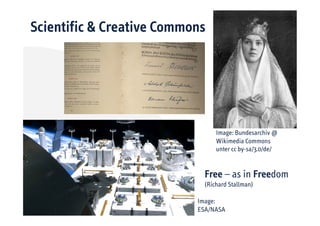
Scientific & Creative Commons


                                 Image: Bundesarchiv @
                                 Wikimedia Commons
                                 unter cc by-sa/3.0/de/


                             Free – as in Freedom
                             (Richard Stallman)

                           Image:
                           ESA/NASA
Creative Commons

    Creative Commons is a nonprofit corporation dedicated to
    making it easier for people to share and build upon the work
    of others, consistent with the rules of copyright.
    The simple cc-Attribution License allows others to copy,
    distribute, display, and
    perform your copyrighted
    work but only if they
    give credit the way you
    request.
    Source: CreativeCommons.org
    http://creativecommons.org
    Creative Commons by/3.0
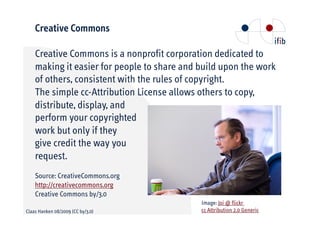
                                             Image: Joi @ flickr
Claas Hanken 08/2009 (CC by/3.0)             cc Attribution 2.0 Generic
German government agencies and CC


    Wikimedia Germany in cooperation with German Bundesarchiv:
    more than 100.000 images, mostly documenting German history .
    The images are issued as Creative Commons BY-SA 3.0 Germany.

    Apart from this publication under cc only in individual
    cases, for instance »Die Lage der Biologischen Vielfalt«
    (Creative Commons Attribution License 2.5).

    German government works are published under special
    copyright conditions. Even CC0 is not applicable.
    Creative Commons licenses could be applied on other works
    for which the Government holds copyright.
Claas Hanken 08/2009 (CC by/3.0)
Lawrence Lessig on ©:

      Overregulation stifles creativity. It smothers innovation.
    It gives dinosaurs a veto over the future.
    It wastes the extraordinary opportunity
    for a democratic creativity that digital technology enables.«
    L. Lessig: Free Culture (2004), p. 199


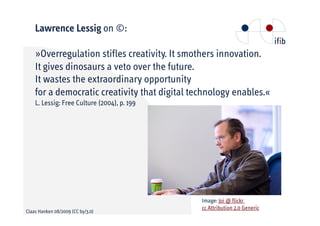
                                               Image: Joi @ flickr
                                               cc Attribution 2.0 Generic
Claas Hanken 08/2009 (CC by/3.0)
»Alle Rechte vorbehalten« vs. § 5 UrhG?

      Standard copyright protection is not appliable on
      German government works (§ 5 Abs. 1 of the german
      Urheberrechtsgesetz – UrhG). In many cases
      government publication could be freely distributed, if
      only the source is identified in a recognizable way.
      None the less most government agencies are using
      »All rights reserved« (»Alle Rechte vorbehalten«) for
      their Websites.

      Why?

Claas Hanken 08/2009 (CC by/3.0)
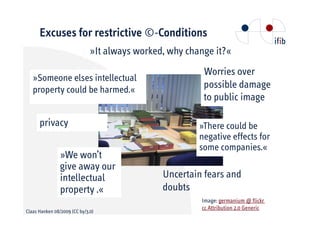
Excuses for restrictive ©-Conditions
                              »It always worked, why change it?«
                                                         Worries over
   »Someone elses intellectual
   property could be harmed.«                            possible damage
                                                         to public image

      privacy                                           »There could be
                                                        negative effects for
                                                        some companies.«
                »We won’t
                give away our
                intellectual                   Uncertain fears and
                property .«                    doubts
                                                        Image: germanium @ flickr
                                                        cc Attribution 2.0 Generic
Claas Hanken 08/2009 (CC by/3.0)
Proprietary Software vs. OSS

      • Usually contractors don’t have to provide results
        under Free and Open Source Licenses (FOSS like
        GNU, EUPL, »Bremer Lizenz«).
      • Due to agreements from the 70’s (»Kieler
        Beschlüsse«) government agencies can adopt and
        use certain applications that were developed for
        other administrative bodies free of charge.
                   Examples: Ginfis, EPOS, Favorit OfficeFlow,
                   Government Site Builder

Claas Hanken 08/2009 (CC by/3.0)
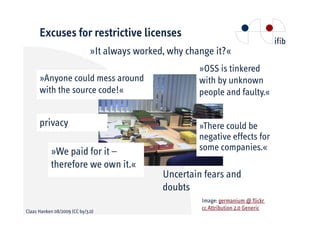
Excuses for restrictive licenses
                              »It always worked, why change it?«
                                                        »OSS is tinkered
      »Anyone could mess around                         with by unknown
      with the source code!«                            people and faulty.«


      privacy                                           »There could be
                                                        negative effects for
           »We paid for it –                            some companies.«
           therefore we own it.«
                                               Uncertain fears and
                                               doubts
                                                        Image: germanium @ flickr
                                                        cc Attribution 2.0 Generic
Claas Hanken 08/2009 (CC by/3.0)
Freedom of Information (FoI)

      • The german laws on FoI (by Bund and Länder)
        have the purpose to ensure that the government’s
        operations are apparent. They grant unconditional
        access to public information for everyone – with
        few exceptions (abandonment of the
        Amtsgeheimnis-paradigm).
      • Risks for requesters: refusal of enquiries,
        high costs


Claas Hanken 08/2009 (CC by/3.0)
FoI documents as Legal torrents?

      In case of a successful FoI request, fees payed: Is one
      allowed to re-publish the document online (without
      commercial interest)? Common answer: No.
      • Example from the US: Download for Democracy
         (documents made available over P2P-networks)
      • Expandable prototype by CCC e.V. and
         FoeBuD e.V. (Germany): »Befreite Dokumente«


Claas Hanken 08/2009 (CC by/3.0)
Laws on the reuse of PSI

      The german »Informationsweiterverwendungsgesetz«
      is aimed to transpose directive 2003/98/EC on the
      reuse of public sector information into national law.
      The law deals with the sharing and reuse of public
      sector information by citizens and businesses.
      Government agencies can impose fees on the reuse of
      information. (Do they charge the taxpayer again for
      information that has been collected using tax money?)


Claas Hanken 08/2009 (CC by/3.0)
„Remix“ of public data sources?

      •• merge data sources
      •• remix and filtering
      •• RSS-feeds to manage information
      •• Example: Google News puts together
         articles on a topic from various
         newspapers
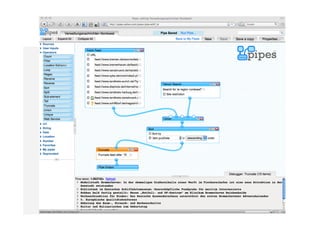
      •• Example: Yahoo! Pipes makes it easy to
         concatenate, combine and transform
         web content (»mashup«)

Claas Hanken 08/2009 (CC by/3.0)
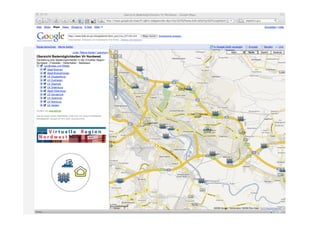
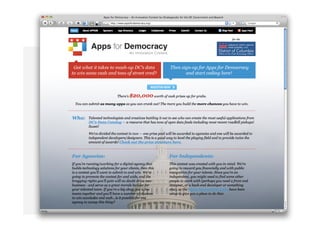
Beispiel: swim & fun Nordwest
Open APIs

      •• An open API (Application Programming
         Interface) gives programmers the opportunity to
         reuse data and certain functionalities in new
         applications.
      •• Examples for german government APIs:
                 eCard-API-Framework,
                 ELSTER COALA Java-APIs


Claas Hanken 08/2009 (CC by/3.0)
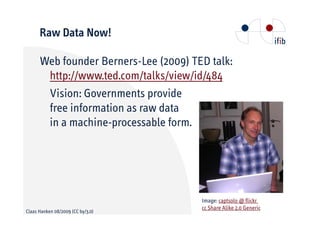
Raw Data Now!

      Web founder Berners-Lee (2009) TED talk:
       http://www.ted.com/talks/view/id/484
       Vision: Governments provide
       free information as raw data
       in a machine-processable form.


                                       Image: captsolo @ flickr
                                       cc Share Alike 2.0 Generic
Claas Hanken 08/2009 (CC by/3.0)
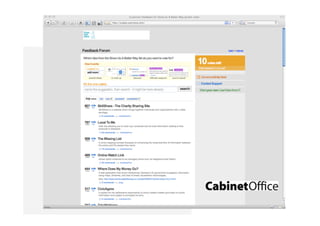
Raw Data from government agencies

      • Example data.gov (US): raw data, geodata, tools
      • What is this good for?
        surveillance cameras /
        crime rate?
      • financial aids / local
        economic growth?
        [Put your idea here.]


                                         Image: captsolo @ flickr
                                         cc Share Alike 2.0 Generic
Claas Hanken 08/2009 (CC by/3.0)
Wrap-up

      Government agencies (in Germany & elsewhere) should:
      •• make sure that hindrances for free publication are
         removed
      •• favor offers that allow publication under free licenses
      •• provide free raw data
      •• use structured data formats
      •• move public data into the interconnected web
      •• provide open APIs


Claas Hanken 08/2009 (CC by/3.0)
Contact:

Claas Hanken – hanken@ifib.de                 Am Fallturm 1, 28359 Bremen
                                              Telefon: ++49(0)421 218-2674
                                              Telefax: ++49(0)421 218-4894
www.egovernment-akademie.de                   Internet: www.ifib.de
                                              E-Mail: info@ifib.de
www.ifib.de
The presentation is published under
Creative Commons Namensnennung 3.0
http://creativecommons.org/licenses/by/3.0/
Author: Claas Hanken

ifib & E-Government-Akademie are registered
trademarks (DPMA.de) of ifib GmbH.

eGovernment, free licenses & FoI in Germany

  • 1.
    eGovernment 2.0, freelicenses and real Freedom of Information Claas Hanken – ifib
  • 2.
    •• Ideal vs.administrative reality in D •• »All rights reserved« •• Freedom of Information and reuse of public sector information Claas Hanken 08/2009 (CC by/3.0)
  • 3.
    Scientific & CreativeCommons Image: Bundesarchiv @ Wikimedia Commons unter cc by-sa/3.0/de/ Free – as in Freedom (Richard Stallman) Image: ESA/NASA
  • 4.
    Creative Commons Creative Commons is a nonprofit corporation dedicated to making it easier for people to share and build upon the work of others, consistent with the rules of copyright. The simple cc-Attribution License allows others to copy, distribute, display, and perform your copyrighted work but only if they give credit the way you request. Source: CreativeCommons.org http://creativecommons.org Creative Commons by/3.0 Image: Joi @ flickr Claas Hanken 08/2009 (CC by/3.0) cc Attribution 2.0 Generic
  • 5.
    German government agenciesand CC Wikimedia Germany in cooperation with German Bundesarchiv: more than 100.000 images, mostly documenting German history . The images are issued as Creative Commons BY-SA 3.0 Germany. Apart from this publication under cc only in individual cases, for instance »Die Lage der Biologischen Vielfalt« (Creative Commons Attribution License 2.5). German government works are published under special copyright conditions. Even CC0 is not applicable. Creative Commons licenses could be applied on other works for which the Government holds copyright. Claas Hanken 08/2009 (CC by/3.0)
  • 6.
    Lawrence Lessig on©: Overregulation stifles creativity. It smothers innovation. It gives dinosaurs a veto over the future. It wastes the extraordinary opportunity for a democratic creativity that digital technology enables.« L. Lessig: Free Culture (2004), p. 199 Image: Joi @ flickr cc Attribution 2.0 Generic Claas Hanken 08/2009 (CC by/3.0)
  • 7.
    »Alle Rechte vorbehalten«vs. § 5 UrhG? Standard copyright protection is not appliable on German government works (§ 5 Abs. 1 of the german Urheberrechtsgesetz – UrhG). In many cases government publication could be freely distributed, if only the source is identified in a recognizable way. None the less most government agencies are using »All rights reserved« (»Alle Rechte vorbehalten«) for their Websites. Why? Claas Hanken 08/2009 (CC by/3.0)
  • 8.
    Excuses for restrictive©-Conditions »It always worked, why change it?« Worries over »Someone elses intellectual property could be harmed.« possible damage to public image privacy »There could be negative effects for some companies.« »We won’t give away our intellectual Uncertain fears and property .« doubts Image: germanium @ flickr cc Attribution 2.0 Generic Claas Hanken 08/2009 (CC by/3.0)
  • 9.
    Proprietary Software vs.OSS • Usually contractors don’t have to provide results under Free and Open Source Licenses (FOSS like GNU, EUPL, »Bremer Lizenz«). • Due to agreements from the 70’s (»Kieler Beschlüsse«) government agencies can adopt and use certain applications that were developed for other administrative bodies free of charge. Examples: Ginfis, EPOS, Favorit OfficeFlow, Government Site Builder Claas Hanken 08/2009 (CC by/3.0)
  • 10.
    Excuses for restrictivelicenses »It always worked, why change it?« »OSS is tinkered »Anyone could mess around with by unknown with the source code!« people and faulty.« privacy »There could be negative effects for »We paid for it – some companies.« therefore we own it.« Uncertain fears and doubts Image: germanium @ flickr cc Attribution 2.0 Generic Claas Hanken 08/2009 (CC by/3.0)
  • 11.
    Freedom of Information(FoI) • The german laws on FoI (by Bund and Länder) have the purpose to ensure that the government’s operations are apparent. They grant unconditional access to public information for everyone – with few exceptions (abandonment of the Amtsgeheimnis-paradigm). • Risks for requesters: refusal of enquiries, high costs Claas Hanken 08/2009 (CC by/3.0)
  • 12.
    FoI documents asLegal torrents? In case of a successful FoI request, fees payed: Is one allowed to re-publish the document online (without commercial interest)? Common answer: No. • Example from the US: Download for Democracy (documents made available over P2P-networks) • Expandable prototype by CCC e.V. and FoeBuD e.V. (Germany): »Befreite Dokumente« Claas Hanken 08/2009 (CC by/3.0)
  • 13.
    Laws on thereuse of PSI The german »Informationsweiterverwendungsgesetz« is aimed to transpose directive 2003/98/EC on the reuse of public sector information into national law. The law deals with the sharing and reuse of public sector information by citizens and businesses. Government agencies can impose fees on the reuse of information. (Do they charge the taxpayer again for information that has been collected using tax money?) Claas Hanken 08/2009 (CC by/3.0)
  • 14.
    „Remix“ of publicdata sources? •• merge data sources •• remix and filtering •• RSS-feeds to manage information •• Example: Google News puts together articles on a topic from various newspapers •• Example: Yahoo! Pipes makes it easy to concatenate, combine and transform web content (»mashup«) Claas Hanken 08/2009 (CC by/3.0)
  • 16.
    Beispiel: swim &fun Nordwest
  • 17.
    Open APIs •• An open API (Application Programming Interface) gives programmers the opportunity to reuse data and certain functionalities in new applications. •• Examples for german government APIs: eCard-API-Framework, ELSTER COALA Java-APIs Claas Hanken 08/2009 (CC by/3.0)
  • 18.
    Raw Data Now! Web founder Berners-Lee (2009) TED talk: http://www.ted.com/talks/view/id/484 Vision: Governments provide free information as raw data in a machine-processable form. Image: captsolo @ flickr cc Share Alike 2.0 Generic Claas Hanken 08/2009 (CC by/3.0)
  • 20.
    Raw Data fromgovernment agencies • Example data.gov (US): raw data, geodata, tools • What is this good for? surveillance cameras / crime rate? • financial aids / local economic growth? [Put your idea here.] Image: captsolo @ flickr cc Share Alike 2.0 Generic Claas Hanken 08/2009 (CC by/3.0)
  • 22.
    Wrap-up Government agencies (in Germany & elsewhere) should: •• make sure that hindrances for free publication are removed •• favor offers that allow publication under free licenses •• provide free raw data •• use structured data formats •• move public data into the interconnected web •• provide open APIs Claas Hanken 08/2009 (CC by/3.0)
  • 23.
    Contact: Claas Hanken –hanken@ifib.de Am Fallturm 1, 28359 Bremen Telefon: ++49(0)421 218-2674 Telefax: ++49(0)421 218-4894 www.egovernment-akademie.de Internet: www.ifib.de E-Mail: info@ifib.de www.ifib.de The presentation is published under Creative Commons Namensnennung 3.0 http://creativecommons.org/licenses/by/3.0/ Author: Claas Hanken ifib & E-Government-Akademie are registered trademarks (DPMA.de) of ifib GmbH.