The Role, Position and Funding 
of Laboratory Diagnostics 
in the German Health Care System 
Dr. med. Lothar Krimmel 
Bioscientia Institute for 
Medical Diagnostics 
Ingelheim, Germany 
Warsaw, 18. May 2007 
Institute for Medical Diagnostics Warsaw, 18. May 2007
of the German Health Care System 
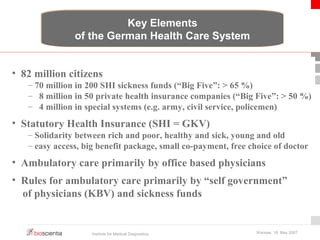
• 82 million citizens 
Key Elements 
– 70 million in 200 SHI sickness funds (“Big Five”: > 65 %) 
– 8 million in 50 private health insurance companies (“Big Five”: > 50 %) 
– 4 million in special systems (e.g. army, civil service, policemen) 
• Statutory Health Insurance (SHI = GKV) 
– Solidarity between rich and poor, healthy and sick, young and old 
– easy access, big benefit package, small co-payment, free choice of doctor 
• Ambulatory care primarily by office based physicians 
• Rules for ambulatory care primarily by “self government” 
of physicians (KBV) and sickness funds 
Institute for Medical Diagnostics Warsaw, 18. May 2007
Number of Lab-service Providers iinn GGeerrmmaannyy 
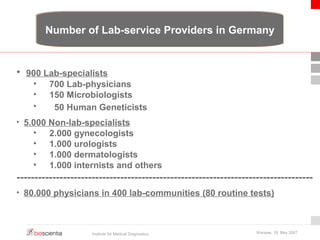
• 900 Lab-specialists 
• 700 Lab-physicians 
• 150 Microbiologists 
• 50 Human Geneticists 
• 5.000 Non-lab-specialists 
• 2.000 gynecologists 
• 1.000 urologists 
• 1.000 dermatologists 
• 1.000 internists and others 
----------------------------------------------------------------------------------- 
• 80.000 physicians in 400 lab-communities (80 routine tests) 
Institute for Medical Diagnostics Warsaw, 18. May 2007
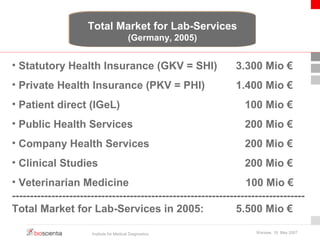
Total Market for Lab-Services 
(Germany, 2005) 
• Statutory Health Insurance (GKV = SHI) 3.300 Mio € 
• Private Health Insurance (PKV = PHI) 1.400 Mio € 
• Patient direct (IGeL) 100 Mio € 
• Public Health Services 200 Mio € 
• Company Health Services 200 Mio € 
• Clinical Studies 200 Mio € 
• Veterinarian Medicine 100 Mio € 
---------------------------------------------------------------------------------- 
Total Market for Lab-Services in 2005: 5.500 Mio € 
Institute for Medical Diagnostics Warsaw, 18. May 2007
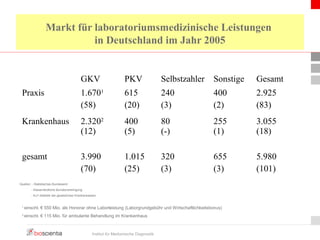
Markt für laboratoriumsmedizinische Leistungen 
in Deutschland im Jahr 2005 
GKV PKV Selbstzahler Sonstige Gesamt 
Praxis 1.6701 
(58) 
615 
(20) 
- Kassenärztliche Bundesvereinigung 
- KJ1-Statistik der gesetzlichen Krankenkassen 
Institut für Medizinische Diagnostik 
240 
(3) 
400 
(2) 
2.925 
(83) 
Krankenhaus 2.3202 
(12) 
400 
(5) 
80 
(-) 
255 
(1) 
3.055 
(18) 
gesamt 3.990 
(70) 
1.015 
(25) 
320 
(3) 
655 
(3) 
5.980 
(101) 
Quellen: - Statistisches Bundesamt 
1 einschl. € 550 Mio. als Honorar ohne Laborleistung (Laborgrundgebühr und Wirtschaftlichkeitsbonus) 
2 einschl. € 115 Mio. für ambulante Behandlung im Krankenhaus
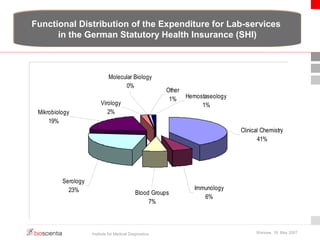
Functional Distribution of the Expenditure for Lab-services 
in the German Statutory Health Insurance (SHI) 
Institute for Medical Diagnostics Warsaw, 18. May 2007 
Mikrobiology 
Serology 
23% 
19% 
Blood Groups 
7% 
Immunology 
6% 
Clinical Chemistry 
41% 
Molecular Biology 
0% 
Hemostaseology 
1% 
Other 
Virology 1% 
2%
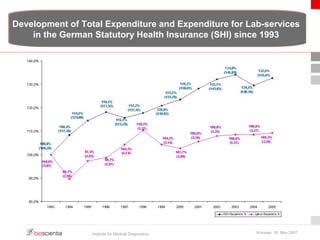
Development of Total Expenditure and Expenditure for Lab-services 
in the German Statutory Health Insurance (SHI) since 1993 
Institute for Medical Diagnostics Warsaw, 18. May 2007
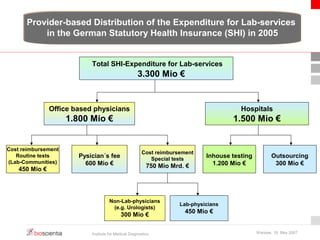
Provider-based Distribution of the Expenditure for Lab-services 
in the German Statutory Health Insurance (SHI) in 2005 
Total SHI-Expenditure for Lab-services 
3.300 Mio € 
Office based physicians 
1.800 Mio € 
Pysician´s fee 
600 Mio € 
Non-Lab-physicians 
(e.g. Urologists) 
300 Mio € 
Hospitals 
1.500 Mio € 
Lab-physicians 
450 Mio € 
Institute for Medical Diagnostics Warsaw, 18. May 2007 
Cost reimbursement 
Routine tests 
(Lab-Communities) 
450 Mio € 
Cost reimbursement 
Special tests 
750 Mio Mrd. € 
Inhouse testing 
1.200 Mio € 
Outsourcing 
300 Mio €
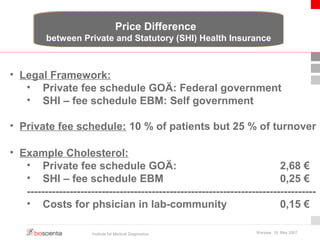
between Private and Statutory (SHI) Health Insurance 
• Legal Framework: 
Price Difference 
• Private fee schedule GOÄ: Federal government 
• SHI – fee schedule EBM: Self government 
• Private fee schedule: 10 % of patients but 25 % of turnover 
• Example Cholesterol: 
• Private fee schedule GOÄ: 2,68 € 
• SHI – fee schedule EBM 0,25 € 
--------------------------------------------------------------------------------- 
• Costs for phsician in lab-community 0,15 € 
Institute for Medical Diagnostics Warsaw, 18. May 2007
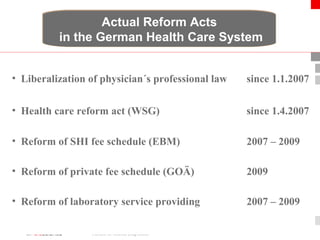
Actual Reform Acts 
in the German Health Care System 
• Liberalization of physician´s professional law since 1.1.2007 
• Health care reform act (WSG) since 1.4.2007 
• Reform of SHI fee schedule (EBM) 2007 – 2009 
• Reform of private fee schedule (GOÄ) 2009 
• Reform of laboratory service providing 2007 – 2009 
Institute for Medical Diagnostics Warsaw, 18. May 2007
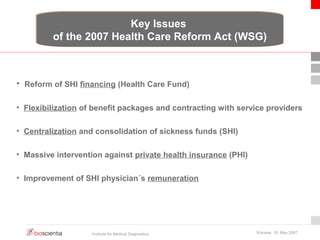
Key Issues 
of the 2007 Health Care Reform Act (WSG) 
• Reform of SHI financing (Health Care Fund) 
• Flexibilization of benefit packages and contracting with service providers 
• Centralization and consolidation of sickness funds (SHI) 
• Massive intervention against private health insurance (PHI) 
• Improvement of SHI physician´s remuneration 
Institute for Medical Diagnostics Warsaw, 18. May 2007
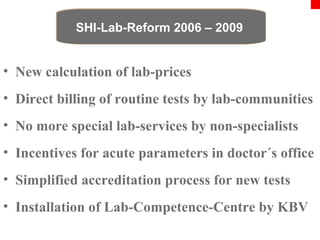
SSHHII--LLaabb--RReeffoorrmm 22000066 –– 22000099 
• New calculation of lab-prices 
• Direct billing of routine tests by lab-communities 
• No more special lab-services by non-specialists 
• Incentives for acute parameters in doctor´s office 
• Simplified accreditation process for new tests 
• Installation of Lab-Competence-Centre by KBV 
Institute for Medical Diagnostics Warsaw, 18. May 2007
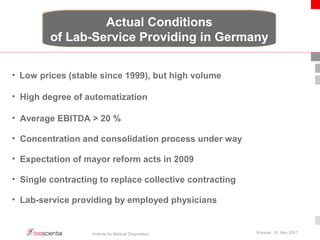
Actual Conditions 
of Lab-Service Providing in Germany 
• Low prices (stable since 1999), but high volume 
• High degree of automatization 
• Average EBITDA > 20 % 
• Concentration and consolidation process under way 
• Expectation of mayor reform acts in 2009 
• Single contracting to replace collective contracting 
• Lab-service providing by employed physicians 
Institute for Medical Diagnostics Warsaw, 18. May 2007
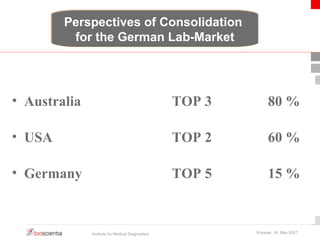
Perspectives of Consolidation 
for the German Lab-Market 
• Australia TOP 3 80 % 
• USA TOP 2 60 % 
• Germany TOP 5 15 % 
Institute for Medical Diagnostics Warsaw, 18. May 2007
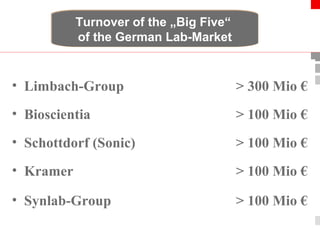
Turnover of the „Big Five“ 
of the German Lab-Market 
• Limbach-Group > 300 Mio € 
• Bioscientia > 100 Mio € 
• Schottdorf (Sonic) > 100 Mio € 
• Kramer > 100 Mio € 
• Synlab-Group > 100 Mio € 
Institute for Medical Diagnostics Warsaw, 18. May 2007
Process of Consolidation 
- Strategic Options 
• Mergers and Acquisitions 
- merger of equals vs. acquisition 
- European perspective 
• Sale to the strategic investor 
- direct sector exposure (e.g. Sonic) 
- indirect sector exposure (e.g. Celesio) 
• Sale to the financial investor 
- with mayority stake 
- with minority stake 
• Alternative: Stand alone with further organic growth 
Institute for Medical Diagnostics Warsaw, 18. May 2007
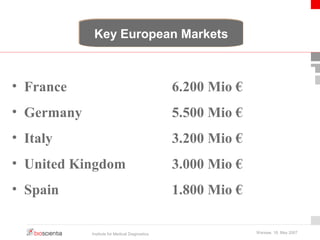
KKeeyy EEuurrooppeeaann MMaarrkkeettss 
• France 6.200 Mio € 
• Germany 5.500 Mio € 
• Italy 3.200 Mio € 
• United Kingdom 3.000 Mio € 
• Spain 1.800 Mio € 
Institute for Medical Diagnostics Warsaw, 18. May 2007
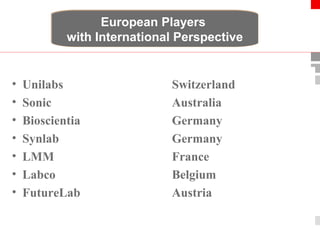
European Players 
with International Perspective 
• Unilabs Switzerland 
• Sonic Australia 
• Bioscientia Germany 
• Synlab Germany 
• LMM France 
• Labco Belgium 
• FutureLab Austria 
Institute for Medical Diagnostics Warsaw, 18. May 2007
Frankfurt 
Institute for Medical Diagnostics Warsaw, 18. May 2007 
Horstmar 
Moers 
Freiburg 
Wiesbaden 
Mainz 
Jena 
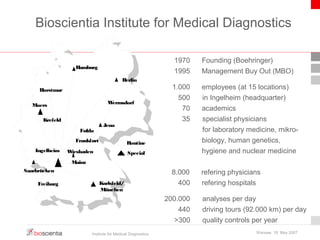
1970 Founding (Boehringer) 
1995 Management Buy Out (MBO) 
1.000 employees (at 15 locations) 
500 in Ingelheim (headquarter) 
70 academics 
35 specialist physicians 
for laboratory medicine, mikro-biology, 
human genetics, 
hygiene and nuclear medicine 
8.000 refering physicians 
400 refering hospitals 
200.000 analyses per day 
440 driving tours (92.000 km) per day 
>300 quality controls per year 
. 
Bioscientia Institute for Medical Diagnostics 
Saarbrücken 
Fulda 
Karlsfeld/ 
München 
Krefeld 
Wermsdorf 
Hamburg 
Berlin 
Ingelheim 
Routine 
Special
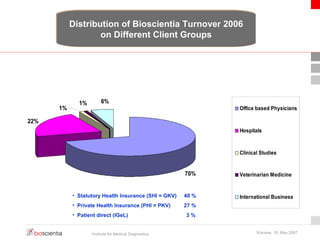
Distribution of Bioscientia Turnover 2006 
on Different Client Groups 
70% 
Institute for Medical Diagnostics Warsaw, 18. May 2007 
22% 
1% 6% 
1% Office based Physicians 
Hospitals 
Clinical Studies 
Veterinarian Medicine 
• Statutory Health Insurance (SHI = GKV) 40 % International Business 
• Private Health Insurance (PHI = PKV) 27 % 
• Patient direct (IGeL) 3 %
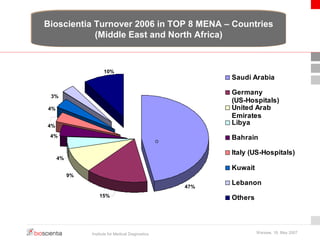
Bioscientia Turnover 2006 in TOP 8 MENA – Countries 
(Middle East and North Africa) 
Institute for Medical Diagnostics Warsaw, 18. May 2007 
3% 
4% 
4% 
4% 
4% 
15% 
9% 
10% 
47% 
Saudi Arabia 
Germany 
(US-Hospitals) 
United Arab 
Emirates 
Libya 
Bahrain 
Italy (US-Hospitals) 
Kuwait 
Lebanon 
Others 
O
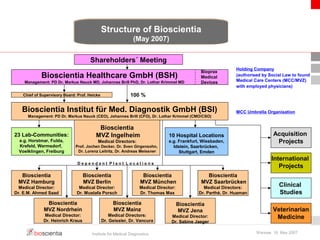
Structure of Bioscientia 
(May 2007) 
Shareholders´ Meeting 
Bioscientia Healthcare GmbH (BSH) 
Management: PD Dr. Markus Nauck MD, Johannes Brill PhD, Dr. Lothar Krimmel MD 
Chief of Supervisory Board: Prof. Heicke 
Bioscientia Institut für Med. Diagnostik GmbH (BSI) 
Management: PD Dr. Markus Nauck (CEO), Johannes Brill (CFO), Dr. Lothar Krimmel (CMO/CSO) 
Holding Company 
(authorised by Social Law to found 
Medical Care Centers (MCC/MVZ) 
with employed physicians) 
Bioscientia 
MVZ Ingelheim 
Medical Directors: 
Prof. Jochen Decker, Dr. Sven Girgensohn, 
Dr. Lorenz Leitritz, Dr. Andreas Meissner 
Institute for Medical Diagnostics Warsaw, 18. May 2007 
Bioscientia 
MVZ Hamburg 
Medical Director: 
Dr. E.M. Ahmed Saad 
Bioscientia 
MVZ München 
Medical Director: 
Dr. Thomas Max 
MCC Umbrella Organisation 
D e p e n d a n t P l a n t L o c a t i o n s 
Bioscientia 
MVZ Mainz 
Medical Directors: 
Dr. Geissler, Dr. Vancura 
Bioscientia 
MVZ Nordrhein 
Medical Director: 
Dr. Heinrich Kraus 
Bioscientia 
MVZ Jena 
Medical Director: 
Dr. Sabine Jaeger 
Bioscientia 
MVZ Berlin 
Medical Director: 
Dr. Mustafa Porsch 
100 % 
Acquisition 
Projects 
Bioprax 
Medical 
Devices 
23 Lab-Communities: 
e.g. Horstmar, Fulda, 
Krefeld, Wermsdorf, 
Voelklingen, Freiburg 
International 
Projects 
10 Hospital Locations 
e.g. Frankfurt, Wiesbaden, 
Idstein, Saarbrücken, 
Stuttgart, Emden 
Clinical 
Studies 
Veterinarian 
Medicine 
Bioscientia 
MVZ Saarbrücken 
Medical Directors: 
Dr. Parthé, Dr. Huaman

2007-05-18 :The Role, Position and Funding of Laboratory Diagnostics in the German Health Care System

  • 1.
    The Role, Positionand Funding of Laboratory Diagnostics in the German Health Care System Dr. med. Lothar Krimmel Bioscientia Institute for Medical Diagnostics Ingelheim, Germany Warsaw, 18. May 2007 Institute for Medical Diagnostics Warsaw, 18. May 2007
  • 2.
    of the GermanHealth Care System • 82 million citizens Key Elements – 70 million in 200 SHI sickness funds (“Big Five”: > 65 %) – 8 million in 50 private health insurance companies (“Big Five”: > 50 %) – 4 million in special systems (e.g. army, civil service, policemen) • Statutory Health Insurance (SHI = GKV) – Solidarity between rich and poor, healthy and sick, young and old – easy access, big benefit package, small co-payment, free choice of doctor • Ambulatory care primarily by office based physicians • Rules for ambulatory care primarily by “self government” of physicians (KBV) and sickness funds Institute for Medical Diagnostics Warsaw, 18. May 2007
  • 3.
    Number of Lab-serviceProviders iinn GGeerrmmaannyy • 900 Lab-specialists • 700 Lab-physicians • 150 Microbiologists • 50 Human Geneticists • 5.000 Non-lab-specialists • 2.000 gynecologists • 1.000 urologists • 1.000 dermatologists • 1.000 internists and others ----------------------------------------------------------------------------------- • 80.000 physicians in 400 lab-communities (80 routine tests) Institute for Medical Diagnostics Warsaw, 18. May 2007
  • 4.
    Total Market forLab-Services (Germany, 2005) • Statutory Health Insurance (GKV = SHI) 3.300 Mio € • Private Health Insurance (PKV = PHI) 1.400 Mio € • Patient direct (IGeL) 100 Mio € • Public Health Services 200 Mio € • Company Health Services 200 Mio € • Clinical Studies 200 Mio € • Veterinarian Medicine 100 Mio € ---------------------------------------------------------------------------------- Total Market for Lab-Services in 2005: 5.500 Mio € Institute for Medical Diagnostics Warsaw, 18. May 2007
  • 5.
    Markt für laboratoriumsmedizinischeLeistungen in Deutschland im Jahr 2005 GKV PKV Selbstzahler Sonstige Gesamt Praxis 1.6701 (58) 615 (20) - Kassenärztliche Bundesvereinigung - KJ1-Statistik der gesetzlichen Krankenkassen Institut für Medizinische Diagnostik 240 (3) 400 (2) 2.925 (83) Krankenhaus 2.3202 (12) 400 (5) 80 (-) 255 (1) 3.055 (18) gesamt 3.990 (70) 1.015 (25) 320 (3) 655 (3) 5.980 (101) Quellen: - Statistisches Bundesamt 1 einschl. € 550 Mio. als Honorar ohne Laborleistung (Laborgrundgebühr und Wirtschaftlichkeitsbonus) 2 einschl. € 115 Mio. für ambulante Behandlung im Krankenhaus
  • 6.
    Functional Distribution ofthe Expenditure for Lab-services in the German Statutory Health Insurance (SHI) Institute for Medical Diagnostics Warsaw, 18. May 2007 Mikrobiology Serology 23% 19% Blood Groups 7% Immunology 6% Clinical Chemistry 41% Molecular Biology 0% Hemostaseology 1% Other Virology 1% 2%
  • 7.
    Development of TotalExpenditure and Expenditure for Lab-services in the German Statutory Health Insurance (SHI) since 1993 Institute for Medical Diagnostics Warsaw, 18. May 2007
  • 8.
    Provider-based Distribution ofthe Expenditure for Lab-services in the German Statutory Health Insurance (SHI) in 2005 Total SHI-Expenditure for Lab-services 3.300 Mio € Office based physicians 1.800 Mio € Pysician´s fee 600 Mio € Non-Lab-physicians (e.g. Urologists) 300 Mio € Hospitals 1.500 Mio € Lab-physicians 450 Mio € Institute for Medical Diagnostics Warsaw, 18. May 2007 Cost reimbursement Routine tests (Lab-Communities) 450 Mio € Cost reimbursement Special tests 750 Mio Mrd. € Inhouse testing 1.200 Mio € Outsourcing 300 Mio €
  • 9.
    between Private andStatutory (SHI) Health Insurance • Legal Framework: Price Difference • Private fee schedule GOÄ: Federal government • SHI – fee schedule EBM: Self government • Private fee schedule: 10 % of patients but 25 % of turnover • Example Cholesterol: • Private fee schedule GOÄ: 2,68 € • SHI – fee schedule EBM 0,25 € --------------------------------------------------------------------------------- • Costs for phsician in lab-community 0,15 € Institute for Medical Diagnostics Warsaw, 18. May 2007
  • 10.
    Actual Reform Acts in the German Health Care System • Liberalization of physician´s professional law since 1.1.2007 • Health care reform act (WSG) since 1.4.2007 • Reform of SHI fee schedule (EBM) 2007 – 2009 • Reform of private fee schedule (GOÄ) 2009 • Reform of laboratory service providing 2007 – 2009 Institute for Medical Diagnostics Warsaw, 18. May 2007
  • 11.
    Key Issues ofthe 2007 Health Care Reform Act (WSG) • Reform of SHI financing (Health Care Fund) • Flexibilization of benefit packages and contracting with service providers • Centralization and consolidation of sickness funds (SHI) • Massive intervention against private health insurance (PHI) • Improvement of SHI physician´s remuneration Institute for Medical Diagnostics Warsaw, 18. May 2007
  • 12.
    SSHHII--LLaabb--RReeffoorrmm 22000066 ––22000099 • New calculation of lab-prices • Direct billing of routine tests by lab-communities • No more special lab-services by non-specialists • Incentives for acute parameters in doctor´s office • Simplified accreditation process for new tests • Installation of Lab-Competence-Centre by KBV Institute for Medical Diagnostics Warsaw, 18. May 2007
  • 13.
    Actual Conditions ofLab-Service Providing in Germany • Low prices (stable since 1999), but high volume • High degree of automatization • Average EBITDA > 20 % • Concentration and consolidation process under way • Expectation of mayor reform acts in 2009 • Single contracting to replace collective contracting • Lab-service providing by employed physicians Institute for Medical Diagnostics Warsaw, 18. May 2007
  • 14.
    Perspectives of Consolidation for the German Lab-Market • Australia TOP 3 80 % • USA TOP 2 60 % • Germany TOP 5 15 % Institute for Medical Diagnostics Warsaw, 18. May 2007
  • 15.
    Turnover of the„Big Five“ of the German Lab-Market • Limbach-Group > 300 Mio € • Bioscientia > 100 Mio € • Schottdorf (Sonic) > 100 Mio € • Kramer > 100 Mio € • Synlab-Group > 100 Mio € Institute for Medical Diagnostics Warsaw, 18. May 2007
  • 16.
    Process of Consolidation - Strategic Options • Mergers and Acquisitions - merger of equals vs. acquisition - European perspective • Sale to the strategic investor - direct sector exposure (e.g. Sonic) - indirect sector exposure (e.g. Celesio) • Sale to the financial investor - with mayority stake - with minority stake • Alternative: Stand alone with further organic growth Institute for Medical Diagnostics Warsaw, 18. May 2007
  • 17.
    KKeeyy EEuurrooppeeaann MMaarrkkeettss • France 6.200 Mio € • Germany 5.500 Mio € • Italy 3.200 Mio € • United Kingdom 3.000 Mio € • Spain 1.800 Mio € Institute for Medical Diagnostics Warsaw, 18. May 2007
  • 18.
    European Players withInternational Perspective • Unilabs Switzerland • Sonic Australia • Bioscientia Germany • Synlab Germany • LMM France • Labco Belgium • FutureLab Austria Institute for Medical Diagnostics Warsaw, 18. May 2007
  • 19.
    Frankfurt Institute forMedical Diagnostics Warsaw, 18. May 2007 Horstmar Moers Freiburg Wiesbaden Mainz Jena 1970 Founding (Boehringer) 1995 Management Buy Out (MBO) 1.000 employees (at 15 locations) 500 in Ingelheim (headquarter) 70 academics 35 specialist physicians for laboratory medicine, mikro-biology, human genetics, hygiene and nuclear medicine 8.000 refering physicians 400 refering hospitals 200.000 analyses per day 440 driving tours (92.000 km) per day >300 quality controls per year . Bioscientia Institute for Medical Diagnostics Saarbrücken Fulda Karlsfeld/ München Krefeld Wermsdorf Hamburg Berlin Ingelheim Routine Special
  • 20.
    Distribution of BioscientiaTurnover 2006 on Different Client Groups 70% Institute for Medical Diagnostics Warsaw, 18. May 2007 22% 1% 6% 1% Office based Physicians Hospitals Clinical Studies Veterinarian Medicine • Statutory Health Insurance (SHI = GKV) 40 % International Business • Private Health Insurance (PHI = PKV) 27 % • Patient direct (IGeL) 3 %
  • 21.
    Bioscientia Turnover 2006in TOP 8 MENA – Countries (Middle East and North Africa) Institute for Medical Diagnostics Warsaw, 18. May 2007 3% 4% 4% 4% 4% 15% 9% 10% 47% Saudi Arabia Germany (US-Hospitals) United Arab Emirates Libya Bahrain Italy (US-Hospitals) Kuwait Lebanon Others O
  • 22.
    Structure of Bioscientia (May 2007) Shareholders´ Meeting Bioscientia Healthcare GmbH (BSH) Management: PD Dr. Markus Nauck MD, Johannes Brill PhD, Dr. Lothar Krimmel MD Chief of Supervisory Board: Prof. Heicke Bioscientia Institut für Med. Diagnostik GmbH (BSI) Management: PD Dr. Markus Nauck (CEO), Johannes Brill (CFO), Dr. Lothar Krimmel (CMO/CSO) Holding Company (authorised by Social Law to found Medical Care Centers (MCC/MVZ) with employed physicians) Bioscientia MVZ Ingelheim Medical Directors: Prof. Jochen Decker, Dr. Sven Girgensohn, Dr. Lorenz Leitritz, Dr. Andreas Meissner Institute for Medical Diagnostics Warsaw, 18. May 2007 Bioscientia MVZ Hamburg Medical Director: Dr. E.M. Ahmed Saad Bioscientia MVZ München Medical Director: Dr. Thomas Max MCC Umbrella Organisation D e p e n d a n t P l a n t L o c a t i o n s Bioscientia MVZ Mainz Medical Directors: Dr. Geissler, Dr. Vancura Bioscientia MVZ Nordrhein Medical Director: Dr. Heinrich Kraus Bioscientia MVZ Jena Medical Director: Dr. Sabine Jaeger Bioscientia MVZ Berlin Medical Director: Dr. Mustafa Porsch 100 % Acquisition Projects Bioprax Medical Devices 23 Lab-Communities: e.g. Horstmar, Fulda, Krefeld, Wermsdorf, Voelklingen, Freiburg International Projects 10 Hospital Locations e.g. Frankfurt, Wiesbaden, Idstein, Saarbrücken, Stuttgart, Emden Clinical Studies Veterinarian Medicine Bioscientia MVZ Saarbrücken Medical Directors: Dr. Parthé, Dr. Huaman