SELF-DIAGNOSTICS

2001 Acura MDX
2001 ENGINE PERFORMANCE
Acura Self-Diagnostics
MDX, 3.2CL  3.2TL
INTRODUCTION
If no faults were found while performing BASIC DIAGNOSTIC
PROCEDURES, proceed with self-diagnostics. If no fault codes, or only
pass codes, exist after entering self-diagnostics, proceed to TROUBLE
SHOOTING - NO CODES article for diagnosis by symptom (i.e., ROUGH
IDLE, NO START, etc.).
SELF-DIAGNOSTIC SYSTEM
NOTE: The Powertrain Control Module (PCM) may be referred to as
Engine Control Unit (ECU).
WARNING: During self-diagnostics, only check ECU (PCM) fuse specified.
ECU (PCM) fuse No. 6 (15-amp) located in underdash fuse/relay
box.
MALFUNCTION INDICATOR LIGHT (MIL)
As a bulb check, the Malfunction Indicator Light (MIL) will
come on whenever ignition is on and engine is not running. The MIL
will also come on whenever a system failure is detected, and a
corresponding trouble code will set in PCM memory.
Hard Failures
Hard failures cause the malfunction indicator light to come
on and remain on until the problem is repaired. If the light comes on
and remains on (light may flash) during vehicle operation, determine
cause of malfunction by following the appropriate code retrieval
procedures. If a sensor fails, the PCM will use a substitute value in
its calculations to continue engine operation. In this condition,
known as limp-in mode, the vehicle will run but driveability will not
be optimum.
Intermittent Failures
Intermittent failures may cause the MIL to flicker or glow
and go out after the intermittent fault goes away. However, the
corresponding trouble code will be retained in PCM memory. If the
related fault does not reoccur within a certain time, the related
trouble code will be erased from PCM memory. Intermittent failures may
be caused by sensor, connector, or wiring problems. See INTERMITTENTS
in TROUBLE SHOOTING - NO CODES article.
RETRIEVING DIAGNOSTIC TROUBLE CODES
NOTE: For complete self-diagnostic capabilities an OBD-II compliant
scan tool or Honda PGM tester is required.
Using Scan Tool
Locate Data Link Connector (DLC) in center console, behind
ash tray. See Fig. 1. Connect and operate scan tool in accordance with
manufacturer’s instructions.
Fig. 1: Locating OBD-II Data Link Connector
Courtesy of American Honda Motor Co., Inc.
FREEZE FRAME DATA
Freeze frame data indicates engine operating conditions when
the first malfunction, misfire or fuel trim malfunction was detected.
Freeze frame data can be helpful when used during trouble shooting. A
scan tool must be used to check for freeze frame data.
PCM RESET PROCEDURE/CLEARING DIAGNOSTIC TROUBLE CODES
NOTE: Before disconnecting battery or removing fuse, obtain
anti-theft code for radio. After battery is reconnected, CODE
will appear on radio display. Enter 5-digit code to restore
radio operation. If code is entered wrong 3 times, leave
radio on at least one hour, then enter code correctly. Any
time radio power is lost, pre-selected radio stations will
have to be set. For more information, see owner’s manual.
Without Scan Tool
To clear PCM memory without using a scan tool, remove fuse
No. 13 (15-amp on 3.2CL, 7.5-amp on MDX and 3.2TL) from underhood
fuse/relay box for 10 seconds.
Using OBD-II Scan Tool
Clear codes with OBD-II scan tool. Connect and operate scan
tool in accordance with manufacturer’s instructions.
PCM LOCATION
PCM is located behind center console, to left of glove box,
under footwell carpet. Pull back carpeting from passenger and driver-
side of center console to expose PCM. Connect test equipment using
backprobe set. See TEST EQUIPMENT. Check system according to
procedures described in specific Diagnostic Trouble Code (DTC) tests.
TEST EQUIPMENT
All voltage tests should be performed by backprobing using a
Digital Volt-Ohmmeter (DVOM) with a minimum 10-megohm input impedance,
unless specifically stated differently in testing procedure. DO NOT
use a test light or analog meter to check circuits with solid-state
devices. Solid-state devices can be damaged. Ensure all jumper wire(s)
include a (5-amp), in-line fuse.
Use 2 Backprobe Sets (07SAZ-001000A) to backprobe Powertrain
Control Module (PCM) terminals when directed by testing. See Fig. 2.
DO NOT puncture wire insulation. Place tester probe into
contact with terminal from terminal side of wiring harness
connector(s) in engine compartment. For female connector(s), touch
terminal lightly with tester probe. DO NOT insert probe into terminal.
NOTE: For PCM harness connector terminal identification, see
CONNECTOR IDENTIFICATION.
NOTE: Circuit tests are written specifically for use with Honda PGM
Tester. Other scan tools can be used but may have limited
functions.
Fig. 2: Using Backprobe Set (Typical)
Courtesy of American Honda Motor Co., Inc.
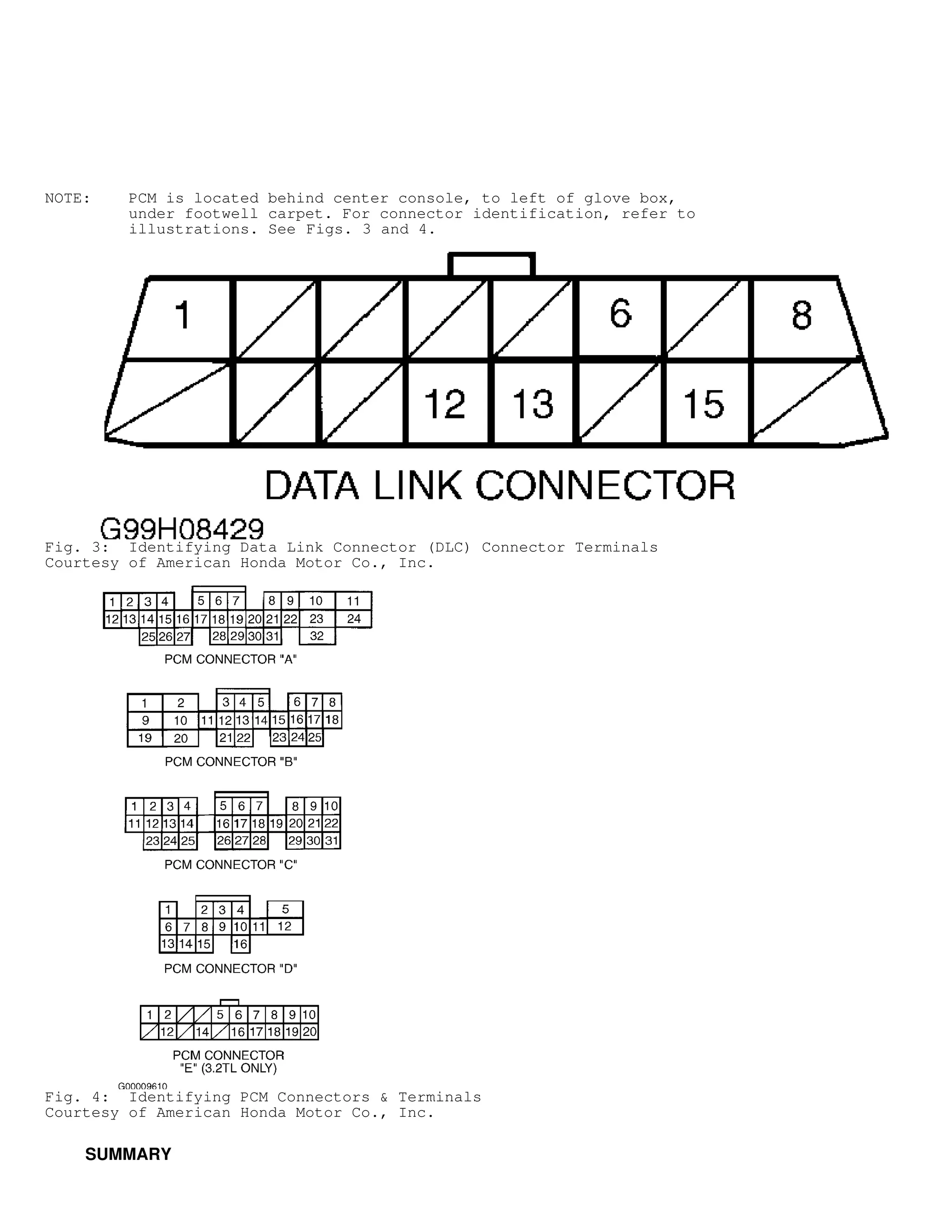
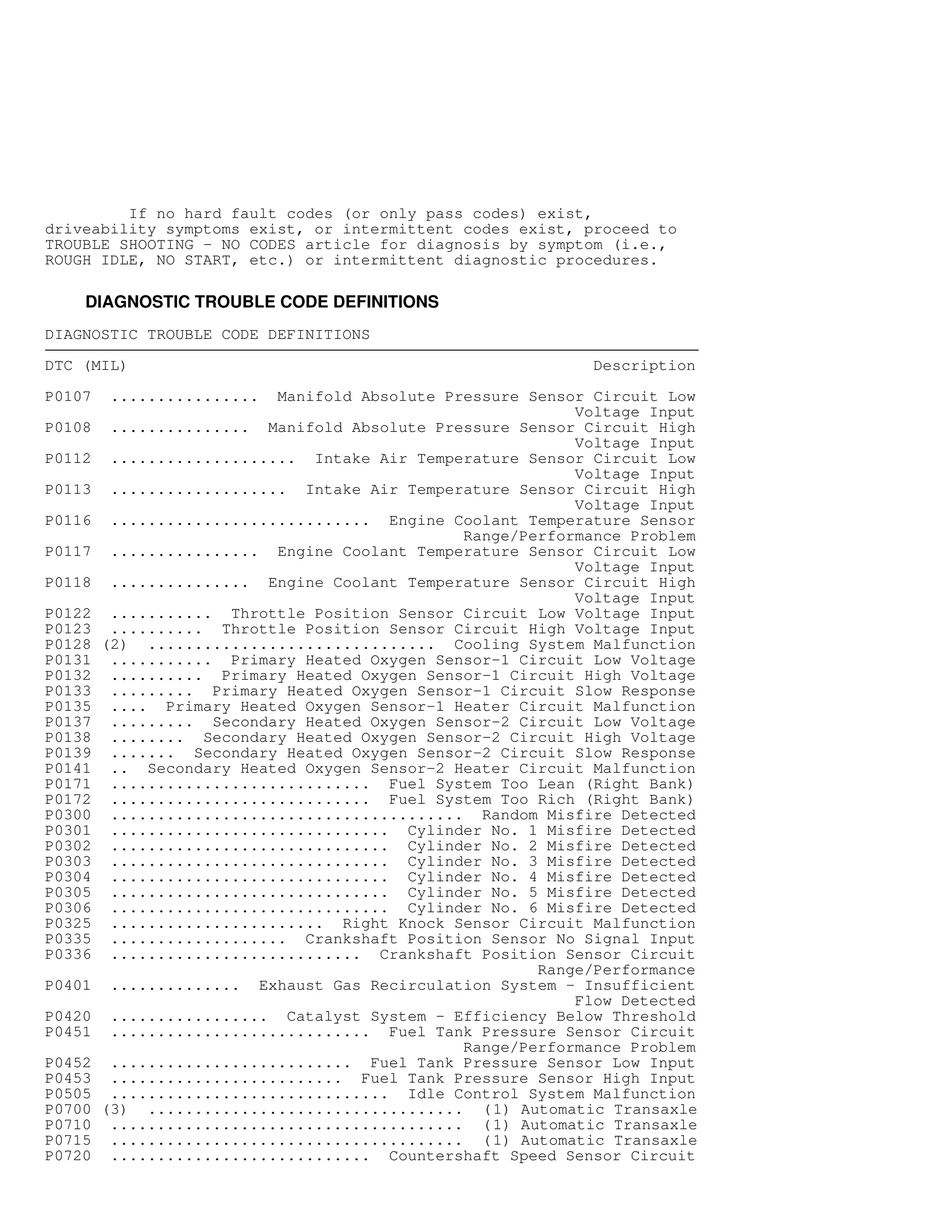
CONNECTOR IDENTIFICATION
NOTE: PCM is located behind center console, to left of glove box,
under footwell carpet. For connector identification, refer to
illustrations. See Figs. 3 and 4.
Fig. 3: Identifying Data Link Connector (DLC) Connector Terminals
Courtesy of American Honda Motor Co., Inc.
Fig. 4: Identifying PCM Connectors  Terminals
Courtesy of American Honda Motor Co., Inc.
SUMMARY
If no hard fault codes (or only pass codes) exist,
driveability symptoms exist, or intermittent codes exist, proceed to
TROUBLE SHOOTING - NO CODES article for diagnosis by symptom (i.e.,
ROUGH IDLE, NO START, etc.) or intermittent diagnostic procedures.
DIAGNOSTIC TROUBLE CODE DEFINITIONS

DTC (MIL) Description
P0107 ................ Manifold Absolute Pressure Sensor Circuit Low
Voltage Input
P0108 ............... Manifold Absolute Pressure Sensor Circuit High
Voltage Input
P0112 .................... Intake Air Temperature Sensor Circuit Low
Voltage Input
P0113 ................... Intake Air Temperature Sensor Circuit High
Voltage Input
P0116 ............................ Engine Coolant Temperature Sensor
Range/Performance Problem
P0117 ................ Engine Coolant Temperature Sensor Circuit Low
Voltage Input
P0118 ............... Engine Coolant Temperature Sensor Circuit High
Voltage Input
P0122 ........... Throttle Position Sensor Circuit Low Voltage Input
P0123 .......... Throttle Position Sensor Circuit High Voltage Input
P0128 (2) ............................... Cooling System Malfunction
P0131 ........... Primary Heated Oxygen Sensor-1 Circuit Low Voltage
P0132 .......... Primary Heated Oxygen Sensor-1 Circuit High Voltage
P0133 ......... Primary Heated Oxygen Sensor-1 Circuit Slow Response
P0135 .... Primary Heated Oxygen Sensor-1 Heater Circuit Malfunction
P0137 ......... Secondary Heated Oxygen Sensor-2 Circuit Low Voltage
P0138 ........ Secondary Heated Oxygen Sensor-2 Circuit High Voltage
P0139 ....... Secondary Heated Oxygen Sensor-2 Circuit Slow Response
P0141 .. Secondary Heated Oxygen Sensor-2 Heater Circuit Malfunction
P0171 ............................ Fuel System Too Lean (Right Bank)
P0172 ............................ Fuel System Too Rich (Right Bank)
P0300 ...................................... Random Misfire Detected
P0301 .............................. Cylinder No. 1 Misfire Detected
P0302 .............................. Cylinder No. 2 Misfire Detected
P0303 .............................. Cylinder No. 3 Misfire Detected
P0304 .............................. Cylinder No. 4 Misfire Detected
P0305 .............................. Cylinder No. 5 Misfire Detected
P0306 .............................. Cylinder No. 6 Misfire Detected
P0325 ....................... Right Knock Sensor Circuit Malfunction
P0335 ................... Crankshaft Position Sensor No Signal Input
P0336 ........................... Crankshaft Position Sensor Circuit
Range/Performance
P0401 .............. Exhaust Gas Recirculation System - Insufficient
Flow Detected
P0420 ................. Catalyst System - Efficiency Below Threshold
P0451 ............................ Fuel Tank Pressure Sensor Circuit
Range/Performance Problem
P0452 .......................... Fuel Tank Pressure Sensor Low Input
P0453 ......................... Fuel Tank Pressure Sensor High Input
P0505 .............................. Idle Control System Malfunction
P0700 (3) .................................. (1) Automatic Transaxle
P0710 ...................................... (1) Automatic Transaxle
P0715 ...................................... (1) Automatic Transaxle
P0720 ............................ Countershaft Speed Sensor Circuit
P0730 ...................................... (1) Automatic Transaxle
P0740 ...................................... (1) Automatic Transaxle
P0753 ...................................... (1) Automatic Transaxle
P0758 ...................................... (1) Automatic Transaxle
P0763 ...................................... (1) Automatic Transaxle
P0780 ...................................... (1) Automatic Transaxle
P1106 ......... Barometric Pressure Sensor Range/Performance Problem
P1107 ......... Barometric Pressure Sensor Circuit Low Voltage Input
P1108 ........ Barometric Pressure Sensor Circuit High Voltage Input
P1121 ........................ Throttle Position Lower Than Expected
P1122 ....................... Throttle Position Higher Than Expected
P1128 ............... Manifold Absolute Pressure Lower Than Expected
P1129 .............. Manifold Absolute Pressure Higher Than Expected
P1259 ...................................... VTEC System Malfunction
P1297 ................... Electrical Load Detector Circuit Low Input
P1298 .................. Electrical Load Detector Circuit High Input
P1361 ....... Top Dead Center Sensor No. 1 Intermittent Interruption
P1362 ....................... Top Dead Center Sensor No. 1 No Signal
P1366 ....... Top Dead Center Sensor No. 2 Intermittent Interruption
P1367 ....................... Top Dead Center Sensor No. 2 No Signal
P1456 ..................... Evaporative Emission Control System Leak
Detected (Fuel Tank System)
P1457 ..................... Evaporative Emission Control System Leak
Detected (EVAP Control Canister System)
P1486 (3) (4) .............. Range/Performance Problem In Thermostat
P1491 ......................... Exhaust Gas Recirculation Valve Lift
Insufficient Detected
P1498 .................. Exhaust Gas Recirculation Valve Lift Sensor
High Voltage
P1519 ....................... Idle Air Control Valve Circuit Failure
P1607 ........... Powertrain Control Module Internal Circuit Failure
P1656 (2) .................................. (1) Automatic Transaxle
P1676 (4) ........... Frame-To-Powertrain Torque Down Request Signal
Line Failure
P1678 (4) ........... Frame-To-Powertrain Torque Down Request Signal
Line Failure
P1705 ...................................... (1) Automatic Transaxle
P1706 ...................................... (1) Automatic Transaxle
P1709 (4) .................................. (1) Automatic Transaxle
P1710 (2) .................................. (1) Automatic Transaxle
P1713 (2) .................................. (1) Automatic Transaxle
P1738 (4) .................................. (1) Automatic Transaxle
P1739 ...................................... (1) Automatic Transaxle
P1740 ...................................... (1) Automatic Transaxle
P1750 (2) ............... (1) Mechanical Problem In Hydraulic System
P1751 (2) ............... (1) Mechanical Problem In Hydraulic System
P1753 ...................................... (1) Automatic Transaxle
P1768 ...................................... (1) Automatic Transaxle
P1773 ...................................... (1) Automatic Transaxle
P1778 (2) .................................. (1) Automatic Transaxle
(1) - See appropriate ELECTRONIC CONTROLS article in AUTOMATIC
TRANSMISSIONS.
(2) - DTC not used on 3.2TL
(3) - DTC not used on 3.2CL
(4) - DTC not used on MDX

DIAGNOSTIC CIRCUIT CHECK
WARNING: Codes must be retrieved and cleared while performing the
following DTC test procedures. Refer to
RETRIEVING DIAGNOSTIC TROUBLE CODES and
PCM RESET PROCEDURE/CLEARING DIAGNOSTIC TROUBLE
CODES under SELF-DIAGNOSTIC SYSTEM.
NOTE: To identify PCM connectors, see illustration. See Fig. 4.
MALFUNCTION INDICATOR LIGHT
1) Turn ignition on and observe Malfunction Indicator Light
(MIL). If MIL always comes on and stays on, go to step 11). If MIL
stays on but sometimes works normally check the following:
* Intermittent short in Brown wire between PCM 32-pin
harness connector terminal No. 10 and DLC 16-pin connector.
See Fig. 3
* Intermittent open in Gray wire between PCM 32-pin harness
connector terminal No. 21 and DLC 16-pin connector.
* Intermittent short in Green/Orange wire between PCM
32-pin harness connector terminal No. 18 and gauge
assembly.
Repair wiring as necessary. If MIL stays off, go to step 3).
If MIL stays off but sometimes works normally, go to next step.
2) Check for following malfunctions:
* Loose fuse No. 9 (10-amp on MDX or 7.5-amp on 3.2CL
 3.2TL) in underdash fuse/relay box.
* Loose fuse No. 46 (20-amp on MDX or 15-amp on 3.2CL
 3.2TL) in underhood fuse/relay box.
* Loose fuse No. 1 (15-amp) in underdash fuse/relay box.
* Intermittent connection at PCM 32-pin harness connector
terminal No. 18 (Green/Orange wire).
* Intermittent open in Green/Orange wire between PCM
32-pin harness connector terminal No. 18 and gauge
assembly.
* Intermittent short in Yellow/Red wire between PCM 31-pin
harness connector terminal No. 19, MAP sensor and counter
shaft speed sensor.
* Intermittent short in Yellow/Blue wire between PCM
31-pin harness connector terminal No. 28, TP sensor,
EGR valve lift sensor, fuel tank pressure sensor and
main shaft speed sensor.
See WIRING DIAGRAMS article. Repair as necessary.
3) Turn ignition off, then on. If oil pressure light is on,
go to next step. If oil pressure light is not on, check for a blown
fuse No. 9 (10-amp on MDX, 7.5-amp on 3.2CL and 3.2TL) in underdash
fuse/relay box. Also check for short or open in Yellow wire between
fuse No. 9 (10-amp on MDX, 7.5-amp on 3.2CL and 3.2TL) in underdash
fuse/relay box and gauge assembly 25-pin harness connector.
4) Attempt to start engine. If engine does not start, go to
next step. If engine starts, turn ignition off. Connect fused jumper
wire between PCM 32-pin harness connector terminal No. 18
(Green/Orange wire) and ground. Turn ignition on. If MIL comes on,
substitute known-good PCM, then recheck. If symptom or indication goes
away, replace original PCM. If MIL does not come on, check for blown
MIL bulb or open in Green/Orange wire between PCM 32-pin harness
connector terminal No. 18 and gauge assembly 32-pin harness connector.
5) Turn ignition off. Inspect fuse No. 46 (20-amp on MDX, 15-
amp on 3.2 CL and 3.2TL) in underhood fuse/relay box. If fuse is okay,
go to next step. If fuse is not okay, check for following
malfunctions:
* Short in White/Green wire between under-hood fuse/relay
box connector terminal No. 17 and PGM-FI main relay
7-pin harness connector terminal No. 7.
* Short in Yellow/Black wire between PGM-FI main relay
7-pin harness connector terminal No. 6 and PCM 25-pin
harness connector terminals No. 1 and No. 9, fuel injector
harness connectors terminal No. 1 and IAC valve harness
connector terminal No. 2
* Blown fuse No. 46 (20-amp on MDX, 15-amp on 3.2CL and
3.2TL) in drivers under dash fuse/relay box.
6) Check fuse No. 1 (15-amp) in drivers under dash fuse/relay
box. If fuse is okay, go to next step. If fuse is not okay, check for
following malfunctions:
* Blown fuse No. 1 (15-amp) in drivers under dash fuse/relay
box.
* Short in Red/White wire between drivers under dash
fuse/relay box connector terminal No. 1 and PGM-FI
main relay 7-pin harness connector terminal No. 5.
* Short in Red/Orange wire between PGM-FI relay 7-pin
harness connector terminal No. 4 and fuel pump harness
connector terminal No. 5.
* Faulty PGM-FI main relay or faulty fuel pump.
7) Disconnect PCM 31-pin harness connector. Check for
continuity between terminal No. 19 (Yellow/Red wire) and ground and
between PCM 31-pin harness connector terminal No. 28 (Yellow/Blue
wire) and ground. If continuity is not present in either circuit, go
to step 9). If continuity is present in both circuits, go to next
step.
8) While checking for continuity to ground between PCM 31-pin
harness connector terminal No. 19 (Yellow/Red wire) or PCM 31-pin
harness connector terminal No. 28 (Yellow/Blue wire), disconnect each
of following 3-pin connector from sensors one at a time to locate
short to ground:
* Countershaft speed sensor
* EGR valve lift sensor
* Fuel tank sensor
* Main shaft speed sensor
* MAP sensor
* TP sensor
When continuity no longer exists, replace shorted sensor in
affected circuit(s). If continuity is still present, locate and repair
short to ground in affected circuit. See WIRING DIAGRAMS article.
Repair as necessary.
9) Disconnect fuel injector and IAC valve connectors. Turn
ignition on. Measure voltage between ground and PCM 25-pin harness
connector terminals No. 1 and No. 9 (Yellow/Black wire). If battery
voltage is present, go to next step. If battery voltage is not
present, check for an open or poor connection between PCM 25-pin
harness connector terminals No. 1 and No. 9 (Yellow/Black wires) and
PGM-FI main relay, or defective PGM-FI main relay. Repair as
necessary.
10) Turn ignition off. Reconnect sensor connectors, then
reconnect PCM 31-pin harness connector. Turn ignition on. Measure
voltage between ground and PCM 25-pin harness connector terminals No.
2 and No. 10 (Black wire) and terminals No. 20 and No. 22
(Brown/Yellow wire). If less than one volt is present, substitute
known-good PCM, then recheck. If symptom or indication goes away,
replace original PCM. If one volt or more is present, repair open
circuit(s) in appropriate wiring between ground and PCM.
11) Turn ignition off. Connect scan tool to DLC. Turn
ignition on. Check for DTCs. If any DTCs are present, diagnose as
necessary. See DIAGNOSTIC TROUBLE CODE DEFINITIONS table. If DTCs are
not present, turn ignition off. Disconnect PCM 32-pin harness
connector. Check continuity between ground and DLC 16-pin connector
terminal No. 7 (Gray wire). If continuity is not present, go to next
step. If continuity is present, repair short in Gray wire between DLC
16-pin connector terminal No. 7 and PCM 32-pin harness connector
terminal No. 21.
12) Check for continuity in Gray wire between PCM 32-pin
harness connector terminal No. 21 and DLC 16-pin connector terminal
No. 7. If continuity is present, substitute known-good PCM, then
recheck. If symptom or indication goes away, replace original PCM. If
continuity is not present, repair open in Gray wire between DLC 16-pin
connector terminal No. 7 and PCM 32-pin harness connector terminal No.
21. Check for DTCs. If any DTCs are present, diagnose as necessary.
See DIAGNOSTIC TROUBLE CODE DEFINITIONS.
13) Turn ignition off, then on. Measure voltage between PCM
32-pin harness connector terminal No. 10 (Brown wire) and ground. If
about 5 volts are present, go to next step. If about 5 volts are not
present, repair short in Brown wire between DLC 16-pin connector
terminal No. 9 and PCM 32-pin harness connector terminal No. 10.
14) Turn ignition off. Disconnect PCM 32-pin harness
connector. Turn ignition on. If MIL comes on, repair short in
Green/Orange wire between PCM 32-pin harness connector terminal No. 18
and gauge assembly 32-pin harness connector terminal No. 30. If MIL
does not come on, substitute known-good PCM, then recheck. If symptom
or indication goes away, replace original PCM.
DIAGNOSTIC TESTS
DTC P0107: MANIFOLD ABSOLUTE PRESSURE SENSOR (MAP) CIRCUIT
LOW VOLTAGE INPUT
1) Turn ignition on. Using scan tool read MAP sensor data. If
MAP sensor data indicates about 101 kPa, problem is intermittent.
Check for poor connection(s) or loose wire(s) between MAP sensor 3-pin
harness connector and PCM 31-pin harness connector. If MAP sensor data
does not indicate about 101 kPa, go to next step.
2) Turn ignition off. Disconnect MAP sensor 3-pin harness
connector. Turn ignition on. Measure voltage between MAP sensor 3-pin
harness connector terminals No. 1 (Yellow/Red wire) and No. 3 (Light
Green/White wire) on MDX or terminals No. 1 (Yellow/Red wire) and No.
2 (Green/White wire) on 3.2CL and 3.2TL. If about 5 volts are present,
go to step 4)If about 5 volts are not present, go to next step.
3) Measure voltage between PCM 31-pin harness connector
terminals No. 7 (Light Green/White wire) on MDX or (Green/White wire)
on 3.2CL and 3.2TL and No. 19 (Yellow/Red wire). If about 5 volts are
present, repair open in Yellow/Red wire between PCM 31-pin harness
connector terminal No. 19 and MAP sensor 3-pin harness connector
terminal No. 1. See WIRING DIAGRAMS article. If about 5 volts are not
present, substitute known-good PCM, then recheck. If symptom or
indication goes away, replace original PCM. Repair as necessary.
4) Using scan tool, check MAP sensor. If 2 kPa or less is
present, go to next step. If greater than 2 kPa is present, replace
MAP sensor.
5) Turn ignition off. Disconnect PCM 31-pin harness
connector. See Fig. 4. Check continuity between ground and MAP sensor
3-pin harness connector terminal No. 2 (Light Green/Red wire) on MDX
or terminal No. 3 (Green/Red wire) on 3.2CL and 3.2TL. If continuity
exists, repair short to ground in wire between MAP sensor 3-pin
harness connector terminal No. 2 (Light Green/Red wire) on MDX or
terminal No. 3 (Green/Red wire) on 3.2CL and 3.2TL and PCM 31-pin
harness connector terminal No. 17. If continuity does not exist,
substitute known-good PCM, then recheck. If symptom or indication goes
away, replace original PCM.
DTC P0108: MANIFOLD ABSOLUTE PRESSURE (MAP) SENSOR CIRCUIT
HIGH VOLTAGE INPUT
1) Start engine. Hold engine speed at 3000 RPM, with no load,
in Park or Neutral, until radiator fan comes on. Allow engine to idle.
Using scan tool, check MAP sensor. If about 101 kPa or more is
present, go to next step. If about 101 kPa or more is not present,
problem is intermittent. Check for poor connection(s) or loose wire(s)
between MAP sensor 3-pin harness connector and PCM 31-pin harness
connector. See WIRING DIAGRAMS article. Repair as necessary.
2) Turn ignition off. Disconnect MAP sensor 3-pin harness
connector. Connect fused jumper wire between following MAP sensor
harness connector terminals:
* On MDX, terminals No. 2 (Light Green/Red wire) and
No. 3 (Light Green/White wire).
* On 3.2CL and 3.2TL, terminals No. 2 (Green/White wire)
and No. 3 (Green/Red wire).
Turn ignition on. Using scan tool, check MAP sensor data. If
MAP sensor data indicates 159 kPa or more, go to next step. If MAP
sensor data indicates less than 159 kPa, replace MAP sensor.
3) Remove fused jumper wire. Measure voltage between
following MAP sensor 3-pin harness connector terminals:
* On MDX, terminals No. 1 (Yellow/Red wire) and No. 3
(Light Green/White wire).
* On 3.2CL and 3.2TL, terminals No. 1 (Yellow/Red wire)
and No. 2 (Green/White wire).
If about 5 volts is present, go to next step. If about 5
volts is not present, repair open between following terminals:
* On MDX, between PCM 31-pin harness connector terminal
No. 7 and MAP sensor 3-pin harness connector terminal
No. 3. (Light Green/White wire)
* On 3.2CL and 3.2TL, between PCM 31-pin harness connector
terminal No. 7 and Map sensor 3-pin harness connector
terminal No. 2. (Green/White wire)
4) Turn ignition off. Install a fused jumper wire between
following PCM terminals:
* On MDX, PCM 31-pin harness connector terminals No.
7 (Light Green/White wire) and No. 17 (Light Green/Red
wire).
* On 3.2CL and 3.2TL, PCM 31-pin harness connector terminals
No. 7 (Green/White wire) and No. 17 (Green/Red wire).
See Fig. 4. Turn ignition on. Using scan tool, check MAP
sensor data. If MAP sensor data indicates 159 kPa or more, substitute
known-good PCM, then recheck. If symptom or indication goes away,
replace original PCM. If MAP sensor data indicates less than 159 kPa,
repair open in wire between PCM 31-pin harness connector terminal No.
17 and MAP sensor 3-pin harness connector terminal No. 2 (Light
Green/Red wire) on MDX or terminal No. 3 (Green/Red wire) on 3.2CL and
3.2TL.
DTC P0112: INTAKE AIR TEMPERATURE (IAT)SENSOR CIRCUIT LOW
VOLTAGE INPUT
NOTE: As intake air temperature increases, IAT sensor resistance
decreases.
1) Turn ignition on. Using scan tool, check IAT sensor data.
If indicated intake air temperature is 302

F (150

C) or more, go to
next step. If indicated intake air temperature is less than specified,
check temperature reading on scan tool for correct ambient
temperature. If engine is warm, reading will be greater than ambient
temperature. If temperature reading is to specification, problem is
intermittent. If temperature reading is not to specification, replace
IAT sensor.
2) Disconnect IAT sensor 2-pin connector. Using scan tool,
check IAT sensor data. If indicated intake air temperature is 302

F
(150

C) or more, go to next step. If indicated intake air temperature
is less than specified, replace IAT sensor.
3) Turn ignition off. Disconnect PCM 31-pin harness
connector. Check for continuity between ground and IAT sensor 2-pin
harness connector terminal No. 2 (Red/Yellow wire). If continuity is
present, repair short in Red/Yellow wire between IAT sensor 2-pin
harness connector terminal No. 2 and PCM 31-pin harness connector
terminal No. 25. See WIRING DIAGRAMS article. If continuity does not
exist, substitute known-good PCM, then recheck. If symptom or
indication goes away, replace original PCM.
DTC P0113: INTAKE AIR TEMPERATURE (IAT) SENSOR CIRCUIT HIGH
VOLTAGE INPUT
NOTE: As intake air temperature increases, IAT sensor resistance
decreases.
1) Turn ignition on. Using scan tool, check IAT sensor data.
If indicated intake air temperature is -4

F (-20

C) or less, go to
next step. If indicated intake air temperature is more than specified,
problem is intermittent. System is okay at this time. Check for poor
connection(s) or loose wire(s) between IAT sensor 2-pin harness
connector and PCM 31-pin harness connector. See WIRING DIAGRAMS
article. Repair as necessary.
2) Disconnect IAT sensor 2-pin connector. Connect a fused
jumper wire between IAT sensor connector terminals No. 1 (Light
Green/Yellow) on MDX or (Green/Yellow wire) on 3.2CL and 3.2TL and No.
2 (Red/Yellow wire). Using scan tool, check IAT sensor data. If
indicated intake air temperature is -4

F (-20

C) or less, go to next
step. If indicated intake air temperature is more than specified,
replace IAT sensor.
3) Turn ignition off. Using a fused jumper wire, connect PCM
31-pin harness connector terminals No. 18 (Light Green/Yellow wire) on
MDX or (Green/Yellow wire) on 3.2CL and 3.2TL and No. 25 (Red/Yellow
wire). Turn ignition on. Using scan tool, check IAT sensor data. If
indicated intake air temperature is -4

F (-20

C) or less, substitute
known-good PCM, then recheck. If symptom or indication goes away,
replace original PCM. If indicated intake air temperature is more than
specified, repair open in wire(s) between IAT sensor 2-pin harness
connector and PCM 31-pin harness connector terminals No. 18 and No.
25.
DTC P0116: ENGINE COOLANT TEMPERATURE (ECT) SENSOR CIRCUIT
RANGE/PERFORMANCE PROBLEM
NOTE: Trouble shoot DTC P0117 or P0118, if set, before proceeding.
NOTE: As engine coolant temperature increases, ECT sensor
resistance decreases.
1) Start engine and run at 3000 RPM, with no load and
transmission in Park or Neutral, until radiator fan comes on. Allow
engine to idle. Using scan tool, check ECT sensor data. If indicated
temperature is not 176-200

F (80-93

C), go to next step. If indicated
temperature is as specified, problem is intermittent. System is okay
at this time. Check thermostat and cooling system. Repair as
necessary.
2) Check thermostat and cooling system. Repair as necessary.
If cooling system is okay, replace ECT sensor.
DTC P0117: ENGINE COOLANT TEMPERATURE (ECT) SENSOR CIRCUIT
LOW VOLTAGE INPUT
NOTE: As engine coolant temperature increases, ECT sensor
resistance decreases.
1) Turn ignition on. Using scan tool, check Engine Coolant
Temperature (ECT) sensor data. If indicated temperature is 302

F
(150

C) or more, go to next step. If indicated temperature is not as
specified, problem is intermittent. System is okay at this time. Check
for poor connection(s) or loose wire(s) between ECT sensor harness
connector and PCM 31-pin harness connector terminals No. 18 and No.
26. See WIRING DIAGRAMS article. Repair as necessary.
2) Turn ignition off. Disconnect ECT sensor harness
connector. Turn ignition on. Using scan tool, check ECT sensor data.
If indicated temperature is 302

F (150

C) or more, go to next step. If
indicated temperature is not as specified, problem is intermittent.
System is okay at this time. Check for poor connections or loose
wire(s) between ECT sensor harness connector and PCM 31-pin harness
connector terminals No. 18 and No. 26.
3) Turn ignition off. Disconnect ECT sensor 2-pin harness
connector. Check ECT with scan tool. If 302

F (150

C) or more is
indicated, go to next step. If less than specified, replace ECT
sensor.
4) Turn ignition off. Disconnect PCM 31-pin harness
connector. Check for continuity between ECT sensor 2-pin harness
connector terminal No. 2 (Red/White wire) and ground. If continuity is
not present, substitute known-good PCM, then recheck. If symptom or
indication goes away, replace original PCM. If continuity is present,
repair short in Red/White wire between ECT sensor harness connector
terminal No. 2 and PCM 31-pin harness connector terminals No. 26. See
WIRING DIAGRAMS article. Repair as necessary.
DTC P0118: ENGINE COOLANT TEMPERATURE (ECT) SENSOR CIRCUIT
HIGH VOLTAGE INPUT
NOTE: As engine coolant temperature increases, ECT sensor
resistance decreases.
1) Turn ignition on. Using scan tool, check Engine Coolant
Temperature (ECT) sensor data. If indicated temperature is -4

F (-
20

C) or less, go to next step. If indicated temperature is not as
specified, problem is intermittent. System is okay at this time. Check
for poor connection(s) or loose wire(s) between PCM 31-pin harness
connector terminals No. 18 and 26 and. See WIRING DIAGRAMS article.
Repair as necessary.
2) Turn ignition off. Disconnect ECT sensor 2-pin connector.
Using a fused jumper wire, connect ECT sensor harness connector
terminals No. 1 (Light Green/Yellow wire) on MDX or (Green/Yellow
wire) on 3.2CL and 3.2TL and No. 2 (Red/White wire). Turn ignition on.
Using scan tool, check ECT sensor data. If indicated temperature is -
4

F (-20

C) or less, go to next step. If indicated temperature is not
as specified, replace ECT sensor.
3) Turn ignition off. Remove fused jumper wire from ECT
sensor connector terminals. Connect fused jumper wire between PCM 31-
pin harness connector terminals No. 18 (Light Green/Yellow wire) on
MDX or (Green/Yellow wire) on 3.2CL and 3.2TL and No. 26 (Red/White
wire). Turn ignition on. Using scan tool, check ECT sensor data.
4) If indicated temperature is not -4

F (-20

C) or less,
repair open in wire(s) between PCM 31-pin harness connector terminals
No. 18 and 26, and ECT sensor 2-pin harness connector terminals. See
WIRING DIAGRAMS article. If indicated temperature is as specified,
substitute known-good PCM, then recheck. If symptom or indication goes
away, replace original PCM.
DTC P0122: THROTTLE POSITION (TP) SENSOR CIRCUIT LOW VOLTAGE
INPUT
1) Start engine and run at 3000 RPM, with no load and
transmission in Park or Neutral, until radiator fan comes on. Turn
ignition off. Turn ignition on. Using scan tool, check TP sensor data.
If throttle position is about 10 percent fully closed, and about 90
percent at fully open, problem is intermittent. System is okay at this
time. Check for poor connection(s) or loose wire(s) between TP sensor
3-pin harness connector and PCM 31-pin harness connector. See WIRING
DIAGRAMS article. Repair as necessary. If throttle position sensor
readings are not as specified, go to next step.
2) Turn ignition off. Disconnect TP sensor 3-pin harness
connector. Turn ignition on. Measure voltage between TP sensor harness
connector terminals No. 1 (Light Green/Yellow) on MDX or (Green/Yellow
wire) on 3.2CL and 3.2TL and No. 3 (Yellow/Blue wire). See Fig. 5. If
reading is about 5 volts, go to next step. If reading is not about 5
volts, go to step 7).
3) Turn ignition off. Measure resistance between TP sensor
terminals No. 1 and 2, with throttle fully closed. See Fig. 5. If
resistance is about 500-900 ohms, go to next step. If resistance is
not as specified, replace throttle body.
NOTE: TP sensor is an integral part of throttle body and is not
serviced separately.
4) Measure resistance between TP sensor 3-pin connector
terminals No. 2 and 3, with throttle fully closed. See Fig. 5. If
resistance is about 4500 ohms, go to next step. If resistance is not
as specified, replace throttle body.
5) Disconnect PCM 31-pin harness connector. Check for
continuity between ground and TP sensor 3-pin harness connector
terminal No. 2 (Red/Black wire). If continuity is not present, go to
next step. If continuity is present, repair short in Red/Black wire
between PCM 31-pin harness connector terminal No. 27 and TP sensor 3-
pin harness connector terminal No. 2.
6) Reconnect TP sensor harness connector. Turn ignition on.
Measure voltage between PCM 31-pin harness connector terminals No. 27
(Red/Black wire) and No. 18 (Light Green/Yellow wire) on MDX or
(Green/Yellow wire) on 3.2CL and 3.2TL. See Fig. 4. If reading is
about 0.5 volt with throttle fully closed and 4.5 volts with throttle
fully open, substitute known-good PCM, then recheck. If symptom or
indication goes away, replace original PCM. If reading is not as
specified, repair short in Red/Black wire between PCM harness
connector terminal No. 27 and TP sensor 3-pin harness connector
terminal No. 2. See WIRING DIAGRAMS article. Repair as necessary.
7) Measure voltage between PCM 31-pin harness connector
terminals No. 28 (Yellow/Blue wire) and No. 18 (Light Green/Yellow
wire) on MDX or (Green/Yellow wire) on 3.2CL and 3.2TL. If reading is
about 5 volts, repair open in Yellow/Blue wire between PCM harness
connector terminal No. 28 and TP sensor 3-pin harness connector
terminal No. 3. If reading is not about 5 volts, substitute known-good
PCM, then recheck. If symptom or indication goes away, replace
original PCM.
Fig. 5: Identifying TP Sensor Terminals
Courtesy of American Honda Motor Co., Inc.
DTC P0123: THROTTLE POSITION (TP) SENSOR CIRCUIT HIGH VOLTAGE
INPUT
1) Start engine and run at 3000 RPM, with no load and
transmission in Park or Neutral, until radiator fan comes on. Turn
ignition off. Turn ignition on. Using scan tool, check TP sensor data.
If throttle position is about 10 percent with fully closed throttle,
and about 90 percent with fully open throttle, problem is
intermittent. System is okay at this time. Check for poor
connection(s) or loose wire(s) between TP sensor 3-pin harness
connector and PCM 31-pin harness connector. See WIRING DIAGRAMS
article. Repair as necessary. If throttle position is not as
specified, go to next step.
NOTE: TP sensor is an integral part of throttle body and is not
sold separately.
2) Turn ignition off. Disconnect TP sensor 3-pin harness
connector. Turn ignition on. Measure voltage between TP sensor harness
connector terminals No. 3 (Yellow/Blue wire) and No. 1 (Light
Green/Yellow wire) on MDX or (Green/Yellow wire) on 3.2CL and 3.2TL.
See Fig. 5. If reading is not about 5 volts, go to next step. If
reading is about 5 volts, replace throttle body.
3) Measure voltage between PCM 31-pin harness connector
terminals No. 28 (Yellow/Blue wire) and No. 18 (Light Green/Yellow
wire) on MDX or (Green/Yellow wire) on 3.2CL and 3.2TL. If reading is
about 5 volts, repair open in Light Green/Yellow wire on MDX or
Green/Yellow wire on 3.2CL and 3.2TL between PCM 31-pin harness
connector terminal No. 18 and TP sensor 3-pin harness connector
terminal No. 1. If reading is not about 5 volts, substitute known-good
PCM, then recheck. If symptom or indication goes away, replace
original PCM.
DTC P0128: COOLING SYSTEM MALFUNCTION (NOT USED ON 3.2TL)
NOTE: If DTCs P0107, P0108, P0112, P0113, P0116, P0117, P0118,
P0300, P0301, P0301-P0306, P0335, P0336, P0401, P0505, P1106,
P1107, P1108, P1128, P1129, P1259 or P1519 are stored,
trouble shoot these DTCs first. DTC P0128 can also set when
hood is opened while engine is running.
1) Check engine coolant level. If coolant is not low, go to
next step. If coolant is low, refill cooling system and repair leak.
2) Turn ignition on. Check radiator fan. If radiator fan does
not keep running, replace thermostat. If radiator fan keeps running,
check radiator fan circuit, radiator fan switch circuit and radiator
fan switch. See WIRING DIAGRAMS article. Repair as necessary. If
circuit is okay, substitute known-good PCM, then recheck. If symptom
or indication goes away, replace original PCM.
DTC P0131: PRIMARY HEATED OXYGEN SENSOR-1 (HO2S-1) CIRCUIT
LOW VOLTAGE
1) Perform PCM reset procedure. See
PCM RESET PROCEDURE/CLEARING DIAGNOSTIC TROUBLE CODES under SELF
DIAGNOSTIC SYSTEM. Start engine and run at 3000 RPM, with no load and
transmission in Park or Neutral, until radiator fan comes on. Using
scan tool, check suspect HO2S-1 output voltage during acceleration
with Wide Open Throttle (WOT). If voltage stays at 0.5 volt or less,
go to next step. If voltage does not stay at 0.5 volt or less, problem
is intermittent. System is okay at this time. Check for poor
connection(s) or loose wire(s) between suspect HO2S-1 and PCM. See
WIRING DIAGRAMS article.
2) Check fuel pressure. See BASIC DIAGNOSTIC PROCEDURES
article. Repair fuel system if necessary. If fuel pressure is okay, go
to next step.
3) Turn ignition off. Disconnect suspect HO2S-1 4-pin
connector. Start engine and allow to idle. Using scan tool, check
HO2S-1 output voltage. If voltage stays at 0.5 volt or less, go to
next step. If voltage does not stay at 0.5 volt or less, replace
suspect HO2S-1.
4) Turn ignition off. Disconnect PCM 31-pin harness
connector. Check continuity between ground and suspect HO2S-1 harness
connector terminal No. 1 (White wire). See Fig. 6. See WIRING DIAGRAMS
article. If continuity exists, repair short in White wire between
suspect HO2S-1 and PCM 31-pin harness connector terminal No. 16. If
continuity does not exist, substitute known-good PCM, then recheck. If
symptom or indication goes away, replace original PCM.
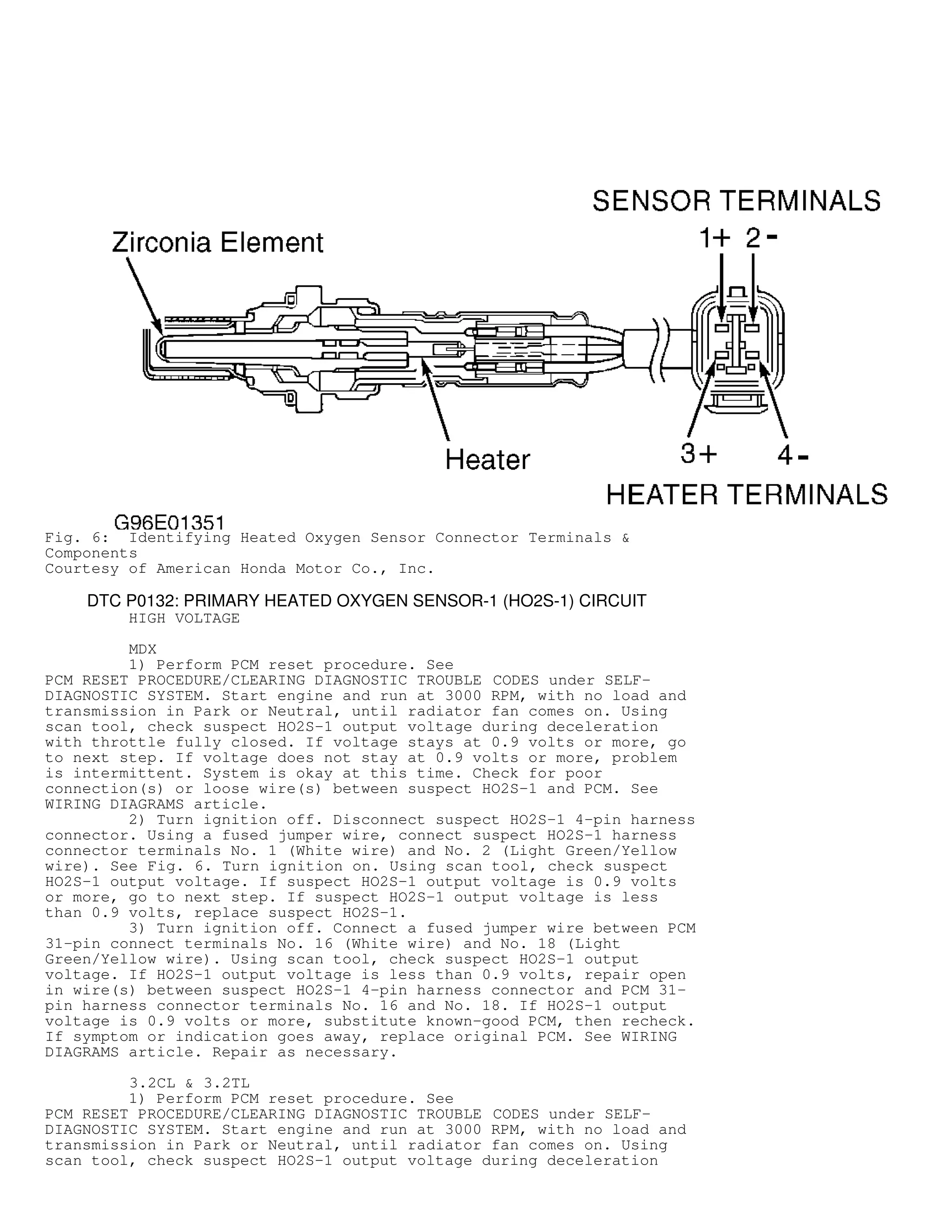
Fig. 6: Identifying Heated Oxygen Sensor Connector Terminals 
Components
Courtesy of American Honda Motor Co., Inc.
DTC P0132: PRIMARY HEATED OXYGEN SENSOR-1 (HO2S-1) CIRCUIT
HIGH VOLTAGE
MDX
1) Perform PCM reset procedure. See
PCM RESET PROCEDURE/CLEARING DIAGNOSTIC TROUBLE CODES under SELF-
DIAGNOSTIC SYSTEM. Start engine and run at 3000 RPM, with no load and
transmission in Park or Neutral, until radiator fan comes on. Using
scan tool, check suspect HO2S-1 output voltage during deceleration
with throttle fully closed. If voltage stays at 0.9 volts or more, go
to next step. If voltage does not stay at 0.9 volts or more, problem
is intermittent. System is okay at this time. Check for poor
connection(s) or loose wire(s) between suspect HO2S-1 and PCM. See
WIRING DIAGRAMS article.
2) Turn ignition off. Disconnect suspect HO2S-1 4-pin harness
connector. Using a fused jumper wire, connect suspect HO2S-1 harness
connector terminals No. 1 (White wire) and No. 2 (Light Green/Yellow
wire). See Fig. 6. Turn ignition on. Using scan tool, check suspect
HO2S-1 output voltage. If suspect HO2S-1 output voltage is 0.9 volts
or more, go to next step. If suspect HO2S-1 output voltage is less
than 0.9 volts, replace suspect HO2S-1.
3) Turn ignition off. Connect a fused jumper wire between PCM
31-pin connect terminals No. 16 (White wire) and No. 18 (Light
Green/Yellow wire). Using scan tool, check suspect HO2S-1 output
voltage. If HO2S-1 output voltage is less than 0.9 volts, repair open
in wire(s) between suspect HO2S-1 4-pin harness connector and PCM 31-
pin harness connector terminals No. 16 and No. 18. If HO2S-1 output
voltage is 0.9 volts or more, substitute known-good PCM, then recheck.
If symptom or indication goes away, replace original PCM. See WIRING
DIAGRAMS article. Repair as necessary.
3.2CL  3.2TL
1) Perform PCM reset procedure. See
PCM RESET PROCEDURE/CLEARING DIAGNOSTIC TROUBLE CODES under SELF-
DIAGNOSTIC SYSTEM. Start engine and run at 3000 RPM, with no load and
transmission in Park or Neutral, until radiator fan comes on. Using
scan tool, check suspect HO2S-1 output voltage during deceleration
with throttle fully closed. If voltage stays at 1.5 volts or more, go
to next step. If voltage is less than 1.5 volts, problem is
intermittent. System is okay at this time. Check for poor
connection(s) or loose wire(s) between suspect HO2S-1 and PCM. See
WIRING DIAGRAMS article.
2) Turn ignition off. Disconnect suspect HO2S-1 4-pin harness
connector. Using a fused jumper wire, connect suspect HO2S-1 harness
connector terminals No. 1 (White wire) and No. 2 (Green/Yellow wire).
See Fig. 6. Turn ignition on. Using scan tool, check suspect HO2S-1
output voltage. If suspect HO2S-1 output voltage is 1.5 volts or more,
go to next step. If suspect HO2S-1 output voltage is less than 1.5
volts, replace suspect HO2S-1.
3) Turn ignition off. Connect a fused jumper wire between PCM
31-pin connect terminals No. 16 (White wire) and No. 18 (Green/Yellow
wire). Using scan tool, check suspect HO2S-1 output voltage. If HO2S-1
output voltage is less than 1.5 volts, repair open in wire(s) between
suspect HO2S-1 4-pin harness connector and PCM 31-pin harness
connector terminals No. 16 and No. 18. If HO2S-1 output voltage is 1.5
volts or more, substitute known-good PCM, then recheck. If symptom or
indication goes away, replace original PCM. See WIRING DIAGRAMS
article. Repair as necessary.
DTC P0133: PRIMARY HEATED OXYGEN SENSOR-1 (HO2S-1) SLOW
RESPONSE
NOTE: Trouble shoot DTC P0131 and P0132, if present, before
proceeding.
1) Perform PCM reset procedure. See
PCM RESET PROCEDURE/CLEARING DIAGNOSTIC TROUBLE CODES under SELF-
DIAGNOSTIC SYSTEM. Start engine and run at 3000 RPM, with no load and
transmission in Park or Neutral, until radiator fan comes on. Using
scan tool, check for temporary DTC P0133. If DTC P0133 is present,
replace HO2S-1. If DTC P0133 is not present, go to next step.
2) Test drive vehicle at a constant 55 MPH, with transmission
in D4 position (D5 on MDX and 3.2CL models) until readiness code comes
on. If DTC P0133 sets, replace HO2S-1. If DTC P0133 does not set,
problem is intermittent. System is okay at this time. Check for poor
connection(s) or loose wire(s) between HO2S-1 4-pin harness connector
and PCM 31-pin harness connector. See WIRING DIAGRAMS article.
DTC P0135 OR P0141: HEATED OXYGEN SENSOR (HO2S) HEATER
CIRCUIT MALFUNCTION
MDX
1) Perform PCM reset procedure. See
PCM RESET PROCEDURE/CLEARING DIAGNOSTIC TROUBLE CODES under SELF-
DIAGNOSTIC SYSTEM. Start engine. If DTC P0135 or P0141 resets, go to
next step. If DTC P0135 or P0141 does not reset, problem is
intermittent. System is okay at this time. Check for poor
connection(s) or loose wire(s) between HO2S-1 or HO2S-2 and PCM.
2) Turn ignition off. Disconnect suspect HO2S 4-pin
connector. Measure resistance between HO2S terminals No. 3 and 4. See
Fig. 6. If suspect HO2S heater resistance is 10-40 ohms, go to next
step. If resistance is not as specified, replace suspect HO2S. See
WIRING DIAGRAMS article.
3) Check for continuity between ground and suspect HO2S 4-pin
connector terminals No. 3 and 4. If continuity is not present, go to
next step. If continuity is present, replace HO2S.
4) Turn ignition on. Measure voltage between suspect HO2S 4-
pin harness connector terminals No. 3 and No. 4. If battery voltage is
present, go to next step. If battery voltage is not present, go to
step 6)
5) Turn ignition off. Disconnect PCM 31-pin harness connector
and PCM 32-pin harness connector. Check continuity between ground and
PCM 31-pin harness connector terminal No. 1 (Black/White wire), or
between ground and PCM 32-pin harness connector terminal No. 8
(Black/White wire). If continuity is present, repair short in
Black/White wire(s) between suspect PCM harness connectors and HO2S 4-
pin harness connector. If continuity is not present, substitute known-
good PCM, then recheck. If symptom or indication goes away, replace
original PCM. See WIRING DIAGRAMS article. Repair as necessary.
6) Turn ignition on. Measure voltage between suspect HO2S 4-
pin harness connector terminal No. 4 (Black/Yellow wire) and ground.
See Fig. 6. If battery voltage is present, go to next step. If battery
voltage is not present, repair open in Black/Yellow wire between fuse
No. 6 (15-amp) in underdash fuse/relay box and suspect HO2S 4-pin
harness connector.
7) Turn ignition off. Reconnect HO2S 4-pin connector.
Disconnect PCM 31-pin harness connector (HO2S-1) or PCM 32-pin harness
connector (HO2S-2). Turn ignition on. Measure voltage between PCM 25-
pin harness connector terminal No. 2 and PCM 31-pin harness connector
terminal No. 1 (Black/White wire) and between PCM 25-pin harness
connector terminal No. 2 and PCM 32-pin harness connector terminal No.
8 (Black/White wire). If battery voltage is present, repair open in
Black/White wire(s) between suspect PCM and HO2S harness connectors.
If battery voltage is not present, substitute known-good PCM, then
recheck. If symptom or indication goes away, replace original PCM. See
WIRING DIAGRAMS article. Repair as necessary.
3.2CL  3.2TL
1) Perform PCM reset procedure. See
PCM RESET PROCEDURE/CLEARING DIAGNOSTIC TROUBLE CODES under SELF-
DIAGNOSTIC SYSTEM. Start engine. If DTC P0135 or P0141 resets, go to
next step. If DTC P0135 or P0141 does not reset, problem is
intermittent. System is okay at this time. Check for poor
connection(s) or loose wire(s) between HO2S-1 or HO2S-2 and PCM.
2) Turn ignition off. Disconnect suspect HO2S 4-pin
connector. Measure resistance between HO2S terminals No. 3 and 4. See
Fig. 6. If suspect HO2S heater resistance is 10-40 ohms, go to next
step. If resistance is not as specified, replace suspect HO2S. See
WIRING DIAGRAMS article.
3) Check for continuity between ground and suspect HO2S 4-pin
connector terminals No. 3 and 4. If continuity is not present, go to
next step. If continuity is present, replace HO2S.
4) Start engine. Measure voltage between suspect HO2S 4-pin
harness connector terminal No. 4 (Black/Yellow wire) and ground. See
Fig. 6. If battery voltage is present, go to next step. If battery
voltage is not present, repair open in wiring between fuse No. 6 (15-
amp) in underdash fuse/relay box and HO2S 4-pin harness connector. See
WIRING DIAGRAMS article.
5) Turn ignition off. Check continuity between HO2S 4-pin
harness connector terminal No. 3 (Black/White wire) and ground. If
continuity is not present, go to next step. If continuity is present,
disconnect PCM 31-pin harness connector (HO2S-1) or 32-pin PCM harness
connector (HO2S-2). Check continuity between HO2S 4-pin harness
connector terminal No. 3 (black/White wire) and ground. If continuity
is present, repair short in Black/White wire(s) between suspect PCM
and H02S harness connectors. If continuity is not present, substitute
known-good PCM, then recheck. If symptom or indication goes away,
replace original PCM.
6) Reconnect HO2S 4-pin connector. Disconnect PCM 31-pin
harness connector (HO2S-1) or PCM 32-pin harness connector (HO2S-2).
Turn ignition on. Measure voltage between PCM 31-pin harness connector
terminal No. 1 (Black/White wire) and ground (HO2S-1), or between PCM
32-pin harness connector terminal No. 8 (Black/White wire) and ground
(HO2S-2). If battery voltage is not present, repair open in
Black/White wire(s) between suspect PCM and HO2S harness connectors.
If battery voltage is present, substitute known-good PCM, then
recheck. If symptom or indication goes away, replace original PCM. See
WIRING DIAGRAMS article. Repair as necessary.
DTC P0137: SECONDARY HEATED OXYGEN SENSOR-2 (HO2S-2) LOW
VOLTAGE
1) Perform PCM reset procedure. See
PCM RESET PROCEDURE/CLEARING DIAGNOSTIC TROUBLE CODES under SELF-
DIAGNOSTIC SYSTEM. Start engine and run at 3000 RPM, with no load and
transmission in Park or Neutral, until radiator fan comes on. Using
scan tool, check HO2S-2 output data with engine running at 3000 RPM.
If voltage stays at 0.3 volt or less, go to next step. If reading is
more than 0.3 volt, problem is intermittent, system is okay at this
time. Check for poor connection(s) in wire(s) between HO2S-2 4-pin
harness connector, and PCM 32-pin harness connector.
2) Turn ignition off. Disconnect HO2S-2 4-pin connector.
Start engine. Using scan tool, check HO2S-2 output data. If voltage
stays at 0.3 volts or less, go to next step. If voltage does not stay
at 0.3 volts or less, replace HO2S-2.
3) Turn ignition off. Disconnect PCM 32-pin harness
connector. See Fig. 4. Check for continuity between ground and HO2S-2
harness 4-pin harness connector terminal No. 2 (White/Red wire). See
Fig. 6. If continuity is present, repair short in White/Red wire
between HO2S-2 4-pin harness connector terminal No. 2 and PCM 32-pin
harness connector terminal No. 1. If continuity is not present,
substitute known-good PCM, then recheck. If symptom or DTC goes away,
replace original PCM. See WIRING DIAGRAMS article. Repair as
necessary.
DTC P0138: SECONDARY HEATED OXYGEN SENSOR-2 (HO2S-2) HIGH
VOLTAGE
MDX
1) Perform PCM reset procedure. See
PCM RESET PROCEDURE/CLEARING DIAGNOSTIC TROUBLE CODES under SELF-
DIAGNOSTIC SYSTEM. Start engine and run at 3000 RPM, with no load and
transmission in Park or Neutral, until radiator fan comes on. Using
scan tool, check HO2S-2 output data with engine running at 3000 RPM.
If voltage stays at 0.8 volts (1.0 volts on MDX) or more, go to next
step. If reading is less than 1.0 volts, problem is intermittent.
System is okay at this time. Check for poor connection(s) or loose
wire(s) between HO2S-2 4-pin harness connector and PCM 32-pin harness
connector.
2) Turn ignition off. Disconnect HO2S-2 4-pin connector.
Connect fused jumper wire between HO2S-2 4-pin harness connector
terminals No. 1 (Green/Black wire) and No. 2 (White/Red wire). See
Fig. 6. See WIRING DIAGRAMS article. Repair as necessary. Turn
ignition on. Using scan tool, check HO2S-2 output data. If reading is
1.0 volts or more, go to next step. If reading is less than 1.0 volts,
replace HO2S-2.
3) Turn ignition off. Remove fused jumper wire from HO2S-2
harness connector. Connect fused jumper wire between PCM 31-pin
harness connector terminal No. 1 (White/Red wire) and PCM 32-pin
harness connector terminal No. 18 (Light Green/Yellow wire). Using
scan tool, check HO2S-2 output data. If reading is less than 1.0
volts, repair open in wiring between appropriate PCM and HO2S-2
harness connectors. If reading 1.0 volts or more, substitute known-
good PCM, then recheck. If symptom or indication goes away, replace
original PCM.
3.2CL  3.2TL
1) Perform PCM reset procedure. See
PCM RESET PROCEDURE/CLEARING DIAGNOSTIC TROUBLE CODES under SELF-
DIAGNOSTIC SYSTEM. Start engine and run at 3000 RPM, with no load and
transmission in Park or Neutral, until radiator fan comes on. Using
scan tool, check HO2S-2 output data with engine running at 3000 RPM.
If voltage stays at 0.8 volts or more, go to next step. If reading is
less than 0.8 volts, problem is intermittent. System is okay at this
time. Check for poor connection(s) or loose wire(s) between HO2S-2 4-
pin harness connector and PCM 32-pin harness connector.
2) Turn ignition off. Disconnect HO2S-2 4-pin connector.
Connect fused jumper wire between HO2S-2 4-pin harness connector
terminals No. 1 (Green/Yellow wire) and No. 2 (White/Red wire). See
Fig. 6. See WIRING DIAGRAMS article. Repair as necessary. Turn
ignition on. Using scan tool, check HO2S-2 output data. If reading is
0.8 volts or more, go to next step. If reading is less than 0.8 volts,
replace HO2S-2.
3) Turn ignition off. Remove fused jumper wire from HO2S-2
harness connector. Connect fused jumper wire between PCM 31-pin
harness connector terminal No. 1 (White/Red wire) and PCM 32-pin
harness connector terminal No. 18 (Green/Yellow wire). Using scan
tool, check HO2S-2 output data. If reading is less than 0.8 volts,
repair open in wiring between appropriate PCM and HO2S-2 harness
connectors. If reading is 0.8 volts or more, substitute known-good
PCM, then recheck. If symptom or indication goes away, replace
original PCM.
DTC P0139: SECONDARY HEATED OXYGEN SENSOR-2 (HO2S-2) SLOW
RESPONSE
1) Perform PCM reset procedure. See
PCM RESET PROCEDURE/CLEARING DIAGNOSTIC TROUBLE CODES under SELF-
DIAGNOSTIC SYSTEM. Start engine and run at 3000 RPM, with no load and
transmission in Park or Neutral, until radiator fan comes on.
2) Using scan tool, check HO2S-2 output data while running
engine at 3000 RPM. If voltage stays within 0.3-0.8 volts for 2
minutes, replace HO2S-2. If voltage does not stay within 0.3-0.8 volts
for 2 minutes, problem is intermittent. System is okay at this time.
Check for poor connection(s) or loose wire(s) between HO2S-2 4-pin
harness connector and PCM 32-pin harness connector. See WIRING
DIAGRAMS article.
DTC P0171 OR P0172: FUEL SYSTEM IS TOO LEAN OR TOO RICH
NOTE: Trouble shoot DTC P0107, P0108, P0135, P0137, P0138, P0141,
P0401, P1128, P1129, P1259, P1491 or P1498, if set, before
proceeding.
1) Check fuel pressure. See FUEL SYSTEM in BASIC DIAGNOSTIC
PROCEDURES article. If fuel pressure is okay, go to next step. If fuel
pressure is too high, check fuel pressure regulator and fuel return
line. Repair as necessary. If fuel pressure is too low, check fuel
pump, fuel feed line, fuel filter and fuel pressure regulator. Repair
as necessary.
2) Start engine and run at 3000 RPM, with no load and
transmission in Park or Neutral, until radiator fan comes on. Using
scan tool, check HO2S-1 output data. If voltage stays at less than 0.3
volts or more than 0.6 volts, replace HO2S-1. If voltage does not stay
at less than 0.3 volts or more than 0.6 volts, go to next step.
3) Turn ignition off. Using a vacuum pump, apply vacuum to
intake manifold side of EVAP purge control solenoid valve. If EVAP
purge control solenoid valve holds vacuum, check valve clearances.
Adjust valves as necessary. If valve clearances are okay, replace fuel
injectors. If EVAP purge control solenoid valve does not hold vacuum,
replace EVAP purge control solenoid valve.
DTC P0300 SET WITH DTC P0301, P0302, P0303, P0304, P0305 OR
P0306: RANDOM MISFIRE
NOTE: If misfire is in one cylinder only, see
DTC P0301, P0302, P0303, P0304, P0305 OR P0306: MISFIRE IN
ONE CYLINDER.
NOTE: If DTCs P0107, P0108, P0131, P0132, P0171, P0172, P0401,
P0505, P1128, P1129, P1259, P1361, P1362, P1366, P1367,
P1491, P1498 and/or P1519 is set, trouble shoot those DTCs
before trouble shooting random misfire DTCs.
1) If DTC P0300 is set with DTC P0301, P0302, P0303, P0304,
P0305 or P0306, test drive vehicle. Based on misfire conditions, test
vehicle in order listed. For random misfire only at low RPM and under
load, check for:
* Insufficient fuel pump flow or pressure.
* Low engine compression.
* Poor fuel octane level quality.
For random misfire only during acceleration, check for:
* Insufficient fuel pump flow or pressure.
* Ignition coil malfunction.
* VTEC system malfunction.
For random misfire only during high RPM, under load, or under
random conditions, check for:
* Insufficient fuel pump flow or pressure.
* Ignition coil malfunction.
* Incorrect valve clearance.
Repair as necessary.
2) If misfire is intermittent or does not recur during test
drive, check for improper fuel octane level (less than specification),
or carbon deposits on spark plugs.
DTC P0301, P0302, P0303, P0304, P0305 OR P0306: MISFIRE IN
ONE CYLINDER
NOTE: If misfire is random, see
DTC P0300 SET WITH DTC P0301, P0302, P0303, P0304,
P0305 OR P0306: RANDOM MISFIRE.
NOTE: If DTCs P0131, P0132, P0171, P0172, P0401, P1361, P1362,
P1366 and/or P1367 is set, trouble shoot those DTCs before
trouble shooting random misfire DTCs.
MDX
1) Remove intake manifold cover and ignition coil cover.
Check and record freeze frame data. Perform PCM reset procedure and
clear DTC(s). See PCM RESET PROCEDURE/CLEARING DIAGNOSTIC TROUBLE
CODES under SELF-DIAGNOSTIC SYSTEM. Start engine and listen for
clicking sound at fuel injector in suspect cylinder. If injector
clicks, go to next step. If injector does not click, check for open or
short in harness between suspect fuel injector and PCM. See WIRING
DIAGRAMS article. If click is heard, go to next step. If click is not
heard, go to step
2) Turn ignition off and reset PCM. See
PCM RESET PROCEDURE/CLEARING DIAGNOSTIC TROUBLE CODES under SELF-
DIAGNOSTIC SYSTEM. Remove ignition coil cover. Exchange ignition coil
from suspect cylinder with one from another cylinder. Let engine idle
for two minutes. Test drive vehicle several times in freeze frame data
range. If DTCs P0301, P0302, P0303, P0304, P0305, P0306 or temporary
DTC P1399 are set, go to next step. If DTCs P0301, P0302, P0303,
P0304, P0305, P0306 or temporary DTC P1399 are not set, problem is
intermittent, possibly due to ignition coil fouling. If misfire
followed ignition coil that was exchanged, replace ignition coil. If
misfire stayed in same cylinder, go to next step.
3) Turn ignition off and reset PCM. See
PCM RESET PROCEDURE/CLEARING DIAGNOSTIC TROUBLE CODES under SELF-
DIAGNOSTIC SYSTEM. Exchange spark plug from suspect cylinder with one
from another cylinder. Connect scan tool. Test drive vehicle several
times in freeze frame data range. If there is no freeze frame data of
misfiring, test drive vehicle under various conditions and try to
duplicate malfunction. If DTCs P0301, P0302, P0303, P0304, P0305,
P0306 or temporary DTC P1399 are set, go to next step. If DTCs P0301,
P0302, P0303, P0304, P0305, P0306 or temporary DTC P1399 are not set,
problem is intermittent, possibly due to fouling spark plug. Misfire
is not detected at this time. If misfire follows spark plug to
different cylinder, replace spark plug. If misfire remains in same
cylinder, go to next step.
4) Turn ignition off and reset PCM. See
PCM RESET PROCEDURE/CLEARING DIAGNOSTIC TROUBLE CODES under SELF-
DIAGNOSTIC SYSTEM. Exchange fuel injector from suspect cylinder with
one from another cylinder. Let engine idle for 2 minutes. Test drive
vehicle several times in freeze frame data range. If there is no
freeze frame data of misfiring, test drive vehicle under various
conditions and try to duplicate malfunction. If DTC P0301, P0302,
P0303, P0304, P0305 or P0306 is not indicated, go to next step.
Possible intermittent fuel injector poor connection. If DTCs are
detected, replace faulty fuel injector. If misfire remains in same
cylinder, check engine compression.
5) Turn ignition off. Turn ignition off. Disconnect ignition
coil 3-pin connector from suspect cylinder. See Fig. 7. Turn ignition
back on. Measure voltage in Black/Yellow wire between ground and
ignition coil 3-pin harness connector terminal No. 3. If voltage is
present go to next step. If voltage is not present, repair open or
short in Black/Yellow wire between ignition coil 3-pin harness
connector terminal No. 3 and fuse No. 11 (15-amp) in underdash
fuse/relay box. See WIRING DIAGRAMS article. Repair as necessary.
6) Turn ignition off. Check for continuity between ground and
ignition coil 3-pin harness connector terminal No. 2 (Black wire). See
Fig. 7. If continuity is present, go to next step. If continuity is
not present, repair open in Black wire between ground and ignition
coil 3-pin harness connector terminal No. 2.
7) Disconnect PCM 31-pin connector. Check for continuity
between ground and PCM 31-pin connector terminal(s). See
DTC/PCM 31-PIN TERMINAL IDENTIFICATION table. If no continuity is
present, go to next step. If continuity is present, repair short in
wire between PCM 31-pin harness connector and ignition coil 3-pin
harness connector.
8) Reconnect PCM 31-pin harness connector. Connect fused
jumper wire between ground and suspect ignition coil 3-pin harness
connector terminal No. 1. See Fig. 7. See
DTC/IGNITION COIL TERMINAL IDENTIFICATION table. Check for continuity
between ground and PCM 31-pin harness connector terminal(s). See
DTC/PCM 31-PIN TERMINAL IDENTIFICATION table. If continuity is
present, go to next step. If continuity is not present, repair open
wire between PCM 31-pin harness connector and ignition coil 3-pin
harness connector. See WIRING DIAGRAMS article. Repair as necessary.
9) Check engine compression. If compression is okay,
substitute known-good PCM, then recheck. If symptom or indication goes
away, replace original PCM. Repair as necessary.
10) Disconnect fuel injector 2-pin connector on suspect
cylinder. Measure resistance between fuel injector terminals No. 1 and
No. 2. If resistance reading is 13-15 ohms, go to next step. If
resistance reading is not 13-15 ohms, replace fuel injector.
11) Exchange fuel injector from suspect cylinder with one
from another cylinder. Let engine idle for 2 minutes. Test drive
vehicle several times in freeze frame data range. If there is no
freeze frame data of misfiring, test drive vehicle under various
conditions and try to duplicate malfunction.
12) If DTC P0301, P0302, P0303, P0304, P0305 or P0306 is not
indicated, misfire condition is not detected at this time. Possible
intermittent fuel injector poor connection. If misfire follows
injector to another cylinder, replace faulty fuel injector. If misfire
remains in same cylinder, check engine compression. Repair as
necessary. If compression is okay, substitute known-good PCM, then
recheck. If symptom or indication goes away, replace original PCM.
13) Turn ignition off. Disconnect fuel injector 2-pin
connector from suspect cylinder. Measure voltage between ground and
fuel injector 2-pin connector terminal No. 1 (Yellow/Black wire). If
battery voltage is present, go to next step. If battery voltage is not
present, check for open in harness between PGM-FI main relay and fuel
injector 2-pin harness connector. See WIRING DIAGRAMS article. Repair
as necessary.
14) Turn ignition off. Check continuity between ground and
PCM 25-pin harness connector terminal(s). See
DTC/PCM 25-PIN TERMINAL IDENTIFICATION table. If continuity is not
present, go to next step. If continuity is present, repair short in
wiring between PCM 25-pin harness connector and fuel injector 2-pin
harness connector.
15) Connect fused jumper wire between ground and fuel
injector 2-pin harness connector terminal No. 2. See
DTC/FUEL INJECTOR TERMINAL IDENTIFICATION table. Check for continuity
between ground and PCM 25-pin harness connector(s). See
DTC/PCM 25-PIN TERMINAL IDENTIFICATION table. If continuity is
present, replace fuel injector. If continuity is not present, repair
open wire between PCM 25-pin harness connector and fuel injector 2-pin
harness connector terminal No. 2.
3.2CL  3.2TL
1) Start engine and listen for clicking sound at fuel
injector in suspect cylinder. If injector clicks, go to next step. If
injector does not click, check for open or short in harness between
suspect fuel injector and PCM. See WIRING DIAGRAMS article. If wiring
is okay, replace fuel injector, and recheck. If symptom or DTC is
gone, replace original fuel injector. If DTC resets, substitute known-
good PCM and recheck. If symptom or DTC is gone, replace original PCM.
2) Check and record freeze frame data. Perform PCM reset
procedure and clear DTC(s). See
PCM RESET PROCEDURE/CLEARING DIAGNOSTIC TROUBLE CODES under SELF-
DIAGNOSTIC SYSTEM. Exchange spark plug from suspect cylinder with one
from another cylinder. Connect scan tool. Test drive vehicle several
times in freeze frame data range. If there is no freeze frame data of
misfiring, test drive vehicle under various conditions and try to
duplicate malfunction. If DTCs P0301, P0302, P0303, P0304, P0305,
P0306 or temporary DTC P1399 are set, go to next step. If DTCs P0301,
P0302, P0303, P0304, P0305, P0306 or temporary DTC P1399 are not set,
problem is intermittent, possibly due to fouling spark plug. Misfire
is not detected at this time. If misfire follows spark plug to
different cylinder, replace spark plug. If misfire remains in same
cylinder, go to next step.
3) Remove ignition coil cover. Exchange ignition coil from
suspect cylinder with one from another cylinder. Let engine idle for
two minutes. Test drive vehicle several times in freeze frame data
range. If DTCs P0301, P0302, P0303, P0304, P0305, P0306 or temporary
DTC P1399 are set, go to next step. If DTCs P0301, P0302, P0303,
P0304, P0305, P0306 or temporary DTC P1399 are not set, problem is
intermittent, possibly due to ignition coil fouling. If misfire
followed ignition coil that was exchanged, replace ignition coil. If
misfire stayed in same cylinder, go to next step.
4) Turn ignition off. Disconnect ignition coil 3-pin
connector from suspect cylinder. See Fig. 7. Turn ignition back on.
Measure voltage in Black/Yellow wire between ground and ignition coil
3-pin harness connector terminal No. 3. If voltage is present go to
next step. If voltage is not present, repair open or short in
Black/Yellow wire between ignition coil 3-pin harness connector
terminal No. 3 and fuse No. 11 (15-amp) in underdash fuse/relay box.
See WIRING DIAGRAMS article. Repair as necessary.
Fig. 7: Identifying 3-Pin Ignition Coil Connector
Courtesy of American Honda Motor Co., Inc.
5) Turn ignition off. Check for continuity between ground and
ignition coil 3-pin harness connector terminal No. 2 (Black wire). See
Fig. 7. If continuity is present, go to next step. If continuity is
not present, repair open in Black wire between ground and ignition
coil 3-pin harness connector terminal No. 2.
6) Disconnect PCM 31-pin connector. Check for continuity
between ground and PCM 31-pin connector terminal(s). See
DTC/PCM 31-PIN TERMINAL IDENTIFICATION table. If no continuity is
present, go to next step. If continuity is present, repair short in
wire between PCM 31-pin harness connector and ignition coil 3-pin
harness connector.
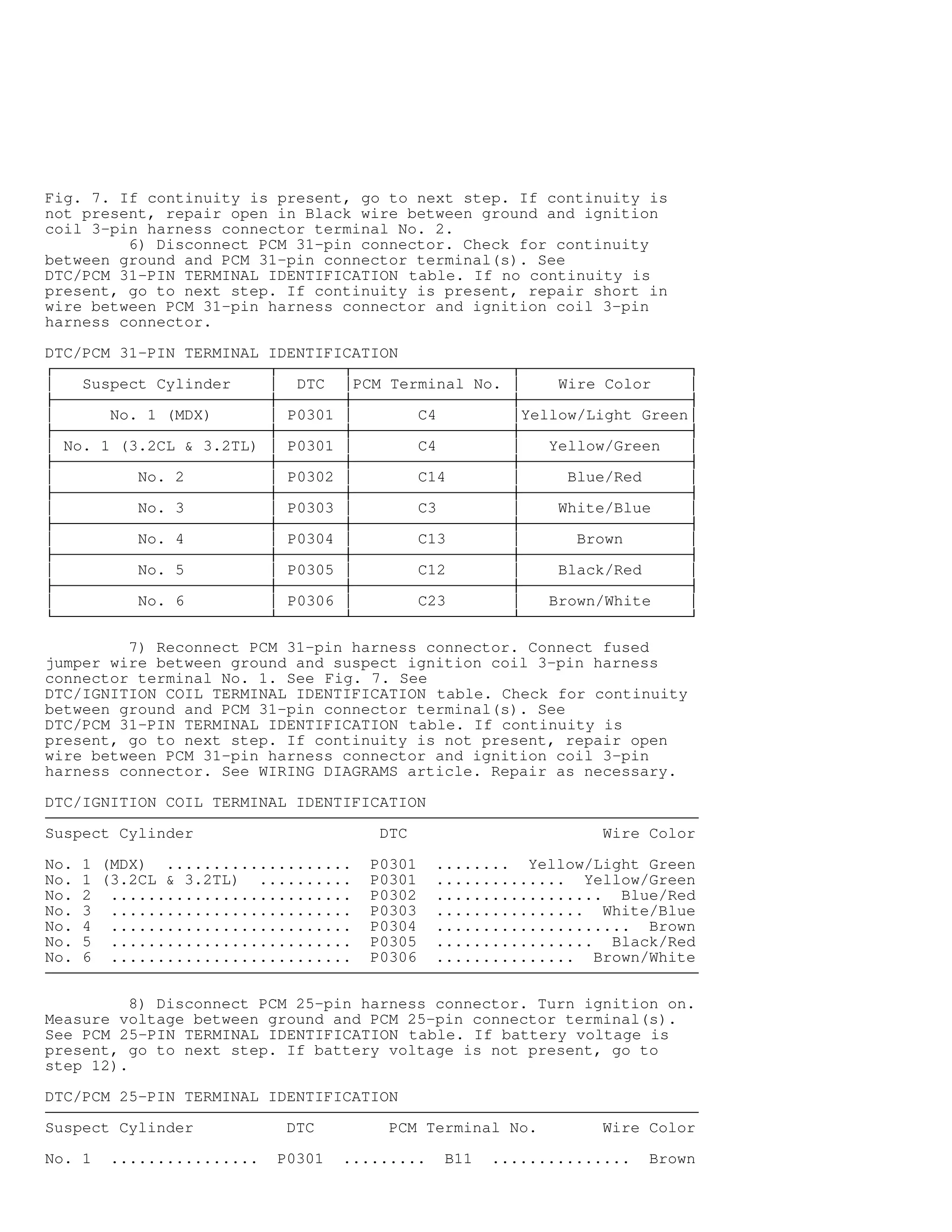
DTC/PCM 31-PIN TERMINAL IDENTIFICATION


Suspect Cylinder

DTC

PCM Terminal No.

Wire Color


No. 1 (MDX)

P0301

C4

Yellow/Light Green


No. 1 (3.2CL  3.2TL)

P0301

C4

Yellow/Green


No. 2

P0302

C14

Blue/Red


No. 3

P0303

C3

White/Blue


No. 4

P0304

C13

Brown


No. 5

P0305

C12

Black/Red


No. 6

P0306

C23

Brown/White


7) Reconnect PCM 31-pin harness connector. Connect fused
jumper wire between ground and suspect ignition coil 3-pin harness
connector terminal No. 1. See Fig. 7. See
DTC/IGNITION COIL TERMINAL IDENTIFICATION table. Check for continuity
between ground and PCM 31-pin connector terminal(s). See
DTC/PCM 31-PIN TERMINAL IDENTIFICATION table. If continuity is
present, go to next step. If continuity is not present, repair open
wire between PCM 31-pin harness connector and ignition coil 3-pin
harness connector. See WIRING DIAGRAMS article. Repair as necessary.
DTC/IGNITION COIL TERMINAL IDENTIFICATION

Suspect Cylinder DTC Wire Color
No. 1 (MDX) .................... P0301 ........ Yellow/Light Green
No. 1 (3.2CL  3.2TL) .......... P0301 .............. Yellow/Green
No. 2 .......................... P0302 .................. Blue/Red
No. 3 .......................... P0303 ................ White/Blue
No. 4 .......................... P0304 ..................... Brown
No. 5 .......................... P0305 ................. Black/Red
No. 6 .......................... P0306 ............... Brown/White

8) Disconnect PCM 25-pin harness connector. Turn ignition on.
Measure voltage between ground and PCM 25-pin connector terminal(s).
See PCM 25-PIN TERMINAL IDENTIFICATION table. If battery voltage is
present, go to next step. If battery voltage is not present, go to
step 12).
DTC/PCM 25-PIN TERMINAL IDENTIFICATION

Suspect Cylinder DTC PCM Terminal No. Wire Color
No. 1 ................ P0301 ......... B11 ............... Brown
No. 2 ................ P0302 .......... B5 ................. Red
No. 3 ................ P0303 ......... B15 ................ Blue
No. 4 ................ P0304 .......... B4 .............. Yellow
No. 5 ................ P0305 .......... B3 ........... Black/Red
No. 6 ................ P0306 .......... B6 .......... White/Blue

9) Disconnect fuel injector 2-pin connector on suspect
cylinder. Measure resistance between fuel injector terminals No. 1 and
No. 2. If resistance reading is 10-13 ohms, go to next step. If
resistance reading is not 10-13 ohms, replace fuel injector.
10) Exchange fuel injector from suspect cylinder with one
from another cylinder. Let engine idle for 2 minutes. Test drive
vehicle several times in freeze frame data range. If there is no
freeze frame data of misfiring, test drive vehicle under various
conditions and try to duplicate malfunction.
11) If DTC P0301, P0302, P0303, P0304, P0305 or P0306 is not
indicated, misfire condition is not detected at this time. Possible
intermittent fuel injector poor connection. If misfire follows
injector to another cylinder, replace faulty fuel injector. If misfire
remains in same cylinder, check engine compression. Repair as
necessary. If compression is okay, substitute known-good PCM, then
recheck. If symptom or indication goes away, replace original PCM.
12) Turn ignition off. Disconnect fuel injector 2-pin
connector from suspect cylinder. Measure voltage between ground and
fuel injector 2-pin connector terminal No. 1 (Yellow/Black wire). If
battery voltage is present, go to next step. If battery voltage is not
present, check for open in harness between PGM-FI main relay and fuel
injector 2-pin harness connector. See WIRING DIAGRAMS article. Repair
as necessary.
13) Turn ignition off. Check continuity between ground and
PCM 25-pin harness connector terminal(s). See
DTC/PCM 25-PIN TERMINAL IDENTIFICATION table. If continuity is not
present, go to next step. If continuity is present, repair short in
wiring between PCM 25-pin harness connector and fuel injector 2-pin
harness connector.
14) Connect fused jumper wire between ground and fuel
injector 2-pin harness connector terminal No. 2. See
DTC/FUEL INJECTOR TERMINAL IDENTIFICATION table. Check for continuity
between ground and PCM 25-pin harness connector(s). See
DTC/PCM 25-PIN TERMINAL IDENTIFICATION table. If continuity is
present, replace fuel injector. If continuity is not present, repair
open wire between PCM 25-pin harness connector and fuel injector 2-pin
harness connector terminal No. 2.
DTC/FUEL INJECTOR TERMINAL IDENTIFICATION

Suspect Cylinder DTC Wire Color
No. 1 ........................... P0301 ................... Brown
No. 2 ........................... P0302 ..................... Red
No. 3 ........................... P0303 .................... Blue
No. 4 ........................... P0304 .................. Yellow
No. 5 ........................... P0305 ............... Black/Red
No. 6 ........................... P0306 .............. White/Blue

DTC P0325: KNOCK SENSOR (KS) CIRCUIT MALFUNCTION
1) Perform PCM reset procedure. See
PCM RESET PROCEDURE/CLEARING DIAGNOSTIC TROUBLE CODES under SELF-
DIAGNOSTIC SYSTEM. Start engine and run at 3000 RPM, with no load and
transmission in Park or Neutral, until radiator fan comes on. Allow
engine to idle. Hold engine speed at 3000-4000 RPM for 60 seconds. If
DTC P0325 resets, go to next step. If DTC P0325 does not reset,
problem is intermittent. System is okay at this time. Check for poor
connection(s) or loose wire(s) between PCM 31-pin harness connector
and knock sensor harness connector. See WIRING DIAGRAMS article.
Repair as necessary.
2) Turn ignition off. Disconnect KS harness connector. Check
for continuity between ground and PCM 31-pin harness connector
terminal No. 22 (Red/Blue wire). See Fig. 4. If continuity does not
exist, go to next step. If continuity exists, repair short in RED/BLUE
wire between PCM 31-pin harness connector terminal No. 22. knock
sensor harness connector.
3) Connect fused jumper wire between ground and knock sensor
harness connector. Check for continuity in Red/Blue wire between
ground and PCM 31-pin harness connector terminal No. 22. If continuity
exists, go to next step. If continuity does not exist, repair open in
RED/BLUE wire between PCM 31-pin harness connector terminal No. 22 and
knock sensor harness connector.
4) Check knock sensor and knock sensor sub-harness for open
or short. If okay, substitute known-good knock sensor and recheck. If
DTC does not reset, replace original knock sensor and knock sensor
sub-harness. If DTC resets, substitute known-good PCM and recheck. If
symptom or DTC goes away, replace original PCM.
DTC P0335 OR P0336: CRANKSHAFT POSITION (CKP) SENSOR
MALFUNCTION
1) Perform PCM reset procedure. See
PCM RESET PROCEDURE/CLEARING DIAGNOSTIC TROUBLE CODES under SELF-
DIAGNOSTIC SYSTEM. Start engine. If DTCs P0335 or P0336 reset, go to
next step. If DTCs do not reset, problem is intermittent. System is
okay at this time. Check for poor connection(s) or loose wire(s)
between CKP/CYP sensor and PCM. Repair as necessary.
2) Turn ignition off. Disconnect CKP sensor 2-pin connector.
Measure resistance between sensor terminals No. and No. 2. If 1850-
2450 ohms are present, go to next step. If 1850-2450 ohms are not
present, replace CKP sensor.
3) Check for continuity between ground and each CKP sensor 2-
pin connector terminals No. 1 and No. 2. If continuity is not present,
go to next step. If continuity is present, replace CKP sensor.
4) Reconnect CKP sensor 2-pin connector. Disconnect PCM 31-
pin harness connector. Measure resistance between PCM 31-pin harness
connector terminals No. 8 (Blue wire) and No. 9 (White wire). If 1850-
2450 ohms are present, go to next step. If 1850-2450 ohms are not
present, repair open in wiring between PCM 31-pin harness connector
terminals No. 8 (Blue wire) and No. 9 (White wire) and CKP sensor 2-
pin harness connector. See WIRING DIAGRAMS article. Repair as
necessary.
5) Check continuity between ground and PCM 31-pin harness
connector terminal No. 8 (Blue wire). If continuity exists, repair
short in BLUE wire between PCM 31-pin harness connector terminal No. 8
and CKP sensor 2-pin harness connector. If continuity is not present,
substitute known-good PCM, then recheck. If symptom or DTC goes away,
replace original PCM.
DTC P0401: EGR SYSTEM - INSUFFICIENT FLOW DETECTED
MDX
Record freeze frame data using scan tool. Check EGR VLS
voltage in freeze frame data list. If 3.0 volts is present, clean
intake manifold port and passage between EGR valve and intake manifold
with carburetor cleaner. If 3.0 volts is not present, check for loose
or poor connection(s) at EGR valve 6-pin harness connector. If okay,
replace EGR valve.
3.2CL  3.2TL
1) Perform PCM reset procedure. See
PCM RESET PROCEDURE/CLEARING DIAGNOSTIC TROUBLE CODES under SELF-
DIAGNOSTIC SYSTEM. Connect scan tool. Test drive vehicle with no
electrical load. Decelerate gradually from 55 MPH for at least 5
seconds. If DTC P0401 does not reset, go to next step. If DTC P0401
resets, clean intake manifold EGR port and EGR passage with carburetor
cleaner. Clean passage inside EGR valve with carburetor cleaner, or
replace EGR valve.
2) Turn ignition off. Disconnect EGR valve 6-pin connector.
Using fused jumper wire, connect positive battery terminal to EGR
valve 6-pin connector terminal No. 4 (Blue/Red wire). See Fig. 8. See
WIRING DIAGRAMS article. Repair as necessary. Start and idle engine.
Using fused jumper wire connect negative battery terminal to EGR valve
6-pin connector terminal No. 6 (Black wire). If engine stalls or runs
rough, problem is intermittent. System is okay at this time. If engine
does not stall or run rough, clean intake manifold EGR port and EGR
passage with carburetor cleaner. Clean passage inside EGR valve with
carburetor cleaner, or replace EGR valve.
Fig. 8: Identifying EGR Sensor Connector Terminals
Courtesy of American Honda Motor Co., Inc.
DTC P0420: CATALYST SYSTEM - EFFICIENCY BELOW THRESHOLD
NOTE: Trouble shoot DTC P0137, P0138 or P0141, if set, before
proceeding.
MDX
1) Perform PCM reset procedure. See
PCM RESET PROCEDURE/CLEARING DIAGNOSTIC TROUBLE CODES under SELF-
DIAGNOSTIC SYSTEM. Start engine and run at 3000 RPM, with no load and
transmission in Park or Neutral, until radiator fan comes on. Drive
about 10 minutes on highway without stopping. Speed can vary. With
transmission in D5 position, drive at steady speed between 50-62 MPH
for 30 seconds. Repeat three times, closing throttle completely for 1-
2 seconds between each repetition. If engine is stopped during this
part of procedure, start over with road test.
2) Check for temporary DTCs with scan tool. If DTC P0420 is
indicated, check three way catalytic converter (TWC). Replace if
necessary. If temporary DTC P0420 is not indicated, check for
readiness completion. If readiness code is complete, it was an
intermittent failure, system is okay at this time. If readiness code
is incomplete, repeat step one.
3.2CL  3.2TL
1) Perform PCM reset procedure. See PCM
PCM RESET PROCEDURE/CLEARING DIAGNOSTIC TROUBLE CODES under SELF-
DIAGNOSTIC SYSTEM. Start engine and run at 3000 RPM, with no load and
transmission in Park or Neutral, until radiator fan comes on.
2) Connect scan tool to vehicle. Test drive vehicle at 40-55
MPH for at least 2 minutes. Decelerate with throttle completely closed
for at least 3 seconds. Reduce speed to 35 MPH and try to hold until
scan tool indicates FAIL or PASS as TWC test result. If test result
fails, check three way catalytic converter (TWC) and replace if
necessary. If test result does not fail, problem is intermittent.
System is okay at this time.
DTC P0451: FUEL TANK PRESSURE SENSOR (FTPS) CIRCUIT
RANGE/PERFORMANCE
1) Remove fuel filler cap. Turn ignition on. Measure voltage
(backprobe) between PCM 31-pin harness connector terminal No. 29
(Light Green wire) and PCM 32-pin harness connector No. 18 (Light
Green/Yellow wire) on MDX or (Green/Yellow wire) on 3.2CL and 3.2TL.
See WIRING DIAGRAMS article. Repair as necessary. If about 2.5 volts
are present, go to next step. If about 2.5 volts are not present,
replace fuel tank pressure sensor.
2) Turn ignition off. Remove four bolts and canister cover on
MDX. Open fuel vent assembly cover in front of EVAP control canister
on 3.2CL and 3.2TL. See COMPONENT LOCATION in SYSTEM  COMPONENT
TESTING article. Disconnect vacuum hose between EVAP 2-way valve and
fuel tank pressure sensor at EVAP 2-way valve end. Connect vacuum pump
to open end of hose.
NOTE: Damage to fuel tank pressure sensor may occur if vacuum is
applied after voltage drops to 1.5 volts.
3) Turn ignition on. Measure voltage between PCM 31-pin
harness connector terminal No. 18 (Light Green/Yellow wire) on MDX or
(Green/Yellow wire) on 3.2CL and 3.2TL and PCM 32-pin harness
connector terminal No. 29 (Light Green wire). Carefully pump vacuum
one stroke at a time. Voltage should drop smoothly from about 2.5
volts down to about 1.5 volts. Stop applying vacuum when voltage drops
to about 1.5 volts, or fuel tank pressure sensor may be damaged. If
voltage drops to about 1.5 volts and holds, substitute known-good PCM,
then recheck. If symptom or indication goes away, replace original
PCM. If voltage does not drop to about 1.5 volts and hold, replace
fuel tank pressure sensor.
DTC P0452: FUEL TANK PRESSURE SENSOR (FTPS) LOW VOLTAGE
1) Check vacuum lines at FTPS for incorrect routing, leakage,
breakage and obstructions. Repair as necessary. If vacuum lines are
okay, go to next step.
2) Perform PCM reset procedure. See PCM
PCM RESET PROCEDURE/CLEARING DIAGNOSTIC TROUBLE CODES under SELF-
DIAGNOSTIC SYSTEM. Remove fuel filler cap. Turn ignition on. Measure
voltage between ground and PCM 32-pin harness connector terminal No.
29 (Light Green wire). See WIRING DIAGRAMS article. Repair as
necessary. If about 2.5 volts are not present, go to next step. If
about 2.5 volts are present, problem is intermittent. System is okay
at this time.
3) Turn ignition off. Reinstall fuel filler cap. Disconnect
FTPS 3-pin harness connector. Turn ignition on. Measure voltage
between FTPS 3-pin harness connector terminals No. 1 (Yellow/Blue
wire) and No. 2 (Black/Green wire) on MDX or (Green/Yellow wire) on 3.
2CL and 3.2TL. See Fig. 9 If about 5 volts are present, go to next
step. If about 5 volts are not present, repair open in Yellow/Blue
wire between FTPS 3-pin harness connector terminal No. 1 and PCM 31-
pin harness connector terminal No. 28.
4) Measure voltage between FTPS 3-pin harness connector
terminal No. 2 (Black/Green wire) on MDX or (Green/Yellow wire) on 3.
2CL and 3.2TL and terminal No. 3 (Light Green wire). If about 5 volts
are not present, go to next step. If about 5 volts are present,
replace FTPS.
5) Turn ignition off. Disconnect PCM 32-pin harness
connector. Check continuity between ground and FTPS 3-pin harness
connector terminal No. 3 (Light Green wire). If continuity is present,
repair short in Light Green wire between FTPS 3-pin harness connector
terminal No. 3 and PCM 32-pin harness connector terminal No. 29. See
WIRING DIAGRAMS article. Repair as necessary. If continuity is not
present, substitute known-good PCM, then recheck. If symptom or
indication goes away, replace original PCM.
Fig. 9: Identifying Fuel Tank Pressure Sensor Harness Connector
Courtesy of American Honda Motor Co., Inc.
DTC P0453: FUEL TANK PRESSURE SENSOR (FTPS) HIGH VOLTAGE
MDX
1) Check vacuum lines at fuel tank pressure sensor for
incorrect routing, leakage, breakage and obstructions. Repair as
necessary. If vacuum lines are okay, go to next step.
2) Perform PCM reset procedure. See PCM
PCM RESET PROCEDURE/CLEARING DIAGNOSTIC TROUBLE CODES under SELF-
DIAGNOSTIC SYSTEM. Remove fuel filler cap. Turn ignition on. Measure
voltage between ground and PCM 32-pin harness connector terminal No.
29 (Light Green wire). If about 2.5 volts are not present, go to next
step. If about 2.5 volts are present, problem is intermittent. System
is okay at this time. Check for poor connection(s) or loose wire(s) at
PCM 32-pin harness connector and FTPS 3-pin harness connector. See
WIRING DIAGRAMS article. Repair as necessary.
3) Turn ignition off. Reinstall fuel filler cap. Disconnect
fuel tank pressure sensor 3-pin harness connector. Turn ignition on.
Measure voltage between FTPS 3-pin harness connector terminals No. 1
(Yellow/Blue wire) and No. 2 (Black/Green wire). If about 5 volts are
present, go to next step. If about 5 volts are not present, repair
open in wire between PCM 31-pin harness connector terminal No. 18
(Light Green/Yellow wire) and FTPS 3-pin harness connector terminal
No. 2 (Black/Green wire)
4) Measure voltage between FTPS 3-pin harness connector
terminals No. 2 (Black/Green wire) and No. 3 (Light Green wire). If
about 5 volts are not present, go to next step. If about 5 volts are
present, replace FTPS.
5) Measure voltage between PCM 32-pin harness connector
terminal No. 29 (Light Green wire) and PCM 31-pin harness connector
terminal No. 18 (Light Green/Yellow wire). If about 5 volts are
present, repair open in Light Green wire between PCM 32-pin harness
connector terminal No. 29 and FTPS 3-pin harness connector terminal
No. 3. See WIRING DIAGRAMS article. Repair as necessary. If about 5
volts are not present, substitute known-good PCM, then recheck. If
symptom or indication goes away, replace original PCM.
3.2CL  3.2TL
1) Check vacuum lines at fuel tank pressure sensor for
incorrect routing, leakage, breakage and obstructions. Repair as
necessary. If vacuum lines are okay, go to next step.
2) Perform PCM reset procedure. See PCM
PCM RESET PROCEDURE/CLEARING DIAGNOSTIC TROUBLE CODES under SELF-
DIAGNOSTIC SYSTEM. Remove fuel filler cap. Turn ignition on. Measure
voltage between ground and PCM 32-pin harness connector terminal No.
29 (Light Green wire). If about 2.5 volts are not present, go to next
step. If about 2.5 volts are present, problem is intermittent. System
is okay at this time. Check for poor connection(s) or loose wire(s) at
PCM 32-pin harness connector and FTPS 3-pin harness connector. See
WIRING DIAGRAMS article. Repair as necessary.
3) Turn ignition off. Reinstall fuel filler cap. Disconnect
fuel tank pressure sensor 3-pin harness connector. Turn ignition on.
Measure voltage between FTPS 3-pin harness connector terminals No. 1
(Yellow/Blue wire) and No. 2 (Green/Yellow wire). If about 5 volts are
present, go to next step. If about 5 volts are not present, repair
open in wire between PCM 31-pin harness connector terminal No. 18
(Green/Yellow wire) and FTPS 3-pin harness connector terminal No. 2
(Green/Yellow wire).
4) Measure voltage between FTPS 3-pin harness connector
terminals No. 2 (Green/Yellow wire) and No. 3 (Light Green wire). If
about 5 volts are not present, go to next step. If about 5 volts are
present, replace FTPS.
5) Measure voltage between PCM 32-pin harness connector
terminal No. 29 (Light Green wire) and PCM 31-pin harness connector
terminal No. 18 (Green/Yellow wire). If about 5 volts are present,
repair open in Light Green wire between PCM 32-pin harness connector
terminal No. 29 and FTPS 3-pin harness connector terminal No. 3. See
WIRING DIAGRAMS article. Repair as necessary. If about 5 volts are not
present, substitute known-good PCM, then recheck. If symptom or
indication goes away, replace original PCM.
DTC P0505: IDLE CONTROL SYSTEM MALFUNCTION
1) Start engine and run at 3000 RPM, with no loads and
transmission in Park or Neutral, until radiator fan comes on. Allow
engine to idle. Using scan tool, check idle speed data under no-load
conditions (all accessories off). If idle speed is as specified,
problem is intermittent, system is okay at this time.See
ENGINE IDLE SPEED SPECIFICATIONS table. If idle speed is less than
minimum specification, go to next step. If idle speed is more than
maximum specification, go to step 3).
ENGINE IDLE SPEED SPECIFICATIONS

Model Idle Speed (RPM)
MDX .............................................. 680-780
3.2CL ............................................ 700-800
3.2TL ............................................ 630-730

2) Disconnect IAC valve 3-pin connector. If engine speed
increases or fluctuates, adjust base idle speed. If base idle speed
cannot be adjusted, clean ports in throttle body. If engine speed does
not increase, replace IAC valve.
3) Turn ignition off. Remove air intake duct from throttle
body. Start and idle engine. Place fingers on lower port in throttle
body. If idle speed drops, adjust idle speed. If idle speed cannot be
adjusted, replace IAC valve. If idle speed does not drop, check for
vacuum leaks and ensure throttle valve is fully closed. Repair as
necessary.
DTC P0720: COUNTERSHAFT SPEED SENSOR CIRCUIT
NOTE: Record freeze frame data before trouble shooting DTC. Check
for MAP sensor codes P0107, P0108, P1128 or P1129 and trouble
shoot these codes first.
MDX  3.2CL
1) Disconnect counter shaft speed sensor 3-pin connector. See
Fig. 10. Turn ignition on. Measure voltage between ground and
countershaft speed sensor 3-pin harness connector terminal No. 1
(Yellow /Red wire). If about 5 volts is present, go to next step. If
about 5 volts is not present, go to step 6). See WIRING DIAGRAMS
article. Repair as necessary.
2) Turn ignition off. Check for continuity between ground and
countershaft speed sensor 3-pin harness connector terminal No. 2 (Blue
wire). If continuity is present, repair short to ground in Blue wire
between PCM 16-pin harness connector terminal No. 10 and countershaft
speed sensor 3-pin harness connector terminal No. 2. If continuity is
not present, go to next step.
3) Check for continuity of following wires:
* On MDX, Light Green wire between ground and counter
shaft speed sensor connector terminal No. 3.
* On 3.2CL and 3.2TL, Green wire between ground and counter
shaft speed sensor connector terminal No. 3.
If continuity is present, go to next step. If continuity is
not present, repair open in suspect wire between PCM 16-pin harness
connector terminal No. 16 and countershaft speed sensor 3-pin harness
connector terminal No. 3.
4) Turn ignition on. Measure voltage between countershaft
speed sensor 3-pin harness connector terminals No. 2 (Blue wire) and
No. 3 (Light Green wire) on MDX or (Green wire) on 3.2CL and 3.2TL. If
about 5 volts is not present, go to next step. If about 5 volts is
present, go to step 8).
5) Measure voltage between PCM 16-pin harness connector
terminals No. 10 (Blue wire) and No. 16 (Light Green wire) on MDX or
(Green wire) on 3.2CL and 3.2TL. If about is present, repair open in
Blue wire between countershaft speed sensor 3-pin harness connector
terminal No. 2 and PCM 16-pin harness connector terminals No. 10. See
WIRING DIAGRAMS article. Repair as necessary. If about 5 volts is not
present, Check for loose terminal fit at PCM 16-pin harness connector.
If necessary, substitute known-good PCM, then recheck. If symptom or
indication goes away, replace original PCM. substitute known-good PCM,
then recheck. If symptom or indication goes away, replace original
PCM.
6) Measure voltage between ground and PCM 31-pin harness
connector terminal No. 1 (Yellow/Red wire). If 4.75-5.25 volts is
present, repair open in Yellow/Red wire between PCM 31-pin harness
connector terminal No. 19 and countershaft speed sensor 3-pin harness
connector terminal No. 1. If 4.75-5.25 volts is not present, go to
next step.
7) Turn ignition off. Disconnect PCM 31-pin harness
connector. Check for continuity between ground and PCM 31-pin harness
connector terminal No. 19 (Yellow/Red wire). If continuity is present,
repair short to ground in Yellow/Red wire between PCM 31-pin harness
connector terminal No. 19 and countershaft speed sensor 3-pin harness
connector terminal No. 1. If continuity is not present, check for
loose terminal fit at PCM 31-pin harness connector. If necessary,
substitute known-good PCM, then recheck. If symptom or indication goes
away, replace original PCM.
8) Reconnect countershaft speed sensor 3-pin connector.
Measure voltage between PCM 16-pin harness connector terminals No. 10
(Blue wire) and No. 16 (Light Green wire) on MDX or (Green wire) on 3.
2CL and 3.2TL. See WIRING DIAGRAMS article. Repair as necessary. If
about 0-5 volts is present, go to next step. If about 0-5 volts is not
present, replace countershaft speed sensor.
9) Raise vehicle and securely support. Set parking brake and
block rear wheels. Start engine and shift into D5 position. Measure
voltage between PCM 16-pin harness connector terminals No. 10 (Blue
wire) and No. 16 (Green wire). If 1.5-3.5 volts is present, check for
loose terminal fit at PCM 31-pin harness connector. If necessary,
substitute known-good PCM, then recheck. If symptom or indication goes
away, replace original PCM. If 1.5-3.5 volts is not present, replace
countershaft speed sensor.
Fig. 10: Identifying Countershaft Speed Sensor 3-Pin Connector
(ELD Connector Is Similar)
Courtesy of American Honda Motor Co., Inc.
3.2TL
1) Check countershaft speed sensor installation. If
countershaft speed sensor is properly installed, go to next step. If
countershaft speed sensor is not properly installed, repair as
necessary and retest system.
2) Disconnect countershaft speed sensor 2-pin connector.
Measure resistance between countershaft speed sensor terminals. If
resistance is 400-600 ohms, go to next step. If resistance is not 400-
600 ohms, replace countershaft speed sensor.
3) Disconnect PCM 16-pin harness connector. Check continuity
between ground and PCM 16-pin harness connector terminal No. 10 (Blue
wire). See Fig. 4. If continuity is present, repair short to ground in
Blue wire between PCM 16-pin harness connector terminal No. 10 and
countershaft speed sensor 2-pin harness connector terminal No. 1. If
continuity is not present, go to next step. See WIRING DIAGRAMS
article. Repair as necessary.
4) Measure continuity between ground and PCM 16-pin harness
connector terminal No. 16 (Green wire). If continuity is present,
repair short to ground in Green wire between PCM 16-pin harness
connector terminal No. 16 and countershaft speed sensor 2-pin harness
connector terminal No. 2. If continuity is not present, go to next
step.
5) Connect countershaft speed sensor connector. Measure
resistance between PCM 16-pin harness connector terminals No. 10 (Blue
wire) and No. 16 (Green wire). Resistance should be 400-600 ohms. If
resistance is not as specified, repair open in wire(s) between PCM 16-
pin harness connector and countershaft speed sensor 2-pin harness
connector. If resistance is as specified, check PCM harness connectors
for loose, damaged or corroded terminals. If problem is present,
repair harness connector. If problem is not present, replace PCM with
known-good PCM and retest system. If symptom or indication goes away,
replace original PCM.
DTC P1106: BAROMETRIC PRESSURE SENSOR RANGE/PERFORMANCE
PROBLEM
Perform PCM reset procedure. See
PCM RESET PROCEDURE/CLEARING DIAGNOSTIC TROUBLE CODES under SELF-
DIAGNOSTIC SYSTEM. Start engine and run at 3000 RPM, with no load and
transmission in Park or Neutral, until radiator fan comes on. Allow
engine to idle. Test drive vehicle with transmission in 2 position.
Accelerate for 5 seconds using Wide Open Throttle (WOT). If DTC P1106
does not reset, problem is intermittent. System is okay at this time.
If DTC P1106 resets, substitute known-good PCM, then recheck. If
symptom or indication goes away, replace original PCM.
DTC P1107 OR P1108: PROBLEM IN BAROMETRIC PRESSURE SENSOR
CIRCUIT
Perform PCM reset procedure. See
PCM RESET PROCEDURE/CLEARING DIAGNOSTIC TROUBLE CODES under SELF-
DIAGNOSTIC SYSTEM. Turn ignition on. If DTC P1107 or P1108 does not
reset, problem is intermittent. System is okay at this time. If DTC
P1107 or P1108 resets, substitute known-good PCM, then recheck. If
symptom or indication goes away, replace original PCM.
DTC P1121: THROTTLE POSITION (TP) LOWER THAN EXPECTED
Turn ignition on. Using scan tool, check TP sensor data. If
throttle position is 16.1 percent or more on MDX or 13.7 percent or
more on 3.2CL and 3.2TL when throttle is fully opened, problem is
intermittent. System is okay at this time. If throttle position is not
as specified, replace TP sensor (on some models, TP sensor is not
serviced separately from throttle body).
DTC P1122: THROTTLE POSITION (TP) HIGHER THAN EXPECTED
Turn ignition on. Using scan tool, check TP sensor data. If
throttle position is 17.6 percent or less on MDX or 16.9 percent or
less on 3.2CL and 3.2TL, when throttle is fully closed, problem is
intermittent. System is okay at this time. If throttle position is not
as specified, replace TP sensor (on some models, TP sensor is not
serviced separately from throttle body).
DTC P1128: MANIFOLD ABSOLUTE PRESSURE (MAP) LOWER THAN
EXPECTED
Turn ignition on. Using scan tool, check MAP sensor data. If
MAP is 54.1 kPa or more, problem is intermittent. System is okay at
this time. If MAP data is not as specified, replace MAP sensor.
DTC P1129: MANIFOLD ABSOLUTE PRESSURE (MAP) HIGHER THAN
EXPECTED
Start engine and run at 3000 RPM, with no load and
transmission in Park or Neutral, until radiator fan comes on. Allow
engine to idle. Using scan tool, check MAP sensor data. If MAP is 36.9
kPa or less on MDX or 43.3 kPa or less on 3.2CL and 3.2TL problem is
intermittent. System is okay at this time. If MAP is not as specified,
replace MAP sensor.
DTC P1259: VTEC SYSTEM MALFUNCTION
1) Check engine oil level, refill if necessary. Perform PCM
reset procedure. See PCM RESET PROCEDURE/CLEARING DIAGNOSTIC TROUBLE
CODES. Start engine and run at 4000 RPM, with no load and transmission
in Park or Neutral, until radiator fan comes on. On MDX, road test
vehicle in position 2 at more than 4,500 RPM and hold for more than
2 seconds. On 3.2CL and 3.2TL, road test vehicle in position 1 at
more than 4,000 RPM and hold for more than 2 seconds. If DTC P1259
comes on, go to next step. If DTC P1259 does not come on, problem is
intermittent. System is okay at this time. Check for poor
connection(s) or loose wire(s) between PCM 25-pin harness connector
and VTEC solenoid valve harness connector.
2) Turn ignition off. Disconnect VTEC oil pressure switch 2-
pin connector. Check continuity at VTEC oil pressure switch 2-pin
connector terminals No. 1 (Blue/Black wire) and No. 2 (Brown/Yellow
wire). See WIRING DIAGRAMS article. If continuity is present, go to
next step. If continuity is not present, replace VTEC oil pressure
switch.
3) Turn ignition on. Measure voltage between ground and VTEC
oil pressure switch 2-pin harness connector terminal No. 1 (Blue/Black
wire). On MDX if battery voltage is present, go to step 7). On 3.2CL
and 3.2TL, if battery voltage is present, go to next step. On MDX, if
battery voltage is not present, go to step 5). On 3.2CL and 3.2TL, if
battery voltage is not present, Check for open or short in Blue/Black
wire between PCM 25-pin harness connector terminal No. 10 and VTEC oil
pressure switch 2-pin harness connector terminal No. 1. If wire is
okay, substitute known-good PCM, then recheck. If symptom or
indication goes away, replace original PCM.
4) Measure voltage between VTEC oil pressure switch 2-pin
harness connector terminals No. 1 (Blue/Black wire) and No. 2
(Brown/Yellow wire). See WIRING DIAGRAMS article. On MDX, if battery
voltage is present, go to step 6). On 3.2CL and 3.2TL If battery
voltage is present, go to step 8). On MDX, if battery voltage is not
present, go to next step. On 3.2CL and 3.2TL, if battery voltage is
not present, repair open in Brown/Yellow wire between ground and VTEC
oil pressure switch 2-pin harness connector terminal No. 2. If
Brown/Yellow wire is okay, substitute known-good PCM, then recheck. If
symptom or indication goes away, replace original PCM.
5) Measure voltage between ground and PCM 31-pin harness
connector terminal No. 10 (Blue/Black wire). If battery voltage is not
present, go to next step. If about battery voltage is present, repair
open in Blue/Black wire between PCM 31-pin harness connector terminal
No. 10 and VTEC oil pressure switch 2-pin harness connector terminal
No. 1.
6) Turn ignition off. Disconnect PCM 31-pin harness
connector. Check continuity of Blue/Black wire between ground and PCM
31-pin harness connector terminal No. 10. If continuity is present,
repair short in Blue/Black wire between PCM 31-pin harness connector
terminal No. 10. See WIRING DIAGRAMS article. If continuity is not
present, substitute known-good PCM, then recheck. If symptom or
indication goes away, replace original PCM.
7) Measure voltage between terminals No. 1 (Blue/Black wire)
and No. 2 (Brown/Yellow wire) of VTEC oil pressure switch 2-pin
harness connector. If battery voltage is present, go to step 6). If
battery voltage is not present, repair open in Brown/Yellow wire
between ground and VTEC oil pressure switch terminal No. 2.
8) Turn ignition off. Disconnect VTEC solenoid valve
connector. Check resistance between ground and VTEC solenoid valve
connector. If 14-30 ohms is present, go to next step. If 14-30 ohms is
not present, inspect VTEC solenoid valve. See RELAYS  SOLENOIDS in
SYSTEM  COMPONENT TESTING article.
9) Remove VTEC oil pressure switch. Install special tools No.
07NAJ-P07010A, 07406-0070300 and 07MAJ-PY40120. See Fig. 11. Reinstall
VTEC oil pressure switch. Reconnect VTEC solenoid valve connector and
VTEC oil pressure switch 2-pin harness connector. Start engine and run
at 3,000 RPM with no load and transmission in Park or Neutral, until
radiator fan comes on. Check oil pressure at 1,000, 2,000 and 3,000
RPM. Checks should be done in under one minute because of engine
running with no load. If oil pressure is below 49 kPa, go to next
step. If oil pressure is not as specified, test VTEC solenoid valve.
See RELAYS  SOLENOIDS in SYSTEM  COMPONENT TESTING article.
10) Turn ignition off. Disconnect VTEC solenoid valve
connector. Using fused jumper wire, connect battery voltage to VTEC
solenoid valve connector terminal. Start engine and check oil pressure
at 3,000 RPM. If pressure is more than 390 kPa, go to next step. If
oil pressure is not as specified, test VTEC solenoid valve. See RELAYS
 SOLENOIDS in SYSTEM  COMPONENT TESTING article.
11) With battery voltage still connected to VTEC solenoid
valve connector terminal, (back probing) measure voltage between
ground and PCM 31-pin harness connector terminal No. 10 (Blue/Black
wire) See WIRING DIAGRAMS article. If battery voltage is present at
more than 4,500 RPM on MDX or more than 4,000 RPM on 3.2CL and 3.2TL,
go to next step. If battery voltage is not present at more than 4,500
RPM on MDX or more than 4,000 RPM on 3.2CL and 3.2TL, replace VTEC oil
pressure switch.
12) Turn ignition off. Disconnect fused jumper wire. Check
continuity between PCM 25-pin harness connector terminal No. 12 and
VTEC solenoid valve harness connector terminal. If continuity is
present, go to next step. If continuity is not present, Repair open in
Light Green/Yellow wire on MDX or Green/Yellow wire on 3.2CL and 3.
2TL, between PCM 25-pin harness connector terminal No. 12 and VTEC
solenoid valve harness connector terminal.
13) Check continuity between ground and VTEC solenoid valve
harness connector terminal. If continuity is present, repair short in
Light Green/Yellow wire on MDX or Green/Yellow wire on 3.2CL and 3.
2TL, between PCM 25-pin harness connector terminal No. 12 and VTEC
solenoid valve harness connector terminal. If continuity is not
present, substitute known-good PCM, then recheck. If symptom or
indication goes away, replace original PCM.
Fig. 11: Identifying VTEC Special Tools
Courtesy of American Honda Motor Co., Inc.
DTC P1297: LOW VOLTAGE ELECTRICAL LOAD DETECTOR CIRCUIT
1) Perform PCM reset procedure. See
PCM RESET PROCEDURE/CLEARING DIAGNOSTIC TROUBLE CODES under SELF-
DIAGNOSTIC SYSTEM. Start engine. Turn headlights on. If DTC P1297 is
set, go to next step. If DTC P1297 is not set, problem is
intermittent. System is okay at this time.
2) Turn ignition and headlights off. Disconnect ELD 3-pin
connector. See Fig. 10. ELD connector is located in right rear of
engine compartment. Turn ignition on. Measure voltage between ground
and ELD 3-pin harness connector terminal No. 3 (Green/Red wire). If
about 5 volts are present, replace ELD. If about 5 volts are not
present, go to next step. See WIRING DIAGRAMS article. Repair as
necessary.
3) Turn ignition off. Disconnect PCM 32-pin harness
connector. Check continuity between ground and PCM 32-pin harness
connector terminal No. 30 (Green/Red wire). If continuity is present,
repair short in Green/Red wire between PCM 32-pin harness connector
terminal No. 3 and ELD 3-pin harness connector terminal No. 3. If
continuity is not present, substitute known-good PCM, then recheck. If
symptom or indication goes away, replace original PCM.
DTC P1298: HIGH VOLTAGE IN ELECTRICAL LOAD DETECTOR CIRCUIT
1) Perform PCM reset procedure. See
PCM RESET PROCEDURE/CLEARING DIAGNOSTIC TROUBLE CODES under SELF-
DIAGNOSTIC SYSTEM. Start engine. Turn headlights on. If DTC P1298 is
set, go to next step. If DTC P1298 is not set, problem is
intermittent. System is okay at this time. Check for poor
connection(s) or loose wire(s) between PCM 32-pin harness connector
and ELD 3-pin harness connector.
2) Turn ignition and headlights off. Disconnect ELD 3-pin
connector. See Fig. 10. ELD connector is located in right rear of
engine compartment. Turn ignition on. Measure voltage between ground
and ELD 3-pin harness connector terminal No. 1 (Black/Yellow wire). If
battery voltage is present, go to next step. If battery voltage is not
present, repair open in Black/Yellow wire between fuse No. 6 (15-amp)
in underdash fuse/relay box and ELD 3-pin harness connector terminal
No. 1. See WIRING DIAGRAMS article. Repair as necessary.
3) Turn ignition off. Check continuity between ground and ELD
3-pin harness connector terminal No. 2 (Black wire). If continuity is
present, go to next step. If continuity is not present, repair open in
Black wire between ground and ELD 3-pin harness connector terminal No.
2.
4) Disconnect PCM 32-pin harness connector. Using fused
jumper wire, connect ground and ELD 3-pin harness connector terminal
No. 3. Check continuity of Green/Red wire between ground and PCM 32-
pin harness connector terminal No. 30. If continuity is present, go to
next step. If continuity is not present, repair open in Green/Red wire
between PCM 32-pin harness connector terminal No. 30 and ELD 3-pin
harness connector terminal No. 3.
5) Reconnect ELD 3-pin harness connector and PCM 32-pin
harness connector. Start and idle engine. Measure voltage between PCM
32-pin harness connector terminal No. 30 (Green/Red wire) and PCM 25-
pin harness connector terminal No. 20 (Brown/Black wire) on MDX or
(Brown/Yellow wire) on 3.2CL and 3.2TL. See WIRING DIAGRAMS article.
Repair as necessary. Turn headlights on (high). If voltage drops,
substitute known-good PCM, then recheck. If symptom or indication goes
away, replace original PCM. If voltage does not drop, replace ELD.
DTC P1361 OR P1362: TOP DEAD CENTER 1 (TDC1) SENSOR CIRCUIT,
OR DTC P1366 OR P1367: TOP DEAD CENTER 2 (TDC2)
SENSOR CIRCUIT
1) Perform PCM reset procedure. See
PCM RESET PROCEDURE/CLEARING DIAGNOSTIC TROUBLE CODES under SELF-
DIAGNOSTIC SYSTEM. Start engine. If DTC P1361, P1362, P1366 or P1367
is set, go to next step. If DTCs P1361, P1362, P1366 and P1367 are not
set, problem is intermittent. System is okay at this time. Check for
poor connection(s) or loose wire(s) between TDC1/TDC2 sensor 4-pin
harness connector and PCM 31-pin harness connector.
2) Turn ignition off. Disconnect TDC1/TDC2 4-pin connector.
Measure resistance between TDC1/TDC2 4-pin connector terminal No. 1
(Light Green wire) on MDX or (Green wire) on 3.2CL and 3.2TL and
terminal No. 2 (Red wire), and between terminals No. 3 (Yellow wire)
and No. 4 (Black wire). If 1850-2450 ohms are present, go to next
step. If 1850-2450 ohms are not present, replace TDC1/TDC2 sensor. See
WIRING DIAGRAMS article. Repair as necessary.
3) Check continuity between ground and each TDC1/TDC2 4-pin
connector terminal. If continuity to ground is present at any
terminal, replace TDC1/TDC2 sensor. If continuity to ground is not
present at any terminal, go to next step.
4) Reconnect TDC1/TDC2 4-pin connector. Disconnect PCM 31-pin
harness connector. Measure resistance between PCM 31-pin harness
connector terminal No. 20 Light Green wire on MDX or (Green wire) on
3.2CL and 3.2TL and terminal No. 21 (Red wire). Also measure
resistance between PCM 31-pin harness connector terminals No. 29
(Yellow wire) and No. 30 (Black wire). If 1850-2450 ohms are present,
go to next step. If 1850-2450 ohms are not present, repair open in
indicated wire(s).
5) Check continuity between ground and PCM 31-pin harness
connector terminals No. 20 (Light Green wire) on MDX or (Green wire)
on 3.2CL and 3.2TL and terminal No. 29 (Yellow wire). See WIRING
DIAGRAMS article. Repair as necessary. If continuity is present,
repair indicated wire(s) for short to ground. If continuity is not
present, substitute known-good PCM, then recheck. If symptom or
indication goes away, replace original PCM.
DTC P1456: EVAPORATIVE EMISSION (EVAP) CONTROL SYSTEM
1) Inspect fuel filler cap. Cap must be Gray or Black OEM
type on MDX or Gray OEM type on 3.2CL and 3.2TL, tightened at least
three clicks and seal is okay. Replace as necessary. If fuel filler
cap is okay, go to next step.
NOTE: EVAP purge control solenoid valve may also be referred to as
EVAP canister purge valve.
2) Turn ignition off. Disconnect vacuum hose coming from EVAP
purge control solenoid valve. Connect vacuum pump to now available
port on EVAP purge control solenoid. Turn ignition on. Apply vacuum to
hose. If valve does not hold vacuum, go to next step. If valve holds
vacuum, EVAP purge control solenoid valve is okay. Go to step 5).
3) Turn ignition off. Disconnect EVAP purge control solenoid
valve 2-pin connector. Check continuity between ground and EVAP purge
control solenoid valve 2-pin harness connector terminal (Red/Yellow
wire). See WIRING DIAGRAMS article. Repair as necessary. If continuity
is present, go to next step. If continuity is not present, replace
EVAP purge control solenoid valve.
4) Disconnect PCM 32-pin harness connector. Check continuity
between ground and EVAP purge control solenoid valve 2-pin harness
connector terminal (Red/Yellow wire). If continuity is present, repair
short in Red/Yellow wire between EVAP purge control solenoid valve 2-
pin harness connector terminal and PCM 32-pin harness connector
terminal No. 6. If continuity is not present, substitute known-good
PCM, then recheck. If symptom or indication goes away, replace
original PCM.
5) Disconnect vacuum hoses coming from EVAP 2-way valve.
Connect vacuum pump to now available port on EVAP 2-way valve. Connect
fused jumper wire between ground and PCM 32-pin harness connector
terminal No. 3 (Orange/White wire) on MDX or (Blue wire) on 3.2CL and
3.2TL. Turn ignition on. Apply vacuum to hose. If valve holds vacuum,
go to next step. If valve does not hold vacuum, go to step 8).
6) Turn ignition off. Disconnect EVAP by-pass solenoid valve
2-pin connector. Check continuity between EVAP by-pass solenoid valve
2-pin harness connector terminal No. 2 (Orange/White wire) on MDX or
(Blue wire) on 3.2CL and 3.2TL and ground. See WIRING DIAGRAMS
article. Repair as necessary. If continuity is present, go to next
step. If continuity is not present, repair open in (Orange/White wire)
on MDX or (Blue wire) on 3.2CL and 3.2TL between PCM 32-pin harness
connector terminal No. 3 and EVAP by-pass solenoid valve 2-pin harness
connector terminal No. 2.
7) Turn ignition on. Measure voltage between ground and EVAP
by-pass solenoid valve 2-pin harness connector terminal No. 1
(Black/Yellow wire). If battery voltage is present, replace EVAP by-
pass solenoid valve and O rings. If battery voltage is not present,
repair open in Black/Yellow wire between EVAP by-pass solenoid valve
2-pin harness connector terminal No. 1 and fuse No. 6 (15-amp) in
underdash fuse/relay box.
8) Plug upper port of EVAP 2-way valve. Measure voltage
between PCM 32-pin harness connector terminal No. 29 (Light Green
wire) and 31-pin harness connector terminal No. 18 (Light Green/Yellow
wire) on MDX or (Green/Black wire) on 3.2CL and 3.2TL while slowly
applying vacuum. If voltage drops to about 1.5 volts and holds for at
least 20 seconds, EVAP by-pass solenoid valve/EVAP 2-way valve is
okay. Go to next step. If voltage does not drop to about 1.5 volts and
hold, repair leakage from EVAP by-pass solenoid valve, EVAP 2-way
valve, fuel tank pressure sensor and O rings.
9) Disconnect vacuum hose from EVAP control canister filter.
Connect vacuum pump to disconnected hose. Turn ignition on. Apply
vacuum to hose with 5 strokes of vacuum pump. If valve holds vacuum,
go to next step. If valve does not hold vacuum, EVAP control canister
vent shut valve is okay. Go to ORVR VENT SHUT VALVE TEST.
10) Turn ignition off. Disconnect EVAP control canister vent
shut valve 2-pin connector. Check continuity between ground and EVAP
control canister vent shut valve 2-pin connector terminal No. 2 (Light
Green/White wire). See WIRING DIAGRAMS article. Repair as necessary.
If continuity is present, go to next step. If continuity is not
present, replace EVAP control canister vent shut valve and O ring.
11) Disconnect PCM 32-pin harness connector. Check continuity
between ground and EVAP control canister vent shut valve 2-pin harness
connector terminal No. 2 (Light Green/White wire). If continuity is
present, repair short in Light Green/White wire between PCM 32-pin
harness connector terminal No. 4 and EVAP control canister vent shut
valve 2-pin harness connector terminal No. 2. If continuity is not
present, substitute known-good PCM, then recheck. If symptom or
indication goes away, replace original PCM.
12) Check fuel tank vapor control float and valve. See ORVR
VENT SHUT VALVE FLOAT TEST and ORVR VENT SHUT VALVE TEST. Repair or
replace as necessary. If float and valve function properly, go to next
step.
13) Tighten fuel cap 3 clicks. Connect scan tool to vehicle.
Start and idle engine for 5 minutes. Using scan tool, check fuel tank
pressure sensor reading. If fuel tank pressure sensor reading is
greater than 4mmHg pressure or less than 4mmHg vacuum, substitute
known-good PCM, then recheck. If symptom or indication goes away,
replace original PCM. If fuel tank pressure sensor reading is not
within specifications, check for leaks at following components:
* Fuel tank.
* Fuel filler cap.
* Fuel filler pipe.
* Fuel tank vapor control valve.
* Fuel tank vapor recirculation valve.
* Fuel tank vapor recirculation tube.
* Fuel tank vapor signal tube.
* Fuel tank vapor control vent tube.
If necessary, repair or replace parts.
ORVR Vent Shut Valve Float Test
Ensure fuel tank is less than half full. Remove fuel filler
cap to relieve fuel tank pressure, then reinstall cap. Remove left
rear inner fender. Disconnect ORVR recirculation tube. See Fig. 16.
Connect a vacuum pump to vapor recirculation hose coming from fuel
tank. Plug tube. Apply vacuum to ORVR vapor recirculation hose from
fuel tank. If vacuum holds, replace ORVR vent shut valve. If vacuum
does not hold, float is okay. Perform valve test. See ORVR VENT SHUT
VALVE TEST.
ORVR Vent Shut Valve Test
NOTE: ORVR vent shut valve may also be referred to as fuel tank
vapor control valve.
1) Ensure fuel tank is less than half full. Remove fuel
filler cap. Remove left rear inner fender. Disconnect (ORVR) signal
hose. See Fig. 13. Disconnect vacuum hose from EVAP canister, then
plug ports with plugs. Connect vacuum pump/gauge to EVAP canister vent
shut valve port. See Figs. 15 or 16. Apply vacuum with vacuum
pump/gauge (80 pumps). If vacuum holds, go to next step. If vacuum
does not hold, go to step 3).
2) Connect a second vacuum pump to fuel tank vapor signal
tube. See Figs. 13 or 14. Apply vacuum with vacuum pump (1 pump).
Check vacuum reading at vacuum pump/gauge. If vacuum holds, replace
fuel tank vapor control valve. If vacuum is released, fuel tank vapor
control valve is okay. Go to step 4).
3) Disconnect ORVR quick-disconnect line from EVAP canister.
Cap port on canister. Reapply 80 pumps of vacuum with vacuum pump. If
vacuum holds, replace fuel tank vapor control valve. If vacuum does
not hold, check EVAP canister vent shut valve O ring. If O ring is
okay, replace EVAP canister.
4) Fill gas tank. Check for fuel in hoses at 2-way valve and
fuel tank vapor recirculation hose. See Fig. 17. If fuel runs out of
hoses at either location, replace fuel tank vapor control valve. If
fuel does not run out at either location, the fuel tank vapor system
function is normal.
NOTE: Tiny droplets of fuel at either location is normal.
Fig. 12: Identifying Fuel Tank Vapor Recirculation Hose (MDX)
Courtesy of American Honda Motor Co., Inc.
Fig. 13: Locating ORVR Signal Tube
Courtesy of American Honda Motor Co., Inc.
Fig. 14: Locating Fuel Tank Vapor Signal Hose (MDX)
Courtesy of American Honda Motor Co., Inc.
Fig. 15: Disconnecting Vacuum Hoses From EVAP Control Canister
Vent Shut Valve
Courtesy of American Honda Motor Co., Inc.
Fig. 16: Disconnecting Vacuum Hoses From EVAP Control Canister
Vent Shut Valve (MDX)
Courtesy of American Honda Motor Co., Inc.
Fig. 17: Checking For Leaks In EVAP System
Courtesy of American Honda Motor Co., Inc.
DTC P1457: EVAPORATIVE EMISSION (EVAP) CONTROL SYSTEM
1) Disconnect vacuum hose from EVAP canister purge solenoid
valve. Connect vacuum pump to disconnected port EVAP canister purge
solenoid valve. Apply vacuum to EVAP canister purge solenoid valve. If
EVAP canister purge solenoid valve holds vacuum, go to next step. If
EVAP canister purge solenoid valve does not hold vacuum, replace EVAP
canister purge solenoid valve. If valve is contaminated with charcoal
particles, replace EVAP canister and blow out vacuum hoses.
2) Connect fused jumper wire between ground and PCM 32-pin
harness connector terminal No. 6 (Red/Yellow wire). See WIRING
DIAGRAMS article. Repair as necessary. Turn ignition on. Apply vacuum
to hose. If valve holds vacuum, go to next step. If valve does not
hold vacuum, EVAP purge control solenoid valve is okay. Go to step 5).
3) Turn ignition off. Disconnect EVAP purge control solenoid
valve 2-pin connector. Check continuity between ground and EVAP purge
control solenoid valve 2-pin connector terminal (Red/Yellow wire). If
continuity is present, go to next step. If continuity is not present,
repair open in Red/Yellow wire between EVAP purge control solenoid
valve 2-pin harness connector terminal and PCM 32-pin harness
connector terminal No. 6. See WIRING DIAGRAMS article.
4) Turn ignition on. Measure voltage between ground and EVAP
purge control solenoid valve 2-pin harness connector terminal
(Black/Yellow wire). If battery voltage is present, replace EVAP purge
control solenoid valve. If battery voltage is not present, repair open
in Black/Yellow wire between EVAP purge control solenoid valve 2-pin
harness connector terminal and fuse No. 6 (15-amp) in underdash
fuse/relay box.
5) Disconnect vacuum hose from EVAP 2-way valve. Connect a
vacuum pump to disconnected port on EVAP 2-way valve and apply vacuum.
Turn ignition on. If valve does not hold vacuum, go to next step. If
valve holds vacuum, EVAP by-pass solenoid valve/EVAP 2-way valve is
okay. Go to step 8).
6) Turn ignition off. Disconnect EVAP by-pass solenoid valve
2-pin connector. Check continuity between ground and EVAP by-pass
solenoid valve 2-pin connector terminal No. 2 (Orange/White wire) on
MDX or (Blue wire) on 3.2CL and 3.2TL. See WIRING DIAGRAMS article.
Repair as necessary. If continuity is present, go to next step. If
continuity is not present, replace EVAP by-pass solenoid valve and O
rings.
7) Disconnect PCM 32-pin harness connector. Check continuity
between ground and EVAP by-pass solenoid valve 2-pin harness connector
terminal No. 2 (Orange/White wire) on MDX or (Blue wire) on 3.2CL and
3.2TL. If continuity is present, repair short in Orange/White wire on
MDX or Blue wire on 3.2CL and 3.2TL between PCM 32-pin harness
connector terminal No. 3 and EVAP by-pass solenoid valve 2-pin harness
connector terminal No. 2. If continuity is not present, substitute
known-good PCM, then recheck. If symptom or indication goes away,
replace original PCM.
8) Disconnect vacuum hose from EVAP control canister vent
filter. Connect vacuum pump to disconnected port on EVAP control
canister vent valve. Connect fused jumper wire between ground and PCM
32-pin harness connector terminal No. 4 (Light Green/White wire). Turn
ignition on. Apply vacuum. If valve does not hold vacuum, go to next
step. If valve holds vacuum, EVAP control canister vent shut valve is
okay. Go to step 11).
9) Turn ignition off. Disconnect EVAP control canister vent
shut valve 2-pin connector. Check continuity between ground and EVAP
control canister vent shut valve 2-pin harness connector terminal No.
2 (Light Green/White wire). If continuity is present, go to next step.
If continuity is not present, repair open in Light Green/White wire
between PCM 32-pin harness connector terminal No. 4 and EVAP control
canister vent shut valve 2-pin harness connector terminal No. 2. See
WIRING DIAGRAMS article. Repair as necessary.
10) Turn ignition on. Measure voltage between ground and EVAP
control canister vent shut valve 2-pin connector terminal No. 1
(Black/Yellow wire). If battery voltage is present, replace EVAP
control canister vent shut valve and O-ring. If battery voltage is not
present, repair open in Black/Yellow wire between EVAP control
canister vent shut valve and fuse No. 6 (15-amp) in underdash
fuse/relay box.
11) Turn ignition off. Connect two T fittings into vacuum
hose from EVAP control canister to EVAP 2-way valve. See Figs. 18 or
19. Connect fuel tank pressure sensor to one T fitting, and vacuum
pump to other T fitting. Remove vent hose from EVAP control canister
vent shut valve. Cap port to seal fresh air vent for EVAP control
canister. See Figs. 19 or 20. Turn ignition on. Measure voltage
between PCM 32-pin harness connector terminal No. 29 (Light Green
wire) and PCM 31-pin harness connector terminal No. 18 (Light
Green/White wire) on MDX or (Green/Yellow wire) on 3.2CL and 3.2TL
while slowly applying vacuum. See WIRING DIAGRAMS article. Continue to
pump vacuum until voltage drops to about 1.5 volts. Ensure engine
coolant temperature is greater than 95

F (35C

) and vacuum pump has no
leak. Check voltage for 20 seconds. If voltage does not drop to 1.5
volts and hold for at least 20 seconds, go to next step. If voltage
drops to 1.5 volts and holds for at least 20 seconds, check EVAP
control canister vent shut valve line and connections. Repair as
necessary.
Fig. 18: Connecting T Fittings At EVAP Control Canister
Courtesy of American Honda Motor Co., Inc.
Fig. 19: Identifying EVAP Canister Vent Shut Valve  2-Way Valve
(MDX)
Courtesy of American Honda Motor Co., Inc.
Fig. 20: Capping EVAP Control Canister Vent Shut Valve Port
Courtesy of American Honda Motor Co., Inc.
12) Turn ignition off. Disconnect quick-connect fitting from
EVAP control canister. Plug canister port. See Figs. 21 or 22. Turn
ignition on. Measure voltage between PCM 32-pin harness connector
terminal No. 29 (Light Green wire) and PCM 31-pin harness connector
terminal No. 18 (Green/Yellow wire) while slowly pumping vacuum pump.
See WIRING DIAGRAMS article. Repair as necessary. Continue to pump
vacuum until voltage drops to about 1.5 volts. Ensure engine
temperature is greater than 95

F (35

C) and vacuum pump has no leak.
Check voltage for 20 seconds. If voltage does not drop to 1.5 volts
and hold for at least 20 seconds, go to next step. If voltage drops to
1.5 volts and holds for at least 20 seconds, check ORVR vent line and
connections. Repair as necessary.
Fig. 21: Locating EVAP Control Canister Quick-Disconnect Fitting
(3.2CL  3.2TL
Courtesy of American Honda Motor Co., Inc.
Fig. 22: Identifying EVAP Control Canister Quick-Disconnect
Fitting (MDX)
Courtesy of American Honda Motor Co., Inc.
13) Turn ignition off. Disconnect purge line hose from
canister at metal line. Plug disconnected hose. See Figs. 19 or 23.
Turn ignition on. Measure voltage between PCM 32-pin harness connector
terminal No. 29 (Light Green wire) and PCM 31-pin harness connector
terminal No. 18 (Green/Yellow wire) while slowly pumping vacuum pump.
Continue to pump vacuum until voltage drops to about 1.5 volts. Ensure
engine coolant temperature is greater than 95

F (35C

) and vacuum pump
has no leak. Monitor voltage for 20 seconds. If voltage drops to 1.5
volts and holds for at least 20 seconds, check EVAP purge control
solenoid valve and connections. Repair as necessary. If EVAP purge
control valve and connections are okay, go to next step. If voltage
does not drop to 1.5 volts and hold for at least 20 seconds, replace
EVAP control canister and retest.
Fig. 23: Locating Purge Line Hose
Courtesy of American Honda Motor Co., Inc.
14) Remove fuel filler cap. Remove vapor hose from EVAP 2-way
valve. Connect T fitting and vacuum pump/gauge to disconnected EVAP
2-way valve hose. See Figs. 24 or 25. Apply vacuum slowly and
continuously while observing gauge. If vacuum stabilizes momentarily
at .2-.6 in. Hg, go to next step. If vacuum does not stabilize
momentarily at less than .2 in. Hg or at greater than .6 in. Hg,
replace valve and retest.
Fig. 24: Checking EVAP 2-Way Valve (3.2CL  3.2TL)
Courtesy of American Honda Motor Co., Inc.
Fig. 25: Checking EVAP 2-Way Valve (MDX)
Courtesy of American Honda Motor Co., Inc.
15) Move vacuum pump hose from vacuum fitting to pressure
fitting. Move vacuum gauge hose from vacuum side to pressure side.
Slowly pressurize vapor line while observing gauge. If pressure
stabilizes momentarily at greater than .3 in. Hg, EVAP 2-way valve is
okay. If pressure does not stabilize at greater than .3 in. Hg,
replace EVAP 2-way valve and retest.
DTC P1486: RANGE/PERFORMANCE PROBLEM IN THERMOSTAT (3.2TL)
NOTE: DTC P1486 can possibly set when hood is opened while engine
is running.
1) Check for other DTCs. If DTC(s) P0107, P0108, P0112,
P0113, P0116, P0117, P0118, P0300, P0301, P0302, P0303, P0304, P0305,
P0306, P0335, P0336, P0401, P0505, P1106, P1107, P1108, P1129, P1259,
P1359, P1491, P1498 or P1519 is present, diagnose that DTC first. If
no other DTCs are present, go to next step.
2) Check engine coolant level and fill as necessary. If
coolant level is okay, turn ignition on. Check cooling fan. If cooling
fan turns off, check thermostat. If cooling fan runs continuously and
never turns off, check cooling fan circuit and cooling fan switch. If
cooling fan circuit and switch are okay, substitute known-good PCM,
then recheck. If symptom or indication goes away, replace original
PCM. See WIRING DIAGRAMS article.
DTC P1491: INSUFFICIENT EGR VALVE LIFT
1) Perform PCM reset procedure. See
PCM RESET PROCEDURE/CLEARING DIAGNOSTIC TROUBLE CODES under SELF-
DIAGNOSTIC SYSTEM. Start engine and run at 3000 RPM, with no load and
transmission in Park or Neutral, until radiator fan comes on. Check
temporary DTC with scan tool. Test drive vehicle for about 10 minutes.
Keep engine speed at 1700-2500 RPM. If DTC P1491 resets, go to next
step. If DTC 1491 does not reset, problem is intermittent. System is
okay at this time. Check for poor connection(s) or loose wire(s)
between PCM and EGR valve. Repair as necessary.
2) Turn ignition off. Disconnect EGR valve 6-pin harness
connector. Start and idle engine. Measure voltage between EGR valve 6-
pin harness connector terminals No. 4 (Blue/Red wire) and No. 6 (Black
wire). See WIRING DIAGRAMS article. Repair as necessary. If battery
voltage is not present, go to next step. If battery voltage is
present, substitute known-good PCM, then recheck. If symptom or
indication goes away, replace original PCM.
3) Turn ignition off. Turn ignition back on. Measure voltage
between EGR valve 6-pin harness connector terminal No. 2 (Light
Green/Yellow wire) on MDX or (Green/Yellow wire) and terminal No. 3
(Yellow/Blue wire). If about 5 volts are not present, go to next step.
If about 5 volts are present, go to step 5).
4) Measure voltage between PCM 31-pin harness connector
terminals No. 28 (Yellow/Blue wire) and No. 18 (Light Green/Yellow
wire) on MDX or (Green/Yellow wire) 3.2CL and 3.2TL. If about 5 volts
are present, repair open in Light Green/Yellow wire on MDX or
Green/Yellow wire on 3.2CL and 3.2TL between PCM 31-pin harness
connector terminal No. 18 and EGR valve 6-pin harness connector
terminal No. 2. If about 5 volts are not present, substitute known-
good PCM, then recheck. If symptom or indication goes away, replace
original PCM.
5) Turn ignition off. Measure resistance between EGR valve 6-
pin connector terminals No. 1 (White/Black wire) and No. 2
(Green/Yellow wire). See WIRING DIAGRAMS article. Repair as necessary.
If less than 100 k/ohms are present, go to next step. If more than 100
k/ohms are present, replace EGR valve.
6) Measure resistance between EGR valve 6-pin connector
terminals No. 1 (White/Black wire) and No. 3 (Yellow/Blue wire). If
less than 100 k/ohms are present, go to next step. If more than 100
k/ohms are present, replace EGR valve.
7) Reconnect EGR valve 6-pin connector. Turn ignition on.
Measure voltage between PCM 31-pin harness connector terminals No. 6
(White/Black wire) and No. 18 (Green/Yellow wire). If about 1.2 volts
are present, go to next step. If about 1.2 volts are not present,
check continuity between ground and PCM 31-pin harness connector
terminal No. 6 (White/Black wire). If continuity is present, repair
short in White/Black wire between PCM 31-pin harness connector
terminal No. 6 and EGR valve 6-pin harness connector terminal No. 1.
If continuity is not present, repair open in White/Black wire between
PCM 31-pin harness connector terminal No. 6 and EGR valve 6-pin
harness connector terminal No. 1.
8) Turn ignition off. Disconnect EGR valve 6-pin harness
connector. Using fused jumper wire, connect battery voltage to EGR
valve 6-pin connector terminal No. 4 (Blue/Red wire). See WIRING
DIAGRAMS article. Repair as necessary. Start and idle engine. Using
second fused jumper wire, connect ground to EGR valve 6-pin connector
terminal No. 6 (Black wire). If engine stalls or runs rough, go to
next step. If engine does not stall or run rough, replace EGR valve.
9) Turn ignition off. Disconnect PCM 25-pin harness
connector. Check continuity of Blue/Red wire between PCM 25-pin
harness connector terminal No. 7 and EGR valve 6-pin harness connector
terminal No. 4. If continuity is present, go to next step. If
continuity is not present, repair open in Blue/Red wire between PCM
25-pin harness connector terminal No. 7 and EGR valve 6-pin harness
connector terminal No. 4.
10) Check continuity between ground and PCM 25-pin harness
connector terminal No. 7 (Blue/Red wire). If continuity is not
present, go to next step. If continuity is present, repair short to
ground in Blue/Red wire between PCM 25-pin harness connector terminal
No. 7 and EGR valve 6-pin harness connector terminal No. 4.
11) Check continuity between ground and EGR valve 6-pin
harness connector terminal No. 6 (Black wire). If continuity is
present, substitute known-good PCM, then recheck. If symptom or
indication goes away, replace original PCM. If continuity is not
present, repair open in Black wire between ground and EGR valve 6-pin
harness connector terminal No. 6.
DTC P1498: EGR VALVE LIFT SENSOR VOLTAGE HIGH
1) Perform PCM reset procedure. See
PCM RESET PROCEDURE/CLEARING DIAGNOSTIC TROUBLE CODES under SELF-
DIAGNOSTIC SYSTEM. Start engine. If DTC P1498 resets, go to next step.
If DTC P1498 does not reset, problem is intermittent. System is okay
at this time. Check for poor connection(s) or loose wire(s) between
PCM 31-pin harness connector and EGR valve 6-pin harness connector.
Repair as necessary.
2) Turn ignition off. Disconnect EGR valve 6-pin connector.
Turn ignition on. Measure voltage between EGR valve 6-pin harness
connector terminals No. 3 (Yellow/Blue wire) and No. 2 (Light
Green/Yellow wire) on MDX or (Green/Yellow wire) on 3.2CL and 3.2TL.
If reading is not about 5 volts, go to next step. If reading is about
5 volts, replace EGR valve.
3) Measure voltage between PCM 31-pin harness connector
terminals No. 28 (Yellow/Blue wire) and No. 18 (Light Green/Yellow
wire) on MDX or (Green/Yellow wire) on 3.2CL and 3.2TL. If reading is
about 5 volts, repair open in Light Green/Yellow wire on MDX or
Green/Yellow wire on 3.2CL and 3.2TL between PCM 31-pin harness
connector terminal No. 18 and EGR valve 6-pin harness connector. See
WIRING DIAGRAMS article. If reading is not about 5 volts, substitute
known-good PCM, then recheck. If symptom or indication goes away,
replace original PCM.
DTC P1519: MALFUNCTION IN IDLE AIR CONTROL (IAC) VALVE
CIRCUIT
1) Perform PCM reset procedure. See
PCM RESET PROCEDURE/CLEARING DIAGNOSTIC TROUBLE CODES under SELF-
DIAGNOSTIC SYSTEM. Turn ignition on. If DTC P1519 sets, go to next
step. If DTC P1519 does not set, problem is intermittent. System is
okay at this time. Check for poor connection(s) or loose wire(s)
between IAC valve 3-pin connector and PCM 25-pin harness connector.
2) Turn ignition off. Disconnect IAC valve 3-pin connector.
Turn ignition on. Measure voltage between ground and IAC valve 3-pin
harness connector terminal No. 2 (Yellow/Black wire). If battery
voltage is present, go to next step. If battery voltage is not
present, repair open in Yellow/Black wire between IAC valve 3-pin
harness connector terminal No. 2 and PGM-FI Relay 7-pin connector
terminal No. 6. See WIRING DIAGRAMS article. Repair as necessary.
3) Check continuity between ground and IAC valve 3-pin
harness connector terminal No. 1 (Black wire). If continuity is
present, go to next step. If continuity is not present, repair open in
Black wire between ground and IAC valve 3-pin harness connector
terminal No. 1.
4) Disconnect PCM 25-pin harness connector. Check continuity
between ground and PCM 25-pin harness connector terminal No. 23
(Black/Red wire). If continuity is not present, go to next step. If
continuity is present, repair short to ground in Black/Red wire
between PCM 25-pin harness connector terminal No. 23 and IAC valve 3-
pin harness connector terminal No. 3.
5) Connect fused jumper wire ground and IAC valve 3-pin
harness connector terminal No. 3. Check for continuity between ground
and PCM 25-pin harness connector terminal No. 23. If continuity is
present, go to next step. If continuity is not present, repair open in
Black/Red wire between PCM 25-pin harness connector terminal No. 23
and IAC valve 3-pin harness connector terminal No. 3. See WIRING
DIAGRAMS article. Repair as necessary.
6) Reconnect IAC valve 3-pin connector. Turn ignition on.
Measure voltage between ground and PCM 25-pin harness connector
terminal No. 23 (Black/Red wire). If battery voltage is present,
substitute known-good PCM, then recheck. If symptom or indication goes
away, replace original PCM. If battery voltage is not present, replace
IAC valve.
DTC P1607: PCM INTERNAL FAILURE
1) Perform PCM reset procedure. See
PCM RESET PROCEDURE/CLEARING DIAGNOSTIC TROUBLE CODES under SELF-
DIAGNOSTIC SYSTEM. Turn ignition on. Wait 30 seconds. If DTC P1607
does not set, go to next step. If DTC P1607 sets, substitute known-
good PCM, then recheck. If symptom or indication goes away, replace
original PCM.
2) Turn ignition off. Turn ignition back on. Wait 10 seconds.
If DTC P1607 sets, substitute known-good PCM, then recheck. If symptom
or indication goes away, replace original PCM. If DTC P1607 does not
set, problem is intermittent. System is okay at this time.
DTC P1676: FRAME-TO-POWERTRAIN TORQUE DOWN REQUEST (FPTDR)
SIGNAL LINE FAILURE (3.2CL  3.2TL)
1) Perform PCM reset procedure. See
PCM RESET PROCEDURE/CLEARING DIAGNOSTIC TROUBLE CODES under SELF-
DIAGNOSTIC SYSTEM. Start engine and wait 10 seconds. If DTC P1676
resets, go to next step. If DTC P1676 does not reset, problem is
intermittent. System is okay at this time. Check for poor
connection(s) or loose wire(s) between ABS/TCS control unit 16-pin
harness connector and PCM 20-pin harness connector.
2) Turn ignition off. Disconnect PCM 20-pin harness connector
and ABS/TCS control unit 16-pin harness connector. ABS/TCS control
unit is located to right of battery. Check continuity between ground
and PCM 20-pin harness connector terminal No. 16 (Pink wire). See
WIRING DIAGRAMS article. Repair as necessary. If continuity is not
present, go to next step. If continuity is present, repair short in
Pink wire between PCM 20-pin harness connector terminal No. 16 and
ABS/TCS control unit 16-pin harness connector terminal No. 1.
3) Check continuity of Pink wire between ABS/TCS control unit
16-pin harness connector terminal No. 1 and PCM 20-pin harness
connector terminal No. 16. If continuity is present, go to next step.
If continuity is not present, repair open in Pink wire between PCM 20-
pin harness connector terminal No. 16 and ABS/TCS control unit 16-pin
harness connector terminal No. 1.
4) Reconnect PCM 20-pin harness connector. Connect fused
jumper wire between PCM 20-pin harness connector terminal No. 16 (Pink
wire) and PCM 31-pin harness connector terminal No. 28 (Yellow/Blue
wire). Perform PCM reset procedure. See
PCM RESET PROCEDURE/CLEARING DIAGNOSTIC TROUBLE CODES under SELF-
DIAGNOSTIC SYSTEM. Start engine and wait 60 seconds. If DTC P1678
sets, substitute known-good ABS/TCS control unit, then recheck. If
symptom or indication goes away, replace original ABS/TCS control
unit. If DTC P1678 does not set, substitute known-good PCM, then
recheck. If symptom or indication goes away, replace original PCM.
DTC P1678: FRAME-TO-POWERTRAIN TORQUE DOWN REQUEST (FPTDR)
SIGNAL LINE FAILURE (3.2CL  3.2TL)
1) Perform PCM reset procedure. See
PCM RESET PROCEDURE/CLEARING DIAGNOSTIC TROUBLE CODES under SELF-
DIAGNOSTIC SYSTEM. Start engine and wait 60 seconds. If DTC P1678 is
set, go to next step. If DTC P1678 is not set, problem is
intermittent. System is okay at this time. Check for poor
connection(s) or loose wire(s) between PCM 20-pin harness connector
and ABS/TCS control unit 16-pin harness connector.
2) Turn ignition off. Disconnect ABS/TCS control unit 16-pin
harness connector. Start engine and wait 10 seconds. If DTC P1678 is
set, substitute known-good ABS/TCS control unit, then recheck. If
symptom or indication goes away, replace original ABS/TCS control
unit. If DTC P1678 is not set, substitute known-good PCM, then
recheck. If symptom or indication goes away, replace original PCM.
A00011826

2001 ENGINE PERFORMANCE Acura Self-Diagnostics

  • 1.
    SELF-DIAGNOSTICS 2001 Acura MDX 2001ENGINE PERFORMANCE Acura Self-Diagnostics MDX, 3.2CL 3.2TL INTRODUCTION If no faults were found while performing BASIC DIAGNOSTIC PROCEDURES, proceed with self-diagnostics. If no fault codes, or only pass codes, exist after entering self-diagnostics, proceed to TROUBLE SHOOTING - NO CODES article for diagnosis by symptom (i.e., ROUGH IDLE, NO START, etc.). SELF-DIAGNOSTIC SYSTEM NOTE: The Powertrain Control Module (PCM) may be referred to as Engine Control Unit (ECU). WARNING: During self-diagnostics, only check ECU (PCM) fuse specified. ECU (PCM) fuse No. 6 (15-amp) located in underdash fuse/relay box. MALFUNCTION INDICATOR LIGHT (MIL) As a bulb check, the Malfunction Indicator Light (MIL) will come on whenever ignition is on and engine is not running. The MIL will also come on whenever a system failure is detected, and a corresponding trouble code will set in PCM memory. Hard Failures Hard failures cause the malfunction indicator light to come on and remain on until the problem is repaired. If the light comes on and remains on (light may flash) during vehicle operation, determine cause of malfunction by following the appropriate code retrieval procedures. If a sensor fails, the PCM will use a substitute value in its calculations to continue engine operation. In this condition, known as limp-in mode, the vehicle will run but driveability will not be optimum. Intermittent Failures Intermittent failures may cause the MIL to flicker or glow and go out after the intermittent fault goes away. However, the corresponding trouble code will be retained in PCM memory. If the related fault does not reoccur within a certain time, the related trouble code will be erased from PCM memory. Intermittent failures may be caused by sensor, connector, or wiring problems. See INTERMITTENTS in TROUBLE SHOOTING - NO CODES article. RETRIEVING DIAGNOSTIC TROUBLE CODES NOTE: For complete self-diagnostic capabilities an OBD-II compliant scan tool or Honda PGM tester is required. Using Scan Tool Locate Data Link Connector (DLC) in center console, behind ash tray. See Fig. 1. Connect and operate scan tool in accordance with manufacturer’s instructions.
  • 2.
    Fig. 1: LocatingOBD-II Data Link Connector Courtesy of American Honda Motor Co., Inc. FREEZE FRAME DATA Freeze frame data indicates engine operating conditions when the first malfunction, misfire or fuel trim malfunction was detected. Freeze frame data can be helpful when used during trouble shooting. A scan tool must be used to check for freeze frame data. PCM RESET PROCEDURE/CLEARING DIAGNOSTIC TROUBLE CODES NOTE: Before disconnecting battery or removing fuse, obtain anti-theft code for radio. After battery is reconnected, CODE will appear on radio display. Enter 5-digit code to restore radio operation. If code is entered wrong 3 times, leave radio on at least one hour, then enter code correctly. Any time radio power is lost, pre-selected radio stations will have to be set. For more information, see owner’s manual.
  • 3.
    Without Scan Tool Toclear PCM memory without using a scan tool, remove fuse No. 13 (15-amp on 3.2CL, 7.5-amp on MDX and 3.2TL) from underhood fuse/relay box for 10 seconds. Using OBD-II Scan Tool Clear codes with OBD-II scan tool. Connect and operate scan tool in accordance with manufacturer’s instructions. PCM LOCATION PCM is located behind center console, to left of glove box, under footwell carpet. Pull back carpeting from passenger and driver- side of center console to expose PCM. Connect test equipment using backprobe set. See TEST EQUIPMENT. Check system according to procedures described in specific Diagnostic Trouble Code (DTC) tests. TEST EQUIPMENT All voltage tests should be performed by backprobing using a Digital Volt-Ohmmeter (DVOM) with a minimum 10-megohm input impedance, unless specifically stated differently in testing procedure. DO NOT use a test light or analog meter to check circuits with solid-state devices. Solid-state devices can be damaged. Ensure all jumper wire(s) include a (5-amp), in-line fuse. Use 2 Backprobe Sets (07SAZ-001000A) to backprobe Powertrain Control Module (PCM) terminals when directed by testing. See Fig. 2. DO NOT puncture wire insulation. Place tester probe into contact with terminal from terminal side of wiring harness connector(s) in engine compartment. For female connector(s), touch terminal lightly with tester probe. DO NOT insert probe into terminal. NOTE: For PCM harness connector terminal identification, see CONNECTOR IDENTIFICATION. NOTE: Circuit tests are written specifically for use with Honda PGM Tester. Other scan tools can be used but may have limited functions. Fig. 2: Using Backprobe Set (Typical) Courtesy of American Honda Motor Co., Inc. CONNECTOR IDENTIFICATION
  • 4.
    NOTE: PCM islocated behind center console, to left of glove box, under footwell carpet. For connector identification, refer to illustrations. See Figs. 3 and 4. Fig. 3: Identifying Data Link Connector (DLC) Connector Terminals Courtesy of American Honda Motor Co., Inc. Fig. 4: Identifying PCM Connectors Terminals Courtesy of American Honda Motor Co., Inc. SUMMARY
  • 5.
    If no hardfault codes (or only pass codes) exist, driveability symptoms exist, or intermittent codes exist, proceed to TROUBLE SHOOTING - NO CODES article for diagnosis by symptom (i.e., ROUGH IDLE, NO START, etc.) or intermittent diagnostic procedures. DIAGNOSTIC TROUBLE CODE DEFINITIONS DIAGNOSTIC TROUBLE CODE DEFINITIONS DTC (MIL) Description P0107 ................ Manifold Absolute Pressure Sensor Circuit Low Voltage Input P0108 ............... Manifold Absolute Pressure Sensor Circuit High Voltage Input P0112 .................... Intake Air Temperature Sensor Circuit Low Voltage Input P0113 ................... Intake Air Temperature Sensor Circuit High Voltage Input P0116 ............................ Engine Coolant Temperature Sensor Range/Performance Problem P0117 ................ Engine Coolant Temperature Sensor Circuit Low Voltage Input P0118 ............... Engine Coolant Temperature Sensor Circuit High Voltage Input P0122 ........... Throttle Position Sensor Circuit Low Voltage Input P0123 .......... Throttle Position Sensor Circuit High Voltage Input P0128 (2) ............................... Cooling System Malfunction P0131 ........... Primary Heated Oxygen Sensor-1 Circuit Low Voltage P0132 .......... Primary Heated Oxygen Sensor-1 Circuit High Voltage P0133 ......... Primary Heated Oxygen Sensor-1 Circuit Slow Response P0135 .... Primary Heated Oxygen Sensor-1 Heater Circuit Malfunction P0137 ......... Secondary Heated Oxygen Sensor-2 Circuit Low Voltage P0138 ........ Secondary Heated Oxygen Sensor-2 Circuit High Voltage P0139 ....... Secondary Heated Oxygen Sensor-2 Circuit Slow Response P0141 .. Secondary Heated Oxygen Sensor-2 Heater Circuit Malfunction P0171 ............................ Fuel System Too Lean (Right Bank) P0172 ............................ Fuel System Too Rich (Right Bank) P0300 ...................................... Random Misfire Detected P0301 .............................. Cylinder No. 1 Misfire Detected P0302 .............................. Cylinder No. 2 Misfire Detected P0303 .............................. Cylinder No. 3 Misfire Detected P0304 .............................. Cylinder No. 4 Misfire Detected P0305 .............................. Cylinder No. 5 Misfire Detected P0306 .............................. Cylinder No. 6 Misfire Detected P0325 ....................... Right Knock Sensor Circuit Malfunction P0335 ................... Crankshaft Position Sensor No Signal Input P0336 ........................... Crankshaft Position Sensor Circuit Range/Performance P0401 .............. Exhaust Gas Recirculation System - Insufficient Flow Detected P0420 ................. Catalyst System - Efficiency Below Threshold P0451 ............................ Fuel Tank Pressure Sensor Circuit Range/Performance Problem P0452 .......................... Fuel Tank Pressure Sensor Low Input P0453 ......................... Fuel Tank Pressure Sensor High Input P0505 .............................. Idle Control System Malfunction P0700 (3) .................................. (1) Automatic Transaxle P0710 ...................................... (1) Automatic Transaxle P0715 ...................................... (1) Automatic Transaxle P0720 ............................ Countershaft Speed Sensor Circuit
  • 6.
    P0730 ...................................... (1)Automatic Transaxle P0740 ...................................... (1) Automatic Transaxle P0753 ...................................... (1) Automatic Transaxle P0758 ...................................... (1) Automatic Transaxle P0763 ...................................... (1) Automatic Transaxle P0780 ...................................... (1) Automatic Transaxle P1106 ......... Barometric Pressure Sensor Range/Performance Problem P1107 ......... Barometric Pressure Sensor Circuit Low Voltage Input P1108 ........ Barometric Pressure Sensor Circuit High Voltage Input P1121 ........................ Throttle Position Lower Than Expected P1122 ....................... Throttle Position Higher Than Expected P1128 ............... Manifold Absolute Pressure Lower Than Expected P1129 .............. Manifold Absolute Pressure Higher Than Expected P1259 ...................................... VTEC System Malfunction P1297 ................... Electrical Load Detector Circuit Low Input P1298 .................. Electrical Load Detector Circuit High Input P1361 ....... Top Dead Center Sensor No. 1 Intermittent Interruption P1362 ....................... Top Dead Center Sensor No. 1 No Signal P1366 ....... Top Dead Center Sensor No. 2 Intermittent Interruption P1367 ....................... Top Dead Center Sensor No. 2 No Signal P1456 ..................... Evaporative Emission Control System Leak Detected (Fuel Tank System) P1457 ..................... Evaporative Emission Control System Leak Detected (EVAP Control Canister System) P1486 (3) (4) .............. Range/Performance Problem In Thermostat P1491 ......................... Exhaust Gas Recirculation Valve Lift Insufficient Detected P1498 .................. Exhaust Gas Recirculation Valve Lift Sensor High Voltage P1519 ....................... Idle Air Control Valve Circuit Failure P1607 ........... Powertrain Control Module Internal Circuit Failure P1656 (2) .................................. (1) Automatic Transaxle P1676 (4) ........... Frame-To-Powertrain Torque Down Request Signal Line Failure P1678 (4) ........... Frame-To-Powertrain Torque Down Request Signal Line Failure P1705 ...................................... (1) Automatic Transaxle P1706 ...................................... (1) Automatic Transaxle P1709 (4) .................................. (1) Automatic Transaxle P1710 (2) .................................. (1) Automatic Transaxle P1713 (2) .................................. (1) Automatic Transaxle P1738 (4) .................................. (1) Automatic Transaxle P1739 ...................................... (1) Automatic Transaxle P1740 ...................................... (1) Automatic Transaxle P1750 (2) ............... (1) Mechanical Problem In Hydraulic System P1751 (2) ............... (1) Mechanical Problem In Hydraulic System P1753 ...................................... (1) Automatic Transaxle P1768 ...................................... (1) Automatic Transaxle P1773 ...................................... (1) Automatic Transaxle P1778 (2) .................................. (1) Automatic Transaxle (1) - See appropriate ELECTRONIC CONTROLS article in AUTOMATIC TRANSMISSIONS. (2) - DTC not used on 3.2TL (3) - DTC not used on 3.2CL (4) - DTC not used on MDX DIAGNOSTIC CIRCUIT CHECK WARNING: Codes must be retrieved and cleared while performing the following DTC test procedures. Refer to
  • 7.
    RETRIEVING DIAGNOSTIC TROUBLECODES and PCM RESET PROCEDURE/CLEARING DIAGNOSTIC TROUBLE CODES under SELF-DIAGNOSTIC SYSTEM. NOTE: To identify PCM connectors, see illustration. See Fig. 4. MALFUNCTION INDICATOR LIGHT 1) Turn ignition on and observe Malfunction Indicator Light (MIL). If MIL always comes on and stays on, go to step 11). If MIL stays on but sometimes works normally check the following: * Intermittent short in Brown wire between PCM 32-pin harness connector terminal No. 10 and DLC 16-pin connector. See Fig. 3 * Intermittent open in Gray wire between PCM 32-pin harness connector terminal No. 21 and DLC 16-pin connector. * Intermittent short in Green/Orange wire between PCM 32-pin harness connector terminal No. 18 and gauge assembly. Repair wiring as necessary. If MIL stays off, go to step 3). If MIL stays off but sometimes works normally, go to next step. 2) Check for following malfunctions: * Loose fuse No. 9 (10-amp on MDX or 7.5-amp on 3.2CL 3.2TL) in underdash fuse/relay box. * Loose fuse No. 46 (20-amp on MDX or 15-amp on 3.2CL 3.2TL) in underhood fuse/relay box. * Loose fuse No. 1 (15-amp) in underdash fuse/relay box. * Intermittent connection at PCM 32-pin harness connector terminal No. 18 (Green/Orange wire). * Intermittent open in Green/Orange wire between PCM 32-pin harness connector terminal No. 18 and gauge assembly. * Intermittent short in Yellow/Red wire between PCM 31-pin harness connector terminal No. 19, MAP sensor and counter shaft speed sensor. * Intermittent short in Yellow/Blue wire between PCM 31-pin harness connector terminal No. 28, TP sensor, EGR valve lift sensor, fuel tank pressure sensor and main shaft speed sensor. See WIRING DIAGRAMS article. Repair as necessary. 3) Turn ignition off, then on. If oil pressure light is on, go to next step. If oil pressure light is not on, check for a blown fuse No. 9 (10-amp on MDX, 7.5-amp on 3.2CL and 3.2TL) in underdash fuse/relay box. Also check for short or open in Yellow wire between fuse No. 9 (10-amp on MDX, 7.5-amp on 3.2CL and 3.2TL) in underdash fuse/relay box and gauge assembly 25-pin harness connector. 4) Attempt to start engine. If engine does not start, go to next step. If engine starts, turn ignition off. Connect fused jumper wire between PCM 32-pin harness connector terminal No. 18 (Green/Orange wire) and ground. Turn ignition on. If MIL comes on, substitute known-good PCM, then recheck. If symptom or indication goes away, replace original PCM. If MIL does not come on, check for blown MIL bulb or open in Green/Orange wire between PCM 32-pin harness connector terminal No. 18 and gauge assembly 32-pin harness connector. 5) Turn ignition off. Inspect fuse No. 46 (20-amp on MDX, 15- amp on 3.2 CL and 3.2TL) in underhood fuse/relay box. If fuse is okay, go to next step. If fuse is not okay, check for following malfunctions:
  • 8.
    * Short inWhite/Green wire between under-hood fuse/relay box connector terminal No. 17 and PGM-FI main relay 7-pin harness connector terminal No. 7. * Short in Yellow/Black wire between PGM-FI main relay 7-pin harness connector terminal No. 6 and PCM 25-pin harness connector terminals No. 1 and No. 9, fuel injector harness connectors terminal No. 1 and IAC valve harness connector terminal No. 2 * Blown fuse No. 46 (20-amp on MDX, 15-amp on 3.2CL and 3.2TL) in drivers under dash fuse/relay box. 6) Check fuse No. 1 (15-amp) in drivers under dash fuse/relay box. If fuse is okay, go to next step. If fuse is not okay, check for following malfunctions: * Blown fuse No. 1 (15-amp) in drivers under dash fuse/relay box. * Short in Red/White wire between drivers under dash fuse/relay box connector terminal No. 1 and PGM-FI main relay 7-pin harness connector terminal No. 5. * Short in Red/Orange wire between PGM-FI relay 7-pin harness connector terminal No. 4 and fuel pump harness connector terminal No. 5. * Faulty PGM-FI main relay or faulty fuel pump. 7) Disconnect PCM 31-pin harness connector. Check for continuity between terminal No. 19 (Yellow/Red wire) and ground and between PCM 31-pin harness connector terminal No. 28 (Yellow/Blue wire) and ground. If continuity is not present in either circuit, go to step 9). If continuity is present in both circuits, go to next step. 8) While checking for continuity to ground between PCM 31-pin harness connector terminal No. 19 (Yellow/Red wire) or PCM 31-pin harness connector terminal No. 28 (Yellow/Blue wire), disconnect each of following 3-pin connector from sensors one at a time to locate short to ground: * Countershaft speed sensor * EGR valve lift sensor * Fuel tank sensor * Main shaft speed sensor * MAP sensor * TP sensor When continuity no longer exists, replace shorted sensor in affected circuit(s). If continuity is still present, locate and repair short to ground in affected circuit. See WIRING DIAGRAMS article. Repair as necessary. 9) Disconnect fuel injector and IAC valve connectors. Turn ignition on. Measure voltage between ground and PCM 25-pin harness connector terminals No. 1 and No. 9 (Yellow/Black wire). If battery voltage is present, go to next step. If battery voltage is not present, check for an open or poor connection between PCM 25-pin harness connector terminals No. 1 and No. 9 (Yellow/Black wires) and PGM-FI main relay, or defective PGM-FI main relay. Repair as necessary. 10) Turn ignition off. Reconnect sensor connectors, then reconnect PCM 31-pin harness connector. Turn ignition on. Measure voltage between ground and PCM 25-pin harness connector terminals No. 2 and No. 10 (Black wire) and terminals No. 20 and No. 22 (Brown/Yellow wire). If less than one volt is present, substitute known-good PCM, then recheck. If symptom or indication goes away, replace original PCM. If one volt or more is present, repair open
  • 9.
    circuit(s) in appropriatewiring between ground and PCM. 11) Turn ignition off. Connect scan tool to DLC. Turn ignition on. Check for DTCs. If any DTCs are present, diagnose as necessary. See DIAGNOSTIC TROUBLE CODE DEFINITIONS table. If DTCs are not present, turn ignition off. Disconnect PCM 32-pin harness connector. Check continuity between ground and DLC 16-pin connector terminal No. 7 (Gray wire). If continuity is not present, go to next step. If continuity is present, repair short in Gray wire between DLC 16-pin connector terminal No. 7 and PCM 32-pin harness connector terminal No. 21. 12) Check for continuity in Gray wire between PCM 32-pin harness connector terminal No. 21 and DLC 16-pin connector terminal No. 7. If continuity is present, substitute known-good PCM, then recheck. If symptom or indication goes away, replace original PCM. If continuity is not present, repair open in Gray wire between DLC 16-pin connector terminal No. 7 and PCM 32-pin harness connector terminal No. 21. Check for DTCs. If any DTCs are present, diagnose as necessary. See DIAGNOSTIC TROUBLE CODE DEFINITIONS. 13) Turn ignition off, then on. Measure voltage between PCM 32-pin harness connector terminal No. 10 (Brown wire) and ground. If about 5 volts are present, go to next step. If about 5 volts are not present, repair short in Brown wire between DLC 16-pin connector terminal No. 9 and PCM 32-pin harness connector terminal No. 10. 14) Turn ignition off. Disconnect PCM 32-pin harness connector. Turn ignition on. If MIL comes on, repair short in Green/Orange wire between PCM 32-pin harness connector terminal No. 18 and gauge assembly 32-pin harness connector terminal No. 30. If MIL does not come on, substitute known-good PCM, then recheck. If symptom or indication goes away, replace original PCM. DIAGNOSTIC TESTS DTC P0107: MANIFOLD ABSOLUTE PRESSURE SENSOR (MAP) CIRCUIT LOW VOLTAGE INPUT 1) Turn ignition on. Using scan tool read MAP sensor data. If MAP sensor data indicates about 101 kPa, problem is intermittent. Check for poor connection(s) or loose wire(s) between MAP sensor 3-pin harness connector and PCM 31-pin harness connector. If MAP sensor data does not indicate about 101 kPa, go to next step. 2) Turn ignition off. Disconnect MAP sensor 3-pin harness connector. Turn ignition on. Measure voltage between MAP sensor 3-pin harness connector terminals No. 1 (Yellow/Red wire) and No. 3 (Light Green/White wire) on MDX or terminals No. 1 (Yellow/Red wire) and No. 2 (Green/White wire) on 3.2CL and 3.2TL. If about 5 volts are present, go to step 4)If about 5 volts are not present, go to next step. 3) Measure voltage between PCM 31-pin harness connector terminals No. 7 (Light Green/White wire) on MDX or (Green/White wire) on 3.2CL and 3.2TL and No. 19 (Yellow/Red wire). If about 5 volts are present, repair open in Yellow/Red wire between PCM 31-pin harness connector terminal No. 19 and MAP sensor 3-pin harness connector terminal No. 1. See WIRING DIAGRAMS article. If about 5 volts are not present, substitute known-good PCM, then recheck. If symptom or indication goes away, replace original PCM. Repair as necessary. 4) Using scan tool, check MAP sensor. If 2 kPa or less is present, go to next step. If greater than 2 kPa is present, replace MAP sensor. 5) Turn ignition off. Disconnect PCM 31-pin harness connector. See Fig. 4. Check continuity between ground and MAP sensor 3-pin harness connector terminal No. 2 (Light Green/Red wire) on MDX or terminal No. 3 (Green/Red wire) on 3.2CL and 3.2TL. If continuity exists, repair short to ground in wire between MAP sensor 3-pin
  • 10.
    harness connector terminalNo. 2 (Light Green/Red wire) on MDX or terminal No. 3 (Green/Red wire) on 3.2CL and 3.2TL and PCM 31-pin harness connector terminal No. 17. If continuity does not exist, substitute known-good PCM, then recheck. If symptom or indication goes away, replace original PCM. DTC P0108: MANIFOLD ABSOLUTE PRESSURE (MAP) SENSOR CIRCUIT HIGH VOLTAGE INPUT 1) Start engine. Hold engine speed at 3000 RPM, with no load, in Park or Neutral, until radiator fan comes on. Allow engine to idle. Using scan tool, check MAP sensor. If about 101 kPa or more is present, go to next step. If about 101 kPa or more is not present, problem is intermittent. Check for poor connection(s) or loose wire(s) between MAP sensor 3-pin harness connector and PCM 31-pin harness connector. See WIRING DIAGRAMS article. Repair as necessary. 2) Turn ignition off. Disconnect MAP sensor 3-pin harness connector. Connect fused jumper wire between following MAP sensor harness connector terminals: * On MDX, terminals No. 2 (Light Green/Red wire) and No. 3 (Light Green/White wire). * On 3.2CL and 3.2TL, terminals No. 2 (Green/White wire) and No. 3 (Green/Red wire). Turn ignition on. Using scan tool, check MAP sensor data. If MAP sensor data indicates 159 kPa or more, go to next step. If MAP sensor data indicates less than 159 kPa, replace MAP sensor. 3) Remove fused jumper wire. Measure voltage between following MAP sensor 3-pin harness connector terminals: * On MDX, terminals No. 1 (Yellow/Red wire) and No. 3 (Light Green/White wire). * On 3.2CL and 3.2TL, terminals No. 1 (Yellow/Red wire) and No. 2 (Green/White wire). If about 5 volts is present, go to next step. If about 5 volts is not present, repair open between following terminals: * On MDX, between PCM 31-pin harness connector terminal No. 7 and MAP sensor 3-pin harness connector terminal No. 3. (Light Green/White wire) * On 3.2CL and 3.2TL, between PCM 31-pin harness connector terminal No. 7 and Map sensor 3-pin harness connector terminal No. 2. (Green/White wire) 4) Turn ignition off. Install a fused jumper wire between following PCM terminals: * On MDX, PCM 31-pin harness connector terminals No. 7 (Light Green/White wire) and No. 17 (Light Green/Red wire). * On 3.2CL and 3.2TL, PCM 31-pin harness connector terminals No. 7 (Green/White wire) and No. 17 (Green/Red wire). See Fig. 4. Turn ignition on. Using scan tool, check MAP sensor data. If MAP sensor data indicates 159 kPa or more, substitute known-good PCM, then recheck. If symptom or indication goes away, replace original PCM. If MAP sensor data indicates less than 159 kPa, repair open in wire between PCM 31-pin harness connector terminal No. 17 and MAP sensor 3-pin harness connector terminal No. 2 (Light Green/Red wire) on MDX or terminal No. 3 (Green/Red wire) on 3.2CL and 3.2TL.
  • 11.
    DTC P0112: INTAKEAIR TEMPERATURE (IAT)SENSOR CIRCUIT LOW VOLTAGE INPUT NOTE: As intake air temperature increases, IAT sensor resistance decreases. 1) Turn ignition on. Using scan tool, check IAT sensor data. If indicated intake air temperature is 302 F (150 C) or more, go to next step. If indicated intake air temperature is less than specified, check temperature reading on scan tool for correct ambient temperature. If engine is warm, reading will be greater than ambient temperature. If temperature reading is to specification, problem is intermittent. If temperature reading is not to specification, replace IAT sensor. 2) Disconnect IAT sensor 2-pin connector. Using scan tool, check IAT sensor data. If indicated intake air temperature is 302 F (150 C) or more, go to next step. If indicated intake air temperature is less than specified, replace IAT sensor. 3) Turn ignition off. Disconnect PCM 31-pin harness connector. Check for continuity between ground and IAT sensor 2-pin harness connector terminal No. 2 (Red/Yellow wire). If continuity is present, repair short in Red/Yellow wire between IAT sensor 2-pin harness connector terminal No. 2 and PCM 31-pin harness connector terminal No. 25. See WIRING DIAGRAMS article. If continuity does not exist, substitute known-good PCM, then recheck. If symptom or indication goes away, replace original PCM. DTC P0113: INTAKE AIR TEMPERATURE (IAT) SENSOR CIRCUIT HIGH VOLTAGE INPUT NOTE: As intake air temperature increases, IAT sensor resistance decreases. 1) Turn ignition on. Using scan tool, check IAT sensor data. If indicated intake air temperature is -4 F (-20 C) or less, go to next step. If indicated intake air temperature is more than specified, problem is intermittent. System is okay at this time. Check for poor connection(s) or loose wire(s) between IAT sensor 2-pin harness connector and PCM 31-pin harness connector. See WIRING DIAGRAMS article. Repair as necessary. 2) Disconnect IAT sensor 2-pin connector. Connect a fused jumper wire between IAT sensor connector terminals No. 1 (Light Green/Yellow) on MDX or (Green/Yellow wire) on 3.2CL and 3.2TL and No. 2 (Red/Yellow wire). Using scan tool, check IAT sensor data. If indicated intake air temperature is -4 F (-20 C) or less, go to next step. If indicated intake air temperature is more than specified, replace IAT sensor. 3) Turn ignition off. Using a fused jumper wire, connect PCM 31-pin harness connector terminals No. 18 (Light Green/Yellow wire) on MDX or (Green/Yellow wire) on 3.2CL and 3.2TL and No. 25 (Red/Yellow wire). Turn ignition on. Using scan tool, check IAT sensor data. If indicated intake air temperature is -4 F (-20 C) or less, substitute known-good PCM, then recheck. If symptom or indication goes away, replace original PCM. If indicated intake air temperature is more than specified, repair open in wire(s) between IAT sensor 2-pin harness connector and PCM 31-pin harness connector terminals No. 18 and No. 25. DTC P0116: ENGINE COOLANT TEMPERATURE (ECT) SENSOR CIRCUIT RANGE/PERFORMANCE PROBLEM NOTE: Trouble shoot DTC P0117 or P0118, if set, before proceeding.
  • 12.
    NOTE: As enginecoolant temperature increases, ECT sensor resistance decreases. 1) Start engine and run at 3000 RPM, with no load and transmission in Park or Neutral, until radiator fan comes on. Allow engine to idle. Using scan tool, check ECT sensor data. If indicated temperature is not 176-200 F (80-93 C), go to next step. If indicated temperature is as specified, problem is intermittent. System is okay at this time. Check thermostat and cooling system. Repair as necessary. 2) Check thermostat and cooling system. Repair as necessary. If cooling system is okay, replace ECT sensor. DTC P0117: ENGINE COOLANT TEMPERATURE (ECT) SENSOR CIRCUIT LOW VOLTAGE INPUT NOTE: As engine coolant temperature increases, ECT sensor resistance decreases. 1) Turn ignition on. Using scan tool, check Engine Coolant Temperature (ECT) sensor data. If indicated temperature is 302 F (150 C) or more, go to next step. If indicated temperature is not as specified, problem is intermittent. System is okay at this time. Check for poor connection(s) or loose wire(s) between ECT sensor harness connector and PCM 31-pin harness connector terminals No. 18 and No. 26. See WIRING DIAGRAMS article. Repair as necessary. 2) Turn ignition off. Disconnect ECT sensor harness connector. Turn ignition on. Using scan tool, check ECT sensor data. If indicated temperature is 302 F (150 C) or more, go to next step. If indicated temperature is not as specified, problem is intermittent. System is okay at this time. Check for poor connections or loose wire(s) between ECT sensor harness connector and PCM 31-pin harness connector terminals No. 18 and No. 26. 3) Turn ignition off. Disconnect ECT sensor 2-pin harness connector. Check ECT with scan tool. If 302 F (150 C) or more is indicated, go to next step. If less than specified, replace ECT sensor. 4) Turn ignition off. Disconnect PCM 31-pin harness connector. Check for continuity between ECT sensor 2-pin harness connector terminal No. 2 (Red/White wire) and ground. If continuity is not present, substitute known-good PCM, then recheck. If symptom or indication goes away, replace original PCM. If continuity is present, repair short in Red/White wire between ECT sensor harness connector terminal No. 2 and PCM 31-pin harness connector terminals No. 26. See WIRING DIAGRAMS article. Repair as necessary. DTC P0118: ENGINE COOLANT TEMPERATURE (ECT) SENSOR CIRCUIT HIGH VOLTAGE INPUT NOTE: As engine coolant temperature increases, ECT sensor resistance decreases. 1) Turn ignition on. Using scan tool, check Engine Coolant Temperature (ECT) sensor data. If indicated temperature is -4 F (- 20 C) or less, go to next step. If indicated temperature is not as specified, problem is intermittent. System is okay at this time. Check for poor connection(s) or loose wire(s) between PCM 31-pin harness connector terminals No. 18 and 26 and. See WIRING DIAGRAMS article. Repair as necessary. 2) Turn ignition off. Disconnect ECT sensor 2-pin connector. Using a fused jumper wire, connect ECT sensor harness connector terminals No. 1 (Light Green/Yellow wire) on MDX or (Green/Yellow wire) on 3.2CL and 3.2TL and No. 2 (Red/White wire). Turn ignition on.
  • 13.
    Using scan tool,check ECT sensor data. If indicated temperature is - 4 F (-20 C) or less, go to next step. If indicated temperature is not as specified, replace ECT sensor. 3) Turn ignition off. Remove fused jumper wire from ECT sensor connector terminals. Connect fused jumper wire between PCM 31- pin harness connector terminals No. 18 (Light Green/Yellow wire) on MDX or (Green/Yellow wire) on 3.2CL and 3.2TL and No. 26 (Red/White wire). Turn ignition on. Using scan tool, check ECT sensor data. 4) If indicated temperature is not -4 F (-20 C) or less, repair open in wire(s) between PCM 31-pin harness connector terminals No. 18 and 26, and ECT sensor 2-pin harness connector terminals. See WIRING DIAGRAMS article. If indicated temperature is as specified, substitute known-good PCM, then recheck. If symptom or indication goes away, replace original PCM. DTC P0122: THROTTLE POSITION (TP) SENSOR CIRCUIT LOW VOLTAGE INPUT 1) Start engine and run at 3000 RPM, with no load and transmission in Park or Neutral, until radiator fan comes on. Turn ignition off. Turn ignition on. Using scan tool, check TP sensor data. If throttle position is about 10 percent fully closed, and about 90 percent at fully open, problem is intermittent. System is okay at this time. Check for poor connection(s) or loose wire(s) between TP sensor 3-pin harness connector and PCM 31-pin harness connector. See WIRING DIAGRAMS article. Repair as necessary. If throttle position sensor readings are not as specified, go to next step. 2) Turn ignition off. Disconnect TP sensor 3-pin harness connector. Turn ignition on. Measure voltage between TP sensor harness connector terminals No. 1 (Light Green/Yellow) on MDX or (Green/Yellow wire) on 3.2CL and 3.2TL and No. 3 (Yellow/Blue wire). See Fig. 5. If reading is about 5 volts, go to next step. If reading is not about 5 volts, go to step 7). 3) Turn ignition off. Measure resistance between TP sensor terminals No. 1 and 2, with throttle fully closed. See Fig. 5. If resistance is about 500-900 ohms, go to next step. If resistance is not as specified, replace throttle body. NOTE: TP sensor is an integral part of throttle body and is not serviced separately. 4) Measure resistance between TP sensor 3-pin connector terminals No. 2 and 3, with throttle fully closed. See Fig. 5. If resistance is about 4500 ohms, go to next step. If resistance is not as specified, replace throttle body. 5) Disconnect PCM 31-pin harness connector. Check for continuity between ground and TP sensor 3-pin harness connector terminal No. 2 (Red/Black wire). If continuity is not present, go to next step. If continuity is present, repair short in Red/Black wire between PCM 31-pin harness connector terminal No. 27 and TP sensor 3- pin harness connector terminal No. 2. 6) Reconnect TP sensor harness connector. Turn ignition on. Measure voltage between PCM 31-pin harness connector terminals No. 27 (Red/Black wire) and No. 18 (Light Green/Yellow wire) on MDX or (Green/Yellow wire) on 3.2CL and 3.2TL. See Fig. 4. If reading is about 0.5 volt with throttle fully closed and 4.5 volts with throttle fully open, substitute known-good PCM, then recheck. If symptom or indication goes away, replace original PCM. If reading is not as specified, repair short in Red/Black wire between PCM harness connector terminal No. 27 and TP sensor 3-pin harness connector terminal No. 2. See WIRING DIAGRAMS article. Repair as necessary. 7) Measure voltage between PCM 31-pin harness connector terminals No. 28 (Yellow/Blue wire) and No. 18 (Light Green/Yellow
  • 14.
    wire) on MDXor (Green/Yellow wire) on 3.2CL and 3.2TL. If reading is about 5 volts, repair open in Yellow/Blue wire between PCM harness connector terminal No. 28 and TP sensor 3-pin harness connector terminal No. 3. If reading is not about 5 volts, substitute known-good PCM, then recheck. If symptom or indication goes away, replace original PCM. Fig. 5: Identifying TP Sensor Terminals Courtesy of American Honda Motor Co., Inc. DTC P0123: THROTTLE POSITION (TP) SENSOR CIRCUIT HIGH VOLTAGE INPUT 1) Start engine and run at 3000 RPM, with no load and transmission in Park or Neutral, until radiator fan comes on. Turn ignition off. Turn ignition on. Using scan tool, check TP sensor data. If throttle position is about 10 percent with fully closed throttle, and about 90 percent with fully open throttle, problem is intermittent. System is okay at this time. Check for poor connection(s) or loose wire(s) between TP sensor 3-pin harness connector and PCM 31-pin harness connector. See WIRING DIAGRAMS article. Repair as necessary. If throttle position is not as specified, go to next step. NOTE: TP sensor is an integral part of throttle body and is not sold separately. 2) Turn ignition off. Disconnect TP sensor 3-pin harness connector. Turn ignition on. Measure voltage between TP sensor harness connector terminals No. 3 (Yellow/Blue wire) and No. 1 (Light Green/Yellow wire) on MDX or (Green/Yellow wire) on 3.2CL and 3.2TL. See Fig. 5. If reading is not about 5 volts, go to next step. If reading is about 5 volts, replace throttle body. 3) Measure voltage between PCM 31-pin harness connector
  • 15.
    terminals No. 28(Yellow/Blue wire) and No. 18 (Light Green/Yellow wire) on MDX or (Green/Yellow wire) on 3.2CL and 3.2TL. If reading is about 5 volts, repair open in Light Green/Yellow wire on MDX or Green/Yellow wire on 3.2CL and 3.2TL between PCM 31-pin harness connector terminal No. 18 and TP sensor 3-pin harness connector terminal No. 1. If reading is not about 5 volts, substitute known-good PCM, then recheck. If symptom or indication goes away, replace original PCM. DTC P0128: COOLING SYSTEM MALFUNCTION (NOT USED ON 3.2TL) NOTE: If DTCs P0107, P0108, P0112, P0113, P0116, P0117, P0118, P0300, P0301, P0301-P0306, P0335, P0336, P0401, P0505, P1106, P1107, P1108, P1128, P1129, P1259 or P1519 are stored, trouble shoot these DTCs first. DTC P0128 can also set when hood is opened while engine is running. 1) Check engine coolant level. If coolant is not low, go to next step. If coolant is low, refill cooling system and repair leak. 2) Turn ignition on. Check radiator fan. If radiator fan does not keep running, replace thermostat. If radiator fan keeps running, check radiator fan circuit, radiator fan switch circuit and radiator fan switch. See WIRING DIAGRAMS article. Repair as necessary. If circuit is okay, substitute known-good PCM, then recheck. If symptom or indication goes away, replace original PCM. DTC P0131: PRIMARY HEATED OXYGEN SENSOR-1 (HO2S-1) CIRCUIT LOW VOLTAGE 1) Perform PCM reset procedure. See PCM RESET PROCEDURE/CLEARING DIAGNOSTIC TROUBLE CODES under SELF DIAGNOSTIC SYSTEM. Start engine and run at 3000 RPM, with no load and transmission in Park or Neutral, until radiator fan comes on. Using scan tool, check suspect HO2S-1 output voltage during acceleration with Wide Open Throttle (WOT). If voltage stays at 0.5 volt or less, go to next step. If voltage does not stay at 0.5 volt or less, problem is intermittent. System is okay at this time. Check for poor connection(s) or loose wire(s) between suspect HO2S-1 and PCM. See WIRING DIAGRAMS article. 2) Check fuel pressure. See BASIC DIAGNOSTIC PROCEDURES article. Repair fuel system if necessary. If fuel pressure is okay, go to next step. 3) Turn ignition off. Disconnect suspect HO2S-1 4-pin connector. Start engine and allow to idle. Using scan tool, check HO2S-1 output voltage. If voltage stays at 0.5 volt or less, go to next step. If voltage does not stay at 0.5 volt or less, replace suspect HO2S-1. 4) Turn ignition off. Disconnect PCM 31-pin harness connector. Check continuity between ground and suspect HO2S-1 harness connector terminal No. 1 (White wire). See Fig. 6. See WIRING DIAGRAMS article. If continuity exists, repair short in White wire between suspect HO2S-1 and PCM 31-pin harness connector terminal No. 16. If continuity does not exist, substitute known-good PCM, then recheck. If symptom or indication goes away, replace original PCM.
  • 16.
    Fig. 6: IdentifyingHeated Oxygen Sensor Connector Terminals Components Courtesy of American Honda Motor Co., Inc. DTC P0132: PRIMARY HEATED OXYGEN SENSOR-1 (HO2S-1) CIRCUIT HIGH VOLTAGE MDX 1) Perform PCM reset procedure. See PCM RESET PROCEDURE/CLEARING DIAGNOSTIC TROUBLE CODES under SELF- DIAGNOSTIC SYSTEM. Start engine and run at 3000 RPM, with no load and transmission in Park or Neutral, until radiator fan comes on. Using scan tool, check suspect HO2S-1 output voltage during deceleration with throttle fully closed. If voltage stays at 0.9 volts or more, go to next step. If voltage does not stay at 0.9 volts or more, problem is intermittent. System is okay at this time. Check for poor connection(s) or loose wire(s) between suspect HO2S-1 and PCM. See WIRING DIAGRAMS article. 2) Turn ignition off. Disconnect suspect HO2S-1 4-pin harness connector. Using a fused jumper wire, connect suspect HO2S-1 harness connector terminals No. 1 (White wire) and No. 2 (Light Green/Yellow wire). See Fig. 6. Turn ignition on. Using scan tool, check suspect HO2S-1 output voltage. If suspect HO2S-1 output voltage is 0.9 volts or more, go to next step. If suspect HO2S-1 output voltage is less than 0.9 volts, replace suspect HO2S-1. 3) Turn ignition off. Connect a fused jumper wire between PCM 31-pin connect terminals No. 16 (White wire) and No. 18 (Light Green/Yellow wire). Using scan tool, check suspect HO2S-1 output voltage. If HO2S-1 output voltage is less than 0.9 volts, repair open in wire(s) between suspect HO2S-1 4-pin harness connector and PCM 31- pin harness connector terminals No. 16 and No. 18. If HO2S-1 output voltage is 0.9 volts or more, substitute known-good PCM, then recheck. If symptom or indication goes away, replace original PCM. See WIRING DIAGRAMS article. Repair as necessary. 3.2CL 3.2TL 1) Perform PCM reset procedure. See PCM RESET PROCEDURE/CLEARING DIAGNOSTIC TROUBLE CODES under SELF- DIAGNOSTIC SYSTEM. Start engine and run at 3000 RPM, with no load and transmission in Park or Neutral, until radiator fan comes on. Using scan tool, check suspect HO2S-1 output voltage during deceleration
  • 17.
    with throttle fullyclosed. If voltage stays at 1.5 volts or more, go to next step. If voltage is less than 1.5 volts, problem is intermittent. System is okay at this time. Check for poor connection(s) or loose wire(s) between suspect HO2S-1 and PCM. See WIRING DIAGRAMS article. 2) Turn ignition off. Disconnect suspect HO2S-1 4-pin harness connector. Using a fused jumper wire, connect suspect HO2S-1 harness connector terminals No. 1 (White wire) and No. 2 (Green/Yellow wire). See Fig. 6. Turn ignition on. Using scan tool, check suspect HO2S-1 output voltage. If suspect HO2S-1 output voltage is 1.5 volts or more, go to next step. If suspect HO2S-1 output voltage is less than 1.5 volts, replace suspect HO2S-1. 3) Turn ignition off. Connect a fused jumper wire between PCM 31-pin connect terminals No. 16 (White wire) and No. 18 (Green/Yellow wire). Using scan tool, check suspect HO2S-1 output voltage. If HO2S-1 output voltage is less than 1.5 volts, repair open in wire(s) between suspect HO2S-1 4-pin harness connector and PCM 31-pin harness connector terminals No. 16 and No. 18. If HO2S-1 output voltage is 1.5 volts or more, substitute known-good PCM, then recheck. If symptom or indication goes away, replace original PCM. See WIRING DIAGRAMS article. Repair as necessary. DTC P0133: PRIMARY HEATED OXYGEN SENSOR-1 (HO2S-1) SLOW RESPONSE NOTE: Trouble shoot DTC P0131 and P0132, if present, before proceeding. 1) Perform PCM reset procedure. See PCM RESET PROCEDURE/CLEARING DIAGNOSTIC TROUBLE CODES under SELF- DIAGNOSTIC SYSTEM. Start engine and run at 3000 RPM, with no load and transmission in Park or Neutral, until radiator fan comes on. Using scan tool, check for temporary DTC P0133. If DTC P0133 is present, replace HO2S-1. If DTC P0133 is not present, go to next step. 2) Test drive vehicle at a constant 55 MPH, with transmission in D4 position (D5 on MDX and 3.2CL models) until readiness code comes on. If DTC P0133 sets, replace HO2S-1. If DTC P0133 does not set, problem is intermittent. System is okay at this time. Check for poor connection(s) or loose wire(s) between HO2S-1 4-pin harness connector and PCM 31-pin harness connector. See WIRING DIAGRAMS article. DTC P0135 OR P0141: HEATED OXYGEN SENSOR (HO2S) HEATER CIRCUIT MALFUNCTION MDX 1) Perform PCM reset procedure. See PCM RESET PROCEDURE/CLEARING DIAGNOSTIC TROUBLE CODES under SELF- DIAGNOSTIC SYSTEM. Start engine. If DTC P0135 or P0141 resets, go to next step. If DTC P0135 or P0141 does not reset, problem is intermittent. System is okay at this time. Check for poor connection(s) or loose wire(s) between HO2S-1 or HO2S-2 and PCM. 2) Turn ignition off. Disconnect suspect HO2S 4-pin connector. Measure resistance between HO2S terminals No. 3 and 4. See Fig. 6. If suspect HO2S heater resistance is 10-40 ohms, go to next step. If resistance is not as specified, replace suspect HO2S. See WIRING DIAGRAMS article. 3) Check for continuity between ground and suspect HO2S 4-pin connector terminals No. 3 and 4. If continuity is not present, go to next step. If continuity is present, replace HO2S. 4) Turn ignition on. Measure voltage between suspect HO2S 4- pin harness connector terminals No. 3 and No. 4. If battery voltage is present, go to next step. If battery voltage is not present, go to step 6)
  • 18.
    5) Turn ignitionoff. Disconnect PCM 31-pin harness connector and PCM 32-pin harness connector. Check continuity between ground and PCM 31-pin harness connector terminal No. 1 (Black/White wire), or between ground and PCM 32-pin harness connector terminal No. 8 (Black/White wire). If continuity is present, repair short in Black/White wire(s) between suspect PCM harness connectors and HO2S 4- pin harness connector. If continuity is not present, substitute known- good PCM, then recheck. If symptom or indication goes away, replace original PCM. See WIRING DIAGRAMS article. Repair as necessary. 6) Turn ignition on. Measure voltage between suspect HO2S 4- pin harness connector terminal No. 4 (Black/Yellow wire) and ground. See Fig. 6. If battery voltage is present, go to next step. If battery voltage is not present, repair open in Black/Yellow wire between fuse No. 6 (15-amp) in underdash fuse/relay box and suspect HO2S 4-pin harness connector. 7) Turn ignition off. Reconnect HO2S 4-pin connector. Disconnect PCM 31-pin harness connector (HO2S-1) or PCM 32-pin harness connector (HO2S-2). Turn ignition on. Measure voltage between PCM 25- pin harness connector terminal No. 2 and PCM 31-pin harness connector terminal No. 1 (Black/White wire) and between PCM 25-pin harness connector terminal No. 2 and PCM 32-pin harness connector terminal No. 8 (Black/White wire). If battery voltage is present, repair open in Black/White wire(s) between suspect PCM and HO2S harness connectors. If battery voltage is not present, substitute known-good PCM, then recheck. If symptom or indication goes away, replace original PCM. See WIRING DIAGRAMS article. Repair as necessary. 3.2CL 3.2TL 1) Perform PCM reset procedure. See PCM RESET PROCEDURE/CLEARING DIAGNOSTIC TROUBLE CODES under SELF- DIAGNOSTIC SYSTEM. Start engine. If DTC P0135 or P0141 resets, go to next step. If DTC P0135 or P0141 does not reset, problem is intermittent. System is okay at this time. Check for poor connection(s) or loose wire(s) between HO2S-1 or HO2S-2 and PCM. 2) Turn ignition off. Disconnect suspect HO2S 4-pin connector. Measure resistance between HO2S terminals No. 3 and 4. See Fig. 6. If suspect HO2S heater resistance is 10-40 ohms, go to next step. If resistance is not as specified, replace suspect HO2S. See WIRING DIAGRAMS article. 3) Check for continuity between ground and suspect HO2S 4-pin connector terminals No. 3 and 4. If continuity is not present, go to next step. If continuity is present, replace HO2S. 4) Start engine. Measure voltage between suspect HO2S 4-pin harness connector terminal No. 4 (Black/Yellow wire) and ground. See Fig. 6. If battery voltage is present, go to next step. If battery voltage is not present, repair open in wiring between fuse No. 6 (15- amp) in underdash fuse/relay box and HO2S 4-pin harness connector. See WIRING DIAGRAMS article. 5) Turn ignition off. Check continuity between HO2S 4-pin harness connector terminal No. 3 (Black/White wire) and ground. If continuity is not present, go to next step. If continuity is present, disconnect PCM 31-pin harness connector (HO2S-1) or 32-pin PCM harness connector (HO2S-2). Check continuity between HO2S 4-pin harness connector terminal No. 3 (black/White wire) and ground. If continuity is present, repair short in Black/White wire(s) between suspect PCM and H02S harness connectors. If continuity is not present, substitute known-good PCM, then recheck. If symptom or indication goes away, replace original PCM. 6) Reconnect HO2S 4-pin connector. Disconnect PCM 31-pin harness connector (HO2S-1) or PCM 32-pin harness connector (HO2S-2). Turn ignition on. Measure voltage between PCM 31-pin harness connector terminal No. 1 (Black/White wire) and ground (HO2S-1), or between PCM 32-pin harness connector terminal No. 8 (Black/White wire) and ground
  • 19.
    (HO2S-2). If batteryvoltage is not present, repair open in Black/White wire(s) between suspect PCM and HO2S harness connectors. If battery voltage is present, substitute known-good PCM, then recheck. If symptom or indication goes away, replace original PCM. See WIRING DIAGRAMS article. Repair as necessary. DTC P0137: SECONDARY HEATED OXYGEN SENSOR-2 (HO2S-2) LOW VOLTAGE 1) Perform PCM reset procedure. See PCM RESET PROCEDURE/CLEARING DIAGNOSTIC TROUBLE CODES under SELF- DIAGNOSTIC SYSTEM. Start engine and run at 3000 RPM, with no load and transmission in Park or Neutral, until radiator fan comes on. Using scan tool, check HO2S-2 output data with engine running at 3000 RPM. If voltage stays at 0.3 volt or less, go to next step. If reading is more than 0.3 volt, problem is intermittent, system is okay at this time. Check for poor connection(s) in wire(s) between HO2S-2 4-pin harness connector, and PCM 32-pin harness connector. 2) Turn ignition off. Disconnect HO2S-2 4-pin connector. Start engine. Using scan tool, check HO2S-2 output data. If voltage stays at 0.3 volts or less, go to next step. If voltage does not stay at 0.3 volts or less, replace HO2S-2. 3) Turn ignition off. Disconnect PCM 32-pin harness connector. See Fig. 4. Check for continuity between ground and HO2S-2 harness 4-pin harness connector terminal No. 2 (White/Red wire). See Fig. 6. If continuity is present, repair short in White/Red wire between HO2S-2 4-pin harness connector terminal No. 2 and PCM 32-pin harness connector terminal No. 1. If continuity is not present, substitute known-good PCM, then recheck. If symptom or DTC goes away, replace original PCM. See WIRING DIAGRAMS article. Repair as necessary. DTC P0138: SECONDARY HEATED OXYGEN SENSOR-2 (HO2S-2) HIGH VOLTAGE MDX 1) Perform PCM reset procedure. See PCM RESET PROCEDURE/CLEARING DIAGNOSTIC TROUBLE CODES under SELF- DIAGNOSTIC SYSTEM. Start engine and run at 3000 RPM, with no load and transmission in Park or Neutral, until radiator fan comes on. Using scan tool, check HO2S-2 output data with engine running at 3000 RPM. If voltage stays at 0.8 volts (1.0 volts on MDX) or more, go to next step. If reading is less than 1.0 volts, problem is intermittent. System is okay at this time. Check for poor connection(s) or loose wire(s) between HO2S-2 4-pin harness connector and PCM 32-pin harness connector. 2) Turn ignition off. Disconnect HO2S-2 4-pin connector. Connect fused jumper wire between HO2S-2 4-pin harness connector terminals No. 1 (Green/Black wire) and No. 2 (White/Red wire). See Fig. 6. See WIRING DIAGRAMS article. Repair as necessary. Turn ignition on. Using scan tool, check HO2S-2 output data. If reading is 1.0 volts or more, go to next step. If reading is less than 1.0 volts, replace HO2S-2. 3) Turn ignition off. Remove fused jumper wire from HO2S-2 harness connector. Connect fused jumper wire between PCM 31-pin harness connector terminal No. 1 (White/Red wire) and PCM 32-pin harness connector terminal No. 18 (Light Green/Yellow wire). Using scan tool, check HO2S-2 output data. If reading is less than 1.0 volts, repair open in wiring between appropriate PCM and HO2S-2 harness connectors. If reading 1.0 volts or more, substitute known- good PCM, then recheck. If symptom or indication goes away, replace original PCM.
  • 20.
    3.2CL 3.2TL 1)Perform PCM reset procedure. See PCM RESET PROCEDURE/CLEARING DIAGNOSTIC TROUBLE CODES under SELF- DIAGNOSTIC SYSTEM. Start engine and run at 3000 RPM, with no load and transmission in Park or Neutral, until radiator fan comes on. Using scan tool, check HO2S-2 output data with engine running at 3000 RPM. If voltage stays at 0.8 volts or more, go to next step. If reading is less than 0.8 volts, problem is intermittent. System is okay at this time. Check for poor connection(s) or loose wire(s) between HO2S-2 4- pin harness connector and PCM 32-pin harness connector. 2) Turn ignition off. Disconnect HO2S-2 4-pin connector. Connect fused jumper wire between HO2S-2 4-pin harness connector terminals No. 1 (Green/Yellow wire) and No. 2 (White/Red wire). See Fig. 6. See WIRING DIAGRAMS article. Repair as necessary. Turn ignition on. Using scan tool, check HO2S-2 output data. If reading is 0.8 volts or more, go to next step. If reading is less than 0.8 volts, replace HO2S-2. 3) Turn ignition off. Remove fused jumper wire from HO2S-2 harness connector. Connect fused jumper wire between PCM 31-pin harness connector terminal No. 1 (White/Red wire) and PCM 32-pin harness connector terminal No. 18 (Green/Yellow wire). Using scan tool, check HO2S-2 output data. If reading is less than 0.8 volts, repair open in wiring between appropriate PCM and HO2S-2 harness connectors. If reading is 0.8 volts or more, substitute known-good PCM, then recheck. If symptom or indication goes away, replace original PCM. DTC P0139: SECONDARY HEATED OXYGEN SENSOR-2 (HO2S-2) SLOW RESPONSE 1) Perform PCM reset procedure. See PCM RESET PROCEDURE/CLEARING DIAGNOSTIC TROUBLE CODES under SELF- DIAGNOSTIC SYSTEM. Start engine and run at 3000 RPM, with no load and transmission in Park or Neutral, until radiator fan comes on. 2) Using scan tool, check HO2S-2 output data while running engine at 3000 RPM. If voltage stays within 0.3-0.8 volts for 2 minutes, replace HO2S-2. If voltage does not stay within 0.3-0.8 volts for 2 minutes, problem is intermittent. System is okay at this time. Check for poor connection(s) or loose wire(s) between HO2S-2 4-pin harness connector and PCM 32-pin harness connector. See WIRING DIAGRAMS article. DTC P0171 OR P0172: FUEL SYSTEM IS TOO LEAN OR TOO RICH NOTE: Trouble shoot DTC P0107, P0108, P0135, P0137, P0138, P0141, P0401, P1128, P1129, P1259, P1491 or P1498, if set, before proceeding. 1) Check fuel pressure. See FUEL SYSTEM in BASIC DIAGNOSTIC PROCEDURES article. If fuel pressure is okay, go to next step. If fuel pressure is too high, check fuel pressure regulator and fuel return line. Repair as necessary. If fuel pressure is too low, check fuel pump, fuel feed line, fuel filter and fuel pressure regulator. Repair as necessary. 2) Start engine and run at 3000 RPM, with no load and transmission in Park or Neutral, until radiator fan comes on. Using scan tool, check HO2S-1 output data. If voltage stays at less than 0.3 volts or more than 0.6 volts, replace HO2S-1. If voltage does not stay at less than 0.3 volts or more than 0.6 volts, go to next step. 3) Turn ignition off. Using a vacuum pump, apply vacuum to intake manifold side of EVAP purge control solenoid valve. If EVAP purge control solenoid valve holds vacuum, check valve clearances. Adjust valves as necessary. If valve clearances are okay, replace fuel
  • 21.
    injectors. If EVAPpurge control solenoid valve does not hold vacuum, replace EVAP purge control solenoid valve. DTC P0300 SET WITH DTC P0301, P0302, P0303, P0304, P0305 OR P0306: RANDOM MISFIRE NOTE: If misfire is in one cylinder only, see DTC P0301, P0302, P0303, P0304, P0305 OR P0306: MISFIRE IN ONE CYLINDER. NOTE: If DTCs P0107, P0108, P0131, P0132, P0171, P0172, P0401, P0505, P1128, P1129, P1259, P1361, P1362, P1366, P1367, P1491, P1498 and/or P1519 is set, trouble shoot those DTCs before trouble shooting random misfire DTCs. 1) If DTC P0300 is set with DTC P0301, P0302, P0303, P0304, P0305 or P0306, test drive vehicle. Based on misfire conditions, test vehicle in order listed. For random misfire only at low RPM and under load, check for: * Insufficient fuel pump flow or pressure. * Low engine compression. * Poor fuel octane level quality. For random misfire only during acceleration, check for: * Insufficient fuel pump flow or pressure. * Ignition coil malfunction. * VTEC system malfunction. For random misfire only during high RPM, under load, or under random conditions, check for: * Insufficient fuel pump flow or pressure. * Ignition coil malfunction. * Incorrect valve clearance. Repair as necessary. 2) If misfire is intermittent or does not recur during test drive, check for improper fuel octane level (less than specification), or carbon deposits on spark plugs. DTC P0301, P0302, P0303, P0304, P0305 OR P0306: MISFIRE IN ONE CYLINDER NOTE: If misfire is random, see DTC P0300 SET WITH DTC P0301, P0302, P0303, P0304, P0305 OR P0306: RANDOM MISFIRE. NOTE: If DTCs P0131, P0132, P0171, P0172, P0401, P1361, P1362, P1366 and/or P1367 is set, trouble shoot those DTCs before trouble shooting random misfire DTCs. MDX 1) Remove intake manifold cover and ignition coil cover. Check and record freeze frame data. Perform PCM reset procedure and clear DTC(s). See PCM RESET PROCEDURE/CLEARING DIAGNOSTIC TROUBLE CODES under SELF-DIAGNOSTIC SYSTEM. Start engine and listen for clicking sound at fuel injector in suspect cylinder. If injector clicks, go to next step. If injector does not click, check for open or short in harness between suspect fuel injector and PCM. See WIRING DIAGRAMS article. If click is heard, go to next step. If click is not heard, go to step
  • 22.
    2) Turn ignitionoff and reset PCM. See PCM RESET PROCEDURE/CLEARING DIAGNOSTIC TROUBLE CODES under SELF- DIAGNOSTIC SYSTEM. Remove ignition coil cover. Exchange ignition coil from suspect cylinder with one from another cylinder. Let engine idle for two minutes. Test drive vehicle several times in freeze frame data range. If DTCs P0301, P0302, P0303, P0304, P0305, P0306 or temporary DTC P1399 are set, go to next step. If DTCs P0301, P0302, P0303, P0304, P0305, P0306 or temporary DTC P1399 are not set, problem is intermittent, possibly due to ignition coil fouling. If misfire followed ignition coil that was exchanged, replace ignition coil. If misfire stayed in same cylinder, go to next step. 3) Turn ignition off and reset PCM. See PCM RESET PROCEDURE/CLEARING DIAGNOSTIC TROUBLE CODES under SELF- DIAGNOSTIC SYSTEM. Exchange spark plug from suspect cylinder with one from another cylinder. Connect scan tool. Test drive vehicle several times in freeze frame data range. If there is no freeze frame data of misfiring, test drive vehicle under various conditions and try to duplicate malfunction. If DTCs P0301, P0302, P0303, P0304, P0305, P0306 or temporary DTC P1399 are set, go to next step. If DTCs P0301, P0302, P0303, P0304, P0305, P0306 or temporary DTC P1399 are not set, problem is intermittent, possibly due to fouling spark plug. Misfire is not detected at this time. If misfire follows spark plug to different cylinder, replace spark plug. If misfire remains in same cylinder, go to next step. 4) Turn ignition off and reset PCM. See PCM RESET PROCEDURE/CLEARING DIAGNOSTIC TROUBLE CODES under SELF- DIAGNOSTIC SYSTEM. Exchange fuel injector from suspect cylinder with one from another cylinder. Let engine idle for 2 minutes. Test drive vehicle several times in freeze frame data range. If there is no freeze frame data of misfiring, test drive vehicle under various conditions and try to duplicate malfunction. If DTC P0301, P0302, P0303, P0304, P0305 or P0306 is not indicated, go to next step. Possible intermittent fuel injector poor connection. If DTCs are detected, replace faulty fuel injector. If misfire remains in same cylinder, check engine compression. 5) Turn ignition off. Turn ignition off. Disconnect ignition coil 3-pin connector from suspect cylinder. See Fig. 7. Turn ignition back on. Measure voltage in Black/Yellow wire between ground and ignition coil 3-pin harness connector terminal No. 3. If voltage is present go to next step. If voltage is not present, repair open or short in Black/Yellow wire between ignition coil 3-pin harness connector terminal No. 3 and fuse No. 11 (15-amp) in underdash fuse/relay box. See WIRING DIAGRAMS article. Repair as necessary. 6) Turn ignition off. Check for continuity between ground and ignition coil 3-pin harness connector terminal No. 2 (Black wire). See Fig. 7. If continuity is present, go to next step. If continuity is not present, repair open in Black wire between ground and ignition coil 3-pin harness connector terminal No. 2. 7) Disconnect PCM 31-pin connector. Check for continuity between ground and PCM 31-pin connector terminal(s). See DTC/PCM 31-PIN TERMINAL IDENTIFICATION table. If no continuity is present, go to next step. If continuity is present, repair short in wire between PCM 31-pin harness connector and ignition coil 3-pin harness connector. 8) Reconnect PCM 31-pin harness connector. Connect fused jumper wire between ground and suspect ignition coil 3-pin harness connector terminal No. 1. See Fig. 7. See DTC/IGNITION COIL TERMINAL IDENTIFICATION table. Check for continuity between ground and PCM 31-pin harness connector terminal(s). See DTC/PCM 31-PIN TERMINAL IDENTIFICATION table. If continuity is present, go to next step. If continuity is not present, repair open wire between PCM 31-pin harness connector and ignition coil 3-pin harness connector. See WIRING DIAGRAMS article. Repair as necessary.
  • 23.
    9) Check enginecompression. If compression is okay, substitute known-good PCM, then recheck. If symptom or indication goes away, replace original PCM. Repair as necessary. 10) Disconnect fuel injector 2-pin connector on suspect cylinder. Measure resistance between fuel injector terminals No. 1 and No. 2. If resistance reading is 13-15 ohms, go to next step. If resistance reading is not 13-15 ohms, replace fuel injector. 11) Exchange fuel injector from suspect cylinder with one from another cylinder. Let engine idle for 2 minutes. Test drive vehicle several times in freeze frame data range. If there is no freeze frame data of misfiring, test drive vehicle under various conditions and try to duplicate malfunction. 12) If DTC P0301, P0302, P0303, P0304, P0305 or P0306 is not indicated, misfire condition is not detected at this time. Possible intermittent fuel injector poor connection. If misfire follows injector to another cylinder, replace faulty fuel injector. If misfire remains in same cylinder, check engine compression. Repair as necessary. If compression is okay, substitute known-good PCM, then recheck. If symptom or indication goes away, replace original PCM. 13) Turn ignition off. Disconnect fuel injector 2-pin connector from suspect cylinder. Measure voltage between ground and fuel injector 2-pin connector terminal No. 1 (Yellow/Black wire). If battery voltage is present, go to next step. If battery voltage is not present, check for open in harness between PGM-FI main relay and fuel injector 2-pin harness connector. See WIRING DIAGRAMS article. Repair as necessary. 14) Turn ignition off. Check continuity between ground and PCM 25-pin harness connector terminal(s). See DTC/PCM 25-PIN TERMINAL IDENTIFICATION table. If continuity is not present, go to next step. If continuity is present, repair short in wiring between PCM 25-pin harness connector and fuel injector 2-pin harness connector. 15) Connect fused jumper wire between ground and fuel injector 2-pin harness connector terminal No. 2. See DTC/FUEL INJECTOR TERMINAL IDENTIFICATION table. Check for continuity between ground and PCM 25-pin harness connector(s). See DTC/PCM 25-PIN TERMINAL IDENTIFICATION table. If continuity is present, replace fuel injector. If continuity is not present, repair open wire between PCM 25-pin harness connector and fuel injector 2-pin harness connector terminal No. 2. 3.2CL 3.2TL 1) Start engine and listen for clicking sound at fuel injector in suspect cylinder. If injector clicks, go to next step. If injector does not click, check for open or short in harness between suspect fuel injector and PCM. See WIRING DIAGRAMS article. If wiring is okay, replace fuel injector, and recheck. If symptom or DTC is gone, replace original fuel injector. If DTC resets, substitute known- good PCM and recheck. If symptom or DTC is gone, replace original PCM. 2) Check and record freeze frame data. Perform PCM reset procedure and clear DTC(s). See PCM RESET PROCEDURE/CLEARING DIAGNOSTIC TROUBLE CODES under SELF- DIAGNOSTIC SYSTEM. Exchange spark plug from suspect cylinder with one from another cylinder. Connect scan tool. Test drive vehicle several times in freeze frame data range. If there is no freeze frame data of misfiring, test drive vehicle under various conditions and try to duplicate malfunction. If DTCs P0301, P0302, P0303, P0304, P0305, P0306 or temporary DTC P1399 are set, go to next step. If DTCs P0301, P0302, P0303, P0304, P0305, P0306 or temporary DTC P1399 are not set, problem is intermittent, possibly due to fouling spark plug. Misfire is not detected at this time. If misfire follows spark plug to different cylinder, replace spark plug. If misfire remains in same cylinder, go to next step.
  • 24.
    3) Remove ignitioncoil cover. Exchange ignition coil from suspect cylinder with one from another cylinder. Let engine idle for two minutes. Test drive vehicle several times in freeze frame data range. If DTCs P0301, P0302, P0303, P0304, P0305, P0306 or temporary DTC P1399 are set, go to next step. If DTCs P0301, P0302, P0303, P0304, P0305, P0306 or temporary DTC P1399 are not set, problem is intermittent, possibly due to ignition coil fouling. If misfire followed ignition coil that was exchanged, replace ignition coil. If misfire stayed in same cylinder, go to next step. 4) Turn ignition off. Disconnect ignition coil 3-pin connector from suspect cylinder. See Fig. 7. Turn ignition back on. Measure voltage in Black/Yellow wire between ground and ignition coil 3-pin harness connector terminal No. 3. If voltage is present go to next step. If voltage is not present, repair open or short in Black/Yellow wire between ignition coil 3-pin harness connector terminal No. 3 and fuse No. 11 (15-amp) in underdash fuse/relay box. See WIRING DIAGRAMS article. Repair as necessary. Fig. 7: Identifying 3-Pin Ignition Coil Connector Courtesy of American Honda Motor Co., Inc. 5) Turn ignition off. Check for continuity between ground and ignition coil 3-pin harness connector terminal No. 2 (Black wire). See
  • 25.
    Fig. 7. Ifcontinuity is present, go to next step. If continuity is not present, repair open in Black wire between ground and ignition coil 3-pin harness connector terminal No. 2. 6) Disconnect PCM 31-pin connector. Check for continuity between ground and PCM 31-pin connector terminal(s). See DTC/PCM 31-PIN TERMINAL IDENTIFICATION table. If no continuity is present, go to next step. If continuity is present, repair short in wire between PCM 31-pin harness connector and ignition coil 3-pin harness connector. DTC/PCM 31-PIN TERMINAL IDENTIFICATION Suspect Cylinder DTC PCM Terminal No. Wire Color No. 1 (MDX) P0301 C4 Yellow/Light Green No. 1 (3.2CL 3.2TL) P0301 C4 Yellow/Green No. 2 P0302 C14 Blue/Red No. 3 P0303 C3 White/Blue No. 4 P0304 C13 Brown No. 5 P0305 C12 Black/Red No. 6 P0306 C23 Brown/White 7) Reconnect PCM 31-pin harness connector. Connect fused jumper wire between ground and suspect ignition coil 3-pin harness connector terminal No. 1. See Fig. 7. See DTC/IGNITION COIL TERMINAL IDENTIFICATION table. Check for continuity between ground and PCM 31-pin connector terminal(s). See DTC/PCM 31-PIN TERMINAL IDENTIFICATION table. If continuity is present, go to next step. If continuity is not present, repair open wire between PCM 31-pin harness connector and ignition coil 3-pin harness connector. See WIRING DIAGRAMS article. Repair as necessary. DTC/IGNITION COIL TERMINAL IDENTIFICATION Suspect Cylinder DTC Wire Color No. 1 (MDX) .................... P0301 ........ Yellow/Light Green No. 1 (3.2CL 3.2TL) .......... P0301 .............. Yellow/Green No. 2 .......................... P0302 .................. Blue/Red No. 3 .......................... P0303 ................ White/Blue No. 4 .......................... P0304 ..................... Brown No. 5 .......................... P0305 ................. Black/Red No. 6 .......................... P0306 ............... Brown/White 8) Disconnect PCM 25-pin harness connector. Turn ignition on. Measure voltage between ground and PCM 25-pin connector terminal(s). See PCM 25-PIN TERMINAL IDENTIFICATION table. If battery voltage is present, go to next step. If battery voltage is not present, go to step 12). DTC/PCM 25-PIN TERMINAL IDENTIFICATION Suspect Cylinder DTC PCM Terminal No. Wire Color No. 1 ................ P0301 ......... B11 ............... Brown
  • 26.
    No. 2 ................P0302 .......... B5 ................. Red No. 3 ................ P0303 ......... B15 ................ Blue No. 4 ................ P0304 .......... B4 .............. Yellow No. 5 ................ P0305 .......... B3 ........... Black/Red No. 6 ................ P0306 .......... B6 .......... White/Blue 9) Disconnect fuel injector 2-pin connector on suspect cylinder. Measure resistance between fuel injector terminals No. 1 and No. 2. If resistance reading is 10-13 ohms, go to next step. If resistance reading is not 10-13 ohms, replace fuel injector. 10) Exchange fuel injector from suspect cylinder with one from another cylinder. Let engine idle for 2 minutes. Test drive vehicle several times in freeze frame data range. If there is no freeze frame data of misfiring, test drive vehicle under various conditions and try to duplicate malfunction. 11) If DTC P0301, P0302, P0303, P0304, P0305 or P0306 is not indicated, misfire condition is not detected at this time. Possible intermittent fuel injector poor connection. If misfire follows injector to another cylinder, replace faulty fuel injector. If misfire remains in same cylinder, check engine compression. Repair as necessary. If compression is okay, substitute known-good PCM, then recheck. If symptom or indication goes away, replace original PCM. 12) Turn ignition off. Disconnect fuel injector 2-pin connector from suspect cylinder. Measure voltage between ground and fuel injector 2-pin connector terminal No. 1 (Yellow/Black wire). If battery voltage is present, go to next step. If battery voltage is not present, check for open in harness between PGM-FI main relay and fuel injector 2-pin harness connector. See WIRING DIAGRAMS article. Repair as necessary. 13) Turn ignition off. Check continuity between ground and PCM 25-pin harness connector terminal(s). See DTC/PCM 25-PIN TERMINAL IDENTIFICATION table. If continuity is not present, go to next step. If continuity is present, repair short in wiring between PCM 25-pin harness connector and fuel injector 2-pin harness connector. 14) Connect fused jumper wire between ground and fuel injector 2-pin harness connector terminal No. 2. See DTC/FUEL INJECTOR TERMINAL IDENTIFICATION table. Check for continuity between ground and PCM 25-pin harness connector(s). See DTC/PCM 25-PIN TERMINAL IDENTIFICATION table. If continuity is present, replace fuel injector. If continuity is not present, repair open wire between PCM 25-pin harness connector and fuel injector 2-pin harness connector terminal No. 2. DTC/FUEL INJECTOR TERMINAL IDENTIFICATION Suspect Cylinder DTC Wire Color No. 1 ........................... P0301 ................... Brown No. 2 ........................... P0302 ..................... Red No. 3 ........................... P0303 .................... Blue No. 4 ........................... P0304 .................. Yellow No. 5 ........................... P0305 ............... Black/Red No. 6 ........................... P0306 .............. White/Blue DTC P0325: KNOCK SENSOR (KS) CIRCUIT MALFUNCTION 1) Perform PCM reset procedure. See PCM RESET PROCEDURE/CLEARING DIAGNOSTIC TROUBLE CODES under SELF- DIAGNOSTIC SYSTEM. Start engine and run at 3000 RPM, with no load and transmission in Park or Neutral, until radiator fan comes on. Allow
  • 27.
    engine to idle.Hold engine speed at 3000-4000 RPM for 60 seconds. If DTC P0325 resets, go to next step. If DTC P0325 does not reset, problem is intermittent. System is okay at this time. Check for poor connection(s) or loose wire(s) between PCM 31-pin harness connector and knock sensor harness connector. See WIRING DIAGRAMS article. Repair as necessary. 2) Turn ignition off. Disconnect KS harness connector. Check for continuity between ground and PCM 31-pin harness connector terminal No. 22 (Red/Blue wire). See Fig. 4. If continuity does not exist, go to next step. If continuity exists, repair short in RED/BLUE wire between PCM 31-pin harness connector terminal No. 22. knock sensor harness connector. 3) Connect fused jumper wire between ground and knock sensor harness connector. Check for continuity in Red/Blue wire between ground and PCM 31-pin harness connector terminal No. 22. If continuity exists, go to next step. If continuity does not exist, repair open in RED/BLUE wire between PCM 31-pin harness connector terminal No. 22 and knock sensor harness connector. 4) Check knock sensor and knock sensor sub-harness for open or short. If okay, substitute known-good knock sensor and recheck. If DTC does not reset, replace original knock sensor and knock sensor sub-harness. If DTC resets, substitute known-good PCM and recheck. If symptom or DTC goes away, replace original PCM. DTC P0335 OR P0336: CRANKSHAFT POSITION (CKP) SENSOR MALFUNCTION 1) Perform PCM reset procedure. See PCM RESET PROCEDURE/CLEARING DIAGNOSTIC TROUBLE CODES under SELF- DIAGNOSTIC SYSTEM. Start engine. If DTCs P0335 or P0336 reset, go to next step. If DTCs do not reset, problem is intermittent. System is okay at this time. Check for poor connection(s) or loose wire(s) between CKP/CYP sensor and PCM. Repair as necessary. 2) Turn ignition off. Disconnect CKP sensor 2-pin connector. Measure resistance between sensor terminals No. and No. 2. If 1850- 2450 ohms are present, go to next step. If 1850-2450 ohms are not present, replace CKP sensor. 3) Check for continuity between ground and each CKP sensor 2- pin connector terminals No. 1 and No. 2. If continuity is not present, go to next step. If continuity is present, replace CKP sensor. 4) Reconnect CKP sensor 2-pin connector. Disconnect PCM 31- pin harness connector. Measure resistance between PCM 31-pin harness connector terminals No. 8 (Blue wire) and No. 9 (White wire). If 1850- 2450 ohms are present, go to next step. If 1850-2450 ohms are not present, repair open in wiring between PCM 31-pin harness connector terminals No. 8 (Blue wire) and No. 9 (White wire) and CKP sensor 2- pin harness connector. See WIRING DIAGRAMS article. Repair as necessary. 5) Check continuity between ground and PCM 31-pin harness connector terminal No. 8 (Blue wire). If continuity exists, repair short in BLUE wire between PCM 31-pin harness connector terminal No. 8 and CKP sensor 2-pin harness connector. If continuity is not present, substitute known-good PCM, then recheck. If symptom or DTC goes away, replace original PCM. DTC P0401: EGR SYSTEM - INSUFFICIENT FLOW DETECTED MDX Record freeze frame data using scan tool. Check EGR VLS voltage in freeze frame data list. If 3.0 volts is present, clean intake manifold port and passage between EGR valve and intake manifold with carburetor cleaner. If 3.0 volts is not present, check for loose or poor connection(s) at EGR valve 6-pin harness connector. If okay,
  • 28.
    replace EGR valve. 3.2CL 3.2TL 1) Perform PCM reset procedure. See PCM RESET PROCEDURE/CLEARING DIAGNOSTIC TROUBLE CODES under SELF- DIAGNOSTIC SYSTEM. Connect scan tool. Test drive vehicle with no electrical load. Decelerate gradually from 55 MPH for at least 5 seconds. If DTC P0401 does not reset, go to next step. If DTC P0401 resets, clean intake manifold EGR port and EGR passage with carburetor cleaner. Clean passage inside EGR valve with carburetor cleaner, or replace EGR valve. 2) Turn ignition off. Disconnect EGR valve 6-pin connector. Using fused jumper wire, connect positive battery terminal to EGR valve 6-pin connector terminal No. 4 (Blue/Red wire). See Fig. 8. See WIRING DIAGRAMS article. Repair as necessary. Start and idle engine. Using fused jumper wire connect negative battery terminal to EGR valve 6-pin connector terminal No. 6 (Black wire). If engine stalls or runs rough, problem is intermittent. System is okay at this time. If engine does not stall or run rough, clean intake manifold EGR port and EGR passage with carburetor cleaner. Clean passage inside EGR valve with carburetor cleaner, or replace EGR valve. Fig. 8: Identifying EGR Sensor Connector Terminals Courtesy of American Honda Motor Co., Inc. DTC P0420: CATALYST SYSTEM - EFFICIENCY BELOW THRESHOLD
  • 29.
    NOTE: Trouble shootDTC P0137, P0138 or P0141, if set, before proceeding. MDX 1) Perform PCM reset procedure. See PCM RESET PROCEDURE/CLEARING DIAGNOSTIC TROUBLE CODES under SELF- DIAGNOSTIC SYSTEM. Start engine and run at 3000 RPM, with no load and transmission in Park or Neutral, until radiator fan comes on. Drive about 10 minutes on highway without stopping. Speed can vary. With transmission in D5 position, drive at steady speed between 50-62 MPH for 30 seconds. Repeat three times, closing throttle completely for 1- 2 seconds between each repetition. If engine is stopped during this part of procedure, start over with road test. 2) Check for temporary DTCs with scan tool. If DTC P0420 is indicated, check three way catalytic converter (TWC). Replace if necessary. If temporary DTC P0420 is not indicated, check for readiness completion. If readiness code is complete, it was an intermittent failure, system is okay at this time. If readiness code is incomplete, repeat step one. 3.2CL 3.2TL 1) Perform PCM reset procedure. See PCM PCM RESET PROCEDURE/CLEARING DIAGNOSTIC TROUBLE CODES under SELF- DIAGNOSTIC SYSTEM. Start engine and run at 3000 RPM, with no load and transmission in Park or Neutral, until radiator fan comes on. 2) Connect scan tool to vehicle. Test drive vehicle at 40-55 MPH for at least 2 minutes. Decelerate with throttle completely closed for at least 3 seconds. Reduce speed to 35 MPH and try to hold until scan tool indicates FAIL or PASS as TWC test result. If test result fails, check three way catalytic converter (TWC) and replace if necessary. If test result does not fail, problem is intermittent. System is okay at this time. DTC P0451: FUEL TANK PRESSURE SENSOR (FTPS) CIRCUIT RANGE/PERFORMANCE 1) Remove fuel filler cap. Turn ignition on. Measure voltage (backprobe) between PCM 31-pin harness connector terminal No. 29 (Light Green wire) and PCM 32-pin harness connector No. 18 (Light Green/Yellow wire) on MDX or (Green/Yellow wire) on 3.2CL and 3.2TL. See WIRING DIAGRAMS article. Repair as necessary. If about 2.5 volts are present, go to next step. If about 2.5 volts are not present, replace fuel tank pressure sensor. 2) Turn ignition off. Remove four bolts and canister cover on MDX. Open fuel vent assembly cover in front of EVAP control canister on 3.2CL and 3.2TL. See COMPONENT LOCATION in SYSTEM COMPONENT TESTING article. Disconnect vacuum hose between EVAP 2-way valve and fuel tank pressure sensor at EVAP 2-way valve end. Connect vacuum pump to open end of hose. NOTE: Damage to fuel tank pressure sensor may occur if vacuum is applied after voltage drops to 1.5 volts. 3) Turn ignition on. Measure voltage between PCM 31-pin harness connector terminal No. 18 (Light Green/Yellow wire) on MDX or (Green/Yellow wire) on 3.2CL and 3.2TL and PCM 32-pin harness connector terminal No. 29 (Light Green wire). Carefully pump vacuum one stroke at a time. Voltage should drop smoothly from about 2.5 volts down to about 1.5 volts. Stop applying vacuum when voltage drops to about 1.5 volts, or fuel tank pressure sensor may be damaged. If voltage drops to about 1.5 volts and holds, substitute known-good PCM, then recheck. If symptom or indication goes away, replace original PCM. If voltage does not drop to about 1.5 volts and hold, replace
  • 30.
    fuel tank pressuresensor. DTC P0452: FUEL TANK PRESSURE SENSOR (FTPS) LOW VOLTAGE 1) Check vacuum lines at FTPS for incorrect routing, leakage, breakage and obstructions. Repair as necessary. If vacuum lines are okay, go to next step. 2) Perform PCM reset procedure. See PCM PCM RESET PROCEDURE/CLEARING DIAGNOSTIC TROUBLE CODES under SELF- DIAGNOSTIC SYSTEM. Remove fuel filler cap. Turn ignition on. Measure voltage between ground and PCM 32-pin harness connector terminal No. 29 (Light Green wire). See WIRING DIAGRAMS article. Repair as necessary. If about 2.5 volts are not present, go to next step. If about 2.5 volts are present, problem is intermittent. System is okay at this time. 3) Turn ignition off. Reinstall fuel filler cap. Disconnect FTPS 3-pin harness connector. Turn ignition on. Measure voltage between FTPS 3-pin harness connector terminals No. 1 (Yellow/Blue wire) and No. 2 (Black/Green wire) on MDX or (Green/Yellow wire) on 3. 2CL and 3.2TL. See Fig. 9 If about 5 volts are present, go to next step. If about 5 volts are not present, repair open in Yellow/Blue wire between FTPS 3-pin harness connector terminal No. 1 and PCM 31- pin harness connector terminal No. 28. 4) Measure voltage between FTPS 3-pin harness connector terminal No. 2 (Black/Green wire) on MDX or (Green/Yellow wire) on 3. 2CL and 3.2TL and terminal No. 3 (Light Green wire). If about 5 volts are not present, go to next step. If about 5 volts are present, replace FTPS. 5) Turn ignition off. Disconnect PCM 32-pin harness connector. Check continuity between ground and FTPS 3-pin harness connector terminal No. 3 (Light Green wire). If continuity is present, repair short in Light Green wire between FTPS 3-pin harness connector terminal No. 3 and PCM 32-pin harness connector terminal No. 29. See WIRING DIAGRAMS article. Repair as necessary. If continuity is not present, substitute known-good PCM, then recheck. If symptom or indication goes away, replace original PCM. Fig. 9: Identifying Fuel Tank Pressure Sensor Harness Connector Courtesy of American Honda Motor Co., Inc. DTC P0453: FUEL TANK PRESSURE SENSOR (FTPS) HIGH VOLTAGE
  • 31.
    MDX 1) Check vacuumlines at fuel tank pressure sensor for incorrect routing, leakage, breakage and obstructions. Repair as necessary. If vacuum lines are okay, go to next step. 2) Perform PCM reset procedure. See PCM PCM RESET PROCEDURE/CLEARING DIAGNOSTIC TROUBLE CODES under SELF- DIAGNOSTIC SYSTEM. Remove fuel filler cap. Turn ignition on. Measure voltage between ground and PCM 32-pin harness connector terminal No. 29 (Light Green wire). If about 2.5 volts are not present, go to next step. If about 2.5 volts are present, problem is intermittent. System is okay at this time. Check for poor connection(s) or loose wire(s) at PCM 32-pin harness connector and FTPS 3-pin harness connector. See WIRING DIAGRAMS article. Repair as necessary. 3) Turn ignition off. Reinstall fuel filler cap. Disconnect fuel tank pressure sensor 3-pin harness connector. Turn ignition on. Measure voltage between FTPS 3-pin harness connector terminals No. 1 (Yellow/Blue wire) and No. 2 (Black/Green wire). If about 5 volts are present, go to next step. If about 5 volts are not present, repair open in wire between PCM 31-pin harness connector terminal No. 18 (Light Green/Yellow wire) and FTPS 3-pin harness connector terminal No. 2 (Black/Green wire) 4) Measure voltage between FTPS 3-pin harness connector terminals No. 2 (Black/Green wire) and No. 3 (Light Green wire). If about 5 volts are not present, go to next step. If about 5 volts are present, replace FTPS. 5) Measure voltage between PCM 32-pin harness connector terminal No. 29 (Light Green wire) and PCM 31-pin harness connector terminal No. 18 (Light Green/Yellow wire). If about 5 volts are present, repair open in Light Green wire between PCM 32-pin harness connector terminal No. 29 and FTPS 3-pin harness connector terminal No. 3. See WIRING DIAGRAMS article. Repair as necessary. If about 5 volts are not present, substitute known-good PCM, then recheck. If symptom or indication goes away, replace original PCM. 3.2CL 3.2TL 1) Check vacuum lines at fuel tank pressure sensor for incorrect routing, leakage, breakage and obstructions. Repair as necessary. If vacuum lines are okay, go to next step. 2) Perform PCM reset procedure. See PCM PCM RESET PROCEDURE/CLEARING DIAGNOSTIC TROUBLE CODES under SELF- DIAGNOSTIC SYSTEM. Remove fuel filler cap. Turn ignition on. Measure voltage between ground and PCM 32-pin harness connector terminal No. 29 (Light Green wire). If about 2.5 volts are not present, go to next step. If about 2.5 volts are present, problem is intermittent. System is okay at this time. Check for poor connection(s) or loose wire(s) at PCM 32-pin harness connector and FTPS 3-pin harness connector. See WIRING DIAGRAMS article. Repair as necessary. 3) Turn ignition off. Reinstall fuel filler cap. Disconnect fuel tank pressure sensor 3-pin harness connector. Turn ignition on. Measure voltage between FTPS 3-pin harness connector terminals No. 1 (Yellow/Blue wire) and No. 2 (Green/Yellow wire). If about 5 volts are present, go to next step. If about 5 volts are not present, repair open in wire between PCM 31-pin harness connector terminal No. 18 (Green/Yellow wire) and FTPS 3-pin harness connector terminal No. 2 (Green/Yellow wire). 4) Measure voltage between FTPS 3-pin harness connector terminals No. 2 (Green/Yellow wire) and No. 3 (Light Green wire). If about 5 volts are not present, go to next step. If about 5 volts are present, replace FTPS. 5) Measure voltage between PCM 32-pin harness connector terminal No. 29 (Light Green wire) and PCM 31-pin harness connector terminal No. 18 (Green/Yellow wire). If about 5 volts are present, repair open in Light Green wire between PCM 32-pin harness connector
  • 32.
    terminal No. 29and FTPS 3-pin harness connector terminal No. 3. See WIRING DIAGRAMS article. Repair as necessary. If about 5 volts are not present, substitute known-good PCM, then recheck. If symptom or indication goes away, replace original PCM. DTC P0505: IDLE CONTROL SYSTEM MALFUNCTION 1) Start engine and run at 3000 RPM, with no loads and transmission in Park or Neutral, until radiator fan comes on. Allow engine to idle. Using scan tool, check idle speed data under no-load conditions (all accessories off). If idle speed is as specified, problem is intermittent, system is okay at this time.See ENGINE IDLE SPEED SPECIFICATIONS table. If idle speed is less than minimum specification, go to next step. If idle speed is more than maximum specification, go to step 3). ENGINE IDLE SPEED SPECIFICATIONS Model Idle Speed (RPM) MDX .............................................. 680-780 3.2CL ............................................ 700-800 3.2TL ............................................ 630-730 2) Disconnect IAC valve 3-pin connector. If engine speed increases or fluctuates, adjust base idle speed. If base idle speed cannot be adjusted, clean ports in throttle body. If engine speed does not increase, replace IAC valve. 3) Turn ignition off. Remove air intake duct from throttle body. Start and idle engine. Place fingers on lower port in throttle body. If idle speed drops, adjust idle speed. If idle speed cannot be adjusted, replace IAC valve. If idle speed does not drop, check for vacuum leaks and ensure throttle valve is fully closed. Repair as necessary. DTC P0720: COUNTERSHAFT SPEED SENSOR CIRCUIT NOTE: Record freeze frame data before trouble shooting DTC. Check for MAP sensor codes P0107, P0108, P1128 or P1129 and trouble shoot these codes first. MDX 3.2CL 1) Disconnect counter shaft speed sensor 3-pin connector. See Fig. 10. Turn ignition on. Measure voltage between ground and countershaft speed sensor 3-pin harness connector terminal No. 1 (Yellow /Red wire). If about 5 volts is present, go to next step. If about 5 volts is not present, go to step 6). See WIRING DIAGRAMS article. Repair as necessary. 2) Turn ignition off. Check for continuity between ground and countershaft speed sensor 3-pin harness connector terminal No. 2 (Blue wire). If continuity is present, repair short to ground in Blue wire between PCM 16-pin harness connector terminal No. 10 and countershaft speed sensor 3-pin harness connector terminal No. 2. If continuity is not present, go to next step. 3) Check for continuity of following wires: * On MDX, Light Green wire between ground and counter shaft speed sensor connector terminal No. 3. * On 3.2CL and 3.2TL, Green wire between ground and counter shaft speed sensor connector terminal No. 3. If continuity is present, go to next step. If continuity is not present, repair open in suspect wire between PCM 16-pin harness
  • 33.
    connector terminal No.16 and countershaft speed sensor 3-pin harness connector terminal No. 3. 4) Turn ignition on. Measure voltage between countershaft speed sensor 3-pin harness connector terminals No. 2 (Blue wire) and No. 3 (Light Green wire) on MDX or (Green wire) on 3.2CL and 3.2TL. If about 5 volts is not present, go to next step. If about 5 volts is present, go to step 8). 5) Measure voltage between PCM 16-pin harness connector terminals No. 10 (Blue wire) and No. 16 (Light Green wire) on MDX or (Green wire) on 3.2CL and 3.2TL. If about is present, repair open in Blue wire between countershaft speed sensor 3-pin harness connector terminal No. 2 and PCM 16-pin harness connector terminals No. 10. See WIRING DIAGRAMS article. Repair as necessary. If about 5 volts is not present, Check for loose terminal fit at PCM 16-pin harness connector. If necessary, substitute known-good PCM, then recheck. If symptom or indication goes away, replace original PCM. substitute known-good PCM, then recheck. If symptom or indication goes away, replace original PCM. 6) Measure voltage between ground and PCM 31-pin harness connector terminal No. 1 (Yellow/Red wire). If 4.75-5.25 volts is present, repair open in Yellow/Red wire between PCM 31-pin harness connector terminal No. 19 and countershaft speed sensor 3-pin harness connector terminal No. 1. If 4.75-5.25 volts is not present, go to next step. 7) Turn ignition off. Disconnect PCM 31-pin harness connector. Check for continuity between ground and PCM 31-pin harness connector terminal No. 19 (Yellow/Red wire). If continuity is present, repair short to ground in Yellow/Red wire between PCM 31-pin harness connector terminal No. 19 and countershaft speed sensor 3-pin harness connector terminal No. 1. If continuity is not present, check for loose terminal fit at PCM 31-pin harness connector. If necessary, substitute known-good PCM, then recheck. If symptom or indication goes away, replace original PCM. 8) Reconnect countershaft speed sensor 3-pin connector. Measure voltage between PCM 16-pin harness connector terminals No. 10 (Blue wire) and No. 16 (Light Green wire) on MDX or (Green wire) on 3. 2CL and 3.2TL. See WIRING DIAGRAMS article. Repair as necessary. If about 0-5 volts is present, go to next step. If about 0-5 volts is not present, replace countershaft speed sensor. 9) Raise vehicle and securely support. Set parking brake and block rear wheels. Start engine and shift into D5 position. Measure voltage between PCM 16-pin harness connector terminals No. 10 (Blue wire) and No. 16 (Green wire). If 1.5-3.5 volts is present, check for loose terminal fit at PCM 31-pin harness connector. If necessary, substitute known-good PCM, then recheck. If symptom or indication goes away, replace original PCM. If 1.5-3.5 volts is not present, replace countershaft speed sensor. Fig. 10: Identifying Countershaft Speed Sensor 3-Pin Connector (ELD Connector Is Similar) Courtesy of American Honda Motor Co., Inc. 3.2TL
  • 34.
    1) Check countershaftspeed sensor installation. If countershaft speed sensor is properly installed, go to next step. If countershaft speed sensor is not properly installed, repair as necessary and retest system. 2) Disconnect countershaft speed sensor 2-pin connector. Measure resistance between countershaft speed sensor terminals. If resistance is 400-600 ohms, go to next step. If resistance is not 400- 600 ohms, replace countershaft speed sensor. 3) Disconnect PCM 16-pin harness connector. Check continuity between ground and PCM 16-pin harness connector terminal No. 10 (Blue wire). See Fig. 4. If continuity is present, repair short to ground in Blue wire between PCM 16-pin harness connector terminal No. 10 and countershaft speed sensor 2-pin harness connector terminal No. 1. If continuity is not present, go to next step. See WIRING DIAGRAMS article. Repair as necessary. 4) Measure continuity between ground and PCM 16-pin harness connector terminal No. 16 (Green wire). If continuity is present, repair short to ground in Green wire between PCM 16-pin harness connector terminal No. 16 and countershaft speed sensor 2-pin harness connector terminal No. 2. If continuity is not present, go to next step. 5) Connect countershaft speed sensor connector. Measure resistance between PCM 16-pin harness connector terminals No. 10 (Blue wire) and No. 16 (Green wire). Resistance should be 400-600 ohms. If resistance is not as specified, repair open in wire(s) between PCM 16- pin harness connector and countershaft speed sensor 2-pin harness connector. If resistance is as specified, check PCM harness connectors for loose, damaged or corroded terminals. If problem is present, repair harness connector. If problem is not present, replace PCM with known-good PCM and retest system. If symptom or indication goes away, replace original PCM. DTC P1106: BAROMETRIC PRESSURE SENSOR RANGE/PERFORMANCE PROBLEM Perform PCM reset procedure. See PCM RESET PROCEDURE/CLEARING DIAGNOSTIC TROUBLE CODES under SELF- DIAGNOSTIC SYSTEM. Start engine and run at 3000 RPM, with no load and transmission in Park or Neutral, until radiator fan comes on. Allow engine to idle. Test drive vehicle with transmission in 2 position. Accelerate for 5 seconds using Wide Open Throttle (WOT). If DTC P1106 does not reset, problem is intermittent. System is okay at this time. If DTC P1106 resets, substitute known-good PCM, then recheck. If symptom or indication goes away, replace original PCM. DTC P1107 OR P1108: PROBLEM IN BAROMETRIC PRESSURE SENSOR CIRCUIT Perform PCM reset procedure. See PCM RESET PROCEDURE/CLEARING DIAGNOSTIC TROUBLE CODES under SELF- DIAGNOSTIC SYSTEM. Turn ignition on. If DTC P1107 or P1108 does not reset, problem is intermittent. System is okay at this time. If DTC P1107 or P1108 resets, substitute known-good PCM, then recheck. If symptom or indication goes away, replace original PCM. DTC P1121: THROTTLE POSITION (TP) LOWER THAN EXPECTED Turn ignition on. Using scan tool, check TP sensor data. If throttle position is 16.1 percent or more on MDX or 13.7 percent or more on 3.2CL and 3.2TL when throttle is fully opened, problem is intermittent. System is okay at this time. If throttle position is not as specified, replace TP sensor (on some models, TP sensor is not serviced separately from throttle body).
  • 35.
    DTC P1122: THROTTLEPOSITION (TP) HIGHER THAN EXPECTED Turn ignition on. Using scan tool, check TP sensor data. If throttle position is 17.6 percent or less on MDX or 16.9 percent or less on 3.2CL and 3.2TL, when throttle is fully closed, problem is intermittent. System is okay at this time. If throttle position is not as specified, replace TP sensor (on some models, TP sensor is not serviced separately from throttle body). DTC P1128: MANIFOLD ABSOLUTE PRESSURE (MAP) LOWER THAN EXPECTED Turn ignition on. Using scan tool, check MAP sensor data. If MAP is 54.1 kPa or more, problem is intermittent. System is okay at this time. If MAP data is not as specified, replace MAP sensor. DTC P1129: MANIFOLD ABSOLUTE PRESSURE (MAP) HIGHER THAN EXPECTED Start engine and run at 3000 RPM, with no load and transmission in Park or Neutral, until radiator fan comes on. Allow engine to idle. Using scan tool, check MAP sensor data. If MAP is 36.9 kPa or less on MDX or 43.3 kPa or less on 3.2CL and 3.2TL problem is intermittent. System is okay at this time. If MAP is not as specified, replace MAP sensor. DTC P1259: VTEC SYSTEM MALFUNCTION 1) Check engine oil level, refill if necessary. Perform PCM reset procedure. See PCM RESET PROCEDURE/CLEARING DIAGNOSTIC TROUBLE CODES. Start engine and run at 4000 RPM, with no load and transmission in Park or Neutral, until radiator fan comes on. On MDX, road test vehicle in position 2 at more than 4,500 RPM and hold for more than 2 seconds. On 3.2CL and 3.2TL, road test vehicle in position 1 at more than 4,000 RPM and hold for more than 2 seconds. If DTC P1259 comes on, go to next step. If DTC P1259 does not come on, problem is intermittent. System is okay at this time. Check for poor connection(s) or loose wire(s) between PCM 25-pin harness connector and VTEC solenoid valve harness connector. 2) Turn ignition off. Disconnect VTEC oil pressure switch 2- pin connector. Check continuity at VTEC oil pressure switch 2-pin connector terminals No. 1 (Blue/Black wire) and No. 2 (Brown/Yellow wire). See WIRING DIAGRAMS article. If continuity is present, go to next step. If continuity is not present, replace VTEC oil pressure switch. 3) Turn ignition on. Measure voltage between ground and VTEC oil pressure switch 2-pin harness connector terminal No. 1 (Blue/Black wire). On MDX if battery voltage is present, go to step 7). On 3.2CL and 3.2TL, if battery voltage is present, go to next step. On MDX, if battery voltage is not present, go to step 5). On 3.2CL and 3.2TL, if battery voltage is not present, Check for open or short in Blue/Black wire between PCM 25-pin harness connector terminal No. 10 and VTEC oil pressure switch 2-pin harness connector terminal No. 1. If wire is okay, substitute known-good PCM, then recheck. If symptom or indication goes away, replace original PCM. 4) Measure voltage between VTEC oil pressure switch 2-pin harness connector terminals No. 1 (Blue/Black wire) and No. 2 (Brown/Yellow wire). See WIRING DIAGRAMS article. On MDX, if battery voltage is present, go to step 6). On 3.2CL and 3.2TL If battery voltage is present, go to step 8). On MDX, if battery voltage is not present, go to next step. On 3.2CL and 3.2TL, if battery voltage is
  • 36.
    not present, repairopen in Brown/Yellow wire between ground and VTEC oil pressure switch 2-pin harness connector terminal No. 2. If Brown/Yellow wire is okay, substitute known-good PCM, then recheck. If symptom or indication goes away, replace original PCM. 5) Measure voltage between ground and PCM 31-pin harness connector terminal No. 10 (Blue/Black wire). If battery voltage is not present, go to next step. If about battery voltage is present, repair open in Blue/Black wire between PCM 31-pin harness connector terminal No. 10 and VTEC oil pressure switch 2-pin harness connector terminal No. 1. 6) Turn ignition off. Disconnect PCM 31-pin harness connector. Check continuity of Blue/Black wire between ground and PCM 31-pin harness connector terminal No. 10. If continuity is present, repair short in Blue/Black wire between PCM 31-pin harness connector terminal No. 10. See WIRING DIAGRAMS article. If continuity is not present, substitute known-good PCM, then recheck. If symptom or indication goes away, replace original PCM. 7) Measure voltage between terminals No. 1 (Blue/Black wire) and No. 2 (Brown/Yellow wire) of VTEC oil pressure switch 2-pin harness connector. If battery voltage is present, go to step 6). If battery voltage is not present, repair open in Brown/Yellow wire between ground and VTEC oil pressure switch terminal No. 2. 8) Turn ignition off. Disconnect VTEC solenoid valve connector. Check resistance between ground and VTEC solenoid valve connector. If 14-30 ohms is present, go to next step. If 14-30 ohms is not present, inspect VTEC solenoid valve. See RELAYS SOLENOIDS in SYSTEM COMPONENT TESTING article. 9) Remove VTEC oil pressure switch. Install special tools No. 07NAJ-P07010A, 07406-0070300 and 07MAJ-PY40120. See Fig. 11. Reinstall VTEC oil pressure switch. Reconnect VTEC solenoid valve connector and VTEC oil pressure switch 2-pin harness connector. Start engine and run at 3,000 RPM with no load and transmission in Park or Neutral, until radiator fan comes on. Check oil pressure at 1,000, 2,000 and 3,000 RPM. Checks should be done in under one minute because of engine running with no load. If oil pressure is below 49 kPa, go to next step. If oil pressure is not as specified, test VTEC solenoid valve. See RELAYS SOLENOIDS in SYSTEM COMPONENT TESTING article. 10) Turn ignition off. Disconnect VTEC solenoid valve connector. Using fused jumper wire, connect battery voltage to VTEC solenoid valve connector terminal. Start engine and check oil pressure at 3,000 RPM. If pressure is more than 390 kPa, go to next step. If oil pressure is not as specified, test VTEC solenoid valve. See RELAYS SOLENOIDS in SYSTEM COMPONENT TESTING article. 11) With battery voltage still connected to VTEC solenoid valve connector terminal, (back probing) measure voltage between ground and PCM 31-pin harness connector terminal No. 10 (Blue/Black wire) See WIRING DIAGRAMS article. If battery voltage is present at more than 4,500 RPM on MDX or more than 4,000 RPM on 3.2CL and 3.2TL, go to next step. If battery voltage is not present at more than 4,500 RPM on MDX or more than 4,000 RPM on 3.2CL and 3.2TL, replace VTEC oil pressure switch. 12) Turn ignition off. Disconnect fused jumper wire. Check continuity between PCM 25-pin harness connector terminal No. 12 and VTEC solenoid valve harness connector terminal. If continuity is present, go to next step. If continuity is not present, Repair open in Light Green/Yellow wire on MDX or Green/Yellow wire on 3.2CL and 3. 2TL, between PCM 25-pin harness connector terminal No. 12 and VTEC solenoid valve harness connector terminal. 13) Check continuity between ground and VTEC solenoid valve harness connector terminal. If continuity is present, repair short in Light Green/Yellow wire on MDX or Green/Yellow wire on 3.2CL and 3. 2TL, between PCM 25-pin harness connector terminal No. 12 and VTEC solenoid valve harness connector terminal. If continuity is not
  • 37.
    present, substitute known-goodPCM, then recheck. If symptom or indication goes away, replace original PCM. Fig. 11: Identifying VTEC Special Tools Courtesy of American Honda Motor Co., Inc. DTC P1297: LOW VOLTAGE ELECTRICAL LOAD DETECTOR CIRCUIT 1) Perform PCM reset procedure. See PCM RESET PROCEDURE/CLEARING DIAGNOSTIC TROUBLE CODES under SELF- DIAGNOSTIC SYSTEM. Start engine. Turn headlights on. If DTC P1297 is set, go to next step. If DTC P1297 is not set, problem is intermittent. System is okay at this time. 2) Turn ignition and headlights off. Disconnect ELD 3-pin connector. See Fig. 10. ELD connector is located in right rear of engine compartment. Turn ignition on. Measure voltage between ground and ELD 3-pin harness connector terminal No. 3 (Green/Red wire). If about 5 volts are present, replace ELD. If about 5 volts are not present, go to next step. See WIRING DIAGRAMS article. Repair as necessary.
  • 38.
    3) Turn ignitionoff. Disconnect PCM 32-pin harness connector. Check continuity between ground and PCM 32-pin harness connector terminal No. 30 (Green/Red wire). If continuity is present, repair short in Green/Red wire between PCM 32-pin harness connector terminal No. 3 and ELD 3-pin harness connector terminal No. 3. If continuity is not present, substitute known-good PCM, then recheck. If symptom or indication goes away, replace original PCM. DTC P1298: HIGH VOLTAGE IN ELECTRICAL LOAD DETECTOR CIRCUIT 1) Perform PCM reset procedure. See PCM RESET PROCEDURE/CLEARING DIAGNOSTIC TROUBLE CODES under SELF- DIAGNOSTIC SYSTEM. Start engine. Turn headlights on. If DTC P1298 is set, go to next step. If DTC P1298 is not set, problem is intermittent. System is okay at this time. Check for poor connection(s) or loose wire(s) between PCM 32-pin harness connector and ELD 3-pin harness connector. 2) Turn ignition and headlights off. Disconnect ELD 3-pin connector. See Fig. 10. ELD connector is located in right rear of engine compartment. Turn ignition on. Measure voltage between ground and ELD 3-pin harness connector terminal No. 1 (Black/Yellow wire). If battery voltage is present, go to next step. If battery voltage is not present, repair open in Black/Yellow wire between fuse No. 6 (15-amp) in underdash fuse/relay box and ELD 3-pin harness connector terminal No. 1. See WIRING DIAGRAMS article. Repair as necessary. 3) Turn ignition off. Check continuity between ground and ELD 3-pin harness connector terminal No. 2 (Black wire). If continuity is present, go to next step. If continuity is not present, repair open in Black wire between ground and ELD 3-pin harness connector terminal No. 2. 4) Disconnect PCM 32-pin harness connector. Using fused jumper wire, connect ground and ELD 3-pin harness connector terminal No. 3. Check continuity of Green/Red wire between ground and PCM 32- pin harness connector terminal No. 30. If continuity is present, go to next step. If continuity is not present, repair open in Green/Red wire between PCM 32-pin harness connector terminal No. 30 and ELD 3-pin harness connector terminal No. 3. 5) Reconnect ELD 3-pin harness connector and PCM 32-pin harness connector. Start and idle engine. Measure voltage between PCM 32-pin harness connector terminal No. 30 (Green/Red wire) and PCM 25- pin harness connector terminal No. 20 (Brown/Black wire) on MDX or (Brown/Yellow wire) on 3.2CL and 3.2TL. See WIRING DIAGRAMS article. Repair as necessary. Turn headlights on (high). If voltage drops, substitute known-good PCM, then recheck. If symptom or indication goes away, replace original PCM. If voltage does not drop, replace ELD. DTC P1361 OR P1362: TOP DEAD CENTER 1 (TDC1) SENSOR CIRCUIT, OR DTC P1366 OR P1367: TOP DEAD CENTER 2 (TDC2) SENSOR CIRCUIT 1) Perform PCM reset procedure. See PCM RESET PROCEDURE/CLEARING DIAGNOSTIC TROUBLE CODES under SELF- DIAGNOSTIC SYSTEM. Start engine. If DTC P1361, P1362, P1366 or P1367 is set, go to next step. If DTCs P1361, P1362, P1366 and P1367 are not set, problem is intermittent. System is okay at this time. Check for poor connection(s) or loose wire(s) between TDC1/TDC2 sensor 4-pin harness connector and PCM 31-pin harness connector. 2) Turn ignition off. Disconnect TDC1/TDC2 4-pin connector. Measure resistance between TDC1/TDC2 4-pin connector terminal No. 1 (Light Green wire) on MDX or (Green wire) on 3.2CL and 3.2TL and terminal No. 2 (Red wire), and between terminals No. 3 (Yellow wire) and No. 4 (Black wire). If 1850-2450 ohms are present, go to next step. If 1850-2450 ohms are not present, replace TDC1/TDC2 sensor. See
  • 39.
    WIRING DIAGRAMS article.Repair as necessary. 3) Check continuity between ground and each TDC1/TDC2 4-pin connector terminal. If continuity to ground is present at any terminal, replace TDC1/TDC2 sensor. If continuity to ground is not present at any terminal, go to next step. 4) Reconnect TDC1/TDC2 4-pin connector. Disconnect PCM 31-pin harness connector. Measure resistance between PCM 31-pin harness connector terminal No. 20 Light Green wire on MDX or (Green wire) on 3.2CL and 3.2TL and terminal No. 21 (Red wire). Also measure resistance between PCM 31-pin harness connector terminals No. 29 (Yellow wire) and No. 30 (Black wire). If 1850-2450 ohms are present, go to next step. If 1850-2450 ohms are not present, repair open in indicated wire(s). 5) Check continuity between ground and PCM 31-pin harness connector terminals No. 20 (Light Green wire) on MDX or (Green wire) on 3.2CL and 3.2TL and terminal No. 29 (Yellow wire). See WIRING DIAGRAMS article. Repair as necessary. If continuity is present, repair indicated wire(s) for short to ground. If continuity is not present, substitute known-good PCM, then recheck. If symptom or indication goes away, replace original PCM. DTC P1456: EVAPORATIVE EMISSION (EVAP) CONTROL SYSTEM 1) Inspect fuel filler cap. Cap must be Gray or Black OEM type on MDX or Gray OEM type on 3.2CL and 3.2TL, tightened at least three clicks and seal is okay. Replace as necessary. If fuel filler cap is okay, go to next step. NOTE: EVAP purge control solenoid valve may also be referred to as EVAP canister purge valve. 2) Turn ignition off. Disconnect vacuum hose coming from EVAP purge control solenoid valve. Connect vacuum pump to now available port on EVAP purge control solenoid. Turn ignition on. Apply vacuum to hose. If valve does not hold vacuum, go to next step. If valve holds vacuum, EVAP purge control solenoid valve is okay. Go to step 5). 3) Turn ignition off. Disconnect EVAP purge control solenoid valve 2-pin connector. Check continuity between ground and EVAP purge control solenoid valve 2-pin harness connector terminal (Red/Yellow wire). See WIRING DIAGRAMS article. Repair as necessary. If continuity is present, go to next step. If continuity is not present, replace EVAP purge control solenoid valve. 4) Disconnect PCM 32-pin harness connector. Check continuity between ground and EVAP purge control solenoid valve 2-pin harness connector terminal (Red/Yellow wire). If continuity is present, repair short in Red/Yellow wire between EVAP purge control solenoid valve 2- pin harness connector terminal and PCM 32-pin harness connector terminal No. 6. If continuity is not present, substitute known-good PCM, then recheck. If symptom or indication goes away, replace original PCM. 5) Disconnect vacuum hoses coming from EVAP 2-way valve. Connect vacuum pump to now available port on EVAP 2-way valve. Connect fused jumper wire between ground and PCM 32-pin harness connector terminal No. 3 (Orange/White wire) on MDX or (Blue wire) on 3.2CL and 3.2TL. Turn ignition on. Apply vacuum to hose. If valve holds vacuum, go to next step. If valve does not hold vacuum, go to step 8). 6) Turn ignition off. Disconnect EVAP by-pass solenoid valve 2-pin connector. Check continuity between EVAP by-pass solenoid valve 2-pin harness connector terminal No. 2 (Orange/White wire) on MDX or (Blue wire) on 3.2CL and 3.2TL and ground. See WIRING DIAGRAMS article. Repair as necessary. If continuity is present, go to next step. If continuity is not present, repair open in (Orange/White wire) on MDX or (Blue wire) on 3.2CL and 3.2TL between PCM 32-pin harness
  • 40.
    connector terminal No.3 and EVAP by-pass solenoid valve 2-pin harness connector terminal No. 2. 7) Turn ignition on. Measure voltage between ground and EVAP by-pass solenoid valve 2-pin harness connector terminal No. 1 (Black/Yellow wire). If battery voltage is present, replace EVAP by- pass solenoid valve and O rings. If battery voltage is not present, repair open in Black/Yellow wire between EVAP by-pass solenoid valve 2-pin harness connector terminal No. 1 and fuse No. 6 (15-amp) in underdash fuse/relay box. 8) Plug upper port of EVAP 2-way valve. Measure voltage between PCM 32-pin harness connector terminal No. 29 (Light Green wire) and 31-pin harness connector terminal No. 18 (Light Green/Yellow wire) on MDX or (Green/Black wire) on 3.2CL and 3.2TL while slowly applying vacuum. If voltage drops to about 1.5 volts and holds for at least 20 seconds, EVAP by-pass solenoid valve/EVAP 2-way valve is okay. Go to next step. If voltage does not drop to about 1.5 volts and hold, repair leakage from EVAP by-pass solenoid valve, EVAP 2-way valve, fuel tank pressure sensor and O rings. 9) Disconnect vacuum hose from EVAP control canister filter. Connect vacuum pump to disconnected hose. Turn ignition on. Apply vacuum to hose with 5 strokes of vacuum pump. If valve holds vacuum, go to next step. If valve does not hold vacuum, EVAP control canister vent shut valve is okay. Go to ORVR VENT SHUT VALVE TEST. 10) Turn ignition off. Disconnect EVAP control canister vent shut valve 2-pin connector. Check continuity between ground and EVAP control canister vent shut valve 2-pin connector terminal No. 2 (Light Green/White wire). See WIRING DIAGRAMS article. Repair as necessary. If continuity is present, go to next step. If continuity is not present, replace EVAP control canister vent shut valve and O ring. 11) Disconnect PCM 32-pin harness connector. Check continuity between ground and EVAP control canister vent shut valve 2-pin harness connector terminal No. 2 (Light Green/White wire). If continuity is present, repair short in Light Green/White wire between PCM 32-pin harness connector terminal No. 4 and EVAP control canister vent shut valve 2-pin harness connector terminal No. 2. If continuity is not present, substitute known-good PCM, then recheck. If symptom or indication goes away, replace original PCM. 12) Check fuel tank vapor control float and valve. See ORVR VENT SHUT VALVE FLOAT TEST and ORVR VENT SHUT VALVE TEST. Repair or replace as necessary. If float and valve function properly, go to next step. 13) Tighten fuel cap 3 clicks. Connect scan tool to vehicle. Start and idle engine for 5 minutes. Using scan tool, check fuel tank pressure sensor reading. If fuel tank pressure sensor reading is greater than 4mmHg pressure or less than 4mmHg vacuum, substitute known-good PCM, then recheck. If symptom or indication goes away, replace original PCM. If fuel tank pressure sensor reading is not within specifications, check for leaks at following components: * Fuel tank. * Fuel filler cap. * Fuel filler pipe. * Fuel tank vapor control valve. * Fuel tank vapor recirculation valve. * Fuel tank vapor recirculation tube. * Fuel tank vapor signal tube. * Fuel tank vapor control vent tube. If necessary, repair or replace parts. ORVR Vent Shut Valve Float Test Ensure fuel tank is less than half full. Remove fuel filler cap to relieve fuel tank pressure, then reinstall cap. Remove left
  • 41.
    rear inner fender.Disconnect ORVR recirculation tube. See Fig. 16. Connect a vacuum pump to vapor recirculation hose coming from fuel tank. Plug tube. Apply vacuum to ORVR vapor recirculation hose from fuel tank. If vacuum holds, replace ORVR vent shut valve. If vacuum does not hold, float is okay. Perform valve test. See ORVR VENT SHUT VALVE TEST. ORVR Vent Shut Valve Test NOTE: ORVR vent shut valve may also be referred to as fuel tank vapor control valve. 1) Ensure fuel tank is less than half full. Remove fuel filler cap. Remove left rear inner fender. Disconnect (ORVR) signal hose. See Fig. 13. Disconnect vacuum hose from EVAP canister, then plug ports with plugs. Connect vacuum pump/gauge to EVAP canister vent shut valve port. See Figs. 15 or 16. Apply vacuum with vacuum pump/gauge (80 pumps). If vacuum holds, go to next step. If vacuum does not hold, go to step 3). 2) Connect a second vacuum pump to fuel tank vapor signal tube. See Figs. 13 or 14. Apply vacuum with vacuum pump (1 pump). Check vacuum reading at vacuum pump/gauge. If vacuum holds, replace fuel tank vapor control valve. If vacuum is released, fuel tank vapor control valve is okay. Go to step 4). 3) Disconnect ORVR quick-disconnect line from EVAP canister. Cap port on canister. Reapply 80 pumps of vacuum with vacuum pump. If vacuum holds, replace fuel tank vapor control valve. If vacuum does not hold, check EVAP canister vent shut valve O ring. If O ring is okay, replace EVAP canister. 4) Fill gas tank. Check for fuel in hoses at 2-way valve and fuel tank vapor recirculation hose. See Fig. 17. If fuel runs out of hoses at either location, replace fuel tank vapor control valve. If fuel does not run out at either location, the fuel tank vapor system function is normal. NOTE: Tiny droplets of fuel at either location is normal. Fig. 12: Identifying Fuel Tank Vapor Recirculation Hose (MDX) Courtesy of American Honda Motor Co., Inc.
  • 42.
    Fig. 13: LocatingORVR Signal Tube Courtesy of American Honda Motor Co., Inc.
  • 43.
    Fig. 14: LocatingFuel Tank Vapor Signal Hose (MDX) Courtesy of American Honda Motor Co., Inc. Fig. 15: Disconnecting Vacuum Hoses From EVAP Control Canister Vent Shut Valve Courtesy of American Honda Motor Co., Inc.
  • 44.
    Fig. 16: DisconnectingVacuum Hoses From EVAP Control Canister Vent Shut Valve (MDX) Courtesy of American Honda Motor Co., Inc.
  • 45.
    Fig. 17: CheckingFor Leaks In EVAP System Courtesy of American Honda Motor Co., Inc. DTC P1457: EVAPORATIVE EMISSION (EVAP) CONTROL SYSTEM
  • 46.
    1) Disconnect vacuumhose from EVAP canister purge solenoid valve. Connect vacuum pump to disconnected port EVAP canister purge solenoid valve. Apply vacuum to EVAP canister purge solenoid valve. If EVAP canister purge solenoid valve holds vacuum, go to next step. If EVAP canister purge solenoid valve does not hold vacuum, replace EVAP canister purge solenoid valve. If valve is contaminated with charcoal particles, replace EVAP canister and blow out vacuum hoses. 2) Connect fused jumper wire between ground and PCM 32-pin harness connector terminal No. 6 (Red/Yellow wire). See WIRING DIAGRAMS article. Repair as necessary. Turn ignition on. Apply vacuum to hose. If valve holds vacuum, go to next step. If valve does not hold vacuum, EVAP purge control solenoid valve is okay. Go to step 5). 3) Turn ignition off. Disconnect EVAP purge control solenoid valve 2-pin connector. Check continuity between ground and EVAP purge control solenoid valve 2-pin connector terminal (Red/Yellow wire). If continuity is present, go to next step. If continuity is not present, repair open in Red/Yellow wire between EVAP purge control solenoid valve 2-pin harness connector terminal and PCM 32-pin harness connector terminal No. 6. See WIRING DIAGRAMS article. 4) Turn ignition on. Measure voltage between ground and EVAP purge control solenoid valve 2-pin harness connector terminal (Black/Yellow wire). If battery voltage is present, replace EVAP purge control solenoid valve. If battery voltage is not present, repair open in Black/Yellow wire between EVAP purge control solenoid valve 2-pin harness connector terminal and fuse No. 6 (15-amp) in underdash fuse/relay box. 5) Disconnect vacuum hose from EVAP 2-way valve. Connect a vacuum pump to disconnected port on EVAP 2-way valve and apply vacuum. Turn ignition on. If valve does not hold vacuum, go to next step. If valve holds vacuum, EVAP by-pass solenoid valve/EVAP 2-way valve is okay. Go to step 8). 6) Turn ignition off. Disconnect EVAP by-pass solenoid valve 2-pin connector. Check continuity between ground and EVAP by-pass solenoid valve 2-pin connector terminal No. 2 (Orange/White wire) on MDX or (Blue wire) on 3.2CL and 3.2TL. See WIRING DIAGRAMS article. Repair as necessary. If continuity is present, go to next step. If continuity is not present, replace EVAP by-pass solenoid valve and O rings. 7) Disconnect PCM 32-pin harness connector. Check continuity between ground and EVAP by-pass solenoid valve 2-pin harness connector terminal No. 2 (Orange/White wire) on MDX or (Blue wire) on 3.2CL and 3.2TL. If continuity is present, repair short in Orange/White wire on MDX or Blue wire on 3.2CL and 3.2TL between PCM 32-pin harness connector terminal No. 3 and EVAP by-pass solenoid valve 2-pin harness connector terminal No. 2. If continuity is not present, substitute known-good PCM, then recheck. If symptom or indication goes away, replace original PCM. 8) Disconnect vacuum hose from EVAP control canister vent filter. Connect vacuum pump to disconnected port on EVAP control canister vent valve. Connect fused jumper wire between ground and PCM 32-pin harness connector terminal No. 4 (Light Green/White wire). Turn ignition on. Apply vacuum. If valve does not hold vacuum, go to next step. If valve holds vacuum, EVAP control canister vent shut valve is okay. Go to step 11). 9) Turn ignition off. Disconnect EVAP control canister vent shut valve 2-pin connector. Check continuity between ground and EVAP control canister vent shut valve 2-pin harness connector terminal No. 2 (Light Green/White wire). If continuity is present, go to next step. If continuity is not present, repair open in Light Green/White wire between PCM 32-pin harness connector terminal No. 4 and EVAP control canister vent shut valve 2-pin harness connector terminal No. 2. See WIRING DIAGRAMS article. Repair as necessary. 10) Turn ignition on. Measure voltage between ground and EVAP
  • 47.
    control canister ventshut valve 2-pin connector terminal No. 1 (Black/Yellow wire). If battery voltage is present, replace EVAP control canister vent shut valve and O-ring. If battery voltage is not present, repair open in Black/Yellow wire between EVAP control canister vent shut valve and fuse No. 6 (15-amp) in underdash fuse/relay box. 11) Turn ignition off. Connect two T fittings into vacuum hose from EVAP control canister to EVAP 2-way valve. See Figs. 18 or 19. Connect fuel tank pressure sensor to one T fitting, and vacuum pump to other T fitting. Remove vent hose from EVAP control canister vent shut valve. Cap port to seal fresh air vent for EVAP control canister. See Figs. 19 or 20. Turn ignition on. Measure voltage between PCM 32-pin harness connector terminal No. 29 (Light Green wire) and PCM 31-pin harness connector terminal No. 18 (Light Green/White wire) on MDX or (Green/Yellow wire) on 3.2CL and 3.2TL while slowly applying vacuum. See WIRING DIAGRAMS article. Continue to pump vacuum until voltage drops to about 1.5 volts. Ensure engine coolant temperature is greater than 95 F (35C ) and vacuum pump has no leak. Check voltage for 20 seconds. If voltage does not drop to 1.5 volts and hold for at least 20 seconds, go to next step. If voltage drops to 1.5 volts and holds for at least 20 seconds, check EVAP control canister vent shut valve line and connections. Repair as necessary. Fig. 18: Connecting T Fittings At EVAP Control Canister Courtesy of American Honda Motor Co., Inc.
  • 48.
    Fig. 19: IdentifyingEVAP Canister Vent Shut Valve 2-Way Valve (MDX) Courtesy of American Honda Motor Co., Inc. Fig. 20: Capping EVAP Control Canister Vent Shut Valve Port Courtesy of American Honda Motor Co., Inc. 12) Turn ignition off. Disconnect quick-connect fitting from EVAP control canister. Plug canister port. See Figs. 21 or 22. Turn
  • 49.
    ignition on. Measurevoltage between PCM 32-pin harness connector terminal No. 29 (Light Green wire) and PCM 31-pin harness connector terminal No. 18 (Green/Yellow wire) while slowly pumping vacuum pump. See WIRING DIAGRAMS article. Repair as necessary. Continue to pump vacuum until voltage drops to about 1.5 volts. Ensure engine temperature is greater than 95 F (35 C) and vacuum pump has no leak. Check voltage for 20 seconds. If voltage does not drop to 1.5 volts and hold for at least 20 seconds, go to next step. If voltage drops to 1.5 volts and holds for at least 20 seconds, check ORVR vent line and connections. Repair as necessary. Fig. 21: Locating EVAP Control Canister Quick-Disconnect Fitting (3.2CL 3.2TL Courtesy of American Honda Motor Co., Inc.
  • 50.
    Fig. 22: IdentifyingEVAP Control Canister Quick-Disconnect Fitting (MDX) Courtesy of American Honda Motor Co., Inc. 13) Turn ignition off. Disconnect purge line hose from canister at metal line. Plug disconnected hose. See Figs. 19 or 23. Turn ignition on. Measure voltage between PCM 32-pin harness connector terminal No. 29 (Light Green wire) and PCM 31-pin harness connector terminal No. 18 (Green/Yellow wire) while slowly pumping vacuum pump. Continue to pump vacuum until voltage drops to about 1.5 volts. Ensure engine coolant temperature is greater than 95 F (35C ) and vacuum pump has no leak. Monitor voltage for 20 seconds. If voltage drops to 1.5 volts and holds for at least 20 seconds, check EVAP purge control solenoid valve and connections. Repair as necessary. If EVAP purge control valve and connections are okay, go to next step. If voltage does not drop to 1.5 volts and hold for at least 20 seconds, replace EVAP control canister and retest. Fig. 23: Locating Purge Line Hose Courtesy of American Honda Motor Co., Inc. 14) Remove fuel filler cap. Remove vapor hose from EVAP 2-way valve. Connect T fitting and vacuum pump/gauge to disconnected EVAP
  • 51.
    2-way valve hose.See Figs. 24 or 25. Apply vacuum slowly and continuously while observing gauge. If vacuum stabilizes momentarily at .2-.6 in. Hg, go to next step. If vacuum does not stabilize momentarily at less than .2 in. Hg or at greater than .6 in. Hg, replace valve and retest. Fig. 24: Checking EVAP 2-Way Valve (3.2CL 3.2TL) Courtesy of American Honda Motor Co., Inc. Fig. 25: Checking EVAP 2-Way Valve (MDX) Courtesy of American Honda Motor Co., Inc.
  • 52.
    15) Move vacuumpump hose from vacuum fitting to pressure fitting. Move vacuum gauge hose from vacuum side to pressure side. Slowly pressurize vapor line while observing gauge. If pressure stabilizes momentarily at greater than .3 in. Hg, EVAP 2-way valve is okay. If pressure does not stabilize at greater than .3 in. Hg, replace EVAP 2-way valve and retest. DTC P1486: RANGE/PERFORMANCE PROBLEM IN THERMOSTAT (3.2TL) NOTE: DTC P1486 can possibly set when hood is opened while engine is running. 1) Check for other DTCs. If DTC(s) P0107, P0108, P0112, P0113, P0116, P0117, P0118, P0300, P0301, P0302, P0303, P0304, P0305, P0306, P0335, P0336, P0401, P0505, P1106, P1107, P1108, P1129, P1259, P1359, P1491, P1498 or P1519 is present, diagnose that DTC first. If no other DTCs are present, go to next step. 2) Check engine coolant level and fill as necessary. If coolant level is okay, turn ignition on. Check cooling fan. If cooling fan turns off, check thermostat. If cooling fan runs continuously and never turns off, check cooling fan circuit and cooling fan switch. If cooling fan circuit and switch are okay, substitute known-good PCM, then recheck. If symptom or indication goes away, replace original PCM. See WIRING DIAGRAMS article. DTC P1491: INSUFFICIENT EGR VALVE LIFT 1) Perform PCM reset procedure. See PCM RESET PROCEDURE/CLEARING DIAGNOSTIC TROUBLE CODES under SELF- DIAGNOSTIC SYSTEM. Start engine and run at 3000 RPM, with no load and transmission in Park or Neutral, until radiator fan comes on. Check temporary DTC with scan tool. Test drive vehicle for about 10 minutes. Keep engine speed at 1700-2500 RPM. If DTC P1491 resets, go to next step. If DTC 1491 does not reset, problem is intermittent. System is okay at this time. Check for poor connection(s) or loose wire(s) between PCM and EGR valve. Repair as necessary. 2) Turn ignition off. Disconnect EGR valve 6-pin harness connector. Start and idle engine. Measure voltage between EGR valve 6- pin harness connector terminals No. 4 (Blue/Red wire) and No. 6 (Black wire). See WIRING DIAGRAMS article. Repair as necessary. If battery voltage is not present, go to next step. If battery voltage is present, substitute known-good PCM, then recheck. If symptom or indication goes away, replace original PCM. 3) Turn ignition off. Turn ignition back on. Measure voltage between EGR valve 6-pin harness connector terminal No. 2 (Light Green/Yellow wire) on MDX or (Green/Yellow wire) and terminal No. 3 (Yellow/Blue wire). If about 5 volts are not present, go to next step. If about 5 volts are present, go to step 5). 4) Measure voltage between PCM 31-pin harness connector terminals No. 28 (Yellow/Blue wire) and No. 18 (Light Green/Yellow wire) on MDX or (Green/Yellow wire) 3.2CL and 3.2TL. If about 5 volts are present, repair open in Light Green/Yellow wire on MDX or Green/Yellow wire on 3.2CL and 3.2TL between PCM 31-pin harness connector terminal No. 18 and EGR valve 6-pin harness connector terminal No. 2. If about 5 volts are not present, substitute known- good PCM, then recheck. If symptom or indication goes away, replace original PCM. 5) Turn ignition off. Measure resistance between EGR valve 6- pin connector terminals No. 1 (White/Black wire) and No. 2 (Green/Yellow wire). See WIRING DIAGRAMS article. Repair as necessary. If less than 100 k/ohms are present, go to next step. If more than 100 k/ohms are present, replace EGR valve.
  • 53.
    6) Measure resistancebetween EGR valve 6-pin connector terminals No. 1 (White/Black wire) and No. 3 (Yellow/Blue wire). If less than 100 k/ohms are present, go to next step. If more than 100 k/ohms are present, replace EGR valve. 7) Reconnect EGR valve 6-pin connector. Turn ignition on. Measure voltage between PCM 31-pin harness connector terminals No. 6 (White/Black wire) and No. 18 (Green/Yellow wire). If about 1.2 volts are present, go to next step. If about 1.2 volts are not present, check continuity between ground and PCM 31-pin harness connector terminal No. 6 (White/Black wire). If continuity is present, repair short in White/Black wire between PCM 31-pin harness connector terminal No. 6 and EGR valve 6-pin harness connector terminal No. 1. If continuity is not present, repair open in White/Black wire between PCM 31-pin harness connector terminal No. 6 and EGR valve 6-pin harness connector terminal No. 1. 8) Turn ignition off. Disconnect EGR valve 6-pin harness connector. Using fused jumper wire, connect battery voltage to EGR valve 6-pin connector terminal No. 4 (Blue/Red wire). See WIRING DIAGRAMS article. Repair as necessary. Start and idle engine. Using second fused jumper wire, connect ground to EGR valve 6-pin connector terminal No. 6 (Black wire). If engine stalls or runs rough, go to next step. If engine does not stall or run rough, replace EGR valve. 9) Turn ignition off. Disconnect PCM 25-pin harness connector. Check continuity of Blue/Red wire between PCM 25-pin harness connector terminal No. 7 and EGR valve 6-pin harness connector terminal No. 4. If continuity is present, go to next step. If continuity is not present, repair open in Blue/Red wire between PCM 25-pin harness connector terminal No. 7 and EGR valve 6-pin harness connector terminal No. 4. 10) Check continuity between ground and PCM 25-pin harness connector terminal No. 7 (Blue/Red wire). If continuity is not present, go to next step. If continuity is present, repair short to ground in Blue/Red wire between PCM 25-pin harness connector terminal No. 7 and EGR valve 6-pin harness connector terminal No. 4. 11) Check continuity between ground and EGR valve 6-pin harness connector terminal No. 6 (Black wire). If continuity is present, substitute known-good PCM, then recheck. If symptom or indication goes away, replace original PCM. If continuity is not present, repair open in Black wire between ground and EGR valve 6-pin harness connector terminal No. 6. DTC P1498: EGR VALVE LIFT SENSOR VOLTAGE HIGH 1) Perform PCM reset procedure. See PCM RESET PROCEDURE/CLEARING DIAGNOSTIC TROUBLE CODES under SELF- DIAGNOSTIC SYSTEM. Start engine. If DTC P1498 resets, go to next step. If DTC P1498 does not reset, problem is intermittent. System is okay at this time. Check for poor connection(s) or loose wire(s) between PCM 31-pin harness connector and EGR valve 6-pin harness connector. Repair as necessary. 2) Turn ignition off. Disconnect EGR valve 6-pin connector. Turn ignition on. Measure voltage between EGR valve 6-pin harness connector terminals No. 3 (Yellow/Blue wire) and No. 2 (Light Green/Yellow wire) on MDX or (Green/Yellow wire) on 3.2CL and 3.2TL. If reading is not about 5 volts, go to next step. If reading is about 5 volts, replace EGR valve. 3) Measure voltage between PCM 31-pin harness connector terminals No. 28 (Yellow/Blue wire) and No. 18 (Light Green/Yellow wire) on MDX or (Green/Yellow wire) on 3.2CL and 3.2TL. If reading is about 5 volts, repair open in Light Green/Yellow wire on MDX or Green/Yellow wire on 3.2CL and 3.2TL between PCM 31-pin harness connector terminal No. 18 and EGR valve 6-pin harness connector. See WIRING DIAGRAMS article. If reading is not about 5 volts, substitute
  • 54.
    known-good PCM, thenrecheck. If symptom or indication goes away, replace original PCM. DTC P1519: MALFUNCTION IN IDLE AIR CONTROL (IAC) VALVE CIRCUIT 1) Perform PCM reset procedure. See PCM RESET PROCEDURE/CLEARING DIAGNOSTIC TROUBLE CODES under SELF- DIAGNOSTIC SYSTEM. Turn ignition on. If DTC P1519 sets, go to next step. If DTC P1519 does not set, problem is intermittent. System is okay at this time. Check for poor connection(s) or loose wire(s) between IAC valve 3-pin connector and PCM 25-pin harness connector. 2) Turn ignition off. Disconnect IAC valve 3-pin connector. Turn ignition on. Measure voltage between ground and IAC valve 3-pin harness connector terminal No. 2 (Yellow/Black wire). If battery voltage is present, go to next step. If battery voltage is not present, repair open in Yellow/Black wire between IAC valve 3-pin harness connector terminal No. 2 and PGM-FI Relay 7-pin connector terminal No. 6. See WIRING DIAGRAMS article. Repair as necessary. 3) Check continuity between ground and IAC valve 3-pin harness connector terminal No. 1 (Black wire). If continuity is present, go to next step. If continuity is not present, repair open in Black wire between ground and IAC valve 3-pin harness connector terminal No. 1. 4) Disconnect PCM 25-pin harness connector. Check continuity between ground and PCM 25-pin harness connector terminal No. 23 (Black/Red wire). If continuity is not present, go to next step. If continuity is present, repair short to ground in Black/Red wire between PCM 25-pin harness connector terminal No. 23 and IAC valve 3- pin harness connector terminal No. 3. 5) Connect fused jumper wire ground and IAC valve 3-pin harness connector terminal No. 3. Check for continuity between ground and PCM 25-pin harness connector terminal No. 23. If continuity is present, go to next step. If continuity is not present, repair open in Black/Red wire between PCM 25-pin harness connector terminal No. 23 and IAC valve 3-pin harness connector terminal No. 3. See WIRING DIAGRAMS article. Repair as necessary. 6) Reconnect IAC valve 3-pin connector. Turn ignition on. Measure voltage between ground and PCM 25-pin harness connector terminal No. 23 (Black/Red wire). If battery voltage is present, substitute known-good PCM, then recheck. If symptom or indication goes away, replace original PCM. If battery voltage is not present, replace IAC valve. DTC P1607: PCM INTERNAL FAILURE 1) Perform PCM reset procedure. See PCM RESET PROCEDURE/CLEARING DIAGNOSTIC TROUBLE CODES under SELF- DIAGNOSTIC SYSTEM. Turn ignition on. Wait 30 seconds. If DTC P1607 does not set, go to next step. If DTC P1607 sets, substitute known- good PCM, then recheck. If symptom or indication goes away, replace original PCM. 2) Turn ignition off. Turn ignition back on. Wait 10 seconds. If DTC P1607 sets, substitute known-good PCM, then recheck. If symptom or indication goes away, replace original PCM. If DTC P1607 does not set, problem is intermittent. System is okay at this time. DTC P1676: FRAME-TO-POWERTRAIN TORQUE DOWN REQUEST (FPTDR) SIGNAL LINE FAILURE (3.2CL 3.2TL) 1) Perform PCM reset procedure. See PCM RESET PROCEDURE/CLEARING DIAGNOSTIC TROUBLE CODES under SELF- DIAGNOSTIC SYSTEM. Start engine and wait 10 seconds. If DTC P1676
  • 55.
    resets, go tonext step. If DTC P1676 does not reset, problem is intermittent. System is okay at this time. Check for poor connection(s) or loose wire(s) between ABS/TCS control unit 16-pin harness connector and PCM 20-pin harness connector. 2) Turn ignition off. Disconnect PCM 20-pin harness connector and ABS/TCS control unit 16-pin harness connector. ABS/TCS control unit is located to right of battery. Check continuity between ground and PCM 20-pin harness connector terminal No. 16 (Pink wire). See WIRING DIAGRAMS article. Repair as necessary. If continuity is not present, go to next step. If continuity is present, repair short in Pink wire between PCM 20-pin harness connector terminal No. 16 and ABS/TCS control unit 16-pin harness connector terminal No. 1. 3) Check continuity of Pink wire between ABS/TCS control unit 16-pin harness connector terminal No. 1 and PCM 20-pin harness connector terminal No. 16. If continuity is present, go to next step. If continuity is not present, repair open in Pink wire between PCM 20- pin harness connector terminal No. 16 and ABS/TCS control unit 16-pin harness connector terminal No. 1. 4) Reconnect PCM 20-pin harness connector. Connect fused jumper wire between PCM 20-pin harness connector terminal No. 16 (Pink wire) and PCM 31-pin harness connector terminal No. 28 (Yellow/Blue wire). Perform PCM reset procedure. See PCM RESET PROCEDURE/CLEARING DIAGNOSTIC TROUBLE CODES under SELF- DIAGNOSTIC SYSTEM. Start engine and wait 60 seconds. If DTC P1678 sets, substitute known-good ABS/TCS control unit, then recheck. If symptom or indication goes away, replace original ABS/TCS control unit. If DTC P1678 does not set, substitute known-good PCM, then recheck. If symptom or indication goes away, replace original PCM. DTC P1678: FRAME-TO-POWERTRAIN TORQUE DOWN REQUEST (FPTDR) SIGNAL LINE FAILURE (3.2CL 3.2TL) 1) Perform PCM reset procedure. See PCM RESET PROCEDURE/CLEARING DIAGNOSTIC TROUBLE CODES under SELF- DIAGNOSTIC SYSTEM. Start engine and wait 60 seconds. If DTC P1678 is set, go to next step. If DTC P1678 is not set, problem is intermittent. System is okay at this time. Check for poor connection(s) or loose wire(s) between PCM 20-pin harness connector and ABS/TCS control unit 16-pin harness connector. 2) Turn ignition off. Disconnect ABS/TCS control unit 16-pin harness connector. Start engine and wait 10 seconds. If DTC P1678 is set, substitute known-good ABS/TCS control unit, then recheck. If symptom or indication goes away, replace original ABS/TCS control unit. If DTC P1678 is not set, substitute known-good PCM, then recheck. If symptom or indication goes away, replace original PCM. A00011826