From ITIL to Agile SM in the
Public Sector
About NHS Digital
• We are the national information and technology partner for the
health and care system.
• Our team of information analysis, technology and project
management experts create, deliver and manage the essential
technology infrastructure, digital systems, services, products
and standards upon which health and care professionals
depend.
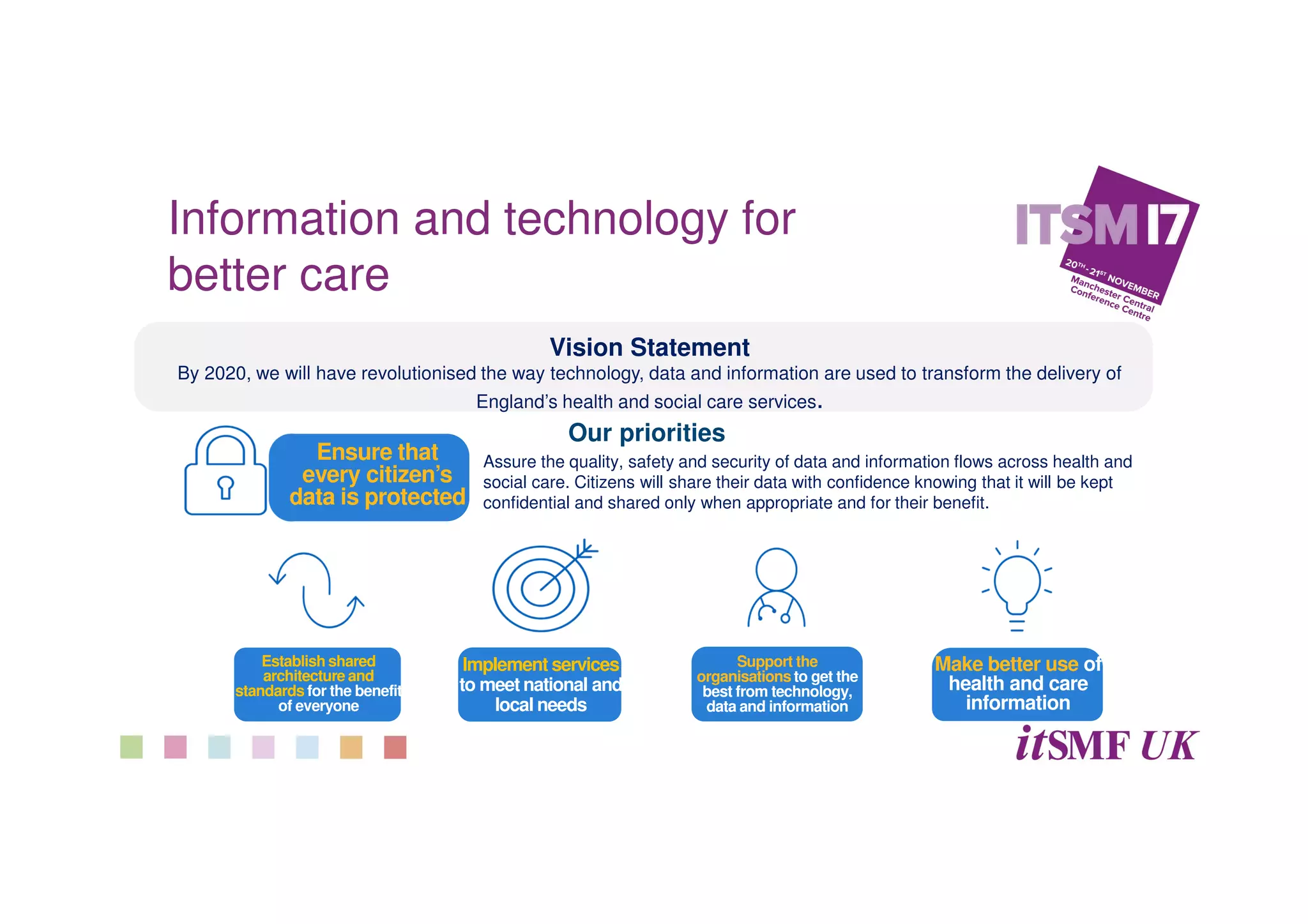
Ensure that
every citizen’s
data is protected
Information and technology for
better care
Vision Statement
By 2020, we will have revolutionised the way technology, data and information are used to transform the delivery of
England’s health and social care services.
Our priorities
Assure the quality, safety and security of data and information flows across health and
social care. Citizens will share their data with confidence knowing that it will be kept
confidential and shared only when appropriate and for their benefit.
Support the
organisations to get the
best from technology,
data and information
Make better use of
health and care
information
Establish shared
architecture and
standards for the benefit
of everyone
Implement services
to meet national and
local needs
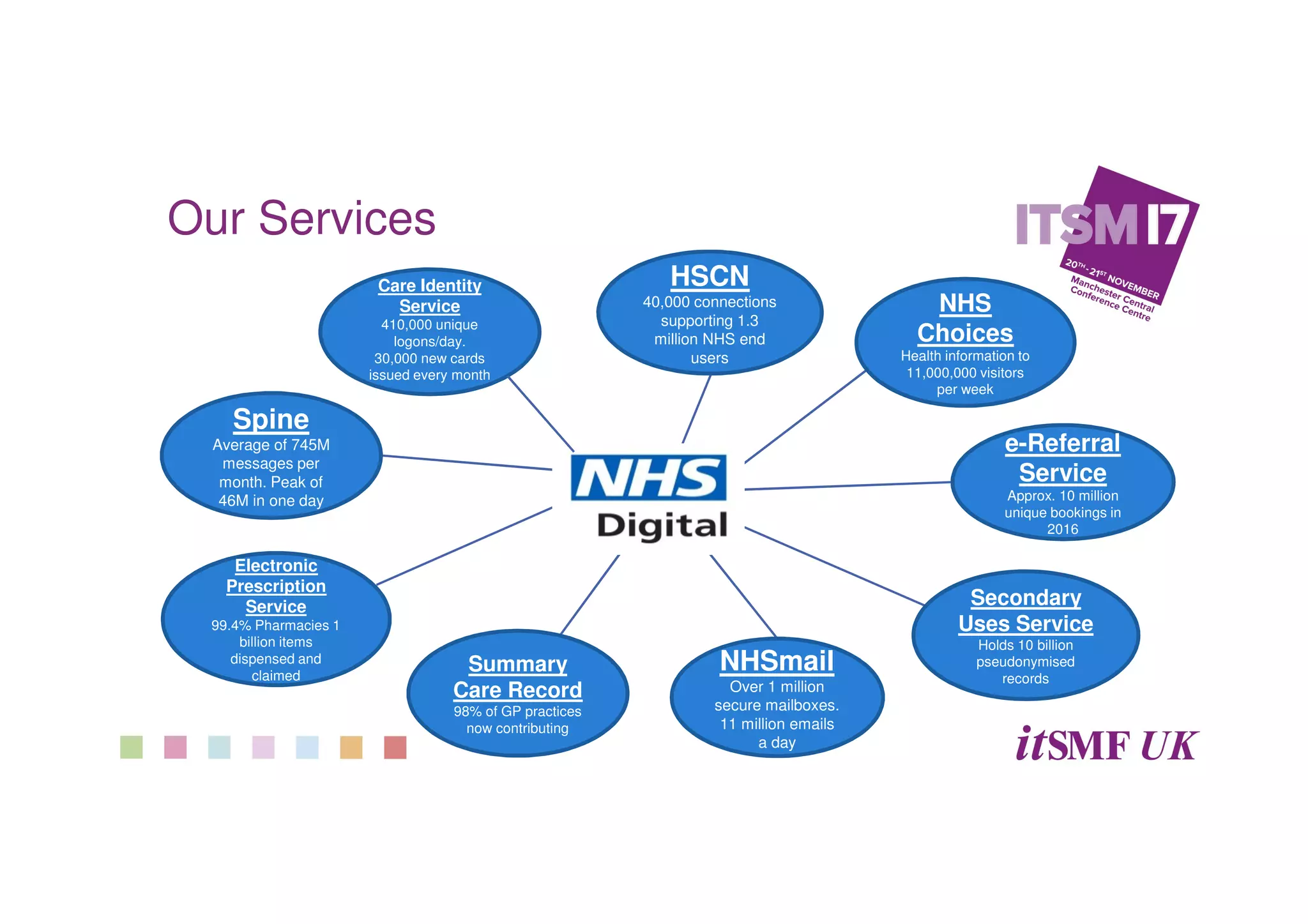
Our Services
e-Referral
Service
Approx. 10 million
unique bookings in
2016
NHSmail
Over 1 million
secure mailboxes.
11 million emails
a day
Summary
Care Record
98% of GP practices
now contributing
Care Identity
Service
410,000 unique
logons/day.
30,000 new cards
issued every month
Electronic
Prescription
Service
99.4% Pharmacies 1
billion items
dispensed and
claimed
Secondary
Uses Service
Holds 10 billion
pseudonymised
records
HSCN
40,000 connections
supporting 1.3
million NHS end
users
NHS
Choices
Health information to
11,000,000 visitors
per week
Spine
Average of 745M
messages per
month. Peak of
46M in one day
The Future
Paperless 2020
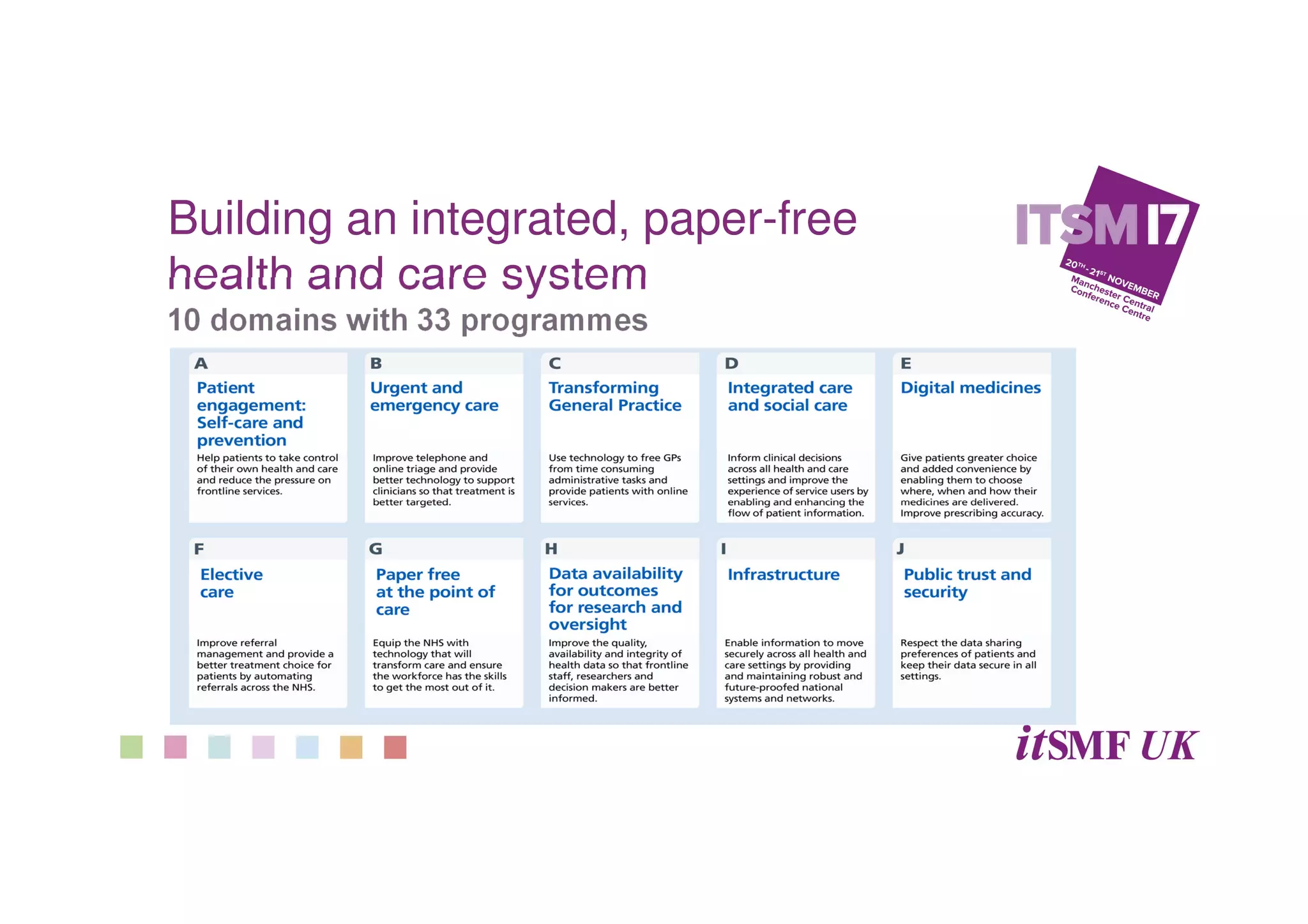
Building an integrated, paper-free
health and care system
10 domains with 33 programmes
SOAP
How NHS Digital Service Management are
gearing up for Paperless 2020
NHS Digital Service Management
• Created in 2003 as service integrator for NHS
national services
• Manage and protect live service for 70+ national
and high availability IT services
• 150 staff in 6 locations
• ITIL aligned
NHS Digital Service Management
• Before 2014
— All service providers were external
— Contracted managed services
— Focus on Governance / Integration / SLA achievement
• From August 2014
— Strategic decision to insource critical national services (Spine, CIS, SUS etc)
— Strategic decision to use existing Service Management Department
responsibility for internal service management
— Addition of Operational responsibilities
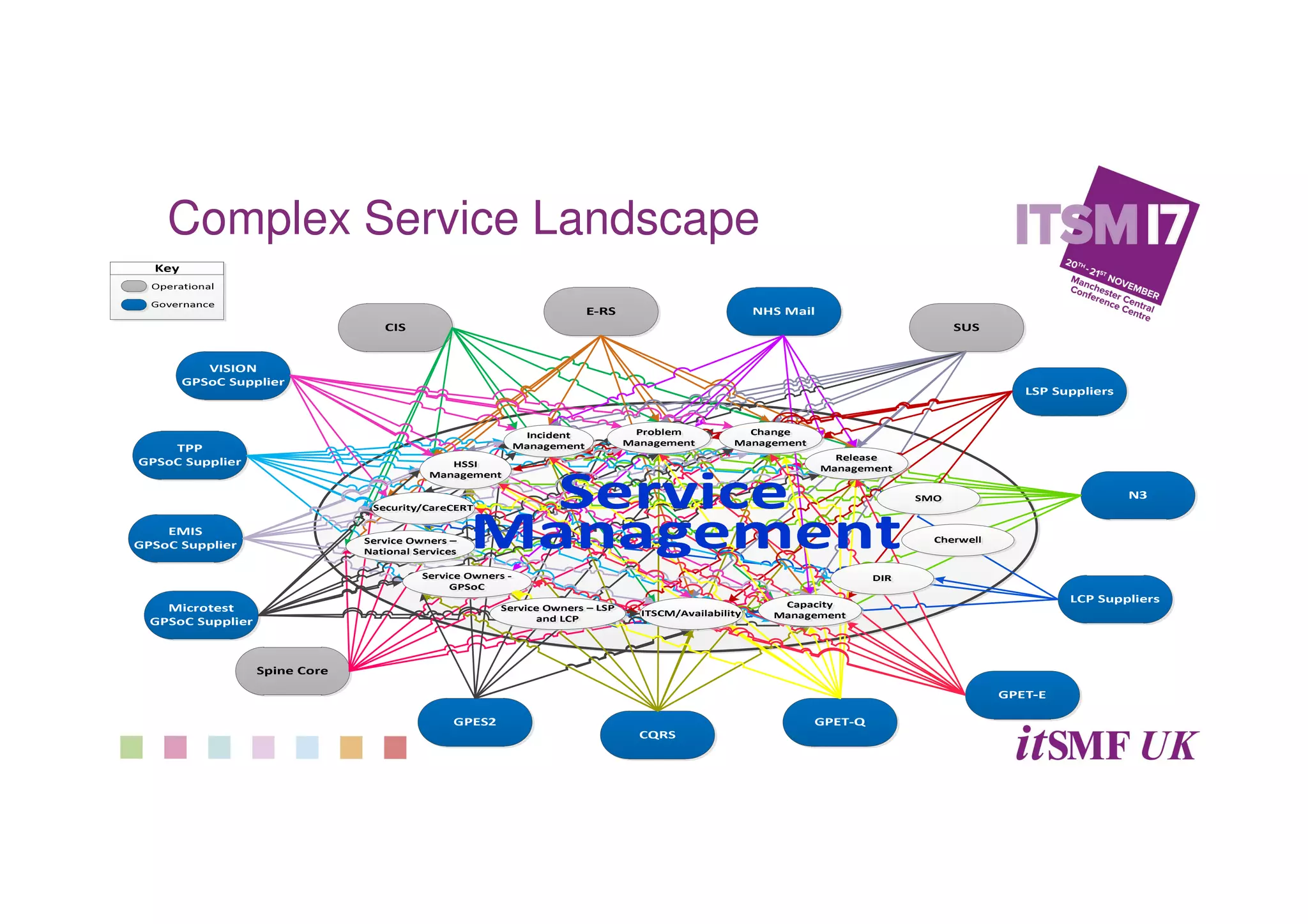
Complex Service Landscape
Our Challenges and Issues
• Cultural divergence between Development Teams and Service
Management
• Struggling to support pace of change
• Process circumvention
• Growing perception of the wider organisation was that Service
Management was a hindrance and not adding value
• Staff development, progression, & retention
• Concerned at our ability to cope with the additional workload of
Paperless 2020
Time for Change
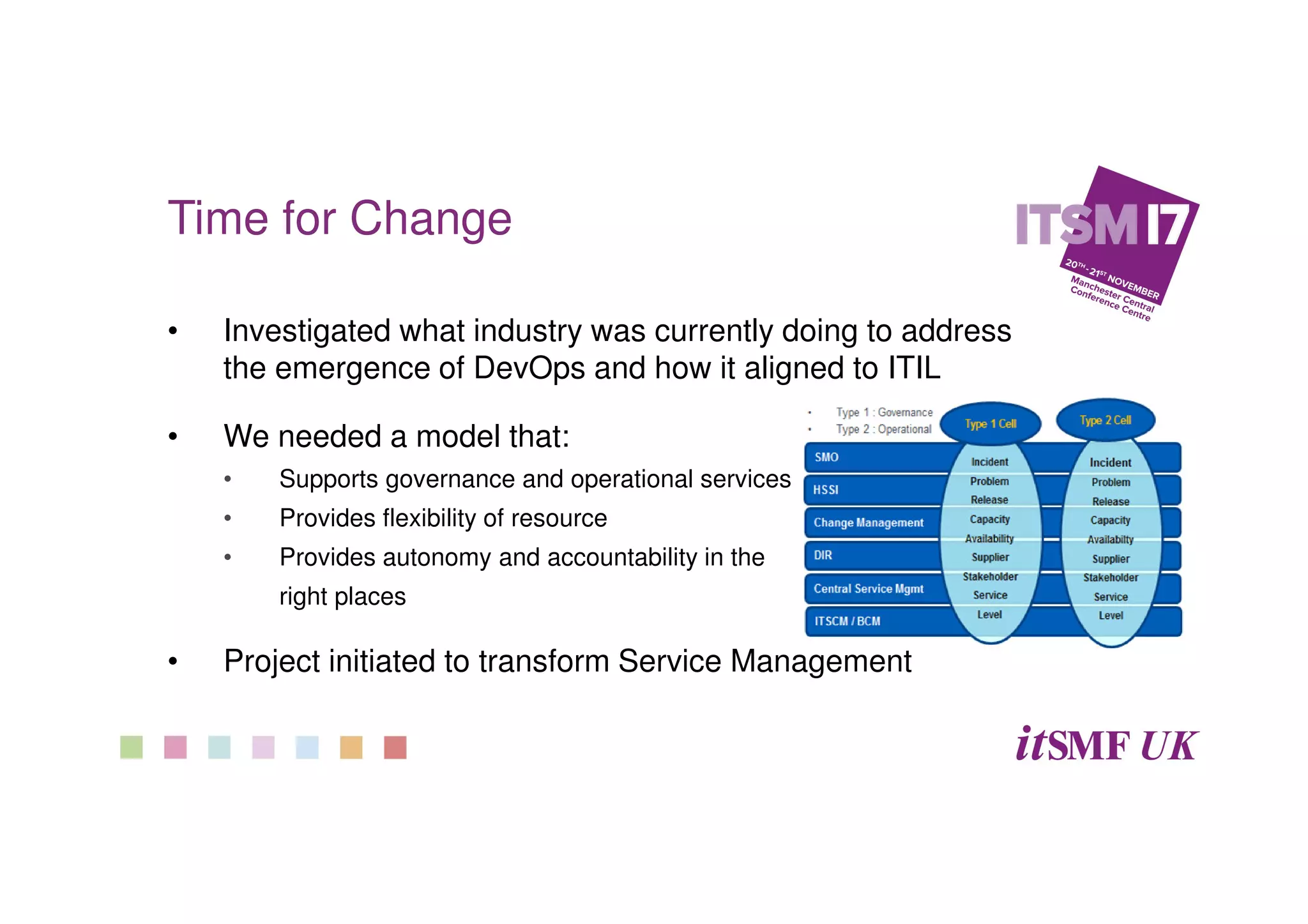
• Investigated what industry was currently doing to address
the emergence of DevOps and how it aligned to ITIL
• We needed a model that:
• Supports governance and operational services
• Provides flexibility of resource
• Provides autonomy and accountability in the
right places
• Project initiated to transform Service Management
Project Objectives – Service
Management 2020
• Change the culture – Bring SM into the 21st Century
• Separate Governance and Operational approach
• Reduce the number of contact points for internal and external stakeholders
• Change the growing perception of the wider organisation that Service Management
was a hindrance and not adding value
• Create service aligned cells that are multi-skilled, autonomous and empowered
• Aligning processes with other NHS Digital departments
Challenges – Service
Management 2020
• The need to retrain staff
• Limited guidance existed on aligning ITIL and Agile
• Complex stakeholders, some of whom were extremely sceptical or resistant to
change
• Maintaining support of live services. A good analogy would be ‘changing the
engine of a car whilst it is moving’
• Meeting individual and department needs in association with resourcing
• Expressions of interest for new roles vs Operational needs
Approach – Service Management 2020
• Use own people
• Project implemented using Agile
approaches/tool/techniques
• Involve stakeholders/customers throughout
• Give the department a voice
• Move at pace
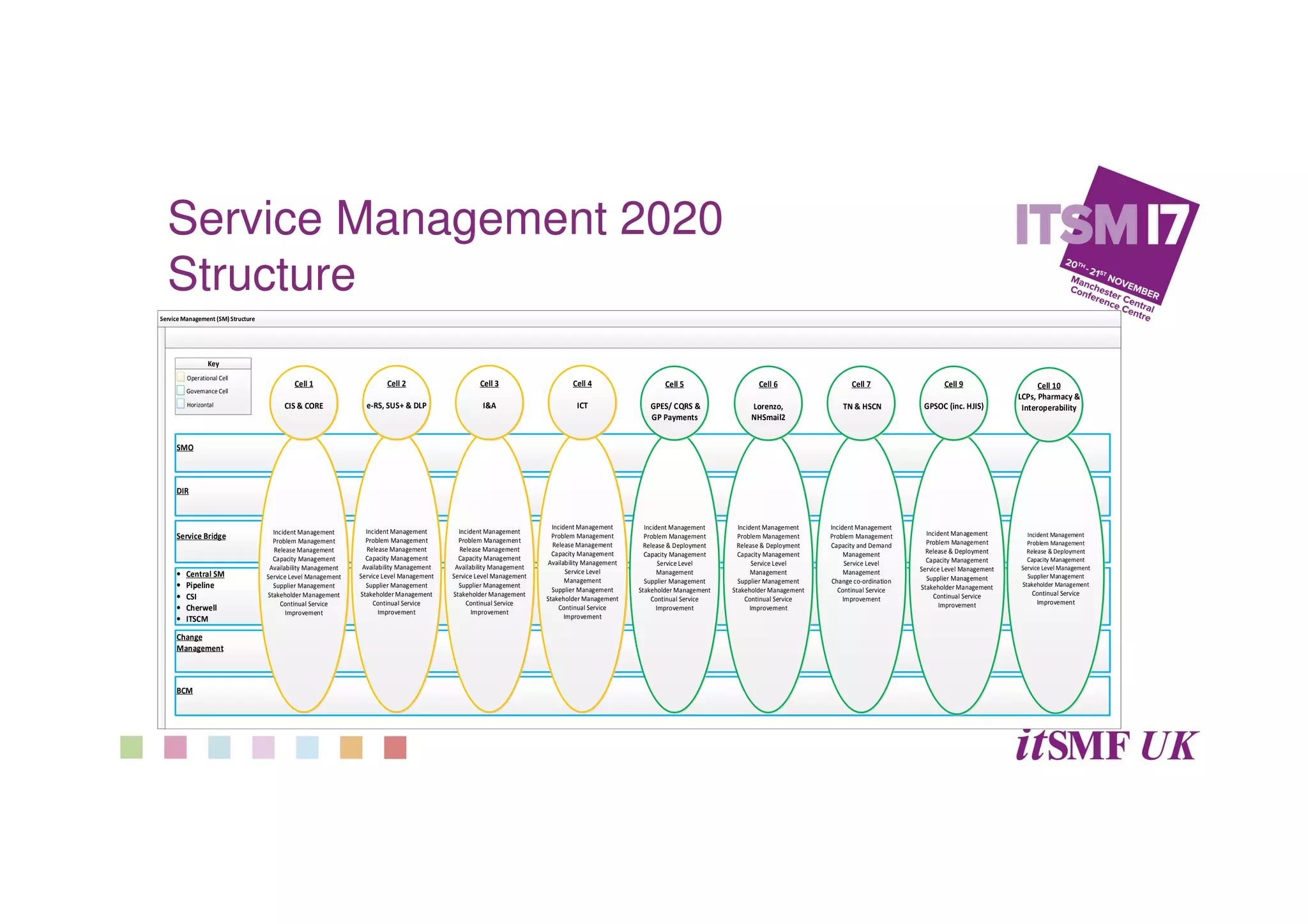
Service Management 2020
Structure
Service Management (SM) Structure
• Central SM
• Pipeline
• CSI
• Cherwell
• ITSCM
BCM
SMO
DIR
Service Bridge
Change
Management
Incident Management
Problem Management
Release Management
Capacity Management
Availability Management
Service Level Management
Supplier Management
Stakeholder Management
Continual Service
Improvement
Incident Management
Problem Management
Release Management
Capacity Management
Availability Management
Service Level Management
Supplier Management
Stakeholder Management
Continual Service
Improvement
Key
Horizontal
Cell 1
CIS & CORE
Cell 2
e-RS, SUS+ & DLP
Incident Management
Problem Management
Release Management
Capacity Management
Availability Management
Service Level Management
Supplier Management
Stakeholder Management
Continual Service
Improvement
Cell 3
I&A
Incident Management
Problem Management
Release & Deployment
Capacity Management
Service Level
Management
Supplier Management
Stakeholder Management
Continual Service
Improvement
Cell 5
GPES/ CQRS &
GP Payments
Incident Management
Problem Management
Release & Deployment
Capacity Management
Service Level
Management
Supplier Management
Stakeholder Management
Continual Service
Improvement
Cell 6
Lorenzo,
NHSmail2
Incident Management
Problem Management
Release Management
Capacity Management
Availability Management
Service Level
Management
Supplier Management
Stakeholder Management
Continual Service
Improvement
Cell 4
ICT
Operational Cell
Governance Cell
Incident Management
Problem Management
Capacity and Demand
Management
Service Level
Management
Change co-ordination
Continual Service
Improvement
Cell 7
TN & HSCN
Incident Management
Problem Management
Release & Deployment
Capacity Management
Service Level Management
Supplier Management
Stakeholder Management
Continual Service
Improvement
Cell 9
GPSOC (inc. HJIS)
Incident Management
Problem Management
Release & Deployment
Capacity Management
Service Level Management
Supplier Management
Stakeholder Management
Continual Service
Improvement
Cell 10
LCPs, Pharmacy &
Interoperability
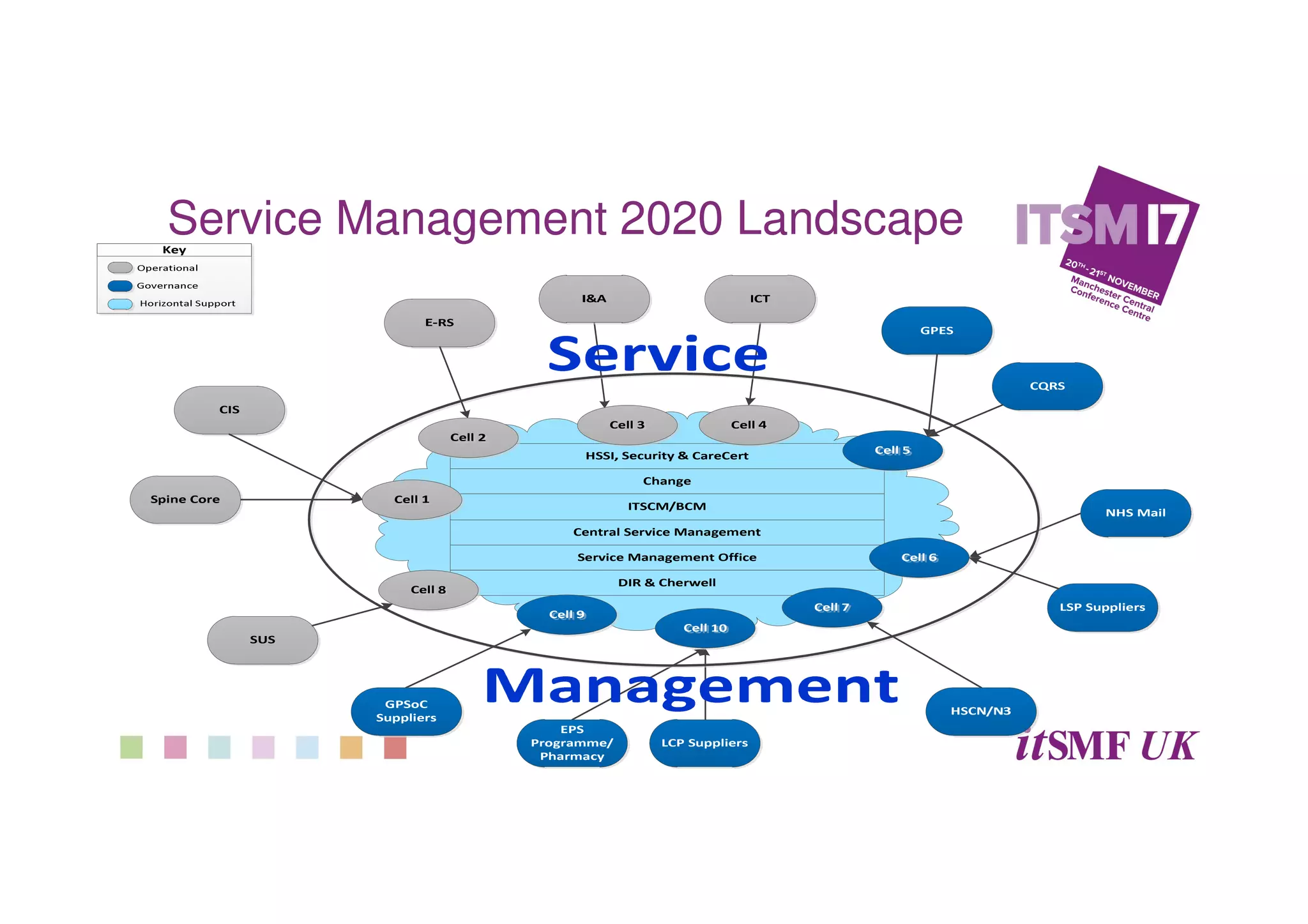
Service Management 2020 Landscape
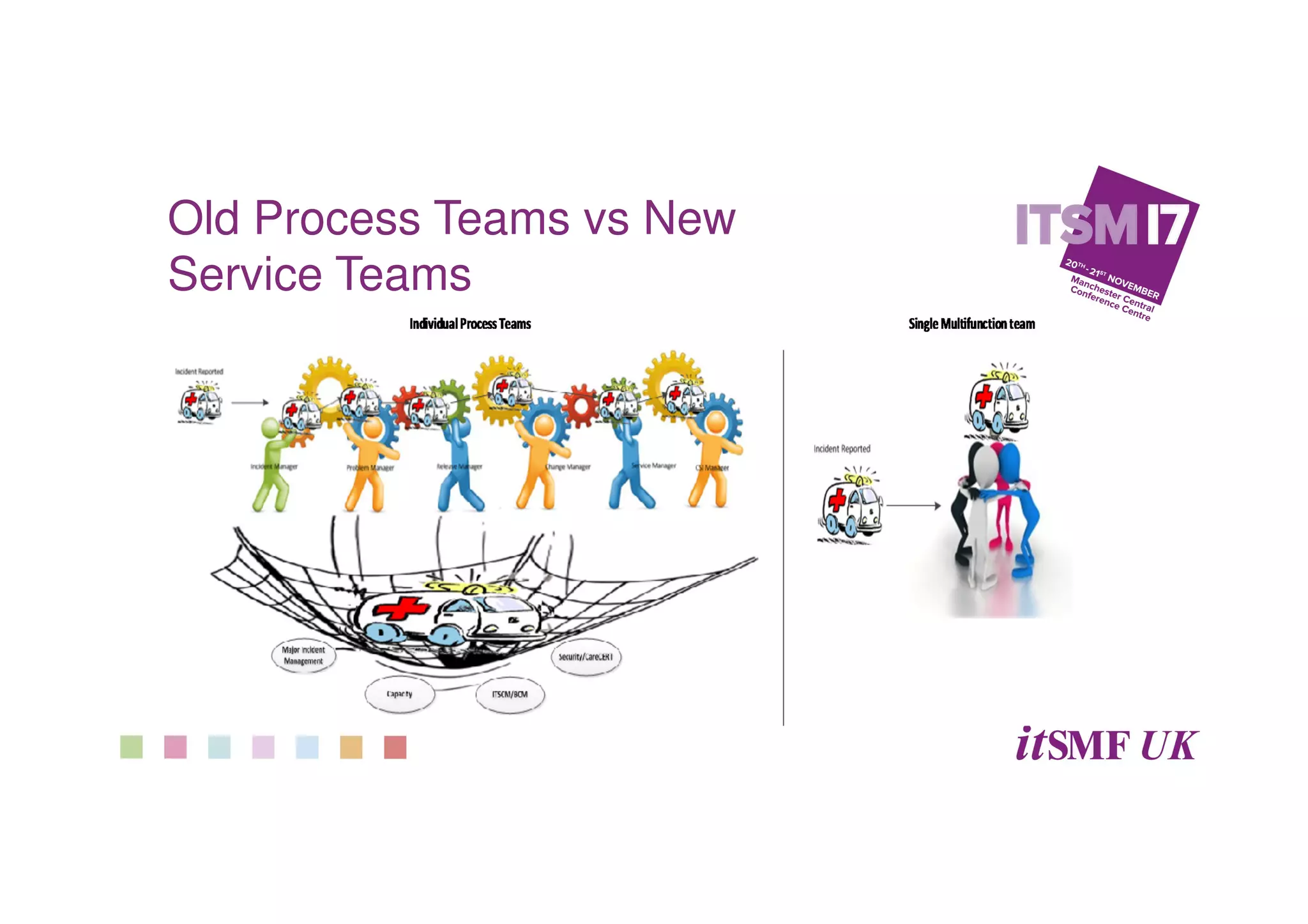
Old Process Teams vs New
Service Teams
Successes –
Service Management 2020
• Increased availability of key services
• Removed communications barrier between SM and the Dev teams creating a positive and
effective relationship
• Halving Mean Time To Resolution (MTTR)
• Reduction in open incident volumes (in some cases by 50%)
• Reduced incident logging time for clinical staff by over 50%
• Through proper problem management, reduction in incidents into the service desk (in some
cases by 90%)
Successes –
Service Management 2020
• Cost savings
• Same number of staff managing more services
• Improved staff morale & retention
• Improved ability to scale and introduce new services
Lessons Learned
• Creating slack in the system to enable smoother staff movement
• Preparing people for the transformation
• There cannot be enough communication
• The support of staff after project closure to ensure ways of working have been
adopted and offering support where needed
• Importance of a consistent message being disseminated from senior management
• Upfront strategies in place to cope with resistance to change
Questions?
www.digital.nhs.uk
@nhsdigital
enquiries@nhsdigital.nhs.uk
0300 303 5678
ITSMF UK
Premier Gate, Easthampstead Road, Bracknell,
RG12 1JS, United Kingdom
Tel: +44 (0) 118 918 6500 | Web: www.itsmf.co.uk

Craig Johnson - Transforming service management into multi-modal and DevOps.

  • 1.
    From ITIL toAgile SM in the Public Sector
  • 2.
    About NHS Digital •We are the national information and technology partner for the health and care system. • Our team of information analysis, technology and project management experts create, deliver and manage the essential technology infrastructure, digital systems, services, products and standards upon which health and care professionals depend.
  • 3.
    Ensure that every citizen’s datais protected Information and technology for better care Vision Statement By 2020, we will have revolutionised the way technology, data and information are used to transform the delivery of England’s health and social care services. Our priorities Assure the quality, safety and security of data and information flows across health and social care. Citizens will share their data with confidence knowing that it will be kept confidential and shared only when appropriate and for their benefit. Support the organisations to get the best from technology, data and information Make better use of health and care information Establish shared architecture and standards for the benefit of everyone Implement services to meet national and local needs
  • 4.
    Our Services e-Referral Service Approx. 10million unique bookings in 2016 NHSmail Over 1 million secure mailboxes. 11 million emails a day Summary Care Record 98% of GP practices now contributing Care Identity Service 410,000 unique logons/day. 30,000 new cards issued every month Electronic Prescription Service 99.4% Pharmacies 1 billion items dispensed and claimed Secondary Uses Service Holds 10 billion pseudonymised records HSCN 40,000 connections supporting 1.3 million NHS end users NHS Choices Health information to 11,000,000 visitors per week Spine Average of 745M messages per month. Peak of 46M in one day
  • 5.
  • 6.
    Building an integrated,paper-free health and care system 10 domains with 33 programmes
  • 7.
    SOAP How NHS DigitalService Management are gearing up for Paperless 2020
  • 8.
    NHS Digital ServiceManagement • Created in 2003 as service integrator for NHS national services • Manage and protect live service for 70+ national and high availability IT services • 150 staff in 6 locations • ITIL aligned
  • 9.
    NHS Digital ServiceManagement • Before 2014 — All service providers were external — Contracted managed services — Focus on Governance / Integration / SLA achievement • From August 2014 — Strategic decision to insource critical national services (Spine, CIS, SUS etc) — Strategic decision to use existing Service Management Department responsibility for internal service management — Addition of Operational responsibilities
  • 10.
  • 11.
    Our Challenges andIssues • Cultural divergence between Development Teams and Service Management • Struggling to support pace of change • Process circumvention • Growing perception of the wider organisation was that Service Management was a hindrance and not adding value • Staff development, progression, & retention • Concerned at our ability to cope with the additional workload of Paperless 2020
  • 12.
    Time for Change •Investigated what industry was currently doing to address the emergence of DevOps and how it aligned to ITIL • We needed a model that: • Supports governance and operational services • Provides flexibility of resource • Provides autonomy and accountability in the right places • Project initiated to transform Service Management
  • 13.
    Project Objectives –Service Management 2020 • Change the culture – Bring SM into the 21st Century • Separate Governance and Operational approach • Reduce the number of contact points for internal and external stakeholders • Change the growing perception of the wider organisation that Service Management was a hindrance and not adding value • Create service aligned cells that are multi-skilled, autonomous and empowered • Aligning processes with other NHS Digital departments
  • 14.
    Challenges – Service Management2020 • The need to retrain staff • Limited guidance existed on aligning ITIL and Agile • Complex stakeholders, some of whom were extremely sceptical or resistant to change • Maintaining support of live services. A good analogy would be ‘changing the engine of a car whilst it is moving’ • Meeting individual and department needs in association with resourcing • Expressions of interest for new roles vs Operational needs
  • 15.
    Approach – ServiceManagement 2020 • Use own people • Project implemented using Agile approaches/tool/techniques • Involve stakeholders/customers throughout • Give the department a voice • Move at pace
  • 16.
    Service Management 2020 Structure ServiceManagement (SM) Structure • Central SM • Pipeline • CSI • Cherwell • ITSCM BCM SMO DIR Service Bridge Change Management Incident Management Problem Management Release Management Capacity Management Availability Management Service Level Management Supplier Management Stakeholder Management Continual Service Improvement Incident Management Problem Management Release Management Capacity Management Availability Management Service Level Management Supplier Management Stakeholder Management Continual Service Improvement Key Horizontal Cell 1 CIS & CORE Cell 2 e-RS, SUS+ & DLP Incident Management Problem Management Release Management Capacity Management Availability Management Service Level Management Supplier Management Stakeholder Management Continual Service Improvement Cell 3 I&A Incident Management Problem Management Release & Deployment Capacity Management Service Level Management Supplier Management Stakeholder Management Continual Service Improvement Cell 5 GPES/ CQRS & GP Payments Incident Management Problem Management Release & Deployment Capacity Management Service Level Management Supplier Management Stakeholder Management Continual Service Improvement Cell 6 Lorenzo, NHSmail2 Incident Management Problem Management Release Management Capacity Management Availability Management Service Level Management Supplier Management Stakeholder Management Continual Service Improvement Cell 4 ICT Operational Cell Governance Cell Incident Management Problem Management Capacity and Demand Management Service Level Management Change co-ordination Continual Service Improvement Cell 7 TN & HSCN Incident Management Problem Management Release & Deployment Capacity Management Service Level Management Supplier Management Stakeholder Management Continual Service Improvement Cell 9 GPSOC (inc. HJIS) Incident Management Problem Management Release & Deployment Capacity Management Service Level Management Supplier Management Stakeholder Management Continual Service Improvement Cell 10 LCPs, Pharmacy & Interoperability
  • 17.
  • 18.
    Old Process Teamsvs New Service Teams
  • 19.
    Successes – Service Management2020 • Increased availability of key services • Removed communications barrier between SM and the Dev teams creating a positive and effective relationship • Halving Mean Time To Resolution (MTTR) • Reduction in open incident volumes (in some cases by 50%) • Reduced incident logging time for clinical staff by over 50% • Through proper problem management, reduction in incidents into the service desk (in some cases by 90%)
  • 20.
    Successes – Service Management2020 • Cost savings • Same number of staff managing more services • Improved staff morale & retention • Improved ability to scale and introduce new services
  • 21.
    Lessons Learned • Creatingslack in the system to enable smoother staff movement • Preparing people for the transformation • There cannot be enough communication • The support of staff after project closure to ensure ways of working have been adopted and offering support where needed • Importance of a consistent message being disseminated from senior management • Upfront strategies in place to cope with resistance to change
  • 22.
  • 23.
  • 24.
    ITSMF UK Premier Gate,Easthampstead Road, Bracknell, RG12 1JS, United Kingdom Tel: +44 (0) 118 918 6500 | Web: www.itsmf.co.uk