Tracking Progress on
Monitoring, Evaluation,
and Learning for
National Adaptation Plan
Processes
WEBINAR
Tuesday, December 10, 2025
9:00 ET / 15:00 CET
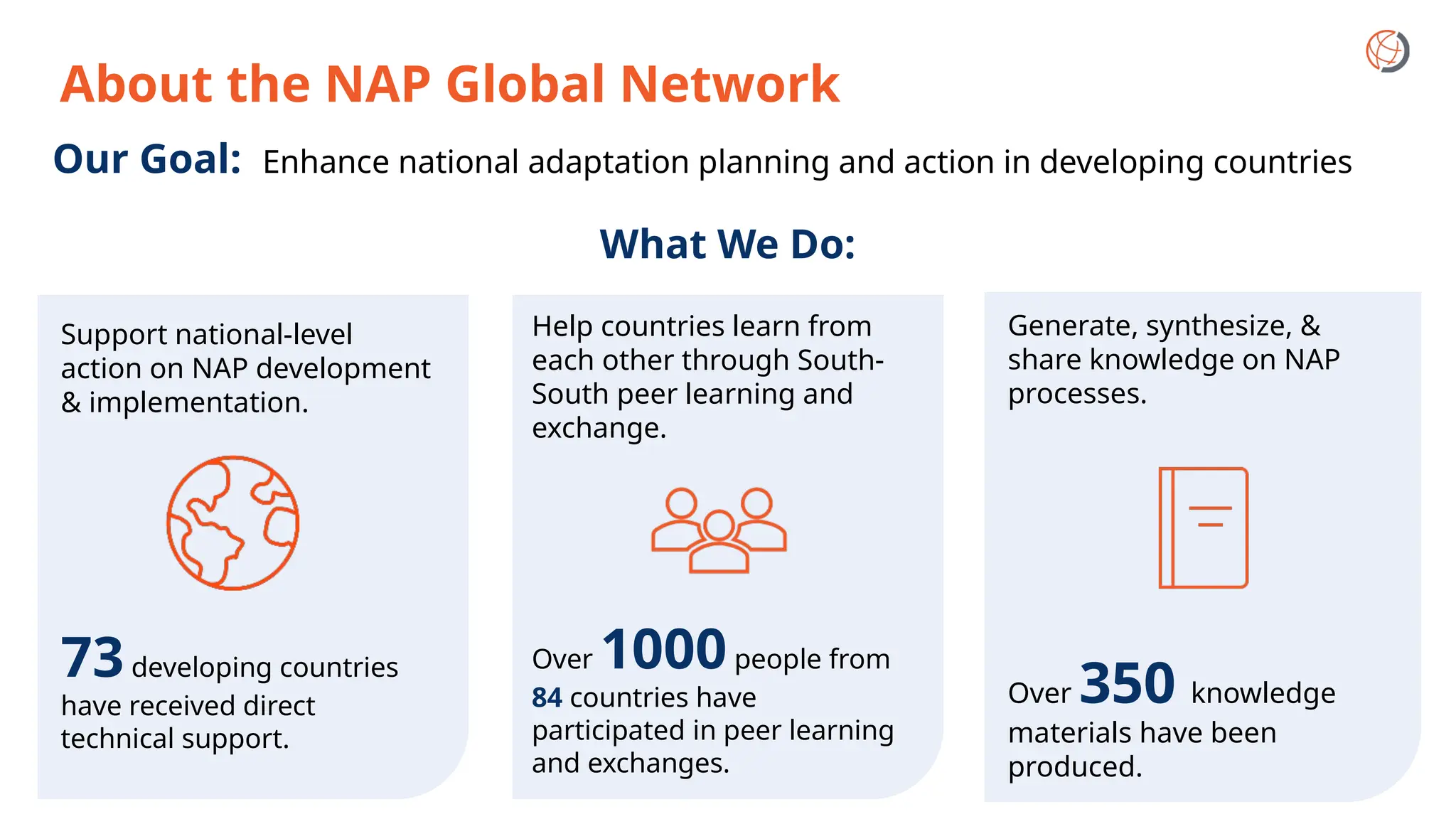
Help countries learn from
each other through South-
South peer learning and
exchange.
Over 1000people from
84 countries have
participated in peer learning
and exchanges.
About the NAP Global Network
What We Do:
Support national-level
action on NAP development
& implementation.
73developing countries
have received direct
technical support​
.
Generate, synthesize, &
share knowledge on NAP
processes.
Over 350 knowledge
materials have been
produced.
Our Goal: Enhance national adaptation planning and action in developing countries
Peer Learning Forum
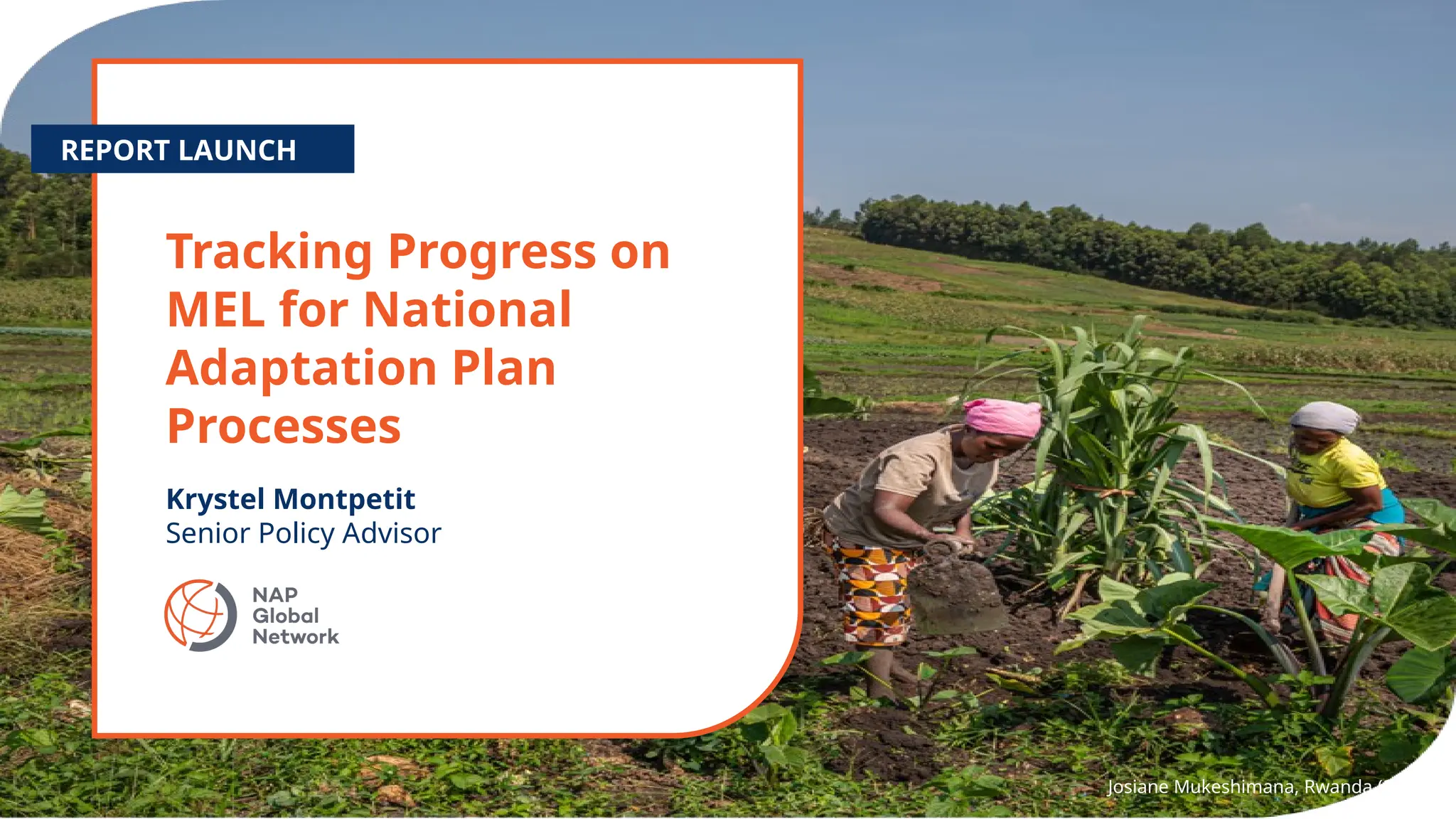
Tracking Progress on
MEL for National
Adaptation Plan
Processes
REPORT LAUNCH
Krystel Montpetit
Senior Policy Advisor
Josiane Mukeshimana, Rwanda (2024)
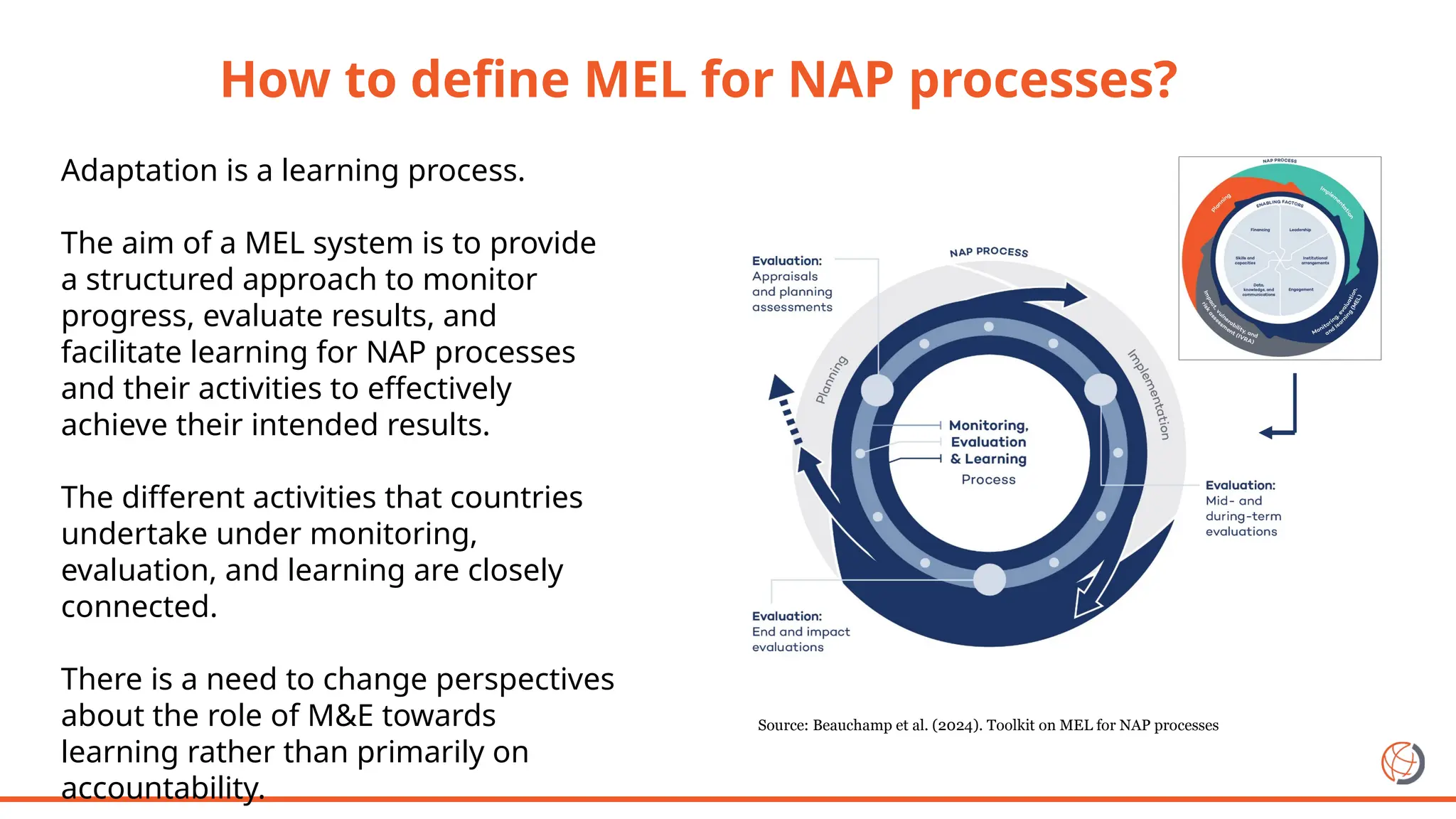
Adaptation is a learning process.
The aim of a MEL system is to provide
a structured approach to monitor
progress, evaluate results, and
facilitate learning for NAP processes
and their activities to effectively
achieve their intended results.
The different activities that countries
undertake under monitoring,
evaluation, and learning are closely
connected.
There is a need to change perspectives
about the role of M&E towards
learning rather than primarily on
accountability.
Source: Beauchamp et al. (2024). Toolkit on MEL for NAP processes
How to define MEL for NAP processes?
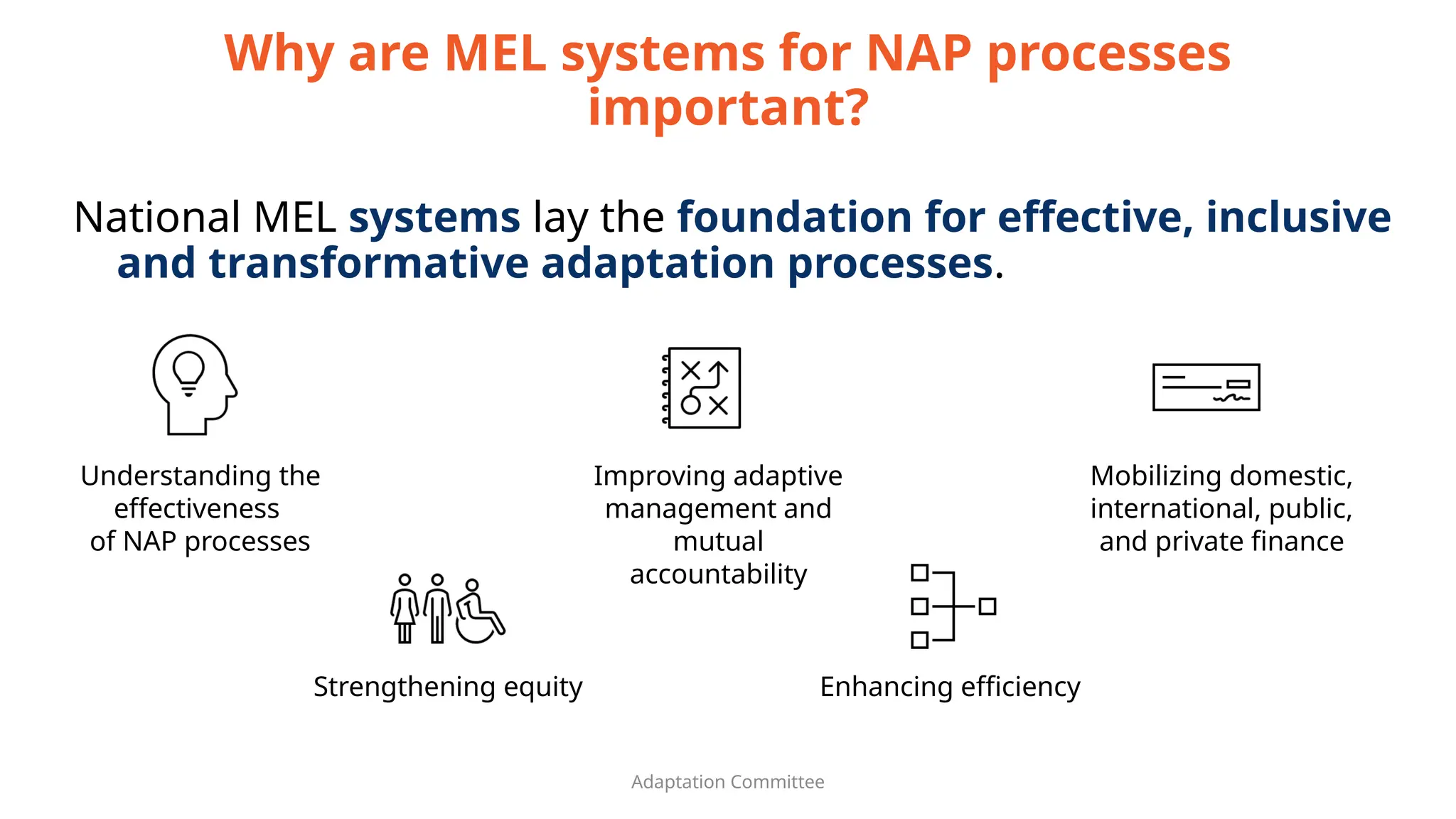
Why are MEL systems for NAP processes
important?
Adaptation Committee
National MEL systems lay the foundation for effective, inclusive
and transformative adaptation processes.
Understanding the
effectiveness
of NAP processes
Enhancing efficiency
Improving adaptive
management and
mutual
accountability
Mobilizing domestic,
international, public,
and private finance
Strengthening equity
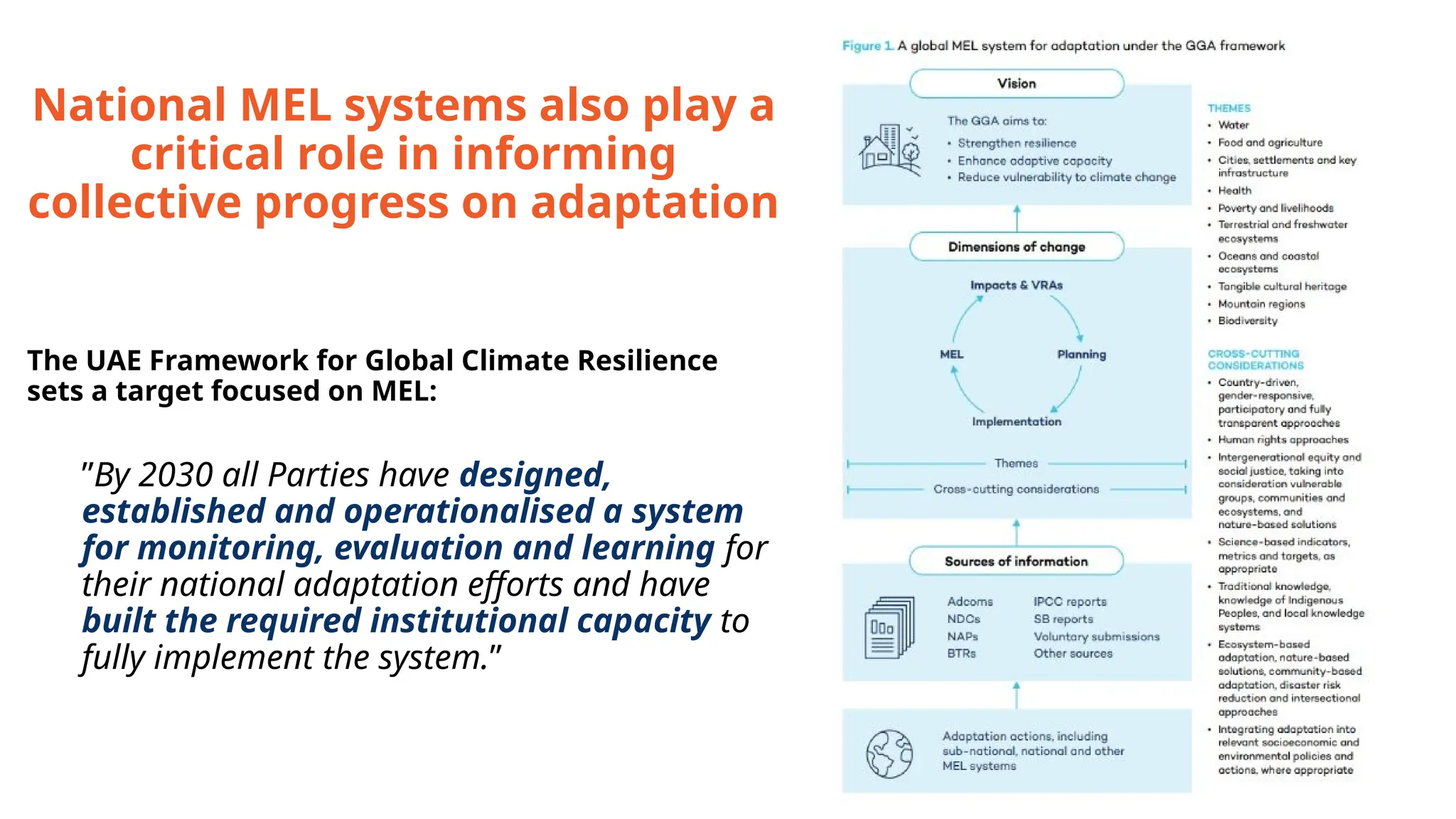
National MEL systems also play a
critical role in informing
collective progress on adaptation
The UAE Framework for Global Climate Resilience
sets a target focused on MEL:
”By 2030 all Parties have designed,
established and operationalised a system
for monitoring, evaluation and learning for
their national adaptation efforts and have
built the required institutional capacity to
fully implement the system.”
Monitoring, Evaluation and Learning
in National Adaptation Plans
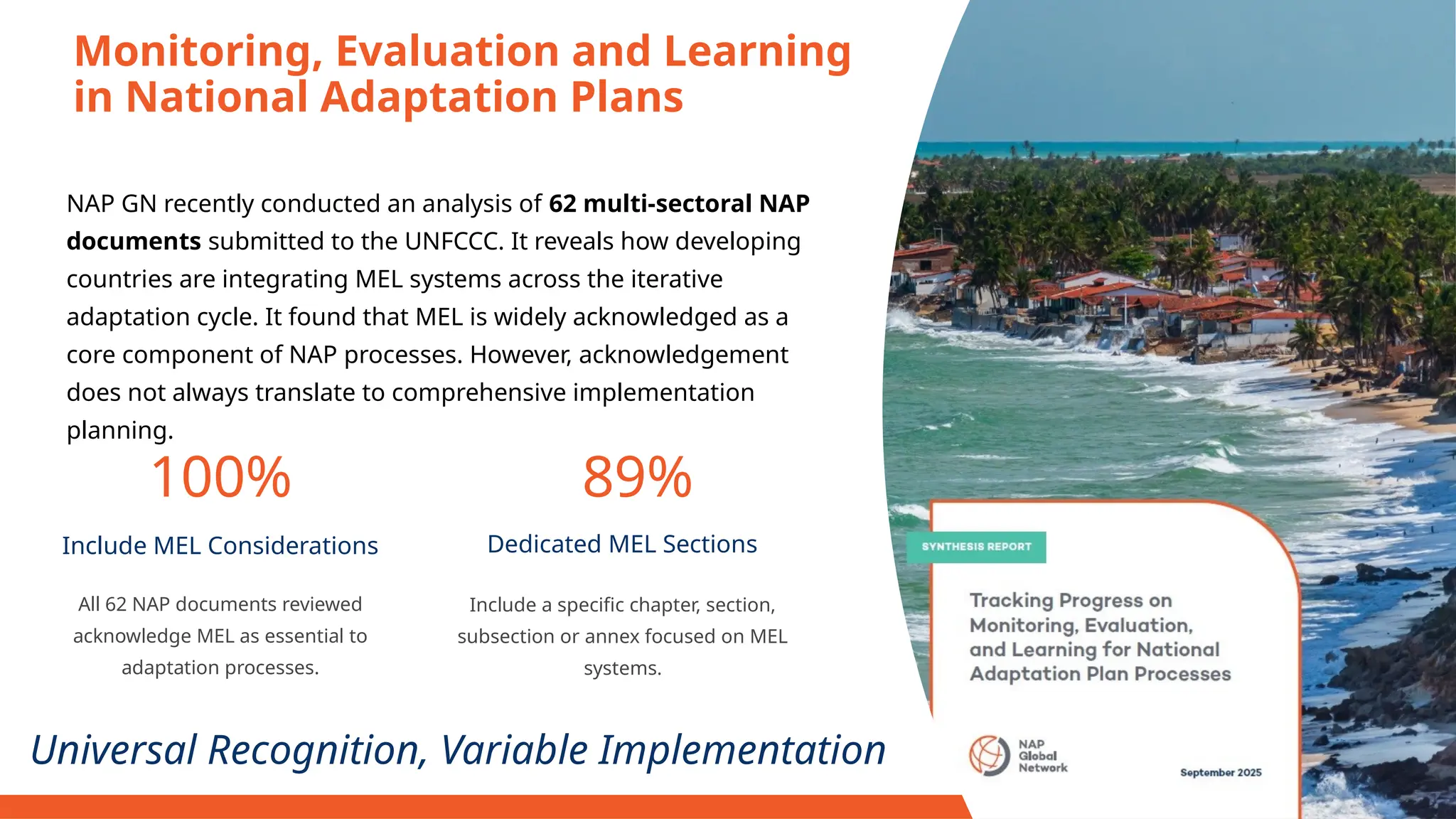
NAP GN recently conducted an analysis of 62 multi-sectoral NAP
documents submitted to the UNFCCC. It reveals how developing
countries are integrating MEL systems across the iterative
adaptation cycle. It found that MEL is widely acknowledged as a
core component of NAP processes. However, acknowledgement
does not always translate to comprehensive implementation
planning.
Universal Recognition, Variable Implementation
100%
Include MEL Considerations
All 62 NAP documents reviewed
acknowledge MEL as essential to
adaptation processes.
89%
Dedicated MEL Sections
Include a specific chapter, section,
subsection or annex focused on MEL
systems.
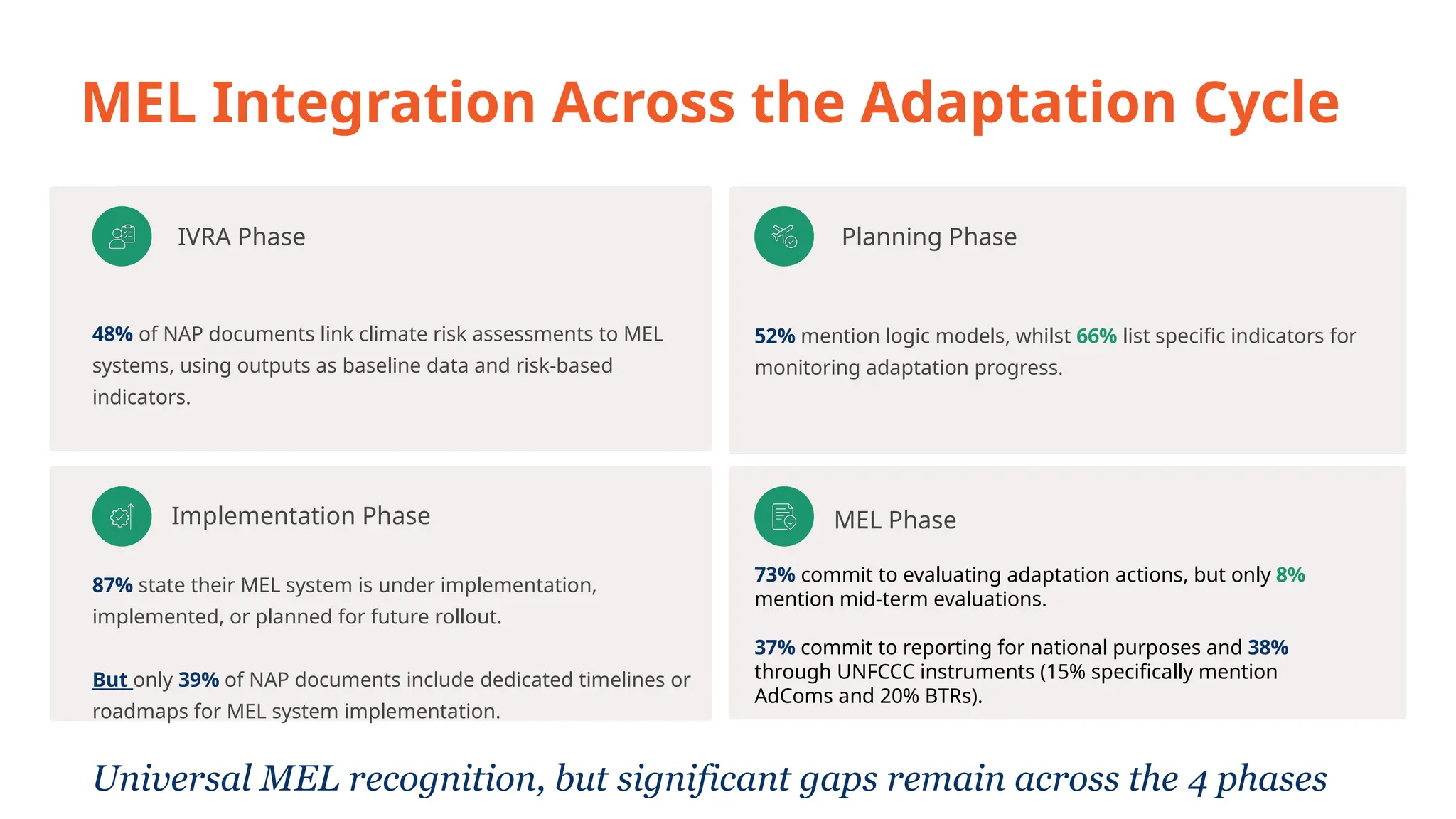
MEL Integration Across the Adaptation Cycle
IVRA Phase
48% of NAP documents link climate risk assessments to MEL
systems, using outputs as baseline data and risk-based
indicators.
Planning Phase
52% mention logic models, whilst 66% list specific indicators for
monitoring adaptation progress.
Implementation Phase
87% state their MEL system is under implementation,
implemented, or planned for future rollout.
But only 39% of NAP documents include dedicated timelines or
roadmaps for MEL system implementation.
MEL Phase
73% commit to evaluating adaptation actions, but only 8%
mention mid-term evaluations.
37% commit to reporting for national purposes and 38%
through UNFCCC instruments (15% specifically mention
AdComs and 20% BTRs).
Universal MEL recognition, but significant gaps remain across the 4 phases
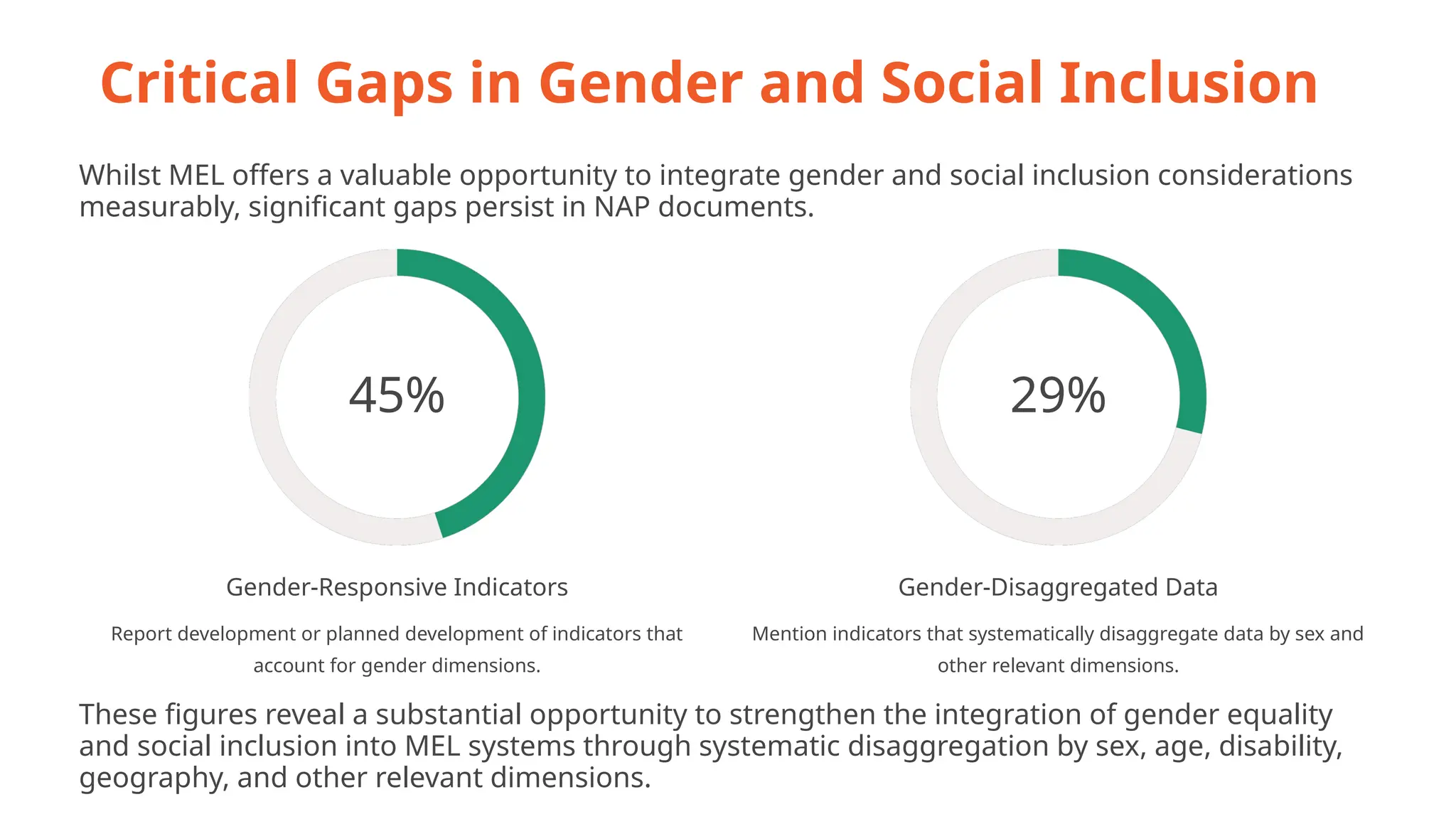
Critical Gaps in Gender and Social Inclusion
Whilst MEL offers a valuable opportunity to integrate gender and social inclusion considerations
measurably, significant gaps persist in NAP documents.
45%
Gender-Responsive Indicators
Report development or planned development of indicators that
account for gender dimensions.
29%
Gender-Disaggregated Data
Mention indicators that systematically disaggregate data by sex and
other relevant dimensions.
These figures reveal a substantial opportunity to strengthen the integration of gender equality
and social inclusion into MEL systems through systematic disaggregation by sex, age, disability,
geography, and other relevant dimensions.
Data Foundations and Evaluation Commitments
Strong Technical Foundations
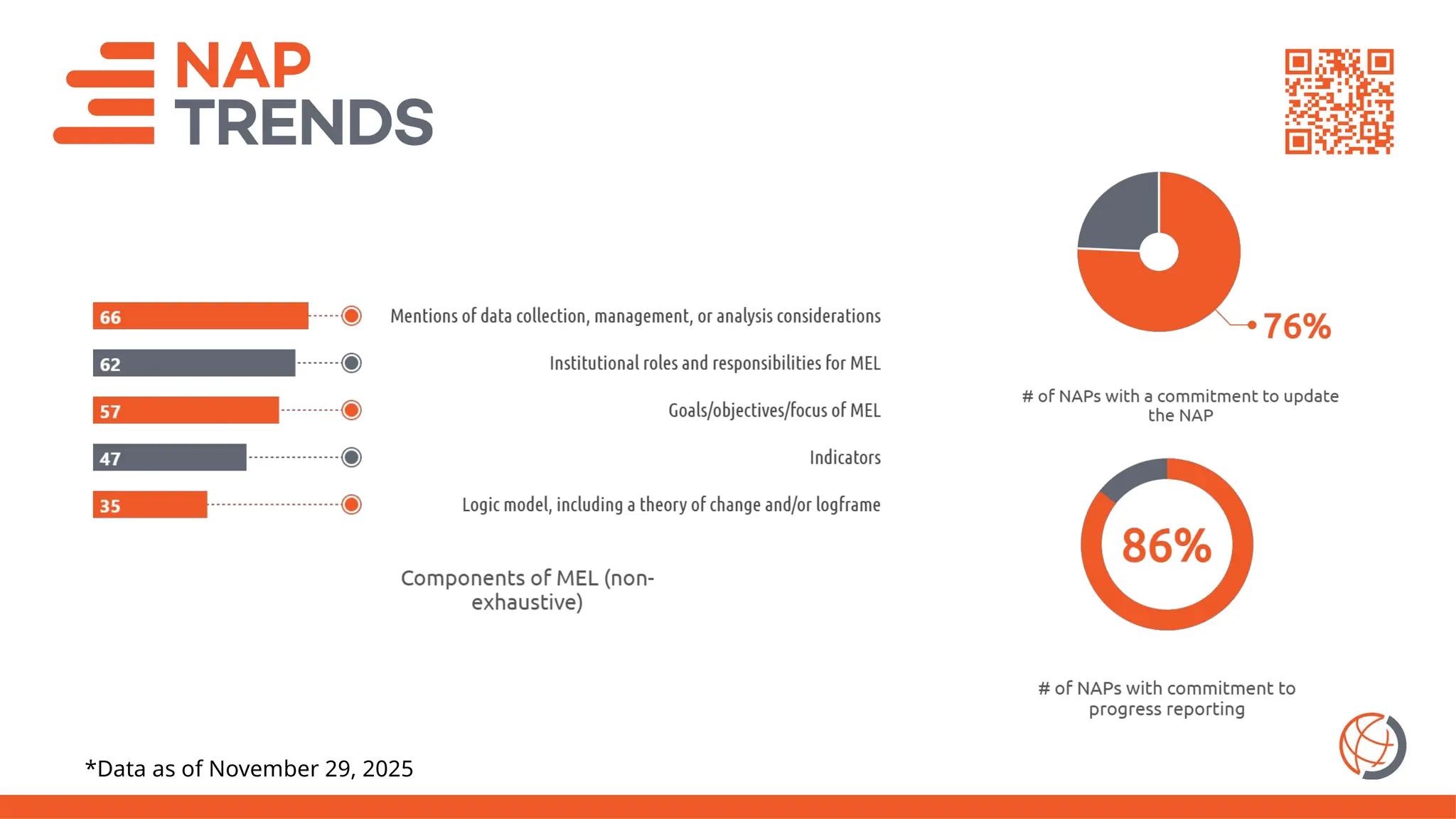
95% of NAP documents mention data collection, management, and
analysis considerations, indicating strong emphasis on establishing
technical foundations for effective monitoring and evaluation.
Additionally, 66% report using or intending to use MEL to track
financial flows, fund efficiency, or adaptation expenditures.
Weak Evaluation Commitments
Whilst 73% include general commitments to evaluating adaptation
actions, specific evaluation plans remain limited:
• Only 8% mention mid-term evaluations
• Only 7% commit to final or impact evaluations
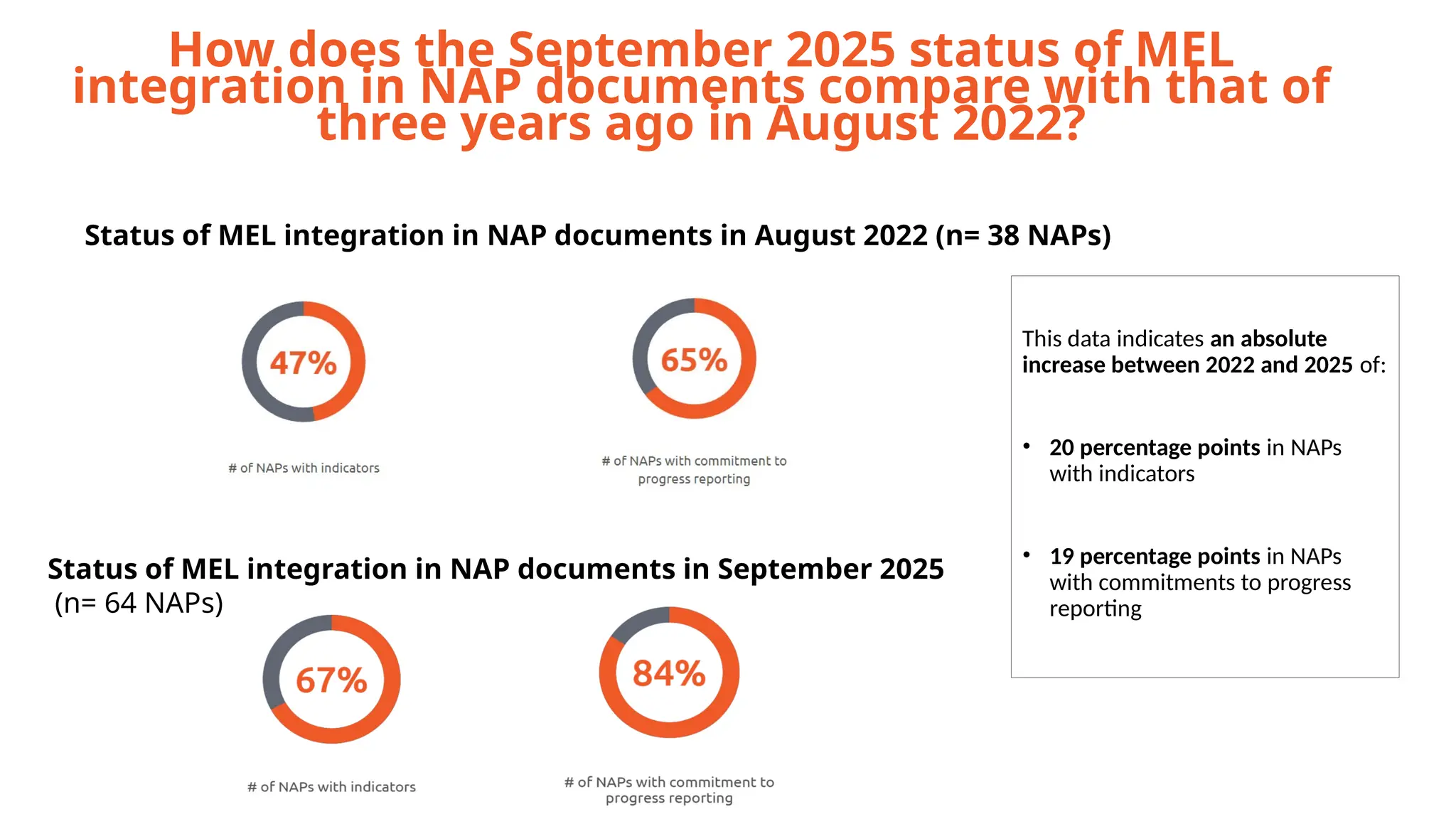
How does the September 2025 status of MEL
integration in NAP documents compare with that of
three years ago in August 2022?
Status of MEL integration in NAP documents in September 2025
(n= 64 NAPs)
Status of MEL integration in NAP documents in August 2022 (n= 38 NAPs)
This data indicates an absolute
increase between 2022 and 2025 of:
• 20 percentage points in NAPs
with indicators
• 19 percentage points in NAPs
with commitments to progress
reporting
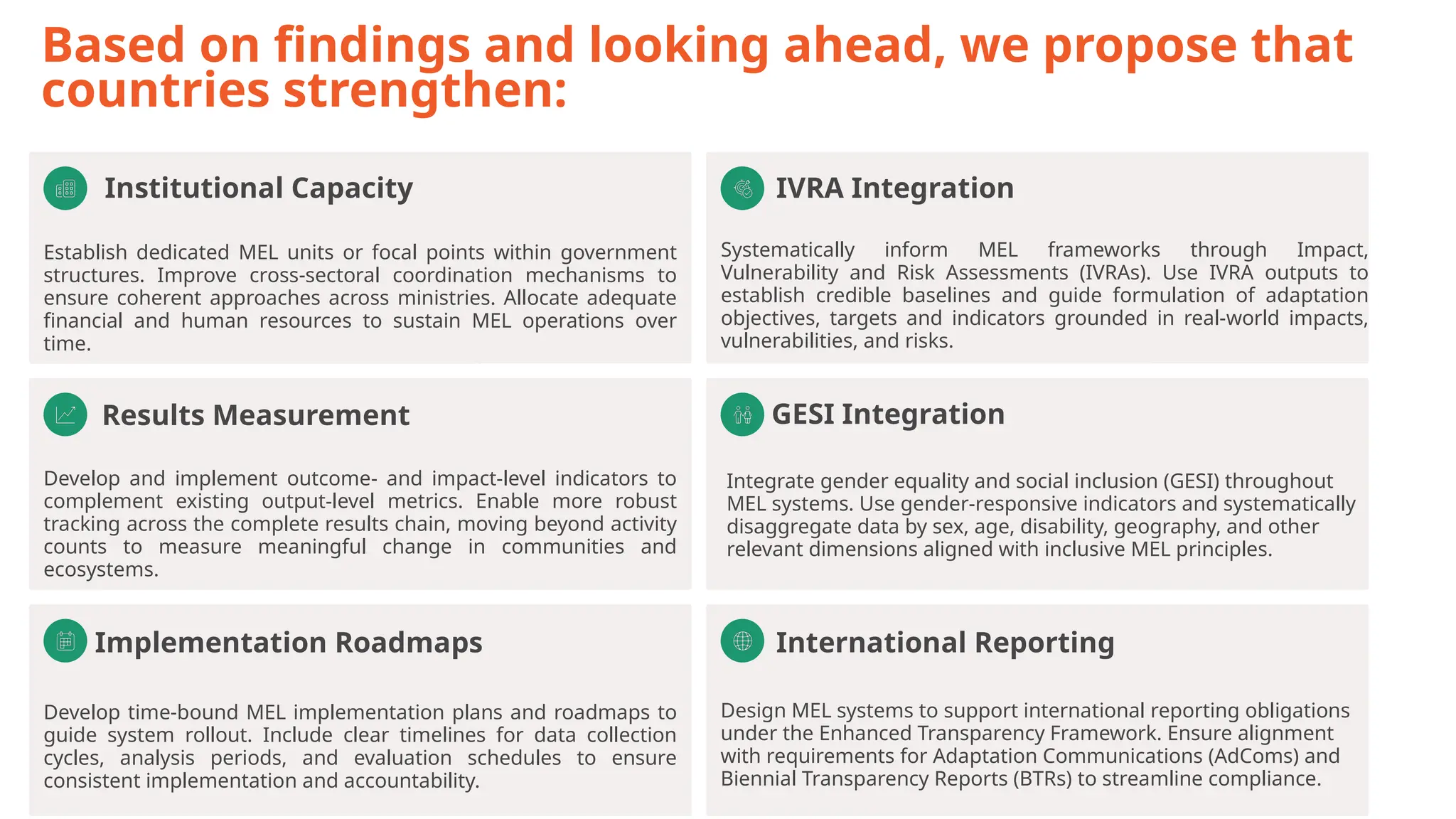
Based on findings and looking ahead, we propose that
countries strengthen:
Institutional Capacity
Establish dedicated MEL units or focal points within government
structures. Improve cross-sectoral coordination mechanisms to
ensure coherent approaches across ministries. Allocate adequate
financial and human resources to sustain MEL operations over
time.
IVRA Integration
Systematically inform MEL frameworks through Impact,
Vulnerability and Risk Assessments (IVRAs). Use IVRA outputs to
establish credible baselines and guide formulation of adaptation
objectives, targets and indicators grounded in real-world impacts,
vulnerabilities, and risks.
Results Measurement
Develop and implement outcome- and impact-level indicators to
complement existing output-level metrics. Enable more robust
tracking across the complete results chain, moving beyond activity
counts to measure meaningful change in communities and
ecosystems.
GESI Integration
Integrate gender equality and social inclusion (GESI) throughout
MEL systems. Use gender-responsive indicators and systematically
disaggregate data by sex, age, disability, geography, and other
relevant dimensions aligned with inclusive MEL principles.
Implementation Roadmaps
Develop time-bound MEL implementation plans and roadmaps to
guide system rollout. Include clear timelines for data collection
cycles, analysis periods, and evaluation schedules to ensure
consistent implementation and accountability.
International Reporting
Design MEL systems to support international reporting obligations
under the Enhanced Transparency Framework. Ensure alignment
with requirements for Adaptation Communications (AdComs) and
Biennial Transparency Reports (BTRs) to streamline compliance.
Making key information
on National
Adaptation Plans
(NAPs) easily accessible
and digestible for the
climate change
adaptation community.
*Data as of November 29, 2025
Government
Representatives
Panel
Government Panellists
Monchalus
Pitisinchoochai
Environmentalist,
Department of Climate
Change and
Environment,
Government of Thailand
Expert on Local
Development,
Environment and
Geomatics, Haiti
Dr Constantin
Joseph
Herrick Mwewa
Principal Climate Change
Officer in charge of
Mitigation Actions and
Programmes, Ministry of
Green Economy and
Environment,
Government of Zambia
Luis Efrain Roque
Salazar
Specialist in Investment
for Climate Change,
Ministry of Environment,
Government of Peru
Monitoring, Evaluation, and Learning Framework
of Haiti’s National Adaptation Plan (NAP)
« By 2030, Haiti will have a robust and operational MEL system
that allows for effective monitoring of adaptation measures,
rigorous evaluation of their impact, and continuous learning to
strengthen national climate resilience.»
17
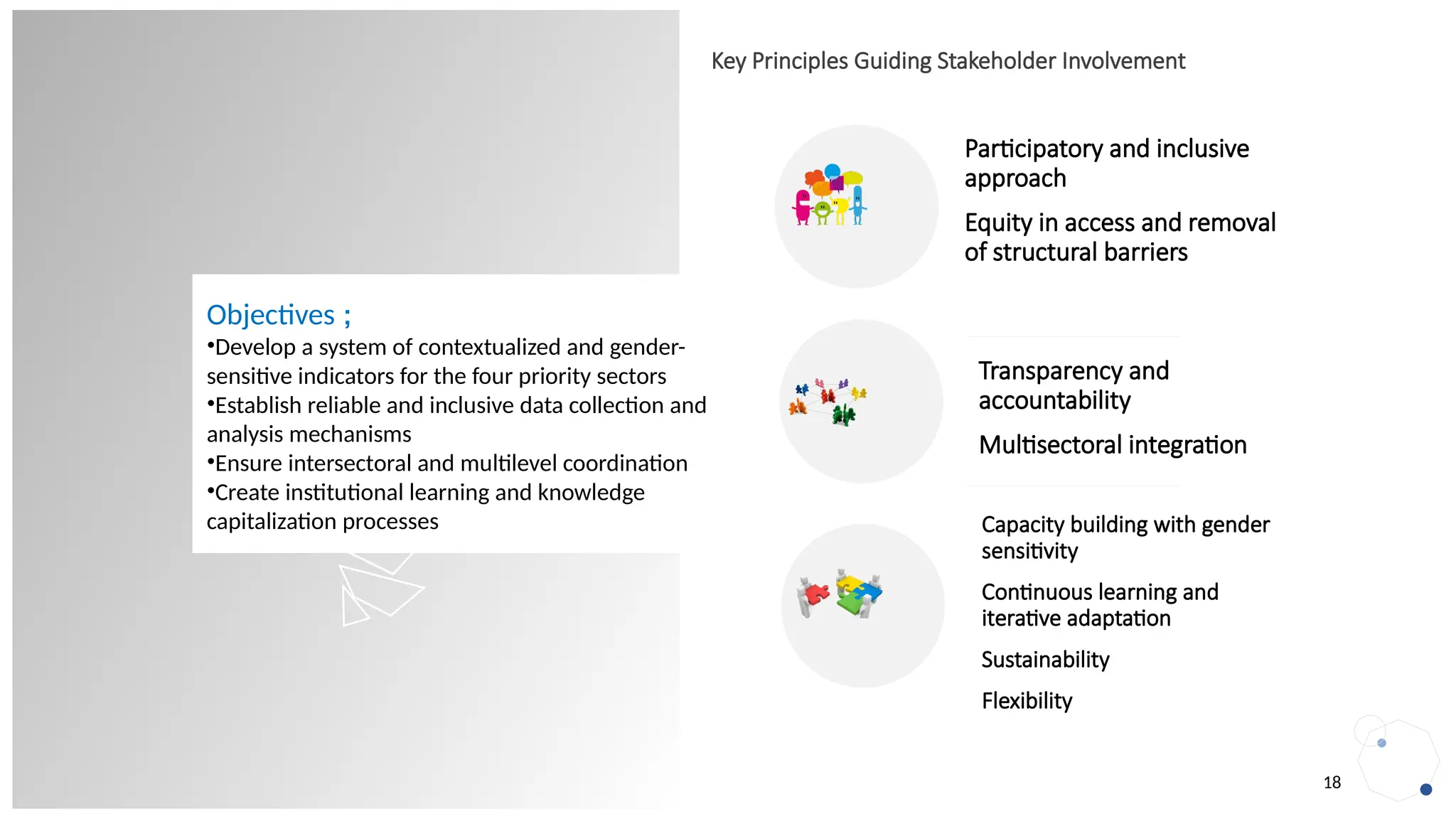
Key Principles Guiding Stakeholder Involvement
Participatory and inclusive
approach
Equity in access and removal
of structural barriers
Transparency and
accountability
Multisectoral integration
Capacity building with gender
sensitivity
Continuous learning and
iterative adaptation
Sustainability
Flexibility
18
Objectives ;
•Develop a system of contextualized and gender-
sensitive indicators for the four priority sectors
•Establish reliable and inclusive data collection and
analysis mechanisms
•Ensure intersectoral and multilevel coordination
•Create institutional learning and knowledge
capitalization processes
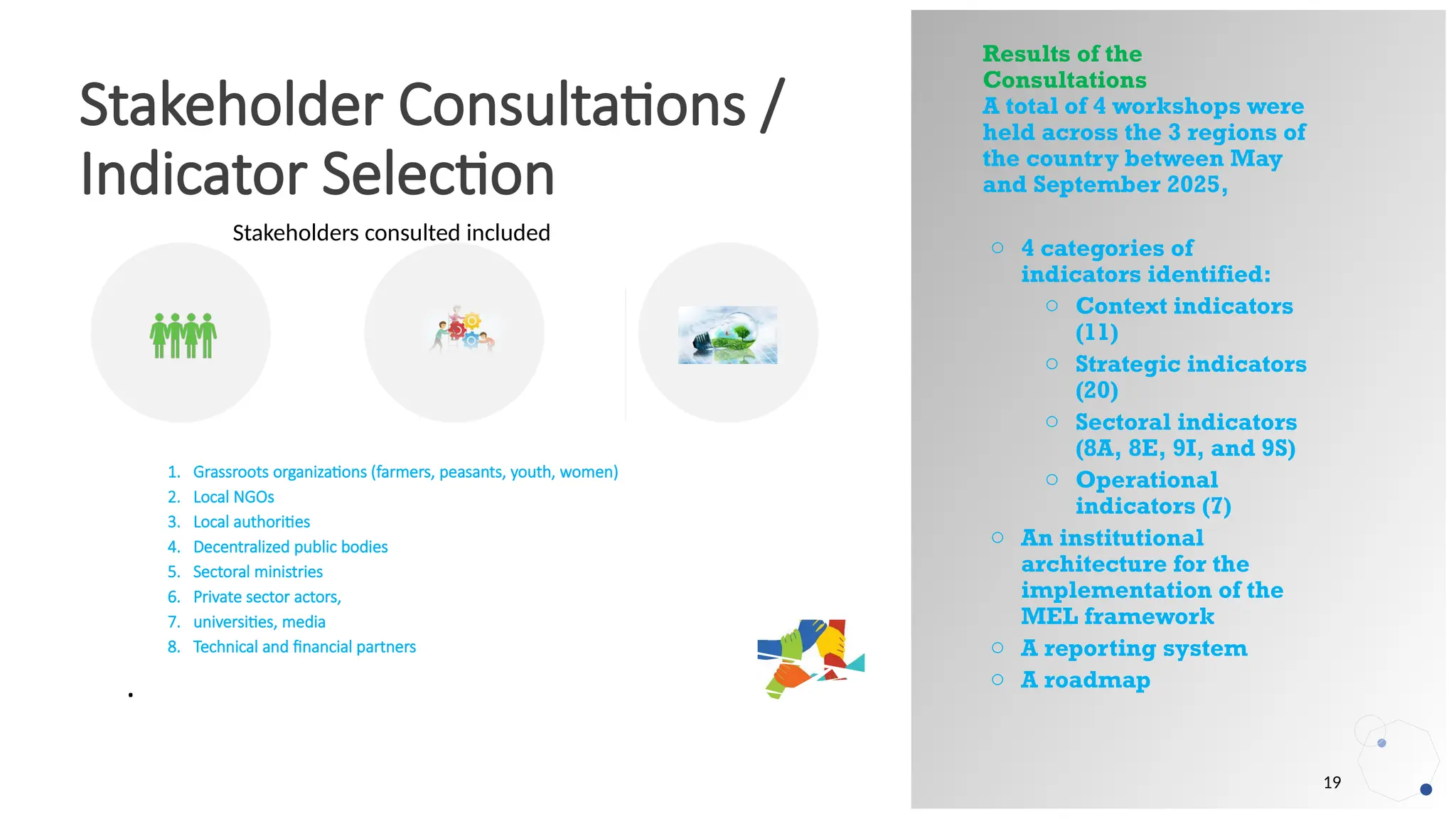
Stakeholder Consultations /
Indicator Selection
1. Grassroots organizations (farmers, peasants, youth, women)
2. Local NGOs
3. Local authorities
4. Decentralized public bodies
5. Sectoral ministries
6. Private sector actors,
7. universities, media
8. Technical and financial partners
.
19
Stakeholders consulted included
Results of the
Consultations
A total of 4 workshops were
held across the 3 regions of
the country between May
and September 2025,
o 4 categories of
indicators identified:
o Context indicators
(11)
o Strategic indicators
(20)
o Sectoral indicators
(8A, 8E, 9I, and 9S)
o Operational
indicators (7)
o An institutional
architecture for the
implementation of the
MEL framework
o A reporting system
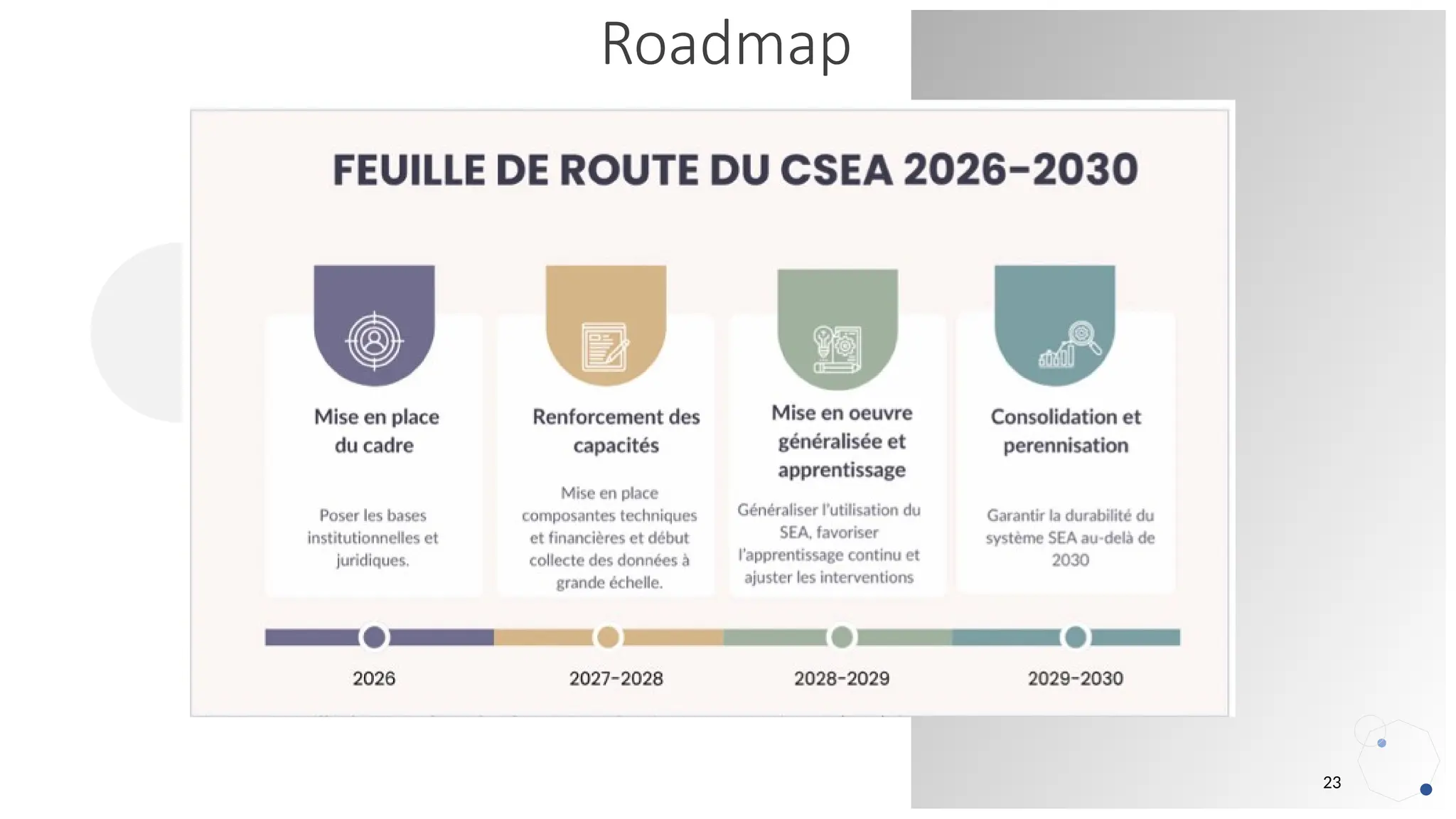
o A roadmap
20
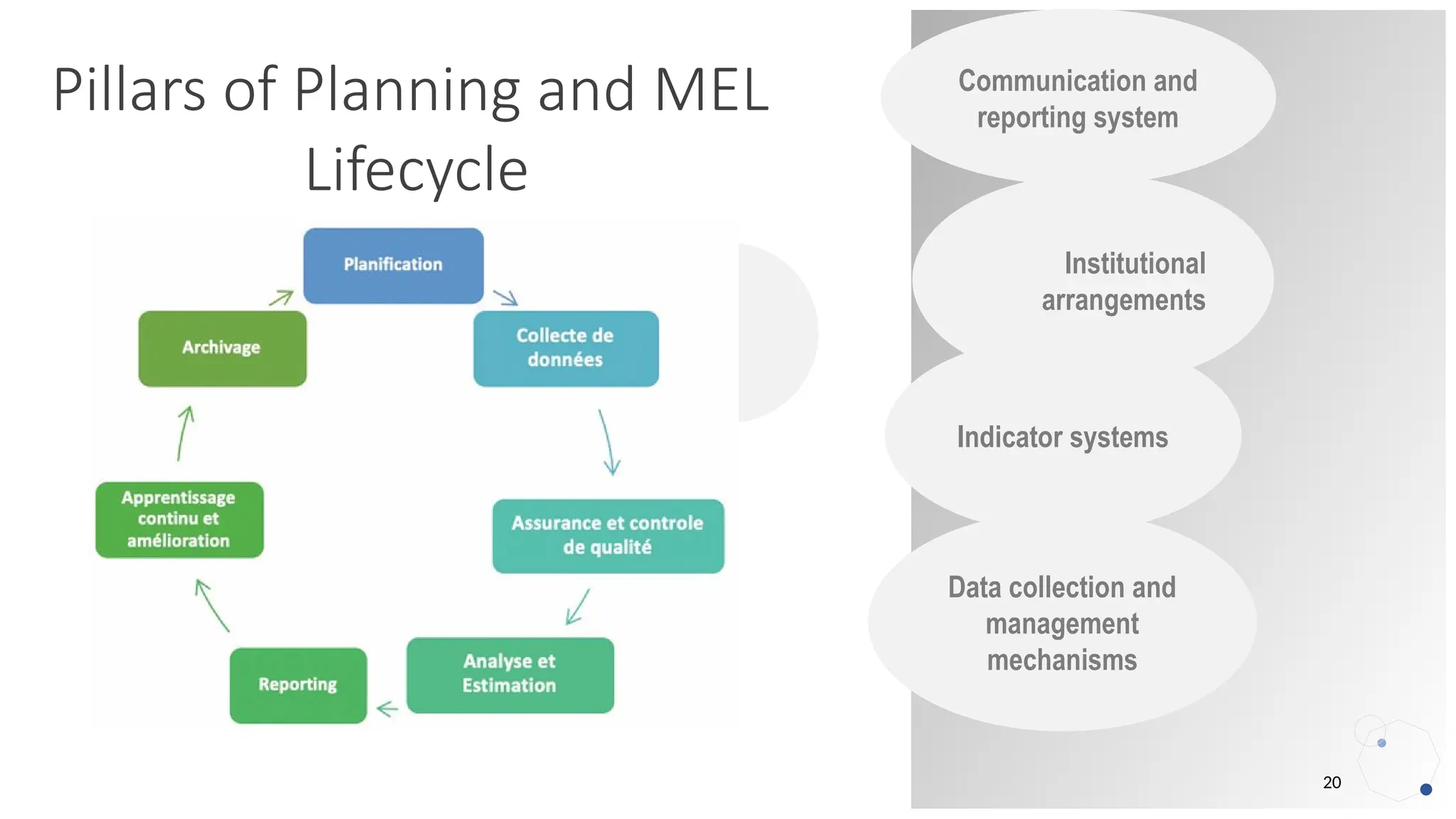
Pillars of Planning and MEL
Lifecycle
Communication and
reporting system
Institutional
arrangements
Data collection and
management
mechanisms
Indicator systems
21
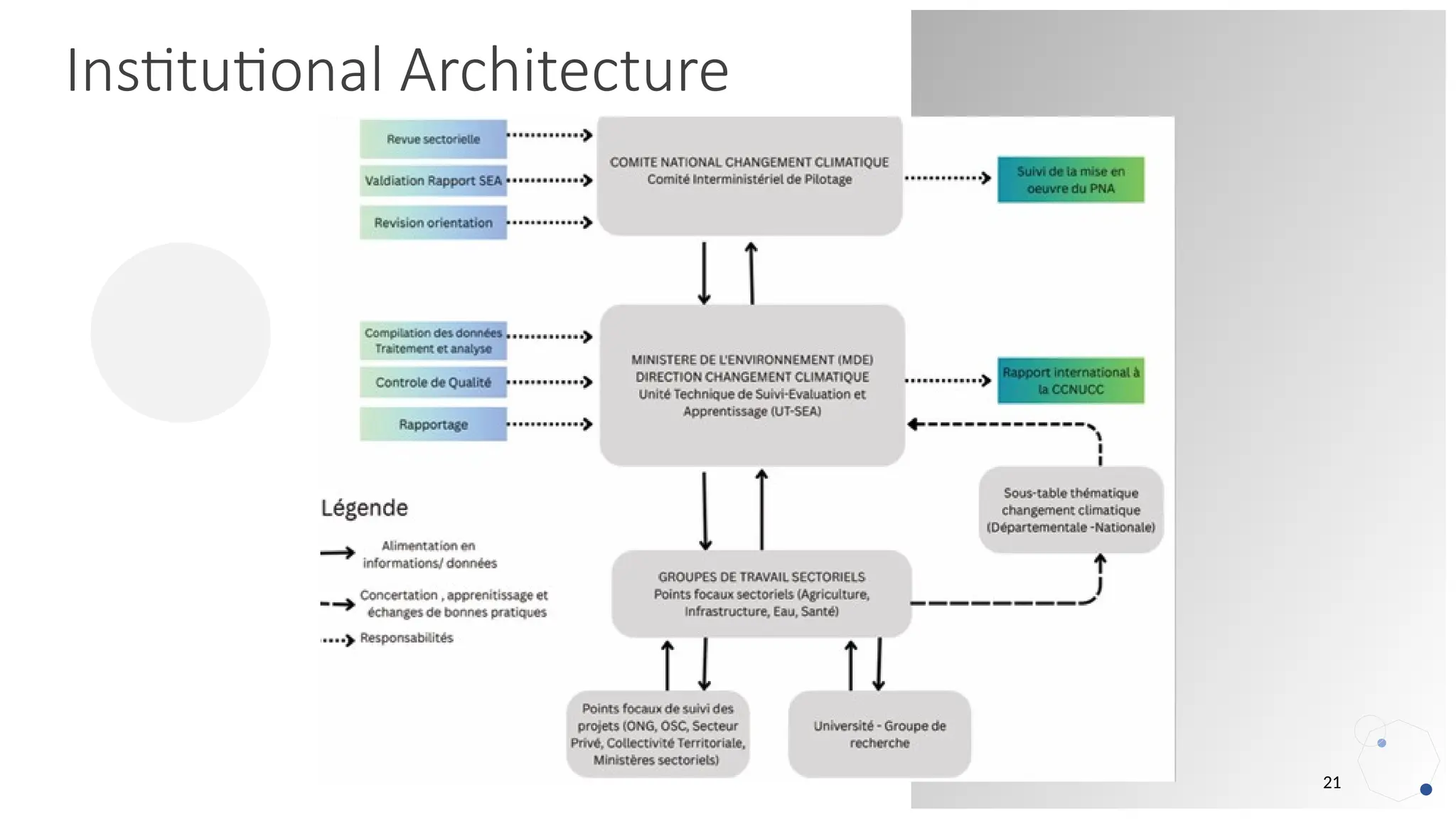
Institutional Architecture
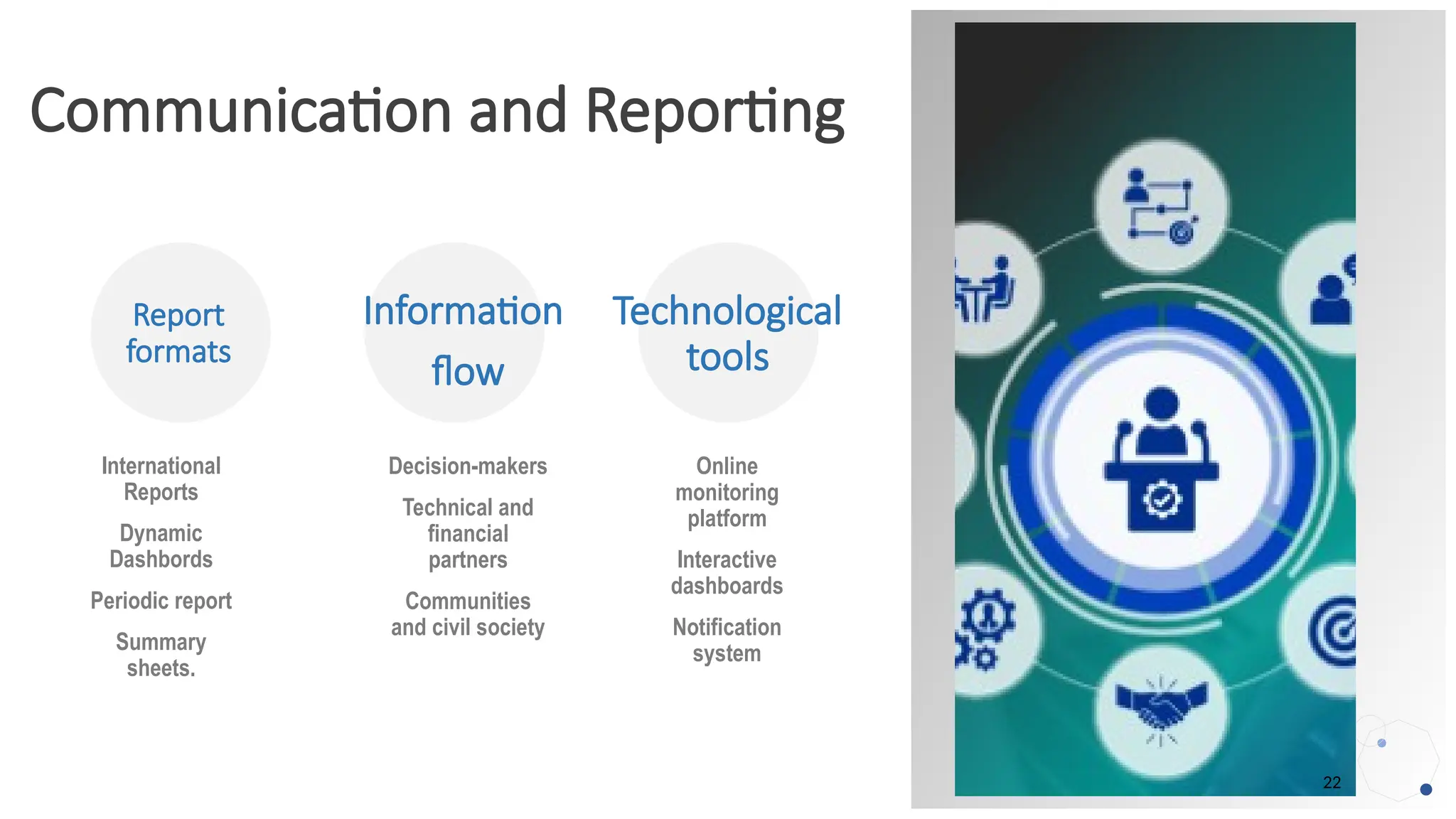
Communication and Reporting
Decision-makers
Technical and
financial
partners
Communities
and civil society
Online
monitoring
platform
Interactive
dashboards
Notification
system
Report
formats
Information
flow
Technological
tools
International
Reports
Dynamic
Dashbords
Periodic report
Summary
sheets.
22
23
Roadmap
Monitoring, Evaluation, and Learning Framework of
Haiti’s National Adaptation Plan (NAP)
Thank you
24
Monitoring Progress in Monitoring,
Evaluation and Learning for the
PNA Processes
Wednesday, December of 10 2025
Luis Roque Salazar
General Directorate of Climate Change and
Desertification
MINAM
Seminar:
Normative framework
Current monitoring
Adaptation M&E Design
Next steps
1
2
3
4
Content
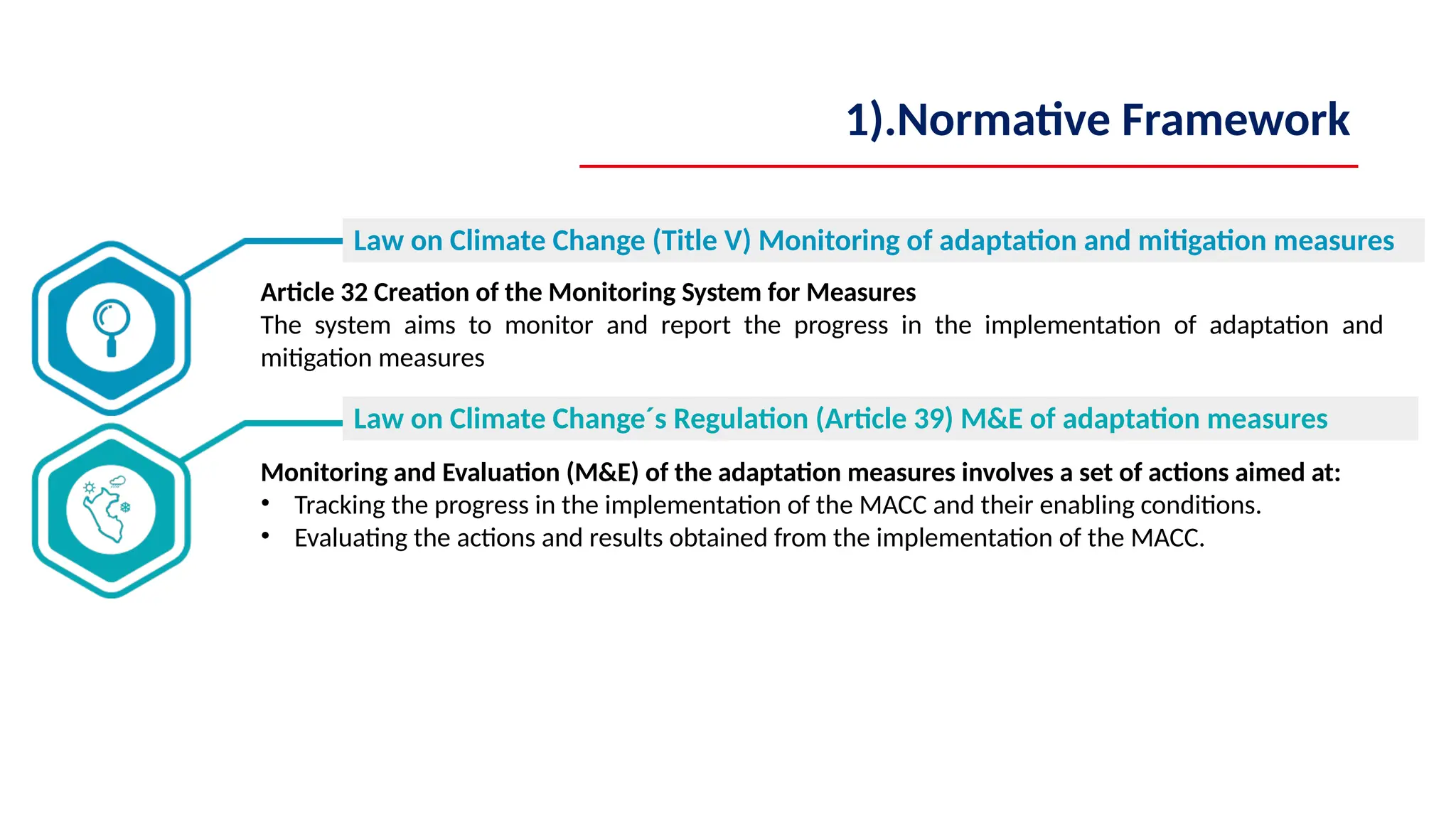
Article 32 Creation of the Monitoring System for Measures
The system aims to monitor and report the progress in the implementation of adaptation and
mitigation measures
Monitoring and Evaluation (M&E) of the adaptation measures involves a set of actions aimed at:
• Tracking the progress in the implementation of the MACC and their enabling conditions.
• Evaluating the actions and results obtained from the implementation of the MACC.
Law on Climate Change (Title V) Monitoring of adaptation and mitigation measures
Law on Climate Change´s Regulation (Article 39) M&E of adaptation measures
1).Normative Framework
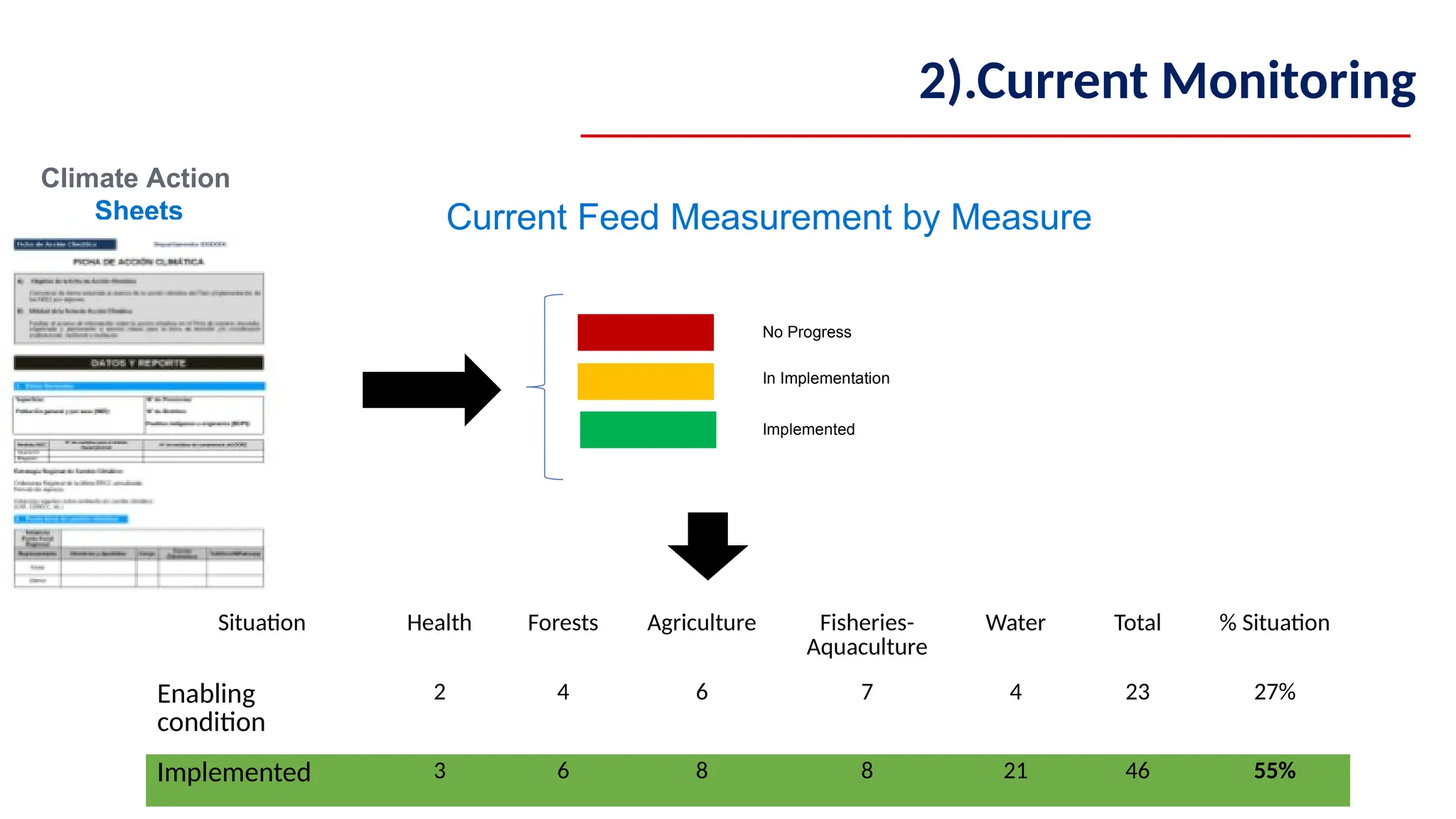
Current Feed Measurement by Measure
No Progress
In Implementation
Implemented
2).Current Monitoring
Climate Action
Sheets
Situation Health Forests Agriculture Fisheries-
Aquaculture
Water Total % Situation
Enabling
condition
2 4 6 7 4 23 27%
Implemented 3 6 8 8 21 46 55%
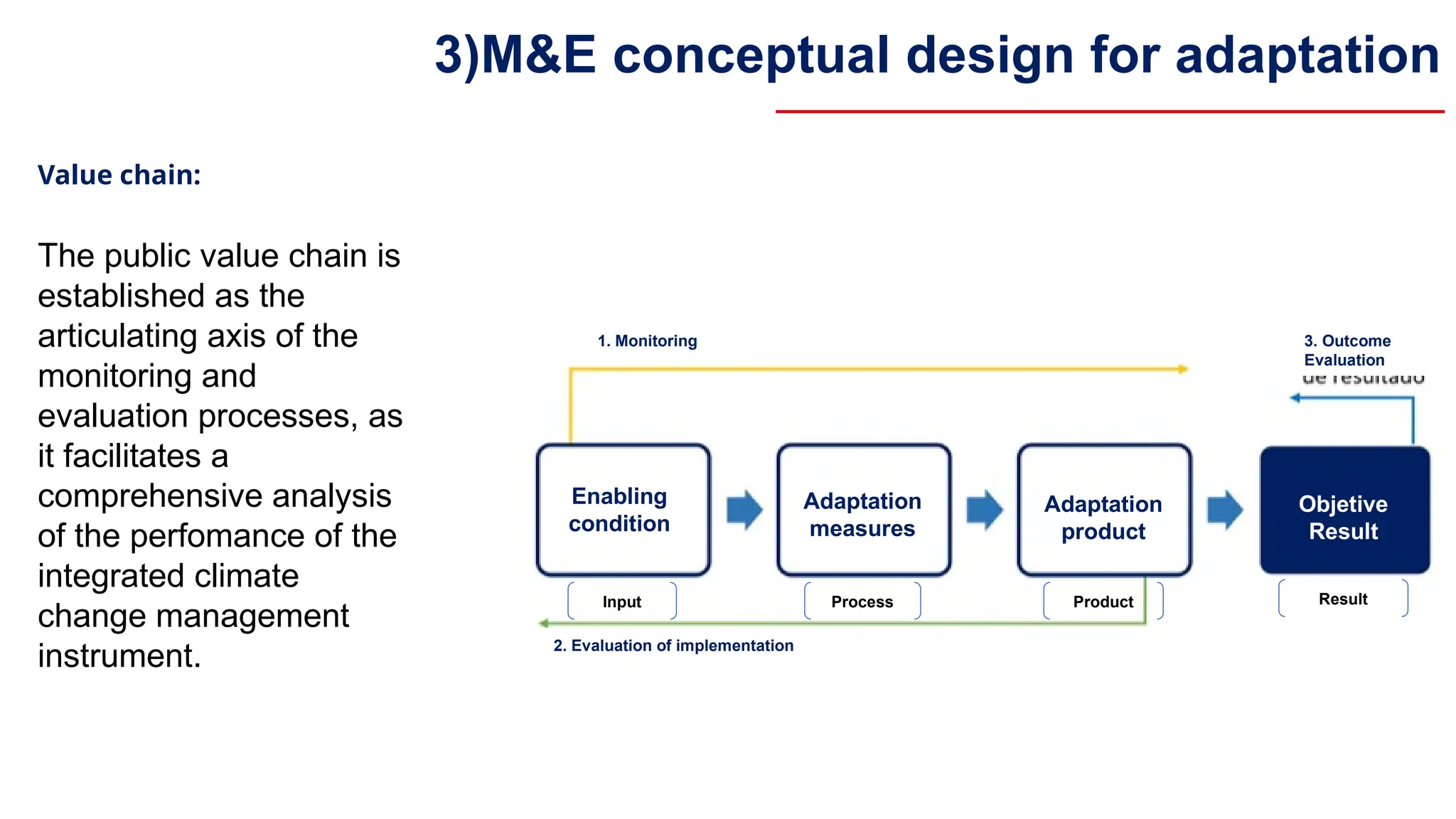
Input Process Product Result
The public value chain is
established as the
articulating axis of the
monitoring and
evaluation processes, as
it facilitates a
comprehensive analysis
of the perfomance of the
integrated climate
change management
instrument.
1. Monitoring
2. Evaluation of implementation
3. Outcome
Evaluation
Enabling
condition
Adaptation
measures
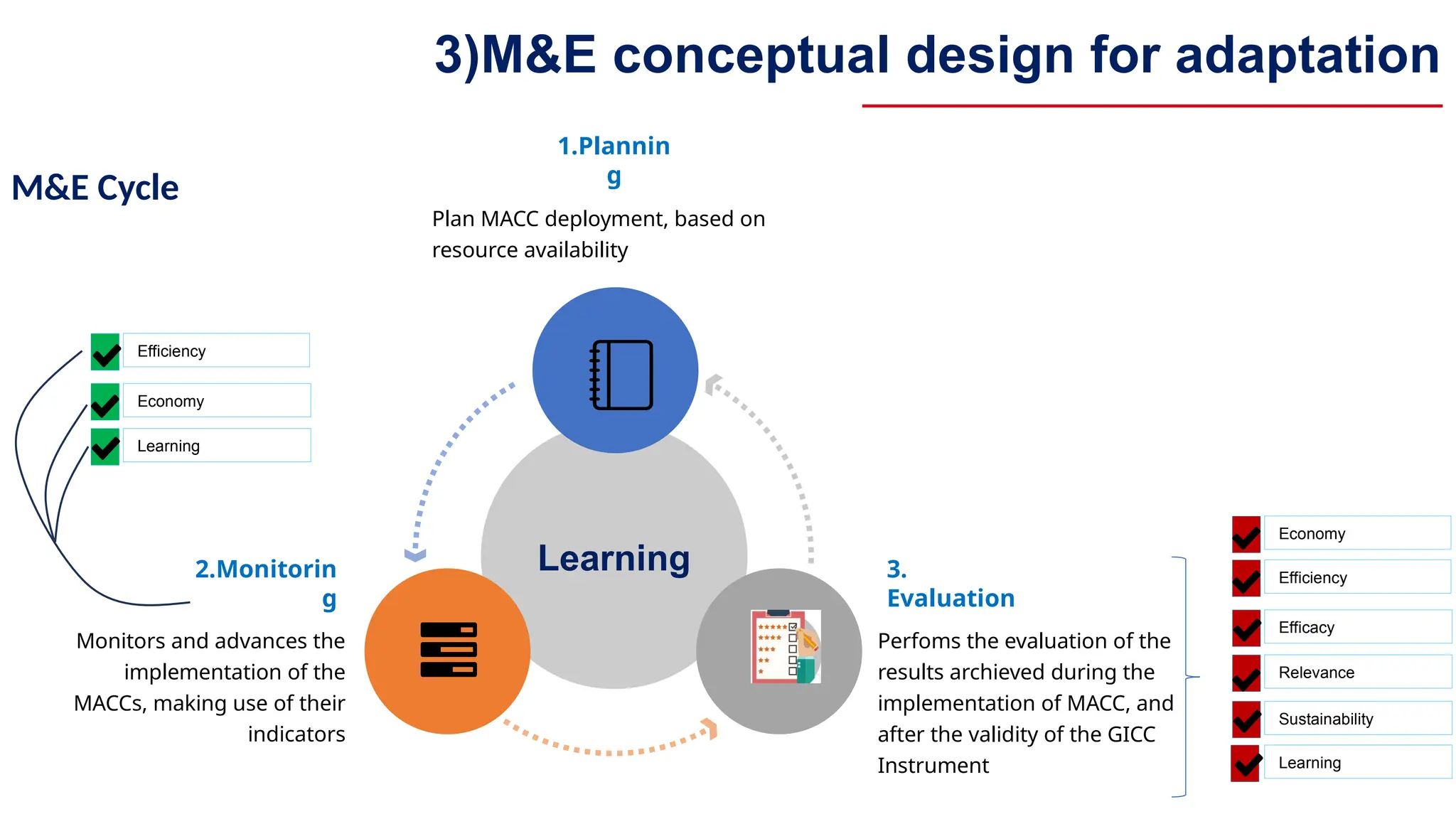
Adaptation
product
Objetive
Result
Value chain:
3)M&E conceptual design for adaptation
1.Plannin
g
Plan MACC deployment, based on
resource availability
2.Monitorin
g
Learning
Monitors and advances the
implementation of the
MACCs, making use of their
indicators
3.
Evaluation
Perfoms the evaluation of the
results archieved during the
implementation of MACC, and
after the validity of the GICC
Instrument
Efficiency
Efficacy
Relevance
Sustainability
Efficiency
Economy
Learning
Learning
Economy
3)M&E conceptual design for adaptation
M&E Cycle
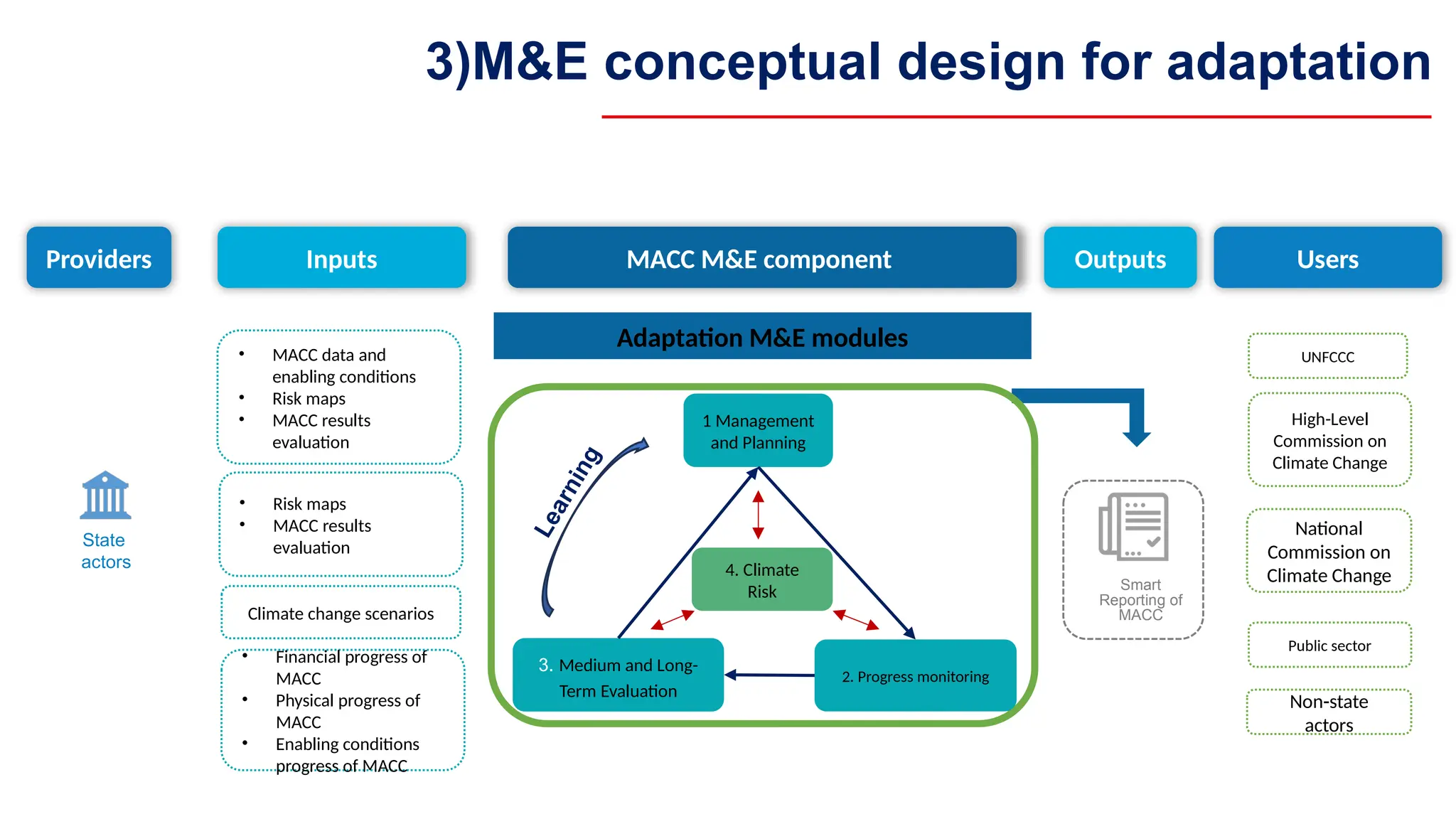
• MACC data and
enabling conditions
• Risk maps
• MACC results
evaluation
• Risk maps
• MACC results
evaluation
• Financial progress of
MACC
• Physical progress of
MACC
• Enabling conditions
progress of MACC
Climate change scenarios
Adaptation M&E modules
UNFCCC
High-Level
Commission on
Climate Change
National
Commission on
Climate Change
Public sector
Non-state
actors
State
actors
1 Management
and Planning
3. Medium and Long-
Term Evaluation
Smart
Reporting of
MACC
2. Progress monitoring
4. Climate
Risk
L
e
a
r
n
i
n
g
Providers Inputs MACC M&E component Outputs Users
3)M&E conceptual design for adaptation
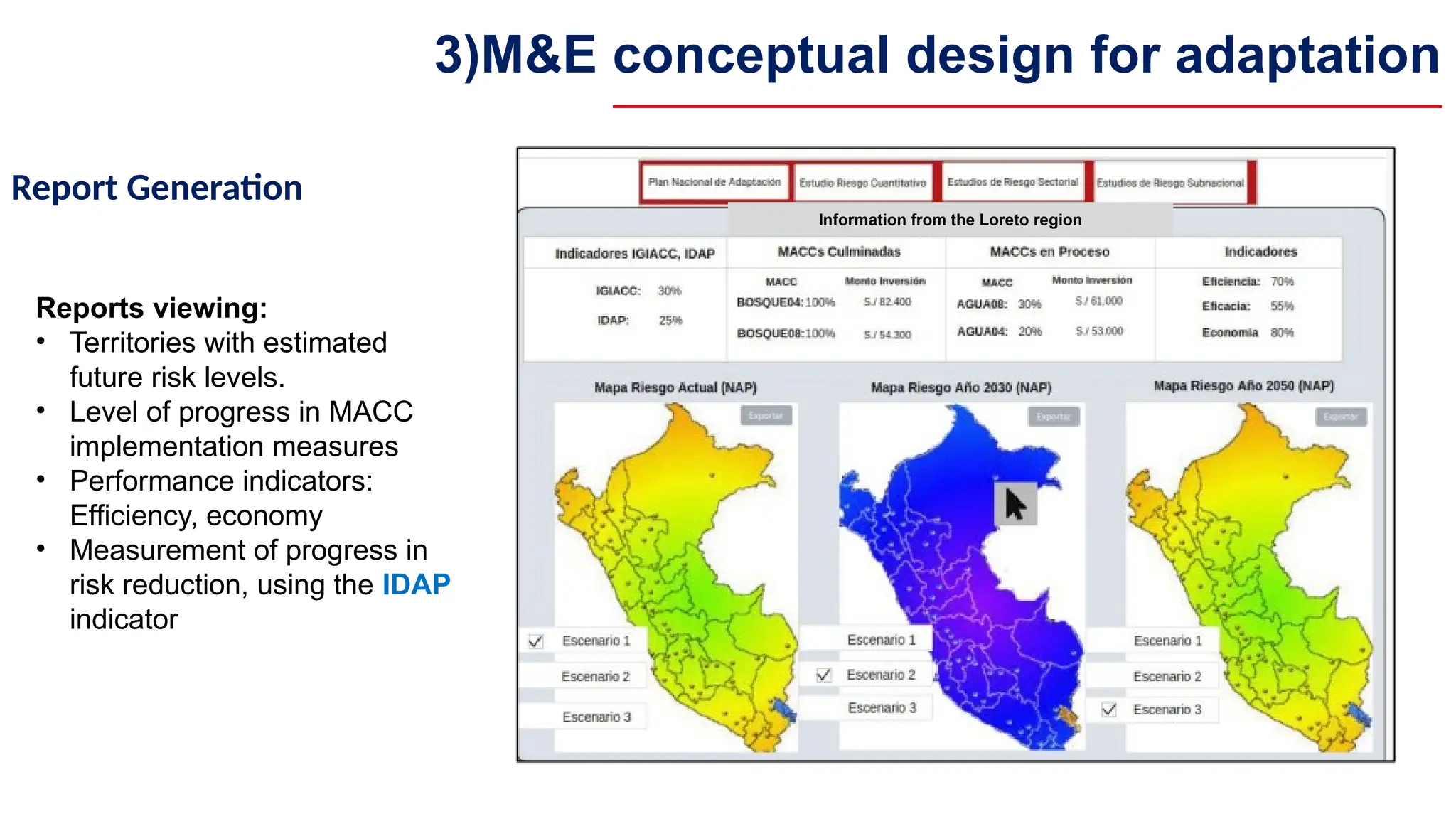
Report Generation
Reports viewing:
• Territories with estimated
future risk levels.
• Level of progress in MACC
implementation measures
• Performance indicators:
Efficiency, economy
• Measurement of progress in
risk reduction, using the IDAP
indicator
Information from the Loreto region
3)M&E conceptual design for adaptation
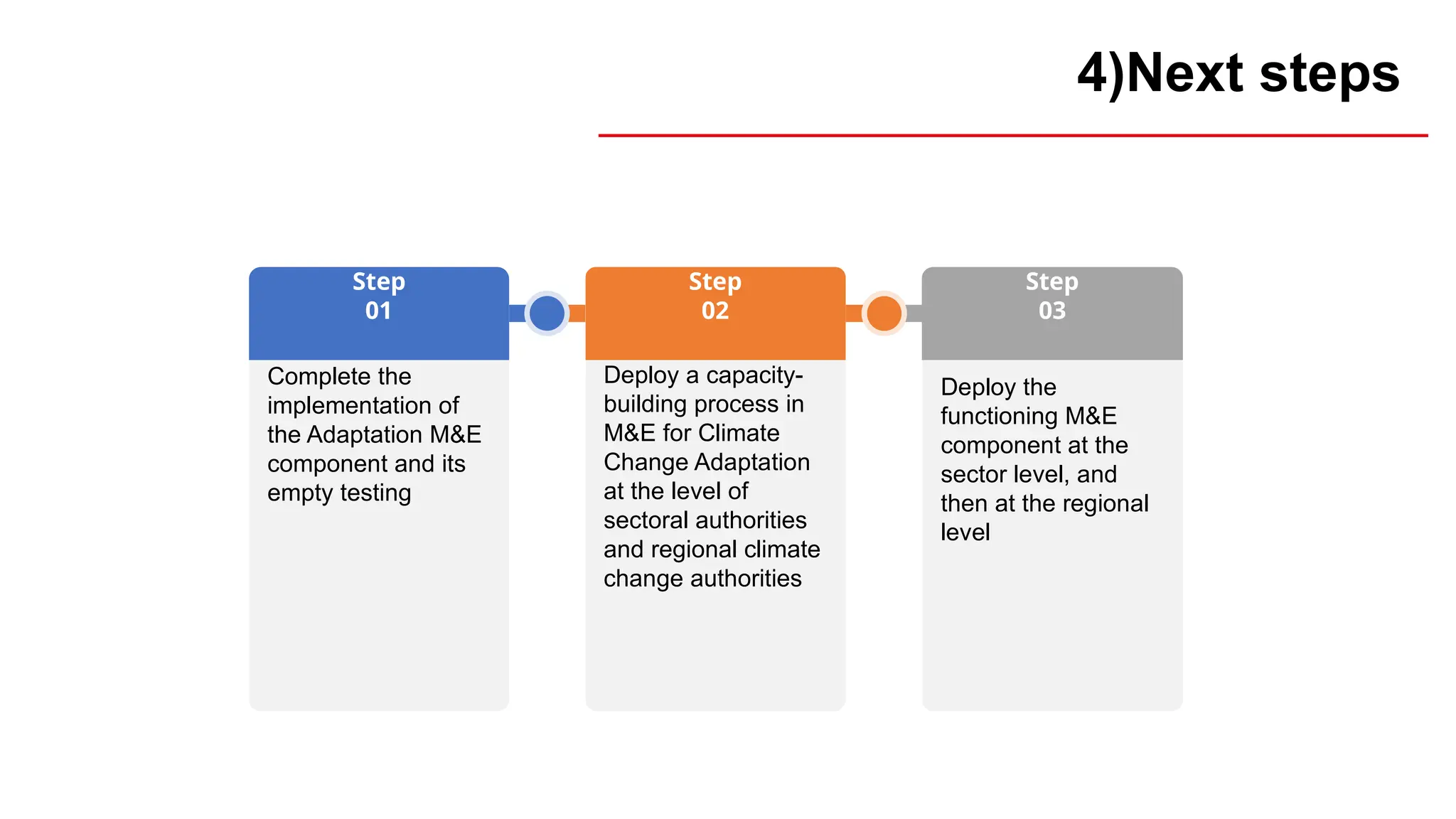
Step
01
Step
02
Step
03
Complete the
implementation of
the Adaptation M&E
component and its
empty testing
Deploy a capacity-
building process in
M&E for Climate
Change Adaptation
at the level of
sectoral authorities
and regional climate
change authorities
Deploy the
functioning M&E
component at the
sector level, and
then at the regional
level
4)Next steps
Thank
you
36
ADAPTATION ON
MONITORING & EVALUATION
CLIMATE CHANGE
THAILAND
Presented by
Miss Monchalus Pitisinchoochai
Environmentalist
DEPARTMENT OF CLIMATE CHANGE AND ENVIRONMENT (DCCE)
37
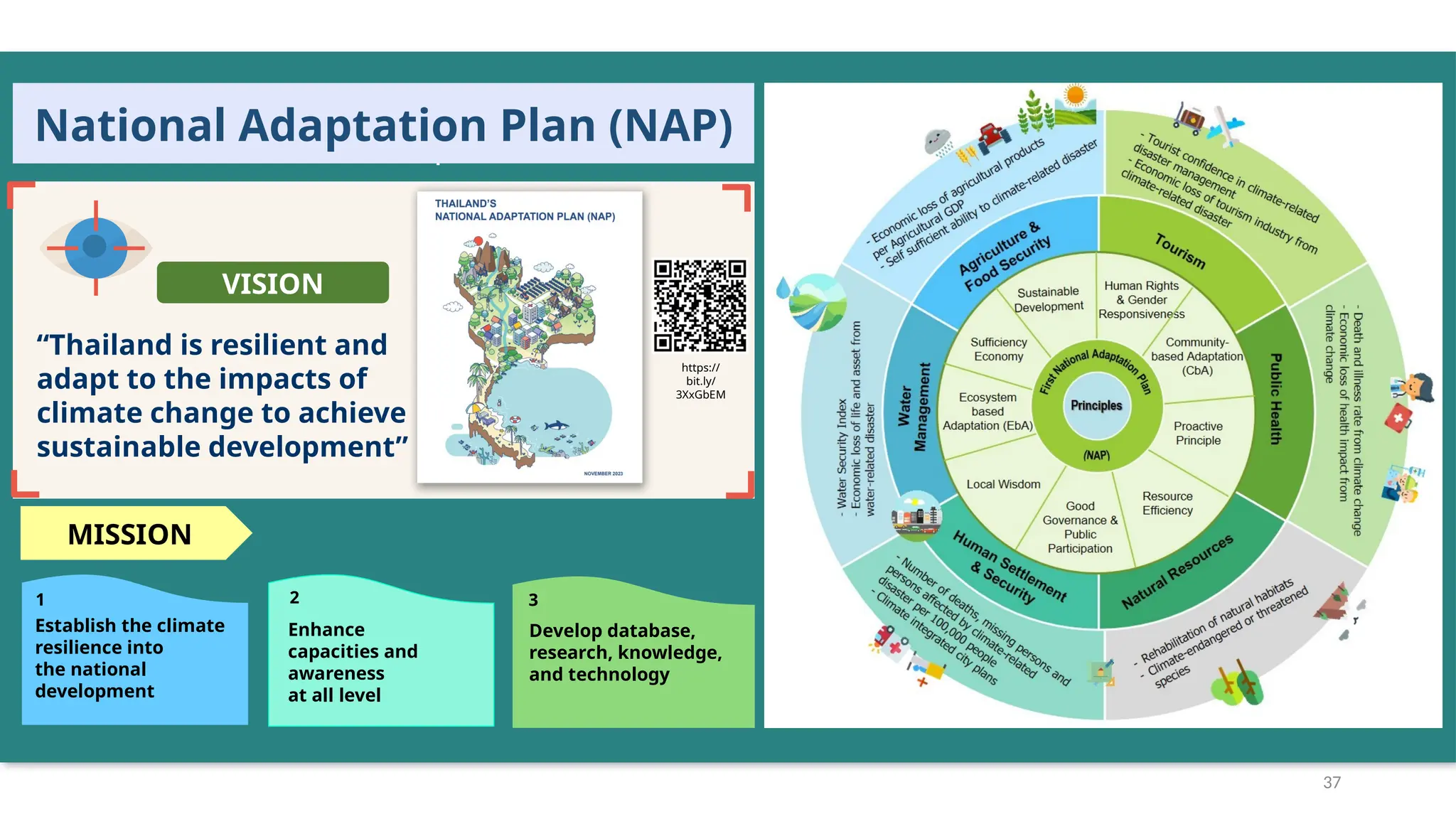
National Adaptation Plan
VISION
“Thailand is resilient and
adapt to the impacts of
climate change to achieve
sustainable development”
MISSION
Establish the climate
resilience into
the national
development
1
Enhance
capacities and
awareness
at all level
2
Develop database,
research, knowledge,
and technology
3
National Adaptation Plan (NAP)
https://
bit.ly/
3XxGbEM
38
Cultivating Climate
Change Awareness
Modified from: Adaptation Committee, 2019
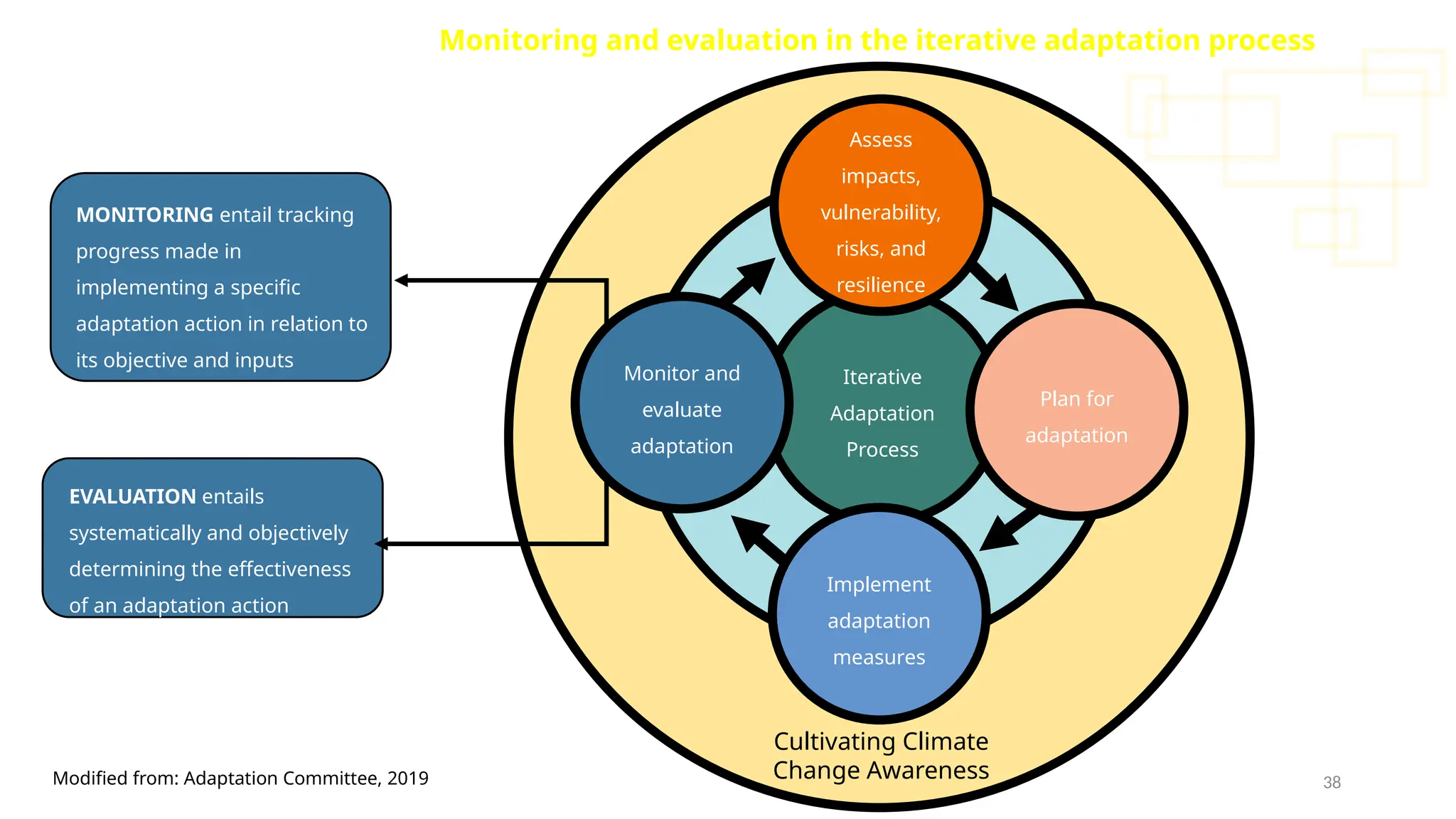
Monitoring and evaluation in the iterative adaptation process
MONITORING entail tracking
progress made in
implementing a specific
adaptation action in relation to
its objective and inputs
EVALUATION entails
systematically and objectively
determining the effectiveness
of an adaptation action
Iterative
Adaptation
Process
Assess
impacts,
vulnerability,
risks, and
resilience
Plan for
adaptation
Monitor and
evaluate
adaptation
Implement
adaptation
measures
39
Monitoring,
Evaluation, and
Learning
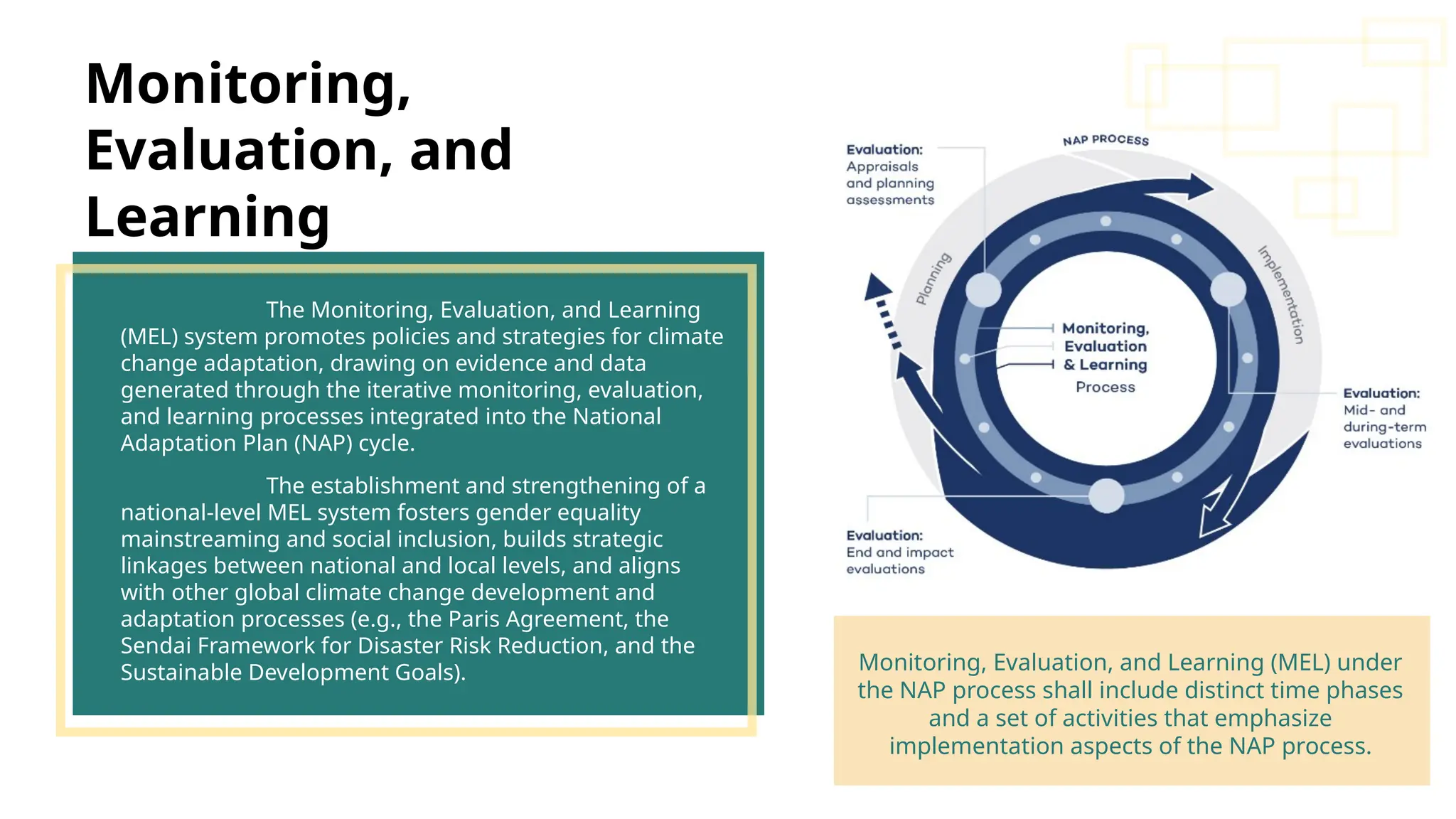
Monitoring, Evaluation, and Learning (MEL) under
the NAP process shall include distinct time phases
and a set of activities that emphasize
implementation aspects of the NAP process.
The establishment and strengthening of a
national-level MEL system fosters gender equality
mainstreaming and social inclusion, builds strategic
linkages between national and local levels, and aligns
with other global climate change development and
adaptation processes (e.g., the Paris Agreement, the
Sendai Framework for Disaster Risk Reduction, and the
Sustainable Development Goals).
The Monitoring, Evaluation, and Learning
(MEL) system promotes policies and strategies for climate
change adaptation, drawing on evidence and data
generated through the iterative monitoring, evaluation,
and learning processes integrated into the National
Adaptation Plan (NAP) cycle.
40
Memorandum of Understanding
41
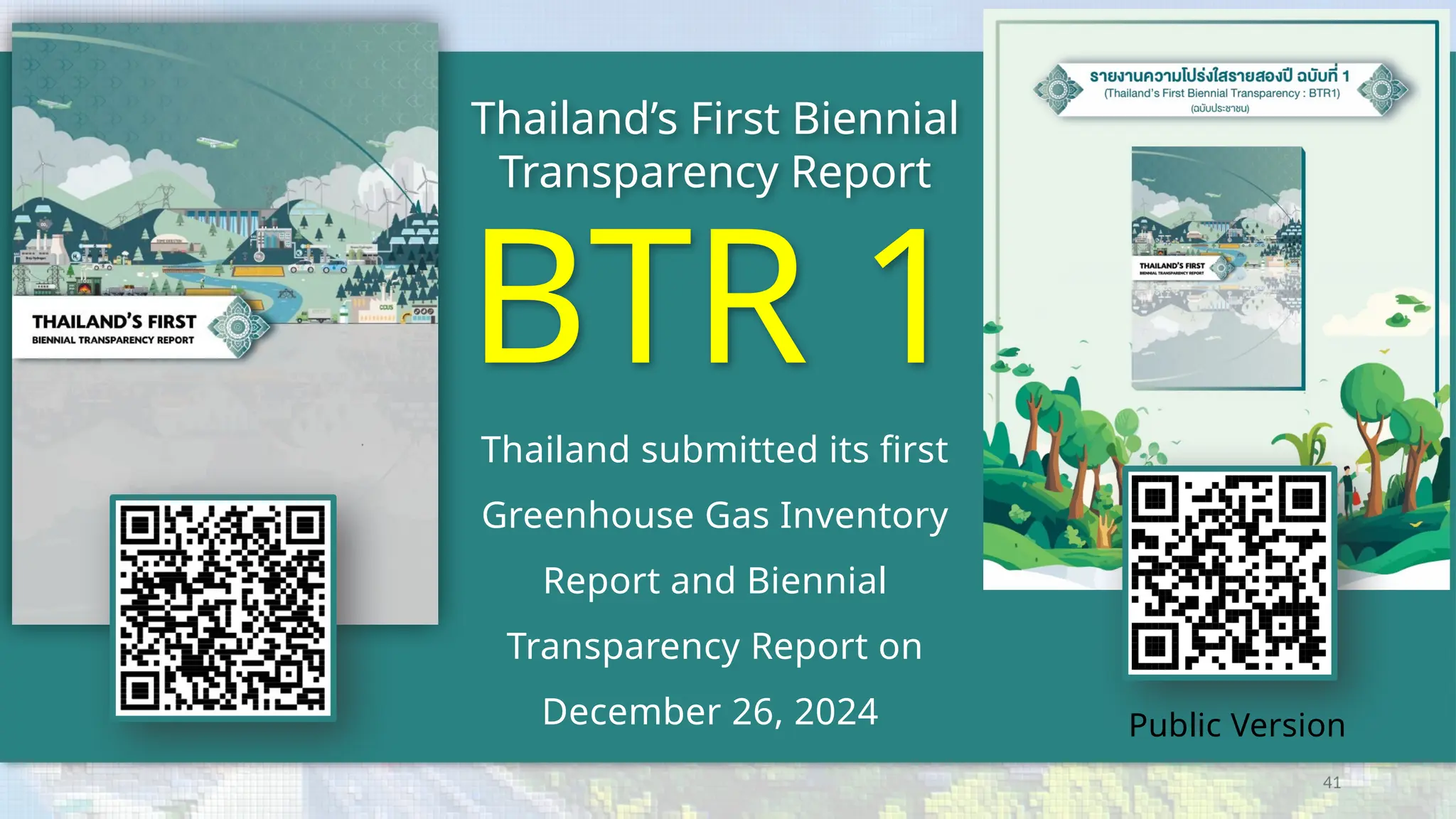
Thailand’s First Biennial
Transparency Report
BTR 1
Thailand submitted its first
Greenhouse Gas Inventory
Report and Biennial
Transparency Report on
December 26, 2024 Public Version
42
Thailand has adopted best practices to enhance its
potential, which plays a significant role in addressing
challenges. This demonstrates progress in
implementation, with case studies from Thailand
encompassing multiple relevant fields. It is considered an
area with the potential to serve as a “Best Practice" and
can be further integrated with other regions.
BEST PRACTICE
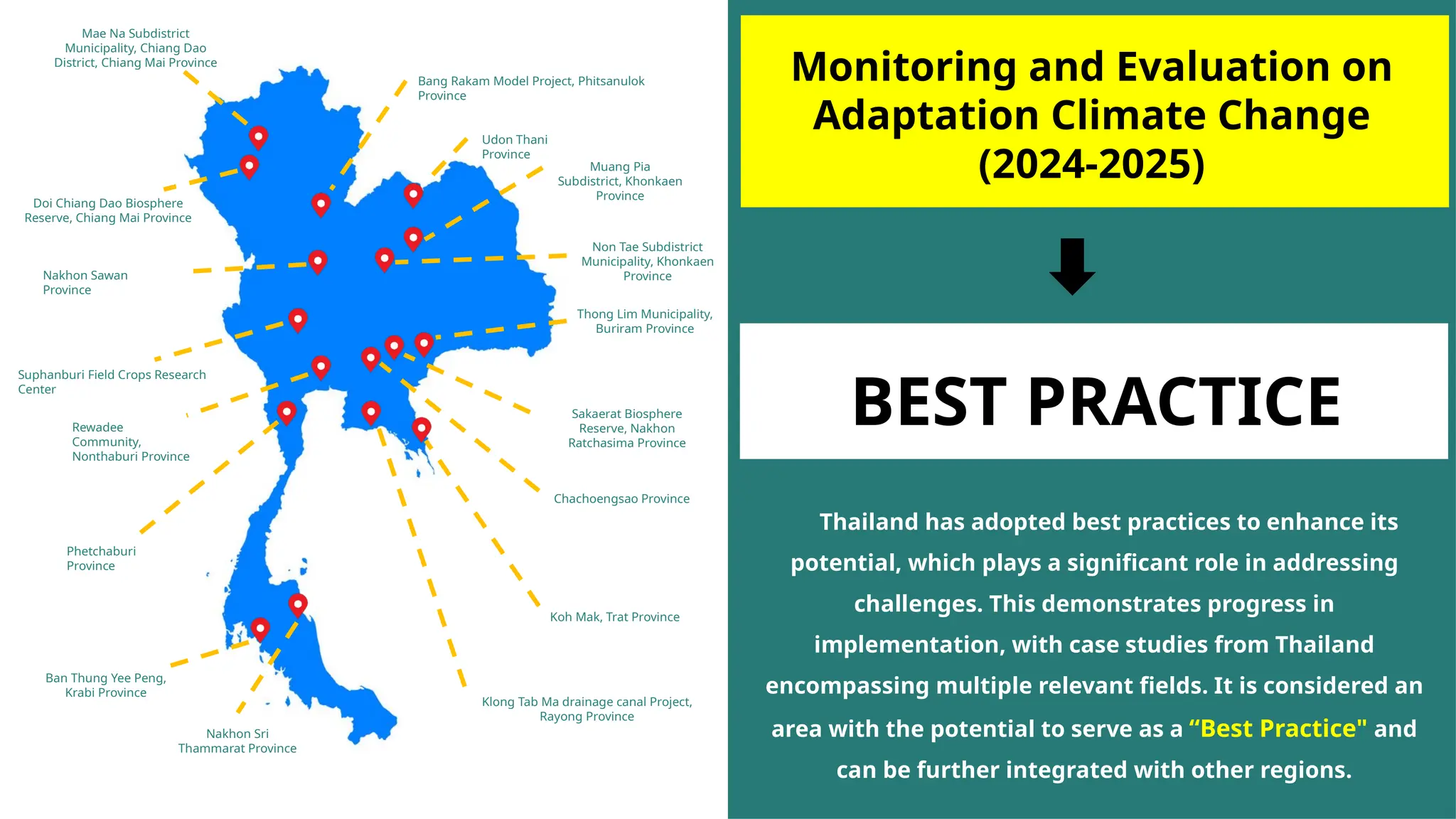
Monitoring and Evaluation on
Adaptation Climate Change
(2024-2025)
Thong Lim Municipality,
Buriram Province
Bang Rakam Model Project, Phitsanulok
Province
Non Tae Subdistrict
Municipality, Khonkaen
Province
Suphanburi Field Crops Research
Center
Koh Mak, Trat Province
Mae Na Subdistrict
Municipality, Chiang Dao
District, Chiang Mai Province
Doi Chiang Dao Biosphere
Reserve, Chiang Mai Province
Nakhon Sawan
Province
Udon Thani
Province
Muang Pia
Subdistrict, Khonkaen
Province
Sakaerat Biosphere
Reserve, Nakhon
Ratchasima Province
Chachoengsao Province
Klong Tab Ma drainage canal Project,
Rayong Province
Rewadee
Community,
Nonthaburi Province
Phetchaburi
Province
Ban Thung Yee Peng,
Krabi Province
Nakhon Sri
Thammarat Province
43
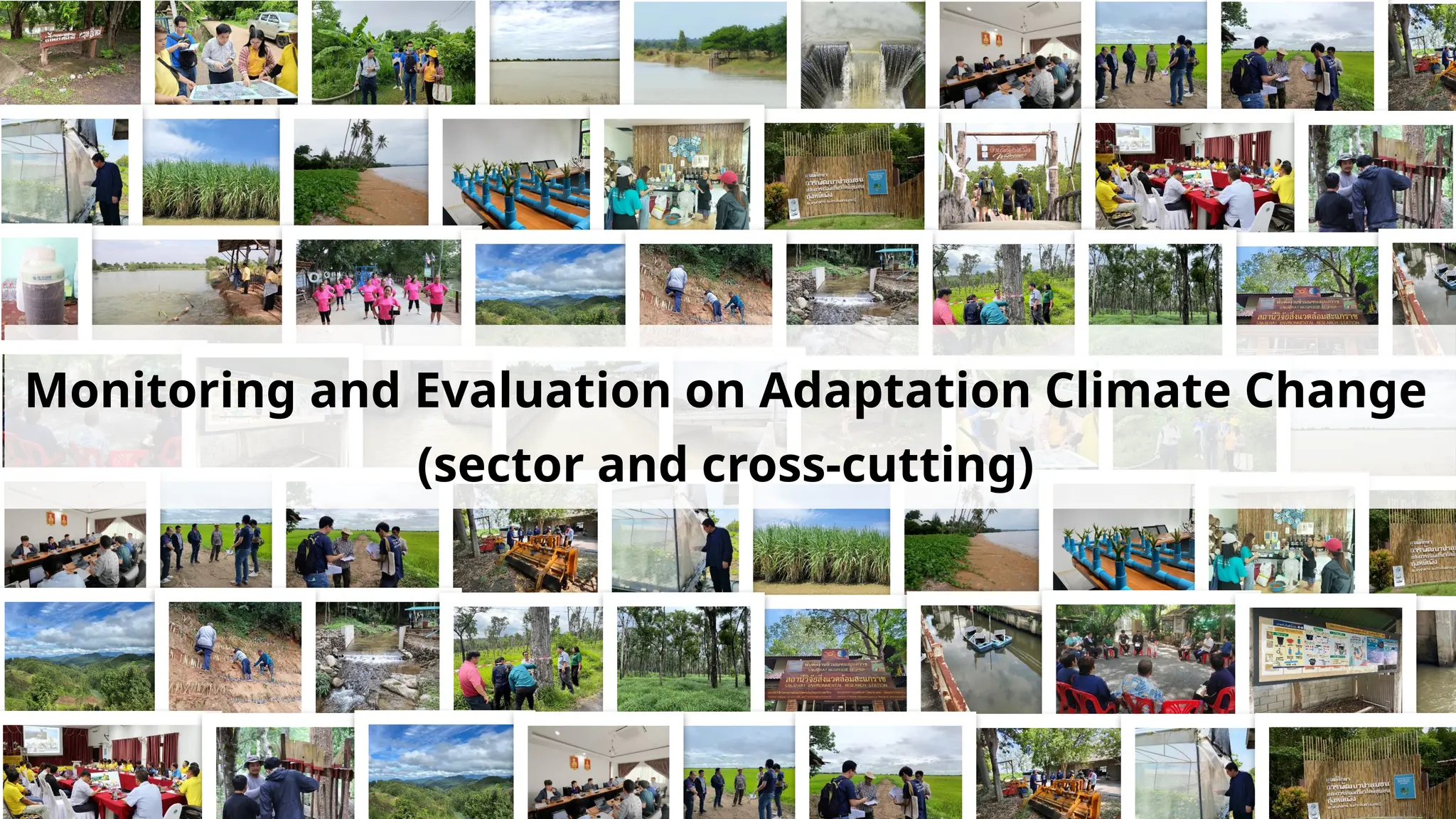
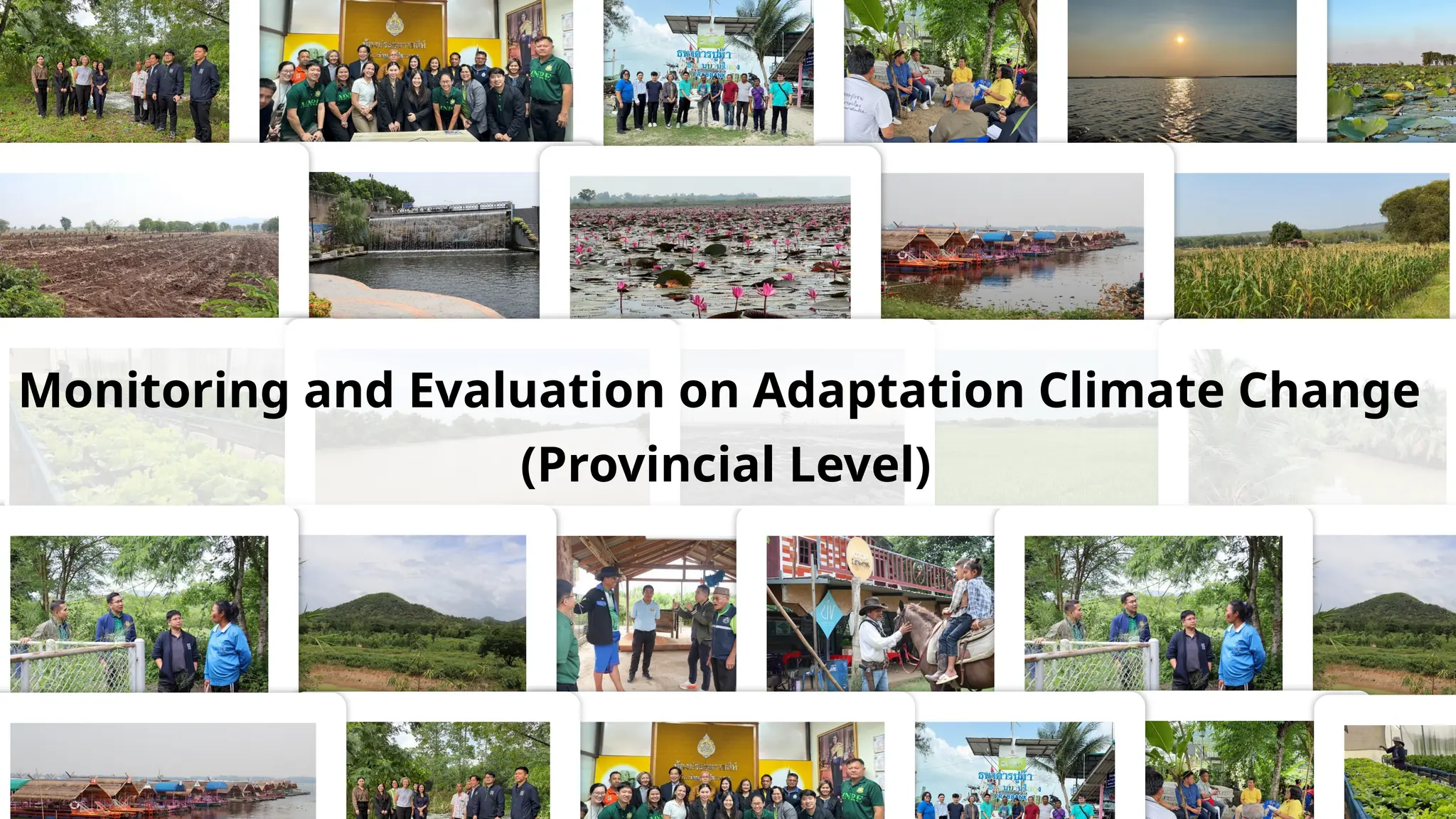
Monitoring and Evaluation on Adaptation Climate Change
(sector and cross-cutting)
44
Monitoring and Evaluation on Adaptation Climate Change
(Provincial Level)
45
Approaches on Adaptation and
Success Factors​
Observation, learning, and local knowledge for specific
ecosystems and farm-level/area-based management.
1
2
3
4
5
6
Application of the royal initiatives of His Majesty King
Bhumibol Adulyadej (Rama 9).
Appropriate technology and innovation.
Data and linkages to climate conditions and systematic
planning.
Area-based collaborative management agreements.
Community-local government-public sector-private sector-
academic collaboration.
46
Gaps Identified
Inter-agency coordination
lacks clear accountability.
Budget constraints limiting support.
1 2
3 4
5
Uneven progress in implementation across
different sectors.
Incomplete indicators—both in terms of data
coverage and data accessibility.
Lack of knowledge and understanding of climate change adaptation issues; absence of a central
database for collecting and storing climate change adaptation data.
47
Requirements for Addressing Gaps Identified
Awareness-Raising Enabling residents to understand the necessity of adaptation and participate in
sustainable risk management.
Technology Transfer Playing a crucial role in enhancing Thailand’s capacity to respond to disasters and
impacts of climate change.
Necessary Policy Development Integrating collaboration across different agencies, establishing inter-
sectoral Memoranda of Understanding (MoUs), and promoting adaptation policy as a national priority.
48
Requirements for Addressing Gaps Identified
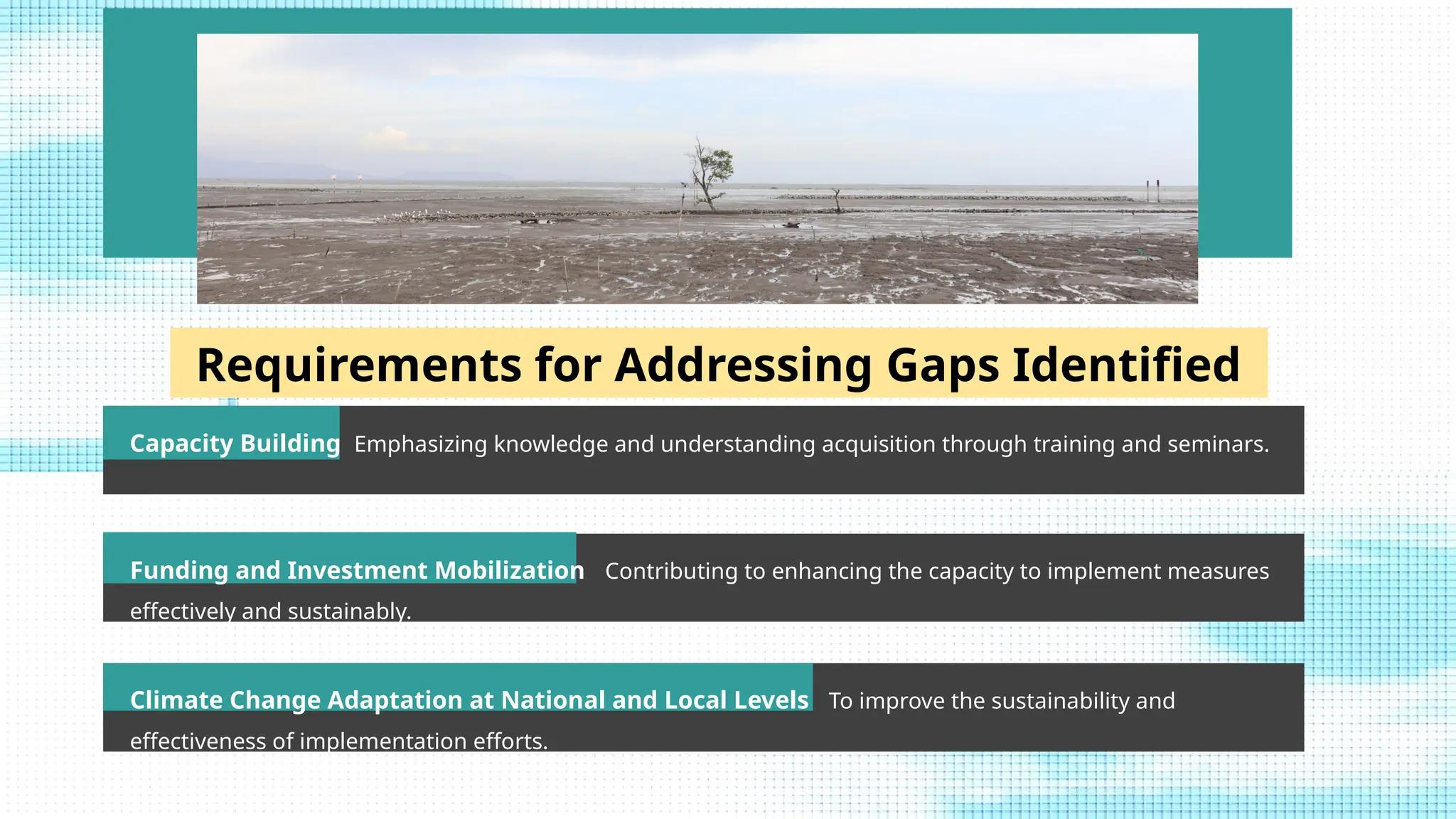
Capacity Building Emphasizing knowledge and understanding acquisition through training and seminars.
Funding and Investment Mobilization Contributing to enhancing the capacity to implement measures
effectively and sustainably.
Climate Change Adaptation at National and Local Levels To improve the sustainability and
effectiveness of implementation efforts.
49
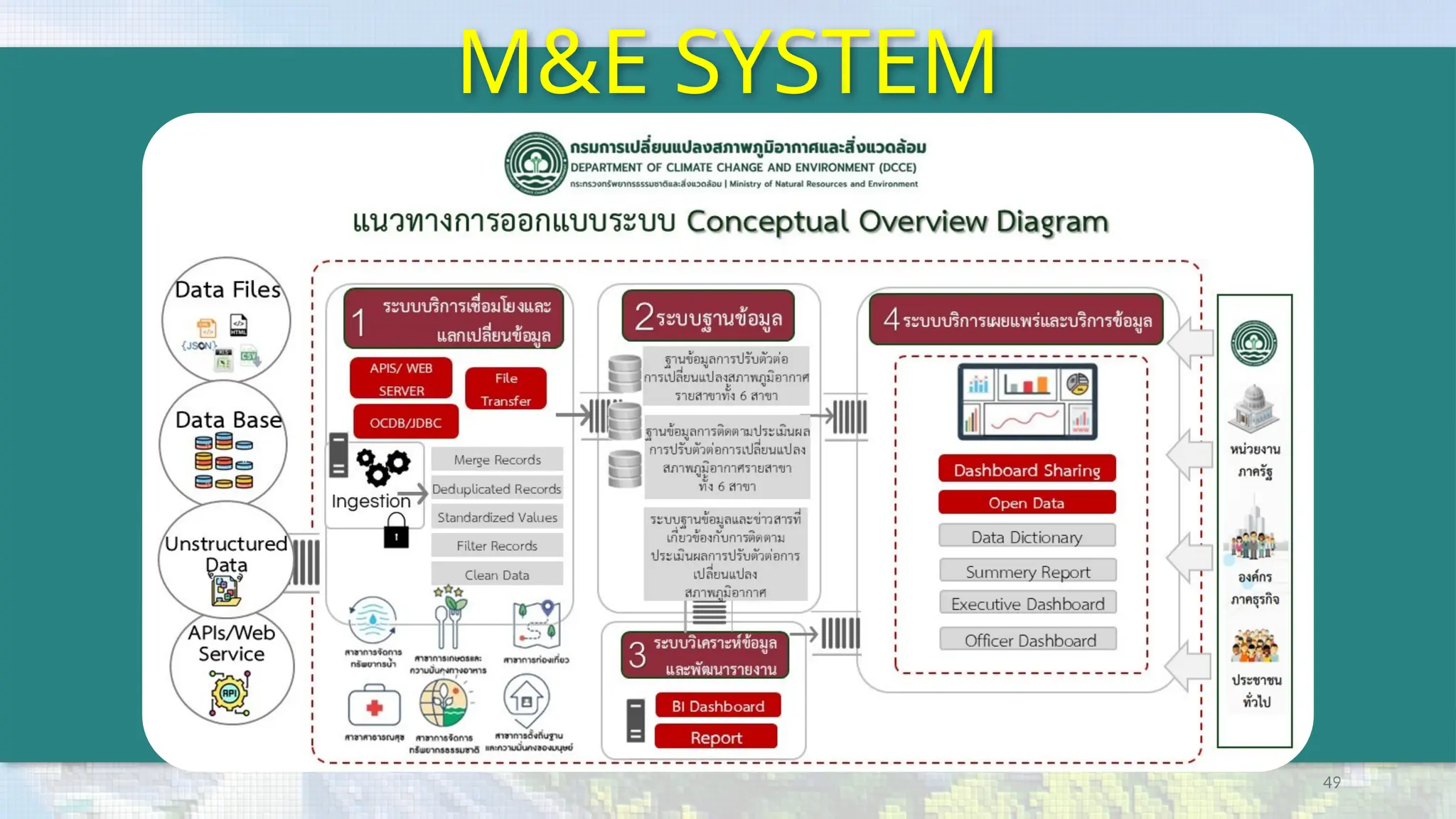
M&E SYSTEM
50
THANK YOU
Tracking Progress on
Monitoring, Evaluation,
and Learning for National
Adaptation Processes
Scan the QR code to
download the report
Thank you!
Email:
info@napglobalnetwork.org
Website:
www.napglobalnetwork.org
NAP Global Network
National Adaptation Plan
Global Network

Tracking Progress on Monitoring, Evaluation, and Learning for National Adaptation Plan Processes​

  • 1.
    Tracking Progress on Monitoring,Evaluation, and Learning for National Adaptation Plan Processes WEBINAR Tuesday, December 10, 2025 9:00 ET / 15:00 CET
  • 2.
    Help countries learnfrom each other through South- South peer learning and exchange. Over 1000people from 84 countries have participated in peer learning and exchanges. About the NAP Global Network What We Do: Support national-level action on NAP development & implementation. 73developing countries have received direct technical support​ . Generate, synthesize, & share knowledge on NAP processes. Over 350 knowledge materials have been produced. Our Goal: Enhance national adaptation planning and action in developing countries
  • 3.
    Peer Learning Forum TrackingProgress on MEL for National Adaptation Plan Processes REPORT LAUNCH Krystel Montpetit Senior Policy Advisor Josiane Mukeshimana, Rwanda (2024)
  • 4.
    Adaptation is alearning process. The aim of a MEL system is to provide a structured approach to monitor progress, evaluate results, and facilitate learning for NAP processes and their activities to effectively achieve their intended results. The different activities that countries undertake under monitoring, evaluation, and learning are closely connected. There is a need to change perspectives about the role of M&E towards learning rather than primarily on accountability. Source: Beauchamp et al. (2024). Toolkit on MEL for NAP processes How to define MEL for NAP processes?
  • 5.
    Why are MELsystems for NAP processes important? Adaptation Committee National MEL systems lay the foundation for effective, inclusive and transformative adaptation processes. Understanding the effectiveness of NAP processes Enhancing efficiency Improving adaptive management and mutual accountability Mobilizing domestic, international, public, and private finance Strengthening equity
  • 6.
    National MEL systemsalso play a critical role in informing collective progress on adaptation The UAE Framework for Global Climate Resilience sets a target focused on MEL: ”By 2030 all Parties have designed, established and operationalised a system for monitoring, evaluation and learning for their national adaptation efforts and have built the required institutional capacity to fully implement the system.”
  • 7.
    Monitoring, Evaluation andLearning in National Adaptation Plans NAP GN recently conducted an analysis of 62 multi-sectoral NAP documents submitted to the UNFCCC. It reveals how developing countries are integrating MEL systems across the iterative adaptation cycle. It found that MEL is widely acknowledged as a core component of NAP processes. However, acknowledgement does not always translate to comprehensive implementation planning. Universal Recognition, Variable Implementation 100% Include MEL Considerations All 62 NAP documents reviewed acknowledge MEL as essential to adaptation processes. 89% Dedicated MEL Sections Include a specific chapter, section, subsection or annex focused on MEL systems.
  • 8.
    MEL Integration Acrossthe Adaptation Cycle IVRA Phase 48% of NAP documents link climate risk assessments to MEL systems, using outputs as baseline data and risk-based indicators. Planning Phase 52% mention logic models, whilst 66% list specific indicators for monitoring adaptation progress. Implementation Phase 87% state their MEL system is under implementation, implemented, or planned for future rollout. But only 39% of NAP documents include dedicated timelines or roadmaps for MEL system implementation. MEL Phase 73% commit to evaluating adaptation actions, but only 8% mention mid-term evaluations. 37% commit to reporting for national purposes and 38% through UNFCCC instruments (15% specifically mention AdComs and 20% BTRs). Universal MEL recognition, but significant gaps remain across the 4 phases
  • 9.
    Critical Gaps inGender and Social Inclusion Whilst MEL offers a valuable opportunity to integrate gender and social inclusion considerations measurably, significant gaps persist in NAP documents. 45% Gender-Responsive Indicators Report development or planned development of indicators that account for gender dimensions. 29% Gender-Disaggregated Data Mention indicators that systematically disaggregate data by sex and other relevant dimensions. These figures reveal a substantial opportunity to strengthen the integration of gender equality and social inclusion into MEL systems through systematic disaggregation by sex, age, disability, geography, and other relevant dimensions.
  • 10.
    Data Foundations andEvaluation Commitments Strong Technical Foundations 95% of NAP documents mention data collection, management, and analysis considerations, indicating strong emphasis on establishing technical foundations for effective monitoring and evaluation. Additionally, 66% report using or intending to use MEL to track financial flows, fund efficiency, or adaptation expenditures. Weak Evaluation Commitments Whilst 73% include general commitments to evaluating adaptation actions, specific evaluation plans remain limited: • Only 8% mention mid-term evaluations • Only 7% commit to final or impact evaluations
  • 11.
    How does theSeptember 2025 status of MEL integration in NAP documents compare with that of three years ago in August 2022? Status of MEL integration in NAP documents in September 2025 (n= 64 NAPs) Status of MEL integration in NAP documents in August 2022 (n= 38 NAPs) This data indicates an absolute increase between 2022 and 2025 of: • 20 percentage points in NAPs with indicators • 19 percentage points in NAPs with commitments to progress reporting
  • 12.
    Based on findingsand looking ahead, we propose that countries strengthen: Institutional Capacity Establish dedicated MEL units or focal points within government structures. Improve cross-sectoral coordination mechanisms to ensure coherent approaches across ministries. Allocate adequate financial and human resources to sustain MEL operations over time. IVRA Integration Systematically inform MEL frameworks through Impact, Vulnerability and Risk Assessments (IVRAs). Use IVRA outputs to establish credible baselines and guide formulation of adaptation objectives, targets and indicators grounded in real-world impacts, vulnerabilities, and risks. Results Measurement Develop and implement outcome- and impact-level indicators to complement existing output-level metrics. Enable more robust tracking across the complete results chain, moving beyond activity counts to measure meaningful change in communities and ecosystems. GESI Integration Integrate gender equality and social inclusion (GESI) throughout MEL systems. Use gender-responsive indicators and systematically disaggregate data by sex, age, disability, geography, and other relevant dimensions aligned with inclusive MEL principles. Implementation Roadmaps Develop time-bound MEL implementation plans and roadmaps to guide system rollout. Include clear timelines for data collection cycles, analysis periods, and evaluation schedules to ensure consistent implementation and accountability. International Reporting Design MEL systems to support international reporting obligations under the Enhanced Transparency Framework. Ensure alignment with requirements for Adaptation Communications (AdComs) and Biennial Transparency Reports (BTRs) to streamline compliance.
  • 13.
    Making key information onNational Adaptation Plans (NAPs) easily accessible and digestible for the climate change adaptation community.
  • 14.
    *Data as ofNovember 29, 2025
  • 15.
  • 16.
    Government Panellists Monchalus Pitisinchoochai Environmentalist, Department ofClimate Change and Environment, Government of Thailand Expert on Local Development, Environment and Geomatics, Haiti Dr Constantin Joseph Herrick Mwewa Principal Climate Change Officer in charge of Mitigation Actions and Programmes, Ministry of Green Economy and Environment, Government of Zambia Luis Efrain Roque Salazar Specialist in Investment for Climate Change, Ministry of Environment, Government of Peru
  • 17.
    Monitoring, Evaluation, andLearning Framework of Haiti’s National Adaptation Plan (NAP) « By 2030, Haiti will have a robust and operational MEL system that allows for effective monitoring of adaptation measures, rigorous evaluation of their impact, and continuous learning to strengthen national climate resilience.» 17
  • 18.
    Key Principles GuidingStakeholder Involvement Participatory and inclusive approach Equity in access and removal of structural barriers Transparency and accountability Multisectoral integration Capacity building with gender sensitivity Continuous learning and iterative adaptation Sustainability Flexibility 18 Objectives ; •Develop a system of contextualized and gender- sensitive indicators for the four priority sectors •Establish reliable and inclusive data collection and analysis mechanisms •Ensure intersectoral and multilevel coordination •Create institutional learning and knowledge capitalization processes
  • 19.
    Stakeholder Consultations / IndicatorSelection 1. Grassroots organizations (farmers, peasants, youth, women) 2. Local NGOs 3. Local authorities 4. Decentralized public bodies 5. Sectoral ministries 6. Private sector actors, 7. universities, media 8. Technical and financial partners . 19 Stakeholders consulted included Results of the Consultations A total of 4 workshops were held across the 3 regions of the country between May and September 2025, o 4 categories of indicators identified: o Context indicators (11) o Strategic indicators (20) o Sectoral indicators (8A, 8E, 9I, and 9S) o Operational indicators (7) o An institutional architecture for the implementation of the MEL framework o A reporting system o A roadmap
  • 20.
    20 Pillars of Planningand MEL Lifecycle Communication and reporting system Institutional arrangements Data collection and management mechanisms Indicator systems
  • 21.
  • 22.
    Communication and Reporting Decision-makers Technicaland financial partners Communities and civil society Online monitoring platform Interactive dashboards Notification system Report formats Information flow Technological tools International Reports Dynamic Dashbords Periodic report Summary sheets. 22
  • 23.
  • 24.
    Monitoring, Evaluation, andLearning Framework of Haiti’s National Adaptation Plan (NAP) Thank you 24
  • 25.
    Monitoring Progress inMonitoring, Evaluation and Learning for the PNA Processes Wednesday, December of 10 2025 Luis Roque Salazar General Directorate of Climate Change and Desertification MINAM Seminar:
  • 26.
    Normative framework Current monitoring AdaptationM&E Design Next steps 1 2 3 4 Content
  • 27.
    Article 32 Creationof the Monitoring System for Measures The system aims to monitor and report the progress in the implementation of adaptation and mitigation measures Monitoring and Evaluation (M&E) of the adaptation measures involves a set of actions aimed at: • Tracking the progress in the implementation of the MACC and their enabling conditions. • Evaluating the actions and results obtained from the implementation of the MACC. Law on Climate Change (Title V) Monitoring of adaptation and mitigation measures Law on Climate Change´s Regulation (Article 39) M&E of adaptation measures 1).Normative Framework
  • 28.
    Current Feed Measurementby Measure No Progress In Implementation Implemented 2).Current Monitoring Climate Action Sheets Situation Health Forests Agriculture Fisheries- Aquaculture Water Total % Situation Enabling condition 2 4 6 7 4 23 27% Implemented 3 6 8 8 21 46 55%
  • 29.
    Input Process ProductResult The public value chain is established as the articulating axis of the monitoring and evaluation processes, as it facilitates a comprehensive analysis of the perfomance of the integrated climate change management instrument. 1. Monitoring 2. Evaluation of implementation 3. Outcome Evaluation Enabling condition Adaptation measures Adaptation product Objetive Result Value chain: 3)M&E conceptual design for adaptation
  • 30.
    1.Plannin g Plan MACC deployment,based on resource availability 2.Monitorin g Learning Monitors and advances the implementation of the MACCs, making use of their indicators 3. Evaluation Perfoms the evaluation of the results archieved during the implementation of MACC, and after the validity of the GICC Instrument Efficiency Efficacy Relevance Sustainability Efficiency Economy Learning Learning Economy 3)M&E conceptual design for adaptation M&E Cycle
  • 31.
    • MACC dataand enabling conditions • Risk maps • MACC results evaluation • Risk maps • MACC results evaluation • Financial progress of MACC • Physical progress of MACC • Enabling conditions progress of MACC Climate change scenarios Adaptation M&E modules UNFCCC High-Level Commission on Climate Change National Commission on Climate Change Public sector Non-state actors State actors 1 Management and Planning 3. Medium and Long- Term Evaluation Smart Reporting of MACC 2. Progress monitoring 4. Climate Risk L e a r n i n g Providers Inputs MACC M&E component Outputs Users 3)M&E conceptual design for adaptation
  • 32.
    Report Generation Reports viewing: •Territories with estimated future risk levels. • Level of progress in MACC implementation measures • Performance indicators: Efficiency, economy • Measurement of progress in risk reduction, using the IDAP indicator Information from the Loreto region 3)M&E conceptual design for adaptation
  • 33.
    Step 01 Step 02 Step 03 Complete the implementation of theAdaptation M&E component and its empty testing Deploy a capacity- building process in M&E for Climate Change Adaptation at the level of sectoral authorities and regional climate change authorities Deploy the functioning M&E component at the sector level, and then at the regional level 4)Next steps
  • 34.
  • 36.
    36 ADAPTATION ON MONITORING &EVALUATION CLIMATE CHANGE THAILAND Presented by Miss Monchalus Pitisinchoochai Environmentalist DEPARTMENT OF CLIMATE CHANGE AND ENVIRONMENT (DCCE)
  • 37.
    37 National Adaptation Plan VISION “Thailandis resilient and adapt to the impacts of climate change to achieve sustainable development” MISSION Establish the climate resilience into the national development 1 Enhance capacities and awareness at all level 2 Develop database, research, knowledge, and technology 3 National Adaptation Plan (NAP) https:// bit.ly/ 3XxGbEM
  • 38.
    38 Cultivating Climate Change Awareness Modifiedfrom: Adaptation Committee, 2019 Monitoring and evaluation in the iterative adaptation process MONITORING entail tracking progress made in implementing a specific adaptation action in relation to its objective and inputs EVALUATION entails systematically and objectively determining the effectiveness of an adaptation action Iterative Adaptation Process Assess impacts, vulnerability, risks, and resilience Plan for adaptation Monitor and evaluate adaptation Implement adaptation measures
  • 39.
    39 Monitoring, Evaluation, and Learning Monitoring, Evaluation,and Learning (MEL) under the NAP process shall include distinct time phases and a set of activities that emphasize implementation aspects of the NAP process. The establishment and strengthening of a national-level MEL system fosters gender equality mainstreaming and social inclusion, builds strategic linkages between national and local levels, and aligns with other global climate change development and adaptation processes (e.g., the Paris Agreement, the Sendai Framework for Disaster Risk Reduction, and the Sustainable Development Goals). The Monitoring, Evaluation, and Learning (MEL) system promotes policies and strategies for climate change adaptation, drawing on evidence and data generated through the iterative monitoring, evaluation, and learning processes integrated into the National Adaptation Plan (NAP) cycle.
  • 40.
  • 41.
    41 Thailand’s First Biennial TransparencyReport BTR 1 Thailand submitted its first Greenhouse Gas Inventory Report and Biennial Transparency Report on December 26, 2024 Public Version
  • 42.
    42 Thailand has adoptedbest practices to enhance its potential, which plays a significant role in addressing challenges. This demonstrates progress in implementation, with case studies from Thailand encompassing multiple relevant fields. It is considered an area with the potential to serve as a “Best Practice" and can be further integrated with other regions. BEST PRACTICE Monitoring and Evaluation on Adaptation Climate Change (2024-2025) Thong Lim Municipality, Buriram Province Bang Rakam Model Project, Phitsanulok Province Non Tae Subdistrict Municipality, Khonkaen Province Suphanburi Field Crops Research Center Koh Mak, Trat Province Mae Na Subdistrict Municipality, Chiang Dao District, Chiang Mai Province Doi Chiang Dao Biosphere Reserve, Chiang Mai Province Nakhon Sawan Province Udon Thani Province Muang Pia Subdistrict, Khonkaen Province Sakaerat Biosphere Reserve, Nakhon Ratchasima Province Chachoengsao Province Klong Tab Ma drainage canal Project, Rayong Province Rewadee Community, Nonthaburi Province Phetchaburi Province Ban Thung Yee Peng, Krabi Province Nakhon Sri Thammarat Province
  • 43.
    43 Monitoring and Evaluationon Adaptation Climate Change (sector and cross-cutting)
  • 44.
    44 Monitoring and Evaluationon Adaptation Climate Change (Provincial Level)
  • 45.
    45 Approaches on Adaptationand Success Factors​ Observation, learning, and local knowledge for specific ecosystems and farm-level/area-based management. 1 2 3 4 5 6 Application of the royal initiatives of His Majesty King Bhumibol Adulyadej (Rama 9). Appropriate technology and innovation. Data and linkages to climate conditions and systematic planning. Area-based collaborative management agreements. Community-local government-public sector-private sector- academic collaboration.
  • 46.
    46 Gaps Identified Inter-agency coordination lacksclear accountability. Budget constraints limiting support. 1 2 3 4 5 Uneven progress in implementation across different sectors. Incomplete indicators—both in terms of data coverage and data accessibility. Lack of knowledge and understanding of climate change adaptation issues; absence of a central database for collecting and storing climate change adaptation data.
  • 47.
    47 Requirements for AddressingGaps Identified Awareness-Raising Enabling residents to understand the necessity of adaptation and participate in sustainable risk management. Technology Transfer Playing a crucial role in enhancing Thailand’s capacity to respond to disasters and impacts of climate change. Necessary Policy Development Integrating collaboration across different agencies, establishing inter- sectoral Memoranda of Understanding (MoUs), and promoting adaptation policy as a national priority.
  • 48.
    48 Requirements for AddressingGaps Identified Capacity Building Emphasizing knowledge and understanding acquisition through training and seminars. Funding and Investment Mobilization Contributing to enhancing the capacity to implement measures effectively and sustainably. Climate Change Adaptation at National and Local Levels To improve the sustainability and effectiveness of implementation efforts.
  • 49.
  • 50.
  • 51.
    Tracking Progress on Monitoring,Evaluation, and Learning for National Adaptation Processes Scan the QR code to download the report
  • 52.

Editor's Notes

  • #3 Note objectives in notes
  • #4 The aim of a MEL system is to provide a structured approach to monitor progress, evaluate results, and facilitate learning for NAP processes and their activities to effectively achieve their intended results. The different activities that countries undertake under monitoring, evaluation, and learning are closely connected.
  • #14 Since most of the Steering Committee is new this year, I’ll start with a quick overview of the NAP Global Network to provide some context. Established in 2014, the NAP Global Network works to advance national adaptation planning and action in developing countries. It does this through activities that map against three objectives: Support national level action on NAP development and implementation, through both short- and long-term technical support Help countries learn from and inspire each other through South-South peer learning and exchange Generate, synthesize, and share knowledge on NAP processes To date, 58 countries have received direct technical support, over 350 people from more than 50 countries have participated in our peer learning and exchange activities, and we’ve produced over 250 knowledge products about NAP processes in the Global South. Further details about the Network are available on the website and the Network Strategy, which has been shared with Steering Committee members.