2
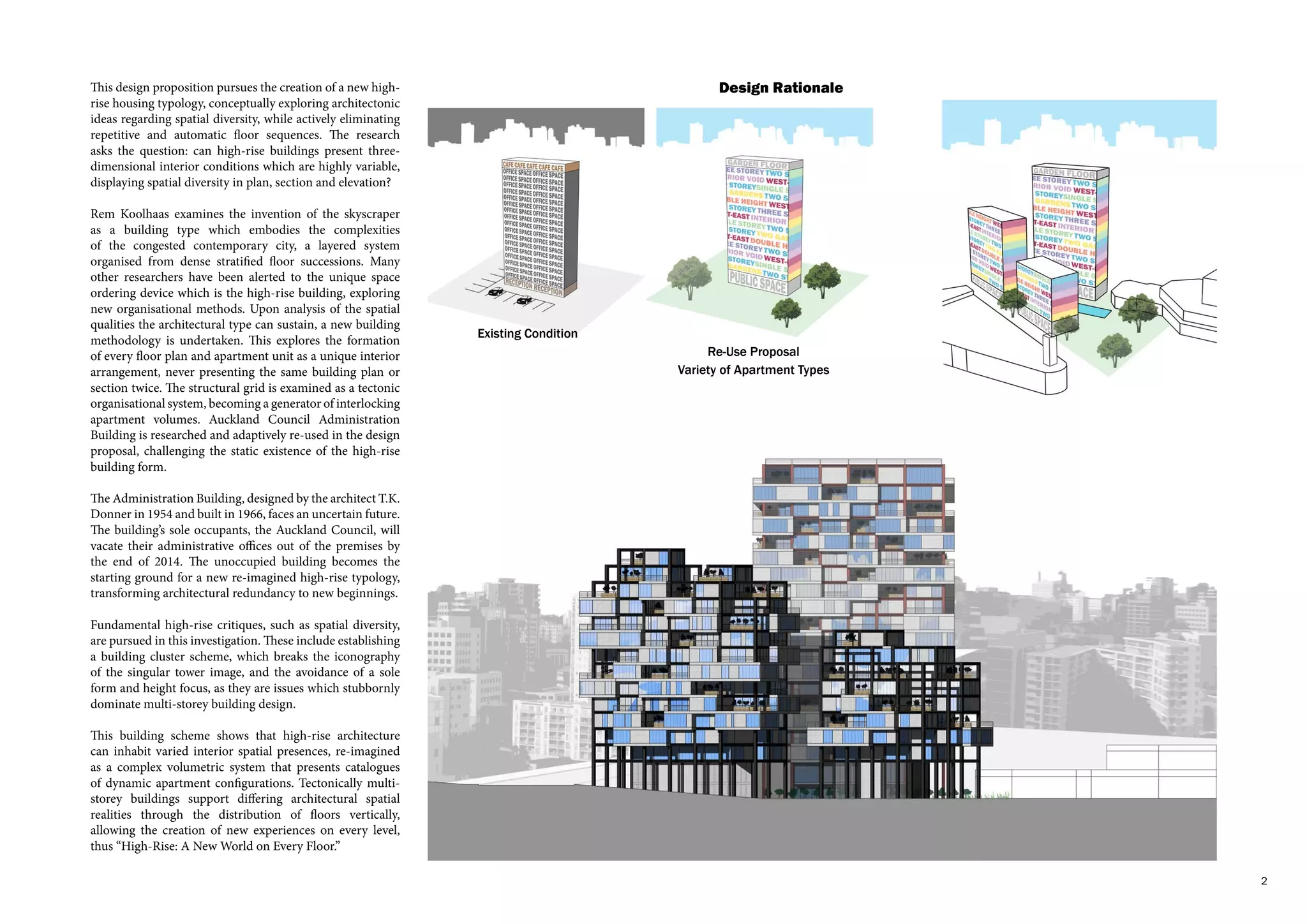
Design Rationale
Existing Condition
Re-Use Proposal
Variety of Apartment Types
This design proposition pursues the creation of a new high-
rise housing typology, conceptually exploring architectonic
ideas regarding spatial diversity, while actively eliminating
repetitive and automatic floor sequences. The research
asks the question: can high-rise buildings present three-
dimensional interior conditions which are highly variable,
displaying spatial diversity in plan, section and elevation?
Rem Koolhaas examines the invention of the skyscraper
as a building type which embodies the complexities
of the congested contemporary city, a layered system
organised from dense stratified floor successions. Many
other researchers have been alerted to the unique space
ordering device which is the high-rise building, exploring
new organisational methods. Upon analysis of the spatial
qualities the architectural type can sustain, a new building
methodology is undertaken. This explores the formation
of every floor plan and apartment unit as a unique interior
arrangement, never presenting the same building plan or
section twice. The structural grid is examined as a tectonic
organisational system, becoming a generator of interlocking
apartment volumes. Auckland Council Administration
Building is researched and adaptively re-used in the design
proposal, challenging the static existence of the high-rise
building form.
The Administration Building, designed by the architect T.K.
Donner in 1954 and built in 1966, faces an uncertain future.
The building’s sole occupants, the Auckland Council, will
vacate their administrative offices out of the premises by
the end of 2014. The unoccupied building becomes the
starting ground for a new re-imagined high-rise typology,
transforming architectural redundancy to new beginnings.
Fundamental high-rise critiques, such as spatial diversity,
are pursued in this investigation. These include establishing
a building cluster scheme, which breaks the iconography
of the singular tower image, and the avoidance of a sole
form and height focus, as they are issues which stubbornly
dominate multi-storey building design.
This building scheme shows that high-rise architecture
can inhabit varied interior spatial presences, re-imagined
as a complex volumetric system that presents catalogues
of dynamic apartment configurations. Tectonically multi-
storey buildings support differing architectural spatial
realities through the distribution of floors vertically,
allowing the creation of new experiences on every level,
thus “High-Rise: A New World on Every Floor.”

2

  • 1.
    2 Design Rationale Existing Condition Re-UseProposal Variety of Apartment Types This design proposition pursues the creation of a new high- rise housing typology, conceptually exploring architectonic ideas regarding spatial diversity, while actively eliminating repetitive and automatic floor sequences. The research asks the question: can high-rise buildings present three- dimensional interior conditions which are highly variable, displaying spatial diversity in plan, section and elevation? Rem Koolhaas examines the invention of the skyscraper as a building type which embodies the complexities of the congested contemporary city, a layered system organised from dense stratified floor successions. Many other researchers have been alerted to the unique space ordering device which is the high-rise building, exploring new organisational methods. Upon analysis of the spatial qualities the architectural type can sustain, a new building methodology is undertaken. This explores the formation of every floor plan and apartment unit as a unique interior arrangement, never presenting the same building plan or section twice. The structural grid is examined as a tectonic organisational system, becoming a generator of interlocking apartment volumes. Auckland Council Administration Building is researched and adaptively re-used in the design proposal, challenging the static existence of the high-rise building form. The Administration Building, designed by the architect T.K. Donner in 1954 and built in 1966, faces an uncertain future. The building’s sole occupants, the Auckland Council, will vacate their administrative offices out of the premises by the end of 2014. The unoccupied building becomes the starting ground for a new re-imagined high-rise typology, transforming architectural redundancy to new beginnings. Fundamental high-rise critiques, such as spatial diversity, are pursued in this investigation. These include establishing a building cluster scheme, which breaks the iconography of the singular tower image, and the avoidance of a sole form and height focus, as they are issues which stubbornly dominate multi-storey building design. This building scheme shows that high-rise architecture can inhabit varied interior spatial presences, re-imagined as a complex volumetric system that presents catalogues of dynamic apartment configurations. Tectonically multi- storey buildings support differing architectural spatial realities through the distribution of floors vertically, allowing the creation of new experiences on every level, thus “High-Rise: A New World on Every Floor.”