Larson & Farber,Elementary Statistics: Picturing the World, 3e 2
Properties of Normal Distributions
A continuous random variable has an infinite number of
possible values that can be represented by an interval on
the number line.
Hours spent studying in a day
0 6
3 9 15
12 18 24
21
The time spent
studying can be any
number between 0
and 24.
The probability distribution of a continuous random
variable is called a continuous probability distribution.
3.
Larson & Farber,Elementary Statistics: Picturing the World, 3e 3
Properties of Normal Distributions
The most important probability distribution in
statistics is the normal distribution.
A normal distribution is a continuous probability
distribution for a random variable, x. The graph of a
normal distribution is called the normal curve.
Normal curve
x
4.
Larson & Farber,Elementary Statistics: Picturing the World, 3e 4
Properties of Normal Distributions
Properties of a Normal Distribution
1. The mean, median, and mode are equal.
2. The normal curve is bell-shaped and symmetric about
the mean.
3. The total area under the curve is equal to one.
4. The normal curve approaches, but never touches the x-
axis as it extends farther and farther away from the
mean.
5. Between μ σ and μ + σ (in the center of the curve), the
graph curves downward. The graph curves upward to
the left of μ σ and to the right of μ + σ. The points at
which the curve changes from curving upward to
curving downward are called the inflection points.
5.
Larson & Farber,Elementary Statistics: Picturing the World, 3e 5
Properties of Normal Distributions
μ 3σ μ + σ
μ 2σ μ σ μ μ + 2σ μ + 3σ
Inflection points
Total area = 1
If x is a continuous random variable having a normal
distribution with mean μ and standard deviation σ, you
can graph a normal curve with the equation
2 2
( ) 2
1
=
2
x μ σ
y e
σ π
- -
. = 2.178 = 3.14
e π
x
6.
Larson & Farber,Elementary Statistics: Picturing the World, 3e 6
Means and Standard Deviations
A normal distribution can have any mean and
any positive standard deviation.
Mean: μ = 3.5
Standard
deviation: σ 1.3
Mean: μ = 6
Standard
deviation: σ 1.9
The mean gives
the location of
the line of
symmetry.
The standard deviation describes the spread of the data.
Inflection
points
Inflection
points
3 6
1 5
4
2
x
3 6
1 5
4
2 9
7 11
10
8
x
7.
Larson & Farber,Elementary Statistics: Picturing the World, 3e 7
Means and Standard Deviations
Example:
1. Which curve has the greater mean?
2. Which curve has the greater standard deviation?
The line of symmetry of curve A occurs at x = 5. The line of symmetry
of curve B occurs at x = 9. Curve B has the greater mean.
Curve B is more spread out than curve A, so curve B has the greater
standard deviation.
3
1 5 9
7 11 13
A
B
x
8.
Larson & Farber,Elementary Statistics: Picturing the World, 3e 8
Interpreting Graphs
Example:
The heights of fully grown magnolia bushes are normally
distributed. The curve represents the distribution. What
is the mean height of a fully grown magnolia bush?
Estimate the standard deviation if point of inflections are
7.3 and 8.7 respectively.
The heights of the magnolia bushes are normally
distributed with a mean height of about 8 feet and a
standard deviation of about 0.7 feet.
μ = 8
The inflection points are one
standard deviation away from the
mean. σ
0.7
6 8
7 9 10
Height (in feet)
x
9.
Larson & Farber,Elementary Statistics: Picturing the World, 3e 9
3 1
2 1 0 2 3
z
The Standard Normal Distribution
The standard normal distribution is a normal distribution
with a mean of 0 and a standard deviation of 1.
Any value can be transformed into a z-score by using the
formula
The horizontal scale
corresponds to z-scores.
- -
Value Mean
= = .
Standard deviation
x μ
z
σ
10.
Larson & Farber,Elementary Statistics: Picturing the World, 3e 10
The Standard Normal Distribution
If each data value of a normally distributed random
variable x is transformed into a z-score, the result will
be the standard normal distribution.
After the formula is used to transform an x-value into a
z-score, the Standard Normal Table in Appendix B is
used to find the cumulative area under the curve.
The area that falls in the interval under
the nonstandard normal curve (the x-
values) is the same as the area under
the standard normal curve (within the
corresponding z-boundaries).
3 1
2 1 0 2 3
z
11.
Larson & Farber,Elementary Statistics: Picturing the World, 3e 11
The Standard Normal Table
Properties of the Standard Normal Distribution
1. The cumulative area is close to 0 for z-scores close to z = 3.49.
2. The cumulative area increases as the z-scores increase.
3. The cumulative area for z = 0 is 0.5000.
4. The cumulative area is close to 1 for z-scores close to z = 3.49
z = 3.49
Area is close to 0.
z = 0
Area is 0.5000.
z = 3.49
Area is close to 1.
z
3 1
2 1 0 2 3
12.
Larson & Farber,Elementary Statistics: Picturing the World, 3e 12
The Standard Normal Table
Example:
Find the cumulative area that corresponds to a z-score
of 2.71.
z .00 .01 .02 .03 .04 .05 .06 .07 .08 .09
0.0 .5000 .5040 .5080 .5120 .5160 .5199 .5239 .5279 .5319 .5359
0.1 .5398 .5438 .5478 .5517 .5557 .5596 .5636 .5675 .5714 .5753
0.2 .5793 .5832 .5871 .5910 .5948 .5987 .6026 .6064 .6103 .6141
2.6 .9953 .9955 .9956 .9957 .9959 .9960 .9961 .9962 .9963 .9964
2.7 .9965 .9966 .9967 .9968 .9969 .9970 .9971 .9972 .9973 .9974
2.8 .9974 .9975 .9976 .9977 .9977 .9978 .9979 .9979 .9980 .9981
Find the area by finding 2.7 in the left hand column, and
then moving across the row to the column under 0.01.
The area to the left of z = 2.71 is 0.9966.
Appendix B: Standard Normal Table
13.
Larson & Farber,Elementary Statistics: Picturing the World, 3e 13
The Standard Normal Table
Example:
Find the cumulative area that corresponds to a z-score
of 0.25.
z .09 .08 .07 .06 .05 .04 .03 .02 .01 .00
3.4 .0002 .0003 .0003 .0003 .0003 .0003 .0003 .0003 .0003 .0003
3.3 .0003 .0004 .0004 .0004 .0004 .0004 .0004 .0005 .0005 .0005
Find the area by finding 0.2 in the left hand column, and
then moving across the row to the column under 0.05.
The area to the left of z = 0.25 is 0.4013
0.3 .3483 .3520 .3557 .3594 .3632 .3669 .3707 .3745 .3783 .3821
0.2 .3859 .3897 .3936 .3974 .4013 .4052 .4090 .4129 .4168 .4207
0.1 .4247 .4286 .4325 .4364 .4404 .4443 .4483 .4522 .4562 .4602
0.0 .4641 .4681 .4724 .4761 .4801 .4840 .4880 .4920 .4960 .5000
Appendix B: Standard Normal Table
14.
Larson & Farber,Elementary Statistics: Picturing the World, 3e 14
Guidelines for Finding Areas
Finding Areas Under the Standard Normal Curve
1. Sketch the standard normal curve and shade the
appropriate area under the curve.
2. Find the area by following the directions for each case
shown.
a. To find the area to the left of z, find the area that
corresponds to z in the Standard Normal Table.
1. Use the table to find
the area for the z-score.
2. The area to the
left of z = 1.23
is 0.8907.
1.23
0
z
15.
Larson & Farber,Elementary Statistics: Picturing the World, 3e 15
Guidelines for Finding Areas
Finding Areas Under the Standard Normal Curve
b. To find the area to the right of z, use the Standard
Normal Table to find the area that corresponds to z.
Then subtract the area from 1.
3. Subtract to find the area to
the right of z = 1.23:
1 0.8907 = 0.1093.
1. Use the table to find
the area for the z-score.
2. The area to the
left of z = 1.23 is
0.8907.
1.23
0
z
16.
Larson & Farber,Elementary Statistics: Picturing the World, 3e 16
Finding Areas Under the Standard Normal Curve
c. To find the area between two z-scores, find the area
corresponding to each z-score in the Standard
Normal Table. Then subtract the smaller area from
the larger area.
Guidelines for Finding Areas
4. Subtract to find the area of
the region between the two
z-scores:
0.8907 0.2266 = 0.6641.
1. Use the table to find the area for
the z-score.
3. The area to the left
of z = 0.75 is
0.2266.
2. The area to the
left of z = 1.23
is 0.8907.
1.23
0
z
0.75
17.
Larson & Farber,Elementary Statistics: Picturing the World, 3e 17
Guidelines for Finding Areas
Example:
Find the area under the standard normal
curve to the left of z = 2.33.
From the Standard Normal Table, the area is
equal to 0.0099.
Always draw
the curve!
2.33 0
z
18.
Larson & Farber,Elementary Statistics: Picturing the World, 3e 18
Guidelines for Finding Areas
Example:
Find the area under the standard normal
curve to the right of z = 0.94.
From the Standard Normal Table, the area is equal to
0.1736.
Always draw
the curve!
0.8264
1 0.8264 = 0.1736
0.94
0
z
19.
Larson & Farber,Elementary Statistics: Picturing the World, 3e 19
Guidelines for Finding Areas
Example:
Find the area under the standard normal
curve between z = 1.98 and z = 1.07.
From the Standard Normal Table, the area is equal to
0.8338.
Always draw
the curve!
0.8577 0.0239 = 0.8338
0.8577
0.0239
1.07
0
z
1.98
Larson & Farber,Elementary Statistics: Picturing the World, 3e 21
Probability and Normal Distributions
If a random variable, x, is normally distributed,
you can find the probability that x will fall in a
given interval by calculating the area under the
normal curve for that interval.
P(x < 15)
μ = 10
σ = 5
15
μ =10
x
22.
Larson & Farber,Elementary Statistics: Picturing the World, 3e 22
Probability and Normal Distributions
Same area
P(x < 15) = P(z < 1) = Shaded area under the curve
= 0.8413
15
μ =10
P(x < 15)
μ = 10
σ = 5
Normal Distribution
x
1
μ =0
μ = 0
σ = 1
Standard Normal Distribution
z
P(z < 1)
23.
Larson & Farber,Elementary Statistics: Picturing the World, 3e 23
Example:
The average on a statistics test was 78 with a standard
deviation of 8. If the test scores are normally distributed,
find the probability that a student receives a test score
less than 90.
Probability and Normal Distributions
P(x < 90) = P(z < 1.5) = 0.9332
-
90-78
=
8
x μ
z
σ
= 1.5
The probability that a
student receives a test
score less than 90 is
0.9332.
μ =0
z
?
1.5
90
μ =78
P(x < 90)
μ = 78
σ = 8
x
24.
Larson & Farber,Elementary Statistics: Picturing the World, 3e 24
Example:
The average on a statistics test was 78 with a standard
deviation of 8. If the test scores are normally distributed,
find the probability that a student receives a test score
greater than than 85.
Probability and Normal Distributions
P(x > 85) = P(z > 0.88) = 1 P(z < 0.88) = 1 0.8106 = 0.1894
85-78
= =
8
x - μ
z
σ
= 0.875 0.88
The probability that a
student receives a test
score greater than 85 is
0.1894.
μ =0
z
?
0.88
85
μ =78
P(x > 85)
μ = 78
σ = 8
x
25.
Larson & Farber,Elementary Statistics: Picturing the World, 3e 25
Example:
The average on a statistics test was 78 with a standard
deviation of 8. If the test scores are normally distributed,
find the probability that a student receives a test score
between 60 and 80.
Probability and Normal Distributions
P(60 < x < 80) = P(2.25 < z < 0.25) = P(z < 0.25) P(z < 2.25)
- -
1
60 78
= =
8
x μ
z
σ
-
= 2.25
The probability that a
student receives a test
score between 60 and 80
is 0.5865.
2
- -
80 78
=
8
x μ
z
σ
= 0.25
μ =0
z
?
? 0.25
2.25
= 0.5987 0.0122 = 0.5865
60 80
μ =78
P(60 < x < 80)
μ = 78
σ = 8
x
26.
Larson & Farber,Elementary Statistics: Picturing the World, 3e 26
Exercises:
The average on a statistics test was 82 with a standard
deviation of 9. If the test scores are normally distributed,
find the probability that a student receives a test score:
a. Less than 87
b. Greater than 80
c. Between 78 and 85
Probability and Normal Distributions
27.
Larson & Farber,Elementary Statistics: Picturing the World, 3e 27
QUIZ:
The average on a statistics test was 80 with a standard
deviation of 8. If the test scores are normally distributed,
find the probability that a student receives a test score:
a. Less than 87
b. Greater than 81
c. Between 87 and 81
d. Less than 75
e. Greater than 90
f. Between 75 and 90
Probability and Normal Distributions
Larson & Farber,Elementary Statistics: Picturing the World, 3e 29
Finding z-Scores
Example:
Find the z-score that corresponds to a cumulative area
of 0.9973.
z .00 .01 .02 .03 .04 .05 .06 .07 .08 .09
0.0 .5000 .5040 .5080 .5120 .5160 .5199 .5239 .5279 .5319 .5359
0.1 .5398 .5438 .5478 .5517 .5557 .5596 .5636 .5675 .5714 .5753
0.2 .5793 .5832 .5871 .5910 .5948 .5987 .6026 .6064 .6103 .6141
2.6 .9953 .9955 .9956 .9957 .9959 .9960 .9961 .9962 .9963 .9964
2.7 .9965 .9966 .9967 .9968 .9969 .9970 .9971 .9972 .9973 .9974
2.8 .9974 .9975 .9976 .9977 .9977 .9978 .9979 .9979 .9980 .9981
Find the z-score by locating 0.9973 in the body of the Standard
Normal Table. The values at the beginning of the
corresponding row and at the top of the column give the z-score.
The z-score is 2.78.
Appendix B: Standard Normal Table
2.7
.08
30.
Larson & Farber,Elementary Statistics: Picturing the World, 3e 30
Finding a z-Score Given a Percentile
Example:
Find the z-score that corresponds to P75.
The z-score that corresponds to P75 is the same z-score that
corresponds to an area of 0.75.
The z-score is 0.67.
?
μ =0
z
0.67
Area = 0.75
31.
Larson & Farber,Elementary Statistics: Picturing the World, 3e 31
Transforming a z-Score to an x-Score
To transform a standard z-score to a data value, x, in
a given population, use the formula
Example:
The monthly electric bills in a city are normally distributed
with a mean of $120 and a standard deviation of $16. Find the
x-value corresponding to a z-score of 1.60.
x μ+ zσ.
x μ+ zσ
= 120 +1.60(16)
= 145.6
We can conclude that an electric bill of $145.60 is 1.6 standard
deviations above the mean.
32.
Larson & Farber,Elementary Statistics: Picturing the World, 3e 32
Finding a Specific Data Value
Example:
The weights of bags of chips for a vending machine are
normally distributed with a mean of 1.25 ounces and a
standard deviation of 0.1 ounce. Bags that have weights in
the lower 8% are too light and will not work in the machine.
What is the least a bag of chips can weigh and still work in the
machine?
x μ+ zσ
The least a bag can weigh and still work in the machine is 1.11 ounces.
? 0
z
8%
P(z < ?) = 0.08
P(z < 1.41) = 0.08
1.41
1.25
x
?
1.25 ( 1.41)0.1
1.11
1.11
33.
Larson & Farber,Elementary Statistics: Picturing the World, 3e 33
Examples
1. Calculate the following probabilities
a. P( to the left of z = -2.04 and to the right of z = 1.27)
b. P(-1.54 ≤ z ≤ 0)
c. P( -1.2 ≤ z ≤ 2.35)
d. P(z ≥ -0.95)
34.
Larson & Farber,Elementary Statistics: Picturing the World, 3e 34
2. Let x be a normal random variable with
μ = 10 and s = 5. Calculate the following:
a. P(10 ≤ x ≤ 12)
b. P(8 ≤ x ≤ 10)
c. P(8 ≤ x ≤ 12)
3. Find the z-score when the area from 0 to z is a.
0.4066; and b. -0.3980.
35.
Larson & Farber,Elementary Statistics: Picturing the World, 3e 35
EXAMPLES
4. The IQ scores of a large group of students are
approximately normally distributed with a mean of
100 and standard deviation of 15. What is the
probability that a randomly chosen student from this
group will have an IQ score
a. above 120?
b. below 128?
c. below 93?
36.
Larson & Farber,Elementary Statistics: Picturing the World, 3e 36
EXAMPLES
5. The IQ scores of a large group of students are
approximately normally distributed with a mean of 100
and standard deviation of 15. What is the probability
that a randomly chosen student from this group will
have an IQ score. How many percent of the students
obtained IQ scores
a. between 85 and 110?
b. between 115 and 125
37.
Larson & Farber,Elementary Statistics: Picturing the World, 3e 37
EXAMPLES
6. A computer instructor constructed a learning module aimed
at familiarizing new students with basic EDP concepts. Past
experience has shown that the length of time required by new
students to complete the module is normally distributed with a
mean of 250 hours and a standard deviation of 50 hours. What
is the probability that a randomly selected new student will
require
a. more than 350 hours to complete the module?
b. more than 200 hours but less than 300 hours?
38.
Larson & Farber,Elementary Statistics: Picturing the World, 3e 38
EXAMPLES
7. Consider a normal distribution with a mean of 500
and a standard deviation of 50.
a. Below what value can we accept to have the
lowest 20%?
b. Between what values can we expect to find the
middle 80%?
39.
Larson & Farber,Elementary Statistics: Picturing the World, 3e 39
Solutions
a.
b.
c.
40.
Larson & Farber,Elementary Statistics: Picturing the World, 3e 40
Solutions
2.
a.
b.
Therefore, about 59% of the students obtained IQ scores
between 85 and 110.
41.
Larson & Farber,Elementary Statistics: Picturing the World, 3e 41
Solutions
b.
Approximately 11% of the students got IQ scores between
115 and 125.
42.
Larson & Farber,Elementary Statistics: Picturing the World, 3e 42
Solutions
a.
b.
43.
Larson & Farber,Elementary Statistics: Picturing the World, 3e 43
Solutions
a. z =
The lowest 20% are below or less than 458.
.
44.
Larson & Farber,Elementary Statistics: Picturing the World, 3e 44
Solutions
b.
The middle 80% are between
436 and 564.
Larson & Farber,Elementary Statistics: Picturing the World, 3e 58
Population
Sample
Sampling Distributions
A sampling distribution is the probability distribution of a
sample statistic that is formed when samples of size n are
repeatedly taken from a population.
Sample
Sample
Sample Sample
Sample
Sample
Sample
Sample
Sample
59.
Larson & Farber,Elementary Statistics: Picturing the World, 3e 59
Sampling Distributions
If the sample statistic is the sample mean, then the
distribution is the sampling distribution of sample means.
Sample 1
1
x
Sample 4
4
x
Sample 3
3
x Sample 6
6
x
The sampling distribution consists of the values of the
sample means, 1 2 3 4 5 6
, , , , , .
x x x x x x
Sample 2
2
x
Sample 5
5
x
60.
Larson & Farber,Elementary Statistics: Picturing the World, 3e 60
Properties of Sampling Distributions
Properties of Sampling Distributions of Sample Means
1. The mean of the sample means, is equal to the population
mean.
2. The standard deviation of the sample means, is equal to the
population standard deviation, divided by the square root of n.
The standard deviation of the sampling distribution of the sample
means is called the standard error of the mean.
,
x
μ
x
μ = μ
,
x
σ
,
σ
x
σ
σ =
n
61.
Larson & Farber,Elementary Statistics: Picturing the World, 3e 61
Sampling Distribution of Sample Means
Example:
The population values {5, 10, 15, 20} are written on slips of
paper and put in a hat. Two slips are randomly selected, with
replacement.
a. Find the mean, standard deviation, and variance of the
population.
Continued.
= 12.5
μ
= 5.59
σ
2
= 31.25
σ
Population
5
10
15
20
62.
Larson & Farber,Elementary Statistics: Picturing the World, 3e 62
Sampling Distribution of Sample Means
Example continued:
The population values {5, 10, 15, 20} are written on slips of
paper and put in a hat. Two slips are randomly selected, with
replacement.
b. Graph the probability histogram for the population
values.
Continued.
This uniform distribution
shows that all values have
the same probability of
being selected.
Population values
Probabilit
y
0.25
5 10 15 20
x
P(x) Probability Histogram
of Population of x
63.
Larson & Farber,Elementary Statistics: Picturing the World, 3e 63
Sampling Distribution of Sample Means
Example continued:
The population values {5, 10, 15, 20} are written on slips of
paper and put in a hat. Two slips are randomly selected, with
replacement.
c. List all the possible samples of size n = 2 and calculate
the mean of each.
15
10, 20
12.5
10, 15
10
10, 10
7.5
10, 5
12.5
5, 20
10
5, 15
7.5
5, 10
5
5, 5
Sample mean,
Sample x
20
20, 20
17.5
20, 15
15
20, 10
12.5
20, 5
17.5
15, 20
15
15, 15
12.5
15, 10
10
15, 5
Sample mean,
Sample x
Continued.
These means
form the
sampling
distribution of
the sample
means.
64.
Larson & Farber,Elementary Statistics: Picturing the World, 3e 64
Sampling Distribution of Sample Means
Example continued:
The population values {5, 10, 15, 20} are written on slips of
paper and put in a hat. Two slips are randomly selected, with
replacement.
d. Create the probability distribution of the sample
means.
Probability Distribution
of Sample Means
0.0625
1
20
0.1250
2
17.5
0.1875
3
15
0.2500
4
12.5
0.1875
3
10
0.1250
2
7.5
0.0625
1
5
x f Probability
65.
Larson & Farber,Elementary Statistics: Picturing the World, 3e 65
Sampling Distribution of Sample Means
Example continued:
The population values {5, 10, 15, 20} are written on slips of
paper and put in a hat. Two slips are randomly selected, with
replacement.
e. Graph the probability histogram for the sampling
distribution.
The shape of the graph is
symmetric and bell shaped.
It approximates a normal
distribution.
Sample mean
Probabilit
y
0.25
P(x) Probability Histogram of
Sampling Distribution
0.20
0.15
0.10
0.05
17.5 20
15
12.5
10
7.5
5
x
66.
Larson & Farber,Elementary Statistics: Picturing the World, 3e 66
the sample means will have a normal distribution.
The Central Limit Theorem
If a sample of size n 30 is taken from a population with
any type of distribution that has a mean = and standard
deviation = ,
x
x
x
x
x
x
x
x
x
x x
x
x
x
x
67.
Larson & Farber,Elementary Statistics: Picturing the World, 3e 67
The Central Limit Theorem
If the population itself is normally distributed, with
mean = and standard deviation = ,
the sample means will have a normal distribution for
any sample size n.
x
x
x
x
x
x
x
x
x
x x
x
x
x
68.
Larson & Farber,Elementary Statistics: Picturing the World, 3e 68
The Central Limit Theorem
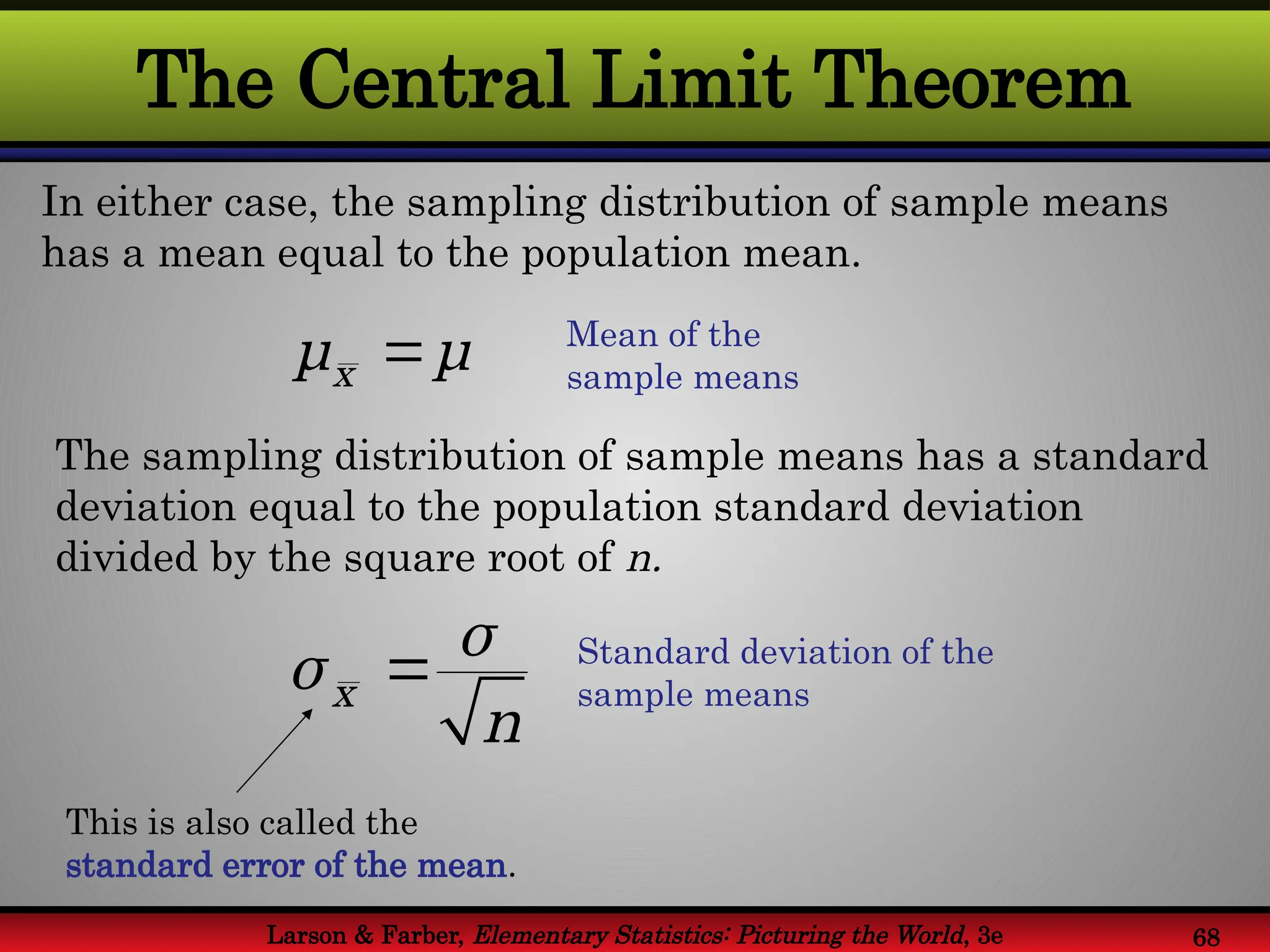
In either case, the sampling distribution of sample means
has a mean equal to the population mean.
x
μ μ
x
σ
σ
n
Mean of the
sample means
Standard deviation of the
sample means
The sampling distribution of sample means has a standard
deviation equal to the population standard deviation
divided by the square root of n.
This is also called the
standard error of the mean.
69.
Larson & Farber,Elementary Statistics: Picturing the World, 3e 69
The Mean and Standard Error
Example:
The heights of fully grown magnolia bushes have a mean
height of 8 feet and a standard deviation of 0.7 feet. 38
bushes are randomly selected from the population, and
the mean of each sample is determined. Find the mean
and standard error of the mean of the sampling
distribution.
x
μ μ
Mean
Standard deviation
(standard error)
x
σ
σ
n
= 8
0.7
=
38
= 0.11
Continued.
70.
Larson & Farber,Elementary Statistics: Picturing the World, 3e 70
Interpreting the Central Limit
Theorem
Example continued:
The heights of fully grown magnolia bushes have a
mean height of 8 feet and a standard deviation of 0.7
feet. 38 bushes are randomly selected from the
population, and the mean of each sample is determined.
From the Central Limit Theorem,
because the sample size is greater
than 30, the sampling
distribution can be approximated
by the normal distribution.
The mean of the sampling distribution is 8 feet ,and the
standard error of the sampling distribution is 0.11 feet.
x
8 8.4
7.6
= 8
x
μ = 0.11
x
σ
71.
Larson & Farber,Elementary Statistics: Picturing the World, 3e 71
Finding Probabilities
Example:
The heights of fully grown magnolia bushes have a
mean height of 8 feet and a standard deviation of 0.7
feet. 38 bushes are randomly selected from the
population, and the mean of each sample is determined.
Find the probability that the
mean height of the 38 bushes is
less than 7.8 feet.
The mean of the sampling distribution
is 8 feet, and the standard error of
the sampling distribution is 0.11 feet.
7.8
x
8.4
7.6 8
Continued.
= 8
x
μ
= 0.11
x
σ
= 38
n
72.
Larson & Farber,Elementary Statistics: Picturing the World, 3e 72
P( < 7.8) = P(z < ____ )
?
1.82
Finding Probabilities
Example continued:
Find the probability that the mean height of the 38
bushes is less than 7.8 feet.
x
x
x μ
z
σ
-
-
7.8 8
=
0.11
7.8
x
8.4
7.6 8
= 8
x
μ
= 0.11
x
σ
n = 38
-
= 1.82
z
0
The probability that the mean height of the 38 bushes is
less than 7.8 feet is 0.0344.
= 0.0344
P( < 7.8)
73.
Larson & Farber,Elementary Statistics: Picturing the World, 3e 73
Example:
The average on a statistics test was 78 with a standard
deviation of 8. If the test scores are normally distributed,
find the probability that the mean score of 25 randomly
selected students is between 75 and 79.
Probability and Normal Distributions
- -
1
75 78
= =
1.6
x
x
x μ
z
σ
-
= 1.88
- -
2
79 78
= =
1.6
x μ
z
σ
= 0.63
0
z
?
? 0.63
1.88
75 79
78
P(75 < < 79)
= 78
σ 8
= = =1.6
n 25
x
x
μ
σ
Continued.
74.
Larson & Farber,Elementary Statistics: Picturing the World, 3e 74
Example continued:
Probability and Normal Distributions
P(75 < < 79) = P(1.88 < z < 0.63) = P(z < 0.63) P(z < 1.88)
Approximately 70.56% of the 25 students will have a mean
score between 75 and 79.
= 0.7357 0.0301 = 0.7056
0
z
?
? 0.63
1.88
75 79
78
P(75 < < 79)
75.
Larson & Farber,Elementary Statistics: Picturing the World, 3e 75
Example:
The population mean salary for auto mechanics is
= $34,000 with a standard deviation of = $2,500. Find
the probability that the mean salary for a randomly selected
sample of 50 mechanics is greater than $35,000.
Probabilities of x and x
- - 3
35000 4000
=
353.55
x
x
x μ
z
σ
= 2.83
0
z
?
2.83
35000
34000
P( > 35000)
= 34000
2500
= = 353.55
50
x
x
μ
σ
σ
n
= P(z > 2.83) = 1 P(z < 2.83)
= 1 0.9977 = 0.0023
The probability that the mean
salary for a randomly selected
sample of 50 mechanics is
greater than $35,000 is 0.0023.
76.
Larson & Farber,Elementary Statistics: Picturing the World, 3e 76
Example:
The population mean salary for auto mechanics is
= $34,000 with a standard deviation of = $2,500. Find
the probability that the salary for one randomly selected
mechanic is greater than $35,000.
Probabilities of x and x
- 35000-34000
= =
2500
x μ
z
σ
= 0.4
0
z
?
0.4
35000
34000
P(x > 35000)
= 34000
= 2500
μ
σ
= P(z > 0.4) = 1 P(z < 0.4)
= 1 0.6554 = 0.3446
The probability that the salary
for one mechanic is greater
than $35,000 is 0.3446.
(Notice that the Central Limit Theorem does not apply.)
77.
Larson & Farber,Elementary Statistics: Picturing the World, 3e 77
Example:
The probability that the salary for one randomly selected
mechanic is greater than $35,000 is 0.3446. In a group of
50 mechanics, approximately how many would have a
salary greater than $35,000?
Probabilities of x and x
P(x > 35000) = 0.3446
This also means that 34.46% of
mechanics have a salary greater than
$35,000.
You would expect about 17 mechanics out of the group
of 50 to have a salary greater than $35,000.
34.46% of 50 = 0.3446 50 = 17.23






![NORMAL DISTRIBUTION FIN [Autosaved].pptx](https://cdn.slidesharecdn.com/ss_thumbnails/normaldistributionfinautosaved-250706062357-4c5756a9-thumbnail.jpg?width=640&height=640&fit=bounds)


