Grinding Machines

                            ME 312 Manufacturing Technology
Vikrant Sharma, Mechanical Engineering Department. FET. MITS
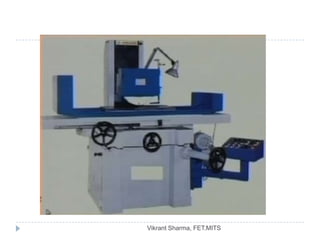
Grinding Machines are also regarded as machine tools. A
  distinguishing feature of grinding machines is the rotating
  abrasive tool. Grinding machine is employed to obtain high
  accuracy along with very high class of surface finish on the
  workpiece.


Grinding machines can be broadly classified as:
(a) Surface grinding machine
(b) Cylindrical grinding machine
(c) Internal grinding machine
(d) Tool and cutter grinding machine


                            Vikrant Sharma, FET.MITS
Surface grinding machine:
This machine may be similar to a milling machine used mainly to grind
  flat surface. However, some types of surface grinders are also
  capable of producing contour surface with formed grinding wheel.

Basically there are four different types of surface grinding machines
  characterised by the movement of their tables and the orientation of
  grinding wheel spindles as follows:

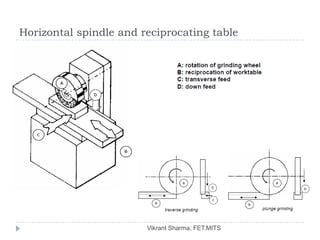
• Horizontal spindle and reciprocating table
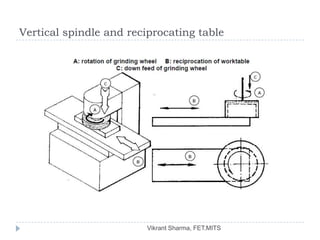
• Vertical spindle and reciprocating table
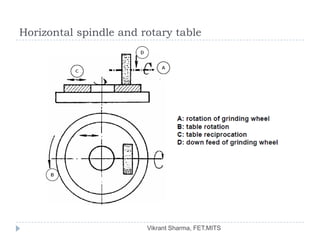
• Horizontal spindle and rotary table
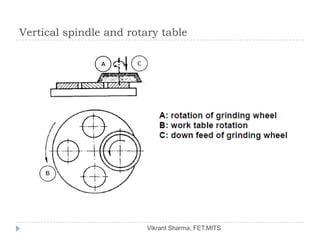
• Vertical spindle and rotary table


                                 Vikrant Sharma, FET.MITS
Horizontal spindle and reciprocating table


                        Vikrant Sharma, FET.MITS
Vikrant Sharma, FET.MITS
Vertical spindle and reciprocating table


                        Vikrant Sharma, FET.MITS
Horizontal spindle and rotary table


                        Vikrant Sharma, FET.MITS
Vertical spindle and rotary table


                         Vikrant Sharma, FET.MITS
Cylindrical grinding machine

This machine is used to produce external cylindrical
  surface. The surfaces may be straight, tapered, steps or
  profiled. Broadly there are three different types of
  cylindrical grinding machine as follows:
1. Plain centre type cylindrical grinder
2. Universal cylindrical surface grinder
3. Centreless cylindrical surface grinder


                           Vikrant Sharma, FET.MITS
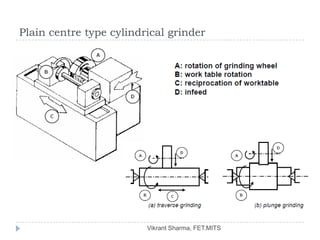
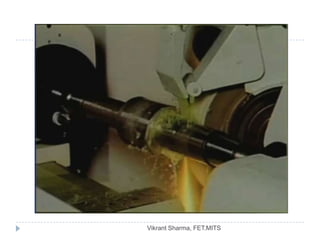
Plain centre type cylindrical grinder


                         Vikrant Sharma, FET.MITS
Vikrant Sharma, FET.MITS
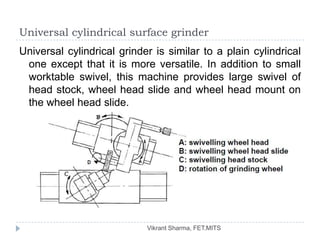
Universal cylindrical surface grinder
Universal cylindrical grinder is similar to a plain cylindrical
 one except that it is more versatile. In addition to small
 worktable swivel, this machine provides large swivel of
 head stock, wheel head slide and wheel head mount on
 the wheel head slide.


                            Vikrant Sharma, FET.MITS
Special application of cylindrical grinder
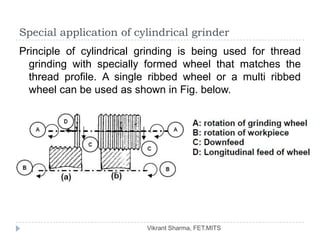
Principle of cylindrical grinding is being used for thread
  grinding with specially formed wheel that matches the
  thread profile. A single ribbed wheel or a multi ribbed
  wheel can be used as shown in Fig. below.


                          Vikrant Sharma, FET.MITS
External centreless grinder
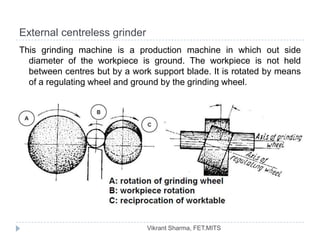
This grinding machine is a production machine in which out side
  diameter of the workpiece is ground. The workpiece is not held
  between centres but by a work support blade. It is rotated by means
  of a regulating wheel and ground by the grinding wheel.


                               Vikrant Sharma, FET.MITS
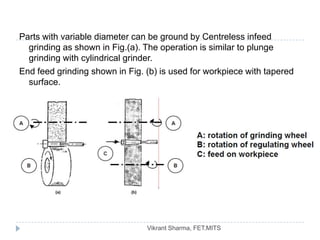
Parts with variable diameter can be ground by Centreless infeed
  grinding as shown in Fig.(a). The operation is similar to plunge
  grinding with cylindrical grinder.
End feed grinding shown in Fig. (b) is used for workpiece with tapered
  surface.


                                Vikrant Sharma, FET.MITS
Vikrant Sharma, FET.MITS
Internal grinding machine

This machine is used to produce internal cylindrical surface. The
  surface may be straight, tapered, grooved or profiled.

Broadly there are three different types of internal grinding machine as
  follows:

1. Chucking type internal grinder
2. Planetary internal grinder
3. Centreless internal grinder


                                    Vikrant Sharma, FET.MITS
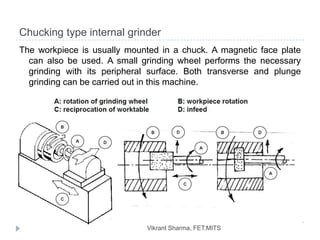
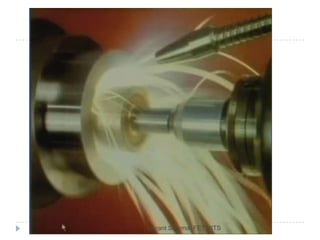
Chucking type internal grinder
The workpiece is usually mounted in a chuck. A magnetic face plate
  can also be used. A small grinding wheel performs the necessary
  grinding with its peripheral surface. Both transverse and plunge
  grinding can be carried out in this machine.


                             Vikrant Sharma, FET.MITS
Vikrant Sharma, FET.MITS
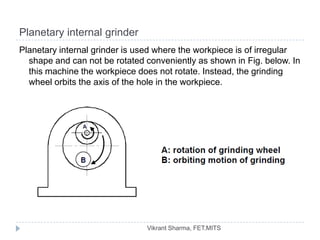
Planetary internal grinder
Planetary internal grinder is used where the workpiece is of irregular
  shape and can not be rotated conveniently as shown in Fig. below. In
  this machine the workpiece does not rotate. Instead, the grinding
  wheel orbits the axis of the hole in the workpiece.


                               Vikrant Sharma, FET.MITS
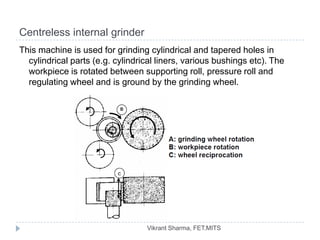
Centreless internal grinder
This machine is used for grinding cylindrical and tapered holes in
  cylindrical parts (e.g. cylindrical liners, various bushings etc). The
  workpiece is rotated between supporting roll, pressure roll and
  regulating wheel and is ground by the grinding wheel.


                                  Vikrant Sharma, FET.MITS
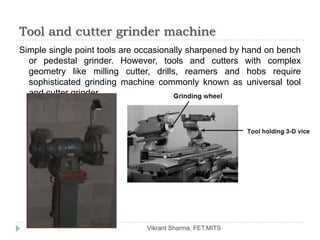
Tool and cutter grinder machine
Simple single point tools are occasionally sharpened by hand on bench
  or pedestal grinder. However, tools and cutters with complex
  geometry like milling cutter, drills, reamers and hobs require
  sophisticated grinding machine commonly known as universal tool
  and cutter grinder.


                               Vikrant Sharma, FET.MITS

1.grinding machine

  • 1.
    Grinding Machines ME 312 Manufacturing Technology Vikrant Sharma, Mechanical Engineering Department. FET. MITS
  • 2.
    Grinding Machines arealso regarded as machine tools. A distinguishing feature of grinding machines is the rotating abrasive tool. Grinding machine is employed to obtain high accuracy along with very high class of surface finish on the workpiece. Grinding machines can be broadly classified as: (a) Surface grinding machine (b) Cylindrical grinding machine (c) Internal grinding machine (d) Tool and cutter grinding machine Vikrant Sharma, FET.MITS
  • 3.
    Surface grinding machine: Thismachine may be similar to a milling machine used mainly to grind flat surface. However, some types of surface grinders are also capable of producing contour surface with formed grinding wheel. Basically there are four different types of surface grinding machines characterised by the movement of their tables and the orientation of grinding wheel spindles as follows: • Horizontal spindle and reciprocating table • Vertical spindle and reciprocating table • Horizontal spindle and rotary table • Vertical spindle and rotary table Vikrant Sharma, FET.MITS
  • 4.
    Horizontal spindle andreciprocating table Vikrant Sharma, FET.MITS
  • 5.
  • 6.
    Vertical spindle andreciprocating table Vikrant Sharma, FET.MITS
  • 7.
    Horizontal spindle androtary table Vikrant Sharma, FET.MITS
  • 8.
    Vertical spindle androtary table Vikrant Sharma, FET.MITS
  • 9.
    Cylindrical grinding machine Thismachine is used to produce external cylindrical surface. The surfaces may be straight, tapered, steps or profiled. Broadly there are three different types of cylindrical grinding machine as follows: 1. Plain centre type cylindrical grinder 2. Universal cylindrical surface grinder 3. Centreless cylindrical surface grinder Vikrant Sharma, FET.MITS
  • 10.
    Plain centre typecylindrical grinder Vikrant Sharma, FET.MITS
  • 11.
  • 12.
    Universal cylindrical surfacegrinder Universal cylindrical grinder is similar to a plain cylindrical one except that it is more versatile. In addition to small worktable swivel, this machine provides large swivel of head stock, wheel head slide and wheel head mount on the wheel head slide. Vikrant Sharma, FET.MITS
  • 13.
    Special application ofcylindrical grinder Principle of cylindrical grinding is being used for thread grinding with specially formed wheel that matches the thread profile. A single ribbed wheel or a multi ribbed wheel can be used as shown in Fig. below. Vikrant Sharma, FET.MITS
  • 14.
    External centreless grinder Thisgrinding machine is a production machine in which out side diameter of the workpiece is ground. The workpiece is not held between centres but by a work support blade. It is rotated by means of a regulating wheel and ground by the grinding wheel. Vikrant Sharma, FET.MITS
  • 15.
    Parts with variablediameter can be ground by Centreless infeed grinding as shown in Fig.(a). The operation is similar to plunge grinding with cylindrical grinder. End feed grinding shown in Fig. (b) is used for workpiece with tapered surface. Vikrant Sharma, FET.MITS
  • 16.
  • 17.
    Internal grinding machine Thismachine is used to produce internal cylindrical surface. The surface may be straight, tapered, grooved or profiled. Broadly there are three different types of internal grinding machine as follows: 1. Chucking type internal grinder 2. Planetary internal grinder 3. Centreless internal grinder Vikrant Sharma, FET.MITS
  • 18.
    Chucking type internalgrinder The workpiece is usually mounted in a chuck. A magnetic face plate can also be used. A small grinding wheel performs the necessary grinding with its peripheral surface. Both transverse and plunge grinding can be carried out in this machine. Vikrant Sharma, FET.MITS
  • 19.
  • 20.
    Planetary internal grinder Planetaryinternal grinder is used where the workpiece is of irregular shape and can not be rotated conveniently as shown in Fig. below. In this machine the workpiece does not rotate. Instead, the grinding wheel orbits the axis of the hole in the workpiece. Vikrant Sharma, FET.MITS
  • 21.
    Centreless internal grinder Thismachine is used for grinding cylindrical and tapered holes in cylindrical parts (e.g. cylindrical liners, various bushings etc). The workpiece is rotated between supporting roll, pressure roll and regulating wheel and is ground by the grinding wheel. Vikrant Sharma, FET.MITS
  • 22.
    Tool and cuttergrinder machine Simple single point tools are occasionally sharpened by hand on bench or pedestal grinder. However, tools and cutters with complex geometry like milling cutter, drills, reamers and hobs require sophisticated grinding machine commonly known as universal tool and cutter grinder. Vikrant Sharma, FET.MITS