REPORT
ON
MILLING MACHINE
MARWADI UNIVERSITY
Faculty
Of
Technology
In
Automobile
By
ZALA MILAN
ROLL NO.-91600107010
DEPARTMENT OF AUTOMOBILE
ENGINEERING
MARWADI UNIVERSITY, RAJKOT
2017
*Milling: is a metal cutting operation in which the excess
material from the work piece is removed by rotating
multipoint cutting tool called Milling Cutter.
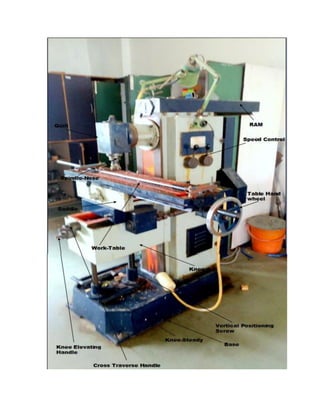
*Milling machine: is a power operated machine tool in
which work piece mounted on a moving table is machined to
various shapes when moved under a show revolving
serrated cutter.
Milling is the process of machining flat, curved, or
Irregular surfaces by feeding the work piece against a
rotating cutter containing a number of cutting edges. The
milling machine consists basically of a motor driven spindle,
which mounts and revolves the milling cutter, and a
reciprocating adjustable worktable, which mounts and feeds
the work piece.
Milling machines are basically classified as vertical or
Horizontal. These machines are also classified as knee-type,
ram-type, manufacturing or bed type, and planer-type. Most
milling machines have self-contained electric drive motors,
coolant systems, variable spindle speeds, and power-
operated table feeds.
Classification Of Milling Machines
1. Column and knee milling machines
a. Plain column & knee type milling machine
-Horizontal spindle machine
-Vertical spindle machine
2. Bed type milling machine
3. Planer type milling machine
4. Special purpose milling machine
a. Tracer controlled milling machine
b. Thread milling machine
c. CNC milling machine
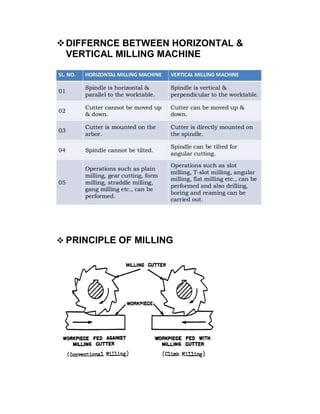
DIFFERNCE BETWEEN HORIZONTAL &
VERTICAL MILLING MACHINE
 PRINCIPLE OF MILLING
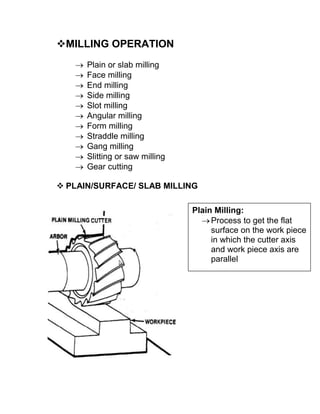
MILLING OPERATION
 Plain or slab milling
 Face milling
 End milling
 Side milling
 Slot milling
 Angular milling
 Form milling
 Straddle milling
 Gang milling
 Slitting or saw milling
 Gear cutting
 PLAIN/SURFACE/ SLAB MILLING
Plain Milling:
Process to get the flat
surface on the work piece
in which the cutter axis
and work piece axis are
parallel
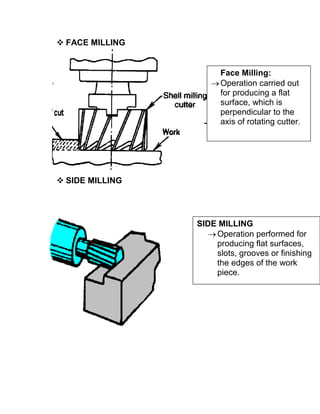
 FACE MILLING
 SIDE MILLING
Face Milling:
Operation carried out
for producing a flat
surface, which is
perpendicular to the
axis of rotating cutter.
SIDE MILLING
Operation performed for
producing flat surfaces,
slots, grooves or finishing
the edges of the work
piece.
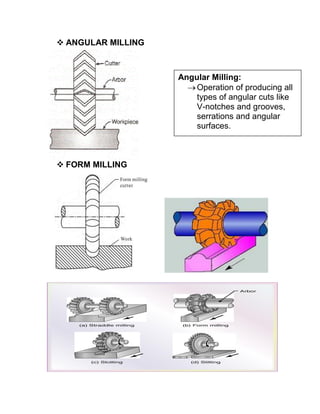
 ANGULAR MILLING
 FORM MILLING
Angular Milling:
Operation of producing all
types of angular cuts like
V-notches and grooves,
serrations and angular
surfaces.
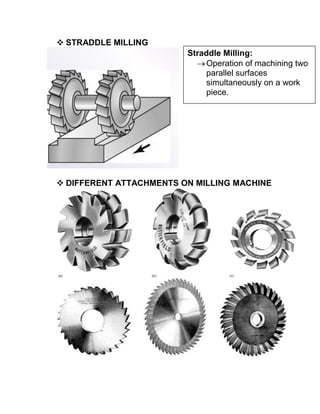
 STRADDLE MILLING
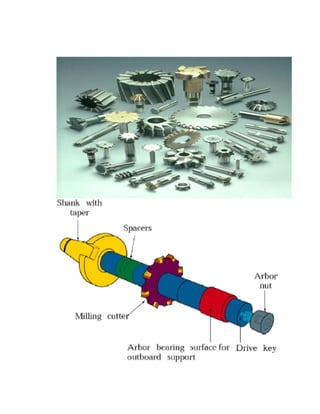
 DIFFERENT ATTACHMENTS ON MILLING MACHINE
Straddle Milling:
Operation of machining two
parallel surfaces
simultaneously on a work
piece.
Report on milling machine

Report on milling machine

  • 1.
  • 2.
    MARWADI UNIVERSITY Faculty Of Technology In Automobile By ZALA MILAN ROLLNO.-91600107010 DEPARTMENT OF AUTOMOBILE ENGINEERING MARWADI UNIVERSITY, RAJKOT 2017
  • 3.
    *Milling: is ametal cutting operation in which the excess material from the work piece is removed by rotating multipoint cutting tool called Milling Cutter. *Milling machine: is a power operated machine tool in which work piece mounted on a moving table is machined to various shapes when moved under a show revolving serrated cutter. Milling is the process of machining flat, curved, or Irregular surfaces by feeding the work piece against a rotating cutter containing a number of cutting edges. The milling machine consists basically of a motor driven spindle, which mounts and revolves the milling cutter, and a reciprocating adjustable worktable, which mounts and feeds the work piece. Milling machines are basically classified as vertical or Horizontal. These machines are also classified as knee-type, ram-type, manufacturing or bed type, and planer-type. Most milling machines have self-contained electric drive motors, coolant systems, variable spindle speeds, and power- operated table feeds. Classification Of Milling Machines 1. Column and knee milling machines a. Plain column & knee type milling machine -Horizontal spindle machine -Vertical spindle machine 2. Bed type milling machine 3. Planer type milling machine 4. Special purpose milling machine a. Tracer controlled milling machine b. Thread milling machine c. CNC milling machine
  • 4.
    DIFFERNCE BETWEEN HORIZONTAL& VERTICAL MILLING MACHINE  PRINCIPLE OF MILLING
  • 5.
    MILLING OPERATION  Plainor slab milling  Face milling  End milling  Side milling  Slot milling  Angular milling  Form milling  Straddle milling  Gang milling  Slitting or saw milling  Gear cutting  PLAIN/SURFACE/ SLAB MILLING Plain Milling: Process to get the flat surface on the work piece in which the cutter axis and work piece axis are parallel
  • 6.
     FACE MILLING SIDE MILLING Face Milling: Operation carried out for producing a flat surface, which is perpendicular to the axis of rotating cutter. SIDE MILLING Operation performed for producing flat surfaces, slots, grooves or finishing the edges of the work piece.
  • 7.
     ANGULAR MILLING FORM MILLING Angular Milling: Operation of producing all types of angular cuts like V-notches and grooves, serrations and angular surfaces.
  • 8.
     STRADDLE MILLING DIFFERENT ATTACHMENTS ON MILLING MACHINE Straddle Milling: Operation of machining two parallel surfaces simultaneously on a work piece.