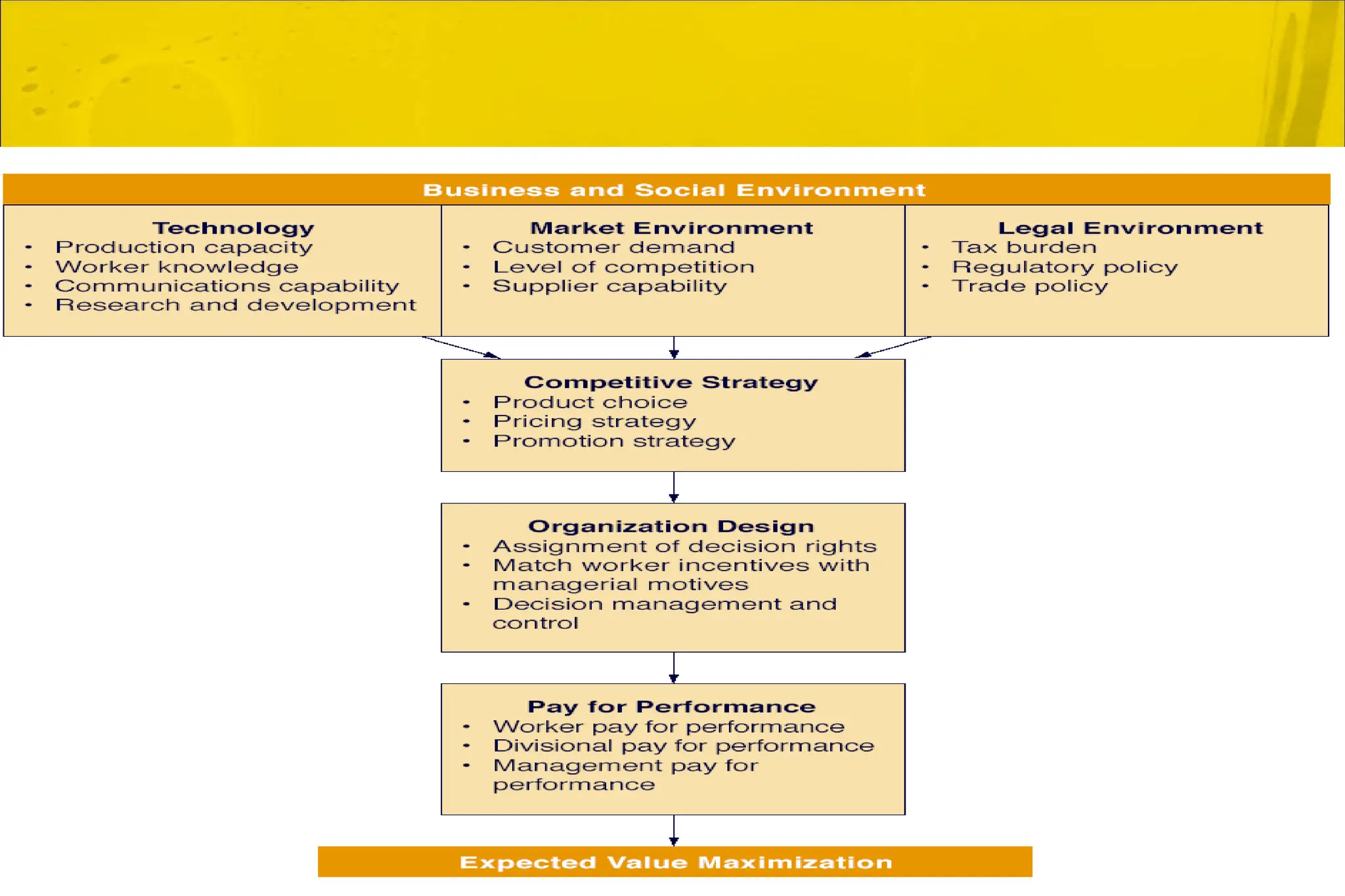
Manajerial #1
Aplikasi teori ekonomi dan alat
pengambilan keputusan untuk
mengetahui bagaimana organisasi
dapat mencapai tujuannya secara lebih
efektif.
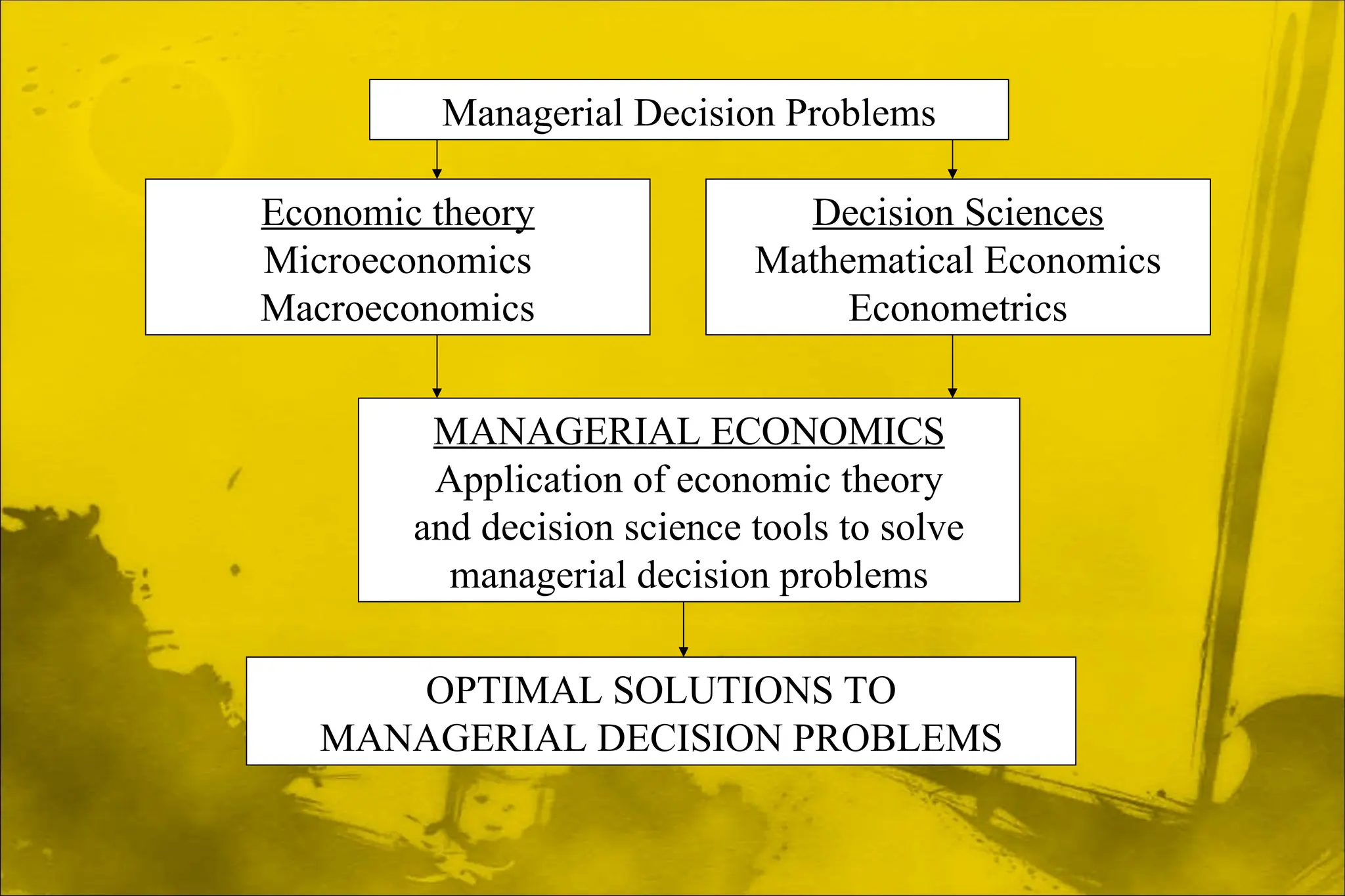
Managerial Decision Problems
Economic theory
Microeconomics
Macroeconomics
Decision Sciences
Mathematical Economics
Econometrics
MANAGERIAL ECONOMICS
Application of economic theory
and decision science tools to solve
managerial decision problems
OPTIMAL SOLUTIONS TO
MANAGERIAL DECISION PROBLEMS
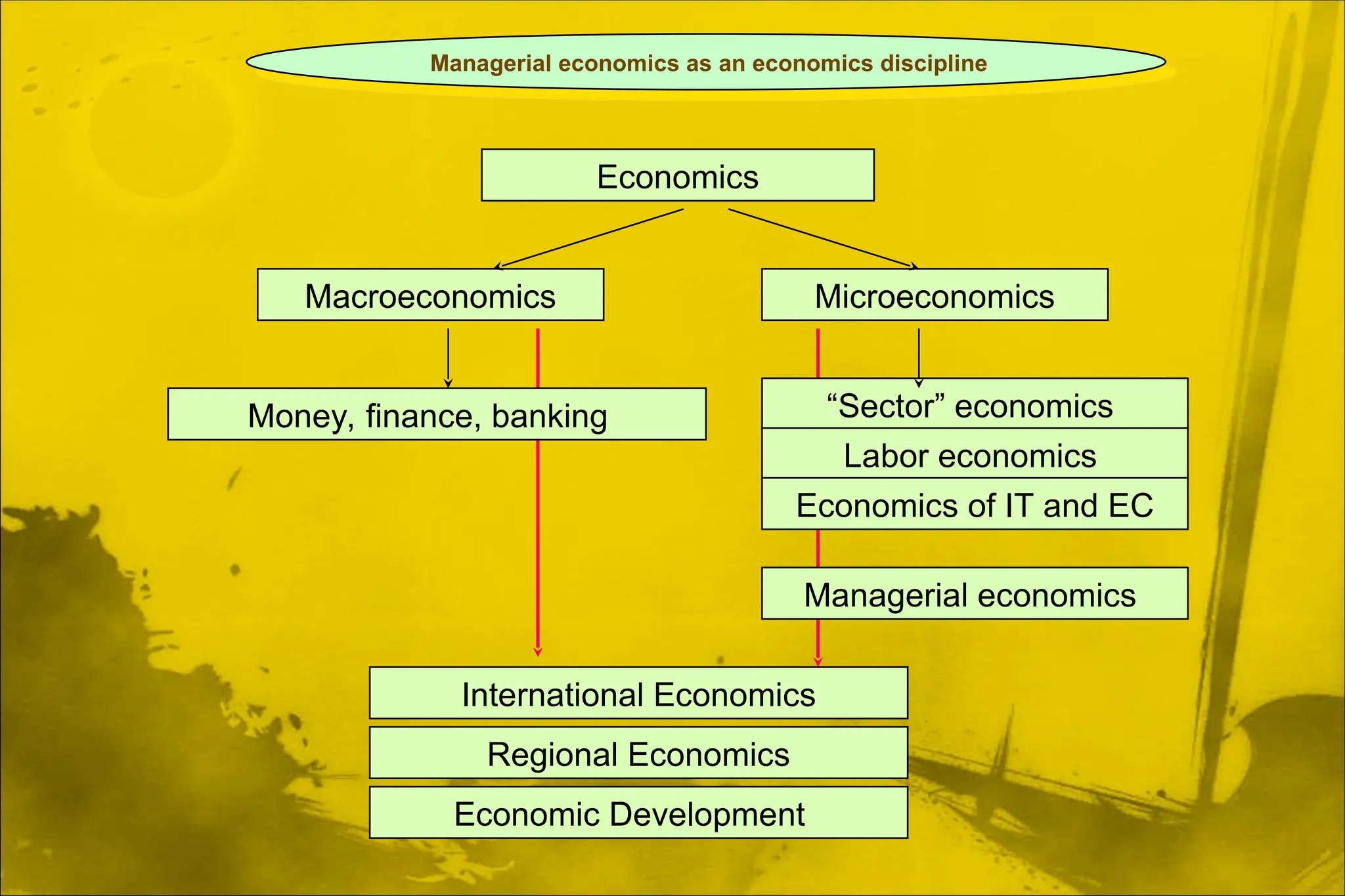
Managerial economics as an economics discipline
Macroeconomics
Economics
Microeconomics
International Economics
Regional Economics
Money, finance, banking “Sector” economics
Labor economics
Economics of IT and EC
Managerial economics
Economic Development
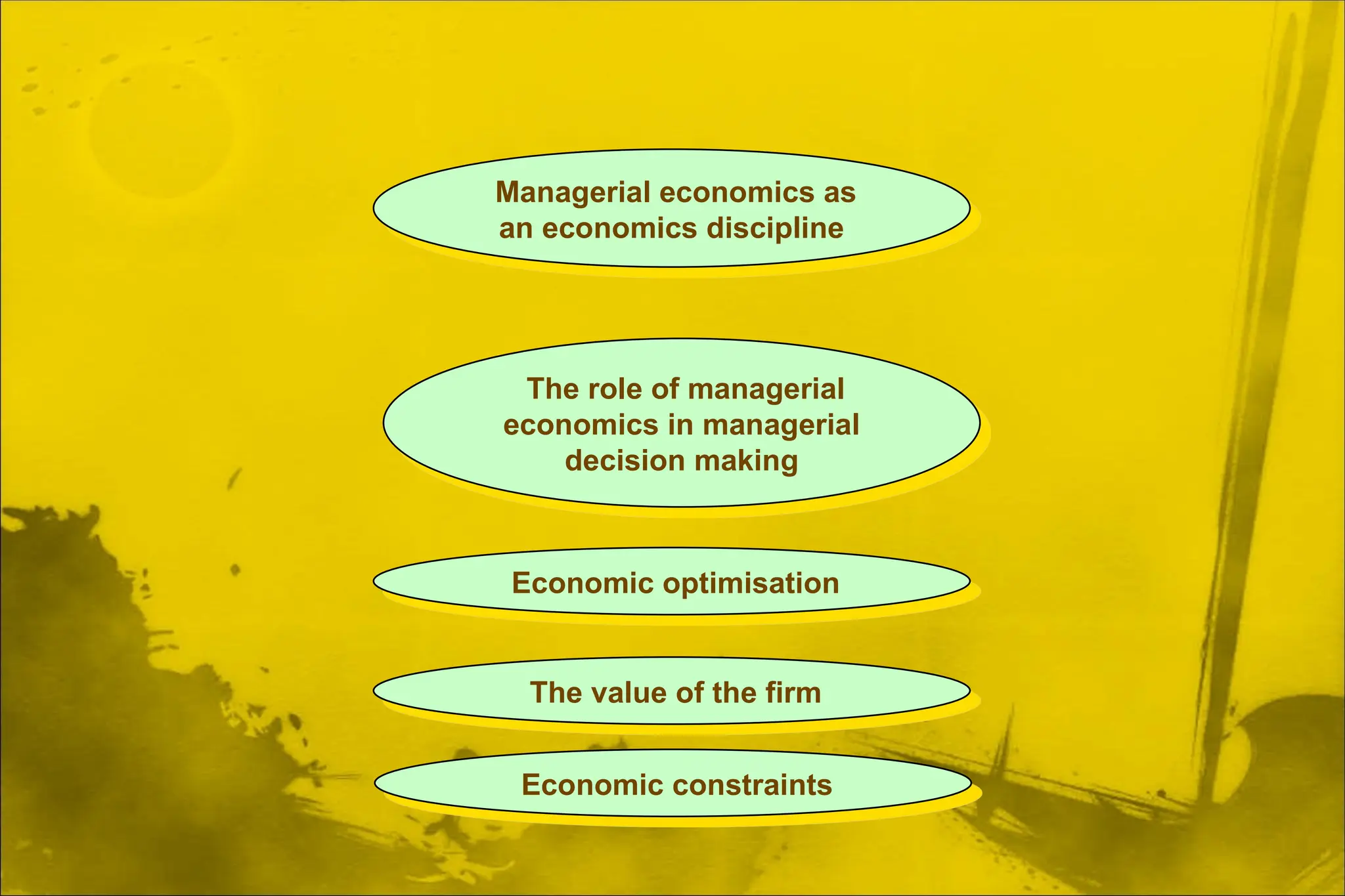
Economic optimisation
The value of the firm
Economic constraints
The role of managerial
economics in managerial
decision making
Managerial economics as
an economics discipline
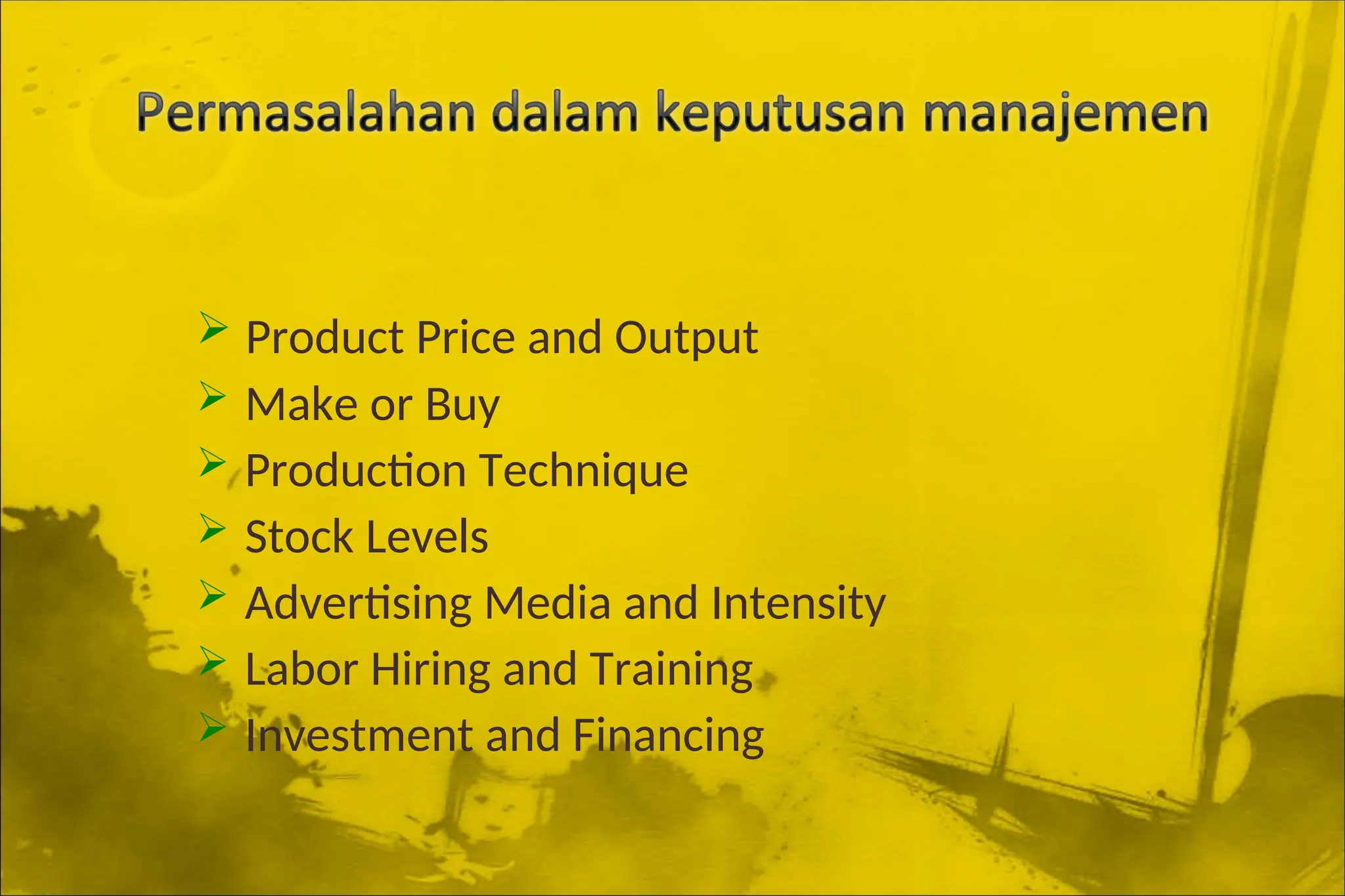
 Product Price and Output
 Make or Buy
 Production Technique
 Stock Levels
 Advertising Media and Intensity
 Labor Hiring and Training
 Investment and Financing
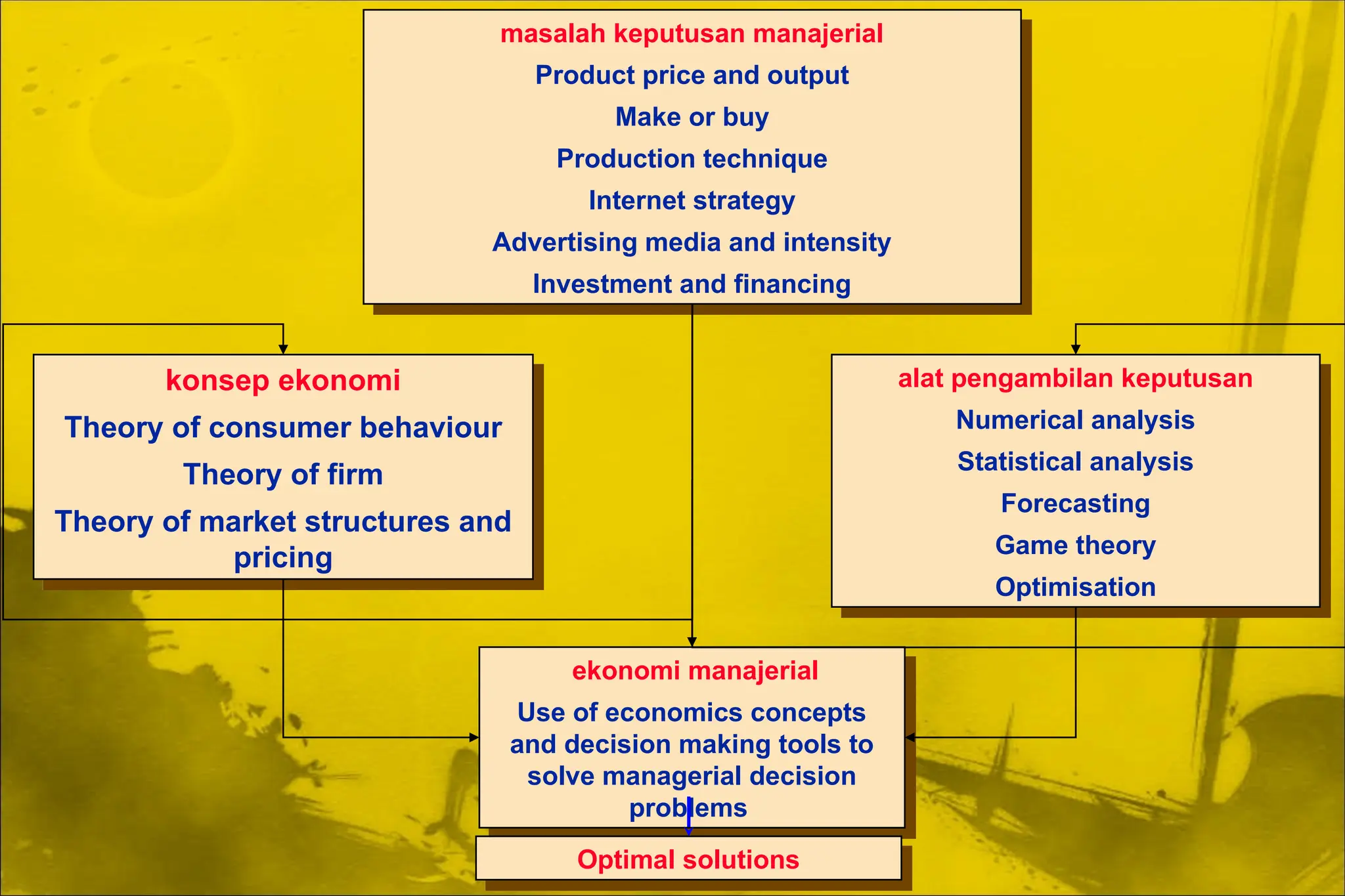
masalah keputusan manajerial
Product price and output
Make or buy
Production technique
Internet strategy
Advertising media and intensity
Investment and financing
konsep ekonomi
Theory of consumer behaviour
Theory of firm
Theory of market structures and
pricing
alat pengambilan keputusan
Numerical analysis
Statistical analysis
Forecasting
Game theory
Optimisation
ekonomi manajerial
Use of economics concepts
and decision making tools to
solve managerial decision
problems
Optimal solutions
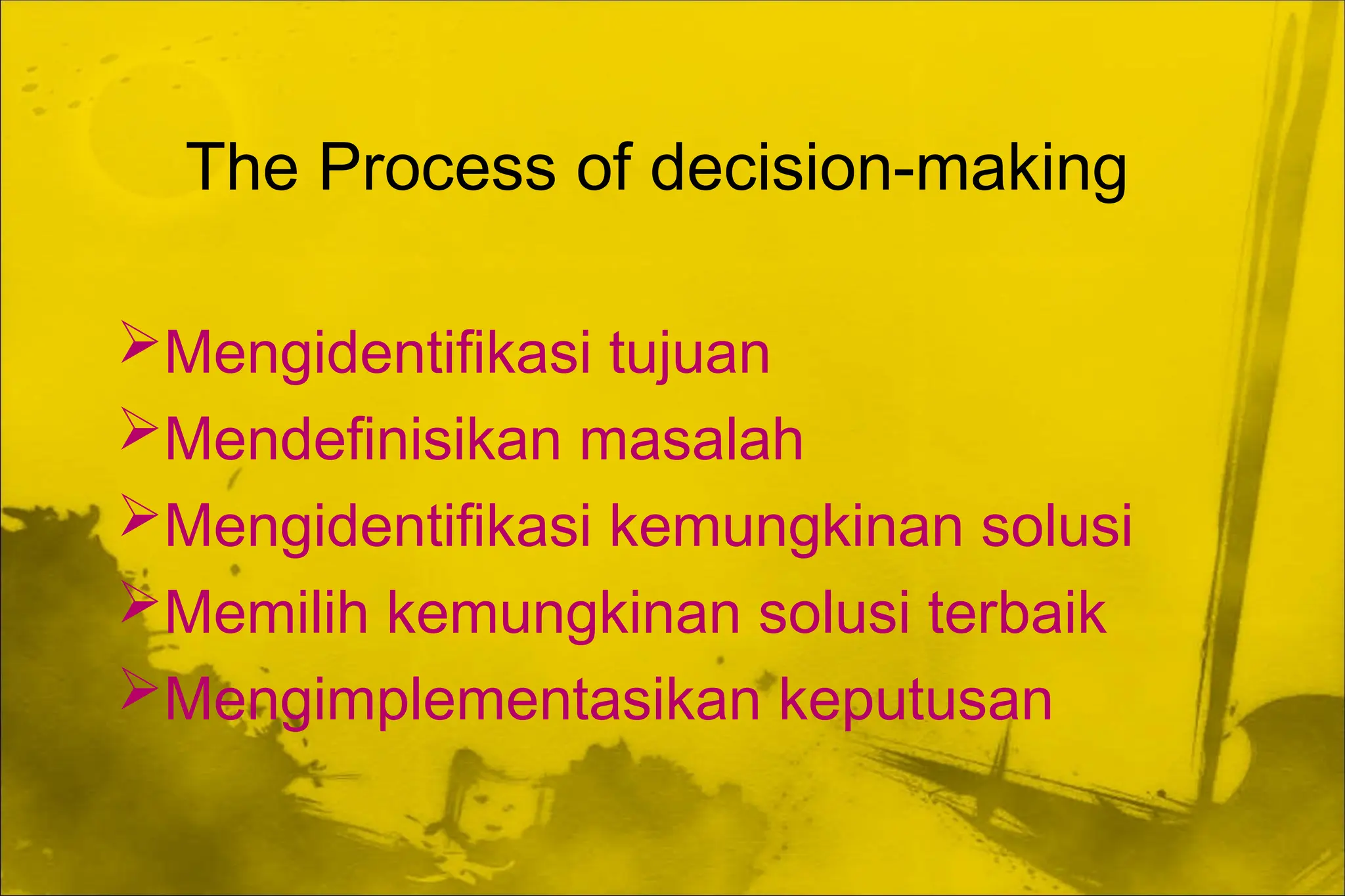
The Process of decision-making
Mengidentifikasi tujuan
Mendefinisikan masalah
Mengidentifikasi kemungkinan solusi
Memilih kemungkinan solusi terbaik
Mengimplementasikan keputusan
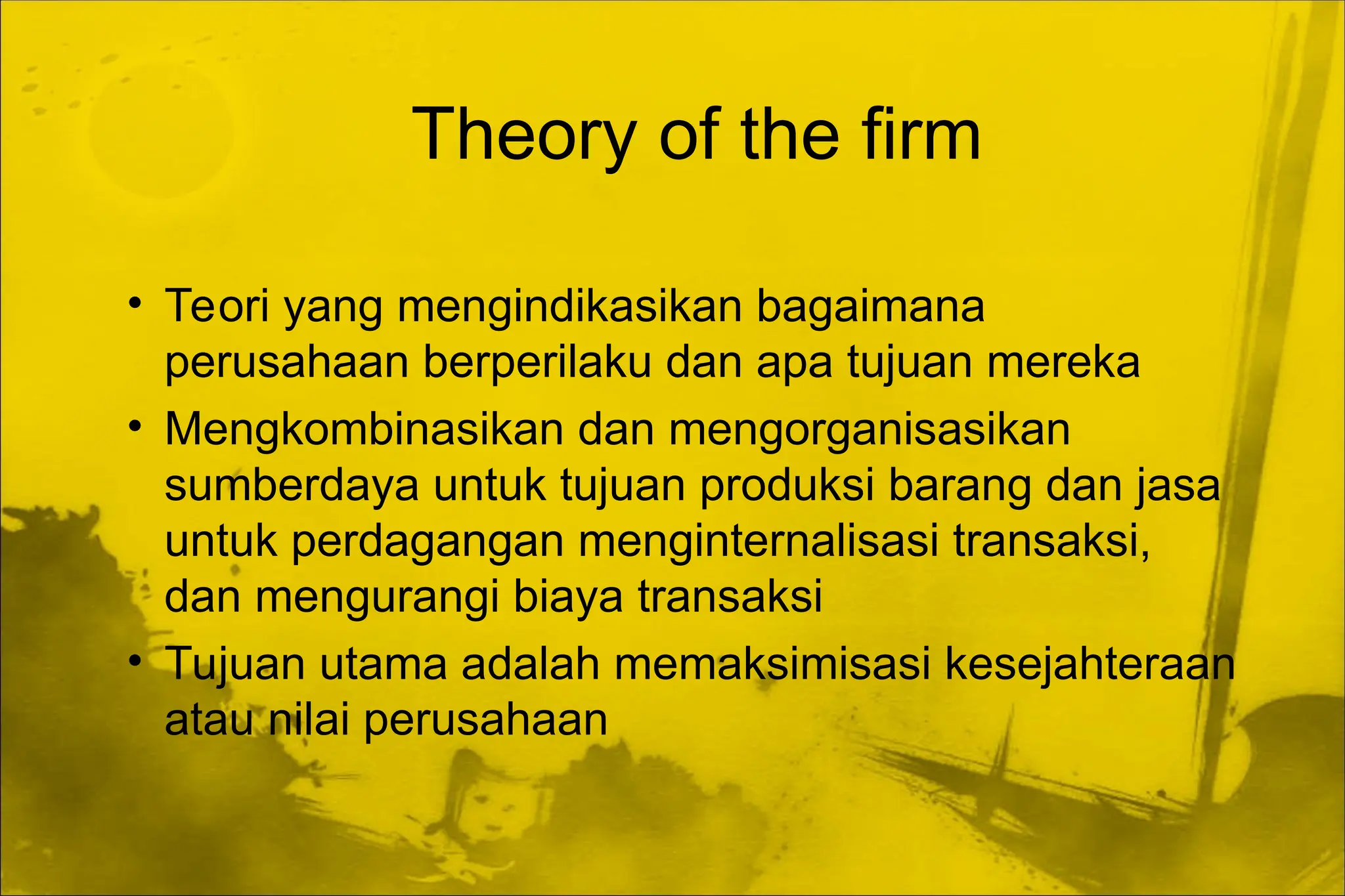
Theory of the firm
• Teori yang mengindikasikan bagaimana
perusahaan berperilaku dan apa tujuan mereka
• Mengkombinasikan dan mengorganisasikan
sumberdaya untuk tujuan produksi barang dan jasa
untuk perdagangan menginternalisasi transaksi,
dan mengurangi biaya transaksi
• Tujuan utama adalah memaksimisasi kesejahteraan
atau nilai perusahaan
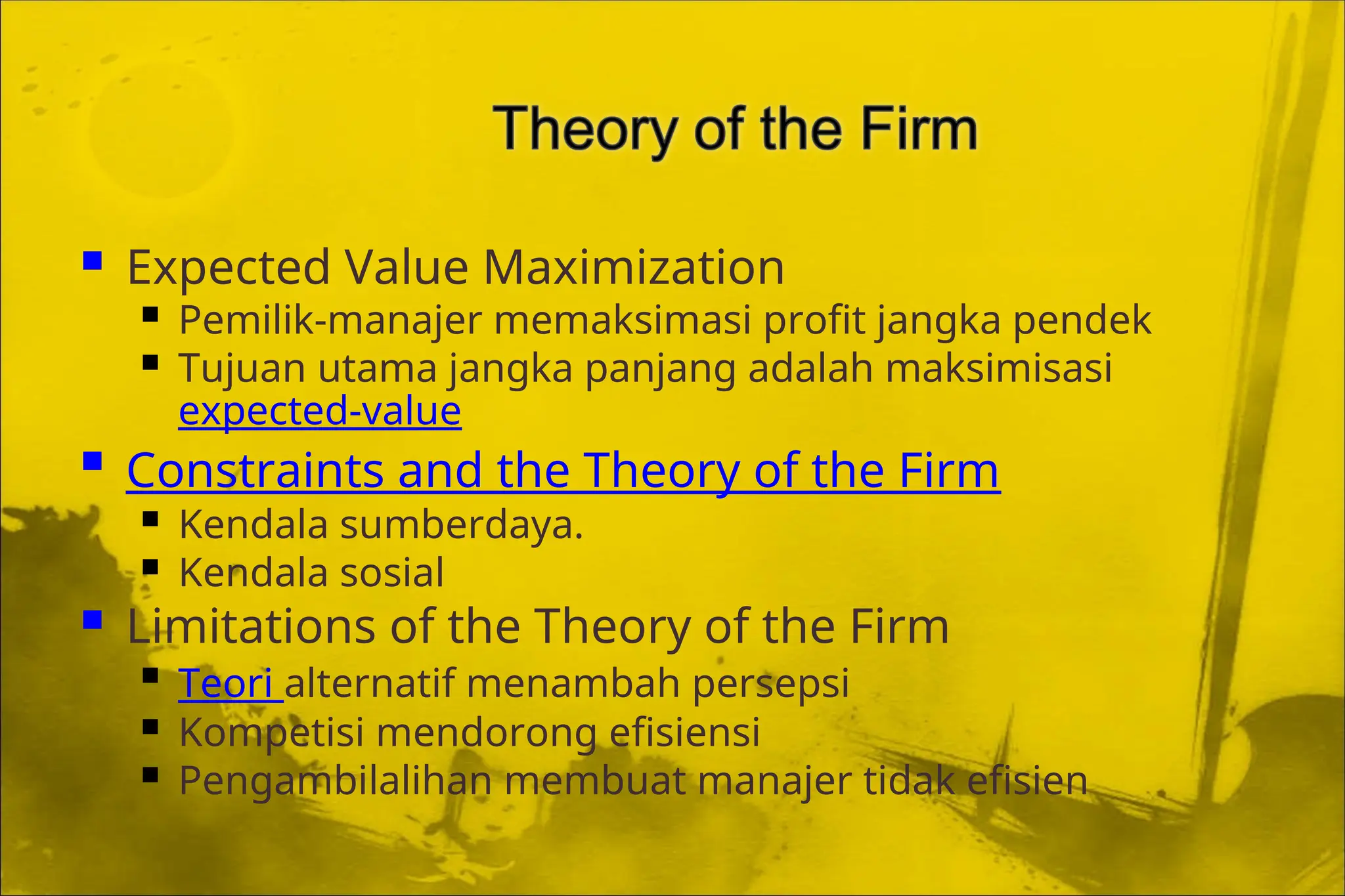
 Expected Value Maximization
 Pemilik-manajer memaksimasi profit jangka pendek
 Tujuan utama jangka panjang adalah maksimisasi
expected-value
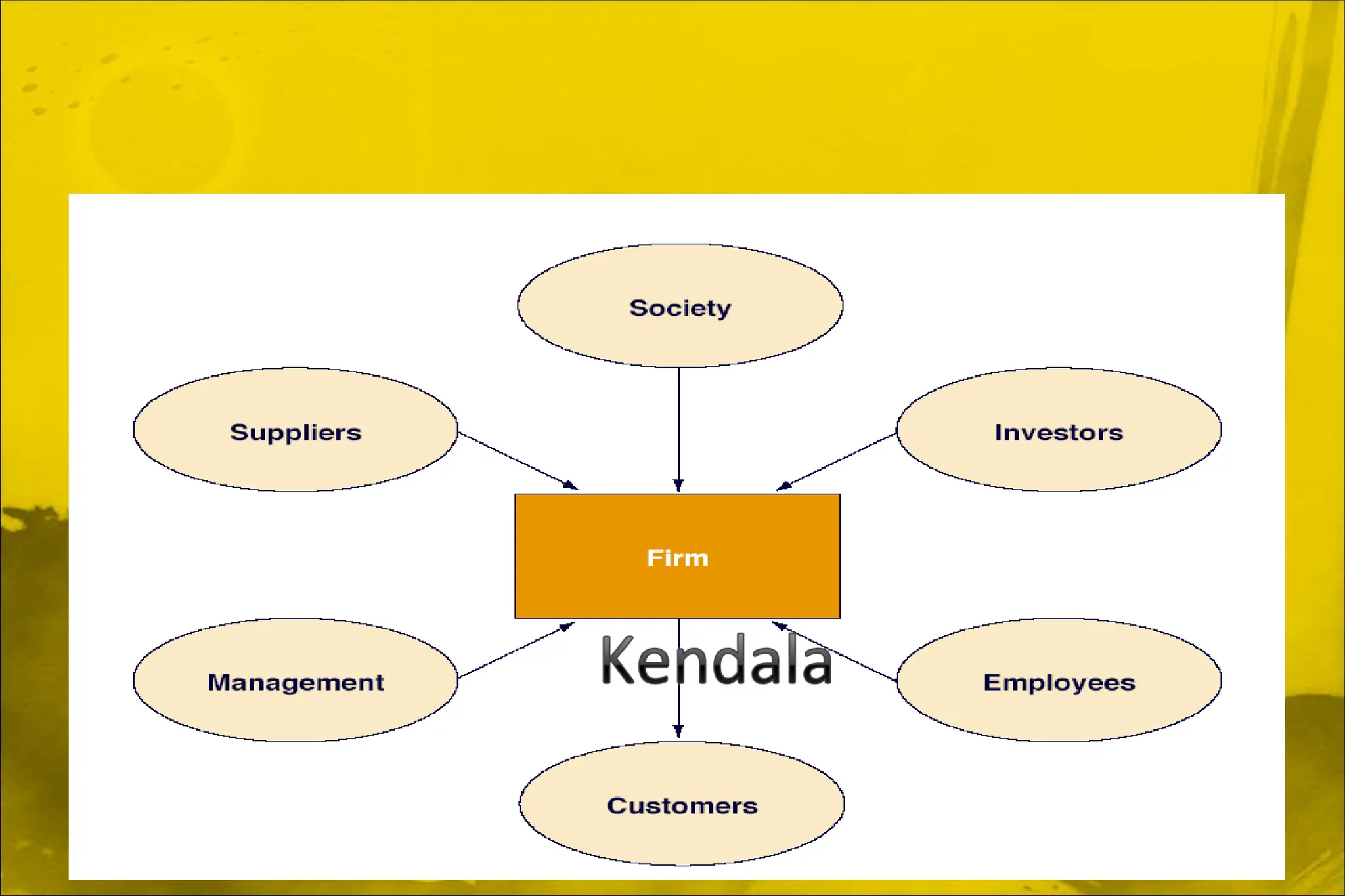
 Constraints and the Theory of the Firm
 Kendala sumberdaya.
 Kendala sosial
 Limitations of the Theory of the Firm
 Teori alternatif menambah persepsi
 Kompetisi mendorong efisiensi
 Pengambilalihan membuat manajer tidak efisien
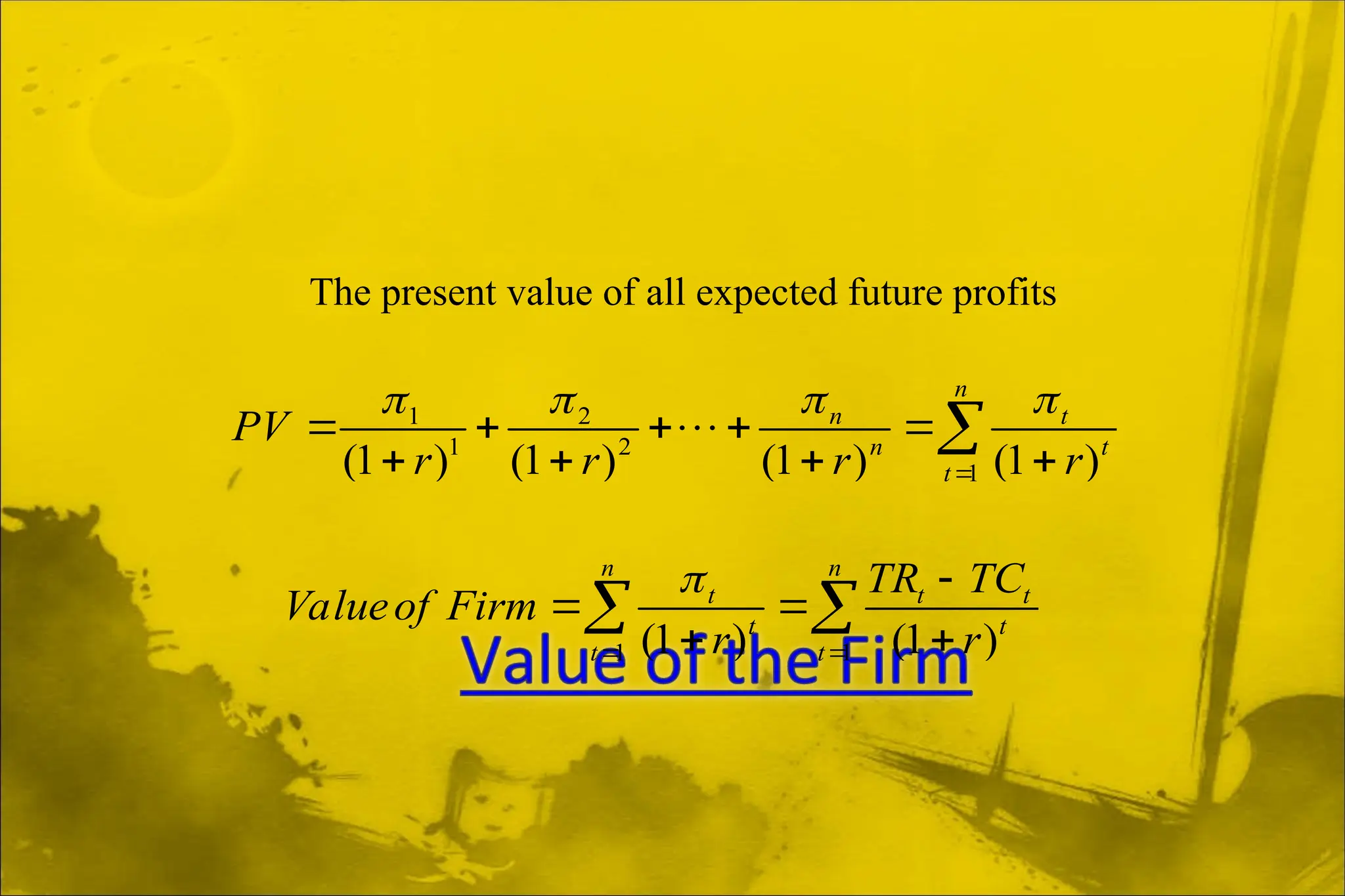
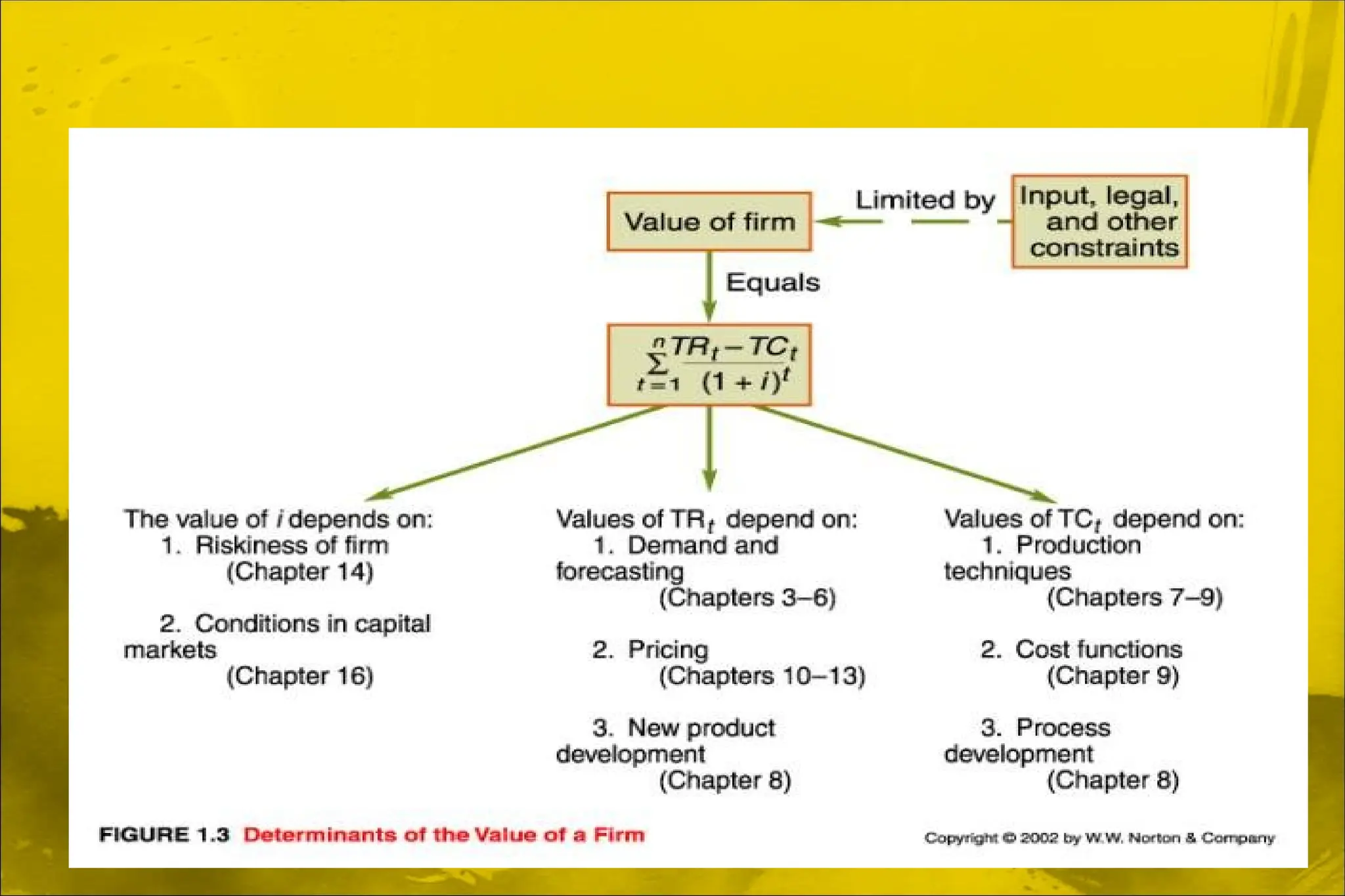
The present value of all expected future profits
1 2
1 2
1
(1 ) (1 ) (1 ) (1 )
n
n t
n t
t
PV
r r r r
 
 

    
   


1 1
(1 ) (1 )
n n
t t t
t t
t t
TR TC
Valueof Firm
r r

 

 
 
 
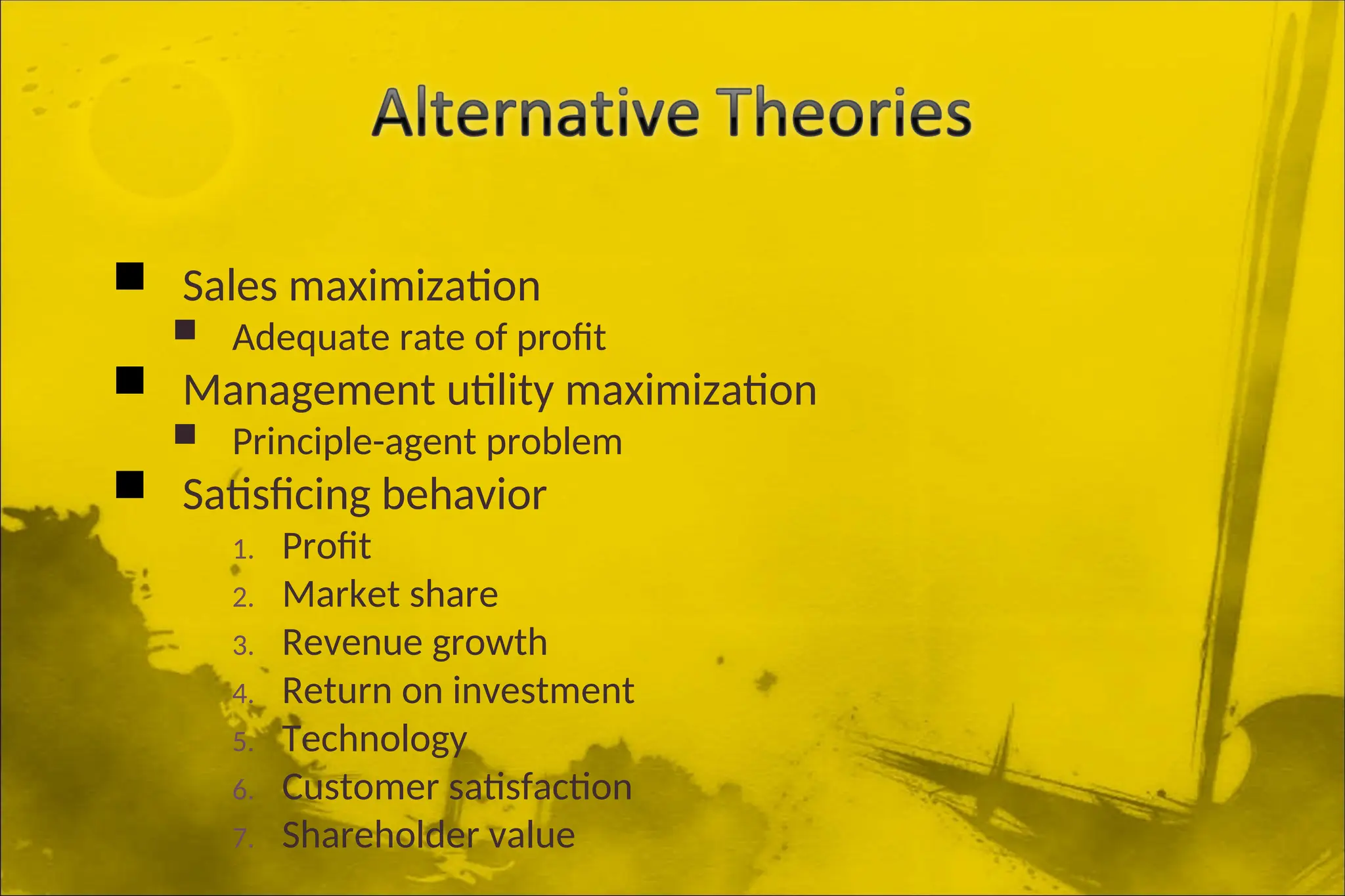
 Sales maximization
 Adequate rate of profit
 Management utility maximization
 Principle-agent problem
 Satisficing behavior
1. Profit
2. Market share
3. Revenue growth
4. Return on investment
5. Technology
6. Customer satisfaction
7. Shareholder value
Non-economic Objectives:
1. “A good place for our employees to work”
2. “Provide good products/services to our
customers”
3. “Act as a good citizen in our society”
Business Profit: Total revenue minus the explicit or
accounting costs of production.
Economic Profit: Total revenue minus the explicit
and implicit costs of production.
Opportunity Cost: Implicit value of a resource in its
best alternative use.
Profit merupakan signal untuk menunjukkan alokasi
sumberdaya
Profit yang tinggi dalam industri merupakan sinyal
bahwa pembeli menginginkan lebih dari yang
diproduksi industri
Profit negatif atau rendah memberikan sinyal bahwa
pembeli menginginkan lebih sedikit dibandingkan
yang diproduksi industri
Risk-Bearing Theories of Profit
Frictional Theory of Profit
Monopoly Theory of Profit
Innovation Theory of Profit
Managerial Efficiency Theory of Profit
Nilai marjinal
• Nilai marjinal dari variabel dependen adalah perubahan
variabel dependen akibat perubahan 1 unit variabel
independen
• Maksimisasi muncul jika marjinal berubah dari positif
menjadi negatif
• Jika marjinal di atas rata-rata, maka rata-rata akan
menaik dan sebaliknya
• Marjinal merupakan derivasi dari nilai total
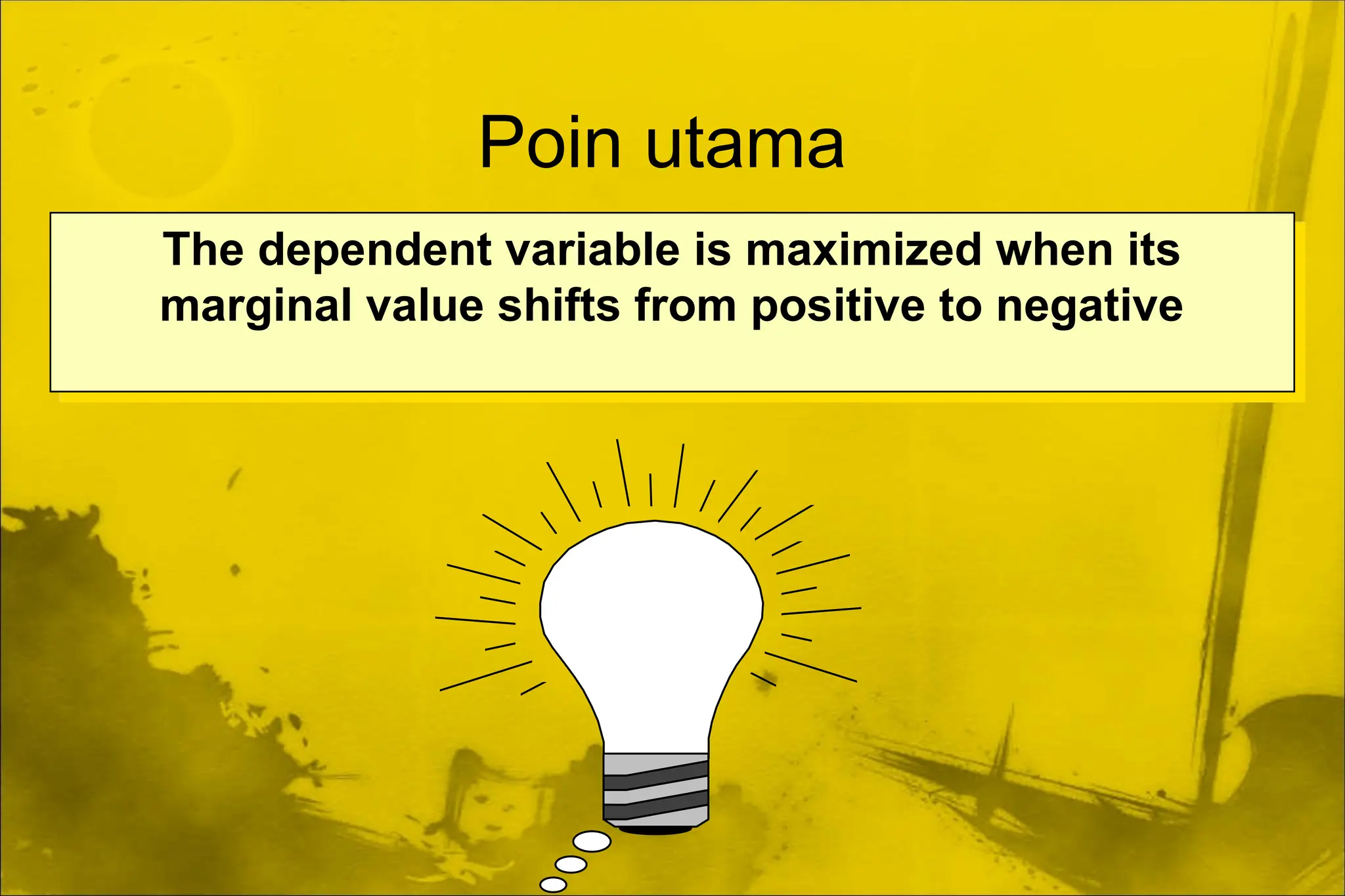
Poin utama
The dependent variable is maximized when its
marginal value shifts from positive to negative
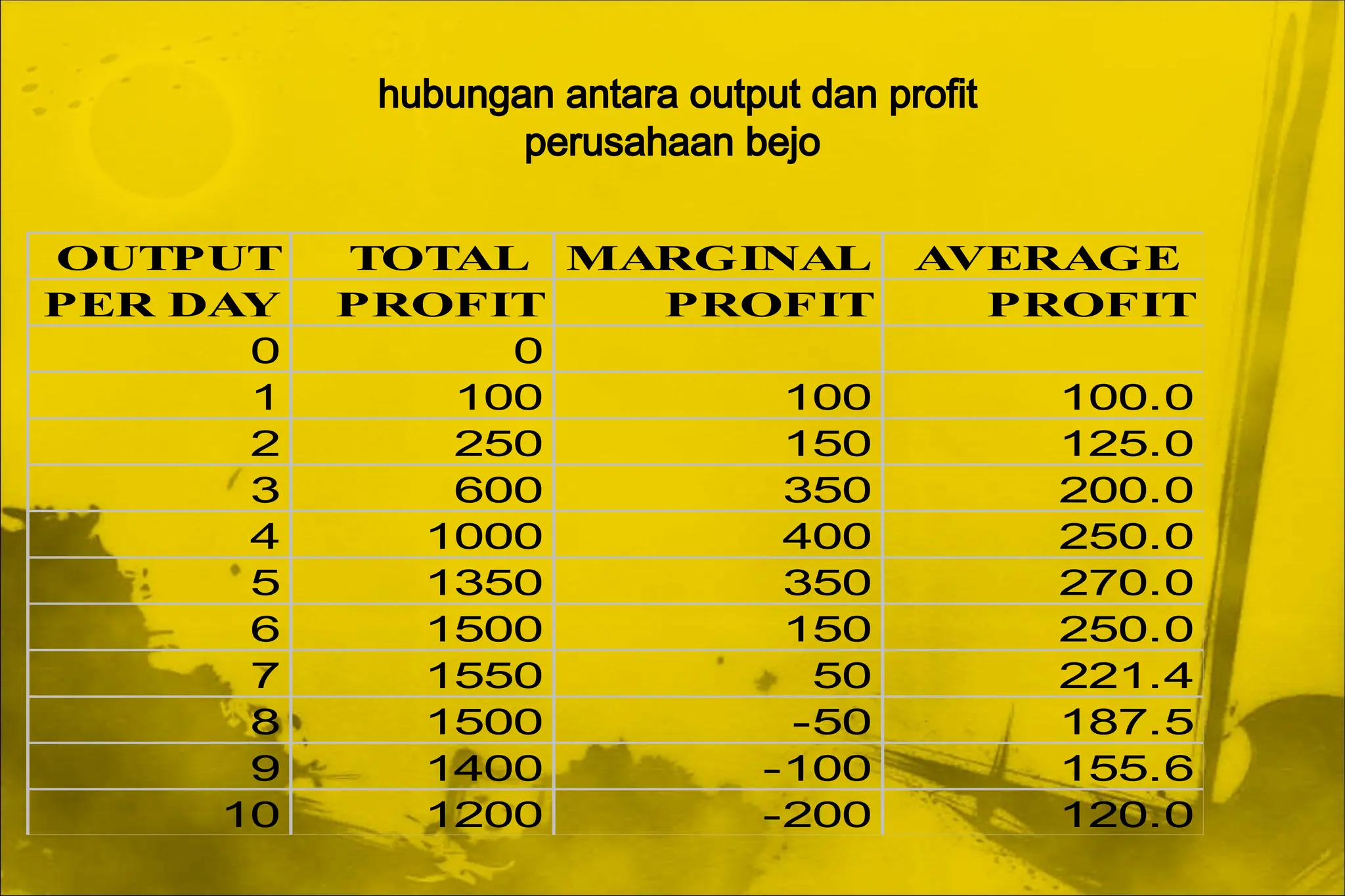
hubungan antara output dan profit
perusahaan bejo
OUTPUT TOTAL MARGINAL A
VERAGE
PER DAY PROFIT PROFIT PROFIT
0 0
1 100 100 100.0
2 250 150 125.0
3 600 350 200.0
4 1000 400 250.0
5 1350 350 270.0
6 1500 150 250.0
7 1550 50 221.4
8 1500 -50 187.5
9 1400 -100 155.6
10 1200 -200 120.0
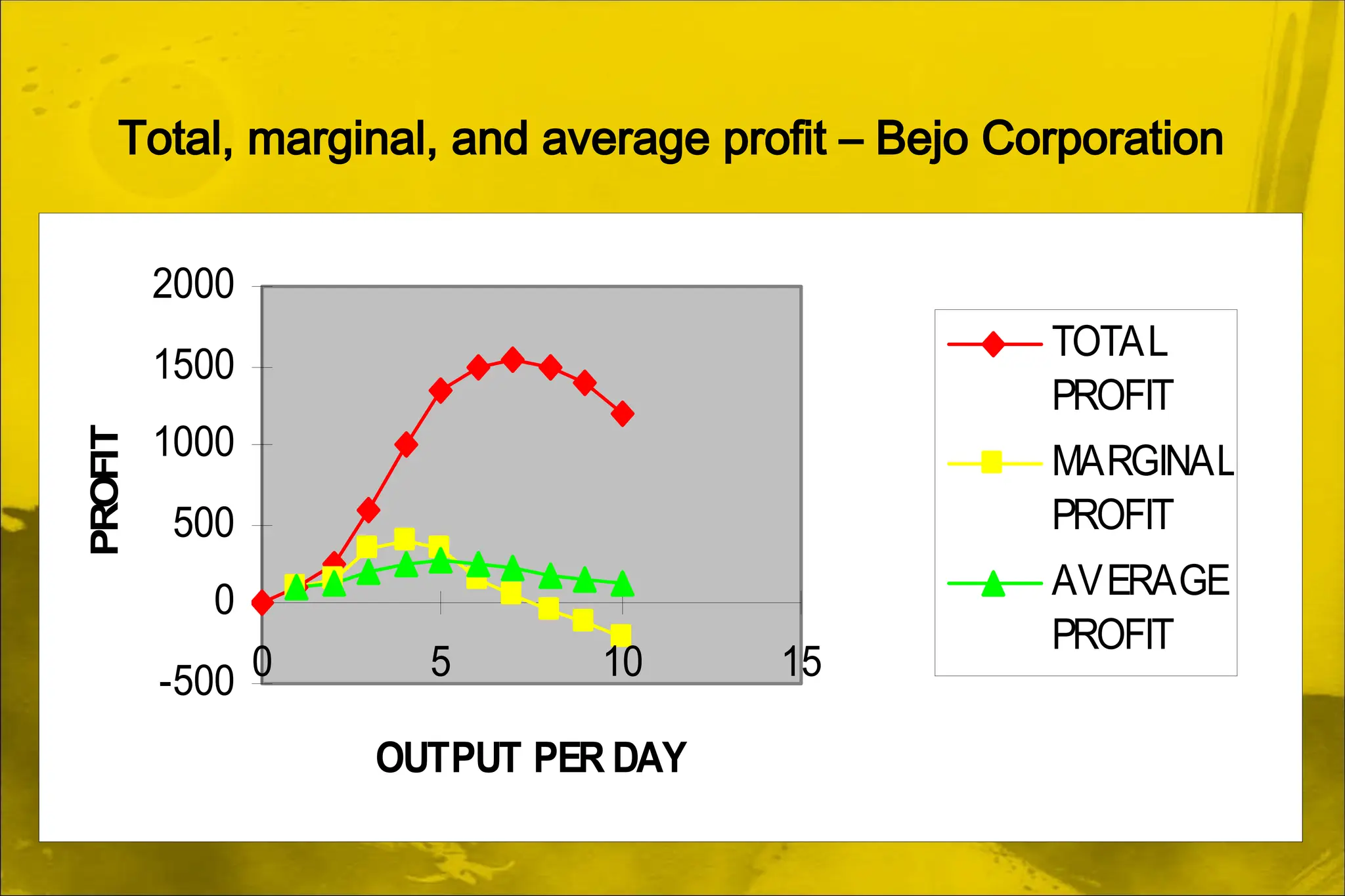
Total, marginal, and average profit – Bejo Corporation
-500
0
500
1000
1500
2000
0 5 10 15
OUTPUT PER DAY
PROFIT
TOTAL
PROFIT
MARGINAL
PROFIT
AVERAGE
PROFIT
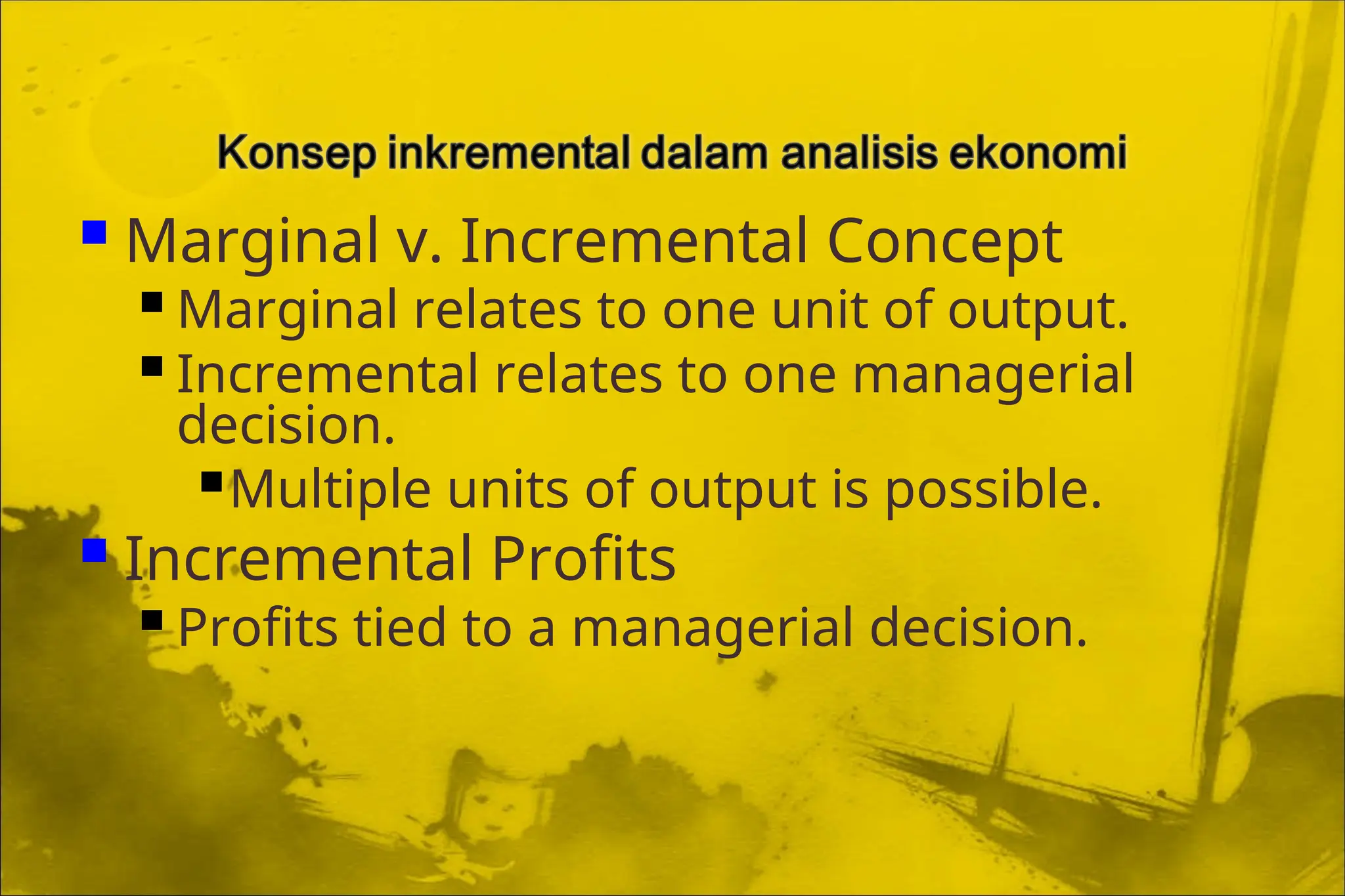
 Marginal v. Incremental Concept
 Marginal relates to one unit of output.
 Incremental relates to one managerial
decision.
Multiple units of output is possible.
 Incremental Profits
 Profits tied to a managerial decision.
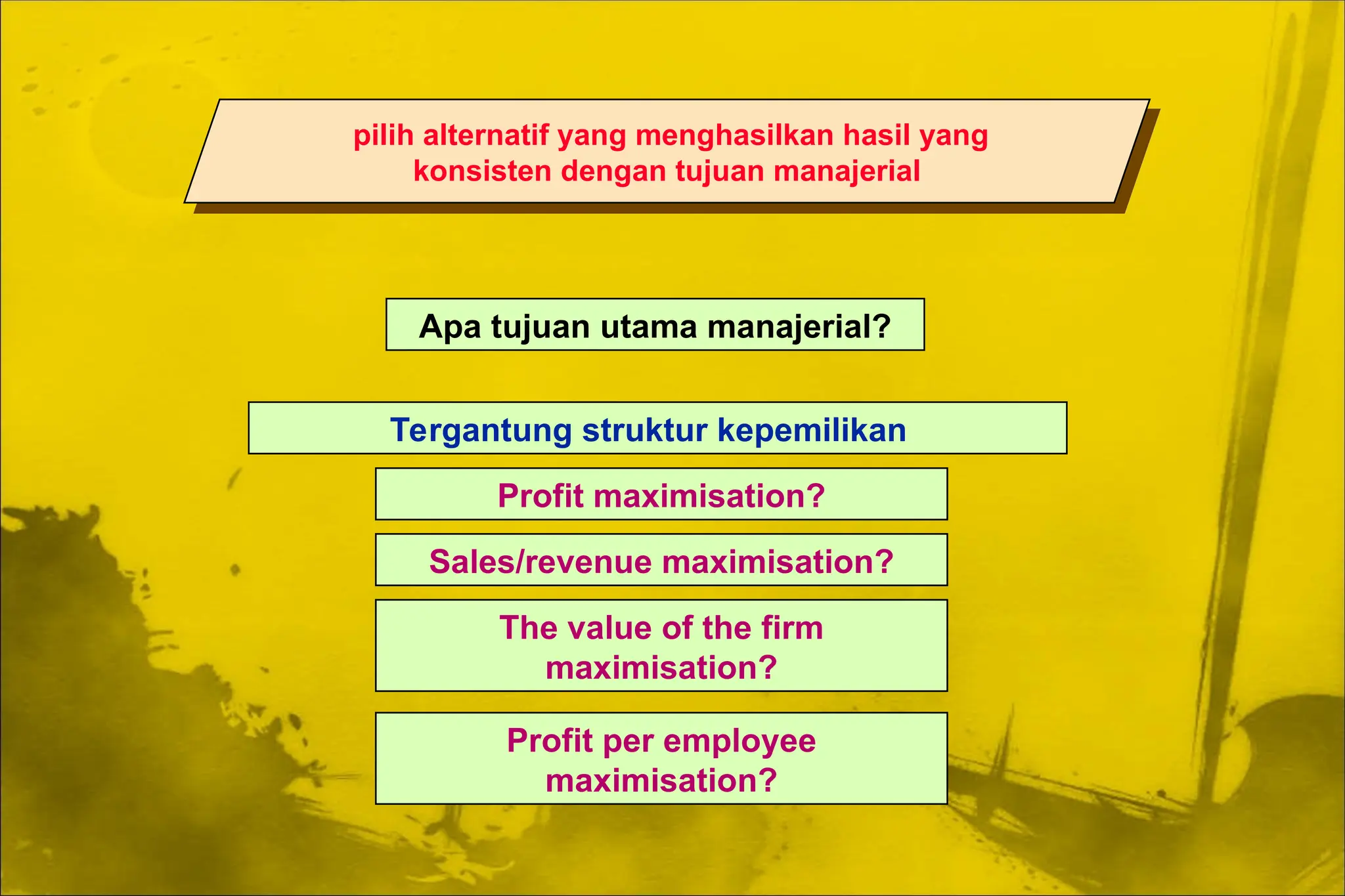
pilih alternatif yang menghasilkan hasil yang
konsisten dengan tujuan manajerial
Apa tujuan utama manajerial?
Tergantung struktur kepemilikan
Profit maximisation?
Sales/revenue maximisation?
The value of the firm
maximisation?
Profit per employee
maximisation?
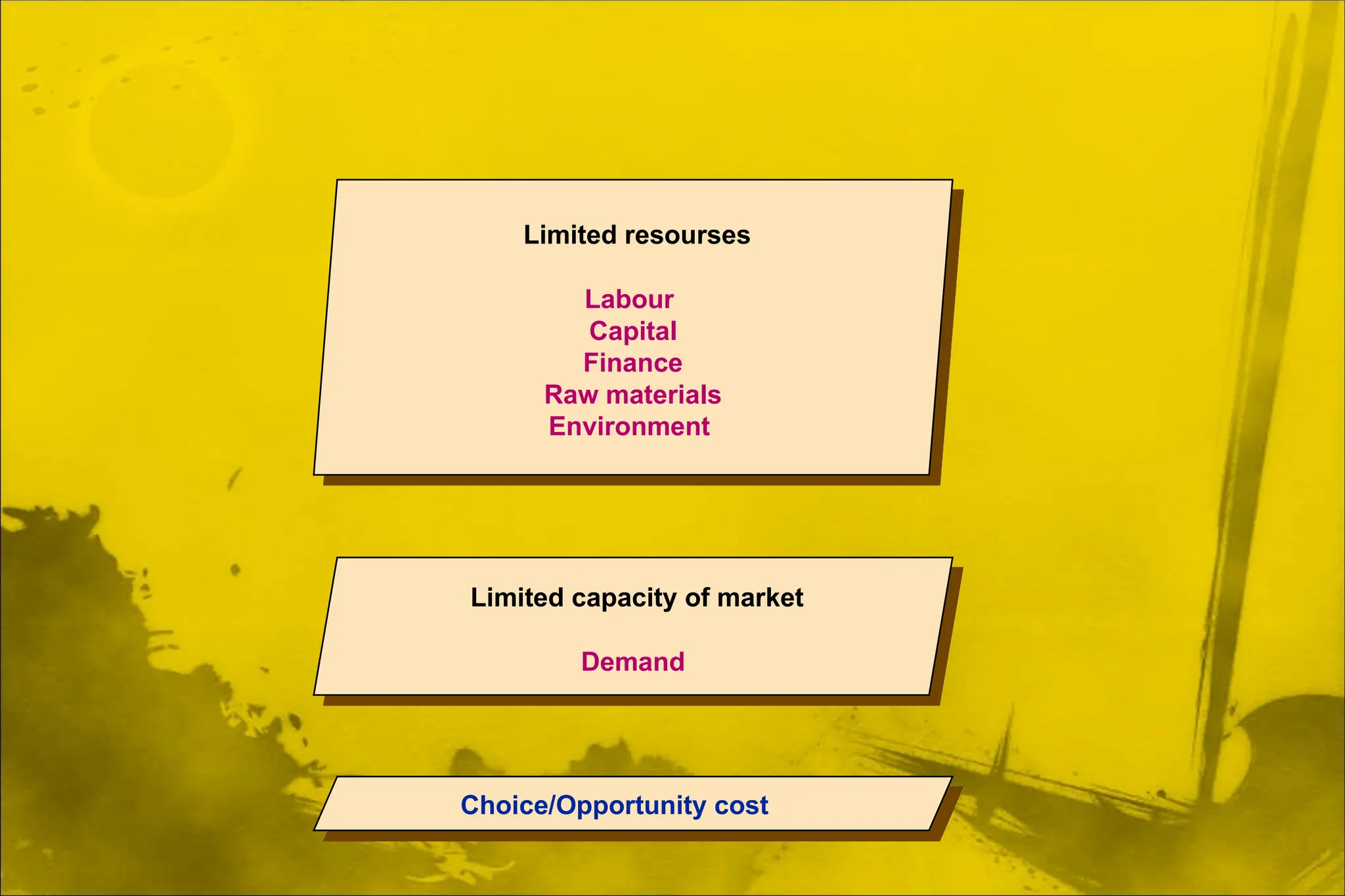
Limited resourses
Labour
Capital
Finance
Raw materials
Environment
Limited capacity of market
Demand
Choice/Opportunity cost
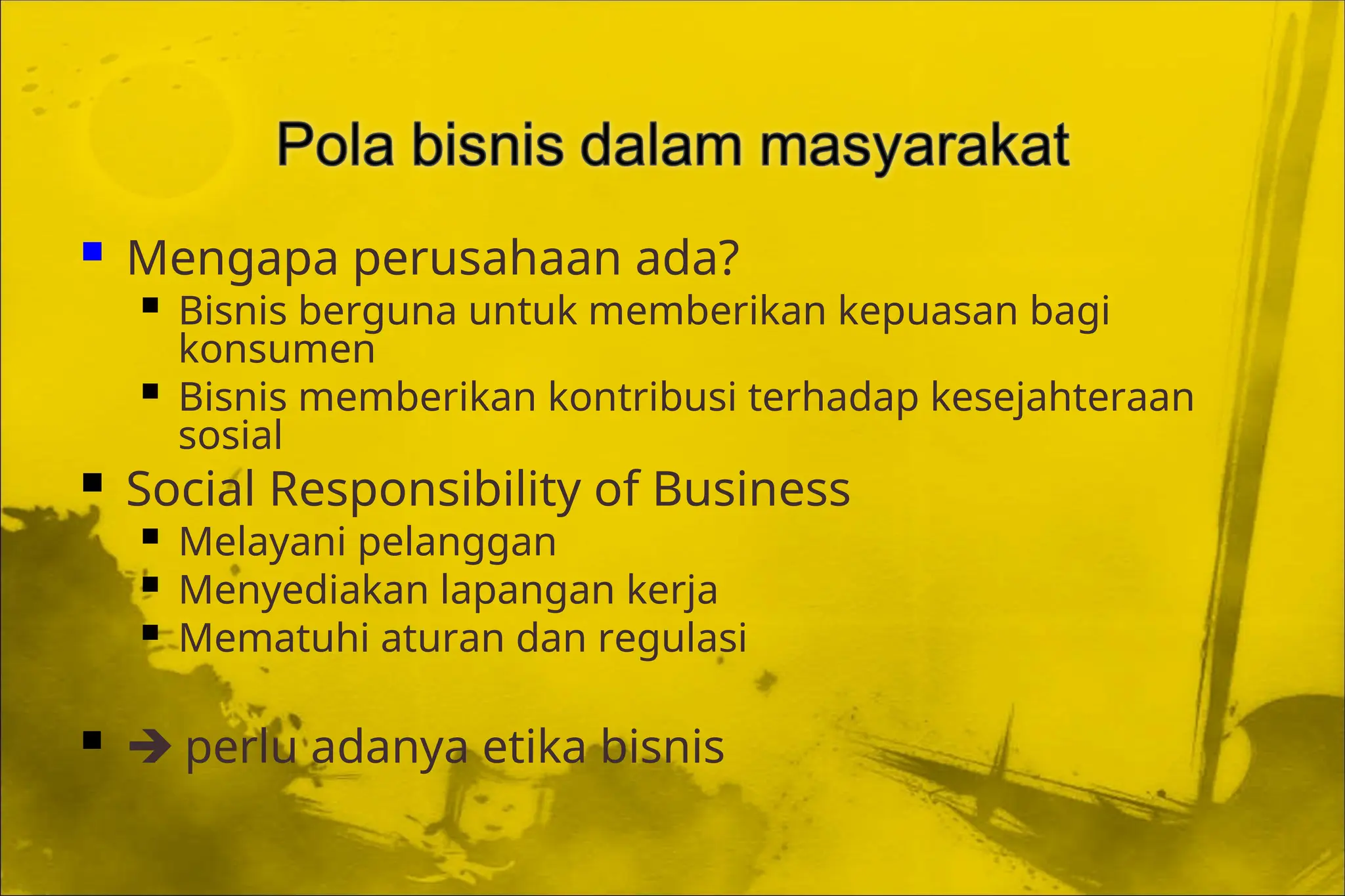
 Mengapa perusahaan ada?
 Bisnis berguna untuk memberikan kepuasan bagi
konsumen
 Bisnis memberikan kontribusi terhadap kesejahteraan
sosial
 Social Responsibility of Business
 Melayani pelanggan
 Menyediakan lapangan kerja
 Mematuhi aturan dan regulasi
  perlu adanya etika bisnis
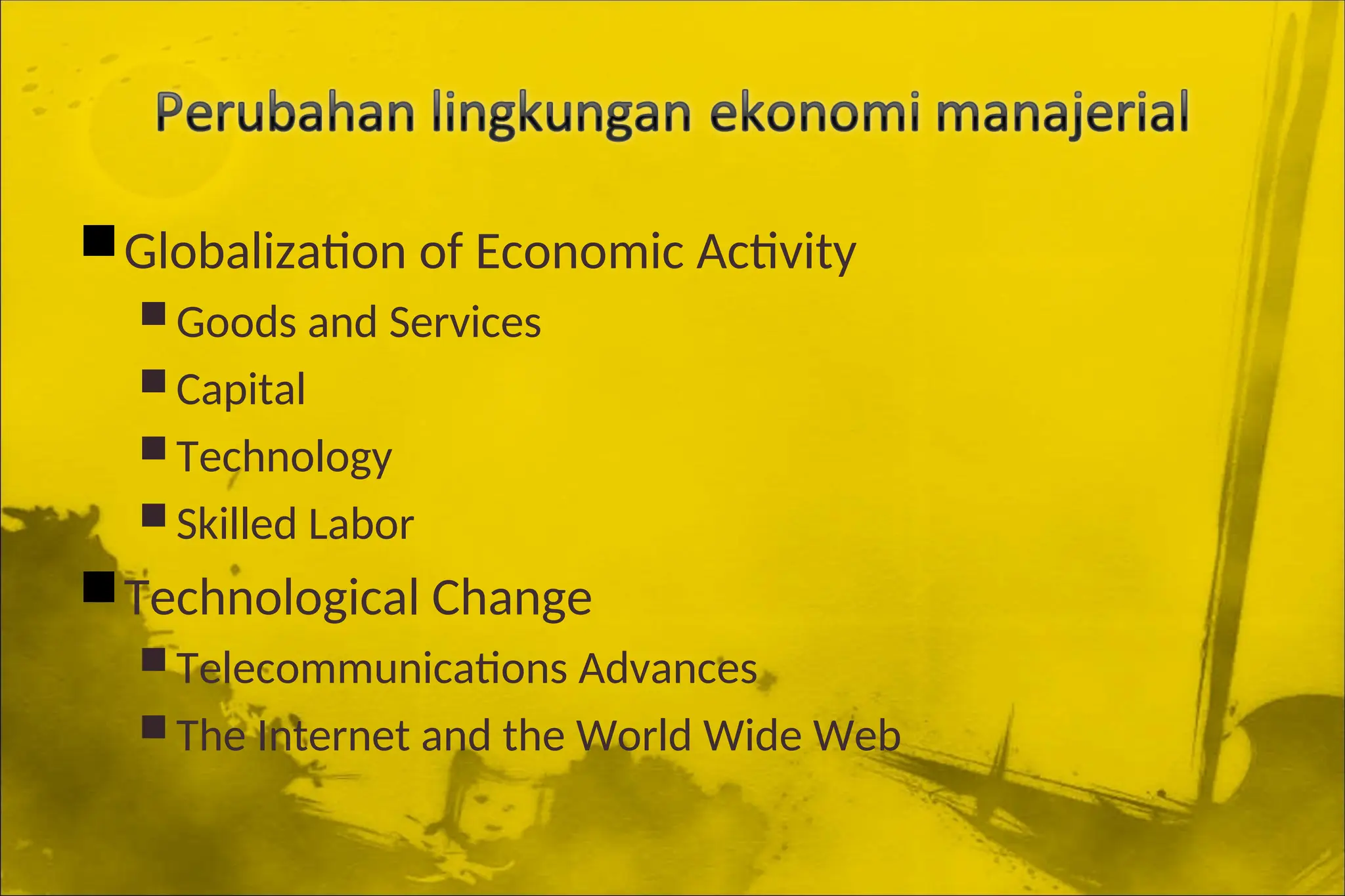
Globalization of Economic Activity
 Goods and Services
 Capital
 Technology
 Skilled Labor
Technological Change
 Telecommunications Advances
 The Internet and the World Wide Web

1_introduction_manajerial ekonomi manajerial pengantar

  • 1.
  • 2.
    Aplikasi teori ekonomidan alat pengambilan keputusan untuk mengetahui bagaimana organisasi dapat mencapai tujuannya secara lebih efektif.
  • 3.
    Managerial Decision Problems Economictheory Microeconomics Macroeconomics Decision Sciences Mathematical Economics Econometrics MANAGERIAL ECONOMICS Application of economic theory and decision science tools to solve managerial decision problems OPTIMAL SOLUTIONS TO MANAGERIAL DECISION PROBLEMS
  • 4.
    Managerial economics asan economics discipline Macroeconomics Economics Microeconomics International Economics Regional Economics Money, finance, banking “Sector” economics Labor economics Economics of IT and EC Managerial economics Economic Development
  • 5.
    Economic optimisation The valueof the firm Economic constraints The role of managerial economics in managerial decision making Managerial economics as an economics discipline
  • 6.
     Product Priceand Output  Make or Buy  Production Technique  Stock Levels  Advertising Media and Intensity  Labor Hiring and Training  Investment and Financing
  • 7.
    masalah keputusan manajerial Productprice and output Make or buy Production technique Internet strategy Advertising media and intensity Investment and financing konsep ekonomi Theory of consumer behaviour Theory of firm Theory of market structures and pricing alat pengambilan keputusan Numerical analysis Statistical analysis Forecasting Game theory Optimisation ekonomi manajerial Use of economics concepts and decision making tools to solve managerial decision problems Optimal solutions
  • 8.
    The Process ofdecision-making Mengidentifikasi tujuan Mendefinisikan masalah Mengidentifikasi kemungkinan solusi Memilih kemungkinan solusi terbaik Mengimplementasikan keputusan
  • 9.
    Theory of thefirm • Teori yang mengindikasikan bagaimana perusahaan berperilaku dan apa tujuan mereka • Mengkombinasikan dan mengorganisasikan sumberdaya untuk tujuan produksi barang dan jasa untuk perdagangan menginternalisasi transaksi, dan mengurangi biaya transaksi • Tujuan utama adalah memaksimisasi kesejahteraan atau nilai perusahaan
  • 10.
     Expected ValueMaximization  Pemilik-manajer memaksimasi profit jangka pendek  Tujuan utama jangka panjang adalah maksimisasi expected-value  Constraints and the Theory of the Firm  Kendala sumberdaya.  Kendala sosial  Limitations of the Theory of the Firm  Teori alternatif menambah persepsi  Kompetisi mendorong efisiensi  Pengambilalihan membuat manajer tidak efisien
  • 11.
    The present valueof all expected future profits 1 2 1 2 1 (1 ) (1 ) (1 ) (1 ) n n t n t t PV r r r r                 1 1 (1 ) (1 ) n n t t t t t t t TR TC Valueof Firm r r          
  • 13.
     Sales maximization Adequate rate of profit  Management utility maximization  Principle-agent problem  Satisficing behavior 1. Profit 2. Market share 3. Revenue growth 4. Return on investment 5. Technology 6. Customer satisfaction 7. Shareholder value
  • 14.
    Non-economic Objectives: 1. “Agood place for our employees to work” 2. “Provide good products/services to our customers” 3. “Act as a good citizen in our society”
  • 15.
    Business Profit: Totalrevenue minus the explicit or accounting costs of production. Economic Profit: Total revenue minus the explicit and implicit costs of production. Opportunity Cost: Implicit value of a resource in its best alternative use.
  • 16.
    Profit merupakan signaluntuk menunjukkan alokasi sumberdaya Profit yang tinggi dalam industri merupakan sinyal bahwa pembeli menginginkan lebih dari yang diproduksi industri Profit negatif atau rendah memberikan sinyal bahwa pembeli menginginkan lebih sedikit dibandingkan yang diproduksi industri
  • 17.
    Risk-Bearing Theories ofProfit Frictional Theory of Profit Monopoly Theory of Profit Innovation Theory of Profit Managerial Efficiency Theory of Profit
  • 18.
    Nilai marjinal • Nilaimarjinal dari variabel dependen adalah perubahan variabel dependen akibat perubahan 1 unit variabel independen • Maksimisasi muncul jika marjinal berubah dari positif menjadi negatif • Jika marjinal di atas rata-rata, maka rata-rata akan menaik dan sebaliknya • Marjinal merupakan derivasi dari nilai total
  • 19.
    Poin utama The dependentvariable is maximized when its marginal value shifts from positive to negative
  • 20.
    hubungan antara outputdan profit perusahaan bejo OUTPUT TOTAL MARGINAL A VERAGE PER DAY PROFIT PROFIT PROFIT 0 0 1 100 100 100.0 2 250 150 125.0 3 600 350 200.0 4 1000 400 250.0 5 1350 350 270.0 6 1500 150 250.0 7 1550 50 221.4 8 1500 -50 187.5 9 1400 -100 155.6 10 1200 -200 120.0
  • 21.
    Total, marginal, andaverage profit – Bejo Corporation -500 0 500 1000 1500 2000 0 5 10 15 OUTPUT PER DAY PROFIT TOTAL PROFIT MARGINAL PROFIT AVERAGE PROFIT
  • 22.
     Marginal v.Incremental Concept  Marginal relates to one unit of output.  Incremental relates to one managerial decision. Multiple units of output is possible.  Incremental Profits  Profits tied to a managerial decision.
  • 23.
    pilih alternatif yangmenghasilkan hasil yang konsisten dengan tujuan manajerial Apa tujuan utama manajerial? Tergantung struktur kepemilikan Profit maximisation? Sales/revenue maximisation? The value of the firm maximisation? Profit per employee maximisation?
  • 25.
    Limited resourses Labour Capital Finance Raw materials Environment Limitedcapacity of market Demand Choice/Opportunity cost
  • 26.
     Mengapa perusahaanada?  Bisnis berguna untuk memberikan kepuasan bagi konsumen  Bisnis memberikan kontribusi terhadap kesejahteraan sosial  Social Responsibility of Business  Melayani pelanggan  Menyediakan lapangan kerja  Mematuhi aturan dan regulasi   perlu adanya etika bisnis
  • 28.
    Globalization of EconomicActivity  Goods and Services  Capital  Technology  Skilled Labor Technological Change  Telecommunications Advances  The Internet and the World Wide Web