E/1995/32
E/CN.17/1995/36
United Nations
Commission on Sustainable Development
Report on the Third Session
(11-28 April 1995)
Economic and Social Council
Official Records, 1995
Supplement No.12
E/1995/32
E/CN.17/1995/36
Commission on Sustainable Development
Report on the Third Session
(11-28 April 1995)
Economic and Social Council
Official Records, 1995
Supplement No.12
United Nations · New York, 1995
NOTE
Symbols of United Nations documents are composed of capital letters combined with
figures.
ISSN 1020-3559
CONTENTS
Chapter Page
I. MATTERS CALLING FOR ACTION BY THE ECONOMIC AND SOCIAL COUNCIL OR
BROUGHT TO ITS ATTENTION ...................................... 1
A. General discussion on progress in the implementation of
Agenda 21, focusing on the cross-sectoral components of
Agenda 21, and the critical elements of sustainability ..... 1
B. Financial resources and mechanisms ......................... 23
C. Education, science, transfer of environmentally sound
technologies, cooperation and capacity-building ............ 28
D. Review of sectoral cluster: Land, desertification, forests
and biodiversity ........................................... 39
E. Other matters .............................................. 60
F. Provisional agenda for the fourth session of the Commission 61
II. CHAIRMAN’S SUMMARY OF THE HIGH-LEVEL MEETING OF THE COMMISSION . 62
III. GENERAL DISCUSSION ON PROGRESS IN THE IMPLEMENTATION OF
AGENDA 21, FOCUSING ON THE CROSS-SECTORAL COMPONENTS OF
AGENDA 21, AND THE CRITICAL ELEMENTS OF SUSTAINABILITY ......... 67
IV. FINANCIAL RESOURCES AND MECHANISMS ............................. 71
V. EDUCATION, SCIENCE, TRANSFER OF ENVIRONMENTALLY SOUND
TECHNOLOGIES, COOPERATION AND CAPACITY-BUILDING ................ 73
VI. REVIEW OF SECTORAL CLUSTER: LAND, DESERTIFICATION, FORESTS AND
BIODIVERSITY ................................................... 75
VII. OTHER MATTERS .................................................. 78
VIII. HIGH-LEVEL MEETING ............................................. 79
IX. PROVISIONAL AGENDA FOR THE FOURTH SESSION OF THE COMMISSION .... 81
X. ADOPTION OF THE REPORT OF THE COMMISSION ON ITS THIRD SESSION .. 82
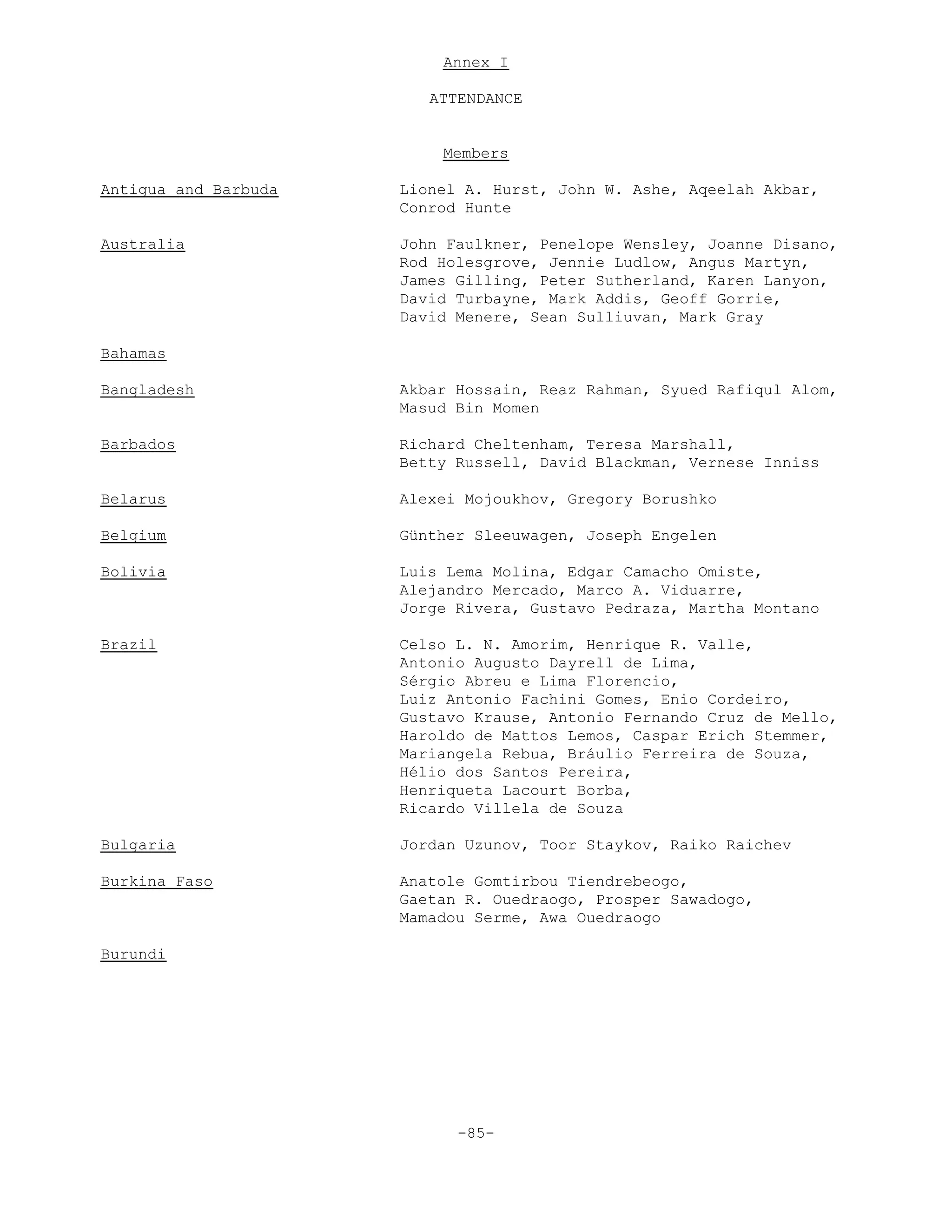
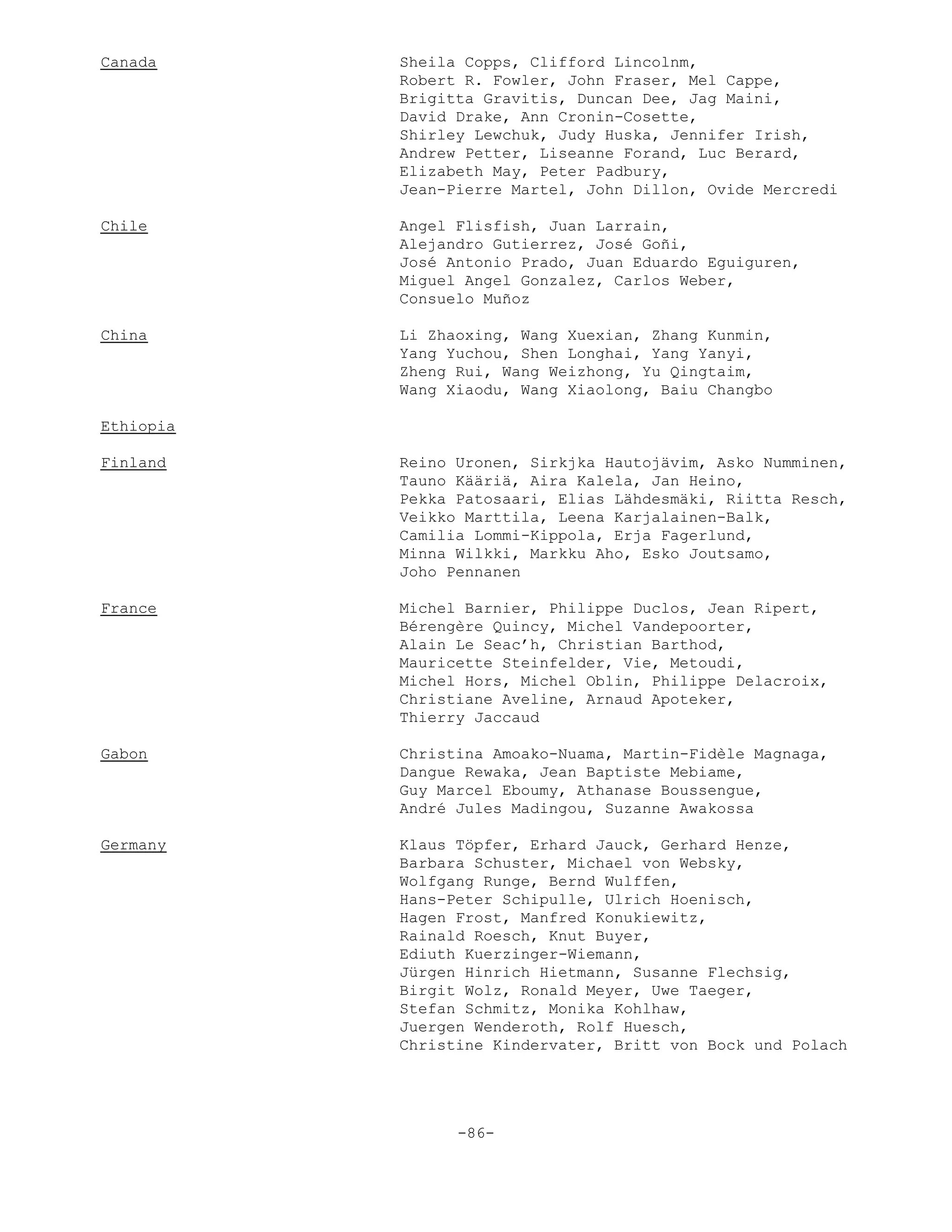
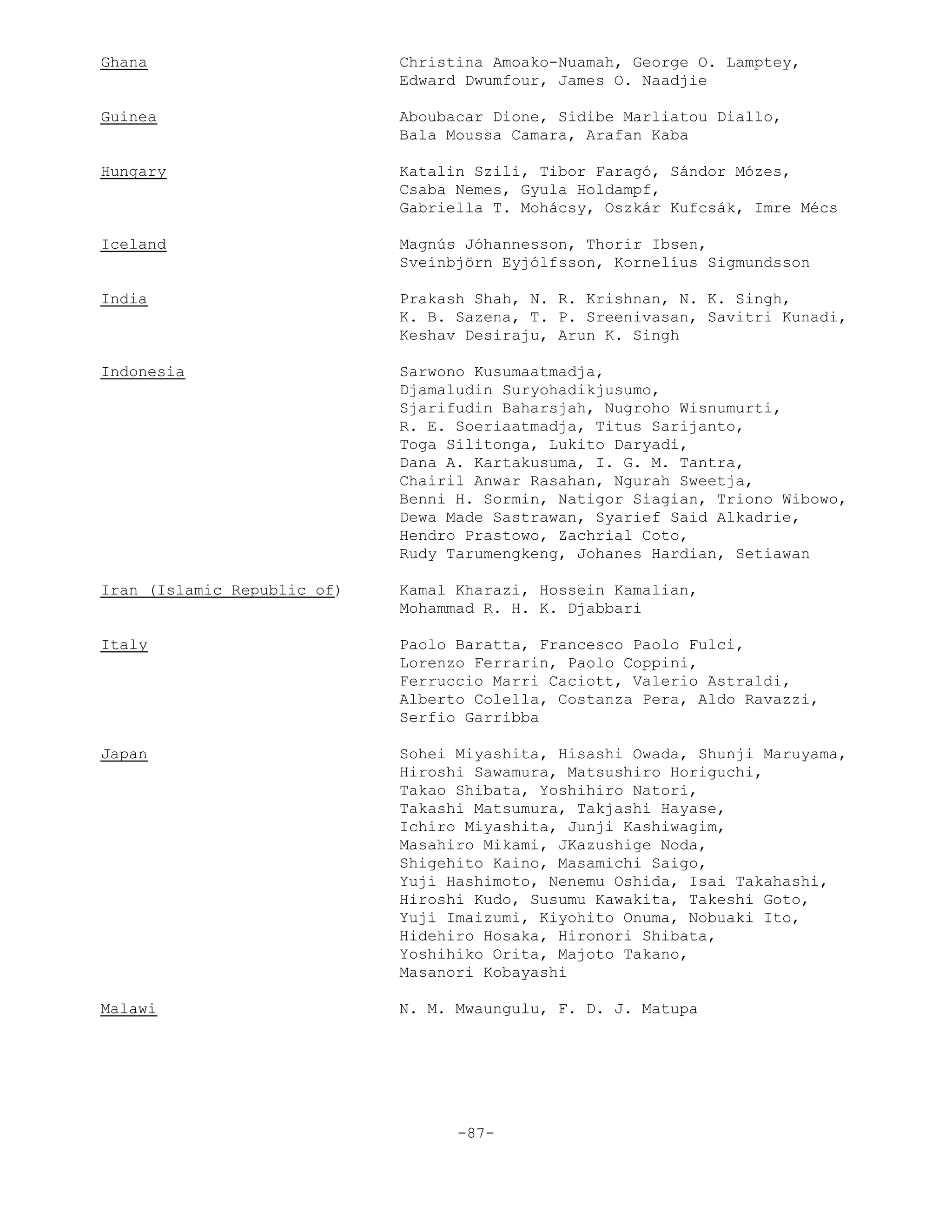
XI. ORGANIZATION OF THE SESSION .................................... 83
A. Opening and duration of the session ........................ 83
B. Attendance ................................................. 83
C. Election of officers ....................................... 83
D. Agenda and organization of work ............................ 84
-iii-
CONTENTS (continued)
Page
Annexes
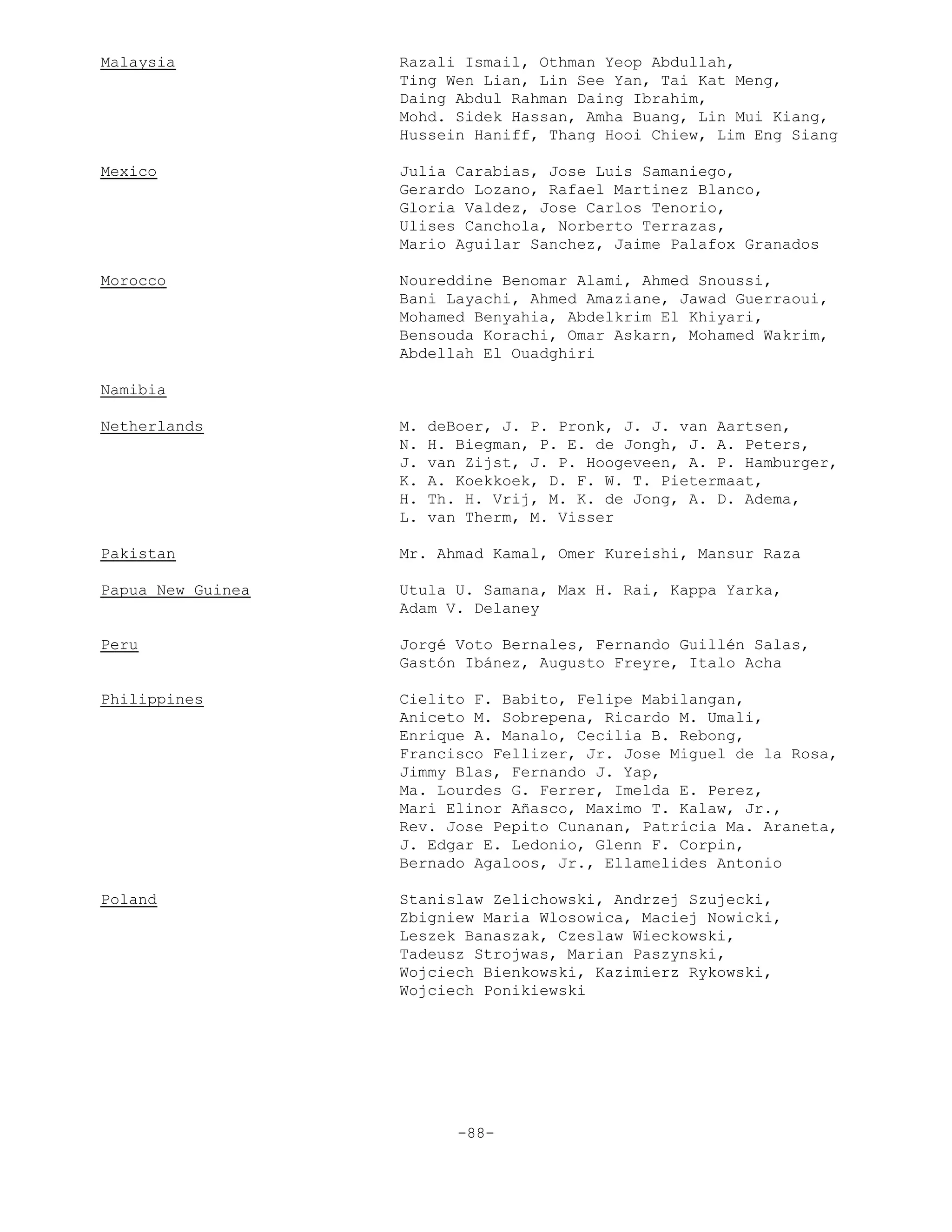
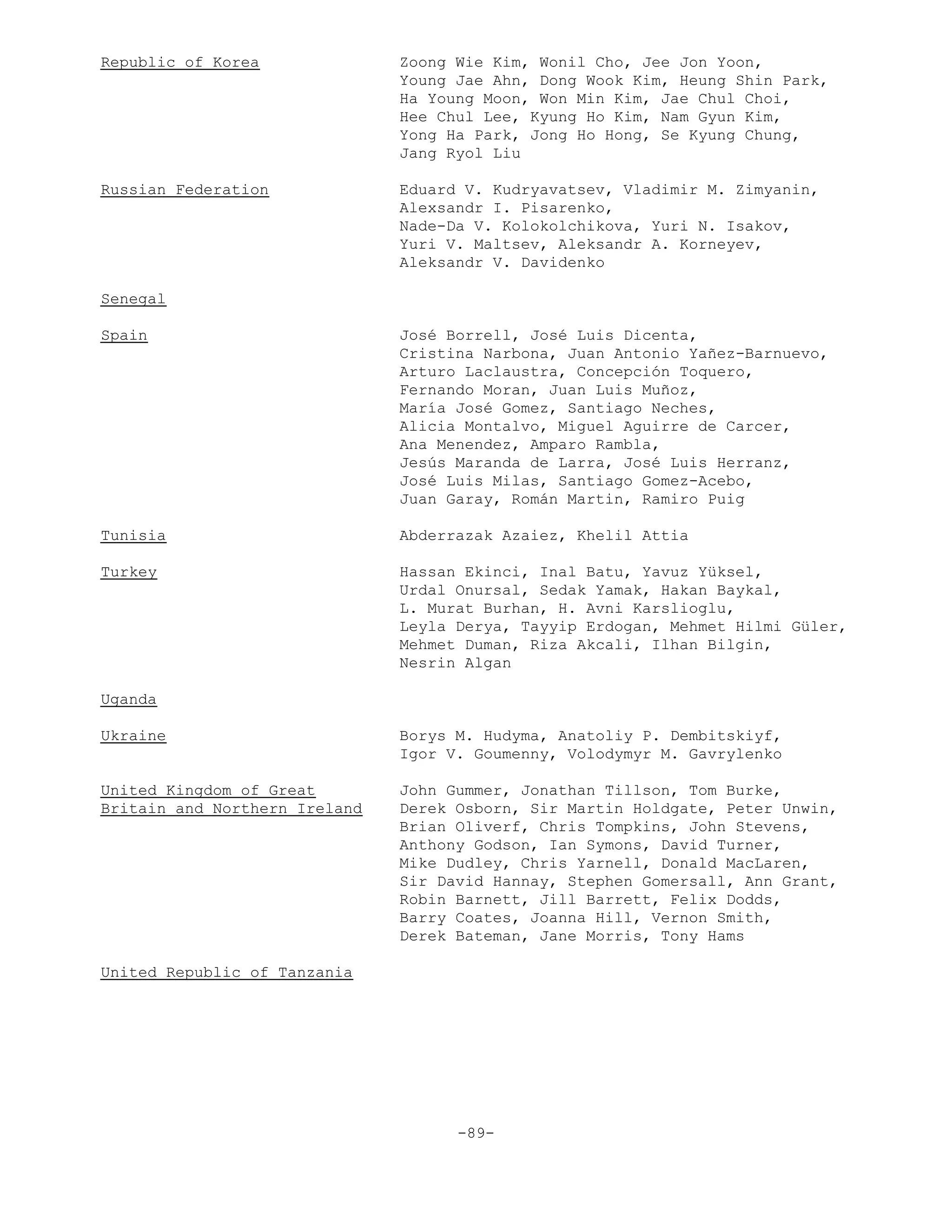
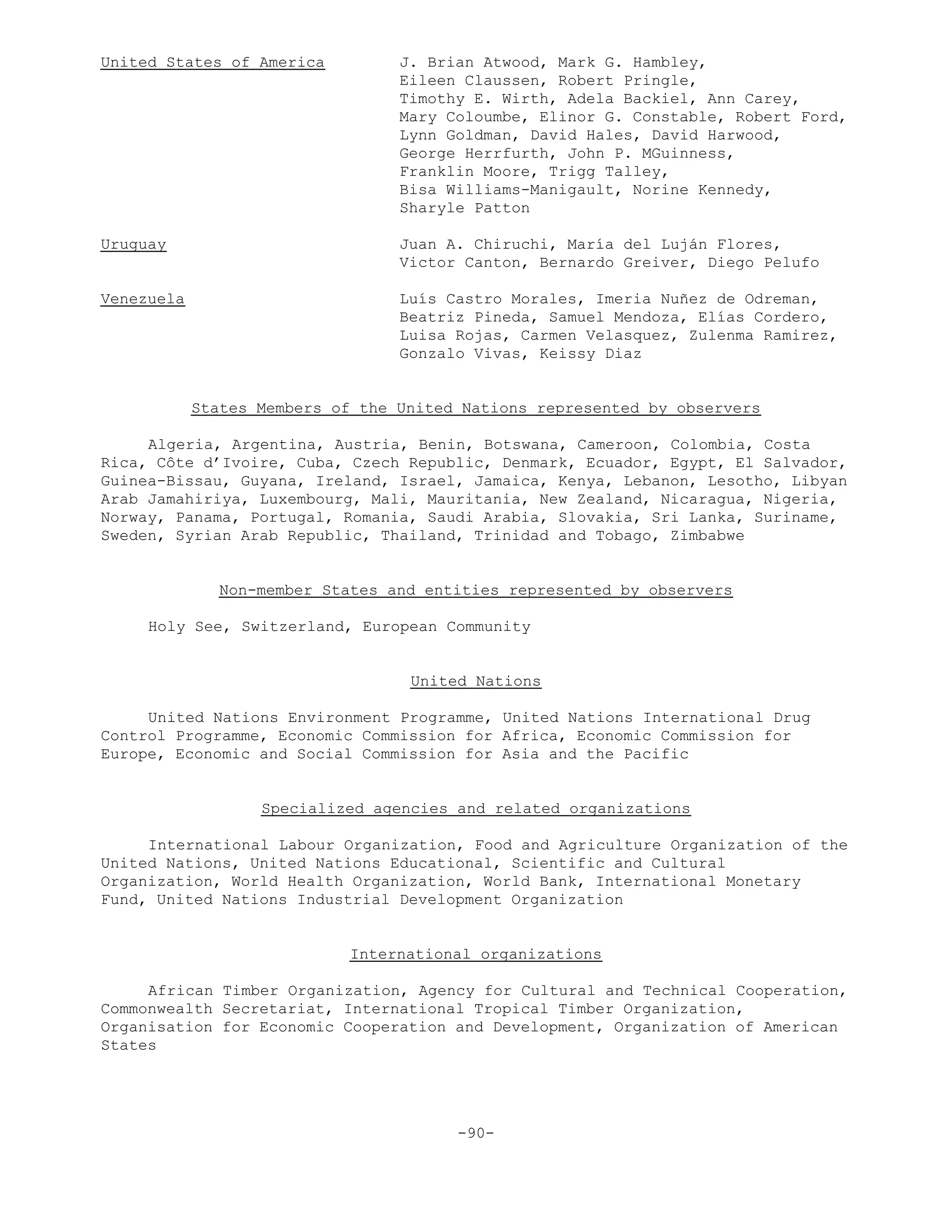
I. ATTENDANCE ..................................................... 85
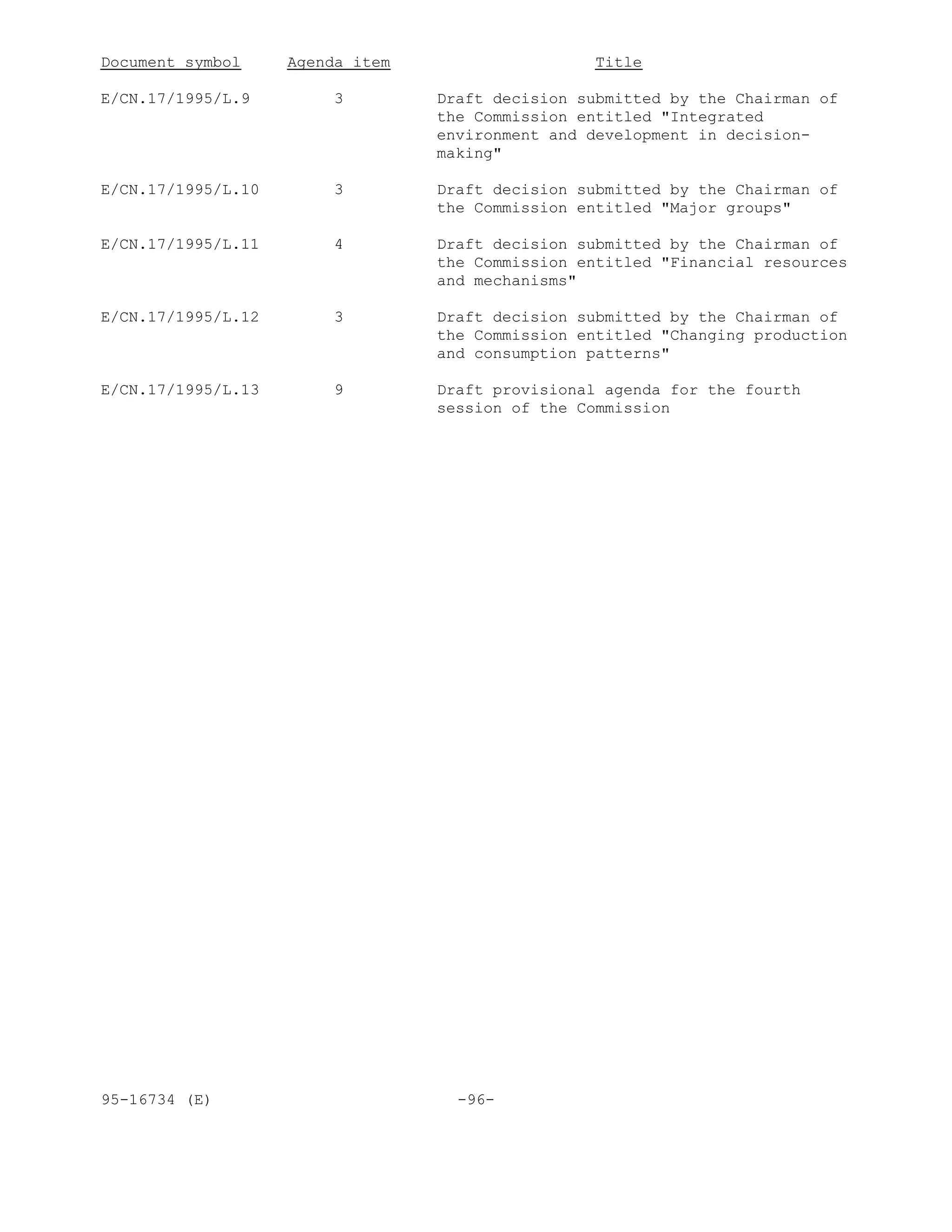
II. LIST OF DOCUMENTS BEFORE THE COMMISSION AT ITS THIRD SESSION ... 92
-iv-
Chapter I
MATTERS CALLING FOR ACTION BY THE ECONOMIC AND SOCIAL
COUNCIL OR BROUGHT TO ITS ATTENTION
A. General discussion on progress in the implementation of
Agenda 21, 1/ focusing on the cross-sectoral components
of Agenda 21, and the critical elements of sustainability
1. Information for decision-making
1. The Commission, having examined the report of the Secretary-General on
information for decision-making and Earthwatch (E/CN.17/1995/18), noted and
welcomed the important measures taken by Governments to make information more
accessible to decision makers at the national level, and calls upon national
Governments to utilize this information for sustainable development at the
country level. The aim of such measures includes the development of a
comprehensive and coherent information programme, drawing upon public
participation in data collection and assessment. In this context, developed
countries are urged to utilize both bilateral and multilateral channels to
facilitate access by developing countries, and countries whose economies are in
transition, to sources of information relative to sustainable development. The
Sustainable Development Networking Programme of the United Nations Development
Programme (UNDP) is one model for such initiatives.
2. The Commission calls attention to the feasibility study undertaken by UNDP
to provide access to information on sustainable development to 35 small island
developing States, 2/ which was welcomed by the General Assembly in its
resolution 49/122 on the Global Conference on the Sustainable Development of
Small Island Developing States.
3. The Commission expresses its appreciation to the organizers of the six
workshops that furthered understanding of the issues addressed in chapter 40 of
Agenda 21, particularly the efforts related to developing a work programme on
indicators of sustainable development, and it supports and encourages further
work in this area as elaborated in paragraphs 7 and 8 below.
4. The Commission welcomes the contribution of non-governmental organizations
to the process of generating information for decision-making, including the
articulation of views from local and grass-roots levels and from major groups,
and expresses its desire that these activities continue and be integrated, to
the extent possible, with those of national Governments, organizations of the
United Nations system and other intergovernmental organizations.
5. The Commission expresses appreciation for the extensive international
collaboration in the United Nations system-wide Earthwatch and its
responsiveness to the priorities of Agenda 21 and to user needs. It urges
Governments and major groups, as well as relevant international organizations
1/ Report of the United Nations Conference on Environment and
Development, Rio de Janeiro, 3-14 June 1992, vol. I, Resolutions Adopted by the
Conference (United Nations publication, Sales No. E.93.I.8 and corrigendum),
resolution 1, annex II.
2/ A/49/414, annex.
-1-
and the scientific community, to participate actively in strengthening
Earthwatch as an international partnership to ensure an adequate flow of
information on the global and regional environment, to support decision-making
and to give early warning on the state of the environment. Special attention is
drawn to the need for improved delivery of information to decision makers and to
increased participation in environmental observations at the local and national
levels within regional and international frameworks. In this regard, the
Commission welcomes all appropriate participation in the Global Learning and
Observations to Benefit the Environment (GLOBE) Programme, as described in
General Assembly resolution 49/112.
6. The Commission recalls that, in addition to Earthwatch, which is a global
system for environmental information, Agenda 21, in paragraph 40.13, calls for
the more effective coordination also of development data, "perhaps through an
equivalent and complementary ’Development Watch’". In this context, the
Commission noted the cooperative effort of the organizations of the United
Nations system to prepare proposals for the creation of such a Development
Watch. It requests UNDP, with the Department for Policy Coordination and
Sustainable Development of the United Nations Secretariat, the United Nations
Environment Programme (UNEP), the World Bank, the World Health
Organization (WHO) and the Food and Agriculture Organization of the United
Nations (FAO), and in cooperation with the regional commissions and other
interested organizations, to further define Development Watch and, in this
regard, to submit a progress report on the implementation of the programme of
work for Development Watch to the Commission at its session in 1997, taking into
account the need for a close linkage between Development Watch and Earthwatch.
7. The Commission noted the importance of developing, among the organizations
of the United Nations system, a common or compatible system of access to their
respective databases, in order to share data fully, to streamline the collection
and interpretation of data and to identify data gaps, for the purpose of
providing more comprehensive and integrated data to decision makers at the
national, regional and international levels. The Commission invites the
Inter-Agency Committee on Sustainable Development to refine measures for
establishing such a common or compatible system and to report thereon to the
Commission at its fourth session. The Commission notes also the rapidly growing
number of information systems for sustainable development at the national and
regional levels, and invites the Secretary-General to consider ways of enhancing
compatibility among and access to these systems and to report his findings to
the Commission at its session in 1997.
8. Governments are encouraged to develop or conduct studies on the development
of indicators of sustainable development in accordance with specific national
conditions. In this context, there is a need for coordination, especially
through the Commission, of the many intergovernmental and scientific
institutions working in this area, as well as a need for intensive international
dialogue.
9. The Commission urges bodies such as the Statistical Division of the United
Nations Secretariat, the statistical services of Member States and other
appropriate institutions, the Organisation for Economic Cooperation and
Development, the Statistical Office of the European Communities and major groups
to cooperate in the development of indicators of sustainable development.
Furthermore, the Commission encourages the scientific community, including the
project on indicators of sustainable development undertaken by the Scientific
Committee on Problems of the Environment (SCOPE), to focus its efforts on the
development and improvement of such indicators.
-2-
10. The Commission reiterates the importance of developing indicators of
sustainable development for use by decision makers at the local, regional and
national levels and expresses its appreciation to the organizations, both
intergovernmental and non-governmental, and the Governments that have
contributed to the process of defining a programme of work for the further
development of indicators of sustainable development.
11. The Commission approves the programme of work on indicators for sustainable
development contained in annex I to the report of the Secretary-General
(E/CN.17/1995/18) and calls upon the organizations of the United Nations system,
with the support of other intergovernmental and non-governmental organizations,
and through the coordination of the Department for Programme Coordination and
Sustainable Development of the United Nations Secretariat, to implement, within
existing resources, the following, as outlined in the programme of work:
(a) enhancement of information exchange among all interested actors;
(b) development of methodology sheets to be made available to Governments;
(c) training and capacity-building at the regional and national levels;
(d) testing of an appropriate combination of indicators and monitoring of
experiences in a few countries; (e) evaluation of the indicators, including
those mentioned in the report of the Secretary-General (E/CN.17/1995/18), and
adjustment, as necessary; (f) identification and assessment of linkages among
the economic, social, institutional and environmental elements of sustainable
development; (g) development of highly aggregated indicators; and (h) further
development of the conceptual framework for sustainable development indicators,
involving experts from the areas of economics, the social sciences and the
physical sciences and policy makers, as well as incorporating non-governmental
organization and indigenous views. The Commission requests the Secretariat to
provide it with a progress report on the implementation of the programme of work
at its fourth session, in 1996.
12. The Commission took note of the report of the Statistical Commission on its
twenty-eighth session, 3/ and expresses its appreciation to the Statistical
Commission for its offer to collaborate with and support the Commission in its
work on indicators for sustainable development. In this context, the Commission
also welcomes the action taken by the Statistical Commission with respect to the
international compilation of environmental indicators from national statistical
services and looks forward to the contribution of this work to the overall
programme of work on indicators of sustainable development. The Department for
Policy Coordination and Sustainable Development of the United Nations
Secretariat should promote and assist these efforts.
2. Integrating environment and development in decision-making
13. The Commission, having examined the report of the Secretary-General on
integrating environment and development in decision-making (E/CN.17/1995/19),
noted the need for a framework at the national level for integrating economic,
social and environmental issues and for bringing together sectoral plans in a
more comprehensive manner. The Commission calls on Governments to continue
their efforts to establish, where appropriate, national mechanisms and to
develop integrated, participatory strategies for sustainable development.
14. The Commission welcomes paragraph 11 of the report and emphasizes the
importance of the steps taken by the Inter-Agency Committee on Sustainable
3/ Official Records of the Economic and Social Council, 1995, Supplement
No. 8 (E/1995/28).
-3-
Development to assist Governments in the elaboration of national environmental
and sustainable development strategies and plans and to develop frameworks in
which sectoral plans can be accommodated. It urges all organizations of the
United Nations system, in cooperation with Governments, to participate, as
relevant, in the ongoing programme, and calls upon non-governmental
organizations to contribute to this process to the fullest extent possible.
15. The Commission welcomes offers for hosting international conferences on
promoting sustainable development in order to promote regional and multilateral
cooperation on sustainable development. In this context, the Commission
welcomes the convening of the Third Ministerial Conference, "Environment for
Europe", to be held in Sofia, Bulgaria, in 1995. The Commission also welcomes
the initiative of the Government of Belarus for the possible convening of an
international conference of the countries with economies in transition on
promoting sustainable development. The Commission encourages interested
Governments and relevant subregional, regional and other interested
organizations to place, inter alia, the Pan-European Environment Action
Programme for Central and Eastern Europe within the broader framework of
sustainable development, taking due account of the need for the full integration
of countries in transition from centrally planned to market economies, as well
as all other countries, into the world economy, which is essential to
sustainable development.
16. The Commission requests the organizations of the United Nations system and
other relevant organizations to organize, within existing resources, regional
workshops to explore, discuss and further develop methodological approaches to
integration based upon, for example, work being done in environmental economics,
valuation, natural resource accounting and integrated economic and environmental
accounting.
17. The Commission underlines the importance of integrated environmental and
economic accounting for sustainable development and encourages Governments to
undertake further national activities in this area.
18. The Commission takes note of the work in integrated economic and
environmental accounting being undertaken by the Statistical Division of the
United Nations Secretariat, organizations of the United Nations system and other
intergovernmental organizations and calls upon them, inter alia, to further this
work, particularly with regard to promoting the implementation of national
programmes and strengthening technical cooperation in this area.
3. Major groups
19. The Commission noted that major group organizations were forging strong
linkages between their activities and contributions to Agenda 21 and
international conference processes and expressed its appreciation of the efforts
of those organizations to maintain Agenda 21 as the umbrella framework for
achieving sustainable development.
20. The Commission noted with appreciation the series of events highlighting
the role of local authorities and the local Agenda 21 process, under the banner
of "A Day of Local Authorities", during the current session, and requested that
similar projects and activities highlighting the role of other major group
sectors be carried out in future years. One such activity, for the fourth
session, in 1996, could involve case-studies on partnerships in the workplace,
involving two major group sectors: workers and trade unions and business and
-4-
industry. It could also involve case-studies of successful environmental
management/sustainable development policies of small- and medium-sized
enterprises. In that context, a programme of events focusing on the role and
contribution of major groups could be organized on the margins of the fourth
session. Governments, international organizations and private sources were
invited to provide voluntary funding support for such special events.
21. The Commission welcomed and encouraged the emerging practice of including
representatives of major groups in national delegations to the Commission as an
effective way of increasing the participation of such groups at the
international level.
22. The Commission reiterated the importance of enabling and empowering
partnerships between the governmental, intergovernmental and non-governmental
sectors in achieving the goals of Agenda 21. It emphasized national-level
participation of major groups in the implementation and monitoring of Agenda 21
inter alia, through national coordinating mechanisms, including national
councils on sustainable development or national networks of major groups, and
recommended that such participation needed to be further encouraged,
strengthened and expanded. The Commission:
(a) Noted with appreciation the efforts of those countries that had
supported major group participation in the national coordinating mechanisms;
(b) Recommended that both the existing and the to-be-established national
coordination mechanisms should strive to achieve the representation of all
relevant major group sectors in their composition;
(c) Recommended that in establishing these mechanisms, national and local
major group organizations should choose their own representatives, in accordance
with national consultative mechanisms;
(d) Recognized the importance of efforts to enable the participation of
major groups at the international and regional levels.
23. The Commission recognized the efforts of Governments, United Nations
organizations and major groups that had promoted major group involvement in
inter-sessional meetings and other meetings relevant to the work of the
Commission, and:
(a) Recommended that all concerned continue to involve major groups in
inter-sessional events and other relevant meetings, particularly with the aim of
enabling a multiplier effect in terms of the diversity of major-group sectors
and organizations invited;
(b) Encouraged partnerships among Governments, intergovernmental
organizations and the major groups in jointly organizing future inter-sessional
activities and other relevant meetings.
24. The Commission recognized the desirability of increased funding to
undertake efforts that increased major-group participation in the Commission’s
sessions, its inter-sessional activities and other meetings relevant to the
follow-up of Agenda 21. This would be particularly desirable in the case of
major-group organizations from developing countries and countries with economies
in transition. The Commission urged interested institutions to explore the
possibility of creating suitable arrangements to that end.
-5-
25. The Commission emphasized the importance of regular information exchange.
Electronic networks were pointed out as an effective and efficient mode of
channelling information between major groups and intergovernmental and
governmental organizations. The Commission requested Governments and
international organizations, in collaboration with such major groups as business
and industry and the academic communities, to explore ways of increasing the
availability of and access to such electronic systems, especially in developing
countries, and urged all countries to seek and enable appropriate public-private
partnerships.
26. The Commission, having noted the important contribution of major groups to
its work, recommended that the overall access of major groups, including
non-governmental organizations, to the work of the Commission throughout the
year be defined. Without prejudice to the outcome of the general review of
arrangements for consultation with non-governmental organizations to be carried
out by the Economic and Social Council, the Commission recommended that:
(a) In reviewing the arrangements for consultation with non-governmental
organizations, the Economic and Social Council ensure that major groups,
including non-governmental organizations, relevant to the work of the Commission
were given the opportunity to participate in the Commission’s work;
(b) The implementation of Economic and Social Council decision 1994/300
concerning chapter I, paragraph 24, of the report of the Commission on its
second session 4/ not result in the interruption of the participation of
non-governmental organizations in the work of the Commission. To this end,
Roster status should be continued through the completion of any processes
resulting from the Council review.
27. The Commission, while noting the increase in the quantity and quality of
inputs from major groups, felt that there was a need to ensure that the
information submitted by major-group organizations for the Commission’s
reporting process was fully utilized in the analyses under the various sectoral
and cross-sectoral reports. The Commission requested the Inter-Agency Committee
on Sustainable Development to elaborate on that issue to achieve the best and
coordinated use of major-group submissions, and to submit the results to the
Commission at its fourth session.
28. The Commission reaffirmed that recognizing and strengthening the role of
major groups at the national and local levels were important for their effective
participation in the process of sustainable development. It requested the
Secretary-General to include information and developments in that area in his
report on major groups to be submitted to the Commission at its fourth session.
29. The Commission stressed the particular role of youth groups in the context
of sustainable development: the young were those who would suffer if long-tern
development was not sustainable; their enthusiasm and sense of commitment were
necessary elements in all strategies for sustainable development.
30. In view of the convening of the Fourth World Conference on Women: Action
for Equality, Development and Peace, to be held in Beijing in September 1995,
the Commission stressed the central role played by women in creating appropriate
conditions for sustainable development and invited the Conference to fully
include the need for sustainable development in its deliberations.
4/ Official Records of the Economic and Social Council, 1994,
Supplement No. 13 (E/1994/33/Rev.1).
-6-
4. Changing production and consumption patterns
31. The Commission affirms that while poverty results in certain kinds of
environmental stress, the major cause of the continued deterioration of the
global environment is the unsustainable pattern of consumption and production,
particularly in industrialized countries, which is a matter of grave concern,
aggravating poverty and imbalances. The Commission thus reaffirms the need to
change the patterns of consumption and production that are detrimental to
sustainable development. In the context of common but differentiated
responsibilities in this field, the developed countries bear a special
responsibility and have agreed to take the lead by taking effective measures for
change in their own countries. In that context, the Commission reiterates that
national authorities should endeavour to promote the internalization of
environmental costs and the use of economic instruments, as appropriate, taking
into account the polluter-pays principle.
32. The Commission, taking into account Agenda 21, in particular chapter 4,
entitled "Changing consumption patterns", welcomes the recent increase in
activities and efforts at the local, national, and international levels aimed at
changing the prevailing unsustainable production and consumption patterns. The
Commission recognizes that Governments should continue to improve their
decision-making so as to integrate environmental, economic and social
considerations, which will involve the use of a range of different policy
approaches and instruments. The Commission notes the initiative taken by the
Government of Norway in hosting the Oslo Ministerial Roundtable Conference on
Sustainable Production and Consumption (6-10 February 1995) and its contribution
to underlining the importance of focusing on demand-side issues as a complement
to the traditional supply-side approach. The Commission also notes the inputs
provided to the Oslo Conference by various sources, including the Zeist Workshop
on Facilities for a Sustainable Household (23-25 January 1995), organized by the
Government of the Netherlands, and the Massachusetts Institute of
Technology/Organisation for Economic Cooperation and Development (OECD) Experts
Seminar on Sustainable Consumption and Production Patterns (Cambridge,
Massachusetts, 18-20 December 1994).
33. In welcoming the inter-sessional work undertaken by Governments, the
Commission reaffirms the need for additional substantial efforts and real
progress by States, in particular the developed countries, in changing their
unsustainable production and consumption patterns, and in assisting in
redressing the present imbalances obtaining between industrialized and
developing nations. It welcomes further contributions from the United Nations
Conference on Trade and Development (UNCTAD), UNEP and other international
organizations, such as OECD, in this area.
34. The Commission notes with concern the significant gaps in per capita income
between developing and developed countries and the continuing current imbalances
in the global patterns of consumption and production. The Commission notes also
with concern that the growing recognition of the need to address patterns of
production and consumption has not yet been matched by a full understanding of
the implications of such patterns on economic, social and environmental
conditions at the local, national and global levels. In order to most
effectively design and implement public policies consistent with the earth’s
carrying capacity, more needs to be known about the role of current and
projected consumption and production patterns in relation to environmental
quality, economic growth and population dynamics. Thus, sustainability,
including equity concerns, should continue to be addressed by Governments, the
Commission, and other forums in their deliberations on how changing production
-7-
and consumption patterns will affect environmental, social and economic
conditions in and among countries at all levels of development.
35. The Commission urges Governments at all levels, business and industry, and
consumers to intensify efforts at reducing the energy and material intensities
of production and consumption, through improving energy efficiency, taking
energy-saving measures, technological innovations and transfer, increased waste
recovery, and reusing and recycling of materials. The Commission stresses that
all countries have, and should exploit, opportunities for further improving
efficiency in resource consumption and for reducing environmentally harmful
by-products of current consumption and production patterns in accordance with
national priorities and international agreements, for example, by promoting the
use of renewable energy sources. In this context, taking into account the
particular needs and conditions of developing countries, and based on the
principle of common but differentiated responsibilities, the Commission urges
developed countries to intensify effort to encourage the transfer of appropriate
technologies to developing countries to assist them in such efforts.
36. The Commission notes that the above-mentioned Oslo Conference, which
focused on consumption and production patterns in the developed countries,
highlighted the demand-side and supply-side issues as deserving of equal
emphasis and referred to the life-cycle approach to assessing the environmental,
social and economic impacts associated with unsustainable production and
consumption patterns. To this end, the Commission emphasizes the responsibility
shared by all stakeholders in society. Governments should provide an overall
framework, including the regulations, economic incentives and infrastructure
required to create the necessary conditions and facilities for business,
industry and households to move towards sustainable production and consumption
patterns. Business and industry in developed countries should fulfil their
responsibility for managing the life-cycle impact of the goods and services that
they supply, and are encouraged to provide information on the environmental and
health effects arising from the production and consumption of their products.
Households, particularly in developed countries, should adopt sustainable
consumption habits and lifestyles. In this regard, public awareness campaigns,
education and community-based voluntary action could contribute to fostering
changes in lifestyles.
37. The Commission reaffirms that Governments themselves also play a role in
consumption, particularly in countries where the public sector plays a large
role in the economy and can have a considerable influence on both corporate
decisions and public perceptions. Governments should therefore review the
purchasing policies of their agencies and departments so that they may improve,
where possible, the environmental content of government procurement policies,
without prejudice to international trade principles. Governments and
intergovernmental organizations, through appropriate mechanisms, may exchange
information and experiences consistent with national laws and regulations in the
area of their procurement policies.
38. The Commission takes note of the lack of information identified in the
report of the Secretary-General on changing consumption and production patterns
(E/CN.17/1995/13) and other documents, and calls on Governments, international
organizations, legislative bodies, research and scientific institutions,
business and industry, and consumer organizations and other non-governmental
organizations to join in concerted efforts to provide comprehensive information
on the status of, and changes and projected trends in, the environment,
ecosystems and the natural resources base at the national, regional and global
levels. At the product level, while the Commission recognizes the need to
-8-
reaffirm the importance of informing consumers about any environmental and
health effects arising from the production and consumption of a given product,
it notes that such information should not be used as a disguise for
protectionist trade measures.
39. Given the long time-frame in which the interactions of economic activities
and the environment take place, the Commission reiterates the need for launching
medium- and long-term studies to monitor and track the evolution of production
and consumption patterns as well as associated environmental, social and
economic impacts, both within and among nations. Such studies should cover
technological innovation and transfer, economic growth and development, and
demographic factors. They should produce quantifiable and measurable indicators
so as to facilitate policy analysis and debate on relevant issues and trends.
In undertaking these studies, attention should be paid to the various effects,
including the potential trade effects and in particular the effects on
developing countries and countries with economies in transition, of new measures
and policy stances to be adopted in promoting sustainable production and
consumption.
40. The Commission calls for the promotion of internalization of environmental
costs, taking into account the polluter-pays principle, with due regard to the
public interest and without distorting international trade and investment. In
this regard, it welcomes progress made so far, including in countries with
economies in transition and developing countries, in further analysing, adapting
and applying various measures and policy instruments designed to internalize
environmental externalities. The Commission recognizes that command-and-control
measures and social and economic instruments all have their role to play in
changing production and consumption patterns. Governments should take into
account local and national conditions in designing and implementing such
instruments. In the long run, economic and other market-based instruments are
likely to be more cost-effective in bringing about sustained changes in producer
and consumer behaviour. In this regard, the Commission invites Governments to
consider introducing economic measures, including tax and subsidies reform
designed to reduce negative environmental impacts and support employment.
41. The Commission regards natural resource accounting as a valuable tool for
the comprehensive full-cost pricing of resource use, and calls upon Governments
and international organizations to promote efforts aimed at integrating natural
resource accounting into standard systems of national accounts. The Commission
welcomes pilot projects launched by United Nations agencies in this area and
urges Governments, as appropriate, to give full support to these activities.
42. The Commission recognizes the international dimensions of national efforts
to change consumption and production patterns within the context of common but
differentiated responsibilities. The Commission emphasizes that strengthened
international cooperation in harmonizing criteria for the setting of voluntary
product standards, with due regard to the specific environmental, social and
economic conditions in developing producer/exporting countries, should take into
account concerns about market access and the competitiveness of products and
services. In this regard, the Commission calls upon Governments to intensify
efforts to encourage the transfer of appropriate technology.
43. The Commission also recognizes the wide scope and multiplicity of the
issues related to consumption and production patterns. The Commission stresses
the importance of and encourages the exchange of information at all levels on
experience in changing production and consumption patterns.
-9-
44. The Commission welcomes in this regard the initiative of the Republic of
Korea to organize a workshop on policy measures for changing consumption
patterns. Further reviews of country experiences might be initiated by the
Commission on Sustainable Development in collaboration with relevant United
Nations bodies, including the regional commissions, and other international
organizations.
45. Taking into account the preceding paragraphs, the Commission adopts for its
future work on changing production and consumption patterns the following work
programme:
A. Identifying the policy implications of projected trends in consumption
and production patterns
The Commission will review periodic reports containing long-term
projections of the world economy with a time-horizon of up to 40 years. Such
projections should cover, inter alia, resource consumption and associated
environmental, social and economic impacts, with particular reference to
developing countries’ efforts at meeting basic needs, eradicating poverty and
achieving economic growth. Such studies should, inter alia, build upon the
existing work of the United Nations system and other international
organizations, and should make use of global models designed to project a number
of indicators on environmental stress and its impact on the environment and
human health.
B. Assessing the impact on developing countries, especially the least
developed countries and small island developing States, of changes
in consumption and production in developed countries
The Commission will review periodic reports on the economic, social and
environmental impacts, particularly on developing countries, of world-wide
changes in consumption and production patterns. Such reports should assess,
inter alia, the additional trade opportunities open to developing countries
arising from the increasing demand for environmentally sound products in
developed countries, as well as possible adverse impacts on exports from
developing countries. The reports should also examine the prospects of
increasing technology transfer through enhanced foreign direct investment.
C. Evaluating the effectiveness of policy measures intended to change
consumption and production patterns, such as command-and-control,
economic and social instruments, government procurement policies
and guidelines
The Commission will review reports on the effectiveness of policy measures
in changing consumption and production patterns, for example, through the
internalization of environmental costs. The reports should evaluate the
performance of command-and-control, social and economic instruments in country-
specific situations with a view to facilitating a better understanding of the
policy options that are available to policy makers in all countries.
D. Eliciting timebound voluntary commitment from countries to make
measurable progress on those sustainable development goals that
have an especially high priority at the national level
The Commission will review a synthesis of national information to assess
progress in fulfilling timebound commitments by Governments concerned on a
voluntary basis. In this context, the Commission urges Governments and other
-10-
stakeholders to use the report of the Oslo Ministerial Roundtable Conference on
Sustainable Production and Consumption, entitled "Elements for an international
work programme on sustainable production and consumption", as a basis for
actions and for discussion in suitable forums, and thereafter to report to the
Commission on the implementation of those recommendations considered most
appropriate, in time for consideration by the Commission at its fifth session,
in 1997.
E. Revision of the guidelines for consumer protection
The Commission recommends that the guidelines for consumer protection
adopted by the General Assembly in its resolution 39/248 of 9 April 1985 be
expanded to include guidelines for sustainable consumption patterns.
46. The Commission urges Governments, the various organizations and bodies of
the United Nations system, other intergovernmental organizations, the
secretariats of the various international conventions, and major groups,
particularly local authorities, business and industry, to undertake specific
elements of the Commission’s work programme on changing production and
consumption patterns. The Commission stresses the importance of exchanging
country experiences. The Commission also notes with appreciation ongoing OECD
work on sustainable production and consumption, and encourages OECD to submit
the results of its work in this area to the Commission as soon as possible. The
Commission recommends the convening of an expert meeting on sustainable
production and consumption patterns, with the widest possible participation and
hosted by interested Governments, to be held before its next substantive session
with a view to collecting information, ideas and suggestions for the follow-up
of this work.
5. Trade, environment and sustainable development
47. The Commission reiterates the initial perspectives for consideration in
subsequent work on trade and environment issues contained in its 1994 decision
and stresses that trade and environment policies should be mutually supportive
in promoting sustainable development. This requires that account be taken of
the special conditions and development needs of the developing countries. There
is also a need for support to build institutional capacity in the area of trade
and development and environmental assessment in developing countries and
countries with economies in transition. There is also a need for
complementarity, coordination, transparency and accountability among
international organizations involved in the development of policies on trade and
environment.
48. The Commission considered a number of key issues related to the linkages
among trade, environment and sustainable development. These include product
measures and market access, process standards and competitiveness,
internalization of environmental externalities and trade, multilateral
environmental agreements and trade policy, environmental factors as trading
opportunities, and trade policies and the environment. Each of these issues
involves conceptual and empirical as well as policy questions. Ongoing work in
different international organizations aims at clarifying these issues, through
policy analysis and debate, and at deriving policy conclusions therefrom. Major
groups, such as non-governmental organizations and the private sector, are also
addressing trade and environment linkages and are making important contributions
to a better understanding of them, as well as to awareness-building and public
education.
-11-
49. The Commission stresses that States should cooperate to promote a
supportive and open international economic system that would lead to economic
growth and sustainable development in all countries, so as to better address the
problems of environmental degradation.
50. The Commission notes that the Uruguay Round of multilateral trade
negotiations agreements represent a substantial liberalization of international
trade, the strengthening of multilateral rules and disciplines to ensure
stability and predictability in trade relations, the establishing of rules and
disciplines in new areas and the founding of a new institutional framework in
the form of the World Trade Organization, with an integrated dispute-settlement
mechanism that should avert unilateral actions that are against international
trade rules. The agreements thus represent an essential element for the
achievement of global sustained economic growth for the benefit of all
countries, in particular developing countries, which is a fundamental element
for achieving sustainable development. In this context, the Commission calls
for the urgent and full implementation of the agreements contained in the Final
Act Embodying the Results of the Uruguay Round of Multilateral Trade
Negotiations, 5/ stresses the urgent need for trade liberalization, including
through substantial reduction of tariffs and other barriers to trade and the
elimination of discriminatory treatment in international trade relations, and
improved access to markets of all countries, in particular those of developed
countries.
51. The Commission on Sustainable Development stresses the importance of the
work of the Committee on Trade and Environment of the World Trade Organization,
in accordance with its mandate, which calls upon the Committee to make
appropriate recommendations on whether any modifications of the provisions of
the multilateral trading system are required, compatible with the open,
equitable and non-discriminatory nature of the system, as regards, in particular
(a) the need for rules to enhance positive interaction between trade and
environmental measures, for the promotion of sustainable development, with
special consideration given to the needs of developing countries, in particular
those of the least developed among them; and (b) the avoidance of protectionist
trade measures, and the adherence to effective multilateral disciplines to
ensure responsiveness of the multilateral trading system to environmental
objectives set forth in Agenda 21 and the Rio Declaration on Environment and
Development, 6/ in particular principle 12; and (c) surveillance of trade
measures used for environmental purposes, of trade-related aspects of
environmental measures that have significant trade effects, and of effective
implementation of the multilateral disciplines governing those measures.
52. The Commission notes that positive measures, such as improved market
access, improved access to finance, access to and transfer of technology,
capacity-building and special provisions for small firms, are effective
instruments to support developing countries and countries in transition in their
efforts to internalize environmental costs.
5/ Legal Instruments Embodying the Results of the Uruguay Round of
Multilateral Trade Negotiations, done at Marrakesh on 15 April 1994, vol. I.
6/ Report of the United Nations Conference on Environment and
Development, Rio de Janeiro, 3-14 June 1992, vol. I, Resolutions Adopted by the
Conference (United Nations publication, Sales No. E.93.I.8 and corrigendum),
resolution 1, annex I.
-12-
53. The Commission reiterates paragraph 32 of its 1994 decision. It further
notes that trade provisions in multilateral environmental agreements (MEAs)
should be transparent and should not constitute a means of arbitrary or
unjustifiable discrimination or a disguised restriction on international trade.
In accordance with principle 12 of the Rio Declaration, unilateral actions to
deal with environmental challenges outside the jurisdiction of the importing
country should be avoided. Environmental measures addressing transboundary or
global environmental problems should, as far as possible, be based on
international consensus.
54. The Commission recognizes that progress has been made by virtue of the new
World Trade Organization provisions, and underscores the importance of building
on these accomplishments, in particular with regard to transparency and the use
of outside review groups where specialized knowledge is relevant.
55. The Commission reaffirms that efforts should be geared to promoting the
convergence of environmental standards and regulations at a high level of
environmental protection, while bearing in mind that regulations and standards
that are valid in the most advanced countries may be inappropriate and have
unwarranted economic and social costs for the developing countries. It further
notes the importance of transparency of environmental regulations and standards
and of supporting developing countries in the development of effective domestic
regulations and standards.
56. The Commission considers that there is a need to analyse the potential
effects of product-specific policies, in particular those based on life-cycle
approaches, which have emerged recently, such as eco-labelling and certain
packaging and recycling requirements, especially as regards their potential
impacts on the exports of developing countries and countries with economies in
transition. It is also important to analyse how improved transparency and
international cooperation could be strengthened so as to facilitate the export
prospects of developing countries and as a means of strengthening environmental
protection.
57. The Commission notes that consumer preferences for "environment-friendly"
products may create trading opportunities including for developing countries.
More work is needed to specify ways and means by which the credibility of
environmental claims relating to products and technologies can be substantiated.
58. The Commission considers that further trade liberalization is a necessary
but not sufficient condition for sustainable development. Trade liberalization
along with sustained economic growth can be expected to pave the way for the
gradual raising of environmental standards at the national and the global level.
At the same time, trade liberalization needs to be complemented by the adoption
of sound environmental policies. National Governments have an interest in
analysing environmental and social effects of significant changes in the volume
and composition in production and consumption patterns, including those
resulting from trade policy reforms, and making, if required, the necessary
policy adjustments with a view to correcting market and policy failures and
internalizing environmental costs.
59. Within the context of the overall aims of sustainable development, the
Commission welcomes the substantial progress achieved in the World Trade
Organization, UNCTAD and UNEP, in particular through the work of the World Trade
Organization Committee on Trade and the Environment, the UNCTAD Ad Hoc Working
Group on Trade, Environment and Development and the joint UNEP/UNCTAD programme,
as well as the important role of UNEP, in particular in relation to multilateral
-13-
environmental agreements, and invites the institutions concerned, as well as
OECD, to continue their work on trade and the environment. It further
emphasizes efforts to make trade and environment mutually supportive through,
inter alia, strengthening technical assistance for capacity-building undertaken
by UNCTAD, UNDP and UNEP, including in integrating the consideration of all
factors relevant to the formulation of trade and sustainable development
policies. The Commission considers that the present division of labour in the
international discussions on trade and the environment is generally satisfactory
and stresses the need for continued close cooperation and complementarity in the
work of the World Trade Organization, UNEP and UNCTAD. In this context, the
Commission invites UNEP and UNCTAD to continue their joint initiative,
preferably at a technical level with a focused agenda.
60. The Commission invites UNCTAD, the task manager for trade and environment,
in cooperation with UNEP, the World Trade Organization, FAO, WHO, the Department
for Policy Coordination and Sustainable Development of the United Nations
Secretariat and other appropriate institutions, to prepare a background paper
for the Commission that would review the growing volume of research on trade,
environment and sustainable development linkages carried out by international
organizations, as well as academic institutions and non-governmental
organizations in developed and developing countries, including within the
framework of projects supported by international and bilateral aid agencies with
a view to identifying possible gaps, including through the use of independent
trade and environment expert groups.
61. As called for in Agenda 21, the Commission recommends that Governments of
developed countries and multilateral aid agencies strengthen efforts to improve
access to markets, finance and access to and transfer of technology and to build
capacity in order to support developing countries and countries with economies
in transition in their efforts to internalize environmental costs. UNCTAD in
cooperation with UNDP, FAO and UNEP and other international bodies, programmes
and organizations is invited to undertake further work in this area with a view
to identifying innovative approaches. The joint UNEP/UNCTAD programme is also
invited to carry out further work in this area, giving particular attention to
principle 16 of the Rio Declaration and capacity-building in developing
countries and countries with economies in transition, in cooperation with other
relevant organizations, such as FAO.
62. In order to gain better understanding on the impact of the internalization
of environmental costs on competitiveness and trade earnings, particularly in
developing countries, UNCTAD is invited to carry out an analytical study on the
relationship of environmental protection to international competitiveness, job
creation and development, with the input of Governments, regional economic
integration organizations, the private sector and non-governmental organizations
as well as other relevant regional and international organizations.
63. The Commission invites UNCTAD and UNEP in cooperation with the World Trade
Organization, the International Organization for Standardization (ISO), and
other relevant international organizations to analyse how transparency and
international cooperation could be strengthened with respect to product-specific
policies, in particular to eco-labelling and certain packaging and recycling
requirements, so as to avoid or mitigate adverse trade effects, including
through the provision of technical assistance to developing countries and
countries with economies in transition and other measures aimed at facilitating
their exports.
-14-
64. The Commission recognizes that eco-labelling and recycling requirements
must be transparent and should take into account the special situation and needs
of the developing countries and countries with economies in transition. The
Commission encourages UNCTAD and UNEP, in cooperation with other relevant
international organizations, to continue to explore the scope for mutual
recognition among eco-labelling schemes on the basis of environmental
equivalencies or appropriately high levels of environmental protection.
65. The Commission invites UNCTAD and UNEP, in cooperation with UNDP,
international financial institutions (IFIs) and other international bodies,
programmes and organizations to examine the effects of trade measures in MEAs on
the achievement of environmental goals and on trade and competitiveness of
developing countries and countries with economies in transition and how positive
measures can assist those countries in meeting their obligations under the
agreements.
66. With respect to eco-labelling and environment-friendly products, the
Commission invites multilateral and bilateral development institutions to
provide technical assistance, as appropriate, to developing countries and
countries with economies in transition in order to facilitate their
participation in international work on eco-labelling and environment-friendly
products carried out by ISO and other relevant international organizations.
67. The Commission invites the joint UNEP/UNCTAD programme to carry out further
work, in cooperation with UNDP and other relevant international organizations,
on the development of a framework to facilitate the assessment of the
environmental impact of trade policies, taking into account the special needs of
developing countries and countries with economies in transition. Such work
should take into account the different elements mentioned in paragraph 33 of the
1994 Commission on Sustainable Development decision.
68. The Commission notes the ongoing work of OECD on trade and environment and
encourages it to submit the results of its work to the Commission on Sustainable
Development.
69. The Commission encourages Governments to develop or strengthen processes to
assess the environmental effects of trade policies, enhance coordination between
environmental and trade policies, including cooperation between environmental
and trade officials in the policy development process, and promote transparency
and openness to the public in these processes.
70. The Commission encourages cooperation and exchange of experiences among
countries to develop and strengthen environmental protection laws and programmes
in the pursuit of the mutual supportiveness of trade and environment.
71. The Commission encourages international organizations, Governments and the
business community, and non-governmental organizations, to promote the
implementation of trade and sustainable development principles consistent with
Agenda 21.
72. The Commission reiterates the importance of achieving transparency,
openness and the active involvement of the public and experts in relation to
work on trade and environment.
-15-
6. Combating poverty
73. The Commission welcomes the Copenhagen Declaration on Social
Development 7/ and Programme of Action of the World Summit for Social
Development. 8/ With reference to combating poverty, it takes note, in
particular, of commitment 2 of the Declaration 9/ in which Governments commit
themselves to the goal of eradicating poverty in the world, through decisive
national actions and international cooperation. The Commission recalls that the
Rio Declaration on Environment and Development 6/ embodies the principle that
eradicating poverty is an indispensable requirement of sustainable development,
and that all States and all people shall cooperate in this essential task. The
United Nations Framework Convention on Climate Change 10/ in its section on
commitments, 11/ and the United Nations Convention to Combat Desertification
in those Countries Experiencing Serious Drought and/or Desertification,
particularly in Africa, 12/ in its preambular section also recognize that
economic and social development and poverty eradication are the first and
overriding priorities of the developing countries and are essential to meeting
sustainability objectives. This was reiterated in the recent decisions of the
first session of the Conference of the Parties to the United Nations Framework
Convention on Climate Change held in Berlin. The Commission further notes that
in all the major United Nations conferences held since 1990, including the World
Summit for Children, the International Conference on Nutrition, the World
Conference on Human Rights, the International Conference on Population and
Development and the World Summit for Social Development, there has been a
recognition of the need to launch a global attack on poverty and commitments
made in recognition of that need. The forthcoming 1995 World Conference on
Women should similarly emphasize the importance of women in strategies to
eradicate poverty.
74. The Commission stresses that the link between poverty eradication and
sustainable development is complex and must be clearly understood. People
living in poverty, with their meagre consumption, are also often reduced, by
their lack of income and command over productive resources and their social
exclusion, to eking out a precarious existence on marginal and ecologically
fragile ecosystems where they often live under life- and health-threatening
circumstances as well. The Commission is deeply convinced that economic
development, social development and environmental protection are interdependent
and mutually reinforcing components of sustainable development, which is the
framework for efforts to achieve a higher quality of life for all people.
Equitable social development that recognizes empowering of the poor to utilize
environmental resources sustainably is a necessary foundation for sustainable
development. Broad-based and sustained economic growth within the context of
sustainable development is necessary to sustain social development and social
justice.
7/ A/CONF.166/9, chap. I, resolution 1, annex I.
8/ Ibid., annex II.
9/ Ibid., annex I, sect. C.
10/ A/AC.237/18 (Part II)/Add.1 and Corr.1, annex I.
11/ Ibid., article IV.
12/ A/49/84/Add.2, annex, appendix II.
-16-
75. The Commission affirms that economic growth will continue to be important
to combat poverty in the long run particularly in developing countries, but
reliance cannot be placed on economic growth alone to combat poverty. There is
an urgent need to formulate or strengthen policies and strategies geared to
substantially reducing overall poverty in the shortest possible time, and
reducing inequalities, and to eradicate absolute poverty by a target date to be
specified by each country within its national context. Such strategies should
also incorporate measures to ensure environmental sustainability. The essential
task of eradicating poverty is an indispensable requirement for sustainable
development. Strategies aimed at poverty eradication are also necessary to
prevent the overexploiting of natural resources out of sheer survival
strategies, which leads to the degradation of resources required to sustain
populations over the long term.
76. The Commission stresses the need for a multidimensional and integrated
approach towards the goal of poverty eradication in partnership with all actors
of civil society. To this end, national strategies should be geared towards the
implementation of the Copenhagen Declaration on Social Development and Programme
of Action of the World Summit for Social Development, in particular commitment 2
of the Declaration and chapter II of the Programme of Action. National budgets
and policies should be oriented, as necessary, to meeting basic needs, reducing
inequalities and targeting poverty as a strategic objective. The Commission
further stresses that the promotion of full employment and the sustainable use
of resources is an essential requirement for combating poverty and promoting
social integration. The Commission notes that this is the primary
responsibility of States themselves. Governments must create an enabling
economic environment aimed at promoting more equitable access for all to income,
resources and social services. The Commission recognizes that women, as
constituting the majority of the people living in abject poverty, and who bear a
disproportionate share of the burden of poverty, must be a central focus of
poverty eradication efforts. It also urges the introduction of programmes that
would focus on the specific needs of children and youth, consistent with the
Convention on the Rights of the Child. 13/ The Commission also recognizes
that full participation of people living in poverty in the design, planning and
implementation of projects aimed at the eradication of poverty would help ensure
effective implementation of such strategies.
77. The Commission urges Governments to reaffirm, promote and strive to ensure
the realization of rights contained in relevant international instruments and
declarations, such as the Universal Declaration of Human Rights, 14/ the
International Covenant on Economic, Social and Cultural Rights 15/ and the
Declaration on the Right to Development, 16/ including those relating to
education, food, shelter, employment, health and information, particularly in
order to assist people living in poverty. The Commission also recognizes the
need to promote, as regards people living in poverty, access to - and
opportunity for - food, water, employment, shelter, education, health,
information, transportation and other essential public services. People living
in poverty must be enabled so as to have access to productive resources and
sustainable livelihoods, including credit, land, education and training, and
13/ General Assembly resolution 44/25, annex.
14/ General Assembly resolution 217 A (III).
15/ See General Assembly resolution 2200 A (XXI), annex.
16/ General Assembly resolution 41/128, annex.
-17-
technology. They should also be empowered to participate in the formulation and
implementation of the policies and decisions affecting them.
78. The Commission reaffirms that a favourable international economic
environment, and the critical provision of financial and technical assistance
flows, are essential catalysts towards poverty eradication. Better terms of
trade, better access to markets, particularly for labour-intensive products, for
agricultural and agro-based products, and for those of medium- and small-scale
enterprises, access to and transfer of environmentally sound technology on
favourable terms, including on concessional and preferential terms, as mutually
agreed, taking into account the need to protect intellectual property rights as
well as the special needs of developing countries are therefore also important
conditions for sustainability. An effective, equitable, development-oriented
and durable solution to the external debt problems of heavily indebted least
developed and other low-income countries, particularly sub-Saharan countries,
would be helpful to free up resources for programmes aimed at the eradication of
poverty. Transfer of environmentally sound technologies is also indispensable
for the adoption of sustainable production patterns both in industry and in
agriculture. The Commission also stresses that activities geared towards
eradication of poverty should be accompanied by meaningful programmes that aim
to substantially reduce environmentally and socially unsustainable patterns of
production and consumption.
79. The Commission stresses the need for the public accountability of private
businesses.
80. The Commission reiterates the need for full implementation of the
commitments, agreements and targets agreed upon by the international community
aimed at the eradication of poverty. The Commission calls upon Governments, the
international community, including the United Nations system, and IFIs as well
as non-governmental organizations to pursue implementation in this context of
commitment 2 of the Copenhagen Declaration on Social Development and chapters II
and V of the Programme of Action of the World Summit for Social Development, and
chapter 3 of Agenda 21.
81. The Commission recommends that the Economic and Social Council, when
considering a common framework for the implementation of the outcome of United
Nations conferences in the economic and social fields, examine how to ensure
synergy and cooperation between the Commission on Sustainable Development and
other functional Commissions with responsibilities in the area of poverty
eradication, including consideration about the proper division of labour among
them.
82. The Commission suggests to the Economic and Social Council that in its
future work the Commission on Sustainable Development focus its attention on the
linkages between programmes aimed at poverty eradication and sustainable
development deriving from Agenda 21 and the Copenhagen Declaration on Social
Development and Programme of Action of the World Summit for Social Development.
7. Demographic dynamics and sustainability
83. The Commission on Sustainable Development takes note of the report of the
Secretary-General on demographic dynamics and sustainability (E/CN.17/1995/15),
including the proposals for action contained therein. Within this context, the
Commission urges Governments to implement fully the Programme of Action of the
-18-
International Conference on Population and Development 17/ and emphasizes as
well the importance of the follow-up mechanism defined in General Assembly
resolution 49/128 to monitor implementation at the national, regional and
international levels.
84. The Commission fully acknowledges that population, poverty, health,
education, technology, patterns of production and consumption and the
environment are closely interconnected. There is therefore a need to achieve a
sustainable relationship among population, resources and development. The
Commission stresses the full and equal participation of women in all aspects of
sustainable development planning and programmes. The Commission furthermore
recognizes that chapter 5 of Agenda 21 and chapter III of the Programme of
Action of the International Conference on Population and Development reinforce
one another, and together form a comprehensive and compelling up-to-date account
as to what needs to be done about the interface among population, environment
and sustainable development.
85. The Commission thus welcomes chapter III of the Programme of Action of the
International Conference on Population and Development which calls on
Governments, with the support of the international community and regional and
subregional organizations, to formulate and implement population-related
policies and programmes to support the objectives and actions agreed in
Agenda 21 and other conferences and other international agreements, taking into
account the common but differentiated responsibilities reflected in those
agreements.
86. The Commission acknowledges that many of the linkages among population,
environment and development need further study. The national reports of the
developing countries contain useful information on these linkages.
87. The Commission recommends that Governments, international organizations and
other relevant bodies undertake research on the linkages among population,
poverty, consumption and production, environment and natural resources,
education and human health as a guide to effective sustainable development
policies.
88. Although the Commission notes that the integration of population concerns
into national planning poses some challenges, it commends the accomplishments of
the last two decades in the formation of central government institutions charged
with the implementation of comprehensive population-related policies and
programmes. The Commission on Sustainable Development welcomes the fact that
more recently steps have been taken to integrate population issues into other
levels of development planning.
89. The Commission recommends to Governments that they reinforce their efforts
at institution-building in the field of population, environment and development-
related policies with a view to achieving prompt integration of population
concerns into sustainable development planning and policies.
90. The Commission urges regional intergovernmental organizations, United
Nations system organizations, funds and programmes, and non-governmental
organizations to make further progress in the implementation of Agenda 21 and
the Programme of Action of the International Conference on Population and
Development.
17/ A/CONF.171/13, chap. I, resolution 1, annex.
-19-
91. The Commission notes with concern that, due to cumulative effects of global
and local environmental degradation, populations are at risk in some areas. The
Commission therefore invites the Commission on Population and Development, with
the assistance of UNDP, the United Nations Population Fund (UNFPA), UNEP and
other relevant institutions, to prepare at reasonable intervals a report on
populations at risk because of environmental degradation and their needs for
additional assistance, including from the international community.
92. The Commission notes the growing awareness of the linkages among
development, environmental protection and the empowerment of women. In
accordance with decisions taken at relevant United Nations conferences, it calls
upon Governments, organizations of the United Nations system and major groups to
give particular attention to the need to involve women in decision-making at all
levels of population- and sustainable development-related strategies, policies,
projects and programmes. The Commission also calls for the further promotion of
measures directed at empowerment of women, ensuring their full access to
literacy, education and training, and health, and at the removal of all
obstacles to their access to credit and other productive resources and to their
ability to buy, hold and sell property and land equally with men. Such
empowerment is an important factor in influencing demographic trends and
sustainability.
93. The Commission recognizes the important role that non-governmental
organizations have played in Rio de Janeiro and in Cairo and play locally, and
encourages them to increase their communications, cooperation and coordination
at the local, regional and international levels with a view to enhancing their
contribution to the mutual understanding of issues related to population and
development and facilitating their active participation in the implementation of
chapter 5 of Agenda 21 and chapter III of the Programme of Action of the
International Conference on Population and Development.
94. The Commission calls upon all countries to consider making contributions to
the implementation of the Programme of Action of the International Conference on
Population and Development, taking into account the provisions of chapters XIII
and XIV of the Programme of Action, and the economic constraints faced by
developing countries, and urges the international community to promote a
supportive international economic environment.
95. The Commission also recognizes that the effective implementation of the
Programme of Action of the International Conference on Population and
Development will require an increased commitment of financial resources, both
domestically and externally, and within this context calls upon the developed
countries to complement the national financial efforts of developing countries
on population and development and to intensify their efforts to transfer new and
additional resources to the developing countries, in accordance with the
relevant provisions of the Programme of Action of the International Conference
on Population and Development, in order to ensure that population and
development objectives and goals are met.
96. The Commission recommends that the Economic and Social Council, when
considering a common framework for the implementation of the outcome of United
Nations conferences in the economic and social field, examine how to ensure
synergy and cooperation between the Commission on Sustainable Development and
the Commission on Population and Development.
-20-
8. Progress in the implementation of decisions on
sectoral issues adopted by the second session
of the Commission on Sustainable Development
97. The Commission recalls the decisions taken on the sectoral clusters of
"Health, human settlements and freshwater" and "Toxic chemicals and hazardous
wastes" at the second session of the Commission on Sustainable Development,
requests detailed consideration regarding the follow-up activities thereon and
urges further efforts to ensure the full implementation of these decisions.
98. The Commission notes that in the area of health a joint WHO/UNDP
interregional initiative has succeeded in incorporating health-and-environment
concerns in the preparation of national plans for sustainable development in
12 countries so far. Regional initiatives relating health and environment
within the context of sustainable development have led to the creation of an
Environment Health Action Plan for Europe and the preparatory work for a
Pan-American Conference on Health and the Environment in Sustainable Development
is under way.
99. In the area of human settlements, the Commission notes that substantial
progress has been made in the development of an electronic catalog of "best
practice" as regards environmental planning and management, including
performance indicators. Initiatives in this area are based on the land
management component of two ongoing inter-agency projects, the Urban Management
Programme and Sustainable Cities Programme, which launched demonstration
activities in several cities achieving tangible results particularly with regard
to stimulating national initiatives.
100. The comprehensive assessment of freshwater resources has started under the
auspices of the Administrative Committee on Coordination (ACC) Subcommittee on
Water Resources with the involvement of a core group of its member organizations
composed of the Department for Policy Coordination and Sustainable Development
of the United Nations Secretariat, UNEP, the United Nations Educational,
Scientific and Cultural Organization (UNESCO), FAO, WHO and the United Nations
Industrial Development Organization (UNIDO) working with the Stockholm
Environment Institute. The Commission again invites Governments to cooperate
actively and encourages countries to provide financial support to this important
initiative and looks forward to reviewing the work at its session in 1997.
101. In the area of environmentally sound management of toxic chemicals the
Commission welcomes the progress in establishing the mechanism of the
Inter-Organization Programme for the Sound Management of Chemicals among UNEP,
the International Labour Organization (ILO), FAO, WHO, UNIDO and OECD; the first
meeting of the Inter-sessional Group of the Intergovernmental Forum on Chemical
Safety, held in Bruges, Belgium, 20-23 March 1995; and the progress in the
implementation of the voluntary Prior Informed Consent (PIC) procedure as well
as the preparation for the development of an internationally legally binding
instrument for its application.
102. The Commission takes note of the initiatives of the Summit of the Americas
(Miami, 9-11 December 1994) and the follow-up, United States of America and
Mexico-hosted International Workshop on Phasing Lead Out of Gasoline

(Washington, D.C., 14 and 15 March 1995), in particular the efforts by
developing countries and the commitments made by countries in the western
hemisphere at the Summit of the Americas to develop action plans to achieve a
phase-out of the use of lead in gasoline.
-21-
103. The Commission calls upon all countries to consider and all interested
countries to develop action plans with a view to phasing out or reducing the use
of lead in gasoline, and invites them to inform the Commission on Sustainable
Development of their decisions and progress as appropriate at the fourth session
of the Commission in 1996. To this end, in the context of the principle of
common but differentiated responsibilities, donor countries and international
financial institutions should assist developing countries in the financing and
transfer of relevant technologies in accordance with chapters 33 and 34 of
Agenda 21. Furthermore, developing countries are encouraged to disseminate
their acquired knowledge and experience in the reduction of or phasing out of
leaded gasoline, including the use of biomass ethanol as an environmentally
sound substitute for lead in gasoline. The Commission further calls upon
countries to guard against the replacement of lead in gasoline with the
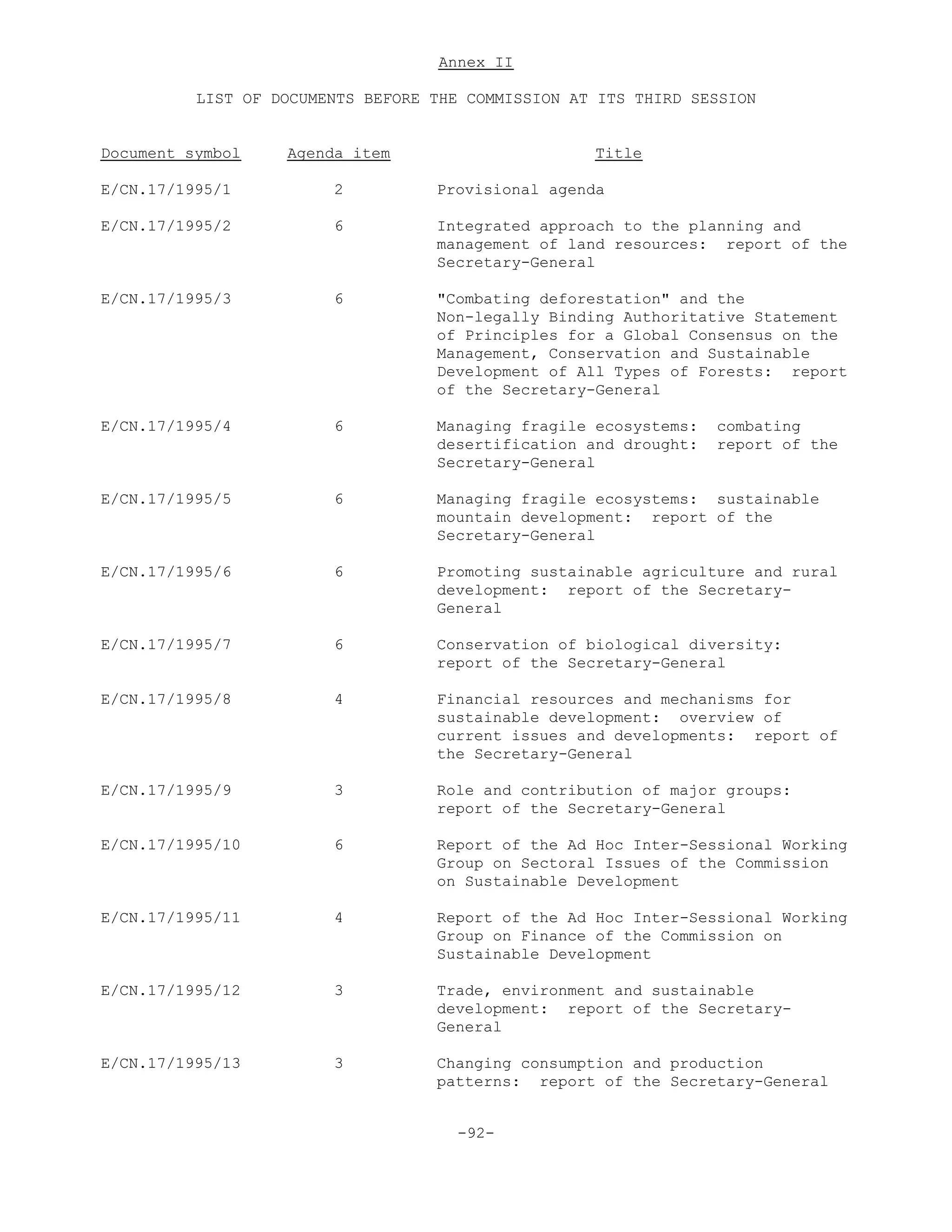
excessive use of aromatics that are also harmful to human health.
104. The Commission welcomes and supports the work of the International Coral
Reef Initiative (ICRI) and its goal of encouraging strategies for sustainable
management of fragile coral reef systems.
105. The Commission welcomes the action of the General Conference of the
International Atomic Energy Agency (IAEA), held in September 1994, which
initiated the preparation for a convention on the safe management of radioactive
wastes.
9. Information provided by Governments and organizations
106. The Commission noted with appreciation the receipt of information from
55 States and organizations. It welcomed the country presentations on national
experiences in elaborating sustainable development strategies and on land
management and sustainable agriculture.
107. The Commission also welcomed the work of the Secretariat in simplifying the
guidelines in order to facilitate further exchange of information and to present
a summary report on the information obtained from the guidelines supplemented by
graphs and tables.
108. The Commission requested the Secretariat to further streamline and simplify
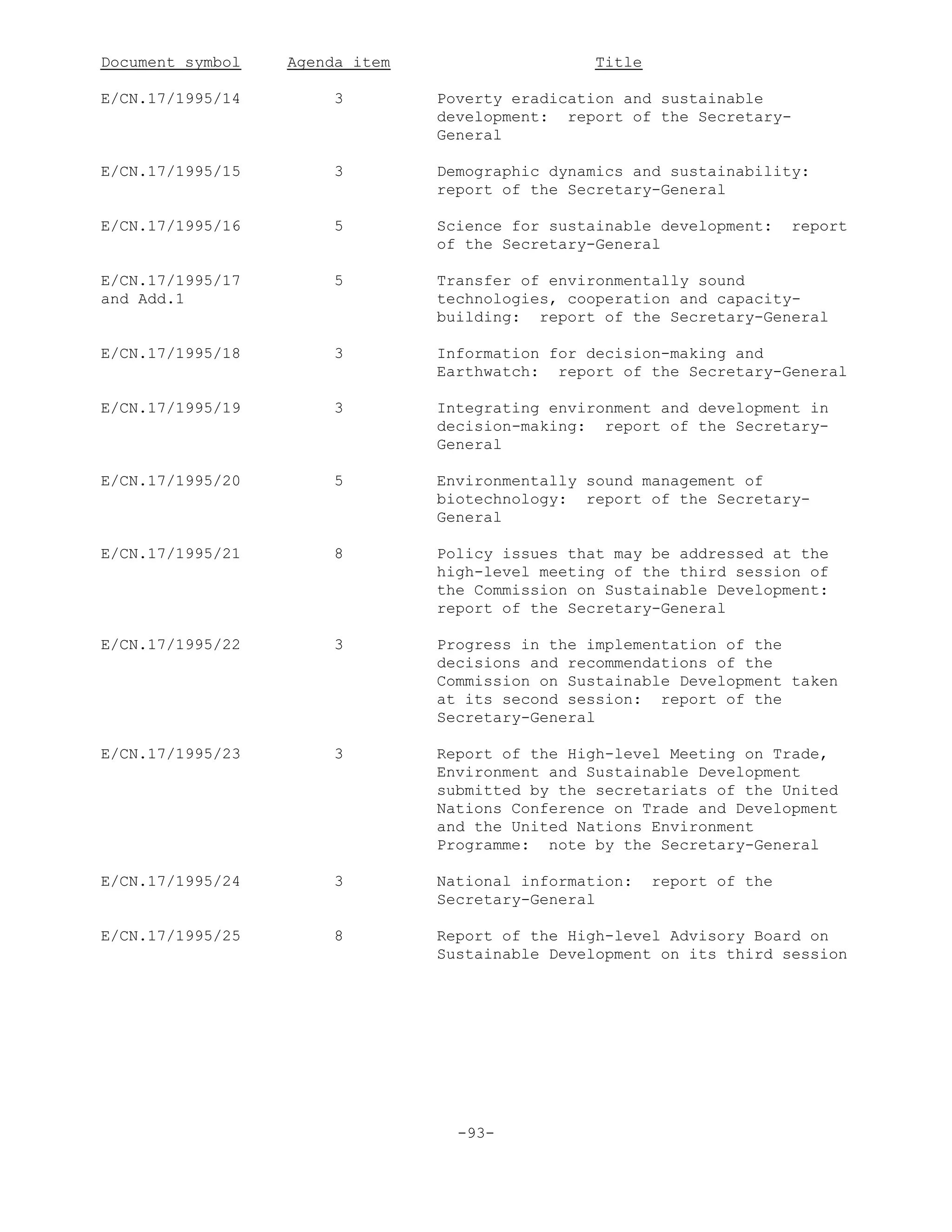
the guidelines for the 1996 session in order to facilitate further exchange of
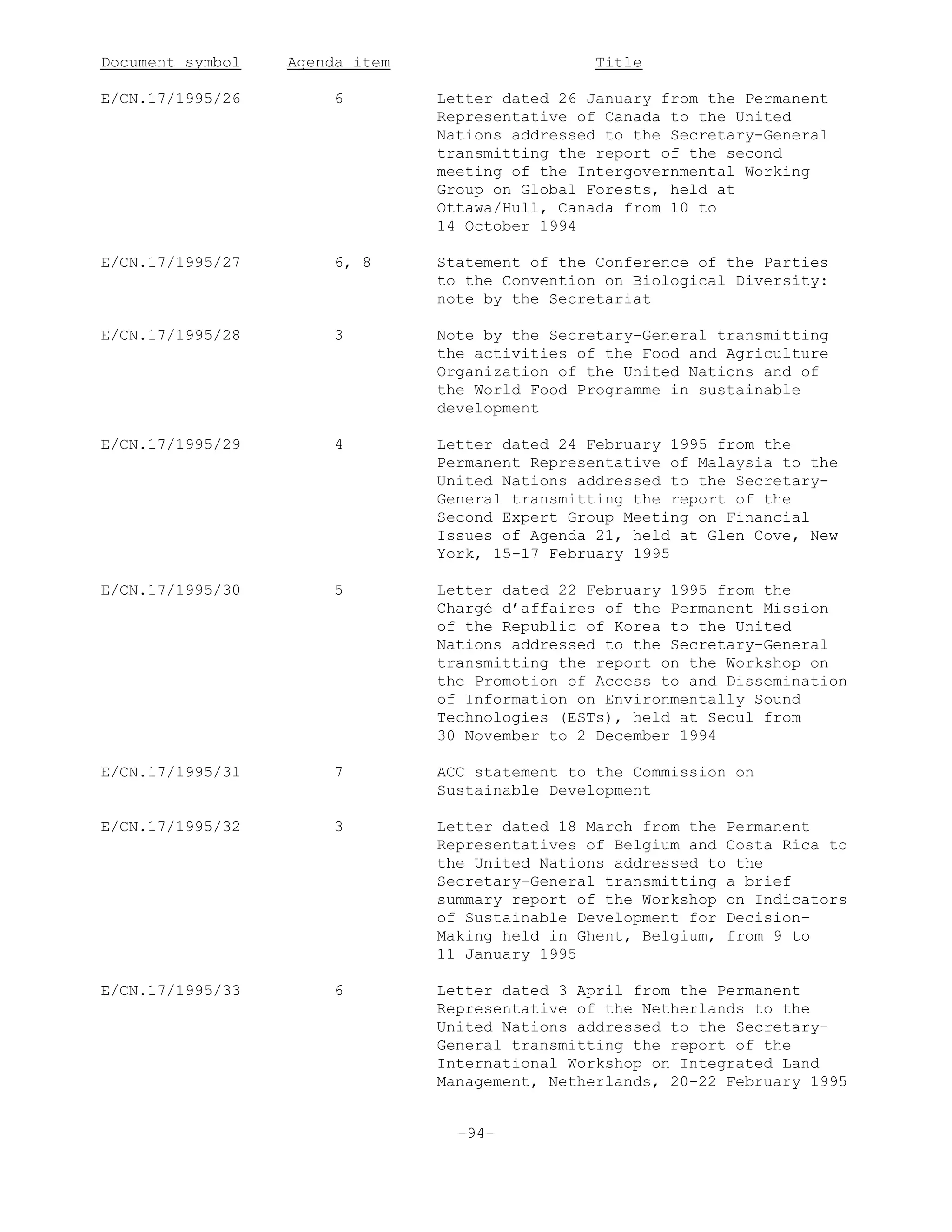
information on national and other relevant experience in implementing Agenda 21;
in particular, the streamlining should allow country reports to focus on
identifiable achievements and lessons learned.
109. The Commission requested relevant organizations within and outside the
United Nations system, as well as donors, to provide, upon request, technical
and financial assistance to developing countries for the preparation of national
strategies for sustainable development, national Agenda 21 action plans and
periodic communications and reports on these activities to the Commission on
Sustainable Development. The Commission noted the intention of several donors
and organizations to consider such requests favourably.
110. The Commission requested the Secretariat to provide draft guidelines for
obtaining information on the overall implementation of Agenda 21 for the 1997
special session of the General Assembly, to be considered at the fourth session
of the Commission.
-22-
B. Financial resources and mechanisms
111. The Commission on Sustainable Development recalls the financial
recommendations and commitments set out in chapter 33 of Agenda 21, especially
those in paragraphs 33.13 and 33.14 thereof.
112. The Commission emphasizes that, in general, the financing for the
implementation of Agenda 21 will come from a country’s own public and private
sectors. For developing countries, particularly the least developed countries,
official development assistance (ODA) is a main source of external funding;
substantial new and additional funding for sustainable development and the
implementation of Agenda 21 will be required. Furthermore, ODA plays a
significant role in addressing sustainable development concerns in those areas
of the world, as well as in addressing social and environmental concerns and
meeting the needs of certain infrastructural sectors that currently are not
favourably placed to attract private financial flows, including foreign direct
investment. The decline of ODA, both in absolute terms and as a percentage of
gross national product (GNP), remains a matter of great concern to the
Commission.
113. The Commission urges the developed countries to continue pursuing policies
aimed at increasing the flow of ODA to developing countries, consistent with the
commitments that they made at the United Nations Conference on Environment and
Development.
114. The Commission, in its work on monitoring the implementation of
recommendations and commitments of Agenda 21 related to ODA, will promote:
(a) New approaches to enhancing the effectiveness of ODA and increasing it
within relevant bilateral and multilateral mechanisms with the objective of
achieving the United Nations target of 0.7 per cent of GNP, as reaffirmed in
chapter 33.13 of Agenda 21, as soon as possible;
(b) Improved cooperation and coordination among national institutions in
recipient and donor countries, international organizations (including financial
institutions) and the private sector and the non-governmental organizations, as
appropriate, inter alia, through the elaboration of national sustainable
development strategies and plans, with a view to enhancing the effectiveness of
ODA delivery and use;
(c) Use of ODA to leverage additional domestic and external financial
resources, through various innovative schemes (such as co-financing and joint
ventures, underwriting of country risks, and venture capital funds) in order to
more efficiently mobilize new financial flows for sustainable development from
all potential sources. In this context, the Commission could initiate case-
studies of national experiences in this area;
(d) Public and political support in donor countries for raising the levels
of ODA, including through highlighting its crucial role for sustainable
development and reform measures, as appropriate, in recipient countries that
increase its effectiveness;
(e) International awareness of the importance of an adequate eleventh
replenishment of the International Development Association (IDA), which is to
come into effect from June 1996.
-23-
115. The Commission welcomes the increase in private capital flows, while
recognizing that they are concentrated in a few countries and sectors. However,
the fact that their stability and sustainability and their environment and
technology transfer content are not assured remains a cause for concern for the
Commission and requires monitoring. Therefore, the Commission invites UNCTAD
and the international financial institutions, in particular the Bretton Woods
institutions, to carry out further studies in this regard, focusing on the high
volatility and short-term nature of a substantial part of such flows and
proposing measures to stimulate more long-term capital flows and to reduce the
destabilizing effects of highly volatile short-term financial flows, and to
share the results with the Commission.
116. The Commission emphasizes that developed and developing countries should
encourage policies to promote private foreign investment in developing countries
that can contribute to sustainable development. In addition, consideration
should be given to the establishment of mechanisms and international
arrangements to address the effects of sudden outflows of private capital from
developing countries.
117. The Commission reiterates the fact that further progress is essential for
the achievement of an effective, equitable, development-oriented and durable
solution to the external debt problems of a large number of developing
countries, particularly the poorest and most heavily indebted among them. The
Copenhagen Declaration on Social Development of the World Summit for Social
Development suggests even more favourable terms of debt relief measures. It
highlights the importance of ensuring the urgent implementation of existing debt
relief agreements and negotiating further initiatives, in addition to existing
ones, to alleviate the debt of the poorest and heavily indebted low-income
countries at an early date, especially through more favourable terms of debt
forgiveness, including application of the terms of debt forgiveness agreed upon
in the Paris Club in December 1994, which encompass debt reduction, including
cancellation or other debt relief measures; where appropriate, these countries
should be given a reduction of their bilateral official debt sufficient to
enable them to exit from the rescheduling process and resume growth and
development.
118. The Commission further emphasizes that measures to tackle the problem of
external debt should also include the consideration and implementation, where
appropriate, of innovative mechanisms such as debt-for-nature and debt-for-
social development swaps. The Commission takes note of successful examples of
debt-for-sustainable development swaps and recommends their further promotion,
as appropriate.
119. The Commission urges international financial institutions and all relevant
development agencies to continue to increase financial flows for sustainable
development. Specifically, these institutions should extend their recent
efforts beyond incorporating environmental and social considerations into their
projects and activities by integrating economic, social and environmental goals
of sustainability from the outset into their institutional mandate, overall
development policies, strategy formulation, and priorities established by
Agenda 21 and other related international instruments and agreements.
120. The Commission notes the importance of the further development of
sustainable development indicators and their possible application, once agreed,
that aim at integrating economic, social and environmental goals. The further
development of sustainable development indicators should be undertaken, with the
-24-
effective participation of all relevant parties in particular developing
countries.
121. The Commission and the policy-making bodies of the international financial
institutions (in particular the Interim and Development Committees) should
strengthen communication, interaction and partnership with a view to promoting
approaches and activities geared towards meeting the objectives of sustainable
development under Agenda 21.
122. The Commission notes that the restructured and replenished Global
Environment Facility (GEF) will continue on an interim basis as the entity
entrusted with the operation of the financial mechanisms of the Convention on
Biological Diversity 18/ and the United Nations Framework Convention on
Climate Change. The Commission emphasizes the importance of the speedy
implementation of these commitments and the other responsibilities of GEF and
recalls that, at its second session, in 1994, it stated that the first
replenishment of the restructured GEF was a first step at a minimum level, and
noted that there would be a need for further replenishment of its funds as the
implementation of commitments under the various agreements and objectives
envisaged for the Facility proceeded. 19/ Furthermore, the Commission
recommends that GEF procedures be further improved to speed up project
implementation without compromising the quality of appraisal and participation.
It notes the fact that GEF procedures are being reviewed.
123. The Commission stresses the need for the fulfilment of the financial
commitments contained in Agenda 21. The Commission encourages the mobilization
of domestic financial resources, inter alia, through the use of economic
instruments and policy reforms in both developed and developing countries and
the establishment of national environmental funds. It emphasizes that these
measures should not be seen as a substitute for the needed increased
international financial flows from all sources, including ODA, but that both
channels of financing should supplement and mutually reinforce each other.
124. The Commission’s review of the use of economic instruments in developed
countries, countries with economies in transition and developing countries
demonstrates clearly that - depending on their specific conditions - they have
in varying degrees attempted to achieve a less distortionary tax system by
introducing environmental taxes. In addition, valuable experience is being
gained in the use of the various other economic instruments. The Commission
emphasizes that future discussions on economic instruments should explore ways
and means of overcoming obstacles to their implementation in developed
countries, developing countries and countries with economies in transition.
Particular attention should be paid to specific country situations and the
phasing out of environmentally unfriendly practices, as well as to problems of
capacity-building in developing countries and distributional problems.
125. The Commission underscores the importance of strengthening national
capacities and capabilities in the use of economic instruments, including the
elimination of environmentally unfriendly subsidies and other practices, within
the context of national strategies and policies for sustainable development. It
recommends that these efforts should be supported by Governments and
18/ See UNEP, Convention on Biological Diversity (Environmental Law and
Institutions Programme Activity Centre), June 1992.
19/ Official Records of the Economic and Social Council, 1994, Supplement
No. 13 (E/1994/33/Rev.1), chap. I, para. 60.
-25-
international organizations, in particular UNDP, UNEP, UNCTAD, the International
Monetary Fund (IMF), the World Bank and the regional commissions.
126. The Commission’s review of the usefulness of the national environment funds
shows that in developed countries, countries with economies in transition and
developing countries, there is a great variety of different types of funds at
work. In many countries these funds play an important and constructive role as
effective financial mechanisms. Their role should be evaluated from the
perspective of searching for optimal solutions. In this context, particular
attention should be given to the advantages and disadvantages of earmarking
funds for environmental expenditures.
127. The Commission will provide leadership in developing further proposals for
promoting the exchange of experiences in the implementation of policy reforms
for sustainable development.
128. The Commission, in its discussion of innovative mechanisms for resource
mobilization, noted that the Ad Hoc Inter-sessional Working Group on Finance
considered in a preliminary manner the feasibility and utility of such measures
as an environmental user charge on air transport, activities implemented jointly
and internationally tradable carbon dioxide (CO2) permits.
129. The Commission notes that the air transport of passengers and cargo is a
source of environmentally damaging emissions and would consider it worthwhile to
examine in detail a properly designed environmental user charge on air transport
if an in-depth study demonstrated its need and feasibility. The Commission
recommends that such a study be undertaken in cooperation with the International
Civil Aviation Organization (ICAO) and other relevant bodies. It also
recommends that the study address the environmental, economic, legal,
administrative, and political aspects of such a mechanism, taking into account
the particular needs and conditions of developing countries.
130. The Commission’s discussion on internationally tradable CO2 permits and
activities implemented jointly reflects concerns and recognition about their
extreme complexity and makes it clear that work undertaken in this regard should
be pursued in the context of the United Nations Framework Convention on Climate
Change, taking into account the situation of countries, particularly the
developing countries, as specified in the relevant paragraphs of the Convention.
In the context of its discussion, the Commission noted the outcome of the first
Conference of the Parties to the Convention, in particular the launching of a
pilot phase for activities implemented jointly. The Commission noted that
participation in the pilot phase is voluntary and that activities implemented
jointly should be compatible with and supportive of national environment and
development priorities and strategies, contribute to cost effectiveness in
achieving global benefits and be conducted in a comprehensive manner covering
all relevant sources, sinks and reservoirs of greenhouse gases. It notes that
no credits are to be provided to any party as a result of greenhouse gas
emissions reduced or sequestered during the pilot phase, and that developed and
developing countries and countries with economies in transition can be involved
in the pilot phase on a voluntary basis.
131. The Commission emphasizes that financing the transfer of environmentally
sound technology and biotechnology should be considered within the context of
the relevant chapters of Agenda 21. The transfer of environmentally sound
technology, on favourable terms, including concessional and preferential terms,
as mutually agreed, taking into account the need to protect intellectual
property rights as well as the special needs of developing countries for the
-26-
implementation of Agenda 21, in accordance with chapter 34 of Agenda 21, is
highlighted by the Commission as having a particularly important role to play in
realizing the goals of sustainable development.
132. The Commission notes that fostering investments in environmentally sound
technologies (ESTs) requires that Governments promote a favourable environment
for the transfer of technology, the adoption of favourable policies for business
development and the creation of a wider framework to encourage investments in
the technology development process, including research, development and
adaptation of technology. The particular problems of small- and medium-sized
enterprises were emphasized.
133. The Commission notes that financing of the transfer of ESTs can also be
promoted by partnerships between the private and public sector, such as publicly
funded intermediaries for EST transfer and publicly sponsored investment funds
with a focus on these technologies. Venture capital funds were particularly
noted. Furthermore, the Commission recommends that the need for and
effectiveness of environmentally sound technology rights banks 20/ and the
practical feasibility of establishing such banks should be further studied.
134. The Commission encourages the use of ESTs and such innovative private
sector financing mechanisms as build-operate-transfer (BOT) schemes for
promoting EST transfer, including building the capacities of developing
countries and countries with economies in transition to negotiate BOT contracts.
135. In addressing the financing of biotechnology, the Commission takes note of
proposals for several funding support mechanisms such as (a) the establishment
of an international biosafety trust fund, (b) the establishment of an
international venture capital fund for biotechnology and (c) creation of an
expert volunteer corps in biotechnology. These actions require further study
and consultations among interested Governments before concrete proposals can be
made.
136. The Commission recognizes that many of the sources of finance, economic
instruments and innovative mechanisms considered in the report of the Secretary-
General on financial resources and mechanisms for sustainable development:
overview of current issues and developments (E/CN.17/1995/8) are also applicable
to financing the transfer of technology and biotechnology sectors.
Nevertheless, detailed study would be required on the application of the "matrix
approach" and countries may choose the most appropriate mix of instruments and
mechanisms.
137. The Commission notes that the analytical framework presented by the matrix
contained in the annex to the above-mentioned report of the Secretary-General is
illustrative and may help to integrate the application of the range of financial
and policy options with individual sectors and cross-sectoral activities, and
could prove valuable in identifying the appropriate and most promising options,
as well as complementarities, taking into account the social, economic and
distributional impact of policy options and the principle of common but
differentiated responsibilities.
20/ Environmentally sound technology rights banks are ownership
arrangements that act as a broker for acquiring patent rights to sounder
technologies and make them available to countries in need of technical
assistance, in particular the developing countries, on favourable terms.
-27-
138. The Commission emphasizes that the matrix approach deserves further
detailed study, including efforts at making the analysis more pragmatic and
comprehensive, quantifying the potential resources generated by the use of
different economic instruments and by policy reform measures. Studies should
exploit the full potential of the matrix as an analytical tool to assist policy
makers, including in examining the appropriate role of public and private
actors, and ways and means of promoting interaction and cooperation between
them. The Commission encourages Governments, United Nations organizations,
international financial institutions, academic and research communities and
other actors, including the private sector, to support and participate in these
efforts.
139. The Commission recognizes that in pursuing studies on economic instruments,
innovative mechanisms and the matrix approach, full consideration should be
given to the concerns of developing countries stated above, including the
mobilization of resource flows, and to promoting national capacities and
capabilities, taking into account the social, economic and distributional
impacts of policy options and keeping in mind the principle of common but
differentiated responsibilities.
140. The Commission expresses its appreciation of the inter-sessional work that
has been undertaken to prepare for its deliberations on financial resources and
mechanisms. It takes note in particular of the role of the Ad Hoc
Inter-sessional Working Group on Finance and its report (E/CN.17/1995/11).
141. The Commission invites international financial institutions and development
agencies and, as far as practicable, private enterprise, research organizations
and non-governmental organizations to participate in its work, including its
inter-sessional work. Furthermore, the Commission will seek out valuable
national experiences as case-studies, encourage informal technical group
meetings and promote pilot projects in order to enhance the effectiveness of its
work.
C. Education, science, transfer of environmentally sound
technologies, cooperation and capacity-building
1. Transfer of environmentally sound technologies, cooperation
and capacity-building
142. The Commission on Sustainable Development:
(a) Took note of the report of the Secretary-General on the transfer of
environmentally sound technologies, cooperation and capacity-building
(E/CN.17/1995/17 and Add.1) and the compilation of information on policies and
programmes of countries, international organizations and financial institutions
to promote the transfer of environmentally sound technologies, cooperation and
capacity-building (E/CN.17/1995/17/Add.1);
(b) Welcomed the elements of a work programme contained in section V of
the report, and noted that the report made full use of the inter-sessional
meetings on issues related to the transfer of environmentally sound
technologies, cooperation and capacity-building, including the Workshop on the
Promotion of Access to and Dissemination of Information on Environmentally Sound
Technologies, organized by the Government of the Republic of Korea, the Third
High-level Advisory Seminar on Cleaner Production, organized by the Government
of Poland, the Workshop on Cleaner Production Technologies in Developing
-28-
Countries, organized by OECD, and the Round Table on Technology Transfer,
Cooperation and Capacity-building, organized by UNIDO, in cooperation with UNEP
and the Department for Policy Coordination and Sustainable Development of the
United Nations Secretariat;
(c) Noted the gradual shift of focus from pollution control and waste
management to pollution prevention approaches in policies and programmes at the
country level and bilateral and multilateral cooperation, and observed that this
shift had resulted in the introduction of production patterns that emphasized
the more efficient use of raw materials and energy, taking into account the
capture and recycling of wastes and the better use of end-products of the
productive system;
(d) Reaffirmed the importance of the balanced approach of chapter 34 of
Agenda 21 concerning the transfer of environmentally sound technology,
cooperation and capacity-building, also reaffirmed the necessity of access to
and transfer of environmentally sound technologies, in particular to developing
countries, on favourable terms, including on concessional and preferential
terms, as mutually agreed, taking into account the need to protect intellectual
property rights, as well as the specific needs of developing countries for the
implementation of Agenda 21, through supportive measures that promoted
technology cooperation and that should enable the transfer of necessary
technological know-how as well as the building of economic, technical and
managerial capabilities for the efficient use and further development of
technology, and further reaffirmed the need to strengthen North-South and
South-South cooperation to implement the provisions of chapter 34 of Agenda 21;
(e) Recognized that international cooperation was essential to promote
access to and dissemination of environmentally sound technologies and that an
adequate approach to the transfer of environmentally sound technologies should
not only consider existing market forces, but also other relevant factors such
as social, cultural, environmental and economic factors, and also recognized
that commercial transactions were an important source of technology cooperation
with regard to environmentally sound technologies, and that such transactions
should be encouraged;
(f) Further recognized that much of Agenda 21 needed to be implemented at
the national level. To accomplish this task, Governments would have to face new
challenges in order to meet the requirements of sustainable development. This
process should be enhanced through the development and transfer of
environmentally sound technologies, in accordance with the provisions of
paragraph 34.14 (b) of Agenda 21, to implement the objectives of sustainable
development. Such technologies should be demand-driven, environmentally sound
and appropriate for the intended users of the technology, taking into account
the social, economic and cultural conditions in the country concerned, in
accordance with its priorities;
(g) Recalled that the promotion, facilitation and financing, as
appropriate, of access to and transfer of environmentally sound technologies and
corresponding know-how, in particular to developing countries, was one of the
means for the implementation of Agenda 21;
(h) Recalled that the private sector was an important vehicle for
technology transfer and that Governments should provide an enabling and
supportive environment;
-29-
(i) Highlighted the need to develop a programme of work on the transfer of
environmentally sound technologies, cooperation and capacity-building, with the
objective of reporting on its implementation by 1997. Consistent with the
decision on the transfer of environmentally sound technologies, cooperation and
capacity-building, adopted by the Commission at its second session, 21/ the
specific activities contained in the programme of work would relate to three
interlinked priority areas.
143. The Commission therefore urges Governments, relevant organizations of the
United Nations system, other intergovernmental organizations, the secretariats
of the various international conventions, and major groups, particularly
business and industry, to make clear commitments to undertake specific elements
of the following work programme:
Work programme
A. Access to and dissemination of information on
environmentally sound technologies
1. The Commission welcomes the work being initiated by the United Nations
Environment Programme (UNEP), in cooperation with other United Nations
bodies and relevant organizations, on a survey of existing information
systems and sources related to environmentally sound technologies as a
practical step towards enhancing cooperation and compatibility between
existing and projected information systems and clearing-house mechanisms.
In this regard, the Commission invites UNEP to submit an interim report to
it at its fourth session, in 1996, which should also take into account
other work now under way such as the inventory on climate-related
technologies to be prepared by the secretariat of the United Nations
Framework Convention on Climate Change. This report should:
(a) Include systems and sources from developed and developing
countries;
(b) Analyse information and identify deficiencies, gaps and
duplications;
(c) Evaluate systems with respect to information quality,
accessibility and costs;
(d) Explore the idea of a broadly based consultative mechanism that
would facilitate consultation among information providers and potential
users.
2. The Commission urges that information and experiences be shared on the
successful implementation of transfer operations of environmentally sound
technologies through, for example, workshops or expert panels, the
dissemination of well-documented case-studies, and networking activities,
and that the results be made available to the Commission.
3. The Commission also urges that information and experiences be shared
on the impact and effectiveness of governmental, public and private sector
initiatives and policies, including voluntary agreements and initiatives,
21/ See Official Records of the Economic and Social Council, 1994,
Supplement No. 13 (E/1994/33/Rev.1), chap. I, sect. C.
-30-
economic instruments and other policies on the development, transfer and
dissemination of environmentally sound technologies. Examples include
country- or sector-specific workshops or expert panels and the
dissemination of well-documented case-studies, the results of which would
be made available to the Commission. Such workshops or panels could
include representations from Governments, international bodies, industry
and other major groups.
B. Institutional development and capacity-building for
managing technological change
4. Effective measures need to be implemented at the national level to
develop the skills, in particular of developing countries, to access,
assess, adapt and apply environmentally sound technologies within specific
contexts and to enhance the innovative capabilities of the technology
users. In this regard, Governments, international organizations and major
groups, including business and industry, should undertake:
(a) Efforts to establish or strengthen environmentally sound
technology centres, networks or other mechanisms, and in particular to
support the establishment or strengthening of such centres, networks or
other mechanisms in developing countries. Functions to be performed by the
environmentally sound technology centres should take into account
specifications such as those contained in the Seoul Plan of Action
concerning Information Exchange about Environmentally Sound Technologies
(see document E/CN.17/1995/30, annex) and the United Nations Industrial
Development Organization (UNIDO) Round Table on Technology Transfer,
Cooperation and Capacity-building, giving priority attention to:
(i) Conducting, as appropriate, surveys and assessments of
environmentally sound technologies;
(ii) Training of trainers and advisers;
(iii) Demonstration projects that highlight the economic and
environmental benefits of the use of environmentally sound
technologies and management skills;
(iv) Awareness building, inter alia, through dissemination of
well-documented case-studies that clearly present those economic
benefits;
(v) Capacity-building for technology assessment.
The promotion of environmentally sound technology centres, or their
equivalent networks, should build upon existing national institutions and
organizations, including research centres, for example, centres established
with the support of UNIDO, UNEP or bilateral donors. The environmentally
sound technology centres could also facilitate technology transfer
involving the private sector;
(b) Cooperation in the development of basic criteria or general
guidelines for environmentally sound technology assessment, building upon
already existing work. These criteria or guidelines should emphasize the
transfer of cleaner technologies;
-31-
(c) Sharing of experiences in case-studies on national needs
assessments in support of the transfer of environmentally sound
technologies as well as the implementation of their results, through, for
example, expert meetings. There is also a need for exchanging such
experiences gained in current cooperation projects, in order to compare
approaches and identify their respective strengths and weaknesses. The
results should be made available to the Commission to enable it to keep
this issue under review;
(d) Encouraging joint ventures and partnerships of the private sector
from developed and developing countries and countries with economies in
transition, with particular emphasis on small- and medium-sized
enterprises. Bilateral technology partnership arrangements could be used
as a means of encouraging private sector initiatives in disseminating
state-of-the-art technologies and enhancing technology development,
innovation and capacity-building;
(e) Developing environmental performance indicators at the national
level, taking into account international work on indicators and criteria,
which may be used in assessing technology options;
(f) Developing measures for strengthening the "technology triangle"
that involve the participation of scientific, private and government
sectors at the national level.
C. Financial and partnership arrangements
5. Urgent and concrete steps are needed towards the provision and
mobilization of resource flows from developed to developing countries, in
particular, consistent with chapter 33 of Agenda 21, especially
paragraphs 33.13 and 33.14, and, as relevant, paragraphs 33.15 and 33.16,
as well as chapter 34 of Agenda 21, and promoting partnership arrangements
between technology suppliers and potential users. In this regard:
(a) Governments are encouraged to take appropriate measures to
strengthen strategic interactions and collaboration and links among
government agencies and institutions, the private sector and institutions
of science and technology, at the national level, and to develop and
utilize a similar approach at the international level;
(b) Governments of developed countries are encouraged to include
environmentally sound technologies as an integral part of their technology
cooperation and technical assistance programmes, in accordance with the
provisions of paragraph 34.14 (b) of Agenda 21, and to provide
encouragement to the private sector, both local enterprises and
transnational corporations, including financial and fiscal incentives, as
appropriate, to promote and accelerate the transfer of environmentally
sound technologies, in particular pollution prevention and control and
waste management technologies, to developing countries and countries with
economies in transition;
(c) Governments are urged to take measures, in cooperation with
international organizations, as appropriate, to enhance both North-South
and South-South cooperation. Initiatives should also be targeted towards
integrating the economies in transition into the system of global
-32-
technology cooperation and partnership. In this regard, particularly
relevant areas are:
(i) Joint technological research and development programmes targeted
at the frontiers of technologies to accelerate technological
change and facilitate technology "leap-frogging" in developing
countries and economies in transition;
(ii) Cooperation between technological research and development
institutions of developed and developing countries and economies
in transition;
(iii) Cooperation among technological research and development
institutions of developing countries;
(iv) Strengthening of existing regional centres that play a role in
the exchange of information about environmentally sound
technologies and in capacity-building of developing countries and
economies in transition for managing technological change;
(d) Governments, international organizations and the private sector
could provide information on case-studies on experiences gained in the
transfer and application of environmentally sound technologies in order to
facilitate the replication of successful examples. Note should be taken of
the useful experiences of environmentally sound technology projects funded
through both the Global Environment Facility and the Multilateral Fund of
the Montreal Protocol on Substances that Deplete the Ozone Layer. The
Commission encourages the sharing of these and similar experiences at
meetings relevant to its work;
(e) Governments are invited to create enabling conditions in order to
increase the amount of foreign direct investment in environmentally sound
technologies through measures such as creating a demand for environmentally
sound technologies through market mechanisms and the examination of the
framework of laws and regulatory policies that affect technology
cooperation;
(f) Existing global and regional funds are urged to allocate
resources to build and strengthen in-country capacity to identify projects
tailored to specific countries’ needs and to carry out in-country
pre-feasibility studies with a view to further attracting funding for
technology transfer projects;
(g) The financial sector is encouraged to promote an assessment of
the potential impact and benefits of the use and transfer of
environmentally sound technologies.
2. Science for sustainable development
144. The Commission took note of the report of the Secretary-General on science
for sustainable development (E/CN.17/1995/16), including the initiatives taken
by national Governments, the United Nations system, other international
organizations, major groups and the scientific and technological community to
implement science-related policies and programmes.
-33-
145. The Commission welcomed the proposals for action contained in section III,
which identified areas for priority actions that should be taken by countries
and regional and international organizations, with a view to further enhancing
the contribution of science to sustainable development, in particular in
developing countries.
146. The Commission noted recent intergovernmental processes relevant to science
for sustainable development, such as the establishment of the Commission on
Science and Technology for the South (COMSATS), with its aim of creating 20
centres of excellence in the South as the frontier areas of science related to
sustainable development, and the related Network of International Centres of
Excellence in the South.
147. The Commission also noted the meetings of the Presidential Forum on the
Management of Science and Technology for Development in Africa which,
inter alia, led to the inauguration of the African Foundation for Research and
Development (AFRAND).
148. The Commission highlighted the useful cooperation and collaboration with
the Commission on Science and Technology for Development through its Panel on
Science and Technology for Integrated Land Management, which provided an
important input into the discussions of the Ad Hoc Inter-sessional Working Group
on Sectoral Issues.
149. The Commission stressed the importance of North-South and South-South
cooperation and partnerships as mechanisms to support initiatives in capacity-
building for science at the country level.
150. The Commission stressed the interdisciplinary nature of science and the
need for related initiatives and research to reflect the linkages among the
economic, social and natural aspects of science.
151. The Commission recognized the importance of indigenous people’s knowledge
and that indigenous sciences, traditions and communities should be consulted to
help solve sustainable development problems.
152. The Commission:
(a) Invites the Parties to the United Nations Framework Convention on
Climate Change, 10/ the Convention on Biological Diversity 18/ and the United
Nations Convention to Combat Desertification in those Countries Experiencing
Serious Drought and/or Desertification, particularly in Africa, 12/ to fully
explore the possibilities of intensified scientific cooperation as provided for
in those Conventions;
(b) Urges countries and international organizations to accord high
priority to measures aimed at capacity-building and sharing of know-how in
science, with particular emphasis on the needs of developing countries as
provided for in chapter 33 of Agenda 21, particularly paragraphs 33.13 and 33.14
and, as relevant, paragraphs 33.15 and 33.16, as well as in chapter 35 of
Agenda 21. In this regard, Governments, organizations of the United Nations
system and other relevant intergovernmental organizations should:
(i) Share reliable and sector/country-specific information concerning
scientific capacities and know-how and its impact on achieving
sustainable development objectives in developing countries, in
particular the least developed countries, and make this information
-34-
available to the Commission, through, inter alia, well-documented
case-studies;
(ii) Specify and implement activities, including through joint initiatives,
cooperation and partnership arrangements, that are targeted towards
enhancing the scientific capacities and capabilities of developing
countries in the following priority areas: promoting general
scientific education and sharing of know-how and training,
particularly with regard to women; enhancing the status of science;
enhancing the capabilities of decision makers to use existing
scientific information in the development of sustainable development
policies; improving the integration of science into national
development policies and plans; promoting interdisciplinary approaches
and use of new technologies; and increasing training in specialized
scientific areas;
(c) Encourages Governments to enhance, with the support of
intergovernmental and other relevant international organizations, international
scientific cooperation, including North-South and South-South cooperation,
taking into account current and planned efforts, for example, the initiatives of
COMSATS and the Presidential Forum on the Management of Science and Technology
for Development in Africa. In this regard, there is a need for:
(i) The networking of national and international centres of excellence
which would build upon existing national and regional research,
education and development institutions, organizations and programmes;
(ii) The enhanced participation of developing countries in international
research programmes on global environmental issues, recognizing that
in many scientific fields related to sustainable development,
generation of new knowledge requires enhanced international scientific
cooperation. Joint efforts could relate to:
a. Making full use and exploring the development of Global
Environment Observing Systems;
b. Reinforcing and, where necessary, expanding existing
international scientific programmes to ensure coordination and
high-quality scientific results;
c. Identifying emerging issues for international scientific
cooperation and addressing appropriate response strategies;
(d) Encourages initiatives at the country level to improve communication
among science, industry, policy makers and major groups and to enhance the
application of science. In this regard, Governments, the scientific and
technological community, including universities, and the industrial sector
should enhance cooperative efforts to ensure that the most recent and
comprehensive scientific information is collected, synthesized and made
available to interested groups. In addition, these groups should also cooperate
to identify priority research needs in support of sustainable development;
(e) Invites the donor community to consider targeted financial support for
the implementation of specific activities related to scientific capacity-
building in the identified priority areas. In this regard, adequate funding is
needed, inter alia, for:
-35-
(i) Promoting basic scientific education, enhancing interdisciplinarity
between natural and social sciences, enhancing research on and
development of new technologies and increasing training in specialized
scientific areas, according to national priorities. Such efforts
should also be part of relevant United Nations organization programmes
and a goal of domestic education programmes in all countries;
(ii) Networking of national and international centres of excellence;
(iii) Implementing problem-oriented interdisciplinary research and
demonstration projects, in particular in developing countries, in
support of the development of sector-specific sustainable resource
management policies.
3. Environmentally sound management of biotechnology
153. The Commission on Sustainable Development takes note of the report of the
Secretary-General on the subject of chapter 16 of Agenda 21, entitled
"Environmentally sound management of biotechnology" (E/CN.17/1995/20) and its
Proposals for action provided in section V of that report which identify areas
for priority action by countries and international organizations, with a view to
enhancing the potential contribution of biotechnology in the attainment of
sustainable development objectives at national, regional and international
levels within a framework of biosafety. Future reports should place a stronger
emphasis, including more information and proposals, on the ecological, safety,
health, and socio-economic and ethical aspects of the application of
biotechnology and the commercialization of biotechnology products, with
particular reference to genetic engineering, including genetically modified
organisms when human genetic material is involved. Such reports should take
into account existing uncertainties and the most recent findings of the science
of genetics. This would enable the Commission to take a balanced and objective
approach to biotechnology.
154. The Commission recalls that chapter 16 of Agenda 21 states that the
environmentally sound management of biotechnology has the potential to make a
significant contribution to enabling the development of better health care,
enhanced food security through sustainable agriculture practices, improved
supplies of potable water, more efficient industrial development processes for
transforming raw materials, support for sustainable methods of afforestation and
reforestation, the removal of pollutants from the environment, and the
conservation and use of natural resources, notably biological resources. The
Commission urges United Nations bodies to continue to monitor and evaluate
biotechnology experiments and projects.
155. The Commission recognizes, however, that concerns exist about biosafety in
the application of biotechnology and the commercialization of biotechnology
products, in particular with regard to genetically modified organisms. It notes
the absence of a globally agreed framework for the safe handling and transfer of
biotechnology, and the sustainable management of genetically modified organisms.
It further notes the particular significance of this for developing countries.
Taking into account the precautionary approach, the Commission attaches high
priority to the safe handling of biotechnology. It therefore welcomes the
decision of the first meeting of the Conference of the Parties to the Convention
on Biological Diversity to establish a process for considering the need for and
modalities of a protocol on biosafety in the field of the safe transfer,
handling and use of any living modified organisms resulting from biotechnology
-36-
that may have adverse effect on the conservation and sustainable use of
biological diversity. That decision involves the establishment of a panel of
experts and an open-ended ad hoc working group of experts nominated by
Governments. It also welcomes the decision of the Conference of the Parties to
include consideration of the knowledge, innovations and practices of indigenous
and local communities in its medium-term programme of work.
156. The Commission also notes recent initiatives for the implementation of the
objectives of chapter 16, such as the WHO Conference on Biotechnology and World
Health, the recent launch of the Biosafety Information Network and Advisory
Service (BINAS) within the United Nations system under the auspices of UNIDO,
and the ongoing work in UNEP, as well as the work taking place within the
European Union and OECD and the rapid streamlining and rationalization of the
regulation of biotechnology products in the United States.
157. The Commission, therefore:
(a) Urges Governments to take specific action, within the framework of
articles 16 and 19 of the Convention on Biological Diversity, aimed at enhancing
the potential contribution of the private sector, financial, academic and
research institutions, non-governmental organizations and other major groups, to
the implementation of the objectives of chapter 16, particularly in view of
their significant role in research and the development, application, and
financing of biotechnology, and in capacity-building for biosafety, risk
management and assessments, and to:
(i) Increase where appropriate the involvement of business and industry,
and financial, academic and research institutions, non-governmental
organizations and other major groups in national, regional and
international consultations on biotechnology development trends and on
impact assessments;
(ii) Encourage the conducting of case-studies on "best practice" in the
environmentally sound and safe development, application and management
of biotechnology, and to make the results available, especially to
developing countries at national and regional levels;
(iii) Support as appropriate the establishment of biotechnology
associations, particularly in developing countries, with a view to
facilitating the safe commercialization and application of
biotechnology products and processes, in accordance with the
provisions of articles 16 and 19 of the Convention on Biological
Diversity;
(iv) Also support as appropriate the establishment and strengthening of
research facilities in universities, research institutes and
Governments in connection with scientific aspects of biosafety and
risk management and assessments;
(v) Mobilize financial resources from both the public and the private
sector for biotechnology research, development and work on safety and
for its sustainable use and management, especially in developing
countries;
-37-
(b) Urges countries and international organizations to accord high
priority to measures aimed at integrating biotechnology, including biosafety
concerns, effectively into national and regional sustainable development
policies and programmes. In this regard, support should be provided to:
(i) Enhance the contribution of business and industry, local authorities,
scientific and technological communities, non-governmental
organizations and other major groups to the identification of problems
(and appropriate solutions) related to the environmentally sound use
and management of biotechnology;
(ii) Promote a balanced and accurate understanding of biotechnology issues
as they impinge upon sustainable development including those related
to biosafety and progressive trends in biotechnology development,
through, for example, training at national and regional levels;
(iii) Establish national databases on information related to biosafety where
these do not currently exist and promote the exchange of information
concerning biosafety in biotechnology;
(iv) Encourage the national and local scientific and technological
communities to exercise ethical responsibility, through safe
laboratory practices and effective and transparent interaction with
the public at large;
(v) Assess the need for advice and assistance in promoting the development
or re-enforcement of biotechnology and biosafety regulations, norms
and standards, especially in the fields of agricultural, human and
animal health, with a view to designing effective programmes for the
environmentally sound management of biotechnology, building whenever
possible upon existing activities and capacities;
(vi) Enhance efforts aimed at human resource development, transfer and
development of technology and capacity-building in developing
countries to regulate, manage and control risks associated with the
use and release of living modified organisms resulting from
biotechnology;
(c) Invites the Conference of the Parties to the Convention on Biological
Diversity to keep the Commission informed of developments concerning the work on
the need for and modalities of a protocol on biosafety, with a view to
identifying areas for further cooperation on this issue. Such areas might
include work on capacity-building measures, especially in developing countries;
(d) Invites countries, international organizations and the Conference of
the Parties to the Convention on Biological Diversity to make their experiences
gained in the environmentally sound application and management of biotechnology
available in order to facilitate the Commission’s work in keeping this issue
under review;
(e) Notes the work on the development of possible international voluntary
technical guidelines on biosafety and stresses that such work should not be seen
as overriding existing national and regional legislation or as prejudging the
result of the ongoing discussions on the need for and modalities of a protocol
on biosafety under the Convention on Biological Diversity.
-38-
D. Review of sectoral cluster: Land, desertification,
forests and biodiversity
1. Overall considerations
158. The Commission on Sustainable Development notes that chapter 10 of
Agenda 21, on an integrated approach to the planning and management of land
resources, provides an overall framework for the implementation of the entire
cluster. While all the chapters are related to land, those on forests and
sustainable agriculture are concerned with the sustainable management and use of
physical and biological resources, while those on desertification and
sustainable mountain development reflect the particular problems of fragile
environments; the issue of the conservation of biodiversity and the sustainable
use of its components is of a cross-cutting nature, and includes those concerned
with freshwater as well as coastal and marine ecosystems. Farmers - men and
women - indigenous people, other rural communities and the private sector, as
the major stakeholders in the use of land and its related resources, must be the
focal points in all the areas of the cluster.
159. Respect for national sovereignty, as well as the need for a comprehensive
approach to implementing the recommendations and commitments contained in
Agenda 21, the Rio Declaration on Environment and Development, and the
Non-legally Binding Authoritative Statement of Principles for a Global Consensus
on the Management, Conservation and Sustainable Development of All Types of
Forests, 22/ are fundamental for achieving sustainable development.
160. National efforts in developing countries to mobilize financial resources
for the full and effective implementation of Agenda 21, including its land-
related chapters under review, have to be supported by the international
community. It is imperative that all financial recommendations and commitments
of Agenda 21 be implemented, in particular those contained in paragraphs 13
and 14 of chapter 33 of Agenda 21. The need for partnership for sustainable
development among all countries and better cooperation and coordination among
national institutions, international organizations, including international
financial institutions, the private sector and non-governmental organizations,
including farmers’ and rural people’s organizations, was underscored.
161. The sharing of scientific knowledge and the transfer of environmentally
sound technology, including on concessional and preferential terms as mutually
agreed, in accordance with the provisions of chapter 34, are crucial instruments
for achieving the objectives of Agenda 21.
162. The Commission on Sustainable Development recommends that high priority be
given to the facilitation of practical action for the transfer, sharing,
adaptation and development of technology for sustainable resource management in
all sectors, at the national and international levels, including under the
auspices of the United Nations system, in particular UNEP, UNIDO and UNESCO, and
of international conventions, as appropriate. Such action should include
support for a wide range of initiatives, including (a) capacity- and
institution-building; (b) exchange of information, making use, inter alia, of
inventories on eco-technologies in those sectors; and (c) education and
22/ Report of the United Nations Conference on Environment and
Development, Rio de Janeiro, 3-14 June 1992, vol. I, Resolutions Adopted by the
Conference (United Nations publication, Sales No. E.93.I.8 and corrigendum),
resolution 1, annex III.
-39-
training - through the establishment of mechanisms such as environmental
technology centres.
163. The Commission on Sustainable Development urges States to sign, ratify,
accede to and implement the Convention on Biological Diversity, the United
Nations Framework Convention on Climate Change and the United Nations Convention
to Combat Desertification in those Countries Experiencing Serious Drought and/or
Desertification, particularly in Africa, making these Conventions the principal
instruments for advancing international cooperation and practical action in
their respective fields. The Commission stresses the need for the formulation
of coordinated approaches towards the implementation of these instruments at the
national and international levels, with a view to making efficient use of
resources. The Commission further agrees to look into the relationship between
work under these Conventions and ongoing work on sustainable development in
other related processes in the follow-up to the United Nations Conference on
Environment and Development.
164. In accordance with General Assembly resolution 49/111 on the report of the
Commission on Sustainable Development on its second session, the Commission
encourages Governments to continue to share their experiences in the
implementation of Agenda 21, taking into account recent efforts and initiatives
to promote sustainable development at the national, subregional, regional and
interregional levels. It welcomes the readiness of some countries to accomplish
specific sustainable development goals by means of closer regional cooperation
to facilitate the implementation of Agenda 21, and recognizes the importance of
regional approaches for the effective implementation of the Conference
agreements to support global and national efforts. The Commission calls upon
the regional commissions to increase their efforts in support of recent
national, subregional, regional and interregional initiatives for promoting
sustainable development. It also recognizes the need to strengthen its ties
with regional institutions and in particular with the regional commissions. The
Commission will continue to review and monitor these regional initiatives aimed
at making the transition to sustainable development more effective in all
countries and which support appropriate global and national efforts.
2. Integrated approach to the planning and management
of land resources
165. The Commission notes with great concern that an estimated one sixth of the
total arable land surface of the globe has been damaged by human-induced soil
degradation. A global partnership is required to protect and restore the health
of the Earth’s terrestrial ecosystems.
166. The Commission notes with concern the convergence of poverty, hunger and
the degradation of terrestrial resources in environmentally more fragile
marginal lands, where the large majority of poor smallholder farmers are
increasingly located. The Commission calls upon Governments, bilateral donors,
multilateral financial institutions, technical specialized agencies, and
non-governmental organizations to give a high priority to rural development in
such lower-potential areas, particularly by enhancing the productivity of
farmers on a sustainable basis.
167. The Commission stresses that an integrated approach to the planning and
management of land and water resources is central to the implementation of
Agenda 21 recommendations concerning land, desertification, mountains, forests
and biodiversity. Land needs to be considered as a finite resource relative to
-40-
many and varied needs; its allocation must aim to satisfy these needs in the
most equitable and sustainable way.
168. An integrated and multidisciplinary approach to the planning, development
and management of land resources is a process that methodically identifies human
and environmental needs; identifies the potential and options for change and
improvement; identifies and evaluates all relevant physical, social, economic
and policy factors; and develops a series of actions necessary to permit and
facilitate change. The process needs to address an array of cross-sectoral
issues, such as the creation of productive employment; the eradication of
poverty; responses to pressures on the land caused by poverty; unsustainable
consumption and production; population growth; and changing demographic
patterns. The clarification and security of land rights, possibly involving
land-tenure and ownership reforms, are central to the solution of such problems.
A holistic approach to the management of land resources requires the integration
of land and water-resource issues as they relate to land use. The mismanagement
of land and water often leads to land degradation in the form of erosion,
flooding, waterlogging and salinity, and the depletion of groundwater resources.
The demands of rural and urban communities for land and its associated water
resources will often conflict with each other if they are not properly managed.
169. The Commission notes that soil and water degradation due to contamination
by agricultural, urban and industrial effluents is of increasing importance in
both developed and developing countries; the Commission invites Governments,
international organizations and groups to increase their efforts in this field.
170. A people-oriented approach that is adapted to suit local circumstances is
central to the sustainable development of land resources. All stakeholders,
especially women, farmers, indigenous peoples, landless labourers and other
major groups, should participate in the planning and management of land
resources, in identifying problems and in proposing solutions and should also
participate in the consensus-building process. For that process, the
intermediate level is important: Governments should encourage the participation
of all stakeholders at that level. The empowerment of people and communities,
the creation of social equity and an enabling environment, and the strengthening
of capacities and the building of awareness at all levels are all important
elements in this multi-stakeholder approach. Security of tenure and the
existence of equitable and efficient legal and fiscal systems are important
management tools for ensuring increased productivity and securing conservation
efforts.
171. The Commission notes with appreciation the outcome of the international
workshop on Agenda 21, chapter 10, entitled "Integrated approach to the planning
and management of land resources", which was organized by the Government of the
Netherlands and FAO and hosted by the Government of the Netherlands (Wageningen,
20-22 February 1995). The Commission invites the Government of the Netherlands
and FAO to disseminate the report and recommendations of the workshop
(E/CN.17/1995/33, annex) as widely as possible.
172. The Commission stresses the importance of the collecting, processing and
disseminating of timely and reliable information, as well as the importance of
utilizing modern land-assessment and evaluation technologies, together with
technologies for resource characterization, all of which are essential for the
planning and management of land resources. The development and use of
appropriate indicators, including performance indicators, on the basis of sound
scientific knowledge that is tailored to meet local requirements and
circumstances, are essential for formulating and implementing policies and
-41-
monitoring results. There is a need to ensure that technical information is
fully linked with social and economic aspects at the local, regional and
national levels. The Commission also takes note with appreciation of the report
of the Panel on Science and Technology for Integrated Land Management of the
Commission on Science and Technology for Development; the report adds an
important dimension in furthering the implementation of chapter 10 of Agenda 21.
173. The Commission notes with concern the uneven pace of progress achieved in
implementing the objectives and recommendations contained in chapter 10 of
Agenda 21, especially with regard to existing institutional structures, which
are largely sector-oriented, thus leading to an overlapping of governmental
responsibilities; the Commission also notes the need for community-driven
approaches.
174. The Commission urges Governments to take all necessary steps to achieve the
objectives set out in chapter 10 within the agreed time-frame. At the
international level, priority should be given to the development of a holistic
and integrated framework for establishing social and economic conditions that
will facilitate sustainable production and the conservation of biodiversity.
Technical and infrastructural support, which can be applied in any country with
appropriate modifications to take account of local needs and conditions, will be
desirable in many cases.
175. The Commission urges Governments, in keeping with their respective needs
and priorities, to develop national and/or local land-use planning systems that
contain a statement of objectives and a detailed timetable for implementation
spread over a period of years. Such systems should aim to remove constraints
and provide incentives, thus enhancing the involvement and empowerment of
peoples; should develop information and management systems; and should modify
institutions, establishing suitable linkages among them. The Commission also
urges Governments to exchange views on their programmes for integrated land
management, involving all sectors of the community and all stakeholder groups,
developed and implemented at the appropriate level.
176. The Commission requests the Secretary-General to strengthen coordination
and cooperation among the organizations and bodies of the United Nations system
by developing and implementing joint approaches and collaborative programmes.
FAO, in partnership with UNEP, UNDP, other international bodies and Governments,
and with the appropriate contributions of non-governmental organizations, should
develop tools and recommend actions for integrated land management. Such action
should involve the Commission in its capacity as a forum for the exchange of
knowledge and experience in an open and transparent manner, with the full and
effective participation of developing countries in a way that reflects their
specific conditions and needs.
177. The Commission urges Governments, with the cooperation and support of the
organizations and bodies of the United Nations system, as appropriate, to pay
particular attention to:
(a) Establishing stable land-use systems in areas where important
ecosystems or ecoregions are being endangered by human activities;
(b) Applying integrated planning and development approaches in regions
that are becoming open to intensified settlement and agricultural production;
(c) Bringing about integrated approaches to capacity-building.
-42-
178. The Commission reaffirms the commitments contained in chapters 33 and 34 of
Agenda 21 for the effective implementation of chapter 10 of Agenda 21.
3. Managing fragile ecosystems: combating desertification
and drought
179. The Commission notes that some 1 billion people live in the rural areas of
the world’s drylands, which constitute one third of the land on Earth. They are
at risk, and more than 100 million are already significantly affected and face
having to abandon their lands and migrate. The Commission is concerned that,
according to the report of the Secretary-General on managing fragile ecosystems:
combating desertification and drought (E/CN.17/1995/4), the economic loss caused
by desertification world wide, in terms of average income forgone, was estimated
in 1991 to be more than US$ 42 billion per year, most of it in Asia
(US$ 20.9 billion per year) and Africa (US$ 9.3 billion per year). These
figures are all the more alarming in Africa, where the affected countries rank
among the poorest and least developed in the world.
180. Desertification and drought are closely interlinked with other issues such
as loss of biodiversity, food security, population growth, poverty, climate
change, water resources, deforestation, resource consumption patterns,
deterioration of terms of trade, economics and, especially, social and cultural
issues. Desertification is a social and economic as well as an environmental
problem. Drought and land degradation can occur in most climatic zones,
affecting a large number of people. The Commission emphasizes the need to take
action on the effects of drought and to recognize that land degradation also
occurs in sub-humid and humid regions. Within the context of food security,
combating desertification and mitigating the effects of drought take on
particular significance.
181. The Commission welcomes the timely conclusion of the United Nations
Convention to Combat Desertification in those Countries Experiencing Serious
Drought and/or Desertification, particularly in Africa, and urges all
Governments to recognize the urgent need for its early signature, ratification
and entry into force, and to support the resolution on urgent action for Africa,
adopted by the Intergovernmental Negotiating Committee for the Elaboration of an
International Convention to Combat Desertification in those Countries
Experiencing Serious Drought and/or Desertification, particularly in Africa, at
its fifth session, 23/ as well as to promote actions in other regions.
Implementation of the programme areas of Agenda 21 should be carried out within
the context of the Convention, including its regional implementation annexes.
The Commission urges Governments and intergovernmental organizations to give
strong political support to the first session of the Conference of the Parties
to the Convention, to be held once the Convention has been ratified by at least
50 countries, and to support fully the work of the interim secretariat in
preparing for the first meeting of the Conference of Parties.
182. The Commission underlines the importance of the following features of the
Convention:
(a) The open, participatory approach, based on active work at the local
level and the particularly important contribution of women;
23/ A/49/84/Add.2, annex, appendix III, sect. A, resolution 5/1.
-43-
(b) The need for improved donor coordination and the establishment of
partnerships between Governments in donor and affected countries, and the active
involvement of non-governmental organizations;
(c) The integrated, that is, global and multidisciplinary, approach,
emphasizing the importance of the links between land and water management; and
the role of energy, in particular new and renewable sources of energy, as well
as the role of socio-economic factors and the need to combat poverty;
(d) The need for an active role of science in improving the situation in
the drylands, and in humid and sub-humid areas.
183. The Commission urges Governments to take an integrated approach to
combating desertification, taking into account the link between desertification
and poverty and the need for appropriate low-cost environmentally sound
technologies for sustainable development. Sectoral strategic framework plans
need to be consolidated within overall national planning and budgeting
frameworks. The Commission draws the attention of Governments to the potential
for the Convention to provide an in-country coordinating mechanism for
integrated land management in arid, semi-arid and sub-humid lands.
184. In order to be fully effective, the Convention needs to be better known.
The Commission therefore emphasizes that, despite the increased understanding of
desertification and drought issues, there is a continuing need to raise public
awareness of the issues. The Commission urges Governments to enhance awareness
among policy makers and the public at large through national institutions in the
framework of the Convention, and of the International Decade for Natural
Disaster Reduction, and through the observance of World Day to Combat
Desertification and Drought, on 17 June of every year.
185. The Commission stresses the need for the mobilization of financial
resources, inter alia, as called for by the relevant provisions of the
Convention (articles 6, 20 and 21) and needed for its implementation,
particularly in Africa. The Commission recommends that appropriate
organizations of the United Nations system take steps to facilitate the
financing of programmes and projects in dry and sub-humid areas. The Commission
urges developed countries to agree on coherent policies and adequate resource
allocations for fulfilling their commitments towards the implementation of the
Convention.
186. The Commission notes that the wealth of information, knowledge and
experience concerning the causes and effects of desertification and drought that
are already available allow for action to be stepped up immediately. Measures
that assist information-sharing (for example, workshops) should be encouraged.
The Commission also considers that the need for substantial improvement and
better use of existing scientific knowledge of the problem is fundamental to
further improving understanding of the significance of desertification and
drought. Meeting this need would involve improved monitoring to provide data
collection for desertification assessment and early warning of drought, as well
as the improvement of capacities to facilitate access to and application of this
information by land users. A more precise understanding of the desertification
issue would involve concerted activities, including consultations with major
groups, at the national level in affected countries, and the recognition by
Governments of its importance, that is, a cross-sectoral effort involving
physical, social, humanitarian and economic factors.
-44-
187. The Commission recognizes that the strengthening of national capacities is
central to combating desertification and drought. The Commission urges affected
countries, regional and subregional organizations:
(a) To take effective action to set up institutional arrangements and
policy frameworks for developing, managing and implementing national strategies
and action programmes, incorporating provision for active public participation,
especially among those most affected;
(b) To encourage Governments to improve national coordination among
agencies in order to implement measures for combating desertification and
managing drought more effectively and for the sustainable use of natural
resources, given the cross-cutting nature of these issues;
(c) To establish, as a matter of highest priority, coordinating
arrangements and to create partnerships with donors and national stakeholders,
within the context of the Convention.
188. The Commission recognizes the importance of preserving the knowledge of
farmers and indigenous and local people concerning dryland management and
survival strategies. Their full involvement in the sustainable development of
these drylands - their homelands - needs to be ensured. In this regard, the
Commission notes with satisfaction that the principle of allowing more effective
participation of local people, especially farmers, through their representative
organizations in the planning and development of their natural resources is
being more willingly accepted in many affected countries. It also notes the
fact that many organizations, especially non-governmental organizations, have
stepped up their participatory approaches with the inclusion of marginalized and
disadvantaged groups, especially women, in the dryland development process.
189. The Commission takes note of the statement in the report of the Secretary-
General (E/CN.17/1995/4) to the effect that United Nations organizations have
already taken steps to align their drought and desertification activities in
accordance with Agenda 21. Further agreements on the system-wide division of
labour and proposals on further partnership arrangements between agencies (and
corresponding targeted work plans) are needed. The Commission recommends that
these organizations further define their roles, comparative advantages,
cooperative mechanisms, level of intervention and corresponding resource
allocations in the implementation of the Convention.
4. Sustainable mountain development
190. The Commission recognizes that mountain ecosystems and environments are of
crucial importance as rich and unique centres of biological and cultural
diversity, water stores and sources of minerals. Mountains cover at least
one fifth of the Earth’s landscape and are home to at least 10 per cent of the
world’s population, predominantly economically poor people. Mountain ecosystems
are complex, fragile, unique in geomorphology, and react sensitively to global
climate change. There is a corresponding need for a comprehensive
interdisciplinary approach to sustainable mountain development as well as for
the effective participation and empowerment of mountain people in the use and
conservation of mountain resources.
191. The Commission recognizes that with increased accessibility into mountain
areas, resource degradation and, in some cases, economic and political
marginalization of mountain communities has taken place. In order to reverse
-45-
this trend and to combat the poverty of mountain people, strategies for mountain
development must empower mountain communities to exercise larger control over
local resource management and conservation and generate income in sustainable
and equitable ways. In this context, the Commission recognizes the central role
of women in the sustainable use and management of resources; therefore, the
specific needs and constraints of women must be acknowledged and addressed.
Furthermore, support is needed to recover and foster the cultural expressions of
mountain populations because mountain cultural diversity is a strong and valid
basis for the sustainable use and conservation of mountain resources; in this
context, the protection of indigenous people’s interests, including the
recognition of their knowledge, should be an integral part of sustainable
development.
192. The Commission stresses that the fragility of mountain ecosystems and the
adverse impact of the degradation of those systems on highland and lowland
populations have not been fully appreciated. The Commission recognizes the
importance of mountains as the predominant and most dependable source of
freshwater currently used by humanity, and therefore stresses the importance of
providing adequate protection for both quality and quantity of water resources
from mountainous regions. The Commission recognizes the vital protective
function of a stable forest cover for the safeguarding of mountainous
settlements and infrastructure. It also urges expanding the network of
protected mountain areas to cover all types of mountain ecosystems,
strengthening existing management capabilities for conserving mountain
ecosystems, species and genetic diversity and promoting local and
non-governmental organizations’ participation in the management of these areas.
193. In order to ensure an integrated approach to the complexity of mountain
ecosystems and the socio-economic issues at stake, the Commission recognizes the
need for strengthening the existing institutional mechanisms as well as the
knowledge base about mountain ecosystems through research, database development,
pilot projects and information exchange, along with support for training in-
country of scientific and technical experts and local natural resource managers.
194. The Commission urges interested Governments, with the support of the
international community, to prepare and implement comprehensive national and/or
local mountain development programmes in relevant countries as outlined in
chapter 13 of Agenda 21: the "mountain agenda". These include strengthening
national capacity for sustainable mountain development and the preparation of
long-term mountain action plans. Action-oriented projects and programmes should
emphasize the long-term monitoring of their environmental, economic and social
impacts. Initiatives to implement the mountain agenda should incorporate
development strategies that address the impacts on mountain communities and
ecosystems of, inter alia, production and land-use systems, tourism,
transportation policies and energy production and use. These initiatives must
incorporate a participatory approach involving all stakeholders, including
farmers, women, and local and indigenous communities, as well as
non-governmental organizations.
195. The Commission also recognizes that there is a need to take a new look at
the overall flow and full-cost pricing of resources and services to and from
mountain areas, including water, wood and non-wood as well as range products,
energy, mineral resources, tourism and human and government services. The
Commission further recognizes the need for a fair share of the benefits derived
from the use of mountain resources to remain with the local people and their
communities.
-46-
196. The Commission notes that there is a need to examine the relationship of
chapter 13 with other chapters of Agenda 21 and with the global conventions and
to analyse the extent to which the concerns of mountain areas can be better
integrated into their follow-up.
197. The Commission welcomes and supports ongoing efforts in preparing and
negotiating subregional and interregional agreements on mountains and, in this
context, notes the entry into force of the Alpine Convention as one example, in
line with paragraph 13.8 (c) of Agenda 21, of cooperation between countries for
the protection of mountain ecosystems.
198. The Commission calls upon Governments and the international community to
take action at all levels with the objective of combating poverty in mountain
areas, diversifying mountain economies, protecting the environment and food
security of local communities, strengthening global information networks and
databases, addressing environmental problems, and creating new livelihood
opportunities, within the context of appropriate institutional frameworks.
199. The Commission urges interested Governments and organizations, including
the private sector, to promote initiatives aimed at raising awareness, including
the convening of regional intergovernmental consultations. A wider
international meeting involving relevant United Nations bodies could facilitate
the exchange of objectives, results and experiences of sustainable development
in different mountain regions.
5. Combating deforestation and the Non-legally Binding
Authoritative Statement of Principles for a Global
Consensus on the Management, Conservation and
Sustainable Development of All Types of Forests 22/
200. The Commission notes that forests and forestry must be managed in order to
continue to meet the growing needs of humankind for forest products,
environmental services, and social and cultural benefits, as well as for
livelihoods that are based on them. Although some corrective actions have been
attempted to alleviate pressures exerted on forest resources, rapidly growing
populations, poverty, unsuitable land use, adverse incentives, and production
and consumption patterns, as well as various other external threats, including
pollution, have continued to damage forests. The need to sustain forests and to
manage them for future generations, because of the growing demand on their
multiple functions and services, remains a major challenge. Particular
attention should be focused on the integrated and balanced approach towards
environmental and developmental functions of forests, sustainable forest
management, conservation of biological diversity, air quality, conservation of
soil and water resources, restoration of damaged forests; and on shortages of
forest products and services, including those that are vital for rural
communities, such as fuelwood and forest-based medicines; and on participation
of major groups, particularly indigenous people and local communities.
201. The Commission welcomes progress that has been made with regard to the
level of awareness, adaptation of policies, preparation or adaptation of
strategies and action plans on forests. The Commission notes with appreciation
the results of several country-led forums that have contributed significantly to
international dialogue on forests, national reporting and better understanding
of sustainable forest management. These forums include approaches towards
national reporting, co-sponsored by India and the United Kingdom of Great
Britain and Northern Ireland; criteria and indicators for sustainable forest
-47-
management through the Helsinki, Montreal, Amazon and International Tropical
Timber Organization (ITTO) processes; the Intergovernmental Working Group on
Forests, co-sponsored by Malaysia and Canada, to examine opportunities and
options for action on forests; and the Global Forest Policy Dialogue
co-sponsored by Indonesia and the Centre for International Forestry Research
(CIFOR). However, the Commission calls for further attention to the cross-
sectoral factors that are the underlying causes of deforestation and degradation
of forests such as production and consumption patterns, poverty, population
growth, insufficient environmental education and knowledge, terms of trade,
discriminatory trade practices and unsustainable policies and practices related
to such sectors as agriculture, energy and trade as well as forestry. In this
regard, it stresses the need for addressing policy issues including the
conservation, valuation and sustainable use of forests in an integrated and
holistic manner. The Commission also considers that the potential role of
voluntary certification schemes with regard to sustainable forest management,
trade in forest products, and consumer education should be further studied,
ensuring full transparency and participation of all interested parties.
202. The Commission considers that further actions are required to improve the
conservation and sustainable management of existing forests, to restore degraded
forests and, where possible, to create new forests, including plantations, in
order to reduce pressure on natural forests, to increase wood supplies as well
as to fulfil other production, protection and social functions of forests,
through an integrated and multidisciplinary, people-oriented approach. In this
regard, the Commission welcomes the Rome Statement on Forestry as adopted by the
Meeting of Ministers Responsible for Forests, the first under the framework of
FAO (Rome, 16 and 17 March 1995). The Commission notes that the Ministers fully
assumed their sectoral responsibility for the forest-related provisions of
Agenda 21 and expressed their political support for further enhancement of
national capabilities and international cooperation and coordination, as well as
for the formulation and implementation of appropriate policies required to meet
the challenges in the field of forests.
203. The Commission urges Governments and interested organizations and groups to
mobilize financial resources, including the provision of new and additional
resources, and the transfer of environmentally sound technology on favourable
terms as mutually agreed for full and effective implementation of the
Non-legally Binding Authoritative Statement of Principles for a Global Consensus
on the Management, Conservation and Development of All Types of Forests (Forest
Principles) and chapter 11 of Agenda 21.
204. The Commission considers further concrete actions, on the management,
conservation and sustainable development of forests, particularly by
Governments, to be an urgent priority. It stresses the need to further assess
actions already undertaken to combat deforestation and forest degradation and to
promote management, conservation and sustainable development of all types of
forests, including environmental and socio-economic impacts; and against that
background, to propose options for further action. In order to pursue consensus
and formulation of coordinated proposals for such action, the Commission decides
to establish an open-ended ad hoc Intergovernmental Panel on Forests, under its
aegis, to work in an open, transparent and participatory manner. The mandate,
modalities for the establishment, and terms of reference for the proposed Panel
are given in annex I below.
-48-
Annex I
COMMISSION ON SUSTAINABLE DEVELOPMENT OPEN-ENDED
INTERGOVERNMENTAL PANEL ON FORESTS
I. OBJECTIVE
1. The Ad Hoc Inter-sessional Working Group on Sectoral Issues met in New York
from 27 February to 3 March 1995, and recommended that at its third session in
April 1995, the Commission on Sustainable Development establish, under its
aegis, an open-ended ad hoc Intergovernmental Panel on Forests (to be referred
to hereinafter as the "Panel"). The recent Rome Meeting of Ministers
Responsible for Forests welcomed such a proposal.
2. The Commission considers further concrete actions on the management,
conservation, and sustainable development of forests, particularly by
Governments, to be an urgent priority. It stresses the need to further assess
action already undertaken to combat deforestation and forest degradation and to
promote management, conservation and sustainable development of all types of
forests, including environmental and socio-economic impacts; and against that
background to propose options for further actions. In order to pursue consensus
and formulation of coordinated proposals for action, the Commission decides to
establish an open-ended ad hoc Intergovernmental Panel on Forests, under its
aegis, to work in an open, transparent and participatory manner.
3. The Panel should promote multidisciplinary action at the international
level consistent with the Non-legally Binding Authoritative Statement of
Principles for a Global Consensus on the Management, Conservation and
Sustainable Development of All Types of Forests (Forest Principles), adopted by
the United Nations Conference on Environment and Development. The Commission
recognizes the sovereignty of countries over their natural resources, as set
forth in principle 1 (a) of the Forest Principles. The Commission also
recognizes that the right to development must be fulfilled so as to equitably
meet the developmental and environmental needs of present and future
generations.
II. ISSUES FOR PRIORITY ACTION
1. The issues for priority action should include the following elements, which
are derived from the Forest Principles and chapter 11 of Agenda 21, and which
take into account subsequent international initiatives related to forests,
including the report of the ad hoc Inter-sessional Working Group on Sectoral
Issues of the Commission on Sustainable Development and the Rome Statement on
Forestry, 16 and 17 March 1995. In pursuing consensus and formulation of
coordinated proposals for action, the Panel should consider the following main
interrelated categories of issues:
(a) Implementation of United Nations Conference on Environment and
Development decisions related to forests at the national and international level
including an examination of sectoral and cross-sectoral linkages;
(b) International cooperation in financial assistance and technology
transfer;
-49-
(c) Scientific research, forest assessment and development of criteria and
indicators for sustainable forest management;
(d) Trade and environment relating to forest products and services;
(e) International organizations and multilateral institutions and
instruments including appropriate legal mechanisms.
III. PROGRAMME OF WORK
I
1. Consider actions to promote progress through national forests and land-use
plans and programmes in implementing the Forest Principles and chapter 11 and
other chapters related to forests in Agenda 21, through an open, transparent and
participatory process involving Governments and all interested parties,
including major groups, particularly indigenous people and local communities.
2. Identify and consider ways to address the underlying causes of
deforestation, forest degradation and the difficulties in implementing
sustainable forest management, with particular attention to cross-sectoral
factors, including the impact on and from forests, at the national and
international levels, such as consumption and production patterns, poverty,
population growth, pollution, terms of trade, discriminatory trade practices and
unsustainable policies related to sectors such as agriculture, energy and trade.
3. Consistent with the terms of the Convention on Biological Diversity,
encourage countries to consider ways and means for the effective protection and
use of traditional forest-related knowledge, innovations and practices of forest
dwellers, indigenous people and other local communities, as well as fair and
equitable sharing of benefits arising from such knowledge, innovations and
practices.
4. Monitor actions to support afforestation, reforestation and the restoration
of forest systems, where appropriate, particularly in countries with fragile
ecosystems and affected by desertification and/or drought, particularly in
Africa. Within this context, also consider specific actions in countries whose
forests are affected by pollution, particularly those with economies in
transition in central and eastern Europe.
5. Propose measures to address the needs and requirements of developing
countries and other countries with low forest cover in order to promote the
activities aimed at conserving the existing coverage, with particular attention
to the unique types of forests.
II
1. Explore ways of improving the efficiency and coordination of bilateral and
multilateral assistance; and consider ways to address the critical areas
relating to the transfer and development of environmentally sound technology on
favourable terms as mutually agreed and the mobilization of financial resources,
including the provision of new and additional resources with a view to assisting
developing countries to pursue policies and comprehensive strategies for
achieving sustainable forest management, recalling principles 10 and 11 of the
Non-legally Binding Authoritative Statement of Principles for a Global Consensus
on the Management, Conservation and Sustainable Development of All Types of
-50-
Forests, and the Rome Statement on Forestry, agreed by Ministers Responsible for
Forests in March 1995.
III
1. Review existing periodic assessment of forests, including relevant
socio-economic and environmental factors, at the global level; identify
shortfalls in present assessments relative to policy considerations; and
recommend practical ways of improving such assessments. Examine ways to broaden
the scientific knowledge and the statistical database available in order to
better understand the ecological, economic, cultural and social functions
performed by all types of forests. Promote the further development of
methodologies for properly valuing the multiple benefits derived from forests in
the form of goods and services, and subsequently to consider their inclusion
within the systems of national accounting, drawing upon work that has been
already undertaken by the United Nations and other relevant organizations.
2. Encourage national implementation of criteria and indicators for
sustainable forest management and study the feasibility of further developing
internationally agreed upon criteria and indicators against which progress
towards sustainable forest management of all types of forests could be measured,
taking into account the specific regional and subregional conditions of forests
and the diversity of economic, social and cultural environments. Within this
context, facilitate the engagement of regions and countries not yet involved in
developing criteria and indicators of sustainable forest management; share
experiences in testing and implementing them; and examine the need to promote
comparability and the appropriateness of convergence among international
initiatives in this regard.
IV
1. Examine relevant factors affecting trade in forest products and other
forest-and-trade issues in an integrated and holistic approach that promotes a
supportive relationship between trade and environment. In this connection,
identify opportunities and recommend measures for improving market access for
forest products on a non-discriminatory basis and consider factors that may
distort trade in forest products and affect their value, including pricing,
import/export controls, subsidies and the need to remove unilateral bans and
boycotts inconsistent with the rules of the international trade system.
Promote the development of methodologies to advance the full valuation,
including replacement and environmental costs, of forest goods and services,
with a view to promoting full cost internalization. Taking account of the
interests of all sectors and particularities of different countries and ensuring
full transparency and participation of all interested parties, examine the issue
of voluntary certification and labelling of forest products so as to contribute
to a better understanding of the role of voluntary certification with regard to
the sustainable management of forests, including the impact of certification on
developing countries.
V
1. Develop a clearer view of the work being carried out by international
organizations and multilateral institutions and under existing instruments as
appropriate, including the Convention on Biological Diversity, the United
Nations Convention to Combat Desertification in those Countries Experiencing
Serious Drought and/or Desertification, particularly in Africa, the United
Nations Framework Convention on Climate Change, the Convention on International
-51-
Trade in Endangered Species of Wild Fauna and Flora (CITES) and the
International Tropical Timber Agreement (ITTA) in forest-related issues,
including United Nations Conference on Environment and Development decisions
related to forests, and the institutional linkages emanating therefrom, in order
to identify any gaps, and areas requiring enhancement, as well as any areas of
duplication.
2. In the light of issues I-V.1 above, based on consensus-building in a step-
by-step process, consider and advise on the need, or otherwise, for other
instruments or arrangements in further implementation of the Forest Principles,
including appropriate legal arrangements and mechanisms covering all types of
forests.
IV. PANEL COMPOSITION, ORGANIZATION AND CONDUCT OF WORK
1. The Commission on Sustainable Development recommends that the Panel should
be an open-ended intergovernmental body. The Panel shall be composed of
representatives from Governments. The European Community shall be entitled to
participate in the same manner as under the Economic and Social Council decision
as to its status in the Commission on Sustainable Development.
Intergovernmental organizations and the full range of non-governmental
organizations and other groups would participate as observers in the Panel, on
an open-ended and fully participatory basis.
2. The Panel should draw particularly on the resources and technical expertise
of relevant organizations, including FAO, UNEP, UNDP, the World Bank, ITTO and
other relevant organizations within and outside the United Nations system as
well as secretariats of relevant conventions, with appropriate contributions of
non-governmental organizations.
3. The Panel will submit a progress report to the fourth session of the
Commission on Sustainable Development in 1996 and its final conclusions,
recommendations and proposals for action to the Commission on Sustainable
Development’s fifth session in 1997. At its first session, which should be held
as soon as practicable in 1995, the Panel will consider the need for dividing
its tasks among appropriate subgroups, as decided. At this session, the Panel
will also resolve pending issues on the modalities of work, including election
and designation of office-holders. The Panel should seek inputs of major groups
in all activities in its programme of work.
V. SECRETARIAT AND FINANCIAL SUPPORT TO THE PANEL
1. The ultimate responsibility for the process and product of the Panel will
reside with the Panel itself. Secretariat support should be provided by a small
team under the Department for Policy Coordination and Sustainable Development of
the United Nations Secretariat, possibly coordinated by a temporary direct hire,
assuming the availability of funds and with the secondment of relevant personnel
from the United Nations system and other organizations, where relevant,
particularly FAO as task manager for chapter 11 of Agenda 21 in the United
Nations system, UNEP, UNDP and ITTO. The secretariat would relay tasks from the
Panel to appropriate organizations, develop and maintain an effective
communication system between the Panel and organizations, and undertake logistic
meeting preparations and document dissemination. Under the direction of the
Panel, the secretariat would also facilitate coordination of work undertaken.
-52-
2. Operation of the panel will require funding to support meetings and
participation by developing country representatives and major groups from
developing countries. In addition to drawing on existing resources where
efficient, the following sources of funding should be considered:
(a) Voluntary extrabudgetary contributions from Governments and
international organizations to support the work of the Panel;
(b) Secondments from international organizations;
(c) In-kind contributions from countries and international organizations,
including hosting meetings.
3. To ensure quick start-up of the Panel, interested Governments and
organizations are encouraged to make early voluntary contributions. As far as
possible, support from the United Nations system should be derived from the
reallocation of resources within existing budgets of United Nations bodies in
order to respond to high-priority activities.
-53-
Annex II
PROGRAMME BUDGET IMPLICATIONS OF RECOMMENDATIONS CONTAINED
IN THE DRAFT REPORT OF THE COMMISSION AT ITS THIRD SESSION
1. Under the terms of paragraph 204 of chapter I of the report of the
Commission on its third session, the Commission decides to establish an open-
ended ad hoc Intergovernmental Panel on Forests, under its aegis, to work in an
open, transparent and participatory manner.
2. Following the review of the mandate, modalities and terms of reference of
the Panel as outlined in annex I to section D.5 above and relating
consultations, it is assumed that the Panel would have one session in 1995, two
sessions in 1996 and one session in 1997 of one week duration each. The
substantive support to the Panel would be provided by the Department for Policy
Coordination and Sustainable Development of the United Nations Secretariat and
would be equivalent to 24 Professional and 24 General Service work-months per
year (12 Professional and 12 General Service work-months in 1995), to be
financed from extrabudgetary resources. The conference-servicing would be
provided in all official languages of the United Nations.
3. On the basis of the above assumptions, the costs of the activities would be
as follows:
1995 1996-1997
$ $
Travel of members of the Commission
to the Panel 132 500 636 000
Substantive support 314 900 682 800
Conference-servicing requirements 320 600 998 700
4. Should the Economic and Social Council adopt the recommendation of the
Commission, the costs relating to attendance of the Commission’s members at the
Panel’s session in 1995 ($132,500) would be financed from the 1994-1995
appropriation approved for the Commission’s activities. The relating costs for
1996-1997 ($636,000) represent additional requirements under section 7A of the
proposed programme budget for the biennium 1996-1997. This requirement would be
dealt with in accordance with the procedure for use and operation of the
contingency fund established by General Assembly resolution 42/211.
5. The conference-servicing requirements for the meetings ($320,600 for 1995
and $998,700 for 1996-1997) will be dealt with within the overall provisions for
conference-servicing of United Nations meetings and conferences, reserved in the
programme budget for those periods respectively. The actual conference-
servicing costs of the meetings will be reported to the General Assembly within
the context of the budget performance reports.
6. Extrabudgetary funds will be sought to meet the requirements for
substantive support and servicing of the Panel by the Department for Policy
Coordination and Sustainable Development of the United Nations Secretariat
($314,900 in 1995 and $682,800 in 1996-1997).
-54-
6. Promoting sustainable agriculture and rural development
205. The Commission notes with concern that, even though some progress has been
reported, disappointment is widely expressed at the slow progress in moving
towards sustainable agriculture and rural development (SARD) in many countries.
206. The Commission recognizes the need for further practical action to promote
and enhance sustainable agriculture and rural development. Such action should
aim at balancing the immediate need to increase food production and food
security and to combat poverty, and the need to protect physical and biological
resources. While the Commission recognizes the potential of sustainable use of
lands to enhance food production for local food security, it notes that the
approach must also focus on the small farmers in marginal lands. This approach
must lead to a productive sustainable agriculture which contributes to the
social and economic vitality of rural areas and ensures balanced rural/urban
development. In addition, traditional agriculture, which produces a substantial
proportion of the world’s food supply and which at the same time contributes to
the protection of biodiversity, must be maintained and developed in a
sustainable way.
207. There is a need for a deeper and wider understanding of various relations
between the farmer and his and her environment at the household and community
levels and of the biophysical processes that underlie the interactions between
farming activities and the ecologies in which they take place. SARD objectives
need to be pursued with the full and vigorous participation of rural people and
their communities. The capacity of local Governments, with regard to decision-
making and the implementation of economically viable, environmentally sound and
socially equitable agricultural and rural development programmes and the
participation of private sector, non-governmental organizations and farmers’
organizations therein, needs to be enhanced.
208. The Commission recommends that FAO, the United Nations Development Fund for
Women (UNIFEM) and UNDP, together with national and local government agencies,
and in cooperation with non-governmental and people’s representative
organizations, promote an exchange of experiences with participatory mechanisms,
with a view to enhancing their effectiveness.
209. Sustainable agriculture and rural development must take place within the
framework of an undistorted sectoral and economy-wide policy framework that
fully integrates environmental considerations. In this context, the full
implementation of the Final Act Embodying the Results of the Uruguay Round of
Multilateral Trade Negotiations 5/ is an important step contributing to
liberalizing international trade in agriculture. In particular, the reforms to
achieve substantial and progressive reduction in the support and protection of
agriculture, in accordance with the Uruguay Round agreement covering internal
regimes, market access and export subsidies, are ongoing. With a view to
promoting sustainable development, non-trade concerns such as economic, social,
food security and environmental impact of trade policies, including trade
liberalization, should be monitored and evaluated, especially taking into
account their impact on developing countries, in particular the least developed
countries and the net food-importing developing countries. Such monitoring and
evaluation should be done in consultation with major groups.
210. The Commission requests FAO, within existing resources, in collaboration
with UNCTAD, the World Trade Organization, UNDP, UNEP and other relevant
organizations, to analyse the implications for SARD of the Final Act Embodying
-55-
the Results of the Uruguay Round of Multilateral Trade Negotiations at national,
regional and international levels.
211. In this context, the Commission notes, taking into account the impact on
and the socio-economic conditions in developing countries, in particular least
developed countries and net food-importing developing countries, the importance
of a comprehensive examination of the environmental consequences of the use of
agricultural practices and policies, including agricultural subsidies, in all
countries and their impact on sustainable agricultural and rural development.
212. The Commission notes that the absence of sufficiently comprehensive
indicators hampers the effective monitoring of progress. In this regard, the
Commission stresses the importance of developing appropriate internationally
agreed agri-environmental criteria and indicators applicable to developed and
developing country situations in order to monitor the status of and progress
towards SARD, with the full and effective participation of developing countries,
reflecting their specific conditions and priority needs. Such indicators should
cover environmental, economic, social and cultural dimensions. In developing
such criteria and indicators, account should be taken of ongoing work at the
national level.
213. The achievement of the multiple objectives related to sustainable
agriculture and rural development requires a whole-system approach that
recognizes that it is not possible to focus on agricultural activities alone.
There is a need to incorporate other aspects such as land-use planning and
community development. In this regard, consideration should be given to
increasing farmers’ capacity to assume activities such as marketing and
processing. This could involve more efficient allocation and use of resources;
a move from policy-induced surpluses in developed countries; an international
economic environment more supportive of the implementation of policies aimed at
the achievement of sustainable agricultural and rural development; more
predictable market access and export earnings; making credit available for
enhancing production; provision of technical and financial assistance to support
developing countries, in particular least developed countries and net food-
importing developing countries so as to improve their agricultural productivity
and infrastructure; and taking advantage of the trading environment emerging
from the Uruguay Round. Such microeconomic development would ensure the
revitalization of rural economies and the strengthening of rural communities.
There is also a need to change attitudes and take concrete steps towards
adopting sustainable agricultural policies and practices in order to enhance
that process. The Commission urges Governments, with the support of the
international community and non-governmental organizations, to work out their
own comprehensive agricultural policies and programmes that take full account of
environmental concerns and capacity-building, including strengthening farmers’
organizations.
214. The Commission notes the need to promote in all countries sustainable
agriculture and ecological farming practices and supportive strategic, problem-
solving agricultural research, including the acquisition of technological
information. The Commission urges support for research and technology
development through strengthening institutional arrangements, such as national
research institutions and extension and education systems, developing regional
cooperative networks, including those of farmers and other rural producers where
locally appropriate, and enhancing support of and from the Consultative Group on
International Agricultural Research (CGIAR) system. This support should
encourage and reward the active involvement of farmers and fieldworkers and
their innovations so as to recognize their role as developers of technology
-56-
through informal research. Research priorities should be established in
consultation with farmers and their representative organizations, to ensure that
the issues related to resources-poor farmers, living in arid and dry sub-humid
areas and amid degraded soils, and to women are integrated.
215. Agricultural research programmes should focus on developing location-
specific technologies for farming systems so as to encompass not only the whole
range of annual crops, including horticulture, but also livestock management and
household production and processing systems, appropriate low-cost soil and water
conservation practices, and yield optimization strategies combining appropriate
low-cost inputs with time-tested local and high-yielding new varieties having
biotic and abiotic resistance, as well as on the use of organic and ecological
farming methods, and integrated pest management (IPM).
216. The Commission encourages Governments to integrate action on energy into
their efforts for sustainable agriculture and rural development, paying
particular attention to the use of energy for electrification, heating and other
purposes, by means of renewable and other forms of energy.
217. The Commission urges Governments to support and facilitate efforts of
interested developing countries in their transition towards the sustainable use
of an appropriate mix of fossil and renewable sources of energy for rural
communities, taking note of the recommendations made by the Committee on New and
Renewable Sources of Energy and on Energy for Development, at its special
session in February 1995.
218. The Commission notes with concern that attention to and progress in the
area of animal genetic resources have not been commensurate with those related
to plant genetic resources. The Commission urges that national and
international action be strengthened with the objective of bringing
international cooperation and support for the conservation and sustainable use
of animal genetic resources to a level similar to that of ongoing initiatives
concerning plant genetic resources.
219. The Commission notes with appreciation the efforts of the organizations
within and outside the United Nations system in terms of coordination and
cooperation concerning activities related to sustainable agriculture and rural
development. The Commission urges that such efforts be further strengthened.
FAO’s Integrated Cooperative Programme Framework for Sustainable Agriculture and
Rural Development (ICPF/SARD) and its component Special Action Programmes
provide a useful vehicle for bringing together the initiatives of different
development partners.
220. The Commission notes the progress that has been made by both developing and
developed countries that have adopted policies of pesticide use reduction as a
means of moving towards sustainable agriculture. The Commission recommends that
all countries take steps to reduce the environmental impact of pesticide use by
promoting IPM as an alternative to exclusive reliance on chemical pesticides.
The Commission further invites FAO, in collaboration with UNEP, UNDP, the World
Bank, the CGIAR centres and other interested organizations, to strengthen and
extend to a wider number of countries its ongoing programmes and projects for
sustainable land and water management in agriculture, integrated pest management
and integrated plant nutrition management, with participation of major groups.
221. The Commission recommends that, under the auspices of FAO as task manager
and building on a partnership between Governments, intergovernmental agencies
and agricultural research institutions, and non-governmental and farmers
-57-
organizations, drawing on successful examples of SARD, there should be a
synthesis and exchange of information and practical experience with a view to
identifying models that could be applied in other situations. Such an exchange
could be through the holding of sub-regional or regional workshops, the results
of which would be widely disseminated.
7. Conservation of biological diversity
222. The Commission reaffirms the importance of the conservation of biological
diversity and the sustainable use of its components, including marine and
coastal ecosystems. It recognizes that the Convention on Biological Diversity
provides the principal mechanism for advancing these objectives and notes with
appreciation the statement presented by the President of the Conference of the
Parties to the Convention.
223. The Commission notes the successful outcome of the first session of the
Conference of the Parties to the Convention on Biological Diversity, in Nassau,
the Bahamas, in 1994. It welcomes the adoption by the Conference of the Parties
of a medium-term programme of work that reflects a balance among the
Convention’s three objectives: conservation of biological diversity,
sustainable use of its components, and fair and equitable sharing of the
benefits arising out of the utilization of genetic resources. The Commission
also welcomes the prompt establishment under the Conference of the Parties of
the Subsidiary Body for Scientific, Technical and Technological Advice and the
rapid action towards the development of a clearing-house to promote and
facilitate technical and scientific cooperation.
224. Furthermore, the Commission welcomes the invitation by the Conference of
the Parties to the Convention on Biological Diversity to participate in a
dialogue on biodiversity and forests and recognizes the crucial role of
conservation and sustainable management of all types of forests for maintaining
the biological diversity of the whole planet, as well as the role of biological
diversity for the integrity and functioning of forest ecosystems. The
Commission emphasizes that biological diversity is of essential importance for
the ecosystem functions of forests and further recognizes the role of
conservation, management and sustainable use of forests for achieving the
objectives of the Convention and welcomes future contributions of the Conference
of the Parties to this end.
225. The Commission welcomes the activities to date undertaken within the United
Nations system as well as the active participation of non-governmental
organizations in the post-United Nations Conference on Environment and
Development process.
226. The Commission stresses that the conservation of biological diversity and
the sustainable use of its components cut across a wide spectrum of sectoral and
cross-sectoral issues addressed in Agenda 21. The underlying motivation for
conserving biological diversity and using its components sustainably is based on
its significance for the integrity and functioning of the life-supporting
ecosystems, and this is deeply rooted in concerns for the well-being and
sustainable development of humankind, embracing such issues as ecosystem
services, food security, poverty and the traditional knowledge, innovations and
practices of indigenous people and local communities.
227. The Commission recognizes that, as provided for in article 20.4 of the
Convention, the extent to which developing-country parties will effectively
-58-
implement their commitments under the Convention will depend on the effective
implementation by developed-country parties of their commitments under the
Convention related to financial resources and transfer of technology.
228. The Commission notes the decision of the Conference of the Parties to the
Convention on Biological Diversity to include in its medium-term Programme,
inter alia, consideration of the knowledge, innovations and practices of
indigenous and local communities.
229. The Commission notes that the restructured and replenished Global
Environment Facility (GEF) will continue on an interim basis as the entity
entrusted with the operation of the financial mechanisms of the Convention on
Biological Diversity and the United Nations Framework Convention on Climate
Change. The Commission emphasizes the importance of a speedy implementation of
these commitments and the other responsibilities of GEF and recalls its 1994
decision in which it stated that the first replenishment of the restructured GEF
was a first step at a minimum level and that there would be a need for further
replenishment of its funds as the implementation of commitments under the
various agreements and objectives envisaged for the Facility proceeded.
230. The Commission, stressing that these activities have to be implemented
through the Convention:
(a) Urges the Governments that have not yet done so to ratify, accede to
and begin implementing the Convention on Biological Diversity;
(b) Urges the international community to support efforts aimed at
capacity-building as well as human resource development, and at the transfer of
technology to developing countries for the conservation of biodiversity,
including through in situ and ex situ conservation, and the sustainable use of
its components, and also urges each country to take legislative, administrative
or policy measures, as appropriate, with the aim of having the private sector
facilitate access to joint development of technology, in accordance with
article 16.4 of the Convention;
(c) Encourages the Conference of the Parties to the Convention on
Biological Diversity, in collaboration with relevant organizations, to explore
means for coordinating relevant global and regional agreements related to the
Convention on Biological Diversity and establishing effective cooperation
mechanisms;
(d) Urges Governments to integrate actions geared to conserving
biodiversity and the sustainable utilization of its components and to promote
sustainable development, inter alia, through integrated action plans and
sectoral strategies, particularly in forests, agriculture, living marine
resources, rural development and land use, and to monitor the implementation and
reporting of progress made;
(e) Also urges Governments to promote the fair and equitable sharing of
the benefits accruing from the utilization of biological resources, in
accordance with the provisions of the Convention on Biological Diversity;
(f) Calls upon multilateral organizations, other intergovernmental
organizations and non-governmental organizations to cooperate with the
Convention on Biological Diversity and Governments in developing coordinating
mechanisms based on national plans and programmes in accordance with the
-59-
provisions of the Convention so as to ensure the effective implementation of the
Convention and other related agreements;
(g) Welcomes the decision of the Conference of the Parties to the
Convention to establish the clearing-house mechanism of the Convention, and
urges Governments and intergovernmental, as well as non-governmental
organizations, to collect, analyse and disseminate more reliable and adequate
data for measuring achievements at the national, regional and global levels;
(h) Calls upon Governments, and multilateral and other intergovernmental
organizations to make full use of existing knowledge and to further improve
understanding of biodiversity in sustainable development;
(i) Calls upon the international community to make efforts to develop
economic mechanisms for determining the costs and benefits of the conservation
of biological diversity and sustainable use of its components, and upon
Governments in accordance with their national plans, policies and programmes to
consider and undertake policies aimed at the effective implementation of the
objectives of chapter 15 of Agenda 21;
(j) Welcomes the decision of the Conference of the Parties to the
Convention on Biological Diversity to include in its medium-term programme,
inter alia, consideration of the knowledge, innovations and practices of
indigenous and local communities; takes note of the statement of the Conference
of the Parties to the Convention (E/CN.17/1995/27, annex) and notes that it
would also be desirable that future work on the protection of traditional
knowledge and practices of indigenous and local communities relevant to
conservation and sustainable use be coordinated with the relevant bodies; and
welcomes the progress made in revising the International Undertaking on Plant
Genetic Resources for Food and Agriculture which relates to outstanding matters
concerning plant genetic resources, including access to ex situ collections and
the question of farmers’ rights.
E. Other matters
Ad hoc open-ended inter-sessional working groups
of the Commission
231. The Commission decides that two ad hoc open-ended inter-sessional working
groups will be set up in order to prepare for its fourth session. The Ad Hoc
Inter-sessional Working Group on Sectoral Issues will deal with sectoral
chapters of Agenda 21 under review in 1996, namely chapter 9 on the protection
of the atmosphere and chapter 17 on protection of the oceans, all kind of seas,
including enclosed and semi-enclosed seas, and coastal areas and the protection,
rational use and development of their living resources. The other group will
deal with financial resources and mechanisms as well as changing production and
consumption patterns. Both groups will address related aspects of transfer of
environmentally sound technology, cooperation and capacity-building, in
accordance with the decision contained in paragraph 217 of Chapter I of the
report of the Commission on its second session. The Commission requests the
Bureau in consultation with member States and with the assistance of the
Secretariat to elaborate the provisional agendas for the ad hoc open-ended
inter-sessional working groups and proposals on organizational modalities.
-60-
F. Provisional agenda for the fourth session of the Commission
232. The Commission recommends that the Economic and Social Council approve the
provisional agenda for its fourth session, set out below:
1. Election of officers.
2. Adoption of the agenda and organization of work.
3. Cross-sectoral issues, with particular reference to the critical
elements of sustainability (Agenda 21, chapters 2-5).
4. Financial resources and mechanisms (Agenda 21, chapter 33).
5. Education, science and the transfer of environmentally sound
technology, with particular reference to Agenda 21, chapters 34, 36
and 37.
6. Review of sectoral clusters:
(a) Chapter 9 (Atmosphere) and chapter 17 (Oceans and all kinds of
seas);
(b) Progress report of the Intergovernmental Panel on Forests;
(c) Progress report on the implementation of the decisions made by
the Commission at its second and third sessions.
7. Progress in the implementation of the Programme of Action for the
Sustainable Development of Small Island Developing States.
8. Other matters.
9. High-level meeting.
10. Provisional agenda for the fifth session of the Commission.
11. Adoption of the report of the Commission on its fourth session.
-61-
Chapter II
CHAIRMAN’S SUMMARY OF THE HIGH-LEVEL MEETING OF THE COMMISSION
1. The Commission on Sustainable Development has met for its third session
with an impressive show of attendance on the part of more than 50 State
Ministers and Secretaries.
2. This time not only environmental Ministers but those responsible for other
relevant sectors such as finance, planning, development cooperation, forestry,
agriculture, labour and infrastructure actively participated in the proceedings.
3. Another significant feature was the genuine collaboration of the entire
family of United Nations institutions, both during the preparatory phase and at
the session itself.
4. This clearly underlines the Commission on Sustainable Development’s firm
commitment to the Rio de Janeiro follow-up process, and establishes the
principle of sustainability as the driving force for the integration of
economic, social, environmental and institutional concerns.
5. The intensity and diversity of initiatives for sustainable development,
whether of national, regional or international scope, indicate the Commission’s
growing influence and this was emphasized by the participants. The Commission
has received valuable support from Governments, the United Nations system, and
other international organizations, and its work has captured the attention and
the participation of the major groups of society.
6. The Commission on Sustainable Development has thus mobilized a variety of
efforts and gained political impetus in implementing the concept of sustainable
development, in an open and transparent manner. On the other hand, while
advancing intergovernmental exchanges and achieving some degree of consensus-
building, it has attributed operational significance to the promises and
expectations of the United Nations Conference on Environment and Development.
7. Following the pattern set in Rio, the Commission on Sustainable Development
has assured intense participation by all stakeholders in the process of shaping
the sustainable development agenda for the future. The proposal to establish an
Intergovernmental Panel on Forests, the analysis of patterns of consumption and
production, a review of the mechanisms for transferring environmentally sound
technologies and the formulation of sustainable development indicators are
typical examples of the progress made by the Commission in carrying out its
responsibilities.
8. High-level meeting participants described a number of encouraging
initiatives at the national and international levels, among which was the action
taken to phase out lead in gasoline. In this respect, the Commission encouraged
the exchange of national experiences, particularly among developing countries,
in the use of environmentally sustainable technologies such as the use of
ethanol and biomass as alternative sources of energy.
9. The need to further pursue the implementation of all United Nations
Conference on Environment and Development decisions and commitments was
highlighted by several participants.
-62-
10. One of the continuing areas of concern remains the financing of sustainable
development aimed at supporting national efforts in developing countries and
economies in transition. Much disappointment was expressed with regard to the
need for new and additional resources in terms of official development
assistance (ODA), which has declined both in absolute terms and as a percentage
of gross national product (GNP).
11. Many speakers stressed the importance of ODA in promoting institutional
strengthening and other aspects of sustainable development in many parts of the
world, and they urged the Commission on Sustainable Development to review the
extent to which Agenda 21 recommendations were in fact implemented. At the same
time, emphasis was often placed on the importance of international and domestic
policies on economic instruments, financial mechanisms and other means of
mobilizing financial resources in the direction of sustainable development.
12. The setting up of an Intergovernmental Panel on Forests was unanimously
supported, and seen as a real achievement demonstrating the level of credibility
attained by the Commission on Sustainable Development in fulfilling one of the
main decisions reached at the United Nations Conference on Environment and
Development.
13. Practical and action-oriented guidance is expected from the Panel in order
to advance international understanding and consensual agreement on this complex
issue. It is essential to maintain the political momentum achieved by all
parties during the third session and assure the Panel an early and successful
start. The Panel shall have two co-chairmen to be proposed by the Chairman of
the Commission on Sustainable Development in consultation with the Bureau and
interested ministers and elected at its first session. Regular meetings will be
held preferably in New York, but may take place in other locations in order to
ensure the widest possible participation, whenever possible, depending upon the
availability of adequate resources.
14. An integrated approach to the planning and management of land resources was
presented as a cornerstone in the combating of deforestation, desertification
and drought; the promoting of sustainable agriculture, rural and mountain
development; the conservation of biological diversity; and the sustainable
management of all types of forests. An essential element in addressing those
initiatives is a people-oriented, balanced approach, adapted to specific
circumstances so as to solicit participation at the local and intermediate
levels of decision-making.
15. Practical and successful tools recommended for the implementation of
sustainable solutions were among others the development of land-use planning
systems, the promotion of pest management programmes in agriculture, and
regional/subregional agreements in relation to mountain ecosystems. Enhanced
productivity in agriculture and other rural activities could be further obtained
through the appropriate use of renewable energy sources as well as fossil fuels.
16. Participants highlighted the importance of national information to document
efforts and progress made at the national level in implementing Agenda 21, also
in preparation for the 1997 review. They noted with satisfaction that 53 States
and 2 organizations had submitted national information to the Secretariat. The
presentation of national experiences during this session by 10 countries
representing all regions was considered a very valuable complement to the
written reports; it deserves follow-up at future sessions. The related work on
indicators forms an important element in the reporting process. Donors were
encouraged to support developing countries with their preparations for future
-63-
sessions of the Commission on Sustainable Development. Given the heavy
reporting burden and the risk of excessive fragmentation, there is a need for
streamlining of the various requirements for reporting on national progress in
achieving sustainable development.
17. The participants in the high-level segment expressed their appreciation for
the continued participation of major groups in the Commission’s work. A
conscious effort to support and encourage the involvement of civil society in
the post-Rio process was felt to be a source of strength. The Day of Local
Authorities was seen as a constructive approach to highlighting concrete results
at the local level through the contributions of specific major groups. This
approach must be continued in coming sessions. A Day of the Workplace, foreseen
for the fourth session, will help demonstrate the contributions of workers and
trade unions and business and industry to sustainable development.
18. The crucial role of women as well as youth and indigenous people and other
local communities in decision-making was reiterated by many delegations. They
felt that the Commission should build on the dynamism displayed by
non-governmental organizations and other major groups at the national and
international levels through their active participation and contributions to
sustainable development in general and to the work of the Commission in
particular. Involvement of all relevant groups in a dialogue at the national,
regional and international levels is imperative to achieving a sustainable
future.
19. They are essential in a people-centred focus within the paradigm of
sustainable development. Within this context, the participants recognized the
enormous contribution made by the International Conference on Population and
Development and by the World Summit for Social Development and the importance of
implementing the Programmes of Action that they had adopted, noting that through
such implementation all of the objectives agreed in Agenda 21 in respect of
combating poverty and addressing demographic issues would be fully achieved.
There was a clear recognition that poverty eradication is an indispensable
requirement for sustainable development.
20. The Panel discussion on employment and sustainable development provided a
timely opportunity to highlight the critical links between the commitments made
by the international community at the Rio Earth Summit and the Copenhagen World
Summit for Social Development. It emphasized the role of partnership and
participation of the relevant stakeholders in promoting full employment as an
essential component of fulfilling sustainable development objectives.
Globalization, the increased reliance on market mechanisms and the growing
interdependence among nations makes this a complex and challenging task. The
Panel discussion stressed the need for much greater attention to be given to
these issues in future.
21. The adoption of the world programme on changing production and consumption
patterns confirms that this issue is at the heart of the work of the Commission.
How do we bring about the changes in all countries, but especially in developed
countries, so as to make the transition to a society in which the patterns of
production and consumption are sustainable? In this respect, the reassertion of
the principle of common but differentiated responsibilities was particularly
stressed. Many linkages with the sectoral issues will come to the forefront in
the preparations for next year’s session. Energy and transport, essential
sectors when addressing production and consumption patterns, are an important
part of the chapter of Agenda 21 on protection of the atmosphere, which the
Commission will review next year.
-64-
22. The participants emphasized the responsibility shared by all stakeholders
in society. Governments should provide an overall framework, including
regulation, economic incentives and infrastructure to create the necessary
conditions and facilities for business, industry and households to move towards
sustainable production and consumption patterns. Business and industry,
particularly those of developed countries, should fulfil their responsibility
for managing the life-cycle impact of the goods and services they supply and are
encouraged to provide information on the environmental and health effects
arising from the production and consumption of their products. Households,
particularly in developed countries, should adopt sustainable consumption habits
and lifestyles. In this regard, public awareness campaigns, education and
community-based voluntary action could contribute to fostering changes in
lifestyles. The panel on mass media showed concrete examples in this respect.
It also highlighted the importance of generating a higher level of interest in
the Commission on Sustainable Development’s achievements by the media.
23. It was recognized that there was a need to analyse the potential effects of
environmentally related trade issues and in particular product-specific
policies, such as eco-labelling and certain packaging and recycling
requirements, especially as regards their potential impacts on exports,
especially those of developing countries and countries with economies in
transition; it was also necessary to strengthen mechanisms to improve
transparency in the setting of such standards and to strengthen international
cooperation which could create trading opportunities for developing countries in
expanding markets for environmentally friendly products. In view of the impacts
of trade liberalization on changing production patterns in exporting countries,
the need for capacity-building in developing countries and economies in
transition to further the integrating of trade and environmental policies was
stressed.
24. The participants welcomed various initiatives presented by many developed
and developing countries during the high-level segment to support the
inter-sessional work of the Commission with a view to enriching the preparations
for the Commission’s fourth session.
25. Following the pattern of the previous inter-sessional period, two ad hoc
open-ended inter-sessional working groups will be set up to address the sectoral
items programmed for 1996, namely atmosphere and oceans, and related technology
issues, on the one hand, and the cross-sectoral issues of financial resources
and mechanisms as well as changing production and consumption patterns, on the
other.
26. Furthermore, it was underscored that the 1997 special session of the
General Assembly, which is expected to review the overall progress achieved
since the United Nations Conference on Environment and Development, should be
seen as an important opportunity to take stock both of practical experiences
gained at the national and international levels to achieve sustainable
development, and of main global political developments, such as the outcomes of
the Global Conference on the Sustainable Development of Small Island Developing
States, the International Conference on Population and Development, the World
Summit for Social Development, the Fourth World Conference on Women, the United
Nations Conference on Human Settlements (Habitat II), and the United Nations
Conference on Straddling Fish Stocks and Highly Migratory Fish Stocks, in their
relationship to the implementation and enhancing of the outcomes of the United
Nations Conference on Environment and Development and to forwarding progress
towards sustainable development world wide. The year 1997 will provide the
-65-
opportunity to define the key issues of sustainability and the future role of
the Commission on Sustainable Development in addressing them.
27. The Bureau of the Commission considers as one of its main tasks the
analysis of all material available as a result of the work of the Commission on
Sustainable Development, and the review of the procedures adopted so far for the
organization and clustering of the main topics of Agenda 21. Furthermore, a
special effort will be made at Bureau level to consider preparations for the
1997 review.
-66-
Chapter III
GENERAL DISCUSSION ON PROGRESS IN THE IMPLEMENTATION OF
AGENDA 21, FOCUSING ON THE CROSS-SECTORAL COMPONENTS OF
AGENDA 21, AND THE CRITICAL ELEMENTS OF SUSTAINABILITY
1. The Commission considered item 3 of its agenda at the 4th, 6th, 7th, 14th
and 19th meetings, on 12, 13, 26 and 28 April 1995. It had before it the
following documents:
(a) Report of the Secretary-General on the role and contribution of major
groups (E/CN.17/1995/9);
(b) Report of the Secretary-General on trade, environment and sustainable
development (E/CN.17/1995/12);
(c) Report of the Secretary-General on changing consumption and production
patterns (E/CN.17/1995/13);
(d) Report of the Secretary-General on poverty eradication and sustainable
development (E/CN.17/1995/14);
(e) Report of the Secretary-General on demographic dynamics and
sustainability (E/CN.17/1995/15);
(f) Report of the Secretary-General on information for decision-making and
Earthwatch (E/CN.17/1995/18);
(g) Report of the Secretary-General on integrating environment and
development in decision-making (E/CN.17/1995/19);
(h) Report of the Secretary-General on policy issues that may be addressed
at the high-level meeting of the third session of the Commission on Sustainable
Development (E/CN.17/1995/21);
(i) Report of the High-Level Meeting on Trade, Environment and Sustainable
Development submitted by the secretariats of the United Nations Conference on
Trade and Development and the United Nations Environment Programme
(E/CN.17/1995/23);
(j) Report of the Secretary-General on national information
(E/CN.17/1995/24);
(k) Note by the Secretary-General transmitting the activities of the Food
and Agriculture Organization of the United Nations and of the World Food
Programme in sustainable development (E/CN.17/1995/28);
(l) Letter dated 18 March 1995 from the Permanent Representatives of
Belgium and Costa Rica to the United Nations addressed to the Secretary-General
transmitting a brief summary report of the Workshop on Indicators of Sustainable
Development for Decision-Making held in Ghent, Belgium, from 9 to
11 January 1995 (E/CN.17/1995/32);
(m) Letter dated 12 April 1995 from the Permanent Representative of Sweden
to the United Nations addressed to the Secretary-General (E/CN.17/1995/35).
-67-
2. At the 4th meeting, on 12 April 1995, introductory statements were made by
the Acting Secretary-General of the United Nations Conference on Trade and
Development, the Deputy Executive Director (Technical Services) of the United
Nations Population Fund and the Director, Division for Sustainable Development
of the Department for Policy Coordination and Sustainable Development of the
United Nations Secretariat.
3. At the 6th meeting, on 13 April 1995, introductory statements were also
made by the Director of the Division for Sustainable Development of the
Department for Policy Coordination and Sustainable Development of the United
Nations Secretariat and by representatives of the Secretariat as well as of the
Statistical Division of the Department for Economic and Social Information and
Policy Analysis of the United Nations Secretariat.
4. During the consideration of the item, statements were made by the
representatives of Bangladesh, France (on behalf of States Members of the United
Nations that are members of the European Union), Brazil, Canada, the United
States of America, Japan, the Republic of Korea, Australia, the Philippines (on
behalf of the States Members of the United Nations that are members of the Group
of 77 and China), Morocco, Malaysia, Belgium, the Islamic Republic of Iran,
India, China, Australia, Belarus, the Philippines, Japan, Mexico, Bulgaria,
Iceland, Uruguay, Venezuela and Tunisia, as well as by the observers for Norway,
Algeria, Costa Rica, Sweden, Ecuador, Israel and the European Community.
5. A statement was also made by the observer for Switzerland.
6. A statement was made by the representative of the World Bank.
7. Statements were also made by the following non-governmental organizations:
the Inter-Parliamentary Union, and Women’s Environment and Development
Organization, and by two non-governmental organizations accredited to the
Commission on Sustainable Development.
Information for decision-making
8. At the 14th meeting, on 26 April 1995, the Chairman introduced a draft
decision (E/CN.17/1995/L.8) entitled "Information for decision-making".
9. At the 19th meeting, on 28 April 1995, the Commission adopted the draft
decision (see chap. I, sect. A).
Integrating environment and development in decision-making
10. At the 14th meeting, on 26 April 1995, the Chairman introduced a draft
decision (E/CN.17/1995/L.9) entitled "Integrating environment and development in
decision-making".
11. At the 19th meeting, on 28 April 1995, the Commission adopted the draft
decision (see chap. I, sect. A).
Major groups
12. At the 14th meeting, on 26 April 1995, the Chairman introduced a draft
decision (E/CN.17/1995/L.10) entitled "Major groups".
-68-
13. At the 19th meeting, on 28 April 1995, the Commission adopted the draft
decision (see chap. I, sect. A).
Changing production and consumption patterns
14. At the 14th meeting, on 26 April 1995, the Chairman introduced a draft
decision (E/CN.17/1995/L.12) entitled "Changing production and consumption
patterns".
15. At the 19th meeting, on 28 April 1995, the Commission adopted the draft
decision (see chap. I, sect. A).
Trade, environment and sustainable development
16. At the 14th meeting, on 26 April 1995, the Chairman introduced a draft
decision entitled "Trade, environment and sustainable development".
17. At the 19th meeting, on 28 April 1995, the Commission adopted the draft
decision (see chap. I, sect. A).
Combating poverty
18. At the 14th meeting, on 26 April 1995, the Chairman introduced a draft
decision entitled "Combating poverty".
19. At the 19th meeting, on 28 April 1995, the Commission adopted the draft
decision (see chap. I, sect. A).
Demographic dynamics and sustainability
20. At the 14th meeting, on 26 April 1995, the Chairman introduced a draft
decision entitled "Demographic dynamics and sustainability".
21. At the 19th meeting, on 28 April 1995, the Commission adopted the draft
decision (see chap. I, sect. A).
Progress in the implementation of decisions on the sectoral
issues adopted by the second session of the Commission on
Sustainable Development
22. At the 14th meeting, on 26 April 1995, the Chairman introduced a draft
decision entitled "Progress in the implementation of decisions on the sectoral
issues adopted by the second session of the Commission on Sustainable
Development".
23. At the 19th meeting, on 28 April 1995, the Commission adopted the draft
decision (see chap. I, sect. A).
-69-
Information provided by Governments and organizations
24. At the 14th meeting, on 26 April 1995, the Chairman introduced a draft
decision entitled "Information provided by Governments and organizations".
25. At the 19th meeting, on 28 April 1995, the Commission adopted the draft
decision (see chap. I, sect. A).
-70-
Chapter IV
FINANCIAL RESOURCES AND MECHANISMS
1. At the 2nd, 5th, 14th and 19th meetings, on 11, 12, 26 and 28 April 1995,
the Commission considered item 4 of its agenda. It had before it the following
documents:
(a) Report of the Secretary-General on financial resources and mechanism
for sustainable development: overview of current issues and developments
(E/CN.17/1995/8);
(b) Report of the Ad Hoc Inter-sessional Working Group on Finance of the
Commission on Sustainable Development (E/CN.17/1995/11);
(c) Letter dated 24 February 1995 from the Permanent Representative of
Malaysia to the United Nations addressed to the Secretary-General transmitting
the report of the Second Expert Group Meeting on Financial Issues of Agenda 21,
held at Glen Cove, New York, 15-17 February 1995 (E/CN.17/1995/29).
2. The Commission heard a statement by the Chairman of the Ad Hoc
Inter-sessional Working Group on Finance of the Commission on Sustainable
Development.
3. The Commission then heard presentations by members on a panel, consisting
of Dr. Lin See-Yan (Chairman of the Inter-sessional Working Group on Finance),
Mr. Nitin Desai (Under-Secretary-General for Policy Coordination and Sustainable
Development), Mr. Grzegorz Kolodko (Deputy Prime-Minister and Minister of
Finance of Poland), Mr. Andrew Steer (World Bank), Mr. Vito Tanzi (IMF),
Ms. Hilary Thompson (Director for Environmental Management (Westminster National
Bank)) and Mr. Maximo Kalaw (Chairman, Green Forum of the Philippines), followed
by a question-and-answer period.
4. At the 5th meeting, on 12 April 1995, the Commission held a general
discussion of the item jointly with item 6, "Review of sectoral cluster: Land,
desertification, forests and biodiversity" (see E/CN.17/1995/L.1/Add.4,
para. 5).
5. At the same meeting, statements were made by the representatives of the
Philippines (on behalf of States Members of the United Nations that are members
of the Group of 77 and China), Chile, China, Canada, Malaysia, Brazil, India,
Bangladesh, Australia, Iceland, Mexico, the United States of America, France (on
behalf of the States Members of the United Nations that are members of the
European Union), Uganda, the Republic of Korea, Indonesia, Hungary, the Islamic
Republic of Iran and Japan, as well as by the observer for Algeria.
6. A statement was also made by the observer for Switzerland.
7. The representative of the Economic and Social Commission for Asia and the
Pacific made a statement.
8. At the same meeting, a statement was made by the observer for Greenpeace
International, a non-governmental organization in consultative status with the
Economic and Social Council, category II.
-71-
Financial resources and mechanisms
9. At the 14th meeting, on 26 April 1995, the Chairman introduced a draft
decision (E/CN.17/1995/L.11) entitled "Financial resources and mechanisms".
10. At the 19th meeting, on 28 April 1995, the Commission adopted the draft
decision, as orally revised (see chap. I, sect. B).
11. After the adoption of the draft decision, a statement was made by the
representative of the United States as follows:
Statement for the record
United States of America
28 April 1995
Financial resources and mechanisms (chapter 33 of Agenda 21)
With respect to paragraph 4 (a) of draft decision E/CN.17/1995/L.11, the
United States is not one of the countries that have affirmed, or reaffirmed in
chapter 33.13 of Agenda 21, a commitment to the United Nations 0.7 per cent
target for official development assistance. The United States believes that
national Governments, not international donors, must have the primary
responsibility for their country’s development. Targets detract from the more
important issues of the effectiveness and quality of aid and the policies of the
recipient country. The United States has traditionally been one of the largest
aid donors in volume terms and, consistent with the commitment it made in
chapter 33.13, will continue to work with developing countries to provide aid in
support of their efforts.
-72-
Chapter V
EDUCATION, SCIENCE, TRANSFER OF ENVIRONMENTALLY SOUND
TECHNOLOGIES, COOPERATION AND CAPACITY-BUILDING
1. The Commission considered item 5 of its agenda at the 8th, 9th, 14th and
19th meetings, on 17, 26 and 28 April 1995. It had before it the following
documents:
(a) Report of the Secretary-General on science for sustainable development
(E/CN.17/1995/16);
(b) Report of the Secretary-General on the transfer of environmentally
sound technologies, cooperation and capacity-building (E/CN.17/1995/17 and
Add.1);
(c) Report of the Secretary-General on environmentally sound management of
biotechnology (E/CN.17/1995/20);
(d) Letter dated 22 February 1995 from the Chargé d’affaires of the
Permanent Mission of the Republic of Korea to the United Nations addressed to
the Secretary-General transmitting the report on the Workshop on the Promotion
of Access to and Dissemination of Information on Environmentally Sound
Technologies (ESTs), held at Seoul from 30 November to 2 December 1994
(E/CN.17/1995/30).
2. At the 8th meeting, on 17 April 1995, introductory statements were made by
the task managers of the United Nations Educational, Scientific and Cultural
Organization and the United Nations Industrial Development Organization, as well
as by the representative of the United Nations Environment Programme and the
representative of the United Nations Secretariat.
3. At the same meeting, statements were made by the representatives of the
Republic of Korea, India, Brazil, Malaysia, the United States of America,
Pakistan, Hungary, the Islamic Republic of Iran, France (on behalf of the States
Members of the United Nations that are members of the European Union) and
Canada, as well as by the observers for the Czech Republic and the observer for
Switzerland.
4. Statements were made by the observers for the International Council of
Scientific Unions (a non-governmental organization in consultative status with
the Economic and Social Council, category II, and the Third World Network (a
non-governmental organization accredited to the Commission).
5. At the 9th meeting, on 17 April 1995, statements were made by the
representatives of China, Tunisia, Australia, Bangladesh, the Philippines (on
behalf of the States Members of the United Nations that are members of the Group
of 77 and China), Morocco, Indonesia, Barbados, Mexico and Japan.
6. At the same meeting, statements were also made by the observers for Algeria
and Colombia.
7. The representative of the United Nations Industrial Development
Organization made a statement.
-73-
8. A statement was made by the observer of the African Timber Organization, an
intergovernmental organization.
Transfer of environmentally sound technologies,
cooperation and capacity-building
9. At the 14th meeting, on 26 April 1995, the Chairman introduced a draft
decision (E/1995/L.6) entitled "Transfer of environmentally sound technologies,
cooperation and capacity-building".
10. At the 19th meeting, on 28 April 1995, the Commission adopted the draft
decision, as orally revised (see chap. I, sect. C).
Science for sustainable development
11. At the 14th meeting, on 26 April 1995, the Chairman introduced a draft
decision (E/1995/L.7) entitled "Science for sustainable development".
12. At the 19th meeting, on 28 April 1995, the Commission adopted the draft
decision, as orally revised (see chap. I, sect. C).
Environmentally sound management of biotechnology
13. At the 14th meeting, on 26 April 1995, the Chairman introduced a draft
decision entitled "Environmentally sound management of biotechnology".
14. At the 19th meeting, on 28 April 1995, the Commission adopted the draft
decision (see chap. I, sect. C).
-74-
Chapter VI
REVIEW OF SECTORAL CLUSTER: LAND, DESERTIFICATION,
FORESTS AND BIODIVERSITY
1. At the 3rd, 5th, 14th and 19th meetings, on 12, 26 and 28 April 1995, the
Commission considered item 6 of its agenda. It had before it the following
documents:
(a) Report of the Secretary-General on an integrated approach to the
planning and management of land resources (E/CN.17/1995/2);
(b) Report of the Secretary-General on "Combating deforestation" and the
Non-legally Binding Authoritative Statement of Principles for a Global Consensus
on the Management, Conservation and Sustainable Development of All Types of
Forests (E/CN.17/1995/3);
(c) Report of the Secretary-General on managing fragile ecosystems:
combating desertification and drought (E/CN.17/1995/4);
(d) Report of the Secretary-General on managing fragile ecosystems:
sustainable mountain development (E/CN.17/1995/5);
(e) Report of the Secretary-General on promoting sustainable agriculture
and rural development (E/CN.17/1995/6);
(f) Report of the Secretary-General on conservation of biological
diversity (E/CN.17/1995/7);
(g) Report of the Ad Hoc Inter-sessional Working Group on Sectoral Issues
of the Commission on Sustainable Development (E/CN.17/1995/10);
(h) Note by the Secretariat transmitting a statement of the Conference of
the Parties to the Convention on Biological Diversity (E/CN.17/1995/27);
(i) Letter dated 3 April 1995 from the Permanent Representative of the
Netherlands to the United Nations addressed to the Secretary-General
transmitting the report of the International Workshop on Integrated Land
Management, held in the Netherlands, 20-22 February 1995 (E/CN.17/1995/33).
2. At the 3rd meeting, on 12 April 1995, the Commission heard statements by
the Chairman of the Ad Hoc Inter-sessional Working Group on Sectoral Issues, the
Chairman of the Intergovernmental Negotiating Committee for the Elaboration of
an International Convention to Combat Desertification in those Countries
Experiencing Serious Drought and/or Desertification, particularly in Africa, and
the Chairperson of the first session of the Conference of the Parties to the
Convention on Biological Diversity.
3. At the same meeting, a statement was made by the observer for Israel.
4. At the same meeting, the Commission also heard presentations by members of
a panel consisting of Sir Martin Holdgate (Chairman of the Ad Hoc
Inter-sessional Working Group on Sectoral Issues), His Excellency the Honourable
John Falloon (Minister of Forestry of New Zealand and Chairman of the
Ministerial Meeting on Forestry of the Food and Agriculture Organization of the
United Nations), Mr. Franz Fischler (European Commissioner for Agriculture),
-75-
Ms. Elizabeth Dowdeswell (Executive Director of the United Nations Environment
Programme), Mr. David Harcharick (Assistant Director-General of the Food and
Agriculture Organization of the United Nations) and Mr. Graham Blight (President
of the International Federation of Agricultural Producers).
5. At the 5th meeting, on 12 April 1995, the Commission held a general
discussion on the item jointly with item 4 (see E/CN.17/1995/L.1/Add.2,
para. 4).
Overall considerations
6. At the 14th meeting, on 26 April 1995, the Chairman introduced a draft
decision (E/CN.17/1995/L.2) entitled "Overall considerations".
7. At the 19th meeting, on 28 April 1995, the Commission adopted the draft
decision, as orally revised (see chap. I, sect. D).
Integrated approach to the planning and management
of land resources
8. At the 14th meeting, on 26 April 1995, the Chairman introduced a draft
decision (E/CN.17/1995/L.3) entitled "Integrated approach to the planning and
management of land resources".
9. At the 19th meeting, on 28 April 1995, after statements by the
representatives of India and France, the Commission adopted the draft decision,
as orally revised (see chap. I, sect. D).
Managing fragile ecosystems: combating desertification
and drought
10. At the 14th meeting, on 26 April 1995, the Chairman introduced a draft
decision (E/CN.17/1995/L.4) entitled "Managing fragile ecosystems: combating
desertification and drought".
11. At the 19th meeting, on 28 April 1995, the Commission adopted the draft
decision, as orally revised (see chap. I, sect. D).
Sustainable mountain development
12. At the 14th meeting, on 26 April 1995, the Chairman introduced a draft
decision (E/CN.17/1995/L.5) entitled "Sustainable mountain development".
13. At the 19th meeting, on 28 April 1995, the Commission adopted the draft
decision, as orally revised (see chap. I, sect. D).
-76-
Combating deforestation and the Non-legally Binding
Authoritative Statement of Principles for a Global
Consensus on the Management, Conservation and
Sustainable Development of All Types of Forests
14. At the 14th meeting, on 26 April 1995, the Chairman introduced a draft
decision entitled "Combating deforestation and the Non-legally Binding
Authoritative Statement of Principles for a Global Consensus on the Management,
Conservation and Sustainable Development of All Types of Forests".
15. At the 19th meeting, on 28 April 1995, the Commission also had before it a
statement pertaining to programme budget implications of the draft decision (see
chap. I, sect. D.5, annex II).
16. At the same meeting, after a statement by the representative of Gabon, the
Commission adopted the draft decision (see chap. I, sect. D).
Promoting sustainable agriculture and rural development
17. At the 14th meeting, on 26 April 1995, the Chairman introduced a draft
decision entitled "Promoting sustainable agriculture and rural development".
18. At the 19th meeting, on 28 April, the Commission adopted the draft decision
(see chap. I, sect. D).
Conservation of biological diversity
19. At the 14th meeting, on 26 April 1995, the Chairman introduced a draft
decision entitled "Conservation of biological diversity".
20. At the 19th meeting, on 28 April 1995, the Commission adopted the draft
decision (see chap. I, sect. D).
-77-
Chapter VII
OTHER MATTERS
Ad hoc open-ended inter-sessional working groups
of the Commission
1. At the 19th meeting, on 28 April 1995, the Commission considered item 7 of
its agenda.
2. At the same meeting, the Chairman introduced a draft decision entitled
"Ad hoc open-ended inter-sessional working groups of the Commission".
3. The Under-Secretary-General for Policy and Coordination and Sustainable
Development responded to a query made by the observer for Morocco.
4. Also at the same meeting, the Commission adopted the draft decision (see
chap. I, sect. E).
-78-
Chapter VIII
HIGH-LEVEL MEETING
1. The Commission considered item 8 of its agenda at the 15th to 19th meetings
on 26, 27 and 28 April 1995. It had before it the following documents:
(a) Report of the Secretary-General on policy issues that may be addressed
at the high-level meeting of the third session of the Commission on Sustainable
Development (E/CN.17/1995/21);
(b) Report of the High-level Advisory Board on Sustainable Development at
its third session (E/CN.17/1995/25).
2. At the 15th meeting, on 26 April 1995, the Chairman made an opening
statement. Statements were made by the Under-Secretary-General for Policy
Coordination and Sustainable Development and the Minister of Development of
Denmark.
3. At the same meeting, statements were made by the Secretary for
Socio-Economic Planning and Chairman, Council for Sustainable Development of the
Philippines; the Minister for the Environment of France; the Minister for
Forestry of Indonesia; the Minister of Environment of the Russian Federation;
the Minister for Development Cooperation of the Netherlands; the Minister of
Environment of Morocco; the Minister of Environment of the Republic of Korea;
the Minister for Environment, Sport and Territories of Australia; the Minister
of Housing, Territorial Planning and Environment of Uruguay; and the Minister of
Transport, Environment and Women’s Affairs of Sri Lanka.
4. At the 16th meeting, on 27 April 1995, the Commission heard statements by
the Secretary of State for the Environment of the United Kingdom of Great
Britain and Northern Ireland; the Administrator of the United States Agency for
International Development of the United States of America; the Minister for
Public Works, Transport and Environment of Spain; the Minister of Agriculture of
Sweden; the Minister of Water and Forests, Postal Services and
Telecommunications, and the Environment of Gabon; the Minister of Environment of
Norway; the Minister of State of Japan; the Secretary of State, Ministry for
Environment and Regional Policy of Hungary; the Minister for the Environment and
Energy of Denmark; the Federal Minister for the Interior of Switzerland; the
Minister of Environment of Turkey; the Minister for the Environment, Water
Resources and the Legal Amazon of Brazil; the Minister of Environment of
Argentina; the Deputy Minister for the Environment and Nuclear Safety of
Germany; the Minister of Agriculture, Nature Management and Fisheries of the
Netherlands; and the Minister of Natural Resources, Energy and Mines of Costa
Rica.
5. At the 17th meeting, on 27 April 1995, statements were made by the Minister
for Environment, Natural Resources and Fisheries of Mexico; the Minister of the
Environment and Deputy Prime Minister of Canada; the Minister of Housing,
Spatial Planning and the Environment of the Netherlands; the Minister of
Environment and Tourism of Burkina Faso; the Federal Minister for Regional
Planning, Building and Urban Development of Germany; the Deputy Minister of
Environment of Bulgaria; the Vice-Minister for Environment of Colombia; the
Director-General for Environmental Protection and Nuclear Safety of the European
Community; and the representative of Egypt.
-79-
6. At the same meeting, a statement was made by the Executive Director of the
United Nations Environment Programme.
7. At the 18th meeting, on 28 April 1995, the Commission heard statements by
the Minister of the Environment of Italy; the Minister for Environment, Science
and Technology of Ghana; the Minister of Tourism, International Transport and
the Environment of Barbados; the Deputy Minister of Environment of Poland; the
Under-Secretary of Agriculture of Chile; the Director-General, Federal Ministry
of the Environment of Austria; and the representatives of Finland, India, China,
Venezuela, Malaysia, Belgium, Bangladesh, Belarus, Pakistan, Ukraine, as well as
the observers for Ecuador, the Czech Republic and Cuba.
8. At the same meeting, a statement was also made by the representative of the
International Tropical Timber Organization, an intergovernmental organization.
9. Also at the same meeting, a statement was made by three observers for
non-governmental organizations on behalf of the non-governmental organization
community.
10. At the 19th meeting, on 28 April 1995, the Chairman read out his summary of
the high-level meeting (see chap. II above).
11. At the same meeting, after statements by the representatives of France (on
behalf of the State Members that are members of the European Union) and Morocco,
the Commission agreed to include the Chairman’s summary in the report of the
Commission.
-80-
Chapter IX
PROVISIONAL AGENDA FOR THE FOURTH SESSION OF THE COMMISSION
1. At the 19th meeting, on 28 April 1995, the Commission considered the
provisional agenda for its fourth session.
2. At the same meeting, after a statement by the observer for Egypt, the
Commission recommended that the Economic and Social Council approve the
provisional agenda (see chap. I, sect. F).
3. The representative of Turkey made a statement.
-81-
Chapter X
ADOPTION OF THE REPORT OF THE COMMISSION ON ITS THIRD SESSION
1. At the 19th meeting, on 28 April 1995, the Rapporteur introduced the draft
report of the Commission on its third session (E/CN.17/1995/L.1 and Add.1-4, and
additional papers in English only, including the Chairman’s summary).
2. At the same meeting, after a statement by the representative of France (on
behalf of the State Members of the United Nations that are members of the
European Union), the Commission adopted the report.
3. After the adoption of the report, statements were made by the
representatives of the United States of America, Canada, France (on behalf of
the State Members of the United Nations that are members of the European Union),
and the Philippines (on behalf of the States Members of the United Nations that
are members of the Group of 77 and China), as well as by the observer for Papua
New Guinea.
4. A statement was also made by the Under-Secretary-General for Policy
Coordination and Sustainable Development.
-82-
Chapter XI
ORGANIZATION OF THE SESSION
A. Opening and duration of the session
1. The Commission on Sustainable Development held its third session at United
Nations Headquarters from 11 to 28 April 1995. The Commission held 19 meetings
(1st to 19th meetings).
2. The session was opened by the temporary Chairman, His Excellency
Mr. Klaus Töpfer (Germany).
3. The Under-Secretary-General for Policy Coordination and Sustainable
Development addressed the Commission.
4. An introductory statement was made by the Co-Chairperson of the High-level
Advisory Board on Sustainable Development.
5. In accordance with the recommendation contained in paragraph 14 (c) of
General Assembly resolution 47/191 of 22 December 1992, the Commission held, on
26, 27 and 28 April 1995, a high-level meeting, with ministerial participation,
to provide for an integrated overview of the implementation of Agenda 21, to
consider emerging policy issues and to provide necessary political impetus to
the implementation of the decisions of the United Nations Conference on
Environment and Development and commitments contained therein (see chaps. II
and VIII).
B. Attendance
6. In accordance with Economic and Social Council decision 1993/207, the
Commission is composed of 53 members elected from among the States Members of
the United Nations and members of the specialized agencies.
7. The session was attended by 46 States members of the Commission. Observers
for other States Members of the United Nations, the European Community, and two
non-member States and the representatives of the Secretariat, United Nations
bodies and specialized agencies, and observers for intergovernmental
organizations and non-governmental organizations also attended. A list of
participants is given in annex I to the present report.
C. Election of officers
8. At its 1st meeting, on 11 April 1995, the Commission elected the following
officers by acclamation:
Chairman: Henrique Brandao Cavalcanti (Brazil)
Vice-Chairmen: Yordan Uzunov (Bulgaria)
Magnus Johannesson (Iceland)
Takao Shibata (Japan)
Henry Aryamanya-Mugisha (Uganda)
-83-
9. At the 3rd meeting, on 12 April 1995, Mr. Yordan Uzunov (Bulgaria) was
elected to serve also as Rapporteur.
D. Agenda and organization of work
10. At the 1st meeting, on 11 April 1995, the Commission adopted the
provisional agenda contained in document E/CN.17/1995/1, and approved its
organization of work. The agenda was as follows:
1. Election of officers.
2. Adoption of the agenda and other organizational matters.
3. General discussion on progress in the implementation of Agenda 21,
focusing on the cross-sectoral components of Agenda 21, and the
critical elements of sustainability.
4. Financial resources and mechanisms.
5. Education, science, transfer of environmentally sound technologies,
cooperation and capacity-building.
6. Review of sectoral cluster: Land, desertification, forests and
biodiversity.
7. Other matters.
8. High-level meeting.
9. Provisional agenda for the fourth session of the Commission.
10. Adoption of the report of the Commission on its third session.
-84-
Annex I
ATTENDANCE
Members
Antigua and Barbuda Lionel A. Hurst, John W. Ashe, Aqeelah Akbar,
Conrod Hunte
Australia John Faulkner, Penelope Wensley, Joanne Disano,
Rod Holesgrove, Jennie Ludlow, Angus Martyn,
James Gilling, Peter Sutherland, Karen Lanyon,
David Turbayne, Mark Addis, Geoff Gorrie,
David Menere, Sean Sulliuvan, Mark Gray
Bahamas
Bangladesh Akbar Hossain, Reaz Rahman, Syued Rafiqul Alom,
Masud Bin Momen
Barbados Richard Cheltenham, Teresa Marshall,
Betty Russell, David Blackman, Vernese Inniss
Belarus Alexei Mojoukhov, Gregory Borushko
Belgium Günther Sleeuwagen, Joseph Engelen
Bolivia Luis Lema Molina, Edgar Camacho Omiste,
Alejandro Mercado, Marco A. Viduarre,
Jorge Rivera, Gustavo Pedraza, Martha Montano
Brazil Celso L. N. Amorim, Henrique R. Valle,
Antonio Augusto Dayrell de Lima,
Sérgio Abreu e Lima Florencio,
Luiz Antonio Fachini Gomes, Enio Cordeiro,
Gustavo Krause, Antonio Fernando Cruz de Mello,
Haroldo de Mattos Lemos, Caspar Erich Stemmer,
Mariangela Rebua, Bráulio Ferreira de Souza,
Hélio dos Santos Pereira,
Henriqueta Lacourt Borba,
Ricardo Villela de Souza
Bulgaria Jordan Uzunov, Toor Staykov, Raiko Raichev
Burkina Faso Anatole Gomtirbou Tiendrebeogo,
Gaetan R. Ouedraogo, Prosper Sawadogo,
Mamadou Serme, Awa Ouedraogo
Burundi
-85-
Canada Sheila Copps, Clifford Lincolnm,
Robert R. Fowler, John Fraser, Mel Cappe,
Brigitta Gravitis, Duncan Dee, Jag Maini,
David Drake, Ann Cronin-Cosette,
Shirley Lewchuk, Judy Huska, Jennifer Irish,
Andrew Petter, Liseanne Forand, Luc Berard,
Elizabeth May, Peter Padbury,
Jean-Pierre Martel, John Dillon, Ovide Mercredi
Chile Angel Flisfish, Juan Larrain,
Alejandro Gutierrez, José Goñi,
José Antonio Prado, Juan Eduardo Eguiguren,
Miguel Angel Gonzalez, Carlos Weber,
Consuelo Muñoz
China Li Zhaoxing, Wang Xuexian, Zhang Kunmin,
Yang Yuchou, Shen Longhai, Yang Yanyi,
Zheng Rui, Wang Weizhong, Yu Qingtaim,
Wang Xiaodu, Wang Xiaolong, Baiu Changbo
Ethiopia
Finland Reino Uronen, Sirkjka Hautojävim, Asko Numminen,
Tauno Kääriä, Aira Kalela, Jan Heino,
Pekka Patosaari, Elias Lähdesmäki, Riitta Resch,
Veikko Marttila, Leena Karjalainen-Balk,
Camilia Lommi-Kippola, Erja Fagerlund,
Minna Wilkki, Markku Aho, Esko Joutsamo,
Joho Pennanen
France Michel Barnier, Philippe Duclos, Jean Ripert,
Bérengère Quincy, Michel Vandepoorter,
Alain Le Seac’h, Christian Barthod,
Mauricette Steinfelder, Vie, Metoudi,
Michel Hors, Michel Oblin, Philippe Delacroix,
Christiane Aveline, Arnaud Apoteker,
Thierry Jaccaud
Gabon Christina Amoako-Nuama, Martin-Fidèle Magnaga,
Dangue Rewaka, Jean Baptiste Mebiame,
Guy Marcel Eboumy, Athanase Boussengue,
André Jules Madingou, Suzanne Awakossa
Germany Klaus Töpfer, Erhard Jauck, Gerhard Henze,
Barbara Schuster, Michael von Websky,
Wolfgang Runge, Bernd Wulffen,
Hans-Peter Schipulle, Ulrich Hoenisch,
Hagen Frost, Manfred Konukiewitz,
Rainald Roesch, Knut Buyer,
Ediuth Kuerzinger-Wiemann,
Jürgen Hinrich Hietmann, Susanne Flechsig,
Birgit Wolz, Ronald Meyer, Uwe Taeger,
Stefan Schmitz, Monika Kohlhaw,
Juergen Wenderoth, Rolf Huesch,
Christine Kindervater, Britt von Bock und Polach
-86-
Ghana Christina Amoako-Nuamah, George O. Lamptey,
Edward Dwumfour, James O. Naadjie
Guinea Aboubacar Dione, Sidibe Marliatou Diallo,
Bala Moussa Camara, Arafan Kaba
Hungary Katalin Szili, Tibor Faragó, Sándor Mózes,
Csaba Nemes, Gyula Holdampf,
Gabriella T. Mohácsy, Oszkár Kufcsák, Imre Mécs
Iceland Magnús Jóhannesson, Thorir Ibsen,
Sveinbjörn Eyjólfsson, Kornelíus Sigmundsson
India Prakash Shah, N. R. Krishnan, N. K. Singh,
K. B. Sazena, T. P. Sreenivasan, Savitri Kunadi,
Keshav Desiraju, Arun K. Singh
Indonesia Sarwono Kusumaatmadja,
Djamaludin Suryohadikjusumo,
Sjarifudin Baharsjah, Nugroho Wisnumurti,
R. E. Soeriaatmadja, Titus Sarijanto,
Toga Silitonga, Lukito Daryadi,
Dana A. Kartakusuma, I. G. M. Tantra,
Chairil Anwar Rasahan, Ngurah Sweetja,
Benni H. Sormin, Natigor Siagian, Triono Wibowo,
Dewa Made Sastrawan, Syarief Said Alkadrie,
Hendro Prastowo, Zachrial Coto,
Rudy Tarumengkeng, Johanes Hardian, Setiawan
Iran (Islamic Republic of) Kamal Kharazi, Hossein Kamalian,
Mohammad R. H. K. Djabbari
Italy Paolo Baratta, Francesco Paolo Fulci,
Lorenzo Ferrarin, Paolo Coppini,
Ferruccio Marri Caciott, Valerio Astraldi,
Alberto Colella, Costanza Pera, Aldo Ravazzi,
Serfio Garribba
Japan Sohei Miyashita, Hisashi Owada, Shunji Maruyama,
Hiroshi Sawamura, Matsushiro Horiguchi,
Takao Shibata, Yoshihiro Natori,
Takashi Matsumura, Takjashi Hayase,
Ichiro Miyashita, Junji Kashiwagim,
Masahiro Mikami, JKazushige Noda,
Shigehito Kaino, Masamichi Saigo,
Yuji Hashimoto, Nenemu Oshida, Isai Takahashi,
Hiroshi Kudo, Susumu Kawakita, Takeshi Goto,
Yuji Imaizumi, Kiyohito Onuma, Nobuaki Ito,
Hidehiro Hosaka, Hironori Shibata,
Yoshihiko Orita, Majoto Takano,
Masanori Kobayashi
Malawi N. M. Mwaungulu, F. D. J. Matupa
-87-
Malaysia Razali Ismail, Othman Yeop Abdullah,
Ting Wen Lian, Lin See Yan, Tai Kat Meng,
Daing Abdul Rahman Daing Ibrahim,
Mohd. Sidek Hassan, Amha Buang, Lin Mui Kiang,
Hussein Haniff, Thang Hooi Chiew, Lim Eng Siang
Mexico Julia Carabias, Jose Luis Samaniego,
Gerardo Lozano, Rafael Martinez Blanco,
Gloria Valdez, Jose Carlos Tenorio,
Ulises Canchola, Norberto Terrazas,
Mario Aguilar Sanchez, Jaime Palafox Granados
Morocco Noureddine Benomar Alami, Ahmed Snoussi,
Bani Layachi, Ahmed Amaziane, Jawad Guerraoui,
Mohamed Benyahia, Abdelkrim El Khiyari,
Bensouda Korachi, Omar Askarn, Mohamed Wakrim,
Abdellah El Ouadghiri
Namibia
Netherlands M. deBoer, J. P. Pronk, J. J. van Aartsen,
N. H. Biegman, P. E. de Jongh, J. A. Peters,
J. van Zijst, J. P. Hoogeveen, A. P. Hamburger,
K. A. Koekkoek, D. F. W. T. Pietermaat,
H. Th. H. Vrij, M. K. de Jong, A. D. Adema,
L. van Therm, M. Visser
Pakistan Mr. Ahmad Kamal, Omer Kureishi, Mansur Raza
Papua New Guinea Utula U. Samana, Max H. Rai, Kappa Yarka,
Adam V. Delaney
Peru Jorgé Voto Bernales, Fernando Guillén Salas,
Gastón Ibánez, Augusto Freyre, Italo Acha
Philippines Cielito F. Babito, Felipe Mabilangan,
Aniceto M. Sobrepena, Ricardo M. Umali,
Enrique A. Manalo, Cecilia B. Rebong,
Francisco Fellizer, Jr. Jose Miguel de la Rosa,
Jimmy Blas, Fernando J. Yap,
Ma. Lourdes G. Ferrer, Imelda E. Perez,
Mari Elinor Añasco, Maximo T. Kalaw, Jr.,
Rev. Jose Pepito Cunanan, Patricia Ma. Araneta,
J. Edgar E. Ledonio, Glenn F. Corpin,
Bernado Agaloos, Jr., Ellamelides Antonio
Poland Stanislaw Zelichowski, Andrzej Szujecki,
Zbigniew Maria Wlosowica, Maciej Nowicki,
Leszek Banaszak, Czeslaw Wieckowski,
Tadeusz Strojwas, Marian Paszynski,
Wojciech Bienkowski, Kazimierz Rykowski,
Wojciech Ponikiewski
-88-
Republic of Korea Zoong Wie Kim, Wonil Cho, Jee Jon Yoon,
Young Jae Ahn, Dong Wook Kim, Heung Shin Park,
Ha Young Moon, Won Min Kim, Jae Chul Choi,
Hee Chul Lee, Kyung Ho Kim, Nam Gyun Kim,
Yong Ha Park, Jong Ho Hong, Se Kyung Chung,
Jang Ryol Liu
Russian Federation Eduard V. Kudryavatsev, Vladimir M. Zimyanin,
Alexsandr I. Pisarenko,
Nade-Da V. Kolokolchikova, Yuri N. Isakov,
Yuri V. Maltsev, Aleksandr A. Korneyev,
Aleksandr V. Davidenko
Senegal
Spain José Borrell, José Luis Dicenta,
Cristina Narbona, Juan Antonio Yañez-Barnuevo,
Arturo Laclaustra, Concepción Toquero,
Fernando Moran, Juan Luis Muñoz,
María José Gomez, Santiago Neches,
Alicia Montalvo, Miguel Aguirre de Carcer,
Ana Menendez, Amparo Rambla,
Jesús Maranda de Larra, José Luis Herranz,
José Luis Milas, Santiago Gomez-Acebo,
Juan Garay, Román Martin, Ramiro Puig
Tunisia Abderrazak Azaiez, Khelil Attia
Turkey Hassan Ekinci, Inal Batu, Yavuz Yüksel,
Urdal Onursal, Sedak Yamak, Hakan Baykal,
L. Murat Burhan, H. Avni Karslioglu,
Leyla Derya, Tayyip Erdogan, Mehmet Hilmi Güler,
Mehmet Duman, Riza Akcali, Ilhan Bilgin,
Nesrin Algan
Uganda
Ukraine Borys M. Hudyma, Anatoliy P. Dembitskiyf,
Igor V. Goumenny, Volodymyr M. Gavrylenko
United Kingdom of Great John Gummer, Jonathan Tillson, Tom Burke,
Britain and Northern Ireland Derek Osborn, Sir Martin Holdgate, Peter Unwin,
Brian Oliverf, Chris Tompkins, John Stevens,
Anthony Godson, Ian Symons, David Turner,
Mike Dudley, Chris Yarnell, Donald MacLaren,
Sir David Hannay, Stephen Gomersall, Ann Grant,
Robin Barnett, Jill Barrett, Felix Dodds,
Barry Coates, Joanna Hill, Vernon Smith,
Derek Bateman, Jane Morris, Tony Hams
United Republic of Tanzania
-89-
United States of America J. Brian Atwood, Mark G. Hambley,
Eileen Claussen, Robert Pringle,
Timothy E. Wirth, Adela Backiel, Ann Carey,
Mary Coloumbe, Elinor G. Constable, Robert Ford,
Lynn Goldman, David Hales, David Harwood,
George Herrfurth, John P. MGuinness,
Franklin Moore, Trigg Talley,
Bisa Williams-Manigault, Norine Kennedy,
Sharyle Patton
Uruguay Juan A. Chiruchi, María del Luján Flores,
Victor Canton, Bernardo Greiver, Diego Pelufo
Venezuela Luís Castro Morales, Imeria Nuñez de Odreman,
Beatriz Pineda, Samuel Mendoza, Elías Cordero,
Luisa Rojas, Carmen Velasquez, Zulenma Ramirez,
Gonzalo Vivas, Keissy Diaz
States Members of the United Nations represented by observers
Algeria, Argentina, Austria, Benin, Botswana, Cameroon, Colombia, Costa
Rica, Côte d’Ivoire, Cuba, Czech Republic, Denmark, Ecuador, Egypt, El Salvador,
Guinea-Bissau, Guyana, Ireland, Israel, Jamaica, Kenya, Lebanon, Lesotho, Libyan
Arab Jamahiriya, Luxembourg, Mali, Mauritania, New Zealand, Nicaragua, Nigeria,
Norway, Panama, Portugal, Romania, Saudi Arabia, Slovakia, Sri Lanka, Suriname,
Sweden, Syrian Arab Republic, Thailand, Trinidad and Tobago, Zimbabwe
Non-member States and entities represented by observers
Holy See, Switzerland, European Community
United Nations
United Nations Environment Programme, United Nations International Drug
Control Programme, Economic Commission for Africa, Economic Commission for
Europe, Economic and Social Commission for Asia and the Pacific
Specialized agencies and related organizations
International Labour Organization, Food and Agriculture Organization of the
United Nations, United Nations Educational, Scientific and Cultural
Organization, World Health Organization, World Bank, International Monetary
Fund, United Nations Industrial Development Organization
International organizations
African Timber Organization, Agency for Cultural and Technical Cooperation,
Commonwealth Secretariat, International Tropical Timber Organization,
Organisation for Economic Cooperation and Development, Organization of American
States
-90-
Non-governmental organizations
Category I: International Confederation of Free Trade Unions,
Inter-Parliamentary Union, International Federation of Agricultural Producers
Category II: Greenpeace International, International Council of Scientific
Unions, World Resource Institute, Church World Service, Inc.
Accredited to the Commission on Sustainable Development: Third World
Network, Women’s Environment Development Organization
-91-
Annex II
LIST OF DOCUMENTS BEFORE THE COMMISSION AT ITS THIRD SESSION
Document symbol Agenda item Title
E/CN.17/1995/1 2 Provisional agenda
E/CN.17/1995/2 6 Integrated approach to the planning and
management of land resources: report of the
Secretary-General
E/CN.17/1995/3 6 "Combating deforestation" and the
Non-legally Binding Authoritative Statement
of Principles for a Global Consensus on the
Management, Conservation and Sustainable
Development of All Types of Forests: report
of the Secretary-General
E/CN.17/1995/4 6 Managing fragile ecosystems: combating
desertification and drought: report of the
Secretary-General
E/CN.17/1995/5 6 Managing fragile ecosystems: sustainable
mountain development: report of the
Secretary-General
E/CN.17/1995/6 6 Promoting sustainable agriculture and rural
development: report of the Secretary-
General
E/CN.17/1995/7 6 Conservation of biological diversity:
report of the Secretary-General
E/CN.17/1995/8 4 Financial resources and mechanisms for
sustainable development: overview of
current issues and developments: report of
the Secretary-General
E/CN.17/1995/9 3 Role and contribution of major groups:
report of the Secretary-General
E/CN.17/1995/10 6 Report of the Ad Hoc Inter-Sessional Working
Group on Sectoral Issues of the Commission
on Sustainable Development
E/CN.17/1995/11 4 Report of the Ad Hoc Inter-Sessional Working
Group on Finance of the Commission on
Sustainable Development
E/CN.17/1995/12 3 Trade, environment and sustainable
development: report of the Secretary-
General
E/CN.17/1995/13 3 Changing consumption and production
patterns: report of the Secretary-General
-92-
Document symbol Agenda item Title
E/CN.17/1995/14 3 Poverty eradication and sustainable
development: report of the Secretary-
General
E/CN.17/1995/15 3 Demographic dynamics and sustainability:
report of the Secretary-General
E/CN.17/1995/16 5 Science for sustainable development: report
of the Secretary-General
E/CN.17/1995/17 5 Transfer of environmentally sound
and Add.1 technologies, cooperation and capacity-
building: report of the Secretary-General
E/CN.17/1995/18 3 Information for decision-making and
Earthwatch: report of the Secretary-General
E/CN.17/1995/19 3 Integrating environment and development in
decision-making: report of the Secretary-
General
E/CN.17/1995/20 5 Environmentally sound management of
biotechnology: report of the Secretary-
General
E/CN.17/1995/21 8 Policy issues that may be addressed at the
high-level meeting of the third session of
the Commission on Sustainable Development:
report of the Secretary-General
E/CN.17/1995/22 3 Progress in the implementation of the
decisions and recommendations of the
Commission on Sustainable Development taken
at its second session: report of the
Secretary-General
E/CN.17/1995/23 3 Report of the High-level Meeting on Trade,
Environment and Sustainable Development
submitted by the secretariats of the United
Nations Conference on Trade and Development
and the United Nations Environment
Programme: note by the Secretary-General
E/CN.17/1995/24 3 National information: report of the
Secretary-General
E/CN.17/1995/25 8 Report of the High-level Advisory Board on
Sustainable Development on its third session
-93-
Document symbol Agenda item Title
E/CN.17/1995/26 6 Letter dated 26 January from the Permanent
Representative of Canada to the United
Nations addressed to the Secretary-General
transmitting the report of the second
meeting of the Intergovernmental Working
Group on Global Forests, held at
Ottawa/Hull, Canada from 10 to
14 October 1994
E/CN.17/1995/27 6, 8 Statement of the Conference of the Parties
to the Convention on Biological Diversity:
note by the Secretariat
E/CN.17/1995/28 3 Note by the Secretary-General transmitting
the activities of the Food and Agriculture
Organization of the United Nations and of
the World Food Programme in sustainable
development
E/CN.17/1995/29 4 Letter dated 24 February 1995 from the
Permanent Representative of Malaysia to the
United Nations addressed to the Secretary-
General transmitting the report of the
Second Expert Group Meeting on Financial
Issues of Agenda 21, held at Glen Cove, New
York, 15-17 February 1995
E/CN.17/1995/30 5 Letter dated 22 February 1995 from the
Chargé d’affaires of the Permanent Mission
of the Republic of Korea to the United
Nations addressed to the Secretary-General
transmitting the report on the Workshop on
the Promotion of Access to and Dissemination
of Information on Environmentally Sound
Technologies (ESTs), held at Seoul from
30 November to 2 December 1994
E/CN.17/1995/31 7 ACC statement to the Commission on
Sustainable Development
E/CN.17/1995/32 3 Letter dated 18 March from the Permanent
Representatives of Belgium and Costa Rica to
the United Nations addressed to the
Secretary-General transmitting a brief
summary report of the Workshop on Indicators
of Sustainable Development for Decision-
Making held in Ghent, Belgium, from 9 to
11 January 1995
E/CN.17/1995/33 6 Letter dated 3 April from the Permanent
Representative of the Netherlands to the
United Nations addressed to the Secretary-
General transmitting the report of the
International Workshop on Integrated Land
Management, Netherlands, 20-22 February 1995
-94-
Document symbol Agenda item Title
E/CN.17/1995/34 6 Letter dated 6 April 1995 from the Permanent
Representative of Peru to the United Nations
addressed to the Secretary-General
transmitting the final document of the
Regional Workshop on the Definition of
Criteria and Indicators for Sustainability
of Amazonian Forests, held in Tarapoto,
Peru, from 23 to 25 February 1995
E/CN.17/1995/35 3 Letter dated 12 April 1995 from the
Permanent Representative of Sweden to the
United Nations addressed to the Secretary-
General transmitting the report of the
Fourth Meeting of the Intergovernmental
Working Group on the Advancement of
Environmental Statistics, held at Stockholm,
Sweden, from 6 to 10 February 1995
E/CN.17/1995/L.1 10 Draft report of the Commission on its third
and Add.1-4 session
E/CN.17/1995/L.2 6 Draft decision submitted by the Chairman of
the Commission entitled "Overall
considerations"
E/CN.17/1995/L.3 6 Draft decision submitted by the Chairman of
the Commission entitled "Integrated approach
to the planning and management of land
resources"
E/CN.17/1995/L.4 6 Draft decision submitted by the Chairman of
the Commission entitled "Managing fragile
ecosystems: combating desertification and
drought"
E/CN.17/1995/L.5 6 Draft decision submitted by the Chairman of
the Commission entitled "Sustainable
mountain development"
E/CN.17/1995/L.6 5 Draft decision submitted by the Chairman of
the Commission entitled "Transfer of
environmentally sound technologies,
cooperation and capacity-building"
E/CN.17/1995/L.7 5 Draft decision submitted by the Chairman of
the Commission entitled "Science for
sustainable development"
E/CN.17/1995/L.8 3 Draft decision submitted by the Chairman of
the Commission entitled "Information for
decision-making"
-95-
Document symbol Agenda item Title
E/CN.17/1995/L.9 3 Draft decision submitted by the Chairman of
the Commission entitled "Integrated
environment and development in decision-
making"
E/CN.17/1995/L.10 3 Draft decision submitted by the Chairman of
the Commission entitled "Major groups"
E/CN.17/1995/L.11 4 Draft decision submitted by the Chairman of
the Commission entitled "Financial resources
and mechanisms"
E/CN.17/1995/L.12 3 Draft decision submitted by the Chairman of
the Commission entitled "Changing production
and consumption patterns"
E/CN.17/1995/L.13 9 Draft provisional agenda for the fourth
session of the Commission
95-16734 (E) -96-

1995 3rd Report - Commission on Sustainable Development (CSD)

  • 1.
    E/1995/32 E/CN.17/1995/36 United Nations Commission onSustainable Development Report on the Third Session (11-28 April 1995) Economic and Social Council Official Records, 1995 Supplement No.12
  • 2.
    E/1995/32 E/CN.17/1995/36 Commission on SustainableDevelopment Report on the Third Session (11-28 April 1995) Economic and Social Council Official Records, 1995 Supplement No.12 United Nations · New York, 1995
  • 3.
    NOTE Symbols of UnitedNations documents are composed of capital letters combined with figures. ISSN 1020-3559
  • 4.
    CONTENTS Chapter Page I. MATTERSCALLING FOR ACTION BY THE ECONOMIC AND SOCIAL COUNCIL OR BROUGHT TO ITS ATTENTION ...................................... 1 A. General discussion on progress in the implementation of Agenda 21, focusing on the cross-sectoral components of Agenda 21, and the critical elements of sustainability ..... 1 B. Financial resources and mechanisms ......................... 23 C. Education, science, transfer of environmentally sound technologies, cooperation and capacity-building ............ 28 D. Review of sectoral cluster: Land, desertification, forests and biodiversity ........................................... 39 E. Other matters .............................................. 60 F. Provisional agenda for the fourth session of the Commission 61 II. CHAIRMAN’S SUMMARY OF THE HIGH-LEVEL MEETING OF THE COMMISSION . 62 III. GENERAL DISCUSSION ON PROGRESS IN THE IMPLEMENTATION OF AGENDA 21, FOCUSING ON THE CROSS-SECTORAL COMPONENTS OF AGENDA 21, AND THE CRITICAL ELEMENTS OF SUSTAINABILITY ......... 67 IV. FINANCIAL RESOURCES AND MECHANISMS ............................. 71 V. EDUCATION, SCIENCE, TRANSFER OF ENVIRONMENTALLY SOUND TECHNOLOGIES, COOPERATION AND CAPACITY-BUILDING ................ 73 VI. REVIEW OF SECTORAL CLUSTER: LAND, DESERTIFICATION, FORESTS AND BIODIVERSITY ................................................... 75 VII. OTHER MATTERS .................................................. 78 VIII. HIGH-LEVEL MEETING ............................................. 79 IX. PROVISIONAL AGENDA FOR THE FOURTH SESSION OF THE COMMISSION .... 81 X. ADOPTION OF THE REPORT OF THE COMMISSION ON ITS THIRD SESSION .. 82 XI. ORGANIZATION OF THE SESSION .................................... 83 A. Opening and duration of the session ........................ 83 B. Attendance ................................................. 83 C. Election of officers ....................................... 83 D. Agenda and organization of work ............................ 84 -iii-
  • 5.
    CONTENTS (continued) Page Annexes I. ATTENDANCE..................................................... 85 II. LIST OF DOCUMENTS BEFORE THE COMMISSION AT ITS THIRD SESSION ... 92 -iv-
  • 6.
    Chapter I MATTERS CALLINGFOR ACTION BY THE ECONOMIC AND SOCIAL COUNCIL OR BROUGHT TO ITS ATTENTION A. General discussion on progress in the implementation of Agenda 21, 1/ focusing on the cross-sectoral components of Agenda 21, and the critical elements of sustainability 1. Information for decision-making 1. The Commission, having examined the report of the Secretary-General on information for decision-making and Earthwatch (E/CN.17/1995/18), noted and welcomed the important measures taken by Governments to make information more accessible to decision makers at the national level, and calls upon national Governments to utilize this information for sustainable development at the country level. The aim of such measures includes the development of a comprehensive and coherent information programme, drawing upon public participation in data collection and assessment. In this context, developed countries are urged to utilize both bilateral and multilateral channels to facilitate access by developing countries, and countries whose economies are in transition, to sources of information relative to sustainable development. The Sustainable Development Networking Programme of the United Nations Development Programme (UNDP) is one model for such initiatives. 2. The Commission calls attention to the feasibility study undertaken by UNDP to provide access to information on sustainable development to 35 small island developing States, 2/ which was welcomed by the General Assembly in its resolution 49/122 on the Global Conference on the Sustainable Development of Small Island Developing States. 3. The Commission expresses its appreciation to the organizers of the six workshops that furthered understanding of the issues addressed in chapter 40 of Agenda 21, particularly the efforts related to developing a work programme on indicators of sustainable development, and it supports and encourages further work in this area as elaborated in paragraphs 7 and 8 below. 4. The Commission welcomes the contribution of non-governmental organizations to the process of generating information for decision-making, including the articulation of views from local and grass-roots levels and from major groups, and expresses its desire that these activities continue and be integrated, to the extent possible, with those of national Governments, organizations of the United Nations system and other intergovernmental organizations. 5. The Commission expresses appreciation for the extensive international collaboration in the United Nations system-wide Earthwatch and its responsiveness to the priorities of Agenda 21 and to user needs. It urges Governments and major groups, as well as relevant international organizations 1/ Report of the United Nations Conference on Environment and Development, Rio de Janeiro, 3-14 June 1992, vol. I, Resolutions Adopted by the Conference (United Nations publication, Sales No. E.93.I.8 and corrigendum), resolution 1, annex II. 2/ A/49/414, annex. -1-
  • 7.
    and the scientificcommunity, to participate actively in strengthening Earthwatch as an international partnership to ensure an adequate flow of information on the global and regional environment, to support decision-making and to give early warning on the state of the environment. Special attention is drawn to the need for improved delivery of information to decision makers and to increased participation in environmental observations at the local and national levels within regional and international frameworks. In this regard, the Commission welcomes all appropriate participation in the Global Learning and Observations to Benefit the Environment (GLOBE) Programme, as described in General Assembly resolution 49/112. 6. The Commission recalls that, in addition to Earthwatch, which is a global system for environmental information, Agenda 21, in paragraph 40.13, calls for the more effective coordination also of development data, "perhaps through an equivalent and complementary ’Development Watch’". In this context, the Commission noted the cooperative effort of the organizations of the United Nations system to prepare proposals for the creation of such a Development Watch. It requests UNDP, with the Department for Policy Coordination and Sustainable Development of the United Nations Secretariat, the United Nations Environment Programme (UNEP), the World Bank, the World Health Organization (WHO) and the Food and Agriculture Organization of the United Nations (FAO), and in cooperation with the regional commissions and other interested organizations, to further define Development Watch and, in this regard, to submit a progress report on the implementation of the programme of work for Development Watch to the Commission at its session in 1997, taking into account the need for a close linkage between Development Watch and Earthwatch. 7. The Commission noted the importance of developing, among the organizations of the United Nations system, a common or compatible system of access to their respective databases, in order to share data fully, to streamline the collection and interpretation of data and to identify data gaps, for the purpose of providing more comprehensive and integrated data to decision makers at the national, regional and international levels. The Commission invites the Inter-Agency Committee on Sustainable Development to refine measures for establishing such a common or compatible system and to report thereon to the Commission at its fourth session. The Commission notes also the rapidly growing number of information systems for sustainable development at the national and regional levels, and invites the Secretary-General to consider ways of enhancing compatibility among and access to these systems and to report his findings to the Commission at its session in 1997. 8. Governments are encouraged to develop or conduct studies on the development of indicators of sustainable development in accordance with specific national conditions. In this context, there is a need for coordination, especially through the Commission, of the many intergovernmental and scientific institutions working in this area, as well as a need for intensive international dialogue. 9. The Commission urges bodies such as the Statistical Division of the United Nations Secretariat, the statistical services of Member States and other appropriate institutions, the Organisation for Economic Cooperation and Development, the Statistical Office of the European Communities and major groups to cooperate in the development of indicators of sustainable development. Furthermore, the Commission encourages the scientific community, including the project on indicators of sustainable development undertaken by the Scientific Committee on Problems of the Environment (SCOPE), to focus its efforts on the development and improvement of such indicators. -2-
  • 8.
    10. The Commissionreiterates the importance of developing indicators of sustainable development for use by decision makers at the local, regional and national levels and expresses its appreciation to the organizations, both intergovernmental and non-governmental, and the Governments that have contributed to the process of defining a programme of work for the further development of indicators of sustainable development. 11. The Commission approves the programme of work on indicators for sustainable development contained in annex I to the report of the Secretary-General (E/CN.17/1995/18) and calls upon the organizations of the United Nations system, with the support of other intergovernmental and non-governmental organizations, and through the coordination of the Department for Programme Coordination and Sustainable Development of the United Nations Secretariat, to implement, within existing resources, the following, as outlined in the programme of work: (a) enhancement of information exchange among all interested actors; (b) development of methodology sheets to be made available to Governments; (c) training and capacity-building at the regional and national levels; (d) testing of an appropriate combination of indicators and monitoring of experiences in a few countries; (e) evaluation of the indicators, including those mentioned in the report of the Secretary-General (E/CN.17/1995/18), and adjustment, as necessary; (f) identification and assessment of linkages among the economic, social, institutional and environmental elements of sustainable development; (g) development of highly aggregated indicators; and (h) further development of the conceptual framework for sustainable development indicators, involving experts from the areas of economics, the social sciences and the physical sciences and policy makers, as well as incorporating non-governmental organization and indigenous views. The Commission requests the Secretariat to provide it with a progress report on the implementation of the programme of work at its fourth session, in 1996. 12. The Commission took note of the report of the Statistical Commission on its twenty-eighth session, 3/ and expresses its appreciation to the Statistical Commission for its offer to collaborate with and support the Commission in its work on indicators for sustainable development. In this context, the Commission also welcomes the action taken by the Statistical Commission with respect to the international compilation of environmental indicators from national statistical services and looks forward to the contribution of this work to the overall programme of work on indicators of sustainable development. The Department for Policy Coordination and Sustainable Development of the United Nations Secretariat should promote and assist these efforts. 2. Integrating environment and development in decision-making 13. The Commission, having examined the report of the Secretary-General on integrating environment and development in decision-making (E/CN.17/1995/19), noted the need for a framework at the national level for integrating economic, social and environmental issues and for bringing together sectoral plans in a more comprehensive manner. The Commission calls on Governments to continue their efforts to establish, where appropriate, national mechanisms and to develop integrated, participatory strategies for sustainable development. 14. The Commission welcomes paragraph 11 of the report and emphasizes the importance of the steps taken by the Inter-Agency Committee on Sustainable 3/ Official Records of the Economic and Social Council, 1995, Supplement No. 8 (E/1995/28). -3-
  • 9.
    Development to assistGovernments in the elaboration of national environmental and sustainable development strategies and plans and to develop frameworks in which sectoral plans can be accommodated. It urges all organizations of the United Nations system, in cooperation with Governments, to participate, as relevant, in the ongoing programme, and calls upon non-governmental organizations to contribute to this process to the fullest extent possible. 15. The Commission welcomes offers for hosting international conferences on promoting sustainable development in order to promote regional and multilateral cooperation on sustainable development. In this context, the Commission welcomes the convening of the Third Ministerial Conference, "Environment for Europe", to be held in Sofia, Bulgaria, in 1995. The Commission also welcomes the initiative of the Government of Belarus for the possible convening of an international conference of the countries with economies in transition on promoting sustainable development. The Commission encourages interested Governments and relevant subregional, regional and other interested organizations to place, inter alia, the Pan-European Environment Action Programme for Central and Eastern Europe within the broader framework of sustainable development, taking due account of the need for the full integration of countries in transition from centrally planned to market economies, as well as all other countries, into the world economy, which is essential to sustainable development. 16. The Commission requests the organizations of the United Nations system and other relevant organizations to organize, within existing resources, regional workshops to explore, discuss and further develop methodological approaches to integration based upon, for example, work being done in environmental economics, valuation, natural resource accounting and integrated economic and environmental accounting. 17. The Commission underlines the importance of integrated environmental and economic accounting for sustainable development and encourages Governments to undertake further national activities in this area. 18. The Commission takes note of the work in integrated economic and environmental accounting being undertaken by the Statistical Division of the United Nations Secretariat, organizations of the United Nations system and other intergovernmental organizations and calls upon them, inter alia, to further this work, particularly with regard to promoting the implementation of national programmes and strengthening technical cooperation in this area. 3. Major groups 19. The Commission noted that major group organizations were forging strong linkages between their activities and contributions to Agenda 21 and international conference processes and expressed its appreciation of the efforts of those organizations to maintain Agenda 21 as the umbrella framework for achieving sustainable development. 20. The Commission noted with appreciation the series of events highlighting the role of local authorities and the local Agenda 21 process, under the banner of "A Day of Local Authorities", during the current session, and requested that similar projects and activities highlighting the role of other major group sectors be carried out in future years. One such activity, for the fourth session, in 1996, could involve case-studies on partnerships in the workplace, involving two major group sectors: workers and trade unions and business and -4-
  • 10.
    industry. It couldalso involve case-studies of successful environmental management/sustainable development policies of small- and medium-sized enterprises. In that context, a programme of events focusing on the role and contribution of major groups could be organized on the margins of the fourth session. Governments, international organizations and private sources were invited to provide voluntary funding support for such special events. 21. The Commission welcomed and encouraged the emerging practice of including representatives of major groups in national delegations to the Commission as an effective way of increasing the participation of such groups at the international level. 22. The Commission reiterated the importance of enabling and empowering partnerships between the governmental, intergovernmental and non-governmental sectors in achieving the goals of Agenda 21. It emphasized national-level participation of major groups in the implementation and monitoring of Agenda 21 inter alia, through national coordinating mechanisms, including national councils on sustainable development or national networks of major groups, and recommended that such participation needed to be further encouraged, strengthened and expanded. The Commission: (a) Noted with appreciation the efforts of those countries that had supported major group participation in the national coordinating mechanisms; (b) Recommended that both the existing and the to-be-established national coordination mechanisms should strive to achieve the representation of all relevant major group sectors in their composition; (c) Recommended that in establishing these mechanisms, national and local major group organizations should choose their own representatives, in accordance with national consultative mechanisms; (d) Recognized the importance of efforts to enable the participation of major groups at the international and regional levels. 23. The Commission recognized the efforts of Governments, United Nations organizations and major groups that had promoted major group involvement in inter-sessional meetings and other meetings relevant to the work of the Commission, and: (a) Recommended that all concerned continue to involve major groups in inter-sessional events and other relevant meetings, particularly with the aim of enabling a multiplier effect in terms of the diversity of major-group sectors and organizations invited; (b) Encouraged partnerships among Governments, intergovernmental organizations and the major groups in jointly organizing future inter-sessional activities and other relevant meetings. 24. The Commission recognized the desirability of increased funding to undertake efforts that increased major-group participation in the Commission’s sessions, its inter-sessional activities and other meetings relevant to the follow-up of Agenda 21. This would be particularly desirable in the case of major-group organizations from developing countries and countries with economies in transition. The Commission urged interested institutions to explore the possibility of creating suitable arrangements to that end. -5-
  • 11.
    25. The Commissionemphasized the importance of regular information exchange. Electronic networks were pointed out as an effective and efficient mode of channelling information between major groups and intergovernmental and governmental organizations. The Commission requested Governments and international organizations, in collaboration with such major groups as business and industry and the academic communities, to explore ways of increasing the availability of and access to such electronic systems, especially in developing countries, and urged all countries to seek and enable appropriate public-private partnerships. 26. The Commission, having noted the important contribution of major groups to its work, recommended that the overall access of major groups, including non-governmental organizations, to the work of the Commission throughout the year be defined. Without prejudice to the outcome of the general review of arrangements for consultation with non-governmental organizations to be carried out by the Economic and Social Council, the Commission recommended that: (a) In reviewing the arrangements for consultation with non-governmental organizations, the Economic and Social Council ensure that major groups, including non-governmental organizations, relevant to the work of the Commission were given the opportunity to participate in the Commission’s work; (b) The implementation of Economic and Social Council decision 1994/300 concerning chapter I, paragraph 24, of the report of the Commission on its second session 4/ not result in the interruption of the participation of non-governmental organizations in the work of the Commission. To this end, Roster status should be continued through the completion of any processes resulting from the Council review. 27. The Commission, while noting the increase in the quantity and quality of inputs from major groups, felt that there was a need to ensure that the information submitted by major-group organizations for the Commission’s reporting process was fully utilized in the analyses under the various sectoral and cross-sectoral reports. The Commission requested the Inter-Agency Committee on Sustainable Development to elaborate on that issue to achieve the best and coordinated use of major-group submissions, and to submit the results to the Commission at its fourth session. 28. The Commission reaffirmed that recognizing and strengthening the role of major groups at the national and local levels were important for their effective participation in the process of sustainable development. It requested the Secretary-General to include information and developments in that area in his report on major groups to be submitted to the Commission at its fourth session. 29. The Commission stressed the particular role of youth groups in the context of sustainable development: the young were those who would suffer if long-tern development was not sustainable; their enthusiasm and sense of commitment were necessary elements in all strategies for sustainable development. 30. In view of the convening of the Fourth World Conference on Women: Action for Equality, Development and Peace, to be held in Beijing in September 1995, the Commission stressed the central role played by women in creating appropriate conditions for sustainable development and invited the Conference to fully include the need for sustainable development in its deliberations. 4/ Official Records of the Economic and Social Council, 1994, Supplement No. 13 (E/1994/33/Rev.1). -6-
  • 12.
    4. Changing productionand consumption patterns 31. The Commission affirms that while poverty results in certain kinds of environmental stress, the major cause of the continued deterioration of the global environment is the unsustainable pattern of consumption and production, particularly in industrialized countries, which is a matter of grave concern, aggravating poverty and imbalances. The Commission thus reaffirms the need to change the patterns of consumption and production that are detrimental to sustainable development. In the context of common but differentiated responsibilities in this field, the developed countries bear a special responsibility and have agreed to take the lead by taking effective measures for change in their own countries. In that context, the Commission reiterates that national authorities should endeavour to promote the internalization of environmental costs and the use of economic instruments, as appropriate, taking into account the polluter-pays principle. 32. The Commission, taking into account Agenda 21, in particular chapter 4, entitled "Changing consumption patterns", welcomes the recent increase in activities and efforts at the local, national, and international levels aimed at changing the prevailing unsustainable production and consumption patterns. The Commission recognizes that Governments should continue to improve their decision-making so as to integrate environmental, economic and social considerations, which will involve the use of a range of different policy approaches and instruments. The Commission notes the initiative taken by the Government of Norway in hosting the Oslo Ministerial Roundtable Conference on Sustainable Production and Consumption (6-10 February 1995) and its contribution to underlining the importance of focusing on demand-side issues as a complement to the traditional supply-side approach. The Commission also notes the inputs provided to the Oslo Conference by various sources, including the Zeist Workshop on Facilities for a Sustainable Household (23-25 January 1995), organized by the Government of the Netherlands, and the Massachusetts Institute of Technology/Organisation for Economic Cooperation and Development (OECD) Experts Seminar on Sustainable Consumption and Production Patterns (Cambridge, Massachusetts, 18-20 December 1994). 33. In welcoming the inter-sessional work undertaken by Governments, the Commission reaffirms the need for additional substantial efforts and real progress by States, in particular the developed countries, in changing their unsustainable production and consumption patterns, and in assisting in redressing the present imbalances obtaining between industrialized and developing nations. It welcomes further contributions from the United Nations Conference on Trade and Development (UNCTAD), UNEP and other international organizations, such as OECD, in this area. 34. The Commission notes with concern the significant gaps in per capita income between developing and developed countries and the continuing current imbalances in the global patterns of consumption and production. The Commission notes also with concern that the growing recognition of the need to address patterns of production and consumption has not yet been matched by a full understanding of the implications of such patterns on economic, social and environmental conditions at the local, national and global levels. In order to most effectively design and implement public policies consistent with the earth’s carrying capacity, more needs to be known about the role of current and projected consumption and production patterns in relation to environmental quality, economic growth and population dynamics. Thus, sustainability, including equity concerns, should continue to be addressed by Governments, the Commission, and other forums in their deliberations on how changing production -7-
  • 13.
    and consumption patternswill affect environmental, social and economic conditions in and among countries at all levels of development. 35. The Commission urges Governments at all levels, business and industry, and consumers to intensify efforts at reducing the energy and material intensities of production and consumption, through improving energy efficiency, taking energy-saving measures, technological innovations and transfer, increased waste recovery, and reusing and recycling of materials. The Commission stresses that all countries have, and should exploit, opportunities for further improving efficiency in resource consumption and for reducing environmentally harmful by-products of current consumption and production patterns in accordance with national priorities and international agreements, for example, by promoting the use of renewable energy sources. In this context, taking into account the particular needs and conditions of developing countries, and based on the principle of common but differentiated responsibilities, the Commission urges developed countries to intensify effort to encourage the transfer of appropriate technologies to developing countries to assist them in such efforts. 36. The Commission notes that the above-mentioned Oslo Conference, which focused on consumption and production patterns in the developed countries, highlighted the demand-side and supply-side issues as deserving of equal emphasis and referred to the life-cycle approach to assessing the environmental, social and economic impacts associated with unsustainable production and consumption patterns. To this end, the Commission emphasizes the responsibility shared by all stakeholders in society. Governments should provide an overall framework, including the regulations, economic incentives and infrastructure required to create the necessary conditions and facilities for business, industry and households to move towards sustainable production and consumption patterns. Business and industry in developed countries should fulfil their responsibility for managing the life-cycle impact of the goods and services that they supply, and are encouraged to provide information on the environmental and health effects arising from the production and consumption of their products. Households, particularly in developed countries, should adopt sustainable consumption habits and lifestyles. In this regard, public awareness campaigns, education and community-based voluntary action could contribute to fostering changes in lifestyles. 37. The Commission reaffirms that Governments themselves also play a role in consumption, particularly in countries where the public sector plays a large role in the economy and can have a considerable influence on both corporate decisions and public perceptions. Governments should therefore review the purchasing policies of their agencies and departments so that they may improve, where possible, the environmental content of government procurement policies, without prejudice to international trade principles. Governments and intergovernmental organizations, through appropriate mechanisms, may exchange information and experiences consistent with national laws and regulations in the area of their procurement policies. 38. The Commission takes note of the lack of information identified in the report of the Secretary-General on changing consumption and production patterns (E/CN.17/1995/13) and other documents, and calls on Governments, international organizations, legislative bodies, research and scientific institutions, business and industry, and consumer organizations and other non-governmental organizations to join in concerted efforts to provide comprehensive information on the status of, and changes and projected trends in, the environment, ecosystems and the natural resources base at the national, regional and global levels. At the product level, while the Commission recognizes the need to -8-
  • 14.
    reaffirm the importanceof informing consumers about any environmental and health effects arising from the production and consumption of a given product, it notes that such information should not be used as a disguise for protectionist trade measures. 39. Given the long time-frame in which the interactions of economic activities and the environment take place, the Commission reiterates the need for launching medium- and long-term studies to monitor and track the evolution of production and consumption patterns as well as associated environmental, social and economic impacts, both within and among nations. Such studies should cover technological innovation and transfer, economic growth and development, and demographic factors. They should produce quantifiable and measurable indicators so as to facilitate policy analysis and debate on relevant issues and trends. In undertaking these studies, attention should be paid to the various effects, including the potential trade effects and in particular the effects on developing countries and countries with economies in transition, of new measures and policy stances to be adopted in promoting sustainable production and consumption. 40. The Commission calls for the promotion of internalization of environmental costs, taking into account the polluter-pays principle, with due regard to the public interest and without distorting international trade and investment. In this regard, it welcomes progress made so far, including in countries with economies in transition and developing countries, in further analysing, adapting and applying various measures and policy instruments designed to internalize environmental externalities. The Commission recognizes that command-and-control measures and social and economic instruments all have their role to play in changing production and consumption patterns. Governments should take into account local and national conditions in designing and implementing such instruments. In the long run, economic and other market-based instruments are likely to be more cost-effective in bringing about sustained changes in producer and consumer behaviour. In this regard, the Commission invites Governments to consider introducing economic measures, including tax and subsidies reform designed to reduce negative environmental impacts and support employment. 41. The Commission regards natural resource accounting as a valuable tool for the comprehensive full-cost pricing of resource use, and calls upon Governments and international organizations to promote efforts aimed at integrating natural resource accounting into standard systems of national accounts. The Commission welcomes pilot projects launched by United Nations agencies in this area and urges Governments, as appropriate, to give full support to these activities. 42. The Commission recognizes the international dimensions of national efforts to change consumption and production patterns within the context of common but differentiated responsibilities. The Commission emphasizes that strengthened international cooperation in harmonizing criteria for the setting of voluntary product standards, with due regard to the specific environmental, social and economic conditions in developing producer/exporting countries, should take into account concerns about market access and the competitiveness of products and services. In this regard, the Commission calls upon Governments to intensify efforts to encourage the transfer of appropriate technology. 43. The Commission also recognizes the wide scope and multiplicity of the issues related to consumption and production patterns. The Commission stresses the importance of and encourages the exchange of information at all levels on experience in changing production and consumption patterns. -9-
  • 15.
    44. The Commissionwelcomes in this regard the initiative of the Republic of Korea to organize a workshop on policy measures for changing consumption patterns. Further reviews of country experiences might be initiated by the Commission on Sustainable Development in collaboration with relevant United Nations bodies, including the regional commissions, and other international organizations. 45. Taking into account the preceding paragraphs, the Commission adopts for its future work on changing production and consumption patterns the following work programme: A. Identifying the policy implications of projected trends in consumption and production patterns The Commission will review periodic reports containing long-term projections of the world economy with a time-horizon of up to 40 years. Such projections should cover, inter alia, resource consumption and associated environmental, social and economic impacts, with particular reference to developing countries’ efforts at meeting basic needs, eradicating poverty and achieving economic growth. Such studies should, inter alia, build upon the existing work of the United Nations system and other international organizations, and should make use of global models designed to project a number of indicators on environmental stress and its impact on the environment and human health. B. Assessing the impact on developing countries, especially the least developed countries and small island developing States, of changes in consumption and production in developed countries The Commission will review periodic reports on the economic, social and environmental impacts, particularly on developing countries, of world-wide changes in consumption and production patterns. Such reports should assess, inter alia, the additional trade opportunities open to developing countries arising from the increasing demand for environmentally sound products in developed countries, as well as possible adverse impacts on exports from developing countries. The reports should also examine the prospects of increasing technology transfer through enhanced foreign direct investment. C. Evaluating the effectiveness of policy measures intended to change consumption and production patterns, such as command-and-control, economic and social instruments, government procurement policies and guidelines The Commission will review reports on the effectiveness of policy measures in changing consumption and production patterns, for example, through the internalization of environmental costs. The reports should evaluate the performance of command-and-control, social and economic instruments in country- specific situations with a view to facilitating a better understanding of the policy options that are available to policy makers in all countries. D. Eliciting timebound voluntary commitment from countries to make measurable progress on those sustainable development goals that have an especially high priority at the national level The Commission will review a synthesis of national information to assess progress in fulfilling timebound commitments by Governments concerned on a voluntary basis. In this context, the Commission urges Governments and other -10-
  • 16.
    stakeholders to usethe report of the Oslo Ministerial Roundtable Conference on Sustainable Production and Consumption, entitled "Elements for an international work programme on sustainable production and consumption", as a basis for actions and for discussion in suitable forums, and thereafter to report to the Commission on the implementation of those recommendations considered most appropriate, in time for consideration by the Commission at its fifth session, in 1997. E. Revision of the guidelines for consumer protection The Commission recommends that the guidelines for consumer protection adopted by the General Assembly in its resolution 39/248 of 9 April 1985 be expanded to include guidelines for sustainable consumption patterns. 46. The Commission urges Governments, the various organizations and bodies of the United Nations system, other intergovernmental organizations, the secretariats of the various international conventions, and major groups, particularly local authorities, business and industry, to undertake specific elements of the Commission’s work programme on changing production and consumption patterns. The Commission stresses the importance of exchanging country experiences. The Commission also notes with appreciation ongoing OECD work on sustainable production and consumption, and encourages OECD to submit the results of its work in this area to the Commission as soon as possible. The Commission recommends the convening of an expert meeting on sustainable production and consumption patterns, with the widest possible participation and hosted by interested Governments, to be held before its next substantive session with a view to collecting information, ideas and suggestions for the follow-up of this work. 5. Trade, environment and sustainable development 47. The Commission reiterates the initial perspectives for consideration in subsequent work on trade and environment issues contained in its 1994 decision and stresses that trade and environment policies should be mutually supportive in promoting sustainable development. This requires that account be taken of the special conditions and development needs of the developing countries. There is also a need for support to build institutional capacity in the area of trade and development and environmental assessment in developing countries and countries with economies in transition. There is also a need for complementarity, coordination, transparency and accountability among international organizations involved in the development of policies on trade and environment. 48. The Commission considered a number of key issues related to the linkages among trade, environment and sustainable development. These include product measures and market access, process standards and competitiveness, internalization of environmental externalities and trade, multilateral environmental agreements and trade policy, environmental factors as trading opportunities, and trade policies and the environment. Each of these issues involves conceptual and empirical as well as policy questions. Ongoing work in different international organizations aims at clarifying these issues, through policy analysis and debate, and at deriving policy conclusions therefrom. Major groups, such as non-governmental organizations and the private sector, are also addressing trade and environment linkages and are making important contributions to a better understanding of them, as well as to awareness-building and public education. -11-
  • 17.
    49. The Commissionstresses that States should cooperate to promote a supportive and open international economic system that would lead to economic growth and sustainable development in all countries, so as to better address the problems of environmental degradation. 50. The Commission notes that the Uruguay Round of multilateral trade negotiations agreements represent a substantial liberalization of international trade, the strengthening of multilateral rules and disciplines to ensure stability and predictability in trade relations, the establishing of rules and disciplines in new areas and the founding of a new institutional framework in the form of the World Trade Organization, with an integrated dispute-settlement mechanism that should avert unilateral actions that are against international trade rules. The agreements thus represent an essential element for the achievement of global sustained economic growth for the benefit of all countries, in particular developing countries, which is a fundamental element for achieving sustainable development. In this context, the Commission calls for the urgent and full implementation of the agreements contained in the Final Act Embodying the Results of the Uruguay Round of Multilateral Trade Negotiations, 5/ stresses the urgent need for trade liberalization, including through substantial reduction of tariffs and other barriers to trade and the elimination of discriminatory treatment in international trade relations, and improved access to markets of all countries, in particular those of developed countries. 51. The Commission on Sustainable Development stresses the importance of the work of the Committee on Trade and Environment of the World Trade Organization, in accordance with its mandate, which calls upon the Committee to make appropriate recommendations on whether any modifications of the provisions of the multilateral trading system are required, compatible with the open, equitable and non-discriminatory nature of the system, as regards, in particular (a) the need for rules to enhance positive interaction between trade and environmental measures, for the promotion of sustainable development, with special consideration given to the needs of developing countries, in particular those of the least developed among them; and (b) the avoidance of protectionist trade measures, and the adherence to effective multilateral disciplines to ensure responsiveness of the multilateral trading system to environmental objectives set forth in Agenda 21 and the Rio Declaration on Environment and Development, 6/ in particular principle 12; and (c) surveillance of trade measures used for environmental purposes, of trade-related aspects of environmental measures that have significant trade effects, and of effective implementation of the multilateral disciplines governing those measures. 52. The Commission notes that positive measures, such as improved market access, improved access to finance, access to and transfer of technology, capacity-building and special provisions for small firms, are effective instruments to support developing countries and countries in transition in their efforts to internalize environmental costs. 5/ Legal Instruments Embodying the Results of the Uruguay Round of Multilateral Trade Negotiations, done at Marrakesh on 15 April 1994, vol. I. 6/ Report of the United Nations Conference on Environment and Development, Rio de Janeiro, 3-14 June 1992, vol. I, Resolutions Adopted by the Conference (United Nations publication, Sales No. E.93.I.8 and corrigendum), resolution 1, annex I. -12-
  • 18.
    53. The Commissionreiterates paragraph 32 of its 1994 decision. It further notes that trade provisions in multilateral environmental agreements (MEAs) should be transparent and should not constitute a means of arbitrary or unjustifiable discrimination or a disguised restriction on international trade. In accordance with principle 12 of the Rio Declaration, unilateral actions to deal with environmental challenges outside the jurisdiction of the importing country should be avoided. Environmental measures addressing transboundary or global environmental problems should, as far as possible, be based on international consensus. 54. The Commission recognizes that progress has been made by virtue of the new World Trade Organization provisions, and underscores the importance of building on these accomplishments, in particular with regard to transparency and the use of outside review groups where specialized knowledge is relevant. 55. The Commission reaffirms that efforts should be geared to promoting the convergence of environmental standards and regulations at a high level of environmental protection, while bearing in mind that regulations and standards that are valid in the most advanced countries may be inappropriate and have unwarranted economic and social costs for the developing countries. It further notes the importance of transparency of environmental regulations and standards and of supporting developing countries in the development of effective domestic regulations and standards. 56. The Commission considers that there is a need to analyse the potential effects of product-specific policies, in particular those based on life-cycle approaches, which have emerged recently, such as eco-labelling and certain packaging and recycling requirements, especially as regards their potential impacts on the exports of developing countries and countries with economies in transition. It is also important to analyse how improved transparency and international cooperation could be strengthened so as to facilitate the export prospects of developing countries and as a means of strengthening environmental protection. 57. The Commission notes that consumer preferences for "environment-friendly" products may create trading opportunities including for developing countries. More work is needed to specify ways and means by which the credibility of environmental claims relating to products and technologies can be substantiated. 58. The Commission considers that further trade liberalization is a necessary but not sufficient condition for sustainable development. Trade liberalization along with sustained economic growth can be expected to pave the way for the gradual raising of environmental standards at the national and the global level. At the same time, trade liberalization needs to be complemented by the adoption of sound environmental policies. National Governments have an interest in analysing environmental and social effects of significant changes in the volume and composition in production and consumption patterns, including those resulting from trade policy reforms, and making, if required, the necessary policy adjustments with a view to correcting market and policy failures and internalizing environmental costs. 59. Within the context of the overall aims of sustainable development, the Commission welcomes the substantial progress achieved in the World Trade Organization, UNCTAD and UNEP, in particular through the work of the World Trade Organization Committee on Trade and the Environment, the UNCTAD Ad Hoc Working Group on Trade, Environment and Development and the joint UNEP/UNCTAD programme, as well as the important role of UNEP, in particular in relation to multilateral -13-
  • 19.
    environmental agreements, andinvites the institutions concerned, as well as OECD, to continue their work on trade and the environment. It further emphasizes efforts to make trade and environment mutually supportive through, inter alia, strengthening technical assistance for capacity-building undertaken by UNCTAD, UNDP and UNEP, including in integrating the consideration of all factors relevant to the formulation of trade and sustainable development policies. The Commission considers that the present division of labour in the international discussions on trade and the environment is generally satisfactory and stresses the need for continued close cooperation and complementarity in the work of the World Trade Organization, UNEP and UNCTAD. In this context, the Commission invites UNEP and UNCTAD to continue their joint initiative, preferably at a technical level with a focused agenda. 60. The Commission invites UNCTAD, the task manager for trade and environment, in cooperation with UNEP, the World Trade Organization, FAO, WHO, the Department for Policy Coordination and Sustainable Development of the United Nations Secretariat and other appropriate institutions, to prepare a background paper for the Commission that would review the growing volume of research on trade, environment and sustainable development linkages carried out by international organizations, as well as academic institutions and non-governmental organizations in developed and developing countries, including within the framework of projects supported by international and bilateral aid agencies with a view to identifying possible gaps, including through the use of independent trade and environment expert groups. 61. As called for in Agenda 21, the Commission recommends that Governments of developed countries and multilateral aid agencies strengthen efforts to improve access to markets, finance and access to and transfer of technology and to build capacity in order to support developing countries and countries with economies in transition in their efforts to internalize environmental costs. UNCTAD in cooperation with UNDP, FAO and UNEP and other international bodies, programmes and organizations is invited to undertake further work in this area with a view to identifying innovative approaches. The joint UNEP/UNCTAD programme is also invited to carry out further work in this area, giving particular attention to principle 16 of the Rio Declaration and capacity-building in developing countries and countries with economies in transition, in cooperation with other relevant organizations, such as FAO. 62. In order to gain better understanding on the impact of the internalization of environmental costs on competitiveness and trade earnings, particularly in developing countries, UNCTAD is invited to carry out an analytical study on the relationship of environmental protection to international competitiveness, job creation and development, with the input of Governments, regional economic integration organizations, the private sector and non-governmental organizations as well as other relevant regional and international organizations. 63. The Commission invites UNCTAD and UNEP in cooperation with the World Trade Organization, the International Organization for Standardization (ISO), and other relevant international organizations to analyse how transparency and international cooperation could be strengthened with respect to product-specific policies, in particular to eco-labelling and certain packaging and recycling requirements, so as to avoid or mitigate adverse trade effects, including through the provision of technical assistance to developing countries and countries with economies in transition and other measures aimed at facilitating their exports. -14-
  • 20.
    64. The Commissionrecognizes that eco-labelling and recycling requirements must be transparent and should take into account the special situation and needs of the developing countries and countries with economies in transition. The Commission encourages UNCTAD and UNEP, in cooperation with other relevant international organizations, to continue to explore the scope for mutual recognition among eco-labelling schemes on the basis of environmental equivalencies or appropriately high levels of environmental protection. 65. The Commission invites UNCTAD and UNEP, in cooperation with UNDP, international financial institutions (IFIs) and other international bodies, programmes and organizations to examine the effects of trade measures in MEAs on the achievement of environmental goals and on trade and competitiveness of developing countries and countries with economies in transition and how positive measures can assist those countries in meeting their obligations under the agreements. 66. With respect to eco-labelling and environment-friendly products, the Commission invites multilateral and bilateral development institutions to provide technical assistance, as appropriate, to developing countries and countries with economies in transition in order to facilitate their participation in international work on eco-labelling and environment-friendly products carried out by ISO and other relevant international organizations. 67. The Commission invites the joint UNEP/UNCTAD programme to carry out further work, in cooperation with UNDP and other relevant international organizations, on the development of a framework to facilitate the assessment of the environmental impact of trade policies, taking into account the special needs of developing countries and countries with economies in transition. Such work should take into account the different elements mentioned in paragraph 33 of the 1994 Commission on Sustainable Development decision. 68. The Commission notes the ongoing work of OECD on trade and environment and encourages it to submit the results of its work to the Commission on Sustainable Development. 69. The Commission encourages Governments to develop or strengthen processes to assess the environmental effects of trade policies, enhance coordination between environmental and trade policies, including cooperation between environmental and trade officials in the policy development process, and promote transparency and openness to the public in these processes. 70. The Commission encourages cooperation and exchange of experiences among countries to develop and strengthen environmental protection laws and programmes in the pursuit of the mutual supportiveness of trade and environment. 71. The Commission encourages international organizations, Governments and the business community, and non-governmental organizations, to promote the implementation of trade and sustainable development principles consistent with Agenda 21. 72. The Commission reiterates the importance of achieving transparency, openness and the active involvement of the public and experts in relation to work on trade and environment. -15-
  • 21.
    6. Combating poverty 73.The Commission welcomes the Copenhagen Declaration on Social Development 7/ and Programme of Action of the World Summit for Social Development. 8/ With reference to combating poverty, it takes note, in particular, of commitment 2 of the Declaration 9/ in which Governments commit themselves to the goal of eradicating poverty in the world, through decisive national actions and international cooperation. The Commission recalls that the Rio Declaration on Environment and Development 6/ embodies the principle that eradicating poverty is an indispensable requirement of sustainable development, and that all States and all people shall cooperate in this essential task. The United Nations Framework Convention on Climate Change 10/ in its section on commitments, 11/ and the United Nations Convention to Combat Desertification in those Countries Experiencing Serious Drought and/or Desertification, particularly in Africa, 12/ in its preambular section also recognize that economic and social development and poverty eradication are the first and overriding priorities of the developing countries and are essential to meeting sustainability objectives. This was reiterated in the recent decisions of the first session of the Conference of the Parties to the United Nations Framework Convention on Climate Change held in Berlin. The Commission further notes that in all the major United Nations conferences held since 1990, including the World Summit for Children, the International Conference on Nutrition, the World Conference on Human Rights, the International Conference on Population and Development and the World Summit for Social Development, there has been a recognition of the need to launch a global attack on poverty and commitments made in recognition of that need. The forthcoming 1995 World Conference on Women should similarly emphasize the importance of women in strategies to eradicate poverty. 74. The Commission stresses that the link between poverty eradication and sustainable development is complex and must be clearly understood. People living in poverty, with their meagre consumption, are also often reduced, by their lack of income and command over productive resources and their social exclusion, to eking out a precarious existence on marginal and ecologically fragile ecosystems where they often live under life- and health-threatening circumstances as well. The Commission is deeply convinced that economic development, social development and environmental protection are interdependent and mutually reinforcing components of sustainable development, which is the framework for efforts to achieve a higher quality of life for all people. Equitable social development that recognizes empowering of the poor to utilize environmental resources sustainably is a necessary foundation for sustainable development. Broad-based and sustained economic growth within the context of sustainable development is necessary to sustain social development and social justice. 7/ A/CONF.166/9, chap. I, resolution 1, annex I. 8/ Ibid., annex II. 9/ Ibid., annex I, sect. C. 10/ A/AC.237/18 (Part II)/Add.1 and Corr.1, annex I. 11/ Ibid., article IV. 12/ A/49/84/Add.2, annex, appendix II. -16-
  • 22.
    75. The Commissionaffirms that economic growth will continue to be important to combat poverty in the long run particularly in developing countries, but reliance cannot be placed on economic growth alone to combat poverty. There is an urgent need to formulate or strengthen policies and strategies geared to substantially reducing overall poverty in the shortest possible time, and reducing inequalities, and to eradicate absolute poverty by a target date to be specified by each country within its national context. Such strategies should also incorporate measures to ensure environmental sustainability. The essential task of eradicating poverty is an indispensable requirement for sustainable development. Strategies aimed at poverty eradication are also necessary to prevent the overexploiting of natural resources out of sheer survival strategies, which leads to the degradation of resources required to sustain populations over the long term. 76. The Commission stresses the need for a multidimensional and integrated approach towards the goal of poverty eradication in partnership with all actors of civil society. To this end, national strategies should be geared towards the implementation of the Copenhagen Declaration on Social Development and Programme of Action of the World Summit for Social Development, in particular commitment 2 of the Declaration and chapter II of the Programme of Action. National budgets and policies should be oriented, as necessary, to meeting basic needs, reducing inequalities and targeting poverty as a strategic objective. The Commission further stresses that the promotion of full employment and the sustainable use of resources is an essential requirement for combating poverty and promoting social integration. The Commission notes that this is the primary responsibility of States themselves. Governments must create an enabling economic environment aimed at promoting more equitable access for all to income, resources and social services. The Commission recognizes that women, as constituting the majority of the people living in abject poverty, and who bear a disproportionate share of the burden of poverty, must be a central focus of poverty eradication efforts. It also urges the introduction of programmes that would focus on the specific needs of children and youth, consistent with the Convention on the Rights of the Child. 13/ The Commission also recognizes that full participation of people living in poverty in the design, planning and implementation of projects aimed at the eradication of poverty would help ensure effective implementation of such strategies. 77. The Commission urges Governments to reaffirm, promote and strive to ensure the realization of rights contained in relevant international instruments and declarations, such as the Universal Declaration of Human Rights, 14/ the International Covenant on Economic, Social and Cultural Rights 15/ and the Declaration on the Right to Development, 16/ including those relating to education, food, shelter, employment, health and information, particularly in order to assist people living in poverty. The Commission also recognizes the need to promote, as regards people living in poverty, access to - and opportunity for - food, water, employment, shelter, education, health, information, transportation and other essential public services. People living in poverty must be enabled so as to have access to productive resources and sustainable livelihoods, including credit, land, education and training, and 13/ General Assembly resolution 44/25, annex. 14/ General Assembly resolution 217 A (III). 15/ See General Assembly resolution 2200 A (XXI), annex. 16/ General Assembly resolution 41/128, annex. -17-
  • 23.
    technology. They shouldalso be empowered to participate in the formulation and implementation of the policies and decisions affecting them. 78. The Commission reaffirms that a favourable international economic environment, and the critical provision of financial and technical assistance flows, are essential catalysts towards poverty eradication. Better terms of trade, better access to markets, particularly for labour-intensive products, for agricultural and agro-based products, and for those of medium- and small-scale enterprises, access to and transfer of environmentally sound technology on favourable terms, including on concessional and preferential terms, as mutually agreed, taking into account the need to protect intellectual property rights as well as the special needs of developing countries are therefore also important conditions for sustainability. An effective, equitable, development-oriented and durable solution to the external debt problems of heavily indebted least developed and other low-income countries, particularly sub-Saharan countries, would be helpful to free up resources for programmes aimed at the eradication of poverty. Transfer of environmentally sound technologies is also indispensable for the adoption of sustainable production patterns both in industry and in agriculture. The Commission also stresses that activities geared towards eradication of poverty should be accompanied by meaningful programmes that aim to substantially reduce environmentally and socially unsustainable patterns of production and consumption. 79. The Commission stresses the need for the public accountability of private businesses. 80. The Commission reiterates the need for full implementation of the commitments, agreements and targets agreed upon by the international community aimed at the eradication of poverty. The Commission calls upon Governments, the international community, including the United Nations system, and IFIs as well as non-governmental organizations to pursue implementation in this context of commitment 2 of the Copenhagen Declaration on Social Development and chapters II and V of the Programme of Action of the World Summit for Social Development, and chapter 3 of Agenda 21. 81. The Commission recommends that the Economic and Social Council, when considering a common framework for the implementation of the outcome of United Nations conferences in the economic and social fields, examine how to ensure synergy and cooperation between the Commission on Sustainable Development and other functional Commissions with responsibilities in the area of poverty eradication, including consideration about the proper division of labour among them. 82. The Commission suggests to the Economic and Social Council that in its future work the Commission on Sustainable Development focus its attention on the linkages between programmes aimed at poverty eradication and sustainable development deriving from Agenda 21 and the Copenhagen Declaration on Social Development and Programme of Action of the World Summit for Social Development. 7. Demographic dynamics and sustainability 83. The Commission on Sustainable Development takes note of the report of the Secretary-General on demographic dynamics and sustainability (E/CN.17/1995/15), including the proposals for action contained therein. Within this context, the Commission urges Governments to implement fully the Programme of Action of the -18-
  • 24.
    International Conference onPopulation and Development 17/ and emphasizes as well the importance of the follow-up mechanism defined in General Assembly resolution 49/128 to monitor implementation at the national, regional and international levels. 84. The Commission fully acknowledges that population, poverty, health, education, technology, patterns of production and consumption and the environment are closely interconnected. There is therefore a need to achieve a sustainable relationship among population, resources and development. The Commission stresses the full and equal participation of women in all aspects of sustainable development planning and programmes. The Commission furthermore recognizes that chapter 5 of Agenda 21 and chapter III of the Programme of Action of the International Conference on Population and Development reinforce one another, and together form a comprehensive and compelling up-to-date account as to what needs to be done about the interface among population, environment and sustainable development. 85. The Commission thus welcomes chapter III of the Programme of Action of the International Conference on Population and Development which calls on Governments, with the support of the international community and regional and subregional organizations, to formulate and implement population-related policies and programmes to support the objectives and actions agreed in Agenda 21 and other conferences and other international agreements, taking into account the common but differentiated responsibilities reflected in those agreements. 86. The Commission acknowledges that many of the linkages among population, environment and development need further study. The national reports of the developing countries contain useful information on these linkages. 87. The Commission recommends that Governments, international organizations and other relevant bodies undertake research on the linkages among population, poverty, consumption and production, environment and natural resources, education and human health as a guide to effective sustainable development policies. 88. Although the Commission notes that the integration of population concerns into national planning poses some challenges, it commends the accomplishments of the last two decades in the formation of central government institutions charged with the implementation of comprehensive population-related policies and programmes. The Commission on Sustainable Development welcomes the fact that more recently steps have been taken to integrate population issues into other levels of development planning. 89. The Commission recommends to Governments that they reinforce their efforts at institution-building in the field of population, environment and development- related policies with a view to achieving prompt integration of population concerns into sustainable development planning and policies. 90. The Commission urges regional intergovernmental organizations, United Nations system organizations, funds and programmes, and non-governmental organizations to make further progress in the implementation of Agenda 21 and the Programme of Action of the International Conference on Population and Development. 17/ A/CONF.171/13, chap. I, resolution 1, annex. -19-
  • 25.
    91. The Commissionnotes with concern that, due to cumulative effects of global and local environmental degradation, populations are at risk in some areas. The Commission therefore invites the Commission on Population and Development, with the assistance of UNDP, the United Nations Population Fund (UNFPA), UNEP and other relevant institutions, to prepare at reasonable intervals a report on populations at risk because of environmental degradation and their needs for additional assistance, including from the international community. 92. The Commission notes the growing awareness of the linkages among development, environmental protection and the empowerment of women. In accordance with decisions taken at relevant United Nations conferences, it calls upon Governments, organizations of the United Nations system and major groups to give particular attention to the need to involve women in decision-making at all levels of population- and sustainable development-related strategies, policies, projects and programmes. The Commission also calls for the further promotion of measures directed at empowerment of women, ensuring their full access to literacy, education and training, and health, and at the removal of all obstacles to their access to credit and other productive resources and to their ability to buy, hold and sell property and land equally with men. Such empowerment is an important factor in influencing demographic trends and sustainability. 93. The Commission recognizes the important role that non-governmental organizations have played in Rio de Janeiro and in Cairo and play locally, and encourages them to increase their communications, cooperation and coordination at the local, regional and international levels with a view to enhancing their contribution to the mutual understanding of issues related to population and development and facilitating their active participation in the implementation of chapter 5 of Agenda 21 and chapter III of the Programme of Action of the International Conference on Population and Development. 94. The Commission calls upon all countries to consider making contributions to the implementation of the Programme of Action of the International Conference on Population and Development, taking into account the provisions of chapters XIII and XIV of the Programme of Action, and the economic constraints faced by developing countries, and urges the international community to promote a supportive international economic environment. 95. The Commission also recognizes that the effective implementation of the Programme of Action of the International Conference on Population and Development will require an increased commitment of financial resources, both domestically and externally, and within this context calls upon the developed countries to complement the national financial efforts of developing countries on population and development and to intensify their efforts to transfer new and additional resources to the developing countries, in accordance with the relevant provisions of the Programme of Action of the International Conference on Population and Development, in order to ensure that population and development objectives and goals are met. 96. The Commission recommends that the Economic and Social Council, when considering a common framework for the implementation of the outcome of United Nations conferences in the economic and social field, examine how to ensure synergy and cooperation between the Commission on Sustainable Development and the Commission on Population and Development. -20-
  • 26.
    8. Progress inthe implementation of decisions on sectoral issues adopted by the second session of the Commission on Sustainable Development 97. The Commission recalls the decisions taken on the sectoral clusters of "Health, human settlements and freshwater" and "Toxic chemicals and hazardous wastes" at the second session of the Commission on Sustainable Development, requests detailed consideration regarding the follow-up activities thereon and urges further efforts to ensure the full implementation of these decisions. 98. The Commission notes that in the area of health a joint WHO/UNDP interregional initiative has succeeded in incorporating health-and-environment concerns in the preparation of national plans for sustainable development in 12 countries so far. Regional initiatives relating health and environment within the context of sustainable development have led to the creation of an Environment Health Action Plan for Europe and the preparatory work for a Pan-American Conference on Health and the Environment in Sustainable Development is under way. 99. In the area of human settlements, the Commission notes that substantial progress has been made in the development of an electronic catalog of "best practice" as regards environmental planning and management, including performance indicators. Initiatives in this area are based on the land management component of two ongoing inter-agency projects, the Urban Management Programme and Sustainable Cities Programme, which launched demonstration activities in several cities achieving tangible results particularly with regard to stimulating national initiatives. 100. The comprehensive assessment of freshwater resources has started under the auspices of the Administrative Committee on Coordination (ACC) Subcommittee on Water Resources with the involvement of a core group of its member organizations composed of the Department for Policy Coordination and Sustainable Development of the United Nations Secretariat, UNEP, the United Nations Educational, Scientific and Cultural Organization (UNESCO), FAO, WHO and the United Nations Industrial Development Organization (UNIDO) working with the Stockholm Environment Institute. The Commission again invites Governments to cooperate actively and encourages countries to provide financial support to this important initiative and looks forward to reviewing the work at its session in 1997. 101. In the area of environmentally sound management of toxic chemicals the Commission welcomes the progress in establishing the mechanism of the Inter-Organization Programme for the Sound Management of Chemicals among UNEP, the International Labour Organization (ILO), FAO, WHO, UNIDO and OECD; the first meeting of the Inter-sessional Group of the Intergovernmental Forum on Chemical Safety, held in Bruges, Belgium, 20-23 March 1995; and the progress in the implementation of the voluntary Prior Informed Consent (PIC) procedure as well as the preparation for the development of an internationally legally binding instrument for its application. 102. The Commission takes note of the initiatives of the Summit of the Americas (Miami, 9-11 December 1994) and the follow-up, United States of America and Mexico-hosted International Workshop on Phasing Lead Out of Gasoline (Washington, D.C., 14 and 15 March 1995), in particular the efforts by developing countries and the commitments made by countries in the western hemisphere at the Summit of the Americas to develop action plans to achieve a phase-out of the use of lead in gasoline. -21-
  • 27.
    103. The Commissioncalls upon all countries to consider and all interested countries to develop action plans with a view to phasing out or reducing the use of lead in gasoline, and invites them to inform the Commission on Sustainable Development of their decisions and progress as appropriate at the fourth session of the Commission in 1996. To this end, in the context of the principle of common but differentiated responsibilities, donor countries and international financial institutions should assist developing countries in the financing and transfer of relevant technologies in accordance with chapters 33 and 34 of Agenda 21. Furthermore, developing countries are encouraged to disseminate their acquired knowledge and experience in the reduction of or phasing out of leaded gasoline, including the use of biomass ethanol as an environmentally sound substitute for lead in gasoline. The Commission further calls upon countries to guard against the replacement of lead in gasoline with the excessive use of aromatics that are also harmful to human health. 104. The Commission welcomes and supports the work of the International Coral Reef Initiative (ICRI) and its goal of encouraging strategies for sustainable management of fragile coral reef systems. 105. The Commission welcomes the action of the General Conference of the International Atomic Energy Agency (IAEA), held in September 1994, which initiated the preparation for a convention on the safe management of radioactive wastes. 9. Information provided by Governments and organizations 106. The Commission noted with appreciation the receipt of information from 55 States and organizations. It welcomed the country presentations on national experiences in elaborating sustainable development strategies and on land management and sustainable agriculture. 107. The Commission also welcomed the work of the Secretariat in simplifying the guidelines in order to facilitate further exchange of information and to present a summary report on the information obtained from the guidelines supplemented by graphs and tables. 108. The Commission requested the Secretariat to further streamline and simplify the guidelines for the 1996 session in order to facilitate further exchange of information on national and other relevant experience in implementing Agenda 21; in particular, the streamlining should allow country reports to focus on identifiable achievements and lessons learned. 109. The Commission requested relevant organizations within and outside the United Nations system, as well as donors, to provide, upon request, technical and financial assistance to developing countries for the preparation of national strategies for sustainable development, national Agenda 21 action plans and periodic communications and reports on these activities to the Commission on Sustainable Development. The Commission noted the intention of several donors and organizations to consider such requests favourably. 110. The Commission requested the Secretariat to provide draft guidelines for obtaining information on the overall implementation of Agenda 21 for the 1997 special session of the General Assembly, to be considered at the fourth session of the Commission. -22-
  • 28.
    B. Financial resourcesand mechanisms 111. The Commission on Sustainable Development recalls the financial recommendations and commitments set out in chapter 33 of Agenda 21, especially those in paragraphs 33.13 and 33.14 thereof. 112. The Commission emphasizes that, in general, the financing for the implementation of Agenda 21 will come from a country’s own public and private sectors. For developing countries, particularly the least developed countries, official development assistance (ODA) is a main source of external funding; substantial new and additional funding for sustainable development and the implementation of Agenda 21 will be required. Furthermore, ODA plays a significant role in addressing sustainable development concerns in those areas of the world, as well as in addressing social and environmental concerns and meeting the needs of certain infrastructural sectors that currently are not favourably placed to attract private financial flows, including foreign direct investment. The decline of ODA, both in absolute terms and as a percentage of gross national product (GNP), remains a matter of great concern to the Commission. 113. The Commission urges the developed countries to continue pursuing policies aimed at increasing the flow of ODA to developing countries, consistent with the commitments that they made at the United Nations Conference on Environment and Development. 114. The Commission, in its work on monitoring the implementation of recommendations and commitments of Agenda 21 related to ODA, will promote: (a) New approaches to enhancing the effectiveness of ODA and increasing it within relevant bilateral and multilateral mechanisms with the objective of achieving the United Nations target of 0.7 per cent of GNP, as reaffirmed in chapter 33.13 of Agenda 21, as soon as possible; (b) Improved cooperation and coordination among national institutions in recipient and donor countries, international organizations (including financial institutions) and the private sector and the non-governmental organizations, as appropriate, inter alia, through the elaboration of national sustainable development strategies and plans, with a view to enhancing the effectiveness of ODA delivery and use; (c) Use of ODA to leverage additional domestic and external financial resources, through various innovative schemes (such as co-financing and joint ventures, underwriting of country risks, and venture capital funds) in order to more efficiently mobilize new financial flows for sustainable development from all potential sources. In this context, the Commission could initiate case- studies of national experiences in this area; (d) Public and political support in donor countries for raising the levels of ODA, including through highlighting its crucial role for sustainable development and reform measures, as appropriate, in recipient countries that increase its effectiveness; (e) International awareness of the importance of an adequate eleventh replenishment of the International Development Association (IDA), which is to come into effect from June 1996. -23-
  • 29.
    115. The Commissionwelcomes the increase in private capital flows, while recognizing that they are concentrated in a few countries and sectors. However, the fact that their stability and sustainability and their environment and technology transfer content are not assured remains a cause for concern for the Commission and requires monitoring. Therefore, the Commission invites UNCTAD and the international financial institutions, in particular the Bretton Woods institutions, to carry out further studies in this regard, focusing on the high volatility and short-term nature of a substantial part of such flows and proposing measures to stimulate more long-term capital flows and to reduce the destabilizing effects of highly volatile short-term financial flows, and to share the results with the Commission. 116. The Commission emphasizes that developed and developing countries should encourage policies to promote private foreign investment in developing countries that can contribute to sustainable development. In addition, consideration should be given to the establishment of mechanisms and international arrangements to address the effects of sudden outflows of private capital from developing countries. 117. The Commission reiterates the fact that further progress is essential for the achievement of an effective, equitable, development-oriented and durable solution to the external debt problems of a large number of developing countries, particularly the poorest and most heavily indebted among them. The Copenhagen Declaration on Social Development of the World Summit for Social Development suggests even more favourable terms of debt relief measures. It highlights the importance of ensuring the urgent implementation of existing debt relief agreements and negotiating further initiatives, in addition to existing ones, to alleviate the debt of the poorest and heavily indebted low-income countries at an early date, especially through more favourable terms of debt forgiveness, including application of the terms of debt forgiveness agreed upon in the Paris Club in December 1994, which encompass debt reduction, including cancellation or other debt relief measures; where appropriate, these countries should be given a reduction of their bilateral official debt sufficient to enable them to exit from the rescheduling process and resume growth and development. 118. The Commission further emphasizes that measures to tackle the problem of external debt should also include the consideration and implementation, where appropriate, of innovative mechanisms such as debt-for-nature and debt-for- social development swaps. The Commission takes note of successful examples of debt-for-sustainable development swaps and recommends their further promotion, as appropriate. 119. The Commission urges international financial institutions and all relevant development agencies to continue to increase financial flows for sustainable development. Specifically, these institutions should extend their recent efforts beyond incorporating environmental and social considerations into their projects and activities by integrating economic, social and environmental goals of sustainability from the outset into their institutional mandate, overall development policies, strategy formulation, and priorities established by Agenda 21 and other related international instruments and agreements. 120. The Commission notes the importance of the further development of sustainable development indicators and their possible application, once agreed, that aim at integrating economic, social and environmental goals. The further development of sustainable development indicators should be undertaken, with the -24-
  • 30.
    effective participation ofall relevant parties in particular developing countries. 121. The Commission and the policy-making bodies of the international financial institutions (in particular the Interim and Development Committees) should strengthen communication, interaction and partnership with a view to promoting approaches and activities geared towards meeting the objectives of sustainable development under Agenda 21. 122. The Commission notes that the restructured and replenished Global Environment Facility (GEF) will continue on an interim basis as the entity entrusted with the operation of the financial mechanisms of the Convention on Biological Diversity 18/ and the United Nations Framework Convention on Climate Change. The Commission emphasizes the importance of the speedy implementation of these commitments and the other responsibilities of GEF and recalls that, at its second session, in 1994, it stated that the first replenishment of the restructured GEF was a first step at a minimum level, and noted that there would be a need for further replenishment of its funds as the implementation of commitments under the various agreements and objectives envisaged for the Facility proceeded. 19/ Furthermore, the Commission recommends that GEF procedures be further improved to speed up project implementation without compromising the quality of appraisal and participation. It notes the fact that GEF procedures are being reviewed. 123. The Commission stresses the need for the fulfilment of the financial commitments contained in Agenda 21. The Commission encourages the mobilization of domestic financial resources, inter alia, through the use of economic instruments and policy reforms in both developed and developing countries and the establishment of national environmental funds. It emphasizes that these measures should not be seen as a substitute for the needed increased international financial flows from all sources, including ODA, but that both channels of financing should supplement and mutually reinforce each other. 124. The Commission’s review of the use of economic instruments in developed countries, countries with economies in transition and developing countries demonstrates clearly that - depending on their specific conditions - they have in varying degrees attempted to achieve a less distortionary tax system by introducing environmental taxes. In addition, valuable experience is being gained in the use of the various other economic instruments. The Commission emphasizes that future discussions on economic instruments should explore ways and means of overcoming obstacles to their implementation in developed countries, developing countries and countries with economies in transition. Particular attention should be paid to specific country situations and the phasing out of environmentally unfriendly practices, as well as to problems of capacity-building in developing countries and distributional problems. 125. The Commission underscores the importance of strengthening national capacities and capabilities in the use of economic instruments, including the elimination of environmentally unfriendly subsidies and other practices, within the context of national strategies and policies for sustainable development. It recommends that these efforts should be supported by Governments and 18/ See UNEP, Convention on Biological Diversity (Environmental Law and Institutions Programme Activity Centre), June 1992. 19/ Official Records of the Economic and Social Council, 1994, Supplement No. 13 (E/1994/33/Rev.1), chap. I, para. 60. -25-
  • 31.
    international organizations, inparticular UNDP, UNEP, UNCTAD, the International Monetary Fund (IMF), the World Bank and the regional commissions. 126. The Commission’s review of the usefulness of the national environment funds shows that in developed countries, countries with economies in transition and developing countries, there is a great variety of different types of funds at work. In many countries these funds play an important and constructive role as effective financial mechanisms. Their role should be evaluated from the perspective of searching for optimal solutions. In this context, particular attention should be given to the advantages and disadvantages of earmarking funds for environmental expenditures. 127. The Commission will provide leadership in developing further proposals for promoting the exchange of experiences in the implementation of policy reforms for sustainable development. 128. The Commission, in its discussion of innovative mechanisms for resource mobilization, noted that the Ad Hoc Inter-sessional Working Group on Finance considered in a preliminary manner the feasibility and utility of such measures as an environmental user charge on air transport, activities implemented jointly and internationally tradable carbon dioxide (CO2) permits. 129. The Commission notes that the air transport of passengers and cargo is a source of environmentally damaging emissions and would consider it worthwhile to examine in detail a properly designed environmental user charge on air transport if an in-depth study demonstrated its need and feasibility. The Commission recommends that such a study be undertaken in cooperation with the International Civil Aviation Organization (ICAO) and other relevant bodies. It also recommends that the study address the environmental, economic, legal, administrative, and political aspects of such a mechanism, taking into account the particular needs and conditions of developing countries. 130. The Commission’s discussion on internationally tradable CO2 permits and activities implemented jointly reflects concerns and recognition about their extreme complexity and makes it clear that work undertaken in this regard should be pursued in the context of the United Nations Framework Convention on Climate Change, taking into account the situation of countries, particularly the developing countries, as specified in the relevant paragraphs of the Convention. In the context of its discussion, the Commission noted the outcome of the first Conference of the Parties to the Convention, in particular the launching of a pilot phase for activities implemented jointly. The Commission noted that participation in the pilot phase is voluntary and that activities implemented jointly should be compatible with and supportive of national environment and development priorities and strategies, contribute to cost effectiveness in achieving global benefits and be conducted in a comprehensive manner covering all relevant sources, sinks and reservoirs of greenhouse gases. It notes that no credits are to be provided to any party as a result of greenhouse gas emissions reduced or sequestered during the pilot phase, and that developed and developing countries and countries with economies in transition can be involved in the pilot phase on a voluntary basis. 131. The Commission emphasizes that financing the transfer of environmentally sound technology and biotechnology should be considered within the context of the relevant chapters of Agenda 21. The transfer of environmentally sound technology, on favourable terms, including concessional and preferential terms, as mutually agreed, taking into account the need to protect intellectual property rights as well as the special needs of developing countries for the -26-
  • 32.
    implementation of Agenda21, in accordance with chapter 34 of Agenda 21, is highlighted by the Commission as having a particularly important role to play in realizing the goals of sustainable development. 132. The Commission notes that fostering investments in environmentally sound technologies (ESTs) requires that Governments promote a favourable environment for the transfer of technology, the adoption of favourable policies for business development and the creation of a wider framework to encourage investments in the technology development process, including research, development and adaptation of technology. The particular problems of small- and medium-sized enterprises were emphasized. 133. The Commission notes that financing of the transfer of ESTs can also be promoted by partnerships between the private and public sector, such as publicly funded intermediaries for EST transfer and publicly sponsored investment funds with a focus on these technologies. Venture capital funds were particularly noted. Furthermore, the Commission recommends that the need for and effectiveness of environmentally sound technology rights banks 20/ and the practical feasibility of establishing such banks should be further studied. 134. The Commission encourages the use of ESTs and such innovative private sector financing mechanisms as build-operate-transfer (BOT) schemes for promoting EST transfer, including building the capacities of developing countries and countries with economies in transition to negotiate BOT contracts. 135. In addressing the financing of biotechnology, the Commission takes note of proposals for several funding support mechanisms such as (a) the establishment of an international biosafety trust fund, (b) the establishment of an international venture capital fund for biotechnology and (c) creation of an expert volunteer corps in biotechnology. These actions require further study and consultations among interested Governments before concrete proposals can be made. 136. The Commission recognizes that many of the sources of finance, economic instruments and innovative mechanisms considered in the report of the Secretary- General on financial resources and mechanisms for sustainable development: overview of current issues and developments (E/CN.17/1995/8) are also applicable to financing the transfer of technology and biotechnology sectors. Nevertheless, detailed study would be required on the application of the "matrix approach" and countries may choose the most appropriate mix of instruments and mechanisms. 137. The Commission notes that the analytical framework presented by the matrix contained in the annex to the above-mentioned report of the Secretary-General is illustrative and may help to integrate the application of the range of financial and policy options with individual sectors and cross-sectoral activities, and could prove valuable in identifying the appropriate and most promising options, as well as complementarities, taking into account the social, economic and distributional impact of policy options and the principle of common but differentiated responsibilities. 20/ Environmentally sound technology rights banks are ownership arrangements that act as a broker for acquiring patent rights to sounder technologies and make them available to countries in need of technical assistance, in particular the developing countries, on favourable terms. -27-
  • 33.
    138. The Commissionemphasizes that the matrix approach deserves further detailed study, including efforts at making the analysis more pragmatic and comprehensive, quantifying the potential resources generated by the use of different economic instruments and by policy reform measures. Studies should exploit the full potential of the matrix as an analytical tool to assist policy makers, including in examining the appropriate role of public and private actors, and ways and means of promoting interaction and cooperation between them. The Commission encourages Governments, United Nations organizations, international financial institutions, academic and research communities and other actors, including the private sector, to support and participate in these efforts. 139. The Commission recognizes that in pursuing studies on economic instruments, innovative mechanisms and the matrix approach, full consideration should be given to the concerns of developing countries stated above, including the mobilization of resource flows, and to promoting national capacities and capabilities, taking into account the social, economic and distributional impacts of policy options and keeping in mind the principle of common but differentiated responsibilities. 140. The Commission expresses its appreciation of the inter-sessional work that has been undertaken to prepare for its deliberations on financial resources and mechanisms. It takes note in particular of the role of the Ad Hoc Inter-sessional Working Group on Finance and its report (E/CN.17/1995/11). 141. The Commission invites international financial institutions and development agencies and, as far as practicable, private enterprise, research organizations and non-governmental organizations to participate in its work, including its inter-sessional work. Furthermore, the Commission will seek out valuable national experiences as case-studies, encourage informal technical group meetings and promote pilot projects in order to enhance the effectiveness of its work. C. Education, science, transfer of environmentally sound technologies, cooperation and capacity-building 1. Transfer of environmentally sound technologies, cooperation and capacity-building 142. The Commission on Sustainable Development: (a) Took note of the report of the Secretary-General on the transfer of environmentally sound technologies, cooperation and capacity-building (E/CN.17/1995/17 and Add.1) and the compilation of information on policies and programmes of countries, international organizations and financial institutions to promote the transfer of environmentally sound technologies, cooperation and capacity-building (E/CN.17/1995/17/Add.1); (b) Welcomed the elements of a work programme contained in section V of the report, and noted that the report made full use of the inter-sessional meetings on issues related to the transfer of environmentally sound technologies, cooperation and capacity-building, including the Workshop on the Promotion of Access to and Dissemination of Information on Environmentally Sound Technologies, organized by the Government of the Republic of Korea, the Third High-level Advisory Seminar on Cleaner Production, organized by the Government of Poland, the Workshop on Cleaner Production Technologies in Developing -28-
  • 34.
    Countries, organized byOECD, and the Round Table on Technology Transfer, Cooperation and Capacity-building, organized by UNIDO, in cooperation with UNEP and the Department for Policy Coordination and Sustainable Development of the United Nations Secretariat; (c) Noted the gradual shift of focus from pollution control and waste management to pollution prevention approaches in policies and programmes at the country level and bilateral and multilateral cooperation, and observed that this shift had resulted in the introduction of production patterns that emphasized the more efficient use of raw materials and energy, taking into account the capture and recycling of wastes and the better use of end-products of the productive system; (d) Reaffirmed the importance of the balanced approach of chapter 34 of Agenda 21 concerning the transfer of environmentally sound technology, cooperation and capacity-building, also reaffirmed the necessity of access to and transfer of environmentally sound technologies, in particular to developing countries, on favourable terms, including on concessional and preferential terms, as mutually agreed, taking into account the need to protect intellectual property rights, as well as the specific needs of developing countries for the implementation of Agenda 21, through supportive measures that promoted technology cooperation and that should enable the transfer of necessary technological know-how as well as the building of economic, technical and managerial capabilities for the efficient use and further development of technology, and further reaffirmed the need to strengthen North-South and South-South cooperation to implement the provisions of chapter 34 of Agenda 21; (e) Recognized that international cooperation was essential to promote access to and dissemination of environmentally sound technologies and that an adequate approach to the transfer of environmentally sound technologies should not only consider existing market forces, but also other relevant factors such as social, cultural, environmental and economic factors, and also recognized that commercial transactions were an important source of technology cooperation with regard to environmentally sound technologies, and that such transactions should be encouraged; (f) Further recognized that much of Agenda 21 needed to be implemented at the national level. To accomplish this task, Governments would have to face new challenges in order to meet the requirements of sustainable development. This process should be enhanced through the development and transfer of environmentally sound technologies, in accordance with the provisions of paragraph 34.14 (b) of Agenda 21, to implement the objectives of sustainable development. Such technologies should be demand-driven, environmentally sound and appropriate for the intended users of the technology, taking into account the social, economic and cultural conditions in the country concerned, in accordance with its priorities; (g) Recalled that the promotion, facilitation and financing, as appropriate, of access to and transfer of environmentally sound technologies and corresponding know-how, in particular to developing countries, was one of the means for the implementation of Agenda 21; (h) Recalled that the private sector was an important vehicle for technology transfer and that Governments should provide an enabling and supportive environment; -29-
  • 35.
    (i) Highlighted theneed to develop a programme of work on the transfer of environmentally sound technologies, cooperation and capacity-building, with the objective of reporting on its implementation by 1997. Consistent with the decision on the transfer of environmentally sound technologies, cooperation and capacity-building, adopted by the Commission at its second session, 21/ the specific activities contained in the programme of work would relate to three interlinked priority areas. 143. The Commission therefore urges Governments, relevant organizations of the United Nations system, other intergovernmental organizations, the secretariats of the various international conventions, and major groups, particularly business and industry, to make clear commitments to undertake specific elements of the following work programme: Work programme A. Access to and dissemination of information on environmentally sound technologies 1. The Commission welcomes the work being initiated by the United Nations Environment Programme (UNEP), in cooperation with other United Nations bodies and relevant organizations, on a survey of existing information systems and sources related to environmentally sound technologies as a practical step towards enhancing cooperation and compatibility between existing and projected information systems and clearing-house mechanisms. In this regard, the Commission invites UNEP to submit an interim report to it at its fourth session, in 1996, which should also take into account other work now under way such as the inventory on climate-related technologies to be prepared by the secretariat of the United Nations Framework Convention on Climate Change. This report should: (a) Include systems and sources from developed and developing countries; (b) Analyse information and identify deficiencies, gaps and duplications; (c) Evaluate systems with respect to information quality, accessibility and costs; (d) Explore the idea of a broadly based consultative mechanism that would facilitate consultation among information providers and potential users. 2. The Commission urges that information and experiences be shared on the successful implementation of transfer operations of environmentally sound technologies through, for example, workshops or expert panels, the dissemination of well-documented case-studies, and networking activities, and that the results be made available to the Commission. 3. The Commission also urges that information and experiences be shared on the impact and effectiveness of governmental, public and private sector initiatives and policies, including voluntary agreements and initiatives, 21/ See Official Records of the Economic and Social Council, 1994, Supplement No. 13 (E/1994/33/Rev.1), chap. I, sect. C. -30-
  • 36.
    economic instruments andother policies on the development, transfer and dissemination of environmentally sound technologies. Examples include country- or sector-specific workshops or expert panels and the dissemination of well-documented case-studies, the results of which would be made available to the Commission. Such workshops or panels could include representations from Governments, international bodies, industry and other major groups. B. Institutional development and capacity-building for managing technological change 4. Effective measures need to be implemented at the national level to develop the skills, in particular of developing countries, to access, assess, adapt and apply environmentally sound technologies within specific contexts and to enhance the innovative capabilities of the technology users. In this regard, Governments, international organizations and major groups, including business and industry, should undertake: (a) Efforts to establish or strengthen environmentally sound technology centres, networks or other mechanisms, and in particular to support the establishment or strengthening of such centres, networks or other mechanisms in developing countries. Functions to be performed by the environmentally sound technology centres should take into account specifications such as those contained in the Seoul Plan of Action concerning Information Exchange about Environmentally Sound Technologies (see document E/CN.17/1995/30, annex) and the United Nations Industrial Development Organization (UNIDO) Round Table on Technology Transfer, Cooperation and Capacity-building, giving priority attention to: (i) Conducting, as appropriate, surveys and assessments of environmentally sound technologies; (ii) Training of trainers and advisers; (iii) Demonstration projects that highlight the economic and environmental benefits of the use of environmentally sound technologies and management skills; (iv) Awareness building, inter alia, through dissemination of well-documented case-studies that clearly present those economic benefits; (v) Capacity-building for technology assessment. The promotion of environmentally sound technology centres, or their equivalent networks, should build upon existing national institutions and organizations, including research centres, for example, centres established with the support of UNIDO, UNEP or bilateral donors. The environmentally sound technology centres could also facilitate technology transfer involving the private sector; (b) Cooperation in the development of basic criteria or general guidelines for environmentally sound technology assessment, building upon already existing work. These criteria or guidelines should emphasize the transfer of cleaner technologies; -31-
  • 37.
    (c) Sharing ofexperiences in case-studies on national needs assessments in support of the transfer of environmentally sound technologies as well as the implementation of their results, through, for example, expert meetings. There is also a need for exchanging such experiences gained in current cooperation projects, in order to compare approaches and identify their respective strengths and weaknesses. The results should be made available to the Commission to enable it to keep this issue under review; (d) Encouraging joint ventures and partnerships of the private sector from developed and developing countries and countries with economies in transition, with particular emphasis on small- and medium-sized enterprises. Bilateral technology partnership arrangements could be used as a means of encouraging private sector initiatives in disseminating state-of-the-art technologies and enhancing technology development, innovation and capacity-building; (e) Developing environmental performance indicators at the national level, taking into account international work on indicators and criteria, which may be used in assessing technology options; (f) Developing measures for strengthening the "technology triangle" that involve the participation of scientific, private and government sectors at the national level. C. Financial and partnership arrangements 5. Urgent and concrete steps are needed towards the provision and mobilization of resource flows from developed to developing countries, in particular, consistent with chapter 33 of Agenda 21, especially paragraphs 33.13 and 33.14, and, as relevant, paragraphs 33.15 and 33.16, as well as chapter 34 of Agenda 21, and promoting partnership arrangements between technology suppliers and potential users. In this regard: (a) Governments are encouraged to take appropriate measures to strengthen strategic interactions and collaboration and links among government agencies and institutions, the private sector and institutions of science and technology, at the national level, and to develop and utilize a similar approach at the international level; (b) Governments of developed countries are encouraged to include environmentally sound technologies as an integral part of their technology cooperation and technical assistance programmes, in accordance with the provisions of paragraph 34.14 (b) of Agenda 21, and to provide encouragement to the private sector, both local enterprises and transnational corporations, including financial and fiscal incentives, as appropriate, to promote and accelerate the transfer of environmentally sound technologies, in particular pollution prevention and control and waste management technologies, to developing countries and countries with economies in transition; (c) Governments are urged to take measures, in cooperation with international organizations, as appropriate, to enhance both North-South and South-South cooperation. Initiatives should also be targeted towards integrating the economies in transition into the system of global -32-
  • 38.
    technology cooperation andpartnership. In this regard, particularly relevant areas are: (i) Joint technological research and development programmes targeted at the frontiers of technologies to accelerate technological change and facilitate technology "leap-frogging" in developing countries and economies in transition; (ii) Cooperation between technological research and development institutions of developed and developing countries and economies in transition; (iii) Cooperation among technological research and development institutions of developing countries; (iv) Strengthening of existing regional centres that play a role in the exchange of information about environmentally sound technologies and in capacity-building of developing countries and economies in transition for managing technological change; (d) Governments, international organizations and the private sector could provide information on case-studies on experiences gained in the transfer and application of environmentally sound technologies in order to facilitate the replication of successful examples. Note should be taken of the useful experiences of environmentally sound technology projects funded through both the Global Environment Facility and the Multilateral Fund of the Montreal Protocol on Substances that Deplete the Ozone Layer. The Commission encourages the sharing of these and similar experiences at meetings relevant to its work; (e) Governments are invited to create enabling conditions in order to increase the amount of foreign direct investment in environmentally sound technologies through measures such as creating a demand for environmentally sound technologies through market mechanisms and the examination of the framework of laws and regulatory policies that affect technology cooperation; (f) Existing global and regional funds are urged to allocate resources to build and strengthen in-country capacity to identify projects tailored to specific countries’ needs and to carry out in-country pre-feasibility studies with a view to further attracting funding for technology transfer projects; (g) The financial sector is encouraged to promote an assessment of the potential impact and benefits of the use and transfer of environmentally sound technologies. 2. Science for sustainable development 144. The Commission took note of the report of the Secretary-General on science for sustainable development (E/CN.17/1995/16), including the initiatives taken by national Governments, the United Nations system, other international organizations, major groups and the scientific and technological community to implement science-related policies and programmes. -33-
  • 39.
    145. The Commissionwelcomed the proposals for action contained in section III, which identified areas for priority actions that should be taken by countries and regional and international organizations, with a view to further enhancing the contribution of science to sustainable development, in particular in developing countries. 146. The Commission noted recent intergovernmental processes relevant to science for sustainable development, such as the establishment of the Commission on Science and Technology for the South (COMSATS), with its aim of creating 20 centres of excellence in the South as the frontier areas of science related to sustainable development, and the related Network of International Centres of Excellence in the South. 147. The Commission also noted the meetings of the Presidential Forum on the Management of Science and Technology for Development in Africa which, inter alia, led to the inauguration of the African Foundation for Research and Development (AFRAND). 148. The Commission highlighted the useful cooperation and collaboration with the Commission on Science and Technology for Development through its Panel on Science and Technology for Integrated Land Management, which provided an important input into the discussions of the Ad Hoc Inter-sessional Working Group on Sectoral Issues. 149. The Commission stressed the importance of North-South and South-South cooperation and partnerships as mechanisms to support initiatives in capacity- building for science at the country level. 150. The Commission stressed the interdisciplinary nature of science and the need for related initiatives and research to reflect the linkages among the economic, social and natural aspects of science. 151. The Commission recognized the importance of indigenous people’s knowledge and that indigenous sciences, traditions and communities should be consulted to help solve sustainable development problems. 152. The Commission: (a) Invites the Parties to the United Nations Framework Convention on Climate Change, 10/ the Convention on Biological Diversity 18/ and the United Nations Convention to Combat Desertification in those Countries Experiencing Serious Drought and/or Desertification, particularly in Africa, 12/ to fully explore the possibilities of intensified scientific cooperation as provided for in those Conventions; (b) Urges countries and international organizations to accord high priority to measures aimed at capacity-building and sharing of know-how in science, with particular emphasis on the needs of developing countries as provided for in chapter 33 of Agenda 21, particularly paragraphs 33.13 and 33.14 and, as relevant, paragraphs 33.15 and 33.16, as well as in chapter 35 of Agenda 21. In this regard, Governments, organizations of the United Nations system and other relevant intergovernmental organizations should: (i) Share reliable and sector/country-specific information concerning scientific capacities and know-how and its impact on achieving sustainable development objectives in developing countries, in particular the least developed countries, and make this information -34-
  • 40.
    available to theCommission, through, inter alia, well-documented case-studies; (ii) Specify and implement activities, including through joint initiatives, cooperation and partnership arrangements, that are targeted towards enhancing the scientific capacities and capabilities of developing countries in the following priority areas: promoting general scientific education and sharing of know-how and training, particularly with regard to women; enhancing the status of science; enhancing the capabilities of decision makers to use existing scientific information in the development of sustainable development policies; improving the integration of science into national development policies and plans; promoting interdisciplinary approaches and use of new technologies; and increasing training in specialized scientific areas; (c) Encourages Governments to enhance, with the support of intergovernmental and other relevant international organizations, international scientific cooperation, including North-South and South-South cooperation, taking into account current and planned efforts, for example, the initiatives of COMSATS and the Presidential Forum on the Management of Science and Technology for Development in Africa. In this regard, there is a need for: (i) The networking of national and international centres of excellence which would build upon existing national and regional research, education and development institutions, organizations and programmes; (ii) The enhanced participation of developing countries in international research programmes on global environmental issues, recognizing that in many scientific fields related to sustainable development, generation of new knowledge requires enhanced international scientific cooperation. Joint efforts could relate to: a. Making full use and exploring the development of Global Environment Observing Systems; b. Reinforcing and, where necessary, expanding existing international scientific programmes to ensure coordination and high-quality scientific results; c. Identifying emerging issues for international scientific cooperation and addressing appropriate response strategies; (d) Encourages initiatives at the country level to improve communication among science, industry, policy makers and major groups and to enhance the application of science. In this regard, Governments, the scientific and technological community, including universities, and the industrial sector should enhance cooperative efforts to ensure that the most recent and comprehensive scientific information is collected, synthesized and made available to interested groups. In addition, these groups should also cooperate to identify priority research needs in support of sustainable development; (e) Invites the donor community to consider targeted financial support for the implementation of specific activities related to scientific capacity- building in the identified priority areas. In this regard, adequate funding is needed, inter alia, for: -35-
  • 41.
    (i) Promoting basicscientific education, enhancing interdisciplinarity between natural and social sciences, enhancing research on and development of new technologies and increasing training in specialized scientific areas, according to national priorities. Such efforts should also be part of relevant United Nations organization programmes and a goal of domestic education programmes in all countries; (ii) Networking of national and international centres of excellence; (iii) Implementing problem-oriented interdisciplinary research and demonstration projects, in particular in developing countries, in support of the development of sector-specific sustainable resource management policies. 3. Environmentally sound management of biotechnology 153. The Commission on Sustainable Development takes note of the report of the Secretary-General on the subject of chapter 16 of Agenda 21, entitled "Environmentally sound management of biotechnology" (E/CN.17/1995/20) and its Proposals for action provided in section V of that report which identify areas for priority action by countries and international organizations, with a view to enhancing the potential contribution of biotechnology in the attainment of sustainable development objectives at national, regional and international levels within a framework of biosafety. Future reports should place a stronger emphasis, including more information and proposals, on the ecological, safety, health, and socio-economic and ethical aspects of the application of biotechnology and the commercialization of biotechnology products, with particular reference to genetic engineering, including genetically modified organisms when human genetic material is involved. Such reports should take into account existing uncertainties and the most recent findings of the science of genetics. This would enable the Commission to take a balanced and objective approach to biotechnology. 154. The Commission recalls that chapter 16 of Agenda 21 states that the environmentally sound management of biotechnology has the potential to make a significant contribution to enabling the development of better health care, enhanced food security through sustainable agriculture practices, improved supplies of potable water, more efficient industrial development processes for transforming raw materials, support for sustainable methods of afforestation and reforestation, the removal of pollutants from the environment, and the conservation and use of natural resources, notably biological resources. The Commission urges United Nations bodies to continue to monitor and evaluate biotechnology experiments and projects. 155. The Commission recognizes, however, that concerns exist about biosafety in the application of biotechnology and the commercialization of biotechnology products, in particular with regard to genetically modified organisms. It notes the absence of a globally agreed framework for the safe handling and transfer of biotechnology, and the sustainable management of genetically modified organisms. It further notes the particular significance of this for developing countries. Taking into account the precautionary approach, the Commission attaches high priority to the safe handling of biotechnology. It therefore welcomes the decision of the first meeting of the Conference of the Parties to the Convention on Biological Diversity to establish a process for considering the need for and modalities of a protocol on biosafety in the field of the safe transfer, handling and use of any living modified organisms resulting from biotechnology -36-
  • 42.
    that may haveadverse effect on the conservation and sustainable use of biological diversity. That decision involves the establishment of a panel of experts and an open-ended ad hoc working group of experts nominated by Governments. It also welcomes the decision of the Conference of the Parties to include consideration of the knowledge, innovations and practices of indigenous and local communities in its medium-term programme of work. 156. The Commission also notes recent initiatives for the implementation of the objectives of chapter 16, such as the WHO Conference on Biotechnology and World Health, the recent launch of the Biosafety Information Network and Advisory Service (BINAS) within the United Nations system under the auspices of UNIDO, and the ongoing work in UNEP, as well as the work taking place within the European Union and OECD and the rapid streamlining and rationalization of the regulation of biotechnology products in the United States. 157. The Commission, therefore: (a) Urges Governments to take specific action, within the framework of articles 16 and 19 of the Convention on Biological Diversity, aimed at enhancing the potential contribution of the private sector, financial, academic and research institutions, non-governmental organizations and other major groups, to the implementation of the objectives of chapter 16, particularly in view of their significant role in research and the development, application, and financing of biotechnology, and in capacity-building for biosafety, risk management and assessments, and to: (i) Increase where appropriate the involvement of business and industry, and financial, academic and research institutions, non-governmental organizations and other major groups in national, regional and international consultations on biotechnology development trends and on impact assessments; (ii) Encourage the conducting of case-studies on "best practice" in the environmentally sound and safe development, application and management of biotechnology, and to make the results available, especially to developing countries at national and regional levels; (iii) Support as appropriate the establishment of biotechnology associations, particularly in developing countries, with a view to facilitating the safe commercialization and application of biotechnology products and processes, in accordance with the provisions of articles 16 and 19 of the Convention on Biological Diversity; (iv) Also support as appropriate the establishment and strengthening of research facilities in universities, research institutes and Governments in connection with scientific aspects of biosafety and risk management and assessments; (v) Mobilize financial resources from both the public and the private sector for biotechnology research, development and work on safety and for its sustainable use and management, especially in developing countries; -37-
  • 43.
    (b) Urges countriesand international organizations to accord high priority to measures aimed at integrating biotechnology, including biosafety concerns, effectively into national and regional sustainable development policies and programmes. In this regard, support should be provided to: (i) Enhance the contribution of business and industry, local authorities, scientific and technological communities, non-governmental organizations and other major groups to the identification of problems (and appropriate solutions) related to the environmentally sound use and management of biotechnology; (ii) Promote a balanced and accurate understanding of biotechnology issues as they impinge upon sustainable development including those related to biosafety and progressive trends in biotechnology development, through, for example, training at national and regional levels; (iii) Establish national databases on information related to biosafety where these do not currently exist and promote the exchange of information concerning biosafety in biotechnology; (iv) Encourage the national and local scientific and technological communities to exercise ethical responsibility, through safe laboratory practices and effective and transparent interaction with the public at large; (v) Assess the need for advice and assistance in promoting the development or re-enforcement of biotechnology and biosafety regulations, norms and standards, especially in the fields of agricultural, human and animal health, with a view to designing effective programmes for the environmentally sound management of biotechnology, building whenever possible upon existing activities and capacities; (vi) Enhance efforts aimed at human resource development, transfer and development of technology and capacity-building in developing countries to regulate, manage and control risks associated with the use and release of living modified organisms resulting from biotechnology; (c) Invites the Conference of the Parties to the Convention on Biological Diversity to keep the Commission informed of developments concerning the work on the need for and modalities of a protocol on biosafety, with a view to identifying areas for further cooperation on this issue. Such areas might include work on capacity-building measures, especially in developing countries; (d) Invites countries, international organizations and the Conference of the Parties to the Convention on Biological Diversity to make their experiences gained in the environmentally sound application and management of biotechnology available in order to facilitate the Commission’s work in keeping this issue under review; (e) Notes the work on the development of possible international voluntary technical guidelines on biosafety and stresses that such work should not be seen as overriding existing national and regional legislation or as prejudging the result of the ongoing discussions on the need for and modalities of a protocol on biosafety under the Convention on Biological Diversity. -38-
  • 44.
    D. Review ofsectoral cluster: Land, desertification, forests and biodiversity 1. Overall considerations 158. The Commission on Sustainable Development notes that chapter 10 of Agenda 21, on an integrated approach to the planning and management of land resources, provides an overall framework for the implementation of the entire cluster. While all the chapters are related to land, those on forests and sustainable agriculture are concerned with the sustainable management and use of physical and biological resources, while those on desertification and sustainable mountain development reflect the particular problems of fragile environments; the issue of the conservation of biodiversity and the sustainable use of its components is of a cross-cutting nature, and includes those concerned with freshwater as well as coastal and marine ecosystems. Farmers - men and women - indigenous people, other rural communities and the private sector, as the major stakeholders in the use of land and its related resources, must be the focal points in all the areas of the cluster. 159. Respect for national sovereignty, as well as the need for a comprehensive approach to implementing the recommendations and commitments contained in Agenda 21, the Rio Declaration on Environment and Development, and the Non-legally Binding Authoritative Statement of Principles for a Global Consensus on the Management, Conservation and Sustainable Development of All Types of Forests, 22/ are fundamental for achieving sustainable development. 160. National efforts in developing countries to mobilize financial resources for the full and effective implementation of Agenda 21, including its land- related chapters under review, have to be supported by the international community. It is imperative that all financial recommendations and commitments of Agenda 21 be implemented, in particular those contained in paragraphs 13 and 14 of chapter 33 of Agenda 21. The need for partnership for sustainable development among all countries and better cooperation and coordination among national institutions, international organizations, including international financial institutions, the private sector and non-governmental organizations, including farmers’ and rural people’s organizations, was underscored. 161. The sharing of scientific knowledge and the transfer of environmentally sound technology, including on concessional and preferential terms as mutually agreed, in accordance with the provisions of chapter 34, are crucial instruments for achieving the objectives of Agenda 21. 162. The Commission on Sustainable Development recommends that high priority be given to the facilitation of practical action for the transfer, sharing, adaptation and development of technology for sustainable resource management in all sectors, at the national and international levels, including under the auspices of the United Nations system, in particular UNEP, UNIDO and UNESCO, and of international conventions, as appropriate. Such action should include support for a wide range of initiatives, including (a) capacity- and institution-building; (b) exchange of information, making use, inter alia, of inventories on eco-technologies in those sectors; and (c) education and 22/ Report of the United Nations Conference on Environment and Development, Rio de Janeiro, 3-14 June 1992, vol. I, Resolutions Adopted by the Conference (United Nations publication, Sales No. E.93.I.8 and corrigendum), resolution 1, annex III. -39-
  • 45.
    training - throughthe establishment of mechanisms such as environmental technology centres. 163. The Commission on Sustainable Development urges States to sign, ratify, accede to and implement the Convention on Biological Diversity, the United Nations Framework Convention on Climate Change and the United Nations Convention to Combat Desertification in those Countries Experiencing Serious Drought and/or Desertification, particularly in Africa, making these Conventions the principal instruments for advancing international cooperation and practical action in their respective fields. The Commission stresses the need for the formulation of coordinated approaches towards the implementation of these instruments at the national and international levels, with a view to making efficient use of resources. The Commission further agrees to look into the relationship between work under these Conventions and ongoing work on sustainable development in other related processes in the follow-up to the United Nations Conference on Environment and Development. 164. In accordance with General Assembly resolution 49/111 on the report of the Commission on Sustainable Development on its second session, the Commission encourages Governments to continue to share their experiences in the implementation of Agenda 21, taking into account recent efforts and initiatives to promote sustainable development at the national, subregional, regional and interregional levels. It welcomes the readiness of some countries to accomplish specific sustainable development goals by means of closer regional cooperation to facilitate the implementation of Agenda 21, and recognizes the importance of regional approaches for the effective implementation of the Conference agreements to support global and national efforts. The Commission calls upon the regional commissions to increase their efforts in support of recent national, subregional, regional and interregional initiatives for promoting sustainable development. It also recognizes the need to strengthen its ties with regional institutions and in particular with the regional commissions. The Commission will continue to review and monitor these regional initiatives aimed at making the transition to sustainable development more effective in all countries and which support appropriate global and national efforts. 2. Integrated approach to the planning and management of land resources 165. The Commission notes with great concern that an estimated one sixth of the total arable land surface of the globe has been damaged by human-induced soil degradation. A global partnership is required to protect and restore the health of the Earth’s terrestrial ecosystems. 166. The Commission notes with concern the convergence of poverty, hunger and the degradation of terrestrial resources in environmentally more fragile marginal lands, where the large majority of poor smallholder farmers are increasingly located. The Commission calls upon Governments, bilateral donors, multilateral financial institutions, technical specialized agencies, and non-governmental organizations to give a high priority to rural development in such lower-potential areas, particularly by enhancing the productivity of farmers on a sustainable basis. 167. The Commission stresses that an integrated approach to the planning and management of land and water resources is central to the implementation of Agenda 21 recommendations concerning land, desertification, mountains, forests and biodiversity. Land needs to be considered as a finite resource relative to -40-
  • 46.
    many and variedneeds; its allocation must aim to satisfy these needs in the most equitable and sustainable way. 168. An integrated and multidisciplinary approach to the planning, development and management of land resources is a process that methodically identifies human and environmental needs; identifies the potential and options for change and improvement; identifies and evaluates all relevant physical, social, economic and policy factors; and develops a series of actions necessary to permit and facilitate change. The process needs to address an array of cross-sectoral issues, such as the creation of productive employment; the eradication of poverty; responses to pressures on the land caused by poverty; unsustainable consumption and production; population growth; and changing demographic patterns. The clarification and security of land rights, possibly involving land-tenure and ownership reforms, are central to the solution of such problems. A holistic approach to the management of land resources requires the integration of land and water-resource issues as they relate to land use. The mismanagement of land and water often leads to land degradation in the form of erosion, flooding, waterlogging and salinity, and the depletion of groundwater resources. The demands of rural and urban communities for land and its associated water resources will often conflict with each other if they are not properly managed. 169. The Commission notes that soil and water degradation due to contamination by agricultural, urban and industrial effluents is of increasing importance in both developed and developing countries; the Commission invites Governments, international organizations and groups to increase their efforts in this field. 170. A people-oriented approach that is adapted to suit local circumstances is central to the sustainable development of land resources. All stakeholders, especially women, farmers, indigenous peoples, landless labourers and other major groups, should participate in the planning and management of land resources, in identifying problems and in proposing solutions and should also participate in the consensus-building process. For that process, the intermediate level is important: Governments should encourage the participation of all stakeholders at that level. The empowerment of people and communities, the creation of social equity and an enabling environment, and the strengthening of capacities and the building of awareness at all levels are all important elements in this multi-stakeholder approach. Security of tenure and the existence of equitable and efficient legal and fiscal systems are important management tools for ensuring increased productivity and securing conservation efforts. 171. The Commission notes with appreciation the outcome of the international workshop on Agenda 21, chapter 10, entitled "Integrated approach to the planning and management of land resources", which was organized by the Government of the Netherlands and FAO and hosted by the Government of the Netherlands (Wageningen, 20-22 February 1995). The Commission invites the Government of the Netherlands and FAO to disseminate the report and recommendations of the workshop (E/CN.17/1995/33, annex) as widely as possible. 172. The Commission stresses the importance of the collecting, processing and disseminating of timely and reliable information, as well as the importance of utilizing modern land-assessment and evaluation technologies, together with technologies for resource characterization, all of which are essential for the planning and management of land resources. The development and use of appropriate indicators, including performance indicators, on the basis of sound scientific knowledge that is tailored to meet local requirements and circumstances, are essential for formulating and implementing policies and -41-
  • 47.
    monitoring results. Thereis a need to ensure that technical information is fully linked with social and economic aspects at the local, regional and national levels. The Commission also takes note with appreciation of the report of the Panel on Science and Technology for Integrated Land Management of the Commission on Science and Technology for Development; the report adds an important dimension in furthering the implementation of chapter 10 of Agenda 21. 173. The Commission notes with concern the uneven pace of progress achieved in implementing the objectives and recommendations contained in chapter 10 of Agenda 21, especially with regard to existing institutional structures, which are largely sector-oriented, thus leading to an overlapping of governmental responsibilities; the Commission also notes the need for community-driven approaches. 174. The Commission urges Governments to take all necessary steps to achieve the objectives set out in chapter 10 within the agreed time-frame. At the international level, priority should be given to the development of a holistic and integrated framework for establishing social and economic conditions that will facilitate sustainable production and the conservation of biodiversity. Technical and infrastructural support, which can be applied in any country with appropriate modifications to take account of local needs and conditions, will be desirable in many cases. 175. The Commission urges Governments, in keeping with their respective needs and priorities, to develop national and/or local land-use planning systems that contain a statement of objectives and a detailed timetable for implementation spread over a period of years. Such systems should aim to remove constraints and provide incentives, thus enhancing the involvement and empowerment of peoples; should develop information and management systems; and should modify institutions, establishing suitable linkages among them. The Commission also urges Governments to exchange views on their programmes for integrated land management, involving all sectors of the community and all stakeholder groups, developed and implemented at the appropriate level. 176. The Commission requests the Secretary-General to strengthen coordination and cooperation among the organizations and bodies of the United Nations system by developing and implementing joint approaches and collaborative programmes. FAO, in partnership with UNEP, UNDP, other international bodies and Governments, and with the appropriate contributions of non-governmental organizations, should develop tools and recommend actions for integrated land management. Such action should involve the Commission in its capacity as a forum for the exchange of knowledge and experience in an open and transparent manner, with the full and effective participation of developing countries in a way that reflects their specific conditions and needs. 177. The Commission urges Governments, with the cooperation and support of the organizations and bodies of the United Nations system, as appropriate, to pay particular attention to: (a) Establishing stable land-use systems in areas where important ecosystems or ecoregions are being endangered by human activities; (b) Applying integrated planning and development approaches in regions that are becoming open to intensified settlement and agricultural production; (c) Bringing about integrated approaches to capacity-building. -42-
  • 48.
    178. The Commissionreaffirms the commitments contained in chapters 33 and 34 of Agenda 21 for the effective implementation of chapter 10 of Agenda 21. 3. Managing fragile ecosystems: combating desertification and drought 179. The Commission notes that some 1 billion people live in the rural areas of the world’s drylands, which constitute one third of the land on Earth. They are at risk, and more than 100 million are already significantly affected and face having to abandon their lands and migrate. The Commission is concerned that, according to the report of the Secretary-General on managing fragile ecosystems: combating desertification and drought (E/CN.17/1995/4), the economic loss caused by desertification world wide, in terms of average income forgone, was estimated in 1991 to be more than US$ 42 billion per year, most of it in Asia (US$ 20.9 billion per year) and Africa (US$ 9.3 billion per year). These figures are all the more alarming in Africa, where the affected countries rank among the poorest and least developed in the world. 180. Desertification and drought are closely interlinked with other issues such as loss of biodiversity, food security, population growth, poverty, climate change, water resources, deforestation, resource consumption patterns, deterioration of terms of trade, economics and, especially, social and cultural issues. Desertification is a social and economic as well as an environmental problem. Drought and land degradation can occur in most climatic zones, affecting a large number of people. The Commission emphasizes the need to take action on the effects of drought and to recognize that land degradation also occurs in sub-humid and humid regions. Within the context of food security, combating desertification and mitigating the effects of drought take on particular significance. 181. The Commission welcomes the timely conclusion of the United Nations Convention to Combat Desertification in those Countries Experiencing Serious Drought and/or Desertification, particularly in Africa, and urges all Governments to recognize the urgent need for its early signature, ratification and entry into force, and to support the resolution on urgent action for Africa, adopted by the Intergovernmental Negotiating Committee for the Elaboration of an International Convention to Combat Desertification in those Countries Experiencing Serious Drought and/or Desertification, particularly in Africa, at its fifth session, 23/ as well as to promote actions in other regions. Implementation of the programme areas of Agenda 21 should be carried out within the context of the Convention, including its regional implementation annexes. The Commission urges Governments and intergovernmental organizations to give strong political support to the first session of the Conference of the Parties to the Convention, to be held once the Convention has been ratified by at least 50 countries, and to support fully the work of the interim secretariat in preparing for the first meeting of the Conference of Parties. 182. The Commission underlines the importance of the following features of the Convention: (a) The open, participatory approach, based on active work at the local level and the particularly important contribution of women; 23/ A/49/84/Add.2, annex, appendix III, sect. A, resolution 5/1. -43-
  • 49.
    (b) The needfor improved donor coordination and the establishment of partnerships between Governments in donor and affected countries, and the active involvement of non-governmental organizations; (c) The integrated, that is, global and multidisciplinary, approach, emphasizing the importance of the links between land and water management; and the role of energy, in particular new and renewable sources of energy, as well as the role of socio-economic factors and the need to combat poverty; (d) The need for an active role of science in improving the situation in the drylands, and in humid and sub-humid areas. 183. The Commission urges Governments to take an integrated approach to combating desertification, taking into account the link between desertification and poverty and the need for appropriate low-cost environmentally sound technologies for sustainable development. Sectoral strategic framework plans need to be consolidated within overall national planning and budgeting frameworks. The Commission draws the attention of Governments to the potential for the Convention to provide an in-country coordinating mechanism for integrated land management in arid, semi-arid and sub-humid lands. 184. In order to be fully effective, the Convention needs to be better known. The Commission therefore emphasizes that, despite the increased understanding of desertification and drought issues, there is a continuing need to raise public awareness of the issues. The Commission urges Governments to enhance awareness among policy makers and the public at large through national institutions in the framework of the Convention, and of the International Decade for Natural Disaster Reduction, and through the observance of World Day to Combat Desertification and Drought, on 17 June of every year. 185. The Commission stresses the need for the mobilization of financial resources, inter alia, as called for by the relevant provisions of the Convention (articles 6, 20 and 21) and needed for its implementation, particularly in Africa. The Commission recommends that appropriate organizations of the United Nations system take steps to facilitate the financing of programmes and projects in dry and sub-humid areas. The Commission urges developed countries to agree on coherent policies and adequate resource allocations for fulfilling their commitments towards the implementation of the Convention. 186. The Commission notes that the wealth of information, knowledge and experience concerning the causes and effects of desertification and drought that are already available allow for action to be stepped up immediately. Measures that assist information-sharing (for example, workshops) should be encouraged. The Commission also considers that the need for substantial improvement and better use of existing scientific knowledge of the problem is fundamental to further improving understanding of the significance of desertification and drought. Meeting this need would involve improved monitoring to provide data collection for desertification assessment and early warning of drought, as well as the improvement of capacities to facilitate access to and application of this information by land users. A more precise understanding of the desertification issue would involve concerted activities, including consultations with major groups, at the national level in affected countries, and the recognition by Governments of its importance, that is, a cross-sectoral effort involving physical, social, humanitarian and economic factors. -44-
  • 50.
    187. The Commissionrecognizes that the strengthening of national capacities is central to combating desertification and drought. The Commission urges affected countries, regional and subregional organizations: (a) To take effective action to set up institutional arrangements and policy frameworks for developing, managing and implementing national strategies and action programmes, incorporating provision for active public participation, especially among those most affected; (b) To encourage Governments to improve national coordination among agencies in order to implement measures for combating desertification and managing drought more effectively and for the sustainable use of natural resources, given the cross-cutting nature of these issues; (c) To establish, as a matter of highest priority, coordinating arrangements and to create partnerships with donors and national stakeholders, within the context of the Convention. 188. The Commission recognizes the importance of preserving the knowledge of farmers and indigenous and local people concerning dryland management and survival strategies. Their full involvement in the sustainable development of these drylands - their homelands - needs to be ensured. In this regard, the Commission notes with satisfaction that the principle of allowing more effective participation of local people, especially farmers, through their representative organizations in the planning and development of their natural resources is being more willingly accepted in many affected countries. It also notes the fact that many organizations, especially non-governmental organizations, have stepped up their participatory approaches with the inclusion of marginalized and disadvantaged groups, especially women, in the dryland development process. 189. The Commission takes note of the statement in the report of the Secretary- General (E/CN.17/1995/4) to the effect that United Nations organizations have already taken steps to align their drought and desertification activities in accordance with Agenda 21. Further agreements on the system-wide division of labour and proposals on further partnership arrangements between agencies (and corresponding targeted work plans) are needed. The Commission recommends that these organizations further define their roles, comparative advantages, cooperative mechanisms, level of intervention and corresponding resource allocations in the implementation of the Convention. 4. Sustainable mountain development 190. The Commission recognizes that mountain ecosystems and environments are of crucial importance as rich and unique centres of biological and cultural diversity, water stores and sources of minerals. Mountains cover at least one fifth of the Earth’s landscape and are home to at least 10 per cent of the world’s population, predominantly economically poor people. Mountain ecosystems are complex, fragile, unique in geomorphology, and react sensitively to global climate change. There is a corresponding need for a comprehensive interdisciplinary approach to sustainable mountain development as well as for the effective participation and empowerment of mountain people in the use and conservation of mountain resources. 191. The Commission recognizes that with increased accessibility into mountain areas, resource degradation and, in some cases, economic and political marginalization of mountain communities has taken place. In order to reverse -45-
  • 51.
    this trend andto combat the poverty of mountain people, strategies for mountain development must empower mountain communities to exercise larger control over local resource management and conservation and generate income in sustainable and equitable ways. In this context, the Commission recognizes the central role of women in the sustainable use and management of resources; therefore, the specific needs and constraints of women must be acknowledged and addressed. Furthermore, support is needed to recover and foster the cultural expressions of mountain populations because mountain cultural diversity is a strong and valid basis for the sustainable use and conservation of mountain resources; in this context, the protection of indigenous people’s interests, including the recognition of their knowledge, should be an integral part of sustainable development. 192. The Commission stresses that the fragility of mountain ecosystems and the adverse impact of the degradation of those systems on highland and lowland populations have not been fully appreciated. The Commission recognizes the importance of mountains as the predominant and most dependable source of freshwater currently used by humanity, and therefore stresses the importance of providing adequate protection for both quality and quantity of water resources from mountainous regions. The Commission recognizes the vital protective function of a stable forest cover for the safeguarding of mountainous settlements and infrastructure. It also urges expanding the network of protected mountain areas to cover all types of mountain ecosystems, strengthening existing management capabilities for conserving mountain ecosystems, species and genetic diversity and promoting local and non-governmental organizations’ participation in the management of these areas. 193. In order to ensure an integrated approach to the complexity of mountain ecosystems and the socio-economic issues at stake, the Commission recognizes the need for strengthening the existing institutional mechanisms as well as the knowledge base about mountain ecosystems through research, database development, pilot projects and information exchange, along with support for training in- country of scientific and technical experts and local natural resource managers. 194. The Commission urges interested Governments, with the support of the international community, to prepare and implement comprehensive national and/or local mountain development programmes in relevant countries as outlined in chapter 13 of Agenda 21: the "mountain agenda". These include strengthening national capacity for sustainable mountain development and the preparation of long-term mountain action plans. Action-oriented projects and programmes should emphasize the long-term monitoring of their environmental, economic and social impacts. Initiatives to implement the mountain agenda should incorporate development strategies that address the impacts on mountain communities and ecosystems of, inter alia, production and land-use systems, tourism, transportation policies and energy production and use. These initiatives must incorporate a participatory approach involving all stakeholders, including farmers, women, and local and indigenous communities, as well as non-governmental organizations. 195. The Commission also recognizes that there is a need to take a new look at the overall flow and full-cost pricing of resources and services to and from mountain areas, including water, wood and non-wood as well as range products, energy, mineral resources, tourism and human and government services. The Commission further recognizes the need for a fair share of the benefits derived from the use of mountain resources to remain with the local people and their communities. -46-
  • 52.
    196. The Commissionnotes that there is a need to examine the relationship of chapter 13 with other chapters of Agenda 21 and with the global conventions and to analyse the extent to which the concerns of mountain areas can be better integrated into their follow-up. 197. The Commission welcomes and supports ongoing efforts in preparing and negotiating subregional and interregional agreements on mountains and, in this context, notes the entry into force of the Alpine Convention as one example, in line with paragraph 13.8 (c) of Agenda 21, of cooperation between countries for the protection of mountain ecosystems. 198. The Commission calls upon Governments and the international community to take action at all levels with the objective of combating poverty in mountain areas, diversifying mountain economies, protecting the environment and food security of local communities, strengthening global information networks and databases, addressing environmental problems, and creating new livelihood opportunities, within the context of appropriate institutional frameworks. 199. The Commission urges interested Governments and organizations, including the private sector, to promote initiatives aimed at raising awareness, including the convening of regional intergovernmental consultations. A wider international meeting involving relevant United Nations bodies could facilitate the exchange of objectives, results and experiences of sustainable development in different mountain regions. 5. Combating deforestation and the Non-legally Binding Authoritative Statement of Principles for a Global Consensus on the Management, Conservation and Sustainable Development of All Types of Forests 22/ 200. The Commission notes that forests and forestry must be managed in order to continue to meet the growing needs of humankind for forest products, environmental services, and social and cultural benefits, as well as for livelihoods that are based on them. Although some corrective actions have been attempted to alleviate pressures exerted on forest resources, rapidly growing populations, poverty, unsuitable land use, adverse incentives, and production and consumption patterns, as well as various other external threats, including pollution, have continued to damage forests. The need to sustain forests and to manage them for future generations, because of the growing demand on their multiple functions and services, remains a major challenge. Particular attention should be focused on the integrated and balanced approach towards environmental and developmental functions of forests, sustainable forest management, conservation of biological diversity, air quality, conservation of soil and water resources, restoration of damaged forests; and on shortages of forest products and services, including those that are vital for rural communities, such as fuelwood and forest-based medicines; and on participation of major groups, particularly indigenous people and local communities. 201. The Commission welcomes progress that has been made with regard to the level of awareness, adaptation of policies, preparation or adaptation of strategies and action plans on forests. The Commission notes with appreciation the results of several country-led forums that have contributed significantly to international dialogue on forests, national reporting and better understanding of sustainable forest management. These forums include approaches towards national reporting, co-sponsored by India and the United Kingdom of Great Britain and Northern Ireland; criteria and indicators for sustainable forest -47-
  • 53.
    management through theHelsinki, Montreal, Amazon and International Tropical Timber Organization (ITTO) processes; the Intergovernmental Working Group on Forests, co-sponsored by Malaysia and Canada, to examine opportunities and options for action on forests; and the Global Forest Policy Dialogue co-sponsored by Indonesia and the Centre for International Forestry Research (CIFOR). However, the Commission calls for further attention to the cross- sectoral factors that are the underlying causes of deforestation and degradation of forests such as production and consumption patterns, poverty, population growth, insufficient environmental education and knowledge, terms of trade, discriminatory trade practices and unsustainable policies and practices related to such sectors as agriculture, energy and trade as well as forestry. In this regard, it stresses the need for addressing policy issues including the conservation, valuation and sustainable use of forests in an integrated and holistic manner. The Commission also considers that the potential role of voluntary certification schemes with regard to sustainable forest management, trade in forest products, and consumer education should be further studied, ensuring full transparency and participation of all interested parties. 202. The Commission considers that further actions are required to improve the conservation and sustainable management of existing forests, to restore degraded forests and, where possible, to create new forests, including plantations, in order to reduce pressure on natural forests, to increase wood supplies as well as to fulfil other production, protection and social functions of forests, through an integrated and multidisciplinary, people-oriented approach. In this regard, the Commission welcomes the Rome Statement on Forestry as adopted by the Meeting of Ministers Responsible for Forests, the first under the framework of FAO (Rome, 16 and 17 March 1995). The Commission notes that the Ministers fully assumed their sectoral responsibility for the forest-related provisions of Agenda 21 and expressed their political support for further enhancement of national capabilities and international cooperation and coordination, as well as for the formulation and implementation of appropriate policies required to meet the challenges in the field of forests. 203. The Commission urges Governments and interested organizations and groups to mobilize financial resources, including the provision of new and additional resources, and the transfer of environmentally sound technology on favourable terms as mutually agreed for full and effective implementation of the Non-legally Binding Authoritative Statement of Principles for a Global Consensus on the Management, Conservation and Development of All Types of Forests (Forest Principles) and chapter 11 of Agenda 21. 204. The Commission considers further concrete actions, on the management, conservation and sustainable development of forests, particularly by Governments, to be an urgent priority. It stresses the need to further assess actions already undertaken to combat deforestation and forest degradation and to promote management, conservation and sustainable development of all types of forests, including environmental and socio-economic impacts; and against that background, to propose options for further action. In order to pursue consensus and formulation of coordinated proposals for such action, the Commission decides to establish an open-ended ad hoc Intergovernmental Panel on Forests, under its aegis, to work in an open, transparent and participatory manner. The mandate, modalities for the establishment, and terms of reference for the proposed Panel are given in annex I below. -48-
  • 54.
    Annex I COMMISSION ONSUSTAINABLE DEVELOPMENT OPEN-ENDED INTERGOVERNMENTAL PANEL ON FORESTS I. OBJECTIVE 1. The Ad Hoc Inter-sessional Working Group on Sectoral Issues met in New York from 27 February to 3 March 1995, and recommended that at its third session in April 1995, the Commission on Sustainable Development establish, under its aegis, an open-ended ad hoc Intergovernmental Panel on Forests (to be referred to hereinafter as the "Panel"). The recent Rome Meeting of Ministers Responsible for Forests welcomed such a proposal. 2. The Commission considers further concrete actions on the management, conservation, and sustainable development of forests, particularly by Governments, to be an urgent priority. It stresses the need to further assess action already undertaken to combat deforestation and forest degradation and to promote management, conservation and sustainable development of all types of forests, including environmental and socio-economic impacts; and against that background to propose options for further actions. In order to pursue consensus and formulation of coordinated proposals for action, the Commission decides to establish an open-ended ad hoc Intergovernmental Panel on Forests, under its aegis, to work in an open, transparent and participatory manner. 3. The Panel should promote multidisciplinary action at the international level consistent with the Non-legally Binding Authoritative Statement of Principles for a Global Consensus on the Management, Conservation and Sustainable Development of All Types of Forests (Forest Principles), adopted by the United Nations Conference on Environment and Development. The Commission recognizes the sovereignty of countries over their natural resources, as set forth in principle 1 (a) of the Forest Principles. The Commission also recognizes that the right to development must be fulfilled so as to equitably meet the developmental and environmental needs of present and future generations. II. ISSUES FOR PRIORITY ACTION 1. The issues for priority action should include the following elements, which are derived from the Forest Principles and chapter 11 of Agenda 21, and which take into account subsequent international initiatives related to forests, including the report of the ad hoc Inter-sessional Working Group on Sectoral Issues of the Commission on Sustainable Development and the Rome Statement on Forestry, 16 and 17 March 1995. In pursuing consensus and formulation of coordinated proposals for action, the Panel should consider the following main interrelated categories of issues: (a) Implementation of United Nations Conference on Environment and Development decisions related to forests at the national and international level including an examination of sectoral and cross-sectoral linkages; (b) International cooperation in financial assistance and technology transfer; -49-
  • 55.
    (c) Scientific research,forest assessment and development of criteria and indicators for sustainable forest management; (d) Trade and environment relating to forest products and services; (e) International organizations and multilateral institutions and instruments including appropriate legal mechanisms. III. PROGRAMME OF WORK I 1. Consider actions to promote progress through national forests and land-use plans and programmes in implementing the Forest Principles and chapter 11 and other chapters related to forests in Agenda 21, through an open, transparent and participatory process involving Governments and all interested parties, including major groups, particularly indigenous people and local communities. 2. Identify and consider ways to address the underlying causes of deforestation, forest degradation and the difficulties in implementing sustainable forest management, with particular attention to cross-sectoral factors, including the impact on and from forests, at the national and international levels, such as consumption and production patterns, poverty, population growth, pollution, terms of trade, discriminatory trade practices and unsustainable policies related to sectors such as agriculture, energy and trade. 3. Consistent with the terms of the Convention on Biological Diversity, encourage countries to consider ways and means for the effective protection and use of traditional forest-related knowledge, innovations and practices of forest dwellers, indigenous people and other local communities, as well as fair and equitable sharing of benefits arising from such knowledge, innovations and practices. 4. Monitor actions to support afforestation, reforestation and the restoration of forest systems, where appropriate, particularly in countries with fragile ecosystems and affected by desertification and/or drought, particularly in Africa. Within this context, also consider specific actions in countries whose forests are affected by pollution, particularly those with economies in transition in central and eastern Europe. 5. Propose measures to address the needs and requirements of developing countries and other countries with low forest cover in order to promote the activities aimed at conserving the existing coverage, with particular attention to the unique types of forests. II 1. Explore ways of improving the efficiency and coordination of bilateral and multilateral assistance; and consider ways to address the critical areas relating to the transfer and development of environmentally sound technology on favourable terms as mutually agreed and the mobilization of financial resources, including the provision of new and additional resources with a view to assisting developing countries to pursue policies and comprehensive strategies for achieving sustainable forest management, recalling principles 10 and 11 of the Non-legally Binding Authoritative Statement of Principles for a Global Consensus on the Management, Conservation and Sustainable Development of All Types of -50-
  • 56.
    Forests, and theRome Statement on Forestry, agreed by Ministers Responsible for Forests in March 1995. III 1. Review existing periodic assessment of forests, including relevant socio-economic and environmental factors, at the global level; identify shortfalls in present assessments relative to policy considerations; and recommend practical ways of improving such assessments. Examine ways to broaden the scientific knowledge and the statistical database available in order to better understand the ecological, economic, cultural and social functions performed by all types of forests. Promote the further development of methodologies for properly valuing the multiple benefits derived from forests in the form of goods and services, and subsequently to consider their inclusion within the systems of national accounting, drawing upon work that has been already undertaken by the United Nations and other relevant organizations. 2. Encourage national implementation of criteria and indicators for sustainable forest management and study the feasibility of further developing internationally agreed upon criteria and indicators against which progress towards sustainable forest management of all types of forests could be measured, taking into account the specific regional and subregional conditions of forests and the diversity of economic, social and cultural environments. Within this context, facilitate the engagement of regions and countries not yet involved in developing criteria and indicators of sustainable forest management; share experiences in testing and implementing them; and examine the need to promote comparability and the appropriateness of convergence among international initiatives in this regard. IV 1. Examine relevant factors affecting trade in forest products and other forest-and-trade issues in an integrated and holistic approach that promotes a supportive relationship between trade and environment. In this connection, identify opportunities and recommend measures for improving market access for forest products on a non-discriminatory basis and consider factors that may distort trade in forest products and affect their value, including pricing, import/export controls, subsidies and the need to remove unilateral bans and boycotts inconsistent with the rules of the international trade system. Promote the development of methodologies to advance the full valuation, including replacement and environmental costs, of forest goods and services, with a view to promoting full cost internalization. Taking account of the interests of all sectors and particularities of different countries and ensuring full transparency and participation of all interested parties, examine the issue of voluntary certification and labelling of forest products so as to contribute to a better understanding of the role of voluntary certification with regard to the sustainable management of forests, including the impact of certification on developing countries. V 1. Develop a clearer view of the work being carried out by international organizations and multilateral institutions and under existing instruments as appropriate, including the Convention on Biological Diversity, the United Nations Convention to Combat Desertification in those Countries Experiencing Serious Drought and/or Desertification, particularly in Africa, the United Nations Framework Convention on Climate Change, the Convention on International -51-
  • 57.
    Trade in EndangeredSpecies of Wild Fauna and Flora (CITES) and the International Tropical Timber Agreement (ITTA) in forest-related issues, including United Nations Conference on Environment and Development decisions related to forests, and the institutional linkages emanating therefrom, in order to identify any gaps, and areas requiring enhancement, as well as any areas of duplication. 2. In the light of issues I-V.1 above, based on consensus-building in a step- by-step process, consider and advise on the need, or otherwise, for other instruments or arrangements in further implementation of the Forest Principles, including appropriate legal arrangements and mechanisms covering all types of forests. IV. PANEL COMPOSITION, ORGANIZATION AND CONDUCT OF WORK 1. The Commission on Sustainable Development recommends that the Panel should be an open-ended intergovernmental body. The Panel shall be composed of representatives from Governments. The European Community shall be entitled to participate in the same manner as under the Economic and Social Council decision as to its status in the Commission on Sustainable Development. Intergovernmental organizations and the full range of non-governmental organizations and other groups would participate as observers in the Panel, on an open-ended and fully participatory basis. 2. The Panel should draw particularly on the resources and technical expertise of relevant organizations, including FAO, UNEP, UNDP, the World Bank, ITTO and other relevant organizations within and outside the United Nations system as well as secretariats of relevant conventions, with appropriate contributions of non-governmental organizations. 3. The Panel will submit a progress report to the fourth session of the Commission on Sustainable Development in 1996 and its final conclusions, recommendations and proposals for action to the Commission on Sustainable Development’s fifth session in 1997. At its first session, which should be held as soon as practicable in 1995, the Panel will consider the need for dividing its tasks among appropriate subgroups, as decided. At this session, the Panel will also resolve pending issues on the modalities of work, including election and designation of office-holders. The Panel should seek inputs of major groups in all activities in its programme of work. V. SECRETARIAT AND FINANCIAL SUPPORT TO THE PANEL 1. The ultimate responsibility for the process and product of the Panel will reside with the Panel itself. Secretariat support should be provided by a small team under the Department for Policy Coordination and Sustainable Development of the United Nations Secretariat, possibly coordinated by a temporary direct hire, assuming the availability of funds and with the secondment of relevant personnel from the United Nations system and other organizations, where relevant, particularly FAO as task manager for chapter 11 of Agenda 21 in the United Nations system, UNEP, UNDP and ITTO. The secretariat would relay tasks from the Panel to appropriate organizations, develop and maintain an effective communication system between the Panel and organizations, and undertake logistic meeting preparations and document dissemination. Under the direction of the Panel, the secretariat would also facilitate coordination of work undertaken. -52-
  • 58.
    2. Operation ofthe panel will require funding to support meetings and participation by developing country representatives and major groups from developing countries. In addition to drawing on existing resources where efficient, the following sources of funding should be considered: (a) Voluntary extrabudgetary contributions from Governments and international organizations to support the work of the Panel; (b) Secondments from international organizations; (c) In-kind contributions from countries and international organizations, including hosting meetings. 3. To ensure quick start-up of the Panel, interested Governments and organizations are encouraged to make early voluntary contributions. As far as possible, support from the United Nations system should be derived from the reallocation of resources within existing budgets of United Nations bodies in order to respond to high-priority activities. -53-
  • 59.
    Annex II PROGRAMME BUDGETIMPLICATIONS OF RECOMMENDATIONS CONTAINED IN THE DRAFT REPORT OF THE COMMISSION AT ITS THIRD SESSION 1. Under the terms of paragraph 204 of chapter I of the report of the Commission on its third session, the Commission decides to establish an open- ended ad hoc Intergovernmental Panel on Forests, under its aegis, to work in an open, transparent and participatory manner. 2. Following the review of the mandate, modalities and terms of reference of the Panel as outlined in annex I to section D.5 above and relating consultations, it is assumed that the Panel would have one session in 1995, two sessions in 1996 and one session in 1997 of one week duration each. The substantive support to the Panel would be provided by the Department for Policy Coordination and Sustainable Development of the United Nations Secretariat and would be equivalent to 24 Professional and 24 General Service work-months per year (12 Professional and 12 General Service work-months in 1995), to be financed from extrabudgetary resources. The conference-servicing would be provided in all official languages of the United Nations. 3. On the basis of the above assumptions, the costs of the activities would be as follows: 1995 1996-1997 $ $ Travel of members of the Commission to the Panel 132 500 636 000 Substantive support 314 900 682 800 Conference-servicing requirements 320 600 998 700 4. Should the Economic and Social Council adopt the recommendation of the Commission, the costs relating to attendance of the Commission’s members at the Panel’s session in 1995 ($132,500) would be financed from the 1994-1995 appropriation approved for the Commission’s activities. The relating costs for 1996-1997 ($636,000) represent additional requirements under section 7A of the proposed programme budget for the biennium 1996-1997. This requirement would be dealt with in accordance with the procedure for use and operation of the contingency fund established by General Assembly resolution 42/211. 5. The conference-servicing requirements for the meetings ($320,600 for 1995 and $998,700 for 1996-1997) will be dealt with within the overall provisions for conference-servicing of United Nations meetings and conferences, reserved in the programme budget for those periods respectively. The actual conference- servicing costs of the meetings will be reported to the General Assembly within the context of the budget performance reports. 6. Extrabudgetary funds will be sought to meet the requirements for substantive support and servicing of the Panel by the Department for Policy Coordination and Sustainable Development of the United Nations Secretariat ($314,900 in 1995 and $682,800 in 1996-1997). -54-
  • 60.
    6. Promoting sustainableagriculture and rural development 205. The Commission notes with concern that, even though some progress has been reported, disappointment is widely expressed at the slow progress in moving towards sustainable agriculture and rural development (SARD) in many countries. 206. The Commission recognizes the need for further practical action to promote and enhance sustainable agriculture and rural development. Such action should aim at balancing the immediate need to increase food production and food security and to combat poverty, and the need to protect physical and biological resources. While the Commission recognizes the potential of sustainable use of lands to enhance food production for local food security, it notes that the approach must also focus on the small farmers in marginal lands. This approach must lead to a productive sustainable agriculture which contributes to the social and economic vitality of rural areas and ensures balanced rural/urban development. In addition, traditional agriculture, which produces a substantial proportion of the world’s food supply and which at the same time contributes to the protection of biodiversity, must be maintained and developed in a sustainable way. 207. There is a need for a deeper and wider understanding of various relations between the farmer and his and her environment at the household and community levels and of the biophysical processes that underlie the interactions between farming activities and the ecologies in which they take place. SARD objectives need to be pursued with the full and vigorous participation of rural people and their communities. The capacity of local Governments, with regard to decision- making and the implementation of economically viable, environmentally sound and socially equitable agricultural and rural development programmes and the participation of private sector, non-governmental organizations and farmers’ organizations therein, needs to be enhanced. 208. The Commission recommends that FAO, the United Nations Development Fund for Women (UNIFEM) and UNDP, together with national and local government agencies, and in cooperation with non-governmental and people’s representative organizations, promote an exchange of experiences with participatory mechanisms, with a view to enhancing their effectiveness. 209. Sustainable agriculture and rural development must take place within the framework of an undistorted sectoral and economy-wide policy framework that fully integrates environmental considerations. In this context, the full implementation of the Final Act Embodying the Results of the Uruguay Round of Multilateral Trade Negotiations 5/ is an important step contributing to liberalizing international trade in agriculture. In particular, the reforms to achieve substantial and progressive reduction in the support and protection of agriculture, in accordance with the Uruguay Round agreement covering internal regimes, market access and export subsidies, are ongoing. With a view to promoting sustainable development, non-trade concerns such as economic, social, food security and environmental impact of trade policies, including trade liberalization, should be monitored and evaluated, especially taking into account their impact on developing countries, in particular the least developed countries and the net food-importing developing countries. Such monitoring and evaluation should be done in consultation with major groups. 210. The Commission requests FAO, within existing resources, in collaboration with UNCTAD, the World Trade Organization, UNDP, UNEP and other relevant organizations, to analyse the implications for SARD of the Final Act Embodying -55-
  • 61.
    the Results ofthe Uruguay Round of Multilateral Trade Negotiations at national, regional and international levels. 211. In this context, the Commission notes, taking into account the impact on and the socio-economic conditions in developing countries, in particular least developed countries and net food-importing developing countries, the importance of a comprehensive examination of the environmental consequences of the use of agricultural practices and policies, including agricultural subsidies, in all countries and their impact on sustainable agricultural and rural development. 212. The Commission notes that the absence of sufficiently comprehensive indicators hampers the effective monitoring of progress. In this regard, the Commission stresses the importance of developing appropriate internationally agreed agri-environmental criteria and indicators applicable to developed and developing country situations in order to monitor the status of and progress towards SARD, with the full and effective participation of developing countries, reflecting their specific conditions and priority needs. Such indicators should cover environmental, economic, social and cultural dimensions. In developing such criteria and indicators, account should be taken of ongoing work at the national level. 213. The achievement of the multiple objectives related to sustainable agriculture and rural development requires a whole-system approach that recognizes that it is not possible to focus on agricultural activities alone. There is a need to incorporate other aspects such as land-use planning and community development. In this regard, consideration should be given to increasing farmers’ capacity to assume activities such as marketing and processing. This could involve more efficient allocation and use of resources; a move from policy-induced surpluses in developed countries; an international economic environment more supportive of the implementation of policies aimed at the achievement of sustainable agricultural and rural development; more predictable market access and export earnings; making credit available for enhancing production; provision of technical and financial assistance to support developing countries, in particular least developed countries and net food- importing developing countries so as to improve their agricultural productivity and infrastructure; and taking advantage of the trading environment emerging from the Uruguay Round. Such microeconomic development would ensure the revitalization of rural economies and the strengthening of rural communities. There is also a need to change attitudes and take concrete steps towards adopting sustainable agricultural policies and practices in order to enhance that process. The Commission urges Governments, with the support of the international community and non-governmental organizations, to work out their own comprehensive agricultural policies and programmes that take full account of environmental concerns and capacity-building, including strengthening farmers’ organizations. 214. The Commission notes the need to promote in all countries sustainable agriculture and ecological farming practices and supportive strategic, problem- solving agricultural research, including the acquisition of technological information. The Commission urges support for research and technology development through strengthening institutional arrangements, such as national research institutions and extension and education systems, developing regional cooperative networks, including those of farmers and other rural producers where locally appropriate, and enhancing support of and from the Consultative Group on International Agricultural Research (CGIAR) system. This support should encourage and reward the active involvement of farmers and fieldworkers and their innovations so as to recognize their role as developers of technology -56-
  • 62.
    through informal research.Research priorities should be established in consultation with farmers and their representative organizations, to ensure that the issues related to resources-poor farmers, living in arid and dry sub-humid areas and amid degraded soils, and to women are integrated. 215. Agricultural research programmes should focus on developing location- specific technologies for farming systems so as to encompass not only the whole range of annual crops, including horticulture, but also livestock management and household production and processing systems, appropriate low-cost soil and water conservation practices, and yield optimization strategies combining appropriate low-cost inputs with time-tested local and high-yielding new varieties having biotic and abiotic resistance, as well as on the use of organic and ecological farming methods, and integrated pest management (IPM). 216. The Commission encourages Governments to integrate action on energy into their efforts for sustainable agriculture and rural development, paying particular attention to the use of energy for electrification, heating and other purposes, by means of renewable and other forms of energy. 217. The Commission urges Governments to support and facilitate efforts of interested developing countries in their transition towards the sustainable use of an appropriate mix of fossil and renewable sources of energy for rural communities, taking note of the recommendations made by the Committee on New and Renewable Sources of Energy and on Energy for Development, at its special session in February 1995. 218. The Commission notes with concern that attention to and progress in the area of animal genetic resources have not been commensurate with those related to plant genetic resources. The Commission urges that national and international action be strengthened with the objective of bringing international cooperation and support for the conservation and sustainable use of animal genetic resources to a level similar to that of ongoing initiatives concerning plant genetic resources. 219. The Commission notes with appreciation the efforts of the organizations within and outside the United Nations system in terms of coordination and cooperation concerning activities related to sustainable agriculture and rural development. The Commission urges that such efforts be further strengthened. FAO’s Integrated Cooperative Programme Framework for Sustainable Agriculture and Rural Development (ICPF/SARD) and its component Special Action Programmes provide a useful vehicle for bringing together the initiatives of different development partners. 220. The Commission notes the progress that has been made by both developing and developed countries that have adopted policies of pesticide use reduction as a means of moving towards sustainable agriculture. The Commission recommends that all countries take steps to reduce the environmental impact of pesticide use by promoting IPM as an alternative to exclusive reliance on chemical pesticides. The Commission further invites FAO, in collaboration with UNEP, UNDP, the World Bank, the CGIAR centres and other interested organizations, to strengthen and extend to a wider number of countries its ongoing programmes and projects for sustainable land and water management in agriculture, integrated pest management and integrated plant nutrition management, with participation of major groups. 221. The Commission recommends that, under the auspices of FAO as task manager and building on a partnership between Governments, intergovernmental agencies and agricultural research institutions, and non-governmental and farmers -57-
  • 63.
    organizations, drawing onsuccessful examples of SARD, there should be a synthesis and exchange of information and practical experience with a view to identifying models that could be applied in other situations. Such an exchange could be through the holding of sub-regional or regional workshops, the results of which would be widely disseminated. 7. Conservation of biological diversity 222. The Commission reaffirms the importance of the conservation of biological diversity and the sustainable use of its components, including marine and coastal ecosystems. It recognizes that the Convention on Biological Diversity provides the principal mechanism for advancing these objectives and notes with appreciation the statement presented by the President of the Conference of the Parties to the Convention. 223. The Commission notes the successful outcome of the first session of the Conference of the Parties to the Convention on Biological Diversity, in Nassau, the Bahamas, in 1994. It welcomes the adoption by the Conference of the Parties of a medium-term programme of work that reflects a balance among the Convention’s three objectives: conservation of biological diversity, sustainable use of its components, and fair and equitable sharing of the benefits arising out of the utilization of genetic resources. The Commission also welcomes the prompt establishment under the Conference of the Parties of the Subsidiary Body for Scientific, Technical and Technological Advice and the rapid action towards the development of a clearing-house to promote and facilitate technical and scientific cooperation. 224. Furthermore, the Commission welcomes the invitation by the Conference of the Parties to the Convention on Biological Diversity to participate in a dialogue on biodiversity and forests and recognizes the crucial role of conservation and sustainable management of all types of forests for maintaining the biological diversity of the whole planet, as well as the role of biological diversity for the integrity and functioning of forest ecosystems. The Commission emphasizes that biological diversity is of essential importance for the ecosystem functions of forests and further recognizes the role of conservation, management and sustainable use of forests for achieving the objectives of the Convention and welcomes future contributions of the Conference of the Parties to this end. 225. The Commission welcomes the activities to date undertaken within the United Nations system as well as the active participation of non-governmental organizations in the post-United Nations Conference on Environment and Development process. 226. The Commission stresses that the conservation of biological diversity and the sustainable use of its components cut across a wide spectrum of sectoral and cross-sectoral issues addressed in Agenda 21. The underlying motivation for conserving biological diversity and using its components sustainably is based on its significance for the integrity and functioning of the life-supporting ecosystems, and this is deeply rooted in concerns for the well-being and sustainable development of humankind, embracing such issues as ecosystem services, food security, poverty and the traditional knowledge, innovations and practices of indigenous people and local communities. 227. The Commission recognizes that, as provided for in article 20.4 of the Convention, the extent to which developing-country parties will effectively -58-
  • 64.
    implement their commitmentsunder the Convention will depend on the effective implementation by developed-country parties of their commitments under the Convention related to financial resources and transfer of technology. 228. The Commission notes the decision of the Conference of the Parties to the Convention on Biological Diversity to include in its medium-term Programme, inter alia, consideration of the knowledge, innovations and practices of indigenous and local communities. 229. The Commission notes that the restructured and replenished Global Environment Facility (GEF) will continue on an interim basis as the entity entrusted with the operation of the financial mechanisms of the Convention on Biological Diversity and the United Nations Framework Convention on Climate Change. The Commission emphasizes the importance of a speedy implementation of these commitments and the other responsibilities of GEF and recalls its 1994 decision in which it stated that the first replenishment of the restructured GEF was a first step at a minimum level and that there would be a need for further replenishment of its funds as the implementation of commitments under the various agreements and objectives envisaged for the Facility proceeded. 230. The Commission, stressing that these activities have to be implemented through the Convention: (a) Urges the Governments that have not yet done so to ratify, accede to and begin implementing the Convention on Biological Diversity; (b) Urges the international community to support efforts aimed at capacity-building as well as human resource development, and at the transfer of technology to developing countries for the conservation of biodiversity, including through in situ and ex situ conservation, and the sustainable use of its components, and also urges each country to take legislative, administrative or policy measures, as appropriate, with the aim of having the private sector facilitate access to joint development of technology, in accordance with article 16.4 of the Convention; (c) Encourages the Conference of the Parties to the Convention on Biological Diversity, in collaboration with relevant organizations, to explore means for coordinating relevant global and regional agreements related to the Convention on Biological Diversity and establishing effective cooperation mechanisms; (d) Urges Governments to integrate actions geared to conserving biodiversity and the sustainable utilization of its components and to promote sustainable development, inter alia, through integrated action plans and sectoral strategies, particularly in forests, agriculture, living marine resources, rural development and land use, and to monitor the implementation and reporting of progress made; (e) Also urges Governments to promote the fair and equitable sharing of the benefits accruing from the utilization of biological resources, in accordance with the provisions of the Convention on Biological Diversity; (f) Calls upon multilateral organizations, other intergovernmental organizations and non-governmental organizations to cooperate with the Convention on Biological Diversity and Governments in developing coordinating mechanisms based on national plans and programmes in accordance with the -59-
  • 65.
    provisions of theConvention so as to ensure the effective implementation of the Convention and other related agreements; (g) Welcomes the decision of the Conference of the Parties to the Convention to establish the clearing-house mechanism of the Convention, and urges Governments and intergovernmental, as well as non-governmental organizations, to collect, analyse and disseminate more reliable and adequate data for measuring achievements at the national, regional and global levels; (h) Calls upon Governments, and multilateral and other intergovernmental organizations to make full use of existing knowledge and to further improve understanding of biodiversity in sustainable development; (i) Calls upon the international community to make efforts to develop economic mechanisms for determining the costs and benefits of the conservation of biological diversity and sustainable use of its components, and upon Governments in accordance with their national plans, policies and programmes to consider and undertake policies aimed at the effective implementation of the objectives of chapter 15 of Agenda 21; (j) Welcomes the decision of the Conference of the Parties to the Convention on Biological Diversity to include in its medium-term programme, inter alia, consideration of the knowledge, innovations and practices of indigenous and local communities; takes note of the statement of the Conference of the Parties to the Convention (E/CN.17/1995/27, annex) and notes that it would also be desirable that future work on the protection of traditional knowledge and practices of indigenous and local communities relevant to conservation and sustainable use be coordinated with the relevant bodies; and welcomes the progress made in revising the International Undertaking on Plant Genetic Resources for Food and Agriculture which relates to outstanding matters concerning plant genetic resources, including access to ex situ collections and the question of farmers’ rights. E. Other matters Ad hoc open-ended inter-sessional working groups of the Commission 231. The Commission decides that two ad hoc open-ended inter-sessional working groups will be set up in order to prepare for its fourth session. The Ad Hoc Inter-sessional Working Group on Sectoral Issues will deal with sectoral chapters of Agenda 21 under review in 1996, namely chapter 9 on the protection of the atmosphere and chapter 17 on protection of the oceans, all kind of seas, including enclosed and semi-enclosed seas, and coastal areas and the protection, rational use and development of their living resources. The other group will deal with financial resources and mechanisms as well as changing production and consumption patterns. Both groups will address related aspects of transfer of environmentally sound technology, cooperation and capacity-building, in accordance with the decision contained in paragraph 217 of Chapter I of the report of the Commission on its second session. The Commission requests the Bureau in consultation with member States and with the assistance of the Secretariat to elaborate the provisional agendas for the ad hoc open-ended inter-sessional working groups and proposals on organizational modalities. -60-
  • 66.
    F. Provisional agendafor the fourth session of the Commission 232. The Commission recommends that the Economic and Social Council approve the provisional agenda for its fourth session, set out below: 1. Election of officers. 2. Adoption of the agenda and organization of work. 3. Cross-sectoral issues, with particular reference to the critical elements of sustainability (Agenda 21, chapters 2-5). 4. Financial resources and mechanisms (Agenda 21, chapter 33). 5. Education, science and the transfer of environmentally sound technology, with particular reference to Agenda 21, chapters 34, 36 and 37. 6. Review of sectoral clusters: (a) Chapter 9 (Atmosphere) and chapter 17 (Oceans and all kinds of seas); (b) Progress report of the Intergovernmental Panel on Forests; (c) Progress report on the implementation of the decisions made by the Commission at its second and third sessions. 7. Progress in the implementation of the Programme of Action for the Sustainable Development of Small Island Developing States. 8. Other matters. 9. High-level meeting. 10. Provisional agenda for the fifth session of the Commission. 11. Adoption of the report of the Commission on its fourth session. -61-
  • 67.
    Chapter II CHAIRMAN’S SUMMARYOF THE HIGH-LEVEL MEETING OF THE COMMISSION 1. The Commission on Sustainable Development has met for its third session with an impressive show of attendance on the part of more than 50 State Ministers and Secretaries. 2. This time not only environmental Ministers but those responsible for other relevant sectors such as finance, planning, development cooperation, forestry, agriculture, labour and infrastructure actively participated in the proceedings. 3. Another significant feature was the genuine collaboration of the entire family of United Nations institutions, both during the preparatory phase and at the session itself. 4. This clearly underlines the Commission on Sustainable Development’s firm commitment to the Rio de Janeiro follow-up process, and establishes the principle of sustainability as the driving force for the integration of economic, social, environmental and institutional concerns. 5. The intensity and diversity of initiatives for sustainable development, whether of national, regional or international scope, indicate the Commission’s growing influence and this was emphasized by the participants. The Commission has received valuable support from Governments, the United Nations system, and other international organizations, and its work has captured the attention and the participation of the major groups of society. 6. The Commission on Sustainable Development has thus mobilized a variety of efforts and gained political impetus in implementing the concept of sustainable development, in an open and transparent manner. On the other hand, while advancing intergovernmental exchanges and achieving some degree of consensus- building, it has attributed operational significance to the promises and expectations of the United Nations Conference on Environment and Development. 7. Following the pattern set in Rio, the Commission on Sustainable Development has assured intense participation by all stakeholders in the process of shaping the sustainable development agenda for the future. The proposal to establish an Intergovernmental Panel on Forests, the analysis of patterns of consumption and production, a review of the mechanisms for transferring environmentally sound technologies and the formulation of sustainable development indicators are typical examples of the progress made by the Commission in carrying out its responsibilities. 8. High-level meeting participants described a number of encouraging initiatives at the national and international levels, among which was the action taken to phase out lead in gasoline. In this respect, the Commission encouraged the exchange of national experiences, particularly among developing countries, in the use of environmentally sustainable technologies such as the use of ethanol and biomass as alternative sources of energy. 9. The need to further pursue the implementation of all United Nations Conference on Environment and Development decisions and commitments was highlighted by several participants. -62-
  • 68.
    10. One ofthe continuing areas of concern remains the financing of sustainable development aimed at supporting national efforts in developing countries and economies in transition. Much disappointment was expressed with regard to the need for new and additional resources in terms of official development assistance (ODA), which has declined both in absolute terms and as a percentage of gross national product (GNP). 11. Many speakers stressed the importance of ODA in promoting institutional strengthening and other aspects of sustainable development in many parts of the world, and they urged the Commission on Sustainable Development to review the extent to which Agenda 21 recommendations were in fact implemented. At the same time, emphasis was often placed on the importance of international and domestic policies on economic instruments, financial mechanisms and other means of mobilizing financial resources in the direction of sustainable development. 12. The setting up of an Intergovernmental Panel on Forests was unanimously supported, and seen as a real achievement demonstrating the level of credibility attained by the Commission on Sustainable Development in fulfilling one of the main decisions reached at the United Nations Conference on Environment and Development. 13. Practical and action-oriented guidance is expected from the Panel in order to advance international understanding and consensual agreement on this complex issue. It is essential to maintain the political momentum achieved by all parties during the third session and assure the Panel an early and successful start. The Panel shall have two co-chairmen to be proposed by the Chairman of the Commission on Sustainable Development in consultation with the Bureau and interested ministers and elected at its first session. Regular meetings will be held preferably in New York, but may take place in other locations in order to ensure the widest possible participation, whenever possible, depending upon the availability of adequate resources. 14. An integrated approach to the planning and management of land resources was presented as a cornerstone in the combating of deforestation, desertification and drought; the promoting of sustainable agriculture, rural and mountain development; the conservation of biological diversity; and the sustainable management of all types of forests. An essential element in addressing those initiatives is a people-oriented, balanced approach, adapted to specific circumstances so as to solicit participation at the local and intermediate levels of decision-making. 15. Practical and successful tools recommended for the implementation of sustainable solutions were among others the development of land-use planning systems, the promotion of pest management programmes in agriculture, and regional/subregional agreements in relation to mountain ecosystems. Enhanced productivity in agriculture and other rural activities could be further obtained through the appropriate use of renewable energy sources as well as fossil fuels. 16. Participants highlighted the importance of national information to document efforts and progress made at the national level in implementing Agenda 21, also in preparation for the 1997 review. They noted with satisfaction that 53 States and 2 organizations had submitted national information to the Secretariat. The presentation of national experiences during this session by 10 countries representing all regions was considered a very valuable complement to the written reports; it deserves follow-up at future sessions. The related work on indicators forms an important element in the reporting process. Donors were encouraged to support developing countries with their preparations for future -63-
  • 69.
    sessions of theCommission on Sustainable Development. Given the heavy reporting burden and the risk of excessive fragmentation, there is a need for streamlining of the various requirements for reporting on national progress in achieving sustainable development. 17. The participants in the high-level segment expressed their appreciation for the continued participation of major groups in the Commission’s work. A conscious effort to support and encourage the involvement of civil society in the post-Rio process was felt to be a source of strength. The Day of Local Authorities was seen as a constructive approach to highlighting concrete results at the local level through the contributions of specific major groups. This approach must be continued in coming sessions. A Day of the Workplace, foreseen for the fourth session, will help demonstrate the contributions of workers and trade unions and business and industry to sustainable development. 18. The crucial role of women as well as youth and indigenous people and other local communities in decision-making was reiterated by many delegations. They felt that the Commission should build on the dynamism displayed by non-governmental organizations and other major groups at the national and international levels through their active participation and contributions to sustainable development in general and to the work of the Commission in particular. Involvement of all relevant groups in a dialogue at the national, regional and international levels is imperative to achieving a sustainable future. 19. They are essential in a people-centred focus within the paradigm of sustainable development. Within this context, the participants recognized the enormous contribution made by the International Conference on Population and Development and by the World Summit for Social Development and the importance of implementing the Programmes of Action that they had adopted, noting that through such implementation all of the objectives agreed in Agenda 21 in respect of combating poverty and addressing demographic issues would be fully achieved. There was a clear recognition that poverty eradication is an indispensable requirement for sustainable development. 20. The Panel discussion on employment and sustainable development provided a timely opportunity to highlight the critical links between the commitments made by the international community at the Rio Earth Summit and the Copenhagen World Summit for Social Development. It emphasized the role of partnership and participation of the relevant stakeholders in promoting full employment as an essential component of fulfilling sustainable development objectives. Globalization, the increased reliance on market mechanisms and the growing interdependence among nations makes this a complex and challenging task. The Panel discussion stressed the need for much greater attention to be given to these issues in future. 21. The adoption of the world programme on changing production and consumption patterns confirms that this issue is at the heart of the work of the Commission. How do we bring about the changes in all countries, but especially in developed countries, so as to make the transition to a society in which the patterns of production and consumption are sustainable? In this respect, the reassertion of the principle of common but differentiated responsibilities was particularly stressed. Many linkages with the sectoral issues will come to the forefront in the preparations for next year’s session. Energy and transport, essential sectors when addressing production and consumption patterns, are an important part of the chapter of Agenda 21 on protection of the atmosphere, which the Commission will review next year. -64-
  • 70.
    22. The participantsemphasized the responsibility shared by all stakeholders in society. Governments should provide an overall framework, including regulation, economic incentives and infrastructure to create the necessary conditions and facilities for business, industry and households to move towards sustainable production and consumption patterns. Business and industry, particularly those of developed countries, should fulfil their responsibility for managing the life-cycle impact of the goods and services they supply and are encouraged to provide information on the environmental and health effects arising from the production and consumption of their products. Households, particularly in developed countries, should adopt sustainable consumption habits and lifestyles. In this regard, public awareness campaigns, education and community-based voluntary action could contribute to fostering changes in lifestyles. The panel on mass media showed concrete examples in this respect. It also highlighted the importance of generating a higher level of interest in the Commission on Sustainable Development’s achievements by the media. 23. It was recognized that there was a need to analyse the potential effects of environmentally related trade issues and in particular product-specific policies, such as eco-labelling and certain packaging and recycling requirements, especially as regards their potential impacts on exports, especially those of developing countries and countries with economies in transition; it was also necessary to strengthen mechanisms to improve transparency in the setting of such standards and to strengthen international cooperation which could create trading opportunities for developing countries in expanding markets for environmentally friendly products. In view of the impacts of trade liberalization on changing production patterns in exporting countries, the need for capacity-building in developing countries and economies in transition to further the integrating of trade and environmental policies was stressed. 24. The participants welcomed various initiatives presented by many developed and developing countries during the high-level segment to support the inter-sessional work of the Commission with a view to enriching the preparations for the Commission’s fourth session. 25. Following the pattern of the previous inter-sessional period, two ad hoc open-ended inter-sessional working groups will be set up to address the sectoral items programmed for 1996, namely atmosphere and oceans, and related technology issues, on the one hand, and the cross-sectoral issues of financial resources and mechanisms as well as changing production and consumption patterns, on the other. 26. Furthermore, it was underscored that the 1997 special session of the General Assembly, which is expected to review the overall progress achieved since the United Nations Conference on Environment and Development, should be seen as an important opportunity to take stock both of practical experiences gained at the national and international levels to achieve sustainable development, and of main global political developments, such as the outcomes of the Global Conference on the Sustainable Development of Small Island Developing States, the International Conference on Population and Development, the World Summit for Social Development, the Fourth World Conference on Women, the United Nations Conference on Human Settlements (Habitat II), and the United Nations Conference on Straddling Fish Stocks and Highly Migratory Fish Stocks, in their relationship to the implementation and enhancing of the outcomes of the United Nations Conference on Environment and Development and to forwarding progress towards sustainable development world wide. The year 1997 will provide the -65-
  • 71.
    opportunity to definethe key issues of sustainability and the future role of the Commission on Sustainable Development in addressing them. 27. The Bureau of the Commission considers as one of its main tasks the analysis of all material available as a result of the work of the Commission on Sustainable Development, and the review of the procedures adopted so far for the organization and clustering of the main topics of Agenda 21. Furthermore, a special effort will be made at Bureau level to consider preparations for the 1997 review. -66-
  • 72.
    Chapter III GENERAL DISCUSSIONON PROGRESS IN THE IMPLEMENTATION OF AGENDA 21, FOCUSING ON THE CROSS-SECTORAL COMPONENTS OF AGENDA 21, AND THE CRITICAL ELEMENTS OF SUSTAINABILITY 1. The Commission considered item 3 of its agenda at the 4th, 6th, 7th, 14th and 19th meetings, on 12, 13, 26 and 28 April 1995. It had before it the following documents: (a) Report of the Secretary-General on the role and contribution of major groups (E/CN.17/1995/9); (b) Report of the Secretary-General on trade, environment and sustainable development (E/CN.17/1995/12); (c) Report of the Secretary-General on changing consumption and production patterns (E/CN.17/1995/13); (d) Report of the Secretary-General on poverty eradication and sustainable development (E/CN.17/1995/14); (e) Report of the Secretary-General on demographic dynamics and sustainability (E/CN.17/1995/15); (f) Report of the Secretary-General on information for decision-making and Earthwatch (E/CN.17/1995/18); (g) Report of the Secretary-General on integrating environment and development in decision-making (E/CN.17/1995/19); (h) Report of the Secretary-General on policy issues that may be addressed at the high-level meeting of the third session of the Commission on Sustainable Development (E/CN.17/1995/21); (i) Report of the High-Level Meeting on Trade, Environment and Sustainable Development submitted by the secretariats of the United Nations Conference on Trade and Development and the United Nations Environment Programme (E/CN.17/1995/23); (j) Report of the Secretary-General on national information (E/CN.17/1995/24); (k) Note by the Secretary-General transmitting the activities of the Food and Agriculture Organization of the United Nations and of the World Food Programme in sustainable development (E/CN.17/1995/28); (l) Letter dated 18 March 1995 from the Permanent Representatives of Belgium and Costa Rica to the United Nations addressed to the Secretary-General transmitting a brief summary report of the Workshop on Indicators of Sustainable Development for Decision-Making held in Ghent, Belgium, from 9 to 11 January 1995 (E/CN.17/1995/32); (m) Letter dated 12 April 1995 from the Permanent Representative of Sweden to the United Nations addressed to the Secretary-General (E/CN.17/1995/35). -67-
  • 73.
    2. At the4th meeting, on 12 April 1995, introductory statements were made by the Acting Secretary-General of the United Nations Conference on Trade and Development, the Deputy Executive Director (Technical Services) of the United Nations Population Fund and the Director, Division for Sustainable Development of the Department for Policy Coordination and Sustainable Development of the United Nations Secretariat. 3. At the 6th meeting, on 13 April 1995, introductory statements were also made by the Director of the Division for Sustainable Development of the Department for Policy Coordination and Sustainable Development of the United Nations Secretariat and by representatives of the Secretariat as well as of the Statistical Division of the Department for Economic and Social Information and Policy Analysis of the United Nations Secretariat. 4. During the consideration of the item, statements were made by the representatives of Bangladesh, France (on behalf of States Members of the United Nations that are members of the European Union), Brazil, Canada, the United States of America, Japan, the Republic of Korea, Australia, the Philippines (on behalf of the States Members of the United Nations that are members of the Group of 77 and China), Morocco, Malaysia, Belgium, the Islamic Republic of Iran, India, China, Australia, Belarus, the Philippines, Japan, Mexico, Bulgaria, Iceland, Uruguay, Venezuela and Tunisia, as well as by the observers for Norway, Algeria, Costa Rica, Sweden, Ecuador, Israel and the European Community. 5. A statement was also made by the observer for Switzerland. 6. A statement was made by the representative of the World Bank. 7. Statements were also made by the following non-governmental organizations: the Inter-Parliamentary Union, and Women’s Environment and Development Organization, and by two non-governmental organizations accredited to the Commission on Sustainable Development. Information for decision-making 8. At the 14th meeting, on 26 April 1995, the Chairman introduced a draft decision (E/CN.17/1995/L.8) entitled "Information for decision-making". 9. At the 19th meeting, on 28 April 1995, the Commission adopted the draft decision (see chap. I, sect. A). Integrating environment and development in decision-making 10. At the 14th meeting, on 26 April 1995, the Chairman introduced a draft decision (E/CN.17/1995/L.9) entitled "Integrating environment and development in decision-making". 11. At the 19th meeting, on 28 April 1995, the Commission adopted the draft decision (see chap. I, sect. A). Major groups 12. At the 14th meeting, on 26 April 1995, the Chairman introduced a draft decision (E/CN.17/1995/L.10) entitled "Major groups". -68-
  • 74.
    13. At the19th meeting, on 28 April 1995, the Commission adopted the draft decision (see chap. I, sect. A). Changing production and consumption patterns 14. At the 14th meeting, on 26 April 1995, the Chairman introduced a draft decision (E/CN.17/1995/L.12) entitled "Changing production and consumption patterns". 15. At the 19th meeting, on 28 April 1995, the Commission adopted the draft decision (see chap. I, sect. A). Trade, environment and sustainable development 16. At the 14th meeting, on 26 April 1995, the Chairman introduced a draft decision entitled "Trade, environment and sustainable development". 17. At the 19th meeting, on 28 April 1995, the Commission adopted the draft decision (see chap. I, sect. A). Combating poverty 18. At the 14th meeting, on 26 April 1995, the Chairman introduced a draft decision entitled "Combating poverty". 19. At the 19th meeting, on 28 April 1995, the Commission adopted the draft decision (see chap. I, sect. A). Demographic dynamics and sustainability 20. At the 14th meeting, on 26 April 1995, the Chairman introduced a draft decision entitled "Demographic dynamics and sustainability". 21. At the 19th meeting, on 28 April 1995, the Commission adopted the draft decision (see chap. I, sect. A). Progress in the implementation of decisions on the sectoral issues adopted by the second session of the Commission on Sustainable Development 22. At the 14th meeting, on 26 April 1995, the Chairman introduced a draft decision entitled "Progress in the implementation of decisions on the sectoral issues adopted by the second session of the Commission on Sustainable Development". 23. At the 19th meeting, on 28 April 1995, the Commission adopted the draft decision (see chap. I, sect. A). -69-
  • 75.
    Information provided byGovernments and organizations 24. At the 14th meeting, on 26 April 1995, the Chairman introduced a draft decision entitled "Information provided by Governments and organizations". 25. At the 19th meeting, on 28 April 1995, the Commission adopted the draft decision (see chap. I, sect. A). -70-
  • 76.
    Chapter IV FINANCIAL RESOURCESAND MECHANISMS 1. At the 2nd, 5th, 14th and 19th meetings, on 11, 12, 26 and 28 April 1995, the Commission considered item 4 of its agenda. It had before it the following documents: (a) Report of the Secretary-General on financial resources and mechanism for sustainable development: overview of current issues and developments (E/CN.17/1995/8); (b) Report of the Ad Hoc Inter-sessional Working Group on Finance of the Commission on Sustainable Development (E/CN.17/1995/11); (c) Letter dated 24 February 1995 from the Permanent Representative of Malaysia to the United Nations addressed to the Secretary-General transmitting the report of the Second Expert Group Meeting on Financial Issues of Agenda 21, held at Glen Cove, New York, 15-17 February 1995 (E/CN.17/1995/29). 2. The Commission heard a statement by the Chairman of the Ad Hoc Inter-sessional Working Group on Finance of the Commission on Sustainable Development. 3. The Commission then heard presentations by members on a panel, consisting of Dr. Lin See-Yan (Chairman of the Inter-sessional Working Group on Finance), Mr. Nitin Desai (Under-Secretary-General for Policy Coordination and Sustainable Development), Mr. Grzegorz Kolodko (Deputy Prime-Minister and Minister of Finance of Poland), Mr. Andrew Steer (World Bank), Mr. Vito Tanzi (IMF), Ms. Hilary Thompson (Director for Environmental Management (Westminster National Bank)) and Mr. Maximo Kalaw (Chairman, Green Forum of the Philippines), followed by a question-and-answer period. 4. At the 5th meeting, on 12 April 1995, the Commission held a general discussion of the item jointly with item 6, "Review of sectoral cluster: Land, desertification, forests and biodiversity" (see E/CN.17/1995/L.1/Add.4, para. 5). 5. At the same meeting, statements were made by the representatives of the Philippines (on behalf of States Members of the United Nations that are members of the Group of 77 and China), Chile, China, Canada, Malaysia, Brazil, India, Bangladesh, Australia, Iceland, Mexico, the United States of America, France (on behalf of the States Members of the United Nations that are members of the European Union), Uganda, the Republic of Korea, Indonesia, Hungary, the Islamic Republic of Iran and Japan, as well as by the observer for Algeria. 6. A statement was also made by the observer for Switzerland. 7. The representative of the Economic and Social Commission for Asia and the Pacific made a statement. 8. At the same meeting, a statement was made by the observer for Greenpeace International, a non-governmental organization in consultative status with the Economic and Social Council, category II. -71-
  • 77.
    Financial resources andmechanisms 9. At the 14th meeting, on 26 April 1995, the Chairman introduced a draft decision (E/CN.17/1995/L.11) entitled "Financial resources and mechanisms". 10. At the 19th meeting, on 28 April 1995, the Commission adopted the draft decision, as orally revised (see chap. I, sect. B). 11. After the adoption of the draft decision, a statement was made by the representative of the United States as follows: Statement for the record United States of America 28 April 1995 Financial resources and mechanisms (chapter 33 of Agenda 21) With respect to paragraph 4 (a) of draft decision E/CN.17/1995/L.11, the United States is not one of the countries that have affirmed, or reaffirmed in chapter 33.13 of Agenda 21, a commitment to the United Nations 0.7 per cent target for official development assistance. The United States believes that national Governments, not international donors, must have the primary responsibility for their country’s development. Targets detract from the more important issues of the effectiveness and quality of aid and the policies of the recipient country. The United States has traditionally been one of the largest aid donors in volume terms and, consistent with the commitment it made in chapter 33.13, will continue to work with developing countries to provide aid in support of their efforts. -72-
  • 78.
    Chapter V EDUCATION, SCIENCE,TRANSFER OF ENVIRONMENTALLY SOUND TECHNOLOGIES, COOPERATION AND CAPACITY-BUILDING 1. The Commission considered item 5 of its agenda at the 8th, 9th, 14th and 19th meetings, on 17, 26 and 28 April 1995. It had before it the following documents: (a) Report of the Secretary-General on science for sustainable development (E/CN.17/1995/16); (b) Report of the Secretary-General on the transfer of environmentally sound technologies, cooperation and capacity-building (E/CN.17/1995/17 and Add.1); (c) Report of the Secretary-General on environmentally sound management of biotechnology (E/CN.17/1995/20); (d) Letter dated 22 February 1995 from the Chargé d’affaires of the Permanent Mission of the Republic of Korea to the United Nations addressed to the Secretary-General transmitting the report on the Workshop on the Promotion of Access to and Dissemination of Information on Environmentally Sound Technologies (ESTs), held at Seoul from 30 November to 2 December 1994 (E/CN.17/1995/30). 2. At the 8th meeting, on 17 April 1995, introductory statements were made by the task managers of the United Nations Educational, Scientific and Cultural Organization and the United Nations Industrial Development Organization, as well as by the representative of the United Nations Environment Programme and the representative of the United Nations Secretariat. 3. At the same meeting, statements were made by the representatives of the Republic of Korea, India, Brazil, Malaysia, the United States of America, Pakistan, Hungary, the Islamic Republic of Iran, France (on behalf of the States Members of the United Nations that are members of the European Union) and Canada, as well as by the observers for the Czech Republic and the observer for Switzerland. 4. Statements were made by the observers for the International Council of Scientific Unions (a non-governmental organization in consultative status with the Economic and Social Council, category II, and the Third World Network (a non-governmental organization accredited to the Commission). 5. At the 9th meeting, on 17 April 1995, statements were made by the representatives of China, Tunisia, Australia, Bangladesh, the Philippines (on behalf of the States Members of the United Nations that are members of the Group of 77 and China), Morocco, Indonesia, Barbados, Mexico and Japan. 6. At the same meeting, statements were also made by the observers for Algeria and Colombia. 7. The representative of the United Nations Industrial Development Organization made a statement. -73-
  • 79.
    8. A statementwas made by the observer of the African Timber Organization, an intergovernmental organization. Transfer of environmentally sound technologies, cooperation and capacity-building 9. At the 14th meeting, on 26 April 1995, the Chairman introduced a draft decision (E/1995/L.6) entitled "Transfer of environmentally sound technologies, cooperation and capacity-building". 10. At the 19th meeting, on 28 April 1995, the Commission adopted the draft decision, as orally revised (see chap. I, sect. C). Science for sustainable development 11. At the 14th meeting, on 26 April 1995, the Chairman introduced a draft decision (E/1995/L.7) entitled "Science for sustainable development". 12. At the 19th meeting, on 28 April 1995, the Commission adopted the draft decision, as orally revised (see chap. I, sect. C). Environmentally sound management of biotechnology 13. At the 14th meeting, on 26 April 1995, the Chairman introduced a draft decision entitled "Environmentally sound management of biotechnology". 14. At the 19th meeting, on 28 April 1995, the Commission adopted the draft decision (see chap. I, sect. C). -74-
  • 80.
    Chapter VI REVIEW OFSECTORAL CLUSTER: LAND, DESERTIFICATION, FORESTS AND BIODIVERSITY 1. At the 3rd, 5th, 14th and 19th meetings, on 12, 26 and 28 April 1995, the Commission considered item 6 of its agenda. It had before it the following documents: (a) Report of the Secretary-General on an integrated approach to the planning and management of land resources (E/CN.17/1995/2); (b) Report of the Secretary-General on "Combating deforestation" and the Non-legally Binding Authoritative Statement of Principles for a Global Consensus on the Management, Conservation and Sustainable Development of All Types of Forests (E/CN.17/1995/3); (c) Report of the Secretary-General on managing fragile ecosystems: combating desertification and drought (E/CN.17/1995/4); (d) Report of the Secretary-General on managing fragile ecosystems: sustainable mountain development (E/CN.17/1995/5); (e) Report of the Secretary-General on promoting sustainable agriculture and rural development (E/CN.17/1995/6); (f) Report of the Secretary-General on conservation of biological diversity (E/CN.17/1995/7); (g) Report of the Ad Hoc Inter-sessional Working Group on Sectoral Issues of the Commission on Sustainable Development (E/CN.17/1995/10); (h) Note by the Secretariat transmitting a statement of the Conference of the Parties to the Convention on Biological Diversity (E/CN.17/1995/27); (i) Letter dated 3 April 1995 from the Permanent Representative of the Netherlands to the United Nations addressed to the Secretary-General transmitting the report of the International Workshop on Integrated Land Management, held in the Netherlands, 20-22 February 1995 (E/CN.17/1995/33). 2. At the 3rd meeting, on 12 April 1995, the Commission heard statements by the Chairman of the Ad Hoc Inter-sessional Working Group on Sectoral Issues, the Chairman of the Intergovernmental Negotiating Committee for the Elaboration of an International Convention to Combat Desertification in those Countries Experiencing Serious Drought and/or Desertification, particularly in Africa, and the Chairperson of the first session of the Conference of the Parties to the Convention on Biological Diversity. 3. At the same meeting, a statement was made by the observer for Israel. 4. At the same meeting, the Commission also heard presentations by members of a panel consisting of Sir Martin Holdgate (Chairman of the Ad Hoc Inter-sessional Working Group on Sectoral Issues), His Excellency the Honourable John Falloon (Minister of Forestry of New Zealand and Chairman of the Ministerial Meeting on Forestry of the Food and Agriculture Organization of the United Nations), Mr. Franz Fischler (European Commissioner for Agriculture), -75-
  • 81.
    Ms. Elizabeth Dowdeswell(Executive Director of the United Nations Environment Programme), Mr. David Harcharick (Assistant Director-General of the Food and Agriculture Organization of the United Nations) and Mr. Graham Blight (President of the International Federation of Agricultural Producers). 5. At the 5th meeting, on 12 April 1995, the Commission held a general discussion on the item jointly with item 4 (see E/CN.17/1995/L.1/Add.2, para. 4). Overall considerations 6. At the 14th meeting, on 26 April 1995, the Chairman introduced a draft decision (E/CN.17/1995/L.2) entitled "Overall considerations". 7. At the 19th meeting, on 28 April 1995, the Commission adopted the draft decision, as orally revised (see chap. I, sect. D). Integrated approach to the planning and management of land resources 8. At the 14th meeting, on 26 April 1995, the Chairman introduced a draft decision (E/CN.17/1995/L.3) entitled "Integrated approach to the planning and management of land resources". 9. At the 19th meeting, on 28 April 1995, after statements by the representatives of India and France, the Commission adopted the draft decision, as orally revised (see chap. I, sect. D). Managing fragile ecosystems: combating desertification and drought 10. At the 14th meeting, on 26 April 1995, the Chairman introduced a draft decision (E/CN.17/1995/L.4) entitled "Managing fragile ecosystems: combating desertification and drought". 11. At the 19th meeting, on 28 April 1995, the Commission adopted the draft decision, as orally revised (see chap. I, sect. D). Sustainable mountain development 12. At the 14th meeting, on 26 April 1995, the Chairman introduced a draft decision (E/CN.17/1995/L.5) entitled "Sustainable mountain development". 13. At the 19th meeting, on 28 April 1995, the Commission adopted the draft decision, as orally revised (see chap. I, sect. D). -76-
  • 82.
    Combating deforestation andthe Non-legally Binding Authoritative Statement of Principles for a Global Consensus on the Management, Conservation and Sustainable Development of All Types of Forests 14. At the 14th meeting, on 26 April 1995, the Chairman introduced a draft decision entitled "Combating deforestation and the Non-legally Binding Authoritative Statement of Principles for a Global Consensus on the Management, Conservation and Sustainable Development of All Types of Forests". 15. At the 19th meeting, on 28 April 1995, the Commission also had before it a statement pertaining to programme budget implications of the draft decision (see chap. I, sect. D.5, annex II). 16. At the same meeting, after a statement by the representative of Gabon, the Commission adopted the draft decision (see chap. I, sect. D). Promoting sustainable agriculture and rural development 17. At the 14th meeting, on 26 April 1995, the Chairman introduced a draft decision entitled "Promoting sustainable agriculture and rural development". 18. At the 19th meeting, on 28 April, the Commission adopted the draft decision (see chap. I, sect. D). Conservation of biological diversity 19. At the 14th meeting, on 26 April 1995, the Chairman introduced a draft decision entitled "Conservation of biological diversity". 20. At the 19th meeting, on 28 April 1995, the Commission adopted the draft decision (see chap. I, sect. D). -77-
  • 83.
    Chapter VII OTHER MATTERS Adhoc open-ended inter-sessional working groups of the Commission 1. At the 19th meeting, on 28 April 1995, the Commission considered item 7 of its agenda. 2. At the same meeting, the Chairman introduced a draft decision entitled "Ad hoc open-ended inter-sessional working groups of the Commission". 3. The Under-Secretary-General for Policy and Coordination and Sustainable Development responded to a query made by the observer for Morocco. 4. Also at the same meeting, the Commission adopted the draft decision (see chap. I, sect. E). -78-
  • 84.
    Chapter VIII HIGH-LEVEL MEETING 1.The Commission considered item 8 of its agenda at the 15th to 19th meetings on 26, 27 and 28 April 1995. It had before it the following documents: (a) Report of the Secretary-General on policy issues that may be addressed at the high-level meeting of the third session of the Commission on Sustainable Development (E/CN.17/1995/21); (b) Report of the High-level Advisory Board on Sustainable Development at its third session (E/CN.17/1995/25). 2. At the 15th meeting, on 26 April 1995, the Chairman made an opening statement. Statements were made by the Under-Secretary-General for Policy Coordination and Sustainable Development and the Minister of Development of Denmark. 3. At the same meeting, statements were made by the Secretary for Socio-Economic Planning and Chairman, Council for Sustainable Development of the Philippines; the Minister for the Environment of France; the Minister for Forestry of Indonesia; the Minister of Environment of the Russian Federation; the Minister for Development Cooperation of the Netherlands; the Minister of Environment of Morocco; the Minister of Environment of the Republic of Korea; the Minister for Environment, Sport and Territories of Australia; the Minister of Housing, Territorial Planning and Environment of Uruguay; and the Minister of Transport, Environment and Women’s Affairs of Sri Lanka. 4. At the 16th meeting, on 27 April 1995, the Commission heard statements by the Secretary of State for the Environment of the United Kingdom of Great Britain and Northern Ireland; the Administrator of the United States Agency for International Development of the United States of America; the Minister for Public Works, Transport and Environment of Spain; the Minister of Agriculture of Sweden; the Minister of Water and Forests, Postal Services and Telecommunications, and the Environment of Gabon; the Minister of Environment of Norway; the Minister of State of Japan; the Secretary of State, Ministry for Environment and Regional Policy of Hungary; the Minister for the Environment and Energy of Denmark; the Federal Minister for the Interior of Switzerland; the Minister of Environment of Turkey; the Minister for the Environment, Water Resources and the Legal Amazon of Brazil; the Minister of Environment of Argentina; the Deputy Minister for the Environment and Nuclear Safety of Germany; the Minister of Agriculture, Nature Management and Fisheries of the Netherlands; and the Minister of Natural Resources, Energy and Mines of Costa Rica. 5. At the 17th meeting, on 27 April 1995, statements were made by the Minister for Environment, Natural Resources and Fisheries of Mexico; the Minister of the Environment and Deputy Prime Minister of Canada; the Minister of Housing, Spatial Planning and the Environment of the Netherlands; the Minister of Environment and Tourism of Burkina Faso; the Federal Minister for Regional Planning, Building and Urban Development of Germany; the Deputy Minister of Environment of Bulgaria; the Vice-Minister for Environment of Colombia; the Director-General for Environmental Protection and Nuclear Safety of the European Community; and the representative of Egypt. -79-
  • 85.
    6. At thesame meeting, a statement was made by the Executive Director of the United Nations Environment Programme. 7. At the 18th meeting, on 28 April 1995, the Commission heard statements by the Minister of the Environment of Italy; the Minister for Environment, Science and Technology of Ghana; the Minister of Tourism, International Transport and the Environment of Barbados; the Deputy Minister of Environment of Poland; the Under-Secretary of Agriculture of Chile; the Director-General, Federal Ministry of the Environment of Austria; and the representatives of Finland, India, China, Venezuela, Malaysia, Belgium, Bangladesh, Belarus, Pakistan, Ukraine, as well as the observers for Ecuador, the Czech Republic and Cuba. 8. At the same meeting, a statement was also made by the representative of the International Tropical Timber Organization, an intergovernmental organization. 9. Also at the same meeting, a statement was made by three observers for non-governmental organizations on behalf of the non-governmental organization community. 10. At the 19th meeting, on 28 April 1995, the Chairman read out his summary of the high-level meeting (see chap. II above). 11. At the same meeting, after statements by the representatives of France (on behalf of the State Members that are members of the European Union) and Morocco, the Commission agreed to include the Chairman’s summary in the report of the Commission. -80-
  • 86.
    Chapter IX PROVISIONAL AGENDAFOR THE FOURTH SESSION OF THE COMMISSION 1. At the 19th meeting, on 28 April 1995, the Commission considered the provisional agenda for its fourth session. 2. At the same meeting, after a statement by the observer for Egypt, the Commission recommended that the Economic and Social Council approve the provisional agenda (see chap. I, sect. F). 3. The representative of Turkey made a statement. -81-
  • 87.
    Chapter X ADOPTION OFTHE REPORT OF THE COMMISSION ON ITS THIRD SESSION 1. At the 19th meeting, on 28 April 1995, the Rapporteur introduced the draft report of the Commission on its third session (E/CN.17/1995/L.1 and Add.1-4, and additional papers in English only, including the Chairman’s summary). 2. At the same meeting, after a statement by the representative of France (on behalf of the State Members of the United Nations that are members of the European Union), the Commission adopted the report. 3. After the adoption of the report, statements were made by the representatives of the United States of America, Canada, France (on behalf of the State Members of the United Nations that are members of the European Union), and the Philippines (on behalf of the States Members of the United Nations that are members of the Group of 77 and China), as well as by the observer for Papua New Guinea. 4. A statement was also made by the Under-Secretary-General for Policy Coordination and Sustainable Development. -82-
  • 88.
    Chapter XI ORGANIZATION OFTHE SESSION A. Opening and duration of the session 1. The Commission on Sustainable Development held its third session at United Nations Headquarters from 11 to 28 April 1995. The Commission held 19 meetings (1st to 19th meetings). 2. The session was opened by the temporary Chairman, His Excellency Mr. Klaus Töpfer (Germany). 3. The Under-Secretary-General for Policy Coordination and Sustainable Development addressed the Commission. 4. An introductory statement was made by the Co-Chairperson of the High-level Advisory Board on Sustainable Development. 5. In accordance with the recommendation contained in paragraph 14 (c) of General Assembly resolution 47/191 of 22 December 1992, the Commission held, on 26, 27 and 28 April 1995, a high-level meeting, with ministerial participation, to provide for an integrated overview of the implementation of Agenda 21, to consider emerging policy issues and to provide necessary political impetus to the implementation of the decisions of the United Nations Conference on Environment and Development and commitments contained therein (see chaps. II and VIII). B. Attendance 6. In accordance with Economic and Social Council decision 1993/207, the Commission is composed of 53 members elected from among the States Members of the United Nations and members of the specialized agencies. 7. The session was attended by 46 States members of the Commission. Observers for other States Members of the United Nations, the European Community, and two non-member States and the representatives of the Secretariat, United Nations bodies and specialized agencies, and observers for intergovernmental organizations and non-governmental organizations also attended. A list of participants is given in annex I to the present report. C. Election of officers 8. At its 1st meeting, on 11 April 1995, the Commission elected the following officers by acclamation: Chairman: Henrique Brandao Cavalcanti (Brazil) Vice-Chairmen: Yordan Uzunov (Bulgaria) Magnus Johannesson (Iceland) Takao Shibata (Japan) Henry Aryamanya-Mugisha (Uganda) -83-
  • 89.
    9. At the3rd meeting, on 12 April 1995, Mr. Yordan Uzunov (Bulgaria) was elected to serve also as Rapporteur. D. Agenda and organization of work 10. At the 1st meeting, on 11 April 1995, the Commission adopted the provisional agenda contained in document E/CN.17/1995/1, and approved its organization of work. The agenda was as follows: 1. Election of officers. 2. Adoption of the agenda and other organizational matters. 3. General discussion on progress in the implementation of Agenda 21, focusing on the cross-sectoral components of Agenda 21, and the critical elements of sustainability. 4. Financial resources and mechanisms. 5. Education, science, transfer of environmentally sound technologies, cooperation and capacity-building. 6. Review of sectoral cluster: Land, desertification, forests and biodiversity. 7. Other matters. 8. High-level meeting. 9. Provisional agenda for the fourth session of the Commission. 10. Adoption of the report of the Commission on its third session. -84-
  • 90.
    Annex I ATTENDANCE Members Antigua andBarbuda Lionel A. Hurst, John W. Ashe, Aqeelah Akbar, Conrod Hunte Australia John Faulkner, Penelope Wensley, Joanne Disano, Rod Holesgrove, Jennie Ludlow, Angus Martyn, James Gilling, Peter Sutherland, Karen Lanyon, David Turbayne, Mark Addis, Geoff Gorrie, David Menere, Sean Sulliuvan, Mark Gray Bahamas Bangladesh Akbar Hossain, Reaz Rahman, Syued Rafiqul Alom, Masud Bin Momen Barbados Richard Cheltenham, Teresa Marshall, Betty Russell, David Blackman, Vernese Inniss Belarus Alexei Mojoukhov, Gregory Borushko Belgium Günther Sleeuwagen, Joseph Engelen Bolivia Luis Lema Molina, Edgar Camacho Omiste, Alejandro Mercado, Marco A. Viduarre, Jorge Rivera, Gustavo Pedraza, Martha Montano Brazil Celso L. N. Amorim, Henrique R. Valle, Antonio Augusto Dayrell de Lima, Sérgio Abreu e Lima Florencio, Luiz Antonio Fachini Gomes, Enio Cordeiro, Gustavo Krause, Antonio Fernando Cruz de Mello, Haroldo de Mattos Lemos, Caspar Erich Stemmer, Mariangela Rebua, Bráulio Ferreira de Souza, Hélio dos Santos Pereira, Henriqueta Lacourt Borba, Ricardo Villela de Souza Bulgaria Jordan Uzunov, Toor Staykov, Raiko Raichev Burkina Faso Anatole Gomtirbou Tiendrebeogo, Gaetan R. Ouedraogo, Prosper Sawadogo, Mamadou Serme, Awa Ouedraogo Burundi -85-
  • 91.
    Canada Sheila Copps,Clifford Lincolnm, Robert R. Fowler, John Fraser, Mel Cappe, Brigitta Gravitis, Duncan Dee, Jag Maini, David Drake, Ann Cronin-Cosette, Shirley Lewchuk, Judy Huska, Jennifer Irish, Andrew Petter, Liseanne Forand, Luc Berard, Elizabeth May, Peter Padbury, Jean-Pierre Martel, John Dillon, Ovide Mercredi Chile Angel Flisfish, Juan Larrain, Alejandro Gutierrez, José Goñi, José Antonio Prado, Juan Eduardo Eguiguren, Miguel Angel Gonzalez, Carlos Weber, Consuelo Muñoz China Li Zhaoxing, Wang Xuexian, Zhang Kunmin, Yang Yuchou, Shen Longhai, Yang Yanyi, Zheng Rui, Wang Weizhong, Yu Qingtaim, Wang Xiaodu, Wang Xiaolong, Baiu Changbo Ethiopia Finland Reino Uronen, Sirkjka Hautojävim, Asko Numminen, Tauno Kääriä, Aira Kalela, Jan Heino, Pekka Patosaari, Elias Lähdesmäki, Riitta Resch, Veikko Marttila, Leena Karjalainen-Balk, Camilia Lommi-Kippola, Erja Fagerlund, Minna Wilkki, Markku Aho, Esko Joutsamo, Joho Pennanen France Michel Barnier, Philippe Duclos, Jean Ripert, Bérengère Quincy, Michel Vandepoorter, Alain Le Seac’h, Christian Barthod, Mauricette Steinfelder, Vie, Metoudi, Michel Hors, Michel Oblin, Philippe Delacroix, Christiane Aveline, Arnaud Apoteker, Thierry Jaccaud Gabon Christina Amoako-Nuama, Martin-Fidèle Magnaga, Dangue Rewaka, Jean Baptiste Mebiame, Guy Marcel Eboumy, Athanase Boussengue, André Jules Madingou, Suzanne Awakossa Germany Klaus Töpfer, Erhard Jauck, Gerhard Henze, Barbara Schuster, Michael von Websky, Wolfgang Runge, Bernd Wulffen, Hans-Peter Schipulle, Ulrich Hoenisch, Hagen Frost, Manfred Konukiewitz, Rainald Roesch, Knut Buyer, Ediuth Kuerzinger-Wiemann, Jürgen Hinrich Hietmann, Susanne Flechsig, Birgit Wolz, Ronald Meyer, Uwe Taeger, Stefan Schmitz, Monika Kohlhaw, Juergen Wenderoth, Rolf Huesch, Christine Kindervater, Britt von Bock und Polach -86-
  • 92.
    Ghana Christina Amoako-Nuamah,George O. Lamptey, Edward Dwumfour, James O. Naadjie Guinea Aboubacar Dione, Sidibe Marliatou Diallo, Bala Moussa Camara, Arafan Kaba Hungary Katalin Szili, Tibor Faragó, Sándor Mózes, Csaba Nemes, Gyula Holdampf, Gabriella T. Mohácsy, Oszkár Kufcsák, Imre Mécs Iceland Magnús Jóhannesson, Thorir Ibsen, Sveinbjörn Eyjólfsson, Kornelíus Sigmundsson India Prakash Shah, N. R. Krishnan, N. K. Singh, K. B. Sazena, T. P. Sreenivasan, Savitri Kunadi, Keshav Desiraju, Arun K. Singh Indonesia Sarwono Kusumaatmadja, Djamaludin Suryohadikjusumo, Sjarifudin Baharsjah, Nugroho Wisnumurti, R. E. Soeriaatmadja, Titus Sarijanto, Toga Silitonga, Lukito Daryadi, Dana A. Kartakusuma, I. G. M. Tantra, Chairil Anwar Rasahan, Ngurah Sweetja, Benni H. Sormin, Natigor Siagian, Triono Wibowo, Dewa Made Sastrawan, Syarief Said Alkadrie, Hendro Prastowo, Zachrial Coto, Rudy Tarumengkeng, Johanes Hardian, Setiawan Iran (Islamic Republic of) Kamal Kharazi, Hossein Kamalian, Mohammad R. H. K. Djabbari Italy Paolo Baratta, Francesco Paolo Fulci, Lorenzo Ferrarin, Paolo Coppini, Ferruccio Marri Caciott, Valerio Astraldi, Alberto Colella, Costanza Pera, Aldo Ravazzi, Serfio Garribba Japan Sohei Miyashita, Hisashi Owada, Shunji Maruyama, Hiroshi Sawamura, Matsushiro Horiguchi, Takao Shibata, Yoshihiro Natori, Takashi Matsumura, Takjashi Hayase, Ichiro Miyashita, Junji Kashiwagim, Masahiro Mikami, JKazushige Noda, Shigehito Kaino, Masamichi Saigo, Yuji Hashimoto, Nenemu Oshida, Isai Takahashi, Hiroshi Kudo, Susumu Kawakita, Takeshi Goto, Yuji Imaizumi, Kiyohito Onuma, Nobuaki Ito, Hidehiro Hosaka, Hironori Shibata, Yoshihiko Orita, Majoto Takano, Masanori Kobayashi Malawi N. M. Mwaungulu, F. D. J. Matupa -87-
  • 93.
    Malaysia Razali Ismail,Othman Yeop Abdullah, Ting Wen Lian, Lin See Yan, Tai Kat Meng, Daing Abdul Rahman Daing Ibrahim, Mohd. Sidek Hassan, Amha Buang, Lin Mui Kiang, Hussein Haniff, Thang Hooi Chiew, Lim Eng Siang Mexico Julia Carabias, Jose Luis Samaniego, Gerardo Lozano, Rafael Martinez Blanco, Gloria Valdez, Jose Carlos Tenorio, Ulises Canchola, Norberto Terrazas, Mario Aguilar Sanchez, Jaime Palafox Granados Morocco Noureddine Benomar Alami, Ahmed Snoussi, Bani Layachi, Ahmed Amaziane, Jawad Guerraoui, Mohamed Benyahia, Abdelkrim El Khiyari, Bensouda Korachi, Omar Askarn, Mohamed Wakrim, Abdellah El Ouadghiri Namibia Netherlands M. deBoer, J. P. Pronk, J. J. van Aartsen, N. H. Biegman, P. E. de Jongh, J. A. Peters, J. van Zijst, J. P. Hoogeveen, A. P. Hamburger, K. A. Koekkoek, D. F. W. T. Pietermaat, H. Th. H. Vrij, M. K. de Jong, A. D. Adema, L. van Therm, M. Visser Pakistan Mr. Ahmad Kamal, Omer Kureishi, Mansur Raza Papua New Guinea Utula U. Samana, Max H. Rai, Kappa Yarka, Adam V. Delaney Peru Jorgé Voto Bernales, Fernando Guillén Salas, Gastón Ibánez, Augusto Freyre, Italo Acha Philippines Cielito F. Babito, Felipe Mabilangan, Aniceto M. Sobrepena, Ricardo M. Umali, Enrique A. Manalo, Cecilia B. Rebong, Francisco Fellizer, Jr. Jose Miguel de la Rosa, Jimmy Blas, Fernando J. Yap, Ma. Lourdes G. Ferrer, Imelda E. Perez, Mari Elinor Añasco, Maximo T. Kalaw, Jr., Rev. Jose Pepito Cunanan, Patricia Ma. Araneta, J. Edgar E. Ledonio, Glenn F. Corpin, Bernado Agaloos, Jr., Ellamelides Antonio Poland Stanislaw Zelichowski, Andrzej Szujecki, Zbigniew Maria Wlosowica, Maciej Nowicki, Leszek Banaszak, Czeslaw Wieckowski, Tadeusz Strojwas, Marian Paszynski, Wojciech Bienkowski, Kazimierz Rykowski, Wojciech Ponikiewski -88-
  • 94.
    Republic of KoreaZoong Wie Kim, Wonil Cho, Jee Jon Yoon, Young Jae Ahn, Dong Wook Kim, Heung Shin Park, Ha Young Moon, Won Min Kim, Jae Chul Choi, Hee Chul Lee, Kyung Ho Kim, Nam Gyun Kim, Yong Ha Park, Jong Ho Hong, Se Kyung Chung, Jang Ryol Liu Russian Federation Eduard V. Kudryavatsev, Vladimir M. Zimyanin, Alexsandr I. Pisarenko, Nade-Da V. Kolokolchikova, Yuri N. Isakov, Yuri V. Maltsev, Aleksandr A. Korneyev, Aleksandr V. Davidenko Senegal Spain José Borrell, José Luis Dicenta, Cristina Narbona, Juan Antonio Yañez-Barnuevo, Arturo Laclaustra, Concepción Toquero, Fernando Moran, Juan Luis Muñoz, María José Gomez, Santiago Neches, Alicia Montalvo, Miguel Aguirre de Carcer, Ana Menendez, Amparo Rambla, Jesús Maranda de Larra, José Luis Herranz, José Luis Milas, Santiago Gomez-Acebo, Juan Garay, Román Martin, Ramiro Puig Tunisia Abderrazak Azaiez, Khelil Attia Turkey Hassan Ekinci, Inal Batu, Yavuz Yüksel, Urdal Onursal, Sedak Yamak, Hakan Baykal, L. Murat Burhan, H. Avni Karslioglu, Leyla Derya, Tayyip Erdogan, Mehmet Hilmi Güler, Mehmet Duman, Riza Akcali, Ilhan Bilgin, Nesrin Algan Uganda Ukraine Borys M. Hudyma, Anatoliy P. Dembitskiyf, Igor V. Goumenny, Volodymyr M. Gavrylenko United Kingdom of Great John Gummer, Jonathan Tillson, Tom Burke, Britain and Northern Ireland Derek Osborn, Sir Martin Holdgate, Peter Unwin, Brian Oliverf, Chris Tompkins, John Stevens, Anthony Godson, Ian Symons, David Turner, Mike Dudley, Chris Yarnell, Donald MacLaren, Sir David Hannay, Stephen Gomersall, Ann Grant, Robin Barnett, Jill Barrett, Felix Dodds, Barry Coates, Joanna Hill, Vernon Smith, Derek Bateman, Jane Morris, Tony Hams United Republic of Tanzania -89-
  • 95.
    United States ofAmerica J. Brian Atwood, Mark G. Hambley, Eileen Claussen, Robert Pringle, Timothy E. Wirth, Adela Backiel, Ann Carey, Mary Coloumbe, Elinor G. Constable, Robert Ford, Lynn Goldman, David Hales, David Harwood, George Herrfurth, John P. MGuinness, Franklin Moore, Trigg Talley, Bisa Williams-Manigault, Norine Kennedy, Sharyle Patton Uruguay Juan A. Chiruchi, María del Luján Flores, Victor Canton, Bernardo Greiver, Diego Pelufo Venezuela Luís Castro Morales, Imeria Nuñez de Odreman, Beatriz Pineda, Samuel Mendoza, Elías Cordero, Luisa Rojas, Carmen Velasquez, Zulenma Ramirez, Gonzalo Vivas, Keissy Diaz States Members of the United Nations represented by observers Algeria, Argentina, Austria, Benin, Botswana, Cameroon, Colombia, Costa Rica, Côte d’Ivoire, Cuba, Czech Republic, Denmark, Ecuador, Egypt, El Salvador, Guinea-Bissau, Guyana, Ireland, Israel, Jamaica, Kenya, Lebanon, Lesotho, Libyan Arab Jamahiriya, Luxembourg, Mali, Mauritania, New Zealand, Nicaragua, Nigeria, Norway, Panama, Portugal, Romania, Saudi Arabia, Slovakia, Sri Lanka, Suriname, Sweden, Syrian Arab Republic, Thailand, Trinidad and Tobago, Zimbabwe Non-member States and entities represented by observers Holy See, Switzerland, European Community United Nations United Nations Environment Programme, United Nations International Drug Control Programme, Economic Commission for Africa, Economic Commission for Europe, Economic and Social Commission for Asia and the Pacific Specialized agencies and related organizations International Labour Organization, Food and Agriculture Organization of the United Nations, United Nations Educational, Scientific and Cultural Organization, World Health Organization, World Bank, International Monetary Fund, United Nations Industrial Development Organization International organizations African Timber Organization, Agency for Cultural and Technical Cooperation, Commonwealth Secretariat, International Tropical Timber Organization, Organisation for Economic Cooperation and Development, Organization of American States -90-
  • 96.
    Non-governmental organizations Category I:International Confederation of Free Trade Unions, Inter-Parliamentary Union, International Federation of Agricultural Producers Category II: Greenpeace International, International Council of Scientific Unions, World Resource Institute, Church World Service, Inc. Accredited to the Commission on Sustainable Development: Third World Network, Women’s Environment Development Organization -91-
  • 97.
    Annex II LIST OFDOCUMENTS BEFORE THE COMMISSION AT ITS THIRD SESSION Document symbol Agenda item Title E/CN.17/1995/1 2 Provisional agenda E/CN.17/1995/2 6 Integrated approach to the planning and management of land resources: report of the Secretary-General E/CN.17/1995/3 6 "Combating deforestation" and the Non-legally Binding Authoritative Statement of Principles for a Global Consensus on the Management, Conservation and Sustainable Development of All Types of Forests: report of the Secretary-General E/CN.17/1995/4 6 Managing fragile ecosystems: combating desertification and drought: report of the Secretary-General E/CN.17/1995/5 6 Managing fragile ecosystems: sustainable mountain development: report of the Secretary-General E/CN.17/1995/6 6 Promoting sustainable agriculture and rural development: report of the Secretary- General E/CN.17/1995/7 6 Conservation of biological diversity: report of the Secretary-General E/CN.17/1995/8 4 Financial resources and mechanisms for sustainable development: overview of current issues and developments: report of the Secretary-General E/CN.17/1995/9 3 Role and contribution of major groups: report of the Secretary-General E/CN.17/1995/10 6 Report of the Ad Hoc Inter-Sessional Working Group on Sectoral Issues of the Commission on Sustainable Development E/CN.17/1995/11 4 Report of the Ad Hoc Inter-Sessional Working Group on Finance of the Commission on Sustainable Development E/CN.17/1995/12 3 Trade, environment and sustainable development: report of the Secretary- General E/CN.17/1995/13 3 Changing consumption and production patterns: report of the Secretary-General -92-
  • 98.
    Document symbol Agendaitem Title E/CN.17/1995/14 3 Poverty eradication and sustainable development: report of the Secretary- General E/CN.17/1995/15 3 Demographic dynamics and sustainability: report of the Secretary-General E/CN.17/1995/16 5 Science for sustainable development: report of the Secretary-General E/CN.17/1995/17 5 Transfer of environmentally sound and Add.1 technologies, cooperation and capacity- building: report of the Secretary-General E/CN.17/1995/18 3 Information for decision-making and Earthwatch: report of the Secretary-General E/CN.17/1995/19 3 Integrating environment and development in decision-making: report of the Secretary- General E/CN.17/1995/20 5 Environmentally sound management of biotechnology: report of the Secretary- General E/CN.17/1995/21 8 Policy issues that may be addressed at the high-level meeting of the third session of the Commission on Sustainable Development: report of the Secretary-General E/CN.17/1995/22 3 Progress in the implementation of the decisions and recommendations of the Commission on Sustainable Development taken at its second session: report of the Secretary-General E/CN.17/1995/23 3 Report of the High-level Meeting on Trade, Environment and Sustainable Development submitted by the secretariats of the United Nations Conference on Trade and Development and the United Nations Environment Programme: note by the Secretary-General E/CN.17/1995/24 3 National information: report of the Secretary-General E/CN.17/1995/25 8 Report of the High-level Advisory Board on Sustainable Development on its third session -93-
  • 99.
    Document symbol Agendaitem Title E/CN.17/1995/26 6 Letter dated 26 January from the Permanent Representative of Canada to the United Nations addressed to the Secretary-General transmitting the report of the second meeting of the Intergovernmental Working Group on Global Forests, held at Ottawa/Hull, Canada from 10 to 14 October 1994 E/CN.17/1995/27 6, 8 Statement of the Conference of the Parties to the Convention on Biological Diversity: note by the Secretariat E/CN.17/1995/28 3 Note by the Secretary-General transmitting the activities of the Food and Agriculture Organization of the United Nations and of the World Food Programme in sustainable development E/CN.17/1995/29 4 Letter dated 24 February 1995 from the Permanent Representative of Malaysia to the United Nations addressed to the Secretary- General transmitting the report of the Second Expert Group Meeting on Financial Issues of Agenda 21, held at Glen Cove, New York, 15-17 February 1995 E/CN.17/1995/30 5 Letter dated 22 February 1995 from the Chargé d’affaires of the Permanent Mission of the Republic of Korea to the United Nations addressed to the Secretary-General transmitting the report on the Workshop on the Promotion of Access to and Dissemination of Information on Environmentally Sound Technologies (ESTs), held at Seoul from 30 November to 2 December 1994 E/CN.17/1995/31 7 ACC statement to the Commission on Sustainable Development E/CN.17/1995/32 3 Letter dated 18 March from the Permanent Representatives of Belgium and Costa Rica to the United Nations addressed to the Secretary-General transmitting a brief summary report of the Workshop on Indicators of Sustainable Development for Decision- Making held in Ghent, Belgium, from 9 to 11 January 1995 E/CN.17/1995/33 6 Letter dated 3 April from the Permanent Representative of the Netherlands to the United Nations addressed to the Secretary- General transmitting the report of the International Workshop on Integrated Land Management, Netherlands, 20-22 February 1995 -94-
  • 100.
    Document symbol Agendaitem Title E/CN.17/1995/34 6 Letter dated 6 April 1995 from the Permanent Representative of Peru to the United Nations addressed to the Secretary-General transmitting the final document of the Regional Workshop on the Definition of Criteria and Indicators for Sustainability of Amazonian Forests, held in Tarapoto, Peru, from 23 to 25 February 1995 E/CN.17/1995/35 3 Letter dated 12 April 1995 from the Permanent Representative of Sweden to the United Nations addressed to the Secretary- General transmitting the report of the Fourth Meeting of the Intergovernmental Working Group on the Advancement of Environmental Statistics, held at Stockholm, Sweden, from 6 to 10 February 1995 E/CN.17/1995/L.1 10 Draft report of the Commission on its third and Add.1-4 session E/CN.17/1995/L.2 6 Draft decision submitted by the Chairman of the Commission entitled "Overall considerations" E/CN.17/1995/L.3 6 Draft decision submitted by the Chairman of the Commission entitled "Integrated approach to the planning and management of land resources" E/CN.17/1995/L.4 6 Draft decision submitted by the Chairman of the Commission entitled "Managing fragile ecosystems: combating desertification and drought" E/CN.17/1995/L.5 6 Draft decision submitted by the Chairman of the Commission entitled "Sustainable mountain development" E/CN.17/1995/L.6 5 Draft decision submitted by the Chairman of the Commission entitled "Transfer of environmentally sound technologies, cooperation and capacity-building" E/CN.17/1995/L.7 5 Draft decision submitted by the Chairman of the Commission entitled "Science for sustainable development" E/CN.17/1995/L.8 3 Draft decision submitted by the Chairman of the Commission entitled "Information for decision-making" -95-
  • 101.
    Document symbol Agendaitem Title E/CN.17/1995/L.9 3 Draft decision submitted by the Chairman of the Commission entitled "Integrated environment and development in decision- making" E/CN.17/1995/L.10 3 Draft decision submitted by the Chairman of the Commission entitled "Major groups" E/CN.17/1995/L.11 4 Draft decision submitted by the Chairman of the Commission entitled "Financial resources and mechanisms" E/CN.17/1995/L.12 3 Draft decision submitted by the Chairman of the Commission entitled "Changing production and consumption patterns" E/CN.17/1995/L.13 9 Draft provisional agenda for the fourth session of the Commission 95-16734 (E) -96-