1800
TOEFL
ESSENTIAL VOCABULARY
By Cho Sangik
DARAKWONPRESSFirstpublished in August2009
By Darakwon, Inc.
Darakwon Bldg., 211, Munbal-ro, Paju-si, Gyeonggi-do 413-830
Republic of Korea
Copyright© 2009 Darakwon, Inc.
All rights reserved. No part of this publication may be reproduced or
transmitted in any form
or by any means, electronics or mechanical, including photocopying,
recording, or by any
information storage and retrieval system, without permission in writing
fromthe copyright
owner.
Author: Cho Sangik
Publisher: Chung Kyudo
Editor: Lee Dongho
Designer: Yoon Jiyoung
www.darakwon.co.krTableof Contents
Categorizing used in this book
Part ★1
Chapter 01
Unit 01 Humanities
Unit 02 Social Sciences
Unit 03 Natural Sciences
Unit 04 Applied Sciences
Chapter 02
Unit 05 Humanities
Unit 06 Social Sciences
Unit 07 Natural Sciences
Unit 08 Applied Sciences
Chapter 03
Unit 09 Humanities
Unit 10 Social Sciences
Unit 11 Natural Sciences
Unit 12 Applied Sciences
Chapter 04
Unit 13 Humanities
Unit 14 Social Sciences
Unit 15 Natural Sciences
Unit 16 Applied Sciences
Part ★2
Chapter 05
Unit 17 Humanities
Unit 18 Social Sciences
Unit 19 Natural Sciences
Unit 20 Applied Sciences
Chapter 06
Unit 21 Humanities
Unit 22 Social Sciences
Unit 23 Natural Sciences
Unit 24 Applied Sciences
Chapter 07Unit25 Humanities
Unit 26 Social Sciences
Unit 27 Natural Sciences
Unit 28 Applied Sciences
Chapter 08
Unit 29 Humanities
Unit 30 Social Sciences
Unit 31 Natural Sciences
Unit 32 Applied Sciences
Part ★3
Chapter 09
Unit 33 Humanities
Unit 34 Social Sciences
Unit 35 Natural Sciences
Unit 36 Applied Sciences
Chapter 10
Unit 37 Humanities
Unit 38 Social Sciences
Unit 39 Natural Sciences
Unit 40 Applied Sciences
Chapter 11
Unit 41 Humanities
Unit 42 Social Sciences
Unit 43 Natural Sciences
Unit 44 Applied Sciences
Chapter 12
Unit 45 Humanities
Unit 46 Social Sciences
Unit 47 Natural Sciences
Unit 48 Applied Sciences
Part ★4
Chapter 13
Unit 49 Humanities
Unit 50 Social Sciences
Unit 51 Natural Sciences
Unit 52 Applied Sciences
Chapter 14Unit53 Humanities
Unit 54 Social Sciences
Unit 55 Natural Sciences
Unit 56 Applied Sciences
Chapter 15
Unit 57 Humanities
Unit 58 Social Sciences
Unit 59 Natural Sciences
Unit 60 Applied SciencesCategorizing usedinthis book
Category:HUMANITIES
Subcategory:
History, Anthropology, Archaeology, Literatureand Authors, Linguistics,
Music and Music
History, Photography, Philosophy, Religion, Visualand Performing Art,
Theater, Dance,
Painting
Category:SOCIAL SCIENCES
Subcategory:
Sociology, Politics, Psychology, Economics, Pedagogy, Business, Mass
Communication,
Child Development, Community Dynamics, Education, Law, Cultural
Studies, Demography
Category:NATURAL SCIENCES
Subcategory:
Physics, Geology, Meteorology, Astronomy, Biology, Aquatic Organisms,
Oceanography,
Glaciers, Deserts, Cosmology, ParticlePhysics, Chemistry, Seismology
Category:APPLIED SCIENCES
Subcategory:
Electronics, Medicine, Architecture, Ecology, IndustrialDesign, City
Planning, Extinction of
Animals, Conservation Efforts for Plants, Medical Technique, Public
Health, PhysiologyChapter 01 UNIT01 Humanities
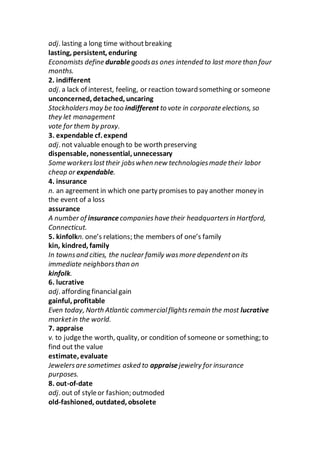
1. contemporary
adj. belonging to the same period or time as something else
concurrent, coexistent, modern
His work wasa contemporary accountof life in the nineteenth century.
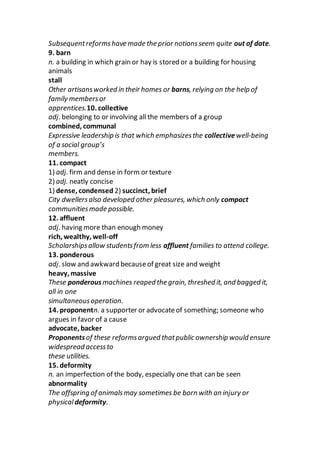
2. afford
1) v. to provide; to give
2) v. to be able to do something or to allow something to happen
1) provide, supply 2) be able, be richenough
Woolblankets were used in the colder regionsof the country because of
the warmth they
afforded.
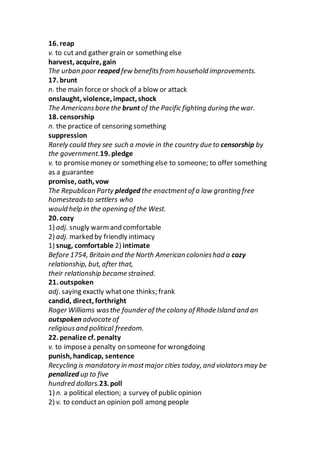
3. annually
adv. once a year; every year
yearly
One of the most notable rodeosin the country is held annually in
Wyoming.
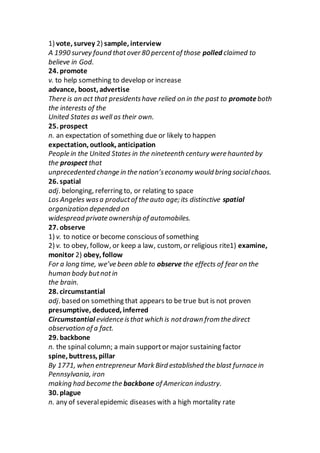
4. ascribe
v. to believe something to be the result or work of
attribute, credit, assign
Tradition ascribes the epic poems to Homer, butlittle is known about
him.
5. imprint
n. a mark or impression made by pressure
mark, track, trace
Experts believe the origin of rice was in Asia due to the imprintsthatthey
found atthe site in
China.
6. apace with
ph. keeping pace with
abreast with
The downtown businessdistrictdid not grow apacewith the city as a
whole.
7. cradle
n. a bed for a small baby, especially one that can be rocked; a place of
origin
bassinet, cot, birthplace
The Nile River is the longestriver in the world and the cradleof
civilization.
8. undoubtedly
adv. without any doubt; surely
certainly, doubtlessly, unquestionably
Undoubtedly, game animalswere major componentsof human diets.
9. cunning
adj. clever in deceiving
deceptive, shrewd, sly
Although they were cunning hunters, primitive humanswere still
threatened by certainanimals.
10. enigmatic
adj. mysterious and very hard to understand
obscure, ambiguous
The rise of Neanderthalman is somewhat enigmatic despite the relative
abundance of fossils.
11. abundant
adj. existing in large amounts
plentiful, profuse, ample
Some women specialized in the gathering of the abundant shellfish that
lived closer to shore.
12. account for
1) ph. to give a reason or explanation for something
2) ph. to constitute; to form
1) explain, clarify 2) make up
Variousmethodsof spattering the glaze onto the ware account for the
extremely wide
variationsin color.
13. cast
v. to shapeby pouring something into a mold and allowing it to set
form, mold, shape
Early civilizations used bronze, an alloy thatcould be cast in molds, to
make tools and
weapons.14. artifact
n. a handcrafted object, especially one that is of archaeologicalinterest
remain, relic, antiquity
The archaeologistsexamined all of evidence from sites very closely and
then determined the
generalage of the artifacts.
15. accommodate
v. to providesomeonewith a place to stay
put up, house, lodge
The adjoining apartmentscould accommodatedozensof families.
16. adorn
v. to makemore beautiful, attractive, or interesting
decorate, ornament, embellish
In the past, men, women, and children adorned themselves with beads.
17. abruptly
adv. in a sudden and unexpected manner; very quickly
unexpectedly, suddenly, instantly
They didn’tcare for the play because it ended so abruptly.
18. acclaim
v. to declare something with noisy enthusiasm
hail, applaud, cheer
The ballerina was acclaimed for her wonderfulperformance.19. bear
1) v. to have; to bring or take
2) v. to supporta weight or load; to accept something without
complaining
1) carry 2) sustain, endure
Alternative history bears some relation to historicalfiction as well as to
science fiction.
20. by chance
ph. without causeor reason; by accident
accidentally, incidentally
The character gained hiswealth by chance, notfrom hard work.
21. abandon
v. to give something up completely
desert, cede, leave behind
Some rituals were abandoned, butthe stories, later called myths,
persisted and provided
materialfor art and drama.
22. abstraction cf. abstract
n. an idea of a quality considered separately from any particular object
or case
conception, notion, representation
A number of sculptorshave rejected the abstractionsof minimalist
artists.
23. agile
adj. able to move or change quickly and easilynimble, quick, swift
Acrobatsmust be extremely agile.
24. surmount
v. to be aboveor on top of; to overcome
ascend, mount, defeat
She managed to surmount the obstacle.
25. aesthetically cf. aesthetic
adv. in an aesthetic manner; in a highly developed senseof beauty
artistically, beautifully, tastefully
Satiresare read because they are aesthetically satisfying worksof art.
26. akin (to)
adj. having the same appearance, character, or nature
similar, alike, related
Her fictitious world is strikingly akin to the realone people live in every
day.
27. diverse
adj. differentfrom each other; showing variety
different, various, assorted
The artwork isdiverse in form and includessculptures, paintingsand
photographs.
28. acquisitionn. theact of obtaining, developing, or acquiring
something
gain, procurement, acquirement
Social-interactionistsbelieve that adults play an importantpartin
children’slanguage
acquisition.
29. outgoing
adj. eager to mix socially with others
friendly, sociable
Gregariouspeople are friendly and outgoing.
30. nuisance
n. something or someonethat causes trouble
annoyance, irritation, inconvenience
After the war, the robber became a small-scale rustler – it wasmore a
nuisancethan highway
robbery.Chapter 01 UNIT02 Social Sciences
1. levy
v. to demand and collect officially
impose, charge, tax
A new tax was levied on consumersof luxury goods.
2. barrier
n. something that is used to keep people or things apart
bar, fence, wall
During pioneer times, the Allegheny Mountainswere major barriersto
transportation.
3. beverage
n. a prepared drink, especially a hot drink like coffee or tea, or an
alcoholic drink like beer
drink, liquid, refreshment
The availability of synthetic fragranceshasmade possible a large variety
of products, from
beverages to used carswith applied “new car odor.”
4. brag
v. to talk boastfully or proudly about oneself and about what one has
done
boast, swagger, talk big
The ownersoften bragged aboutthe quality of the facilities at their
resort.
5. breedv. to reproducesexually; to raisesomething, often an animal
generate, bring forth, rear
Nothing breeds success like success, so he kept signing deals after he got
his first one.
6. speculator
n. someonewho speculates, especially financially
investor, gambler
Excessive investment by speculatorsmay lead to uncontrolled economic
growth.
7. culminate
v. to reach the highest point or climax
climax, consummate
The crisis culminated in the Panic of 1873, when the leading investment
banking firm declared
bankruptcy.
8. propel
v. to driveor push something forward
drive, thrust, impel
By the 1600s, colonialshipbuilderswere strong competitorsin the
shipbuilding industry and
helped to propel heavy transatlantic commerce.
9. auction
n. a public sale in which each item is sold to the person who offers the
most money
public sale, open sale
Auctionswere another popular form of occasionaltrade.10.
urbanization cf. urban
n. the process by which cities grow or by which societies become more
urban
citification
Technologicaldevelopmentsfurther stimulated the processof
urbanization.
11. calamity
n. a catastrophe, or serious misfortunethat causes great loss or damage
disaster, catastrophe, misfortune
The Red Crossprovidesrelief in case of calamitieslike floods,
earthquakes, and hurricanes.
12. infamous
adj. well known for being bad or morally wicked
notorious, disreputable, ill-famed
Jesse Jameswas an infamous outlaw who waswell-known asa bank
robber and gunfighter.
13. notify
v. to tell someone, especially formally
announce, inform, alert
Who should be notified in case you are involved in an accident?
14. misery
n. great unhappiness or suffering
affliction, distress, hardshipJacobRiis, a newspaper reporter and
photographer, revealed the misery of the slums of New
York City.
15. acute
adj. able to notice small differences; showing an ability to understand
things clearly and
deeply
keen, sharp, penetrating
The acutepublic awarenessof social changeswastied to the
tremendousgrowth in popular
journalism in the late nineteenth century.
16. assert
v. to state firmly; to insiston or to defend one’s rights, opinions, or
something else
affirm, state, insist
Slave ownersasserted that their cropswere a greatbenefit to the
economy and thatthe slaves
were needed to work the land.
17. adversity
n. circumstances thatcause trouble or sorrow
hardship, misfortune, suffering
The natives were very tough people who were able to handle adversity.
18. retrieval
n. the act or process of retrieving
recovery, restoration
Memory formation involvesthree main processes; encoding, storage,
and retrieval.19. assembly
n. a group of people gathered together, especially for a meeting
gathering, congregation, congress
All the representativescame to the capital for legislative sessions of the
assembly and council.
20. bill
n. a written plan or draft for a proposed law
act, measure
Even if a bill passes in Congress, it still does notbecome a law until the
presidentsigns it.
21. craft
1) n. a skill, or occupation, especially one requiring the useof the hands
2) v. to make something skillfully
1) expertise, adeptness 2) make, fabricate
Much of the political activity on television newshas been crafted by
politicians and their
public relations advisers.
22. adept
adj. skillfulat doing something
proficient, versed, dexterous
He must be adept at dealing with politicians, public interest groups, and
governmentagencies.
23. enact
v. to establish by law
pass, decree, legislateMarketregulationsare often enacted by corrupt
governmentsfor the purpose of benefiting
well-connected companiesor politicians.
24. eligible
adj. suitable or deserving to be chosen for a job or something else
suitable, qualified, fit
In the United States, citizens are eligibleto vote at the age of eighteen.
25. conclusive
adj. leaving no roomfor doubt or uncertainty
decisive, convincing, definite
Each circumstance may mean little, buta whole chain of circumstances
can be as conclusive
as direct evidence.
26. verbal
adj. relating to or consisting of words
oral, spoken, vocal
Dreamsare commonly made up of both visual and verbal images.
27. able
adj. having the necessary knowledge, power, time, and opportunity to
do something
capable, competent, talented
The head of an academic departmentata university should be notonly a
distinguished scholar
but also an able administer.28. adhere (to)
v. to stick or remain fixed to something
attach, cleave, stick
The child alwaysadheresto the teacher’srules.
29. ban
v. to forbid something
prohibit, bar, outlaw
Some people feel that violent sportslike boxing should be banned
because they are too
dangerous.
30. blunt
adj. having no point or sharp edge; imperceptive
dull, worn, abrupt
The victim wasapparently struck by a club or some other blunt
object.Chapter 01 UNIT03 Natural Sciences
1. cognizant
adj. awareof something or having knowledgeof it
aware, conscious, knowledgeable
A scientist must alwaysbe cognizant of and guard againstbiasskewing
the results of his or
her research.
2. cohesive
adj. having the power of cohering; tending to unite into a mass
condensable, consolidative
The cohesive strength permitscolumnsof water to be pulled to great
heights withoutbeing
broken.
3. confirm
v. to providesupportfor the truth or validity of something
verify, prove, affirm
If observations confirmthe scientists’ predictions, then that will give
supportto their theory.
4. warp
v. to makesomething become twisted out of shapethrough shrinking
and expanding
bend, twist, distort
If boardsbecome wet, they may warp.5. discharge
v. to flow out or to be released; to lose someor all of something’s
electrical charge
let out, release, emit
Sharkscan detectminute electrical signals discharged from their prey.
6. alert
v. to warn someoneof danger; to make someone awareof a fact or
circumstance
caution, alarm, warn
Fire ants make use of an alarm pheromone to alert workersto an
emergency.
7. chamber
n. a room, especially a bedroom; a room set aside for a special purpose
bedroom, room, compartment
Numerousnetworksof tunnelslinked all the different chambers
together.
8. classify
v. to put animals, plants, or something else into a particular group or
category
categorize, divide, sort
Monkeysare classified as primates.
9. claw
n. a hard, curved, and pointed nail on the end of each digit of the footof
an animal
nail, talon
Unlike other cats, the cheetah cannotfully extractits claws.10. aromatic
adj. having a strong but sweet or pleasant smell; sweet-smelling
fragrant, perfumed, pungent
At least 50 different aromatic compoundshave been analyzed in the
orchid family.
11. demonstrate
1) v. to show or provesomething by reasoning or providing evidence
2) v. to show supportor opposition by protesting or marching in public
1) illustrate, explain 2) parade, protest
Many experimentsdemonstrated how some plants can survive with very
little amountsof
water.
12. landmark
n. a mark showing the boundary of a piece of land; an occasion, event,
or development of
importance
milestone, watershed, turning point
Some experts have suggested thatmigrating birds find their way by
following landmarkslike
rivers and mountain ranges.
13. bloom
v. to be in or come into flower; to be growing well
blossom, flourish, prosper
Most flowersbloomin the spring.
14. venomousadj. having theability to poison
poisonous, toxic
The rattlesnake is the most common venomoussnake in the United
States.
15. botanical
adj. of, pertaining to, made from, or containing plants
phytological
One of the most beautiful botanical gardensin the United States is the
wild and lovely
Magnolia Gardensin South Carolina.
16. ambidextrous
adj. able to use both hands equally well; unusually skillful
talented, gifted, adept
Right-handersare said to make up 80% to 90% of all people and
left-handers5% to 15%
while the remaining tiny percentage is ambidextrous.
17. advent
n. a coming or arrival; a first appearance
arrival, appearance
With the advent of the Vietnam War, the Air Force wanted a system to
help it navigate over the
junglesof SoutheastAsia.
18. alien
adj. fromanother country or society; connected with creatures from
another world
exotic, foreign, outlandishThe alien in the Earth’score make it a far
more alien world than space.
19. boulder
n. a large piece of rock that has been rounded and worn smooth by
weathering and abrasion
rock
The mineralparticles found in soil range in size from microscopic clay
particles to large
boulder.
20. stable
adj. firmly balanced or fixed; not likely to wobbleor fall over
steady, secure, firm
A roadbed suppliesa stable base for a highway.
21. permeable cf. permeate
adj. allowing certain liquids or gases to pass through something
penetrable, pervious
In some cases, wells can draw water from a permeablerock layer.
22. eject
v. to throw out someoneor something with force
banish, boot, expel
Geysersperiodically eject streams of hot water into the air.
23. hem
v. to surround something closely and prevent its movementenclose,
encase, hedge
The GreatBasin is hemmed in by the Sierra Nevada Mountainsto the
west and by the Rocky
Mountainsto the east, giving it no outlet to the sea.
24. core
n. the innermost, central, essential, or unchanging part
center, heart, nucleus
The asteroids’ compositionsare believed to be similar to that of Earth’s
iron core.
25. hamper
v. to hinder the progress or movementof someoneor something
impede, obstruct, block
Bad weather hampered the rescue crewstrying to locate the life rafts.
26. synthesize
v. to combine simple parts to form a complex whole; to make or produce
combine, mix, compose
It is importantto note that animal cells cannot synthesizesome complex
molecules from
simple compounds.
27. delicate
adj. easily damaged or broken; made or formed in a very careful and
detailed way
fragile, breakable, exquisite
Earth is not too close or too far away from the sun to upset the delicate
temperature
requirementsof life.28. fuel
1) n. any material that releases energy when burned
2) v. to fill or feed with fuel
1) energy, power 2) feed, nourish
The sun is fueled by thermonuclear reactionsnear itscenter that convert
hydrogen to helium.
29. shrink
v. to makeor become smaller in size or extent
wither, shrivel, contract
About5 billion yearsfrom now, the sun’score will shrink and become
hotter.
30. efficiency
n. the quality of doing something well with no wasteof time or money
effectiveness, productivity
Even some supportersof alternative energy realize thatthe easiest way
to cut carbon
emissions is to focusmore on efficiency.Chapter 01 UNIT04 Applied
Sciences
1. appeal
n. an urgentor formalrequest for help; the quality of being attractive or
interesting
solicitation, attraction, charm
The appeal of iron comesfrom its low cost, strength, and resistance to
fire.
2. bind
v. to tie or fasten tightly; to force someoneto do something by making
him or her promiseto
do it
tie, constrain, obligate
Hotels were some of the earliest places that helped bind the United
States together.
3. sway
v. to swing or to make something swing; to incline toward a particular
opinion
wave, swing, tilt
In high winds, skyscraperswill sway slightly.
4. beneficial
adj. having good results or benefits
helpful, useful, advantageous
Some bacteria are beneficial since they stimulate plant life through food
decomposition.
5. alludev. to mention something indirectly; to speak about something in
passing
hint, mention, refer
The word “zigzag” alludesto the geometric ornamentation.
6. alter
v. to become different or to make something or someonebecome
different
change, convert, transform
As Earth developed, the concentrationsof the pollutants were altered by
variouschemical
reactions.
7. appreciation
n. sensitiveunderstanding of the value or quality of something
recognition, understanding, admiration
With concernsaboutthe loss of species, there is a growing appreciation
for the importance of
biologicaldiversity.
8. barren
adj. not able to producecrops or fruit; not able to bear offspring
infertile, sterile, unproductive
We can see large, pristine forestson one side and an almost barren land
devoid of trees on the
other side.
9. comparatively
adv. according to an estimate made in comparison; not absolutely
relatively, nearly, approximatelyThe firstattemptto dig the canalwas
made by private companies, and only a comparatively
small portion wasbuilt.
10. clue
n. a fact or circumstancewhich helps toward the solution of a crime or a
mystery
hint, evidence, indication
There were no clues as to how the animal died.
11. voluminous
adj. producing greatquantities of writing; enough to fill many volumes
copious, bulky, huge
The ecologist had voluminouscorrespondence and frequentdiscussions
with other expertsin
the field.
12. thrive
v. to grow strong and healthy
prosper, flourish
Barley, unlike most other grains, thrivesat high altitudes, so it can be
grown in many places.
13. facilitate
v. to makesomething easy or easier to do or to achieve
expedite, ease, promote
Research into hydrogen technologywas facilitated by money from
Congress.
14. boundaryn. a line or border marking the farthest limit of an area
border, bounds, limit
Lake Superior formsa natural boundary between the United States and
Canada.
15. advocate
n. someonewho supports or recommends an idea or proposal
proponent, supporter, patron
Advocatesof organic foodsfrequently proclaim thatsuch productsare
safer and more
nutritiousthan others.
16. cope with
ph. to manage successfully; to deal with
handle, dispose of
The human body isusually unable to copewith extremely hot or cold
temperatures.
17. crucial
adj. extremely important because the thing will affect others
decisive, critical, vital
Obviously, muscles are crucial to the human body.
18. inhibit
v. to hold back or preventan action, desire, or progress; to prohibit
someone fromdoing
something
check, restrain, bar
Antibiotics inhibit the growth of bacteria.19. illusion
n. a deceptive or misleading appearance
fantasy, delusion, hallucination
Optical illusionsdeceive the eye with tricks of perception.
20. specimen
n. a small amountof something that shows whatthe rest of it is like; a
sample or example of
something, especially something that will be studied
example, sample, case
Many medicaltests require a blood specimen.
21. breakthrough
n. a sudden achievement; a decisive advance or discovery, especially in
scientific research
advancement, improvement
The new vaccine represented a significant breakthrough in the battle
againstthe virus.
22. codify
v. to arrangesomething into a systematic code or laws
systematize, formulate
By the 1500sin Europe, the collected knowledge of the human body was
codified.
23. anatomy
n. the art of dissection; the scientific study of the structureof living
organisms, including
humansdissection
ThomasEakins studied not only painting but also anatomy when he was
training to become an
artist.
24. acrid
adj. having a very bitter and pungent smell or taste
pungent, tart, bitter
Burning rubber producesan acrid smoke.
25. corpse
n. the dead body of a human being or an animal
cadaver, carcass, remains
The decomposing corpseof a dead antis generally removed from the
colony by worker ants.
26. finite
adj. having an end or limit
limited, restricted, bounded
Many people fear that Earth’ssupply of oil is finiteand that we will run
out of energy
someday.
27. ignite
v. to set fire to something
burn, inflame, kindle
When exposed to air, phosphorous ignitesspontaneously and forms
white fumeswhen it burns.28. manipulate
v. to handle something or to work something with the hands, especially
in a skillful way
control, operate, direct
The pilot must manipulatethe controlsto take off, to change directions
and speed, and to land.
29. drainage
n. a process or systemby which wasteliquid flows away
draining, sewage
That province hasa history of underground faultsthathas created an
efficient water drainage
system.
30. ventilate
v. to allow fresh air to circulate throughouta room or a building
air
Most modern barnsare insulated, ventilated, and equipped with
electricity.Chapter 02 UNIT 05 Humanities
1. daring
adj. braveenough to do risky things; new or unusualin a way that may
shock people
courageous, adventurous, bold
Richard Bird and his pilot Floyd Bennett undertook a daring flightto the
North Pole in May
1926.
2. depress
1) v. to weaken something; to make something lower
2) v. to make someonesad and gloomy
1) weaken, lower 2) dishearten, sadden
Rent controlshave artificially depressed the most importantlong-term
determinantof
profitability: rents.
3. disaster
n. an event causing great damage, injury, or loss of life
calamity, catastrophe, cataclysm
When their cropsfailed, it wasa disaster that caused many people to
lose their lives.
4. domain
n. the scopeof any subjector area of interest
field, realm, sphere
The empire wassilently, butquickly, extending its domain.5. decipher
v. to translatea text in an unfamiliar or strangeform of writing into
ordinary language
decode, unravel, interpret
They could decipher the tablets because the language wasa Semitic one
that scholarshad first
translated a decade ago.
6. ascend
v. to climb something or to move to a higher position
arise, climb, mount
The pueblo architectslaid out a system of public roadswith stone
staircases for ascending
cliff faces.
7. avid
adj. very enthusiastic about something
ardent, eager, passionate
PresidentTheodore Roosevelt wasan avid conservationistwho believed
in preserving nature.
8. restrict
v. to keep someoneor something within certain limits
confine, limit, restrain
The study of fossilized footprintsis not restricted to examples from
millions of yearsago.
9. roughly
adv. not exactly
approximately, around, aboutThe population roughly doubled every
generation during the restof the nineteenth centuries.
10. settled
adj. established in someroutine
arranged, fixed, inhabited
With the settled routine of Neolithic farmerscame the evolution of
townsand, eventually,
cities.
11. attire
n. clothes, especially formal or elegant ones
clothes, apparel
He indicated several weeksago that he would wear formal attireathis
inauguration.
12. component
n. any of the parts or elements that make up a machine, engine, or
instrument
constituent, element, factor
The time scale is divided into three time components; eons, eras, and
periods.
13. considerable
adj. fairly large, especially large enough to havean effect or be
important
notable, sizable, substantial
The book wasa considerable improvementover the only other
instruction manualexisting at
the time.14. thanks to
ph. because of
owing to, as a result of
Thanks to the unending pressuresof the work, he decided to quit his
business.
15. adversary cf. adverse
n. an opponentin a competition
enemy, foe, opponent
By adulthood, Genghishad been through a seriesof rough-and-tumble
encounterswith various
adversaries, who tried to enslave or kill him and his family.
16. afterlife
n. the life that some people believe people have after death
hereafter
It is said that death is a new beginning when the deceased passes from
the restrictions of this
life into the afterlife.
17. compose
v. to create music, poetry, or something else; to make up or constitute
something
set tomusic, constitute, form
Certain films had music specifically composed for them.
18. costume
n. a set of clothing of a special kind, especially of a particular historical
period
apparel, attire, dressWearing masksand costumes, they often
impersonated other people, animals, or supernatural
beings.
19. overall
adj. including everything
total, whole, entire
A book’stable of contentsprovides readerswith an overall idea of what
it is about.
20. assimilate
v. to become a part of a country or community; to completely
understand and begin to use
new ideas, information, or something else
make similar, absorb
The immigrantsquickly assimilated to life in their new country and
learned both its language
and customs.
21. assumption
n. something that is accepted as true without proof
presumption, supposition
The assumption of many expertsis that drama evolved from various
rituals.
22. attachment cf. attach
n. an act or means of fastening; liking or affection
fastening, bond, affection
Emotionalattachmentsplay a significant role in the decisions that
people make.23. carry out
ph. to do the work of; to bring, take, or convey something
perform, convey, transport
African-American graphic artists carried out effortsto increase and
promote the visual arts.
24. coin
1) v. to invent a new word or phrase
2) v. to manufacturecoins from metal
1) originate, create 2) mint, stamp
The term “beat” was coined by HerbertHuncke, who meantit to be a
synonym for tired or
down and out.
25. aristocracy
n. the highest social class, usually owning land and having titles
gentry, upper class
He is a member of the aristocracy buthaslittle in terms of monetary
wealth.
26. bland
adj. withoutany excitement, strong opinion, or special character; having
very little taste
boring, insipid, tasteless
The main issue wasthat such a rigid structure made the opera bland and
at times predictable.
27. emphasize
v. to put an emphasis or stress on something
stress, highlight, underscoreMothersexaggerate their facialexpressions,
hold vowels longer, and emphasizecertain words
when they communicate with their children.
28. dialect
n. a formof a language spoken in a particular region or by a certain
social group
vernacular, tongue
They studied the local dialect and wrote storieswhich focused on life in
specific regionsof the
country.
29. come up with
ph. to produce something or to have an idea
conceive, hit upon
Companiesare being required to come up with innovative waysof
cutting costs because of the
economic circumstances.
30. current
1) adj. belonging to the present
2) n. the continuous steady flow of a body of water, air, or heat in a
particular direction
1) present, contemporary 2) flow, stream
The term “folk song” hasbeen current for over a hundred years.Chapter
02 UNIT 06 Social Sciences
1. spark
v. to emit sparks of fireor electricity; to stimulate, provoke, or start
ignite, stimulate, initiate
The booming economy sparked an explosion in realestate development.
2. devastate
v. to causegreat destruction in or to something
ruin, destroy, ravage
After the war devastated the country, it took many years for everything
to be rebuilt.
3. encourage
v. to give support, confidence, or hope to someone
cheer, hearten, inspire
The state government encouraged the internalimprovementsof the
corporationsin two
distinct ways.
4. effect
n. a resultor condition produced by a cause; the way in which an event,
action, or person
changes someone or something
result, consequence, impact
In the United States in the early 1800s, state governmentshad more
effect on the economy
than the federalgovernment.5. end
n. an objector purpose
aim, goal
Toward the end – to restore stability to the economy –the government
pursued severalcourses
of action.
6. toll
n. a fee or tax paid for the use of a bridge or road
charge, duty, impost
The canallived up to the investors’ expectations, quickly paying for itself
through tolls.
7. warrant
v. to justify something; to guarantee something as being of a specified
quality or quantity
justify, promise, assure
Further explanationswere not warranted since everyone understood
whatwashappening.
8. phase
n. a stage or period in growth or development
state, period, stage
A full-scale Keynesian policy should grantthe governmenta role in all
phases of economic
life.
9. fragrance cf. fragrant
n. sweetness of smell
odor, scent, balmNaturalflavoringsand fragrancesare often costly and
limited in supply.
10. sheer
adj. complete and not mixed with anything else
absolute, downright, plain
The decade of the 1870swasa period in which the sheer number of
newspapersdoubled.
11. significant
adj. important; worth noting or considering
critical, weighty, meaningful
The Civil Rights Act of 1964 wasa particularly significant piece of
legislation to African-
Americans.
12. concern
1) n. a feeling of worry aboutsomething important
2) n. a company or business
1) anxiety, apprehension 2) enterprise, firm
A business concern with two or more ownersis referred to as a
partnership.
13. sparse
adj. thinly scattered or dotted about
meager, scant, few
If the population in an area was sparse, the Black Death usually ran out
of steam within a
year.14. undertake
v. to accept a duty, responsibility, or task
take on, assume, accept
The Erie Canalwasone of the greatest construction jobsthatanyone had
ever undertaken up
to that point.
15. catastrophic
adj. relating a terrible event in which there is a lot of destruction
calamitous, disastrous
A tsunami can be a catastrophic eventthat kills thousandsof people and
destroystheir homes
and buildings.
16. coincide with
ph. to happen at the same time as
concur with, clashwith
The rapid growth of Boston coincided with the immigration of huge
numbersof people there.
17. alleviate
v. to makepain, a problem, suffering, or something else less severe
ease, relieve, mitigate
A supportnetwork of relativesand friendscan alleviate much of the
burden of raising a child.
18. antagonistic
adj. unfriendly; opposed to an idea or group
hostile, opposing, conflictingMostplantation ownerswere antagonistic
to the developmentof the towns.
19. declare
v. to announcesomething publicly or formally
announce, proclaim, pronounce
The United States declared war and quickly sentmen to the European
frontduring World War
II.
20. deem
v. to think of something in a particular way or as having a particular
quality
consider, judge, think
The presidentcan make such regulationscovering the prohibition of
alcoholic liquorsas may
be deemed necessary.
21. equality
n. the state or quality of being equal
impartiality, fairness, equivalence
In 1957, Ralph Abernathyfounded an organization devoted to achieving
racialequality for
black Americans.
22. collapse
n. a sudden failure of something, such as an institution or a business, or
a courseof action
break-down, downfall, disintegration
The enormoussize of the Roman Empire made it increasingly difficultto
defend, setting the
stage for its eventual collapsein 476.23. bar
v. to officially prevent someone from doing something
forbid, prohibit, ban
The political party urged thatimmigrantsbe barred from running for
public office.
24. succinct
adj. clearly expressed in a few words; to the point
brief, concise, precise
He wrote a succinct and graphic accountconcerning the slum and
housing problem in New
York City.
25. constrict
v. to makesomething narrower or tighter
compress, contract, squeeze
The experts predicted thatgrowth could notcontinue and that the tight
labor marketwould
constrict the economy.
26. allegiance
n. a commitment and duty to obey and be loyal to a governmentor
sovereign
faithfulness, fidelity, loyalty
While some of the Indianshad formed allegianceswith French Jesuit
priests, they were far
more suspicious of the British soldiers.
27. appealingadj. evoking or attracting interest, desire, curiosity, or
sympathy
attractive, inviting, fascinating
The most appealing publishing investments were small booksthatwere
steady sellers.
28. suit
v. to be appropriateto; in harmony with
fit, adapt, adjust
Reformerssuggested that the education programsshould suit the needs
of the population.
29. cite
v. to mention something as an example, especially one that supports,
proves, or explains an
idea or situation
quote, mention, refer to
When writing research papers, writersmust citethe sourcesthey use.
30. flaw
n. a mistake, mark, or weakness that makes something imperfect
fault, defect, blemish
A flaw in a jewel makesit less valuable.Chapter 02 UNIT07 Natural
Sciences
1. disperse
v. to spread out over a wide area
diffuse, scatter, dissipate
The factthat white light is composed of variouswavelengthsmay be
demonstrated by
dispersing a beam of light through a prism.
2. emerge
v. to come out fromsomewhere
appear, arise, turnout
The species emerged from the water and moved onto the land.
3. emit
v. to give out light, heat, a sound, or a smell
sendout, discharge, eject
Certain gases such as neon emit light when exposed to an electrical
current.
4. vertical
adj. pointing up in a line that forms an angle of 90º with a flat surface
upright, erect, perpendicular
Although there are both horizontaland vertical movementsof air, the
term “wind” applies
only to horizontalmovement.5. exhilarating
adj. filling someone with a lively cheerfulness
invigorating, refreshing, cheering
Riding a space shuttle can be an exhilarating experience.
6. dense
adj. closely packed or crowded together
compact, solid, thick
The jungle is incredibly dense because of the huge amountof vegetation
growing in it.
7. determine
v. to fix or settle the exact limits or nature of something; to form a firm
intention
conclude, decide, resolve
Canadian researchershave discovered a set of genes that determinethe
lifespan of the
common nematode, a type of worm.
8. dissenting
adj. disagreeing, especially openly or hostilely
discording, disagreeing, conflicting
Our understanding of these ancient beasts hasgrown slowly, with many
dissenting opinions
among the experts.
9. edible
adj. fit to be eaten; suitable to eat
eatableCelery, an edibleplantwith long stalks topped with feathery
leaves, growsbest in cool
weather.
10. entire
adj. with nothing left out
complete, whole, total
Entirecropscan be wiped outby fungalattacksboth before and after
harvesting.
11. fatal
adj. causing or resulting in death
mortal, lethal, deadly
Honeysuckle isa shrub that has fatal white or yellowish blossoms.
12. succumb
v. to give in to pressure, temptation, or desire
surrender, yield, give up
Most birds would succumb to the harsh weather and die if they did not
migrate south for the
winter.
13. crave
v. to havea very strong, almost uncontrollable, desire for
desire, yearn, long for
Some insects may help ants by cleaning them or by giving them
chemicalsthey crave.
14. uprightadj. standing straightup
erect, vertical, perpendicular
Kangaroosuse their long and powerfultails to balance themselves when
sitting upright or
jumping.
15. venture
v. to be so bold as to; to attempt something dangerous
risk, gamble, dare
Must crustaceanslive in the sea, but some live in fresh water, and a few
have ventured onto
land.
16. brood
n. a number of young animals, especially birds, that are produced or
hatched at the same time
offspring, progeny, young
The mother duck led her brood into the pond.
17. bring about
ph. to cause to happen, occur, or exist
cause, produce, effect
Earthwormsbring about changesin the soil by enriching it and making it
more fertile.
18. carry
1) v. to hold something in one’s hands or back while moving
2) v. to supportsomething’s weighton one’s body
1) convey, transport 2) support, maintainSome partsof the lithosphere
carry the ocean floor, and otherscarry land massesor a
combination of the two types.
19. comprise
v. to contain, include, or consistof something specified
compose, form
The core, mantle, and crust comprise the three layers of the Earth.
20. uncharted
adj. not fully explored or mapped in detail; not yet examined or fully
investigated
unmapped, unexplored, unknown
The ocean bottom is a vast frontier thateven today is largely unexplored
and uncharted.
21. dot
1) v. to scatter; to cover with a scattering
2) n. a small and round mark
1) spot, fleck 2) speck, point
Steep, round hills called knobs dot southern Indiana.
22. imaginary
adj. existing only in the mind or imagination; not real
imagined, fictitious, fictional
The equator is an imaginary line running around the center of the Earth.
23. receptaclen. a container or device that receives or holds something
container, holder, repository
The broken valleysof the Great Basin provided ready receptaclesfor the
moisture.
24. diminish
v. to become or make something less or smaller
decrease, reduce, dwindle
The power of a hurricane becomesimmediately diminished once over
land because it is
disconnected from its warm-water energy source.
25. balmy
adj. warmand soft
gentle, mild
The Virgin Islands, located in the Caribbean Sea, have a balmy climate.
26. desperately
adv. recklessly or dangerously becauseof despair or urgency
impetuously, urgently, hopelessly
The moon and Marscould be a future source of naturalresources
desperately needed on Earth.
27. flame
v. to burn with flames
blaze, flare, glow
Jupiter would have flamed as a star in its own light.28. sustainable
adj. capable of being sustained or maintained
supportable, endurable, bearable
Something absolutely necessary for a sustainable human settlementis
water.
29. terrain
n. a stretch of land, especially with regard to its physicalfeatures
topography, territory, landscape
The moon may be divided into two major terrains; the maria and the
terrace.
30. extinguish
v. to put out a fire
put out, quench
After two full weeksof trying to fight it, the fire from the explosion was
finally extinguished.Chapter 02 UNIT08 Applied Sciences
1. confine
v. to keep within limits; to keep in a small or enclosed space
restrict, limit, restrain
Workersin clay could generally afford to confinethemselves to either
decorated waresor
housewares.
2. dwelling
n. a house, flat, or something else where people live
habitation, house, residence
A few houses in New England were built of stone, but only in
Pennsylvania and adjacentareas
wasstone widely used in dwellings.
3. fasten
v. to makesomething firmly closed or fixed
tie, attach, lock
Before the plane takes off, passengersmust fasten their seatbelts.
4. raze
v. to destroy something like a building or a town completely
demolish, tear down, knock down
Wrecking ballsare used to razebuildings.5. annihilate
v. to destroy something completely
exterminate, eliminate
Human beingshave the power to annihilate many speciesas well as
damage the balance of
their own balance with nature.
6. clumsy
adj. unskillfulwith the hands or awkward and ungainly in movement
unhandy, ungraceful, awkward
Seals appear clumsy on land, butthey are able to move short distances
faster than most people
can run.
7. conceal
v. to hide; to place out of sight
hide, cover, secrete
The researchersarguedthatthe city was threatened by faultswhich lay
concealed
underground inside it.
8. critical
adj. of or being a moment of great danger, difficulty, or uncertainty
crucial, vital, momentous
Biological diversity hasbecome widely recognized asa critical
conservation issue.
9. demise
n. the termination of existence or operation
death, lossA shortage of fundsled to the demise of the program.
10. deplete
v. to reducegreatly in number or quantity; to use up supplies, money,
energy, or resources
consume, expend, exhaust
The remainsof organismsare recycled in the earth, which is fortunate
because, otherwise, soil
and water would soon become depleted of essential nutrients.
11. sequence
n. a series or succession of things in a specific order; the order two or
more things follow
series, succession, order
Equally interesting is the fact that the ants’ execution of multiple-step
tasks is accomplished in
a series-parallelsequence.
12. turbulent
adj. having a restless or uncontrolled quality; violently disturbed
wild, unruly, stormy
Small mammalssuffer hardship in the exposed and turbulent
environmentof the uppermost
trees.
13. typify
v. to be an excellent or characteristic example of something
exemplify, represent, symbolize
High mountains typify the terrain of Tibet and Nepal.14. unprecedented
adj. withoutprecedent; not known ever to have happened before
unheard-of, unusual
The developed countriesof the world are using valuable resourcesatan
unprecedented rate.
15. feverish
adj. having a tendency to producea fever; excited, restless, or
uncontrolled
inflamed, fervent, passionate
The Civil War created feverish manufacturing activity to supply critical
materials, especially
in the North.
16. permanent
adj. lasting or intended to last for a long time
eternal, perpetual, everlasting
Heavy drinking can cause permanent damage to the brain.
17. maintain
1) v. to keep something in existence
2) v. to continue to arguesomething
1) preserve, keep 2) contend, claim
Consumersare misled if they believe organic foodscan maintain health
and provide better
nutritionalquality than conventionally grown foods.
18. screen
1) v. to shelter or conceal2) v. to test someonein order to check for the
presenceof a disease
1) shield, cover 2) examine, scan
Now, all blood is rigorously screened for HIV and other viruses.
19. stride
n. a single long step in walking; an advance or development
pace, step, development
From these studies, great strideshave been made in treating patients.
20. surpass
v. to go or be beyond in degree or extent
better, exceed, outdo
It was reported thatinternalmedicine would surpass surgery in value to
the human race
within the next twenty-five years.
21. unsubstantiated
adj. not substantiated; unable to provethe truth of something
unverified, unproved
There are numerous unsubstantiated reportsthatnaturalvitamins are
superior to synthetic
ones.
22. ward (off)
v. to fend off, turn aside, or parry a blow; to keep trouble, hunger, or
diseaseaway
block, avoid, avert
Some plants are able to ward off animals by emitting noxious fumesthat
drive them away.23. articulate
v. to pronouncewords or to speak clearly and distinctly
enunciate
Each sound is considered and analyzed before itis articulated.
24. element
n. a partof something; a component or feature
constituent, ingredient, factor
Hydrogen, although itis the most abundant element in the universe, is
not freely found on
Earth.
25. fabric
n. woven, knitted, or felted cloth
textile, cloth
Naturalsilk is highly prized in spite of the availability of similar artificial
fabrics.
26. serve as
ph. to be in the serviceof; to work for
functionas, act as
Pheromonesare substancesthat serve as chemicalsignals between
membersof the same
species.
27. brittle
adj. hard but easily broken or likely to breakfragile, breakable, weak
Steel is notas brittleascast iron, so it does not break aseasily.
28. vibration
n. a vibrating motion; a single movement back and forth in vibrating
oscillation, shaking, shivering
The sensation of sound is produced when vibrationstransmitted through
the air strike the
eardrum.
29. dazzling
adj. temporarily blinding; fascinating
brilliant, bright, dizzying
The snow on the mountaintop was dazzling in the brightmorning sun.
30. device
n. a tool or instrumentmade for a special purpose
instrument, apparatus, contrivance
An odometer is a device used to measure distance.Chapter 02 UNIT09
Humanities
1. outlaw
n. someonewho has committed a crime
gangster, desperado, criminal
Jesse wasan outlaw, a bandit, and a criminal.
2. enable
v. to makesomeone able to do something
entitle, empower, capacitate
The economic aid would only last long enough to enable the people to
help themselves.
3. fundamental
adj. serving as or being an essential partof a foundation or basis
essential, rudimentary, basic
The fundamental ideals embodied in the Constitution should not be
lightly considered.
4. ignorant
adj. lacking knowledge or information aboutsomething
unknowing, unaware, unlearned
Critics ignorant of the conditionsattacked the proposed method to fix
the problem aswasteful
and dangerous.
5. transportationn. theact of transporting or the process of being
transported
conveyance, moving, carriage
Steam travel finally became a viable means of transportation in the late
eighteenth centuries.
6. behold
v. to look at something or someone
notice, see, look at
The steamboatsmust have been something to behold on the rivers due
to their size and
elaborate, even luxurious, construction and appearance.
7. mobility cf. mobile
n. the ability to be moved easily
movability, portability, transportability
The troops’ mobility wastheir greatestasset in warfare.
8. moreover
adv. beside what has been said; and what is moreimportant
in addition, besides, furthermore
Moreover, even when people in differentplacesuse the material in a
similar manner, the style
of their work still varies.
9. chore
n. a domestic task; a boring or unenjoyabletask
drudgery
The earliest pottery wasused for chores, with no attempt to make them
worksof art.10. partition
v. to divide into parts, pieces, or sections
separate, divide, split
Partitioned roomsin log houses became the new style as they replaced
the simple cabins
people used to live in.
11. paramount
adj. greater than all others in importance or influence; of supreme
importance
primary, supreme, predominant
Tradition is paramount, and mosttribes are hesitant to make any
changes.
12. durability
n. the ability to be strong and to last for a long time withoutbreaking or
becoming weaker
endurance, stability, firmness
The durability of the pottery wascrucialto the tribes since making
ceramicswasnot easy for
them to do.
13. establish
v. to set up
create, found, organize
The Rodeo Cowboy Association wasfounded in 1936 to establish
standardsand regulations
for the sport.
14. ethnicadj. relating to or having a common race or cultural tradition
racial, native
The Harlem Renaissance combined realism, ethnic consciousness, and
Americanism.
15. assortment cf. an assortmentof
n. a mixed collection
group, collection, array
An assortment of bones wasfound atthe site, which helped improved
scientists’ understanding
of the ancientculture.
16. clarity
n. the quality of being clear and pure
clearness, distinctness, definition
Clarity and structure became the foundation of the opera seria.
17. witness
v. to see or notice something by being present when it happens
observe, behold, watch
In 1905, he wentto Paris to work with an art dealer, and it wasthere
that he later witnessed
the formative yearsof Cubism.
18. devote
v. to useor give up a resourcesuch as time or money wholly to some
purpose
dedicate, pledge, consecrate
Ordinary citizenssometimes devotetheir entire lives to serving humanity
unselfishly.19. enforce
v. to causea law or decision to be carried out effectively; to make
something happen
administer, implement, carry out
These images are meantto enforce how foolish and pitiful the character
really is.
20. essence
n. the basic distinctive partor quality of something, which determines its
nature or character;
a basic nature
nature, principle, core
The essence of folk music is how it reflects the humanity of the people
who created it.
21. climax
n. the high point or culmination of a series of events or of an experience
peak, apex, culmination
Arias usually followed asa climax and revealed the emotion or internal
conflictof the actors.
22. composite
n. a combination of two or morematerials
aggregate, combination, compound
Some say that neither the Iliad nor Odyssey was written by a single poet
but rather thateach
poem is a compositeof the writings of several people.
23. encompass
v. to surround completely; to include or be concerned withencircle,
enclose, include
The term “art deco” hascome to encompass three distinct butrelated
design trendsof the
1920sand 1930s.
24. deliberate
adj. done on purposeor as a result of carefulplanning
intentional, planned, careful
The artist began the deliberateprocessof painting the individual flowers
in his landscape.
25. husbandry
n. the farming business
farming, agriculture
The adventof animalhusbandry led to advancementsin every aspect of
human development
from science to psychology.
26. hallmark
n. a typical or distinctive feature, especially of quality
characteristic, identification
One hallmark of jazz music is the way thatthe best musicians can
improvise so easily during
their performances.
27. gesture
n. the movement of the body as an expression of meaning
motion, indication, signal
In all cultures, gestures are used as a form of communication.28.
discipline
1) n. strict training or the enforcing of rules
2) n. an area of learning
1) drilling, regulation 2) field, area
Every scientific discipline tendsto develop its own special language
because it findsordinary
wordsinadequate, and psychology isno different.
29. gala
n. an occasion of special entertainment or a public festivity
celebration, festival, feast
Many people celebrate the new year with gala parties.
30. immerse
v. to put completely under water
sink, dip, submerge
Daguerre discovered thatan image could be made permanentby
immersing it in salt.Chapter 03 UNIT 10 Social Sciences
1. engage in
ph. to take partin; to be involved in
participate in, partake in, enter into
In the early 1800s, over 80 percentof the United States’ labor force was
engaged in
agriculture.
2. exclusive
adj. involving the rejection or denial of everything else
sole, only, unique
A copyrightisan exclusiverightto copy, sell, or perform a creative work
such as a book or
play.
3. halt
n. an interruption or stop in movement, progression, or growth
stop, cessation, standstill
World War II began, which broughtan immediate halt to all commercial
airline service to
Europe as well as Asia.
4. precious
adj. of great value, especially because something is very expensive or
much loved
valuable, dear, beloved
Salt wasonce so precious that some cultures used it as a form of
money.5. prosper
v. to do well, especially financially
flourish, thrive, succeed
Trade with Britain and the West Indiesallowed Colonialseaportssuch as
Boston to prosper.
6. sluggish
adj. unenergetic; habitually lazy or inactive
stagnant, lethargic, lazy
Some economistsbelieve that the best way to get a sluggish economy
moving again is to cut
taxes.
7. sound
adj. not damaged or injured; in good condition
undamaged, unimpaired, firm
Governmentbondsand blue-chip stocksare sound investments.
8. ware
n. manufactured goods of a specified material or for a specified rangeof
use
merchandise, commodity, supply
In the past, many salesmen tried to sell their wares door-to-door.
9. pervasive
adj. tending to or having the power to spread everywhere
prevalent, widespread, permeateThe influence of the thoughtshasbeen
so pervasivethat its theoreticalapproacheshave come
to be known in academic circlesas the Chicago School.
10. nurse
v. to hold something with care; to look after sick or injured people
care for, look after, attend
Female lions cannotgo into estrusand get pregnantwhile they are
nursing lion infants.
11. proceed
v. to makeone’s way; to go on
advance, progress, continue
Real estate subdivision in the cities proceeded much faster than
population growth.
12. donate
v. to give, especially to charity
contribute, bestow, grant
In 1899, Mary Elizabeth Browndonated a couple of hundred musical
instrumentsto the
museum.
13. remarkably
adv. considerably; significantly
noticeably, unusually, extraordinarily
The urban population grew remarkably quickly during thistime, mostly
because people were
moving to the cities to look for work.14. gregarious
adj. seeking and enjoying the company of others
companionable, sociable
A gregariousperson avoidssolitude.
15. confer
v. to grantsomeone an honor or distinction
give, award, present
In the family, traditionalculturalpatterns confer leadership on one or
both of the parents.
16. constitute
v. to be an element or part of; to establish laws or an institution
form, compose, establish
A soldier’s refusalto commitan illegal act does not constitute rebellion.
17. linear
adj. of, consisting of, or using lines; extended or arranged in a line
straight, straightway
The usually uncriticalacceptance of this thesis led in turn to the
assumption that the
application of science to industrialpurposeswasa linear process.
18. bias
n. an inclination to favor or disfavor oneside against
inclination, prejudice, leaning
Throughoutthe 19th century and into the 20th century, farmersin the
U.S. maintained a biasagainstbig cities.
19. exempt
adj. free fromsomeobligation; not liable
excused, free, immune
Some parentswere motivated to send their children to private schools,
which were exempt
from governmentalrestrictions.
20. negligible
adj. small or unimportant enough to ignore
trivial, insignificant, trifling
Although the accidentappeared serious, only a negligible amountof
damage wasdone.
21. impose
v. to makea paymentof a tax or fine; to make the performanceof a duty
compulsory
levy, place, force
The government imposed strict regulationson the people for the
duration of the war.
22. reckless
adj. heedless of the consequences of one’s actions or behavior
rash, careless, imprudent
Motorists can be fined for reckless driving.
23. bound
n. a limit or boundary; a limitationborder, confines, extent
Education knowsno bounds.
24. atheist
n. a person who denies or disbelieves the existence of a supremebeing
or beings
nonbeliever, infidel
Allen was an outspoken atheist who wasan advocate of deistic thought.
25. detect
v. to see or to notice; to discover the presenceof
uncover, discover, notice
The objective of the experimentwasto detect consciousnessin animals
to see if they are self-
aware or not.
26. milestone
n. a very importantevent; a significant point or stage
landmark
Gallup’sreportof the experimentwas milestonein our understanding of
animalminds.
27. overthrow
v. to defeat completely an established order or a government
overpower, dethrone, defeat
In 509 B.C., the Roman Republic wasestablished after the citizens of
Rome overthrew the
ruling Etruscans.28. overtax
v. to demand too much tax from someone; to burden heavily
overload, overdo
The public school system suddenly found itself overtaxed.
29. headquarter
v. to locate the center of an organization or group from which activities
are controlled
base
The InternationalHerald Tribune, which isco-owned by the Washington
Post and The New
York Times, is headquartered in Paris.
30. zealous
adj. enthusiastic; keen
eager, ardent, fervent
Although he was a sickly child, Theodore Roosevelteventually became a
zealousoutdoorsman
who extolled the virtues of vigorousexertion.Chapter 03 UNIT11 Natural
Sciences
1. formulate
v. to express something in terms of a formula; to express something
precisely and clearly
systematize, devise, articulate
Some possible solutions to the problem are being formulated.
2. incorporate
v. to contain something as partof a whole; to combine something
consolidate, merge, unite
When hypothesesare confirmed, they are into incorporated theories.
3. strand
n. a single thin piece of thread, wire, or hair
string, fiber, thread
Ropes are cordsat least 0.15 inchesin diameter and are made of three or
more strandswhich
are themselves formed of twisted yarns.
4. cell
n. a piece of equipment for producing electricity from
chemicals, heat, or light
His subsequenthydrogen fuel cellsnever produced enoughelectricity to
justify the expense of
creating them.5. flourish
v. to be strong and healthy; to grow well
prosper, thrive, flower
Tulips also flourished in Pennsylvania.
6. frigid
adj. cold and unfriendly
cold, frosty, chilly
During the frigid winters, food sourcesbecome scarce, and migration to
more fertile feeding
groundsbecomesmandatory for their survival.
7. instance
n. an example, especially one of a particular condition or circumstance
case, illustration, occurrence
In many instances, the specimens are less than one-tenth of a millimeter
in diameter.
8. gap
n. a spacebetween two things or in the middle of something
rift, crevice, hole, cavity
The crossbill windsits long tongue into the gap of the nutand drawsout
the seed.
9. fuse
v. to melt as a result of the application of heat; to join by, or as if by,
melting together
melt, blend, combine
The male and female reproductive organsof orchidsare fused together
into a single structure.10. lump
n. an irregularly shaped mass or piece
chunk, clot, bump
As centuries passed, lumps of the resin were covered by layersof soil.
11. shedlight on
ph. to clear up; to provideinformation about
throw light on, clarify, elucidate
This finding sheds new light on the inexorable processof aging and
death.
12. heart
n. the most central part; the most important part
center, core, essence
The heart of a comet is typically quite solid and can be more than ten
kilometersin diameter.
13. startling
adj. causing someoneto be slightly shocked or surprised
amazing, surprising, astonishing
The difference between a hummingbird and a penguin isimmense, but it
is hardly as startling
as the between a batand a whale.
14. sterile
adj. incapable of producing offspring, fruit, or seeds
unproductive, infertile, barrenTypically, a colony consistsof the queen,
sterilefemale workers, and males.
15. canopy
n. a covering over something for decoration or protection; the upper
level of the trees in a
rainforest
ceiling, roof, tent
The canopy holds plenty of climbing mammalsthat are moderately
large.
16. convert
v. to changethe formor function of one thing into another
alter, change, transform
The term “latent heat” refersto the energy thathasto be used to
convert liquid water to water
vapor.
17. demolish
v. to destroy or ruin a building or other structureon purpose; to tear
down
raze, smash, break down
When MountSt. Helens erupted in 1980, it demolished a large amount
of the ice field that
surrounded it.
18. overcome
v. to fight successfully in a struggleor conflict
get over, conquer, defeat
Nesting on a narrow ledge hasits own peculiar problems, and the bird’s
behavior hasbecome
adapted to overcome them.19. texture
n. the structureformed by smaller particles; the way the surfaceof a
substancefeels
fabric, feel
The textureof the soil can be determined by physically changing the
shape of the soil with
one’shands.
20. initiate
v. to makesomething begin; to be responsiblefor starting
commence, launch, start
In addition, snowfallmay be initiated when mountainousregionscause
moist air to elevate.
21. drench
v. to flow or makesomething flow in a thin stream or drops
drown, immerse, soak
Despite the long-term lack of rain, deserts occasionally are drenched by
violent storms.
22. adjunct
n. something attached or added to something else but which is not an
essential part of it
appendage, attachment, accessory
In North America, potash making quickly became an adjunct to the
cleaning of land for
agriculture.
23. uneven
adj. not smooth or flat; bumpyirregular, rough, rugged
Essentially, windsare nature’sway of balancing the uneven distribution
of air pressure over
the Earth.
24. tepid
adj. slightly or only justwarm
lukewarm, warmish
Hurricanespose the greatest threatto human populationswhen they
track eastward to the
tepid watersof the Gulf of Mexico.
25. sporadically
adv. at irregular intervals; not continuously
occasionally, intermittently
Lichens and moss grow on the rockswhile small tufts of grassspring up
sporadically in
between the bouldersand stones.
26. obvious
adj. easily seen, recognized, or understood
clear, apparent, evident
No two comets ever look identical, but they have basic featuresin
common, one of the most
obviousof which is a coma.
27. plunge
v. to dive, throw oneself, fall, or rush headlong into something; to thrust
or push something
fall, drop, pitchWhen the comet plunged into Jupiter’satmosphere and
struck the planet, astronomerswere
watching asclosely as they could.
28. suitable
adj. having the right qualities for a particular person, purpose, or
situation
appropriate, fitting, proper
If a suitableamountof water is found on the planet, it could enable
colonies to be established
there much more easily.
29. trek
n. a long and hard journey
trip, journey, hike
GPS receiving devices are becoming standard in most new car designs
and are a favorite of
huntersand fishermen making long treksin the wilderness.
30. peril
n. gravedanger, especially of being harmed or killed
threat, risk, jeopardy
While high winds are commonly associated with the perilsof hurricanes,
the most destructive
factor is the accompanying storm surge asit strikes land.Chapter 03
UNIT 12 Applied Sciences
1. elaborate
adj. complicated in design; carefully planned or worked out
intricate, painstaking, meticulous
Arriving in the New World during the 1600s, early American settlershad
little resourcesfor or
interest in elaboratefurniture.
2. erect
v. to put up or build something; to set up or establish something
construct, create, found
Many buildingsin that style were erected nationwide thanksto
governmentprograms.
3. rectangular
adj. relating to a four-sided figurewith opposite sides of equal length
square, four-sided, right-angled
Within its rectangular walls, permanenthouseswere built, replacing the
thatched dwellingsof
the originalManhattanites.
4. unify
v. to bring two or more things together to form a single unit
combine, integrate, unite
All of the parksand squareswere meantto supplementthe major road,
which wasto remain
the unifying factor for the entire system.5. aptly
adv. in an apt or suitable manner
fitly, appropriately, properly
The road hasbeen aptly called “the metropolitan corridor” of the
American landscape.
6. eliminate
v. to completely get rid of something that is unnecessary or unwanted
remove, exterminate, obliterate
Certain species may be eliminated while othersmay survive for no
particular reason.
7. aquatic
adj. involving or happening in water
marine, oceanic
Rodents dwellin various habitats, with some species being aquatic and
othersterrestrial.
8. efficient
adj. producing satisfactory results with an economy of effort
effective, proficient, economic
Believe it or not, diesel is both rich in energy and highly efficient.
9. habitat
n. the natural home of an animal or plant
home, niche, territory
Watching the behavior of diverse animal species in their natural habitats,
Lopez andTinbergen observed behavior patternsthatpromote survival.
10. ensure
v. to makesomething certain; to assureor guaranteesomething
assure, confirm, guarantee
The behavioral ensures that the young willstay close to their mother and
be protected from
danger.
11. stress
v. to emphasizeor attach importance to something
accent, underscore, spotlight
The woods’ importance in the communities of colonialNorth America
need hardly be stressed.
12. striking
adj. unusualor interesting enough to be easily noticed
extraordinary, remarkable, impressive
Perhapsthe most unique aspect of butterfly diversity is the striking
difference in species
richnessbetween tropicaland temperate regions.
13. pliable
adj. able to bend without breaking or cracking
flexible, elastic, malleable
Platinum is harder than copper and isalmost as pliableas gold.
14. teemwithph. to be very full of people or animals, which are all
moving about
proliferate with, swarmwith, overflow with
The watersoff the east coast of the United States once teemed with
immense schoolsof fish,
some as many as a mile across.
15. obtain
v. to get something that is necessary
acquire, gain, procure
Vitamin C is obtained from citrus fruits.
16. nutritional
adj. relating to the substances in food that make or stay healthy
nourishing, nutritive, alimentary
If one’sbasic nutritionalneedsare being met, he or she should not need
to take vitamin
supplements.
17. deter
v. to discourageor restrain from acting
inhibit, prevent, check
Another form of biologicalpest controlis to include variousplants in a
garden or field that
are known naturally to deter parasitic pests.
18. portable
adj. easily carried or moved and usually designed to be so
transportable, carryable, handySome stuttererscarrya portabledevice
that allows them to hear their own wordswith a time
delay.
19. populate
v. to inhabit or live in a certain area
settle, occupy
Skeletalmuscles populatethe human body more than any other kind of
muscles.
20. precede
v. to go or be before someone or something
predate, lead, herald
Occasionally, the episode may be preceded by some visible drowsiness,
but it usually justhits
out of nowhere.
21. prescribe
v. to advisea medicine as a remedy, especially by completing a
prescription
direct, specify, order
In herbaltherapy, specialherbsare prescribed by a doctor to be taken in
a hotliquid form.
22. reaction
n. a responseto a stimulus
reply, feedback, repulsion
A chemicalreaction thatabsorbsheat is called endothermic.
23. respiratoryadj. relating to breathing or the lungs
breathing, respiring
Examples of smooth muscle can be found in the respiratory tissues.
24. at odds
ph. at variance; in disagreement
disagreeing, conflicting, onbad terms
Scientists, physicians, and psychologistshave often been at odds about
how the brain
functions.
25. ingredient
n. one of the parts that makeup a whole
constituent, element, factor
When the two ingredientsare mixed together, under certain conditions,
the results can be
deadly.
26. noxious
adj. causing or capable of causing harm; poisonous
harmful, nocuous, toxic
One result of the industrial complexconstruction wasan increased
concentration of noxious
chemicalsin the air.
27. subject (to)
adj. likely to be affected by something, especially something bad; being
under domination,
control, or influence
vulnerable, prone, submissivePlantsare subject to attack and infection
by a remarkable variety of symbiotic species and
have evolved a diverse array of mechanismsdesigned to frustrate
potential colonists.
28. protein
n. a substancethat exists in foods such as meat, eggs, and beans and
which a body needs in
order to grow and to remain strong and healthy
A fever is caused when blood cells release proteinscalled pyrogens,
which raise the body’s
temperature.
29. artificial
adj. made by human effort; not occurring naturally
man-made, unnatural
In a domed stadium, naturalgrasscannotbe grown, so artificial turf is
used on the playing
field.
30. harness
v. to controland use the natural force or power of something
utilize, apply, exploit
Damscan harness the power of rivers, but they may also destroy their
beauty.Chapter 03 UNIT13 Humanities
1. implication
n. a possibleeffect or resultof an action or a decision; something that is
suggested or
indirectly stated
hint, insinuation, connotation
Pennsylvania’scolonialironmastersforged iron and a revolution thathad
both industrial and
political implications.
2. accompany
v. to go along or in company with; to join in action
attend, go with, escort
Formsof music often accompanied the stories to instill emotion and
climax in the history.
3. dexterous
adj. skillfulin physicalmovements, especially of the hands
deft, artful, shrewd
Dexterouswith axes, snares, and fishing lines, these men blazed the
trails, built the first log
cabins, and confronted Native American tribes.
4. prevent
v. to stop someone fromdoing something or from happening
prohibit, inhibit, forestall
The availability of fresh meat was very limited; there wasno way to
prevent spoilage.5. unrestricted cf. restrict
adj. not limited by anyoneor anything
unlimited, unimpeded, free
The herdsof cattle no longer had unrestricted use of the plains for
grazing, and the fencing
led to conflict between the farmersand the cattle ranchers.
6. administer
v. to manage, govern, or direct one’s affairs or an organization
direct, manage
The NationalMarine SanctuariesProgram is administered by the
NationalOceanic
Administration.
7. migrate
v. to travel fromone region to another; to leave one place to settle in
another
move, resettle, relocate
At this point, early groupsof humansbegan to migrateboth east and
west.
8. funeral
n. the ceremonial burial or cremation of a dead person
burial, interment
Funeral rites have alwaysplayed importantrolesin human history.
9. innovative
adj. introducing or using new ideas or ways of doing something
creative, imaginative, ingeniousOne innovativeapproachon the
functionsof the stone tools involves studying damage and
wear on them.
10. frame
1) v. to composeor design something
2) n. a hard main structureor basis to something
1) construct, devise 2) structure, framework
The questionsbehaviorists framed and the techniquesthey used were
designed to help them
understand how people behaved.
11. recall
v. to bring back from memory
recollect, remember, reminisce
Some archeologists recalled complicated emotionswhen they had finally
found the artifacts.
12. excavate
v. to dig up or uncover something, especially historical remains
unearth, uncover, expose
It was notuntil the 1890sthatarchaeologists excavating in city-statesto
the south of Nineveh
found many thousandsof tabletsinscribed only in Sumerian.
13. isolated cf. isolate
adj. placed or standing alone or apart
separated, secluded, unconnected
The ideal situation for the creation of folk music is an isolated rural
community.14. fashion
1) v. to make something into a particular shape
2) n. a way of making or doing something
1) make, manufacture 2) manner, way
The Native Americansin northern California were highly skilled at
basketry, using reeds,
grasses, and roots to fashion articles of all sorts and sizes.
15. coffin
n. a box into which a corpseis put for cremation or burial
casket, pall
The climax occursat the end of the feast, when the body is placed in a
coffin and carried to its
final resting place.
16. conduct
v. to carry outa particular activity or process; to lead or guide
run, direct, manage
Recently, some anthropologists conducted an interesting case study in
ethnology.
17. evoke
v. to causeor to producea responseor reaction
invoke, raise, make
The purpose of a poem need notbe to inform the reader of anything but
rather to evoke a
feeling to create a sensual, aesthetically pleasing experience.18. genius
n. someonewho has an outstanding creative or intellectual ability
brain, intellect, mastermind
Today, his work tendsto be poorly known amonghistoriansthough some
call him an intuitive
genius far ahead of his peers.
19. imitate
v. to copy the behavior, manners, or appearance of someone; to use
something as a model
mimic, copy
Numerousassistants, who had been trained to imitatethe artist’s style,
applied the paint.
20. exert
v. to usepower or influence in order to make something happen
exercise, expend, use
The pressuresexerted along the foot, together with the length of the
stride, which averaged 87
centimeters, indicated that the hominids had been walking slowly.
21. deserving
adj. worthy of being given supportor a reward
creditable, estimable, praiseworthy
Annualcash awardsare given to deserving artists in various categories.
22. note
v. to notice or pay careful attention to something
observe, perceive, noticeOther investigatorshave noted that when
motherstalk to babieswho are only a few months
old, they exaggerate the pitch, loudness, and intensity of their words.
23. infinite
adj. having no boundaries or limits in size, extent, time, or space
boundless, endless, limitless
In The Library of Babel, Borgesdescribesan infinite library thatcontains
all possible texts.
24. culmination
n. the top or highest point; the attainment or arrivalat the highest point
of glory, power, or
something else
peak, zenith, climax
His death wassimply a culmination of yearsand yearsof trouble, pain,
and suffering.
25. consciously
adv. with full awareness of whatone is doing
intentionally, deliberately, knowingly
In playing hotjazz, a musician consciously departsfrom strictmeter to
create a relaxed sense
of phrasing thatemphasizes the underlying rhythms.
26. idiosyncratic
adj. peculiar to a specific individual; rather unusual
eccentric, odd, strange
At first, the poemsof Cummingsgained notoriety for their idiosyncratic
punctuation and
typography, butthey have been gradually recognized for their lyric
power.27.elastic
adj. able to return to its original shape or size after being pulled or
pressed out of shape
flexible, stretchable, pliable
Sound is any disturbance thattravels through an elastic medium, such as
air, ground, or water,
to be heard by the human ear.
28. discrimination
n. the ability to draw fine distinctions; biased judgment
discernment, prejudice
Babies enter the world with the ability to make precisely those
perceptual discriminationsthat
are necessary if they are to acquire aurallanguage.
29. flamboyant
adj. brightly colored and easily noticed; excessively showy
flashy, garish, eye-catching
In the 1960s, men’sclothing underwentrevolutionarychangesin color
and fabric, becoming
flamboyant for the first time in the 20th century.
30. embrace
1) v. to hold someoneclosely in the arms affectionately or as a greeting
2) v. to include something as a part
1) hug, clasp 2) include, encompass
Some of these artists came to truly embracelife in small townsand to
rejectcity life and so-
called “sophisticated society.”Chapter 04 UNIT 14 Social Sciences
1. precipitous
adj. very sudden; dangerously high or steep
abrupt, steep, sheer
Besides ruining many thousandsof individualinvestors, the precipitous
decline in the value of
assets greatly strained banksand other financialinstitutions.
2. confront
v. to face someone; to prepareto deal firmly with something
encounter, face, defy
Staggering tasks confronted the people of the United States, both the
North and the South,
when the Civil War ended.
3. tedious
adj. tiresomely long-winded or dull
boring, overlong, monotonous
The use of robotsand automated machinery haseliminated certain
tediousfactory jobs.
4. transition
n. a changeor passagefromone condition or place to another
alteration, change, conversion
The United States economy underwenta massive transition, and the
nature of work was
permanently altered.5. virtually
adv. in practice, though not strictly speaking
substantially, practically, nearly
The land surrounding Boston had alwaysbeen poor farm country, and,
by the mid-eighteenth
century, it was virtually stripped of its timber.
6. courteously
adv. in a polite manner
politely, considerately, respectfully
Workersin the service sector should be trained to act as courteously as
possible.
7. seasoned
adj. rendered competent through trial and experience
trained, experienced, veteran
Seasoned workersare more valuable to employersthan beginners.
8. soar
v. to riseor fly high into the air
rise, increase, skyrocket
Cotton production soared as southern farmersturned their land into
cotton plantations.
9. extraordinary
adj. very unusualor surprising; much greater or more impressivethan
usual
strange, abnormal, outstandingThe combination of new immigrantsand
old American “settlers” on America’s“urban
frontier” in the late 19th century proved extraordinary.
10. magnify
v. to makesomething seem bigger or louder, especially using special
equipment
amplify, enlarge, augment
Rapid industrialization and increased geographic mobility in the
nineteenth century has
special implications for women because these changestended to
magnify social distinctions.
11. makeup
n. the combination of characteristics or ingredients that form something
composition, constitution, arrangement
As the population grew, its makeup also changed.
12. merchandise
n. goods that are being sold
commodities, products, staples
The men boughtor traded farm animalsand acquired needed
merchandise in the market.
13. metropolis
n. a very large city that is the mostimportant city in a country or area
megalopolis, municipality
By 1930, the United States had ten giant metropolises.
14. corruption cf. corruptn. a sinking to a state of low moral standards
depravity, perversion
Most lived in small towns and believed cities to be centersof corruption,
crime, and moral
degradation.
15. descent
n. family origins or ancestry
lineage, bloodline, ancestry
Some culturestrace a person’sancestry back through the mother’sline,
which is known asthe
matrilineal system of descent.
16. circulation
1) n. the passing of something from one person or place to another
2) n. the distribution of a newspaper or magazine
1) distribution, diffusion 2) issuance
In fact, the circulation of weekly magazinesexceeded thatof newspapers
in the period.
17. competitiveness
n. the ability of a company, country, or a product to compete with
others
rivalry
In the contextof extreme competitivenessand dizzying socialchange,
the household lost many
of its earlier functions.
18. disdain
n. a lack of respect accompanied by a feeling of intense dislike
contempt, scornTheir disputeswith Hamilton over his pro-business
economic program and disdain for the
common man contributed to the formation of the first U.S. party system.
19. constraint
n. something that limits one’s freedom of action or choice
restraint, limitation, curb
The time constraintsprevented the subjects from finishing the test on
time.
20. budget
n. an estimate of expected income and expenses for a given period
fund, pool
The military was restricted by its minuscule budget.
21. particulars
n. the facts and details about a job, property, or legal case
details, specifics, minutiae
The study revealed particularsthatseem to hold true for the general
population.
22. stepin
ph. to become involved in an activity, discussion, or disagreement
intervene, intercede
The town board wasforced to step in and put a stop to the development
in the area.
23. pleadv. to ask someonefor something in a very strong and serious
way; to state in a court of law
that one is guilty or not guilty
petition, argue, assert
In 1977, Richard Helms pleaded guilty to chargesof inaccurately
testifying aboutCIA
activities in Chile.
24. attune
v. to adjustor to prepare for a situation or something
adjust, accord, harmonize
A new type of newspaper, one thatwasmore attuned to the spirit and
needs of the new
America, appeared around thistime.
25. disgust
n. a strong feeling of dislike, annoyance, or disapproval
loathing, hatred, nausea
Eight pigeonswere shown photographsof people displaying emotionsof
happiness, anger,
surprise, and disgust.
26. assessment
n. the act of calculating or deciding the value or amountof something
estimation, evaluation, judgment
One is a conscious, rational assessment of the danger, and the other is
an unconscious, innate
reaction.
27. chance
1) n. likelihood that something will happen, especially something
desirable2) adj. not planned or expected
1) probability, prospect 2) accidental, causal
A chanceconversation with a stranger may lead a person to discover
how little is known of
other religions.
28. integral
adj. being a necessary partof a whole
essential, fundamental, elemental
Education is a lifelong processthat starts long before the start of school
and is one that should
be an integral partof one’sentire life.
29. palatial cf. palace
adj. like a palace in magnificence or spaciousness
luxurious, grand, splendid
Miami Beach is a popular year-round resort, famousfor itsgold coast
hotel strip, palatial
estates, and recreationalfacilities.
30. adoption
n. the act of taking and using as one’s own
acceptance
In 1923, he began a campaign to promote the adoption of an
amendmentto the United States
Constitution mandating equalrightsfor women.Chapter 04 UNIT15
Natural Sciences
1. minute
adj. very small
tiny, minuscule, little
Quarksare minuteparticlesthat are believed to be the fundamentalunit
of matter.
2. cross-sectional
adj. made in horizontalsections
cross-sectioned
The strength of a rope is directly proportionalto its cross-sectional area.
3. spike
1) n. a large metal nail
2) v. to rise dramatically
1) peg, pin 2) skyrocket
The result wasthe most catastrophic nuclear disaster ever as radioactive
levels spiked in the
surrounding areas.
4. literally
adv. according to the words and not the intention
strictly, exactly, wordfor word
These animals were the pterosaurs, literally, the “winged lizards.”5.
merely
adv. only as specified and nothing more
only, simply, purely
The plovers’ nests are merely scrapesin the sand or earth.
6. random
adj. having no specific pattern
accidental, haphazard, unsystematic
Far from being random, molting is controlled by strong evolutionary
forcesthat have
established an optimal time and duration.
7. rear
v. to feed and educate children; to bring up
nurture, raise, care for
Among the species of seabirds thatuse the cliffs on the Atlantic coast in
Canada to mate, lay
eggs, and rear their young are common murres.
8. recruit
v. to enroll or obtain new members
mobilize, draft, enlist
When they fight with insects from outside their colony, Argentine ants
can quickly recruit a
huge army from their network of nests.
9. refuge cf. refugee
n. a shelter or protection from danger or trouble
haven, asylum, sanctuaryWetlandsprovide refugefor many speciesof
birds, reptiles, mammals, and amphibians.
10. respiration
n. the act of respiring or breathing
exhalation
The processof respiration in plants involves a complexseries of chemical
reactions.
11. robust
adj. strong and healthy; with a strong constitution
vigorous, hardy, sturdy
This bird hasa large, robust bill, yet it is notthe most prominentfeature
on the animal.
12. rotting cf. rotten
adj. decaying or causing to decay by a gradual naturalprocess
decomposing, decaying, spoiling
Both animalslived and foraged primarily in the soil and in rotting
vegetation on the ground.
13. scramble
v. to crawlor to climb, especially hurriedly or frantically
clamber, scrabble, crawl
The animal’ssmall size makesit easy for it to scramblefor insects,
flowers, or fruitamong the
twigs and branchesin the canopy.
14. conspicuousadj. visibly noticeableor obvious
prominent, outstanding, vivid
Many mountaineerswear orange and other brightcolorsin order to be
as conspicuousas
possible.
15. seep
v. to pass slowly through smallopenings or pores
leak, drain, ooze
Millions of yearsago in the Oligocene Epoch of Earth’shistory, clear resin
seeped from pine
trees growing in the Baltic Sea basin.
16. dubious
adj. feeling doubt; unsure
doubtful, suspicious, ambiguous
They objected to the plan because the replenishmentprogramsare costly
and of dubiousvalue.
17. edge
n. the part farthestfromthe middle of something
border, boundary, rim
Prehistoric people used flint to make tools and weaponsbecause it could
be chipped into
shapeswith sharp edges.
18. seismic
adj. relating to or characteristic of earthquakes
The way thatseismic waves travel showsthat the Earth’sinterior is far
from uniform.19. sort out
ph. to separate froma mass or group
classify, group, divide
To measure soil texture, the sand, silt, and clay particlesare sorted out
by size and weight.
20. squeeze
v. to grasp or embrace tightly; to get or force out by squeezing
compress, press, extract
The ability of oil companiesto squeeze outmore production by using
new technology has
added to the surplus.
21. tangled
adj. untidy, knotted, and confused; involved especially in conflict
entangled, twisted, intertwined
Since then, over 100 tons of fossils, including 1.5 million tons from
vertebratesand 2.5 million
tons from invertebrates, have been recovered, often in densely
concentrated tangled masses.
22. consistency
n. the state of always keeping to the sameprinciples or courseof action;
the degree of
firmness or thickness
agreement, coherence, solidity
The consistency of the ocean floor determineswhattype of blast the
trencher uses.
23. hazardousadj. very risky; dangerous
perilous, unsafe, precarious
Working with toxic materialsis a hazardousoccupation.
24. major
adj. great or greater in number, size, extent, value, or importance
primary, principal, critical
Galaxies are the major building blocksof the universe.
25. subtle
adj. not straightforwardly or obviously stated or displayed
delicate, vague, abstruse
The available weather data are generally notdetailed enough to allow
computersto discern
the subtle atmospheric changesthatprecede these storms.
26. primeval
adj. of the earliest period in the existence of something
early, prehistoric, primitive
For more than 15 years, astronomershave searched for such primeval
galaxies, and many
gave up the task after several surveysof the sky failed to find any.
27. graphic
adj. described or shown vividly and in detail
descriptive, explicit, lifelike
Dr. DennisMcCarthy, the chief of the branch thatmeasuresthe Earth’s
rotation, expressed themeaning of a second in another, perhapsmore
graphic, way.
28. solitary
adj. habitually alone, especially by choice
sole, single, lone
The solitary scientist making importantdiscoveriesby himself hasbeen
replaced by a
cooperative scientific team.
29. molecule
n. the smallest particle of an element or compound that can exist
independently
The molecular theory of matter, which considered allmatter to be
composed of tiny, indivisible
entities called molecules, wasdeveloped.
30. realm
n. a domain, province, or region; a field of interest, study, or activity
territory, area, sphere
The invention of the visible-light microscope late in the sixteenth century
introduced a
previously unknown realmof single-celled plantsand animals.Chapter 04
UNIT 16 Applied Sciences
1. install
v. to put equipment or machinery in place and to make it ready for use
position, place, settle
The Baltimore and Ohio Railroad installed the first air conditioning
system for trains in 1931.
2. spawn
1) v. to lay eggs; to give riseto something
2) n. an offspring of someoneor something
1) generate, create 2) progeny
One invention often spawns many others.
3. subsequent
adj. happening after or following
ensuing, following, succeeding
Modern architectshave ignored the subsequent impactof
industrialization on modern life.
4. stiffen cf. stiff
v. to makeor become firm
harden, solidify, thicken
Until the George Washington Bridge wasbuilt, modern suspension
bridgeswere stiffened with
steel trusses and beamsto limit their motion in traffic and wind.5.
borough
n. a division of a large town
town, city, municipality
The commercialcenter of New York City, the island of Manhattan is
joined to the other
boroughsby bridgesand tunnels.
6. obligate
v. to forceor compel somebody to do something
oblige, bind, compel
The Endangered SpeciesActof 1973 obligatesthe governmentto protect
all animal and plant
life threatened with extinction.
7. extinction
n. the dying out of many animal species at more or less the same time
death, loss, destruction
Perhapsthe human species wasdriving othersto extinction long before
the dawn of history.
8. menace
v. to show an intention to damage or harm someone
threaten, intimidate, frighten
Bald eagles were hunted both for sportand because they were thought
to menace livestock.
9. innate
adj. belonging to or existing from birth
inborn, inherent, intrinsicScientistsare exploring the innateweed-killing
powersof living organisms, primarily insects
and microorganisms.
10. key
adj. centrally important
essential, crucial, main
Sociality has several key advantagesover solitary behavior.
11. preponderance
n. the state of being greater in amount, number, or something else
supremacy, superiority, predominance
New World butterfliesmake up the preponderance of examples because
they are the most
familiar species.
12. profound
adj. far below the surface; very strongly felt
deep, intense, great
The wrong policy hashad a profound impact on Haiti’s developmentand
has resulted in Haiti
being the poorestnation in the Western Hemisphere.
13. reveal
v. to makea secretknown; to disclose something
expose, display, let out
The fossil record revealsthat extinctions have occurred throughoutthe
history of Earth.14. evade
v. to escapeor avoid something or someoneby trickery or skill
avoid, elude, escape
Many typesof fish are continually stalking and evading one another.
15. bloodcurdling
adj. causing a strong chilling fear or horror
horrible, scary, gory
A more bloodcurdling example, especially to human beingsand most
other species of fish, is
the shark.
16. puzzle over
ph. to make a great effortof the mind in order to find the answer to a
question
ponder, contemplate, consider
Doctorsand psychologistsin the past puzzled over the cause of the
disease.
17. skyrocketing
adj. increasing rapidly
soaring, rising
It was justa decade before this that many drug companiesfound their
vitamin sales
skyrocketing.
18. solely
adv. only and not involving anyone or anything else
alone, solitarily, exclusivelyEar acupuncture isinvolved solely with the
ear and its numerousactivation points.
19. nervous
adj. relating to the nerves; easily agitated
agitated, anxious, on edge
The nervoussystem of vertebratesis characterized by a hollow, dorsal
nerve cord that ends in
the head region.
20. onslaught
n. a fierce attack; an onset
assault, attack, raid
In the face of this onslaught, living things have evolved a variety of
defense mechanismsto
protecttheir bodiesfrom invasion by other organisms.
21. ratio
n. the number or degree of one class of things in relation to another
proportion
In the experiment, the ratio of helium to hydrogen nucleiremained about
the same.
22. cautious
adj. carefulto avoid risks
wary, watchful, alert
Workersmustbe very cautiouswhen dealing with toxic substances.
23. physiologicaladj. of or pertaining to physiology
Alternative therapiescan work wondersaspreventative methodsfor
psychological aswell as
psychologicalproblems.
24. aversion
n. a strong dislike
hatred, animosity, hostility
A person suffering from claustrophobia hasan aversion to confined
spaces.
25. outrage
v. to insult, shock, or anger someonegreatly
enrage, infuriate, offend
The patient survived, but the incident outraged the religious sensitivities
of the times, and no
further experimentswere tried.
26. overlap
v. to partly cover another object
overlie, overlay
One reason thatthere is much less emphasison whether a person is
considered to be “right-”
or “left-brained” is that there is such an overlap in these areas.
27. odor
n. a distinctive smell, especially an unpleasantone
smell, scent, stink
Each ant nest has its own odor as a result of its location, history, and
local food supply.28. petroleum
n. a naturally occurring oil consisting of a dark and thick liquid mixture of
hydrocarbons
Pipelines transporthuge quantitiesof naturalgasand liquid petroleum
products.
29. wholesome
adj. good for the body or likely to produce good health
healthy, nutritious, beneficial
Whole grainsand fresh fruits and vegetables are wholesome foods.
30. murky
adj. dark and unpleasant
gloomy, dim, overcast
It’s difficult for scuba divers to see when the water is murky.Chapter 05
UNIT 17 Humanities
1. record
v. to set something down in somepermanent form
write down, register, document
By 1820, itwas a city of more than 10,000 people, and, by 1880, ithad
recorded a population
of over one million.
2. seize
v. to take or grab suddenly, eagerly, or forcibly
grasp, grab, capture
Many West Africanswere seized and shipped unwillingly to the New
World as slaves.
3. concrete
adj. definite or positive, as opposed to vague or general
actual, tangible, specific
A good writer supportshis or her generalizationswith concrete
examples.
4. provisional
adj. under terms not final or fully worked out or agreed upon
temporary, interim, conditional
On February 7, the seven states adopted a provisional constitution for
the Confederate States
of America.5. traverse
v. to go across or through something
cross, crisscross, intersect
The ships could traverse greatdistances and bring American and other
Allied fighting forces
to face the Axis powers.
6. boost
v. to improveor encourage something or someone
lift, raise, encourage
Throughoutthe wilderness, bandsprovided entertainmentand boosted
morale.
7. employ
1) v. to use a particular object or method
2) v. to give work, usually paid, to someone
1) utilize, apply 2) hire, recruit
The earliest way of keeping a countwasby some simple tally method,
employing the principle
of one-to-one correspondence.
8. expose
v. to removethe cover fromsomething or to allow this to be the case
uncover, reveal, unveil
The woolly mammoth and other mammalswere periodically exposed in
the tundra of Siberia.
9. favoredcf. favor
adj. enjoying favor or preferential treatment
preferred, selected, favoriteIfsuch huntersfirstcompeted with the
larger predatorsand then replaced them, they may have
allowed more young to survive each year, gradually increasing the
populationsof favored
species.
10. glaze
v. to makesomething shiny; to cover plates or cups with a thin liquid
polish, coat, enamel
Kilns were also used for glazing pottery when two firingswere needed.
11. indispensable
adj. absolutely necessary; essential
requisite, vital, crucial
From the very beginning, music wasregarded asan indispensable
accompanimentthatpeople
simply needed to listen to.
12. legacy
n. an amountof property or money left in a will
heritage, bequest, inheritance
The empire did notlast long, but its legacy wasfar reaching.
13. inscribe
v. to write or engravewords on something, often as a lasting record
engrave, etch
Many other tablets were inscribed in another language thatwasnot
previously unknown and
thus could not be translated.14. majestic
adj. having or showing majesty; grand in manner
magnificent, imperial, grand
This high land ground is majestic butnot forbidding.
15. conjecture
v. to forman opinion about something even without much information
on it
guess, suppose, estimate
It is conjectured thatthe Anasaziabandoned their settlementsbecause
of drought.
16. disguise
1) v. to change appearancein order to escape recognition
2) n. a disguised state
1) mask, deceive 2) camouflage, coverup
Contrary to folk songs, popular songs’ originscannotbe disguised, and
therefore they belong
primarily to the composer and notto a community.
17. excursion
n. a shorttrip, usually one made for pleasure
journey, expedition, jaunt
The artsociety’s activities also included organized sketching excursions
along the Hudson
River, where artists painted landscapesof the breathtaking scenery
there.
18. outstandingadj. very greator clear; extremely good
distinguished, remarkable, excellent
Mark Twain became the country’smost outstanding realistauthor.
19. epoch
n. a major division or period of history, or of a person’s life
era, age, period
The year 1850 may be considered the beginning of a new epoch in
American art.
20. status
n. a rank or position in relation to others within society or an
organization
standing, position, level
By the outbreak of the revolution in 1778, the statusof the artists had
already undergone
changes.
21. execute
v. to performor carry out something
perform, fulfill, accomplish
Once again, an originalportraitbecame a luxury thatwas commissioned
by the wealthy and
executed by the professional.
22. flatter
v. to praisesomeone excessively or insincerely
compliment, butter up, fawn
While the nickname wasnotintended to be flattering, itwas hardly
inappropriate in hiscase,so he was not offended by it.
23. forefront
n. the very front; the most prominentor active position
vanguard, head
The Enlightenmentwasa period of time in Europe in which people put
human reason atthe
forefront of thought.
24. dub
v. to give a name, especially a nickname, to someone
call, name, entitle
Over time, the style of the intermezzo caughton and wasputon
separately, eventually being
dubbed the opera buffa.
25. exponent
n. a person who supports an idea, theory, or something else and
persuades others that it is
good
proponent, advocate, supporter
France produceda number of outstanding exponentsof the Art Nouveau
style, so many artists
moved there to attempt to learn from them.
26. extol
v. to praisesomething very much
praise, celebrate, glorify
In the United States as well as in GreatBritain, reformers extolled the
virtues of handcrafted
objects, thereby driving up their prices.27. mimic
v. to imitate in a way that is meant to be amusing
copy, imitate, mirror
The tree seemed to mimic the Old Testament prophetJoshua waving
people, with upraised
arms, on toward the Promised Land.
28. intuitive
adj. attained by using feelings rather than by considering facts
instinctive, insightful
The converser’stone can reflect intuitive sympathy or antipathy, lack of
interest, fatigue,
anxiety, or even excitement.
29. caustic
adj. critical in a bitter or sarcastic way
biting, harsh, scathing
Caustic remarkscan offend people, which iswhy people need to be
carefulof whatthey say in
the presence of others.
30. skeptical
adj. having doubts that a claim or statement is true or that something
will happen
doubtful, dubious, suspicious
They were skeptical aboutthe plan; a railroad builtthrough so
challenging and thinly settled
a stretch of desert, mountain, and semiarid plain could notmake a
profit.Chapter 05 UNIT18 Social Sciences
1. stemfrom
ph. to arise or originate from
derive from, come from
The impressive gain in output stemmed primarily fromthe way in which
workersmade the
goods.
2. commerce
n. the buying and selling of commodities and services
trade, business, merchandising
With the growth of international commerce, the economiesof the world
have become more
interdependent.
3. savage
adj. untamed or undomesticated; cruel
wild, barbaric, brutal
The petroleum industry suffered from savagecompetition, and, in the
1870s, many oil
industries failed.
4. sleek
adj. smooth, soft, and shiny
glossy, satiny, slick
Pan Am named the airplanesafter the swift, sleek clipper ships that once
sailed the world’s
oceansduring the nineteenth century.5. recession
n. a period of reduced trade and business activity
depression, downturn, slump
During a depression, economic conditionsare far worse than they are
during a recession,
which also lasts for a shorter period of time than a depression.
6. tranquil
adj. serenely quiet or peaceful; undisturbed
serene, calm, placid
Manufactured in the tranquil New England town of Concord, the famous
Concord Coach came
to symbolize the Wild West.
7. stock
n. the total shares issued by a particular company
shares, funds, assets
Corporationsoften raise fundsby the sale of stock.
8. verge cf. on the verge of
n. a limit, boundary, or border
margin, edge, brim
Unfortunately, by the late 1930s, the whooping crane wason the verge
of extinction and
required protection in order to survive.
9. denouncev. to informagainst or to accusesomeone publicly
blame, condemn, criticize
Knightand Viner denounced economic imperialism, which viewed all
social forcesas having
an economic explanation.
10. era
n. a distinct period in history marked by an important event
epoch, time, age
In every era, the lure of the city included a major psychologicalelement
for country people as
it drew them to urban centersby the thousands.
11. exceed
v. to be more than a particular number or amount
excel, surpass, transcend
In 1872, only two daily newspaperscould claim a circulation of over
100,000, but, by 1892,
seven more newspapers exceeded that figure.
12. forward-looking
adj. planning for and thinking about the futurein a positive way
going ahead, progressive
Ice wasused in hotels, taverns, hospitals, and by some forward-looking
city dealersin fresh
meat, fresh fish, and butter.
13. functional
adj. designed for efficiency rather than decorativeness
practical, useful, effectiveOnly New York possessesan easy-access
functional connection to the vast Midwestern
hinterland.
14. burdensome
adj. difficult to carry, support, or tolerate
cumbersome, troublesome, bothersome
At the same time, war taxes had to be reduced to less burdensome
levels.
15. inadequate
adj. not sufficientor adequate
deficient, insufficient, incomplete
In the 1950sand 1960s, the baby boom hitan antiquated and
inadequateschoolsystem.
16. intensive
adj. requiring considerableamounts of effort within a relatively short
period
concentrated, focused
Even in this currentera of large-scale, intensiveresearch and
development, the
interrelationshipsbetween companiesand universities are frequently
misunderstood.
17. tout
v. to try to persuadepeople that something is important by praising it
push, promote, talk up
The Freudians touted the impactof the personalsubconsciousnesson
behavior, and the
behaviorists emphasized externalpunishmentsand rewards.18.
congestion
n. an excessiveor abnormalaccumulation
overcrowding, jam
The confusion and congestion of individualcitizens looking for their
letters wasitself enough
to discourage use of the mail.
19. secessioncf. secede
n. the act of an area or group becoming independent from the country
or larger group that it
belongs to
separation, breaking
The war led to the South’s secession from the Union.
20. position
n. a place where someoneor something is
stance, posture, job
Mary Goddard isconsidered to be the first woman to hold a federal
position.
21. prevalent
adj. common at a particular time, in a particular place, or among a
particular group
prevailing, common, widespread
The movie representsthe idealism prevalent in America in the early
twentieth century.
22. supervisioncf. supervise
n. the management by overseeing the performanceor operation of a
person or group
superintendence, oversightThe HumanGenome Project, surprisingly, is
under the supervision of the Departmentof
Energy.
23. symbolize
v. to be a symbolof something; to stand for something
denote, exemplify, typify
An image on a nationalflag can symbolizepolitical ideals that would
otherwise take many
wordsto explain.
24. revise
v. to changesomething becauseof new information or ideas
amend, modify, alter
Lawmakerssimply revised the vetoed bill and passed it again, daring the
presidentto veto it
despite its popular support.
25. curb
v. to controlor limit something in order to prevent it from having a
harmfuleffect
check, restrain, control
The governmenthopesto curb tax fraud, so it is simplifying the process
of filing taxes to make
it less confusing.
26. authorize
v. to give someonethe power or right to do something
empower, entitle, license
The NationalLabor Relations Board is authorized to investigate
allegations of unfair laborpracticeson the partof either employersor
employees.
27. essential
adj. extremely important and necessary; relating to the basic
indispensable, necessary, fundamental
Although there are several variationson the exact formatthat
worksheetscan take, they are all
similar in their essential aspects.
28. encounter
v. to meet someoneor something, especially unexpectedly
come upon, run into
The memory of a past encounter with a snake would make the
impression of the snake much
stronger.
29. illegible
adj. difficult or impossible to read
unreadable, indecipherable
Illegiblehandwriting doesnotindicate a weaknessof character aseven
a quick glance at the
penmanship of George Washington reveals.
30. expertise
n. special skillor knowledgein a particular subject
know-how, knowledge
A new energy policy should be developed and guided by people with
apolitical science and
technology expertise.Chapter 05 UNIT19 Natural Sciences
1. optical
adj. relating to sight or to what one sees; connected with the
relationship between light and
sight
ocular, visual, optic
The new X-ray microscopesconsiderably improve on the resolution
provided by optical
microscopes.
2. panel
n. a rectangular board forming a section
board, pane
The instrumentpanel of a light airplane hasat least a dozen instruments
the pilot must watch.
3. perseverance
n. a continued effortto achieve something despite setbacks
persistence, patience, endurance
The researcher’sdiscovery wasbased on over thirty yearsof
perseverance and sweat.
4. self-consistent
adj. not self-contradictory
self-evident, self-explaining
Although the phlogiston theory was self-consistent, itwas awkward
because it required that
imaginative, even mysterious, propertiesbe ascribed to phlogiston.5.
scarce
adj. less plentiful than whatis normal, necessary, or desirable
scant, rare, lacking
The scarcefossils of the Proterozoic,mostly single-celled bacteria,
provide little evidence for
glaciation.
6. assure
v. to state positively and confidently; to guarantee
ensure, assert
Nesting material should be added in sufficient amountsto avoid both
extreme temperature
situations and to assure that the eggshave a soft, secure place to rest.
7. concede
v. to acknowledgeas true, just, or proper
admit, accept, acknowledge
Darwin himself conceded that the missing fossil record could be used as
an argumentagainst
the validity of his theory.
8. principal
adj. firstin rank or importance
chief, primary, important
Darwin wasan amazing man and wasthe principal founder of
evolutionary biology.
9. puncture
v. to makea small hole in somethingperforate, pierce, stab
The externalsurfacesof plants often carry spiky hairsknown as
trichomes, which either
preventfeeling by insects or may even punctureand kill insect larvae.
10. reproductive
adj. producing new life or offspring
generative, procreative
These fish have nothad a chance to mature long enough to become
reproductive.
11. repertoire
n. the list of things that a performer is ready to perform
repertory, stockpile, collection
Plovers have an effective repertoire of tricksfor distracting potential nest
predatorsfrom their
exposed and defenseless eggs.
12. deft
adj. skillfuland quick
dexterous, handy
As a rule, large-billed crossbills are better at seeking seeds from large
coneswhile small-
billed crossbills are more deft at removing the seeds from small,
thin-scaled cones.
13. squirt
v. to shoota liquid or something else out in a narrow jet
spout, gush, jet
When the sea cucumber isattacked, it squirtsall its internalorgansinto
the water.14. gear
v. to adjustto a particular situation in order to bring about satisfactory
results
adjust, fit, tailor
A consequence of right-hand dominance is thatmost common consumer
productsare geared to
right-handersonly.
15. free
v. to allow someoneto move without restriction
release, emancipate, liberate
The increasing water pressure under the glacier mightlift it off its bed,
overcoming the friction
between ice and rock, thus freeing the glacier.
16. hazy
adj. not clear or exact
foggy, faint, vague
When it comesto predicting an earthquake, itis a very hazy area.
17. nutrient
n. a chemical or food that provides whatis needed for life and growth
nourishment
Since the dam was built, the sediments, rich with nutrients, are fewer,
and the fish are also
fewer.
18. residuen. whatremains of something or is left over
remainder, remains, rest
The water can be drawn off and evaporated, leaving a residue of clay,
which can be weighed.
19. sag
v. to bend, sink, or hang down, especially in the middle
droop, dip, drop
Each piece of clay can stand only a certain amountof heatwithoutlosing
its shape through
sagging or melting.
20. segment
n. a partof something that is different from the whole
section, portion, fragment
The cable ship will move on to repeatthe processand lay another
segment of cable.
21. segregate
v. to set apartor to isolate
divide, separate, discriminate
The one riddle was that in the Western United States, two kinds of ejecta
– quartz and melted
rock – are not intermingled butare segregated; the quartz is layered just
above the melted
rock.
22. convoluted
adj. coiled and twisted
curled, entwined, coiledThe convoluted foldsof the Earth’ssurface and
its fractured geologicalstructure tend to
absorb the seismic energy of an earthquake.
23. worth(of)
adj. equal in value to something specified; deserving of
valuable, qualified, meriting
Floodscause billions of dollars worth of property damage annually.
24. spot
1) v. to search for; to mark with spots
2) n. a place; a small mark or stain
1) detect, identify 2) site, stain
The geographicalcenter of the North American continentis a spot near
Balta, North Dakota.
25. adjacent
adj. lying beside or next to something
adjoining, bordering, touching
Meteorology studiesthe currentsof free air that are not adjacent to the
Earth’ssurface but
which are higher up in the atmosphere.
26. retain
v. to keep or continue to have something
hold, preserve, save
On the moon, there is no air because the moon’sgravitationalfield is too
weak to retain an
atmosphere.27. faint
adj. difficult to see, hear, or smell
pale, dim, faded
Astronomersuse photographyand sighting telescopesto study the
motions of all of the bright
stars and many of the faint ones.
28. glimpse
v. to see something or someonemomentarily
spot, glance, peek
This cometary train, glistening like a string of pearls, had been first
glimpsed only a few
monthsbefore its fatefulimpactwith Jupiter.
29. mutate
v. to changeand develop a new form
modify, alter, transform
The radioactive raysare especially dangerousto humansbecause they
increase the risk of
cancer and can negatively alter and mutateDNA.
30. observation
n. the act of noticing or watching
watching, viewing, notice
The scientist plans experiments, performscalculations, and makes
observationsto test
hypotheses.Chapter 05 UNIT20 Applied Sciences
1. folly
n. a foolish action, practice, or idea
idiocy, stupidity, absurdity
However, the artists’ achievements were mocked by the artistic elite of
Parisas expensive and
ugly follies.
2. regardless of
ph. in spite of; without regard for
despite, notwithstanding, heedless of
Potters found it convenientto locate their workshopsnear their source of
clay, regardlessof
their relation to the center of the settlements.
3. renovation
n. the act of improving by renewing and restoring
remodeling, reengineering, upgrade
The renovation of the building will take longer than whathad been
previously estimated.
4. spacious
adj. having ample room or space; extending over a large area
wide, capacious, extensive
By the opening decadesof the twentieth century, spaciousbuildings
finally transcended the
light confinementof row house building lots.5. centripetal
adj. acting or moving toward the center of a circle; tending to unify
centralized, unifying
Sociallife is thus centripetal; thatis, it is focused around the community
center, the village.
6. compete
v. to striveto outdo another for acknowledgment, a prize, supremacy, or
profit
contend, vie
As the populationsexpanded, they may have competed with other game
species for the same
environmentalniche.
7. periodic
adj. happening at intervals, especially regular ones
periodical, regular, cyclical
This periodic extinction mightbe due to the intersection of the Earth’s
orbitwith a cloud of
comets.
8. perch
v. to sit or rest on an elevated place or position
roost, rest, sit
In Alaska, where eagles perched on fish trapsand scared away the
salmon, hunterskilled more
than 100,000 eaglesbetween 1917 and 1952.
9. conversion
n. an act or process of changing something into a different state or
formalteration, metamorphosis, transformation
At least 5,000 yearsago, in Europe, deforestation and the conversion of
wildlandsto pasture
began.
10. jolting
adj. moving suddenly and roughly; giving someonea sudden shock
jerking, shaking, shocking
The high rate of species extinctions in these environmentsis jolting.
11. magnitude
n. the great size or importance of something
size, enormousness, greatness
However, nothing hasever equaled the magnitudeand speed with which
the human species is
altering the physicaland chemicalworld and demolishing the
environment.
12. perish
v. to die; to be destroyed or ruined
lose life, expire
When a species can no longer adaptto a changed environment, itmay
perish.
13. poultry
n. birds such as chickens and ducks that are kept on farms in order to
produceeggs and meat
domestic fowl
Ducksare less susceptible to infection than other typesof poultry.14.
choke
v. to preventor be prevented from breathing by an obstruction in the
throat
suffocate, smother, stifle
Oil and the pollutants it causes are choking the life from the planet.
15. combustion
n. the act or process of burning
burning, flaming
Oil wasin the depthsof the planetfor millions of yearsbefore man found
a use for it in the
internalcombustion engine.
16. tempting cf. temptation
adj. attractive; inviting
seductive, enticing, alluring
Many people find chocolate tempting, which accountsfor the reason
why the chocolate
industry is so profitable.
17. when it comes to
ph. regarding; with regard to
in relationto, as for, as to
When it comes to our vision, all of the componentsof the eye are
important.
18. impulse
n. a sudden push forward; a forceproducing sudden movement forward
boots, urge, impetus, stimulusThe cardiac muscle willcontinue to pump
blood withoutany impulses from the brain or ANS.
19. in retrospect
ph. in looking back on past events
in hindsight
In retrospect, vitamin and mineraltherapieswere much less effective
when applied to health-
crisis conditions.
20. infection
n. the act or process of causing or getting a disease
contagion, communication
His work wasstimulated by the wartime need to find a cure for the
fungusinfectionsthat
afflicted many military personnel.
21. challenging
adj. offering a challenge; testing one’s ability, endurance, or something
else
defying, provoking, demanding
Still, the brain is a greatunknown in myriad waysand remainsone of the
most challenging
and fascinating areasin the medicalfield.
22. bolster
v. to makesomething stronger or to hold something up
support, reinforce, buttress
Ki is fundamentalin giving human strength and energy aswell as
bolstering the immune
system.23. conjunction
n. a combination of different things that have come together
combination, union
Sometimes, herbalmedicinesare used in conjunction with acupuncture
to magnify its effects.
24. cerebral
adj. relating to or affecting the brain; involving complicated ideas
intellectual
In most cases of epilepsy, cerebral electrical activity, also known asbrain
waves,
demonstratesa characteristically abnormalrhythm.
25. vessel
n. a container, especially for liquids; a ship or large boat
container, holder, ship
An Erlenmeyer flask is a glass vessel used in chemistry labs.
26. neutralize
v. to cancel out the effect of something; to make a substancechemically
neutral
negate, counteract, offset
The insects can neutralize or alter the poisonoussubstancesthat certain
plants produce.
27. nucleus
n. the positively charged tiny central part of an atom; the central partof
something
heart, coreMostof the mass of an atom is made up of the nucleus, which
containsthe neutronsand
protons.
28. alchemist cf. alchemy
n. a scientist who tried to discover how to change ordinary metal into
gold, especially in the
Middle Ages
Through the centuries, the dream of medieval alchemistswasto discover
how to turn lead and
other base metals into gold.
29. renowned
adj. known and admired by a lot of people, especially for a special skill,
achievement, or
quality
famous, celebrated, noted
His discovery of the electric light is whathe is most renowned for.
30. defective
adj. having a defect or defects
imperfect, flawed, faulty
A defective battery can cause an electricaldevice to malfunction.Chapter
06 UNIT 21 Humanities
1. settle
1) v. to make or become quiet, calm, or still
2) v. to come to an agreement about something
1) relax, tranquilize 2) decide, fix
The place functioned asa sanctuary where the eldersmet to plan
festivals, perform ritual
dances, settlepueblo affairs, and imparttriballore to the younger
generation.
2. oral
adj. spoken; not written
verbal, vocal, voiced
Most African cultureswere based on whatis called an oral tradition.
3. peak
n. a sharply pointed mountain top; the highest point
summit, pinnacle, apex
After the peak year of 1957, the birth rate in Canada began to decline.
4. initially
adv. at the beginning
originally, incipiently
The characteristic of jazz is a rhythmic drive that was initially called
“hot” and later
“swing.”5. scope
n. the size or range of a subjector topic
extent, range, reach
How long the recession is expected to last will affectthe scope of
measuresthe bank might
adopt.
6. tenuous
adj. slight; with little strength or substance
thin, vague, meager
Oil priceswere little changed lastyear although analystssaid the
stability was tenuous.
7. staunch
adj. dependably loyal
trusty, steadfast, reliable
The staunch membersof the ladies’ group would notgive up their fight
for the rightto vote.
8. oversee
v. to watch to see that work is being properly done
supervise, superintend, direct
Before the deceased oversee and conductthe lives of the people they
have left behind, an
elaborate funeralcelebration musttake place.
9. mercy
n. a willingness to forgive, not to punish
pity, compassion, kindnessIf the opponentskilled their emissary or
refused to surrender, the Mongolsshowed no mercy.
10. mandate
v. to give authority or power to someone or something; to command to
act in a certain way
order, dictate, command
In 1938, the Fair Labor StandardsAct mandated a weekly maximum of
40 hoursto begin in
1940.
11. marginal
adj. on or in the margin of a page; small in importance or amount
borderline, insignificant
His tribe was one of the poorer ones, living north of the greatGobi Desert
in areaswith
marginal resources.
12. meticulously
adv. very carefully
painstakingly, particularly, scrupulously
In the past, things were notrecorded as meticulously asthey are today.
13. nomad
n. a member of a people without permanent homes and who travel from
place to place
migrant, rover
The Aboriginesare probably the descendantsof these early nomads ,
who made their way
through southern Asia both by boatsacross narrow channelsand across
land bridges.14. ornament
n. something that decorates or adds graceor beauty to a person or thing
accessory, adornment, decoration
Articles for nearly every household activity and ornament could be
boughtin Rockingham
ware.
15. engulf
v. to swallow something completely
devour, swallow
Over the next ten years, a fierce civil war engulfed the Mongoltribes
until Genghis was
master of them all.
16. eternal
adj. lasting forever and without a beginning or an end
timeless, everlasting, immortal
The essence of the individual is eternal and will continue to exist in this
world until a proper
funeralceremony hasbeen performed to send the person off to the next
stage of existence.
17. primary
adj. firstor most important
chief, fundamental, principal
In addition to revealing the primary concernsof a society, the contentof
that society’s artmay
also reflectthe culture’ssocial stratification.
18. prize1) n. something won in a competition or lottery
2) v. to value or regard highly
1) award, reward 2) treasure, cherish
The Art Nouveau style waswidely copied in their time and is highly
prized today.
19. foremost
adj. firstin place, order, or rank; leading
primary, supreme, prominent
Theodore Dreiser, the foremost naturalistwriter, grimly portrayed a dark
world in which
human beingswere tossed aboutby forcesbeyond their understanding
or control.
20. stereotype
n. a fixed idea or image that many people have of a particular type of
person or thing
type-cast
The minstrel show featured white actorsdressed in blackface and playing
up racial
stereotypes.
21. identical
adj. exactly similar in every respect; exactly alike
same, twin, indistinguishable
This type of writing describes an imaginary world thatis identical to ours
up to a certain
point in history.
22. representative
1) adj. being an example of whatother members of the same group are
like
2) n. a person or thing that represents another or others1) typical,
symbolic 2) deputy, delegate
Most of these leaderswere involved in public life as reformers, activists
working for women’s
rightto vote, or authors, and were not representative atall of the great
mass of ordinary
women.
23. district
n. a division of territory, as of a country, state, or county
area, quarter, locality
The district in New York City known asHarlem wasthe capital of the
Harlem Renaissance.
24. fabricate
v. to invent or make up a story or evidence; to make something
imagine, fake, manufacture
Dreiser thoughtthat writersshould tell the truth abouthuman affairs,
not fabricate romance.
25. fade
v. to lose or cause to lose strength, freshness, or color; to become dim
wane, dull, cloud
These writers, who can genuinely be said to have created a genre, the
“railroad novel,” are
now mostly forgotten, their nameshaving faded from memory.
26. feuding
adj. quarreling between families, individuals, or clans; having persistent
enmity
conflicting, quarreling, hostile
West Side Story transformedthe Montaguesand Capuletsof
Shakespeare’splay into feudingstreetgangs, the Jets and the Sharks.
27. originate
v. to bring or come into being
begin, derive, stem
The term etiquette originated in France in the seventeenth century, butit
is also a common
term today in English.
28. regarding
prep. being talked or written about
withregardto, as to, as for
The importance of punctuality can be seen through the myriad proverbs
and expressions
almost every culture has regarding time.
29. distinct
1) adj. noticeably different or separate
2) adj. easily seen, heard, or recognized
1) different, separate 2) clear, explicit
Every Pomo basket maker knew how to produce from fifteen to twenty
distinct patternsthat
could be combined in a number of differentways.
30. lament
v. to feel or express regret or sadness
sorrow, grieve, mourn
Deeply philosophicalhistorians lamented the role that the new frenzy for
business wasplaying
in eroding traditionalvalues.Chapter 06 UNIT 22 Social Sciences
1. commodity
n. something that is bought and sold, especially a manufactured product
or raw material
product, merchandise
Corn, cotton, sugar, and many other goodsare boughtand sold in
commodity markets.
2. convenient
adj. fitting in with one’s plans; not causing trouble or difficulty
suitable, handy, nearby
Automatic teller machinesprovide a convenient meansof banking 24
hoursa day.
3. monetary
adj. belonging or relating to, or consisting of, money
financial, fiscal, pecuniary
Canada adopted the dollar asits monetary unit in 1878.
4. notion
n. an impression, conception, or understanding
concept, idea, thought
The Depression yearsof the 1930sbroughtwith them the notion of job
sharing to spread
available work around.
5. furnacen. an enclosed chamber in which heat is produced for smelting
metal
The furnacein the factory wasturned up as high as possible.
6. prolific
adj. producing plentiful fruit or offspring; producing many works
productive, fertile, fruitful
As early as 1782, the prolific Delaware inventor Oliver Evans had built a
highly automated,
labor-saving flour mill driven by water power.
7. routine
n. a regular or unvarying series of actions or a way of doing things
custom, habit, procedure
The mass production of paper bagscostso little that a bag soon became
a routinepartof
almost every purchase.
8. monotonous
adj. lacking in variety; tediously unchanging
repetitious, tedious
While factory work waslesscreative and more monotonous, it was also
more efficient and
allowed mass production.
9. posture
n. the general way of holding the body; a way of behaving on a particular
occasion
position, pose, stance
The governmentestablished tariff barriers, provided loansand grantsto
build atranscontinentalrailroad, and assumed a studied postureof
nonintervention in private
enterprise.
10. accommodating
adj. helpful; willing to do what another person wants
cooperative, hospitable, kind
The governmentwasnothing if not accommodating.
11. content
v. to satisfy or to make oneself or another satisfied
please, gladden, gratify
Most other cities contented themselves with zoning plansfor regulating
future growth.
12. distinguish
v. to makeout or identify something
discriminate, separate, differentiate
In 1870, the censusofficially distinguished the nation’s “urban” from its
“rural” population
for the first time.
13. justify
v. to proveor show something to be right, just, or reasonable
legitimate, vindicate, rationalize
The slave ownersjustified slavery by saying it wasthe naturalorder of
events and thatthe
Africans’ place in the world wasas slaves.14. oblige
v. to bind someonemorally or legally; to compel
require, force, coerce
Slave ownerswere obliged to care for the nonproductive Africans, which
included the young,
aged, and infirm.
15. outbreak
n. a sudden, usually violent, beginning or occurrence
outburst, rash
In the fifteen yearsprior to the outbreak of the War of Independence in
1775, more than
200,000 immigrantsarrived on North American shores.
16. overwhelming
adj. physically or mentally crushing; intensely powerful
overpowering, formidable, uncontrollable
The new play wasso successfulthat the demand for tickets was
overwhelming.
17. pack
v. to stow goods compactly in cases; to put goods into a container
cram, fill, package
Major cities were packed with people basically living on top of each
other.
18. sprawling
adj. spreading or extending in an irregular, straggling, or untidy way
spreading, extending, stretchingLosAngeleswasa decentralized
metropolis, sprawling acrossthe desertlandscape over an
area of 400 square miles.
19. counter
v. to oppose, act against, or hit back
contradict, retaliate, frustrate
One method to counter desertification that is being used is the planting
of leguminousplants.
20. senator
n. a member of a senate
politician
A person must be at least thirty yearsold in order to serve as a U.S.
senator.
21. temporary
adj. lasting, acting, or used for a limited period of time only
momentary, transient, provisional
The city of Memphis wasan importantConfederate military center
during the Civil War and
served as the temporary state capitalin 1862.
22. property
1) n. something which is owned
2) n. a quality, power, or effect that belongs naturally to something
1) possessions, belongings 2) characteristic, trait
Fewer than 25 percentof the 245,000 whotook up land under the act
obtained finaltitle to the
property.23. campaign
1) n. an organized series of actions intended to gain supportfor or build
up opposition to a
particular practice or group
2) v. to organizeor take part in a campaign
1) operation, drive 2) run, electioneer
Campaigning on television means that, increasingly, our politicalworld
containsmemorable
picturesrather than memorable words.
24. urge
v. to try very hard to persuade; to suggeststrongly
press, push, request
The League of Women Voters urges all citizens to vote.
25. deploy
v. to spread out and position troops to get ready for battle
The generalwasreluctantto deploy his troopsinto the enemy-controlled
town.
26. backlash
n. a sudden violent reaction to an action or situation
backfire, counteraction, repercussion
Then came the backlash in the 1920s. America wastricked into the war
by the British and
French, said many.
27. evidence
1) n. information or something else that gives grounds for belief2) v. to
be evidence of something; to prove
1) proof, ground 2) demonstrate, reveal
Emotionalhealth is evidenced in the voice by free and melodic soundsof
the happy, by the
constricted and harsh soundsof the angry, and by the dull and lethargic
qualities of the
depressed.
28. concentrate
v. to give full attention and energy to something or someone
focus, center, intensify
Adults sometimes mistake children’scuriosity abouteverything asa lack
of ability to
concentrate.
29. means
n. the instrument or method used to achieve some object
process, manner, way
Increasingly, schoolswere viewed asthe most important means of
integrating immigrantsinto
American society.
30. compulsory
adj. required by the rules or law
obligatory, mandatory
The use of seatbelts is compulsory in many states; failure to wear them
may result in fines.Chapter 06 UNIT 23 Natural Sciences
1. outline
1) n. a line that marks the outer edge of an object
2) v. to give a brief description of something
1) contour, silhouette 2) delineate, draft
CharlesTownesand Arthur Schawlow wrote a long paper outlining the
conditionsneeded to
amplify stimulated emission of visible light waves.
2. interchangeable
adj. capable of being put or used in place of something else
equivalent, identical
Potash and soda are not interchangeable for allpurposes, butfor glass-
or soap-making,
either will do.
3. mutual
adj. having or based on the same relationship of one towards theother
reciprocal, interactive
It seems thatall allosaursworked together for mutual protection and
nourishment.
4. latent
adj. presentor existing in an undeveloped or hidden form
dormant, potential, undeveloped
The primary source of energy for tropicalcyclonesisthe latent heat
released when water
vapor condenses.5. ooze
v. to flow or leak out gently or slowly
leak, exude, secrete
Precipitation such as rain and water can enter directly into the poolof
nuclear waste, mix with
it, and ooze out into the environment.
6. herbivore
n. a plant-eating animal
Any plant species often has many waysto defend itself from herbivores.
7. hostile
adj. expressing enmity, aggression, or angry opposition
antagonistic, inhospitable, unfriendly
The deep-ocean bottom isa hostileenvironmentto humans.
8. crawl
v. to movealong the ground slowly; to movealong on one’s hands and
knees
creep, worm, squirm
A three-foot-long octopuscan crawl through a hole less than one inch in
diameter.
9. intervention
n. an act of intervening, especially in the affairs of other people or
countries
interference, interruptionOrdinarylightis emitted spontaneously when
atoms or molecules get rid of excess energy by
themselves withoutany outside intervention.
10. nocturnal
adj. happening or active at night
nightly
Most mice are nocturnal, butthe African grassmouse is active during
daylighthours.
11. abyss
n. a deep and bottomless hole
abysm, bottomless gulf
In the dark abyssof the deep sea, the only light is produced by
luminescent fish.
12. palatable
adj. having a pleasant taste
appetizing, tasty, savory
Menhaden are a small fish belonging to the haddock family, butthey are
not very palatableto
humans.
13. fine-tuning
n. slightadjustments to something to obtain optimum performance
In the world of birds, bill design is a prime example of evolutionary
fine-tuning.
14. grumble
v. to complain in a bad-tempered waycomplain, gripe, mutter
His letter the following year grumbled thathis livestock was all dead.
15. sole
adj. being the only one
singular, unique, lone
Pheromonesare the predominantmedium of communication among
insects butare rarely the
sole method.
16. span
v. to forman arch or bridgeover; to go from one end to the other end of
bridge, cross, stretchover
The plover’smost famousstratagem is the broken-wing display, which is
actually a continuum
of injury-mimicking behavior spanning the range from slightdisability to
near-complete
helplessness.
17. invade
v. to attack or overrun; to enter a country by forcewith an army
encroach, overrun, raid
Molten materialwells outof the Earth’sinterior to invadethe surface
layersor to flow onto
the surface itself.
18. interval
n. a period of time between two events
interim, intermission, pauseHowever, atintervalsof 10 to 100 years,
these glaciers move forward up to 100 times faster
than usual.
19. intricate
adj. full of complicated, interrelating, or tangled details or parts
complex, tangled, involved
The geyser is linked by an intricate plumbing network to some extremely
hot rocks.
20. intrusion
n. an act or process of intruding, especially on someoneelse’s property
encroachment, interruption
Man’sintrusion into the deltas sometimes upsets the balance of nature.
21. margin
n. the blank spacearound a page of writing or print
boundary, edge, rim
New oceanic crustis formed along one or more marginsof each plate by
materialissuing from
deeper layersof the Earth’scrust.
22. modify
v. to changethe formor quality of something, usually only slightly
revise, amend, adjust
Rain dissolves, transports, and precipitatesmany chemicalcompounds
and is constantly
modifying the face of the Earth.23. deduction
n. a process of reasoning using general rules or principles to form a
judgment
conclusion, reasoning
Strictly speaking, the “true” naturalscience is in the set of facts, not the
deductions.
24. damp
adj. slightly wet
moist, humid, dank
Florida hasa humid climate. Summersthere are particularly hotand
damp.
25. recede
v. to go or move back or backward
retreat, withdraw, goback
At the end of the Ice Age, the glaciersbegan to recede.
26. rudimentary
adj. of or relating to basic facts or principles
basic, fundamental, elementary
In the early nineteenth century, the knowledge of the physicsof heat,
which wasessential to
the science of refrigeration, was rudimentary.
27. altitude
n. the height, especially above sea level, of a mountain, aircraft, or
something else
elevation, height, level
At higher altitudes, the particle cools, and the moisture it carriesis
precipitated as rain orsnow.
28. revolve
v. to moveor turn, or to make something move or turn, in a circle
turn, rotate, spin
All the planetsin the solar system except Mercury and Venushave
naturalsatellites, which are
objectsthat around revolve planets.
29. devour
v. to eat up something greedily
gulp, swallow, gorge
Black holesare areasof massive gravitationalenergy that devour all
things they pass,
including stars.
30. dominate
v. to havecommand or influence over someone or something
control, govern, reign
The light from the nearby Virgo Galaxy setoutwhen reptiles still
dominated the animalworld.Chapter 06 UNIT24 Applied Sciences
1. presumably
adv. supposedly; probably
supposedly, likely, seemingly
The ruralpottery establishmenton the island of Thasosproduced many
types of pottery and
roof tiles, too, presumably to meet local demand.
2. picturesque
adj. charming to look at, especially if it is rather quaint
scenic, pictorial, attractive
With its charming shopsand restaurants, Old Town is the most
picturesquesection of
Albuquerque.
3. predecessor
n. the person who formerly held a job or position now held by someone
else; something
formerly used
forerunner, antecedent, forebear
Eighteenth-century housesshowed greatinterior improvementsover
their predecessors.
4. recommendation
n. an official suggestion aboutthe best thing to do
advice, counsel, guidance
The plan impressed the university officials, and, in time, many of its
recommendationswere
implemented.5. convivial
adj. pleasantly merry and friendly
gala, jolly, sociable
American hotels made other nationalconventionsnotonly possible but
also pleasantand
convivial.
6. pursue
v. to follow someone or something in order to overtake
chase, follow, trace
Few predatorsfailto pursue such obviously vulnerable prey.
7. raid
v. to attack on a person, place, or something else to do damage
attack, invade
Even the few protected partsin Haiti are raided for their prized trees.
8. wary
adj. looking out for danger; careful
circumspect, vigilant, cautious
You must be wary when buying a used car; be sure the engine is in good
condition.
9. exposure cf. expose
n. the act of exposing or the state of being exposed
disclosure, uncovering, baringHuman populationsnear the equator all
have dark skin over many generationsbecause of
exposure to the fierce raysof the sun.
10. generate
v. to produceor create something
create, manufacture, breed
It is hoped thatthe errors generated by imperfectand incomplete
taxonomy willbe minimized.
11. pungent
adj. sharp and strong; cleverly caustic or biting
bitter, biting, tart
Certain spices give foodsa pungent taste.
12. render
v. to causeto be or become
make, become
Rapid ecologicalchange may render an environmenthostile to a species.
13. inhabit
v. to live in or occupy a place
dwell in, reside in, live in
The factthat half of the known speciesare thoughtto inhabit the world’s
rainforestsdoesnot
seem surprising.14. genesis
n. an origin or generation
origin, beginning, generation
Life’s transition from the sea to the land was perhapsasmuch of an
evolutionary challenge as
wasthe genesis of life.
15. crunch
n. the moment of decision or crisis
crisis, critical point, decisiontime
Hybrid carshave been around in one form or another since the early
seventies during the oil
crunch in the U.S.
16. impair
v. to damage or weaken something, especially in terms of its quality or
strength
damage, injure, harm
Alcoholcan impair one’sability to drive.
17. potent
adj. having a very powerfuleffect or influence
powerful, mighty, effective
Morphine, a form of synthetic heroin, is a potent painkiller.
18. curative
adj. able to or tending to cure
remedial, restorative, therapeuticSome people believe that the crystals
of certain mineralshave curativepowers.
19. density cf. dense
n. the degree to which an area is filled with people or things
solidness, thickness
Our bone and muscle structuresas well as their density are
predetermined by our genes.
20. elongate
v. to lengthen or stretch something out
extend, prolong, lengthen
The actualeyeballis oblong and elongated length-wise from the frontto
the rear.
21. enthusiastic
adj. showing lively interest; extremely keen
passionate, eager, fervent
Some experts were enthusiastic aboutthe medicine while otherssaid it
wasonly effective for a
few months.
22. circulatory cf. circulate
adj. relating to the circulation of the blood or something else
Herbshave a more directinfluence than acupuncture on the body’s
physicalsystems, such as
the circulatory system.
23. concomitant (with)
adj. accompanying because of or as a result of something elseconcurrent,
coincidental, accompanying
Concomitant with the increasing use of donor eggs, the proportion of
women with multiple
births over age 40 hasincreased as well.
24. crux
n. the most important partof a problem, question, argument, or
something else
core, gist, pivot
The herbalists attemptto treatthe source of the health problem rather
than simply get rid of
the symptoms, which is something that many argue is the flawed crux of
Western medicinal
techniques.
25. resistant
adj. able to resist something; not affected by something
defiant, unsubmissive, impervious
Ceramicscan be harder, lighter, and more resistant to heatthan metals.
26. impurity
n. something that renders something else impure
contaminant, pollutant
Emeraldsget their beautifulgreen color from titanium and chromium
impuritiesin the stone.
27. modulate
v. to vary the strength or natureof something; to change or alter
tune, adjust, regulate
The organism’sability to modulatea chemicalsignal is limited when
compared withcommunication by visualor acoustic means.
28. alloy
n. a material consisting of a mixture of two or moremetals
composite, compound, mixture
Despite their light weight, aluminum alloyscan be very strong.
29. tolerate
v. to bear or endure someoneor something
bear, endure, stand
Another strategy of large desertanimals is to toleratethe loss of body
water to a pointthat
would be fatal for non-adapted animals.
30. expel
v. to driveor forceout or away
eject, dislodge, remove
A sponge feedsitself by drawing water through tiny poreson its surface,
filtering outfood
particles, and then expelling the water through larger vents.Chapter 07
UNIT 25 Humanities
1. vanish
v. to become invisible or unnoticeable
disappear, dissipate, evaporate
As the frontier vanished, greatfactoriesand vast agriculturalholdings
marked the land.
2. longing cf. long for
n. an intense desire or yearning
craving, desire, wish
Tulip bulbs were sent from Europe to the United States to satisfy the
nostalgic longingsof
homesick English and Dutch settlers.
3. meteoric cf. meteor
adj. belonging or relating to meteors; very rapid
fleeting, swift
A number of circumstancescontributed to the meteoric rise of Los
Angeles.
4. novel
adj. not like anything known before
new, unusual, creative
The engine that became standard on western steamboatswasa
differentand novel design.
5. obsoleteadj. no longer in useor in practice
out of date, outmoded, old-fashioned
Until refrigeratorsmade it obsolete, the ice industry supplied city
dwellerswith blocksof ice.
6. coerce
v. to forceor compel someoneto do something by using threats
force, fore, oblige, make
As for Italians, the Russians only met the reluctantfew whom Hitler
managed to coercefor his
Russian campaign.
7. conquer
v. to gain possession or dominion over a territory by force
defeat, subdue, vanquish
With his horse-riding, arrow-shooting hordes, he conquered a territory
greater than any other
leader either before or after him.
8. consume
v. to useup time, money, goods or something else
exhaust, deplete, expend
It is clear that humansbegan to carry their food to centralplaces, called
home bases, where it
wasshared and consumed.
9. dispute
n. an argumentor a disagreement between two people or groups
debate, discussion, controversyThe village chief dealt with land disputes
and religiousaffairs.
10. plateau
n. an extensive area of relatively flat high land that is usually bounded by
steep sides
mesa, tableland, highland
Mesa Verde is located in the high plateau lands near Four Corners,
where Colorado, Utah,
New Mexico, and Arizona come together.
11. pore
n. one of the similar small holes in the surfaceof a plant or a rock
opening, orifice, hole
Fossils are frequently very dense because the pores and other spaces in
the boneshave become
filed with mineralstaken up from the surrounding sediments.
12. sacred
adj. religious in natureor use
holy, divine, sainted
The sacred objectsof the family were under the controlof the oldest
female.
13. staple
1) n. an economically important product
2) n. a major constituent of a particular community’s diet
1) merchandise, provision 2) necessity, basic
Though otherswere sometimes used, these four materialswere the
staples of their finest
basketry.14. story
n. any of the levels on which a building is built
floor, level, tier
The largestPueblo buildings had five stories and more than 800 rooms.
15. exalted
adj. raised or elevated, as in rank or character; noble or elevated
lofty, noble, honored
The artisans’ products, primarily silver plates and bowls, reflected their
exalted status and
testified to their customers’ prominence.
16. foe
n. a person who feels enmity or hatred toward another
enemy, adversary, opponent
Humansorganize their societies in such a way to obtain a measure of
security from a harsh
and hazardousenvironmentmade up of human foes, famine, and
plagues.
17. realization
1) n. an awareness of something
2) n. making something real
1) recognization, comprehension 2) actualization
Satire jarsus out of complacence into a pleasantly shocked realization
that many of the values
we unquestioningly acceptare false.
18. securev. to make free from danger or risk
protect, guard, defend
In addition to securing an exhibition space in the Library Society Building
in lower
Manhattan, the society founded a small schoolfor the instruction of
watercolor painting.
19. ensconce
v. to hide safely
hide, conceal, cache
The key wasensconced under the welcome mat.
20. marked
adj. obvious or noticeable
conspicuous, pronounced, evident
Citizens of prosperous, essentially middle-class, republicshave always
shown a marked taste
for portraiture.
21. medium
n. something by or through which an effect is produced
means, method, mode
Implicit in it is an aesthetic principle as well that the medium has certain
qualities of beauty
and expressiveness.
22. monopolize
v. to havea monopoly or exclusive control of trade in a commodity or
service
control, dominateThe older painterspracticed in a mode that wasoften
self-taughtand monopolized by the
subjectmatter of the landscape.
23. optimistic
adj. disposed to take a favorableview of events or conditions
positive, hopeful, idealistic
The ending of the poem is optimistic, making itvery differentfrom the
dark, pessimistic
outcome of Smith’s.
24. tantrum
n. an outburstof childish or petulant bad temper
blowup, rage, fury
Spoiled children are aptto have tantrumswhen they do not get their
way.
25. flush
v. to blush or to make someoneblush or go red; to animate
redden, excite, encourage
The artmovement known asRegionalism began in the United States
when the Depression
occurred, butitreally flushed before the 1930s.
26. improvisation
n. the creative activity of immediate musical composition
extemporization, ad-libbing
Opera seria eschewed imagination and improvisation in favor of familiar
storylines, most
often Greek.27. strict
adj. demanding obedience or the close observanceof rules
austere, rigid, rigorous
Many parentsplace strict limits on the kinds of showstheir children may
see and the number
of hoursallowed for television viewing.
28. utterance
n. the act of speaking
statement, expression
The soundsthat an infant notices mightbe the wordsthatoften occur at
the ends of utterances.
29. fidelity
n. faithfulness; devotion
loyalty, dedication
Most importantwasthat the artists had all maintained, with a certain
fidelity, a manner of
technique and composition consistent with those of America’sfirst
popular landscape artist.
30. irrelevant cf. relevant
adj. not connected with the subjectat hand; beside the point
unrelated, impertinent, inappropriate
Especially because of writerswho place so much importance on sound
itself, the meaningsof
the wordsbecome all but irrelevant.Chapter 07 UNIT26 Social Sciences
1. durable
adj. lasting a long time withoutbreaking
lasting, persistent, enduring
Economists define durablegoodsas ones intended to last more than four
months.
2. indifferent
adj. a lack of interest, feeling, or reaction toward something or someone
unconcerned, detached, uncaring
Stockholdersmay be too indifferent to vote in corporate elections, so
they let management
vote for them by proxy.
3. expendable cf. expend
adj. not valuable enough to be worth preserving
dispensable, nonessential, unnecessary
Some workerslosttheir jobswhen new technologiesmade their labor
cheap or expendable.
4. insurance
n. an agreement in which one party promises to pay another money in
the event of a loss
assurance
A number of insurancecompanieshave their headquartersin Hartford,
Connecticut.
5. kinfolkn. one’s relations; the members of one’s family
kin, kindred, family
In townsand cities, the nuclear family wasmore dependenton its
immediate neighborsthan on
kinfolk.
6. lucrative
adj. affording financialgain
gainful, profitable
Even today, North Atlantic commercialflightsremain the most lucrative
marketin the world.
7. appraise
v. to judgethe worth, quality, or condition of someone or something; to
find out the value
estimate, evaluate
Jewelersare sometimes asked to appraisejewelry for insurance
purposes.
8. out-of-date
adj. out of styleor fashion; outmoded
old-fashioned, outdated, obsolete
Subsequentreformshave made the prior notionsseem quite out of date.
9. barn
n. a building in which grain or hay is stored or a building for housing
animals
stall
Other artisansworked in their homes or barns, relying on the help of
family membersor
apprentices.10. collective
adj. belonging to or involving all the members of a group
combined, communal
Expressive leadership is that which emphasizesthe collective well-being
of a social group’s
members.
11. compact
1) adj. firm and dense in form or texture
2) adj. neatly concise
1) dense, condensed 2) succinct, brief
City dwellersalso developed other pleasures, which only compact
communitiesmade possible.
12. affluent
adj. having more than enough money
rich, wealthy, well-off
Scholarshipsallow studentsfrom less affluent families to attend college.
13. ponderous
adj. slow and awkward becauseof great size and weight
heavy, massive
These ponderousmachines reaped the grain, threshed it, and bagged it,
all in one
simultaneousoperation.
14. proponentn. a supporter or advocateof something; someone who
argues in favor of a cause
advocate, backer
Proponentsof these reformsargued thatpublic ownership would ensure
widespread accessto
these utilities.
15. deformity
n. an imperfection of the body, especially one that can be seen
abnormality
The offspring of animalsmay sometimes be born with an injury or
physicaldeformity.
16. reap
v. to cut and gather grain or something else
harvest, acquire, gain
The urban poor reaped few benefitsfrom household improvements.
17. brunt
n. the main force or shock of a blow or attack
onslaught, violence, impact, shock
The Americansbore the brunt of the Pacific fighting during the war.
18. censorship
n. the practice of censoring something
suppression
Rarely could they see such a movie in the country due to censorship by
the government.19. pledge
v. to promisemoney or something else to someone; to offer something
as a guarantee
promise, oath, vow
The Republican Party pledged the enactmentof a law granting free
homesteadsto settlers who
would help in the opening of the West.
20. cozy
1) adj. snugly warmand comfortable
2) adj. marked by friendly intimacy
1) snug, comfortable 2) intimate
Before 1754, Britain and the North American colonieshad a cozy
relationship, but, after that,
their relationship became strained.
21. outspoken
adj. saying exactly whatone thinks; frank
candid, direct, forthright
Roger Williams wasthe founder of the colony of Rhode Island and an
outspoken advocate of
religiousand political freedom.
22. penalize cf. penalty
v. to imposea penalty on someone for wrongdoing
punish, handicap, sentence
Recycling is mandatory in mostmajor cities today, and violatorsmay be
penalized up to five
hundred dollars.23. poll
1) n. a political election; a survey of public opinion
2) v. to conductan opinion poll among people
1) vote, survey 2) sample, interview
A 1990 survey found thatover 80 percentof those polled claimed to
believe in God.
24. promote
v. to help something to develop or increase
advance, boost, advertise
There is an act that presidentshave relied on in the past to promoteboth
the interests of the
United States as well as their own.
25. prospect
n. an expectation of something due or likely to happen
expectation, outlook, anticipation
People in the United States in the nineteenth century were haunted by
the prospect that
unprecedented change in the nation’seconomy would bring socialchaos.
26. spatial
adj. belonging, referring to, or relating to space
Los Angeles wasa productof the auto age; its distinctive spatial
organization depended on
widespread private ownership of automobiles.
27. observe
1) v. to notice or become conscious of something
2) v. to obey, follow, or keep a law, custom, or religious rite1) examine,
monitor 2) obey, follow
For a long time, we’ve been able to observe the effects of fear on the
human body butnotin
the brain.
28. circumstantial
adj. based on something that appears to be true but is not proven
presumptive, deduced, inferred
Circumstantial evidence isthat which is notdrawn from the direct
observation of a fact.
29. backbone
n. the spinal column; a main supportor major sustaining factor
spine, buttress, pillar
By 1771, when entrepreneur Mark Bird established the blast furnace in
Pennsylvania, iron
making had become the backbone of American industry.
30. plague
n. any of severalepidemic diseases with a high mortality rate
scourge, epidemic, pestilence
The plaguethen spread by sea trade on ships into the Mediterranean
and to the island Sicily,
where it got its first foothold on Europe.Chapter 07 UNIT27 Natural
Sciences
1. ample
adj. morethan enough
abundant, plentiful, sufficient
There is ample evidence that water once existed on the surface of Mars
and might return in the
future if the planetwarms.
2. penetrate
v. to find a way into something; to enter something, especially with
difficulty
pierce, puncture, gothrough
Cleaner water allowssunlight to penetrateto greater depths.
3. preliminary
adj. occurring at the beginning; preparatory
prior, initial, introductory
It takes aboutfour yearsfor a new aircraftmodelto move from the
preliminary design stage to
the full-production stage.
4. gravitation
n. the force of attraction between any two masses
gravity, attraction
Gravitation keepsthe moon in orbit around Earth.5. horizontal
adj. at right angles to vertical
level, flat, plane
More air is involved in those horizontal movementsthan in vertical
movements.
6. induce
v. to persuade, influence, or causesomeone to do something; to cause
lead, urge, influence
Scientists hope to attach differentchemicalsto the tip of the scanning
microscope to induce
chemicalreactionsat precise spots.
7. injection
n. an act of forcing liquid into something
instillation, inoculation, shot
Fuel injection enginesemploy injectorsinstead of a carburetorto spray
fuel into the
cylinders.
8. trait
n. a particular quality in someone’s character
characteristic, feature, property
Traitssuch as hair color and eye color are inherited genetically from
one’sparents.
9. courtship
n. the courting or wooing of an intended spouse
courting, wooingBill clapping is a common partof courtship by storks,
and bill snapping is a common threatby
owls.
10. jeopardy
n. the danger of harm, loss, or destruction
hazard, peril, risk
When groupsof chimpanzeesbecome fragmented and isolated from
each other, their own
genetic makeup is placed in jeopardy.
11. lair
n. a wild animal’s den
hole, burrow, cave
Dinosaurshad nests or lairswhere they laid the eggs.
12. from afar
ph. far off; a long way off
from a distance
To lure their pollinators from afar, orchidsuse appropriately intriguing
shapes, colors, and
scents.
13. depart from
ph. to start doing something different or not planned
diverge, deviate, differfrom
Desertmammals depart from the normalmammalian practice of
maintaining a constantbody
temperature.14. mature
adj. fully grown or developed
adult, ripened, aged
Its featuresare striking, as a mature whooping crane isall white and
stands five feet tall with
a wingspan of abouteightfeet.
15. heretofore
adv. before or up to this time; formerly
hitherto, theretofore, thus far
Researchersare confidentthatthe discoveries will provide invaluable
clues aboutthis
heretoforemysteriousprocess.
16. pounce
v. to leap or swoop on a victim or prey, especially when trying to capture
it
jump, spring, leap
When a tiger spots its prey, it crouchesand then pounces.
17. immunity
n. the state of being immune to a disease; the state of being protected
fromunpleasant things
exemption, invulnerability, nonliability
The human immune system reacts defensively, and immunity is
stimulated withoutillness.
18. rapidity
n. a rapid state or quality; quickness
swiftness, speediness, promptnessThe lastfigure showsthe importance
of the ocean asthe principalreservoir of the hydrosphere
and also the rapidity of water transporton the continents.
19. rigid
adj. completely stiff and inflexible; unwilling to change
firm, hard, stubborn
The hard, rigid platesthat form the outermostportion of the Earth are
about100 kilometers
thick.
20. tap
v. to startusing a source, supply, or something else
use, utilize
Geothermalenergy isa potentially inexhaustible energy source thathas
been tapped by
humansfor centuriesbut, until recent years, only on a small scale.
21. grind
v. to crush something into small particles or powder between two hard
surfaces
pound, pulverize, mill
Because of their hardness, industrialdiamondscan be used for cutting,
grinding, and drilling.
22. groundwater
n. water which occurs in the rocks beneath the surfaceof the Earth
undergroundwater, subsurface water
Many communitiesare dependenton groundwater obtained from wells
for their water supply.23. inaccessible
adj. difficult or impossible to approach, reach, or obtain
unapproachable, unobtainable, unreachable
Until abouta century ago, the deep-ocean floor wascompletely
inaccessible.
24. infringe (on)
v. to break or to violate a law or oath
intrude, impinge, trespass
While many anxiousparentsmay welcome this, othersare already
beginning to wonder if the
GPS revolution is just another way for the governmentto infringeon its
citizens’ privacy.
25. delta
n. a more-or-less triangular area of sediments deposited at the mouth of
a river
The Amazon River has the largest delta in the world, and the Yellow River
in China has the
greatestsediment flow, which is very importantin delta formation.
26. sturdy
adj. thick and strong-looking
strong, solid, well-built
Because they must be able to break a path through icebound waters,
icebreakershave to be
very sturdy boats.
27. instantaneously
adv. in an instant; at a particular instant
immediately, directly, promptlyCommunicationssatellites can transmit
data around the world cheaply and instantaneously.
28. phenomenon
n. something that happens or exists in society, science, or nature
event, happening, occurrence
The spectacular aurora lightdisplaysthatappear in Earth’satmosphere
around the north and
south magnetic poleswere once mysterious phenomena.
29. compile
v. to collect and organizeinformation
put together, collect, gather
Modern computerscan quickly compileand analyze a large volume of
weather information.
30. vast
adj. extremely great in size, extent, or amount
great, enormous, huge
It is now known thatthe vast majority of the moon’scraterswere formed
by the impact of solid
bodieswith the lunar surface.Chapter 07 UNIT28 Applied Sciences
1. combine
v. to join together
connect, link, unite
Because of the urban heatisland effect, several characteristicsof urban
areascombineto
elevate artificially the ambienttemperature.
2. projection
1) n. the process of being projected
2) n. something that protrudes from a surface
1) presentation 2) bulge, protrusion
The hatch dome is a smooth design with no projectionsto easily attach
to.
3. meager
adj. lacking in quality or quantity
scant, sparse, thin
Seattle’s park developmentwasvery limited, and its funding was
meager.
4. mural
n. a painting that is painted directly onto a wall
wall painting, fresco
Muralstell narrative stories through visualimages.5. deck
n. a platformextending fromone side of a ship to the other and forming
a floor or covering
floor
The observation deck at the Empire State Building has been featured
prominently in several
movies.
6. unique
adj. being the only one of its kind; unusually good and special
single, only, unequaled
Whatunusualor unique biologicaltrait led to the remarkable
diversification and
unchallenged successof ants for over 50 million years?
7. ultimately
adv. at last; in the end
finally, eventually, inthe long run
Other species may become better adapted to an environment, resulting
in competition, and,
ultimately, the death of a species.
8. rare
adj. not done, found, or occurring very often
scarce, unusual, uncommon
On the rareoccasion when a fine piece of sculpture wasdesired,
Americansturned to foreign
sculptors.
9. ecosystem
n. a community of living things and their relationships to their
surroundingsHumanshave become expertsat destroying the world and
the ecosystems in which they live.
10. measure
n. a systemof measurement; the process of ascertaining the quantity of
something
gauge, scale, estimation
Absent an objective measure, therefore, the range of estimates is wide.
11. equivalent
adj. equal in value, power, or meaning
comparable, corresponding, equal
Studies have shown that it costs the equivalent of abouta dollar a gallon
to recharge a plug-in
hybrid’senergy tank.
12. eschew
v. to avoid, keep away from, or abstain from something
evade, escape, avoid
We should acceptthe responsibility of saving the environmentby
eschewing non-hybrid cars
for more environmentally friendly plug-in hybrids.
13. eternity
n. time regarded as having no end
perpetuity, infinity, timelessness
The animal may soon be another one lost for eternity to human greed.14.
custodian
n. someonewho cares for something, like a public building or ancient
monument
caretaker, guardian, watchman
Therefore, both the ocean and the human body have a kind of custodian
that maintainstheir
bacteria levels.
15. debilitate
v. to makesomeone weak or weaker
weaken, enervate
If bacteria levels increase and get outof control, they can take hold of a
system, overrun it,
and become debilitating.
16. flora
n. the wild plants of a particular region, country, or time period
vegetation, greenery, herbage
These plans have been designed to protectthe endangered flora and
fauna aswell.
17. aggravate
v. to makesomething worse; to exasperate or irritate
exacerbate, worsen, bother
The treatmentonly aggravated the condition.
18. circulate
v. to moveor to cause to move around freely, especially in a fixed route
circle, flow, move aroundThe heartmust beat more forcefully if it is to
circulate the same amountof blood.
19. blockage
n. the state of being blocked or prevented; something that is stopping
movement in a narrow
place
obstruction, impasse
These pathwaysmightsuffer blockageor be disrupted for various
reasons.
20. clot
n. a thick, almost solid, mass formed when blood or milk dries
coagulation, lump
This can cause serious problems. A clot, or a lump of blood, can form.
21. compatible
adj. able to associate or coexist agreeably
agreeable, consistent, harmonious
In a transfusion, a patient must receive a blood type that is compatible
with his blood.
22. besiege
v. to surround a town or stronghold with an army
lay siege to, blockade, surround
Almost daily, the public is besieged by claims for “no-aging” diets, new
vitamins, and other
wonder foods.
23. intoxicationn. a condition in which certain centers in the brain are
affected by toxic substances
poisoning
A sudden increase in caffeine consumption can easily produce caffeine
intoxication.
24. chronic
adj. long-lasting, usually of gradualonset, and often difficult to treat
long-lasting, lingering, continuing
More often than not, chronic pain is untreated or undertreated, butit
does nothave to be this
way.
25. filter
v. to pass something through a filter, often to removeimpurities
sieve, purify, refine
Commercialhoney isheated and filtered in order to stabilize and clarify
it.
26. detonate
v. to explode or to make something explode
explode, burst, blow up
Dynamite is ordinarily detonated with a device called a blasting cap.
27. duplicate
v. to makeor be an exact copy or copies of something; to repeat
something
copy, reproduce, repeat
In science, the results of an experimentare not generally accepted until
they have been
duplicated in other laboratories.28. amenable
adj. ready to accept someone else’s idea, proposal, advice, or guidance
agreeable, receptive, obedient
Glass is amenable to a greater number of heat-forming techniquesthan
most other materials.
29. pupa
n. the inactive stageduring which a larva is transformed into a sexually
mature adult while
enclosed in a protective case
chrysalis
Eight to eleven dayslater, an adult moth emergesfrom the pupa.
30. brilliant
adj. very brightand sparkling; showing outstanding intelligence or talent
shining, radiant, intelligent
RobertGoddard wasa brilliant pioneer in the field of rocketry.Chapter
08 UNIT 29 Humanities
1. fragile
adj. easily broken, shattered, or damaged
brittle, feeble, frail
The fiberswere shortand fragile, but he predicted that spun glass fibers
as thin as spider silk
would be flexible and could be woven into fabric.
2. grueling
adj. very difficult and tiring
exhausting, laborious, arduous
The 26-mile-long Boston Marathon isa grueling footrace.
3. fixture cf. fix
n. a permanently fixed piece of furniture or equipment
appliance, fitting, equipment
The iceboxbecame a fixturein most homesand remained so until the
mechanized refrigerator
replaced it in the 1920sand 1930s.
4. hollow
adj. containing an empty spacewithin or below; not solid
empty, vacant, void
As they continued this oraltradition, they were able to fill up whatwas
hollow and whatwas
missing inside of them.5. intent
n. something which is aimed at or intended; a purpose
intention, goal, object
Despite the intent of the law, speculatorsoften managed to obtain large
tracts of land.
6. subterranean
adj. beneath the surfaceof the Earth
underground
Separate subterranean roomsin three puebloswere set aside for
religiousceremonies.
7. be derivedfrom
ph. to have arisen fromsomething; to be traced back to something
stemfrom, be originatedfrom
The name of the ware wasprobably derived from its resemblance to
English earthenware made
in South Yorkshire.
8. besides
prep. in addition to; apart from something or someone
as well as, additionally, aside from
Besides overhunting, atleast three other reasonsfor the extinction have
been suggested.
9. blend
v. to mix different sorts or varieties into one
mix, mingle, combineThe funeraltradition of the Toraja people blends
ancientanimist beliefs with the Western
influencesof Christianity.
10. casual
1) adj. intended for informalsituations
2) adj. happening by chance
1) informal 2) accidental, fortuitous
Spoken language isgenerally more casual than written language.
11. butt
n. a person who is often the target of jokes, ridicule, or criticism
object, target, victim
These so-called couch potatoesare often the butt of jokesor regarded as
being unintelligent.
12. supernatural
adj. relating to phenomena that cannotbe explained by the laws of
nature
paranormal, unnatural, mysterious
The belief in the supernatural powersof a stone or tree may cause a
sculptor to be sensitive to
that material.
13. supposedly
adv. seemingly; probably
presumably, allegedly, reputedly
English goodswere supposedly being smuggled into that city at a time
when the Dutch
controlled trading in the area.14. supreme
adj. highestin rank, power, or importance; most outstanding
uppermost, prime, excellent
The anthropologistsuggested thatall human beingshave the capacity to
understand thatthere
is a supreme god.
15. forge
v. to shapemetal by heating and hammering; to develop something new
mold, invent, form
Genghiswas able to forge his people into the greatest class of warriors
the world hasever
known.
16. hearth
n. the floor of a fireplace or the area surrounding it
fireplace, fireside
Most early pottery wasfired over open hearths.
17. shield
1) n. a piece of armor consisting of a broad plate
2) v. to protect fromdanger or harm
1) buckler 2) guard, defend
Locksand escutcheon plates - the latter to shield the wood from the
metal key - would often be
imported.
18. sketchv. to do a rough drawing or drawings of something
outline, delineate
Sometimesa talented man or woman who began by sketching family
membersgained a local
reputation.
19. outnumber
v. to exceed in number; to be more than
The greatestmusical expansionsand experimentationshave involved
percussion instruments,
which outnumber stringsand winds.
20. overtake
v. to go past a moving vehicle or person in the same direction
overhaul, catch, reach
Art Nouveau waseventually overtaken by a new school of thought
known asFunctionalism,
which had been practiced since the turn of the century.
21. pessimistic
adj. emphasizing or expecting the worst
negative, cynical, hopeless
Most people mix a pessimistic and an optimistic outlook to some degree.
22. prevail
v. to be victorious; to be the common, usual, or generally accepted thing
predominate, preponderate, spread
After the 1870s, a number of importantauthorsbegan to rejectthe
romanticism that hadprevailed immediately following the Civil War.
23. prominent
adj. importantor well-known; easily seen
eminent, celebrated, conspicuous
Forty-two prominent artistsliving in New York City founded the
American Society of Painters
in Water Colors.
24. inception
n. the start of an organization, institution, or something else
beginning, outset, dawn
Since its inception in Italy around the year 1600, opera hasexperienced a
number of shifts
and trends.
25. insanity cf. insane
n. the state of being insane
lunacy, madness
Hersis a world of violence, insanity, fractured love, and hopeless
loneliness.
26. acculturation
n. the adoption of the behavior patterns of a surrounding culture
socialization
One crucialoutcome of these musical acculturationswasthe
developmentby blacksof the so-
called blues scale, with its “blue notes.”27. self-sacrificing
adj. forgoing one’s own needs or interests for the sakeof others
selfless, self-immolating
The Hopipeople of Arizona stressthe institutions of family and religion in
a harmonious
existence which makesthe self-sacrificing individualthe ideal.
28. snap
v. to break suddenly and cleanly with a sharp cracking noise
crack, break, fracture
Before barbed wire came into generaluse, fencing was often made from
serrated wire, which
could snap in cold weather due to contractions.
29. feed
v. to supply food to animals or something else; to supply a machine with
fuel
nurture, nourish, supply
The wire to make the barbsis fed into the machine from the sides and
cut to length by knives
that cut diagonally through the wire to produce a sharp point.
30. hull
n. the frame or body of a ship or airship
framework, structure, body
The clipper has a knifelike bow to slice easily through the water and a
narrow hull so thatthe
ship can move smoothly.Chapter 08 UNIT30 Social Sciences
1. prudent
adj. sensibleand careful, especially by trying to avoid unnecessary risks
wary, cautious, discreet
A prudent investor never takes unnecessary financialrisks.
2. raw
adj. not cooked; not processed, purified, or refined
unprepared, untreated, crude
Raw materialshave less economic value than processed ones.
3. cling (to)
v. to hold firmly or tightly; to stick
adhere, attach, stick
In the nineteenth century, the former colonieslagged behind Britain in
industrialdevelopment
because their supply of wood led them to cling to charcoaliron.
4. domesticate
v. to train an animal for life in the company of people
tame
Huge numbersof people began to rely on the grain they grew and the
animals they
domesticated.5. eager
adj. feeling great desire or enthusiasm; keen to do something
avid, enthusiastic, longing
This new technology enabled them to build factoriesin the largestcities,
taking advantage of
urban concentrationsof inexpensive labor and eager customers.
6. reconstruction
n. constructing or forming again
restoration
The desperate plightof the South eclipsed the fact that reconstruction
had to be undertaken in
the North as well.
7. entrepreneur
n. someonewho engages in business enterprises
industrialist
North American entrepreneursincreased productivity by reorganizing
work and building
factories.
8. bust
n. a failure; a sudden decline in the economic conditions of a country
failure, recession
The more-or-lessrhythmic succession of economic boomsand bustsis
referred to as the
business cycle.
9. buttress
v. to supporta system, idea, argument, or something elsebrace, sustain,
reinforce
The population flow from farmsto cities increased, and the labor force it
provided was
buttressed by millions of newly arrived immigrants.
10. clamp
v. to put or hold something in a position so that it cannotmove
clasp, clip, fasten
In 1789, he invented a machine in which the cutter was clamped into a
moveable slide that
could be advanced precisely by a hand crank.
11. avail
v. to providewith something useful or desirable
benefit, pay, profit
With much of the labor force inducted into the army and with grain
priceson the rise, northern
farmersrushed to avail themselves of the new labor-saving equipment.
12. rational
adj. related to or based on reason or logic
logical, reasonable, sensible
Your rational mind tells you it’s just a stick, butyour innate mind tells
you it could be a snake.
13. resolve
1) v. to determine to do something
2) v. to find a solution for something
1) decide, determine 2) solve, answerThey were quick to lighten serious
momentswith humor and tried to resolve issues that
threatened to divide the group.
14. afterthought
1) n. a thought after a main plan has been formed
2) n. something added later
1) reconsideration 2) addition
In most of the earliest booksfor children, illustrations were an
afterthought.
15. stimulate
v. to causephysicalactivity or increased activity; to initiate or to get
going
rouse, spur, provoke
The agriculturalrevolution stimulated many in the countryside to seek
new lives in the cities.
16. superb
adj. extremely good
perfect, marvelous, excellent
The city had a superb naturalharbor aswell as excellent rail connections.
17. tenement
n. a large building divided into several self-contained flats or apartments
apartment, flat
Urban slum wardsoften had no sewers, garbage collection, or gasor
electric lines, and
tenements lacked both running water and centralheating.18.
determinant
n. a thing that decides whether or how something happens
Economicswasprobably the most important determinant for the baby
boom.
19. dilute
v. to makea liquid weaker; to makea quality or belief weaker or less
effective
water down, weaken, lessen
As a result, it changesfar more slowly than regular DNA, which is diluted
by fifty percenteach
generation.
20. uniformly
adv. without variation or diversity
consistently, evenly, equally
To be fair, lawsmust be uniformly applied to all people.
21. inspection
n. a close look at or over someoneor something in order to judgeits
condition
scrutiny, examination, audit
The perishable commoditiesof trade generally came under state
inspection.
22. jury cf. juror
n. a body of people sworn to give an honestverdict
Many Americansstill feel that the jury system is at the core of their
democracy.23. legislative
adj. concerned with making laws
lawmaking
Membersof congresshave to spend most of their time in Washington
taking care of their
legislative duties.
24. mock
1) v. to make someoneor something the object of unkind laughter
2) adj. not real, but intended to be similar to a real situation or
substance
1) deride, ridicule 2) fake, sham
He wasasked to be a juror in the mock trial which will take place at the
law school next week.
25. conspiracy
n. a secretplan made by two or more people to do something that is
harmfulor illegal
collusion, plot, intrigue
The details of John Kennedy’sdeath continue to elude the most relentless
of conspiracy
theorists.
26. demographic
adj. pertaining to demography; relating to the dynamic balance of a
population
Today, the elderly comprise the fastest growing demographic groupin
many developed
countries.
27. characteristic
n. a quality or feature of something or someone that is typical of that
thing or person and is
easy to recognizemark, trait, property
These factorsensured thatChicago would become a greatcity regardless
of the
disadvantageous characteristicsof the available site.
28. assign
v. to give a task or something else to someone
allocate, allot, apportion
In the research, each consideration isassigned a numericalvalue to
reflectits relative
importance.
29. sponsor
v. to act as a sponsor for someoneor something
patronize, support, back
Classes for adultimmigrantswere sponsored by public schools,
corporations, unions,
churches, settlementhouses, and other agencies.
30. dismay
v. to break down the courage of completely, as by sudden danger or
trouble
discourage, dishearten
Some visitors were dismayed by the endless urban sprawland dismissed
Los Angeles as a mere
collection of suburbsin search of a city.Chapter 08 UNIT 31 Natural
Sciences
1. candidate
n. someonewho is competing with others for a parliamentary seat or
some other position
runner, nominee, applicant
Marswould be a more successful candidatefor exploration and
settlement.
2. cushion
v. to makethe effect of a fall or hit less painful
soften, mitigate, absorb
The big surprise, though, isthe role of air resistance in cushioning the
shock of collisions.
3. bewildering
adj. thoroughly confusing, disorientating, or puzzling
baffling, perplexing, confusing
Telescopic imagesof the planetpermitted the cataloging of a
bewildering array of land forms.
4. quantify
v. to determine the quantity of something
measure
Scientists have tried to quantify the proportion of the sun’s energy.
5. refrigerate
v. to freezesomething or to make it coldchill, cool, ice
Florists often refrigerate cutflowersto protecttheir fresh appearance.
6. condense
v. to decreasethe volume, size, or density of a substance
compress, compact, concentrate
The water stored as vapor in the atmosphere will condense to a liquid
again, and the energy
will be released to the atmosphere.
7. constituent
n. a forming part of a whole
component, element, ingredient
Helium nucleihave also been found to be constituentsof cosmic rays
that fall on the Earth.
8. diffuse
v. to spread or to send out in all directions
disperse, distribute, scatter
The nitrogen diffuses from the tissues into the blood and from the blood
into the lungs.
9. friction
n. the rubbing of one thing against another; disagreementor
unfriendliness between people
abrasion, scrape, conflict
The air of the upper atmosphere isdense enough to ignite meteorsby
friction.10. wander
v. to walk, move, or travelabout with no particular destination
ramble, roam, range
Some of the mice wandered around the boxand did notappear to be
bothered by being so
exposed.
11. ferocious
adj. violently unfriendly or aggressive
fierce, savage, cruel
Barracudasare ferociouspredatorsand are sometimescalled the
“tigers” of tropicalwaters.
12. humidity
n. the amount of water vapor in the atmosphere
dampness, moisture
When parrotsincubate their eggsin the wild, the temperature and
humidity of their nests are
controlled naturally.
13. instill
v. to impress ideas, feelings, or something else slowly or gradually
implant, imbue, infuse
Through thisprocess, the conservationists instill in the whooping cranes
a naturalsense of
migration.
14. intact
adj. not broken or damaged; untouched
undamaged, unimpaired, unblemishedThe finding of a perfectly intact
massive dinosaur fossilmay seem exciting, but to
paleontologists, it is just evidence that one beast died for some reason.
15. intake
n. a thing or quantity taken in or accepted; the act of taking in
consumption, ingestion
An importantconsideration of fat intakeis the ratio of saturated fats to
unsaturated fats.
16. expenditure
n. a paymentmade in the courseof achieving a result
outlay, expense, cost
Each of the functionsof the body, even thinking, requiresthe
expenditureof energy.
17. incubator
n. a transparentcontainer in which a prematurely born baby can be
nurtured
The eggswere placed in incubators, hatched, and continually monitored
and eventually raised
by specialists.
18. ingest
v. to take food or liquid into the body
consume, eat
The nectar of flowersis ingested by worker beesand converted to honey
in a special sac in
their digestive systems.19. insulation
n. the state of being alone or kept apart from others
isolation, secludedness, separateness
Fat acts as insulation againstthe cold and as cushioning for the internal
organs.
20. jostle
v. to push something in an annoying way
hustle, jolt, push
Eventually, large rocksmay be jostled around enough to be broken into
sand-sized grains.
21. submerge
v. to plunge, sink, or causeto plunge or sink under the surfaceof some
liquid
immerse, drench, dive
As the Bering land bridge had been submerged before the Eskimos came
from Asia, they must
have arrived by boat.
22. decompose
v. to rot, usually as a result of the activity of fungiand bacteria
decay, break down, disintegrate
It is the rock thatgradually decomposesinto clay.
23. deposit
v. to put something down; to leave a layer of a substanceon the surface
of something
place, store, bank
When a river overflows, the coarser sand sediment is sometimes
deposited on the river banks,which formsnaturallevees.
24. fine
adj. consisting of tiny particles
dusty, floury, powdery
Table salt is finer than rock salt.
25. erode
v. to wear away, destroy, or be gradually destroyed
wear down, grind down, corrode
Rock is eroded by wind and water, and many of the eroded partsend up
in the water system at
some pointand, eventually, in the greatrivers of the world.
26. give way to
ph. to give priority to; to collapse under pressure
concede, succumb, yield
Beyond a depth of around 2,900kilometers, a greatchange takesplace,
and the mantle gives
way to the core.
27. labyrinth
n. a highly complex network of interconnected passages
maze
Located inside Rainer’stwo ice-filled summit craters, these caves form a
labyrinth of tunnels
and vaulted chambersaboutone and one-half milesin total length.28.
glowing
adj. giving out a steady heat or light withoutflames
burning, luminous, incandescent
Viewed from outer space, aurorascan be seen as dimly glowing belts
wrapped around each of
the Earth’smagnetic poles.
29. inflow
n. a flowing or coming in
influx, inrush
For a snowfallto continue once it starts, there must be a constant inflow
of moisture to supply
the nuclei.
30. evaporate
v. to changeor causesomething to change from a liquid into a vapor
vaporize, boil off, dehydrate
Rain and melting snow quickly evaporatein the dry desert
climate.Chapter 08 UNIT 32 Applied Sciences
1. outlook
n. a view froma particular place
viewpoint, perspective, prospect
The town planning commission said that its financial outlook for the next
fiscal year was
optimistic; it expects an increase in its tax revenues.
2. inviting
adj. attractive or tempting
alluring, captivating, enticing
In spite of Hunt’s inviting façade, the living space wasawkwardly
arranged.
3. loop
n. a rounded or oval-shaped single coil in a piece of thread, string, or
rope
circle, hoop, ring
The Loop, which is the commercialheartof Chicago, is enclosed within a
rectangular loop of
elevated train tracks.
4. magnificent
adj. splendidly impressivein size, extent, or appearance
great, grand, impressive
Even though many are taller, the building’shistory and the magnificent
view from the top have
helped its popularity endure throughoutthe decades.5. draw on
ph. to utilize or make useof something as a source
employ, exploit, use
A public library is a resource the entire community can draw on.
6. toxic
adj. relating to the characteristics of poison or toxin
poisonous, venomous
In her book SilentSpring, RachelCarson wrote aboutinsecticidesand
their toxic effectson
animallife.
7. cosmic
adj. relating to the universe
universal
The extinction of the dinosaurswascaused by some physicalevent,
either climatic or cosmic.
8. drastically
adv. with force or violence; severely or extensively
severely, violently, forcefully
The weather can change drastically in the desert over the course of a
mere day.
9. bleak
adj. cold and cheerless
dreary, dismal, desolateWith its massive population and bleak future,
many Haitiansare sneaking acrossthe border
and hoping for a better one in the Dominican Republic.
10. comparably
adv. in a similar way or to a similar degree
similarly, equivalently, likely
Crowsare less well known than many comparably common species.
11. conserve
v. to keep safefromdamage, deterioration, loss, or undesirablechange
keep, preserve, save
In winter especially, it is importantfor birdsto conserve their precious
food reserves.
12. decline
n. a lessening of strength, health, or something else
weakening, decrease, downturn
There are two major factorswhich contributed to the declineof the bird
in the early twentieth
century.
13. deficient
adj. not good enough; not having all that is needed
lacking, wanting, insufficient
If one of them is missing or deficient, an entire system can be placed in
jeopardy.
14. mitigatev. to makepain, anger, or something else less severe
moderate, relieve, lessen
One strategy for mitigating the impactof the heat island effectis to use
construction materials
in houses, pavements, and highwaysthatreflect, not absorb, the
sunlight.
15. discrepancy
n. a failure of sets of information or something else to correspond to
something
disparity, disagreement, inconsistency
The two nations have followed differentpathsof forestmanagement,
which has resulted in the
currentdiscrepancy.
16. exhale
v. to breathe out
blow, puff
When the pressure inside the lungsincreases, the air is exhaled.
17. abuse
n. the wrong useof one’s power; the excessiveuse of harmful
substances
perversion, misuse, ill-use
The therapy is excellent for treating individuals with eating disordersand
drug abuse.
18. come about
ph. to happen
occur, take place, come up
The train wreck cameabout as a result of the engineer’s negligence.19.
methodically
adv. in a systematic way; systematically
neatly, tidily, regularly
Hazen methodically screened and cultured scoresof soil samples, which
she then sent to her
partner.
20. ironic
adj. containing, characterized by, or expressing irony
sarcastic, satirical, sardonic
It is somewhatironic thatwithoutcholesterol, a person’sbody would not
be able to function
correctly.
21. holistic
adj. considering a person or thing as a whole rather than as separate
parts
Many individuals are taking a more holistic approach to their bodiesand
health rather than
simply looking for a quick cure.
22. imbibe
v. to drink, especially alcoholic drinks
drink, take
Traditionally, herbalteasare imbibed to boost the immune system.
23. tissue
n. a group of cells with a similar structureand particular functionFree
radicalsof oxygen, common byproductsof the metabolic processesin the
body, are
capable of causing tissue damage.
24. alternative
adj. secondary or different, especially in terms of being less favorableas
a choice
substitute, surrogate
Naturalgas really is an excellent alternative fuelto gasoline.
25. cease
v. to bring or to come to an end
end, halt, stop
By the time the universe wasa few minutes old, helium production had
effectively ceased.
26. concise
adj. brief but comprehensive
compact, succinct, abridged
The system of chemical symbols, first devised around 1800, givesa
conciseand instantly
recognizable description of an elementor compound.
27. tarnish
v. to makeor become dull and discolored
sully, stain, spoil
In the metal industry, hydrogen isused to preventmetals from
tarnishing while undergoing
heat treatments.28. homology
n. the same relation; the quality of being similar or corresponding in
position, value
structure, or function
The conceptsof analogy and homology are probablyeasier to exemplify
than to define.
29. pectoral
adj. referring to or relating to the breastor chest
thoracic
The pectoral finsof a fish, the wings of a bird, and the forelimbsof a
mammalare all
homologousstructures.
30. affliction
n. distress or suffering
hardship, pain, disease
Future studies of the brain may make it possible to create microchips
that can be implanted,
thus curing stutterersof their afflictionsfor good.Chapter 09 UNIT33
Humanities
1. enthusiasm
n. lively or passionateinterest or eagerness
fervor, passion, ardor
There seemed to be nothing thatmen are so afraid of as religious
enthusiasm.
2. eradicate
v. to get rid of something completely
eliminate, obliterate, remove
Governmentalattemptsto eradicatethe black marketwere less than
successful.
3. trend
n. a general direction or tendency
inclination, leaning, direction
A generation in pop-culture termsmeasuresabouttwo years, and a
trend can come and go in
weeks.
4. progressive
adj. favoring or advocating progress, change, improvement, or reform
advancing, liberal, radical
The progressive movement is an umbrella term referring to some reform
effortsthat emerged in
the early 1900s.5. crisscross
v. to cross oneanother in different directions
weave, traverse
Wagonsand coachescontinued to crisscrossthe West wherever the rails
had not yetbeen laid.
6. designate
v. to name, choose, or specify someoneor something for a particular
purpose
nominate, appoint, select
The Antiquities Act gives the presidentthe unobstructed power to
designateland as national
monuments.
7. attain
v. to complete successfully
accomplish, achieve, reach
The natives attained one of the most complexsocial organizationsof any
nonagricultural
people in the world.
8. attribute
n. a trait or characteristic of something
trait, quality, feature
The physicalattributesof the Hole in the Rock in Arizona allow its use as
a naturalcalendar.
9. surmise
v. to concludesomething from the information available
suppose, assume, guessOne mightsurmisethat these dwellings were
built for protection, butthe Anasazihad no
known enemies.
10. synonymous (with)
adj. having the character of synonyms or a synonym; equivalentin
meaning
equal, tantamount, identical
They thoughtof the IndustrialRevolution as synonymous with
mechanization, with human
labor replaced by machines.
11. henceforth
adv. from now on; fromthis point forward
hereafter, henceforward
In 1926, he announced that, henceforth, hisfactorieswould close for the
entire day on
Saturday.
12. immutable
adj. unable to be changed
changeless, invariable, constant
Adjustmentsin variousplaces show that the standard is not immutable.
13. imperative
adj. absolutely essential; urgent
necessary, requisite, pressing
With the gradualevolution of society, more complex counting became
imperative.14. incise
v. to cut into, especially precisely and with a specialized sharp tool
cut, gash, slash
Some pots were adorned with incised or stamped decorations.
15. incur
v. to bring something unpleasantupon oneself; to become liable for
debts
draw, arouse, provoke
The reason is due to the cost since the family will incur heavy expenses
because of the funeral.
16. iridescent
adj. having many bright rainbow-likecolors which seem to change
constantly
opalescent
A favored device of the style was to imitate the iridescent surface seen
on ancient glass.
17. fate
n. the apparent power that determines the courseof events over which
humans have no control
fortune, destiny, doom
Some writerswrote of a world in which a cruel and merciless
environmentdetermined human
fate.
18. proclivity
n. a naturalliking or tendency, especially towards something bad
inclination, preference, tendency
The proclivity to play hotdistinguished jazz musiciansfrom other
instrumentalists.19. undergo
v. to experience something especially unpleasant or difficult
suffer, bear, endure
The surrounding areawas undergoing tremendouseconomic and
demographic growth.
20. revere
v. to feel or show great respector reverencefor someoneor something
respect, admire, worship
Founded by John Ruskin and William Morris, the movement revered craft
as a form of art.
21. rotate
v. to turn or make something turn about an axis like a wheel
revolve, spin, whirl
Committee membership rotatesevery year so that new voices and
opinionsare constantly
heard.
22. myriad
adj. an exceedingly great number
countless, limitless
A series of mechanicalimprovementsfinally produced an instrument
capable of myriad tonal
effects.
23. norm
n. a typical pattern or situation; a standard, especially for achievement in
industrycriterion, standard, model
The organization of the opera never deviatesfrom the usual norm.
24. preoccupation
n. the state or condition of being preoccupied
obsession, absorption
An examination of the artof the Middle Ages tells us something about
the medieval
preoccupation with theologicaldoctrine.
25. rage
n. a widespread, usually temporary, fashion
fashion, vogue, craze
In the late eighteenth century, portraiture wasthe rage, so Raphaelle
Peale found few buyers
for his still lives.
26. refreshing
adj. producing a feeling of comfortand new strength
invigorating, rejuvenating, exhilarating
Satire exists because readersappreciate a refreshing stimulus, an
irreverentreminder they
live in a world of platitudinousthinking.
27. exuberant
adj. overflowing with life and cheerful excitement
joyful, lively, vigorous
Self-image can be indicated by a tone of voice that is confident, shy,
aggressive, or exuberant.28. delivery
n. the carrying of goods, letters, or something else to a person or place
distribution, conveyance, transportation
The free delivery service wasat first confined to cities, and soon home
delivery became a mark
of urbanism.
29. insulting cf. insult
adj. rudeor offensivewith lack of respect
contemptuous, rude, offensive
After the Civil War, Jefferson Davis, presidentof the Southern
Confederacy, wasthe subjectof
an insulting popular Northern song.
30. formidable
adj. causing fear, doubt, or anxiety; very impressive
appalling, awesome, overwhelming
The northwestcoastof the United States is uniquely characterizedby the
formidableCascade
Mountain Range.Chapter 09 UNIT34 Social Sciences
1. prior
adj. existing or arranged beforesomething else or beforethe present
situation
earlier, former, previous
Employersoften require job applicantsto have prior experience in the
field.
2. output
n. the quantity or amountof something produced
production, yield
The innovationsin manufacturing boosted outputand living standardsto
an unprecedented
extent.
3. capacity
1) n. someone’s ability to do something
2) n. the amount of space a container or room has to hold things or
people
1) ability, faculty 2) space, volume
The economic heartof Canada, Ontario accountsfor more than 40
percentof the nation’s
productive capacity.
4. cohesion
n. the process or state of sticking together; the tendency to unite
cohesiveness, connection, bond
The airplanescontributed to a kind of international cohesion, which was
beginning to emerge
due to air travel acrossthe oceans.5. colossal
adj. extraordinarily great in size, extent, or degree
vast, gigantic, enormous
The Lincoln Memorialfeaturesa colossal statue of the sixteenth
president.
6. cramped
adj. uncomfortably restricted in size
tight, crowded, close
Having a lower income generally forcespeople to live in more cramped
quartersthan those
typically occupied by wealthier people.
7. defunct
adj. no longer living, existing, active, usable, or in use
extinct, outmoded, expired
The city cannotlegally sign a contractwith a defunct corporation.
8. dictate
v. to say words for someoneto write down; to tell someone whatto do
command, order, demand
The quality of the hinterland dictated the pace of growth of the cities.
9. astounding
adj. so surprising thatit is almostimpossible to believe
astonishing, shocking, stunningThe circulation of Ladies’ Home Journal
reached an astounding 700,000 copies.
10. turmoil
n. a state of confusion, excitement, or anxiety
disorder, confusion, unrest
There were a number of major causesfor the social and religious turmoil
experienced in
Europe during the fourteenth century.
11. valid
1) adj. based on truth or sound reasoning
2) adj. drawn up according to proper legal procedure
1) concrete, sound 2) lawful, legitimate
In some societies, both male and female lines are considered equally
valid.
12. vigilance
n. the state of being watchful or observant
alertness, watchfulness, caution
From this point until the first green corn could be harvested, the crop
required labor and
vigilance.
13. exorbitant
adj. going beyond a normalor acceptable limit in degree or amount
excessive, outrageous, disproportionate
Reformersargued thatthe privately owned utility companieswould
charge exorbitant ratesfor
these essential services.14. exponential
adj. becoming faster and faster
Except for Boston, cities grew by exponential leapsthrough the
eighteenth century.
15. filthy
adj. extremely dirty
foul, tainted, unclean
The filthy living conditionswere definitely a major reason why the Black
Death was so
devastating to Europe.
16. foothold
n. a place to put one’s foot when climbing; a firm or secureposition
footing, bridgehead, base
The five-day working week gained a firm foothold in England during the
past year.
17. foreshadow
v. to give or have someindication of something in advance
augur, indicate, presage
The beginning of a major change was foreshowed in the later 1860s.
18. ghastly
adj. making someone very frightened, upset, or shocked
awful, terrible, appallingThe date of the pandemic’s ghastly, horrific
assault on Europe wasprobably around the mid-
fourteenth century.
19. go along with
ph. to comply with something, even if reluctantly
agree to, assent to, concur with
The presidentwould go along with the decision to hire more people if
the departmentcould
bring in more revenue.
20. grant
n. something granted, especially an amount of money from a public fund
for a specific
purpose
subsidy, subvention
Many universities receive grantsto do research for the federal
government.
21. herald
v. to proclaimor usher in something
announce, proclaim, declare
The Declaration of Independence included the namesof its signers and
therefore heralded the
supportof all thirteen colonies.
22. discourse
n. an exchange of views for the purposeof exploring a subjector
deciding an issue
discussion, colloquy
Much of whatconstituted the traditionalpolitical discourse of earlier
ages hasbeen lost.23. emissary
n. a person senton a mission, especially on behalf of a government
messenger, envoy, legate
When the British sent emissaries demanding the surrender of the colony,
the leader wanted to
fight.
24. entanglement
n. a difficult situation or relationship that is hard to escape from
involvement, complication
The first presidentadvised the nation to avoid foreign entanglements,
and, for the first
century, the country wasquite adeptat doing so.
25. facilitationcf. facilitate
n. the act of making something easy or easier
aid, assist, promotion
The goalsof the federalgovernmentwere the facilitation of western
settlements and the
developmentof native industries.
26. fatigue
1) v. to exhaust or to become exhausted
2) n. tiredness after work or effort
1) tire, exhaust 2) weariness, tiredness
People make more mistakes when they are fatigued than when they are
fresh.
27. insatiableadj. notable to be satisfied; extremely greedy
greedy, ravenous, unquenchable
One characteristic thatmany psychologistshave agreed is common to
creative typesis an
insatiablecuriosity.
28. antecedent
n. an event or circumstancewhich precedes another
forerunner, precursor, predecessor
A book wasgenerally bound simply, in boardsor merely stitched in paper
wrappers, which was
an antecedent of modern-day paperbacks.
29. blunder
n. a foolish or thoughtless, and usually serious, mistake
error, mistake, howler
The airline blundered. It sent him to Atlanta but his luggage to Montreal.
30. ideal
1) n. the best or mostsuitable that something could be
2) adj. perfect in every way
1) perfection, nonpareil 2) supreme, complete
Many people feel that Hawaiihas an almost ideal climate.Chapter 09
UNIT 35 Natural Sciences
1. postpone
v. to delay or put off something till later
defer, adjourn, suspend
NASA sometimes postponesthe launch of space vehicles on accountof
bad weather or
technicalproblems.
2. atmosphere
n. the layer of gas surrounding a planet; the general or prevailing climate
or mood
aerosphere, air, mood
Atmosphereis crucialbecause it protects humansand all other life from
the continuous
bombardmentof cosmic radiation.
3. axis
n. an imaginary straightline around which an object, like a planet,
rotates
The axisis tilted so that Earth has variousseasons at the northern and
southern regions.
4. bypass
v. to avoid a congested or blocked place by taking a route which goes
round it
evade, circumvent, sidestep
The moon’srelatively harsh environmentis the major reason why it
should be bypassed.
5. relatedadj. connected with something or someone in some way
associated, linked, allied
In science, a theory is a reasonable explanation of observed eventsthat
are related.
6. capsize
v. to turn over completely
invert, overturn, upset
Small sailboats can easily capsizeif they are nothandled carefully.
7. abrasion
n. the process of rubbing a surfacevery hard so that it becomes
damaged or disappears
erosion, friction, wear
Abrasion due to daily wear alters the surface featuresof beads.
8. atom
n. the smallest unit of a chemical element that can display the properties
of that element
Physicists have known since the early nineteenth century thatall matter
is made up of
extremely tiny particlescalled atoms.
9. aurora
n. an atmospheric phenomenon consisting of bands of light caused by
charged solar particles
following the Earth’s magnetic lines of force
The colorsof an aurora depend on the atomsemitting them.10. keen
1) adj. having a sharp edge or point
2) adj. enthusiastic about something or someone
1) sharp, pointed 2) eager, enthusiastic
The rhinoceroshasa poor sense of sight but a keen sense of smell.
11. gigantic
adj. extremely large in size, amount, or degree
enormous, huge, massive
Like the dinosaurs, some of the pterosaursbecame gigantic.
12. grasp
1) v. to take a firm hold of something or someone
2) v. to completely understand
1) grip, seize 2) understand, comprehend
A couple of major contrastsbetween antand human societiesare
perhapseasier to grasp.
13. groundbreaking
adj. making new discoveries; using new methods
innovative
The groundbreaking work of primatologistsLouisLeakey and Jane
Goodallhas shown that
the chimpanzee isnot just another monkey.
14. hibernation
n. passing the winter in a sleeping or inactive conditionSome animal
activities, such as mating, migration, and hibernation,have a yearly
cycle.
15. hue
n. a color or type of color
tint, shade, tone
The bird’shead is colored red and black, and its eyes are a deep, golden
hue.
16. fertilize
v. to makenew animal or plant develop; to supply soilor land with extra
nutrients
impregnate, pollinate, enrich
The male ants serve one purpose only; to fertilize the eggs of the queen.
17. lacerate
v. to cut skin deeply with something sharp; to wound or hurt someone’s
feelings
gash, rip, wound, hurt
The weed has sharp, spiny leaves that can laceratethe flesh of ranchers
and horsesalike.
18. litter
1) n. discarded rubbish lying in a public place
2) v. to make something untidy
1) rubbish, debris 2) clutter, scatter
The ground under towering oaksisoften littered with thousandsof
half-eaten acorns, each one
only bitten from the top.
19. huddlev. to gather or crowd together in a closemass
cluster, crowd, pack
The effectof sheltering is magnified by several birds, including wrens,
swifts, and brown
creepers, huddling together in the roosts.
20. nostril
n. either of the two external openings in the nose
nare
The sea otter is well adapted to its marine existence, with ears and
nostrilsthat can be closed
under water.
21. summit
n. the highest point of a mountain or hill
pinnacle, zenith, peak
The snow-covered summit of MountHood is the highest pointin the
state of Oregon.
22. igneous
adj. of rocks formed when magma becomes solid, especially after it has
poured out of a
volcano
Even today, approximately 95 percentof the entire crust is igneous.
23. crack
n. a partial fracturein a material produced by an external force or
internal stress
split, crevice, rift
If there is a crack in the rock, a crack thatrunsfrom the aquifer to the
surface pushesthewater up through it.
24. facet
n. any of the flat sides of something; an aspect of a problem
side, aspect, phase
The more facetsa diamond has, the more it glitters.
25. expedition
n. an organized journey with a specific purpose
excursion, exploration
The Lewis and Clark expedition, sponsoredby PresidentJefferson, was
the most important
examination of the high plains and the northwestbefore the War of
1812.
26. entomb
v. to put a body in a tomb; to bury someoneor something
bury, inter
Although they were entombed in rock for millions of years, many fossils
have organic remains
in them.
27. fleck
n. a spotor marking
speck, dot, mark
The Glass Mountainsof northwestern Oklahoma are coveredwith flecks
of gypsum, which
shine in the sunlight.28. oscillation
n. a movement of swinging or making something swing backward and
forward
fluctuation, vibration, swing
In the diurnaltype of tidal oscillation, the alternate rise and fall of sea
level, a single high
water and a single low water occur each tidal day.
29. consecutive
adj. following one after the other; in sequence
successive, succeeding, sequential
The driest deserts are called hyper-arid, and rain isabsentfor at least
twelve consecutive
months.
30. embed
v. to set or fix something firmly and deeply
root, entrench, implant
When meteorites fell on the continent, they were embedded in the
moving ice sheets.Chapter 09 UNIT 36 Applied Sciences
1. harmonize
v. to formor be made to form a pleasing whole
coordinate, conform
Frank Lloyd Wrightis known for hishighly originalmethodsof
harmonizing buildingswith
their surroundings.
2. intimacy
n. a state of having a close personalrelationship with someone
familiarity, closeness, nearness
The American farmer isas free of the intimacy of the village as the
urbanite.
3. impetus
n. the force with which something moves; a driving force
thrust, impulse, stimulus
Brick houses became common in Boston, where the danger of fire gave
an impetus to using
more durable materials.
4. edifice
n. a building, especially a large and impressiveone
building, hall, palace
The Executive Mansion, constructed in the 1790sand now called the
White House, is the
oldest edificein Washington, D.C.5. foliage
n. the green leaves on a tree or plant; the sprays of leaves used for
decoration
leafage, greenery
Art deco regularized the formsinto abstracted repetitive patternsrather
than presenting them
as flowing, asymmetrical foliage.
6. archaic
adj. fromor relating to ancient times; old and no longer used
antiquated, outmoded, out-of-date
In fact, hybrid technology was archaic aswasbattery technology.
7. bark
n. the tough and protective outer layer which covers the stems and roots
of woody plants
The bark of a tree thickens with age.
8. emissioncf. emit
n. the act of sending out light, heat, or gas
discharge, ejection, radiation
Emissions from the new diesel release up to 30% less carbon dioxide into
the air than gas
burners.
9. encroach(on)
v. to advancebeyond proper, established, or usuallimits
intrude, trespass, infringe
As populationsin Africa explode and encroach on chimpanzee societies,
they begin to becomeinfected with disease, suffer, and die.
10. entrench
v. to fortify something with trenches dug around it; to establish
something firmly
establish, embed, fix
This combination of resourcesand technology is entrenched in man’s
way of life.
11. environs
n. surrounding areas, especially the outskirts of a town or city
environment, neighborhood
The numbersof bacteria are vast, which allowsthem both to dominate
and maintain a healthy
balance within their environs.
12. impede
v. to preventor delay the start or progress of an activity or something
else
obstruct, hamper, hinder
Weeds clog waterways, destroy wildlife habitats, and impedefarming.
13. epic
adj. having the features of an epic; very great and impressive
heroic, imposing, impressive
This is unfortunate since the loss of the menhaden spellsan eco-disaster
of epic proportions.
14. forage
v. to gather food or provisions from an areagraze, pasture
During the day, partiesof birdswill have spread outto forageover a very
large area.
15. fraction
n. a small partof something
segment, portion, bit
Only a small fraction of all the organismsthathave ever lived are
preserved as fossils.
16. layman
n. someonewho is not a member of the clergy; someone who does not
have specialized
knowledge
worldling, nonprofessional
Both doctorsand laymen talk aboutboth hemispheresof the brain as if
each has specially
assigned functions.
17. ailment
n. an illness, especially a minor one
sickness, affliction, disease
Anthraxis generally an ailment of sheep and cattle but may also be
transmitted to humans.
18. nausea
n. a sensation that one is about to vomit
queasiness, squeamishness
Early signs characteristic of the acute phase of viral hepatitis are
abdominalpain, nausea,
and fever often accompanied by chills.19. perspiration
n. the secretion of fluid by the sweatglands of the skin
sweating
Anyone working under conditionsthatcause a heavy amountof
perspiration can suffer heat
exhaustion.
20. pharmaceutical
n. the preparation of drugs and medicines; medicine
medication, drug
Thousandstoday claim that pharmaceuticalshave done wonders,
helping them manage stress
better on a day-to-daybasis.
21. pulsate
v. to makesounds or movements that are strong and regular like a heart
beating
beat, throb, pulse
Ki is a kind of life force that pulsates through every human’sbody.
22. rectify
v. to correcta mistake; to adjustsomething
correct, revise, fix
Research has demonstrated thatrapid weightloss can be rectified by
providing adequate
protein associated with certain foods.
23. spinal cf. spineadj. belonging, relating, or referring to the spine
The spinal column is like the brain in that its main functionscan be
classified as either
sensory or motor functions.
24. stamina
n. energy and staying power
vigor, robustness, indefatigability
Some teas build stamina and are good for digestive purposes.
25. correlate
v. to havea connection or correspondence; to relate one thing to
another
link, associate, connect
One function of a virus that does not correlate with its size is its ability to
cause a serious
disease.
26. corrosive
adj. capable of eating away; tending to causecorrosion
caustic
The chemicalelement chlorine is a corrosive, greenish-yellow gasthat
has a sharp odor and is
2 1/2 times heavier than air.
27. detergent
n. a liquid or powder used for washing clothes, dishes, or something else
cleanser
Detergentsclean clothesby first removing particlesof dirtfrom the
fabric and thensuspending the particlesuntil they can be washed away.
28. tart
adj. sharp or sour in taste
acidic, sour, tangy
Citric acid gives citrus fruittheir tart taste.
29. haphazard
adj. happening or done in a way that is not planned or organized
casual, random, arbitrary
At first, the results of the experimentseemed haphazard , but a pattern
finally emerged.
30. tamper (with)
1) v. to interfere or to meddle
2) v. to handle thoughtlessly, ignorantly, or mischievously
1) intervene 2) fiddle, mess
One should never buy food or medicine if the package hasobviously been
tampered with.Chapter 10 UNIT 37 Humanities
1. fort
n. a fortified military building, enclosure, or position
fortress, base, stronghold
In addition to their military role, the fortsof the nineteenth century
provided numerousother
benefits for the American West.
2. imposing
adj. impressive, especially in size, dignity, or appearance
majestic, magnificent, grand
The First Bank of the United States still stands in the imposing building
constructed in the
1790s.
3. retract
v. to refuseto keep an agreement, a promise, or something else
withdraw, revoke, cancel
Once determined, little can be done to retract or stop the establishment
of monuments.
4. apparent
adj. easy to see or to understand
obvious, evident, clear
The way in which a society views its environmentis sometimes apparent
in its choice and use
of artistic materials.5. unearth
v. to dig something up out of the ground
excavate, disclose, uncover
Vast quantities of tablets in Sumerian have been unearthed during the
intervening yearsfrom
numeroussites.
6. utmost
adj. the greatest possiblein degree, number, or amount
paramount, ultimate, supreme
The clay used in prehistoric potmaking wasinvariably selected with the
utmost care.
7. luster
n. the shiny appearanceof something in reflected light
radiance, luminosity, sheen
The distinctive color and luster of pottery were the results of skillful
adjustmentsof the kiln’s
temperature.
8. mundane
adj. connected with ordinary daily life rather than religious matters
everyday, prosaic
A man remainsa creation eternally torn between the divine and the
mundane.
9. ornate
adj. covered with a lot of decoration
elaborate, flamboyantThese tools were highly ornate, with elaborate
barbsand points on them.
10. procure
v. to manage to obtain something or to bring something about
acquire, gain, come by
Hunting is a precariousway of procuring food even when the person’s
diet is supplemented
with seeds and fruits.
11. ramble
v. to go where one pleases; to wander
stroll, amble, meander
The Anasazibegan to build their homesabove ground and joined them
together into rambling
multistoried complexes.
12. rebuke
1) n. a stern reprimand or reproach
2) v. to speak severely to someone
1) criticism2) reprove, scold
Fighting, bullying, or attempting to surpassothersbringsautomatic
rebuke from the
community.
13. sufficient
adj. as much as is needed for a particular purpose
enough, adequate
They enjoyed sufficient patronage to allow them to maintain an image
of themselves asprofessionalartists.
14. setting
n. a set of surroundings; a background within or against which action
takes place
environment, background, scene
The museum featured paintingsby Peale and his family and displaysof
animals in their
naturalsettings.
15. solemn
adj. very serious and not happy; performed in a very serious way
grave, serious, sober
Within a very shorttime, the incongruity of playing lively music for a
solemn film became
apparent.
16. contrasting
adj. differentor dissimilar between things or people that are being
compared
different, dissimilar, distinct
The new taste demanded dramatic effectsof contrasting stark outline
and complextextural
surfaces.
17. struggle
n. a long and hard fight to get freedom, political rights, or something
else; a task requiring
strenuous effort
fight, strife, effort
The Hudson River Schoolseems to have emerged in the 1870sasa direct
result of the struggle
between the old and new generationsof artists.18. prodigious
adj. very large or great in a surprising or impressiveway
huge, enormous, immense
Her productivity hasbeen prodigious, asshe has, in less than two
decades, written nearly
thirty works.
19. protrude
v. to stick out fromsomewhere
project, extend
The painter stands outwith his life-sized painting of a woman’sbent
back from which protrude
realthorns.
20. score
n. a written or printed copy of music for severalparts and which is set
out vertically down the
page
music
The most famousscore wascomposed and arranged for D. W. Griffith’s
film Birth of a Nation.
21. spontaneous
adj. unplanned and voluntary or instinctive; not provoked or invited by
others
natural, instinctive, involuntary
Music began playing a greater role in opera, was spontaneous, and
often mirrored the
characters’ emotions.22. criterion
n. a standard or principle on which to basea judgment
standard, benchmark, touchstone
Some groupsjudged potentialmembersthrough a complexsetof criteria
that often included
class, education and skin tone.
23. in vain
ph. without success; to no purpose
unsuccessfully, vainly, fruitlessly
Supply shipswere essential during the war because, withoutthe supply
ships, all would be in
vain.
24. rugged
adj. not having a level or smooth surface
jagged, rough, bumpy
The glass fiberswere brittle, ragged, and no longer than ten feet.
25. in proportionto
ph. having due proportion
corresponding
The high-pressure engine wasfar lighter in proportion to its horsepower
and wasmuch easier
and cheaper to repair than the previousone.
26. obsessed
adj. completely or constantly occupied by thoughts or the mind
haunted, preoccupied, possessedEvansquickly became obsessed by the
possibilities of mechanized production and steam
power.
27. option cf. opt
n. the power, right, or opportunity to choose
choice, selection
Their speed of travel made steamboatsthe most attractive and practical
option for shipping as
well as for human travel.
28. ridge
n. a long and narrow strip of relatively high ground with steep slopes on
either side
crest, strip, topedge
The distance was more than 350 miles, and there were ridges to cross
and a wildernessof
woodsand swampsto penetrate.
29. resort (to)
v. to turn to something as a means of solving a problem
turn, fall back
It is pleasantto imagine a woodworker carefully matching lumber and
joining a chest together
withoutresort to nails or glue.
30. aid
v. to help or supportin the form of money, supplies, or services
assist, help, back
The swamp’senvironmentkeptbacterialdecay down, which aided in the
preservation of plantsand animals.Chapter 10 UNIT 38 Social Sciences
1. wage
n. a regular payment froman employer to an employee
salary, pay, earnings
Congresssets the minimum wage, which is the lowest amountof money
workersmay be paid
per hour.
2. communal
adj. for or by a group rather than individuals
collective, shared, common
Communal violence broke outin differentpartsof the country.
3. boom
v. to become rapidly prosperous; to increasesharply in value
prosper, flourish, roar
The glass factoriesof Toledo, Ohio, boomed after Michael Owens
invented a processthat
turned outbottles by the thousands.
4. ploy
n. a stratagemor maneuver to gain an advantage
artifice, trick, wile
At this point, she may use one of several ploys to deceive her enemy.5.
follow suit
ph. to do the same thing; to follow the example of another
follow in one’s tracks, conform to
When Britain developed coke smelting, the coloniesdid not follow suit
because they had
plenty of wood.
6. foment
v. to encourageor foster ill-feeling or something else
agitate, inflame, provoke
The event was a major issue that fomented the break between England
and the British
colonies.
7. implement
1) v. to take action or make changes that have been decided
2) n. a tool, especially one used for outdoor physicalwork
1) execute, carry out 2) instrument, utensil
A plow is a farm implement used to break up soil and to prepare the land
for planting.
8. jolt
n. a jarring shake; an emotional shock
bounce, blow, shock
The coach’srugged body and suspension system of leather strapscould
handle the hard jolts
from rough roads.
9. altogether
adv. wholly; with all or everything includedentirely, totally, utterly
The interrelationship of science, technology, and industry issummed up,
not altogether
accurately, as“research and development.”
10. assassinate cf. assassin
v. to kill suddenly or secretively
kill, murder
A group who favored the restoration of the Roman Republic
assassinated Caesar in 44 B.C.
11. optimal
adj. mostfavorable; most suitable
optimum
Proponentsof the worksheetprocedure believe that it will yield optimal,
that is, the best
decisions.
12. hygiene
n. a condition of cleanliness that helps maintain health
cleanliness, sanitation
City streets were crowded with citizens, and hygiene wasnot at the top
of a fourteenth-century
European’slist of priorities.
13. influx
n. a continual streamor arrivalof large numbers of people or things
inflow, inrush
This black influx to cities increased during World War II asblacks came
seeking jobsin thewar industries.
14. ingenuity
n. inventive cleverness, skill, or originality; inventiveness
handiness, brilliance, creativity
Some functionsof the park are directresults of the ingenuity of the
citizenry.
15. instability cf. stability
n. a lack of physicalor mental steadiness or stability
insecurity, precariousness, shakiness
The rezoning plan would catalyze physicalexpansion and accelerate the
inherentinstability of
urban life.
16. gulf
n. a portion of an ocean or sea partly enclosed by land; a large difference
between two people
or groups
bay, cove, gap
A gulf that at times seemed unbridgeable wascreated between
husbandsand wives.
17. intriguing
adj. arousing curiosity or interest
interesting, fascinating, immersing
The bustle and social interaction of urban life seemed particularly
intriguing to those raised
in ruralisolation.18. cooperation
n. an act or instance of working or acting together for a common
purpose
collaboration, teamwork, interaction
The originalmotivation for the space station wasto foster cooperation
between the United
States and the Soviet Union.
19. accuse
v. to makea claim of wrongdoing against
blame, denounce, indict
In the United States, every person accused of a crime has the rightto a
trial by a jury of his or
her peers.
20. eloquently
adv. in an eloquent manner; by powerfuldiscourse
fluently, persuasively, effectively
Few American politicians have spoken more eloquently than William
JenningsBryan.
21. feeble
adj. lacking strength
fragile, weak, infirm
The nationalgovernmentmade a feeble attempt to reduce taxes.
22. intertwine
v. to twistor be twisted together
interweave, interlace, entangleThe AmericanConstitution clearly states
that religiousworship and governmentalactivities
shall not be intertwined.
23. nominate
v. to suggestsomeoneformally for a position, office, or something else
appoint, designate, name
In 1884, Belva Lockwood,a lawyer who had appeared before the
Supreme Court, became the
first woman nominated for presidentof the United States.
24. decree
v. to order or decide something formally or officially
ordain, proclaim, pronounce
The presidentdecreed that no more money would be spent on missile
defense.
25. fair
n. an event at which people or businesses show and selltheir products; a
market
exhibition, exposition, bazaar
The fairsprovided a meansof bringing handmade goodsfrom outlying
places to would-be
buyersin the city.
26. bond
1) n. something used for tying, binding, or holding
2) n. a written agreement to pay money
1) tie 2) contract, covenant
Investment banking deals with corporate stocksand bondsas well as the
governmentbonds.27. condemn
1) v. to declare something to be wrong or evil
2) v. to give someone a punishmentafter deciding the person is guilty of
a crime
1) criticize 2) convict, sentence
When Martin Luther was condemned as a religious outlaw, he
experienced profound spiritual
and physicaltorment.
28. nurture
1) n. care or nourishmentgiven to a growing child
2) v. to nourish and tend to a growing child
1) raising 2) foster, nourish
The other theory maintainsthat a child is defined by environment−
nurture− not nature.
29. statutorily
adv. in terms of rules or laws which havebeen formally written down
legally, legitimately
The name “charter” refersto the statutorily defined performance
contractthatthe schools are
expected to meet.
30. intrude
v. to forceor imposeoneself without welcome or invitation
encroach, interfere, break in
The printed word, unquestionably, was intruding on the insulation that
had characterized the
United States society in an earlier period.Chapter 10 UNIT39 Natural
Sciences
1. fickle
adj. likely to change suddenly and withoutreason
capricious, inconstant
This, along with the ficklenature of hurricanes, addsto the turmoilthat
hurricanesinflicton
the populationsof the areasthey hit.
2. celestial
adj. belonging or relating to the sky
astronomical, heavenly
The orbitof a celestial body isusually in the shape of an ellipse.
3. staggering
adj. almostunbelievable
amazing, surprising, unpredictable
The processcould take hundredsor even thousandsof yearsto complete,
and the cost would be
staggering.
4. contradict
v. to assertthe opposite of a statement or something else made by a
person; to disagree with
controvert, counter
Newton’sidea of gravity as a force of attraction, which contradicted the
idea of a universe that
is static, was unchanging.5. crater
n. the bowl-shaped mouth of a volcano or geyser
hole, cavity, pit
The roughnessof the moon’ssurface is mostly caused by the abundance
of craters.
6. retreat
v. to moveback or away from the enemy or to retire after defeat
withdraw, recede, evacuate
Some 800 yearsago, Alaska’sHubbardGlacier advanced toward the sea,
retreated, and
advanced again 500 yearslater.
7. interstitial
adj. pertaining to, situated in, or forming a spaceor crack
Some fossil boneshave all of their interstitial spacesfilled with foreign
minerals.
8. misconception
n. a wrong or misguided attitude, opinion, or view
misapprehension, misjudgment, misunderstanding
That all deserts are hot is a common misconception.
9. granular
adj. made of or containing tiny particles or granules
grainy, gritty, particulate
As new snow falls and buriesthe older snow, the layersof granular snow
further compact.10. hemisphere
n. one half of a sphere
Logically, in the Northern Hemisphere, a north wind turnsto bring colder
weather and the
south wind warmer weather.
11. ornamental
adj. serving as an ornament
decorative, adorning, beautifying
An ornamental plantis cultivated chiefly for its beauty.
12. estimate
v. to judgeor calculate size, amount, or value roughly or without
measuring
approximate, gauge, guess
A professor estimated thateach large white oak produced between two
and eight thousand
acorns.
13. disproportionately
adv. out of proportion, as in sizeor number
asymmetrically, unevenly
Humansare disproportionately right-handed.
14. stash
v. to put aside or away for safekeeping or future use, usually in a secret
place
cache, secreteThe antcolony containsallof the ants’ important
possessions, such as the queen and their
stashed food reserves.
15. forerunner
n. a person or thing that goes before; an earlier type or version
predecessor, forebear, precursor
Experts have concentrated their studies on the species called the Allosaur,
a forerunner of the
massive TyrannosaurusRex.
16. fragrant
adj. having a pleasant scent or aroma
sweet-smelling, sweet-scented, aromatic
The daylily is an attractive, fragrant flower.
17. dehydration
n. dryness resulting fromthe removalof water; an abnormal loss of
water fromthe body
evaporation
Dehydration occurswhen more water islost through perspiration or
diarrhea than is replaced
by fluid intake.
18. obedient
adj. doing what one is ordered to do; willing to obey
observant, docile, compliant
They are wild animals and do not make obedient, domesticated pets.19.
impinge
1) v. to interfere with or encroach on something or someone
2) v. to make an impression
1) infringe, encroach 2) impact
Florida’ssurrounding lushnesscannot impingeon its desertscrubbiness.
20. omnivorous
adj. eating any type of food, especially both meat and vegetable matter
polyphagous
Chimpanzeesare omnivorous, which meansthatthey rely on meat, plant
life, and fruit for
subsistence.
21. pandemonium
n. any very disorderly or noisy place or assembly
chaos, turmoil, uproar
The chimpanzee’sability to use tools caused near pandemoniumin the
scientific world.
22. transmit
v. to pass or hand on, especially a message, an inheritance, or disease
transfer, convey, send
Paths, roads, and trails made journeyseasier, and the creation of maps
transmitted this
knowledge to others.
23. bound
adj. tied with or as if with a ropeor other binding; stuck
togetherfastened, tied, fixed
The processby which individual crystalsbecome bound together in a
collection of ice crystals
producesglacialice.
24. ore
n. rock, earth, or something else from which metal can be obtained
The ore is broken up in a series of blasting operations.
25. bunch
1) n. a number of things fastened or growing together
2) v. to group together in or to form a bunch or bunches of something
1) bundle, cluster 2) collect, gather
In the polar regions, the magnetic lines of force of the Earth and of the
solar wind bunch
together.
26. acronym
n. a word made fromthe first letters of other words and pronounced as
a word in its own
right
abbreviation
The word laser wascoined as an acronym for LightAmplification by the
Stimulated Emission
of Radiation.
27. conflict
1) n. a disagreement; a fierce argument
2) v. to be incompatible or in opposition; to fight
1) dispute, opposition 2) disagree, clashWhen JulesVerne wrote Journey
to the Center of the Earth in 1864, there were many
conflicting theoriesaboutthe nature of the Earth’sinterior.
28. outfit
1) n. a set of equipment; an organization
2) v. to providesomeone with an outfit
1) apparatus, group 2) equip, furnish
The cable ship crew will pull the trencher back up to the surface and
outfit it with a burying
apparatus.
29. percolate
v. to pass slowly through a material that has small holes in it
filter, seep, permeate
All of the mineralsdeposited within the bone have been recrystallized
from solution by the
action of water percolating though them.
30. insurmountable
adj. too large or difficult to be dealt with
unbeatable, indomitable, invincible
The difficulties involved in rapidly collecting and processing the raw
weather data from such
an old network were insurmountable.Chapter 10 UNIT40 Applied
Sciences
1. commission
v. to give a commission or authority to someone
authorize, license, charge
The city’s social leadership commissioned mansionswhile apartments
and hotels began to
sprouton multiple lots.
2. engage
1) v. to take someone on as a worker
2) v. to involve or to occupy
1) employ, hire 2) occupy, absorb
In 1903, the governing boardof the University of Washington engaged a
firm of landscape
architects.
3. frenetic
adj. wildly excited or active; in an uncontrolled way
frantic, frenzied
Hotels were both creaturesand creatorsof communitiesas well as
symptomsof the frenetic
quest for community.
4. hurl
v. to throw something with force
cast, throw, pitch
Passenger terminals, like the luxury expresstrains that hurled people
over spots, spotlight theromance of railroading.
5. suspension
n. the act of suspending or the state of being suspended
The George Washington Bridge isa suspension bridge between New
York City and FortLee,
New Jersey.
6. arbitrary
adj. not based on any principle
capricious, erratic
In constructing the botanicalgardens, some arbitrary, practicaldecisions
were made.
7. fringe
n. a border of loose threads on a garment or something else
border, edge, trimming
In terrestrialecosystemsand in fringe marine ecosystems, the most
common problem ishabitat
destruction.
8. germinate
v. to causea seed to start growing; to show the firstsigns of
development
sprout
These acorn halves, many of which contain seeds, may later germinate.
9. hack
v. to cut or chop something roughlyhew, slash, slice
Whatis so worrisome is that acre upon acre of the animals’ habitatis
being hacked to the
ground every day.
10. herbicide
n. a substanceused to kill weeds
weed-killer
The herbicidesare effective, butsome pose seriousproblems,
particularly if misused.
11. scurry
v. to movehurriedly or briskly
hurry, rush, dash
The ducksrespond by scurrying to gather around her.
12. inclination
1) n. the degree at which an object slopes away from a vertical line
2) n. a particular tendency
1) tilt, slope 2) disposition, preference
Individualbirds have markedly differentinterests, inclinations, and
strategies.
13. infrastructure
n. the basic inner structureof a society, organization, or system
base
They have established another companyto help develop the
infrastructure of hydrogen
separation and hydrogen supply points.14. ironout
ph. to solve or get rid of problems or difficulties, especially small ones
resolve, clear up
Until these basic problemsare ironed out, hydrogenwillnot turn into a
major source of
energy.
15. lurking
adj. lying in wait, especially in ambush, with some sinister purposein
mind
hiding, sneaking, slinking
Still, there is another predator lurking invisibly in the bodies of water of
the world; bacteria.
16. stimulant
n. any substancethat produces an increasein particular activity
stimulus, spur, incentive
Occasionally, doctorswill provide stimulants, butthese can cause
addiction and are usually
avoided except in the most extreme cases.
17. stroke
n. a interruption to the supply of blood to the brain, thereby causing
unconsciousness
cerebral apoplexy, attack, seizure
If a blood clot goes to the brain, it can cause a strokeor even death.
18. stutter
n. an inability to form words atwhat is considered a normalspeed of
speechstammer, slur
The newesttheories on stuttering concentrate on how the brain
functionsduring speech.
19. subconscious
adj. denoting mental processes which a person is not fully aware of
subliminal
Specialists believe stutterersare listening to themselves as they talk but
at a subconscious
level of understanding.
20. transfusion
n. the process of introducing blood directly into the bloodstream of a
person
You may know that, nowadays, blood transfusions, or the giving of one
person’sblood to
another, are a common practice.
21. transplanted
adj. having taken a living organ from someoneand using it as an implant;
having taken a
plant out of the ground and put it in a different place
relocated, uprooted, removed
The immune system takes action against foreign invadersand
transplanted tissues that are
treated as foreign cells.
22. equilibrium
n. a state in which various forces balanceeach other
balance
Illness can result when bodily systems are notin equilibrium.23. outage
n. a period of time during which a power supply fails to operate
power failure, power cut
The 1979 power outagein New York City caused half of the city to be
withoutelectricity for
several hours.
24. infinitesimal
adj. infinitely small; with a value too closeto zero to be measured
tiny, minute, slight
A virus is so infinitesimal thatit can be seen only with an electron
microscope.
25. inert
adj. tending to remain in a state of restor uniform motion
inactive, inanimate, motionless
These gases include helium, neon, and argon and are called inert
because they bond with other
elements only with extreme difficulty.
26. integrity
n. the quality or state of being whole and unimpaired
completeness, entirety, soundness
The colony odor allowsantsto identify intrudersand to maintain colony
integrity.
27. malleable
adj. able to be beaten into a different shapeor bent without
breakingflexible, pliable, tractable
The mixture becomessoft and malleableand can be formed into many
shapesand sizes.
28. fortuitously
adv. by chance or haphazardly
incidentally, haphazardly, accidentally
On a 1948 vacation, Hazen fortuitously collected a clump of soil from the
edge of a cow
pasture in Fauquier County, Virginia.
29. prow
n. the projecting front partof a ship
bow, head
To ensure proper identification, the prowsof Viking warshipswere either
adorned with carved
figuresor vividly painted.
30. counterpart
n. one of two parts which form a corresponding pair
rival, equivalent, parallel
Digital camerasare likely to replace their traditional counterpartsas
pricesof electronic
componentsgo down.Chapter 11 UNIT41 Humanities
1. veil
1) n. a fabric covering for a woman’s head or face
2) v. to cover something
1) cloak, curtain 2) conceal, hide
Eventually, stories arose which explained or veiled the mysteries of the
rites.
2. worldly
adj. relating to this world; material, as opposed to spiritual or eternal
earthly, secular, mundane
An elaborate funeralcelebration isalso importantto impress the gods
with the individual’s
worldly importance and wealth.
3. relent cf. relentlessly
v. to become less severe or unkind
relax, soften
He could have relented, buthe decided to attack.
4. sanitation
n. the systemthat keeps places clean, especially by removing human
waste
In Sacramento, an excavation ata site revealed garbage in the building
basementdespite
sanitation lawsto the contrary.5. scorch
v. to burn or be burned slightly or superficially
char, sear, roast
This timber might be scorched occasionally, butit wasfar enough in
frontof the rising column
of heatto be safe from catching fire.
6. stalk
1) v. to walk in a proud proved or angry way and with long steps
2) v. to hunt, follow, or approach stealthily
1) strut, prance 2) chase, hunt
Many accountssay that GenghisKhan stalked and killed his older
half-brother.
7. stringent
adj. not allowing for any exceptions or loosening of standards
rigid, strict, inflexible
The archaeologistsstated that they have subjected their findings to
stringent and numerous
tests.
8. subjugate
v. to dominate someone; to bring someone under control
subdue, suppress, subject
The peoplessubjugated by the Nazislabored, sometimeswithout pay
and sometimes for a
pittance.
9. lavish
adj. spending or giving generouslygenerous, unsparing, open-handed
In most cultures, it is traditionalto prepare lavish mealsto celebrate
holidays.
10. vital
adj. relating to or essential for life; extremely importantand necessary
essential, requisite, crucial
From colonialtimes, sailing ships were vital to the economy.
11. supplant
v. to take the place of someoneor something, often by forceor unfair
means
replace, substitute, supersede
Modern dictatorsare using art to help their states supplant religion with
political myths.
12. frustrationcf. frustrate
n. the fact that something is preventing someonefrom succeeding; the
feeling of being
frustrated
prevention, disappointment, dissatisfaction
Expressionist drama often showsthe influence of modern psychology by
reflecting the inner
frustrationsof the dramatist.
13. trace
1) v. to track by following clues
2) n. a sign of presence in a particular place
1) pursue, shadow 2) print, footmark
Another theory tracesthe theater’sorigin from the human interestin
storytelling.14. vividly
adv. in a very clear and detailed manner
distinctly, clearly, lively
In his novel The Red Badge of Courage, Stephen Crane vividly describesa
Civil War battle.
15. accomplished
adj. expert or skilled
versed, adept, proficient
An accomplished saxophonistand composer, John Coltrane began his
career playing in the
big bandsof the early 1950s.
16. subject cf. be subject to
v. to causesomething to undergo something unpleasant
expose, submit, lay open
When songs have been subjected to complexprocesses, their originsare
usually impossible to
trace.
17. unadorned
adj. withoutunnecessary or special features or decorations
undecorated, unornamented, unembellished
Many early jazz bandsplayed unadorned published arrangementsof
popular songs.
18. inflection
n. a changein the tone or pitch of a voiceaccent, intonation
Babies can detect the difference between syllablespronounced with
rising and falling
inflections.
19. vary
v. to be different from each other in size, shape, or something else
differ, diverge
In the early daysof the United States, postal chargeswere paid by the
recipient, and charges
varied according to the distance carried.
20. apply (to)
v. to usesomething like a method, idea, or law in a particular situation,
activity, or process
use, utilize, employ
This term wasusually applied to a fabric of wooland linen used in heavy
clothing and quilted
petticoats worn in the wintertime.
21. periphery
n. the edge or boundary of something
perimeter, circumference, rim
Over 100 areasdesignated as conservation of wildlife preservesexist
around the periphery of
the Caribbean Sea.
22. persist
v. to continue with something in spite of resistanceand difficulty
continue, preserve, insistAlong with marketdays, the institution daysof
twice-yearly fairs persisted in Philadelphia.
23. indigenous
adj. belonging naturally to a country or area
native, local, aboriginal
The indigenouspeople of Australia were called Aboriginesby the English
settlers.
24. submission
n. a bending to the authority or control of another
surrender, concession, obedience
GenghisKhan often sent an emissary ahead to a city to ask for its
submission.
25. thereby
adv. with the result that something else happens
thus, therefore, hence
Non-Western music typically divides an interval between two pitches
more finely than Western
music does, thereby producing a greatnumber of distinct tones, or
microtones, within the same
interval.
26. agent
1) n. someoneor something that affects or changes a situation
2) n. someonewho represents an organization and acts on its behalf
1) factor, means 2) proxy, representative
Organismsmust be buried rapidly to escape destruction by the elements
and to be protected
from agentsof weathering and erosion.27. trickle
v. to flow in a thin and slow stream or drops
drip, drop, flow
The climate is dry, buttiny streams trickleatthe bottom of deeply cut
canyons.
28. perishable cf. perish
adj. liable to rot or to go bad quickly
Before refrigeratorscame into common use, people in ruralareasoften
had a well or a
springhouse to keep perishable foodsfresh.
29. preside
v. to take the lead at an event; to be in charge
chair, supervise, oversee
Mr. Kennedy wasscheduled to presideat 4 p.m. over a meeting of the
NationalSecurity
Council.
30. anonymous
adj. having no name; fromsomeone whosename is not known
nameless, incognito, unidentified
The terminology by which artistswere described at the time suggests
their status: "limner"
wasusually applied to anonymousportraitpaintersup to the
1760s.Chapter 11 UNIT42 Social Sciences
1. yield
1) v. to give up or to give in
2) n. the amount of profits or crops that something produces
1) surrender, handin 2) production, output
Fertilizerscan increase farmers’ yields.
2. allot
v. to give a shareof something to each member of a group
allocate, apportion, distribute
Rationing is a system for allotting scarce resources.
3. discriminate
v. to recognizea difference between things; to treat a person or group
differently from
another in an unfair way
differentiate, discern, segregate
It is illegal for universities and colleges to discriminate on the basis of sex,
religion, or
nationalorigin.
4. lull
v. to makesomeone relaxed and calm
soothe, calm, tranquilize
Parentsoften sing to children to lull them to sleep.5. lure
v. to tempt or to entice, often by the offer of some reward
tempt, attract, seduce
Many adults were lured to the cities by promisesof steady employment.
6. mason
n. someonewho is skilled in shaping stones for building work
stonecutter
Where stone wasthe local building material, a mason wassure to
appear on the list of people
who paid taxes.
7. merger
n. a joining together, especially of business firms
consolidation, amalgamation, combination
A merger is achieved when a company purchasesthe property of other
firms.
8. mint
v. to manufacturecoins
coin
Both the United States silver dollar and half-dollar, first minted in 1794,
had the figuresof
Liberty on one side and an eagle on the reverse side.
9. ratify
v. to give formalconsentto a treaty or agreement
approve, endorse, validateCongressmustwrite and ratify the
declaration much like a law.
10. reverse
v. to movebackward or in an opposite direction
invert, transpose, overturn
Today, there is a high demand for people who mightbe able to controlor
reverse the aging
process.
11. irrigation
n. the artificial application of water to land
watering
The agriculturalpotentialof the area wasenormousif water for
irrigation could be found.
12. lineage
n. the way in which members of a family are descended from other
members
ancestry, genealogy, bloodline
It can alwaysbe proven thatthe membersof a lineageshare blood ties.
13. divulge
v. to makesomething known; to reveal a secret
expose, unveil, disclose
A person who hasbeen accused of a crime cannotbe forced to divulge
any information thatis
self-incriminating.14. monarchy
n. the systemin which a country is ruled by a king or queen
autocracy, absolutism, monocracy
Patrilinealdescent is often used in monarchiesto determine who hasthe
best claim on the
throne.
15. municipal
adj. relating to or belonging to the local governmentof a town or region
civic, urban
Water and sewage systems were usually operated by municipal
governments.
16. potential
adj. possibleor likely, though as yet not tested or actual
possible, dormant, latent
Real estate developersadded 800,000 potential building sitesto the
Chicago region in just
fifty years.
17. precarious
adj. not in complete control of something unsafe
unreliable, perilous, risky
Thousandsabandonedtheir precariouslives on the farm for more secure
and better paying
jobsin the city.
18. notoriety cf. notorious
n. the state of being known for something bad or unfavorable
disgrace, dishonor, disreputeHe achieved notoriety aschief counselto
PresidentNixon during the Watergate break-in.
19. prejudice
n. a biased opinion based on insufficientknowledge
partiality, bias, prejudgment
Ethnic and religious prejudiceoften influences politics.
20. split
n. a tear or crack in something; a separation or division through
disagreement
crack, rift, division
It was the split of eleven southern states from the Union in 1861 thatled
to the Civil War in the
United States.
21. appliance
n. a piece of equipment, especially something electrical
gadget, contrivance
The electric toaster was one of the earliest appliancesto be developed
for the kitchen.
22. loom
1) v. to appear in an enlarged form
2) v. to appear important or threatening and likely to happen soon
1) appear, emerge 2) predominate
After the Civil War, financialproblems loomed large in both the North
and the South.23. dramatically
adv. forcefully in appearanceor effect
sensationally, strikingly, suddenly
Critics argue that urbanization hascreated manyproblemsand has
dramatically decreased
people’squality of life in cities.
24. snippet
n. a scrap of information, news, or something else
snatch, extract
In snippets, politicians assert but do not argue.
25. superintendent
n. someonewhosejob is to manage a department
supervisor, overseer, foreman
She served as the superintendent of a group of hospitalnursesfor the
federalgovernment.
26. pertinent
adj. relating to or concerned with something
appropriate, pertaining, relevant
It is an ability to ask pertinent questions, recognize defensible answers,
and rejectspuriousor
irrelevantones.
27. trigger
v. to pull a trigger or detonating device; to start a train of events
activate, propel, sparkA sense of danger nearby, whetherrealor
imagined, triggersvariousreactionsin the body.
28. cursive
adj. having letters which are joined rather than printed separately
flowing, running
The children moved from writing in block capitalletters to cursivescript.
29. rank
1) v. to have a particular status in relation to others
2) n. a position of seniority within an organization
1) rate, grade 2) status, standing
Despite its greater number of dead, the Russian effort rankssecond
place to the American
effortduring World War II.
30. preoccupied
adj. lost in thought and unawareof one’s surroundings or actions
engrossed, absorbed, rapt
People were becoming more and more preoccupied with their own
lives.Chapter 11 UNIT 43 Natural Sciences
1. descend
v. to go or move down froma higher to a lower position
get down, decline, slope
Smokejumpersare firefighterswho descend into remote areasby
parachute to fightforest fires.
2. inexorable
adj. incapable of being made to change a position; unrelenting
unavoidable, inevitable, merciless
A glacier’sprocessis slow but inexorable.
3. docket
n. any label accompanying a package; a list of things to be done
tag, timetable, agenda
The moon is already on NASA’s docket for further exploration within the
next couple of
decades.
4. commence
v. to begin or start something
begin, initiate, launch
The Space Age commenced in October 1957 when Sputnik waslaunched
by the Soviet Union.
5. entityn. something thathas a physicalexistence as opposed to a
quality or mood
being, object, thing
But none of the shapeson the list describesthe largest single entitiesin
the universe.
6. extract
v. to pull or draw something out, especially by force or with effort
extricate, pull, derive
Hydrogen can be extracted from watersourcesand used asfuel.
7. rear
n. the back of something, as distinguished from the front
back, end, hindpart
As the cat rotates the frontof its body clockwise, its rear and tail twist
counterclockwise so
that the total spin remainszero.
8. intense
adj. very great or extreme, especially in quality or feeling
powerful, severe, extreme
A laser uses a synthetic ruby to concentrate lightinto an extremely
intense high-energy beam.
9. plate
n. a thin and flat piece of metal; any of the rigid sections that make up
the Earth’s crust
panel, layer
They can measure the movementof the plates butnot when they will
spawn an earthquake.10. kinetic
adj. relating to or producing motion
motive
When each fragmentslammed into the atmosphere, itsimmense kinetic
energy was
transformed into heat.
11. lubricant
n. oil, grease, or something else used to reduce friction
Subglacialstreamsof meltwater mightact as a lubricant , allowing the
glacier to flow rapidly
toward the sea.
12. extend
v. to makesomething longer or larger
stretch, elongate, broaden
The evaporated water isreplaced by water moving from inside the plant
in unbroken columns
that extend from the top of a plant to its roots.
13. cast off
ph. to remove something or someone that becomes unnecessary
throw off, shed
When attacked, the sea cucumber also casts off attached structuressuch
as tentacles.
14. colony
1) n. an area under the political control of a distantcountry
2) n. a group of the same kind of animals or plants1) settlement 2)
community
When it comesto ant colonies, certain kindsof ants are divided into
highly specialized
positions.
15. porous
adj. referring or relating to a material that contains pores or cavities
spongy, permeable, pervious
Porous rockssuch as chalk and sandstone allow water to soak through
them.
16. discard
v. to get rid of something as useless or unwanted
dispense with, dispose of, abandon
Using its bill and tongue, the bird cracksopen and discardsthe woody
seed covering and
swallowsthe nutritious inner kernel.
17. counteract
v. to reduceor prevent the effect of something
counterbalance, neutralize, nullify
Increased protection by the mass rootsis counteracted since they attract
predatorsand are
vulnerable if they are on the ground.
18. parasite
n. a plant or animal that lives on or in other living things
hanger-on, freeloader
Perhapsthe most straightforward dependence of one specieson another
occurswith parasites.
19. peculiar
adj. strangeor unusual, especially in a way that is unpleasantor
worrying
odd, weird, quaint
All birdshave wings, too, but wingsare not peculiar to birds.
20. predator
n. any animal that obtains food by eating other animals
Fish are not the only predatorsof menhaden asbirdsalso depend on
them as a source of
nourishment.
21. dwindle
v. to shrink in size, number, or intensity
decrease, diminish, reduce
The amountof open space has dwindled as more and more land is
developed.
22. application
n. the act of using something for a particular purpose
utilization, operation, use
The applicationsof GPS are wide-ranging.
23. primate
n. a member of the group of animals that includes humans and
monkeysTheir astonishing research revealsthatthese primatesexhibit
numeroushighly developed
physicalas well as mental characteristics.
24. pry
v. to move, raise, or open by leverage
lever, jimmy, prize
Squirrelspry off the caps of acornsand bite through the shells to get at
the inner kernels.
25. benign
adj. kind and gentle; not dangerous or likely to causedeath
gentle, mild, nonfatal
Following the early Proterozoic, the climate appearsto have been fairly
benign for a very
long time.
26. hydraulic
adj. moved or operated by the pressureof water or other liquid
Hydraulic elevatorsare still used in some old buildings, butalmost all
new buildingsare
equipped with electrical elevators.
27. discrete
adj. separateand distinct from each other
separate, individual, disconnected
By such ingeniousadaptationsto specific pollinators, orchidshave
avoided the hazardsof
rampantcrossbreeding in the wild, assuring the survival of species as
discreteidentities.28. quarry
v. to dig stoneor sand froma quarry
mine, extract
One of the latest methods of quarrying stone is cutting the stone with a
jet torch.
29. scuff
v. to brush, graze, or scrape, especially shoes or heels while walking
scrape, abrade
Caves are usually created by carbonate acid trickling down, butthe cave
wasscuffed out by
powerfulacid thatrose from below.
30. sediment
n. solid particles that havesettled at the bottom of a liquid
deposit, grounds, remains
A delta can build up for many centuries, and, if there is enough sediment,
it can produce
islands.Chapter 11 UNIT 44 Applied Sciences
1. adjoin
v. to be next to; to be contiguous to
neighbor, abut, border
Their roomson upper floorscould be entered both by doorwaysfrom
adjoining roomsand by a
hole in the ceiling.
2. cluster
1) n. a small group or gathering
2) v. to forminto a cluster or clusters
1) collection, bunch 2) gather
The motels clustered along transcontinentalhighwayssuch asU.S.
Routes 40 and 66.
3. lug
n. a partof something that sticks out and can be used as a handle or a
support
grip, handle
Wood from a freshly cut tree was used for the lug pole, so it would resist
heat.
4. sumptuous
adj. very impressiveand expensive
costly, expensive, luxurious
These who could afford the buildingswere quite contentto live in the
more sumptuous, single-
family homes.5. motif
1) n. an idea or subjectrepeated throughouta work
2) n. a single design
1) theme, topic 2) pattern, figure
Stone carversengraved motifsof skulls and crossbonesand other
religiousicons of death into
the tombstonesin old burialgrounds.
6. aerial
adj. relating to or found in the air; from a plane
An aerial view of the border between Haitiand the Dominican Republic
showsa remarkable
sight.
7. mar
v. to spoilsomething; to make something less attractive or enjoyable
damage, spoil, impair
Marring our gardensis one of the milder effects of weeds.
8. pneumatic
adj. filled with air; worked by air pressure
Compressed air providesthe power to drive pneumatic tools.
9. paucity
n. less than is needed of something
lack, shortage, scarcityBecause of skyrocketing populationsand the
paucity of housing in many regionsof Africa,
developersare cutting back the jungle.
10. perpetuation
n. an endless existence for an indefinite period of time
continuance, eternity, immortality
Migration is the second major hurdle the whooping crane and
conservationistsalike needed to
overcome in order to secure the birds’ perpetuation.
11. pesky
adj. annoying
troublesome, bothersome, disturbing
Are squirrels dispersersand plantersof oak forests or pesky seed
predators?
12. pillage
v. to steal things from a place or region, especially in a war, by using
violence
loot, plunder
Once the eggswere pillaged from nests, future generationsbecame
placed even more in
jeopardy.
13. pollutant cf. pollute
n. any substanceor agent that pollutes
adulterant, contaminant, impurity
In the future, even water vapor mightbe considered an air pollutant
under certain conditions.14. proliferate
v. to reproducerapidly; to increase in number
grow, increase, multiply
The species will continue to expand and to proliferate in most regionsof
the world.
15. purificationcf. purify
n. the act or an instance of cleansing or purifying
cleansing, sanctification
Human outputmay temporarily overload the natural purification
scheme of the cycle.
16. fracture
n. a crack or broken part in a bone or other hard substance
break, breakage
We are able to repair damage such asbone fracturesand injuriesto the
skin and muscles.
17. cranial
adj. relating to or in the region of the skull
The peripheralnervoussystem is responsible for controlling cranial,
spinal, and autonomic
nerves.
18. dissection
n. the separation and identification of the parts of a whole
breakdown, anatomizing
Early studies of anatomy were hamperedby the authorities’ disapproval
of dissections, and by
the lack of refrigeration.19. vein
n. one of the tubes which carries blood to the heart from other parts of a
body
Cholesteroltends to get built up as excess residue in the arteriesand
veins of the body.
20. champion
v. to strongly supportor defend a person or cause
advocate, back, support
For many years, doctorshave championed the view that cholesterolis a
dangeroussubstance.
21. acupuncture
n. a treatment for pain and diseasethat involves pushing specialneedles
into parts of the body
Two of the most popular formsof alternative therapiesin the West today
are acupuncture and
herbalmedicine.
22. appendage
n. anything added or attached to a larger or more important part
accessory, attachment, addition
The muscles are responsible for the actual, physicalmovementof our
limbs and appendages.
23. artery
n. one of the tubes that carries blood from the heart to the restof the
body
The pulmonary artery carriesblood from the rightside of the heartto the
lungs.24. complication
n. a second diseasethat arises as a result of an existing one
A painfulcomplication of diabetesmay be caused by an underproduction
of a hormone that
nourishesand maintainsthe body’snervoussystem.
25. microbe
n. an extremely small living thing that can only be seen under a
microscopeand that may
causediseases
microorganism, germ
When fish populationsbecome depleted due to factorslike overfishing,
microbessuch as algae
expand and threaten the fragile ecosystems of the ocean.
26. resin
n. a thick and sticky liquid that comes out of sometrees
Amber is a hard, yellow-brown substance formed from the resin of pine
trees that lived
millions of yearsago.
27. saturated
adj. extremely wet; containing as much of a solute as can be dissolved
drenched, soaked
All fats are combinationsof saturated and unsaturated fatty acids.
28. treble
v. to become three times as much or as many
triple, threefoldA baby usually doubleshisbirth weightat the end of
four monthsand treblesit at the end of
one year.
29. summon
v. to order someoneto come to a place
call, assemble, convene
Ultrasonic whistles, which cannotbe heard by human beings, are audible
to dogsand are used
to summon them.
30. helical cf. helix
adj. relating to or like a helix
spiral, coiling, screwlike
Franklin used the technique known asX-ray crystallography to show that
DNA hasa helical,
or spiral, shape.Chapter 12 UNIT45 Humanities
1. maritime
adj. connected with the sea in relation to navigation; pertaining to the
sea
marine, nautical, oceanic
The Native American people of the north Pacific Coastcreated a highly
complex maritime
culture.
2. jolly
adj. good-humored; pleasantand enjoyable
joyful, cheerful, merry
The jolly character Falstaff isone of Shakespeare’s finestcomic
creations.
3. shun
v. to intentionally avoid or keep away from someoneor something
avoid, eschew, stay away from
The Shakerswere a strict religiousgroup that shunned all typesof
pleasure.
4. envision
v. to picture mentally some futureevents
envisage, imagine, visualize
Before hunting, hunterswould draw and study migrating animalsand
envision having a
successful hunt.5. depict
v. to describesomething or someone in writing or to show someoneor
something in a
painting
describe, characterize, picture
In their novels, Joel Chandler Harrisand Ellen Glasgow depicted life in
the South.
6. tremendously
adv. greatly in size, amount, or intensity
enormously, vastly, utterly
During the GreatDepression, the economy suffered tremendously.
7. vigorous
adj. strong and active
brisk, dynamic, energetic
The Board of Health took vigorousmeasuresto bring the tenement
housesof New York up to
the best sanitary condition.
8. vocalize
v. to utter or producesomething with the voice
articulate, verbalize, speak
The Malcolm X march hasoften been used as an outlet to vocalize
discontentover the
developmentof Harlem.
9. puzzling
adj. confusing and difficult to understand or explain
baffling, perplexing, bewilderingSherlock Holmes, a fictionaldetective,
solved many puzzling crimes.
10. usher
v. to escortsomeoneinto a place
guide, direct, lead
In 1839, the daguerreotype wasintroduced to America, ushering in the
age of photography.
11. complement
1) v. to make up a lack of something
2) n. something that completes or perfects another
1) complete, enhance 2) supplement
Movie directorsuse music to complement the action on the screen.
12. eerie
adj. strangeand disturbing or frightening
uncanny, weird, creepy
The writer H.P. Lovecraftwrote many eeriestories aboutthe
supernatural.
13. entice
v. to tempt by arousing hopes or desires or by promising a reward
seduce, lure, tempt
Vance Packard’s book, The Hidden Persuadersdealswith the tactics
advertisersuse to entice
consumers.14. jargon
n. the specialized vocabulary of a particular profession
argot, cant, lingo
Technicaljargonsgreatly accelerate changesin usage, often blurring the
definitions of words
and fracturing the grammaticalrulesof purists.
15. roll back
ph. to return to a lower level of prices, wages, or something else
In 1979, Santa Monica’smunicipalgovernment ordered landlordsto roll
back their rents to the
levels charged in 1978.
16. maintenance
n. the process of keeping something in good condition
continuance, persistence
Rental pricespromote the efficient maintenanceof existing housing and
stimulate the
construction of new housing.
17. kiln
n. a heated oven or furnaceused for drying or for firing something
furnace, oven
More and more large kilns were built to create the high-fired stoneware.
18. carve
v. to cut wood, stone, or something else into a shape
hew, sculpt, engraveSculptorsuse hammersand chisels to carvestatues
out of stone.
19. rehearse
v. to practice something before performing it in frontof an audience
exercise, practice
Musicians have to rehearse before performing.
20. time-wise
adv. with regard to time
Because the railroad wasmore efficientand reliable time-wise, it quickly
became the
dominantmode of transportation.
21. mythology
n. ancient myths in general
folklore, lore, stories
In the seventh and sixth centuries, potters depicted episodes from
mythology and ancient
Greek heroic narratives.
22. deteriorate
v. to grow worse
worsen, degrade
Fired clay does not deteriorate over time.
23. homage
n. a display of great respecttoward someonerespect, admiration,
esteem
The priests transcribed their homage in Egyptian and Greek using the
three prevailing scripts
of the day.
24. carcass
n. the dead body of an animal
corpse, remains
An importantfunction of early stone tools was to extracthighly
nutritiousfood from large
animalcarcasses.
25. tactics
n. the art or science of disposing military forces for battle
maneuvers, strategy, plans
It is a reflection of the American and Russian commanders’ battle tactics,
with the former
being more concerned with saving lives.
26. cathartic
adj. helping someoneto removestrong or violent emotions
purgative, cleansing
Through songsand the oraltradition, slaves were able to be free in a
sense, which became
cathartic for them.
27. logistical
adj. relating to supplies carried by an army
A greatlogistical effortwasrequired to supportboth its own forcesand
those of many othernations.
28. spectacular
adj. impressively striking to see or watch
dramatic, splendid, sensational
D.W. Griffith wasthe first director of spectacular films. There were
movies made on a colossal
scale.
29. unravel
v. to separatethe strands of a knitted fabric; to explain something that is
mysterious or
complicated
untwine, untangle, solve
The pot’shistory, manufacture, culturalcontext, economic role, and
ornamentaluse are all
points of information one hopesto unravel.
30. obscure
adj. not clearly understood or expressed
uncertain, confusing, ambiguous
The poetry of Ezra Pound issometimes difficultto understand because it
containsso many
obscure references.Chapter 12 UNIT46 SocialSciences
1. preach
v. to deliver a sermon as part of a religious service; to talk about
something in order to
persuadepeople to accept it
evangelize, sermonize, urge
Before the GreatDepression, classical economics preached the theory of
laissez-faire.
2. abound
v. to presentin large numbers
teem, overflow
All sorts of fine trees were abounded, and those who pushed westward
encountered new forests
as well.
3. accelerate
v. to increasethe speed of something
hasten, quicken, speed
The opening of the Erie Canalin 1825 accelerated the developmentof
commerce on the Great
Lakes.
4. pastoral
adj. relating to the countrysideor country life
rustic, rural, provincial
Some huntersand gathererscontinued the old pastoral and nomadic
ways.5. plush
adj. expensively or showily luxurious
luxurious, opulent, lavish
The accommodationswere by no means plush.
6. shrewd
adj. possessing or showing keen judgmentgained from practical
experience
astute, clever, sharp
A shrewd businesswoman, Oprah hasinspired trendsin the marketplace
simply by mentioning
a producton the air.
7. stabilize
v. to makeor become firm or steady
balance, steady, fix
The InternationalMonetary Fund wascreated to stabilize exchange
rates withoutinterfering
with the growth of trade.
8. rejuvenate
v. to makesomeone feel young again
reinvigorate, renew, revitalize
Music can help to rejuvenate or soothe the patient.
9. vying cf. vie
adj. competing with someonefor some gain or advantage
competing, contending, strugglingIn the 1880s, five railroadswere vying
for traffic between New York and Chicago.
10. abolish
v. to put an end to customs, laws, or something else
eliminate, terminate, obliterate
In 1864, the House resumed the consideration of the constitutional
amendmentto abolish
slavery.
11. precursor
n. something that comes before another and leads to it
forerunner, harbinger, herald
The iceboxwas a precursor of the modern refrigerator.
12. uncanny
adj. having a supernaturalor inexplicable basis; beyond the ordinary
supernatural, unnatural, unaccountable
Abraham Maslow possessed an uncanny intelligence that put him in the
company of the
greatestsocial thinkers of the day.
13. reciprocal
adj. giving and receiving or given and received
mutual, complementary, shared
The reciprocal relationship ensured thatallwould have a means of
survival.14. replicate
v. to reproduceor copy something exactly
copy, duplicate, transcribe
Researchersmake tools that replicate excavated specimensas closely as
possible.
15. revolt
1) v. to rise up against a government
2) v. to provokea feeling of disgust
1) rebel, mutiny 2) disgust, offend
While infanticide may revolt the vast majority of people, it has its
purpose within the animal
kingdom.
16. gratify
v. to give pleasureto a person by satisfying desires
please, satisfy, delight
He observed that individuals whose basic needs had been gratified
performed differently from
dissatisfied people.
17. sire
v. to be a father of young
father, generate, create
Among some species, males that take over a group of femaleskill every
child sired by the other
males.
18. upheaval
n. a strong or violent change or disturbance, as in a societyupset,
disruption, disturbance
Political discontent arises when existing political parties fail to give voice
to those frustrated
by social upheavals.
19. aspiration
n. a strong desirefor high achievement
ambition, dream, yearning
In addition to his political aspirations, he served as the leader of the
Green Mountain Boys.
20. coordinate
v. to integrate and adjusta number of different parts or processes
systematize, organize, harmonize
Political parties help to coordinate the campaignsof their members.
21. union
n. an association, confederation, or group of people united for a
common goal; a trade union
alliance, coalition, league
In 1886, many national unionsformed the American Federation of Labor
under the leadership
of SamuelGompers.
22. autocratic
adj. pertaining to autocracy or exercising power or authority without
interference by others
tyrannical, despotic, dictatorial
An autocratic ruler whoserveshis people well is sometimes called a
benevolentdictator.23. lucid
adj. brightor shining; clearly presented and easily understood
luminous, distinct, clear
Julius Caesar is known for hispolitical skills and for his lucid, informative
writing.
24. morale
n. the level of confidence or optimism in a person or group
spirit, confidence, self-esteem
The USO is a service organization thatentertainsU.S. troopsand
improvestheir morale.
25. substantially
adv. in real worth, value, or effect
actually, practically, virtually
The effectof advertising increased substantially asadsfor productslike
coffee, tea, and
chocolate appeared in newspapers.
26. dogma
n. a belief or principle laid down by an authority as unquestionably true
creed, doctrine, tenet
The experimentswith the animalseroded the behaviorist dogma that
only humanshave minds.
27. endow
v. to providea sourceof income for an organization
donate, grant, contributeMassachusettsused much of its fundsto
endow the Massachusetts Institute of Technology.
28. inevitably
adv. without possibility of escape
inescapably, unavoidably, certainly
The focusof educators inevitably turned toward the lower gradesand
back to basic academic
skills and discipline.
29. wharf
n. a landing-stagebuilt along a waterfrontfor loading and unloading
vessels
pier, dock
The largestcompanieshave fired many employees, and many of their
vessels sit idle at the
wharf.
30. arable
adj. suitable or used for plowing and growing crops
Land refersto all naturalresourcesusable in the production process:
arableland, forests, and
so on.Chapter 12 UNIT 47 Natural Sciences
1. arid
adj. having so little rain as to be very dry and unproductive
desert, dry, torrid
Southern Arizona hasan arid climate, and there are some deserts.
2. precipitation
n. water that falls from clouds in the atmosphereto the Earth’s surface
rainfall, shower, downpour
Deserts are regionsthat receive less than 25 centimetersof annual
precipitation.
3. rim
n. the outside edge or border of, especially a round object
edge, brim, border
The totally eclipsed moon will appear to have a bright rim along its
southern edge.
4. incinerate
v. to burn or reduce to ashes
burn
The asteroid impactcaused an explosion that quickly expanded aseach
icy mass incinerated
itself.
5. inhospitableadj. notfriendly or welcoming to others
unwelcoming, unfriendly, unfavorable
According to the evidence gathered by space probesand astronomers,
Marsis an inhospitable
planet.
6. intensity
n. the quality or state of being intense
power, strength, forcefulness
The habitable zone is the region 75 to 140 million miles away from a star
with the intensity of
our sun.
7. lethal
adj. causing or enough to cause death
fatal, mortal, deadly
Marshas no ozone layer to screen outthe sun’s lethal radiation.
8. ambient
adj. relating to the surrounding area
surrounding
The report, which was prepared for the Environmental Protection Agency,
stated that the level
of lead in ambient air poses a significant threatto infants.
9. acidic
adj. like, or containing, acid; very sour
sour, tartRain is slightly acidic even in unpolluted air.
10. ominous
adj. containing a warning of something evil or bad that will happen
foreboding, sinister
The black cloudsof a gathering thunderstorm look quite ominous.
11. radiation
n. the energy in the form of heat or light that is sent out as waves
emission, emanation, diffusion
The nuclear chamber continuesto smolder and to emit harmful radiation
into the air and
water.
12. resonance
n. the sound produced in an object by sound of a similar frequency from
another object
vibration, echo, reverberation
The musical tone of an electric guitar is created notby the resonance of
the body of the guitar
but by electronic amplification.
13. aggression
n. the act or tendency of attacking another person or country without
being provoked
attack, belligerence, hostility
Within this colony, there is little aggression among antsfrom different
nests.
14. speculatev. to consider the possibilities regarding something
postulate, hypothesize, conjecture
Experts have speculated that there may have been a cycle of dry and wet
seasons.
15. bizarre
adj. weirdly odd or strange
odd, peculiar, weird
Whatelse can be said aboutthe bizarreanimalthateats mud is thatit
feeds almost
continuously day and night.
16. carnivore
n. an animal that feeds mainly on the flesh of other animals
Our image of dinosaursis either of massive herbivoreslike the
Brontosaurusor of carnivores
such as the TyrannosaurusRex.
17. torque
n. the measured ability of a rotating element to overcome turning
resistance
While nobody can acquire spin without torque, a flexible one, like a cat,
can readily change its
orientation.
18. scale
1) v. to climb up
2) n. an extent or level relative to others
1) ascend, mount 2) range, scope
One of the most popular peaksfor mountain climbersto scaleis El
Capitan in YosemiteNational Park.
19. scavenger
n. a person or animal that searches among wastefor usableitems or
food
prowler
Like vultures, condorsare scavengers, so they eat animals that are
already dead.
20. blistering
adj. viciously angry and aggressive
harsh, critical
Its climate, despite more than 50 inchesof annualrainfall, is blistering.
21. untamed cf. tame
adj. undomesticated or uncultivated
unsubdued, savage, wild
Hawaii’svariety of untamed volcanic rangesand pristine beaches
attracts many touristswho
enjoy the diverse wilderness.
22. accessible
adj. able to be reached easily
approachable, attainable, available
Rivers also revealclay along their banks, and erosion on a hillside may
make the clay easily
accessible.
23. apparatusn. the equipment needed for a specified purpose
device, gear, machine
Though delicate apparatusesare used, volcanoeshave been great
mysteries.
24. sieve
1) n. a utensil with a meshed or perforated bottom
2) v. to strain or sift with a sieve
1) mesh, net 2) filter, screen
Clay is far too small to sieve accurately.
25. scourge
n. a causeof great suffering and affliction
affliction, misery, plague
With their ability to disseminate numerousseedsquickly, weedssoon
became the scourgeof
the prairies.
26. skim
v. to removefloating matter from the surfaceof a liquid
cream, scoop, take off
The bubblesrose to the surface with the mineralparticlesattached, and
they were skimmed.
27. trench
n. a long and narrow ditch in the ground
channel, furrow, pit
The trenchers, which are complexmachinesthatdig the trench for the
cable, lay it in thecorrectposition and then bury it.
28. thruster
n. a rocketattached to a spacecraftused to controlits attitude
In the back of the trencher, itcontainsten fan thrustersthatpropelit
through the water.
29. accumulate
v. to collect or gather something in an increasing quantity
amass, stock, pile up
There seem to have been several periodswhen water accumulated in
these basins.
30. homogeneous
adj. made up of elements that are all of the samekind or nature
uniform, consistent, identical
Railroadshave made the people of the United States homogeneous and
have broken through
the peculiarities and provincialisms.Chapter 12 UNIT 48 Applied Sciences
1. reorient cf. orient
v. to set or arrangein a new or different determinate position
modify
Railroadsreshaped the North American environmentand reoriented
North American behavior.
2. deciduous
adj. involving plants which shed all their leaves at a certain time of year
This pest defoliatesornamentaltrees such as deciduousoaks.
3. expedient
adj. usefulor helpful for a purpose
beneficial, effective, practical
He felt that there must be a more expedient way to send messages.
4. stake
1) n. an interest, especially a financial one
2) n. a sum of money risked in betting
1) interest, share2) bet
Holding a large stake in the community, nineteenth-century American
hotelkeepersexercised
power to make it prosper.
5. adverseadj. going against; unfavorableto one’s interests
contrary, negative, hostile
Penicillin can have an adverse effect on a person who is allergic to it.
6. replenish
v. to fill up or make complete again
refill, restock, restore
There is no easy source of hydrogen to replenish the supply.
7. resilient
adj. able to recover quickly
elastic, flexible, springy
By ridding the ocean of weaker fish, predatorsallow the stronger onesto
multiply, making
their species more resilient.
8. sanctuary
1) n. a holy or sacred place, like a church or temple
2) n. an area for birds or animals where they cannot be hunted
1) sanctum, shrine 2) reservation
The designation of a marine sanctuary indicatesthat it is a protected
area, justas a national
park is.
9. sedentary
adj. involving much sitting; not moving from one place to another
seated, stationary, unmovingAphidsare particularly vulnerable to
predatorsbecause of their gregarioushabitsand
sedentary nature.
10. stagnant
adj. not flowing; not developing or growing
motionless, standing, stale
A cupfulof stagnant water may contain millions of microorganisms.
11. suffocate
v. to kill or be killed by a lack of air
choke, stifle
If the bacteria are notkept in check, they could suffocatethe oceans.
12. nemesis
n. a person or thing that causes serious harm as punishment
enemy, foe, rival
He believed AIDS is our collective nemesis.
13. hatch
v. to break out of an egg; to produceyoung animals from eggs
breed, incubate, brood
Female sea turtles swim as much as 2,000 kilometersto return to the
beacheswhere they were
hatched.
14. surrenderv. to admit defeat by giving oneself up to an enemy
give up, concede, yield
The military was charged with defending the nation’sforests and had
ordersto kill illegal
loggerswho did not surrender.
15. symbiotic
adj. relating to a relationship in which organisms, people, or living things
involved depend
on each other
A symbiotic relationship is when two organismsof differentspecies
“work together” and each
benefit from the relationship.
16. glucose
n. a naturalform of sugar found in fruitand used in the body
Glucose doesnot have to be digested, so it can be put directly into the
bloodstream.
17. prosthetic
adj. relating to a device that substitutes for or supplements a missing or
defective part of the
body
A prosthetic leg enables a person to function withoutthe assistance of a
wheelchair or
crutches.
18. amnesia
n. a loss of memory, either in part or completely
forgetfulness
In cases of a minor injury to the brain, amnesia is likely to be a
temporary condition.19. analgesic
n. a remedy that relieves or allays pain
painkiller
Analgesicsare used to relieve pain and reduce fever.
20. antibiotic
n. a substancelike penicillin which is used in the treatment of bacterial
infections
Fungiare the source of many of the most potent antibioticsused in
clinical medicine,
including penicillin.
21. hypnosis
n. an induced sleeplike state in which a person is deeply relaxed
hypnotism, mesmerism
Hypnosis is sometimes employed asa meansof helping people to quit
smoking.
22. insomnia
n. a condition wherethe individual has trouble falling asleep or wakes up
repeatedly during
the night
sleeplessness, wakefulness
The causesof insomnia are usually psychologicalin the form of stress,
depression, and too
much worrying.
23. terminology
n. the words and phrases used in a particular subjector fieldjargon,
lingo, argot
In very loose terminology, the righthemisphere of the brain controlsthe
left side of the body.
24. ulcer
n. a soreplace appearing on the skin inside or outside the body which
may bleed or produce
poisonous matter
sore, abscess, canker
People with ulcersmust eat bland foods.
25. secrete
v. to formand release a substance
release, ooze, exude
Pheromonesare secreted to the outside of the body and cause other
individuals to have
specific reactions.
26. volatility
n. the property of changing readily from a solid or liquid to a vapor
The chemicalsignal can be persistent depending upon the volatility of
the chemical.
27. weld
v. to join two pieces of metal; to unite something together firmly
join, unite, combine
There are two gastanks connected to the welding equipment; one is full
of oxygen, and the
other is full of acetylene.28. streamlined
adj. designed to offer the least possibleresistance; optimally shaped
hydrodynamic, aerodynamic, efficient
The challenge is to build a wing streamlined enough to fly at high speeds
for long distances.
29. revolutionize
v. to bring about revolution; to change dramatically
Iron production was revolutionized in the early eighteenth century when
coke wasfirst used
instead of charcoalfor refining iron ore.
30. serene
adj. calm and composed
tranquil, peaceful, pacific
The architectsemphasized the need for natural, serenesettings where
hurried urban dwellers
could periodically escape from the city.Chapter 13 UNIT 49 Humanities
1. subsidize
v. to provideor supportwith a subsidy
finance, fund, sponsor
One award subsidizesa promising American writer’svisit to Rome.
2. utter
1) adj. having no exceptions or restrictions
2) v. to express a thought or emotion in words
1) complete, thorough 2) state
This movie illustrates people’s utter helplessness in the face of machines
meantto serve their
basic needs.
3. article
1) n. an object
2) n. a shortwritten composition in a newspaper
1) item2) essay, report
The Pomo people used four distinct variations on the basic twining
process, often employing
more than one of them in a single article.
4. convergence
n. the coming together of two or more things to the same point
confluence, conjunction, meeting
From this unity created by the convergence of artists from varioussocial
and geographicalbackgroundscame a new spirit.
5. hilarious
adj. very funny or humorous
amusing, comical, merry
Shirley Jackson’ssometimeschilling, sometimes hilariousstories were
largely ignored by
critics when they were published.
6. jester
n. a colorfully-dressed professionalclown
clown, joker
This funny costume remindsyou of a jester or even a woman.
7. puppet
n. a type of doll that can be operated by strings or sticks
marionette
Music based on Indonesian music wasused in the shadow puppet
theater of that region.
8. memoir
n. a record of events written by a person having knowledgeof them
biography, life, reminiscence
A memoir is restricted in scope, and it is usually shorter than an
autobiography.
9. obscenity cf. obscene
n. the state or quality of being obscenebawdiness, vulgarity, filthiness
Also influential wasa novel by Williams S. Burroughs, Naked Lunch,
which also survived an
obscenity trial.
10. prosaic
adj. not poetic; boring or ordinary
unimaginative, common, routine
For babies, language is a sensory-motor delightrather than the route to
prosaic meaning that
it often is for adults.
11. auditory
adj. referring to hearing or the organs involved in hearing
acoustic, aural, auricular
Babies’responsesto the sound of the human voice are differentfrom
their responsesto other
sorts of auditory stimuli.
12. utensil
n. an implement or tool, especially one for everyday or domestic use
tool, implement, device
The fork hasbeen used as an eating utensil at least since the twelfth
century.
13. cumbersome
adj. difficult to use or operate, especially because of size, weight, or
design
awkward, clumsy, unhandy
As a partof a cumbersomeprocess, a pit was dug, and a platform was
set up acrossit.14. strategic
adj. done as a part of a plan, especially in a military or business
tactical
Another area to take into consideration wasthe strategic bombing
campaign.
15. coarse
adj. of low quality; not having a level or smooth surface
crude, inferior, rough
The Egyptiansmade coarse fibersby 1600 B.C., and fiberssurvived as
decorationson
Egyptian pottery dating back to 1375 B.C.
16. infiltrate
v. to filter something like a liquid; to pass into a territory
insinuate, permeate, sneak
Using the cover of darkness, the soldiers infiltrated the enemy’s
defenses.
17. niche
n. a shallow recess suitable for a thing; a position in life in which one
feels fulfilled
alcove, hollow, place
The archaeologicalsite contained nichesfor ceremonialobjectsand a
centralfire pit.
18. eccentricity
n. an odd or peculiar habit
unusualness, strangeness, peculiarityPlaywrightOscar Wilde
distinguished himself for his wit and eccentricity in dress, taste, and
manners.
19. rote
n. the mechanical use of the memory to perform something without
thinking
memory
John Dewey strongly believed that children should notbe taughtby rote.
20. shard
n. a fragmentof something brittle
chip, fragment, piece
By digging up different shards from differentstratum layers,
archaeologistscan easily date the
stages of a culture’sdevelopment.
21. chronicle
v. to record historicalevents in the order in which they occurred
record, list, document
The book vividly chronicled the writer’sstruggle to overcome alcoholism.
22. libation
n. a liquid suitable for drinking; the pouring of wine or something else in
honor of a god
drink
Large quantitiesof food and libationsare consumed during the
festivities.23. figurine
n. a small carved or molded figure
figure, statuette
At the archaeologicalsite, there were many poor-quality figurinesand
painted pots produced
in quantity by easy, inexpensive means.
24. conventional
adj. conforming to established practice or accepted standards
customary, traditional, ordinary
The European influenceson jazz can be heard in its use of such
conventional instrumentsas
the trumpet, string bass, and piano.
25. betray
v. to be disloyalor unfaithful to
sell out, let down, fail
Arthur Miller’s masterpiece, Death of Salesman, is the tragic story of a
salesman betrayed by
his own hollow values.
26. sentiment
n. a subjectiveresponseto a person, thing, or situation
feeling, emotion
Modern Times doesaccurately reflectthe sentimentsof many who feel
they are victims of an
over-mechanized world.
27. dilapidated
adj. falling to pieces because of neglect or age; in great need of
repairruined, destroyed, broken-down
These paintersusually chose subjectsthat were interesting only because
they were so
ordinary; a closed-downgasstation, an old man waiting for a bus, a
dilapidated billboard.
28. aviation
n. the science of mechanical flight through the air; the industry that
makes aircraft
aeronautics
CharlesLindbergh’sfirsttransatlantic flight opened a whole new world of
possibilities for
aviation, especially commercialaviation.
29. pluck
v. to pull out something with one’s fingers; to sound the strings of a
violin or something else
using the fingers
pick, extract, draw out
The harp is a stringed musical instrumentof ancientorigin, and its
strings are plucked by the
fingers.
30. decode cf. encode
v. to translatea coded message into ordinary language
decipher, interpret
In order to decode Egyptian numerals, long stretchesof symbol
groupingshad to be sorted out
and added together.Chapter 13 UNIT50 Social Sciences
1. pivotal
adj. constructed as or acting like a pivot; crucially important
central, vital, crucial
The developmentof steam engines played a pivotal role in the spread of
the factory system.
2. barter
1) n. a trade by exchanging goods rather than by selling them for money
2) v. to trade or exchange goods or services without using money
1) trade 2) exchange, bargain
Before currency came into use, people used the barter system to
exchange goodsdirectly for
goods.
3. lay off
ph. to stop employing someonebecause there is no work for that person
to do
dismiss, sack
The Brindley Corporation had to lay off ten percentof its employeesdue
to decreased sales.
4. reprieve
n. a delay or cancellation of someone’s punishment
postponement, suspension
To famers, factoriesoffered a reprievefrom the backbreaking workand
financial
unpredictability associated with farming.5. juggernaut
n. a mighty force sweeping away and destroying everything in its path
They were the juggernautsof the sky and by far the largestcommercial
planes of their day.
6. per capita
ph. by or for each individual person
per head, per each person
Fifteen hundred dollarsa year wasthe per capita income in the United
States in 1950.
7. arduous
adj. needing a lot of work, effort, or energy
hard, laborious, exhausting
Mountain climbing is an arduous sport.
8. frivolous
adj. not sufficiently serious; silly or amusing
insignificant, trivial, childish
He wasfrustrated because his boss assigned him some frivolouswork.
9. consistent
adj. in agreement with something; in keeping with something
conforming, accordant, constant
Decadesof research have failed to produce consistent evidence.10.
subdue
v. to overpower and bring under control; to reduce in intensity
conquer, suppress, quell
Policemen armed with riot shields and batons were called in to subdue
the angry soccer fans.
11. patent
1) n. a sole right to make and sell a particular article
2) v. to obtain a patent for an invention
Barbed wire, first patented in the United States in 1867, played an
importantpartin the
developmentof American farming.
12. strain
n. a type of animal, plant, or disease
family, bloodline, race
The second strain wasthe pneumonic plague, which wasprobably a
mutation of the bubonic
plague.
13. abortion
n. the deliberate ending of a pregnancy at an early stage
termination
In some societies like China, with its one-child policy, the preference for
sons is a driving
reason for abortion.
14. census
n. an official count of a population carried out at periodic intervalspoll
The United States census for 1970 showed thatthe French-speaking
residents of Louisiana
were one of the country’smostcompactregionallinguistic minorities.
15. locale
n. the scene of someevent or occurrence
site, location, spot
The information on the alarm pertained to the localein which it would
be used.
16. ovulate
v. to release an ovum or egg cell from the ovary
During estrus, a female is ovulating and can become pregnant.
17. put down
1) ph. to criticize someone to make that person feel silly
2) ph. to stop a revolution or something else by using force
1) belittle, insult 2) overpower, suppress
The leadersput down a rebellion in their country by appeasing the
differentgroups.
18. falter
v. to moveunsteadily; to become weaker
totter, stumble, weaken
After starting outin the lead, he began to falter near the finish line.19.
federal
adj. belonging to a country consisting of a group of states
The federal system of governmentin Canada is similar to that of the
United States.
20. electorate
n. all the people in a city or country who havethe right to vote
The British Reform Bill of 1867 more than doubled the electorate by
granting the right to vote
to common working men.
21. hierarchical
adj. classified according to various criteria into successivelevels or layers
Because of the fiercenessof their army and their hierarchical
organization, they became the
largest Native American society.
22. amendment
n. a small changeor improvement that is made to a law or a document
correction, alteration
The first ten amendments to the Constitution are known asthe Bill of
Rights.
23. ammunition
n. bullets, shells, bombs, or something else made to be fired from a
weapon
Many of the Frenchmen had provided allsorts of things, from food to
ammunition, for the
Indians.24. bladder
n. a hollow sac-shaped organ in which liquid wasteis stored before it is
passed out of the
body
vesica
Your bowelsand bladder prepare to empty their contentsbecause, if
they experience an injury,
their contentscould infect your body.
25. ruthless
adj. having or showing a lack of sympathy or tender feeling; hard and
cruel
relentless, pitiless, merciless
The pirate Blackbeard had a reputation for being a harsh, ruthlessman.
26. incest
n. sexualintercourse between closely related people
While virtually all cultureshave rules prohibiting incest, the definition of
whatconstitutes
incest fluctuates widely.
27. inaugural
adj. coming before all others in time or order; relating to a ceremony
that officially marks
the beginning of something
initial, introductory, maiden
On the inaugural flightof the Dixie Clipper acrossthe Atlantic,
twenty-two passengers
enjoyed a main sitting area equipped with plush sofas.
28. soothe
v. to bring relief frompain or something elsecomfort, calm, mitigate
Food, drink, and celebration after the group work provided relaxation
and soothed weary
muscles.
29. interdisciplinary
adj. involving two or more subjects of study
Cognitive science is an interdisciplinary field of research thatemploys
psychology, linguistics,
and biology.
30. dignify
v. to makesomething impressiveor dignified
ennoble, glorify, exalt
Agriculture wasnoteven considered a science until it was dignified by
the work of research
stations.Chapter 13 UNIT 51 Natural Sciences
1. hexagonal cf. hexagon
adj. having a plane figure with six sides and angles
Simple snowflakespossessa variety of beautifulforms, most of which are
hexagonal.
2. torrential
adj. caused by or like a torrent; falling in large amounts
rushing, streaming, violent
The torrential rainsand heavy windsthe hurricane broughtare
contributing to its storm surge.
3. luminous
adj. full of or giving out light
bright, shining, glowing
The most luminousobjectsseen by telescopes are probably ten thousand
million light years
away.
4. spiral
adj. moving in a continuous curvethat winds around a central point
coiled, helical, screw
The Milky Way is a spiral galaxy, a flattish disc of stars with two spiral
armsemerging from its
centralnucleus.
5. tentaclen. long and thin appendages which are used as senseorgans
Giant squid have eight shortarmsand two long tentacles.
6. sinuous
adj. marked by a long series of irregular curves
curving, twisting, winding
The large circular maria were seen as strange, and sinuousfeatureswere
observed in the
maria.
7. rupture
v. to be broken or to burstapart; to burstor break apartsomething
break, split, breach
This change in the volume of air may cause the lungs to distend and even
to rupture.
8. tension
1) n. a feeling of anxiety and stress thatmakes it impossible to relax
2) n. the state of being stretched tight
1) nervousness, distress 2) strain, pressure
As water is lost from the surface of the leaves, a negative pressure or
tension is created on it.
9. translucent
adj. allowing light to pass diffusely
semi-transparent, see-through
One cannotsee through translucent materials, butlightcan pass
through them.10. borealis
n. a luminous display of colors in the night sky of the Northern
Hemisphere
It is almost impossible to capture the beauty of the aurora borealisin
photographs.
11. reactor
n. a large structureused for the controlled production of nuclear energy
In late April1986, the number four reactor atthe Chernobylnuclear
power plantexploded.
12. oval
adj. with the outline of an egg or shaped like an egg
egg-shaped, ovoid, elliptical
The pear tree has simple, oval leaves that are smoother and shinier than
those of the apple.
13. gyration
n. a rapid turning about on an axis or central point
whirl, rotation, spin
The gyrationsof the cat in midair are too fast for the human eye to
follow, so the processis
obscured.
14. anomaly
n. something that is unusualor different from what is expected
abnormality, freak, exception
If we stand above nature and if technology isall powerful, then AIDS isa
horrifying anomaly
that must be trying to tell us something.15. antler
n. either of a pair of solid bony outgrowths on the head of an animal
Deer use their antlerschiefly to fight for mates or for leadership of a
herd.
16. epidermis
n. the outer layer of skin
skin
The externalsurfacesof plants, in addition to being covered by an
epidermisand a waxy
cuticle, often carry spiky hairs.
17. conifer
n. a tree with narrow needle-like leaves and which produce pollen and
seeds in cones
The conifer, which is among the tallest trees, has an unusually low root
pressure.
18. pique
v. to hurtsomeone’s pride; to arousecuriosity or interest
annoy, offend, intrigue
Although this impact event wasof considerable scientific important, it
especially piqued the
public’scuriosity and interest.
19. phosphorescent
adj. producing a faint light in the dark; luminous withoutsensible heat
light, radiant, luminousFish living in complete darknessatthe bottom of
deep-sea trencheshave evolved incredibly
sensitive eyes and phosphorescent organs.
20. vascular
adj. relating to the blood vessels of animals or the sap-conducting
tissues of plants
Club mosses, considered to be advanced because they are vascular, often
inhabitmoist places.
21. pollinate
v. to put pollen into a flower or plant so that it produces seeds
fertilize
Some honeybeesare raised for their ability to pollinate, which ensures
plant fertilization that
increasesfruit yields.
22. unfurl
v. to spread out or unroll something from a rolled-up state
spread, unfold, open
The water unfurlsin the sunlight with the colorsof the rainbow playing
acrossit.
23. aquifer
n. an area of rock underneath the surfaceof the Earth that absorbs and
holds water
The first condition for a geyser’seruption isthat water must be
contained in an aquifer.
24. cartographer
n. a person who makes charts or maps
mapmakerThe task of a cartographer isto representthe Earth’ssurface
at a greatly reduced scale.
25. fault
n. a break or crack in the Earth’s crustresulting in the slippageof a rock
mass
slip
The originalarchitectsof the University of California atBerkeley built the
campusdirectly on
top of a fault.
26. parole
n. the release before the end of one’s sentence on the promiseof good
behavior
GPS is even used to keep track of criminalson day leave or parole.
27. ensue
v. to happen after or as a result of another event
follow
In 1906, much of San Francisco wasdestroyed by an earthquake and the
fires that ensued.
28. impending
adj. being soon to appear or take place
imminent, approaching, nearing
Even with our improved ability to identify hazardousareasand to warn
of impending
eruptions, increasing numbersof people face certain danger.
29. overcastadj. covered by clouds
cloudy, gloomy, dark
Because ultraviolet light from the sun can penetrate clouds, it is possible
to get a sunburn on
an overcast day.
30. gauge
n. a standard againstwhich things are measured; an instrumentused to
measurea quantity
yardstick, measure, indicator
The gauge known aspotentialevaporation totals the water lost through
both normal
evaporation and the evaporation thatoccursfrom plantlife.Chapter 13
UNIT 52 Applied Sciences
1. minuscule
adj. extremely small
minute, tiny
In order to build his dream, he borrowed $50 million, which sounds
minusculeby today’s
standards.
2. ledge
n. a narrow horizontalshelf or shelf-like part
shelf, projection, overhang
Two ledges were built acrossfrom each other on the inside of the
chimney.
3. tendon
n. a cord of strong fibrous tissuethat joins a muscle to a bone
Muscle fibersare attached bonesby tendons.
4. electron
n. a particle which has a negative electric charge in atoms
The proton hasa positive charge, and the electron hasa negative
charge.
5. scaffolding
n. a temporary framework of metal poles and planks
frame, rackConstruction workershave begun dismantling the scaffolding
that has encased the
Guggenheim Museum for nearly three years.
6. terrestrial
adj. relating to the land or to the Earth
earthly, earthbound
Much has been written aboutthe diversity of terrestrial organisms.
7. thwart
v. to preventor hinder someoneor something
impede, obstruct, block
Ocean predatorsplay a critical role by thwarting bacteria growth and
maintaining the oceans’
equilibrium by reducing vulnerable linksin the food chain.
8. parched
adj. dried up; slightly roasted
dry, torrid, burned
According to one of the scientists, most parched trees transmittheir
plight in the 50- and 500-
kilohertz range.
9. saline
adj. containing sodium chloride or salt
briny, salty
When the saline water table rises to within two metersof the surface,
evaporation
concentratessalt at the surface.10. seemingly
adv. in appearance
apparently, ostensibly, superficially
Why did the huge, seemingly successfulmammothsdisappear?
11. bog
n. an area of low and wet muddy ground that sometimes contains
bushes or grasses
marsh, swamp, fen
Many animalsbecame trapped in bogs overgrown by vegetation.
12. propagation
n. multiplication by natural reproduction; dissemination
proliferation, generation, spread
Our problemsdo notstem from evaporated water suppliesbutfrom a
propagation of carbon
dioxide and other greenhouse gasesdue to industrialand automobile
emissions.
13. groom
v. to clean the fur or skin of another animal or itself
dress, neatenup, tidy up
Monkeysare highly social animals. A good example of this is the fact
that they groom one
another.
14. cetacean
n. an animal belonging to the order which includes dolphins, porpoises,
and whalesItis widely believed that cetaceansare highly intelligent.
15. antigen
n. a foreign substancethat stimulates the body’s immunesystem to
produceantibodies
Each blood cell hasan antigen, a kind of protein, on its surface.
16. capillary
adj. having a very small diameter; relating to capillarity
hair-like
Oxygen and nutrientsreach the body’stissues by passing from the blood
through the capillary
wall.
17. canine
n. one of the long, sharp, and pointed teeth in frontof a human’s or
animal’s mouth
cuspid, dogtooth
The frontteeth are used to bite food, the canines to tear it, and the
molarsto grind it.
18. incisor
n. one of the eight sharp teeth at the front of the mouth and which are
used for biting
front tooth, fore-tooth
A baby’sfirstteeth to appear are generally the lower incisors.
19. diaphragm
n. the layer of musclebetween the lungs and the stomach and which is
used especially tocontrolbreathing
The power required for breathing comesfrom the intercostalmuscles
and the diaphragm.
20. iris
n. the colored part of the eye that controls the opening and closing of
the pupil
The irisis basically the aperture of the eye, which is similar to thatof a
camera.
21. neurosis
n. a mental disorder that causes obsessivefears and unreasonable
behavior
nervous breakdown
A psychosisis a severe mentaldisorder that is more serious than a
neurosis.
22. pneumonia
n. an inflammation of the lungs, usually as a resultof bacterial or viral
infection
The symptomsof pneumonia, a lung infection, include high fever, chest
pains, breathing
difficulty, and coughing.
23. pupil
n. the dark and circular opening in the center of the iris
The pupil regulatesthe amountof light allowed into the eye.
24. paralysis
n. a temporary or permanent loss of muscular function or sensation
numbness, palsyAlthough complete paralysisisrare with neuritis, it is
common for some muscles to become
weak.
25. arthritis
n. a diseasethat causes pain and swelling in one or more joints of the
body
Isadora Martinez invented a knee implant that lets people with arthritis
bend their knees
easily.
26. viable
adj. capable of being done or carried out
feasible, possible, practical
During the nineteenth century, further advanceswere made, notably
Bessemer’s processfor
converting iron into steel, which made the materialmore commercially
viable.
27. carbohydrate
n. a group of organic compounds which consistof carbon, hydrogen, and
oxygen
Carbohydratessuch as sugar or starchesare importantenergy sources
for humansand
animals.
28. viscosity
n. the degree to which a fluid can resistflowing
cohesion
Viscosity is a measurementdescribing the relative difficulty or easiness
with which liquids
flow.29. pavilion
n. a large and elaborate tent; a large ornamental building
The Liberty Bell, formerly housed in Independence Hall, wasmoved to a
separate glass
pavilion in 1976.
30. prodigy
n. a child of extraordinary brilliance; something extraordinary or
surprising
genius, wonder, marvel
Edison hasbeen referred to asa child prodigy since he began working on
his first inventions
at the age of twelve.Chapter 14 UNIT 53 Humanities
1. caliber
n. the level of quality or ability that someone or something has achieved
talent, capacity, merit
The actorsmay be of the highest caliber or simply part-time novices.
2. cardinal
adj. highly important; having other things based on something
essential, main, principal
A cardinal rule for playersof the lute, a stringed instrument, is that every
note is sustained for
as long as possible.
3. hiss
n. a sound like a long ‘s’; unwanted background noisein a sound system
sibilance
Environmentalsoundsand electrically generated hisses can be
incorporated into a musical
composition.
4. luminosity
n. the property of emitting light
radiance, glow, splendor
His paintings show the same luminosity and attention to detail thatthe
worksof the Dutch
masters show.5. lurid
adj. too brightin color; arousing a strong and superficialinterest or
emotional reaction
flaming, sensational, startling
Paperback novels in the 1940soften had lurid coversto attractreaders’
attention.
6. choreography
n. the arrangementof the pattern of movements in dancing
It was around 1925thatan accurate, convenientsystem for recording
the choreography of
ballet was developed.
7. punctuality
n. the quality or habit of arriving on time
promptness, timeliness
You will no doubtmeet people with varying attitudes towards
punctuality.
8. babble
v. to talk or say something quickly
prattle, chatter, jabber
Between four monthsand eight months, infants begin to babble
meaninglesssyllables.
9. cliché
n. a phrasewhich has become stale and hackneyed through overuse
trite saying, banality
Some of the American expressionsare so common they have become
clichés; “Time is money,”“Time waitsfor no one,” and so on.
10. sprout
v. to develop a new growth of leaves, hair, or something else
come up, bud, germinate
Thanksto the steamboat, numeroustownsand industriesbegan to
sprout up along the rivers.
11. supplement
n. something that is added to makesomething else complete
addition, annex, accessory
Wagon freighting, stage coaching and steamboating became
supplements of feedersfor the
first train.
12. treacherous
adj. not to be trusted; ready or likely to betray
unreliable, faithless, disloyal
The early slave songs provided them with a kind of spiritual escape from
the treacherous
bondsof slavery.
13. discretion
n. the right to make decisions; the quality of behaving in a discreetway
volition, discernment, discrimination
Establishing monumentsis at the president’s discretion.
14. feudal cf. feudalismadj. relating to the feudal structurethat was
used in medieval Europe
Although based on feudal models, the colony of Pennsylvania developed
a reputation for a
progressive political and social outlook.
15. mutiny
n. a rebellion or an act of rebellion; open fighting againstauthority
rebellion, revolt, uprising
The mutiny of a ship’s crew signifies the breakdownof obedience and
discipline.
16. detectable cf. detect
adj. able to be noticed or discovered
perceptible, observable, discernible
The factthat DNA in detectable amountshassurvived for 40,000 years
has given scientists
hope that genetic material of other long-vanished species may be found.
17. limbo
n. an area between heaven and hell
The natives believe that only through a funeralare they able to break the
limbo of their dead
family member.
18. hominid
n. a primate belonging to the family of modern man and his ancient
ancestors
human
A greatdeal can be learned from the actualfootprintsof early
hominids.19. vault
n. an underground burialchamber
crypt, catacomb
The body is placed in a horizontal vault and enclosed with stone or wood.
20. freakish
adj. very unusualor unexpected
odd, weird, peculiar
A trumpeter of freakish gift, Louis Armstrong willbe remembered asthe
most influential jazz
musician of all time.
21. characterize
v. to describesomething; to be a typical feature of something
depict, label, mark
Her workscan notbe characterized in a few words.
22. glorify
v. to makesomeone or something seem more important or beautiful
than he, she, or it really
is
exalt, dignify, ennoble
The artdid not glorify any specific rulers.
23. delineate
v. to describe, draw, or explain something in detail
describe, outline, portrayThe regionalnovel delineatesthe lives of
people in a particular place to demonstrate how an
environmentinfluencesits inhabitants.
24. embark (on)
v. to begin a task, especially a lengthy one
commence, launch, start
The Dadaistsembarked on their crusade by trying to shock the public by
constructing
offensive or outrageousworksof art and literature.
25. rekindle
v. to relight a fire; to reviveor renew something
restore, revitalize, renew
In 1912, O’Keeffe’screative spark was rekindled when she attended an
artclass at the
University of Virginia summer school.
26. relegate
v. to movesomeone down to a lower grade
banish, exile, demote
The show washounded off the legitimate stage and found itself
relegated to saloonsand
barrooms.
27. come of age cf. constant
ph. to become established and accepted
Colonialcoppersmithing also came of age in the early eighteenth century
and prospered in
northern cities.28. inregards to
ph. with regard to; regarding or about
as regards, inrespect of
Pay particular attention to details, especially in regardsto Poe’swork,
because they are there
for a reason.
29. impostor
n. someonewho pretends to be someone else in order to deceive others
pretender, deceiver, trickster
The character looksvery much like a foolor even an impostor; that is, he
might have wealth,
but, essentially, he is a clown, a fake.
30. lyrics
n. the words of a song
libretto, book, words
Louis Armstrong wasone of the first musicians to sing in the scat style,
using rhythmic
nonsense syllables instead of lyrics.Chapter 14 UNIT 54 Social Sciences
1. spearhead
v. to lead a movement, campaign, attack, or something else
lead, initiate, pioneer
Taylor wasan American engineer who spearheaded the Efficiency
Movement at the beginning
of the 20th century.
2. haul
v. to pull with great effortor difficulty
drag, draw, tow
Farm women had to haul large quantitiesof water into the house from
wells or pumpsfor
every purpose.
3. arithmetic
n. the branch of mathematics that uses numbers to solve problems
calculation, computation
Reading, writing, and arithmetic were the basics of an elementary school
education.
4. encyclopedia
n. a reference containing information on every branch of knowledge
Publishersof encyclopediasemployed hundredsof specialists and large
editorialstaffs.
5. protocoln. theversion of an agreement; correct, formal, or diplomatic
etiquette or procedure
treaty, manners, convention
This endless repetition, combined with strict schedules and office
protocol, hasa very wearing
effecton workers.
6. hinge on
ph. to be dependent or contingent on, or as if on a hinge
dependon, rely on, turnto
Industrialgrowth hinged on several economic factors.
7. lathe
n. a machine tool used to cut, drill, or polish a piece of metal
Until the late 1700s, metalcould not be turned on a latheto make it
uniformly smooth and
round.
8. subsist
v. to live or to manage to stay alive
exist, live, survive
Many prehistoric people subsisted as huntersand gathers.
9. heading
n. a word or series of words, often in larger letters, placed at the
beginning of a passagein
order to introduceor categorize
headline, rubric, title
The work of a factory workerand an office workerfallsunder the general
heading of labor.10. disseminate
v. to makesomething be widely circulated or diffused
disperse, spread, dissipate
Hollywood disseminated an image of the good life in Southern California
on screens all across
the nation.
11. windfall
n. a fruit, especially an apple, blown down from its tree; an unexpected
fortune
jackpot, bonanza, lucky strike
The South received greatfinancial windfallsfrom its agricultural
produce.
12. linger
v. to remain for a long time
remain, stay, loiter
Some people like to linger after dinner over coffee and dessert.
13. ideology
n. the body of ideas which forms the basis for a socialsystem
beliefs, doctrine, philosophy
The farmers’ distrustof a city was caused, in part, by a national ideology
that proclaimed
farming the greatest occupation and ruralliving superior to urban living.
14. litter
n. a number of animals born to the samemother at the same
timeoffspring, young, brood
Many animalspecies produce large littersatbirth.
15. puberty
n. the stage of changein the human body from childhood to the adult
state
adolescence, pubescence, teens
Adolescence is a transitional stage in human developmentfrom the
beginning of puberty to the
attainmentof the emotional, social, and physicalmaturity of adulthood.
16. chaos
n. a state of utter confusion or disorder
disorder, pandemonium, turmoil
These new urbanitieseagerly embraced the progressive reformsthat
promised to bring order
out of the chaos of the city.
17. institution
n. a public body founded for a special purpose; a custom or tradition
establishment, foundation, practice
The institution of slavery hasbeen a partof human history for thousands
of years.
18. gullible
adj. easily tricked or fooled
innocent, naive, unwary
Con artists are criminalswho take advantage of gulliblepeople by
tricking them and taking
their money.19. pending
adj. waiting to be decided or dealt with
impending, undecided
The pending plan for the improvementof New York Harbor was
discussed at a conference, but,
unfortunately, itwasnot agreed to.
20. ravage
v. to causeextensive damage to a place
demolish, destroy, raze
The country currently isbeing ravaged by ancientreligious conflicts.
21. epithet
n. a word applied to a person or thing to describe an actual quality
nickname, label, tag
Even the name is an epithet, a synonym for the stunted, the scruffy, and
the insignificant.
22. cabinet
n. an executive policy-making body made up of senior ministers
council, ministry
In the United States, the attorney generalis the cabinet member in
charge of the
administration of the Departmentof Justice.
23. credential
n. the personalqualifications that can be quoted as evidence of one’s
competenceidentification, reference, license
Whatever their opinion of Mr. Jelks was, he had very impressive
credentials.
24. isolationism
n. the policy of not joining with other countries in international affairs
A whole movement, known as isolationism, which called for America to
remain outof world
affairsunless threatened directly, grew.
25. arena
n. a playing field wheresporting events take place; a place of great
activity
stadium, theater
In foreign affairs, he led the United States into the arena of international
power politics,
thrusting aside the American tradition of isolationism.
26. bowels
n. an intestine, especially the large intestine in humans
intestines, guts, innards
An estimated one in five Americanssuffersfrom irritable bowel
syndrome, a disorder thatcan
cause disabling cramping, constipation, and diarrhea.
27. variable
n. a factor which may change or be changed by another
A worksheetcan be especially useful when the decision involves a large
number of variables
with complexrelationships.28. exaltation
n. the act of exalting or raising high
elevation, glory, praise
The Second Chicago Schooladhered to neoclassicaleconomicsand
rejected the Keynesian
exaltation of governmentregulation.
29. cost-effective
adj. giving an acceptable financial return in relation to the initial outlay
profitable, economical, worthwhile
Pamphletsand chapbookscould be printed in large, cost-effective
editions and sold cheaply.
30. territory
n. an area of land, especially considered with regard to the government
that owns or controls
it
land, area, domain
Canada, which hasa small population, coversslightly more territory
than the United States
does.Chapter 14 UNIT 55 Natural Sciences
1. concentric
adj. having a common center
The planets in our solar system are arrayed on nearly the same flat plane,
with their orbits
forming roughly concentricellipses around the sun.
2. wisp
n. a thin and fine tuft or shred; a thin or delicate untidy piece
bit, tuft, snippet
Daytime temperaturesmay reach above freezing,butbecause the planet
is blanketed by the
mere wisp of an atmosphere, the heat radiatesback into space.
3. eclipse
1) v. to causean eclipse of a heavenly body
2) v. to surpass or to outshine
1) veil, overshadow 2) surpass
The moon hasbeen eclipsed by mankind, and it is only naturalthatMars
be the next step for
space exploration.
4. skewed
adj. sloping or twisted
oblique, distorted
Made of hard wood, the boomerang isroughly V-shaped with arms
slightly skewed.5. constellation
n. a group of stars which form a pattern and havea name
In addition to the twelve ones of the Zodiac, thirty other constellations
were familiar to people
in ancienttimes.
6. tributary
n. a streamor river that flows into a larger stream or river
branch, offshoot, streamlet
A western tributary, called Valerie Glacier, advanced up to 122 feetper
day.
7. velocity
n. a rate of motion; a speed in a certain direction
speed, pace, rapidity
The velocity of a river is controlled by the slope, depth, and toughnessof
the riverbed.
8. refraction
n. a changein the direction of a waveof light when it passes from one
medium to another
Because of refraction, the water in a tank never looksas deep as it
actually is.
9. narcotic
adj. taking away pain or especially causing sleep
anesthetic, hypnotic, soporific
Some doctorshave questioned whether surgicaltreatments, injections,
and narcotic pain
medicationsare being used appropriately in many patients.10. petal
n. one of the modified leaves, often scented and brightly colored
The most noticeable of the petals is called the labellum, or lip.
11. hitch
n. a small and temporary setback or difficulty
problem, snag, obstacle
There was a hitch in the program, which caused a two-hour delay.
12. molt
v. to shed feathers, hair, or skin to make way for a new growth
shed
All adultbirds molt their feathersat least once a year.
13. coronary
adj. denoting vessels, nerves, or something else belonging or relating to
the heart
Cholesterolmay lead to coronary heartdisease by building up in the
arteriesof the heart.
14. hypersensitive
adj. unusually sensitive; having feelings which aretoo easily hurt
temperamental, touchy
In an allergy, the animal’s immune system is hypersensitive to some
substancesit encounters,
called allergens.15. embryo
n. a developing young organism until hatching or birth
Eggs should not become chilled to a point where the embryo can no
longer survive.
16. fauna
n. the animals of a given region or period considered as a whole
Crowsare probably the mostfrequently metand easily identifiable
membersof the native
fauna of the United States.
17. intestine
n. the long tube that carries wastematter from the stomach out of the
body
bowls, guts
Protein digestion beginsin the stomach and ends in the small intestine.
18. resilience
n. the power or ability to return to an original form or position after
being bent, compressed,
or stretched
elasticity, springiness, flexibility
The tiny antcould be one of the most successful and marvelousspecies
ever witnessed due to
its unrivaled resilience.
19. metabolism
n. the chemical reaction that occurs within the cells of a living
organismVirtually allspecies have biologicalclocksthat regulate their
metabolism over a 24-hour
period.
20. crevice
n. a narrow crack
fissure, cleft, cranny
Cactusrange from the three-inch fishhook cactusnestled in a rock
creviceto the towering
Saguaro Cactus, which reachesheightsof 30 to 40 feet.
21. grid
n. a network of evenly spaced horizontal and vertical lines that can be
superimposed on a
chart
On more modern GPSsused in vehicles, it even showsan animated car
exactly where it is on a
city grid.
22. quicksand
n. wet sand that can suck down anything that lands or falls on it
Although quicksand can be found allover the world, little was known
aboutits composition
until recently.
23. dune
n. a ridge or hill, usually on a seashoreor in a hot desert
Sand dunes are made of loose sand built up by the action of the wind.
24. geysern. a typeof hot spring that intermittently spouts hot water
and steam into the air
Geysers have often been compared to volcanoesbecause they both emit
hot liquids from below
the Earth’ssurface.
25. incandescent
adj. white-hotor glowing with intense heat
glowing, flaming, flaring
Some geologists thoughtthatthe Earth’s interior contained a highly
compressed ballof
incandescent gas.
26. synchronize
1) v. to happen or make something happen in exact time with something
else or each other
2) v. to set clocks and watches so that all show the sametime
1) coincide 2) coordinate, mate
The GPS receiver synchronizesits clock with thatof the satellites’ atomic
clocks.
27. basalt
n. a fine-grained dark volcanic rock formed by the solidification of
molten lava
The black obsidian cliffs of Yellowstone NationalPark are the result of a
lava flow of basalt
running head on into a glacier.
28. stratum
n. a layer of sedimentary rock; a layer of the atmosphere or the ocean
level, layer
The formation of snow beginswith these ice crystalsin the subfreezing
strata of the middleand upper atmosphere.
29. weathering
n. the action of weather on rocks making them change shapeor color
efflorescence, erosion
Weathering involves the interaction of the lithosphere with the
atmosphere and hydrosphere.
30. symmetrical
adj. characterized by or exhibiting symmetry; proportionally balanced
proportional, well-balanced
The elliptical galaxies have a symmetrical elliptical or spheroidalshape
with an obvious
structure.Chapter 14 UNIT56 Applied Sciences
1. thaw
v. to melt; to make snow or ice melt
melt, deice, unfreeze
During the summer, the permafrost thawsenough so thatplants are
able to grow and
reproduce.
2. crooked
adj. bent or curved, angled, or twisted; not straight
bowed, askew, distorted
Lombard Streetin San Francisco, which zigzagsits way up a steep hill, is
known asthe most
crooked street in the world.
3. hoist
v. to lift or heave something up, especially something heavy
elevate, raise, uplift
During the construction of skyscrapers, cranesare used to hoist building
materials to the
upper floors.
4. opulent
adj. having or showing great wealth
affluent, wealthy, well-to-do
Many of the world’smost opulent restaurantsare located in luxury
hotels.5. barge
n. a long and flat-bottomed boat used on rivers and canals
Coal, grain, steel, and other productsare often shipped by barge on
inland waterways.
6. peg
n. a little shaftof somewood shaped for any of various fixing
pin, rod, bolt
Early carpenters, having no nails, had to use wooden pegs to secure their
constructions.
7. canal
n. an artificial channel or waterway
It is said that George Washington wasone of the first to realize how
importantthe buildingsof
canalswould be to the nation’sdevelopment.
8. vindicate
v. to provethat something is true or right; to clear someoneof blame or
criticism
justify, support, exonerate
Carson’swork was vindicated by a 1963 reportof the President’sScience
Advisory Committee.
9. roam
v. to ramble or wander with no fixed purposeor direction
wander, range, rove
Millions of bison once roamed the plains of North America.10. pasture
n. an area of grasslands suitableor used for the grazing of livestock
meadow, grassland, range
Overgrazing isa result of too much livestock being kepton a given area
of pasture.
11. pulverizationcf. pulverize
n. the action of reducing to dustor powder
grinding, shattering, crushing
The result of cattle grazing in an area is the reduction of the natural
vegetation and the
pulverization of the soil.
12. enzyme
n. a specialized protein molecule that acts as a catalyst
In factthe enzyme may cause a reaction to proceed billionsof times
faster than it would
otherwise.
13. stasis
n. a situation in which there is no changeor development
counterpoise, equilibrium, equipoise
Basil workstogether in conjunction with helpfulpredatoryinsectsto
create a state of stasis in
which the levels of harmfulpestdamage are minimized withoutthe use
of any chemicals.
14. mileage
n. the number of miles traveled or to be traveledTests have shown that
the new diesel gets between 25% and 45% better mileagethan gasoline.
15. tusk
n. one of a pair of long and projected teeth certain animals, like the
elephant, have
Mammothswere distinguished from today’selephantsby their thick,
shaggy coatsand their
huge, upward-curving tusks.
16. camouflage
n. the way that the color or shape of something can make it difficult to
see
cover, disguise, concealment
These snakeshave camouflagepatternson them and can be very
difficult to see.
17. splice
v. to join two pieces of ropeby weaving the strands of one into the other
knit, unite, bind
Another possible solution to the problem of overfishing is gene splicing,
which can accelerate
the reproduction of fish many times.
18. arboretum
n. a botanical garden where trees and shrubs aregrown
In an arboretum, treesare cultivated for scientific and educational
purposes.
19. infrared
n. a wavelength between the red end of the visible spectrum and
microwaves and radio wavesThe greenhouse effectisa processby which
the sun’s infrared radiation ismore readily
absorbed by the atmosphere.
20. kingdom
n. a category in biological taxonomy; one of the five major groups into
which all living
things are organized
Membersof the animal kingdomhave developed a variety of defense
mechanismsfor dealing
with parasites.
21. veterinarian
n. a person trained in the medical care and treatment of sick animals
A dog should be checked regularly by a veterinarian to ensure thatit
remainsin good heath.
22. slashand burn
ph. characterized by a system of agriculture in which trees are cut down
and burned in order
to make land available for crops
This terrible loss of vegetation and farmland isdue to the slash and burn
agricultural
practicesused by the indigenouspeople.
23. astigmatism
n. the inability of the eye to see properly becauseof its shape
Symptomsof astigmatism are blurred vision and, in more extreme cases,
headaches.
24. dementia
n. a loss or severe lessening of normalmental abilityAlzheimer disease is
the most common form of dementia.
25. hepatitis
n. an inflammation of the liver caused by a viral infection
Early signs characteristic of the acute phase of viral hepatitisare
abdominalpain, nausea,
and fever often accompanied by chills.
26. plasma
n. the component of blood or lymph in which the blood cells are
suspended
Blood is usually stored as whole blood or plasma.
27. hypersomnia
n. the condition of sleeping for excessive periods
Contrary to popular belief, many studieshave shown that hypersomnia
could actually be even
more common than its nocturnalcousin, insomnia.
28. ligament
n. a band of tough connective tissuethat holds two bones together at a
joint
sinew, string
They are also the muscles that connectto tendonsand ligaments, which
connectthem to our
bones.
29. anesthesia
n. a reversibleloss of sensation in all or part of the bodynarcosis
Frontier surgeon Ephraim MacDonald had to perform operationswithout
anesthesia.
30. pituitary gland
ph. a small and oval endocrine gland attached to the baseof the
vertebrate brain
Endocrine is used to refer to glandslike the thyroid and pituitary glands,
which secrete
productsdirectly into the bloodstream.Chapter 15 UNIT57 Humanities
1. footage
n. a clip froma film used in a TV program or a movie
Scenesof factory interiorsaccountfor only aboutone third of the
footageof Modern Times.
2. chisel
n. a hand tool which has a strong metal blade with a cutting edge at the
end of the blade, used
for cutting into or shaping wood, stone, or something else
Neoclassical sculptorsseldom held a mallet or chisel in their own hands.
3. snide
adj. expressing criticismor disapprovalin an unpleasant manner
scornful
Although many intellectuals make snide remarksaboutTV viewing, there
are a number of
“high-brow” shows.
4. intonation
n. the rise and fall of the pitch of the voice in speech
inflection, accent, tone
These differencesin adult stress and intonation can influence babies’
emotionalstates and
behavior.
5. voweladj. pertaining to any of the human speech sounds in which the
breath is let out without any
closing of the air passagein the mouth or throat
Most common are those wordsbeginning with p, b, d, or n sounds
followed by a vowel sound.
6. stationary
adj. not moving; standing still
fixed, immovable, static
As early as 1802, he wasusing a stationary steam engine of
high-pressure design in his mill.
7. surge
v. to moveup and down or to swell with force
wave, bulge, rise and fall
Most of the surging population growth came from a naturalincrease.
8. salvage
v. to rescueproperty or a ship from potential destruction or loss
save, rescue, retrieve
Even after a ship has sunk, its cargo can often be salvaged.
9. hinterland
n. a region lying inland from the coast or the banks of a river
interior, province
Philadelphia became an increasingly importantmarketing center for a
vast and growing
agricultural hinterland.10. semantics
n. the branch of linguistics that deals with the meanings of words
One importantbranch of linguistics is semantics, which analyzesthe
meaningsof words.
11. utilitarian
adj. intended to be usefulrather than beautiful
functional, practical, useful
Pottery usually has utilitarian purposes, and sometimesit is designed
purely for decorative
reasons.
12. derogatory
adj. showing disapproval, dislike, scorn, or a lack of respect
depreciating, lowering, insulting
We used to call them Eskimos, but, today, that term is regarded by many
Inuit as derogatory.
13. polygamy
n. the customof having more than one husband or wife
Marriageswere notalwaysmonogamous. Some men practiced
polygamy.
14. hieroglyphs
n. a symbolrepresenting a word, syllable, sound, or idea
Hieroglyphscatered to religious rulesand represented important
conceptswith stylized
pictures.15. etch
v. to makedesigns on metal by using acid to eat out the lines
engrave
The monumentatMountRushmore is a giantsculpture of four United
States presidentsthat is
etched into the highest peak in the Black Hills mountain range.
16. humanitarian
adj. concerned with improving people’s lives and welfare
She is remembered for her work in literature and also for her
humanitarian work.
17. evacuate
v. to leave a place, especially because of danger
leave, vacate, decamp
The Bucksreturned to China in the year 1927 only to be evacuated to
Japan during the
Chinese Civil War.
18. hoard
v. to storeor gather something especially for use in the future
store, reserve, setaside
The famousmiser Ebenezer Scrooge would hoard hismoney and never
spend it.
19. consort
v. to associateor keep company with someone
mingle, mix, palSome colonialurban portraitists consorted with affluent
patrons.
20. gruff
adj. having a deep and rough voice
hoarse, husky, rough
Louis DanielArmstrong is known for the beautiful, clear tone of his
trumpet-playing and for
his gruff, gravelly singing voice.
21. faction
n. an active or trouble-making group within a larger organization
group, cabal, bloc
Those who were pro-slavery joined the Democrats, and the anti-slavery
faction switched to the
Republicans, who were led by Abraham Lincoln.
22. morph
v. to form, shape, or structure
Their distinct styles reflected the social mentality of the era and its ability
to morph and grow
in a new direction.
23. fiddle
n. a violin, especially when used to play folk music or jazz
After work, the people of the frontier sang and danced to fiddletunes or
country dances.
24. prop
n. a small article, such as a weapon or piece of furniture, that is used on
stage in the acting ofa play
Provincialtheatersfrequently lacked heatand even minimal propsand
scenery.
25. pretend
1) adj. imaginary
2) v. to make believe; to act as if
1) imagined, fake 2) make believe, feign
In the experiment, the child waspresented with a picture of some kind of
pretend creature.
26. lexicon
n. a dictionary; the vocabulary of terms used in a particular branch of
knowledge
dictionary
Whether the term “couch potato” wasfirst said in jest or not, it has stuck
and is now a partof
the lexicon of modern-daypeople.
27. metaphysical
adj. belonging or relating to metaphysics
abstract, psychic
Metaphysical philosophy isconcerned with the principles, structures, and
meaningsthat
underlie all observable reality.
28. template
n. a piece of metal cut in a particular shape and used as a pattern when
cutting out material
pattern, model
The Rainbow provided the templatefor a new generation of ships that
amazed the world.29. catalyzecf. catalyst
v. to bring about a change in the rate of a chemical reaction; to alter
significantly
Mass transportation catalyzed physicalexpansion, itsorted out people
and land uses, and it
accelerated the inherentinstability of urban life.
30. thermal
adj. belonging or relating to, caused by, or producing heat
Glass fibers were little more than a novelty until the 1930s, when their
thermal and electrical
insulating propertieswere appreciated.Chapter 15 UNIT58 Social
Sciences
1. premise
n. a statement or idea assumed to be true as a basis for stating
something further
assumption, proposition, supposition
Keynes’ premise wasthat the rate of economic growth dependson an
aggregate demand for
goods.
2. heyday
n. the climax of the most success and prosperity
goldenage, best days
Clipper ships saw their heyday in the early to mid-1800s.
3. consensus
n. a general agreement; the opinion of most of the people in a group
The conference came to a consensus, overcoming a variety of challenges.
4. sweatshop
n. a workshop in which the employees work hard, often in terrible
conditions
There were sweatshops in city tenements, where groupsof men and
women manufactured
clothing or cigars.
5. depression
1) n. a period of low business and industrial activity2) n. a mental state
of prolonged sadness and pessimism
1) recession, slump 2) dejection, gloom
The Wall StreetCrash of 1929 leadsto yearsof economic depression in
the United States.
6. tariff
n. the tax to be paid on a particular class of goods imported or exported
The federalgovernmentsetup a system of tariffsthat wasbasically
protectionist.
7. microcosm
n. any structurewhich contains, in miniature, all of the larger structure
The settlement at Jamestown in Virginia was in many waysa microcosm
of the economy of
colonialNorth America.
8. surplus
n. an amountthat exceeds the amountrequired
leftover, oversupply, excess
The administration raised the possibility that the slowing economy could
drive the federal
budgetsurplusdown this year.
9. embargo
n. an official order forbidding something, especially trade with another
country
ban, prohibition, proscription
The Nazi’sembargo immediately affected the United Statesand many of
its allies.10. laissez-faire
1) adj. with minimally restricted freedom in commerce
2) n. a policy of not interfering in whatothers are doing
He reversed the traditionalfederalpolicy of laissez-faireand soughtto
bring order, social
justice, and fair dealingsto American industry and commerce.
11. tenet
n. a principle or belief held by a person, group, or something else
creed, doctrine, dogma
Not all of the membersaccepted the church’s tenets.
12. pluralism
n. the belief or theory that reality consists of more than two kinds of
substances
Locke recommended a cultural pluralism through which artistscould
enrich the culture of
America.
13. decimal
adj. based on the number 10
Canada adopted the decimal system of coinage in 1867.
14. pseudo
adj. not actual but having the appearance of; false or spurious
quasi, sham, deceptive
According to the pseudo-science of racialclassification, Africanswere
deemed inferior and
unintelligent.15. breadbasket
n. an area which produces largeamounts of grain for export
richgrain district, granary
The regionsaround New York and Philadelphia became the breadbasket
of North America.
16. genealogy
n. the history of the members of a family from the past to the present; a
person’s directline of
descent froman ancestor
pedigree, lineage
Today, individuals, driven by an urge to learn more abouttheir family’s
history, often trace
their personallineagesthrough online genealogy sites.
17. miscarriage
n. a caseof accidentally giving birth to a child too early for it to live
Abortion exists in some animalsas a naturalphenomenon in the form of
miscarriages.
18. commentary
n. a spoken description of an event while it is happening, especially on
the radio or television;
a criticism or discussion of something
comment, exposition, criticism
James Franklin wasthe first editor to see the newspaper asa means of
expressing social and
political commentary.
19. questionnairen. a setof questions formulated as a means of
collecting information
One of the most importanttoolsfor research in social science is a
well-written questionnaire.
20. treaty
n. a formalagreement between states or governments
agreement, compact, protocol
The defeated were forced to sign a treaty with their opponents.
21. veto
1) n. the right to formally reject a proposal
2) v. to formally and authoritatively reject or forbid
1) turndown, rejection 2) deny, proscribe
If it’s not to the president’sliking, the bill can be vetoed or killed in two
other ways.
22. bracket
n. a group or category fixed according to certain upper and lower limits
class, group, rank
Unfortunately, such optionsare notavailable to all, especially those in a
lower income
bracket.
23. egalitarian
adj. relating to the principle that all human beings are equal
Olmstead’s conceptwasto make the park a symbol of democracy and
egalitarian ideals.24. cognition
n. the mental processes which enable humans to experience and process
knowledgeand
information
Whatpsychologistscall cognition is a generalcategory thatincludesall
mental states and
activities.
25. ethology
n. the study of animal behavior with an emphasis on their behavioral
patterns
Ethology began to be applied to research on children in the 1960sbut
has become even more
influential today.
26. paranoia
n. a raremental disorder characterized by delusions of persecution by
others
The memoriesof the terrible events were so powerfulthatthey suffered
from insomnia,
paranoia, and other dramatic side effects.
27. traumatic
adj. relating to, resulting from, or causing physicalwounds; of an
experience deeply and
unforgettably shocking
Anyone who hasbeen in a car accident, been robbed, or been in any kind
of traumatic event
can suffer from post-traumatic stressdisorder.
28. supersede
v. to take the place of something
displace, replace, supplantPlastic and fiberglasshave superseded metal
in the replacementof such body partsas
eyeballs, teeth, and bones.
29. hub
n. the center of a wheel; the center of activity or importance
center, core, pivot
Phoenixis the ninth largest city in the United States and is the hub of the
rich agricultural
region of the Salt River Valley.
30. anarchy
n. lawlessness and socialand political disorder caused by absence of
governmentor control;
any state of disorder and confusion
The Dadaists’ answer wasto embrace anarchy and the
irrational.Chapter 15 UNIT59 Natural Sciences
1. tilt
n. a sloping position or angle; a slant
incline, pitch, slope
Earth’stilt, which gives us the seasons, is probably due to the impactof a
large objectat its
birth.
2. nebula
n. a mass of gas and dust among the stars, appearing often as a bright
cloud at night
Jupiter is the best-preserved sample of the early solar nebula.
3. tug
1) v. to pull sharply or strongly
2) n. a strong, sharp and sudden pull
1) draw, haul 2) drag, yank
Tides are caused by the tug of the moon’sgravity.
4. elliptical
adj. relating to, or having the shape of, an ellipse; rounded like an egg
oval
The satellite is following an elliptical path 680 milesfrom the Earth at its
farthestpoint.
5. plasman. a gas that has a nearly equal number of positively and
negatively charged particles
The gas is stripped of its electronsby heat, and each atom thereby
acquiresa positive electric
charge. In this form, the gas is called “plasma.”
6. diffraction
n. the spreading out of light waves as they emerge from a small opening
or slit
Two young scientists boldly published the results of their experimentson
the diffraction of
light.
7. spell
n. a period or bout of illness, work, weather, or something else
interval, period
High-pressure cellsmay bring brief warm spellseven in the middle of
winter.
8. imprinting
n. the process by which animals rapidly learn the characters of their own
species
Like all migratory birds, they have a naturalinstinct called imprinting,
which meansthey will
follow and trust the first objectthey open their eyes to.
9. gill
n. a respiratory organ of a fish that extracts dissolved oxygen from the
surrounding water
branchia
Menhaden swim with their mouths open, allowing water to flow through
their gills.10. herbarium
n. a classified collection of preserved plants in a room
Unfortunately, no book described the weed, and no samplesexisted in
any herbaria in the
United States.
11. biodiversity
n. the existence of different species of living organisms within a given
area
One definitive characteristic of tundra is a very low level of biodiversity.
12. pathological
adj. of or pertaining to pathology; caused by or involving disease
morbid
Some researchershave argued thatsome left-handednessmay have a
pathological origin,
having been caused by brain trauma during birth.
13. vertebrate
n. any animal that has a backbone
The first flying vertebrateswere true reptiles which had one of the
fingersfrom their front
limbs become very elongated.
14. invertebrate
n. any animal that does not possess a backbone
Some marine invertebratesmigrate from deep water to shallow water to
spawn during spring
and early summer.15. metamorphosiscf. metamorphose
n. a change in physical form that occurs during the development process;
a complete change
transformation, change
Butterflies undergo metamorphosischanging from caterpillar to pupa.
16. superficial
adj. apparentrather than actual or substantial
external, shallow
There was only a superficial resemblance between the two creatures.
17. avalanche
n. the rapid movement of a large mass of snow down a mountain slope
snowslide
Occurring predominantly in mountainousareas, avalanchesare
triggered by earthquake
tremors, human disturbances, or excessive rainfall.
18. estuary
n. the broad mouth of a river that flows into the sea
Other deltas do not appear to be deltas at all but are more like estuaries
because the strength
of the tides and waves is so strong in those areas.
19. longitude
n. the imaginary circles that pass through both poles measured from
Greenwich
Lines of longituderun from the North to South poles.20. coma
n. the envelope of gas which forms around the nucleus of a comet
The visible coma is a huge cloud of gasand dustthat has escaped from
the nucleus.
21. reclamation
n. the conversion of wasteland to commercial use
recovery
Reclamation isthe successful attempt to make unusable land suitable for
farming.
22. congregate
v. to gather together into a crowd
assemble, collect, cluster
Like stars, galaxies tend to congregate in clusters.
23. granite
n. a hard and coarse-grained igneous rock widely used in buildings and
roads
Graniteis a coarse-grained igneousrock whose individualmineral
crystalshave formed to a
size easily seen by the naked eye.
24. lava
n. the magma that has erupted from a volcano; a rock in a very hot liquid
state flowing froma
volcano
In its molten state, the material is called magma when it pushes into the
crust and lava when itrunsout onto the surface.
25. asteroid
n. a small rocky objector a celestial body orbiting a star
Our solar system has 240 moons, or naturalsatellites, that
circumnavigate the planets and
asteroids.
26. bulge
v. to swelloutwards
swell, protrude, stick out
A planet’srotation generally causesa slight flattening at the poles and
bulging at the equator.
27. scrap
1) v. to discard or cease to use
2) n. a small piece
1) abandon, discard 2) piece, fragment
Denver’splan to build a subway system was scrapped in the 1970s.
28. tectonics
n. the study of continental drift and how mountains and volcanoes form
With an understanding of plate tectonics, geologistshave puttogether a
new history of the
Earth’ssurface.
29. latitude
n. the imaginary circles drawn around the Earth parallel to the
equatorLatitudelinesstart at zero degreesatthe equator and then run
north to the North Pole.
30. stark
adj. barren or severely bare; harsh or simple
vacant, severe, desolate
Marsis an inhospitable planet, more similar to Earth’smoon than to
Earth itself – a dry, stark,
seemingly lifeless world.Chapter 15 UNIT60 Applied Sciences
1. vicinity
n. an area very near to or around a stated place
neighborhood, environs, locale
A metropolitan area consists of a centralcity and any suburban areasin
its vicinity.
2. feasibility cf. feasible
n. the capability of being done or achieved
practicability, workability, viability
The canalwasnever completed, butit showed the nation the feasibility
of canals.
3. arch
n. a curved and both-side supported structureforming an opening of a
roof, post, or pillar
The committee appointed by the mayor willundertake the erection of a
memorialarch in honor
of the soldierswho died in the war.
4. divergence
n. the act of moving away in a different direction from a common point;
a difference between
two or more things
separation, division, difference
Most domestic architecture during the firstthree-quartersof the
eighteenth century displaysa
wide divergence of tastes.5. topography
n. the science of describing the character of an area; the natural and
constructed features on
the surfaceof land
terrain
He and his brothersbelieved thatparksshould be adapted to the local
topography.
6. order
n. the groups into which a class is divided and subdivided into more
families
Scientists cannotagree on how fleasare related to other orders of
insects.
7. environmentally-kind
adj. suitable to the surroundings; harmonizing with the circumstances
eco-friendly, nature friendly, green
There is a number of whatwe call green fuels, more
environmentally-kind fuels, on the market
rightnow.
8. adrenal
adj. pertaining to the adrenalglands; relating to the kidneys
suprarenal
The adrenal glands, one on top of each kidney, secrete many important
hormones.
9. cardiac
adj. relating to or affecting the heart
As the name implies, cardiac muscle is the tissue that surroundsthe
heartand allows it to
pump blood throughoutour bodies.10. inflammation
n. the presence of redness and swelling from an infection
Encephalitis is an inflammation of the brain that can be caused by
rabies.
11. hyperopia
n. a condition in which distant objects are seen more distinctly than near
ones
farsightedness
As they grow and develop, sometimesthe shape of the eye does as well,
thereby alleviating the
hyperopia.
12. narcolepsy
n. a condition marked by sudden episodes of irresistible sleepiness
Scientists believe that narcolepsy is a genetic disorder passed down
through generations.
13. antidepressant
n. a drug that prevents or relieves the symptoms of depression
Seven out of ten practicing health care professionalsin Alaska prescribe
antidepressantsto
their patients.
14. neutron
n. one of the electrically uncharged particles in the nucleus of an atom
The neutron is neutral, meaning it has no charge.15. photosynthesis
n. the process of manufacturing carbohydrates from carbon dioxideand
water by using light
During the processof photosynthesisin green plants, light energy is
captured and used.
16. genetics
n. the scientific study of heredity and of its mechanisms
Our body typesare usually fixed by heredity, thatis, genetics.
17. antioxidant
n. a substancethat slows down the oxidation of other substances
One excellent example of an herbalremedy ismushroom tea, which is an
excellent
antioxidant.
18. asthma
n. a long-lasting disease which causes difficulty in breathing
chronic respiratory disease
Hot, humid weather can make an asthma sufferer’scondition much
worse.
19. chromosome
n. the microscopic thread-like structures of a cell which contain all the
genetic information
Almost all the hereditary materialof an individualorganism residesin
the chromosomes.
20. endocrineadj. relating to internal secretions or to a pathway or
structurethat secretes internally
The endocrinesystem functionsin close relationship with the nervous
system.
21. cornea
n. the convex transparentmembranethat covers the frontof the eyeball
The cornea protectsthe internal workingsof the eye from things like
foreign debris.
22. lens
n. a piece of round and transparentflesh behind the pupil in the eye
The lens focusesthe image before it moves inwardly onto the retina.
23. myopia
n. a condition in which distant objects appear blurry
shortsightedness
People with myopia have difficulty seeing objectsfar away butcan see
things up close very
easily.
24. measles
n. a highly infectious disease characterized by fever, a sore throat, and a
blotchy red rash
rubeola
Among the symptomsof measles are a high fever, the swelling glands
and a cough.
25. polio
n. a viraldisease of the brain and spinalcord which can resultin
paralysispoliomyelitis
The polio vaccine was discovered by a physician named JonasSalk.
26. receptor
n. an element of the nervous system adapted for reception of stimuli
These are genes that are associated with particular nerve-cellreceptors
in the brain.
27. kidney
n. an organ whosefunction is the removalof wasteproducts from the
blood
The kidneys play a vital role in maintaining health by removing
impurities from the
bloodstream.
28. pancreas
n. an organ that is situated behind the stomach and which produces
insulin
The hormone secretin travelsthrough the bloodstream and stimulates
the pancreasto liberate
digestive fluid.
29. isotope
n. one of two or more atoms with the sameatomic number but with
different numbers of
neutrons
Carbon can have isotopeslike carbon-12, carbon-13, and carbon-14.
30. proton
n. the positively charged particles that are found at the center of an
atomThe number of protonsin the nucleusof an atom varies from
element to element.

1800 toefl essential vocabulary

  • 1.
    1800 TOEFL ESSENTIAL VOCABULARY By ChoSangik DARAKWONPRESSFirstpublished in August2009 By Darakwon, Inc. Darakwon Bldg., 211, Munbal-ro, Paju-si, Gyeonggi-do 413-830 Republic of Korea Copyright© 2009 Darakwon, Inc. All rights reserved. No part of this publication may be reproduced or transmitted in any form or by any means, electronics or mechanical, including photocopying, recording, or by any information storage and retrieval system, without permission in writing fromthe copyright owner. Author: Cho Sangik Publisher: Chung Kyudo Editor: Lee Dongho Designer: Yoon Jiyoung www.darakwon.co.krTableof Contents Categorizing used in this book Part ★1 Chapter 01 Unit 01 Humanities Unit 02 Social Sciences Unit 03 Natural Sciences Unit 04 Applied Sciences Chapter 02 Unit 05 Humanities Unit 06 Social Sciences Unit 07 Natural Sciences Unit 08 Applied Sciences Chapter 03 Unit 09 Humanities Unit 10 Social Sciences
  • 2.
    Unit 11 NaturalSciences Unit 12 Applied Sciences Chapter 04 Unit 13 Humanities Unit 14 Social Sciences Unit 15 Natural Sciences Unit 16 Applied Sciences Part ★2 Chapter 05 Unit 17 Humanities Unit 18 Social Sciences Unit 19 Natural Sciences Unit 20 Applied Sciences Chapter 06 Unit 21 Humanities Unit 22 Social Sciences Unit 23 Natural Sciences Unit 24 Applied Sciences Chapter 07Unit25 Humanities Unit 26 Social Sciences Unit 27 Natural Sciences Unit 28 Applied Sciences Chapter 08 Unit 29 Humanities Unit 30 Social Sciences Unit 31 Natural Sciences Unit 32 Applied Sciences Part ★3 Chapter 09 Unit 33 Humanities Unit 34 Social Sciences Unit 35 Natural Sciences Unit 36 Applied Sciences Chapter 10 Unit 37 Humanities Unit 38 Social Sciences Unit 39 Natural Sciences Unit 40 Applied Sciences
  • 3.
    Chapter 11 Unit 41Humanities Unit 42 Social Sciences Unit 43 Natural Sciences Unit 44 Applied Sciences Chapter 12 Unit 45 Humanities Unit 46 Social Sciences Unit 47 Natural Sciences Unit 48 Applied Sciences Part ★4 Chapter 13 Unit 49 Humanities Unit 50 Social Sciences Unit 51 Natural Sciences Unit 52 Applied Sciences Chapter 14Unit53 Humanities Unit 54 Social Sciences Unit 55 Natural Sciences Unit 56 Applied Sciences Chapter 15 Unit 57 Humanities Unit 58 Social Sciences Unit 59 Natural Sciences Unit 60 Applied SciencesCategorizing usedinthis book Category:HUMANITIES Subcategory: History, Anthropology, Archaeology, Literatureand Authors, Linguistics, Music and Music History, Photography, Philosophy, Religion, Visualand Performing Art, Theater, Dance, Painting Category:SOCIAL SCIENCES Subcategory: Sociology, Politics, Psychology, Economics, Pedagogy, Business, Mass Communication, Child Development, Community Dynamics, Education, Law, Cultural Studies, Demography Category:NATURAL SCIENCES
  • 4.
    Subcategory: Physics, Geology, Meteorology,Astronomy, Biology, Aquatic Organisms, Oceanography, Glaciers, Deserts, Cosmology, ParticlePhysics, Chemistry, Seismology Category:APPLIED SCIENCES Subcategory: Electronics, Medicine, Architecture, Ecology, IndustrialDesign, City Planning, Extinction of Animals, Conservation Efforts for Plants, Medical Technique, Public Health, PhysiologyChapter 01 UNIT01 Humanities 1. contemporary adj. belonging to the same period or time as something else concurrent, coexistent, modern His work wasa contemporary accountof life in the nineteenth century. 2. afford 1) v. to provide; to give 2) v. to be able to do something or to allow something to happen 1) provide, supply 2) be able, be richenough Woolblankets were used in the colder regionsof the country because of the warmth they afforded. 3. annually adv. once a year; every year yearly One of the most notable rodeosin the country is held annually in Wyoming. 4. ascribe v. to believe something to be the result or work of attribute, credit, assign Tradition ascribes the epic poems to Homer, butlittle is known about him. 5. imprint n. a mark or impression made by pressure mark, track, trace Experts believe the origin of rice was in Asia due to the imprintsthatthey found atthe site in China. 6. apace with ph. keeping pace with abreast with
  • 5.
    The downtown businessdistrictdidnot grow apacewith the city as a whole. 7. cradle n. a bed for a small baby, especially one that can be rocked; a place of origin bassinet, cot, birthplace The Nile River is the longestriver in the world and the cradleof civilization. 8. undoubtedly adv. without any doubt; surely certainly, doubtlessly, unquestionably Undoubtedly, game animalswere major componentsof human diets. 9. cunning adj. clever in deceiving deceptive, shrewd, sly Although they were cunning hunters, primitive humanswere still threatened by certainanimals. 10. enigmatic adj. mysterious and very hard to understand obscure, ambiguous The rise of Neanderthalman is somewhat enigmatic despite the relative abundance of fossils. 11. abundant adj. existing in large amounts plentiful, profuse, ample Some women specialized in the gathering of the abundant shellfish that lived closer to shore. 12. account for 1) ph. to give a reason or explanation for something 2) ph. to constitute; to form 1) explain, clarify 2) make up Variousmethodsof spattering the glaze onto the ware account for the extremely wide variationsin color. 13. cast v. to shapeby pouring something into a mold and allowing it to set form, mold, shape Early civilizations used bronze, an alloy thatcould be cast in molds, to make tools and weapons.14. artifact
  • 6.
    n. a handcraftedobject, especially one that is of archaeologicalinterest remain, relic, antiquity The archaeologistsexamined all of evidence from sites very closely and then determined the generalage of the artifacts. 15. accommodate v. to providesomeonewith a place to stay put up, house, lodge The adjoining apartmentscould accommodatedozensof families. 16. adorn v. to makemore beautiful, attractive, or interesting decorate, ornament, embellish In the past, men, women, and children adorned themselves with beads. 17. abruptly adv. in a sudden and unexpected manner; very quickly unexpectedly, suddenly, instantly They didn’tcare for the play because it ended so abruptly. 18. acclaim v. to declare something with noisy enthusiasm hail, applaud, cheer The ballerina was acclaimed for her wonderfulperformance.19. bear 1) v. to have; to bring or take 2) v. to supporta weight or load; to accept something without complaining 1) carry 2) sustain, endure Alternative history bears some relation to historicalfiction as well as to science fiction. 20. by chance ph. without causeor reason; by accident accidentally, incidentally The character gained hiswealth by chance, notfrom hard work. 21. abandon v. to give something up completely desert, cede, leave behind Some rituals were abandoned, butthe stories, later called myths, persisted and provided materialfor art and drama. 22. abstraction cf. abstract n. an idea of a quality considered separately from any particular object or case
  • 7.
    conception, notion, representation Anumber of sculptorshave rejected the abstractionsof minimalist artists. 23. agile adj. able to move or change quickly and easilynimble, quick, swift Acrobatsmust be extremely agile. 24. surmount v. to be aboveor on top of; to overcome ascend, mount, defeat She managed to surmount the obstacle. 25. aesthetically cf. aesthetic adv. in an aesthetic manner; in a highly developed senseof beauty artistically, beautifully, tastefully Satiresare read because they are aesthetically satisfying worksof art. 26. akin (to) adj. having the same appearance, character, or nature similar, alike, related Her fictitious world is strikingly akin to the realone people live in every day. 27. diverse adj. differentfrom each other; showing variety different, various, assorted The artwork isdiverse in form and includessculptures, paintingsand photographs. 28. acquisitionn. theact of obtaining, developing, or acquiring something gain, procurement, acquirement Social-interactionistsbelieve that adults play an importantpartin children’slanguage acquisition. 29. outgoing adj. eager to mix socially with others friendly, sociable Gregariouspeople are friendly and outgoing. 30. nuisance n. something or someonethat causes trouble annoyance, irritation, inconvenience After the war, the robber became a small-scale rustler – it wasmore a nuisancethan highway robbery.Chapter 01 UNIT02 Social Sciences
  • 8.
    1. levy v. todemand and collect officially impose, charge, tax A new tax was levied on consumersof luxury goods. 2. barrier n. something that is used to keep people or things apart bar, fence, wall During pioneer times, the Allegheny Mountainswere major barriersto transportation. 3. beverage n. a prepared drink, especially a hot drink like coffee or tea, or an alcoholic drink like beer drink, liquid, refreshment The availability of synthetic fragranceshasmade possible a large variety of products, from beverages to used carswith applied “new car odor.” 4. brag v. to talk boastfully or proudly about oneself and about what one has done boast, swagger, talk big The ownersoften bragged aboutthe quality of the facilities at their resort. 5. breedv. to reproducesexually; to raisesomething, often an animal generate, bring forth, rear Nothing breeds success like success, so he kept signing deals after he got his first one. 6. speculator n. someonewho speculates, especially financially investor, gambler Excessive investment by speculatorsmay lead to uncontrolled economic growth. 7. culminate v. to reach the highest point or climax climax, consummate The crisis culminated in the Panic of 1873, when the leading investment banking firm declared bankruptcy. 8. propel v. to driveor push something forward drive, thrust, impel
  • 9.
    By the 1600s,colonialshipbuilderswere strong competitorsin the shipbuilding industry and helped to propel heavy transatlantic commerce. 9. auction n. a public sale in which each item is sold to the person who offers the most money public sale, open sale Auctionswere another popular form of occasionaltrade.10. urbanization cf. urban n. the process by which cities grow or by which societies become more urban citification Technologicaldevelopmentsfurther stimulated the processof urbanization. 11. calamity n. a catastrophe, or serious misfortunethat causes great loss or damage disaster, catastrophe, misfortune The Red Crossprovidesrelief in case of calamitieslike floods, earthquakes, and hurricanes. 12. infamous adj. well known for being bad or morally wicked notorious, disreputable, ill-famed Jesse Jameswas an infamous outlaw who waswell-known asa bank robber and gunfighter. 13. notify v. to tell someone, especially formally announce, inform, alert Who should be notified in case you are involved in an accident? 14. misery n. great unhappiness or suffering affliction, distress, hardshipJacobRiis, a newspaper reporter and photographer, revealed the misery of the slums of New York City. 15. acute adj. able to notice small differences; showing an ability to understand things clearly and deeply keen, sharp, penetrating The acutepublic awarenessof social changeswastied to the tremendousgrowth in popular
  • 10.
    journalism in thelate nineteenth century. 16. assert v. to state firmly; to insiston or to defend one’s rights, opinions, or something else affirm, state, insist Slave ownersasserted that their cropswere a greatbenefit to the economy and thatthe slaves were needed to work the land. 17. adversity n. circumstances thatcause trouble or sorrow hardship, misfortune, suffering The natives were very tough people who were able to handle adversity. 18. retrieval n. the act or process of retrieving recovery, restoration Memory formation involvesthree main processes; encoding, storage, and retrieval.19. assembly n. a group of people gathered together, especially for a meeting gathering, congregation, congress All the representativescame to the capital for legislative sessions of the assembly and council. 20. bill n. a written plan or draft for a proposed law act, measure Even if a bill passes in Congress, it still does notbecome a law until the presidentsigns it. 21. craft 1) n. a skill, or occupation, especially one requiring the useof the hands 2) v. to make something skillfully 1) expertise, adeptness 2) make, fabricate Much of the political activity on television newshas been crafted by politicians and their public relations advisers. 22. adept adj. skillfulat doing something proficient, versed, dexterous He must be adept at dealing with politicians, public interest groups, and governmentagencies. 23. enact v. to establish by law
  • 11.
    pass, decree, legislateMarketregulationsareoften enacted by corrupt governmentsfor the purpose of benefiting well-connected companiesor politicians. 24. eligible adj. suitable or deserving to be chosen for a job or something else suitable, qualified, fit In the United States, citizens are eligibleto vote at the age of eighteen. 25. conclusive adj. leaving no roomfor doubt or uncertainty decisive, convincing, definite Each circumstance may mean little, buta whole chain of circumstances can be as conclusive as direct evidence. 26. verbal adj. relating to or consisting of words oral, spoken, vocal Dreamsare commonly made up of both visual and verbal images. 27. able adj. having the necessary knowledge, power, time, and opportunity to do something capable, competent, talented The head of an academic departmentata university should be notonly a distinguished scholar but also an able administer.28. adhere (to) v. to stick or remain fixed to something attach, cleave, stick The child alwaysadheresto the teacher’srules. 29. ban v. to forbid something prohibit, bar, outlaw Some people feel that violent sportslike boxing should be banned because they are too dangerous. 30. blunt adj. having no point or sharp edge; imperceptive dull, worn, abrupt The victim wasapparently struck by a club or some other blunt object.Chapter 01 UNIT03 Natural Sciences 1. cognizant adj. awareof something or having knowledgeof it
  • 12.
    aware, conscious, knowledgeable Ascientist must alwaysbe cognizant of and guard againstbiasskewing the results of his or her research. 2. cohesive adj. having the power of cohering; tending to unite into a mass condensable, consolidative The cohesive strength permitscolumnsof water to be pulled to great heights withoutbeing broken. 3. confirm v. to providesupportfor the truth or validity of something verify, prove, affirm If observations confirmthe scientists’ predictions, then that will give supportto their theory. 4. warp v. to makesomething become twisted out of shapethrough shrinking and expanding bend, twist, distort If boardsbecome wet, they may warp.5. discharge v. to flow out or to be released; to lose someor all of something’s electrical charge let out, release, emit Sharkscan detectminute electrical signals discharged from their prey. 6. alert v. to warn someoneof danger; to make someone awareof a fact or circumstance caution, alarm, warn Fire ants make use of an alarm pheromone to alert workersto an emergency. 7. chamber n. a room, especially a bedroom; a room set aside for a special purpose bedroom, room, compartment Numerousnetworksof tunnelslinked all the different chambers together. 8. classify v. to put animals, plants, or something else into a particular group or category categorize, divide, sort Monkeysare classified as primates.
  • 13.
    9. claw n. ahard, curved, and pointed nail on the end of each digit of the footof an animal nail, talon Unlike other cats, the cheetah cannotfully extractits claws.10. aromatic adj. having a strong but sweet or pleasant smell; sweet-smelling fragrant, perfumed, pungent At least 50 different aromatic compoundshave been analyzed in the orchid family. 11. demonstrate 1) v. to show or provesomething by reasoning or providing evidence 2) v. to show supportor opposition by protesting or marching in public 1) illustrate, explain 2) parade, protest Many experimentsdemonstrated how some plants can survive with very little amountsof water. 12. landmark n. a mark showing the boundary of a piece of land; an occasion, event, or development of importance milestone, watershed, turning point Some experts have suggested thatmigrating birds find their way by following landmarkslike rivers and mountain ranges. 13. bloom v. to be in or come into flower; to be growing well blossom, flourish, prosper Most flowersbloomin the spring. 14. venomousadj. having theability to poison poisonous, toxic The rattlesnake is the most common venomoussnake in the United States. 15. botanical adj. of, pertaining to, made from, or containing plants phytological One of the most beautiful botanical gardensin the United States is the wild and lovely Magnolia Gardensin South Carolina. 16. ambidextrous adj. able to use both hands equally well; unusually skillful
  • 14.
    talented, gifted, adept Right-handersaresaid to make up 80% to 90% of all people and left-handers5% to 15% while the remaining tiny percentage is ambidextrous. 17. advent n. a coming or arrival; a first appearance arrival, appearance With the advent of the Vietnam War, the Air Force wanted a system to help it navigate over the junglesof SoutheastAsia. 18. alien adj. fromanother country or society; connected with creatures from another world exotic, foreign, outlandishThe alien in the Earth’score make it a far more alien world than space. 19. boulder n. a large piece of rock that has been rounded and worn smooth by weathering and abrasion rock The mineralparticles found in soil range in size from microscopic clay particles to large boulder. 20. stable adj. firmly balanced or fixed; not likely to wobbleor fall over steady, secure, firm A roadbed suppliesa stable base for a highway. 21. permeable cf. permeate adj. allowing certain liquids or gases to pass through something penetrable, pervious In some cases, wells can draw water from a permeablerock layer. 22. eject v. to throw out someoneor something with force banish, boot, expel Geysersperiodically eject streams of hot water into the air. 23. hem v. to surround something closely and prevent its movementenclose, encase, hedge The GreatBasin is hemmed in by the Sierra Nevada Mountainsto the west and by the Rocky Mountainsto the east, giving it no outlet to the sea.
  • 15.
    24. core n. theinnermost, central, essential, or unchanging part center, heart, nucleus The asteroids’ compositionsare believed to be similar to that of Earth’s iron core. 25. hamper v. to hinder the progress or movementof someoneor something impede, obstruct, block Bad weather hampered the rescue crewstrying to locate the life rafts. 26. synthesize v. to combine simple parts to form a complex whole; to make or produce combine, mix, compose It is importantto note that animal cells cannot synthesizesome complex molecules from simple compounds. 27. delicate adj. easily damaged or broken; made or formed in a very careful and detailed way fragile, breakable, exquisite Earth is not too close or too far away from the sun to upset the delicate temperature requirementsof life.28. fuel 1) n. any material that releases energy when burned 2) v. to fill or feed with fuel 1) energy, power 2) feed, nourish The sun is fueled by thermonuclear reactionsnear itscenter that convert hydrogen to helium. 29. shrink v. to makeor become smaller in size or extent wither, shrivel, contract About5 billion yearsfrom now, the sun’score will shrink and become hotter. 30. efficiency n. the quality of doing something well with no wasteof time or money effectiveness, productivity Even some supportersof alternative energy realize thatthe easiest way to cut carbon emissions is to focusmore on efficiency.Chapter 01 UNIT04 Applied Sciences 1. appeal
  • 16.
    n. an urgentorformalrequest for help; the quality of being attractive or interesting solicitation, attraction, charm The appeal of iron comesfrom its low cost, strength, and resistance to fire. 2. bind v. to tie or fasten tightly; to force someoneto do something by making him or her promiseto do it tie, constrain, obligate Hotels were some of the earliest places that helped bind the United States together. 3. sway v. to swing or to make something swing; to incline toward a particular opinion wave, swing, tilt In high winds, skyscraperswill sway slightly. 4. beneficial adj. having good results or benefits helpful, useful, advantageous Some bacteria are beneficial since they stimulate plant life through food decomposition. 5. alludev. to mention something indirectly; to speak about something in passing hint, mention, refer The word “zigzag” alludesto the geometric ornamentation. 6. alter v. to become different or to make something or someonebecome different change, convert, transform As Earth developed, the concentrationsof the pollutants were altered by variouschemical reactions. 7. appreciation n. sensitiveunderstanding of the value or quality of something recognition, understanding, admiration With concernsaboutthe loss of species, there is a growing appreciation for the importance of biologicaldiversity. 8. barren
  • 17.
    adj. not ableto producecrops or fruit; not able to bear offspring infertile, sterile, unproductive We can see large, pristine forestson one side and an almost barren land devoid of trees on the other side. 9. comparatively adv. according to an estimate made in comparison; not absolutely relatively, nearly, approximatelyThe firstattemptto dig the canalwas made by private companies, and only a comparatively small portion wasbuilt. 10. clue n. a fact or circumstancewhich helps toward the solution of a crime or a mystery hint, evidence, indication There were no clues as to how the animal died. 11. voluminous adj. producing greatquantities of writing; enough to fill many volumes copious, bulky, huge The ecologist had voluminouscorrespondence and frequentdiscussions with other expertsin the field. 12. thrive v. to grow strong and healthy prosper, flourish Barley, unlike most other grains, thrivesat high altitudes, so it can be grown in many places. 13. facilitate v. to makesomething easy or easier to do or to achieve expedite, ease, promote Research into hydrogen technologywas facilitated by money from Congress. 14. boundaryn. a line or border marking the farthest limit of an area border, bounds, limit Lake Superior formsa natural boundary between the United States and Canada. 15. advocate n. someonewho supports or recommends an idea or proposal proponent, supporter, patron Advocatesof organic foodsfrequently proclaim thatsuch productsare safer and more
  • 18.
    nutritiousthan others. 16. copewith ph. to manage successfully; to deal with handle, dispose of The human body isusually unable to copewith extremely hot or cold temperatures. 17. crucial adj. extremely important because the thing will affect others decisive, critical, vital Obviously, muscles are crucial to the human body. 18. inhibit v. to hold back or preventan action, desire, or progress; to prohibit someone fromdoing something check, restrain, bar Antibiotics inhibit the growth of bacteria.19. illusion n. a deceptive or misleading appearance fantasy, delusion, hallucination Optical illusionsdeceive the eye with tricks of perception. 20. specimen n. a small amountof something that shows whatthe rest of it is like; a sample or example of something, especially something that will be studied example, sample, case Many medicaltests require a blood specimen. 21. breakthrough n. a sudden achievement; a decisive advance or discovery, especially in scientific research advancement, improvement The new vaccine represented a significant breakthrough in the battle againstthe virus. 22. codify v. to arrangesomething into a systematic code or laws systematize, formulate By the 1500sin Europe, the collected knowledge of the human body was codified. 23. anatomy n. the art of dissection; the scientific study of the structureof living organisms, including humansdissection
  • 19.
    ThomasEakins studied notonly painting but also anatomy when he was training to become an artist. 24. acrid adj. having a very bitter and pungent smell or taste pungent, tart, bitter Burning rubber producesan acrid smoke. 25. corpse n. the dead body of a human being or an animal cadaver, carcass, remains The decomposing corpseof a dead antis generally removed from the colony by worker ants. 26. finite adj. having an end or limit limited, restricted, bounded Many people fear that Earth’ssupply of oil is finiteand that we will run out of energy someday. 27. ignite v. to set fire to something burn, inflame, kindle When exposed to air, phosphorous ignitesspontaneously and forms white fumeswhen it burns.28. manipulate v. to handle something or to work something with the hands, especially in a skillful way control, operate, direct The pilot must manipulatethe controlsto take off, to change directions and speed, and to land. 29. drainage n. a process or systemby which wasteliquid flows away draining, sewage That province hasa history of underground faultsthathas created an efficient water drainage system. 30. ventilate v. to allow fresh air to circulate throughouta room or a building air Most modern barnsare insulated, ventilated, and equipped with electricity.Chapter 02 UNIT 05 Humanities 1. daring
  • 20.
    adj. braveenough todo risky things; new or unusualin a way that may shock people courageous, adventurous, bold Richard Bird and his pilot Floyd Bennett undertook a daring flightto the North Pole in May 1926. 2. depress 1) v. to weaken something; to make something lower 2) v. to make someonesad and gloomy 1) weaken, lower 2) dishearten, sadden Rent controlshave artificially depressed the most importantlong-term determinantof profitability: rents. 3. disaster n. an event causing great damage, injury, or loss of life calamity, catastrophe, cataclysm When their cropsfailed, it wasa disaster that caused many people to lose their lives. 4. domain n. the scopeof any subjector area of interest field, realm, sphere The empire wassilently, butquickly, extending its domain.5. decipher v. to translatea text in an unfamiliar or strangeform of writing into ordinary language decode, unravel, interpret They could decipher the tablets because the language wasa Semitic one that scholarshad first translated a decade ago. 6. ascend v. to climb something or to move to a higher position arise, climb, mount The pueblo architectslaid out a system of public roadswith stone staircases for ascending cliff faces. 7. avid adj. very enthusiastic about something ardent, eager, passionate PresidentTheodore Roosevelt wasan avid conservationistwho believed in preserving nature. 8. restrict
  • 21.
    v. to keepsomeoneor something within certain limits confine, limit, restrain The study of fossilized footprintsis not restricted to examples from millions of yearsago. 9. roughly adv. not exactly approximately, around, aboutThe population roughly doubled every generation during the restof the nineteenth centuries. 10. settled adj. established in someroutine arranged, fixed, inhabited With the settled routine of Neolithic farmerscame the evolution of townsand, eventually, cities. 11. attire n. clothes, especially formal or elegant ones clothes, apparel He indicated several weeksago that he would wear formal attireathis inauguration. 12. component n. any of the parts or elements that make up a machine, engine, or instrument constituent, element, factor The time scale is divided into three time components; eons, eras, and periods. 13. considerable adj. fairly large, especially large enough to havean effect or be important notable, sizable, substantial The book wasa considerable improvementover the only other instruction manualexisting at the time.14. thanks to ph. because of owing to, as a result of Thanks to the unending pressuresof the work, he decided to quit his business. 15. adversary cf. adverse n. an opponentin a competition enemy, foe, opponent
  • 22.
    By adulthood, Genghishadbeen through a seriesof rough-and-tumble encounterswith various adversaries, who tried to enslave or kill him and his family. 16. afterlife n. the life that some people believe people have after death hereafter It is said that death is a new beginning when the deceased passes from the restrictions of this life into the afterlife. 17. compose v. to create music, poetry, or something else; to make up or constitute something set tomusic, constitute, form Certain films had music specifically composed for them. 18. costume n. a set of clothing of a special kind, especially of a particular historical period apparel, attire, dressWearing masksand costumes, they often impersonated other people, animals, or supernatural beings. 19. overall adj. including everything total, whole, entire A book’stable of contentsprovides readerswith an overall idea of what it is about. 20. assimilate v. to become a part of a country or community; to completely understand and begin to use new ideas, information, or something else make similar, absorb The immigrantsquickly assimilated to life in their new country and learned both its language and customs. 21. assumption n. something that is accepted as true without proof presumption, supposition The assumption of many expertsis that drama evolved from various rituals. 22. attachment cf. attach n. an act or means of fastening; liking or affection
  • 23.
    fastening, bond, affection Emotionalattachmentsplaya significant role in the decisions that people make.23. carry out ph. to do the work of; to bring, take, or convey something perform, convey, transport African-American graphic artists carried out effortsto increase and promote the visual arts. 24. coin 1) v. to invent a new word or phrase 2) v. to manufacturecoins from metal 1) originate, create 2) mint, stamp The term “beat” was coined by HerbertHuncke, who meantit to be a synonym for tired or down and out. 25. aristocracy n. the highest social class, usually owning land and having titles gentry, upper class He is a member of the aristocracy buthaslittle in terms of monetary wealth. 26. bland adj. withoutany excitement, strong opinion, or special character; having very little taste boring, insipid, tasteless The main issue wasthat such a rigid structure made the opera bland and at times predictable. 27. emphasize v. to put an emphasis or stress on something stress, highlight, underscoreMothersexaggerate their facialexpressions, hold vowels longer, and emphasizecertain words when they communicate with their children. 28. dialect n. a formof a language spoken in a particular region or by a certain social group vernacular, tongue They studied the local dialect and wrote storieswhich focused on life in specific regionsof the country. 29. come up with ph. to produce something or to have an idea conceive, hit upon
  • 24.
    Companiesare being requiredto come up with innovative waysof cutting costs because of the economic circumstances. 30. current 1) adj. belonging to the present 2) n. the continuous steady flow of a body of water, air, or heat in a particular direction 1) present, contemporary 2) flow, stream The term “folk song” hasbeen current for over a hundred years.Chapter 02 UNIT 06 Social Sciences 1. spark v. to emit sparks of fireor electricity; to stimulate, provoke, or start ignite, stimulate, initiate The booming economy sparked an explosion in realestate development. 2. devastate v. to causegreat destruction in or to something ruin, destroy, ravage After the war devastated the country, it took many years for everything to be rebuilt. 3. encourage v. to give support, confidence, or hope to someone cheer, hearten, inspire The state government encouraged the internalimprovementsof the corporationsin two distinct ways. 4. effect n. a resultor condition produced by a cause; the way in which an event, action, or person changes someone or something result, consequence, impact In the United States in the early 1800s, state governmentshad more effect on the economy than the federalgovernment.5. end n. an objector purpose aim, goal Toward the end – to restore stability to the economy –the government pursued severalcourses of action. 6. toll n. a fee or tax paid for the use of a bridge or road
  • 25.
    charge, duty, impost Thecanallived up to the investors’ expectations, quickly paying for itself through tolls. 7. warrant v. to justify something; to guarantee something as being of a specified quality or quantity justify, promise, assure Further explanationswere not warranted since everyone understood whatwashappening. 8. phase n. a stage or period in growth or development state, period, stage A full-scale Keynesian policy should grantthe governmenta role in all phases of economic life. 9. fragrance cf. fragrant n. sweetness of smell odor, scent, balmNaturalflavoringsand fragrancesare often costly and limited in supply. 10. sheer adj. complete and not mixed with anything else absolute, downright, plain The decade of the 1870swasa period in which the sheer number of newspapersdoubled. 11. significant adj. important; worth noting or considering critical, weighty, meaningful The Civil Rights Act of 1964 wasa particularly significant piece of legislation to African- Americans. 12. concern 1) n. a feeling of worry aboutsomething important 2) n. a company or business 1) anxiety, apprehension 2) enterprise, firm A business concern with two or more ownersis referred to as a partnership. 13. sparse adj. thinly scattered or dotted about meager, scant, few
  • 26.
    If the populationin an area was sparse, the Black Death usually ran out of steam within a year.14. undertake v. to accept a duty, responsibility, or task take on, assume, accept The Erie Canalwasone of the greatest construction jobsthatanyone had ever undertaken up to that point. 15. catastrophic adj. relating a terrible event in which there is a lot of destruction calamitous, disastrous A tsunami can be a catastrophic eventthat kills thousandsof people and destroystheir homes and buildings. 16. coincide with ph. to happen at the same time as concur with, clashwith The rapid growth of Boston coincided with the immigration of huge numbersof people there. 17. alleviate v. to makepain, a problem, suffering, or something else less severe ease, relieve, mitigate A supportnetwork of relativesand friendscan alleviate much of the burden of raising a child. 18. antagonistic adj. unfriendly; opposed to an idea or group hostile, opposing, conflictingMostplantation ownerswere antagonistic to the developmentof the towns. 19. declare v. to announcesomething publicly or formally announce, proclaim, pronounce The United States declared war and quickly sentmen to the European frontduring World War II. 20. deem v. to think of something in a particular way or as having a particular quality consider, judge, think The presidentcan make such regulationscovering the prohibition of alcoholic liquorsas may
  • 27.
    be deemed necessary. 21.equality n. the state or quality of being equal impartiality, fairness, equivalence In 1957, Ralph Abernathyfounded an organization devoted to achieving racialequality for black Americans. 22. collapse n. a sudden failure of something, such as an institution or a business, or a courseof action break-down, downfall, disintegration The enormoussize of the Roman Empire made it increasingly difficultto defend, setting the stage for its eventual collapsein 476.23. bar v. to officially prevent someone from doing something forbid, prohibit, ban The political party urged thatimmigrantsbe barred from running for public office. 24. succinct adj. clearly expressed in a few words; to the point brief, concise, precise He wrote a succinct and graphic accountconcerning the slum and housing problem in New York City. 25. constrict v. to makesomething narrower or tighter compress, contract, squeeze The experts predicted thatgrowth could notcontinue and that the tight labor marketwould constrict the economy. 26. allegiance n. a commitment and duty to obey and be loyal to a governmentor sovereign faithfulness, fidelity, loyalty While some of the Indianshad formed allegianceswith French Jesuit priests, they were far more suspicious of the British soldiers. 27. appealingadj. evoking or attracting interest, desire, curiosity, or sympathy attractive, inviting, fascinating
  • 28.
    The most appealingpublishing investments were small booksthatwere steady sellers. 28. suit v. to be appropriateto; in harmony with fit, adapt, adjust Reformerssuggested that the education programsshould suit the needs of the population. 29. cite v. to mention something as an example, especially one that supports, proves, or explains an idea or situation quote, mention, refer to When writing research papers, writersmust citethe sourcesthey use. 30. flaw n. a mistake, mark, or weakness that makes something imperfect fault, defect, blemish A flaw in a jewel makesit less valuable.Chapter 02 UNIT07 Natural Sciences 1. disperse v. to spread out over a wide area diffuse, scatter, dissipate The factthat white light is composed of variouswavelengthsmay be demonstrated by dispersing a beam of light through a prism. 2. emerge v. to come out fromsomewhere appear, arise, turnout The species emerged from the water and moved onto the land. 3. emit v. to give out light, heat, a sound, or a smell sendout, discharge, eject Certain gases such as neon emit light when exposed to an electrical current. 4. vertical adj. pointing up in a line that forms an angle of 90º with a flat surface upright, erect, perpendicular Although there are both horizontaland vertical movementsof air, the term “wind” applies only to horizontalmovement.5. exhilarating adj. filling someone with a lively cheerfulness
  • 29.
    invigorating, refreshing, cheering Ridinga space shuttle can be an exhilarating experience. 6. dense adj. closely packed or crowded together compact, solid, thick The jungle is incredibly dense because of the huge amountof vegetation growing in it. 7. determine v. to fix or settle the exact limits or nature of something; to form a firm intention conclude, decide, resolve Canadian researchershave discovered a set of genes that determinethe lifespan of the common nematode, a type of worm. 8. dissenting adj. disagreeing, especially openly or hostilely discording, disagreeing, conflicting Our understanding of these ancient beasts hasgrown slowly, with many dissenting opinions among the experts. 9. edible adj. fit to be eaten; suitable to eat eatableCelery, an edibleplantwith long stalks topped with feathery leaves, growsbest in cool weather. 10. entire adj. with nothing left out complete, whole, total Entirecropscan be wiped outby fungalattacksboth before and after harvesting. 11. fatal adj. causing or resulting in death mortal, lethal, deadly Honeysuckle isa shrub that has fatal white or yellowish blossoms. 12. succumb v. to give in to pressure, temptation, or desire surrender, yield, give up Most birds would succumb to the harsh weather and die if they did not migrate south for the winter.
  • 30.
    13. crave v. tohavea very strong, almost uncontrollable, desire for desire, yearn, long for Some insects may help ants by cleaning them or by giving them chemicalsthey crave. 14. uprightadj. standing straightup erect, vertical, perpendicular Kangaroosuse their long and powerfultails to balance themselves when sitting upright or jumping. 15. venture v. to be so bold as to; to attempt something dangerous risk, gamble, dare Must crustaceanslive in the sea, but some live in fresh water, and a few have ventured onto land. 16. brood n. a number of young animals, especially birds, that are produced or hatched at the same time offspring, progeny, young The mother duck led her brood into the pond. 17. bring about ph. to cause to happen, occur, or exist cause, produce, effect Earthwormsbring about changesin the soil by enriching it and making it more fertile. 18. carry 1) v. to hold something in one’s hands or back while moving 2) v. to supportsomething’s weighton one’s body 1) convey, transport 2) support, maintainSome partsof the lithosphere carry the ocean floor, and otherscarry land massesor a combination of the two types. 19. comprise v. to contain, include, or consistof something specified compose, form The core, mantle, and crust comprise the three layers of the Earth. 20. uncharted adj. not fully explored or mapped in detail; not yet examined or fully investigated unmapped, unexplored, unknown
  • 31.
    The ocean bottomis a vast frontier thateven today is largely unexplored and uncharted. 21. dot 1) v. to scatter; to cover with a scattering 2) n. a small and round mark 1) spot, fleck 2) speck, point Steep, round hills called knobs dot southern Indiana. 22. imaginary adj. existing only in the mind or imagination; not real imagined, fictitious, fictional The equator is an imaginary line running around the center of the Earth. 23. receptaclen. a container or device that receives or holds something container, holder, repository The broken valleysof the Great Basin provided ready receptaclesfor the moisture. 24. diminish v. to become or make something less or smaller decrease, reduce, dwindle The power of a hurricane becomesimmediately diminished once over land because it is disconnected from its warm-water energy source. 25. balmy adj. warmand soft gentle, mild The Virgin Islands, located in the Caribbean Sea, have a balmy climate. 26. desperately adv. recklessly or dangerously becauseof despair or urgency impetuously, urgently, hopelessly The moon and Marscould be a future source of naturalresources desperately needed on Earth. 27. flame v. to burn with flames blaze, flare, glow Jupiter would have flamed as a star in its own light.28. sustainable adj. capable of being sustained or maintained supportable, endurable, bearable Something absolutely necessary for a sustainable human settlementis water. 29. terrain n. a stretch of land, especially with regard to its physicalfeatures
  • 32.
    topography, territory, landscape Themoon may be divided into two major terrains; the maria and the terrace. 30. extinguish v. to put out a fire put out, quench After two full weeksof trying to fight it, the fire from the explosion was finally extinguished.Chapter 02 UNIT08 Applied Sciences 1. confine v. to keep within limits; to keep in a small or enclosed space restrict, limit, restrain Workersin clay could generally afford to confinethemselves to either decorated waresor housewares. 2. dwelling n. a house, flat, or something else where people live habitation, house, residence A few houses in New England were built of stone, but only in Pennsylvania and adjacentareas wasstone widely used in dwellings. 3. fasten v. to makesomething firmly closed or fixed tie, attach, lock Before the plane takes off, passengersmust fasten their seatbelts. 4. raze v. to destroy something like a building or a town completely demolish, tear down, knock down Wrecking ballsare used to razebuildings.5. annihilate v. to destroy something completely exterminate, eliminate Human beingshave the power to annihilate many speciesas well as damage the balance of their own balance with nature. 6. clumsy adj. unskillfulwith the hands or awkward and ungainly in movement unhandy, ungraceful, awkward Seals appear clumsy on land, butthey are able to move short distances faster than most people can run. 7. conceal
  • 33.
    v. to hide;to place out of sight hide, cover, secrete The researchersarguedthatthe city was threatened by faultswhich lay concealed underground inside it. 8. critical adj. of or being a moment of great danger, difficulty, or uncertainty crucial, vital, momentous Biological diversity hasbecome widely recognized asa critical conservation issue. 9. demise n. the termination of existence or operation death, lossA shortage of fundsled to the demise of the program. 10. deplete v. to reducegreatly in number or quantity; to use up supplies, money, energy, or resources consume, expend, exhaust The remainsof organismsare recycled in the earth, which is fortunate because, otherwise, soil and water would soon become depleted of essential nutrients. 11. sequence n. a series or succession of things in a specific order; the order two or more things follow series, succession, order Equally interesting is the fact that the ants’ execution of multiple-step tasks is accomplished in a series-parallelsequence. 12. turbulent adj. having a restless or uncontrolled quality; violently disturbed wild, unruly, stormy Small mammalssuffer hardship in the exposed and turbulent environmentof the uppermost trees. 13. typify v. to be an excellent or characteristic example of something exemplify, represent, symbolize High mountains typify the terrain of Tibet and Nepal.14. unprecedented adj. withoutprecedent; not known ever to have happened before unheard-of, unusual
  • 34.
    The developed countriesofthe world are using valuable resourcesatan unprecedented rate. 15. feverish adj. having a tendency to producea fever; excited, restless, or uncontrolled inflamed, fervent, passionate The Civil War created feverish manufacturing activity to supply critical materials, especially in the North. 16. permanent adj. lasting or intended to last for a long time eternal, perpetual, everlasting Heavy drinking can cause permanent damage to the brain. 17. maintain 1) v. to keep something in existence 2) v. to continue to arguesomething 1) preserve, keep 2) contend, claim Consumersare misled if they believe organic foodscan maintain health and provide better nutritionalquality than conventionally grown foods. 18. screen 1) v. to shelter or conceal2) v. to test someonein order to check for the presenceof a disease 1) shield, cover 2) examine, scan Now, all blood is rigorously screened for HIV and other viruses. 19. stride n. a single long step in walking; an advance or development pace, step, development From these studies, great strideshave been made in treating patients. 20. surpass v. to go or be beyond in degree or extent better, exceed, outdo It was reported thatinternalmedicine would surpass surgery in value to the human race within the next twenty-five years. 21. unsubstantiated adj. not substantiated; unable to provethe truth of something unverified, unproved There are numerous unsubstantiated reportsthatnaturalvitamins are superior to synthetic
  • 35.
    ones. 22. ward (off) v.to fend off, turn aside, or parry a blow; to keep trouble, hunger, or diseaseaway block, avoid, avert Some plants are able to ward off animals by emitting noxious fumesthat drive them away.23. articulate v. to pronouncewords or to speak clearly and distinctly enunciate Each sound is considered and analyzed before itis articulated. 24. element n. a partof something; a component or feature constituent, ingredient, factor Hydrogen, although itis the most abundant element in the universe, is not freely found on Earth. 25. fabric n. woven, knitted, or felted cloth textile, cloth Naturalsilk is highly prized in spite of the availability of similar artificial fabrics. 26. serve as ph. to be in the serviceof; to work for functionas, act as Pheromonesare substancesthat serve as chemicalsignals between membersof the same species. 27. brittle adj. hard but easily broken or likely to breakfragile, breakable, weak Steel is notas brittleascast iron, so it does not break aseasily. 28. vibration n. a vibrating motion; a single movement back and forth in vibrating oscillation, shaking, shivering The sensation of sound is produced when vibrationstransmitted through the air strike the eardrum. 29. dazzling adj. temporarily blinding; fascinating brilliant, bright, dizzying The snow on the mountaintop was dazzling in the brightmorning sun.
  • 36.
    30. device n. atool or instrumentmade for a special purpose instrument, apparatus, contrivance An odometer is a device used to measure distance.Chapter 02 UNIT09 Humanities 1. outlaw n. someonewho has committed a crime gangster, desperado, criminal Jesse wasan outlaw, a bandit, and a criminal. 2. enable v. to makesomeone able to do something entitle, empower, capacitate The economic aid would only last long enough to enable the people to help themselves. 3. fundamental adj. serving as or being an essential partof a foundation or basis essential, rudimentary, basic The fundamental ideals embodied in the Constitution should not be lightly considered. 4. ignorant adj. lacking knowledge or information aboutsomething unknowing, unaware, unlearned Critics ignorant of the conditionsattacked the proposed method to fix the problem aswasteful and dangerous. 5. transportationn. theact of transporting or the process of being transported conveyance, moving, carriage Steam travel finally became a viable means of transportation in the late eighteenth centuries. 6. behold v. to look at something or someone notice, see, look at The steamboatsmust have been something to behold on the rivers due to their size and elaborate, even luxurious, construction and appearance. 7. mobility cf. mobile n. the ability to be moved easily movability, portability, transportability The troops’ mobility wastheir greatestasset in warfare.
  • 37.
    8. moreover adv. besidewhat has been said; and what is moreimportant in addition, besides, furthermore Moreover, even when people in differentplacesuse the material in a similar manner, the style of their work still varies. 9. chore n. a domestic task; a boring or unenjoyabletask drudgery The earliest pottery wasused for chores, with no attempt to make them worksof art.10. partition v. to divide into parts, pieces, or sections separate, divide, split Partitioned roomsin log houses became the new style as they replaced the simple cabins people used to live in. 11. paramount adj. greater than all others in importance or influence; of supreme importance primary, supreme, predominant Tradition is paramount, and mosttribes are hesitant to make any changes. 12. durability n. the ability to be strong and to last for a long time withoutbreaking or becoming weaker endurance, stability, firmness The durability of the pottery wascrucialto the tribes since making ceramicswasnot easy for them to do. 13. establish v. to set up create, found, organize The Rodeo Cowboy Association wasfounded in 1936 to establish standardsand regulations for the sport. 14. ethnicadj. relating to or having a common race or cultural tradition racial, native The Harlem Renaissance combined realism, ethnic consciousness, and Americanism. 15. assortment cf. an assortmentof
  • 38.
    n. a mixedcollection group, collection, array An assortment of bones wasfound atthe site, which helped improved scientists’ understanding of the ancientculture. 16. clarity n. the quality of being clear and pure clearness, distinctness, definition Clarity and structure became the foundation of the opera seria. 17. witness v. to see or notice something by being present when it happens observe, behold, watch In 1905, he wentto Paris to work with an art dealer, and it wasthere that he later witnessed the formative yearsof Cubism. 18. devote v. to useor give up a resourcesuch as time or money wholly to some purpose dedicate, pledge, consecrate Ordinary citizenssometimes devotetheir entire lives to serving humanity unselfishly.19. enforce v. to causea law or decision to be carried out effectively; to make something happen administer, implement, carry out These images are meantto enforce how foolish and pitiful the character really is. 20. essence n. the basic distinctive partor quality of something, which determines its nature or character; a basic nature nature, principle, core The essence of folk music is how it reflects the humanity of the people who created it. 21. climax n. the high point or culmination of a series of events or of an experience peak, apex, culmination Arias usually followed asa climax and revealed the emotion or internal conflictof the actors. 22. composite n. a combination of two or morematerials
  • 39.
    aggregate, combination, compound Somesay that neither the Iliad nor Odyssey was written by a single poet but rather thateach poem is a compositeof the writings of several people. 23. encompass v. to surround completely; to include or be concerned withencircle, enclose, include The term “art deco” hascome to encompass three distinct butrelated design trendsof the 1920sand 1930s. 24. deliberate adj. done on purposeor as a result of carefulplanning intentional, planned, careful The artist began the deliberateprocessof painting the individual flowers in his landscape. 25. husbandry n. the farming business farming, agriculture The adventof animalhusbandry led to advancementsin every aspect of human development from science to psychology. 26. hallmark n. a typical or distinctive feature, especially of quality characteristic, identification One hallmark of jazz music is the way thatthe best musicians can improvise so easily during their performances. 27. gesture n. the movement of the body as an expression of meaning motion, indication, signal In all cultures, gestures are used as a form of communication.28. discipline 1) n. strict training or the enforcing of rules 2) n. an area of learning 1) drilling, regulation 2) field, area Every scientific discipline tendsto develop its own special language because it findsordinary wordsinadequate, and psychology isno different. 29. gala n. an occasion of special entertainment or a public festivity
  • 40.
    celebration, festival, feast Manypeople celebrate the new year with gala parties. 30. immerse v. to put completely under water sink, dip, submerge Daguerre discovered thatan image could be made permanentby immersing it in salt.Chapter 03 UNIT 10 Social Sciences 1. engage in ph. to take partin; to be involved in participate in, partake in, enter into In the early 1800s, over 80 percentof the United States’ labor force was engaged in agriculture. 2. exclusive adj. involving the rejection or denial of everything else sole, only, unique A copyrightisan exclusiverightto copy, sell, or perform a creative work such as a book or play. 3. halt n. an interruption or stop in movement, progression, or growth stop, cessation, standstill World War II began, which broughtan immediate halt to all commercial airline service to Europe as well as Asia. 4. precious adj. of great value, especially because something is very expensive or much loved valuable, dear, beloved Salt wasonce so precious that some cultures used it as a form of money.5. prosper v. to do well, especially financially flourish, thrive, succeed Trade with Britain and the West Indiesallowed Colonialseaportssuch as Boston to prosper. 6. sluggish adj. unenergetic; habitually lazy or inactive stagnant, lethargic, lazy Some economistsbelieve that the best way to get a sluggish economy moving again is to cut
  • 41.
    taxes. 7. sound adj. notdamaged or injured; in good condition undamaged, unimpaired, firm Governmentbondsand blue-chip stocksare sound investments. 8. ware n. manufactured goods of a specified material or for a specified rangeof use merchandise, commodity, supply In the past, many salesmen tried to sell their wares door-to-door. 9. pervasive adj. tending to or having the power to spread everywhere prevalent, widespread, permeateThe influence of the thoughtshasbeen so pervasivethat its theoreticalapproacheshave come to be known in academic circlesas the Chicago School. 10. nurse v. to hold something with care; to look after sick or injured people care for, look after, attend Female lions cannotgo into estrusand get pregnantwhile they are nursing lion infants. 11. proceed v. to makeone’s way; to go on advance, progress, continue Real estate subdivision in the cities proceeded much faster than population growth. 12. donate v. to give, especially to charity contribute, bestow, grant In 1899, Mary Elizabeth Browndonated a couple of hundred musical instrumentsto the museum. 13. remarkably adv. considerably; significantly noticeably, unusually, extraordinarily The urban population grew remarkably quickly during thistime, mostly because people were moving to the cities to look for work.14. gregarious adj. seeking and enjoying the company of others companionable, sociable A gregariousperson avoidssolitude.
  • 42.
    15. confer v. tograntsomeone an honor or distinction give, award, present In the family, traditionalculturalpatterns confer leadership on one or both of the parents. 16. constitute v. to be an element or part of; to establish laws or an institution form, compose, establish A soldier’s refusalto commitan illegal act does not constitute rebellion. 17. linear adj. of, consisting of, or using lines; extended or arranged in a line straight, straightway The usually uncriticalacceptance of this thesis led in turn to the assumption that the application of science to industrialpurposeswasa linear process. 18. bias n. an inclination to favor or disfavor oneside against inclination, prejudice, leaning Throughoutthe 19th century and into the 20th century, farmersin the U.S. maintained a biasagainstbig cities. 19. exempt adj. free fromsomeobligation; not liable excused, free, immune Some parentswere motivated to send their children to private schools, which were exempt from governmentalrestrictions. 20. negligible adj. small or unimportant enough to ignore trivial, insignificant, trifling Although the accidentappeared serious, only a negligible amountof damage wasdone. 21. impose v. to makea paymentof a tax or fine; to make the performanceof a duty compulsory levy, place, force The government imposed strict regulationson the people for the duration of the war. 22. reckless adj. heedless of the consequences of one’s actions or behavior rash, careless, imprudent
  • 43.
    Motorists can befined for reckless driving. 23. bound n. a limit or boundary; a limitationborder, confines, extent Education knowsno bounds. 24. atheist n. a person who denies or disbelieves the existence of a supremebeing or beings nonbeliever, infidel Allen was an outspoken atheist who wasan advocate of deistic thought. 25. detect v. to see or to notice; to discover the presenceof uncover, discover, notice The objective of the experimentwasto detect consciousnessin animals to see if they are self- aware or not. 26. milestone n. a very importantevent; a significant point or stage landmark Gallup’sreportof the experimentwas milestonein our understanding of animalminds. 27. overthrow v. to defeat completely an established order or a government overpower, dethrone, defeat In 509 B.C., the Roman Republic wasestablished after the citizens of Rome overthrew the ruling Etruscans.28. overtax v. to demand too much tax from someone; to burden heavily overload, overdo The public school system suddenly found itself overtaxed. 29. headquarter v. to locate the center of an organization or group from which activities are controlled base The InternationalHerald Tribune, which isco-owned by the Washington Post and The New York Times, is headquartered in Paris. 30. zealous adj. enthusiastic; keen eager, ardent, fervent
  • 44.
    Although he wasa sickly child, Theodore Roosevelteventually became a zealousoutdoorsman who extolled the virtues of vigorousexertion.Chapter 03 UNIT11 Natural Sciences 1. formulate v. to express something in terms of a formula; to express something precisely and clearly systematize, devise, articulate Some possible solutions to the problem are being formulated. 2. incorporate v. to contain something as partof a whole; to combine something consolidate, merge, unite When hypothesesare confirmed, they are into incorporated theories. 3. strand n. a single thin piece of thread, wire, or hair string, fiber, thread Ropes are cordsat least 0.15 inchesin diameter and are made of three or more strandswhich are themselves formed of twisted yarns. 4. cell n. a piece of equipment for producing electricity from chemicals, heat, or light His subsequenthydrogen fuel cellsnever produced enoughelectricity to justify the expense of creating them.5. flourish v. to be strong and healthy; to grow well prosper, thrive, flower Tulips also flourished in Pennsylvania. 6. frigid adj. cold and unfriendly cold, frosty, chilly During the frigid winters, food sourcesbecome scarce, and migration to more fertile feeding groundsbecomesmandatory for their survival. 7. instance n. an example, especially one of a particular condition or circumstance case, illustration, occurrence In many instances, the specimens are less than one-tenth of a millimeter in diameter. 8. gap
  • 45.
    n. a spacebetweentwo things or in the middle of something rift, crevice, hole, cavity The crossbill windsits long tongue into the gap of the nutand drawsout the seed. 9. fuse v. to melt as a result of the application of heat; to join by, or as if by, melting together melt, blend, combine The male and female reproductive organsof orchidsare fused together into a single structure.10. lump n. an irregularly shaped mass or piece chunk, clot, bump As centuries passed, lumps of the resin were covered by layersof soil. 11. shedlight on ph. to clear up; to provideinformation about throw light on, clarify, elucidate This finding sheds new light on the inexorable processof aging and death. 12. heart n. the most central part; the most important part center, core, essence The heart of a comet is typically quite solid and can be more than ten kilometersin diameter. 13. startling adj. causing someoneto be slightly shocked or surprised amazing, surprising, astonishing The difference between a hummingbird and a penguin isimmense, but it is hardly as startling as the between a batand a whale. 14. sterile adj. incapable of producing offspring, fruit, or seeds unproductive, infertile, barrenTypically, a colony consistsof the queen, sterilefemale workers, and males. 15. canopy n. a covering over something for decoration or protection; the upper level of the trees in a rainforest ceiling, roof, tent The canopy holds plenty of climbing mammalsthat are moderately large.
  • 46.
    16. convert v. tochangethe formor function of one thing into another alter, change, transform The term “latent heat” refersto the energy thathasto be used to convert liquid water to water vapor. 17. demolish v. to destroy or ruin a building or other structureon purpose; to tear down raze, smash, break down When MountSt. Helens erupted in 1980, it demolished a large amount of the ice field that surrounded it. 18. overcome v. to fight successfully in a struggleor conflict get over, conquer, defeat Nesting on a narrow ledge hasits own peculiar problems, and the bird’s behavior hasbecome adapted to overcome them.19. texture n. the structureformed by smaller particles; the way the surfaceof a substancefeels fabric, feel The textureof the soil can be determined by physically changing the shape of the soil with one’shands. 20. initiate v. to makesomething begin; to be responsiblefor starting commence, launch, start In addition, snowfallmay be initiated when mountainousregionscause moist air to elevate. 21. drench v. to flow or makesomething flow in a thin stream or drops drown, immerse, soak Despite the long-term lack of rain, deserts occasionally are drenched by violent storms. 22. adjunct n. something attached or added to something else but which is not an essential part of it appendage, attachment, accessory
  • 47.
    In North America,potash making quickly became an adjunct to the cleaning of land for agriculture. 23. uneven adj. not smooth or flat; bumpyirregular, rough, rugged Essentially, windsare nature’sway of balancing the uneven distribution of air pressure over the Earth. 24. tepid adj. slightly or only justwarm lukewarm, warmish Hurricanespose the greatest threatto human populationswhen they track eastward to the tepid watersof the Gulf of Mexico. 25. sporadically adv. at irregular intervals; not continuously occasionally, intermittently Lichens and moss grow on the rockswhile small tufts of grassspring up sporadically in between the bouldersand stones. 26. obvious adj. easily seen, recognized, or understood clear, apparent, evident No two comets ever look identical, but they have basic featuresin common, one of the most obviousof which is a coma. 27. plunge v. to dive, throw oneself, fall, or rush headlong into something; to thrust or push something fall, drop, pitchWhen the comet plunged into Jupiter’satmosphere and struck the planet, astronomerswere watching asclosely as they could. 28. suitable adj. having the right qualities for a particular person, purpose, or situation appropriate, fitting, proper If a suitableamountof water is found on the planet, it could enable colonies to be established there much more easily. 29. trek
  • 48.
    n. a longand hard journey trip, journey, hike GPS receiving devices are becoming standard in most new car designs and are a favorite of huntersand fishermen making long treksin the wilderness. 30. peril n. gravedanger, especially of being harmed or killed threat, risk, jeopardy While high winds are commonly associated with the perilsof hurricanes, the most destructive factor is the accompanying storm surge asit strikes land.Chapter 03 UNIT 12 Applied Sciences 1. elaborate adj. complicated in design; carefully planned or worked out intricate, painstaking, meticulous Arriving in the New World during the 1600s, early American settlershad little resourcesfor or interest in elaboratefurniture. 2. erect v. to put up or build something; to set up or establish something construct, create, found Many buildingsin that style were erected nationwide thanksto governmentprograms. 3. rectangular adj. relating to a four-sided figurewith opposite sides of equal length square, four-sided, right-angled Within its rectangular walls, permanenthouseswere built, replacing the thatched dwellingsof the originalManhattanites. 4. unify v. to bring two or more things together to form a single unit combine, integrate, unite All of the parksand squareswere meantto supplementthe major road, which wasto remain the unifying factor for the entire system.5. aptly adv. in an apt or suitable manner fitly, appropriately, properly The road hasbeen aptly called “the metropolitan corridor” of the American landscape. 6. eliminate
  • 49.
    v. to completelyget rid of something that is unnecessary or unwanted remove, exterminate, obliterate Certain species may be eliminated while othersmay survive for no particular reason. 7. aquatic adj. involving or happening in water marine, oceanic Rodents dwellin various habitats, with some species being aquatic and othersterrestrial. 8. efficient adj. producing satisfactory results with an economy of effort effective, proficient, economic Believe it or not, diesel is both rich in energy and highly efficient. 9. habitat n. the natural home of an animal or plant home, niche, territory Watching the behavior of diverse animal species in their natural habitats, Lopez andTinbergen observed behavior patternsthatpromote survival. 10. ensure v. to makesomething certain; to assureor guaranteesomething assure, confirm, guarantee The behavioral ensures that the young willstay close to their mother and be protected from danger. 11. stress v. to emphasizeor attach importance to something accent, underscore, spotlight The woods’ importance in the communities of colonialNorth America need hardly be stressed. 12. striking adj. unusualor interesting enough to be easily noticed extraordinary, remarkable, impressive Perhapsthe most unique aspect of butterfly diversity is the striking difference in species richnessbetween tropicaland temperate regions. 13. pliable adj. able to bend without breaking or cracking flexible, elastic, malleable Platinum is harder than copper and isalmost as pliableas gold.
  • 50.
    14. teemwithph. tobe very full of people or animals, which are all moving about proliferate with, swarmwith, overflow with The watersoff the east coast of the United States once teemed with immense schoolsof fish, some as many as a mile across. 15. obtain v. to get something that is necessary acquire, gain, procure Vitamin C is obtained from citrus fruits. 16. nutritional adj. relating to the substances in food that make or stay healthy nourishing, nutritive, alimentary If one’sbasic nutritionalneedsare being met, he or she should not need to take vitamin supplements. 17. deter v. to discourageor restrain from acting inhibit, prevent, check Another form of biologicalpest controlis to include variousplants in a garden or field that are known naturally to deter parasitic pests. 18. portable adj. easily carried or moved and usually designed to be so transportable, carryable, handySome stuttererscarrya portabledevice that allows them to hear their own wordswith a time delay. 19. populate v. to inhabit or live in a certain area settle, occupy Skeletalmuscles populatethe human body more than any other kind of muscles. 20. precede v. to go or be before someone or something predate, lead, herald Occasionally, the episode may be preceded by some visible drowsiness, but it usually justhits out of nowhere. 21. prescribe
  • 51.
    v. to adviseamedicine as a remedy, especially by completing a prescription direct, specify, order In herbaltherapy, specialherbsare prescribed by a doctor to be taken in a hotliquid form. 22. reaction n. a responseto a stimulus reply, feedback, repulsion A chemicalreaction thatabsorbsheat is called endothermic. 23. respiratoryadj. relating to breathing or the lungs breathing, respiring Examples of smooth muscle can be found in the respiratory tissues. 24. at odds ph. at variance; in disagreement disagreeing, conflicting, onbad terms Scientists, physicians, and psychologistshave often been at odds about how the brain functions. 25. ingredient n. one of the parts that makeup a whole constituent, element, factor When the two ingredientsare mixed together, under certain conditions, the results can be deadly. 26. noxious adj. causing or capable of causing harm; poisonous harmful, nocuous, toxic One result of the industrial complexconstruction wasan increased concentration of noxious chemicalsin the air. 27. subject (to) adj. likely to be affected by something, especially something bad; being under domination, control, or influence vulnerable, prone, submissivePlantsare subject to attack and infection by a remarkable variety of symbiotic species and have evolved a diverse array of mechanismsdesigned to frustrate potential colonists. 28. protein
  • 52.
    n. a substancethatexists in foods such as meat, eggs, and beans and which a body needs in order to grow and to remain strong and healthy A fever is caused when blood cells release proteinscalled pyrogens, which raise the body’s temperature. 29. artificial adj. made by human effort; not occurring naturally man-made, unnatural In a domed stadium, naturalgrasscannotbe grown, so artificial turf is used on the playing field. 30. harness v. to controland use the natural force or power of something utilize, apply, exploit Damscan harness the power of rivers, but they may also destroy their beauty.Chapter 03 UNIT13 Humanities 1. implication n. a possibleeffect or resultof an action or a decision; something that is suggested or indirectly stated hint, insinuation, connotation Pennsylvania’scolonialironmastersforged iron and a revolution thathad both industrial and political implications. 2. accompany v. to go along or in company with; to join in action attend, go with, escort Formsof music often accompanied the stories to instill emotion and climax in the history. 3. dexterous adj. skillfulin physicalmovements, especially of the hands deft, artful, shrewd Dexterouswith axes, snares, and fishing lines, these men blazed the trails, built the first log cabins, and confronted Native American tribes. 4. prevent v. to stop someone fromdoing something or from happening prohibit, inhibit, forestall
  • 53.
    The availability offresh meat was very limited; there wasno way to prevent spoilage.5. unrestricted cf. restrict adj. not limited by anyoneor anything unlimited, unimpeded, free The herdsof cattle no longer had unrestricted use of the plains for grazing, and the fencing led to conflict between the farmersand the cattle ranchers. 6. administer v. to manage, govern, or direct one’s affairs or an organization direct, manage The NationalMarine SanctuariesProgram is administered by the NationalOceanic Administration. 7. migrate v. to travel fromone region to another; to leave one place to settle in another move, resettle, relocate At this point, early groupsof humansbegan to migrateboth east and west. 8. funeral n. the ceremonial burial or cremation of a dead person burial, interment Funeral rites have alwaysplayed importantrolesin human history. 9. innovative adj. introducing or using new ideas or ways of doing something creative, imaginative, ingeniousOne innovativeapproachon the functionsof the stone tools involves studying damage and wear on them. 10. frame 1) v. to composeor design something 2) n. a hard main structureor basis to something 1) construct, devise 2) structure, framework The questionsbehaviorists framed and the techniquesthey used were designed to help them understand how people behaved. 11. recall v. to bring back from memory recollect, remember, reminisce Some archeologists recalled complicated emotionswhen they had finally found the artifacts.
  • 54.
    12. excavate v. todig up or uncover something, especially historical remains unearth, uncover, expose It was notuntil the 1890sthatarchaeologists excavating in city-statesto the south of Nineveh found many thousandsof tabletsinscribed only in Sumerian. 13. isolated cf. isolate adj. placed or standing alone or apart separated, secluded, unconnected The ideal situation for the creation of folk music is an isolated rural community.14. fashion 1) v. to make something into a particular shape 2) n. a way of making or doing something 1) make, manufacture 2) manner, way The Native Americansin northern California were highly skilled at basketry, using reeds, grasses, and roots to fashion articles of all sorts and sizes. 15. coffin n. a box into which a corpseis put for cremation or burial casket, pall The climax occursat the end of the feast, when the body is placed in a coffin and carried to its final resting place. 16. conduct v. to carry outa particular activity or process; to lead or guide run, direct, manage Recently, some anthropologists conducted an interesting case study in ethnology. 17. evoke v. to causeor to producea responseor reaction invoke, raise, make The purpose of a poem need notbe to inform the reader of anything but rather to evoke a feeling to create a sensual, aesthetically pleasing experience.18. genius n. someonewho has an outstanding creative or intellectual ability brain, intellect, mastermind Today, his work tendsto be poorly known amonghistoriansthough some call him an intuitive genius far ahead of his peers. 19. imitate
  • 55.
    v. to copythe behavior, manners, or appearance of someone; to use something as a model mimic, copy Numerousassistants, who had been trained to imitatethe artist’s style, applied the paint. 20. exert v. to usepower or influence in order to make something happen exercise, expend, use The pressuresexerted along the foot, together with the length of the stride, which averaged 87 centimeters, indicated that the hominids had been walking slowly. 21. deserving adj. worthy of being given supportor a reward creditable, estimable, praiseworthy Annualcash awardsare given to deserving artists in various categories. 22. note v. to notice or pay careful attention to something observe, perceive, noticeOther investigatorshave noted that when motherstalk to babieswho are only a few months old, they exaggerate the pitch, loudness, and intensity of their words. 23. infinite adj. having no boundaries or limits in size, extent, time, or space boundless, endless, limitless In The Library of Babel, Borgesdescribesan infinite library thatcontains all possible texts. 24. culmination n. the top or highest point; the attainment or arrivalat the highest point of glory, power, or something else peak, zenith, climax His death wassimply a culmination of yearsand yearsof trouble, pain, and suffering. 25. consciously adv. with full awareness of whatone is doing intentionally, deliberately, knowingly In playing hotjazz, a musician consciously departsfrom strictmeter to create a relaxed sense of phrasing thatemphasizes the underlying rhythms. 26. idiosyncratic adj. peculiar to a specific individual; rather unusual
  • 56.
    eccentric, odd, strange Atfirst, the poemsof Cummingsgained notoriety for their idiosyncratic punctuation and typography, butthey have been gradually recognized for their lyric power.27.elastic adj. able to return to its original shape or size after being pulled or pressed out of shape flexible, stretchable, pliable Sound is any disturbance thattravels through an elastic medium, such as air, ground, or water, to be heard by the human ear. 28. discrimination n. the ability to draw fine distinctions; biased judgment discernment, prejudice Babies enter the world with the ability to make precisely those perceptual discriminationsthat are necessary if they are to acquire aurallanguage. 29. flamboyant adj. brightly colored and easily noticed; excessively showy flashy, garish, eye-catching In the 1960s, men’sclothing underwentrevolutionarychangesin color and fabric, becoming flamboyant for the first time in the 20th century. 30. embrace 1) v. to hold someoneclosely in the arms affectionately or as a greeting 2) v. to include something as a part 1) hug, clasp 2) include, encompass Some of these artists came to truly embracelife in small townsand to rejectcity life and so- called “sophisticated society.”Chapter 04 UNIT 14 Social Sciences 1. precipitous adj. very sudden; dangerously high or steep abrupt, steep, sheer Besides ruining many thousandsof individualinvestors, the precipitous decline in the value of assets greatly strained banksand other financialinstitutions. 2. confront v. to face someone; to prepareto deal firmly with something encounter, face, defy
  • 57.
    Staggering tasks confrontedthe people of the United States, both the North and the South, when the Civil War ended. 3. tedious adj. tiresomely long-winded or dull boring, overlong, monotonous The use of robotsand automated machinery haseliminated certain tediousfactory jobs. 4. transition n. a changeor passagefromone condition or place to another alteration, change, conversion The United States economy underwenta massive transition, and the nature of work was permanently altered.5. virtually adv. in practice, though not strictly speaking substantially, practically, nearly The land surrounding Boston had alwaysbeen poor farm country, and, by the mid-eighteenth century, it was virtually stripped of its timber. 6. courteously adv. in a polite manner politely, considerately, respectfully Workersin the service sector should be trained to act as courteously as possible. 7. seasoned adj. rendered competent through trial and experience trained, experienced, veteran Seasoned workersare more valuable to employersthan beginners. 8. soar v. to riseor fly high into the air rise, increase, skyrocket Cotton production soared as southern farmersturned their land into cotton plantations. 9. extraordinary adj. very unusualor surprising; much greater or more impressivethan usual strange, abnormal, outstandingThe combination of new immigrantsand old American “settlers” on America’s“urban frontier” in the late 19th century proved extraordinary. 10. magnify
  • 58.
    v. to makesomethingseem bigger or louder, especially using special equipment amplify, enlarge, augment Rapid industrialization and increased geographic mobility in the nineteenth century has special implications for women because these changestended to magnify social distinctions. 11. makeup n. the combination of characteristics or ingredients that form something composition, constitution, arrangement As the population grew, its makeup also changed. 12. merchandise n. goods that are being sold commodities, products, staples The men boughtor traded farm animalsand acquired needed merchandise in the market. 13. metropolis n. a very large city that is the mostimportant city in a country or area megalopolis, municipality By 1930, the United States had ten giant metropolises. 14. corruption cf. corruptn. a sinking to a state of low moral standards depravity, perversion Most lived in small towns and believed cities to be centersof corruption, crime, and moral degradation. 15. descent n. family origins or ancestry lineage, bloodline, ancestry Some culturestrace a person’sancestry back through the mother’sline, which is known asthe matrilineal system of descent. 16. circulation 1) n. the passing of something from one person or place to another 2) n. the distribution of a newspaper or magazine 1) distribution, diffusion 2) issuance In fact, the circulation of weekly magazinesexceeded thatof newspapers in the period. 17. competitiveness n. the ability of a company, country, or a product to compete with others
  • 59.
    rivalry In the contextofextreme competitivenessand dizzying socialchange, the household lost many of its earlier functions. 18. disdain n. a lack of respect accompanied by a feeling of intense dislike contempt, scornTheir disputeswith Hamilton over his pro-business economic program and disdain for the common man contributed to the formation of the first U.S. party system. 19. constraint n. something that limits one’s freedom of action or choice restraint, limitation, curb The time constraintsprevented the subjects from finishing the test on time. 20. budget n. an estimate of expected income and expenses for a given period fund, pool The military was restricted by its minuscule budget. 21. particulars n. the facts and details about a job, property, or legal case details, specifics, minutiae The study revealed particularsthatseem to hold true for the general population. 22. stepin ph. to become involved in an activity, discussion, or disagreement intervene, intercede The town board wasforced to step in and put a stop to the development in the area. 23. pleadv. to ask someonefor something in a very strong and serious way; to state in a court of law that one is guilty or not guilty petition, argue, assert In 1977, Richard Helms pleaded guilty to chargesof inaccurately testifying aboutCIA activities in Chile. 24. attune v. to adjustor to prepare for a situation or something adjust, accord, harmonize A new type of newspaper, one thatwasmore attuned to the spirit and needs of the new
  • 60.
    America, appeared aroundthistime. 25. disgust n. a strong feeling of dislike, annoyance, or disapproval loathing, hatred, nausea Eight pigeonswere shown photographsof people displaying emotionsof happiness, anger, surprise, and disgust. 26. assessment n. the act of calculating or deciding the value or amountof something estimation, evaluation, judgment One is a conscious, rational assessment of the danger, and the other is an unconscious, innate reaction. 27. chance 1) n. likelihood that something will happen, especially something desirable2) adj. not planned or expected 1) probability, prospect 2) accidental, causal A chanceconversation with a stranger may lead a person to discover how little is known of other religions. 28. integral adj. being a necessary partof a whole essential, fundamental, elemental Education is a lifelong processthat starts long before the start of school and is one that should be an integral partof one’sentire life. 29. palatial cf. palace adj. like a palace in magnificence or spaciousness luxurious, grand, splendid Miami Beach is a popular year-round resort, famousfor itsgold coast hotel strip, palatial estates, and recreationalfacilities. 30. adoption n. the act of taking and using as one’s own acceptance In 1923, he began a campaign to promote the adoption of an amendmentto the United States Constitution mandating equalrightsfor women.Chapter 04 UNIT15 Natural Sciences 1. minute
  • 61.
    adj. very small tiny,minuscule, little Quarksare minuteparticlesthat are believed to be the fundamentalunit of matter. 2. cross-sectional adj. made in horizontalsections cross-sectioned The strength of a rope is directly proportionalto its cross-sectional area. 3. spike 1) n. a large metal nail 2) v. to rise dramatically 1) peg, pin 2) skyrocket The result wasthe most catastrophic nuclear disaster ever as radioactive levels spiked in the surrounding areas. 4. literally adv. according to the words and not the intention strictly, exactly, wordfor word These animals were the pterosaurs, literally, the “winged lizards.”5. merely adv. only as specified and nothing more only, simply, purely The plovers’ nests are merely scrapesin the sand or earth. 6. random adj. having no specific pattern accidental, haphazard, unsystematic Far from being random, molting is controlled by strong evolutionary forcesthat have established an optimal time and duration. 7. rear v. to feed and educate children; to bring up nurture, raise, care for Among the species of seabirds thatuse the cliffs on the Atlantic coast in Canada to mate, lay eggs, and rear their young are common murres. 8. recruit v. to enroll or obtain new members mobilize, draft, enlist When they fight with insects from outside their colony, Argentine ants can quickly recruit a
  • 62.
    huge army fromtheir network of nests. 9. refuge cf. refugee n. a shelter or protection from danger or trouble haven, asylum, sanctuaryWetlandsprovide refugefor many speciesof birds, reptiles, mammals, and amphibians. 10. respiration n. the act of respiring or breathing exhalation The processof respiration in plants involves a complexseries of chemical reactions. 11. robust adj. strong and healthy; with a strong constitution vigorous, hardy, sturdy This bird hasa large, robust bill, yet it is notthe most prominentfeature on the animal. 12. rotting cf. rotten adj. decaying or causing to decay by a gradual naturalprocess decomposing, decaying, spoiling Both animalslived and foraged primarily in the soil and in rotting vegetation on the ground. 13. scramble v. to crawlor to climb, especially hurriedly or frantically clamber, scrabble, crawl The animal’ssmall size makesit easy for it to scramblefor insects, flowers, or fruitamong the twigs and branchesin the canopy. 14. conspicuousadj. visibly noticeableor obvious prominent, outstanding, vivid Many mountaineerswear orange and other brightcolorsin order to be as conspicuousas possible. 15. seep v. to pass slowly through smallopenings or pores leak, drain, ooze Millions of yearsago in the Oligocene Epoch of Earth’shistory, clear resin seeped from pine trees growing in the Baltic Sea basin. 16. dubious adj. feeling doubt; unsure doubtful, suspicious, ambiguous
  • 63.
    They objected tothe plan because the replenishmentprogramsare costly and of dubiousvalue. 17. edge n. the part farthestfromthe middle of something border, boundary, rim Prehistoric people used flint to make tools and weaponsbecause it could be chipped into shapeswith sharp edges. 18. seismic adj. relating to or characteristic of earthquakes The way thatseismic waves travel showsthat the Earth’sinterior is far from uniform.19. sort out ph. to separate froma mass or group classify, group, divide To measure soil texture, the sand, silt, and clay particlesare sorted out by size and weight. 20. squeeze v. to grasp or embrace tightly; to get or force out by squeezing compress, press, extract The ability of oil companiesto squeeze outmore production by using new technology has added to the surplus. 21. tangled adj. untidy, knotted, and confused; involved especially in conflict entangled, twisted, intertwined Since then, over 100 tons of fossils, including 1.5 million tons from vertebratesand 2.5 million tons from invertebrates, have been recovered, often in densely concentrated tangled masses. 22. consistency n. the state of always keeping to the sameprinciples or courseof action; the degree of firmness or thickness agreement, coherence, solidity The consistency of the ocean floor determineswhattype of blast the trencher uses. 23. hazardousadj. very risky; dangerous perilous, unsafe, precarious Working with toxic materialsis a hazardousoccupation. 24. major
  • 64.
    adj. great orgreater in number, size, extent, value, or importance primary, principal, critical Galaxies are the major building blocksof the universe. 25. subtle adj. not straightforwardly or obviously stated or displayed delicate, vague, abstruse The available weather data are generally notdetailed enough to allow computersto discern the subtle atmospheric changesthatprecede these storms. 26. primeval adj. of the earliest period in the existence of something early, prehistoric, primitive For more than 15 years, astronomershave searched for such primeval galaxies, and many gave up the task after several surveysof the sky failed to find any. 27. graphic adj. described or shown vividly and in detail descriptive, explicit, lifelike Dr. DennisMcCarthy, the chief of the branch thatmeasuresthe Earth’s rotation, expressed themeaning of a second in another, perhapsmore graphic, way. 28. solitary adj. habitually alone, especially by choice sole, single, lone The solitary scientist making importantdiscoveriesby himself hasbeen replaced by a cooperative scientific team. 29. molecule n. the smallest particle of an element or compound that can exist independently The molecular theory of matter, which considered allmatter to be composed of tiny, indivisible entities called molecules, wasdeveloped. 30. realm n. a domain, province, or region; a field of interest, study, or activity territory, area, sphere The invention of the visible-light microscope late in the sixteenth century introduced a previously unknown realmof single-celled plantsand animals.Chapter 04 UNIT 16 Applied Sciences
  • 65.
    1. install v. toput equipment or machinery in place and to make it ready for use position, place, settle The Baltimore and Ohio Railroad installed the first air conditioning system for trains in 1931. 2. spawn 1) v. to lay eggs; to give riseto something 2) n. an offspring of someoneor something 1) generate, create 2) progeny One invention often spawns many others. 3. subsequent adj. happening after or following ensuing, following, succeeding Modern architectshave ignored the subsequent impactof industrialization on modern life. 4. stiffen cf. stiff v. to makeor become firm harden, solidify, thicken Until the George Washington Bridge wasbuilt, modern suspension bridgeswere stiffened with steel trusses and beamsto limit their motion in traffic and wind.5. borough n. a division of a large town town, city, municipality The commercialcenter of New York City, the island of Manhattan is joined to the other boroughsby bridgesand tunnels. 6. obligate v. to forceor compel somebody to do something oblige, bind, compel The Endangered SpeciesActof 1973 obligatesthe governmentto protect all animal and plant life threatened with extinction. 7. extinction n. the dying out of many animal species at more or less the same time death, loss, destruction Perhapsthe human species wasdriving othersto extinction long before the dawn of history. 8. menace v. to show an intention to damage or harm someone
  • 66.
    threaten, intimidate, frighten Baldeagles were hunted both for sportand because they were thought to menace livestock. 9. innate adj. belonging to or existing from birth inborn, inherent, intrinsicScientistsare exploring the innateweed-killing powersof living organisms, primarily insects and microorganisms. 10. key adj. centrally important essential, crucial, main Sociality has several key advantagesover solitary behavior. 11. preponderance n. the state of being greater in amount, number, or something else supremacy, superiority, predominance New World butterfliesmake up the preponderance of examples because they are the most familiar species. 12. profound adj. far below the surface; very strongly felt deep, intense, great The wrong policy hashad a profound impact on Haiti’s developmentand has resulted in Haiti being the poorestnation in the Western Hemisphere. 13. reveal v. to makea secretknown; to disclose something expose, display, let out The fossil record revealsthat extinctions have occurred throughoutthe history of Earth.14. evade v. to escapeor avoid something or someoneby trickery or skill avoid, elude, escape Many typesof fish are continually stalking and evading one another. 15. bloodcurdling adj. causing a strong chilling fear or horror horrible, scary, gory A more bloodcurdling example, especially to human beingsand most other species of fish, is the shark. 16. puzzle over
  • 67.
    ph. to makea great effortof the mind in order to find the answer to a question ponder, contemplate, consider Doctorsand psychologistsin the past puzzled over the cause of the disease. 17. skyrocketing adj. increasing rapidly soaring, rising It was justa decade before this that many drug companiesfound their vitamin sales skyrocketing. 18. solely adv. only and not involving anyone or anything else alone, solitarily, exclusivelyEar acupuncture isinvolved solely with the ear and its numerousactivation points. 19. nervous adj. relating to the nerves; easily agitated agitated, anxious, on edge The nervoussystem of vertebratesis characterized by a hollow, dorsal nerve cord that ends in the head region. 20. onslaught n. a fierce attack; an onset assault, attack, raid In the face of this onslaught, living things have evolved a variety of defense mechanismsto protecttheir bodiesfrom invasion by other organisms. 21. ratio n. the number or degree of one class of things in relation to another proportion In the experiment, the ratio of helium to hydrogen nucleiremained about the same. 22. cautious adj. carefulto avoid risks wary, watchful, alert Workersmustbe very cautiouswhen dealing with toxic substances. 23. physiologicaladj. of or pertaining to physiology Alternative therapiescan work wondersaspreventative methodsfor psychological aswell as psychologicalproblems.
  • 68.
    24. aversion n. astrong dislike hatred, animosity, hostility A person suffering from claustrophobia hasan aversion to confined spaces. 25. outrage v. to insult, shock, or anger someonegreatly enrage, infuriate, offend The patient survived, but the incident outraged the religious sensitivities of the times, and no further experimentswere tried. 26. overlap v. to partly cover another object overlie, overlay One reason thatthere is much less emphasison whether a person is considered to be “right-” or “left-brained” is that there is such an overlap in these areas. 27. odor n. a distinctive smell, especially an unpleasantone smell, scent, stink Each ant nest has its own odor as a result of its location, history, and local food supply.28. petroleum n. a naturally occurring oil consisting of a dark and thick liquid mixture of hydrocarbons Pipelines transporthuge quantitiesof naturalgasand liquid petroleum products. 29. wholesome adj. good for the body or likely to produce good health healthy, nutritious, beneficial Whole grainsand fresh fruits and vegetables are wholesome foods. 30. murky adj. dark and unpleasant gloomy, dim, overcast It’s difficult for scuba divers to see when the water is murky.Chapter 05 UNIT 17 Humanities 1. record v. to set something down in somepermanent form write down, register, document By 1820, itwas a city of more than 10,000 people, and, by 1880, ithad recorded a population
  • 69.
    of over onemillion. 2. seize v. to take or grab suddenly, eagerly, or forcibly grasp, grab, capture Many West Africanswere seized and shipped unwillingly to the New World as slaves. 3. concrete adj. definite or positive, as opposed to vague or general actual, tangible, specific A good writer supportshis or her generalizationswith concrete examples. 4. provisional adj. under terms not final or fully worked out or agreed upon temporary, interim, conditional On February 7, the seven states adopted a provisional constitution for the Confederate States of America.5. traverse v. to go across or through something cross, crisscross, intersect The ships could traverse greatdistances and bring American and other Allied fighting forces to face the Axis powers. 6. boost v. to improveor encourage something or someone lift, raise, encourage Throughoutthe wilderness, bandsprovided entertainmentand boosted morale. 7. employ 1) v. to use a particular object or method 2) v. to give work, usually paid, to someone 1) utilize, apply 2) hire, recruit The earliest way of keeping a countwasby some simple tally method, employing the principle of one-to-one correspondence. 8. expose v. to removethe cover fromsomething or to allow this to be the case uncover, reveal, unveil The woolly mammoth and other mammalswere periodically exposed in the tundra of Siberia. 9. favoredcf. favor
  • 70.
    adj. enjoying favoror preferential treatment preferred, selected, favoriteIfsuch huntersfirstcompeted with the larger predatorsand then replaced them, they may have allowed more young to survive each year, gradually increasing the populationsof favored species. 10. glaze v. to makesomething shiny; to cover plates or cups with a thin liquid polish, coat, enamel Kilns were also used for glazing pottery when two firingswere needed. 11. indispensable adj. absolutely necessary; essential requisite, vital, crucial From the very beginning, music wasregarded asan indispensable accompanimentthatpeople simply needed to listen to. 12. legacy n. an amountof property or money left in a will heritage, bequest, inheritance The empire did notlast long, but its legacy wasfar reaching. 13. inscribe v. to write or engravewords on something, often as a lasting record engrave, etch Many other tablets were inscribed in another language thatwasnot previously unknown and thus could not be translated.14. majestic adj. having or showing majesty; grand in manner magnificent, imperial, grand This high land ground is majestic butnot forbidding. 15. conjecture v. to forman opinion about something even without much information on it guess, suppose, estimate It is conjectured thatthe Anasaziabandoned their settlementsbecause of drought. 16. disguise 1) v. to change appearancein order to escape recognition 2) n. a disguised state 1) mask, deceive 2) camouflage, coverup
  • 71.
    Contrary to folksongs, popular songs’ originscannotbe disguised, and therefore they belong primarily to the composer and notto a community. 17. excursion n. a shorttrip, usually one made for pleasure journey, expedition, jaunt The artsociety’s activities also included organized sketching excursions along the Hudson River, where artists painted landscapesof the breathtaking scenery there. 18. outstandingadj. very greator clear; extremely good distinguished, remarkable, excellent Mark Twain became the country’smost outstanding realistauthor. 19. epoch n. a major division or period of history, or of a person’s life era, age, period The year 1850 may be considered the beginning of a new epoch in American art. 20. status n. a rank or position in relation to others within society or an organization standing, position, level By the outbreak of the revolution in 1778, the statusof the artists had already undergone changes. 21. execute v. to performor carry out something perform, fulfill, accomplish Once again, an originalportraitbecame a luxury thatwas commissioned by the wealthy and executed by the professional. 22. flatter v. to praisesomeone excessively or insincerely compliment, butter up, fawn While the nickname wasnotintended to be flattering, itwas hardly inappropriate in hiscase,so he was not offended by it. 23. forefront n. the very front; the most prominentor active position vanguard, head
  • 72.
    The Enlightenmentwasa periodof time in Europe in which people put human reason atthe forefront of thought. 24. dub v. to give a name, especially a nickname, to someone call, name, entitle Over time, the style of the intermezzo caughton and wasputon separately, eventually being dubbed the opera buffa. 25. exponent n. a person who supports an idea, theory, or something else and persuades others that it is good proponent, advocate, supporter France produceda number of outstanding exponentsof the Art Nouveau style, so many artists moved there to attempt to learn from them. 26. extol v. to praisesomething very much praise, celebrate, glorify In the United States as well as in GreatBritain, reformers extolled the virtues of handcrafted objects, thereby driving up their prices.27. mimic v. to imitate in a way that is meant to be amusing copy, imitate, mirror The tree seemed to mimic the Old Testament prophetJoshua waving people, with upraised arms, on toward the Promised Land. 28. intuitive adj. attained by using feelings rather than by considering facts instinctive, insightful The converser’stone can reflect intuitive sympathy or antipathy, lack of interest, fatigue, anxiety, or even excitement. 29. caustic adj. critical in a bitter or sarcastic way biting, harsh, scathing Caustic remarkscan offend people, which iswhy people need to be carefulof whatthey say in the presence of others.
  • 73.
    30. skeptical adj. havingdoubts that a claim or statement is true or that something will happen doubtful, dubious, suspicious They were skeptical aboutthe plan; a railroad builtthrough so challenging and thinly settled a stretch of desert, mountain, and semiarid plain could notmake a profit.Chapter 05 UNIT18 Social Sciences 1. stemfrom ph. to arise or originate from derive from, come from The impressive gain in output stemmed primarily fromthe way in which workersmade the goods. 2. commerce n. the buying and selling of commodities and services trade, business, merchandising With the growth of international commerce, the economiesof the world have become more interdependent. 3. savage adj. untamed or undomesticated; cruel wild, barbaric, brutal The petroleum industry suffered from savagecompetition, and, in the 1870s, many oil industries failed. 4. sleek adj. smooth, soft, and shiny glossy, satiny, slick Pan Am named the airplanesafter the swift, sleek clipper ships that once sailed the world’s oceansduring the nineteenth century.5. recession n. a period of reduced trade and business activity depression, downturn, slump During a depression, economic conditionsare far worse than they are during a recession, which also lasts for a shorter period of time than a depression. 6. tranquil adj. serenely quiet or peaceful; undisturbed serene, calm, placid
  • 74.
    Manufactured in thetranquil New England town of Concord, the famous Concord Coach came to symbolize the Wild West. 7. stock n. the total shares issued by a particular company shares, funds, assets Corporationsoften raise fundsby the sale of stock. 8. verge cf. on the verge of n. a limit, boundary, or border margin, edge, brim Unfortunately, by the late 1930s, the whooping crane wason the verge of extinction and required protection in order to survive. 9. denouncev. to informagainst or to accusesomeone publicly blame, condemn, criticize Knightand Viner denounced economic imperialism, which viewed all social forcesas having an economic explanation. 10. era n. a distinct period in history marked by an important event epoch, time, age In every era, the lure of the city included a major psychologicalelement for country people as it drew them to urban centersby the thousands. 11. exceed v. to be more than a particular number or amount excel, surpass, transcend In 1872, only two daily newspaperscould claim a circulation of over 100,000, but, by 1892, seven more newspapers exceeded that figure. 12. forward-looking adj. planning for and thinking about the futurein a positive way going ahead, progressive Ice wasused in hotels, taverns, hospitals, and by some forward-looking city dealersin fresh meat, fresh fish, and butter. 13. functional adj. designed for efficiency rather than decorativeness practical, useful, effectiveOnly New York possessesan easy-access functional connection to the vast Midwestern
  • 75.
    hinterland. 14. burdensome adj. difficultto carry, support, or tolerate cumbersome, troublesome, bothersome At the same time, war taxes had to be reduced to less burdensome levels. 15. inadequate adj. not sufficientor adequate deficient, insufficient, incomplete In the 1950sand 1960s, the baby boom hitan antiquated and inadequateschoolsystem. 16. intensive adj. requiring considerableamounts of effort within a relatively short period concentrated, focused Even in this currentera of large-scale, intensiveresearch and development, the interrelationshipsbetween companiesand universities are frequently misunderstood. 17. tout v. to try to persuadepeople that something is important by praising it push, promote, talk up The Freudians touted the impactof the personalsubconsciousnesson behavior, and the behaviorists emphasized externalpunishmentsand rewards.18. congestion n. an excessiveor abnormalaccumulation overcrowding, jam The confusion and congestion of individualcitizens looking for their letters wasitself enough to discourage use of the mail. 19. secessioncf. secede n. the act of an area or group becoming independent from the country or larger group that it belongs to separation, breaking The war led to the South’s secession from the Union. 20. position n. a place where someoneor something is stance, posture, job
  • 76.
    Mary Goddard isconsideredto be the first woman to hold a federal position. 21. prevalent adj. common at a particular time, in a particular place, or among a particular group prevailing, common, widespread The movie representsthe idealism prevalent in America in the early twentieth century. 22. supervisioncf. supervise n. the management by overseeing the performanceor operation of a person or group superintendence, oversightThe HumanGenome Project, surprisingly, is under the supervision of the Departmentof Energy. 23. symbolize v. to be a symbolof something; to stand for something denote, exemplify, typify An image on a nationalflag can symbolizepolitical ideals that would otherwise take many wordsto explain. 24. revise v. to changesomething becauseof new information or ideas amend, modify, alter Lawmakerssimply revised the vetoed bill and passed it again, daring the presidentto veto it despite its popular support. 25. curb v. to controlor limit something in order to prevent it from having a harmfuleffect check, restrain, control The governmenthopesto curb tax fraud, so it is simplifying the process of filing taxes to make it less confusing. 26. authorize v. to give someonethe power or right to do something empower, entitle, license The NationalLabor Relations Board is authorized to investigate allegations of unfair laborpracticeson the partof either employersor employees. 27. essential
  • 77.
    adj. extremely importantand necessary; relating to the basic indispensable, necessary, fundamental Although there are several variationson the exact formatthat worksheetscan take, they are all similar in their essential aspects. 28. encounter v. to meet someoneor something, especially unexpectedly come upon, run into The memory of a past encounter with a snake would make the impression of the snake much stronger. 29. illegible adj. difficult or impossible to read unreadable, indecipherable Illegiblehandwriting doesnotindicate a weaknessof character aseven a quick glance at the penmanship of George Washington reveals. 30. expertise n. special skillor knowledgein a particular subject know-how, knowledge A new energy policy should be developed and guided by people with apolitical science and technology expertise.Chapter 05 UNIT19 Natural Sciences 1. optical adj. relating to sight or to what one sees; connected with the relationship between light and sight ocular, visual, optic The new X-ray microscopesconsiderably improve on the resolution provided by optical microscopes. 2. panel n. a rectangular board forming a section board, pane The instrumentpanel of a light airplane hasat least a dozen instruments the pilot must watch. 3. perseverance n. a continued effortto achieve something despite setbacks persistence, patience, endurance
  • 78.
    The researcher’sdiscovery wasbasedon over thirty yearsof perseverance and sweat. 4. self-consistent adj. not self-contradictory self-evident, self-explaining Although the phlogiston theory was self-consistent, itwas awkward because it required that imaginative, even mysterious, propertiesbe ascribed to phlogiston.5. scarce adj. less plentiful than whatis normal, necessary, or desirable scant, rare, lacking The scarcefossils of the Proterozoic,mostly single-celled bacteria, provide little evidence for glaciation. 6. assure v. to state positively and confidently; to guarantee ensure, assert Nesting material should be added in sufficient amountsto avoid both extreme temperature situations and to assure that the eggshave a soft, secure place to rest. 7. concede v. to acknowledgeas true, just, or proper admit, accept, acknowledge Darwin himself conceded that the missing fossil record could be used as an argumentagainst the validity of his theory. 8. principal adj. firstin rank or importance chief, primary, important Darwin wasan amazing man and wasthe principal founder of evolutionary biology. 9. puncture v. to makea small hole in somethingperforate, pierce, stab The externalsurfacesof plants often carry spiky hairsknown as trichomes, which either preventfeeling by insects or may even punctureand kill insect larvae. 10. reproductive adj. producing new life or offspring generative, procreative
  • 79.
    These fish havenothad a chance to mature long enough to become reproductive. 11. repertoire n. the list of things that a performer is ready to perform repertory, stockpile, collection Plovers have an effective repertoire of tricksfor distracting potential nest predatorsfrom their exposed and defenseless eggs. 12. deft adj. skillfuland quick dexterous, handy As a rule, large-billed crossbills are better at seeking seeds from large coneswhile small- billed crossbills are more deft at removing the seeds from small, thin-scaled cones. 13. squirt v. to shoota liquid or something else out in a narrow jet spout, gush, jet When the sea cucumber isattacked, it squirtsall its internalorgansinto the water.14. gear v. to adjustto a particular situation in order to bring about satisfactory results adjust, fit, tailor A consequence of right-hand dominance is thatmost common consumer productsare geared to right-handersonly. 15. free v. to allow someoneto move without restriction release, emancipate, liberate The increasing water pressure under the glacier mightlift it off its bed, overcoming the friction between ice and rock, thus freeing the glacier. 16. hazy adj. not clear or exact foggy, faint, vague When it comesto predicting an earthquake, itis a very hazy area. 17. nutrient n. a chemical or food that provides whatis needed for life and growth nourishment
  • 80.
    Since the damwas built, the sediments, rich with nutrients, are fewer, and the fish are also fewer. 18. residuen. whatremains of something or is left over remainder, remains, rest The water can be drawn off and evaporated, leaving a residue of clay, which can be weighed. 19. sag v. to bend, sink, or hang down, especially in the middle droop, dip, drop Each piece of clay can stand only a certain amountof heatwithoutlosing its shape through sagging or melting. 20. segment n. a partof something that is different from the whole section, portion, fragment The cable ship will move on to repeatthe processand lay another segment of cable. 21. segregate v. to set apartor to isolate divide, separate, discriminate The one riddle was that in the Western United States, two kinds of ejecta – quartz and melted rock – are not intermingled butare segregated; the quartz is layered just above the melted rock. 22. convoluted adj. coiled and twisted curled, entwined, coiledThe convoluted foldsof the Earth’ssurface and its fractured geologicalstructure tend to absorb the seismic energy of an earthquake. 23. worth(of) adj. equal in value to something specified; deserving of valuable, qualified, meriting Floodscause billions of dollars worth of property damage annually. 24. spot 1) v. to search for; to mark with spots 2) n. a place; a small mark or stain 1) detect, identify 2) site, stain
  • 81.
    The geographicalcenter ofthe North American continentis a spot near Balta, North Dakota. 25. adjacent adj. lying beside or next to something adjoining, bordering, touching Meteorology studiesthe currentsof free air that are not adjacent to the Earth’ssurface but which are higher up in the atmosphere. 26. retain v. to keep or continue to have something hold, preserve, save On the moon, there is no air because the moon’sgravitationalfield is too weak to retain an atmosphere.27. faint adj. difficult to see, hear, or smell pale, dim, faded Astronomersuse photographyand sighting telescopesto study the motions of all of the bright stars and many of the faint ones. 28. glimpse v. to see something or someonemomentarily spot, glance, peek This cometary train, glistening like a string of pearls, had been first glimpsed only a few monthsbefore its fatefulimpactwith Jupiter. 29. mutate v. to changeand develop a new form modify, alter, transform The radioactive raysare especially dangerousto humansbecause they increase the risk of cancer and can negatively alter and mutateDNA. 30. observation n. the act of noticing or watching watching, viewing, notice The scientist plans experiments, performscalculations, and makes observationsto test hypotheses.Chapter 05 UNIT20 Applied Sciences 1. folly n. a foolish action, practice, or idea idiocy, stupidity, absurdity
  • 82.
    However, the artists’achievements were mocked by the artistic elite of Parisas expensive and ugly follies. 2. regardless of ph. in spite of; without regard for despite, notwithstanding, heedless of Potters found it convenientto locate their workshopsnear their source of clay, regardlessof their relation to the center of the settlements. 3. renovation n. the act of improving by renewing and restoring remodeling, reengineering, upgrade The renovation of the building will take longer than whathad been previously estimated. 4. spacious adj. having ample room or space; extending over a large area wide, capacious, extensive By the opening decadesof the twentieth century, spaciousbuildings finally transcended the light confinementof row house building lots.5. centripetal adj. acting or moving toward the center of a circle; tending to unify centralized, unifying Sociallife is thus centripetal; thatis, it is focused around the community center, the village. 6. compete v. to striveto outdo another for acknowledgment, a prize, supremacy, or profit contend, vie As the populationsexpanded, they may have competed with other game species for the same environmentalniche. 7. periodic adj. happening at intervals, especially regular ones periodical, regular, cyclical This periodic extinction mightbe due to the intersection of the Earth’s orbitwith a cloud of comets. 8. perch v. to sit or rest on an elevated place or position roost, rest, sit
  • 83.
    In Alaska, whereeagles perched on fish trapsand scared away the salmon, hunterskilled more than 100,000 eaglesbetween 1917 and 1952. 9. conversion n. an act or process of changing something into a different state or formalteration, metamorphosis, transformation At least 5,000 yearsago, in Europe, deforestation and the conversion of wildlandsto pasture began. 10. jolting adj. moving suddenly and roughly; giving someonea sudden shock jerking, shaking, shocking The high rate of species extinctions in these environmentsis jolting. 11. magnitude n. the great size or importance of something size, enormousness, greatness However, nothing hasever equaled the magnitudeand speed with which the human species is altering the physicaland chemicalworld and demolishing the environment. 12. perish v. to die; to be destroyed or ruined lose life, expire When a species can no longer adaptto a changed environment, itmay perish. 13. poultry n. birds such as chickens and ducks that are kept on farms in order to produceeggs and meat domestic fowl Ducksare less susceptible to infection than other typesof poultry.14. choke v. to preventor be prevented from breathing by an obstruction in the throat suffocate, smother, stifle Oil and the pollutants it causes are choking the life from the planet. 15. combustion n. the act or process of burning burning, flaming Oil wasin the depthsof the planetfor millions of yearsbefore man found a use for it in the
  • 84.
    internalcombustion engine. 16. temptingcf. temptation adj. attractive; inviting seductive, enticing, alluring Many people find chocolate tempting, which accountsfor the reason why the chocolate industry is so profitable. 17. when it comes to ph. regarding; with regard to in relationto, as for, as to When it comes to our vision, all of the componentsof the eye are important. 18. impulse n. a sudden push forward; a forceproducing sudden movement forward boots, urge, impetus, stimulusThe cardiac muscle willcontinue to pump blood withoutany impulses from the brain or ANS. 19. in retrospect ph. in looking back on past events in hindsight In retrospect, vitamin and mineraltherapieswere much less effective when applied to health- crisis conditions. 20. infection n. the act or process of causing or getting a disease contagion, communication His work wasstimulated by the wartime need to find a cure for the fungusinfectionsthat afflicted many military personnel. 21. challenging adj. offering a challenge; testing one’s ability, endurance, or something else defying, provoking, demanding Still, the brain is a greatunknown in myriad waysand remainsone of the most challenging and fascinating areasin the medicalfield. 22. bolster v. to makesomething stronger or to hold something up support, reinforce, buttress Ki is fundamentalin giving human strength and energy aswell as bolstering the immune
  • 85.
    system.23. conjunction n. acombination of different things that have come together combination, union Sometimes, herbalmedicinesare used in conjunction with acupuncture to magnify its effects. 24. cerebral adj. relating to or affecting the brain; involving complicated ideas intellectual In most cases of epilepsy, cerebral electrical activity, also known asbrain waves, demonstratesa characteristically abnormalrhythm. 25. vessel n. a container, especially for liquids; a ship or large boat container, holder, ship An Erlenmeyer flask is a glass vessel used in chemistry labs. 26. neutralize v. to cancel out the effect of something; to make a substancechemically neutral negate, counteract, offset The insects can neutralize or alter the poisonoussubstancesthat certain plants produce. 27. nucleus n. the positively charged tiny central part of an atom; the central partof something heart, coreMostof the mass of an atom is made up of the nucleus, which containsthe neutronsand protons. 28. alchemist cf. alchemy n. a scientist who tried to discover how to change ordinary metal into gold, especially in the Middle Ages Through the centuries, the dream of medieval alchemistswasto discover how to turn lead and other base metals into gold. 29. renowned adj. known and admired by a lot of people, especially for a special skill, achievement, or quality famous, celebrated, noted His discovery of the electric light is whathe is most renowned for.
  • 86.
    30. defective adj. havinga defect or defects imperfect, flawed, faulty A defective battery can cause an electricaldevice to malfunction.Chapter 06 UNIT 21 Humanities 1. settle 1) v. to make or become quiet, calm, or still 2) v. to come to an agreement about something 1) relax, tranquilize 2) decide, fix The place functioned asa sanctuary where the eldersmet to plan festivals, perform ritual dances, settlepueblo affairs, and imparttriballore to the younger generation. 2. oral adj. spoken; not written verbal, vocal, voiced Most African cultureswere based on whatis called an oral tradition. 3. peak n. a sharply pointed mountain top; the highest point summit, pinnacle, apex After the peak year of 1957, the birth rate in Canada began to decline. 4. initially adv. at the beginning originally, incipiently The characteristic of jazz is a rhythmic drive that was initially called “hot” and later “swing.”5. scope n. the size or range of a subjector topic extent, range, reach How long the recession is expected to last will affectthe scope of measuresthe bank might adopt. 6. tenuous adj. slight; with little strength or substance thin, vague, meager Oil priceswere little changed lastyear although analystssaid the stability was tenuous. 7. staunch adj. dependably loyal trusty, steadfast, reliable
  • 87.
    The staunch membersofthe ladies’ group would notgive up their fight for the rightto vote. 8. oversee v. to watch to see that work is being properly done supervise, superintend, direct Before the deceased oversee and conductthe lives of the people they have left behind, an elaborate funeralcelebration musttake place. 9. mercy n. a willingness to forgive, not to punish pity, compassion, kindnessIf the opponentskilled their emissary or refused to surrender, the Mongolsshowed no mercy. 10. mandate v. to give authority or power to someone or something; to command to act in a certain way order, dictate, command In 1938, the Fair Labor StandardsAct mandated a weekly maximum of 40 hoursto begin in 1940. 11. marginal adj. on or in the margin of a page; small in importance or amount borderline, insignificant His tribe was one of the poorer ones, living north of the greatGobi Desert in areaswith marginal resources. 12. meticulously adv. very carefully painstakingly, particularly, scrupulously In the past, things were notrecorded as meticulously asthey are today. 13. nomad n. a member of a people without permanent homes and who travel from place to place migrant, rover The Aboriginesare probably the descendantsof these early nomads , who made their way through southern Asia both by boatsacross narrow channelsand across land bridges.14. ornament n. something that decorates or adds graceor beauty to a person or thing accessory, adornment, decoration
  • 88.
    Articles for nearlyevery household activity and ornament could be boughtin Rockingham ware. 15. engulf v. to swallow something completely devour, swallow Over the next ten years, a fierce civil war engulfed the Mongoltribes until Genghis was master of them all. 16. eternal adj. lasting forever and without a beginning or an end timeless, everlasting, immortal The essence of the individual is eternal and will continue to exist in this world until a proper funeralceremony hasbeen performed to send the person off to the next stage of existence. 17. primary adj. firstor most important chief, fundamental, principal In addition to revealing the primary concernsof a society, the contentof that society’s artmay also reflectthe culture’ssocial stratification. 18. prize1) n. something won in a competition or lottery 2) v. to value or regard highly 1) award, reward 2) treasure, cherish The Art Nouveau style waswidely copied in their time and is highly prized today. 19. foremost adj. firstin place, order, or rank; leading primary, supreme, prominent Theodore Dreiser, the foremost naturalistwriter, grimly portrayed a dark world in which human beingswere tossed aboutby forcesbeyond their understanding or control. 20. stereotype n. a fixed idea or image that many people have of a particular type of person or thing type-cast The minstrel show featured white actorsdressed in blackface and playing up racial
  • 89.
    stereotypes. 21. identical adj. exactlysimilar in every respect; exactly alike same, twin, indistinguishable This type of writing describes an imaginary world thatis identical to ours up to a certain point in history. 22. representative 1) adj. being an example of whatother members of the same group are like 2) n. a person or thing that represents another or others1) typical, symbolic 2) deputy, delegate Most of these leaderswere involved in public life as reformers, activists working for women’s rightto vote, or authors, and were not representative atall of the great mass of ordinary women. 23. district n. a division of territory, as of a country, state, or county area, quarter, locality The district in New York City known asHarlem wasthe capital of the Harlem Renaissance. 24. fabricate v. to invent or make up a story or evidence; to make something imagine, fake, manufacture Dreiser thoughtthat writersshould tell the truth abouthuman affairs, not fabricate romance. 25. fade v. to lose or cause to lose strength, freshness, or color; to become dim wane, dull, cloud These writers, who can genuinely be said to have created a genre, the “railroad novel,” are now mostly forgotten, their nameshaving faded from memory. 26. feuding adj. quarreling between families, individuals, or clans; having persistent enmity conflicting, quarreling, hostile West Side Story transformedthe Montaguesand Capuletsof Shakespeare’splay into feudingstreetgangs, the Jets and the Sharks. 27. originate
  • 90.
    v. to bringor come into being begin, derive, stem The term etiquette originated in France in the seventeenth century, butit is also a common term today in English. 28. regarding prep. being talked or written about withregardto, as to, as for The importance of punctuality can be seen through the myriad proverbs and expressions almost every culture has regarding time. 29. distinct 1) adj. noticeably different or separate 2) adj. easily seen, heard, or recognized 1) different, separate 2) clear, explicit Every Pomo basket maker knew how to produce from fifteen to twenty distinct patternsthat could be combined in a number of differentways. 30. lament v. to feel or express regret or sadness sorrow, grieve, mourn Deeply philosophicalhistorians lamented the role that the new frenzy for business wasplaying in eroding traditionalvalues.Chapter 06 UNIT 22 Social Sciences 1. commodity n. something that is bought and sold, especially a manufactured product or raw material product, merchandise Corn, cotton, sugar, and many other goodsare boughtand sold in commodity markets. 2. convenient adj. fitting in with one’s plans; not causing trouble or difficulty suitable, handy, nearby Automatic teller machinesprovide a convenient meansof banking 24 hoursa day. 3. monetary adj. belonging or relating to, or consisting of, money financial, fiscal, pecuniary Canada adopted the dollar asits monetary unit in 1878. 4. notion
  • 91.
    n. an impression,conception, or understanding concept, idea, thought The Depression yearsof the 1930sbroughtwith them the notion of job sharing to spread available work around. 5. furnacen. an enclosed chamber in which heat is produced for smelting metal The furnacein the factory wasturned up as high as possible. 6. prolific adj. producing plentiful fruit or offspring; producing many works productive, fertile, fruitful As early as 1782, the prolific Delaware inventor Oliver Evans had built a highly automated, labor-saving flour mill driven by water power. 7. routine n. a regular or unvarying series of actions or a way of doing things custom, habit, procedure The mass production of paper bagscostso little that a bag soon became a routinepartof almost every purchase. 8. monotonous adj. lacking in variety; tediously unchanging repetitious, tedious While factory work waslesscreative and more monotonous, it was also more efficient and allowed mass production. 9. posture n. the general way of holding the body; a way of behaving on a particular occasion position, pose, stance The governmentestablished tariff barriers, provided loansand grantsto build atranscontinentalrailroad, and assumed a studied postureof nonintervention in private enterprise. 10. accommodating adj. helpful; willing to do what another person wants cooperative, hospitable, kind The governmentwasnothing if not accommodating. 11. content v. to satisfy or to make oneself or another satisfied
  • 92.
    please, gladden, gratify Mostother cities contented themselves with zoning plansfor regulating future growth. 12. distinguish v. to makeout or identify something discriminate, separate, differentiate In 1870, the censusofficially distinguished the nation’s “urban” from its “rural” population for the first time. 13. justify v. to proveor show something to be right, just, or reasonable legitimate, vindicate, rationalize The slave ownersjustified slavery by saying it wasthe naturalorder of events and thatthe Africans’ place in the world wasas slaves.14. oblige v. to bind someonemorally or legally; to compel require, force, coerce Slave ownerswere obliged to care for the nonproductive Africans, which included the young, aged, and infirm. 15. outbreak n. a sudden, usually violent, beginning or occurrence outburst, rash In the fifteen yearsprior to the outbreak of the War of Independence in 1775, more than 200,000 immigrantsarrived on North American shores. 16. overwhelming adj. physically or mentally crushing; intensely powerful overpowering, formidable, uncontrollable The new play wasso successfulthat the demand for tickets was overwhelming. 17. pack v. to stow goods compactly in cases; to put goods into a container cram, fill, package Major cities were packed with people basically living on top of each other. 18. sprawling adj. spreading or extending in an irregular, straggling, or untidy way spreading, extending, stretchingLosAngeleswasa decentralized metropolis, sprawling acrossthe desertlandscape over an
  • 93.
    area of 400square miles. 19. counter v. to oppose, act against, or hit back contradict, retaliate, frustrate One method to counter desertification that is being used is the planting of leguminousplants. 20. senator n. a member of a senate politician A person must be at least thirty yearsold in order to serve as a U.S. senator. 21. temporary adj. lasting, acting, or used for a limited period of time only momentary, transient, provisional The city of Memphis wasan importantConfederate military center during the Civil War and served as the temporary state capitalin 1862. 22. property 1) n. something which is owned 2) n. a quality, power, or effect that belongs naturally to something 1) possessions, belongings 2) characteristic, trait Fewer than 25 percentof the 245,000 whotook up land under the act obtained finaltitle to the property.23. campaign 1) n. an organized series of actions intended to gain supportfor or build up opposition to a particular practice or group 2) v. to organizeor take part in a campaign 1) operation, drive 2) run, electioneer Campaigning on television means that, increasingly, our politicalworld containsmemorable picturesrather than memorable words. 24. urge v. to try very hard to persuade; to suggeststrongly press, push, request The League of Women Voters urges all citizens to vote. 25. deploy v. to spread out and position troops to get ready for battle The generalwasreluctantto deploy his troopsinto the enemy-controlled town.
  • 94.
    26. backlash n. asudden violent reaction to an action or situation backfire, counteraction, repercussion Then came the backlash in the 1920s. America wastricked into the war by the British and French, said many. 27. evidence 1) n. information or something else that gives grounds for belief2) v. to be evidence of something; to prove 1) proof, ground 2) demonstrate, reveal Emotionalhealth is evidenced in the voice by free and melodic soundsof the happy, by the constricted and harsh soundsof the angry, and by the dull and lethargic qualities of the depressed. 28. concentrate v. to give full attention and energy to something or someone focus, center, intensify Adults sometimes mistake children’scuriosity abouteverything asa lack of ability to concentrate. 29. means n. the instrument or method used to achieve some object process, manner, way Increasingly, schoolswere viewed asthe most important means of integrating immigrantsinto American society. 30. compulsory adj. required by the rules or law obligatory, mandatory The use of seatbelts is compulsory in many states; failure to wear them may result in fines.Chapter 06 UNIT 23 Natural Sciences 1. outline 1) n. a line that marks the outer edge of an object 2) v. to give a brief description of something 1) contour, silhouette 2) delineate, draft CharlesTownesand Arthur Schawlow wrote a long paper outlining the conditionsneeded to amplify stimulated emission of visible light waves. 2. interchangeable
  • 95.
    adj. capable ofbeing put or used in place of something else equivalent, identical Potash and soda are not interchangeable for allpurposes, butfor glass- or soap-making, either will do. 3. mutual adj. having or based on the same relationship of one towards theother reciprocal, interactive It seems thatall allosaursworked together for mutual protection and nourishment. 4. latent adj. presentor existing in an undeveloped or hidden form dormant, potential, undeveloped The primary source of energy for tropicalcyclonesisthe latent heat released when water vapor condenses.5. ooze v. to flow or leak out gently or slowly leak, exude, secrete Precipitation such as rain and water can enter directly into the poolof nuclear waste, mix with it, and ooze out into the environment. 6. herbivore n. a plant-eating animal Any plant species often has many waysto defend itself from herbivores. 7. hostile adj. expressing enmity, aggression, or angry opposition antagonistic, inhospitable, unfriendly The deep-ocean bottom isa hostileenvironmentto humans. 8. crawl v. to movealong the ground slowly; to movealong on one’s hands and knees creep, worm, squirm A three-foot-long octopuscan crawl through a hole less than one inch in diameter. 9. intervention n. an act of intervening, especially in the affairs of other people or countries interference, interruptionOrdinarylightis emitted spontaneously when atoms or molecules get rid of excess energy by themselves withoutany outside intervention.
  • 96.
    10. nocturnal adj. happeningor active at night nightly Most mice are nocturnal, butthe African grassmouse is active during daylighthours. 11. abyss n. a deep and bottomless hole abysm, bottomless gulf In the dark abyssof the deep sea, the only light is produced by luminescent fish. 12. palatable adj. having a pleasant taste appetizing, tasty, savory Menhaden are a small fish belonging to the haddock family, butthey are not very palatableto humans. 13. fine-tuning n. slightadjustments to something to obtain optimum performance In the world of birds, bill design is a prime example of evolutionary fine-tuning. 14. grumble v. to complain in a bad-tempered waycomplain, gripe, mutter His letter the following year grumbled thathis livestock was all dead. 15. sole adj. being the only one singular, unique, lone Pheromonesare the predominantmedium of communication among insects butare rarely the sole method. 16. span v. to forman arch or bridgeover; to go from one end to the other end of bridge, cross, stretchover The plover’smost famousstratagem is the broken-wing display, which is actually a continuum of injury-mimicking behavior spanning the range from slightdisability to near-complete helplessness. 17. invade v. to attack or overrun; to enter a country by forcewith an army encroach, overrun, raid
  • 97.
    Molten materialwells outofthe Earth’sinterior to invadethe surface layersor to flow onto the surface itself. 18. interval n. a period of time between two events interim, intermission, pauseHowever, atintervalsof 10 to 100 years, these glaciers move forward up to 100 times faster than usual. 19. intricate adj. full of complicated, interrelating, or tangled details or parts complex, tangled, involved The geyser is linked by an intricate plumbing network to some extremely hot rocks. 20. intrusion n. an act or process of intruding, especially on someoneelse’s property encroachment, interruption Man’sintrusion into the deltas sometimes upsets the balance of nature. 21. margin n. the blank spacearound a page of writing or print boundary, edge, rim New oceanic crustis formed along one or more marginsof each plate by materialissuing from deeper layersof the Earth’scrust. 22. modify v. to changethe formor quality of something, usually only slightly revise, amend, adjust Rain dissolves, transports, and precipitatesmany chemicalcompounds and is constantly modifying the face of the Earth.23. deduction n. a process of reasoning using general rules or principles to form a judgment conclusion, reasoning Strictly speaking, the “true” naturalscience is in the set of facts, not the deductions. 24. damp adj. slightly wet moist, humid, dank Florida hasa humid climate. Summersthere are particularly hotand damp. 25. recede
  • 98.
    v. to goor move back or backward retreat, withdraw, goback At the end of the Ice Age, the glaciersbegan to recede. 26. rudimentary adj. of or relating to basic facts or principles basic, fundamental, elementary In the early nineteenth century, the knowledge of the physicsof heat, which wasessential to the science of refrigeration, was rudimentary. 27. altitude n. the height, especially above sea level, of a mountain, aircraft, or something else elevation, height, level At higher altitudes, the particle cools, and the moisture it carriesis precipitated as rain orsnow. 28. revolve v. to moveor turn, or to make something move or turn, in a circle turn, rotate, spin All the planetsin the solar system except Mercury and Venushave naturalsatellites, which are objectsthat around revolve planets. 29. devour v. to eat up something greedily gulp, swallow, gorge Black holesare areasof massive gravitationalenergy that devour all things they pass, including stars. 30. dominate v. to havecommand or influence over someone or something control, govern, reign The light from the nearby Virgo Galaxy setoutwhen reptiles still dominated the animalworld.Chapter 06 UNIT24 Applied Sciences 1. presumably adv. supposedly; probably supposedly, likely, seemingly The ruralpottery establishmenton the island of Thasosproduced many types of pottery and roof tiles, too, presumably to meet local demand. 2. picturesque adj. charming to look at, especially if it is rather quaint
  • 99.
    scenic, pictorial, attractive Withits charming shopsand restaurants, Old Town is the most picturesquesection of Albuquerque. 3. predecessor n. the person who formerly held a job or position now held by someone else; something formerly used forerunner, antecedent, forebear Eighteenth-century housesshowed greatinterior improvementsover their predecessors. 4. recommendation n. an official suggestion aboutthe best thing to do advice, counsel, guidance The plan impressed the university officials, and, in time, many of its recommendationswere implemented.5. convivial adj. pleasantly merry and friendly gala, jolly, sociable American hotels made other nationalconventionsnotonly possible but also pleasantand convivial. 6. pursue v. to follow someone or something in order to overtake chase, follow, trace Few predatorsfailto pursue such obviously vulnerable prey. 7. raid v. to attack on a person, place, or something else to do damage attack, invade Even the few protected partsin Haiti are raided for their prized trees. 8. wary adj. looking out for danger; careful circumspect, vigilant, cautious You must be wary when buying a used car; be sure the engine is in good condition. 9. exposure cf. expose n. the act of exposing or the state of being exposed disclosure, uncovering, baringHuman populationsnear the equator all have dark skin over many generationsbecause of exposure to the fierce raysof the sun.
  • 100.
    10. generate v. toproduceor create something create, manufacture, breed It is hoped thatthe errors generated by imperfectand incomplete taxonomy willbe minimized. 11. pungent adj. sharp and strong; cleverly caustic or biting bitter, biting, tart Certain spices give foodsa pungent taste. 12. render v. to causeto be or become make, become Rapid ecologicalchange may render an environmenthostile to a species. 13. inhabit v. to live in or occupy a place dwell in, reside in, live in The factthat half of the known speciesare thoughtto inhabit the world’s rainforestsdoesnot seem surprising.14. genesis n. an origin or generation origin, beginning, generation Life’s transition from the sea to the land was perhapsasmuch of an evolutionary challenge as wasthe genesis of life. 15. crunch n. the moment of decision or crisis crisis, critical point, decisiontime Hybrid carshave been around in one form or another since the early seventies during the oil crunch in the U.S. 16. impair v. to damage or weaken something, especially in terms of its quality or strength damage, injure, harm Alcoholcan impair one’sability to drive. 17. potent adj. having a very powerfuleffect or influence powerful, mighty, effective Morphine, a form of synthetic heroin, is a potent painkiller. 18. curative
  • 101.
    adj. able toor tending to cure remedial, restorative, therapeuticSome people believe that the crystals of certain mineralshave curativepowers. 19. density cf. dense n. the degree to which an area is filled with people or things solidness, thickness Our bone and muscle structuresas well as their density are predetermined by our genes. 20. elongate v. to lengthen or stretch something out extend, prolong, lengthen The actualeyeballis oblong and elongated length-wise from the frontto the rear. 21. enthusiastic adj. showing lively interest; extremely keen passionate, eager, fervent Some experts were enthusiastic aboutthe medicine while otherssaid it wasonly effective for a few months. 22. circulatory cf. circulate adj. relating to the circulation of the blood or something else Herbshave a more directinfluence than acupuncture on the body’s physicalsystems, such as the circulatory system. 23. concomitant (with) adj. accompanying because of or as a result of something elseconcurrent, coincidental, accompanying Concomitant with the increasing use of donor eggs, the proportion of women with multiple births over age 40 hasincreased as well. 24. crux n. the most important partof a problem, question, argument, or something else core, gist, pivot The herbalists attemptto treatthe source of the health problem rather than simply get rid of the symptoms, which is something that many argue is the flawed crux of Western medicinal techniques. 25. resistant
  • 102.
    adj. able toresist something; not affected by something defiant, unsubmissive, impervious Ceramicscan be harder, lighter, and more resistant to heatthan metals. 26. impurity n. something that renders something else impure contaminant, pollutant Emeraldsget their beautifulgreen color from titanium and chromium impuritiesin the stone. 27. modulate v. to vary the strength or natureof something; to change or alter tune, adjust, regulate The organism’sability to modulatea chemicalsignal is limited when compared withcommunication by visualor acoustic means. 28. alloy n. a material consisting of a mixture of two or moremetals composite, compound, mixture Despite their light weight, aluminum alloyscan be very strong. 29. tolerate v. to bear or endure someoneor something bear, endure, stand Another strategy of large desertanimals is to toleratethe loss of body water to a pointthat would be fatal for non-adapted animals. 30. expel v. to driveor forceout or away eject, dislodge, remove A sponge feedsitself by drawing water through tiny poreson its surface, filtering outfood particles, and then expelling the water through larger vents.Chapter 07 UNIT 25 Humanities 1. vanish v. to become invisible or unnoticeable disappear, dissipate, evaporate As the frontier vanished, greatfactoriesand vast agriculturalholdings marked the land. 2. longing cf. long for n. an intense desire or yearning craving, desire, wish Tulip bulbs were sent from Europe to the United States to satisfy the nostalgic longingsof
  • 103.
    homesick English andDutch settlers. 3. meteoric cf. meteor adj. belonging or relating to meteors; very rapid fleeting, swift A number of circumstancescontributed to the meteoric rise of Los Angeles. 4. novel adj. not like anything known before new, unusual, creative The engine that became standard on western steamboatswasa differentand novel design. 5. obsoleteadj. no longer in useor in practice out of date, outmoded, old-fashioned Until refrigeratorsmade it obsolete, the ice industry supplied city dwellerswith blocksof ice. 6. coerce v. to forceor compel someoneto do something by using threats force, fore, oblige, make As for Italians, the Russians only met the reluctantfew whom Hitler managed to coercefor his Russian campaign. 7. conquer v. to gain possession or dominion over a territory by force defeat, subdue, vanquish With his horse-riding, arrow-shooting hordes, he conquered a territory greater than any other leader either before or after him. 8. consume v. to useup time, money, goods or something else exhaust, deplete, expend It is clear that humansbegan to carry their food to centralplaces, called home bases, where it wasshared and consumed. 9. dispute n. an argumentor a disagreement between two people or groups debate, discussion, controversyThe village chief dealt with land disputes and religiousaffairs. 10. plateau n. an extensive area of relatively flat high land that is usually bounded by steep sides
  • 104.
    mesa, tableland, highland MesaVerde is located in the high plateau lands near Four Corners, where Colorado, Utah, New Mexico, and Arizona come together. 11. pore n. one of the similar small holes in the surfaceof a plant or a rock opening, orifice, hole Fossils are frequently very dense because the pores and other spaces in the boneshave become filed with mineralstaken up from the surrounding sediments. 12. sacred adj. religious in natureor use holy, divine, sainted The sacred objectsof the family were under the controlof the oldest female. 13. staple 1) n. an economically important product 2) n. a major constituent of a particular community’s diet 1) merchandise, provision 2) necessity, basic Though otherswere sometimes used, these four materialswere the staples of their finest basketry.14. story n. any of the levels on which a building is built floor, level, tier The largestPueblo buildings had five stories and more than 800 rooms. 15. exalted adj. raised or elevated, as in rank or character; noble or elevated lofty, noble, honored The artisans’ products, primarily silver plates and bowls, reflected their exalted status and testified to their customers’ prominence. 16. foe n. a person who feels enmity or hatred toward another enemy, adversary, opponent Humansorganize their societies in such a way to obtain a measure of security from a harsh and hazardousenvironmentmade up of human foes, famine, and plagues. 17. realization 1) n. an awareness of something
  • 105.
    2) n. makingsomething real 1) recognization, comprehension 2) actualization Satire jarsus out of complacence into a pleasantly shocked realization that many of the values we unquestioningly acceptare false. 18. securev. to make free from danger or risk protect, guard, defend In addition to securing an exhibition space in the Library Society Building in lower Manhattan, the society founded a small schoolfor the instruction of watercolor painting. 19. ensconce v. to hide safely hide, conceal, cache The key wasensconced under the welcome mat. 20. marked adj. obvious or noticeable conspicuous, pronounced, evident Citizens of prosperous, essentially middle-class, republicshave always shown a marked taste for portraiture. 21. medium n. something by or through which an effect is produced means, method, mode Implicit in it is an aesthetic principle as well that the medium has certain qualities of beauty and expressiveness. 22. monopolize v. to havea monopoly or exclusive control of trade in a commodity or service control, dominateThe older painterspracticed in a mode that wasoften self-taughtand monopolized by the subjectmatter of the landscape. 23. optimistic adj. disposed to take a favorableview of events or conditions positive, hopeful, idealistic The ending of the poem is optimistic, making itvery differentfrom the dark, pessimistic outcome of Smith’s. 24. tantrum
  • 106.
    n. an outburstofchildish or petulant bad temper blowup, rage, fury Spoiled children are aptto have tantrumswhen they do not get their way. 25. flush v. to blush or to make someoneblush or go red; to animate redden, excite, encourage The artmovement known asRegionalism began in the United States when the Depression occurred, butitreally flushed before the 1930s. 26. improvisation n. the creative activity of immediate musical composition extemporization, ad-libbing Opera seria eschewed imagination and improvisation in favor of familiar storylines, most often Greek.27. strict adj. demanding obedience or the close observanceof rules austere, rigid, rigorous Many parentsplace strict limits on the kinds of showstheir children may see and the number of hoursallowed for television viewing. 28. utterance n. the act of speaking statement, expression The soundsthat an infant notices mightbe the wordsthatoften occur at the ends of utterances. 29. fidelity n. faithfulness; devotion loyalty, dedication Most importantwasthat the artists had all maintained, with a certain fidelity, a manner of technique and composition consistent with those of America’sfirst popular landscape artist. 30. irrelevant cf. relevant adj. not connected with the subjectat hand; beside the point unrelated, impertinent, inappropriate Especially because of writerswho place so much importance on sound itself, the meaningsof the wordsbecome all but irrelevant.Chapter 07 UNIT26 Social Sciences 1. durable
  • 107.
    adj. lasting along time withoutbreaking lasting, persistent, enduring Economists define durablegoodsas ones intended to last more than four months. 2. indifferent adj. a lack of interest, feeling, or reaction toward something or someone unconcerned, detached, uncaring Stockholdersmay be too indifferent to vote in corporate elections, so they let management vote for them by proxy. 3. expendable cf. expend adj. not valuable enough to be worth preserving dispensable, nonessential, unnecessary Some workerslosttheir jobswhen new technologiesmade their labor cheap or expendable. 4. insurance n. an agreement in which one party promises to pay another money in the event of a loss assurance A number of insurancecompanieshave their headquartersin Hartford, Connecticut. 5. kinfolkn. one’s relations; the members of one’s family kin, kindred, family In townsand cities, the nuclear family wasmore dependenton its immediate neighborsthan on kinfolk. 6. lucrative adj. affording financialgain gainful, profitable Even today, North Atlantic commercialflightsremain the most lucrative marketin the world. 7. appraise v. to judgethe worth, quality, or condition of someone or something; to find out the value estimate, evaluate Jewelersare sometimes asked to appraisejewelry for insurance purposes. 8. out-of-date adj. out of styleor fashion; outmoded old-fashioned, outdated, obsolete
  • 108.
    Subsequentreformshave made theprior notionsseem quite out of date. 9. barn n. a building in which grain or hay is stored or a building for housing animals stall Other artisansworked in their homes or barns, relying on the help of family membersor apprentices.10. collective adj. belonging to or involving all the members of a group combined, communal Expressive leadership is that which emphasizesthe collective well-being of a social group’s members. 11. compact 1) adj. firm and dense in form or texture 2) adj. neatly concise 1) dense, condensed 2) succinct, brief City dwellersalso developed other pleasures, which only compact communitiesmade possible. 12. affluent adj. having more than enough money rich, wealthy, well-off Scholarshipsallow studentsfrom less affluent families to attend college. 13. ponderous adj. slow and awkward becauseof great size and weight heavy, massive These ponderousmachines reaped the grain, threshed it, and bagged it, all in one simultaneousoperation. 14. proponentn. a supporter or advocateof something; someone who argues in favor of a cause advocate, backer Proponentsof these reformsargued thatpublic ownership would ensure widespread accessto these utilities. 15. deformity n. an imperfection of the body, especially one that can be seen abnormality The offspring of animalsmay sometimes be born with an injury or physicaldeformity.
  • 109.
    16. reap v. tocut and gather grain or something else harvest, acquire, gain The urban poor reaped few benefitsfrom household improvements. 17. brunt n. the main force or shock of a blow or attack onslaught, violence, impact, shock The Americansbore the brunt of the Pacific fighting during the war. 18. censorship n. the practice of censoring something suppression Rarely could they see such a movie in the country due to censorship by the government.19. pledge v. to promisemoney or something else to someone; to offer something as a guarantee promise, oath, vow The Republican Party pledged the enactmentof a law granting free homesteadsto settlers who would help in the opening of the West. 20. cozy 1) adj. snugly warmand comfortable 2) adj. marked by friendly intimacy 1) snug, comfortable 2) intimate Before 1754, Britain and the North American colonieshad a cozy relationship, but, after that, their relationship became strained. 21. outspoken adj. saying exactly whatone thinks; frank candid, direct, forthright Roger Williams wasthe founder of the colony of Rhode Island and an outspoken advocate of religiousand political freedom. 22. penalize cf. penalty v. to imposea penalty on someone for wrongdoing punish, handicap, sentence Recycling is mandatory in mostmajor cities today, and violatorsmay be penalized up to five hundred dollars.23. poll 1) n. a political election; a survey of public opinion 2) v. to conductan opinion poll among people
  • 110.
    1) vote, survey2) sample, interview A 1990 survey found thatover 80 percentof those polled claimed to believe in God. 24. promote v. to help something to develop or increase advance, boost, advertise There is an act that presidentshave relied on in the past to promoteboth the interests of the United States as well as their own. 25. prospect n. an expectation of something due or likely to happen expectation, outlook, anticipation People in the United States in the nineteenth century were haunted by the prospect that unprecedented change in the nation’seconomy would bring socialchaos. 26. spatial adj. belonging, referring to, or relating to space Los Angeles wasa productof the auto age; its distinctive spatial organization depended on widespread private ownership of automobiles. 27. observe 1) v. to notice or become conscious of something 2) v. to obey, follow, or keep a law, custom, or religious rite1) examine, monitor 2) obey, follow For a long time, we’ve been able to observe the effects of fear on the human body butnotin the brain. 28. circumstantial adj. based on something that appears to be true but is not proven presumptive, deduced, inferred Circumstantial evidence isthat which is notdrawn from the direct observation of a fact. 29. backbone n. the spinal column; a main supportor major sustaining factor spine, buttress, pillar By 1771, when entrepreneur Mark Bird established the blast furnace in Pennsylvania, iron making had become the backbone of American industry. 30. plague n. any of severalepidemic diseases with a high mortality rate
  • 111.
    scourge, epidemic, pestilence Theplaguethen spread by sea trade on ships into the Mediterranean and to the island Sicily, where it got its first foothold on Europe.Chapter 07 UNIT27 Natural Sciences 1. ample adj. morethan enough abundant, plentiful, sufficient There is ample evidence that water once existed on the surface of Mars and might return in the future if the planetwarms. 2. penetrate v. to find a way into something; to enter something, especially with difficulty pierce, puncture, gothrough Cleaner water allowssunlight to penetrateto greater depths. 3. preliminary adj. occurring at the beginning; preparatory prior, initial, introductory It takes aboutfour yearsfor a new aircraftmodelto move from the preliminary design stage to the full-production stage. 4. gravitation n. the force of attraction between any two masses gravity, attraction Gravitation keepsthe moon in orbit around Earth.5. horizontal adj. at right angles to vertical level, flat, plane More air is involved in those horizontal movementsthan in vertical movements. 6. induce v. to persuade, influence, or causesomeone to do something; to cause lead, urge, influence Scientists hope to attach differentchemicalsto the tip of the scanning microscope to induce chemicalreactionsat precise spots. 7. injection n. an act of forcing liquid into something instillation, inoculation, shot
  • 112.
    Fuel injection enginesemployinjectorsinstead of a carburetorto spray fuel into the cylinders. 8. trait n. a particular quality in someone’s character characteristic, feature, property Traitssuch as hair color and eye color are inherited genetically from one’sparents. 9. courtship n. the courting or wooing of an intended spouse courting, wooingBill clapping is a common partof courtship by storks, and bill snapping is a common threatby owls. 10. jeopardy n. the danger of harm, loss, or destruction hazard, peril, risk When groupsof chimpanzeesbecome fragmented and isolated from each other, their own genetic makeup is placed in jeopardy. 11. lair n. a wild animal’s den hole, burrow, cave Dinosaurshad nests or lairswhere they laid the eggs. 12. from afar ph. far off; a long way off from a distance To lure their pollinators from afar, orchidsuse appropriately intriguing shapes, colors, and scents. 13. depart from ph. to start doing something different or not planned diverge, deviate, differfrom Desertmammals depart from the normalmammalian practice of maintaining a constantbody temperature.14. mature adj. fully grown or developed adult, ripened, aged Its featuresare striking, as a mature whooping crane isall white and stands five feet tall with a wingspan of abouteightfeet.
  • 113.
    15. heretofore adv. beforeor up to this time; formerly hitherto, theretofore, thus far Researchersare confidentthatthe discoveries will provide invaluable clues aboutthis heretoforemysteriousprocess. 16. pounce v. to leap or swoop on a victim or prey, especially when trying to capture it jump, spring, leap When a tiger spots its prey, it crouchesand then pounces. 17. immunity n. the state of being immune to a disease; the state of being protected fromunpleasant things exemption, invulnerability, nonliability The human immune system reacts defensively, and immunity is stimulated withoutillness. 18. rapidity n. a rapid state or quality; quickness swiftness, speediness, promptnessThe lastfigure showsthe importance of the ocean asthe principalreservoir of the hydrosphere and also the rapidity of water transporton the continents. 19. rigid adj. completely stiff and inflexible; unwilling to change firm, hard, stubborn The hard, rigid platesthat form the outermostportion of the Earth are about100 kilometers thick. 20. tap v. to startusing a source, supply, or something else use, utilize Geothermalenergy isa potentially inexhaustible energy source thathas been tapped by humansfor centuriesbut, until recent years, only on a small scale. 21. grind v. to crush something into small particles or powder between two hard surfaces pound, pulverize, mill Because of their hardness, industrialdiamondscan be used for cutting, grinding, and drilling.
  • 114.
    22. groundwater n. waterwhich occurs in the rocks beneath the surfaceof the Earth undergroundwater, subsurface water Many communitiesare dependenton groundwater obtained from wells for their water supply.23. inaccessible adj. difficult or impossible to approach, reach, or obtain unapproachable, unobtainable, unreachable Until abouta century ago, the deep-ocean floor wascompletely inaccessible. 24. infringe (on) v. to break or to violate a law or oath intrude, impinge, trespass While many anxiousparentsmay welcome this, othersare already beginning to wonder if the GPS revolution is just another way for the governmentto infringeon its citizens’ privacy. 25. delta n. a more-or-less triangular area of sediments deposited at the mouth of a river The Amazon River has the largest delta in the world, and the Yellow River in China has the greatestsediment flow, which is very importantin delta formation. 26. sturdy adj. thick and strong-looking strong, solid, well-built Because they must be able to break a path through icebound waters, icebreakershave to be very sturdy boats. 27. instantaneously adv. in an instant; at a particular instant immediately, directly, promptlyCommunicationssatellites can transmit data around the world cheaply and instantaneously. 28. phenomenon n. something that happens or exists in society, science, or nature event, happening, occurrence The spectacular aurora lightdisplaysthatappear in Earth’satmosphere around the north and south magnetic poleswere once mysterious phenomena. 29. compile v. to collect and organizeinformation
  • 115.
    put together, collect,gather Modern computerscan quickly compileand analyze a large volume of weather information. 30. vast adj. extremely great in size, extent, or amount great, enormous, huge It is now known thatthe vast majority of the moon’scraterswere formed by the impact of solid bodieswith the lunar surface.Chapter 07 UNIT28 Applied Sciences 1. combine v. to join together connect, link, unite Because of the urban heatisland effect, several characteristicsof urban areascombineto elevate artificially the ambienttemperature. 2. projection 1) n. the process of being projected 2) n. something that protrudes from a surface 1) presentation 2) bulge, protrusion The hatch dome is a smooth design with no projectionsto easily attach to. 3. meager adj. lacking in quality or quantity scant, sparse, thin Seattle’s park developmentwasvery limited, and its funding was meager. 4. mural n. a painting that is painted directly onto a wall wall painting, fresco Muralstell narrative stories through visualimages.5. deck n. a platformextending fromone side of a ship to the other and forming a floor or covering floor The observation deck at the Empire State Building has been featured prominently in several movies. 6. unique adj. being the only one of its kind; unusually good and special single, only, unequaled
  • 116.
    Whatunusualor unique biologicaltraitled to the remarkable diversification and unchallenged successof ants for over 50 million years? 7. ultimately adv. at last; in the end finally, eventually, inthe long run Other species may become better adapted to an environment, resulting in competition, and, ultimately, the death of a species. 8. rare adj. not done, found, or occurring very often scarce, unusual, uncommon On the rareoccasion when a fine piece of sculpture wasdesired, Americansturned to foreign sculptors. 9. ecosystem n. a community of living things and their relationships to their surroundingsHumanshave become expertsat destroying the world and the ecosystems in which they live. 10. measure n. a systemof measurement; the process of ascertaining the quantity of something gauge, scale, estimation Absent an objective measure, therefore, the range of estimates is wide. 11. equivalent adj. equal in value, power, or meaning comparable, corresponding, equal Studies have shown that it costs the equivalent of abouta dollar a gallon to recharge a plug-in hybrid’senergy tank. 12. eschew v. to avoid, keep away from, or abstain from something evade, escape, avoid We should acceptthe responsibility of saving the environmentby eschewing non-hybrid cars for more environmentally friendly plug-in hybrids. 13. eternity n. time regarded as having no end perpetuity, infinity, timelessness
  • 117.
    The animal maysoon be another one lost for eternity to human greed.14. custodian n. someonewho cares for something, like a public building or ancient monument caretaker, guardian, watchman Therefore, both the ocean and the human body have a kind of custodian that maintainstheir bacteria levels. 15. debilitate v. to makesomeone weak or weaker weaken, enervate If bacteria levels increase and get outof control, they can take hold of a system, overrun it, and become debilitating. 16. flora n. the wild plants of a particular region, country, or time period vegetation, greenery, herbage These plans have been designed to protectthe endangered flora and fauna aswell. 17. aggravate v. to makesomething worse; to exasperate or irritate exacerbate, worsen, bother The treatmentonly aggravated the condition. 18. circulate v. to moveor to cause to move around freely, especially in a fixed route circle, flow, move aroundThe heartmust beat more forcefully if it is to circulate the same amountof blood. 19. blockage n. the state of being blocked or prevented; something that is stopping movement in a narrow place obstruction, impasse These pathwaysmightsuffer blockageor be disrupted for various reasons. 20. clot n. a thick, almost solid, mass formed when blood or milk dries coagulation, lump This can cause serious problems. A clot, or a lump of blood, can form. 21. compatible adj. able to associate or coexist agreeably
  • 118.
    agreeable, consistent, harmonious Ina transfusion, a patient must receive a blood type that is compatible with his blood. 22. besiege v. to surround a town or stronghold with an army lay siege to, blockade, surround Almost daily, the public is besieged by claims for “no-aging” diets, new vitamins, and other wonder foods. 23. intoxicationn. a condition in which certain centers in the brain are affected by toxic substances poisoning A sudden increase in caffeine consumption can easily produce caffeine intoxication. 24. chronic adj. long-lasting, usually of gradualonset, and often difficult to treat long-lasting, lingering, continuing More often than not, chronic pain is untreated or undertreated, butit does nothave to be this way. 25. filter v. to pass something through a filter, often to removeimpurities sieve, purify, refine Commercialhoney isheated and filtered in order to stabilize and clarify it. 26. detonate v. to explode or to make something explode explode, burst, blow up Dynamite is ordinarily detonated with a device called a blasting cap. 27. duplicate v. to makeor be an exact copy or copies of something; to repeat something copy, reproduce, repeat In science, the results of an experimentare not generally accepted until they have been duplicated in other laboratories.28. amenable adj. ready to accept someone else’s idea, proposal, advice, or guidance agreeable, receptive, obedient Glass is amenable to a greater number of heat-forming techniquesthan most other materials.
  • 119.
    29. pupa n. theinactive stageduring which a larva is transformed into a sexually mature adult while enclosed in a protective case chrysalis Eight to eleven dayslater, an adult moth emergesfrom the pupa. 30. brilliant adj. very brightand sparkling; showing outstanding intelligence or talent shining, radiant, intelligent RobertGoddard wasa brilliant pioneer in the field of rocketry.Chapter 08 UNIT 29 Humanities 1. fragile adj. easily broken, shattered, or damaged brittle, feeble, frail The fiberswere shortand fragile, but he predicted that spun glass fibers as thin as spider silk would be flexible and could be woven into fabric. 2. grueling adj. very difficult and tiring exhausting, laborious, arduous The 26-mile-long Boston Marathon isa grueling footrace. 3. fixture cf. fix n. a permanently fixed piece of furniture or equipment appliance, fitting, equipment The iceboxbecame a fixturein most homesand remained so until the mechanized refrigerator replaced it in the 1920sand 1930s. 4. hollow adj. containing an empty spacewithin or below; not solid empty, vacant, void As they continued this oraltradition, they were able to fill up whatwas hollow and whatwas missing inside of them.5. intent n. something which is aimed at or intended; a purpose intention, goal, object Despite the intent of the law, speculatorsoften managed to obtain large tracts of land. 6. subterranean adj. beneath the surfaceof the Earth underground
  • 120.
    Separate subterranean roomsinthree puebloswere set aside for religiousceremonies. 7. be derivedfrom ph. to have arisen fromsomething; to be traced back to something stemfrom, be originatedfrom The name of the ware wasprobably derived from its resemblance to English earthenware made in South Yorkshire. 8. besides prep. in addition to; apart from something or someone as well as, additionally, aside from Besides overhunting, atleast three other reasonsfor the extinction have been suggested. 9. blend v. to mix different sorts or varieties into one mix, mingle, combineThe funeraltradition of the Toraja people blends ancientanimist beliefs with the Western influencesof Christianity. 10. casual 1) adj. intended for informalsituations 2) adj. happening by chance 1) informal 2) accidental, fortuitous Spoken language isgenerally more casual than written language. 11. butt n. a person who is often the target of jokes, ridicule, or criticism object, target, victim These so-called couch potatoesare often the butt of jokesor regarded as being unintelligent. 12. supernatural adj. relating to phenomena that cannotbe explained by the laws of nature paranormal, unnatural, mysterious The belief in the supernatural powersof a stone or tree may cause a sculptor to be sensitive to that material. 13. supposedly adv. seemingly; probably presumably, allegedly, reputedly English goodswere supposedly being smuggled into that city at a time when the Dutch
  • 121.
    controlled trading inthe area.14. supreme adj. highestin rank, power, or importance; most outstanding uppermost, prime, excellent The anthropologistsuggested thatall human beingshave the capacity to understand thatthere is a supreme god. 15. forge v. to shapemetal by heating and hammering; to develop something new mold, invent, form Genghiswas able to forge his people into the greatest class of warriors the world hasever known. 16. hearth n. the floor of a fireplace or the area surrounding it fireplace, fireside Most early pottery wasfired over open hearths. 17. shield 1) n. a piece of armor consisting of a broad plate 2) v. to protect fromdanger or harm 1) buckler 2) guard, defend Locksand escutcheon plates - the latter to shield the wood from the metal key - would often be imported. 18. sketchv. to do a rough drawing or drawings of something outline, delineate Sometimesa talented man or woman who began by sketching family membersgained a local reputation. 19. outnumber v. to exceed in number; to be more than The greatestmusical expansionsand experimentationshave involved percussion instruments, which outnumber stringsand winds. 20. overtake v. to go past a moving vehicle or person in the same direction overhaul, catch, reach Art Nouveau waseventually overtaken by a new school of thought known asFunctionalism, which had been practiced since the turn of the century. 21. pessimistic
  • 122.
    adj. emphasizing orexpecting the worst negative, cynical, hopeless Most people mix a pessimistic and an optimistic outlook to some degree. 22. prevail v. to be victorious; to be the common, usual, or generally accepted thing predominate, preponderate, spread After the 1870s, a number of importantauthorsbegan to rejectthe romanticism that hadprevailed immediately following the Civil War. 23. prominent adj. importantor well-known; easily seen eminent, celebrated, conspicuous Forty-two prominent artistsliving in New York City founded the American Society of Painters in Water Colors. 24. inception n. the start of an organization, institution, or something else beginning, outset, dawn Since its inception in Italy around the year 1600, opera hasexperienced a number of shifts and trends. 25. insanity cf. insane n. the state of being insane lunacy, madness Hersis a world of violence, insanity, fractured love, and hopeless loneliness. 26. acculturation n. the adoption of the behavior patterns of a surrounding culture socialization One crucialoutcome of these musical acculturationswasthe developmentby blacksof the so- called blues scale, with its “blue notes.”27. self-sacrificing adj. forgoing one’s own needs or interests for the sakeof others selfless, self-immolating The Hopipeople of Arizona stressthe institutions of family and religion in a harmonious existence which makesthe self-sacrificing individualthe ideal. 28. snap v. to break suddenly and cleanly with a sharp cracking noise crack, break, fracture
  • 123.
    Before barbed wirecame into generaluse, fencing was often made from serrated wire, which could snap in cold weather due to contractions. 29. feed v. to supply food to animals or something else; to supply a machine with fuel nurture, nourish, supply The wire to make the barbsis fed into the machine from the sides and cut to length by knives that cut diagonally through the wire to produce a sharp point. 30. hull n. the frame or body of a ship or airship framework, structure, body The clipper has a knifelike bow to slice easily through the water and a narrow hull so thatthe ship can move smoothly.Chapter 08 UNIT30 Social Sciences 1. prudent adj. sensibleand careful, especially by trying to avoid unnecessary risks wary, cautious, discreet A prudent investor never takes unnecessary financialrisks. 2. raw adj. not cooked; not processed, purified, or refined unprepared, untreated, crude Raw materialshave less economic value than processed ones. 3. cling (to) v. to hold firmly or tightly; to stick adhere, attach, stick In the nineteenth century, the former colonieslagged behind Britain in industrialdevelopment because their supply of wood led them to cling to charcoaliron. 4. domesticate v. to train an animal for life in the company of people tame Huge numbersof people began to rely on the grain they grew and the animals they domesticated.5. eager adj. feeling great desire or enthusiasm; keen to do something avid, enthusiastic, longing This new technology enabled them to build factoriesin the largestcities, taking advantage of
  • 124.
    urban concentrationsof inexpensivelabor and eager customers. 6. reconstruction n. constructing or forming again restoration The desperate plightof the South eclipsed the fact that reconstruction had to be undertaken in the North as well. 7. entrepreneur n. someonewho engages in business enterprises industrialist North American entrepreneursincreased productivity by reorganizing work and building factories. 8. bust n. a failure; a sudden decline in the economic conditions of a country failure, recession The more-or-lessrhythmic succession of economic boomsand bustsis referred to as the business cycle. 9. buttress v. to supporta system, idea, argument, or something elsebrace, sustain, reinforce The population flow from farmsto cities increased, and the labor force it provided was buttressed by millions of newly arrived immigrants. 10. clamp v. to put or hold something in a position so that it cannotmove clasp, clip, fasten In 1789, he invented a machine in which the cutter was clamped into a moveable slide that could be advanced precisely by a hand crank. 11. avail v. to providewith something useful or desirable benefit, pay, profit With much of the labor force inducted into the army and with grain priceson the rise, northern farmersrushed to avail themselves of the new labor-saving equipment. 12. rational adj. related to or based on reason or logic logical, reasonable, sensible
  • 125.
    Your rational mindtells you it’s just a stick, butyour innate mind tells you it could be a snake. 13. resolve 1) v. to determine to do something 2) v. to find a solution for something 1) decide, determine 2) solve, answerThey were quick to lighten serious momentswith humor and tried to resolve issues that threatened to divide the group. 14. afterthought 1) n. a thought after a main plan has been formed 2) n. something added later 1) reconsideration 2) addition In most of the earliest booksfor children, illustrations were an afterthought. 15. stimulate v. to causephysicalactivity or increased activity; to initiate or to get going rouse, spur, provoke The agriculturalrevolution stimulated many in the countryside to seek new lives in the cities. 16. superb adj. extremely good perfect, marvelous, excellent The city had a superb naturalharbor aswell as excellent rail connections. 17. tenement n. a large building divided into several self-contained flats or apartments apartment, flat Urban slum wardsoften had no sewers, garbage collection, or gasor electric lines, and tenements lacked both running water and centralheating.18. determinant n. a thing that decides whether or how something happens Economicswasprobably the most important determinant for the baby boom. 19. dilute v. to makea liquid weaker; to makea quality or belief weaker or less effective water down, weaken, lessen As a result, it changesfar more slowly than regular DNA, which is diluted by fifty percenteach
  • 126.
    generation. 20. uniformly adv. withoutvariation or diversity consistently, evenly, equally To be fair, lawsmust be uniformly applied to all people. 21. inspection n. a close look at or over someoneor something in order to judgeits condition scrutiny, examination, audit The perishable commoditiesof trade generally came under state inspection. 22. jury cf. juror n. a body of people sworn to give an honestverdict Many Americansstill feel that the jury system is at the core of their democracy.23. legislative adj. concerned with making laws lawmaking Membersof congresshave to spend most of their time in Washington taking care of their legislative duties. 24. mock 1) v. to make someoneor something the object of unkind laughter 2) adj. not real, but intended to be similar to a real situation or substance 1) deride, ridicule 2) fake, sham He wasasked to be a juror in the mock trial which will take place at the law school next week. 25. conspiracy n. a secretplan made by two or more people to do something that is harmfulor illegal collusion, plot, intrigue The details of John Kennedy’sdeath continue to elude the most relentless of conspiracy theorists. 26. demographic adj. pertaining to demography; relating to the dynamic balance of a population Today, the elderly comprise the fastest growing demographic groupin many developed countries.
  • 127.
    27. characteristic n. aquality or feature of something or someone that is typical of that thing or person and is easy to recognizemark, trait, property These factorsensured thatChicago would become a greatcity regardless of the disadvantageous characteristicsof the available site. 28. assign v. to give a task or something else to someone allocate, allot, apportion In the research, each consideration isassigned a numericalvalue to reflectits relative importance. 29. sponsor v. to act as a sponsor for someoneor something patronize, support, back Classes for adultimmigrantswere sponsored by public schools, corporations, unions, churches, settlementhouses, and other agencies. 30. dismay v. to break down the courage of completely, as by sudden danger or trouble discourage, dishearten Some visitors were dismayed by the endless urban sprawland dismissed Los Angeles as a mere collection of suburbsin search of a city.Chapter 08 UNIT 31 Natural Sciences 1. candidate n. someonewho is competing with others for a parliamentary seat or some other position runner, nominee, applicant Marswould be a more successful candidatefor exploration and settlement. 2. cushion v. to makethe effect of a fall or hit less painful soften, mitigate, absorb The big surprise, though, isthe role of air resistance in cushioning the shock of collisions. 3. bewildering adj. thoroughly confusing, disorientating, or puzzling
  • 128.
    baffling, perplexing, confusing Telescopicimagesof the planetpermitted the cataloging of a bewildering array of land forms. 4. quantify v. to determine the quantity of something measure Scientists have tried to quantify the proportion of the sun’s energy. 5. refrigerate v. to freezesomething or to make it coldchill, cool, ice Florists often refrigerate cutflowersto protecttheir fresh appearance. 6. condense v. to decreasethe volume, size, or density of a substance compress, compact, concentrate The water stored as vapor in the atmosphere will condense to a liquid again, and the energy will be released to the atmosphere. 7. constituent n. a forming part of a whole component, element, ingredient Helium nucleihave also been found to be constituentsof cosmic rays that fall on the Earth. 8. diffuse v. to spread or to send out in all directions disperse, distribute, scatter The nitrogen diffuses from the tissues into the blood and from the blood into the lungs. 9. friction n. the rubbing of one thing against another; disagreementor unfriendliness between people abrasion, scrape, conflict The air of the upper atmosphere isdense enough to ignite meteorsby friction.10. wander v. to walk, move, or travelabout with no particular destination ramble, roam, range Some of the mice wandered around the boxand did notappear to be bothered by being so exposed. 11. ferocious adj. violently unfriendly or aggressive fierce, savage, cruel
  • 129.
    Barracudasare ferociouspredatorsand aresometimescalled the “tigers” of tropicalwaters. 12. humidity n. the amount of water vapor in the atmosphere dampness, moisture When parrotsincubate their eggsin the wild, the temperature and humidity of their nests are controlled naturally. 13. instill v. to impress ideas, feelings, or something else slowly or gradually implant, imbue, infuse Through thisprocess, the conservationists instill in the whooping cranes a naturalsense of migration. 14. intact adj. not broken or damaged; untouched undamaged, unimpaired, unblemishedThe finding of a perfectly intact massive dinosaur fossilmay seem exciting, but to paleontologists, it is just evidence that one beast died for some reason. 15. intake n. a thing or quantity taken in or accepted; the act of taking in consumption, ingestion An importantconsideration of fat intakeis the ratio of saturated fats to unsaturated fats. 16. expenditure n. a paymentmade in the courseof achieving a result outlay, expense, cost Each of the functionsof the body, even thinking, requiresthe expenditureof energy. 17. incubator n. a transparentcontainer in which a prematurely born baby can be nurtured The eggswere placed in incubators, hatched, and continually monitored and eventually raised by specialists. 18. ingest v. to take food or liquid into the body consume, eat The nectar of flowersis ingested by worker beesand converted to honey in a special sac in
  • 130.
    their digestive systems.19.insulation n. the state of being alone or kept apart from others isolation, secludedness, separateness Fat acts as insulation againstthe cold and as cushioning for the internal organs. 20. jostle v. to push something in an annoying way hustle, jolt, push Eventually, large rocksmay be jostled around enough to be broken into sand-sized grains. 21. submerge v. to plunge, sink, or causeto plunge or sink under the surfaceof some liquid immerse, drench, dive As the Bering land bridge had been submerged before the Eskimos came from Asia, they must have arrived by boat. 22. decompose v. to rot, usually as a result of the activity of fungiand bacteria decay, break down, disintegrate It is the rock thatgradually decomposesinto clay. 23. deposit v. to put something down; to leave a layer of a substanceon the surface of something place, store, bank When a river overflows, the coarser sand sediment is sometimes deposited on the river banks,which formsnaturallevees. 24. fine adj. consisting of tiny particles dusty, floury, powdery Table salt is finer than rock salt. 25. erode v. to wear away, destroy, or be gradually destroyed wear down, grind down, corrode Rock is eroded by wind and water, and many of the eroded partsend up in the water system at some pointand, eventually, in the greatrivers of the world. 26. give way to ph. to give priority to; to collapse under pressure concede, succumb, yield
  • 131.
    Beyond a depthof around 2,900kilometers, a greatchange takesplace, and the mantle gives way to the core. 27. labyrinth n. a highly complex network of interconnected passages maze Located inside Rainer’stwo ice-filled summit craters, these caves form a labyrinth of tunnels and vaulted chambersaboutone and one-half milesin total length.28. glowing adj. giving out a steady heat or light withoutflames burning, luminous, incandescent Viewed from outer space, aurorascan be seen as dimly glowing belts wrapped around each of the Earth’smagnetic poles. 29. inflow n. a flowing or coming in influx, inrush For a snowfallto continue once it starts, there must be a constant inflow of moisture to supply the nuclei. 30. evaporate v. to changeor causesomething to change from a liquid into a vapor vaporize, boil off, dehydrate Rain and melting snow quickly evaporatein the dry desert climate.Chapter 08 UNIT 32 Applied Sciences 1. outlook n. a view froma particular place viewpoint, perspective, prospect The town planning commission said that its financial outlook for the next fiscal year was optimistic; it expects an increase in its tax revenues. 2. inviting adj. attractive or tempting alluring, captivating, enticing In spite of Hunt’s inviting façade, the living space wasawkwardly arranged. 3. loop n. a rounded or oval-shaped single coil in a piece of thread, string, or rope
  • 132.
    circle, hoop, ring TheLoop, which is the commercialheartof Chicago, is enclosed within a rectangular loop of elevated train tracks. 4. magnificent adj. splendidly impressivein size, extent, or appearance great, grand, impressive Even though many are taller, the building’shistory and the magnificent view from the top have helped its popularity endure throughoutthe decades.5. draw on ph. to utilize or make useof something as a source employ, exploit, use A public library is a resource the entire community can draw on. 6. toxic adj. relating to the characteristics of poison or toxin poisonous, venomous In her book SilentSpring, RachelCarson wrote aboutinsecticidesand their toxic effectson animallife. 7. cosmic adj. relating to the universe universal The extinction of the dinosaurswascaused by some physicalevent, either climatic or cosmic. 8. drastically adv. with force or violence; severely or extensively severely, violently, forcefully The weather can change drastically in the desert over the course of a mere day. 9. bleak adj. cold and cheerless dreary, dismal, desolateWith its massive population and bleak future, many Haitiansare sneaking acrossthe border and hoping for a better one in the Dominican Republic. 10. comparably adv. in a similar way or to a similar degree similarly, equivalently, likely Crowsare less well known than many comparably common species. 11. conserve v. to keep safefromdamage, deterioration, loss, or undesirablechange
  • 133.
    keep, preserve, save Inwinter especially, it is importantfor birdsto conserve their precious food reserves. 12. decline n. a lessening of strength, health, or something else weakening, decrease, downturn There are two major factorswhich contributed to the declineof the bird in the early twentieth century. 13. deficient adj. not good enough; not having all that is needed lacking, wanting, insufficient If one of them is missing or deficient, an entire system can be placed in jeopardy. 14. mitigatev. to makepain, anger, or something else less severe moderate, relieve, lessen One strategy for mitigating the impactof the heat island effectis to use construction materials in houses, pavements, and highwaysthatreflect, not absorb, the sunlight. 15. discrepancy n. a failure of sets of information or something else to correspond to something disparity, disagreement, inconsistency The two nations have followed differentpathsof forestmanagement, which has resulted in the currentdiscrepancy. 16. exhale v. to breathe out blow, puff When the pressure inside the lungsincreases, the air is exhaled. 17. abuse n. the wrong useof one’s power; the excessiveuse of harmful substances perversion, misuse, ill-use The therapy is excellent for treating individuals with eating disordersand drug abuse. 18. come about ph. to happen occur, take place, come up
  • 134.
    The train wreckcameabout as a result of the engineer’s negligence.19. methodically adv. in a systematic way; systematically neatly, tidily, regularly Hazen methodically screened and cultured scoresof soil samples, which she then sent to her partner. 20. ironic adj. containing, characterized by, or expressing irony sarcastic, satirical, sardonic It is somewhatironic thatwithoutcholesterol, a person’sbody would not be able to function correctly. 21. holistic adj. considering a person or thing as a whole rather than as separate parts Many individuals are taking a more holistic approach to their bodiesand health rather than simply looking for a quick cure. 22. imbibe v. to drink, especially alcoholic drinks drink, take Traditionally, herbalteasare imbibed to boost the immune system. 23. tissue n. a group of cells with a similar structureand particular functionFree radicalsof oxygen, common byproductsof the metabolic processesin the body, are capable of causing tissue damage. 24. alternative adj. secondary or different, especially in terms of being less favorableas a choice substitute, surrogate Naturalgas really is an excellent alternative fuelto gasoline. 25. cease v. to bring or to come to an end end, halt, stop By the time the universe wasa few minutes old, helium production had effectively ceased. 26. concise adj. brief but comprehensive
  • 135.
    compact, succinct, abridged Thesystem of chemical symbols, first devised around 1800, givesa conciseand instantly recognizable description of an elementor compound. 27. tarnish v. to makeor become dull and discolored sully, stain, spoil In the metal industry, hydrogen isused to preventmetals from tarnishing while undergoing heat treatments.28. homology n. the same relation; the quality of being similar or corresponding in position, value structure, or function The conceptsof analogy and homology are probablyeasier to exemplify than to define. 29. pectoral adj. referring to or relating to the breastor chest thoracic The pectoral finsof a fish, the wings of a bird, and the forelimbsof a mammalare all homologousstructures. 30. affliction n. distress or suffering hardship, pain, disease Future studies of the brain may make it possible to create microchips that can be implanted, thus curing stutterersof their afflictionsfor good.Chapter 09 UNIT33 Humanities 1. enthusiasm n. lively or passionateinterest or eagerness fervor, passion, ardor There seemed to be nothing thatmen are so afraid of as religious enthusiasm. 2. eradicate v. to get rid of something completely eliminate, obliterate, remove Governmentalattemptsto eradicatethe black marketwere less than successful. 3. trend n. a general direction or tendency
  • 136.
    inclination, leaning, direction Ageneration in pop-culture termsmeasuresabouttwo years, and a trend can come and go in weeks. 4. progressive adj. favoring or advocating progress, change, improvement, or reform advancing, liberal, radical The progressive movement is an umbrella term referring to some reform effortsthat emerged in the early 1900s.5. crisscross v. to cross oneanother in different directions weave, traverse Wagonsand coachescontinued to crisscrossthe West wherever the rails had not yetbeen laid. 6. designate v. to name, choose, or specify someoneor something for a particular purpose nominate, appoint, select The Antiquities Act gives the presidentthe unobstructed power to designateland as national monuments. 7. attain v. to complete successfully accomplish, achieve, reach The natives attained one of the most complexsocial organizationsof any nonagricultural people in the world. 8. attribute n. a trait or characteristic of something trait, quality, feature The physicalattributesof the Hole in the Rock in Arizona allow its use as a naturalcalendar. 9. surmise v. to concludesomething from the information available suppose, assume, guessOne mightsurmisethat these dwellings were built for protection, butthe Anasazihad no known enemies. 10. synonymous (with) adj. having the character of synonyms or a synonym; equivalentin meaning
  • 137.
    equal, tantamount, identical Theythoughtof the IndustrialRevolution as synonymous with mechanization, with human labor replaced by machines. 11. henceforth adv. from now on; fromthis point forward hereafter, henceforward In 1926, he announced that, henceforth, hisfactorieswould close for the entire day on Saturday. 12. immutable adj. unable to be changed changeless, invariable, constant Adjustmentsin variousplaces show that the standard is not immutable. 13. imperative adj. absolutely essential; urgent necessary, requisite, pressing With the gradualevolution of society, more complex counting became imperative.14. incise v. to cut into, especially precisely and with a specialized sharp tool cut, gash, slash Some pots were adorned with incised or stamped decorations. 15. incur v. to bring something unpleasantupon oneself; to become liable for debts draw, arouse, provoke The reason is due to the cost since the family will incur heavy expenses because of the funeral. 16. iridescent adj. having many bright rainbow-likecolors which seem to change constantly opalescent A favored device of the style was to imitate the iridescent surface seen on ancient glass. 17. fate n. the apparent power that determines the courseof events over which humans have no control fortune, destiny, doom Some writerswrote of a world in which a cruel and merciless environmentdetermined human
  • 138.
    fate. 18. proclivity n. anaturalliking or tendency, especially towards something bad inclination, preference, tendency The proclivity to play hotdistinguished jazz musiciansfrom other instrumentalists.19. undergo v. to experience something especially unpleasant or difficult suffer, bear, endure The surrounding areawas undergoing tremendouseconomic and demographic growth. 20. revere v. to feel or show great respector reverencefor someoneor something respect, admire, worship Founded by John Ruskin and William Morris, the movement revered craft as a form of art. 21. rotate v. to turn or make something turn about an axis like a wheel revolve, spin, whirl Committee membership rotatesevery year so that new voices and opinionsare constantly heard. 22. myriad adj. an exceedingly great number countless, limitless A series of mechanicalimprovementsfinally produced an instrument capable of myriad tonal effects. 23. norm n. a typical pattern or situation; a standard, especially for achievement in industrycriterion, standard, model The organization of the opera never deviatesfrom the usual norm. 24. preoccupation n. the state or condition of being preoccupied obsession, absorption An examination of the artof the Middle Ages tells us something about the medieval preoccupation with theologicaldoctrine. 25. rage n. a widespread, usually temporary, fashion fashion, vogue, craze
  • 139.
    In the lateeighteenth century, portraiture wasthe rage, so Raphaelle Peale found few buyers for his still lives. 26. refreshing adj. producing a feeling of comfortand new strength invigorating, rejuvenating, exhilarating Satire exists because readersappreciate a refreshing stimulus, an irreverentreminder they live in a world of platitudinousthinking. 27. exuberant adj. overflowing with life and cheerful excitement joyful, lively, vigorous Self-image can be indicated by a tone of voice that is confident, shy, aggressive, or exuberant.28. delivery n. the carrying of goods, letters, or something else to a person or place distribution, conveyance, transportation The free delivery service wasat first confined to cities, and soon home delivery became a mark of urbanism. 29. insulting cf. insult adj. rudeor offensivewith lack of respect contemptuous, rude, offensive After the Civil War, Jefferson Davis, presidentof the Southern Confederacy, wasthe subjectof an insulting popular Northern song. 30. formidable adj. causing fear, doubt, or anxiety; very impressive appalling, awesome, overwhelming The northwestcoastof the United States is uniquely characterizedby the formidableCascade Mountain Range.Chapter 09 UNIT34 Social Sciences 1. prior adj. existing or arranged beforesomething else or beforethe present situation earlier, former, previous Employersoften require job applicantsto have prior experience in the field. 2. output n. the quantity or amountof something produced production, yield
  • 140.
    The innovationsin manufacturingboosted outputand living standardsto an unprecedented extent. 3. capacity 1) n. someone’s ability to do something 2) n. the amount of space a container or room has to hold things or people 1) ability, faculty 2) space, volume The economic heartof Canada, Ontario accountsfor more than 40 percentof the nation’s productive capacity. 4. cohesion n. the process or state of sticking together; the tendency to unite cohesiveness, connection, bond The airplanescontributed to a kind of international cohesion, which was beginning to emerge due to air travel acrossthe oceans.5. colossal adj. extraordinarily great in size, extent, or degree vast, gigantic, enormous The Lincoln Memorialfeaturesa colossal statue of the sixteenth president. 6. cramped adj. uncomfortably restricted in size tight, crowded, close Having a lower income generally forcespeople to live in more cramped quartersthan those typically occupied by wealthier people. 7. defunct adj. no longer living, existing, active, usable, or in use extinct, outmoded, expired The city cannotlegally sign a contractwith a defunct corporation. 8. dictate v. to say words for someoneto write down; to tell someone whatto do command, order, demand The quality of the hinterland dictated the pace of growth of the cities. 9. astounding adj. so surprising thatit is almostimpossible to believe astonishing, shocking, stunningThe circulation of Ladies’ Home Journal reached an astounding 700,000 copies. 10. turmoil
  • 141.
    n. a stateof confusion, excitement, or anxiety disorder, confusion, unrest There were a number of major causesfor the social and religious turmoil experienced in Europe during the fourteenth century. 11. valid 1) adj. based on truth or sound reasoning 2) adj. drawn up according to proper legal procedure 1) concrete, sound 2) lawful, legitimate In some societies, both male and female lines are considered equally valid. 12. vigilance n. the state of being watchful or observant alertness, watchfulness, caution From this point until the first green corn could be harvested, the crop required labor and vigilance. 13. exorbitant adj. going beyond a normalor acceptable limit in degree or amount excessive, outrageous, disproportionate Reformersargued thatthe privately owned utility companieswould charge exorbitant ratesfor these essential services.14. exponential adj. becoming faster and faster Except for Boston, cities grew by exponential leapsthrough the eighteenth century. 15. filthy adj. extremely dirty foul, tainted, unclean The filthy living conditionswere definitely a major reason why the Black Death was so devastating to Europe. 16. foothold n. a place to put one’s foot when climbing; a firm or secureposition footing, bridgehead, base The five-day working week gained a firm foothold in England during the past year. 17. foreshadow v. to give or have someindication of something in advance augur, indicate, presage
  • 142.
    The beginning ofa major change was foreshowed in the later 1860s. 18. ghastly adj. making someone very frightened, upset, or shocked awful, terrible, appallingThe date of the pandemic’s ghastly, horrific assault on Europe wasprobably around the mid- fourteenth century. 19. go along with ph. to comply with something, even if reluctantly agree to, assent to, concur with The presidentwould go along with the decision to hire more people if the departmentcould bring in more revenue. 20. grant n. something granted, especially an amount of money from a public fund for a specific purpose subsidy, subvention Many universities receive grantsto do research for the federal government. 21. herald v. to proclaimor usher in something announce, proclaim, declare The Declaration of Independence included the namesof its signers and therefore heralded the supportof all thirteen colonies. 22. discourse n. an exchange of views for the purposeof exploring a subjector deciding an issue discussion, colloquy Much of whatconstituted the traditionalpolitical discourse of earlier ages hasbeen lost.23. emissary n. a person senton a mission, especially on behalf of a government messenger, envoy, legate When the British sent emissaries demanding the surrender of the colony, the leader wanted to fight. 24. entanglement n. a difficult situation or relationship that is hard to escape from involvement, complication
  • 143.
    The first presidentadvisedthe nation to avoid foreign entanglements, and, for the first century, the country wasquite adeptat doing so. 25. facilitationcf. facilitate n. the act of making something easy or easier aid, assist, promotion The goalsof the federalgovernmentwere the facilitation of western settlements and the developmentof native industries. 26. fatigue 1) v. to exhaust or to become exhausted 2) n. tiredness after work or effort 1) tire, exhaust 2) weariness, tiredness People make more mistakes when they are fatigued than when they are fresh. 27. insatiableadj. notable to be satisfied; extremely greedy greedy, ravenous, unquenchable One characteristic thatmany psychologistshave agreed is common to creative typesis an insatiablecuriosity. 28. antecedent n. an event or circumstancewhich precedes another forerunner, precursor, predecessor A book wasgenerally bound simply, in boardsor merely stitched in paper wrappers, which was an antecedent of modern-day paperbacks. 29. blunder n. a foolish or thoughtless, and usually serious, mistake error, mistake, howler The airline blundered. It sent him to Atlanta but his luggage to Montreal. 30. ideal 1) n. the best or mostsuitable that something could be 2) adj. perfect in every way 1) perfection, nonpareil 2) supreme, complete Many people feel that Hawaiihas an almost ideal climate.Chapter 09 UNIT 35 Natural Sciences 1. postpone v. to delay or put off something till later defer, adjourn, suspend
  • 144.
    NASA sometimes postponesthelaunch of space vehicles on accountof bad weather or technicalproblems. 2. atmosphere n. the layer of gas surrounding a planet; the general or prevailing climate or mood aerosphere, air, mood Atmosphereis crucialbecause it protects humansand all other life from the continuous bombardmentof cosmic radiation. 3. axis n. an imaginary straightline around which an object, like a planet, rotates The axisis tilted so that Earth has variousseasons at the northern and southern regions. 4. bypass v. to avoid a congested or blocked place by taking a route which goes round it evade, circumvent, sidestep The moon’srelatively harsh environmentis the major reason why it should be bypassed. 5. relatedadj. connected with something or someone in some way associated, linked, allied In science, a theory is a reasonable explanation of observed eventsthat are related. 6. capsize v. to turn over completely invert, overturn, upset Small sailboats can easily capsizeif they are nothandled carefully. 7. abrasion n. the process of rubbing a surfacevery hard so that it becomes damaged or disappears erosion, friction, wear Abrasion due to daily wear alters the surface featuresof beads. 8. atom n. the smallest unit of a chemical element that can display the properties of that element Physicists have known since the early nineteenth century thatall matter is made up of extremely tiny particlescalled atoms.
  • 145.
    9. aurora n. anatmospheric phenomenon consisting of bands of light caused by charged solar particles following the Earth’s magnetic lines of force The colorsof an aurora depend on the atomsemitting them.10. keen 1) adj. having a sharp edge or point 2) adj. enthusiastic about something or someone 1) sharp, pointed 2) eager, enthusiastic The rhinoceroshasa poor sense of sight but a keen sense of smell. 11. gigantic adj. extremely large in size, amount, or degree enormous, huge, massive Like the dinosaurs, some of the pterosaursbecame gigantic. 12. grasp 1) v. to take a firm hold of something or someone 2) v. to completely understand 1) grip, seize 2) understand, comprehend A couple of major contrastsbetween antand human societiesare perhapseasier to grasp. 13. groundbreaking adj. making new discoveries; using new methods innovative The groundbreaking work of primatologistsLouisLeakey and Jane Goodallhas shown that the chimpanzee isnot just another monkey. 14. hibernation n. passing the winter in a sleeping or inactive conditionSome animal activities, such as mating, migration, and hibernation,have a yearly cycle. 15. hue n. a color or type of color tint, shade, tone The bird’shead is colored red and black, and its eyes are a deep, golden hue. 16. fertilize v. to makenew animal or plant develop; to supply soilor land with extra nutrients impregnate, pollinate, enrich The male ants serve one purpose only; to fertilize the eggs of the queen. 17. lacerate
  • 146.
    v. to cutskin deeply with something sharp; to wound or hurt someone’s feelings gash, rip, wound, hurt The weed has sharp, spiny leaves that can laceratethe flesh of ranchers and horsesalike. 18. litter 1) n. discarded rubbish lying in a public place 2) v. to make something untidy 1) rubbish, debris 2) clutter, scatter The ground under towering oaksisoften littered with thousandsof half-eaten acorns, each one only bitten from the top. 19. huddlev. to gather or crowd together in a closemass cluster, crowd, pack The effectof sheltering is magnified by several birds, including wrens, swifts, and brown creepers, huddling together in the roosts. 20. nostril n. either of the two external openings in the nose nare The sea otter is well adapted to its marine existence, with ears and nostrilsthat can be closed under water. 21. summit n. the highest point of a mountain or hill pinnacle, zenith, peak The snow-covered summit of MountHood is the highest pointin the state of Oregon. 22. igneous adj. of rocks formed when magma becomes solid, especially after it has poured out of a volcano Even today, approximately 95 percentof the entire crust is igneous. 23. crack n. a partial fracturein a material produced by an external force or internal stress split, crevice, rift If there is a crack in the rock, a crack thatrunsfrom the aquifer to the surface pushesthewater up through it. 24. facet
  • 147.
    n. any ofthe flat sides of something; an aspect of a problem side, aspect, phase The more facetsa diamond has, the more it glitters. 25. expedition n. an organized journey with a specific purpose excursion, exploration The Lewis and Clark expedition, sponsoredby PresidentJefferson, was the most important examination of the high plains and the northwestbefore the War of 1812. 26. entomb v. to put a body in a tomb; to bury someoneor something bury, inter Although they were entombed in rock for millions of years, many fossils have organic remains in them. 27. fleck n. a spotor marking speck, dot, mark The Glass Mountainsof northwestern Oklahoma are coveredwith flecks of gypsum, which shine in the sunlight.28. oscillation n. a movement of swinging or making something swing backward and forward fluctuation, vibration, swing In the diurnaltype of tidal oscillation, the alternate rise and fall of sea level, a single high water and a single low water occur each tidal day. 29. consecutive adj. following one after the other; in sequence successive, succeeding, sequential The driest deserts are called hyper-arid, and rain isabsentfor at least twelve consecutive months. 30. embed v. to set or fix something firmly and deeply root, entrench, implant When meteorites fell on the continent, they were embedded in the moving ice sheets.Chapter 09 UNIT 36 Applied Sciences 1. harmonize
  • 148.
    v. to formorbe made to form a pleasing whole coordinate, conform Frank Lloyd Wrightis known for hishighly originalmethodsof harmonizing buildingswith their surroundings. 2. intimacy n. a state of having a close personalrelationship with someone familiarity, closeness, nearness The American farmer isas free of the intimacy of the village as the urbanite. 3. impetus n. the force with which something moves; a driving force thrust, impulse, stimulus Brick houses became common in Boston, where the danger of fire gave an impetus to using more durable materials. 4. edifice n. a building, especially a large and impressiveone building, hall, palace The Executive Mansion, constructed in the 1790sand now called the White House, is the oldest edificein Washington, D.C.5. foliage n. the green leaves on a tree or plant; the sprays of leaves used for decoration leafage, greenery Art deco regularized the formsinto abstracted repetitive patternsrather than presenting them as flowing, asymmetrical foliage. 6. archaic adj. fromor relating to ancient times; old and no longer used antiquated, outmoded, out-of-date In fact, hybrid technology was archaic aswasbattery technology. 7. bark n. the tough and protective outer layer which covers the stems and roots of woody plants The bark of a tree thickens with age. 8. emissioncf. emit n. the act of sending out light, heat, or gas discharge, ejection, radiation
  • 149.
    Emissions from thenew diesel release up to 30% less carbon dioxide into the air than gas burners. 9. encroach(on) v. to advancebeyond proper, established, or usuallimits intrude, trespass, infringe As populationsin Africa explode and encroach on chimpanzee societies, they begin to becomeinfected with disease, suffer, and die. 10. entrench v. to fortify something with trenches dug around it; to establish something firmly establish, embed, fix This combination of resourcesand technology is entrenched in man’s way of life. 11. environs n. surrounding areas, especially the outskirts of a town or city environment, neighborhood The numbersof bacteria are vast, which allowsthem both to dominate and maintain a healthy balance within their environs. 12. impede v. to preventor delay the start or progress of an activity or something else obstruct, hamper, hinder Weeds clog waterways, destroy wildlife habitats, and impedefarming. 13. epic adj. having the features of an epic; very great and impressive heroic, imposing, impressive This is unfortunate since the loss of the menhaden spellsan eco-disaster of epic proportions. 14. forage v. to gather food or provisions from an areagraze, pasture During the day, partiesof birdswill have spread outto forageover a very large area. 15. fraction n. a small partof something segment, portion, bit Only a small fraction of all the organismsthathave ever lived are preserved as fossils. 16. layman
  • 150.
    n. someonewho isnot a member of the clergy; someone who does not have specialized knowledge worldling, nonprofessional Both doctorsand laymen talk aboutboth hemispheresof the brain as if each has specially assigned functions. 17. ailment n. an illness, especially a minor one sickness, affliction, disease Anthraxis generally an ailment of sheep and cattle but may also be transmitted to humans. 18. nausea n. a sensation that one is about to vomit queasiness, squeamishness Early signs characteristic of the acute phase of viral hepatitis are abdominalpain, nausea, and fever often accompanied by chills.19. perspiration n. the secretion of fluid by the sweatglands of the skin sweating Anyone working under conditionsthatcause a heavy amountof perspiration can suffer heat exhaustion. 20. pharmaceutical n. the preparation of drugs and medicines; medicine medication, drug Thousandstoday claim that pharmaceuticalshave done wonders, helping them manage stress better on a day-to-daybasis. 21. pulsate v. to makesounds or movements that are strong and regular like a heart beating beat, throb, pulse Ki is a kind of life force that pulsates through every human’sbody. 22. rectify v. to correcta mistake; to adjustsomething correct, revise, fix Research has demonstrated thatrapid weightloss can be rectified by providing adequate protein associated with certain foods.
  • 151.
    23. spinal cf.spineadj. belonging, relating, or referring to the spine The spinal column is like the brain in that its main functionscan be classified as either sensory or motor functions. 24. stamina n. energy and staying power vigor, robustness, indefatigability Some teas build stamina and are good for digestive purposes. 25. correlate v. to havea connection or correspondence; to relate one thing to another link, associate, connect One function of a virus that does not correlate with its size is its ability to cause a serious disease. 26. corrosive adj. capable of eating away; tending to causecorrosion caustic The chemicalelement chlorine is a corrosive, greenish-yellow gasthat has a sharp odor and is 2 1/2 times heavier than air. 27. detergent n. a liquid or powder used for washing clothes, dishes, or something else cleanser Detergentsclean clothesby first removing particlesof dirtfrom the fabric and thensuspending the particlesuntil they can be washed away. 28. tart adj. sharp or sour in taste acidic, sour, tangy Citric acid gives citrus fruittheir tart taste. 29. haphazard adj. happening or done in a way that is not planned or organized casual, random, arbitrary At first, the results of the experimentseemed haphazard , but a pattern finally emerged. 30. tamper (with) 1) v. to interfere or to meddle 2) v. to handle thoughtlessly, ignorantly, or mischievously 1) intervene 2) fiddle, mess
  • 152.
    One should neverbuy food or medicine if the package hasobviously been tampered with.Chapter 10 UNIT 37 Humanities 1. fort n. a fortified military building, enclosure, or position fortress, base, stronghold In addition to their military role, the fortsof the nineteenth century provided numerousother benefits for the American West. 2. imposing adj. impressive, especially in size, dignity, or appearance majestic, magnificent, grand The First Bank of the United States still stands in the imposing building constructed in the 1790s. 3. retract v. to refuseto keep an agreement, a promise, or something else withdraw, revoke, cancel Once determined, little can be done to retract or stop the establishment of monuments. 4. apparent adj. easy to see or to understand obvious, evident, clear The way in which a society views its environmentis sometimes apparent in its choice and use of artistic materials.5. unearth v. to dig something up out of the ground excavate, disclose, uncover Vast quantities of tablets in Sumerian have been unearthed during the intervening yearsfrom numeroussites. 6. utmost adj. the greatest possiblein degree, number, or amount paramount, ultimate, supreme The clay used in prehistoric potmaking wasinvariably selected with the utmost care. 7. luster n. the shiny appearanceof something in reflected light radiance, luminosity, sheen The distinctive color and luster of pottery were the results of skillful adjustmentsof the kiln’s
  • 153.
    temperature. 8. mundane adj. connectedwith ordinary daily life rather than religious matters everyday, prosaic A man remainsa creation eternally torn between the divine and the mundane. 9. ornate adj. covered with a lot of decoration elaborate, flamboyantThese tools were highly ornate, with elaborate barbsand points on them. 10. procure v. to manage to obtain something or to bring something about acquire, gain, come by Hunting is a precariousway of procuring food even when the person’s diet is supplemented with seeds and fruits. 11. ramble v. to go where one pleases; to wander stroll, amble, meander The Anasazibegan to build their homesabove ground and joined them together into rambling multistoried complexes. 12. rebuke 1) n. a stern reprimand or reproach 2) v. to speak severely to someone 1) criticism2) reprove, scold Fighting, bullying, or attempting to surpassothersbringsautomatic rebuke from the community. 13. sufficient adj. as much as is needed for a particular purpose enough, adequate They enjoyed sufficient patronage to allow them to maintain an image of themselves asprofessionalartists. 14. setting n. a set of surroundings; a background within or against which action takes place environment, background, scene The museum featured paintingsby Peale and his family and displaysof animals in their
  • 154.
    naturalsettings. 15. solemn adj. veryserious and not happy; performed in a very serious way grave, serious, sober Within a very shorttime, the incongruity of playing lively music for a solemn film became apparent. 16. contrasting adj. differentor dissimilar between things or people that are being compared different, dissimilar, distinct The new taste demanded dramatic effectsof contrasting stark outline and complextextural surfaces. 17. struggle n. a long and hard fight to get freedom, political rights, or something else; a task requiring strenuous effort fight, strife, effort The Hudson River Schoolseems to have emerged in the 1870sasa direct result of the struggle between the old and new generationsof artists.18. prodigious adj. very large or great in a surprising or impressiveway huge, enormous, immense Her productivity hasbeen prodigious, asshe has, in less than two decades, written nearly thirty works. 19. protrude v. to stick out fromsomewhere project, extend The painter stands outwith his life-sized painting of a woman’sbent back from which protrude realthorns. 20. score n. a written or printed copy of music for severalparts and which is set out vertically down the page music The most famousscore wascomposed and arranged for D. W. Griffith’s film Birth of a Nation.
  • 155.
    21. spontaneous adj. unplannedand voluntary or instinctive; not provoked or invited by others natural, instinctive, involuntary Music began playing a greater role in opera, was spontaneous, and often mirrored the characters’ emotions.22. criterion n. a standard or principle on which to basea judgment standard, benchmark, touchstone Some groupsjudged potentialmembersthrough a complexsetof criteria that often included class, education and skin tone. 23. in vain ph. without success; to no purpose unsuccessfully, vainly, fruitlessly Supply shipswere essential during the war because, withoutthe supply ships, all would be in vain. 24. rugged adj. not having a level or smooth surface jagged, rough, bumpy The glass fiberswere brittle, ragged, and no longer than ten feet. 25. in proportionto ph. having due proportion corresponding The high-pressure engine wasfar lighter in proportion to its horsepower and wasmuch easier and cheaper to repair than the previousone. 26. obsessed adj. completely or constantly occupied by thoughts or the mind haunted, preoccupied, possessedEvansquickly became obsessed by the possibilities of mechanized production and steam power. 27. option cf. opt n. the power, right, or opportunity to choose choice, selection Their speed of travel made steamboatsthe most attractive and practical option for shipping as well as for human travel. 28. ridge
  • 156.
    n. a longand narrow strip of relatively high ground with steep slopes on either side crest, strip, topedge The distance was more than 350 miles, and there were ridges to cross and a wildernessof woodsand swampsto penetrate. 29. resort (to) v. to turn to something as a means of solving a problem turn, fall back It is pleasantto imagine a woodworker carefully matching lumber and joining a chest together withoutresort to nails or glue. 30. aid v. to help or supportin the form of money, supplies, or services assist, help, back The swamp’senvironmentkeptbacterialdecay down, which aided in the preservation of plantsand animals.Chapter 10 UNIT 38 Social Sciences 1. wage n. a regular payment froman employer to an employee salary, pay, earnings Congresssets the minimum wage, which is the lowest amountof money workersmay be paid per hour. 2. communal adj. for or by a group rather than individuals collective, shared, common Communal violence broke outin differentpartsof the country. 3. boom v. to become rapidly prosperous; to increasesharply in value prosper, flourish, roar The glass factoriesof Toledo, Ohio, boomed after Michael Owens invented a processthat turned outbottles by the thousands. 4. ploy n. a stratagemor maneuver to gain an advantage artifice, trick, wile At this point, she may use one of several ploys to deceive her enemy.5. follow suit ph. to do the same thing; to follow the example of another follow in one’s tracks, conform to
  • 157.
    When Britain developedcoke smelting, the coloniesdid not follow suit because they had plenty of wood. 6. foment v. to encourageor foster ill-feeling or something else agitate, inflame, provoke The event was a major issue that fomented the break between England and the British colonies. 7. implement 1) v. to take action or make changes that have been decided 2) n. a tool, especially one used for outdoor physicalwork 1) execute, carry out 2) instrument, utensil A plow is a farm implement used to break up soil and to prepare the land for planting. 8. jolt n. a jarring shake; an emotional shock bounce, blow, shock The coach’srugged body and suspension system of leather strapscould handle the hard jolts from rough roads. 9. altogether adv. wholly; with all or everything includedentirely, totally, utterly The interrelationship of science, technology, and industry issummed up, not altogether accurately, as“research and development.” 10. assassinate cf. assassin v. to kill suddenly or secretively kill, murder A group who favored the restoration of the Roman Republic assassinated Caesar in 44 B.C. 11. optimal adj. mostfavorable; most suitable optimum Proponentsof the worksheetprocedure believe that it will yield optimal, that is, the best decisions. 12. hygiene n. a condition of cleanliness that helps maintain health cleanliness, sanitation
  • 158.
    City streets werecrowded with citizens, and hygiene wasnot at the top of a fourteenth-century European’slist of priorities. 13. influx n. a continual streamor arrivalof large numbers of people or things inflow, inrush This black influx to cities increased during World War II asblacks came seeking jobsin thewar industries. 14. ingenuity n. inventive cleverness, skill, or originality; inventiveness handiness, brilliance, creativity Some functionsof the park are directresults of the ingenuity of the citizenry. 15. instability cf. stability n. a lack of physicalor mental steadiness or stability insecurity, precariousness, shakiness The rezoning plan would catalyze physicalexpansion and accelerate the inherentinstability of urban life. 16. gulf n. a portion of an ocean or sea partly enclosed by land; a large difference between two people or groups bay, cove, gap A gulf that at times seemed unbridgeable wascreated between husbandsand wives. 17. intriguing adj. arousing curiosity or interest interesting, fascinating, immersing The bustle and social interaction of urban life seemed particularly intriguing to those raised in ruralisolation.18. cooperation n. an act or instance of working or acting together for a common purpose collaboration, teamwork, interaction The originalmotivation for the space station wasto foster cooperation between the United States and the Soviet Union. 19. accuse v. to makea claim of wrongdoing against
  • 159.
    blame, denounce, indict Inthe United States, every person accused of a crime has the rightto a trial by a jury of his or her peers. 20. eloquently adv. in an eloquent manner; by powerfuldiscourse fluently, persuasively, effectively Few American politicians have spoken more eloquently than William JenningsBryan. 21. feeble adj. lacking strength fragile, weak, infirm The nationalgovernmentmade a feeble attempt to reduce taxes. 22. intertwine v. to twistor be twisted together interweave, interlace, entangleThe AmericanConstitution clearly states that religiousworship and governmentalactivities shall not be intertwined. 23. nominate v. to suggestsomeoneformally for a position, office, or something else appoint, designate, name In 1884, Belva Lockwood,a lawyer who had appeared before the Supreme Court, became the first woman nominated for presidentof the United States. 24. decree v. to order or decide something formally or officially ordain, proclaim, pronounce The presidentdecreed that no more money would be spent on missile defense. 25. fair n. an event at which people or businesses show and selltheir products; a market exhibition, exposition, bazaar The fairsprovided a meansof bringing handmade goodsfrom outlying places to would-be buyersin the city. 26. bond 1) n. something used for tying, binding, or holding 2) n. a written agreement to pay money 1) tie 2) contract, covenant
  • 160.
    Investment banking dealswith corporate stocksand bondsas well as the governmentbonds.27. condemn 1) v. to declare something to be wrong or evil 2) v. to give someone a punishmentafter deciding the person is guilty of a crime 1) criticize 2) convict, sentence When Martin Luther was condemned as a religious outlaw, he experienced profound spiritual and physicaltorment. 28. nurture 1) n. care or nourishmentgiven to a growing child 2) v. to nourish and tend to a growing child 1) raising 2) foster, nourish The other theory maintainsthat a child is defined by environment− nurture− not nature. 29. statutorily adv. in terms of rules or laws which havebeen formally written down legally, legitimately The name “charter” refersto the statutorily defined performance contractthatthe schools are expected to meet. 30. intrude v. to forceor imposeoneself without welcome or invitation encroach, interfere, break in The printed word, unquestionably, was intruding on the insulation that had characterized the United States society in an earlier period.Chapter 10 UNIT39 Natural Sciences 1. fickle adj. likely to change suddenly and withoutreason capricious, inconstant This, along with the ficklenature of hurricanes, addsto the turmoilthat hurricanesinflicton the populationsof the areasthey hit. 2. celestial adj. belonging or relating to the sky astronomical, heavenly The orbitof a celestial body isusually in the shape of an ellipse. 3. staggering adj. almostunbelievable
  • 161.
    amazing, surprising, unpredictable Theprocesscould take hundredsor even thousandsof yearsto complete, and the cost would be staggering. 4. contradict v. to assertthe opposite of a statement or something else made by a person; to disagree with controvert, counter Newton’sidea of gravity as a force of attraction, which contradicted the idea of a universe that is static, was unchanging.5. crater n. the bowl-shaped mouth of a volcano or geyser hole, cavity, pit The roughnessof the moon’ssurface is mostly caused by the abundance of craters. 6. retreat v. to moveback or away from the enemy or to retire after defeat withdraw, recede, evacuate Some 800 yearsago, Alaska’sHubbardGlacier advanced toward the sea, retreated, and advanced again 500 yearslater. 7. interstitial adj. pertaining to, situated in, or forming a spaceor crack Some fossil boneshave all of their interstitial spacesfilled with foreign minerals. 8. misconception n. a wrong or misguided attitude, opinion, or view misapprehension, misjudgment, misunderstanding That all deserts are hot is a common misconception. 9. granular adj. made of or containing tiny particles or granules grainy, gritty, particulate As new snow falls and buriesthe older snow, the layersof granular snow further compact.10. hemisphere n. one half of a sphere Logically, in the Northern Hemisphere, a north wind turnsto bring colder weather and the south wind warmer weather. 11. ornamental adj. serving as an ornament
  • 162.
    decorative, adorning, beautifying Anornamental plantis cultivated chiefly for its beauty. 12. estimate v. to judgeor calculate size, amount, or value roughly or without measuring approximate, gauge, guess A professor estimated thateach large white oak produced between two and eight thousand acorns. 13. disproportionately adv. out of proportion, as in sizeor number asymmetrically, unevenly Humansare disproportionately right-handed. 14. stash v. to put aside or away for safekeeping or future use, usually in a secret place cache, secreteThe antcolony containsallof the ants’ important possessions, such as the queen and their stashed food reserves. 15. forerunner n. a person or thing that goes before; an earlier type or version predecessor, forebear, precursor Experts have concentrated their studies on the species called the Allosaur, a forerunner of the massive TyrannosaurusRex. 16. fragrant adj. having a pleasant scent or aroma sweet-smelling, sweet-scented, aromatic The daylily is an attractive, fragrant flower. 17. dehydration n. dryness resulting fromthe removalof water; an abnormal loss of water fromthe body evaporation Dehydration occurswhen more water islost through perspiration or diarrhea than is replaced by fluid intake. 18. obedient adj. doing what one is ordered to do; willing to obey observant, docile, compliant
  • 163.
    They are wildanimals and do not make obedient, domesticated pets.19. impinge 1) v. to interfere with or encroach on something or someone 2) v. to make an impression 1) infringe, encroach 2) impact Florida’ssurrounding lushnesscannot impingeon its desertscrubbiness. 20. omnivorous adj. eating any type of food, especially both meat and vegetable matter polyphagous Chimpanzeesare omnivorous, which meansthatthey rely on meat, plant life, and fruit for subsistence. 21. pandemonium n. any very disorderly or noisy place or assembly chaos, turmoil, uproar The chimpanzee’sability to use tools caused near pandemoniumin the scientific world. 22. transmit v. to pass or hand on, especially a message, an inheritance, or disease transfer, convey, send Paths, roads, and trails made journeyseasier, and the creation of maps transmitted this knowledge to others. 23. bound adj. tied with or as if with a ropeor other binding; stuck togetherfastened, tied, fixed The processby which individual crystalsbecome bound together in a collection of ice crystals producesglacialice. 24. ore n. rock, earth, or something else from which metal can be obtained The ore is broken up in a series of blasting operations. 25. bunch 1) n. a number of things fastened or growing together 2) v. to group together in or to form a bunch or bunches of something 1) bundle, cluster 2) collect, gather In the polar regions, the magnetic lines of force of the Earth and of the solar wind bunch together. 26. acronym
  • 164.
    n. a wordmade fromthe first letters of other words and pronounced as a word in its own right abbreviation The word laser wascoined as an acronym for LightAmplification by the Stimulated Emission of Radiation. 27. conflict 1) n. a disagreement; a fierce argument 2) v. to be incompatible or in opposition; to fight 1) dispute, opposition 2) disagree, clashWhen JulesVerne wrote Journey to the Center of the Earth in 1864, there were many conflicting theoriesaboutthe nature of the Earth’sinterior. 28. outfit 1) n. a set of equipment; an organization 2) v. to providesomeone with an outfit 1) apparatus, group 2) equip, furnish The cable ship crew will pull the trencher back up to the surface and outfit it with a burying apparatus. 29. percolate v. to pass slowly through a material that has small holes in it filter, seep, permeate All of the mineralsdeposited within the bone have been recrystallized from solution by the action of water percolating though them. 30. insurmountable adj. too large or difficult to be dealt with unbeatable, indomitable, invincible The difficulties involved in rapidly collecting and processing the raw weather data from such an old network were insurmountable.Chapter 10 UNIT40 Applied Sciences 1. commission v. to give a commission or authority to someone authorize, license, charge The city’s social leadership commissioned mansionswhile apartments and hotels began to sprouton multiple lots. 2. engage
  • 165.
    1) v. totake someone on as a worker 2) v. to involve or to occupy 1) employ, hire 2) occupy, absorb In 1903, the governing boardof the University of Washington engaged a firm of landscape architects. 3. frenetic adj. wildly excited or active; in an uncontrolled way frantic, frenzied Hotels were both creaturesand creatorsof communitiesas well as symptomsof the frenetic quest for community. 4. hurl v. to throw something with force cast, throw, pitch Passenger terminals, like the luxury expresstrains that hurled people over spots, spotlight theromance of railroading. 5. suspension n. the act of suspending or the state of being suspended The George Washington Bridge isa suspension bridge between New York City and FortLee, New Jersey. 6. arbitrary adj. not based on any principle capricious, erratic In constructing the botanicalgardens, some arbitrary, practicaldecisions were made. 7. fringe n. a border of loose threads on a garment or something else border, edge, trimming In terrestrialecosystemsand in fringe marine ecosystems, the most common problem ishabitat destruction. 8. germinate v. to causea seed to start growing; to show the firstsigns of development sprout These acorn halves, many of which contain seeds, may later germinate. 9. hack v. to cut or chop something roughlyhew, slash, slice
  • 166.
    Whatis so worrisomeis that acre upon acre of the animals’ habitatis being hacked to the ground every day. 10. herbicide n. a substanceused to kill weeds weed-killer The herbicidesare effective, butsome pose seriousproblems, particularly if misused. 11. scurry v. to movehurriedly or briskly hurry, rush, dash The ducksrespond by scurrying to gather around her. 12. inclination 1) n. the degree at which an object slopes away from a vertical line 2) n. a particular tendency 1) tilt, slope 2) disposition, preference Individualbirds have markedly differentinterests, inclinations, and strategies. 13. infrastructure n. the basic inner structureof a society, organization, or system base They have established another companyto help develop the infrastructure of hydrogen separation and hydrogen supply points.14. ironout ph. to solve or get rid of problems or difficulties, especially small ones resolve, clear up Until these basic problemsare ironed out, hydrogenwillnot turn into a major source of energy. 15. lurking adj. lying in wait, especially in ambush, with some sinister purposein mind hiding, sneaking, slinking Still, there is another predator lurking invisibly in the bodies of water of the world; bacteria. 16. stimulant n. any substancethat produces an increasein particular activity stimulus, spur, incentive Occasionally, doctorswill provide stimulants, butthese can cause addiction and are usually
  • 167.
    avoided except inthe most extreme cases. 17. stroke n. a interruption to the supply of blood to the brain, thereby causing unconsciousness cerebral apoplexy, attack, seizure If a blood clot goes to the brain, it can cause a strokeor even death. 18. stutter n. an inability to form words atwhat is considered a normalspeed of speechstammer, slur The newesttheories on stuttering concentrate on how the brain functionsduring speech. 19. subconscious adj. denoting mental processes which a person is not fully aware of subliminal Specialists believe stutterersare listening to themselves as they talk but at a subconscious level of understanding. 20. transfusion n. the process of introducing blood directly into the bloodstream of a person You may know that, nowadays, blood transfusions, or the giving of one person’sblood to another, are a common practice. 21. transplanted adj. having taken a living organ from someoneand using it as an implant; having taken a plant out of the ground and put it in a different place relocated, uprooted, removed The immune system takes action against foreign invadersand transplanted tissues that are treated as foreign cells. 22. equilibrium n. a state in which various forces balanceeach other balance Illness can result when bodily systems are notin equilibrium.23. outage n. a period of time during which a power supply fails to operate power failure, power cut The 1979 power outagein New York City caused half of the city to be withoutelectricity for several hours.
  • 168.
    24. infinitesimal adj. infinitelysmall; with a value too closeto zero to be measured tiny, minute, slight A virus is so infinitesimal thatit can be seen only with an electron microscope. 25. inert adj. tending to remain in a state of restor uniform motion inactive, inanimate, motionless These gases include helium, neon, and argon and are called inert because they bond with other elements only with extreme difficulty. 26. integrity n. the quality or state of being whole and unimpaired completeness, entirety, soundness The colony odor allowsantsto identify intrudersand to maintain colony integrity. 27. malleable adj. able to be beaten into a different shapeor bent without breakingflexible, pliable, tractable The mixture becomessoft and malleableand can be formed into many shapesand sizes. 28. fortuitously adv. by chance or haphazardly incidentally, haphazardly, accidentally On a 1948 vacation, Hazen fortuitously collected a clump of soil from the edge of a cow pasture in Fauquier County, Virginia. 29. prow n. the projecting front partof a ship bow, head To ensure proper identification, the prowsof Viking warshipswere either adorned with carved figuresor vividly painted. 30. counterpart n. one of two parts which form a corresponding pair rival, equivalent, parallel Digital camerasare likely to replace their traditional counterpartsas pricesof electronic componentsgo down.Chapter 11 UNIT41 Humanities 1. veil
  • 169.
    1) n. afabric covering for a woman’s head or face 2) v. to cover something 1) cloak, curtain 2) conceal, hide Eventually, stories arose which explained or veiled the mysteries of the rites. 2. worldly adj. relating to this world; material, as opposed to spiritual or eternal earthly, secular, mundane An elaborate funeralcelebration isalso importantto impress the gods with the individual’s worldly importance and wealth. 3. relent cf. relentlessly v. to become less severe or unkind relax, soften He could have relented, buthe decided to attack. 4. sanitation n. the systemthat keeps places clean, especially by removing human waste In Sacramento, an excavation ata site revealed garbage in the building basementdespite sanitation lawsto the contrary.5. scorch v. to burn or be burned slightly or superficially char, sear, roast This timber might be scorched occasionally, butit wasfar enough in frontof the rising column of heatto be safe from catching fire. 6. stalk 1) v. to walk in a proud proved or angry way and with long steps 2) v. to hunt, follow, or approach stealthily 1) strut, prance 2) chase, hunt Many accountssay that GenghisKhan stalked and killed his older half-brother. 7. stringent adj. not allowing for any exceptions or loosening of standards rigid, strict, inflexible The archaeologistsstated that they have subjected their findings to stringent and numerous tests. 8. subjugate v. to dominate someone; to bring someone under control
  • 170.
    subdue, suppress, subject Thepeoplessubjugated by the Nazislabored, sometimeswithout pay and sometimes for a pittance. 9. lavish adj. spending or giving generouslygenerous, unsparing, open-handed In most cultures, it is traditionalto prepare lavish mealsto celebrate holidays. 10. vital adj. relating to or essential for life; extremely importantand necessary essential, requisite, crucial From colonialtimes, sailing ships were vital to the economy. 11. supplant v. to take the place of someoneor something, often by forceor unfair means replace, substitute, supersede Modern dictatorsare using art to help their states supplant religion with political myths. 12. frustrationcf. frustrate n. the fact that something is preventing someonefrom succeeding; the feeling of being frustrated prevention, disappointment, dissatisfaction Expressionist drama often showsthe influence of modern psychology by reflecting the inner frustrationsof the dramatist. 13. trace 1) v. to track by following clues 2) n. a sign of presence in a particular place 1) pursue, shadow 2) print, footmark Another theory tracesthe theater’sorigin from the human interestin storytelling.14. vividly adv. in a very clear and detailed manner distinctly, clearly, lively In his novel The Red Badge of Courage, Stephen Crane vividly describesa Civil War battle. 15. accomplished adj. expert or skilled versed, adept, proficient
  • 171.
    An accomplished saxophonistandcomposer, John Coltrane began his career playing in the big bandsof the early 1950s. 16. subject cf. be subject to v. to causesomething to undergo something unpleasant expose, submit, lay open When songs have been subjected to complexprocesses, their originsare usually impossible to trace. 17. unadorned adj. withoutunnecessary or special features or decorations undecorated, unornamented, unembellished Many early jazz bandsplayed unadorned published arrangementsof popular songs. 18. inflection n. a changein the tone or pitch of a voiceaccent, intonation Babies can detect the difference between syllablespronounced with rising and falling inflections. 19. vary v. to be different from each other in size, shape, or something else differ, diverge In the early daysof the United States, postal chargeswere paid by the recipient, and charges varied according to the distance carried. 20. apply (to) v. to usesomething like a method, idea, or law in a particular situation, activity, or process use, utilize, employ This term wasusually applied to a fabric of wooland linen used in heavy clothing and quilted petticoats worn in the wintertime. 21. periphery n. the edge or boundary of something perimeter, circumference, rim Over 100 areasdesignated as conservation of wildlife preservesexist around the periphery of the Caribbean Sea. 22. persist v. to continue with something in spite of resistanceand difficulty
  • 172.
    continue, preserve, insistAlongwith marketdays, the institution daysof twice-yearly fairs persisted in Philadelphia. 23. indigenous adj. belonging naturally to a country or area native, local, aboriginal The indigenouspeople of Australia were called Aboriginesby the English settlers. 24. submission n. a bending to the authority or control of another surrender, concession, obedience GenghisKhan often sent an emissary ahead to a city to ask for its submission. 25. thereby adv. with the result that something else happens thus, therefore, hence Non-Western music typically divides an interval between two pitches more finely than Western music does, thereby producing a greatnumber of distinct tones, or microtones, within the same interval. 26. agent 1) n. someoneor something that affects or changes a situation 2) n. someonewho represents an organization and acts on its behalf 1) factor, means 2) proxy, representative Organismsmust be buried rapidly to escape destruction by the elements and to be protected from agentsof weathering and erosion.27. trickle v. to flow in a thin and slow stream or drops drip, drop, flow The climate is dry, buttiny streams trickleatthe bottom of deeply cut canyons. 28. perishable cf. perish adj. liable to rot or to go bad quickly Before refrigeratorscame into common use, people in ruralareasoften had a well or a springhouse to keep perishable foodsfresh. 29. preside v. to take the lead at an event; to be in charge chair, supervise, oversee
  • 173.
    Mr. Kennedy wasscheduledto presideat 4 p.m. over a meeting of the NationalSecurity Council. 30. anonymous adj. having no name; fromsomeone whosename is not known nameless, incognito, unidentified The terminology by which artistswere described at the time suggests their status: "limner" wasusually applied to anonymousportraitpaintersup to the 1760s.Chapter 11 UNIT42 Social Sciences 1. yield 1) v. to give up or to give in 2) n. the amount of profits or crops that something produces 1) surrender, handin 2) production, output Fertilizerscan increase farmers’ yields. 2. allot v. to give a shareof something to each member of a group allocate, apportion, distribute Rationing is a system for allotting scarce resources. 3. discriminate v. to recognizea difference between things; to treat a person or group differently from another in an unfair way differentiate, discern, segregate It is illegal for universities and colleges to discriminate on the basis of sex, religion, or nationalorigin. 4. lull v. to makesomeone relaxed and calm soothe, calm, tranquilize Parentsoften sing to children to lull them to sleep.5. lure v. to tempt or to entice, often by the offer of some reward tempt, attract, seduce Many adults were lured to the cities by promisesof steady employment. 6. mason n. someonewho is skilled in shaping stones for building work stonecutter Where stone wasthe local building material, a mason wassure to appear on the list of people who paid taxes.
  • 174.
    7. merger n. ajoining together, especially of business firms consolidation, amalgamation, combination A merger is achieved when a company purchasesthe property of other firms. 8. mint v. to manufacturecoins coin Both the United States silver dollar and half-dollar, first minted in 1794, had the figuresof Liberty on one side and an eagle on the reverse side. 9. ratify v. to give formalconsentto a treaty or agreement approve, endorse, validateCongressmustwrite and ratify the declaration much like a law. 10. reverse v. to movebackward or in an opposite direction invert, transpose, overturn Today, there is a high demand for people who mightbe able to controlor reverse the aging process. 11. irrigation n. the artificial application of water to land watering The agriculturalpotentialof the area wasenormousif water for irrigation could be found. 12. lineage n. the way in which members of a family are descended from other members ancestry, genealogy, bloodline It can alwaysbe proven thatthe membersof a lineageshare blood ties. 13. divulge v. to makesomething known; to reveal a secret expose, unveil, disclose A person who hasbeen accused of a crime cannotbe forced to divulge any information thatis self-incriminating.14. monarchy n. the systemin which a country is ruled by a king or queen autocracy, absolutism, monocracy
  • 175.
    Patrilinealdescent is oftenused in monarchiesto determine who hasthe best claim on the throne. 15. municipal adj. relating to or belonging to the local governmentof a town or region civic, urban Water and sewage systems were usually operated by municipal governments. 16. potential adj. possibleor likely, though as yet not tested or actual possible, dormant, latent Real estate developersadded 800,000 potential building sitesto the Chicago region in just fifty years. 17. precarious adj. not in complete control of something unsafe unreliable, perilous, risky Thousandsabandonedtheir precariouslives on the farm for more secure and better paying jobsin the city. 18. notoriety cf. notorious n. the state of being known for something bad or unfavorable disgrace, dishonor, disreputeHe achieved notoriety aschief counselto PresidentNixon during the Watergate break-in. 19. prejudice n. a biased opinion based on insufficientknowledge partiality, bias, prejudgment Ethnic and religious prejudiceoften influences politics. 20. split n. a tear or crack in something; a separation or division through disagreement crack, rift, division It was the split of eleven southern states from the Union in 1861 thatled to the Civil War in the United States. 21. appliance n. a piece of equipment, especially something electrical gadget, contrivance The electric toaster was one of the earliest appliancesto be developed for the kitchen.
  • 176.
    22. loom 1) v.to appear in an enlarged form 2) v. to appear important or threatening and likely to happen soon 1) appear, emerge 2) predominate After the Civil War, financialproblems loomed large in both the North and the South.23. dramatically adv. forcefully in appearanceor effect sensationally, strikingly, suddenly Critics argue that urbanization hascreated manyproblemsand has dramatically decreased people’squality of life in cities. 24. snippet n. a scrap of information, news, or something else snatch, extract In snippets, politicians assert but do not argue. 25. superintendent n. someonewhosejob is to manage a department supervisor, overseer, foreman She served as the superintendent of a group of hospitalnursesfor the federalgovernment. 26. pertinent adj. relating to or concerned with something appropriate, pertaining, relevant It is an ability to ask pertinent questions, recognize defensible answers, and rejectspuriousor irrelevantones. 27. trigger v. to pull a trigger or detonating device; to start a train of events activate, propel, sparkA sense of danger nearby, whetherrealor imagined, triggersvariousreactionsin the body. 28. cursive adj. having letters which are joined rather than printed separately flowing, running The children moved from writing in block capitalletters to cursivescript. 29. rank 1) v. to have a particular status in relation to others 2) n. a position of seniority within an organization 1) rate, grade 2) status, standing Despite its greater number of dead, the Russian effort rankssecond place to the American
  • 177.
    effortduring World WarII. 30. preoccupied adj. lost in thought and unawareof one’s surroundings or actions engrossed, absorbed, rapt People were becoming more and more preoccupied with their own lives.Chapter 11 UNIT 43 Natural Sciences 1. descend v. to go or move down froma higher to a lower position get down, decline, slope Smokejumpersare firefighterswho descend into remote areasby parachute to fightforest fires. 2. inexorable adj. incapable of being made to change a position; unrelenting unavoidable, inevitable, merciless A glacier’sprocessis slow but inexorable. 3. docket n. any label accompanying a package; a list of things to be done tag, timetable, agenda The moon is already on NASA’s docket for further exploration within the next couple of decades. 4. commence v. to begin or start something begin, initiate, launch The Space Age commenced in October 1957 when Sputnik waslaunched by the Soviet Union. 5. entityn. something thathas a physicalexistence as opposed to a quality or mood being, object, thing But none of the shapeson the list describesthe largest single entitiesin the universe. 6. extract v. to pull or draw something out, especially by force or with effort extricate, pull, derive Hydrogen can be extracted from watersourcesand used asfuel. 7. rear n. the back of something, as distinguished from the front back, end, hindpart As the cat rotates the frontof its body clockwise, its rear and tail twist counterclockwise so
  • 178.
    that the totalspin remainszero. 8. intense adj. very great or extreme, especially in quality or feeling powerful, severe, extreme A laser uses a synthetic ruby to concentrate lightinto an extremely intense high-energy beam. 9. plate n. a thin and flat piece of metal; any of the rigid sections that make up the Earth’s crust panel, layer They can measure the movementof the plates butnot when they will spawn an earthquake.10. kinetic adj. relating to or producing motion motive When each fragmentslammed into the atmosphere, itsimmense kinetic energy was transformed into heat. 11. lubricant n. oil, grease, or something else used to reduce friction Subglacialstreamsof meltwater mightact as a lubricant , allowing the glacier to flow rapidly toward the sea. 12. extend v. to makesomething longer or larger stretch, elongate, broaden The evaporated water isreplaced by water moving from inside the plant in unbroken columns that extend from the top of a plant to its roots. 13. cast off ph. to remove something or someone that becomes unnecessary throw off, shed When attacked, the sea cucumber also casts off attached structuressuch as tentacles. 14. colony 1) n. an area under the political control of a distantcountry 2) n. a group of the same kind of animals or plants1) settlement 2) community When it comesto ant colonies, certain kindsof ants are divided into highly specialized positions.
  • 179.
    15. porous adj. referringor relating to a material that contains pores or cavities spongy, permeable, pervious Porous rockssuch as chalk and sandstone allow water to soak through them. 16. discard v. to get rid of something as useless or unwanted dispense with, dispose of, abandon Using its bill and tongue, the bird cracksopen and discardsthe woody seed covering and swallowsthe nutritious inner kernel. 17. counteract v. to reduceor prevent the effect of something counterbalance, neutralize, nullify Increased protection by the mass rootsis counteracted since they attract predatorsand are vulnerable if they are on the ground. 18. parasite n. a plant or animal that lives on or in other living things hanger-on, freeloader Perhapsthe most straightforward dependence of one specieson another occurswith parasites. 19. peculiar adj. strangeor unusual, especially in a way that is unpleasantor worrying odd, weird, quaint All birdshave wings, too, but wingsare not peculiar to birds. 20. predator n. any animal that obtains food by eating other animals Fish are not the only predatorsof menhaden asbirdsalso depend on them as a source of nourishment. 21. dwindle v. to shrink in size, number, or intensity decrease, diminish, reduce The amountof open space has dwindled as more and more land is developed. 22. application n. the act of using something for a particular purpose utilization, operation, use
  • 180.
    The applicationsof GPSare wide-ranging. 23. primate n. a member of the group of animals that includes humans and monkeysTheir astonishing research revealsthatthese primatesexhibit numeroushighly developed physicalas well as mental characteristics. 24. pry v. to move, raise, or open by leverage lever, jimmy, prize Squirrelspry off the caps of acornsand bite through the shells to get at the inner kernels. 25. benign adj. kind and gentle; not dangerous or likely to causedeath gentle, mild, nonfatal Following the early Proterozoic, the climate appearsto have been fairly benign for a very long time. 26. hydraulic adj. moved or operated by the pressureof water or other liquid Hydraulic elevatorsare still used in some old buildings, butalmost all new buildingsare equipped with electrical elevators. 27. discrete adj. separateand distinct from each other separate, individual, disconnected By such ingeniousadaptationsto specific pollinators, orchidshave avoided the hazardsof rampantcrossbreeding in the wild, assuring the survival of species as discreteidentities.28. quarry v. to dig stoneor sand froma quarry mine, extract One of the latest methods of quarrying stone is cutting the stone with a jet torch. 29. scuff v. to brush, graze, or scrape, especially shoes or heels while walking scrape, abrade Caves are usually created by carbonate acid trickling down, butthe cave wasscuffed out by powerfulacid thatrose from below. 30. sediment
  • 181.
    n. solid particlesthat havesettled at the bottom of a liquid deposit, grounds, remains A delta can build up for many centuries, and, if there is enough sediment, it can produce islands.Chapter 11 UNIT 44 Applied Sciences 1. adjoin v. to be next to; to be contiguous to neighbor, abut, border Their roomson upper floorscould be entered both by doorwaysfrom adjoining roomsand by a hole in the ceiling. 2. cluster 1) n. a small group or gathering 2) v. to forminto a cluster or clusters 1) collection, bunch 2) gather The motels clustered along transcontinentalhighwayssuch asU.S. Routes 40 and 66. 3. lug n. a partof something that sticks out and can be used as a handle or a support grip, handle Wood from a freshly cut tree was used for the lug pole, so it would resist heat. 4. sumptuous adj. very impressiveand expensive costly, expensive, luxurious These who could afford the buildingswere quite contentto live in the more sumptuous, single- family homes.5. motif 1) n. an idea or subjectrepeated throughouta work 2) n. a single design 1) theme, topic 2) pattern, figure Stone carversengraved motifsof skulls and crossbonesand other religiousicons of death into the tombstonesin old burialgrounds. 6. aerial adj. relating to or found in the air; from a plane An aerial view of the border between Haitiand the Dominican Republic showsa remarkable sight.
  • 182.
    7. mar v. tospoilsomething; to make something less attractive or enjoyable damage, spoil, impair Marring our gardensis one of the milder effects of weeds. 8. pneumatic adj. filled with air; worked by air pressure Compressed air providesthe power to drive pneumatic tools. 9. paucity n. less than is needed of something lack, shortage, scarcityBecause of skyrocketing populationsand the paucity of housing in many regionsof Africa, developersare cutting back the jungle. 10. perpetuation n. an endless existence for an indefinite period of time continuance, eternity, immortality Migration is the second major hurdle the whooping crane and conservationistsalike needed to overcome in order to secure the birds’ perpetuation. 11. pesky adj. annoying troublesome, bothersome, disturbing Are squirrels dispersersand plantersof oak forests or pesky seed predators? 12. pillage v. to steal things from a place or region, especially in a war, by using violence loot, plunder Once the eggswere pillaged from nests, future generationsbecame placed even more in jeopardy. 13. pollutant cf. pollute n. any substanceor agent that pollutes adulterant, contaminant, impurity In the future, even water vapor mightbe considered an air pollutant under certain conditions.14. proliferate v. to reproducerapidly; to increase in number grow, increase, multiply The species will continue to expand and to proliferate in most regionsof the world. 15. purificationcf. purify
  • 183.
    n. the actor an instance of cleansing or purifying cleansing, sanctification Human outputmay temporarily overload the natural purification scheme of the cycle. 16. fracture n. a crack or broken part in a bone or other hard substance break, breakage We are able to repair damage such asbone fracturesand injuriesto the skin and muscles. 17. cranial adj. relating to or in the region of the skull The peripheralnervoussystem is responsible for controlling cranial, spinal, and autonomic nerves. 18. dissection n. the separation and identification of the parts of a whole breakdown, anatomizing Early studies of anatomy were hamperedby the authorities’ disapproval of dissections, and by the lack of refrigeration.19. vein n. one of the tubes which carries blood to the heart from other parts of a body Cholesteroltends to get built up as excess residue in the arteriesand veins of the body. 20. champion v. to strongly supportor defend a person or cause advocate, back, support For many years, doctorshave championed the view that cholesterolis a dangeroussubstance. 21. acupuncture n. a treatment for pain and diseasethat involves pushing specialneedles into parts of the body Two of the most popular formsof alternative therapiesin the West today are acupuncture and herbalmedicine. 22. appendage n. anything added or attached to a larger or more important part accessory, attachment, addition The muscles are responsible for the actual, physicalmovementof our limbs and appendages.
  • 184.
    23. artery n. oneof the tubes that carries blood from the heart to the restof the body The pulmonary artery carriesblood from the rightside of the heartto the lungs.24. complication n. a second diseasethat arises as a result of an existing one A painfulcomplication of diabetesmay be caused by an underproduction of a hormone that nourishesand maintainsthe body’snervoussystem. 25. microbe n. an extremely small living thing that can only be seen under a microscopeand that may causediseases microorganism, germ When fish populationsbecome depleted due to factorslike overfishing, microbessuch as algae expand and threaten the fragile ecosystems of the ocean. 26. resin n. a thick and sticky liquid that comes out of sometrees Amber is a hard, yellow-brown substance formed from the resin of pine trees that lived millions of yearsago. 27. saturated adj. extremely wet; containing as much of a solute as can be dissolved drenched, soaked All fats are combinationsof saturated and unsaturated fatty acids. 28. treble v. to become three times as much or as many triple, threefoldA baby usually doubleshisbirth weightat the end of four monthsand treblesit at the end of one year. 29. summon v. to order someoneto come to a place call, assemble, convene Ultrasonic whistles, which cannotbe heard by human beings, are audible to dogsand are used to summon them. 30. helical cf. helix adj. relating to or like a helix spiral, coiling, screwlike
  • 185.
    Franklin used thetechnique known asX-ray crystallography to show that DNA hasa helical, or spiral, shape.Chapter 12 UNIT45 Humanities 1. maritime adj. connected with the sea in relation to navigation; pertaining to the sea marine, nautical, oceanic The Native American people of the north Pacific Coastcreated a highly complex maritime culture. 2. jolly adj. good-humored; pleasantand enjoyable joyful, cheerful, merry The jolly character Falstaff isone of Shakespeare’s finestcomic creations. 3. shun v. to intentionally avoid or keep away from someoneor something avoid, eschew, stay away from The Shakerswere a strict religiousgroup that shunned all typesof pleasure. 4. envision v. to picture mentally some futureevents envisage, imagine, visualize Before hunting, hunterswould draw and study migrating animalsand envision having a successful hunt.5. depict v. to describesomething or someone in writing or to show someoneor something in a painting describe, characterize, picture In their novels, Joel Chandler Harrisand Ellen Glasgow depicted life in the South. 6. tremendously adv. greatly in size, amount, or intensity enormously, vastly, utterly During the GreatDepression, the economy suffered tremendously. 7. vigorous adj. strong and active brisk, dynamic, energetic
  • 186.
    The Board ofHealth took vigorousmeasuresto bring the tenement housesof New York up to the best sanitary condition. 8. vocalize v. to utter or producesomething with the voice articulate, verbalize, speak The Malcolm X march hasoften been used as an outlet to vocalize discontentover the developmentof Harlem. 9. puzzling adj. confusing and difficult to understand or explain baffling, perplexing, bewilderingSherlock Holmes, a fictionaldetective, solved many puzzling crimes. 10. usher v. to escortsomeoneinto a place guide, direct, lead In 1839, the daguerreotype wasintroduced to America, ushering in the age of photography. 11. complement 1) v. to make up a lack of something 2) n. something that completes or perfects another 1) complete, enhance 2) supplement Movie directorsuse music to complement the action on the screen. 12. eerie adj. strangeand disturbing or frightening uncanny, weird, creepy The writer H.P. Lovecraftwrote many eeriestories aboutthe supernatural. 13. entice v. to tempt by arousing hopes or desires or by promising a reward seduce, lure, tempt Vance Packard’s book, The Hidden Persuadersdealswith the tactics advertisersuse to entice consumers.14. jargon n. the specialized vocabulary of a particular profession argot, cant, lingo Technicaljargonsgreatly accelerate changesin usage, often blurring the definitions of words and fracturing the grammaticalrulesof purists. 15. roll back
  • 187.
    ph. to returnto a lower level of prices, wages, or something else In 1979, Santa Monica’smunicipalgovernment ordered landlordsto roll back their rents to the levels charged in 1978. 16. maintenance n. the process of keeping something in good condition continuance, persistence Rental pricespromote the efficient maintenanceof existing housing and stimulate the construction of new housing. 17. kiln n. a heated oven or furnaceused for drying or for firing something furnace, oven More and more large kilns were built to create the high-fired stoneware. 18. carve v. to cut wood, stone, or something else into a shape hew, sculpt, engraveSculptorsuse hammersand chisels to carvestatues out of stone. 19. rehearse v. to practice something before performing it in frontof an audience exercise, practice Musicians have to rehearse before performing. 20. time-wise adv. with regard to time Because the railroad wasmore efficientand reliable time-wise, it quickly became the dominantmode of transportation. 21. mythology n. ancient myths in general folklore, lore, stories In the seventh and sixth centuries, potters depicted episodes from mythology and ancient Greek heroic narratives. 22. deteriorate v. to grow worse worsen, degrade Fired clay does not deteriorate over time. 23. homage n. a display of great respecttoward someonerespect, admiration, esteem
  • 188.
    The priests transcribedtheir homage in Egyptian and Greek using the three prevailing scripts of the day. 24. carcass n. the dead body of an animal corpse, remains An importantfunction of early stone tools was to extracthighly nutritiousfood from large animalcarcasses. 25. tactics n. the art or science of disposing military forces for battle maneuvers, strategy, plans It is a reflection of the American and Russian commanders’ battle tactics, with the former being more concerned with saving lives. 26. cathartic adj. helping someoneto removestrong or violent emotions purgative, cleansing Through songsand the oraltradition, slaves were able to be free in a sense, which became cathartic for them. 27. logistical adj. relating to supplies carried by an army A greatlogistical effortwasrequired to supportboth its own forcesand those of many othernations. 28. spectacular adj. impressively striking to see or watch dramatic, splendid, sensational D.W. Griffith wasthe first director of spectacular films. There were movies made on a colossal scale. 29. unravel v. to separatethe strands of a knitted fabric; to explain something that is mysterious or complicated untwine, untangle, solve The pot’shistory, manufacture, culturalcontext, economic role, and ornamentaluse are all points of information one hopesto unravel. 30. obscure
  • 189.
    adj. not clearlyunderstood or expressed uncertain, confusing, ambiguous The poetry of Ezra Pound issometimes difficultto understand because it containsso many obscure references.Chapter 12 UNIT46 SocialSciences 1. preach v. to deliver a sermon as part of a religious service; to talk about something in order to persuadepeople to accept it evangelize, sermonize, urge Before the GreatDepression, classical economics preached the theory of laissez-faire. 2. abound v. to presentin large numbers teem, overflow All sorts of fine trees were abounded, and those who pushed westward encountered new forests as well. 3. accelerate v. to increasethe speed of something hasten, quicken, speed The opening of the Erie Canalin 1825 accelerated the developmentof commerce on the Great Lakes. 4. pastoral adj. relating to the countrysideor country life rustic, rural, provincial Some huntersand gathererscontinued the old pastoral and nomadic ways.5. plush adj. expensively or showily luxurious luxurious, opulent, lavish The accommodationswere by no means plush. 6. shrewd adj. possessing or showing keen judgmentgained from practical experience astute, clever, sharp A shrewd businesswoman, Oprah hasinspired trendsin the marketplace simply by mentioning a producton the air. 7. stabilize
  • 190.
    v. to makeorbecome firm or steady balance, steady, fix The InternationalMonetary Fund wascreated to stabilize exchange rates withoutinterfering with the growth of trade. 8. rejuvenate v. to makesomeone feel young again reinvigorate, renew, revitalize Music can help to rejuvenate or soothe the patient. 9. vying cf. vie adj. competing with someonefor some gain or advantage competing, contending, strugglingIn the 1880s, five railroadswere vying for traffic between New York and Chicago. 10. abolish v. to put an end to customs, laws, or something else eliminate, terminate, obliterate In 1864, the House resumed the consideration of the constitutional amendmentto abolish slavery. 11. precursor n. something that comes before another and leads to it forerunner, harbinger, herald The iceboxwas a precursor of the modern refrigerator. 12. uncanny adj. having a supernaturalor inexplicable basis; beyond the ordinary supernatural, unnatural, unaccountable Abraham Maslow possessed an uncanny intelligence that put him in the company of the greatestsocial thinkers of the day. 13. reciprocal adj. giving and receiving or given and received mutual, complementary, shared The reciprocal relationship ensured thatallwould have a means of survival.14. replicate v. to reproduceor copy something exactly copy, duplicate, transcribe Researchersmake tools that replicate excavated specimensas closely as possible. 15. revolt 1) v. to rise up against a government
  • 191.
    2) v. toprovokea feeling of disgust 1) rebel, mutiny 2) disgust, offend While infanticide may revolt the vast majority of people, it has its purpose within the animal kingdom. 16. gratify v. to give pleasureto a person by satisfying desires please, satisfy, delight He observed that individuals whose basic needs had been gratified performed differently from dissatisfied people. 17. sire v. to be a father of young father, generate, create Among some species, males that take over a group of femaleskill every child sired by the other males. 18. upheaval n. a strong or violent change or disturbance, as in a societyupset, disruption, disturbance Political discontent arises when existing political parties fail to give voice to those frustrated by social upheavals. 19. aspiration n. a strong desirefor high achievement ambition, dream, yearning In addition to his political aspirations, he served as the leader of the Green Mountain Boys. 20. coordinate v. to integrate and adjusta number of different parts or processes systematize, organize, harmonize Political parties help to coordinate the campaignsof their members. 21. union n. an association, confederation, or group of people united for a common goal; a trade union alliance, coalition, league In 1886, many national unionsformed the American Federation of Labor under the leadership of SamuelGompers. 22. autocratic
  • 192.
    adj. pertaining toautocracy or exercising power or authority without interference by others tyrannical, despotic, dictatorial An autocratic ruler whoserveshis people well is sometimes called a benevolentdictator.23. lucid adj. brightor shining; clearly presented and easily understood luminous, distinct, clear Julius Caesar is known for hispolitical skills and for his lucid, informative writing. 24. morale n. the level of confidence or optimism in a person or group spirit, confidence, self-esteem The USO is a service organization thatentertainsU.S. troopsand improvestheir morale. 25. substantially adv. in real worth, value, or effect actually, practically, virtually The effectof advertising increased substantially asadsfor productslike coffee, tea, and chocolate appeared in newspapers. 26. dogma n. a belief or principle laid down by an authority as unquestionably true creed, doctrine, tenet The experimentswith the animalseroded the behaviorist dogma that only humanshave minds. 27. endow v. to providea sourceof income for an organization donate, grant, contributeMassachusettsused much of its fundsto endow the Massachusetts Institute of Technology. 28. inevitably adv. without possibility of escape inescapably, unavoidably, certainly The focusof educators inevitably turned toward the lower gradesand back to basic academic skills and discipline. 29. wharf n. a landing-stagebuilt along a waterfrontfor loading and unloading vessels pier, dock
  • 193.
    The largestcompanieshave firedmany employees, and many of their vessels sit idle at the wharf. 30. arable adj. suitable or used for plowing and growing crops Land refersto all naturalresourcesusable in the production process: arableland, forests, and so on.Chapter 12 UNIT 47 Natural Sciences 1. arid adj. having so little rain as to be very dry and unproductive desert, dry, torrid Southern Arizona hasan arid climate, and there are some deserts. 2. precipitation n. water that falls from clouds in the atmosphereto the Earth’s surface rainfall, shower, downpour Deserts are regionsthat receive less than 25 centimetersof annual precipitation. 3. rim n. the outside edge or border of, especially a round object edge, brim, border The totally eclipsed moon will appear to have a bright rim along its southern edge. 4. incinerate v. to burn or reduce to ashes burn The asteroid impactcaused an explosion that quickly expanded aseach icy mass incinerated itself. 5. inhospitableadj. notfriendly or welcoming to others unwelcoming, unfriendly, unfavorable According to the evidence gathered by space probesand astronomers, Marsis an inhospitable planet. 6. intensity n. the quality or state of being intense power, strength, forcefulness The habitable zone is the region 75 to 140 million miles away from a star with the intensity of our sun. 7. lethal
  • 194.
    adj. causing orenough to cause death fatal, mortal, deadly Marshas no ozone layer to screen outthe sun’s lethal radiation. 8. ambient adj. relating to the surrounding area surrounding The report, which was prepared for the Environmental Protection Agency, stated that the level of lead in ambient air poses a significant threatto infants. 9. acidic adj. like, or containing, acid; very sour sour, tartRain is slightly acidic even in unpolluted air. 10. ominous adj. containing a warning of something evil or bad that will happen foreboding, sinister The black cloudsof a gathering thunderstorm look quite ominous. 11. radiation n. the energy in the form of heat or light that is sent out as waves emission, emanation, diffusion The nuclear chamber continuesto smolder and to emit harmful radiation into the air and water. 12. resonance n. the sound produced in an object by sound of a similar frequency from another object vibration, echo, reverberation The musical tone of an electric guitar is created notby the resonance of the body of the guitar but by electronic amplification. 13. aggression n. the act or tendency of attacking another person or country without being provoked attack, belligerence, hostility Within this colony, there is little aggression among antsfrom different nests. 14. speculatev. to consider the possibilities regarding something postulate, hypothesize, conjecture Experts have speculated that there may have been a cycle of dry and wet seasons. 15. bizarre
  • 195.
    adj. weirdly oddor strange odd, peculiar, weird Whatelse can be said aboutthe bizarreanimalthateats mud is thatit feeds almost continuously day and night. 16. carnivore n. an animal that feeds mainly on the flesh of other animals Our image of dinosaursis either of massive herbivoreslike the Brontosaurusor of carnivores such as the TyrannosaurusRex. 17. torque n. the measured ability of a rotating element to overcome turning resistance While nobody can acquire spin without torque, a flexible one, like a cat, can readily change its orientation. 18. scale 1) v. to climb up 2) n. an extent or level relative to others 1) ascend, mount 2) range, scope One of the most popular peaksfor mountain climbersto scaleis El Capitan in YosemiteNational Park. 19. scavenger n. a person or animal that searches among wastefor usableitems or food prowler Like vultures, condorsare scavengers, so they eat animals that are already dead. 20. blistering adj. viciously angry and aggressive harsh, critical Its climate, despite more than 50 inchesof annualrainfall, is blistering. 21. untamed cf. tame adj. undomesticated or uncultivated unsubdued, savage, wild Hawaii’svariety of untamed volcanic rangesand pristine beaches attracts many touristswho enjoy the diverse wilderness. 22. accessible adj. able to be reached easily
  • 196.
    approachable, attainable, available Riversalso revealclay along their banks, and erosion on a hillside may make the clay easily accessible. 23. apparatusn. the equipment needed for a specified purpose device, gear, machine Though delicate apparatusesare used, volcanoeshave been great mysteries. 24. sieve 1) n. a utensil with a meshed or perforated bottom 2) v. to strain or sift with a sieve 1) mesh, net 2) filter, screen Clay is far too small to sieve accurately. 25. scourge n. a causeof great suffering and affliction affliction, misery, plague With their ability to disseminate numerousseedsquickly, weedssoon became the scourgeof the prairies. 26. skim v. to removefloating matter from the surfaceof a liquid cream, scoop, take off The bubblesrose to the surface with the mineralparticlesattached, and they were skimmed. 27. trench n. a long and narrow ditch in the ground channel, furrow, pit The trenchers, which are complexmachinesthatdig the trench for the cable, lay it in thecorrectposition and then bury it. 28. thruster n. a rocketattached to a spacecraftused to controlits attitude In the back of the trencher, itcontainsten fan thrustersthatpropelit through the water. 29. accumulate v. to collect or gather something in an increasing quantity amass, stock, pile up There seem to have been several periodswhen water accumulated in these basins. 30. homogeneous adj. made up of elements that are all of the samekind or nature
  • 197.
    uniform, consistent, identical Railroadshavemade the people of the United States homogeneous and have broken through the peculiarities and provincialisms.Chapter 12 UNIT 48 Applied Sciences 1. reorient cf. orient v. to set or arrangein a new or different determinate position modify Railroadsreshaped the North American environmentand reoriented North American behavior. 2. deciduous adj. involving plants which shed all their leaves at a certain time of year This pest defoliatesornamentaltrees such as deciduousoaks. 3. expedient adj. usefulor helpful for a purpose beneficial, effective, practical He felt that there must be a more expedient way to send messages. 4. stake 1) n. an interest, especially a financial one 2) n. a sum of money risked in betting 1) interest, share2) bet Holding a large stake in the community, nineteenth-century American hotelkeepersexercised power to make it prosper. 5. adverseadj. going against; unfavorableto one’s interests contrary, negative, hostile Penicillin can have an adverse effect on a person who is allergic to it. 6. replenish v. to fill up or make complete again refill, restock, restore There is no easy source of hydrogen to replenish the supply. 7. resilient adj. able to recover quickly elastic, flexible, springy By ridding the ocean of weaker fish, predatorsallow the stronger onesto multiply, making their species more resilient. 8. sanctuary 1) n. a holy or sacred place, like a church or temple 2) n. an area for birds or animals where they cannot be hunted 1) sanctum, shrine 2) reservation
  • 198.
    The designation ofa marine sanctuary indicatesthat it is a protected area, justas a national park is. 9. sedentary adj. involving much sitting; not moving from one place to another seated, stationary, unmovingAphidsare particularly vulnerable to predatorsbecause of their gregarioushabitsand sedentary nature. 10. stagnant adj. not flowing; not developing or growing motionless, standing, stale A cupfulof stagnant water may contain millions of microorganisms. 11. suffocate v. to kill or be killed by a lack of air choke, stifle If the bacteria are notkept in check, they could suffocatethe oceans. 12. nemesis n. a person or thing that causes serious harm as punishment enemy, foe, rival He believed AIDS is our collective nemesis. 13. hatch v. to break out of an egg; to produceyoung animals from eggs breed, incubate, brood Female sea turtles swim as much as 2,000 kilometersto return to the beacheswhere they were hatched. 14. surrenderv. to admit defeat by giving oneself up to an enemy give up, concede, yield The military was charged with defending the nation’sforests and had ordersto kill illegal loggerswho did not surrender. 15. symbiotic adj. relating to a relationship in which organisms, people, or living things involved depend on each other A symbiotic relationship is when two organismsof differentspecies “work together” and each benefit from the relationship. 16. glucose n. a naturalform of sugar found in fruitand used in the body
  • 199.
    Glucose doesnot haveto be digested, so it can be put directly into the bloodstream. 17. prosthetic adj. relating to a device that substitutes for or supplements a missing or defective part of the body A prosthetic leg enables a person to function withoutthe assistance of a wheelchair or crutches. 18. amnesia n. a loss of memory, either in part or completely forgetfulness In cases of a minor injury to the brain, amnesia is likely to be a temporary condition.19. analgesic n. a remedy that relieves or allays pain painkiller Analgesicsare used to relieve pain and reduce fever. 20. antibiotic n. a substancelike penicillin which is used in the treatment of bacterial infections Fungiare the source of many of the most potent antibioticsused in clinical medicine, including penicillin. 21. hypnosis n. an induced sleeplike state in which a person is deeply relaxed hypnotism, mesmerism Hypnosis is sometimes employed asa meansof helping people to quit smoking. 22. insomnia n. a condition wherethe individual has trouble falling asleep or wakes up repeatedly during the night sleeplessness, wakefulness The causesof insomnia are usually psychologicalin the form of stress, depression, and too much worrying. 23. terminology n. the words and phrases used in a particular subjector fieldjargon, lingo, argot
  • 200.
    In very looseterminology, the righthemisphere of the brain controlsthe left side of the body. 24. ulcer n. a soreplace appearing on the skin inside or outside the body which may bleed or produce poisonous matter sore, abscess, canker People with ulcersmust eat bland foods. 25. secrete v. to formand release a substance release, ooze, exude Pheromonesare secreted to the outside of the body and cause other individuals to have specific reactions. 26. volatility n. the property of changing readily from a solid or liquid to a vapor The chemicalsignal can be persistent depending upon the volatility of the chemical. 27. weld v. to join two pieces of metal; to unite something together firmly join, unite, combine There are two gastanks connected to the welding equipment; one is full of oxygen, and the other is full of acetylene.28. streamlined adj. designed to offer the least possibleresistance; optimally shaped hydrodynamic, aerodynamic, efficient The challenge is to build a wing streamlined enough to fly at high speeds for long distances. 29. revolutionize v. to bring about revolution; to change dramatically Iron production was revolutionized in the early eighteenth century when coke wasfirst used instead of charcoalfor refining iron ore. 30. serene adj. calm and composed tranquil, peaceful, pacific The architectsemphasized the need for natural, serenesettings where hurried urban dwellers could periodically escape from the city.Chapter 13 UNIT 49 Humanities 1. subsidize
  • 201.
    v. to provideorsupportwith a subsidy finance, fund, sponsor One award subsidizesa promising American writer’svisit to Rome. 2. utter 1) adj. having no exceptions or restrictions 2) v. to express a thought or emotion in words 1) complete, thorough 2) state This movie illustrates people’s utter helplessness in the face of machines meantto serve their basic needs. 3. article 1) n. an object 2) n. a shortwritten composition in a newspaper 1) item2) essay, report The Pomo people used four distinct variations on the basic twining process, often employing more than one of them in a single article. 4. convergence n. the coming together of two or more things to the same point confluence, conjunction, meeting From this unity created by the convergence of artists from varioussocial and geographicalbackgroundscame a new spirit. 5. hilarious adj. very funny or humorous amusing, comical, merry Shirley Jackson’ssometimeschilling, sometimes hilariousstories were largely ignored by critics when they were published. 6. jester n. a colorfully-dressed professionalclown clown, joker This funny costume remindsyou of a jester or even a woman. 7. puppet n. a type of doll that can be operated by strings or sticks marionette Music based on Indonesian music wasused in the shadow puppet theater of that region. 8. memoir n. a record of events written by a person having knowledgeof them biography, life, reminiscence
  • 202.
    A memoir isrestricted in scope, and it is usually shorter than an autobiography. 9. obscenity cf. obscene n. the state or quality of being obscenebawdiness, vulgarity, filthiness Also influential wasa novel by Williams S. Burroughs, Naked Lunch, which also survived an obscenity trial. 10. prosaic adj. not poetic; boring or ordinary unimaginative, common, routine For babies, language is a sensory-motor delightrather than the route to prosaic meaning that it often is for adults. 11. auditory adj. referring to hearing or the organs involved in hearing acoustic, aural, auricular Babies’responsesto the sound of the human voice are differentfrom their responsesto other sorts of auditory stimuli. 12. utensil n. an implement or tool, especially one for everyday or domestic use tool, implement, device The fork hasbeen used as an eating utensil at least since the twelfth century. 13. cumbersome adj. difficult to use or operate, especially because of size, weight, or design awkward, clumsy, unhandy As a partof a cumbersomeprocess, a pit was dug, and a platform was set up acrossit.14. strategic adj. done as a part of a plan, especially in a military or business tactical Another area to take into consideration wasthe strategic bombing campaign. 15. coarse adj. of low quality; not having a level or smooth surface crude, inferior, rough The Egyptiansmade coarse fibersby 1600 B.C., and fiberssurvived as decorationson Egyptian pottery dating back to 1375 B.C.
  • 203.
    16. infiltrate v. tofilter something like a liquid; to pass into a territory insinuate, permeate, sneak Using the cover of darkness, the soldiers infiltrated the enemy’s defenses. 17. niche n. a shallow recess suitable for a thing; a position in life in which one feels fulfilled alcove, hollow, place The archaeologicalsite contained nichesfor ceremonialobjectsand a centralfire pit. 18. eccentricity n. an odd or peculiar habit unusualness, strangeness, peculiarityPlaywrightOscar Wilde distinguished himself for his wit and eccentricity in dress, taste, and manners. 19. rote n. the mechanical use of the memory to perform something without thinking memory John Dewey strongly believed that children should notbe taughtby rote. 20. shard n. a fragmentof something brittle chip, fragment, piece By digging up different shards from differentstratum layers, archaeologistscan easily date the stages of a culture’sdevelopment. 21. chronicle v. to record historicalevents in the order in which they occurred record, list, document The book vividly chronicled the writer’sstruggle to overcome alcoholism. 22. libation n. a liquid suitable for drinking; the pouring of wine or something else in honor of a god drink Large quantitiesof food and libationsare consumed during the festivities.23. figurine n. a small carved or molded figure figure, statuette
  • 204.
    At the archaeologicalsite,there were many poor-quality figurinesand painted pots produced in quantity by easy, inexpensive means. 24. conventional adj. conforming to established practice or accepted standards customary, traditional, ordinary The European influenceson jazz can be heard in its use of such conventional instrumentsas the trumpet, string bass, and piano. 25. betray v. to be disloyalor unfaithful to sell out, let down, fail Arthur Miller’s masterpiece, Death of Salesman, is the tragic story of a salesman betrayed by his own hollow values. 26. sentiment n. a subjectiveresponseto a person, thing, or situation feeling, emotion Modern Times doesaccurately reflectthe sentimentsof many who feel they are victims of an over-mechanized world. 27. dilapidated adj. falling to pieces because of neglect or age; in great need of repairruined, destroyed, broken-down These paintersusually chose subjectsthat were interesting only because they were so ordinary; a closed-downgasstation, an old man waiting for a bus, a dilapidated billboard. 28. aviation n. the science of mechanical flight through the air; the industry that makes aircraft aeronautics CharlesLindbergh’sfirsttransatlantic flight opened a whole new world of possibilities for aviation, especially commercialaviation. 29. pluck v. to pull out something with one’s fingers; to sound the strings of a violin or something else using the fingers pick, extract, draw out
  • 205.
    The harp isa stringed musical instrumentof ancientorigin, and its strings are plucked by the fingers. 30. decode cf. encode v. to translatea coded message into ordinary language decipher, interpret In order to decode Egyptian numerals, long stretchesof symbol groupingshad to be sorted out and added together.Chapter 13 UNIT50 Social Sciences 1. pivotal adj. constructed as or acting like a pivot; crucially important central, vital, crucial The developmentof steam engines played a pivotal role in the spread of the factory system. 2. barter 1) n. a trade by exchanging goods rather than by selling them for money 2) v. to trade or exchange goods or services without using money 1) trade 2) exchange, bargain Before currency came into use, people used the barter system to exchange goodsdirectly for goods. 3. lay off ph. to stop employing someonebecause there is no work for that person to do dismiss, sack The Brindley Corporation had to lay off ten percentof its employeesdue to decreased sales. 4. reprieve n. a delay or cancellation of someone’s punishment postponement, suspension To famers, factoriesoffered a reprievefrom the backbreaking workand financial unpredictability associated with farming.5. juggernaut n. a mighty force sweeping away and destroying everything in its path They were the juggernautsof the sky and by far the largestcommercial planes of their day. 6. per capita ph. by or for each individual person per head, per each person
  • 206.
    Fifteen hundred dollarsayear wasthe per capita income in the United States in 1950. 7. arduous adj. needing a lot of work, effort, or energy hard, laborious, exhausting Mountain climbing is an arduous sport. 8. frivolous adj. not sufficiently serious; silly or amusing insignificant, trivial, childish He wasfrustrated because his boss assigned him some frivolouswork. 9. consistent adj. in agreement with something; in keeping with something conforming, accordant, constant Decadesof research have failed to produce consistent evidence.10. subdue v. to overpower and bring under control; to reduce in intensity conquer, suppress, quell Policemen armed with riot shields and batons were called in to subdue the angry soccer fans. 11. patent 1) n. a sole right to make and sell a particular article 2) v. to obtain a patent for an invention Barbed wire, first patented in the United States in 1867, played an importantpartin the developmentof American farming. 12. strain n. a type of animal, plant, or disease family, bloodline, race The second strain wasthe pneumonic plague, which wasprobably a mutation of the bubonic plague. 13. abortion n. the deliberate ending of a pregnancy at an early stage termination In some societies like China, with its one-child policy, the preference for sons is a driving reason for abortion. 14. census n. an official count of a population carried out at periodic intervalspoll
  • 207.
    The United Statescensus for 1970 showed thatthe French-speaking residents of Louisiana were one of the country’smostcompactregionallinguistic minorities. 15. locale n. the scene of someevent or occurrence site, location, spot The information on the alarm pertained to the localein which it would be used. 16. ovulate v. to release an ovum or egg cell from the ovary During estrus, a female is ovulating and can become pregnant. 17. put down 1) ph. to criticize someone to make that person feel silly 2) ph. to stop a revolution or something else by using force 1) belittle, insult 2) overpower, suppress The leadersput down a rebellion in their country by appeasing the differentgroups. 18. falter v. to moveunsteadily; to become weaker totter, stumble, weaken After starting outin the lead, he began to falter near the finish line.19. federal adj. belonging to a country consisting of a group of states The federal system of governmentin Canada is similar to that of the United States. 20. electorate n. all the people in a city or country who havethe right to vote The British Reform Bill of 1867 more than doubled the electorate by granting the right to vote to common working men. 21. hierarchical adj. classified according to various criteria into successivelevels or layers Because of the fiercenessof their army and their hierarchical organization, they became the largest Native American society. 22. amendment n. a small changeor improvement that is made to a law or a document correction, alteration The first ten amendments to the Constitution are known asthe Bill of Rights.
  • 208.
    23. ammunition n. bullets,shells, bombs, or something else made to be fired from a weapon Many of the Frenchmen had provided allsorts of things, from food to ammunition, for the Indians.24. bladder n. a hollow sac-shaped organ in which liquid wasteis stored before it is passed out of the body vesica Your bowelsand bladder prepare to empty their contentsbecause, if they experience an injury, their contentscould infect your body. 25. ruthless adj. having or showing a lack of sympathy or tender feeling; hard and cruel relentless, pitiless, merciless The pirate Blackbeard had a reputation for being a harsh, ruthlessman. 26. incest n. sexualintercourse between closely related people While virtually all cultureshave rules prohibiting incest, the definition of whatconstitutes incest fluctuates widely. 27. inaugural adj. coming before all others in time or order; relating to a ceremony that officially marks the beginning of something initial, introductory, maiden On the inaugural flightof the Dixie Clipper acrossthe Atlantic, twenty-two passengers enjoyed a main sitting area equipped with plush sofas. 28. soothe v. to bring relief frompain or something elsecomfort, calm, mitigate Food, drink, and celebration after the group work provided relaxation and soothed weary muscles. 29. interdisciplinary adj. involving two or more subjects of study Cognitive science is an interdisciplinary field of research thatemploys psychology, linguistics,
  • 209.
    and biology. 30. dignify v.to makesomething impressiveor dignified ennoble, glorify, exalt Agriculture wasnoteven considered a science until it was dignified by the work of research stations.Chapter 13 UNIT 51 Natural Sciences 1. hexagonal cf. hexagon adj. having a plane figure with six sides and angles Simple snowflakespossessa variety of beautifulforms, most of which are hexagonal. 2. torrential adj. caused by or like a torrent; falling in large amounts rushing, streaming, violent The torrential rainsand heavy windsthe hurricane broughtare contributing to its storm surge. 3. luminous adj. full of or giving out light bright, shining, glowing The most luminousobjectsseen by telescopes are probably ten thousand million light years away. 4. spiral adj. moving in a continuous curvethat winds around a central point coiled, helical, screw The Milky Way is a spiral galaxy, a flattish disc of stars with two spiral armsemerging from its centralnucleus. 5. tentaclen. long and thin appendages which are used as senseorgans Giant squid have eight shortarmsand two long tentacles. 6. sinuous adj. marked by a long series of irregular curves curving, twisting, winding The large circular maria were seen as strange, and sinuousfeatureswere observed in the maria. 7. rupture v. to be broken or to burstapart; to burstor break apartsomething break, split, breach
  • 210.
    This change inthe volume of air may cause the lungs to distend and even to rupture. 8. tension 1) n. a feeling of anxiety and stress thatmakes it impossible to relax 2) n. the state of being stretched tight 1) nervousness, distress 2) strain, pressure As water is lost from the surface of the leaves, a negative pressure or tension is created on it. 9. translucent adj. allowing light to pass diffusely semi-transparent, see-through One cannotsee through translucent materials, butlightcan pass through them.10. borealis n. a luminous display of colors in the night sky of the Northern Hemisphere It is almost impossible to capture the beauty of the aurora borealisin photographs. 11. reactor n. a large structureused for the controlled production of nuclear energy In late April1986, the number four reactor atthe Chernobylnuclear power plantexploded. 12. oval adj. with the outline of an egg or shaped like an egg egg-shaped, ovoid, elliptical The pear tree has simple, oval leaves that are smoother and shinier than those of the apple. 13. gyration n. a rapid turning about on an axis or central point whirl, rotation, spin The gyrationsof the cat in midair are too fast for the human eye to follow, so the processis obscured. 14. anomaly n. something that is unusualor different from what is expected abnormality, freak, exception If we stand above nature and if technology isall powerful, then AIDS isa horrifying anomaly that must be trying to tell us something.15. antler n. either of a pair of solid bony outgrowths on the head of an animal
  • 211.
    Deer use theirantlerschiefly to fight for mates or for leadership of a herd. 16. epidermis n. the outer layer of skin skin The externalsurfacesof plants, in addition to being covered by an epidermisand a waxy cuticle, often carry spiky hairs. 17. conifer n. a tree with narrow needle-like leaves and which produce pollen and seeds in cones The conifer, which is among the tallest trees, has an unusually low root pressure. 18. pique v. to hurtsomeone’s pride; to arousecuriosity or interest annoy, offend, intrigue Although this impact event wasof considerable scientific important, it especially piqued the public’scuriosity and interest. 19. phosphorescent adj. producing a faint light in the dark; luminous withoutsensible heat light, radiant, luminousFish living in complete darknessatthe bottom of deep-sea trencheshave evolved incredibly sensitive eyes and phosphorescent organs. 20. vascular adj. relating to the blood vessels of animals or the sap-conducting tissues of plants Club mosses, considered to be advanced because they are vascular, often inhabitmoist places. 21. pollinate v. to put pollen into a flower or plant so that it produces seeds fertilize Some honeybeesare raised for their ability to pollinate, which ensures plant fertilization that increasesfruit yields. 22. unfurl v. to spread out or unroll something from a rolled-up state spread, unfold, open The water unfurlsin the sunlight with the colorsof the rainbow playing acrossit.
  • 212.
    23. aquifer n. anarea of rock underneath the surfaceof the Earth that absorbs and holds water The first condition for a geyser’seruption isthat water must be contained in an aquifer. 24. cartographer n. a person who makes charts or maps mapmakerThe task of a cartographer isto representthe Earth’ssurface at a greatly reduced scale. 25. fault n. a break or crack in the Earth’s crustresulting in the slippageof a rock mass slip The originalarchitectsof the University of California atBerkeley built the campusdirectly on top of a fault. 26. parole n. the release before the end of one’s sentence on the promiseof good behavior GPS is even used to keep track of criminalson day leave or parole. 27. ensue v. to happen after or as a result of another event follow In 1906, much of San Francisco wasdestroyed by an earthquake and the fires that ensued. 28. impending adj. being soon to appear or take place imminent, approaching, nearing Even with our improved ability to identify hazardousareasand to warn of impending eruptions, increasing numbersof people face certain danger. 29. overcastadj. covered by clouds cloudy, gloomy, dark Because ultraviolet light from the sun can penetrate clouds, it is possible to get a sunburn on an overcast day. 30. gauge n. a standard againstwhich things are measured; an instrumentused to measurea quantity yardstick, measure, indicator
  • 213.
    The gauge knownaspotentialevaporation totals the water lost through both normal evaporation and the evaporation thatoccursfrom plantlife.Chapter 13 UNIT 52 Applied Sciences 1. minuscule adj. extremely small minute, tiny In order to build his dream, he borrowed $50 million, which sounds minusculeby today’s standards. 2. ledge n. a narrow horizontalshelf or shelf-like part shelf, projection, overhang Two ledges were built acrossfrom each other on the inside of the chimney. 3. tendon n. a cord of strong fibrous tissuethat joins a muscle to a bone Muscle fibersare attached bonesby tendons. 4. electron n. a particle which has a negative electric charge in atoms The proton hasa positive charge, and the electron hasa negative charge. 5. scaffolding n. a temporary framework of metal poles and planks frame, rackConstruction workershave begun dismantling the scaffolding that has encased the Guggenheim Museum for nearly three years. 6. terrestrial adj. relating to the land or to the Earth earthly, earthbound Much has been written aboutthe diversity of terrestrial organisms. 7. thwart v. to preventor hinder someoneor something impede, obstruct, block Ocean predatorsplay a critical role by thwarting bacteria growth and maintaining the oceans’ equilibrium by reducing vulnerable linksin the food chain. 8. parched adj. dried up; slightly roasted dry, torrid, burned
  • 214.
    According to oneof the scientists, most parched trees transmittheir plight in the 50- and 500- kilohertz range. 9. saline adj. containing sodium chloride or salt briny, salty When the saline water table rises to within two metersof the surface, evaporation concentratessalt at the surface.10. seemingly adv. in appearance apparently, ostensibly, superficially Why did the huge, seemingly successfulmammothsdisappear? 11. bog n. an area of low and wet muddy ground that sometimes contains bushes or grasses marsh, swamp, fen Many animalsbecame trapped in bogs overgrown by vegetation. 12. propagation n. multiplication by natural reproduction; dissemination proliferation, generation, spread Our problemsdo notstem from evaporated water suppliesbutfrom a propagation of carbon dioxide and other greenhouse gasesdue to industrialand automobile emissions. 13. groom v. to clean the fur or skin of another animal or itself dress, neatenup, tidy up Monkeysare highly social animals. A good example of this is the fact that they groom one another. 14. cetacean n. an animal belonging to the order which includes dolphins, porpoises, and whalesItis widely believed that cetaceansare highly intelligent. 15. antigen n. a foreign substancethat stimulates the body’s immunesystem to produceantibodies Each blood cell hasan antigen, a kind of protein, on its surface. 16. capillary adj. having a very small diameter; relating to capillarity hair-like
  • 215.
    Oxygen and nutrientsreachthe body’stissues by passing from the blood through the capillary wall. 17. canine n. one of the long, sharp, and pointed teeth in frontof a human’s or animal’s mouth cuspid, dogtooth The frontteeth are used to bite food, the canines to tear it, and the molarsto grind it. 18. incisor n. one of the eight sharp teeth at the front of the mouth and which are used for biting front tooth, fore-tooth A baby’sfirstteeth to appear are generally the lower incisors. 19. diaphragm n. the layer of musclebetween the lungs and the stomach and which is used especially tocontrolbreathing The power required for breathing comesfrom the intercostalmuscles and the diaphragm. 20. iris n. the colored part of the eye that controls the opening and closing of the pupil The irisis basically the aperture of the eye, which is similar to thatof a camera. 21. neurosis n. a mental disorder that causes obsessivefears and unreasonable behavior nervous breakdown A psychosisis a severe mentaldisorder that is more serious than a neurosis. 22. pneumonia n. an inflammation of the lungs, usually as a resultof bacterial or viral infection The symptomsof pneumonia, a lung infection, include high fever, chest pains, breathing difficulty, and coughing. 23. pupil n. the dark and circular opening in the center of the iris The pupil regulatesthe amountof light allowed into the eye. 24. paralysis
  • 216.
    n. a temporaryor permanent loss of muscular function or sensation numbness, palsyAlthough complete paralysisisrare with neuritis, it is common for some muscles to become weak. 25. arthritis n. a diseasethat causes pain and swelling in one or more joints of the body Isadora Martinez invented a knee implant that lets people with arthritis bend their knees easily. 26. viable adj. capable of being done or carried out feasible, possible, practical During the nineteenth century, further advanceswere made, notably Bessemer’s processfor converting iron into steel, which made the materialmore commercially viable. 27. carbohydrate n. a group of organic compounds which consistof carbon, hydrogen, and oxygen Carbohydratessuch as sugar or starchesare importantenergy sources for humansand animals. 28. viscosity n. the degree to which a fluid can resistflowing cohesion Viscosity is a measurementdescribing the relative difficulty or easiness with which liquids flow.29. pavilion n. a large and elaborate tent; a large ornamental building The Liberty Bell, formerly housed in Independence Hall, wasmoved to a separate glass pavilion in 1976. 30. prodigy n. a child of extraordinary brilliance; something extraordinary or surprising genius, wonder, marvel Edison hasbeen referred to asa child prodigy since he began working on his first inventions at the age of twelve.Chapter 14 UNIT 53 Humanities
  • 217.
    1. caliber n. thelevel of quality or ability that someone or something has achieved talent, capacity, merit The actorsmay be of the highest caliber or simply part-time novices. 2. cardinal adj. highly important; having other things based on something essential, main, principal A cardinal rule for playersof the lute, a stringed instrument, is that every note is sustained for as long as possible. 3. hiss n. a sound like a long ‘s’; unwanted background noisein a sound system sibilance Environmentalsoundsand electrically generated hisses can be incorporated into a musical composition. 4. luminosity n. the property of emitting light radiance, glow, splendor His paintings show the same luminosity and attention to detail thatthe worksof the Dutch masters show.5. lurid adj. too brightin color; arousing a strong and superficialinterest or emotional reaction flaming, sensational, startling Paperback novels in the 1940soften had lurid coversto attractreaders’ attention. 6. choreography n. the arrangementof the pattern of movements in dancing It was around 1925thatan accurate, convenientsystem for recording the choreography of ballet was developed. 7. punctuality n. the quality or habit of arriving on time promptness, timeliness You will no doubtmeet people with varying attitudes towards punctuality. 8. babble v. to talk or say something quickly prattle, chatter, jabber
  • 218.
    Between four monthsandeight months, infants begin to babble meaninglesssyllables. 9. cliché n. a phrasewhich has become stale and hackneyed through overuse trite saying, banality Some of the American expressionsare so common they have become clichés; “Time is money,”“Time waitsfor no one,” and so on. 10. sprout v. to develop a new growth of leaves, hair, or something else come up, bud, germinate Thanksto the steamboat, numeroustownsand industriesbegan to sprout up along the rivers. 11. supplement n. something that is added to makesomething else complete addition, annex, accessory Wagon freighting, stage coaching and steamboating became supplements of feedersfor the first train. 12. treacherous adj. not to be trusted; ready or likely to betray unreliable, faithless, disloyal The early slave songs provided them with a kind of spiritual escape from the treacherous bondsof slavery. 13. discretion n. the right to make decisions; the quality of behaving in a discreetway volition, discernment, discrimination Establishing monumentsis at the president’s discretion. 14. feudal cf. feudalismadj. relating to the feudal structurethat was used in medieval Europe Although based on feudal models, the colony of Pennsylvania developed a reputation for a progressive political and social outlook. 15. mutiny n. a rebellion or an act of rebellion; open fighting againstauthority rebellion, revolt, uprising The mutiny of a ship’s crew signifies the breakdownof obedience and discipline. 16. detectable cf. detect adj. able to be noticed or discovered
  • 219.
    perceptible, observable, discernible Thefactthat DNA in detectable amountshassurvived for 40,000 years has given scientists hope that genetic material of other long-vanished species may be found. 17. limbo n. an area between heaven and hell The natives believe that only through a funeralare they able to break the limbo of their dead family member. 18. hominid n. a primate belonging to the family of modern man and his ancient ancestors human A greatdeal can be learned from the actualfootprintsof early hominids.19. vault n. an underground burialchamber crypt, catacomb The body is placed in a horizontal vault and enclosed with stone or wood. 20. freakish adj. very unusualor unexpected odd, weird, peculiar A trumpeter of freakish gift, Louis Armstrong willbe remembered asthe most influential jazz musician of all time. 21. characterize v. to describesomething; to be a typical feature of something depict, label, mark Her workscan notbe characterized in a few words. 22. glorify v. to makesomeone or something seem more important or beautiful than he, she, or it really is exalt, dignify, ennoble The artdid not glorify any specific rulers. 23. delineate v. to describe, draw, or explain something in detail describe, outline, portrayThe regionalnovel delineatesthe lives of people in a particular place to demonstrate how an environmentinfluencesits inhabitants. 24. embark (on)
  • 220.
    v. to begina task, especially a lengthy one commence, launch, start The Dadaistsembarked on their crusade by trying to shock the public by constructing offensive or outrageousworksof art and literature. 25. rekindle v. to relight a fire; to reviveor renew something restore, revitalize, renew In 1912, O’Keeffe’screative spark was rekindled when she attended an artclass at the University of Virginia summer school. 26. relegate v. to movesomeone down to a lower grade banish, exile, demote The show washounded off the legitimate stage and found itself relegated to saloonsand barrooms. 27. come of age cf. constant ph. to become established and accepted Colonialcoppersmithing also came of age in the early eighteenth century and prospered in northern cities.28. inregards to ph. with regard to; regarding or about as regards, inrespect of Pay particular attention to details, especially in regardsto Poe’swork, because they are there for a reason. 29. impostor n. someonewho pretends to be someone else in order to deceive others pretender, deceiver, trickster The character looksvery much like a foolor even an impostor; that is, he might have wealth, but, essentially, he is a clown, a fake. 30. lyrics n. the words of a song libretto, book, words Louis Armstrong wasone of the first musicians to sing in the scat style, using rhythmic nonsense syllables instead of lyrics.Chapter 14 UNIT 54 Social Sciences 1. spearhead
  • 221.
    v. to leada movement, campaign, attack, or something else lead, initiate, pioneer Taylor wasan American engineer who spearheaded the Efficiency Movement at the beginning of the 20th century. 2. haul v. to pull with great effortor difficulty drag, draw, tow Farm women had to haul large quantitiesof water into the house from wells or pumpsfor every purpose. 3. arithmetic n. the branch of mathematics that uses numbers to solve problems calculation, computation Reading, writing, and arithmetic were the basics of an elementary school education. 4. encyclopedia n. a reference containing information on every branch of knowledge Publishersof encyclopediasemployed hundredsof specialists and large editorialstaffs. 5. protocoln. theversion of an agreement; correct, formal, or diplomatic etiquette or procedure treaty, manners, convention This endless repetition, combined with strict schedules and office protocol, hasa very wearing effecton workers. 6. hinge on ph. to be dependent or contingent on, or as if on a hinge dependon, rely on, turnto Industrialgrowth hinged on several economic factors. 7. lathe n. a machine tool used to cut, drill, or polish a piece of metal Until the late 1700s, metalcould not be turned on a latheto make it uniformly smooth and round. 8. subsist v. to live or to manage to stay alive exist, live, survive Many prehistoric people subsisted as huntersand gathers. 9. heading
  • 222.
    n. a wordor series of words, often in larger letters, placed at the beginning of a passagein order to introduceor categorize headline, rubric, title The work of a factory workerand an office workerfallsunder the general heading of labor.10. disseminate v. to makesomething be widely circulated or diffused disperse, spread, dissipate Hollywood disseminated an image of the good life in Southern California on screens all across the nation. 11. windfall n. a fruit, especially an apple, blown down from its tree; an unexpected fortune jackpot, bonanza, lucky strike The South received greatfinancial windfallsfrom its agricultural produce. 12. linger v. to remain for a long time remain, stay, loiter Some people like to linger after dinner over coffee and dessert. 13. ideology n. the body of ideas which forms the basis for a socialsystem beliefs, doctrine, philosophy The farmers’ distrustof a city was caused, in part, by a national ideology that proclaimed farming the greatest occupation and ruralliving superior to urban living. 14. litter n. a number of animals born to the samemother at the same timeoffspring, young, brood Many animalspecies produce large littersatbirth. 15. puberty n. the stage of changein the human body from childhood to the adult state adolescence, pubescence, teens Adolescence is a transitional stage in human developmentfrom the beginning of puberty to the attainmentof the emotional, social, and physicalmaturity of adulthood. 16. chaos n. a state of utter confusion or disorder
  • 223.
    disorder, pandemonium, turmoil Thesenew urbanitieseagerly embraced the progressive reformsthat promised to bring order out of the chaos of the city. 17. institution n. a public body founded for a special purpose; a custom or tradition establishment, foundation, practice The institution of slavery hasbeen a partof human history for thousands of years. 18. gullible adj. easily tricked or fooled innocent, naive, unwary Con artists are criminalswho take advantage of gulliblepeople by tricking them and taking their money.19. pending adj. waiting to be decided or dealt with impending, undecided The pending plan for the improvementof New York Harbor was discussed at a conference, but, unfortunately, itwasnot agreed to. 20. ravage v. to causeextensive damage to a place demolish, destroy, raze The country currently isbeing ravaged by ancientreligious conflicts. 21. epithet n. a word applied to a person or thing to describe an actual quality nickname, label, tag Even the name is an epithet, a synonym for the stunted, the scruffy, and the insignificant. 22. cabinet n. an executive policy-making body made up of senior ministers council, ministry In the United States, the attorney generalis the cabinet member in charge of the administration of the Departmentof Justice. 23. credential n. the personalqualifications that can be quoted as evidence of one’s competenceidentification, reference, license Whatever their opinion of Mr. Jelks was, he had very impressive credentials.
  • 224.
    24. isolationism n. thepolicy of not joining with other countries in international affairs A whole movement, known as isolationism, which called for America to remain outof world affairsunless threatened directly, grew. 25. arena n. a playing field wheresporting events take place; a place of great activity stadium, theater In foreign affairs, he led the United States into the arena of international power politics, thrusting aside the American tradition of isolationism. 26. bowels n. an intestine, especially the large intestine in humans intestines, guts, innards An estimated one in five Americanssuffersfrom irritable bowel syndrome, a disorder thatcan cause disabling cramping, constipation, and diarrhea. 27. variable n. a factor which may change or be changed by another A worksheetcan be especially useful when the decision involves a large number of variables with complexrelationships.28. exaltation n. the act of exalting or raising high elevation, glory, praise The Second Chicago Schooladhered to neoclassicaleconomicsand rejected the Keynesian exaltation of governmentregulation. 29. cost-effective adj. giving an acceptable financial return in relation to the initial outlay profitable, economical, worthwhile Pamphletsand chapbookscould be printed in large, cost-effective editions and sold cheaply. 30. territory n. an area of land, especially considered with regard to the government that owns or controls it land, area, domain Canada, which hasa small population, coversslightly more territory than the United States
  • 225.
    does.Chapter 14 UNIT55 Natural Sciences 1. concentric adj. having a common center The planets in our solar system are arrayed on nearly the same flat plane, with their orbits forming roughly concentricellipses around the sun. 2. wisp n. a thin and fine tuft or shred; a thin or delicate untidy piece bit, tuft, snippet Daytime temperaturesmay reach above freezing,butbecause the planet is blanketed by the mere wisp of an atmosphere, the heat radiatesback into space. 3. eclipse 1) v. to causean eclipse of a heavenly body 2) v. to surpass or to outshine 1) veil, overshadow 2) surpass The moon hasbeen eclipsed by mankind, and it is only naturalthatMars be the next step for space exploration. 4. skewed adj. sloping or twisted oblique, distorted Made of hard wood, the boomerang isroughly V-shaped with arms slightly skewed.5. constellation n. a group of stars which form a pattern and havea name In addition to the twelve ones of the Zodiac, thirty other constellations were familiar to people in ancienttimes. 6. tributary n. a streamor river that flows into a larger stream or river branch, offshoot, streamlet A western tributary, called Valerie Glacier, advanced up to 122 feetper day. 7. velocity n. a rate of motion; a speed in a certain direction speed, pace, rapidity The velocity of a river is controlled by the slope, depth, and toughnessof the riverbed. 8. refraction
  • 226.
    n. a changeinthe direction of a waveof light when it passes from one medium to another Because of refraction, the water in a tank never looksas deep as it actually is. 9. narcotic adj. taking away pain or especially causing sleep anesthetic, hypnotic, soporific Some doctorshave questioned whether surgicaltreatments, injections, and narcotic pain medicationsare being used appropriately in many patients.10. petal n. one of the modified leaves, often scented and brightly colored The most noticeable of the petals is called the labellum, or lip. 11. hitch n. a small and temporary setback or difficulty problem, snag, obstacle There was a hitch in the program, which caused a two-hour delay. 12. molt v. to shed feathers, hair, or skin to make way for a new growth shed All adultbirds molt their feathersat least once a year. 13. coronary adj. denoting vessels, nerves, or something else belonging or relating to the heart Cholesterolmay lead to coronary heartdisease by building up in the arteriesof the heart. 14. hypersensitive adj. unusually sensitive; having feelings which aretoo easily hurt temperamental, touchy In an allergy, the animal’s immune system is hypersensitive to some substancesit encounters, called allergens.15. embryo n. a developing young organism until hatching or birth Eggs should not become chilled to a point where the embryo can no longer survive. 16. fauna n. the animals of a given region or period considered as a whole Crowsare probably the mostfrequently metand easily identifiable membersof the native fauna of the United States. 17. intestine
  • 227.
    n. the longtube that carries wastematter from the stomach out of the body bowls, guts Protein digestion beginsin the stomach and ends in the small intestine. 18. resilience n. the power or ability to return to an original form or position after being bent, compressed, or stretched elasticity, springiness, flexibility The tiny antcould be one of the most successful and marvelousspecies ever witnessed due to its unrivaled resilience. 19. metabolism n. the chemical reaction that occurs within the cells of a living organismVirtually allspecies have biologicalclocksthat regulate their metabolism over a 24-hour period. 20. crevice n. a narrow crack fissure, cleft, cranny Cactusrange from the three-inch fishhook cactusnestled in a rock creviceto the towering Saguaro Cactus, which reachesheightsof 30 to 40 feet. 21. grid n. a network of evenly spaced horizontal and vertical lines that can be superimposed on a chart On more modern GPSsused in vehicles, it even showsan animated car exactly where it is on a city grid. 22. quicksand n. wet sand that can suck down anything that lands or falls on it Although quicksand can be found allover the world, little was known aboutits composition until recently. 23. dune n. a ridge or hill, usually on a seashoreor in a hot desert Sand dunes are made of loose sand built up by the action of the wind. 24. geysern. a typeof hot spring that intermittently spouts hot water and steam into the air
  • 228.
    Geysers have oftenbeen compared to volcanoesbecause they both emit hot liquids from below the Earth’ssurface. 25. incandescent adj. white-hotor glowing with intense heat glowing, flaming, flaring Some geologists thoughtthatthe Earth’s interior contained a highly compressed ballof incandescent gas. 26. synchronize 1) v. to happen or make something happen in exact time with something else or each other 2) v. to set clocks and watches so that all show the sametime 1) coincide 2) coordinate, mate The GPS receiver synchronizesits clock with thatof the satellites’ atomic clocks. 27. basalt n. a fine-grained dark volcanic rock formed by the solidification of molten lava The black obsidian cliffs of Yellowstone NationalPark are the result of a lava flow of basalt running head on into a glacier. 28. stratum n. a layer of sedimentary rock; a layer of the atmosphere or the ocean level, layer The formation of snow beginswith these ice crystalsin the subfreezing strata of the middleand upper atmosphere. 29. weathering n. the action of weather on rocks making them change shapeor color efflorescence, erosion Weathering involves the interaction of the lithosphere with the atmosphere and hydrosphere. 30. symmetrical adj. characterized by or exhibiting symmetry; proportionally balanced proportional, well-balanced The elliptical galaxies have a symmetrical elliptical or spheroidalshape with an obvious structure.Chapter 14 UNIT56 Applied Sciences 1. thaw v. to melt; to make snow or ice melt
  • 229.
    melt, deice, unfreeze Duringthe summer, the permafrost thawsenough so thatplants are able to grow and reproduce. 2. crooked adj. bent or curved, angled, or twisted; not straight bowed, askew, distorted Lombard Streetin San Francisco, which zigzagsits way up a steep hill, is known asthe most crooked street in the world. 3. hoist v. to lift or heave something up, especially something heavy elevate, raise, uplift During the construction of skyscrapers, cranesare used to hoist building materials to the upper floors. 4. opulent adj. having or showing great wealth affluent, wealthy, well-to-do Many of the world’smost opulent restaurantsare located in luxury hotels.5. barge n. a long and flat-bottomed boat used on rivers and canals Coal, grain, steel, and other productsare often shipped by barge on inland waterways. 6. peg n. a little shaftof somewood shaped for any of various fixing pin, rod, bolt Early carpenters, having no nails, had to use wooden pegs to secure their constructions. 7. canal n. an artificial channel or waterway It is said that George Washington wasone of the first to realize how importantthe buildingsof canalswould be to the nation’sdevelopment. 8. vindicate v. to provethat something is true or right; to clear someoneof blame or criticism justify, support, exonerate Carson’swork was vindicated by a 1963 reportof the President’sScience Advisory Committee.
  • 230.
    9. roam v. toramble or wander with no fixed purposeor direction wander, range, rove Millions of bison once roamed the plains of North America.10. pasture n. an area of grasslands suitableor used for the grazing of livestock meadow, grassland, range Overgrazing isa result of too much livestock being kepton a given area of pasture. 11. pulverizationcf. pulverize n. the action of reducing to dustor powder grinding, shattering, crushing The result of cattle grazing in an area is the reduction of the natural vegetation and the pulverization of the soil. 12. enzyme n. a specialized protein molecule that acts as a catalyst In factthe enzyme may cause a reaction to proceed billionsof times faster than it would otherwise. 13. stasis n. a situation in which there is no changeor development counterpoise, equilibrium, equipoise Basil workstogether in conjunction with helpfulpredatoryinsectsto create a state of stasis in which the levels of harmfulpestdamage are minimized withoutthe use of any chemicals. 14. mileage n. the number of miles traveled or to be traveledTests have shown that the new diesel gets between 25% and 45% better mileagethan gasoline. 15. tusk n. one of a pair of long and projected teeth certain animals, like the elephant, have Mammothswere distinguished from today’selephantsby their thick, shaggy coatsand their huge, upward-curving tusks. 16. camouflage n. the way that the color or shape of something can make it difficult to see cover, disguise, concealment
  • 231.
    These snakeshave camouflagepatternsonthem and can be very difficult to see. 17. splice v. to join two pieces of ropeby weaving the strands of one into the other knit, unite, bind Another possible solution to the problem of overfishing is gene splicing, which can accelerate the reproduction of fish many times. 18. arboretum n. a botanical garden where trees and shrubs aregrown In an arboretum, treesare cultivated for scientific and educational purposes. 19. infrared n. a wavelength between the red end of the visible spectrum and microwaves and radio wavesThe greenhouse effectisa processby which the sun’s infrared radiation ismore readily absorbed by the atmosphere. 20. kingdom n. a category in biological taxonomy; one of the five major groups into which all living things are organized Membersof the animal kingdomhave developed a variety of defense mechanismsfor dealing with parasites. 21. veterinarian n. a person trained in the medical care and treatment of sick animals A dog should be checked regularly by a veterinarian to ensure thatit remainsin good heath. 22. slashand burn ph. characterized by a system of agriculture in which trees are cut down and burned in order to make land available for crops This terrible loss of vegetation and farmland isdue to the slash and burn agricultural practicesused by the indigenouspeople. 23. astigmatism n. the inability of the eye to see properly becauseof its shape Symptomsof astigmatism are blurred vision and, in more extreme cases, headaches. 24. dementia
  • 232.
    n. a lossor severe lessening of normalmental abilityAlzheimer disease is the most common form of dementia. 25. hepatitis n. an inflammation of the liver caused by a viral infection Early signs characteristic of the acute phase of viral hepatitisare abdominalpain, nausea, and fever often accompanied by chills. 26. plasma n. the component of blood or lymph in which the blood cells are suspended Blood is usually stored as whole blood or plasma. 27. hypersomnia n. the condition of sleeping for excessive periods Contrary to popular belief, many studieshave shown that hypersomnia could actually be even more common than its nocturnalcousin, insomnia. 28. ligament n. a band of tough connective tissuethat holds two bones together at a joint sinew, string They are also the muscles that connectto tendonsand ligaments, which connectthem to our bones. 29. anesthesia n. a reversibleloss of sensation in all or part of the bodynarcosis Frontier surgeon Ephraim MacDonald had to perform operationswithout anesthesia. 30. pituitary gland ph. a small and oval endocrine gland attached to the baseof the vertebrate brain Endocrine is used to refer to glandslike the thyroid and pituitary glands, which secrete productsdirectly into the bloodstream.Chapter 15 UNIT57 Humanities 1. footage n. a clip froma film used in a TV program or a movie Scenesof factory interiorsaccountfor only aboutone third of the footageof Modern Times. 2. chisel n. a hand tool which has a strong metal blade with a cutting edge at the end of the blade, used
  • 233.
    for cutting intoor shaping wood, stone, or something else Neoclassical sculptorsseldom held a mallet or chisel in their own hands. 3. snide adj. expressing criticismor disapprovalin an unpleasant manner scornful Although many intellectuals make snide remarksaboutTV viewing, there are a number of “high-brow” shows. 4. intonation n. the rise and fall of the pitch of the voice in speech inflection, accent, tone These differencesin adult stress and intonation can influence babies’ emotionalstates and behavior. 5. voweladj. pertaining to any of the human speech sounds in which the breath is let out without any closing of the air passagein the mouth or throat Most common are those wordsbeginning with p, b, d, or n sounds followed by a vowel sound. 6. stationary adj. not moving; standing still fixed, immovable, static As early as 1802, he wasusing a stationary steam engine of high-pressure design in his mill. 7. surge v. to moveup and down or to swell with force wave, bulge, rise and fall Most of the surging population growth came from a naturalincrease. 8. salvage v. to rescueproperty or a ship from potential destruction or loss save, rescue, retrieve Even after a ship has sunk, its cargo can often be salvaged. 9. hinterland n. a region lying inland from the coast or the banks of a river interior, province Philadelphia became an increasingly importantmarketing center for a vast and growing agricultural hinterland.10. semantics n. the branch of linguistics that deals with the meanings of words
  • 234.
    One importantbranch oflinguistics is semantics, which analyzesthe meaningsof words. 11. utilitarian adj. intended to be usefulrather than beautiful functional, practical, useful Pottery usually has utilitarian purposes, and sometimesit is designed purely for decorative reasons. 12. derogatory adj. showing disapproval, dislike, scorn, or a lack of respect depreciating, lowering, insulting We used to call them Eskimos, but, today, that term is regarded by many Inuit as derogatory. 13. polygamy n. the customof having more than one husband or wife Marriageswere notalwaysmonogamous. Some men practiced polygamy. 14. hieroglyphs n. a symbolrepresenting a word, syllable, sound, or idea Hieroglyphscatered to religious rulesand represented important conceptswith stylized pictures.15. etch v. to makedesigns on metal by using acid to eat out the lines engrave The monumentatMountRushmore is a giantsculpture of four United States presidentsthat is etched into the highest peak in the Black Hills mountain range. 16. humanitarian adj. concerned with improving people’s lives and welfare She is remembered for her work in literature and also for her humanitarian work. 17. evacuate v. to leave a place, especially because of danger leave, vacate, decamp The Bucksreturned to China in the year 1927 only to be evacuated to Japan during the Chinese Civil War. 18. hoard v. to storeor gather something especially for use in the future store, reserve, setaside
  • 235.
    The famousmiser EbenezerScrooge would hoard hismoney and never spend it. 19. consort v. to associateor keep company with someone mingle, mix, palSome colonialurban portraitists consorted with affluent patrons. 20. gruff adj. having a deep and rough voice hoarse, husky, rough Louis DanielArmstrong is known for the beautiful, clear tone of his trumpet-playing and for his gruff, gravelly singing voice. 21. faction n. an active or trouble-making group within a larger organization group, cabal, bloc Those who were pro-slavery joined the Democrats, and the anti-slavery faction switched to the Republicans, who were led by Abraham Lincoln. 22. morph v. to form, shape, or structure Their distinct styles reflected the social mentality of the era and its ability to morph and grow in a new direction. 23. fiddle n. a violin, especially when used to play folk music or jazz After work, the people of the frontier sang and danced to fiddletunes or country dances. 24. prop n. a small article, such as a weapon or piece of furniture, that is used on stage in the acting ofa play Provincialtheatersfrequently lacked heatand even minimal propsand scenery. 25. pretend 1) adj. imaginary 2) v. to make believe; to act as if 1) imagined, fake 2) make believe, feign In the experiment, the child waspresented with a picture of some kind of pretend creature. 26. lexicon
  • 236.
    n. a dictionary;the vocabulary of terms used in a particular branch of knowledge dictionary Whether the term “couch potato” wasfirst said in jest or not, it has stuck and is now a partof the lexicon of modern-daypeople. 27. metaphysical adj. belonging or relating to metaphysics abstract, psychic Metaphysical philosophy isconcerned with the principles, structures, and meaningsthat underlie all observable reality. 28. template n. a piece of metal cut in a particular shape and used as a pattern when cutting out material pattern, model The Rainbow provided the templatefor a new generation of ships that amazed the world.29. catalyzecf. catalyst v. to bring about a change in the rate of a chemical reaction; to alter significantly Mass transportation catalyzed physicalexpansion, itsorted out people and land uses, and it accelerated the inherentinstability of urban life. 30. thermal adj. belonging or relating to, caused by, or producing heat Glass fibers were little more than a novelty until the 1930s, when their thermal and electrical insulating propertieswere appreciated.Chapter 15 UNIT58 Social Sciences 1. premise n. a statement or idea assumed to be true as a basis for stating something further assumption, proposition, supposition Keynes’ premise wasthat the rate of economic growth dependson an aggregate demand for goods. 2. heyday n. the climax of the most success and prosperity goldenage, best days Clipper ships saw their heyday in the early to mid-1800s.
  • 237.
    3. consensus n. ageneral agreement; the opinion of most of the people in a group The conference came to a consensus, overcoming a variety of challenges. 4. sweatshop n. a workshop in which the employees work hard, often in terrible conditions There were sweatshops in city tenements, where groupsof men and women manufactured clothing or cigars. 5. depression 1) n. a period of low business and industrial activity2) n. a mental state of prolonged sadness and pessimism 1) recession, slump 2) dejection, gloom The Wall StreetCrash of 1929 leadsto yearsof economic depression in the United States. 6. tariff n. the tax to be paid on a particular class of goods imported or exported The federalgovernmentsetup a system of tariffsthat wasbasically protectionist. 7. microcosm n. any structurewhich contains, in miniature, all of the larger structure The settlement at Jamestown in Virginia was in many waysa microcosm of the economy of colonialNorth America. 8. surplus n. an amountthat exceeds the amountrequired leftover, oversupply, excess The administration raised the possibility that the slowing economy could drive the federal budgetsurplusdown this year. 9. embargo n. an official order forbidding something, especially trade with another country ban, prohibition, proscription The Nazi’sembargo immediately affected the United Statesand many of its allies.10. laissez-faire 1) adj. with minimally restricted freedom in commerce 2) n. a policy of not interfering in whatothers are doing He reversed the traditionalfederalpolicy of laissez-faireand soughtto bring order, social
  • 238.
    justice, and fairdealingsto American industry and commerce. 11. tenet n. a principle or belief held by a person, group, or something else creed, doctrine, dogma Not all of the membersaccepted the church’s tenets. 12. pluralism n. the belief or theory that reality consists of more than two kinds of substances Locke recommended a cultural pluralism through which artistscould enrich the culture of America. 13. decimal adj. based on the number 10 Canada adopted the decimal system of coinage in 1867. 14. pseudo adj. not actual but having the appearance of; false or spurious quasi, sham, deceptive According to the pseudo-science of racialclassification, Africanswere deemed inferior and unintelligent.15. breadbasket n. an area which produces largeamounts of grain for export richgrain district, granary The regionsaround New York and Philadelphia became the breadbasket of North America. 16. genealogy n. the history of the members of a family from the past to the present; a person’s directline of descent froman ancestor pedigree, lineage Today, individuals, driven by an urge to learn more abouttheir family’s history, often trace their personallineagesthrough online genealogy sites. 17. miscarriage n. a caseof accidentally giving birth to a child too early for it to live Abortion exists in some animalsas a naturalphenomenon in the form of miscarriages. 18. commentary n. a spoken description of an event while it is happening, especially on the radio or television; a criticism or discussion of something
  • 239.
    comment, exposition, criticism JamesFranklin wasthe first editor to see the newspaper asa means of expressing social and political commentary. 19. questionnairen. a setof questions formulated as a means of collecting information One of the most importanttoolsfor research in social science is a well-written questionnaire. 20. treaty n. a formalagreement between states or governments agreement, compact, protocol The defeated were forced to sign a treaty with their opponents. 21. veto 1) n. the right to formally reject a proposal 2) v. to formally and authoritatively reject or forbid 1) turndown, rejection 2) deny, proscribe If it’s not to the president’sliking, the bill can be vetoed or killed in two other ways. 22. bracket n. a group or category fixed according to certain upper and lower limits class, group, rank Unfortunately, such optionsare notavailable to all, especially those in a lower income bracket. 23. egalitarian adj. relating to the principle that all human beings are equal Olmstead’s conceptwasto make the park a symbol of democracy and egalitarian ideals.24. cognition n. the mental processes which enable humans to experience and process knowledgeand information Whatpsychologistscall cognition is a generalcategory thatincludesall mental states and activities. 25. ethology n. the study of animal behavior with an emphasis on their behavioral patterns Ethology began to be applied to research on children in the 1960sbut has become even more influential today.
  • 240.
    26. paranoia n. araremental disorder characterized by delusions of persecution by others The memoriesof the terrible events were so powerfulthatthey suffered from insomnia, paranoia, and other dramatic side effects. 27. traumatic adj. relating to, resulting from, or causing physicalwounds; of an experience deeply and unforgettably shocking Anyone who hasbeen in a car accident, been robbed, or been in any kind of traumatic event can suffer from post-traumatic stressdisorder. 28. supersede v. to take the place of something displace, replace, supplantPlastic and fiberglasshave superseded metal in the replacementof such body partsas eyeballs, teeth, and bones. 29. hub n. the center of a wheel; the center of activity or importance center, core, pivot Phoenixis the ninth largest city in the United States and is the hub of the rich agricultural region of the Salt River Valley. 30. anarchy n. lawlessness and socialand political disorder caused by absence of governmentor control; any state of disorder and confusion The Dadaists’ answer wasto embrace anarchy and the irrational.Chapter 15 UNIT59 Natural Sciences 1. tilt n. a sloping position or angle; a slant incline, pitch, slope Earth’stilt, which gives us the seasons, is probably due to the impactof a large objectat its birth. 2. nebula n. a mass of gas and dust among the stars, appearing often as a bright cloud at night Jupiter is the best-preserved sample of the early solar nebula.
  • 241.
    3. tug 1) v.to pull sharply or strongly 2) n. a strong, sharp and sudden pull 1) draw, haul 2) drag, yank Tides are caused by the tug of the moon’sgravity. 4. elliptical adj. relating to, or having the shape of, an ellipse; rounded like an egg oval The satellite is following an elliptical path 680 milesfrom the Earth at its farthestpoint. 5. plasman. a gas that has a nearly equal number of positively and negatively charged particles The gas is stripped of its electronsby heat, and each atom thereby acquiresa positive electric charge. In this form, the gas is called “plasma.” 6. diffraction n. the spreading out of light waves as they emerge from a small opening or slit Two young scientists boldly published the results of their experimentson the diffraction of light. 7. spell n. a period or bout of illness, work, weather, or something else interval, period High-pressure cellsmay bring brief warm spellseven in the middle of winter. 8. imprinting n. the process by which animals rapidly learn the characters of their own species Like all migratory birds, they have a naturalinstinct called imprinting, which meansthey will follow and trust the first objectthey open their eyes to. 9. gill n. a respiratory organ of a fish that extracts dissolved oxygen from the surrounding water branchia Menhaden swim with their mouths open, allowing water to flow through their gills.10. herbarium n. a classified collection of preserved plants in a room
  • 242.
    Unfortunately, no bookdescribed the weed, and no samplesexisted in any herbaria in the United States. 11. biodiversity n. the existence of different species of living organisms within a given area One definitive characteristic of tundra is a very low level of biodiversity. 12. pathological adj. of or pertaining to pathology; caused by or involving disease morbid Some researchershave argued thatsome left-handednessmay have a pathological origin, having been caused by brain trauma during birth. 13. vertebrate n. any animal that has a backbone The first flying vertebrateswere true reptiles which had one of the fingersfrom their front limbs become very elongated. 14. invertebrate n. any animal that does not possess a backbone Some marine invertebratesmigrate from deep water to shallow water to spawn during spring and early summer.15. metamorphosiscf. metamorphose n. a change in physical form that occurs during the development process; a complete change transformation, change Butterflies undergo metamorphosischanging from caterpillar to pupa. 16. superficial adj. apparentrather than actual or substantial external, shallow There was only a superficial resemblance between the two creatures. 17. avalanche n. the rapid movement of a large mass of snow down a mountain slope snowslide Occurring predominantly in mountainousareas, avalanchesare triggered by earthquake tremors, human disturbances, or excessive rainfall. 18. estuary n. the broad mouth of a river that flows into the sea
  • 243.
    Other deltas donot appear to be deltas at all but are more like estuaries because the strength of the tides and waves is so strong in those areas. 19. longitude n. the imaginary circles that pass through both poles measured from Greenwich Lines of longituderun from the North to South poles.20. coma n. the envelope of gas which forms around the nucleus of a comet The visible coma is a huge cloud of gasand dustthat has escaped from the nucleus. 21. reclamation n. the conversion of wasteland to commercial use recovery Reclamation isthe successful attempt to make unusable land suitable for farming. 22. congregate v. to gather together into a crowd assemble, collect, cluster Like stars, galaxies tend to congregate in clusters. 23. granite n. a hard and coarse-grained igneous rock widely used in buildings and roads Graniteis a coarse-grained igneousrock whose individualmineral crystalshave formed to a size easily seen by the naked eye. 24. lava n. the magma that has erupted from a volcano; a rock in a very hot liquid state flowing froma volcano In its molten state, the material is called magma when it pushes into the crust and lava when itrunsout onto the surface. 25. asteroid n. a small rocky objector a celestial body orbiting a star Our solar system has 240 moons, or naturalsatellites, that circumnavigate the planets and asteroids. 26. bulge v. to swelloutwards swell, protrude, stick out
  • 244.
    A planet’srotation generallycausesa slight flattening at the poles and bulging at the equator. 27. scrap 1) v. to discard or cease to use 2) n. a small piece 1) abandon, discard 2) piece, fragment Denver’splan to build a subway system was scrapped in the 1970s. 28. tectonics n. the study of continental drift and how mountains and volcanoes form With an understanding of plate tectonics, geologistshave puttogether a new history of the Earth’ssurface. 29. latitude n. the imaginary circles drawn around the Earth parallel to the equatorLatitudelinesstart at zero degreesatthe equator and then run north to the North Pole. 30. stark adj. barren or severely bare; harsh or simple vacant, severe, desolate Marsis an inhospitable planet, more similar to Earth’smoon than to Earth itself – a dry, stark, seemingly lifeless world.Chapter 15 UNIT60 Applied Sciences 1. vicinity n. an area very near to or around a stated place neighborhood, environs, locale A metropolitan area consists of a centralcity and any suburban areasin its vicinity. 2. feasibility cf. feasible n. the capability of being done or achieved practicability, workability, viability The canalwasnever completed, butit showed the nation the feasibility of canals. 3. arch n. a curved and both-side supported structureforming an opening of a roof, post, or pillar The committee appointed by the mayor willundertake the erection of a memorialarch in honor of the soldierswho died in the war. 4. divergence
  • 245.
    n. the actof moving away in a different direction from a common point; a difference between two or more things separation, division, difference Most domestic architecture during the firstthree-quartersof the eighteenth century displaysa wide divergence of tastes.5. topography n. the science of describing the character of an area; the natural and constructed features on the surfaceof land terrain He and his brothersbelieved thatparksshould be adapted to the local topography. 6. order n. the groups into which a class is divided and subdivided into more families Scientists cannotagree on how fleasare related to other orders of insects. 7. environmentally-kind adj. suitable to the surroundings; harmonizing with the circumstances eco-friendly, nature friendly, green There is a number of whatwe call green fuels, more environmentally-kind fuels, on the market rightnow. 8. adrenal adj. pertaining to the adrenalglands; relating to the kidneys suprarenal The adrenal glands, one on top of each kidney, secrete many important hormones. 9. cardiac adj. relating to or affecting the heart As the name implies, cardiac muscle is the tissue that surroundsthe heartand allows it to pump blood throughoutour bodies.10. inflammation n. the presence of redness and swelling from an infection Encephalitis is an inflammation of the brain that can be caused by rabies. 11. hyperopia n. a condition in which distant objects are seen more distinctly than near ones
  • 246.
    farsightedness As they growand develop, sometimesthe shape of the eye does as well, thereby alleviating the hyperopia. 12. narcolepsy n. a condition marked by sudden episodes of irresistible sleepiness Scientists believe that narcolepsy is a genetic disorder passed down through generations. 13. antidepressant n. a drug that prevents or relieves the symptoms of depression Seven out of ten practicing health care professionalsin Alaska prescribe antidepressantsto their patients. 14. neutron n. one of the electrically uncharged particles in the nucleus of an atom The neutron is neutral, meaning it has no charge.15. photosynthesis n. the process of manufacturing carbohydrates from carbon dioxideand water by using light During the processof photosynthesisin green plants, light energy is captured and used. 16. genetics n. the scientific study of heredity and of its mechanisms Our body typesare usually fixed by heredity, thatis, genetics. 17. antioxidant n. a substancethat slows down the oxidation of other substances One excellent example of an herbalremedy ismushroom tea, which is an excellent antioxidant. 18. asthma n. a long-lasting disease which causes difficulty in breathing chronic respiratory disease Hot, humid weather can make an asthma sufferer’scondition much worse. 19. chromosome n. the microscopic thread-like structures of a cell which contain all the genetic information Almost all the hereditary materialof an individualorganism residesin the chromosomes. 20. endocrineadj. relating to internal secretions or to a pathway or structurethat secretes internally
  • 247.
    The endocrinesystem functionsinclose relationship with the nervous system. 21. cornea n. the convex transparentmembranethat covers the frontof the eyeball The cornea protectsthe internal workingsof the eye from things like foreign debris. 22. lens n. a piece of round and transparentflesh behind the pupil in the eye The lens focusesthe image before it moves inwardly onto the retina. 23. myopia n. a condition in which distant objects appear blurry shortsightedness People with myopia have difficulty seeing objectsfar away butcan see things up close very easily. 24. measles n. a highly infectious disease characterized by fever, a sore throat, and a blotchy red rash rubeola Among the symptomsof measles are a high fever, the swelling glands and a cough. 25. polio n. a viraldisease of the brain and spinalcord which can resultin paralysispoliomyelitis The polio vaccine was discovered by a physician named JonasSalk. 26. receptor n. an element of the nervous system adapted for reception of stimuli These are genes that are associated with particular nerve-cellreceptors in the brain. 27. kidney n. an organ whosefunction is the removalof wasteproducts from the blood The kidneys play a vital role in maintaining health by removing impurities from the bloodstream. 28. pancreas n. an organ that is situated behind the stomach and which produces insulin The hormone secretin travelsthrough the bloodstream and stimulates the pancreasto liberate
  • 248.
    digestive fluid. 29. isotope n.one of two or more atoms with the sameatomic number but with different numbers of neutrons Carbon can have isotopeslike carbon-12, carbon-13, and carbon-14. 30. proton n. the positively charged particles that are found at the center of an atomThe number of protonsin the nucleusof an atom varies from element to element.