For updated information, please visit www.ibef.org
August 2022
AUTO COMPONENTS
2
Executive Summary 3
Advantage India 4
Market Overview 6
Recent Trends and Strategies 13
Growth Drivers 17
Opportunities 23
Key Industry Contacts 28
Appendix 30
Table of Contents
3
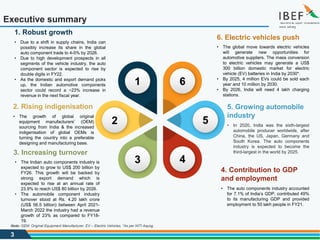
Executive summary
2. Rising indigenisation
• The growth of global original
equipment manufacturers’ (OEM)
sourcing from India & the increased
indigenisation of global OEMs is
turning the country into a preferable
designing and manufacturing base.
3. Increasing turnover
• The Indian auto components industry is
expected to grow to US$ 200 billion by
FY26. This growth will be backed by
strong export demand which is
expected to rise at an annual rate of
23.9% to reach US$ 80 billion by 2026.
• The automobile component industry
turnover stood at Rs. 4.20 lakh crore
(US$ 56.5 billion) between April 2021-
March 2022 the industry had a revenue
growth of 23% as compared to FY18-
19.
5. Growing automobile
industry
• In 2020, India was the sixth-largest
automobile producer worldwide, after
China, the US, Japan, Germany and
South Korea. The auto components
industry is expected to become the
third-largest in the world by 2025.
4. Contribution to GDP
and employment
• The auto components industry accounted
for 7.1% of India’s GDP, contributed 49%
to its manufacturing GDP and provided
employment to 50 lakh people in FY21.
1. Robust growth
• Due to a shift in supply chains, India can
possibly increase its share in the global
auto component trade to 4-5% by 2026.
• Due to high development prospects in all
segments of the vehicle industry, the auto
component sector is expected to rise by
double digits in FY22.
• As the domestic and export demand picks
up, the Indian automotive components
sector could record a ~23% increase in
revenue in the next fiscal year.
6. Electric vehicles push
• The global move towards electric vehicles
will generate new opportunities for
automotive suppliers. The mass conversion
to electric vehicles may generate a US$
300 billion domestic market for electric
vehicle (EV) batteries in India by 2030*.
• By 2025, 4 million EVs could be sold each
year and 10 million by 2030.
• By 2026, India will need 4 lakh charging
stations.
5
4
1 6
3
2
Note: OEM: Original Equipment Manufacturer, EV – Electric Vehicles, *As per NITI Aayog
4
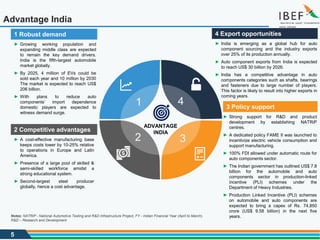
Advantage India
5
Advantage India
ADVANTAGE
INDIA
1 4
3
2
► Growing working population and
expanding middle class are expected
to remain the key demand drivers.
India is the fifth-largest automobile
market globally.
► By 2025, 4 million of EVs could be
sold each year and 10 million by 2030
The market is expected to reach US$
206 billion.
► With plans to reduce auto
components’ import dependence
domestic players are expected to
witness demand surge.
1 Robust demand
► India is emerging as a global hub for auto
component sourcing and the industry exports
over 25% of its production annually.
► Auto component exports from India is expected
to reach US$ 30 billion by 2026.
► India has a competitive advantage in auto
components categories such as shafts, bearings
and fasteners due to large number of players.
This factor is likely to result into higher exports in
coming years.
4 Export opportunities
► A cost-effective manufacturing base
keeps costs lower by 10-25% relative
to operations in Europe and Latin
America.
► Presence of a large pool of skilled &
semi-skilled workforce amidst a
strong educational system.
► Second-largest steel producer
globally, hence a cost advantage.
2 Competitive advantages
► Strong support for R&D and product
development by establishing NATRiP
centres.
► A dedicated policy FAME II was launched to
incentivize electric vehicle consumption and
support manufacturing.
► 100% FDI allowed under automatic route for
auto components sector.
► The Indian government has outlined US$ 7.8
billion for the automobile and auto
components sector in production-linked
incentive (PLI) schemes under the
Department of Heavy Industries.
► Production Linked Incentive (PLI) schemes
on automobile and auto components are
expected to bring a capex of Rs. 74,850
crore (US$ 9.58 billion) in the next five
years.
3 Policy support
Notes: NATRiP - National Automotive Testing and R&D Infrastructure Project, FY - Indian Financial Year (April to March),
R&D – Research and Development
6
Market Overview
MARKET OVERVIEW
7
Auto Components
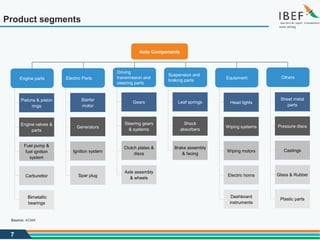
Product segments
Source: ACMA
Starter
motor
Generators
Ignition system
Spar plug
Electric Parts
Gears
Steering gears
& systems
Clutch plates &
discs
Axle assembly
& wheels
Driving
transmission and
steering parts
Leaf springs
Shock
absorbers
Brake assembly
& facing
Suspension and
braking parts
Head lights
Dashboard
instruments
Wiping systems
Wiping motors
Electric horns
Equipment
Pistons & piston
rings
Bimetallic
bearings
Engine valves &
parts
Fuel pump &
fuel ignition
system
Carburettor
Engine parts
Sheet metal
parts
Plastic parts
Pressure discs
Castings
Glass & Rubber
Others
8
Robust growth
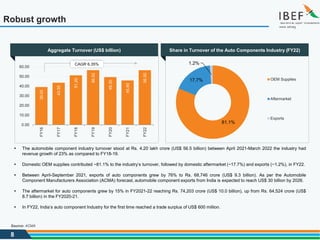
▪ The automobile component industry turnover stood at Rs. 4.20 lakh crore (US$ 56.5 billion) between April 2021-March 2022 the industry had
revenue growth of 23% as compared to FY18-19.
▪ Domestic OEM supplies contributed ~81.1% to the industry’s turnover, followed by domestic aftermarket (~17.7%) and exports (~1.2%), in FY22.
▪ Between April-September 2021, exports of auto components grew by 76% to Rs. 68,746 crore (US$ 9.3 billion). As per the Automobile
Component Manufacturers Association (ACMA) forecast, automobile component exports from India is expected to reach US$ 30 billion by 2026.
▪ The aftermarket for auto components grew by 15% in FY2021-22 reaching Rs. 74,203 crore (US$ 10.0 billion), up from Rs. 64,524 crore (US$
8.7 billion) in the FY2020-21.
▪ In FY22, India’s auto component Industry for the first time reached a trade surplus of US$ 600 million.
Source: ACMA
39.05
43.55
51.20
56.52
49.30
45.90
56.50
0.00
10.00
20.00
30.00
40.00
50.00
60.00
FY16
FY17
FY18
FY19
FY20
FY21
FY22
CAGR 6.35%
81.1%
17.7%
1.2%
OEM Supplies
Aftermarket
Exports
Share in Turnover of the Auto Components Industry (FY22)
Aggregate Turnover (US$ billion)
9
Export growth
Source: ACMA
31%
32%
25%
12% Europe
North America
Asia
Rest of the world
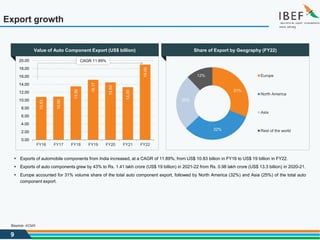
▪ Exports of automobile components from India increased, at a CAGR of 11.89%, from US$ 10.83 billion in FY16 to US$ 19 billion in FY22.
▪ Exports of auto components grew by 43% to Rs. 1.41 lakh crore (US$ 19 billion) in 2021-22 from Rs. 0.98 lakh crore (US$ 13.3 billion) in 2020-21.
▪ Europe accounted for 31% volume share of the total auto component export, followed by North America (32%) and Asia (25%) of the total auto
component export.
10.83
10.90
13.50
15.17
14.50
13.30
19.00
0.00
2.00
4.00
6.00
8.00
10.00
12.00
14.00
16.00
18.00
20.00
FY16 FY17 FY18 FY19 FY20 FY21 FY22
CAGR 11.89%
Value of Auto Component Export (US$ billion) Share of Export by Geography (FY22)
10
Aftermarket growth
Source: ACMA
24%
15%
15%
14%
11%
10%
8%
3%
Engine Components
Suspension and Braking
Drive Transmission
Electricals and
Electronics
Body/Chassis/BiW
Consumables and Misc
Interiors
Cooling System
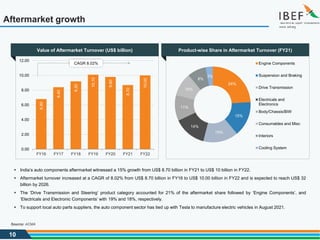
▪ India’s auto components aftermarket witnessed a 15% growth from US$ 8.70 billion in FY21 to US$ 10 billion in FY22.
▪ Aftermarket turnover increased at a CAGR of 8.02% from US$ 8.70 billion in FY16 to US$ 10.00 billion in FY22 and is expected to reach US$ 32
billion by 2026.
▪ The ‘Drive Transmission and Steering’ product category accounted for 21% of the aftermarket share followed by ‘Engine Components’, and
‘Electricals and Electronic Components’ with 19% and 18%, respectively.
▪ To support local auto parts suppliers, the auto component sector has tied up with Tesla to manufacture electric vehicles in August 2021.
6.80
8.40
9.20
10.10
9.80
8.70
10.00
0.00
2.00
4.00
6.00
8.00
10.00
12.00
FY16 FY17 FY18 FY19 FY20 FY21 FY22
CAGR 8.02%
Value of Aftermarket Turnover (US$ billion) Product-wise Share in Aftermarket Turnover (FY21)
11
Shares in production and supply
Source: ACMA, SIAM
Auto Component Supply to OEMs (FY21)
80.17%
18.27%
1.55%
Two Wheelers
Passenger Vehicles
Three Wheelers
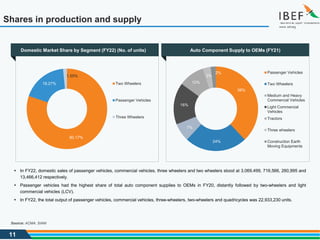
▪ In FY22, domestic sales of passenger vehicles, commercial vehicles, three wheelers and two wheelers stood at 3,069,499, 716,566, 260,995 and
13,466,412 respectively.
▪ Passenger vehicles had the highest share of total auto component supplies to OEMs in FY20, distantly followed by two-wheelers and light
commercial vehicles (LCV).
▪ In FY22, the total output of passenger vehicles, commercial vehicles, three-wheelers, two-wheelers and quadricycles was 22,933,230 units.
38%
24%
7%
16%
10%
3%
2% Passenger Vehicles
Two Wheelers
Medium and Heavy
Commercial Vehicles
Light Commercial
Vehicles
Tractors
Three wheelers
Construction Earth
Moving Equipments
Domestic Market Share by Segment (FY22) (No. of units)
12
Major players by segment
Note: OEM means Original Equipment Manufacturer
Source: Media sources
Engine & engine
parts
Transmission &
steering parts
Suspension &
braking parts
Electrical Equipment
▪ Pistons - Goetze,
Shriram Pistons & Rings,
India Pistons, Anand I-
Power Ltd.
▪ Engine Valves - Rane
Engine Valves, Shriram
Pistons and Rings, SSV
Valves
▪ Carburetors - UCAL Fuel
Systems and Spaco
Carburetors & Escorts
Auto Components
▪ Diesel-based fuel-
injection systems -
MICO, Delphi-TVS Diesel
System and Tata
Cummins
▪ Steering Systems -
Sona Koyo Steering
Systems, Rane NSK
Steering Systems and
Rane TRW Systems
▪ Gears - Bharat Gears,
Gajra Bevel Gears, ZF
Steering Gear (India) Ltd,
Eicher, Graziano
Trasmissioni and SlAP
Gears India
▪ Clutch - Clutch Auto,
Ceekay Daikin,
Amalgamations Repco,
LuK Clutches
▪ Driveshafts - Gkn
Driveshafts, Spicer India
Private Ltd., Delphi and
Sona Koyo Steering
Systems
▪ Brake Systems - Brakes
India, Kalyani Brakes,
Mando India Ltd. &
Automotive Axles and
GNA Axles Limited
▪ Brake Lining - Rane
Brake Lining, Sundaram
Brake Lining, Hindustan
Composites and Allied
Nippon
▪ Leaf Springs - Jamna
Auto & Jai Parabolic
▪ Shock Absorbers -
Gabriel India, Delphi,
Mando India Ltd. and
Munjal Showa, Rane
Holdings Limited
▪ Lucas TVS, DENSO,
Delco Remy Electricals,
Varroc Group and
Nippon Electricals are
key players in this
segment
▪ Headlights - Lumax,
Autolite and Phoenix
Lamps
▪ Dashboard - Premiere
Instruments & Controls
▪ Sheet metal parts - Jay
Bharat Maruti, Omax
Auto and JBM Tools
▪ Sensors - Pricol Limited
13
Recent Trends and Strategies
RECENT TRENDS AND STRATEGIES
14
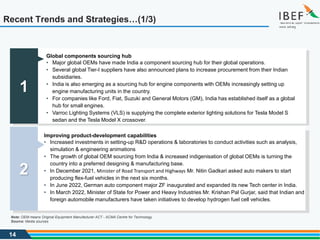
Recent Trends and Strategies…(1/3)
1
Global components sourcing hub
• Major global OEMs have made India a component sourcing hub for their global operations.
• Several global Tier-I suppliers have also announced plans to increase procurement from their Indian
subsidiaries.
• India is also emerging as a sourcing hub for engine components with OEMs increasingly setting up
engine manufacturing units in the country.
• For companies like Ford, Fiat, Suzuki and General Motors (GM), India has established itself as a global
hub for small engines.
• Varroc Lighting Systems (VLS) is supplying the complete exterior lighting solutions for Tesla Model S
sedan and the Tesla Model X crossover.
2
Improving product-development capabilities
• Increased investments in setting-up R&D operations & laboratories to conduct activities such as analysis,
simulation & engineering animations
• The growth of global OEM sourcing from India & increased indigenisation of global OEMs is turning the
country into a preferred designing & manufacturing base.
• In December 2021, Minister of Road Transport and Highways Mr. Nitin Gadkari asked auto makers to start
producing flex-fuel vehicles in the next six months.
• In June 2022, German auto component major ZF inaugurated and expanded its new Tech center in India.
• In March 2022, Minister of State for Power and Heavy Industries Mr. Krishan Pal Gurjar, said that Indian and
foreign automobile manufacturers have taken initiatives to develop hydrogen fuel cell vehicles.
Source: Media sources
Note: OEM means Original Equipment Manufacturer ACT - ACMA Centre for Technology
15
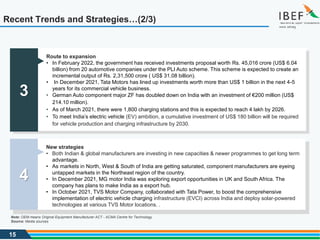
Recent Trends and Strategies…(2/3)
3
Route to expansion
• In February 2022, the government has received investments proposal worth Rs. 45,016 crore (US$ 6.04
billion) from 20 automotive companies under the PLI Auto scheme. This scheme is expected to create an
incremental output of Rs. 2,31,500 crore ( US$ 31.08 billion).
• In December 2021, Tata Motors has lined up investments worth more than US$ 1 billion in the next 4-5
years for its commercial vehicle business.
• German Auto component major ZF has doubled down on India with an investment of €200 million (US$
214.10 million).
• As of March 2021, there were 1,800 charging stations and this is expected to reach 4 lakh by 2026.
• To meet India’s electric vehicle (EV) ambition, a cumulative investment of US$ 180 billion will be required
for vehicle production and charging infrastructure by 2030.
4
New strategies
• Both Indian & global manufacturers are investing in new capacities & newer programmes to get long term
advantage.
• As markets in North, West & South of India are getting saturated, component manufacturers are eyeing
untapped markets in the Northeast region of the country.
• In December 2021, MG motor India was exploring export opportunities in UK and South Africa. The
company has plans to make India as a export hub.
• In October 2021, TVS Motor Company, collaborated with Tata Power, to boost the comprehensive
implementation of electric vehicle charging infrastructure (EVCI) across India and deploy solar-powered
technologies at various TVS Motor locations. .
Source: Media sources
Note: OEM means Original Equipment Manufacturer ACT - ACMA Centre for Technology
16
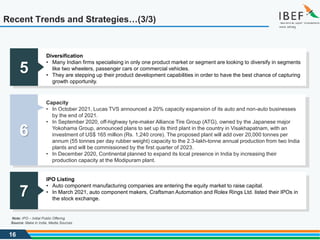
Recent Trends and Strategies…(3/3)
6
Capacity
• In October 2021, Lucas TVS announced a 20% capacity expansion of its auto and non-auto businesses
by the end of 2021.
• In September 2020, off-highway tyre-maker Alliance Tire Group (ATG), owned by the Japanese major
Yokohama Group, announced plans to set up its third plant in the country in Visakhapatnam, with an
investment of US$ 165 million (Rs. 1,240 crore). The proposed plant will add over 20,000 tonnes per
annum (55 tonnes per day rubber weight) capacity to the 2.3-lakh-tonne annual production from two India
plants and will be commissioned by the first quarter of 2023.
• In December 2020, Continental planned to expand its local presence in India by increasing their
production capacity at the Modipuram plant.
5
Diversification
• Many Indian firms specialising in only one product market or segment are looking to diversify in segments
like two wheelers, passenger cars or commercial vehicles.
• They are stepping up their product development capabilities in order to have the best chance of capturing
growth opportunity.
7
IPO Listing
• Auto component manufacturing companies are entering the equity market to raise capital.
• In March 2021, auto component makers, Craftsman Automation and Rolex Rings Ltd. listed their IPOs in
the stock exchange.
Source: Make in India, Media Sources
Note: IPO – Initial Public Offering
17
Growth Drivers
GROWTH DRIVERS
18
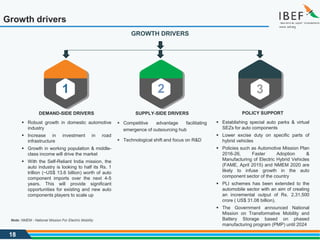
Growth drivers
Note: NMEM - National Mission For Electric Mobility
DEMAND-SIDE DRIVERS
▪ Robust growth in domestic automotive
industry
▪ Increase in investment in road
infrastructure
▪ Growth in working population & middle-
class income will drive the market
▪ With the Self-Reliant India mission, the
auto industry is looking to half its Rs. 1
trillion (~US$ 13.6 billion) worth of auto
component imports over the next 4-5
years. This will provide significant
opportunities for existing and new auto
components players to scale up
SUPPLY-SIDE DRIVERS
▪ Competitive advantage facilitating
emergence of outsourcing hub
▪ Technological shift and focus on R&D
POLICY SUPPORT
▪ Establishing special auto parks & virtual
SEZs for auto components
▪ Lower excise duty on specific parts of
hybrid vehicles
▪ Policies such as Automotive Mission Plan
2016-26, Faster Adoption &
Manufacturing of Electric Hybrid Vehicles
(FAME, April 2015) and NMEM 2020 are
likely to infuse growth in the auto
component sector of the country
▪ PLI schemes has been extended to the
automobile sector with an aim of creating
an incremental output of Rs. 2,31,500
crore ( US$ 31.08 billion).
▪ The Government announced National
Mission on Transformative Mobility and
Battery Storage based on phased
manufacturing program (PMP) until 2024
3
2
1
GROWTH DRIVERS
19
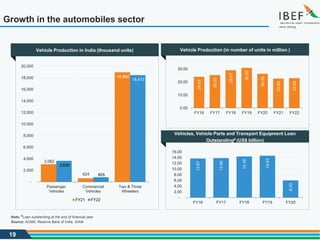
Growth in the automobiles sector
3,062
624
18,960
3,650
805
18,472
-
2,000
4,000
6,000
8,000
10,000
12,000
14,000
16,000
18,000
20,000
Passenger
Vehicles
Commercial
Vehicles
Two & Three
Wheelers
FY21 FY22
Vehicle Production (in number of units in million )
24.02
25.33
29.07
30.92
26.36
22.65
22.93
0.00
10.00
20.00
30.00
FY16 FY17 FY18 FY19 FY20 FY21 FY22
Source: ACMA, Reserve Bank of India, SIAM
Note: #Loan outstanding at the end of financial year
Vehicle Production in India (thousand units)
Vehicles, Vehicle Parts and Transport Equipment Loan
Outstanding# (US$ billion)
13.67
13.80
14.39
14.63
6.03
-
2.00
4.00
6.00
8.00
10.00
12.00
14.00
16.00
FY16 FY17 FY18 FY19 FY20
20
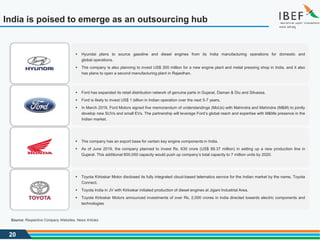
India is poised to emerge as an outsourcing hub
▪ Hyundai plans to source gasoline and diesel engines from its India manufacturing operations for domestic and
global operations.
▪ The company is also planning to invest US$ 300 million for a new engine plant and metal pressing shop in India, and it also
has plans to open a second manufacturing plant in Rajasthan.
▪ Ford has expanded its retail distribution network of genuine parts in Gujarat, Daman & Diu and Silvassa.
▪ Ford is likely to invest US$ 1 billion in Indian operation over the next 5-7 years.
▪ In March 2019, Ford Motors signed five memorandum of understandings (MoUs) with Mahindra and Mahindra (M&M) to jointly
develop new SUVs and small EVs. The partnership will leverage Ford’s global reach and expertise with M&Ms presence in the
Indian market.
▪ The company has an export base for certain key engine components in India.
▪ As of June 2019, the company planned to invest Rs. 630 crore (US$ 89.37 million) in setting up a new production line in
Gujarat. This additional 600,000 capacity would push up company’s total capacity to 7 million units by 2020.
▪ Toyota Kirloskar Motor disclosed its fully integrated cloud-based telematics service for the Indian market by the name, Toyota
Connect.
▪ Toyota India in JV with Kirloskar initiated production of diesel engines at Jigani Industrial Area.
▪ Toyota Kirloskar Motors announced investments of over Rs. 2,000 crores in India directed towards electric components and
technologies
Source: Respective Company Websites, News Articles
21
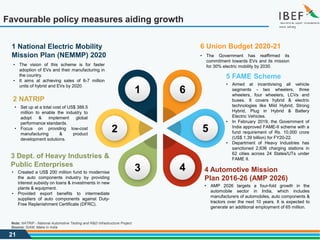
Favourable policy measures aiding growth
Source: SIAM, Make in India
Note: NATRiP - National Automotive Testing and R&D Infrastructure Project
2 NATRIP
• Set up at a total cost of US$ 388.5
million to enable the industry to
adopt & implement global
performance standards.
• Focus on providing low-cost
manufacturing & product
development solutions.
3 Dept. of Heavy Industries &
Public Enterprises
• Created a US$ 200 million fund to modernise
the auto components industry by providing
interest subsidy on loans & investments in new
plants & equipment.
• Provided export benefits to intermediate
suppliers of auto components against Duty-
Free Replenishment Certificate (DFRC).
5 FAME Scheme
• Aimed at incentivising all vehicle
segments - two wheelers, three
wheelers, four wheelers, LCVs and
buses. It covers hybrid & electric
technologies like Mild Hybrid, Strong
Hybrid, Plug in Hybrid & Battery
Electric Vehicles.
• In February 2019, the Government of
India approved FAME-II scheme with a
fund requirement of Rs. 10,000 crore
(US$ 1.39 billion) for FY20-22.
• Department of Heavy Industries has
sanctioned 2,636 charging stations in
62 cities across 24 States/UTs under
FAME II.
4 Automotive Mission
Plan 2016-26 (AMP 2026)
• AMP 2026 targets a four-fold growth in the
automobile sector in India, which includes
manufacturers of automobiles, auto components &
tractors over the next 10 years. It is expected to
generate an additional employment of 65 million.
1 National Electric Mobility
Mission Plan (NEMMP) 2020
• The vision of this scheme is for faster
adoption of EVs and their manufacturing in
the country.
• It aims at achieving sales of 6-7 million
units of hybrid and EVs by 2020.
6 Union Budget 2020-21
• The Government has reaffirmed its
commitment towards EVs and its mission
for 30% electric mobility by 2030.
5
4
1 6
3
2
22
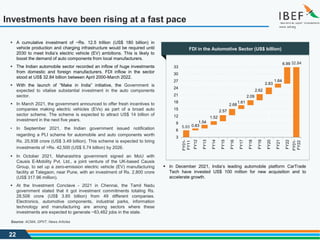
Investments have been rising at a fast pace
Source: ACMA, DPIIT, News Articles
21.38
0.83
1.54
1.52
2.57
2.68
1.61
2.09
2.62
2.83
1.64
6.99
5.93
32.84
3
6
9
12
15
18
21
24
27
30
33
FY01-
FY11
FY12
FY13
FY14
FY15
FY16
FY17
FY18
FY19
FY20
FY21
FY22
FY01-
FY22
▪ A cumulative investment of ~Rs. 12.5 trillion (US$ 180 billion) in
vehicle production and charging infrastructure would be required until
2030 to meet India’s electric vehicle (EV) ambitions. This is likely to
boost the demand of auto components from local manufacturers.
▪ The Indian automobile sector recorded an inflow of huge investments
from domestic and foreign manufacturers. FDI inflow in the sector
stood at US$ 32.84 billion between April 2000-March 2022.
▪ With the launch of “Make in India” initiative, the Government is
expected to vitalise substantial investment in the auto components
sector.
▪ In March 2021, the government announced to offer fresh incentives to
companies making electric vehicles (EVs) as part of a broad auto
sector scheme. The scheme is expected to attract US$ 14 billion of
investment in the next five years.
• In September 2021, the Indian government issued notification
regarding a PLI scheme for automobile and auto components worth
Rs. 25,938 crore (US$ 3.49 billion). This scheme is expected to bring
investments of >Rs. 42,500 (US$ 5.74 billion) by 2026.
▪ In October 2021, Maharashtra government signed an MoU with
Causis E-Mobility Pvt. Ltd., a joint venture of the UK-based Causis
Group, to set up a zero-emission electric vehicle (EV) manufacturing
facility at Talegaon, near Pune, with an investment of Rs. 2,800 crore
(US$ 317.96 million).
▪ At the Investment Conclave - 2021 in Chennai, the Tamil Nadu
government stated that it got investment commitments totaling Rs.
28,508 crore (US$ 3.85 billion) from 49 different companies.
Electronics, automotive components, industrial parks, information
technology and manufacturing are among sectors where these
investments are expected to generate ~83,482 jobs in the state.
FDI in the Automotive Sector (US$ billion)
▪ In December 2021, India’s leading automobile platform CarTrade
Tech have invested US$ 100 million for new acquisition and to
accelerate growth.
23
Opportunities
OPPORTUNITIES
24
Domestic and exports markets hold huge potential
43.55
51.20
57.00
49.30
200.00
0
50
100
150
200
FY17 FY18 FY19 FY20 FY26
10.90
13.50 15.16
80.00
0
10
20
30
40
50
60
70
80
90
FY17 FY18 FY19 FY26
Source: ACMA
Note: E - Estimate
Export Market Potential (US$ billion)
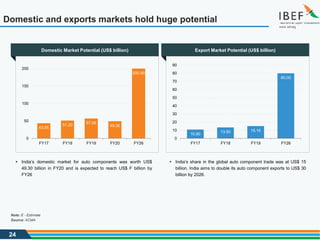
▪ India’s domestic market for auto components was worth US$
49.30 billion in FY20 and is expected to reach US$ F billion by
FY26
▪ India’s share in the global auto component trade was at US$ 15
billion. India aims to double its auto component exports to US$ 30
billion by 2026.
Domestic Market Potential (US$ billion)
25
Market potential balanced across product types
Source: ACMA, News Sources
Note: 2020E - Estimated value for 2020 by ACMA
33%
19%
13%
11%
11%
6%
Drive Transmission &
Steering
Engine Components
Body/Chassis/BiW
Suspension & Braking
Electricals & Electronics
Interiors
Domestic Market Potential by Components (FY21) Export Market Potential by Components (2020)
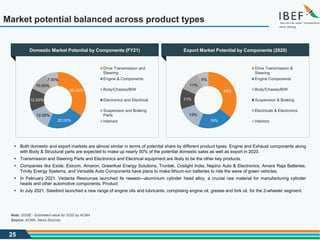
▪ Both domestic and export markets are almost similar in terms of potential share by different product types. Engine and Exhaust components along
with Body & Structural parts are expected to make up nearly 50% of the potential domestic sales as well as export in 2020.
▪ Transmission and Steering Parts and Electronics and Electrical equipment are likely to be the other key products.
▪ Companies like Exide, Exicom, Amaron, Greenfuel Energy Solutions, Trontek, Coslight India, Napino Auto & Electronics, Amara Raja Batteries,
Trinity Energy Systems, and Versatile Auto Components have plans to make lithium-ion batteries to ride the wave of green vehicles.
▪ In February 2021, Vedanta Resources launched its newest—aluminium cylinder head alloy, a crucial raw material for manufacturing cylinder
heads and other automotive components. Product
▪ In July 2021, Steelbird launched a new range of engine oils and lubricants, comprising engine oil, grease and fork oil, for the 2-wheeler segment.
32.00%
20.00%
12.00%
12.00%
10.00%
7.00%
Drive Transmission and
Steering
Engine & Components
Body/Chassis/BiW
Electronics and Electrical
Suspension and Braking
Parts
Interiors
26
Opportunities in engineering products
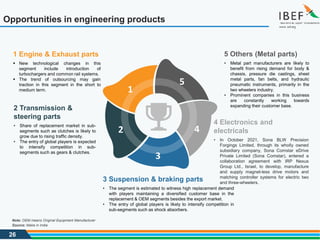
3 Suspension & braking parts
• The segment is estimated to witness high replacement demand
with players maintaining a diversified customer base in the
replacement & OEM segments besides the export market.
• The entry of global players is likely to intensify competition in
sub-segments such as shock absorbers.
5 Others (Metal parts)
• Metal part manufacturers are likely to
benefit from rising demand for body &
chassis, pressure die castings, sheet
metal parts, fan belts, and hydraulic
pneumatic instruments, primarily in the
two wheelers industry.
• Prominent companies in this business
are constantly working towards
expanding their customer base.
1 Engine & Exhaust parts
▪ New technological changes in this
segment include introduction of
turbochargers and common rail systems.
▪ The trend of outsourcing may gain
traction in this segment in the short to
medium term.
4 Electronics and
electricals
• In October 2021, Sona BLW Precision
Forgings Limited, through its wholly owned
subsidiary company, Sona Comstar eDrive
Private Limited (Sona Comstar), entered a
collaboration agreement with IRP Nexus
Group Ltd., Israel, to develop, manufacture
and supply magnet-less drive motors and
matching controller systems for electric two
and three-wheelers.
2 Transmission &
steering parts
• Share of replacement market in sub-
segments such as clutches is likely to
grow due to rising traffic density.
• The entry of global players is expected
to intensify competition in sub-
segments such as gears & clutches.
Source: Make in India
Note: OEM means Original Equipment Manufacturer
5
4
3
2
1
27
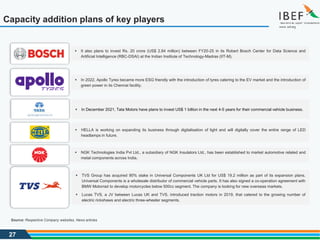
▪ It also plans to invest Rs. 20 crore (US$ 2.84 million) between FY20-25 in its Robert Bosch Center for Data Science and
Artificial Intelligence (RBC-DSAI) at the Indian Institute of Technology-Madras (IIT-M).
▪ In 2022, Apollo Tyres became more ESG friendly with the introduction of tyres catering to the EV market and the introduction of
green power in its Chennai facility.
▪ In December 2021, Tata Motors have plans to invest US$ 1 billion in the next 4-5 years for their commercial vehicle business.
▪ HELLA is working on expanding its business through digitalisation of light and will digitally cover the entire range of LED
headlamps in future.
▪ NGK Technologies India Pvt Ltd., a subsidiary of NGK Insulators Ltd., has been established to market automotive related and
metal components across India.
▪ TVS Group has acquired 90% stake in Universal Components UK Ltd for US$ 19.2 million as part of its expansion plans.
Universal Components is a wholesale distributor of commercial vehicle parts. It has also signed a co-operation agreement with
BMW Motorrad to develop motorcycles below 500cc segment. The company is looking for new overseas markets.
▪ Lucas TVS, a JV between Lucas UK and TVS, introduced traction motors in 2019, that catered to the growing number of
electric rickshaws and electric three-wheeler segments.
Capacity addition plans of key players
Source: Respective Company websites, News articles
28
Key Industry Contacts
29
Key Industry Contacts
Agency Contact Information
Automotive Component Manufacturers
Association of India (ACMA)
6th Floor, The Capital Court,
Olof Palme Marg, Munirka,
New Delhi - 110 067, India
Phone: 91 11 2616 0315, 2617 5873, 2618 4479
Fax: 91 11 2616 0317
E-mail: acma@acma.in ; acma@vsnl.com
Website: www.acma.in
Automotive Research Association of India
(ARAI)
Survey No. 102, Vetal Hill, off Paud Road,
Kothrud, Pune - 411 038
P. B. No. 832, Pune - 411 004
Tel No. : +91-020-30231111
Fax No. : +91-020-30231104
Email Id : info@araiindia.com
Website: www.araiindia.com
30
Appendix
31
Glossary
▪ ACMA: Automotive Component Manufacturers Association of India
▪ SIAM: Society of Indian Automobile Manufacturers
▪ ARAI: Automotive Research Association of India
▪ CAGR: Compound Annual Growth Rate
▪ FDI: Foreign Direct Investment
▪ FY: Indian Financial Year (April to March); So, FY12 implies April 2011 to March 2012
▪ GOI: Government of India
▪ OEM: Original Equipment Manufacturers
▪ NATRiP: National Automotive Testing and R&D Infrastructure Project
▪ Rs.: Indian Rupee
▪ SEZ: Special Economic Zone
▪ US$: US Dollar
▪ Wherever applicable, numbers have been rounded off to the nearest whole number
32
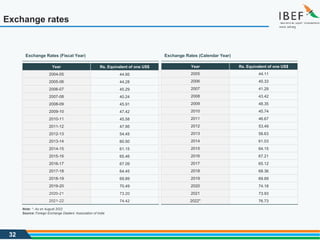
Exchange rates
Exchange Rates (Fiscal Year) Exchange Rates (Calendar Year)
Year Rs. Equivalent of one US$
2004-05 44.95
2005-06 44.28
2006-07 45.29
2007-08 40.24
2008-09 45.91
2009-10 47.42
2010-11 45.58
2011-12 47.95
2012-13 54.45
2013-14 60.50
2014-15 61.15
2015-16 65.46
2016-17 67.09
2017-18 64.45
2018-19 69.89
2019-20 70.49
2020-21 73.20
2021-22 74.42
Source: Foreign Exchange Dealers’ Association of India
Note: *- As on August 2022
Year Rs. Equivalent of one US$
2005 44.11
2006 45.33
2007 41.29
2008 43.42
2009 48.35
2010 45.74
2011 46.67
2012 53.49
2013 58.63
2014 61.03
2015 64.15
2016 67.21
2017 65.12
2018 68.36
2019 69.89
2020 74.18
2021 73.93
2022* 76.73
33
Disclaimer
India Brand Equity Foundation (IBEF) engaged Aranca (Mumbai) Pvt. Ltd. to prepare/update this presentation.
All rights reserved. All copyright in this presentation and related works is solely and exclusively owned by IBEF, delivered during the course of
engagement under the Professional Service Agreement signed by the Parties. The same may not be reproduced, wholly or in part in any material
form (including photocopying or storing it in any medium by electronic means and whether or not transiently or incidentally to some other use of this
presentation), modified or in any manner communicated to any third party except with the written approval of IBEF.
This presentation is for information purposes only. While due care has been taken during the compilation of this presentation to ensure that the
information is accurate to the best of Aranca (Mumbai) Pvt. Ltd and IBEF’s knowledge and belief, the content is not to be construed in any manner
whatsoever as a substitute for professional advice.
Aranca (Mumbai) Pvt. Ltd and IBEF neither recommend nor endorse any specific products or services that may have been mentioned in this
presentation and nor do they assume any liability, damages or responsibility for the outcome of decisions taken as a result of any reliance placed on
this presentation.
Neither Aranca (Mumbai) Pvt. Ltd nor IBEF shall be liable for any special, direct, indirect or consequential damages that may arise due to any act or
omission on the part of the user due to any reliance placed or guidance taken from any portion of this presentation.

1664767673_auto-components-august-2022.pdf

  • 1.
    For updated information,please visit www.ibef.org August 2022 AUTO COMPONENTS
  • 2.
    2 Executive Summary 3 AdvantageIndia 4 Market Overview 6 Recent Trends and Strategies 13 Growth Drivers 17 Opportunities 23 Key Industry Contacts 28 Appendix 30 Table of Contents
  • 3.
    3 Executive summary 2. Risingindigenisation • The growth of global original equipment manufacturers’ (OEM) sourcing from India & the increased indigenisation of global OEMs is turning the country into a preferable designing and manufacturing base. 3. Increasing turnover • The Indian auto components industry is expected to grow to US$ 200 billion by FY26. This growth will be backed by strong export demand which is expected to rise at an annual rate of 23.9% to reach US$ 80 billion by 2026. • The automobile component industry turnover stood at Rs. 4.20 lakh crore (US$ 56.5 billion) between April 2021- March 2022 the industry had a revenue growth of 23% as compared to FY18- 19. 5. Growing automobile industry • In 2020, India was the sixth-largest automobile producer worldwide, after China, the US, Japan, Germany and South Korea. The auto components industry is expected to become the third-largest in the world by 2025. 4. Contribution to GDP and employment • The auto components industry accounted for 7.1% of India’s GDP, contributed 49% to its manufacturing GDP and provided employment to 50 lakh people in FY21. 1. Robust growth • Due to a shift in supply chains, India can possibly increase its share in the global auto component trade to 4-5% by 2026. • Due to high development prospects in all segments of the vehicle industry, the auto component sector is expected to rise by double digits in FY22. • As the domestic and export demand picks up, the Indian automotive components sector could record a ~23% increase in revenue in the next fiscal year. 6. Electric vehicles push • The global move towards electric vehicles will generate new opportunities for automotive suppliers. The mass conversion to electric vehicles may generate a US$ 300 billion domestic market for electric vehicle (EV) batteries in India by 2030*. • By 2025, 4 million EVs could be sold each year and 10 million by 2030. • By 2026, India will need 4 lakh charging stations. 5 4 1 6 3 2 Note: OEM: Original Equipment Manufacturer, EV – Electric Vehicles, *As per NITI Aayog
  • 4.
  • 5.
    5 Advantage India ADVANTAGE INDIA 1 4 3 2 ►Growing working population and expanding middle class are expected to remain the key demand drivers. India is the fifth-largest automobile market globally. ► By 2025, 4 million of EVs could be sold each year and 10 million by 2030 The market is expected to reach US$ 206 billion. ► With plans to reduce auto components’ import dependence domestic players are expected to witness demand surge. 1 Robust demand ► India is emerging as a global hub for auto component sourcing and the industry exports over 25% of its production annually. ► Auto component exports from India is expected to reach US$ 30 billion by 2026. ► India has a competitive advantage in auto components categories such as shafts, bearings and fasteners due to large number of players. This factor is likely to result into higher exports in coming years. 4 Export opportunities ► A cost-effective manufacturing base keeps costs lower by 10-25% relative to operations in Europe and Latin America. ► Presence of a large pool of skilled & semi-skilled workforce amidst a strong educational system. ► Second-largest steel producer globally, hence a cost advantage. 2 Competitive advantages ► Strong support for R&D and product development by establishing NATRiP centres. ► A dedicated policy FAME II was launched to incentivize electric vehicle consumption and support manufacturing. ► 100% FDI allowed under automatic route for auto components sector. ► The Indian government has outlined US$ 7.8 billion for the automobile and auto components sector in production-linked incentive (PLI) schemes under the Department of Heavy Industries. ► Production Linked Incentive (PLI) schemes on automobile and auto components are expected to bring a capex of Rs. 74,850 crore (US$ 9.58 billion) in the next five years. 3 Policy support Notes: NATRiP - National Automotive Testing and R&D Infrastructure Project, FY - Indian Financial Year (April to March), R&D – Research and Development
  • 6.
  • 7.
    7 Auto Components Product segments Source:ACMA Starter motor Generators Ignition system Spar plug Electric Parts Gears Steering gears & systems Clutch plates & discs Axle assembly & wheels Driving transmission and steering parts Leaf springs Shock absorbers Brake assembly & facing Suspension and braking parts Head lights Dashboard instruments Wiping systems Wiping motors Electric horns Equipment Pistons & piston rings Bimetallic bearings Engine valves & parts Fuel pump & fuel ignition system Carburettor Engine parts Sheet metal parts Plastic parts Pressure discs Castings Glass & Rubber Others
  • 8.
    8 Robust growth ▪ Theautomobile component industry turnover stood at Rs. 4.20 lakh crore (US$ 56.5 billion) between April 2021-March 2022 the industry had revenue growth of 23% as compared to FY18-19. ▪ Domestic OEM supplies contributed ~81.1% to the industry’s turnover, followed by domestic aftermarket (~17.7%) and exports (~1.2%), in FY22. ▪ Between April-September 2021, exports of auto components grew by 76% to Rs. 68,746 crore (US$ 9.3 billion). As per the Automobile Component Manufacturers Association (ACMA) forecast, automobile component exports from India is expected to reach US$ 30 billion by 2026. ▪ The aftermarket for auto components grew by 15% in FY2021-22 reaching Rs. 74,203 crore (US$ 10.0 billion), up from Rs. 64,524 crore (US$ 8.7 billion) in the FY2020-21. ▪ In FY22, India’s auto component Industry for the first time reached a trade surplus of US$ 600 million. Source: ACMA 39.05 43.55 51.20 56.52 49.30 45.90 56.50 0.00 10.00 20.00 30.00 40.00 50.00 60.00 FY16 FY17 FY18 FY19 FY20 FY21 FY22 CAGR 6.35% 81.1% 17.7% 1.2% OEM Supplies Aftermarket Exports Share in Turnover of the Auto Components Industry (FY22) Aggregate Turnover (US$ billion)
  • 9.
    9 Export growth Source: ACMA 31% 32% 25% 12%Europe North America Asia Rest of the world ▪ Exports of automobile components from India increased, at a CAGR of 11.89%, from US$ 10.83 billion in FY16 to US$ 19 billion in FY22. ▪ Exports of auto components grew by 43% to Rs. 1.41 lakh crore (US$ 19 billion) in 2021-22 from Rs. 0.98 lakh crore (US$ 13.3 billion) in 2020-21. ▪ Europe accounted for 31% volume share of the total auto component export, followed by North America (32%) and Asia (25%) of the total auto component export. 10.83 10.90 13.50 15.17 14.50 13.30 19.00 0.00 2.00 4.00 6.00 8.00 10.00 12.00 14.00 16.00 18.00 20.00 FY16 FY17 FY18 FY19 FY20 FY21 FY22 CAGR 11.89% Value of Auto Component Export (US$ billion) Share of Export by Geography (FY22)
  • 10.
    10 Aftermarket growth Source: ACMA 24% 15% 15% 14% 11% 10% 8% 3% EngineComponents Suspension and Braking Drive Transmission Electricals and Electronics Body/Chassis/BiW Consumables and Misc Interiors Cooling System ▪ India’s auto components aftermarket witnessed a 15% growth from US$ 8.70 billion in FY21 to US$ 10 billion in FY22. ▪ Aftermarket turnover increased at a CAGR of 8.02% from US$ 8.70 billion in FY16 to US$ 10.00 billion in FY22 and is expected to reach US$ 32 billion by 2026. ▪ The ‘Drive Transmission and Steering’ product category accounted for 21% of the aftermarket share followed by ‘Engine Components’, and ‘Electricals and Electronic Components’ with 19% and 18%, respectively. ▪ To support local auto parts suppliers, the auto component sector has tied up with Tesla to manufacture electric vehicles in August 2021. 6.80 8.40 9.20 10.10 9.80 8.70 10.00 0.00 2.00 4.00 6.00 8.00 10.00 12.00 FY16 FY17 FY18 FY19 FY20 FY21 FY22 CAGR 8.02% Value of Aftermarket Turnover (US$ billion) Product-wise Share in Aftermarket Turnover (FY21)
  • 11.
    11 Shares in productionand supply Source: ACMA, SIAM Auto Component Supply to OEMs (FY21) 80.17% 18.27% 1.55% Two Wheelers Passenger Vehicles Three Wheelers ▪ In FY22, domestic sales of passenger vehicles, commercial vehicles, three wheelers and two wheelers stood at 3,069,499, 716,566, 260,995 and 13,466,412 respectively. ▪ Passenger vehicles had the highest share of total auto component supplies to OEMs in FY20, distantly followed by two-wheelers and light commercial vehicles (LCV). ▪ In FY22, the total output of passenger vehicles, commercial vehicles, three-wheelers, two-wheelers and quadricycles was 22,933,230 units. 38% 24% 7% 16% 10% 3% 2% Passenger Vehicles Two Wheelers Medium and Heavy Commercial Vehicles Light Commercial Vehicles Tractors Three wheelers Construction Earth Moving Equipments Domestic Market Share by Segment (FY22) (No. of units)
  • 12.
    12 Major players bysegment Note: OEM means Original Equipment Manufacturer Source: Media sources Engine & engine parts Transmission & steering parts Suspension & braking parts Electrical Equipment ▪ Pistons - Goetze, Shriram Pistons & Rings, India Pistons, Anand I- Power Ltd. ▪ Engine Valves - Rane Engine Valves, Shriram Pistons and Rings, SSV Valves ▪ Carburetors - UCAL Fuel Systems and Spaco Carburetors & Escorts Auto Components ▪ Diesel-based fuel- injection systems - MICO, Delphi-TVS Diesel System and Tata Cummins ▪ Steering Systems - Sona Koyo Steering Systems, Rane NSK Steering Systems and Rane TRW Systems ▪ Gears - Bharat Gears, Gajra Bevel Gears, ZF Steering Gear (India) Ltd, Eicher, Graziano Trasmissioni and SlAP Gears India ▪ Clutch - Clutch Auto, Ceekay Daikin, Amalgamations Repco, LuK Clutches ▪ Driveshafts - Gkn Driveshafts, Spicer India Private Ltd., Delphi and Sona Koyo Steering Systems ▪ Brake Systems - Brakes India, Kalyani Brakes, Mando India Ltd. & Automotive Axles and GNA Axles Limited ▪ Brake Lining - Rane Brake Lining, Sundaram Brake Lining, Hindustan Composites and Allied Nippon ▪ Leaf Springs - Jamna Auto & Jai Parabolic ▪ Shock Absorbers - Gabriel India, Delphi, Mando India Ltd. and Munjal Showa, Rane Holdings Limited ▪ Lucas TVS, DENSO, Delco Remy Electricals, Varroc Group and Nippon Electricals are key players in this segment ▪ Headlights - Lumax, Autolite and Phoenix Lamps ▪ Dashboard - Premiere Instruments & Controls ▪ Sheet metal parts - Jay Bharat Maruti, Omax Auto and JBM Tools ▪ Sensors - Pricol Limited
  • 13.
    13 Recent Trends andStrategies RECENT TRENDS AND STRATEGIES
  • 14.
    14 Recent Trends andStrategies…(1/3) 1 Global components sourcing hub • Major global OEMs have made India a component sourcing hub for their global operations. • Several global Tier-I suppliers have also announced plans to increase procurement from their Indian subsidiaries. • India is also emerging as a sourcing hub for engine components with OEMs increasingly setting up engine manufacturing units in the country. • For companies like Ford, Fiat, Suzuki and General Motors (GM), India has established itself as a global hub for small engines. • Varroc Lighting Systems (VLS) is supplying the complete exterior lighting solutions for Tesla Model S sedan and the Tesla Model X crossover. 2 Improving product-development capabilities • Increased investments in setting-up R&D operations & laboratories to conduct activities such as analysis, simulation & engineering animations • The growth of global OEM sourcing from India & increased indigenisation of global OEMs is turning the country into a preferred designing & manufacturing base. • In December 2021, Minister of Road Transport and Highways Mr. Nitin Gadkari asked auto makers to start producing flex-fuel vehicles in the next six months. • In June 2022, German auto component major ZF inaugurated and expanded its new Tech center in India. • In March 2022, Minister of State for Power and Heavy Industries Mr. Krishan Pal Gurjar, said that Indian and foreign automobile manufacturers have taken initiatives to develop hydrogen fuel cell vehicles. Source: Media sources Note: OEM means Original Equipment Manufacturer ACT - ACMA Centre for Technology
  • 15.
    15 Recent Trends andStrategies…(2/3) 3 Route to expansion • In February 2022, the government has received investments proposal worth Rs. 45,016 crore (US$ 6.04 billion) from 20 automotive companies under the PLI Auto scheme. This scheme is expected to create an incremental output of Rs. 2,31,500 crore ( US$ 31.08 billion). • In December 2021, Tata Motors has lined up investments worth more than US$ 1 billion in the next 4-5 years for its commercial vehicle business. • German Auto component major ZF has doubled down on India with an investment of €200 million (US$ 214.10 million). • As of March 2021, there were 1,800 charging stations and this is expected to reach 4 lakh by 2026. • To meet India’s electric vehicle (EV) ambition, a cumulative investment of US$ 180 billion will be required for vehicle production and charging infrastructure by 2030. 4 New strategies • Both Indian & global manufacturers are investing in new capacities & newer programmes to get long term advantage. • As markets in North, West & South of India are getting saturated, component manufacturers are eyeing untapped markets in the Northeast region of the country. • In December 2021, MG motor India was exploring export opportunities in UK and South Africa. The company has plans to make India as a export hub. • In October 2021, TVS Motor Company, collaborated with Tata Power, to boost the comprehensive implementation of electric vehicle charging infrastructure (EVCI) across India and deploy solar-powered technologies at various TVS Motor locations. . Source: Media sources Note: OEM means Original Equipment Manufacturer ACT - ACMA Centre for Technology
  • 16.
    16 Recent Trends andStrategies…(3/3) 6 Capacity • In October 2021, Lucas TVS announced a 20% capacity expansion of its auto and non-auto businesses by the end of 2021. • In September 2020, off-highway tyre-maker Alliance Tire Group (ATG), owned by the Japanese major Yokohama Group, announced plans to set up its third plant in the country in Visakhapatnam, with an investment of US$ 165 million (Rs. 1,240 crore). The proposed plant will add over 20,000 tonnes per annum (55 tonnes per day rubber weight) capacity to the 2.3-lakh-tonne annual production from two India plants and will be commissioned by the first quarter of 2023. • In December 2020, Continental planned to expand its local presence in India by increasing their production capacity at the Modipuram plant. 5 Diversification • Many Indian firms specialising in only one product market or segment are looking to diversify in segments like two wheelers, passenger cars or commercial vehicles. • They are stepping up their product development capabilities in order to have the best chance of capturing growth opportunity. 7 IPO Listing • Auto component manufacturing companies are entering the equity market to raise capital. • In March 2021, auto component makers, Craftsman Automation and Rolex Rings Ltd. listed their IPOs in the stock exchange. Source: Make in India, Media Sources Note: IPO – Initial Public Offering
  • 17.
  • 18.
    18 Growth drivers Note: NMEM- National Mission For Electric Mobility DEMAND-SIDE DRIVERS ▪ Robust growth in domestic automotive industry ▪ Increase in investment in road infrastructure ▪ Growth in working population & middle- class income will drive the market ▪ With the Self-Reliant India mission, the auto industry is looking to half its Rs. 1 trillion (~US$ 13.6 billion) worth of auto component imports over the next 4-5 years. This will provide significant opportunities for existing and new auto components players to scale up SUPPLY-SIDE DRIVERS ▪ Competitive advantage facilitating emergence of outsourcing hub ▪ Technological shift and focus on R&D POLICY SUPPORT ▪ Establishing special auto parks & virtual SEZs for auto components ▪ Lower excise duty on specific parts of hybrid vehicles ▪ Policies such as Automotive Mission Plan 2016-26, Faster Adoption & Manufacturing of Electric Hybrid Vehicles (FAME, April 2015) and NMEM 2020 are likely to infuse growth in the auto component sector of the country ▪ PLI schemes has been extended to the automobile sector with an aim of creating an incremental output of Rs. 2,31,500 crore ( US$ 31.08 billion). ▪ The Government announced National Mission on Transformative Mobility and Battery Storage based on phased manufacturing program (PMP) until 2024 3 2 1 GROWTH DRIVERS
  • 19.
    19 Growth in theautomobiles sector 3,062 624 18,960 3,650 805 18,472 - 2,000 4,000 6,000 8,000 10,000 12,000 14,000 16,000 18,000 20,000 Passenger Vehicles Commercial Vehicles Two & Three Wheelers FY21 FY22 Vehicle Production (in number of units in million ) 24.02 25.33 29.07 30.92 26.36 22.65 22.93 0.00 10.00 20.00 30.00 FY16 FY17 FY18 FY19 FY20 FY21 FY22 Source: ACMA, Reserve Bank of India, SIAM Note: #Loan outstanding at the end of financial year Vehicle Production in India (thousand units) Vehicles, Vehicle Parts and Transport Equipment Loan Outstanding# (US$ billion) 13.67 13.80 14.39 14.63 6.03 - 2.00 4.00 6.00 8.00 10.00 12.00 14.00 16.00 FY16 FY17 FY18 FY19 FY20
  • 20.
    20 India is poisedto emerge as an outsourcing hub ▪ Hyundai plans to source gasoline and diesel engines from its India manufacturing operations for domestic and global operations. ▪ The company is also planning to invest US$ 300 million for a new engine plant and metal pressing shop in India, and it also has plans to open a second manufacturing plant in Rajasthan. ▪ Ford has expanded its retail distribution network of genuine parts in Gujarat, Daman & Diu and Silvassa. ▪ Ford is likely to invest US$ 1 billion in Indian operation over the next 5-7 years. ▪ In March 2019, Ford Motors signed five memorandum of understandings (MoUs) with Mahindra and Mahindra (M&M) to jointly develop new SUVs and small EVs. The partnership will leverage Ford’s global reach and expertise with M&Ms presence in the Indian market. ▪ The company has an export base for certain key engine components in India. ▪ As of June 2019, the company planned to invest Rs. 630 crore (US$ 89.37 million) in setting up a new production line in Gujarat. This additional 600,000 capacity would push up company’s total capacity to 7 million units by 2020. ▪ Toyota Kirloskar Motor disclosed its fully integrated cloud-based telematics service for the Indian market by the name, Toyota Connect. ▪ Toyota India in JV with Kirloskar initiated production of diesel engines at Jigani Industrial Area. ▪ Toyota Kirloskar Motors announced investments of over Rs. 2,000 crores in India directed towards electric components and technologies Source: Respective Company Websites, News Articles
  • 21.
    21 Favourable policy measuresaiding growth Source: SIAM, Make in India Note: NATRiP - National Automotive Testing and R&D Infrastructure Project 2 NATRIP • Set up at a total cost of US$ 388.5 million to enable the industry to adopt & implement global performance standards. • Focus on providing low-cost manufacturing & product development solutions. 3 Dept. of Heavy Industries & Public Enterprises • Created a US$ 200 million fund to modernise the auto components industry by providing interest subsidy on loans & investments in new plants & equipment. • Provided export benefits to intermediate suppliers of auto components against Duty- Free Replenishment Certificate (DFRC). 5 FAME Scheme • Aimed at incentivising all vehicle segments - two wheelers, three wheelers, four wheelers, LCVs and buses. It covers hybrid & electric technologies like Mild Hybrid, Strong Hybrid, Plug in Hybrid & Battery Electric Vehicles. • In February 2019, the Government of India approved FAME-II scheme with a fund requirement of Rs. 10,000 crore (US$ 1.39 billion) for FY20-22. • Department of Heavy Industries has sanctioned 2,636 charging stations in 62 cities across 24 States/UTs under FAME II. 4 Automotive Mission Plan 2016-26 (AMP 2026) • AMP 2026 targets a four-fold growth in the automobile sector in India, which includes manufacturers of automobiles, auto components & tractors over the next 10 years. It is expected to generate an additional employment of 65 million. 1 National Electric Mobility Mission Plan (NEMMP) 2020 • The vision of this scheme is for faster adoption of EVs and their manufacturing in the country. • It aims at achieving sales of 6-7 million units of hybrid and EVs by 2020. 6 Union Budget 2020-21 • The Government has reaffirmed its commitment towards EVs and its mission for 30% electric mobility by 2030. 5 4 1 6 3 2
  • 22.
    22 Investments have beenrising at a fast pace Source: ACMA, DPIIT, News Articles 21.38 0.83 1.54 1.52 2.57 2.68 1.61 2.09 2.62 2.83 1.64 6.99 5.93 32.84 3 6 9 12 15 18 21 24 27 30 33 FY01- FY11 FY12 FY13 FY14 FY15 FY16 FY17 FY18 FY19 FY20 FY21 FY22 FY01- FY22 ▪ A cumulative investment of ~Rs. 12.5 trillion (US$ 180 billion) in vehicle production and charging infrastructure would be required until 2030 to meet India’s electric vehicle (EV) ambitions. This is likely to boost the demand of auto components from local manufacturers. ▪ The Indian automobile sector recorded an inflow of huge investments from domestic and foreign manufacturers. FDI inflow in the sector stood at US$ 32.84 billion between April 2000-March 2022. ▪ With the launch of “Make in India” initiative, the Government is expected to vitalise substantial investment in the auto components sector. ▪ In March 2021, the government announced to offer fresh incentives to companies making electric vehicles (EVs) as part of a broad auto sector scheme. The scheme is expected to attract US$ 14 billion of investment in the next five years. • In September 2021, the Indian government issued notification regarding a PLI scheme for automobile and auto components worth Rs. 25,938 crore (US$ 3.49 billion). This scheme is expected to bring investments of >Rs. 42,500 (US$ 5.74 billion) by 2026. ▪ In October 2021, Maharashtra government signed an MoU with Causis E-Mobility Pvt. Ltd., a joint venture of the UK-based Causis Group, to set up a zero-emission electric vehicle (EV) manufacturing facility at Talegaon, near Pune, with an investment of Rs. 2,800 crore (US$ 317.96 million). ▪ At the Investment Conclave - 2021 in Chennai, the Tamil Nadu government stated that it got investment commitments totaling Rs. 28,508 crore (US$ 3.85 billion) from 49 different companies. Electronics, automotive components, industrial parks, information technology and manufacturing are among sectors where these investments are expected to generate ~83,482 jobs in the state. FDI in the Automotive Sector (US$ billion) ▪ In December 2021, India’s leading automobile platform CarTrade Tech have invested US$ 100 million for new acquisition and to accelerate growth.

  • 23.
  • 24.
    24 Domestic and exportsmarkets hold huge potential 43.55 51.20 57.00 49.30 200.00 0 50 100 150 200 FY17 FY18 FY19 FY20 FY26 10.90 13.50 15.16 80.00 0 10 20 30 40 50 60 70 80 90 FY17 FY18 FY19 FY26 Source: ACMA Note: E - Estimate Export Market Potential (US$ billion) ▪ India’s domestic market for auto components was worth US$ 49.30 billion in FY20 and is expected to reach US$ F billion by FY26 ▪ India’s share in the global auto component trade was at US$ 15 billion. India aims to double its auto component exports to US$ 30 billion by 2026. Domestic Market Potential (US$ billion)
  • 25.
    25 Market potential balancedacross product types Source: ACMA, News Sources Note: 2020E - Estimated value for 2020 by ACMA 33% 19% 13% 11% 11% 6% Drive Transmission & Steering Engine Components Body/Chassis/BiW Suspension & Braking Electricals & Electronics Interiors Domestic Market Potential by Components (FY21) Export Market Potential by Components (2020) ▪ Both domestic and export markets are almost similar in terms of potential share by different product types. Engine and Exhaust components along with Body & Structural parts are expected to make up nearly 50% of the potential domestic sales as well as export in 2020. ▪ Transmission and Steering Parts and Electronics and Electrical equipment are likely to be the other key products. ▪ Companies like Exide, Exicom, Amaron, Greenfuel Energy Solutions, Trontek, Coslight India, Napino Auto & Electronics, Amara Raja Batteries, Trinity Energy Systems, and Versatile Auto Components have plans to make lithium-ion batteries to ride the wave of green vehicles. ▪ In February 2021, Vedanta Resources launched its newest—aluminium cylinder head alloy, a crucial raw material for manufacturing cylinder heads and other automotive components. Product ▪ In July 2021, Steelbird launched a new range of engine oils and lubricants, comprising engine oil, grease and fork oil, for the 2-wheeler segment. 32.00% 20.00% 12.00% 12.00% 10.00% 7.00% Drive Transmission and Steering Engine & Components Body/Chassis/BiW Electronics and Electrical Suspension and Braking Parts Interiors
  • 26.
    26 Opportunities in engineeringproducts 3 Suspension & braking parts • The segment is estimated to witness high replacement demand with players maintaining a diversified customer base in the replacement & OEM segments besides the export market. • The entry of global players is likely to intensify competition in sub-segments such as shock absorbers. 5 Others (Metal parts) • Metal part manufacturers are likely to benefit from rising demand for body & chassis, pressure die castings, sheet metal parts, fan belts, and hydraulic pneumatic instruments, primarily in the two wheelers industry. • Prominent companies in this business are constantly working towards expanding their customer base. 1 Engine & Exhaust parts ▪ New technological changes in this segment include introduction of turbochargers and common rail systems. ▪ The trend of outsourcing may gain traction in this segment in the short to medium term. 4 Electronics and electricals • In October 2021, Sona BLW Precision Forgings Limited, through its wholly owned subsidiary company, Sona Comstar eDrive Private Limited (Sona Comstar), entered a collaboration agreement with IRP Nexus Group Ltd., Israel, to develop, manufacture and supply magnet-less drive motors and matching controller systems for electric two and three-wheelers. 2 Transmission & steering parts • Share of replacement market in sub- segments such as clutches is likely to grow due to rising traffic density. • The entry of global players is expected to intensify competition in sub- segments such as gears & clutches. Source: Make in India Note: OEM means Original Equipment Manufacturer 5 4 3 2 1
  • 27.
    27 ▪ It alsoplans to invest Rs. 20 crore (US$ 2.84 million) between FY20-25 in its Robert Bosch Center for Data Science and Artificial Intelligence (RBC-DSAI) at the Indian Institute of Technology-Madras (IIT-M). ▪ In 2022, Apollo Tyres became more ESG friendly with the introduction of tyres catering to the EV market and the introduction of green power in its Chennai facility. ▪ In December 2021, Tata Motors have plans to invest US$ 1 billion in the next 4-5 years for their commercial vehicle business. ▪ HELLA is working on expanding its business through digitalisation of light and will digitally cover the entire range of LED headlamps in future. ▪ NGK Technologies India Pvt Ltd., a subsidiary of NGK Insulators Ltd., has been established to market automotive related and metal components across India. ▪ TVS Group has acquired 90% stake in Universal Components UK Ltd for US$ 19.2 million as part of its expansion plans. Universal Components is a wholesale distributor of commercial vehicle parts. It has also signed a co-operation agreement with BMW Motorrad to develop motorcycles below 500cc segment. The company is looking for new overseas markets. ▪ Lucas TVS, a JV between Lucas UK and TVS, introduced traction motors in 2019, that catered to the growing number of electric rickshaws and electric three-wheeler segments. Capacity addition plans of key players Source: Respective Company websites, News articles
  • 28.
  • 29.
    29 Key Industry Contacts AgencyContact Information Automotive Component Manufacturers Association of India (ACMA) 6th Floor, The Capital Court, Olof Palme Marg, Munirka, New Delhi - 110 067, India Phone: 91 11 2616 0315, 2617 5873, 2618 4479 Fax: 91 11 2616 0317 E-mail: acma@acma.in ; acma@vsnl.com Website: www.acma.in Automotive Research Association of India (ARAI) Survey No. 102, Vetal Hill, off Paud Road, Kothrud, Pune - 411 038 P. B. No. 832, Pune - 411 004 Tel No. : +91-020-30231111 Fax No. : +91-020-30231104 Email Id : info@araiindia.com Website: www.araiindia.com
  • 30.
  • 31.
    31 Glossary ▪ ACMA: AutomotiveComponent Manufacturers Association of India ▪ SIAM: Society of Indian Automobile Manufacturers ▪ ARAI: Automotive Research Association of India ▪ CAGR: Compound Annual Growth Rate ▪ FDI: Foreign Direct Investment ▪ FY: Indian Financial Year (April to March); So, FY12 implies April 2011 to March 2012 ▪ GOI: Government of India ▪ OEM: Original Equipment Manufacturers ▪ NATRiP: National Automotive Testing and R&D Infrastructure Project ▪ Rs.: Indian Rupee ▪ SEZ: Special Economic Zone ▪ US$: US Dollar ▪ Wherever applicable, numbers have been rounded off to the nearest whole number
  • 32.
    32 Exchange rates Exchange Rates(Fiscal Year) Exchange Rates (Calendar Year) Year Rs. Equivalent of one US$ 2004-05 44.95 2005-06 44.28 2006-07 45.29 2007-08 40.24 2008-09 45.91 2009-10 47.42 2010-11 45.58 2011-12 47.95 2012-13 54.45 2013-14 60.50 2014-15 61.15 2015-16 65.46 2016-17 67.09 2017-18 64.45 2018-19 69.89 2019-20 70.49 2020-21 73.20 2021-22 74.42 Source: Foreign Exchange Dealers’ Association of India Note: *- As on August 2022 Year Rs. Equivalent of one US$ 2005 44.11 2006 45.33 2007 41.29 2008 43.42 2009 48.35 2010 45.74 2011 46.67 2012 53.49 2013 58.63 2014 61.03 2015 64.15 2016 67.21 2017 65.12 2018 68.36 2019 69.89 2020 74.18 2021 73.93 2022* 76.73
  • 33.
    33 Disclaimer India Brand EquityFoundation (IBEF) engaged Aranca (Mumbai) Pvt. Ltd. to prepare/update this presentation. All rights reserved. All copyright in this presentation and related works is solely and exclusively owned by IBEF, delivered during the course of engagement under the Professional Service Agreement signed by the Parties. The same may not be reproduced, wholly or in part in any material form (including photocopying or storing it in any medium by electronic means and whether or not transiently or incidentally to some other use of this presentation), modified or in any manner communicated to any third party except with the written approval of IBEF. This presentation is for information purposes only. While due care has been taken during the compilation of this presentation to ensure that the information is accurate to the best of Aranca (Mumbai) Pvt. Ltd and IBEF’s knowledge and belief, the content is not to be construed in any manner whatsoever as a substitute for professional advice. Aranca (Mumbai) Pvt. Ltd and IBEF neither recommend nor endorse any specific products or services that may have been mentioned in this presentation and nor do they assume any liability, damages or responsibility for the outcome of decisions taken as a result of any reliance placed on this presentation. Neither Aranca (Mumbai) Pvt. Ltd nor IBEF shall be liable for any special, direct, indirect or consequential damages that may arise due to any act or omission on the part of the user due to any reliance placed or guidance taken from any portion of this presentation.