








2
3
 (PCB)
 , FR-4 ,
/


 JKSimMet, Metsim, Modsim
 PCB

 Trial/Error
4

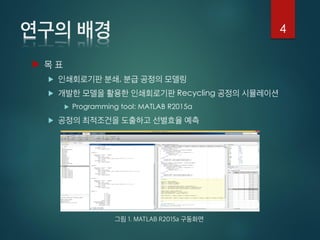
 ,
 Recycling
 Programming tool: MATLAB R2015a

 PCB
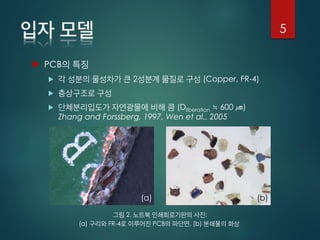
 2 (Copper, FR-4)

 (Dliberation ≒ 600 )
Zhang and Forssberg, 1997, Wen et al., 2005
5
2. :
(a) FR-4 PCB , (b)
(a) (b)
 Modeling
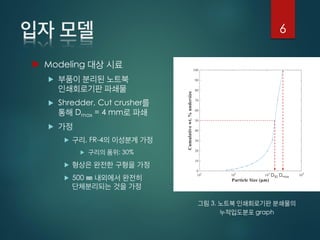

 Shredder, Cut crusher
Dmax = 4 mm

 , FR-4
 : 30%

 500
6
3.
graph
D50 Dmax
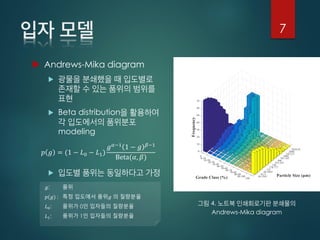
 Andrews-Mika diagram

 Beta distribution
modeling

7
4.
Andrews-Mika diagram
𝑝 𝑔 = (1 − 𝐿0 − 𝐿1)
𝑔 𝛼−1
1 − 𝑔 𝛽−1
Beta(𝛼, 𝛽)
𝑔: 품위
𝑝(𝑔) : 특정 입도에서 품위𝑔 의 질량분율
𝐿0: 품위가 0인 입자들의 질량분율
𝐿1: 품위가 1인 입자들의 질량분율
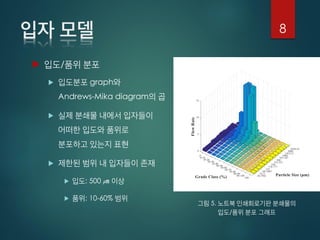
 /
 graph
Andrews-Mika diagram


 : 500
 : 10-60%
8
5.
/

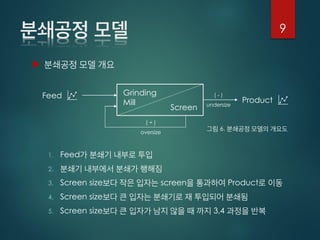
1. Feed
2.
3. Screen size screen Product
4. Screen size
5. Screen size 3,4
Product
Grinding
Mill
Screen undersize
oversize
( - )
( + )
Feed
9
6.
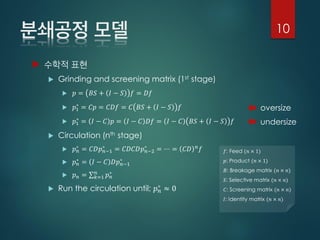
𝑓: Feed (𝑛 × 1)
𝑝: Product (𝑛 × 1)
𝐵: Breakage matrix (𝑛 × 𝑛)
𝑆: Selective matrix (𝑛 × 𝑛)
𝐶: Screening matrix (𝑛 × 𝑛)
𝐼: Identity matrix (𝑛 × 𝑛)

 Grinding and screening matrix (1st stage)
 𝑝 = 𝐵𝑆 + 𝐼 − 𝑆 𝑓 = 𝐷𝑓
 𝑝1
∘
= 𝐶𝑝 = 𝐶𝐷𝑓 = 𝐶 𝐵𝑆 + 𝐼 − 𝑆 𝑓
 𝑝1
∗
= 𝐼 − 𝐶 𝑝 = 𝐼 − 𝐶 𝐷𝑓 = 𝐼 − 𝐶 𝐵𝑆 + 𝐼 − 𝑆 𝑓
 Circulation (nth stage)
 𝑝 𝑛
∘
= 𝐶𝐷𝑝 𝑛−1
∘
= 𝐶𝐷𝐶𝐷𝑝 𝑛−2
∘
= ⋯ = 𝐶𝐷 𝑛
𝑓
 𝑝 𝑛
∗
= 𝐼 − 𝐶 𝐷𝑝 𝑛−1
∘
 𝑝 𝑛 = σ 𝑘=1
𝑛
𝑝 𝑛
∗
 Run the circulation until; 𝑝 𝑛
∘ ≈ 0
oversize
undersize
10
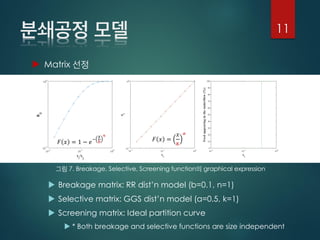
 Matrix
 Breakage matrix: RR dist’n model (b=0.1, n=1)
 Selective matrix: GGS dist’n model (a=0.5, k=1)
 Screening matrix: Ideal partition curve
 * Both breakage and selective functions are size independent
11
7. Breakage, Selective, Screening function graphical expression
𝐹 𝑥 = 1 − 𝑒
−
𝑥
𝑏
𝑛
𝐹 𝑥 =
𝑥
𝜅
𝛼
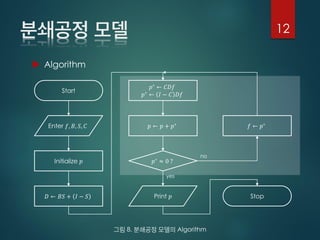
Start
Stop
𝑝∘
≈ 0 ?
𝑝∘
← 𝐶𝐷𝑓
𝑝∗
← 𝐼 − 𝐶 𝐷𝑓
𝑝 ← 𝑝 + 𝑝∗
Enter 𝑓, 𝐵, 𝑆, 𝐶
Print 𝑝𝐷 ← 𝐵𝑆 + 𝐼 − 𝑆
Initialize 𝑝
𝑓 ← 𝑝∘
yes
no
 Algorithm
12
8. Algorithm
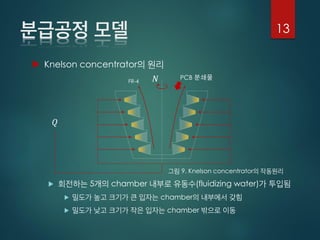
 Knelson concentrator
 5 chamber (fluidizing water)
 chamber
 chamber
13
𝑁
𝑄
PCB 분쇄물
FR-4
9. Knelson concentrator
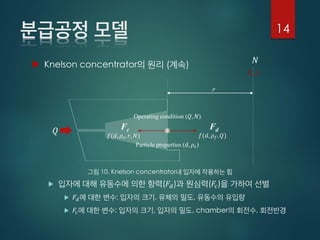
 Knelson concentrator ( )
 (𝐹𝑑) (𝐹𝑐)
 𝐹𝑑 : , ,
 𝐹𝑐 : , , chamber ,
Fd
Particle properties (𝑑, 𝜌𝑠)
Operating condition (𝑄, 𝑁)
𝑓(𝑑, 𝜌 𝑓, 𝑄)
𝑁
r
𝑄 Fc
𝑓(𝑑, 𝜌𝑠, 𝑟, 𝑁)
14
10. Knelson concentrator

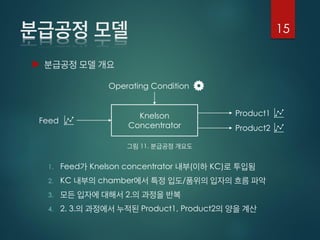
1. Feed Knelson concentrator ( KC)
2. KC chamber /
3. 2.
4. 2. 3. Product1, Product2
15
Feed
Knelson
Concentrator
Operating Condition
Product1
Product2
11.
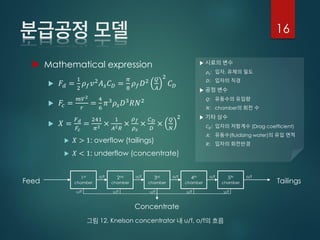
 Mathematical expression
 𝐹𝑑 =
1
2
𝜌 𝑓 𝑣2 𝐴 𝑠 𝐶 𝐷 =
𝜋
8
𝜌 𝑓 𝐷2 𝑄
𝐴
2
𝐶 𝐷
 𝐹𝑐 =
𝑚𝑉2
𝑟
=
4
6
𝜋3
𝜌𝑠 𝐷3
𝑅𝑁2
 𝑋 =
𝐹 𝑑
𝐹𝑐
=
241
𝜋2 ×
1
𝐴2 𝑅
×
𝜌 𝑓
𝜌 𝑠
×
𝐶 𝐷
𝐷
×
𝑄
𝑁
2
 𝑋 > 1: overflow (tailings)
 𝑋 < 1: underflow (concentrate)
시료의 변수
𝜌𝑠: 입자, 유체의 밀도
𝐷: 입자의 직경
공정 변수
𝑄: 유동수의 유입량
𝑁: chamber의 회전 수
기타 상수
𝐶 𝐷: 입자의 저항계수 (Drag coefficient)
𝐴: 유동수(fluidizing water)의 유입 면적
𝑅: 입자의 회전반경
1st
chamberFeed
2nd
chamber
3rd
chamber
4th
chamber
5th
chamber Tailings
o/f o/f o/f o/f
u/f
o/f
u/f u/f u/f u/f
Concentrate
16
12. Knelson concentrator u/f, o/f
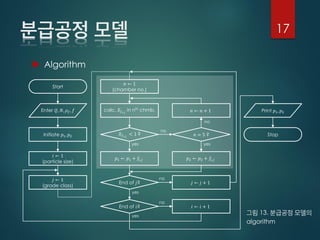
 Algorithm
17
Start
𝑗 ← 1
(grade class)
Enter 𝑄, 𝑁, 𝜌 𝑓, 𝑓
𝑖 ← 1
(particle size)
Initiate 𝑝1, 𝑝2
𝑝1 ← 𝑝1 + 𝑓𝑖,𝑗
𝑋𝑓 𝑖,𝑗
< 1 ?
calc. 𝑋𝑓 𝑖,𝑗
in nth chmb.
𝑛 ← 1
(chamber no.)
End of 𝑗?
End of 𝑖?
𝑛 ← 𝑛 + 1
𝑗 ← 𝑗 + 1
𝑝2 ← 𝑝2 + 𝑓𝑖,𝑗
𝑛 = 5 ?
𝑖 ← 𝑖 + 1
Print 𝑝1, 𝑝2
Stop
no
no
no
no
yes yes
yes
yes
13.
algorithm
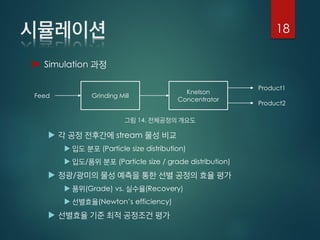
 Simulation
 stream
 (Particle size distribution)
 / (Particle size / grade distribution)
 /
 (Grade) vs. (Recovery)
 (Newton’s efficiency)

18
Grinding Mill
Knelson
Concentrator
Product1
Feed
Product2
14.
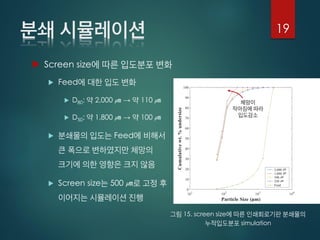
 Screen size
 Feed
 D80: 2,000 → 110
 D50: 1,800 → 100
 Feed
 Screen size 500
19
15. screen size
simulation
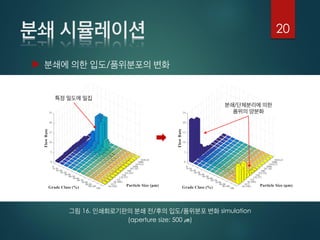
 /
20
16. / / simulation
(aperture size: 500 )
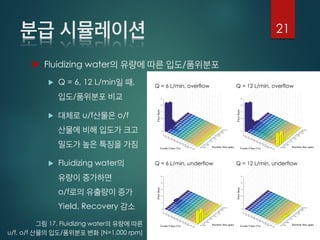
 Fluidizing water /
 Q = 6, 12 L/min ,
/
 u/f o/f
 Fluidizing water
o/f
Yield, Recovery
21
17. Fluidizing water
u/f, o/f / (N=1,000 rpm)
Q = 6 L/min, overflow Q = 12 L/min, overflow
Q = 6 L/min, underflow Q = 12 L/min, underflow
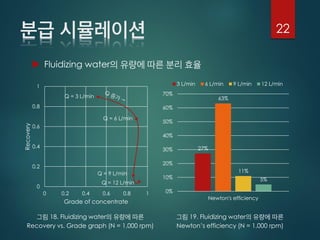
 Fluidizing water
22
18. Fluidizing water
Recovery vs. Grade graph (N = 1,000 rpm)
0
0.2
0.4
0.6
0.8
1
0 0.2 0.4 0.6 0.8 1
Recovery
Grade of concentrate
Q = 3 L/min
Q = 6 L/min
Q = 9 L/min
Q = 12 L/min
27%
63%
11%
5%
0%
10%
20%
30%
40%
50%
60%
70%
Newton's efficiency
3 L/min 6 L/min 9 L/min 12 L/min
19. Fluidizing water
Newton’s efficiency (N = 1,000 rpm)
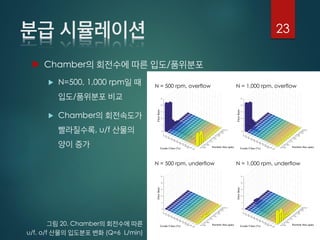
 Chamber /
 N=500, 1,000 rpm
/
 Chamber
, u/f
23
20. Chamber
u/f, o/f (Q=6 L/min)
N = 500 rpm, overflow N = 1,000 rpm, overflow
N = 500 rpm, underflow N = 1,000 rpm, underflow
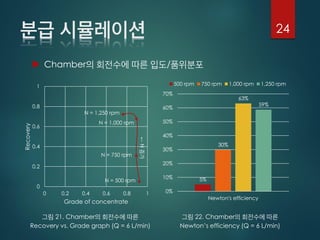
 Chamber /
24
21. Chamber
Recovery vs. Grade graph (Q = 6 L/min)
0
0.2
0.4
0.6
0.8
1
0 0.2 0.4 0.6 0.8 1
Recovery
Grade of concentrate
N = 1,250 rpm
N = 1,000 rpm
5%
30%
63%
59%
0%
10%
20%
30%
40%
50%
60%
70%
Newton's efficiency
500 rpm 750 rpm 1,000 rpm 1,250 rpm
22. Chamber
Newton’s efficiency (Q = 6 L/min)
N = 750 rpm
N = 500 rpm
←N

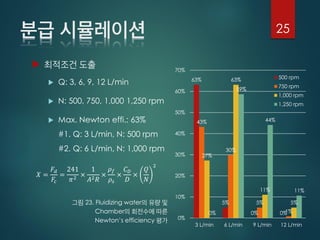
 Q: 3, 6, 9, 12 L/min
 N: 500, 750, 1,000 1,250 rpm
 Max. Newton effi.: 63%
#1. Q: 3 L/min, N: 500 rpm
#2. Q: 6 L/min, N: 1,000 rpm
25
63%
5%
0% 0%
43%
30%
5%
1%
27%
63%
11%
5%
0%
59%
44%
11%
0%
10%
20%
30%
40%
50%
60%
70%
3 L/min 6 L/min 9 L/min 12 L/min
500 rpm
750 rpm
1,000 rpm
1,250 rpm
23. Fluidizing water
Chamber
Newton’s efficiency
𝑋 =
𝐹𝑑
𝐹𝑐
=
241
𝜋2
×
1
𝐴2 𝑅
×
𝜌 𝑓
𝜌𝑠
×
𝐶 𝐷
𝐷
×
𝑄
𝑁
2

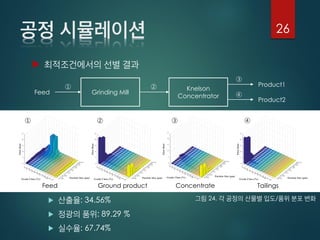
 : 34.56%
 : 89.29 %
 : 67.74%
26
Grinding Mill
Knelson
Concentrator
Product1
Feed
Product2
Feed Ground product Concentrate Tailings
24. /
① ②
③
④
① ② ③ ④
 ,

 ,
 Knelson concentrator (Newton efficiency)
#1. Q: 3 L/min, N: 500 rpm
#2. Q: 6 L/min, N: 1,000 rpm
 : 34.56%
 : 89.29 %
 : 67.74%
27




28
29
30
 Particle
 (Flowrate) FlowRate 1 x 1
 ( )
 (Components) Componentsi 1 x 2
 i ( ), text
ex> {‘Copper’, ‘FR-4’}
 (Density) Densityi 1 x 2
 i
ex> [2 9]
 (Particle size range) PSRi 1 x 13
 i (Nominal size)
ex> [45 62.5, 90, 125, … 2,800]
31
 Particle ( )
 (Particle size distribution) PSDi 1 x 13
 i
ex> [0.1, 0.15, … 0.1]
 (Grade distribution) GDi,j 13 x 12
 i j
ex> [0 0.1 0.12, … 0.1]
 (Drag coefficient) C_D 1 x 1

ex> 0.47
32
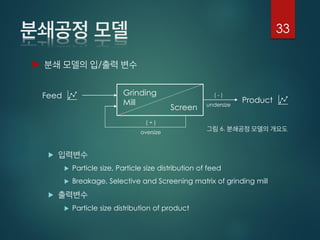
 /

 Particle size, Particle size distribution of feed
 Breakage, Selective and Screening matrix of grinding mill

 Particle size distribution of product
Product
Grinding
Mill
Screen undersize
oversize
( - )
( + )
Feed
33
6.


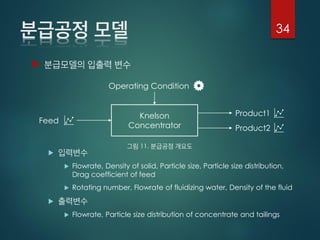
 Flowrate, Density of solid, Particle size, Particle size distribution,
Drag coefficient of feed
 Rotating number, Flowrate of fluidizing water, Density of the fluid

 Flowrate, Particle size distribution of concentrate and tailings
34
Feed
Knelson
Concentrator
Operating Condition
Product1
Product2
11.

150507 2015년 춘계 한국자원리싸이클링학회 발표자료 (박승수)

  • 2.
  • 3.
    3  (PCB)  ,FR-4 , /    JKSimMet, Metsim, Modsim  PCB   Trial/Error
  • 4.
    4   ,  Recycling Programming tool: MATLAB R2015a 
  • 5.
     PCB  2(Copper, FR-4)   (Dliberation ≒ 600 ) Zhang and Forssberg, 1997, Wen et al., 2005 5 2. : (a) FR-4 PCB , (b) (a) (b)
  • 6.
     Modeling   Shredder,Cut crusher Dmax = 4 mm   , FR-4  : 30%   500 6 3. graph D50 Dmax
  • 7.
     Andrews-Mika diagram  Beta distribution modeling  7 4. Andrews-Mika diagram 𝑝 𝑔 = (1 − 𝐿0 − 𝐿1) 𝑔 𝛼−1 1 − 𝑔 𝛽−1 Beta(𝛼, 𝛽) 𝑔: 품위 𝑝(𝑔) : 특정 입도에서 품위𝑔 의 질량분율 𝐿0: 품위가 0인 입자들의 질량분율 𝐿1: 품위가 1인 입자들의 질량분율
  • 8.
     /  graph Andrews-Mikadiagram    : 500  : 10-60% 8 5. /
  • 9.
     1. Feed 2. 3. Screensize screen Product 4. Screen size 5. Screen size 3,4 Product Grinding Mill Screen undersize oversize ( - ) ( + ) Feed 9 6.
  • 10.
    𝑓: Feed (𝑛× 1) 𝑝: Product (𝑛 × 1) 𝐵: Breakage matrix (𝑛 × 𝑛) 𝑆: Selective matrix (𝑛 × 𝑛) 𝐶: Screening matrix (𝑛 × 𝑛) 𝐼: Identity matrix (𝑛 × 𝑛)   Grinding and screening matrix (1st stage)  𝑝 = 𝐵𝑆 + 𝐼 − 𝑆 𝑓 = 𝐷𝑓  𝑝1 ∘ = 𝐶𝑝 = 𝐶𝐷𝑓 = 𝐶 𝐵𝑆 + 𝐼 − 𝑆 𝑓  𝑝1 ∗ = 𝐼 − 𝐶 𝑝 = 𝐼 − 𝐶 𝐷𝑓 = 𝐼 − 𝐶 𝐵𝑆 + 𝐼 − 𝑆 𝑓  Circulation (nth stage)  𝑝 𝑛 ∘ = 𝐶𝐷𝑝 𝑛−1 ∘ = 𝐶𝐷𝐶𝐷𝑝 𝑛−2 ∘ = ⋯ = 𝐶𝐷 𝑛 𝑓  𝑝 𝑛 ∗ = 𝐼 − 𝐶 𝐷𝑝 𝑛−1 ∘  𝑝 𝑛 = σ 𝑘=1 𝑛 𝑝 𝑛 ∗  Run the circulation until; 𝑝 𝑛 ∘ ≈ 0 oversize undersize 10
  • 11.
     Matrix  Breakagematrix: RR dist’n model (b=0.1, n=1)  Selective matrix: GGS dist’n model (a=0.5, k=1)  Screening matrix: Ideal partition curve  * Both breakage and selective functions are size independent 11 7. Breakage, Selective, Screening function graphical expression 𝐹 𝑥 = 1 − 𝑒 − 𝑥 𝑏 𝑛 𝐹 𝑥 = 𝑥 𝜅 𝛼
  • 12.
    Start Stop 𝑝∘ ≈ 0 ? 𝑝∘ ←𝐶𝐷𝑓 𝑝∗ ← 𝐼 − 𝐶 𝐷𝑓 𝑝 ← 𝑝 + 𝑝∗ Enter 𝑓, 𝐵, 𝑆, 𝐶 Print 𝑝𝐷 ← 𝐵𝑆 + 𝐼 − 𝑆 Initialize 𝑝 𝑓 ← 𝑝∘ yes no  Algorithm 12 8. Algorithm
  • 13.
     Knelson concentrator 5 chamber (fluidizing water)  chamber  chamber 13 𝑁 𝑄 PCB 분쇄물 FR-4 9. Knelson concentrator
  • 14.
     Knelson concentrator( )  (𝐹𝑑) (𝐹𝑐)  𝐹𝑑 : , ,  𝐹𝑐 : , , chamber , Fd Particle properties (𝑑, 𝜌𝑠) Operating condition (𝑄, 𝑁) 𝑓(𝑑, 𝜌 𝑓, 𝑄) 𝑁 r 𝑄 Fc 𝑓(𝑑, 𝜌𝑠, 𝑟, 𝑁) 14 10. Knelson concentrator
  • 15.
     1. Feed Knelsonconcentrator ( KC) 2. KC chamber / 3. 2. 4. 2. 3. Product1, Product2 15 Feed Knelson Concentrator Operating Condition Product1 Product2 11.
  • 16.
     Mathematical expression 𝐹𝑑 = 1 2 𝜌 𝑓 𝑣2 𝐴 𝑠 𝐶 𝐷 = 𝜋 8 𝜌 𝑓 𝐷2 𝑄 𝐴 2 𝐶 𝐷  𝐹𝑐 = 𝑚𝑉2 𝑟 = 4 6 𝜋3 𝜌𝑠 𝐷3 𝑅𝑁2  𝑋 = 𝐹 𝑑 𝐹𝑐 = 241 𝜋2 × 1 𝐴2 𝑅 × 𝜌 𝑓 𝜌 𝑠 × 𝐶 𝐷 𝐷 × 𝑄 𝑁 2  𝑋 > 1: overflow (tailings)  𝑋 < 1: underflow (concentrate) 시료의 변수 𝜌𝑠: 입자, 유체의 밀도 𝐷: 입자의 직경 공정 변수 𝑄: 유동수의 유입량 𝑁: chamber의 회전 수 기타 상수 𝐶 𝐷: 입자의 저항계수 (Drag coefficient) 𝐴: 유동수(fluidizing water)의 유입 면적 𝑅: 입자의 회전반경 1st chamberFeed 2nd chamber 3rd chamber 4th chamber 5th chamber Tailings o/f o/f o/f o/f u/f o/f u/f u/f u/f u/f Concentrate 16 12. Knelson concentrator u/f, o/f
  • 17.
     Algorithm 17 Start 𝑗 ←1 (grade class) Enter 𝑄, 𝑁, 𝜌 𝑓, 𝑓 𝑖 ← 1 (particle size) Initiate 𝑝1, 𝑝2 𝑝1 ← 𝑝1 + 𝑓𝑖,𝑗 𝑋𝑓 𝑖,𝑗 < 1 ? calc. 𝑋𝑓 𝑖,𝑗 in nth chmb. 𝑛 ← 1 (chamber no.) End of 𝑗? End of 𝑖? 𝑛 ← 𝑛 + 1 𝑗 ← 𝑗 + 1 𝑝2 ← 𝑝2 + 𝑓𝑖,𝑗 𝑛 = 5 ? 𝑖 ← 𝑖 + 1 Print 𝑝1, 𝑝2 Stop no no no no yes yes yes yes 13. algorithm
  • 18.
     Simulation  stream (Particle size distribution)  / (Particle size / grade distribution)  /  (Grade) vs. (Recovery)  (Newton’s efficiency)  18 Grinding Mill Knelson Concentrator Product1 Feed Product2 14.
  • 19.
     Screen size Feed  D80: 2,000 → 110  D50: 1,800 → 100  Feed  Screen size 500 19 15. screen size simulation
  • 20.
     / 20 16. // simulation (aperture size: 500 )
  • 21.
     Fluidizing water/  Q = 6, 12 L/min , /  u/f o/f  Fluidizing water o/f Yield, Recovery 21 17. Fluidizing water u/f, o/f / (N=1,000 rpm) Q = 6 L/min, overflow Q = 12 L/min, overflow Q = 6 L/min, underflow Q = 12 L/min, underflow
  • 22.
     Fluidizing water 22 18.Fluidizing water Recovery vs. Grade graph (N = 1,000 rpm) 0 0.2 0.4 0.6 0.8 1 0 0.2 0.4 0.6 0.8 1 Recovery Grade of concentrate Q = 3 L/min Q = 6 L/min Q = 9 L/min Q = 12 L/min 27% 63% 11% 5% 0% 10% 20% 30% 40% 50% 60% 70% Newton's efficiency 3 L/min 6 L/min 9 L/min 12 L/min 19. Fluidizing water Newton’s efficiency (N = 1,000 rpm)
  • 23.
     Chamber / N=500, 1,000 rpm /  Chamber , u/f 23 20. Chamber u/f, o/f (Q=6 L/min) N = 500 rpm, overflow N = 1,000 rpm, overflow N = 500 rpm, underflow N = 1,000 rpm, underflow
  • 24.
     Chamber / 24 21.Chamber Recovery vs. Grade graph (Q = 6 L/min) 0 0.2 0.4 0.6 0.8 1 0 0.2 0.4 0.6 0.8 1 Recovery Grade of concentrate N = 1,250 rpm N = 1,000 rpm 5% 30% 63% 59% 0% 10% 20% 30% 40% 50% 60% 70% Newton's efficiency 500 rpm 750 rpm 1,000 rpm 1,250 rpm 22. Chamber Newton’s efficiency (Q = 6 L/min) N = 750 rpm N = 500 rpm ←N
  • 25.
      Q: 3,6, 9, 12 L/min  N: 500, 750, 1,000 1,250 rpm  Max. Newton effi.: 63% #1. Q: 3 L/min, N: 500 rpm #2. Q: 6 L/min, N: 1,000 rpm 25 63% 5% 0% 0% 43% 30% 5% 1% 27% 63% 11% 5% 0% 59% 44% 11% 0% 10% 20% 30% 40% 50% 60% 70% 3 L/min 6 L/min 9 L/min 12 L/min 500 rpm 750 rpm 1,000 rpm 1,250 rpm 23. Fluidizing water Chamber Newton’s efficiency 𝑋 = 𝐹𝑑 𝐹𝑐 = 241 𝜋2 × 1 𝐴2 𝑅 × 𝜌 𝑓 𝜌𝑠 × 𝐶 𝐷 𝐷 × 𝑄 𝑁 2
  • 26.
      : 34.56% : 89.29 %  : 67.74% 26 Grinding Mill Knelson Concentrator Product1 Feed Product2 Feed Ground product Concentrate Tailings 24. / ① ② ③ ④ ① ② ③ ④
  • 27.
     ,   , Knelson concentrator (Newton efficiency) #1. Q: 3 L/min, N: 500 rpm #2. Q: 6 L/min, N: 1,000 rpm  : 34.56%  : 89.29 %  : 67.74% 27
  • 28.
  • 29.
  • 30.
  • 31.
     Particle  (Flowrate)FlowRate 1 x 1  ( )  (Components) Componentsi 1 x 2  i ( ), text ex> {‘Copper’, ‘FR-4’}  (Density) Densityi 1 x 2  i ex> [2 9]  (Particle size range) PSRi 1 x 13  i (Nominal size) ex> [45 62.5, 90, 125, … 2,800] 31
  • 32.
     Particle ()  (Particle size distribution) PSDi 1 x 13  i ex> [0.1, 0.15, … 0.1]  (Grade distribution) GDi,j 13 x 12  i j ex> [0 0.1 0.12, … 0.1]  (Drag coefficient) C_D 1 x 1  ex> 0.47 32
  • 33.
     /   Particlesize, Particle size distribution of feed  Breakage, Selective and Screening matrix of grinding mill   Particle size distribution of product Product Grinding Mill Screen undersize oversize ( - ) ( + ) Feed 33 6.
  • 34.
       Flowrate, Densityof solid, Particle size, Particle size distribution, Drag coefficient of feed  Rotating number, Flowrate of fluidizing water, Density of the fluid   Flowrate, Particle size distribution of concentrate and tailings 34 Feed Knelson Concentrator Operating Condition Product1 Product2 11.