DEPARTMENT OF
CITY PLANNING
200 N.SPRING STREET,Room 525
Los ANGELES,CA 90012-4801
AND
6262VAN NuYS BLVD.,SUITE 351
VAN Nuys,CA 91401
CITY PLANNING COMMISSION
DAVID H.J. AMBROZ
PRESIDENT
RENEE DAKE WILSON
VICE-PRESIDENT
ROBERT L AHN
MARIA CABILDO
CAROLINE CHOE
RICHARD KATZ
JOHN W.MACK
DANA M.PERLMAN
MARTA SEGURA
JAMES K. WILLIAMS
COMMISSION EXECUTIVE ASSISTANT II
(213)978-1300
CITY OF LOS ANGELES
Council ofthe City of Los Angeles
Public Safety Committee
200 North Spring Street
Los Angeles,CA 90012
CALIFORNIA
ERIC GARCETTI
MAYOR
February 2,2015
RE: REGULATING MASSAGE BUSINESSES IN LOS ANGELES
EXECUTIVE OFFICES
MICHAEL J. LOGRANDE
DIRECTOR
(213)978-1271
USA M.WEBBER,AICP
DEPUTY DIRECTOR
(213)978-1274
JAN ZATORSKI
DEPUTY DIRECTOR
(213)978-1273
VACANT
DEPUTY DIRECTOR
(213)978-1272
FAX:(213)978-1275
IN FORMATION
www.planning.lacity.org
Honorable Members of the Public Safety Committee; Councilmembers Mitchell
Englander, Joe Buscaino, Mike Bonin, Mitch O'Farrell, and Nury Martinez:
For your consideration, this report responds to a recommendation by the Board of
Police Commissioners to the City Council to modify sections of the Los Angeles
Municipal Code relating to massage therapy and adult entertainment in light of changes
in State law pursuant to Assembly Bill(AB)1147that became effective January 1,2015.
BACKGROUND
In 1978,Ordinance No. 151,294 added Section 12.70 Adult Entertainment Zoning to the
Los Angeles Municipal Code (LAMC), which described and regulated adult
entertainment, including massage parlors. In 1981, Ordinance No. 155,718 added
provisions that distinguished between massage parlors providing sexually-oriented
massage from those that did not. Non-sexually oriented massage parlors were
permitted by right in the C2, C4, C5, CM, M1, M2, and M3Zones without a conditional
use permit. Sexually-oriented massage parlors were required to obtain a conditional use
permit in the C2,C4,C5,CM,Ml, M2,and M3Zones and also required to abide by the
adult entertainment restrictions in Section 12.70-C.
Reportto Public Safety Committee Page 2
February 02,2015
Previous State Law:Effective 2009-2014
In 2009, California Senate Bill (SB) 731 amendments to the California Business and
Professions Code prohibited local jurisdictions from regulating massage enterprises as
adult entertainment and preempted them from requiring massage establishments that
utilized only State-licensed massage therapists and practitioners to obtain a local
business license or permit. This, in some circumstances, lessened the ability of local
jurisdictions to manage the business of massage through land use regulations and
business licenses.
The Department of City Planning responded to the 2009 provisions by issuing a Zoning
Administrator's Interpretation (ZAI) under ZA 2010-2714(ZAI), which is attached. The
ZAI stated that all massage parlors are allowed as a by-right land use in the C2,C4,C5,
CM,Ml, M2,and M3Zones and that a conditional use permit requiring compliance with
the adult entertainment restrictions in Section 12.70 will no longer be required.
The 2009 provisions also established that massage businesses utilizing only State-
licensed therapists and practitioners were exempted by State law from having to obtain
permits issued by the Board of Police Commissioners(known as "police permits") that
otherwise would have been required under the LAMC's business regulations, Section
103.205. These "police permits" would have required compliance with a comprehensive
set of operational regulations, including annual inspections from the Los Angeles
County Department of Health and limited operating hours,among other standards.
New State Law:Effective January 2015
On January 1, 2015, the Massage Therapy Act, California Assembly Bill (AB) 1147,
became effective. While the new legislation still prohibits local jurisdictions from
regulating massage as adult entertainment, it restores local authority to regulate the
business of massage through business licensing and/or land use regulations. The State
will regulate the practice of massage, i.e. certification of massage therapists and
massage practitioners.
The Board of Police Commissioners has recommended to the City Council that the
Office of the City Attorney be directed to modify LAMC Section 103.205, Massage
Therapy,and that the Department of City Planning be directed to modify LAMC Section
12.70, Adult Entertainment Zoning and other land use regulations in the Code,to reflect
regulatory controls made available with adoption of AB 1147. Attached to the report was
a list of issues recommended to be addressed in a draft ordinance, noting that "the
issues related to land use regulations are best addressed by the Planning
Department...".
Report to Public Safety Committee Page 3
February 02,2015
DISCUSSION
The Department of City Planning has addressed compliance with AB 1147 and land use
issues related to massage parlors with the ZAI issued in 2010, as referenced above.
The ZAI stated that massage parlors are a land use allowed by right in most of the
commercial and industrial zones, and that massage parlors with State-licensed
practitioners are not an adult entertainment business and therefore are not subject to
the adult entertainment regulations. The ZAI remains applicable even with the AB 1147
changes to State law. On December 26, 2014, Associate Zoning Administrator David
Weintraub issued an information memorandum to that effect, which is attached,
addressing questions that might arise about the regulation of massage parlors in light of
the passage of AB 1147.
The Department of City Planning acknowledges human trafficking and prostitution are
serious problems. They are citywide vice and public safety issues that at times follow
certain land uses,such as massage establishments, but have occurred independent of,
and are not exclusive to, massage parlors. More importantly, they are not land uses and
are not best addressed by a land use regulatory process. Pursuant to the changes in
State law, LAMC Section 12.70 Adult Entertainment Zoning cannot be used to regulate
massage enterprises. In light of the State's clear pivot away from associating massage
establishments with adult entertainment, any new modification of LAMC Section 12.70
for the purpose of regulating massage parlors would not be appropriate and could
instead expose the City to legal challenges.
Furthermore, the Department of City Planning does not see added value in creating a
new conditional use for massage parlors. If a conditional use process were an effective
deterrent to illicit behavior associated with otherwise legal activity or land use, then it
would be expected that prostitution and similar vice activity would not be prevalent in
alcoholic beverage-related businesses, which are currently required to obtain
conditional use permits. The Department of City Planning's years of experience with
conditional use permits for alcoholic beverage-related businesses indicates that the time
and expense of obtaining and maintaining a conditional use permit is not an effective
deterrent to such illicit activities. In addition, setting hurdles for all massage businesses
would financially burden those that are legitimate and jeopardize existing legitimate
establishments by classifying them as a non-conforming use, the rights for which could
be lost by expansion or relocation. A land use regulatory response such as a conditional
use process to combat vice and public safety issues is at best an indirect approach to
addressing criminal activities that warrant more immediate action.
Other suggested amendments recommended by the Board of Police Commissioners for
inclusion in a draft ordinance can be captured most effectively by modifications to LAMC
Section 103.205, compliance with which would be enforced by the Police Department
rather than the Department of Building and Safety. The change in State law removes
the preemption that exempted massage establishments utilizing only State-licensed
massage therapists and practitioners from obtaining the "police permit" required by the
Reportto Public Safety Committee Page 4
February 02,2015
Code's business regulations. The preemption of the City's business regulations
interfered with the City's ability to effectively oversee and manage the operations of
massage establishments utilizing police powers. Now that the preemption has been
removed, the City can require all massage establishments to obtain and maintain a
"police permit" and will regain a powerful mechanism for controlling the operations of
these businesses.
RECOMMENDATIONS
The Department of City Planning recommends that the Office of the City Attorney be
directed to modify and update the Los Angeles Municipal Code's business regulations
to comply with AB 1147 and better address the problems of human trafficking and
prostitution associated with massage establishments and that no amendments to the
Zoning Code be made to address these issues at this time.
Should you have any questions about this report, please call Phyllis Nathanson at(213)
978-1474.
Sinc
LINN W ATT
Chief • ing Administrator
LKW:PJN
ATTACHMENTS:
Case No.ZA 2010-2714(ZAI)
Memorandum from David S.Weintraub on massage parlors, December26,2014
AD-id:4c
—A9
i'd10
L I :C Z 83J IOZ
LINN K. VVYATT
ACTING CHIEF ZONING ADMINISTRATOR
ASSOCIATE ZONING ADMINISTRATORS
R. NICOLAS BROWN
SUE CHANG
LOURDES GREEN
MAYA E. ZAITZEVSKY
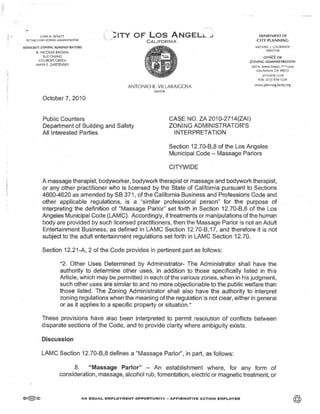
October 7,2010
ITY OF LOS ANGELL _.,
CALIFORNIA
ANTONIO R.VILLARAIGOSA
MAYOR
DEPARTMENT OF
CITY PLANNING
MICHAEL ). LOGRANDE
DIRECTOR
OFFICE OF
ZONING ADMINISTRATION
200 N.SPRING STREET,7'FLOOR
LosANGELES,CA 90012
(213)978-1318
FAX.(213)978-1334
www.planning.lacity.org
Public Counters CASE NO.ZA 2010-2714(ZAI)
Departmentof Building and Safety ZONING ADMINISTRATOR'S
All Interested Parties INTERPRETATION
Section 12.70-6,8 ofthe Los Angeles
Municipal Code — Massage Parlors
CITYWIDE
A massagetherapist,bodyworker,bodyworktherapistor massage and bodyworktherapist,
or any other practitioner who is licensed by the State of California pursuant to Sections
46004620as amended bySB 371,ofthe California Business and Professions Code and
other applicable regulations, is a "similar professional person" for the purpose of
interpreting the definition of"Massage Parlor" set forth in Section 12.70-B,8 of the Los
Angeles Municipal Code(LAMC). Accordingly,iftreatmentsor manipulationsofthe human
body are provided bysuch licensed practitioners,then the Massage Parlor is notan Adult
Entertainment Business,as defined in LAMC Section 12.70-B,17, and therefore it is not
subjectto the adult entertainment regulations setforth in LAMC Section 12.70.
Section 12.21-A,2ofthe Code provides in pertinent part as follows:
"2. Other Uses Determined by Administrator- The Administrator shall have the
authority to determine other uses, in addition to those specifically listed in this
Article,which may be permitted in each ofthe variouszones,when in hisjudgment,
such other uses are similarto and no more objectionabletothe public welfare than
those listed. The Zoning Administrator shall also have the authority to interpret
zoning regulations when the meaning ofthe regulation is notclear,either in general
or as it applies to a specific property or situation."
These provisions have also been interpreted to permit resolution of conflicts between
disparate sections ofthe Code,and to provide clarity where ambiguity exists.
Discussion
LAMC Section 12.70-B,8 defines a"Massage Parlor", in part, asfollows:
8. "Massage Parlor" — An establishment where, for any form of
consideration,massage,alcohol rub,fomentation,electricor magnetictreatment,or
AN EQUAL EMPLOYMENT OPPORTUNITY — AFFIRMATIVE ACTION EMPLOYER
CASE NO.ZA 2010-27. ,ZAI) PAGE 2
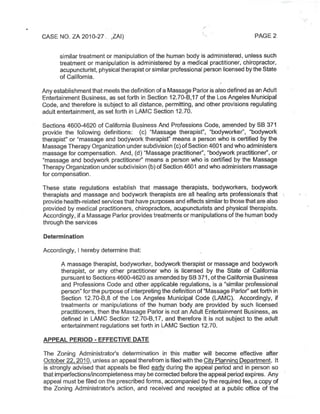
similar treatment or manipulation ofthe human body is administered, unless such
treatment or manipulation is administered by a medical practitioner, chiropractor,
acupuncturist,physicaltherapistorsimilar professional person licensed bytheState
of California.
Anyestablishmentthat meetsthe definition ofa Massage Parlor is alsodefined asan Adult
Entertainment Business,as setforth in Section 12.70-B,17 ofthe Los Angeles Municipal
Code,and therefore is subject to all distance, permitting,and other provisions regulating
adultentertainment,as setforth in LAMC Section 12.70.
Sections 4600-4620 of California Business And Professions Code,amended by SB 371
provide the following definitions: (c) "Massage therapist", "bodyworker", "bodywork
therapist" or"massage and bodywork therapist" means a person who is certified by the
Massage Therapy Organization undersubdivision(c)ofSection4601 and whoadministers
massage for compensation. And,(d)"Massage practitioner","bodywork practitioner",or
"massage and bodywork practitioner" means a person who is certified by the Massage
Therapy Organization undersubdivision(b)ofSection4601 and who administers massage
for compensation.
These state regulations establish that massage therapists, bodyworkers, bodywork
therapists and massage and bodywork therapists are all healing arts professionals that
provide health-related servicesthat have purposesand effects similartothosethatarealso
provided by medical practitioners, chiropractors, acupuncturists and physical therapists.
Accordingly,ifa Massage Parlor providestreatmentsor manipulationsofthe human body
through the services
Determination
Accordingly, I hereby determine that:
A massage therapist, bodyworker, bodywork therapist or massage and bodywork
therapist, or any other practitioner who is licensed by the State of California
pursuantto Sections4600-4620asamended bySB 371,ofthe California Business
and Professions Code and other applicable regulations, is a "similar professional
person"forthe purpose ofinterpreting the definition of"Massage Parlor"setforth in
Section 12.70-B,8 of the Los Angeles Municipal Code (LAMC). Accordingly, if
treatments or manipulations of the human body are provided by such licensed
practitioners,then the Massage Parlor is not an Adult Entertainment Business,as
defined in LAMC Section 12.70-B,17, and therefore it is not subject to the adult
entertainment regulations setforth in LAMC Section 12.70.
APPEAL PERIOD - EFFECTIVE DATE
The Zoning Administrator's determination in this matter will become effective after
October22,2010,unless an appealtherefrom isfiled withthe City Planning Department. It
is strongly advised that appeals be filed early during the appeal period and in person so
thatimperfections/incompleteness may becorrected beforetheappeal period expires. Any
appeal must be filed on the prescribed forms,accompanied bythe required fee,a copy of
the Zoning Administrator's action, and received and receipted at a public office of the
CASE NO.ZA 2010-27 ,ZAI) PAGE 3
DepartmentofCity Planning on or beforethe above date orthe appeal will not be accepted.
Forms are available on-line at http://planninq.lacitv.org. Public offices are located at:
Figueroa Plaza
201 North Figueroa Street,
4th Floor
Los Angeles,CA 90012
(213)482-7077
Marvin Braude San Fernando
Valley Constituent Service Center
6262Van Nuys Boulevard, Room 251
Van Nuys,CA 91401
(818)374-5050
If you seek judicial review of any decision ofthe City pursuant to California Code of Civil
ProcedureSection 1094.5,the petition for writofmandate pursuanttothatsection must be
filed no laterthan the90th dayfollowing the date on which the City'sdecision becamefinal
pursuant to Calif .•e of Civil Procedure Section 1094.6. There may be other time
limits which o affect yo r ability to seek judicial review.
LINN
Acting ChiefZoning Administrator
Direct Telephone No.:(213)978-1318
LKW:AB:Imc
City Hall•200 N. Spring Street, Room •Los Angeles,CA 90012
December 26,2014
TO: All Staff
Other Interested Partie
FROM: David S.Weintraub
Associate Zoning Administrator
Development Services Center
Department of City Planning
SUBJECT: MASSAGE PARLORS
This memorandum answers frequently asked questions about Massage Parlors in light
of amendments to State law,enacted under Assembly Bill(AB)1147,effective January
1,2015.
1. Where are Massage Parlors permitted within the City of Los Angeles?
Massage Parlors as described in Los Angeles Municipal Code (LAMC) Section
12.14-A,37 are a land use permitted by right in the C2, C4, C5, CM, M1, M2,and
M3Zones.
2. Does a Massage Parlor require a Conditional Use permit?
Massage Parlors utilizing State-licensed therapists or practitioners, including those
certified by the California Massage Therapy Council(CAMTC),are allowed by right
in the C2, C4, C5, CM, M1, M2, and M3 Zones. No conditional use permit is
required (see LAMC Section 12.14-A, 37). Massage Parlors seeking to operate in
otherzones require a variance pursuant to LAMC Section 12.27.
LAMC Section 12.24-W,18 lists a conditional use for Massage Parlors associated
with the Adult Entertainment provisions in Section 12.70. However in 2009,
amendments to the California Business and Professions Code under Senate Bill
(SB)731, prohibited local jurisdictions from regulating massage enterprises as adult
entertainment. In response to the adoption of SB731, a Zoning Administrator's
Interpretation (ZAI) under ZA 2010-2714(ZAI) issued in 2010 determined that: "A
massage therapist... licensed by the State of California is a similar professional
person [to a medical practitioner, chiropractor, acupuncturist, physical therapist]
...[and] if treatments or manipulations of the human body are provided by ... [such
State-] licensed practitioners, then the Massage Parlor is not an Adult
Entertainment Business,as defined in LAMC Section 12.70-B,17,and therefore it is
not subject to the adult entertainment regulations setforth in LAMC Section 12.70."
(See attached).
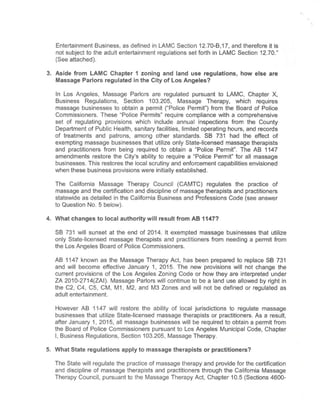
3. Aside from LAMC Chapter 1 zoning and land use regulations, how else are
Massage Parlors regulated in the City of Los Angeles?
In Los Angeles, Massage Parlors are regulated pursuant to LAMC, Chapter X,
Business Regulations, Section 103.205, Massage Therapy, which requires
massage businesses to obtain a permit ("Police Permit")from the Board of Police
Commissioners. These "Police Permits" require compliance with a comprehensive
set of regulating provisions which include annual inspections from the County
Department of Public Health, sanitary facilities, limited operating hours,and records
of treatments and patrons, among other standards. SB 731 had the effect of
exempting massage businesses that utilize only State-licensed massage therapists
and practitioners from being required to obtain a "Police Permit". The AB 1147
amendments restore the City's ability to require a "Police Permit" for all massage
businesses. This restores the local scrutiny and enforcement capabilities envisioned
when these business provisions were initially established.
The California Massage Therapy Council (CAMTC) regulates the practice of
massage and the certification and discipline of massage therapists and practitioners
statewide as detailed in the California Business and Professions Code(see answer
to Question No.5 below).
4. Whatchanges to local authority will resultfrom AB 1147?
SB 731 will sunset at the end of 2014. It exempted massage businesses that utilize
only State-licensed massage therapists and practitioners from needing a permit from
the Los Angeles Board of Police Commissioners.
AB 1147 known as the Massage Therapy Act, has been prepared to replace SB 731
and will become effective January 1, 2015. The new provisions will not change the
current provisions of the Los Angeles Zoning Code or how they are interpreted under
ZA 2010-2714(ZAI). Massage Parlors will continue to be a land use allowed by right in
the C2, C4, C5, CM, M1, M2, and M3 Zones and will not be defined or regulated as
adult entertainment.
However AB 1147 will restore the ability of local jurisdictions to regulate massage
businesses that utilize State-licensed massage therapists or practitioners. As a result,
after January 1, 2015,all massage businesses will be required to obtain a permit from
the Board of Police Commissioners pursuant to Los Angeles Municipal Code, Chapter
I, Business Regulations, Section 103.205, Massage Therapy.
5. WhatState regulations apply to massage therapists or practitioners?
The State will regulate the practice of massage therapy and provide for the certification
and discipline of massage therapists and practitioners through the California Massage
Therapy Council, pursuant to the Massage Therapy Act, Chapter 10.5(Sections 4600-
4620), added to the Business and Professions Code by AB 1147 and effective January
1, 2015. Certification requirements include that recipients be at least 18 years of age,
complete a minimum of 500 hours of instruction in massage and related subjects from
approved schools, and pass a massage and bodywork competency examination and
background investigation.
For more detailed information regarding zoning and land use regulations applicable to
a specific property, please consult with Department of City Planning staff at the
Development Services Center in either ofthese two locations:
Figueroa Plaza
201 North Figueroa Street,
4th Floor
Los Angeles, CA 90012
(213)482-7077
Marvin Braude San Fernando
Valley Constituent Service Center
6262 Van Nuys Boulevard, Room 251
Van Nuys,CA 91401
(818)374-5050

Massage Businesses Regulation in Los Angeles

  • 1.
    DEPARTMENT OF CITY PLANNING 200N.SPRING STREET,Room 525 Los ANGELES,CA 90012-4801 AND 6262VAN NuYS BLVD.,SUITE 351 VAN Nuys,CA 91401 CITY PLANNING COMMISSION DAVID H.J. AMBROZ PRESIDENT RENEE DAKE WILSON VICE-PRESIDENT ROBERT L AHN MARIA CABILDO CAROLINE CHOE RICHARD KATZ JOHN W.MACK DANA M.PERLMAN MARTA SEGURA JAMES K. WILLIAMS COMMISSION EXECUTIVE ASSISTANT II (213)978-1300 CITY OF LOS ANGELES Council ofthe City of Los Angeles Public Safety Committee 200 North Spring Street Los Angeles,CA 90012 CALIFORNIA ERIC GARCETTI MAYOR February 2,2015 RE: REGULATING MASSAGE BUSINESSES IN LOS ANGELES EXECUTIVE OFFICES MICHAEL J. LOGRANDE DIRECTOR (213)978-1271 USA M.WEBBER,AICP DEPUTY DIRECTOR (213)978-1274 JAN ZATORSKI DEPUTY DIRECTOR (213)978-1273 VACANT DEPUTY DIRECTOR (213)978-1272 FAX:(213)978-1275 IN FORMATION www.planning.lacity.org Honorable Members of the Public Safety Committee; Councilmembers Mitchell Englander, Joe Buscaino, Mike Bonin, Mitch O'Farrell, and Nury Martinez: For your consideration, this report responds to a recommendation by the Board of Police Commissioners to the City Council to modify sections of the Los Angeles Municipal Code relating to massage therapy and adult entertainment in light of changes in State law pursuant to Assembly Bill(AB)1147that became effective January 1,2015. BACKGROUND In 1978,Ordinance No. 151,294 added Section 12.70 Adult Entertainment Zoning to the Los Angeles Municipal Code (LAMC), which described and regulated adult entertainment, including massage parlors. In 1981, Ordinance No. 155,718 added provisions that distinguished between massage parlors providing sexually-oriented massage from those that did not. Non-sexually oriented massage parlors were permitted by right in the C2, C4, C5, CM, M1, M2, and M3Zones without a conditional use permit. Sexually-oriented massage parlors were required to obtain a conditional use permit in the C2,C4,C5,CM,Ml, M2,and M3Zones and also required to abide by the adult entertainment restrictions in Section 12.70-C.
  • 2.
    Reportto Public SafetyCommittee Page 2 February 02,2015 Previous State Law:Effective 2009-2014 In 2009, California Senate Bill (SB) 731 amendments to the California Business and Professions Code prohibited local jurisdictions from regulating massage enterprises as adult entertainment and preempted them from requiring massage establishments that utilized only State-licensed massage therapists and practitioners to obtain a local business license or permit. This, in some circumstances, lessened the ability of local jurisdictions to manage the business of massage through land use regulations and business licenses. The Department of City Planning responded to the 2009 provisions by issuing a Zoning Administrator's Interpretation (ZAI) under ZA 2010-2714(ZAI), which is attached. The ZAI stated that all massage parlors are allowed as a by-right land use in the C2,C4,C5, CM,Ml, M2,and M3Zones and that a conditional use permit requiring compliance with the adult entertainment restrictions in Section 12.70 will no longer be required. The 2009 provisions also established that massage businesses utilizing only State- licensed therapists and practitioners were exempted by State law from having to obtain permits issued by the Board of Police Commissioners(known as "police permits") that otherwise would have been required under the LAMC's business regulations, Section 103.205. These "police permits" would have required compliance with a comprehensive set of operational regulations, including annual inspections from the Los Angeles County Department of Health and limited operating hours,among other standards. New State Law:Effective January 2015 On January 1, 2015, the Massage Therapy Act, California Assembly Bill (AB) 1147, became effective. While the new legislation still prohibits local jurisdictions from regulating massage as adult entertainment, it restores local authority to regulate the business of massage through business licensing and/or land use regulations. The State will regulate the practice of massage, i.e. certification of massage therapists and massage practitioners. The Board of Police Commissioners has recommended to the City Council that the Office of the City Attorney be directed to modify LAMC Section 103.205, Massage Therapy,and that the Department of City Planning be directed to modify LAMC Section 12.70, Adult Entertainment Zoning and other land use regulations in the Code,to reflect regulatory controls made available with adoption of AB 1147. Attached to the report was a list of issues recommended to be addressed in a draft ordinance, noting that "the issues related to land use regulations are best addressed by the Planning Department...".
  • 3.
    Report to PublicSafety Committee Page 3 February 02,2015 DISCUSSION The Department of City Planning has addressed compliance with AB 1147 and land use issues related to massage parlors with the ZAI issued in 2010, as referenced above. The ZAI stated that massage parlors are a land use allowed by right in most of the commercial and industrial zones, and that massage parlors with State-licensed practitioners are not an adult entertainment business and therefore are not subject to the adult entertainment regulations. The ZAI remains applicable even with the AB 1147 changes to State law. On December 26, 2014, Associate Zoning Administrator David Weintraub issued an information memorandum to that effect, which is attached, addressing questions that might arise about the regulation of massage parlors in light of the passage of AB 1147. The Department of City Planning acknowledges human trafficking and prostitution are serious problems. They are citywide vice and public safety issues that at times follow certain land uses,such as massage establishments, but have occurred independent of, and are not exclusive to, massage parlors. More importantly, they are not land uses and are not best addressed by a land use regulatory process. Pursuant to the changes in State law, LAMC Section 12.70 Adult Entertainment Zoning cannot be used to regulate massage enterprises. In light of the State's clear pivot away from associating massage establishments with adult entertainment, any new modification of LAMC Section 12.70 for the purpose of regulating massage parlors would not be appropriate and could instead expose the City to legal challenges. Furthermore, the Department of City Planning does not see added value in creating a new conditional use for massage parlors. If a conditional use process were an effective deterrent to illicit behavior associated with otherwise legal activity or land use, then it would be expected that prostitution and similar vice activity would not be prevalent in alcoholic beverage-related businesses, which are currently required to obtain conditional use permits. The Department of City Planning's years of experience with conditional use permits for alcoholic beverage-related businesses indicates that the time and expense of obtaining and maintaining a conditional use permit is not an effective deterrent to such illicit activities. In addition, setting hurdles for all massage businesses would financially burden those that are legitimate and jeopardize existing legitimate establishments by classifying them as a non-conforming use, the rights for which could be lost by expansion or relocation. A land use regulatory response such as a conditional use process to combat vice and public safety issues is at best an indirect approach to addressing criminal activities that warrant more immediate action. Other suggested amendments recommended by the Board of Police Commissioners for inclusion in a draft ordinance can be captured most effectively by modifications to LAMC Section 103.205, compliance with which would be enforced by the Police Department rather than the Department of Building and Safety. The change in State law removes the preemption that exempted massage establishments utilizing only State-licensed massage therapists and practitioners from obtaining the "police permit" required by the
  • 4.
    Reportto Public SafetyCommittee Page 4 February 02,2015 Code's business regulations. The preemption of the City's business regulations interfered with the City's ability to effectively oversee and manage the operations of massage establishments utilizing police powers. Now that the preemption has been removed, the City can require all massage establishments to obtain and maintain a "police permit" and will regain a powerful mechanism for controlling the operations of these businesses. RECOMMENDATIONS The Department of City Planning recommends that the Office of the City Attorney be directed to modify and update the Los Angeles Municipal Code's business regulations to comply with AB 1147 and better address the problems of human trafficking and prostitution associated with massage establishments and that no amendments to the Zoning Code be made to address these issues at this time. Should you have any questions about this report, please call Phyllis Nathanson at(213) 978-1474. Sinc LINN W ATT Chief • ing Administrator LKW:PJN ATTACHMENTS: Case No.ZA 2010-2714(ZAI) Memorandum from David S.Weintraub on massage parlors, December26,2014 AD-id:4c —A9 i'd10 L I :C Z 83J IOZ
  • 5.
    LINN K. VVYATT ACTINGCHIEF ZONING ADMINISTRATOR ASSOCIATE ZONING ADMINISTRATORS R. NICOLAS BROWN SUE CHANG LOURDES GREEN MAYA E. ZAITZEVSKY October 7,2010 ITY OF LOS ANGELL _., CALIFORNIA ANTONIO R.VILLARAIGOSA MAYOR DEPARTMENT OF CITY PLANNING MICHAEL ). LOGRANDE DIRECTOR OFFICE OF ZONING ADMINISTRATION 200 N.SPRING STREET,7'FLOOR LosANGELES,CA 90012 (213)978-1318 FAX.(213)978-1334 www.planning.lacity.org Public Counters CASE NO.ZA 2010-2714(ZAI) Departmentof Building and Safety ZONING ADMINISTRATOR'S All Interested Parties INTERPRETATION Section 12.70-6,8 ofthe Los Angeles Municipal Code — Massage Parlors CITYWIDE A massagetherapist,bodyworker,bodyworktherapistor massage and bodyworktherapist, or any other practitioner who is licensed by the State of California pursuant to Sections 46004620as amended bySB 371,ofthe California Business and Professions Code and other applicable regulations, is a "similar professional person" for the purpose of interpreting the definition of"Massage Parlor" set forth in Section 12.70-B,8 of the Los Angeles Municipal Code(LAMC). Accordingly,iftreatmentsor manipulationsofthe human body are provided bysuch licensed practitioners,then the Massage Parlor is notan Adult Entertainment Business,as defined in LAMC Section 12.70-B,17, and therefore it is not subjectto the adult entertainment regulations setforth in LAMC Section 12.70. Section 12.21-A,2ofthe Code provides in pertinent part as follows: "2. Other Uses Determined by Administrator- The Administrator shall have the authority to determine other uses, in addition to those specifically listed in this Article,which may be permitted in each ofthe variouszones,when in hisjudgment, such other uses are similarto and no more objectionabletothe public welfare than those listed. The Zoning Administrator shall also have the authority to interpret zoning regulations when the meaning ofthe regulation is notclear,either in general or as it applies to a specific property or situation." These provisions have also been interpreted to permit resolution of conflicts between disparate sections ofthe Code,and to provide clarity where ambiguity exists. Discussion LAMC Section 12.70-B,8 defines a"Massage Parlor", in part, asfollows: 8. "Massage Parlor" — An establishment where, for any form of consideration,massage,alcohol rub,fomentation,electricor magnetictreatment,or AN EQUAL EMPLOYMENT OPPORTUNITY — AFFIRMATIVE ACTION EMPLOYER
  • 6.
    CASE NO.ZA 2010-27.,ZAI) PAGE 2 similar treatment or manipulation ofthe human body is administered, unless such treatment or manipulation is administered by a medical practitioner, chiropractor, acupuncturist,physicaltherapistorsimilar professional person licensed bytheState of California. Anyestablishmentthat meetsthe definition ofa Massage Parlor is alsodefined asan Adult Entertainment Business,as setforth in Section 12.70-B,17 ofthe Los Angeles Municipal Code,and therefore is subject to all distance, permitting,and other provisions regulating adultentertainment,as setforth in LAMC Section 12.70. Sections 4600-4620 of California Business And Professions Code,amended by SB 371 provide the following definitions: (c) "Massage therapist", "bodyworker", "bodywork therapist" or"massage and bodywork therapist" means a person who is certified by the Massage Therapy Organization undersubdivision(c)ofSection4601 and whoadministers massage for compensation. And,(d)"Massage practitioner","bodywork practitioner",or "massage and bodywork practitioner" means a person who is certified by the Massage Therapy Organization undersubdivision(b)ofSection4601 and who administers massage for compensation. These state regulations establish that massage therapists, bodyworkers, bodywork therapists and massage and bodywork therapists are all healing arts professionals that provide health-related servicesthat have purposesand effects similartothosethatarealso provided by medical practitioners, chiropractors, acupuncturists and physical therapists. Accordingly,ifa Massage Parlor providestreatmentsor manipulationsofthe human body through the services Determination Accordingly, I hereby determine that: A massage therapist, bodyworker, bodywork therapist or massage and bodywork therapist, or any other practitioner who is licensed by the State of California pursuantto Sections4600-4620asamended bySB 371,ofthe California Business and Professions Code and other applicable regulations, is a "similar professional person"forthe purpose ofinterpreting the definition of"Massage Parlor"setforth in Section 12.70-B,8 of the Los Angeles Municipal Code (LAMC). Accordingly, if treatments or manipulations of the human body are provided by such licensed practitioners,then the Massage Parlor is not an Adult Entertainment Business,as defined in LAMC Section 12.70-B,17, and therefore it is not subject to the adult entertainment regulations setforth in LAMC Section 12.70. APPEAL PERIOD - EFFECTIVE DATE The Zoning Administrator's determination in this matter will become effective after October22,2010,unless an appealtherefrom isfiled withthe City Planning Department. It is strongly advised that appeals be filed early during the appeal period and in person so thatimperfections/incompleteness may becorrected beforetheappeal period expires. Any appeal must be filed on the prescribed forms,accompanied bythe required fee,a copy of the Zoning Administrator's action, and received and receipted at a public office of the
  • 7.
    CASE NO.ZA 2010-27,ZAI) PAGE 3 DepartmentofCity Planning on or beforethe above date orthe appeal will not be accepted. Forms are available on-line at http://planninq.lacitv.org. Public offices are located at: Figueroa Plaza 201 North Figueroa Street, 4th Floor Los Angeles,CA 90012 (213)482-7077 Marvin Braude San Fernando Valley Constituent Service Center 6262Van Nuys Boulevard, Room 251 Van Nuys,CA 91401 (818)374-5050 If you seek judicial review of any decision ofthe City pursuant to California Code of Civil ProcedureSection 1094.5,the petition for writofmandate pursuanttothatsection must be filed no laterthan the90th dayfollowing the date on which the City'sdecision becamefinal pursuant to Calif .•e of Civil Procedure Section 1094.6. There may be other time limits which o affect yo r ability to seek judicial review. LINN Acting ChiefZoning Administrator Direct Telephone No.:(213)978-1318 LKW:AB:Imc
  • 8.
    City Hall•200 N.Spring Street, Room •Los Angeles,CA 90012 December 26,2014 TO: All Staff Other Interested Partie FROM: David S.Weintraub Associate Zoning Administrator Development Services Center Department of City Planning SUBJECT: MASSAGE PARLORS This memorandum answers frequently asked questions about Massage Parlors in light of amendments to State law,enacted under Assembly Bill(AB)1147,effective January 1,2015. 1. Where are Massage Parlors permitted within the City of Los Angeles? Massage Parlors as described in Los Angeles Municipal Code (LAMC) Section 12.14-A,37 are a land use permitted by right in the C2, C4, C5, CM, M1, M2,and M3Zones. 2. Does a Massage Parlor require a Conditional Use permit? Massage Parlors utilizing State-licensed therapists or practitioners, including those certified by the California Massage Therapy Council(CAMTC),are allowed by right in the C2, C4, C5, CM, M1, M2, and M3 Zones. No conditional use permit is required (see LAMC Section 12.14-A, 37). Massage Parlors seeking to operate in otherzones require a variance pursuant to LAMC Section 12.27. LAMC Section 12.24-W,18 lists a conditional use for Massage Parlors associated with the Adult Entertainment provisions in Section 12.70. However in 2009, amendments to the California Business and Professions Code under Senate Bill (SB)731, prohibited local jurisdictions from regulating massage enterprises as adult entertainment. In response to the adoption of SB731, a Zoning Administrator's Interpretation (ZAI) under ZA 2010-2714(ZAI) issued in 2010 determined that: "A massage therapist... licensed by the State of California is a similar professional person [to a medical practitioner, chiropractor, acupuncturist, physical therapist] ...[and] if treatments or manipulations of the human body are provided by ... [such State-] licensed practitioners, then the Massage Parlor is not an Adult
  • 9.
    Entertainment Business,as definedin LAMC Section 12.70-B,17,and therefore it is not subject to the adult entertainment regulations setforth in LAMC Section 12.70." (See attached). 3. Aside from LAMC Chapter 1 zoning and land use regulations, how else are Massage Parlors regulated in the City of Los Angeles? In Los Angeles, Massage Parlors are regulated pursuant to LAMC, Chapter X, Business Regulations, Section 103.205, Massage Therapy, which requires massage businesses to obtain a permit ("Police Permit")from the Board of Police Commissioners. These "Police Permits" require compliance with a comprehensive set of regulating provisions which include annual inspections from the County Department of Public Health, sanitary facilities, limited operating hours,and records of treatments and patrons, among other standards. SB 731 had the effect of exempting massage businesses that utilize only State-licensed massage therapists and practitioners from being required to obtain a "Police Permit". The AB 1147 amendments restore the City's ability to require a "Police Permit" for all massage businesses. This restores the local scrutiny and enforcement capabilities envisioned when these business provisions were initially established. The California Massage Therapy Council (CAMTC) regulates the practice of massage and the certification and discipline of massage therapists and practitioners statewide as detailed in the California Business and Professions Code(see answer to Question No.5 below). 4. Whatchanges to local authority will resultfrom AB 1147? SB 731 will sunset at the end of 2014. It exempted massage businesses that utilize only State-licensed massage therapists and practitioners from needing a permit from the Los Angeles Board of Police Commissioners. AB 1147 known as the Massage Therapy Act, has been prepared to replace SB 731 and will become effective January 1, 2015. The new provisions will not change the current provisions of the Los Angeles Zoning Code or how they are interpreted under ZA 2010-2714(ZAI). Massage Parlors will continue to be a land use allowed by right in the C2, C4, C5, CM, M1, M2, and M3 Zones and will not be defined or regulated as adult entertainment. However AB 1147 will restore the ability of local jurisdictions to regulate massage businesses that utilize State-licensed massage therapists or practitioners. As a result, after January 1, 2015,all massage businesses will be required to obtain a permit from the Board of Police Commissioners pursuant to Los Angeles Municipal Code, Chapter I, Business Regulations, Section 103.205, Massage Therapy. 5. WhatState regulations apply to massage therapists or practitioners? The State will regulate the practice of massage therapy and provide for the certification and discipline of massage therapists and practitioners through the California Massage Therapy Council, pursuant to the Massage Therapy Act, Chapter 10.5(Sections 4600-
  • 10.
    4620), added tothe Business and Professions Code by AB 1147 and effective January 1, 2015. Certification requirements include that recipients be at least 18 years of age, complete a minimum of 500 hours of instruction in massage and related subjects from approved schools, and pass a massage and bodywork competency examination and background investigation. For more detailed information regarding zoning and land use regulations applicable to a specific property, please consult with Department of City Planning staff at the Development Services Center in either ofthese two locations: Figueroa Plaza 201 North Figueroa Street, 4th Floor Los Angeles, CA 90012 (213)482-7077 Marvin Braude San Fernando Valley Constituent Service Center 6262 Van Nuys Boulevard, Room 251 Van Nuys,CA 91401 (818)374-5050