NAMA- KULDIP NAMA
ROLL NO. – 13000722038
SUBJECT – HEAT TRANSFER ( PC-ME501)
5TH SEMESTER
MECHANICAL ENGINEERING.
TOPIC- BRIEF INTRODUCTION TO HEAT
TRANSFER.
Introduction to Heat transfer
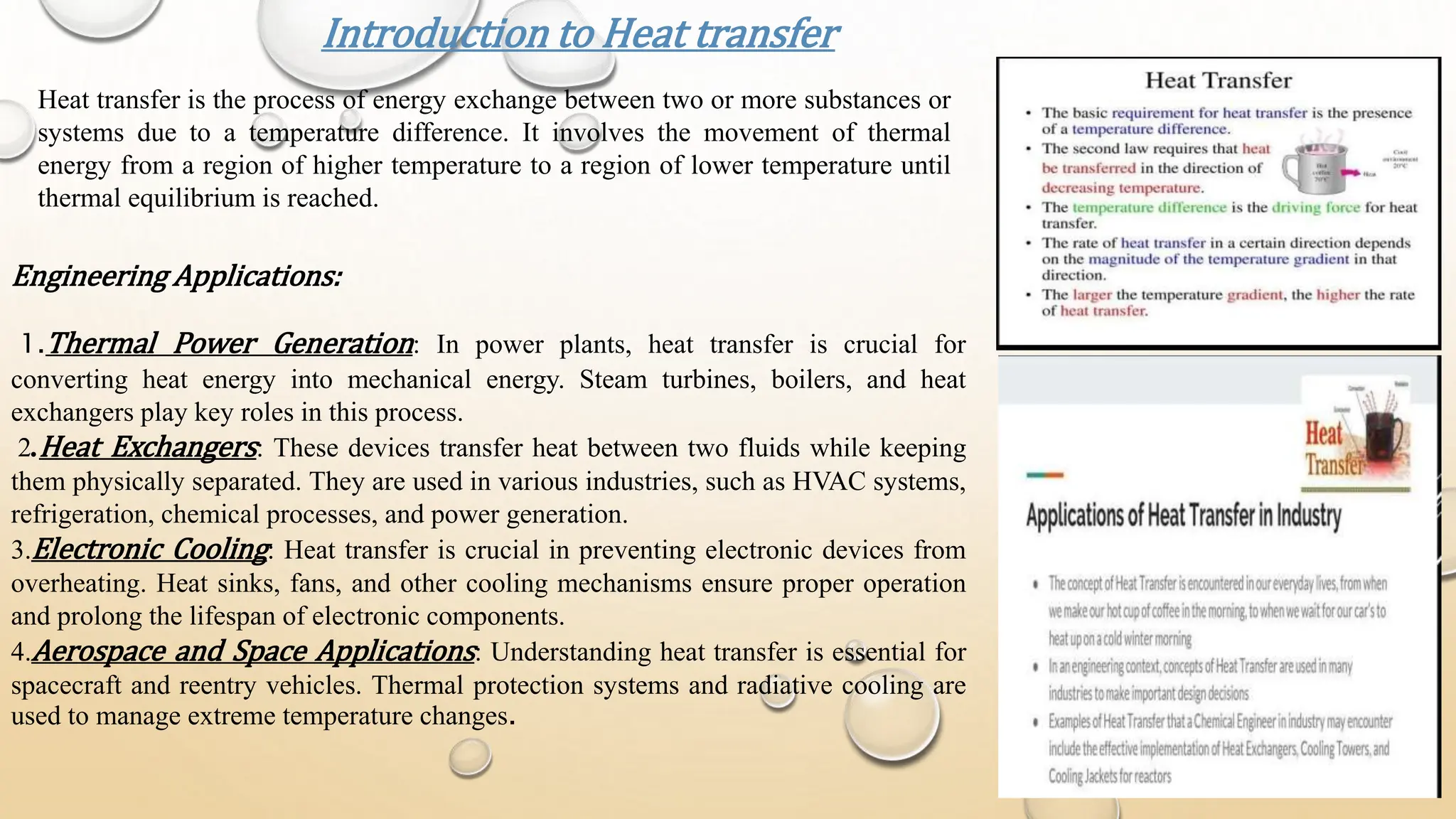
Heat transfer is the process of energy exchange between two or more substances or
systems due to a temperature difference. It involves the movement of thermal
energy from a region of higher temperature to a region of lower temperature until
thermal equilibrium is reached.
Engineering Applications:
1.Thermal Power Generation: In power plants, heat transfer is crucial for
converting heat energy into mechanical energy. Steam turbines, boilers, and heat
exchangers play key roles in this process.
2.Heat Exchangers: These devices transfer heat between two fluids while keeping
them physically separated. They are used in various industries, such as HVAC systems,
refrigeration, chemical processes, and power generation.
3.Electronic Cooling: Heat transfer is crucial in preventing electronic devices from
overheating. Heat sinks, fans, and other cooling mechanisms ensure proper operation
and prolong the lifespan of electronic components.
4.Aerospace and Space Applications: Understanding heat transfer is essential for
spacecraft and reentry vehicles. Thermal protection systems and radiative cooling are
used to manage extreme temperature changes.
Modes of Heat Transfer
Exchange of energy can occur through three primary mechanisms: conduction, convection, and radiation
1.Conduction: Heat transfer through conduction occurs within a solid material or
between solids that are in direct contact. In this process, thermal energy is transferred
from one particle to another through direct physical interaction, causing the particles
to vibrate and pass their energy along. The rate of conduction depends on factors such
as the thermal conductivity of the material and the temperature gradient (difference in
temperature) across the material.
2.Convection: Convection involves the transfer of heat through the movement of
fluids (liquids or gases). It can be further divided into natural convection and forced
convection. Natural convection occurs when the fluid movement is driven by
buoyancy forces resulting from temperature differences. Forced convection occurs
when an external force (such as a fan or pump) is applied to the fluid, enhancing the
heat transfer rate.
3.Radiation: Radiation is the transfer of heat through electromagnetic waves, such as
infrared radiation. Unlike conduction and convection, radiation can occur in a vacuum
and does not require a physical medium for energy transfer. All objects emit thermal
radiation based on their temperature and emissivity.
Conduction
Conduction is a mode of heat transfer that occurs within a solid material or between solids in direct contact. It involves the
transfer of thermal energy through the vibration and collision of particles, such as atoms and molecules, within the material.
Factors affecting Conduction
•Thermal Conductivity: This property determines how well a material
conducts heat. Materials with higher thermal conductivity transfer heat more
efficiently. Metals like copper and aluminum have high thermal conductivity,
making them good conductors.
•Temperature Gradient: The rate of heat conduction increases with a
larger temperature difference (gradient) between two points in the material.
•Material Thickness: Thicker materials impede heat transfer, as there's more
material for heat to pass through.
•Cross-Sectional Area: Larger cross-sectional areas facilitate higher heat
transfer rates.
•Time: Conduction is a time-dependent process. Over time, heat will
distribute more evenly within a material.
Fourier’s Law
Describes the heat transfer rate through conduction in a solid material. It
states that the heat transfer rate (Q) is proportional to the temperature
gradient (∇T) across the material and is also influenced by the material's
thermal conductivity (k). The equation is as follows: Q = -k * A * ∇T
Where:
•Q: Heat transfer rate (in watts or joules per second)
•k: Thermal conductivity of the material (in watts per meter per kelvin)
•A: Cross-sectional area perpendicular to the direction of heat transfer (in
square meters)
•∇T: Temperature gradient, the rate of change of temperature with
distance (in kelvin per meter) The negative sign in the equation indicates
that heat flows from regions of higher temperature to regions of lower
temperature.
For a one-dimensional case (heat transfer in a single direction), Fourier's
Law simplifies to: Q = -k * A * (dT / dx)
Where:
•dT / dx: Temperature gradient along the direction of heat transfer (in
kelvin per meter) This equation shows that the heat transfer rate is
directly proportional to the temperature gradient and the cross-sectional
area, and it is inversely proportional to the thermal conductivity of the
material.
The heat diffusion equation
The heat diffusion equation, also known as the heat equation, is a partial differential equation that describes how heat
spreads or diffuses through a solid material over time. It's a fundamental equation in the study of heat conduction and plays
a crucial role in various fields, including physics, engineering, and applied mathematics. The heat diffusion equation is
typically expressed as:
∂u / ∂t = α * ∇²u
Where:
•u: Temperature distribution in the material as a function of time (t) and position (x, y, z).
•t: Time (in seconds).
•α: Thermal diffusivity of the material (in square meters per second).
•∇²u: Laplacian of temperature u, which represents the spatial distribution of temperature variations.
This equation describes how the temperature at a
particular point in a material changes over time
due to heat diffusion. The Laplacian term (∇²u)
accounts for the spatial variations in
temperature. The thermal diffusivity (α)
combines the material's thermal conductivity (k)
and its density (ρ) and specific heat capacity (c)
as α = k / (ρ * c).
Convection
Convection is the transfer of heat through the movement of fluids (liquids or gases). It
involves the bulk movement of a fluid from one place to another, carrying heat along with it
Convection can be categorized into two types: natural convection and forced convection.
1.Natural Convection: This occurs when a fluid, usually a gas or a liquid, experiences
temperature variations. When a fluid is heated, it becomes less dense and rises due to
buoyancy forces. As it moves upward, it carries heat away from the heat source. Meanwhile,
cooler and denser fluid from the surroundings flows in to replace the rising fluid, completing
the convection loop.
2.Forced Convection: In forced convection, an external force or motion is applied to the
fluid to enhance heat transfer. This could be achieved using fans, pumps, or other mechanical
means. For example, air conditioning systems use fans to circulate air in a room, facilitating
heat transfer between the air and the room's surfaces.
Flow Velocity: In forced convection, where an external force is applied to a fluid to induce
motion, higher flow velocities generally result in more efficient heat transfer. This is because
faster-moving fluid particles can carry heat away from a heated surface more quickly,
reducing the temperature difference between the surface and the fluid.
Boundary Layer: The boundary layer is a thin layer of fluid that develops near a solid surface
when a fluid flows over it. This layer experiences a gradual change in velocity from zero at the
solid surface to the freestream velocity of the fluid.
Radiation
Radiation is one of the three primary modes of heat transfer, alongside conduction and convection. Unlike conduction and
convection, which require a medium (solid, liquid, or gas) for heat transfer, radiation is the transfer of heat through
electromagnetic waves. These waves can travel through vacuum as well as transparent mediums like air or glass .
Characteristics of Radiation:
1.No Medium Required: Unlike conduction and convection, radiation
doesn't require a physical medium for heat transfer. It can occur in a
vacuum, such as in space.
2.Speed of Light: Radiation travels at the speed of light (approximately
299,792,458 meters per second), which is the maximum possible speed for
any form of energy transfer.
3.Directional Emission: Objects emit radiation in all directions, creating a
spherical pattern of radiation distribution around the object. The intensity
of radiation decreases with distance from the object.
4.Emissivity: Emissivity is a material property that determines how
efficiently an object emits and absorbs radiation. A perfect emitter and
absorber of radiation has an emissivity of 1, while objects with lower
emissivity emit and absorb radiation less effectively.
5.Blackbody Radiation: A blackbody is an idealized object that emits and absorbs radiation perfectly at all
wavelengths and temperatures. The relationship between temperature and the intensity of radiation emitted by a
blackbody is described by Planck's Law and the Stefan-Boltzmann Law.
6.Spectral Distribution: The wavelength distribution of emitted radiation depends on the temperature of the
object. Warmer objects emit more radiation at shorter wavelengths (higher energy), while cooler objects emit more
radiation at longer wavelengths (lower energy).
7.Absorption and Reflection: Objects not only emit radiation but also absorb and reflect incoming radiation. The
net effect ofthese processes determines whether an object gains or loses heat through radiation.
8.Applications: Radiation has numerous applications, including space heating through infrared radiation, solar
energy collection using solar panels, thermal imaging in medical and industrial fields, and even cooking food using
microwave ovens.
Conclusion
In conclusion, heat transfer is a fundamental concept that underlies many natural phenomena and
engineering applications. It is the process by which thermal energy is exchanged between objects or
systems due to temperature differences. The three primary modes of heat transfer conduction,
convection, and radiation each operate through distinct mechanisms and have their own characteristics.
Conduction involves the transfer of heat through direct particle interaction within solids or between
solids in contact. This process plays a crucial role in everyday situations, such as cooking, handling hot
objects, and maintaining temperature gradients.
Convection relies on fluid movement to transfer heat. Natural convection occurs due to buoyancy forces
caused by temperature variations in fluids, while forced convection involves external forces driving fluid
motion. Convection is essential in processes ranging from cooling systems to atmospheric circulation
and even human thermoregulation.
Radiation, in contrast, is the transfer of heat through electromagnetic waves emitted by objects with a
temperature above absolute zero. It operates in a vacuum and is characterized by its speed of light,
directionality, and dependence on temperature and surface properties. Radiation has diverse
applications, including space heating, solar energy collection, and thermal imaging.
In everyday life and engineering, heat transfer is indispensable. From designing energy -efficient
buildings and cooling electronic devices to understanding climate patterns and creating advanced
medical treatments, a grasp of heat transfer principles enables innovation and problem -solving across
various domains.
By comprehending and harnessing the intricacies of heat transfer, we can optimize energy usage,
improve the efficiency of technological systems, and better understand the world around us. As science
and technology continue to advance, the study of heat transfer remains a cornerstone for progress and
Thank you!

13000722038- KULDIP NAMA- HEAT TRANSFER.pptx

  • 1.
    NAMA- KULDIP NAMA ROLLNO. – 13000722038 SUBJECT – HEAT TRANSFER ( PC-ME501) 5TH SEMESTER MECHANICAL ENGINEERING. TOPIC- BRIEF INTRODUCTION TO HEAT TRANSFER.
  • 2.
    Introduction to Heattransfer Heat transfer is the process of energy exchange between two or more substances or systems due to a temperature difference. It involves the movement of thermal energy from a region of higher temperature to a region of lower temperature until thermal equilibrium is reached. Engineering Applications: 1.Thermal Power Generation: In power plants, heat transfer is crucial for converting heat energy into mechanical energy. Steam turbines, boilers, and heat exchangers play key roles in this process. 2.Heat Exchangers: These devices transfer heat between two fluids while keeping them physically separated. They are used in various industries, such as HVAC systems, refrigeration, chemical processes, and power generation. 3.Electronic Cooling: Heat transfer is crucial in preventing electronic devices from overheating. Heat sinks, fans, and other cooling mechanisms ensure proper operation and prolong the lifespan of electronic components. 4.Aerospace and Space Applications: Understanding heat transfer is essential for spacecraft and reentry vehicles. Thermal protection systems and radiative cooling are used to manage extreme temperature changes.
  • 3.
    Modes of HeatTransfer Exchange of energy can occur through three primary mechanisms: conduction, convection, and radiation 1.Conduction: Heat transfer through conduction occurs within a solid material or between solids that are in direct contact. In this process, thermal energy is transferred from one particle to another through direct physical interaction, causing the particles to vibrate and pass their energy along. The rate of conduction depends on factors such as the thermal conductivity of the material and the temperature gradient (difference in temperature) across the material. 2.Convection: Convection involves the transfer of heat through the movement of fluids (liquids or gases). It can be further divided into natural convection and forced convection. Natural convection occurs when the fluid movement is driven by buoyancy forces resulting from temperature differences. Forced convection occurs when an external force (such as a fan or pump) is applied to the fluid, enhancing the heat transfer rate. 3.Radiation: Radiation is the transfer of heat through electromagnetic waves, such as infrared radiation. Unlike conduction and convection, radiation can occur in a vacuum and does not require a physical medium for energy transfer. All objects emit thermal radiation based on their temperature and emissivity.
  • 4.
    Conduction Conduction is amode of heat transfer that occurs within a solid material or between solids in direct contact. It involves the transfer of thermal energy through the vibration and collision of particles, such as atoms and molecules, within the material. Factors affecting Conduction •Thermal Conductivity: This property determines how well a material conducts heat. Materials with higher thermal conductivity transfer heat more efficiently. Metals like copper and aluminum have high thermal conductivity, making them good conductors. •Temperature Gradient: The rate of heat conduction increases with a larger temperature difference (gradient) between two points in the material. •Material Thickness: Thicker materials impede heat transfer, as there's more material for heat to pass through. •Cross-Sectional Area: Larger cross-sectional areas facilitate higher heat transfer rates. •Time: Conduction is a time-dependent process. Over time, heat will distribute more evenly within a material.
  • 5.
    Fourier’s Law Describes theheat transfer rate through conduction in a solid material. It states that the heat transfer rate (Q) is proportional to the temperature gradient (∇T) across the material and is also influenced by the material's thermal conductivity (k). The equation is as follows: Q = -k * A * ∇T Where: •Q: Heat transfer rate (in watts or joules per second) •k: Thermal conductivity of the material (in watts per meter per kelvin) •A: Cross-sectional area perpendicular to the direction of heat transfer (in square meters) •∇T: Temperature gradient, the rate of change of temperature with distance (in kelvin per meter) The negative sign in the equation indicates that heat flows from regions of higher temperature to regions of lower temperature. For a one-dimensional case (heat transfer in a single direction), Fourier's Law simplifies to: Q = -k * A * (dT / dx) Where: •dT / dx: Temperature gradient along the direction of heat transfer (in kelvin per meter) This equation shows that the heat transfer rate is directly proportional to the temperature gradient and the cross-sectional area, and it is inversely proportional to the thermal conductivity of the material.
  • 6.
    The heat diffusionequation The heat diffusion equation, also known as the heat equation, is a partial differential equation that describes how heat spreads or diffuses through a solid material over time. It's a fundamental equation in the study of heat conduction and plays a crucial role in various fields, including physics, engineering, and applied mathematics. The heat diffusion equation is typically expressed as: ∂u / ∂t = α * ∇²u Where: •u: Temperature distribution in the material as a function of time (t) and position (x, y, z). •t: Time (in seconds). •α: Thermal diffusivity of the material (in square meters per second). •∇²u: Laplacian of temperature u, which represents the spatial distribution of temperature variations. This equation describes how the temperature at a particular point in a material changes over time due to heat diffusion. The Laplacian term (∇²u) accounts for the spatial variations in temperature. The thermal diffusivity (α) combines the material's thermal conductivity (k) and its density (ρ) and specific heat capacity (c) as α = k / (ρ * c).
  • 7.
    Convection Convection is thetransfer of heat through the movement of fluids (liquids or gases). It involves the bulk movement of a fluid from one place to another, carrying heat along with it Convection can be categorized into two types: natural convection and forced convection. 1.Natural Convection: This occurs when a fluid, usually a gas or a liquid, experiences temperature variations. When a fluid is heated, it becomes less dense and rises due to buoyancy forces. As it moves upward, it carries heat away from the heat source. Meanwhile, cooler and denser fluid from the surroundings flows in to replace the rising fluid, completing the convection loop. 2.Forced Convection: In forced convection, an external force or motion is applied to the fluid to enhance heat transfer. This could be achieved using fans, pumps, or other mechanical means. For example, air conditioning systems use fans to circulate air in a room, facilitating heat transfer between the air and the room's surfaces. Flow Velocity: In forced convection, where an external force is applied to a fluid to induce motion, higher flow velocities generally result in more efficient heat transfer. This is because faster-moving fluid particles can carry heat away from a heated surface more quickly, reducing the temperature difference between the surface and the fluid. Boundary Layer: The boundary layer is a thin layer of fluid that develops near a solid surface when a fluid flows over it. This layer experiences a gradual change in velocity from zero at the solid surface to the freestream velocity of the fluid.
  • 8.
    Radiation Radiation is oneof the three primary modes of heat transfer, alongside conduction and convection. Unlike conduction and convection, which require a medium (solid, liquid, or gas) for heat transfer, radiation is the transfer of heat through electromagnetic waves. These waves can travel through vacuum as well as transparent mediums like air or glass . Characteristics of Radiation: 1.No Medium Required: Unlike conduction and convection, radiation doesn't require a physical medium for heat transfer. It can occur in a vacuum, such as in space. 2.Speed of Light: Radiation travels at the speed of light (approximately 299,792,458 meters per second), which is the maximum possible speed for any form of energy transfer. 3.Directional Emission: Objects emit radiation in all directions, creating a spherical pattern of radiation distribution around the object. The intensity of radiation decreases with distance from the object. 4.Emissivity: Emissivity is a material property that determines how efficiently an object emits and absorbs radiation. A perfect emitter and absorber of radiation has an emissivity of 1, while objects with lower emissivity emit and absorb radiation less effectively.
  • 9.
    5.Blackbody Radiation: Ablackbody is an idealized object that emits and absorbs radiation perfectly at all wavelengths and temperatures. The relationship between temperature and the intensity of radiation emitted by a blackbody is described by Planck's Law and the Stefan-Boltzmann Law. 6.Spectral Distribution: The wavelength distribution of emitted radiation depends on the temperature of the object. Warmer objects emit more radiation at shorter wavelengths (higher energy), while cooler objects emit more radiation at longer wavelengths (lower energy). 7.Absorption and Reflection: Objects not only emit radiation but also absorb and reflect incoming radiation. The net effect ofthese processes determines whether an object gains or loses heat through radiation. 8.Applications: Radiation has numerous applications, including space heating through infrared radiation, solar energy collection using solar panels, thermal imaging in medical and industrial fields, and even cooking food using microwave ovens.
  • 10.
    Conclusion In conclusion, heattransfer is a fundamental concept that underlies many natural phenomena and engineering applications. It is the process by which thermal energy is exchanged between objects or systems due to temperature differences. The three primary modes of heat transfer conduction, convection, and radiation each operate through distinct mechanisms and have their own characteristics. Conduction involves the transfer of heat through direct particle interaction within solids or between solids in contact. This process plays a crucial role in everyday situations, such as cooking, handling hot objects, and maintaining temperature gradients. Convection relies on fluid movement to transfer heat. Natural convection occurs due to buoyancy forces caused by temperature variations in fluids, while forced convection involves external forces driving fluid motion. Convection is essential in processes ranging from cooling systems to atmospheric circulation and even human thermoregulation. Radiation, in contrast, is the transfer of heat through electromagnetic waves emitted by objects with a temperature above absolute zero. It operates in a vacuum and is characterized by its speed of light, directionality, and dependence on temperature and surface properties. Radiation has diverse applications, including space heating, solar energy collection, and thermal imaging. In everyday life and engineering, heat transfer is indispensable. From designing energy -efficient buildings and cooling electronic devices to understanding climate patterns and creating advanced medical treatments, a grasp of heat transfer principles enables innovation and problem -solving across various domains. By comprehending and harnessing the intricacies of heat transfer, we can optimize energy usage, improve the efficiency of technological systems, and better understand the world around us. As science and technology continue to advance, the study of heat transfer remains a cornerstone for progress and Thank you!