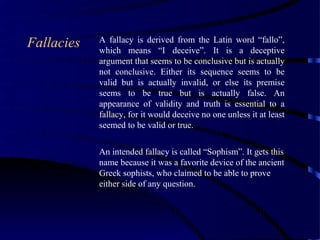
This document discusses different types of fallacies, which are deceptive arguments that seem valid but are not actually conclusive. It begins by defining a fallacy and explaining their purpose and effects. It then describes several categories of fallacies:
1) Fallacies of language, which involve ambiguous or equivocal uses of language. Examples given are equivocation, amphiboly, composition, and division.
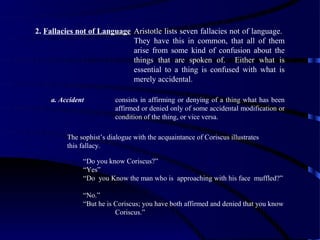
2) Fallacies not of language, which involve confusion about things spoken of. Examples are accident and converse accident.
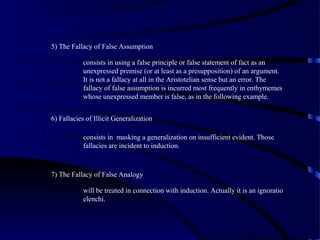
3) Examples are provided for many of the different types of fallacies to illustrate how they work. Understanding fallacies is important for correctly applying logic, avoiding deception, and strengthening one's