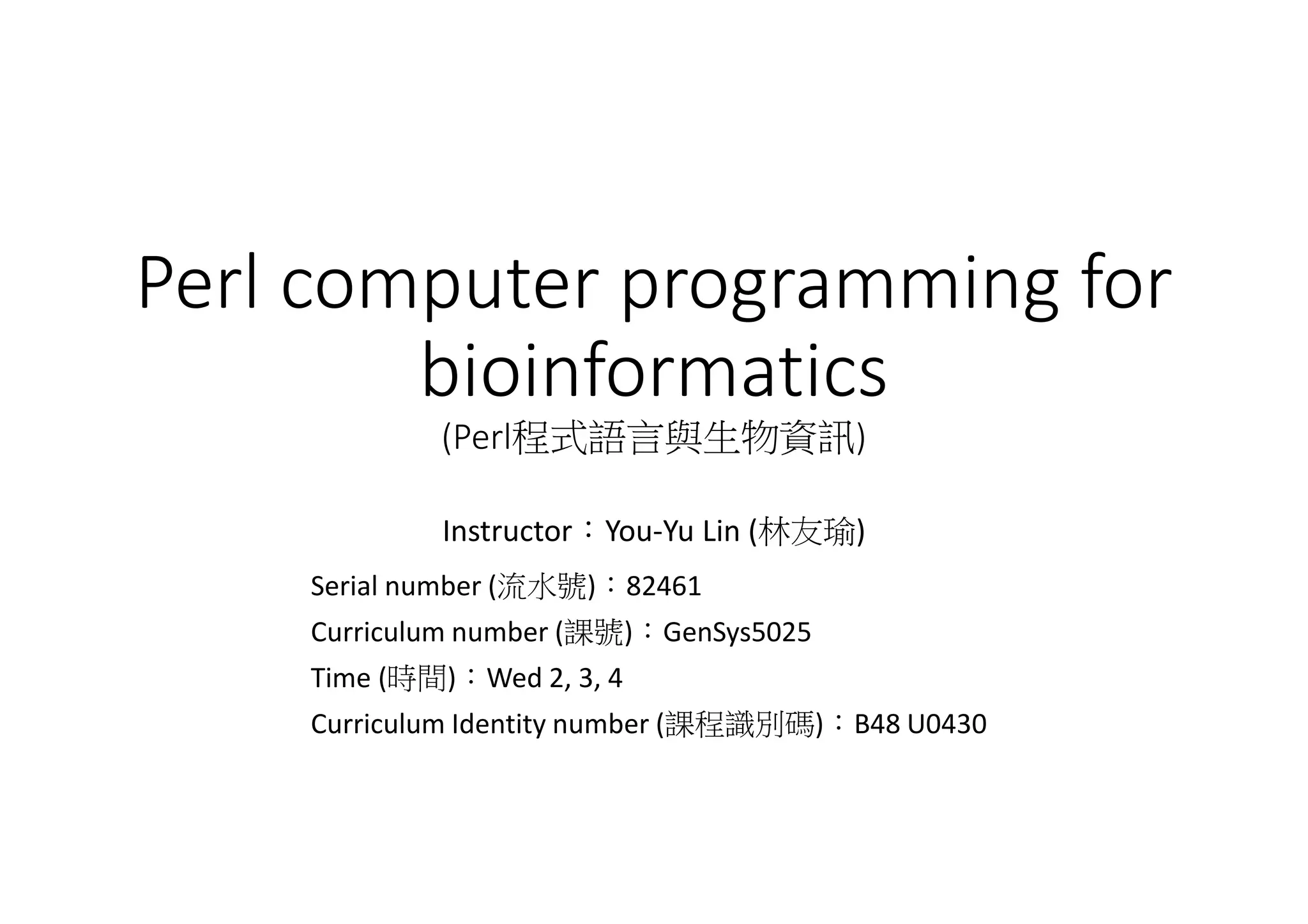
Perl computer programming for
bioinformatics
(Perl程式語言與生物資訊)
Instructor:You-Yu Lin (林友瑜)
Serial number (流水號):82461
Curriculum number (課號):GenSys5025
Time (時間):Wed 2, 3, 4
Curriculum Identity number (課程識別碼):B48 U0430
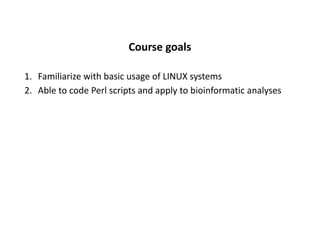
Course goals
1. Familiarize with basic usage of LINUX systems
2. Able to code Perl scripts and apply to bioinformatic analyses
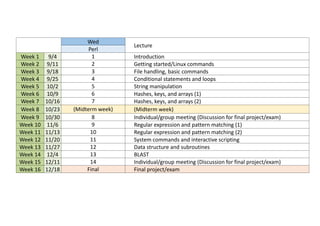
Wed
Lecture
Perl
Week 1 9/4 1 Introduction
Week 2 9/11 2 Getting started/Linux commands
Week 3 9/18 3 File handling, basic commands
Week 4 9/25 4 Conditional statements and loops
Week 5 10/2 5 String manipulation
Week 6 10/9 6 Hashes, keys, and arrays (1)
Week 7 10/16 7 Hashes, keys, and arrays (2)
Week 8 10/23 (Midterm week) (Midterm week)
Week 9 10/30 8 Individual/group meeting (Discussion for final project/exam)
Week 10 11/6 9 Regular expression and pattern matching (1)
Week 11 11/13 10 Regular expression and pattern matching (2)
Week 12 11/20 11 System commands and interactive scripting
Week 13 11/27 12 Data structure and subroutines
Week 14 12/4 13 BLAST
Week 15 12/11 14 Individual/group meeting (Discussion for final project/exam)
Week 16 12/18 Final Final project/exam
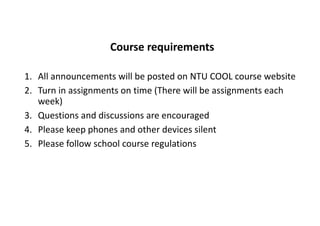
Course requirements
1. All announcements will be posted on NTU COOL course website
2. Turn in assignments on time (There will be assignments each
week)
3. Questions and discussions are encouraged
4. Please keep phones and other devices silent
5. Please follow school course regulations
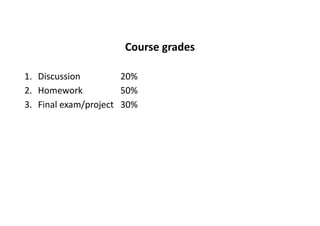
Course grades
1. Discussion 20%
2. Homework 50%
3. Final exam/project 30%
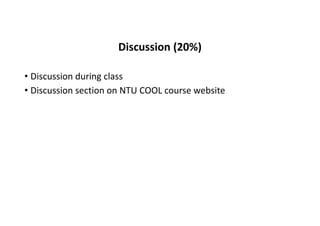
Discussion (20%)
• Discussion during class
• Discussion section on NTU COOL course website
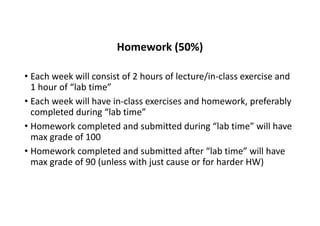
Homework (50%)
• Each week will consist of 2 hours of lecture/in-class exercise and
1 hour of “lab time”
• Each week will have in-class exercises and homework, preferably
completed during “lab time”
• Homework completed and submitted during “lab time” will have
max grade of 100
• Homework completed and submitted after “lab time” will have
max grade of 90 (unless with just cause or for harder HW)
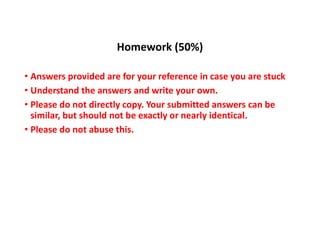
Homework (50%)
• Answers provided are for your reference in case you are stuck
• Understand the answers and write your own.
• Please do not directly copy. Your submitted answers can be
similar, but should not be exactly or nearly identical.
• Please do not abuse this.
Final project (30%)
• Final practice to incorporate what we have discussed all semester
• May work in groups (max 3 people) or individually
• Groups need to list individual contributions
• Each group will meet with me twice during the semester
• First meeting in week 9 to discuss topic/idea/strategy for final project
• Second meeting in week 14/15 to discuss any issues before
presentation
Final project (30%)
• Each group will propose their own topic
• Grading for final project (by me) will mainly focus on the
programming performance, not the biological or application aspects
• 30% Scope of the programming skills presented
• 20% Depth of the programming skills presented
• 20% Novelty of the programming skills presented
• 30% Performance of the programming skills presented (accuracy,
robustness, user interface, input/output format, efficiency, etc)
• Classmates will also grade each other’s performance (by your own
standards), and bonus credit will be awarded based on your grades

113-1_Perl_0_Course_Requirements_for_beginners.pdf

  • 1.
    Perl computer programmingfor bioinformatics (Perl程式語言與生物資訊) Instructor:You-Yu Lin (林友瑜) Serial number (流水號):82461 Curriculum number (課號):GenSys5025 Time (時間):Wed 2, 3, 4 Curriculum Identity number (課程識別碼):B48 U0430
  • 2.
    Course goals 1. Familiarizewith basic usage of LINUX systems 2. Able to code Perl scripts and apply to bioinformatic analyses
  • 3.
    Wed Lecture Perl Week 1 9/41 Introduction Week 2 9/11 2 Getting started/Linux commands Week 3 9/18 3 File handling, basic commands Week 4 9/25 4 Conditional statements and loops Week 5 10/2 5 String manipulation Week 6 10/9 6 Hashes, keys, and arrays (1) Week 7 10/16 7 Hashes, keys, and arrays (2) Week 8 10/23 (Midterm week) (Midterm week) Week 9 10/30 8 Individual/group meeting (Discussion for final project/exam) Week 10 11/6 9 Regular expression and pattern matching (1) Week 11 11/13 10 Regular expression and pattern matching (2) Week 12 11/20 11 System commands and interactive scripting Week 13 11/27 12 Data structure and subroutines Week 14 12/4 13 BLAST Week 15 12/11 14 Individual/group meeting (Discussion for final project/exam) Week 16 12/18 Final Final project/exam
  • 4.
    Course requirements 1. Allannouncements will be posted on NTU COOL course website 2. Turn in assignments on time (There will be assignments each week) 3. Questions and discussions are encouraged 4. Please keep phones and other devices silent 5. Please follow school course regulations
  • 5.
    Course grades 1. Discussion20% 2. Homework 50% 3. Final exam/project 30%
  • 6.
    Discussion (20%) • Discussionduring class • Discussion section on NTU COOL course website
  • 7.
    Homework (50%) • Eachweek will consist of 2 hours of lecture/in-class exercise and 1 hour of “lab time” • Each week will have in-class exercises and homework, preferably completed during “lab time” • Homework completed and submitted during “lab time” will have max grade of 100 • Homework completed and submitted after “lab time” will have max grade of 90 (unless with just cause or for harder HW)
  • 8.
    Homework (50%) • Answersprovided are for your reference in case you are stuck • Understand the answers and write your own. • Please do not directly copy. Your submitted answers can be similar, but should not be exactly or nearly identical. • Please do not abuse this.
  • 9.
    Final project (30%) •Final practice to incorporate what we have discussed all semester • May work in groups (max 3 people) or individually • Groups need to list individual contributions • Each group will meet with me twice during the semester • First meeting in week 9 to discuss topic/idea/strategy for final project • Second meeting in week 14/15 to discuss any issues before presentation
  • 10.
    Final project (30%) •Each group will propose their own topic • Grading for final project (by me) will mainly focus on the programming performance, not the biological or application aspects • 30% Scope of the programming skills presented • 20% Depth of the programming skills presented • 20% Novelty of the programming skills presented • 30% Performance of the programming skills presented (accuracy, robustness, user interface, input/output format, efficiency, etc) • Classmates will also grade each other’s performance (by your own standards), and bonus credit will be awarded based on your grades