CIRCUIT SWITCHING  AND PACKET SWITCHING
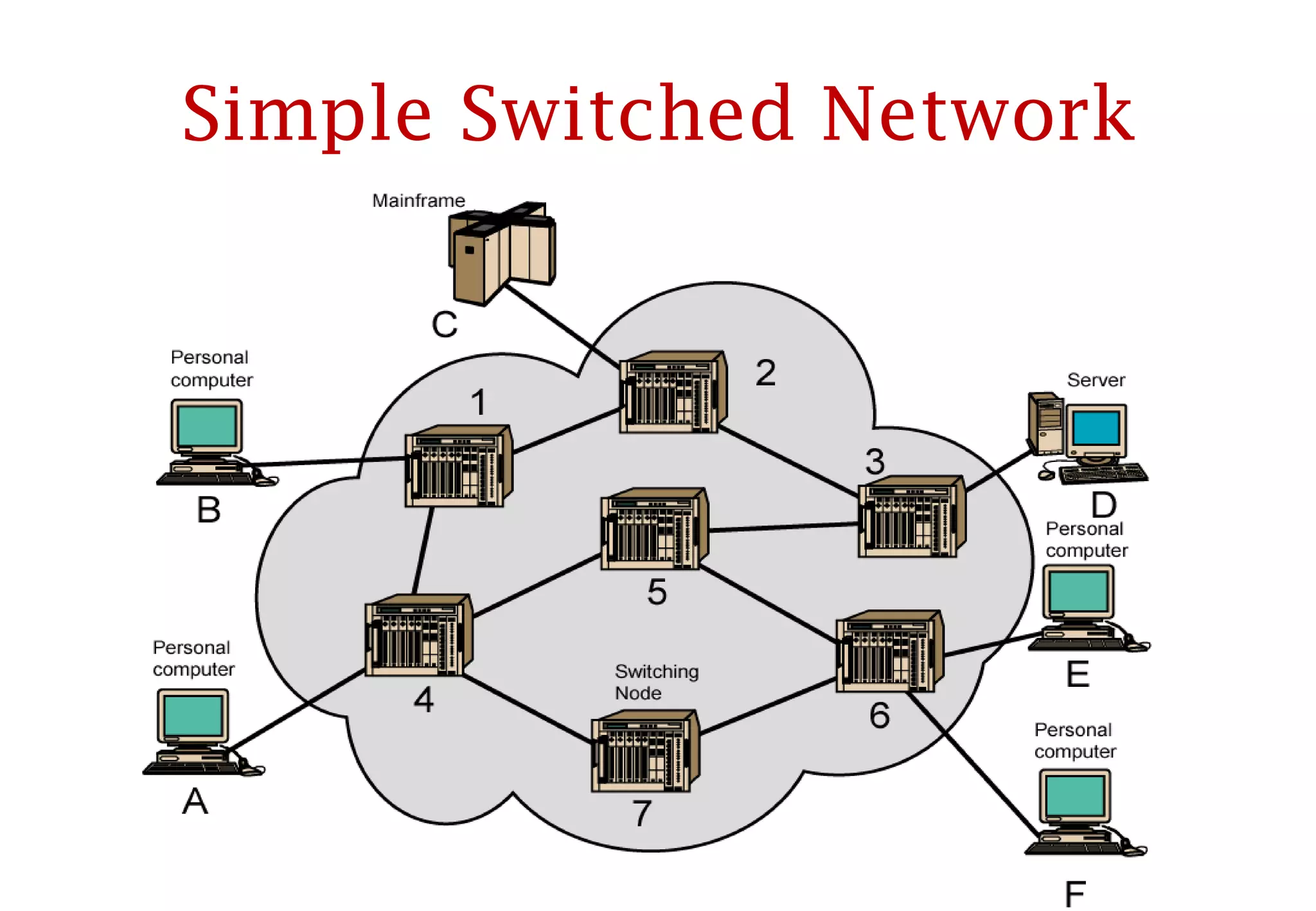
Switching Networks Long distance transmission is typically done over a network of switched nodes Nodes not concerned with content of data purpose is to provide a switching facility that will move the data from node to node until they reach their destination End devices are stations Computer, terminal, phone, etc. A collection of nodes and connections is a  communications network Data routed by being switched from node to node
Nodes Nodes may connect to other nodes only, or to stations and other nodes Node to node links usually multiplexed FDM or TDM Network is usually partially connected (not fully connected) Some redundant connections are desirable for reliability (more than 1 possible path for each pair) Two different switching technologies Circuit switching Packet switching
Simple Switched Network
Circuit Switching Dedicated communication path between two stations Three phases Establish Transfer Disconnect Must have switching capacity and channel capacity to establish connection Must have intelligence to work out routing
Circuit Switching - Applications Inefficient Channel capacity dedicated for duration of connection If no data,  capacity wasted Set up (connection) takes time Once connected, transfer is transparent to users Developed for voice traffic (phone)
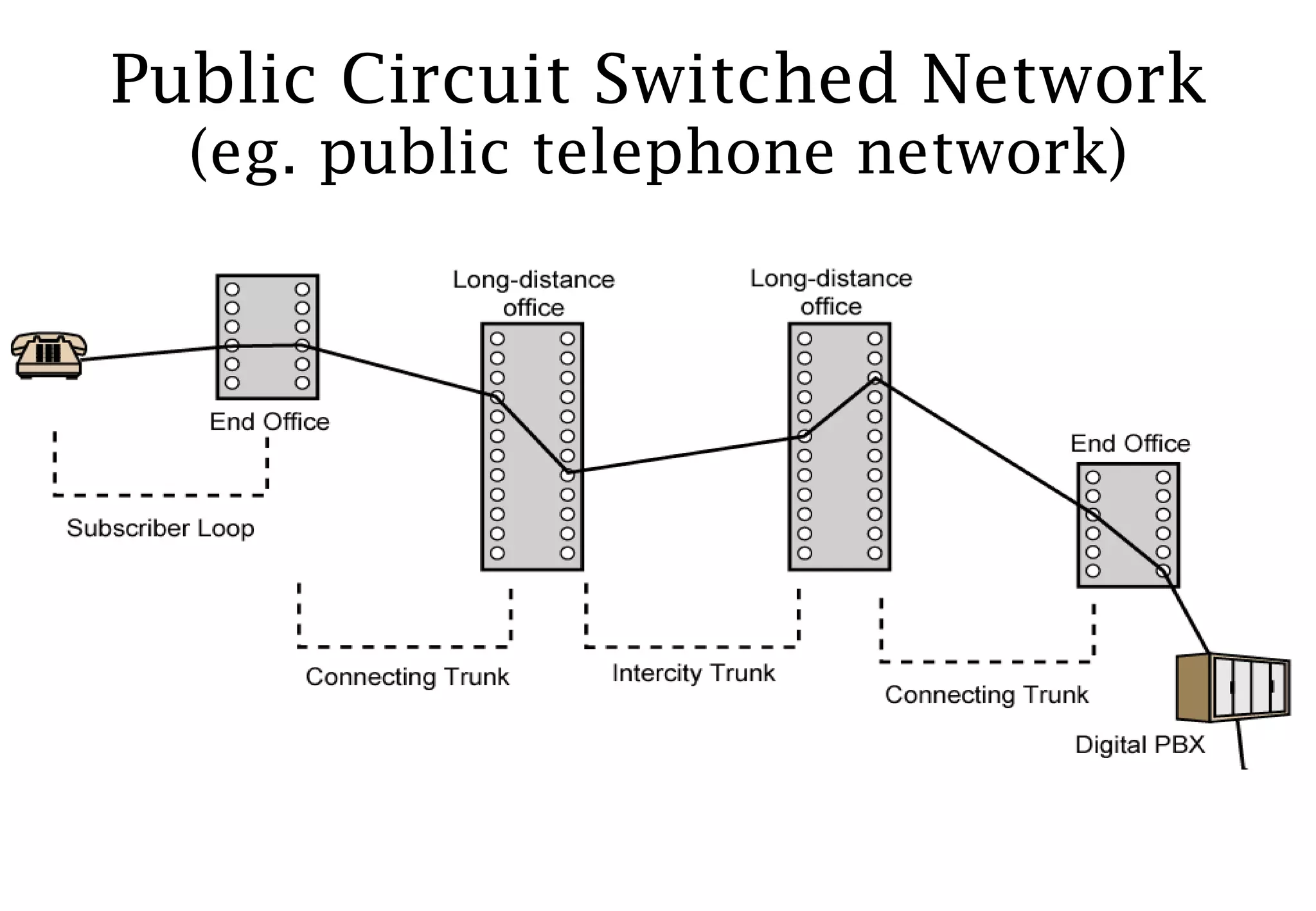
Public Circuit Switched Network (eg. public telephone network)
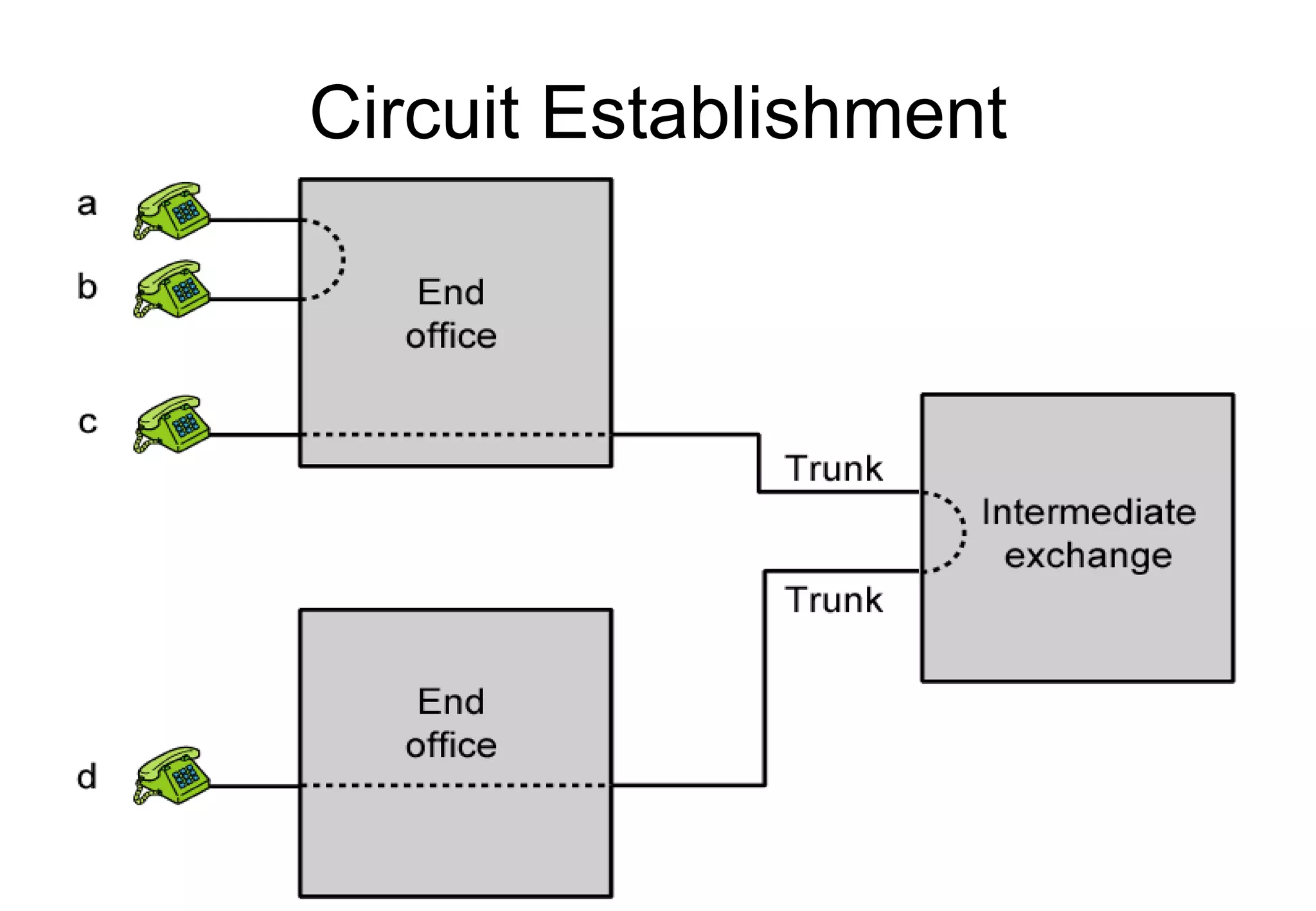
Telecommunications Components Subscriber Devices attached to network.eg. telephone Subscriber line  Local Loop @ Subscriber loop Connection to network  (link between subscriber & network) Few km up to few tens of km Exchange Switching centers Switching centre supports subscribers - End office  Trunks Branches between exchanges Carry multiplexed multiple voice-frequency circuits
Circuit Establishment
4.1.3 Circuit Switching Concepts Digital Switch Provide transparent signal path between devices Network Interface Represents the functions and hardware needed to connect digital devices Control Unit Establish connections Generally on demand Handle and acknowledge requests Determine if destination is free construct path Maintain connection Disconnect
Blocking or Non-blocking Blocking A network is  unable to connect stations because all paths are in use A blocking network allows this Used on voice systems Short duration calls Non-blocking Permits all stations to connect (in pairs) at once (as long as the called party is free) Used for some data connections
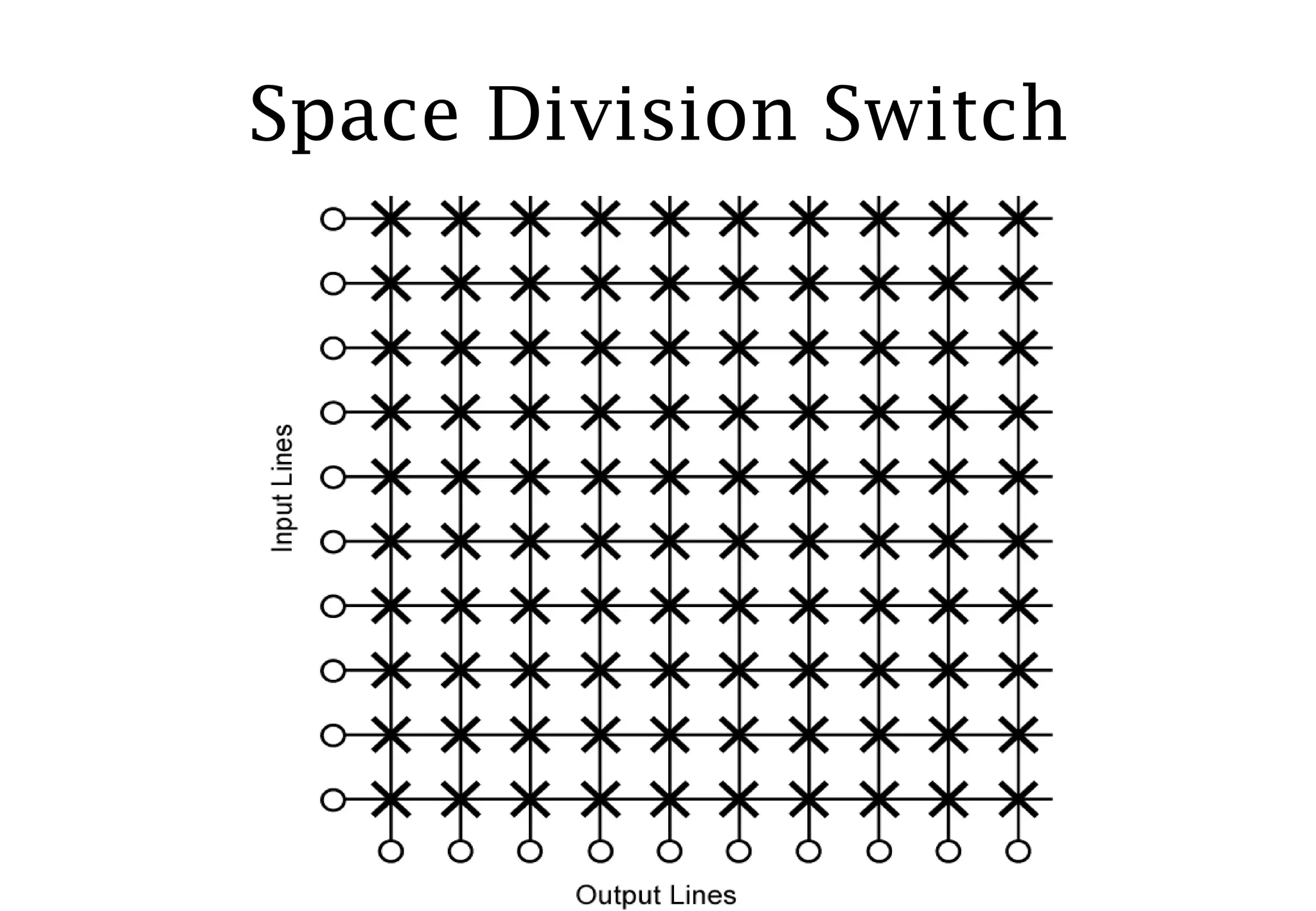
Space Division Switching Developed for analog environment Separate physical paths (divided in space) Crossbar switch Number of crosspoints grows as square of number of stations.  Loss of crosspoint prevents connection Inefficient use of crosspoints All stations connected, only a few crosspoints in use Non-blocking
Space Division Switch
Multistage Switch Reduced number of crosspoints More than one path through network Increased reliability More complex control May be blocking
Time Division Switching Modern digital systems rely on intelligent control of space and time division elements Use digital time division techniques to set up and maintain virtual circuits Partition low speed bit stream into pieces that share higher speed stream Manipulated by control logic to route data from input to output.
4.1.4 Control Signaling Functions Audible communication with subscriber Transmission of dialed number Call can not be completed indication Call ended indication Signal to ring phone Billing info Equipment and trunk status info Diagnostic info Control of specialist equipment – satellite channel equipment
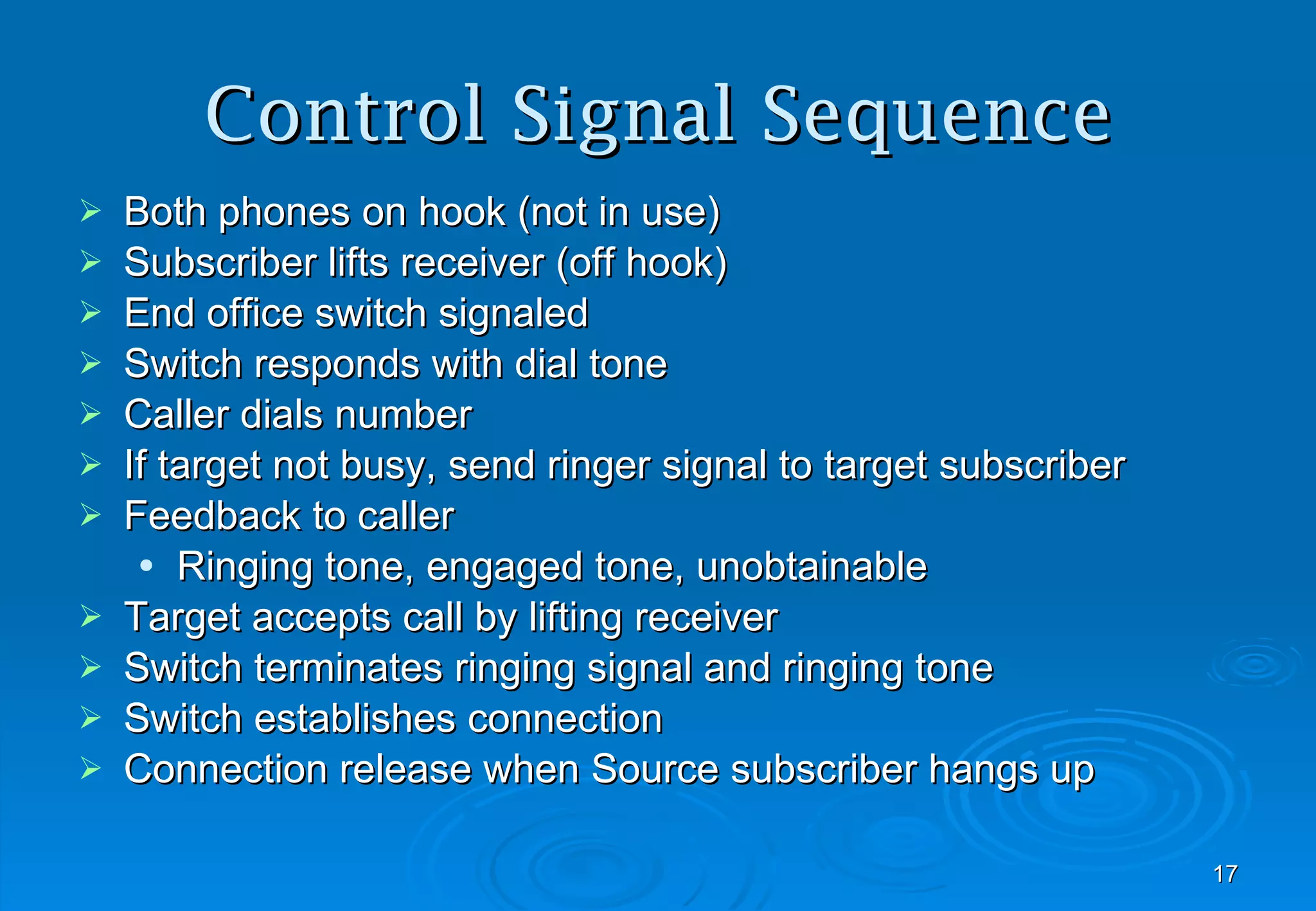
Control Signal Sequence Both phones on hook (not in use) Subscriber lifts receiver (off hook) End office switch signaled Switch responds with dial tone Caller dials number If target not busy, send ringer signal to target subscriber Feedback to caller Ringing tone, engaged tone, unobtainable Target accepts call by lifting receiver Switch terminates ringing signal and ringing tone Switch establishes connection Connection release when Source subscriber hangs up
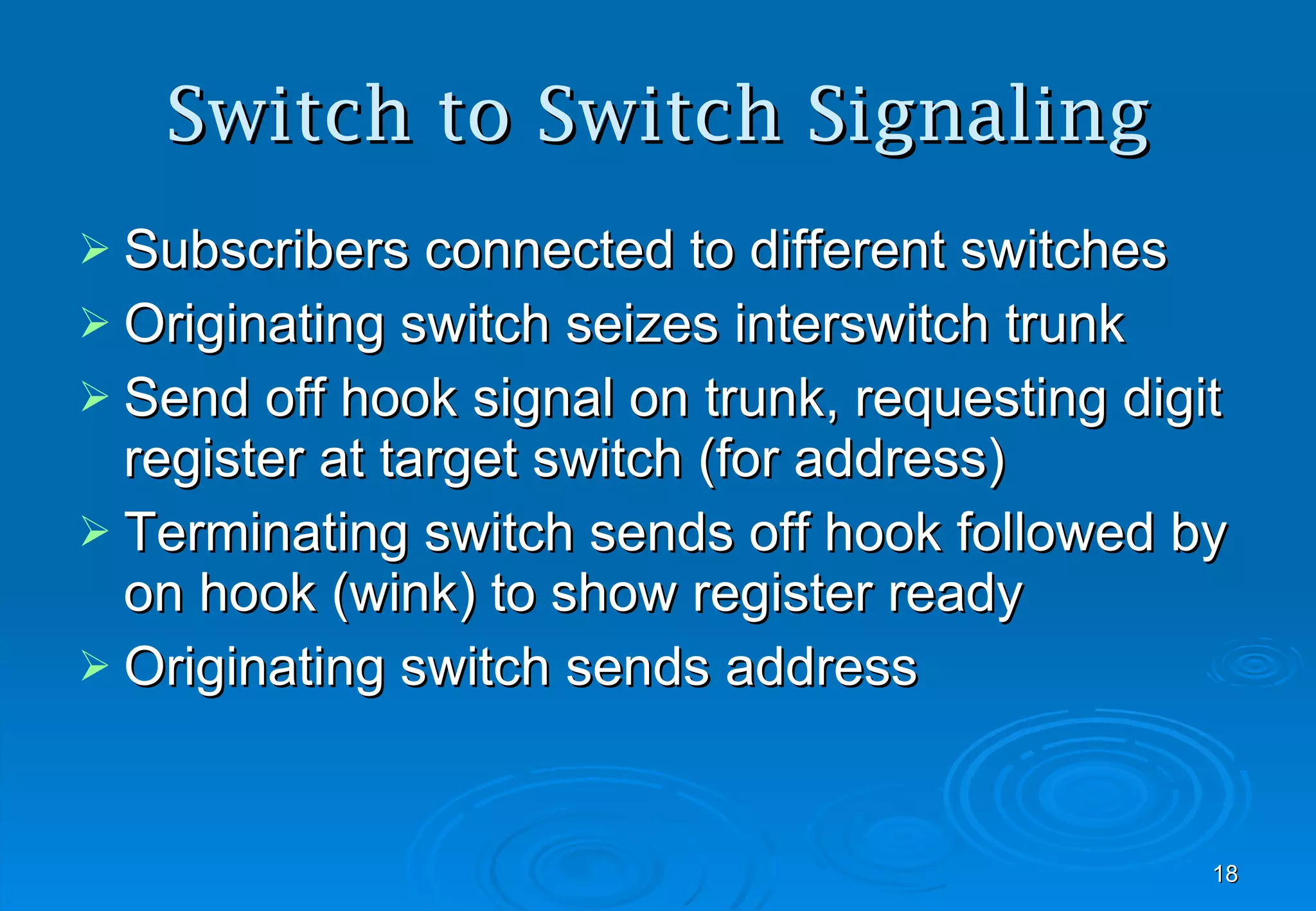
Switch to Switch Signaling Subscribers connected to different switches Originating switch seizes interswitch trunk Send off hook signal on trunk, requesting digit register at target switch (for address) Terminating switch sends off hook followed by on hook (wink) to show register ready Originating switch sends address
Location of Signaling Subscriber to network Depends on subscriber device and switch Within network Management of subscriber calls and network ore complex
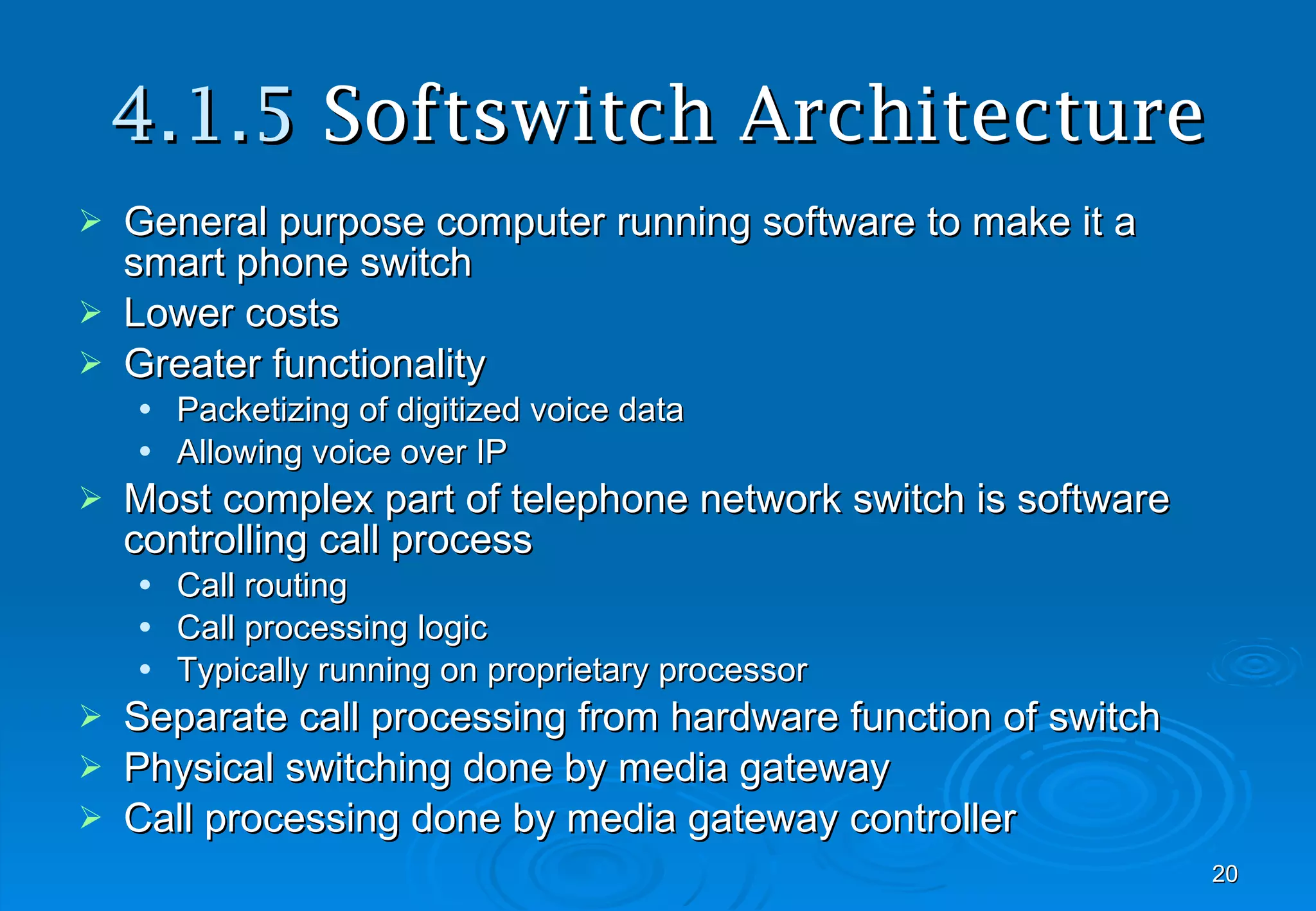
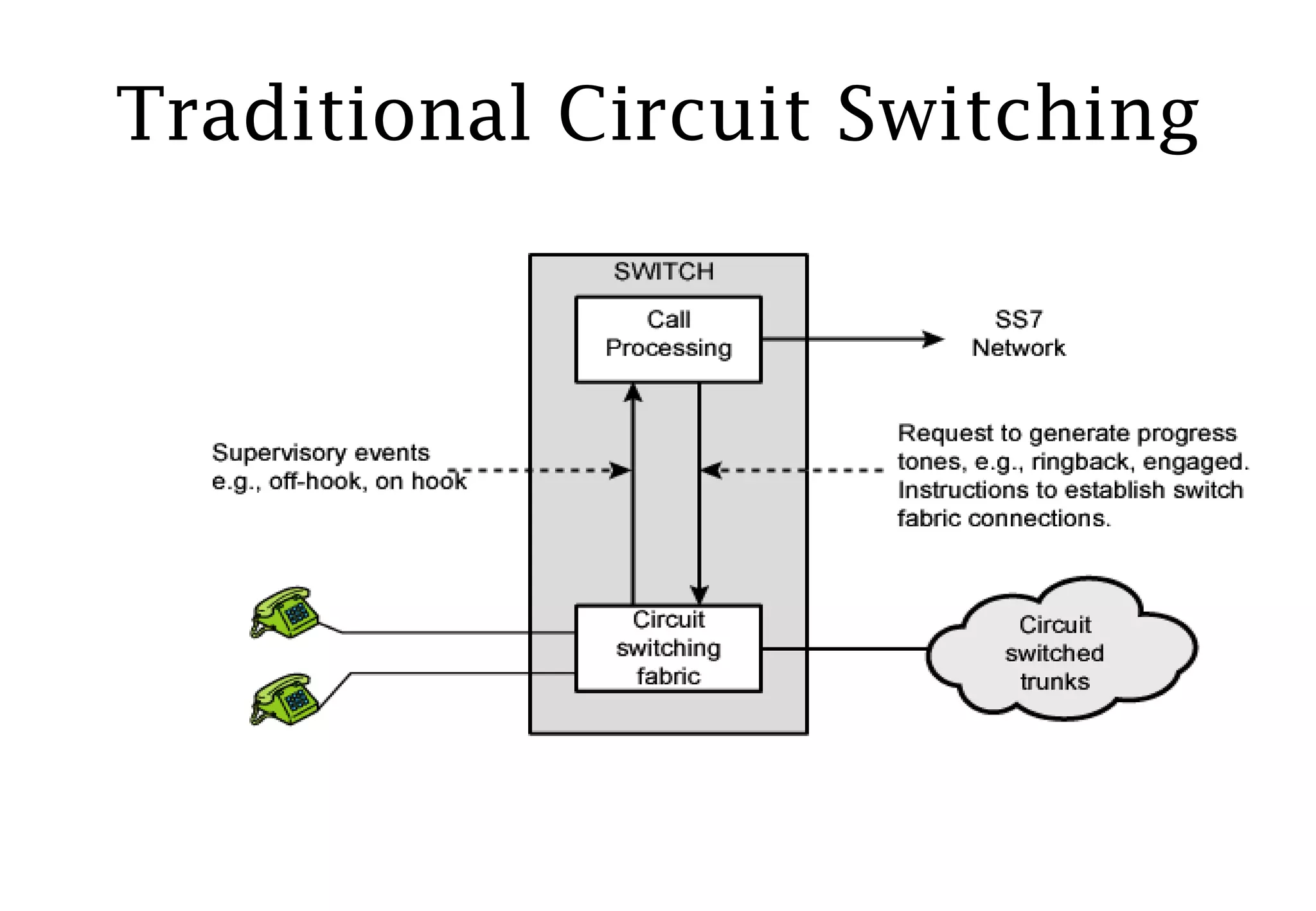
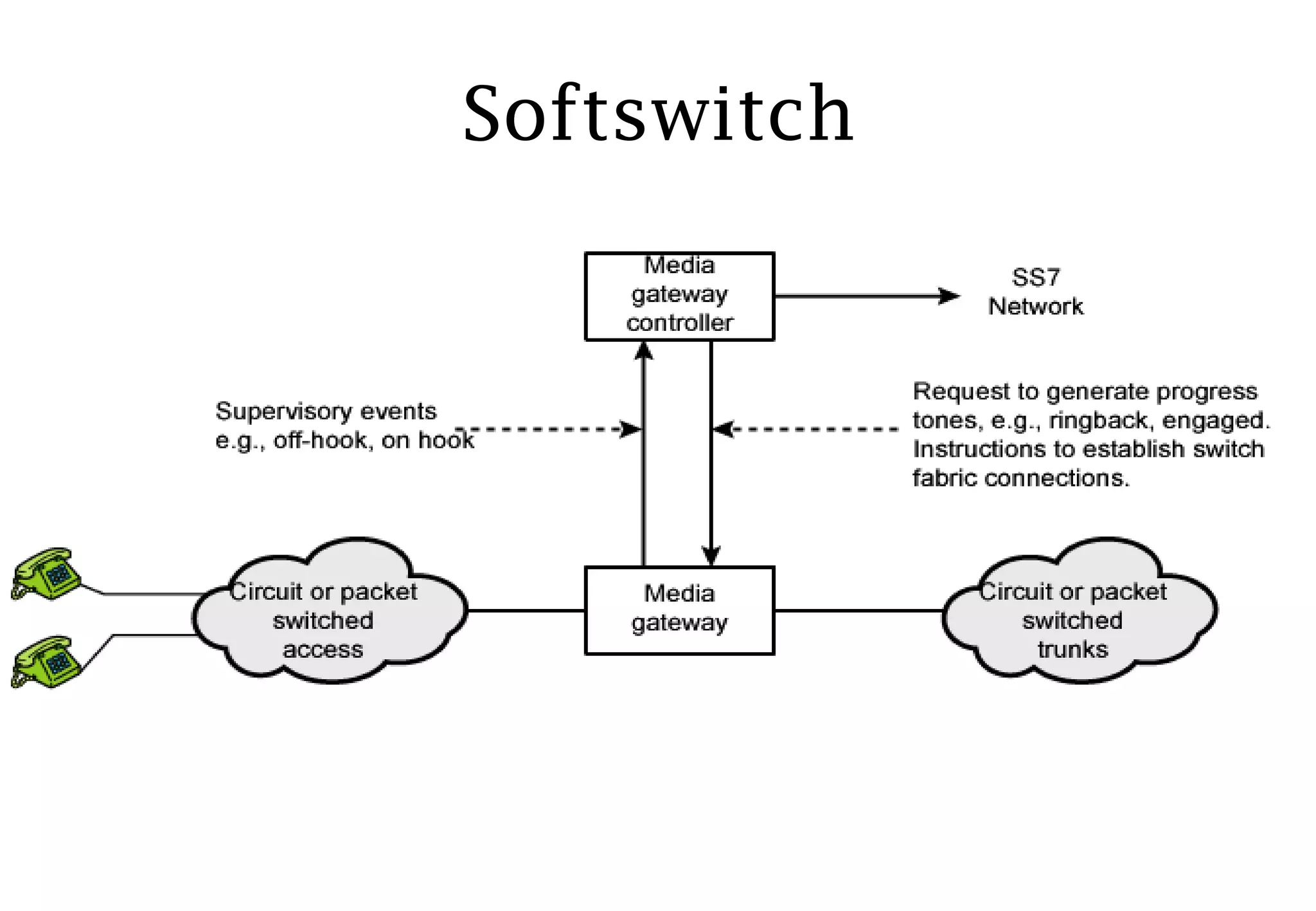
4.1.5  Softswitch Architecture General purpose computer running software to make it a smart phone switch Lower costs Greater functionality Packetizing of digitized voice data Allowing voice over IP Most complex part of telephone network switch is software controlling call process Call routing Call processing logic Typically running on proprietary processor Separate call processing from hardware function of switch Physical switching done by media gateway Call processing done by media gateway controller
Traditional Circuit Switching
Softswitch
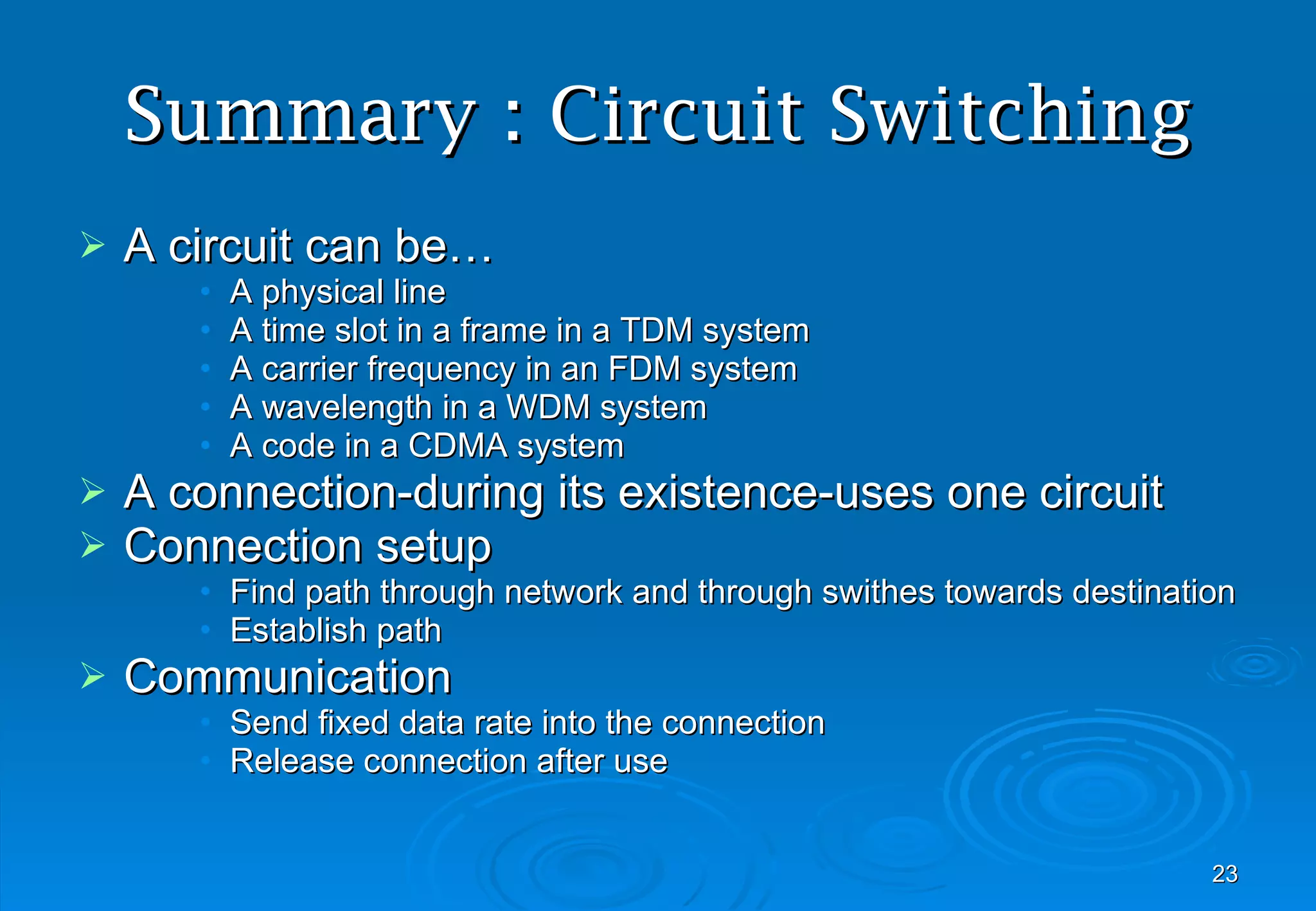
Summary : Circuit Switching A circuit can be… A physical line A time slot in a frame in a TDM system A carrier frequency in an FDM system A wavelength in a WDM system A code in a CDMA system A connection-during its existence-uses one circuit Connection setup Find path through network and through swithes towards destination Establish path Communication Send fixed data rate into the connection Release connection after use
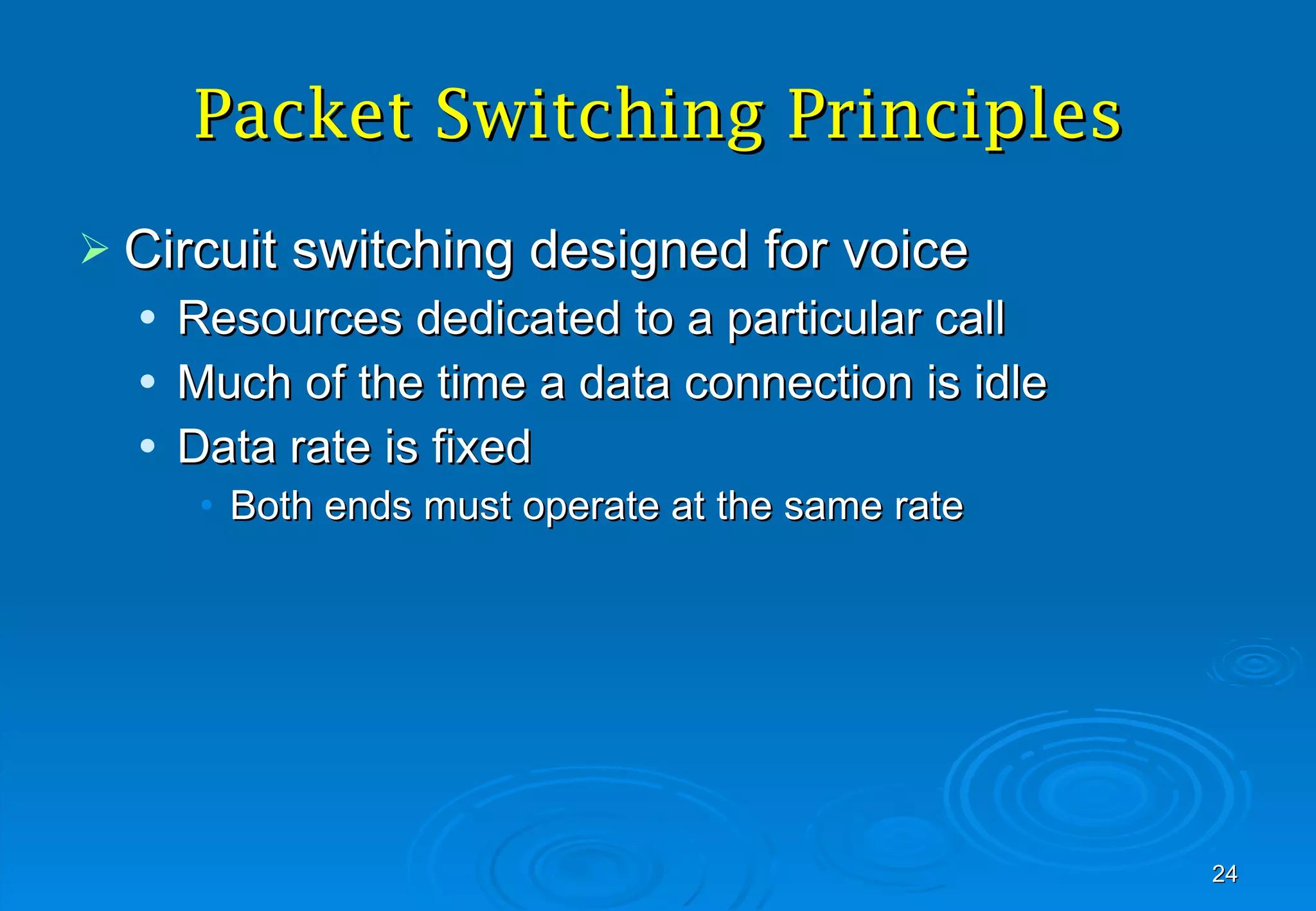
Packet Switching  Principles Circuit switching designed for voice Resources dedicated to a particular call Much of the time a data connection is idle Data rate is fixed Both ends must operate at the same rate
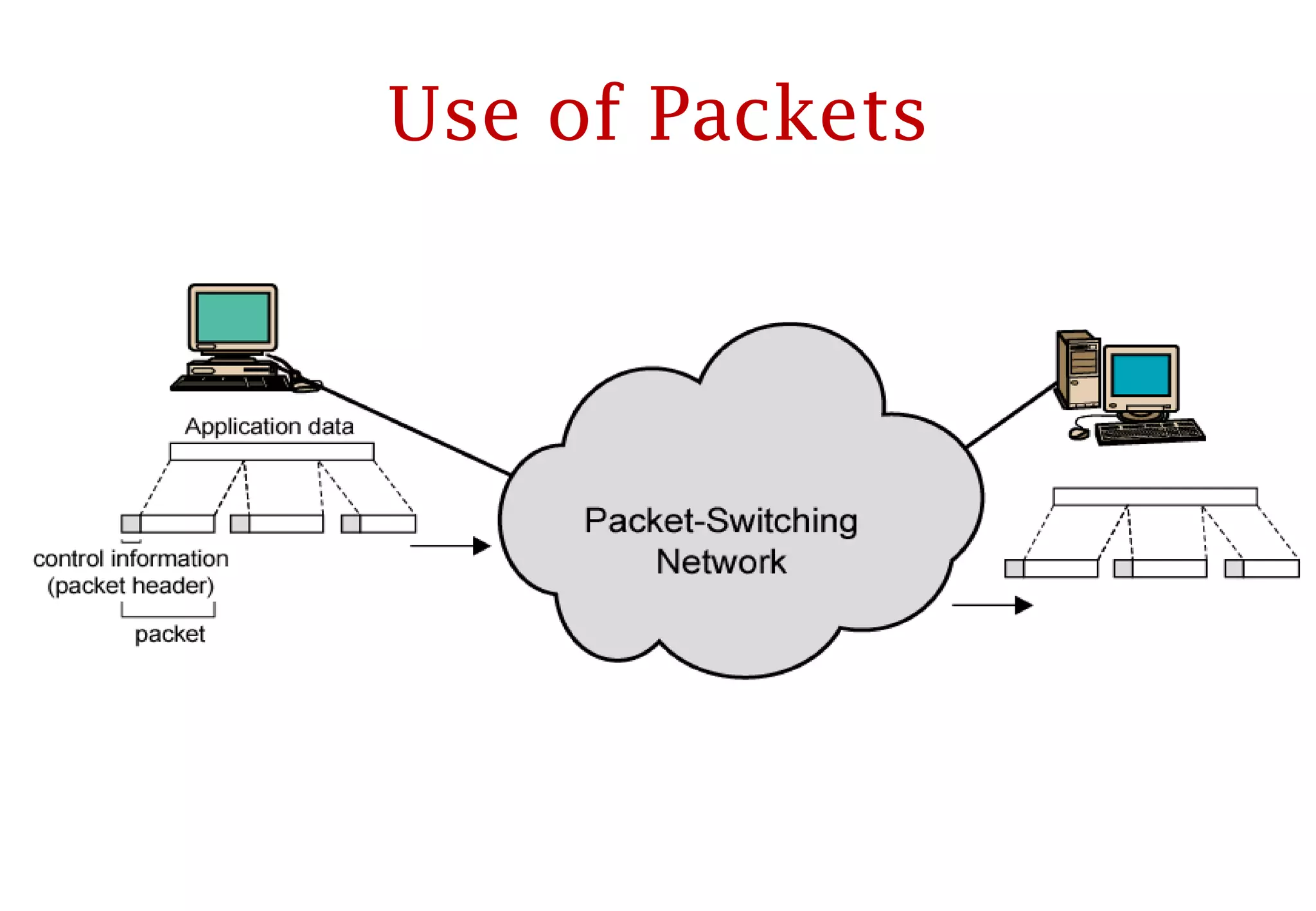
Packet Switching -  Basic Operation Data transmitted in small packets Typically 1000 octets Longer messages split into series of packets Each packet contains a portion of user data plus some control info Control info Routing (addressing) info Packets are received, stored briefly (buffered) and past on to the next node Store and forward
Use of Packets
Advantages Line efficiency Single node to node link can be shared by many packets over time Packets queued and transmitted as fast as possible Data rate conversion Each station connects to the local node at  its own speed Nodes buffer data if required to equalize rates Packets are accepted even when network is busy Delivery may slow down Priorities can be used
Packet Switching –  Switching Technique Station breaks long message into packets Packets sent one at a time to the network Packets handled in two ways (a) Datagram (b) Virtual circuit
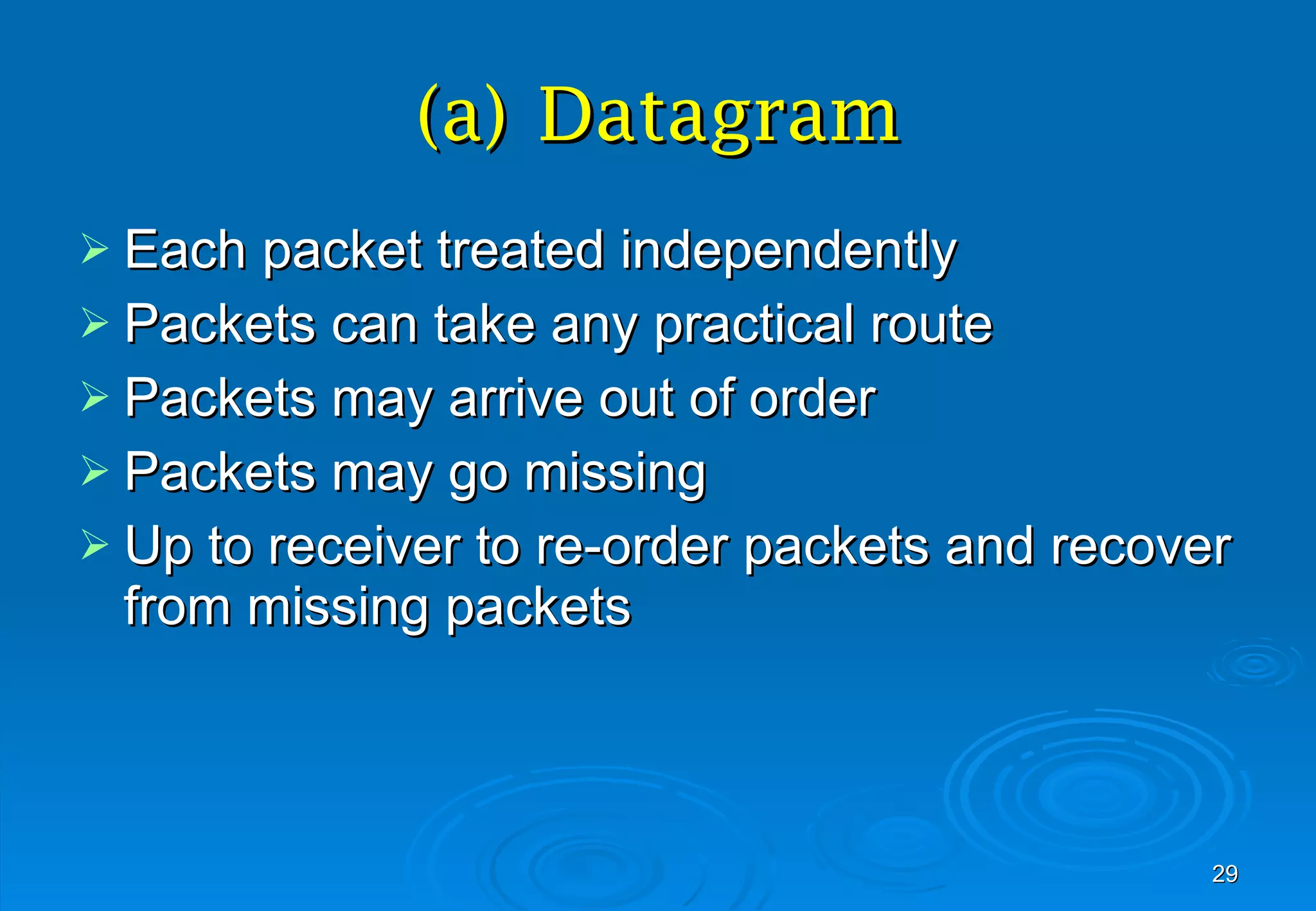
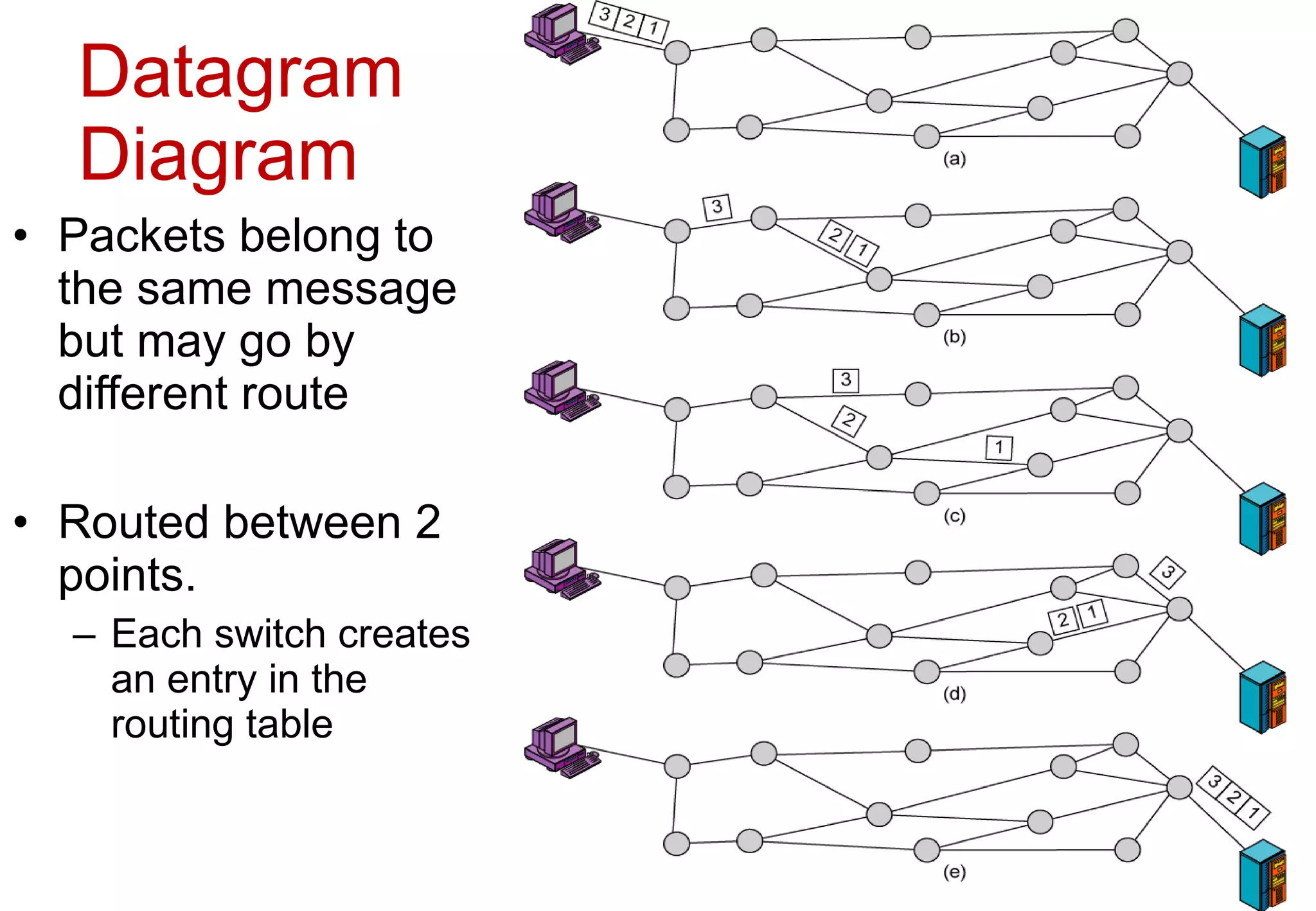
(a) Datagram Each packet treated independently Packets can take any practical route Packets may arrive out of order Packets may go missing Up to receiver to re-order packets and recover from missing packets
Datagram Diagram Packets belong to the same message but may go by different route Routed between 2 points.  Each switch creates an entry in the routing table
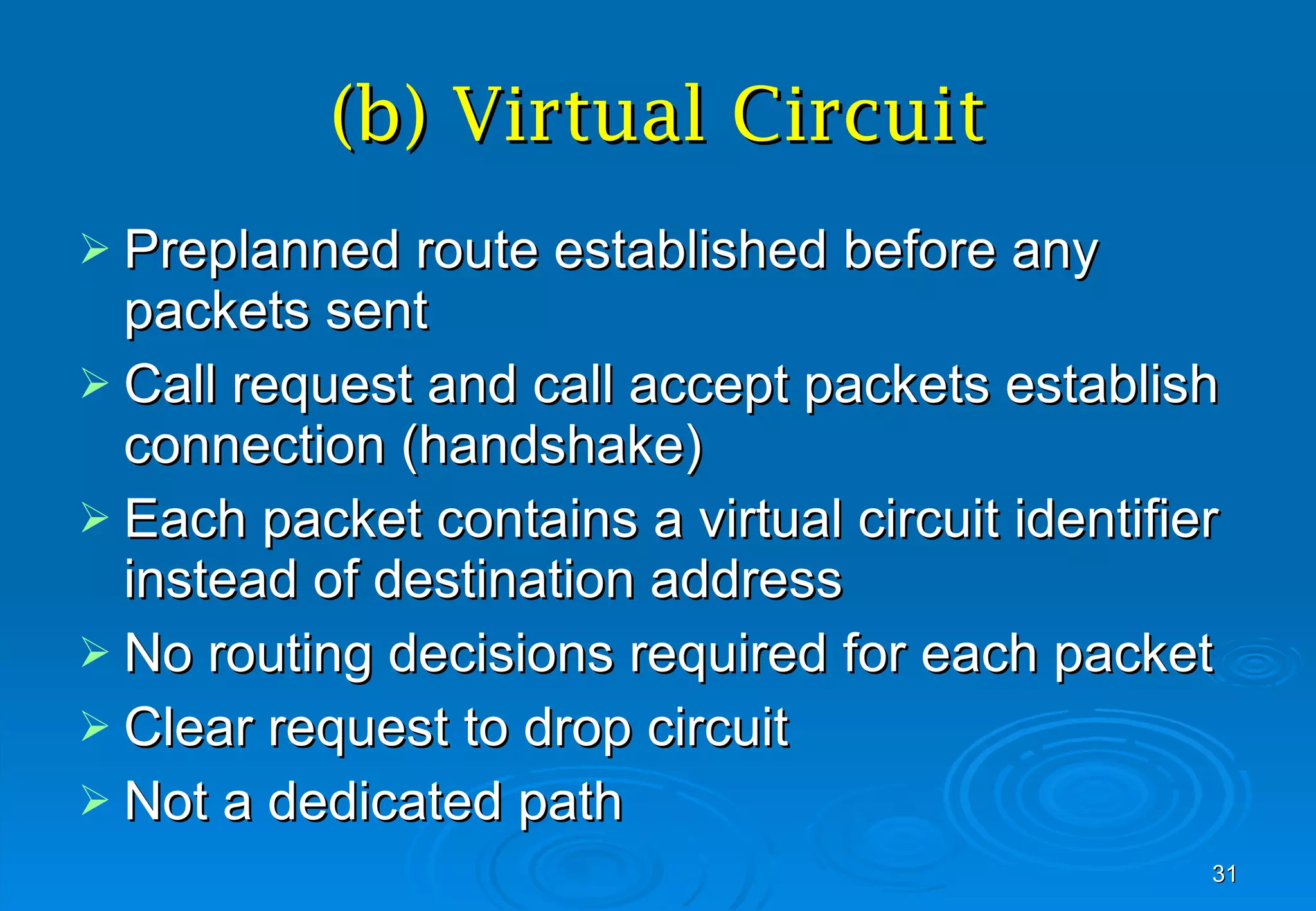
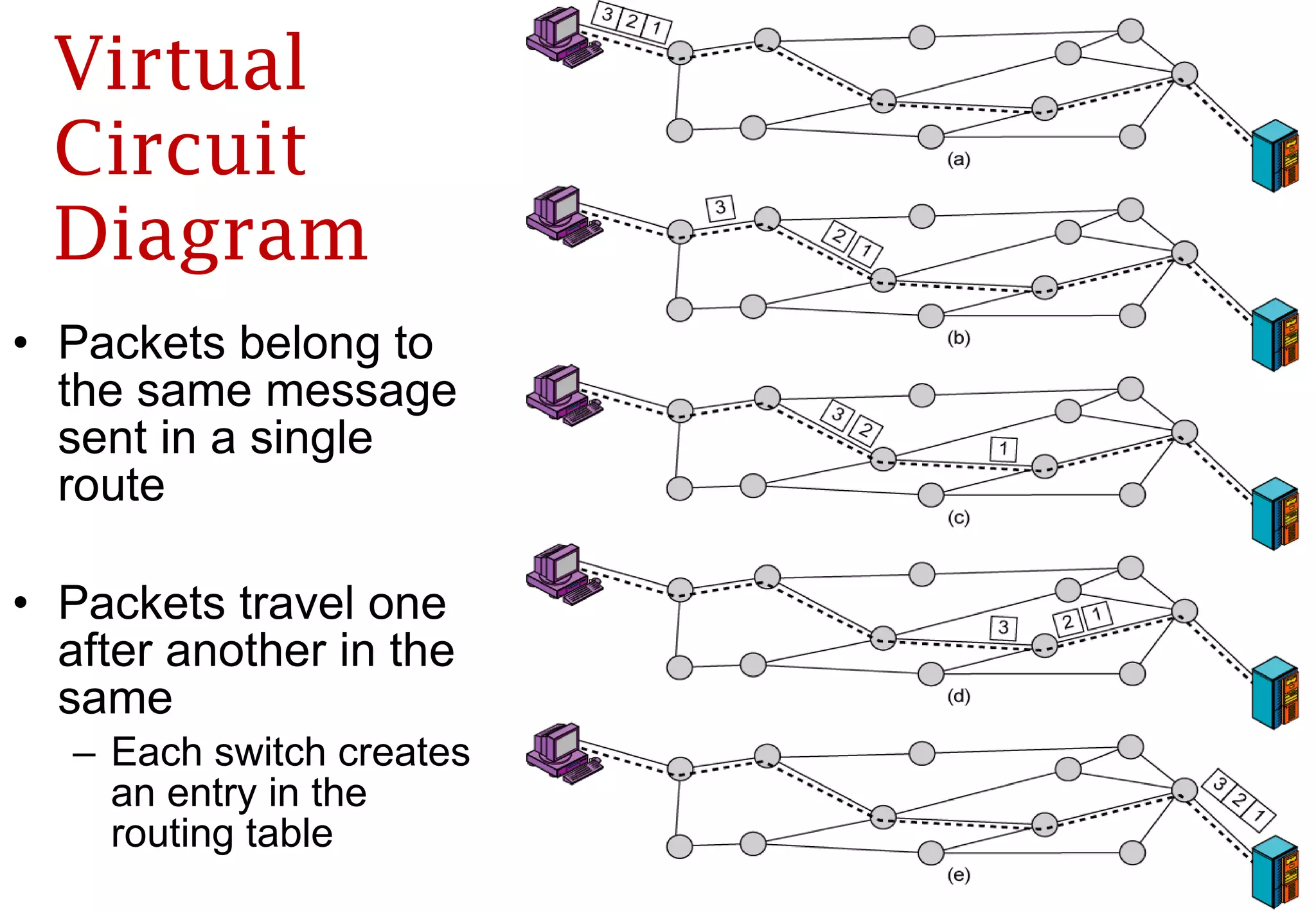
(b) Virtual Circuit Preplanned route established before any packets sent Call request and call accept packets establish connection (handshake) Each packet contains a virtual circuit identifier instead of destination address No routing decisions required for each packet Clear request to drop circuit Not a dedicated path
Virtual Circuit Diagram Packets belong to the same message sent in a single route Packets travel one after another in the same Each switch creates an entry in the routing table
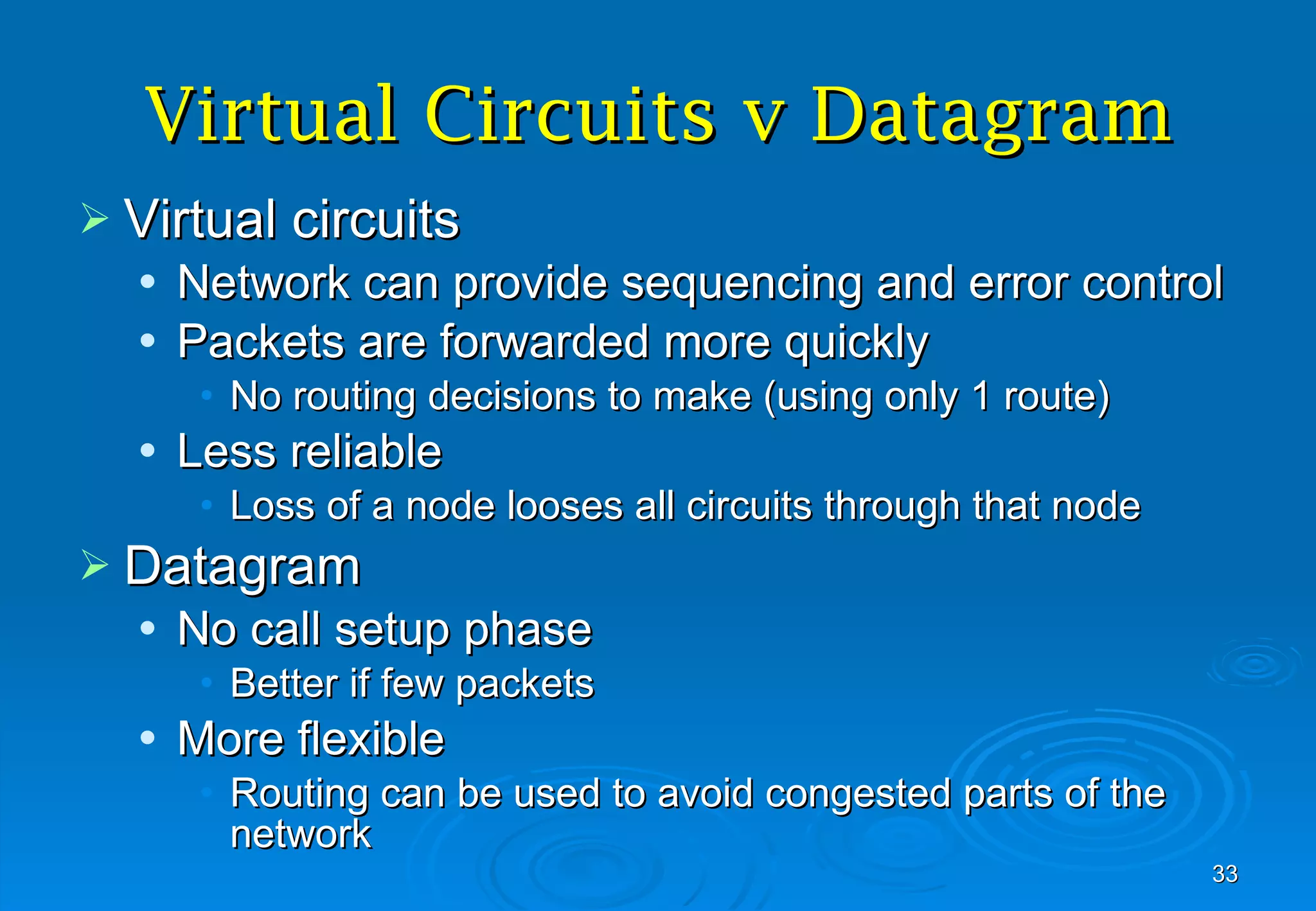
Virtual Circuits v Datagram Virtual circuits Network can provide sequencing and error control Packets are forwarded more quickly No routing decisions to make (using only 1 route) Less reliable Loss of a node looses all circuits through that node Datagram No call setup phase Better if few packets More flexible Routing can be used to avoid congested parts of the network
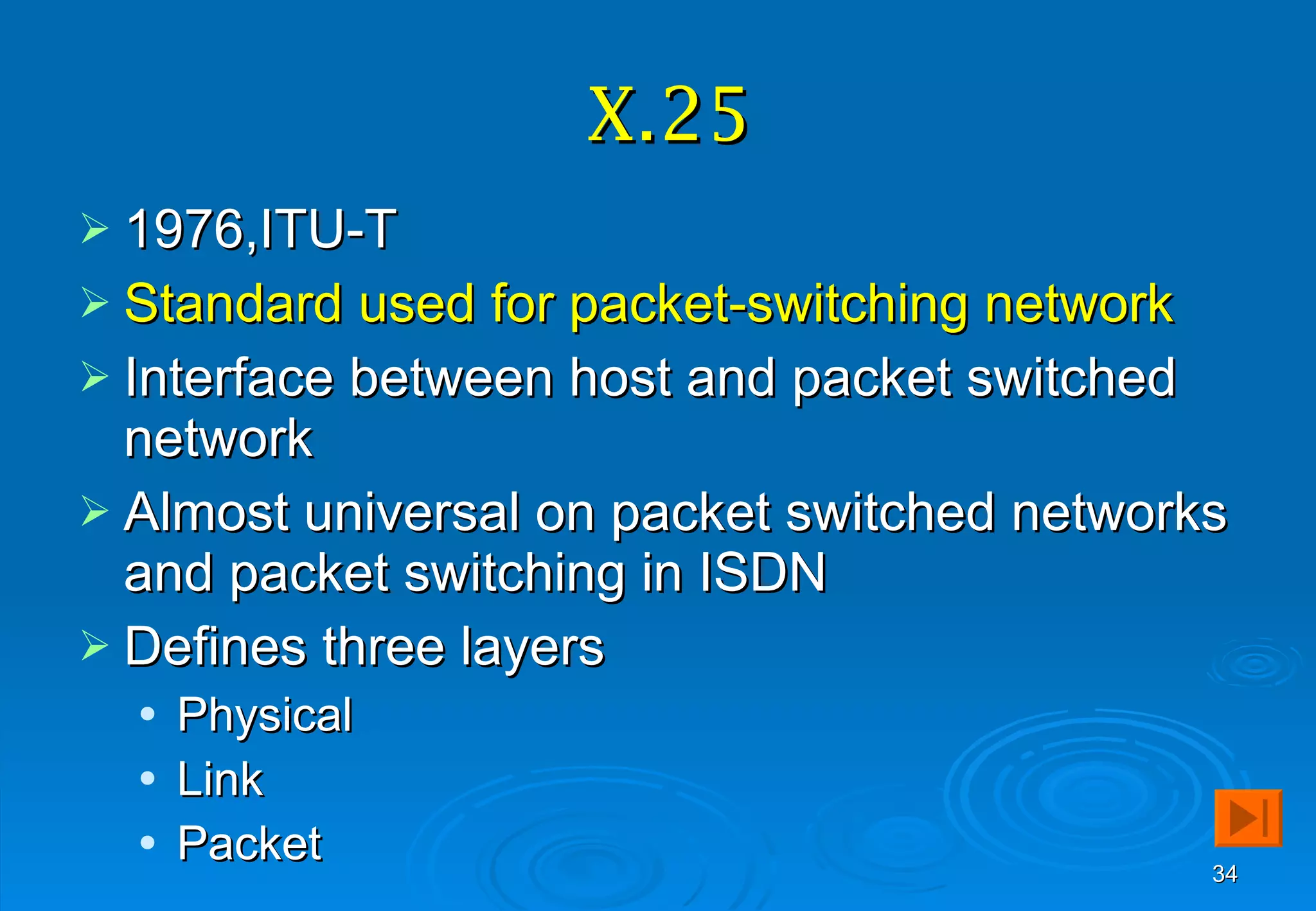
X.25 1976,ITU-T Standard used for packet-switching network Interface between host and packet switched network Almost universal on packet switched networks and packet switching in ISDN Defines three layers Physical Link Packet
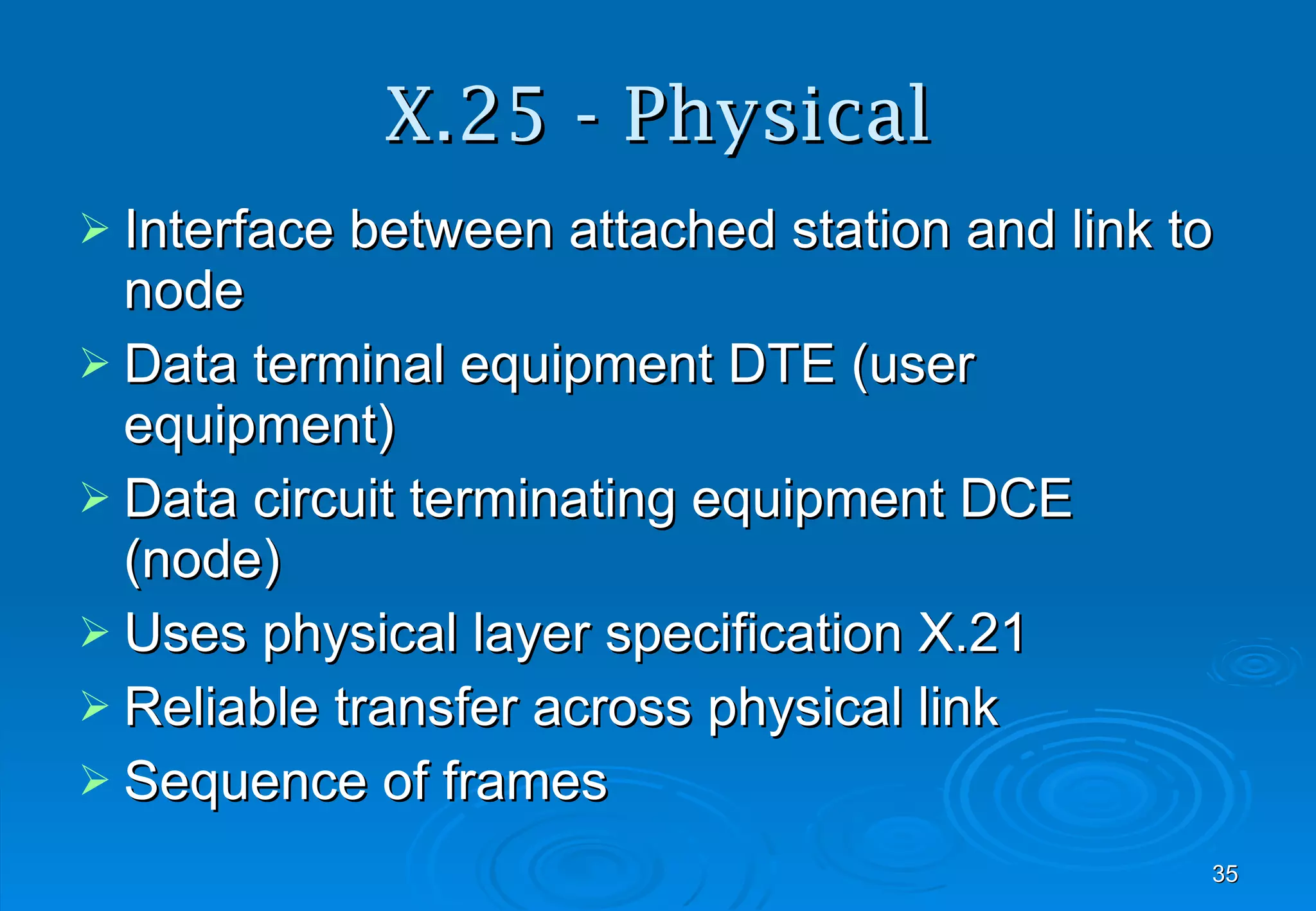
X.25 - Physical Interface between attached station and link to node Data terminal equipment DTE (user equipment) Data circuit terminating equipment DCE (node) Uses physical layer specification X.21 Reliable transfer across physical link Sequence of frames
X.25 - Link Link Access Protocol Balanced (LAPB) Subset of HDLC (high level data link level)
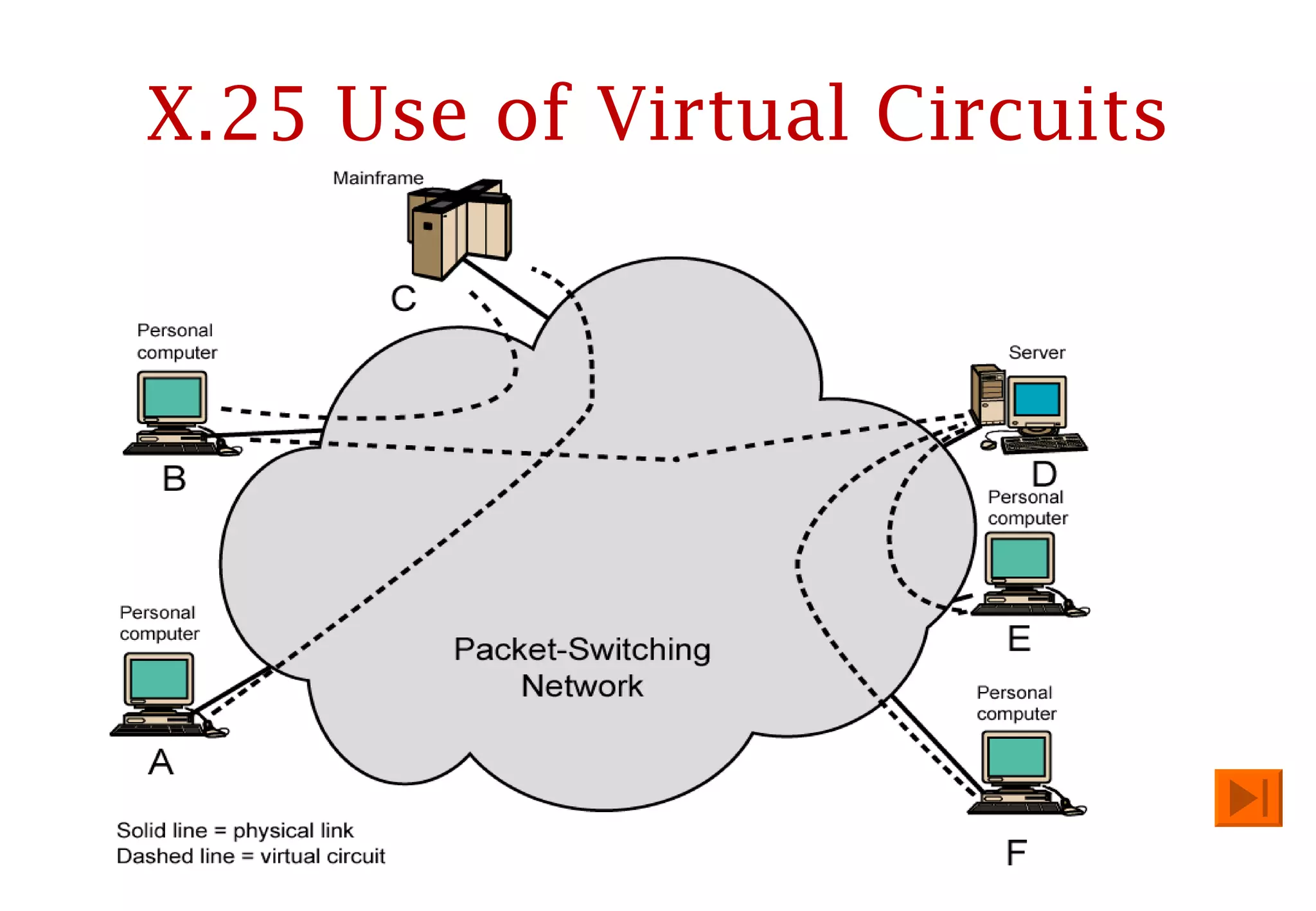
X.25 Use of Virtual Circuits
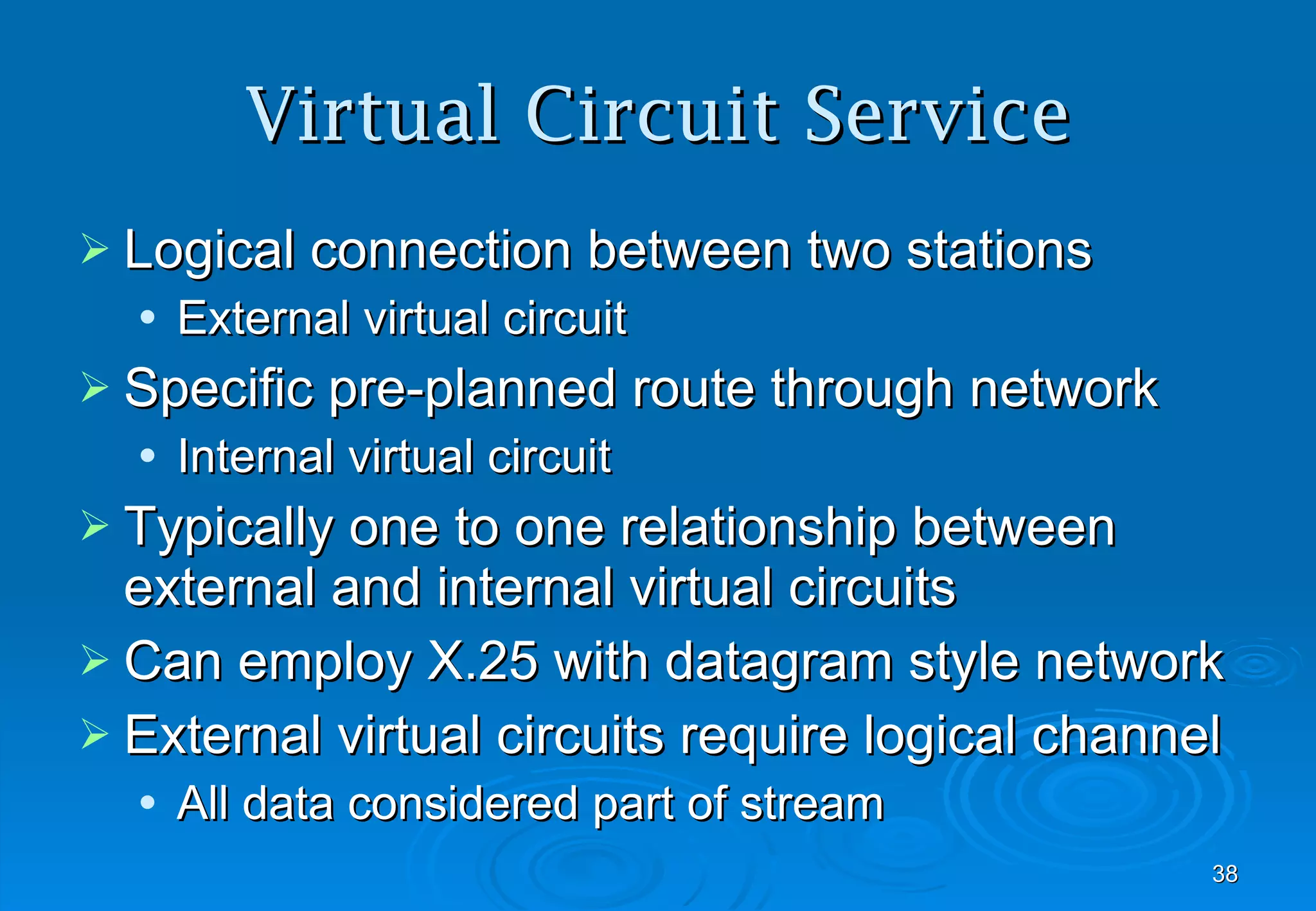
Virtual Circuit Service Logical connection between two stations External virtual circuit Specific pre-planned route through network Internal virtual circuit Typically one to one relationship between external and internal virtual circuits Can employ X.25 with datagram style network External virtual circuits require logical channel  All data considered part of stream
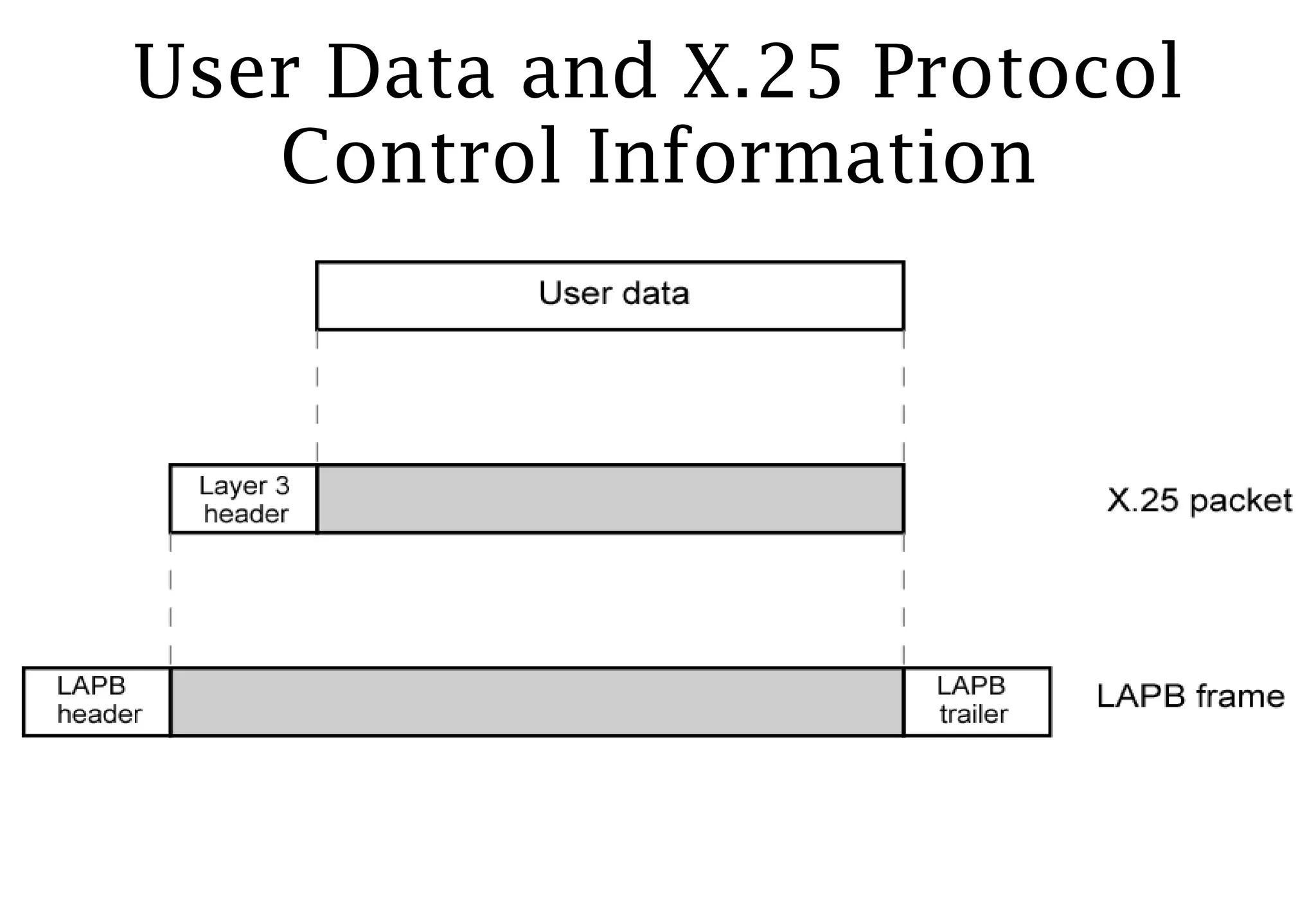
User Data and X.25 Protocol Control Information
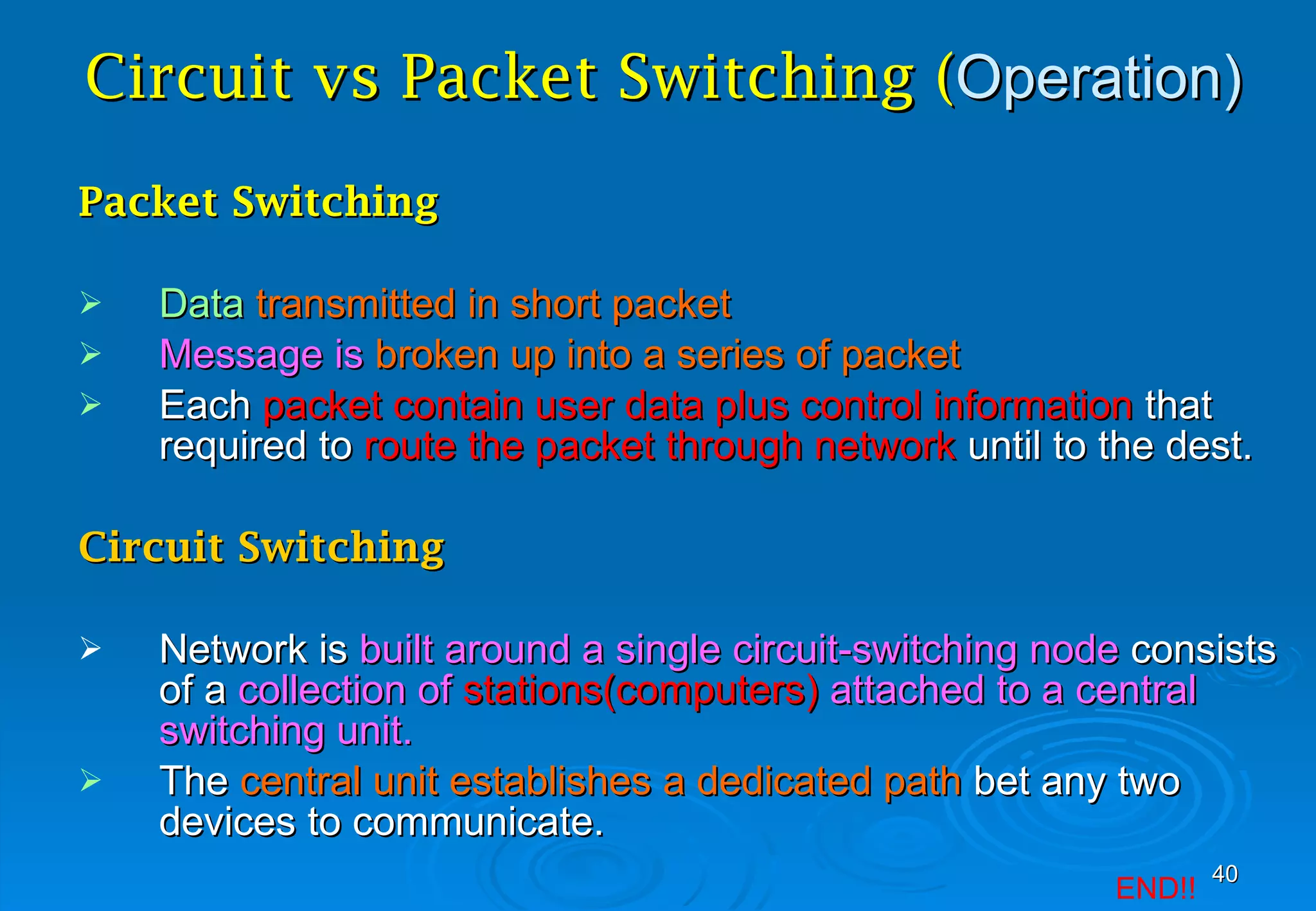
Packet Switching Data   transmitted in short packet Message is   broken up into a series of packet Each  packet contain user data plus control information  that required to  route the packet through network  until to the dest. Circuit Switching   Network is  built around a single circuit-switching node  consists of a  collection of  stations(computers)  attached to a central switching unit. The  central unit establishes a dedicated path  bet any two devices to communicate. Circuit vs Packet Switching ( Operation) END!!
11 circuit-packet

  • 1.
    CIRCUIT SWITCHING AND PACKET SWITCHING
  • 2.
    Switching Networks Longdistance transmission is typically done over a network of switched nodes Nodes not concerned with content of data purpose is to provide a switching facility that will move the data from node to node until they reach their destination End devices are stations Computer, terminal, phone, etc. A collection of nodes and connections is a communications network Data routed by being switched from node to node
  • 3.
    Nodes Nodes mayconnect to other nodes only, or to stations and other nodes Node to node links usually multiplexed FDM or TDM Network is usually partially connected (not fully connected) Some redundant connections are desirable for reliability (more than 1 possible path for each pair) Two different switching technologies Circuit switching Packet switching
  • 4.
  • 5.
    Circuit Switching Dedicatedcommunication path between two stations Three phases Establish Transfer Disconnect Must have switching capacity and channel capacity to establish connection Must have intelligence to work out routing
  • 6.
    Circuit Switching -Applications Inefficient Channel capacity dedicated for duration of connection If no data, capacity wasted Set up (connection) takes time Once connected, transfer is transparent to users Developed for voice traffic (phone)
  • 7.
    Public Circuit SwitchedNetwork (eg. public telephone network)
  • 8.
    Telecommunications Components SubscriberDevices attached to network.eg. telephone Subscriber line Local Loop @ Subscriber loop Connection to network (link between subscriber & network) Few km up to few tens of km Exchange Switching centers Switching centre supports subscribers - End office Trunks Branches between exchanges Carry multiplexed multiple voice-frequency circuits
  • 9.
  • 10.
    4.1.3 Circuit SwitchingConcepts Digital Switch Provide transparent signal path between devices Network Interface Represents the functions and hardware needed to connect digital devices Control Unit Establish connections Generally on demand Handle and acknowledge requests Determine if destination is free construct path Maintain connection Disconnect
  • 11.
    Blocking or Non-blockingBlocking A network is unable to connect stations because all paths are in use A blocking network allows this Used on voice systems Short duration calls Non-blocking Permits all stations to connect (in pairs) at once (as long as the called party is free) Used for some data connections
  • 12.
    Space Division SwitchingDeveloped for analog environment Separate physical paths (divided in space) Crossbar switch Number of crosspoints grows as square of number of stations. Loss of crosspoint prevents connection Inefficient use of crosspoints All stations connected, only a few crosspoints in use Non-blocking
  • 13.
  • 14.
    Multistage Switch Reducednumber of crosspoints More than one path through network Increased reliability More complex control May be blocking
  • 15.
    Time Division SwitchingModern digital systems rely on intelligent control of space and time division elements Use digital time division techniques to set up and maintain virtual circuits Partition low speed bit stream into pieces that share higher speed stream Manipulated by control logic to route data from input to output.
  • 16.
    4.1.4 Control SignalingFunctions Audible communication with subscriber Transmission of dialed number Call can not be completed indication Call ended indication Signal to ring phone Billing info Equipment and trunk status info Diagnostic info Control of specialist equipment – satellite channel equipment
  • 17.
    Control Signal SequenceBoth phones on hook (not in use) Subscriber lifts receiver (off hook) End office switch signaled Switch responds with dial tone Caller dials number If target not busy, send ringer signal to target subscriber Feedback to caller Ringing tone, engaged tone, unobtainable Target accepts call by lifting receiver Switch terminates ringing signal and ringing tone Switch establishes connection Connection release when Source subscriber hangs up
  • 18.
    Switch to SwitchSignaling Subscribers connected to different switches Originating switch seizes interswitch trunk Send off hook signal on trunk, requesting digit register at target switch (for address) Terminating switch sends off hook followed by on hook (wink) to show register ready Originating switch sends address
  • 19.
    Location of SignalingSubscriber to network Depends on subscriber device and switch Within network Management of subscriber calls and network ore complex
  • 20.
    4.1.5 SoftswitchArchitecture General purpose computer running software to make it a smart phone switch Lower costs Greater functionality Packetizing of digitized voice data Allowing voice over IP Most complex part of telephone network switch is software controlling call process Call routing Call processing logic Typically running on proprietary processor Separate call processing from hardware function of switch Physical switching done by media gateway Call processing done by media gateway controller
  • 21.
  • 22.
  • 23.
    Summary : CircuitSwitching A circuit can be… A physical line A time slot in a frame in a TDM system A carrier frequency in an FDM system A wavelength in a WDM system A code in a CDMA system A connection-during its existence-uses one circuit Connection setup Find path through network and through swithes towards destination Establish path Communication Send fixed data rate into the connection Release connection after use
  • 24.
    Packet Switching Principles Circuit switching designed for voice Resources dedicated to a particular call Much of the time a data connection is idle Data rate is fixed Both ends must operate at the same rate
  • 25.
    Packet Switching - Basic Operation Data transmitted in small packets Typically 1000 octets Longer messages split into series of packets Each packet contains a portion of user data plus some control info Control info Routing (addressing) info Packets are received, stored briefly (buffered) and past on to the next node Store and forward
  • 26.
  • 27.
    Advantages Line efficiencySingle node to node link can be shared by many packets over time Packets queued and transmitted as fast as possible Data rate conversion Each station connects to the local node at its own speed Nodes buffer data if required to equalize rates Packets are accepted even when network is busy Delivery may slow down Priorities can be used
  • 28.
    Packet Switching – Switching Technique Station breaks long message into packets Packets sent one at a time to the network Packets handled in two ways (a) Datagram (b) Virtual circuit
  • 29.
    (a) Datagram Eachpacket treated independently Packets can take any practical route Packets may arrive out of order Packets may go missing Up to receiver to re-order packets and recover from missing packets
  • 30.
    Datagram Diagram Packetsbelong to the same message but may go by different route Routed between 2 points. Each switch creates an entry in the routing table
  • 31.
    (b) Virtual CircuitPreplanned route established before any packets sent Call request and call accept packets establish connection (handshake) Each packet contains a virtual circuit identifier instead of destination address No routing decisions required for each packet Clear request to drop circuit Not a dedicated path
  • 32.
    Virtual Circuit DiagramPackets belong to the same message sent in a single route Packets travel one after another in the same Each switch creates an entry in the routing table
  • 33.
    Virtual Circuits vDatagram Virtual circuits Network can provide sequencing and error control Packets are forwarded more quickly No routing decisions to make (using only 1 route) Less reliable Loss of a node looses all circuits through that node Datagram No call setup phase Better if few packets More flexible Routing can be used to avoid congested parts of the network
  • 34.
    X.25 1976,ITU-T Standardused for packet-switching network Interface between host and packet switched network Almost universal on packet switched networks and packet switching in ISDN Defines three layers Physical Link Packet
  • 35.
    X.25 - PhysicalInterface between attached station and link to node Data terminal equipment DTE (user equipment) Data circuit terminating equipment DCE (node) Uses physical layer specification X.21 Reliable transfer across physical link Sequence of frames
  • 36.
    X.25 - LinkLink Access Protocol Balanced (LAPB) Subset of HDLC (high level data link level)
  • 37.
    X.25 Use ofVirtual Circuits
  • 38.
    Virtual Circuit ServiceLogical connection between two stations External virtual circuit Specific pre-planned route through network Internal virtual circuit Typically one to one relationship between external and internal virtual circuits Can employ X.25 with datagram style network External virtual circuits require logical channel All data considered part of stream
  • 39.
    User Data andX.25 Protocol Control Information
  • 40.
    Packet Switching Data transmitted in short packet Message is broken up into a series of packet Each packet contain user data plus control information that required to route the packet through network until to the dest. Circuit Switching Network is built around a single circuit-switching node consists of a collection of stations(computers) attached to a central switching unit. The central unit establishes a dedicated path bet any two devices to communicate. Circuit vs Packet Switching ( Operation) END!!