8.1
Module 2
Circuit & Packet Switching
Copyright © The McGraw-Hill Companies, Inc. Permission required for reproduction or display.
Switched Network
• A network is a set of connected devices.
• Whenever we have multiple devices, we have the
problem of how to connect them to make one-to-one
communication possible.
• One solution is to make a point-to-point connection
between each pair of devices (mesh or star topology).
— impractical and wasteful when applied to very large
networks.
• Multipoint connection –bus topology
- ruled out because the distances between devices and the total
number of devices increases beyond the capacities of the
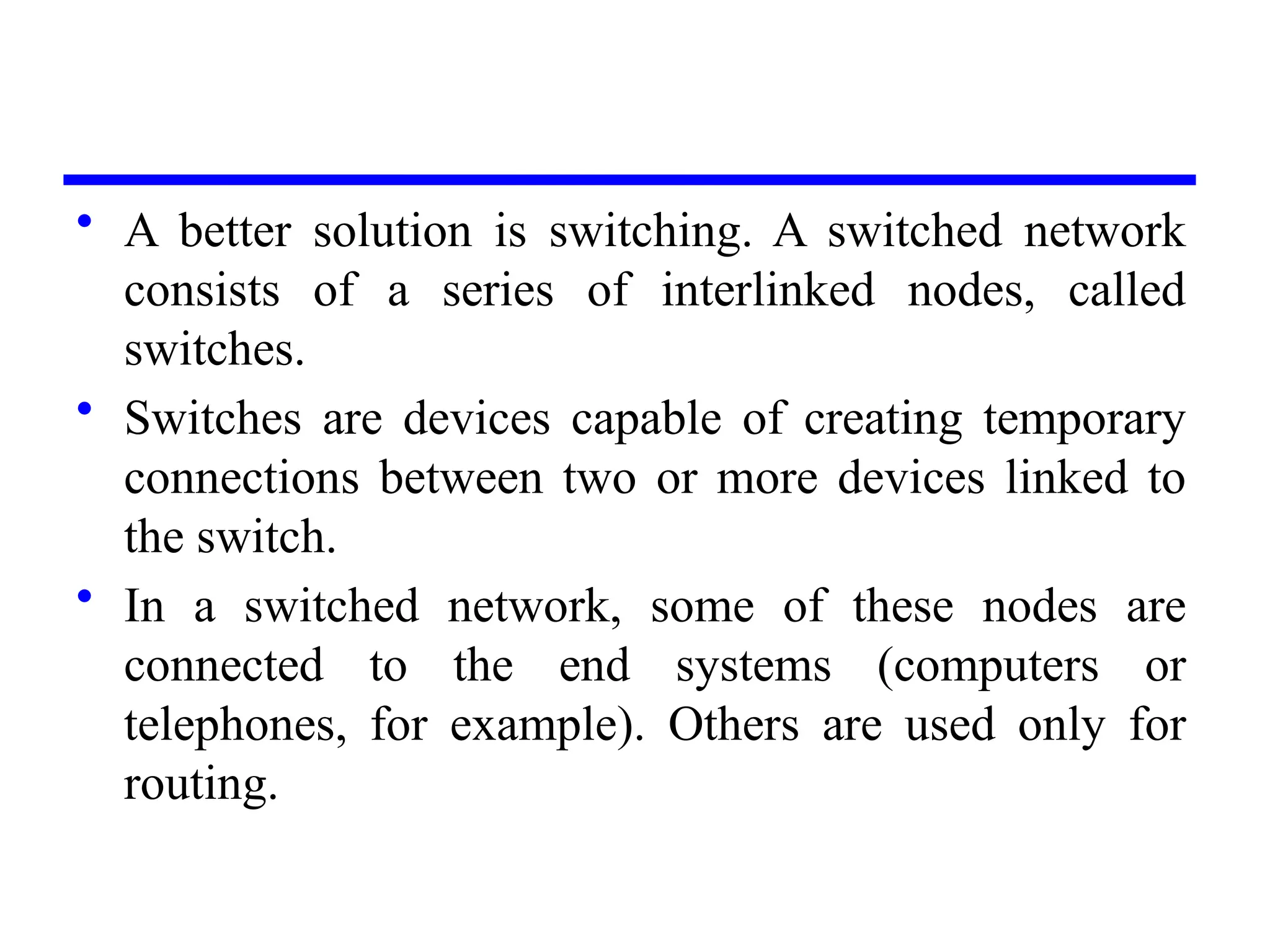
• A better solution is switching. A switched network
consists of a series of interlinked nodes, called
switches.
• Switches are devices capable of creating temporary
connections between two or more devices linked to
the switch.
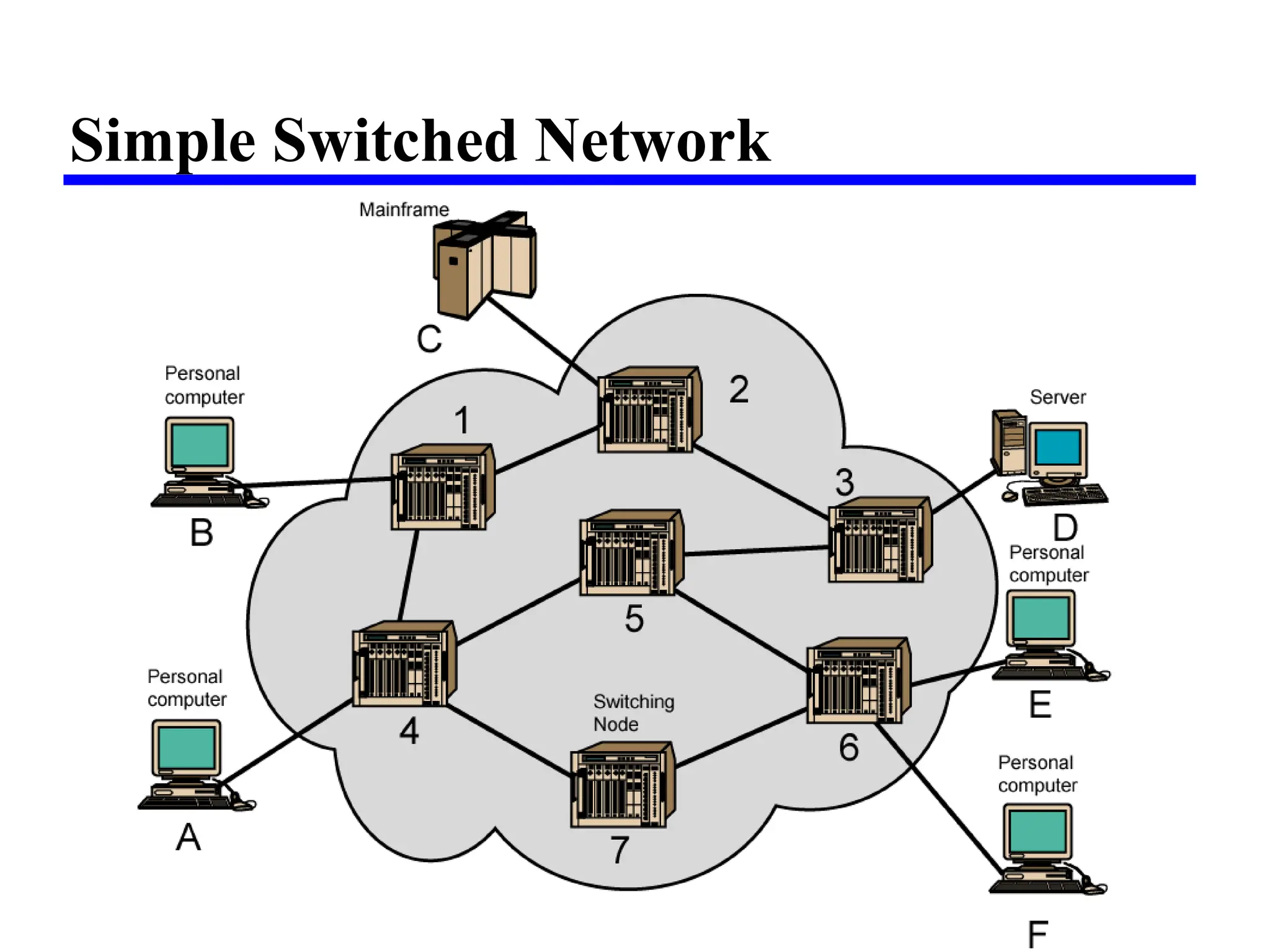
• In a switched network, some of these nodes are
connected to the end systems (computers or
telephones, for example). Others are used only for
routing.
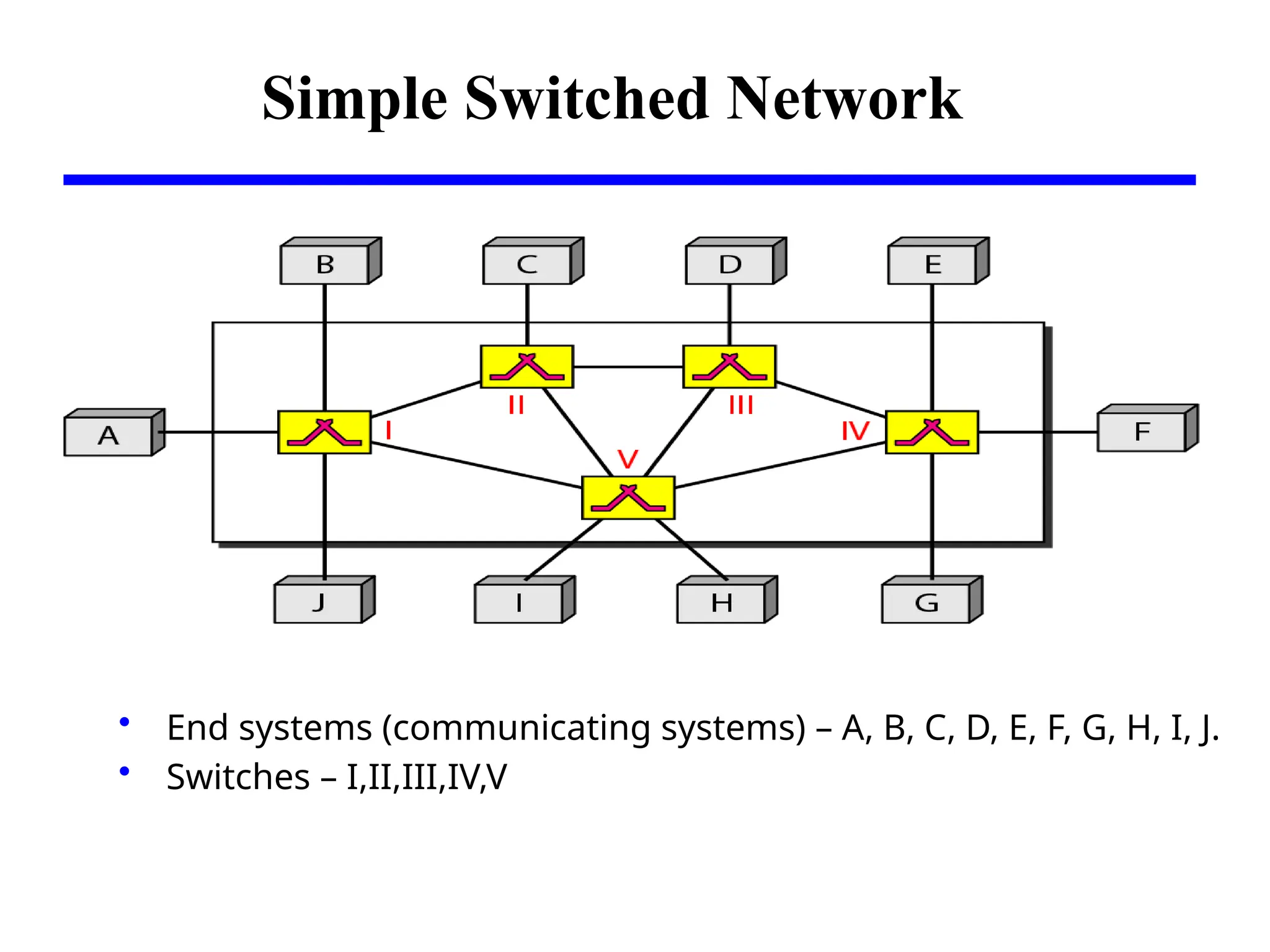
Simple Switched Network
• End systems (communicating systems) – A, B, C, D, E, F, G, H, I, J.
• Switches – I,II,III,IV,V
Simple Switched Network
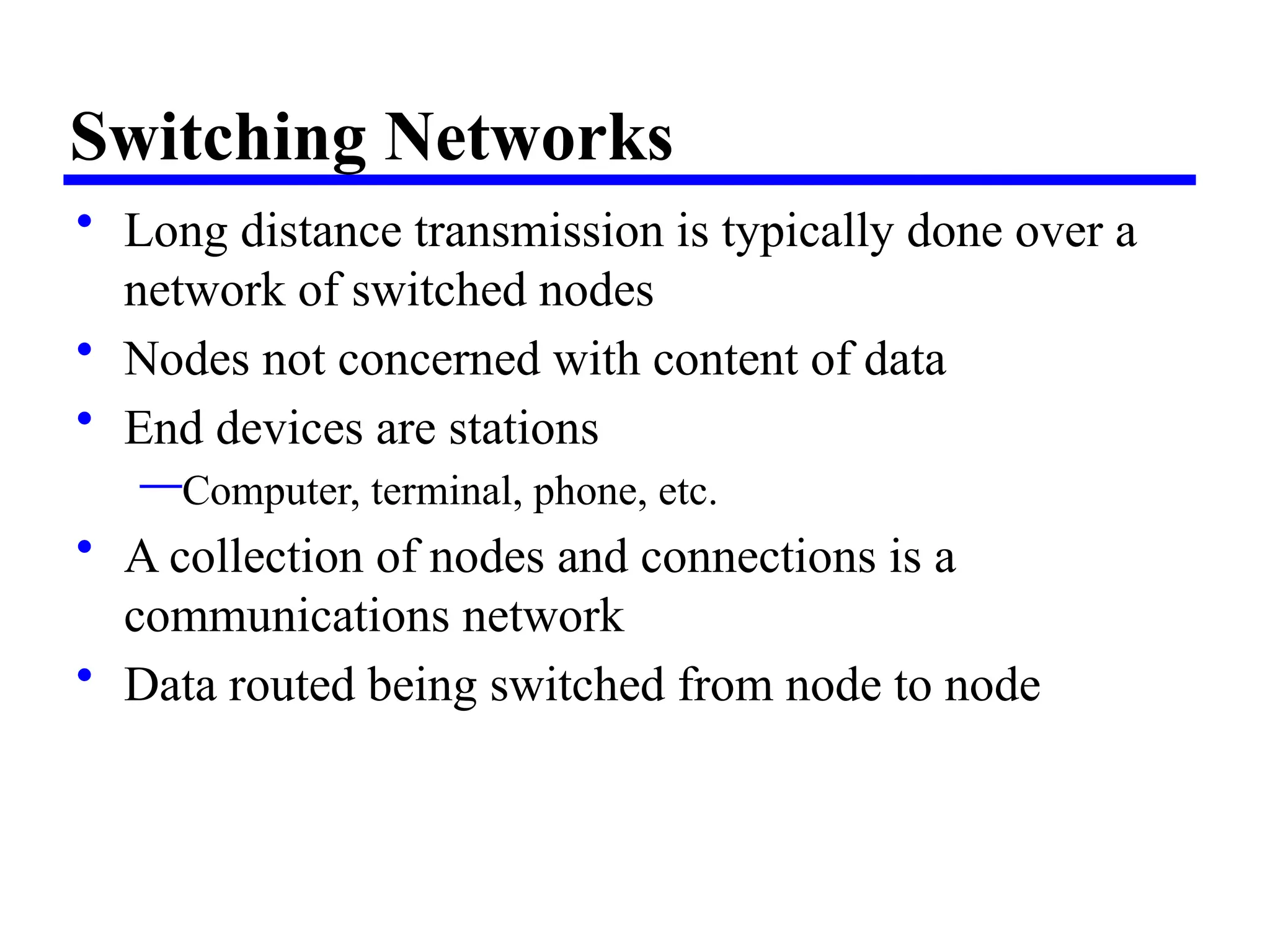
Switching Networks
• Long distance transmission is typically done over a
network of switched nodes
• Nodes not concerned with content of data
• End devices are stations
—Computer, terminal, phone, etc.
• A collection of nodes and connections is a
communications network
• Data routed being switched from node to node
Nodes
• Nodes may connect to other nodes only, or to stations
and other nodes
• Node to node links usually multiplexed
• Network is usually partially connected
—Some redundant connections are desirable for reliability
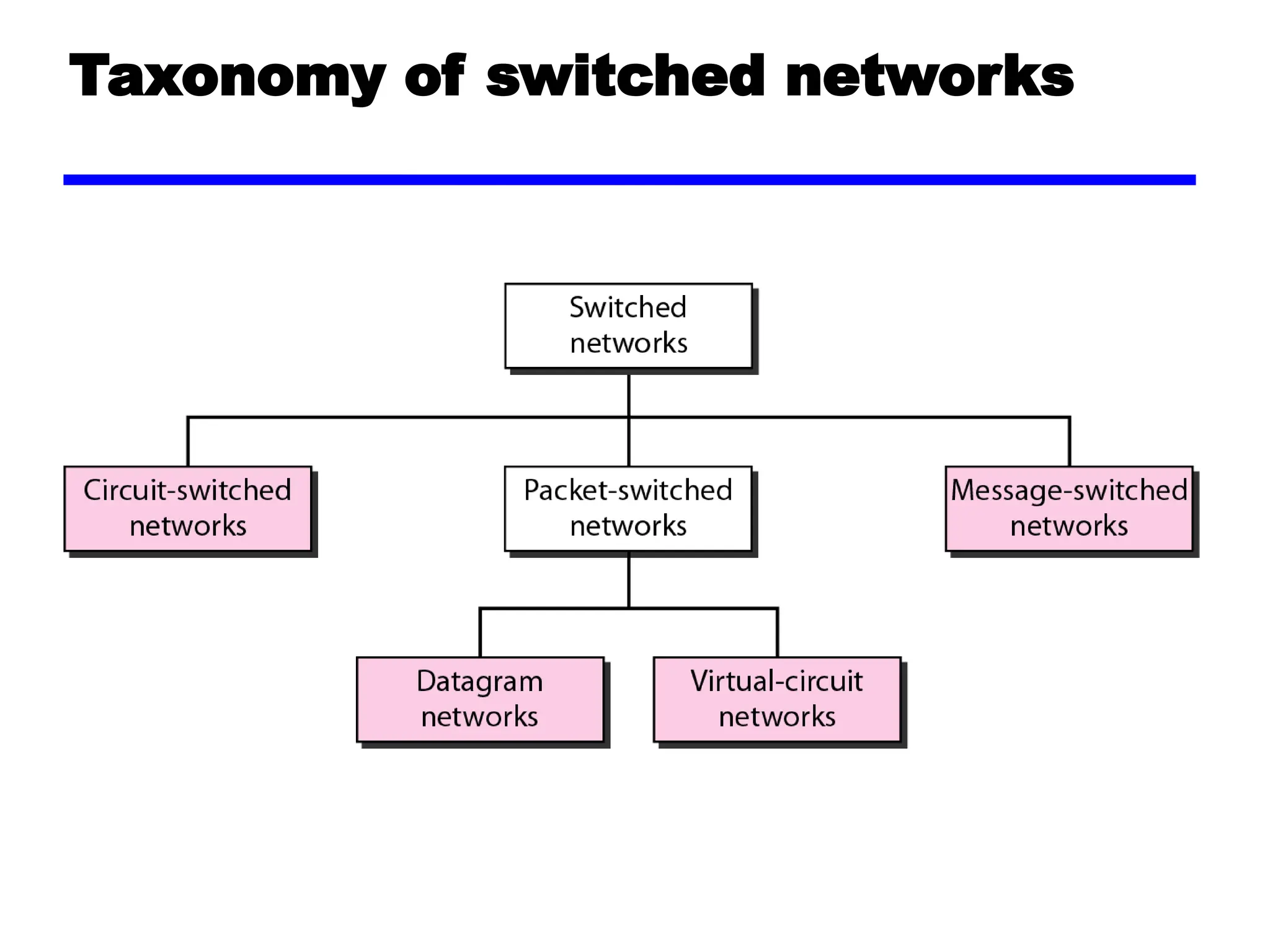
Taxonomy of switched networks
Circuit Switching
• Dedicated communication path between two stations
• Three phases
—Establish
—Transfer
—Disconnect
• Must have switching capacity and channel capacity
to establish connection
• Must have intelligence to work out routing
Circuit Switching
• Inefficient
—Channel capacity dedicated for duration of connection
—If no data, capacity wasted
• Set up (connection) takes time
• Once connected, transfer is transparent
• Circuit switching designed for voice
—Resources dedicated to a particular call
—Much of the time a data connection is idle
—Data rate is fixed
• Both ends must operate at the same rate
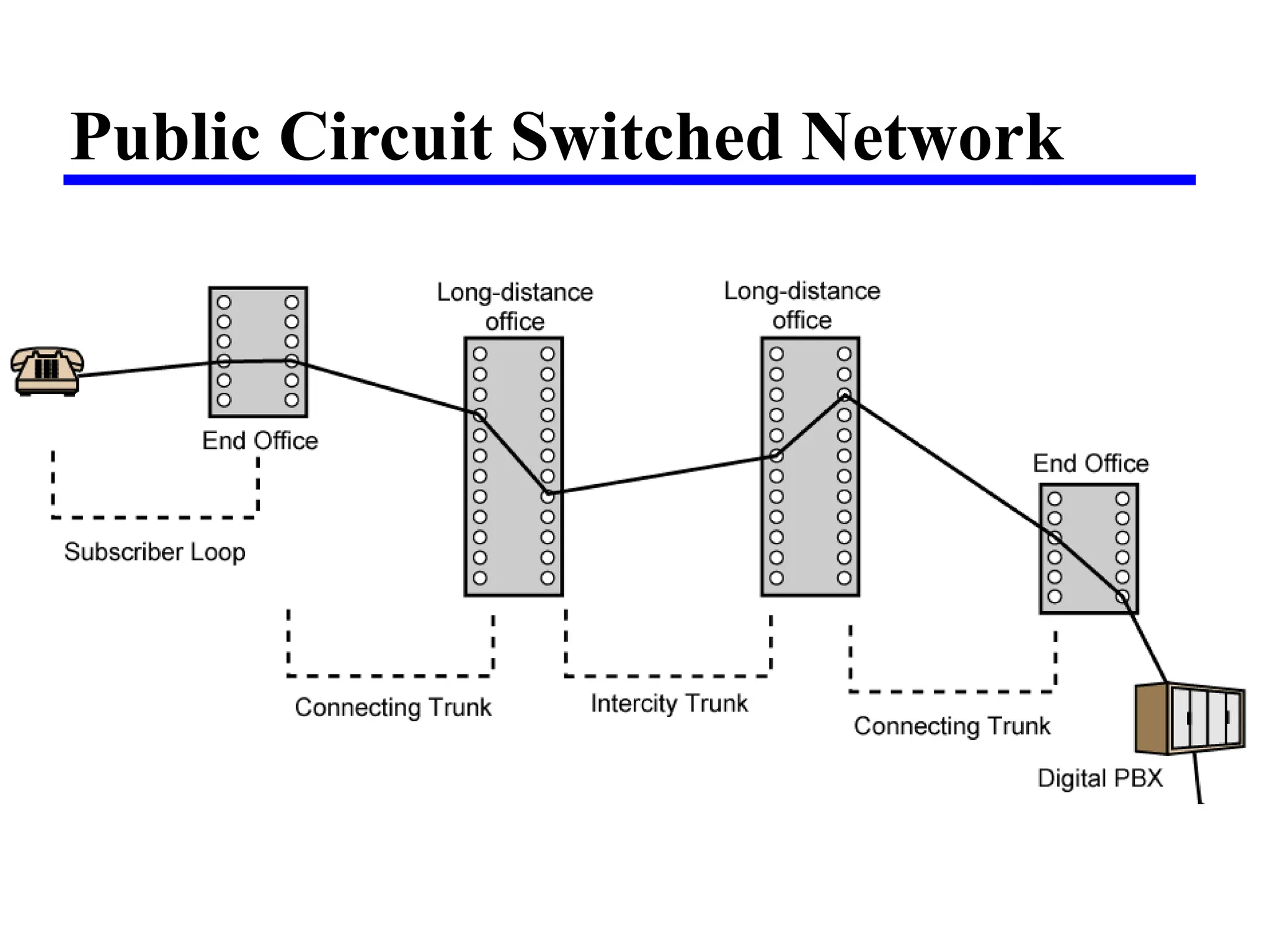
Public Circuit Switched Network
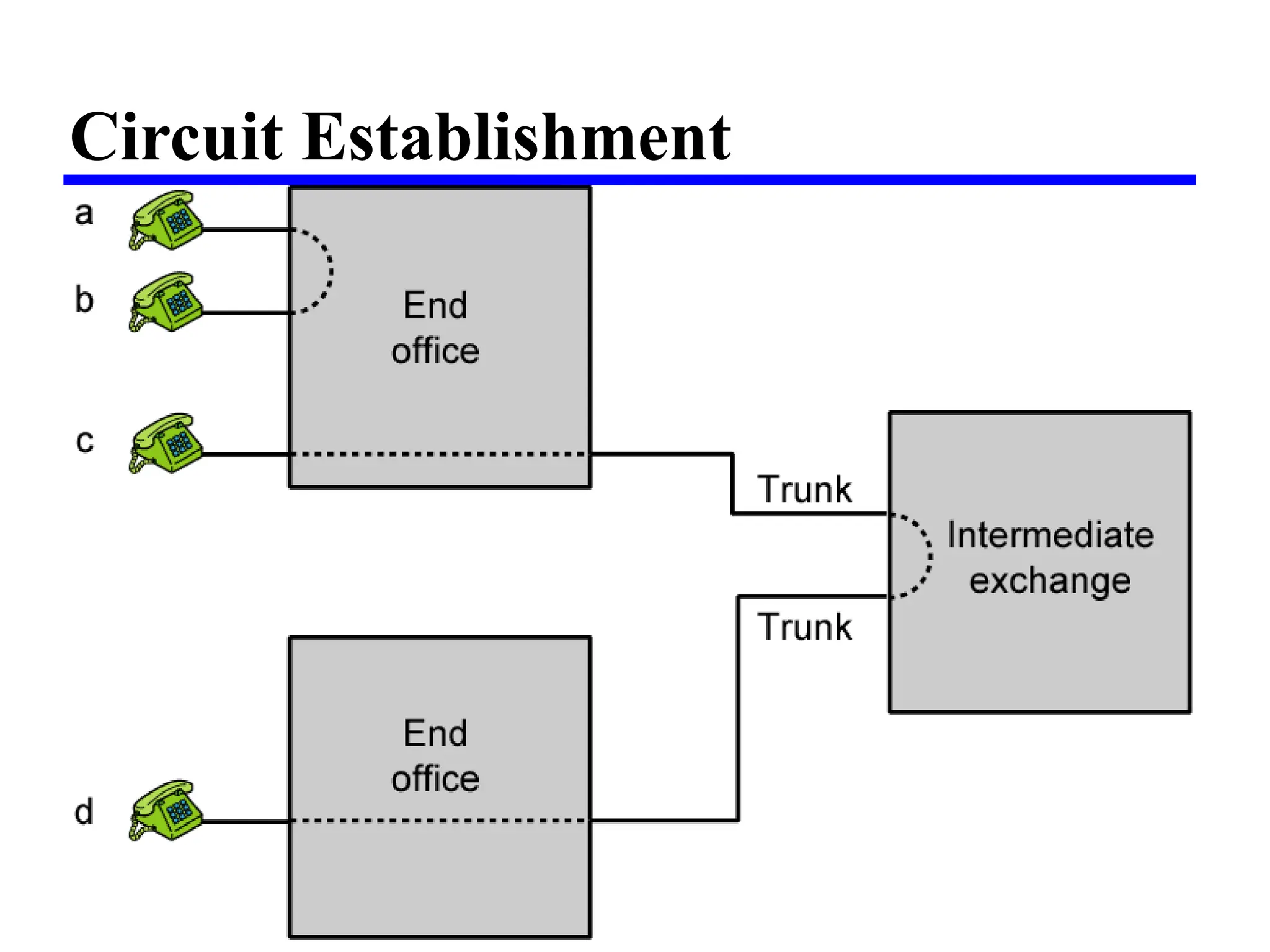
Circuit Establishment
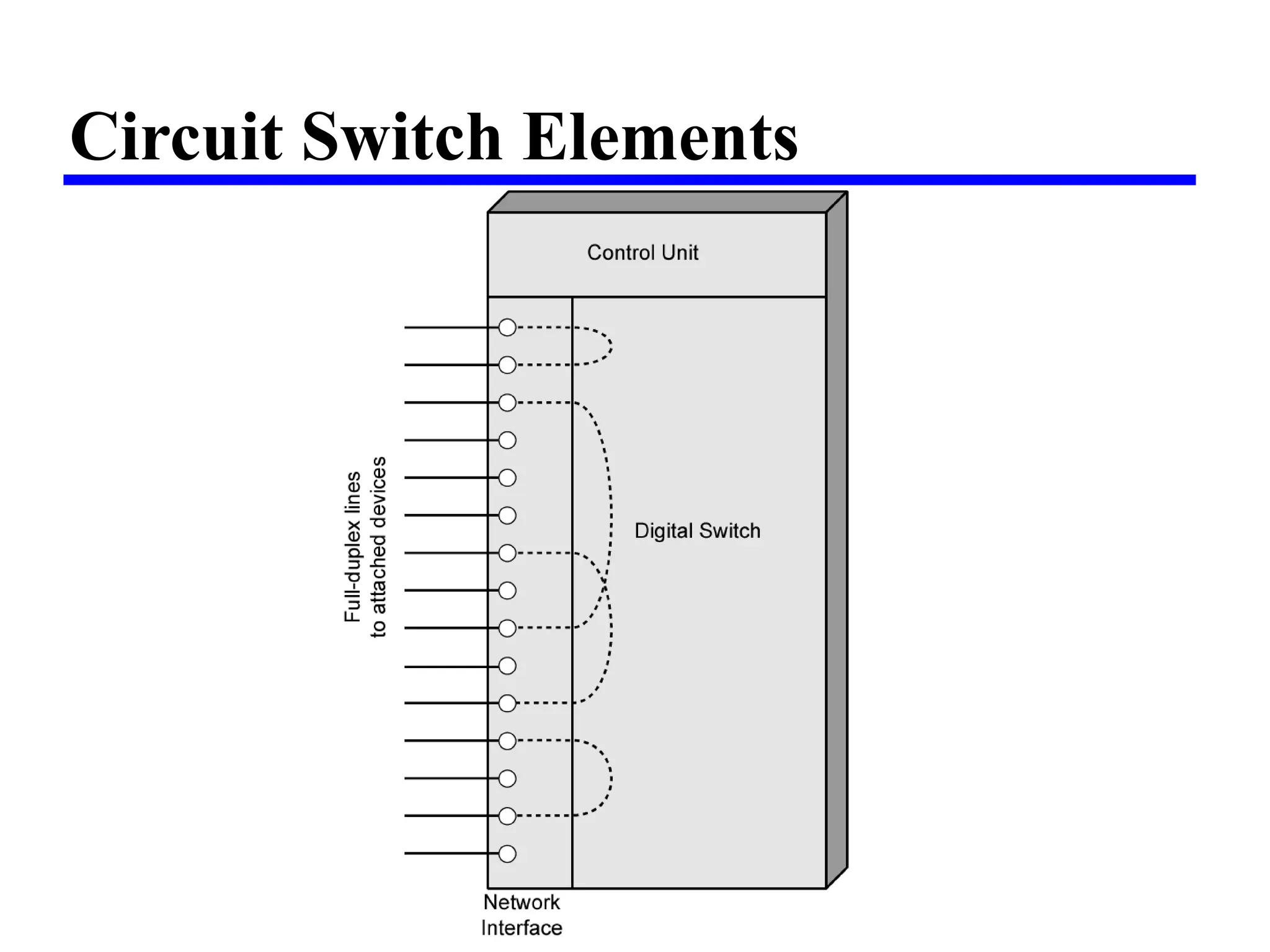
Circuit Switch Elements
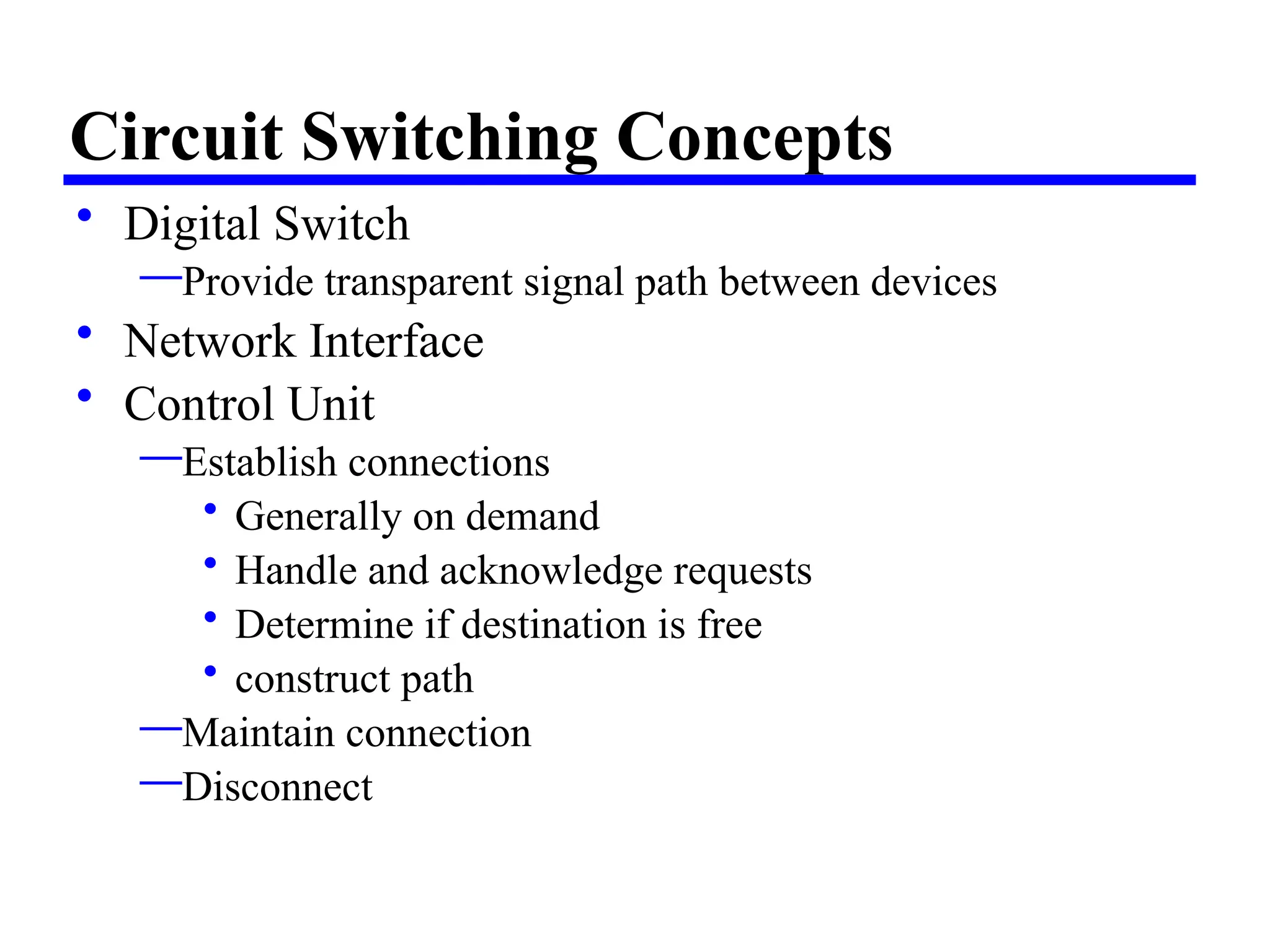
Circuit Switching Concepts
• Digital Switch
—Provide transparent signal path between devices
• Network Interface
• Control Unit
—Establish connections
• Generally on demand
• Handle and acknowledge requests
• Determine if destination is free
• construct path
—Maintain connection
—Disconnect
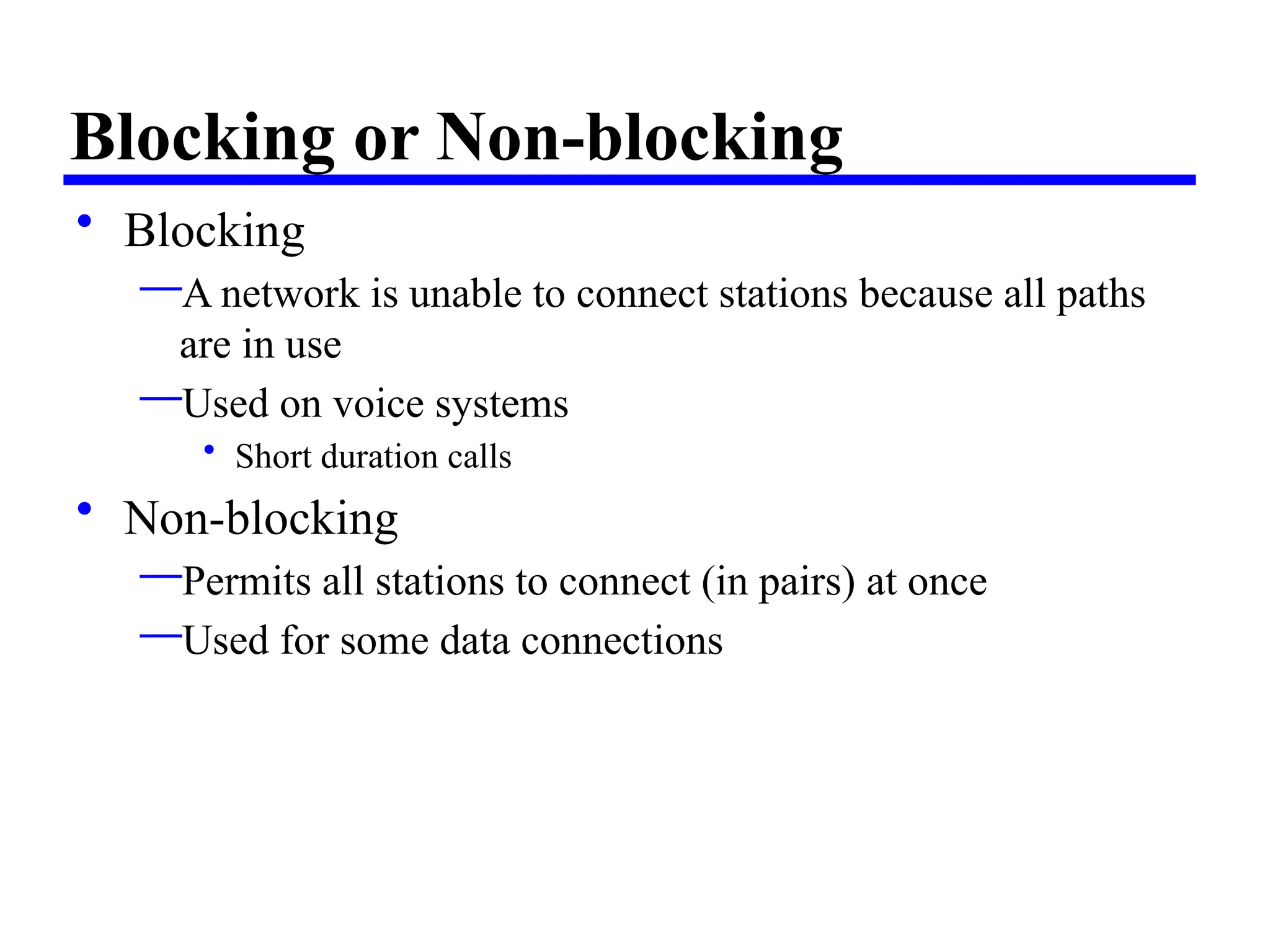
Blocking or Non-blocking
• Blocking
—A network is unable to connect stations because all paths
are in use
—Used on voice systems
• Short duration calls
• Non-blocking
—Permits all stations to connect (in pairs) at once
—Used for some data connections
8.17
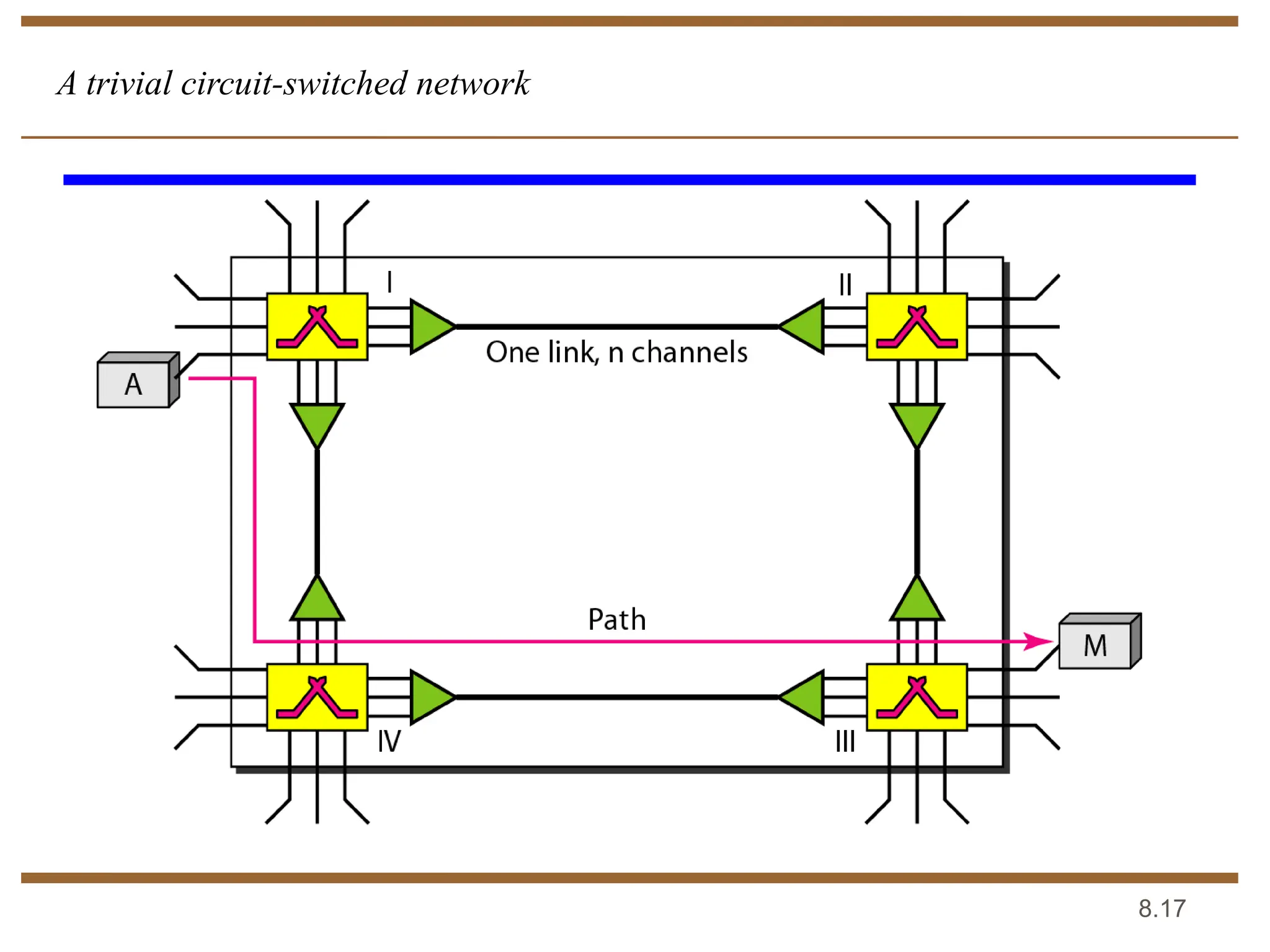
A trivial circuit-switched network
8.18
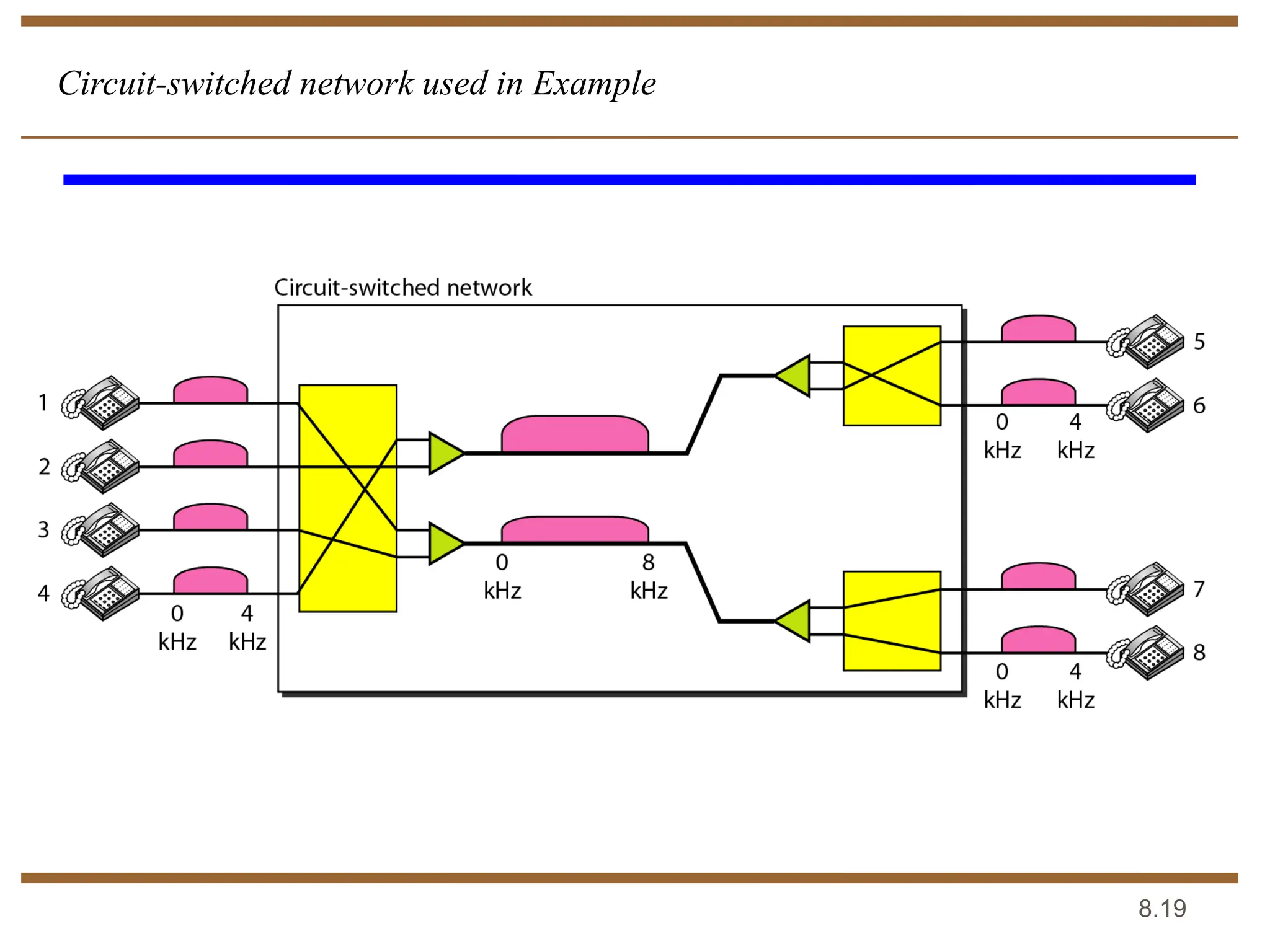
As a trivial example, let us use a circuit-switched network
to connect eight telephones in a small area.
Communication is through 4-kHz voice channels. We
assume that each link uses FDM to connect a maximum of
two voice channels. The bandwidth of each link is then 8
kHz. Figure 8.4 shows the situation. Telephone 1 is
connected to telephone 7; 2 to 5; 3 to 8; and 4 to 6. Of
course the situation may change when new connections are
made. The switch controls the connections.
Example
8.19
Circuit-switched network used in Example
Packet Switching Principles
• In a packet-switched network, there is no resource
reservation; resources are allocated on demand.
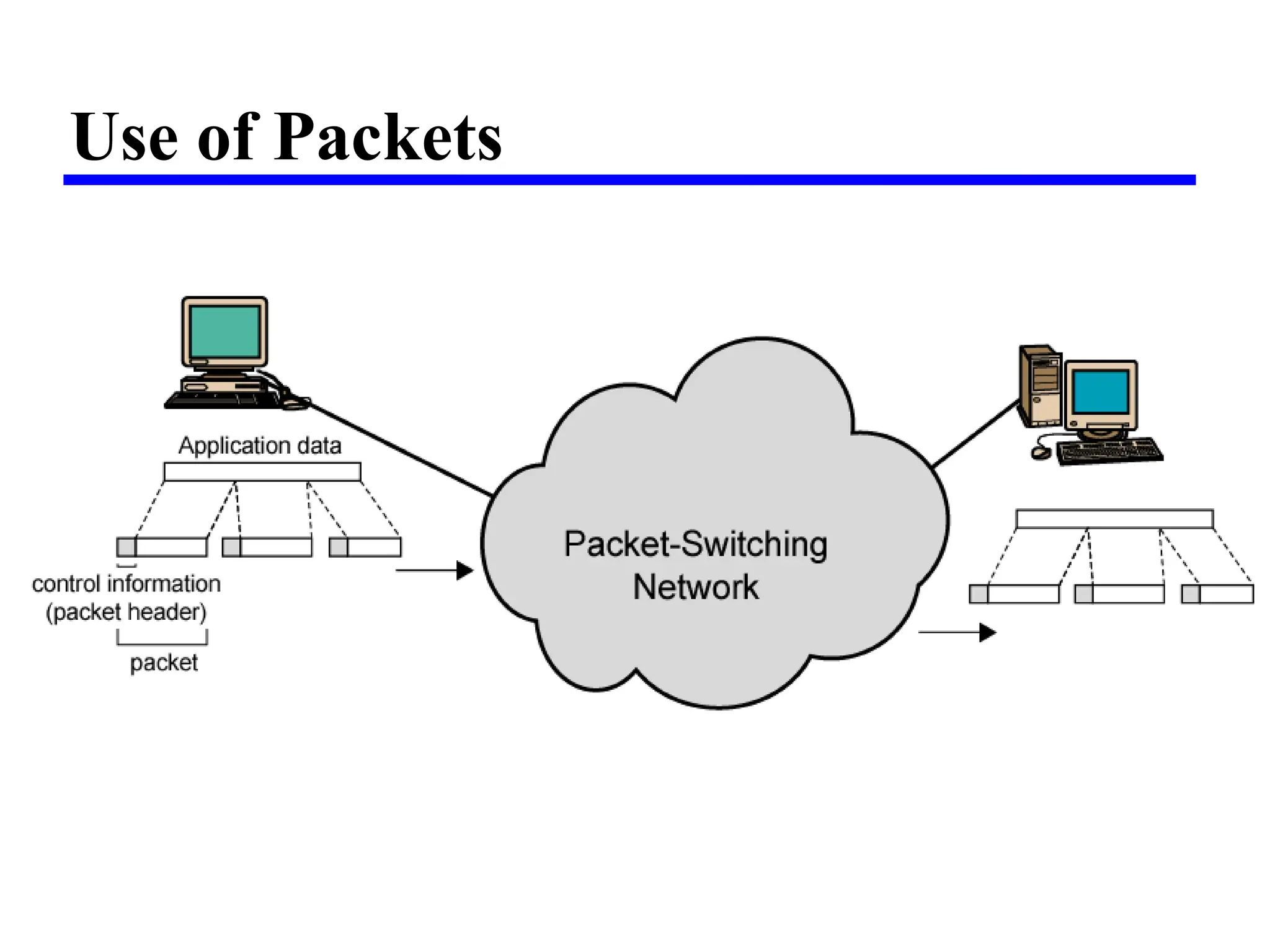
• Data transmitted in small packets
—Typically 1000 octets
—Longer messages split into series of packets
—Each packet contains a portion of user data plus some
control info
• Control info
—Routing (addressing) info
• Packets are received, stored briefly (buffered) and
past on to the next node
Use of Packets
Advantages
• Line efficiency
—Single node to node link can be shared by many packets
over time
—Packets queued and transmitted as fast as possible
• Data rate conversion
—Each station connects to the local node at its own speed
—Nodes buffer data if required to equalize rates
• Packets are accepted even when network is busy
—Delivery may slow down
• Priorities can be used
Packet Switching Technique
• Station breaks long message into packets
• Packets sent one at a time to the network
• Packets handled in two ways
—Datagram Approach
—Virtual circuit Approach
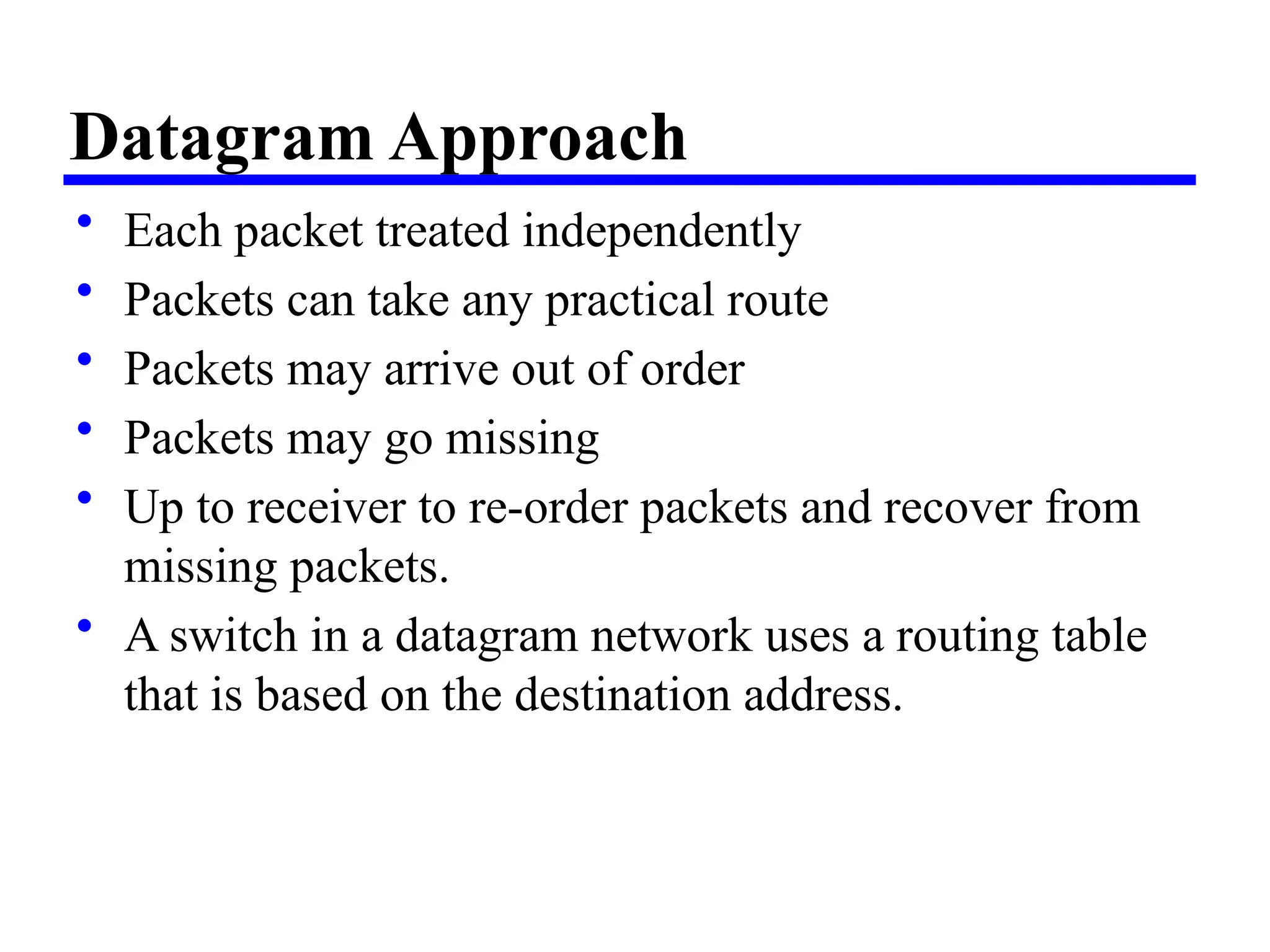
Datagram Approach
• Each packet treated independently
• Packets can take any practical route
• Packets may arrive out of order
• Packets may go missing
• Up to receiver to re-order packets and recover from
missing packets.
• A switch in a datagram network uses a routing table
that is based on the destination address.
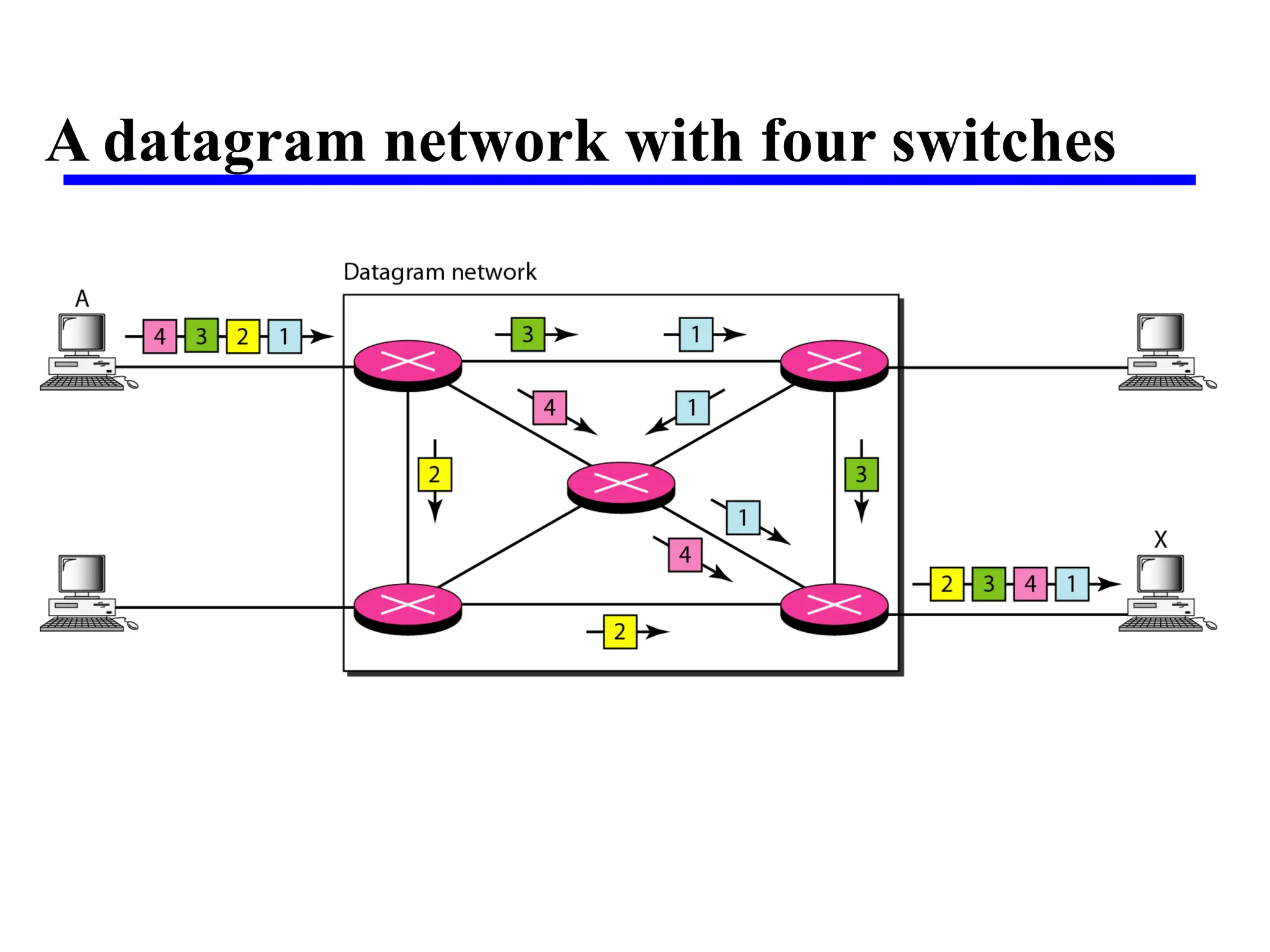
A datagram network with four switches
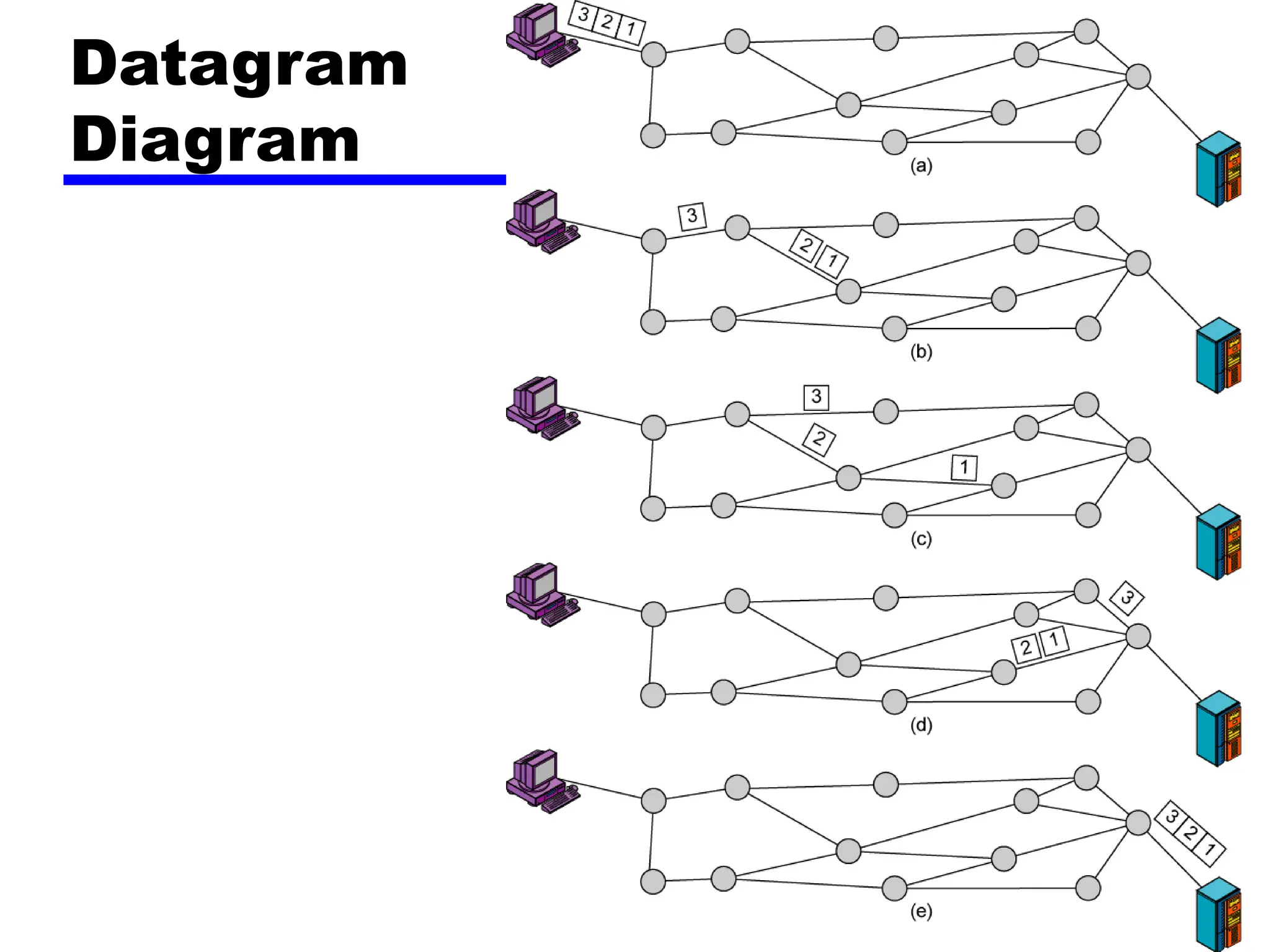
Datagram
Diagram
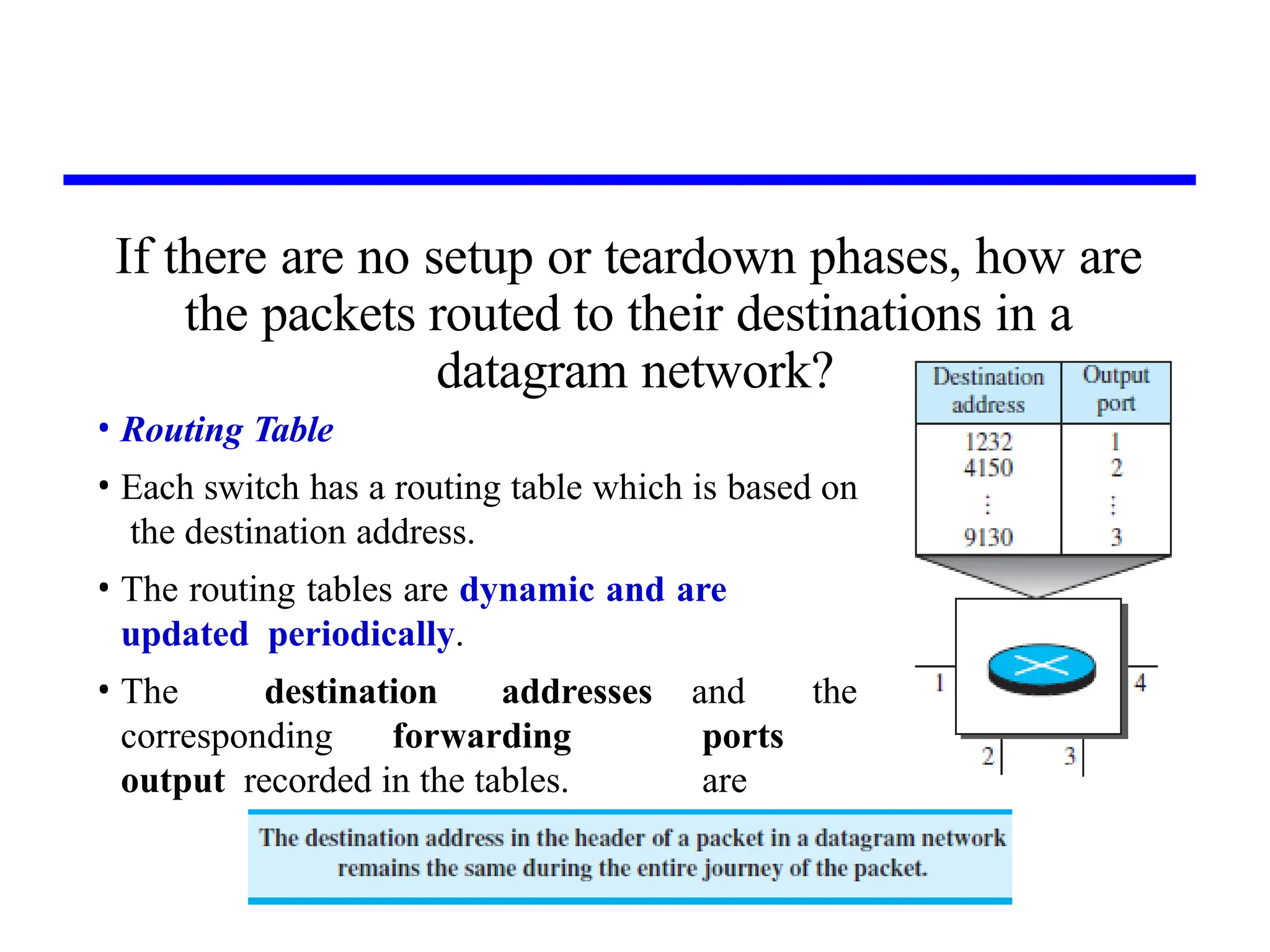
If there are no setup or teardown phases, how are
the packets routed to their destinations in a
datagram network?
• Routing Table
• Each switch has a routing table which is based on
the destination address.
• The routing tables are dynamic and are
updated periodically.
• The destination addresses
corresponding forwarding
output recorded in the tables.
and the
ports
are
Virtual-Circuit Networks
• A virtual-circuit network is a cross between a circuit-switched
network and a datagram network
1. As in a circuit-switched network, there are setup and teardown phases in
addition to the data transfer phase.
2. Resources can be allocated during the setup phase, as in a circuit-switched
network, or on demand, as in a datagram network.
3. As in a datagram network, data are packetized and each packet carries an
address in the header.
• address has local jurisdiction (it defines what the next switch should be and the
channel on which the packet is being carried)
4. As in a circuit-switched network, all packets follow the same
path
established during the connection
(normally implemented in the data-link layer)
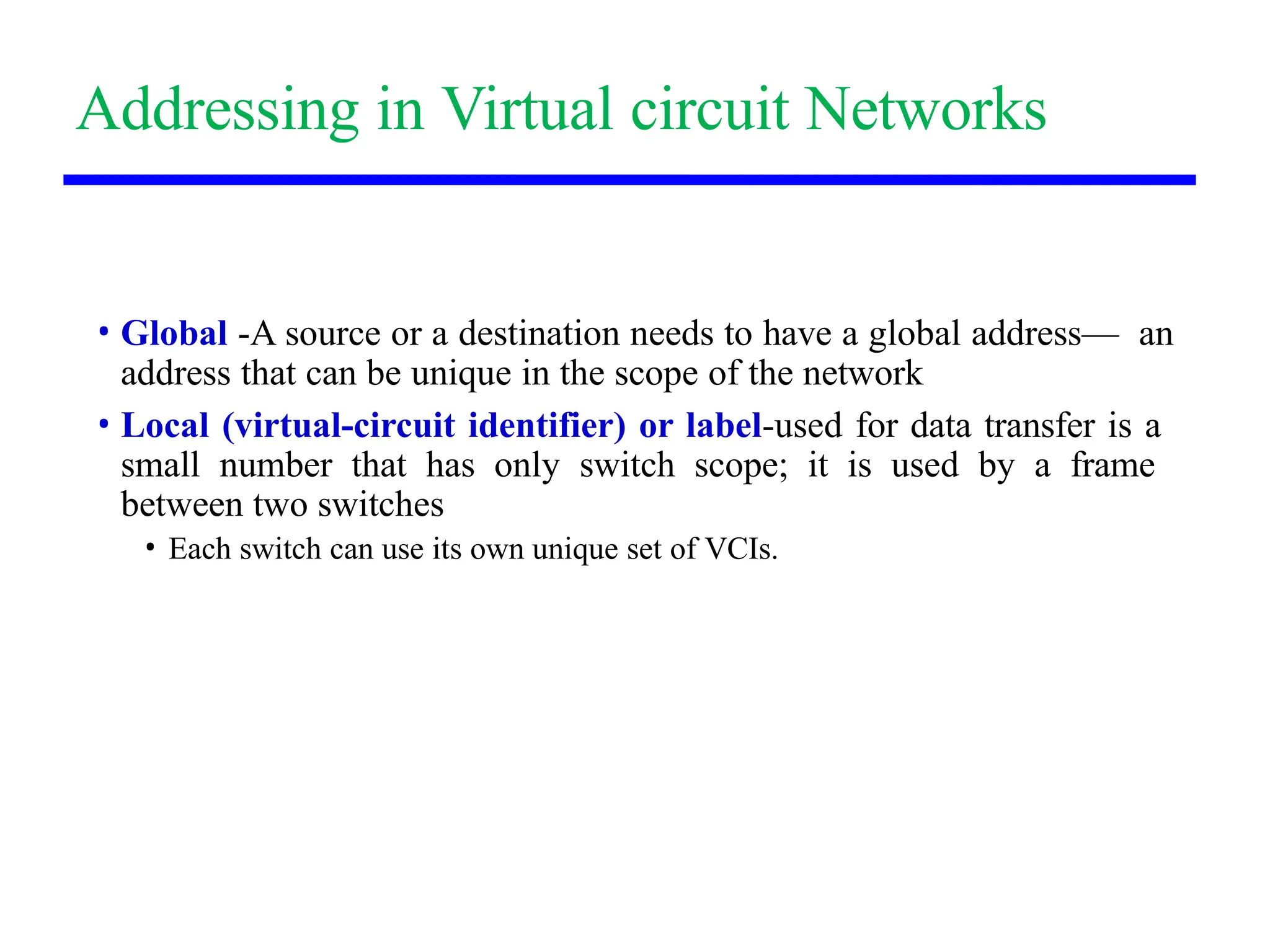
Addressing in Virtual circuit Networks
• Global -A source or a destination needs to have a global address— an
address that can be unique in the scope of the network
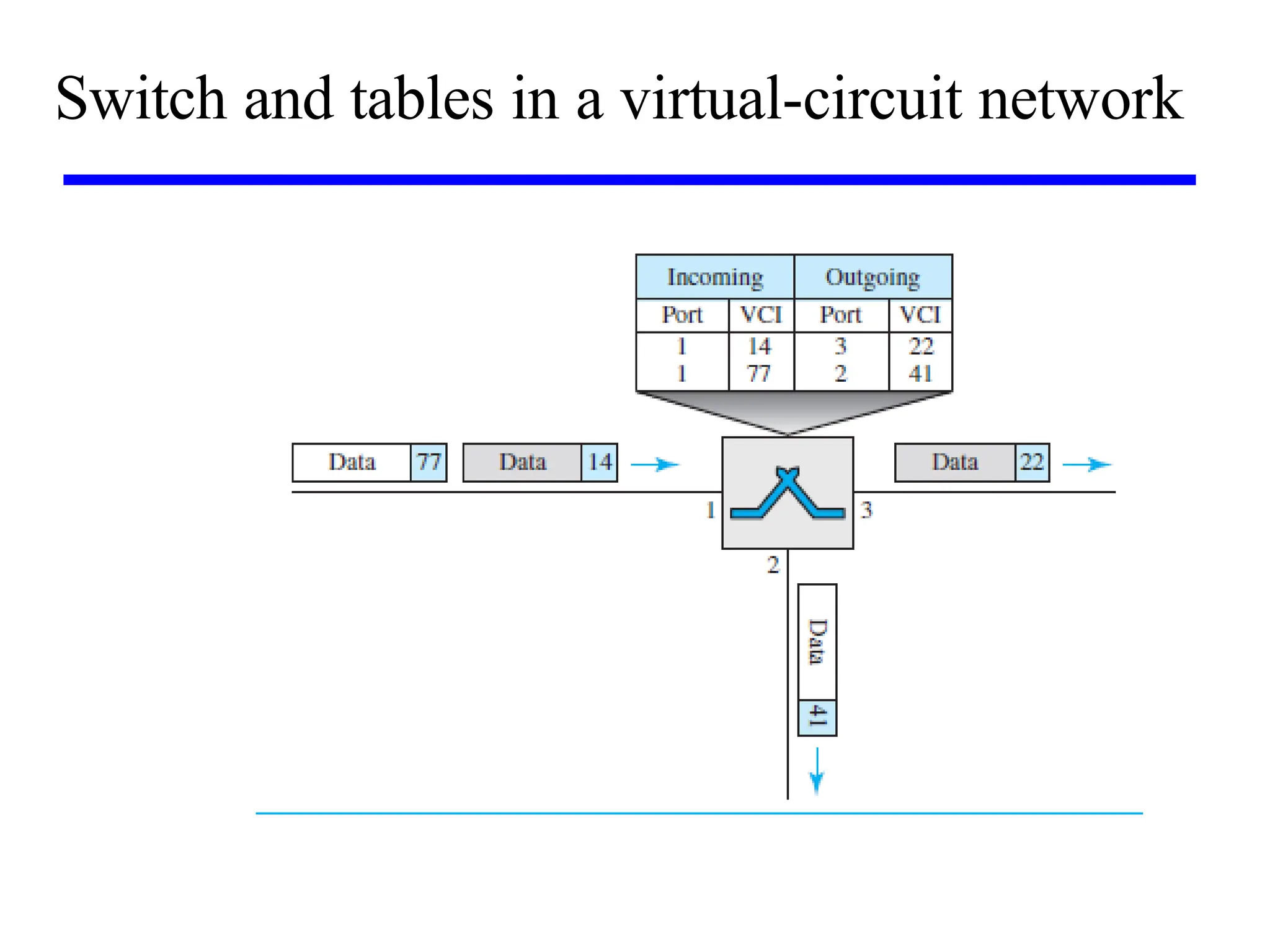
• Local (virtual-circuit identifier) or label-used for data transfer is a
small number that has only switch scope; it is used by a frame
between two switches
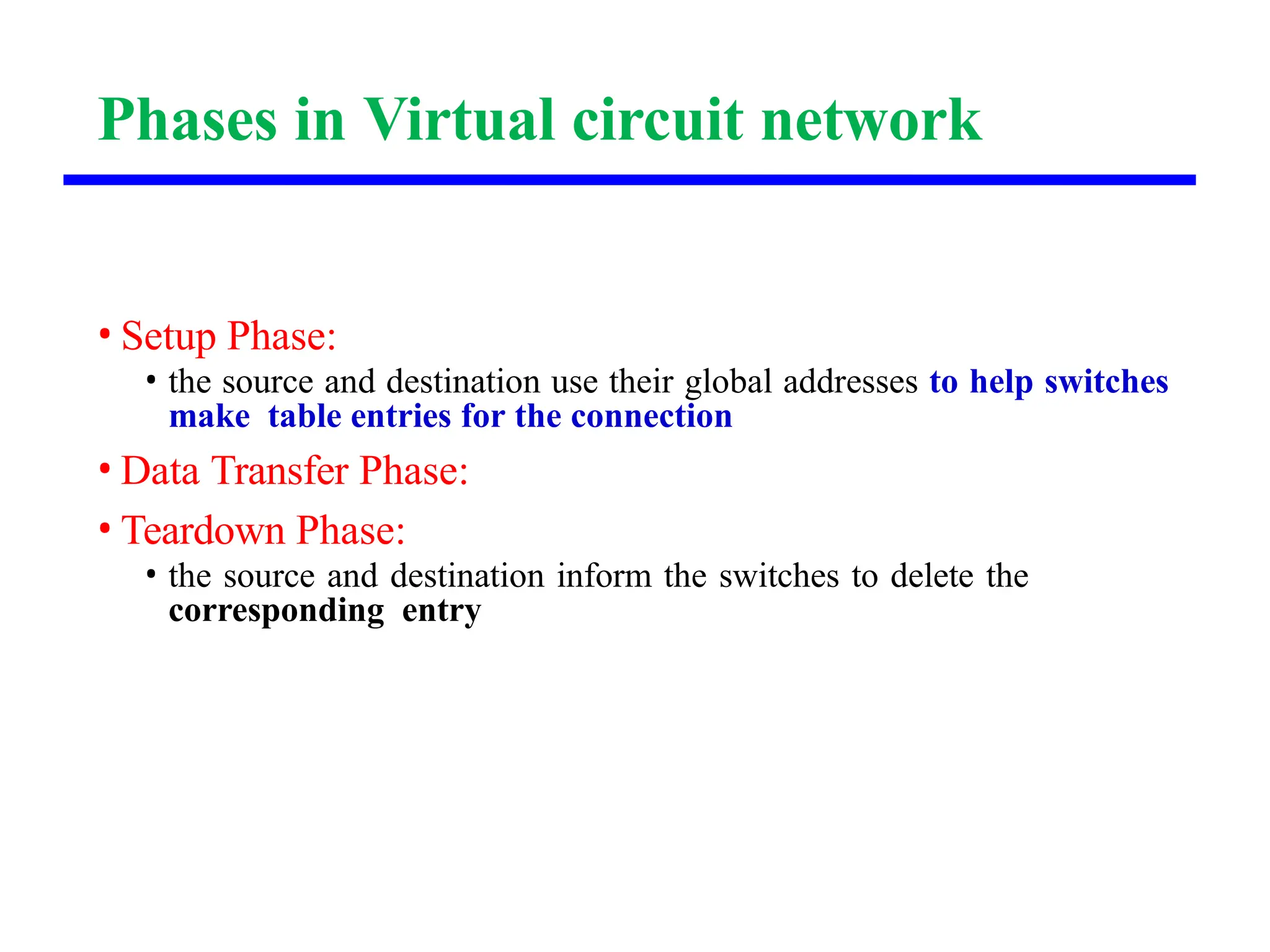
• Each switch can use its own unique set of VCIs.
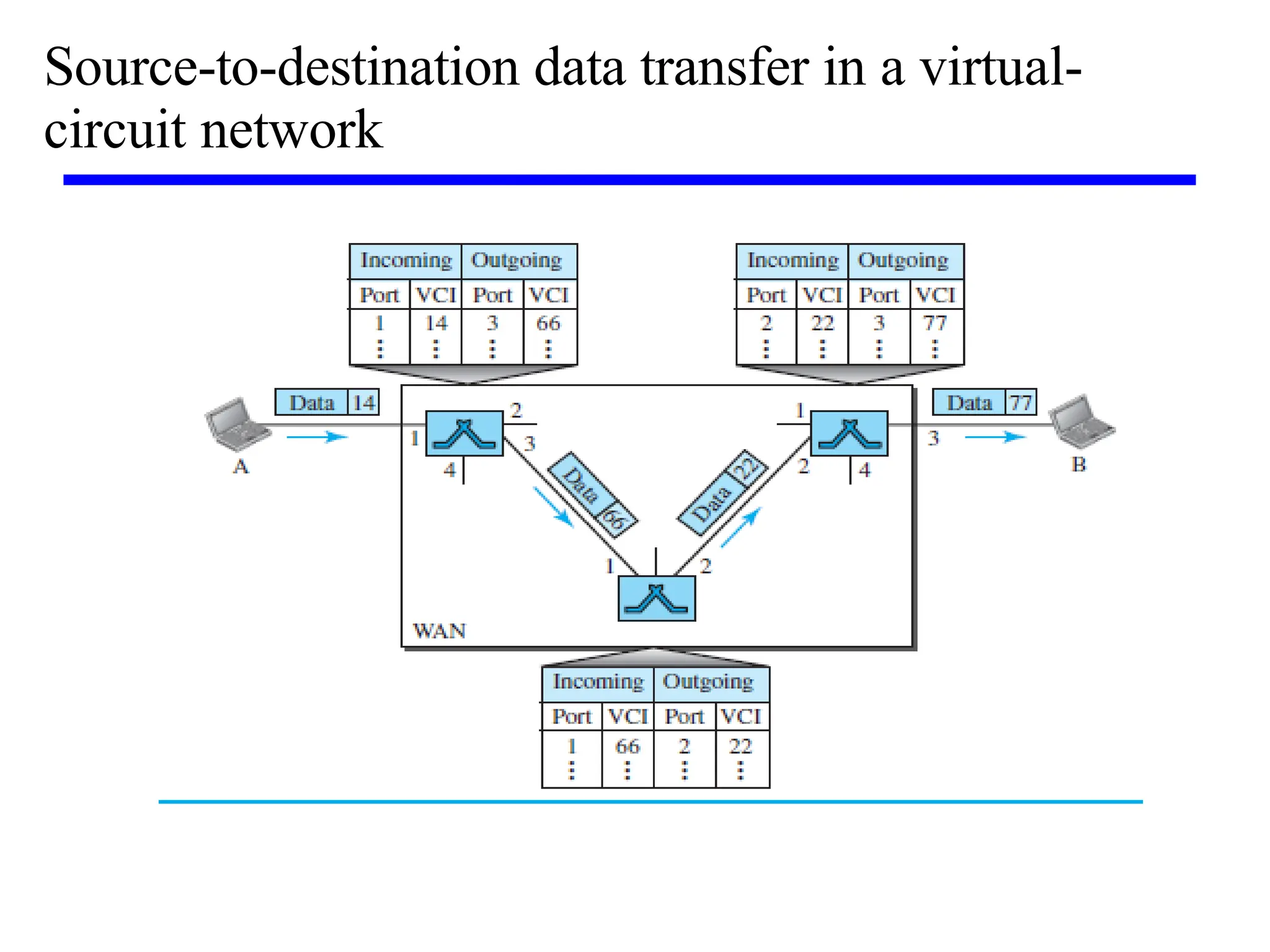
Phases in Virtual circuit network
• Setup Phase:
• the source and destination use their global addresses to help switches
make table entries for the connection
• Data Transfer Phase:
• Teardown Phase:
• the source and destination inform the switches to delete the
corresponding entry
Switch and tables in a virtual-circuit network
Source-to-destination data transfer in a virtual-
circuit network
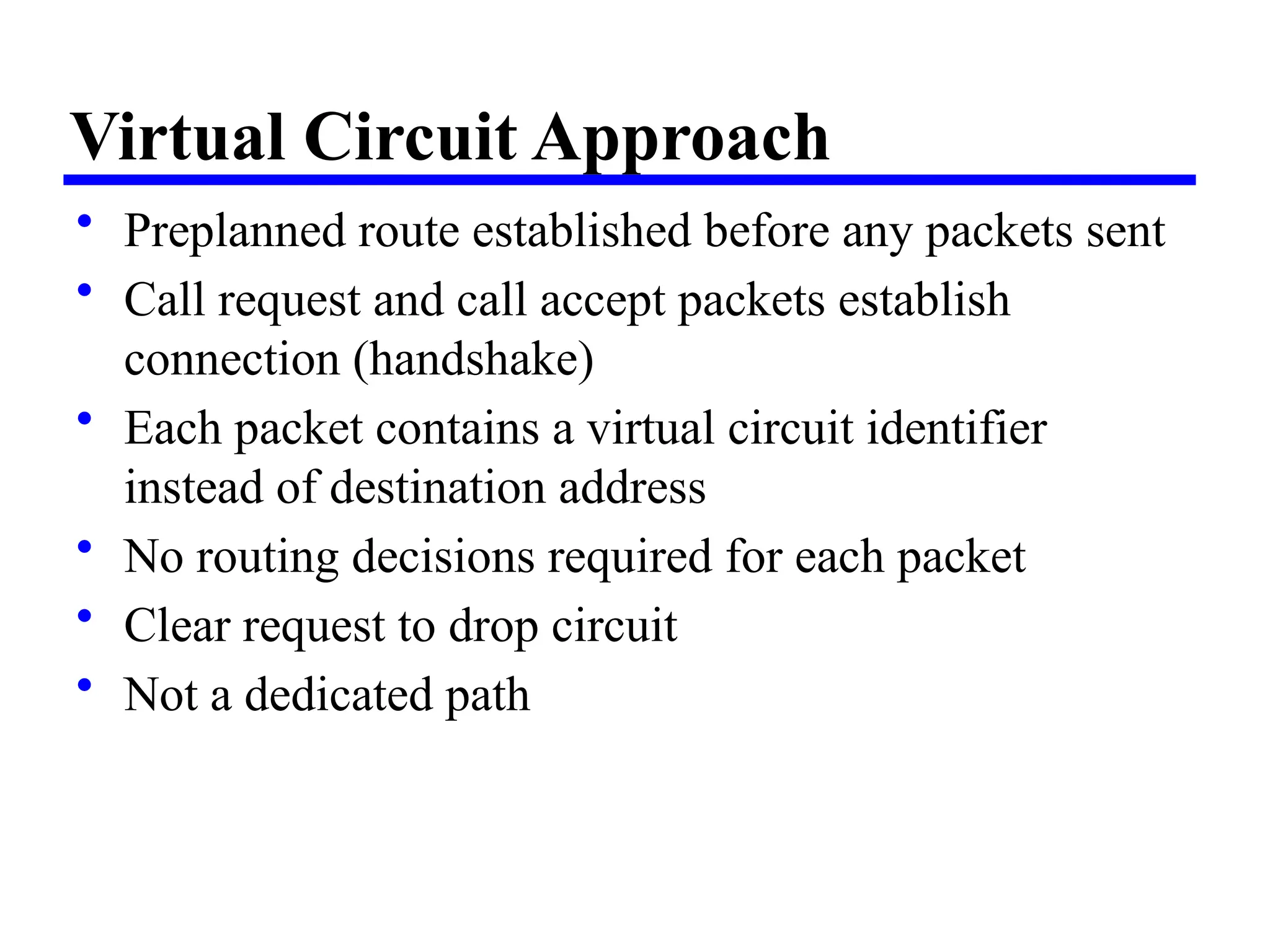
Virtual Circuit Approach
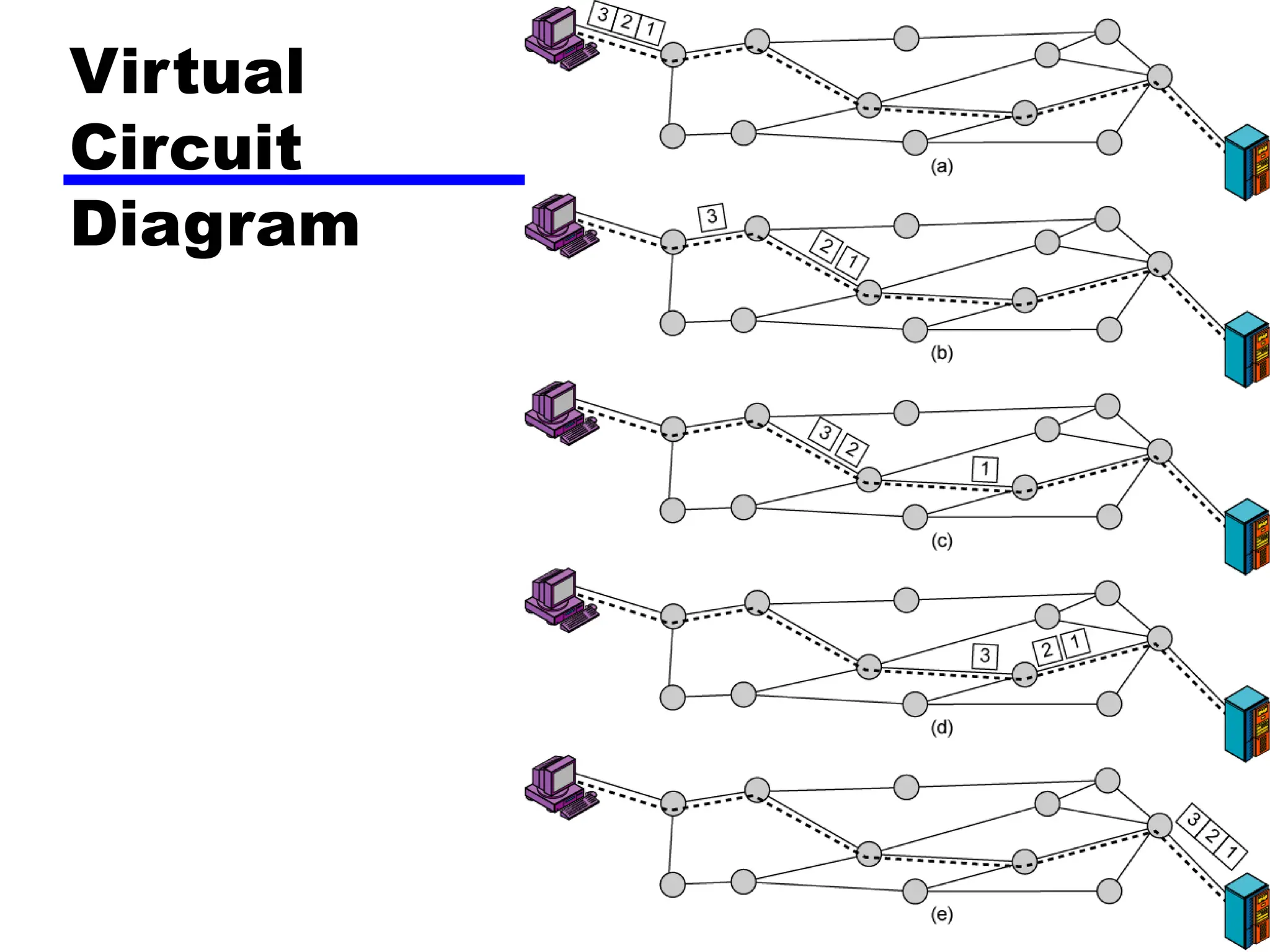
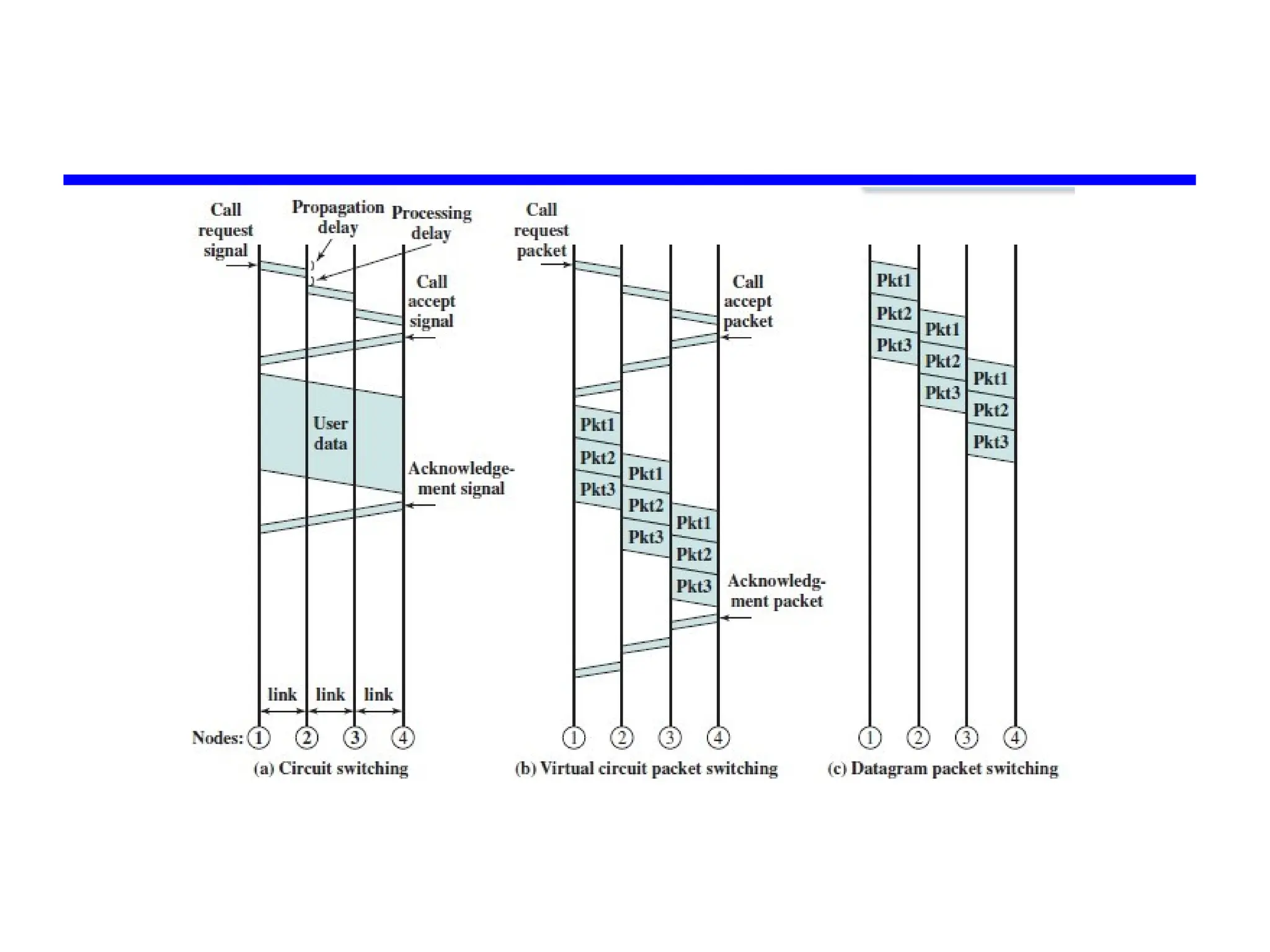
• Preplanned route established before any packets sent
• Call request and call accept packets establish
connection (handshake)
• Each packet contains a virtual circuit identifier
instead of destination address
• No routing decisions required for each packet
• Clear request to drop circuit
• Not a dedicated path
Virtual
Circuit
Diagram
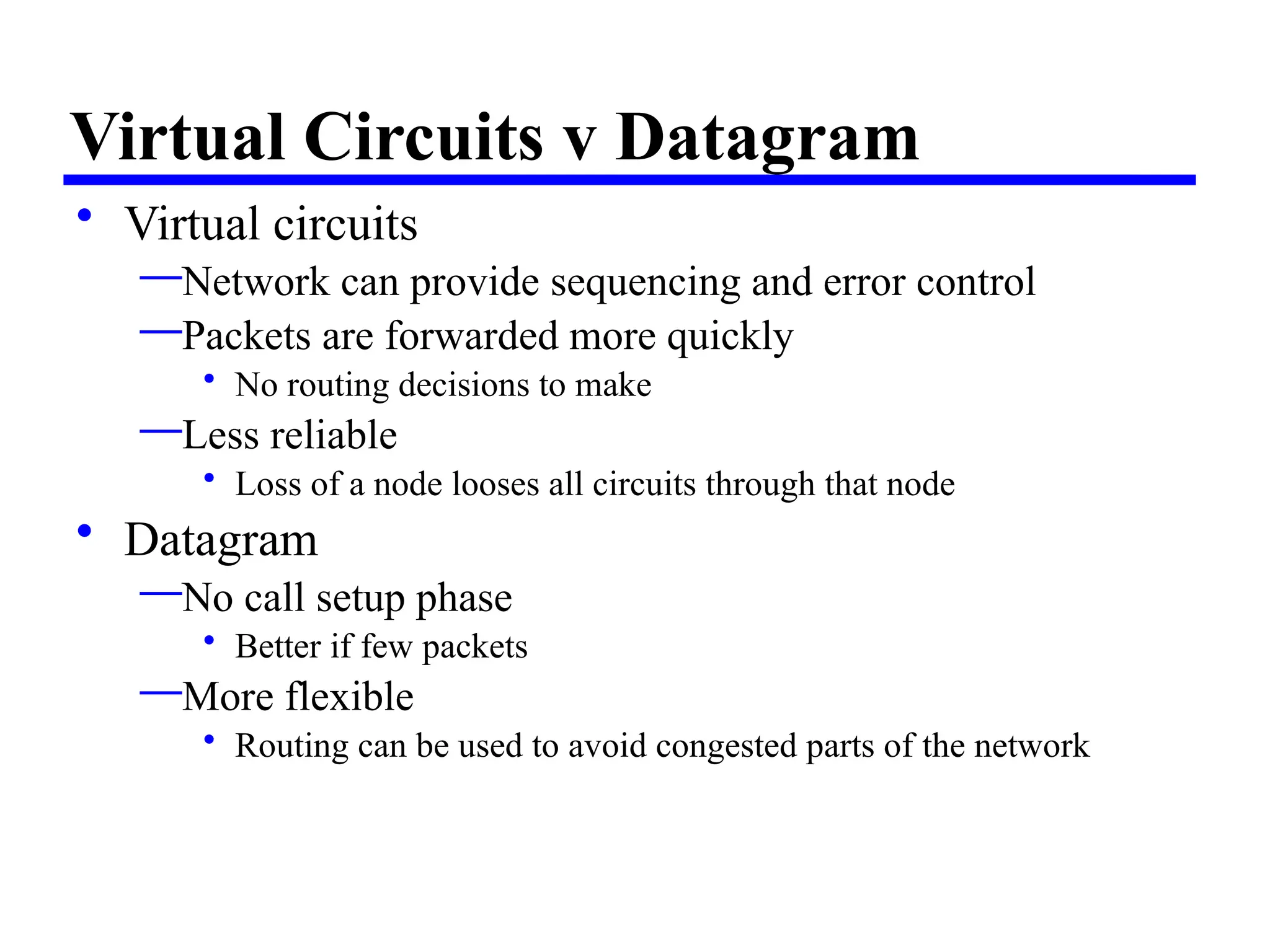
Virtual Circuits v Datagram
• Virtual circuits
—Network can provide sequencing and error control
—Packets are forwarded more quickly
• No routing decisions to make
—Less reliable
• Loss of a node looses all circuits through that node
• Datagram
—No call setup phase
• Better if few packets
—More flexible
• Routing can be used to avoid congested parts of the network
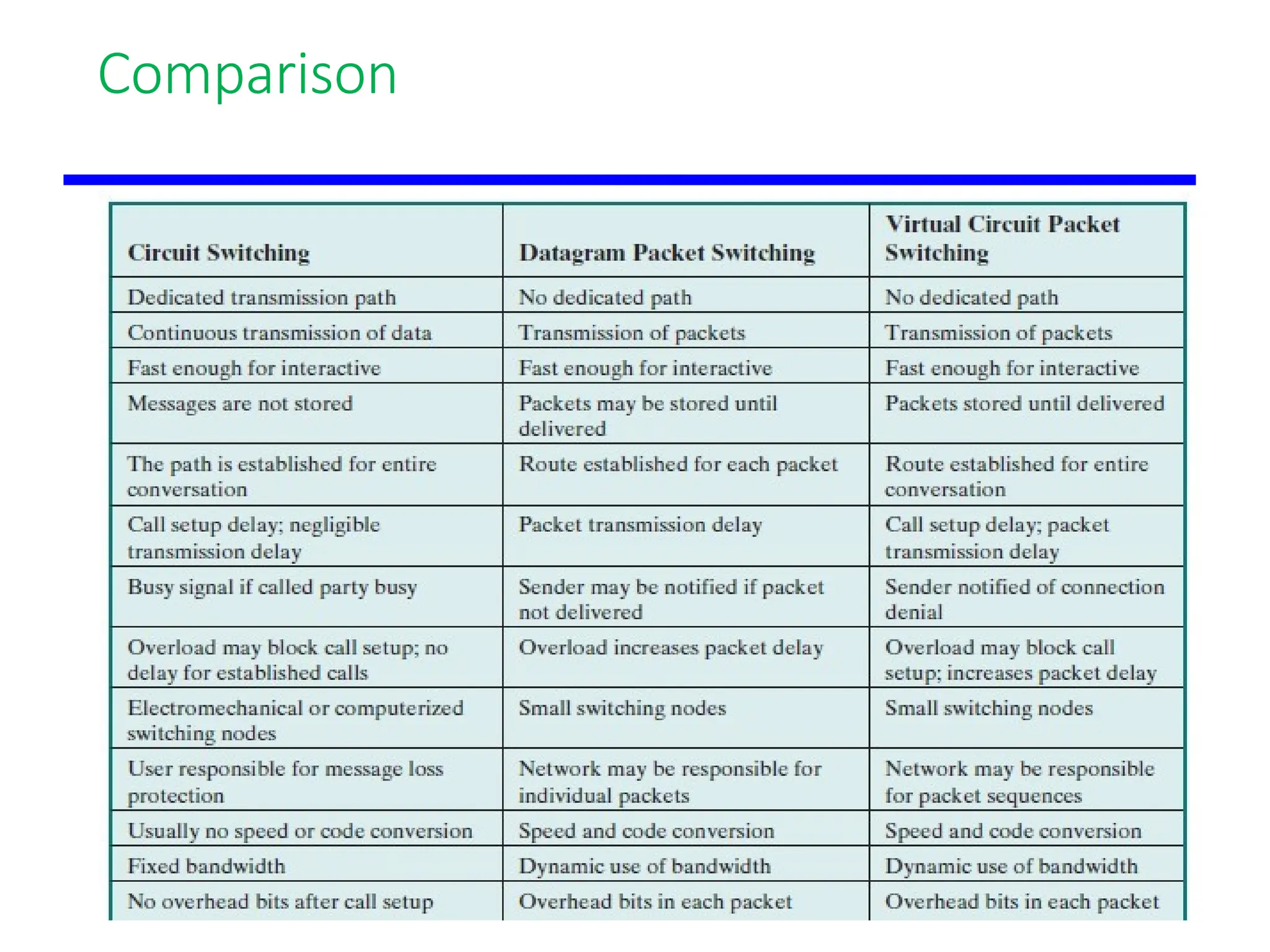
Comparison
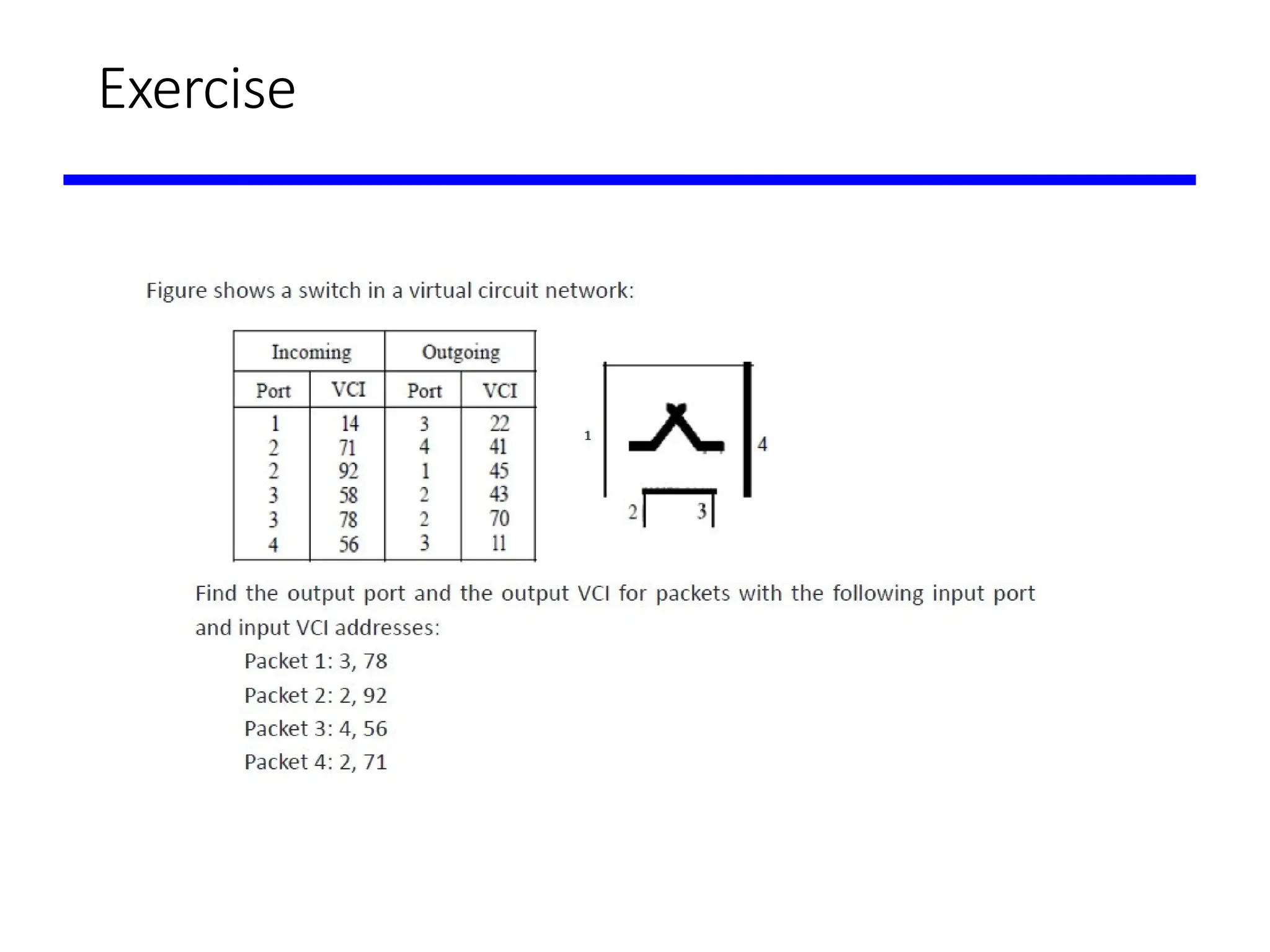
Exercise
Cell Switching
• Cell Switching is a connection oriented switching technique in
which message is transmitted in the form of packets of same size.
• Cell switching is similar to packet switching as it operates in a
similar way to packet switching but uses small fixed length cells
for data transport.
• Used in Asynchronous Transfer Mode networks.
• Cell switching can handle multiple data types, i.e. voice, video
and
data. Moreover, cell switching is typically a high bandwidth and
high speed technology.
• Cell switching is essentially an attempt to combine the best of
circuit switching and packet switching.
Computer Networks-Switching( Circuit, Packet)

  • 1.
    8.1 Module 2 Circuit &Packet Switching Copyright © The McGraw-Hill Companies, Inc. Permission required for reproduction or display.
  • 2.
    Switched Network • Anetwork is a set of connected devices. • Whenever we have multiple devices, we have the problem of how to connect them to make one-to-one communication possible. • One solution is to make a point-to-point connection between each pair of devices (mesh or star topology). — impractical and wasteful when applied to very large networks. • Multipoint connection –bus topology - ruled out because the distances between devices and the total number of devices increases beyond the capacities of the
  • 3.
    • A bettersolution is switching. A switched network consists of a series of interlinked nodes, called switches. • Switches are devices capable of creating temporary connections between two or more devices linked to the switch. • In a switched network, some of these nodes are connected to the end systems (computers or telephones, for example). Others are used only for routing.
  • 4.
    Simple Switched Network •End systems (communicating systems) – A, B, C, D, E, F, G, H, I, J. • Switches – I,II,III,IV,V
  • 5.
  • 6.
    Switching Networks • Longdistance transmission is typically done over a network of switched nodes • Nodes not concerned with content of data • End devices are stations —Computer, terminal, phone, etc. • A collection of nodes and connections is a communications network • Data routed being switched from node to node
  • 7.
    Nodes • Nodes mayconnect to other nodes only, or to stations and other nodes • Node to node links usually multiplexed • Network is usually partially connected —Some redundant connections are desirable for reliability
  • 8.
  • 9.
    Circuit Switching • Dedicatedcommunication path between two stations • Three phases —Establish —Transfer —Disconnect • Must have switching capacity and channel capacity to establish connection • Must have intelligence to work out routing
  • 10.
    Circuit Switching • Inefficient —Channelcapacity dedicated for duration of connection —If no data, capacity wasted • Set up (connection) takes time • Once connected, transfer is transparent • Circuit switching designed for voice —Resources dedicated to a particular call —Much of the time a data connection is idle —Data rate is fixed • Both ends must operate at the same rate
  • 11.
  • 12.
  • 13.
  • 14.
    Circuit Switching Concepts •Digital Switch —Provide transparent signal path between devices • Network Interface • Control Unit —Establish connections • Generally on demand • Handle and acknowledge requests • Determine if destination is free • construct path —Maintain connection —Disconnect
  • 15.
    Blocking or Non-blocking •Blocking —A network is unable to connect stations because all paths are in use —Used on voice systems • Short duration calls • Non-blocking —Permits all stations to connect (in pairs) at once —Used for some data connections
  • 16.
  • 17.
    8.18 As a trivialexample, let us use a circuit-switched network to connect eight telephones in a small area. Communication is through 4-kHz voice channels. We assume that each link uses FDM to connect a maximum of two voice channels. The bandwidth of each link is then 8 kHz. Figure 8.4 shows the situation. Telephone 1 is connected to telephone 7; 2 to 5; 3 to 8; and 4 to 6. Of course the situation may change when new connections are made. The switch controls the connections. Example
  • 18.
  • 19.
    Packet Switching Principles •In a packet-switched network, there is no resource reservation; resources are allocated on demand. • Data transmitted in small packets —Typically 1000 octets —Longer messages split into series of packets —Each packet contains a portion of user data plus some control info • Control info —Routing (addressing) info • Packets are received, stored briefly (buffered) and past on to the next node
  • 20.
  • 21.
    Advantages • Line efficiency —Singlenode to node link can be shared by many packets over time —Packets queued and transmitted as fast as possible • Data rate conversion —Each station connects to the local node at its own speed —Nodes buffer data if required to equalize rates • Packets are accepted even when network is busy —Delivery may slow down • Priorities can be used
  • 22.
    Packet Switching Technique •Station breaks long message into packets • Packets sent one at a time to the network • Packets handled in two ways —Datagram Approach —Virtual circuit Approach
  • 23.
    Datagram Approach • Eachpacket treated independently • Packets can take any practical route • Packets may arrive out of order • Packets may go missing • Up to receiver to re-order packets and recover from missing packets. • A switch in a datagram network uses a routing table that is based on the destination address.
  • 24.
    A datagram networkwith four switches
  • 25.
  • 26.
    If there areno setup or teardown phases, how are the packets routed to their destinations in a datagram network? • Routing Table • Each switch has a routing table which is based on the destination address. • The routing tables are dynamic and are updated periodically. • The destination addresses corresponding forwarding output recorded in the tables. and the ports are
  • 27.
    Virtual-Circuit Networks • Avirtual-circuit network is a cross between a circuit-switched network and a datagram network 1. As in a circuit-switched network, there are setup and teardown phases in addition to the data transfer phase. 2. Resources can be allocated during the setup phase, as in a circuit-switched network, or on demand, as in a datagram network. 3. As in a datagram network, data are packetized and each packet carries an address in the header. • address has local jurisdiction (it defines what the next switch should be and the channel on which the packet is being carried) 4. As in a circuit-switched network, all packets follow the same path established during the connection (normally implemented in the data-link layer)
  • 28.
    Addressing in Virtualcircuit Networks • Global -A source or a destination needs to have a global address— an address that can be unique in the scope of the network • Local (virtual-circuit identifier) or label-used for data transfer is a small number that has only switch scope; it is used by a frame between two switches • Each switch can use its own unique set of VCIs.
  • 29.
    Phases in Virtualcircuit network • Setup Phase: • the source and destination use their global addresses to help switches make table entries for the connection • Data Transfer Phase: • Teardown Phase: • the source and destination inform the switches to delete the corresponding entry
  • 30.
    Switch and tablesin a virtual-circuit network
  • 31.
    Source-to-destination data transferin a virtual- circuit network
  • 32.
    Virtual Circuit Approach •Preplanned route established before any packets sent • Call request and call accept packets establish connection (handshake) • Each packet contains a virtual circuit identifier instead of destination address • No routing decisions required for each packet • Clear request to drop circuit • Not a dedicated path
  • 33.
  • 34.
    Virtual Circuits vDatagram • Virtual circuits —Network can provide sequencing and error control —Packets are forwarded more quickly • No routing decisions to make —Less reliable • Loss of a node looses all circuits through that node • Datagram —No call setup phase • Better if few packets —More flexible • Routing can be used to avoid congested parts of the network
  • 35.
  • 37.
  • 38.
    Cell Switching • CellSwitching is a connection oriented switching technique in which message is transmitted in the form of packets of same size. • Cell switching is similar to packet switching as it operates in a similar way to packet switching but uses small fixed length cells for data transport. • Used in Asynchronous Transfer Mode networks. • Cell switching can handle multiple data types, i.e. voice, video and data. Moreover, cell switching is typically a high bandwidth and high speed technology. • Cell switching is essentially an attempt to combine the best of circuit switching and packet switching.