디바이스 드라이버 작성 기초
http://cafe.naver.com/embeddedcrazyboys
             http://www.mangoboard.com
Device Driver 작성(1)
 Device structure
   디바이스 구조체 : 2 개의 필드로 구성된 구조체
      Name field             static struct char_device_struct {
                                    struct char_device_struct *next;
      file_operation files         unsigned int major;
                                    unsigned int baseminor;
                                    int minorct;
                                    char name[64];
                                    struct cdev *cdev;           /* will die */
                              } *chrdevs[CHRDEV_MAJOR_HASH_SIZE];

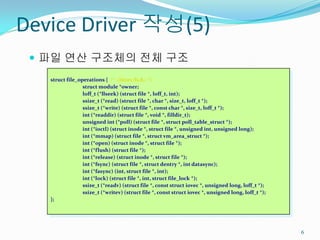
                              struct file_operations { /* include/linux/fs.h */
                                 lseek;
                                 read;
                                 write;
                                 readdir;
                                 poll;
                                 ioctl;
                                 mmap;
                                 open;
                                 flush;
                                 release;
                              …
                              }                                                   2
Device Driver 작성(2)
 디바이스 드라이버 등록
   드라이버를 커널에 등록하고, 파일 연산을 정의하는 등의 초
    기화 작업 수행이 필요
   모듈의 형태에서는 init_module()함수에서 초기화 수행
   드라이버의 등록 함수
         int register_chrdev( unsigned int major,
                    const * name,
                   struct file_operations * fops);

      커널에 지정되어 있는 chrdevs 구조에 새로운 char device 등록
        major number : 주번호, 0을 주면 사용하지 않는 값을 반환
        name : 디바이스 이름으로 /proc/devices에 나타남
        fops: 디바이스와 연관된 파일 연산 구조체 포인터
      음수가 반환되면 오류가 발생했음을 나타냄


                                                     3
Device Driver 작성(3)
 디바이스 드라이버 제거
   더 이상 사용되지 않는 드라이버의 제거
   Rmmod하는 명령을 이용하여 제거하며, 이때 드라이버
    내의 cleanup_module이 호출되는데, 이 루틴 안에서 다
    음의 시스템 콜을 호출
   드라이버 제거 함수


      int unregister_chrdev( unsigned int major, const * name);


                                                                  4
Device Driver 작성(4)
 파일 연산
   디바이스 드라이버를 일반적인 파일과 유사한 인터페이
    스를 이용하여 관리
     각 디바이스는 파일 형태로 존재하고, 커널은 파일 연산을 이
      용하여 I/O 연산을 수행하도록 인터페이스 구성
     디바이스 드라이버를 구현한다는 것은 상당부분 파일연산 구
      조체에서 요구되는 기능들을 프로그래밍 한다는 것을 의미
     가상의 dummy character device 구현예제에서의 파일연산 구
      조체 정의 예


                                                  5
Device Driver 작성(5)
  파일 연산 구조체의 전체 구조
   struct file_operations { /* <linux/fs.h> */
                 struct module *owner;
                 loff_t (*llseek) (struct file *, loff_t, int);
                 ssize_t (*read) (struct file *, char *, size_t, loff_t *);
                 ssize_t (*write) (struct file *, const char *, size_t, loff_t *);
                 int (*readdir) (struct file *, void *, filldir_t);
                 unsigned int (*poll) (struct file *, struct poll_table_struct *);
                 int (*ioctl) (struct inode *, struct file *, unsigned int, unsigned long);
                 int (*mmap) (struct file *, struct vm_area_struct *);
                 int (*open) (struct inode *, struct file *);
                 int (*flush) (struct file *);
                 int (*release) (struct inode *, struct file *);
                 int (*fsync) (struct file *, struct dentry *, int datasync);
                 int (*fasync) (int, struct file *, int);
                 int (*lock) (struct file *, int, struct file_lock *);
                 ssize_t (*readv) (struct file *, const struct iovec *, unsigned long, loff_t *);
                 ssize_t (*writev) (struct file *, const struct iovec *, unsigned long, loff_t *);
   };


                                                                                                     6
Device Driver 작성(6)

 File operations
           loff_t (*llseek)(struct file *, loff_t, int);
                 현재의 read/write 위치를 옮긴다.
           ssize_t (*read)(struct file *, char *, size_t, loff_t *);
                 디바이스에서 데이터를 가져오기 위해서 사용
           ssize_t (*write)(struct file*, const char*, size_t, loff_t*);
                 디바이스에 데이터를 쓰기 위해서 사용
           int (*readdir)(struct file *, void *, filldir_t);
                 디렉토리를 다룰 때 사용
           unsigned int (*poll)(struct file*, struct poll_table_struct*);
                 현재 프로세스를 대기 큐에 넣기 위해서 사용


                                                                            7
Device Driver 작성(7)
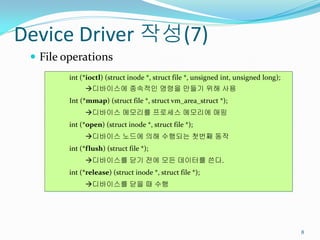
  File operations
         int (*ioctl) (struct inode *, struct file *, unsigned int, unsigned long);
              디바이스에 종속적인 명령을 만들기 위해 사용
         Int (*mmap) (struct file *, struct vm_area_struct *);
              디바이스 메모리를 프로세스 메모리에 매핑
         int (*open) (struct inode *, struct file *);
              디바이스 노드에 의해 수행되는 첫번째 동작
         int (*flush) (struct file *);
              디바이스를 닫기 전에 모든 데이터를 쓴다.
         int (*release) (struct inode *, struct file *);
              디바이스를 닫을 때 수행


                                                                                      8
Device Driver 작성(8)
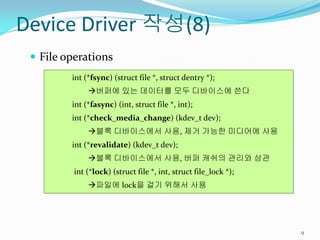
  File operations
         int (*fsync) (struct file *, struct dentry *);
              버퍼에 있는 데이터를 모두 디바이스에 쓴다
         int (*fasync) (int, struct file *, int);
         int (*check_media_change) (kdev_t dev);
              블록 디바이스에서 사용, 제거 가능한 미디어에 사용
         int (*revalidate) (kdev_t dev);
              블록 디바이스에서 사용, 버퍼 캐쉬의 관리와 상관
          int (*lock) (struct file *, int, struct file_lock *);
              파일에 lock을 걸기 위해서 사용


                                                                  9
Device Driver 작성(9)
 Dummy Character device 드라이버 소스코드

    #include <linux/init.h>
    #include <linux/module.h>
    #include <linux/kernel.h>
    #include <linux/fs.h>
    #include <linux/errno.h>
    #include <linux/types.h>
    #include <linux/fcntl.h>

    #define DUMMY_MAJOR_NUMBER 254 /* dummy.c */
    #define DEV_NAME "dummy-device"
    int dummy_open(struct inode *inode,struct file *filp)
    {
         int num=MINOR(inode->i_rdev);
         printk(" Open call for Dummy Char Device call open ->minor:%dn",num);
         return 0;
    }
    loff_t dummy_llseek(struct file *filp,loff_t off,int whence)
    {
         printk("call llseek->off:%08x, whenec:%08xn",off,whence);
         return 0x23;
    }


                                                                                  10
Device Driver 작성(10)
 Dummy Character device 드라이버 소스코드

    ssize_t dummy_read(struct file *filp,char *buf, size_t count,loff_t *f_pos)
    {
         printk("call read ->buf:%08x, count:%08xn",buf,count);
         return 0x33;
    }
    ssize_t dummy_write(struct file *filp,const char *buf, size_t count,loff_t *f_pos)
    {
         printk("call write->buf:%08x, count:%08xn",buf,count);
         return 0x43;
    }
    int dummy_ioctl(struct inode *inode, struct file *filp,unsigned int cmd,unsigned long arg)
    {
         printk("call ioctl->cmd:%08,arg:%08xn",cmd,arg);
         return 0x53;
    }
    int dummy_release(struct inode *inode, struct file *filp)
    {
         printk(" Release call for Dummy Char Device n");
         return 0;
    }


                                                                                                 11
Device Driver 작성(11)
 Dummy Character device 드라이버 소스코드
    struct file_operations dummy_fops =
    {
        .owner =THIS_MODULE,
        .llseek=dummy_llseek,
        .open = dummy_open,
        .read=dummy_read,
        .write=dummy_write,
        .ioctl=dummy_ioctl,
        .release=dummy_release,

    };
    int dummy_init(void)
    {
         int result;
         printk("call dummy_initn");
         result=register_chrdev(DUMMY_MAJOR_NUMBER,DEV_NAME,&dummy_fops);
         if(result<0) return result;
         return 0;
    }
    void dummy_exit(void)
    {
         printk("call dummy_exitn");
         unregister_chrdev(DUMMY_MAJOR_NUMBER,DEV_NAME);
    }
    module_init(dummy_init);
    module_exit(dummy_exit);

    MODULE_LICENSE("GPL");

                                                                            12
Device Driver 작성(12)
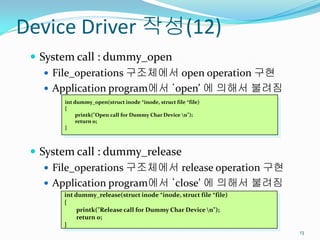
  System call : dummy_open
     File_operations 구조체에서 open operation 구현
     Application program에서 ‘open’ 에 의해서 불려짐
       int dummy_open(struct inode *inode, struct file *file)
       {
            printk("Open call for Dummy Char Device n");
            return 0;
       }


  System call : dummy_release
     File_operations 구조체에서 release operation 구현
     Application program에서 ‘close’ 에 의해서 불려짐
       int dummy_release(struct inode *inode, struct file *file)
       {
            printk("Release call for Dummy Char Device n");
            return 0;
       }
                                                                   13
Device Driver 작성(11)
  System call : dummy_read
     File_operations 구조체에서 read operation 구현
     Application program에서 ‘read’ 에 의해서 불려짐
     ssize_t dummy_read(struct file *file, char *buffer, size_t length, loff_t *offset)
     {
         printk("Read Call for Dummy Device n");
         buffer[0] = 0x34; return 0;
     }


  System call : dummy_write
     File_operations 구조체에서 write operation 구현
     Application program에서 ‘write’ 에 의해서 불려짐
     ssize_t dummy_write(struct file *file, const char *buffer, size_t length, loff_t *offset)
     {
         printk("Write Call for Dummy Device : [%x]n ", buffer[0]);
         return 0;
     }

                                                                                                 14
드라이버 컴파일/로딩/노드 생성
 디바이스 드라이버 컴파일
 Makefile 작성
   obj-m:=dummy-driver.o
   KDIR:=../mango100_kernel_2010_06_30
   PWD:=$(shell pwd)

   default:
        $(MAKE) -C $(KDIR) SUBDIRS=$(PWD) modules
   clean:
       rm -rf *.ko
       rm -rf *.mod.*
       rm -rf .*.cmd
       rm -rf *.o

 #make                                             15
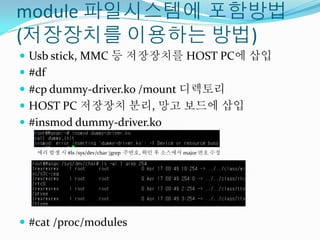
module 파일시스템에 포함방법
(저장장치를 이용하는 방법)
 Usb stick, MMC 등 저장장치를 HOST PC에 삽입
 #df
 #cp dummy-driver.ko /mount 디렉토리
 HOST PC 저장장치 분리, 망고 보드에 삽입
 #insmod dummy-driver.ko

   에러 발생 시 #ls /sys/dev/char |grep 주번호, 확인 후 소스에서 major 번호 수정


 #cat /proc/modules
장치파일 등록(1/2)
 장치 파일 등록
[root]# insmod mydrv_dev.ko

Int xxx_init(void)
 {
    int result;
      result = register_chrdev(RDWR_DEV_MAJOR, RDWR_DEV_NAME, &xxx_fops);
      …..
      return 0;
 }
  module_init(xxx_init);


                                                                            17
장치파일 등록(2/2)
     register_chrdev 의 기능


쉘                             디바이스 드라이버               커널

                                                                  Chr_devs   Block_devs


                              xxx_init(…)
                              {
    …
                                register_chrdev(
    [root]# insmod mydrv.ko                                 ,,,


    …                                     D_name,           240 : *fops
                                          240,              ,,,


                                          fops);
                              }
                                                    index


                                                                                          18
Open 의 이해
  Open 과정

응용프로그램
                                    task_structure

open( /dev/mydrv );                                    files

                                                         *f_op
                                                                                      open();


                                    커널                           디바이스 드라이버
                                      Chr_devs
      open();
                                                                 struct file_operations mydrv_fops =
                                                                 {
                inode                                                .read      = mydrv_read,
                  i_mod = S_IFCHR                                    .write    = mydrv_write,
HDD               i_rdev = 240:0
                                         ,,,
                                                                     .open      = mydrv_open,
                                         240 : *fops                 .release = mydrv_release,
                                         ,,,
                                                                  };
                                                                        xxx_read(…)
                                         Block_devs
                                                                        { xxx_write(…)
                                                                        ..
                                                                           { xxx_open(…)
                                                                        }
                                                                           ..
                                                                              { xxx_release(…)
                                                                           }
                                                                              ..
                                                                                 {
                                                                              }
                                                                                 ..
                                                                                 }

                                                                                                 19
Application Program 작성
 Read / write application program 작성
    작성한 dummy character device를 테스트
    Dummy-device를 열고 문자열을 read /write 함
    Console의 커널 내부 정보를 통해 실제 dummy_device
     를 통해서 read / write가 이루어졌는지 확인


                                             20
Application Program 작성
#include <stdio.h>                                                if(dev>=0)
#include <sys/types.h>                                            {
#include <sys/stat.h>                                                          printf("2) seek function calln");
#include <sys/ioctl.h>
#include <fcntl.h>                                                             ret = lseek(dev, 0x20, SEEK_SET);
#include <unistd.h>                                                            printf("ret = %08Xn",ret);
#define DEVICE_FILENAME "/dev/dummy-driver”
int main(){                                                                    printf("3) read function calln");
                 int dev;
                 char buff[128];
                                                                               ret = read(dev,0x30, 0x31);
                 int ret;
                                                                               printf("ret = %08Xn", ret);
              printf("1) device file openn");
                                                                               printf("4) write function calln");
              dev = open(DEVICE_FILENAME, O_RDWR|O_NDELAY);                    ret = write(dev, 0x40, 0x41);
                                                                               printf("ret = %08Xn",ret);
                                                                               printf("5) ioctl function calln");
                                                                               ret = ioctl(dev, 0x51, 0x52);
                                                                               printf("ret = %08Xn" ,ret);

                                                                               printf("6) device file closen");
                                                                               ret = close(dev);
                                                                               printf("ret = %08Xn" ,ret);
                                                                  }
                                                                  return 0;
                                                              }


                                                                                                                   21
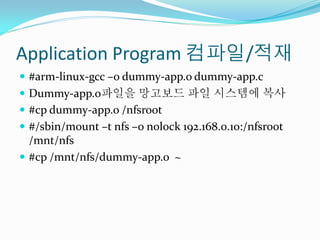
Application Program 컴파일/적재
 #arm-linux-gcc –o dummy-app.o dummy-app.c
 Dummy-app.o파일을 망고보드 파일 시스템에 복사
 #cp dummy-app.o /nfsroot
 #/sbin/mount –t nfs –o nolock 192.168.0.10:/nfsroot
  /mnt/nfs
 #cp /mnt/nfs/dummy-app.o ~
Application 실행 방법
 #mknod /dev/dummy-driver c 240 32
 #./dummy-app.o

망고100 보드로 놀아보자 14

  • 1.
    디바이스 드라이버 작성기초 http://cafe.naver.com/embeddedcrazyboys http://www.mangoboard.com
  • 2.
    Device Driver 작성(1) Device structure  디바이스 구조체 : 2 개의 필드로 구성된 구조체  Name field static struct char_device_struct { struct char_device_struct *next;  file_operation files unsigned int major; unsigned int baseminor; int minorct; char name[64]; struct cdev *cdev; /* will die */ } *chrdevs[CHRDEV_MAJOR_HASH_SIZE]; struct file_operations { /* include/linux/fs.h */ lseek; read; write; readdir; poll; ioctl; mmap; open; flush; release; … } 2
  • 3.
    Device Driver 작성(2) 디바이스 드라이버 등록  드라이버를 커널에 등록하고, 파일 연산을 정의하는 등의 초 기화 작업 수행이 필요  모듈의 형태에서는 init_module()함수에서 초기화 수행  드라이버의 등록 함수 int register_chrdev( unsigned int major, const * name, struct file_operations * fops);  커널에 지정되어 있는 chrdevs 구조에 새로운 char device 등록  major number : 주번호, 0을 주면 사용하지 않는 값을 반환  name : 디바이스 이름으로 /proc/devices에 나타남  fops: 디바이스와 연관된 파일 연산 구조체 포인터  음수가 반환되면 오류가 발생했음을 나타냄 3
  • 4.
    Device Driver 작성(3) 디바이스 드라이버 제거  더 이상 사용되지 않는 드라이버의 제거  Rmmod하는 명령을 이용하여 제거하며, 이때 드라이버 내의 cleanup_module이 호출되는데, 이 루틴 안에서 다 음의 시스템 콜을 호출  드라이버 제거 함수 int unregister_chrdev( unsigned int major, const * name); 4
  • 5.
    Device Driver 작성(4) 파일 연산  디바이스 드라이버를 일반적인 파일과 유사한 인터페이 스를 이용하여 관리  각 디바이스는 파일 형태로 존재하고, 커널은 파일 연산을 이 용하여 I/O 연산을 수행하도록 인터페이스 구성  디바이스 드라이버를 구현한다는 것은 상당부분 파일연산 구 조체에서 요구되는 기능들을 프로그래밍 한다는 것을 의미  가상의 dummy character device 구현예제에서의 파일연산 구 조체 정의 예 5
  • 6.
    Device Driver 작성(5)  파일 연산 구조체의 전체 구조 struct file_operations { /* <linux/fs.h> */ struct module *owner; loff_t (*llseek) (struct file *, loff_t, int); ssize_t (*read) (struct file *, char *, size_t, loff_t *); ssize_t (*write) (struct file *, const char *, size_t, loff_t *); int (*readdir) (struct file *, void *, filldir_t); unsigned int (*poll) (struct file *, struct poll_table_struct *); int (*ioctl) (struct inode *, struct file *, unsigned int, unsigned long); int (*mmap) (struct file *, struct vm_area_struct *); int (*open) (struct inode *, struct file *); int (*flush) (struct file *); int (*release) (struct inode *, struct file *); int (*fsync) (struct file *, struct dentry *, int datasync); int (*fasync) (int, struct file *, int); int (*lock) (struct file *, int, struct file_lock *); ssize_t (*readv) (struct file *, const struct iovec *, unsigned long, loff_t *); ssize_t (*writev) (struct file *, const struct iovec *, unsigned long, loff_t *); }; 6
  • 7.
    Device Driver 작성(6) File operations loff_t (*llseek)(struct file *, loff_t, int); 현재의 read/write 위치를 옮긴다. ssize_t (*read)(struct file *, char *, size_t, loff_t *); 디바이스에서 데이터를 가져오기 위해서 사용 ssize_t (*write)(struct file*, const char*, size_t, loff_t*); 디바이스에 데이터를 쓰기 위해서 사용 int (*readdir)(struct file *, void *, filldir_t); 디렉토리를 다룰 때 사용 unsigned int (*poll)(struct file*, struct poll_table_struct*); 현재 프로세스를 대기 큐에 넣기 위해서 사용 7
  • 8.
    Device Driver 작성(7)  File operations int (*ioctl) (struct inode *, struct file *, unsigned int, unsigned long); 디바이스에 종속적인 명령을 만들기 위해 사용 Int (*mmap) (struct file *, struct vm_area_struct *); 디바이스 메모리를 프로세스 메모리에 매핑 int (*open) (struct inode *, struct file *); 디바이스 노드에 의해 수행되는 첫번째 동작 int (*flush) (struct file *); 디바이스를 닫기 전에 모든 데이터를 쓴다. int (*release) (struct inode *, struct file *); 디바이스를 닫을 때 수행 8
  • 9.
    Device Driver 작성(8)  File operations int (*fsync) (struct file *, struct dentry *); 버퍼에 있는 데이터를 모두 디바이스에 쓴다 int (*fasync) (int, struct file *, int); int (*check_media_change) (kdev_t dev); 블록 디바이스에서 사용, 제거 가능한 미디어에 사용 int (*revalidate) (kdev_t dev); 블록 디바이스에서 사용, 버퍼 캐쉬의 관리와 상관 int (*lock) (struct file *, int, struct file_lock *); 파일에 lock을 걸기 위해서 사용 9
  • 10.
    Device Driver 작성(9) Dummy Character device 드라이버 소스코드 #include <linux/init.h> #include <linux/module.h> #include <linux/kernel.h> #include <linux/fs.h> #include <linux/errno.h> #include <linux/types.h> #include <linux/fcntl.h> #define DUMMY_MAJOR_NUMBER 254 /* dummy.c */ #define DEV_NAME "dummy-device" int dummy_open(struct inode *inode,struct file *filp) { int num=MINOR(inode->i_rdev); printk(" Open call for Dummy Char Device call open ->minor:%dn",num); return 0; } loff_t dummy_llseek(struct file *filp,loff_t off,int whence) { printk("call llseek->off:%08x, whenec:%08xn",off,whence); return 0x23; } 10
  • 11.
    Device Driver 작성(10) Dummy Character device 드라이버 소스코드 ssize_t dummy_read(struct file *filp,char *buf, size_t count,loff_t *f_pos) { printk("call read ->buf:%08x, count:%08xn",buf,count); return 0x33; } ssize_t dummy_write(struct file *filp,const char *buf, size_t count,loff_t *f_pos) { printk("call write->buf:%08x, count:%08xn",buf,count); return 0x43; } int dummy_ioctl(struct inode *inode, struct file *filp,unsigned int cmd,unsigned long arg) { printk("call ioctl->cmd:%08,arg:%08xn",cmd,arg); return 0x53; } int dummy_release(struct inode *inode, struct file *filp) { printk(" Release call for Dummy Char Device n"); return 0; } 11
  • 12.
    Device Driver 작성(11) Dummy Character device 드라이버 소스코드 struct file_operations dummy_fops = { .owner =THIS_MODULE, .llseek=dummy_llseek, .open = dummy_open, .read=dummy_read, .write=dummy_write, .ioctl=dummy_ioctl, .release=dummy_release, }; int dummy_init(void) { int result; printk("call dummy_initn"); result=register_chrdev(DUMMY_MAJOR_NUMBER,DEV_NAME,&dummy_fops); if(result<0) return result; return 0; } void dummy_exit(void) { printk("call dummy_exitn"); unregister_chrdev(DUMMY_MAJOR_NUMBER,DEV_NAME); } module_init(dummy_init); module_exit(dummy_exit); MODULE_LICENSE("GPL"); 12
  • 13.
    Device Driver 작성(12)  System call : dummy_open  File_operations 구조체에서 open operation 구현  Application program에서 ‘open’ 에 의해서 불려짐 int dummy_open(struct inode *inode, struct file *file) { printk("Open call for Dummy Char Device n"); return 0; }  System call : dummy_release  File_operations 구조체에서 release operation 구현  Application program에서 ‘close’ 에 의해서 불려짐 int dummy_release(struct inode *inode, struct file *file) { printk("Release call for Dummy Char Device n"); return 0; } 13
  • 14.
    Device Driver 작성(11)  System call : dummy_read  File_operations 구조체에서 read operation 구현  Application program에서 ‘read’ 에 의해서 불려짐 ssize_t dummy_read(struct file *file, char *buffer, size_t length, loff_t *offset) { printk("Read Call for Dummy Device n"); buffer[0] = 0x34; return 0; }  System call : dummy_write  File_operations 구조체에서 write operation 구현  Application program에서 ‘write’ 에 의해서 불려짐 ssize_t dummy_write(struct file *file, const char *buffer, size_t length, loff_t *offset) { printk("Write Call for Dummy Device : [%x]n ", buffer[0]); return 0; } 14
  • 15.
    드라이버 컴파일/로딩/노드 생성 디바이스 드라이버 컴파일  Makefile 작성 obj-m:=dummy-driver.o KDIR:=../mango100_kernel_2010_06_30 PWD:=$(shell pwd) default: $(MAKE) -C $(KDIR) SUBDIRS=$(PWD) modules clean: rm -rf *.ko rm -rf *.mod.* rm -rf .*.cmd rm -rf *.o  #make 15
  • 16.
    module 파일시스템에 포함방법 (저장장치를이용하는 방법)  Usb stick, MMC 등 저장장치를 HOST PC에 삽입  #df  #cp dummy-driver.ko /mount 디렉토리  HOST PC 저장장치 분리, 망고 보드에 삽입  #insmod dummy-driver.ko 에러 발생 시 #ls /sys/dev/char |grep 주번호, 확인 후 소스에서 major 번호 수정  #cat /proc/modules
  • 17.
    장치파일 등록(1/2)  장치파일 등록 [root]# insmod mydrv_dev.ko Int xxx_init(void) { int result; result = register_chrdev(RDWR_DEV_MAJOR, RDWR_DEV_NAME, &xxx_fops); ….. return 0; } module_init(xxx_init); 17
  • 18.
    장치파일 등록(2/2)  register_chrdev 의 기능 쉘 디바이스 드라이버 커널 Chr_devs Block_devs xxx_init(…) { … register_chrdev( [root]# insmod mydrv.ko ,,, … D_name, 240 : *fops 240, ,,, fops); } index 18
  • 19.
    Open 의 이해  Open 과정 응용프로그램 task_structure open( /dev/mydrv ); files *f_op open(); 커널 디바이스 드라이버 Chr_devs open(); struct file_operations mydrv_fops = { inode .read = mydrv_read, i_mod = S_IFCHR .write = mydrv_write, HDD i_rdev = 240:0 ,,, .open = mydrv_open, 240 : *fops .release = mydrv_release, ,,, }; xxx_read(…) Block_devs { xxx_write(…) .. { xxx_open(…) } .. { xxx_release(…) } .. { } .. } 19
  • 20.
    Application Program 작성 Read / write application program 작성  작성한 dummy character device를 테스트  Dummy-device를 열고 문자열을 read /write 함  Console의 커널 내부 정보를 통해 실제 dummy_device 를 통해서 read / write가 이루어졌는지 확인 20
  • 21.
    Application Program 작성 #include<stdio.h> if(dev>=0) #include <sys/types.h> { #include <sys/stat.h> printf("2) seek function calln"); #include <sys/ioctl.h> #include <fcntl.h> ret = lseek(dev, 0x20, SEEK_SET); #include <unistd.h> printf("ret = %08Xn",ret); #define DEVICE_FILENAME "/dev/dummy-driver” int main(){ printf("3) read function calln"); int dev; char buff[128]; ret = read(dev,0x30, 0x31); int ret; printf("ret = %08Xn", ret); printf("1) device file openn"); printf("4) write function calln"); dev = open(DEVICE_FILENAME, O_RDWR|O_NDELAY); ret = write(dev, 0x40, 0x41); printf("ret = %08Xn",ret); printf("5) ioctl function calln"); ret = ioctl(dev, 0x51, 0x52); printf("ret = %08Xn" ,ret); printf("6) device file closen"); ret = close(dev); printf("ret = %08Xn" ,ret); } return 0; } 21
  • 22.
    Application Program 컴파일/적재 #arm-linux-gcc –o dummy-app.o dummy-app.c  Dummy-app.o파일을 망고보드 파일 시스템에 복사  #cp dummy-app.o /nfsroot  #/sbin/mount –t nfs –o nolock 192.168.0.10:/nfsroot /mnt/nfs  #cp /mnt/nfs/dummy-app.o ~
  • 23.
    Application 실행 방법 #mknod /dev/dummy-driver c 240 32  #./dummy-app.o