10 Reduction and Oxidation
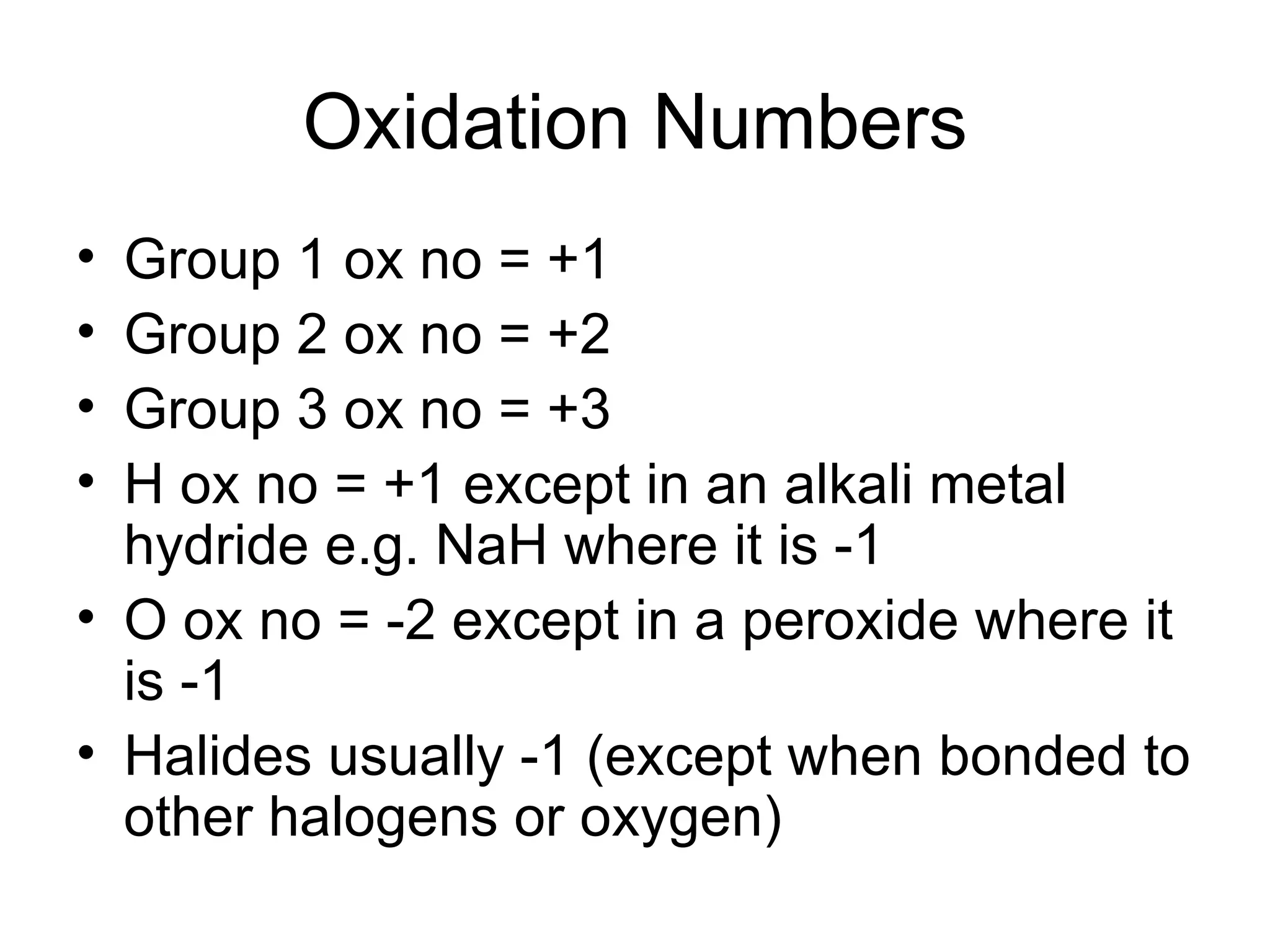
Oxidation Numbers Group 1 ox no = +1 Group 2 ox no = +2 Group 3 ox no = +3 H ox no = +1 except in an alkali metal hydride e.g. NaH where it is -1 O ox no = -2 except in a peroxide where it is -1 Halides usually -1 (except when bonded to other halogens or oxygen)
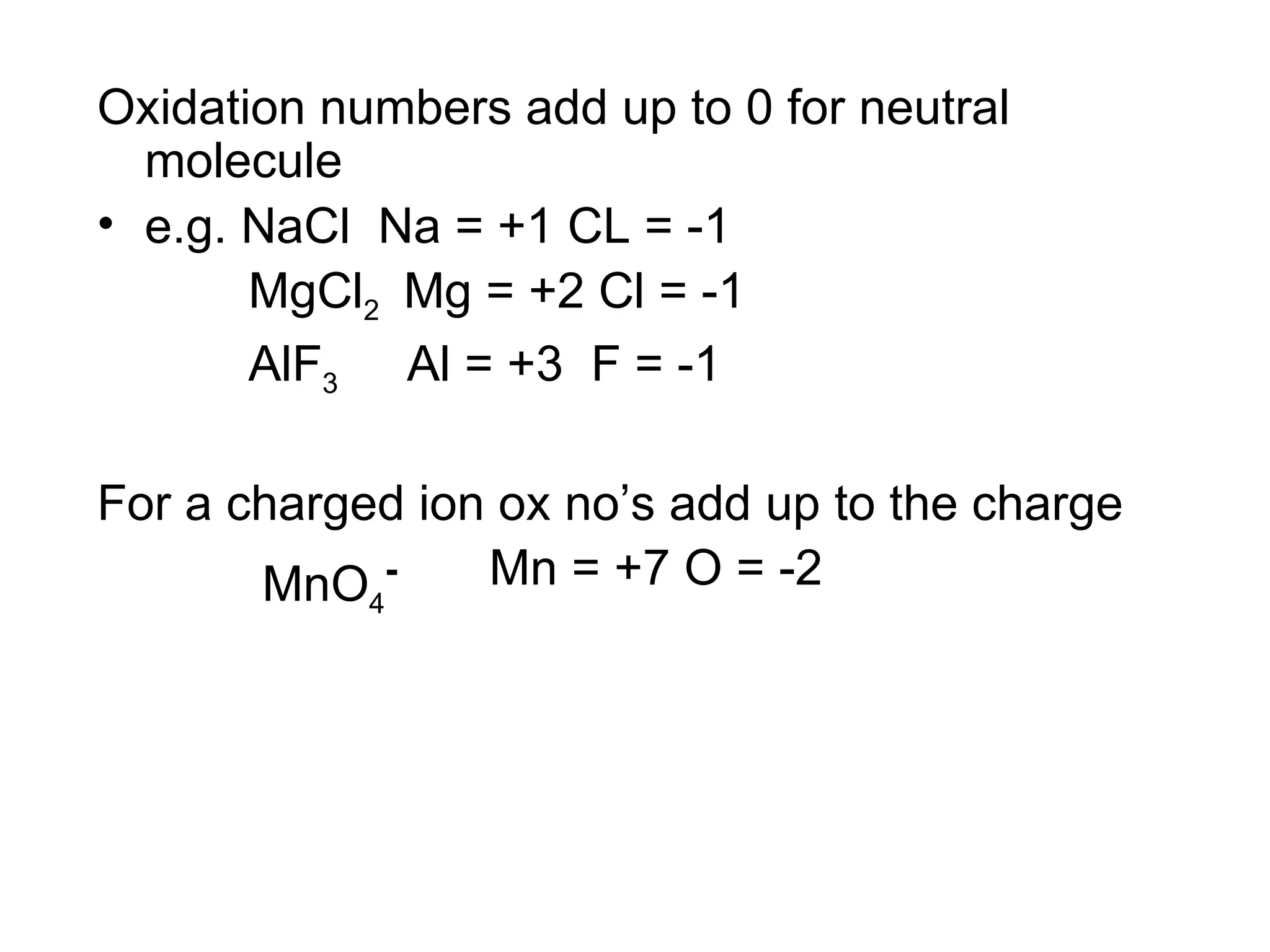
Oxidation numbers add up to 0 for neutral molecule e.g. NaCl  Na = +1 CL = -1 MgCl 2  Mg = +2 Cl = -1 AlF 3   Al = +3  F = -1 For a charged ion ox no’s add up to the charge MnO 4 - Mn = +7 O = -2
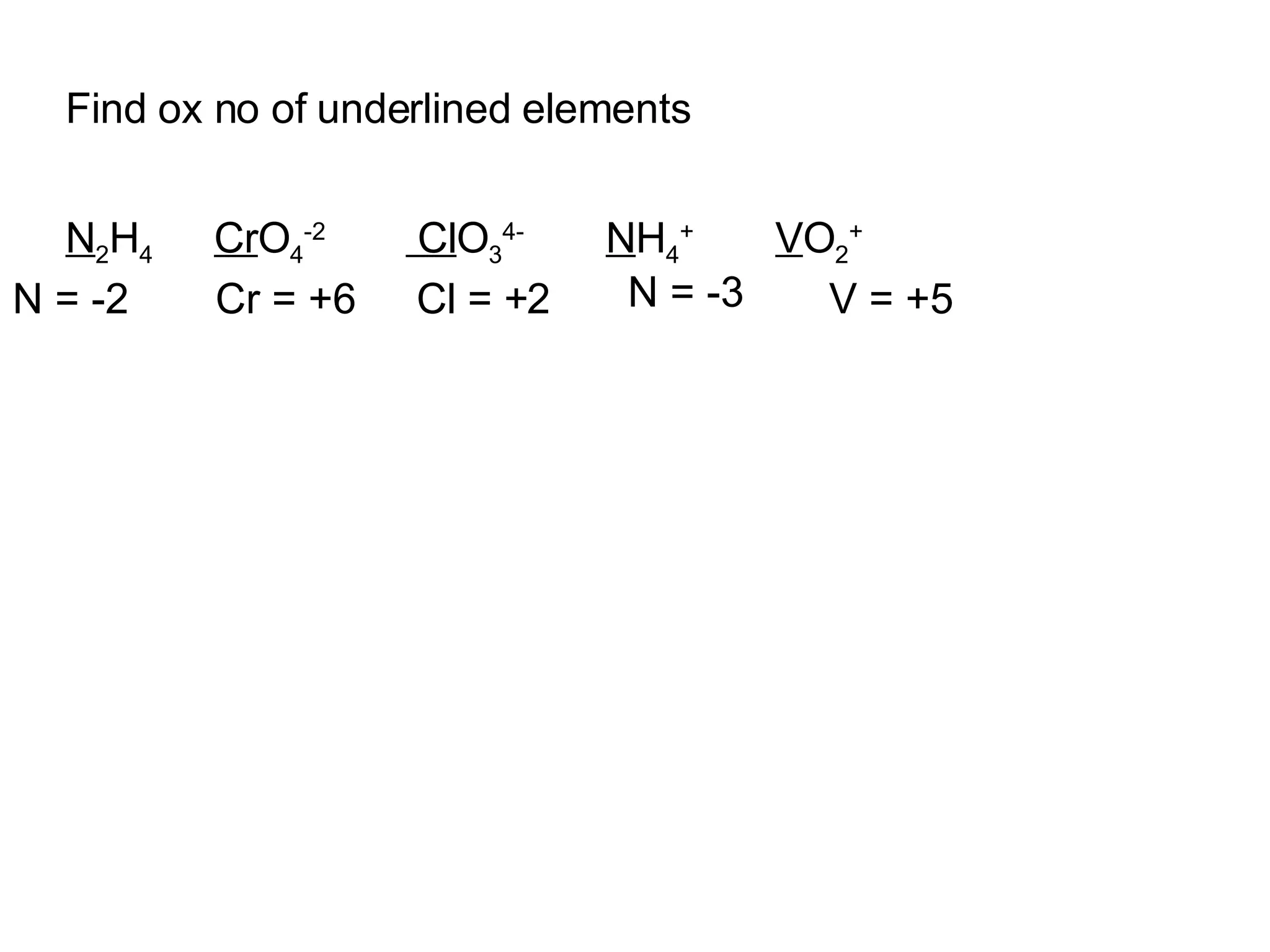
Find ox no of underlined elements N 2 H 4  Cr O 4 -2   Cl O 3 4-  N H 4 +  V O 2 + N = -2 Cr = +6 Cl = +2  N = -3 V = +5
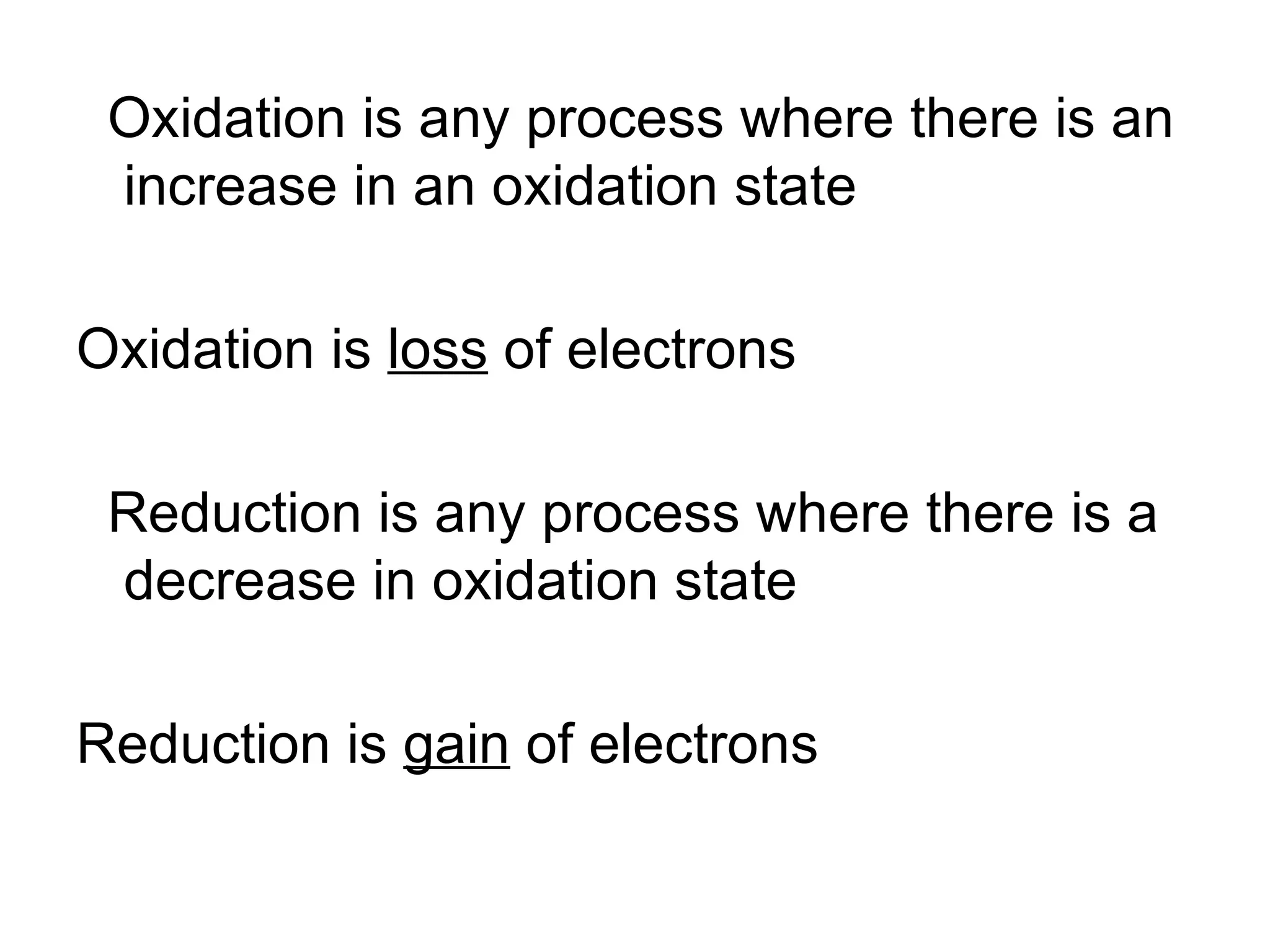
Oxidation is any process where there is an increase in an oxidation state Oxidation is  loss  of electrons Reduction is any process where there is a decrease in oxidation state Reduction is  gain  of electrons
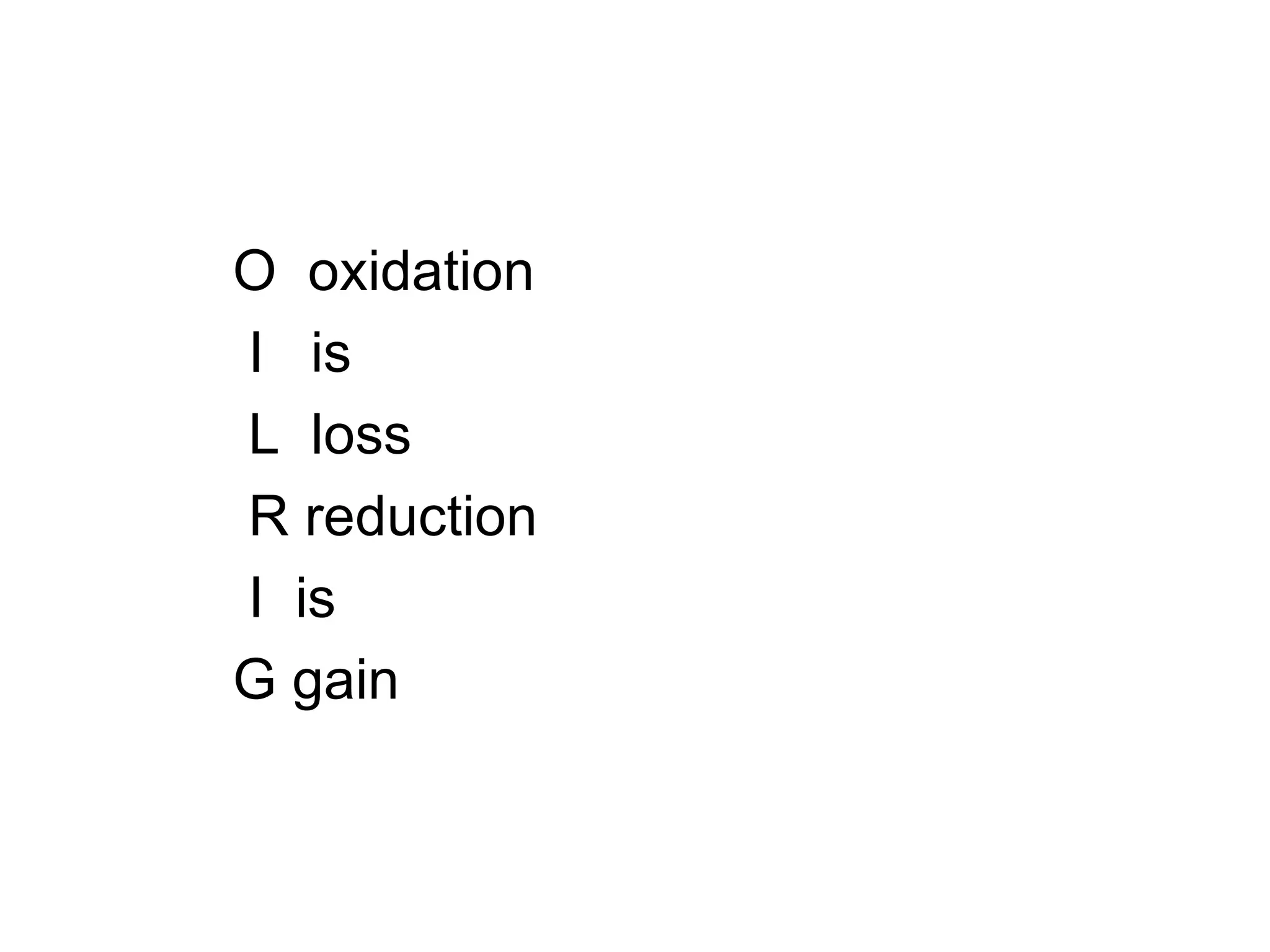
O  oxidation I  is  L  loss R reduction  I  is G gain
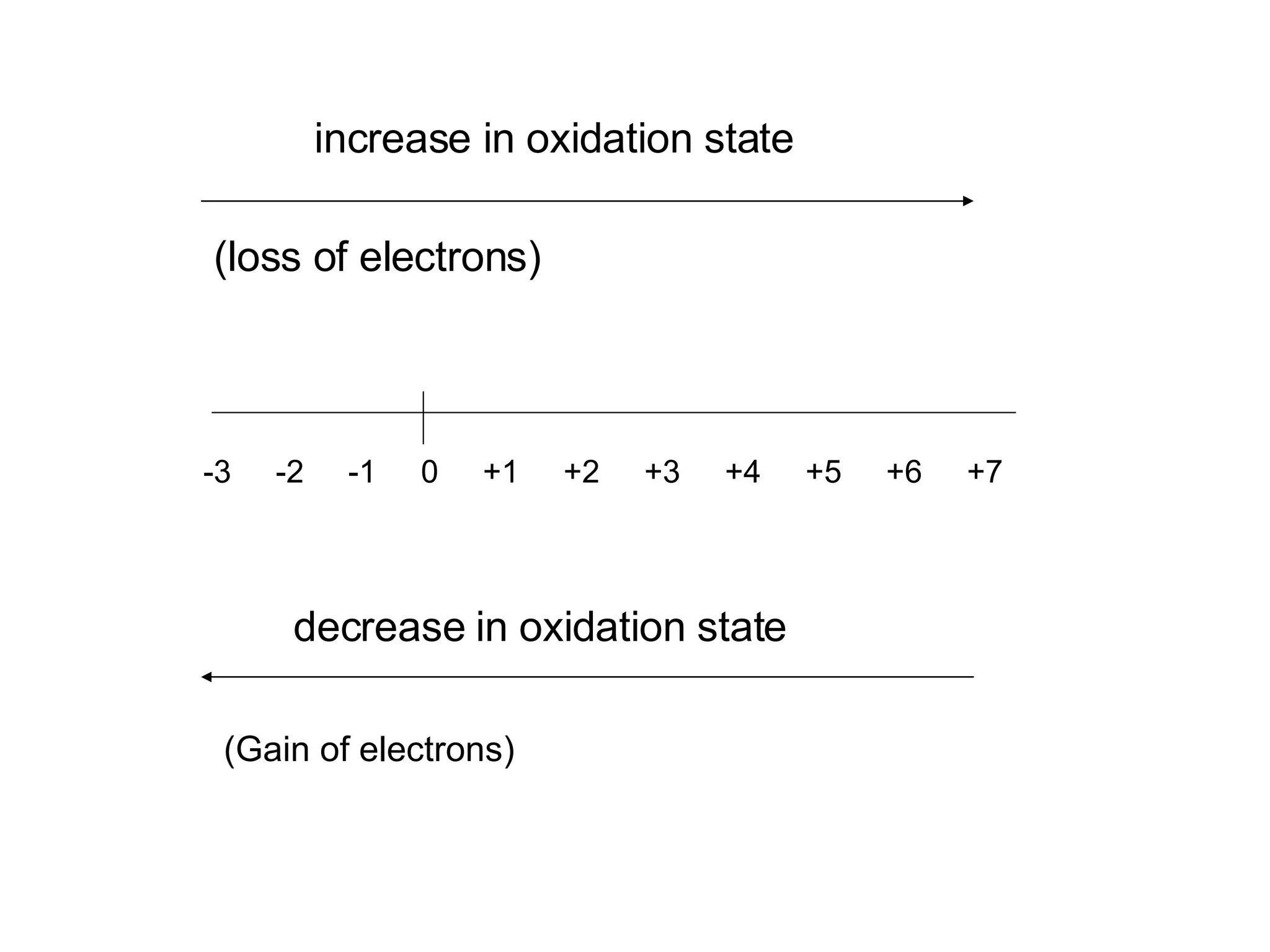
increase in oxidation state (loss of electrons) -3  -2  -1  0  +1  +2  +3  +4  +5  +6  +7  decrease in oxidation state (Gain of electrons)
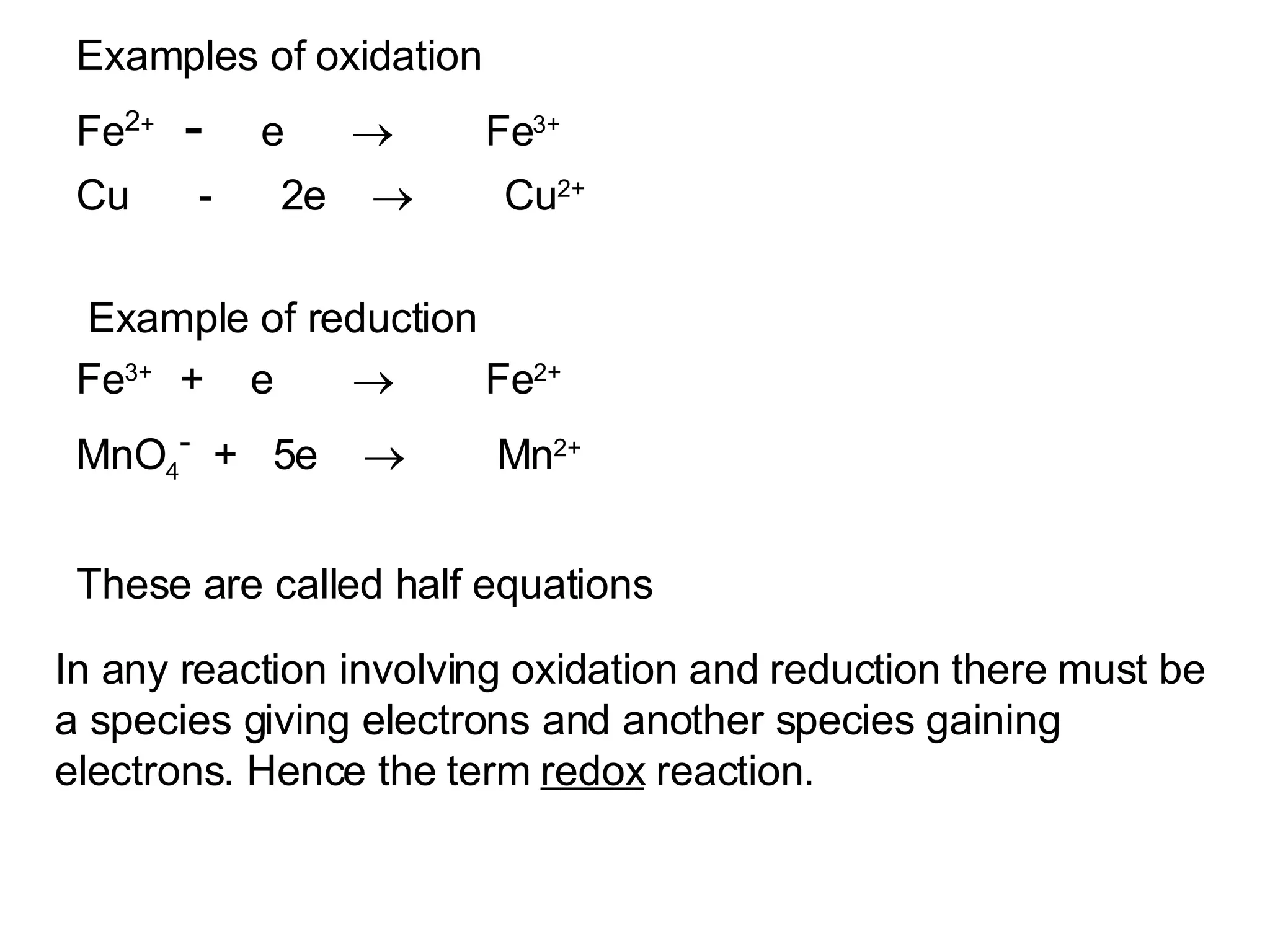
Examples of oxidation Fe 2 +  -   e     Fe 3+   Cu  -  2e     Cu 2+ Example of reduction Fe 3+  +  e     Fe 2+ MnO 4 -   +  5e     Mn 2+ These are called half equations In any reaction involving oxidation and reduction there must be a species giving electrons and another species gaining electrons. Hence the term  redox  reaction.
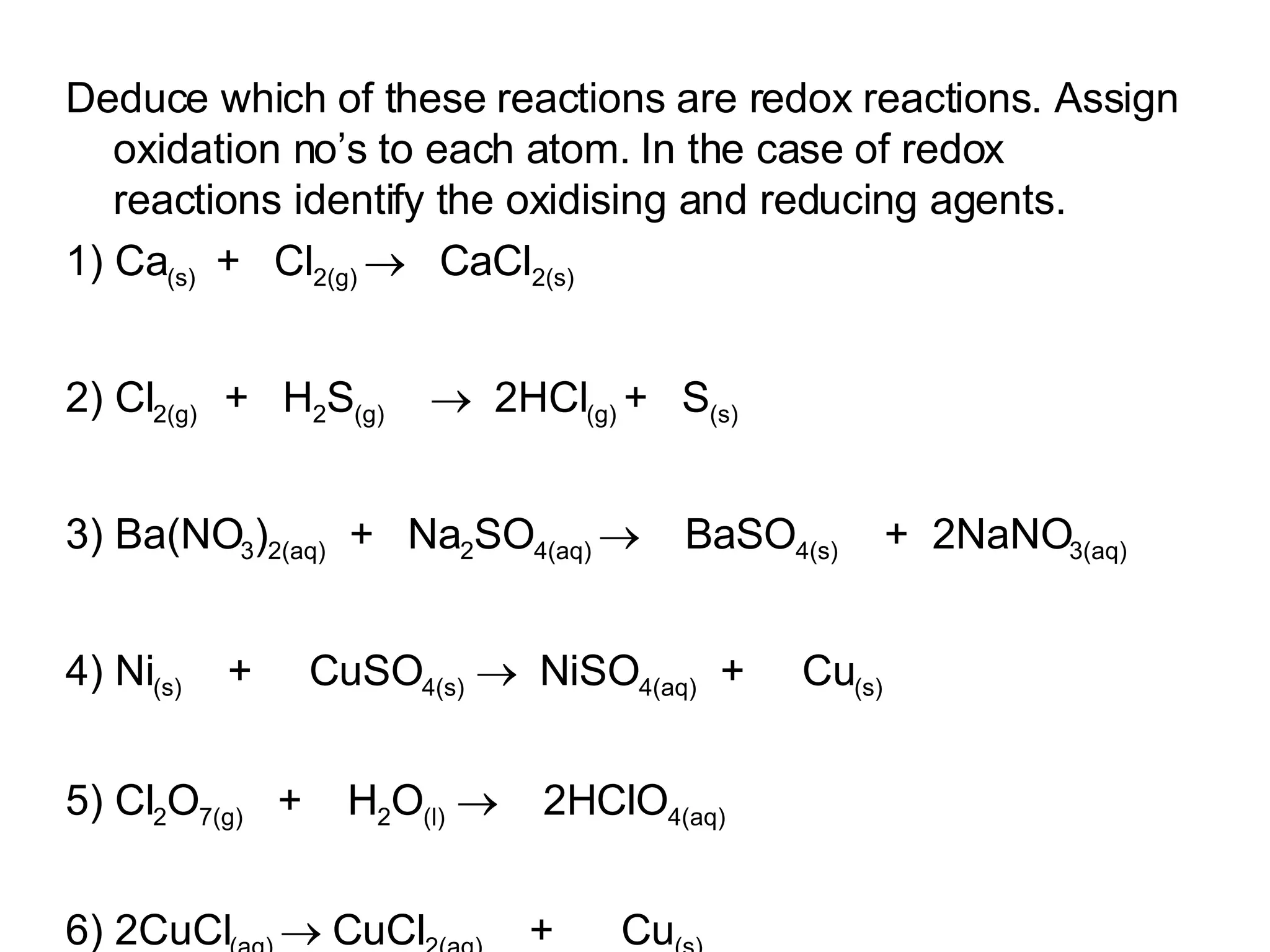
Deduce which of these reactions are redox reactions. Assign oxidation no’s to each atom. In the case of redox reactions identify the oxidising and reducing agents. 1) Ca (s)  +   Cl 2(g)     CaCl 2(s) 2) Cl 2(g)  +  H 2 S (g)      2HCl (g)  +  S (s) 3) Ba(NO 3 ) 2(aq)   +  Na 2 SO 4(aq)     BaSO 4(s)   +  2NaNO 3(aq) 4) Ni (s)   +  CuSO 4(s)      NiSO 4(aq)   +  Cu (s) 5) Cl 2 O 7(g)   +  H 2 O (l)      2HClO 4(aq) 6) 2CuCl (aq)    CuCl 2(aq)   +  Cu (s)
We can add 2 half equations together to make a full equation. Oxidation and reduction must both occur together.  The species donating electrons is called the reducing agent The species receiving electrons is called the oxidising agent
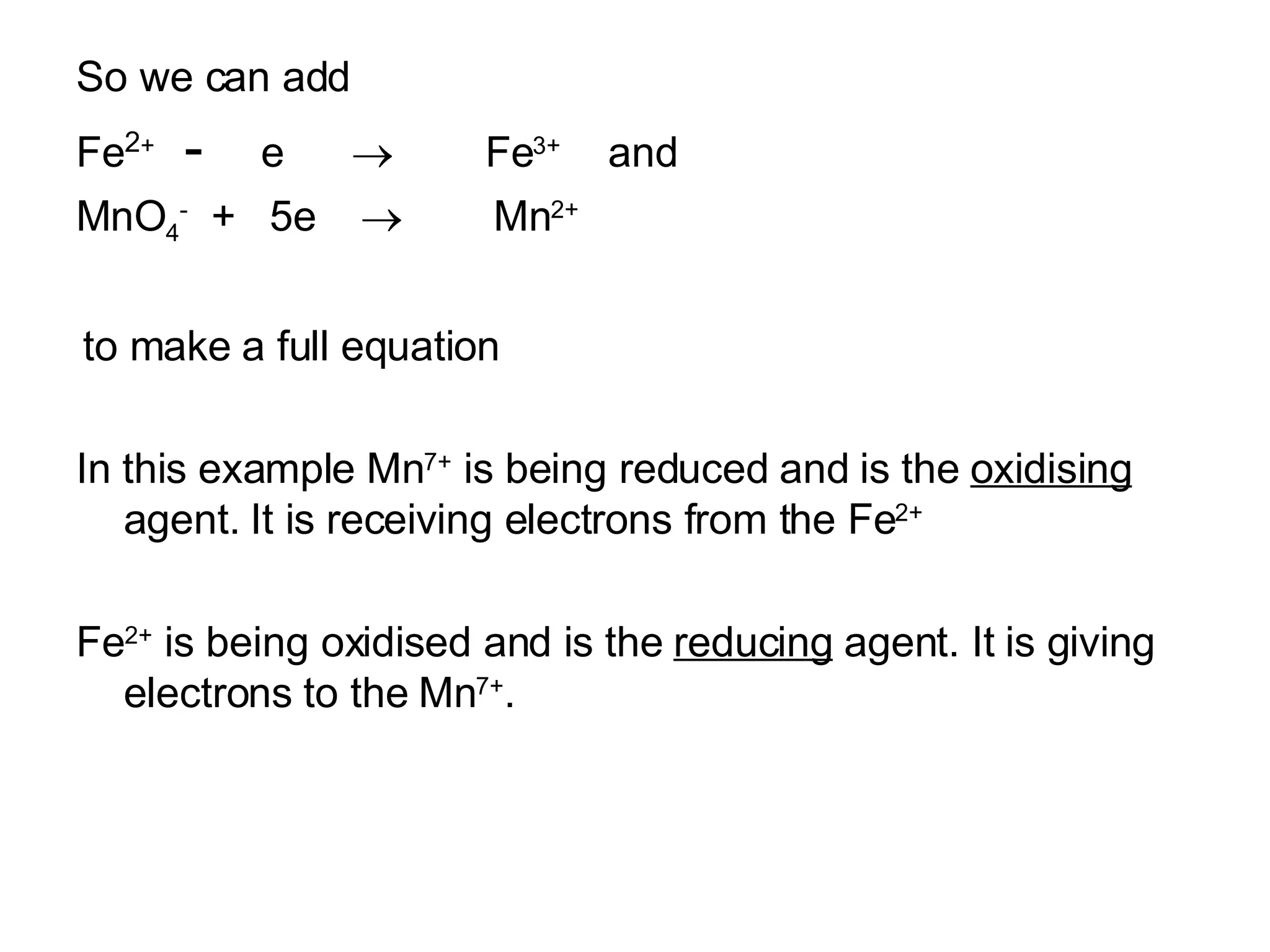
So we can add  Fe 2 +  -   e     Fe 3+  and MnO 4 -   +  5e     Mn 2+ to make a full equation In this example Mn 7+  is being reduced and is the  oxidising  agent. It is receiving electrons from the Fe 2+ Fe 2+  is being oxidised and is the  reducing  agent. It is giving electrons to the Mn 7+ .
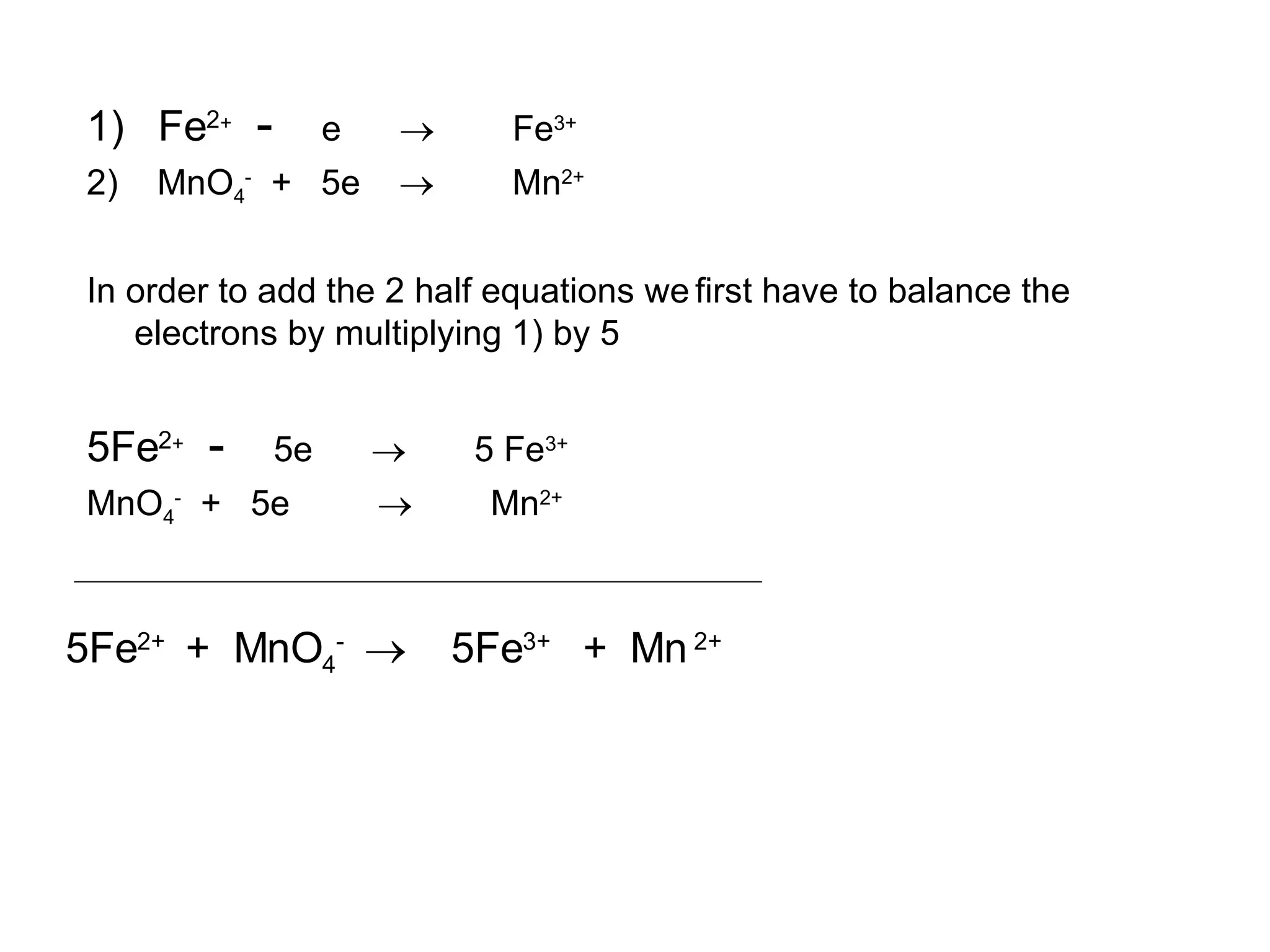
1)  Fe 2 +  -   e     Fe 3+  2)  MnO 4 -   +  5e     Mn 2+ In order to add the 2 half equations we   first have to balance the electrons by multiplying 1) by 5 5Fe 2 +  -   5e     5 Fe 3+ MnO 4 -   +  5e     Mn 2+ 5Fe 2+  +  MnO 4 -     5Fe 3+  +  Mn  2+
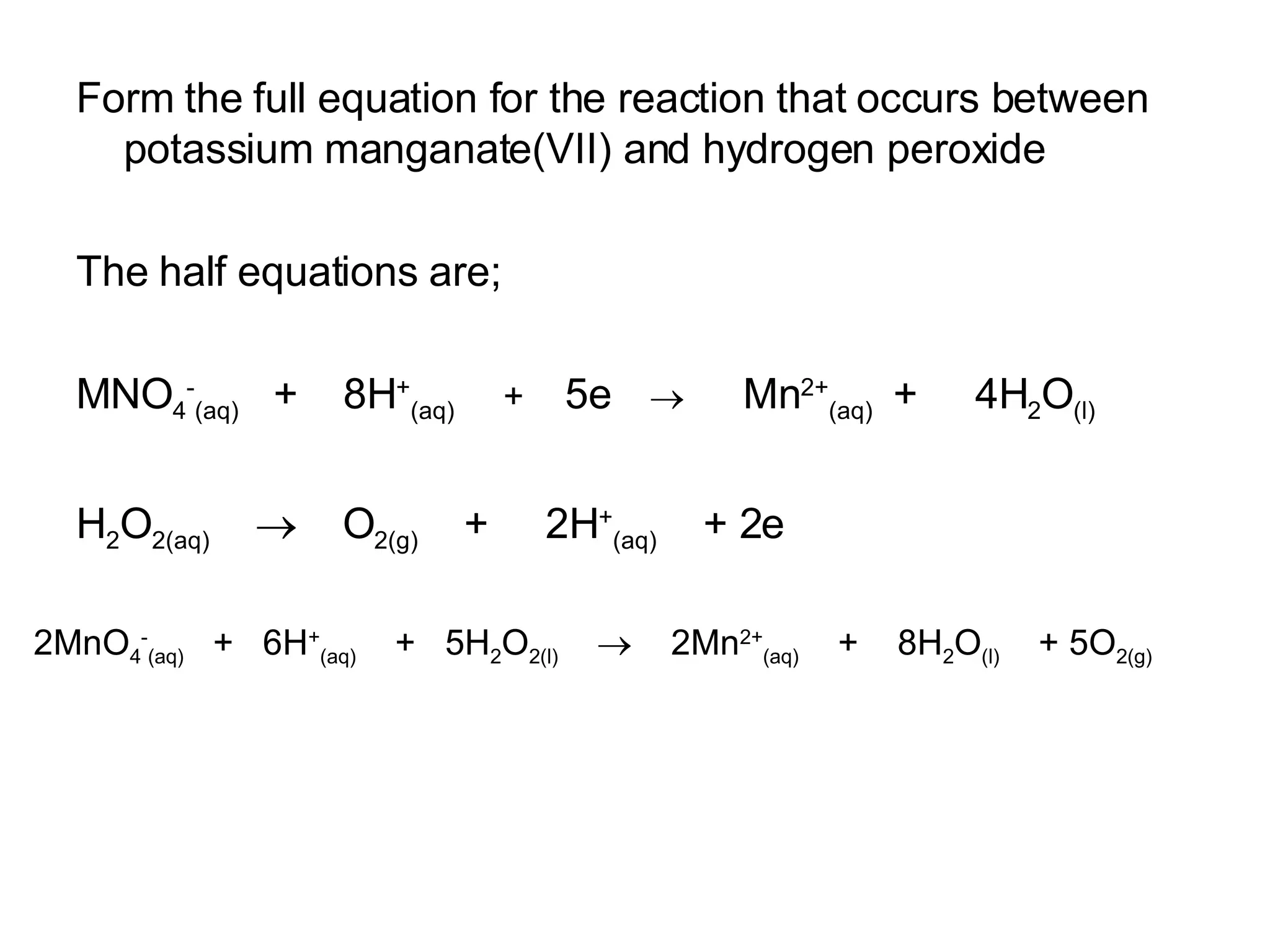
Form the full equation for the reaction that occurs between potassium manganate(VII) and hydrogen peroxide The half equations are; MNO 4 - (aq)   +  8H + (aq)   +  5e      Mn 2+ (aq)   +  4H 2 O (l) H 2 O 2(aq)      O 2(g)   +  2H + (aq)   + 2e 2MnO 4 - (aq)   +  6H + (aq)   +  5H 2 O 2(l)      2Mn 2+ (aq)   +  8H 2 O (l)   + 5O 2(g)
Write balance ion equations for the following and determine whether oxidation or reduction occurs chlorine to chloride ions oxygen to oxide ions aluminium to aluminium ions magnesium to magnesium ions tin(IV) ions to tin (II)ions chromium(II) to chromium(III) ions O 2   + 4e     2O 2-  ox no  0 to -2  reduction Al  -3e     Al 3+  ox no  0 to +3  oxidation Mg  -2e     Mg 2+  ox no  0 to +2  oxidation Sn 4+  +2e     Sn 2+  ox no   +4 to +2   reduction Cl 2   + 2e     2Cl -   ox no  0 to -1  reduction
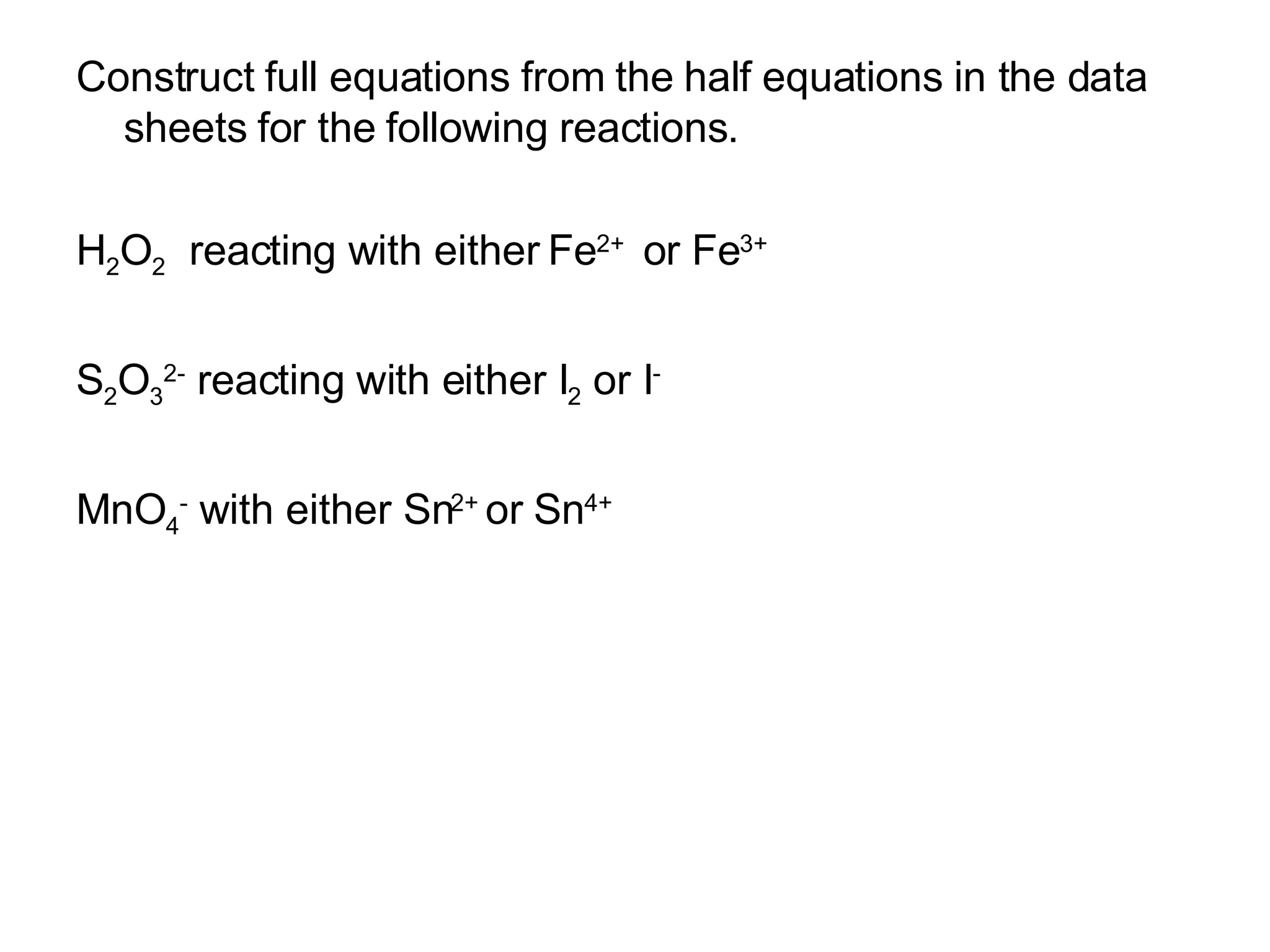
Construct full equations from the half equations in the data sheets for the following reactions. H 2 O 2   reacting with either Fe 2+  or Fe 3+ S 2 O 3 2-  reacting with either I 2  or I - MnO 4 -  with either Sn 2+  or Sn 4+

10 Reduction And Oxidation

  • 1.
  • 2.
    Oxidation Numbers Group1 ox no = +1 Group 2 ox no = +2 Group 3 ox no = +3 H ox no = +1 except in an alkali metal hydride e.g. NaH where it is -1 O ox no = -2 except in a peroxide where it is -1 Halides usually -1 (except when bonded to other halogens or oxygen)
  • 3.
    Oxidation numbers addup to 0 for neutral molecule e.g. NaCl Na = +1 CL = -1 MgCl 2 Mg = +2 Cl = -1 AlF 3 Al = +3 F = -1 For a charged ion ox no’s add up to the charge MnO 4 - Mn = +7 O = -2
  • 4.
    Find ox noof underlined elements N 2 H 4 Cr O 4 -2 Cl O 3 4- N H 4 + V O 2 + N = -2 Cr = +6 Cl = +2 N = -3 V = +5
  • 5.
    Oxidation is anyprocess where there is an increase in an oxidation state Oxidation is loss of electrons Reduction is any process where there is a decrease in oxidation state Reduction is gain of electrons
  • 6.
    O oxidationI is L loss R reduction I is G gain
  • 7.
    increase in oxidationstate (loss of electrons) -3 -2 -1 0 +1 +2 +3 +4 +5 +6 +7 decrease in oxidation state (Gain of electrons)
  • 8.
    Examples of oxidationFe 2 + - e  Fe 3+ Cu - 2e  Cu 2+ Example of reduction Fe 3+ + e  Fe 2+ MnO 4 - + 5e  Mn 2+ These are called half equations In any reaction involving oxidation and reduction there must be a species giving electrons and another species gaining electrons. Hence the term redox reaction.
  • 9.
    Deduce which ofthese reactions are redox reactions. Assign oxidation no’s to each atom. In the case of redox reactions identify the oxidising and reducing agents. 1) Ca (s) + Cl 2(g)  CaCl 2(s) 2) Cl 2(g) + H 2 S (g)  2HCl (g) + S (s) 3) Ba(NO 3 ) 2(aq) + Na 2 SO 4(aq)  BaSO 4(s) + 2NaNO 3(aq) 4) Ni (s) + CuSO 4(s)  NiSO 4(aq) + Cu (s) 5) Cl 2 O 7(g) + H 2 O (l)  2HClO 4(aq) 6) 2CuCl (aq)  CuCl 2(aq) + Cu (s)
  • 10.
    We can add2 half equations together to make a full equation. Oxidation and reduction must both occur together. The species donating electrons is called the reducing agent The species receiving electrons is called the oxidising agent
  • 11.
    So we canadd Fe 2 + - e  Fe 3+ and MnO 4 - + 5e  Mn 2+ to make a full equation In this example Mn 7+ is being reduced and is the oxidising agent. It is receiving electrons from the Fe 2+ Fe 2+ is being oxidised and is the reducing agent. It is giving electrons to the Mn 7+ .
  • 12.
    1) Fe2 + - e  Fe 3+ 2) MnO 4 - + 5e  Mn 2+ In order to add the 2 half equations we first have to balance the electrons by multiplying 1) by 5 5Fe 2 + - 5e  5 Fe 3+ MnO 4 - + 5e  Mn 2+ 5Fe 2+ + MnO 4 -  5Fe 3+ + Mn 2+
  • 13.
    Form the fullequation for the reaction that occurs between potassium manganate(VII) and hydrogen peroxide The half equations are; MNO 4 - (aq) + 8H + (aq) + 5e  Mn 2+ (aq) + 4H 2 O (l) H 2 O 2(aq)  O 2(g) + 2H + (aq) + 2e 2MnO 4 - (aq) + 6H + (aq) + 5H 2 O 2(l)  2Mn 2+ (aq) + 8H 2 O (l) + 5O 2(g)
  • 14.
    Write balance ionequations for the following and determine whether oxidation or reduction occurs chlorine to chloride ions oxygen to oxide ions aluminium to aluminium ions magnesium to magnesium ions tin(IV) ions to tin (II)ions chromium(II) to chromium(III) ions O 2 + 4e  2O 2- ox no 0 to -2 reduction Al -3e  Al 3+ ox no 0 to +3 oxidation Mg -2e  Mg 2+ ox no 0 to +2 oxidation Sn 4+ +2e  Sn 2+ ox no +4 to +2 reduction Cl 2 + 2e  2Cl - ox no 0 to -1 reduction
  • 15.
    Construct full equationsfrom the half equations in the data sheets for the following reactions. H 2 O 2 reacting with either Fe 2+ or Fe 3+ S 2 O 3 2- reacting with either I 2 or I - MnO 4 - with either Sn 2+ or Sn 4+