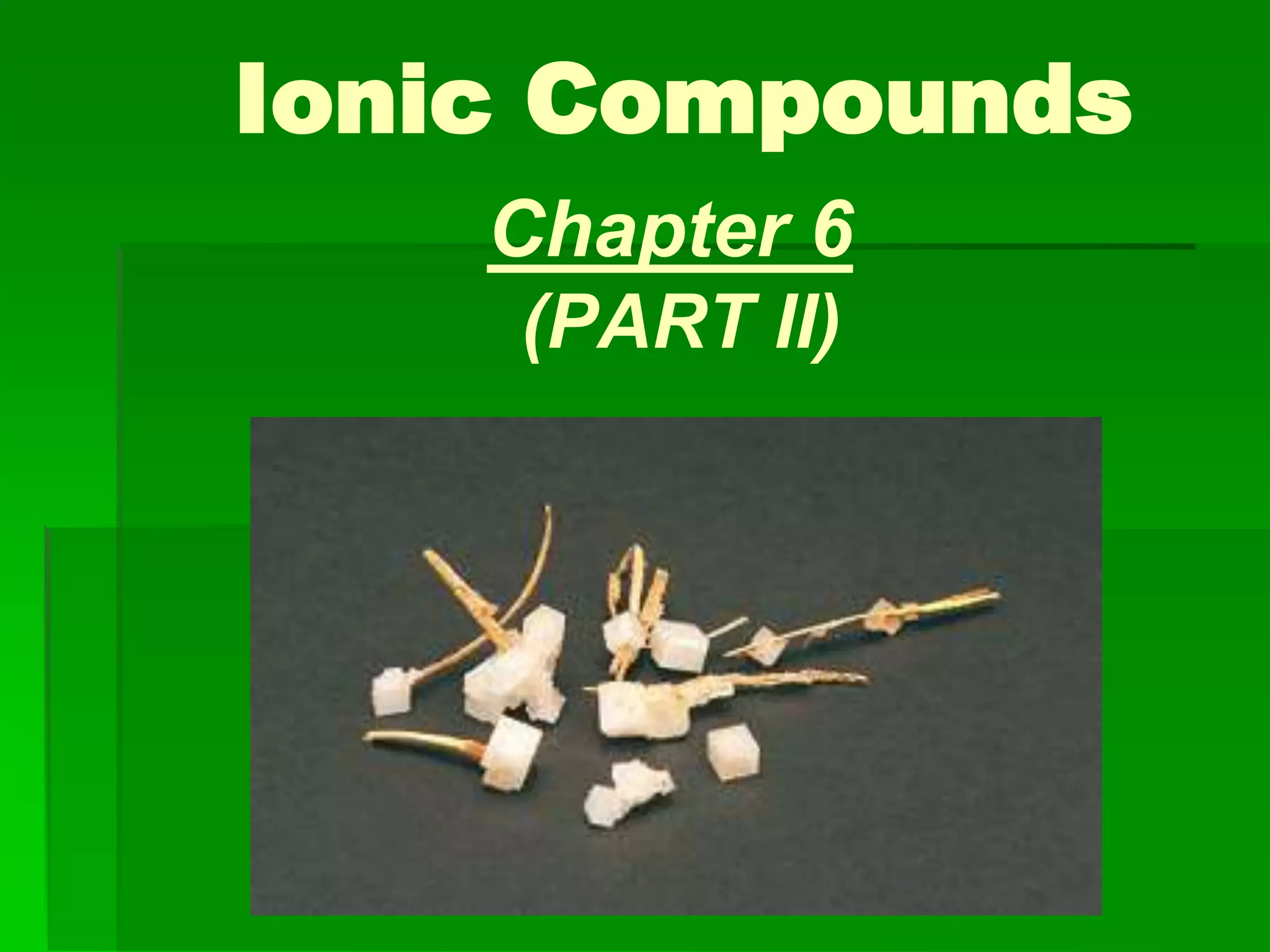
Ionic Compounds
Chapter 6
(PART II)
Ionic Compounds
▪ Ionic compounds are made up by the
chemical combination of metallic and non-
metallic elements.
▪ Most rocks, minerals and gemstones are ionic
compounds.
▪ Clays contain ionic compounds.
▪ While most of the above are made up of
mixtures of different ionic compounds table
salt is a pure ionic compound made up of
sodium chloride (NaCl)
I. Structure:
▪ The physical properties of ionic
compounds are very different from
metals.
▪ The structure of ionic compounds must
therefore be very different from those
present in metals.
I. Structure:
▪ The forces between the particles are strong.
▪ There are no free-moving electrons present,
unlike in metals.
▪ There are charged particles present, but in
solid state they are not free to move.
▪ When an ionic compound melts, however,
the particles are free to move and the
compound will conduct electricity.
I. Structure:
▪ The electric forces in an ionic bond are
strong enough to hold more than one pair of
opposite ions.
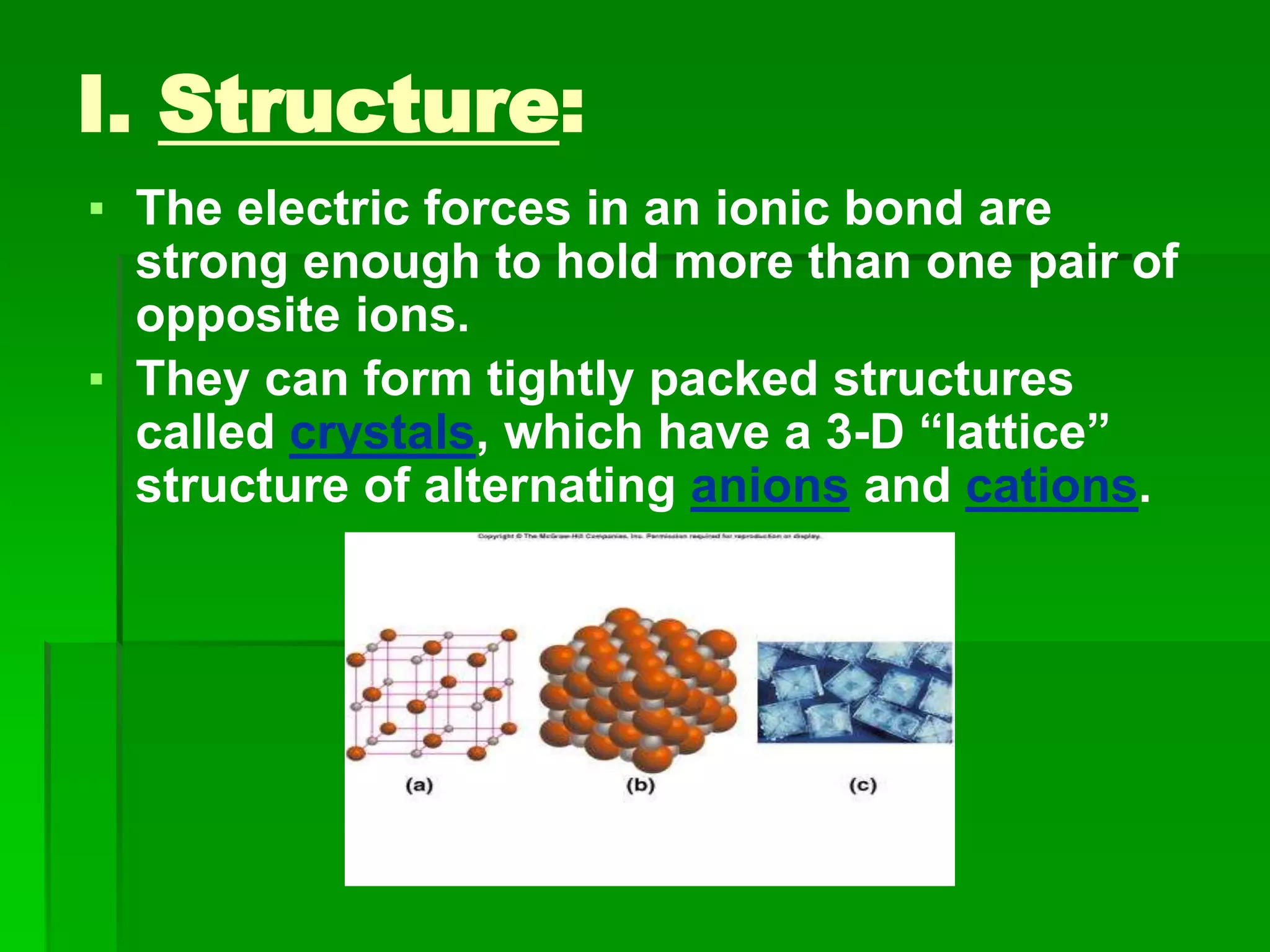
▪ They can form tightly packed structures
called crystals, which have a 3-D “lattice”
structure of alternating anions and cations.
▪ Ionic bonds are very strong.
▪ As solids, they are very hard and
brittle.
▪ Form a crystal lattice that results in a
release of energy, making the resulting
ionic compound (ex. salt) more stable
than before.
I. Structure:
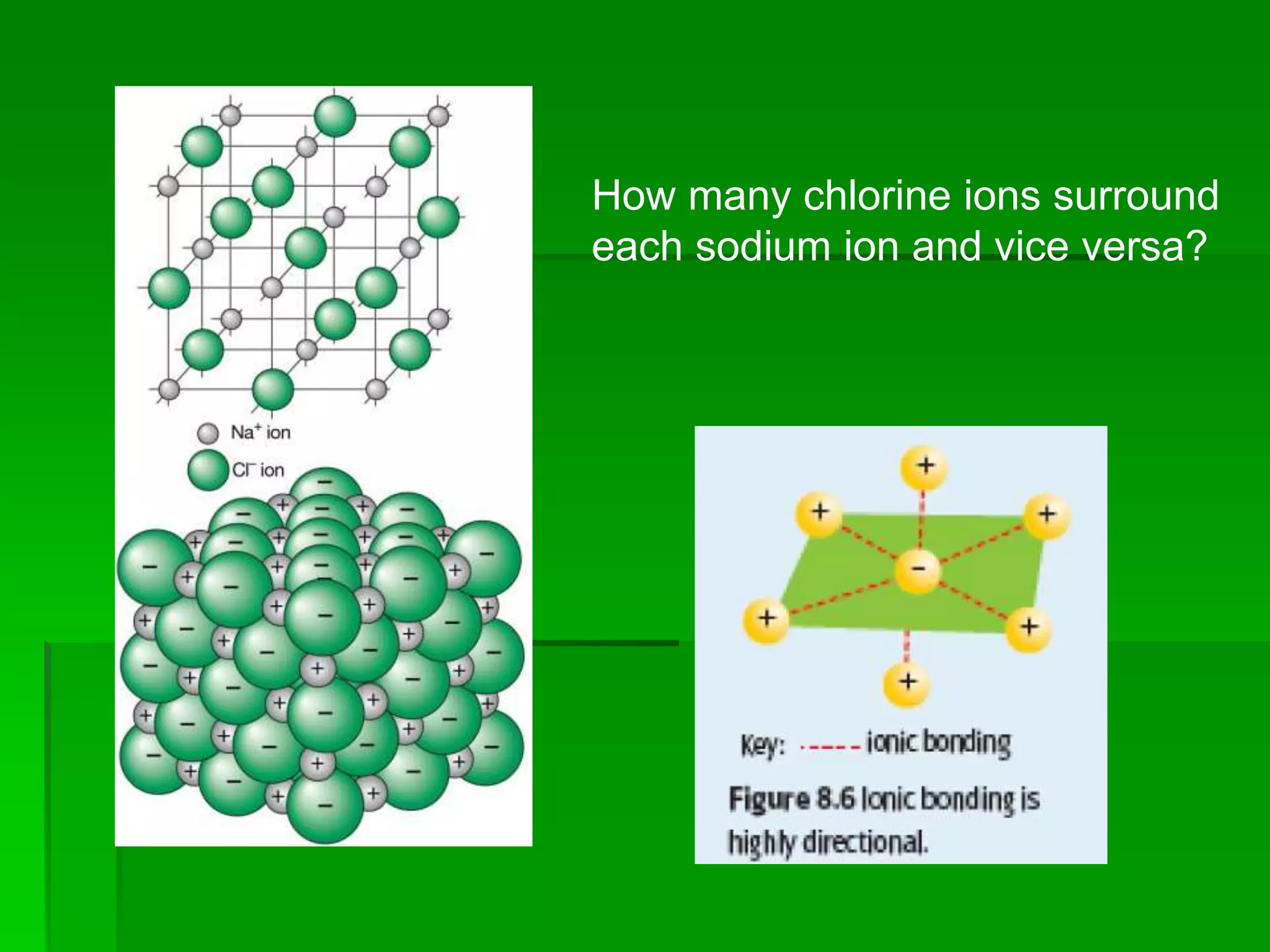
How many chlorine ions surround
each sodium ion and vice versa?
I. Structure:
Transferring Electrons Involves Energy Changes
• Ionization energy is the energy absorbed in order to
remove the outermost electron from an atom.
• The equation below shows this process for sodium.
Na + energy → Na+ + e−
• With some elements, such as chlorine, energy is
released when an electron is added.
Cl + e− → Cl− + energy
Chapter 5
I. Structure:
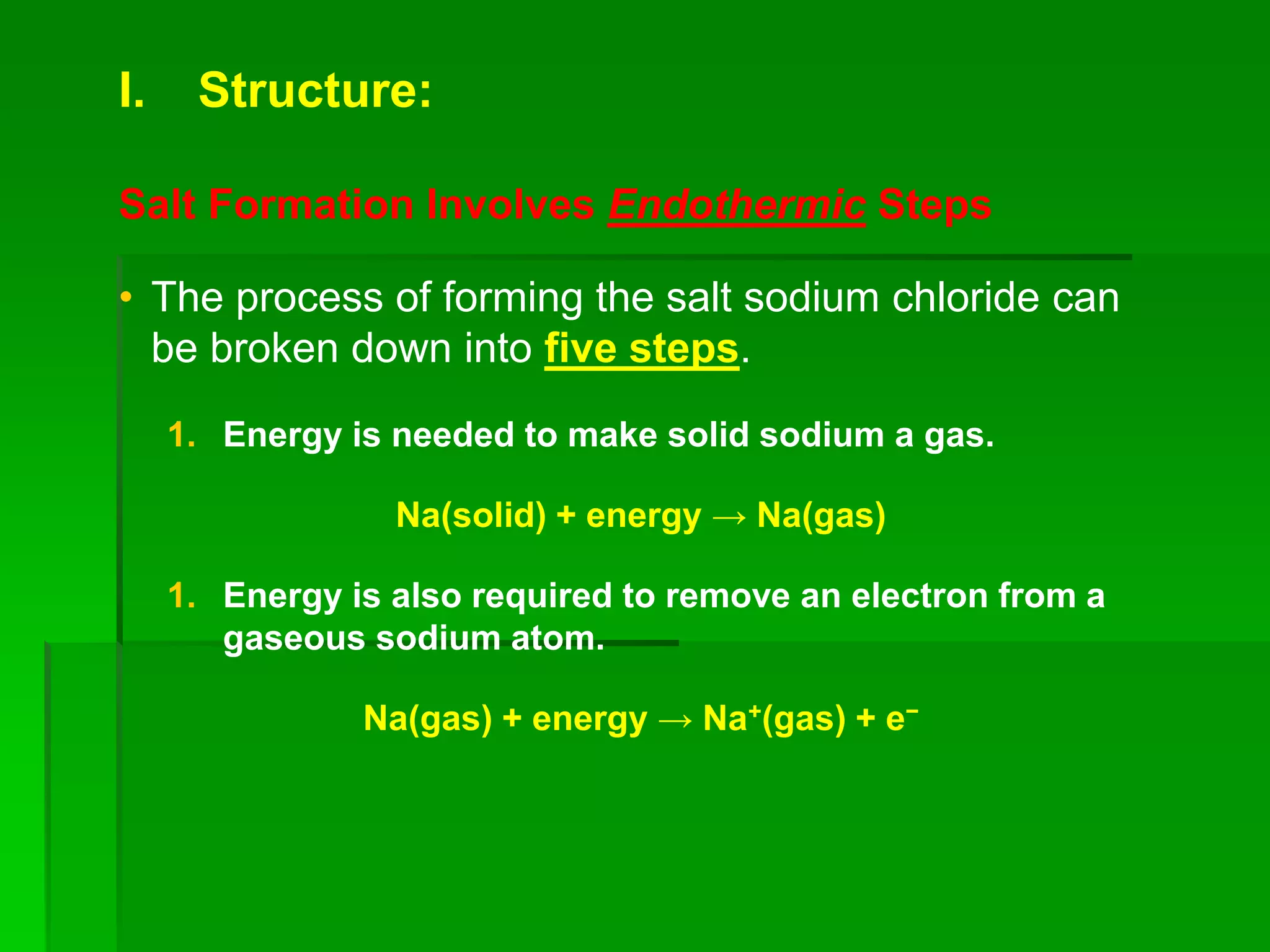
Salt Formation Involves Endothermic Steps
• The process of forming the salt sodium chloride can
be broken down into five steps.
1. Energy is needed to make solid sodium a gas.
Na(solid) + energy → Na(gas)
1. Energy is also required to remove an electron from a
gaseous sodium atom.
Na(gas) + energy → Na+(gas) + e−
I. Structure:
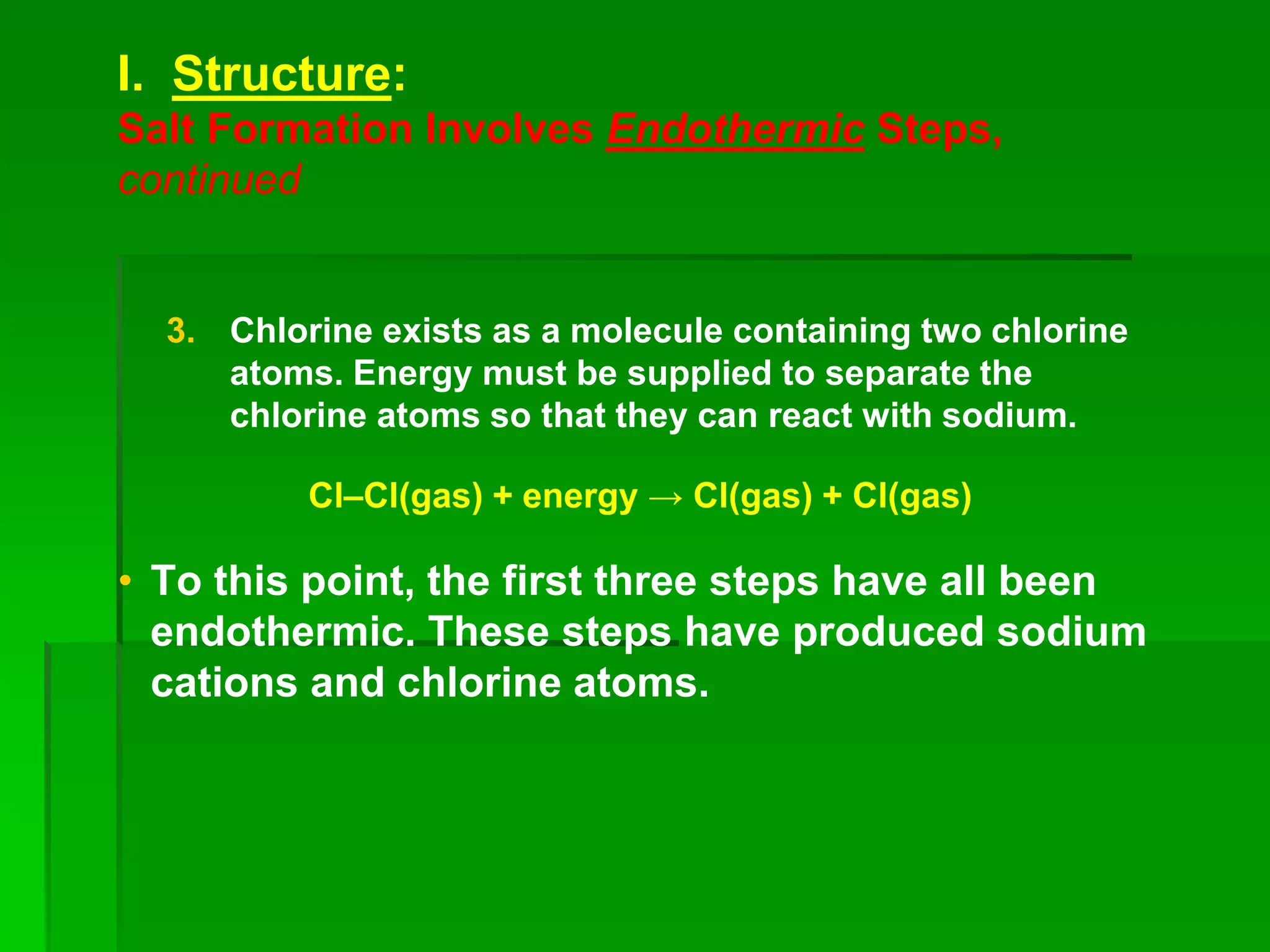
Salt Formation Involves Endothermic Steps,
continued
3. Chlorine exists as a molecule containing two chlorine
atoms. Energy must be supplied to separate the
chlorine atoms so that they can react with sodium.
Cl–Cl(gas) + energy → Cl(gas) + Cl(gas)
• To this point, the first three steps have all been
endothermic. These steps have produced sodium
cations and chlorine atoms.
I. Structure:
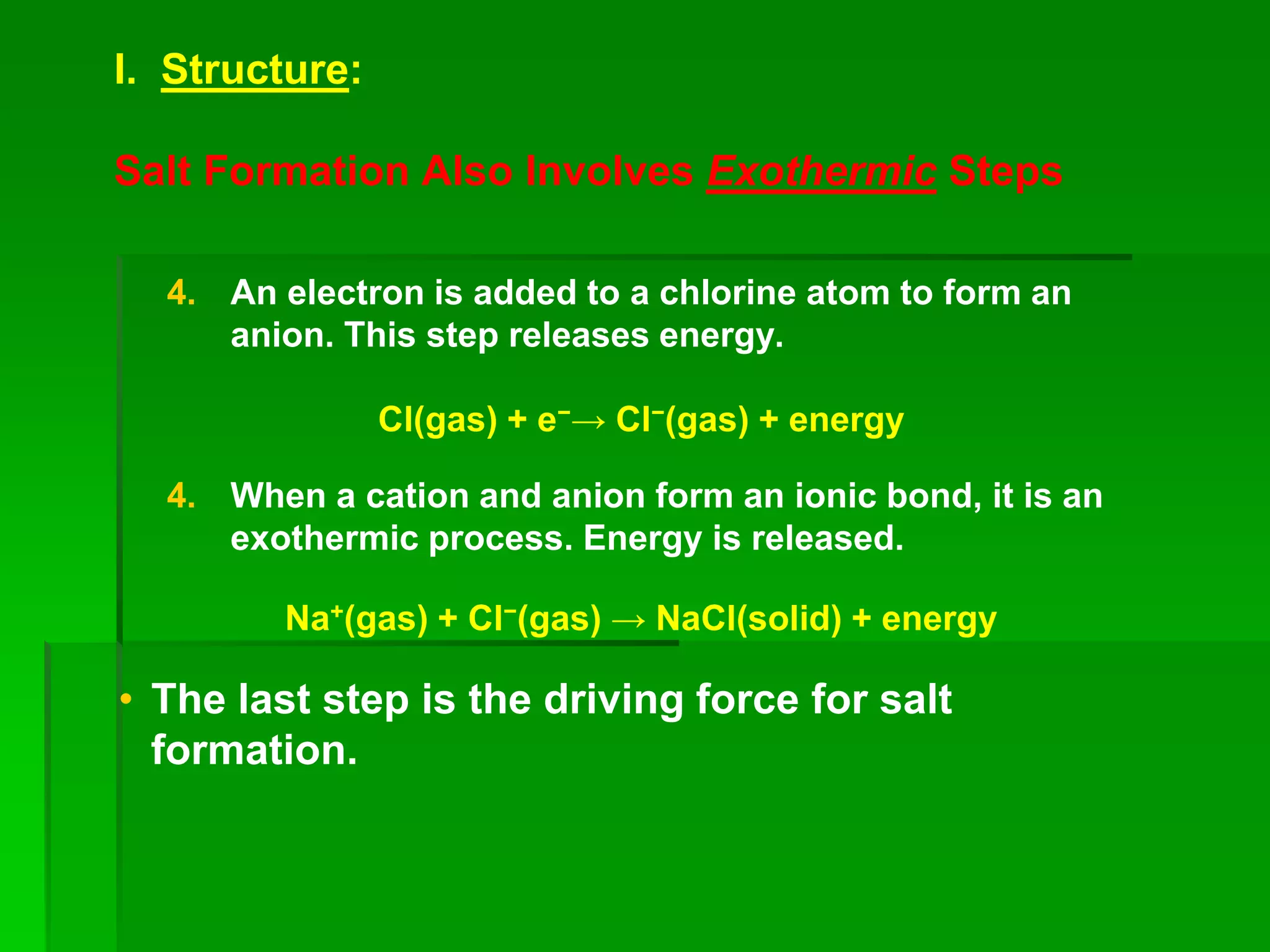
Salt Formation Also Involves Exothermic Steps
4. An electron is added to a chlorine atom to form an
anion. This step releases energy.
Cl(gas) + e−→ Cl−(gas) + energy
4. When a cation and anion form an ionic bond, it is an
exothermic process. Energy is released.
Na+(gas) + Cl−(gas) → NaCl(solid) + energy
• The last step is the driving force for salt
formation.
I. Structure:
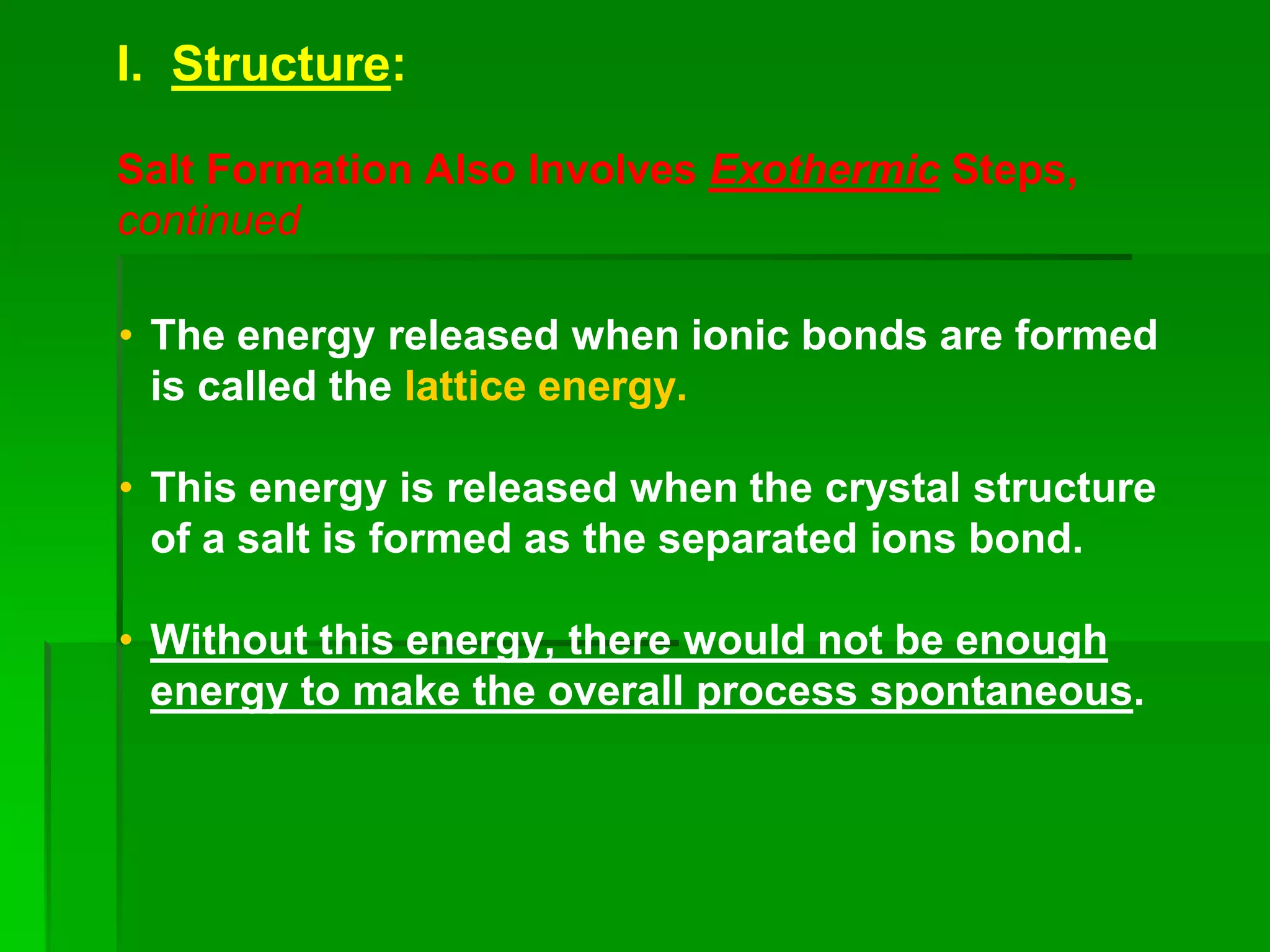
Salt Formation Also Involves Exothermic Steps,
continued
• The energy released when ionic bonds are formed
is called the lattice energy.
• This energy is released when the crystal structure
of a salt is formed as the separated ions bond.
• Without this energy, there would not be enough
energy to make the overall process spontaneous.
I. Structure
Ionic Bond Energy:
▪ Lattice Energy — the energy required to
separate one mole (a chemical quantity)
of ions in an ionic compound.
▪ Lattice energy is affected by—
▪ Size of the ions (the smaller the ions in
bonds, the greater the lattice energy).
▪ The charge on the ions (the greater the
charges in the bonds, the greater the
lattice energy).
II. Properties of Ionic
Compounds
(using sodium chloride as an example)
1. High Melting Temperature
▪ Ever noticed that when you eat fish and chips
the food may be hot but the salt does not melt.
▪ This is because to melt and ionic solid energy
must be provided to allow the ions to break
free and move.
▪ NaCl has a high melting temp, this indicates a
large amount of energy is needed to reduce
the electrostatic attraction between the
oppositely charged ions and allow them to
move freely.
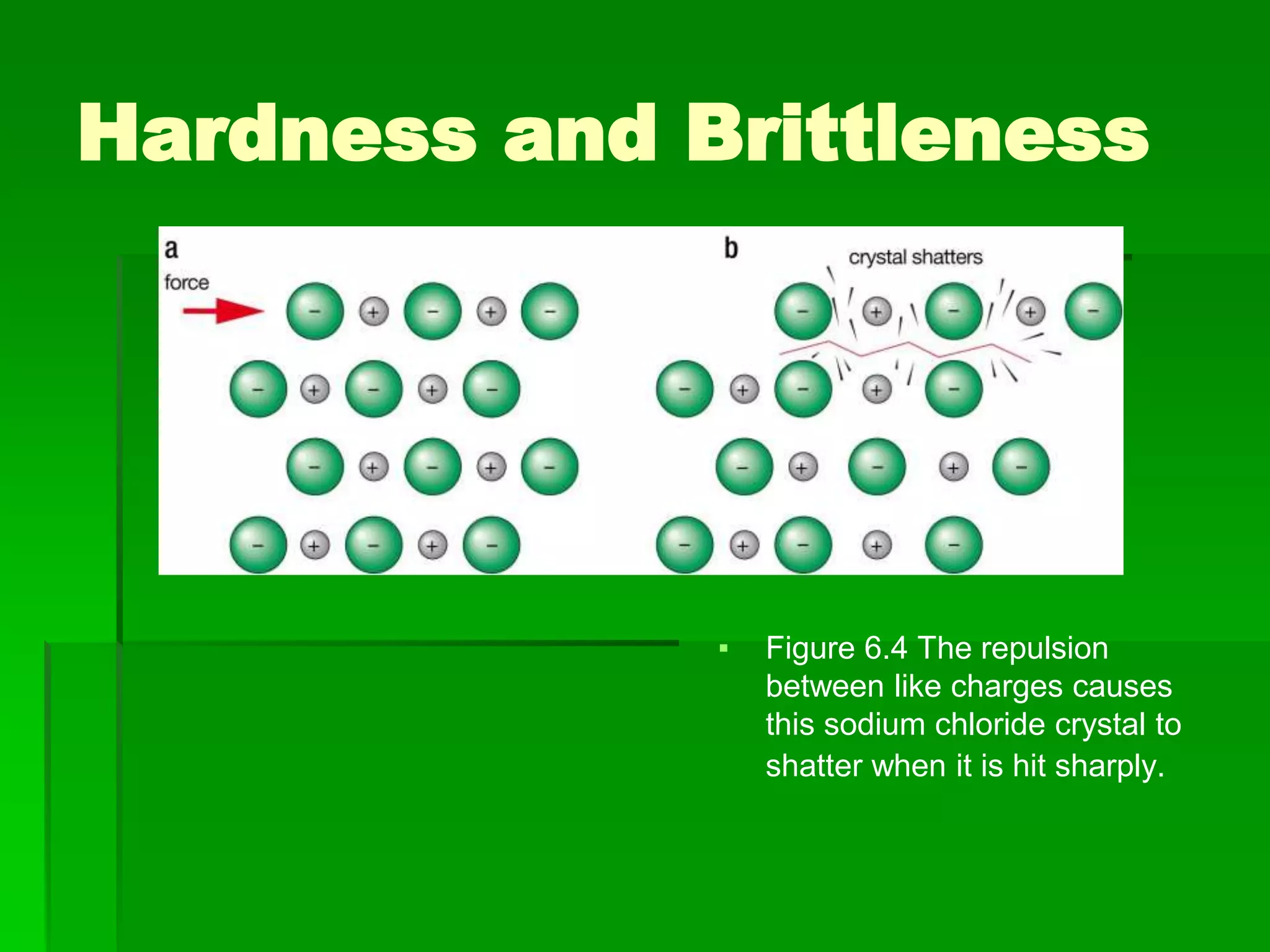
2. Hardness and Brittleness
▪ Unlike metals ionic compounds are not
malleable. They break when beaten.
▪ A force can disrupt the strong electrostatic
forces holding the lattice in place.
▪ A sodium chloride crystal cannot be scratched
easily but if a strong force (a hammer blow) is
applied it will shatter.
▪ This is because the layers of ions will move
relative to each other due to the force.
▪ During this movement, ions of like charge will
become adjacent to each other. Resulting in
repulsion
Hardness and Brittleness
▪ Figure 6.4 The repulsion
between like charges causes
this sodium chloride crystal to
shatter when it is hit sharply.
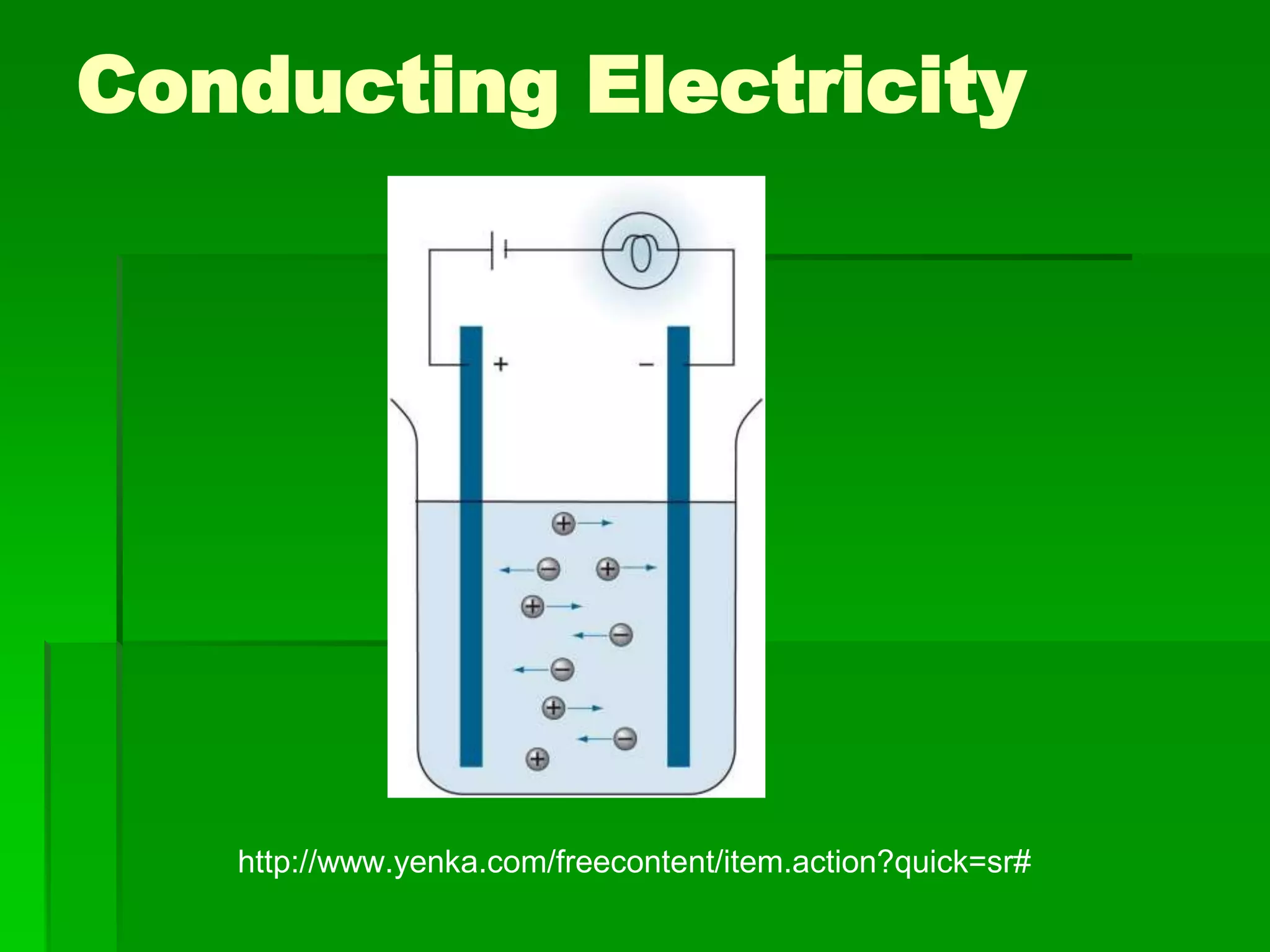
3. Electrical Conductivity
▪ In the solid form, ions in sodium chloride are
held in the crystal lattice and are not free to
move so cannot conduct electricity.
▪ When the solid melts the ions are free to move.
▪ The movement of these charged particles to an
electrode completes an electrical circuit.
▪ In a similar way, when sodium chloride
dissolves in water, the ions separate and are
free to move towards the opposite charge.
Conducting Electricity
http://www.yenka.com/freecontent/item.action?quick=sr#
4. Reactions of metals with
non-metals
▪ Metallic atoms have low ionisation energies
and low electronegativity.
▪ Non-metallic atoms have high ionisation
energies and low electronegativity.
▪ In other words metallic atoms lose electrons
easily and non-metallic atoms gain
electrons easily.
Ionic Compounds
▪ So the metal atoms lose an electron to
the non-metal atoms.
▪ In doing so, both atoms will often achieve
the electronic configuration of the nearest
noblest gas, which is particularly stable.
Sodium Chloride
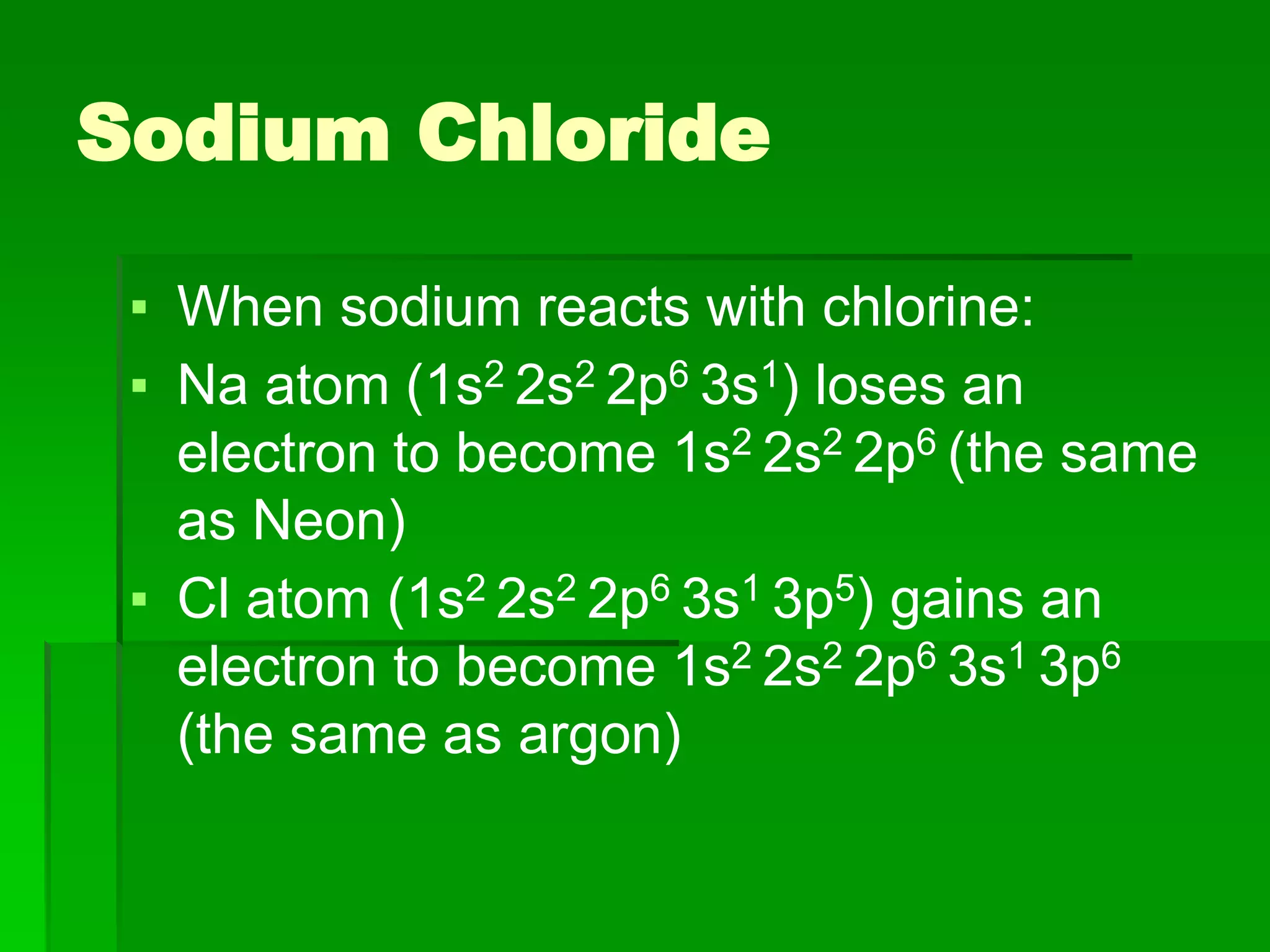
▪ When sodium reacts with chlorine:
▪ Na atom (1s2 2s2 2p6 3s1) loses an
electron to become 1s2 2s2 2p6 (the same
as Neon)
▪ Cl atom (1s2 2s2 2p6 3s1 3p5) gains an
electron to become 1s2 2s2 2p6 3s1 3p6
(the same as argon)
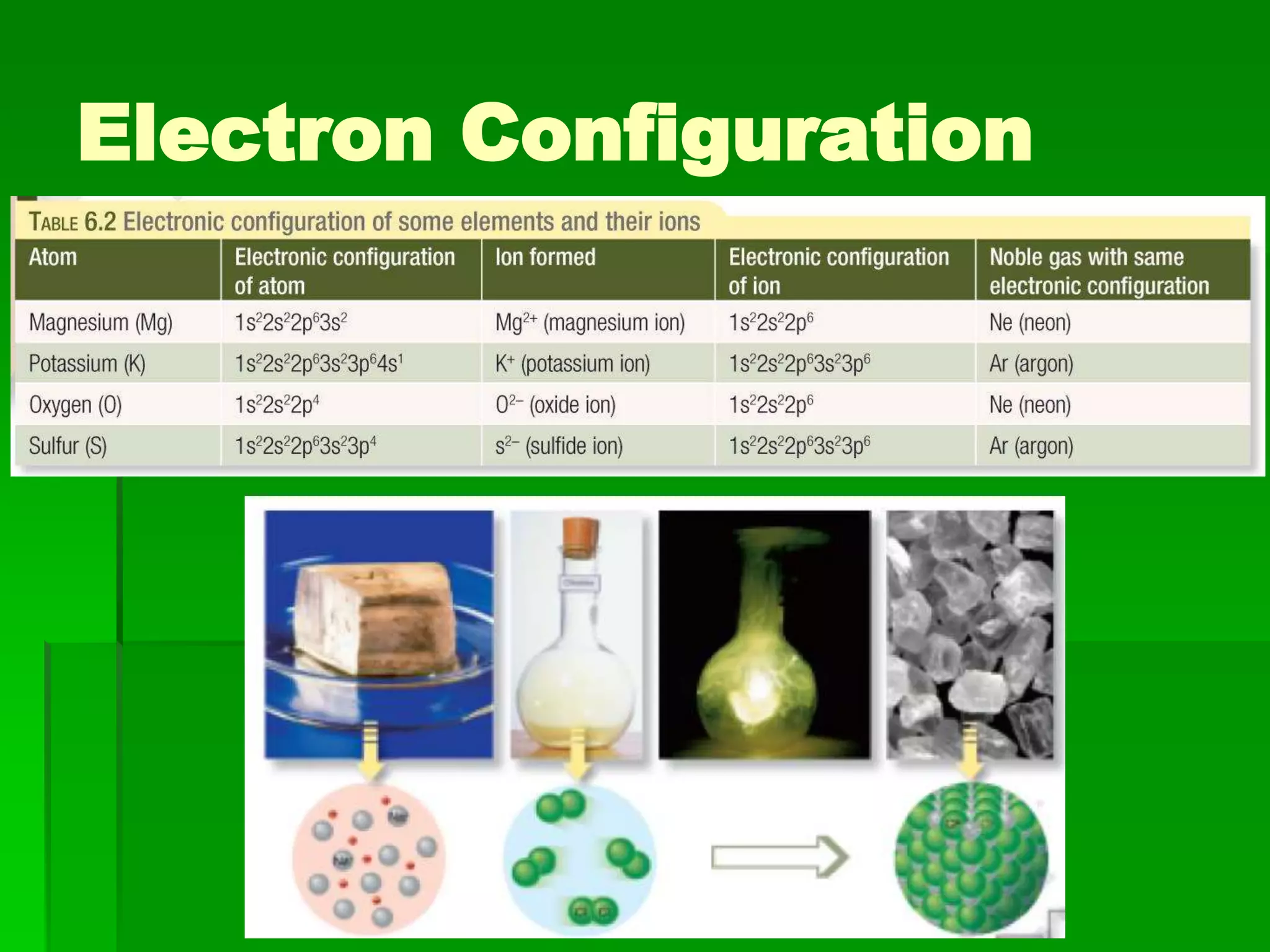
Electron Configuration
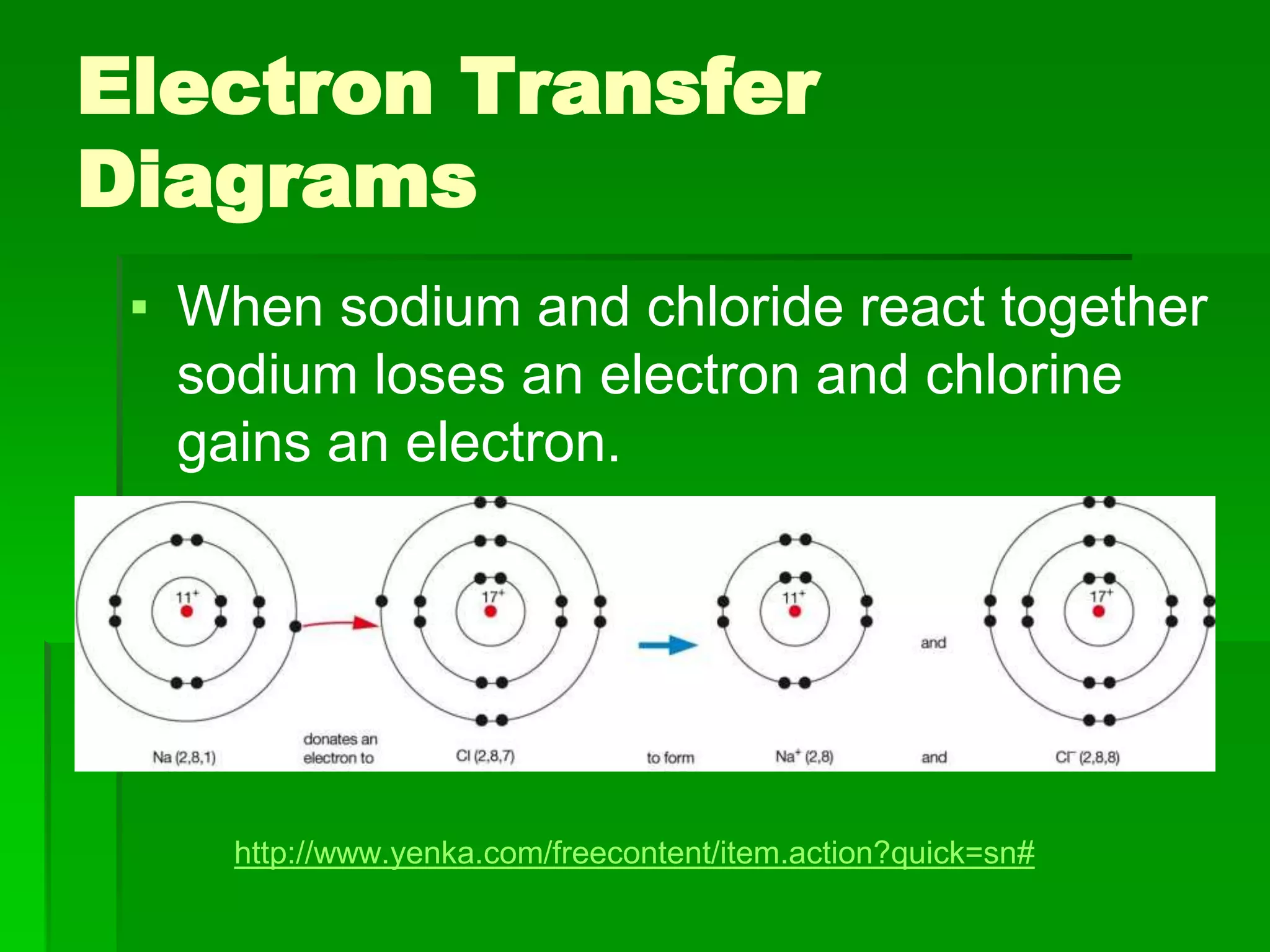
Electron Transfer
Diagrams
▪ When sodium and chloride react together
sodium loses an electron and chlorine
gains an electron.
http://www.yenka.com/freecontent/item.action?quick=sn#
Sodium Chloride
What is happening:
▪ Chlorine molecules splitting into separate
chlorine atoms
▪ Electrons being transferred from sodium atoms
to chlorine atoms – positively charged sodium
and negatively charged chlorine ions are being
formed.
▪ Sodium and chloride ions combining to form a
three dimensional lattice.
Notes:
▪ When a non-metal atom gains one or
more electrons, the name of the negative
ion ends in –ide.
▪ When a metal atom loses one or more
electrons the name of the positive ion is
the same as the metal and is always
named first.
▪ For example: sodium chloride
Electrovalency
▪ The charge on an ion is known as its
electrovalency.
▪ That is the little positive or negative
number to the top right of a chemical
symbol.
▪ Sodium has an electrovalency of +1 whilst
chlorine has an electrovalency of -1
▪ Na+1 and Cl-1
Magnesium Oxide
▪ What are the electron configurations for
Magnesium and Oxygen?
▪ How many electrons does magnesium
need to lose to get a full outer shell?
▪ How many electrons does oxygen need
to gain to get a full outer shell?
▪ Draw an electron transfer diagram.
▪ What is the electrovalency of a
magnesium ion and an oxide ion?
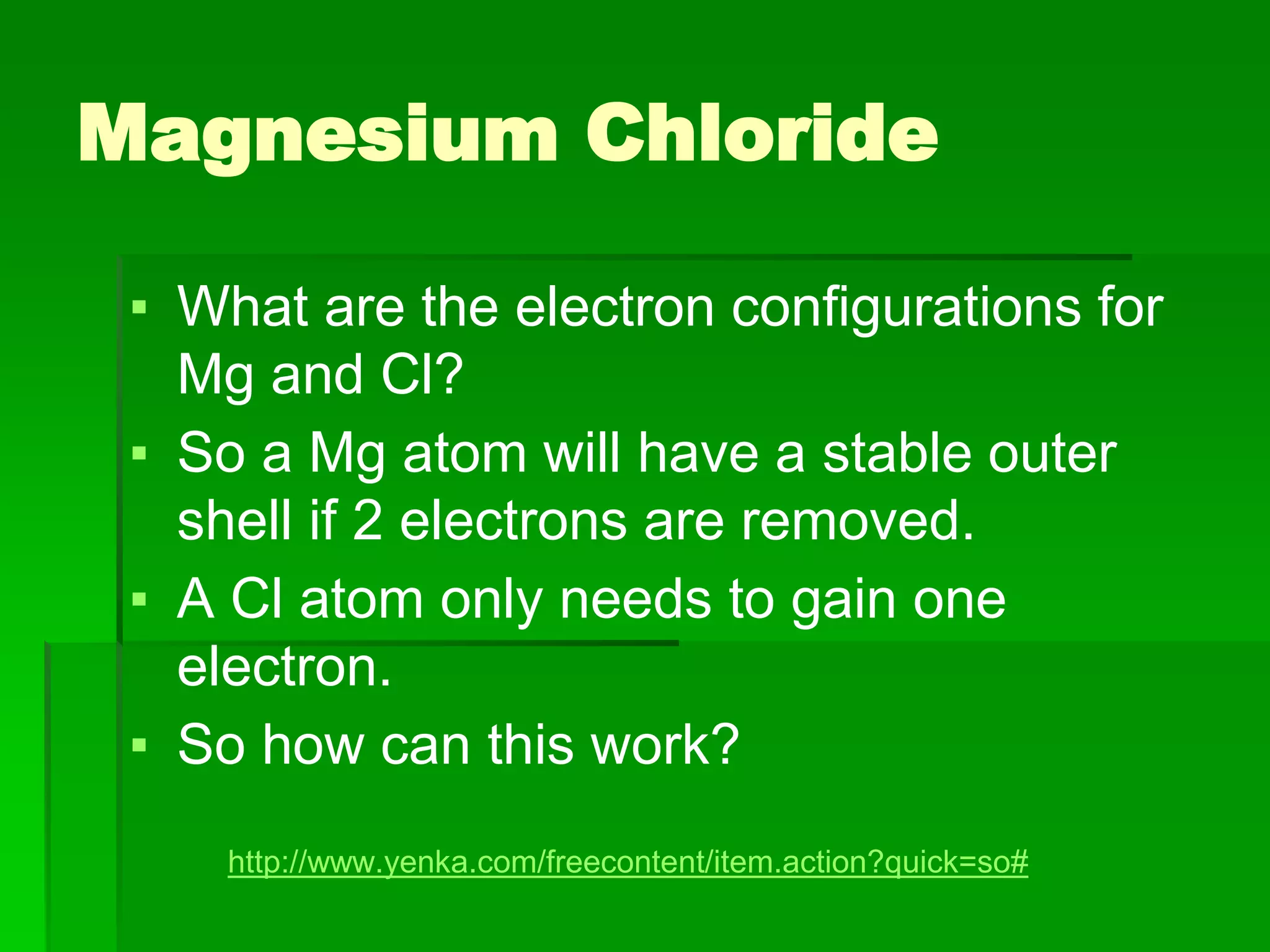
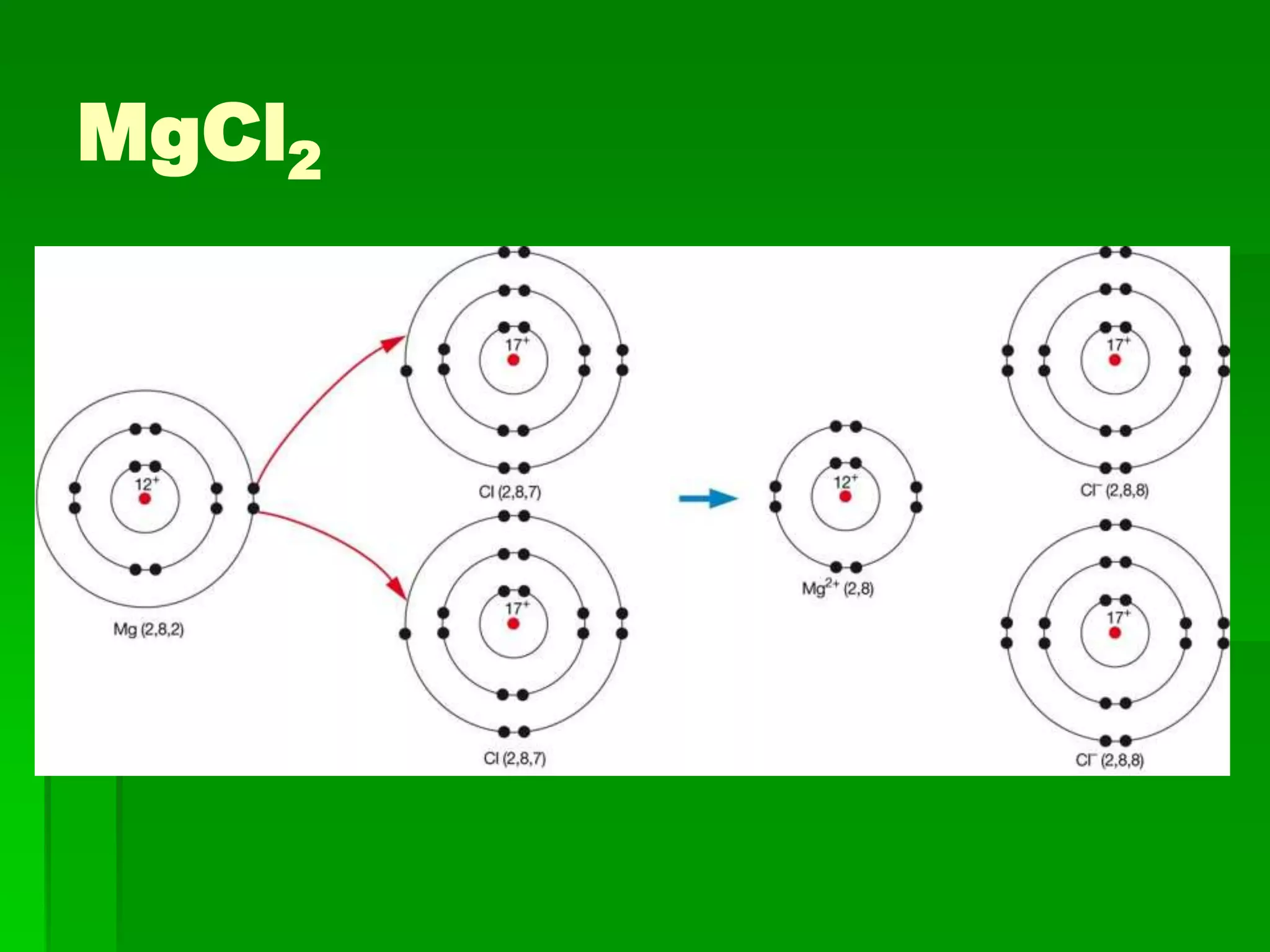
Magnesium Chloride
▪ What are the electron configurations for
Mg and Cl?
▪ So a Mg atom will have a stable outer
shell if 2 electrons are removed.
▪ A Cl atom only needs to gain one
electron.
▪ So how can this work?
http://www.yenka.com/freecontent/item.action?quick=so#
MgCl2
Chemical Formulas
▪ Almost every compound in which a metal
is combined with a non-metal displays
ionic bonding.
▪ The formulas of simple ionic compounds,
such as NaCl and MgCl2 can be
predicted from the electron configurations
of the atoms.
Electrovalencies
▪ Elements in groups 1 all have an
electrovalency of +1 (they all have only
one electron to lose)
▪ Elements in group 17 all have an
electrovalency of -1
▪ What about groups 2 and groups 16?
▪ Does this formula work for all atoms?
Writing Formulas: Rules
▪ Chemical formulas are part of the
language of chemists. To understand and
use this language, you need to follow a
number of fules.
Simple Ions
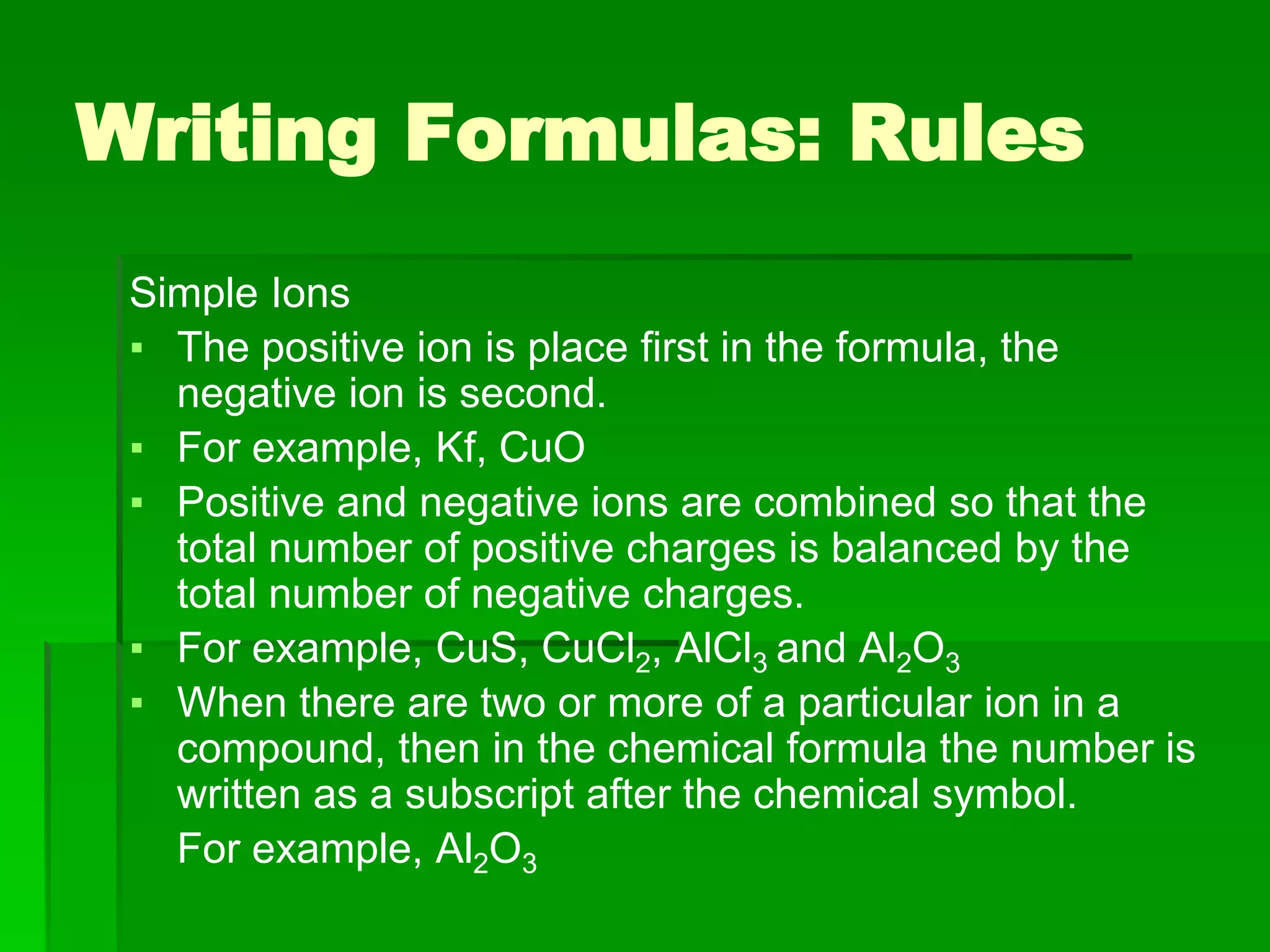
▪ The positive ion is place first in the formula, the
negative ion is second.
▪ For example, Kf, CuO
▪ Positive and negative ions are combined so that the
total number of positive charges is balanced by the
total number of negative charges.
▪ For example, CuS, CuCl2, AlCl3 and Al2O3
▪ When there are two or more of a particular ion in a
compound, then in the chemical formula the number is
written as a subscript after the chemical symbol.
For example, Al2O3
Writing Formulas: Rules
Polyatomic ions
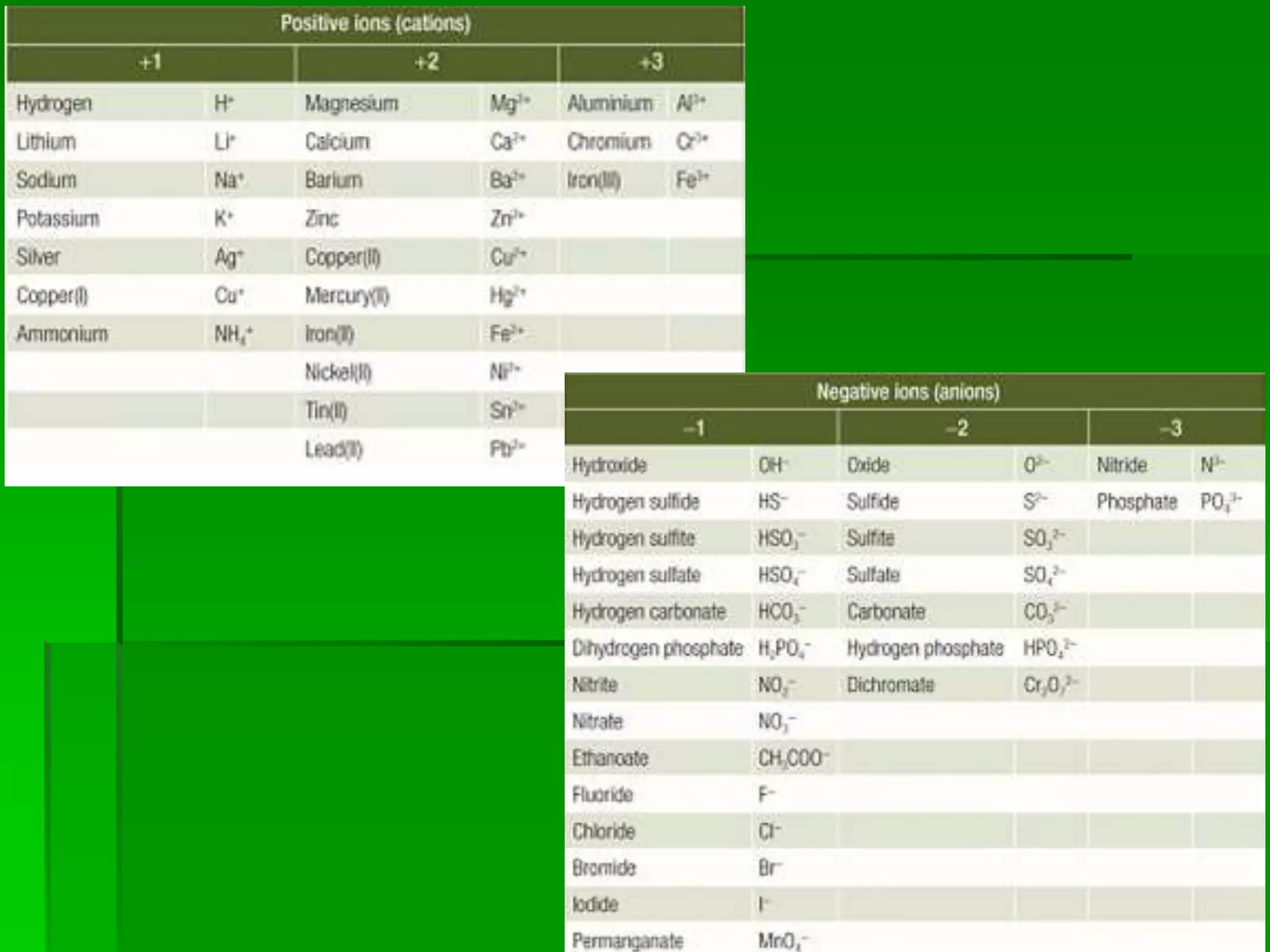
▪ Some ions contain more than one atom.
▪ These are called polyatomic ions.
▪ They include nitrate (NO3
-) and hydroxide (OH-).
What else?
▪ If more than one of these ions is used to
balance the charge of a compound, then it is
placed in brackets with the required number
written as a subscript after the brackets.
For example Mg(NO3)2 and Al(OH)3
▪ Brackets are not required for the formula of
sodium nitrate NaNO3, where there is only one
nitrate ion present for each sodium ion.
Different Electrovalencies
▪ Some elements form ions with different charges.
▪ Iron ions can have a charge of +2 or +3.
▪ In this situation you need to specify the electrovalency
when naming the compound.
▪ This is done by placing a Roman numeral representing
the electrovalency of the ion immediately after the
metal in the name of the compound.
▪ For example
▪ Iron(II) chloride contains Fe2+ ions and so the formula
is FeCl2
▪ Iron(III) chloride contains Fe3+ ions and so the forumla
is FeCl3

CH.6 (PART II) - PROPERTIES of Ionic Compounds ppt. (2022).pptx

  • 1.
  • 2.
    Ionic Compounds ▪ Ioniccompounds are made up by the chemical combination of metallic and non- metallic elements. ▪ Most rocks, minerals and gemstones are ionic compounds. ▪ Clays contain ionic compounds. ▪ While most of the above are made up of mixtures of different ionic compounds table salt is a pure ionic compound made up of sodium chloride (NaCl)
  • 3.
    I. Structure: ▪ Thephysical properties of ionic compounds are very different from metals. ▪ The structure of ionic compounds must therefore be very different from those present in metals.
  • 4.
    I. Structure: ▪ Theforces between the particles are strong. ▪ There are no free-moving electrons present, unlike in metals. ▪ There are charged particles present, but in solid state they are not free to move. ▪ When an ionic compound melts, however, the particles are free to move and the compound will conduct electricity.
  • 5.
    I. Structure: ▪ Theelectric forces in an ionic bond are strong enough to hold more than one pair of opposite ions. ▪ They can form tightly packed structures called crystals, which have a 3-D “lattice” structure of alternating anions and cations.
  • 6.
    ▪ Ionic bondsare very strong. ▪ As solids, they are very hard and brittle. ▪ Form a crystal lattice that results in a release of energy, making the resulting ionic compound (ex. salt) more stable than before. I. Structure:
  • 7.
    How many chlorineions surround each sodium ion and vice versa?
  • 8.
    I. Structure: Transferring ElectronsInvolves Energy Changes • Ionization energy is the energy absorbed in order to remove the outermost electron from an atom. • The equation below shows this process for sodium. Na + energy → Na+ + e− • With some elements, such as chlorine, energy is released when an electron is added. Cl + e− → Cl− + energy Chapter 5
  • 9.
    I. Structure: Salt FormationInvolves Endothermic Steps • The process of forming the salt sodium chloride can be broken down into five steps. 1. Energy is needed to make solid sodium a gas. Na(solid) + energy → Na(gas) 1. Energy is also required to remove an electron from a gaseous sodium atom. Na(gas) + energy → Na+(gas) + e−
  • 10.
    I. Structure: Salt FormationInvolves Endothermic Steps, continued 3. Chlorine exists as a molecule containing two chlorine atoms. Energy must be supplied to separate the chlorine atoms so that they can react with sodium. Cl–Cl(gas) + energy → Cl(gas) + Cl(gas) • To this point, the first three steps have all been endothermic. These steps have produced sodium cations and chlorine atoms.
  • 11.
    I. Structure: Salt FormationAlso Involves Exothermic Steps 4. An electron is added to a chlorine atom to form an anion. This step releases energy. Cl(gas) + e−→ Cl−(gas) + energy 4. When a cation and anion form an ionic bond, it is an exothermic process. Energy is released. Na+(gas) + Cl−(gas) → NaCl(solid) + energy • The last step is the driving force for salt formation.
  • 12.
    I. Structure: Salt FormationAlso Involves Exothermic Steps, continued • The energy released when ionic bonds are formed is called the lattice energy. • This energy is released when the crystal structure of a salt is formed as the separated ions bond. • Without this energy, there would not be enough energy to make the overall process spontaneous.
  • 13.
    I. Structure Ionic BondEnergy: ▪ Lattice Energy — the energy required to separate one mole (a chemical quantity) of ions in an ionic compound. ▪ Lattice energy is affected by— ▪ Size of the ions (the smaller the ions in bonds, the greater the lattice energy). ▪ The charge on the ions (the greater the charges in the bonds, the greater the lattice energy).
  • 14.
    II. Properties ofIonic Compounds (using sodium chloride as an example)
  • 15.
    1. High MeltingTemperature ▪ Ever noticed that when you eat fish and chips the food may be hot but the salt does not melt. ▪ This is because to melt and ionic solid energy must be provided to allow the ions to break free and move. ▪ NaCl has a high melting temp, this indicates a large amount of energy is needed to reduce the electrostatic attraction between the oppositely charged ions and allow them to move freely.
  • 16.
    2. Hardness andBrittleness ▪ Unlike metals ionic compounds are not malleable. They break when beaten. ▪ A force can disrupt the strong electrostatic forces holding the lattice in place. ▪ A sodium chloride crystal cannot be scratched easily but if a strong force (a hammer blow) is applied it will shatter. ▪ This is because the layers of ions will move relative to each other due to the force. ▪ During this movement, ions of like charge will become adjacent to each other. Resulting in repulsion
  • 17.
    Hardness and Brittleness ▪Figure 6.4 The repulsion between like charges causes this sodium chloride crystal to shatter when it is hit sharply.
  • 18.
    3. Electrical Conductivity ▪In the solid form, ions in sodium chloride are held in the crystal lattice and are not free to move so cannot conduct electricity. ▪ When the solid melts the ions are free to move. ▪ The movement of these charged particles to an electrode completes an electrical circuit. ▪ In a similar way, when sodium chloride dissolves in water, the ions separate and are free to move towards the opposite charge.
  • 19.
  • 20.
    4. Reactions ofmetals with non-metals ▪ Metallic atoms have low ionisation energies and low electronegativity. ▪ Non-metallic atoms have high ionisation energies and low electronegativity. ▪ In other words metallic atoms lose electrons easily and non-metallic atoms gain electrons easily.
  • 21.
    Ionic Compounds ▪ Sothe metal atoms lose an electron to the non-metal atoms. ▪ In doing so, both atoms will often achieve the electronic configuration of the nearest noblest gas, which is particularly stable.
  • 22.
    Sodium Chloride ▪ Whensodium reacts with chlorine: ▪ Na atom (1s2 2s2 2p6 3s1) loses an electron to become 1s2 2s2 2p6 (the same as Neon) ▪ Cl atom (1s2 2s2 2p6 3s1 3p5) gains an electron to become 1s2 2s2 2p6 3s1 3p6 (the same as argon)
  • 23.
  • 24.
    Electron Transfer Diagrams ▪ Whensodium and chloride react together sodium loses an electron and chlorine gains an electron. http://www.yenka.com/freecontent/item.action?quick=sn#
  • 25.
    Sodium Chloride What ishappening: ▪ Chlorine molecules splitting into separate chlorine atoms ▪ Electrons being transferred from sodium atoms to chlorine atoms – positively charged sodium and negatively charged chlorine ions are being formed. ▪ Sodium and chloride ions combining to form a three dimensional lattice.
  • 26.
    Notes: ▪ When anon-metal atom gains one or more electrons, the name of the negative ion ends in –ide. ▪ When a metal atom loses one or more electrons the name of the positive ion is the same as the metal and is always named first. ▪ For example: sodium chloride
  • 27.
    Electrovalency ▪ The chargeon an ion is known as its electrovalency. ▪ That is the little positive or negative number to the top right of a chemical symbol. ▪ Sodium has an electrovalency of +1 whilst chlorine has an electrovalency of -1 ▪ Na+1 and Cl-1
  • 28.
    Magnesium Oxide ▪ Whatare the electron configurations for Magnesium and Oxygen? ▪ How many electrons does magnesium need to lose to get a full outer shell? ▪ How many electrons does oxygen need to gain to get a full outer shell? ▪ Draw an electron transfer diagram. ▪ What is the electrovalency of a magnesium ion and an oxide ion?
  • 29.
    Magnesium Chloride ▪ Whatare the electron configurations for Mg and Cl? ▪ So a Mg atom will have a stable outer shell if 2 electrons are removed. ▪ A Cl atom only needs to gain one electron. ▪ So how can this work? http://www.yenka.com/freecontent/item.action?quick=so#
  • 30.
  • 31.
    Chemical Formulas ▪ Almostevery compound in which a metal is combined with a non-metal displays ionic bonding. ▪ The formulas of simple ionic compounds, such as NaCl and MgCl2 can be predicted from the electron configurations of the atoms.
  • 32.
    Electrovalencies ▪ Elements ingroups 1 all have an electrovalency of +1 (they all have only one electron to lose) ▪ Elements in group 17 all have an electrovalency of -1 ▪ What about groups 2 and groups 16? ▪ Does this formula work for all atoms?
  • 33.
    Writing Formulas: Rules ▪Chemical formulas are part of the language of chemists. To understand and use this language, you need to follow a number of fules.
  • 34.
    Simple Ions ▪ Thepositive ion is place first in the formula, the negative ion is second. ▪ For example, Kf, CuO ▪ Positive and negative ions are combined so that the total number of positive charges is balanced by the total number of negative charges. ▪ For example, CuS, CuCl2, AlCl3 and Al2O3 ▪ When there are two or more of a particular ion in a compound, then in the chemical formula the number is written as a subscript after the chemical symbol. For example, Al2O3 Writing Formulas: Rules
  • 36.
    Polyatomic ions ▪ Someions contain more than one atom. ▪ These are called polyatomic ions. ▪ They include nitrate (NO3 -) and hydroxide (OH-). What else? ▪ If more than one of these ions is used to balance the charge of a compound, then it is placed in brackets with the required number written as a subscript after the brackets. For example Mg(NO3)2 and Al(OH)3 ▪ Brackets are not required for the formula of sodium nitrate NaNO3, where there is only one nitrate ion present for each sodium ion.
  • 37.
    Different Electrovalencies ▪ Someelements form ions with different charges. ▪ Iron ions can have a charge of +2 or +3. ▪ In this situation you need to specify the electrovalency when naming the compound. ▪ This is done by placing a Roman numeral representing the electrovalency of the ion immediately after the metal in the name of the compound. ▪ For example ▪ Iron(II) chloride contains Fe2+ ions and so the formula is FeCl2 ▪ Iron(III) chloride contains Fe3+ ions and so the forumla is FeCl3