1 CHRONICLES 25 COMMENTARY
EDITED BY GLENN PEASE
The Musicians
1David, together with the commanders of the
army, set apart some of the sons of Asaph, Heman
and Jeduthun for the ministry of prophesying,
accompanied by harps, lyres and cymbals. Here is
the list of the men who performed this service:
BARNES, "The captains of the host - Rather, “the princes” of 1Ch_23:2; 1Ch_
24:6.
CLARKE, "David and the captains of the host - The chiefs of those who formed
the several orders: not military captains.
Should prophesy - Should accompany their musical instruments with prayer and
singing.
GILL, "Moreover, David and the captains of the host separated to the
service,.... Of singing the praises of God; this was done by the princes of the people, and
the chief of the priests, who were gathered together, and before whom the lots were cast,
1
both for priests and Levites, and now here for the singers, see 1Ch_22:2 and those that
were separated were
of the sons of Asaph, and of Heman, and of Jeduthun; or Ethan, the three
precentors, or chief of the singers:
who should prophesy with harps, with psalteries, and with cymbals; sing
psalms, hymns, and spiritual songs, endited by the Holy Spirit of God; which contained
in them prophecies concerning things to come, particularly relating to the Messiah, of
which there are many in the book of Psalms; and to the tunes of these they played on the
above instruments of music:
and the number of the workmen, according to their service, was; as follows.
HENRY, "Observe, I. Singing the praises of God is here called prophesying (1Ch_
25:1-3), not that all those who were employed in this service were honoured with the
visions of God, or could foretel things to come. Heman indeed is said to be the king's
seer in the words of God (1Ch_25:5); but the psalms they sang were composed by the
prophets, and many of them were prophetical; and the edification of the church was
intended in it, as well as the glory of God. In Samuel's time singing the praises of God
went by the name of prophesying (1Sa_10:5; 1Sa_19:20), and perhaps that is intended
in what St. Paul calls prophesying, 1Co_11:4; 1Co_14:24.
II. This is here called a service, and the persons employed in it workmen, 1Ch_25:1.
Not but that it is the greatest liberty and pleasure to be employed in praising God: what
is heaven but that? But it intimates that it is our duty to make a business of it, and stir up
all that is within us to it; and that, in our present state of corruption and infirmity, it will
not be done as it should be done without labour and struggle. We must take pains with
our hearts to bring them, and keep them, to this work, and to engage all that is within us.
III. Here were, in compliance with the temper of that dispensation, a great variety of
musical instruments used, harps, psalteries, cymbals (1Ch_25:1, 1Ch_25:6), and here
was one that lifted up the horn (1Ch_25:5), that is, used wind-music. The bringing of
such concerts of music into the worship of God now is what none pretend to. But those
who use such concerts for their own entertainment should feel themselves obliged to
preserve them always free from any thing that savours of immorality or profaneness, by
this consideration, that time was when they were sacred; and then those were justly
condemned who brought them into common use, Amo_6:5. They invented to
themselves instruments of music like David.
IV. The glory and honour of God were principally intended in all this temple-music,
whether vocal or instrumental. It was to give thanks, and praise the Lord, that the
singers were employed, 1Ch_25:3. It was in the songs of the Lord that they were
instructed (1Ch_25:7), that is, for songs in the house of the Lord, 1Ch_25:6. This agrees
with the intention of the perpetuating of psalmody in the gospel-church, which is to
make melody with the heart, in conjunction with the voice, unto the Lord, Eph_5:19.
V. The order of the king is likewise taken notice of, 1Ch_25:2 and again 1Ch_25:6. In
those matters indeed David acted as a prophet; but his taking care for the due and
regular observance of divine institutions, both ancient and modern, is an example to all
in authority to use their power for the promoting of religion, and the enforcing of the
2
laws of Christ. Let them thus be ministers of God for good.
VI. The fathers presided in this service, Asaph, Heman, and Jeduthun (1Ch_25:1), and
the children were under the hands of their father, 1Ch_25:2, 1Ch_25:3, 1Ch_25:6. This
gives a good example to parents to train up their children, and indeed to all seniors to
instruct their juniors in the service of God, and particularly in praising him, than which
there is no part of our work more necessary or more worthy to be transmitted to the
succeeding generations. It gives also an example to the younger to submit themselves to
the elder (whose experience and observation fit them for direction), and, as far as may
be, to do what they do under their hand. It is probable that Heman, Asaph, and
Jeduthun, were bred up under Samuel, and had their education in the schools of the
prophets which he was the founder and president of; then they were pupils, now they
came to be masters. Those that would be eminent must begin early, and take time to
prepare themselves. This good work of singing God's praises Samuel revived, and set on
foot, but lived not to see it brought to the perfection it appears in here. Solomon perfects
what David began, so David perfects what Samuel began. Let all, in their day, do what
they can for God and his church, though they cannot carry it so far as they would; when
they are gone God can out of stones raise up others who shall build upon their
foundation and bring forth the top-stone.
JAMISON, "1Ch_25:1-7. Number and office of the singers.
David and the captains of the host — that is, the princes (1Ch_23:2; 1Ch_24:6).
It is probable that the king was attended on the occasion of arranging the singers by the
same parties that are mentioned as having assisted him in regulating the order of the
priests and Levites.
K&D, "The twenty-four classes of musicians. - 1Ch_25:1. “David and the princes of
the host separated for the service the sons of Asaph,” etc. ‫א‬ ָ‫ב‬ָ‫צּ‬ ַ‫ה‬ ‫י‬ ֵ‫ר‬ָ‫שׂ‬ are not princes of
the Levite host; for although the service of the Levites is called ‫א‬ ָ‫ב‬ָ‫צ‬ ‫ֹא‬‫ב‬ ְ‫צ‬ in Num_4:23,
yet the princes of the Levites are nowhere called ‫א‬ ָ‫ב‬ָ‫צ‬ ָ‫ה‬ ‫י‬ ֵ‫ר‬ָ‫.שׂ‬ This expression rather
denotes either the leaders of the army of the chiefs of Israel, as the host of Jahve, Exo_
12:17, Exo_12:41, etc. Here it is used in the last signification, as synonymous with
princes of Israel (1Ch_23:2); in Exo_24:6 we have simply the princes, along with whom
the heads of the fathers'-houses of the priests and the Levites are mentioned. ‫ה‬ ָ‫ֹד‬‫ב‬ֲ‫ע‬ַ‫ל‬
‫יל‬ ִ‫דּ‬ ְ‫ב‬ ִ‫,ה‬ separate for the service; cf. Num_16:9. The ְ‫ל‬ in ‫ף‬ ָ‫ס‬ ָ‫א‬ ‫ֵי‬‫נ‬ ְ‫ב‬ ִ‫ל‬ is nota acc. Since
Asaph was, according to 1Ch_6:39-43, a descendant of Gershon, Heman, according to
1Ch_6:33-38, a descendant of Kohath, and Jeduthun (= Ethan) a descendant of Merari
(1Ch_6:44-47), all the chief families of Levi had representatives among the singers. The
Kethibh ‫הנביאים‬ is an orthographical error for ‫ים‬ ִ‫א‬ ְ‫בּ‬ִ‫נּ‬ ַ‫ה‬ (Keri), partic. Niph.,
corresponding to the singular ‫א‬ ָ‫בּ‬ִ‫נּ‬ ַ‫,ה‬ 1Ch_25:2 and 1Ch_25:3. ‫א‬ ָ‫בּ‬ִ‫,נּ‬ prophetare, is here
used in its wider signification of the singing and playing to the praise of God performed
in the power of the Divine Spirit. In reference to the instruments of these chief
musicians, cf. 1Ch_15:16. The suffix in ‫ם‬ ָ‫ר‬ָ‫פּ‬ ְ‫ס‬ ִ‫מ‬ refers to the following noun, which is
3
subordinated to the word ‫ר‬ָ‫פּ‬ ְ‫ס‬ ִ‫מ‬ as genitive; cf. the similar construction ‫ל‬ֵ‫צ‬ָ‫ע‬ ‫שׁ‬ ְ‫ַפ‬‫נ‬, his,
the sluggard's, soul, Pro_13:4, and Ew. §309, e. “Their number (the number) of the
workmen for the service, i.e., of those who performed the work of the service, was (as
follows).”
BENSON, "1 Chronicles 25:1. And captains — All the princes of Israel, with the
priests and the Levites, whom David gathered together (1 Chronicles 23:2) for this
very end, that, with their approbation and consent, all these things might be
established, who are here fitly called the captains of the host; for the princes were,
under David, the chief captains of the militia of the kingdom; and as the Levites are
called a host, and the Lord’s host, because of their number and order in holy
ministrations, so these priests and Levites were the captains and governors of the
rest. Separated — Distributed them into their several ranks: which, though chiefly
done by David as a prophet, and by divine direction, yet is imputed in part to the
captains of the host, because it was done with their concurrence and approbation.
The service — To the service of God, under the conduct of these persons. Who
should prophesy — Praise God by singing the psalms of David, and other sacred
songs made by themselves, who were prophets, or by other prophets or holy men of
God. The number of the workmen according to their service — Although this sacred
work of praising God is here termed service, and the persons employed in it
workmen, yet it is the greatest liberty and pleasure to be engaged in it. But the
expressions intimate that it is our duty to make a business of it, and stir up all that is
within us to it; and that in our present state of corruption and infirmity, it will not
be done, as it should be done, without labour and struggle. We must take pains with
our hearts to bring and keep them to this work, and to engage all that is within us in
it. It is probable, Heman, Asaph, and Jeduthun were bred up under Samuel, and
had their education in the schools of the prophets, of which he was the founder and
president. Then they were pupils, now they come to be masters. Those that would be
eminent must begin early and take time to prepare themselves. This good work, of
singing God’s praises, Samuel revived and set on foot, but lived not to see it brought
to the perfection in which it appears here. Solomon perfects what David began. So
David perfects what Samuel began. Let each in their day do what they can for God
and his church, though they cannot carry it so far as they would; when they are
gone, God can out of stones raise up others, who shall build upon their foundation,
and bring forth the top-stone.
COFFMAN, "DAVID'S INSTRUMENTALISTS AND SINGERS;
4
"Who should prophesy with harps, psalteries, etc."; 1 Chronicles 25:1. The Good
News Bible probably has the correct meaning here: "They were to proclaim God's
messages accompanied by the music of harps and cymbals."
COKE, "1 Chronicles 25:1. Should prophesy— 1:e. Sing prophesies or sacred
hymns, composed by the prophets, in the temple of God. See Numbers 11:25. The
captains of the host, at the beginning of this verse, is rendered very properly by
Houbigant, the chiefs, or heads of the orders in the ministry; those priests, whom
David had lately appointed and divided into four-and-twenty classes; and not, as
some have absurdly supposed, the commanders of the army, who certainly could
have nothing to do with the appointment of singers for the temple. In the third verse
the sons of Jeduthun are said to be six, though five only are enumerated. Shimei,
mentioned in the 17th verse, is supplied in the Arabic version.
ELLICOTT, "THE TWENTY-FOUR CLASSES OF SINGERS, OR MINSTRELS.
(1) Moreover (and) David and the captains of the host.—The latter (“the princes” of
1 Chronicles 24:6), were also concerned in the arrangement of the priestly classes (1
Chronicles 23:2).
Separated to the service of the sons of Asaph.—Rather, separated for service the
sons of Asaph, and Heman, and Jeduthun. These formed three guilds of sacred
minstrels, famous to all after times. (Comp. the headings of many psalms in which
these names occur, and also 1 Chronicles 6:33, sqq., whence it appears that Asaph
belonged to the sub tribe of Gershon, Heman to that of Kohath, and Ethan-
Jeduthun to that of Merari, so that all the branches of Levi were represented among
the musicians.)
Separated.—So Numbers 16:9, and Genesis 1:7. (Comp Acts 13:2.)
Who should prophesy with harps.—In Hebrew, the verb to prophesy is a reflexive
form, implying utterance under a spiritual influence. The ancients regarded musical
5
utterance as an effect and proof of direct inspiration, and we still speak of the higher
results of genius as inspired, however we may choose to explain the term away as a
mere figure of speech. The power of moving sounds, whether of voice or instrument,
is not to be gained by mere study or training; it is commonly spoken of as a “gift,”
and its products are called “inspirations.” Whence come they, if not from the Divine
source of life, and of all that makes life glad and beautiful? (James 1:17; 1 Samuel
10:5; 1 Samuel 16:16; 1 Samuel 18:10).
Harps, with psalteries.—Lutes and harps.
And the number of the workmen according to their service was.—Literally, And the
number of them—that is, of the men of work—for their service proved (as follows).
Men of work.—A remarkable appellation. The term “work” is popularly restricted
to what is called productive labour, but it is not difficult to see that persons engaged,
like these minstrels, in singing and playing to the praise of God are actually helping
to produce one of the best of real results, viz., the conservation of the religious spirit:
that is, of the right attitude of man towards the Power upon whom his entire welfare
absolutely depends.
PARKER, ""Moreover David and the captains of the host [rather, "the princes" the
same persons who are mentioned in 1 Chronicles 23:2, and 1 Chronicles 24:6]
separated to the service of the sons of Asaph, and of Heman, and of Jeduthun, who
should prophesy [rather, "divided for the service the sons of Asaph, etc, who
prophesied." By prophesying is probably meant public recitation of the sacred
services (see 1 Chronicles 24:3)] with harps, with psalteries, and with cymbals" ( 1
Chronicles 25:1).
Let us analyse these indications. We want warriors; there is not one in this list: we
need builders; there is not a man in the catalogue that ever built anything that could
be seen or valued arithmetically: we want legislators, men who can make duty
mysterious, and dissolve responsibility in polysyllables; there is no such erratic
genius in this guild. Whom have we? Prophets; for the word is "prophesy," and to
6
prophesy means in this connection to teach, to reveal doctrines, to indicate duty, to
exhort to service, to reveal the will and purpose of heaven. With what apparatus are
these men furnished? Harps, psalteries, cymbals. They were known amongst their
fellows as a guild of sacred minstrels. When a man prophesies he utters under a
spiritual influence. We do not know how much we are indebted to music. He would
be the most combative man that ever lived who would fight with a tune; the tune
will not fight. There are atheists who have shed tears under the influence of what is
known as sacred music. Then they were not far from the kingdom of God: they were
only atheists argumentatively. How many men have committed suicide by the razor
of logic! They were never meant to be logicians. When you see a man take hold of a
razor you do not exhort him to be careful, because you know that he can handle it
wisely; but if you saw a little child open a case and take out a razor, how you would
exclaim, how you would rush to the rescue; how you would deprecate the audacity
of the thoughtless little creature! It is even so with the Church. There are some
infants we cannot keep away from the razor-case: if they would only take their seat
within one inch of the organ they might be saved. How are these musicians
described in the verse? They are described by a word which some men would
begrudge; they are described as "the workmen." It should be put more vividly than
this, namely, "the men working." But is music work? Certainly. Is a song a
sacrifice? Yes, if sung with the whole heart. He labours who toils with his hands.
Probably, but not he only. He labours who gives his brain away, who imparts to
others the fragrance of his love, who makes the world welcome to all the hospitality
of his prayers. He is a labourer who puts things into sweet musical rhyme for us.
Sometimes we get our children to persuade themselves that they are enjoying an
amusement when they are learning, in fact, the multiplication table, through the
medium of rhyme. Children who would abhor the multiplication table if it were set
before them nakedly would come up to it quite loving and sympathetically if they
might sing it all through. So there are men who help to sing us into our duties, and
who help us to sing in the discharge of those duties, and who show us, by a
mysterious power given to them of God, that all work should blossom into play, all
service should find its fruition in song. There are those who have distinguished
between sacred music and secular music. What a marvellous faculty of analysis such
men must have! There are those who talk about sacred and profane history. By what
right do they so talk? What history is profane? Is there anything profane that
belongs to the development of humanity, the cultivation of the total nature of man?
Are we to attach a stigma to the study of history, to the perusal of those documents
and records which testify to the progress of all manner of human thought? There
are persons who can sing bad common metre in the church, and think it pious;
whereas they could not listen to a sweet domestically beautiful song in church
without a shudder. The only thing to be done with such is to let them shudder. We
7
must see to it that the religious spirit is maintained, and nothing can maintain it so
healthily as music. To think that the enemy has all the brass bands but about a
dozen! whereas the church ought to have every one, and he ought to be considered a
thief who plays anything on an instrument that could not be played in the church.
There was music in the Old Testament sanctuary; men praised the Lord loudly and
sweetly in the ancient time.
GUZIK, '1 CHRONICLES 25 - MUSICIANS FOR THE TEMPLE
A. The musicians for the temple.
1. (1 Chronicles 25:1) Musicians separated for service.
Moreover David and the captains of the army separated for the service some of the
sons of Asaph, of Heman, and of Jeduthun, who should prophesy with harps,
stringed instruments, and cymbals. And the number of the skilled men performing
their service was:
a. David and the captains of the army separated for the service: Interestingly, the
captains of the army took part in the selection and organization of the musicians or
“worship leaders” for Israel. David sensed a connection between the security of the
kingdom and the worship and honoring of God.
i. “Chapter 25 concerns David’s organization of the four thousand Levitical
musicians (1 Chronicles 23:5) into courses of service that correspond to those of the
priests and temple Levites (chapter 24).” (Payne)
ii. “David did give high regard to the counsel of his military commanders (1
Chronicles 11:10; 1Ch_12:32; 1Ch_28:1), even in liturgical affairs (cf. 1 Chronicles
13:1; 1Ch_15:25).” (Payne)
8
b. Who should prophesy with harps, stringed instruments, and cymbals: Their
service was connected with the dynamic of prophesy in the sense that it was inspired
by God. Their ministry in music was not merely the product of good musicianship; it
was a gift of the Holy Spirit being exercised through them.
i. “This work of praise is thrice described by a somewhat singular, and, in this
connection, arresting word, ‘prophecy.’ The use of this word here is a revelation of
the true value of the service of music in the sanctuary of God.” (Morgan)
ii. “Either they supplied messages direct from God in the manner of the classical
prophets, for which the Levite Jahaziel (2 Chronicles 20:14-17) provides an obvious
analogy, or their praise was itself seen as ‘prophecy’ in that it proclaimed God’s
word with God’s authority.” (Selman)
POOLE, "The number and offices of the singers out of the sons of Asaph, Heman,
and Jeduthun, 1 Chronicles 25:1-7. Their division by lot into twenty-four orders, 1
Chronicles 25:8-31
The captains of the host; both of the civil and sacred host, to wit, all the princes of
Israel, with the priests and the Levites, whom David gathered together, 1 Chronicles
23:2, for this very end, that in their presence, and with their approbation and
consent, all these things might be established; who are here fitly called the captains
of the host; for the princes were, under David, the chief captains or commanders of
the militia or trained bands of the kingdom: and as the Levites are called a host, and
the Lord’s host, Numbers 4:3, and elsewhere, because of their number and order in
holy ministrations; so these priests and Levites were the captains and governors of
the rest. Separated, i.e. distributed them into their several ranks and orders; which,
though chiefly done by David as a prophet, and by Divine direction, as hath been oft
observed, yet is here imputed in part to the captains of the host, because it was done
with their concurrence and approbation. To the service of the sons of Asaph, &c, i.e.
to the service of God under the conduct and command of these persons. Who should
prophesy, i.e. praise God by singing the Psalms of David, (of which See Poole "1
Chronicles 16:7",) and other sacred songs made by themselves, who were prophets
9
in some sort, or by other prophets or holy men of God. Or this action of theirs is
called prophesying, because it had been formerly performed by the prophets; and
the sons of the prophets; of which see 1 Samuel 10:5 19:20 2 Kings 3:15 1 Chronicles
15:19. The number of the workmen; of the persons employed in this sacred work.
PULPIT, "The twenty-four courses of those who were to be engaged in the temple
service as singers and musicians fill up this chapter. They are to be taken from the
three great families of Asaph, Heman, and Jeduthun. For the captains of the host, as
designating those who superintended the order of temple worship, see 1 Chronicles
22:17; 1 Chronicles 23:2; 1 Chronicles 24:6; as also Numbers 4:3; Numbers 8:23.
The sons of Asaph. (For a clear instance of the use of the preposition (lamed)
prefixed, as here, see Ezra 8:24.) The English should appear "the sons of Asaph."
Asaph, Heman, and Jeduthun belonged respectively to the Gershon, Kohath, and
Merarite families (1 Chronicles 6:18-32). Thus these singers and musicians were
drawn from each great branch of Levi; viz. from Gershon, four through Asaph;
from Kohath, six through Jeduthun; and from Merari, fourteen through Heman;
while the whole number of those trained to sing was two hundred and eighty-eight.
Who should prophesy. The Hebrew ‫ים‬ ִ‫א‬ ְ‫בּ‬ ִ‫גּ‬ַ‫ה‬ (Jeremiah 14:14, Jeremiah 14:16) stands
for Niphal participle plural, the singular of which ( ‫א‬ָ‫נּבּ‬ַ‫ח‬ ) appears in the following
two verses. These were the utterers in song of the Divine mind and will. The
essential meaning of the expression evidently is to use the voice in sacred service,
more or less under Divine impulse. With cymbals. These instruments were used to
regulate the time (compare this verse with 1 Chronicles 13:8). For some particulars
respecting these and other musical instruments used in Israel at this time, the article
"Music" in Smith's 'Bible Dictionary' may be consulted with advantage. And the
number, etc. The literal translation of the last clause of this verse is, And was their
number, the men of work, for their service, i.e. "And the number of workmen for
the service was." The workmen intend, of course, those who performed the service.
2 From the sons of Asaph:
Zakkur, Joseph, Nethaniah and Asarelah. The
sons of Asaph were under the supervision of
10
Asaph, who prophesied under the king’s
supervision.
BARNES, "Under the hands of Asaph ... - That is to say, “under the direction of
Asaph” - who himself “prophesied,” or performed the sacred services, “under the
direction of the king.”
CLARKE, "Which prophesied - Sung hymns and prayed. But the Targum
understands this of prophesying in the proper sense of the term; and therefore says,
“Who prophesied by the Holy Spirit.” Jarchi is of the same opinion and quotes the case
of Elisha, 2Ki_3:15; While the minstrel played, the hand of the Lord [i.e., the spirit of
prophecy] was upon him.
GILL, "Of the sons of Asaph,.... Who were separated, and by lot appointed, to the
service of singers in the temple:
Zaccur, and Joseph, and Nethaniah, and Asarelah; called Jesharelah, 1Ch_
25:14, these had the third fourth, fifth, and seventh lots, 1Ch_25:9,
under the hands of Asaph; under his instruction and authority:
which prophesied according to the order of the king; which Asaph composed
psalms under the inspiration of the Spirit of God, and was ordered by King David to sing
them, and by whose command they were inserted in the book of Psalms, where they now
stand with his name to them.
JAMISON, "according to the order of the king — Hebrew, “by the hands of the
king,” that is, “according to the king’s order,” under the personal superintendence of
Asaph and his colleagues.
which prophesied — that is, in this connection, played with instruments. This
metaphorical application of the term “prophecy” most probably originated in the
practice of the prophets, who endeavored to rouse their prophetic spirit by the
animating influence of music (see on 2Ki_3:15). It is said that Asaph did this “according
to David’s order,” because by royal appointment he officiated in the tabernacle on Zion
(1Ch_16:37-41), while other leaders of the sacred music were stationed at Gibeon.
11
K&D 2-3, "With ‫ף‬ ָ‫ס‬ ָ‫א‬ ‫ֵי‬‫נ‬ ְ‫ב‬ ִ‫ל‬ the enumeration beings: “Of Asaph's sons were, or to
Asaph's sons belonged, Zacchur,” etc. Four are here named, but the number is not
stated, while it is given in the case of the sons of Jeduthun and Heman, 1Ch_25:3 and
1Ch_25:5. ‫ַד‬‫י‬‫ל־‬ַ‫,ע‬ at the hand, alternates with ‫י‬ ֵ‫ד‬ְ‫ל־י‬ַ‫ע‬ (1Ch_25:3 and 1Ch_25:6), and
‫ף‬ ָ‫ס‬ ָ‫א‬ ‫ַד‬‫י‬ ‫ל‬ַ‫ע‬ does not of itself express a different relationship to Asaph than that expressed
by ֶ‫ל‬ ֶ‫מּ‬ ַ‫ה‬ ‫י‬ ֵ‫ד‬ְ‫י‬ ‫ל‬ַ‫ע‬ with reference to the king. It signifies only “under (according to) the
direction of;” and in 1Ch_25:6 the king, Asaph, Jeduthun, and Heman are co-ordinated,
inasmuch as the musical part of the worship was arranged by David and the three chief
musicians in common, although only the latter were concerned in its performance. In
1Ch_25:3 ‫ידוּתוּן‬ ִ‫ל‬ is placed at the beginning, because the choir of singers led by him bore
his name; and so also in the case of Heman, 1Ch_25:4. “As to Jeduthun, were sons of
Jeduthun.” The word sons in these catalogues denotes not merely actual sons, but those
intellectually sons, i.e., scholars taught by the master. This is clear from the fact that the
twenty-four classes, each of which numbered twelve men, consist of sons and brothers of
the leaders. The names given as those of the sons of Asaph, Jeduthun, and Heman, in
1Ch_25:2-5, do not represent the whole number of the scholars of these masters, but
only the presidents of the twenty-four classes of Levites who were engaged under their
leadership in performing the sacred music. Only five sons of Jeduthun are named in our
text, while according to the number given there should be six. A comparison of the
names in vv. 9-31 shows that in 1Ch_25:3 the name ‫י‬ ִ‫ע‬ ְ‫מ‬ ִ‫שׁ‬ (1Ch_25:17) has been dropped
out. ‫ר‬ ‫נּ‬ ִ‫כּ‬ ַ‫בּ‬ belongs to ‫דוּתוּן‬ְ‫:י‬ under the direction of their father Jeduthun (the master),
upon the kinnor (see on 1Ch_15:16), who was inspired to sing praise, i.e., who played
inspiredly to bring praise and honour to the Lord; cf. 1Ch_16:4; 1Ch_23:30, etc.
BENSON, "Verse 2-3
1 Chronicles 25:2-3. Under the hands of Asaph — Under his oversight and direction.
According to the order of the king — In such manner and order as David appointed.
The sons of Jeduthun, six — Jeduthun, their father, being included in that number;
or Shimei, mentioned 1 Chronicles 25:17.
ELLICOTT, " (2) Of the sons of Asaph; Zaccur.—Literally, To the sons of Asaph
belonged Zaccur. In 1 Chronicles 25:2-7 the term “sons” appears to mean trained
members of the musical guilds, of which the three chiefs, Asaph, Heman, and
Jeduthun, were masters.
Asarelah.—This singular name is spelt “Jesharelah” in 1 Chronicles 25:14. Ewald
identifies it with “Israel,” the unaccented ending ah having the force belonging to—
12
literally, towards, unto—so that Jesharelah is in effect the modern Jewish surname
Israels. (Comp. “Jaakobah,” 1 Chronicles 4:36, to Jacob, i.e., Jacobs.)
Under the hands of Asaph.—Rather, at the hand of Asaph. It is implied that the four
leaders here named were subordinate to Asaph, and under his direction. (Comp. 1
Chronicles 25:3; 1 Chronicles 25:6; 2 Chronicles 23:18; 2 Chronicles 29:27; Ezra
3:10.)
Which prophesied according to the order of the king.—Literally (Asaph), who
prophesied (or should prophesy, the participle, as in 1 Chronicles 25:1) at the hands
of the king: that is, either according to the royal arrangements (2 Chronicles 23:18),
under David’s own appointment, or under the royal direction.
Prophesied.—That is, made music. (See 1 Chronicles 25:1.)
guzik, "2. (1 Chronicles 25:2-6) The sons of Asaph, Jeduthun, and Heman.
Of the sons of Asaph: Zaccur, Joseph, Nethaniah, and Asharelah; the sons of Asaph
were under the direction of Asaph, who prophesied according to the order of the
king. Of Jeduthun, the sons of Jeduthun: Gedaliah, Zeri, Jeshaiah, Shimei,
Hashabiah, and Mattithiah, six, under the direction of their father Jeduthun, who
prophesied with a harp to give thanks and to praise the LORD. Of Heman, the sons
of Heman: Bukkiah, Mattaniah, Uzziel, Shebuel, Jerimoth, Hananiah, Hanani,
Eliathah, Giddalti, Romamti-Ezer, Joshbekashah, Mallothi, Hothir, and Mahazioth.
All these were the sons of Heman the king’s seer in the words of God, to exalt his
horn. For God gave Heman fourteen sons and three daughters. All these were under
the direction of their father for the music in the house of the LORD, with cymbals,
stringed instruments, and harps, for the service of the house of God. Asaph,
Jeduthun, and Heman were under the authority of the king.
a. Asaph, who prophesied according to the order of the king: 12 Psalms are
13
attributed to Asaph (Psalms 50 and Psalms 73 through 83).
b. Jeduthun, who prophesied with a harp to give thanks and to praise the LORD:
Jeduthun’s music ministry was so inspired by the Spirit of God that it could be said
that he prophesied with a harp.
c. Heman the king’s seer: “He is called the king’s seer, either because the king took
special delight in him, or because he frequently attended upon the king in his palace,
executing his sacred office there, while the rest were constantly employed in the
tabernacle.” (Poole)
d. Asaph, Jeduthun, and Heman were under the authority of the king: These
enormously talented and Spirit-anointed men knew how to submit themselves under
the leadership of David, under the authority of the king.
i. We note the prominent place of the sons of Heman, and that all these were under
the direction of their father for the music in the house of the LORD. “How one
would like to have seen Heman coming into the Temple with his children! It was
largely owing to him and their mother that they were what they were.” (Meyer)
ii. Under the direction of their father: “Heman’s children were ‘under the hands of
their father.’ Young people must not get the upper hand.” (Meyer)
iii. Yet we also see that Heman was among those under the authority of the king.
“But if you would rule well, you must obey. Asaph, Heman, and Jeduthun, were
under the king. The man who is himself under authority, can say, Go, come, do this
or that, with the calm assurance of being obeyed.” (Meyer)
PULPIT, "Four sons of Asaph are hero given, the number, however, not being ex.
pressed, although it is expressed in the cases of Jeduthun and Heman (1 Chronicles
25:3, 1 Chronicles 25:5). "For Asaph," we find twelve psalms inscribed, viz. Psalms
14
1:1-6.; 73-83.; of some of which he was himself the inspired composer. When it is
said "for Asaph," the meaning is for those "under his hand," or direction, and who
as a band bore his name, and performed among other odes those which he
prophesied. Zaccur. A descendant after the Return is mentioned in Nehemiah 12:35.
Asarelah. This last of the four sons of Asaph is called in Nehemiah 12:14,
Jesharelah. Under the hands of… according to the order of. The Hebrew words are
"to the hand of" and "to the hands of." Between the signification of these two
forms, the one expressed in the singular number and the ether in the plural, there
does not seem to be any distinction, and accordingly they might be better translated,
under the direction of… under the directions of. The latter form is that found in
Nehemiah 12:3, Nehemiah 12:6.
3 As for Jeduthun, from his sons:
Gedaliah, Zeri, Jeshaiah, Shimei,[a] Hashabiah
and Mattithiah, six in all, under the supervision of
their father Jeduthun, who prophesied, using the
harp in thanking and praising the Lord.
CLARKE, "The sons of Jeduthun - six - That is, six with their father, otherwise,
there are but five. Hence it is said, they were under the hands of their father Jeduthun,
who prophesied with a harp, etc.
GILL, "Of Jeduthun,.... Or Ethan, the sons of Jeduthun:
Gedaliah and Zeri; called Izri, 1Ch_25:11,
and Jeshaiah, Hashabiah, and Mattithiah, six; whereas five only are mentioned;
it may be thought that Shimei, 1Ch_25:17 is the sixth, he not being mentioned
15
elsewhere; it is a tradition of the Jews, that his mother was now with child of him, and it
being foreseen by the Holy Spirit that he would be the chief of a course, the number six
is given, as Jarchi observes; but rather, as Kimchi, he was young, and not fit to sing, yet
was chosen the head of a course, until he was grown up and fit for it; to these six came
up the second, fourth, eighth, twelfth, fourteenth, and tenth lots, 1Ch_25:9 and these
were under the hands of their father Jeduthun; to instruct and direct them, and
appoint their service to them:
who prophesied with a harp; or sung a prophetic psalm or hymn on that:
to give thanks, and to praise the Lord; for what he had done and promised, and
foretold he would do for his people.
ELLICOTT, " (3) Of Jeduthun: the sons of Jeduthun.—Rather, To Jeduthun (i.e.,
belonging to the guild so called): the sons of Jeduthun were Gedaliah, &c.
Zeri.—The “Izri” of 1 Chronicles 25:11 is probably right. (Comp. Numbers 26:49.)
The error here is as old as the ancient versions.
Six.—Only five names are now read in the text; that of “Shimei” (1 Chronicles
25:17) has fallen out, the only name in 1 Chronicles 25:9-31 which does not occur in
1 Chronicles 25:2-4. The Alex. LXX. inserts the name between Jeshaiah and
Hashabiah.
Jeshaiah.—Elsewhere spelled Isaiah.
Under the hands (see last verse) of their father Jeduthun, who prophesied with a
harp.—Literally, according to the Hebrew punctuation, at the hands of their father
Jeduthun, with the lute (i.e., provided with lutes, 1 Chronicles 15:16), who
prophesied (or was to prophesy) for giving thanks and praise to Jehovah. (Comp. 1
Chronicles 16:4).
At the hands of their father.—Under the direction of their conductor.
16
PARKER, ""Of Jeduthun: the sons of Jeduthun; Gedaliah, and Zeri, and Jeshaiah,
Hashabiah, and Mattithiah, six" ( 1 Chronicles 25:3).
There are not six, there are only five: where is the sixth? When an arithmetical
number is put before us we are entitled to begin counting. "Of Jeduthun: the sons of
Jeduthun; Gedaliah, and Zeri, and Jeshaiah, Hashabiah, and Mattithiah,"—five.
But the Chronicler says there were six. Then why did he not write six names down?
We are entitled to inquire always for the missing man. Woe unto that shepherd who
allows one little lamb to go, and not trouble about him: woe to that friend who can
allow one of his comrades to fall out of the ranks, and never ask a question about his
doom. How was the sixth name omitted? By a clerical error? Then we should find it
again. It is of small consequence to be omitted by the clerk; the clerk is not almighty.
It is of small account that our name be not found on the record of the visible church
because some careless writer has omitted to inscribe it there. Has he gone out of the
list by proved incapacity? Could he not play the harp? Did he make a false noise
with the cymbals? Let us ask the question. Has he gone out by moral lapse? Was the
fool caught in some snare, the existence of which he did not suspect? Was he
treading in dangerous paths, and seized by a ruffian hand, when he ought to have
kept near the altar and found his security at home? We cannot tell. In this instance,
the sixth man was found again. He is omitted from verse number three, but he is
found in verse number seventeen. Do lists dwindle? Do friends grow fewer? They
may grow fewer in one sense, and yet may be stronger in another, they may be but
transplanted. The dead are not lost; they love the twilight, they can unfold
themselves in shadows, they can speak through dreams; call not those dead who
have gone up to be ennobled and crowned.
Regarding these six men we read of them still in verse three, as "under the hands of
their father." The picture is a lovely one. It is that of six sons being conducted in
musical exercise by their father. Let the picture shape itself vividly to the mental eye:
six sons, with harps, psalteries, and cymbals, and the father conducting, educating,
keeping them together, making all the sounds one, reconciling all the exercise into
one blessed harmony. What is a father for if he is not to be a conductor? Some
fathers are too separate from their families. What is a pastor to be if not a
conductor? and what are children for if they set up for themselves on a basis of
absolutely foolish independence? The inquiry is a two-edged sword: take care how
17
you lift it up, for it is a dangerous weapon.
POOLE, "The sons of Jeduthun, or, his sons, (the construct form being used before
the absolute, of which there are examples in Scripture,) Jeduthun, called by his
father’s name; otherwise they are not six, unless either Jeduthun their father be
included in that number, or Shimei, mentioned 1 Chronicles 25:17, be one of them,
as many learned men think. See the like, 1 Chronicles 24:23.
PULPIT, "Six sons are here said to be under the direction of Jeduthun (or Ethan, 1
Chronicles 6:44). The name missing is Shimei, supplied by 1 Chronicles 25:17, and
which the Alexandrine Septuagint places fourth in this list. This is clear from the list
of 1 Chronicles 25:9-31, which contains all the same names as are found in the
present 1 Chronicles 25:2-4, and one more, Shimei, which therefore offers to supply
the place vacant here. The name Zeri reappears in 1 Chronicles 25:11 as Izri. Who
prophesied (see headings to Psalms 39:1-13.; 62.; 77.: we do not know, however, that
Jeduthun composed any of these, nor does the word "prophesy" necessitate it).
4 As for Heman, from his sons:
Bukkiah, Mattaniah, Uzziel, Shubael and
Jerimoth; Hananiah, Hanani, Eliathah, Giddalti
and Romamti-Ezer; Joshbekashah, Mallothi,
Hothir and Mahazioth.
GILL, "Of Heman: the sons of Heman,.... The third chief singer:
18
Bukkiah, Mattaniah, Uzziel; the same with Azareel, 1Ch_25:18.
Shebuel; called Shubael, 1Ch_25:20.
and Jerimoth, Hananiah, Hanani, Eliathah, Giddalti, and Romamtiezer,
Joshbekashah, Mallothi, Hothir, and Mahazioth; in all fourteen, to whom came
the sixth, ninth, eleventh, fifteenth, sixteenth, eighteenth, twentieth, twenty second,
twenty fourth, seventeenth, nineteenth, twentieth, and twenty third lots, 1Ch_25:13.
K&D 4-5, "Fourteen sons of Heman are enumerated. ‫ֶר‬‫ז‬ֶ‫ע‬ ‫י‬ ִ‫תּ‬ ְ‫מ‬ ַ‫מ‬ֹ‫ר‬ is one name, cf. 31,
although ‫ֶר‬‫ז‬ֶ‫ע‬ is without doubt to be supplied also after ‫י‬ ִ‫תּ‬ ְ‫ל‬ ַ‫דּ‬ִ‫.גּ‬ Probably also ‫ת‬ ‫יא‬ִ‫ז‬ֲ‫ח‬ ַ‫מ‬ is
to be supplied in thought after the names. ‫י‬ ִ‫ת‬ ‫ל‬ ַ‫,מ‬ I made full, and ‫יר‬ ִ‫ת‬ ‫,ה‬ increased.
(Note: On these names Ewald ways, ausf. Lehrb. der Hebr. Sprache, §274, S. 672,
der 7 Ausg.: “It is thought that the utterance of a great prophet is to be found cut up
into names of near relatives, when the words,
‫ֶר‬‫ז‬ֶ‫ע‬ ‫י‬ ִ‫תּ‬ ְ‫מ‬ ַ‫מ‬ֹ‫ר‬ ‫י‬ ִ‫תּ‬ ְ‫ל‬ ַ‫דּ‬ִ‫גּ‬
‫ת‬ ‫יא‬ִ‫ז‬ֲ‫ח‬ ַ‫מ‬ ‫יר‬ ִ‫ת‬ ‫ה‬ ‫י‬ ִ‫ת‬ ‫ל‬ ַ‫מ‬
'I have given great and lofty help,
I have to fulness spoken oracles,'
which manifestly form a verse, and may have been the commencement of a famed
ancient oracle, are found transferred to the five musical sons of Heman,
Giddalti(ezer), Romamtiezer, Mallothi, Hothir, and Machazioth.”)
Heman is called in 1Ch_25:5 the seer of the king in the words of God, because he,
along with his gift of song, was endowed also with the prophetic gift, and as seer made
known to the king revelations of God. In 2Ch_35:15 the same thing is predicated also of
Jeduthun, and in the same sense the prophet Gad is called in 1Ch_21:9 David's seer. ‫ן‬ ֶ‫ר‬ ֶ‫ק‬
‫ים‬ ִ‫ר‬ ָ‫ה‬ ְ‫ל‬ the Masoretes have connected with the preceding, by placing Athnach under the
‫,קרן‬ and the phrase has been wholly misunderstood by the Rabbins and Christian
commentators. Berth., e.g., connects it with ‫ים‬ ִ‫ה‬ ֱ‫א‬ ָ‫ה‬ ‫י‬ ֵ‫ר‬ ְ‫ב‬ ִ‫ד‬ ְ‫,בּ‬ and translates, “to sound
loud upon horns, according to the divine command,” referring to 2Ch_29:15, where,
however, both meaning and accentuation forbid us to connect ‫יהוה‬ ‫י‬ ֵ‫ר‬ ְ‫ב‬ ִ‫ד‬ ְ‫בּ‬ with what
follows. This interpretation of the words is thoroughly wrong, not only because the
Levites under Heman's direction did not blow horns, the horn not being one of the
instruments played by the Levites in connection with the worship, but also because on
linguistic grounds it is objectionable. ‫ן‬ ֶ‫ר‬ ֶ‫ק‬ ‫ן‬ ֶ‫ר‬ ֶ‫ק‬ ‫ים‬ ִ‫ר‬ ֵ‫ה‬ .el never has the signification to
blow the horn; for to elevate the horn signifies everywhere to heighten the power of any
one, or unfold, show power; cf. 1Sa_2:10; Lam_2:17; Psa_148:14; Psa_89:18; Psa_92:11,
etc. That is the meaning of the phrase here, and the words are to be connected,
according to their sense, with what follows: “to elevate the horn,” i.e., to give power, God
gave Heman fourteen sons and three daughters; i.e., to make Heman's race mighty for
the praise of God, God gave him so many sons and daughters.
19
ELLICOTT, " (4) Of Heman.—Rather, To Reman: the sons of Heman were, &c.
Fourteen names of Hemanite leaders are given. Curiously enough, the last six,
excluding the peculiar “Joshbekashah,” form, as they stand, a complete poetical
couplet, which may be rendered:
“God has come; I have exalted and extolled the help;
I have spoken abundance of visions.”
Such words are very suitable in the mouth of a seer, as Heman is called in the next
verse, but the arrangement of the names in this order is perhaps only a mnemonic
device
Uzziel.—Power of God (Exodus 6:18); called “Azareel” in 1 Chronicles 25:18 ( God
hath helped, 1 Chronicles 12:6). The words differ in Hebrew by one letter only. The
Syriac has “Uzziel” (Azael) in both places. But the difference appears in the LXX.
and Vulg.
Shebuel.—In 1 Chronicles 25:20, “Shubael,” which the LXX. reads in both places.
The Syriac and Vulg. keep the distinction. (Comp. 1 Chronicles 24:20.)
Giddalti, and Romamti-ezer.—That is, perhaps, Giddalti-ezer and Romamti-ezer.
But in 1 Chronicles 25:29 “Giddalti” occurs again without any such addition, and
the name as it stands may be compared with “Mallothi.” The two verbs, giddaltî and
romamtî, occur together in Isaiah 1:2 : “1 have nourished and brought up.”
PULPIT, "The two names Uzziel and Shebuel, in this verse, reappear respectively in
1 Chronicles 25:18, 1 Chronicles 25:20, as Azareel and Shubael. It is remarkable
20
that the ninth and tenth names of this list, with the twelfth, thirteenth, and
fourteenth, when put together, run into two lines of verse, which may be translated,
"These bestowed great and high help; I have abundantly uttered oracles." Ewald
suggests that these may be the commencing lines of some ancient prophet's oracles.
5 (All these were sons of Heman the king’s seer.
They were given him through the promises of God
to exalt him. God gave Heman fourteen sons and
three daughters.)
BARNES, "To lift up the horn - Some take this literally, and consider that Heman
and his sons played on the born in the musical services; but there is no other evidence
that the horn was so employed. Perhaps the most probable explanation is that it has
been transferred from the next clause, where (as here) it followed the word “God,” with
the sense that “God, to exalt Heman’s horn (or, increase his dignity), gave him fourteen
sons and three daughters.”
CLARKE, "To lift up the horn - “The horn of prophecy,” says Jarchi; “to sound
with the trumpet in the words of prophecy before the Lord.” - T.
Three daughters - These also were employed among the singers.
GILL, "All these were the sons of Heman, the king's seer,.... The prophet of the
king, as the Targum, who was frequently with him, assisting him
in the words of God: in divine things:
to lift up the horn; to blow with the hornpipe or trumpet, and to magnify and set forth
the greatness of the kingdom of Israel, and especially of the King Messiah, the horn of
21
salvation, that would be raised up in the house of David:
and God gave to Heman fourteen sons; whose names are before mentioned:
and three daughters; of whom we have no more account, only may observe, that both
are the gifts of God, and an heritage from him, Psa_127:3.
JAMISON, "Heman the king’s seer — The title of “seer” or “prophet of David” is
also given to Gad (1Ch_21:9), and to Jeduthun (2Ch_29:14, 2Ch_29:15), in the words
(Margin, “matters”) of God.
to lift up the horn — that is, to blow loudly in the worship of God; or perhaps it
means nothing more than that he presided over the wind instruments, as Jeduthun over
the harp. Heman had been appointed at first to serve at Gibeon (1Ch_16:41). But his
destination seems to have been changed at a subsequent period.
God gave to Heman fourteen sons and three daughters — The daughters are
mentioned, solely because from their musical taste and talents they formed part of the
choir (Psa_68:25).
BENSON, "1 Chronicles 25:5. The king’s seer — Or prophet. Either he was a
prophet as well as a singer; or he is thus called because he prophesied, or praised
God, in the sense designed 1 Chronicles 25:1. And he is called the king’s seer,
because the king took special delight in him; or because he frequently attended the
king in his palace, executing his sacred office there, while the rest were employed in
the tabernacle. In the words of God — To sing such divine songs as were inspired by
God to the prophets or holy men of God. To lift up the horn — To praise God with
the sound of a trumpet, or some other musical instrument made of horn, which,
being a martial kind of music, might be most grateful to David’s martial spirit:
though he was also skilled in other instruments of music which he used in the house
of God.
COKE, "1 Chronicles 25:5. To lift up the horn— To celebrate the praises;
Houbigant. For there is no example in Scripture, says he, of such an expression as
lifting up the horn, for any thing in music. Some, however, think that it means to
blow aloud with trumpets made of horns.
ELLICOTT, " (5) All these were the sons of Heman.—Literally, Were sons to
Heman.
22
The king’s seer in the words of God.—Or, in the things of God, in Divine (that is,
liturgical) matters. Heman was a prophet as well as a minstrel. (For the connection
between music and prophecy, comp. 1 Samuel 10:5-6; 2 Kings 3:15; Exodus 15:20.)
Comp. also Note on 1 Chronicles 25:1, above.
Seer.—Heb., hôzèh. Literally, gazer. The word rendered “seer” in 1 Chronicles 26:28
and 1 Samuel 9:9 is different (rô’èh). Gad was called “David’s seer” (1 Chronicles
21:9); so also Jeduthun is “the king’s seer” (2 Chronicles 35:15).
To lift up the horn.—That is, according to Bertheau, “to blow the horns loudly.”
With this he connects the preceding phrase, which he renders “by God’s
commands.” (Comp. 2 Chronicles 29:15.) But the horn does not appear elsewhere
among the instruments of the Temple musicians, and the phrase “to lift up the horn”
of a person is a well-known Hebrew metaphor. (Comp. 1 Samuel 2:10 : “May he give
strength to his king, and lift up the horn of his anointed.”) Thus it seems that the
meaning is that God gave all these “sons”—i.e., proficient disciples—to Heman in
order to strengthen him for his work by providing him with a strong body of able
assistants.
And three daughters.—The mention of “three daughters” is interesting, as an
indication that women sustained a part in the service of song. (Comp. Exodus 15:20;
Judges 11:34; 1 Samuel 18:6.) The Syriac omits the whole verse.
POOLE, " The king’s seer, or prophet, which is the same thing, 1 Samuel 9:9. Either
he was a prophet as well as a singer; or he is thus called because he prophesied in
the sense designed, 1 Chronicles 25:1. And he is called the king’s seer, either because
the king took special delight in him, or because he frequently attended upon the
king in his palace, executing his sacred office there, while the rest were constantly
employed in the tabernacle. In the words of God, i.e. to sing such Divine songs as
were inspired by God to the prophets or holy men of God. To lift up the horn; either,
23
1. Metaphorically, to extol and praise God for exalting
the horn (i.e. the power and kingdom) of David; of which phrase see Psalms 92:10
Psalms 132:17. Or rather,
2. Properly, to praise God with the sound of a trumpet, (as was usual, as 2
Chronicles 5:12 13:12) or some other musical instrument made of horn, which being
a martial kind of music, might be most grateful to David’s martial spirit; though he
was also skilled in other instruments of music, which he used in the house of God, as
is expressed in the next verse.
PULPIT, "For the expression, the king's seer, and as other instances of the office, see
1 Chronicles 21:9; 2 Chronicles 35:15, in neither of which places, however, have we
the attendant phrase, in the words of God. Yet we have the same sense strictly
implied in 1 Chronicles 21:9, 1 Chronicles 21:19. The expression needs not to be
generalized into "in the matters of God," but evidently describes the seer (Heman,
Gad, or Jeduthun) as the authorized medium of verbal communication between God
and the king. There is difficulty in assigning the right place of the clause, to lift up
the horn. There can be no doubt at all that it contains no allusion whatever to the
horn as an instrument of sound (the almost solitary approach to which use of the
word is found in Joshua 6:5), but that it falls in with the very frequent figurative use
of the phrase as it occurs in the very same words (Psalms 75:5, Psalms 75:6; Psalms
89:18, Psalms 89:25; Psalms 92:12; Psalms 112:9; 1 Samuel 2:1, 1 Samuel 2:10, etc.),
and which means "to add to the strength" or "honour" of any one. The allusion is to
the number of Heman's children being a mark of the honour God set on him. The
words cannot go with the latter part of the verse, while the conjunction (vau) in ‫ן‬ ֵ‫תּ‬ִ‫ַיּ‬‫ו‬
opens it. The possible order may be, All these sons were to Heman, the king's seer,
by the words of God, to lift up the horn. The absence of the third personal pronoun
suffix to ‫ן‬ ֶ‫ר‬ֶ‫ק‬ is noticeable, place the clause where we will The statement of the
fourteen sons and three daughters belonging to Heman, in this verse, shows that up
to this point the word "sons" is used in its stricter sense, however true it may be that
the sense is amplified in 1 Chronicles 21:10 -31.
24
6 All these men were under the supervision of
their father for the music of the temple of the
Lord, with cymbals, lyres and harps, for the
ministry at the house of God.
Asaph, Jeduthun and Heman were under the
supervision of the king.
GILL, "All these were under the hands of their father, for song in the house
of the Lord,.... Instructed and directed by him in the performance of the service in the
temple:
with cymbals, psalteries, and harps, for the service of the house of God;
which were the three principal instruments of music used in the temple service:
according to the king's order, to Asaph, Jeduthun, and Heman; who ordered
and directed them what to sing, what tunes to make use of, and what instruments to play
upon to those tunes.
JAMISON, "All these were under the hands of their father — Asaph had four
sons, Jeduthun six, and Heman fourteen, equal to twenty-four; making the musicians
with their brethren the singers, an amount of two hundred eighty-eight. For, like the
priests and Levites, they were divided into twenty-four courses of twelve men each, equal
to two hundred eighty-eight, who served a week in rotation; and these, half of whom
officiated every week with a proportionate number of assistants, were skilful and
experienced musicians, capable of leading and instructing the general musical corps,
which comprised no less than four thousand (1Ch_23:5).
K&D, "1Ch_25:6 is the subscription to the enumeration, 1Ch_25:2-5. ‫ה‬ֶ‫לּ‬ ֵ‫ל־א‬ָ‫כּ‬ are
not the fourteen sons of Heman, but all the sons of Asaph, Jeduthun, and Heman. All
these were under the direction of their fathers for song in the house of Jahve, with
25
cymbals ... for the service in the house of God under the direction of the king, etc. ‫ם‬ ֶ‫יה‬ ִ‫ֲב‬‫א‬
is used distributively of each father of the sons named. Bertheau supplies after ‫ם‬ ֶ‫יה‬ ִ‫ֲב‬‫א‬
the name Heman, and thereby the first half of the verse contradicts the second, which he
correctly understands to refer to the twenty-four persons enumerated. - In 1Ch_25:7 the
total number is given. Their number (the number) of the sons of Asaph, Jeduthun, and
Heman (i.e., of the twenty-four 4 + 6 + 14 mentioned by name), with their brethren, was
288 (24 x 12); whence we learn that each of those named had eleven ‫ים‬ ִ‫ח‬ ַ‫,א‬ all of them
‫יר‬ ִ‫שׁ‬ ‫יר‬ ִ‫שׁ‬ ‫י‬ ֵ‫ד‬ ְ‫מּ‬ֻ‫ל‬ ְ‫,מ‬ learned, practised in song for Jahve. In ‫ין‬ ִ‫ב‬ ֵ‫מּ‬ ַ‫ל־ה‬ָ‫כּ‬ the sons and the
brothers are both included, in order to give the total number. ‫ין‬ ִ‫ב‬ ֵ‫,מ‬ having
understanding, knowledge of a thing, denotes here those who by education and practice
were skilled in song - the accomplished musicians. Their number was 288, and these
were divided into twenty-four choirs (classes). David had, according to 1Ch_23:5,
appointed 4000 Levites for the performance of the music. Of these, 288 were ‫ים‬ִ‫ינ‬ ִ‫ב‬ ְ‫מ‬
skilled in song; the others were scholars (‫ים‬ ִ‫יד‬ ִ‫מ‬ ְ‫ל‬ ַ‫,)תּ‬ as 1Ch_25:8 shows, where ‫ין‬ ִ‫ב‬ ֵ‫מ‬ and
‫יד‬ ִ‫מ‬ ְ‫ל‬ ַ‫תּ‬ are the two categories into which the musicians are divided.
ELLICOTT, " (6) All these were under the hands of their father . . . and harps.—
Rather, All these were under the direction of their conductor in the music in the
house of Jehovah, with cymbals, harps, and lutes, (See Notes on 1 Chronicles
25:2-3.)
According to the king’s order to Asaph, Jeduthun, and Heman.—Rather, under the
directions of the king (and), Asaph, Heman, and Jeduthun. The meaning is that the
arrangement of the duties of the minstrels was accomplished by David with the
assistance of the three chief musicians, just as, in the classification of the priests, the
king had been helped by the chief priests Zadok and Ahimelech (1 Chronicles 24:3).
All these.—That is, the twenty-four leading minstrels, enumerated in 1 Chronicles
25:2-4. Each performed under the supervision of his own “father,” i.e., director.
POOLE, " Under the hands. i.e. under his direction, as 1 Chronicles 25:2.
According to the king’s order to Asaph, Jeduthun, and Heman, Heb. by the hands of
the king, and of Asaph, Jeduthun, and Heman, i.e. according to the king’s
26
appointment, and under the conduct of Asaph, Jeduthun, and Heman.
PULPIT, "This verse needs nothing except exact translation to make its meaning
clear and consistent, All these (i.e. the names of 1 Chronicles 25:2-4) were under the
directions of their father, in the song of the house of the Lord, with cymbals,
psalteries, and harps, for the service of the house of God, under the directions of the
king, Asaph, and Jeduthun and Heman.
7 Along with their relatives—all of them trained
and skilled in music for the Lord—they numbered
288.
BARNES, "With their brethren - i. e., “with others of the tribe of Levi.” Each son
of Asaph, Jeduthun, and Heman, was at the head of a band of twelve skilled musicians,
consisting partly of his own sons, partly of Levites belonging to other families 1 Chr.
25:9-31. The 24 band-leaders, together with their bands, formed a body of 288 persons
(24 x 12 =288) Besides these, we hear of there being above 3,700 singers, who were
probably divided, like the trained musicians, into 24 courses, which must have contained
about 155 each 1Ch_23:5.
CLARKE, "Two hundred fourscore and eight - That it twelve classes of twenty-
four Levites each; for two hundred and eighty-eight divided by twelve quotes twenty-
four.
GILL, "Two hundred fourscore and eight - That it twelve classes of twenty-four
Levites each; for two hundred and eighty-eight divided by twelve quotes twenty-four.
27
HENRY, "VII. There were others also, besides the sons of these three great men, who
are called their brethren (probably because they had been wont to join with them in
their private concerts), who were instructed in the songs of the Lord, and were cunning
or well skilled therein, 1Ch_25:7. They were all Levites and were in number 288. Now, 1.
These were a good number, and a competent number to keep up the service in the house
of God; for they were all skilful in the work to which they were called. When David the
king was so much addicted to divine poesy and music many others, all that had a genius
for it, applied their studies and endeavours that way. Those do religion a great deal of
good service that bring the exercises of devotion into reputation. 2. Yet these were but a
small number in comparison with the 4000 whom David appointed thus to praise the
Lord, 1Ch_23:5. Where were all the rest when only 288, and those but by twelve in a
course, were separated to this service? It is probable that all the rest were divided into as
many courses, and were to follow as these led. Or, perhaps, these were for songs in the
house of the Lord (1Ch_25:6), with whom any that worshipped in the courts of that
house might join; and the rest were disposed of, all the kingdom over, to preside in the
country congregations, in this good work: for, though the sacrifices instituted by the
hand of Moses might be offered but at one place, the psalms penned by David might be
sung every where, 1Ti_2:8.
BENSON, "1 Chronicles 25:7. All that were cunning — Who were so skilful that
they were able to teach others; and, together with their scholars, made up the four
thousand mentioned 1 Chronicles 23:5.
COKE, "1 Chronicles 25:7. Was two hundred fourscore and eight— That is, after
the classes were appointed from the sons of Asaph, Jeduthun, and Heman, as well as
from those which each one introduced into his class: for the sons of those three,
when David appointed the classes of the singers, were no more than twenty-four.
ELLICOTT, "(7) So the number of them, with their brethren . . . was two hundred
fourscore and eight.—This total of two hundred and eighty-eight skilled musicians
(24 × 12) shows that each of the twenty-four leading minstrels, called in 1 Chronicles
25:2-4 the “sons” of Asaph, Jeduthun, and Heman, was associated with a company
of eleven “brethren,” who were experts in the chanting of the sanctuary. The twenty-
four leaders accompanied the singing of their choirs with instrumental music.
guzik, "B. The result of the casting of lots for their duty.
28
1. (1 Chronicles 25:7-8) The number of skillful musicians.
So the number of them, with their brethren who were instructed in the songs of the
LORD, all who were skillful, was two hundred and eighty-eight. And they cast lots
for their duty, the small as well as the great, the teacher with the student.
a. They cast lots for their duty, the small as well as the great, the teacher with the
student: David didn’t give the choice worship assignments only to the most talented
and greatest. He let God do the choosing and it was both a prevention of pride for
the great and the teacher, and a learning opportunity for the small and the student.
POOLE, " All that were cunning; who were so skilful that they were able to teach
others.
Two hundred fourscore and eight; which, together with their scholars, make up the
four thousand mentioned 1 Chronicles 23:5.
PULPIT, "This verse introduces a large additional number of those called for the
present brethren of the foregoing twenty-four. These brethren (partly composed of
their sons, as appears from 1 Chronicles 25:9-31) were to aid in the songs of the
Lord, and were apparently under instruction for that purpose. Each one of the
twenty-four had eleven associated subordinates with him, and for whose instruction
and service he was probably answerable. These would, of course, multiply up to the
two hundred four score and eight mentioned in the verse. This verse appears
(contrary to the interpretation of Keil, Bertheau, and others) with sufficient
precision to mark two classes ‫יר‬ ִ‫י־שׁ‬ ֵ‫ד‬ ְ‫ֻמּ‬‫ל‬ ְ‫,מ‬ and ‫ין‬ ִ‫בּ‬ ֵ‫מּ‬ַ‫,ה‬ the latter not embracing the
former, but the two together making up the two hundred and eighty-eight spoken of.
These two classes will surely satisfy the "teacher and the scholar" classification of
the following verse; the classes are denoted by the same Hebrew roots. In 1
Chronicles 25:7 the passive Pual participle of the instructed and the Hiphil
participle of the cunning, or skilled, correspond exactly with the "scholar" ( ‫יד‬ ִ‫מ‬ְ‫ל‬ ַ‫ת‬ )
and the "teacher" ( ‫ין‬ ִ‫ב‬ ֵ‫)מּ‬ of 1 Chronicles 25:8. The contents of 1 Chronicles 31-25:9
29
point to the same, being as they are without an allusion to any other outsiders—to
any but the already introduced names of "sons" and "brethren." The supposing,
therefore, of any allusion here to the "four thousand" of 1 Chronicles 23:5 seems
unnecessary and unnatural in whatever way they were distributed—and probably
enough it was in an analogous manner—no distinct reference is made to them here.
BI, "That were instructed in the songs of the Lord.
Music and worship
In the services of the Jewish temple all is devout, exalted, appropriate, devotional,
impressive, and soul-subduing, because the musicians themselves are close to the heart
of the great Jehovah; the worshipping congregation hears His voice with awe, “as the
sound of many waters,” and the priests of the temple lift their reverent thoughts to the
great “I Am,” with every cloud of incense that floats above the altar.
I. The moral purpose of music. All other aspects of music in religious service, that
merely show off voices, and entertain the jaded senses of the crowd, without a devotional
spirit and moral purpose behind them, may be theatrical and imposing, and to a certain
extent moving, but they do not rise higher than the altitude of a passing mood. Musical
effect is one thing—musical sincerity another. Words may be eloquent; they are useless
when they do not touch the soul. Church music may be charming; it is but an idle breath
when no message of spiritual power goes from the singer to him who listens. The
Puritans and Spartans were both agreed that luxury of sound was sometimes
mischievous. The Puritan said, “Sweet music at first delighteth the ears, but afterward
corrupteth and depraveth the mind.” Timotheus, the Milesian, added a twelfth string to
his harp, for which he was severely punished by the Spartans. They feared this luxury of
sound would effeminate the people. Music is not only closely related to mind, but to
morals as well; and, Church-wise, this moral quality makes its swift appeal to the
emotional sense; the exact relation of music to the emotions and the effect of melody
upon the listener are truly and eloquently described by Mr. Haweis: “Like the sound of
bells at night breaking the silence, only to lead the spirit into deeper peace; like a leaden
cloud at morn, rising in grey twilight, to hang as a golden mist before the furnace of the
sun; like the dull, deep pain of one who sits in an empty room watching the shadows of
the firelight full of memories; like the plaint of souls that are wasted with sighing; like
paeans of exalted praise; like sudden songs from the open gates of paradise—is music.
Like one who stands in the midst of hot and terrible battle, drunk with the fiery smoke
and hearing the roar of cannon in a trance; like one who finds himself in a long cathedral
aisle, and hears the pealing organ, and sees a kneeling crowd smitten with fringes of
coloured light; like one who, from a precipice, leaps out upon the warm midsummer air,
toward the peaceful valleys below, and feeling himself buoyed up with wings that
suddenly fail him, wakens in great despair from his wild dream—so is he who can listen
and understand.” Such is the mission of music, which George Eliot characterises as love
in search of a word.
II. There can be no sort of question that the religious bodies which give the people most
to do in the service, and exact from the choir music of the most devotional type, are
gaining the largest number of worshippers. In the first particular the Roman Catholic
30
Church is seriously defective; but in the second particular it must be conceded that
Protestants have absolutely nothing approaching the grandeur of the Roman Catholic
masses, where we have a mind like that of Mozart or Beethoven steadily working out, in
strains of incomparable depth and pathos, a great connected series of thoughts,
embodying all the varied phases of religious emotion.” What man, capable of
profoundest feeling, has not been thrilled to his heart’s depth by the great cathedral
music of the Romish Church? Presbyterian and Congregational churches have been
absolutely forced into warmer, more varied, and more worshipful forms of service by the
hunger of the people and by the pressure of competition from without. On this point
allow me to quote the strong language of Professor Waldo S. Pratt, of Hartford
Theological Seminary, one of the most rigid and orthodox of Congregational institutions.
He writes: “American Dissenting churches have begun to see that in their protest against
the Episcopacy of the eighteenth century they went to the extreme in many matters.
They have not only fallen into bald and irregular habits of worship, but in their
exaltation of the teaching office of the pulpit they have almost forgotten the worshipping
office of the pew. Accordingly, throughout the land arises a cry for the enrichment of
public worship. Hence the growing use of responsive reading, of formulae of prayer and
confession, of singing in which all the people may join,” Barren worship is productive of
no such blessed inspirations and emotions as follow what is truly congregational
worship.
III. I am ready to grant the existence of certain dangers.
1. One is, that the music may be simply an entertainment. When Archbishop
Stephens, of New York, was dying, he took the hand of a friend and whispered,
almost with his last breath, “Come to the funeral. The music will be splendid.”
2. Another danger is that the service, largely ritualistic, may be emptied of all feeling
of true devotion. Dr. Lyman Abbott notes a great absence of seriousness in the
cathedral services of Antwerp, Cologne, and Paris. And upon this phase of the
subject I will only remark that three principles must be duly observed in the
construction of a satisfactory ritual—
(1) The sentiment of reverence must be increased, and not diminished. All
tendencies toward trivialness in the treatment of the great realities symbolised by
worship must be sternly reproved.
(2) There should be entire fitness of parts. Music, responses, prayers, must not
be permitted to overweight each other. Proportion is as necessary in service as it
is in architecture.
(3) Concentration of effects. The aim of all worship should be to bring God
nearer, and to lift the soul in adoration. Whatever contributes to these results—
though it be an innovation—ought at least to receive a respectful hearing in the
court of reason. (F. Stanley Root, M. A.)
8 Young and old alike, teacher as well as student,
31
cast lots for their duties.
BARNES, "As well the small as the great - Compare 1Ch_24:31. The lot was not
applied indiscriminately to all the 24 courses, but was only used to settle which course of
Asaph, which of Jeduthun, and which of Heman, should on each occasion be taken.
Asaph was given the precedence over his brethren, and his four courses were assigned
the first, and then each alternate place. Jeduthun took rank next, and received alternate
places, first with Asaph, and then with Heman, until his courses were exhausted. After
this, all the later places fell necessarily to Heman, whose courses continue without
interruption from the 15th.
GILL, "And they cast lots, ward against ward,.... That is, which ward or course of
the singers should answer to and attend on the first ward or course of the priests in their
weekly service, and which the second, and so on:
as well the small as the great, the teacher as the scholar; no regard was had to
the age of a person, his being the firstborn or a younger brother, or to his office and
station, whether as a teacher or a learner in the science of singing; he was made the head
of a course, as the lot came up; and it may easily be observed, by comparing the lots in
the following verses with the sons of the chief singers, according to the order of them in
1Ch_25:2 that the younger are often preferred in the courses by lot to the elder, of which
even the first lot is an instance.
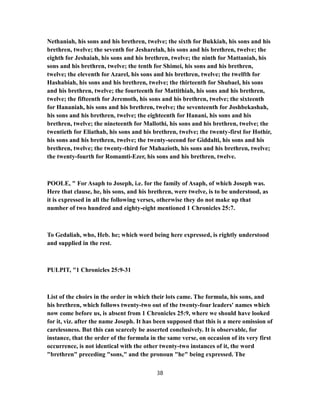
HENRY 8-31, "Twenty-four persons are named in the beginning of this chapter as
sons of those three great men, Asaph, Heman, and Jeduthun. Ethan was the third (1Ch_
6:44), but probably he was dead before the establishment was perfected and Jeduthun
came in his room. [Or perhaps Ethan and Jeduthun were two names for the same
person.] Of these three Providence so ordered it that Asaph had four sons, Jeduthun six
[only five are mentioned 1Ch_25:3; Shimei, mentioned 1Ch_25:17, is supposed to have
been the sixth], and Heman fourteen, in all twenty-four (who were named, 1Ch_25:2-4),
who were all qualified for the service and called to it. But the question was, In what order
must they serve? This was determined by lot, to prevent strife for precedency, a sin
which most easily besets many that otherwise are good people.
I. The lot was thrown impartially. They were placed in twenty-four companies, twelve
in a company, in two rows, twelve companies in a row, and so they cast lots, ward
against ward, putting them all upon a level, small and great, teacher and scholar. They
did not go according to their age, or according to their standing, or the degrees they had
taken in the music-schools; but it was referred to God, 1Ch_25:8. Small and great,
32
teachers and scholars, stand alike before God, who goes not according to our rules of
distinction and precedency. See Mat_20:23.
II. God determined it as he pleased, taking account, it is probable, of the respective
merits of the persons, which are of much more importance than seniority of age or
priority of birth. Let us compare them with the preceding catalogue and we shall find
that, 1. Josephus was the second son of Asaph. 2. Gedaliah the eldest son of Jeduthun. 3.
Zaccur the eldest of Asaph. 4. Izri the second of Jeduthun. 5. Nethaniah the third of
Asaph. 6. Bukkiah the eldest of Heman. 7. Jesharelah the youngest of Asaph. 8. Jeshaiah
the third of Jeduthun. 9. Mattaniah the second of Heman. 10. Shimei the youngest of
Jeduthun. 11. Azareel the third of Heman. 12. Hashabiah the fourth of Jeduthun. 13.
Shubael the fourth of Heman. 14. Mattithiah the fifth of Jeduthun. 15. Jeremoth the fifth
of Heman. 16. Hananiah the sixth of Heman. 17. Joshbekashah the eleventh of Heman.
18. Hanani the seventh of Heman. 19. Mallothi the twelfth of Heman. 20. Eliathah the
eighth of Heman. 21. Hothir the thirteenth of Heman. 22. Giddalti the ninth of Heman.
23. Mehazioth the fourteenth of Heman. And, lastly, Romamti-ezer, the tenth of Heman.
See how God increased some and preferred the younger before the elder.
III. Each of these had in his chorus the number of twelve, called their sons and their
brethren, because they observed them as sons, and concurred with them as brethren.
Probably twelve, some for the voice and others for the instrument, made up the concert.
Let us learn with one mind and one mouth to glorify God, and that will be the best
concert.
JAMISON, "1Ch_25:8-31. Their division by lot into four and twenty orders.
they cast lots, ward against ward — “Ward” is an old English word for “division”
or “company.” The lot was cast to determine the precedence of the classes or divisions
over which the musical leaders presided; and, in order to secure an impartial
arrangement of their order, the master and his assistants, the teacher and his scholars,
in each class or company took part in this solemn casting of lots. In the first catalogue
given in this chapter the courses are classed according to their employment as
musicians. In the second, they are arranged in the order of their service.
K&D, "They cast lots, ‫ת‬ ֶ‫ר‬ ֶ‫מ‬ ְ‫שׁ‬ ִ‫מ‬ ‫ת‬ ‫ל‬ ָ‫ר‬ ‫,גּ‬ κλήρους ἐφημερίων (lxx), by which the
‫ת‬ ֶ‫ר‬ ֶ‫מ‬ ְ‫שׁ‬ ִ‫,מ‬ the waiting upon the service, was fixed, that is, the order of their succession in
the official service. ‫ת‬ ַ‫מּ‬ֻ‫ע‬ ְ‫ל‬ is variously translated. As no name follows, R. Shel. and
Kimchi would repeat the preceding ‫ת‬ ֶ‫ר‬ ֶ‫מ‬ ְ‫שׁ‬ ִ‫:מ‬ one class as the other; and this is supported
by 1Ch_26:16 and Neh_12:24, and by the fact that in 1Ch_17:5, after ‫ן‬ָ‫כּ‬ ְ‫שׁ‬ ִ‫מּ‬ ִ‫,מ‬ the words
‫ן‬ָ‫כּ‬ ְ‫שׁ‬ ִ‫מ‬ ‫ל‬ ֶ‫א‬ have been dropped out. But according to the accentuation ‫ת‬ ֶ‫ר‬ ֶ‫מ‬ ְ‫שׁ‬ ִ‫מ‬ belongs to
‫ת‬ ‫ל‬ ָ‫ר‬ ‫,גּ‬ and so the proposed completion is at once disposed of. Besides this, however,
the thought “class like class” does not appear quite suitable, as the classes were only
formed by the lots, and so were not in existence so as to be able to cast lots. We
therefore, with Ewald, §360, a, and Berth., hold the clause ‫ל‬ ‫ָד‬‫גּ‬ַ‫כּ‬ ‫ן‬ֹ‫ט‬ ָ‫קּ‬ ַ‫כּ‬ to be the genitive
33
belonging to ‫ת‬ ַ‫מּ‬ֻ‫ע‬ ְ‫,ל‬ since ‫ת‬ ַ‫מּ‬ֻ‫ע‬ is in Ecc_5:15 also connected with a clause: “in the
manner of, as the small, so the great,” i.e., the small and the great, the older as the
younger. This is further defined by “the skilled as the scholars.” From these words it is
manifest that not merely the 288 cast lots, for these were ‫ין‬ ִ‫ב‬ ֵ‫ל־מ‬ָ‫כּ‬ (1Ch_25:7), but also
the other 3712 Levites appointed for the service of the singers; whence it further follows
that only the 288 who were divided by lot into twenty-four classes, each numbering
twelve persons, were thoroughly skilled in singing and playing, and the scholars were so
distributed to them that each class received an equal number of them, whom they had to
educate and train. These, then, were probably trained up for and employed in the temple
music according to their progress in their education, so that the ἐφημερία which had at
any time charge of the service consisted not only of the twelve skilled musicians, but also
of a number of scholars who assisted in singing and playing under their direction.
BENSON, "1 Chronicles 25:8. Ward against ward — A course of Levites answerable
to one of the priests, upon whom the Levites were to wait in their holy ministrations,
1 Chronicles 23:28. As well the teacher as the scholar — Without any respect to their
different ages or abilities.
COKE, "1 Chronicles 25:8. They cast lots ward against ward— They cast lots,
according to each of their classes. Houbigant.
ELLICOTT, " (8) And they cast lots, ward against ward.—Rather, And they cast
lots of charge, that is, for determining the order in which each of the twenty-four
guilds, or classes, should take charge of the services. (Comp, the LXX., κλήρους
ἐφημερίων, “lots of courses;” and see Luke 1:6.) Some Hebrew MSS. and the
Targum repeat the word “ward” (mishmèreth, “charge”), whence the reading of the
Authorised Version. The ancient versions omit the word altogether.
As well the small as the great.—Heb., exactly as the small (or, the younger), so the
great (or, the elder). (Comp. the Vulg., “ex aequo tam major quam minor.”) But
perhaps leummath is here used absolutely: “They cast lots in like manner” (1
Chronicles 24:31). The senior houses, or guilds, had no advantage over the juniors,
the order of rotation being decided by lot. (Comp. 1 Chronicles 24:31.)
The teacher as the scholar.—Literally, cunning (1 Chronicles 25:7) with learner.
34
According to 1 Chronicles 23:5, the whole number of Levites appointed for the
service of song was 4,000. These were all included in the twenty-four classes, 288 of
them being “cunning” men, that is, masters in their art, and the remaining 3,712
forming the rank and file of the choirs under the training of the proficients. The
Aramaic word talmid (scholar) occurs nowhere else in the Old Testament. It is the
term used of the disciples of the Rabbis in the Talmud, and is the exact equivalent of
the New Testament word, μαθητής.
POOLE, " Ward against ward, i.e. a ward, or rank, or course of Levites answerable
to one of the priests, upon whom the Levites were to wait in their holy ministrations,
1 Chronicles 23:28. As well the small as the great, the teacher as the scholar, without
any respect to their different ages or abilities.
9 The first lot, which was for Asaph, fell to Joseph,
his sons and relatives[b] 12[c]
the second to Gedaliah,
him and his relatives and sons 12
CLARKE, "For Asaph to Joseph - His first-born.
The second to Gedaliah - The first-born of Jeduthun.
GILL 9-31, "Now the first lot came forth for Asaph to Joseph,.... His second son
to the preference of the firstborn, 1Ch_25:2,
35
the second to Gedaliah, who with his brethren and sons were twelve: and
which must also be understood of Joseph, and supplied to him; for those being both in
one verse, as Jarchi observes, it is but once mentioned, but must be supplied, or
otherwise the number of two hundred and eighty eight could not be made up; the same
is observed of all the other lots and courses to the end of the chapter as here, and
therefore need no more remarks.
K&D 9-31, "The order of succession was so determined by lot, that the four sons of
Asaph (1Ch_25:3) received the first, third, fifth, and seventh places; the six sons of
Jeduthun, the second, fourth, eighth, twelfth, and fourteenth; and finally, the four sons
of Heman (first mentioned in 1Ch_25:4), the sixth, ninth, eleventh, and thirteenth
places; while the remaining places, 1Ch_25:15-24, fell to the other sons of Heman. From
this we learn that the lots of the sons of the three chief musicians were not placed in
separate urns, and one lot drawn from each alternately; but that, on the contrary, all the
lots were placed in one urn, and in drawing the lots of Asaph and Jeduthun came out so,
that after the fourteenth drawing only sons of Heman remained.
(Note: Bertheau, S. 218, draws quite another conclusion from the above-
mentioned order in which the lots were drawn. He supposes “that two series, each of
seven, were first included in the lot: to the one series belonged the four sons of Asaph
and the three sons of Heman, Mattaniah, Uzziel or Azarel, and Shebuel or Shubael;
to the other, the six sons of Jeduthun and Bukkiah the son of Heman. A lot was
drawn from each series alternately, commencing with the first, so that the four sons
of Asaph and the three sons of Heman obtained the places 1, 3, 5, 7, 9, 11, 13; while to
the six sons of Jeduthun, and the son of Heman added to them, fell the places 2, 4, 6,
8, 10, 12, 14. The still remaining ten sons of Heman were then finally drawn for, and
received the placed from the 15th to the 24th.” This very artificial hypothesis
explains, indeed, the order of the lots, but we cannot think it probable, because (1)
for the supposed dividing of the lots to be drawn into divisions of 10 and 14 no
reason can be assigned; (2) by any such division the sons of Heman would have been
placed at a disadvantage from the beginning as compared with the sons of Asaph and
Jeduthun, since not only Asaph's four sons, but also all Jeduthun's six sons, would
have been placed in the first rank, while only four sons of Heman accompany them,
Heman's ten remaining sons having had the last place assigned them.)
As to the details in 1Ch_25:9, after Joseph we miss the statement, “he and his sons
and his brothers, twelve;” which, with the exception of the ‫,הוּא‬ used only of the second
lot, and omitted for the sake of brevity in all the other cases, is repeated with all the 23
numbers, and so can have been dropped here only by an error. The words ‫ף‬ ֵ‫ס‬ ‫י‬ ְ‫ל‬ ‫ף‬ ָ‫ס‬ ָ‫א‬ ְ‫ל‬
are to be understood thus: The first lot drawn was for Asaph, viz., for his son Joseph. In
the succeeding verses the names are enumerated, sometimes with and sometimes
without ְ‫.ל‬ Some of the names diverge somewhat in form. Izri, 1Ch_25:11, stands for
Zeri, 1Ch_25:3; Jesharelah, 1Ch_25:14, for Asarelah, 1Ch_25:2; Azarel, 1Ch_25:18, for
Uzziel, 1Ch_25:4 (like the king's names Uzziah and Azariah, 1Ch_3:12, and 2Ch_26:1);
Shubael, 1Ch_25:20, for Shebuel, 1Ch_25:4 (cf. 1Ch_23:16 with 1Ch_24:20); Jeremoth,
1Ch_25:22, for Jerimoth, 1Ch_25:4; Eliyathah, 1Ch_25:27, for Eliathah, 1Ch_25:4.
Besides these, the fuller forms Nethanyahu (1Ch_25:12), Hashabyahu (1Ch_25:3),
36
Hananyahu (1Ch_25:23), are used instead of the shorter Nethaniah, etc. (1Ch_25:2,
1Ch_25:19, 1Ch_25:4). Of the 24 names which are here enumerated, besides those of
Asaph, Jeduthun, and Heman, only Mattithiah recurs (1Ch_15:18, 1Ch_15:21) in the
description of the solemnities connected with the bringing in of the ark; “but we are not
justified in seeking there the names of our twenty-four classes” (Berth.).
BENSON, "1 Chronicles 25:9. To Joseph — For the family of Asaph, of which
Joseph was. Here that clause, he, his sons, and his brethren were twelve, is to be
understood as it is expressed in all the following verses, otherwise they do not make
up that number of two hundred and eighty-eight, mentioned 1 Chronicles 25:7.
ELLICOTT, " (9) Now the first lot came forth for Asaph to Joseph.—See 1
Chronicles 25:2, according to which Joseph was the second “son” of Asaph.
Although not stated in the text, it must have been true of Joseph as of all the
following heads, that “he, and his sons and his brethren were twelve.” The specified
total of 288 (1 Chronicles 25:7) requires it.
The second to Gedaliah, who with his brethren and sons were twelve.—Rather,
Gedaliah was the second, he and his brethren and his sons—twelve. The “brethren”
and “sons” of the chiefs, in this and the following verses, are the eleven masters, or
proficients, in each class.
Brethren.—Fellow-clansmen, or associates.
Sons.—Disciples, or subordinates.
Perhaps, however, we should think of elder and younger families, grouped together
in one class.guzik, "2. (1 Chronicles 25:9-31) The divisions of the musicians.
Now the first lot for Asaph came out for Joseph; the second for Gedaliah, him with
his brethren and sons, twelve; the third for Zaccur, his sons and his brethren,
twelve; the fourth for Jizri, his sons and his brethren, twelve; the fifth for
37
Nethaniah, his sons and his brethren, twelve; the sixth for Bukkiah, his sons and his
brethren, twelve; the seventh for Jesharelah, his sons and his brethren, twelve; the
eighth for Jeshaiah, his sons and his brethren, twelve; the ninth for Mattaniah, his
sons and his brethren, twelve; the tenth for Shimei, his sons and his brethren,
twelve; the eleventh for Azarel, his sons and his brethren, twelve; the twelfth for
Hashabiah, his sons and his brethren, twelve; the thirteenth for Shubael, his sons
and his brethren, twelve; the fourteenth for Mattithiah, his sons and his brethren,
twelve; the fifteenth for Jeremoth, his sons and his brethren, twelve; the sixteenth
for Hananiah, his sons and his brethren, twelve; the seventeenth for Joshbekashah,
his sons and his brethren, twelve; the eighteenth for Hanani, his sons and his
brethren, twelve; the nineteenth for Mallothi, his sons and his brethren, twelve; the
twentieth for Eliathah, his sons and his brethren, twelve; the twenty-first for Hothir,
his sons and his brethren, twelve; the twenty-second for Giddalti, his sons and his
brethren, twelve; the twenty-third for Mahazioth, his sons and his brethren, twelve;
the twenty-fourth for Romamti-Ezer, his sons and his brethren, twelve.
POOLE, " For Asaph to Joseph, i.e. for the family of Asaph, of which Joseph was.
Here that clause, he, his sons, and his brethren, were twelve, is to be understood, as
it is expressed in all the following verses, otherwise they do not make up that
number of two hundred and eighty-eight mentioned 1 Chronicles 25:7.
To Gedaliah, who, Heb. he; which word being here expressed, is rightly understood
and supplied in the rest.
PULPIT, "1 Chronicles 25:9-31
List of the choirs in the order in which their lots came. The formula, his sons, and
his brethren, which follows twenty-two out of the twenty-four leaders' names which
now come before us, is absent from 1 Chronicles 25:9, where we should have looked
for it, viz. after the name Joseph. It has been supposed that this is a mere omission of
carelessness. But this can scarcely be asserted conclusively. It is observable, for
instance, that the order of the formula in the same verse, on occasion of its very first
occurrence, is not identical with the other twenty-two instances of it, the word
"brethren" preceding "sons," and the pronoun "he" being expressed. The
38
preposition () ‫ל‬ is sometimes expressed and sometimes not expressed before both the
proper names and the ordinal numerals of the list. Examination of the contents of
these verses shows, either that it was due to the Divine direction of the lot (Proverbs
16:33) that an issue resulted which looks so unlike mere chance, and the system of
which is so methodical and traceable; or that the lot-taking was not one of families
and sons, all thrown together from the first. This supposition would, of course, leave
room for some such ingenious hypothesis as that of Berthean, too artificial by far to
be defensible except as a theory that would indeed work out the result. He suggests
that the modus operandi was by two urns, one for the first seven odd numbers, into
which were put the names of Asaph's four sons and of the second, third, and fourth
of Heman; the other for the first seven even numbers, into which were put the six
sons of Jeduthun and the first of Heman. Turning from such a concocted theory to
these verses, we find that the first cast brings to the surface the second son of Asaph,
and the second cast brings up the eldest son of Jeduthun. At the end of the seventh
all of Asaph's sons are exhausted, and what would have been his next place (the
ninth) is occupied by the second son of Heman, whose eldest had just taken the sixth
place so thrown out by the lot. At the end of the fourteenth throw Jeduthun's six
sons are all used up, and all the remaining places belong to Heman's sons, but still in
the order in which they are thrown out by the lot.
10 the third to Zakkur,
his sons and relatives 12
ELLICOTT, "(10) The third to Zaccur.—Literally, The third, Zaccur and his sons
and his brethren—twelve. The same mode of expression is used down to 1
Chronicles 25:18, except in 1 Chronicles 25:11, which reads, “The fourth for the
Izrite, his sons and his brethren—twelve.” The Izrite (not “Izri”) is a Gentilic name,
and seems to denote a family rather than a person.
39
11 the fourth to Izri,[d]
his sons and relatives 12
12 the fifth to Nethaniah,
his sons and relatives 12
13 the sixth to Bukkiah,
his sons and relatives 12
14 the seventh to Jesarelah,[e]
his sons and relatives 12
15 the eighth to Jeshaiah,
his sons and relatives 12
16 the ninth to Mattaniah,
his sons and relatives 12
17 the tenth to Shimei,
his sons and relatives 12
ELLICOTT, "(17) Shimei.—Omitted by accident from 1 Chronicles 25:3.
40
18 the eleventh to Azarel,[f]
his sons and relatives 12
COKE, "1 Chronicles 25:18. The eleventh to Azareel— His name is written Uzziel in
the fourth verse. Probably he was sometimes called by one of those names, and
sometimes by the other.
REFLECTIONS.—The courses of singers are here appointed to accompany the
priests and Levites in their service. Asaph, Heman, and Jeduthun, or Ethan, were
the three great masters, and their sons under them, four-and-twenty, according to
the number of courses. Their service is called prophesying (see 1 Corinthians 11:4; 1
Corinthians 14:24.); for the songs in which they praised God were chiefly
prophetical of the Messiah. A variety of instruments were used to fill the sacred
chorus, while their hearts and voices joined in the songs of the Lord. Music is highly
pleasing; but we must not lose the sense in the sound. Songs of praise are no longer
harmonious, than while we are making melody in our hearts unto God. Each of
these twenty-four had eleven assistant singers, of the most musical of their brethren;
in all 288: and, as four thousand are before said to be appointed for song, either they
were divided into classes, and followed when these principal singers led; or they
might be employed in teaching the divine hymns of David to the rest of the people in
the country. The singers were appointed by lot as before, and we may observe that
many of the younger sons were preferred before their elders. Note; The younger in
years are often the elder in grace.
ELLICOTT, "(18) Azareel.—Called Uzziel in 1 Chronicles 25:4. (Comp. Azariah as
a variant of Uzziah, 1 Chronicles 3:12, and 2 Chronicles 26:1.)
19 the twelfth to Hashabiah,
41
his sons and relatives 12
20 the thirteenth to Shubael,
his sons and relatives 12
ELLICOTT, "(20) The thirteenth to Shubael.—The Hebrew is, to thirteenth,
Shubael, his sons and his brethren, twelve; and so in the next verse. The meaning
seems to be: as to, or as regards, the thirteenth. Shubael (Shebuel) has occurred
before (1 Chronicles 23:16; 1 Chronicles 24:20).
21 the fourteenth to Mattithiah,
his sons and relatives 12
PULPIT, "Mattithiah (see 1 Chronicles 15:18, 1 Chronicles 15:21). No other of these
twenty-four names is found elsewhere out of this chapter in the history, a just
indication of the trustworthiness rather than the contrary of this table.
22 the fifteenth to Jerimoth,
his sons and relatives 12
ELLICOTT, " (22) The fifteenth to Jeremoth.—Heb., to fifteenth, to Jeremoth; i.e.,
as regards the fifteenth lot, it was for Jeremoth. The construction is the same to the
end of the chapter.
42
Spelling, and probably pronunciation, fluctuated between Jeremoth and Jerimoth (1
Chronicles 25:4). (Comp. 1 Chronicles 23:23; 1 Chronicles 24:30.) The LXX. and
Vulg. spell “Jerimoth” in both places here; Syriac, “Jarmûth”; Arabic, “Jârâmâth”
and “Jarmûth.”
23 the sixteenth to Hananiah,
his sons and relatives 12
24 the seventeenth to Joshbekashah,
his sons and relatives 12
25 the eighteenth to Hanani,
his sons and relatives 12
26 the nineteenth to Mallothi,
his sons and relatives 12
27 the twentieth to Eliathah,
his sons and relatives 12
28 the twenty-first to Hothir,
his sons and relatives 12
29 the twenty-second to Giddalti,
his sons and relatives 12
43
30 the twenty-third to Mahazioth,
his sons and relatives 12
31 the twenty-fourth to Romamti-Ezer,
his sons and relatives 12.
CLARKE, "Romamti-ezer - Both these names belong to the same person. He is
mentioned also 1Ch_25:4.
With this immense parade of noise and show, (David’s own invention), Christianity
has nothing to do.
ELLICOTT, " (31) An analysis of the whole list shows that the first, third, fifth, and
seventh places fell to the four Asaphite guilds, or clans; the second, fourth, eighth,
tenth, twelfth, and fourteenth to the six guilds of the sons of Jeduthun, or Ethanites;
the sixth, ninth, eleventh, thirteenth, and the remaining ten places, to the fourteen
guilds of Heman.
It appears evident that all the lots were thrown into a single urn, and that the
Asaphite and Ethanite names were all drawn, as the chances made it likely, before
the Hemanites were exhausted. As it happened, only Hemanite names were left after
the fourteenth drawing.
44
Footnotes:
1 Chronicles 25:3 One Hebrew manuscript and
some Septuagint manuscripts (see also verse 17);
most Hebrew manuscripts do not have Shimei.
1 Chronicles 25:9 See Septuagint; Hebrew does
not have his sons and relatives.
1 Chronicles 25:9 See the total in verse 7;
Hebrew does not have twelve.
1 Chronicles 25:11 A variant of Zeri
1 Chronicles 25:14 A variant of Asarelah
1 Chronicles 25:18 A variant of Uzziel
45

1 chronicles 25 commentary

  • 1.
    1 CHRONICLES 25COMMENTARY EDITED BY GLENN PEASE The Musicians 1David, together with the commanders of the army, set apart some of the sons of Asaph, Heman and Jeduthun for the ministry of prophesying, accompanied by harps, lyres and cymbals. Here is the list of the men who performed this service: BARNES, "The captains of the host - Rather, “the princes” of 1Ch_23:2; 1Ch_ 24:6. CLARKE, "David and the captains of the host - The chiefs of those who formed the several orders: not military captains. Should prophesy - Should accompany their musical instruments with prayer and singing. GILL, "Moreover, David and the captains of the host separated to the service,.... Of singing the praises of God; this was done by the princes of the people, and the chief of the priests, who were gathered together, and before whom the lots were cast, 1
  • 2.
    both for priestsand Levites, and now here for the singers, see 1Ch_22:2 and those that were separated were of the sons of Asaph, and of Heman, and of Jeduthun; or Ethan, the three precentors, or chief of the singers: who should prophesy with harps, with psalteries, and with cymbals; sing psalms, hymns, and spiritual songs, endited by the Holy Spirit of God; which contained in them prophecies concerning things to come, particularly relating to the Messiah, of which there are many in the book of Psalms; and to the tunes of these they played on the above instruments of music: and the number of the workmen, according to their service, was; as follows. HENRY, "Observe, I. Singing the praises of God is here called prophesying (1Ch_ 25:1-3), not that all those who were employed in this service were honoured with the visions of God, or could foretel things to come. Heman indeed is said to be the king's seer in the words of God (1Ch_25:5); but the psalms they sang were composed by the prophets, and many of them were prophetical; and the edification of the church was intended in it, as well as the glory of God. In Samuel's time singing the praises of God went by the name of prophesying (1Sa_10:5; 1Sa_19:20), and perhaps that is intended in what St. Paul calls prophesying, 1Co_11:4; 1Co_14:24. II. This is here called a service, and the persons employed in it workmen, 1Ch_25:1. Not but that it is the greatest liberty and pleasure to be employed in praising God: what is heaven but that? But it intimates that it is our duty to make a business of it, and stir up all that is within us to it; and that, in our present state of corruption and infirmity, it will not be done as it should be done without labour and struggle. We must take pains with our hearts to bring them, and keep them, to this work, and to engage all that is within us. III. Here were, in compliance with the temper of that dispensation, a great variety of musical instruments used, harps, psalteries, cymbals (1Ch_25:1, 1Ch_25:6), and here was one that lifted up the horn (1Ch_25:5), that is, used wind-music. The bringing of such concerts of music into the worship of God now is what none pretend to. But those who use such concerts for their own entertainment should feel themselves obliged to preserve them always free from any thing that savours of immorality or profaneness, by this consideration, that time was when they were sacred; and then those were justly condemned who brought them into common use, Amo_6:5. They invented to themselves instruments of music like David. IV. The glory and honour of God were principally intended in all this temple-music, whether vocal or instrumental. It was to give thanks, and praise the Lord, that the singers were employed, 1Ch_25:3. It was in the songs of the Lord that they were instructed (1Ch_25:7), that is, for songs in the house of the Lord, 1Ch_25:6. This agrees with the intention of the perpetuating of psalmody in the gospel-church, which is to make melody with the heart, in conjunction with the voice, unto the Lord, Eph_5:19. V. The order of the king is likewise taken notice of, 1Ch_25:2 and again 1Ch_25:6. In those matters indeed David acted as a prophet; but his taking care for the due and regular observance of divine institutions, both ancient and modern, is an example to all in authority to use their power for the promoting of religion, and the enforcing of the 2
  • 3.
    laws of Christ.Let them thus be ministers of God for good. VI. The fathers presided in this service, Asaph, Heman, and Jeduthun (1Ch_25:1), and the children were under the hands of their father, 1Ch_25:2, 1Ch_25:3, 1Ch_25:6. This gives a good example to parents to train up their children, and indeed to all seniors to instruct their juniors in the service of God, and particularly in praising him, than which there is no part of our work more necessary or more worthy to be transmitted to the succeeding generations. It gives also an example to the younger to submit themselves to the elder (whose experience and observation fit them for direction), and, as far as may be, to do what they do under their hand. It is probable that Heman, Asaph, and Jeduthun, were bred up under Samuel, and had their education in the schools of the prophets which he was the founder and president of; then they were pupils, now they came to be masters. Those that would be eminent must begin early, and take time to prepare themselves. This good work of singing God's praises Samuel revived, and set on foot, but lived not to see it brought to the perfection it appears in here. Solomon perfects what David began, so David perfects what Samuel began. Let all, in their day, do what they can for God and his church, though they cannot carry it so far as they would; when they are gone God can out of stones raise up others who shall build upon their foundation and bring forth the top-stone. JAMISON, "1Ch_25:1-7. Number and office of the singers. David and the captains of the host — that is, the princes (1Ch_23:2; 1Ch_24:6). It is probable that the king was attended on the occasion of arranging the singers by the same parties that are mentioned as having assisted him in regulating the order of the priests and Levites. K&D, "The twenty-four classes of musicians. - 1Ch_25:1. “David and the princes of the host separated for the service the sons of Asaph,” etc. ‫א‬ ָ‫ב‬ָ‫צּ‬ ַ‫ה‬ ‫י‬ ֵ‫ר‬ָ‫שׂ‬ are not princes of the Levite host; for although the service of the Levites is called ‫א‬ ָ‫ב‬ָ‫צ‬ ‫ֹא‬‫ב‬ ְ‫צ‬ in Num_4:23, yet the princes of the Levites are nowhere called ‫א‬ ָ‫ב‬ָ‫צ‬ ָ‫ה‬ ‫י‬ ֵ‫ר‬ָ‫.שׂ‬ This expression rather denotes either the leaders of the army of the chiefs of Israel, as the host of Jahve, Exo_ 12:17, Exo_12:41, etc. Here it is used in the last signification, as synonymous with princes of Israel (1Ch_23:2); in Exo_24:6 we have simply the princes, along with whom the heads of the fathers'-houses of the priests and the Levites are mentioned. ‫ה‬ ָ‫ֹד‬‫ב‬ֲ‫ע‬ַ‫ל‬ ‫יל‬ ִ‫דּ‬ ְ‫ב‬ ִ‫,ה‬ separate for the service; cf. Num_16:9. The ְ‫ל‬ in ‫ף‬ ָ‫ס‬ ָ‫א‬ ‫ֵי‬‫נ‬ ְ‫ב‬ ִ‫ל‬ is nota acc. Since Asaph was, according to 1Ch_6:39-43, a descendant of Gershon, Heman, according to 1Ch_6:33-38, a descendant of Kohath, and Jeduthun (= Ethan) a descendant of Merari (1Ch_6:44-47), all the chief families of Levi had representatives among the singers. The Kethibh ‫הנביאים‬ is an orthographical error for ‫ים‬ ִ‫א‬ ְ‫בּ‬ִ‫נּ‬ ַ‫ה‬ (Keri), partic. Niph., corresponding to the singular ‫א‬ ָ‫בּ‬ִ‫נּ‬ ַ‫,ה‬ 1Ch_25:2 and 1Ch_25:3. ‫א‬ ָ‫בּ‬ִ‫,נּ‬ prophetare, is here used in its wider signification of the singing and playing to the praise of God performed in the power of the Divine Spirit. In reference to the instruments of these chief musicians, cf. 1Ch_15:16. The suffix in ‫ם‬ ָ‫ר‬ָ‫פּ‬ ְ‫ס‬ ִ‫מ‬ refers to the following noun, which is 3
  • 4.
    subordinated to theword ‫ר‬ָ‫פּ‬ ְ‫ס‬ ִ‫מ‬ as genitive; cf. the similar construction ‫ל‬ֵ‫צ‬ָ‫ע‬ ‫שׁ‬ ְ‫ַפ‬‫נ‬, his, the sluggard's, soul, Pro_13:4, and Ew. §309, e. “Their number (the number) of the workmen for the service, i.e., of those who performed the work of the service, was (as follows).” BENSON, "1 Chronicles 25:1. And captains — All the princes of Israel, with the priests and the Levites, whom David gathered together (1 Chronicles 23:2) for this very end, that, with their approbation and consent, all these things might be established, who are here fitly called the captains of the host; for the princes were, under David, the chief captains of the militia of the kingdom; and as the Levites are called a host, and the Lord’s host, because of their number and order in holy ministrations, so these priests and Levites were the captains and governors of the rest. Separated — Distributed them into their several ranks: which, though chiefly done by David as a prophet, and by divine direction, yet is imputed in part to the captains of the host, because it was done with their concurrence and approbation. The service — To the service of God, under the conduct of these persons. Who should prophesy — Praise God by singing the psalms of David, and other sacred songs made by themselves, who were prophets, or by other prophets or holy men of God. The number of the workmen according to their service — Although this sacred work of praising God is here termed service, and the persons employed in it workmen, yet it is the greatest liberty and pleasure to be engaged in it. But the expressions intimate that it is our duty to make a business of it, and stir up all that is within us to it; and that in our present state of corruption and infirmity, it will not be done, as it should be done, without labour and struggle. We must take pains with our hearts to bring and keep them to this work, and to engage all that is within us in it. It is probable, Heman, Asaph, and Jeduthun were bred up under Samuel, and had their education in the schools of the prophets, of which he was the founder and president. Then they were pupils, now they come to be masters. Those that would be eminent must begin early and take time to prepare themselves. This good work, of singing God’s praises, Samuel revived and set on foot, but lived not to see it brought to the perfection in which it appears here. Solomon perfects what David began. So David perfects what Samuel began. Let each in their day do what they can for God and his church, though they cannot carry it so far as they would; when they are gone, God can out of stones raise up others, who shall build upon their foundation, and bring forth the top-stone. COFFMAN, "DAVID'S INSTRUMENTALISTS AND SINGERS; 4
  • 5.
    "Who should prophesywith harps, psalteries, etc."; 1 Chronicles 25:1. The Good News Bible probably has the correct meaning here: "They were to proclaim God's messages accompanied by the music of harps and cymbals." COKE, "1 Chronicles 25:1. Should prophesy— 1:e. Sing prophesies or sacred hymns, composed by the prophets, in the temple of God. See Numbers 11:25. The captains of the host, at the beginning of this verse, is rendered very properly by Houbigant, the chiefs, or heads of the orders in the ministry; those priests, whom David had lately appointed and divided into four-and-twenty classes; and not, as some have absurdly supposed, the commanders of the army, who certainly could have nothing to do with the appointment of singers for the temple. In the third verse the sons of Jeduthun are said to be six, though five only are enumerated. Shimei, mentioned in the 17th verse, is supplied in the Arabic version. ELLICOTT, "THE TWENTY-FOUR CLASSES OF SINGERS, OR MINSTRELS. (1) Moreover (and) David and the captains of the host.—The latter (“the princes” of 1 Chronicles 24:6), were also concerned in the arrangement of the priestly classes (1 Chronicles 23:2). Separated to the service of the sons of Asaph.—Rather, separated for service the sons of Asaph, and Heman, and Jeduthun. These formed three guilds of sacred minstrels, famous to all after times. (Comp. the headings of many psalms in which these names occur, and also 1 Chronicles 6:33, sqq., whence it appears that Asaph belonged to the sub tribe of Gershon, Heman to that of Kohath, and Ethan- Jeduthun to that of Merari, so that all the branches of Levi were represented among the musicians.) Separated.—So Numbers 16:9, and Genesis 1:7. (Comp Acts 13:2.) Who should prophesy with harps.—In Hebrew, the verb to prophesy is a reflexive form, implying utterance under a spiritual influence. The ancients regarded musical 5
  • 6.
    utterance as aneffect and proof of direct inspiration, and we still speak of the higher results of genius as inspired, however we may choose to explain the term away as a mere figure of speech. The power of moving sounds, whether of voice or instrument, is not to be gained by mere study or training; it is commonly spoken of as a “gift,” and its products are called “inspirations.” Whence come they, if not from the Divine source of life, and of all that makes life glad and beautiful? (James 1:17; 1 Samuel 10:5; 1 Samuel 16:16; 1 Samuel 18:10). Harps, with psalteries.—Lutes and harps. And the number of the workmen according to their service was.—Literally, And the number of them—that is, of the men of work—for their service proved (as follows). Men of work.—A remarkable appellation. The term “work” is popularly restricted to what is called productive labour, but it is not difficult to see that persons engaged, like these minstrels, in singing and playing to the praise of God are actually helping to produce one of the best of real results, viz., the conservation of the religious spirit: that is, of the right attitude of man towards the Power upon whom his entire welfare absolutely depends. PARKER, ""Moreover David and the captains of the host [rather, "the princes" the same persons who are mentioned in 1 Chronicles 23:2, and 1 Chronicles 24:6] separated to the service of the sons of Asaph, and of Heman, and of Jeduthun, who should prophesy [rather, "divided for the service the sons of Asaph, etc, who prophesied." By prophesying is probably meant public recitation of the sacred services (see 1 Chronicles 24:3)] with harps, with psalteries, and with cymbals" ( 1 Chronicles 25:1). Let us analyse these indications. We want warriors; there is not one in this list: we need builders; there is not a man in the catalogue that ever built anything that could be seen or valued arithmetically: we want legislators, men who can make duty mysterious, and dissolve responsibility in polysyllables; there is no such erratic genius in this guild. Whom have we? Prophets; for the word is "prophesy," and to 6
  • 7.
    prophesy means inthis connection to teach, to reveal doctrines, to indicate duty, to exhort to service, to reveal the will and purpose of heaven. With what apparatus are these men furnished? Harps, psalteries, cymbals. They were known amongst their fellows as a guild of sacred minstrels. When a man prophesies he utters under a spiritual influence. We do not know how much we are indebted to music. He would be the most combative man that ever lived who would fight with a tune; the tune will not fight. There are atheists who have shed tears under the influence of what is known as sacred music. Then they were not far from the kingdom of God: they were only atheists argumentatively. How many men have committed suicide by the razor of logic! They were never meant to be logicians. When you see a man take hold of a razor you do not exhort him to be careful, because you know that he can handle it wisely; but if you saw a little child open a case and take out a razor, how you would exclaim, how you would rush to the rescue; how you would deprecate the audacity of the thoughtless little creature! It is even so with the Church. There are some infants we cannot keep away from the razor-case: if they would only take their seat within one inch of the organ they might be saved. How are these musicians described in the verse? They are described by a word which some men would begrudge; they are described as "the workmen." It should be put more vividly than this, namely, "the men working." But is music work? Certainly. Is a song a sacrifice? Yes, if sung with the whole heart. He labours who toils with his hands. Probably, but not he only. He labours who gives his brain away, who imparts to others the fragrance of his love, who makes the world welcome to all the hospitality of his prayers. He is a labourer who puts things into sweet musical rhyme for us. Sometimes we get our children to persuade themselves that they are enjoying an amusement when they are learning, in fact, the multiplication table, through the medium of rhyme. Children who would abhor the multiplication table if it were set before them nakedly would come up to it quite loving and sympathetically if they might sing it all through. So there are men who help to sing us into our duties, and who help us to sing in the discharge of those duties, and who show us, by a mysterious power given to them of God, that all work should blossom into play, all service should find its fruition in song. There are those who have distinguished between sacred music and secular music. What a marvellous faculty of analysis such men must have! There are those who talk about sacred and profane history. By what right do they so talk? What history is profane? Is there anything profane that belongs to the development of humanity, the cultivation of the total nature of man? Are we to attach a stigma to the study of history, to the perusal of those documents and records which testify to the progress of all manner of human thought? There are persons who can sing bad common metre in the church, and think it pious; whereas they could not listen to a sweet domestically beautiful song in church without a shudder. The only thing to be done with such is to let them shudder. We 7
  • 8.
    must see toit that the religious spirit is maintained, and nothing can maintain it so healthily as music. To think that the enemy has all the brass bands but about a dozen! whereas the church ought to have every one, and he ought to be considered a thief who plays anything on an instrument that could not be played in the church. There was music in the Old Testament sanctuary; men praised the Lord loudly and sweetly in the ancient time. GUZIK, '1 CHRONICLES 25 - MUSICIANS FOR THE TEMPLE A. The musicians for the temple. 1. (1 Chronicles 25:1) Musicians separated for service. Moreover David and the captains of the army separated for the service some of the sons of Asaph, of Heman, and of Jeduthun, who should prophesy with harps, stringed instruments, and cymbals. And the number of the skilled men performing their service was: a. David and the captains of the army separated for the service: Interestingly, the captains of the army took part in the selection and organization of the musicians or “worship leaders” for Israel. David sensed a connection between the security of the kingdom and the worship and honoring of God. i. “Chapter 25 concerns David’s organization of the four thousand Levitical musicians (1 Chronicles 23:5) into courses of service that correspond to those of the priests and temple Levites (chapter 24).” (Payne) ii. “David did give high regard to the counsel of his military commanders (1 Chronicles 11:10; 1Ch_12:32; 1Ch_28:1), even in liturgical affairs (cf. 1 Chronicles 13:1; 1Ch_15:25).” (Payne) 8
  • 9.
    b. Who shouldprophesy with harps, stringed instruments, and cymbals: Their service was connected with the dynamic of prophesy in the sense that it was inspired by God. Their ministry in music was not merely the product of good musicianship; it was a gift of the Holy Spirit being exercised through them. i. “This work of praise is thrice described by a somewhat singular, and, in this connection, arresting word, ‘prophecy.’ The use of this word here is a revelation of the true value of the service of music in the sanctuary of God.” (Morgan) ii. “Either they supplied messages direct from God in the manner of the classical prophets, for which the Levite Jahaziel (2 Chronicles 20:14-17) provides an obvious analogy, or their praise was itself seen as ‘prophecy’ in that it proclaimed God’s word with God’s authority.” (Selman) POOLE, "The number and offices of the singers out of the sons of Asaph, Heman, and Jeduthun, 1 Chronicles 25:1-7. Their division by lot into twenty-four orders, 1 Chronicles 25:8-31 The captains of the host; both of the civil and sacred host, to wit, all the princes of Israel, with the priests and the Levites, whom David gathered together, 1 Chronicles 23:2, for this very end, that in their presence, and with their approbation and consent, all these things might be established; who are here fitly called the captains of the host; for the princes were, under David, the chief captains or commanders of the militia or trained bands of the kingdom: and as the Levites are called a host, and the Lord’s host, Numbers 4:3, and elsewhere, because of their number and order in holy ministrations; so these priests and Levites were the captains and governors of the rest. Separated, i.e. distributed them into their several ranks and orders; which, though chiefly done by David as a prophet, and by Divine direction, as hath been oft observed, yet is here imputed in part to the captains of the host, because it was done with their concurrence and approbation. To the service of the sons of Asaph, &c, i.e. to the service of God under the conduct and command of these persons. Who should prophesy, i.e. praise God by singing the Psalms of David, (of which See Poole "1 Chronicles 16:7",) and other sacred songs made by themselves, who were prophets 9
  • 10.
    in some sort,or by other prophets or holy men of God. Or this action of theirs is called prophesying, because it had been formerly performed by the prophets; and the sons of the prophets; of which see 1 Samuel 10:5 19:20 2 Kings 3:15 1 Chronicles 15:19. The number of the workmen; of the persons employed in this sacred work. PULPIT, "The twenty-four courses of those who were to be engaged in the temple service as singers and musicians fill up this chapter. They are to be taken from the three great families of Asaph, Heman, and Jeduthun. For the captains of the host, as designating those who superintended the order of temple worship, see 1 Chronicles 22:17; 1 Chronicles 23:2; 1 Chronicles 24:6; as also Numbers 4:3; Numbers 8:23. The sons of Asaph. (For a clear instance of the use of the preposition (lamed) prefixed, as here, see Ezra 8:24.) The English should appear "the sons of Asaph." Asaph, Heman, and Jeduthun belonged respectively to the Gershon, Kohath, and Merarite families (1 Chronicles 6:18-32). Thus these singers and musicians were drawn from each great branch of Levi; viz. from Gershon, four through Asaph; from Kohath, six through Jeduthun; and from Merari, fourteen through Heman; while the whole number of those trained to sing was two hundred and eighty-eight. Who should prophesy. The Hebrew ‫ים‬ ִ‫א‬ ְ‫בּ‬ ִ‫גּ‬ַ‫ה‬ (Jeremiah 14:14, Jeremiah 14:16) stands for Niphal participle plural, the singular of which ( ‫א‬ָ‫נּבּ‬ַ‫ח‬ ) appears in the following two verses. These were the utterers in song of the Divine mind and will. The essential meaning of the expression evidently is to use the voice in sacred service, more or less under Divine impulse. With cymbals. These instruments were used to regulate the time (compare this verse with 1 Chronicles 13:8). For some particulars respecting these and other musical instruments used in Israel at this time, the article "Music" in Smith's 'Bible Dictionary' may be consulted with advantage. And the number, etc. The literal translation of the last clause of this verse is, And was their number, the men of work, for their service, i.e. "And the number of workmen for the service was." The workmen intend, of course, those who performed the service. 2 From the sons of Asaph: Zakkur, Joseph, Nethaniah and Asarelah. The sons of Asaph were under the supervision of 10
  • 11.
    Asaph, who prophesiedunder the king’s supervision. BARNES, "Under the hands of Asaph ... - That is to say, “under the direction of Asaph” - who himself “prophesied,” or performed the sacred services, “under the direction of the king.” CLARKE, "Which prophesied - Sung hymns and prayed. But the Targum understands this of prophesying in the proper sense of the term; and therefore says, “Who prophesied by the Holy Spirit.” Jarchi is of the same opinion and quotes the case of Elisha, 2Ki_3:15; While the minstrel played, the hand of the Lord [i.e., the spirit of prophecy] was upon him. GILL, "Of the sons of Asaph,.... Who were separated, and by lot appointed, to the service of singers in the temple: Zaccur, and Joseph, and Nethaniah, and Asarelah; called Jesharelah, 1Ch_ 25:14, these had the third fourth, fifth, and seventh lots, 1Ch_25:9, under the hands of Asaph; under his instruction and authority: which prophesied according to the order of the king; which Asaph composed psalms under the inspiration of the Spirit of God, and was ordered by King David to sing them, and by whose command they were inserted in the book of Psalms, where they now stand with his name to them. JAMISON, "according to the order of the king — Hebrew, “by the hands of the king,” that is, “according to the king’s order,” under the personal superintendence of Asaph and his colleagues. which prophesied — that is, in this connection, played with instruments. This metaphorical application of the term “prophecy” most probably originated in the practice of the prophets, who endeavored to rouse their prophetic spirit by the animating influence of music (see on 2Ki_3:15). It is said that Asaph did this “according to David’s order,” because by royal appointment he officiated in the tabernacle on Zion (1Ch_16:37-41), while other leaders of the sacred music were stationed at Gibeon. 11
  • 12.
    K&D 2-3, "With‫ף‬ ָ‫ס‬ ָ‫א‬ ‫ֵי‬‫נ‬ ְ‫ב‬ ִ‫ל‬ the enumeration beings: “Of Asaph's sons were, or to Asaph's sons belonged, Zacchur,” etc. Four are here named, but the number is not stated, while it is given in the case of the sons of Jeduthun and Heman, 1Ch_25:3 and 1Ch_25:5. ‫ַד‬‫י‬‫ל־‬ַ‫,ע‬ at the hand, alternates with ‫י‬ ֵ‫ד‬ְ‫ל־י‬ַ‫ע‬ (1Ch_25:3 and 1Ch_25:6), and ‫ף‬ ָ‫ס‬ ָ‫א‬ ‫ַד‬‫י‬ ‫ל‬ַ‫ע‬ does not of itself express a different relationship to Asaph than that expressed by ֶ‫ל‬ ֶ‫מּ‬ ַ‫ה‬ ‫י‬ ֵ‫ד‬ְ‫י‬ ‫ל‬ַ‫ע‬ with reference to the king. It signifies only “under (according to) the direction of;” and in 1Ch_25:6 the king, Asaph, Jeduthun, and Heman are co-ordinated, inasmuch as the musical part of the worship was arranged by David and the three chief musicians in common, although only the latter were concerned in its performance. In 1Ch_25:3 ‫ידוּתוּן‬ ִ‫ל‬ is placed at the beginning, because the choir of singers led by him bore his name; and so also in the case of Heman, 1Ch_25:4. “As to Jeduthun, were sons of Jeduthun.” The word sons in these catalogues denotes not merely actual sons, but those intellectually sons, i.e., scholars taught by the master. This is clear from the fact that the twenty-four classes, each of which numbered twelve men, consist of sons and brothers of the leaders. The names given as those of the sons of Asaph, Jeduthun, and Heman, in 1Ch_25:2-5, do not represent the whole number of the scholars of these masters, but only the presidents of the twenty-four classes of Levites who were engaged under their leadership in performing the sacred music. Only five sons of Jeduthun are named in our text, while according to the number given there should be six. A comparison of the names in vv. 9-31 shows that in 1Ch_25:3 the name ‫י‬ ִ‫ע‬ ְ‫מ‬ ִ‫שׁ‬ (1Ch_25:17) has been dropped out. ‫ר‬ ‫נּ‬ ִ‫כּ‬ ַ‫בּ‬ belongs to ‫דוּתוּן‬ְ‫:י‬ under the direction of their father Jeduthun (the master), upon the kinnor (see on 1Ch_15:16), who was inspired to sing praise, i.e., who played inspiredly to bring praise and honour to the Lord; cf. 1Ch_16:4; 1Ch_23:30, etc. BENSON, "Verse 2-3 1 Chronicles 25:2-3. Under the hands of Asaph — Under his oversight and direction. According to the order of the king — In such manner and order as David appointed. The sons of Jeduthun, six — Jeduthun, their father, being included in that number; or Shimei, mentioned 1 Chronicles 25:17. ELLICOTT, " (2) Of the sons of Asaph; Zaccur.—Literally, To the sons of Asaph belonged Zaccur. In 1 Chronicles 25:2-7 the term “sons” appears to mean trained members of the musical guilds, of which the three chiefs, Asaph, Heman, and Jeduthun, were masters. Asarelah.—This singular name is spelt “Jesharelah” in 1 Chronicles 25:14. Ewald identifies it with “Israel,” the unaccented ending ah having the force belonging to— 12
  • 13.
    literally, towards, unto—sothat Jesharelah is in effect the modern Jewish surname Israels. (Comp. “Jaakobah,” 1 Chronicles 4:36, to Jacob, i.e., Jacobs.) Under the hands of Asaph.—Rather, at the hand of Asaph. It is implied that the four leaders here named were subordinate to Asaph, and under his direction. (Comp. 1 Chronicles 25:3; 1 Chronicles 25:6; 2 Chronicles 23:18; 2 Chronicles 29:27; Ezra 3:10.) Which prophesied according to the order of the king.—Literally (Asaph), who prophesied (or should prophesy, the participle, as in 1 Chronicles 25:1) at the hands of the king: that is, either according to the royal arrangements (2 Chronicles 23:18), under David’s own appointment, or under the royal direction. Prophesied.—That is, made music. (See 1 Chronicles 25:1.) guzik, "2. (1 Chronicles 25:2-6) The sons of Asaph, Jeduthun, and Heman. Of the sons of Asaph: Zaccur, Joseph, Nethaniah, and Asharelah; the sons of Asaph were under the direction of Asaph, who prophesied according to the order of the king. Of Jeduthun, the sons of Jeduthun: Gedaliah, Zeri, Jeshaiah, Shimei, Hashabiah, and Mattithiah, six, under the direction of their father Jeduthun, who prophesied with a harp to give thanks and to praise the LORD. Of Heman, the sons of Heman: Bukkiah, Mattaniah, Uzziel, Shebuel, Jerimoth, Hananiah, Hanani, Eliathah, Giddalti, Romamti-Ezer, Joshbekashah, Mallothi, Hothir, and Mahazioth. All these were the sons of Heman the king’s seer in the words of God, to exalt his horn. For God gave Heman fourteen sons and three daughters. All these were under the direction of their father for the music in the house of the LORD, with cymbals, stringed instruments, and harps, for the service of the house of God. Asaph, Jeduthun, and Heman were under the authority of the king. a. Asaph, who prophesied according to the order of the king: 12 Psalms are 13
  • 14.
    attributed to Asaph(Psalms 50 and Psalms 73 through 83). b. Jeduthun, who prophesied with a harp to give thanks and to praise the LORD: Jeduthun’s music ministry was so inspired by the Spirit of God that it could be said that he prophesied with a harp. c. Heman the king’s seer: “He is called the king’s seer, either because the king took special delight in him, or because he frequently attended upon the king in his palace, executing his sacred office there, while the rest were constantly employed in the tabernacle.” (Poole) d. Asaph, Jeduthun, and Heman were under the authority of the king: These enormously talented and Spirit-anointed men knew how to submit themselves under the leadership of David, under the authority of the king. i. We note the prominent place of the sons of Heman, and that all these were under the direction of their father for the music in the house of the LORD. “How one would like to have seen Heman coming into the Temple with his children! It was largely owing to him and their mother that they were what they were.” (Meyer) ii. Under the direction of their father: “Heman’s children were ‘under the hands of their father.’ Young people must not get the upper hand.” (Meyer) iii. Yet we also see that Heman was among those under the authority of the king. “But if you would rule well, you must obey. Asaph, Heman, and Jeduthun, were under the king. The man who is himself under authority, can say, Go, come, do this or that, with the calm assurance of being obeyed.” (Meyer) PULPIT, "Four sons of Asaph are hero given, the number, however, not being ex. pressed, although it is expressed in the cases of Jeduthun and Heman (1 Chronicles 25:3, 1 Chronicles 25:5). "For Asaph," we find twelve psalms inscribed, viz. Psalms 14
  • 15.
    1:1-6.; 73-83.; ofsome of which he was himself the inspired composer. When it is said "for Asaph," the meaning is for those "under his hand," or direction, and who as a band bore his name, and performed among other odes those which he prophesied. Zaccur. A descendant after the Return is mentioned in Nehemiah 12:35. Asarelah. This last of the four sons of Asaph is called in Nehemiah 12:14, Jesharelah. Under the hands of… according to the order of. The Hebrew words are "to the hand of" and "to the hands of." Between the signification of these two forms, the one expressed in the singular number and the ether in the plural, there does not seem to be any distinction, and accordingly they might be better translated, under the direction of… under the directions of. The latter form is that found in Nehemiah 12:3, Nehemiah 12:6. 3 As for Jeduthun, from his sons: Gedaliah, Zeri, Jeshaiah, Shimei,[a] Hashabiah and Mattithiah, six in all, under the supervision of their father Jeduthun, who prophesied, using the harp in thanking and praising the Lord. CLARKE, "The sons of Jeduthun - six - That is, six with their father, otherwise, there are but five. Hence it is said, they were under the hands of their father Jeduthun, who prophesied with a harp, etc. GILL, "Of Jeduthun,.... Or Ethan, the sons of Jeduthun: Gedaliah and Zeri; called Izri, 1Ch_25:11, and Jeshaiah, Hashabiah, and Mattithiah, six; whereas five only are mentioned; it may be thought that Shimei, 1Ch_25:17 is the sixth, he not being mentioned 15
  • 16.
    elsewhere; it isa tradition of the Jews, that his mother was now with child of him, and it being foreseen by the Holy Spirit that he would be the chief of a course, the number six is given, as Jarchi observes; but rather, as Kimchi, he was young, and not fit to sing, yet was chosen the head of a course, until he was grown up and fit for it; to these six came up the second, fourth, eighth, twelfth, fourteenth, and tenth lots, 1Ch_25:9 and these were under the hands of their father Jeduthun; to instruct and direct them, and appoint their service to them: who prophesied with a harp; or sung a prophetic psalm or hymn on that: to give thanks, and to praise the Lord; for what he had done and promised, and foretold he would do for his people. ELLICOTT, " (3) Of Jeduthun: the sons of Jeduthun.—Rather, To Jeduthun (i.e., belonging to the guild so called): the sons of Jeduthun were Gedaliah, &c. Zeri.—The “Izri” of 1 Chronicles 25:11 is probably right. (Comp. Numbers 26:49.) The error here is as old as the ancient versions. Six.—Only five names are now read in the text; that of “Shimei” (1 Chronicles 25:17) has fallen out, the only name in 1 Chronicles 25:9-31 which does not occur in 1 Chronicles 25:2-4. The Alex. LXX. inserts the name between Jeshaiah and Hashabiah. Jeshaiah.—Elsewhere spelled Isaiah. Under the hands (see last verse) of their father Jeduthun, who prophesied with a harp.—Literally, according to the Hebrew punctuation, at the hands of their father Jeduthun, with the lute (i.e., provided with lutes, 1 Chronicles 15:16), who prophesied (or was to prophesy) for giving thanks and praise to Jehovah. (Comp. 1 Chronicles 16:4). At the hands of their father.—Under the direction of their conductor. 16
  • 17.
    PARKER, ""Of Jeduthun:the sons of Jeduthun; Gedaliah, and Zeri, and Jeshaiah, Hashabiah, and Mattithiah, six" ( 1 Chronicles 25:3). There are not six, there are only five: where is the sixth? When an arithmetical number is put before us we are entitled to begin counting. "Of Jeduthun: the sons of Jeduthun; Gedaliah, and Zeri, and Jeshaiah, Hashabiah, and Mattithiah,"—five. But the Chronicler says there were six. Then why did he not write six names down? We are entitled to inquire always for the missing man. Woe unto that shepherd who allows one little lamb to go, and not trouble about him: woe to that friend who can allow one of his comrades to fall out of the ranks, and never ask a question about his doom. How was the sixth name omitted? By a clerical error? Then we should find it again. It is of small consequence to be omitted by the clerk; the clerk is not almighty. It is of small account that our name be not found on the record of the visible church because some careless writer has omitted to inscribe it there. Has he gone out of the list by proved incapacity? Could he not play the harp? Did he make a false noise with the cymbals? Let us ask the question. Has he gone out by moral lapse? Was the fool caught in some snare, the existence of which he did not suspect? Was he treading in dangerous paths, and seized by a ruffian hand, when he ought to have kept near the altar and found his security at home? We cannot tell. In this instance, the sixth man was found again. He is omitted from verse number three, but he is found in verse number seventeen. Do lists dwindle? Do friends grow fewer? They may grow fewer in one sense, and yet may be stronger in another, they may be but transplanted. The dead are not lost; they love the twilight, they can unfold themselves in shadows, they can speak through dreams; call not those dead who have gone up to be ennobled and crowned. Regarding these six men we read of them still in verse three, as "under the hands of their father." The picture is a lovely one. It is that of six sons being conducted in musical exercise by their father. Let the picture shape itself vividly to the mental eye: six sons, with harps, psalteries, and cymbals, and the father conducting, educating, keeping them together, making all the sounds one, reconciling all the exercise into one blessed harmony. What is a father for if he is not to be a conductor? Some fathers are too separate from their families. What is a pastor to be if not a conductor? and what are children for if they set up for themselves on a basis of absolutely foolish independence? The inquiry is a two-edged sword: take care how 17
  • 18.
    you lift itup, for it is a dangerous weapon. POOLE, "The sons of Jeduthun, or, his sons, (the construct form being used before the absolute, of which there are examples in Scripture,) Jeduthun, called by his father’s name; otherwise they are not six, unless either Jeduthun their father be included in that number, or Shimei, mentioned 1 Chronicles 25:17, be one of them, as many learned men think. See the like, 1 Chronicles 24:23. PULPIT, "Six sons are here said to be under the direction of Jeduthun (or Ethan, 1 Chronicles 6:44). The name missing is Shimei, supplied by 1 Chronicles 25:17, and which the Alexandrine Septuagint places fourth in this list. This is clear from the list of 1 Chronicles 25:9-31, which contains all the same names as are found in the present 1 Chronicles 25:2-4, and one more, Shimei, which therefore offers to supply the place vacant here. The name Zeri reappears in 1 Chronicles 25:11 as Izri. Who prophesied (see headings to Psalms 39:1-13.; 62.; 77.: we do not know, however, that Jeduthun composed any of these, nor does the word "prophesy" necessitate it). 4 As for Heman, from his sons: Bukkiah, Mattaniah, Uzziel, Shubael and Jerimoth; Hananiah, Hanani, Eliathah, Giddalti and Romamti-Ezer; Joshbekashah, Mallothi, Hothir and Mahazioth. GILL, "Of Heman: the sons of Heman,.... The third chief singer: 18
  • 19.
    Bukkiah, Mattaniah, Uzziel;the same with Azareel, 1Ch_25:18. Shebuel; called Shubael, 1Ch_25:20. and Jerimoth, Hananiah, Hanani, Eliathah, Giddalti, and Romamtiezer, Joshbekashah, Mallothi, Hothir, and Mahazioth; in all fourteen, to whom came the sixth, ninth, eleventh, fifteenth, sixteenth, eighteenth, twentieth, twenty second, twenty fourth, seventeenth, nineteenth, twentieth, and twenty third lots, 1Ch_25:13. K&D 4-5, "Fourteen sons of Heman are enumerated. ‫ֶר‬‫ז‬ֶ‫ע‬ ‫י‬ ִ‫תּ‬ ְ‫מ‬ ַ‫מ‬ֹ‫ר‬ is one name, cf. 31, although ‫ֶר‬‫ז‬ֶ‫ע‬ is without doubt to be supplied also after ‫י‬ ִ‫תּ‬ ְ‫ל‬ ַ‫דּ‬ִ‫.גּ‬ Probably also ‫ת‬ ‫יא‬ִ‫ז‬ֲ‫ח‬ ַ‫מ‬ is to be supplied in thought after the names. ‫י‬ ִ‫ת‬ ‫ל‬ ַ‫,מ‬ I made full, and ‫יר‬ ִ‫ת‬ ‫,ה‬ increased. (Note: On these names Ewald ways, ausf. Lehrb. der Hebr. Sprache, §274, S. 672, der 7 Ausg.: “It is thought that the utterance of a great prophet is to be found cut up into names of near relatives, when the words, ‫ֶר‬‫ז‬ֶ‫ע‬ ‫י‬ ִ‫תּ‬ ְ‫מ‬ ַ‫מ‬ֹ‫ר‬ ‫י‬ ִ‫תּ‬ ְ‫ל‬ ַ‫דּ‬ִ‫גּ‬ ‫ת‬ ‫יא‬ִ‫ז‬ֲ‫ח‬ ַ‫מ‬ ‫יר‬ ִ‫ת‬ ‫ה‬ ‫י‬ ִ‫ת‬ ‫ל‬ ַ‫מ‬ 'I have given great and lofty help, I have to fulness spoken oracles,' which manifestly form a verse, and may have been the commencement of a famed ancient oracle, are found transferred to the five musical sons of Heman, Giddalti(ezer), Romamtiezer, Mallothi, Hothir, and Machazioth.”) Heman is called in 1Ch_25:5 the seer of the king in the words of God, because he, along with his gift of song, was endowed also with the prophetic gift, and as seer made known to the king revelations of God. In 2Ch_35:15 the same thing is predicated also of Jeduthun, and in the same sense the prophet Gad is called in 1Ch_21:9 David's seer. ‫ן‬ ֶ‫ר‬ ֶ‫ק‬ ‫ים‬ ִ‫ר‬ ָ‫ה‬ ְ‫ל‬ the Masoretes have connected with the preceding, by placing Athnach under the ‫,קרן‬ and the phrase has been wholly misunderstood by the Rabbins and Christian commentators. Berth., e.g., connects it with ‫ים‬ ִ‫ה‬ ֱ‫א‬ ָ‫ה‬ ‫י‬ ֵ‫ר‬ ְ‫ב‬ ִ‫ד‬ ְ‫,בּ‬ and translates, “to sound loud upon horns, according to the divine command,” referring to 2Ch_29:15, where, however, both meaning and accentuation forbid us to connect ‫יהוה‬ ‫י‬ ֵ‫ר‬ ְ‫ב‬ ִ‫ד‬ ְ‫בּ‬ with what follows. This interpretation of the words is thoroughly wrong, not only because the Levites under Heman's direction did not blow horns, the horn not being one of the instruments played by the Levites in connection with the worship, but also because on linguistic grounds it is objectionable. ‫ן‬ ֶ‫ר‬ ֶ‫ק‬ ‫ן‬ ֶ‫ר‬ ֶ‫ק‬ ‫ים‬ ִ‫ר‬ ֵ‫ה‬ .el never has the signification to blow the horn; for to elevate the horn signifies everywhere to heighten the power of any one, or unfold, show power; cf. 1Sa_2:10; Lam_2:17; Psa_148:14; Psa_89:18; Psa_92:11, etc. That is the meaning of the phrase here, and the words are to be connected, according to their sense, with what follows: “to elevate the horn,” i.e., to give power, God gave Heman fourteen sons and three daughters; i.e., to make Heman's race mighty for the praise of God, God gave him so many sons and daughters. 19
  • 20.
    ELLICOTT, " (4)Of Heman.—Rather, To Reman: the sons of Heman were, &c. Fourteen names of Hemanite leaders are given. Curiously enough, the last six, excluding the peculiar “Joshbekashah,” form, as they stand, a complete poetical couplet, which may be rendered: “God has come; I have exalted and extolled the help; I have spoken abundance of visions.” Such words are very suitable in the mouth of a seer, as Heman is called in the next verse, but the arrangement of the names in this order is perhaps only a mnemonic device Uzziel.—Power of God (Exodus 6:18); called “Azareel” in 1 Chronicles 25:18 ( God hath helped, 1 Chronicles 12:6). The words differ in Hebrew by one letter only. The Syriac has “Uzziel” (Azael) in both places. But the difference appears in the LXX. and Vulg. Shebuel.—In 1 Chronicles 25:20, “Shubael,” which the LXX. reads in both places. The Syriac and Vulg. keep the distinction. (Comp. 1 Chronicles 24:20.) Giddalti, and Romamti-ezer.—That is, perhaps, Giddalti-ezer and Romamti-ezer. But in 1 Chronicles 25:29 “Giddalti” occurs again without any such addition, and the name as it stands may be compared with “Mallothi.” The two verbs, giddaltî and romamtî, occur together in Isaiah 1:2 : “1 have nourished and brought up.” PULPIT, "The two names Uzziel and Shebuel, in this verse, reappear respectively in 1 Chronicles 25:18, 1 Chronicles 25:20, as Azareel and Shubael. It is remarkable 20
  • 21.
    that the ninthand tenth names of this list, with the twelfth, thirteenth, and fourteenth, when put together, run into two lines of verse, which may be translated, "These bestowed great and high help; I have abundantly uttered oracles." Ewald suggests that these may be the commencing lines of some ancient prophet's oracles. 5 (All these were sons of Heman the king’s seer. They were given him through the promises of God to exalt him. God gave Heman fourteen sons and three daughters.) BARNES, "To lift up the horn - Some take this literally, and consider that Heman and his sons played on the born in the musical services; but there is no other evidence that the horn was so employed. Perhaps the most probable explanation is that it has been transferred from the next clause, where (as here) it followed the word “God,” with the sense that “God, to exalt Heman’s horn (or, increase his dignity), gave him fourteen sons and three daughters.” CLARKE, "To lift up the horn - “The horn of prophecy,” says Jarchi; “to sound with the trumpet in the words of prophecy before the Lord.” - T. Three daughters - These also were employed among the singers. GILL, "All these were the sons of Heman, the king's seer,.... The prophet of the king, as the Targum, who was frequently with him, assisting him in the words of God: in divine things: to lift up the horn; to blow with the hornpipe or trumpet, and to magnify and set forth the greatness of the kingdom of Israel, and especially of the King Messiah, the horn of 21
  • 22.
    salvation, that wouldbe raised up in the house of David: and God gave to Heman fourteen sons; whose names are before mentioned: and three daughters; of whom we have no more account, only may observe, that both are the gifts of God, and an heritage from him, Psa_127:3. JAMISON, "Heman the king’s seer — The title of “seer” or “prophet of David” is also given to Gad (1Ch_21:9), and to Jeduthun (2Ch_29:14, 2Ch_29:15), in the words (Margin, “matters”) of God. to lift up the horn — that is, to blow loudly in the worship of God; or perhaps it means nothing more than that he presided over the wind instruments, as Jeduthun over the harp. Heman had been appointed at first to serve at Gibeon (1Ch_16:41). But his destination seems to have been changed at a subsequent period. God gave to Heman fourteen sons and three daughters — The daughters are mentioned, solely because from their musical taste and talents they formed part of the choir (Psa_68:25). BENSON, "1 Chronicles 25:5. The king’s seer — Or prophet. Either he was a prophet as well as a singer; or he is thus called because he prophesied, or praised God, in the sense designed 1 Chronicles 25:1. And he is called the king’s seer, because the king took special delight in him; or because he frequently attended the king in his palace, executing his sacred office there, while the rest were employed in the tabernacle. In the words of God — To sing such divine songs as were inspired by God to the prophets or holy men of God. To lift up the horn — To praise God with the sound of a trumpet, or some other musical instrument made of horn, which, being a martial kind of music, might be most grateful to David’s martial spirit: though he was also skilled in other instruments of music which he used in the house of God. COKE, "1 Chronicles 25:5. To lift up the horn— To celebrate the praises; Houbigant. For there is no example in Scripture, says he, of such an expression as lifting up the horn, for any thing in music. Some, however, think that it means to blow aloud with trumpets made of horns. ELLICOTT, " (5) All these were the sons of Heman.—Literally, Were sons to Heman. 22
  • 23.
    The king’s seerin the words of God.—Or, in the things of God, in Divine (that is, liturgical) matters. Heman was a prophet as well as a minstrel. (For the connection between music and prophecy, comp. 1 Samuel 10:5-6; 2 Kings 3:15; Exodus 15:20.) Comp. also Note on 1 Chronicles 25:1, above. Seer.—Heb., hôzèh. Literally, gazer. The word rendered “seer” in 1 Chronicles 26:28 and 1 Samuel 9:9 is different (rô’èh). Gad was called “David’s seer” (1 Chronicles 21:9); so also Jeduthun is “the king’s seer” (2 Chronicles 35:15). To lift up the horn.—That is, according to Bertheau, “to blow the horns loudly.” With this he connects the preceding phrase, which he renders “by God’s commands.” (Comp. 2 Chronicles 29:15.) But the horn does not appear elsewhere among the instruments of the Temple musicians, and the phrase “to lift up the horn” of a person is a well-known Hebrew metaphor. (Comp. 1 Samuel 2:10 : “May he give strength to his king, and lift up the horn of his anointed.”) Thus it seems that the meaning is that God gave all these “sons”—i.e., proficient disciples—to Heman in order to strengthen him for his work by providing him with a strong body of able assistants. And three daughters.—The mention of “three daughters” is interesting, as an indication that women sustained a part in the service of song. (Comp. Exodus 15:20; Judges 11:34; 1 Samuel 18:6.) The Syriac omits the whole verse. POOLE, " The king’s seer, or prophet, which is the same thing, 1 Samuel 9:9. Either he was a prophet as well as a singer; or he is thus called because he prophesied in the sense designed, 1 Chronicles 25:1. And he is called the king’s seer, either because the king took special delight in him, or because he frequently attended upon the king in his palace, executing his sacred office there, while the rest were constantly employed in the tabernacle. In the words of God, i.e. to sing such Divine songs as were inspired by God to the prophets or holy men of God. To lift up the horn; either, 23
  • 24.
    1. Metaphorically, toextol and praise God for exalting the horn (i.e. the power and kingdom) of David; of which phrase see Psalms 92:10 Psalms 132:17. Or rather, 2. Properly, to praise God with the sound of a trumpet, (as was usual, as 2 Chronicles 5:12 13:12) or some other musical instrument made of horn, which being a martial kind of music, might be most grateful to David’s martial spirit; though he was also skilled in other instruments of music, which he used in the house of God, as is expressed in the next verse. PULPIT, "For the expression, the king's seer, and as other instances of the office, see 1 Chronicles 21:9; 2 Chronicles 35:15, in neither of which places, however, have we the attendant phrase, in the words of God. Yet we have the same sense strictly implied in 1 Chronicles 21:9, 1 Chronicles 21:19. The expression needs not to be generalized into "in the matters of God," but evidently describes the seer (Heman, Gad, or Jeduthun) as the authorized medium of verbal communication between God and the king. There is difficulty in assigning the right place of the clause, to lift up the horn. There can be no doubt at all that it contains no allusion whatever to the horn as an instrument of sound (the almost solitary approach to which use of the word is found in Joshua 6:5), but that it falls in with the very frequent figurative use of the phrase as it occurs in the very same words (Psalms 75:5, Psalms 75:6; Psalms 89:18, Psalms 89:25; Psalms 92:12; Psalms 112:9; 1 Samuel 2:1, 1 Samuel 2:10, etc.), and which means "to add to the strength" or "honour" of any one. The allusion is to the number of Heman's children being a mark of the honour God set on him. The words cannot go with the latter part of the verse, while the conjunction (vau) in ‫ן‬ ֵ‫תּ‬ִ‫ַיּ‬‫ו‬ opens it. The possible order may be, All these sons were to Heman, the king's seer, by the words of God, to lift up the horn. The absence of the third personal pronoun suffix to ‫ן‬ ֶ‫ר‬ֶ‫ק‬ is noticeable, place the clause where we will The statement of the fourteen sons and three daughters belonging to Heman, in this verse, shows that up to this point the word "sons" is used in its stricter sense, however true it may be that the sense is amplified in 1 Chronicles 21:10 -31. 24
  • 25.
    6 All thesemen were under the supervision of their father for the music of the temple of the Lord, with cymbals, lyres and harps, for the ministry at the house of God. Asaph, Jeduthun and Heman were under the supervision of the king. GILL, "All these were under the hands of their father, for song in the house of the Lord,.... Instructed and directed by him in the performance of the service in the temple: with cymbals, psalteries, and harps, for the service of the house of God; which were the three principal instruments of music used in the temple service: according to the king's order, to Asaph, Jeduthun, and Heman; who ordered and directed them what to sing, what tunes to make use of, and what instruments to play upon to those tunes. JAMISON, "All these were under the hands of their father — Asaph had four sons, Jeduthun six, and Heman fourteen, equal to twenty-four; making the musicians with their brethren the singers, an amount of two hundred eighty-eight. For, like the priests and Levites, they were divided into twenty-four courses of twelve men each, equal to two hundred eighty-eight, who served a week in rotation; and these, half of whom officiated every week with a proportionate number of assistants, were skilful and experienced musicians, capable of leading and instructing the general musical corps, which comprised no less than four thousand (1Ch_23:5). K&D, "1Ch_25:6 is the subscription to the enumeration, 1Ch_25:2-5. ‫ה‬ֶ‫לּ‬ ֵ‫ל־א‬ָ‫כּ‬ are not the fourteen sons of Heman, but all the sons of Asaph, Jeduthun, and Heman. All these were under the direction of their fathers for song in the house of Jahve, with 25
  • 26.
    cymbals ... forthe service in the house of God under the direction of the king, etc. ‫ם‬ ֶ‫יה‬ ִ‫ֲב‬‫א‬ is used distributively of each father of the sons named. Bertheau supplies after ‫ם‬ ֶ‫יה‬ ִ‫ֲב‬‫א‬ the name Heman, and thereby the first half of the verse contradicts the second, which he correctly understands to refer to the twenty-four persons enumerated. - In 1Ch_25:7 the total number is given. Their number (the number) of the sons of Asaph, Jeduthun, and Heman (i.e., of the twenty-four 4 + 6 + 14 mentioned by name), with their brethren, was 288 (24 x 12); whence we learn that each of those named had eleven ‫ים‬ ִ‫ח‬ ַ‫,א‬ all of them ‫יר‬ ִ‫שׁ‬ ‫יר‬ ִ‫שׁ‬ ‫י‬ ֵ‫ד‬ ְ‫מּ‬ֻ‫ל‬ ְ‫,מ‬ learned, practised in song for Jahve. In ‫ין‬ ִ‫ב‬ ֵ‫מּ‬ ַ‫ל־ה‬ָ‫כּ‬ the sons and the brothers are both included, in order to give the total number. ‫ין‬ ִ‫ב‬ ֵ‫,מ‬ having understanding, knowledge of a thing, denotes here those who by education and practice were skilled in song - the accomplished musicians. Their number was 288, and these were divided into twenty-four choirs (classes). David had, according to 1Ch_23:5, appointed 4000 Levites for the performance of the music. Of these, 288 were ‫ים‬ִ‫ינ‬ ִ‫ב‬ ְ‫מ‬ skilled in song; the others were scholars (‫ים‬ ִ‫יד‬ ִ‫מ‬ ְ‫ל‬ ַ‫,)תּ‬ as 1Ch_25:8 shows, where ‫ין‬ ִ‫ב‬ ֵ‫מ‬ and ‫יד‬ ִ‫מ‬ ְ‫ל‬ ַ‫תּ‬ are the two categories into which the musicians are divided. ELLICOTT, " (6) All these were under the hands of their father . . . and harps.— Rather, All these were under the direction of their conductor in the music in the house of Jehovah, with cymbals, harps, and lutes, (See Notes on 1 Chronicles 25:2-3.) According to the king’s order to Asaph, Jeduthun, and Heman.—Rather, under the directions of the king (and), Asaph, Heman, and Jeduthun. The meaning is that the arrangement of the duties of the minstrels was accomplished by David with the assistance of the three chief musicians, just as, in the classification of the priests, the king had been helped by the chief priests Zadok and Ahimelech (1 Chronicles 24:3). All these.—That is, the twenty-four leading minstrels, enumerated in 1 Chronicles 25:2-4. Each performed under the supervision of his own “father,” i.e., director. POOLE, " Under the hands. i.e. under his direction, as 1 Chronicles 25:2. According to the king’s order to Asaph, Jeduthun, and Heman, Heb. by the hands of the king, and of Asaph, Jeduthun, and Heman, i.e. according to the king’s 26
  • 27.
    appointment, and underthe conduct of Asaph, Jeduthun, and Heman. PULPIT, "This verse needs nothing except exact translation to make its meaning clear and consistent, All these (i.e. the names of 1 Chronicles 25:2-4) were under the directions of their father, in the song of the house of the Lord, with cymbals, psalteries, and harps, for the service of the house of God, under the directions of the king, Asaph, and Jeduthun and Heman. 7 Along with their relatives—all of them trained and skilled in music for the Lord—they numbered 288. BARNES, "With their brethren - i. e., “with others of the tribe of Levi.” Each son of Asaph, Jeduthun, and Heman, was at the head of a band of twelve skilled musicians, consisting partly of his own sons, partly of Levites belonging to other families 1 Chr. 25:9-31. The 24 band-leaders, together with their bands, formed a body of 288 persons (24 x 12 =288) Besides these, we hear of there being above 3,700 singers, who were probably divided, like the trained musicians, into 24 courses, which must have contained about 155 each 1Ch_23:5. CLARKE, "Two hundred fourscore and eight - That it twelve classes of twenty- four Levites each; for two hundred and eighty-eight divided by twelve quotes twenty- four. GILL, "Two hundred fourscore and eight - That it twelve classes of twenty-four Levites each; for two hundred and eighty-eight divided by twelve quotes twenty-four. 27
  • 28.
    HENRY, "VII. Therewere others also, besides the sons of these three great men, who are called their brethren (probably because they had been wont to join with them in their private concerts), who were instructed in the songs of the Lord, and were cunning or well skilled therein, 1Ch_25:7. They were all Levites and were in number 288. Now, 1. These were a good number, and a competent number to keep up the service in the house of God; for they were all skilful in the work to which they were called. When David the king was so much addicted to divine poesy and music many others, all that had a genius for it, applied their studies and endeavours that way. Those do religion a great deal of good service that bring the exercises of devotion into reputation. 2. Yet these were but a small number in comparison with the 4000 whom David appointed thus to praise the Lord, 1Ch_23:5. Where were all the rest when only 288, and those but by twelve in a course, were separated to this service? It is probable that all the rest were divided into as many courses, and were to follow as these led. Or, perhaps, these were for songs in the house of the Lord (1Ch_25:6), with whom any that worshipped in the courts of that house might join; and the rest were disposed of, all the kingdom over, to preside in the country congregations, in this good work: for, though the sacrifices instituted by the hand of Moses might be offered but at one place, the psalms penned by David might be sung every where, 1Ti_2:8. BENSON, "1 Chronicles 25:7. All that were cunning — Who were so skilful that they were able to teach others; and, together with their scholars, made up the four thousand mentioned 1 Chronicles 23:5. COKE, "1 Chronicles 25:7. Was two hundred fourscore and eight— That is, after the classes were appointed from the sons of Asaph, Jeduthun, and Heman, as well as from those which each one introduced into his class: for the sons of those three, when David appointed the classes of the singers, were no more than twenty-four. ELLICOTT, "(7) So the number of them, with their brethren . . . was two hundred fourscore and eight.—This total of two hundred and eighty-eight skilled musicians (24 × 12) shows that each of the twenty-four leading minstrels, called in 1 Chronicles 25:2-4 the “sons” of Asaph, Jeduthun, and Heman, was associated with a company of eleven “brethren,” who were experts in the chanting of the sanctuary. The twenty- four leaders accompanied the singing of their choirs with instrumental music. guzik, "B. The result of the casting of lots for their duty. 28
  • 29.
    1. (1 Chronicles25:7-8) The number of skillful musicians. So the number of them, with their brethren who were instructed in the songs of the LORD, all who were skillful, was two hundred and eighty-eight. And they cast lots for their duty, the small as well as the great, the teacher with the student. a. They cast lots for their duty, the small as well as the great, the teacher with the student: David didn’t give the choice worship assignments only to the most talented and greatest. He let God do the choosing and it was both a prevention of pride for the great and the teacher, and a learning opportunity for the small and the student. POOLE, " All that were cunning; who were so skilful that they were able to teach others. Two hundred fourscore and eight; which, together with their scholars, make up the four thousand mentioned 1 Chronicles 23:5. PULPIT, "This verse introduces a large additional number of those called for the present brethren of the foregoing twenty-four. These brethren (partly composed of their sons, as appears from 1 Chronicles 25:9-31) were to aid in the songs of the Lord, and were apparently under instruction for that purpose. Each one of the twenty-four had eleven associated subordinates with him, and for whose instruction and service he was probably answerable. These would, of course, multiply up to the two hundred four score and eight mentioned in the verse. This verse appears (contrary to the interpretation of Keil, Bertheau, and others) with sufficient precision to mark two classes ‫יר‬ ִ‫י־שׁ‬ ֵ‫ד‬ ְ‫ֻמּ‬‫ל‬ ְ‫,מ‬ and ‫ין‬ ִ‫בּ‬ ֵ‫מּ‬ַ‫,ה‬ the latter not embracing the former, but the two together making up the two hundred and eighty-eight spoken of. These two classes will surely satisfy the "teacher and the scholar" classification of the following verse; the classes are denoted by the same Hebrew roots. In 1 Chronicles 25:7 the passive Pual participle of the instructed and the Hiphil participle of the cunning, or skilled, correspond exactly with the "scholar" ( ‫יד‬ ִ‫מ‬ְ‫ל‬ ַ‫ת‬ ) and the "teacher" ( ‫ין‬ ִ‫ב‬ ֵ‫)מּ‬ of 1 Chronicles 25:8. The contents of 1 Chronicles 31-25:9 29
  • 30.
    point to thesame, being as they are without an allusion to any other outsiders—to any but the already introduced names of "sons" and "brethren." The supposing, therefore, of any allusion here to the "four thousand" of 1 Chronicles 23:5 seems unnecessary and unnatural in whatever way they were distributed—and probably enough it was in an analogous manner—no distinct reference is made to them here. BI, "That were instructed in the songs of the Lord. Music and worship In the services of the Jewish temple all is devout, exalted, appropriate, devotional, impressive, and soul-subduing, because the musicians themselves are close to the heart of the great Jehovah; the worshipping congregation hears His voice with awe, “as the sound of many waters,” and the priests of the temple lift their reverent thoughts to the great “I Am,” with every cloud of incense that floats above the altar. I. The moral purpose of music. All other aspects of music in religious service, that merely show off voices, and entertain the jaded senses of the crowd, without a devotional spirit and moral purpose behind them, may be theatrical and imposing, and to a certain extent moving, but they do not rise higher than the altitude of a passing mood. Musical effect is one thing—musical sincerity another. Words may be eloquent; they are useless when they do not touch the soul. Church music may be charming; it is but an idle breath when no message of spiritual power goes from the singer to him who listens. The Puritans and Spartans were both agreed that luxury of sound was sometimes mischievous. The Puritan said, “Sweet music at first delighteth the ears, but afterward corrupteth and depraveth the mind.” Timotheus, the Milesian, added a twelfth string to his harp, for which he was severely punished by the Spartans. They feared this luxury of sound would effeminate the people. Music is not only closely related to mind, but to morals as well; and, Church-wise, this moral quality makes its swift appeal to the emotional sense; the exact relation of music to the emotions and the effect of melody upon the listener are truly and eloquently described by Mr. Haweis: “Like the sound of bells at night breaking the silence, only to lead the spirit into deeper peace; like a leaden cloud at morn, rising in grey twilight, to hang as a golden mist before the furnace of the sun; like the dull, deep pain of one who sits in an empty room watching the shadows of the firelight full of memories; like the plaint of souls that are wasted with sighing; like paeans of exalted praise; like sudden songs from the open gates of paradise—is music. Like one who stands in the midst of hot and terrible battle, drunk with the fiery smoke and hearing the roar of cannon in a trance; like one who finds himself in a long cathedral aisle, and hears the pealing organ, and sees a kneeling crowd smitten with fringes of coloured light; like one who, from a precipice, leaps out upon the warm midsummer air, toward the peaceful valleys below, and feeling himself buoyed up with wings that suddenly fail him, wakens in great despair from his wild dream—so is he who can listen and understand.” Such is the mission of music, which George Eliot characterises as love in search of a word. II. There can be no sort of question that the religious bodies which give the people most to do in the service, and exact from the choir music of the most devotional type, are gaining the largest number of worshippers. In the first particular the Roman Catholic 30
  • 31.
    Church is seriouslydefective; but in the second particular it must be conceded that Protestants have absolutely nothing approaching the grandeur of the Roman Catholic masses, where we have a mind like that of Mozart or Beethoven steadily working out, in strains of incomparable depth and pathos, a great connected series of thoughts, embodying all the varied phases of religious emotion.” What man, capable of profoundest feeling, has not been thrilled to his heart’s depth by the great cathedral music of the Romish Church? Presbyterian and Congregational churches have been absolutely forced into warmer, more varied, and more worshipful forms of service by the hunger of the people and by the pressure of competition from without. On this point allow me to quote the strong language of Professor Waldo S. Pratt, of Hartford Theological Seminary, one of the most rigid and orthodox of Congregational institutions. He writes: “American Dissenting churches have begun to see that in their protest against the Episcopacy of the eighteenth century they went to the extreme in many matters. They have not only fallen into bald and irregular habits of worship, but in their exaltation of the teaching office of the pulpit they have almost forgotten the worshipping office of the pew. Accordingly, throughout the land arises a cry for the enrichment of public worship. Hence the growing use of responsive reading, of formulae of prayer and confession, of singing in which all the people may join,” Barren worship is productive of no such blessed inspirations and emotions as follow what is truly congregational worship. III. I am ready to grant the existence of certain dangers. 1. One is, that the music may be simply an entertainment. When Archbishop Stephens, of New York, was dying, he took the hand of a friend and whispered, almost with his last breath, “Come to the funeral. The music will be splendid.” 2. Another danger is that the service, largely ritualistic, may be emptied of all feeling of true devotion. Dr. Lyman Abbott notes a great absence of seriousness in the cathedral services of Antwerp, Cologne, and Paris. And upon this phase of the subject I will only remark that three principles must be duly observed in the construction of a satisfactory ritual— (1) The sentiment of reverence must be increased, and not diminished. All tendencies toward trivialness in the treatment of the great realities symbolised by worship must be sternly reproved. (2) There should be entire fitness of parts. Music, responses, prayers, must not be permitted to overweight each other. Proportion is as necessary in service as it is in architecture. (3) Concentration of effects. The aim of all worship should be to bring God nearer, and to lift the soul in adoration. Whatever contributes to these results— though it be an innovation—ought at least to receive a respectful hearing in the court of reason. (F. Stanley Root, M. A.) 8 Young and old alike, teacher as well as student, 31
  • 32.
    cast lots fortheir duties. BARNES, "As well the small as the great - Compare 1Ch_24:31. The lot was not applied indiscriminately to all the 24 courses, but was only used to settle which course of Asaph, which of Jeduthun, and which of Heman, should on each occasion be taken. Asaph was given the precedence over his brethren, and his four courses were assigned the first, and then each alternate place. Jeduthun took rank next, and received alternate places, first with Asaph, and then with Heman, until his courses were exhausted. After this, all the later places fell necessarily to Heman, whose courses continue without interruption from the 15th. GILL, "And they cast lots, ward against ward,.... That is, which ward or course of the singers should answer to and attend on the first ward or course of the priests in their weekly service, and which the second, and so on: as well the small as the great, the teacher as the scholar; no regard was had to the age of a person, his being the firstborn or a younger brother, or to his office and station, whether as a teacher or a learner in the science of singing; he was made the head of a course, as the lot came up; and it may easily be observed, by comparing the lots in the following verses with the sons of the chief singers, according to the order of them in 1Ch_25:2 that the younger are often preferred in the courses by lot to the elder, of which even the first lot is an instance. HENRY 8-31, "Twenty-four persons are named in the beginning of this chapter as sons of those three great men, Asaph, Heman, and Jeduthun. Ethan was the third (1Ch_ 6:44), but probably he was dead before the establishment was perfected and Jeduthun came in his room. [Or perhaps Ethan and Jeduthun were two names for the same person.] Of these three Providence so ordered it that Asaph had four sons, Jeduthun six [only five are mentioned 1Ch_25:3; Shimei, mentioned 1Ch_25:17, is supposed to have been the sixth], and Heman fourteen, in all twenty-four (who were named, 1Ch_25:2-4), who were all qualified for the service and called to it. But the question was, In what order must they serve? This was determined by lot, to prevent strife for precedency, a sin which most easily besets many that otherwise are good people. I. The lot was thrown impartially. They were placed in twenty-four companies, twelve in a company, in two rows, twelve companies in a row, and so they cast lots, ward against ward, putting them all upon a level, small and great, teacher and scholar. They did not go according to their age, or according to their standing, or the degrees they had taken in the music-schools; but it was referred to God, 1Ch_25:8. Small and great, 32
  • 33.
    teachers and scholars,stand alike before God, who goes not according to our rules of distinction and precedency. See Mat_20:23. II. God determined it as he pleased, taking account, it is probable, of the respective merits of the persons, which are of much more importance than seniority of age or priority of birth. Let us compare them with the preceding catalogue and we shall find that, 1. Josephus was the second son of Asaph. 2. Gedaliah the eldest son of Jeduthun. 3. Zaccur the eldest of Asaph. 4. Izri the second of Jeduthun. 5. Nethaniah the third of Asaph. 6. Bukkiah the eldest of Heman. 7. Jesharelah the youngest of Asaph. 8. Jeshaiah the third of Jeduthun. 9. Mattaniah the second of Heman. 10. Shimei the youngest of Jeduthun. 11. Azareel the third of Heman. 12. Hashabiah the fourth of Jeduthun. 13. Shubael the fourth of Heman. 14. Mattithiah the fifth of Jeduthun. 15. Jeremoth the fifth of Heman. 16. Hananiah the sixth of Heman. 17. Joshbekashah the eleventh of Heman. 18. Hanani the seventh of Heman. 19. Mallothi the twelfth of Heman. 20. Eliathah the eighth of Heman. 21. Hothir the thirteenth of Heman. 22. Giddalti the ninth of Heman. 23. Mehazioth the fourteenth of Heman. And, lastly, Romamti-ezer, the tenth of Heman. See how God increased some and preferred the younger before the elder. III. Each of these had in his chorus the number of twelve, called their sons and their brethren, because they observed them as sons, and concurred with them as brethren. Probably twelve, some for the voice and others for the instrument, made up the concert. Let us learn with one mind and one mouth to glorify God, and that will be the best concert. JAMISON, "1Ch_25:8-31. Their division by lot into four and twenty orders. they cast lots, ward against ward — “Ward” is an old English word for “division” or “company.” The lot was cast to determine the precedence of the classes or divisions over which the musical leaders presided; and, in order to secure an impartial arrangement of their order, the master and his assistants, the teacher and his scholars, in each class or company took part in this solemn casting of lots. In the first catalogue given in this chapter the courses are classed according to their employment as musicians. In the second, they are arranged in the order of their service. K&D, "They cast lots, ‫ת‬ ֶ‫ר‬ ֶ‫מ‬ ְ‫שׁ‬ ִ‫מ‬ ‫ת‬ ‫ל‬ ָ‫ר‬ ‫,גּ‬ κλήρους ἐφημερίων (lxx), by which the ‫ת‬ ֶ‫ר‬ ֶ‫מ‬ ְ‫שׁ‬ ִ‫,מ‬ the waiting upon the service, was fixed, that is, the order of their succession in the official service. ‫ת‬ ַ‫מּ‬ֻ‫ע‬ ְ‫ל‬ is variously translated. As no name follows, R. Shel. and Kimchi would repeat the preceding ‫ת‬ ֶ‫ר‬ ֶ‫מ‬ ְ‫שׁ‬ ִ‫:מ‬ one class as the other; and this is supported by 1Ch_26:16 and Neh_12:24, and by the fact that in 1Ch_17:5, after ‫ן‬ָ‫כּ‬ ְ‫שׁ‬ ִ‫מּ‬ ִ‫,מ‬ the words ‫ן‬ָ‫כּ‬ ְ‫שׁ‬ ִ‫מ‬ ‫ל‬ ֶ‫א‬ have been dropped out. But according to the accentuation ‫ת‬ ֶ‫ר‬ ֶ‫מ‬ ְ‫שׁ‬ ִ‫מ‬ belongs to ‫ת‬ ‫ל‬ ָ‫ר‬ ‫,גּ‬ and so the proposed completion is at once disposed of. Besides this, however, the thought “class like class” does not appear quite suitable, as the classes were only formed by the lots, and so were not in existence so as to be able to cast lots. We therefore, with Ewald, §360, a, and Berth., hold the clause ‫ל‬ ‫ָד‬‫גּ‬ַ‫כּ‬ ‫ן‬ֹ‫ט‬ ָ‫קּ‬ ַ‫כּ‬ to be the genitive 33
  • 34.
    belonging to ‫ת‬ַ‫מּ‬ֻ‫ע‬ ְ‫,ל‬ since ‫ת‬ ַ‫מּ‬ֻ‫ע‬ is in Ecc_5:15 also connected with a clause: “in the manner of, as the small, so the great,” i.e., the small and the great, the older as the younger. This is further defined by “the skilled as the scholars.” From these words it is manifest that not merely the 288 cast lots, for these were ‫ין‬ ִ‫ב‬ ֵ‫ל־מ‬ָ‫כּ‬ (1Ch_25:7), but also the other 3712 Levites appointed for the service of the singers; whence it further follows that only the 288 who were divided by lot into twenty-four classes, each numbering twelve persons, were thoroughly skilled in singing and playing, and the scholars were so distributed to them that each class received an equal number of them, whom they had to educate and train. These, then, were probably trained up for and employed in the temple music according to their progress in their education, so that the ἐφημερία which had at any time charge of the service consisted not only of the twelve skilled musicians, but also of a number of scholars who assisted in singing and playing under their direction. BENSON, "1 Chronicles 25:8. Ward against ward — A course of Levites answerable to one of the priests, upon whom the Levites were to wait in their holy ministrations, 1 Chronicles 23:28. As well the teacher as the scholar — Without any respect to their different ages or abilities. COKE, "1 Chronicles 25:8. They cast lots ward against ward— They cast lots, according to each of their classes. Houbigant. ELLICOTT, " (8) And they cast lots, ward against ward.—Rather, And they cast lots of charge, that is, for determining the order in which each of the twenty-four guilds, or classes, should take charge of the services. (Comp, the LXX., κλήρους ἐφημερίων, “lots of courses;” and see Luke 1:6.) Some Hebrew MSS. and the Targum repeat the word “ward” (mishmèreth, “charge”), whence the reading of the Authorised Version. The ancient versions omit the word altogether. As well the small as the great.—Heb., exactly as the small (or, the younger), so the great (or, the elder). (Comp. the Vulg., “ex aequo tam major quam minor.”) But perhaps leummath is here used absolutely: “They cast lots in like manner” (1 Chronicles 24:31). The senior houses, or guilds, had no advantage over the juniors, the order of rotation being decided by lot. (Comp. 1 Chronicles 24:31.) The teacher as the scholar.—Literally, cunning (1 Chronicles 25:7) with learner. 34
  • 35.
    According to 1Chronicles 23:5, the whole number of Levites appointed for the service of song was 4,000. These were all included in the twenty-four classes, 288 of them being “cunning” men, that is, masters in their art, and the remaining 3,712 forming the rank and file of the choirs under the training of the proficients. The Aramaic word talmid (scholar) occurs nowhere else in the Old Testament. It is the term used of the disciples of the Rabbis in the Talmud, and is the exact equivalent of the New Testament word, μαθητής. POOLE, " Ward against ward, i.e. a ward, or rank, or course of Levites answerable to one of the priests, upon whom the Levites were to wait in their holy ministrations, 1 Chronicles 23:28. As well the small as the great, the teacher as the scholar, without any respect to their different ages or abilities. 9 The first lot, which was for Asaph, fell to Joseph, his sons and relatives[b] 12[c] the second to Gedaliah, him and his relatives and sons 12 CLARKE, "For Asaph to Joseph - His first-born. The second to Gedaliah - The first-born of Jeduthun. GILL 9-31, "Now the first lot came forth for Asaph to Joseph,.... His second son to the preference of the firstborn, 1Ch_25:2, 35
  • 36.
    the second toGedaliah, who with his brethren and sons were twelve: and which must also be understood of Joseph, and supplied to him; for those being both in one verse, as Jarchi observes, it is but once mentioned, but must be supplied, or otherwise the number of two hundred and eighty eight could not be made up; the same is observed of all the other lots and courses to the end of the chapter as here, and therefore need no more remarks. K&D 9-31, "The order of succession was so determined by lot, that the four sons of Asaph (1Ch_25:3) received the first, third, fifth, and seventh places; the six sons of Jeduthun, the second, fourth, eighth, twelfth, and fourteenth; and finally, the four sons of Heman (first mentioned in 1Ch_25:4), the sixth, ninth, eleventh, and thirteenth places; while the remaining places, 1Ch_25:15-24, fell to the other sons of Heman. From this we learn that the lots of the sons of the three chief musicians were not placed in separate urns, and one lot drawn from each alternately; but that, on the contrary, all the lots were placed in one urn, and in drawing the lots of Asaph and Jeduthun came out so, that after the fourteenth drawing only sons of Heman remained. (Note: Bertheau, S. 218, draws quite another conclusion from the above- mentioned order in which the lots were drawn. He supposes “that two series, each of seven, were first included in the lot: to the one series belonged the four sons of Asaph and the three sons of Heman, Mattaniah, Uzziel or Azarel, and Shebuel or Shubael; to the other, the six sons of Jeduthun and Bukkiah the son of Heman. A lot was drawn from each series alternately, commencing with the first, so that the four sons of Asaph and the three sons of Heman obtained the places 1, 3, 5, 7, 9, 11, 13; while to the six sons of Jeduthun, and the son of Heman added to them, fell the places 2, 4, 6, 8, 10, 12, 14. The still remaining ten sons of Heman were then finally drawn for, and received the placed from the 15th to the 24th.” This very artificial hypothesis explains, indeed, the order of the lots, but we cannot think it probable, because (1) for the supposed dividing of the lots to be drawn into divisions of 10 and 14 no reason can be assigned; (2) by any such division the sons of Heman would have been placed at a disadvantage from the beginning as compared with the sons of Asaph and Jeduthun, since not only Asaph's four sons, but also all Jeduthun's six sons, would have been placed in the first rank, while only four sons of Heman accompany them, Heman's ten remaining sons having had the last place assigned them.) As to the details in 1Ch_25:9, after Joseph we miss the statement, “he and his sons and his brothers, twelve;” which, with the exception of the ‫,הוּא‬ used only of the second lot, and omitted for the sake of brevity in all the other cases, is repeated with all the 23 numbers, and so can have been dropped here only by an error. The words ‫ף‬ ֵ‫ס‬ ‫י‬ ְ‫ל‬ ‫ף‬ ָ‫ס‬ ָ‫א‬ ְ‫ל‬ are to be understood thus: The first lot drawn was for Asaph, viz., for his son Joseph. In the succeeding verses the names are enumerated, sometimes with and sometimes without ְ‫.ל‬ Some of the names diverge somewhat in form. Izri, 1Ch_25:11, stands for Zeri, 1Ch_25:3; Jesharelah, 1Ch_25:14, for Asarelah, 1Ch_25:2; Azarel, 1Ch_25:18, for Uzziel, 1Ch_25:4 (like the king's names Uzziah and Azariah, 1Ch_3:12, and 2Ch_26:1); Shubael, 1Ch_25:20, for Shebuel, 1Ch_25:4 (cf. 1Ch_23:16 with 1Ch_24:20); Jeremoth, 1Ch_25:22, for Jerimoth, 1Ch_25:4; Eliyathah, 1Ch_25:27, for Eliathah, 1Ch_25:4. Besides these, the fuller forms Nethanyahu (1Ch_25:12), Hashabyahu (1Ch_25:3), 36
  • 37.
    Hananyahu (1Ch_25:23), areused instead of the shorter Nethaniah, etc. (1Ch_25:2, 1Ch_25:19, 1Ch_25:4). Of the 24 names which are here enumerated, besides those of Asaph, Jeduthun, and Heman, only Mattithiah recurs (1Ch_15:18, 1Ch_15:21) in the description of the solemnities connected with the bringing in of the ark; “but we are not justified in seeking there the names of our twenty-four classes” (Berth.). BENSON, "1 Chronicles 25:9. To Joseph — For the family of Asaph, of which Joseph was. Here that clause, he, his sons, and his brethren were twelve, is to be understood as it is expressed in all the following verses, otherwise they do not make up that number of two hundred and eighty-eight, mentioned 1 Chronicles 25:7. ELLICOTT, " (9) Now the first lot came forth for Asaph to Joseph.—See 1 Chronicles 25:2, according to which Joseph was the second “son” of Asaph. Although not stated in the text, it must have been true of Joseph as of all the following heads, that “he, and his sons and his brethren were twelve.” The specified total of 288 (1 Chronicles 25:7) requires it. The second to Gedaliah, who with his brethren and sons were twelve.—Rather, Gedaliah was the second, he and his brethren and his sons—twelve. The “brethren” and “sons” of the chiefs, in this and the following verses, are the eleven masters, or proficients, in each class. Brethren.—Fellow-clansmen, or associates. Sons.—Disciples, or subordinates. Perhaps, however, we should think of elder and younger families, grouped together in one class.guzik, "2. (1 Chronicles 25:9-31) The divisions of the musicians. Now the first lot for Asaph came out for Joseph; the second for Gedaliah, him with his brethren and sons, twelve; the third for Zaccur, his sons and his brethren, twelve; the fourth for Jizri, his sons and his brethren, twelve; the fifth for 37
  • 38.
    Nethaniah, his sonsand his brethren, twelve; the sixth for Bukkiah, his sons and his brethren, twelve; the seventh for Jesharelah, his sons and his brethren, twelve; the eighth for Jeshaiah, his sons and his brethren, twelve; the ninth for Mattaniah, his sons and his brethren, twelve; the tenth for Shimei, his sons and his brethren, twelve; the eleventh for Azarel, his sons and his brethren, twelve; the twelfth for Hashabiah, his sons and his brethren, twelve; the thirteenth for Shubael, his sons and his brethren, twelve; the fourteenth for Mattithiah, his sons and his brethren, twelve; the fifteenth for Jeremoth, his sons and his brethren, twelve; the sixteenth for Hananiah, his sons and his brethren, twelve; the seventeenth for Joshbekashah, his sons and his brethren, twelve; the eighteenth for Hanani, his sons and his brethren, twelve; the nineteenth for Mallothi, his sons and his brethren, twelve; the twentieth for Eliathah, his sons and his brethren, twelve; the twenty-first for Hothir, his sons and his brethren, twelve; the twenty-second for Giddalti, his sons and his brethren, twelve; the twenty-third for Mahazioth, his sons and his brethren, twelve; the twenty-fourth for Romamti-Ezer, his sons and his brethren, twelve. POOLE, " For Asaph to Joseph, i.e. for the family of Asaph, of which Joseph was. Here that clause, he, his sons, and his brethren, were twelve, is to be understood, as it is expressed in all the following verses, otherwise they do not make up that number of two hundred and eighty-eight mentioned 1 Chronicles 25:7. To Gedaliah, who, Heb. he; which word being here expressed, is rightly understood and supplied in the rest. PULPIT, "1 Chronicles 25:9-31 List of the choirs in the order in which their lots came. The formula, his sons, and his brethren, which follows twenty-two out of the twenty-four leaders' names which now come before us, is absent from 1 Chronicles 25:9, where we should have looked for it, viz. after the name Joseph. It has been supposed that this is a mere omission of carelessness. But this can scarcely be asserted conclusively. It is observable, for instance, that the order of the formula in the same verse, on occasion of its very first occurrence, is not identical with the other twenty-two instances of it, the word "brethren" preceding "sons," and the pronoun "he" being expressed. The 38
  • 39.
    preposition () ‫ל‬is sometimes expressed and sometimes not expressed before both the proper names and the ordinal numerals of the list. Examination of the contents of these verses shows, either that it was due to the Divine direction of the lot (Proverbs 16:33) that an issue resulted which looks so unlike mere chance, and the system of which is so methodical and traceable; or that the lot-taking was not one of families and sons, all thrown together from the first. This supposition would, of course, leave room for some such ingenious hypothesis as that of Berthean, too artificial by far to be defensible except as a theory that would indeed work out the result. He suggests that the modus operandi was by two urns, one for the first seven odd numbers, into which were put the names of Asaph's four sons and of the second, third, and fourth of Heman; the other for the first seven even numbers, into which were put the six sons of Jeduthun and the first of Heman. Turning from such a concocted theory to these verses, we find that the first cast brings to the surface the second son of Asaph, and the second cast brings up the eldest son of Jeduthun. At the end of the seventh all of Asaph's sons are exhausted, and what would have been his next place (the ninth) is occupied by the second son of Heman, whose eldest had just taken the sixth place so thrown out by the lot. At the end of the fourteenth throw Jeduthun's six sons are all used up, and all the remaining places belong to Heman's sons, but still in the order in which they are thrown out by the lot. 10 the third to Zakkur, his sons and relatives 12 ELLICOTT, "(10) The third to Zaccur.—Literally, The third, Zaccur and his sons and his brethren—twelve. The same mode of expression is used down to 1 Chronicles 25:18, except in 1 Chronicles 25:11, which reads, “The fourth for the Izrite, his sons and his brethren—twelve.” The Izrite (not “Izri”) is a Gentilic name, and seems to denote a family rather than a person. 39
  • 40.
    11 the fourthto Izri,[d] his sons and relatives 12 12 the fifth to Nethaniah, his sons and relatives 12 13 the sixth to Bukkiah, his sons and relatives 12 14 the seventh to Jesarelah,[e] his sons and relatives 12 15 the eighth to Jeshaiah, his sons and relatives 12 16 the ninth to Mattaniah, his sons and relatives 12 17 the tenth to Shimei, his sons and relatives 12 ELLICOTT, "(17) Shimei.—Omitted by accident from 1 Chronicles 25:3. 40
  • 41.
    18 the eleventhto Azarel,[f] his sons and relatives 12 COKE, "1 Chronicles 25:18. The eleventh to Azareel— His name is written Uzziel in the fourth verse. Probably he was sometimes called by one of those names, and sometimes by the other. REFLECTIONS.—The courses of singers are here appointed to accompany the priests and Levites in their service. Asaph, Heman, and Jeduthun, or Ethan, were the three great masters, and their sons under them, four-and-twenty, according to the number of courses. Their service is called prophesying (see 1 Corinthians 11:4; 1 Corinthians 14:24.); for the songs in which they praised God were chiefly prophetical of the Messiah. A variety of instruments were used to fill the sacred chorus, while their hearts and voices joined in the songs of the Lord. Music is highly pleasing; but we must not lose the sense in the sound. Songs of praise are no longer harmonious, than while we are making melody in our hearts unto God. Each of these twenty-four had eleven assistant singers, of the most musical of their brethren; in all 288: and, as four thousand are before said to be appointed for song, either they were divided into classes, and followed when these principal singers led; or they might be employed in teaching the divine hymns of David to the rest of the people in the country. The singers were appointed by lot as before, and we may observe that many of the younger sons were preferred before their elders. Note; The younger in years are often the elder in grace. ELLICOTT, "(18) Azareel.—Called Uzziel in 1 Chronicles 25:4. (Comp. Azariah as a variant of Uzziah, 1 Chronicles 3:12, and 2 Chronicles 26:1.) 19 the twelfth to Hashabiah, 41
  • 42.
    his sons andrelatives 12 20 the thirteenth to Shubael, his sons and relatives 12 ELLICOTT, "(20) The thirteenth to Shubael.—The Hebrew is, to thirteenth, Shubael, his sons and his brethren, twelve; and so in the next verse. The meaning seems to be: as to, or as regards, the thirteenth. Shubael (Shebuel) has occurred before (1 Chronicles 23:16; 1 Chronicles 24:20). 21 the fourteenth to Mattithiah, his sons and relatives 12 PULPIT, "Mattithiah (see 1 Chronicles 15:18, 1 Chronicles 15:21). No other of these twenty-four names is found elsewhere out of this chapter in the history, a just indication of the trustworthiness rather than the contrary of this table. 22 the fifteenth to Jerimoth, his sons and relatives 12 ELLICOTT, " (22) The fifteenth to Jeremoth.—Heb., to fifteenth, to Jeremoth; i.e., as regards the fifteenth lot, it was for Jeremoth. The construction is the same to the end of the chapter. 42
  • 43.
    Spelling, and probablypronunciation, fluctuated between Jeremoth and Jerimoth (1 Chronicles 25:4). (Comp. 1 Chronicles 23:23; 1 Chronicles 24:30.) The LXX. and Vulg. spell “Jerimoth” in both places here; Syriac, “Jarmûth”; Arabic, “Jârâmâth” and “Jarmûth.” 23 the sixteenth to Hananiah, his sons and relatives 12 24 the seventeenth to Joshbekashah, his sons and relatives 12 25 the eighteenth to Hanani, his sons and relatives 12 26 the nineteenth to Mallothi, his sons and relatives 12 27 the twentieth to Eliathah, his sons and relatives 12 28 the twenty-first to Hothir, his sons and relatives 12 29 the twenty-second to Giddalti, his sons and relatives 12 43
  • 44.
    30 the twenty-thirdto Mahazioth, his sons and relatives 12 31 the twenty-fourth to Romamti-Ezer, his sons and relatives 12. CLARKE, "Romamti-ezer - Both these names belong to the same person. He is mentioned also 1Ch_25:4. With this immense parade of noise and show, (David’s own invention), Christianity has nothing to do. ELLICOTT, " (31) An analysis of the whole list shows that the first, third, fifth, and seventh places fell to the four Asaphite guilds, or clans; the second, fourth, eighth, tenth, twelfth, and fourteenth to the six guilds of the sons of Jeduthun, or Ethanites; the sixth, ninth, eleventh, thirteenth, and the remaining ten places, to the fourteen guilds of Heman. It appears evident that all the lots were thrown into a single urn, and that the Asaphite and Ethanite names were all drawn, as the chances made it likely, before the Hemanites were exhausted. As it happened, only Hemanite names were left after the fourteenth drawing. 44
  • 45.
    Footnotes: 1 Chronicles 25:3One Hebrew manuscript and some Septuagint manuscripts (see also verse 17); most Hebrew manuscripts do not have Shimei. 1 Chronicles 25:9 See Septuagint; Hebrew does not have his sons and relatives. 1 Chronicles 25:9 See the total in verse 7; Hebrew does not have twelve. 1 Chronicles 25:11 A variant of Zeri 1 Chronicles 25:14 A variant of Asarelah 1 Chronicles 25:18 A variant of Uzziel 45