Nursing Care Continuum
Framework and Competencies
ICN Regulation Series
Pre-publication copy
ICN Regulation Series
Nursing Care Continuum Framework and Competencies
International Council of Nurses
2
All rights, including translation into other languages, reserved. No part of this publication may
be reproduced in print, by photostatic means or in any other manner, or stored in a retrieval
system, or transmitted in any form, or sold without the express written permission of the
International Council of Nurses. Short excerpts (under 300 words) may be reproduced
without authorisation, on condition that the source is indicated.
Copyright © 2008 by ICN - International Council of Nurses,
3, place Jean-Marteau, 1201 Geneva, Switzerland
ISBN: 978-92-95065-25-3
3
Table of contents
Introduction 4
ICN Framework of Competencies 9
Accountability 12
Ethical Practice 14
Legal Practice 16
Principles of Care Provision 18
Promotion of Health 22
Assessment 23
Planning 24
Implementation 26
Evaluation 27
Therapeutic Communication and Interpersonal Relationships 28
Leadership and Management 30
Safe Environment 32
Delegation and Supervision 34
Inter-Professional Health Care 35
Enhancement of the Profession 36
Quality Improvement 38
Continuing Education 39
Glossary 40
References 42
4
Introduction
For over a century, the International Council of Nurses (ICN) has
acted as a global leader and advocate for improved nursing and
health care services. One of the traditional approaches used has
been international standard-setting. In addition, within the context of
increased migration, ICN more recently began using its global
resources to identify international frameworks and core
competencies for the levels of nursing personnel most commonly
recognised across countries.
Unfortunately, an increasing number of countries are experiencing a
nursing shortage.1
These shortages are intensifying against a
background of growing and changing health needs, health service
reform and expansion, advances in knowledge and technology and
new avenues for treatment and service. Within this environment ICN
is convinced of the need to complete work on defining the range of
knowledge, skills and competencies expected of those providing
care that falls within the Nursing Care Continuum Framework. (The
ICN Nursing Care Continuum Framework and Competencies will
henceforth be referred to as “the Continuum”).
In the context of health care, the term continuum is multi-
dimensional and describes a relationship between the health care
delivery system and those using its services. It is often used to
relate to the setting of care and seamless transitions from one
setting to another, such as from hospital to home to nursing home,
etc.2
It is also used to denote care needs, such as being fully
independent, partially dependent or fully dependent. Finally, it can
relate to roles (e.g. aide, enrolled nurse, registered nurse, etc.). This
paper addresses the care continuum from the perspective of
nursing roles.
In today’s highly paced, high cost health care environment, there is
much overlap of health and social care roles as well as increased
demand for value for money services. This is bound to grow as the
elderly make up an increasing proportion of the population and as
chronic disease increasingly takes its toll. The response, seen
already in the midst of the global health human resources crisis, is a
call for less skilled workers and for task shifting from the more
educated to the less educated, and from specialists to generalists.
At the same time, in some countries, the emphasis on education is
creating a range of baccalaureate prepared practitioners in low skill
level jobs which do not fully utilise their potential. All in all, there is
much pressure on nursing to define the profession, share
competencies, task shift, and delegate. Although some countries
are now starting to look at parts of the Continuum, nursing lacks a
coherent global framework within which to respond, let alone be
proactive.
The nursing profession has historically refused to define nursing’s
parameters, aside from the role of the professional nurse. This may
have been acceptable in the past but will not work in current or
future environments.
5
ICN is challenged to better define the range of capabilities,
responsibilities, authority and relationships occurring among nursing
personnel for, as the ICN report on global shortages, points out:
Achieving a balance of skill mix, with the optimum proportion of
registered nurses and midwives, other health professionals,
support workers, and nursing assistants is one of the main
staffing challenges facing management.3
The need to undertake this work has been widely supported,
including through the Triad Communiqué
(www.icn.ch/triad/inaugural/2006TRiadCommunique.pdf) issued
after the May 2006 WHO/ICN/ICM meeting of government chief
nursing and midwifery officers and representatives of national
nursing and midwifery associations and regulatory bodies from 101
countries. The Communiqué articulated international nursing
leaders’ concerns for patient safety if skill mix changes are
introduced without effective controls and a clear understanding of
accountability, delegation and supervisory responsibilities within the
nursing personnel category.
The work has been endorsed by the ICN Credentialing Forum and
the ICN Observatory on Licensure and Registration. Both agreed
that it is imperative to turn attention to defining the roles and skill
base of the diverse group of health care workers, who are, and will
be, engaged in the delivery of nursing care. In doing so ICN will
contribute to:
• providing better tools for more coherent decision-making about
the nature of the nursing work force;
• supporting sound skill mix decisions; and
• managing the current re-configurations occurring within the
health workforce.
Purpose of the ICN Nursing Care Continuum Framework
The Continuum serves several purposes. It:
1. Communicates to nursing and others outside the profession
the range of roles and incremental complexity of the
competencies required to fulfil increasing levels of
responsibility.
2. Clarifies relationships and accountability among the different
levels within the Continuum.
3. Provide a tool to interpret levels of responsibilities and
accountability across health systems and jurisdictions.
4. Assist in a variety of situations such as deciding on curriculum
content, negotiating skill mix and developing job descriptions.
5. Help evaluate and manage the introduction of new or
changing nursing roles and responsibilities.
6. Guide formulation or revision of competencies at a national or
jurisdictional level.
6
Approach
Using the Continuum Framework, competencies are identified for
the range of personnel most commonly found in the 129 ICN
member countries. The Continuum does not claim to address all the
possible levels that may exist in a particular country or jurisdiction
(e.g. Advanced Enrolled Nurse, Registered Psychiatric Nurse, etc.).
Countries are encouraged to make the necessary adaptation to
include other categories important to them. Additionally, the
Continuum does not seek to describe progression of competencies
within a particular level associated with the development of practice
from that of the newly qualified to the expert practitioner. However,
the support worker is included as this category is widely used and
does carry out nursing care in many countries. Moreover, nurses
have accountability and supervisory relationships for this group.
In the Continuum the following categories are addressed:
1. Support or assistive worker
2. Enrolled nurse/ Registered Nurse Assistant/Licensed Practical
Nurse
3. Registered/Licensed Nurse
4. Specialist Nurse
5. Advanced Practice Nurse
For clarity it is important to state that the competencies are those
associated with a person who is newly qualified in the particular
role.
The development of the Continuum is a result of a two step process.
First, a small steering group was invited to comment on the
attached competency matrix and encouraged to consult widely,
particularly with educators and directors of nursing services. After
making modifications based on feedback from this consultation, the
document was circulated widely for comment to all ICN members
and others such as regulators, nurses in government and ICN’s
affiliates.
Definition of Categories within the Continuum
The Nursing Care Continuum is derived from the definition of
nursing4
adopted by ICN. The Continuum:
encompasses nursing care delivered through autonomous
and collaborative practise targeted towards individuals of all
ages, families, groups and communities, sick or well and in all
settings. Within this context, nursing includes the promotion of
health, prevention of illness, and the care of ill, disabled and
dying people. Additionally, advocacy, promotion of a safe
environment, research, participation in shaping health policy
and in patient and health systems management, and
education are also key aspects of nursing.
! Nursing support worker (SW) is the term applied to the
auxiliary category that assists directly in nursing care in
institutional or community settings under the standards and the
direct or indirect supervision of nurses.5
They are paid providers
who are neither registered nor licensed by a regulatory body.
They have no legally defined scope of practice or mandatory
7
education or practice standards. Diverse titles are applied to this
health care worker such as nursing assistant, auxiliary, support
worker, orderly, aide, home support workers, personal care
worker, health care assistant, and community health worker.
! An enrolled, registered or licensed practical nurse (EN) is a
person authorised to practise within the limits of a defined scope
of practice and under the supervision (direct or indirect) of a
registered nurse. Titles that may be applied to this category
include licensed or trained practical nurse, and registered
assistant nurse.
! A registered or licensed nurse (RN) is a self-regulated health
care professional who works autonomously and in collaboration
with others and (a) has successfully completed a programme of
education approved by the nursing board/council, (b) has
passed the required assessments established by the nursing
board/council for entry into the profession and (c) continues to
meet the standards of the nursing board/council.6
The terms
licensed, professional or qualified nurse are used in a similar
sense.
! The nurse specialist (NS) is a nurse prepared beyond the level
of a nurse generalist and authorised to practice as a specialist
with advanced expertise in a branch of the nursing field.
Specialist practice includes clinical, teaching, administration,
research and consultant roles.7
! The advanced practice nurse (APN) is a registered nurse who
has acquired an expert knowledge base, complex decision
making skills and clinical competencies for expanded practice;
the characteristics of which are shaped by the context and/or
country in which s/he is credentialed to practice. Titles in this
category vary from country to country and are applied
inconsistently, even with the same country. Titles such as nurse
practitioners, clinical nurse specialist, and consultant nurse are
used in conjunction with this category.
For other definitions, refer to the glossary.
Assumptions
The following assumptions have been and should be kept in mind
when interpreting the links and progression of competence levels
across the Continuum:
1. Health care delivery requires a range of personnel providing
nursing services.
2. There will be variability across countries and jurisdictions in the
definition of scope of nursing practice and, therefore, in the way
nursing and non-nursing functions are interpreted.
3. Regulation of roles is in the public interest, but needs to be
sufficiently permissive to encourage innovation and
development to meet changing and new care needs.
8
4. Roles are described in terms of competencies needed to deliver
the service.
5. Each set of competencies provides a unique and distinctive
contribution to health care. In their differentiation (into separate
levels), the spectrum of health needs are addressed and are
articulated at the level required for the individual entering that
level.
6. The Registered Nurse role is pivotal in the Continuum of nursing
care delivery.
7. Nursing competencies and associated tasks and activities that
may be performed by other nursing personnel are consistent
with the legal scope of nursing practice and legal requirements
as defined within a country or as part of an international trade
agreement.
8. Although the responsibility for the performance of a nursing task
or activity may be transferred to a nursing support worker,
accountability rests with the professional (registered/licensed)
nurse who remains answerable for the outcome.
9. Although certain competencies can be shared across two or
more levels of the Continuum, in general they are progressive in
terms of complexity from support worker to advanced practice
nurse.
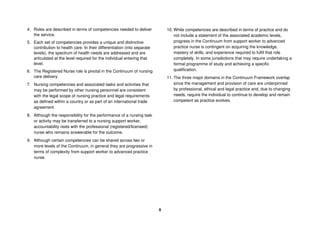
10. While competencies are described in terms of practice and do
not include a statement of the associated academic levels,
progress in the Continuum from support worker to advanced
practice nurse is contingent on acquiring the knowledge,
mastery of skills, and experience required to fulfil that role
completely. In some jurisdictions that may require undertaking a
formal programme of study and achieving a specific
qualification.
11. The three major domains in the Continuum Framework overlap
since the management and provision of care are underpinned
by professional, ethical and legal practice and, due to changing
needs, require the individual to continue to develop and remain
competent as practice evolves.
9
ICN Framework of Competencies
Initially, the ICN Framework of Competencies for the Generalist
Nurse was developed to identify competencies expected of a
generalist nurse at the point of entry into professional practice.8
It
has been used in various ways internationally. For example, the
regulatory bodies of the concerned countries used it to identify
common competencies for registered nurses in South East Asia and
the Western Pacific.9
Another application was as a guide to the
development of a competency inventory for registered nurses in the
People’s Republic of China.10
In the King Faisal Specialist Hospital
and Research Centre in Saudi Arabia, the ICN Framework formed
the basis for a clinical practice assessment portfolio for new
graduates undertaking a period of internship.11
As a result of the consultation for the Continuum the major domains
and some of the sub-domains of the Framework have been revised
(Figure 1). The competencies under three domains are:
1. Professional, ethical and legal practice
2. Care provision and management
3. Professional, personal, and quality development
In undertaking work on the Continuum the ICN competencies for the
registered (generalist) nurse were used as the initial benchmark
against which all other competencies in the Continuum have been
set. As the registered nurse competencies were five years old ICN
took the opportunity to review and revise them as part of the
Continuum development process. The specialist nurse
competencies were based on those developed as part of work
undertaken in collaboration with the European Parkinson’s Disease
Association. The advanced practice competencies have been
developed in collaboration with the ICN International Nurse
Practitioner and Advanced Nursing Network.
In some cases an individual practitioner may develop competencies
in one or more of the areas beyond those set as the initial
benchmarks. This can occur as a result of progress from novice to
expert in their role, as part of preparation for moving to more
developed roles, or as part of a particular demand of the position to
which they have been appointed. Any individual who functions at a
level beyond the initial benchmark in one or more areas is not
considered competent or recognised as functioning at the higher
level unless all requirements are met and any additional formal
preparation or assessment have been completed.
Finally, in developing the Nursing Care Continuum Framework and
Competencies ICN consulted widely in order to arrive at
international consensus. However, these competencies should not
be regarded as prescriptive. Those utilizing the Continuum need to
refer to their particular context and make revisions accordingly.
Some areas may need further expansion and others may be
inappropriate, while areas that are important to practice in their
country may have been omitted. Additionally, some countries may
wish to use the competencies as the basis for developing more
detailed guidance that can inform curriculum development by
identifying the underpinning knowledge and skills required to
achieve the competencies. Figure 2 provides an example of how
this may be developed.
10
ICN FRAMEWORK OF COMPETENCIES
PROFESSIONAL, ETHICAL, LEGAL PRACTICE
CARE PROVISION AND MANAGEMENT
PROFESSIONAL, PERSONAL &
QUALITY DEVELOPMENT
Accountability Ethical Practice
Legal Practice
Enhancement of the Profession Quality Improvement Continuing Education
Key Principles of Care
Leadership and Management
Health Promotion Assessment
Planning Implementation
Evaluation Therapeutic Communication &
Relationships
Inter-professional Health Care Delegation & Supervision
Safe Environment
Figure 1: Revised ICN Competency Framework
11
Figure 2: Example of knowledge and skills required to achieve competencies associated with delegation and supervision
Delegation and Supervision
Knowledge & Skills SW EN RN NS APN
Definition and principles of effective delegation (5 rights of delegation)
Forms of delegation including the use of protocols, guidelines, standing orders
Relation of delegation to professional role, scope of practice and personal accountability/responsibilities,
statutory and regulatory authority for delegation
!
!
!
!
!
!
!
!
!
!
!
!
Organisational responsibilities, policies and procedures to support delegation decisions and supervisory
activities
!
!
!
!
Definition and principles of supervision of individuals
Types and methods of supervision (direct and indirect)
How delegation/supervision contributes to effective use of health resources and the continuum of care
!
!
!
!
!
!
!
!
!
!
!
!
Role as receiver of delegation/supervision: Concept of delegation/supervision
How/when to request additional instruction, training and
support
Right to decline a delegated activity
!
!
!
!
!
!
!
!
!
!
!
!
Skills: 1. Formulating organisational policies/procedures and creating adequate structures and resources
to support delegation and supervisory responsibilities
2. Communicating delegated task
3. Monitoring and providing feedback delegated tasks
4. Using a variety of methods for guidance, instruction, support
!
!
!
!
!
!
!
!
!
!
!
!
!
!
!
!
!
!
!
! Denotes level at which initial knowledge and/or skill is obtained. Knowledge in that area may be further expanded in breadth and depth as a
person progresses in experience and the Continuum.
12
Accountability
Support Worker Enrolled Nurse Registered Nurse Specialist Nurse Advanced Practice Nurse
1 Accepts accountability to
client, employer and registered
nurse.
Accepts accountability for own
professional judgement,
actions, outcomes of care and
continued competence in
accordance with scope of
practice, legislative acts and
regulations.
Accepts accountability for own
professional judgement,
actions, outcomes of care and
continued competence in
accordance with scope of
practice, increased
responsibility, legislative acts
and regulations.
Accepts accountability for
increased responsibility, for
own professional judgement,
actions, outcomes of care and
continued competence in
accordance with scope of
practice, legislative acts and
regulations.
Accepts accountability for
increased role responsibilities,
own professional judgement,
actions, outcomes of care and
continued competence in
accordance with changing
scope of practice, legislative
acts and regulations.
2 Undertakes functions as
directed.
Knows and communicates
own limits of knowledge and
skill when accepting
assignments.
Recognizes the limits of scope
of practice and own
competence.
Recognizes the limits of scope
of practice and own
competence.
Recognizes the limits of scope
of practice and own
competence.
Sets boundaries that
acknowledge practice changes
and developments as well as
conform to legal requirements,
policies and own level of
competence.
3 Seeks assistance and
guidance from a registered
nurse when encountering
situations beyond training
and/or when undertaking a
delegated task.
Seeks guidance from a
registered nurse with the
required knowledge, skills and
when encountering situations
that fall beyond own
knowledge, competence or
scope of practice.
Seeks guidance from the
appropriate others when
encountering situations
beyond own knowledge,
competence or scope of
practice.
Consults with or refers to the
appropriate others when
encountering situations
beyond own knowledge,
competence or scope of
practice.
Consults with or refers to the
appropriate others when
encountering situations
beyond own knowledge,
competence or scope of
practice.
4 Understands different levels of
accountability for the range of
available personnel.
Recognizes and respects
different levels of
accountability for the range of
available personnel.
Recognizes and respects the
different levels of
accountability for the range of
available personnel.
Recognizes and respects
different levels of
accountability for the range of
available personnel.
Recognizes and respects
different levels of
accountability for the range of
available personnel.
5 Participates in activities
related to improving the
access to the range of
services required for effective
health services.
Participates in activities
related to improving the
access to the range of
services required for effective
specialist services.
Works collaboratively with
other health care
professionals, planners, policy
makers and community
leaders to improve service
access, clinical efficacy and
quality of care.
13
14
Ethical Practice
Support Worker Enrolled Nurse Registered Nurse Specialist Nurse Advanced Practice Nurse
6 Conforms to employer’s code
of conduct.
Practises in a manner that
conforms to the ICN Code of
Ethics, the professional code in
force in the jurisdiction and
employer’s code of conduct.
Practises in a manner that
conforms to the ICN Code of
Ethics, the professional code
in force in the jurisdiction and
employer’s code of conduct.
Practises in a manner that
conforms to the ICN Code of
Ethics, the professional code
in force in the jurisdiction and
employer’s code of conduct.
Practises in a manner that
conforms to the ICN Code of
Ethics, the professional code
in force in the jurisdiction and
employer’s code of conduct.
7 Recognizes ethical issues as
they relate to own role, and
seeks guidance in dealing
with situations with ethical
implications.
Engages in effective ethical
decision-making in
collaboration and consultation
with other team members.
Engages in effective ethical
decision-making with respect
to own professional
responsibilities or where
ethical issues affect the
broader health care team.
Engages in effective ethical
decision-making with respect
to own professional practice
areas or where ethical issues
affect the broader health care
team.
Engages in effective ethical
decision-making and
contributes to resolution and
the positive promotion of
ethical practice in the health
system.
8 Upholds right for the client to
be cared for in circumstances
that sustain human and
patient rights, and report
violations.
Acts in an advocacy role to
protect human rights and
questions violations of client in
accordance with jurisdictional
and the ICN Codes of Ethics.
Acts in an advocacy role to
protect human rights and
questions violations of client
in accordance with
jurisdictional and the ICN
Codes of Ethics.
Acts in an advocacy role to
protect human rights and
questions violations of client
in accordance with
jurisdictional and the ICN
Codes of Ethics.
Acts in an advocacy role to
protect human rights and
questions violations of client
in accordance with
jurisdictional and the ICN
Codes of Ethics.
9 Maintains confidentiality and
security of written and verbal
information acquired during
the course of work.
Maintains confidentiality and
security of written, verbal and
electronic information acquired
in a professional capacity.
Maintains confidentiality and
security of written, verbal and
electronic information
acquired in a professional
capacity.
Maintains confidentiality and
security of written, verbal and
electronic information
acquired in a professional
capacity.
Participates in policy and
system development to
increase the levels of
confidentiality and security of
written verbal and electronic
information acquired in a
professional capacity.
10 Respects the client’s right to
privacy and dignity.
Respects the client’s right to
privacy and dignity.
Respects the client’s right to
privacy and dignity.
Respects the client’s right to
privacy and dignity.
Respects the client’s right to
privacy and dignity.
11 Respects the client’s right to
choice and self-determination
in nursing and health care.
Respects the client’s right to
choice and self-determination
in nursing and health care.
Respects the client’s right to
information, choice and self-
determination in nursing and
health care.
Respects the client’s right to
information, choice and self-
determination in nursing and
health care.
Participates in establishing
policies that confirm the
client’s right to information,
choice and self-determination
in nursing and health care
and applies these in practice.
15
Ethical Practice (cont.)
Support Worker Enrolled Nurse Registered Nurse Specialist Nurse Advanced Practice Nurse
12 Follows organisational
procedures to report observed
behaviour, actions or
situations that could
compromise client safety,
privacy or dignity.
Challenges behaviour and
health care practice that could
compromise client safety,
privacy or dignity.
Challenges behaviour and
health care practice that could
compromise client safety,
privacy or dignity.
Challenges behaviour and
health care practice that could
compromise client safety,
privacy or dignity.
Participates in creating
mechanisms to monitor and
respond to situations where
behaviour or health care
practice may compromise
client safety, privacy or
dignity.
13 Demonstrates professional
integrity, probity and ethical
conduct in response to
industry marketing strategies
when prescribing drugs and
other products.
Demonstrates professional
integrity, probity and ethical
conduct in response to
industry marketing strategies
when prescribing drugs and
other products.
16
Legal Practice
Support Worker Enrolled Nurse Registered Nurse Specialist Nurse Advanced Practice Nurse
14 Works within existing legal
and organisational framework.
Practices in accordance with
professional, relevant civil
legislation and regulations.
Practices in accordance with
professional, relevant civil
legislation and regulations.
Practices in accordance with
professional, relevant civil
legislation and regulations
including those specific to
area of specialty practice.
Practices independently in
accordance with professional,
relevant civil legislation and
regulations including those
specific to the advanced
practice role.
15 Adheres to organisational
policies and procedural
guidelines.
Practices in accordance with
jurisdictional and local policies
and procedural guidelines.
Practices in accordance with
jurisdictional and local policies
and procedural guidelines.
Practices in accordance with
jurisdictional and local policies
and procedural guidelines.
Practices in accordance with
jurisdictional and local policies
and procedural guidelines
pertaining to the advanced
practice nursing role.
16 Raises concerns to direct
supervisor or those in
authority, in cases of harm or
abuse of clients.
Recognizes and acts upon
breaches of law relating to the
professional role and/or
professional code of
conduct/code of practice.
Recognizes and acts upon
breaches of law relating to the
professional role and/or
professional code of
conduct/code of practice.
Recognizes and acts upon
breaches of law relating to the
professional role and/or
professional code of
conduct/code of practice.
Recognizes and acts upon
breaches of law relating to the
professional role and/or
professional code of
conduct/code of practice.
17
18
Principles of Care Provision
Support Worker Enrolled Nurse Registered Nurse Specialist Nurse Advanced Practice Nurse
17 Can accurately describe
activity or task.
Provides a rationale for the
nursing care delivered.
Uses knowledge from nursing,
health and other disciplines
combined with best available
evidence to explain nursing
decisions and interventions.
Uses knowledge from nursing,
health and other disciplines
combined with best available
evidence to explain nursing
decisions and interventions.
Draws on knowledge within
nursing and across other
disciplines and best available
evidence to provide a
rationale for APN decisions
and interventions.
18 Uses acquired knowledge
and skills when fulfilling role
requirements.
Uses current knowledge
based on best practice when
carrying out professional
responsibilities.
Applies contemporary
knowledge from different
sources and the best
available evidence to base
professional decision-making
and practice.
Applies contemporary
knowledge from different
sources and area for
speciality and the best
available evidence to base
professional decision-making
and practice.
Integrates scientific
knowledge, best available
evidence and expert
judgement to guide and
advance practice.
19 Recognizes and reports a
problem when it occurs
during the course of work.
Uses clinical problem solving
skills to guide practice.
Applies critical thinking skills
and a systems approach to
problem solving and nursing
decision-making across a
range of professional and
care delivery contexts.
Applies critical thinking skills
and a systems approach to
problem solving and nursing
decision-making and
speciality care delivery
contexts.
Applies critical thinking,
clinical reasoning and expert
judgement to decision-
making in complex areas of
practice and across a range
of professional and care
delivery contexts.
20 Delivers care according to
instructions of the supervisor,
and in concordance with
nursing and organisational
standards and procedures.
Delivers care consistent with
professional and
organisational standards,
policies, protocols and
procedures.
Delivers care consistent with
professional and
organisational standards,
policies, protocols and
procedures.
Delivers care consistent with
professional and
organisational standards,
policies, protocols and
procedures applicable to
specialist nursing practice.
Delivers care consistent with
professional guidelines,
standards, policies, protocols
and procedures applicable to
advanced nursing practice.
21 Understands that care may
need to be modified to
cultural needs.
Recognizes culturally
sensitive needs and adapts
practice accordingly.
Recognizes culturally
sensitive needs and adapts
practice accordingly.
Recognizes culturally
sensitive needs and adapts
practice accordingly.
Recognizes breaches and
intervenes at the practice and
system levels to ensure that
care is sensitive to cultural
needs.
19
Principles of Care Provision (cont.)
Support Worker Enrolled Nurse Registered Nurse Specialist Nurse Advanced Practice Nurse
22 Is aware of clients’ beliefs and
practices in traditional healing
practices.
Understands the significance
of traditional healing practices
within a client’s health belief
system.
Incorporates traditional
healing practices valued by
clients and with proven
beneficial/or harmless effects
into care activities.
Incorporates traditional
healing practices valued by
clients and with proven
beneficial or harmless effects
into care activities.
Searches for evidence to
support claims for the
beneficial effects of traditional
healing practices and
incorporates as appropriate.
23 Consults with supervisor
before providing information
about rights of a health
service user.
Informs clients about rights of
a health service user.
Applies advocacy skills to
assist clients unable to
represent or speak for
themselves.
Applies advocacy skills to
assist clients unable to
represent or speak for
themselves regarding
speciality care requirements.
Uses advocacy skills to
influence health policy and
planning and service access
on behalf of clients unable to
represent or speak for
themselves.
24 Demonstrates awareness of
resources available for
assisting clients with changes
in health, disability and death.
Knows how to access and use
resources available to assist
clients deal with changes in
health, disability and death.
Acts as an information and
education resource and for
clients seeking to improve life
styles, adopt illness/injury
prevention activities and
cope with changes in health,
disability and death.
Acts as an information and
education resource in the
speciality area for clients
seeking healthier life styles,
adopt illness/injury prevention
activities and cope with
changes in health, disability
and death.
Develops resources,
programmes and formulates
implementation strategies
designed to promote healthy
life styles, and adoption of
illness/injury prevention
activities of individuals,
families or communities.
25 Provides support in the
development and/or
maintenance of independent
living skills.
Provides guidance/ instruction
in the development and/or
maintenance of independent
living skills.
Provides guidance/
instruction in the
development and/or
maintenance of independent
living skills.
Provides guidance/
instruction in the
development and/or
maintenance of independent
living skills.
Contributes to planning and
policy development designed
to promote self sufficiency
and independent living skills.
26 Under the guidance of a
supervisor, gives simple
instruction appropriate to level
of knowledge and work
responsibility.
Uses opportunities to
introduce health-related
instruction during the care
process.
Recognizes opportunities and
provides guidance/education
to individuals, families and
communities to encourage
adoption of illness prevention
activities and maintenance
healthy lifestyles.
Recognizes opportunities and
provides guidance/ education
to individuals, families and
communities to encourage
adoption of illness prevention
activities and maintenance of
healthy lifestyles.
Identifies and responds
creatively to new opportunities
for health education/patient
education based on client and
community needs, and
available resources, and
using strategies based on the
best evidence available.
20
Principles of Care Provision (cont.)
Support Worker Enrolled Nurse Registered Nurse Specialist Nurse Advanced Practice Nurse
27 Contributes to the teaching
plan established by the
registered nurse.
Selects teaching/learning
strategies appropriate to the
needs and characteristics of
the individual or group.
Selects teaching/learning
strategies appropriate to the
needs and characteristics of
the individual or group.
Participates in creating, and
establishing evidence-based
implementation strategies for
education programmes
designed to encourage
learning about health
promotion and illness/injury
prevention, and stimulate
participation of clients to meet
own health needs.
Monitors educational
programme implementation
and evaluates outcomes and
impact on behaviour.
28 Gives feedback to client and
supervisor on results of
instruction.
Evaluates learning outcomes
and modifies
teaching/learning approaches
and content accordingly.
Evaluates learning outcomes
and modifies
teaching/learning approaches
and content accordingly.
Uses evaluation data to
improve educational
programme outcomes.
29
.
Demonstrates awareness of
major developments and the
potential application of current
communication/health
technologies in health care.
Keeps abreast of
developments and potential
applications of emerging
communication/health
technologies in health care.
Identifies opportunities for and
participates in the
assessments of new
communication/health
technologies to practice prior
to introduction into the
practice context.
21
22
Promotion of Health
Support Worker Enrolled Nurse Registered Nurse Specialist Nurse Advanced Practice Nurse
30 Maintains own health and
personal fitness for/at work.
Maintains own health and
personal fitness for/at work.
Maintains own health and
personal fitness for/at work.
Maintains own health and
personal fitness for/at work.
Maintains own health and
personal fitness for/at work.
31 Seeks involvement in
activities designed to reduce
illness and promote healthy
life styles and environments.
Participates with nurses, other
professionals and community
groups in activities to reduce
illness and promote healthy
life styles and environments.
Cooperates with nurses, other
professionals and community
groups in activities to reduce
illness and promote healthy
life styles and environments.
Cooperates with other
professionals and community
and speciality interest groups
in activities to reduce illness
and promote healthy life
styles and environments in
areas important to speciality
practice.
Engages actively with other
health professionals,
planners, policymakers,
advocacy and community
groups to formulate strategies
and mobilize resources for
improving the health status of
the community.
32 Demonstrates an
understanding of how health
and disease are affected by
basic hygiene, sanitation and
nutrition.
Demonstrates an
understanding of how health
and disease are affected by
multiple and interconnected
factors.
Incorporates into practice a
perspective that takes
account of the multiple
determinants of health.
Incorporates into practice a
perspective that takes
account of the multiple
determinants of health.
Incorporates a perspective
that takes account the
multiple determinants of
health when developing
illness prevention, health
promotion and capacity
building strategies for
individuals, families and
communities.
23
Assessment
Support Worker Enrolled Nurse Registered Nurse Specialist Nurse Advanced Practice Nurse
33 Undertakes delegated
aspects of health data
collection within sphere of
competence.
Undertakes delegated
aspects of health data
collection within sphere of
competence and contributes
data and information to the
assessment made by the
registered nurse.
Gathers accurate and relevant
objective and subjective data
through systematic health and
nursing assessments-
Gathers accurate and relevant
objective and subjective data
required for practice in
specialty area through
systematic health and nursing
assessments, ordering
diagnostic tests and
procedures as permitted in
the scope of specialist
practice and legislation.
Gathers accurate and relevant
objective and subjective data
for client assessment using
multiple data collection
strategies and information
sources, ordering diagnostic
tests and procedures as
permitted in the scope of
advanced nursing practice
and legislation.
34 Reports changes that may
affect health and well being.
Identifies common and overt
actual and potential health
problems and notes findings
that lie outside the norm.
Organises, synthesizes,
analyses, and interprets data
from different sources to
derive a nursing diagnosis
and determine a care plan.
Organises, synthesizes,
analyses, and interprets data
from different sources to
derive nursing diagnoses and
determine a care plan.
Applies advanced clinical
reasoning judgement and in-
depth knowledge to derive a
differential diagnosis and
determine a comprehensive
care plan.
35 Reports observations and
complies with organisational
policy.
Reports and keeps accurate,
timely records of findings
complying with professional
standards and organisational
policies.
Shares and documents
findings accurately and in a
timely manner complying with
professional standards and
organisational policies.
Shares and documents
findings accurately and in a
timely manner complying with
professional standards and
organisational policies.
Shares and documents
findings accurately and in a
timely manner complying with
professional standards and
organisational policies.
24
Planning
Support Worker Enrolled Nurse Registered Nurse Specialist Nurse Advanced Practice Nurse
36 Contributes information to
assist with care planning.
Assists the registered nurse to
formulate a care plan for
clients based on assessment
results.
Formulates a comprehensive
care plan with identified care
outcomes based on nursing
diagnoses, findings from a
nursing and health
assessment, inputs from other
health team members, and
nursing practice standards.
.
Formulates a compre-
hensive care plan with
identified care outcomes
based on nursing diagnoses,
findings from a nursing and
health assessment, inputs
from other health team
members, and nursing
practice standards.
Formulates and mobilizes
resources for a coordinated
comprehensive care plan with
identified care outcomes and
based on advanced nursing
practice standards, and
informed decisions about
preventive, diagnostic and
therapeutic interventions.
37 Uses relevant knowledge
from nursing and other
disciplines to contribute to
care planning.
Applies critical thinking and
clinical reasoning skills
underpinned by knowledge of
nursing and other disciplines
to the care planning process.
Applies critical thinking and
clinical reasoning skills
underpinned by knowledge
of the area of specialist
practice and other
disciplines to the care
planning process.
Applies critical thinking and
complex clinical reasoning
underpinned by in depth
theoretical, scientific and
contemporary clinical and
health system knowledge to
the care planning process.
38 Establishes priorities for care
with nurse supervisor.
Establishes priorities for care
in collaboration with other care
providers and clients.
Establishes priorities for
care in collaboration with
other care providers and
clients.
Negotiates to meet priorities
for care within available
health resources and the
system capabilities.
39 Directs questions from clients
about care plan to the nurse
supervisor.
Provides accurate information
to clients about aspects of
care plan that fall within own
responsibility.
Involves clients where
possible in care planning
ensuring that they receive
accurate, understandable
information on which to base
consent for care.
Involves clients where
possible in care planning
ensuring that they receive
accurate, understandable
information on which to base
consent for care
Involves clients where
possible in care planning
ensuring that they receive
accurate, understandable
information on which to base
consent for care.
25
Planning (cont.)
Support Worker Enrolled Nurse Registered Nurse Specialist Nurse Advanced Practice Nurse
40 Reports concerns regarding
clients’ ability to understand
and make decisions.
Reports and requests an
advocate when clients and/or
carers ask for support, have
limited abilities in decision-
making, giving informed
consent, or where there is a
language barrier.
Involves an advocate when
clients, families or carers
request support or have
limited abilities in decision-
making, giving informed
consent, or where there is a
language barrier.
Involves an advocate when
clients, families or carers
request support or have
limited abilities in decision-
making, giving informed
consent, or where there is a
language barrier.
Implements a mechanism to
assure the presence of an
advocate when clients,
families or carers request
support or have limited
abilities in decision-making,
giving informed consent or
where there is a language
barrier.
41 Contributes to care plan
review and revision.
In collaboration with a
registered nurse, regularly
reviews and revises the care
plan.
Regularly reviews and
revises the care plan, where
possible in collaboration with
other members of the
health/social health team,
and clients.
Regularly reviews and revises
the care plan, where possible
in collaboration with other
members of the health/social
health team, and clients.
Regularly reviews and revises
the care plan, where possible
in collaboration with other
members of the health/social
health team, clients and/or
carers.
42 Keeps records of activities. Under the supervision of a
registered nurse maintains a
current, accurate care plan
and related records.
Maintains a current, accurate
care plan and related
records.
Maintains a current, accurate
care plan and related
records.
Maintains a current, accurate
care plan and related
records.
26
Implementation
Support Worker Enrolled Nurse Registered Nurse Specialist Nurse Advanced Practice Nurse
43 Assists with care under the
direction of an enrolled or
registered nurse.
Under the supervision of the
registered nurse, implements
planned nursing
interventions in accordance
with nursing and best
practice standards.
Implements a range of
procedures, treatments and
interventions that fall within
scope of practice for the
registered nurse and are in
accordance with nursing and
best practice standards.
Implements a range of
procedures, treatments
and interventions that fall
within scope of specialist
practice and are in
accordance with specialist
nursing and best practice
standards.
Implements procedures,
treatments and interventions
that fall within the legal
authority, scope of extended
practice and are in accordance
with nursing and best practice
standards.
44 Records task undertaken
and observations accurately
and in a timely fashion
according to organisational
procedures.
Documents interventions
and client responses
accurately and in a timely
manner.
Documents interventions
and client responses
accurately and in a timely
manner.
Documents interventions
and client responses
accurately and in a timely
manner.
Documents interventions and
client responses accurately
and in a timely manner.
45 Identifies and reports
unexpected changing
situations.
Identifies and reports
unexpected changing
situations.
Responds appropriately and
in time to unexpected or
rapidly changing situations.
Responds appropriately
and in time to unexpected
or rapidly changing
situations.
Adapts interventions to the
needs of the client and/or the
environment in unexpected or
rapidly changing situations.
Summons immediate
assistance in an emergency/
disaster situation.
Summons immediate and
appropriate assistance to the
emergency/disaster
situation.
46
Applies life support skills until
assistance arrives.
Applies life support skills
until assistance arrives.
Responds immediately and
appropriately to emergency
and disaster situations,
including launching life
support procedures when
necessary, and other
emergency/disaster
procedures.
Responds immediately and
appropriately to emergency
and disaster situations
taking a leadership role in
triage and coordination of
care for clients with
specialty care needs.
Mobilizes and coordinates
resources and assumes
leadership in emergency
and/or disaster situations.
27
Evaluation
Support Worker Enrolled Nurse Registered Nurse Specialist Nurse Advanced Practice Nurse
47 Contributes information to the
evaluation of progress toward
expected care outcome.
Monitors and documents
progress toward expected
outcomes accurately and
completely.
Monitors and documents
progress toward expected
outcomes accurately and
completely.
Monitors and documents
progress toward expected
outcomes accurately and
completely.
Monitors and documents
progress toward expected
outcomes accurately and
completely.
48 Contributes to team
evaluation of progress
towards planned outcomes.
In consultation with clients,
families and/or carers, and
health team members,
evaluates progress towards
planned outcomes.
In consultation with clients,
families and/or carers, and
health team members,
evaluates progress towards
planned outcomes.
In consultation with clients,
families and/or carers,
participates in interdisciplinary
evaluation of progress
towards planned outcomes.
49 Contributes evaluation data
and suggests modifications in
the care plan to the registered
nurse.
Uses evaluation data to
modify the care plan.
Uses evaluation data to
modify the care plan.
Uses evaluation data to
influence care strategies and
inform future practice trends.
28
Therapeutic Communication and Interpersonal Relationships
Support Worker Enrolled Nurse Registered Nurse Specialist Nurse Advanced Practice Nurse
50 Operates within scope of work
to initiate, develop and
discontinue interpersonal
relationships with
patients/clients and/or carers.
Initiates, develops and
discontinues therapeutic
relationships through the use
of appropriate communication
and interpersonal skills.
Initiates, develops and
discontinues therapeutic
relationships through the use
of appropriate communication
and interpersonal skills.
Initiates, develops and
discontinues therapeutic
relationships using a range of
advanced communication and
interpersonal skills.
Initiates, develops and
discontinues therapeutic
relationships through the use
of advanced communication
and interpersonal skills.
51 Maintains a relationship that
respects the boundary
between clients and self.
Maintains a relationship that
respects the boundary
between clients and self.
Maintains a relationship that
respects the boundary
between clients and self.
Maintains a relationship that
respects the boundary
between clients and self.
Maintains a relationship that
respects the boundary
between clients and self.
52 Listens to others in an
unbiased manner, respects
points of view of others.
Listens to others in an
unbiased manner, respects
points of view of others.
Listens to others in an
unbiased manner, respects
points of view of others, and
promotes the expression of
diverse opinions and
perspectives.
Listens to others in an
unbiased manner, respects
points of view of others, and
promotes the expression of
diverse opinions and
perspectives.
Listens to others in an
unbiased manner, respects
points of view of others, and
promotes the expression of
diverse opinions and
perspectives.
53 Communicates clear,
consistent and accurate
information about client status
that falls within scope of work
and maintains confidence in
care.
Communicates clear,
consistent and accurate
information verbally, or in
written and electronic forms,
that falls within professional
responsibility and maintains
confidence in care.
Communicates clear,
consistent and accurate
information verbally, or in
written and electronic forms,
that falls within professional
responsibility and maintains
confidence in care.
Communicates clear,
consistent and accurate
information verbally, or in
written and electronic forms,
that falls within professional
responsibility.
Communicates clear,
consistent and accurate
information verbally, or in
written and electronic forms,
that falls within professional
responsibility and maintains
confidence in care.
54 Interacts in a manner that is
respectful and culturally
appropriate to the clients,
family and/or carers from
diverse cultural backgrounds.
Interacts in a manner that is
respectful and culturally
appropriate to the clients,
family and/or carers from
diverse cultural backgrounds.
Interacts in a manner that is
respectful and culturally
appropriate to the clients,
family and/or carers from
diverse cultural backgrounds.
Interacts in a manner that is
respectful and culturally
appropriate to the clients,
family and/or carers from
diverse cultural backgrounds.
Interacts in a manner that is
respectful and culturally
appropriate to the clients,
family and/or carers from
diverse cultural backgrounds.
55 Facilitates access to
information or refers request
to the appropriate person.
Facilitates access to
information or refers request
to the registered nurse.
Facilitates access to
information or refers request
to the appropriate person.
Facilitates access to
information or refers request to
the appropriate person.
Advocates for and assists with
establishing policies that
facilitate access for clients to
information relevant to their
situation.
29
Therapeutic Communication and Interpersonal Relationships (contd.)
Support Worker Enrolled Nurse Registered Nurse Specialist Nurse Advanced Practice Nurse
56 Communicates activities
carried out to other team
members, providing sufficient
information for their needs.
Communicates and shares
relevant information, including
views of clients, families
and/or carers with other
health team members
involved in providing services.
Communicates and shares
relevant information including
views of clients, families
and/or carers with other
health team members
involved in providing services.
Communicates and shares
information including views of
clients, families and/or carers
with other health team
members involved in
providing services.
Takes measures to create
effective mechanisms for
communicating and sharing
information with other health
team members involved in
providing services.
30
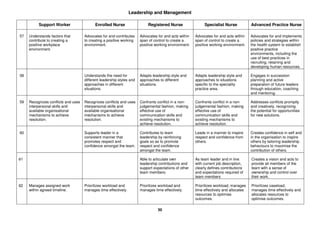
Leadership and Management
Support Worker Enrolled Nurse Registered Nurse Specialist Nurse Advanced Practice Nurse
57 Understands factors that
contribute to creating a
positive workplace
environment.
Advocates for and contributes
to creating a positive working
environment.
Advocates for and acts within
span of control to create a
positive working environment.
Advocates for and acts within
span of control to create a
positive working environment.
Advocates for and implements
policies and strategies within
the health system to establish
positive practice
environments, including the
use of best practices in
recruiting, retaining and
developing human resources.
58 Understands the need for
different leadership styles and
approaches in different
situations.
Adapts leadership style and
approaches to different
situations.
Adapts leadership style and
approaches to situations
specific to the speciality
practice area.
Engages in succession
planning and active
preparation of future leaders
through education, coaching
and mentoring.
59 Recognizes conflicts and uses
interpersonal skills and
available organisational
mechanisms to achieve
resolution.
Recognizes conflicts and uses
interpersonal skills and
available organisational
mechanisms to achieve
resolution.
Confronts conflict in a non-
judgemental fashion, making
effective use of
communication skills and
existing mechanisms to
achieve resolution.
Confronts conflict in a non-
judgemental fashion, making
effective use of
communication skills and
existing mechanisms to
achieve resolution.
Addresses conflicts promptly
and creatively, recognizing
the potential for opportunities
for new solutions.
60 Supports leader in a
consistent manner that
promotes respect and
confidence amongst the team.
Contributes to team
leadership by reinforcing
goals so as to promote
respect and confidence
amongst the team.
Leads in a manner to inspire
respect and confidence from
others.
Creates confidence in self and
in the organisation to inspire
others by tailoring leadership
behaviours to maximise the
contribution of others.
61 Able to articulate own
leadership contributions and
support expectations of other
team members.
As team leader and in line
with current job description,
clearly defines contributions
and expectations required of
team members
Creates a vision and acts to
provide all members of the
team with a sense of
ownership and control over
their work.
62 Manages assigned work
within agreed timeline.
Prioritizes workload and
manages time effectively.
Prioritizes workload and
manages time effectively.
Prioritizes workload, manages
time effectively and allocates
resources to optimise
outcomes.
Prioritizes caseload,
manages time effectively and
allocates resources to
optimise outcomes.
31
Leadership and Management (cont.)
Support Worker Enrolled Nurse Registered Nurse Specialist Nurse Advanced Practice Nurse
63 Demonstrates awareness of
the role of policies and
procedures in the
management of the
organisation.
Demonstrates understanding
of how policies and
procedures are developed
and contributes to feedback to
review committees.
Contributes to the review and
modification of current
organisational and practice
policies and procedures
currently in force.
Contributes to the review and
modification of current
organisational and practice
policies and procedures
currently in force and provides
leadership in developing and
implementing organisational
and practice policies and
procedures specific to the
specialty area.
Develops and implements
mechanisms for periodic
monitoring and evaluation of
policies that impact on nursing
services and translates these
into health plans, structures,
and programmes.
64 Participates in unit based
teaching/ learning activities.
Participates in unit based
teaching/ learning activities.
Contributes to education and
professional development of
students and colleagues in
the work place.
Contributes to the
development and
implementation of specialist
education and professional
development of students and
colleagues in the work place.
Promotes policies and
advocates for resources to
support education and
professional development in
the work setting.
65 Offers suggestions and
provide feedback for changes
in own sphere of work.
Provides feedback and offers
suggestions for changes in
own sphere of practice and
deals effectively with the
impact of change on own
practice.
Provides feedback, offers
suggestions for changes and
deals effectively with the
impact of change in own
practice or on the
organisation.
Uses the change process to
influence the introduction of
innovations and adaptations
to specialist practice and
service organisation.
Introduces, evaluates and
manages innovation and
change in the health system
through encouraging
creativity.
32
Safe Environment
Support Worker Enrolled Nurse Registered Nurse Specialist Nurse Advanced Practice Nurse
66 Identifies and reports
situations that may impact on
the safety of patients/clients
or staff.
Identifies and reports
situations that may impact on
the safety of patients/clients
or staff.
Uses appropriate assessment
tools to identify actual and
potential risks to safety and
reports concerns to the
relevant authority.
Uses appropriate assessment
tools to identify actual and
potential risks to safety and
security and reports concerns
to the relevant authority.
Uses regular assessments to
identify actual and potential
environmental, patient,
personnel safety and security
risks and reports concerns to
the relevant authority.
67 Contributes to safety and
security measures through
timely action and adherence
to national legislation and
workplace health and safety
measures.
Maintains a safe care
environment through timely
action and adherence to
national legislation and
workplace health and safety
requirements, policies and
procedures.
Takes timely action through
the use of quality
improvement risk
management strategies to
create and maintain safe care
environment and meet
national legislation and
workplace health and safety
requirements, policies and
procedures.
Takes timely action through
the use of quality
improvement risk
management strategies to
create and maintain safe care
environment and meet
national legislation and
workplace health and safety
requirements, policies and
procedures.
Uses multiple interventions
and risk management
strategies to initiate change
and maintain safe
environments within the
system and that meet national
legislation and health and
safety requirements.
68 Stores therapeutic substances
safely and securely.
Ensures the safe and proper
storage, administration and
recording of therapeutic
substances.
Ensures the safe and proper
storage, administration and
recording of therapeutic
substances.
Ensure that policies and
procedures are in place for
the safe and proper storage,
administration and recording
of therapeutic substances.
69 Administers and records
medication under the
supervision of a registered
nurse when legally permitted.
Administers and records
medication, assesses side-
effects and titrates dosages in
accordance with authorised
prescriptions.
In accordance with
prescriptive authority selects/
prescribes/ administers
medication, including accurate
dosage, routes and frequency
pattern, based upon accurate
knowledge of the
pharmacological effect,
patient characteristics and
concurrent therapies.
In accordance with
prescriptive authority
selects/prescribes/
administers medication,
including accurate dosage,
routes and frequency pattern,
based upon accurate
knowledge of the
pharmacological effect,
patient characteristics and
concurrent therapies.
33
Safe Environment (cont.)
Support Worker Enrolled Nurse Registered Nurse Specialist Nurse Advanced Practice Nurse
70 Complies with infection
prevention procedures.
Complies with infection
prevention procedures.
Complies with infection
prevention procedures and
challenges breaches in other
practitioners’ practice.
Complies with infection
prevention procedures and
challenges breaches in other
practitioners’ practice.
Is proactive in highlighting and
proposing improvements to
infection control strategies for
all practice sites.
71 Knows actions to take in the
event a disaster is declared.
Knows actions to take in the
event a disaster is declared.
Knows responsibilities’ and
procedures to follow in the
event a disaster is declared.
Identifies and plans for
specific measures necessary
to deal with patients/clients in
area of specialty practice in
the event of a disaster.
Contributes to the formulation
of service disaster and
recovery plans.
34
Delegation and Supervision
Support Worker Enrolled Nurse Registered Nurse Specialist Nurse Advanced Practice Nurse
Delegates to others, activities
according to ability, level of
preparation, proficiency and
legal scope of practice.
Delegates to others, activities
according to ability, level of
preparation, proficiency and
legal scope of practice.
72 Accepts delegated/
assigned activities for which
preparation has been
provided and proficiency
has been assessed.
Accepts delegated activities in
line with personal level of
proficiency and legal scope of
practice.
Accepts delegated activities in
line with personal level of
proficiency and legal scope of
practice.
Accepts delegated activities
in line with personal level of
proficiency and legal scope
of practice.
Delegates to others, activities
according to ability, level of
preparation, proficiency and
legal scope of practice.
73
Provides feedback to
persons delegating/
assigning activities and
supervising work.
Provides feedback to persons
delegating/assigning activities
and supervising work.
Monitors and uses a range of
supportive strategies including
precepting when supervising
and/or monitoring delegated
care.
Monitors and uses a range of
supportive strategies
including precepting and
mentoring when supervising
and/or monitoring delegated
care.
Offers supportive strategies
including mentoring, coaching
and precepting as part of
supervisory responsibilities.
74 Accepts responsibility for
delegated activity.
Maintains accountability for
outcomes of delegated activity.
Maintains accountability and
responsibility when delegating
aspects of care to others.
Maintains accountability and
responsibility when
delegating aspects of care to
others.
Maintains accountability and
responsibility when delegating
aspects of care to others.
75 Contributes to policy and
protocol development that
relates to delegation of clinical
responsibilities.
Contributes to policy and
protocol development that
relates to delegation of
clinical responsibilities
specific to speciality practice.
Contributes to policy and
protocol development that
relates to delegation of clinical
responsibilities within nursing
and across the health
professions.
35
Inter-Professional Health Care
Support Worker Enrolled Nurse Registered Nurse Specialist Nurse Advanced Practice Nurse
76 Understands some roles and
skills of other care providers
in relation to own
responsibilities.
Understands and values the
roles, knowledge and skills of
members of the health care
team in relation to own
responsibilities.
Understands and values the
roles, knowledge and skills of
members of the health team in
relation to own responsibilities.
Understands and values the
roles, knowledge and skills of
members of the health team
in relation to own
responsibilities.
Creates an environment that
fosters trust among health
care providers, and familiarity
of the knowledge and skills
that different professions and
disciplines bring to health
service delivery.
77 Cooperates to maintain
effective multidisciplinary
teamwork.
Cooperates to maintain
effective multidisciplinary
teamwork.
Works collaboratively with
other professionals in health
care to enhance nursing and
other health services being
accessed by clients.
Works collaboratively with
other professionals in health
care to enhance nursing and
other services offered in
specialty area.
Utilizes leadership, team
building, negotiation and
conflict resolution skills to
build intra-/inter-professional,
agency and community
partnerships to improve
quality of care and address
gaps/barriers to access.
78 Uses basic knowledge of
effective inter- and intra-
professional working
practices.
Uses knowledge of effective
inter- and intra-professional
working practices.
Uses knowledge of effective
inter- and intra-professional
working practices.
Engages in active promotion
of inter- and intra-professional
collaborative working
practices within the practice
environment.
79 Communicates views of
patients/clients and/or carers
to assist with decision-making
by the inter-professional team.
Presents and supports the
views of clients, families
and/or carers during decision-
making by the inter-
professional team.
Presents the views of clients,
families and/or carers in
decision-making by the inter-
professional team and assists
with negotiation of mutually
agreed decisions.
Presents the views of /clients,
families and/or carers in inter-
and intra-professional team
decisions and assists and/or
leads in the negotiation of
mutually agreed decisions.
80 Refers clients to a registered
nurse to ensure
patients/clients have access
to best available interventions.
Refers clients to ensure
patients/clients have access to
best available interventions.
Refers clients and accepts
referrals from other health
care providers to ensure
clients have access to best
available intervention.
Makes referrals to and
receives referrals from other
health care providers to
promote continuity of care and
ensure offer best available
intervention.
81 Accepts accountability and
responsibility for caseload
management.
36
Enhancement of the Profession
Support Worker Enrolled Nurse Registered Nurse Specialist Nurse Advanced Practice Nurse
82 Understands how professional
standards contribute to the
safety and quality of care.
Knows and follows
professional standards and
best practices applicable to
professional responsibilities.
Promotes dissemination, use,
monitoring and review of
professional standards and
best practice guidelines.
Promotes dissemination, use,
monitoring and review of
professional specialist
standards and best practice
guidelines and participates in
developing and adapting
standards to the practice
context.
Provides leadership in
developing the evidence base
for professional standards and
best practice and leads in
developing and adapting
standards to the practice
context.
83 Promotes and maintains a
positive image of nursing.
Promotes and maintains a
positive image of nursing.
Promotes specialist nursing
practice as an essential part
of health service delivery.
Articulates and promotes the
advanced practice nursing
role in the clinical, political
and professional contexts.
84 Acts as an effective role
model for enrolled nurse
students and support staff.
Acts as an effective role
model for students and within
the care team.
Acts as an effective role
model for students and within
the care team.
Acts as an effective role
model for students and within
the care team.
85 Acts as a resource for
enrolled nursing students and
support staff.
Acts as a resource for
students, other members of
the health team and the
public.
Acts as a resource in
speciality area for students,
other members of health
team, health planners and the
public
Acts as a resource on
advanced nursing practice for
students, other members of
the health team, health
planners and the public.
86
Values research in
contributing to developments
in nursing and uses findings
as a means to improving
standards of care.
Contributes to knowledge and
practice development of the
clinical nursing speciality
through identifying and
conducting research in areas
of need.
Contributes new knowledge
to practice development by
conducting research,
dissemination and
incorporating findings into
practice.
37
Enhancement of the Profession (cont.)
Support Worker Enrolled Nurse Registered Nurse Specialist Nurse Advanced Practice Nurse
87 Advocates for and participates
in obtaining public, legal and
employer recognition of
specialist qualifications, title
protection and related scope
of practice.
Advocates for and
participates in obtaining
public, legal and employer
recognition of advanced
practice nursing
qualifications, title protection
and scope of practice.
88 Scans practice environment
and nursing literature to
identify emerging trends and
issues.
Scans practice environment
and specialist nursing
literature to identify emerging
trends and issues.
Scans the global environment
for emerging trends in
advanced practice and health
care.
89 Engages in advocacy
activities through the
professional organisation to
influence health and social
care service policies and
access to services.
Engages in advocacy
activities through the
professional organisation to
influence health and social
care service policies and
access to services.
Engages in advocacy
activities through professional
organisations to influence
health and social care service
policies and service provision
important to the area of
speciality practice.
Leads advocacy activities
through professional
organisation to influence
health and social care service
policies that impact on the
availability and access to
advanced nursing practice
services.
38
Quality Improvement
Support Worker Enrolled Nurse Registered Nurse Specialist Nurse Advanced Practice Nurse
90 Undertakes tasks as directed
and in line with policies,
procedures, quality measures
and with level of training.
Undertakes tasks as directed
and in line with policies,
procedures, quality measures
and with level of training.
Follows evidence-based and
best practice guidelines in the
delivery of nursing practice.
Uses and contributes to
research into the evidence
base for safe, effective,
efficient practice in speciality
area.
Translates and integrates
research to produce evidence
based practice to improve
safety, efficiency and
effectiveness of care.
91 Suggests ideas to the
appropriate person for
services improvement.
Participates in quality
improvement and quality
assurance procedures.
Participates in quality
improvement and quality
assurance procedures.
Uses systematic review to
improve client experience and
outcomes in area of speciality.
Participates in intra- and inter-
disciplinary peer supervision
and review to improve client
experience and outcomes.
39
Continuing Education
Support Worker Enrolled Nurse Registered Nurse Specialist Nurse Advanced Practice Nurse
92 Identifies gaps between
current work requirements
and current knowledge,
understanding and skills.
Undertakes regular review of
own practice by engaging in
reflection and peer review.
Undertakes regular review of
own practice by engaging in
reflection, critical examination
and evaluation and seeking
peer review.
Undertakes regular review of
own practice by engaging in
reflection, critical examination
and evaluation and seeking
peer review.
Undertakes regular review of
own practice by engaging in
reflection, critical examination
and evaluation and seeking
peer review.
93 Routinely attends up-date
sessions relevant to
developments on own and
associated areas of work.
Assumes responsibility for
lifelong learning, own
professional development and
maintenance of competence.
Assumes responsibility for
lifelong learning, own
professional development and
maintenance of competence.
Assumes responsibility for
lifelong learning, own
professional development and
maintenance of competence.
Assumes responsibility for
lifelong learning, own
professional development
and maintenance of
competence.
94 Takes opportunities to learn
together with others
contributing to health.
Takes opportunities to learn
with others contributing to
health care.
Takes opportunities to learn
with others contributing to
health care.
Participates in uni- and
multidisciplinary teaching
learning.
Promotes and encourages
programmes that support
interdisciplinary health care
education.
40
GLOSSARY
Accountability: The readiness or preparedness to give an explanation or justification to relevant others (for one's judgements, intentions, acts
and omissions) when appropriately called upon to do so.
Competence: The effective application of a combination of knowledge, skill and judgement demonstrated by an individual in daily practice or
job performance. In nursing definitions, there is wide ranging agreement that, in the performance of nursing roles to the standards required in
employment, competence reflects the following:
" Knowledge, understanding and judgement;
" A range of skills cognitive, technical or psychomotor and interpersonal; and
" A range of personal attributes and attitudes.12
Clinical Judgement: The process of arriving at a clinical decision after assessment of alternatives.
Clinical Reasoning: The cognitive process that informs and underpins autonomous clinical practice, involving the gathering and interpretation
of data, generation of hypotheses and making of decisions regarding patient care.
Critical Thinking: Critical thinking is essential as a tool of inquiry. It is a purposeful, results-oriented process that focuses on information
seeking, decision making and problem solving and involves a process of interpretation, analysis, inference and evaluation of information.
Delegation: Delegation involves the transfer of responsibility for the performance of a task from one individual to another while the person
whose task is being delegated retains accountability for the outcome.13
It involves assessment of the needs of the client and the abilities of the
person being assigned the delegated activities and includes the responsibility of the person whose task is being delegated for the ongoing direct
or indirect supervision and monitoring of patient outcome and performance of the individual undertaking the delegated activities.
Scope of Practice: The range of roles, functions, responsibilities and activities, which a registered/licensed professional is educated for,
competent in, and is authorised to perform. It defines the accountability and limits of practice.14
41
Skill Mix: The mix of posts in the establishment; the mix of employees in a post; the combination of skills available at a specific time; or the
combination of activities that comprise each role, rather than the combination of different job titles.15
Supervision: The active process of directing, guiding and influencing the outcome of an individual’s performance of a task.16
Direct supervision
refers to the situation when the supervisor is physically present when the task is being done. Indirect supervision occurs when the supervisor is
not physically present but communicates instruction, directions and guidelines through various forms of communication – written, verbal or
electronic.
Task: A set of activities aimed at reaching a specific goal or objective. It involves a number of skills. It is at a lower level than a competency,
stipulating what is done but not indicating why it is done.17
42
REFERENCES
1
Buchan J & Calman L (2004). The Global Shortage of Registered Nurses: An Overview of Issues and Actions, International Council of Nurses.
2
Center to Improve Care of the Dying, Continuity of Care. Retrieved 17 May, 2006 from www.gwu.edu/~cicd/toolkit/contin.htm.
3
Buchan J & Calman L. (2004). Op. Cit., p41
4
Adapted from the ICN Definition of Nursing. Available on www.icn.ch/definition.htm
5
International Council of Nurses (1993). Nursing Support Workers: Position Statement and Guidelines. No longer in print.
6
Adapted from Regulation Terminology, International Council of Nurses (2005), p21. Available on icn.ch/regterms.htm.
7
Affara FA & Styles MM (1992). Nursing Regulation Guidebook: From Principle to Power.
8
Alexander MF & Runciman PJ (2003). ICN Framework of Competencies for the Generalist Nurse, International Council of Nurses.
9
Australian Nursing and Midwifery Council (2004-2005). 13th
Annual Report.
10
Lui M, Kunaiktikul W, Tonmukayakul O and Eriksen L (2006). Development of Competency Inventory for Registered Nurses in the People’s
Republic of China: Scale Development. Int. J. Nurs. Stud.: 4, 2006.
11
King Faisal Specialist Hospital & Research Centre, Nursing Saudization Department, Clinical Practice Assessment Portfolio. Retrieved 17
May 2007 from www.kfshrc.edu.sa/saudization/files/Clinical%20Practice%20Assessement%20Portfolio.doc
12
Adapted from Regulation Terminology, International Council of Nurses (2005), Op. Cit. p9.
13
American Nurses Association (2005). Principles for Delegation. Retrieved 17 May 2007 from
www.indiananurses.org/education/principles_for_delegation.pdf, p4.
14
Adapted from Regulation Terminology, International Council of Nurses (2005), Op. Cit. p33.
43
15
Buchan J, Ball J and O’May F (2000). Determining skill mix in the health workforce: guidelines for managers and health professionals. Issues
in health services delivery paper no. 3. Department of Organisation of Health Services Delivery. World Health Organisation. Retrieved 17 May
2007 from www.who.int/mipfiles/2361/Disc.3-
Determiningskillmix.pdf#search='Determining%20skill%20mix%20in%20the%20health%20workforce%3A%20guidelines%20for%20managers%
20and%20health%20professionals
16
American Nurses Association (2005). Op. Cit, p4.
17
Uys LR (2004). Competency in Nursing. World Health Organization. Retrieved 17 May 2006 from
www.rsdesigns.com/extranet/IMG/pdf/Competency_in_Nursing.pdf#search='Competency%20in%20Nursing%20uys', p3.

07_ICN_Nursing_Care_Continuum_Framework_and_Competencies.pdf

  • 1.
    Nursing Care Continuum Frameworkand Competencies ICN Regulation Series Pre-publication copy
  • 2.
    ICN Regulation Series NursingCare Continuum Framework and Competencies International Council of Nurses
  • 3.
    2 All rights, includingtranslation into other languages, reserved. No part of this publication may be reproduced in print, by photostatic means or in any other manner, or stored in a retrieval system, or transmitted in any form, or sold without the express written permission of the International Council of Nurses. Short excerpts (under 300 words) may be reproduced without authorisation, on condition that the source is indicated. Copyright © 2008 by ICN - International Council of Nurses, 3, place Jean-Marteau, 1201 Geneva, Switzerland ISBN: 978-92-95065-25-3
  • 4.
    3 Table of contents Introduction4 ICN Framework of Competencies 9 Accountability 12 Ethical Practice 14 Legal Practice 16 Principles of Care Provision 18 Promotion of Health 22 Assessment 23 Planning 24 Implementation 26 Evaluation 27 Therapeutic Communication and Interpersonal Relationships 28 Leadership and Management 30 Safe Environment 32 Delegation and Supervision 34 Inter-Professional Health Care 35 Enhancement of the Profession 36 Quality Improvement 38 Continuing Education 39 Glossary 40 References 42
  • 5.
    4 Introduction For over acentury, the International Council of Nurses (ICN) has acted as a global leader and advocate for improved nursing and health care services. One of the traditional approaches used has been international standard-setting. In addition, within the context of increased migration, ICN more recently began using its global resources to identify international frameworks and core competencies for the levels of nursing personnel most commonly recognised across countries. Unfortunately, an increasing number of countries are experiencing a nursing shortage.1 These shortages are intensifying against a background of growing and changing health needs, health service reform and expansion, advances in knowledge and technology and new avenues for treatment and service. Within this environment ICN is convinced of the need to complete work on defining the range of knowledge, skills and competencies expected of those providing care that falls within the Nursing Care Continuum Framework. (The ICN Nursing Care Continuum Framework and Competencies will henceforth be referred to as “the Continuum”). In the context of health care, the term continuum is multi- dimensional and describes a relationship between the health care delivery system and those using its services. It is often used to relate to the setting of care and seamless transitions from one setting to another, such as from hospital to home to nursing home, etc.2 It is also used to denote care needs, such as being fully independent, partially dependent or fully dependent. Finally, it can relate to roles (e.g. aide, enrolled nurse, registered nurse, etc.). This paper addresses the care continuum from the perspective of nursing roles. In today’s highly paced, high cost health care environment, there is much overlap of health and social care roles as well as increased demand for value for money services. This is bound to grow as the elderly make up an increasing proportion of the population and as chronic disease increasingly takes its toll. The response, seen already in the midst of the global health human resources crisis, is a call for less skilled workers and for task shifting from the more educated to the less educated, and from specialists to generalists. At the same time, in some countries, the emphasis on education is creating a range of baccalaureate prepared practitioners in low skill level jobs which do not fully utilise their potential. All in all, there is much pressure on nursing to define the profession, share competencies, task shift, and delegate. Although some countries are now starting to look at parts of the Continuum, nursing lacks a coherent global framework within which to respond, let alone be proactive. The nursing profession has historically refused to define nursing’s parameters, aside from the role of the professional nurse. This may have been acceptable in the past but will not work in current or future environments.
  • 6.
    5 ICN is challengedto better define the range of capabilities, responsibilities, authority and relationships occurring among nursing personnel for, as the ICN report on global shortages, points out: Achieving a balance of skill mix, with the optimum proportion of registered nurses and midwives, other health professionals, support workers, and nursing assistants is one of the main staffing challenges facing management.3 The need to undertake this work has been widely supported, including through the Triad Communiqué (www.icn.ch/triad/inaugural/2006TRiadCommunique.pdf) issued after the May 2006 WHO/ICN/ICM meeting of government chief nursing and midwifery officers and representatives of national nursing and midwifery associations and regulatory bodies from 101 countries. The Communiqué articulated international nursing leaders’ concerns for patient safety if skill mix changes are introduced without effective controls and a clear understanding of accountability, delegation and supervisory responsibilities within the nursing personnel category. The work has been endorsed by the ICN Credentialing Forum and the ICN Observatory on Licensure and Registration. Both agreed that it is imperative to turn attention to defining the roles and skill base of the diverse group of health care workers, who are, and will be, engaged in the delivery of nursing care. In doing so ICN will contribute to: • providing better tools for more coherent decision-making about the nature of the nursing work force; • supporting sound skill mix decisions; and • managing the current re-configurations occurring within the health workforce. Purpose of the ICN Nursing Care Continuum Framework The Continuum serves several purposes. It: 1. Communicates to nursing and others outside the profession the range of roles and incremental complexity of the competencies required to fulfil increasing levels of responsibility. 2. Clarifies relationships and accountability among the different levels within the Continuum. 3. Provide a tool to interpret levels of responsibilities and accountability across health systems and jurisdictions. 4. Assist in a variety of situations such as deciding on curriculum content, negotiating skill mix and developing job descriptions. 5. Help evaluate and manage the introduction of new or changing nursing roles and responsibilities. 6. Guide formulation or revision of competencies at a national or jurisdictional level.
  • 7.
    6 Approach Using the ContinuumFramework, competencies are identified for the range of personnel most commonly found in the 129 ICN member countries. The Continuum does not claim to address all the possible levels that may exist in a particular country or jurisdiction (e.g. Advanced Enrolled Nurse, Registered Psychiatric Nurse, etc.). Countries are encouraged to make the necessary adaptation to include other categories important to them. Additionally, the Continuum does not seek to describe progression of competencies within a particular level associated with the development of practice from that of the newly qualified to the expert practitioner. However, the support worker is included as this category is widely used and does carry out nursing care in many countries. Moreover, nurses have accountability and supervisory relationships for this group. In the Continuum the following categories are addressed: 1. Support or assistive worker 2. Enrolled nurse/ Registered Nurse Assistant/Licensed Practical Nurse 3. Registered/Licensed Nurse 4. Specialist Nurse 5. Advanced Practice Nurse For clarity it is important to state that the competencies are those associated with a person who is newly qualified in the particular role. The development of the Continuum is a result of a two step process. First, a small steering group was invited to comment on the attached competency matrix and encouraged to consult widely, particularly with educators and directors of nursing services. After making modifications based on feedback from this consultation, the document was circulated widely for comment to all ICN members and others such as regulators, nurses in government and ICN’s affiliates. Definition of Categories within the Continuum The Nursing Care Continuum is derived from the definition of nursing4 adopted by ICN. The Continuum: encompasses nursing care delivered through autonomous and collaborative practise targeted towards individuals of all ages, families, groups and communities, sick or well and in all settings. Within this context, nursing includes the promotion of health, prevention of illness, and the care of ill, disabled and dying people. Additionally, advocacy, promotion of a safe environment, research, participation in shaping health policy and in patient and health systems management, and education are also key aspects of nursing. ! Nursing support worker (SW) is the term applied to the auxiliary category that assists directly in nursing care in institutional or community settings under the standards and the direct or indirect supervision of nurses.5 They are paid providers who are neither registered nor licensed by a regulatory body. They have no legally defined scope of practice or mandatory
  • 8.
    7 education or practicestandards. Diverse titles are applied to this health care worker such as nursing assistant, auxiliary, support worker, orderly, aide, home support workers, personal care worker, health care assistant, and community health worker. ! An enrolled, registered or licensed practical nurse (EN) is a person authorised to practise within the limits of a defined scope of practice and under the supervision (direct or indirect) of a registered nurse. Titles that may be applied to this category include licensed or trained practical nurse, and registered assistant nurse. ! A registered or licensed nurse (RN) is a self-regulated health care professional who works autonomously and in collaboration with others and (a) has successfully completed a programme of education approved by the nursing board/council, (b) has passed the required assessments established by the nursing board/council for entry into the profession and (c) continues to meet the standards of the nursing board/council.6 The terms licensed, professional or qualified nurse are used in a similar sense. ! The nurse specialist (NS) is a nurse prepared beyond the level of a nurse generalist and authorised to practice as a specialist with advanced expertise in a branch of the nursing field. Specialist practice includes clinical, teaching, administration, research and consultant roles.7 ! The advanced practice nurse (APN) is a registered nurse who has acquired an expert knowledge base, complex decision making skills and clinical competencies for expanded practice; the characteristics of which are shaped by the context and/or country in which s/he is credentialed to practice. Titles in this category vary from country to country and are applied inconsistently, even with the same country. Titles such as nurse practitioners, clinical nurse specialist, and consultant nurse are used in conjunction with this category. For other definitions, refer to the glossary. Assumptions The following assumptions have been and should be kept in mind when interpreting the links and progression of competence levels across the Continuum: 1. Health care delivery requires a range of personnel providing nursing services. 2. There will be variability across countries and jurisdictions in the definition of scope of nursing practice and, therefore, in the way nursing and non-nursing functions are interpreted. 3. Regulation of roles is in the public interest, but needs to be sufficiently permissive to encourage innovation and development to meet changing and new care needs.
  • 9.
    8 4. Roles aredescribed in terms of competencies needed to deliver the service. 5. Each set of competencies provides a unique and distinctive contribution to health care. In their differentiation (into separate levels), the spectrum of health needs are addressed and are articulated at the level required for the individual entering that level. 6. The Registered Nurse role is pivotal in the Continuum of nursing care delivery. 7. Nursing competencies and associated tasks and activities that may be performed by other nursing personnel are consistent with the legal scope of nursing practice and legal requirements as defined within a country or as part of an international trade agreement. 8. Although the responsibility for the performance of a nursing task or activity may be transferred to a nursing support worker, accountability rests with the professional (registered/licensed) nurse who remains answerable for the outcome. 9. Although certain competencies can be shared across two or more levels of the Continuum, in general they are progressive in terms of complexity from support worker to advanced practice nurse. 10. While competencies are described in terms of practice and do not include a statement of the associated academic levels, progress in the Continuum from support worker to advanced practice nurse is contingent on acquiring the knowledge, mastery of skills, and experience required to fulfil that role completely. In some jurisdictions that may require undertaking a formal programme of study and achieving a specific qualification. 11. The three major domains in the Continuum Framework overlap since the management and provision of care are underpinned by professional, ethical and legal practice and, due to changing needs, require the individual to continue to develop and remain competent as practice evolves.
  • 10.
    9 ICN Framework ofCompetencies Initially, the ICN Framework of Competencies for the Generalist Nurse was developed to identify competencies expected of a generalist nurse at the point of entry into professional practice.8 It has been used in various ways internationally. For example, the regulatory bodies of the concerned countries used it to identify common competencies for registered nurses in South East Asia and the Western Pacific.9 Another application was as a guide to the development of a competency inventory for registered nurses in the People’s Republic of China.10 In the King Faisal Specialist Hospital and Research Centre in Saudi Arabia, the ICN Framework formed the basis for a clinical practice assessment portfolio for new graduates undertaking a period of internship.11 As a result of the consultation for the Continuum the major domains and some of the sub-domains of the Framework have been revised (Figure 1). The competencies under three domains are: 1. Professional, ethical and legal practice 2. Care provision and management 3. Professional, personal, and quality development In undertaking work on the Continuum the ICN competencies for the registered (generalist) nurse were used as the initial benchmark against which all other competencies in the Continuum have been set. As the registered nurse competencies were five years old ICN took the opportunity to review and revise them as part of the Continuum development process. The specialist nurse competencies were based on those developed as part of work undertaken in collaboration with the European Parkinson’s Disease Association. The advanced practice competencies have been developed in collaboration with the ICN International Nurse Practitioner and Advanced Nursing Network. In some cases an individual practitioner may develop competencies in one or more of the areas beyond those set as the initial benchmarks. This can occur as a result of progress from novice to expert in their role, as part of preparation for moving to more developed roles, or as part of a particular demand of the position to which they have been appointed. Any individual who functions at a level beyond the initial benchmark in one or more areas is not considered competent or recognised as functioning at the higher level unless all requirements are met and any additional formal preparation or assessment have been completed. Finally, in developing the Nursing Care Continuum Framework and Competencies ICN consulted widely in order to arrive at international consensus. However, these competencies should not be regarded as prescriptive. Those utilizing the Continuum need to refer to their particular context and make revisions accordingly. Some areas may need further expansion and others may be inappropriate, while areas that are important to practice in their country may have been omitted. Additionally, some countries may wish to use the competencies as the basis for developing more detailed guidance that can inform curriculum development by identifying the underpinning knowledge and skills required to achieve the competencies. Figure 2 provides an example of how this may be developed.
  • 11.
    10 ICN FRAMEWORK OFCOMPETENCIES PROFESSIONAL, ETHICAL, LEGAL PRACTICE CARE PROVISION AND MANAGEMENT PROFESSIONAL, PERSONAL & QUALITY DEVELOPMENT Accountability Ethical Practice Legal Practice Enhancement of the Profession Quality Improvement Continuing Education Key Principles of Care Leadership and Management Health Promotion Assessment Planning Implementation Evaluation Therapeutic Communication & Relationships Inter-professional Health Care Delegation & Supervision Safe Environment Figure 1: Revised ICN Competency Framework
  • 12.
    11 Figure 2: Exampleof knowledge and skills required to achieve competencies associated with delegation and supervision Delegation and Supervision Knowledge & Skills SW EN RN NS APN Definition and principles of effective delegation (5 rights of delegation) Forms of delegation including the use of protocols, guidelines, standing orders Relation of delegation to professional role, scope of practice and personal accountability/responsibilities, statutory and regulatory authority for delegation ! ! ! ! ! ! ! ! ! ! ! ! Organisational responsibilities, policies and procedures to support delegation decisions and supervisory activities ! ! ! ! Definition and principles of supervision of individuals Types and methods of supervision (direct and indirect) How delegation/supervision contributes to effective use of health resources and the continuum of care ! ! ! ! ! ! ! ! ! ! ! ! Role as receiver of delegation/supervision: Concept of delegation/supervision How/when to request additional instruction, training and support Right to decline a delegated activity ! ! ! ! ! ! ! ! ! ! ! ! Skills: 1. Formulating organisational policies/procedures and creating adequate structures and resources to support delegation and supervisory responsibilities 2. Communicating delegated task 3. Monitoring and providing feedback delegated tasks 4. Using a variety of methods for guidance, instruction, support ! ! ! ! ! ! ! ! ! ! ! ! ! ! ! ! ! ! ! ! Denotes level at which initial knowledge and/or skill is obtained. Knowledge in that area may be further expanded in breadth and depth as a person progresses in experience and the Continuum.
  • 13.
    12 Accountability Support Worker EnrolledNurse Registered Nurse Specialist Nurse Advanced Practice Nurse 1 Accepts accountability to client, employer and registered nurse. Accepts accountability for own professional judgement, actions, outcomes of care and continued competence in accordance with scope of practice, legislative acts and regulations. Accepts accountability for own professional judgement, actions, outcomes of care and continued competence in accordance with scope of practice, increased responsibility, legislative acts and regulations. Accepts accountability for increased responsibility, for own professional judgement, actions, outcomes of care and continued competence in accordance with scope of practice, legislative acts and regulations. Accepts accountability for increased role responsibilities, own professional judgement, actions, outcomes of care and continued competence in accordance with changing scope of practice, legislative acts and regulations. 2 Undertakes functions as directed. Knows and communicates own limits of knowledge and skill when accepting assignments. Recognizes the limits of scope of practice and own competence. Recognizes the limits of scope of practice and own competence. Recognizes the limits of scope of practice and own competence. Sets boundaries that acknowledge practice changes and developments as well as conform to legal requirements, policies and own level of competence. 3 Seeks assistance and guidance from a registered nurse when encountering situations beyond training and/or when undertaking a delegated task. Seeks guidance from a registered nurse with the required knowledge, skills and when encountering situations that fall beyond own knowledge, competence or scope of practice. Seeks guidance from the appropriate others when encountering situations beyond own knowledge, competence or scope of practice. Consults with or refers to the appropriate others when encountering situations beyond own knowledge, competence or scope of practice. Consults with or refers to the appropriate others when encountering situations beyond own knowledge, competence or scope of practice. 4 Understands different levels of accountability for the range of available personnel. Recognizes and respects different levels of accountability for the range of available personnel. Recognizes and respects the different levels of accountability for the range of available personnel. Recognizes and respects different levels of accountability for the range of available personnel. Recognizes and respects different levels of accountability for the range of available personnel. 5 Participates in activities related to improving the access to the range of services required for effective health services. Participates in activities related to improving the access to the range of services required for effective specialist services. Works collaboratively with other health care professionals, planners, policy makers and community leaders to improve service access, clinical efficacy and quality of care.
  • 14.
  • 15.
    14 Ethical Practice Support WorkerEnrolled Nurse Registered Nurse Specialist Nurse Advanced Practice Nurse 6 Conforms to employer’s code of conduct. Practises in a manner that conforms to the ICN Code of Ethics, the professional code in force in the jurisdiction and employer’s code of conduct. Practises in a manner that conforms to the ICN Code of Ethics, the professional code in force in the jurisdiction and employer’s code of conduct. Practises in a manner that conforms to the ICN Code of Ethics, the professional code in force in the jurisdiction and employer’s code of conduct. Practises in a manner that conforms to the ICN Code of Ethics, the professional code in force in the jurisdiction and employer’s code of conduct. 7 Recognizes ethical issues as they relate to own role, and seeks guidance in dealing with situations with ethical implications. Engages in effective ethical decision-making in collaboration and consultation with other team members. Engages in effective ethical decision-making with respect to own professional responsibilities or where ethical issues affect the broader health care team. Engages in effective ethical decision-making with respect to own professional practice areas or where ethical issues affect the broader health care team. Engages in effective ethical decision-making and contributes to resolution and the positive promotion of ethical practice in the health system. 8 Upholds right for the client to be cared for in circumstances that sustain human and patient rights, and report violations. Acts in an advocacy role to protect human rights and questions violations of client in accordance with jurisdictional and the ICN Codes of Ethics. Acts in an advocacy role to protect human rights and questions violations of client in accordance with jurisdictional and the ICN Codes of Ethics. Acts in an advocacy role to protect human rights and questions violations of client in accordance with jurisdictional and the ICN Codes of Ethics. Acts in an advocacy role to protect human rights and questions violations of client in accordance with jurisdictional and the ICN Codes of Ethics. 9 Maintains confidentiality and security of written and verbal information acquired during the course of work. Maintains confidentiality and security of written, verbal and electronic information acquired in a professional capacity. Maintains confidentiality and security of written, verbal and electronic information acquired in a professional capacity. Maintains confidentiality and security of written, verbal and electronic information acquired in a professional capacity. Participates in policy and system development to increase the levels of confidentiality and security of written verbal and electronic information acquired in a professional capacity. 10 Respects the client’s right to privacy and dignity. Respects the client’s right to privacy and dignity. Respects the client’s right to privacy and dignity. Respects the client’s right to privacy and dignity. Respects the client’s right to privacy and dignity. 11 Respects the client’s right to choice and self-determination in nursing and health care. Respects the client’s right to choice and self-determination in nursing and health care. Respects the client’s right to information, choice and self- determination in nursing and health care. Respects the client’s right to information, choice and self- determination in nursing and health care. Participates in establishing policies that confirm the client’s right to information, choice and self-determination in nursing and health care and applies these in practice.
  • 16.
    15 Ethical Practice (cont.) SupportWorker Enrolled Nurse Registered Nurse Specialist Nurse Advanced Practice Nurse 12 Follows organisational procedures to report observed behaviour, actions or situations that could compromise client safety, privacy or dignity. Challenges behaviour and health care practice that could compromise client safety, privacy or dignity. Challenges behaviour and health care practice that could compromise client safety, privacy or dignity. Challenges behaviour and health care practice that could compromise client safety, privacy or dignity. Participates in creating mechanisms to monitor and respond to situations where behaviour or health care practice may compromise client safety, privacy or dignity. 13 Demonstrates professional integrity, probity and ethical conduct in response to industry marketing strategies when prescribing drugs and other products. Demonstrates professional integrity, probity and ethical conduct in response to industry marketing strategies when prescribing drugs and other products.
  • 17.
    16 Legal Practice Support WorkerEnrolled Nurse Registered Nurse Specialist Nurse Advanced Practice Nurse 14 Works within existing legal and organisational framework. Practices in accordance with professional, relevant civil legislation and regulations. Practices in accordance with professional, relevant civil legislation and regulations. Practices in accordance with professional, relevant civil legislation and regulations including those specific to area of specialty practice. Practices independently in accordance with professional, relevant civil legislation and regulations including those specific to the advanced practice role. 15 Adheres to organisational policies and procedural guidelines. Practices in accordance with jurisdictional and local policies and procedural guidelines. Practices in accordance with jurisdictional and local policies and procedural guidelines. Practices in accordance with jurisdictional and local policies and procedural guidelines. Practices in accordance with jurisdictional and local policies and procedural guidelines pertaining to the advanced practice nursing role. 16 Raises concerns to direct supervisor or those in authority, in cases of harm or abuse of clients. Recognizes and acts upon breaches of law relating to the professional role and/or professional code of conduct/code of practice. Recognizes and acts upon breaches of law relating to the professional role and/or professional code of conduct/code of practice. Recognizes and acts upon breaches of law relating to the professional role and/or professional code of conduct/code of practice. Recognizes and acts upon breaches of law relating to the professional role and/or professional code of conduct/code of practice.
  • 18.
  • 19.
    18 Principles of CareProvision Support Worker Enrolled Nurse Registered Nurse Specialist Nurse Advanced Practice Nurse 17 Can accurately describe activity or task. Provides a rationale for the nursing care delivered. Uses knowledge from nursing, health and other disciplines combined with best available evidence to explain nursing decisions and interventions. Uses knowledge from nursing, health and other disciplines combined with best available evidence to explain nursing decisions and interventions. Draws on knowledge within nursing and across other disciplines and best available evidence to provide a rationale for APN decisions and interventions. 18 Uses acquired knowledge and skills when fulfilling role requirements. Uses current knowledge based on best practice when carrying out professional responsibilities. Applies contemporary knowledge from different sources and the best available evidence to base professional decision-making and practice. Applies contemporary knowledge from different sources and area for speciality and the best available evidence to base professional decision-making and practice. Integrates scientific knowledge, best available evidence and expert judgement to guide and advance practice. 19 Recognizes and reports a problem when it occurs during the course of work. Uses clinical problem solving skills to guide practice. Applies critical thinking skills and a systems approach to problem solving and nursing decision-making across a range of professional and care delivery contexts. Applies critical thinking skills and a systems approach to problem solving and nursing decision-making and speciality care delivery contexts. Applies critical thinking, clinical reasoning and expert judgement to decision- making in complex areas of practice and across a range of professional and care delivery contexts. 20 Delivers care according to instructions of the supervisor, and in concordance with nursing and organisational standards and procedures. Delivers care consistent with professional and organisational standards, policies, protocols and procedures. Delivers care consistent with professional and organisational standards, policies, protocols and procedures. Delivers care consistent with professional and organisational standards, policies, protocols and procedures applicable to specialist nursing practice. Delivers care consistent with professional guidelines, standards, policies, protocols and procedures applicable to advanced nursing practice. 21 Understands that care may need to be modified to cultural needs. Recognizes culturally sensitive needs and adapts practice accordingly. Recognizes culturally sensitive needs and adapts practice accordingly. Recognizes culturally sensitive needs and adapts practice accordingly. Recognizes breaches and intervenes at the practice and system levels to ensure that care is sensitive to cultural needs.
  • 20.
    19 Principles of CareProvision (cont.) Support Worker Enrolled Nurse Registered Nurse Specialist Nurse Advanced Practice Nurse 22 Is aware of clients’ beliefs and practices in traditional healing practices. Understands the significance of traditional healing practices within a client’s health belief system. Incorporates traditional healing practices valued by clients and with proven beneficial/or harmless effects into care activities. Incorporates traditional healing practices valued by clients and with proven beneficial or harmless effects into care activities. Searches for evidence to support claims for the beneficial effects of traditional healing practices and incorporates as appropriate. 23 Consults with supervisor before providing information about rights of a health service user. Informs clients about rights of a health service user. Applies advocacy skills to assist clients unable to represent or speak for themselves. Applies advocacy skills to assist clients unable to represent or speak for themselves regarding speciality care requirements. Uses advocacy skills to influence health policy and planning and service access on behalf of clients unable to represent or speak for themselves. 24 Demonstrates awareness of resources available for assisting clients with changes in health, disability and death. Knows how to access and use resources available to assist clients deal with changes in health, disability and death. Acts as an information and education resource and for clients seeking to improve life styles, adopt illness/injury prevention activities and cope with changes in health, disability and death. Acts as an information and education resource in the speciality area for clients seeking healthier life styles, adopt illness/injury prevention activities and cope with changes in health, disability and death. Develops resources, programmes and formulates implementation strategies designed to promote healthy life styles, and adoption of illness/injury prevention activities of individuals, families or communities. 25 Provides support in the development and/or maintenance of independent living skills. Provides guidance/ instruction in the development and/or maintenance of independent living skills. Provides guidance/ instruction in the development and/or maintenance of independent living skills. Provides guidance/ instruction in the development and/or maintenance of independent living skills. Contributes to planning and policy development designed to promote self sufficiency and independent living skills. 26 Under the guidance of a supervisor, gives simple instruction appropriate to level of knowledge and work responsibility. Uses opportunities to introduce health-related instruction during the care process. Recognizes opportunities and provides guidance/education to individuals, families and communities to encourage adoption of illness prevention activities and maintenance healthy lifestyles. Recognizes opportunities and provides guidance/ education to individuals, families and communities to encourage adoption of illness prevention activities and maintenance of healthy lifestyles. Identifies and responds creatively to new opportunities for health education/patient education based on client and community needs, and available resources, and using strategies based on the best evidence available.
  • 21.
    20 Principles of CareProvision (cont.) Support Worker Enrolled Nurse Registered Nurse Specialist Nurse Advanced Practice Nurse 27 Contributes to the teaching plan established by the registered nurse. Selects teaching/learning strategies appropriate to the needs and characteristics of the individual or group. Selects teaching/learning strategies appropriate to the needs and characteristics of the individual or group. Participates in creating, and establishing evidence-based implementation strategies for education programmes designed to encourage learning about health promotion and illness/injury prevention, and stimulate participation of clients to meet own health needs. Monitors educational programme implementation and evaluates outcomes and impact on behaviour. 28 Gives feedback to client and supervisor on results of instruction. Evaluates learning outcomes and modifies teaching/learning approaches and content accordingly. Evaluates learning outcomes and modifies teaching/learning approaches and content accordingly. Uses evaluation data to improve educational programme outcomes. 29 . Demonstrates awareness of major developments and the potential application of current communication/health technologies in health care. Keeps abreast of developments and potential applications of emerging communication/health technologies in health care. Identifies opportunities for and participates in the assessments of new communication/health technologies to practice prior to introduction into the practice context.
  • 22.
  • 23.
    22 Promotion of Health SupportWorker Enrolled Nurse Registered Nurse Specialist Nurse Advanced Practice Nurse 30 Maintains own health and personal fitness for/at work. Maintains own health and personal fitness for/at work. Maintains own health and personal fitness for/at work. Maintains own health and personal fitness for/at work. Maintains own health and personal fitness for/at work. 31 Seeks involvement in activities designed to reduce illness and promote healthy life styles and environments. Participates with nurses, other professionals and community groups in activities to reduce illness and promote healthy life styles and environments. Cooperates with nurses, other professionals and community groups in activities to reduce illness and promote healthy life styles and environments. Cooperates with other professionals and community and speciality interest groups in activities to reduce illness and promote healthy life styles and environments in areas important to speciality practice. Engages actively with other health professionals, planners, policymakers, advocacy and community groups to formulate strategies and mobilize resources for improving the health status of the community. 32 Demonstrates an understanding of how health and disease are affected by basic hygiene, sanitation and nutrition. Demonstrates an understanding of how health and disease are affected by multiple and interconnected factors. Incorporates into practice a perspective that takes account of the multiple determinants of health. Incorporates into practice a perspective that takes account of the multiple determinants of health. Incorporates a perspective that takes account the multiple determinants of health when developing illness prevention, health promotion and capacity building strategies for individuals, families and communities.
  • 24.
    23 Assessment Support Worker EnrolledNurse Registered Nurse Specialist Nurse Advanced Practice Nurse 33 Undertakes delegated aspects of health data collection within sphere of competence. Undertakes delegated aspects of health data collection within sphere of competence and contributes data and information to the assessment made by the registered nurse. Gathers accurate and relevant objective and subjective data through systematic health and nursing assessments- Gathers accurate and relevant objective and subjective data required for practice in specialty area through systematic health and nursing assessments, ordering diagnostic tests and procedures as permitted in the scope of specialist practice and legislation. Gathers accurate and relevant objective and subjective data for client assessment using multiple data collection strategies and information sources, ordering diagnostic tests and procedures as permitted in the scope of advanced nursing practice and legislation. 34 Reports changes that may affect health and well being. Identifies common and overt actual and potential health problems and notes findings that lie outside the norm. Organises, synthesizes, analyses, and interprets data from different sources to derive a nursing diagnosis and determine a care plan. Organises, synthesizes, analyses, and interprets data from different sources to derive nursing diagnoses and determine a care plan. Applies advanced clinical reasoning judgement and in- depth knowledge to derive a differential diagnosis and determine a comprehensive care plan. 35 Reports observations and complies with organisational policy. Reports and keeps accurate, timely records of findings complying with professional standards and organisational policies. Shares and documents findings accurately and in a timely manner complying with professional standards and organisational policies. Shares and documents findings accurately and in a timely manner complying with professional standards and organisational policies. Shares and documents findings accurately and in a timely manner complying with professional standards and organisational policies.
  • 25.
    24 Planning Support Worker EnrolledNurse Registered Nurse Specialist Nurse Advanced Practice Nurse 36 Contributes information to assist with care planning. Assists the registered nurse to formulate a care plan for clients based on assessment results. Formulates a comprehensive care plan with identified care outcomes based on nursing diagnoses, findings from a nursing and health assessment, inputs from other health team members, and nursing practice standards. . Formulates a compre- hensive care plan with identified care outcomes based on nursing diagnoses, findings from a nursing and health assessment, inputs from other health team members, and nursing practice standards. Formulates and mobilizes resources for a coordinated comprehensive care plan with identified care outcomes and based on advanced nursing practice standards, and informed decisions about preventive, diagnostic and therapeutic interventions. 37 Uses relevant knowledge from nursing and other disciplines to contribute to care planning. Applies critical thinking and clinical reasoning skills underpinned by knowledge of nursing and other disciplines to the care planning process. Applies critical thinking and clinical reasoning skills underpinned by knowledge of the area of specialist practice and other disciplines to the care planning process. Applies critical thinking and complex clinical reasoning underpinned by in depth theoretical, scientific and contemporary clinical and health system knowledge to the care planning process. 38 Establishes priorities for care with nurse supervisor. Establishes priorities for care in collaboration with other care providers and clients. Establishes priorities for care in collaboration with other care providers and clients. Negotiates to meet priorities for care within available health resources and the system capabilities. 39 Directs questions from clients about care plan to the nurse supervisor. Provides accurate information to clients about aspects of care plan that fall within own responsibility. Involves clients where possible in care planning ensuring that they receive accurate, understandable information on which to base consent for care. Involves clients where possible in care planning ensuring that they receive accurate, understandable information on which to base consent for care Involves clients where possible in care planning ensuring that they receive accurate, understandable information on which to base consent for care.
  • 26.
    25 Planning (cont.) Support WorkerEnrolled Nurse Registered Nurse Specialist Nurse Advanced Practice Nurse 40 Reports concerns regarding clients’ ability to understand and make decisions. Reports and requests an advocate when clients and/or carers ask for support, have limited abilities in decision- making, giving informed consent, or where there is a language barrier. Involves an advocate when clients, families or carers request support or have limited abilities in decision- making, giving informed consent, or where there is a language barrier. Involves an advocate when clients, families or carers request support or have limited abilities in decision- making, giving informed consent, or where there is a language barrier. Implements a mechanism to assure the presence of an advocate when clients, families or carers request support or have limited abilities in decision-making, giving informed consent or where there is a language barrier. 41 Contributes to care plan review and revision. In collaboration with a registered nurse, regularly reviews and revises the care plan. Regularly reviews and revises the care plan, where possible in collaboration with other members of the health/social health team, and clients. Regularly reviews and revises the care plan, where possible in collaboration with other members of the health/social health team, and clients. Regularly reviews and revises the care plan, where possible in collaboration with other members of the health/social health team, clients and/or carers. 42 Keeps records of activities. Under the supervision of a registered nurse maintains a current, accurate care plan and related records. Maintains a current, accurate care plan and related records. Maintains a current, accurate care plan and related records. Maintains a current, accurate care plan and related records.
  • 27.
    26 Implementation Support Worker EnrolledNurse Registered Nurse Specialist Nurse Advanced Practice Nurse 43 Assists with care under the direction of an enrolled or registered nurse. Under the supervision of the registered nurse, implements planned nursing interventions in accordance with nursing and best practice standards. Implements a range of procedures, treatments and interventions that fall within scope of practice for the registered nurse and are in accordance with nursing and best practice standards. Implements a range of procedures, treatments and interventions that fall within scope of specialist practice and are in accordance with specialist nursing and best practice standards. Implements procedures, treatments and interventions that fall within the legal authority, scope of extended practice and are in accordance with nursing and best practice standards. 44 Records task undertaken and observations accurately and in a timely fashion according to organisational procedures. Documents interventions and client responses accurately and in a timely manner. Documents interventions and client responses accurately and in a timely manner. Documents interventions and client responses accurately and in a timely manner. Documents interventions and client responses accurately and in a timely manner. 45 Identifies and reports unexpected changing situations. Identifies and reports unexpected changing situations. Responds appropriately and in time to unexpected or rapidly changing situations. Responds appropriately and in time to unexpected or rapidly changing situations. Adapts interventions to the needs of the client and/or the environment in unexpected or rapidly changing situations. Summons immediate assistance in an emergency/ disaster situation. Summons immediate and appropriate assistance to the emergency/disaster situation. 46 Applies life support skills until assistance arrives. Applies life support skills until assistance arrives. Responds immediately and appropriately to emergency and disaster situations, including launching life support procedures when necessary, and other emergency/disaster procedures. Responds immediately and appropriately to emergency and disaster situations taking a leadership role in triage and coordination of care for clients with specialty care needs. Mobilizes and coordinates resources and assumes leadership in emergency and/or disaster situations.
  • 28.
    27 Evaluation Support Worker EnrolledNurse Registered Nurse Specialist Nurse Advanced Practice Nurse 47 Contributes information to the evaluation of progress toward expected care outcome. Monitors and documents progress toward expected outcomes accurately and completely. Monitors and documents progress toward expected outcomes accurately and completely. Monitors and documents progress toward expected outcomes accurately and completely. Monitors and documents progress toward expected outcomes accurately and completely. 48 Contributes to team evaluation of progress towards planned outcomes. In consultation with clients, families and/or carers, and health team members, evaluates progress towards planned outcomes. In consultation with clients, families and/or carers, and health team members, evaluates progress towards planned outcomes. In consultation with clients, families and/or carers, participates in interdisciplinary evaluation of progress towards planned outcomes. 49 Contributes evaluation data and suggests modifications in the care plan to the registered nurse. Uses evaluation data to modify the care plan. Uses evaluation data to modify the care plan. Uses evaluation data to influence care strategies and inform future practice trends.
  • 29.
    28 Therapeutic Communication andInterpersonal Relationships Support Worker Enrolled Nurse Registered Nurse Specialist Nurse Advanced Practice Nurse 50 Operates within scope of work to initiate, develop and discontinue interpersonal relationships with patients/clients and/or carers. Initiates, develops and discontinues therapeutic relationships through the use of appropriate communication and interpersonal skills. Initiates, develops and discontinues therapeutic relationships through the use of appropriate communication and interpersonal skills. Initiates, develops and discontinues therapeutic relationships using a range of advanced communication and interpersonal skills. Initiates, develops and discontinues therapeutic relationships through the use of advanced communication and interpersonal skills. 51 Maintains a relationship that respects the boundary between clients and self. Maintains a relationship that respects the boundary between clients and self. Maintains a relationship that respects the boundary between clients and self. Maintains a relationship that respects the boundary between clients and self. Maintains a relationship that respects the boundary between clients and self. 52 Listens to others in an unbiased manner, respects points of view of others. Listens to others in an unbiased manner, respects points of view of others. Listens to others in an unbiased manner, respects points of view of others, and promotes the expression of diverse opinions and perspectives. Listens to others in an unbiased manner, respects points of view of others, and promotes the expression of diverse opinions and perspectives. Listens to others in an unbiased manner, respects points of view of others, and promotes the expression of diverse opinions and perspectives. 53 Communicates clear, consistent and accurate information about client status that falls within scope of work and maintains confidence in care. Communicates clear, consistent and accurate information verbally, or in written and electronic forms, that falls within professional responsibility and maintains confidence in care. Communicates clear, consistent and accurate information verbally, or in written and electronic forms, that falls within professional responsibility and maintains confidence in care. Communicates clear, consistent and accurate information verbally, or in written and electronic forms, that falls within professional responsibility. Communicates clear, consistent and accurate information verbally, or in written and electronic forms, that falls within professional responsibility and maintains confidence in care. 54 Interacts in a manner that is respectful and culturally appropriate to the clients, family and/or carers from diverse cultural backgrounds. Interacts in a manner that is respectful and culturally appropriate to the clients, family and/or carers from diverse cultural backgrounds. Interacts in a manner that is respectful and culturally appropriate to the clients, family and/or carers from diverse cultural backgrounds. Interacts in a manner that is respectful and culturally appropriate to the clients, family and/or carers from diverse cultural backgrounds. Interacts in a manner that is respectful and culturally appropriate to the clients, family and/or carers from diverse cultural backgrounds. 55 Facilitates access to information or refers request to the appropriate person. Facilitates access to information or refers request to the registered nurse. Facilitates access to information or refers request to the appropriate person. Facilitates access to information or refers request to the appropriate person. Advocates for and assists with establishing policies that facilitate access for clients to information relevant to their situation.
  • 30.
    29 Therapeutic Communication andInterpersonal Relationships (contd.) Support Worker Enrolled Nurse Registered Nurse Specialist Nurse Advanced Practice Nurse 56 Communicates activities carried out to other team members, providing sufficient information for their needs. Communicates and shares relevant information, including views of clients, families and/or carers with other health team members involved in providing services. Communicates and shares relevant information including views of clients, families and/or carers with other health team members involved in providing services. Communicates and shares information including views of clients, families and/or carers with other health team members involved in providing services. Takes measures to create effective mechanisms for communicating and sharing information with other health team members involved in providing services.
  • 31.
    30 Leadership and Management SupportWorker Enrolled Nurse Registered Nurse Specialist Nurse Advanced Practice Nurse 57 Understands factors that contribute to creating a positive workplace environment. Advocates for and contributes to creating a positive working environment. Advocates for and acts within span of control to create a positive working environment. Advocates for and acts within span of control to create a positive working environment. Advocates for and implements policies and strategies within the health system to establish positive practice environments, including the use of best practices in recruiting, retaining and developing human resources. 58 Understands the need for different leadership styles and approaches in different situations. Adapts leadership style and approaches to different situations. Adapts leadership style and approaches to situations specific to the speciality practice area. Engages in succession planning and active preparation of future leaders through education, coaching and mentoring. 59 Recognizes conflicts and uses interpersonal skills and available organisational mechanisms to achieve resolution. Recognizes conflicts and uses interpersonal skills and available organisational mechanisms to achieve resolution. Confronts conflict in a non- judgemental fashion, making effective use of communication skills and existing mechanisms to achieve resolution. Confronts conflict in a non- judgemental fashion, making effective use of communication skills and existing mechanisms to achieve resolution. Addresses conflicts promptly and creatively, recognizing the potential for opportunities for new solutions. 60 Supports leader in a consistent manner that promotes respect and confidence amongst the team. Contributes to team leadership by reinforcing goals so as to promote respect and confidence amongst the team. Leads in a manner to inspire respect and confidence from others. Creates confidence in self and in the organisation to inspire others by tailoring leadership behaviours to maximise the contribution of others. 61 Able to articulate own leadership contributions and support expectations of other team members. As team leader and in line with current job description, clearly defines contributions and expectations required of team members Creates a vision and acts to provide all members of the team with a sense of ownership and control over their work. 62 Manages assigned work within agreed timeline. Prioritizes workload and manages time effectively. Prioritizes workload and manages time effectively. Prioritizes workload, manages time effectively and allocates resources to optimise outcomes. Prioritizes caseload, manages time effectively and allocates resources to optimise outcomes.
  • 32.
    31 Leadership and Management(cont.) Support Worker Enrolled Nurse Registered Nurse Specialist Nurse Advanced Practice Nurse 63 Demonstrates awareness of the role of policies and procedures in the management of the organisation. Demonstrates understanding of how policies and procedures are developed and contributes to feedback to review committees. Contributes to the review and modification of current organisational and practice policies and procedures currently in force. Contributes to the review and modification of current organisational and practice policies and procedures currently in force and provides leadership in developing and implementing organisational and practice policies and procedures specific to the specialty area. Develops and implements mechanisms for periodic monitoring and evaluation of policies that impact on nursing services and translates these into health plans, structures, and programmes. 64 Participates in unit based teaching/ learning activities. Participates in unit based teaching/ learning activities. Contributes to education and professional development of students and colleagues in the work place. Contributes to the development and implementation of specialist education and professional development of students and colleagues in the work place. Promotes policies and advocates for resources to support education and professional development in the work setting. 65 Offers suggestions and provide feedback for changes in own sphere of work. Provides feedback and offers suggestions for changes in own sphere of practice and deals effectively with the impact of change on own practice. Provides feedback, offers suggestions for changes and deals effectively with the impact of change in own practice or on the organisation. Uses the change process to influence the introduction of innovations and adaptations to specialist practice and service organisation. Introduces, evaluates and manages innovation and change in the health system through encouraging creativity.
  • 33.
    32 Safe Environment Support WorkerEnrolled Nurse Registered Nurse Specialist Nurse Advanced Practice Nurse 66 Identifies and reports situations that may impact on the safety of patients/clients or staff. Identifies and reports situations that may impact on the safety of patients/clients or staff. Uses appropriate assessment tools to identify actual and potential risks to safety and reports concerns to the relevant authority. Uses appropriate assessment tools to identify actual and potential risks to safety and security and reports concerns to the relevant authority. Uses regular assessments to identify actual and potential environmental, patient, personnel safety and security risks and reports concerns to the relevant authority. 67 Contributes to safety and security measures through timely action and adherence to national legislation and workplace health and safety measures. Maintains a safe care environment through timely action and adherence to national legislation and workplace health and safety requirements, policies and procedures. Takes timely action through the use of quality improvement risk management strategies to create and maintain safe care environment and meet national legislation and workplace health and safety requirements, policies and procedures. Takes timely action through the use of quality improvement risk management strategies to create and maintain safe care environment and meet national legislation and workplace health and safety requirements, policies and procedures. Uses multiple interventions and risk management strategies to initiate change and maintain safe environments within the system and that meet national legislation and health and safety requirements. 68 Stores therapeutic substances safely and securely. Ensures the safe and proper storage, administration and recording of therapeutic substances. Ensures the safe and proper storage, administration and recording of therapeutic substances. Ensure that policies and procedures are in place for the safe and proper storage, administration and recording of therapeutic substances. 69 Administers and records medication under the supervision of a registered nurse when legally permitted. Administers and records medication, assesses side- effects and titrates dosages in accordance with authorised prescriptions. In accordance with prescriptive authority selects/ prescribes/ administers medication, including accurate dosage, routes and frequency pattern, based upon accurate knowledge of the pharmacological effect, patient characteristics and concurrent therapies. In accordance with prescriptive authority selects/prescribes/ administers medication, including accurate dosage, routes and frequency pattern, based upon accurate knowledge of the pharmacological effect, patient characteristics and concurrent therapies.
  • 34.
    33 Safe Environment (cont.) SupportWorker Enrolled Nurse Registered Nurse Specialist Nurse Advanced Practice Nurse 70 Complies with infection prevention procedures. Complies with infection prevention procedures. Complies with infection prevention procedures and challenges breaches in other practitioners’ practice. Complies with infection prevention procedures and challenges breaches in other practitioners’ practice. Is proactive in highlighting and proposing improvements to infection control strategies for all practice sites. 71 Knows actions to take in the event a disaster is declared. Knows actions to take in the event a disaster is declared. Knows responsibilities’ and procedures to follow in the event a disaster is declared. Identifies and plans for specific measures necessary to deal with patients/clients in area of specialty practice in the event of a disaster. Contributes to the formulation of service disaster and recovery plans.
  • 35.
    34 Delegation and Supervision SupportWorker Enrolled Nurse Registered Nurse Specialist Nurse Advanced Practice Nurse Delegates to others, activities according to ability, level of preparation, proficiency and legal scope of practice. Delegates to others, activities according to ability, level of preparation, proficiency and legal scope of practice. 72 Accepts delegated/ assigned activities for which preparation has been provided and proficiency has been assessed. Accepts delegated activities in line with personal level of proficiency and legal scope of practice. Accepts delegated activities in line with personal level of proficiency and legal scope of practice. Accepts delegated activities in line with personal level of proficiency and legal scope of practice. Delegates to others, activities according to ability, level of preparation, proficiency and legal scope of practice. 73 Provides feedback to persons delegating/ assigning activities and supervising work. Provides feedback to persons delegating/assigning activities and supervising work. Monitors and uses a range of supportive strategies including precepting when supervising and/or monitoring delegated care. Monitors and uses a range of supportive strategies including precepting and mentoring when supervising and/or monitoring delegated care. Offers supportive strategies including mentoring, coaching and precepting as part of supervisory responsibilities. 74 Accepts responsibility for delegated activity. Maintains accountability for outcomes of delegated activity. Maintains accountability and responsibility when delegating aspects of care to others. Maintains accountability and responsibility when delegating aspects of care to others. Maintains accountability and responsibility when delegating aspects of care to others. 75 Contributes to policy and protocol development that relates to delegation of clinical responsibilities. Contributes to policy and protocol development that relates to delegation of clinical responsibilities specific to speciality practice. Contributes to policy and protocol development that relates to delegation of clinical responsibilities within nursing and across the health professions.
  • 36.
    35 Inter-Professional Health Care SupportWorker Enrolled Nurse Registered Nurse Specialist Nurse Advanced Practice Nurse 76 Understands some roles and skills of other care providers in relation to own responsibilities. Understands and values the roles, knowledge and skills of members of the health care team in relation to own responsibilities. Understands and values the roles, knowledge and skills of members of the health team in relation to own responsibilities. Understands and values the roles, knowledge and skills of members of the health team in relation to own responsibilities. Creates an environment that fosters trust among health care providers, and familiarity of the knowledge and skills that different professions and disciplines bring to health service delivery. 77 Cooperates to maintain effective multidisciplinary teamwork. Cooperates to maintain effective multidisciplinary teamwork. Works collaboratively with other professionals in health care to enhance nursing and other health services being accessed by clients. Works collaboratively with other professionals in health care to enhance nursing and other services offered in specialty area. Utilizes leadership, team building, negotiation and conflict resolution skills to build intra-/inter-professional, agency and community partnerships to improve quality of care and address gaps/barriers to access. 78 Uses basic knowledge of effective inter- and intra- professional working practices. Uses knowledge of effective inter- and intra-professional working practices. Uses knowledge of effective inter- and intra-professional working practices. Engages in active promotion of inter- and intra-professional collaborative working practices within the practice environment. 79 Communicates views of patients/clients and/or carers to assist with decision-making by the inter-professional team. Presents and supports the views of clients, families and/or carers during decision- making by the inter- professional team. Presents the views of clients, families and/or carers in decision-making by the inter- professional team and assists with negotiation of mutually agreed decisions. Presents the views of /clients, families and/or carers in inter- and intra-professional team decisions and assists and/or leads in the negotiation of mutually agreed decisions. 80 Refers clients to a registered nurse to ensure patients/clients have access to best available interventions. Refers clients to ensure patients/clients have access to best available interventions. Refers clients and accepts referrals from other health care providers to ensure clients have access to best available intervention. Makes referrals to and receives referrals from other health care providers to promote continuity of care and ensure offer best available intervention. 81 Accepts accountability and responsibility for caseload management.
  • 37.
    36 Enhancement of theProfession Support Worker Enrolled Nurse Registered Nurse Specialist Nurse Advanced Practice Nurse 82 Understands how professional standards contribute to the safety and quality of care. Knows and follows professional standards and best practices applicable to professional responsibilities. Promotes dissemination, use, monitoring and review of professional standards and best practice guidelines. Promotes dissemination, use, monitoring and review of professional specialist standards and best practice guidelines and participates in developing and adapting standards to the practice context. Provides leadership in developing the evidence base for professional standards and best practice and leads in developing and adapting standards to the practice context. 83 Promotes and maintains a positive image of nursing. Promotes and maintains a positive image of nursing. Promotes specialist nursing practice as an essential part of health service delivery. Articulates and promotes the advanced practice nursing role in the clinical, political and professional contexts. 84 Acts as an effective role model for enrolled nurse students and support staff. Acts as an effective role model for students and within the care team. Acts as an effective role model for students and within the care team. Acts as an effective role model for students and within the care team. 85 Acts as a resource for enrolled nursing students and support staff. Acts as a resource for students, other members of the health team and the public. Acts as a resource in speciality area for students, other members of health team, health planners and the public Acts as a resource on advanced nursing practice for students, other members of the health team, health planners and the public. 86 Values research in contributing to developments in nursing and uses findings as a means to improving standards of care. Contributes to knowledge and practice development of the clinical nursing speciality through identifying and conducting research in areas of need. Contributes new knowledge to practice development by conducting research, dissemination and incorporating findings into practice.
  • 38.
    37 Enhancement of theProfession (cont.) Support Worker Enrolled Nurse Registered Nurse Specialist Nurse Advanced Practice Nurse 87 Advocates for and participates in obtaining public, legal and employer recognition of specialist qualifications, title protection and related scope of practice. Advocates for and participates in obtaining public, legal and employer recognition of advanced practice nursing qualifications, title protection and scope of practice. 88 Scans practice environment and nursing literature to identify emerging trends and issues. Scans practice environment and specialist nursing literature to identify emerging trends and issues. Scans the global environment for emerging trends in advanced practice and health care. 89 Engages in advocacy activities through the professional organisation to influence health and social care service policies and access to services. Engages in advocacy activities through the professional organisation to influence health and social care service policies and access to services. Engages in advocacy activities through professional organisations to influence health and social care service policies and service provision important to the area of speciality practice. Leads advocacy activities through professional organisation to influence health and social care service policies that impact on the availability and access to advanced nursing practice services.
  • 39.
    38 Quality Improvement Support WorkerEnrolled Nurse Registered Nurse Specialist Nurse Advanced Practice Nurse 90 Undertakes tasks as directed and in line with policies, procedures, quality measures and with level of training. Undertakes tasks as directed and in line with policies, procedures, quality measures and with level of training. Follows evidence-based and best practice guidelines in the delivery of nursing practice. Uses and contributes to research into the evidence base for safe, effective, efficient practice in speciality area. Translates and integrates research to produce evidence based practice to improve safety, efficiency and effectiveness of care. 91 Suggests ideas to the appropriate person for services improvement. Participates in quality improvement and quality assurance procedures. Participates in quality improvement and quality assurance procedures. Uses systematic review to improve client experience and outcomes in area of speciality. Participates in intra- and inter- disciplinary peer supervision and review to improve client experience and outcomes.
  • 40.
    39 Continuing Education Support WorkerEnrolled Nurse Registered Nurse Specialist Nurse Advanced Practice Nurse 92 Identifies gaps between current work requirements and current knowledge, understanding and skills. Undertakes regular review of own practice by engaging in reflection and peer review. Undertakes regular review of own practice by engaging in reflection, critical examination and evaluation and seeking peer review. Undertakes regular review of own practice by engaging in reflection, critical examination and evaluation and seeking peer review. Undertakes regular review of own practice by engaging in reflection, critical examination and evaluation and seeking peer review. 93 Routinely attends up-date sessions relevant to developments on own and associated areas of work. Assumes responsibility for lifelong learning, own professional development and maintenance of competence. Assumes responsibility for lifelong learning, own professional development and maintenance of competence. Assumes responsibility for lifelong learning, own professional development and maintenance of competence. Assumes responsibility for lifelong learning, own professional development and maintenance of competence. 94 Takes opportunities to learn together with others contributing to health. Takes opportunities to learn with others contributing to health care. Takes opportunities to learn with others contributing to health care. Participates in uni- and multidisciplinary teaching learning. Promotes and encourages programmes that support interdisciplinary health care education.
  • 41.
    40 GLOSSARY Accountability: The readinessor preparedness to give an explanation or justification to relevant others (for one's judgements, intentions, acts and omissions) when appropriately called upon to do so. Competence: The effective application of a combination of knowledge, skill and judgement demonstrated by an individual in daily practice or job performance. In nursing definitions, there is wide ranging agreement that, in the performance of nursing roles to the standards required in employment, competence reflects the following: " Knowledge, understanding and judgement; " A range of skills cognitive, technical or psychomotor and interpersonal; and " A range of personal attributes and attitudes.12 Clinical Judgement: The process of arriving at a clinical decision after assessment of alternatives. Clinical Reasoning: The cognitive process that informs and underpins autonomous clinical practice, involving the gathering and interpretation of data, generation of hypotheses and making of decisions regarding patient care. Critical Thinking: Critical thinking is essential as a tool of inquiry. It is a purposeful, results-oriented process that focuses on information seeking, decision making and problem solving and involves a process of interpretation, analysis, inference and evaluation of information. Delegation: Delegation involves the transfer of responsibility for the performance of a task from one individual to another while the person whose task is being delegated retains accountability for the outcome.13 It involves assessment of the needs of the client and the abilities of the person being assigned the delegated activities and includes the responsibility of the person whose task is being delegated for the ongoing direct or indirect supervision and monitoring of patient outcome and performance of the individual undertaking the delegated activities. Scope of Practice: The range of roles, functions, responsibilities and activities, which a registered/licensed professional is educated for, competent in, and is authorised to perform. It defines the accountability and limits of practice.14
  • 42.
    41 Skill Mix: Themix of posts in the establishment; the mix of employees in a post; the combination of skills available at a specific time; or the combination of activities that comprise each role, rather than the combination of different job titles.15 Supervision: The active process of directing, guiding and influencing the outcome of an individual’s performance of a task.16 Direct supervision refers to the situation when the supervisor is physically present when the task is being done. Indirect supervision occurs when the supervisor is not physically present but communicates instruction, directions and guidelines through various forms of communication – written, verbal or electronic. Task: A set of activities aimed at reaching a specific goal or objective. It involves a number of skills. It is at a lower level than a competency, stipulating what is done but not indicating why it is done.17
  • 43.
    42 REFERENCES 1 Buchan J &Calman L (2004). The Global Shortage of Registered Nurses: An Overview of Issues and Actions, International Council of Nurses. 2 Center to Improve Care of the Dying, Continuity of Care. Retrieved 17 May, 2006 from www.gwu.edu/~cicd/toolkit/contin.htm. 3 Buchan J & Calman L. (2004). Op. Cit., p41 4 Adapted from the ICN Definition of Nursing. Available on www.icn.ch/definition.htm 5 International Council of Nurses (1993). Nursing Support Workers: Position Statement and Guidelines. No longer in print. 6 Adapted from Regulation Terminology, International Council of Nurses (2005), p21. Available on icn.ch/regterms.htm. 7 Affara FA & Styles MM (1992). Nursing Regulation Guidebook: From Principle to Power. 8 Alexander MF & Runciman PJ (2003). ICN Framework of Competencies for the Generalist Nurse, International Council of Nurses. 9 Australian Nursing and Midwifery Council (2004-2005). 13th Annual Report. 10 Lui M, Kunaiktikul W, Tonmukayakul O and Eriksen L (2006). Development of Competency Inventory for Registered Nurses in the People’s Republic of China: Scale Development. Int. J. Nurs. Stud.: 4, 2006. 11 King Faisal Specialist Hospital & Research Centre, Nursing Saudization Department, Clinical Practice Assessment Portfolio. Retrieved 17 May 2007 from www.kfshrc.edu.sa/saudization/files/Clinical%20Practice%20Assessement%20Portfolio.doc 12 Adapted from Regulation Terminology, International Council of Nurses (2005), Op. Cit. p9. 13 American Nurses Association (2005). Principles for Delegation. Retrieved 17 May 2007 from www.indiananurses.org/education/principles_for_delegation.pdf, p4. 14 Adapted from Regulation Terminology, International Council of Nurses (2005), Op. Cit. p33.
  • 44.
    43 15 Buchan J, BallJ and O’May F (2000). Determining skill mix in the health workforce: guidelines for managers and health professionals. Issues in health services delivery paper no. 3. Department of Organisation of Health Services Delivery. World Health Organisation. Retrieved 17 May 2007 from www.who.int/mipfiles/2361/Disc.3- Determiningskillmix.pdf#search='Determining%20skill%20mix%20in%20the%20health%20workforce%3A%20guidelines%20for%20managers% 20and%20health%20professionals 16 American Nurses Association (2005). Op. Cit, p4. 17 Uys LR (2004). Competency in Nursing. World Health Organization. Retrieved 17 May 2006 from www.rsdesigns.com/extranet/IMG/pdf/Competency_in_Nursing.pdf#search='Competency%20in%20Nursing%20uys', p3.