Duck Typing
덕타이핑(Duck Typing)이라고많이들어보셨을텐데요, 현재이덕타이핑
체계를기반으로동적언어에타입을추론하는언어는GoLang과 Python 등
이있습니다. 하지만TypeScript는이덕타이핑과는조금 다른체계로
Typing을하고 있습니다.
덕타이핑에대한보다자세한내용은여기를참고해주세요.
7.
Structural typing
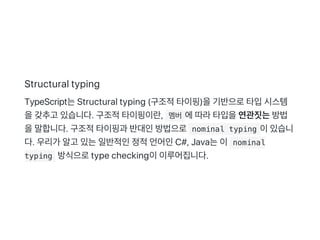
TypeScript는Structural typing(구조적타이핑)을기반으로타입시스템
을갖추고 있습니다. 구조적타이핑이란, 멤버 에따라타입을연관짓는방법
을말합니다. 구조적타이핑과 반대인방법으로 nominal typing 이있습니
다. 우리가 알고 있는일반적인정적언어인C#, Java는이 nominal
typing 방식으로type checking이이루어집니다.
8.
_Official Document_에나온예제를통해설명드립니다.
interface Named{
name: string;
}
class Person {
name: string;
}
let p: Named;
p = new Person(); // Ok, because of structural typing
위코드를C# 또는Java의문법에맞게 변경한다면동작하지않는잘못된코
드가 됩니다. 하지만TypeScript에서는정상적으로동작합니다. Named 와
Person 두가지는오로지 name 이라는프로퍼티(or 멤버)만갖고 있는타
입이므로서로 compatibility 하다고 볼수있습니다. 때문에위코드는문
제되지않습니다. (compatibility에대해서는뒤에서알아봅니다.)
const initialState: Todos= [
{
id: 0,
text: 'Study RxJS',
completed: false,
} as Todo
];
위코드처럼 as 키워드를사용할수있습니다. 두가지모두동일하지만
tsx 와함께사용하기 위해서는 as 키워드를사용하는것이좋습니다.
typeof , instanceof
TypeScript에서도마찬가지로 typeof 와 instanceof 오퍼레이터를지
원합니다.
function setNumberOrString(x:number | string) {
if (typeof x === 'string') {
console.log(x.subtr(1)); // Error
console.log(x.substr(1)); // OK
} else {
console.log(typof x); // number
}
x.substr(1); // Error
}
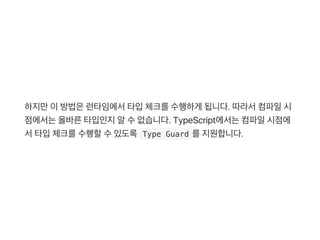
위코드에서 if-block 내에서의 x 변수의타입은 string 일수밖에없다
는것을컴파일시점에체크하여transpiler가 Error를발생시키는경우입니다.
이예제와비슷한방법으로 instanceof 오퍼레이터를사용할수있습니다.
instanceof 는클래스를기반으로생성된인스턴스의타입을판단하는데
사용됩니다.
20.
class Pet {
name= 123;
common = '123';
}
class Basket {
size = 123;
common = '123';
}
21.
function create(arg: Pet| Basket) {
if (arg instanceof Pet) {
console.log(arg.name); // OK
console.log(arg.size); // Error!
}
if (arg instanceof Basket) {
console.log(arg.name); // Error!
console.log(arg.size); // OK
}
console.log(arg.common); // OK
console.log(arg.name); // Error!
console.log(arg.size); // Error!
}
typeof 와마찬가지로 instanceof 로필터링된block 내부에서Type
checking이이루어집니다.
22.
in
interface A {
x:number;
}
interface B {
y: string;
}
function execute(q: A | B) {
if ('x' in q) {
// q: A
} else {
// q: B
}
}
A 또는 B 를유니온타입으로받을수있는 execute 함수내에서각각에
대해다른처리를할경우, in 이라는오퍼레이터를사용할수있습니다. 해당
오퍼레이터는check하고자하는타입에해당프로퍼티가 존재하는지의유무
를판단할수있습니다.
type Foo ={
kind: 'foo', // Literal type
foo: number
}
type Bar = {
kind: 'bar', // Literal type
bar: number
}
function execute(arg: Foo | Bar) {
if (arg.kind === 'foo') {
console.log(arg.foo); // OK
console.log(arg.bar); // Error!
}
}
위코드에서처럼 type 키워드를사용하여별도타입을지정할때, kind 라
는프로퍼티를추가하여타입검사를수행할수있습니다.
25.
User Defined TypeGuards
메소드를별도로분리하여Type Guard를지정할수있습니다. 아까 지정한
interface A로만들어보겠습니다.
interface A {
x: number;
}
// Define Type Guard
function isA(arg: any): arg is A {
return arg.x !== undefined;
}
arg is A 라는타입으로 isA 메소드가 Type Guard의역할을수행한다
는것을명시할수있습니다. if 내부에들어가는로직을별도로추출하여보다
가독서이좋은코드를작성할수있습니다.
1. Comparing twoObjects
let x = {name: `Jbee`};
let y = {name: `James`, age: 34};
x = y; // OK!
y = x; // Error!
위코드에서 x 는 {name: string} 타입으로추론되며, y 는 {name:
string, age: number} 로추론됩니다. 이경우 x = y 는 y 에 name 이
라는속성이있으므로가능하지만 y = x 의경우, x 에는 age 라는속성이
없으므로에러가 발생합니다.
28.
2. Comparing twofunctions
let x = (a: number) => 0;
let y = (b: number, s: string) => 0;
y = x; // OK
x = y; // Error
함수일경우에는객체인경우와조금 다른것을볼수있습니다. 위코드에서
두 x , y 함수는parameter 만다르게 정의되어있습니다. 이경우, x 함수
에전달할수있는parameter의경우의수가 y에모두해당하므로 y = x 가
정상적으로동작합니다. 하지만그 반대인 x = y 는 y 함수에전달할수있
는parameter를 x 가 모두포용할수없으므로에러가 발생합니다.
29.
let x =() => ({name: `Jbee`});
let y = () => ({name: `James`, age: 34});
x = y; // OK!
y = x; // Error!
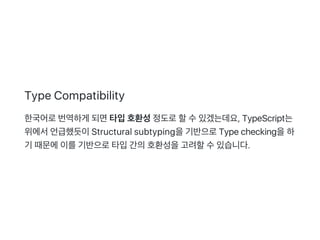
이번에는return value의type이다른경우입니다. 이경우에는함수의경우
를따르지않고 객체인경우를따르게 됩니다.
Reference
TypeScript Official Document‑ Type Inference
TypeScript Official Document ‑ Type Compatibility
Golang으로만나보는duck typing
Type Systems: Structural vs Nominal typing explained
TypeScript Deep dive ‑ Type Guard
![[TS] 7. Typescript's Type System
by jbee](https://image.slidesharecdn.com/ts07typesystem-180728041121/85/07-type-system-1-320.jpg)





![const mixedArr = [0, 1, `jbee`];
number 에해당되는value와 string 에해당하는value가 공존하기 때문
에위코드에서 mixedArr 은 (number | string)[] 의타입을갖게 됩니
다. 이렇게 여러타입이공존하는경우에추론하여지정되는타입을Best
common type이라고 합니다.](https://image.slidesharecdn.com/ts07typesystem-180728041121/85/07-type-system-11-320.jpg)
![Type Assertion
이변수의타입은분명 A 인데TypeScript에서보수적으로처리하여에러를
발생시키는경우가 있습니다. 이럴경우해당변수를 A 라고 명시하여에러를
사라지게 할수있습니다.
export type Todo = {
id: number;
text: string;
completed: boolean;
};
export type Todos = Todo[];
위와같이 Todo 타입과 Todos 타입을지정한상황이라고 했을때를예로
들어보겠습니다.](https://image.slidesharecdn.com/ts07typesystem-180728041121/85/07-type-system-12-320.jpg)
![const initialState: Todos = [
{
id: 0,
text: 'Study RxJS',
completed: false,
}
];
위코드에서 Todos 에해당하는타입을제대로지정해줬지만뭔가 아쉬움이
남을수있는데요, 이때두가지방법을사용할수있습니다.](https://image.slidesharecdn.com/ts07typesystem-180728041121/85/07-type-system-13-320.jpg)
![const initialState: Todos = [
<TODO>{
id: 0,
text: 'Study RxJS',
completed: false,
}
];
위코드처럼 <> 을사용하거나](https://image.slidesharecdn.com/ts07typesystem-180728041121/85/07-type-system-14-320.jpg)
![const initialState: Todos = [
{
id: 0,
text: 'Study RxJS',
completed: false,
} as Todo
];
위코드처럼 as 키워드를사용할수있습니다. 두가지모두동일하지만
tsx 와함께사용하기 위해서는 as 키워드를사용하는것이좋습니다.](https://image.slidesharecdn.com/ts07typesystem-180728041121/85/07-type-system-15-320.jpg)
![[!] 이Type Assertion은Type Casting과는다릅니다. 자세한내용은
DailyEngineering ‑ 타입추론과 타입단언을참고해주세요!](https://image.slidesharecdn.com/ts07typesystem-180728041121/85/07-type-system-16-320.jpg)
![Type Guards
자바스크립트에서는 typeof 또는 instanceof 와같은오퍼레이터가 타
입을확인해주는역할을했었습니다.
if (typeof this.state[key] !== typeof newData) {
return ;
}](https://image.slidesharecdn.com/ts07typesystem-180728041121/85/07-type-system-17-320.jpg)






![[Swift] Generics](https://cdn.slidesharecdn.com/ss_thumbnails/generics-200515094730-thumbnail.jpg?width=640&height=640&fit=bounds)


![[Td 2015]java script에게 형(type)이 생겼어요. typescript(박용준)](https://cdn.slidesharecdn.com/ss_thumbnails/td2015javascripttype-151104051048-lva1-app6892-thumbnail.jpg?width=640&height=640&fit=bounds)


![[부스트캠프 Tech Talk]조찬영_타입스크립트없인 코딩할 수 없는 몸이 되버렸어](https://cdn.slidesharecdn.com/ss_thumbnails/techtalk4-201012060901-thumbnail.jpg?width=640&height=640&fit=bounds)

![[Swift] Type casting](https://cdn.slidesharecdn.com/ss_thumbnails/typecasting-200513092237-thumbnail.jpg?width=640&height=640&fit=bounds)

![[ES6] 8. Symbol](https://cdn.slidesharecdn.com/ss_thumbnails/es68symbol-171130014759-thumbnail.jpg?width=640&height=640&fit=bounds)


![[Swift] Types](https://cdn.slidesharecdn.com/ss_thumbnails/types-200513092238-thumbnail.jpg?width=640&height=640&fit=bounds)


![[ES6] 12. Array](https://cdn.slidesharecdn.com/ss_thumbnails/es612array-171130043837-thumbnail.jpg?width=640&height=640&fit=bounds)
![[ES6] 11. Modularization, import와 export](https://cdn.slidesharecdn.com/ss_thumbnails/es611modularization-171130022210-thumbnail.jpg?width=640&height=640&fit=bounds)
![[ES6] 10. Generator](https://cdn.slidesharecdn.com/ss_thumbnails/es610generator-171130014802-thumbnail.jpg?width=640&height=640&fit=bounds)
![[ES6] 9. Iterator](https://cdn.slidesharecdn.com/ss_thumbnails/es69iterator-171130014800-thumbnail.jpg?width=640&height=640&fit=bounds)
![[ES6] 7. Template literal](https://cdn.slidesharecdn.com/ss_thumbnails/es67templateliteral-171130014757-thumbnail.jpg?width=640&height=640&fit=bounds)
![[ES6] 6. Class](https://cdn.slidesharecdn.com/ss_thumbnails/es66class-171130014756-thumbnail.jpg?width=640&height=640&fit=bounds)
![[ES6] 5. Destructuring](https://cdn.slidesharecdn.com/ss_thumbnails/es65destructuring-171130014754-thumbnail.jpg?width=640&height=640&fit=bounds)
![[ES6] 4. Spread, Rest parameter](https://cdn.slidesharecdn.com/ss_thumbnails/es64spreadrestparameter-171130014753-thumbnail.jpg?width=640&height=640&fit=bounds)
![[ES6] 3. iteration](https://cdn.slidesharecdn.com/ss_thumbnails/es63iteration-171130014750-thumbnail.jpg?width=640&height=640&fit=bounds)
![[ES6] 2. arrow function](https://cdn.slidesharecdn.com/ss_thumbnails/es62arrowfunction-171130014749-thumbnail.jpg?width=640&height=640&fit=bounds)
![[ES6] 1. let과 const](https://cdn.slidesharecdn.com/ss_thumbnails/es61letconst-171130014747-thumbnail.jpg?width=640&height=640&fit=bounds)
