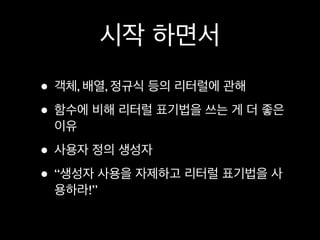
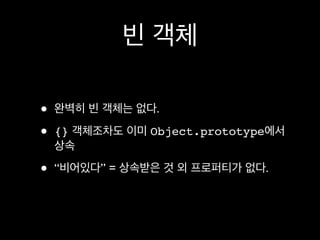
빈 객체
• 완벽히 빈 객체는 없다.
• {} 객체조차도 이미 Object.prototype에서
상속
• “비어있다” = 상속받은 것 외 프로퍼티가 없다.
8.
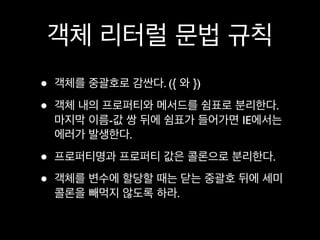
객체 리터럴 문법규칙
• 객체를 중괄호로 감싼다. ({ 와 })
• 객체 내의 프로퍼티와 메서드를 쉼표로 분리한다.
마지막 이름-값 쌍 뒤에 쉼표가 들어가면 IE에서는
에러가 발생한다.
• 프로퍼티명과 프로퍼티 값은 콜론으로 분리한다.
• 객체를 변수에 할당할 때는 닫는 중괄호 뒤에 세미
콜론을 빼먹지 않도록 하라.
9.
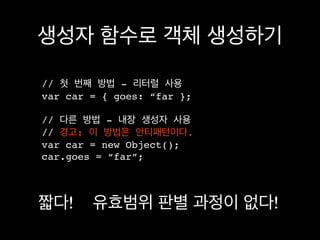
생성자 함수로 객체생성하기
// 첫 번째 방법 - 리터럴 사용
var car = { goes: “far };
// 다른 방법 - 내장 생성자 사용
// 경고: 이 방법은 안티패턴이다.
var car = new Object();
car.goes = “far”;
짧다! 유효범위 판별 과정이 없다!
10.
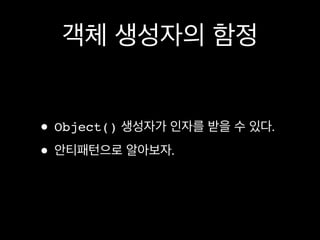
객체 생성자의 함정
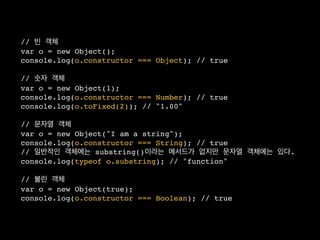
•Object() 생성자가 인자를 받을 수 있다.
• 안티패턴으로 알아보자.
11.
// 빈 객체
varo = new Object();
console.log(o.constructor === Object); // true
// 숫자 객체
var o = new Object(1);
console.log(o.constructor === Number); // true
console.log(o.toFixed(2)); // "1.00"
// 문자열 객체
var o = new Object("I am a string");
console.log(o.constructor === String); // true
// 일반적인 객체에는 substring()이라는 메서드가 없지만 문자열 객체에는 있다.
console.log(typeof o.substring); // "function"
// 불린 객체
var o = new Object(true);
console.log(o.constructor === Boolean); // true
12.
2 사용자 정의생성자 함수
• 자바에서 클래스를 사용하여 객체를 생성하는
방식과 유사하지만,
• 자바스크립트에서는 그저 함수일 뿐이다.
13.
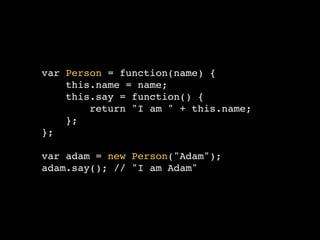
var Person =function(name) {
this.name = name;
this.say = function() {
return "I am " + this.name;
};
};
var adam = new Person("Adam");
adam.say(); // "I am Adam"
14.
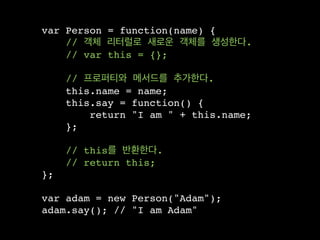
var Person =function(name) {
// 객체 리터럴로 새로운 객체를 생성한다.
// var this = {};
// 프로퍼티와 메서드를 추가한다.
this.name = name;
this.say = function() {
return "I am " + this.name;
};
// this를 반환한다.
// return this;
};
var adam = new Person("Adam");
adam.say(); // "I am Adam"
15.
생성자의 반환 값
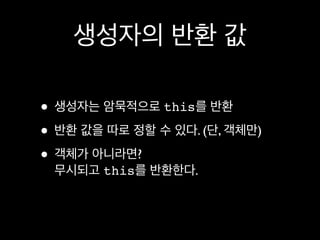
•생성자는 암묵적으로 this를 반환
• 반환 값을 따로 정할 수 있다. (단, 객체만)
• 객체가 아니라면?
무시되고 this를 반환한다.
16.
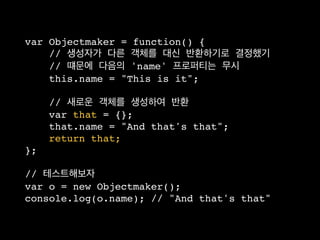
var Objectmaker =function() {
// 생성자가 다른 객체를 대신 반환하기로 결정했기
// 떄문에 다음의 'name' 프로퍼티는 무시
this.name = "This is it";
// 새로운 객체를 생성하여 반환
var that = {};
that.name = "And that's that";
return that;
};
// 테스트해보자
var o = new Objectmaker();
console.log(o.name); // "And that's that"
17.
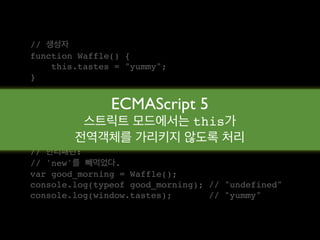
3 new를 강제하는패턴
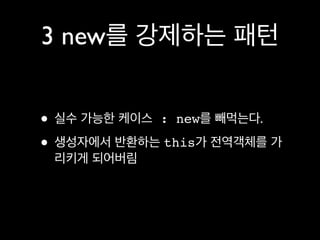
• 실수 가능한 케이스 : new를 빼먹는다.
• 생성자에서 반환하는 this가 전역객체를 가
리키게 되어버림
18.
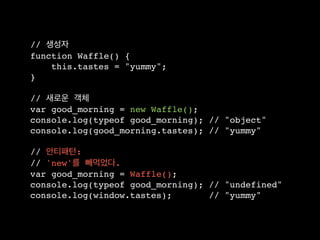
// 생성자
function Waffle(){
this.tastes = "yummy";
}
// 새로운 객체
var good_morning = new Waffle();
console.log(typeof good_morning); // "object"
console.log(good_morning.tastes); // "yummy"
// 안티패턴:
// 'new'를 빼먹었다.
var good_morning = Waffle();
console.log(typeof good_morning); // "undefined"
console.log(window.tastes); // "yummy"
19.
// 생성자
function Waffle(){
this.tastes = "yummy";
}
// 새로운 객체
ECMAScript 5
var good_morning = new Waffle();
스트릭트 모드에서는 this가
console.log(typeof good_morning); // "object"
console.log(good_morning.tastes); // "yummy"
전역객체를 가리키지 않도록 처리
// 안티패턴:
// 'new'를 빼먹었다.
var good_morning = Waffle();
console.log(typeof good_morning); // "undefined"
console.log(window.tastes); // "yummy"
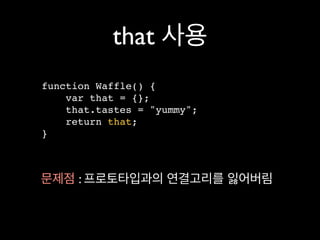
that 사용
function Waffle(){
var that = {};
that.tastes = "yummy";
return that;
}
문제점 : 프로토타입과의 연결고리를 잃어버림
22.
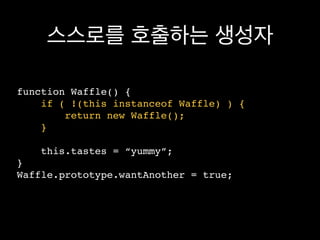
스스로를 호출하는 생성자
functionWaffle() {
if ( !(this instanceof Waffle) ) {
return new Waffle();
}
this.tastes = “yummy”;
}
Waffle.prototype.wantAnother = true;
23.
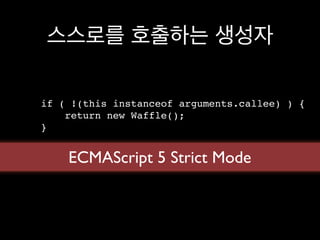
스스로를 호출하는 생성자
functionWaffle() {
if ( !(this instanceof arguments.callee) ) {
return new Waffle();
}
this.tastes = “yummy”;
} ECMAScript 5 Strict Mode
Waffle.prototype.wantAnother = true;
24.
4 배열 리터럴
//세 개의 원소를 가지는 배열
// 경고: 안티패턴
var a = new Array("itsy", "bitsy", "spider");
// 위와 똑같은 배열
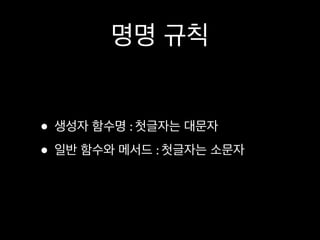
var a = ["itsy", "bitsy", "spider"];
console.log(typeof a); // 배열도 객체이기 때문에 "object"가 출력
console.log(a.constructor === Array); // true
25.
배열 생성자의 특이성
//세 개의 원소를 가지는 배열을 생성
var a = new Array(3);
console.log(a.length); // 3
console.log(typeof a[0]); // “undefined”
// RangeError가 발생
var a = new Array(3.14);
console.log(typeof a); // “undefined”
26.
배열인지 판별하는 방법
//ECMAScript 5 지원하지 않는 경우
if (typeof Array.isArray === "undefined") {
Array.isArray = function (arg) {
return Object.prototype.toString.call(arg)
=== "[object Array]";
};
}
Array.isArray([]); // true



![4 배열 리터럴
// 세 개의 원소를 가지는 배열
// 경고: 안티패턴
var a = new Array("itsy", "bitsy", "spider");
// 위와 똑같은 배열
var a = ["itsy", "bitsy", "spider"];
console.log(typeof a); // 배열도 객체이기 때문에 "object"가 출력
console.log(a.constructor === Array); // true](https://image.slidesharecdn.com/javascriptpatternsch3-121112203456-phpapp01/85/JavaScript-Patterns-Chapter-3-Literals-and-Constructors-24-320.jpg)
![배열 생성자의 특이성
// 세 개의 원소를 가지는 배열을 생성
var a = new Array(3);
console.log(a.length); // 3
console.log(typeof a[0]); // “undefined”
// RangeError가 발생
var a = new Array(3.14);
console.log(typeof a); // “undefined”](https://image.slidesharecdn.com/javascriptpatternsch3-121112203456-phpapp01/85/JavaScript-Patterns-Chapter-3-Literals-and-Constructors-25-320.jpg)
![배열인지 판별하는 방법
// ECMAScript 5 지원하지 않는 경우
if (typeof Array.isArray === "undefined") {
Array.isArray = function (arg) {
return Object.prototype.toString.call(arg)
=== "[object Array]";
};
}
Array.isArray([]); // true](https://image.slidesharecdn.com/javascriptpatternsch3-121112203456-phpapp01/85/JavaScript-Patterns-Chapter-3-Literals-and-Constructors-26-320.jpg)

![정규 표현식 리터럴 문법
function getRE() {
var re = /[a-z]/;
re.foo = "bar";
return re;
}
var reg = getRE(),
re2 = getRE();
console.log(reg === re2); // true
reg.foo = "baz";
console.log(re2.foo); // "baz"](https://image.slidesharecdn.com/javascriptpatternsch3-121112203456-phpapp01/85/JavaScript-Patterns-Chapter-3-Literals-and-Constructors-30-320.jpg)
![정규 표현식 리터럴 문법
function getRE() {
var re = /[a-z]/;
re.foo = "bar";
return re;
}
ECMAScript 5
var 리터럴을 사용해도
reg = getRE(), 새로운 객체가 생성
re2 = getRE();
console.log(reg === re2); // true
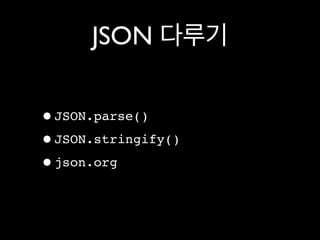
reg.foo = "baz";
console.log(re2.foo); // "baz"](https://image.slidesharecdn.com/javascriptpatternsch3-121112203456-phpapp01/85/JavaScript-Patterns-Chapter-3-Literals-and-Constructors-31-320.jpg)


![[D2 COMMUNITY] ECMAScript 2015 S67 seminar - 1. primitive](https://cdn.slidesharecdn.com/ss_thumbnails/1primitive-161207024601-thumbnail.jpg?width=640&height=640&fit=bounds)


![[IT기술칼럼#2] 고급자바스크립트 for AngularJS, React_고급자바스크립트,AngularJS,React전문교육학원](https://cdn.slidesharecdn.com/ss_thumbnails/02ecmascript-170404072342-thumbnail.jpg?width=640&height=640&fit=bounds)
