FROM
ARROGANCE
TO
DESTRUCTION
Lesson 6 for
February 8,
2020
The arrogance of Belshazzar. Daniel 5:1-4
God’s message. Daniel 5:5-8
The queen’s advice. Daniel 5:9-12
The interpretation of the message. Daniel 5:13-28
The destruction of Belshazzar. Daniel 5:29-31
Just 23 years after the death of
Nebuchadnezzar (562 B.C.),
Belshazzar was holding the
feast mentioned in Daniel 5
(539 B.C.).
During that period, Babylon
was governed by Nabonidus
who was married to Nitocris,
daughter of Nebuchadnezzar.
She’s the queen mentioned in
Daniel 5.
Nabonidus appointed
Belshazzar as co-regent. He
became the governor of
Babylon city.
Belshazzar was as arrogant as
his grandfather
Nebuchadnezzar. He felt
invincible and held a great
feast while Babylon was being
besieged by the Persians.
THE ARROGANCE OF BELSHAZZAR
“They drank wine, and praised the gods of gold and
silver, bronze and iron, wood and stone.” (Daniel 5:4)
Belshazzar got merry with the wine and ordered
to bring the sacred vessels that were taken from
the temple in Jerusalem.
He arrogantly used the tools which were meant
to worship the true God to worship false gods.
The Babylonians used the sexagesimal system,
so mentioning six types of materials was a
reference to all the Babylonian gods.
In the End Time,
“Babylon” will also use
elements from true
religion [the golden cup]
to make everyone accept
all types of lies [the
abominations]
(Revelation 17:4-6).
GOD’S
MESSAGE
“In the same hour the fingers of a man’s
hand appeared and wrote opposite the
lampstand on the plaster of the wall of the
king’s palace; and the king saw the part of
the hand that wrote.” (Daniel 5:5)
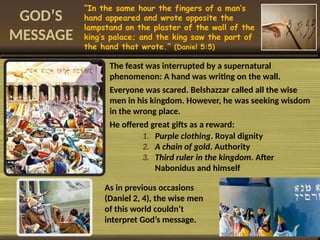
The feast was interrupted by a supernatural
phenomenon: A hand was writing on the wall.
Everyone was scared. Belshazzar called all the wise
men in his kingdom. However, he was seeking wisdom
in the wrong place.
He offered great gifts as a reward:
1. Purple clothing. Royal dignity
2. A chain of gold. Authority
3. Third ruler in the kingdom. After
Nabonidus and himself
As in previous occasions
(Daniel 2, 4), the wise men
of this world couldn’t
interpret God’s message.
THE QUEEN’S ADVICE
“let Daniel be called, and he will give the interpretation.”
(Daniel 5:12)
The queen reminded Belshazzar that there
was an exceptional person in his kingdom:
↘ He has the Holy Spirit [“the spirit of the
gods/of God”]
↘ He has superior knowledge and
understanding
↘ He is chief of the wise men
↘ He can interpret dreams, solve riddles
and explain enigmas
Daniel had worked with Belshazzar at least until his
third year as governor (Daniel 8:1, 27). However,
the king didn’t want to deal with someone who
disturbed his conscience.
The queen was aware of the influence that Daniel
exerted on her father. If anyone in Babylon could
help Belshazzar, it was Daniel.
THE INTERPRETATION
OF THE MESSAGE
“But you his son, Belshazzar, have not humbled
your heart, although you knew all this.” (Daniel 5:22)
Daniel rejected the king’s reward. His interpretation wouldn’t be influenced by
gifts. He showed Belshazzar his condition before interpreting the message:
The king knew about Nebuchadnezzar’s experience and how
he repentedbeing after humiliated by God. But Belshazzar had
chosen not to follow his example.
He had humiliated God by desecrating the sacred vessels
He had praised gods that couldn’t see, hear or think
He knew that his life relied on God, but he hadn’t honored him
For this reason, God had sent him a special message.
“And this is the inscription that was written: ‘MENE, MENE, TEKEL, UPHARSIN.’”
(Daniel 5:25)
“Numbered, numbered, weighed,
divided.” The message was written in
Aramaic and could be easily read, but
interpreting it was not that easy.
MENE [Numbered]. God has numbered
your kingdom, and finished it
TEKEL [Weighed]. You have been weighed
in the balances, and found wanting
UPHARSIN [Divided]. Your kingdom has been
divided, and given to the Medes and Persians
Daniel didn’t soften the
message. Belshazzar had
overstepped the limits.
The king had not changed his
attitude.
His sentence would be
fulfilled that very night.
THE INTERPRETATION OF THE MESSAGE
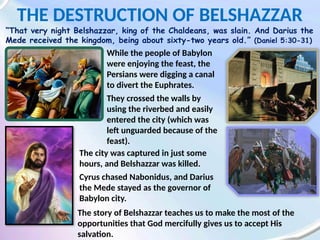
THE DESTRUCTION OF BELSHAZZAR
“That very night Belshazzar, king of the Chaldeans, was slain. And Darius the
Mede received the kingdom, being about sixty-two years old.” (Daniel 5:30-31)
While the people of Babylon
were enjoying the feast, the
Persians were digging a canal
to divert the Euphrates.
They crossed the walls by
using the riverbed and easily
entered the city (which was
left unguarded because of the
feast).
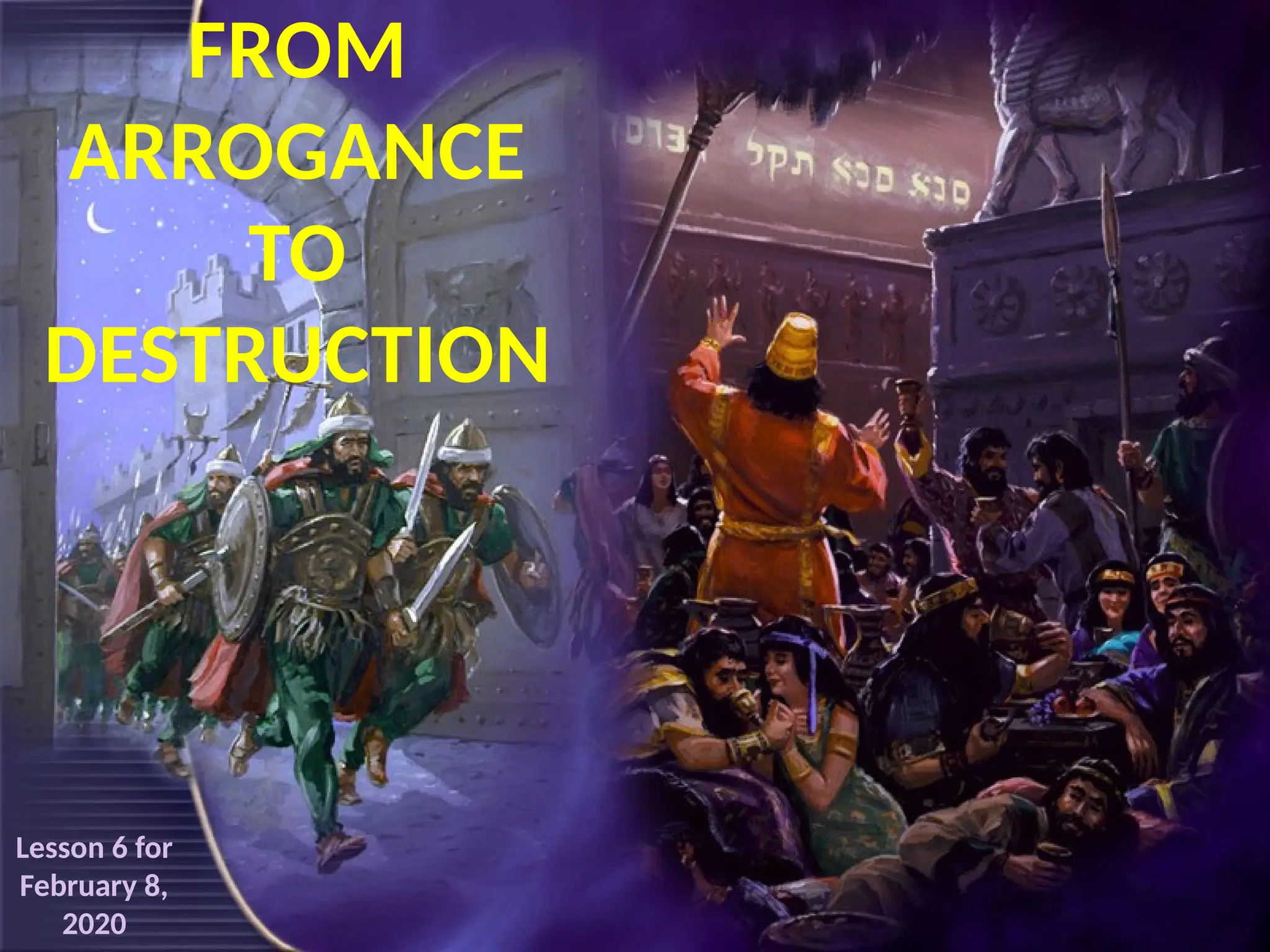
The city was captured in just some
hours, and Belshazzar was killed.
Cyrus chased Nabonidus, and Darius
the Mede stayed as the governor of
Babylon city.
The story of Belshazzar teaches us to make the most of the
opportunities that God mercifully gives us to accept His
salvation.
“Little did Belshazzar think that an
unseen Watcher beheld his idolatrous
revelry. But there is nothing said or done
that is not recorded on the books of
heaven. The mystic characters traced by
the bloodless hand testify that God is a
witness to all we do, and that He is
dishonored by feasting and reveling. We
cannot hide anything from God. We cannot
escape from our accountability to Him.
Wherever we are and whatever we do, we
are responsible to Him whose we are by
creation and by redemption.”
E.G.W. (Temperance, cp. 6, p. 49)

06. FROM ARROGANCE TO DESTRUCTION PRESENTATION

  • 1.
  • 2.
    The arrogance ofBelshazzar. Daniel 5:1-4 God’s message. Daniel 5:5-8 The queen’s advice. Daniel 5:9-12 The interpretation of the message. Daniel 5:13-28 The destruction of Belshazzar. Daniel 5:29-31 Just 23 years after the death of Nebuchadnezzar (562 B.C.), Belshazzar was holding the feast mentioned in Daniel 5 (539 B.C.). During that period, Babylon was governed by Nabonidus who was married to Nitocris, daughter of Nebuchadnezzar. She’s the queen mentioned in Daniel 5. Nabonidus appointed Belshazzar as co-regent. He became the governor of Babylon city. Belshazzar was as arrogant as his grandfather Nebuchadnezzar. He felt invincible and held a great feast while Babylon was being besieged by the Persians.
  • 3.
    THE ARROGANCE OFBELSHAZZAR “They drank wine, and praised the gods of gold and silver, bronze and iron, wood and stone.” (Daniel 5:4) Belshazzar got merry with the wine and ordered to bring the sacred vessels that were taken from the temple in Jerusalem. He arrogantly used the tools which were meant to worship the true God to worship false gods. The Babylonians used the sexagesimal system, so mentioning six types of materials was a reference to all the Babylonian gods. In the End Time, “Babylon” will also use elements from true religion [the golden cup] to make everyone accept all types of lies [the abominations] (Revelation 17:4-6).
  • 4.
    GOD’S MESSAGE “In the samehour the fingers of a man’s hand appeared and wrote opposite the lampstand on the plaster of the wall of the king’s palace; and the king saw the part of the hand that wrote.” (Daniel 5:5) The feast was interrupted by a supernatural phenomenon: A hand was writing on the wall. Everyone was scared. Belshazzar called all the wise men in his kingdom. However, he was seeking wisdom in the wrong place. He offered great gifts as a reward: 1. Purple clothing. Royal dignity 2. A chain of gold. Authority 3. Third ruler in the kingdom. After Nabonidus and himself As in previous occasions (Daniel 2, 4), the wise men of this world couldn’t interpret God’s message.
  • 5.
    THE QUEEN’S ADVICE “letDaniel be called, and he will give the interpretation.” (Daniel 5:12) The queen reminded Belshazzar that there was an exceptional person in his kingdom: ↘ He has the Holy Spirit [“the spirit of the gods/of God”] ↘ He has superior knowledge and understanding ↘ He is chief of the wise men ↘ He can interpret dreams, solve riddles and explain enigmas Daniel had worked with Belshazzar at least until his third year as governor (Daniel 8:1, 27). However, the king didn’t want to deal with someone who disturbed his conscience. The queen was aware of the influence that Daniel exerted on her father. If anyone in Babylon could help Belshazzar, it was Daniel.
  • 6.
    THE INTERPRETATION OF THEMESSAGE “But you his son, Belshazzar, have not humbled your heart, although you knew all this.” (Daniel 5:22) Daniel rejected the king’s reward. His interpretation wouldn’t be influenced by gifts. He showed Belshazzar his condition before interpreting the message: The king knew about Nebuchadnezzar’s experience and how he repentedbeing after humiliated by God. But Belshazzar had chosen not to follow his example. He had humiliated God by desecrating the sacred vessels He had praised gods that couldn’t see, hear or think He knew that his life relied on God, but he hadn’t honored him For this reason, God had sent him a special message.
  • 7.
    “And this isthe inscription that was written: ‘MENE, MENE, TEKEL, UPHARSIN.’” (Daniel 5:25) “Numbered, numbered, weighed, divided.” The message was written in Aramaic and could be easily read, but interpreting it was not that easy. MENE [Numbered]. God has numbered your kingdom, and finished it TEKEL [Weighed]. You have been weighed in the balances, and found wanting UPHARSIN [Divided]. Your kingdom has been divided, and given to the Medes and Persians Daniel didn’t soften the message. Belshazzar had overstepped the limits. The king had not changed his attitude. His sentence would be fulfilled that very night. THE INTERPRETATION OF THE MESSAGE
  • 8.
    THE DESTRUCTION OFBELSHAZZAR “That very night Belshazzar, king of the Chaldeans, was slain. And Darius the Mede received the kingdom, being about sixty-two years old.” (Daniel 5:30-31) While the people of Babylon were enjoying the feast, the Persians were digging a canal to divert the Euphrates. They crossed the walls by using the riverbed and easily entered the city (which was left unguarded because of the feast). The city was captured in just some hours, and Belshazzar was killed. Cyrus chased Nabonidus, and Darius the Mede stayed as the governor of Babylon city. The story of Belshazzar teaches us to make the most of the opportunities that God mercifully gives us to accept His salvation.
  • 9.
    “Little did Belshazzarthink that an unseen Watcher beheld his idolatrous revelry. But there is nothing said or done that is not recorded on the books of heaven. The mystic characters traced by the bloodless hand testify that God is a witness to all we do, and that He is dishonored by feasting and reveling. We cannot hide anything from God. We cannot escape from our accountability to Him. Wherever we are and whatever we do, we are responsible to Him whose we are by creation and by redemption.” E.G.W. (Temperance, cp. 6, p. 49)