QUANTITY SURVEYING &
COST ESTIMATION
CE-372
Volumes
Quantity Surveying & Cost Estimation
SE Shahid
Today's Objectives
 Identify cubes, cuboids, rectangular and
triangular prisms, pyramids and cones
 Perform calculations to calculate the volumes of
the above solids
 Calculate the volume of irregular shapes using
Trapezoidal, Simpson’s and Prismoidal rule
 Solve practical problems involving volume
CE-372 Quantity Surveying & Cost Estimation
2
Practical Usage
 The QS has to work out quantitates from the
drawings and from site which involve volume
calculations in various items like:-
 Excavation, fill quantity, brickwork,
concreting, roof insulation, volume
calculations in road work etc
CE 372 Quantity Surveying & Cost Estimation
3
Volume
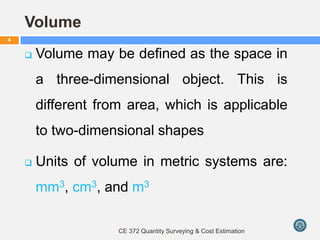
 Volume may be defined as the space in
a three-dimensional object. This is
different from area, which is applicable
to two-dimensional shapes
 Units of volume in metric systems are:
mm3, cm3, and m3
CE 372 Quantity Surveying & Cost Estimation
4
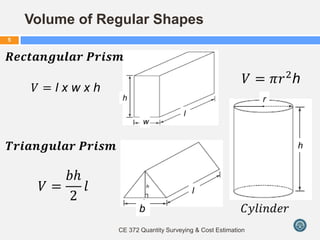
Volume of Regular Shapes
CE 372 Quantity Surveying & Cost Estimation
5
𝑉 = l x w x h
𝑉 =
𝑏𝑕
2
𝑙
𝑉 = 𝜋𝑟2
h
𝑻𝒓𝒊𝒂𝒏𝒈𝒖𝒍𝒂𝒓 𝑷𝒓𝒊𝒔𝒎
𝑹𝒆𝒄𝒕𝒂𝒏𝒈𝒖𝒍𝒂𝒓 𝑷𝒓𝒊𝒔𝒎
𝐶𝑦𝑙𝑖𝑛𝑑𝑒𝑟
l
b
r
h
l
h
w
CE 372 Quantity Surveying & Cost Estimation
6
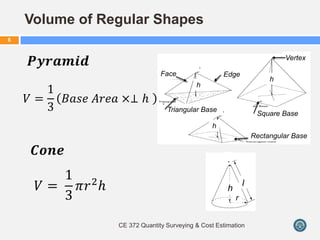
𝑉 =
1
3
𝐵𝑎𝑠𝑒 𝐴𝑟𝑒𝑎 ×⊥ 𝑕
Volume of Regular Shapes
𝑷𝒚𝒓𝒂𝒎𝒊𝒅
𝑪𝒐𝒏𝒆
𝑉 =
1
3
𝜋𝑟2
𝑕
Square Base
h
l
r
.
Rectangular Base
Triangular Base
Square Base
Face
Vertex
Edge
.
.
h
h
h
CE 372 Quantity Surveying & Cost Estimation
7
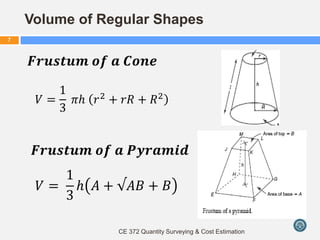
𝑉 =
1
3
𝜋𝑕 𝑟2
+ 𝑟𝑅 + 𝑅2
Volume of Regular Shapes
𝑭𝒓𝒖𝒔𝒕𝒖𝒎 𝒐𝒇 𝒂 𝑪𝒐𝒏𝒆
𝑭𝒓𝒖𝒔𝒕𝒖𝒎 𝒐𝒇 𝒂 𝑷𝒚𝒓𝒂𝒎𝒊𝒅
𝑉 =
1
3
𝑕 𝐴 + √𝐴𝐵 + 𝐵
Volume of Frustum of a Pyramid - Example
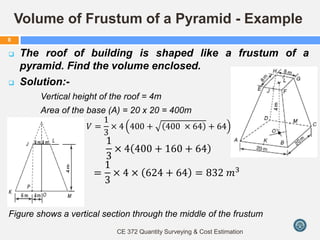
 The roof of building is shaped like a frustum of a
pyramid. Find the volume enclosed.
 Solution:-
Vertical height of the roof = 4m
Area of the base (A) = 20 x 20 = 400m
𝑉 =
1
3
× 4 400 + 400 × 64 + 64
1
3
× 4 400 + 160 + 64
=
1
3
× 4 × 624 + 64 = 832 𝑚3
Figure shows a vertical section through the middle of the frustum
CE 372 Quantity Surveying & Cost Estimation
8
Volume of Irregular Shapes
 There are many situations where we are faced with the
determination of the volume of Irregular solids like
excavation in uneven ground for building and roads.
 Volume estimation techniques:
 Trapezoidal rule
 Simpson’s rule
 Prismoidal rule
CE 372 Quantity Surveying & Cost Estimation
9
Trapezoidal Rule for Volume
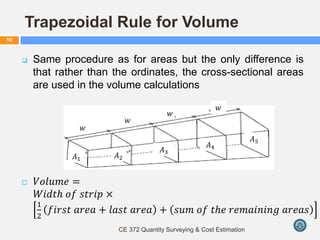
 Same procedure as for areas but the only difference is
that rather than the ordinates, the cross-sectional areas
are used in the volume calculations
 𝑉𝑜𝑙𝑢𝑚𝑒 =
𝑊𝑖𝑑𝑡𝑕 𝑜𝑓 𝑠𝑡𝑟𝑖𝑝 ×
1
2
𝑓𝑖𝑟𝑠𝑡 𝑎𝑟𝑒𝑎 + 𝑙𝑎𝑠𝑡 𝑎𝑟𝑒𝑎 + 𝑠𝑢𝑚 𝑜𝑓 𝑡𝑕𝑒 𝑟𝑒𝑚𝑎𝑖𝑛𝑖𝑛𝑔 𝑎𝑟𝑒𝑎𝑠
CE 372 Quantity Surveying & Cost Estimation
10
𝐴1
𝑤
𝐴2
𝐴3
𝐴4
𝐴5
𝑤
𝑤
𝑤
Simpson’s Rule for Volume
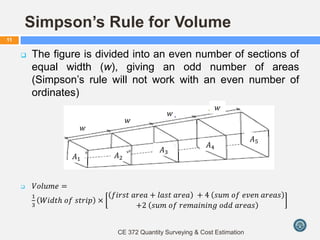
 The figure is divided into an even number of sections of
equal width (w), giving an odd number of areas
(Simpson’s rule will not work with an even number of
ordinates)
 𝑉𝑜𝑙𝑢𝑚𝑒 =
1
3
𝑊𝑖𝑑𝑡𝑕 𝑜𝑓 𝑠𝑡𝑟𝑖𝑝 ×
𝑓𝑖𝑟𝑠𝑡 𝑎𝑟𝑒𝑎 + 𝑙𝑎𝑠𝑡 𝑎𝑟𝑒𝑎 + 4 𝑠𝑢𝑚 𝑜𝑓 𝑒𝑣𝑒𝑛 𝑎𝑟𝑒𝑎𝑠
+2 𝑠𝑢𝑚 𝑜𝑓 𝑟𝑒𝑚𝑎𝑖𝑛𝑖𝑛𝑔 𝑜𝑑𝑑 𝑎𝑟𝑒𝑎𝑠
CE 372 Quantity Surveying & Cost Estimation
11
𝐴1
𝑤
𝐴2
𝐴3
𝐴4
𝐴5
𝑤
𝑤
𝑤
Prismoidal Rule for Volume
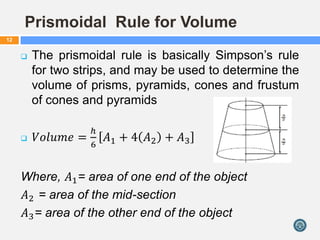
 The prismoidal rule is basically Simpson’s rule
for two strips, and may be used to determine the
volume of prisms, pyramids, cones and frustum
of cones and pyramids
 𝑉𝑜𝑙𝑢𝑚𝑒 =
ℎ
6
𝐴1 + 4 𝐴2 + 𝐴3
Where, 𝐴1= area of one end of the object
𝐴2 = area of the mid-section
𝐴3= area of the other end of the object
12
Volume using Trapezoidal Rule- Example
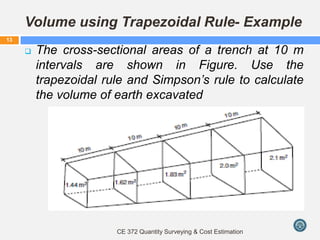
 The cross-sectional areas of a trench at 10 m
intervals are shown in Figure. Use the
trapezoidal rule and Simpson’s rule to calculate
the volume of earth excavated
CE 372 Quantity Surveying & Cost Estimation
13
Volume using Trapezoidal Rule - Example
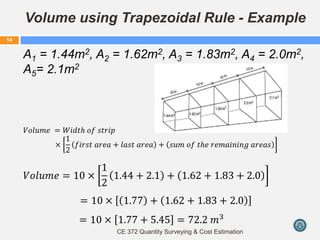
A1 = 1.44m2, A2 = 1.62m2, A3 = 1.83m2, A4 = 2.0m2,
A5= 2.1m2
𝑉𝑜𝑙𝑢𝑚𝑒 = 𝑊𝑖𝑑𝑡𝑕 𝑜𝑓 𝑠𝑡𝑟𝑖𝑝
×
1
2
𝑓𝑖𝑟𝑠𝑡 𝑎𝑟𝑒𝑎 + 𝑙𝑎𝑠𝑡 𝑎𝑟𝑒𝑎 + 𝑠𝑢𝑚 𝑜𝑓 𝑡𝑕𝑒 𝑟𝑒𝑚𝑎𝑖𝑛𝑖𝑛𝑔 𝑎𝑟𝑒𝑎𝑠
𝑉𝑜𝑙𝑢𝑚𝑒 = 10 ×
1
2
1.44 + 2.1 + 1.62 + 1.83 + 2.0
= 10 × 1.77 + 1.62 + 1.83 + 2.0
= 10 × 1.77 + 5.45 = 72.2 𝑚3
CE 372 Quantity Surveying & Cost Estimation
14
Volume using Simpson’s Rule - Example
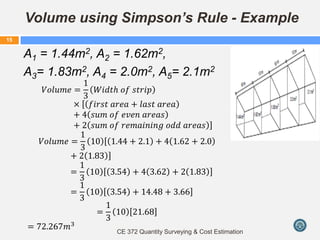
A1 = 1.44m2, A2 = 1.62m2,
A3= 1.83m2, A4 = 2.0m2, A5= 2.1m2
𝑉𝑜𝑙𝑢𝑚𝑒 =
1
3
𝑊𝑖𝑑𝑡𝑕 𝑜𝑓 𝑠𝑡𝑟𝑖𝑝
× 𝑓𝑖𝑟𝑠𝑡 𝑎𝑟𝑒𝑎 + 𝑙𝑎𝑠𝑡 𝑎𝑟𝑒𝑎
+ 4 𝑠𝑢𝑚 𝑜𝑓 𝑒𝑣𝑒𝑛 𝑎𝑟𝑒𝑎𝑠
+ 2 𝑠𝑢𝑚 𝑜𝑓 𝑟𝑒𝑚𝑎𝑖𝑛𝑖𝑛𝑔 𝑜𝑑𝑑 𝑎𝑟𝑒𝑎𝑠
𝑉𝑜𝑙𝑢𝑚𝑒 =
1
3
10 1.44 + 2.1 + 4 1.62 + 2.0
+ 2 1.83
=
1
3
10 3.54 + 4 3.62 + 2 1.83
=
1
3
10 3.54 + 14.48 + 3.66
=
1
3
10 21.68
= 72.267𝑚3
CE 372 Quantity Surveying & Cost Estimation
15
Volume using Prismoidal Rule - Example
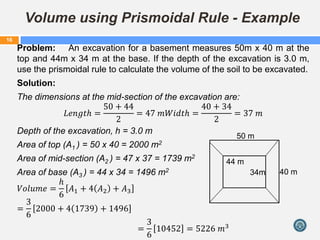
Problem: An excavation for a basement measures 50m x 40 m at the
top and 44m x 34 m at the base. If the depth of the excavation is 3.0 m,
use the prismoidal rule to calculate the volume of the soil to be excavated.
Solution:
The dimensions at the mid-section of the excavation are:
𝐿𝑒𝑛𝑔𝑡𝑕 =
50 + 44
2
= 47 𝑚𝑊𝑖𝑑𝑡𝑕 =
40 + 34
2
= 37 𝑚
Depth of the excavation, h = 3.0 m
Area of top (A1 ) = 50 x 40 = 2000 m2
Area of mid-section (A2 ) = 47 x 37 = 1739 m2
Area of base (A3 ) = 44 x 34 = 1496 m2
𝑉𝑜𝑙𝑢𝑚𝑒 =
𝑕
6
𝐴1 + 4 𝐴2 + 𝐴3
=
3
6
2000 + 4 1739 + 1496
=
3
6
10452 = 5226 𝑚3
16
44 m
40 m
34m
50 m
Effort Never Dies
END
17
CE-372 Quantity Surveying & Cost Estimation

05 - Volumes,QS_CE, Mar 2021.pdf

  • 1.
    QUANTITY SURVEYING & COSTESTIMATION CE-372 Volumes Quantity Surveying & Cost Estimation SE Shahid
  • 2.
    Today's Objectives  Identifycubes, cuboids, rectangular and triangular prisms, pyramids and cones  Perform calculations to calculate the volumes of the above solids  Calculate the volume of irregular shapes using Trapezoidal, Simpson’s and Prismoidal rule  Solve practical problems involving volume CE-372 Quantity Surveying & Cost Estimation 2
  • 3.
    Practical Usage  TheQS has to work out quantitates from the drawings and from site which involve volume calculations in various items like:-  Excavation, fill quantity, brickwork, concreting, roof insulation, volume calculations in road work etc CE 372 Quantity Surveying & Cost Estimation 3
  • 4.
    Volume  Volume maybe defined as the space in a three-dimensional object. This is different from area, which is applicable to two-dimensional shapes  Units of volume in metric systems are: mm3, cm3, and m3 CE 372 Quantity Surveying & Cost Estimation 4
  • 5.
    Volume of RegularShapes CE 372 Quantity Surveying & Cost Estimation 5 𝑉 = l x w x h 𝑉 = 𝑏𝑕 2 𝑙 𝑉 = 𝜋𝑟2 h 𝑻𝒓𝒊𝒂𝒏𝒈𝒖𝒍𝒂𝒓 𝑷𝒓𝒊𝒔𝒎 𝑹𝒆𝒄𝒕𝒂𝒏𝒈𝒖𝒍𝒂𝒓 𝑷𝒓𝒊𝒔𝒎 𝐶𝑦𝑙𝑖𝑛𝑑𝑒𝑟 l b r h l h w
  • 6.
    CE 372 QuantitySurveying & Cost Estimation 6 𝑉 = 1 3 𝐵𝑎𝑠𝑒 𝐴𝑟𝑒𝑎 ×⊥ 𝑕 Volume of Regular Shapes 𝑷𝒚𝒓𝒂𝒎𝒊𝒅 𝑪𝒐𝒏𝒆 𝑉 = 1 3 𝜋𝑟2 𝑕 Square Base h l r . Rectangular Base Triangular Base Square Base Face Vertex Edge . . h h h
  • 7.
    CE 372 QuantitySurveying & Cost Estimation 7 𝑉 = 1 3 𝜋𝑕 𝑟2 + 𝑟𝑅 + 𝑅2 Volume of Regular Shapes 𝑭𝒓𝒖𝒔𝒕𝒖𝒎 𝒐𝒇 𝒂 𝑪𝒐𝒏𝒆 𝑭𝒓𝒖𝒔𝒕𝒖𝒎 𝒐𝒇 𝒂 𝑷𝒚𝒓𝒂𝒎𝒊𝒅 𝑉 = 1 3 𝑕 𝐴 + √𝐴𝐵 + 𝐵
  • 8.
    Volume of Frustumof a Pyramid - Example  The roof of building is shaped like a frustum of a pyramid. Find the volume enclosed.  Solution:- Vertical height of the roof = 4m Area of the base (A) = 20 x 20 = 400m 𝑉 = 1 3 × 4 400 + 400 × 64 + 64 1 3 × 4 400 + 160 + 64 = 1 3 × 4 × 624 + 64 = 832 𝑚3 Figure shows a vertical section through the middle of the frustum CE 372 Quantity Surveying & Cost Estimation 8
  • 9.
    Volume of IrregularShapes  There are many situations where we are faced with the determination of the volume of Irregular solids like excavation in uneven ground for building and roads.  Volume estimation techniques:  Trapezoidal rule  Simpson’s rule  Prismoidal rule CE 372 Quantity Surveying & Cost Estimation 9
  • 10.
    Trapezoidal Rule forVolume  Same procedure as for areas but the only difference is that rather than the ordinates, the cross-sectional areas are used in the volume calculations  𝑉𝑜𝑙𝑢𝑚𝑒 = 𝑊𝑖𝑑𝑡𝑕 𝑜𝑓 𝑠𝑡𝑟𝑖𝑝 × 1 2 𝑓𝑖𝑟𝑠𝑡 𝑎𝑟𝑒𝑎 + 𝑙𝑎𝑠𝑡 𝑎𝑟𝑒𝑎 + 𝑠𝑢𝑚 𝑜𝑓 𝑡𝑕𝑒 𝑟𝑒𝑚𝑎𝑖𝑛𝑖𝑛𝑔 𝑎𝑟𝑒𝑎𝑠 CE 372 Quantity Surveying & Cost Estimation 10 𝐴1 𝑤 𝐴2 𝐴3 𝐴4 𝐴5 𝑤 𝑤 𝑤
  • 11.
    Simpson’s Rule forVolume  The figure is divided into an even number of sections of equal width (w), giving an odd number of areas (Simpson’s rule will not work with an even number of ordinates)  𝑉𝑜𝑙𝑢𝑚𝑒 = 1 3 𝑊𝑖𝑑𝑡𝑕 𝑜𝑓 𝑠𝑡𝑟𝑖𝑝 × 𝑓𝑖𝑟𝑠𝑡 𝑎𝑟𝑒𝑎 + 𝑙𝑎𝑠𝑡 𝑎𝑟𝑒𝑎 + 4 𝑠𝑢𝑚 𝑜𝑓 𝑒𝑣𝑒𝑛 𝑎𝑟𝑒𝑎𝑠 +2 𝑠𝑢𝑚 𝑜𝑓 𝑟𝑒𝑚𝑎𝑖𝑛𝑖𝑛𝑔 𝑜𝑑𝑑 𝑎𝑟𝑒𝑎𝑠 CE 372 Quantity Surveying & Cost Estimation 11 𝐴1 𝑤 𝐴2 𝐴3 𝐴4 𝐴5 𝑤 𝑤 𝑤
  • 12.
    Prismoidal Rule forVolume  The prismoidal rule is basically Simpson’s rule for two strips, and may be used to determine the volume of prisms, pyramids, cones and frustum of cones and pyramids  𝑉𝑜𝑙𝑢𝑚𝑒 = ℎ 6 𝐴1 + 4 𝐴2 + 𝐴3 Where, 𝐴1= area of one end of the object 𝐴2 = area of the mid-section 𝐴3= area of the other end of the object 12
  • 13.
    Volume using TrapezoidalRule- Example  The cross-sectional areas of a trench at 10 m intervals are shown in Figure. Use the trapezoidal rule and Simpson’s rule to calculate the volume of earth excavated CE 372 Quantity Surveying & Cost Estimation 13
  • 14.
    Volume using TrapezoidalRule - Example A1 = 1.44m2, A2 = 1.62m2, A3 = 1.83m2, A4 = 2.0m2, A5= 2.1m2 𝑉𝑜𝑙𝑢𝑚𝑒 = 𝑊𝑖𝑑𝑡𝑕 𝑜𝑓 𝑠𝑡𝑟𝑖𝑝 × 1 2 𝑓𝑖𝑟𝑠𝑡 𝑎𝑟𝑒𝑎 + 𝑙𝑎𝑠𝑡 𝑎𝑟𝑒𝑎 + 𝑠𝑢𝑚 𝑜𝑓 𝑡𝑕𝑒 𝑟𝑒𝑚𝑎𝑖𝑛𝑖𝑛𝑔 𝑎𝑟𝑒𝑎𝑠 𝑉𝑜𝑙𝑢𝑚𝑒 = 10 × 1 2 1.44 + 2.1 + 1.62 + 1.83 + 2.0 = 10 × 1.77 + 1.62 + 1.83 + 2.0 = 10 × 1.77 + 5.45 = 72.2 𝑚3 CE 372 Quantity Surveying & Cost Estimation 14
  • 15.
    Volume using Simpson’sRule - Example A1 = 1.44m2, A2 = 1.62m2, A3= 1.83m2, A4 = 2.0m2, A5= 2.1m2 𝑉𝑜𝑙𝑢𝑚𝑒 = 1 3 𝑊𝑖𝑑𝑡𝑕 𝑜𝑓 𝑠𝑡𝑟𝑖𝑝 × 𝑓𝑖𝑟𝑠𝑡 𝑎𝑟𝑒𝑎 + 𝑙𝑎𝑠𝑡 𝑎𝑟𝑒𝑎 + 4 𝑠𝑢𝑚 𝑜𝑓 𝑒𝑣𝑒𝑛 𝑎𝑟𝑒𝑎𝑠 + 2 𝑠𝑢𝑚 𝑜𝑓 𝑟𝑒𝑚𝑎𝑖𝑛𝑖𝑛𝑔 𝑜𝑑𝑑 𝑎𝑟𝑒𝑎𝑠 𝑉𝑜𝑙𝑢𝑚𝑒 = 1 3 10 1.44 + 2.1 + 4 1.62 + 2.0 + 2 1.83 = 1 3 10 3.54 + 4 3.62 + 2 1.83 = 1 3 10 3.54 + 14.48 + 3.66 = 1 3 10 21.68 = 72.267𝑚3 CE 372 Quantity Surveying & Cost Estimation 15
  • 16.
    Volume using PrismoidalRule - Example Problem: An excavation for a basement measures 50m x 40 m at the top and 44m x 34 m at the base. If the depth of the excavation is 3.0 m, use the prismoidal rule to calculate the volume of the soil to be excavated. Solution: The dimensions at the mid-section of the excavation are: 𝐿𝑒𝑛𝑔𝑡𝑕 = 50 + 44 2 = 47 𝑚𝑊𝑖𝑑𝑡𝑕 = 40 + 34 2 = 37 𝑚 Depth of the excavation, h = 3.0 m Area of top (A1 ) = 50 x 40 = 2000 m2 Area of mid-section (A2 ) = 47 x 37 = 1739 m2 Area of base (A3 ) = 44 x 34 = 1496 m2 𝑉𝑜𝑙𝑢𝑚𝑒 = 𝑕 6 𝐴1 + 4 𝐴2 + 𝐴3 = 3 6 2000 + 4 1739 + 1496 = 3 6 10452 = 5226 𝑚3 16 44 m 40 m 34m 50 m
  • 17.
    Effort Never Dies END 17 CE-372Quantity Surveying & Cost Estimation