Design Patterns
CSE354
Dr. Muhammad Farhan
Assistant Professor, CUI Sahiwal
farhan@cuisahiwal.edu.pk
+92-3324428802
Factory Method
DESIGN PATTERN
Factory
Method
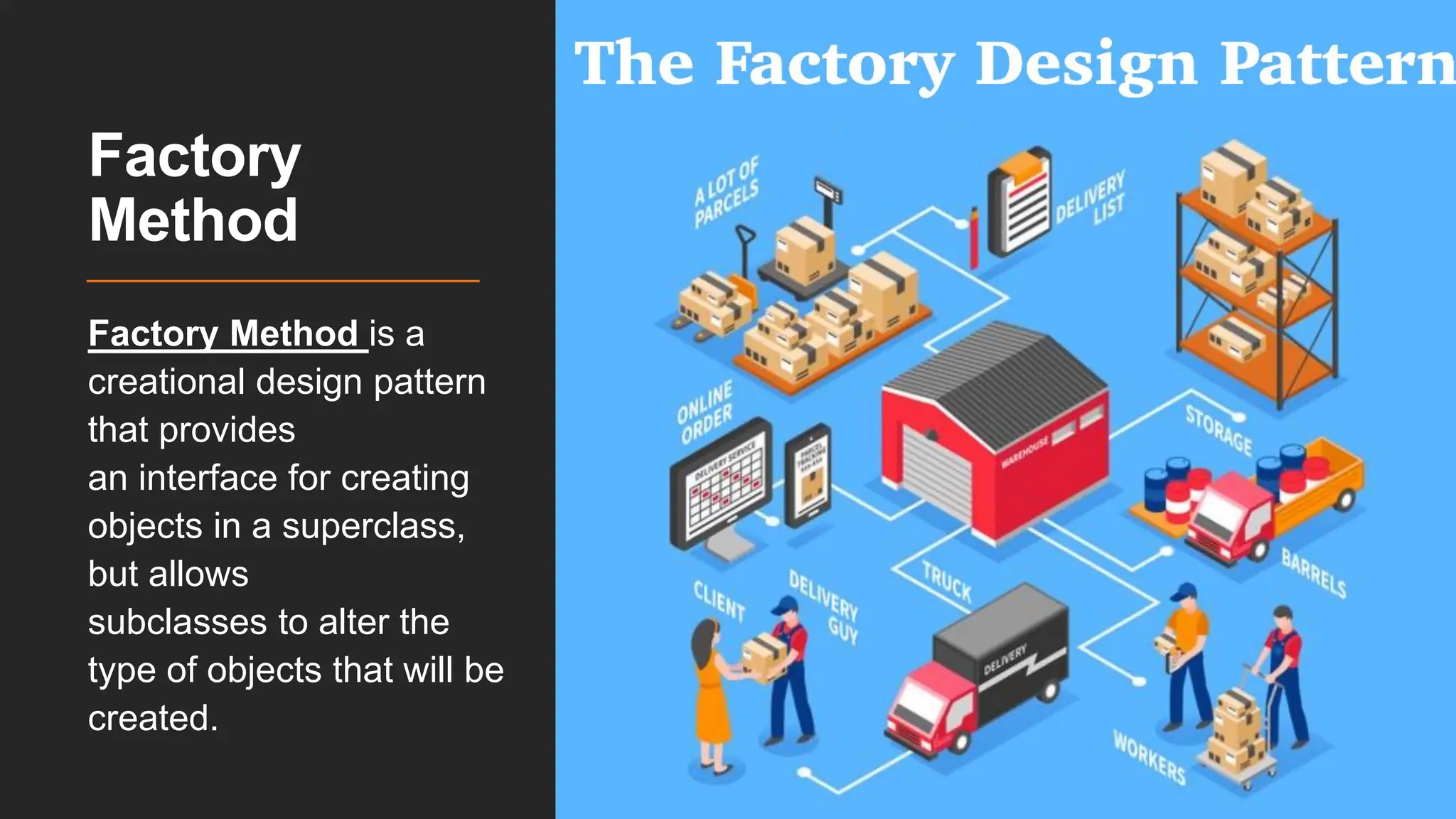
Factory Method is a
creational design pattern
that provides
an interface for creating
objects in a superclass,
but allows
subclasses to alter the
type of objects that will be
created.
Problem (Cont…)
Imagine that you’re creating a logistics management
application. The first version of your app can only handle
transportation by trucks, so the bulk of your code lives inside
the
Truck class.
After a while, your app becomes pretty popular. Each day you
receive dozens of requests from sea transportation companies
to incorporate sea logistics into the app.
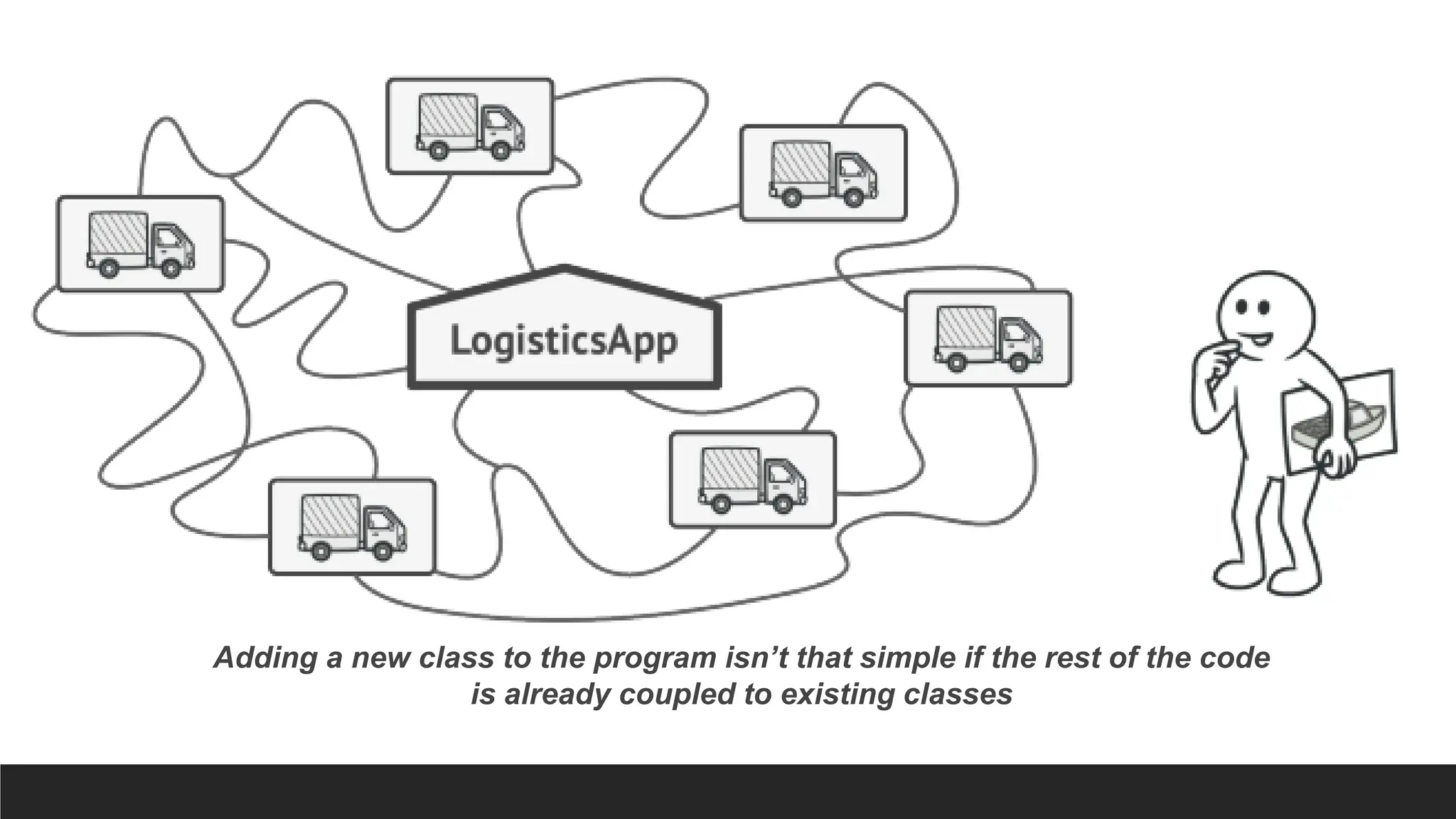
Adding a new class to the program isn’t that simple if the rest of the code
is already coupled to existing classes
Problem
Great news, right? But how about the code? At present, most of
your code is coupled to the Truck class. Adding Ships into the app
would require making changes to the entire codebase. Moreover,
if later you decide to add another type of transportation to the
app, you will probably need to make all of these changes again.
As a result, you will end up with pretty nasty code, riddled with
conditionals that switch the app’s behavior depending on the
class of transportation objects.
Solution (Cont…)
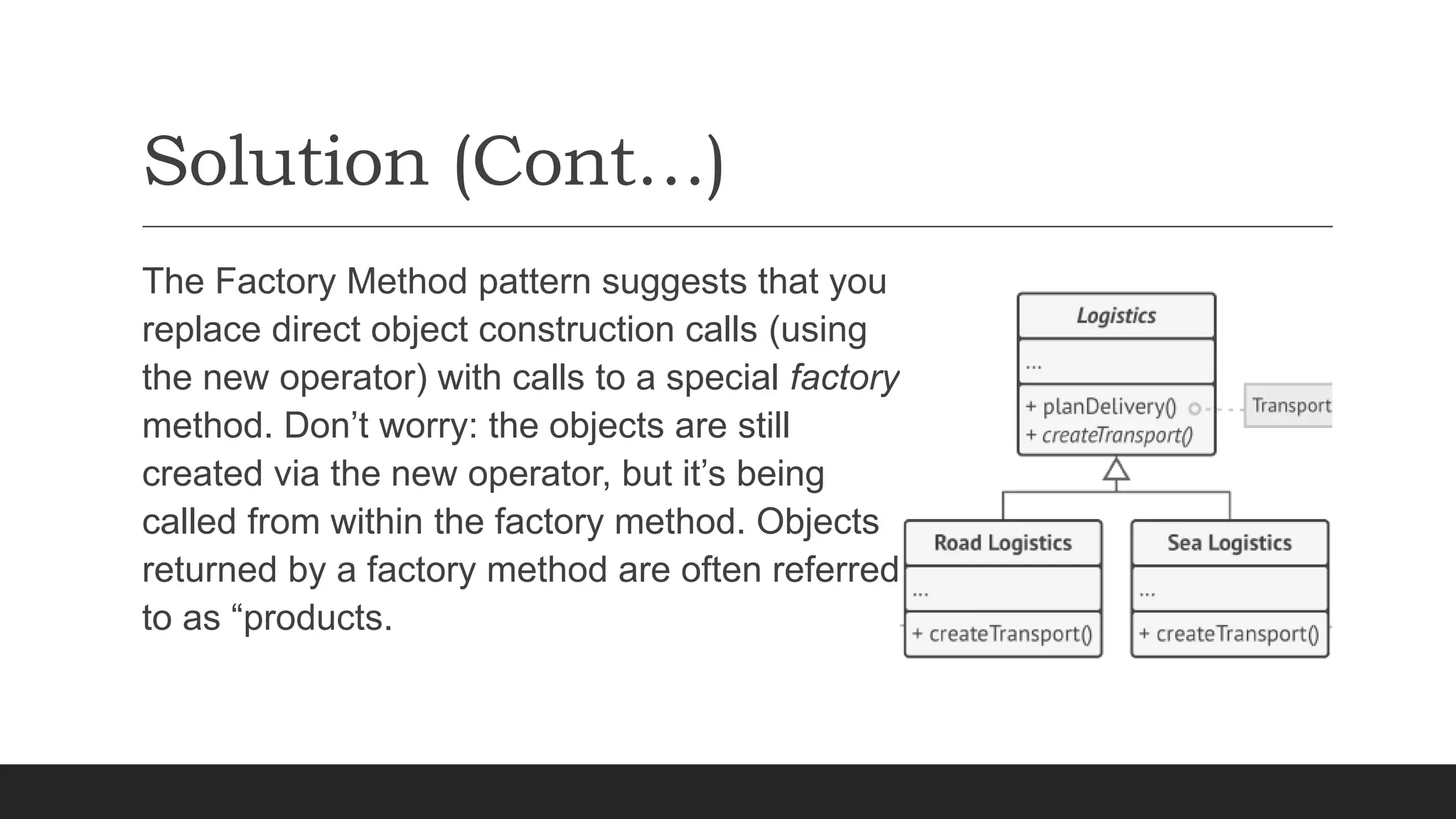
The Factory Method pattern suggests that you
replace direct object construction calls (using
the new operator) with calls to a special factory
method. Don’t worry: the objects are still
created via the new operator, but it’s being
called from within the factory method. Objects
returned by a factory method are often referred
to as “products.
Solution (Cont…)
At first glance, this change may look pointless: we just moved the
constructor call from one part of the program to another. However,
consider this: now you can override the factory method in a subclass and
change the class of products being created by the method.
There’s a slight limitation though: subclasses may return different types of
products only if these products have a common base class or interface.
Also, the factory method in the base class should have its return type
declared as this interface.
Solution (Cont...)
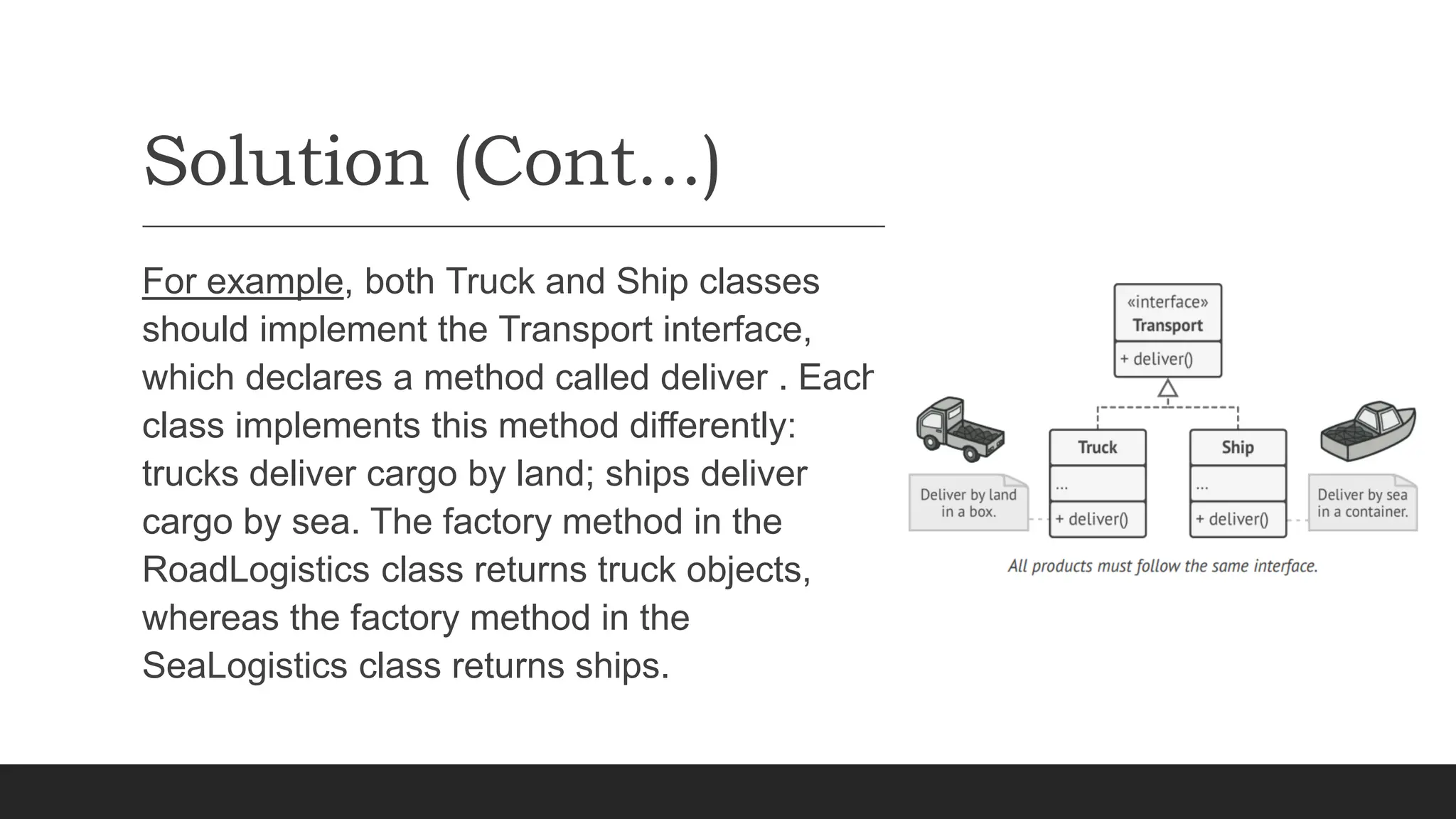
For example, both Truck and Ship classes
should implement the Transport interface,
which declares a method called deliver . Each
class implements this method differently:
trucks deliver cargo by land; ships deliver
cargo by sea. The factory method in the
RoadLogistics class returns truck objects,
whereas the factory method in the
SeaLogistics class returns ships.
Solution (Cont…)
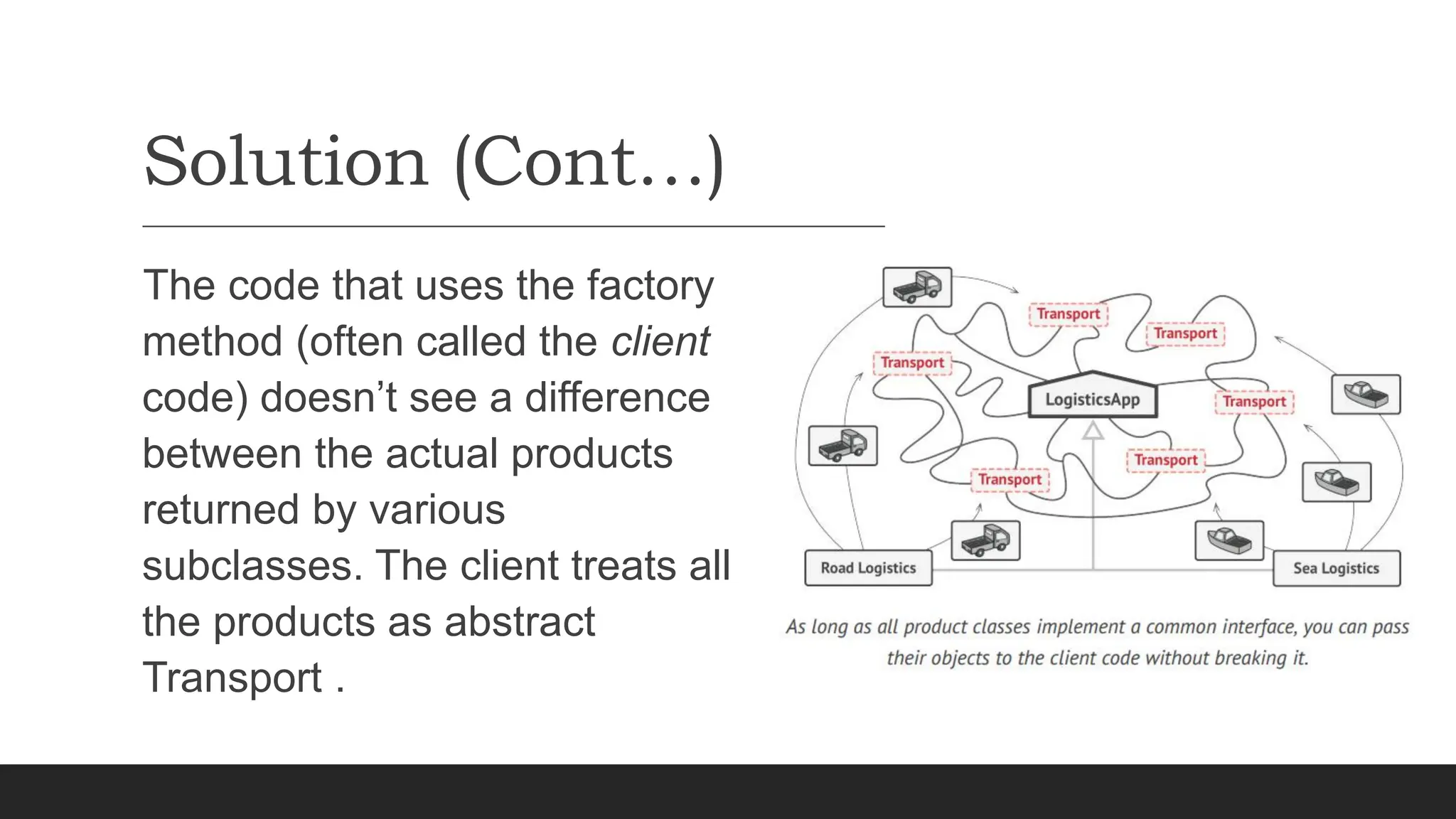
The code that uses the factory
method (often called the client
code) doesn’t see a difference
between the actual products
returned by various
subclasses. The client treats all
the products as abstract
Transport .
Solution
The client knows that all transport objects are supposed to
have the deliver method, but exactly how it works isn’t
important to the client.
Structure
(Cont…)
Structure (Cont…)
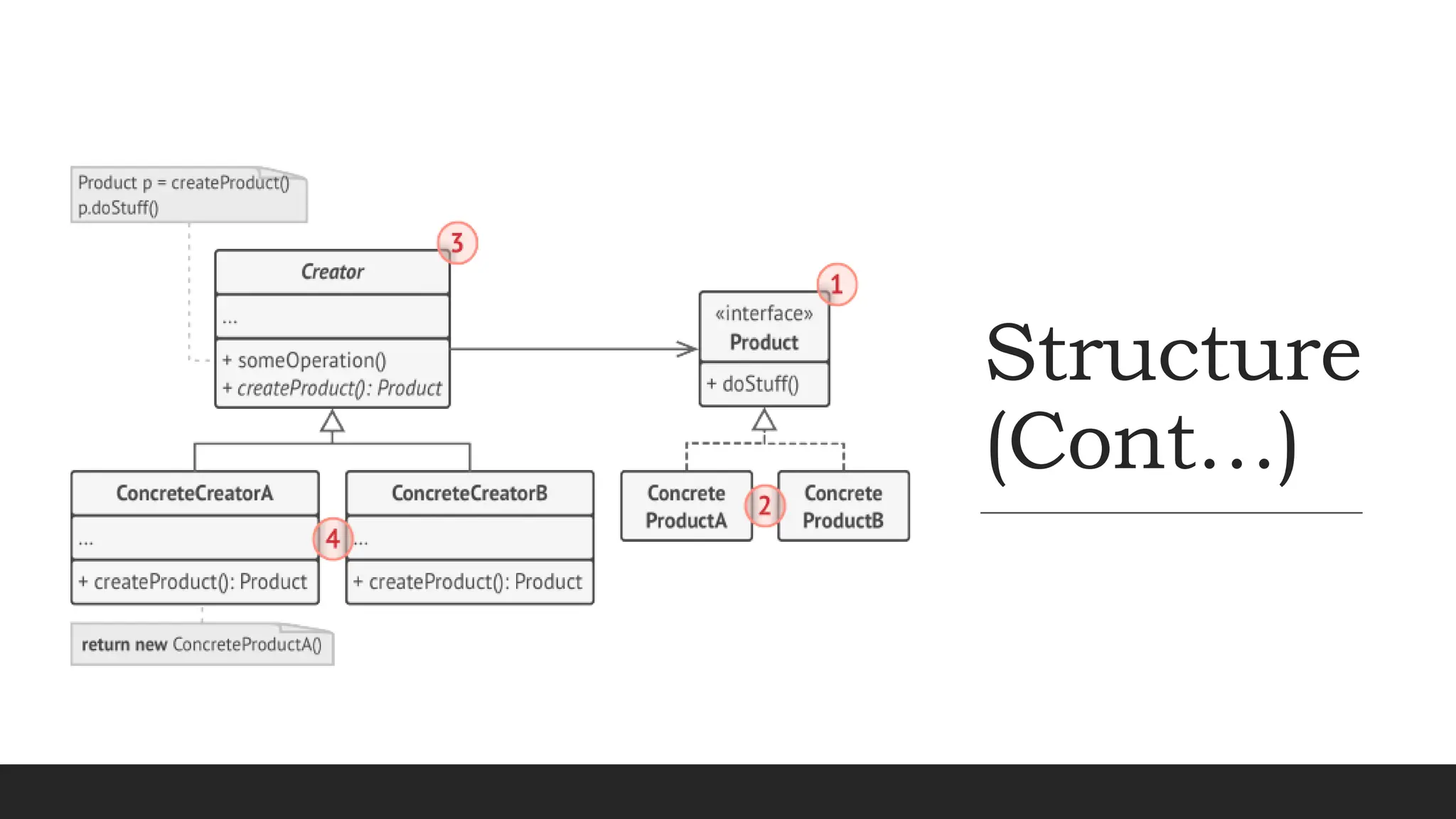
The Product declares the interface, which is common to all objects that can be
produced by the creator and its subclasses.
Concrete Products are different implementations of the product interface.
The Creator class declares the factory method that returns new product
objects. It’s important that the return type of this method matches the product
interface.
You can declare the factory method as abstract to force all subclasses to
implement their own versions of the method. As an alternative, the base
factory method can return some default product type
Structure (Cont…)
Note, despite its name, product creation is not the primary responsibility
of the creator. Usually, the creator class already has some core business
logic related to products. The factory
method helps to decouple this logic from the concrete product classes.
Here is an analogy: a large software development company can have a
training department for programmers. However, the primary function of
the company as a whole is still writing code, not producing programmers.
Structure
Concrete Creators override the base factory method, so it returns a different
type of product. 76 Creational Design Patterns / Factory Method Note that
the factory method doesn’t have to create new instances all the time. It can
also return existing objects from a cache, an object pool, or another source.

03-Factory Method for design patterns.pdf

  • 1.
    Design Patterns CSE354 Dr. MuhammadFarhan Assistant Professor, CUI Sahiwal farhan@cuisahiwal.edu.pk +92-3324428802
  • 2.
  • 3.
    Factory Method Factory Method isa creational design pattern that provides an interface for creating objects in a superclass, but allows subclasses to alter the type of objects that will be created.
  • 4.
    Problem (Cont…) Imagine thatyou’re creating a logistics management application. The first version of your app can only handle transportation by trucks, so the bulk of your code lives inside the Truck class. After a while, your app becomes pretty popular. Each day you receive dozens of requests from sea transportation companies to incorporate sea logistics into the app.
  • 5.
    Adding a newclass to the program isn’t that simple if the rest of the code is already coupled to existing classes
  • 6.
    Problem Great news, right?But how about the code? At present, most of your code is coupled to the Truck class. Adding Ships into the app would require making changes to the entire codebase. Moreover, if later you decide to add another type of transportation to the app, you will probably need to make all of these changes again. As a result, you will end up with pretty nasty code, riddled with conditionals that switch the app’s behavior depending on the class of transportation objects.
  • 7.
    Solution (Cont…) The FactoryMethod pattern suggests that you replace direct object construction calls (using the new operator) with calls to a special factory method. Don’t worry: the objects are still created via the new operator, but it’s being called from within the factory method. Objects returned by a factory method are often referred to as “products.
  • 8.
    Solution (Cont…) At firstglance, this change may look pointless: we just moved the constructor call from one part of the program to another. However, consider this: now you can override the factory method in a subclass and change the class of products being created by the method. There’s a slight limitation though: subclasses may return different types of products only if these products have a common base class or interface. Also, the factory method in the base class should have its return type declared as this interface.
  • 9.
    Solution (Cont...) For example,both Truck and Ship classes should implement the Transport interface, which declares a method called deliver . Each class implements this method differently: trucks deliver cargo by land; ships deliver cargo by sea. The factory method in the RoadLogistics class returns truck objects, whereas the factory method in the SeaLogistics class returns ships.
  • 10.
    Solution (Cont…) The codethat uses the factory method (often called the client code) doesn’t see a difference between the actual products returned by various subclasses. The client treats all the products as abstract Transport .
  • 11.
    Solution The client knowsthat all transport objects are supposed to have the deliver method, but exactly how it works isn’t important to the client.
  • 12.
  • 13.
    Structure (Cont…) The Productdeclares the interface, which is common to all objects that can be produced by the creator and its subclasses. Concrete Products are different implementations of the product interface. The Creator class declares the factory method that returns new product objects. It’s important that the return type of this method matches the product interface. You can declare the factory method as abstract to force all subclasses to implement their own versions of the method. As an alternative, the base factory method can return some default product type
  • 14.
    Structure (Cont…) Note, despiteits name, product creation is not the primary responsibility of the creator. Usually, the creator class already has some core business logic related to products. The factory method helps to decouple this logic from the concrete product classes. Here is an analogy: a large software development company can have a training department for programmers. However, the primary function of the company as a whole is still writing code, not producing programmers.
  • 15.
    Structure Concrete Creators overridethe base factory method, so it returns a different type of product. 76 Creational Design Patterns / Factory Method Note that the factory method doesn’t have to create new instances all the time. It can also return existing objects from a cache, an object pool, or another source.