ATOMS, MOLECULES
AND IONS
Chemistry for Industrial Technologist
Development of the
Modern Atomic
Theory
Since the ancient times, philosophers and scientists had
been asking “What are things made of?”
• Greek philosophers pioneered the quest of
finding out the basic composition of matter.
• EMPEDOCLES ( 490-435 B.C.) who proposed
the concept of fire, air, water, and earth as
the answer. He called these the four
elements, composed of minute, unchanging
particles.
• This was then accepted by ARISTOTLE (384-
323 B.C.), he even added a 5 the element
which he called QUINTESSENCE.
• These ideas culminated into a primitive
concept developed by DEMOCRITUS
(460-370 B.C.) who assumed the
presence of a void in which the
unchanging particles were in continuous
random motion. Later he then came up
with a theory stating that everything is
composed of small indivisible particles
which he called ATOMOS.
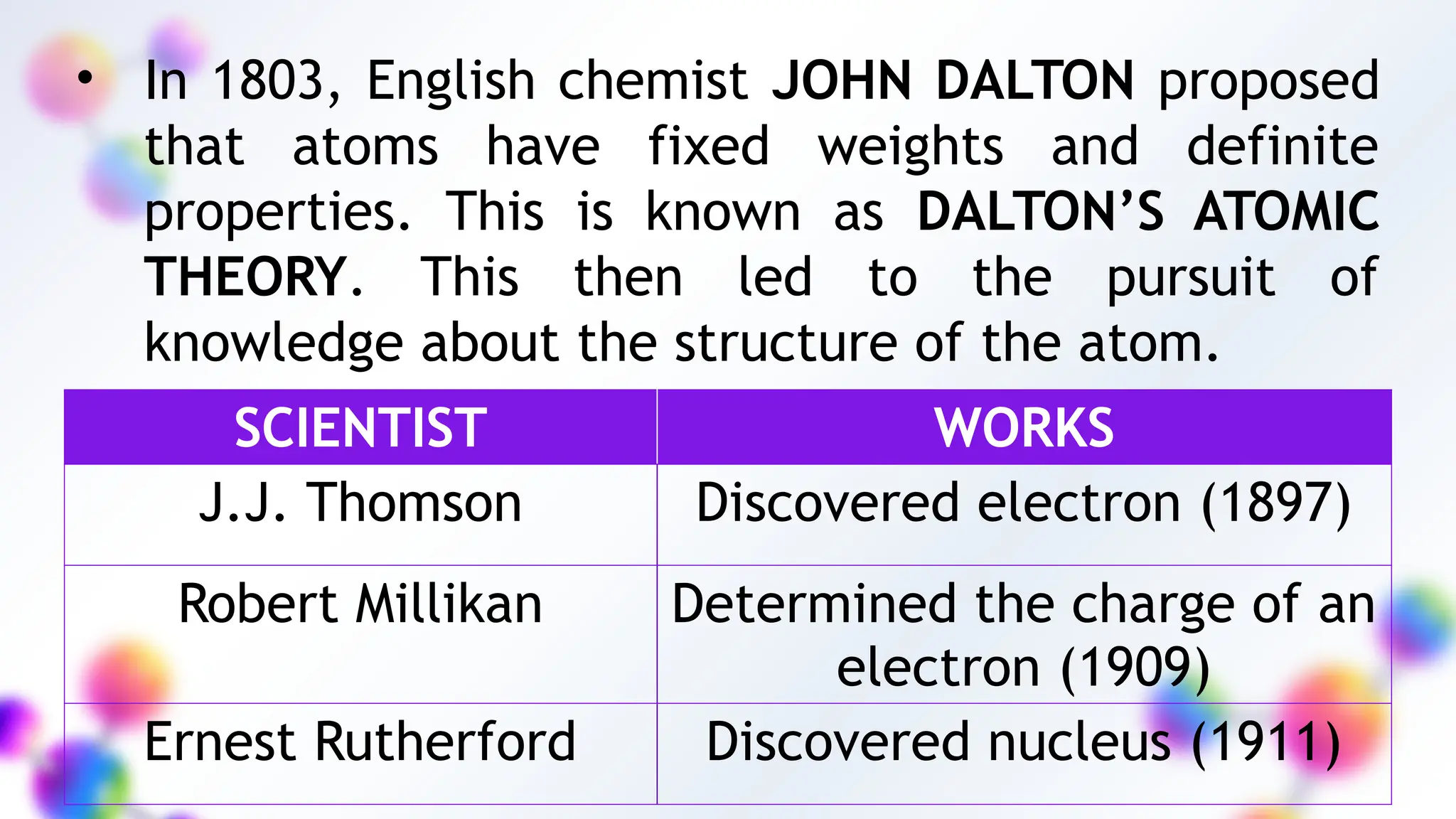
• In 1803, English chemist JOHN DALTON proposed
that atoms have fixed weights and definite
properties. This is known as DALTON’S ATOMIC
THEORY. This then led to the pursuit of
knowledge about the structure of the atom.
SCIENTIST WORKS
J.J. Thomson Discovered electron (1897)
Robert Millikan Determined the charge of an
electron (1909)
Ernest Rutherford Discovered nucleus (1911)
Law of Conservation of Mass
• In a chemical reaction, no change in
mass takes place. The total mass of the
products is equal to the total mass of
the reactant.
• In 1789, Antoine Laurent Lavoisier
discovered the law of conservation of
mass.
Reaction Reactant(s) Product(s)
1) H₂ O₂ H O
₂
mass 3.4g 10g 13.4g
2) CH₄ O₂ CO₂ H O
₂
mass 12.2g 14g 6.2g 20g
3) HgO Hg O₂
mass 23.6g 10.6g 13g
4) Li O₂ Li O
₂
mass 18.9g 5.7g 24.6g
5) C H
₃ ₆ O₂ CO₂ H O
₂
mass 18.9g 11.1g 14.4g 15.6g
6) Al(OH)₃ Al O
₂ ₃ H O
₂
mass 31.5g 21.8g 9.7g
• Hydrogen and oxygen react chemically to
form water. How much water would form if
14.8 grams of hydrogen reacted with 34.8
grams of oxygen? (H + O
₂ ₂ → H₂O)
H + O H O
₂ ₂ → ₂
Reactant side Product side
→
14.8g + 34.8g 49.6g
→
Law of Definite Proportion
• A compound always contains the same
constituent elements in a fixed or definite
proportion by mass.
• As an example, any sample of pure water
contains 11.19% hydrogen and 88.81%
oxygen by mass. It does not matter where
the sample of water came from or how it
was prepared. Its composition, like that of
every other compound, is fixed.
• For example, when different samples of isooctane (a
component of gasoline and one of the standards used in
the octane rating system) are analyzed, they are found
to have a carbon-to-hydrogen mass ratio of 5.33:1
Sample Carbon Hydrogen Mass Ratio
A 14.82g 2.78g =
B 22.33g 4.19g =
C 19.40g 3.64g =
Law of Multiple Proportion
• If two elements can combine to form
more than one compound, the masses of
one element that will combine with a
fixed mass of the other element are in a
ratio of small whole numbers.
Law of Multiple Proportion
• It states that when two elements
combine to form more than one
compound, the ratios of the masses of
the second element that combine with a
fixed mass of the first element are
simple whole numbers.
• Consider the compounds formed by carbon and
oxygen:
• Carbon monoxide (CO)12 grams of carbon
combine with 16 grams of oxygen.
• Carbon dioxide (CO )12 grams of carbon
₂
combine with 32 grams of oxygen.
• In this case, the mass ratios of oxygen that
combine with a fixed mass of carbon (12
grams) are 16 grams and 32 grams. The ratio of
these masses is a simple whole number:
Dalton’s Atomic Theory
proposed by John Dalton, can be used to
explain the laws of chemical change. This
theory is based on the following set of
postulates:
1. Elements are made up of very small particles
known as atoms.
Dalton’s Atomic Theory
2. All the atoms of an element are identical in
mass and size, and are different from the
atoms of another element. Dalton used the
different shapes or figures to represent
different elements, as follows:
Dalton’s Atomic Theory
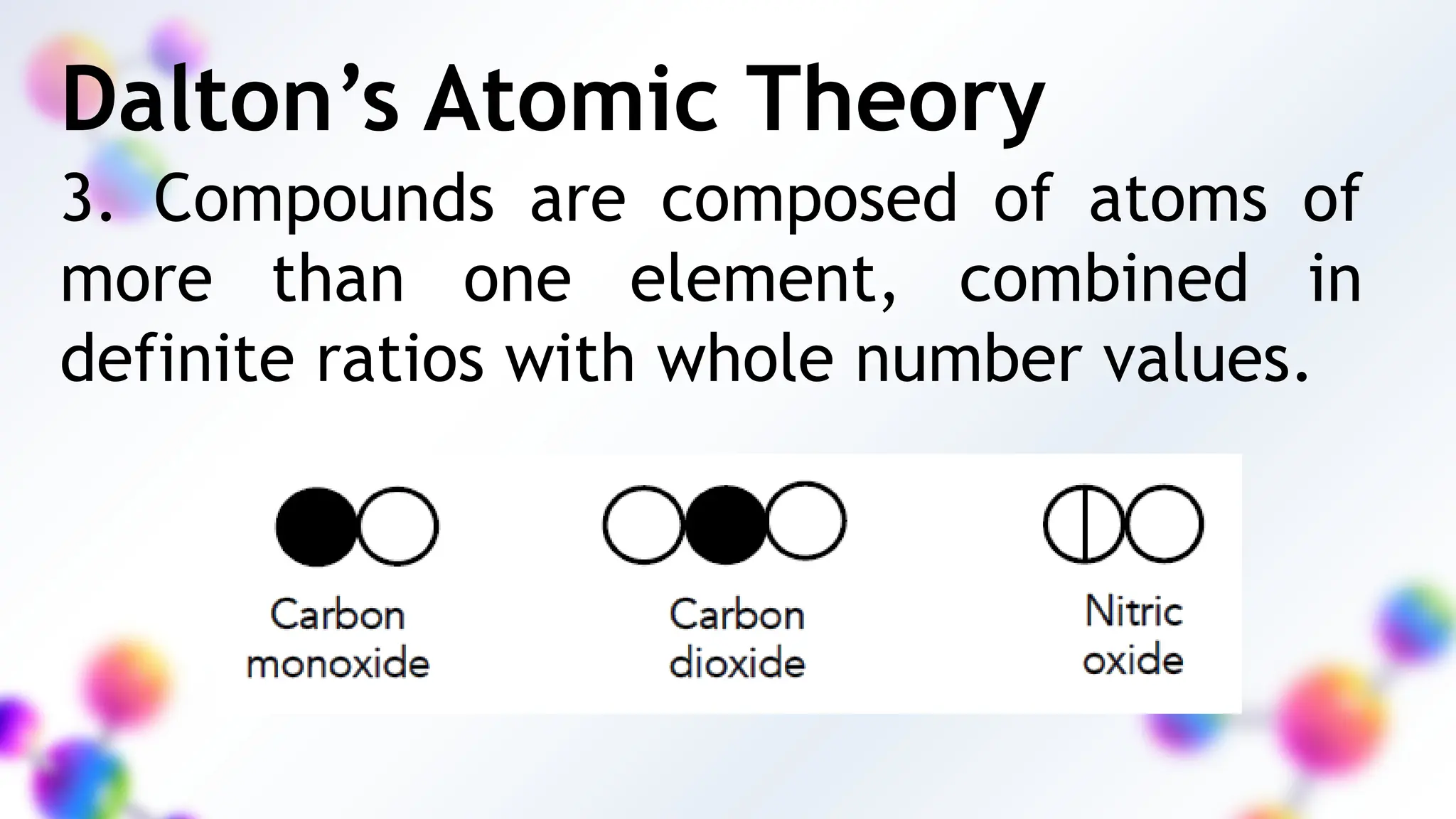
3. Compounds are composed of atoms of
more than one element, combined in
definite ratios with whole number values.
Dalton’s Atomic Theory
4. During a chemical reaction, atoms
combine, separate, or rearrange. No atoms
are created and no atoms disappear.
The Atomic
Structure
The Structure of Atoms
An atom is a small, indivisible particle
considered to be the basic unit of matter. An
atom consists of three main subatomic particles,
namely, protons, neutrons, and electrons.
Subatomic Particles
• ELECTRONS are small, negatively charged particles that spin
around the nucleus, staying in their ORBITS. The shells are
numbered, depending on how close they are to the nucleus.
Electrons in the lowest energy level are the ones most tightly
bound and, therefore hardest to expel. The number of the
energy level is designated.
• PROTONS were discovered Eugene Goldstein using Crookes
tube. Protons are positively charged particles.
• NEUTRONS are found in the nucleus. James Chadwick showed
that uncharged particles are emitted when beryllium and
other elements are bombarded with high velocity helium
particles. A neutron has no charge.
PARTICLE LOCATION CHARGE RELATIVE
MASS
PROTON Nucleus +1 1
ELECTRON Outside
nucleus
-1 0.0006
NEUTRON Nucleus 0 1
a. Atomic number = number of protons =
number of electrons in a neutral atom
b. Mass number = number of protons +
number of neutrons
Representing an Atom
ATOMIC
NUMBER
MASS
NUMBER
NUMBER OF
PROTON
NUMBER OF
ELECTRONS
NUMBER OF
NEUTRON
4 9 4 4 5
14 28 14 14 14
8 17 8 8 9
11 23 11 11 12
24 52 24 24 28
19 39 19 19 20
atoms of an element having the
same atomic number but
different mass number. The
existence of isotopes was shown
by mass spectroscopy
experiments, wherein elements
were found to be composed of
several types of atoms, each
with different masses.
Isotopes
• Protium is the most common isotope of hydrogen
and also the most abundant in nature. The basic
hydrogen atom – a single proton circled by a single
electron
• Deuterium is sometimes called heavy hydrogen
because it is more massive than protium. The
isotope deuterium has one proton, one neutron and
one electron.
• Tritium is a hydrogen atom that has two neutrons in
the nucleus and one proton.
Isotopes
Molecules and
Ions
Not all matter is atomic in nature. Most matter exist in
nature in the forms of molecules, ions and compounds.
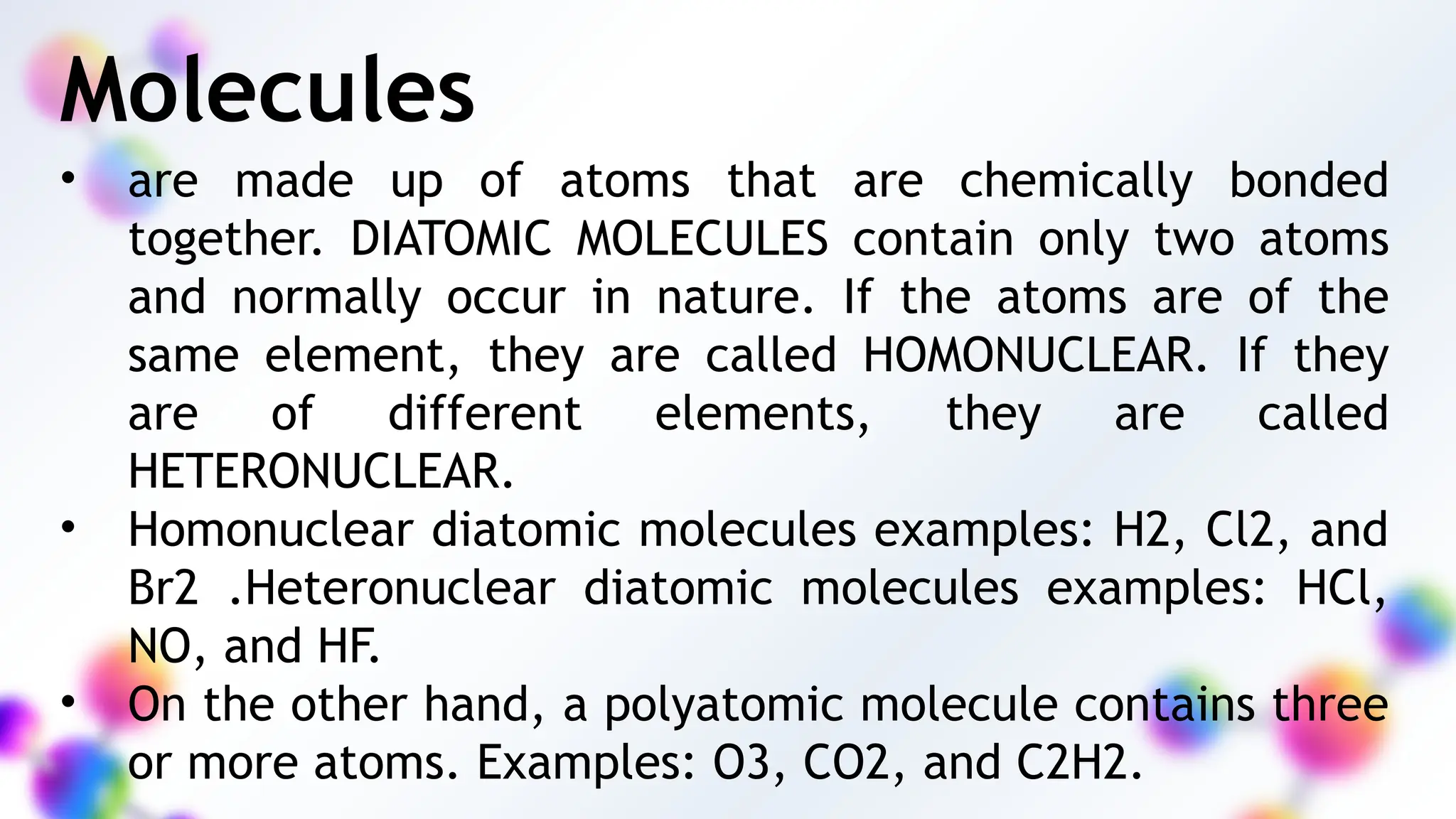
• are made up of atoms that are chemically bonded
together. DIATOMIC MOLECULES contain only two atoms
and normally occur in nature. If the atoms are of the
same element, they are called HOMONUCLEAR. If they
are of different elements, they are called
HETERONUCLEAR.
• Homonuclear diatomic molecules examples: H2, Cl2, and
Br2 .Heteronuclear diatomic molecules examples: HCl,
NO, and HF.
• On the other hand, a polyatomic molecule contains three
or more atoms. Examples: O3, CO2, and C2H2.
Molecules
• are atoms or molecules that have charge,
meaning the number protons is not equal
to the number of electrons, giving the
atom either a positive or negative net
charge. Ions with positive charge are
called CATIONS while ions with negative
charge are called ANIONS.
Ions
Chemical
Formulas
Writing chemical is a way of expressing in symbols the
elements present in a compound, as well as the number of
atoms of each element present in the compound.
• Indicates how the atoms are arranged and bonded
chemically. They are graphical representations of
compounds showing the elements connected to
each other in symbols and how they are arranged
in the molecule of the compound.
Structural Formula
• A formula that shows the number of atoms
per element present in a compound. It is also
called the true formula.
Molecular Formula
• Shows the simplest form of the atomic
ratio in a chemical compound.
Empirical Formula
Naming
Compounds
There are certain rules to follow when naming compounds.
Ionic and molecular compounds use different nomenclature
rules.
• is a neutrally-charged compound that contains a cation
that are usually metallic and anion that are usually non-
metallic. Rules:
a. Name the metal
b. If the metal has more than one oxidation state, indicate
the charge of the metal cation using Roman numerals and
enclose it in parentheses or use suffixes –ous and –ic.
c. If the anion is monoatomic, add the suffix –ide to the root
of the name of the non-metal. A MONOATOMIC ANION is
made up of only one atom. A POLYATOMIC ANION is made up
of more than one atom of different elements.
Naming Ionic
What is the chemical name of the
following Ionic compounds
• KCl
• KNO₃
• FEI₂
• Cu(NO )
₃ ₂
Write the chemical formula of
the following ionic compounds.
• Sodium hydroxide
• Aluminum phosphate
• A molecular compound is composed of non-metallic elements.
Rules:
1. Use prefixes for both elements in the compound to indicate the
number of atom for each elements present in the compound. If there
is only 1 atom in the first element, the prefix “mono” is usually
dropped.
Naming Molecular Compounds
1 mono-
2 di-
3 tri-
4 tetra-
5 penta-
6 hexa-
7 hepta-
8 octa-
9 nona-
10 deca-
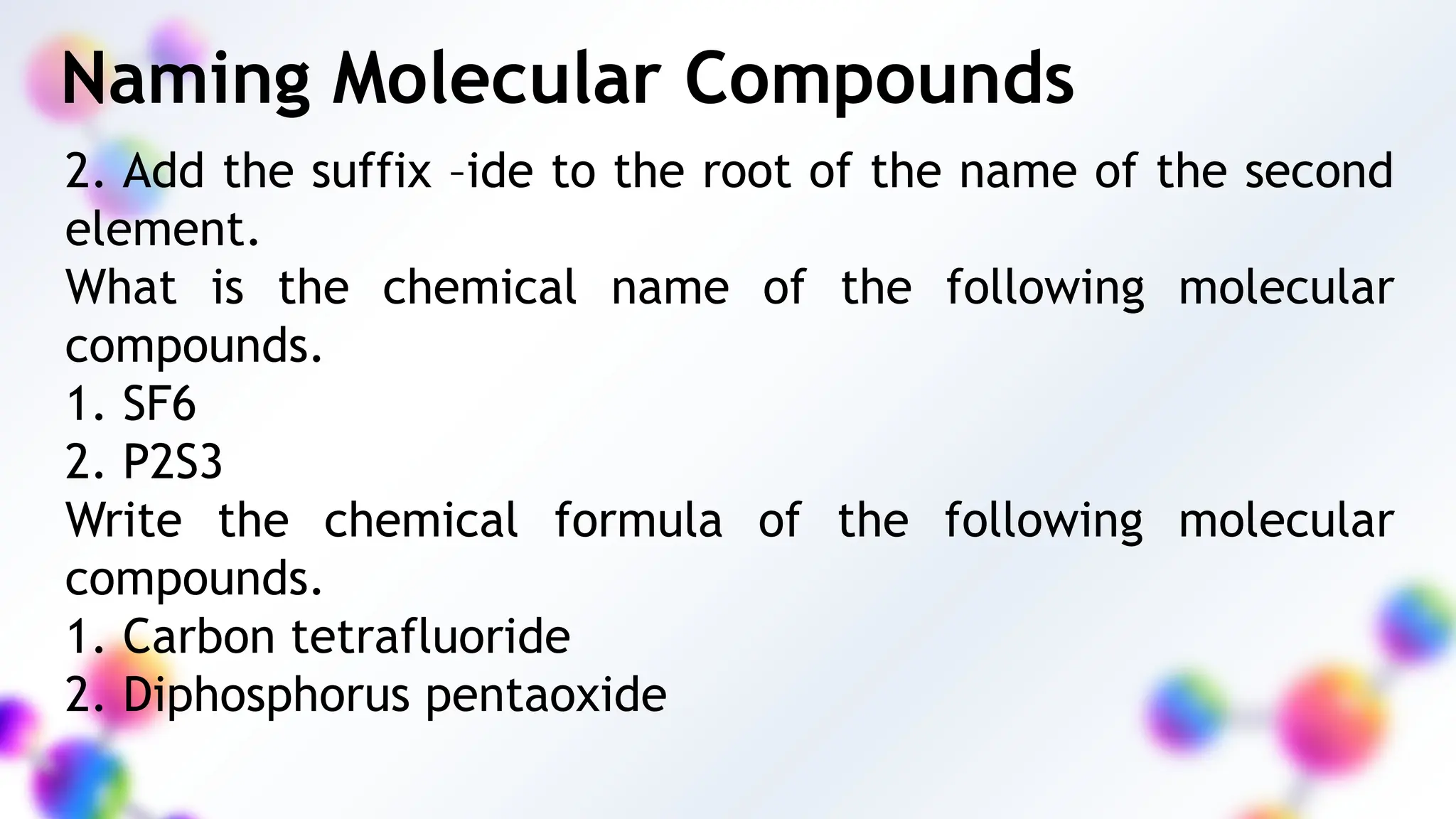
2. Add the suffix –ide to the root of the name of the second
element.
What is the chemical name of the following molecular
compounds.
1. SF6
2. P2S3
Write the chemical formula of the following molecular
compounds.
1. Carbon tetrafluoride
2. Diphosphorus pentaoxide
Naming Molecular Compounds

03_Atoms, Molecules and Ions(Chemistry).pptx

  • 1.
    ATOMS, MOLECULES AND IONS Chemistryfor Industrial Technologist
  • 2.
    Development of the ModernAtomic Theory Since the ancient times, philosophers and scientists had been asking “What are things made of?”
  • 3.
    • Greek philosopherspioneered the quest of finding out the basic composition of matter. • EMPEDOCLES ( 490-435 B.C.) who proposed the concept of fire, air, water, and earth as the answer. He called these the four elements, composed of minute, unchanging particles. • This was then accepted by ARISTOTLE (384- 323 B.C.), he even added a 5 the element which he called QUINTESSENCE.
  • 4.
    • These ideasculminated into a primitive concept developed by DEMOCRITUS (460-370 B.C.) who assumed the presence of a void in which the unchanging particles were in continuous random motion. Later he then came up with a theory stating that everything is composed of small indivisible particles which he called ATOMOS.
  • 5.
    • In 1803,English chemist JOHN DALTON proposed that atoms have fixed weights and definite properties. This is known as DALTON’S ATOMIC THEORY. This then led to the pursuit of knowledge about the structure of the atom. SCIENTIST WORKS J.J. Thomson Discovered electron (1897) Robert Millikan Determined the charge of an electron (1909) Ernest Rutherford Discovered nucleus (1911)
  • 6.
    Law of Conservationof Mass • In a chemical reaction, no change in mass takes place. The total mass of the products is equal to the total mass of the reactant. • In 1789, Antoine Laurent Lavoisier discovered the law of conservation of mass.
  • 7.
    Reaction Reactant(s) Product(s) 1)H₂ O₂ H O ₂ mass 3.4g 10g 13.4g 2) CH₄ O₂ CO₂ H O ₂ mass 12.2g 14g 6.2g 20g 3) HgO Hg O₂ mass 23.6g 10.6g 13g 4) Li O₂ Li O ₂ mass 18.9g 5.7g 24.6g 5) C H ₃ ₆ O₂ CO₂ H O ₂ mass 18.9g 11.1g 14.4g 15.6g 6) Al(OH)₃ Al O ₂ ₃ H O ₂ mass 31.5g 21.8g 9.7g
  • 8.
    • Hydrogen andoxygen react chemically to form water. How much water would form if 14.8 grams of hydrogen reacted with 34.8 grams of oxygen? (H + O ₂ ₂ → H₂O) H + O H O ₂ ₂ → ₂ Reactant side Product side → 14.8g + 34.8g 49.6g →
  • 9.
    Law of DefiniteProportion • A compound always contains the same constituent elements in a fixed or definite proportion by mass. • As an example, any sample of pure water contains 11.19% hydrogen and 88.81% oxygen by mass. It does not matter where the sample of water came from or how it was prepared. Its composition, like that of every other compound, is fixed.
  • 10.
    • For example,when different samples of isooctane (a component of gasoline and one of the standards used in the octane rating system) are analyzed, they are found to have a carbon-to-hydrogen mass ratio of 5.33:1 Sample Carbon Hydrogen Mass Ratio A 14.82g 2.78g = B 22.33g 4.19g = C 19.40g 3.64g =
  • 11.
    Law of MultipleProportion • If two elements can combine to form more than one compound, the masses of one element that will combine with a fixed mass of the other element are in a ratio of small whole numbers.
  • 12.
    Law of MultipleProportion • It states that when two elements combine to form more than one compound, the ratios of the masses of the second element that combine with a fixed mass of the first element are simple whole numbers.
  • 13.
    • Consider thecompounds formed by carbon and oxygen: • Carbon monoxide (CO)12 grams of carbon combine with 16 grams of oxygen. • Carbon dioxide (CO )12 grams of carbon ₂ combine with 32 grams of oxygen. • In this case, the mass ratios of oxygen that combine with a fixed mass of carbon (12 grams) are 16 grams and 32 grams. The ratio of these masses is a simple whole number:
  • 14.
    Dalton’s Atomic Theory proposedby John Dalton, can be used to explain the laws of chemical change. This theory is based on the following set of postulates: 1. Elements are made up of very small particles known as atoms.
  • 15.
    Dalton’s Atomic Theory 2.All the atoms of an element are identical in mass and size, and are different from the atoms of another element. Dalton used the different shapes or figures to represent different elements, as follows:
  • 16.
    Dalton’s Atomic Theory 3.Compounds are composed of atoms of more than one element, combined in definite ratios with whole number values.
  • 17.
    Dalton’s Atomic Theory 4.During a chemical reaction, atoms combine, separate, or rearrange. No atoms are created and no atoms disappear.
  • 18.
  • 19.
    The Structure ofAtoms An atom is a small, indivisible particle considered to be the basic unit of matter. An atom consists of three main subatomic particles, namely, protons, neutrons, and electrons.
  • 20.
    Subatomic Particles • ELECTRONSare small, negatively charged particles that spin around the nucleus, staying in their ORBITS. The shells are numbered, depending on how close they are to the nucleus. Electrons in the lowest energy level are the ones most tightly bound and, therefore hardest to expel. The number of the energy level is designated. • PROTONS were discovered Eugene Goldstein using Crookes tube. Protons are positively charged particles. • NEUTRONS are found in the nucleus. James Chadwick showed that uncharged particles are emitted when beryllium and other elements are bombarded with high velocity helium particles. A neutron has no charge.
  • 21.
    PARTICLE LOCATION CHARGERELATIVE MASS PROTON Nucleus +1 1 ELECTRON Outside nucleus -1 0.0006 NEUTRON Nucleus 0 1
  • 22.
    a. Atomic number= number of protons = number of electrons in a neutral atom b. Mass number = number of protons + number of neutrons Representing an Atom
  • 23.
    ATOMIC NUMBER MASS NUMBER NUMBER OF PROTON NUMBER OF ELECTRONS NUMBEROF NEUTRON 4 9 4 4 5 14 28 14 14 14 8 17 8 8 9 11 23 11 11 12 24 52 24 24 28 19 39 19 19 20
  • 24.
    atoms of anelement having the same atomic number but different mass number. The existence of isotopes was shown by mass spectroscopy experiments, wherein elements were found to be composed of several types of atoms, each with different masses. Isotopes
  • 25.
    • Protium isthe most common isotope of hydrogen and also the most abundant in nature. The basic hydrogen atom – a single proton circled by a single electron • Deuterium is sometimes called heavy hydrogen because it is more massive than protium. The isotope deuterium has one proton, one neutron and one electron. • Tritium is a hydrogen atom that has two neutrons in the nucleus and one proton. Isotopes
  • 26.
    Molecules and Ions Not allmatter is atomic in nature. Most matter exist in nature in the forms of molecules, ions and compounds.
  • 27.
    • are madeup of atoms that are chemically bonded together. DIATOMIC MOLECULES contain only two atoms and normally occur in nature. If the atoms are of the same element, they are called HOMONUCLEAR. If they are of different elements, they are called HETERONUCLEAR. • Homonuclear diatomic molecules examples: H2, Cl2, and Br2 .Heteronuclear diatomic molecules examples: HCl, NO, and HF. • On the other hand, a polyatomic molecule contains three or more atoms. Examples: O3, CO2, and C2H2. Molecules
  • 28.
    • are atomsor molecules that have charge, meaning the number protons is not equal to the number of electrons, giving the atom either a positive or negative net charge. Ions with positive charge are called CATIONS while ions with negative charge are called ANIONS. Ions
  • 29.
    Chemical Formulas Writing chemical isa way of expressing in symbols the elements present in a compound, as well as the number of atoms of each element present in the compound.
  • 30.
    • Indicates howthe atoms are arranged and bonded chemically. They are graphical representations of compounds showing the elements connected to each other in symbols and how they are arranged in the molecule of the compound. Structural Formula
  • 31.
    • A formulathat shows the number of atoms per element present in a compound. It is also called the true formula. Molecular Formula
  • 32.
    • Shows thesimplest form of the atomic ratio in a chemical compound. Empirical Formula
  • 33.
    Naming Compounds There are certainrules to follow when naming compounds. Ionic and molecular compounds use different nomenclature rules.
  • 34.
    • is aneutrally-charged compound that contains a cation that are usually metallic and anion that are usually non- metallic. Rules: a. Name the metal b. If the metal has more than one oxidation state, indicate the charge of the metal cation using Roman numerals and enclose it in parentheses or use suffixes –ous and –ic. c. If the anion is monoatomic, add the suffix –ide to the root of the name of the non-metal. A MONOATOMIC ANION is made up of only one atom. A POLYATOMIC ANION is made up of more than one atom of different elements. Naming Ionic
  • 35.
    What is thechemical name of the following Ionic compounds • KCl • KNO₃ • FEI₂ • Cu(NO ) ₃ ₂
  • 36.
    Write the chemicalformula of the following ionic compounds. • Sodium hydroxide • Aluminum phosphate
  • 37.
    • A molecularcompound is composed of non-metallic elements. Rules: 1. Use prefixes for both elements in the compound to indicate the number of atom for each elements present in the compound. If there is only 1 atom in the first element, the prefix “mono” is usually dropped. Naming Molecular Compounds 1 mono- 2 di- 3 tri- 4 tetra- 5 penta- 6 hexa- 7 hepta- 8 octa- 9 nona- 10 deca-
  • 38.
    2. Add thesuffix –ide to the root of the name of the second element. What is the chemical name of the following molecular compounds. 1. SF6 2. P2S3 Write the chemical formula of the following molecular compounds. 1. Carbon tetrafluoride 2. Diphosphorus pentaoxide Naming Molecular Compounds