M.V.HERWADKAR ENG.MED.
SCHOOL
STD-IX SUB: SCIENCE TOPIC-ATOMS AND MOLECULES
NEETA PATIL
• An Indian philosopher Maharishi Kanad, postulated that if
we go on dividing matter (padarth), we shall get smaller
and smaller particles. Ultimately, a time will come when we
shall come across the smallest particles beyond which
further division will not be possible. He named these
particles Parmanu. Another Indian philosopher, Pakudha
Katyayama, elaborated this doctrine and said that these
particles normally exist in a combined form which gives us
various forms of matter.
• Ancient Greek philosophers – Democritus and Leucippus suggested
that if we go on dividing matter, a stage will come when particles
obtained cannot be divided further. Democritus called these
indivisible particles atoms (meaning indivisible). All this was based
on philosophical considerations and not much experimental work to
validate these ideas could be done till the eighteenth century.
• By the end of the eighteenth century, scientists recognised the
difference between elements and compounds and naturally became
interested in finding out how and why elements combine and what
happens when they combine.
Laws of Chemical Combination
• .1 LAW OF CONSERVATION OF MASS
• Law of conservation of mass states that mass can neither be
created nor destroyed in a chemical reaction.
• .2 LAW OF CONSTANT PROPORTIONS
• “In a chemical substance the elements are always present in
definite proportions by mass”
• . This law was stated by Proust.
• The law of constant proportions which is also known as the law
of definite proportions.
EXAMPLES
• In a compound such as water, the ratio of the mass
of hydrogen to the mass of oxygen is always 1:8,
whatever the source of water. Thus, if 9 g of water is
decomposed, 1 g of hydrogen and 8 g of oxygen are
always obtained. Similarly in ammonia, nitrogen and
hydrogen are always present in the ratio 14:3 by
mass, whatever the method or the source from
which it is obtained.
DALTONS ATOMIC THEORY
• Dalton picked up the idea of divisibility of matter,
which was till then just a philosophy. He took the
name ‘atoms’ as given by the Greeks and said that
the smallest particles of matter are atoms. His theory
was based on the laws of chemical combination.
Dalton’s atomic theory provided an explanation for
the law of conservation of mass and the law of
definite proportions.
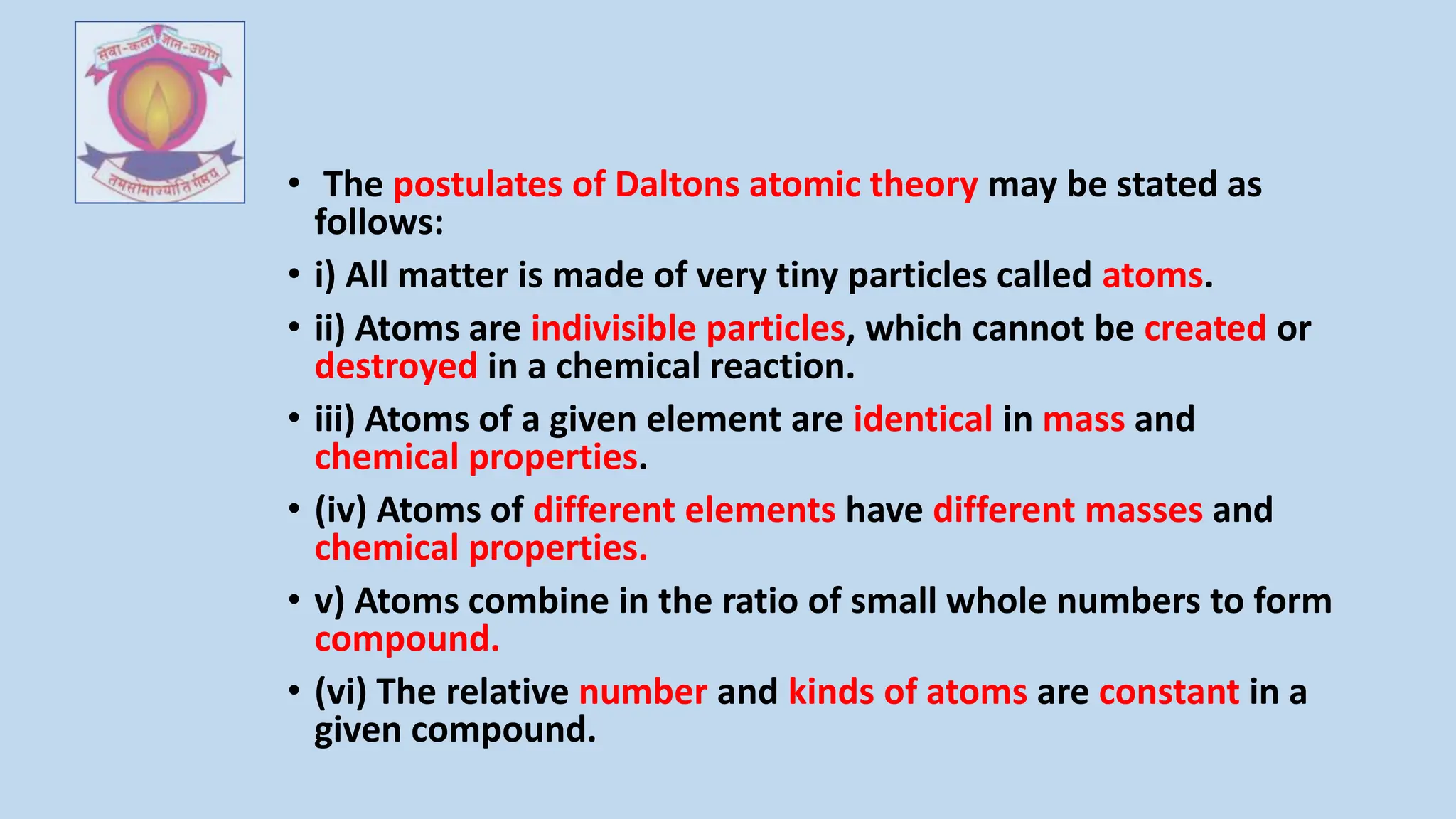
• The postulates of Daltons atomic theory may be stated as
follows:
• i) All matter is made of very tiny particles called atoms.
• ii) Atoms are indivisible particles, which cannot be created or
destroyed in a chemical reaction.
• iii) Atoms of a given element are identical in mass and
chemical properties.
• (iv) Atoms of different elements have different masses and
chemical properties.
• v) Atoms combine in the ratio of small whole numbers to form
compound.
• (vi) The relative number and kinds of atoms are constant in a
given compound.
MOLECULES OF COMPOUNDS
• Atoms of different
elements join together in
definite proportions to
form molecules of
compounds.
• Molecules of some
compounds :
Atoms
• The building blocks of
all matter are atoms.
•Atoms are very small,
they are smaller than
anything that we can
imagine or compare
with .
•Dalton was the first
scientist to use the symbols
for elements in a very
specific sense.
• Berzilius suggested that
the symbols of elements be
made from one or two
letters of the name of the
element.
• In the beginning, the names of elements were
derived from the name of the place where they
were found for the first time. For example, the
name copper was taken from Cyprus.
• Some names were taken from specific colours. For
example, gold was taken from the English word
meaning yellow.
• Now-a-days, IUPAC (International Union of Pure
and Applied Chemistry) approves names of
elements.
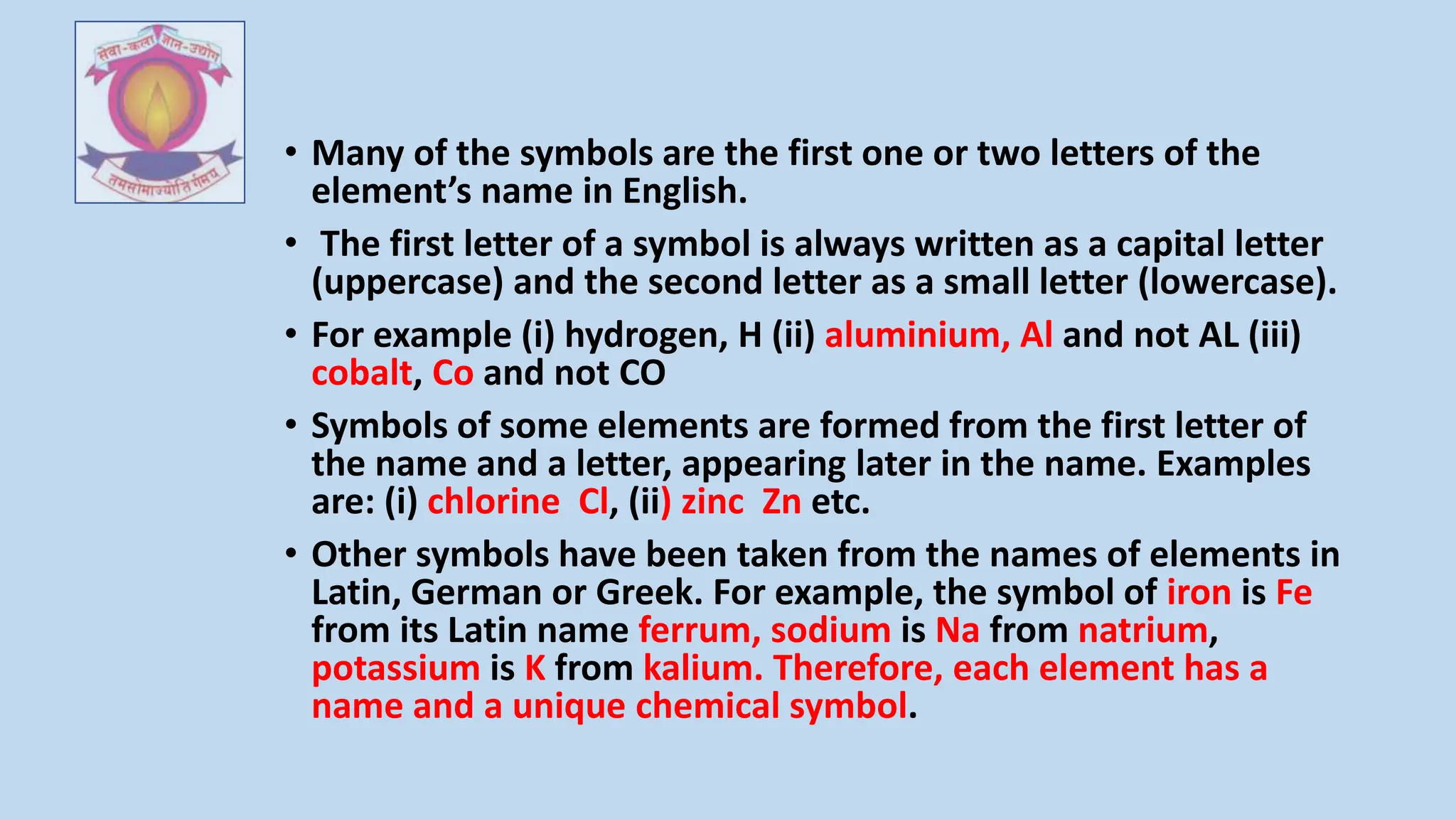
• Many of the symbols are the first one or two letters of the
element’s name in English.
• The first letter of a symbol is always written as a capital letter
(uppercase) and the second letter as a small letter (lowercase).
• For example (i) hydrogen, H (ii) aluminium, Al and not AL (iii)
cobalt, Co and not CO
• Symbols of some elements are formed from the first letter of
the name and a letter, appearing later in the name. Examples
are: (i) chlorine Cl, (ii) zinc Zn etc.
• Other symbols have been taken from the names of elements in
Latin, German or Greek. For example, the symbol of iron is Fe
from its Latin name ferrum, sodium is Na from natrium,
potassium is K from kalium. Therefore, each element has a
name and a unique chemical symbol.
ATOMIC MASS
• In 1961 for a universally accepted atomic mass unit, carbon-
12 isotope was chosen as the standard reference for
measuring atomic masses. One atomic mass unit is a mass
unit equal to exactly one-twelfth (1/12th) the mass of one
atom of carbon-12. The relative atomic masses of all
elements have been found with respect to an atom of
carbon-12
• The relative atomic mass of the atom of an element is
defined as the average mass of the atom, as compared to
1/12th the mass of one carbon-12 atom.
HOW DO ATOMS EXIST?
•Atoms of most elements are not able to
exist independently.
•Atoms form molecules and ions.
•These molecules or ions aggregate in large
numbers to form the matter that we can
see, feel or touch.
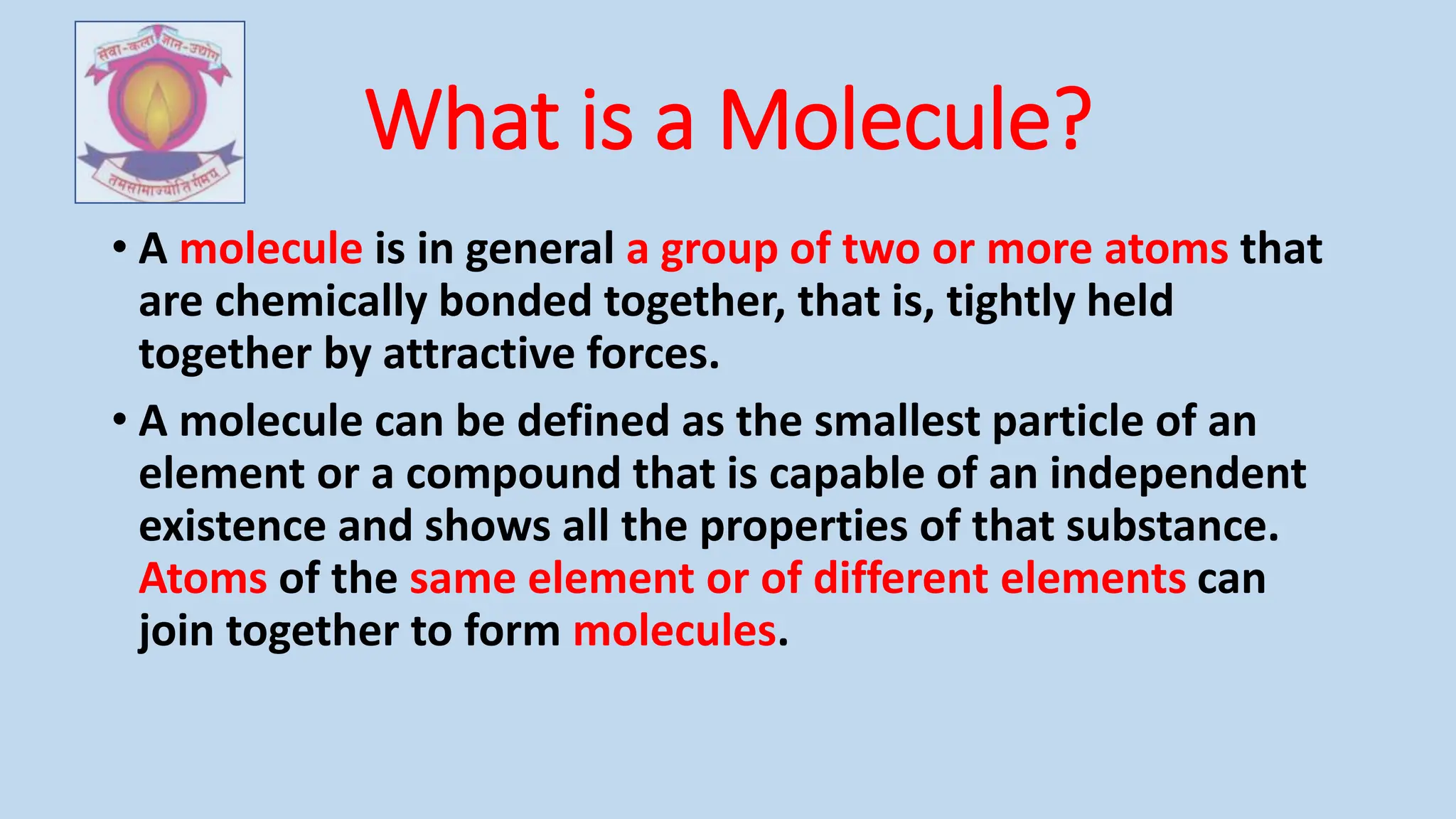
What is a Molecule?
• A molecule is in general a group of two or more atoms that
are chemically bonded together, that is, tightly held
together by attractive forces.
• A molecule can be defined as the smallest particle of an
element or a compound that is capable of an independent
existence and shows all the properties of that substance.
Atoms of the same element or of different elements can
join together to form molecules.
MOLECULES OF ELEMENTS
• The molecules of an element are constituted by the same type of
atoms.
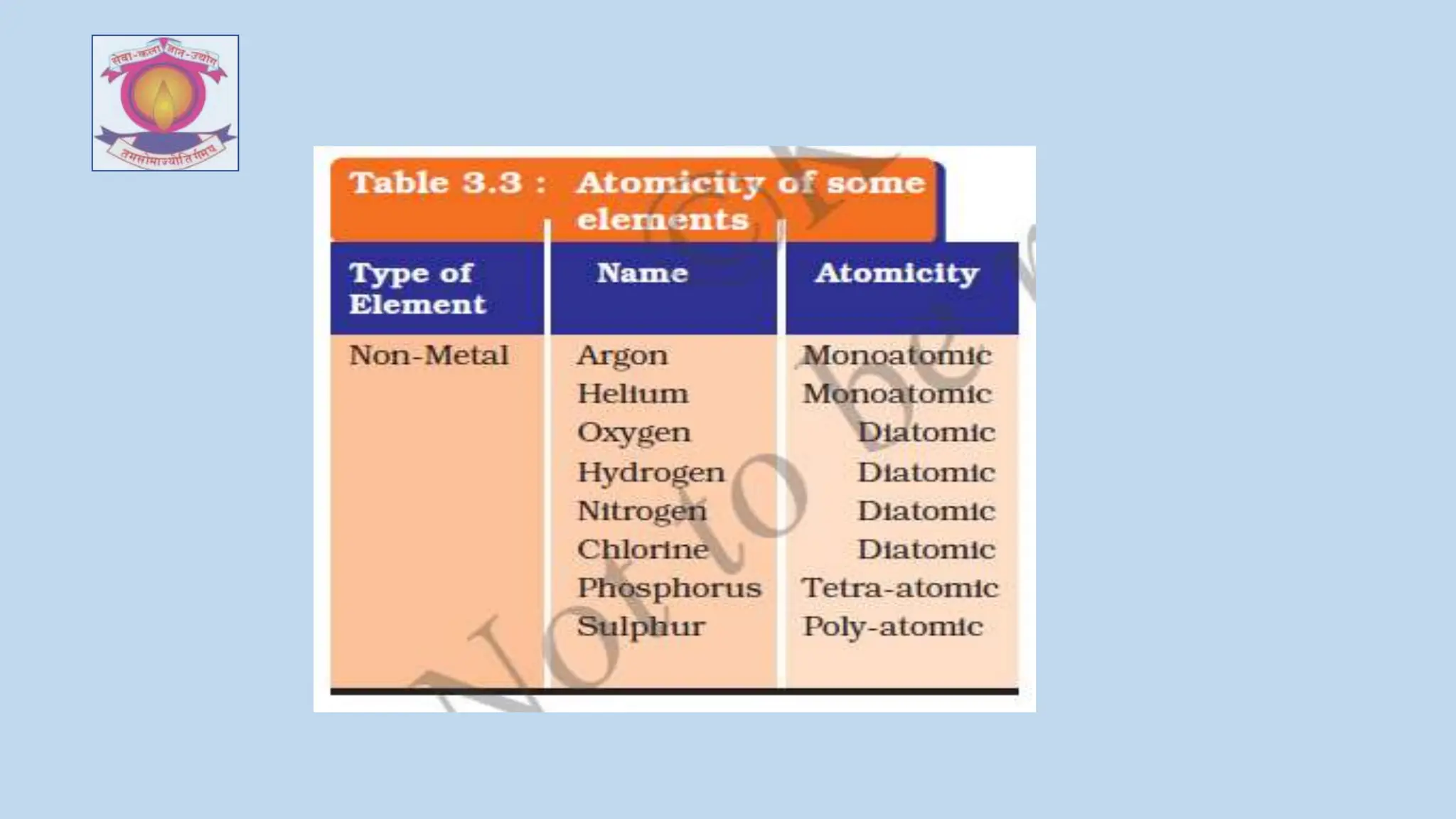
• Molecules of many elements, such as argon (Ar), helium (He) etc.
are made up of only one atom of that element. These molecules are
called as monoatomic molecules.
• This is not the case with most of the nonmetals. For example, a
molecule of oxygen consists of two atoms of oxygen and hence it is
known as a diatomic molecule, O2.
• If 3 atoms of oxygen unite into a molecule, instead of the usual 2,
we get ozone.
• The number of atoms constituting a molecule is known as its
atomicity.
ION
• Compounds composed of metals and nonmetals contain charged
species.
• The charged species are known as ions. An ion is a charged particle
and can be negatively or positively charged. A negatively charged
ion is called an ‘anion’ and the positively charged ion, a ‘cation’.
Take, for example, sodium chloride (NaCl). Its constituent particles
are positively charged sodium ions (Na+) and negatively charged
chloride ions (Cl–).
• Ions may consist of a single charged atom or a group of atomsthat
have a net charge on them. A group of atoms carrying a charge is
known as a polyatomic ion.
Writing Chemical Formulae
• The chemical formula of a compound is a symbolic representation of
its composition.
• The chemical formulae of different compounds can be written
easily.
• For this, we need to learn the symbols and combining capacity of
the elements.
• The combining power (or capacity) of an element is known as its
valency.
• The rules that you have to follow while writing a chemical
formula are as follows:
• The valencies or charges on the ion must balance.
• When a compound consists of a metal and a non-metal, the
name or symbol of the metal is written first. For example:
calcium oxide (CaO), sodium chloride (NaCl), iron sulphide
(FeS), copper oxide (CuO) etc., where oxygen, chlorine, sulphur
are non-metals and are written on the right, whereas calcium,
sodium, iron and copper are metals, and are written on the
left.
• In compounds formed with polyatomic ions, the ion is enclosed
in a bracket before writing the number to indicate the ratio. In
case the number of polyatomic ion is one, the bracket is not
required. For example, NaOH.
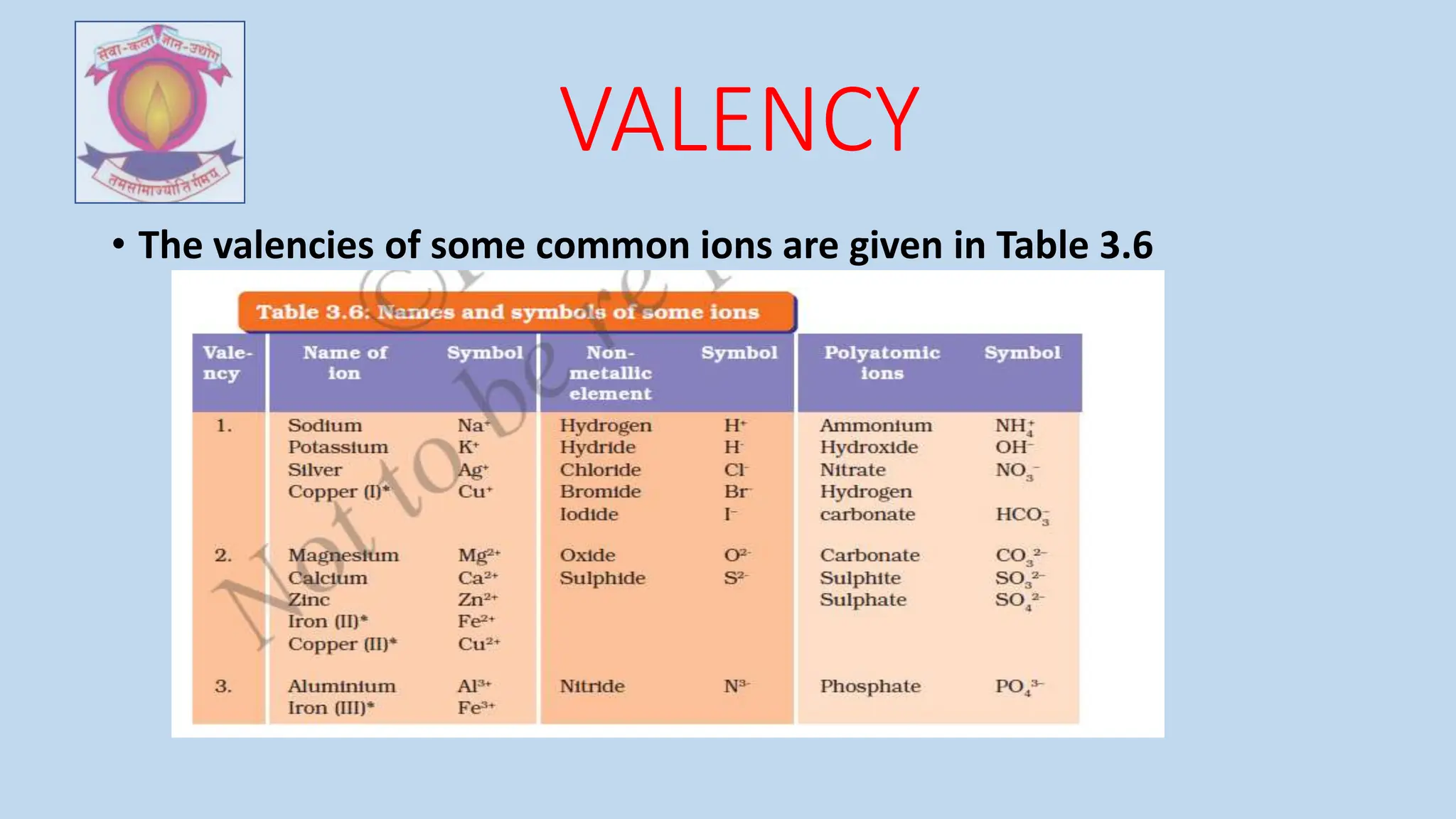
VALENCY
• The valencies of some common ions are given in Table 3.6
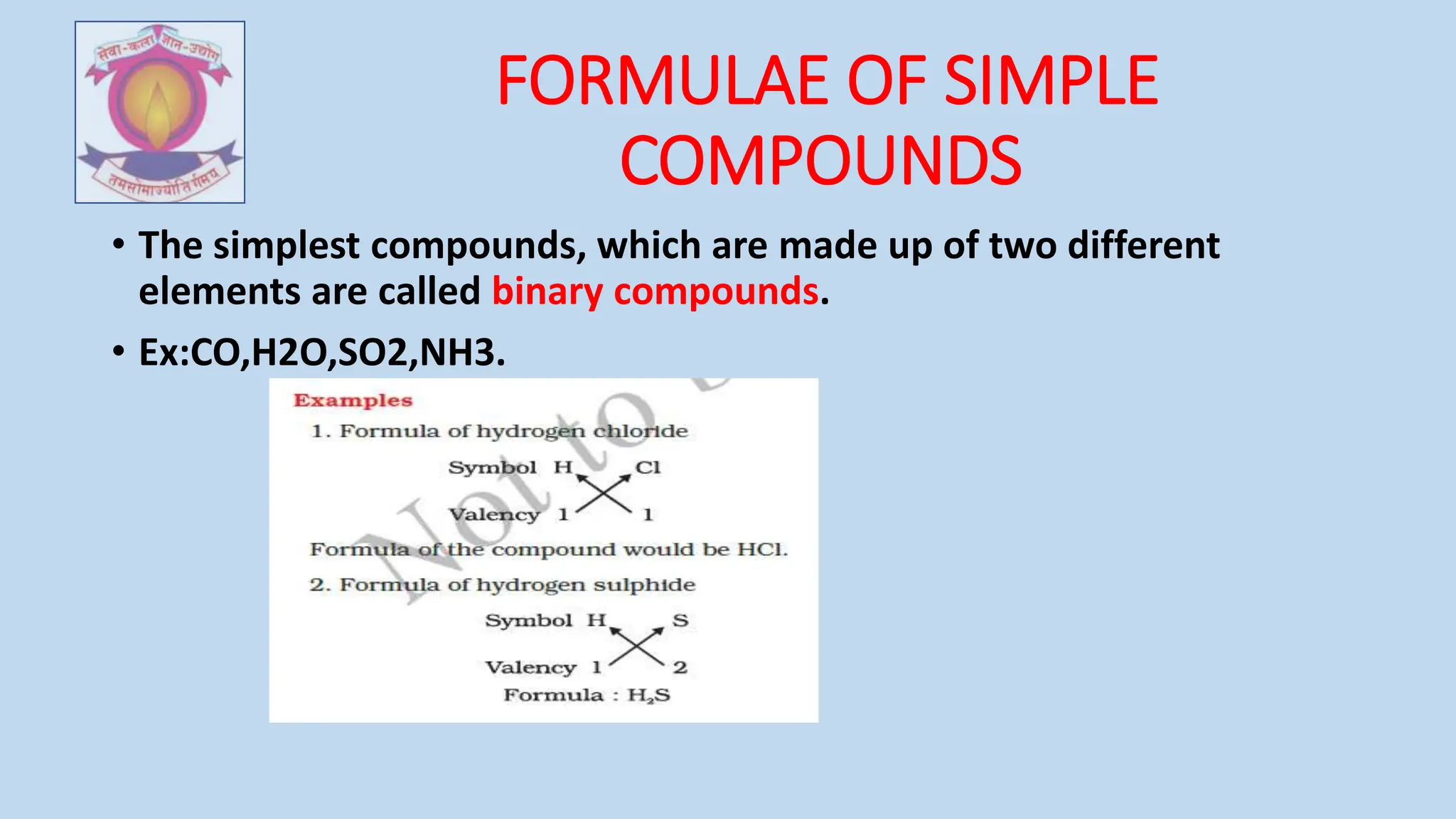
FORMULAE OF SIMPLE
COMPOUNDS
• The simplest compounds, which are made up of two different
elements are called binary compounds.
• Ex:CO,H2O,SO2,NH3.
Molecular Mass and Mole Concept
• MOLECULAR MASS:The molecular mass of a substance is the sum of
the atomic masses of all the atoms in a molecule of the substance. It
is therefore the relative mass of a molecule expressed in atomic
mass units (u).
• Example (a) Calculate the relative molecular mass of water (H2O).
(b) Calculate the molecular mass of HNO3. Solution: (a) Atomic
mass of hydrogen = 1u, oxygen = 16 u So the molecular mass of
water, which contains two atoms of hydrogen and one atom of
oxygen is = 2 × 1+ 1×16 = 18 u (b) The molecular mass of HNO3 = the
atomic mass of H + the atomic mass of N+ 3 × the atomic mass of O
= 1 + 14 + 48 = 63 u
FORMULA UNIT MASS
• The formula unit mass of a substance is a sum of the atomic masses
of all atoms in a formula unit of a compound. Formula unit mass is
calculated in the same manner as we calculate the molecular mass.
The only difference is that we use the word formula unit for those
substances whose constituent particles are ions .
• For example, sodium chloride as discussed above, has a formula
unit NaCl.
• Its formula unit mass can be calculated as– 1 × 23 + 1 × 35.5 =58.5 u
MOLE CONCEPT
• Ex. 2H2+ O2 → 2H2O
• The above reaction indicates that,
• (i) two molecules of hydrogen combine with one molecule of
oxygen to form two molecules of water, or
• (ii) 4 u of hydrogen molecules combine with 32 u of oxygen
molecules to form 36 u of water molecules.
• The number of particles (atoms, molecules or ions) present in 1
mole of any substance is fixed, with a value of 6.022 × 10²³.
• This is an experimentally obtained value. This number is called the
Avogadro Constant or Avogadro Number (represented by N0),
named in honour of the Italian scientist, Amedeo Avogadro.
• 1 mole (of anything) = 6.022 × 10²³ in number as,
• 1 dozen = 12 nos.
• 1 gross = 144 nos.
GRAM ATOMIC MASS
• The mass of 1 mole of a substance is equal to its relative atomic or
molecular mass in grams.
• The atomic mass of an element gives us the mass of one atom of
that element in atomic mass units (u).
• To get the mass of 1 mole of atom of that element, that is, molar
mass, we have to take the same numerical value but change the
units from ‘u’ to ‘g’. Molar mass of atoms is also known as gram
atomic mass.
• For example, atomic mass of hydrogen=1u. So, gram atomic mass of
hydrogen = 1 g.
RELATIVE MASS
• Ex. 1u hydrogen has only 1 atom of hydrogen 1 g hydrogen has 1
mole atoms, that is, 6.022 × 10²³ atoms of hydrogen.
• Similarly, 16 u oxygen has only 1 atom of oxygen, 16 g oxygen has 1
mole atoms, that is, 6.022 × 10²³ atoms of oxygen.
• 18 u water has only 1 molecule of water, 18 g water has 1 mole
molecules of water, that is, 6.022 × 10²³ molecules of water.
• Chemists need the number of atoms and molecules while carrying
out reactions, and for this they need to relate the mass in grams to
the number.
• It is done as follows: 1 mole = 6.022 × 10²³ number = Relative mass
in grams.

ATOMS AND MOLECULES.pptx.................

  • 1.
    M.V.HERWADKAR ENG.MED. SCHOOL STD-IX SUB:SCIENCE TOPIC-ATOMS AND MOLECULES NEETA PATIL
  • 2.
    • An Indianphilosopher Maharishi Kanad, postulated that if we go on dividing matter (padarth), we shall get smaller and smaller particles. Ultimately, a time will come when we shall come across the smallest particles beyond which further division will not be possible. He named these particles Parmanu. Another Indian philosopher, Pakudha Katyayama, elaborated this doctrine and said that these particles normally exist in a combined form which gives us various forms of matter.
  • 3.
    • Ancient Greekphilosophers – Democritus and Leucippus suggested that if we go on dividing matter, a stage will come when particles obtained cannot be divided further. Democritus called these indivisible particles atoms (meaning indivisible). All this was based on philosophical considerations and not much experimental work to validate these ideas could be done till the eighteenth century. • By the end of the eighteenth century, scientists recognised the difference between elements and compounds and naturally became interested in finding out how and why elements combine and what happens when they combine.
  • 5.
    Laws of ChemicalCombination • .1 LAW OF CONSERVATION OF MASS • Law of conservation of mass states that mass can neither be created nor destroyed in a chemical reaction. • .2 LAW OF CONSTANT PROPORTIONS • “In a chemical substance the elements are always present in definite proportions by mass” • . This law was stated by Proust. • The law of constant proportions which is also known as the law of definite proportions.
  • 6.
    EXAMPLES • In acompound such as water, the ratio of the mass of hydrogen to the mass of oxygen is always 1:8, whatever the source of water. Thus, if 9 g of water is decomposed, 1 g of hydrogen and 8 g of oxygen are always obtained. Similarly in ammonia, nitrogen and hydrogen are always present in the ratio 14:3 by mass, whatever the method or the source from which it is obtained.
  • 7.
    DALTONS ATOMIC THEORY •Dalton picked up the idea of divisibility of matter, which was till then just a philosophy. He took the name ‘atoms’ as given by the Greeks and said that the smallest particles of matter are atoms. His theory was based on the laws of chemical combination. Dalton’s atomic theory provided an explanation for the law of conservation of mass and the law of definite proportions.
  • 8.
    • The postulatesof Daltons atomic theory may be stated as follows: • i) All matter is made of very tiny particles called atoms. • ii) Atoms are indivisible particles, which cannot be created or destroyed in a chemical reaction. • iii) Atoms of a given element are identical in mass and chemical properties. • (iv) Atoms of different elements have different masses and chemical properties. • v) Atoms combine in the ratio of small whole numbers to form compound. • (vi) The relative number and kinds of atoms are constant in a given compound.
  • 9.
    MOLECULES OF COMPOUNDS •Atoms of different elements join together in definite proportions to form molecules of compounds. • Molecules of some compounds :
  • 10.
    Atoms • The buildingblocks of all matter are atoms. •Atoms are very small, they are smaller than anything that we can imagine or compare with .
  • 11.
    •Dalton was thefirst scientist to use the symbols for elements in a very specific sense. • Berzilius suggested that the symbols of elements be made from one or two letters of the name of the element.
  • 12.
    • In thebeginning, the names of elements were derived from the name of the place where they were found for the first time. For example, the name copper was taken from Cyprus. • Some names were taken from specific colours. For example, gold was taken from the English word meaning yellow. • Now-a-days, IUPAC (International Union of Pure and Applied Chemistry) approves names of elements.
  • 13.
    • Many ofthe symbols are the first one or two letters of the element’s name in English. • The first letter of a symbol is always written as a capital letter (uppercase) and the second letter as a small letter (lowercase). • For example (i) hydrogen, H (ii) aluminium, Al and not AL (iii) cobalt, Co and not CO • Symbols of some elements are formed from the first letter of the name and a letter, appearing later in the name. Examples are: (i) chlorine Cl, (ii) zinc Zn etc. • Other symbols have been taken from the names of elements in Latin, German or Greek. For example, the symbol of iron is Fe from its Latin name ferrum, sodium is Na from natrium, potassium is K from kalium. Therefore, each element has a name and a unique chemical symbol.
  • 15.
    ATOMIC MASS • In1961 for a universally accepted atomic mass unit, carbon- 12 isotope was chosen as the standard reference for measuring atomic masses. One atomic mass unit is a mass unit equal to exactly one-twelfth (1/12th) the mass of one atom of carbon-12. The relative atomic masses of all elements have been found with respect to an atom of carbon-12 • The relative atomic mass of the atom of an element is defined as the average mass of the atom, as compared to 1/12th the mass of one carbon-12 atom.
  • 17.
    HOW DO ATOMSEXIST? •Atoms of most elements are not able to exist independently. •Atoms form molecules and ions. •These molecules or ions aggregate in large numbers to form the matter that we can see, feel or touch.
  • 18.
    What is aMolecule? • A molecule is in general a group of two or more atoms that are chemically bonded together, that is, tightly held together by attractive forces. • A molecule can be defined as the smallest particle of an element or a compound that is capable of an independent existence and shows all the properties of that substance. Atoms of the same element or of different elements can join together to form molecules.
  • 19.
    MOLECULES OF ELEMENTS •The molecules of an element are constituted by the same type of atoms. • Molecules of many elements, such as argon (Ar), helium (He) etc. are made up of only one atom of that element. These molecules are called as monoatomic molecules. • This is not the case with most of the nonmetals. For example, a molecule of oxygen consists of two atoms of oxygen and hence it is known as a diatomic molecule, O2. • If 3 atoms of oxygen unite into a molecule, instead of the usual 2, we get ozone. • The number of atoms constituting a molecule is known as its atomicity.
  • 22.
    ION • Compounds composedof metals and nonmetals contain charged species. • The charged species are known as ions. An ion is a charged particle and can be negatively or positively charged. A negatively charged ion is called an ‘anion’ and the positively charged ion, a ‘cation’. Take, for example, sodium chloride (NaCl). Its constituent particles are positively charged sodium ions (Na+) and negatively charged chloride ions (Cl–). • Ions may consist of a single charged atom or a group of atomsthat have a net charge on them. A group of atoms carrying a charge is known as a polyatomic ion.
  • 24.
    Writing Chemical Formulae •The chemical formula of a compound is a symbolic representation of its composition. • The chemical formulae of different compounds can be written easily. • For this, we need to learn the symbols and combining capacity of the elements. • The combining power (or capacity) of an element is known as its valency.
  • 25.
    • The rulesthat you have to follow while writing a chemical formula are as follows: • The valencies or charges on the ion must balance. • When a compound consists of a metal and a non-metal, the name or symbol of the metal is written first. For example: calcium oxide (CaO), sodium chloride (NaCl), iron sulphide (FeS), copper oxide (CuO) etc., where oxygen, chlorine, sulphur are non-metals and are written on the right, whereas calcium, sodium, iron and copper are metals, and are written on the left. • In compounds formed with polyatomic ions, the ion is enclosed in a bracket before writing the number to indicate the ratio. In case the number of polyatomic ion is one, the bracket is not required. For example, NaOH.
  • 26.
    VALENCY • The valenciesof some common ions are given in Table 3.6
  • 27.
    FORMULAE OF SIMPLE COMPOUNDS •The simplest compounds, which are made up of two different elements are called binary compounds. • Ex:CO,H2O,SO2,NH3.
  • 28.
    Molecular Mass andMole Concept • MOLECULAR MASS:The molecular mass of a substance is the sum of the atomic masses of all the atoms in a molecule of the substance. It is therefore the relative mass of a molecule expressed in atomic mass units (u). • Example (a) Calculate the relative molecular mass of water (H2O). (b) Calculate the molecular mass of HNO3. Solution: (a) Atomic mass of hydrogen = 1u, oxygen = 16 u So the molecular mass of water, which contains two atoms of hydrogen and one atom of oxygen is = 2 × 1+ 1×16 = 18 u (b) The molecular mass of HNO3 = the atomic mass of H + the atomic mass of N+ 3 × the atomic mass of O = 1 + 14 + 48 = 63 u
  • 29.
    FORMULA UNIT MASS •The formula unit mass of a substance is a sum of the atomic masses of all atoms in a formula unit of a compound. Formula unit mass is calculated in the same manner as we calculate the molecular mass. The only difference is that we use the word formula unit for those substances whose constituent particles are ions . • For example, sodium chloride as discussed above, has a formula unit NaCl. • Its formula unit mass can be calculated as– 1 × 23 + 1 × 35.5 =58.5 u
  • 31.
    MOLE CONCEPT • Ex.2H2+ O2 → 2H2O • The above reaction indicates that, • (i) two molecules of hydrogen combine with one molecule of oxygen to form two molecules of water, or • (ii) 4 u of hydrogen molecules combine with 32 u of oxygen molecules to form 36 u of water molecules.
  • 32.
    • The numberof particles (atoms, molecules or ions) present in 1 mole of any substance is fixed, with a value of 6.022 × 10²³. • This is an experimentally obtained value. This number is called the Avogadro Constant or Avogadro Number (represented by N0), named in honour of the Italian scientist, Amedeo Avogadro. • 1 mole (of anything) = 6.022 × 10²³ in number as, • 1 dozen = 12 nos. • 1 gross = 144 nos.
  • 33.
    GRAM ATOMIC MASS •The mass of 1 mole of a substance is equal to its relative atomic or molecular mass in grams. • The atomic mass of an element gives us the mass of one atom of that element in atomic mass units (u). • To get the mass of 1 mole of atom of that element, that is, molar mass, we have to take the same numerical value but change the units from ‘u’ to ‘g’. Molar mass of atoms is also known as gram atomic mass. • For example, atomic mass of hydrogen=1u. So, gram atomic mass of hydrogen = 1 g.
  • 34.
    RELATIVE MASS • Ex.1u hydrogen has only 1 atom of hydrogen 1 g hydrogen has 1 mole atoms, that is, 6.022 × 10²³ atoms of hydrogen. • Similarly, 16 u oxygen has only 1 atom of oxygen, 16 g oxygen has 1 mole atoms, that is, 6.022 × 10²³ atoms of oxygen. • 18 u water has only 1 molecule of water, 18 g water has 1 mole molecules of water, that is, 6.022 × 10²³ molecules of water. • Chemists need the number of atoms and molecules while carrying out reactions, and for this they need to relate the mass in grams to the number. • It is done as follows: 1 mole = 6.022 × 10²³ number = Relative mass in grams.