RULES OF INFERENCES.
guided By :-
Dr.Ashok Mishra
PRESENTED BY :-
Rajnikant pandey
(220101120115)
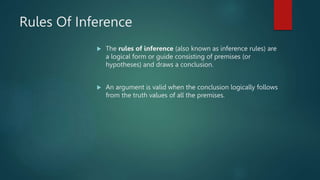
Rules Of Inference
 The rules of inference (also known as inference rules) are
a logical form or guide consisting of premises (or
hypotheses) and draws a conclusion.
 An argument is valid when the conclusion logically follows
from the truth values of all the premises.
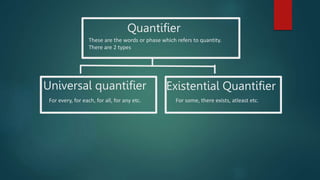
Quantifier
These are the words or phase which refers to quantity.
There are 2 types
Universal quantifier
For every, for each, for all, for any etc.
Existential Quantifier
For some, there exists, atleast etc.
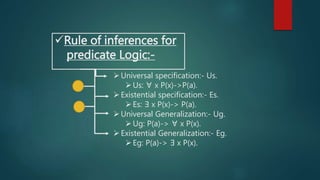
Rule of inferences for
predicate Logic:-
Universal specification:- Us.
Us: ∀ x P(x)->P(a).
Existential specification:- Es.
Es: ∃ x P(x)-> P(a).
Universal Generalization:- Ug.
Ug: P(a)-> ∀ x P(x).
Existential Generalization:- Eg.
Eg: P(a)-> ∃ x P(x).
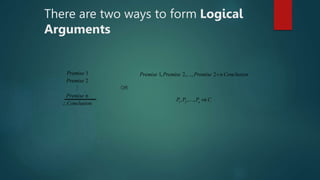
There are two ways to form Logical
Arguments
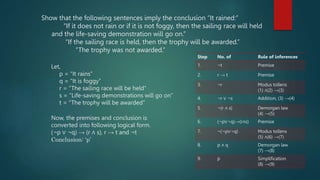
Show that the following sentences imply the conclusion “It rained:”
“If it does not rain or if it is not foggy, then the sailing race will held
and the life-saving demonstration will go on.”
“If the sailing race is held, then the trophy will be awarded.”
“The trophy was not awarded.”
Let,
p = “It rains”
q = “It is foggy”
r = “The sailing race will be held”
s = “Life-saving demonstrations will go on”
t = “The trophy will be awarded”
Now, the premises and conclusion is
converted into following logical form.
(¬p ∨ ¬q) → (r ∧ s), r → t and ¬t
Conclusion: ‘p’
Step No. of Rule of inferences
1. ¬t Premise
2. r → t Premise
3. ¬r Modus tollens
(1) ∧(2) →(3)
4. ¬r ∨ ¬s Addition, (3) →(4)
5. ¬(r ∧ s) Demorgan law
(4) →(5)
6. (¬p∨¬q)→(r∧s) Premise
7. ¬(¬p∨¬q) Modus tollens
(5) ∧(6) →(7)
8. p ∧ q Demorgan law
(7) →(8)
9. p Simplification
(8) →(9)
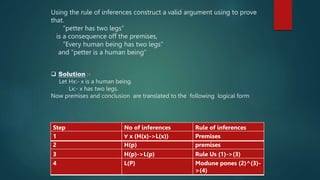
Using the rule of inferences construct a valid argument using to prove
that.
“petter has two legs”
is a consequence off the premises,
“Every human being has two legs”
and “petter is a human being”
 Solution :-
Let Hx:- x is a human being.
Lx:- x has two legs.
Now premises and conclusion are translated to the following logical form
Step No of inferences Rule of inferences
2 H(p) premises
3 H(p)->L(p) Rule Us (1)->(3)
4 L(P) Modune pones (2)^(3)-
>(4)
1 ∀ x (H(x)->L(x)) Premises
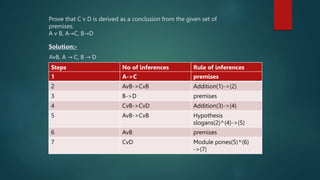
Prove that C v D is derived as a conclusion from the given set of
premises.
A v B, A→C, B→D
Solution:-
AvB, A → C, B → D
Steps No of inferences Rule of inferences
1 A->C premises
2 AvB->CvB Addition(1)->(2)
3 B->D premises
4 CvB->CvD Addition(3)->(4)
5 AvB->CvB Hypothesis
slogans(2)^(4)->(5)
6 AvB premises
7 CvD Module pones(5)^(6)
->(7)
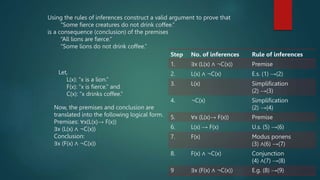
Using the rules of inferences construct a valid argument to prove that
“Some fierce creatures do not drink coffee.”
is a consequence (conclusion) of the premises
“All lions are fierce.”
“Some lions do not drink coffee.”
Let,
L(x): “x is a lion.”
F(x): “x is fierce.” and
C(x): “x drinks coffee.”
Now, the premises and conclusion are
translated into the following logical form.
Premises: ∀x(L(x)→ F(x))
∃x (L(x) ∧ ¬C(x))
Conclusion:
∃x (F(x) ∧ ¬C(x))
Step No. of inferences Rule of inferences
1. ∃x (L(x) ∧ ¬C(x)) Premise
2. L(x) ∧ ¬C(x) E.s. (1) →(2)
3. L(x) Simplification
(2) →(3)
4. ¬C(x) Simplification
(2) →(4)
5. ∀x (L(x)→ F(x)) Premise
6. L(x) → F(x) U.s. (5) →(6)
7. F(x) Modus ponens
(3) ∧(6) →(7)
8. F(x) ∧ ¬C(x) Conjunction
(4) ∧(7) →(8)
9 ∃x (F(x) ∧ ¬C(x)) E.g. (8) →(9)
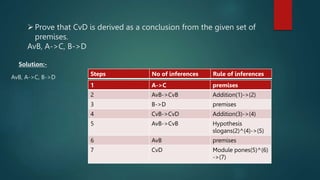
Prove that CvD is derived as a conclusion from the given set of
premises.
AvB, A->C, B->D
Solution:-
AvB, A->C, B->D
Steps No of inferences Rule of inferences
1 A->C premises
2 AvB->CvB Addition(1)->(2)
3 B->D premises
4 CvB->CvD Addition(3)->(4)
5 AvB->CvB Hypothesis
slogans(2)^(4)->(5)
6 AvB premises
7 CvD Module pones(5)^(6)
->(7)
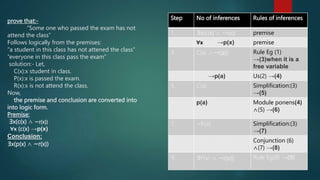
prove that:-
“Some one who passed the exam has not
attend the class”
Follows logically from the premises:
“a student in this class has not attened the class”
“everyone in this class pass the exam”
solution:- Let,
C(x):x student in class.
P(x):x is passed the exam.
R(x):x is not attend the class.
Now,
the premise and conclusion are converted into
into logic form.
Premise:
∃x(c(x) ∧ ~r(x))
∀x (c(x) →p(x)
Conclusion:
∃x(p(x) ∧ ~r(x))
Step No of inferences Rules of inferences
1. ∃x(c(x) ∧ ~r(x)) premise
2. ∀x (c(x) →p(x) premise
3. C(a) ∧~r(a)) Rule Eg (1)
→(3)when it is a
free variable
4. C(a) →p(a) Us(2) →(4)
5. C(a) Simplification:(3)
→(5)
6. p(a) Module ponens(4)
∧(5) →(6)
7. ~R(a) Simplification:(3)
→(7)
8. P(a) ∧ ~r(a)) Conjunction (6)
∧(7) →(8)
9. ∃P(x) ∧ ~r(x)) Rule Eg(8) →(9)
THANK YOU!!!!

02 RULES OF INFERENCES.pptx

  • 1.
    RULES OF INFERENCES. guidedBy :- Dr.Ashok Mishra PRESENTED BY :- Rajnikant pandey (220101120115)
  • 2.
    Rules Of Inference The rules of inference (also known as inference rules) are a logical form or guide consisting of premises (or hypotheses) and draws a conclusion.  An argument is valid when the conclusion logically follows from the truth values of all the premises.
  • 3.
    Quantifier These are thewords or phase which refers to quantity. There are 2 types Universal quantifier For every, for each, for all, for any etc. Existential Quantifier For some, there exists, atleast etc.
  • 4.
    Rule of inferencesfor predicate Logic:- Universal specification:- Us. Us: ∀ x P(x)->P(a). Existential specification:- Es. Es: ∃ x P(x)-> P(a). Universal Generalization:- Ug. Ug: P(a)-> ∀ x P(x). Existential Generalization:- Eg. Eg: P(a)-> ∃ x P(x).
  • 5.
    There are twoways to form Logical Arguments
  • 6.
    Show that thefollowing sentences imply the conclusion “It rained:” “If it does not rain or if it is not foggy, then the sailing race will held and the life-saving demonstration will go on.” “If the sailing race is held, then the trophy will be awarded.” “The trophy was not awarded.” Let, p = “It rains” q = “It is foggy” r = “The sailing race will be held” s = “Life-saving demonstrations will go on” t = “The trophy will be awarded” Now, the premises and conclusion is converted into following logical form. (¬p ∨ ¬q) → (r ∧ s), r → t and ¬t Conclusion: ‘p’ Step No. of Rule of inferences 1. ¬t Premise 2. r → t Premise 3. ¬r Modus tollens (1) ∧(2) →(3) 4. ¬r ∨ ¬s Addition, (3) →(4) 5. ¬(r ∧ s) Demorgan law (4) →(5) 6. (¬p∨¬q)→(r∧s) Premise 7. ¬(¬p∨¬q) Modus tollens (5) ∧(6) →(7) 8. p ∧ q Demorgan law (7) →(8) 9. p Simplification (8) →(9)
  • 7.
    Using the ruleof inferences construct a valid argument using to prove that. “petter has two legs” is a consequence off the premises, “Every human being has two legs” and “petter is a human being”  Solution :- Let Hx:- x is a human being. Lx:- x has two legs. Now premises and conclusion are translated to the following logical form Step No of inferences Rule of inferences 2 H(p) premises 3 H(p)->L(p) Rule Us (1)->(3) 4 L(P) Modune pones (2)^(3)- >(4) 1 ∀ x (H(x)->L(x)) Premises
  • 8.
    Prove that Cv D is derived as a conclusion from the given set of premises. A v B, A→C, B→D Solution:- AvB, A → C, B → D Steps No of inferences Rule of inferences 1 A->C premises 2 AvB->CvB Addition(1)->(2) 3 B->D premises 4 CvB->CvD Addition(3)->(4) 5 AvB->CvB Hypothesis slogans(2)^(4)->(5) 6 AvB premises 7 CvD Module pones(5)^(6) ->(7)
  • 9.
    Using the rulesof inferences construct a valid argument to prove that “Some fierce creatures do not drink coffee.” is a consequence (conclusion) of the premises “All lions are fierce.” “Some lions do not drink coffee.” Let, L(x): “x is a lion.” F(x): “x is fierce.” and C(x): “x drinks coffee.” Now, the premises and conclusion are translated into the following logical form. Premises: ∀x(L(x)→ F(x)) ∃x (L(x) ∧ ¬C(x)) Conclusion: ∃x (F(x) ∧ ¬C(x)) Step No. of inferences Rule of inferences 1. ∃x (L(x) ∧ ¬C(x)) Premise 2. L(x) ∧ ¬C(x) E.s. (1) →(2) 3. L(x) Simplification (2) →(3) 4. ¬C(x) Simplification (2) →(4) 5. ∀x (L(x)→ F(x)) Premise 6. L(x) → F(x) U.s. (5) →(6) 7. F(x) Modus ponens (3) ∧(6) →(7) 8. F(x) ∧ ¬C(x) Conjunction (4) ∧(7) →(8) 9 ∃x (F(x) ∧ ¬C(x)) E.g. (8) →(9)
  • 10.
    Prove that CvDis derived as a conclusion from the given set of premises. AvB, A->C, B->D Solution:- AvB, A->C, B->D Steps No of inferences Rule of inferences 1 A->C premises 2 AvB->CvB Addition(1)->(2) 3 B->D premises 4 CvB->CvD Addition(3)->(4) 5 AvB->CvB Hypothesis slogans(2)^(4)->(5) 6 AvB premises 7 CvD Module pones(5)^(6) ->(7)
  • 11.
    prove that:- “Some onewho passed the exam has not attend the class” Follows logically from the premises: “a student in this class has not attened the class” “everyone in this class pass the exam” solution:- Let, C(x):x student in class. P(x):x is passed the exam. R(x):x is not attend the class. Now, the premise and conclusion are converted into into logic form. Premise: ∃x(c(x) ∧ ~r(x)) ∀x (c(x) →p(x) Conclusion: ∃x(p(x) ∧ ~r(x)) Step No of inferences Rules of inferences 1. ∃x(c(x) ∧ ~r(x)) premise 2. ∀x (c(x) →p(x) premise 3. C(a) ∧~r(a)) Rule Eg (1) →(3)when it is a free variable 4. C(a) →p(a) Us(2) →(4) 5. C(a) Simplification:(3) →(5) 6. p(a) Module ponens(4) ∧(5) →(6) 7. ~R(a) Simplification:(3) →(7) 8. P(a) ∧ ~r(a)) Conjunction (6) ∧(7) →(8) 9. ∃P(x) ∧ ~r(x)) Rule Eg(8) →(9)
  • 12.