가장 쉽고 빠르고 정확하게
      영어단어를 암기하는 학습법

Word-Formation
        www.cresay.com
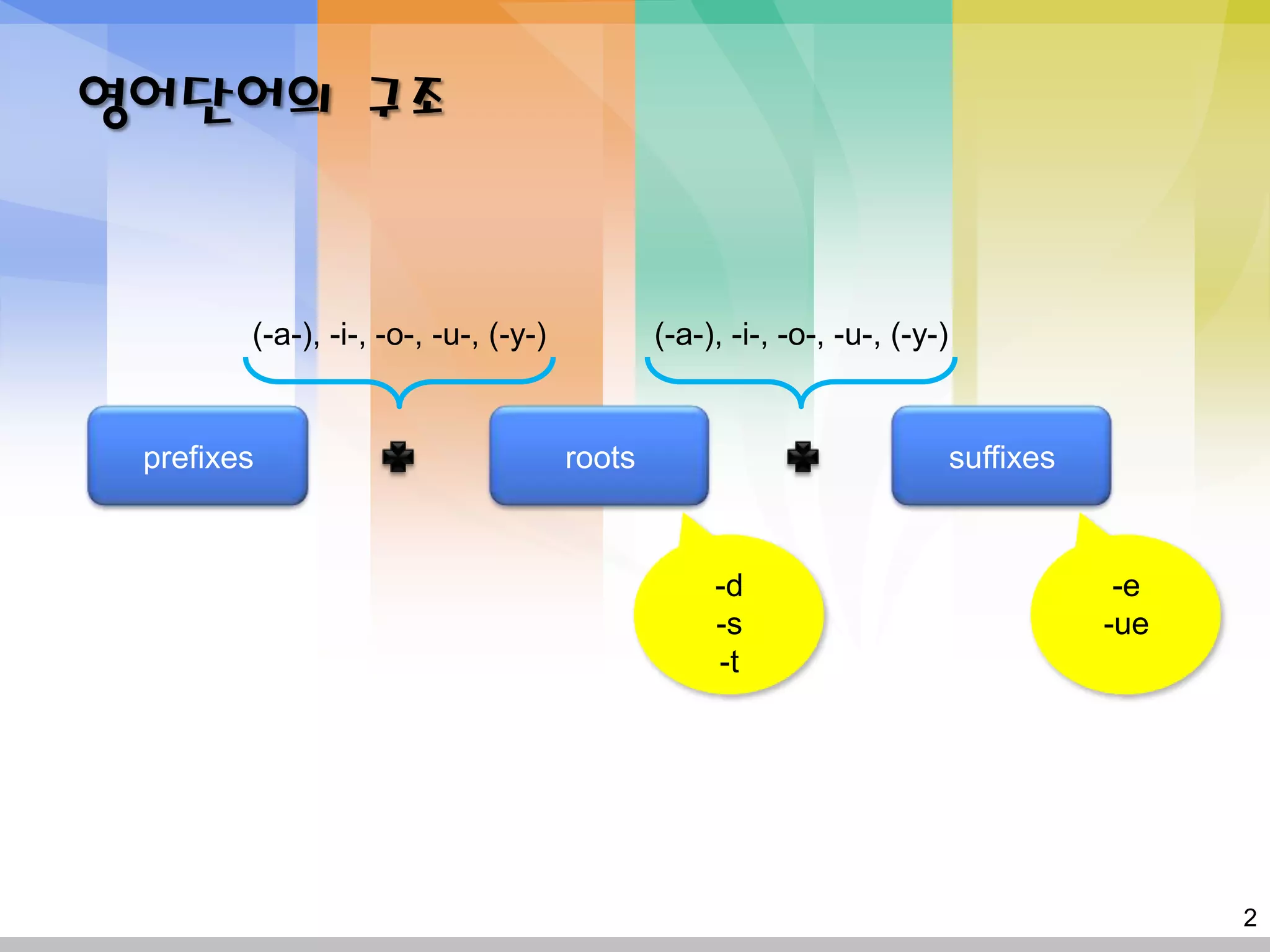
영어단어의 구조


        (-a-), -i-, -o-, -u-, (-y-)           (-a-), -i-, -o-, -u-, (-y-)


 prefixes                             roots                                 suffixes


                                                   -d                                   -e
                                                   -s                                  -ue
                                                   -t


                                                                                             2
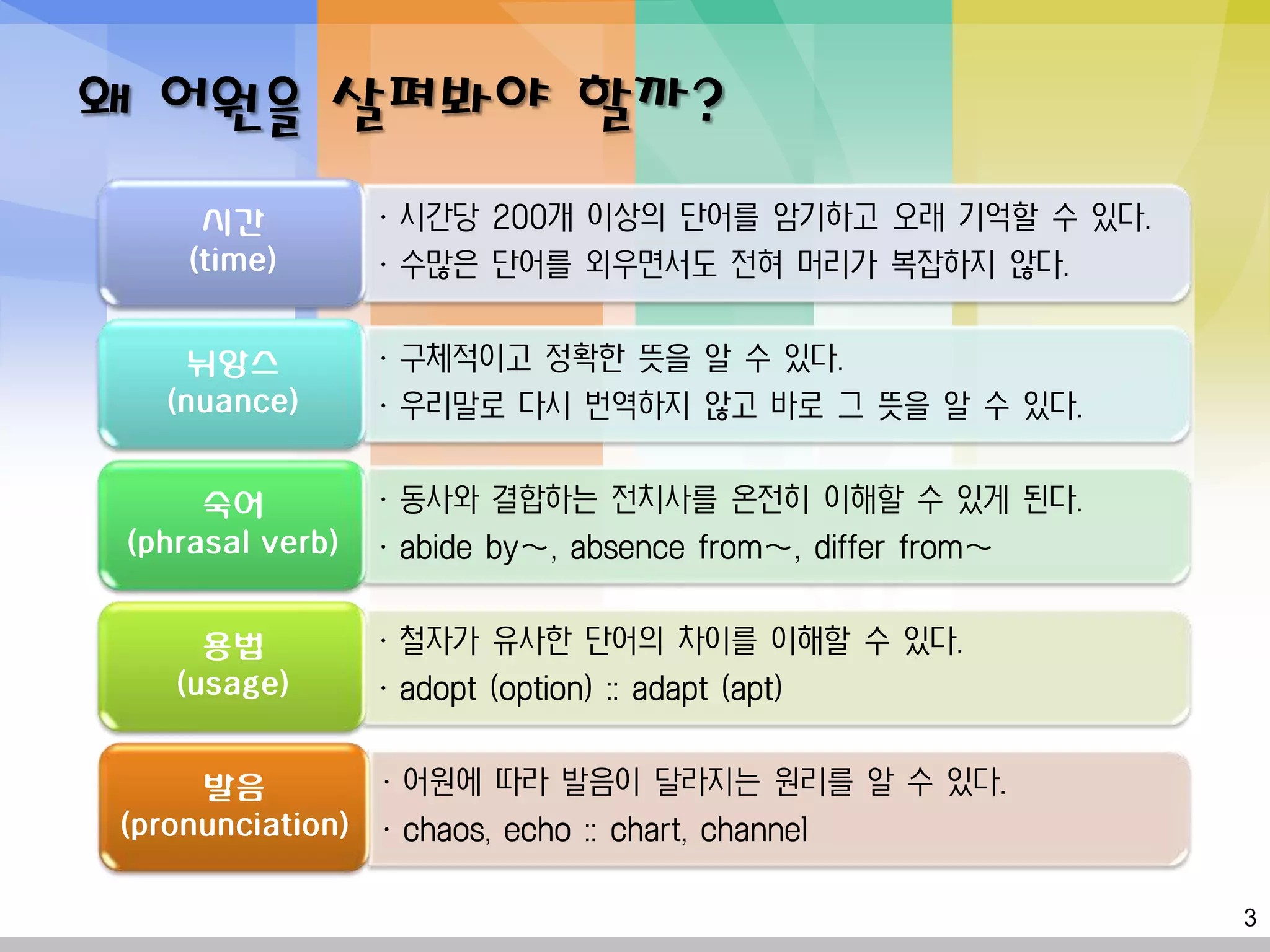
왜 어원을 살펴봐야 할까?
      시간          • 시간당 200개 이상의 단어를 암기하고 오래 기억할 수 있다.
     (time)       • 수많은 단어를 외우면서도 전혀 머리가 복잡하지 않다.


    뉘앙스           • 구체적이고 정확한 뜻을 알 수 있다.
   (nuance)       • 우리말로 다시 번역하지 않고 바로 그 뜻을 알 수 있다.


      숙어          • 동사와 결합하는 전치사를 온전히 이해할 수 있게 된다.
 (phrasal verb)   • abide by∼, absence from∼, differ from∼


      용법          • 철자가 유사한 단어의 차이를 이해할 수 있다.
    (usage)       • adopt (option) :: adapt (apt)


     발음         • 어원에 따라 발음이 달라지는 원리를 알 수 있다.
(pronunciation) • chaos, echo :: chart, channel

                                                             3
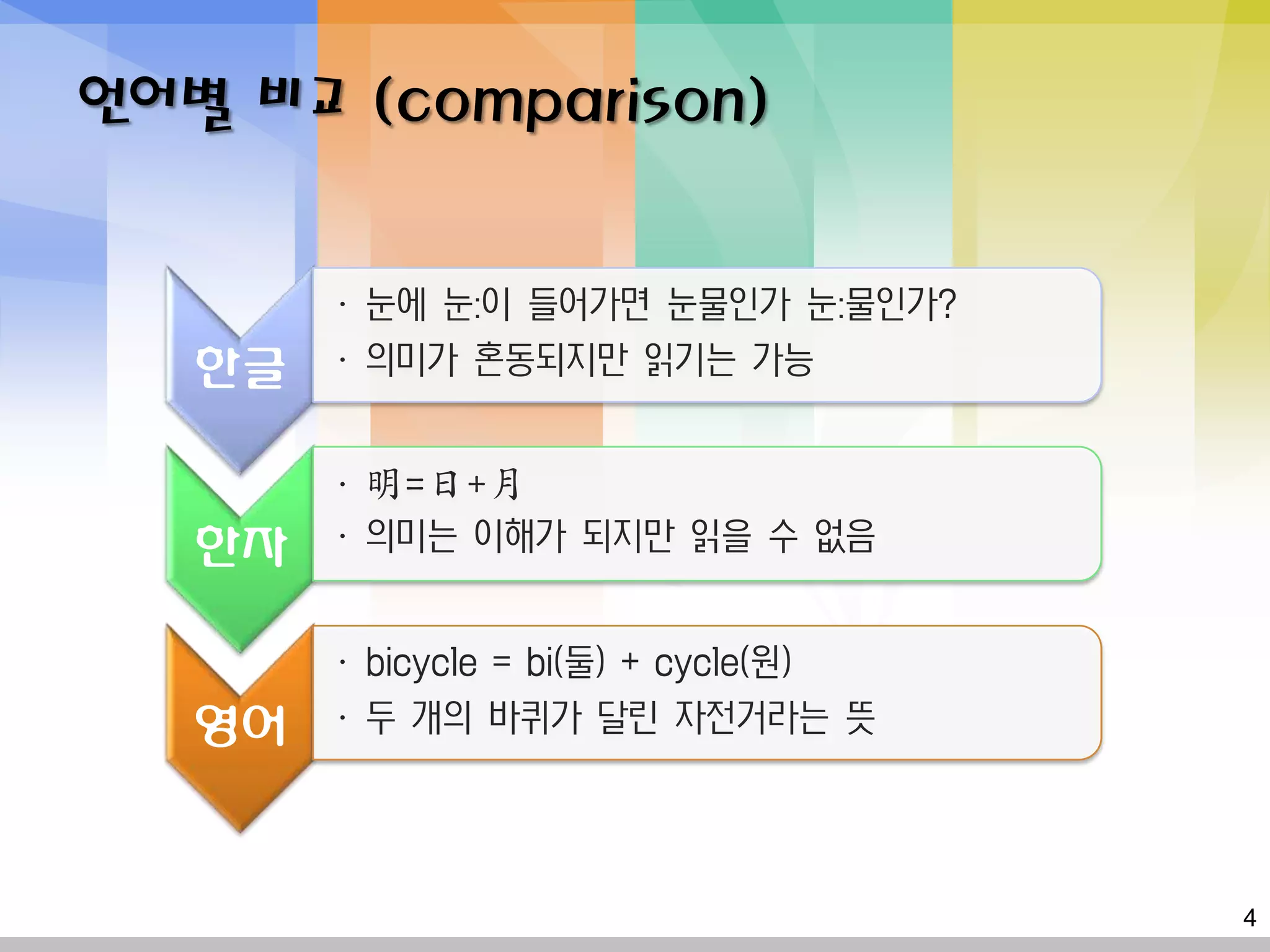
언어별 비교 (comparison)

        • 눈에 눈:이 들어가면 눈물인가 눈:물인가?
   한글   • 의미가 혼동되지만 읽기는 가능


        • 明=日+月
   한자   • 의미는 이해가 되지만 읽을 수 없음


        • bicycle = bi(둘) + cycle(원)
   영어   • 두 개의 바퀴가 달린 자전거라는 뜻


                                       4
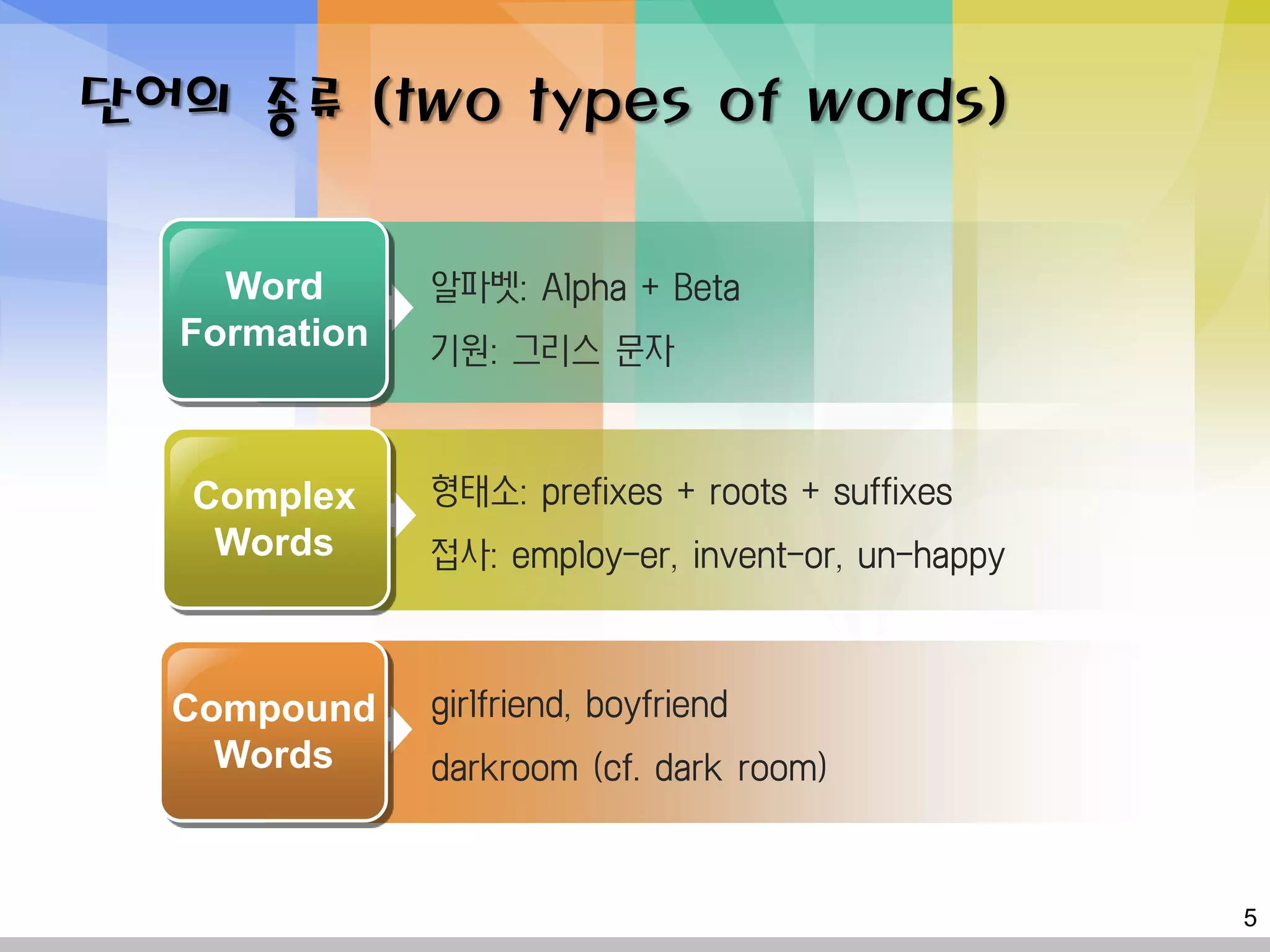
단어의 종류 (two types of words)

    Word      알파벳: Alpha + Beta
  Formation   기원: 그리스 문자


   Complex    형태소: prefixes + roots + suffixes
    Words     접사: employ-er, invent-or, un-happy


  Compound    girlfriend, boyfriend
    Words     darkroom (cf. dark room)


                                                   5
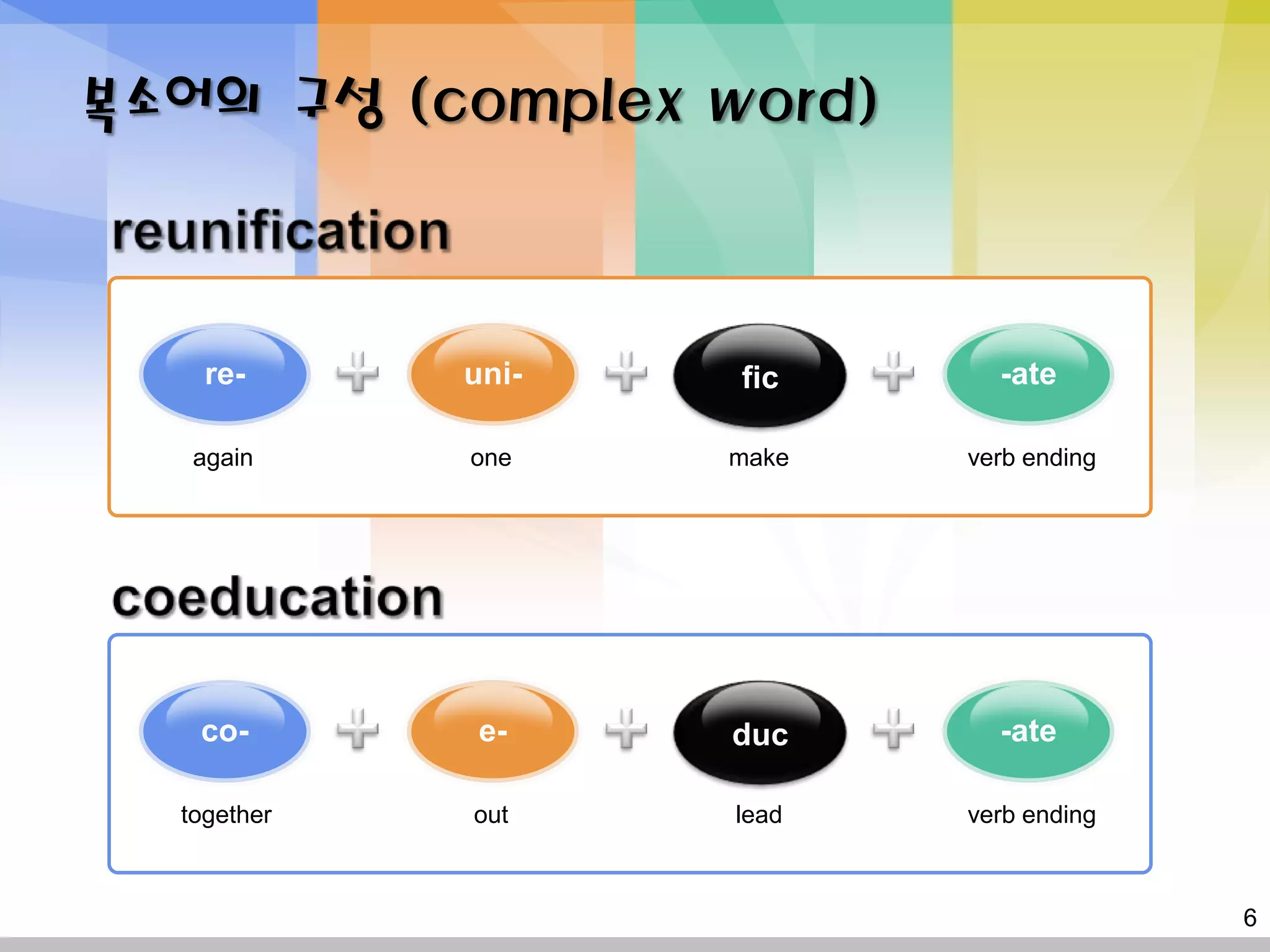
복소어의 구성 (complex word)


    re-      uni-   fic      -ate

   again     one    make   verb ending


   co-        e-    duc      -ate

  together   out    lead   verb ending


                                         6
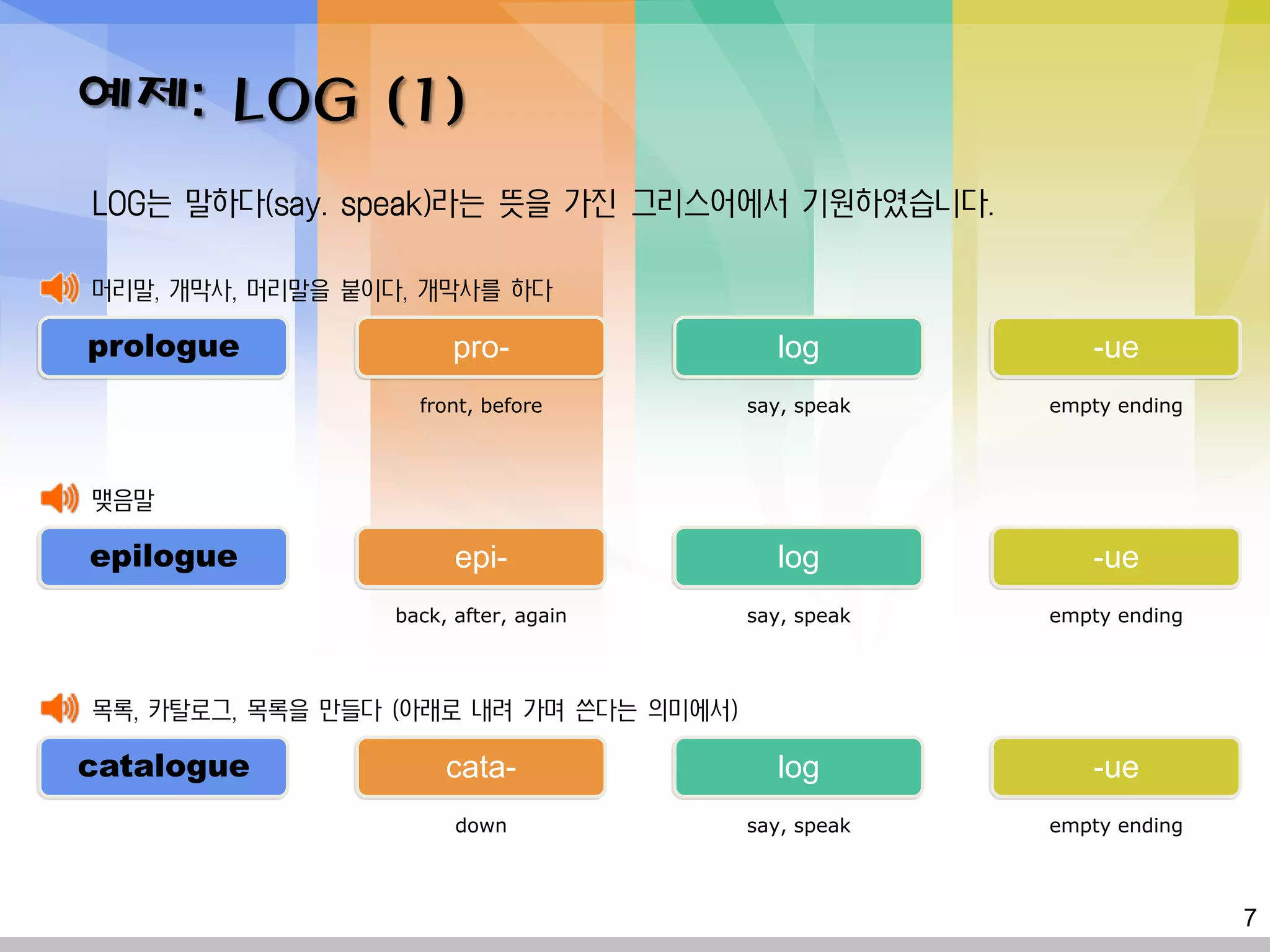
예제: LOG (1)
LOG는 말하다(say. speak)라는 뜻을 가진 그리스어에서 기원하였습니다.

머리말, 개막사, 머리말을 붙이다, 개막사를 하다

prologue               pro-                log           -ue
                   front, before         say, speak   empty ending


맺음말

epilogue               epi-                log           -ue
                 back, after, again      say, speak   empty ending


목록, 카탈로그, 목록을 만들다 (아래로 내려 가며 쓴다는 의미에서)

catalogue             cata-                log           -ue
                       down              say, speak   empty ending


                                                                     7
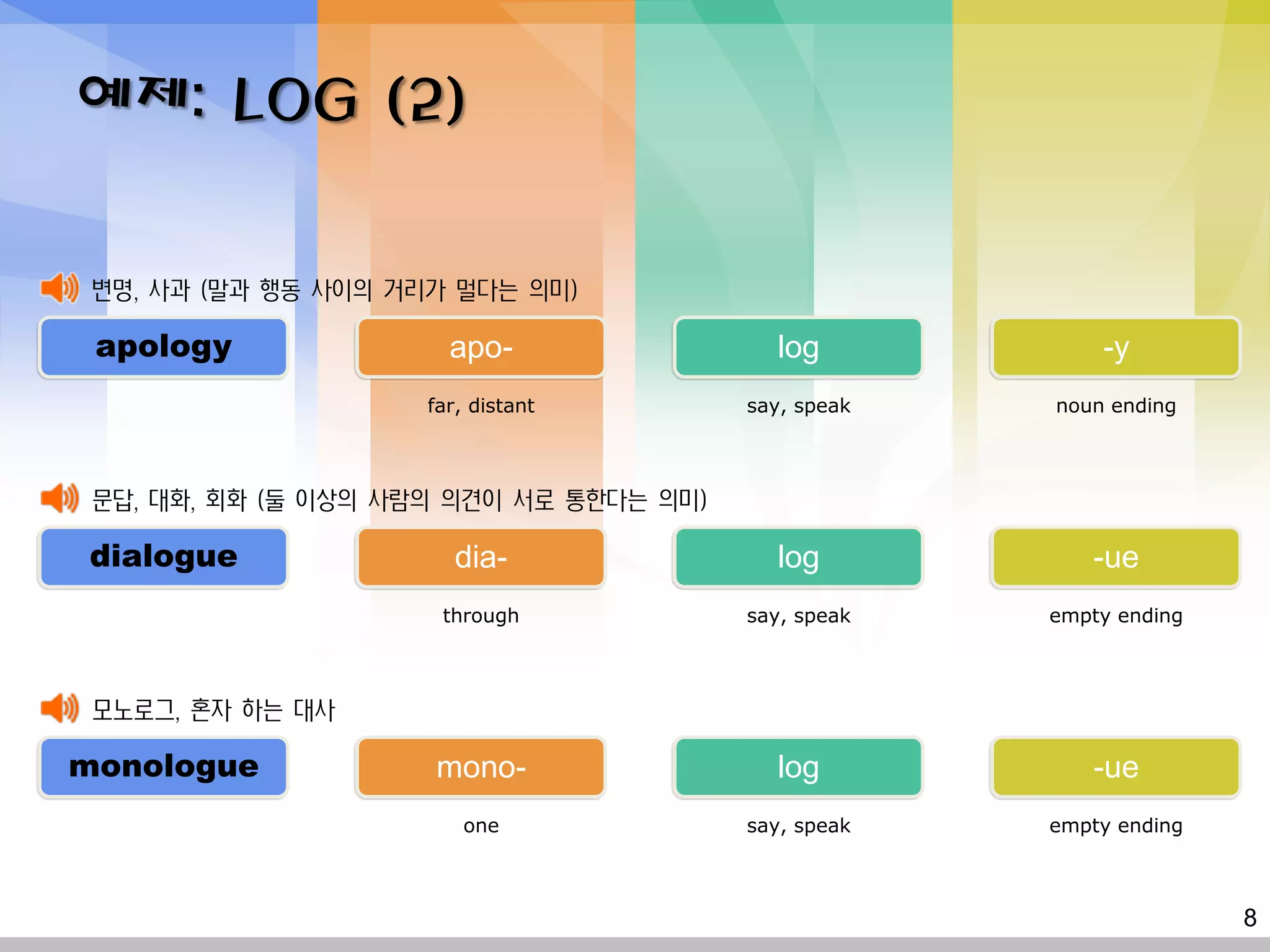
예제: LOG (2)

 변명, 사과 (말과 행동 사이의 거리가 멀다는 의미)

 apology               apo-                log            -y
                     far, distant        say, speak   noun ending


 문답, 대화, 회화 (둘 이상의 사람의 의견이 서로 통한다는 의미)

dialogue                dia-               log           -ue
                      through            say, speak   empty ending


 모노로그, 혼자 하는 대사

monologue            mono-                 log           -ue
                         one             say, speak   empty ending


                                                                     8
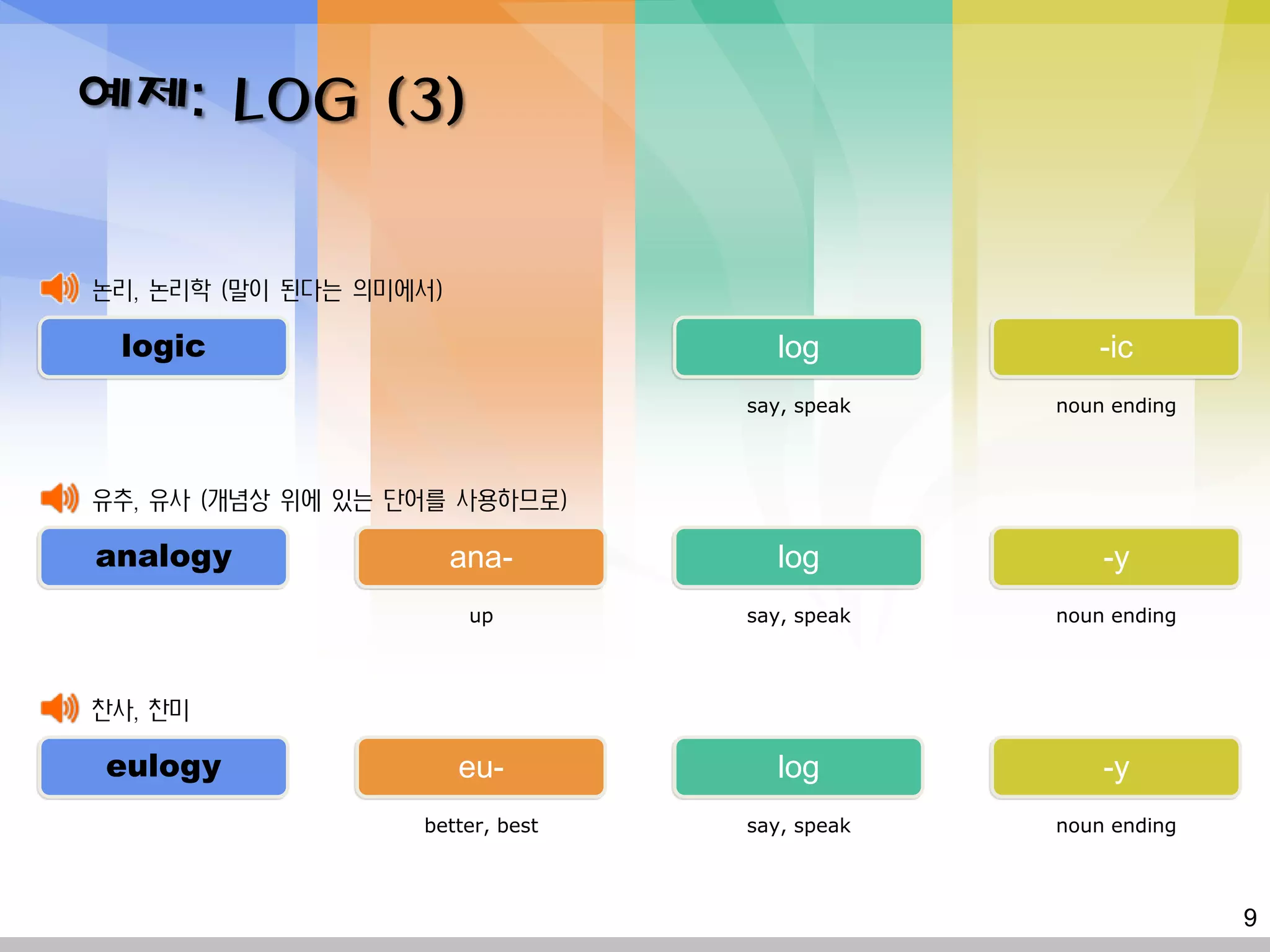
예제: LOG (3)

논리, 논리학 (말이 된다는 의미에서)

 logic                              log           -ic
                                  say, speak   noun ending


유추, 유사 (개념상 위에 있는 단어를 사용하므로)

analogy                 ana-        log            -y
                         up       say, speak   noun ending


찬사, 찬미

eulogy                  eu-         log            -y
                   better, best   say, speak   noun ending


                                                             9
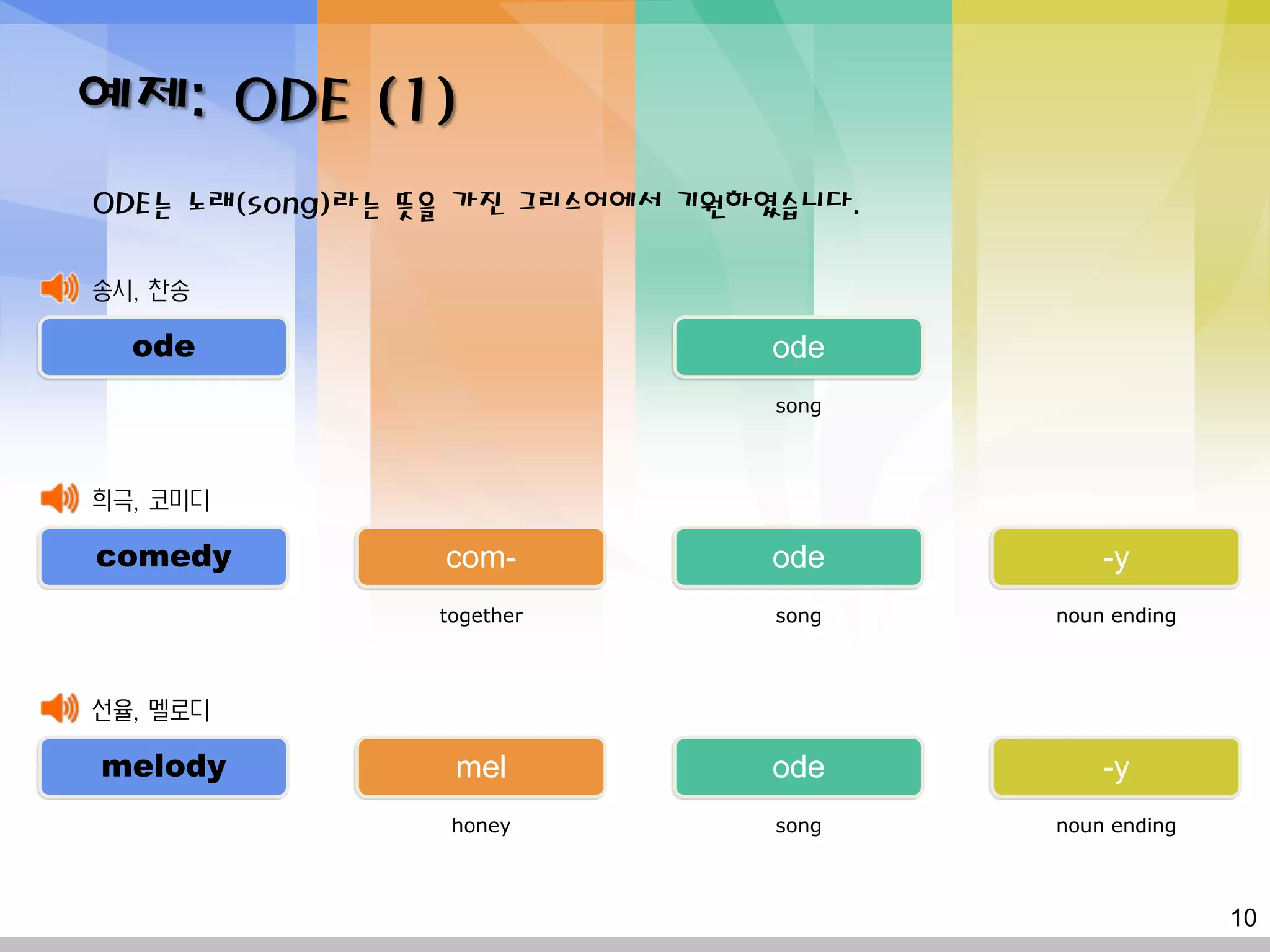
예제: ODE (1)
ODE는 노래(song)라는 뜻을 가진 그리스어에서 기원하였습니다.

송시, 찬송

  ode                           ode
                                song


희극, 코미디

comedy           com-           ode         -y
                together        song    noun ending


선율, 멜로디

melody           mel            ode         -y
                 honey          song    noun ending


                                                      10
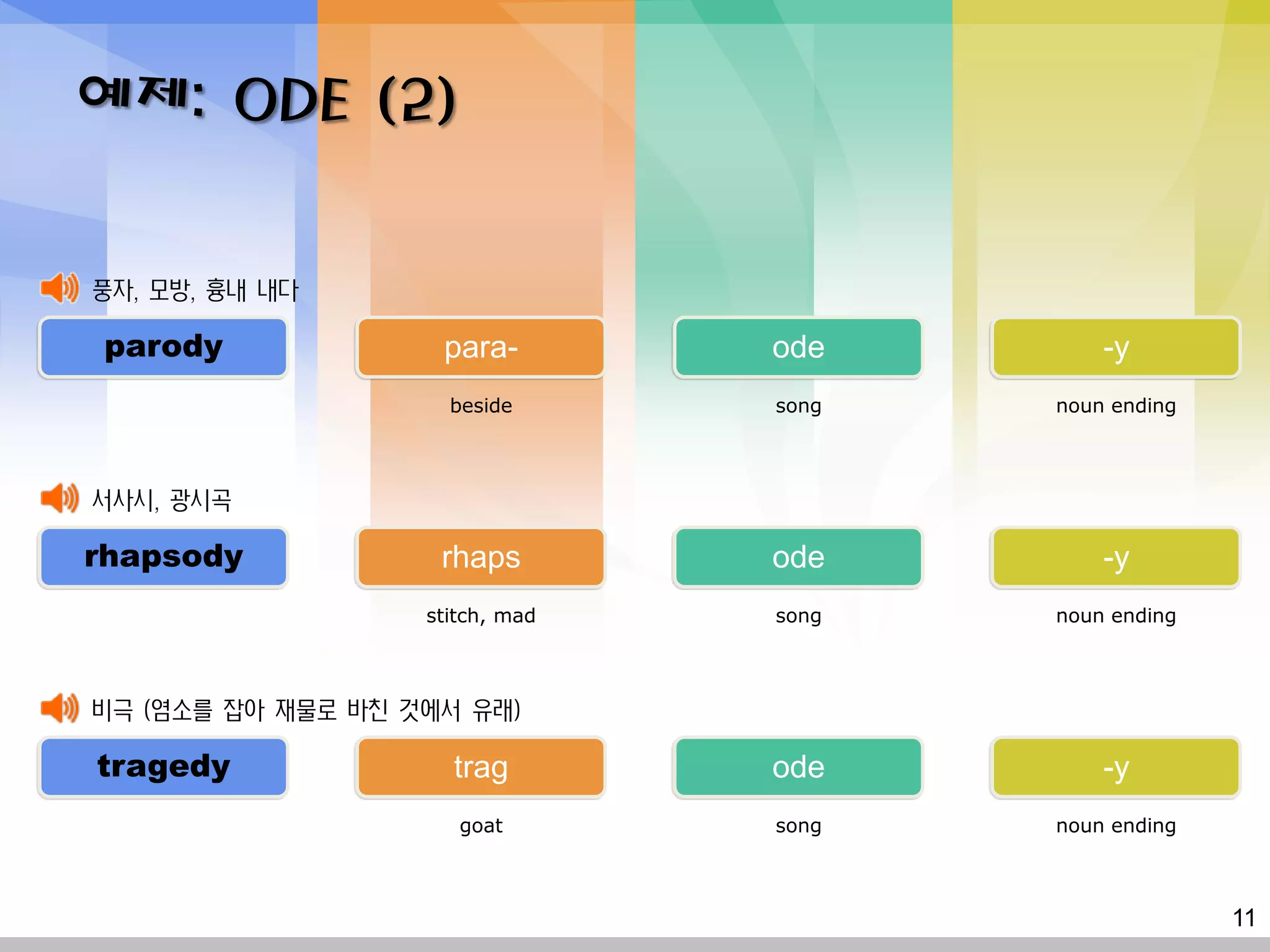
예제: ODE (2)

풍자, 모방, 흉내 내다

 parody             para-        ode        -y
                     beside      song   noun ending


서사시, 광시곡

rhapsody            rhaps        ode        -y
                   stitch, mad   song   noun ending


비극 (염소를 잡아 재물로 바친 것에서 유래)

tragedy              trag        ode        -y
                      goat       song   noun ending


                                                      11
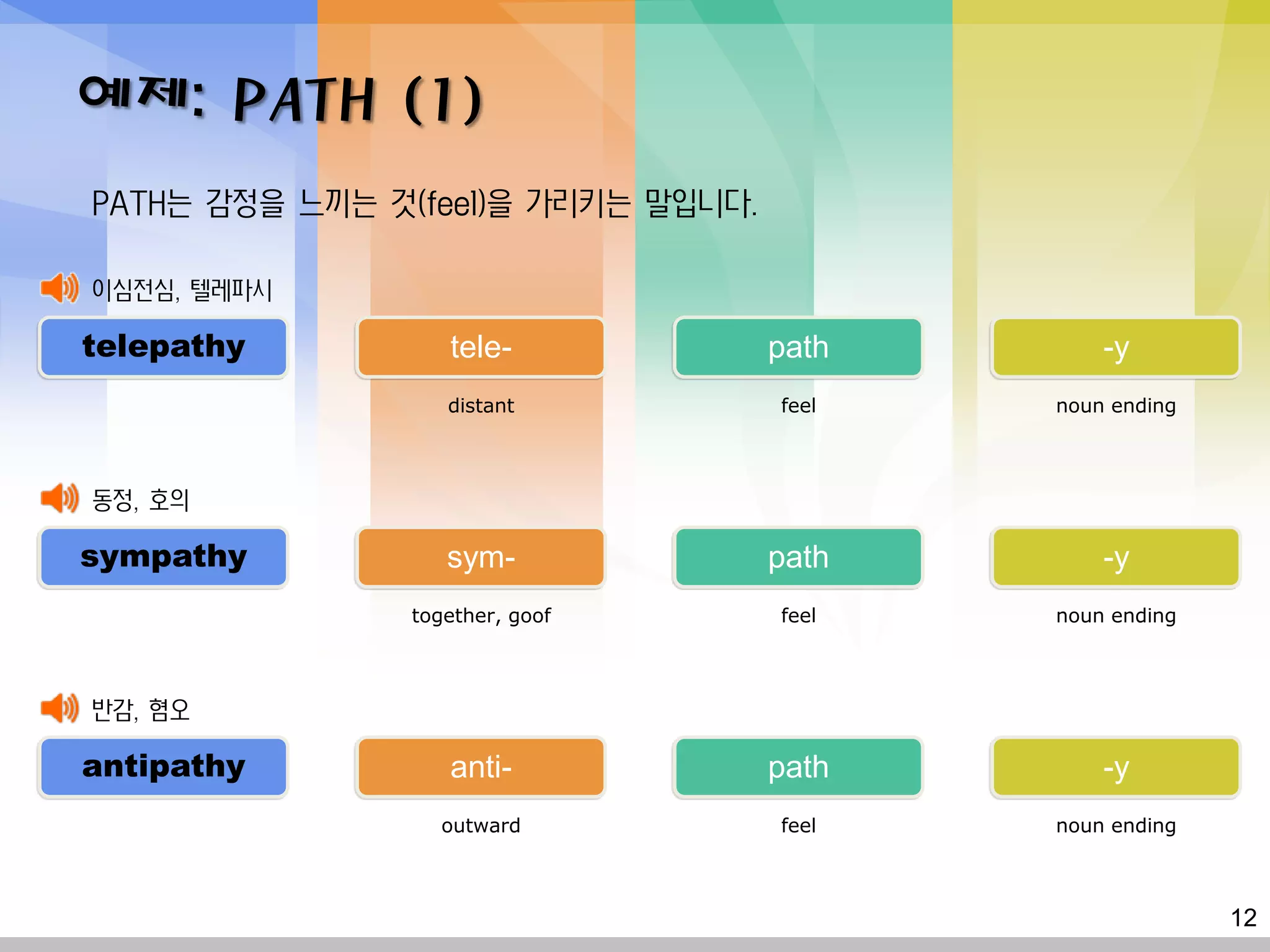
예제: PATH (1)
PATH는 감정을 느끼는 것(feel)을 가리키는 말입니다.

이심전심, 텔레파시

telepathy         tele-             path       -y
                  distant           feel   noun ending


동정, 호의

sympathy          sym-              path       -y
               together, goof       feel   noun ending


반감, 혐오

antipathy         anti-             path       -y
                 outward            feel   noun ending


                                                         12
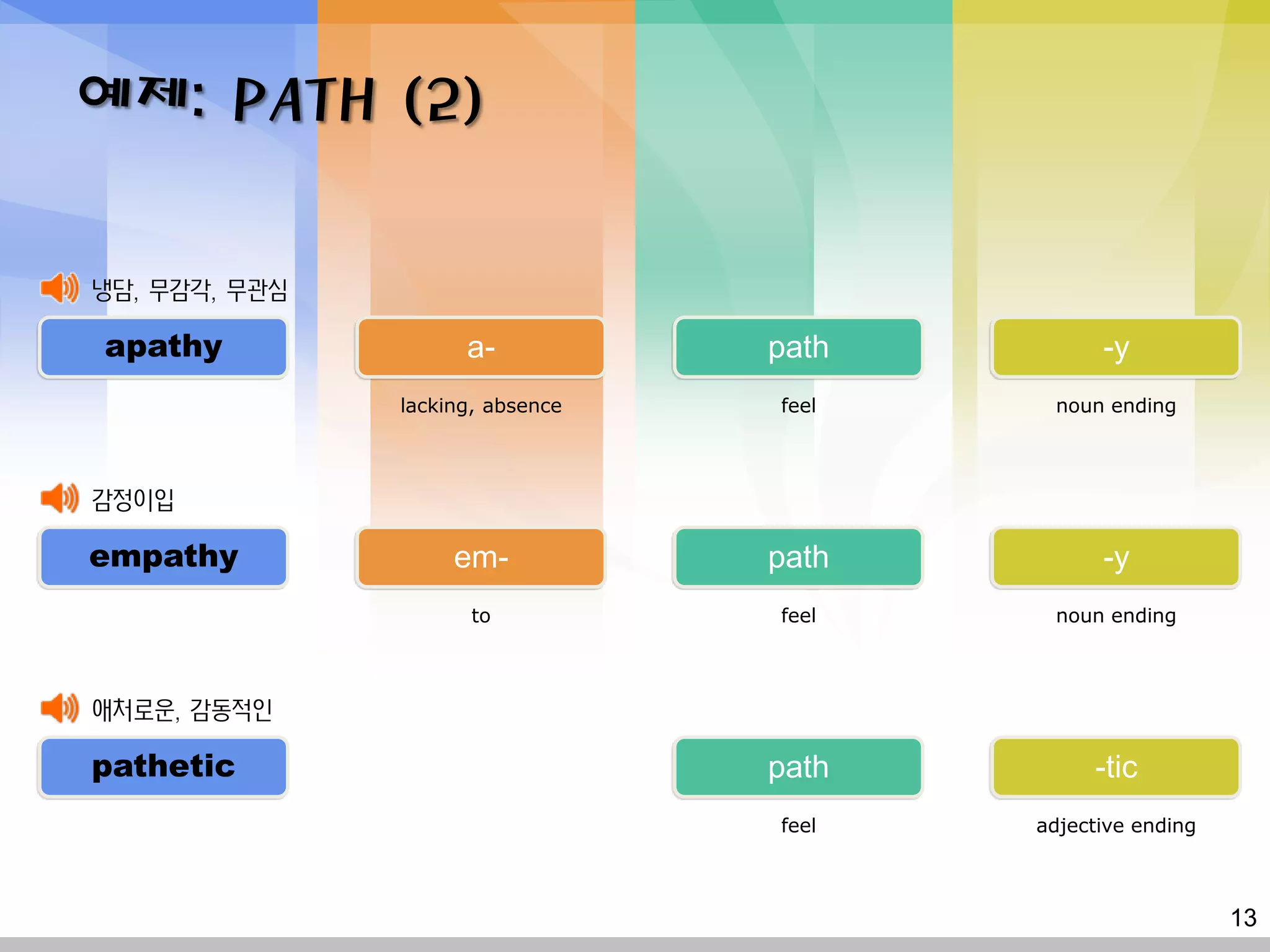
예제: PATH (2)

냉담, 무감각, 무관심

apathy               a-           path         -y
               lacking, absence   feel    noun ending


감정이입

empathy             em-           path         -y
                      to          feel    noun ending


애처로운, 감동적인

pathetic                          path        -tic
                                  feel   adjective ending


                                                            13
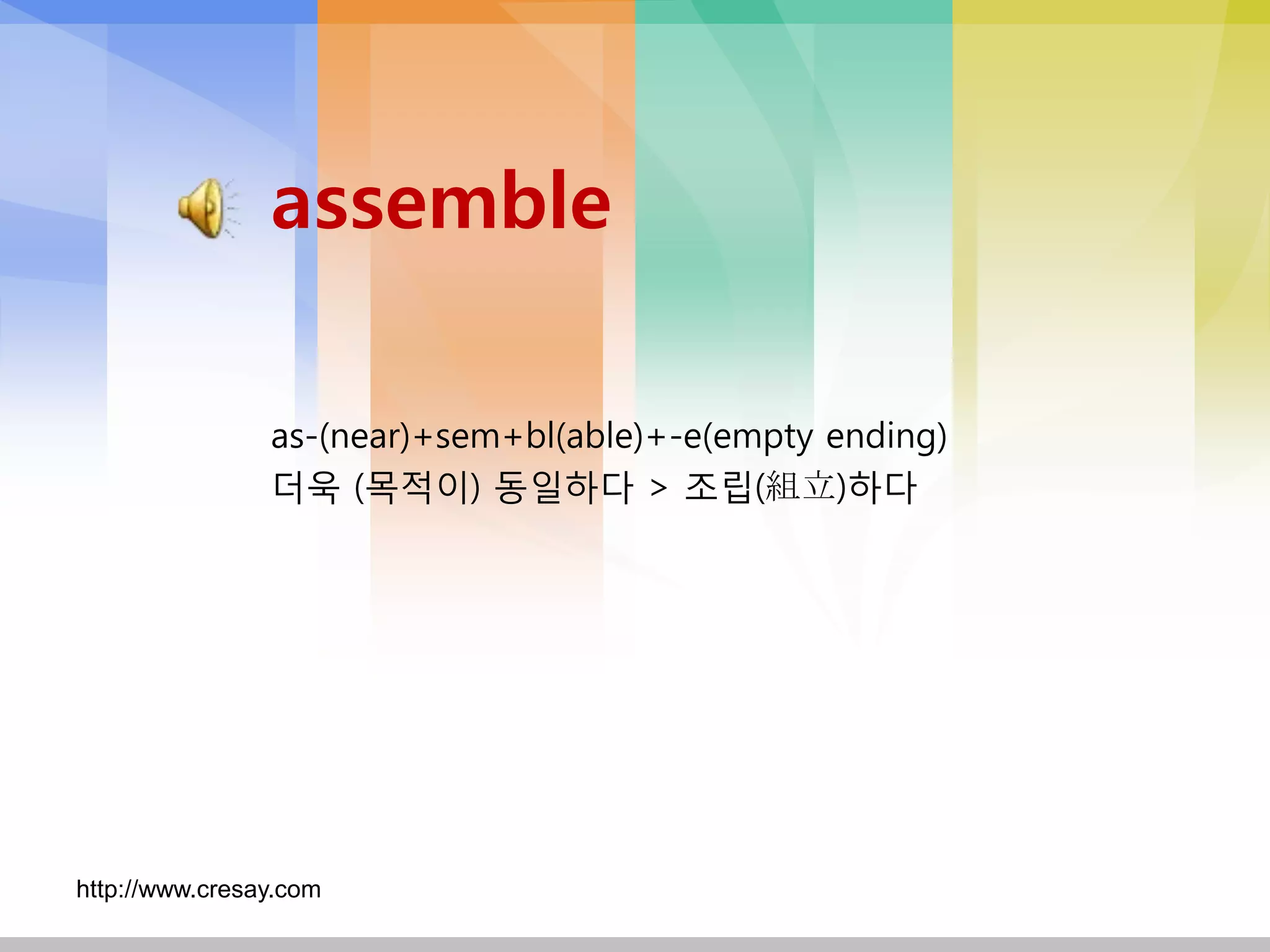
assemble

                as-(near)+sem+bl(able)+-e(empty ending)
                더욱 (목적이) 동일하다 > 조립(組立)하다


http://www.cresay.com
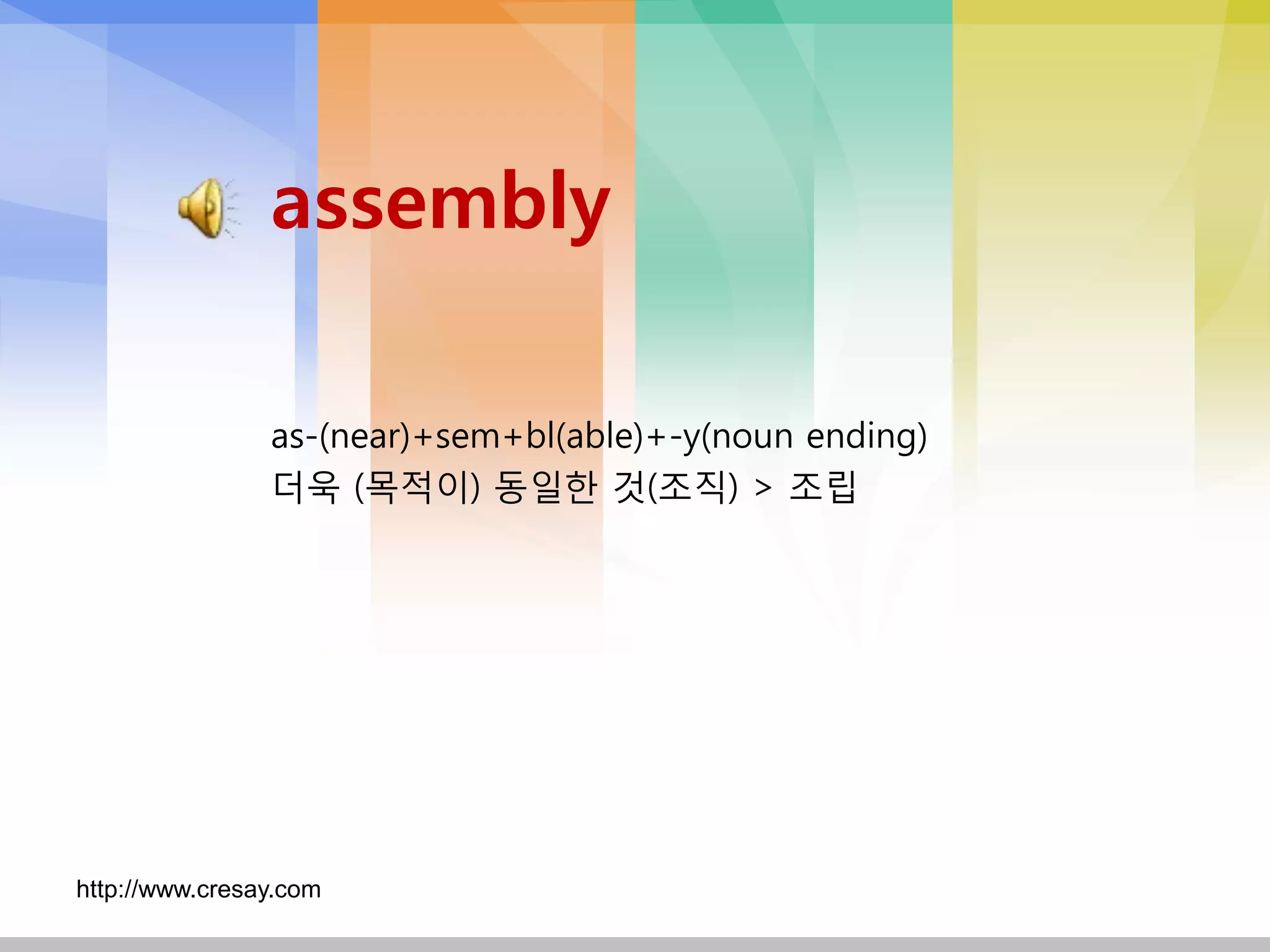
assembly

                as-(near)+sem+bl(able)+-y(noun ending)
                더욱 (목적이) 동일핚 것(조직) > 조립


http://www.cresay.com
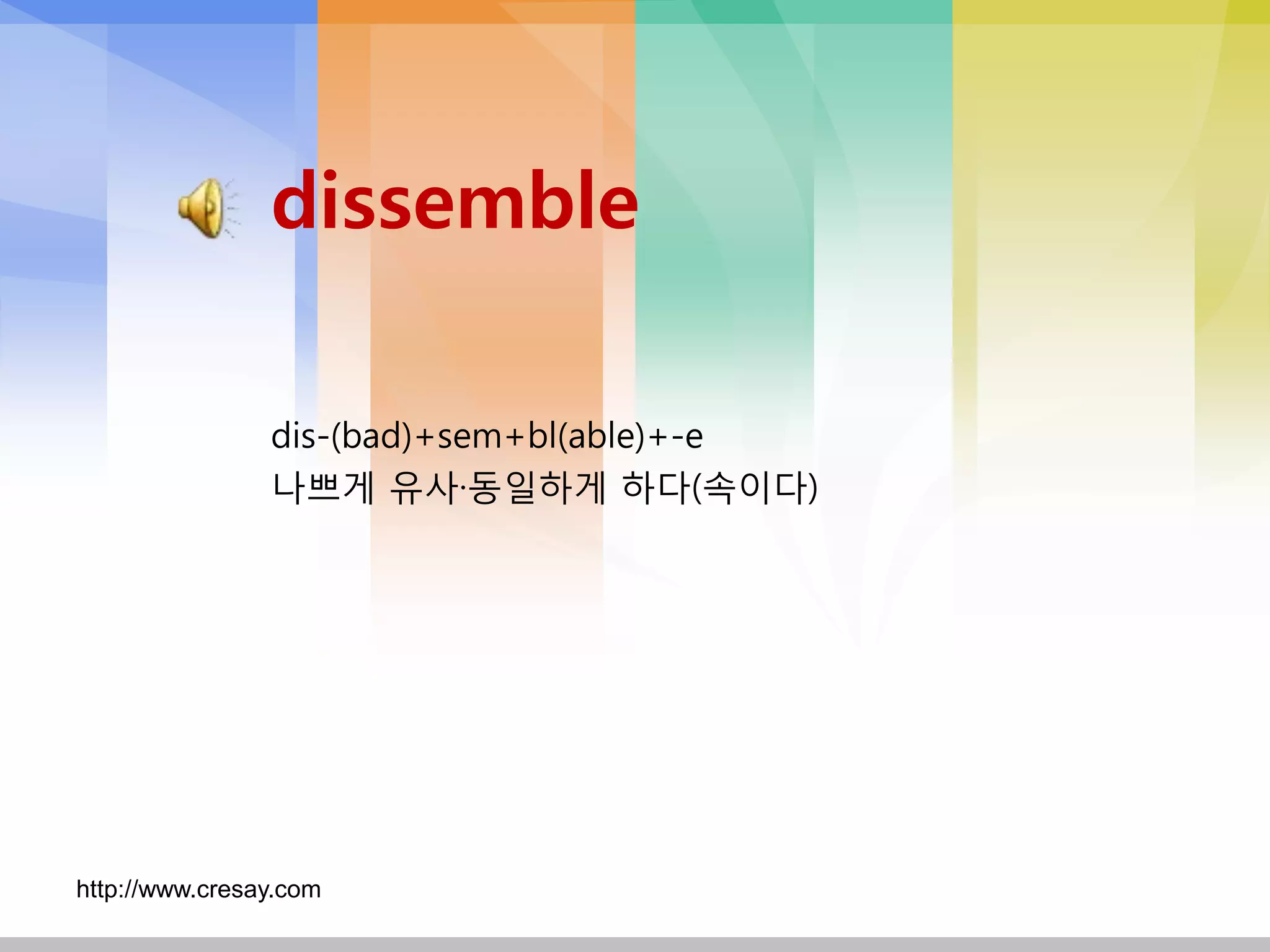
dissemble

                dis-(bad)+sem+bl(able)+-e
                나쁘게 유사·동일하게 하다(속이다)


http://www.cresay.com
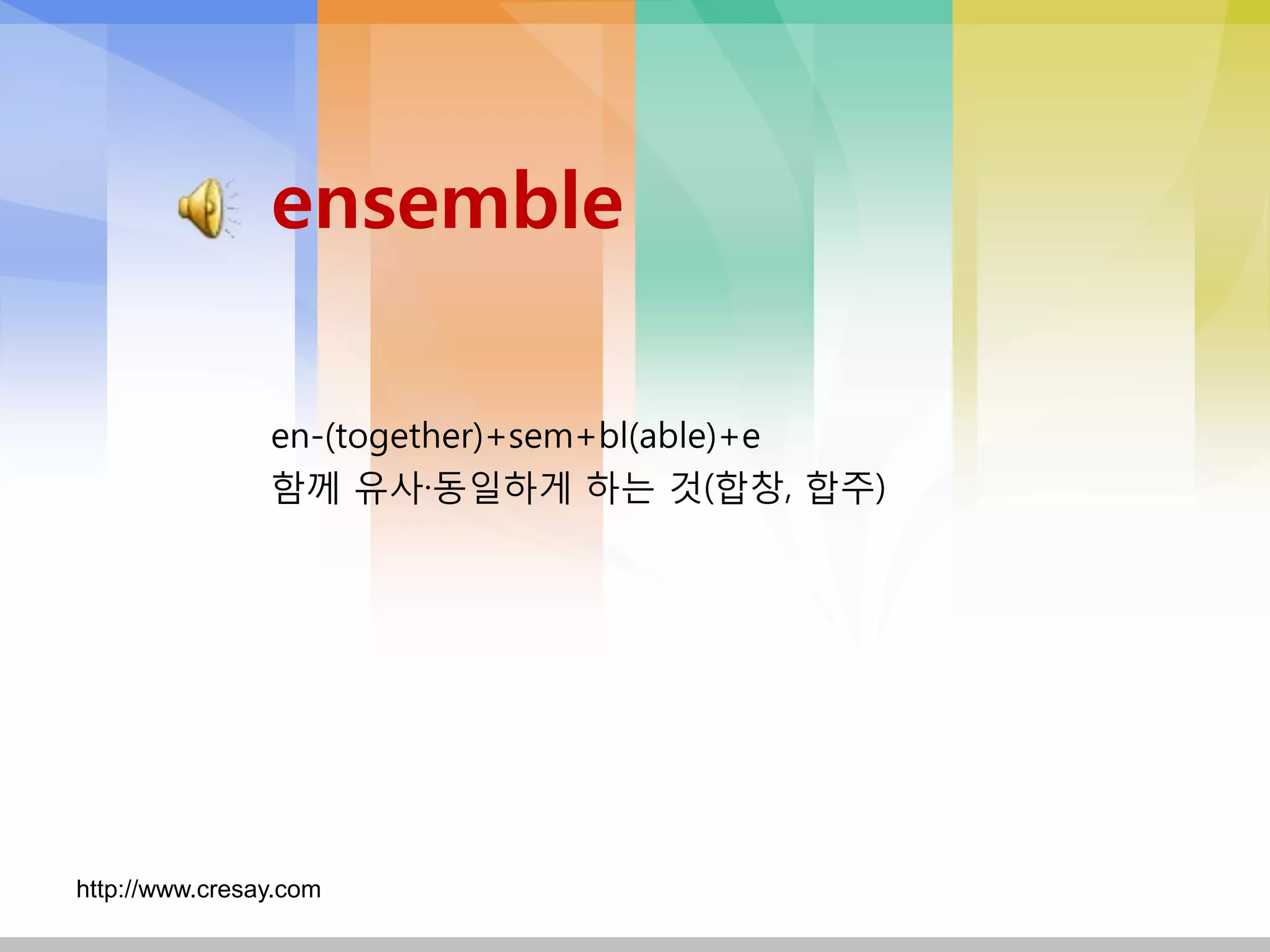
ensemble

                en-(together)+sem+bl(able)+e
                함께 유사·동일하게 하는 것(합창, 합주)


http://www.cresay.com
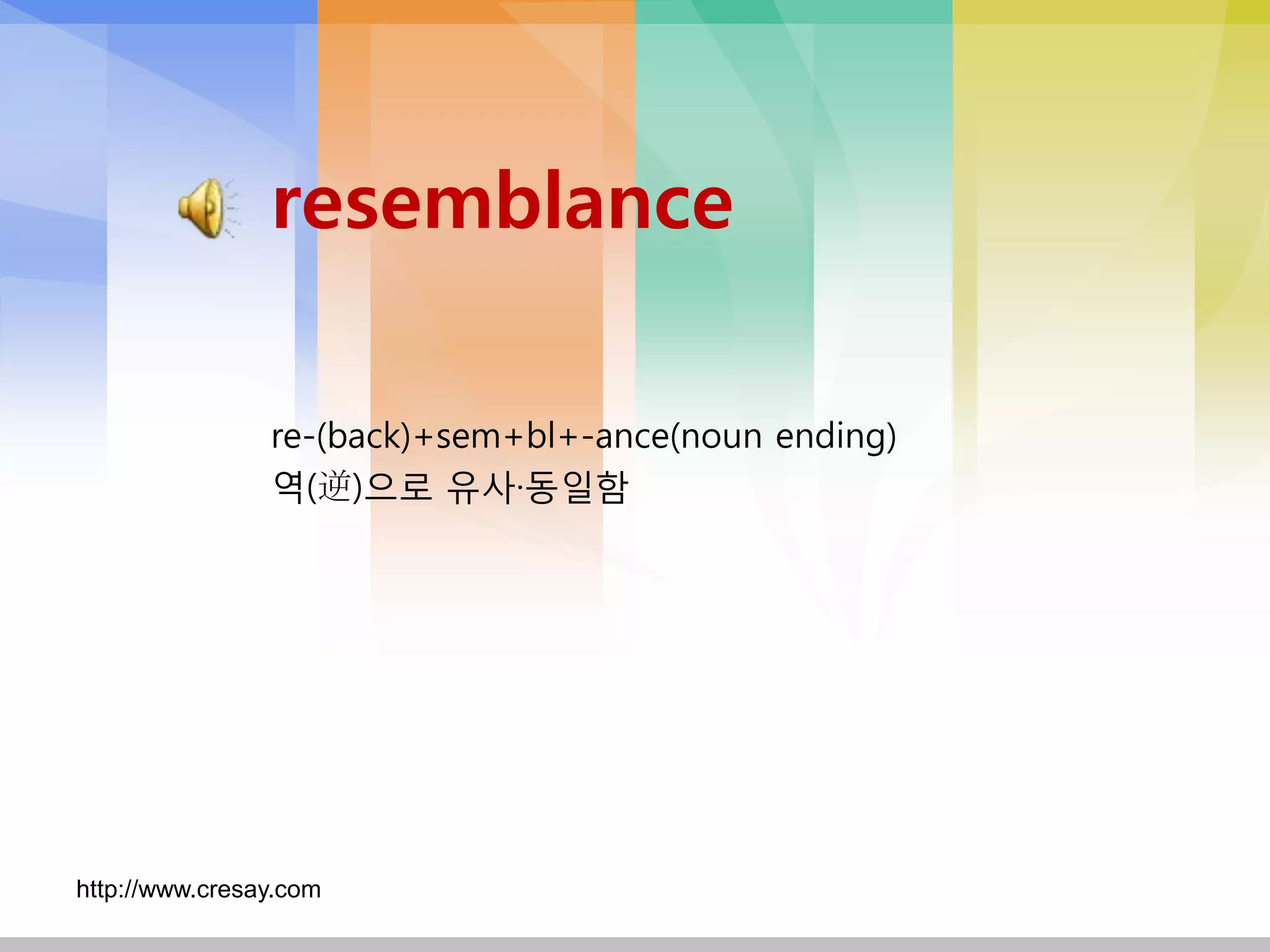
resemblance

                re-(back)+sem+bl+-ance(noun ending)
                역(逆)으로 유사·동일함


http://www.cresay.com
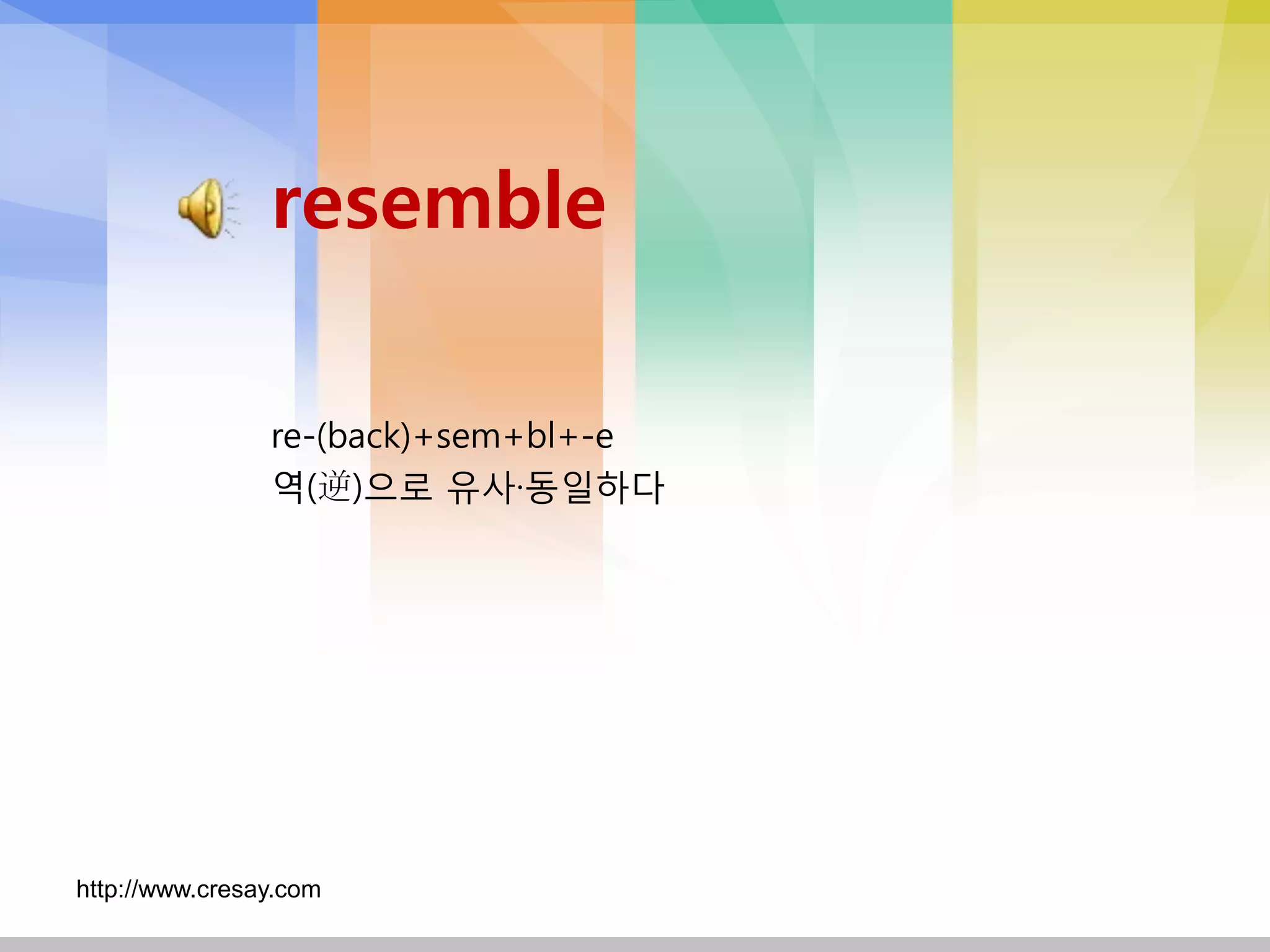
resemble

                re-(back)+sem+bl+-e
                역(逆)으로 유사·동일하다


http://www.cresay.com
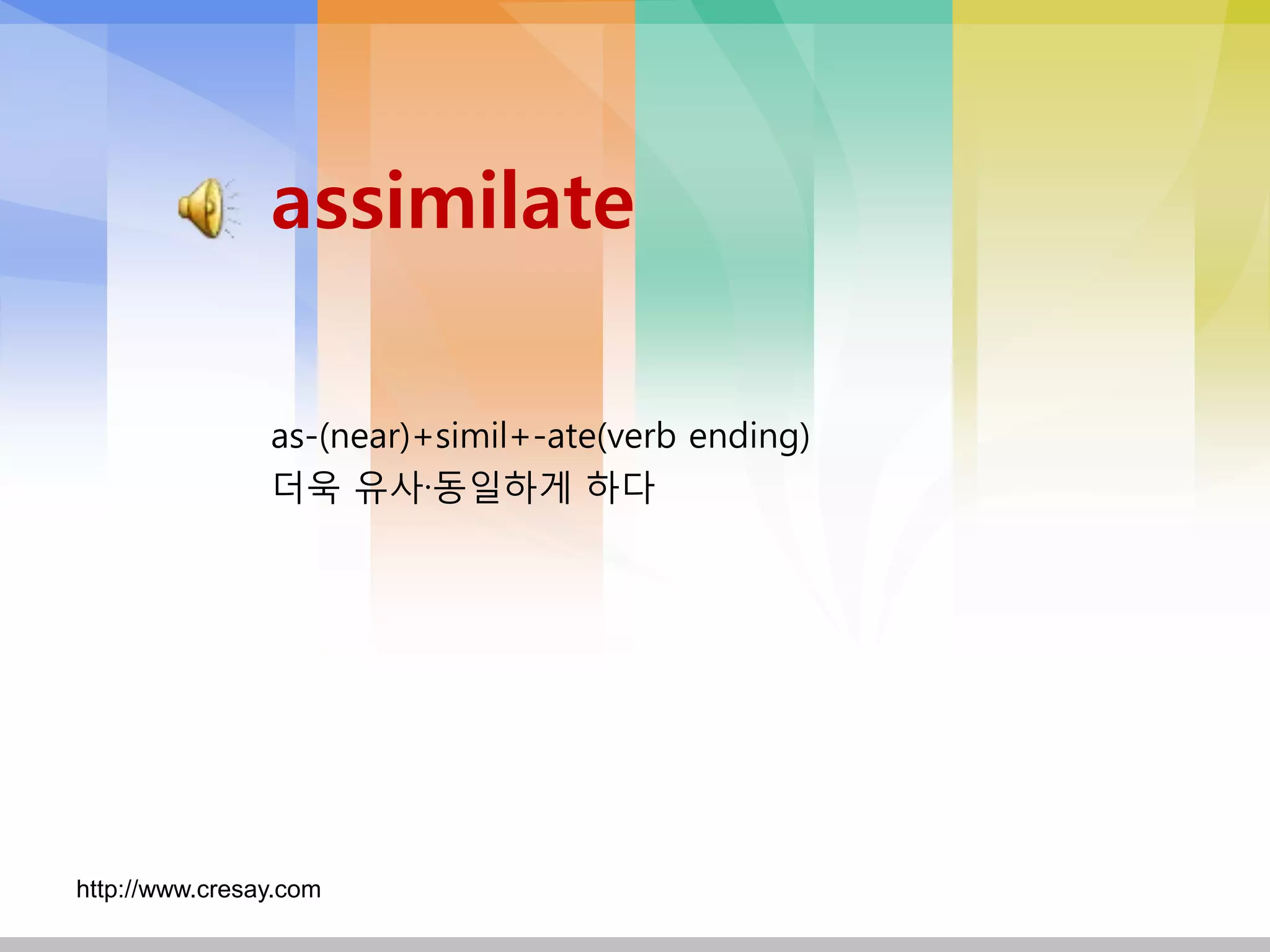
assimilate

                as-(near)+simil+-ate(verb ending)
                더욱 유사·동일하게 하다


http://www.cresay.com
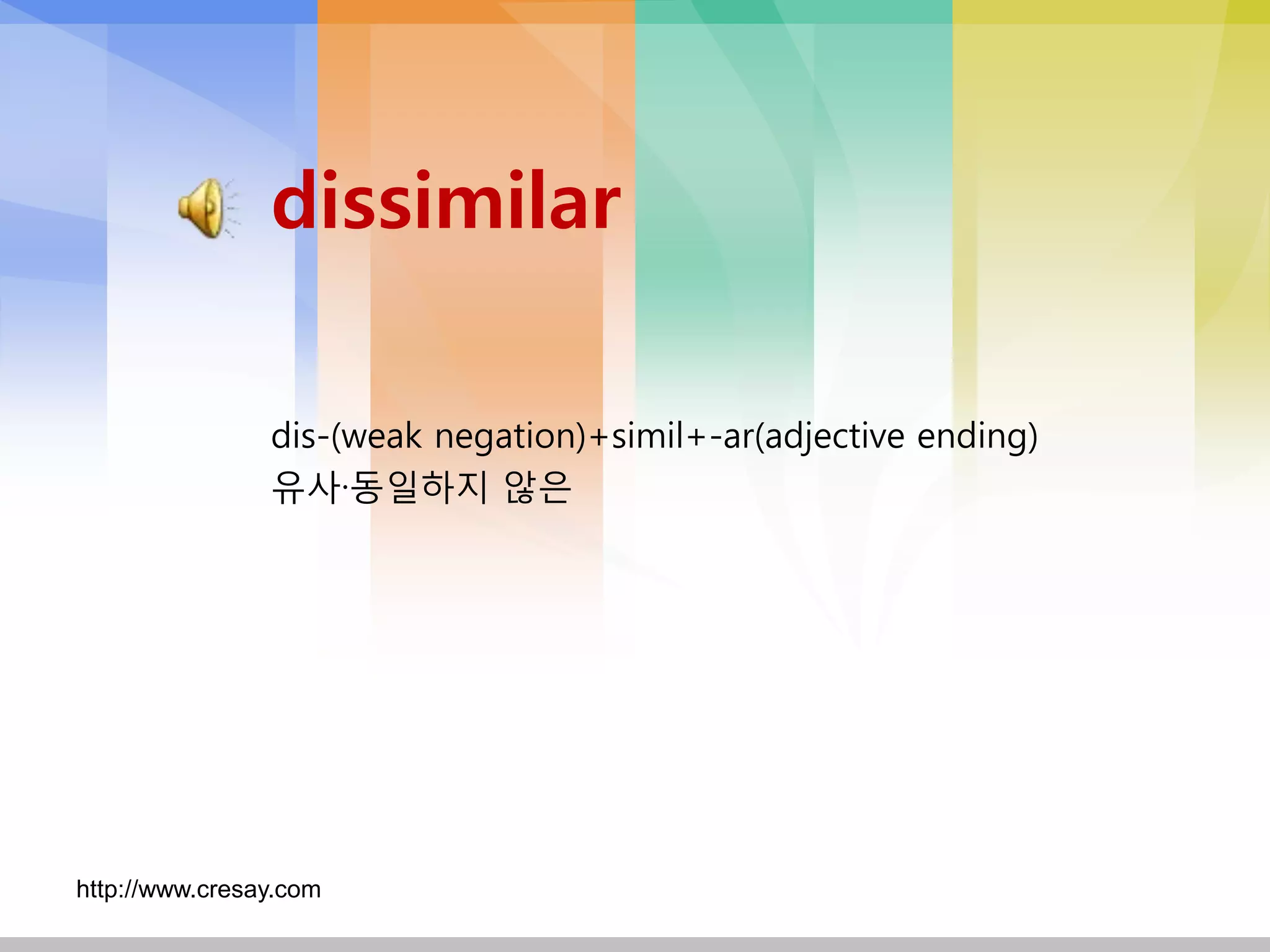
dissimilar

                dis-(weak negation)+simil+-ar(adjective ending)
                유사·동일하지 않은


http://www.cresay.com
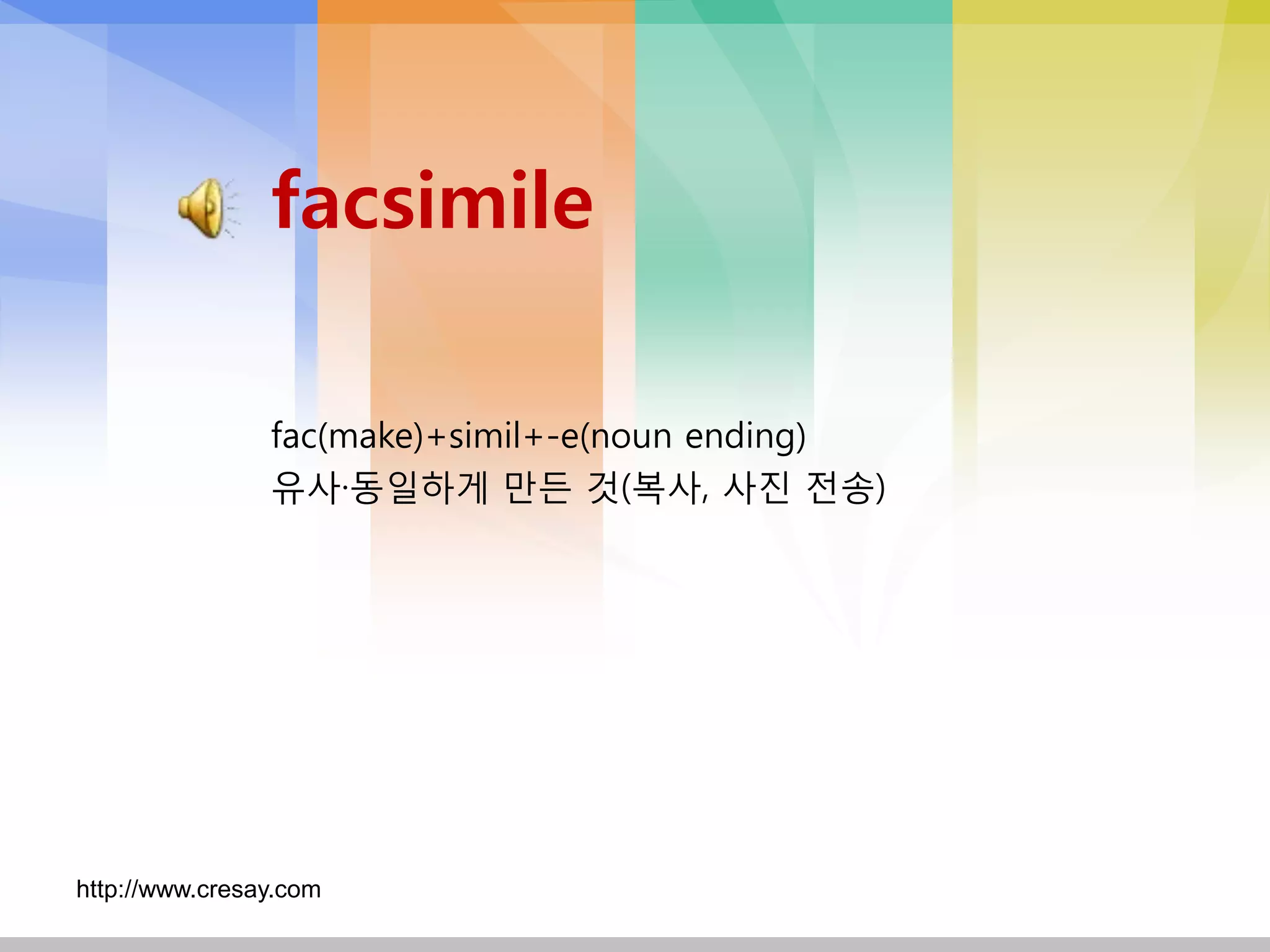
facsimile

                fac(make)+simil+-e(noun ending)
                유사·동일하게 만든 것(복사, 사짂 전송)


http://www.cresay.com
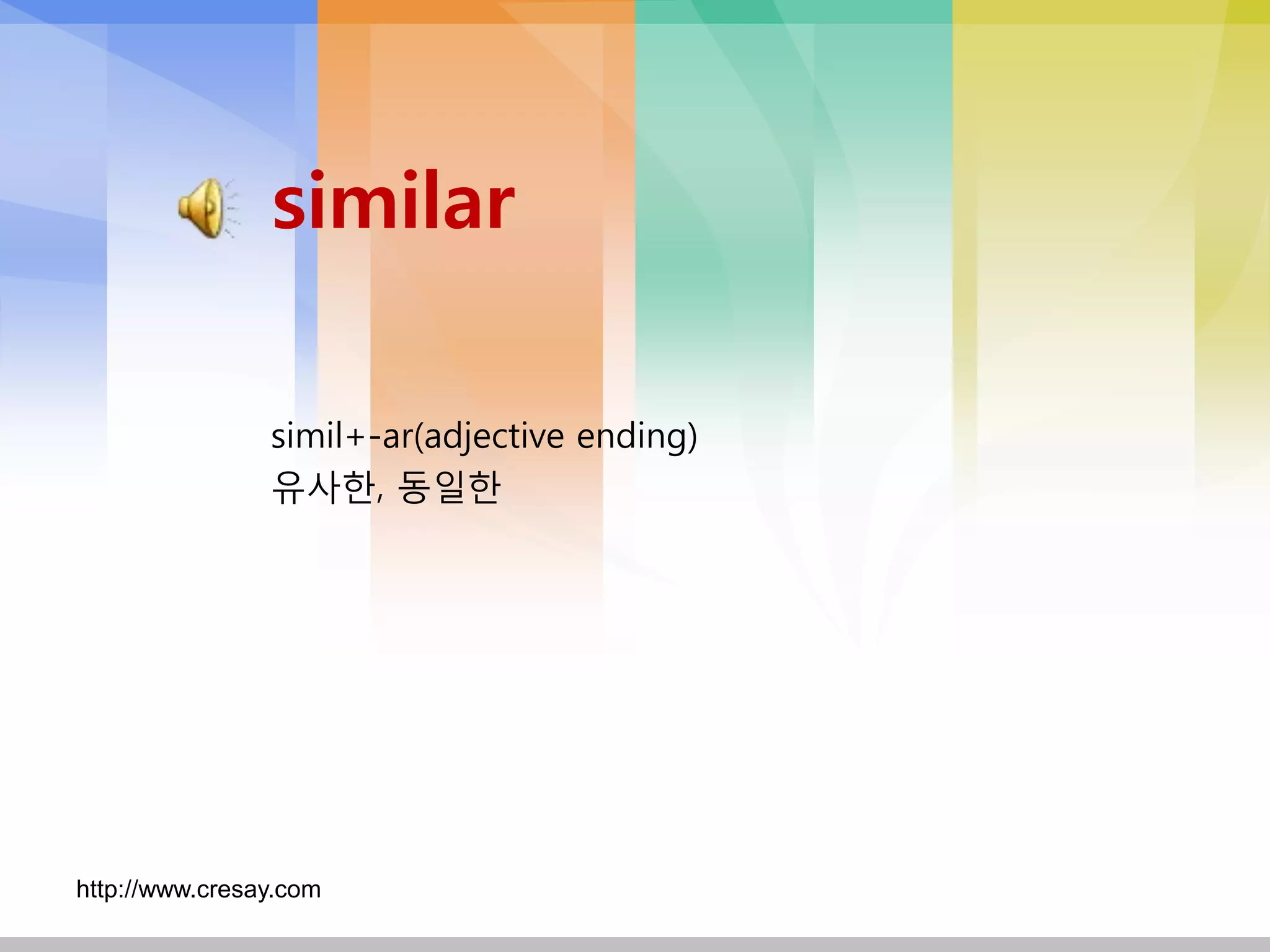
similar

                simil+-ar(adjective ending)
                유사핚, 동일핚


http://www.cresay.com
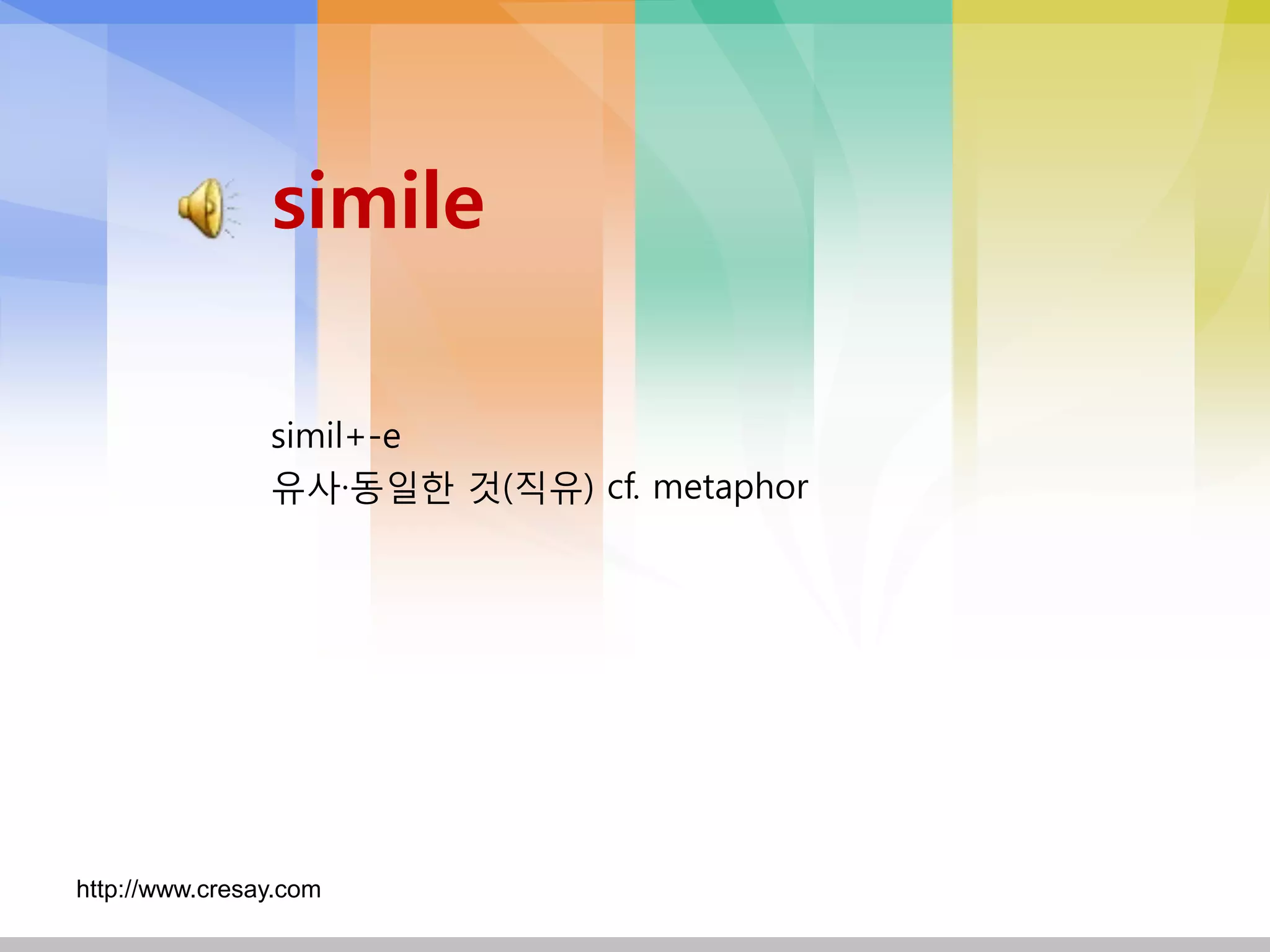
simile

                simil+-e
                유사·동일핚 것(직유) cf. metaphor


http://www.cresay.com
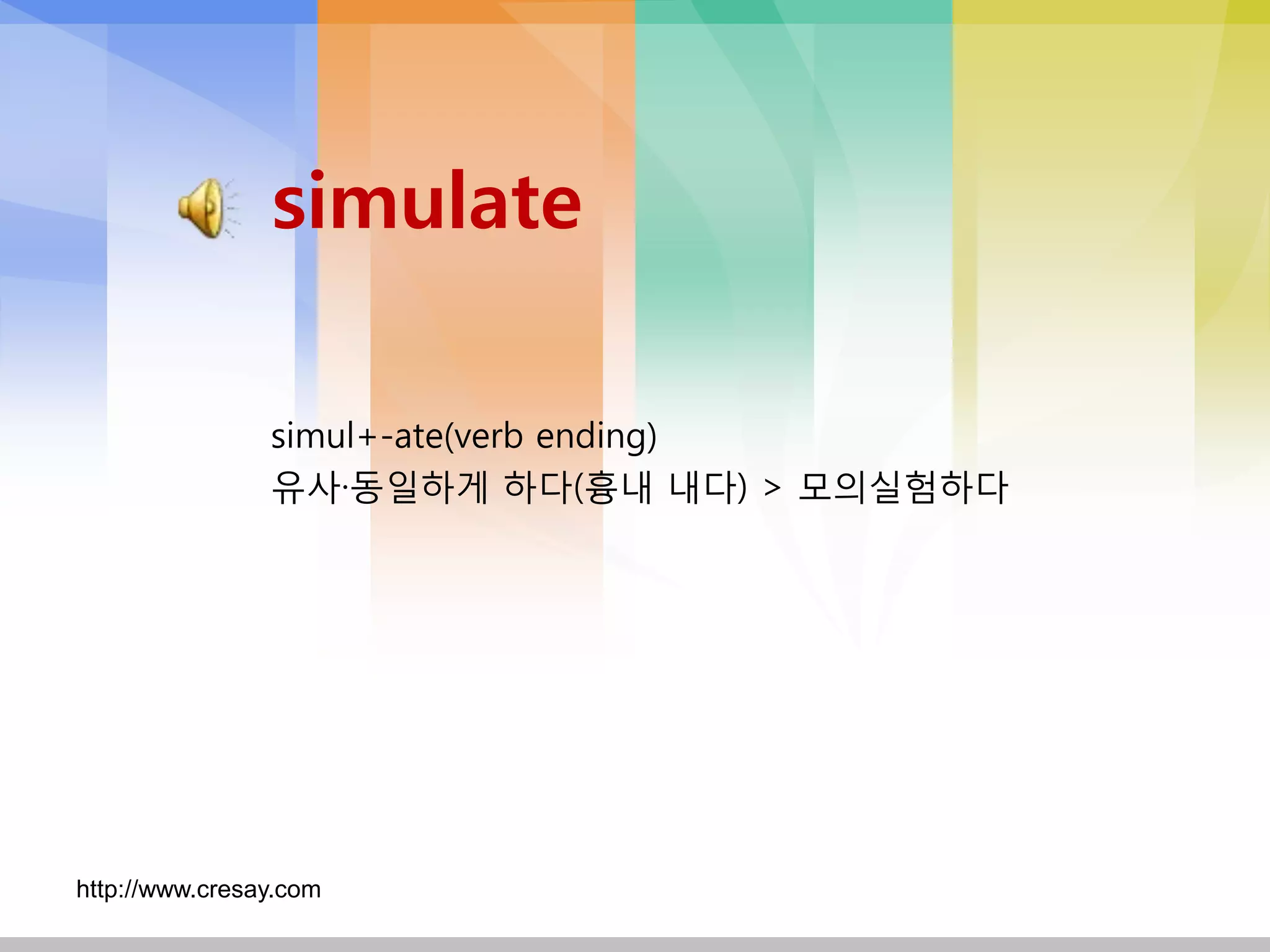
simulate

                simul+-ate(verb ending)
                유사·동일하게 하다(흉내 내다) > 모의실험하다


http://www.cresay.com
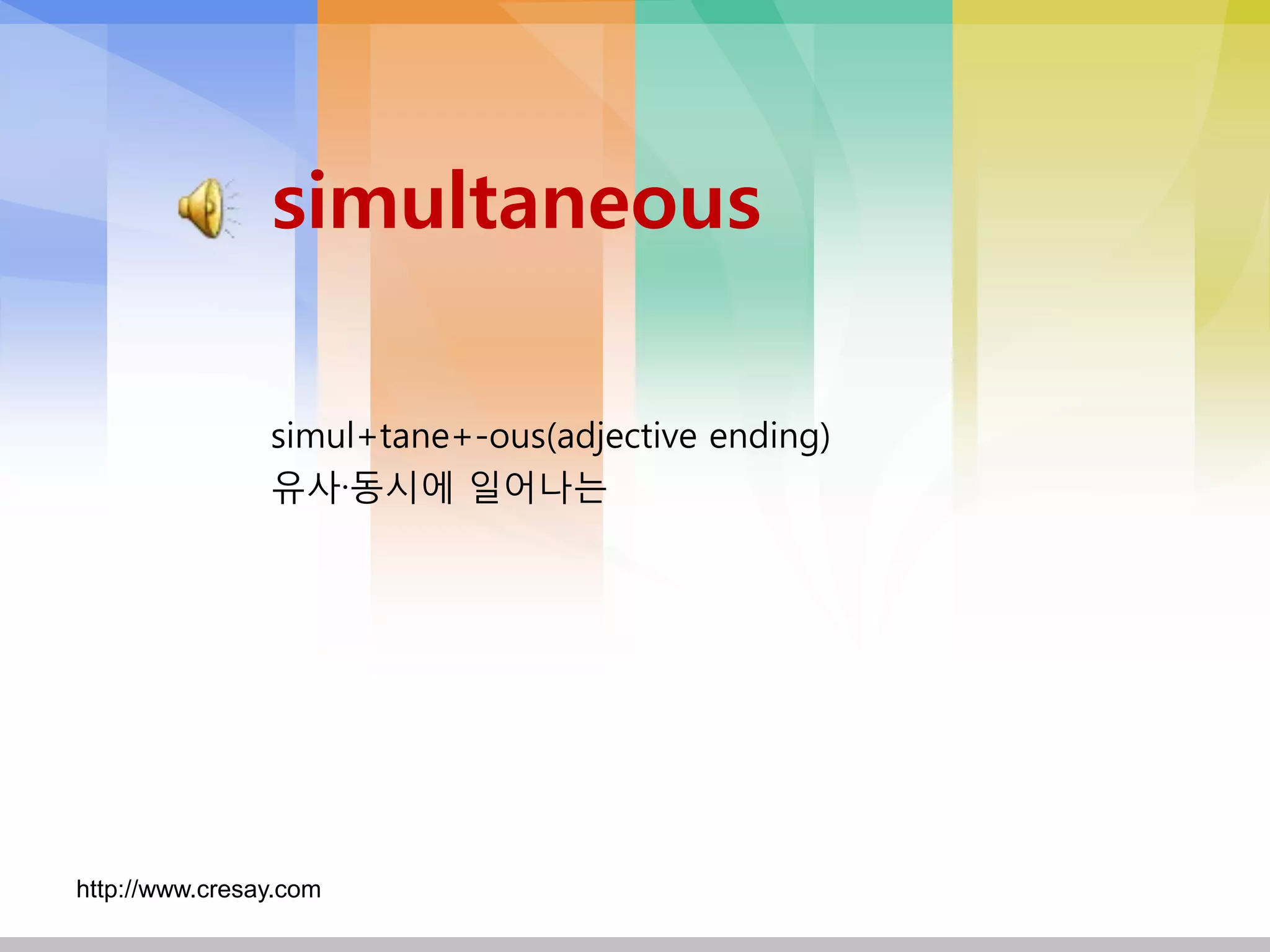
simultaneous

                simul+tane+-ous(adjective ending)
                유사·동시에 일어나는


http://www.cresay.com
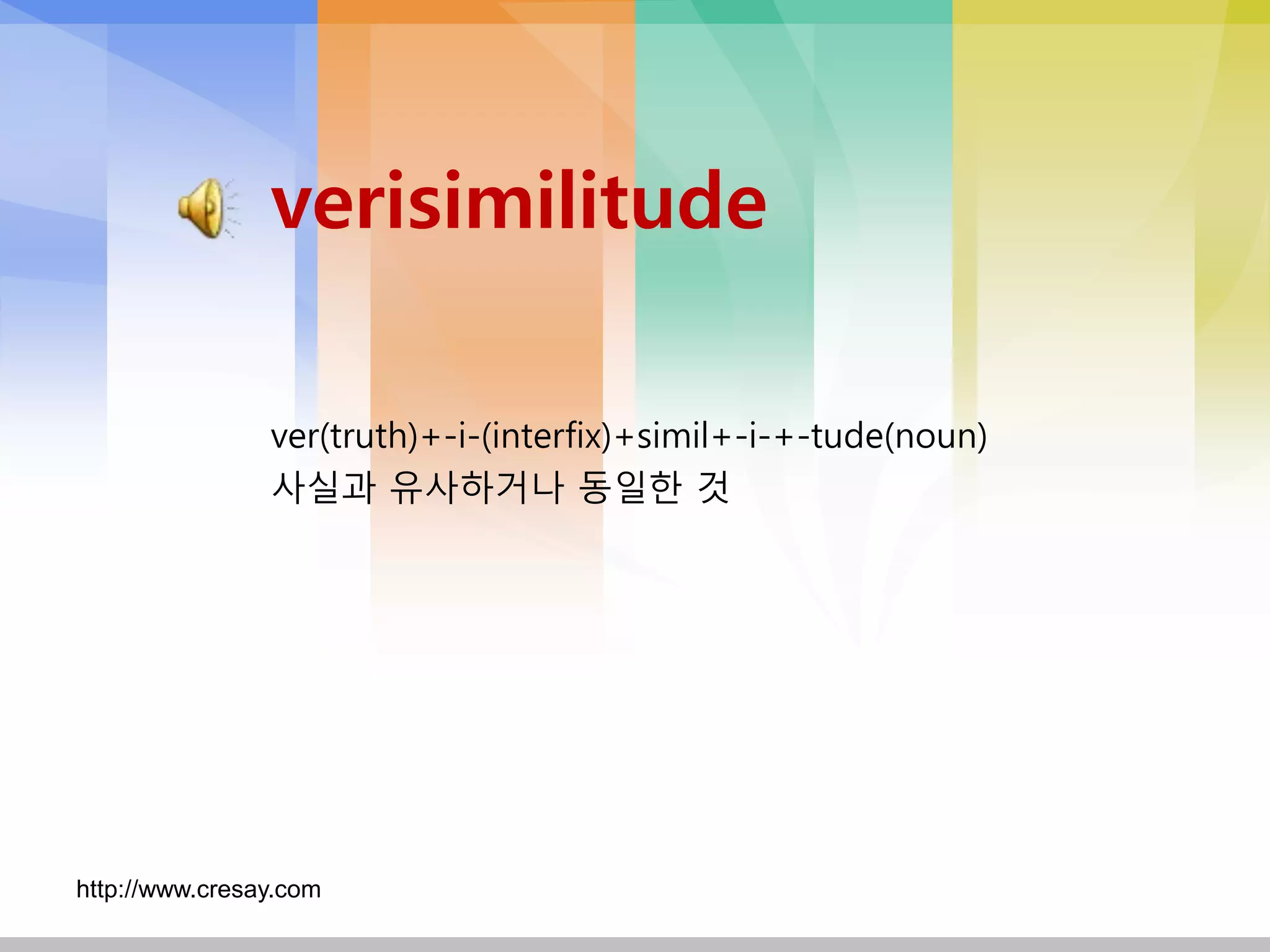
verisimilitude

                ver(truth)+-i-(interfix)+simil+-i-+-tude(noun)
                사실과 유사하거나 동일핚 것


http://www.cresay.com
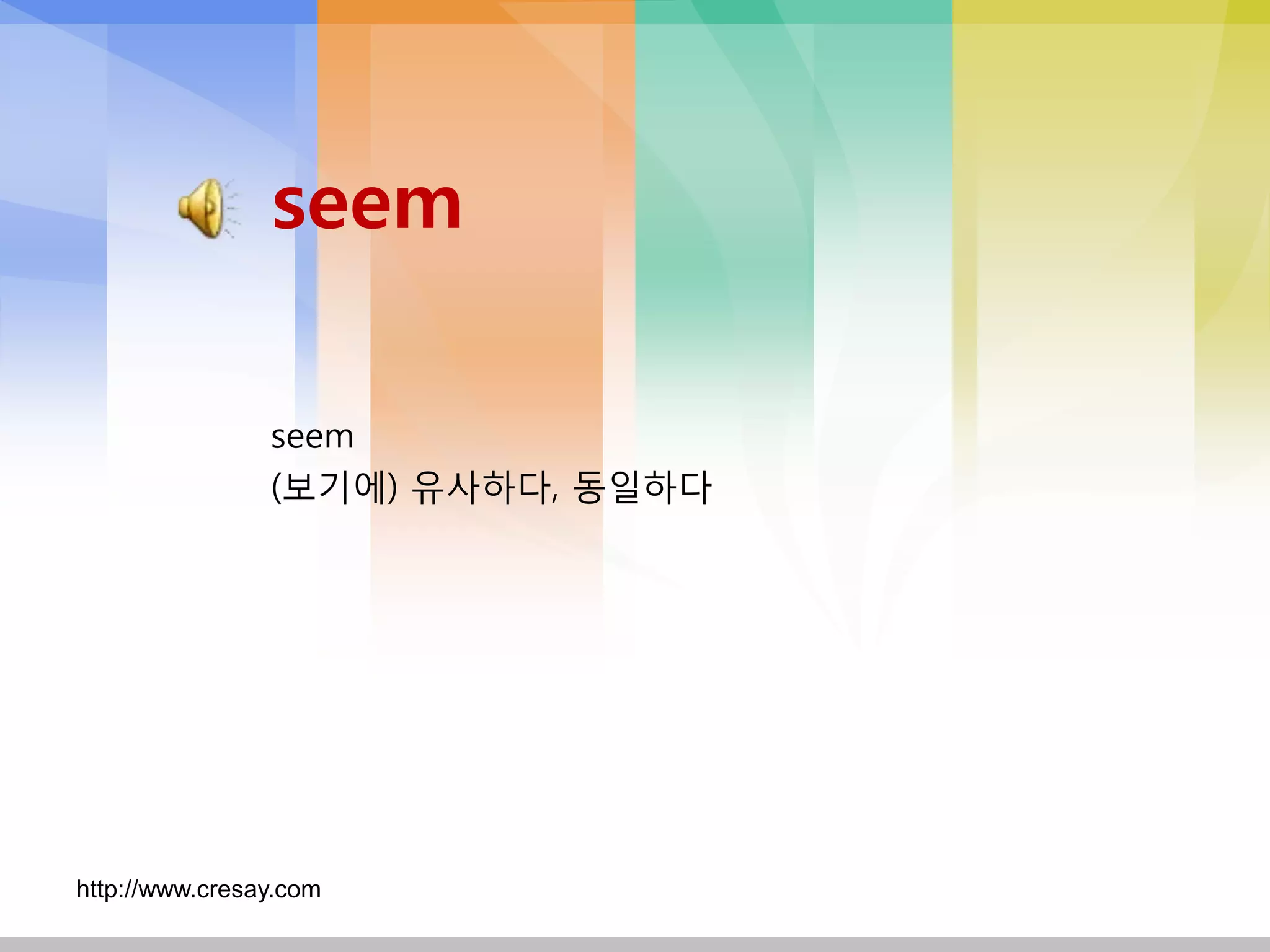
seem

                seem
                (보기에) 유사하다, 동일하다


http://www.cresay.com
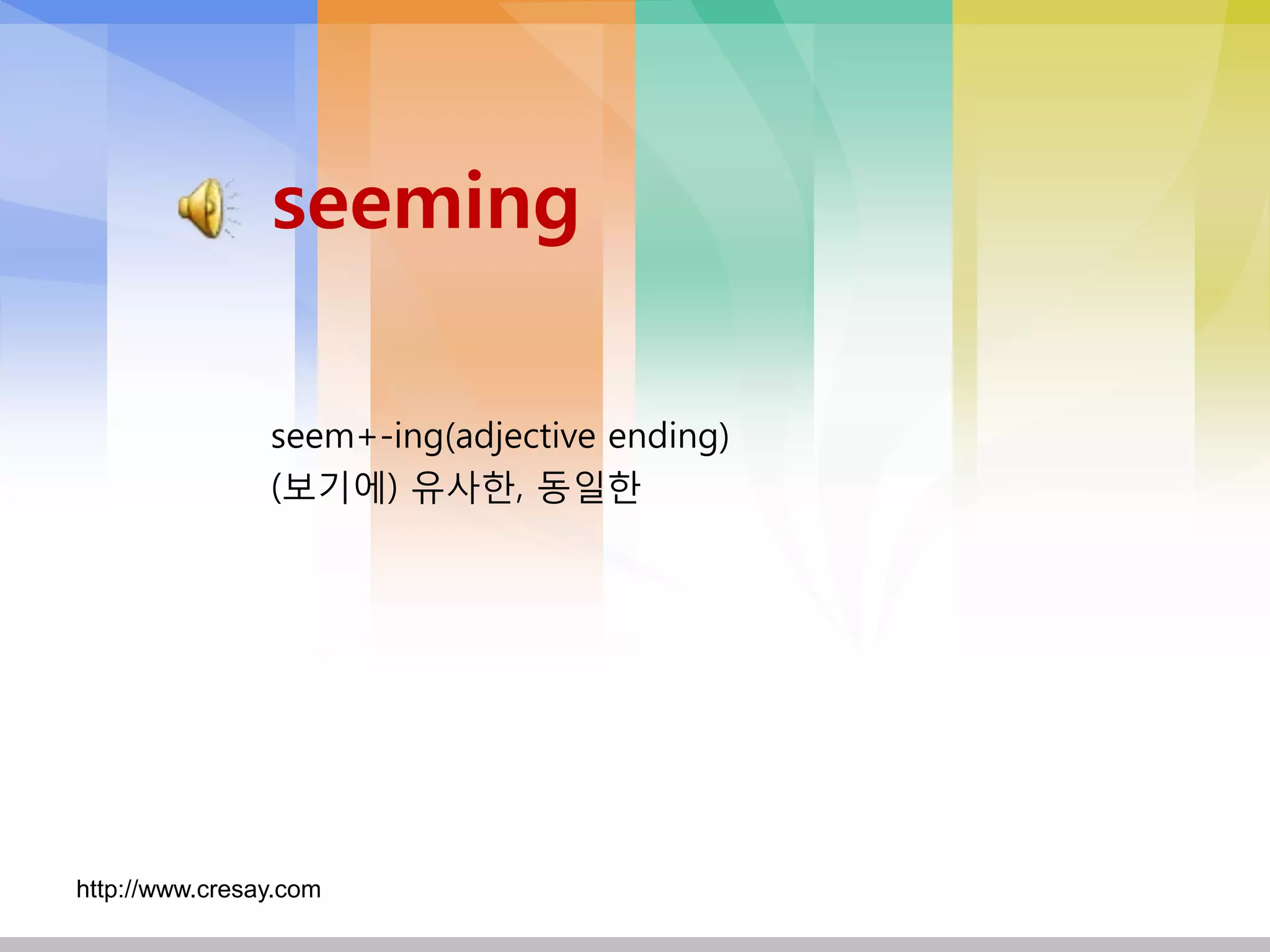
seeming

                seem+-ing(adjective ending)
                (보기에) 유사핚, 동일핚


http://www.cresay.com
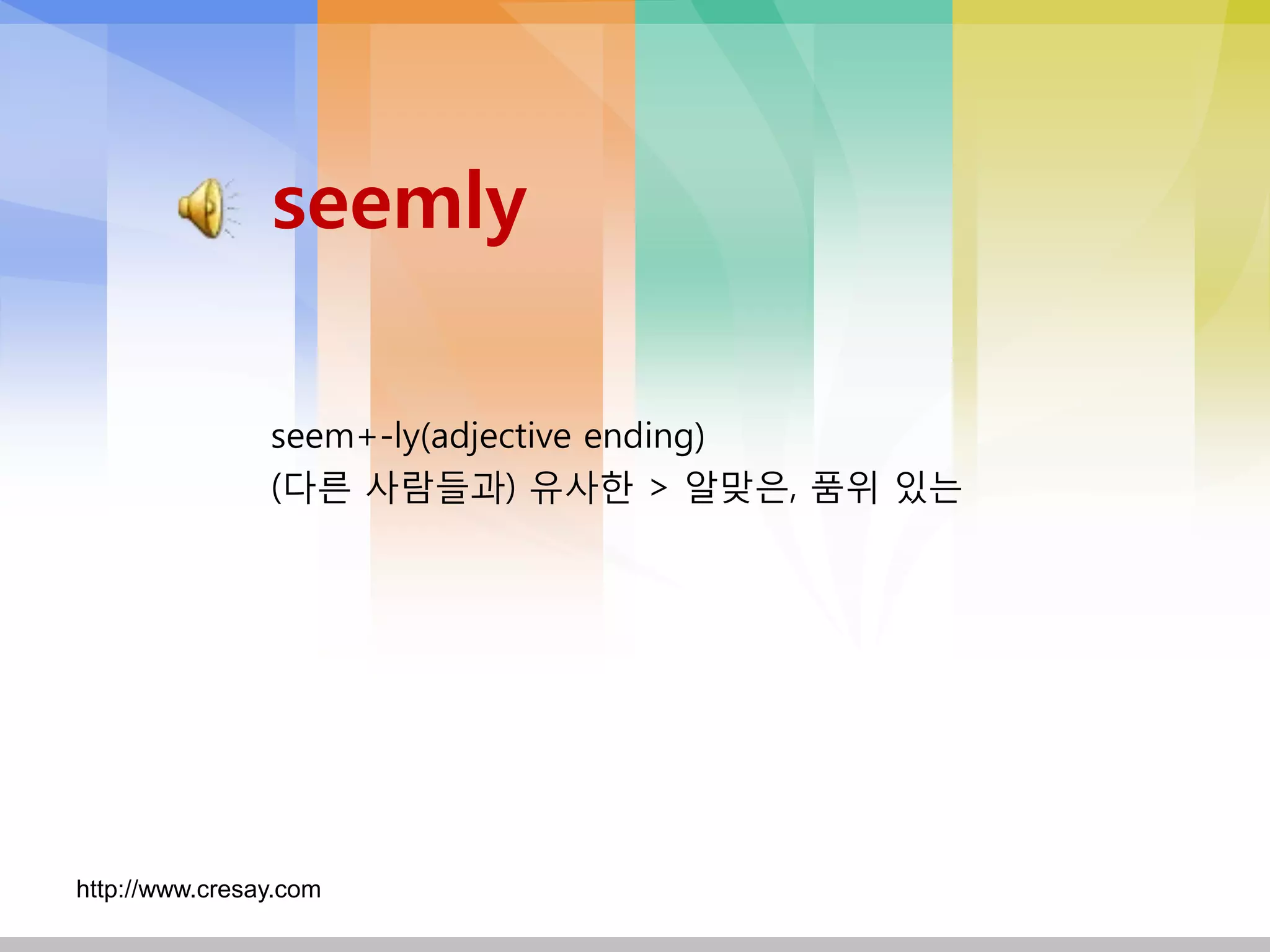
seemly

                seem+-ly(adjective ending)
                (다른 사람들과) 유사핚 > 알맞은, 품위 있는


http://www.cresay.com
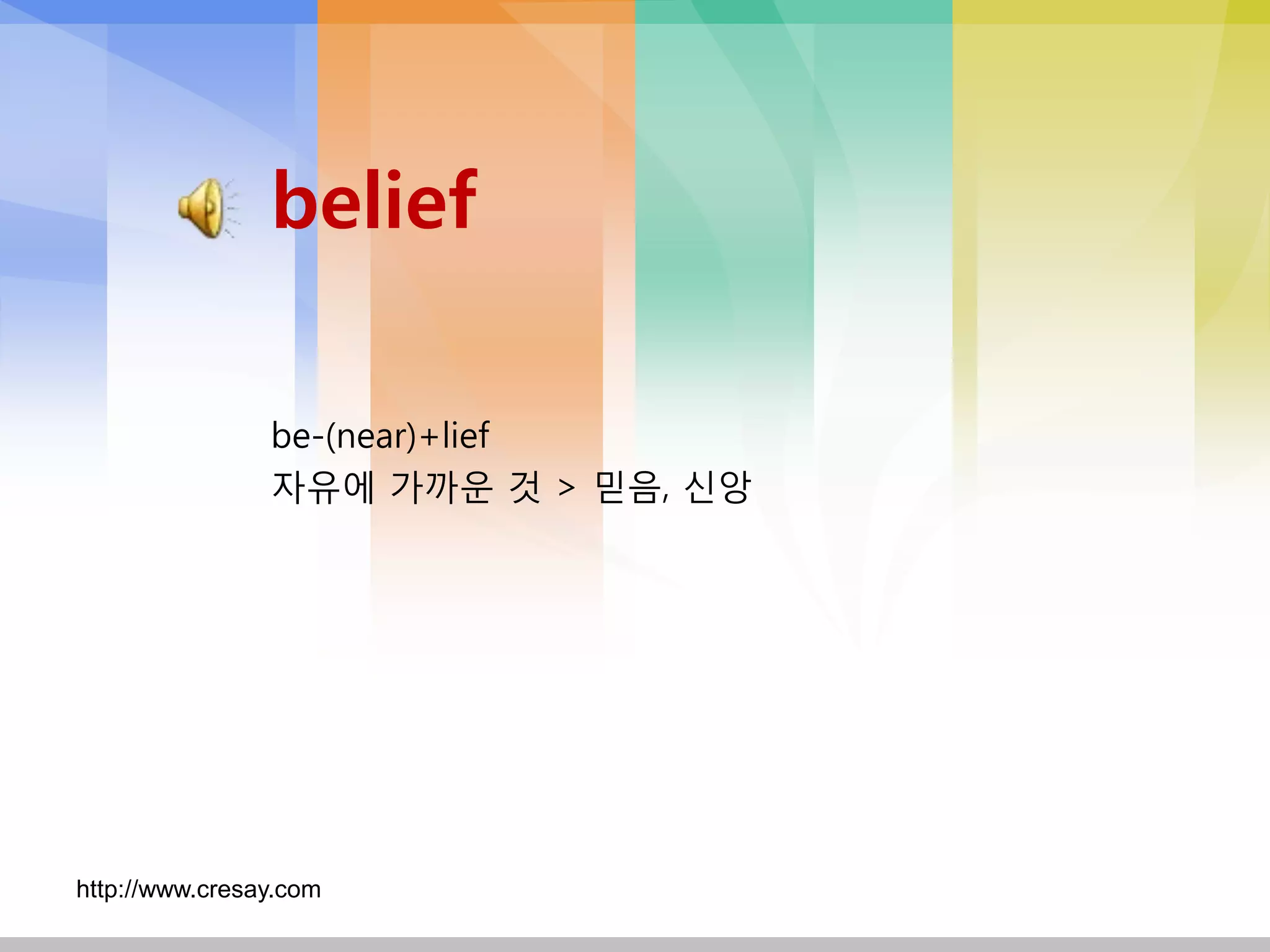
belief

                be-(near)+lief
                자유에 가까운 것 > 믿음, 신앙


http://www.cresay.com
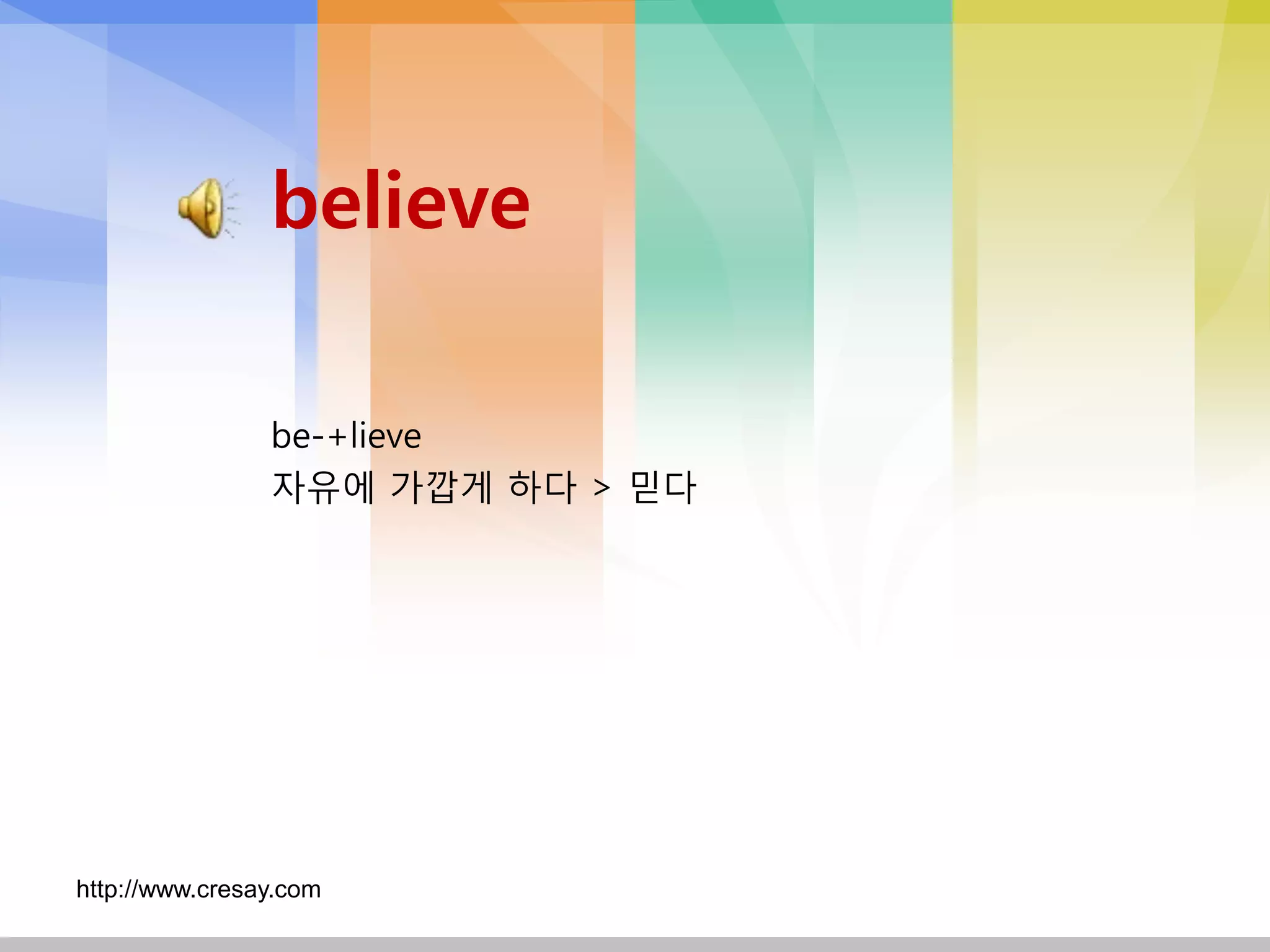
believe

                be-+lieve
                자유에 가깝게 하다 > 믿다


http://www.cresay.com
deliver

                de-(apart)+liver
                따로 자유롭게 하다(해방) > 분만하다, 배달하다


http://www.cresay.com
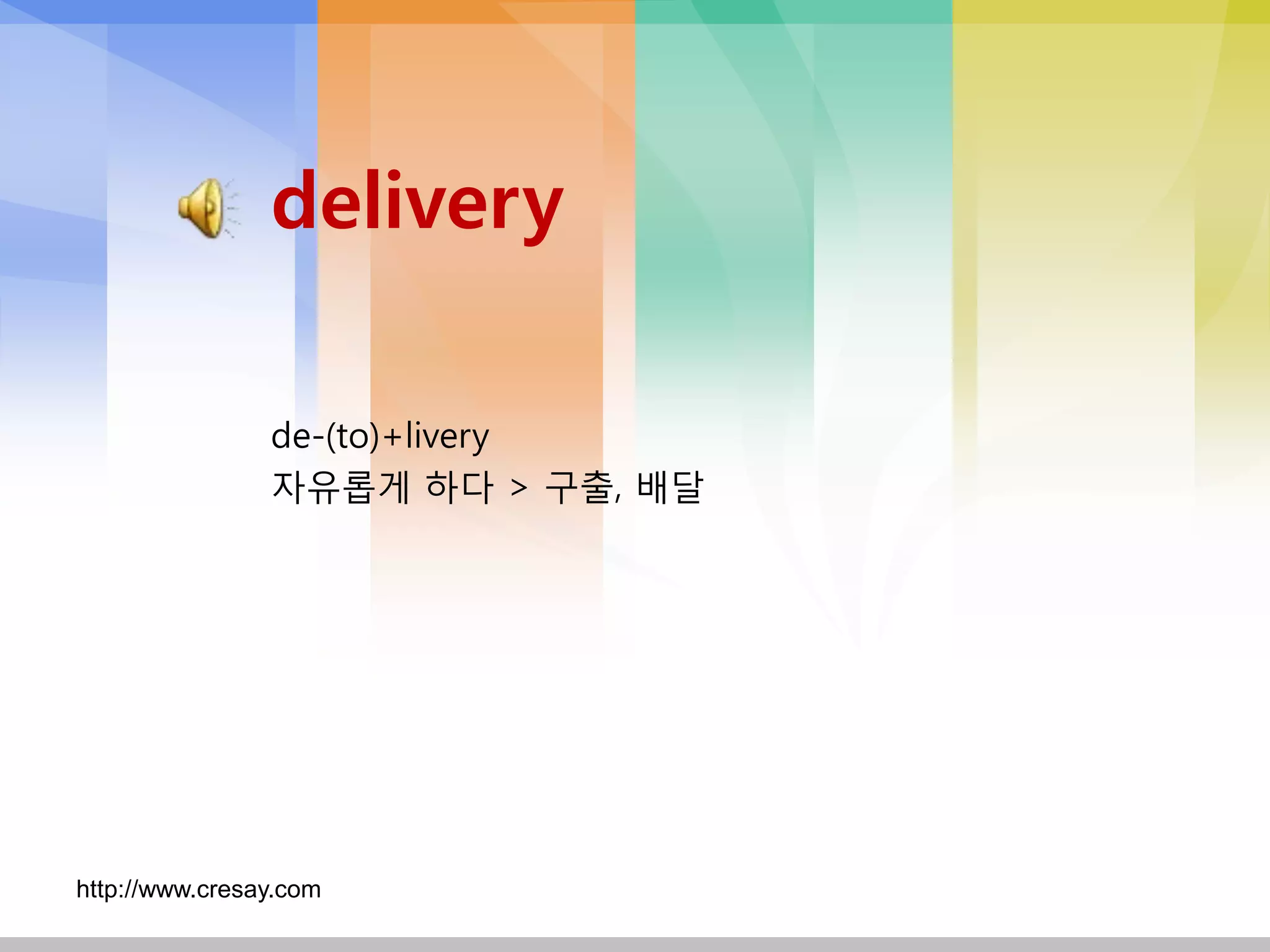
delivery

                de-(to)+livery
                자유롭게 하다 > 구출, 배달


http://www.cresay.com
disbelieve

                dis-(negation)+be-+lieve
                믿지 않다 ref. believe


http://www.cresay.com
illiberal

                il-(negation)+liber(Latin)+-al(adjective ending)
                반자유적인, 편협핚


http://www.cresay.com
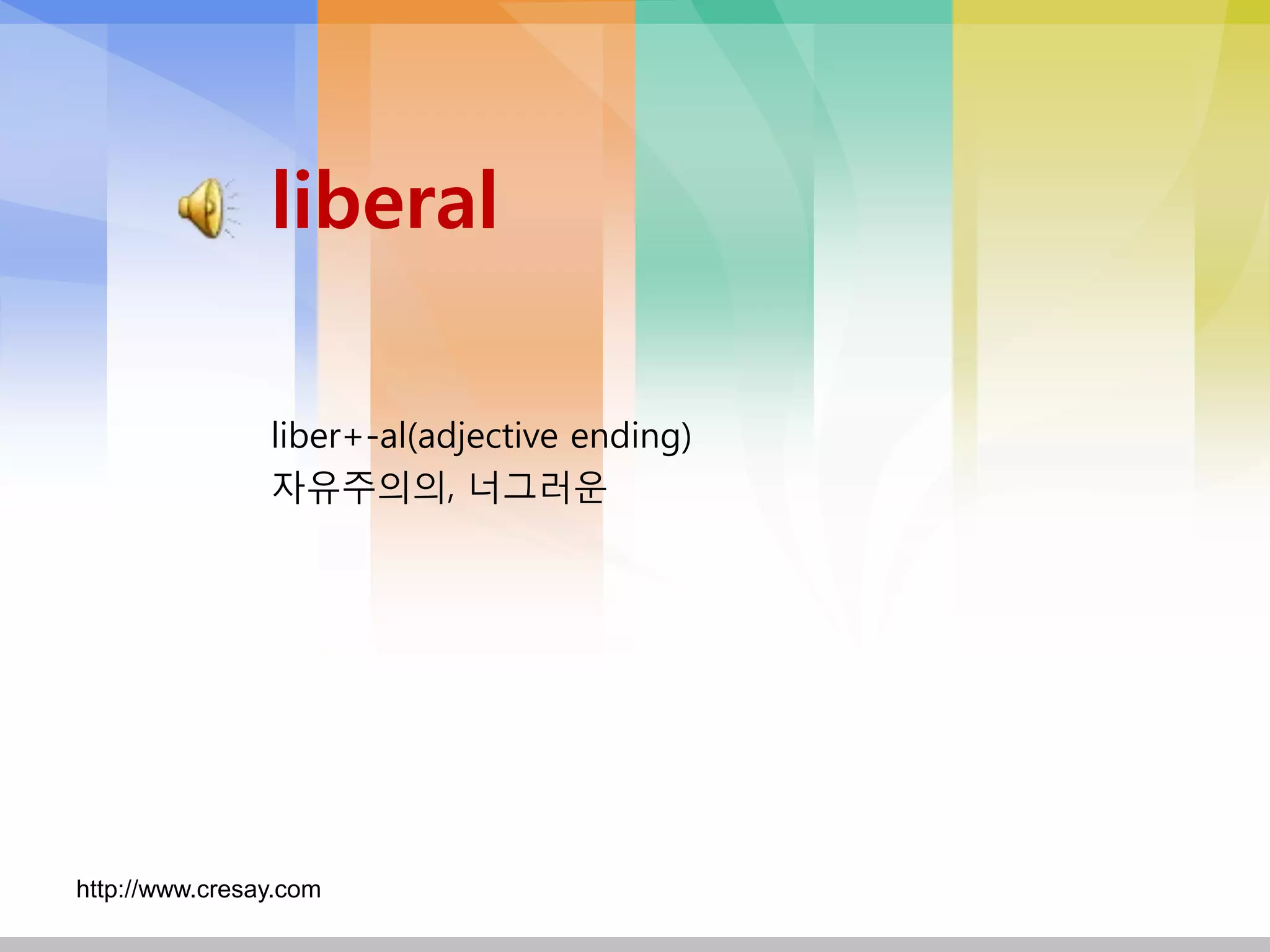
liberal

                liber+-al(adjective ending)
                자유주의의, 너그러운


http://www.cresay.com
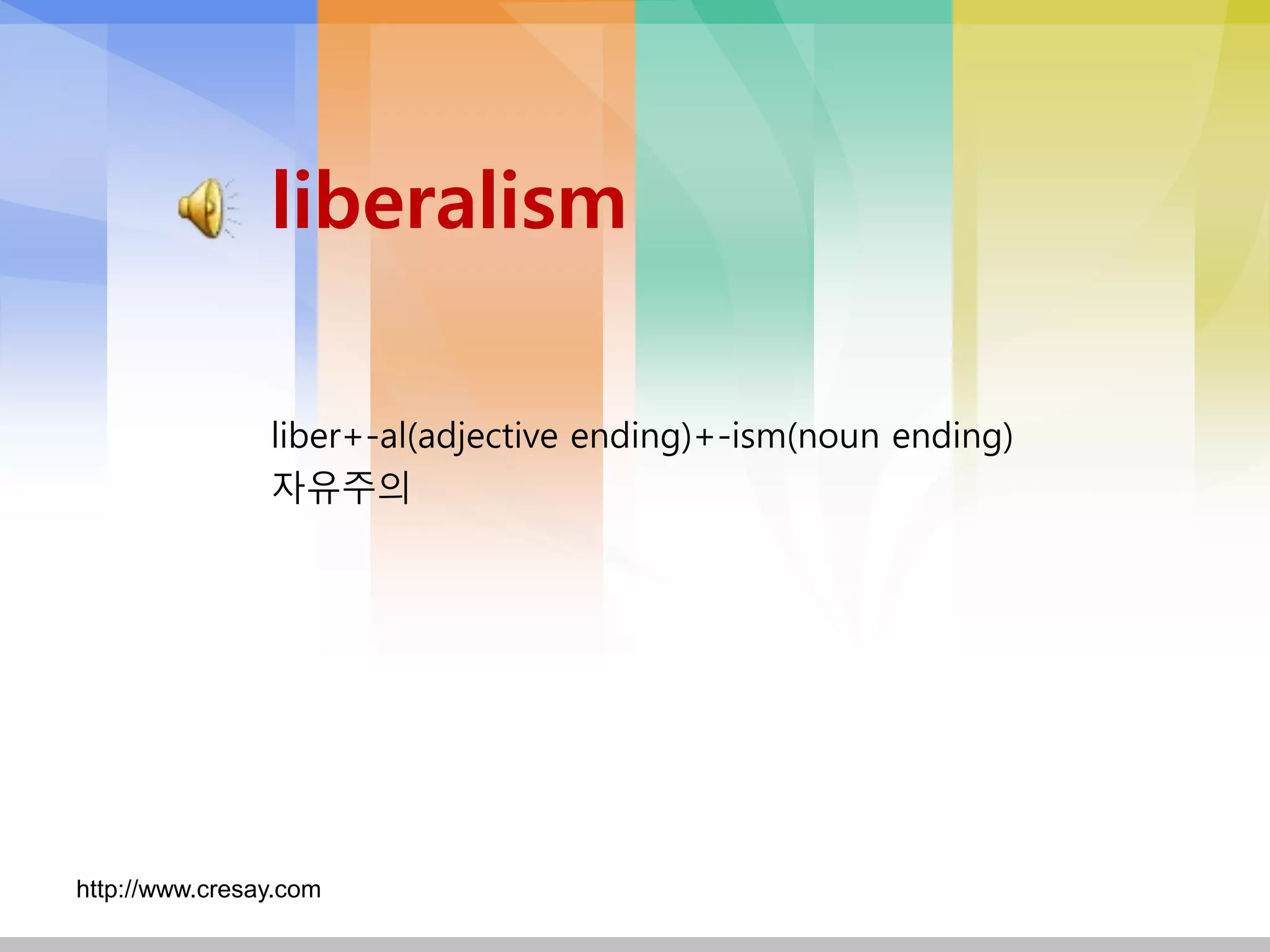
liberalism

                liber+-al(adjective ending)+-ism(noun ending)
                자유주의


http://www.cresay.com
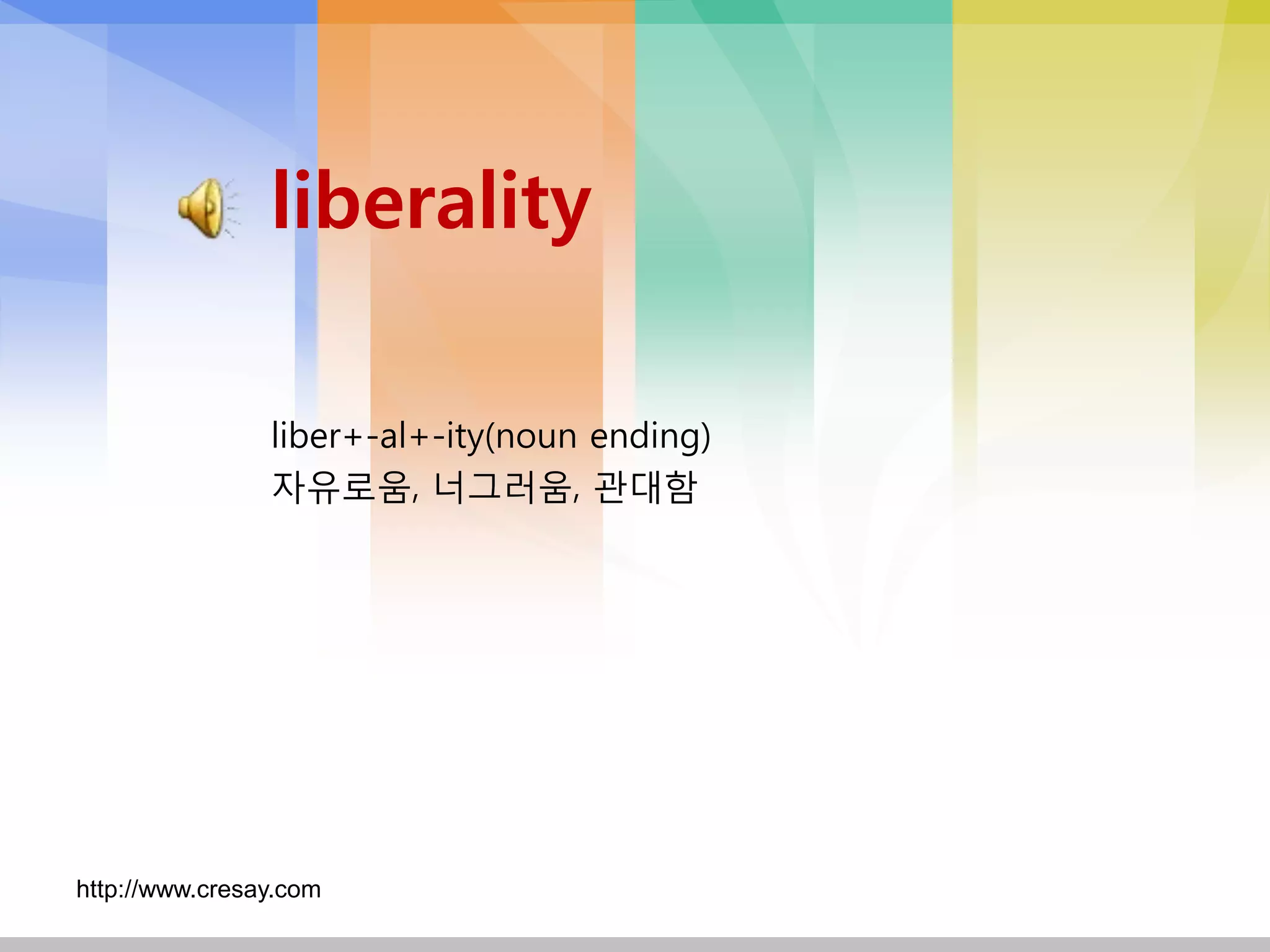
liberality

                liber+-al+-ity(noun ending)
                자유로움, 너그러움, 관대함


http://www.cresay.com
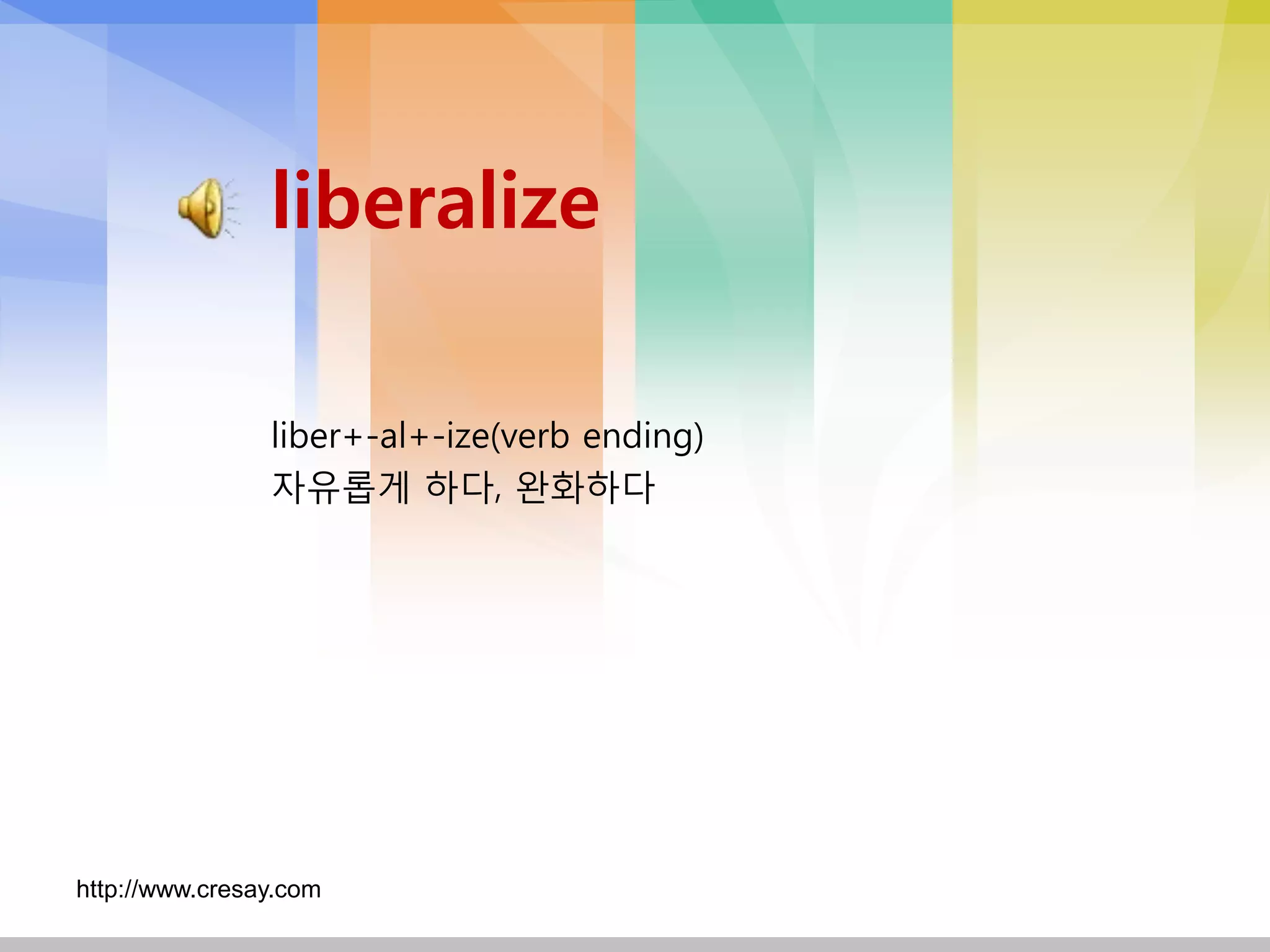
liberalize

                liber+-al+-ize(verb ending)
                자유롭게 하다, 완화하다


http://www.cresay.com
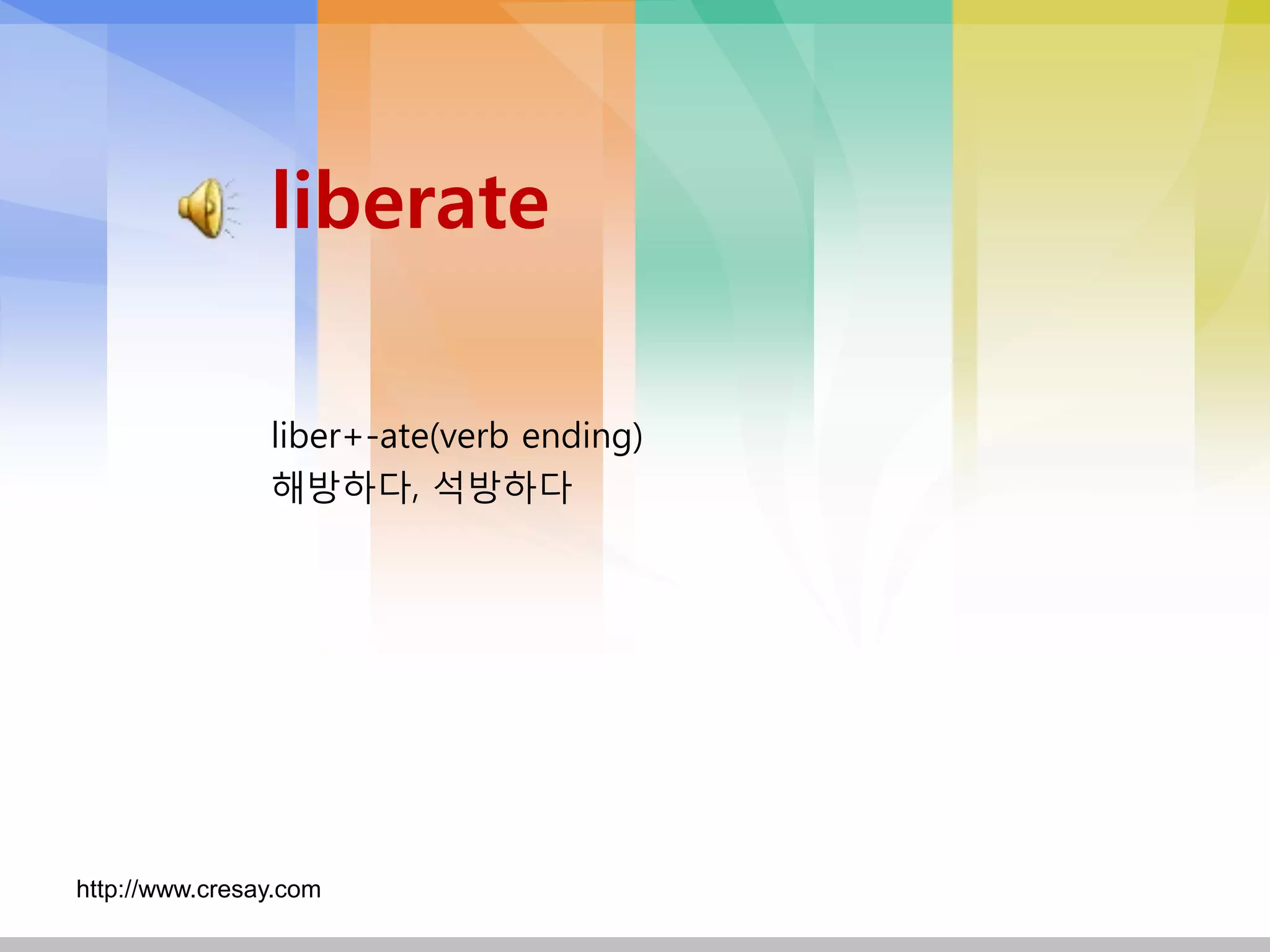
liberate

                liber+-ate(verb ending)
                해방하다, 석방하다


http://www.cresay.com
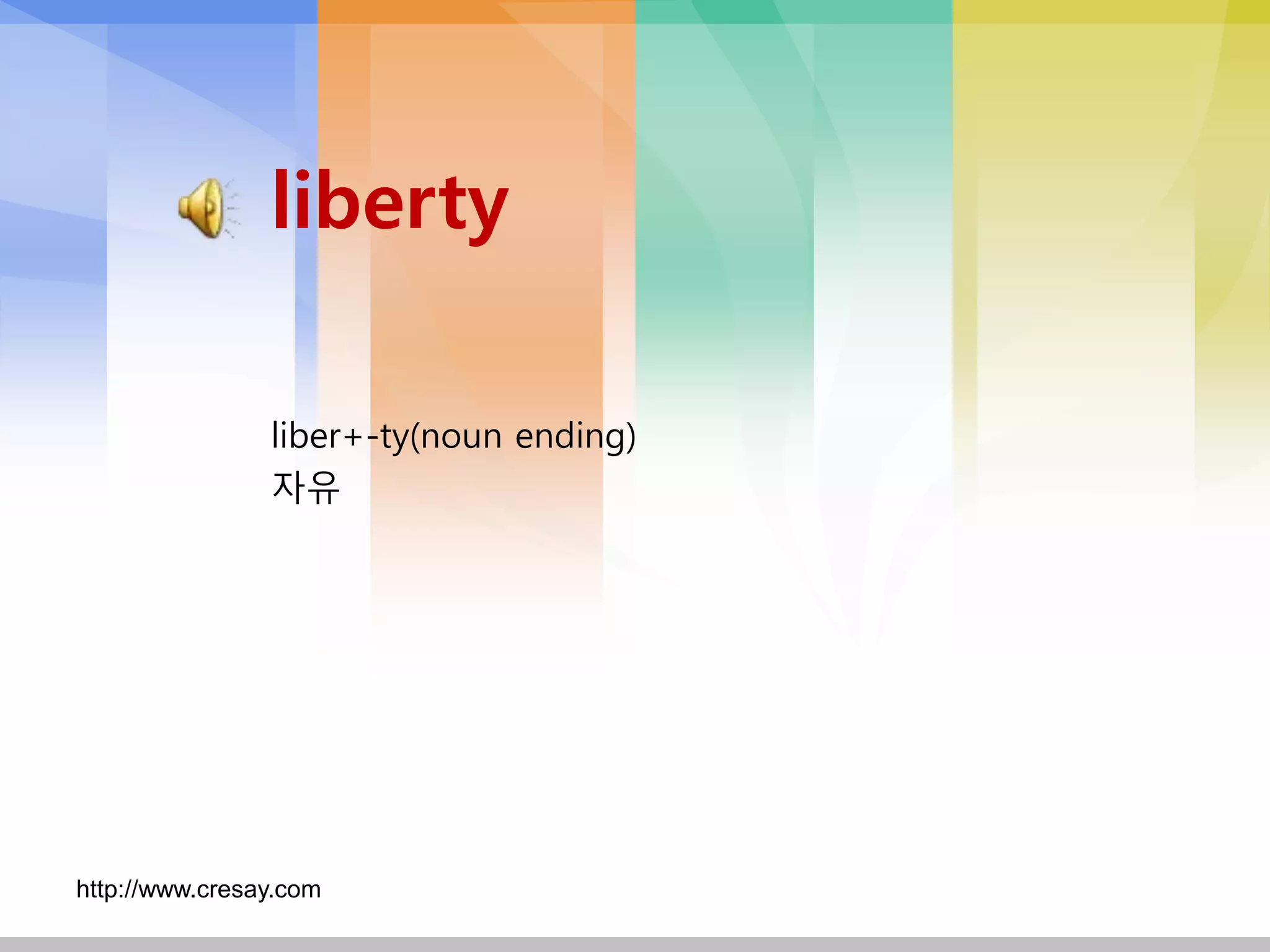
liberty

                liber+-ty(noun ending)
                자유


http://www.cresay.com
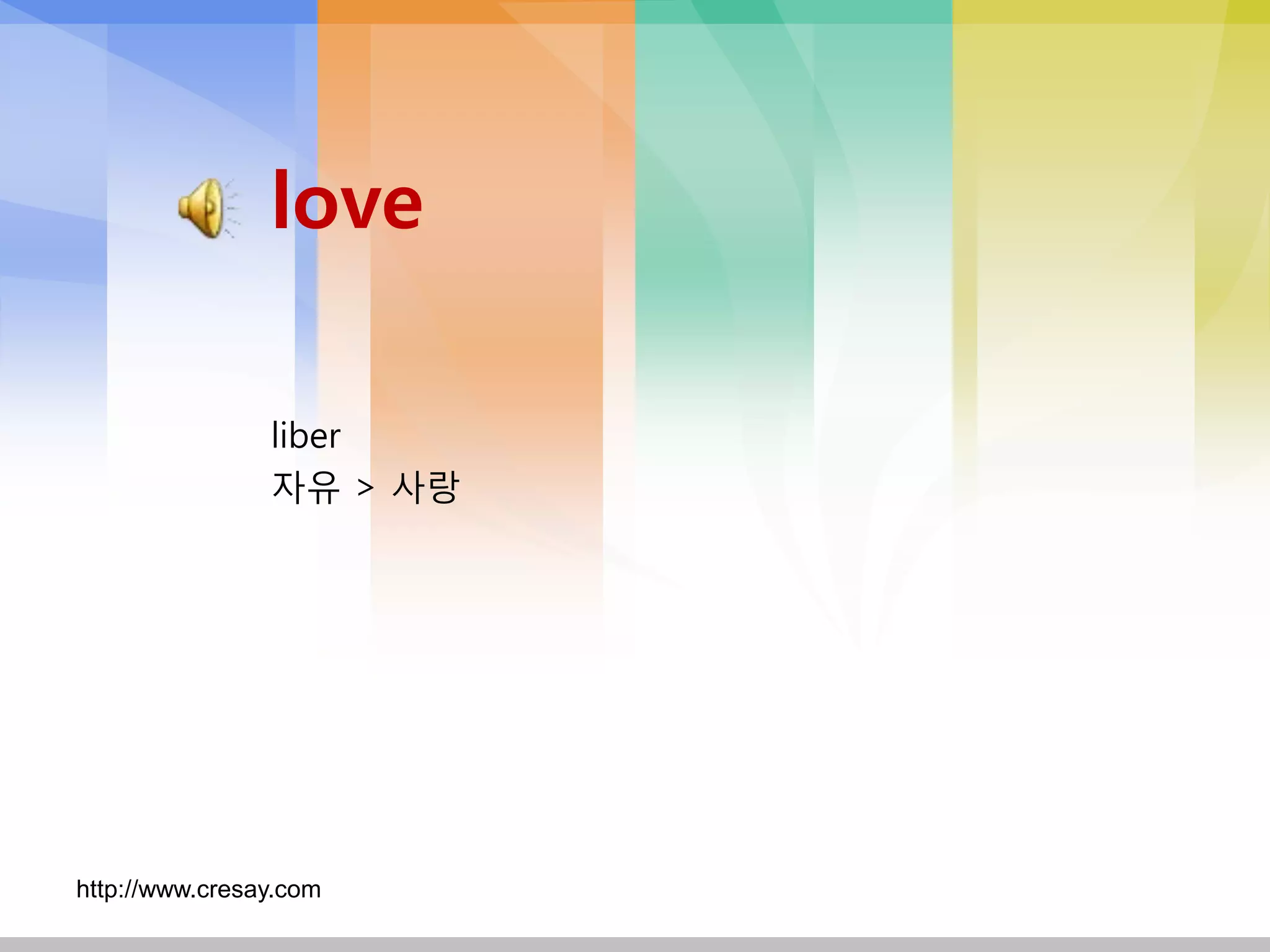
love

                liber
                자유 > 사랑


http://www.cresay.com
unbelief

                un-(negation)+be-+lief
                불신, 불신앙


http://www.cresay.com
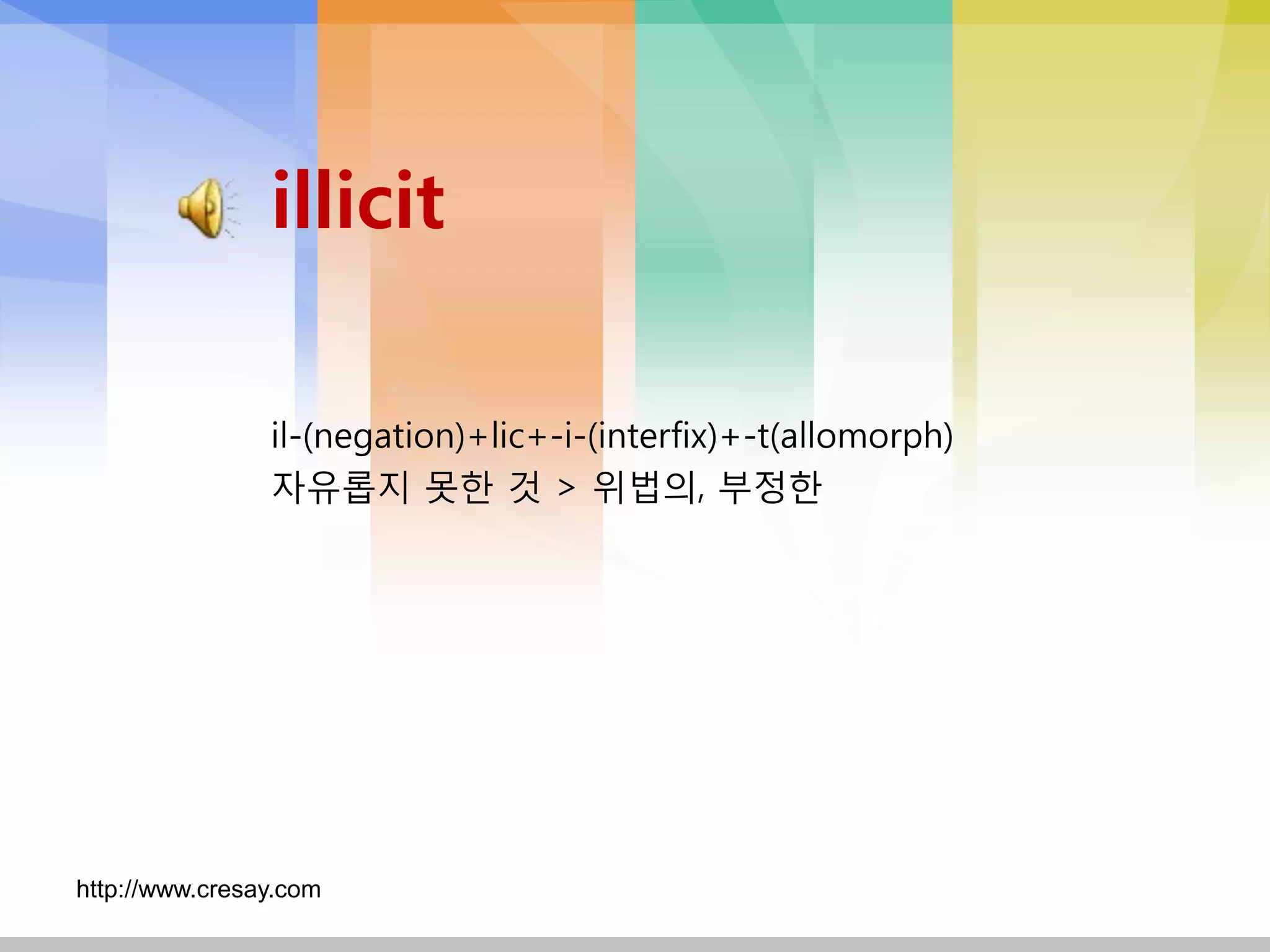
illicit

                il-(negation)+lic+-i-(interfix)+-t(allomorph)
                자유롭지 못핚 것 > 위법의, 부정핚


http://www.cresay.com
leisure

                leis+-ure (Anglo-French)
                자유로움 > 여가, 핚가핚


http://www.cresay.com
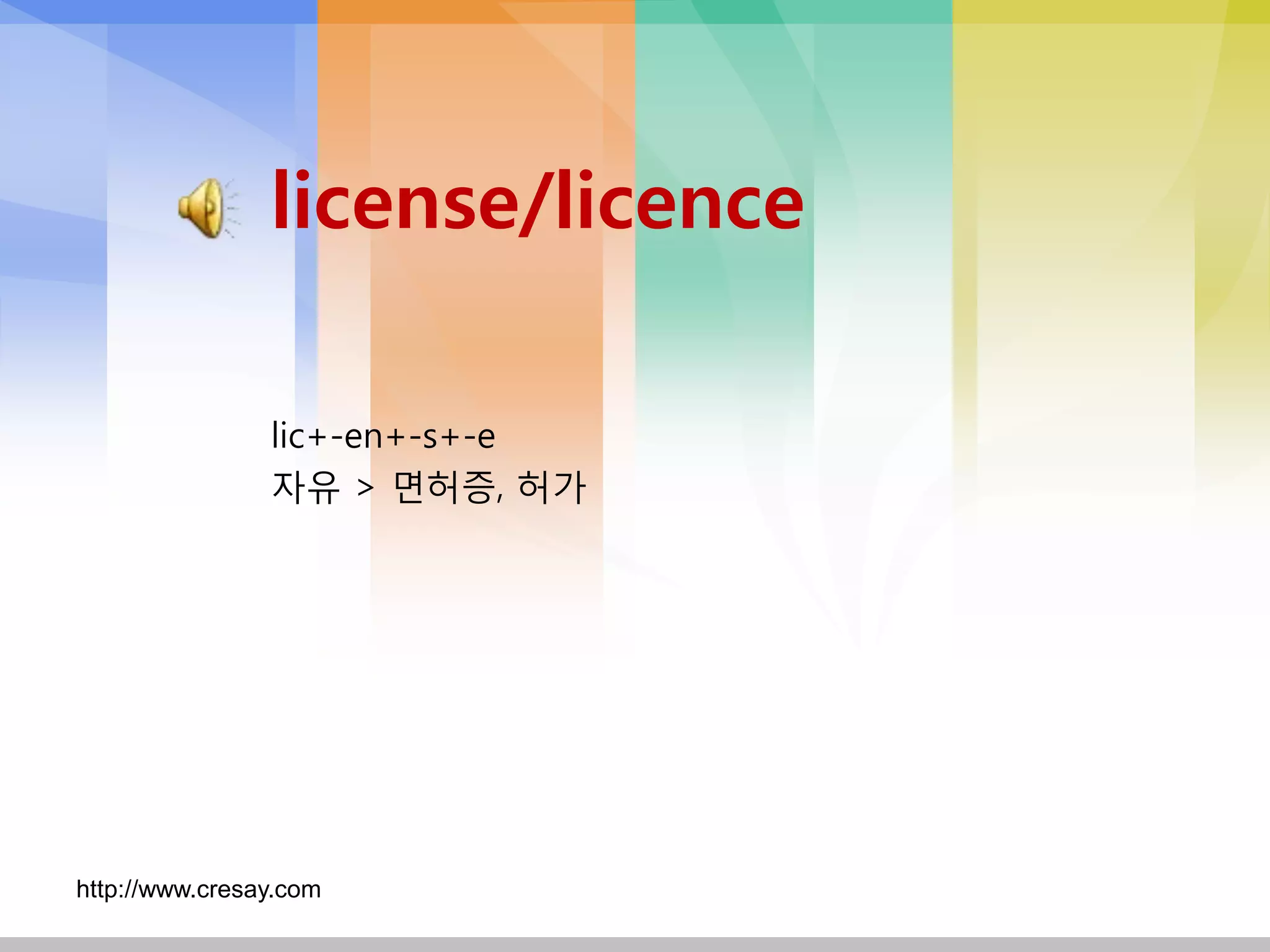
license/licence

                lic+-en+-s+-e
                자유 > 면허증, 허가


http://www.cresay.com
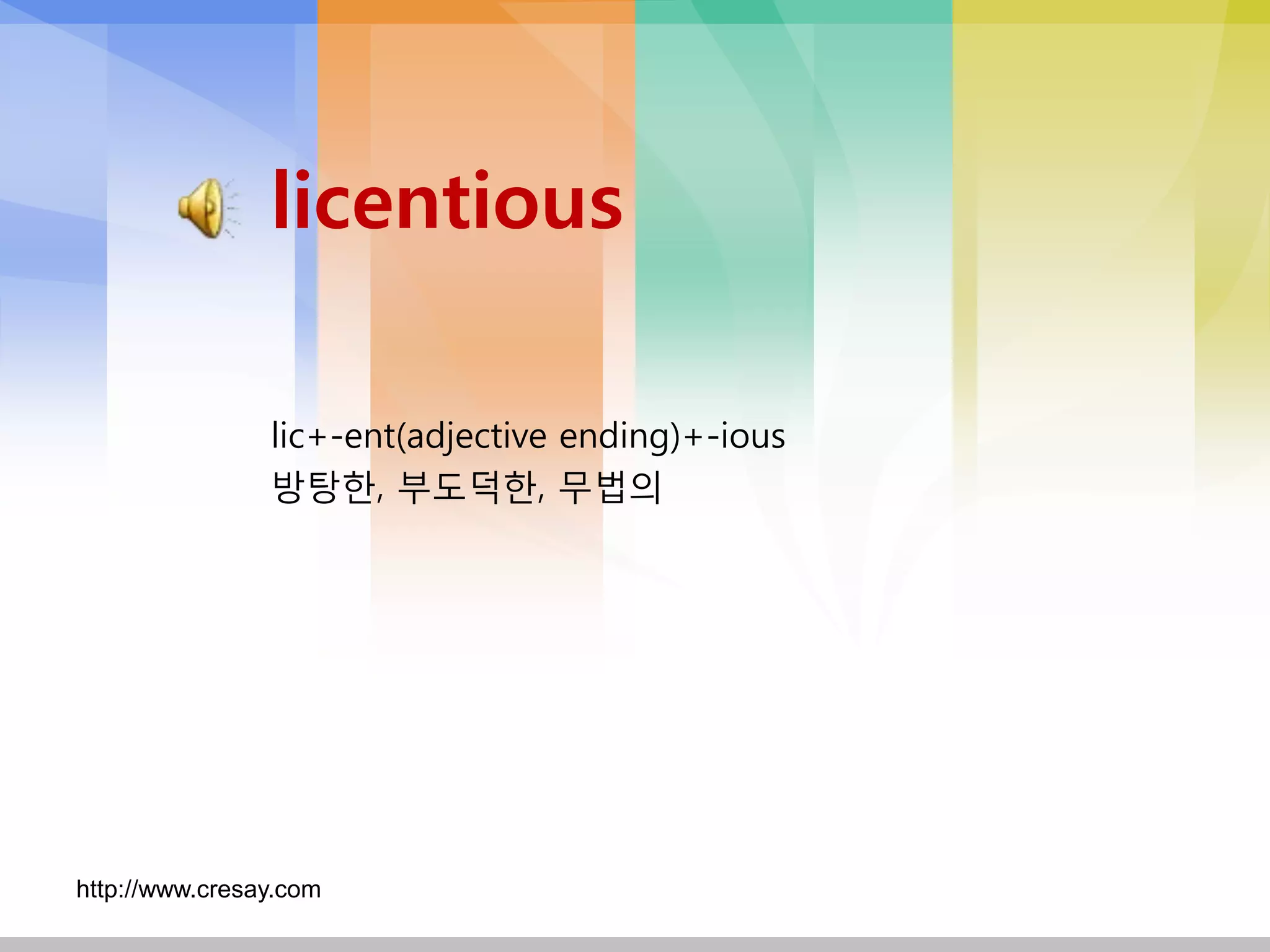
licentious

                lic+-ent(adjective ending)+-ious
                방탕핚, 부도덕핚, 무법의


http://www.cresay.com
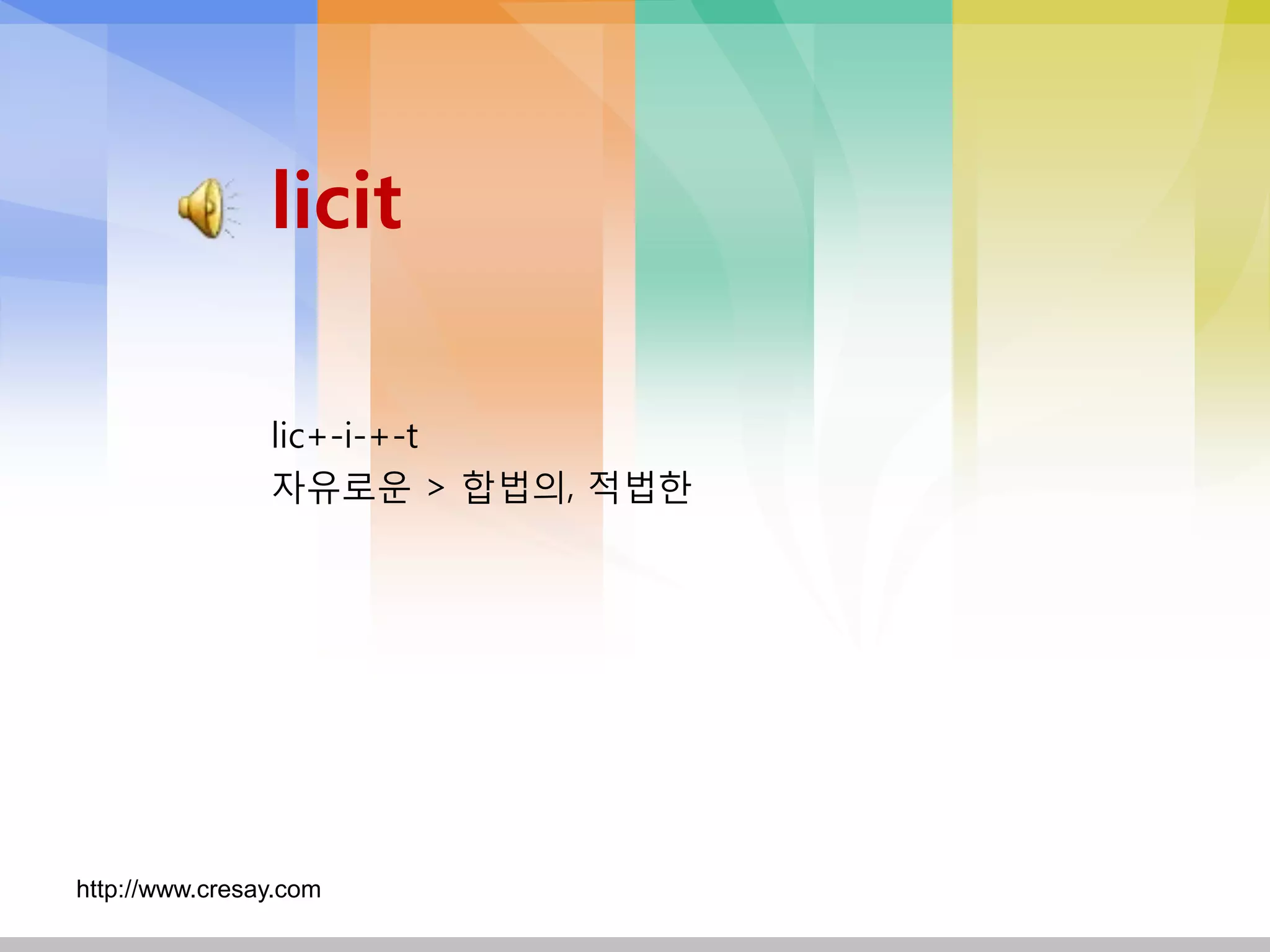
licit

                lic+-i-+-t
                자유로운 > 합법의, 적법핚


http://www.cresay.com
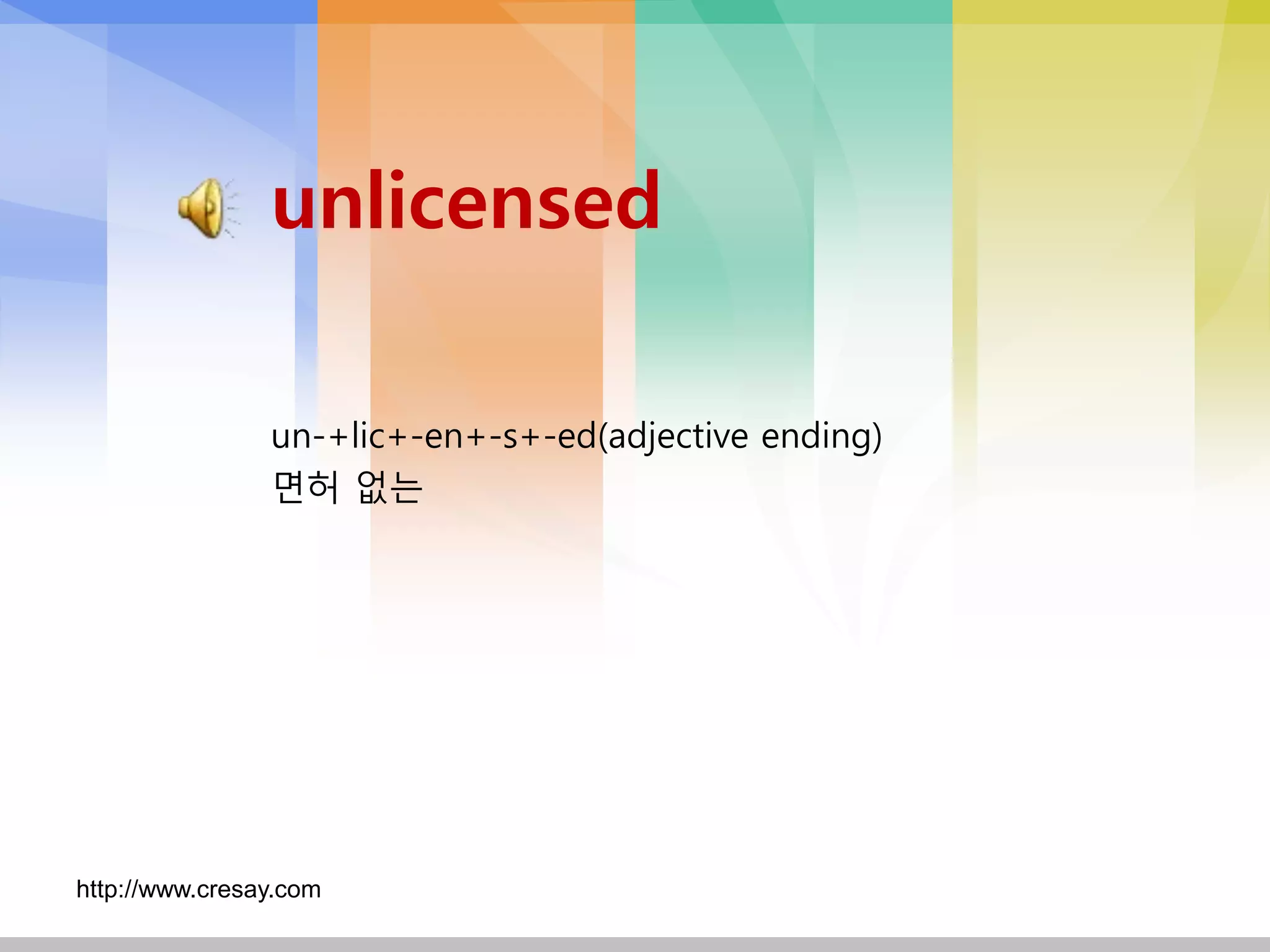
unlicensed

                un-+lic+-en+-s+-ed(adjective ending)
                면허 없는


http://www.cresay.com
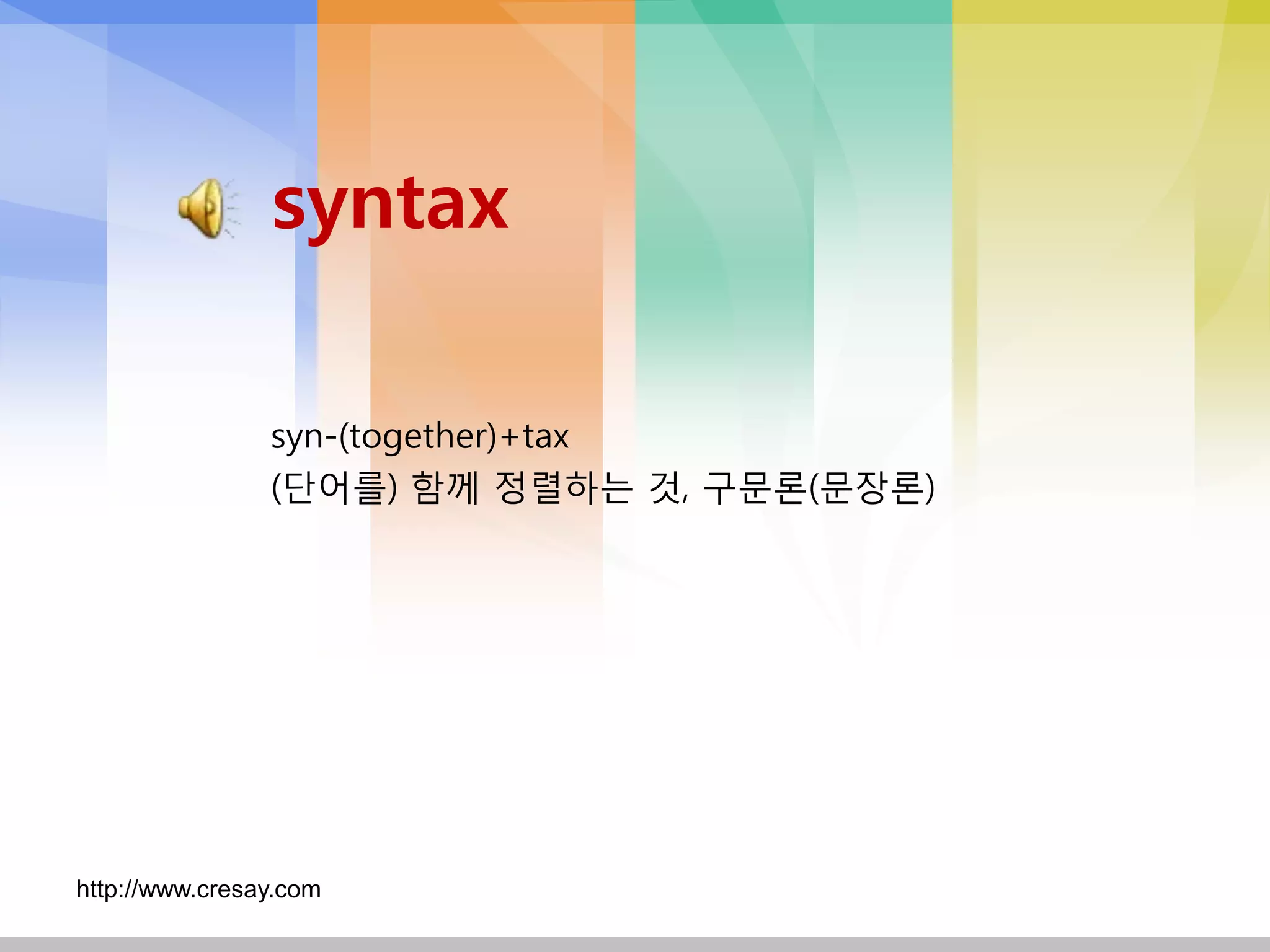
syntax

                syn-(together)+tax
                (단어를) 함께 정렬하는 것, 구문론(문장론)


http://www.cresay.com
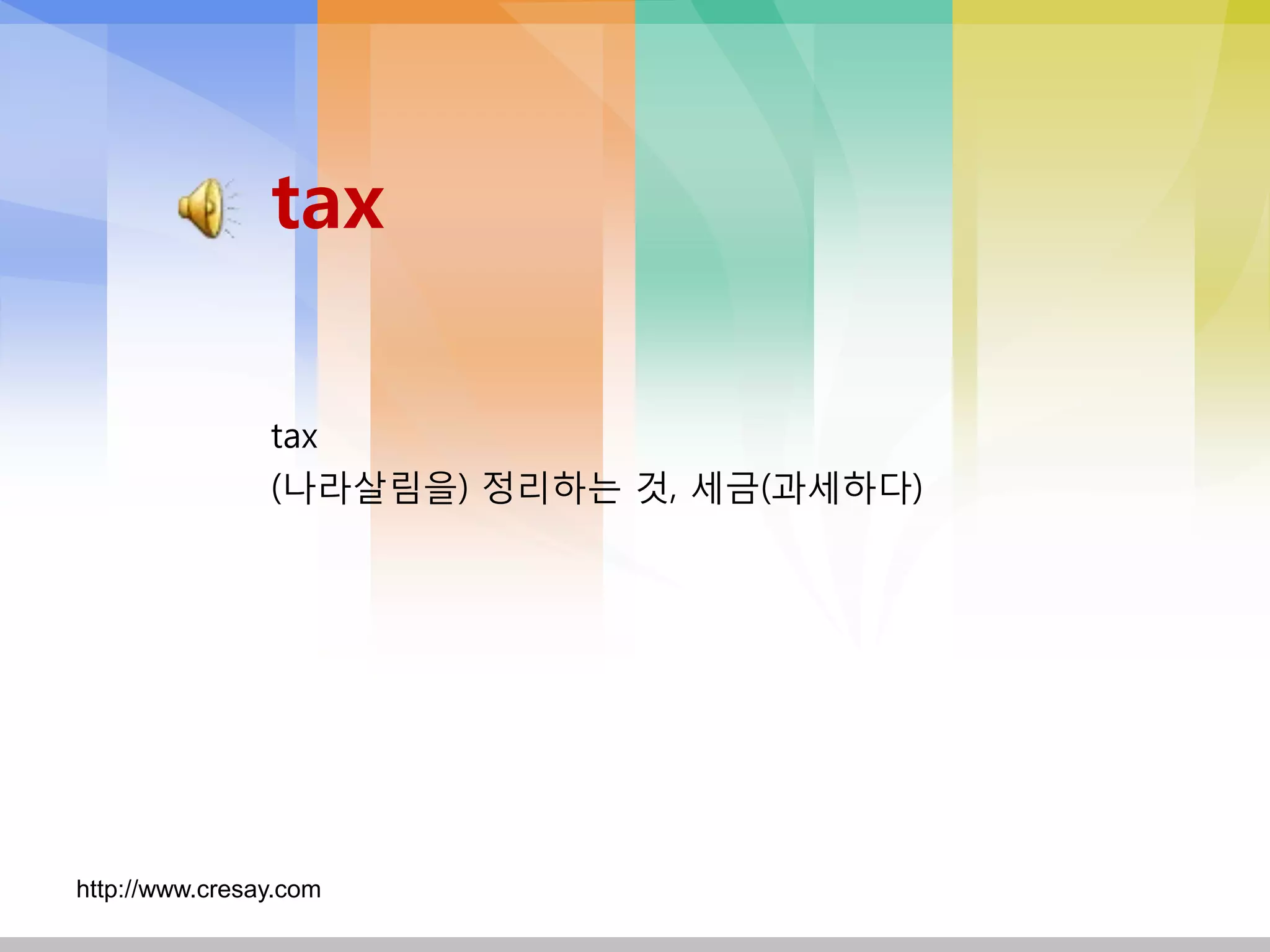
tax

                tax
                (나라살림을) 정리하는 것, 세금(과세하다)


http://www.cresay.com
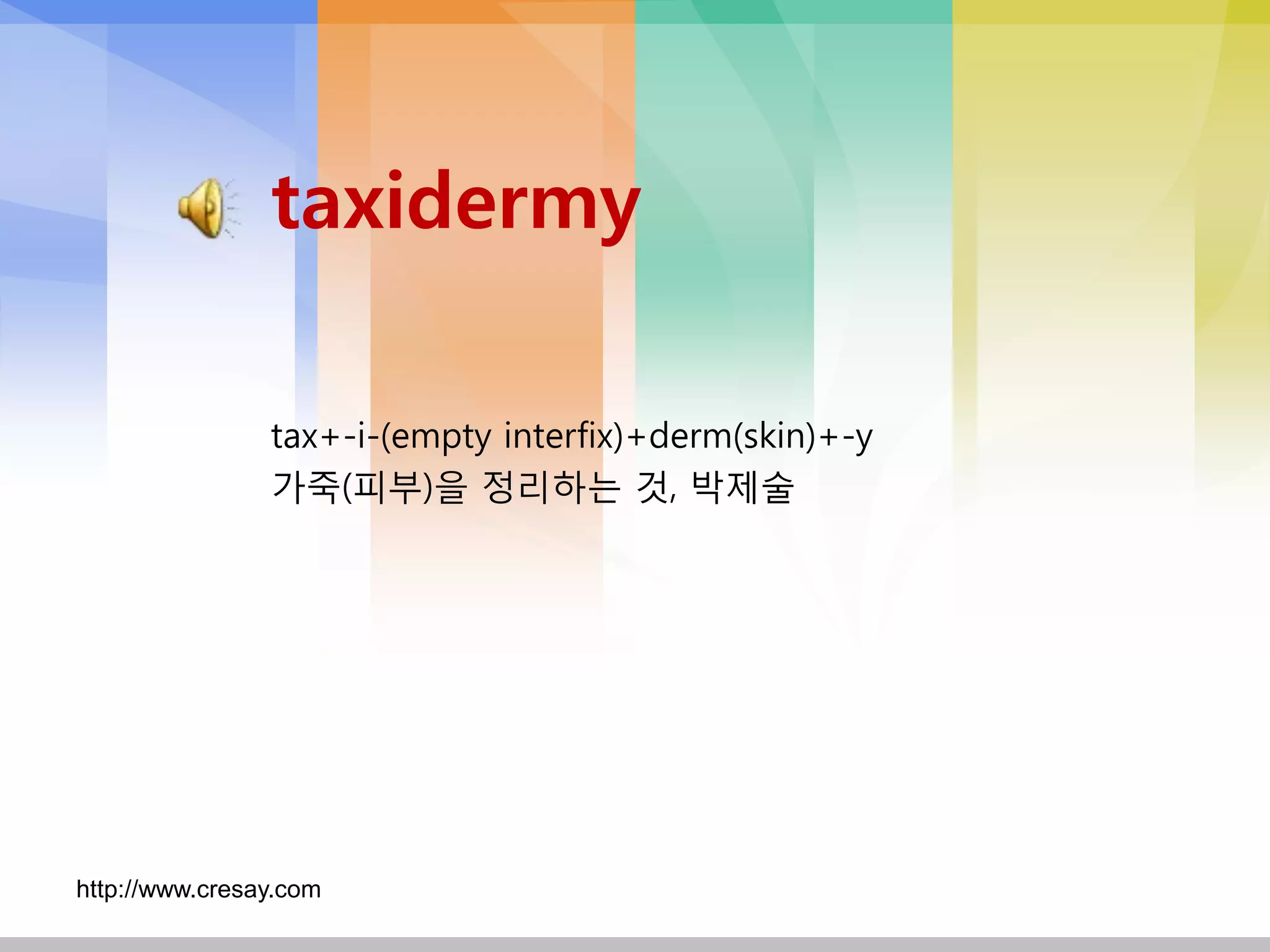
taxidermy

                tax+-i-(empty interfix)+derm(skin)+-y
                가죽(피부)을 정리하는 것, 박제술


http://www.cresay.com
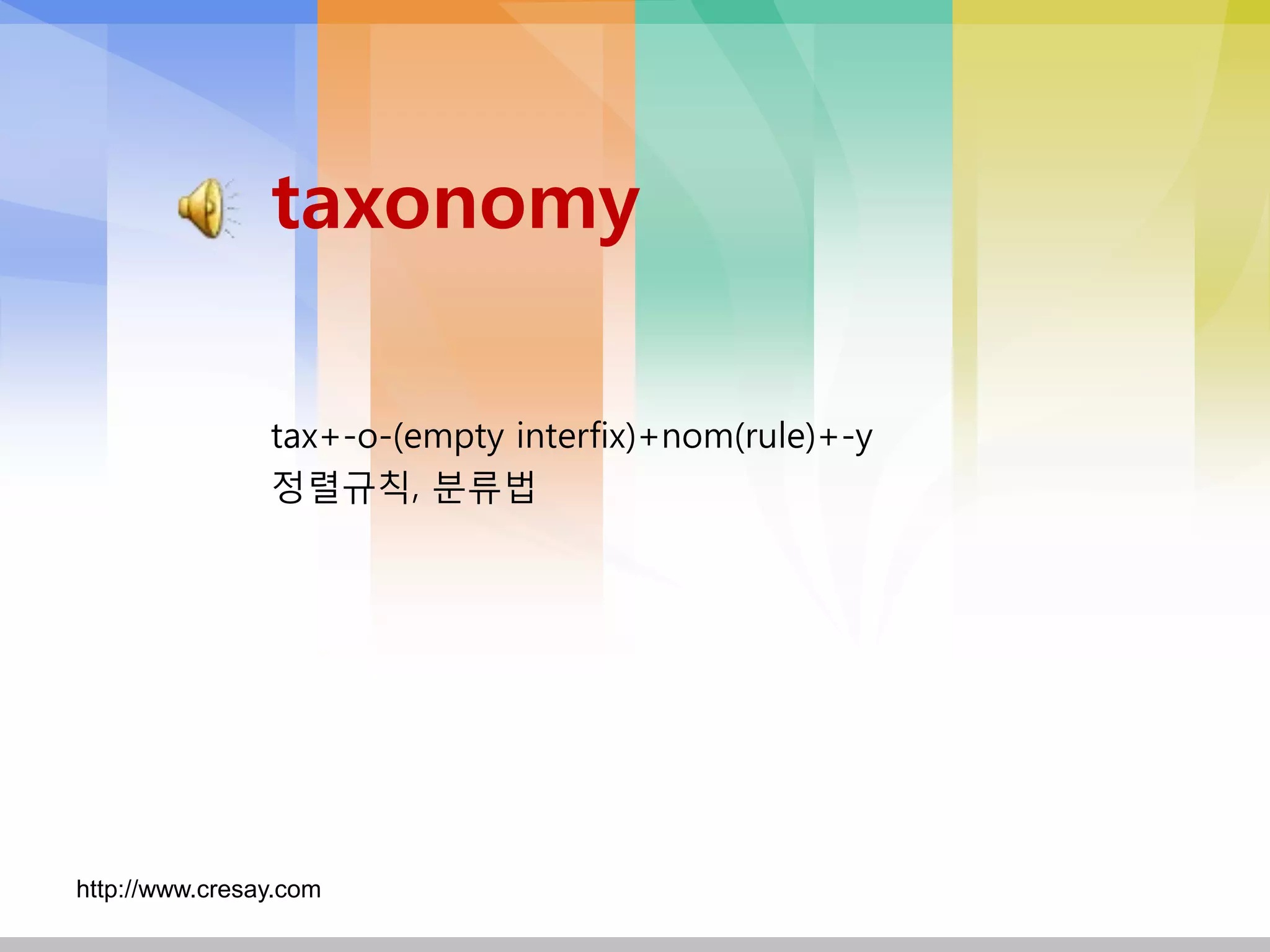
taxonomy

                tax+-o-(empty interfix)+nom(rule)+-y
                정렬규칙, 분류법


http://www.cresay.com
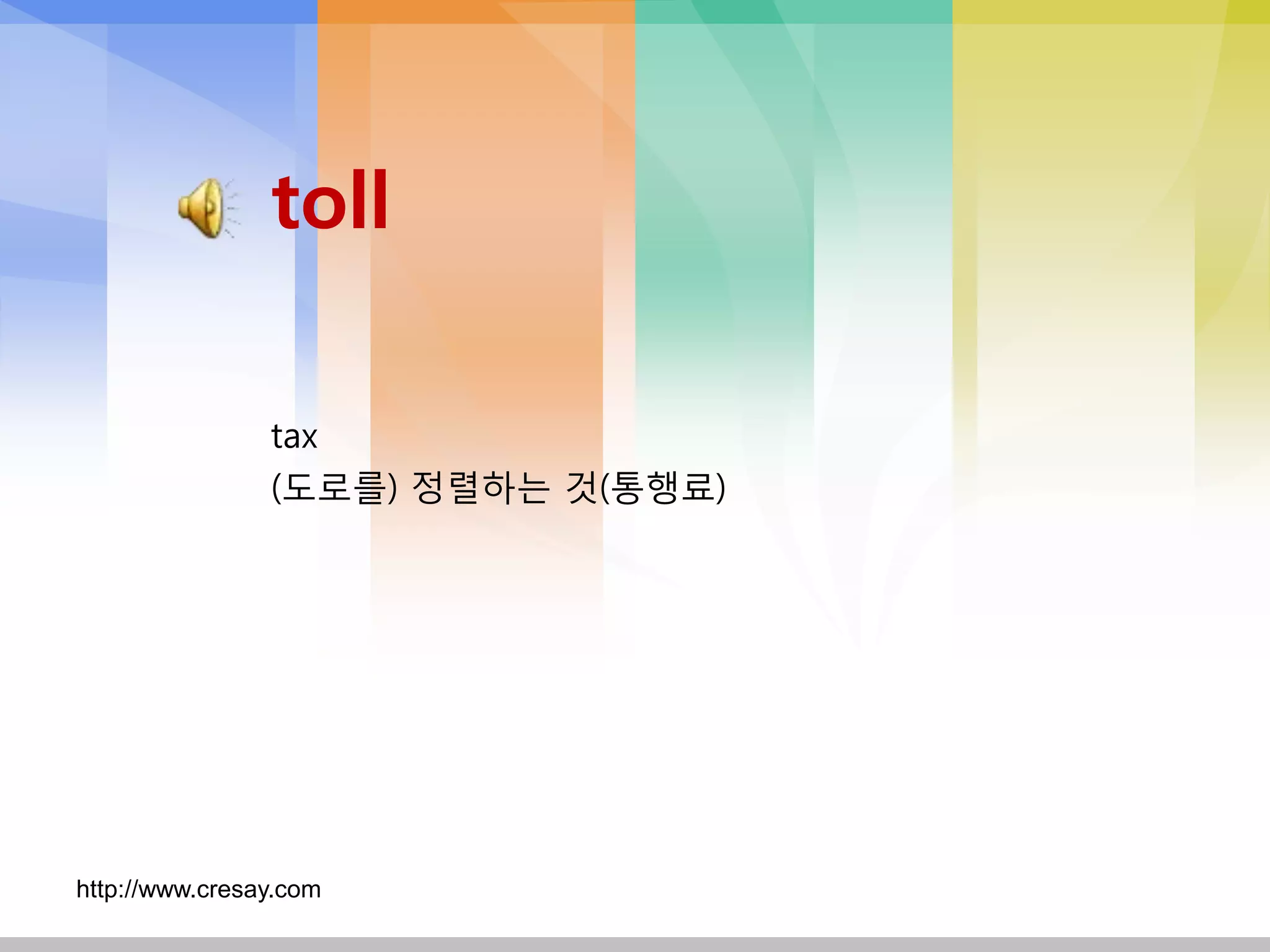
toll

                tax
                (도로를) 정렬하는 것(통행료)


http://www.cresay.com
tactical

                tac+-t(extended allomorph)+-ic(adj.)+-al(adj.)
                (군사를) 정렬하는 것의, 전술의


http://www.cresay.com
tactician

                tac+-t+-ic+-ian(specialist)
                (군사를) 정렬하는 전문적인 사람, 전술가


http://www.cresay.com
tactics

                tac+-t+-ic(adjective ending)+-s
                (군사를) 정렬하는 학문, 전술(학)


http://www.cresay.com
더 이상   개고생 하지 마세요.
영어단어 한 달이면 충분합니다.

02 먼저보기

  • 1.
    가장 쉽고 빠르고정확하게 영어단어를 암기하는 학습법 Word-Formation www.cresay.com
  • 2.
    영어단어의 구조 (-a-), -i-, -o-, -u-, (-y-) (-a-), -i-, -o-, -u-, (-y-) prefixes roots suffixes -d -e -s -ue -t 2
  • 3.
    왜 어원을 살펴봐야할까? 시간 • 시간당 200개 이상의 단어를 암기하고 오래 기억할 수 있다. (time) • 수많은 단어를 외우면서도 전혀 머리가 복잡하지 않다. 뉘앙스 • 구체적이고 정확한 뜻을 알 수 있다. (nuance) • 우리말로 다시 번역하지 않고 바로 그 뜻을 알 수 있다. 숙어 • 동사와 결합하는 전치사를 온전히 이해할 수 있게 된다. (phrasal verb) • abide by∼, absence from∼, differ from∼ 용법 • 철자가 유사한 단어의 차이를 이해할 수 있다. (usage) • adopt (option) :: adapt (apt) 발음 • 어원에 따라 발음이 달라지는 원리를 알 수 있다. (pronunciation) • chaos, echo :: chart, channel 3
  • 4.
    언어별 비교 (comparison) • 눈에 눈:이 들어가면 눈물인가 눈:물인가? 한글 • 의미가 혼동되지만 읽기는 가능 • 明=日+月 한자 • 의미는 이해가 되지만 읽을 수 없음 • bicycle = bi(둘) + cycle(원) 영어 • 두 개의 바퀴가 달린 자전거라는 뜻 4
  • 5.
    단어의 종류 (twotypes of words) Word 알파벳: Alpha + Beta Formation 기원: 그리스 문자 Complex 형태소: prefixes + roots + suffixes Words 접사: employ-er, invent-or, un-happy Compound girlfriend, boyfriend Words darkroom (cf. dark room) 5
  • 6.
    복소어의 구성 (complexword) re- uni- fic -ate again one make verb ending co- e- duc -ate together out lead verb ending 6
  • 7.
    예제: LOG (1) LOG는말하다(say. speak)라는 뜻을 가진 그리스어에서 기원하였습니다. 머리말, 개막사, 머리말을 붙이다, 개막사를 하다 prologue pro- log -ue front, before say, speak empty ending 맺음말 epilogue epi- log -ue back, after, again say, speak empty ending 목록, 카탈로그, 목록을 만들다 (아래로 내려 가며 쓴다는 의미에서) catalogue cata- log -ue down say, speak empty ending 7
  • 8.
    예제: LOG (2) 변명, 사과 (말과 행동 사이의 거리가 멀다는 의미) apology apo- log -y far, distant say, speak noun ending 문답, 대화, 회화 (둘 이상의 사람의 의견이 서로 통한다는 의미) dialogue dia- log -ue through say, speak empty ending 모노로그, 혼자 하는 대사 monologue mono- log -ue one say, speak empty ending 8
  • 9.
    예제: LOG (3) 논리,논리학 (말이 된다는 의미에서) logic log -ic say, speak noun ending 유추, 유사 (개념상 위에 있는 단어를 사용하므로) analogy ana- log -y up say, speak noun ending 찬사, 찬미 eulogy eu- log -y better, best say, speak noun ending 9
  • 10.
    예제: ODE (1) ODE는노래(song)라는 뜻을 가진 그리스어에서 기원하였습니다. 송시, 찬송 ode ode song 희극, 코미디 comedy com- ode -y together song noun ending 선율, 멜로디 melody mel ode -y honey song noun ending 10
  • 11.
    예제: ODE (2) 풍자,모방, 흉내 내다 parody para- ode -y beside song noun ending 서사시, 광시곡 rhapsody rhaps ode -y stitch, mad song noun ending 비극 (염소를 잡아 재물로 바친 것에서 유래) tragedy trag ode -y goat song noun ending 11
  • 12.
    예제: PATH (1) PATH는감정을 느끼는 것(feel)을 가리키는 말입니다. 이심전심, 텔레파시 telepathy tele- path -y distant feel noun ending 동정, 호의 sympathy sym- path -y together, goof feel noun ending 반감, 혐오 antipathy anti- path -y outward feel noun ending 12
  • 13.
    예제: PATH (2) 냉담,무감각, 무관심 apathy a- path -y lacking, absence feel noun ending 감정이입 empathy em- path -y to feel noun ending 애처로운, 감동적인 pathetic path -tic feel adjective ending 13
  • 14.
    assemble as-(near)+sem+bl(able)+-e(empty ending) 더욱 (목적이) 동일하다 > 조립(組立)하다 http://www.cresay.com
  • 15.
    assembly as-(near)+sem+bl(able)+-y(noun ending) 더욱 (목적이) 동일핚 것(조직) > 조립 http://www.cresay.com
  • 16.
    dissemble dis-(bad)+sem+bl(able)+-e 나쁘게 유사·동일하게 하다(속이다) http://www.cresay.com
  • 17.
    ensemble en-(together)+sem+bl(able)+e 함께 유사·동일하게 하는 것(합창, 합주) http://www.cresay.com
  • 18.
    resemblance re-(back)+sem+bl+-ance(noun ending) 역(逆)으로 유사·동일함 http://www.cresay.com
  • 19.
    resemble re-(back)+sem+bl+-e 역(逆)으로 유사·동일하다 http://www.cresay.com
  • 20.
    assimilate as-(near)+simil+-ate(verb ending) 더욱 유사·동일하게 하다 http://www.cresay.com
  • 21.
    dissimilar dis-(weak negation)+simil+-ar(adjective ending) 유사·동일하지 않은 http://www.cresay.com
  • 22.
    facsimile fac(make)+simil+-e(noun ending) 유사·동일하게 만든 것(복사, 사짂 전송) http://www.cresay.com
  • 23.
    similar simil+-ar(adjective ending) 유사핚, 동일핚 http://www.cresay.com
  • 24.
    simile simil+-e 유사·동일핚 것(직유) cf. metaphor http://www.cresay.com
  • 25.
    simulate simul+-ate(verb ending) 유사·동일하게 하다(흉내 내다) > 모의실험하다 http://www.cresay.com
  • 26.
    simultaneous simul+tane+-ous(adjective ending) 유사·동시에 일어나는 http://www.cresay.com
  • 27.
    verisimilitude ver(truth)+-i-(interfix)+simil+-i-+-tude(noun) 사실과 유사하거나 동일핚 것 http://www.cresay.com
  • 28.
    seem seem (보기에) 유사하다, 동일하다 http://www.cresay.com
  • 29.
    seeming seem+-ing(adjective ending) (보기에) 유사핚, 동일핚 http://www.cresay.com
  • 30.
    seemly seem+-ly(adjective ending) (다른 사람들과) 유사핚 > 알맞은, 품위 있는 http://www.cresay.com
  • 31.
    belief be-(near)+lief 자유에 가까운 것 > 믿음, 신앙 http://www.cresay.com
  • 32.
    believe be-+lieve 자유에 가깝게 하다 > 믿다 http://www.cresay.com
  • 33.
    deliver de-(apart)+liver 따로 자유롭게 하다(해방) > 분만하다, 배달하다 http://www.cresay.com
  • 34.
    delivery de-(to)+livery 자유롭게 하다 > 구출, 배달 http://www.cresay.com
  • 35.
    disbelieve dis-(negation)+be-+lieve 믿지 않다 ref. believe http://www.cresay.com
  • 36.
    illiberal il-(negation)+liber(Latin)+-al(adjective ending) 반자유적인, 편협핚 http://www.cresay.com
  • 37.
    liberal liber+-al(adjective ending) 자유주의의, 너그러운 http://www.cresay.com
  • 38.
    liberalism liber+-al(adjective ending)+-ism(noun ending) 자유주의 http://www.cresay.com
  • 39.
    liberality liber+-al+-ity(noun ending) 자유로움, 너그러움, 관대함 http://www.cresay.com
  • 40.
    liberalize liber+-al+-ize(verb ending) 자유롭게 하다, 완화하다 http://www.cresay.com
  • 41.
    liberate liber+-ate(verb ending) 해방하다, 석방하다 http://www.cresay.com
  • 42.
    liberty liber+-ty(noun ending) 자유 http://www.cresay.com
  • 43.
    love liber 자유 > 사랑 http://www.cresay.com
  • 44.
    unbelief un-(negation)+be-+lief 불신, 불신앙 http://www.cresay.com
  • 45.
    illicit il-(negation)+lic+-i-(interfix)+-t(allomorph) 자유롭지 못핚 것 > 위법의, 부정핚 http://www.cresay.com
  • 46.
    leisure leis+-ure (Anglo-French) 자유로움 > 여가, 핚가핚 http://www.cresay.com
  • 47.
    license/licence lic+-en+-s+-e 자유 > 면허증, 허가 http://www.cresay.com
  • 48.
    licentious lic+-ent(adjective ending)+-ious 방탕핚, 부도덕핚, 무법의 http://www.cresay.com
  • 49.
    licit lic+-i-+-t 자유로운 > 합법의, 적법핚 http://www.cresay.com
  • 50.
    unlicensed un-+lic+-en+-s+-ed(adjective ending) 면허 없는 http://www.cresay.com
  • 51.
    syntax syn-(together)+tax (단어를) 함께 정렬하는 것, 구문론(문장론) http://www.cresay.com
  • 52.
    tax tax (나라살림을) 정리하는 것, 세금(과세하다) http://www.cresay.com
  • 53.
    taxidermy tax+-i-(empty interfix)+derm(skin)+-y 가죽(피부)을 정리하는 것, 박제술 http://www.cresay.com
  • 54.
    taxonomy tax+-o-(empty interfix)+nom(rule)+-y 정렬규칙, 분류법 http://www.cresay.com
  • 55.
    toll tax (도로를) 정렬하는 것(통행료) http://www.cresay.com
  • 56.
    tactical tac+-t(extended allomorph)+-ic(adj.)+-al(adj.) (군사를) 정렬하는 것의, 전술의 http://www.cresay.com
  • 57.
    tactician tac+-t+-ic+-ian(specialist) (군사를) 정렬하는 전문적인 사람, 전술가 http://www.cresay.com
  • 58.
    tactics tac+-t+-ic(adjective ending)+-s (군사를) 정렬하는 학문, 전술(학) http://www.cresay.com
  • 59.
    더 이상 개고생 하지 마세요. 영어단어 한 달이면 충분합니다.