2011 NFL SOLUTIONAVOIDING A WORK STOPPAGE1Jason Mathas © Copyright  2010-11 • Jason@JasonMathas.com
A WORK STOPPAGE BENEFITS NO ONEProjected 2011 revenue for the NFL is $9B.Equitable distribution of revenue is critical for all participants.But increasing net revenue for all is more important than leveraging percentage.50% of a $9B+ yearly business is more valuable than 100% of a $0-4.4B business.The revenue lost during a full year work stoppage will require 9 years to recoup if total yearly revenue increased by 1B per year after work stoppage.That is an optimistic/unrealistic projection to expect an average of 11-12% growth (compared to $9B/year) over the next 9 years.Jason Mathas © Copyright  2010-11 • Jason@JasonMathas.com2
INCREASE REVENUE IN 16-GAME REGULAR SEASON WITH STRATEGIC PLAN FOR EXPANSIONInstead of spending more time on difficult negotiations for an increase in regular season games, there is great potential for significantly more revenue under the current 16-game regular season.Efforts and energy by league, owners, players association and players are better spent maximizing revenue under current system, than recreating it.While efficiently increasing revenue under current system, a plan for expansion (within the next 3-5 years) can be developed to benefit everyone involved.Jason Mathas © Copyright  2010-11 • Jason@JasonMathas.com3
ADVANCING NEGOTIATIONSLeague, owners and players can all reap greater profits from current system without increasing to an 18-game regular season.Significant additional revenue is being left on the table and completely overlooked.Greater revenue, an improved NFL product and satisfied participants (league, owners, players) can coexist.By removing the “18-Game Regular Season” barrier, negotiations can advance to other critical issues:Revenue sharingRookie wage scaleRetired players’ benefitsJason Mathas © Copyright  2010-11 • Jason@JasonMathas.com4
18 GAME SEASON DOES NOT ADD REVENUE GAMES4 pre-season + 16 regular season=20 games/team2 pre-season + 18 regular season=20 games/teamThis is simply a redistribution, rather than addition.Theoretically more regular season games should result in more revenue, but in practical application the ROI will not justify the change.But there is a way to generate more revenue without altering the current pre/regular season (4+16) format.Jason Mathas © Copyright  2010-11 • Jason@JasonMathas.com5
NFL INSTANT REVENUE INCREASE WITHOUT 18-GAME REGULAR SEASONPost-season games (on a 1 to 1 comparison) are far  more valuable for revenue generation than pre-season or regular season games.Compare total revenue generated during 11 post-season games (4 rounds-wild card to Super Bowl) with the highest revenue generated by 11 regular season games.Increasing post-season games is the most efficient way to increase revenue without implementing an 18-game regular season, and combating the resultant resistance from players and NFLPA.Jason Mathas © Copyright  2010-11 • Jason@JasonMathas.com6
MORE “MEANINGFUL” GAMES, NOT SIMPLY “MORE” GAMESAdding games does not guarantee long-term revenue increases, without a strategic transitional plan.Adding games without a strategic plan devalues and dilutes the NFL product.  This can weaken the NFL’s position for future tv contract negotiations.18-game regular season is not the most efficient method to increase revenue.  Plus it risks alienating advertisers/sponsors, players and fans.Post-Season/Playoff games intensify the NFL product.Playoff expansion creates a solution for the league, owners and players that is equitable and profitable. Jason Mathas © Copyright  2010-11 • Jason@JasonMathas.com7
PLAYERS WON’T OBJECT TO MORE “MEANINGFUL” GAMESThe 2010 Packers played 24 gamesThe 2007 Giants played 24 gamesThe 2005 Steelers played 24 games4 pre-season games16 regular season games4 post-season gamesWild card teams reaching the Super Bowl play 4 additional gamesNo player has ever resisted playing more than 16 games, when additional games are played in the post-season.But they’re already resisting the concept of more than 16 games in the regular season.Jason Mathas © Copyright  2010-11 • Jason@JasonMathas.com8
ADDITIONAL GAMES REPACKAGED, MADE MORE APPEALINGUnder the current 12-team NFL playoff tournament, an 18-game regular season creates greater likelihood of more inconsequential games during the final month of the season.More inconsequential games translates into less player and fan interest because playoff teams are set and final games don’t impact teams that qualify.Qualifying more teams for post-season ensures competitive games during every week of the season.Teams will battle for 1st round byes, 1st round home games and the precious few remaining 1st round road games in playoffs.Jason Mathas © Copyright  2010-11 • Jason@JasonMathas.com9
INCENTIVIZE TEAMS TOEARN 17TH GAMEGenerating the most possible revenue is a combination of putting the best product on the field to create fan interest, resulting in stadium sellouts, high tv ratings and ultimately more lucrative tv contracts with networks.Increasing the number of regular season games doesn’t automatically ensure all teams will do their absolute best to be competitive for the duration of the season.Rewarding the top 24 teams provides the motivation for all 32 to focus on attempting to win every game, rather than resting starters late in the season (once a playoff spot is secured) or playing for draft position (when eliminated from post-season contention).Jason Mathas © Copyright  2010-11 • Jason@JasonMathas.com10
REWARDS AND REPERCUSSIONSPlayers who perform well earn more money. Players who don’t perform well make less or are cut.Teams should be subject to the same paradigm.Teams with the best records qualify for the post-season, play more games and earn more money.Teams who don’t qualify for the playoffs, play less games and make less money.The onus should be on both players AND teams to perform well in order to earn increased compensation and generate more revenue.Jason Mathas © Copyright  2010-11 • Jason@JasonMathas.com11
REGULAR SEASON PERFORMANCE DETERMINES POST-SEASON APPEARANCE(S) AND REVENUE POTENTIALMake the post-season, play more games, generate more revenue.Miss the post-season, play less games, generate less revenue.18-game regular season means 9 home games per teamAdditional meaningful games can be created without immediate expansion to 18-game regular season.16-game regular season with 24-team playoff expansion system guarantees:Minimum of 9 home games for 16 of 32 teams=50%100% increase over current system (from 8 to 16)Minimum of 17 meaningful games for 24 of 32 teams=75%100% increase over current system (from 12 to 24)If 24 teams make the playoffs, a slow start or marginal record will not cause a team to jettison talent or play for next year because the real possibility for a playoff spot still exists.Jason Mathas © Copyright  2010-11 • Jason@JasonMathas.com12
PLAYOFF GAMES ARE GUARANTEED SELLOUTS, RATINGS WINNERS & AD REVENUE GOLDMINESAdding 2 regular season games (games 17 & 18) will likely result in many empty stadiums, disgruntled season ticket holders/fans and local blackouts for teams out of the playoff picture.This dilutes the quality of play and tarnishes the reputation of the NFL.Adding an additional round of playoffs, creates a 17th game for 75% of teams and provides the opportunity to contend for a Super Bowl.  This translates into more sold out stadiums because of more meaningful games.Jason Mathas © Copyright  2010-11 • Jason@JasonMathas.com13
POST-SEASON PARTICIPATIONCurrent NFL Playoff System qualifies 12 teams in a single-elimination tournament12/32=38% of teams make post-seasonNBA Qualifies 16/30 teams=53%4 round playoff system (best of 7 series format) results in numerous games and opportunities for revenue.MLB Qualifies 8/30 teams=27%But Triple and Quadruple elimination format of NBA and MLB requires too much time for resolution.Jason Mathas © Copyright  2010-11 • Jason@JasonMathas.com14
NFL PLAYOFF PARTICIPATION HISTORYIn a 32-team league (2002-2010) 12/32 teams make playoffs=38%In a 30-team league (1995-2001) 12/30 teams made playoffs=40%In a 28-team league (1990-1995), 12/28 teams made playoffs=43%In 1982* 16/28 teams made playoffs=57% (*strike shortened season)In a 28-team league (1978-1989) 10/28 teams made playoffs=36%In a 28-team league (1976-1977) 8/28 teams made playoffs=29%In a 26-team league (1970-1975) 8/26 teams made playoffs=30%The NFL has already gone as high as 57% of teams qualifying for post-season in 1982.  Then, “necessity demanded creativity”. The “loss of revenue” consequences of a work stoppage in 2011 are considerably greater.  Now “crisis demands resolution”.Jason Mathas © Copyright  2010-11 • Jason@JasonMathas.com15
VIABLE AND FEASIBLE POST-SEASON SOLUTIONS FOR NFLCurrent NFL system is 4-Round Playoff: 12/32 teams make playoffs=38%11 post-season games (including Super Bowl)Solution #15-Round Playoff: 24/32 teams make playoffs=75%23 post-season games (including Super Bowl)Solution #2	Separate PPT19 post-season games (including Super Bowl)Solution#3	Separate PPT13 post-season games (including Super Bowl)Jason Mathas © Copyright  2010-11 • Jason@JasonMathas.com16
24-TEAM PLAYOFF BENEFITSSolution #15-Round Playoff: 24/32 teams make playoffs=75%23 post-season games (including Super Bowl)Qualifying more teams for playoffs will make regular season more competitive and compelling throughout all 16 games.Teams like Giants and Bucs are rewarded, rather than punished, for a 10-6 record (that earned the Packers a chance at a Super Bowl and ultimately a championship), but eliminated them from post-season because of tiebreakers and division alignment.Fewer teams are mathematically eliminated with 4-6 games remaining.More playoff teams means more competitive/compelling regular season games, more exciting playoff games and the resultant increase in playoff revenue.Jason Mathas © Copyright  2010-11 • Jason@JasonMathas.com17
MOTIVATING TEAMS TO COMPETE IN ALL 16 REGULAR SEASON GAMES8 teams (1-4 from each conference) are guaranteed a 1st round bye, 2nd round home game and the shortest, most direct path to the Super Bowl.8 teams (5-8 from each conference) are guaranteed 1st round home games.8 teams (9-12 from each conference) are guaranteed a playoff berth and 1st round road games.Jason Mathas © Copyright  2010-11 • Jason@JasonMathas.com18
TEAMS 1-4 WILL PLAY HARDER, ALL SEASON, WITH EXPANDED PLAYOFFSThe top record in each conference secures home-field advantage throughout the playoffs.  This creates motivation to play for more than simply a playoff spot and 1st round bye.  The ranking of teams 1-4 can be altered pending the outcome of all 16 regular season games, especially the last 4, because all 32 teams will still be in contention, playing hard, late in the season despite record.Teams ranked 1-4 will play hard all seasonto earn home-field advantage throughout the playoffsto earn a 1st round bye by finishing in the top 4to not slip to 5-8 in conference and be forced to play a 1st round home gameto not slip to 9-12 in conference and be forced to play a 1st round road gameTo not slip out of the playoffs altogetherJason Mathas © Copyright  2010-11 • Jason@JasonMathas.com19
TEAMS 5-8 WILL PLAY HARDER, ALL SEASON, WITH EXPANDED PLAYOFFS8 teams (5-8 from each conference) are guaranteed a 1st round home game.Qualifying for the playoffs and earning a home game, even without a 1st round bye creates an easier path to the Super Bowl.The ranking of teams 5-8 can be altered pending the outcome of all 16 regular season games, especially the last 4, because all 32 teams will still be in contention, playing hard, late in the season despite record.Teams ranked 5-8 will play hard all seasonto possibly move into the top 4 and earn a 1st round byeto not slip to 9-12 in conference and be forced to play a 1st round road gameTo not slip out of the playoffs altogetherJason Mathas © Copyright  2010-11 • Jason@JasonMathas.com20
TEAMS 9-12 WILL PLAY HARDER, ALL SEASON, WITH EXPANDED PLAYOFFS8 teams (9-12 from each conference) are guaranteed a playoff spot and 1st round road game.Qualifying for the playoffs earns teams a 17th game and the opportunity to compete for a chance to advance to the Super Bowl.The ranking of teams 9-12 can be altered pending the outcome of all 16 regular season games, especially the last 4, because all 32 teams will still be in contention, playing hard, late in the season despite record.Teams ranked 9-12 will play hard all seasonto possibly move into the top 4 and earn a 1st round bye.to earn a 1st round home game by finishing ranked 5-8.to maintain a position in the top 12 and prevent post-season elimination.Jason Mathas © Copyright  2010-11 • Jason@JasonMathas.com21
TEAMS 13-16 WILL PLAY HARDER, ALL SEASON, WITH EXPANDED PLAYOFFS8 teams (13-16 from each conference) have the opportunity to control their own destiny and earn a playoff spot, in spite of a slow start or mid-season slump.  The possibility of controlling destiny by winning games will create motivation to stay focused all season long.Qualifying for the playoffs by moving up from position 13-16 to a top 12 ranking earns teams a 17th game and the opportunity to compete and potentially advance to the Super Bowl.  As long as there’s a legitimate opportunity to compete for a world championship, greater effort will be put forth.The ranking of teams 13-16 can be altered pending the outcome of all 16 regular season games, especially the last 4.Teams ranked 13-16 will play hard all seasonto possibly move into the top 12 and earn a playoff berth.to potentially earn a 1st round home game by finishing ranked 5-8to go from “out of” the playoffs to “in”, simply by winning remaining games.Jason Mathas © Copyright  2010-11 • Jason@JasonMathas.com22
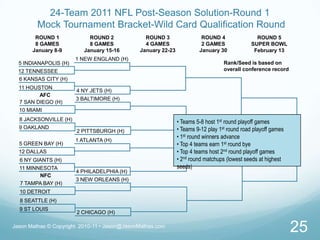
24-TEAM PLAYOFF DETAILS5 Round post-season (including Super Bowl).Top 12 records from each conference qualify.Playoff seeding/rank based on overall record compared to other teams in conference (with applicable tiebreakers).Teams 1-4 in each conference (not necessarily division winners) receive 1st round bye and 2nd round home game.Teams 5-8 in each conference play 1st round home game.Teams 9-12 in each conference play 1st round road gameJason Mathas © Copyright  2010-11 • Jason@JasonMathas.com23
24-Team PlayoffRound 1 (8 Games)Wild card “Qualification Round”-GAME 17Teams 5-12 in each conference play in 1st round.Teams 5-8 host home games, teams 9-12 travel.5 vs 12, 6 vs 11, 7 vs 10, 8 vs 924 teams reduced to 16 during round 1.Winners advance and play road game in 2nd round.Jason Mathas © Copyright  2010-11 • Jason@JasonMathas.com24
24-Team 2011 NFL Post-Season Solution-Round 1 Mock Tournament Bracket-Wild Card Qualification RoundJason Mathas © Copyright  2010-11 • Jason@JasonMathas.com25ROUND 18 GAMESJanuary 8-9ROUND 34 GAMESJanuary 22-23ROUND 42 GAMESJanuary 30ROUND 28 GAMESJanuary 15-16ROUND 5SUPER BOWLFebruary 131 NEW ENGLAND (H)Rank/Seed is based on overall conference record5 INDIANAPOLIS (H)12 TENNESSEE6 KANSAS CITY (H)11 HOUSTON4 NY JETS (H)AFC3 BALTIMORE (H)7 SAN DIEGO (H)10 MIAMI• Teams 5-8 host 1st round playoff games• Teams 9-12 play 1st round road playoff games• 1st round winners advance  • Top 4 teams earn 1st round bye• Top 4 teams host 2nd round playoff games• 2nd round matchups (lowest seeds at highest seeds)8 JACKSONVILLE (H)9 OAKLAND2 PITTSBURGH (H)1 ATLANTA (H)5 GREEN BAY (H)12 DALLAS6 NY GIANTS (H)11 MINNESOTA4 PHILADELPHIA (H)NFC3 NEW ORLEANS (H)7 TAMPA BAY (H)10 DETROIT8 SEATTLE (H)9 ST LOUIS2 CHICAGO (H)
24-TEAM PLAYOFF ROUND 1 SCHEDULING-OPTION 1Option 1 (8 Games)3 Saturday Games/3 Sunday Games/2 Monday GamesSaturday & Sunday 1:30 PM EST-1 Game (East Coast Host Team)Saturday & Sunday 5:00 PM EST-1 GameSaturday & Sunday 8:30 PM EST-1 GameMonday 7:00 PM EST-1 Game (East Coast Host Team)Monday 10:30 PM EST-1 Game (West Coast Host Team)This expands revenue opportunities over 3 days, but also requires more viewer commitment.  But the Monday addition is a familiar adaptation for NFL fans.This option provides a singular national audience focus for all 8 games, which creates national ad revenue increases.Jason Mathas © Copyright  2010-11 • Jason@JasonMathas.com26
24-Team 2011 NFL Post-Season Solution-Round 1 Mock Tournament Bracket-Wild Card Qualification RoundJason Mathas © Copyright  2010-11 • Jason@JasonMathas.com27ROUND 18 GAMESJanuary 8-10ROUND 34 GAMESJanuary 22-23ROUND 42 GAMESJanuary 30ROUND 28 GAMESJanuary 15-17ROUND 5SUPER BOWLFebruary 131 NEW ENGLAND (H)Rank/Seed is based on overall conference record5 INDIANAPOLIS (H)12 TENNESSEE6 KANSAS CITY (H)11 HOUSTONRound 1-Scheduling Option 13 Saturday Games/3 Sunday Games/2 Monday GamesSaturday January 8 (1:30 PM EST)-Tampa Bay vs DetroitSaturday January 8 (5:00 PM EST)-Jacksonville vs OaklandSaturday January 8 (8:30 PM EST)-Indianapolis vs TennesseeSunday January 9 (1:30 PM EST)-Kansas City vs HoustonSunday January 9 (5:00 PM EST)-San Diego vs MiamiSunday January 9 (8:30 PM EST)-Green Bay vs DallasMonday January 10 (7:00 PM EST)-NY Giants vs MinnesotaMonday January 10 (10:30 PM EST)-Seattle vs St Louis4 NY JETS (H)AFC3 BALTIMORE (H)7 SAN DIEGO (H)10 MIAMI8 JACKSONVILLE (H)9 OAKLAND2 PITTSBURGH (H)1 ATLANTA (H)5 GREEN BAY (H)12 DALLAS6 NY GIANTS (H)11 MINNESOTA4 PHILADELPHIA (H)NFC3 NEW ORLEANS (H)7 TAMPA BAY (H)10 DETROIT8 SEATTLE (H)9 ST LOUIS2 CHICAGO (H)
24-TEAM PLAYOFF ROUND 1 SCHEDULING-OPTION 2Option 2 (8 Games)1 Friday Game/3 Saturday Games/3 Sunday Games/1 Monday GameFriday 9:00 PM EST-1 GameSaturday & Sunday 1:30 PM EST-1 Game (East Coast Host Team)Saturday & Sunday 5:00 PM EST-1 GameSaturday & Sunday 8:30 PM EST-1 GameMonday 8:30 PM EST-1 Game (East Coast Host Team)This expands revenue opportunities over 4 days, but also requires more viewer commitment.  The preparation week is shortened for teams playing in Friday game, and requires concerted efforts to alert fans of new Friday playoff game.This option provides a singular national audience focus for all 8 games, which creates national ad revenue increases.Jason Mathas © Copyright  2010-11 • Jason@JasonMathas.com28
24-Team 2011 NFL Post-Season Solution-Round 1 Mock Tournament Bracket-Wild Card Qualification RoundJason Mathas © Copyright  2010-11 • Jason@JasonMathas.com29ROUND 18 GAMESJanuary 7-10ROUND 34 GAMESJanuary 22-23ROUND 42 GAMESJanuary 30ROUND 28 GAMESJanuary 14-17ROUND 5SUPER BOWLFebruary 131 NEW ENGLAND (H)Rank/Seed is based on overall conference record5 INDIANAPOLIS (H)12 TENNESSEE6 KANSAS CITY (H)Round 1-Scheduling Option 21 Friday Game/3 Saturday Games/3 Sunday Games/1 Monday GameFriday January 7 (9:00 PM EST)-Seattle vs St LouisSaturday January 8 (1:30 PM EST)-Tampa Bay vs DetroitSaturday January 8 (5:00 PM EST)-Jacksonville vs OaklandSaturday January 8 (8:30 PM EST)-Indianapolis vs TennesseeSunday January 9 (1:30 PM EST)-Kansas City vs HoustonSunday January 9 (5:00 PM EST)-San Diego vs MiamiSunday January 9 (8:30 PM EST)-Green Bay vs DallasMonday January 10 (8:30 PM EST)-NY Giants vs Minnesota11 HOUSTON4 NY JETS (H)AFC3 BALTIMORE (H)7 SAN DIEGO (H)10 MIAMI8 JACKSONVILLE (H)9 OAKLAND2 PITTSBURGH (H)1 ATLANTA (H)5 GREEN BAY (H)12 DALLAS6 NY GIANTS (H)11 MINNESOTA4 PHILADELPHIA (H)NFC3 NEW ORLEANS (H)7 TAMPA BAY (H)10 DETROIT8 SEATTLE (H)9 ST LOUIS2 CHICAGO (H)
24-TEAM PLAYOFF ROUND 1 SCHEDULING-OPTION 3Option 3 (8 Games)4 Saturday Games/4 Sunday GamesSaturday & Sunday 1:30 PM EST-2 Games (East Coast Host Team)Saturday & Sunday 5:00 PM EST-1 GameSaturday & Sunday 8:30 PM EST-1 GameThis consolidates scheduling into 2 days, but requires 4 games to run concurrently (2 Saturday, 2 Sunday).This option does not provide a singular national audience focus for all 8 games, which is an overall national ad revenue concern.Jason Mathas © Copyright  2010-11 • Jason@JasonMathas.com30
24-Team 2011 NFL Post-Season Solution-Round 1 Mock Tournament Bracket-Wild Card Qualification RoundJason Mathas © Copyright  2010-11 • Jason@JasonMathas.com31ROUND 18 GAMESJanuary 8-9ROUND 34 GAMESJanuary 22-23ROUND 42 GAMESJanuary 30ROUND 28 GAMESJanuary 15-16ROUND 5SUPER BOWLFebruary 131 NEW ENGLAND (H)Rank/Seed is based on overall conference record5 INDIANAPOLIS (H)12 TENNESSEE6 KANSAS CITY (H)11 HOUSTON4 NY JETS (H)Round 1-Scheduling Option 34 Saturday Games/4 Sunday GamesSaturday January 8 (1:30 PM EST) -Jacksonville vs OaklandSaturday January 8 (1:30 PM EST) -Tampa Bay vs DetroitSaturday January 8 (5:00 PM EST)-Seattle vs St LouisSaturday January 8 (8:30 PM EST)-Indianapolis vs TennesseeSunday January 9 (1:30 PM EST)-Kansas City vs HoustonSunday January 9 (1:30 PM EST)-NY Giants vs MinnesotaSunday January 9 (5:00 PM EST)-San Diego vs MiamiSunday January 9 (8:30 PM EST)-Green Bay vs DallasAFC3 BALTIMORE (H)7 SAN DIEGO (H)10 MIAMI8 JACKSONVILLE (H)9 OAKLAND2 PITTSBURGH (H)1 ATLANTA (H)5 GREEN BAY (H)12 DALLAS6 NY GIANTS (H)11 MINNESOTA4 PHILADELPHIA (H)NFC3 NEW ORLEANS (H)7 TAMPA BAY (H)10 DETROIT8 SEATTLE (H)9 ST LOUIS2 CHICAGO (H)
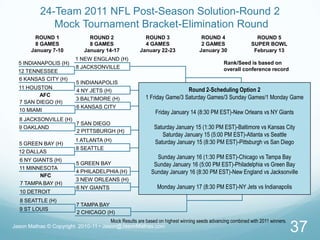
24-Team PlayoffRound 2 (8 Games)“Elimination Round”-GAME 18 for road teams, GAME 17 for home teamsTeams 1-4 in each conference had bye in Round 1.16 teams remain in Round 2 (8 per conference)Top 4 teams in each conference host home game in 2nd round.1 vs 4th ranked advancing team from 1st round.2 vs 3rd ranked advancing team from 1st round.3 vs 2nd ranked advancing team from 1st round.4 vs 1st ranked advancing team from 1st round.16 teams reduced to 8 in round 2.Jason Mathas © Copyright  2010-11 • Jason@JasonMathas.com32
24-Team 2011 NFL Post-Season Solution-Round 2 Mock Tournament Bracket-Elimination RoundJason Mathas © Copyright  2010-11 • Jason@JasonMathas.com33ROUND 18 GAMESJanuary 8-9ROUND 34 GAMESJanuary 22-23ROUND 42 GAMESJanuary 30ROUND 28 GAMESJanuary 15-16ROUND 5SUPER BOWLFebruary 131 NEW ENGLAND (H)Rank/Seed is based on overall conference record5 INDIANAPOLIS (H)8 JACKSONVILLE12 TENNESSEE6 KANSAS CITY (H)5 INDIANAPOLIS11 HOUSTON4 NY JETS (H)AFC3 BALTIMORE (H)7 SAN DIEGO (H)6 KANSAS CITY10 MIAMI• Top 4 teams (each conference) host 2nd round games• 2nd round matchups (lowest seeds at highest seeds)• 2 highest advancing seeds in each conference host 3rd round home playoff game• 2 lowest advancing seeds in each conference play 3rd round road playoff game8 JACKSONVILLE (H)7 SAN DIEGO 9 OAKLAND2 PITTSBURGH (H)1 ATLANTA (H)5 GREEN BAY (H)8 SEATTLE12 DALLAS6 NY GIANTS (H)5 GREEN BAY 11 MINNESOTA4 PHILADELPHIA (H)NFC3 NEW ORLEANS (H)7 TAMPA BAY (H)6 NY GIANTS 10 DETROIT8 SEATTLE (H)7 TAMPA BAY9 ST LOUIS2 CHICAGO (H)Mock Results are based on highest winning seeds advancing combined with 2011 winners.
24-TEAM PLAYOFF ROUND 2 SCHEDULING-OPTION 1Option 1 (8 Games)3 Saturday Games/3 Sunday Games/2 Monday GamesSaturday & Sunday 1:30 PM EST-1Game (East Coast Host Team)Saturday & Sunday 5:00 PM EST-1 GameSaturday & Sunday 8:30 PM EST-1 GameMonday 7:00 PM EST-1 Game (preferably East Coast Host Team)Monday 10:30 PM EST-1 Game (preferably West Coast Host Team)This expands revenue opportunities over 3 days, but also requires more viewer commitment.  But the Monday addition is a familiar adaptation for NFL fans.Monday games could require earlier start times to accommodate national audiences, depending on team/city matchups.This option provides a singular national audience focus for all 8 games, which creates national ad revenue increases.Jason Mathas © Copyright  2010-11 • Jason@JasonMathas.com34
24-Team 2011 NFL Post-Season Solution-Round 2 Mock Tournament Bracket-Elimination RoundJason Mathas © Copyright  2010-11 • Jason@JasonMathas.com35ROUND 18 GAMESJanuary 8-10ROUND 34 GAMESJanuary 22-23ROUND 42 GAMESJanuary 30ROUND 28 GAMESJanuary 15-17ROUND 5SUPER BOWLFebruary 131 NEW ENGLAND (H)Rank/Seed is based on overall conference record5 INDIANAPOLIS (H)8 JACKSONVILLE12 TENNESSEE6 KANSAS CITY (H)5 INDIANAPOLIS11 HOUSTON4 NY JETS (H)Round 2-Scheduling Option 13 Saturday Games/3 Sunday Games/2 Monday GamesSaturday January 15 (1:30 PM EST) -Baltimore vs Kansas CitySaturday January 15 (5:00 PM EST)-Pittsburgh vs San DiegoSaturday January 15 (8:30 PM EST)-NY Jets vs IndianapolisSunday January 16 (1:30 PM EST)-Chicago vs Tampa BaySunday January 16 (5:00 PM EST)-Atlanta vs SeattleSunday January 16 (8:30 PM EST)-New England vs JacksonvilleMonday January 17 (7:00 PM EST)-Philadelphia vs Green BayMonday January 17 (10:30 PM EST)-New Orleans vs NY GiantsAFC3 BALTIMORE (H)7 SAN DIEGO (H)6 KANSAS CITY10 MIAMI8 JACKSONVILLE (H)7 SAN DIEGO 9 OAKLAND2 PITTSBURGH (H)1 ATLANTA (H)5 GREEN BAY (H)8 SEATTLE12 DALLAS6 NY GIANTS (H)5 GREEN BAY 11 MINNESOTA4 PHILADELPHIA (H)NFC3 NEW ORLEANS (H)7 TAMPA BAY (H)6 NY GIANTS 10 DETROIT8 SEATTLE (H)7 TAMPA BAY9 ST LOUIS2 CHICAGO (H)Mock Results are based on highest winning seeds advancing combined with 2011 winners.
24-TEAM PLAYOFF ROUND 2 SCHEDULING-OPTION 2Option 2 (8 Games)1 Friday Game/3 Saturday Games/3 Sunday Games/1 Monday GameFriday 8:30 PM EST-1 GameSaturday & Sunday 1:30 PM EST-1 Game (East Coast Host Team)Saturday & Sunday 5:00 PM EST-1 GameSaturday & Sunday 8:30 PM EST-1 GameMonday 8:30 PM EST-1 Game (East Coast Host Team)This expands revenue opportunities over 4 days, but also requires more viewer commitment.  The preparation week is shortened for teams playing in Friday game, and requires concerted effort to alert fans of new Friday playoff game.This option provides a singular national audience focus for all 8 games, which creates national ad revenue increases.Jason Mathas © Copyright  2010-11 • Jason@JasonMathas.com36
24-Team 2011 NFL Post-Season Solution-Round 2 Mock Tournament Bracket-Elimination RoundJason Mathas © Copyright  2010-11 • Jason@JasonMathas.com37ROUND 18 GAMESJanuary 7-10ROUND 34 GAMESJanuary 22-23ROUND 42 GAMESJanuary 30ROUND 28 GAMESJanuary 14-17ROUND 5SUPER BOWLFebruary 131 NEW ENGLAND (H)Rank/Seed is based on overall conference record5 INDIANAPOLIS (H)8 JACKSONVILLE12 TENNESSEE6 KANSAS CITY (H)5 INDIANAPOLISRound 2-Scheduling Option 21 Friday Game/3 Saturday Games/3 Sunday Games/1 Monday GameFriday January 14 (8:30 PM EST)-New Orleans vs NY GiantsSaturday January 15 (1:30 PM EST)-Baltimore vs Kansas CitySaturday January 15 (5:00 PM EST)-Atlanta vs SeattleSaturday January 15 (8:30 PM EST)-Pittsburgh vs San DiegoSunday January 16 (1:30 PM EST)-Chicago vs Tampa BaySunday January 16 (5:00 PM EST)-Philadelphia vs Green BaySunday January 16 (8:30 PM EST)-New England vs JacksonvilleMonday January 17 (8:30 PM EST)-NY Jets vs Indianapolis11 HOUSTON4 NY JETS (H)AFC3 BALTIMORE (H)7 SAN DIEGO (H)6 KANSAS CITY10 MIAMI8 JACKSONVILLE (H)7 SAN DIEGO 9 OAKLAND2 PITTSBURGH (H)1 ATLANTA (H)5 GREEN BAY (H)8 SEATTLE12 DALLAS6 NY GIANTS (H)5 GREEN BAY 11 MINNESOTA4 PHILADELPHIA (H)NFC3 NEW ORLEANS (H)7 TAMPA BAY (H)6 NY GIANTS 10 DETROIT8 SEATTLE (H)7 TAMPA BAY9 ST LOUIS2 CHICAGO (H)Mock Results are based on highest winning seeds advancing combined with 2011 winners.
24-TEAM PLAYOFF ROUND 2 SCHEDULING-OPTION 3Option 3 (8 Games)4 Saturday Games/4 Sunday GamesSaturday & Sunday 1:30 PM EST-2 Games (East Coast Host Team)Saturday & Sunday 5:00 PM EST-1 GameSaturday & Sunday 8:30 PM EST-1 GameThis consolidates scheduling into 2 days, but requires 4 games to run concurrently (2 Saturday, 2 Sunday).This option does not provide a singular national audience focus for all 8 games, which is an overall national ad revenue concern.Jason Mathas © Copyright  2010-11 • Jason@JasonMathas.com38
Jason Mathas © Copyright  2010-11 • Jason@JasonMathas.com3924-Team 2011 NFL Post-Season Solution-Round 2 Mock Tournament Bracket-Elimination RoundROUND 18 GAMESJanuary 8-9ROUND 34 GAMESJanuary 22-23ROUND 42 GAMESJanuary 30ROUND 28 GAMESJanuary 15-16ROUND 5SUPER BOWLFebruary 131 NEW ENGLAND (H)Rank/Seed is based on overall conference record5 INDIANAPOLIS (H)8 JACKSONVILLE12 TENNESSEE6 KANSAS CITY (H)5 INDIANAPOLIS11 HOUSTON4 NY JETS (H)Round 2-Scheduling Option 34 Saturday Games/4 Sunday GamesSaturday January 15 (1:30 PM EST)-Baltimore vs Kansas CitySaturday January 15 (1:30 PM EST)-Philadelphia vs Green BaySaturday January 15 (5:00 PM EST)-New England vs JacksonvilleSaturday January 15 (8:30 PM EST)-New Orleans vs NY GiantsSunday January 16 (1:30 PM EST)-Chicago vs Tampa BaySunday January 16 (1:30 PM EST)-Atlanta vs SeattleSunday January 16 (5:00 PM EST)-Pittsburgh vs San DiegoSunday January 16 (8:30 PM EST)-NY Jets vs IndianapolisAFC3 BALTIMORE (H)7 SAN DIEGO (H)6 KANSAS CITY10 MIAMI8 JACKSONVILLE (H)7 SAN DIEGO 9 OAKLAND2 PITTSBURGH (H)1 ATLANTA (H)5 GREEN BAY (H)8 SEATTLE12 DALLAS6 NY GIANTS (H)5 GREEN BAY 11 MINNESOTA4 PHILADELPHIA (H)NFC3 NEW ORLEANS (H)7 TAMPA BAY (H)6 NY GIANTS 10 DETROIT8 SEATTLE (H)7 TAMPA BAY9 ST LOUIS2 CHICAGO (H)Mock Results are based on highest winning seeds advancing combined with 2011 winners.
24-Team PlayoffRound 3 (4 Games)Divisional Round-GAME 19 for teams 5-12 advancing, GAME 18 for teams 1-4 advancing8 teams (4 per conference) advanced from round 2 and qualify for round 32 highest ranked advancing teams from each conference host home games1st ranked team vs 4th ranked team2nd ranked team vs 3rd ranked team8 teams reduced to 4 in round 3.Jason Mathas © Copyright  2010-11 • Jason@JasonMathas.com40
24-Team 2011 NFL Post-Season Solution-Round 3 Mock Tournament Bracket-Divisional RoundJason Mathas © Copyright  2010-11 • Jason@JasonMathas.com41ROUND 18 GAMESJanuary 8-9ROUND 34 GAMESJanuary 22-23ROUND 42 GAMESJanuary 30ROUND 28 GAMESJanuary 15-16ROUND 5SUPER BOWLFebruary 131 NEW ENGLAND (H)1 NEW ENGLAND (H)Rank/Seed is based on overall conference record5 INDIANAPOLIS (H)8 JACKSONVILLE12 TENNESSEE6 KANSAS CITY (H)Round 3-Scheduling2 Saturday Games/2 Sunday GamesSaturday January 22 (4:00 PM EST)Pittsburgh vs BaltimoreSaturday January 22 (8:30 PM EST)Atlanta vs Green BaySunday January 23 (4:00 PM EST)Chicago vs New OrleansSunday January 23 (8:30 PM EST)New England vs NY Jets5 INDIANAPOLIS4 NY JETS11 HOUSTON4 NY JETS (H)AFC3 BALTIMORE (H)7 SAN DIEGO (H)3 BALTIMORE 6 KANSAS CITY10 MIAMI8 JACKSONVILLE (H)7 SAN DIEGO 2 PITTSBURGH (H)9 OAKLAND2 PITTSBURGH (H)1 ATLANTA (H)5 GREEN BAY (H)1 ATLANTA (H)8 SEATTLE12 DALLAS6 NY GIANTS (H)5 GREEN BAY 11 MINNESOTA5 GREEN BAY • Top 2 teams (each conference) host 3rd round games• 3rd round matchups (lowest seeds at highest seeds)• Highest advancing seeds (each conference) host 3rd round home playoff game• 2 lowest advancing seeds in each conference play 3rd round road playoff game4 PHILADELPHIA (H)NFC3 NEW ORLEANS (H)7 TAMPA BAY (H)3 NEW ORLEANS  6 NY GIANTS 10 DETROIT8 SEATTLE (H)7 TAMPA BAY2 CHICAGO (H)9 ST LOUIS2 CHICAGO (H)Mock Results are based on highest winning seeds advancing combined with 2011 winners.
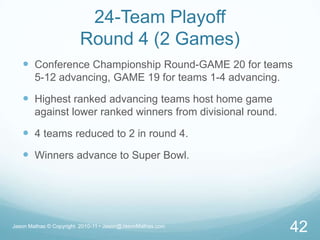
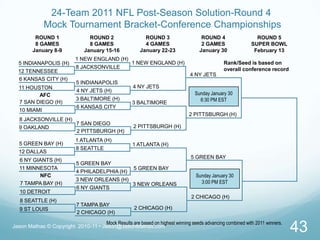
24-Team PlayoffRound 4 (2 Games)Conference Championship Round-GAME 20 for teams 5-12 advancing, GAME 19 for teams 1-4 advancing.Highest ranked advancing teams host home game against lower ranked winners from divisional round.4 teams reduced to 2 in round 4.Winners advance to Super Bowl.Jason Mathas © Copyright  2010-11 • Jason@JasonMathas.com42
24-Team 2011 NFL Post-Season Solution-Round 4  Mock Tournament Bracket-Conference ChampionshipsJason Mathas © Copyright  2010-11 • Jason@JasonMathas.com43ROUND 18 GAMESJanuary 8-9ROUND 34 GAMESJanuary 22-23ROUND 42 GAMESJanuary 30ROUND 28 GAMESJanuary 15-16ROUND 5SUPER BOWLFebruary 131 NEW ENGLAND (H)1 NEW ENGLAND (H)Rank/Seed is based on overall conference record5 INDIANAPOLIS (H)8 JACKSONVILLE12 TENNESSEE4 NY JETS6 KANSAS CITY (H)5 INDIANAPOLIS4 NY JETS11 HOUSTONSunday January 306:30 PM EST4 NY JETS (H)AFC3 BALTIMORE (H)7 SAN DIEGO (H)3 BALTIMORE 6 KANSAS CITY10 MIAMI2 PITTSBURGH (H)8 JACKSONVILLE (H)7 SAN DIEGO 2 PITTSBURGH (H)9 OAKLAND2 PITTSBURGH (H)1 ATLANTA (H)5 GREEN BAY (H)1 ATLANTA (H)8 SEATTLE12 DALLAS5 GREEN BAY 6 NY GIANTS (H)5 GREEN BAY 11 MINNESOTA5 GREEN BAY 4 PHILADELPHIA (H)Sunday January 303:00 PM ESTNFC3 NEW ORLEANS (H)7 TAMPA BAY (H)3 NEW ORLEANS  6 NY GIANTS 10 DETROIT2 CHICAGO (H)8 SEATTLE (H)7 TAMPA BAY2 CHICAGO (H)9 ST LOUIS2 CHICAGO (H)Mock Results are based on highest winning seeds advancing combined with 2011 winners.
24-TEAM PLAYOFFROUND 5 (SUPER BOWL)GAME 21 for teams 5-12 (per conference) advancing, GAME 20 for teams 1-4 (per conference) advancing.Conference Champions meet in Super Bowl to determine league champion.Jason Mathas © Copyright  2010-11 • Jason@JasonMathas.com44
24-TEAM 2011 NFL POST-SEASON SOLUTION  MOCK TOURNAMENT BRACKET-ROUNDS 1-5Jason Mathas © Copyright  2010-11 • Jason@JasonMathas.com45ROUND 18 GAMESJanuary 8-9ROUND 34 GAMESJanuary 22-23ROUND 42 GAMESJanuary 30ROUND 28 GAMESJanuary 15-16ROUND 5SUPER BOWLFebruary 131 NEW ENGLAND (H)1 NEW ENGLAND (H)Rank/Seed is based on overall conference record5 INDIANAPOLIS (H)8 JACKSONVILLE12 TENNESSEE4 NY JETS6 KANSAS CITY (H)5 INDIANAPOLIS4 NY JETS11 HOUSTON4 NY JETS (H)2 PITTSBURGHAFC3 BALTIMORE (H)7 SAN DIEGO (H)3 BALTIMORE 6 KANSAS CITY10 MIAMI2 PITTSBURGH (H)8 JACKSONVILLE (H)7 SAN DIEGO 2 PITTSBURGH (H)9 OAKLAND2 PITTSBURGH (H)1 ATLANTA (H)5 GREEN BAY (H)1 ATLANTA (H)8 SEATTLE12 DALLAS5 GREEN BAY 6 NY GIANTS (H)5 GREEN BAY 11 MINNESOTA5 GREEN BAY 4 PHILADELPHIA (H)NFC5 GREEN BAY 3 NEW ORLEANS (H)7 TAMPA BAY (H)3 NEW ORLEANS  6 NY GIANTS 10 DETROIT2 CHICAGO (H)8 SEATTLE (H)7 TAMPA BAY2 CHICAGO (H)9 ST LOUIS2 CHICAGO (H)Mock Results are based on highest winning seeds advancing combined with 2011 winners.
MORE PLAYOFF TEAMS, NOT LESS, MAKES NFL MORE COMPETITIVESeattle (7-9) beat New Orleans (11-5).7-9 teams (even 6-10 teams, in some instances) can be dangerous in the post-season.Records are not always indicative of outcome.Post-Season single elimination tourney elevates intensity and excitement across the board.Qualifying more teams greatly increases the likelihood all teams will put forth their best effort and put the best possible product on the field during every regular season game.Jason Mathas © Copyright  2010-11 • Jason@JasonMathas.com46
EXPANDED PLAYOFF PROOF 2002-2010 (32 TEAMS)2002-2010Average of 14.4 teams finished .563 or better45% of teams finished 9-7 or betterAverage of 18.2 teams finished .500 or better60% of teams finished 8-8 or betterAverage of 21.4 teams finished .438 or better67% of teams finished 7-9 or betterAverage of 3.1 teams with winning records (.563 or better) didn’t make the playoffs.9.6% of teams with winning records were excluded from playoffsSeattle proved a 7-9 team can win a playoff game.  Qualifying teams 7-9 or better creates a very competitive post-season tournament.This system prevents teams not qualifying for playoffs with better records than teams qualifying.This system rewards the best records with home games, regardless of division standings.Jason Mathas © Copyright  2010-11 • Jason@JasonMathas.com47
2002 DATA SUPPORTING EXPANDED PLAYOFF200216 teams (50%) finished 9-7 (.563) or better4 teams with winning records were excluded from post-seasonThe Jets, Dolphins and Patriots all finished 9-7, but a tiebreaker qualified Jets and eliminated Dolphins and PatriotsTeams shouldn’t be punished for identical records to advancing teams (unless they’re sub .500).19 teams (59%) finished 8-8 (.500) or better5 teams (16%) finished 7-9 (.438)24 teams finished .438 or better75% of teams finished 7-9 or betterJason Mathas © Copyright  2010-11 • Jason@JasonMathas.com48
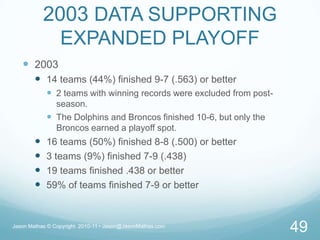
2003 DATA SUPPORTING EXPANDED PLAYOFF200314 teams (44%) finished 9-7 (.563) or better2 teams with winning records were excluded from post-season.The Dolphins and Broncos finished 10-6, but only the Broncos earned a playoff spot.16 teams (50%) finished 8-8 (.500) or better3 teams (9%) finished 7-9 (.438)19 teams finished .438 or better59% of teams finished 7-9 or betterJason Mathas © Copyright  2010-11 • Jason@JasonMathas.com49
2004 DATA SUPPORTING EXPANDED PLAYOFF200413 teams (41%) finished 9-7 (.563) or better3 teams (Jacksonville, Baltimore and Buffalo) with winning records were excluded from post-seasonSt Louis and Minnesota finished 8-8 and made the playoffs.  New Orleans and Cincinnati didn’t with the same 8-8 record.17 teams (53%) finished 8-8 (.500) or better3 teams (9%) finished 7-9 (.438)20 teams finished .438 or better63% of teams finished 7-9 or betterJason Mathas © Copyright  2010-11 • Jason@JasonMathas.com50
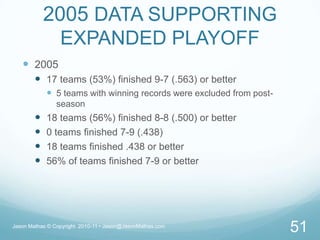
2005 DATA SUPPORTING EXPANDED PLAYOFF200517 teams (53%) finished 9-7 (.563) or better5 teams with winning records were excluded from post-season18 teams (56%) finished 8-8 (.500) or better0 teams finished 7-9 (.438)18 teams finished .438 or better56% of teams finished 7-9 or betterJason Mathas © Copyright  2010-11 • Jason@JasonMathas.com51
2006 DATA SUPPORTING EXPANDED PLAYOFF200612 teams (38%) finished 9-7 (.563) or betterDenver (9-7) was excluded from post-season, eliminated by Kansas City (identical 9-7 record) in division.Dallas and Seattle (both 9-7) made playoffs, as did the NY Giants (8-8).20 teams (63%) finished 8-8 (.500) or better3 teams (9%) finished 7-9 (.438)23 teams finished .438 or better72% of teams finished 7-9 or betterJason Mathas © Copyright  2010-11 • Jason@JasonMathas.com52
2007 DATA SUPPORTING EXPANDED PLAYOFF200713 teams (41%) finished 9-7 (.563) or betterCleveland finished 10-6, but failed to make the playoffs, though Pittsburgh finished 10-6, won the division and made playoffs due to tiebreakers.Washington and Tampa Bay finished 9-7, but both made playoffs with worse records than Cleveland.17 teams (53%) finished 8-8 (.500) or better7 teams (22%) finished .438 or better24 teams finished .438 or better75% of teams finished 7-9 or betterJason Mathas © Copyright  2010-11 • Jason@JasonMathas.com53
2008 DATA SUPPORTING EXPANDED PLAYOFF200816 teams (50%) finished 9-7 (.563) or better6 teams with winning records were excluded from post-seasonNew England and Atlanta finished 11-5, but did not qualify for the playoffs.San Diego (8-8), Arizona (9-7), Philadelphia (9-6-1), and Minnesota (10-6) all made the playoffs.21 teams (66%) finished 8-8 (.500) or better2 teams (6%) finished .438 or better23 teams finished .438 or better72% of teams finished 7-9 or betterJason Mathas © Copyright  2010-11 • Jason@JasonMathas.com54
2009 DATA SUPPORTING EXPANDED PLAYOFF200915 teams (47%) finished 9-7 (.563) or better3 teams with winning records were excluded from post-seasonBaltimore, Pittsburgh and Houston all finished 9-7, but only Baltimore qualified for playoffs because of tiebreakers and division alignment.20 teams (63%) finished 8-8 (.500) or better3 teams (9%) finished 7-9 (.438)23 teams finished .438 or better72% of teams finished 7-9 or betterJason Mathas © Copyright  2010-11 • Jason@JasonMathas.com55
2010 DATA SUPPORTING EXPANDED PLAYOFF201014 teams (44%) finished 9-7 (.563) or better3 teams with winning records were excluded from post-seasonPhiladelphia, NY Giants and Tampa Bay all finished 10-6, but only Philadelphia qualified for playoffs because of tiebreakers and division alignment.San Diego finished 9-7, Oakland and Jacksonville finished 8-8, but only Seattle (7-9) made the playoffs.16 teams (50%) finished 8-8 (.500) or better3 teams (9%) finished .438 or better19 teams finished .438 or better59% of teams finished 7-9 or betterJason Mathas © Copyright  2010-11 • Jason@JasonMathas.com56
TOTAL REVENUE GAMES16 OR 18 GAME SCHEDULE20 games per team=320 total games4 pre-season + 16 regular season=320 total games2 pre-season + 18 regular season=320 total gamesCurrent post-season is 11 games (including Super Bowl) for a grand total of 331 total revenue games (“+1” counting the Pro Bowl).Pre-season games are not highly regarded, but teams and fans are still excited about the possibility of success for the year.In many cases, the final 2-4 regular season games (in an 18-game season) will be less compelling for teams mathematically eliminated from post-season contention than pre-season games.  This already occurs with a 16-game regular season.The result is low attendance and even lower regard for the increase in games.Jason Mathas © Copyright  2010-11 • Jason@JasonMathas.com57
TRANSITION AWAY FROM 4 PRE-SEASON GAMES MUST BE STRATEGIZED BEFORE IMPLEMENTED4 pre-season games allow for teams to tune-up and are part of the ritual/schedule/routine of training camp.4 pre-season games, more importantly, allow for the evaluation of new talent, questionable talent and fading talent.4 pre-season games prepare players for the regular season, physically and mentally, over the course of an entire month.Pre-season games can be reduced, but only with a specifically designed plan created with the players, not dictated to them.  People will resist what they’re told to do, but will embrace what they help design.Reducing pre-season games from 4 to 2 doesn’t make long-term financial sense until overall games (pre and regular season) exceed 20, not simply equal 20 by redistribution. Jason Mathas © Copyright  2010-11 • Jason@JasonMathas.com58
INCREASE TOTAL REVENUE GAMES WITHOUT RESISTANCEAll players want to become world champions and win the Super Bowl.Psychologically players will risk more and play harder during the post-season than they will during the regular season (especially compared to the pre-season).Players will resent all injuries suffered (from nagging to catastrophic) to varying degrees.  But those suffered during pre-season and regular season much more than those suffered during post-season play, especially in a Super Bowl.  Those games matter because there’s something at stake…legacy, football immortality etc.Expanding the post-season with more teams and more games is the most efficient way to increase total league revenue and improve the NFL product among all 32 teams.Jason Mathas © Copyright  2010-11 • Jason@JasonMathas.com59
POST-SEASON REVENUE GAMES ARE MORE THAN DOUBLEDExpanding the playoff format from 12 to 24 teams, (from 4 to 5 rounds), gives more teams the legitimate opportunity to compete for a Super Bowl.This format change increases total post-season games per year from 11 to 23.That’s 12 additional high-profile/high revenue playoff games.Total post-season revenue will more than double.Post-season games are guaranteed sellouts.Games 15-18 during the regular season are not guaranteed sellouts when a team has already secured a playoff spot and pulled starters or is out of the race.Jason Mathas © Copyright  2010-11 • Jason@JasonMathas.com60
24-TEAM PLAYOFF EXPANSIONBENEFITS LEAGUE, OWNERS, PLAYERS AND BOTTOM LINE FOR ALLNFL creates a more equitable playoff opportunity for all 32 teams, making the regular season more valuable/profitable.All teams play harder for the duration of the regular season to fortify playoff positions or earn spots in the post-season.16 teams/owners earn minimum of 9 home games.24 teams/owners earn minimum of 17 games.Players have a better chance of getting to and winning Super Bowl.Significantly more money is made without a significant increase in workload over current system.Jason Mathas © Copyright  2010-11 • Jason@JasonMathas.com61

2011 NFL Solution to Avoid Work Stoppage

  • 1.
    2011 NFL SOLUTIONAVOIDINGA WORK STOPPAGE1Jason Mathas © Copyright 2010-11 • Jason@JasonMathas.com
  • 2.
    A WORK STOPPAGEBENEFITS NO ONEProjected 2011 revenue for the NFL is $9B.Equitable distribution of revenue is critical for all participants.But increasing net revenue for all is more important than leveraging percentage.50% of a $9B+ yearly business is more valuable than 100% of a $0-4.4B business.The revenue lost during a full year work stoppage will require 9 years to recoup if total yearly revenue increased by 1B per year after work stoppage.That is an optimistic/unrealistic projection to expect an average of 11-12% growth (compared to $9B/year) over the next 9 years.Jason Mathas © Copyright 2010-11 • Jason@JasonMathas.com2
  • 3.
    INCREASE REVENUE IN16-GAME REGULAR SEASON WITH STRATEGIC PLAN FOR EXPANSIONInstead of spending more time on difficult negotiations for an increase in regular season games, there is great potential for significantly more revenue under the current 16-game regular season.Efforts and energy by league, owners, players association and players are better spent maximizing revenue under current system, than recreating it.While efficiently increasing revenue under current system, a plan for expansion (within the next 3-5 years) can be developed to benefit everyone involved.Jason Mathas © Copyright 2010-11 • Jason@JasonMathas.com3
  • 4.
    ADVANCING NEGOTIATIONSLeague, ownersand players can all reap greater profits from current system without increasing to an 18-game regular season.Significant additional revenue is being left on the table and completely overlooked.Greater revenue, an improved NFL product and satisfied participants (league, owners, players) can coexist.By removing the “18-Game Regular Season” barrier, negotiations can advance to other critical issues:Revenue sharingRookie wage scaleRetired players’ benefitsJason Mathas © Copyright 2010-11 • Jason@JasonMathas.com4
  • 5.
    18 GAME SEASONDOES NOT ADD REVENUE GAMES4 pre-season + 16 regular season=20 games/team2 pre-season + 18 regular season=20 games/teamThis is simply a redistribution, rather than addition.Theoretically more regular season games should result in more revenue, but in practical application the ROI will not justify the change.But there is a way to generate more revenue without altering the current pre/regular season (4+16) format.Jason Mathas © Copyright 2010-11 • Jason@JasonMathas.com5
  • 6.
    NFL INSTANT REVENUEINCREASE WITHOUT 18-GAME REGULAR SEASONPost-season games (on a 1 to 1 comparison) are far more valuable for revenue generation than pre-season or regular season games.Compare total revenue generated during 11 post-season games (4 rounds-wild card to Super Bowl) with the highest revenue generated by 11 regular season games.Increasing post-season games is the most efficient way to increase revenue without implementing an 18-game regular season, and combating the resultant resistance from players and NFLPA.Jason Mathas © Copyright 2010-11 • Jason@JasonMathas.com6
  • 7.
    MORE “MEANINGFUL” GAMES,NOT SIMPLY “MORE” GAMESAdding games does not guarantee long-term revenue increases, without a strategic transitional plan.Adding games without a strategic plan devalues and dilutes the NFL product. This can weaken the NFL’s position for future tv contract negotiations.18-game regular season is not the most efficient method to increase revenue. Plus it risks alienating advertisers/sponsors, players and fans.Post-Season/Playoff games intensify the NFL product.Playoff expansion creates a solution for the league, owners and players that is equitable and profitable. Jason Mathas © Copyright 2010-11 • Jason@JasonMathas.com7
  • 8.
    PLAYERS WON’T OBJECTTO MORE “MEANINGFUL” GAMESThe 2010 Packers played 24 gamesThe 2007 Giants played 24 gamesThe 2005 Steelers played 24 games4 pre-season games16 regular season games4 post-season gamesWild card teams reaching the Super Bowl play 4 additional gamesNo player has ever resisted playing more than 16 games, when additional games are played in the post-season.But they’re already resisting the concept of more than 16 games in the regular season.Jason Mathas © Copyright 2010-11 • Jason@JasonMathas.com8
  • 9.
    ADDITIONAL GAMES REPACKAGED,MADE MORE APPEALINGUnder the current 12-team NFL playoff tournament, an 18-game regular season creates greater likelihood of more inconsequential games during the final month of the season.More inconsequential games translates into less player and fan interest because playoff teams are set and final games don’t impact teams that qualify.Qualifying more teams for post-season ensures competitive games during every week of the season.Teams will battle for 1st round byes, 1st round home games and the precious few remaining 1st round road games in playoffs.Jason Mathas © Copyright 2010-11 • Jason@JasonMathas.com9
  • 10.
    INCENTIVIZE TEAMS TOEARN17TH GAMEGenerating the most possible revenue is a combination of putting the best product on the field to create fan interest, resulting in stadium sellouts, high tv ratings and ultimately more lucrative tv contracts with networks.Increasing the number of regular season games doesn’t automatically ensure all teams will do their absolute best to be competitive for the duration of the season.Rewarding the top 24 teams provides the motivation for all 32 to focus on attempting to win every game, rather than resting starters late in the season (once a playoff spot is secured) or playing for draft position (when eliminated from post-season contention).Jason Mathas © Copyright 2010-11 • Jason@JasonMathas.com10
  • 11.
    REWARDS AND REPERCUSSIONSPlayerswho perform well earn more money. Players who don’t perform well make less or are cut.Teams should be subject to the same paradigm.Teams with the best records qualify for the post-season, play more games and earn more money.Teams who don’t qualify for the playoffs, play less games and make less money.The onus should be on both players AND teams to perform well in order to earn increased compensation and generate more revenue.Jason Mathas © Copyright 2010-11 • Jason@JasonMathas.com11
  • 12.
    REGULAR SEASON PERFORMANCEDETERMINES POST-SEASON APPEARANCE(S) AND REVENUE POTENTIALMake the post-season, play more games, generate more revenue.Miss the post-season, play less games, generate less revenue.18-game regular season means 9 home games per teamAdditional meaningful games can be created without immediate expansion to 18-game regular season.16-game regular season with 24-team playoff expansion system guarantees:Minimum of 9 home games for 16 of 32 teams=50%100% increase over current system (from 8 to 16)Minimum of 17 meaningful games for 24 of 32 teams=75%100% increase over current system (from 12 to 24)If 24 teams make the playoffs, a slow start or marginal record will not cause a team to jettison talent or play for next year because the real possibility for a playoff spot still exists.Jason Mathas © Copyright 2010-11 • Jason@JasonMathas.com12
  • 13.
    PLAYOFF GAMES AREGUARANTEED SELLOUTS, RATINGS WINNERS & AD REVENUE GOLDMINESAdding 2 regular season games (games 17 & 18) will likely result in many empty stadiums, disgruntled season ticket holders/fans and local blackouts for teams out of the playoff picture.This dilutes the quality of play and tarnishes the reputation of the NFL.Adding an additional round of playoffs, creates a 17th game for 75% of teams and provides the opportunity to contend for a Super Bowl. This translates into more sold out stadiums because of more meaningful games.Jason Mathas © Copyright 2010-11 • Jason@JasonMathas.com13
  • 14.
    POST-SEASON PARTICIPATIONCurrent NFLPlayoff System qualifies 12 teams in a single-elimination tournament12/32=38% of teams make post-seasonNBA Qualifies 16/30 teams=53%4 round playoff system (best of 7 series format) results in numerous games and opportunities for revenue.MLB Qualifies 8/30 teams=27%But Triple and Quadruple elimination format of NBA and MLB requires too much time for resolution.Jason Mathas © Copyright 2010-11 • Jason@JasonMathas.com14
  • 15.
    NFL PLAYOFF PARTICIPATIONHISTORYIn a 32-team league (2002-2010) 12/32 teams make playoffs=38%In a 30-team league (1995-2001) 12/30 teams made playoffs=40%In a 28-team league (1990-1995), 12/28 teams made playoffs=43%In 1982* 16/28 teams made playoffs=57% (*strike shortened season)In a 28-team league (1978-1989) 10/28 teams made playoffs=36%In a 28-team league (1976-1977) 8/28 teams made playoffs=29%In a 26-team league (1970-1975) 8/26 teams made playoffs=30%The NFL has already gone as high as 57% of teams qualifying for post-season in 1982. Then, “necessity demanded creativity”. The “loss of revenue” consequences of a work stoppage in 2011 are considerably greater. Now “crisis demands resolution”.Jason Mathas © Copyright 2010-11 • Jason@JasonMathas.com15
  • 16.
    VIABLE AND FEASIBLEPOST-SEASON SOLUTIONS FOR NFLCurrent NFL system is 4-Round Playoff: 12/32 teams make playoffs=38%11 post-season games (including Super Bowl)Solution #15-Round Playoff: 24/32 teams make playoffs=75%23 post-season games (including Super Bowl)Solution #2 Separate PPT19 post-season games (including Super Bowl)Solution#3 Separate PPT13 post-season games (including Super Bowl)Jason Mathas © Copyright 2010-11 • Jason@JasonMathas.com16
  • 17.
    24-TEAM PLAYOFF BENEFITSSolution#15-Round Playoff: 24/32 teams make playoffs=75%23 post-season games (including Super Bowl)Qualifying more teams for playoffs will make regular season more competitive and compelling throughout all 16 games.Teams like Giants and Bucs are rewarded, rather than punished, for a 10-6 record (that earned the Packers a chance at a Super Bowl and ultimately a championship), but eliminated them from post-season because of tiebreakers and division alignment.Fewer teams are mathematically eliminated with 4-6 games remaining.More playoff teams means more competitive/compelling regular season games, more exciting playoff games and the resultant increase in playoff revenue.Jason Mathas © Copyright 2010-11 • Jason@JasonMathas.com17
  • 18.
    MOTIVATING TEAMS TOCOMPETE IN ALL 16 REGULAR SEASON GAMES8 teams (1-4 from each conference) are guaranteed a 1st round bye, 2nd round home game and the shortest, most direct path to the Super Bowl.8 teams (5-8 from each conference) are guaranteed 1st round home games.8 teams (9-12 from each conference) are guaranteed a playoff berth and 1st round road games.Jason Mathas © Copyright 2010-11 • Jason@JasonMathas.com18
  • 19.
    TEAMS 1-4 WILLPLAY HARDER, ALL SEASON, WITH EXPANDED PLAYOFFSThe top record in each conference secures home-field advantage throughout the playoffs. This creates motivation to play for more than simply a playoff spot and 1st round bye. The ranking of teams 1-4 can be altered pending the outcome of all 16 regular season games, especially the last 4, because all 32 teams will still be in contention, playing hard, late in the season despite record.Teams ranked 1-4 will play hard all seasonto earn home-field advantage throughout the playoffsto earn a 1st round bye by finishing in the top 4to not slip to 5-8 in conference and be forced to play a 1st round home gameto not slip to 9-12 in conference and be forced to play a 1st round road gameTo not slip out of the playoffs altogetherJason Mathas © Copyright 2010-11 • Jason@JasonMathas.com19
  • 20.
    TEAMS 5-8 WILLPLAY HARDER, ALL SEASON, WITH EXPANDED PLAYOFFS8 teams (5-8 from each conference) are guaranteed a 1st round home game.Qualifying for the playoffs and earning a home game, even without a 1st round bye creates an easier path to the Super Bowl.The ranking of teams 5-8 can be altered pending the outcome of all 16 regular season games, especially the last 4, because all 32 teams will still be in contention, playing hard, late in the season despite record.Teams ranked 5-8 will play hard all seasonto possibly move into the top 4 and earn a 1st round byeto not slip to 9-12 in conference and be forced to play a 1st round road gameTo not slip out of the playoffs altogetherJason Mathas © Copyright 2010-11 • Jason@JasonMathas.com20
  • 21.
    TEAMS 9-12 WILLPLAY HARDER, ALL SEASON, WITH EXPANDED PLAYOFFS8 teams (9-12 from each conference) are guaranteed a playoff spot and 1st round road game.Qualifying for the playoffs earns teams a 17th game and the opportunity to compete for a chance to advance to the Super Bowl.The ranking of teams 9-12 can be altered pending the outcome of all 16 regular season games, especially the last 4, because all 32 teams will still be in contention, playing hard, late in the season despite record.Teams ranked 9-12 will play hard all seasonto possibly move into the top 4 and earn a 1st round bye.to earn a 1st round home game by finishing ranked 5-8.to maintain a position in the top 12 and prevent post-season elimination.Jason Mathas © Copyright 2010-11 • Jason@JasonMathas.com21
  • 22.
    TEAMS 13-16 WILLPLAY HARDER, ALL SEASON, WITH EXPANDED PLAYOFFS8 teams (13-16 from each conference) have the opportunity to control their own destiny and earn a playoff spot, in spite of a slow start or mid-season slump. The possibility of controlling destiny by winning games will create motivation to stay focused all season long.Qualifying for the playoffs by moving up from position 13-16 to a top 12 ranking earns teams a 17th game and the opportunity to compete and potentially advance to the Super Bowl. As long as there’s a legitimate opportunity to compete for a world championship, greater effort will be put forth.The ranking of teams 13-16 can be altered pending the outcome of all 16 regular season games, especially the last 4.Teams ranked 13-16 will play hard all seasonto possibly move into the top 12 and earn a playoff berth.to potentially earn a 1st round home game by finishing ranked 5-8to go from “out of” the playoffs to “in”, simply by winning remaining games.Jason Mathas © Copyright 2010-11 • Jason@JasonMathas.com22
  • 23.
    24-TEAM PLAYOFF DETAILS5Round post-season (including Super Bowl).Top 12 records from each conference qualify.Playoff seeding/rank based on overall record compared to other teams in conference (with applicable tiebreakers).Teams 1-4 in each conference (not necessarily division winners) receive 1st round bye and 2nd round home game.Teams 5-8 in each conference play 1st round home game.Teams 9-12 in each conference play 1st round road gameJason Mathas © Copyright 2010-11 • Jason@JasonMathas.com23
  • 24.
    24-Team PlayoffRound 1(8 Games)Wild card “Qualification Round”-GAME 17Teams 5-12 in each conference play in 1st round.Teams 5-8 host home games, teams 9-12 travel.5 vs 12, 6 vs 11, 7 vs 10, 8 vs 924 teams reduced to 16 during round 1.Winners advance and play road game in 2nd round.Jason Mathas © Copyright 2010-11 • Jason@JasonMathas.com24
  • 25.
    24-Team 2011 NFLPost-Season Solution-Round 1 Mock Tournament Bracket-Wild Card Qualification RoundJason Mathas © Copyright 2010-11 • Jason@JasonMathas.com25ROUND 18 GAMESJanuary 8-9ROUND 34 GAMESJanuary 22-23ROUND 42 GAMESJanuary 30ROUND 28 GAMESJanuary 15-16ROUND 5SUPER BOWLFebruary 131 NEW ENGLAND (H)Rank/Seed is based on overall conference record5 INDIANAPOLIS (H)12 TENNESSEE6 KANSAS CITY (H)11 HOUSTON4 NY JETS (H)AFC3 BALTIMORE (H)7 SAN DIEGO (H)10 MIAMI• Teams 5-8 host 1st round playoff games• Teams 9-12 play 1st round road playoff games• 1st round winners advance • Top 4 teams earn 1st round bye• Top 4 teams host 2nd round playoff games• 2nd round matchups (lowest seeds at highest seeds)8 JACKSONVILLE (H)9 OAKLAND2 PITTSBURGH (H)1 ATLANTA (H)5 GREEN BAY (H)12 DALLAS6 NY GIANTS (H)11 MINNESOTA4 PHILADELPHIA (H)NFC3 NEW ORLEANS (H)7 TAMPA BAY (H)10 DETROIT8 SEATTLE (H)9 ST LOUIS2 CHICAGO (H)
  • 26.
    24-TEAM PLAYOFF ROUND1 SCHEDULING-OPTION 1Option 1 (8 Games)3 Saturday Games/3 Sunday Games/2 Monday GamesSaturday & Sunday 1:30 PM EST-1 Game (East Coast Host Team)Saturday & Sunday 5:00 PM EST-1 GameSaturday & Sunday 8:30 PM EST-1 GameMonday 7:00 PM EST-1 Game (East Coast Host Team)Monday 10:30 PM EST-1 Game (West Coast Host Team)This expands revenue opportunities over 3 days, but also requires more viewer commitment. But the Monday addition is a familiar adaptation for NFL fans.This option provides a singular national audience focus for all 8 games, which creates national ad revenue increases.Jason Mathas © Copyright 2010-11 • Jason@JasonMathas.com26
  • 27.
    24-Team 2011 NFLPost-Season Solution-Round 1 Mock Tournament Bracket-Wild Card Qualification RoundJason Mathas © Copyright 2010-11 • Jason@JasonMathas.com27ROUND 18 GAMESJanuary 8-10ROUND 34 GAMESJanuary 22-23ROUND 42 GAMESJanuary 30ROUND 28 GAMESJanuary 15-17ROUND 5SUPER BOWLFebruary 131 NEW ENGLAND (H)Rank/Seed is based on overall conference record5 INDIANAPOLIS (H)12 TENNESSEE6 KANSAS CITY (H)11 HOUSTONRound 1-Scheduling Option 13 Saturday Games/3 Sunday Games/2 Monday GamesSaturday January 8 (1:30 PM EST)-Tampa Bay vs DetroitSaturday January 8 (5:00 PM EST)-Jacksonville vs OaklandSaturday January 8 (8:30 PM EST)-Indianapolis vs TennesseeSunday January 9 (1:30 PM EST)-Kansas City vs HoustonSunday January 9 (5:00 PM EST)-San Diego vs MiamiSunday January 9 (8:30 PM EST)-Green Bay vs DallasMonday January 10 (7:00 PM EST)-NY Giants vs MinnesotaMonday January 10 (10:30 PM EST)-Seattle vs St Louis4 NY JETS (H)AFC3 BALTIMORE (H)7 SAN DIEGO (H)10 MIAMI8 JACKSONVILLE (H)9 OAKLAND2 PITTSBURGH (H)1 ATLANTA (H)5 GREEN BAY (H)12 DALLAS6 NY GIANTS (H)11 MINNESOTA4 PHILADELPHIA (H)NFC3 NEW ORLEANS (H)7 TAMPA BAY (H)10 DETROIT8 SEATTLE (H)9 ST LOUIS2 CHICAGO (H)
  • 28.
    24-TEAM PLAYOFF ROUND1 SCHEDULING-OPTION 2Option 2 (8 Games)1 Friday Game/3 Saturday Games/3 Sunday Games/1 Monday GameFriday 9:00 PM EST-1 GameSaturday & Sunday 1:30 PM EST-1 Game (East Coast Host Team)Saturday & Sunday 5:00 PM EST-1 GameSaturday & Sunday 8:30 PM EST-1 GameMonday 8:30 PM EST-1 Game (East Coast Host Team)This expands revenue opportunities over 4 days, but also requires more viewer commitment. The preparation week is shortened for teams playing in Friday game, and requires concerted efforts to alert fans of new Friday playoff game.This option provides a singular national audience focus for all 8 games, which creates national ad revenue increases.Jason Mathas © Copyright 2010-11 • Jason@JasonMathas.com28
  • 29.
    24-Team 2011 NFLPost-Season Solution-Round 1 Mock Tournament Bracket-Wild Card Qualification RoundJason Mathas © Copyright 2010-11 • Jason@JasonMathas.com29ROUND 18 GAMESJanuary 7-10ROUND 34 GAMESJanuary 22-23ROUND 42 GAMESJanuary 30ROUND 28 GAMESJanuary 14-17ROUND 5SUPER BOWLFebruary 131 NEW ENGLAND (H)Rank/Seed is based on overall conference record5 INDIANAPOLIS (H)12 TENNESSEE6 KANSAS CITY (H)Round 1-Scheduling Option 21 Friday Game/3 Saturday Games/3 Sunday Games/1 Monday GameFriday January 7 (9:00 PM EST)-Seattle vs St LouisSaturday January 8 (1:30 PM EST)-Tampa Bay vs DetroitSaturday January 8 (5:00 PM EST)-Jacksonville vs OaklandSaturday January 8 (8:30 PM EST)-Indianapolis vs TennesseeSunday January 9 (1:30 PM EST)-Kansas City vs HoustonSunday January 9 (5:00 PM EST)-San Diego vs MiamiSunday January 9 (8:30 PM EST)-Green Bay vs DallasMonday January 10 (8:30 PM EST)-NY Giants vs Minnesota11 HOUSTON4 NY JETS (H)AFC3 BALTIMORE (H)7 SAN DIEGO (H)10 MIAMI8 JACKSONVILLE (H)9 OAKLAND2 PITTSBURGH (H)1 ATLANTA (H)5 GREEN BAY (H)12 DALLAS6 NY GIANTS (H)11 MINNESOTA4 PHILADELPHIA (H)NFC3 NEW ORLEANS (H)7 TAMPA BAY (H)10 DETROIT8 SEATTLE (H)9 ST LOUIS2 CHICAGO (H)
  • 30.
    24-TEAM PLAYOFF ROUND1 SCHEDULING-OPTION 3Option 3 (8 Games)4 Saturday Games/4 Sunday GamesSaturday & Sunday 1:30 PM EST-2 Games (East Coast Host Team)Saturday & Sunday 5:00 PM EST-1 GameSaturday & Sunday 8:30 PM EST-1 GameThis consolidates scheduling into 2 days, but requires 4 games to run concurrently (2 Saturday, 2 Sunday).This option does not provide a singular national audience focus for all 8 games, which is an overall national ad revenue concern.Jason Mathas © Copyright 2010-11 • Jason@JasonMathas.com30
  • 31.
    24-Team 2011 NFLPost-Season Solution-Round 1 Mock Tournament Bracket-Wild Card Qualification RoundJason Mathas © Copyright 2010-11 • Jason@JasonMathas.com31ROUND 18 GAMESJanuary 8-9ROUND 34 GAMESJanuary 22-23ROUND 42 GAMESJanuary 30ROUND 28 GAMESJanuary 15-16ROUND 5SUPER BOWLFebruary 131 NEW ENGLAND (H)Rank/Seed is based on overall conference record5 INDIANAPOLIS (H)12 TENNESSEE6 KANSAS CITY (H)11 HOUSTON4 NY JETS (H)Round 1-Scheduling Option 34 Saturday Games/4 Sunday GamesSaturday January 8 (1:30 PM EST) -Jacksonville vs OaklandSaturday January 8 (1:30 PM EST) -Tampa Bay vs DetroitSaturday January 8 (5:00 PM EST)-Seattle vs St LouisSaturday January 8 (8:30 PM EST)-Indianapolis vs TennesseeSunday January 9 (1:30 PM EST)-Kansas City vs HoustonSunday January 9 (1:30 PM EST)-NY Giants vs MinnesotaSunday January 9 (5:00 PM EST)-San Diego vs MiamiSunday January 9 (8:30 PM EST)-Green Bay vs DallasAFC3 BALTIMORE (H)7 SAN DIEGO (H)10 MIAMI8 JACKSONVILLE (H)9 OAKLAND2 PITTSBURGH (H)1 ATLANTA (H)5 GREEN BAY (H)12 DALLAS6 NY GIANTS (H)11 MINNESOTA4 PHILADELPHIA (H)NFC3 NEW ORLEANS (H)7 TAMPA BAY (H)10 DETROIT8 SEATTLE (H)9 ST LOUIS2 CHICAGO (H)
  • 32.
    24-Team PlayoffRound 2(8 Games)“Elimination Round”-GAME 18 for road teams, GAME 17 for home teamsTeams 1-4 in each conference had bye in Round 1.16 teams remain in Round 2 (8 per conference)Top 4 teams in each conference host home game in 2nd round.1 vs 4th ranked advancing team from 1st round.2 vs 3rd ranked advancing team from 1st round.3 vs 2nd ranked advancing team from 1st round.4 vs 1st ranked advancing team from 1st round.16 teams reduced to 8 in round 2.Jason Mathas © Copyright 2010-11 • Jason@JasonMathas.com32
  • 33.
    24-Team 2011 NFLPost-Season Solution-Round 2 Mock Tournament Bracket-Elimination RoundJason Mathas © Copyright 2010-11 • Jason@JasonMathas.com33ROUND 18 GAMESJanuary 8-9ROUND 34 GAMESJanuary 22-23ROUND 42 GAMESJanuary 30ROUND 28 GAMESJanuary 15-16ROUND 5SUPER BOWLFebruary 131 NEW ENGLAND (H)Rank/Seed is based on overall conference record5 INDIANAPOLIS (H)8 JACKSONVILLE12 TENNESSEE6 KANSAS CITY (H)5 INDIANAPOLIS11 HOUSTON4 NY JETS (H)AFC3 BALTIMORE (H)7 SAN DIEGO (H)6 KANSAS CITY10 MIAMI• Top 4 teams (each conference) host 2nd round games• 2nd round matchups (lowest seeds at highest seeds)• 2 highest advancing seeds in each conference host 3rd round home playoff game• 2 lowest advancing seeds in each conference play 3rd round road playoff game8 JACKSONVILLE (H)7 SAN DIEGO 9 OAKLAND2 PITTSBURGH (H)1 ATLANTA (H)5 GREEN BAY (H)8 SEATTLE12 DALLAS6 NY GIANTS (H)5 GREEN BAY 11 MINNESOTA4 PHILADELPHIA (H)NFC3 NEW ORLEANS (H)7 TAMPA BAY (H)6 NY GIANTS 10 DETROIT8 SEATTLE (H)7 TAMPA BAY9 ST LOUIS2 CHICAGO (H)Mock Results are based on highest winning seeds advancing combined with 2011 winners.
  • 34.
    24-TEAM PLAYOFF ROUND2 SCHEDULING-OPTION 1Option 1 (8 Games)3 Saturday Games/3 Sunday Games/2 Monday GamesSaturday & Sunday 1:30 PM EST-1Game (East Coast Host Team)Saturday & Sunday 5:00 PM EST-1 GameSaturday & Sunday 8:30 PM EST-1 GameMonday 7:00 PM EST-1 Game (preferably East Coast Host Team)Monday 10:30 PM EST-1 Game (preferably West Coast Host Team)This expands revenue opportunities over 3 days, but also requires more viewer commitment. But the Monday addition is a familiar adaptation for NFL fans.Monday games could require earlier start times to accommodate national audiences, depending on team/city matchups.This option provides a singular national audience focus for all 8 games, which creates national ad revenue increases.Jason Mathas © Copyright 2010-11 • Jason@JasonMathas.com34
  • 35.
    24-Team 2011 NFLPost-Season Solution-Round 2 Mock Tournament Bracket-Elimination RoundJason Mathas © Copyright 2010-11 • Jason@JasonMathas.com35ROUND 18 GAMESJanuary 8-10ROUND 34 GAMESJanuary 22-23ROUND 42 GAMESJanuary 30ROUND 28 GAMESJanuary 15-17ROUND 5SUPER BOWLFebruary 131 NEW ENGLAND (H)Rank/Seed is based on overall conference record5 INDIANAPOLIS (H)8 JACKSONVILLE12 TENNESSEE6 KANSAS CITY (H)5 INDIANAPOLIS11 HOUSTON4 NY JETS (H)Round 2-Scheduling Option 13 Saturday Games/3 Sunday Games/2 Monday GamesSaturday January 15 (1:30 PM EST) -Baltimore vs Kansas CitySaturday January 15 (5:00 PM EST)-Pittsburgh vs San DiegoSaturday January 15 (8:30 PM EST)-NY Jets vs IndianapolisSunday January 16 (1:30 PM EST)-Chicago vs Tampa BaySunday January 16 (5:00 PM EST)-Atlanta vs SeattleSunday January 16 (8:30 PM EST)-New England vs JacksonvilleMonday January 17 (7:00 PM EST)-Philadelphia vs Green BayMonday January 17 (10:30 PM EST)-New Orleans vs NY GiantsAFC3 BALTIMORE (H)7 SAN DIEGO (H)6 KANSAS CITY10 MIAMI8 JACKSONVILLE (H)7 SAN DIEGO 9 OAKLAND2 PITTSBURGH (H)1 ATLANTA (H)5 GREEN BAY (H)8 SEATTLE12 DALLAS6 NY GIANTS (H)5 GREEN BAY 11 MINNESOTA4 PHILADELPHIA (H)NFC3 NEW ORLEANS (H)7 TAMPA BAY (H)6 NY GIANTS 10 DETROIT8 SEATTLE (H)7 TAMPA BAY9 ST LOUIS2 CHICAGO (H)Mock Results are based on highest winning seeds advancing combined with 2011 winners.
  • 36.
    24-TEAM PLAYOFF ROUND2 SCHEDULING-OPTION 2Option 2 (8 Games)1 Friday Game/3 Saturday Games/3 Sunday Games/1 Monday GameFriday 8:30 PM EST-1 GameSaturday & Sunday 1:30 PM EST-1 Game (East Coast Host Team)Saturday & Sunday 5:00 PM EST-1 GameSaturday & Sunday 8:30 PM EST-1 GameMonday 8:30 PM EST-1 Game (East Coast Host Team)This expands revenue opportunities over 4 days, but also requires more viewer commitment. The preparation week is shortened for teams playing in Friday game, and requires concerted effort to alert fans of new Friday playoff game.This option provides a singular national audience focus for all 8 games, which creates national ad revenue increases.Jason Mathas © Copyright 2010-11 • Jason@JasonMathas.com36
  • 37.
    24-Team 2011 NFLPost-Season Solution-Round 2 Mock Tournament Bracket-Elimination RoundJason Mathas © Copyright 2010-11 • Jason@JasonMathas.com37ROUND 18 GAMESJanuary 7-10ROUND 34 GAMESJanuary 22-23ROUND 42 GAMESJanuary 30ROUND 28 GAMESJanuary 14-17ROUND 5SUPER BOWLFebruary 131 NEW ENGLAND (H)Rank/Seed is based on overall conference record5 INDIANAPOLIS (H)8 JACKSONVILLE12 TENNESSEE6 KANSAS CITY (H)5 INDIANAPOLISRound 2-Scheduling Option 21 Friday Game/3 Saturday Games/3 Sunday Games/1 Monday GameFriday January 14 (8:30 PM EST)-New Orleans vs NY GiantsSaturday January 15 (1:30 PM EST)-Baltimore vs Kansas CitySaturday January 15 (5:00 PM EST)-Atlanta vs SeattleSaturday January 15 (8:30 PM EST)-Pittsburgh vs San DiegoSunday January 16 (1:30 PM EST)-Chicago vs Tampa BaySunday January 16 (5:00 PM EST)-Philadelphia vs Green BaySunday January 16 (8:30 PM EST)-New England vs JacksonvilleMonday January 17 (8:30 PM EST)-NY Jets vs Indianapolis11 HOUSTON4 NY JETS (H)AFC3 BALTIMORE (H)7 SAN DIEGO (H)6 KANSAS CITY10 MIAMI8 JACKSONVILLE (H)7 SAN DIEGO 9 OAKLAND2 PITTSBURGH (H)1 ATLANTA (H)5 GREEN BAY (H)8 SEATTLE12 DALLAS6 NY GIANTS (H)5 GREEN BAY 11 MINNESOTA4 PHILADELPHIA (H)NFC3 NEW ORLEANS (H)7 TAMPA BAY (H)6 NY GIANTS 10 DETROIT8 SEATTLE (H)7 TAMPA BAY9 ST LOUIS2 CHICAGO (H)Mock Results are based on highest winning seeds advancing combined with 2011 winners.
  • 38.
    24-TEAM PLAYOFF ROUND2 SCHEDULING-OPTION 3Option 3 (8 Games)4 Saturday Games/4 Sunday GamesSaturday & Sunday 1:30 PM EST-2 Games (East Coast Host Team)Saturday & Sunday 5:00 PM EST-1 GameSaturday & Sunday 8:30 PM EST-1 GameThis consolidates scheduling into 2 days, but requires 4 games to run concurrently (2 Saturday, 2 Sunday).This option does not provide a singular national audience focus for all 8 games, which is an overall national ad revenue concern.Jason Mathas © Copyright 2010-11 • Jason@JasonMathas.com38
  • 39.
    Jason Mathas ©Copyright 2010-11 • Jason@JasonMathas.com3924-Team 2011 NFL Post-Season Solution-Round 2 Mock Tournament Bracket-Elimination RoundROUND 18 GAMESJanuary 8-9ROUND 34 GAMESJanuary 22-23ROUND 42 GAMESJanuary 30ROUND 28 GAMESJanuary 15-16ROUND 5SUPER BOWLFebruary 131 NEW ENGLAND (H)Rank/Seed is based on overall conference record5 INDIANAPOLIS (H)8 JACKSONVILLE12 TENNESSEE6 KANSAS CITY (H)5 INDIANAPOLIS11 HOUSTON4 NY JETS (H)Round 2-Scheduling Option 34 Saturday Games/4 Sunday GamesSaturday January 15 (1:30 PM EST)-Baltimore vs Kansas CitySaturday January 15 (1:30 PM EST)-Philadelphia vs Green BaySaturday January 15 (5:00 PM EST)-New England vs JacksonvilleSaturday January 15 (8:30 PM EST)-New Orleans vs NY GiantsSunday January 16 (1:30 PM EST)-Chicago vs Tampa BaySunday January 16 (1:30 PM EST)-Atlanta vs SeattleSunday January 16 (5:00 PM EST)-Pittsburgh vs San DiegoSunday January 16 (8:30 PM EST)-NY Jets vs IndianapolisAFC3 BALTIMORE (H)7 SAN DIEGO (H)6 KANSAS CITY10 MIAMI8 JACKSONVILLE (H)7 SAN DIEGO 9 OAKLAND2 PITTSBURGH (H)1 ATLANTA (H)5 GREEN BAY (H)8 SEATTLE12 DALLAS6 NY GIANTS (H)5 GREEN BAY 11 MINNESOTA4 PHILADELPHIA (H)NFC3 NEW ORLEANS (H)7 TAMPA BAY (H)6 NY GIANTS 10 DETROIT8 SEATTLE (H)7 TAMPA BAY9 ST LOUIS2 CHICAGO (H)Mock Results are based on highest winning seeds advancing combined with 2011 winners.
  • 40.
    24-Team PlayoffRound 3(4 Games)Divisional Round-GAME 19 for teams 5-12 advancing, GAME 18 for teams 1-4 advancing8 teams (4 per conference) advanced from round 2 and qualify for round 32 highest ranked advancing teams from each conference host home games1st ranked team vs 4th ranked team2nd ranked team vs 3rd ranked team8 teams reduced to 4 in round 3.Jason Mathas © Copyright 2010-11 • Jason@JasonMathas.com40
  • 41.
    24-Team 2011 NFLPost-Season Solution-Round 3 Mock Tournament Bracket-Divisional RoundJason Mathas © Copyright 2010-11 • Jason@JasonMathas.com41ROUND 18 GAMESJanuary 8-9ROUND 34 GAMESJanuary 22-23ROUND 42 GAMESJanuary 30ROUND 28 GAMESJanuary 15-16ROUND 5SUPER BOWLFebruary 131 NEW ENGLAND (H)1 NEW ENGLAND (H)Rank/Seed is based on overall conference record5 INDIANAPOLIS (H)8 JACKSONVILLE12 TENNESSEE6 KANSAS CITY (H)Round 3-Scheduling2 Saturday Games/2 Sunday GamesSaturday January 22 (4:00 PM EST)Pittsburgh vs BaltimoreSaturday January 22 (8:30 PM EST)Atlanta vs Green BaySunday January 23 (4:00 PM EST)Chicago vs New OrleansSunday January 23 (8:30 PM EST)New England vs NY Jets5 INDIANAPOLIS4 NY JETS11 HOUSTON4 NY JETS (H)AFC3 BALTIMORE (H)7 SAN DIEGO (H)3 BALTIMORE 6 KANSAS CITY10 MIAMI8 JACKSONVILLE (H)7 SAN DIEGO 2 PITTSBURGH (H)9 OAKLAND2 PITTSBURGH (H)1 ATLANTA (H)5 GREEN BAY (H)1 ATLANTA (H)8 SEATTLE12 DALLAS6 NY GIANTS (H)5 GREEN BAY 11 MINNESOTA5 GREEN BAY • Top 2 teams (each conference) host 3rd round games• 3rd round matchups (lowest seeds at highest seeds)• Highest advancing seeds (each conference) host 3rd round home playoff game• 2 lowest advancing seeds in each conference play 3rd round road playoff game4 PHILADELPHIA (H)NFC3 NEW ORLEANS (H)7 TAMPA BAY (H)3 NEW ORLEANS 6 NY GIANTS 10 DETROIT8 SEATTLE (H)7 TAMPA BAY2 CHICAGO (H)9 ST LOUIS2 CHICAGO (H)Mock Results are based on highest winning seeds advancing combined with 2011 winners.
  • 42.
    24-Team PlayoffRound 4(2 Games)Conference Championship Round-GAME 20 for teams 5-12 advancing, GAME 19 for teams 1-4 advancing.Highest ranked advancing teams host home game against lower ranked winners from divisional round.4 teams reduced to 2 in round 4.Winners advance to Super Bowl.Jason Mathas © Copyright 2010-11 • Jason@JasonMathas.com42
  • 43.
    24-Team 2011 NFLPost-Season Solution-Round 4 Mock Tournament Bracket-Conference ChampionshipsJason Mathas © Copyright 2010-11 • Jason@JasonMathas.com43ROUND 18 GAMESJanuary 8-9ROUND 34 GAMESJanuary 22-23ROUND 42 GAMESJanuary 30ROUND 28 GAMESJanuary 15-16ROUND 5SUPER BOWLFebruary 131 NEW ENGLAND (H)1 NEW ENGLAND (H)Rank/Seed is based on overall conference record5 INDIANAPOLIS (H)8 JACKSONVILLE12 TENNESSEE4 NY JETS6 KANSAS CITY (H)5 INDIANAPOLIS4 NY JETS11 HOUSTONSunday January 306:30 PM EST4 NY JETS (H)AFC3 BALTIMORE (H)7 SAN DIEGO (H)3 BALTIMORE 6 KANSAS CITY10 MIAMI2 PITTSBURGH (H)8 JACKSONVILLE (H)7 SAN DIEGO 2 PITTSBURGH (H)9 OAKLAND2 PITTSBURGH (H)1 ATLANTA (H)5 GREEN BAY (H)1 ATLANTA (H)8 SEATTLE12 DALLAS5 GREEN BAY 6 NY GIANTS (H)5 GREEN BAY 11 MINNESOTA5 GREEN BAY 4 PHILADELPHIA (H)Sunday January 303:00 PM ESTNFC3 NEW ORLEANS (H)7 TAMPA BAY (H)3 NEW ORLEANS 6 NY GIANTS 10 DETROIT2 CHICAGO (H)8 SEATTLE (H)7 TAMPA BAY2 CHICAGO (H)9 ST LOUIS2 CHICAGO (H)Mock Results are based on highest winning seeds advancing combined with 2011 winners.
  • 44.
    24-TEAM PLAYOFFROUND 5(SUPER BOWL)GAME 21 for teams 5-12 (per conference) advancing, GAME 20 for teams 1-4 (per conference) advancing.Conference Champions meet in Super Bowl to determine league champion.Jason Mathas © Copyright 2010-11 • Jason@JasonMathas.com44
  • 45.
    24-TEAM 2011 NFLPOST-SEASON SOLUTION MOCK TOURNAMENT BRACKET-ROUNDS 1-5Jason Mathas © Copyright 2010-11 • Jason@JasonMathas.com45ROUND 18 GAMESJanuary 8-9ROUND 34 GAMESJanuary 22-23ROUND 42 GAMESJanuary 30ROUND 28 GAMESJanuary 15-16ROUND 5SUPER BOWLFebruary 131 NEW ENGLAND (H)1 NEW ENGLAND (H)Rank/Seed is based on overall conference record5 INDIANAPOLIS (H)8 JACKSONVILLE12 TENNESSEE4 NY JETS6 KANSAS CITY (H)5 INDIANAPOLIS4 NY JETS11 HOUSTON4 NY JETS (H)2 PITTSBURGHAFC3 BALTIMORE (H)7 SAN DIEGO (H)3 BALTIMORE 6 KANSAS CITY10 MIAMI2 PITTSBURGH (H)8 JACKSONVILLE (H)7 SAN DIEGO 2 PITTSBURGH (H)9 OAKLAND2 PITTSBURGH (H)1 ATLANTA (H)5 GREEN BAY (H)1 ATLANTA (H)8 SEATTLE12 DALLAS5 GREEN BAY 6 NY GIANTS (H)5 GREEN BAY 11 MINNESOTA5 GREEN BAY 4 PHILADELPHIA (H)NFC5 GREEN BAY 3 NEW ORLEANS (H)7 TAMPA BAY (H)3 NEW ORLEANS 6 NY GIANTS 10 DETROIT2 CHICAGO (H)8 SEATTLE (H)7 TAMPA BAY2 CHICAGO (H)9 ST LOUIS2 CHICAGO (H)Mock Results are based on highest winning seeds advancing combined with 2011 winners.
  • 46.
    MORE PLAYOFF TEAMS,NOT LESS, MAKES NFL MORE COMPETITIVESeattle (7-9) beat New Orleans (11-5).7-9 teams (even 6-10 teams, in some instances) can be dangerous in the post-season.Records are not always indicative of outcome.Post-Season single elimination tourney elevates intensity and excitement across the board.Qualifying more teams greatly increases the likelihood all teams will put forth their best effort and put the best possible product on the field during every regular season game.Jason Mathas © Copyright 2010-11 • Jason@JasonMathas.com46
  • 47.
    EXPANDED PLAYOFF PROOF2002-2010 (32 TEAMS)2002-2010Average of 14.4 teams finished .563 or better45% of teams finished 9-7 or betterAverage of 18.2 teams finished .500 or better60% of teams finished 8-8 or betterAverage of 21.4 teams finished .438 or better67% of teams finished 7-9 or betterAverage of 3.1 teams with winning records (.563 or better) didn’t make the playoffs.9.6% of teams with winning records were excluded from playoffsSeattle proved a 7-9 team can win a playoff game. Qualifying teams 7-9 or better creates a very competitive post-season tournament.This system prevents teams not qualifying for playoffs with better records than teams qualifying.This system rewards the best records with home games, regardless of division standings.Jason Mathas © Copyright 2010-11 • Jason@JasonMathas.com47
  • 48.
    2002 DATA SUPPORTINGEXPANDED PLAYOFF200216 teams (50%) finished 9-7 (.563) or better4 teams with winning records were excluded from post-seasonThe Jets, Dolphins and Patriots all finished 9-7, but a tiebreaker qualified Jets and eliminated Dolphins and PatriotsTeams shouldn’t be punished for identical records to advancing teams (unless they’re sub .500).19 teams (59%) finished 8-8 (.500) or better5 teams (16%) finished 7-9 (.438)24 teams finished .438 or better75% of teams finished 7-9 or betterJason Mathas © Copyright 2010-11 • Jason@JasonMathas.com48
  • 49.
    2003 DATA SUPPORTINGEXPANDED PLAYOFF200314 teams (44%) finished 9-7 (.563) or better2 teams with winning records were excluded from post-season.The Dolphins and Broncos finished 10-6, but only the Broncos earned a playoff spot.16 teams (50%) finished 8-8 (.500) or better3 teams (9%) finished 7-9 (.438)19 teams finished .438 or better59% of teams finished 7-9 or betterJason Mathas © Copyright 2010-11 • Jason@JasonMathas.com49
  • 50.
    2004 DATA SUPPORTINGEXPANDED PLAYOFF200413 teams (41%) finished 9-7 (.563) or better3 teams (Jacksonville, Baltimore and Buffalo) with winning records were excluded from post-seasonSt Louis and Minnesota finished 8-8 and made the playoffs. New Orleans and Cincinnati didn’t with the same 8-8 record.17 teams (53%) finished 8-8 (.500) or better3 teams (9%) finished 7-9 (.438)20 teams finished .438 or better63% of teams finished 7-9 or betterJason Mathas © Copyright 2010-11 • Jason@JasonMathas.com50
  • 51.
    2005 DATA SUPPORTINGEXPANDED PLAYOFF200517 teams (53%) finished 9-7 (.563) or better5 teams with winning records were excluded from post-season18 teams (56%) finished 8-8 (.500) or better0 teams finished 7-9 (.438)18 teams finished .438 or better56% of teams finished 7-9 or betterJason Mathas © Copyright 2010-11 • Jason@JasonMathas.com51
  • 52.
    2006 DATA SUPPORTINGEXPANDED PLAYOFF200612 teams (38%) finished 9-7 (.563) or betterDenver (9-7) was excluded from post-season, eliminated by Kansas City (identical 9-7 record) in division.Dallas and Seattle (both 9-7) made playoffs, as did the NY Giants (8-8).20 teams (63%) finished 8-8 (.500) or better3 teams (9%) finished 7-9 (.438)23 teams finished .438 or better72% of teams finished 7-9 or betterJason Mathas © Copyright 2010-11 • Jason@JasonMathas.com52
  • 53.
    2007 DATA SUPPORTINGEXPANDED PLAYOFF200713 teams (41%) finished 9-7 (.563) or betterCleveland finished 10-6, but failed to make the playoffs, though Pittsburgh finished 10-6, won the division and made playoffs due to tiebreakers.Washington and Tampa Bay finished 9-7, but both made playoffs with worse records than Cleveland.17 teams (53%) finished 8-8 (.500) or better7 teams (22%) finished .438 or better24 teams finished .438 or better75% of teams finished 7-9 or betterJason Mathas © Copyright 2010-11 • Jason@JasonMathas.com53
  • 54.
    2008 DATA SUPPORTINGEXPANDED PLAYOFF200816 teams (50%) finished 9-7 (.563) or better6 teams with winning records were excluded from post-seasonNew England and Atlanta finished 11-5, but did not qualify for the playoffs.San Diego (8-8), Arizona (9-7), Philadelphia (9-6-1), and Minnesota (10-6) all made the playoffs.21 teams (66%) finished 8-8 (.500) or better2 teams (6%) finished .438 or better23 teams finished .438 or better72% of teams finished 7-9 or betterJason Mathas © Copyright 2010-11 • Jason@JasonMathas.com54
  • 55.
    2009 DATA SUPPORTINGEXPANDED PLAYOFF200915 teams (47%) finished 9-7 (.563) or better3 teams with winning records were excluded from post-seasonBaltimore, Pittsburgh and Houston all finished 9-7, but only Baltimore qualified for playoffs because of tiebreakers and division alignment.20 teams (63%) finished 8-8 (.500) or better3 teams (9%) finished 7-9 (.438)23 teams finished .438 or better72% of teams finished 7-9 or betterJason Mathas © Copyright 2010-11 • Jason@JasonMathas.com55
  • 56.
    2010 DATA SUPPORTINGEXPANDED PLAYOFF201014 teams (44%) finished 9-7 (.563) or better3 teams with winning records were excluded from post-seasonPhiladelphia, NY Giants and Tampa Bay all finished 10-6, but only Philadelphia qualified for playoffs because of tiebreakers and division alignment.San Diego finished 9-7, Oakland and Jacksonville finished 8-8, but only Seattle (7-9) made the playoffs.16 teams (50%) finished 8-8 (.500) or better3 teams (9%) finished .438 or better19 teams finished .438 or better59% of teams finished 7-9 or betterJason Mathas © Copyright 2010-11 • Jason@JasonMathas.com56
  • 57.
    TOTAL REVENUE GAMES16OR 18 GAME SCHEDULE20 games per team=320 total games4 pre-season + 16 regular season=320 total games2 pre-season + 18 regular season=320 total gamesCurrent post-season is 11 games (including Super Bowl) for a grand total of 331 total revenue games (“+1” counting the Pro Bowl).Pre-season games are not highly regarded, but teams and fans are still excited about the possibility of success for the year.In many cases, the final 2-4 regular season games (in an 18-game season) will be less compelling for teams mathematically eliminated from post-season contention than pre-season games. This already occurs with a 16-game regular season.The result is low attendance and even lower regard for the increase in games.Jason Mathas © Copyright 2010-11 • Jason@JasonMathas.com57
  • 58.
    TRANSITION AWAY FROM4 PRE-SEASON GAMES MUST BE STRATEGIZED BEFORE IMPLEMENTED4 pre-season games allow for teams to tune-up and are part of the ritual/schedule/routine of training camp.4 pre-season games, more importantly, allow for the evaluation of new talent, questionable talent and fading talent.4 pre-season games prepare players for the regular season, physically and mentally, over the course of an entire month.Pre-season games can be reduced, but only with a specifically designed plan created with the players, not dictated to them. People will resist what they’re told to do, but will embrace what they help design.Reducing pre-season games from 4 to 2 doesn’t make long-term financial sense until overall games (pre and regular season) exceed 20, not simply equal 20 by redistribution. Jason Mathas © Copyright 2010-11 • Jason@JasonMathas.com58
  • 59.
    INCREASE TOTAL REVENUEGAMES WITHOUT RESISTANCEAll players want to become world champions and win the Super Bowl.Psychologically players will risk more and play harder during the post-season than they will during the regular season (especially compared to the pre-season).Players will resent all injuries suffered (from nagging to catastrophic) to varying degrees. But those suffered during pre-season and regular season much more than those suffered during post-season play, especially in a Super Bowl. Those games matter because there’s something at stake…legacy, football immortality etc.Expanding the post-season with more teams and more games is the most efficient way to increase total league revenue and improve the NFL product among all 32 teams.Jason Mathas © Copyright 2010-11 • Jason@JasonMathas.com59
  • 60.
    POST-SEASON REVENUE GAMESARE MORE THAN DOUBLEDExpanding the playoff format from 12 to 24 teams, (from 4 to 5 rounds), gives more teams the legitimate opportunity to compete for a Super Bowl.This format change increases total post-season games per year from 11 to 23.That’s 12 additional high-profile/high revenue playoff games.Total post-season revenue will more than double.Post-season games are guaranteed sellouts.Games 15-18 during the regular season are not guaranteed sellouts when a team has already secured a playoff spot and pulled starters or is out of the race.Jason Mathas © Copyright 2010-11 • Jason@JasonMathas.com60
  • 61.
    24-TEAM PLAYOFF EXPANSIONBENEFITSLEAGUE, OWNERS, PLAYERS AND BOTTOM LINE FOR ALLNFL creates a more equitable playoff opportunity for all 32 teams, making the regular season more valuable/profitable.All teams play harder for the duration of the regular season to fortify playoff positions or earn spots in the post-season.16 teams/owners earn minimum of 9 home games.24 teams/owners earn minimum of 17 games.Players have a better chance of getting to and winning Super Bowl.Significantly more money is made without a significant increase in workload over current system.Jason Mathas © Copyright 2010-11 • Jason@JasonMathas.com61