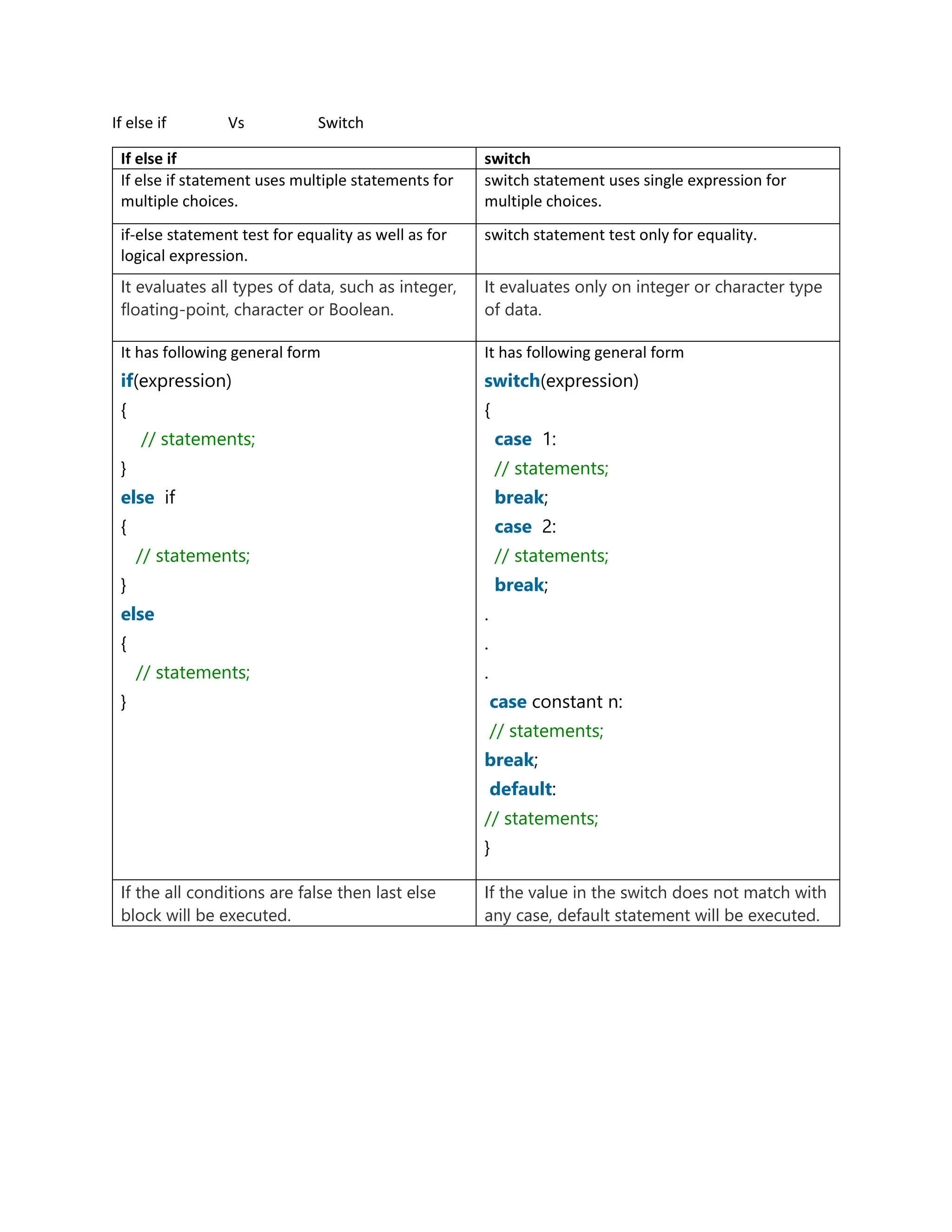
If else ifVs Switch
If else if switch
If else if statement uses multiple statements for
multiple choices.
switch statement uses single expression for
multiple choices.
if-else statement test for equality as well as for
logical expression.
switch statement test only for equality.
It evaluates all types of data, such as integer,
floating-point, character or Boolean.
It evaluates only on integer or character type
of data.
It has following general form
1. if(expression)
2. {
3. // statements;
4. }
5. else if
6. {
7. // statements;
8. }
9. else
{
// statements;
}
It has following general form
1. switch(expression)
2. {
3. case 1:
4. // statements;
5. break;
6. case 2:
7. // statements;
8. break;
9. .
.
.
case constant n:
// statements;
break;
default:
// statements;
}
If the all conditions are false then last else
block will be executed.
If the value in the switch does not match with
any case, default statement will be executed.