Introduction to credit default swaps
About the consistency of clustering financial time series
Design of distances and alternative dependence coefficients
Summary and open questions
Some contributions to the clustering
of financial time series
and its applications to credit default swaps
Gautier Marti
November 10, 2017
Gautier Marti Some contributions to the clustering of financial time series
Introduction to credit default swaps
About the consistency of clustering financial time series
Design of distances and alternative dependence coefficients
Summary and open questions
Context of the PhD thesis
PhD studies in hedge funds:
Hellebore Capital Management,
63 Avenue des Champs-Elys´ees, Paris, France
(April 1, 2014 - February 29, 2016)
Hellebore Capital Limited,
81 Fulham Road, London, United Kingdom
(March 1, 2016 - September 20, 2017)
AXA IM Chorus,
18 Westlands Road, Hong Kong
(October 1, 2017 - present)
Gautier Marti Some contributions to the clustering of financial time series
Introduction to credit default swaps
About the consistency of clustering financial time series
Design of distances and alternative dependence coefficients
Summary and open questions
Outline
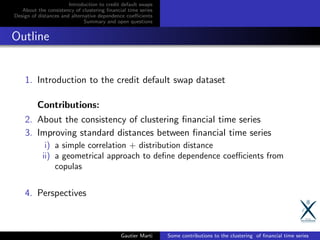
1. Introduction to the credit default swap dataset
Contributions:
2. About the consistency of clustering financial time series
3. Improving standard distances between financial time series
i) a simple correlation + distribution distance
ii) a geometrical approach to define dependence coefficients from
copulas
4. Perspectives
Gautier Marti Some contributions to the clustering of financial time series
Introduction to credit default swaps
About the consistency of clustering financial time series
Design of distances and alternative dependence coefficients
Summary and open questions
Some movation for using clustering
Statistical modelling is difficult as the time series
are non stationary, e.g. economic regimes are changing, it
can be misleading to use data from a too distant past
are near efficient, i.e. behaving nearly like random walks (cf.
the efficient-market hypothesis (Fama, 1970) [5])
have a low signal-to-noise ratio, i.e. measure artifacts hide
information in random fluctuations
are in an unfavorable statistical setting, too few relevant
observations (length) wrt the number of variables (time series)
Gautier Marti Some contributions to the clustering of financial time series
Introduction to credit default swaps
About the consistency of clustering financial time series
Design of distances and alternative dependence coefficients
Summary and open questions
Some motivation for using clustering
Clustering helps to reduce dimensionality, and thus can be used as
a preprocessing for:
Risk management, e.g. filtering covariances, performance
and risk attribution
Investment, e.g. portfolio design, statarb, beta neutralization
Data analysis, e.g. outliers detection and missing values
imputation, exploration (www.datagrapple.com)
Gautier Marti Some contributions to the clustering of financial time series
Introduction to credit default swaps
About the consistency of clustering financial time series
Design of distances and alternative dependence coefficients
Summary and open questions
1 Introduction to credit default swaps
2 About the consistency of clustering financial time series
3 Design of distances and alternative dependence coefficients
Alternative representation and correlation+distribution distance
Copula-based dependence coefficients
4 Summary and open questions
Gautier Marti Some contributions to the clustering of financial time series
Introduction to credit default swaps
About the consistency of clustering financial time series
Design of distances and alternative dependence coefficients
Summary and open questions
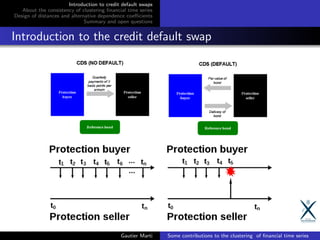
Introduction to the credit default swap
Gautier Marti Some contributions to the clustering of financial time series
Introduction to credit default swaps
About the consistency of clustering financial time series
Design of distances and alternative dependence coefficients
Summary and open questions
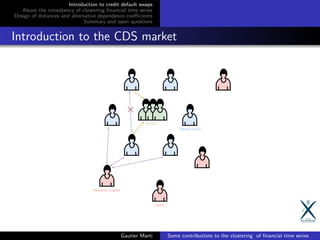
Introduction to the CDS market
Gautier Marti Some contributions to the clustering of financial time series
Introduction to credit default swaps
About the consistency of clustering financial time series
Design of distances and alternative dependence coefficients
Summary and open questions
Introduction to the CDS raw dataset
Putting Self-Supervised Token Embedding on the Tables [15]
(ICMLA 2017)
Gautier Marti Some contributions to the clustering of financial time series
Introduction to credit default swaps
About the consistency of clustering financial time series
Design of distances and alternative dependence coefficients
Summary and open questions
A ‘tick-by-tick’ dataset
Autoregressive Convolutional Neural Networks for Asynchronous
Time Series [1] (ICML Time Series WS 2017)
Gautier Marti Some contributions to the clustering of financial time series
Introduction to credit default swaps
About the consistency of clustering financial time series
Design of distances and alternative dependence coefficients
Summary and open questions
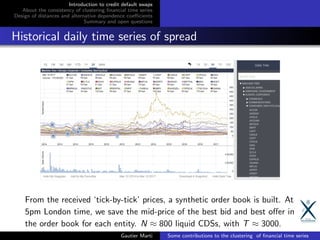
Historical daily time series of spread
From the received ‘tick-by-tick’ prices, a synthetic order book is built. At
5pm London time, we save the mid-price of the best bid and best offer in
the order book for each entity. N ≈ 800 liquid CDSs, with T ≈ 3000.
Gautier Marti Some contributions to the clustering of financial time series
Introduction to credit default swaps
About the consistency of clustering financial time series
Design of distances and alternative dependence coefficients
Summary and open questions
1 Introduction to credit default swaps
2 About the consistency of clustering financial time series
3 Design of distances and alternative dependence coefficients
Alternative representation and correlation+distribution distance
Copula-based dependence coefficients
4 Summary and open questions
Gautier Marti Some contributions to the clustering of financial time series
Introduction to credit default swaps
About the consistency of clustering financial time series
Design of distances and alternative dependence coefficients
Summary and open questions
Clustering of Financial Time Series
Stylized fact I: Financial time series correlations have a strong
hierarchical block diagonal structure (Mantegna, 1999) [6]
https://gmarti.gitlab.io/ml/2017/09/07/how-to-sort-distance-matrix.html
Stylized fact II: Most correlations are spurious (Bouchaud,
1999) [3]
Motivation for clustering financial time series using correlation as a
similarity measure:
dimensionality reduction ≡ filtering noisy correlations
Gautier Marti Some contributions to the clustering of financial time series
Introduction to credit default swaps
About the consistency of clustering financial time series
Design of distances and alternative dependence coefficients
Summary and open questions
Challenge for the statistical practitioner
The dilemma:
the longer the time interval, the more precise the correlation
estimates, but also
the longer the time interval, the more unrealistic the
stationarity hypothesis for these time series.
Question: How does the clustering behave with statistical errors
of the correlation estimates?
Gautier Marti Some contributions to the clustering of financial time series
Introduction to credit default swaps
About the consistency of clustering financial time series
Design of distances and alternative dependence coefficients
Summary and open questions
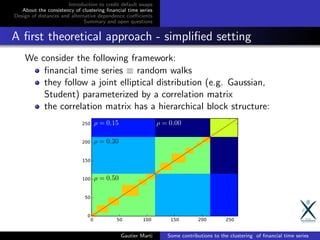
A first theoretical approach - simplified setting
We consider the following framework:
financial time series ≡ random walks
they follow a joint elliptical distribution (e.g. Gaussian,
Student) parameterized by a correlation matrix
the correlation matrix has a hierarchical block structure:
Gautier Marti Some contributions to the clustering of financial time series
Hierarchical clustering algorithms - A taxonomy
We consider Hierarchical Agglomerative Clustering algorithms.
Such as single linkage, average linkage, Ward.
Space contracting vs. Space conserving vs. Space dilating [2]
D(t+1)
C
(t)
i
∪ C
(t)
j
, C
(t)
k
≤ min D
(t)
ik
, D
(t)
jk
D(t+1)
C
(t)
i
∪ C
(t)
j
, C
(t)
k
∈
min D
(t)
ik
, D
(t)
jk
, max D
(t)
ik
, D
(t)
jk
D(t+1)
C
(t)
i
∪ C
(t)
j
, C
(t)
k
≥ max D
(t)
ik
, D
(t)
jk
Gautier Marti Some contributions to the clustering of financial time series
Introduction to credit default swaps
About the consistency of clustering financial time series
Design of distances and alternative dependence coefficients
Summary and open questions
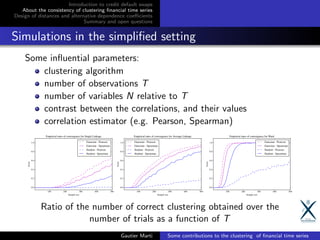
Simulations in the simplified setting
Some influential parameters:
clustering algorithm
number of observations T
number of variables N relative to T
contrast between the correlations, and their values
correlation estimator (e.g. Pearson, Spearman)
100 200 300 400 500
Sample size
0.0
0.2
0.4
0.6
0.8
1.0
Score
Empirical rates of convergence for Single Linkage
Gaussian - Pearson
Gaussian - Spearman
Student - Pearson
Student - Spearman
100 200 300 400 500
Sample size
0.0
0.2
0.4
0.6
0.8
1.0
Score
Empirical rates of convergence for Average Linkage
Gaussian - Pearson
Gaussian - Spearman
Student - Pearson
Student - Spearman
100 200 300 400 500
Sample size
0.0
0.2
0.4
0.6
0.8
1.0
Score
Empirical rates of convergence for Ward
Gaussian - Pearson
Gaussian - Spearman
Student - Pearson
Student - Spearman
Ratio of the number of correct clustering obtained over the
number of trials as a function of T
Gautier Marti Some contributions to the clustering of financial time series
Introduction to credit default swaps
About the consistency of clustering financial time series
Design of distances and alternative dependence coefficients
Summary and open questions
A consistency proof & first convergence bounds
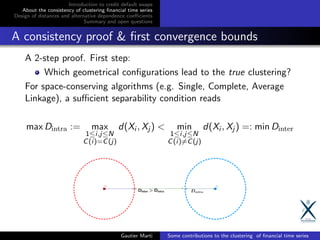
A 2-step proof. First step:
Which geometrical configurations lead to the true clustering?
For space-conserving algorithms (e.g. Single, Complete, Average
Linkage), a sufficient separability condition reads
max Dintra := max
1≤i,j≤N
C(i)=C(j)
d(Xi , Xj ) < min
1≤i,j≤N
C(i)=C(j)
d(Xi , Xj ) =: min Dinter
Gautier Marti Some contributions to the clustering of financial time series
Introduction to credit default swaps
About the consistency of clustering financial time series
Design of distances and alternative dependence coefficients
Summary and open questions
A consistency proof & first convergence bounds
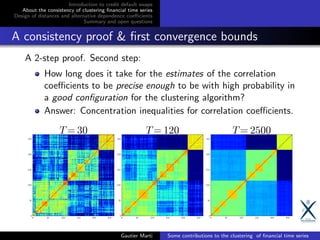
A 2-step proof. Second step:
How long does it take for the estimates of the correlation
coefficients to be precise enough to be with high probability in
a good configuration for the clustering algorithm?
Answer: Concentration inequalities for correlation coefficients.
Gautier Marti Some contributions to the clustering of financial time series
Introduction to credit default swaps
About the consistency of clustering financial time series
Design of distances and alternative dependence coefficients
Summary and open questions
Convergence bounds
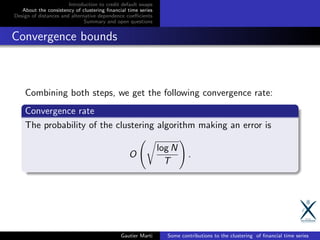
Combining both steps, we get the following convergence rate:
Convergence rate
The probability of the clustering algorithm making an error is
O
log N
T
.
Gautier Marti Some contributions to the clustering of financial time series
Introduction to credit default swaps
About the consistency of clustering financial time series
Design of distances and alternative dependence coefficients
Summary and open questions
Proof. Step 1 - A bit more details
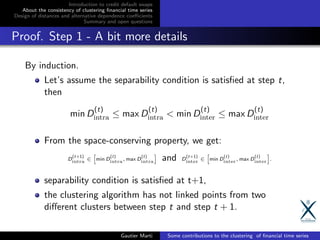
By induction.
Let’s assume the separability condition is satisfied at step t,
then
min D
(t)
intra ≤ max D
(t)
intra < min D
(t)
inter ≤ max D
(t)
inter
From the space-conserving property, we get:
D
(t+1)
intra ∈ min D
(t)
intra, max D
(t)
intra and D
(t+1)
inter ∈ min D
(t)
inter, max D
(t)
inter .
separability condition is satisfied at t+1,
the clustering algorithm has not linked points from two
different clusters between step t and step t + 1.
Gautier Marti Some contributions to the clustering of financial time series
Proof. Step 2 - A bit more details
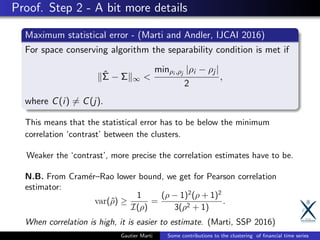
Maximum statistical error - (Marti and Andler, IJCAI 2016)
For space conserving algorithm the separability condition is met if
ˆΣ − Σ ∞ <
minρi ,ρj
|ρi − ρj |
2
,
where C(i) = C(j).
This means that the statistical error has to be below the minimum
correlation ‘contrast’ between the clusters.
Weaker the ‘contrast’, more precise the correlation estimates have to be.
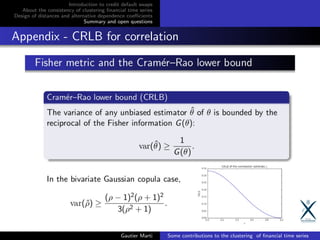
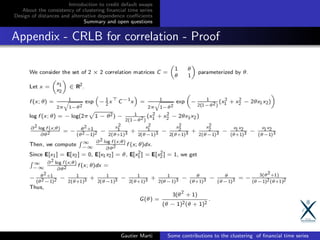
N.B. From Cram´er–Rao lower bound, we get for Pearson correlation
estimator:
var(ˆρ) ≥
1
I(ρ)
=
(ρ − 1)2
(ρ + 1)2
3(ρ2 + 1)
.
When correlation is high, it is easier to estimate. (Marti, SSP 2016)
Gautier Marti Some contributions to the clustering of financial time series
Correlation estimates concentration bounds
number of variables N, observations T, minimum separation d
Concentration bounds [4]
If Σ and ˆΣ are the population and empirical Spearman correlation
matrices respectively, then for N ≥ 24
log T + 2, we have with
probability at least 1 − 1
T2 ,
ˆΣ − Σ ∞ ≤ 24
log N
T
.
P(“correct clustering”) ≥ 1 − 2N2
e−Td2/24
Not sharp enough for reasonable values of N, T, d.
For example, for N = 500, T = 2500, d = 0.2, we obtain
≈ −7750.
Gautier Marti Some contributions to the clustering of financial time series
Future developments & open questions
Bounds are not sharp enough. We can try to refine them using:
(theoretical) Intrinsic dimension of the HCBM model [16];
(theoretical Use PSD-ness to refine the bounds for the matrix
(theoretical/empirical) A distance between dendrograms
(instead of correct/incorrect) for a finer analysis;
(empirical) A study of ‘correctness’ isoquants:
Precise convergence rates of clustering methodologies can provide
a useful model selection criterion for practitioners!
Gautier Marti Some contributions to the clustering of financial time series
Introduction to credit default swaps
About the consistency of clustering financial time series
Design of distances and alternative dependence coefficients
Summary and open questions
Alternative representation and correlation+distribution distance
Copula-based dependence coefficients
1 Introduction to credit default swaps
2 About the consistency of clustering financial time series
3 Design of distances and alternative dependence coefficients
Alternative representation and correlation+distribution distance
Copula-based dependence coefficients
4 Summary and open questions
Gautier Marti Some contributions to the clustering of financial time series
Introduction to credit default swaps
About the consistency of clustering financial time series
Design of distances and alternative dependence coefficients
Summary and open questions
Alternative representation and correlation+distribution distance
Copula-based dependence coefficients
Motivations
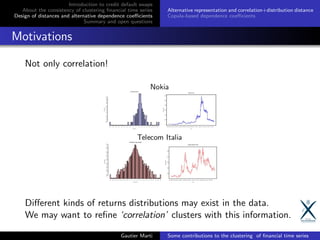
Not only correlation!
Different kinds of returns distributions may exist in the data.
We may want to refine ‘correlation’ clusters with this information.
Gautier Marti Some contributions to the clustering of financial time series
Introduction to credit default swaps
About the consistency of clustering financial time series
Design of distances and alternative dependence coefficients
Summary and open questions
Alternative representation and correlation+distribution distance
Copula-based dependence coefficients
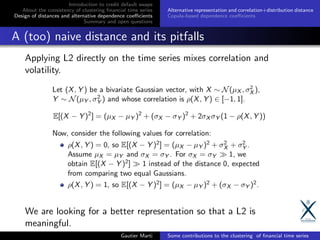
A (too) naive distance and its pitfalls
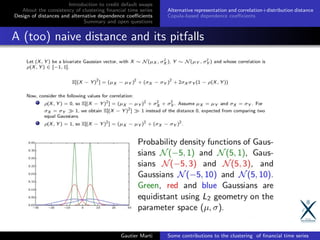
Applying L2 directly on the time series mixes correlation and
volatility.
We are looking for a better representation so that a L2 is
meaningful.
Gautier Marti Some contributions to the clustering of financial time series
Introduction to credit default swaps
About the consistency of clustering financial time series
Design of distances and alternative dependence coefficients
Summary and open questions
Alternative representation and correlation+distribution distance
Copula-based dependence coefficients
A (too) naive distance and its pitfalls
Gautier Marti Some contributions to the clustering of financial time series
Introduction to credit default swaps
About the consistency of clustering financial time series
Design of distances and alternative dependence coefficients
Summary and open questions
Alternative representation and correlation+distribution distance
Copula-based dependence coefficients
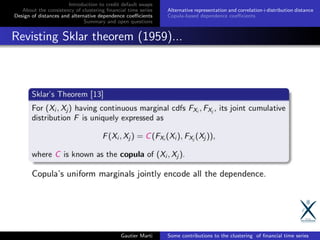
Revisting Sklar theorem (1959)...
Gautier Marti Some contributions to the clustering of financial time series
Introduction to credit default swaps
About the consistency of clustering financial time series
Design of distances and alternative dependence coefficients
Summary and open questions
Alternative representation and correlation+distribution distance
Copula-based dependence coefficients
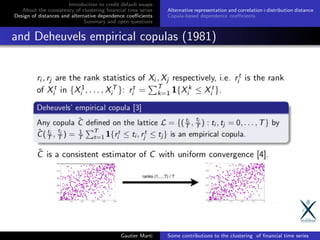
and Deheuvels empirical copulas (1981)
Gautier Marti Some contributions to the clustering of financial time series
Introduction to credit default swaps
About the consistency of clustering financial time series
Design of distances and alternative dependence coefficients
Summary and open questions
Alternative representation and correlation+distribution distance
Copula-based dependence coefficients
A novel representation for time series
Basically, we transform each time series of returns to a (normalized
ranks, square root of marginal density) vector.
Applying a L2 between two of these vectors is now equivalent to a
distance in Spearman correlation + Hellinger between the densities.
cf. (Marti et al., 2016) [13] (Pattern Recognition Letters) for more
details on this representation and the associated distance.
Gautier Marti Some contributions to the clustering of financial time series
Introduction to credit default swaps
About the consistency of clustering financial time series
Design of distances and alternative dependence coefficients
Summary and open questions
Alternative representation and correlation+distribution distance
Copula-based dependence coefficients
Analysing the differences - Using the Sankey diagram
cf. (Marti et al., 2015) [14] (ICMLA 2015) for guidelines on how to
compare several clustering methodologies for financial time series.
Gautier Marti Some contributions to the clustering of financial time series
Introduction to credit default swaps
About the consistency of clustering financial time series
Design of distances and alternative dependence coefficients
Summary and open questions
Alternative representation and correlation+distribution distance
Copula-based dependence coefficients
Exploring and improving dependence coefficients –
Motivations
We want to use dependence measures which are:
robust to noise (not Pearson then) and preserve as much
information as possible, so that clusterings are more stable;
can be tuned to look for specific dependencies, e.g.
tail-dependence or more exotic ones.
As copulas are a convenient way to capture all the dependence
between two variables, we aim at leveraging them.
Gautier Marti Some contributions to the clustering of financial time series
Introduction to credit default swaps
About the consistency of clustering financial time series
Design of distances and alternative dependence coefficients
Summary and open questions
Alternative representation and correlation+distribution distance
Copula-based dependence coefficients
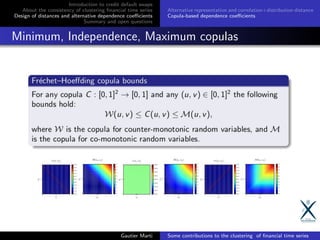
Minimum, Independence, Maximum copulas
Gautier Marti Some contributions to the clustering of financial time series
Introduction to credit default swaps
About the consistency of clustering financial time series
Design of distances and alternative dependence coefficients
Summary and open questions
Alternative representation and correlation+distribution distance
Copula-based dependence coefficients
Relation to existing dependence coefficients
Some dependence coefficients can be readily expressed as:
deviation from Fr´echet-Hoeffding bounds
Spearman’s ρS = 1 − 6 [0,1]2 (ui − uj )2
dC(ui , uj ),
Gini’s γ,
Kendall distribution distance,
deviation from independence ui uj
Spearman ρS = 12 [0,1]2 (C(ui , uj ) − ui uj )dui
duj
,
Copula MMD,
Schweizer-Wolff’s σ,
Hoeffding’s φ2
Gautier Marti Some contributions to the clustering of financial time series
Introduction to credit default swaps
About the consistency of clustering financial time series
Design of distances and alternative dependence coefficients
Summary and open questions
Alternative representation and correlation+distribution distance
Copula-based dependence coefficients
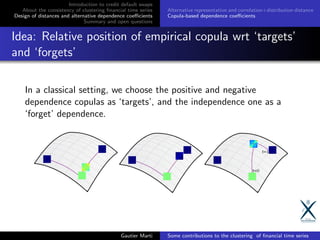
Idea: Relative position of empirical copula wrt ‘targets’
and ‘forgets’
In a classical setting, we choose the positive and negative
dependence copulas as ‘targets’, and the independence one as a
‘forget’ dependence.
Gautier Marti Some contributions to the clustering of financial time series
Introduction to credit default swaps
About the consistency of clustering financial time series
Design of distances and alternative dependence coefficients
Summary and open questions
Alternative representation and correlation+distribution distance
Copula-based dependence coefficients
Optimal Transport between empirical copulas
cf. (Marti et al., 2016) [12] (ICASSP 2016)
Gautier Marti Some contributions to the clustering of financial time series
Introduction to credit default swaps
About the consistency of clustering financial time series
Design of distances and alternative dependence coefficients
Summary and open questions
Alternative representation and correlation+distribution distance
Copula-based dependence coefficients
Why choosing Optimal Transport over f -divergences?
Distances between Gaussian copulas C1, C2, C3:
cf. (Marti et al., 2016) [7] (SSP 2016)
Gautier Marti Some contributions to the clustering of financial time series
Introduction to credit default swaps
About the consistency of clustering financial time series
Design of distances and alternative dependence coefficients
Summary and open questions
Alternative representation and correlation+distribution distance
Copula-based dependence coefficients
Standard setting: TFDC vs. Spearman
cf. (Marti et al., 2017) [8] (NIPS Time Series WS 2016)
Gautier Marti Some contributions to the clustering of financial time series
Introduction to credit default swaps
About the consistency of clustering financial time series
Design of distances and alternative dependence coefficients
Summary and open questions
Alternative representation and correlation+distribution distance
Copula-based dependence coefficients
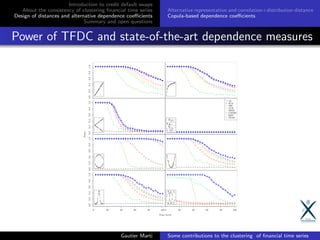
Power of TFDC and state-of-the-art dependence measures
Gautier Marti Some contributions to the clustering of financial time series
Introduction to credit default swaps
About the consistency of clustering financial time series
Design of distances and alternative dependence coefficients
Summary and open questions
Alternative representation and correlation+distribution distance
Copula-based dependence coefficients
Some applications of the Target/Forget Dependence
Coefficient
Applications in non-standard settings: We can look for particular
associations between random variables.
cf. (Marti et al., 2017) [8] (NIPS Time Series 2016)
Gautier Marti Some contributions to the clustering of financial time series
Introduction to credit default swaps
About the consistency of clustering financial time series
Design of distances and alternative dependence coefficients
Summary and open questions
Alternative representation and correlation+distribution distance
Copula-based dependence coefficients
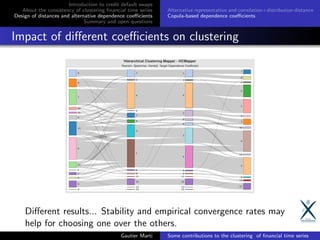
Impact of different coefficients on clustering
Different results... Stability and empirical convergence rates may
help for choosing one over the others.
Gautier Marti Some contributions to the clustering of financial time series
Introduction to credit default swaps
About the consistency of clustering financial time series
Design of distances and alternative dependence coefficients
Summary and open questions
1 Introduction to credit default swaps
2 About the consistency of clustering financial time series
3 Design of distances and alternative dependence coefficients
Alternative representation and correlation+distribution distance
Copula-based dependence coefficients
4 Summary and open questions
Gautier Marti Some contributions to the clustering of financial time series
Introduction to credit default swaps
About the consistency of clustering financial time series
Design of distances and alternative dependence coefficients
Summary and open questions
Summary of contributions
The contribution of the PhD thesis:
bring a greater focus on statistical reliability (convergence
rates and consistency) [9] (IJCAI 2016)
consider alternative representation and distances [13]
(Pattern Recognition Letters), [8] (NIPS Time Series 2016)
visualizations [10] and a framework to test for clustering
stability [14] (ICMLA 2015)
an extensive and regularly updated survey of the literature:
https://arxiv.org/pdf/1703.00485.pdf [11] (350+
references)
Gautier Marti Some contributions to the clustering of financial time series
Introduction to credit default swaps
About the consistency of clustering financial time series
Design of distances and alternative dependence coefficients
Summary and open questions
Perspectives and open questions
“How many clusters?”
What is multivariate correlation? How to use it for
hierarchical clustering?
Using several time series representing a given entity, and
dependence between random vectors?
Riemannian geometry of correlation matrices (not a totally
geodesic submanifold of the well-explored manifold of
covariances)
Entities switching clusters: noise or signal?
More precise results for (empirical) convergence rates?
Gautier Marti Some contributions to the clustering of financial time series
Introduction to credit default swaps
About the consistency of clustering financial time series
Design of distances and alternative dependence coefficients
Summary and open questions
Mikolaj Binkowski, Gautier Marti, and Philippe Donnat.
Autoregressive convolutional neural networks for asynchronous
time series.
arXiv preprint arXiv:1703.04122, 2017.
Zhenmin Chen and John W Van Ness.
Space-conserving agglomerative algorithms.
Journal of classification, 13(1):157–168, 1996.
Laurent Laloux, Pierre Cizeau, Marc Potters, and
Jean-Philippe Bouchaud.
Random matrix theory and financial correlations.
International Journal of Theoretical and Applied Finance,
3(03):391–397, 2000.
Han Liu, Fang Han, Ming Yuan, John Lafferty, Larry
Wasserman, et al.
Gautier Marti Some contributions to the clustering of financial time series
Introduction to credit default swaps
About the consistency of clustering financial time series
Design of distances and alternative dependence coefficients
Summary and open questions
High-dimensional semiparametric gaussian copula graphical
models.
The Annals of Statistics, 40(4):2293–2326, 2012.
Burton G Malkiel and Eugene F Fama.
Efficient capital markets: A review of theory and empirical
work.
The journal of Finance, 25(2):383–417, 1970.
Rosario N Mantegna.
Hierarchical structure in financial markets.
The European Physical Journal B-Condensed Matter and
Complex Systems, 11(1):193–197, 1999.
Gautier Marti, S´ebastien Andler, Frank Nielsen, and Philippe
Donnat.
Optimal transport vs. fisher-rao distance between copulas for
clustering multivariate time series.
Gautier Marti Some contributions to the clustering of financial time series
Introduction to credit default swaps
About the consistency of clustering financial time series
Design of distances and alternative dependence coefficients
Summary and open questions
In Statistical Signal Processing Workshop (SSP), 2016 IEEE,
pages 1–5. IEEE, 2016.
Gautier Marti, S´ebastien Andler, Frank Nielsen, and Philippe
Donnat.
Exploring and measuring non-linear correlations: Copulas,
lightspeed transportation and clustering.
In NIPS 2016 Time Series Workshop, pages 59–69, 2017.
Gautier Marti, S´ebastien Andler, Frank Nielsen, and Philippe
Donnat.
Clustering financial time series: How long is enough?
2016.
Gautier Marti, Philippe Donnat, Frank Nielsen, and Philippe
Very.
Gautier Marti Some contributions to the clustering of financial time series
Introduction to credit default swaps
About the consistency of clustering financial time series
Design of distances and alternative dependence coefficients
Summary and open questions
HCMapper: An interactive visualization tool to compare
partition-based flat clustering extracted from pairs of
dendrograms.
arXiv preprint arXiv:1507.08137, 2015.
Gautier Marti, Frank Nielsen, Mikolaj Bi´nkowski, and Philippe
Donnat.
A review of two decades of correlations, hierarchies, networks
and clustering in financial markets.
arXiv preprint arXiv:1703.00485, 2017.
Gautier Marti, Frank Nielsen, and Philippe Donnat.
Optimal copula transport for clustering multivariate time
series.
In Acoustics, Speech and Signal Processing (ICASSP), 2016
IEEE International Conference on, pages 2379–2383. IEEE,
2016.
Gautier Marti Some contributions to the clustering of financial time series
Introduction to credit default swaps
About the consistency of clustering financial time series
Design of distances and alternative dependence coefficients
Summary and open questions
Gautier Marti, Philippe Very, and Philippe Donnat.
Toward a generic representation of random variables for
machine learning.
arXiv preprint arXiv:1506.00976, 2015.
Gautier Marti, Philippe Very, Philippe Donnat, and Frank
Nielsen.
A proposal of a methodological framework with experimental
guidelines to investigate clustering stability on financial time
series.
In 14th IEEE International Conference on Machine Learning
and Applications, ICMLA 2015, Miami, FL, USA, December
9-11, 2015, pages 32–37, 2015.
Marc Szafraniec, Gautier Marti, and Philippe Donnat.
Putting self-supervised token embedding on the tables.
arXiv preprint arXiv:1708.04120, 2017.
Gautier Marti Some contributions to the clustering of financial time series
Introduction to credit default swaps
About the consistency of clustering financial time series
Design of distances and alternative dependence coefficients
Summary and open questions
Joel A Tropp.
An introduction to matrix concentration inequalities.
arXiv preprint arXiv:1501.01571, 2015.
Gautier Marti Some contributions to the clustering of financial time series
Introduction to credit default swaps
About the consistency of clustering financial time series
Design of distances and alternative dependence coefficients
Summary and open questions
Appendix - CRLB for correlation
Gautier Marti Some contributions to the clustering of financial time series
Introduction to credit default swaps
About the consistency of clustering financial time series
Design of distances and alternative dependence coefficients
Summary and open questions
Appendix - CRLB for correlation - Proof
Gautier Marti Some contributions to the clustering of financial time series
Introduction to credit default swaps
About the consistency of clustering financial time series
Design of distances and alternative dependence coefficients
Summary and open questions
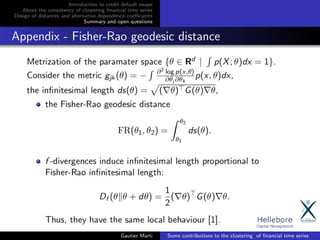
Appendix - Fisher-Rao geodesic distance
Gautier Marti Some contributions to the clustering of financial time series
Introduction to credit default swaps
About the consistency of clustering financial time series
Design of distances and alternative dependence coefficients
Summary and open questions
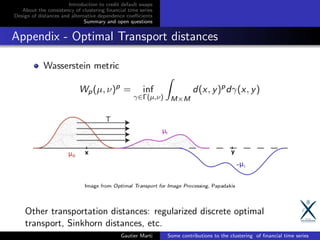
Appendix - Optimal Transport distances
Other transportation distances: regularized discrete optimal
transport, Sinkhorn distances, etc.
Gautier Marti Some contributions to the clustering of financial time series
Introduction to credit default swaps
About the consistency of clustering financial time series
Design of distances and alternative dependence coefficients
Summary and open questions
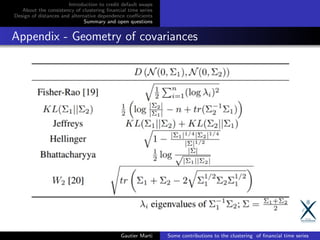
Appendix - Geometry of covariances
Gautier Marti Some contributions to the clustering of financial time series
Introduction to credit default swaps
About the consistency of clustering financial time series
Design of distances and alternative dependence coefficients
Summary and open questions
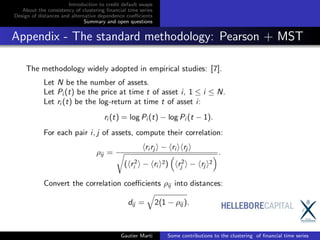
Appendix - The standard methodology: Pearson + MST
Gautier Marti Some contributions to the clustering of financial time series
Introduction to credit default swaps
About the consistency of clustering financial time series
Design of distances and alternative dependence coefficients
Summary and open questions
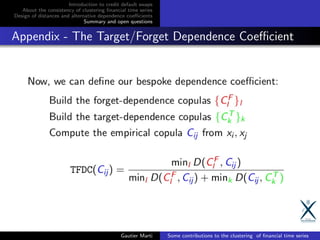
Appendix - The Target/Forget Dependence Coefficient
Gautier Marti Some contributions to the clustering of financial time series
Introduction to credit default swaps
About the consistency of clustering financial time series
Design of distances and alternative dependence coefficients
Summary and open questions
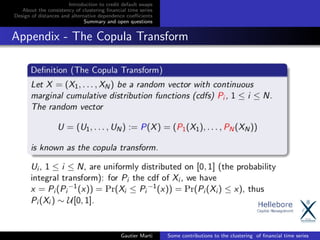
Appendix - The Copula Transform
Gautier Marti Some contributions to the clustering of financial time series
Introduction to credit default swaps
About the consistency of clustering financial time series
Design of distances and alternative dependence coefficients
Summary and open questions
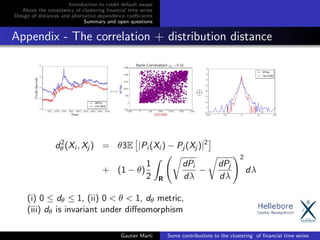
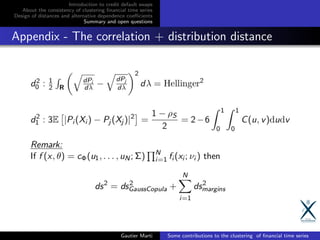
Appendix - The correlation + distribution distance
Gautier Marti Some contributions to the clustering of financial time series
Introduction to credit default swaps
About the consistency of clustering financial time series
Design of distances and alternative dependence coefficients
Summary and open questions
Appendix - The correlation + distribution distance
Gautier Marti Some contributions to the clustering of financial time series
Introduction to credit default swaps
About the consistency of clustering financial time series
Design of distances and alternative dependence coefficients
Summary and open questions
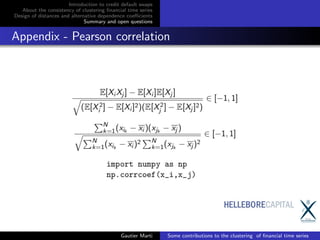
Appendix - Pearson correlation
Gautier Marti Some contributions to the clustering of financial time series

Some contributions to the clustering of financial time series - Applications to credit default swaps

  • 1.
    Introduction to creditdefault swaps About the consistency of clustering financial time series Design of distances and alternative dependence coefficients Summary and open questions Some contributions to the clustering of financial time series and its applications to credit default swaps Gautier Marti November 10, 2017 Gautier Marti Some contributions to the clustering of financial time series
  • 2.
    Introduction to creditdefault swaps About the consistency of clustering financial time series Design of distances and alternative dependence coefficients Summary and open questions Context of the PhD thesis PhD studies in hedge funds: Hellebore Capital Management, 63 Avenue des Champs-Elys´ees, Paris, France (April 1, 2014 - February 29, 2016) Hellebore Capital Limited, 81 Fulham Road, London, United Kingdom (March 1, 2016 - September 20, 2017) AXA IM Chorus, 18 Westlands Road, Hong Kong (October 1, 2017 - present) Gautier Marti Some contributions to the clustering of financial time series
  • 3.
    Introduction to creditdefault swaps About the consistency of clustering financial time series Design of distances and alternative dependence coefficients Summary and open questions Outline 1. Introduction to the credit default swap dataset Contributions: 2. About the consistency of clustering financial time series 3. Improving standard distances between financial time series i) a simple correlation + distribution distance ii) a geometrical approach to define dependence coefficients from copulas 4. Perspectives Gautier Marti Some contributions to the clustering of financial time series
  • 4.
    Introduction to creditdefault swaps About the consistency of clustering financial time series Design of distances and alternative dependence coefficients Summary and open questions Some movation for using clustering Statistical modelling is difficult as the time series are non stationary, e.g. economic regimes are changing, it can be misleading to use data from a too distant past are near efficient, i.e. behaving nearly like random walks (cf. the efficient-market hypothesis (Fama, 1970) [5]) have a low signal-to-noise ratio, i.e. measure artifacts hide information in random fluctuations are in an unfavorable statistical setting, too few relevant observations (length) wrt the number of variables (time series) Gautier Marti Some contributions to the clustering of financial time series
  • 5.
    Introduction to creditdefault swaps About the consistency of clustering financial time series Design of distances and alternative dependence coefficients Summary and open questions Some motivation for using clustering Clustering helps to reduce dimensionality, and thus can be used as a preprocessing for: Risk management, e.g. filtering covariances, performance and risk attribution Investment, e.g. portfolio design, statarb, beta neutralization Data analysis, e.g. outliers detection and missing values imputation, exploration (www.datagrapple.com) Gautier Marti Some contributions to the clustering of financial time series
  • 6.
    Introduction to creditdefault swaps About the consistency of clustering financial time series Design of distances and alternative dependence coefficients Summary and open questions 1 Introduction to credit default swaps 2 About the consistency of clustering financial time series 3 Design of distances and alternative dependence coefficients Alternative representation and correlation+distribution distance Copula-based dependence coefficients 4 Summary and open questions Gautier Marti Some contributions to the clustering of financial time series
  • 7.
    Introduction to creditdefault swaps About the consistency of clustering financial time series Design of distances and alternative dependence coefficients Summary and open questions Introduction to the credit default swap Gautier Marti Some contributions to the clustering of financial time series
  • 8.
    Introduction to creditdefault swaps About the consistency of clustering financial time series Design of distances and alternative dependence coefficients Summary and open questions Introduction to the CDS market Gautier Marti Some contributions to the clustering of financial time series
  • 9.
    Introduction to creditdefault swaps About the consistency of clustering financial time series Design of distances and alternative dependence coefficients Summary and open questions Introduction to the CDS raw dataset Putting Self-Supervised Token Embedding on the Tables [15] (ICMLA 2017) Gautier Marti Some contributions to the clustering of financial time series
  • 10.
    Introduction to creditdefault swaps About the consistency of clustering financial time series Design of distances and alternative dependence coefficients Summary and open questions A ‘tick-by-tick’ dataset Autoregressive Convolutional Neural Networks for Asynchronous Time Series [1] (ICML Time Series WS 2017) Gautier Marti Some contributions to the clustering of financial time series
  • 11.
    Introduction to creditdefault swaps About the consistency of clustering financial time series Design of distances and alternative dependence coefficients Summary and open questions Historical daily time series of spread From the received ‘tick-by-tick’ prices, a synthetic order book is built. At 5pm London time, we save the mid-price of the best bid and best offer in the order book for each entity. N ≈ 800 liquid CDSs, with T ≈ 3000. Gautier Marti Some contributions to the clustering of financial time series
  • 12.
    Introduction to creditdefault swaps About the consistency of clustering financial time series Design of distances and alternative dependence coefficients Summary and open questions 1 Introduction to credit default swaps 2 About the consistency of clustering financial time series 3 Design of distances and alternative dependence coefficients Alternative representation and correlation+distribution distance Copula-based dependence coefficients 4 Summary and open questions Gautier Marti Some contributions to the clustering of financial time series
  • 13.
    Introduction to creditdefault swaps About the consistency of clustering financial time series Design of distances and alternative dependence coefficients Summary and open questions Clustering of Financial Time Series Stylized fact I: Financial time series correlations have a strong hierarchical block diagonal structure (Mantegna, 1999) [6] https://gmarti.gitlab.io/ml/2017/09/07/how-to-sort-distance-matrix.html Stylized fact II: Most correlations are spurious (Bouchaud, 1999) [3] Motivation for clustering financial time series using correlation as a similarity measure: dimensionality reduction ≡ filtering noisy correlations Gautier Marti Some contributions to the clustering of financial time series
  • 14.
    Introduction to creditdefault swaps About the consistency of clustering financial time series Design of distances and alternative dependence coefficients Summary and open questions Challenge for the statistical practitioner The dilemma: the longer the time interval, the more precise the correlation estimates, but also the longer the time interval, the more unrealistic the stationarity hypothesis for these time series. Question: How does the clustering behave with statistical errors of the correlation estimates? Gautier Marti Some contributions to the clustering of financial time series
  • 15.
    Introduction to creditdefault swaps About the consistency of clustering financial time series Design of distances and alternative dependence coefficients Summary and open questions A first theoretical approach - simplified setting We consider the following framework: financial time series ≡ random walks they follow a joint elliptical distribution (e.g. Gaussian, Student) parameterized by a correlation matrix the correlation matrix has a hierarchical block structure: Gautier Marti Some contributions to the clustering of financial time series
  • 16.
    Hierarchical clustering algorithms- A taxonomy We consider Hierarchical Agglomerative Clustering algorithms. Such as single linkage, average linkage, Ward. Space contracting vs. Space conserving vs. Space dilating [2] D(t+1) C (t) i ∪ C (t) j , C (t) k ≤ min D (t) ik , D (t) jk D(t+1) C (t) i ∪ C (t) j , C (t) k ∈ min D (t) ik , D (t) jk , max D (t) ik , D (t) jk D(t+1) C (t) i ∪ C (t) j , C (t) k ≥ max D (t) ik , D (t) jk Gautier Marti Some contributions to the clustering of financial time series
  • 17.
    Introduction to creditdefault swaps About the consistency of clustering financial time series Design of distances and alternative dependence coefficients Summary and open questions Simulations in the simplified setting Some influential parameters: clustering algorithm number of observations T number of variables N relative to T contrast between the correlations, and their values correlation estimator (e.g. Pearson, Spearman) 100 200 300 400 500 Sample size 0.0 0.2 0.4 0.6 0.8 1.0 Score Empirical rates of convergence for Single Linkage Gaussian - Pearson Gaussian - Spearman Student - Pearson Student - Spearman 100 200 300 400 500 Sample size 0.0 0.2 0.4 0.6 0.8 1.0 Score Empirical rates of convergence for Average Linkage Gaussian - Pearson Gaussian - Spearman Student - Pearson Student - Spearman 100 200 300 400 500 Sample size 0.0 0.2 0.4 0.6 0.8 1.0 Score Empirical rates of convergence for Ward Gaussian - Pearson Gaussian - Spearman Student - Pearson Student - Spearman Ratio of the number of correct clustering obtained over the number of trials as a function of T Gautier Marti Some contributions to the clustering of financial time series
  • 18.
    Introduction to creditdefault swaps About the consistency of clustering financial time series Design of distances and alternative dependence coefficients Summary and open questions A consistency proof & first convergence bounds A 2-step proof. First step: Which geometrical configurations lead to the true clustering? For space-conserving algorithms (e.g. Single, Complete, Average Linkage), a sufficient separability condition reads max Dintra := max 1≤i,j≤N C(i)=C(j) d(Xi , Xj ) < min 1≤i,j≤N C(i)=C(j) d(Xi , Xj ) =: min Dinter Gautier Marti Some contributions to the clustering of financial time series
  • 19.
    Introduction to creditdefault swaps About the consistency of clustering financial time series Design of distances and alternative dependence coefficients Summary and open questions A consistency proof & first convergence bounds A 2-step proof. Second step: How long does it take for the estimates of the correlation coefficients to be precise enough to be with high probability in a good configuration for the clustering algorithm? Answer: Concentration inequalities for correlation coefficients. Gautier Marti Some contributions to the clustering of financial time series
  • 20.
    Introduction to creditdefault swaps About the consistency of clustering financial time series Design of distances and alternative dependence coefficients Summary and open questions Convergence bounds Combining both steps, we get the following convergence rate: Convergence rate The probability of the clustering algorithm making an error is O log N T . Gautier Marti Some contributions to the clustering of financial time series
  • 21.
    Introduction to creditdefault swaps About the consistency of clustering financial time series Design of distances and alternative dependence coefficients Summary and open questions Proof. Step 1 - A bit more details By induction. Let’s assume the separability condition is satisfied at step t, then min D (t) intra ≤ max D (t) intra < min D (t) inter ≤ max D (t) inter From the space-conserving property, we get: D (t+1) intra ∈ min D (t) intra, max D (t) intra and D (t+1) inter ∈ min D (t) inter, max D (t) inter . separability condition is satisfied at t+1, the clustering algorithm has not linked points from two different clusters between step t and step t + 1. Gautier Marti Some contributions to the clustering of financial time series
  • 22.
    Proof. Step 2- A bit more details Maximum statistical error - (Marti and Andler, IJCAI 2016) For space conserving algorithm the separability condition is met if ˆΣ − Σ ∞ < minρi ,ρj |ρi − ρj | 2 , where C(i) = C(j). This means that the statistical error has to be below the minimum correlation ‘contrast’ between the clusters. Weaker the ‘contrast’, more precise the correlation estimates have to be. N.B. From Cram´er–Rao lower bound, we get for Pearson correlation estimator: var(ˆρ) ≥ 1 I(ρ) = (ρ − 1)2 (ρ + 1)2 3(ρ2 + 1) . When correlation is high, it is easier to estimate. (Marti, SSP 2016) Gautier Marti Some contributions to the clustering of financial time series
  • 23.
    Correlation estimates concentrationbounds number of variables N, observations T, minimum separation d Concentration bounds [4] If Σ and ˆΣ are the population and empirical Spearman correlation matrices respectively, then for N ≥ 24 log T + 2, we have with probability at least 1 − 1 T2 , ˆΣ − Σ ∞ ≤ 24 log N T . P(“correct clustering”) ≥ 1 − 2N2 e−Td2/24 Not sharp enough for reasonable values of N, T, d. For example, for N = 500, T = 2500, d = 0.2, we obtain ≈ −7750. Gautier Marti Some contributions to the clustering of financial time series
  • 24.
    Future developments &open questions Bounds are not sharp enough. We can try to refine them using: (theoretical) Intrinsic dimension of the HCBM model [16]; (theoretical Use PSD-ness to refine the bounds for the matrix (theoretical/empirical) A distance between dendrograms (instead of correct/incorrect) for a finer analysis; (empirical) A study of ‘correctness’ isoquants: Precise convergence rates of clustering methodologies can provide a useful model selection criterion for practitioners! Gautier Marti Some contributions to the clustering of financial time series
  • 25.
    Introduction to creditdefault swaps About the consistency of clustering financial time series Design of distances and alternative dependence coefficients Summary and open questions Alternative representation and correlation+distribution distance Copula-based dependence coefficients 1 Introduction to credit default swaps 2 About the consistency of clustering financial time series 3 Design of distances and alternative dependence coefficients Alternative representation and correlation+distribution distance Copula-based dependence coefficients 4 Summary and open questions Gautier Marti Some contributions to the clustering of financial time series
  • 26.
    Introduction to creditdefault swaps About the consistency of clustering financial time series Design of distances and alternative dependence coefficients Summary and open questions Alternative representation and correlation+distribution distance Copula-based dependence coefficients Motivations Not only correlation! Different kinds of returns distributions may exist in the data. We may want to refine ‘correlation’ clusters with this information. Gautier Marti Some contributions to the clustering of financial time series
  • 27.
    Introduction to creditdefault swaps About the consistency of clustering financial time series Design of distances and alternative dependence coefficients Summary and open questions Alternative representation and correlation+distribution distance Copula-based dependence coefficients A (too) naive distance and its pitfalls Applying L2 directly on the time series mixes correlation and volatility. We are looking for a better representation so that a L2 is meaningful. Gautier Marti Some contributions to the clustering of financial time series
  • 28.
    Introduction to creditdefault swaps About the consistency of clustering financial time series Design of distances and alternative dependence coefficients Summary and open questions Alternative representation and correlation+distribution distance Copula-based dependence coefficients A (too) naive distance and its pitfalls Gautier Marti Some contributions to the clustering of financial time series
  • 29.
    Introduction to creditdefault swaps About the consistency of clustering financial time series Design of distances and alternative dependence coefficients Summary and open questions Alternative representation and correlation+distribution distance Copula-based dependence coefficients Revisting Sklar theorem (1959)... Gautier Marti Some contributions to the clustering of financial time series
  • 30.
    Introduction to creditdefault swaps About the consistency of clustering financial time series Design of distances and alternative dependence coefficients Summary and open questions Alternative representation and correlation+distribution distance Copula-based dependence coefficients and Deheuvels empirical copulas (1981) Gautier Marti Some contributions to the clustering of financial time series
  • 31.
    Introduction to creditdefault swaps About the consistency of clustering financial time series Design of distances and alternative dependence coefficients Summary and open questions Alternative representation and correlation+distribution distance Copula-based dependence coefficients A novel representation for time series Basically, we transform each time series of returns to a (normalized ranks, square root of marginal density) vector. Applying a L2 between two of these vectors is now equivalent to a distance in Spearman correlation + Hellinger between the densities. cf. (Marti et al., 2016) [13] (Pattern Recognition Letters) for more details on this representation and the associated distance. Gautier Marti Some contributions to the clustering of financial time series
  • 32.
    Introduction to creditdefault swaps About the consistency of clustering financial time series Design of distances and alternative dependence coefficients Summary and open questions Alternative representation and correlation+distribution distance Copula-based dependence coefficients Analysing the differences - Using the Sankey diagram cf. (Marti et al., 2015) [14] (ICMLA 2015) for guidelines on how to compare several clustering methodologies for financial time series. Gautier Marti Some contributions to the clustering of financial time series
  • 33.
    Introduction to creditdefault swaps About the consistency of clustering financial time series Design of distances and alternative dependence coefficients Summary and open questions Alternative representation and correlation+distribution distance Copula-based dependence coefficients Exploring and improving dependence coefficients – Motivations We want to use dependence measures which are: robust to noise (not Pearson then) and preserve as much information as possible, so that clusterings are more stable; can be tuned to look for specific dependencies, e.g. tail-dependence or more exotic ones. As copulas are a convenient way to capture all the dependence between two variables, we aim at leveraging them. Gautier Marti Some contributions to the clustering of financial time series
  • 34.
    Introduction to creditdefault swaps About the consistency of clustering financial time series Design of distances and alternative dependence coefficients Summary and open questions Alternative representation and correlation+distribution distance Copula-based dependence coefficients Minimum, Independence, Maximum copulas Gautier Marti Some contributions to the clustering of financial time series
  • 35.
    Introduction to creditdefault swaps About the consistency of clustering financial time series Design of distances and alternative dependence coefficients Summary and open questions Alternative representation and correlation+distribution distance Copula-based dependence coefficients Relation to existing dependence coefficients Some dependence coefficients can be readily expressed as: deviation from Fr´echet-Hoeffding bounds Spearman’s ρS = 1 − 6 [0,1]2 (ui − uj )2 dC(ui , uj ), Gini’s γ, Kendall distribution distance, deviation from independence ui uj Spearman ρS = 12 [0,1]2 (C(ui , uj ) − ui uj )dui duj , Copula MMD, Schweizer-Wolff’s σ, Hoeffding’s φ2 Gautier Marti Some contributions to the clustering of financial time series
  • 36.
    Introduction to creditdefault swaps About the consistency of clustering financial time series Design of distances and alternative dependence coefficients Summary and open questions Alternative representation and correlation+distribution distance Copula-based dependence coefficients Idea: Relative position of empirical copula wrt ‘targets’ and ‘forgets’ In a classical setting, we choose the positive and negative dependence copulas as ‘targets’, and the independence one as a ‘forget’ dependence. Gautier Marti Some contributions to the clustering of financial time series
  • 37.
    Introduction to creditdefault swaps About the consistency of clustering financial time series Design of distances and alternative dependence coefficients Summary and open questions Alternative representation and correlation+distribution distance Copula-based dependence coefficients Optimal Transport between empirical copulas cf. (Marti et al., 2016) [12] (ICASSP 2016) Gautier Marti Some contributions to the clustering of financial time series
  • 38.
    Introduction to creditdefault swaps About the consistency of clustering financial time series Design of distances and alternative dependence coefficients Summary and open questions Alternative representation and correlation+distribution distance Copula-based dependence coefficients Why choosing Optimal Transport over f -divergences? Distances between Gaussian copulas C1, C2, C3: cf. (Marti et al., 2016) [7] (SSP 2016) Gautier Marti Some contributions to the clustering of financial time series
  • 39.
    Introduction to creditdefault swaps About the consistency of clustering financial time series Design of distances and alternative dependence coefficients Summary and open questions Alternative representation and correlation+distribution distance Copula-based dependence coefficients Standard setting: TFDC vs. Spearman cf. (Marti et al., 2017) [8] (NIPS Time Series WS 2016) Gautier Marti Some contributions to the clustering of financial time series
  • 40.
    Introduction to creditdefault swaps About the consistency of clustering financial time series Design of distances and alternative dependence coefficients Summary and open questions Alternative representation and correlation+distribution distance Copula-based dependence coefficients Power of TFDC and state-of-the-art dependence measures Gautier Marti Some contributions to the clustering of financial time series
  • 41.
    Introduction to creditdefault swaps About the consistency of clustering financial time series Design of distances and alternative dependence coefficients Summary and open questions Alternative representation and correlation+distribution distance Copula-based dependence coefficients Some applications of the Target/Forget Dependence Coefficient Applications in non-standard settings: We can look for particular associations between random variables. cf. (Marti et al., 2017) [8] (NIPS Time Series 2016) Gautier Marti Some contributions to the clustering of financial time series
  • 42.
    Introduction to creditdefault swaps About the consistency of clustering financial time series Design of distances and alternative dependence coefficients Summary and open questions Alternative representation and correlation+distribution distance Copula-based dependence coefficients Impact of different coefficients on clustering Different results... Stability and empirical convergence rates may help for choosing one over the others. Gautier Marti Some contributions to the clustering of financial time series
  • 43.
    Introduction to creditdefault swaps About the consistency of clustering financial time series Design of distances and alternative dependence coefficients Summary and open questions 1 Introduction to credit default swaps 2 About the consistency of clustering financial time series 3 Design of distances and alternative dependence coefficients Alternative representation and correlation+distribution distance Copula-based dependence coefficients 4 Summary and open questions Gautier Marti Some contributions to the clustering of financial time series
  • 44.
    Introduction to creditdefault swaps About the consistency of clustering financial time series Design of distances and alternative dependence coefficients Summary and open questions Summary of contributions The contribution of the PhD thesis: bring a greater focus on statistical reliability (convergence rates and consistency) [9] (IJCAI 2016) consider alternative representation and distances [13] (Pattern Recognition Letters), [8] (NIPS Time Series 2016) visualizations [10] and a framework to test for clustering stability [14] (ICMLA 2015) an extensive and regularly updated survey of the literature: https://arxiv.org/pdf/1703.00485.pdf [11] (350+ references) Gautier Marti Some contributions to the clustering of financial time series
  • 45.
    Introduction to creditdefault swaps About the consistency of clustering financial time series Design of distances and alternative dependence coefficients Summary and open questions Perspectives and open questions “How many clusters?” What is multivariate correlation? How to use it for hierarchical clustering? Using several time series representing a given entity, and dependence between random vectors? Riemannian geometry of correlation matrices (not a totally geodesic submanifold of the well-explored manifold of covariances) Entities switching clusters: noise or signal? More precise results for (empirical) convergence rates? Gautier Marti Some contributions to the clustering of financial time series
  • 46.
    Introduction to creditdefault swaps About the consistency of clustering financial time series Design of distances and alternative dependence coefficients Summary and open questions Mikolaj Binkowski, Gautier Marti, and Philippe Donnat. Autoregressive convolutional neural networks for asynchronous time series. arXiv preprint arXiv:1703.04122, 2017. Zhenmin Chen and John W Van Ness. Space-conserving agglomerative algorithms. Journal of classification, 13(1):157–168, 1996. Laurent Laloux, Pierre Cizeau, Marc Potters, and Jean-Philippe Bouchaud. Random matrix theory and financial correlations. International Journal of Theoretical and Applied Finance, 3(03):391–397, 2000. Han Liu, Fang Han, Ming Yuan, John Lafferty, Larry Wasserman, et al. Gautier Marti Some contributions to the clustering of financial time series
  • 47.
    Introduction to creditdefault swaps About the consistency of clustering financial time series Design of distances and alternative dependence coefficients Summary and open questions High-dimensional semiparametric gaussian copula graphical models. The Annals of Statistics, 40(4):2293–2326, 2012. Burton G Malkiel and Eugene F Fama. Efficient capital markets: A review of theory and empirical work. The journal of Finance, 25(2):383–417, 1970. Rosario N Mantegna. Hierarchical structure in financial markets. The European Physical Journal B-Condensed Matter and Complex Systems, 11(1):193–197, 1999. Gautier Marti, S´ebastien Andler, Frank Nielsen, and Philippe Donnat. Optimal transport vs. fisher-rao distance between copulas for clustering multivariate time series. Gautier Marti Some contributions to the clustering of financial time series
  • 48.
    Introduction to creditdefault swaps About the consistency of clustering financial time series Design of distances and alternative dependence coefficients Summary and open questions In Statistical Signal Processing Workshop (SSP), 2016 IEEE, pages 1–5. IEEE, 2016. Gautier Marti, S´ebastien Andler, Frank Nielsen, and Philippe Donnat. Exploring and measuring non-linear correlations: Copulas, lightspeed transportation and clustering. In NIPS 2016 Time Series Workshop, pages 59–69, 2017. Gautier Marti, S´ebastien Andler, Frank Nielsen, and Philippe Donnat. Clustering financial time series: How long is enough? 2016. Gautier Marti, Philippe Donnat, Frank Nielsen, and Philippe Very. Gautier Marti Some contributions to the clustering of financial time series
  • 49.
    Introduction to creditdefault swaps About the consistency of clustering financial time series Design of distances and alternative dependence coefficients Summary and open questions HCMapper: An interactive visualization tool to compare partition-based flat clustering extracted from pairs of dendrograms. arXiv preprint arXiv:1507.08137, 2015. Gautier Marti, Frank Nielsen, Mikolaj Bi´nkowski, and Philippe Donnat. A review of two decades of correlations, hierarchies, networks and clustering in financial markets. arXiv preprint arXiv:1703.00485, 2017. Gautier Marti, Frank Nielsen, and Philippe Donnat. Optimal copula transport for clustering multivariate time series. In Acoustics, Speech and Signal Processing (ICASSP), 2016 IEEE International Conference on, pages 2379–2383. IEEE, 2016. Gautier Marti Some contributions to the clustering of financial time series
  • 50.
    Introduction to creditdefault swaps About the consistency of clustering financial time series Design of distances and alternative dependence coefficients Summary and open questions Gautier Marti, Philippe Very, and Philippe Donnat. Toward a generic representation of random variables for machine learning. arXiv preprint arXiv:1506.00976, 2015. Gautier Marti, Philippe Very, Philippe Donnat, and Frank Nielsen. A proposal of a methodological framework with experimental guidelines to investigate clustering stability on financial time series. In 14th IEEE International Conference on Machine Learning and Applications, ICMLA 2015, Miami, FL, USA, December 9-11, 2015, pages 32–37, 2015. Marc Szafraniec, Gautier Marti, and Philippe Donnat. Putting self-supervised token embedding on the tables. arXiv preprint arXiv:1708.04120, 2017. Gautier Marti Some contributions to the clustering of financial time series
  • 51.
    Introduction to creditdefault swaps About the consistency of clustering financial time series Design of distances and alternative dependence coefficients Summary and open questions Joel A Tropp. An introduction to matrix concentration inequalities. arXiv preprint arXiv:1501.01571, 2015. Gautier Marti Some contributions to the clustering of financial time series
  • 52.
    Introduction to creditdefault swaps About the consistency of clustering financial time series Design of distances and alternative dependence coefficients Summary and open questions Appendix - CRLB for correlation Gautier Marti Some contributions to the clustering of financial time series
  • 53.
    Introduction to creditdefault swaps About the consistency of clustering financial time series Design of distances and alternative dependence coefficients Summary and open questions Appendix - CRLB for correlation - Proof Gautier Marti Some contributions to the clustering of financial time series
  • 54.
    Introduction to creditdefault swaps About the consistency of clustering financial time series Design of distances and alternative dependence coefficients Summary and open questions Appendix - Fisher-Rao geodesic distance Gautier Marti Some contributions to the clustering of financial time series
  • 55.
    Introduction to creditdefault swaps About the consistency of clustering financial time series Design of distances and alternative dependence coefficients Summary and open questions Appendix - Optimal Transport distances Other transportation distances: regularized discrete optimal transport, Sinkhorn distances, etc. Gautier Marti Some contributions to the clustering of financial time series
  • 56.
    Introduction to creditdefault swaps About the consistency of clustering financial time series Design of distances and alternative dependence coefficients Summary and open questions Appendix - Geometry of covariances Gautier Marti Some contributions to the clustering of financial time series
  • 57.
    Introduction to creditdefault swaps About the consistency of clustering financial time series Design of distances and alternative dependence coefficients Summary and open questions Appendix - The standard methodology: Pearson + MST Gautier Marti Some contributions to the clustering of financial time series
  • 58.
    Introduction to creditdefault swaps About the consistency of clustering financial time series Design of distances and alternative dependence coefficients Summary and open questions Appendix - The Target/Forget Dependence Coefficient Gautier Marti Some contributions to the clustering of financial time series
  • 59.
    Introduction to creditdefault swaps About the consistency of clustering financial time series Design of distances and alternative dependence coefficients Summary and open questions Appendix - The Copula Transform Gautier Marti Some contributions to the clustering of financial time series
  • 60.
    Introduction to creditdefault swaps About the consistency of clustering financial time series Design of distances and alternative dependence coefficients Summary and open questions Appendix - The correlation + distribution distance Gautier Marti Some contributions to the clustering of financial time series
  • 61.
    Introduction to creditdefault swaps About the consistency of clustering financial time series Design of distances and alternative dependence coefficients Summary and open questions Appendix - The correlation + distribution distance Gautier Marti Some contributions to the clustering of financial time series
  • 62.
    Introduction to creditdefault swaps About the consistency of clustering financial time series Design of distances and alternative dependence coefficients Summary and open questions Appendix - Pearson correlation Gautier Marti Some contributions to the clustering of financial time series