








Echo Chamber? What Echo Chamber?
Reviewing the Evidence
Prof. Axel Bruns
ARC Future Fellow
Digital Media Research Centre
Queensland University of Technology
a.bruns@qut.edu.au – @snurb_dot_info
Echo Chambers? Filter Bubbles?
• What even are they?
– Both fundamentally related to underlying network structures
– Definitional uncertainty, despite Sunstein (‘echo chambers’) and Pariser (‘filter bubbles’)
– Vague uses especially in mainstream discourse, often used interchangeably
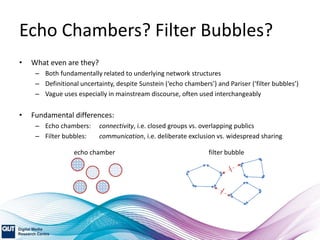
• Fundamental differences:
– Echo chambers: connectivity, i.e. closed groups vs. overlapping publics
– Filter bubbles: communication, i.e. deliberate exclusion vs. widespread sharing
echo chamber filter bubble
Don’t Blame Technology
Paul Bradshaw, Online Journalism Blog, 28 June 2016
https://onlinejournalismblog.com/2016/06/28/dont-blame-facebook-for-your-own-filter-bubble/
Working Definitions
• An echo chamber comes into being where a group of participants choose to
preferentially connect with each other, to the exclusion of outsiders. The more fully
formed this network is (that is, the more connections are created within the group,
and the more connections with outsiders are severed), the more isolated from the
introduction of outside views is the group, while the views of its members are able
to circulate widely within it.
• A filter bubble emerges when a group of participants, independent of the
underlying network structures of their connections with others, choose to
preferentially communicate with each other, to the exclusion of outsiders. The
more consistently they adhere to such practices, the more likely it is that
participants’ own views and information will circulate amongst group members,
rather than information introduced from the outside.
But Are They Real?
• Moral panics based on limited evidence:
– Heterogeneous personal networks online and
offline (Pew Center)
– Except for far-right/left individuals
(and even then…)
– Disagreements, trolling, abuse show that they
do see each other’s views
– Context collapse (Marwick & boyd) results in
serendipitous encounters of content
• Blaming technology lazy and counterfactual:
– Yes, networking and information consumption
patterns are changing
– But no evidence that this is reducing volume
and diversity of information intake
– Rather, decline of mastheads may increase
diversity (Reuters Institute)
(US)
THIS PROJECT
Reviewing the Evidence
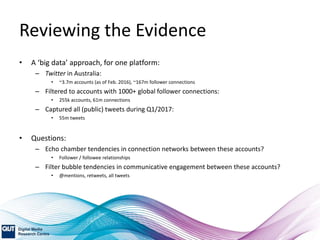
• A ‘big data’ approach, for one platform:
– Twitter in Australia:
• ~3.7m accounts (as of Feb. 2016), ~167m follower connections
– Filtered to accounts with 1000+ global follower connections:
• 255k accounts, 61m connections
– Captured all (public) tweets during Q1/2017:
• 55m tweets
• Questions:
– Echo chamber tendencies in connection networks between these accounts?
• Follower / followee relationships
– Filter bubble tendencies in communicative engagement between these accounts?
• @mentions, retweets, all tweets
Assessing Network Structures
• How exclusive are the groups?
– Strongly inwardly focussed = echo chambers / filter bubbles
– Strongly outwardly focussed = network bridges / information hubs
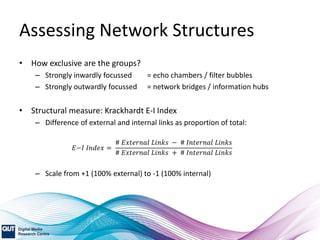
• Structural measure: Krackhardt E-I Index
– Difference of external and internal links as proportion of total:
𝐸−𝐼 𝐼𝑛𝑑𝑒𝑥 =
# 𝐸𝑥𝑡𝑒𝑟𝑛𝑎𝑙 𝐿𝑖𝑛𝑘𝑠 − # 𝐼𝑛𝑡𝑒𝑟𝑛𝑎𝑙 𝐿𝑖𝑛𝑘𝑠
# 𝐸𝑥𝑡𝑒𝑟𝑛𝑎𝑙 𝐿𝑖𝑛𝑘𝑠 + # 𝐼𝑛𝑡𝑒𝑟𝑛𝑎𝑙 𝐿𝑖𝑛𝑘𝑠
– Scale from +1 (100% external) to -1 (100% internal)
ECHO CHAMBERS
Follower/Followee Connections:
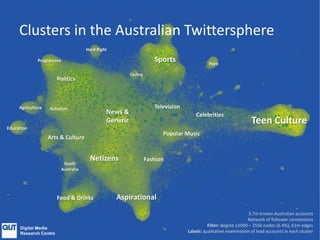
Clusters in the Australian Twittersphere
3.7m known Australian accounts
Network of follower connections
Filter: degree ≥1000 – 255k nodes (6.4%), 61m edges
Position: Force Atlas 2 algorithm in Gephi
Colour: Louvain Community Detection algorithm (resolution 0.25)
3.7m known Australian accounts
Network of follower connections
Filter: degree ≥1000 – 255k nodes (6.4%), 61m edges
Labels: qualitative examination of lead accounts in each cluster
Clusters in the Australian Twittersphere
Teen Culture
Aspirational
Sports
Netizens
Arts & Culture
Politics
Television
Fashion
Popular Music
Food & Drinks
Agriculture Activism
Porn
Education
Cycling
News &
Generic
Hard Right
Progressive
South
Australia
Celebrities
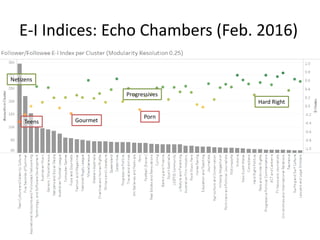
E-I Indices: Echo Chambers (Feb. 2016)
Teens Gourmet
Porn
Progressives
Hard Right
Netizens
E-I Index per Cluster
Colour scale: red (-1) to green (+1)
Louvain modularity resolution 0.25
Minimum: -0.97 / Maximum: 0.92
FILTER BUBBLES
Engagement through @mentions and Retweets:
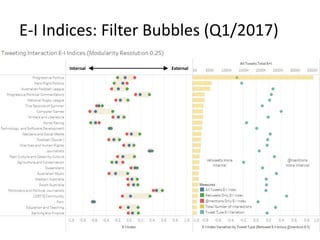
E-I Indices: Filter Bubbles (Q1/2017)
Teens
Gamers
Horses
Porn
Commentators
Journalists
Politicians
Partisan Politics
Horses
Agriculture
Internal External
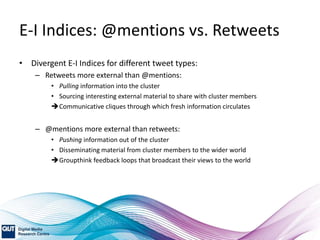
E-I Indices: @mentions vs. Retweets
• Divergent E-I Indices for different tweet types:
– Retweets more external than @mentions:
• Pulling information into the cluster
• Sourcing interesting external material to share with cluster members
Communicative cliques through which fresh information circulates
– @mentions more external than retweets:
• Pushing information out of the cluster
• Disseminating material from cluster members to the wider world
Groupthink feedback loops that broadcast their views to the world
CONCLUSION
Echo Chambers? Filter Bubbles?
• Very limited evidence in the Australian Twittersphere:
– E-I Index values largely positive (connections) or balanced (engagement)
– No sign of highly exclusionary patterns, except for outliers
• Echo chambers:
– Clear clustering tendencies, but disconnect only for specialist clusters (teens, gourmets, porn)
– Most E-I Indices > 0: more external than internal connections
• Filter bubbles:
– Balanced or moderately inward engagement; strongly inward only for specialist groups
– Retweeting generally more externally-focussed than @mentions: seeking information from outside
– Partisan political clusters diverge: pushing internal views to outside through @mentions
• Limitations:
– Analysis only for accounts with 1000+ global follower/followee connections – need to repeat for full network
– Engagement patterns during Q1/2017 may be affected by key events (e.g. Trump administration)
Beyond Twitter
• Context collapse:
– Echo chambers and filter bubbles intersect and overlap
• Private, family, fandom, interest-based, professional identities
• Face-to-face, email, Twitter, Facebook, Instagram, Snapchat, …
– Information travels through any and all of these
– It would take hard work to keep them from leaking into each other
• So if there is little evidence for exclusionary patterns within one network,
how likely are they to exist across all of our networks in combination?
http://mappingonlinepublics.net/
@snurb_dot_info
@socialmediaQUT – http://socialmedia.qut.edu.au/
@qutdmrc – https://www.qut.edu.au/research/dmrc
This research is supported by the ARC Future Fellowship project “Understanding Intermedia Information Flows in the
Australian Online Public Sphere”, the ARC Discovery project “Journalism beyond the Crisis: Emerging Forms, Practices,
and Uses”, and the ARC LIEF project “TrISMA: Tracking Infrastructure for Social Media Analysis.”

Echo Chamber? What Echo Chamber? Reviewing the Evidence

  • 1.
    Echo Chamber? WhatEcho Chamber? Reviewing the Evidence Prof. Axel Bruns ARC Future Fellow Digital Media Research Centre Queensland University of Technology a.bruns@qut.edu.au – @snurb_dot_info
  • 2.
    Echo Chambers? FilterBubbles? • What even are they? – Both fundamentally related to underlying network structures – Definitional uncertainty, despite Sunstein (‘echo chambers’) and Pariser (‘filter bubbles’) – Vague uses especially in mainstream discourse, often used interchangeably • Fundamental differences: – Echo chambers: connectivity, i.e. closed groups vs. overlapping publics – Filter bubbles: communication, i.e. deliberate exclusion vs. widespread sharing echo chamber filter bubble
  • 3.
    Don’t Blame Technology PaulBradshaw, Online Journalism Blog, 28 June 2016 https://onlinejournalismblog.com/2016/06/28/dont-blame-facebook-for-your-own-filter-bubble/
  • 4.
    Working Definitions • Anecho chamber comes into being where a group of participants choose to preferentially connect with each other, to the exclusion of outsiders. The more fully formed this network is (that is, the more connections are created within the group, and the more connections with outsiders are severed), the more isolated from the introduction of outside views is the group, while the views of its members are able to circulate widely within it. • A filter bubble emerges when a group of participants, independent of the underlying network structures of their connections with others, choose to preferentially communicate with each other, to the exclusion of outsiders. The more consistently they adhere to such practices, the more likely it is that participants’ own views and information will circulate amongst group members, rather than information introduced from the outside.
  • 5.
    But Are TheyReal? • Moral panics based on limited evidence: – Heterogeneous personal networks online and offline (Pew Center) – Except for far-right/left individuals (and even then…) – Disagreements, trolling, abuse show that they do see each other’s views – Context collapse (Marwick & boyd) results in serendipitous encounters of content • Blaming technology lazy and counterfactual: – Yes, networking and information consumption patterns are changing – But no evidence that this is reducing volume and diversity of information intake – Rather, decline of mastheads may increase diversity (Reuters Institute) (US)
  • 6.
  • 7.
    Reviewing the Evidence •A ‘big data’ approach, for one platform: – Twitter in Australia: • ~3.7m accounts (as of Feb. 2016), ~167m follower connections – Filtered to accounts with 1000+ global follower connections: • 255k accounts, 61m connections – Captured all (public) tweets during Q1/2017: • 55m tweets • Questions: – Echo chamber tendencies in connection networks between these accounts? • Follower / followee relationships – Filter bubble tendencies in communicative engagement between these accounts? • @mentions, retweets, all tweets
  • 8.
    Assessing Network Structures •How exclusive are the groups? – Strongly inwardly focussed = echo chambers / filter bubbles – Strongly outwardly focussed = network bridges / information hubs • Structural measure: Krackhardt E-I Index – Difference of external and internal links as proportion of total: 𝐸−𝐼 𝐼𝑛𝑑𝑒𝑥 = # 𝐸𝑥𝑡𝑒𝑟𝑛𝑎𝑙 𝐿𝑖𝑛𝑘𝑠 − # 𝐼𝑛𝑡𝑒𝑟𝑛𝑎𝑙 𝐿𝑖𝑛𝑘𝑠 # 𝐸𝑥𝑡𝑒𝑟𝑛𝑎𝑙 𝐿𝑖𝑛𝑘𝑠 + # 𝐼𝑛𝑡𝑒𝑟𝑛𝑎𝑙 𝐿𝑖𝑛𝑘𝑠 – Scale from +1 (100% external) to -1 (100% internal)
  • 9.
  • 10.
    Clusters in theAustralian Twittersphere 3.7m known Australian accounts Network of follower connections Filter: degree ≥1000 – 255k nodes (6.4%), 61m edges Position: Force Atlas 2 algorithm in Gephi Colour: Louvain Community Detection algorithm (resolution 0.25)
  • 11.
    3.7m known Australianaccounts Network of follower connections Filter: degree ≥1000 – 255k nodes (6.4%), 61m edges Labels: qualitative examination of lead accounts in each cluster Clusters in the Australian Twittersphere Teen Culture Aspirational Sports Netizens Arts & Culture Politics Television Fashion Popular Music Food & Drinks Agriculture Activism Porn Education Cycling News & Generic Hard Right Progressive South Australia Celebrities
  • 12.
    E-I Indices: EchoChambers (Feb. 2016) Teens Gourmet Porn Progressives Hard Right Netizens
  • 13.
    E-I Index perCluster Colour scale: red (-1) to green (+1) Louvain modularity resolution 0.25 Minimum: -0.97 / Maximum: 0.92
  • 14.
    FILTER BUBBLES Engagement through@mentions and Retweets:
  • 15.
    E-I Indices: FilterBubbles (Q1/2017) Teens Gamers Horses Porn Commentators Journalists Politicians Partisan Politics Horses Agriculture Internal External
  • 16.
    E-I Indices: @mentionsvs. Retweets • Divergent E-I Indices for different tweet types: – Retweets more external than @mentions: • Pulling information into the cluster • Sourcing interesting external material to share with cluster members Communicative cliques through which fresh information circulates – @mentions more external than retweets: • Pushing information out of the cluster • Disseminating material from cluster members to the wider world Groupthink feedback loops that broadcast their views to the world
  • 17.
  • 18.
    Echo Chambers? FilterBubbles? • Very limited evidence in the Australian Twittersphere: – E-I Index values largely positive (connections) or balanced (engagement) – No sign of highly exclusionary patterns, except for outliers • Echo chambers: – Clear clustering tendencies, but disconnect only for specialist clusters (teens, gourmets, porn) – Most E-I Indices > 0: more external than internal connections • Filter bubbles: – Balanced or moderately inward engagement; strongly inward only for specialist groups – Retweeting generally more externally-focussed than @mentions: seeking information from outside – Partisan political clusters diverge: pushing internal views to outside through @mentions • Limitations: – Analysis only for accounts with 1000+ global follower/followee connections – need to repeat for full network – Engagement patterns during Q1/2017 may be affected by key events (e.g. Trump administration)
  • 19.
    Beyond Twitter • Contextcollapse: – Echo chambers and filter bubbles intersect and overlap • Private, family, fandom, interest-based, professional identities • Face-to-face, email, Twitter, Facebook, Instagram, Snapchat, … – Information travels through any and all of these – It would take hard work to keep them from leaking into each other • So if there is little evidence for exclusionary patterns within one network, how likely are they to exist across all of our networks in combination?
  • 20.
    http://mappingonlinepublics.net/ @snurb_dot_info @socialmediaQUT – http://socialmedia.qut.edu.au/ @qutdmrc– https://www.qut.edu.au/research/dmrc This research is supported by the ARC Future Fellowship project “Understanding Intermedia Information Flows in the Australian Online Public Sphere”, the ARC Discovery project “Journalism beyond the Crisis: Emerging Forms, Practices, and Uses”, and the ARC LIEF project “TrISMA: Tracking Infrastructure for Social Media Analysis.”