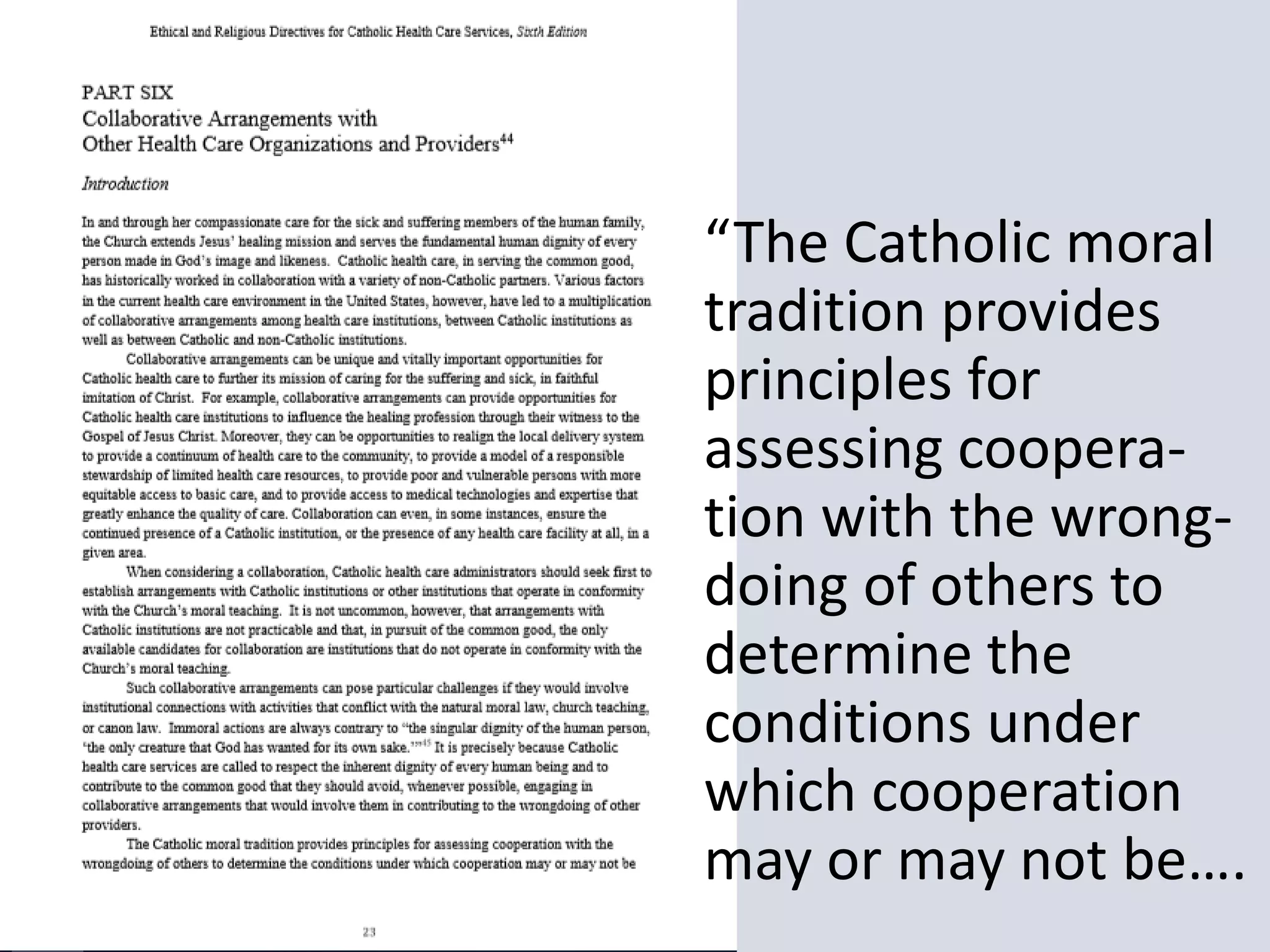
“The Catholic moral
tradition provides
principles for
assessing coopera-
tion with the wrong-
doing of others to
determine the
conditions under
which cooperation
may or may not be….
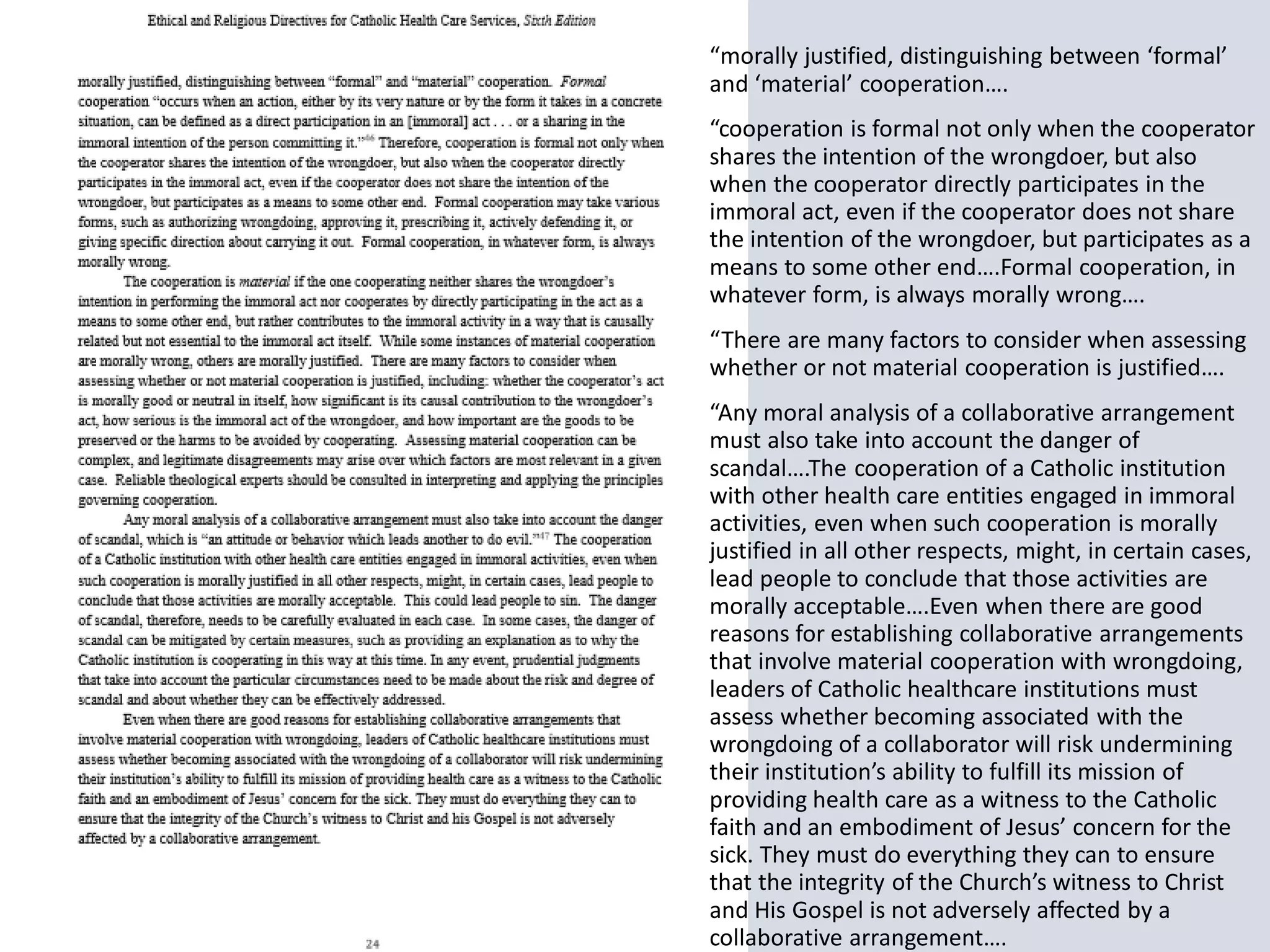
“morally justified, distinguishing between ‘formal’
and ‘material’ cooperation….
“cooperation is formal not only when the cooperator
shares the intention of the wrongdoer, but also
when the cooperator directly participates in the
immoral act, even if the cooperator does not share
the intention of the wrongdoer, but participates as a
means to some other end….Formal cooperation, in
whatever form, is always morally wrong….
“There are many factors to consider when assessing
whether or not material cooperation is justified….
“Any moral analysis of a collaborative arrangement
must also take into account the danger of
scandal….The cooperation of a Catholic institution
with other health care entities engaged in immoral
activities, even when such cooperation is morally
justified in all other respects, might, in certain cases,
lead people to conclude that those activities are
morally acceptable….Even when there are good
reasons for establishing collaborative arrangements
that involve material cooperation with wrongdoing,
leaders of Catholic healthcare institutions must
assess whether becoming associated with the
wrongdoing of a collaborator will risk undermining
their institution’s ability to fulfill its mission of
providing health care as a witness to the Catholic
faith and an embodiment of Jesus’ concern for the
sick. They must do everything they can to ensure
that the integrity of the Church’s witness to Christ
and His Gospel is not adversely affected by a
collaborative arrangement….
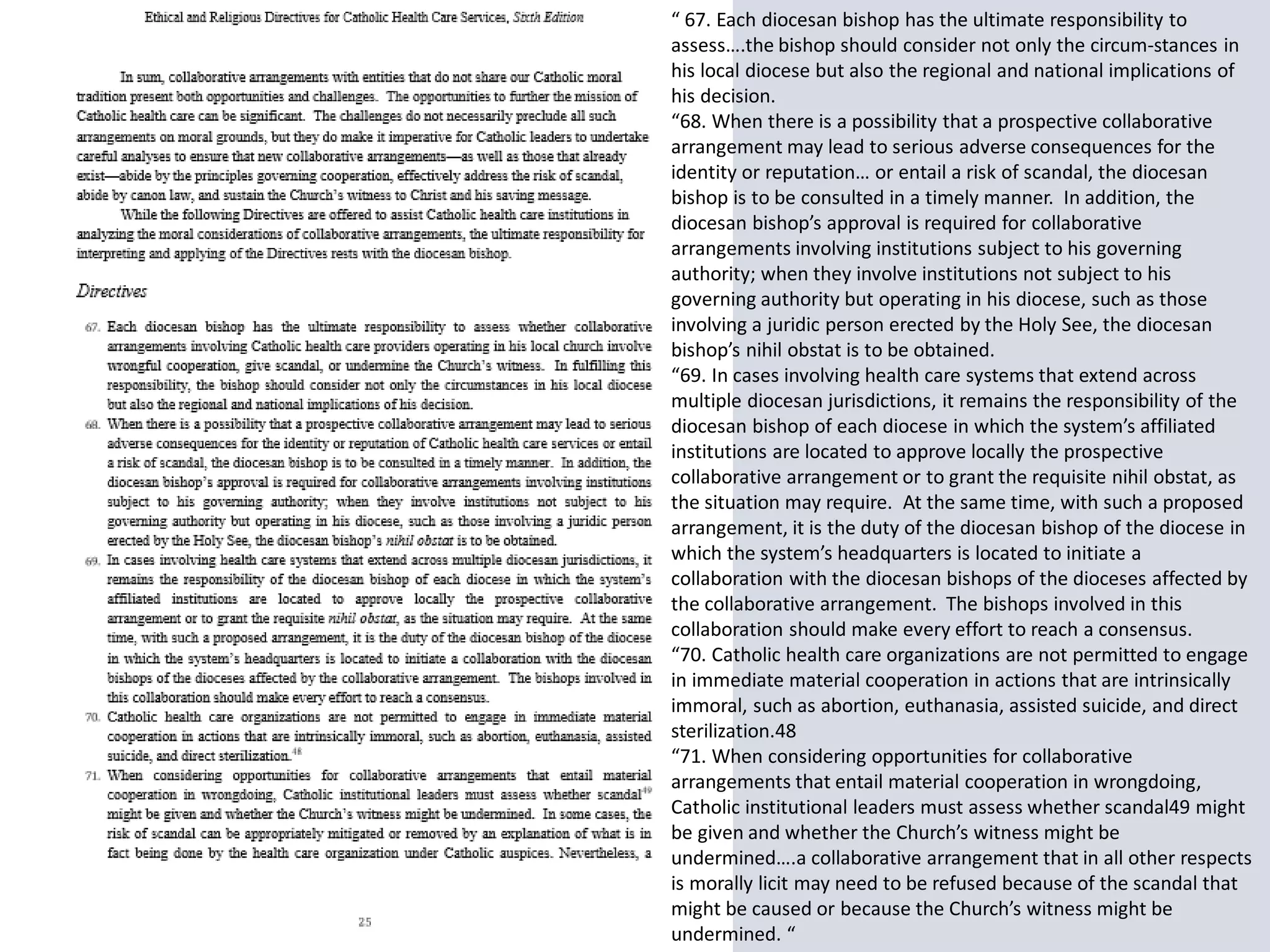
“ 67. Each diocesan bishop has the ultimate responsibility to
assess….the bishop should consider not only the circum-stances in
his local diocese but also the regional and national implications of
his decision.
“68. When there is a possibility that a prospective collaborative
arrangement may lead to serious adverse consequences for the
identity or reputation… or entail a risk of scandal, the diocesan
bishop is to be consulted in a timely manner. In addition, the
diocesan bishop’s approval is required for collaborative
arrangements involving institutions subject to his governing
authority; when they involve institutions not subject to his
governing authority but operating in his diocese, such as those
involving a juridic person erected by the Holy See, the diocesan
bishop’s nihil obstat is to be obtained.
“69. In cases involving health care systems that extend across
multiple diocesan jurisdictions, it remains the responsibility of the
diocesan bishop of each diocese in which the system’s affiliated
institutions are located to approve locally the prospective
collaborative arrangement or to grant the requisite nihil obstat, as
the situation may require. At the same time, with such a proposed
arrangement, it is the duty of the diocesan bishop of the diocese in
which the system’s headquarters is located to initiate a
collaboration with the diocesan bishops of the dioceses affected by
the collaborative arrangement. The bishops involved in this
collaboration should make every effort to reach a consensus.
“70. Catholic health care organizations are not permitted to engage
in immediate material cooperation in actions that are intrinsically
immoral, such as abortion, euthanasia, assisted suicide, and direct
sterilization.48
“71. When considering opportunities for collaborative
arrangements that entail material cooperation in wrongdoing,
Catholic institutional leaders must assess whether scandal49 might
be given and whether the Church’s witness might be
undermined….a collaborative arrangement that in all other respects
is morally licit may need to be refused because of the scandal that
might be caused or because the Church’s witness might be
undermined. “
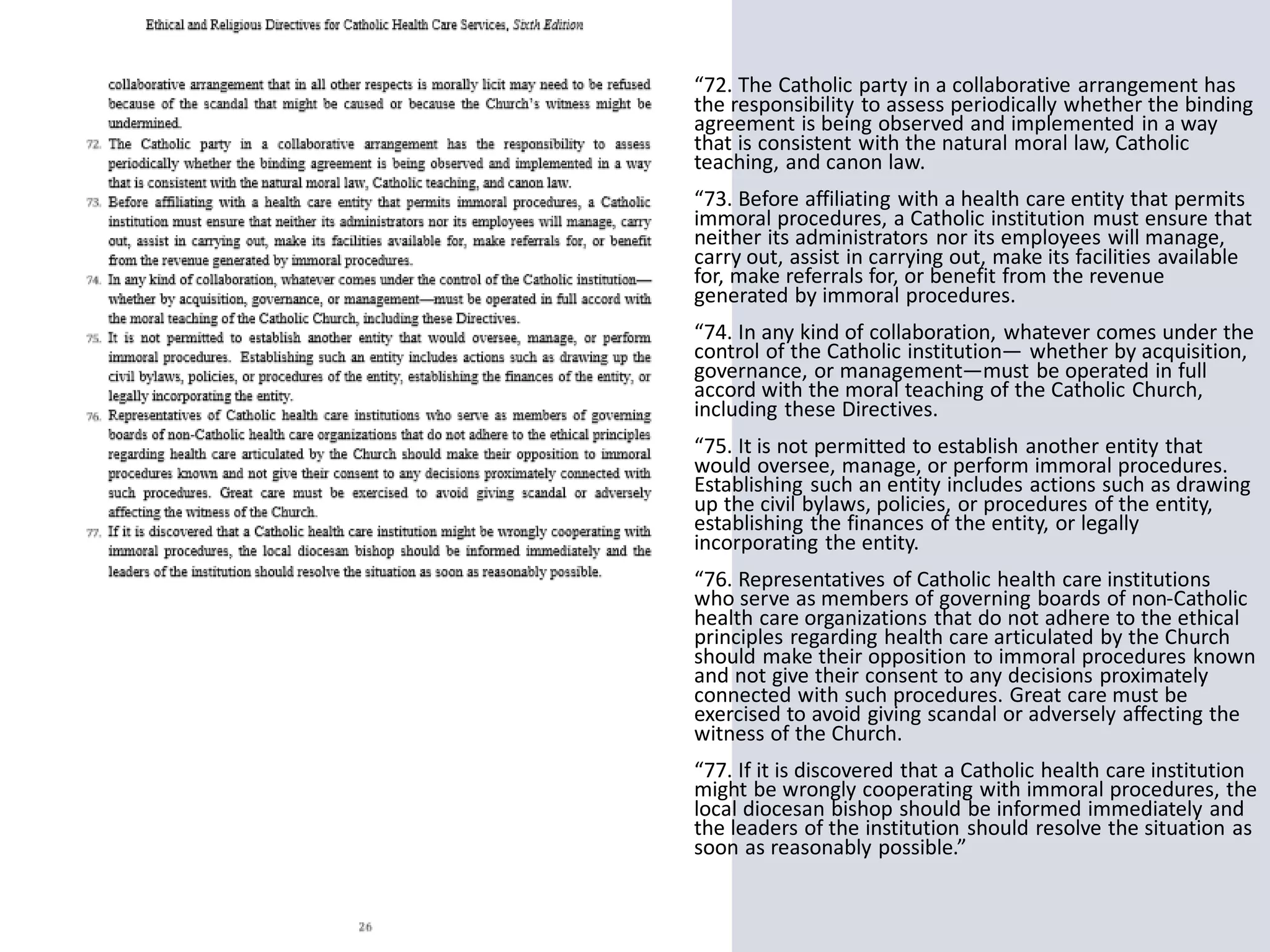
“72. The Catholic party in a collaborative arrangement has
the responsibility to assess periodically whether the binding
agreement is being observed and implemented in a way
that is consistent with the natural moral law, Catholic
teaching, and canon law.
“73. Before affiliating with a health care entity that permits
immoral procedures, a Catholic institution must ensure that
neither its administrators nor its employees will manage,
carry out, assist in carrying out, make its facilities available
for, make referrals for, or benefit from the revenue
generated by immoral procedures.
“74. In any kind of collaboration, whatever comes under the
control of the Catholic institution— whether by acquisition,
governance, or management—must be operated in full
accord with the moral teaching of the Catholic Church,
including these Directives.
“75. It is not permitted to establish another entity that
would oversee, manage, or perform immoral procedures.
Establishing such an entity includes actions such as drawing
up the civil bylaws, policies, or procedures of the entity,
establishing the finances of the entity, or legally
incorporating the entity.
“76. Representatives of Catholic health care institutions
who serve as members of governing boards of non-Catholic
health care organizations that do not adhere to the ethical
principles regarding health care articulated by the Church
should make their opposition to immoral procedures known
and not give their consent to any decisions proximately
connected with such procedures. Great care must be
exercised to avoid giving scandal or adversely affecting the
witness of the Church.
“77. If it is discovered that a Catholic health care institution
might be wrongly cooperating with immoral procedures, the
local diocesan bishop should be informed immediately and
the leaders of the institution should resolve the situation as
soon as reasonably possible.”
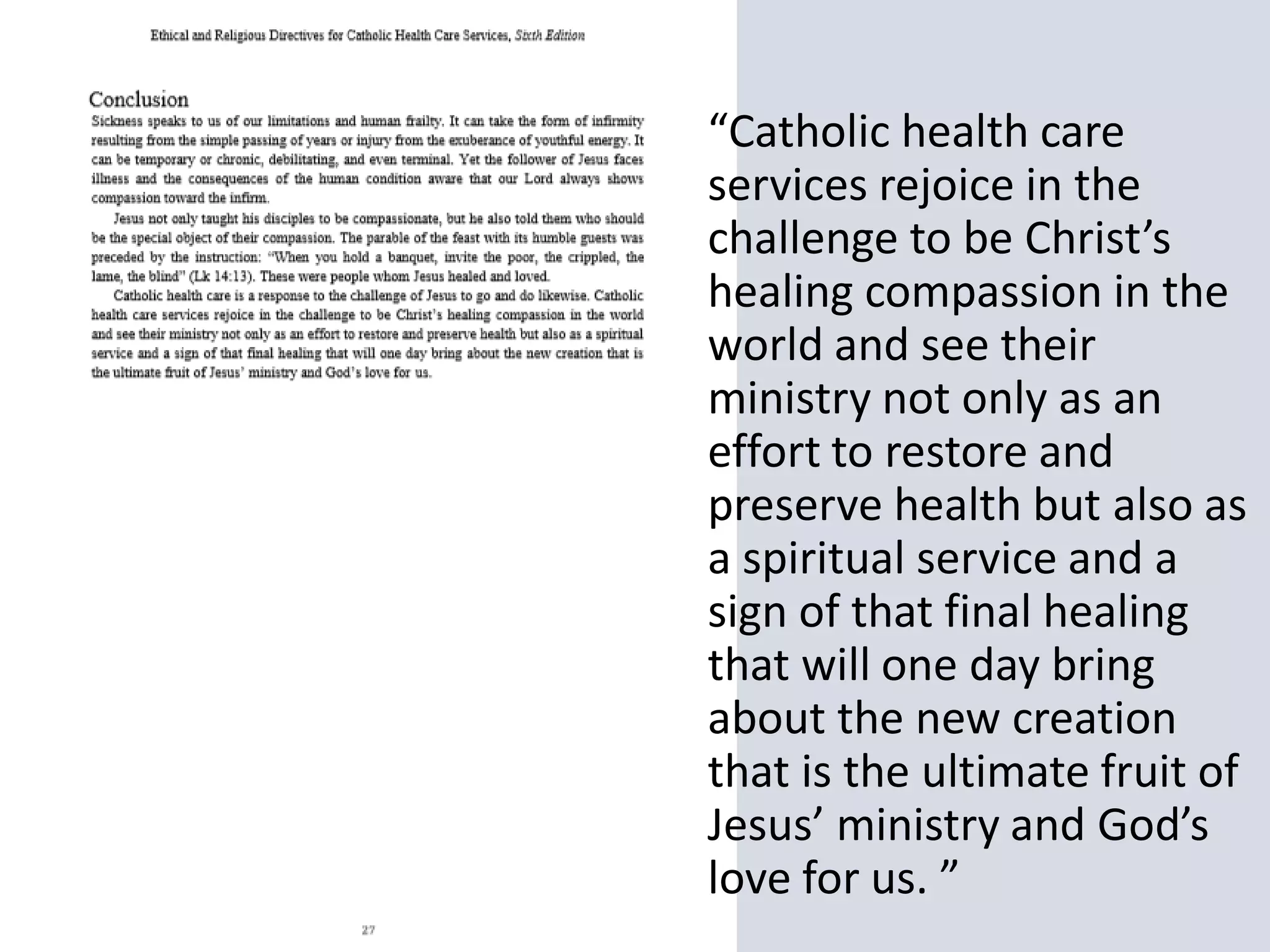
“Catholic health care
services rejoice in the
challenge to be Christ’s
healing compassion in the
world and see their
ministry not only as an
effort to restore and
preserve health but also as
a spiritual service and a
sign of that final healing
that will one day bring
about the new creation
that is the ultimate fruit of
Jesus’ ministry and God’s
love for us. ”
Updates in the er ds 6th ed of june 2018

Updates in the er ds 6th ed of june 2018

  • 1.
    “The Catholic moral traditionprovides principles for assessing coopera- tion with the wrong- doing of others to determine the conditions under which cooperation may or may not be….
  • 2.
    “morally justified, distinguishingbetween ‘formal’ and ‘material’ cooperation…. “cooperation is formal not only when the cooperator shares the intention of the wrongdoer, but also when the cooperator directly participates in the immoral act, even if the cooperator does not share the intention of the wrongdoer, but participates as a means to some other end….Formal cooperation, in whatever form, is always morally wrong…. “There are many factors to consider when assessing whether or not material cooperation is justified…. “Any moral analysis of a collaborative arrangement must also take into account the danger of scandal….The cooperation of a Catholic institution with other health care entities engaged in immoral activities, even when such cooperation is morally justified in all other respects, might, in certain cases, lead people to conclude that those activities are morally acceptable….Even when there are good reasons for establishing collaborative arrangements that involve material cooperation with wrongdoing, leaders of Catholic healthcare institutions must assess whether becoming associated with the wrongdoing of a collaborator will risk undermining their institution’s ability to fulfill its mission of providing health care as a witness to the Catholic faith and an embodiment of Jesus’ concern for the sick. They must do everything they can to ensure that the integrity of the Church’s witness to Christ and His Gospel is not adversely affected by a collaborative arrangement….
  • 3.
    “ 67. Eachdiocesan bishop has the ultimate responsibility to assess….the bishop should consider not only the circum-stances in his local diocese but also the regional and national implications of his decision. “68. When there is a possibility that a prospective collaborative arrangement may lead to serious adverse consequences for the identity or reputation… or entail a risk of scandal, the diocesan bishop is to be consulted in a timely manner. In addition, the diocesan bishop’s approval is required for collaborative arrangements involving institutions subject to his governing authority; when they involve institutions not subject to his governing authority but operating in his diocese, such as those involving a juridic person erected by the Holy See, the diocesan bishop’s nihil obstat is to be obtained. “69. In cases involving health care systems that extend across multiple diocesan jurisdictions, it remains the responsibility of the diocesan bishop of each diocese in which the system’s affiliated institutions are located to approve locally the prospective collaborative arrangement or to grant the requisite nihil obstat, as the situation may require. At the same time, with such a proposed arrangement, it is the duty of the diocesan bishop of the diocese in which the system’s headquarters is located to initiate a collaboration with the diocesan bishops of the dioceses affected by the collaborative arrangement. The bishops involved in this collaboration should make every effort to reach a consensus. “70. Catholic health care organizations are not permitted to engage in immediate material cooperation in actions that are intrinsically immoral, such as abortion, euthanasia, assisted suicide, and direct sterilization.48 “71. When considering opportunities for collaborative arrangements that entail material cooperation in wrongdoing, Catholic institutional leaders must assess whether scandal49 might be given and whether the Church’s witness might be undermined….a collaborative arrangement that in all other respects is morally licit may need to be refused because of the scandal that might be caused or because the Church’s witness might be undermined. “
  • 4.
    “72. The Catholicparty in a collaborative arrangement has the responsibility to assess periodically whether the binding agreement is being observed and implemented in a way that is consistent with the natural moral law, Catholic teaching, and canon law. “73. Before affiliating with a health care entity that permits immoral procedures, a Catholic institution must ensure that neither its administrators nor its employees will manage, carry out, assist in carrying out, make its facilities available for, make referrals for, or benefit from the revenue generated by immoral procedures. “74. In any kind of collaboration, whatever comes under the control of the Catholic institution— whether by acquisition, governance, or management—must be operated in full accord with the moral teaching of the Catholic Church, including these Directives. “75. It is not permitted to establish another entity that would oversee, manage, or perform immoral procedures. Establishing such an entity includes actions such as drawing up the civil bylaws, policies, or procedures of the entity, establishing the finances of the entity, or legally incorporating the entity. “76. Representatives of Catholic health care institutions who serve as members of governing boards of non-Catholic health care organizations that do not adhere to the ethical principles regarding health care articulated by the Church should make their opposition to immoral procedures known and not give their consent to any decisions proximately connected with such procedures. Great care must be exercised to avoid giving scandal or adversely affecting the witness of the Church. “77. If it is discovered that a Catholic health care institution might be wrongly cooperating with immoral procedures, the local diocesan bishop should be informed immediately and the leaders of the institution should resolve the situation as soon as reasonably possible.”
  • 5.
    “Catholic health care servicesrejoice in the challenge to be Christ’s healing compassion in the world and see their ministry not only as an effort to restore and preserve health but also as a spiritual service and a sign of that final healing that will one day bring about the new creation that is the ultimate fruit of Jesus’ ministry and God’s love for us. ”