
Register based census -
the way to make census
operations more efficent
in Estonia
by Diana Beltadze
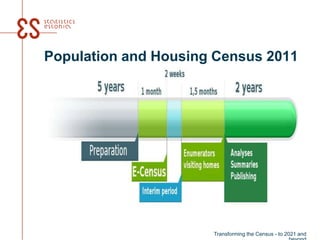
Population and Housing Census 2011
Transforming the Census - to 2021 and
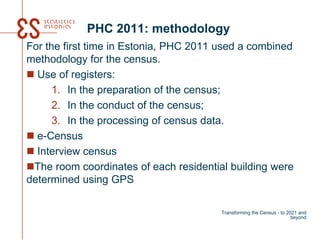
PHC 2011: methodology
For the first time in Estonia, PHC 2011 used a combined
methodology for the census.
 Use of registers:
1. In the preparation of the census;
2. In the conduct of the census;
3. In the processing of census data.
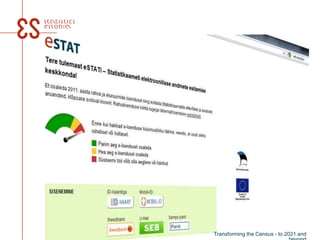
 e-Census
 Interview census
The room coordinates of each residential building were
determined using GPS
Transforming the Census - to 2021 and
beyond
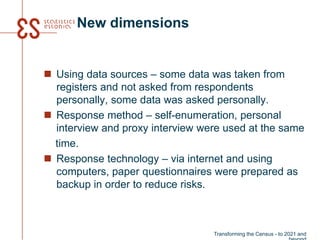
New dimensions
 Using data sources – some data was taken from
registers and not asked from respondents
personally, some data was asked personally.
 Response method – self-enumeration, personal
interview and proxy interview were used at the same
time.
 Response technology – via internet and using
computers, paper questionnaires were prepared as
backup in order to reduce risks.
Transforming the Census - to 2021 and
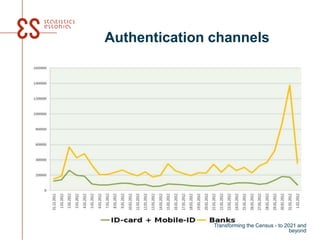
Authentication channels
Transforming the Census - to 2021 and
beyond
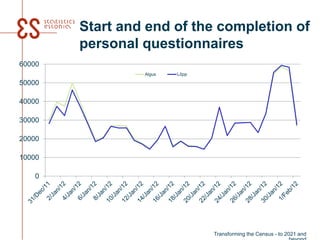
Start and end of the completion of
personal questionnaires
Transforming the Census - to 2021 and
0
10000
20000
30000
40000
50000
60000
Algus Lõpp
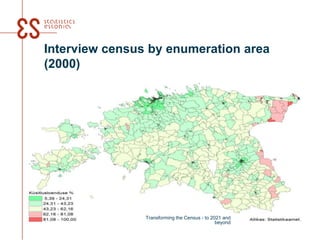
Interview census by enumeration area
(2000)
Transforming the Census - to 2021 and
beyond
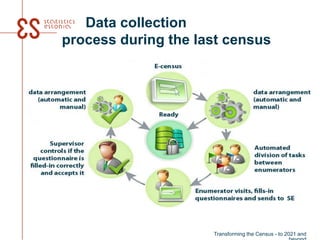
Data collection
process during the last census
Transforming the Census - to 2021 and
Progress of the interview
census
 The enumerators were on schedule:
23.02 – 8 % 11 %
01.03 – 30 % 38 %
08.03 – 60 % 66 %
29.03 – 100 % 99 %
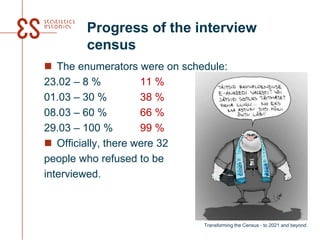
 Officially, there were 32
people who refused to be
interviewed.
Transforming the Census - to 2021 and beyond
Lessons learned from PHC 2011 (I)
 Too many levels in the census organisation.
 On this scale, the technical systems may not always
work properly (e.g. varying level of Internet
connection in Estonia).
Transforming the Census - to 2021 and
beyond
Results
 Under-coverage among enumerated permanent
residents is 3%.
 For individual parameters, coverage was at least
99%.
 The census was carried out in a positive atmosphere
and the residents were very involved.
 About 67% of the enumerated persons completed
the census online.
Transforming the Census - to 2021 and
beyond
Roll of media and social media
 The public campaign was deeply integrated and
coordinated with the data collection activities. A special
awareness survey was launched about a year before
actual data collection started. Based on that survey, the
PR activities were corrected and targeted.
Transforming the Census - to 2021 and
beyond
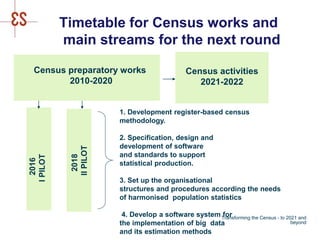
Timetable for Census works and
main streams for the next round
2018
IIPILOT
Census activities
2021-2022
2016
IPILOT
1. Development register-based census
methodology.
2. Specification, design and
development of software
and standards to support
statistical production.
3. Set up the organisational
structures and procedures according the needs
of harmonised population statistics
4. Develop a software system for
the implementation of big data
and its estimation methods
Census preparatory works
2010-2020
Transforming the Census - to 2021 and
beyond
Transforming the Census - to 2021 and
Using administrative data - general
background in Estonia
 State information system (RIHA)
 Which are the information systems and databases that
make up the state’s information system;
 Which data are collected and processed and in which
information systems;
 Which services, incl. X-Road services, are provided and
who is using them;
 Who are the responsible and authorised processors of
the information systems and databases, and who are the
contact persons;
 On which legal basis are the databases operated and the
data processed;
 The reusable components that ensure the interoperability
of information systems (XML assets, classifications,
dictionaries and ontologies.
Transforming the Census - to 2021 and
beyond
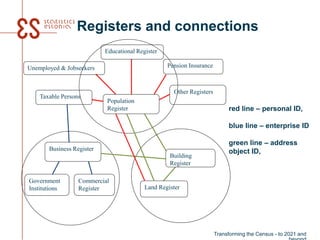
Registers and connections
Educational Register
Unemployed & Jobseekers
Taxable Persons
Pension Insurance
Other Registers
Population
Register
Commercial
Register
Business Register
Government
Institutions
Building
Register
Land Register
red line – personal ID,
blue line – enterprise ID
green line – address
object ID,
Transforming the Census - to 2021 and
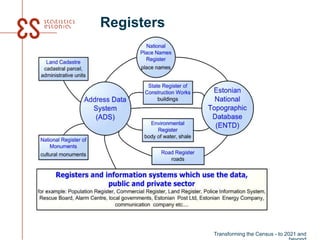
Registers
Transforming the Census - to 2021 and
Using administrative data - general
background from the legal aspect
 Official Statistics Act - all data collected in administrative
databases is available to SE for producing official statistics
 Public Information Act - establishing separate databases
for the collection of the same data is prohibited in Estonia. The
more the data are used for different purposes, the better the
quality due to stricter and more continuous checking
 Spatial Data Act - all state and local government databases
have to be integrated with the central Address Data System
(ADS), unique identification of the address objects
Transforming the Census - to 2021 and
beyond
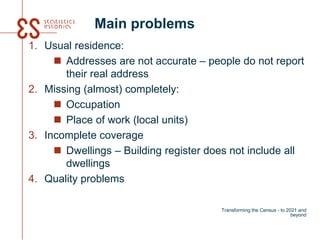
Main problems
1. Usual residence:
 Addresses are not accurate – people do not report
their real address
2. Missing (almost) completely:
 Occupation
 Place of work (local units)
3. Incomplete coverage
 Dwellings – Building register does not include all
dwellings
4. Quality problems
Transforming the Census - to 2021 and
beyond
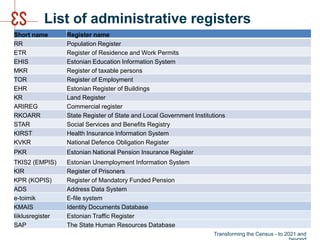
List of administrative registers
Transforming the Census - to 2021 and
Short name Register name
RR Population Register
ETR Register of Residence and Work Permits
EHIS Estonian Education Information System
MKR Register of taxable persons
TOR Register of Employment
EHR Estonian Register of Buildings
KR Land Register
ARIREG Commercial register
RKOARR State Register of State and Local Government Institutions
STAR Social Services and Benefits Registry
KIRST Health Insurance Information System
KVKR National Defence Obligation Register
PKR Estonian National Pension Insurance Register
TKIS2 (EMPIS) Estonian Unemployment Information System
KIR Register of Prisoners
KPR (KOPIS) Register of Mandatory Funded Pension
ADS Address Data System
e-toimik E-file system
KMAIS Identity Documents Database
liiklusregister Estonian Traffic Register
SAP The State Human Resources Database
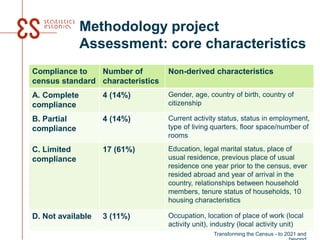
Methodology project
Assessment: core characteristics
Compliance to
census standard
Number of
characteristics
Non-derived characteristics
A. Complete
compliance
4 (14%) Gender, age, country of birth, country of
citizenship
B. Partial
compliance
4 (14%) Current activity status, status in employment,
type of living quarters, floor space/number of
rooms
C. Limited
compliance
17 (61%) Education, legal marital status, place of
usual residence, previous place of usual
residence one year prior to the census, ever
resided abroad and year of arrival in the
country, relationships between household
members, tenure status of households, 10
housing characteristics
D. Not available 3 (11%) Occupation, location of place of work (local
activity unit), industry (local activity unit)
Transforming the Census - to 2021 and
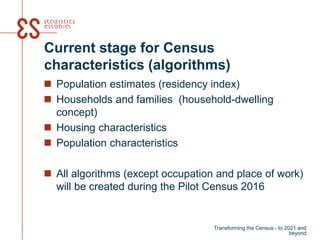
Current stage for Census
characteristics (algorithms)
 Population estimates (residency index)
 Households and families (household-dwelling
concept)
 Housing characteristics
 Population characteristics
 All algorithms (except occupation and place of work)
will be created during the Pilot Census 2016
Transforming the Census - to 2021 and
beyond
Residency index - determining
permanent residency status using
registers in Estonia
 General idea: It can be assumed that the people
who actually live in Estonia are represented in other
administrative registers because they are using
services and receive payments
Transforming the Census - to 2021 and
beyond
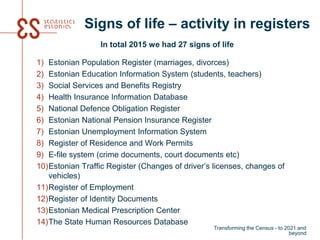
Signs of life – activity in registers
In total 2015 we had 27 signs of life
1) Estonian Population Register (marriages, divorces)
2) Estonian Education Information System (students, teachers)
3) Social Services and Benefits Registry
4) Health Insurance Information Database
5) National Defence Obligation Register
6) Estonian National Pension Insurance Register
7) Estonian Unemployment Information System
8) Register of Residence and Work Permits
9) E-file system (crime documents, court documents etc)
10)Estonian Traffic Register (Changes of driver’s licenses, changes of
vehicles)
11)Register of Employment
12)Register of Identity Documents
13)Estonian Medical Prescription Center
14)The State Human Resources Database
Transforming the Census - to 2021 and
beyond
Achievement
 Residency index - new methodology for determining
permanent residency status using registers
 01.01.2016 Estonian official population is calculated
by this new methodology
Transforming the Census - to 2021 and
beyond
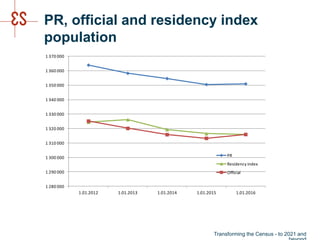
PR, official and residency index
population
Transforming the Census - to 2021 and
1 280 000
1 290 000
1 300 000
1 310 000
1 320 000
1 330 000
1 340 000
1 350 000
1 360 000
1 370 000
1.01.2012 1.01.2013 1.01.2014 1.01.2015 1.01.2016
PR
Residency index
Official
Data quality
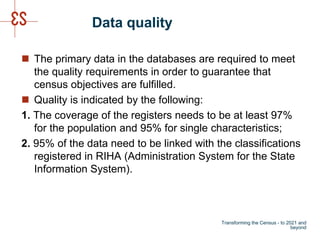
 The primary data in the databases are required to meet
the quality requirements in order to guarantee that
census objectives are fulfilled.
 Quality is indicated by the following:
1. The coverage of the registers needs to be at least 97%
for the population and 95% for single characteristics;
2. 95% of the data need to be linked with the classifications
registered in RIHA (Administration System for the State
Information System).
Transforming the Census - to 2021 and
beyond
Limitations
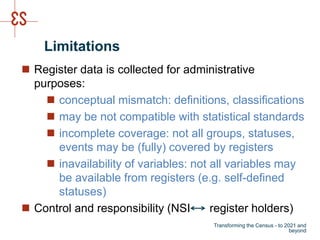
 Register data is collected for administrative
purposes:
 conceptual mismatch: definitions, classifications
 may be not compatible with statistical standards
 incomplete coverage: not all groups, statuses,
events may be (fully) covered by registers
 inavailability of variables: not all variables may
be available from registers (e.g. self-defined
statuses)
 Control and responsibility (NSI register holders)
Transforming the Census - to 2021 and
beyond
What we have today?
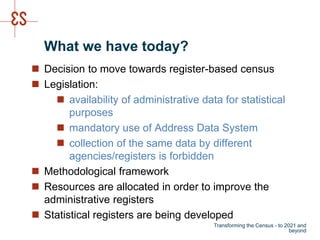
 Decision to move towards register-based census
 Legislation:
 availability of administrative data for statistical
purposes
 mandatory use of Address Data System
 collection of the same data by different
agencies/registers is forbidden
 Methodological framework
 Resources are allocated in order to improve the
administrative registers
 Statistical registers are being developed
Transforming the Census - to 2021 and
beyond
A new challenge!
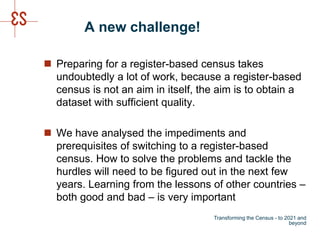
 Preparing for a register-based census takes
undoubtedly a lot of work, because a register-based
census is not an aim in itself, the aim is to obtain a
dataset with sufficient quality.
 We have analysed the impediments and
prerequisites of switching to a register-based
census. How to solve the problems and tackle the
hurdles will need to be figured out in the next few
years. Learning from the lessons of other countries –
both good and bad – is very important
Transforming the Census - to 2021 and
beyond
Conclusion
 REGREL video
https://www.youtube.com/watch?v=3VFw3VfHSb4&list=PLuv
Q8YOPmhujbKMb1p3uGRNweyf_-FBIr
Transforming the Census - to 2021 and
beyond
Thank You!
Transforming the Census - to 2021 and

Register based census - the way to make census operations more efficient in Estonia

  • 1.
    Register based census- the way to make census operations more efficent in Estonia by Diana Beltadze
  • 2.
    Population and HousingCensus 2011 Transforming the Census - to 2021 and
  • 3.
    PHC 2011: methodology Forthe first time in Estonia, PHC 2011 used a combined methodology for the census.  Use of registers: 1. In the preparation of the census; 2. In the conduct of the census; 3. In the processing of census data.  e-Census  Interview census The room coordinates of each residential building were determined using GPS Transforming the Census - to 2021 and beyond
  • 4.
    New dimensions  Usingdata sources – some data was taken from registers and not asked from respondents personally, some data was asked personally.  Response method – self-enumeration, personal interview and proxy interview were used at the same time.  Response technology – via internet and using computers, paper questionnaires were prepared as backup in order to reduce risks. Transforming the Census - to 2021 and
  • 5.
  • 6.
    Authentication channels Transforming theCensus - to 2021 and beyond
  • 7.
    Start and endof the completion of personal questionnaires Transforming the Census - to 2021 and 0 10000 20000 30000 40000 50000 60000 Algus Lõpp
  • 8.
    Interview census byenumeration area (2000) Transforming the Census - to 2021 and beyond
  • 9.
    Data collection process duringthe last census Transforming the Census - to 2021 and
  • 10.
    Progress of theinterview census  The enumerators were on schedule: 23.02 – 8 % 11 % 01.03 – 30 % 38 % 08.03 – 60 % 66 % 29.03 – 100 % 99 %  Officially, there were 32 people who refused to be interviewed. Transforming the Census - to 2021 and beyond
  • 11.
    Lessons learned fromPHC 2011 (I)  Too many levels in the census organisation.  On this scale, the technical systems may not always work properly (e.g. varying level of Internet connection in Estonia). Transforming the Census - to 2021 and beyond
  • 12.
    Results  Under-coverage amongenumerated permanent residents is 3%.  For individual parameters, coverage was at least 99%.  The census was carried out in a positive atmosphere and the residents were very involved.  About 67% of the enumerated persons completed the census online. Transforming the Census - to 2021 and beyond
  • 13.
    Roll of mediaand social media  The public campaign was deeply integrated and coordinated with the data collection activities. A special awareness survey was launched about a year before actual data collection started. Based on that survey, the PR activities were corrected and targeted. Transforming the Census - to 2021 and beyond
  • 14.
    Timetable for Censusworks and main streams for the next round 2018 IIPILOT Census activities 2021-2022 2016 IPILOT 1. Development register-based census methodology. 2. Specification, design and development of software and standards to support statistical production. 3. Set up the organisational structures and procedures according the needs of harmonised population statistics 4. Develop a software system for the implementation of big data and its estimation methods Census preparatory works 2010-2020 Transforming the Census - to 2021 and beyond
  • 15.
  • 16.
    Using administrative data- general background in Estonia  State information system (RIHA)  Which are the information systems and databases that make up the state’s information system;  Which data are collected and processed and in which information systems;  Which services, incl. X-Road services, are provided and who is using them;  Who are the responsible and authorised processors of the information systems and databases, and who are the contact persons;  On which legal basis are the databases operated and the data processed;  The reusable components that ensure the interoperability of information systems (XML assets, classifications, dictionaries and ontologies. Transforming the Census - to 2021 and beyond
  • 17.
    Registers and connections EducationalRegister Unemployed & Jobseekers Taxable Persons Pension Insurance Other Registers Population Register Commercial Register Business Register Government Institutions Building Register Land Register red line – personal ID, blue line – enterprise ID green line – address object ID, Transforming the Census - to 2021 and
  • 18.
  • 19.
  • 20.
    Using administrative data- general background from the legal aspect  Official Statistics Act - all data collected in administrative databases is available to SE for producing official statistics  Public Information Act - establishing separate databases for the collection of the same data is prohibited in Estonia. The more the data are used for different purposes, the better the quality due to stricter and more continuous checking  Spatial Data Act - all state and local government databases have to be integrated with the central Address Data System (ADS), unique identification of the address objects Transforming the Census - to 2021 and beyond
  • 21.
    Main problems 1. Usualresidence:  Addresses are not accurate – people do not report their real address 2. Missing (almost) completely:  Occupation  Place of work (local units) 3. Incomplete coverage  Dwellings – Building register does not include all dwellings 4. Quality problems Transforming the Census - to 2021 and beyond
  • 22.
    List of administrativeregisters Transforming the Census - to 2021 and Short name Register name RR Population Register ETR Register of Residence and Work Permits EHIS Estonian Education Information System MKR Register of taxable persons TOR Register of Employment EHR Estonian Register of Buildings KR Land Register ARIREG Commercial register RKOARR State Register of State and Local Government Institutions STAR Social Services and Benefits Registry KIRST Health Insurance Information System KVKR National Defence Obligation Register PKR Estonian National Pension Insurance Register TKIS2 (EMPIS) Estonian Unemployment Information System KIR Register of Prisoners KPR (KOPIS) Register of Mandatory Funded Pension ADS Address Data System e-toimik E-file system KMAIS Identity Documents Database liiklusregister Estonian Traffic Register SAP The State Human Resources Database
  • 23.
    Methodology project Assessment: corecharacteristics Compliance to census standard Number of characteristics Non-derived characteristics A. Complete compliance 4 (14%) Gender, age, country of birth, country of citizenship B. Partial compliance 4 (14%) Current activity status, status in employment, type of living quarters, floor space/number of rooms C. Limited compliance 17 (61%) Education, legal marital status, place of usual residence, previous place of usual residence one year prior to the census, ever resided abroad and year of arrival in the country, relationships between household members, tenure status of households, 10 housing characteristics D. Not available 3 (11%) Occupation, location of place of work (local activity unit), industry (local activity unit) Transforming the Census - to 2021 and
  • 24.
    Current stage forCensus characteristics (algorithms)  Population estimates (residency index)  Households and families (household-dwelling concept)  Housing characteristics  Population characteristics  All algorithms (except occupation and place of work) will be created during the Pilot Census 2016 Transforming the Census - to 2021 and beyond
  • 25.
    Residency index -determining permanent residency status using registers in Estonia  General idea: It can be assumed that the people who actually live in Estonia are represented in other administrative registers because they are using services and receive payments Transforming the Census - to 2021 and beyond
  • 26.
    Signs of life– activity in registers In total 2015 we had 27 signs of life 1) Estonian Population Register (marriages, divorces) 2) Estonian Education Information System (students, teachers) 3) Social Services and Benefits Registry 4) Health Insurance Information Database 5) National Defence Obligation Register 6) Estonian National Pension Insurance Register 7) Estonian Unemployment Information System 8) Register of Residence and Work Permits 9) E-file system (crime documents, court documents etc) 10)Estonian Traffic Register (Changes of driver’s licenses, changes of vehicles) 11)Register of Employment 12)Register of Identity Documents 13)Estonian Medical Prescription Center 14)The State Human Resources Database Transforming the Census - to 2021 and beyond
  • 27.
    Achievement  Residency index- new methodology for determining permanent residency status using registers  01.01.2016 Estonian official population is calculated by this new methodology Transforming the Census - to 2021 and beyond
  • 28.
    PR, official andresidency index population Transforming the Census - to 2021 and 1 280 000 1 290 000 1 300 000 1 310 000 1 320 000 1 330 000 1 340 000 1 350 000 1 360 000 1 370 000 1.01.2012 1.01.2013 1.01.2014 1.01.2015 1.01.2016 PR Residency index Official
  • 29.
    Data quality  Theprimary data in the databases are required to meet the quality requirements in order to guarantee that census objectives are fulfilled.  Quality is indicated by the following: 1. The coverage of the registers needs to be at least 97% for the population and 95% for single characteristics; 2. 95% of the data need to be linked with the classifications registered in RIHA (Administration System for the State Information System). Transforming the Census - to 2021 and beyond
  • 30.
    Limitations  Register datais collected for administrative purposes:  conceptual mismatch: definitions, classifications  may be not compatible with statistical standards  incomplete coverage: not all groups, statuses, events may be (fully) covered by registers  inavailability of variables: not all variables may be available from registers (e.g. self-defined statuses)  Control and responsibility (NSI register holders) Transforming the Census - to 2021 and beyond
  • 31.
    What we havetoday?  Decision to move towards register-based census  Legislation:  availability of administrative data for statistical purposes  mandatory use of Address Data System  collection of the same data by different agencies/registers is forbidden  Methodological framework  Resources are allocated in order to improve the administrative registers  Statistical registers are being developed Transforming the Census - to 2021 and beyond
  • 32.
    A new challenge! Preparing for a register-based census takes undoubtedly a lot of work, because a register-based census is not an aim in itself, the aim is to obtain a dataset with sufficient quality.  We have analysed the impediments and prerequisites of switching to a register-based census. How to solve the problems and tackle the hurdles will need to be figured out in the next few years. Learning from the lessons of other countries – both good and bad – is very important Transforming the Census - to 2021 and beyond
  • 33.
  • 34.
    Thank You! Transforming theCensus - to 2021 and