
DR. SHAHARYAR HAMID
BDS, FCPS
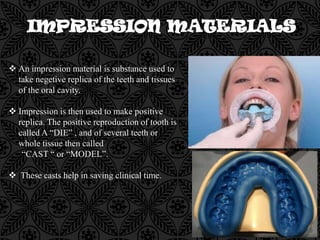
 An impression material is substance used to
take negetive replica of the teeth and tissues
of the oral cavity.
 Impression is then used to make positive
replica. The positive reproduction of tooth is
called A “DIE” , and of several teeth or
whole tissue then called
“CAST “ or “MODEL”.
 These casts help in saving clinical time.
Desireable Properties Of an
Impression Material
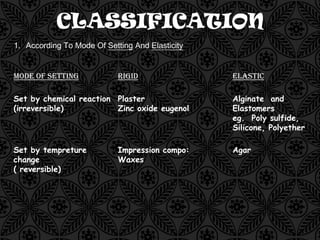
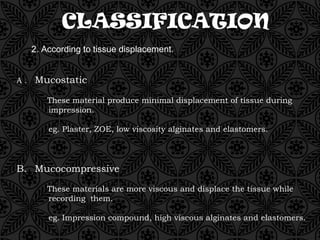
 Initially it must posses soft gel state to flow in undercuts easily to record them.
 Possess elastic nature to avoid distortion during removal.
 Possess sufficient
working time and
setting time.
 Must be dimensionally stable.
 Should posses retention property
 Must be non-toxic, non-irritant, non-allergic .
 Have pleasant taste and odor.
 Economical.
 Capable of being decontaminate.
CLASSIFICATION
 There are several ways of classifying impression materials.
1. According to mode of setting and elasticity.
2. According to tissue displacement.
3. According to their use in dentistry.
CLASSIFICATION
1. According To Mode Of Setting And Elasticity
Mode of setting Rigid Elastic
Set by chemical reaction
(irreversible)
Plaster
Zinc oxide eugenol
Alginate and
Elastomers
eg. Poly sulfide,
Silicone, Polyether
Set by tempreture
change
( reversible)
Impression compo:
Waxes
Agar
CLASSIFICATION
2. According to tissue displacement.
A . Mucostatic
These material produce minimal displacement of tissue during
impression.
eg. Plaster, ZOE, low viscosity alginates and elastomers.
B. Mucocompressive
These materials are more viscous and displace the tissue while
recording them.
eg. Impression compound, high viscous alginates and elastomers.
CLASSIFICATION
3. According to their use in dentistry
A. Used for Complete Denture Prosthesis
Plaster , Impression compound and Impression paste set to rigid mass and hence
cannot be removed from undercuts without distortion.
Therefore these are used for Edentulous patients.
B. Used for Dentulous patients
Alginates and Rubber base Impressions are elastic and suitable for impressions
of Dentulous mouths.
Classes Of
Impression Materials
There are 2 classes :
1. Elastic
2. Non-Elastic or Rigid
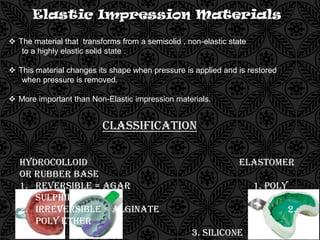
Elastic Impression Materials
 The material that transforms from a semisolid , non-elastic state
to a highly elastic solid state .
 This material changes its shape when pressure is applied and is restored
when pressure is removed.
 More important than Non-Elastic impression materials.
Classification
Hydrocolloid Elastomer
Or Rubber Base
1. Reversible = Agar 1. Poly
Sulphide
2. Irreversible = Alginate 2.
Poly Ether
3. Silicone
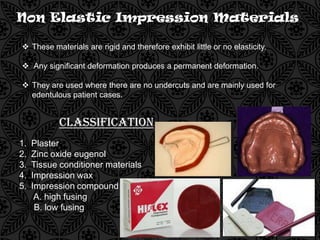
Non Elastic Impression Materials
 These materials are rigid and therefore exhibit little or no elasticity.
 Any significant deformation produces a permanent deformation.
 They are used where there are no undercuts and are mainly used for
edentulous patient cases.
Classification
1. Plaster
2. Zinc oxide eugenol
3. Tissue conditioner materials
4. Impression wax
5. Impression compound
A. high fusing
B. low fusing
Impression materials

Impression materials

  • 1.
  • 2.
     An impressionmaterial is substance used to take negetive replica of the teeth and tissues of the oral cavity.  Impression is then used to make positive replica. The positive reproduction of tooth is called A “DIE” , and of several teeth or whole tissue then called “CAST “ or “MODEL”.  These casts help in saving clinical time.
  • 4.
    Desireable Properties Ofan Impression Material  Initially it must posses soft gel state to flow in undercuts easily to record them.  Possess elastic nature to avoid distortion during removal.  Possess sufficient working time and setting time.  Must be dimensionally stable.  Should posses retention property  Must be non-toxic, non-irritant, non-allergic .  Have pleasant taste and odor.  Economical.  Capable of being decontaminate.
  • 5.
    CLASSIFICATION  There areseveral ways of classifying impression materials. 1. According to mode of setting and elasticity. 2. According to tissue displacement. 3. According to their use in dentistry.
  • 6.
    CLASSIFICATION 1. According ToMode Of Setting And Elasticity Mode of setting Rigid Elastic Set by chemical reaction (irreversible) Plaster Zinc oxide eugenol Alginate and Elastomers eg. Poly sulfide, Silicone, Polyether Set by tempreture change ( reversible) Impression compo: Waxes Agar
  • 7.
    CLASSIFICATION 2. According totissue displacement. A . Mucostatic These material produce minimal displacement of tissue during impression. eg. Plaster, ZOE, low viscosity alginates and elastomers. B. Mucocompressive These materials are more viscous and displace the tissue while recording them. eg. Impression compound, high viscous alginates and elastomers.
  • 8.
    CLASSIFICATION 3. According totheir use in dentistry A. Used for Complete Denture Prosthesis Plaster , Impression compound and Impression paste set to rigid mass and hence cannot be removed from undercuts without distortion. Therefore these are used for Edentulous patients. B. Used for Dentulous patients Alginates and Rubber base Impressions are elastic and suitable for impressions of Dentulous mouths.
  • 9.
    Classes Of Impression Materials Thereare 2 classes : 1. Elastic 2. Non-Elastic or Rigid
  • 10.
    Elastic Impression Materials The material that transforms from a semisolid , non-elastic state to a highly elastic solid state .  This material changes its shape when pressure is applied and is restored when pressure is removed.  More important than Non-Elastic impression materials. Classification Hydrocolloid Elastomer Or Rubber Base 1. Reversible = Agar 1. Poly Sulphide 2. Irreversible = Alginate 2. Poly Ether 3. Silicone
  • 11.
    Non Elastic ImpressionMaterials  These materials are rigid and therefore exhibit little or no elasticity.  Any significant deformation produces a permanent deformation.  They are used where there are no undercuts and are mainly used for edentulous patient cases. Classification 1. Plaster 2. Zinc oxide eugenol 3. Tissue conditioner materials 4. Impression wax 5. Impression compound A. high fusing B. low fusing