Effective Instruction for
English Language Learners
Effective Instruction for
English Language Learners
AgendaAgenda
•Dialogue•Dialogue
Demonstration
Application
•By the end of the session you will have
more:
•knowledge about the unique needs of
ELL’s
•strategies to implement this fall
•confidence to plan and modify lessons for
ELL’s
•enthusiasm for teaching ELL’s
• Dialogue:
• What do you know about English Language
Learners?
• Your own experiences
• or What you’ve learned
•“exploding demographics”
•(Flores, 1994)
•home language/school
language
•time required to learn
English
•instructional resources
•classroom segregation
•teacher capacity
Issues
•“English learners are
best served when their
teachers provide
instruction-including
corrective feedback--
when it is needed.”
• Source: (Scarcella, 2004, p. 53)
Instruction!
•“The most powerful way
of learning academic
English is through good
instruction.”
• Source: (Scarcella, 2004, p. 53)
Big IdeasBig Ideas
•Increase academic vocabulary:
multiple encounters with words.
•Increase academic vocabulary:
multiple encounters with words.
Oral language development:
lots of dialogue
Automaticity with sight words
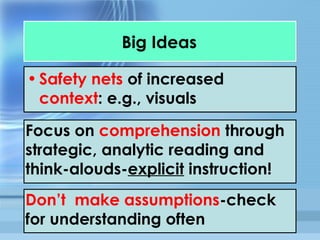
Big IdeasBig Ideas
•Safety nets of increased
context: e.g., visuals
•Safety nets of increased
context: e.g., visuals
Focus on comprehension through
strategic, analytic reading and
think-alouds-explicit instruction!
Don’t make assumptions-check
for understanding often
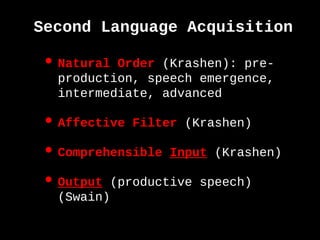
•Natural Order (Krashen): pre-
production, speech emergence,
intermediate, advanced
•Affective Filter (Krashen)
•Comprehensible Input (Krashen)
•Output (productive speech)
(Swain)
Second Language Acquisition
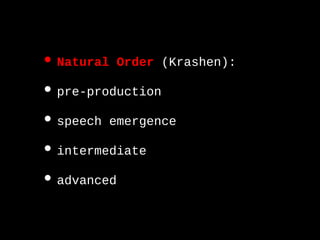
•Natural Order (Krashen):
•pre-production
•speech emergence
•intermediate
•advanced
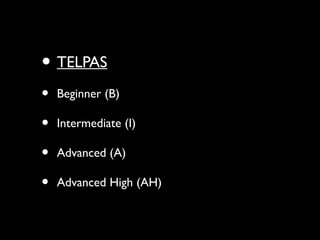
• TELPAS
• Beginner (B)
• Intermediate (I)
• Advanced (A)
• Advanced High (AH)
•Linguistic Transfer from L1
•Prior knowledge/declarative
knowledge
•Strategic/procedural knowledge
•Motivation to learn English
•Cultural and linguistic
resources
•“Funds of Knowledge”
What ELL’s Bring:
•Vocabulary/Academic English
• English Grammar
•Increased CONTEXT
What ELL’s need:
• Modifications:
• VOCABULARY focus
• Visuals/video/multimedia
• Hands-on
• Real Objects
• Preview-TEACH-Review
• Small group/partner work
• “Unstructured and
unplanned grammar
instruction is a
disaster for ELL’s.” (p.
100)
• No on-the-fly
instruction!
• Source: (Scarcella, 2003)
•http://www.learner.org/resour
•Clip: 17:00-23:00
Annenberg Video
•Thoughts?
•Shared reading component
•Singing
•Poetry/chart stories
•Routines
More on oral language development
•<Word Study>
•Automaticity
•Word lists
•250 words
•Source: Bear, D. R., Helman, L., Templeton, S., Invernizzi, M., & Johnston,
F. (2007). Words their way with English learners: Word Study for Phonics,
Vocabulary, and Spelling Instruction. Columbus, OH: Merrill/Prentice Hall.
Sight Words
• 100 most common words=
• 50% of words in a text
• Source: (Nation, 2005)
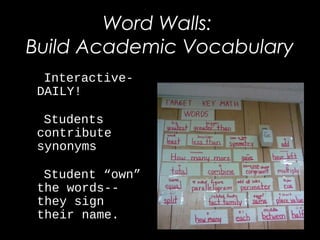
•Interactive-
DAILY!
•Students
contribute
synonyms
•Student “own”
the words--
they sign
their name.
Word Walls:
Build Academic Vocabulary
•Word Walls
•Visual Scaffolding
•<Sheltered English>
•What is Sheltered
English?
•Content learning +
language learning
•Importance of schema
building: front-loading
•Pre-reading activities
Shared ReadingShared Reading
•Advantages of shared reading
•Active reading and engaging
texts.
•Thinking aloud to make
meaning explicit.
•Advantages of shared reading
•Active reading and engaging
texts.
•Thinking aloud to make
meaning explicit.
Application
Consider a classroom reading book you recently
used.What vocabulary or concepts were
presented in the book that could cause
confusion for ELL Learners?
What could you do to scaffold the reading
experience that would benefit ELL learners?
1.What might this look like in your
classroom?
Turn and Talk

English languagelearners1