




Liability Implications of
Direct-to-Consumer Genetic Testing
Gary Marchant, Ph.D., J.D.
2019 Petrie-Flom Center Annual Conference on
Consuming Genetics:
Ethical and Legal Considerations of New Technologies
May 17, 2019
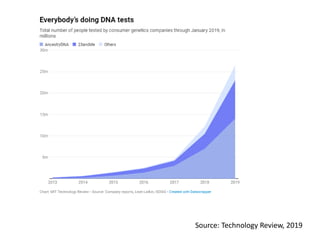
DTC Genetic Testing:
Lots of Testing,
….. And Lots of Errors
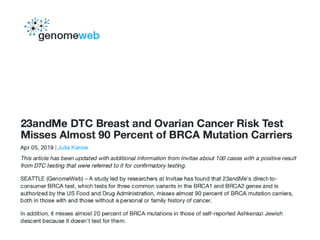
Source: Technology Review, 2019
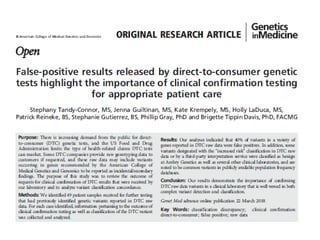
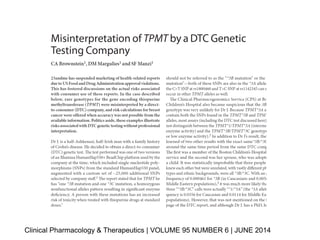
Clinical Pharmacology & Therapeutics | VOLUME 95 NUMBER 6 | JUNE 2014
Liability?
Potential DTC Genetic Testing
Injuries That Could Create Liability
 Patient falsely tests positive for BRCA variant,
undergoes unnecessary prophylactic surgery
 Patient with family history of colon cancer falsely
tests negative for colon cancer variant; patient
reassured and takes no further action, develops
colon cancer 3 years later
 Patient receives erroneous results on warfarin
sensitivity; given wrong dose based on incorrect
DTC info, suffers serious bleeding or stroke
event
Two Liability Scenarios
1. DTC Company liable for erroneous
genetic test results
2. Personal physician of DTC customer
liable for mishandling genetic test
results
DTC Company
What is a DTC Genetic Testing
Company?
 Laboratory (non-provider)?
• Negligence
 Laboratory (health care provider)?
• Medical malpractice
 Product?
• Products liability
Restriction on Suing DTC
Company: Disclaimer (23andMe)
 “…this information is intended for informational
purposes only and for discussion with your physician
or other healthcare provider. As explained on our
website, 23andMe believes that (a) genetics is only part of
the picture of any individual's state of being, (b) the state
of the understanding of Genetic Information is rapidly
evolving and at any given time we only comprehend part of
the picture of the role of genetics, and (c) only a trained
physician or other health care provider can assess
your current state of health or disease, taking into
account many factors, including in some cases your
genetics as well as your current symptoms, if any.
Reliance on any information provided by 23andMe,
23andMe employees, others appearing on our website at
the invitation of 23andMe, or other visitors to our website
is solely at your own risk.”
Restriction on Suing DTC
Company: Arbitration (23andMe)
 “any disputes with 23andMe arising out of or relating to the
Agreement ("Disputes") shall be governed by California
law regardless of your country of origin or where you access
23andMe …. Any Disputes shall be resolved by final and
binding arbitration under the rules and auspices of the
American Arbitration Association, to be held in San Francisco,
California, in English, with a written decision stating legal
reasoning issued by the arbitrator(s) at either party's request,
and with arbitration costs and reasonable documented
attorneys' costs of both parties to be borne by the party that
ultimately loses.”
“Background: Customers of genetic testing service provider brought
putative class action against provider, asserting claims for unfair
business practices, breach of warranty, and misrepresentations about
the health benefits of provider's services.” N.D. Cal. “granted provider's
motion to compel arbitration pursuant to arbitration provision in provider's
terms of service agreement. Customers appealed.” Holdings:
“1 prevailing party clause in arbitration provision was not
substantively unconscionable;
2 forum selection clause in arbitration provision was not substantively
unconscionable;
3 arbitration provision's exemption for intellectual property disputes
was not substantively unconscionable;
4 provision establishing one-year limitations period did not render
arbitration provision unconscionable; and
5 unilateral modification provision did not render arbitration provision
unconscionable.
Affirmed.”
Physicians
Damned if You Don’t …
 Some physicians will apparently refuse to consider
a patient’s DTC genetic test results
 Not an unreasonable position
 clinical relevance of data is questionable
 most physicians lack expertise to evaluate genetic results
 no reimbursement for reviewing results
 But – if DTC records show significant actionable
genetic risk, physician could potentially be sued for
refusing to consider
Damned if You Do … (Part 1)
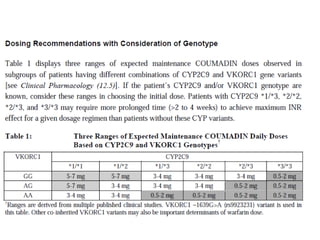
 Stroke patient is prescribed warfarin
 Patient shows physician DTC test results showing
variant suggesting much lower starting dose of
warfarin
 Insurer won’t pay for restesting of patient; doctor
doesn’t want to wait days for confirmatory
testing, so starts patient on lower dose
 Patient has stroke; turns out patient doesn’t have
the variant reported by DTC lab
Damned if You Do …
 Patient doesn’t meet current guidelines for BRCA
testing; gets DTC testing and finds out she has a
BRCA mutation
 Patient’s physician recommends retesting, but
patient’s insurer still won’t cover it, and patient
cannot afford to pay for retest
 Should physician assume that patient has BRCA
gene and recommend prophylactic surgery?
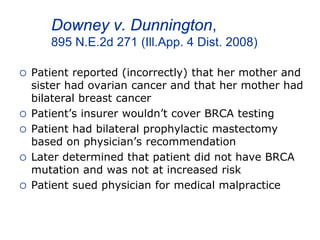
Downey v. Dunnington,
895 N.E.2d 271 (Ill.App. 4 Dist. 2008)
 Patient reported (incorrectly) that her mother and
sister had ovarian cancer and that her mother had
bilateral breast cancer
 Patient’s insurer wouldn’t cover BRCA testing
 Patient had bilateral prophylactic mastectomy
based on physician’s recommendation
 Later determined that patient did not have BRCA
mutation and was not at increased risk
 Patient sued physician for medical malpractice
Acknowledgements
 Co-authors:
 Mark Barnes, JD, LLM, Ropes & Gray LLP
 Ellen Wright Clayton, MD, JD, Vanderbilt
University Health Center
 Susan M. Wolf, JD, U. of Minnesota
 Funding:
 Funding for this work was provided by
NIH/NHGRI/NCI grant #1R01HG008605 on
“LawSeqSM: Building a Sound Legal
Foundation for Translation Genomics into
Clinical Application” (Wolf, Clayton, Lawrenz,
PIs). All views are those of the authors.

Gary Marchant, "Liability Implications of Direct-to-Consumer Genetic Testing"

  • 1.
    Liability Implications of Direct-to-ConsumerGenetic Testing Gary Marchant, Ph.D., J.D. 2019 Petrie-Flom Center Annual Conference on Consuming Genetics: Ethical and Legal Considerations of New Technologies May 17, 2019
  • 2.
    DTC Genetic Testing: Lotsof Testing, ….. And Lots of Errors
  • 3.
  • 6.
    Clinical Pharmacology &Therapeutics | VOLUME 95 NUMBER 6 | JUNE 2014
  • 7.
  • 8.
    Potential DTC GeneticTesting Injuries That Could Create Liability  Patient falsely tests positive for BRCA variant, undergoes unnecessary prophylactic surgery  Patient with family history of colon cancer falsely tests negative for colon cancer variant; patient reassured and takes no further action, develops colon cancer 3 years later  Patient receives erroneous results on warfarin sensitivity; given wrong dose based on incorrect DTC info, suffers serious bleeding or stroke event
  • 9.
    Two Liability Scenarios 1.DTC Company liable for erroneous genetic test results 2. Personal physician of DTC customer liable for mishandling genetic test results
  • 10.
  • 11.
    What is aDTC Genetic Testing Company?  Laboratory (non-provider)? • Negligence  Laboratory (health care provider)? • Medical malpractice  Product? • Products liability
  • 12.
    Restriction on SuingDTC Company: Disclaimer (23andMe)  “…this information is intended for informational purposes only and for discussion with your physician or other healthcare provider. As explained on our website, 23andMe believes that (a) genetics is only part of the picture of any individual's state of being, (b) the state of the understanding of Genetic Information is rapidly evolving and at any given time we only comprehend part of the picture of the role of genetics, and (c) only a trained physician or other health care provider can assess your current state of health or disease, taking into account many factors, including in some cases your genetics as well as your current symptoms, if any. Reliance on any information provided by 23andMe, 23andMe employees, others appearing on our website at the invitation of 23andMe, or other visitors to our website is solely at your own risk.”
  • 13.
    Restriction on SuingDTC Company: Arbitration (23andMe)  “any disputes with 23andMe arising out of or relating to the Agreement ("Disputes") shall be governed by California law regardless of your country of origin or where you access 23andMe …. Any Disputes shall be resolved by final and binding arbitration under the rules and auspices of the American Arbitration Association, to be held in San Francisco, California, in English, with a written decision stating legal reasoning issued by the arbitrator(s) at either party's request, and with arbitration costs and reasonable documented attorneys' costs of both parties to be borne by the party that ultimately loses.”
  • 14.
    “Background: Customers ofgenetic testing service provider brought putative class action against provider, asserting claims for unfair business practices, breach of warranty, and misrepresentations about the health benefits of provider's services.” N.D. Cal. “granted provider's motion to compel arbitration pursuant to arbitration provision in provider's terms of service agreement. Customers appealed.” Holdings: “1 prevailing party clause in arbitration provision was not substantively unconscionable; 2 forum selection clause in arbitration provision was not substantively unconscionable; 3 arbitration provision's exemption for intellectual property disputes was not substantively unconscionable; 4 provision establishing one-year limitations period did not render arbitration provision unconscionable; and 5 unilateral modification provision did not render arbitration provision unconscionable. Affirmed.”
  • 15.
  • 16.
    Damned if YouDon’t …  Some physicians will apparently refuse to consider a patient’s DTC genetic test results  Not an unreasonable position  clinical relevance of data is questionable  most physicians lack expertise to evaluate genetic results  no reimbursement for reviewing results  But – if DTC records show significant actionable genetic risk, physician could potentially be sued for refusing to consider
  • 17.
    Damned if YouDo … (Part 1)  Stroke patient is prescribed warfarin  Patient shows physician DTC test results showing variant suggesting much lower starting dose of warfarin  Insurer won’t pay for restesting of patient; doctor doesn’t want to wait days for confirmatory testing, so starts patient on lower dose  Patient has stroke; turns out patient doesn’t have the variant reported by DTC lab
  • 19.
    Damned if YouDo …  Patient doesn’t meet current guidelines for BRCA testing; gets DTC testing and finds out she has a BRCA mutation  Patient’s physician recommends retesting, but patient’s insurer still won’t cover it, and patient cannot afford to pay for retest  Should physician assume that patient has BRCA gene and recommend prophylactic surgery?
  • 20.
    Downey v. Dunnington, 895N.E.2d 271 (Ill.App. 4 Dist. 2008)  Patient reported (incorrectly) that her mother and sister had ovarian cancer and that her mother had bilateral breast cancer  Patient’s insurer wouldn’t cover BRCA testing  Patient had bilateral prophylactic mastectomy based on physician’s recommendation  Later determined that patient did not have BRCA mutation and was not at increased risk  Patient sued physician for medical malpractice
  • 21.
    Acknowledgements  Co-authors:  MarkBarnes, JD, LLM, Ropes & Gray LLP  Ellen Wright Clayton, MD, JD, Vanderbilt University Health Center  Susan M. Wolf, JD, U. of Minnesota  Funding:  Funding for this work was provided by NIH/NHGRI/NCI grant #1R01HG008605 on “LawSeqSM: Building a Sound Legal Foundation for Translation Genomics into Clinical Application” (Wolf, Clayton, Lawrenz, PIs). All views are those of the authors.